, to see if you have full access to this publication.
Monograph No access
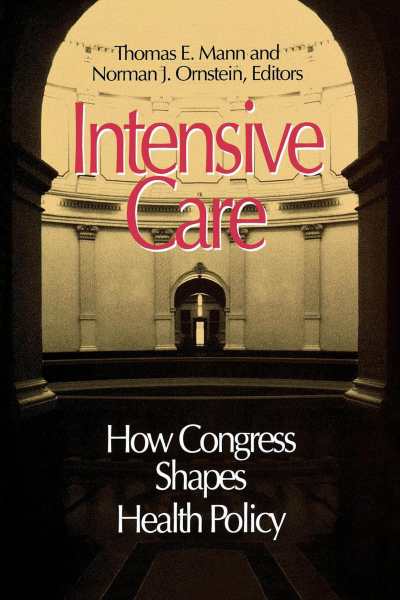
Intensive Care
How Congress Shapes Health Policy
Authors:
|
Publisher:
2011
Summary
The devastating and politically consequential defeat of President Clinton's comprehensive health plan in Congress has unleashed a torrent of speculation over "who or what killed reform." One class of explanation deals with the institutional arrangements by which policy is made in the United States and, more specifically, with the rules and organization of Congress. This volume weighs the importance of Congress in the failure to enact health reform by examining more broadly how Congress shapes health policyon matters ranging from ambitious plans to achieve universal health insurance coverage to annual appropriations for public health agencies.
Part One examines how Congress has organized and equipped itself to make health policy. Individual chapters consider how committee jurisdictions, budgeting procedures, information, and oversight influence health policymaking. Part Two uses recent health policy episodesthe 1988-89 adoption and repeal of Medicare catastrophic coverage and the 1993-94 failure to pass national health reformto generalize about how process shapes policy.
This book is a product of the Renewing Congress Project, a joint undertaking of the Brookings Institution and the American Enterprise Institute. The contributors include C. Lawrence Evans, College of William and Mary; Mark Nadel, General Accounting Office; Julie Rovner, freelance health policy writer; and Allen Schick and Joseph White, Brookings.
Copublished with the American Enterprise Institute
Search publication
Bibliographic data
Edition
1/2011
Copyright Year
2011
ISBN-Print
978-0-8157-5463-3
ISBN-Online
978-0-8157-1667-9
Publisher
Rowman & Littlefield, Lanham
Language
English
Pages
316
Product Type
Monograph
Table of contents
ChapterPages
Contents No access
Congressional Structures and Processes No access
Health Policymaking No access
Improving Congressional Performance No access
Importance of Jurisdiction No access
Who Has Health? No access
Implications No access
Conclusion No access
The Congressional Budget Process(es) No access
Deficit Reduction and Health Entitlement Policymaking No access
Budgeting for AIDS Treatment and Research No access
Health Care Reform, 1993–94 No access
The Future No access
Coping with Uncertainty No access
Availability of Information No access
Information Use in Congress No access
Explaining the Use of Policy-Analytic Information in Congress No access
Congress and Information, with Thoughts on the 104th No access
The Changing Nature of Oversight No access
Techniques of Oversight No access
Setting the Oversight Agenda No access
Changing the Agenda: How the Parties Differ No access
Is Oversight Systematic? No access
How Effective Is Health Policy Oversight? No access
About Medicare No access
Why Catastrophic? No access
The Road to Passage No access
House Action No access
Senate Action No access
House-Senate Conference No access
The Backlash No access
Implications for Health Reform No access
Prologue No access
Development of the Clinton Plan No access
Autumn 1993: Handing the Ball Off to Congress No access
The Battle Engaged No access
Committee Action No access
Leadership Attempts to Reconcile No access
Floor Action No access
The End No access
Conclusions No access
The President's Agenda No access
(Mis)Reading Public Opinion No access
Fractured Interests No access
In Congress Disassembled No access
Parties in Conflict No access
Committee Breakdown No access
Leaders as Followers No access
What Congress Learned About Itself No access
Notes No access Pages 273 - 304
A No access
B No access
C No access
D No access
E No access
F No access
G No access
H No access
I No access
J No access
K No access
L No access
M No access
N No access
O No access
P No access
R No access
S No access
T No access
V No access
W No access
Y No access
Z No access
Similar publications
from the topics "Gesundheit und Medizin allgemein"