, to see if you have full access to this publication.
Monograph No access
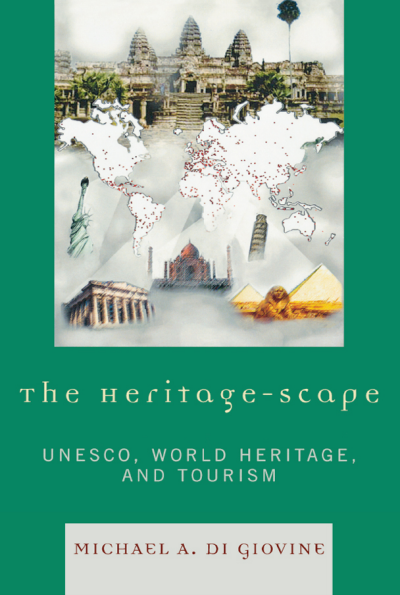
The Heritage-Scape
UNESCO, World Heritage, and Tourism
Authors:
Publisher:
2008
Summary
Tourism today is recognized as the largest and fastest-growing industry in the world, capable of producing positive social and economic transformations especially in developing countries. Yet for UNESCO, it works in conjunction with World Heritage sites for a far more ambitious goal: to produce 'peace in the minds of men' by creating a new, global identity. Anthropologist and former tour operator Michael Di Giovine draws on ethnographic fieldwork, close policy analysis of UNESCO's major documents, and professional experiences in Southeast Asia and Europe to provide a detailed examination of UNESCO's unusual effort to harness the phenomenon of globalization and the existence of cultural diversity for the purpose of creating 'peace in the minds of men' through its World Heritage program. He convincingly argues that UNESCO's designations are not impotent political performances that lead to the commercialization of local monuments for a touristic superstructure, but instead the building blocks of a new world system, an imaginative re-ordering of the world that knows no geopolitical boundaries but exists in the individual 'minds of men.' Di Giovine terms this system the heritage-scape, a real social structure that extends unbridled across the globe, spreading its mantra of 'unity in diversity.' Written for social scientists, heritage and tourism professionals, and the educated traveler, The Heritage-scape is an insightful, detailed, and expansive look at the politics and processes, histories and structures, and rituals and symbolisms of the interrelated phenomena of tourism, historic preservation, and UNESCO's World Heritage Program in Viet Nam, Cambodia, and across the world.
Keywords
Search publication
Bibliographic data
Edition
1/2008
Copyright Year
2008
ISBN-Print
978-0-7391-1434-6
ISBN-Online
978-1-4616-6266-2
Publisher
Lexington, Lanham
Language
English
Pages
519
Product Type
Monograph
Table of contents
ChapterPages
Table of Contents No access
Introduction: Traveling Across Stones that Speak No access Pages 1 - 24
Chapter One: Mediating World Heritage: Authenticity and Fields of Production in Tourism and Heritage No access Pages 25 - 68
Chapter Two: The Heritage-scape: UNESCO's Globalizing Endeavor No access Pages 69 - 118
Chapter Three: Unity in Diversity: The Heritage-scape's Meta-Narrative Claim No access Pages 119 - 144
Chapter Four: Tourism: The Heritage-scape's Ritual Interaction No access Pages 145 - 186
Chapter Five: Converting Localities into Universal Heritage No access Pages 187 - 214
Chapter Six: Politics and Personalities Within the Heritage-scape: Narratives of Nature and Culture in Vietnam No access Pages 215 - 260
Chapter Seven: Museumification of Local Cultures: Hạ Long Bay and Hội An No access Pages 261 - 274
Chapter Eight: Creating the Drama of the Destination: Managing, Interpreting and Branding World Heritage Sites No access Pages 275 - 300
Chapter Nine: Preserving the Past: The Heritage-scape and Historic Preservation No access Pages 301 - 340
Chapter Ten: Problematics of Preservation: Narrative and Practice at the Angkor Archaeological Park No access Pages 341 - 366
Chapter Eleven: Raising Awareness, Re-Presenting the Heritage-scape: Fragmentary and Reproducible Re-Presentations No access Pages 367 - 398
Conclusion: The Future of the Heritage-scape No access Pages 399 - 430