, to see if you have full access to this publication.
Monograph No access
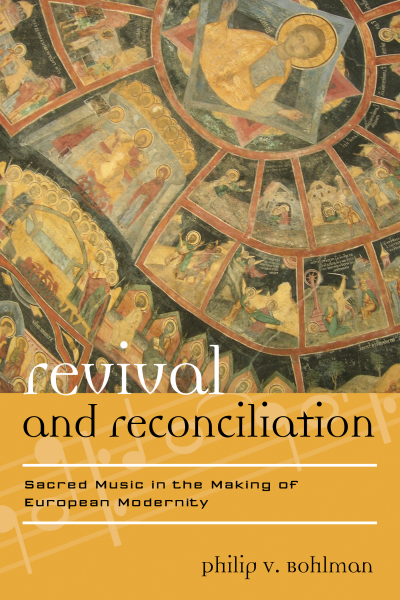
Revival and Reconciliation
Sacred Music in the Making of European Modernity
Authors:
Publisher:
2013
Summary
Sacred music has long contributed fundamentally to the making of Europe. The passage from origin myths to history, the sacred journeys that have mobilized pilgrims, crusaders, and colonizers, the politics and power sounded by the vox populi—all have joined in counterpoint to shape Europe’s historical longue durée. Drawing upon three decades of research in European sacred music, Philip V. Bohlman calls for a re-examination of European modernity in the twenty first century, a modernity shaped no less by canonic religious and musical practices than by the proliferation of belief systems that today more than ever respond to the diverse belief systems that engender the New Europe. In contrast to most studies of sacred musical practice in European history, with their emphasis on the musical repertories and ecclesiastical practices at the center of society, Bohlman turns our attention to individual and marginalized communities and to the collectives of believers to whose lives meaning accrues upon sounding the sacred together.
In the historical chapters that open Revival and Reconciliation, Bohlman examines the genesis of modern history in the convergence and conflict the lie at the heart of the Abrahamic faiths—Judaism, Christianity, and Islam. Critical to the meaning of these religions to Europe, Bohlman argues, has been their capacity to mobilize both sacred journey and social action, which enter the everyday lives of Europeans through folk religion, pilgrimage, and politics, the subjects of the second half of his study. The closing sections then cross the threshold from history into modernity, above all that of the New Europe, with its return to religion through revival and reconciliation. Based on an extensive ethnographic engagement with the sacred landscapes and sites of conflict in twenty-first-century Europe, Bohlman calls in his final chapters for new ways of hearing the silenced voices and the full chorus of sacred music in our contemporary world.
Ethnomusicologists from different traditions as well as scholars of religious studies and the history of modern Europe will find Revival and Reconciliation a fascinating exploration of the connections between sacred music and the role it plays in the formations of the modern self.
Search publication
Bibliographic data
Edition
1/2013
Copyright Year
2013
ISBN-Print
978-0-8108-8183-9
ISBN-Online
978-0-8108-8269-0
Publisher
Rowman & Littlefield, Lanham
Language
English
Pages
288
Product Type
Monograph
Table of contents
ChapterPages
Contents No access
List of Illustrations No access
Sources No access
Note on Translation, Transliteration, and Transcription No access
Foreword No access
Prologue: Themes and Variations in the Sacred Music of Europe No access
Acknowledgments No access
Chapter 1. Past, Present, and the People without Music History No access
Chapter 2. Rediscovering the Mediterranean, Recovering Modernity No access
Chapter 3. And She Sang a New Song No access
Chapter 4. Pilgrim’s Progress No access
Chapter 5. The Final Borderpost No access
Chapter 6. The People’s Voice in Sacred Song No access
Chapter 7. To Hear the Voices Still Heard No access
Chapter 8. Sacred Popular Music and the Journey to Jerusalem No access
Chapter 9. Music of the Other Germany No access
Chapter 10. World Music at the End of History No access