, to see if you have full access to this publication.
Monograph No access
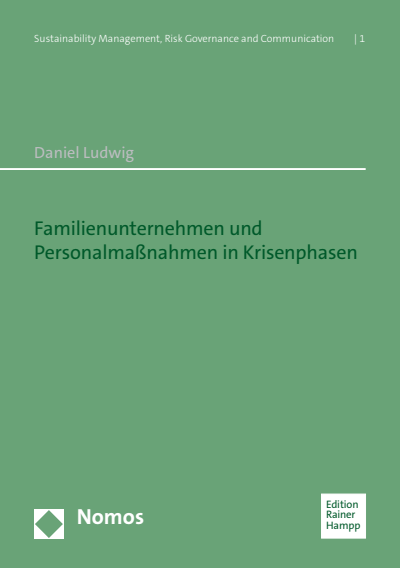
Familienunternehmen und Personalmaßnahmen in Krisenphasen
- Authors:
- Series:
- Sustainability Management, Risk Governance and Communication, Volume 1
- Publisher:
- 2021
Keywords
Search publication
Bibliographic data
- Edition
- 1/2021
- Copyright Year
- 2021
- ISBN-Print
- 978-3-98542-015-5
- ISBN-Online
- 978-3-95710-388-8
- Publisher
- Hampp, Baden-Baden
- Series
- Sustainability Management, Risk Governance and Communication
- Volume
- 1
- Language
- German
- Pages
- 253
- Product Type
- Monograph
Table of contents
ChapterPages
- Titelei/Inhaltsverzeichnis No access Pages 1 - 16
- 1.1 Ausgangslage und Problemstellung No access
- 1.2 Forschungsfragen und Zielsetzung No access
- 1.3 Vorgehensweise und Aufbau No access
- 2.1.1 Familienunternehmen No access
- 2.1.2 Mittelstand No access
- 2.1.3 Arbeitsdefinition No access
- 2.1.4 Volkswirtschaftliche Bedeutung No access
- 2.2.1 Krisenbegriff, -verläufe und krisenähnliche Phasen No access
- 2.2.2.1 Endogene und häufig auftretende Ursachen No access
- 2.2.2.2 Exogene Ursachen am Beispiel der Finanz- und Wirtschaftskrise No access
- 2.2.2.3 Übersicht Krisenwirkungen No access
- 2.2.2.4 Zusammenfassung, Krisenindikatoren und Arbeitsdefinition No access
- 2.2.3.1 Perspektiven des Krisenmanagements No access
- 2.2.3.2 Zusammenfassung und Einordnung Personalmaßnahmen No access
- 2.3.1 Einführung in den Sachverhalt und erste Begriffsbestimmungen No access
- 2.3.2 Personalabbau im engeren Sinne und Downsizing No access
- 2.3.3 Systematisierungen zum Personalabbau – im engeren und weiteren Sinne No access
- 2.3.4 Übersicht gesetzliche Bestimmungen No access
- 2.3.5 Zusammenfassung und Arbeitsdefinition No access
- 3.1 Einführung zur Vorgehensweise No access
- 3.2 Durchführung einer systematischen Literaturübersicht No access
- 3.3.1 Wachstum und Marktchancen/-risiken No access
- 3.3.2 Nichtfinanzielle und finanzielle Performance No access
- 3.3.3 Resilience und Survival No access
- 3.3.4 Zwischenfazit No access
- 3.4.1 Arbeitskonflikte und -bedingungen No access
- 3.4.2 Krisenmanagement und Reaktionsmuster – Qualitativ No access
- 3.4.3 Downsizing, implizite Verträge und Personalabbau – Quantitativ No access
- 3.4.4 Personalmaßnahmen und Performance No access
- 3.4.5 Fazit No access
- 3.5 Diskussion zum Stand der Forschung No access
- 4.1 Theorien in der Familienunternehmensforschung No access
- 4.2 Socioemotional Wealth als Erklärungsansatz No access
- 4.3 Kritische Zusammenfassung No access
- 4.4.1 Sozioemotionale Werte, Personal und Krisenphasen No access
- 4.4.2 Sozioemotionale Werte und Krisenphasen No access
- 4.4.3 Sozioemotionale Werte, Krisenphasen und weitere Zielsetzungen No access
- 4.5 Bezugsrahmen, Einflussfaktoren und Forschungsmodell No access
- 5.1 Einführung zur Vorgehensweise No access
- 5.2.1 IAB-Betriebspanel und Aufbereitung des Paneldatensatzes No access
- 5.2.2 Samples: Ebenen, Größenklassen und Krisenindikatoren No access
- 5.3.1 Abhängige Variablen No access
- 5.3.2 Interessierende unabhängige Variable No access
- 5.4.1 Propensity Score Matching No access
- 5.4.2 Kovariaten und Variablenübersicht No access
- 5.5.1 Regressionsverfahren und Bildung von Interaktionen No access
- 5.5.2 Unabhängige Variablen und Variablenübersicht No access
- 6.1.1 Personalabbau im engeren Sinne No access
- 6.1.2 Personalabbau im weiteren Sinne No access
- 6.1.3 Personalabgänge Gesamt No access
- 6.1.4 Stamm- und Randbelegschaft No access
- 6.2.1 Personalabbau im engeren Sinne No access
- 6.2.2 Personalabbau im weiteren Sinne No access
- 6.2.3 Personalabgänge Gesamt No access
- 6.2.4 Downsizing No access
- 6.3 Diskussion der Ergebnisse No access
- 7.1 Zusammenfassung No access
- 7.2 Implikationen No access
- 7.3 Limitationen No access
- 7.4 Weiterführende Forschung No access
- Anhang 1 No access
- Anhang 2 No access
- Anhang 3 No access
- Anhang 4 No access
- Anhang 5 No access
- Literaturverzeichnis No access Pages 231 - 253
Bibliography (396 entries)
No match found. Try another term.
- Abe, N. und Shimizutani, S. (2007): Employment Policy and Corporate Governance: An Empirical Comparison of the Stakeholder and the Profit-Maximization Model, in: Journal of Comparative Economics, 35(2), 346 – 368. Open Google Scholar DOI: 10.5771/9783957103888
- Alakent, E. und Lee, S.-H. (2010): Do Institutionalized Traditions Matter During Crisis? Employee Downsizing in Korean Manufacturing Organizations, in: Journal of Management Studies, 47(3), 509 – 532. Open Google Scholar DOI: 10.5771/9783957103888
- Albert, S. und Whetten, D. A. (1985): Organizational Identity, in: Staw, B. M. und Cummings, L. L. (Hrsg.): Research in Organizational Behavior, 7. Aufl., Greenwich: JAI Press, 263 – 295. Open Google Scholar DOI: 10.5771/9783957103888
- Allen, F. und Carletti, E. (2010): An Overview of the Crisis: Causes, Consequences, and Solutions, in: International Review of Finance, 10(1), 1 – 26. Open Google Scholar DOI: 10.5771/9783957103888
- Amann, B. und Jaussaud, J. (2012): Family and Non-Family Business Resilience in an Economic Downturn, in: Asia Pacific Business Review, 18(2), 203 – 223. Open Google Scholar DOI: 10.5771/9783957103888
- Anderson, A. R., Jack, S. L. und Drakopoulou Dodd, S. (2005): The Role of Family Members in Entrepreneurial Networks. Beyond the Boundaries of the Family Firm, in: Family Business Review, 18(2), 135 – 154. Open Google Scholar DOI: 10.5771/9783957103888
- Anderson, R. C. und Reeb, D. M. (2003): Founding-Family Ownership and Firm Performance. Evidence from the S&P 500, in: The Journal of Finance, 58(3), 1301 – 1328. Open Google Scholar DOI: 10.5771/9783957103888
- Anderson, R. C. und Reeb, D. M. (2004): Board Composition: Balancing Family Influence in S&P 500 Firms, in: Administrative Science Quarterly, 49(2), 209 – 237. Open Google Scholar DOI: 10.5771/9783957103888
- Andrzejewski, L. und Refisch, H. (2015): Trennungs-Kultur und Mitarbeiterbindung. Kündigungen, Aufhebungen, Versetzungen fair und effizient gestalten, 4. Aufl., Köln: Luchterhand. Open Google Scholar DOI: 10.5771/9783957103888
- Appelbaum, S. H., Close, T. G. und Klasa, S. (1999): Downsizing: An Examination of some Successes and More Failures, in: Management Decision, 37(5) , 424 – 436. Open Google Scholar DOI: 10.5771/9783957103888
- Arentz, O. und Münstermann, L. (2013): Wo liegt der Kern des deutschen Mittelstands?, in: Wirtschaftsdienst, 93(9), 622 – 628. Open Google Scholar DOI: 10.5771/9783957103888
- Arogyaswamy, K., Barker, V. L. und Yasai‐Ardekani, M. (1995): Firm Turnarounds: An Integrative Two‐Stage Model, in: Journal of Management Studies, 32(4), 493 – 525. Open Google Scholar DOI: 10.5771/9783957103888
- Aronoff, C. E. und Ward, J. L. (1995): Family-Owned Businesses: A Thing of the Past or a Model of the Future?, in: Family Business Review, 8(2), 121 – 130. Open Google Scholar DOI: 10.5771/9783957103888
- Argyris, C. (1960): Understanding Organizational Behavior, Homewood: Dorsey. Open Google Scholar DOI: 10.5771/9783957103888
- Arregle, J.-L., Hitt, M. A., Sirmon, D. G. und Very, P. (2007): The Development of Organizational Social Capital. Attributes of Family Firms, in: Journal of Management Studies, 44(1), 73 – 95. Open Google Scholar DOI: 10.5771/9783957103888
- Ashforth, B. E. und Mael, F. A. (1996): Organizational Identity and Strategy as a Context for the Individual, in: Advances in Strategic Management, 13(1), 19 – 64. Open Google Scholar DOI: 10.5771/9783957103888
- Astrachan, J. H. und Allen, I. E. (2003): American Family Business Survey, Springfield. Open Google Scholar DOI: 10.5771/9783957103888
- Astrachan, J. H., Klein, S. B. und Smyrnios, K. X. (2002): The F-PEC Scale of Family Influence. A Proposal for Solving the Family Business Definition Problem, in: Family Business Review, 15(1), 45 – 58. Open Google Scholar DOI: 10.5771/9783957103888
- Astrachan, J. H. und Shanker, M. C. (2003): Family Businesses’ Contribution to the U.S. Economy. A Closer Look, in: Family Business Review, 16(3), 211 – 219. Open Google Scholar DOI: 10.5771/9783957103888
- Atkinson, J. (1984): Manpower Strategies for Flexible Organisations, in: Personnel Management, 16(8), 28 – 31. Open Google Scholar DOI: 10.5771/9783957103888
- Audretsch, D. B. und Lehmann, E. (2016): The Seven Secrets of Germany. Economic Resilience in an Era of Global Turbulence, New York: Oxford University Press. Open Google Scholar DOI: 10.5771/9783957103888
- Bach, L. und Serrano-Velarde, N. (2015): CEO Identity and Labor Contracts. Evidence from CEO Transitions, in: Journal of Corporate Finance, 33, 227 – 242. Open Google Scholar DOI: 10.5771/9783957103888
- Bacon, N., Hoque, K. und Siebert, S. (2013): Family Business People Capital, London. Open Google Scholar DOI: 10.5771/9783957103888
- Baetge, J., Schmidt, M. und Hater, A. (2012): Determinanten einer Unternehmenskrise, in: Thierhoff, M., Illy, T., Müller, R., Liebscher, M. und Baetge, J. (Hrsg.): Unternehmenssanierung, 2. Aufl., Heidelberg: C. F. Müller, 19 – 27. Open Google Scholar DOI: 10.5771/9783957103888
- Bandiera, O., Guiso, L., Prat, A. und Sadun, R. (2015): Matching Firms, Managers, and Incentives, in: Journal of Labor Economics, 33(3), 623 – 681. Open Google Scholar DOI: 10.5771/9783957103888
- Barbera, F. und Moores, K. (2013): Firm Ownership and Productivity. A Study of Family and Non-Family SMEs, in: Small Business Economics, 40(4), 953 – 976. Open Google Scholar DOI: 10.5771/9783957103888
- Barnett, M. L., Jermier, J. M. und Lafferty, B. A. (2006): Corporate Reputation. The Definitional Landscape, in: Corporate Reputation Review, 9(1), 26 – 38. Open Google Scholar DOI: 10.5771/9783957103888
- Barney, J. (1991): Firm Resources and Sustained Competitive Advantage, in: Journal of Management, 17(1), 99 – 120. Open Google Scholar DOI: 10.5771/9783957103888
- Bartz, W. und Winkler, A. (2016): Flexible or Fragile? The Growth Performance of Small and Young Businesses during the Global Financial Crisis. Evidence from Germany, in: Journal of Business Venturing, 31(2), 196 – 215. Open Google Scholar DOI: 10.5771/9783957103888
- Bassanini, A., Breda, T., Caroli, E. und Reberioux, A. (2013): Working in Family Firms. Paid Less but More Secure? Evidence from French Matched Employer-Employee Data, in: Industrial and Labor Relations Review, 66(2), 433 – 466. Open Google Scholar DOI: 10.5771/9783957103888
- Bauweraerts, J. und Colot, O. (2013): How do Family Firms Deal with the Crisis?, in: International Advances in Economic Research, 19(3), 313 – 314. Open Google Scholar DOI: 10.5771/9783957103888
- Bechmann, S., Dahms, V., Fischer, A., Frei, M. und Leber, U. (2010): 20 Jahre Deutsche Einheit: Ein Vergleich der west- und ostdeutschen Betriebslandschaft im Krisenjahr 2009, Nürnberg. Open Google Scholar DOI: 10.5771/9783957103888
- Bechmann, S., Dahms, V., Fischer, A., Frei, M., Leber, U. und Möller, I. (2011): Beschäftigung, Arbeit und Unternehmertum in deutschen Kleinbetrieben. Ergebnisse aus dem IAB-Betriebspanel 2010, Nürnberg. Open Google Scholar DOI: 10.5771/9783957103888
- Becker, F. G. (2015): Personalmanagement im Mittelstand, in: Becker, W. und Ulrich, P. (Hrsg.): BWL im Mittelstand. Grundlagen, Besonderheiten, Entwicklungen, Stuttgart: Kohlhammer, 251 – 263. Open Google Scholar DOI: 10.5771/9783957103888
- Becker, W. und Ulrich, P. (2009): Mittelstand, KMU und Familienunternehmen in der Betriebswirtschaftslehre, in: WiSt - Wirtschaftswissenschaftliches Studium, 38(1), 2 – 7. Open Google Scholar DOI: 10.5771/9783957103888
- Beckmann, M. (2000): Unternehmenspolitik, Managerkontrolle und Personalabba in Deutschland, in: Mitteilungen aus der Arbeitsmarkt- und Berufsforschung (MittAB), 33(4), 594 – 608. Open Google Scholar DOI: 10.5771/9783957103888
- Bellmann, L., Gerner, H.-D. und Upward, R. (2015): The Response of German Establishments to the 2008-2009 Economic Crisis, in: Commendatore, P., Kayam, S. und Kubin, I. (Hrsg.): Complexity and Geographical Economics, Cham u. a.: Springer, 165 – 207. Open Google Scholar DOI: 10.5771/9783957103888
- Belot, F. und Waxin, T. (2015): Labor Conflicts in French Workplaces. Does (the Type of) Family Control Matter?, in: Journal of Business Ethics, 36(6), 1 – 27. Open Google Scholar DOI: 10.5771/9783957103888
- Beneito, P., Rochina-Barrachina, M. E. und Sanchis-Llopis, A. (2015): Ownership and the Cyclicality of Firms’ R&D Investment, in: International Entrepreneurship and Management Journal, 11(2), 343 – 359. Open Google Scholar DOI: 10.5771/9783957103888
- Bennedsen, M., Huang, S., Wagner, H. F. und Zeume, S. (2015): Family Firms and Labor Market Regulation, Fontainebleau. Open Google Scholar DOI: 10.5771/9783957103888
- Bergauer, A. (2001): Erfolgreiches Krisenmanagement in der Unternehmung. Eine empirische Analyse, Berlin: Erich Schmidt. Open Google Scholar DOI: 10.5771/9783957103888
- Berghoff, H. (2006): The End of Family Business? The Mittelstand and German Capitalism in Transition, 1949 – 2000, in: Business History Review, 80(2), 263 – 295. Open Google Scholar DOI: 10.5771/9783957103888
- Berman, S. L., Wicks, A. C., Kotha, S. und Jones, T. M. (1999): Does Stakeholder Orientation Matter? The Relationship between Stakeholder Management Models and Firm Financial Performance, in: Academy of Management Journal, 42(5), 488 – 506. Open Google Scholar DOI: 10.5771/9783957103888
- Berrone, P., Cruz, C. und Gomez-Mejia, L. R. (2012): Socioemotional Wealth in Family Firms. Theoretical Dimensions, Assessment Approaches, and Agenda for Future Research, in: Family Business Review, 25(3), 258 – 279. Open Google Scholar DOI: 10.5771/9783957103888
- Berrone, P., Cruz, C. und Gomez-Mejia, L. R. (2014): Family-Controlled Firms and Stakeholder Management: A Socioemotional Wealth Preservation Perspective, in: Melin, L., Nordqvist, M. und Sharma, P. (Hrsg.): The SAGE Handbook of Family Business, Los Angeles u. a.: SAGE, 179 – 195. Open Google Scholar DOI: 10.5771/9783957103888
- Berrone, P., Cruz, C., Gomez-Mejia, L. R. und Larraza-Kintana, M. (2010): Socioemotional Wealth and Corporate Responses to Institutional Pressures. Do Family-Controlled Firms Pollute Less?, in: Administrative Science Quarterly, 55(1), 82 – 113. Open Google Scholar DOI: 10.5771/9783957103888
- Berthel, J. und Becker, F. G. (2007): Personal-Management. Grundzüge für Konzeptionen betrieblicher Personalarbeit, 8. Aufl., Stuttgart: Schäffer-Poeschel. Open Google Scholar DOI: 10.5771/9783957103888
- Bethel, J. E. und Liebeskind, J. (1993): The Effects of Ownership Structure on Corporate Restructuring, in: Strategic Management Journal, 14(1), 15 – 31. Open Google Scholar DOI: 10.5771/9783957103888
- Bingham, J. B., Gibb Dyer, W., Smith, I. und Adams, G. L. (2011): A Stakeholder Identity Orientation Approach to Corporate Social Performance in Family Firms, in: Journal of Business Ethics, 99(4), 565 – 585. Open Google Scholar DOI: 10.5771/9783957103888
- Bjuggren, C. M. (2015): Sensitivity to Shocks and Implicit Employment Protection in Family Firms, in: Journal of Economic Behavior & Organization, 119, 18 – 31. Open Google Scholar DOI: 10.5771/9783957103888
- Bjuggren, C. M., Daunfeldt, S.-O. und Johansson, D. (2013): High-Growth Firms and Family Ownership, in: Journal of Small Business & Entrepreneurship, 26(4), 365 – 385. Open Google Scholar DOI: 10.5771/9783957103888
- Block, J. H. (2009): Long-term Orientation of Family Firms. An Investigation of R&D Investments, Downsizing Practices, and Executive Pay, Wiesbaden: Springer Gabler. Open Google Scholar DOI: 10.5771/9783957103888
- Block, J. H. (2010): Family Management, Family Ownership, and Downsizing. Evidence From S&P 500 Firms, in: Family Business Review, 23(2), 109 – 130. Open Google Scholar DOI: 10.5771/9783957103888
- Block, J. H., Fisch, C. O., Lau, J., Obschonka, M. und Presse, A. (2016): Who Prefers Working in Family Firms? An Exploratory Study of Individuals’ Organizational Preferences Across 40 Countries, in: Journal of Family Business Strategy, 7(2), 65 – 74. Open Google Scholar DOI: 10.5771/9783957103888
- Block, J. H. und Wagner, M. (2014): The Effect of Family Ownership on Different Dimensions of Corporate Social Responsibility. Evidence from Large US Firms, in: Business Strategy and the Environment, 23(7), 475 – 492. Open Google Scholar DOI: 10.5771/9783957103888
- Böckenförde, B. (1991): Unternehmenssanierung, Stuttgart: Schäffer-Verlag. Open Google Scholar DOI: 10.5771/9783957103888
- Bohachova, O., Boockmann, B. und Buch, C. M. (2011): Labor Demand During the Crisis: What Happened in Germany?, Tübingen. Open Google Scholar DOI: 10.5771/9783957103888
- Brenke, K. (2010): Aus der Krise zum zweiten Wirtschaftswunder?, in: Aus Politik und Zeitgeschichte, 48, 39 – 46. Open Google Scholar DOI: 10.5771/9783957103888
- Brixy, U. und Murmann, M. (2016): The Growth and Human Capital Structure of New Firms over the Business Cycle, Mannheim. Open Google Scholar DOI: 10.5771/9783957103888
- Bröckermann, R. (2016): Personalwirtschaft. Lehr- und Übungsbuch für Human Resource Management, 7. Aufl., Stuttgart: Schäffer-Poeschel. Open Google Scholar DOI: 10.5771/9783957103888
- Broer, E., Ernst, C., Peters, B., Rotfuß, W., Schmidt, S., Schröder, M., Westerheide, P., Kirchdörfer, R. und Huber, S. (2008): Wirtschaftliche und gesellschaftliche Bedeutung von Familienunternehmen. Abschlussbericht an das Bundesministerium für Wirtschaft und Technologie (BMWi), Mannheim. Open Google Scholar DOI: 10.5771/9783957103888
- Brühl, V. (2004): Restrukturierung: Ursachen, Verlauf und Management, in: Brühl, V. und Göpfert, B. (Hrsg.): Unternehmensrestrukturierung: Strategien und Konzepte, Stuttgart: Schäffer-Poeschel, 3 – 32. Open Google Scholar DOI: 10.5771/9783957103888
- Bryson, A., Dale-Olsen, H. und Gulbrandsen, T. (2016): Family Ownership, Workplace Closure and the Recession, Bonn. Open Google Scholar DOI: 10.5771/9783957103888
- Bryson, A., Dorsett, R. und Purdon, S. (2002): The Use of Propensity Score Matching in the Evaluation of Labour Market Policies, London. Open Google Scholar DOI: 10.5771/9783957103888
- Budros, A. (1997): The New Capitalism and Organizational Rationality: The Adoption of Downsizing Programs, 1979 - 1994, in: Social Forces, 76(1), 229 – 249. Open Google Scholar DOI: 10.5771/9783957103888
- Bundesministerium für Wirtschaft und Technologie (2007): Der Mittelstand in der Bundesrepublik Deutschland. Eine volkswirtschaftliche Bestandsaufnahme, Berlin. Open Google Scholar DOI: 10.5771/9783957103888
- Bundy, J., Pfarrer, M. D., Short, C. E. und Coombs, W. T. (2017): Crises and Crisis Management: Integration, Interpretation, and Research Development, in: Journal of Management, 43(6), 1661 – 1692. Open Google Scholar DOI: 10.5771/9783957103888
- Burda, M. und Hunt, J. (2011): What Explains the German Labor Market Miracle in the Great Recession?, in: Brookings Papers on Economic Activity, 42(1), 273 – 335. Open Google Scholar DOI: 10.5771/9783957103888
- Caliendo, M. und Kopeinig, S. (2008): Some Practical Guidance for the Implementation of Propensity Score Matching, in: Journal of Economic Surveys, 22(1), 31 – 72. Open Google Scholar DOI: 10.5771/9783957103888
- Cameron, K. S., Freeman, S. J. und Mishra, A. K. (1993): Downsizing and Redesigning Organizations, in: Huber, G. P. und Glick, W. H. (Hrsg.): Organizational Change and Redesign. Ideas and Insights for Improving Performance, New York: Oxford University Press, 19 – 65. Open Google Scholar DOI: 10.5771/9783957103888
- Cameron, K. S., Kim, M. U. und Whetten, D. A. (1987): Organizational Effects of Decline and Turbulence, in: Administrative Science Quarterly, 32(2), 222 – 240. Open Google Scholar DOI: 10.5771/9783957103888
- Cameron, A. C. und Trivedi, P. K. (2010): Microeconometrics Using Stata, College Station, Texas: Stata Press. Open Google Scholar DOI: 10.5771/9783957103888
- Canavati, S. (2018): Corporate Social Performance in Family Firms: A Meta-Analysis, in: Journal of Family Business Management, 8(3), 235 – 271. Open Google Scholar DOI: 10.5771/9783957103888
- Carmeli, A. und Sheaffer, Z. (2009): How Leadership Characteristics Affect Organizational Decline and Downsizing, in: Journal of Business Ethics, 86(3), 363 – 378. Open Google Scholar DOI: 10.5771/9783957103888
- Cascio, W. F. (1993): Downsizing: What do we Know? What have we Learned?, in: Academy of Management Perspectives, 7(1), 95 – 104. Open Google Scholar DOI: 10.5771/9783957103888
- Cascio, W. F. (2012): How Does Downsizing Come About?, in: Pandey, A., Cooper, C. L. und Quick, J. C. (Hrsg.): Downsizing. Is Less Still More?, Cambridge: Cambridge University Press, 51 – 75. Open Google Scholar DOI: 10.5771/9783957103888
- Cascio, W. F., Young, C. E. und Morris, J. R. (1997): Financial Consequences of Employment Change Decisions in Major U. S. Corporations, in: Academy of Management Journal, 40(5), 1175 – 1189. Open Google Scholar DOI: 10.5771/9783957103888
- Cater, J. und Schwab, A. (2008): Turnaround Strategies in Established Small Family Firms, in: Family Business Review, 21(1), 31 – 50. Open Google Scholar DOI: 10.5771/9783957103888
- Cater III, J. J. und Beal, B. (2014): Ripple Effects on Family Firms from an Externally Induced Crisis, in: Journal of Family Business Management, 4(1), 62 – 78. Open Google Scholar DOI: 10.5771/9783957103888
- Cennamo, C., Berrone, P., Cruz, C. und Gomez-Mejia, L. R. (2012): Socioemotional Wealth and Proactive Stakeholder Engagement. Why Family-Controlled Firms Care More About Their Stakeholders, in: Entrepreneurship Theory and Practice, 36(6), 1153 – 1173. Open Google Scholar DOI: 10.5771/9783957103888
- Chen, Q., Hou, W., Li, W., Wilson, C. und Wu, Z. (2014): Family Control, Regulatory Environment, and the Growth of Entrepreneurial Firms. International Evidence, in: Corporate Governance: An International Review, 22(2), 132 – 144. Open Google Scholar DOI: 10.5771/9783957103888
- Chrisman, J. J., Chua, J. H., Kellermanns, F. W. und Chang, E. P. C. (2007): Are Family Managers Agents or Stewards? An Exploratory Study in Privately held Family Firms, in: Journal of Business Research, 60(10), 1030 – 1038. Open Google Scholar DOI: 10.5771/9783957103888
- Chrisman, J. J., Chua, J. H., Pearson, A. W. und Barnett, T. (2012): Family Involvement, Family Influence, and Family-Centered Non-Economic Goals in Small Firms, in: Entrepreneurship Theory and Practice, 36(2), 267 – 293. Open Google Scholar DOI: 10.5771/9783957103888
- Chrisman, J. J., Chua, J. H. und Sharma, P. (2005): Trends and Directions in the Development of a Strategic Management Theory of the Family Firm, in: Entrepreneurship Theory and Practice, 29(5), 555 – 576. Open Google Scholar DOI: 10.5771/9783957103888
- Chrisman, J. J., Chua, J. H. und Steier, L. P. (2011): Resilience of Family Firms. An Introduction, in: Entrepreneurship Theory and Practice, 35(6), 1107 – 1119. Open Google Scholar DOI: 10.5771/9783957103888
- Chrisman, J. J., Kellermanns, F. W., Chan, K. C. und Liano, K. (2010): Intellectual Foundations of Current Research in Family Business. An Identification and Review of 25 Influential Articles, in: Family Business Review, 23(1), 9 – 26. Open Google Scholar DOI: 10.5771/9783957103888
- Chrisman, J. J. und Patel, P. C. (2012): Variations in R&D Investments of Family and Nonfamily Firms. Behavioral Agency and Myopic Loss Aversion Perspectives, in: Academy of Management Journal, 55(4), 976 – 997. Open Google Scholar DOI: 10.5771/9783957103888
- Chu, P. und Siu, W.-S. (2001): Coping with the Asian Economic Crisis. The Rightsizing Strategies of Small- and Medium-Sized Enterprises, in: International Journal of Human Resource Management, 12(5), 845 – 858. Open Google Scholar DOI: 10.5771/9783957103888
- Chua, J. H., Chrisman, J. J. und Chang, E. P. C. (2004): Are Family Firms Born or Made? An Exploratory Investigation, in: Family Business Review, 17(1), 37 – 54. Open Google Scholar DOI: 10.5771/9783957103888
- Chua, J. H., Chrisman, J. J. und De Massis, A. (2015): A Closer Look at Socioemotional Wealth. Its Flows, Stocks, and Prospects for Moving Forward, in: Entrepreneurship Theory and Practice, 39(2), 173 – 182. Open Google Scholar DOI: 10.5771/9783957103888
- Chua, J. H., Chrisman, J. J. und Sharma, P. (1999): Defining the Family Business by Behavior, in: Entrepreneurship Theory and Practice, 23(4), 19 – 39. Open Google Scholar DOI: 10.5771/9783957103888
- Coad, A. (2009): The Growth of Firms: A Survey of Theories and Empirical Evidence, Cheltenham/ Northampton: Edward Elgar Publishing. Open Google Scholar DOI: 10.5771/9783957103888
- Coase, R. H. (1937): The Nature of the Firm, in: Economica, 4(16), 386 – 405. Open Google Scholar DOI: 10.5771/9783957103888
- Colli, A. (2011): Business History in Family Business Studies. From Neglect to Cooperation?, in: Journal of Family Business Management, 1(1), 14 – 25. Open Google Scholar DOI: 10.5771/9783957103888
- Colombo, M. G., De Massis, A., Piva, E., Rossi-Lamastra, C. und Wright, M. (2014): Sales and Employment Changes in Entrepreneurial Ventures with Family Ownership. Empirical Evidence from High-Tech Industries, in: Journal of Small Business Management, 52(2), 226 – 245. Open Google Scholar DOI: 10.5771/9783957103888
- Cook, D. J., Mulrow, C. D. und Haynes, R. B. (1997): Systematic Reviews: Synthesis of Best Evidence for Clinical Decisions, in: Annals of Internal Medicine, 126(5), 376 – 380. Open Google Scholar DOI: 10.5771/9783957103888
- Coombs, W. T. (2014): Ongoing Crisis Communication: Planning, Managing, and Responding, 4. Aufl., Los Angeles u. a.: SAGE. Open Google Scholar DOI: 10.5771/9783957103888
- Corbetta, G. und Salvato, C. (2004): Self-Serving or Self-Actualizing? Models of Man and Agency Costs in Different Types of Family Firms: A Commentary on "Comparing the Agency Costs of Family and Non-family Firms: Conceptual Issues and Exploratory Evidence", in: Entrepreneurship Theory and Practice, 28(4), 355 – 362. Open Google Scholar DOI: 10.5771/9783957103888
- Cornelissen, J. P., Haslam, S. A. und Balmer, J. M. T. (2007): Social Identity, Organizational Identity and Corporate Identity. Towards an Integrated Understanding of Processes, Patternings and Products, in: British Journal of Management, 18(1), 1 – 16. Open Google Scholar DOI: 10.5771/9783957103888
- Covin, T. J. (1994): Perceptions of Family Owned Firms the Impact of Gender and Educational Level, in: Journal of Small Business Management, 32(3), 29 – 39. Open Google Scholar DOI: 10.5771/9783957103888
- Coyle-Shapiro, J. A.-M. und Parzefall, M. (2008): Psychological Contracts, in: Cooper, C. L. und Barling, J. (Hrsg.): The SAGE Handbook of Organizational Behavior. Vol. 1: Micro Approaches, Los Angeles u. a.: SAGE, 17 – 34. Open Google Scholar DOI: 10.5771/9783957103888
- Crone, A. und Werner, H. (2017): Modernes Sanierungsmanagement: Sanierungskonzepte, Finanzinstrumente, Insolvenzverfahren, Haftungsrisiken, Arbeitsrecht und Verhandlungsführung, 5. Aufl., München: Vahlen. Open Google Scholar DOI: 10.5771/9783957103888
- Cruz, C., Firfiray, S. und Gomez-Mejia, L. R. (2011): Socioemotional Wealth and Human Resource Management (HRM) in Family-Controlled Firms, in: Joshi, A., Liao, H. und Martocchio, J. J. (Hrsg.): Research in Personnel and Human Resources Management, Burlington: Emerald Group, 159 – 217. Open Google Scholar DOI: 10.5771/9783957103888
- Cruz, C., Justo, R. und De Castro, J. O. (2012): Does Family Employment Enhance MSEs Performance?, in: Journal of Business Venturing, 27(1), 62 – 76. Open Google Scholar DOI: 10.5771/9783957103888
- Cruz, C., Larraza-Kintana, M., Garces-Galdeano, L. und Berrone, P. (2014): Are Family Firms Really More Socially Responsible?, in: Entrepreneurship Theory and Practice, 44(1-2), 1295 - 1316. Open Google Scholar DOI: 10.5771/9783957103888
- Cucculelli, M. und Marchionne, F. (2012): Market Opportunities and Owner Identity. Are Family Firms Different?, in: Journal of Corporate Finance, 18(3), 476 – 495. Open Google Scholar DOI: 10.5771/9783957103888
- Cyert, R. M. und March, J. G. (1963): A Behavioral Theory of the Firm, Englewood Cliffs: Prentice-Hall. Open Google Scholar DOI: 10.5771/9783957103888
- Datta, D. K., Basuil, D. A. und Radeva, A. (2012): Employee Downsizing and Organizational Performance: What do we Know?, in: Pandey, A., Cooper, C. L. und Quick, J. C. (Hrsg.): Downsizing. Is Less Still More?, Cambridge: Cambridge University Press, 199 – 227. Open Google Scholar DOI: 10.5771/9783957103888
- Datta, D. K., Guthrie, J. P., Basuil, D. und Pandey, A. (2010): Causes and Effects of Employee Downsizing. A Review and Synthesis, in: Journal of Management, 36(1), 281 – 348. Open Google Scholar DOI: 10.5771/9783957103888
- D'Aurizio, L., Oliviero, T. und Romano, L. (2015): Family firms, Soft Information and Bank Lending in a Financial Crisis, in: Journal of Corporate Finance, 33, 279 – 292. Open Google Scholar DOI: 10.5771/9783957103888
- D'Aurizio, L. und Romano, L. (2013): Family Firms and the Great Recession. Out of Sight, out of Mind?, Rom. Open Google Scholar DOI: 10.5771/9783957103888
- David, S. (2001): Externes Krisenmanagement aus Sicht der Banken, Lohmar: Eul. Open Google Scholar DOI: 10.5771/9783957103888
- Davis, S. J., Haltiwanger, J. C. und Schuh, S. (1998): Job Creation and Destruction, London u. a.: MIT Press. Open Google Scholar DOI: 10.5771/9783957103888
- Davis, J. H., Schoorman, F. D. und Donaldson, L. (1997): Toward a Stewardship Theory of Management, in: The Academy of Management Review, 22(1), 20 – 47. Open Google Scholar DOI: 10.5771/9783957103888
- Deephouse, D. L. und Jaskiewicz, P. (2013): Do Family Firms have better Reputations than Non-Family Firms? An Integration of Socioemotional Wealth and Social Identity Theories, in: Journal of Management Studies, 50(3), 337 – 360. Open Google Scholar DOI: 10.5771/9783957103888
- Dekker, J. und Hasso, T. (2016): Environmental Performance Focus in Private Family Firms: The Role of Social Embeddedness, in: Journal of Business Ethics, 136(2), 293 – 309. Open Google Scholar DOI: 10.5771/9783957103888
- De Meuse, K. P. und Dai, G. (2012): Reducing Costs and Enhancing Efficiency or Damaging the Company: Downsizing in Today`s Global Economy, in: Pandey, A., Cooper, C. L. und Quick, J. C. (Hrsg.): Downsizing. Is Less Still More?, Cambridge: Cambridge University Press, 258 – 290. Open Google Scholar DOI: 10.5771/9783957103888
- Dewitt, R.-L. (1998): Firm, Industry, and Strategy Influences on Choice of Downsizing Approach, in: Strategic Management Journal, 19(1), 59 – 79. Open Google Scholar DOI: 10.5771/9783957103888
- Dietz, M., Stops, M. und Walwei, U. (2011): Safeguarding Jobs in Times of Crisis: Lessons from the German Experience, Genf. Open Google Scholar DOI: 10.5771/9783957103888
- Donaldson, L. und Davis, J. H. (1991): Stewardship Theory or Agency Theory. CEO Governance and Shareholder Returns, in: Australian Journal of Management, 16(1), 49 – 64. Open Google Scholar DOI: 10.5771/9783957103888
- Donckels, R. und Frohlich, E. (1991): Are Family Businesses Really Different? European Experiences from STRATOS, in: Family Business Review, 4(2), 149 – 160. Open Google Scholar DOI: 10.5771/9783957103888
- Dreux, D. R. (1990): Financing Family Business: Alternatives to Selling Out or Going Public, in: Family Business Review, 3(3), 225 – 243. Open Google Scholar DOI: 10.5771/9783957103888
- Drumm, H. J. (2008): Personalwirtschaft, 6. Aufl., Berlin: Springer. Open Google Scholar DOI: 10.5771/9783957103888
- Dyer, W. G. und Mortensen, P. S. (2005): Entrepreneurship and Family Business in a Hostile Environment: The Case of Lithuania, in: Family Business Review, 18(3), 247 – 258. Open Google Scholar DOI: 10.5771/9783957103888
- Dyer, W. G. und Whetten, D. A. (2006): Family Firms and Social Responsibility. Preliminary Evidence from the S&P 500, in: Entrepreneurship Theory and Practice, 30(6), 785 – 802. Open Google Scholar DOI: 10.5771/9783957103888
- Eddleston, K. A. und Kellermanns, F. W. (2007): Destructive and Productive Family Relationships. A Stewardship Theory Perspective, in: Journal of Business Venturing, 22(4), 545 – 565. Open Google Scholar DOI: 10.5771/9783957103888
- Eigler, J. (1997): Fehlsteuerungen durch hektischen Personalabbau in der Krise, in: Personal, 49(4), 176 – 179. Open Google Scholar DOI: 10.5771/9783957103888
- Ellguth, P., Kohaut, S. und Möller, I. (2014): The IAB Establishment Panel - Methodological Essentials and Data Quality, in: Journal for Labour Market Research, 47(1-2), 27-41. Open Google Scholar DOI: 10.5771/9783957103888
- Ellul, A., Pagano, M. und Schivardi, F. (2017): Employment and Wage Insurance within Firms. Worldwide Evidence, Bloomington/ Indianapolis. Open Google Scholar DOI: 10.5771/9783957103888
- EU-Kommission (2003): Empfehlung der Kommission vom 6. Mai 2003 betreffend die Definition der Kleinstunternehmen sowie der kleinen und mittleren Unternehmen, [https://eur-lex.europa.eu/legal-content/DE/TXT/?uri=celex%3A32003H0361], zuletzt geprüft am 18.12.2019. Open Google Scholar DOI: 10.5771/9783957103888
- EU-Kommission (2009): Final Report of the Expert Group. Overview of Family-Business-Relevant Issues: Research, Networks, Policy Measures and Existing Studies, Brüssel. Open Google Scholar DOI: 10.5771/9783957103888
- EU-Kommission (2019): What is an SME?, [https://ec.europa.eu/growth/smes/business-friendly-environment/sme-definition/], zuletzt geprüft am 18.12.2019. Open Google Scholar DOI: 10.5771/9783957103888
- Faccio, M. und Lang, L. H. P. (2002): The Ultimate Ownership of Western European Corporations, in: Journal of Financial Economics, 65(3), 365 – 395. Open Google Scholar DOI: 10.5771/9783957103888
- Faghfouri, P. (2013): The Role of Governance Structure in the Context of Crisis Management, Wiesbaden: Springer Gabler. Open Google Scholar DOI: 10.5771/9783957103888
- Feldbauer-Durstmüller, B. und Mayr, S. (2010): Sanierungsmanagement in KMU, in: Controlling, 22(3), 154 – 159. Open Google Scholar DOI: 10.5771/9783957103888
- Ferraro, H. und Marrone, J. (2016): Examining Employment Relationship Activities in Family Business Research, in: Journal of Family Business Management, 6(3), 210 – 224. Open Google Scholar DOI: 10.5771/9783957103888
- Fischer, G., Janik, F., Müller, D. und Schmucker, A. (2008): Das IAB-Betriebspanel: Von der Stichprobe über die Erhebung bis zur Hochrechnung, Nürnberg. Open Google Scholar DOI: 10.5771/9783957103888
- Fischer, G., Janik, F., Müller, D. und Schmucker, A. (2009): The IAB Establishment Panel – Things Users Should Know, in: Schmollers Jahrbuch. Zeitschrift für Wirtschafts- und Sozialwissenschaften, 129(1), 133 – 148. Open Google Scholar DOI: 10.5771/9783957103888
- Fleege-Althoff, F. (1930): Die notleidende Unternehmung, I. Band: Krankheitserscheinungen und Krankheitsursachen, Stuttgart: Poeschel. Open Google Scholar DOI: 10.5771/9783957103888
- Freeman, R. E. (1984): Strategic Management. A Stakeholder Approach, Boston: Pitman. Open Google Scholar DOI: 10.5771/9783957103888
- Freeman, S. J. und Cameron, K. S. (1993): Organizational Downsizing. A Convergence and Reorientation Framework, in: Organization Science, 4(1), 10 – 29. Open Google Scholar DOI: 10.5771/9783957103888
- Freeman, S. J. und Ehrhardt K. (2012): The Antecedents of Downsizing, in: Pandey, A., Cooper, C. L. und Quick, J. C. (Hrsg.): Downsizing. Is Less Still More?, Cambridge: Cambridge University Press, 76 – 100. Open Google Scholar DOI: 10.5771/9783957103888
- Frey, U., Sieger, P. und Zellweger, T. (2010): Wie Familienunternehmen die Wirtschaftskrise meistern, in: IO New Management, 78(11), 37 – 40. Open Google Scholar DOI: 10.5771/9783957103888
- Fröhlich, W. und Gindert, C. (1994): Krisenbewältigung durch quantitative und qualitative Personalanpassung, in: Kraus, H., Scheff, J. und Gutschelhofer, A. (Hrsg.): Personalmanagement in der Krise - Krise des Personalmanagements, Wien: Linde, 565 – 578. Open Google Scholar DOI: 10.5771/9783957103888
- Gandolfi, F. (2008): Cost Reductions, Downsizing-Related Layoffs, and HR Practices, in: SAM Advanced Management Journal, 73(3), 52 – 58. Open Google Scholar DOI: 10.5771/9783957103888
- Gedajlovic, E. und Carney, M. (2010): Markets, Hierarchies, and Families. Toward a Transaction Cost Theory of the Family Firm, in: Entrepreneurship Theory and Practice, 34(6), 1145 – 1172. Open Google Scholar DOI: 10.5771/9783957103888
- Gentry, R., Dibrell, C. und Kim, J. (2016): Long–Term Orientation in Publicly Traded Family Businesses: Evidence of a Dominant Logic, in: Entrepreneurship Theory and Practice, 40(4), 733 – 757. Open Google Scholar DOI: 10.5771/9783957103888
- Gerner, H.-D., Reinemann, H., Dutzi, A. und Ludwig, D. (2019): Voraussetzungen und Effekte betrieblicher Interessenvertretung in eigentümergeführten Unternehmen, in: ZfKE - Zeitschrift für KMU & Entrepreneurship, 67(2), 113 – 144. Open Google Scholar DOI: 10.5771/9783957103888
- Gersick, K. E., Davis, J. A., Hampton, M. M. und Lansberg, I. (1997): Generation to Generation: Life Cycles of the Family Business. Boston: Harvard Business School Press. Open Google Scholar DOI: 10.5771/9783957103888
- Gilley, K. M., McGee, J. E. und Rasheed, A. A. (2004): Perceived Environmental Dynamism and Managerial Risk Aversion as Antecedents of Manufacturing Outsourcing: The Moderating Effects of Firm Maturity, in: Journal of Small Business Management, 42 (2), 117 - 133. Open Google Scholar DOI: 10.5771/9783957103888
- Gless, S.-E. (1996): Unternehmenssanierung. Grundlagen - Strategien - Maßnahmen, Wiesbaden: Deutscher Universitätsverlag. Open Google Scholar DOI: 10.5771/9783957103888
- Godfrey, P. C. (2005): The Relationship between Corporate Philanthropy and Shareholder Wealth: A Risk Management Perspective, in: Academy of Management Review, 30(4), 777 – 798. Open Google Scholar DOI: 10.5771/9783957103888
- Goesaert, T., Heinz, M. und Vanormelingen, S. (2015): Downsizing and Firm Performance: Evidence from German Firm Data, in: Industrial and Corporate Change, 24(6), 1443 – 1472. Open Google Scholar DOI: 10.5771/9783957103888
- Gomez-Mejia, L. R., Campbell, J. T., Martin, G., Hoskisson, R. E., Makri, M. und Sirmon, D. G. (2014): Socioemotional Wealth as a Mixed Gamble. Revisiting Family Firm R&D Investments With the Behavioral Agency Model, in: Entrepreneurship Theory and Practice, 33(1), 1351 – 1374. Open Google Scholar DOI: 10.5771/9783957103888
- Gomez-Mejia, L. R., Cruz, C., Berrone, P. und De Castro, J. (2011): The Bind that Ties. Socioemotional Wealth Preservation in Family Firms, in: The Academy of Management Annals, 5(1), 653 – 707. Open Google Scholar DOI: 10.5771/9783957103888
- Gomez-Mejia, L. R., Haynes, K. T., Nunez-Nickel, M., Jacobson, K. J. L. und Moyano-Fuentes, J. (2007): Socioemotional Wealth and Business Risks in Family-Controlled Firms. Evidence from Spanish Olive Oil Mills, in: Administrative Science Quarterly, 52(1), 106 – 137. Open Google Scholar DOI: 10.5771/9783957103888
- Gomez-Mejia, L. R., Nunez-Nickel, M. und Gutierrez, I. (2001): The Role of Family Ties in Agency Contracts, in: Academy of Management Journal, 44(1), 81 – 95. Open Google Scholar DOI: 10.5771/9783957103888
- Gomez-Mejia, L. R., Welbourne, T. M. und Wiseman, R. M. (2000): The Role of Risk Taking and Risk Sharing Under Gainsharing, in: Academy of Management Review, 25(3), 492 – 507. Open Google Scholar DOI: 10.5771/9783957103888
- Gonzalez, M., Guzman, A., Pombo, C. und Trujillo, M. A. (2013): Family Firms and Debt: Risk Aversion Versus Risk of Losing Control, in: Journal of Business Research, 66(11), 2308 – 2320. Open Google Scholar DOI: 10.5771/9783957103888
- Gottschalk, S., Egeln, J., Kinne, J., Hauer, A., Keese, D. und Oehme, M. (2017): Die volkswirtschaftliche Bedeutung der Familienunternehmen, München. Open Google Scholar DOI: 10.5771/9783957103888
- Gottschalk, S., Hauer, A., Niefert, M., Keese, D. und Licht, G. (2011): Die volkswirtschaftliche Bedeutung der Familienunternehmen, München. Open Google Scholar DOI: 10.5771/9783957103888
- Gottschalk, S., Niefert, M., Licht, G., Wagner, S., Hauer, A., Keese, D. und Woywode, M. (2014): Die volkswirtschaftliche Bedeutung der Familienunternehmen, München. Open Google Scholar DOI: 10.5771/9783957103888
- Grape, C. (2006): Sanierungsstrategien: Empirisch-qualitative Untersuchung zur Bewältigung schwerer Unternehmenskrisen, Wiesbaden: Deutscher Universitätsverlag. Open Google Scholar DOI: 10.5771/9783957103888
- Greenhalgh, L., Lawrence, A. T. und Sutton, R. I. (1988): Determinants of Work Force Reduction Strategies in Declining Organizations, in: Academy of Management Review, 13(2), 241 – 254. Open Google Scholar DOI: 10.5771/9783957103888
- Griess-Nega, T. (2006): Krisenmanagement in der Liquiditätskrise, in: Hutzschenreuter, T. und Griess-Nega, T. (Hrsg.): Krisenmanagement: Grundlagen - Strategien - Instrumente, Wiesbaden: Springer Gabler, 279 – 300. Open Google Scholar DOI: 10.5771/9783957103888
- Grimmeisen, M. (1998): Implementierungscontrolling. Wirtschaftliche Umsetzung von Change-Programmen, Wiesbaden: Deutscher Universitätsverlag. Open Google Scholar DOI: 10.5771/9783957103888
- Grochla, E. (1978): Einführung in die Organisationstheorie, Stuttgart: Poeschel. Open Google Scholar DOI: 10.5771/9783957103888
- Guiso, L., Pistaferri, L. und Schivardi, F. (2005): Insurance within the Firm, in: Journal of Political Economy, 113(5), 1054 – 1087. Open Google Scholar DOI: 10.5771/9783957103888
- Gunzenhauser, P. (1995): Unternehmenssanierung in den neuen Bundesländern. Eine Branchenuntersuchung des Werkzeugmaschinenbaus, Lohmar: Eul. Open Google Scholar DOI: 10.5771/9783957103888
- Guo, S. und Fraser, M. W. (2010): Propensity Score Analysis: Statistical Methods and Appli-cations, Thousand Oaks: SAGE. Open Google Scholar DOI: 10.5771/9783957103888
- Habbershon, T. G. und Williams, M. L. (1999): A Resource-Based Framework for Assessing the Strategic Advantages of Family Firms, in: Family Business Review, 12(1), 1 – 25. Open Google Scholar DOI: 10.5771/9783957103888
- Hale, J. E., Dulek, R. E. und Hale, D. P. (2005): Crisis Response Communication Challenges: Building Theory from Qualitative Data, in: The Journal of Business Communication, 42(2), 112 – 134. Open Google Scholar DOI: 10.5771/9783957103888
- Hallock, K. F., Strain, M. R. und Webber, D. A. (2012): Downsizing: Job Loss and Effects on Firms and Workers, in: Pandey, A., Cooper, C. L. und Quick, J. C. (Hrsg.): Downsizing. Is Less Still More?, Cambridge: Cambridge University Press, 3 – 50. Open Google Scholar DOI: 10.5771/9783957103888
- Hambrick, D. C. und Mason, P. A. (1984): Upper Echelons. The Organization as a Reflection of Its Top Managers, in: The Academy of Management Review, 9(2), 193 – 206. Open Google Scholar DOI: 10.5771/9783957103888
- Hamelin, A. (2013): Influence of Family Ownership on Small Business Growth. Evidence from French SMEs, in: Small Business Economics, 41(3), 563 – 579. Open Google Scholar DOI: 10.5771/9783957103888
- Handler, W. C. (1989): Methodological Issues and Considerations in Studying Family Businesses, in: Family Business Review, 2(3), 257 – 276. Open Google Scholar DOI: 10.5771/9783957103888
- Harris, R. und Reid, R. (2008): Barriers to Growth in Family-Owned Smaller Businesses, in: Barrett, R. und Mayson, S. (Hrsg.): International Handbook of HRM Entrepreneurship, Cheltenham/ Northampton: Edward Elgar Publisihing, 260 – 284. Open Google Scholar DOI: 10.5771/9783957103888
- Hatum, A. und Pettigrew, A. (2004): Adaptation Under Environmental Turmoil. Organizational Flexibility in Family-Owned Firms, in: Family Business Review, 17(3), 237 – 258. Open Google Scholar DOI: 10.5771/9783957103888
- Hauck, J., Suess-Reyes, J., Beck, S., Prügl, R. und Frank, H. (2016): Measuring Socioemotional Wealth in Family-Owned and -Managed Firms. A Validation and Short Form of the FIBER Scale, in: Journal of Family Business Strategy, 7(3), 133 – 148. Open Google Scholar DOI: 10.5771/9783957103888
- Haunschild, L., Wallau, F., Hauser, H.-E. und Wolter, H.-J. (2007): Die volkswirtschaftliche Bedeutung der Familienunternehmen. Gutachten im Auftrag der Stiftung Familienunternehmen, Bonn. Open Google Scholar DOI: 10.5771/9783957103888
- Haunschild, L. und Wolter, H.-J. (2010): Volkswirtschaftliche Bedeutung von Familien- und Frauenunternehmen, Bonn. Open Google Scholar DOI: 10.5771/9783957103888
- Hauschildt, J. (1983): Aus Schaden klug, in: Manager Magazin, 13(10), 142 – 152. Open Google Scholar DOI: 10.5771/9783957103888
- Hauschildt, J. (1988): Unternehmenskrisen - Herausforderungen an die Bilanzanalyse, in: Hauschildt, J. (Hrsg.): Krisendiagnose durch Bilanzanalyse, Köln: Dr. Otto Schmidt, 1 – 16. Open Google Scholar DOI: 10.5771/9783957103888
- Hauschildt, J. (2006): Entwicklungen in der Krisenforschung, in: Hutzschenreuter, T. und Griess-Nega, T. (Hrsg.): Krisenmanagement: Grundlagen - Strategien - Instrumente, Wiesbaden: Springer Gabler, 19 – 40. Open Google Scholar DOI: 10.5771/9783957103888
- Hauschildt, J., Grape, C. und Schindler, M. (2006): Typologien von Unternehmenskrisen im Wandel, in: Die Betriebswirtschaft, 66(1), 7 – 25. Open Google Scholar DOI: 10.5771/9783957103888
- Hauswald, H., Hack, A., Kellermanns, F. W. und Patzelt, H. (2016): Attracting New Talent to Family Firms. Who Is Attracted and Under What Conditions?, in: Entrepreneurship Theory and Practice, 40(5), 963 – 989. Open Google Scholar DOI: 10.5771/9783957103888
- Heckman, J. J., LaLonde, R. J. und Smith, J. A. (1999): The Economics and Econometrics of Active Labor Market Programs, in: Ashenfelter, O. und Card, D. (Hrsg.): Handbook of Labor Economics, 3. Aufl., Amsterdam: Elsevier Science, 1865 – 2097. Open Google Scholar DOI: 10.5771/9783957103888
- Heckmann, M., Kettner, A., Pausch, S., Szameitat, J. und Vogler-Ludwig, K. (2009): Unternehmensbefragung im II. Quartal 2009. Wie Betriebe in der Krise Beschäftigung stützen, Nürnberg. Open Google Scholar DOI: 10.5771/9783957103888
- Hentze, J. (1986): Personalwirtschaftslehre 2, Personalerhaltung und Leistungsstimulation, Personalfreistellung und Personalinformationswirtschaft, 3. Aufl., Bern: Haupt. Open Google Scholar DOI: 10.5771/9783957103888
- Hertig, P. (1996): Personalentwicklung und Personalerhaltung in der Unternehmungskrise. Effektivität und Effizienz ausgewählter personalwirtschaftlicher Maßnahmen des Krisenmanagements, Bern: Haupt. Open Google Scholar DOI: 10.5771/9783957103888
- Hiebl, M. R. W. (2012): Risk Aversion in Family Firms. What Do We Really Know?, in: The Journal of Risk Finance, 14(1), 49 – 70. Open Google Scholar DOI: 10.5771/9783957103888
- Hochhold, S. und Rudolph B. (2009): Principal-Agent-Theorie, in: Schwaiger, M. und Meyer, A. (Hrsg.): Theorien und Methoden der Betriebswirtschaft: Handbuch für Wissenschaftler und Studierende, München: Vahlen, 131 – 145. Open Google Scholar DOI: 10.5771/9783957103888
- Hofer, C. W. (1980): Turnaround Strategies, in: The Journal of Business Strategy, 1(1), 19-31. Open Google Scholar DOI: 10.5771/9783957103888
- Hoffmann, M., Wallau, F. und Kayser, G. (2009): BDI-Mittelstandspanel 2009. Ergebnisse der Mittelstandsbefragung aus Frühjahr und Herbst 2009, Bonn. Open Google Scholar DOI: 10.5771/9783957103888
- Hohendanner, C. und Bellmann, L. (2006): Interne und externe Flexibilität, in: WSI-Mitteilungen, 59(5), 241 – 246. Open Google Scholar DOI: 10.5771/9783957103888
- Hoskisson, R. E., Chirico, F., Zyung, J. und Gambeta, E. (2016): Managerial Risk Taking, in: Journal of Management, 43(1), 137 – 169. Open Google Scholar DOI: 10.5771/9783957103888
- Huang, M., Li, P., Meschke, F. und Guthrie, J. P. (2015): Family Firms, Employee Satisfaction, and Corporate Performance, in: Journal of Corporate Finance, 34, 108 – 127. Open Google Scholar DOI: 10.5771/9783957103888
- Hülsmann, M. (2005): Ad-hoc-Krise - eine begriffliche Annäherung, in: Burmann, C., Freiling, J. und Hülsmann, M. (Hrsg.): Management von Ad-hoc-Krisen. Grundlagen - Strategien - Erfolgsfaktoren, Wiesbaden: Springer Gabler, 33 – 57. Open Google Scholar DOI: 10.5771/9783957103888
- Hutzschenreuter, T. (2006): Unternehmenskrisen als Teil der Unternehmensentwicklung, in: Hutzschenreuter, T. und Griess-Nega, T. (Hrsg.): Krisenmanagement: Grundlagen - Strategien - Instrumente, Wiesbaden: Springer Gabler, 3 – 18. Open Google Scholar DOI: 10.5771/9783957103888
- Institut für Arbeitsmarkt- und Berufsforschung (2019): IAB-Betriebspanel, [https://fdz.iab.de/de/FDZ_Establishment_Data/IAB_Establishment_Panel/IABBP_9318.aspx], zuletzt geprüft am 18.12.2019. Open Google Scholar DOI: 10.5771/9783957103888
- Institut für Mittelstandsforschung Bonn (2019a): Mittelstandsdefinition des IfM Bonn, [http://www.ifm-bonn.org/definitionen/mittelstandsdefinition-des-ifm-bonn/], zuletzt geprüft am 18.12.2019. Open Google Scholar DOI: 10.5771/9783957103888
- Institut für Mittelstandsforschung Bonn (2019b): Definitionen, [https://www.ifm-bonn.org/definitionen/], zuletzt geprüft am 18.12.2019. Open Google Scholar DOI: 10.5771/9783957103888
- Institut für Mittelstandsforschung Bonn (2019c): Familienunternehmens-Definition des IfM Bonn, [https://www.ifm-bonn.org/definitionen/familienunternehmen-definition/], zuletzt geprüft am 18.12.2019. Open Google Scholar DOI: 10.5771/9783957103888
- Institut für Mittelstandsforschung Bonn (2019d): Fragen zum Mittelstand, [https://www.ifm-bonn.org/definitionen/faq-fragen-zum-mittelstand/#accordion=0&tab=5], zuletzt geprüft am 18.12.2019. Open Google Scholar DOI: 10.5771/9783957103888
- Institut für Mittelstandsforschung Bonn (2019e): KMU-Definition des IfM Bonn, [https://www.ifm-bonn.org/definitionen/kmu-definition-des-ifm-bonn/], zuletzt geprüft am 18.12.2019. Open Google Scholar DOI: 10.5771/9783957103888
- James, H. S. (1999): Owner as Manager, Extended Horizons and the Family Firm, in: International Journal of the Economics of Business, 6(1), 41 – 55. Open Google Scholar DOI: 10.5771/9783957103888
- Jensen, M. C. und Meckling, W. H. (1976): Theory of the Firm: Managerial Behavior, Agency Costs and Ownership Structure, in: Journal of Financial Economics, 3(4), 305 – 360. Open Google Scholar DOI: 10.5771/9783957103888
- Jung, H. (2011): Personalwirtschaft, 9. Aufl., Oldenburg: De Gruyter. Open Google Scholar DOI: 10.5771/9783957103888
- Jung, S. (2014): Employment Adjustment in German Firms, in: Journal for Labour Market Research, 47(1-2), 83 – 106. Open Google Scholar DOI: 10.5771/9783957103888
- Kachaner, N., Stalk, G. und Bloch, A. (2012): What You Can Learn from Family Business, in: Harvard Business Review, 90(11), 102 – 106. Open Google Scholar DOI: 10.5771/9783957103888
- Kachaner, N., Stalk, G. und Bloch, A. (2013): 33. Resilience: Lessons from Family Businesses, in: Deimler, M. S., Lesser, R., Rhodes, D. und Sinha, J. (Hrsg.): Own the Future. 50 Ways to Win from the Boston Consulting Group, Hoboken: Wiley, 243 – 252. Open Google Scholar DOI: 10.5771/9783957103888
- Kachel, T. (2017): Die Auswahl von Controlling-Instrumenten zwecks Optimierung der Strategietransmission in mittelständischen Familienunternehmen, Aachen: Shaker. Open Google Scholar DOI: 10.5771/9783957103888
- Kahneman, D. und Tversky, A. (1979): Prospect Theory: An Analysis of Decision under Risk, in: Econometrica, 47(2), 263 – 290. Open Google Scholar DOI: 10.5771/9783957103888
- Kang, J.-K., Lee, I. und Na, H. S. (2010): Economic Shock, Owner-Manager Incentives, and Corporate Restructuring. Evidence from the Financial Crisis in Korea, in: Journal of Corporate Finance, 16(3), 333 – 351. Open Google Scholar DOI: 10.5771/9783957103888
- Kang, J.-K. und Shivdasani, A. (1997): Corporate Restructuring during Performance Declines in Japan, in: Journal of Financial Economics, 46(1), 29 – 65. Open Google Scholar DOI: 10.5771/9783957103888
- Kashmiri, S. und Mahajan, V. (2014): Beating the Recession Blues. Exploring the Link between Family Ownership, Strategic Marketing Behavior and Firm Performance during Recessions, in: International Journal of Research in Marketing, 31(1), 78 – 93. Open Google Scholar DOI: 10.5771/9783957103888
- Kellermanns, F. W., Eddleston, K. A., Barnett, T. und Pearson, A. (2008): An Exploratory Study of Family Member Characteristics and Involvement. Effects on Entrepreneurial Behavior in the Family Firm, in: Family Business Review, 21(1), 1 – 14. Open Google Scholar DOI: 10.5771/9783957103888
- Kellermanns, F. W., Eddleston, K. A. und Zellweger, T. M. (2012): Extending the Socioemotional Wealth Perspective: A Look at the Dark Side, in: Entrepreneurship Theory and Practice, 36(6), 1175 – 1182. Open Google Scholar DOI: 10.5771/9783957103888
- Kempers, M., Leitterstorf, M. P. und Kammerlander, N. (2019): Risk Behavior of Family Firms: A Literature Review, Framework, and Research Agenda, in: Memili, E. und Dibrell, C. (Hrsg.): The Palgrave Handbook of Heterogeneity Among Family Firms, Cham: Palgrave Macmillan, 431 – 460. Open Google Scholar DOI: 10.5771/9783957103888
- Kets de Vries, M. F. R. (1993): The Dynamics of Family Controlled Firms. The Good and the Bad News, in: Organizational Dynamics, 21(3), 59 – 71. Open Google Scholar DOI: 10.5771/9783957103888
- Kieser, A. (2002): Downsizing – eine vernünftige Strategie?, in: Harvard Business Manager, 24(2), 30 – 39. Open Google Scholar DOI: 10.5771/9783957103888
- Kinkel, S. und Lay, G. (2012): Familienunternehmen – langfristige Stabilität statt kurzfristiger Optimierung. Wettbewerbs- und Modernisierungsstrategien von Familienbetrieben im Vergleich zu anderen Betrieben, Karlsruhe. Open Google Scholar DOI: 10.5771/9783957103888
- Klein, S. B. (2000): Family Businesses in Germany: Significance and Structure, in: Family Business Review, 13(3), 157 – 182. Open Google Scholar DOI: 10.5771/9783957103888
- Klein, S. B. (2008): Corporate Governance in Familienunternehmen, in: ZfKE – Zeitschrift für KMU und Entrepreneurship, 56(1-2), 18 – 35. Open Google Scholar DOI: 10.5771/9783957103888
- Klein, S. B. (2010): Familienunternehmen. Theoretische und empirische Grundlagen, 3. Aufl., Lohmar: Eul. Open Google Scholar DOI: 10.5771/9783957103888
- Klein, S. B., Astrachan, J. H. und Smyrnios, K. X. (2005): The F-PEC Scale of Family Influence. Construction, Validation, and Further Implication for Theory, in: Entrepreneurship Theory and Practice, 29(3), 321 – 339. Open Google Scholar DOI: 10.5771/9783957103888
- Klöpper, A. und Holtrup, A. (2011): Ambivalenzen betrieblicher Krisenbewältigung, IAW-Schriftenreihe, 10/2011, Bremen. Open Google Scholar DOI: 10.5771/9783957103888
- Kolb, S. (2006): Integriertes Turnaround-Management. Konzept zur nachhaltigen Überwindung von Unternehmenskrisen in KMU, Frankfurt am Main: Lang. Open Google Scholar DOI: 10.5771/9783957103888
- Kolb, S. und Welter, F. (2008): Turnaround-Management in KMU. Krisen erkennen, bewältigen und vorsorgen, in: Kraus, S. und Fink, M. (Hrsg.): Entrepreneurship. Theorie und Fallstudien zu Gründungs-, Wachstums- und KMU-Management, Wien: Facultas, 219 – 232. Open Google Scholar DOI: 10.5771/9783957103888
- Kolko, J. und Neumark, D. (2010): Does Local Business Ownership Insulate Cities from Economic Shocks?, in: Journal of Urban Economics, 67(1), 103 – 115. Open Google Scholar DOI: 10.5771/9783957103888
- Kölling, A. (2016): Family Firms and Labor Demand: Size Matters - But Only the Small Ones are Different, Berlin. Open Google Scholar DOI: 10.5771/9783957103888
- Kölling, A. (2018): Family-Managed Firms and Labor Demand: Size Matters - But Only the Small Ones Are Different, in: CESifo Economic Studies, 65(1), 108 – 129. Open Google Scholar DOI: 10.5771/9783957103888
- Kotlar, J., De Massis, A., Fang, H. und Frattini, F. (2014): Strategic Reference Points in Family Firms, in: Small Business Economics, 43(3), 597 – 619. Open Google Scholar DOI: 10.5771/9783957103888
- Kraus, S., Moog, P., Schlepphorst, S. und Raich, M. (2013): Crisis and Turnaround Management in SMEs. A Qualitative-Empirical Investigation of 30 Companies, in: International Journal of Entrepreneurial Venturing, 5(4), 406 – 430. Open Google Scholar DOI: 10.5771/9783957103888
- Krings (2018): Personalwirtschaft - Grundlagen betrieblicher Personalarbeit, Wiesbaden: Springer Gabler. Open Google Scholar DOI: 10.5771/9783957103888
- Krugman, P. (2009): Free to Lose, in: New York Times, 13. November 2009. Open Google Scholar DOI: 10.5771/9783957103888
- Krystek, U. (1987): Unternehmungskrisen: Beschreibung, Vermeidung und Bewältigung überlebenskritischer Prozesse in Unternehmungen, Wiesbaden: Springer Gabler. Open Google Scholar DOI: 10.5771/9783957103888
- Krystek, U. (2002): Unternehmenskrisen: Vermeidung und Bewältigung, in Pastors, P. (Hrsg.): Risiken des Unternehmens – vorbeugen und meistern, München: Mering, 87 – 134. Open Google Scholar DOI: 10.5771/9783957103888
- Krystek, U. (2006): Krisenarten und Krisenursachen, in: Hutzschenreuter, T. und Griess-Nega, T. (Hrsg.): Krisenmanagement: Grundlagen - Strategien - Instrumente, Wiesbaden: Springer Gabler, 41 – 66. Open Google Scholar DOI: 10.5771/9783957103888
- Krystek, U. und Lentz, M. (2014): Unternehmenskrisen: Beschreibung, Ursachen, Verlauf und Wirkungen überlebenskritischer Prozesse in Unternehmen, in Thießen, A. (Hrsg.): Handbuch Krisenmanagement, 2. Aufl., Wiesbaden: Springer VS, 31 – 54. Open Google Scholar DOI: 10.5771/9783957103888
- Krystek, U. und Moldenhauer, R. (2007): Handbuch Krisen- und Restrukturierungsmanagement. Generelle Konzepte, Spezialprobleme, Praxisberichte, Stuttgart: Kohlhammer. Open Google Scholar DOI: 10.5771/9783957103888
- Kumeto, A. (2015): Behavioural Agency Theory and the Family Business, in: Nordqvist, M., Melin, L., Waldkirch, M. und Kumeto, G. (Hrsg.): Theoretical Perspectives on Family Businesses, Cheltenham/ Northampton: Edward Elgar Publishing, 78 – 98. Open Google Scholar DOI: 10.5771/9783957103888
- Lagaras, S. und Tsoutsoura, M. (2015): Family Control and the Cost of Debt. Evidence from the Great Recession, Chicago. Open Google Scholar DOI: 10.5771/9783957103888
- Lansberg, I. S. (1983): Managing Human Resources in Family Firms. The Problem of Institutional Overlap, in: Organizational Dynamics, 12(1), 39 – 46. Open Google Scholar DOI: 10.5771/9783957103888
- La Porta, R., Lopez‐de‐Silanes, F. und Shleifer, A. (1999): Corporate Ownership Around the World in: The Journal of Finance, 54(2), 471 – 517. Open Google Scholar DOI: 10.5771/9783957103888
- Le Breton-Miller, I. und Miller, D. (2006): Why Do Some Family Businesses Out-Compete? Governance, Long-Term Orientations, and Sustainable Capability, in: Entrepreneurship Theory and Practice, 30(6), 731 – 746. Open Google Scholar DOI: 10.5771/9783957103888
- Le Breton-Miller, I. und Miller, D. (2009): Agency vs. Stewardship in Public Family Firms: A Social Embeddedness Reconciliation, in: Entrepreneurship Theory and Practice, 33(6), 1169 – 1191. Open Google Scholar DOI: 10.5771/9783957103888
- Lee, J. (2006): Family Firm Performance: Further Evidence, in: Family Business Review, 19(2), 103 – 114. Open Google Scholar DOI: 10.5771/9783957103888
- Lengnick-Hall, C. A. und Beck, T. E. (2005): Adaptive Fit Versus Robust Transformation: How Organizations Respond to Environmental Change, in: Journal of Management, 31(5), 738 – 757. Open Google Scholar DOI: 10.5771/9783957103888
- Leuven, E. und Sianesi, B. (2003): PSMATCH2: Stata Module to Perform Full Mahalanobis and Propensity Score Matching, Common Support Graphing, and Covariate Imbalance Testing, [https://ideas.repec.org/c/boc/bocode/s432001.html], zuletzt geprüft am 18.12.2019. Open Google Scholar DOI: 10.5771/9783957103888
- Linne, G. (2002): Flexibel arbeiten – flexibel leben? Die Auswirkungen flexibler Arbeitszeiten auf Erwerbschancen, Arbeits- und Lebensbedingungen, Düsseldorf. Open Google Scholar DOI: 10.5771/9783957103888
- Lins, K. V., Volpin, P. und Wagner, H. F. (2013): Does Family Control Matter? International Evidence from the 2008–2009 Financial Crisis, in: Review of Financial Studies, 26(10), 2583 – 2619. Open Google Scholar DOI: 10.5771/9783957103888
- Löher, J., Schlepphorst, S., Chlosta, S. und Nielen, S. (2016): Die größten Familienunternehmen in Deutschland - Frühjahrsbefragung 2016, Chartbook I: Innovation und Investitionen, Berlin/ Frankfurt. Open Google Scholar DOI: 10.5771/9783957103888
- Lumpkin, G. T. und Brigham, K. H. (2011): Long-Term Orientation and Intertemporal Choice in Family Firms, in: Entrepreneurship Theory and Practice, 35(6), 1149 – 1169. Open Google Scholar DOI: 10.5771/9783957103888
- Mallok, J. (2011): Mit Flexibilität durch die Krise – Fallstudien in produzierenden Unternehmen, in: Arbeit, 20(4), 261 – 276. Open Google Scholar DOI: 10.5771/9783957103888
- Marques, P., Presas, P. und Simon, A. (2014): The Heterogeneity of Family Firms in CSR Engagement, in: Family Business Review, 27(3), 206 – 227. Open Google Scholar DOI: 10.5771/9783957103888
- Marr, R. und Steiner, K. (2003): Personalabbau in deutschen Unternehmen. Empirische Ergebnisse zu Ursachen, Instrumenten und Folgewirkungen, Wiesbaden: Springer Fachmedien. Open Google Scholar DOI: 10.5771/9783957103888
- Martin, G. und Gomez-Mejia, L. (2016): The Relationship between Socioemotional and Financial Wealth, in: Management Research: Journal of the Iberoamerican Academy of Management, 14(3), 215 – 233. Open Google Scholar DOI: 10.5771/9783957103888
- Martinez-Romero, M. J. und Rojo-Ramirez, A. A. (2016): SEW. Looking for a Definition and Controversial Issues, in: European Journal of Family Business, 6(1), 1 – 9. Open Google Scholar DOI: 10.5771/9783957103888
- Matthes, B., Dauth, W., Dengler, K., Gartner, H. und Zika, G. (2019): Digitalisierung der Arbeitswelt: Bisherige Veränderungen und Folgen für Arbeitsmarkt, Ausbildung und Qualifizierung. Beantwortung des Fragenkatalogs zur Anhörung der Enquete-Kommission "Berufliche Bildung in der digitalen Arbeitswelt" des Deutschen Bundestags am 11. Februar 2019, Nürnberg. Open Google Scholar DOI: 10.5771/9783957103888
- Mayr, S. und Feldbauer-Durstmüller, B. (2015): Sanierungsmanagement im Mittelstand, in: Becker, W. und Ulrich, P. (Hrsg.): BWL im Mittelstand. Grundlagen, Besonderheiten, Entwicklungen, Stuttgart: Kohlhammer, 670 – 688. Open Google Scholar DOI: 10.5771/9783957103888
- Mazzelli, A. (2015): Behavioural Theory and the Family Business, in: Nordqvist, M., Melin, L., Waldkirch, M. und Kumeto, G. (Hrsg.): Theoretical Perspectives on Family Businesses, Cheltenham/ Northampton: Edward Elgar Publishing, 35 – 57. Open Google Scholar DOI: 10.5771/9783957103888
- McKinley, W., Mone, M. A. und Barker, V. L. (1998): Some Ideological Foundations of Organizational Downsizing, in: Journal of Management Inquiry, 7(3), 198 – 212. Open Google Scholar DOI: 10.5771/9783957103888
- Meffert, J. und Bernhard, E. M. (2006): Kostensenkungen in Unternehmenskrisen – wirkungsvolles Vorgehen bei einem Turnaround, in: Hutzschenreuter, T. und Griess-Nega, T. (Hrsg.): Krisenmanagement: Grundlagen - Strategien - Instrumente, Wiesbaden: Springer Gabler, 247 – 278. Open Google Scholar DOI: 10.5771/9783957103888
- Memili, E., Chrisman, J. J. und Chua, J. H. (2011): Transaction Costs and Outsourcing Decisions in Small-and Medium-Sized Family Firms, in: Family Business Review, 24 (1), 47 – 61. Open Google Scholar DOI: 10.5771/9783957103888
- Memili, E., Eddleston, K. A., Zellweger, T. M., Kellermanns, F. W. und Barnett, T. (2010): The Importance of Looking Toward the Future and Building on the Past: Entrepreneurial Risk Taking and Image in Family Firms, in: Stewart, A., Lumpkin, G. T. und Katz, J. A. (Hrsg.): Entrepreneurship and Family Business, Bingley: Emerald Group, 3 – 29. Open Google Scholar DOI: 10.5771/9783957103888
- Mietzner, M. und Tyrell, M. (2012): Das Verhalten von Familienunternehmen gegenüber ihren Stakeholdern. Erste Ergebnisse einer auf den deutschen Kapitalmarkt bezogenen Untersuchung, in: Familienunternehmen und Stiftungen, 3, 108 – 113. Open Google Scholar DOI: 10.5771/9783957103888
- Miller, D. und Le Breton-Miller, I. (2005): Managing for the Long Run. Lessons in Competitive Advantage from Great Family Businesses, Boston: Harvard Business School Press. Open Google Scholar DOI: 10.5771/9783957103888
- Miller, D. und Le Breton-Miller, I. (2007): Kicking the Habit: Broadening our Horizons by Studying Family Businesses, in: Journal of Management Inquiry, 16(1), 27 – 30. Open Google Scholar DOI: 10.5771/9783957103888
- Miller, D. und Le Breton-Miller, I. (2014): Deconstructing Socioemotional Wealth, in: Entrepreneurship Theory and Practice, 38(4), 713 – 720. Open Google Scholar DOI: 10.5771/9783957103888
- Miller, D., Le Breton-Miller, I. und Scholnick, B. (2008): Stewardship vs. Stagnation. An Empirical Comparison of Small Family and Non-Family Businesses, in: Journal of Management Studies, 45(1), 51-78. Open Google Scholar DOI: 10.5771/9783957103888
- Miller, D., Lee, J., Chang, S. und Le Breton-Miller, I. (2009): Filling the Institutional Void. The Social Behavior and Performance of Family vs Non-Family Technology Firms in Emerging Markets, in: Journal of International Business Studies, 40(5), 802 – 817. Open Google Scholar DOI: 10.5771/9783957103888
- Minichilli, A., Brogi, M. und Calabro, A. (2016): Weathering the Storm. Family Ownership, Governance, and Performance through the Financial and Economic Crisis, in: Corporate Governance: An International Review, 24(6), 552 – 568. Open Google Scholar DOI: 10.5771/9783957103888
- Mitchell, M. N. (2012): Interpreting and Visualizing Regression Models using Stata, College Station: Stata Press. Open Google Scholar DOI: 10.5771/9783957103888
- Möller, J. (2010): The German Labor Market Response in the World Recession – De-Mystifying a Miracle, in: Zeitschrift für ArbeitsmarktForschung, 42(4), 325 – 336. Open Google Scholar DOI: 10.5771/9783957103888
- Möller, J. (2015): Did the German Model Survive the Labor Market Reforms?, in: Journal for Labour Market Research, 48(2), 151 – 168. Open Google Scholar DOI: 10.5771/9783957103888
- Morris, J. R., Cascio, W. E. und Young, C. E. (1999): Downsizing after all these Years. Questions and Answers about who did it, how many did it, and who benefited from it, in: Organizational Dynamics, 27(3), 78 – 87. Open Google Scholar DOI: 10.5771/9783957103888
- Moulton, B. R. (1990): An Illustration of a Pitfall in Estimating the Effects of Aggregate Variables on Micro Units, in: Review of Economics and Statistics, 72(2), 334 – 338. Open Google Scholar DOI: 10.5771/9783957103888
- Müller, W. (1986): Krisenmanagement in der Unternehmung: Vorgehen, Maßnahmen und Organisation, 2. Aufl., Frankfurt am Main u. a.: Lang. Open Google Scholar DOI: 10.5771/9783957103888
- Müller, C .E. (2012): Quasiexperimentelle Wirkungsevaluation mit Propensity Score Mat-ching: Ein Leitfaden für die Umsetzung mit Stata, Saarbrücken. Open Google Scholar DOI: 10.5771/9783957103888
- Mueller, H. M. und Philippon, T. (2011): Family Firms and Labor Relations, in: American Economic Journal, 3(2), 218 – 245. Open Google Scholar DOI: 10.5771/9783957103888
- Mullins, W. und Schoar, A. (2016): How do CEOs see their Roles? Management Philosophies and Styles in Family and Non-Family Firms, in: Journal of Financial Economics, 119(1), 24 – 43. Open Google Scholar DOI: 10.5771/9783957103888
- Myers, S. C. (1984): The Capital Structure Puzzle, in: The Journal of Finance, 39(3), 574 – 592. Open Google Scholar DOI: 10.5771/9783957103888
- Myers, S. C. und Majluf, N. S. (1984): Corporate Financing and Investment Decisions when Firms have Information that Investors do not have, in: Journal of Financial Economics, 13(2), 187 – 221. Open Google Scholar DOI: 10.5771/9783957103888
- Naldi, L., Cennamo, C., Corbetta, G. und Gomez-Mejia, L. (2013): Preserving Socioemotional Wealth in Family Firms. Asset or Liability? The Moderating Role of Business Context, in: Entrepreneurship Theory and Practice, 37(6), 1341 – 1360. Open Google Scholar DOI: 10.5771/9783957103888
- Neckebrouck, J., Schulze, W. und Zellweger, T. (2018): Are Family Firms Good Employers?, in: Academy of Management Journal, 61(2), 553 – 585. Open Google Scholar DOI: 10.5771/9783957103888
- Nicolai, C. (2017): Personalmanagement, 4. Aufl., Konstanz u. a.: UVK. Open Google Scholar DOI: 10.5771/9783957103888
- Niefert, M., Hauer, A., Heger, D., Keese, D., Licht, G. und Schramm, T. (2009): Die volkswirtschaftliche Bedeutung der Familienunternehmen, München. Open Google Scholar DOI: 10.5771/9783957103888
- Nixon, R. D., Hitt, M. A., Lee, H.-U. und Jeong, E. (2004): Market Reactions to Announcements of Corporate Downsizing Actions and Implementation Strategies, in: Strategic Management Journal, 25(11), 1121 – 1129. Open Google Scholar DOI: 10.5771/9783957103888
- O’Boyle, E. H., Rutherford, M. W. und Pollack, J. M. (2010): Examining the Relation Between Ethical Focus and Financial Performance in Family Firms. An Exploratory Study, in: Family Business Review, 23(4), 310 – 326. Open Google Scholar DOI: 10.5771/9783957103888
- Olfert, K. (2012): Personalwirtschaft, 15. Aufl., Herne: Kiehl. Open Google Scholar DOI: 10.5771/9783957103888
- O’Neill, H. M., Rondinelli, D. A. und Wattanakul, T. (2004): Ownership and its Impact on Coping with Financial Crisis. Differences in State-, Mixed-, and Privately-Owned Enterprises in Thailand, in: Asia Pacific Journal of Management, 21(1-2), 49 – 74. Open Google Scholar DOI: 10.5771/9783957103888
- Oswald, S. L., Muse, L. A. und Rutherford, M. W. (2009): The Influence of Large Stake Family Control on Performance: Is It Agency or Entrenchment?, in: Journal of Small Business Management, 47(1), 116 – 135. Open Google Scholar DOI: 10.5771/9783957103888
- Pahnke, A. und Welter, F. (2019): The German Mittelstand: Antithesis to Silicon Valley Entrepreneurship?, in: Small Business Economics, 52(2), 345 – 358. Open Google Scholar DOI: 10.5771/9783957103888
- Pan, W. und Bai, H. (2015): Propensity Score Analysis: Concepts and Issues, in: Pan, W. und Bai, H. (Hrsg.): Propensity Score Analysis: Fundamentals and Developments, New York: Guilford Press, 3 – 19. Open Google Scholar DOI: 10.5771/9783957103888
- Pavlinek, P. (2014): The Impact of the 2008-2009 Crisis on the Automotive Industry. Global Trends and Firm-Level Effects in Central Europe, in: European Urban and Regional Studies, 22(1), 20 – 40. Open Google Scholar DOI: 10.5771/9783957103888
- Pearce, J. A. und Robbins, K. (1993): Toward Improved Theory and Research on Business Turnaround, in: Journal of Management, 19(3), 613 – 636. Open Google Scholar DOI: 10.5771/9783957103888
- Pearson, C. M. und Clair, J. A. (1998): Reframing Crisis Management, in: Academy of Management Review, 23(1), 59 – 76. Open Google Scholar DOI: 10.5771/9783957103888
- Penrose, E. G. (1959): The Theory of the Growth of the Firm, New York: Wiley. Open Google Scholar DOI: 10.5771/9783957103888
- Pielken, A. (2017): Vertrauen zwischen Banken und Krisenunternehmen in der Sanierung, Wiesbaden: Springer Gabler. Open Google Scholar DOI: 10.5771/9783957103888
- Poza, E. J., Alfred, T. und Maheshwari, A. (1997): Stakeholder Perceptions of Culture and Management Practices in Family and Family Firms - A Preliminary Report, in: Family Business Review, 10(2), 135 – 155. Open Google Scholar DOI: 10.5771/9783957103888
- Pulte, P. (2005): Die Sicht der juristischen Abwicklung, in: Bröckermann, R. (Hrsg.): Die Personalfreisetzung. Betriebswirtschaftlich – gesellschaftspolitisch – menschlich, Renningen: expert, 42 – 58. Open Google Scholar DOI: 10.5771/9783957103888
- Rammer, C. (2011): Auswirkungen der Wirtschaftskrise auf die Innovationstätigkeit der Unternehmen in Deutschland, Mannheim. Open Google Scholar DOI: 10.5771/9783957103888
- Rausch, B. (2017): Rechnungslegung in wirtschaftlichen Krisenzeiten. Eine empirische Analyse der bilanzpolitischen Einflussnahme mittelständischer Unternehmen vor einer Insolvenz, Frankfurt am Main: Lang. Open Google Scholar DOI: 10.5771/9783957103888
- Reinemann, H. (2019): Mittelstandsmanagement. Einführung in Theorie und Praxis, 2. Aufl., Wiesbaden: Springer Gabler. Open Google Scholar DOI: 10.5771/9783957103888
- Reinemann, H. und Ludwig, D. (2015): Die qualitative Dimension des Mittelstandsbegriffs, in: Becker, W. und Ulrich, P. (Hrsg.): BWL im Mittelstand. Grundlagen, Besonderheiten, Entwicklungen, Stuttgart: Kohlhammer, 38 – 52. Open Google Scholar DOI: 10.5771/9783957103888
- Reisinger, S. und Lehner, J. M. (2015): Navigating a Family Business through a Changing Environment. Findings from a Longitudinal Study, in: Review of Managerial Science, 9(2), 411 – 429. Open Google Scholar DOI: 10.5771/9783957103888
- Reiss, D. (1981): The Family’s Construction of Reality. Cambridge: Harvard University Press. Open Google Scholar DOI: 10.5771/9783957103888
- Revilla, A. J., Perez-Luno, A. und Nieto, M. J. (2016): Does Family Involvement in Management Reduce the Risk of Business Failure? The Moderating Role of Entrepreneurial Orientation, in: Family Business Review, 29(4), 365 – 379. Open Google Scholar DOI: 10.5771/9783957103888
- Rinne, U. und Zimmermann, K. F. (2011): Another Economic Miracle? The German Labor Market and the Great Recession, Bonn. Open Google Scholar DOI: 10.5771/9783957103888
- RKW-Handbuch (1990): RKW-Handbuch Personalplanung, 2. Aufl., Neuwied/ Darmstadt: Luchterhand. Open Google Scholar DOI: 10.5771/9783957103888
- Robbins, D. K. und Pearce, J. A. (1992): Turnaround: Retrenchment and Recovery, in: Strategic Management Journal, 13(4), 287 – 309. Open Google Scholar DOI: 10.5771/9783957103888
- Rogers, W. (1993): Regression Standard Errors in Clustered Samples, in: Stata Technical Bulletin, 3(13), 19 – 23. Open Google Scholar DOI: 10.5771/9783957103888
- Rosenbaum, P. R. (2002): Observational Studies, 2. Aufl., New York: Springer. Open Google Scholar DOI: 10.5771/9783957103888
- Rousseau, D. M. (1989): Psychological and Implied Contracts in Organizations, in: Employee Responsibilities and Rights Journal, 2(2), 121 – 139. Open Google Scholar DOI: 10.5771/9783957103888
- Roy, A. (1951): Some Thoughts on the Distribution of Earnings, in: Oxford Economic Papers, 3(2), 135 – 145. Open Google Scholar DOI: 10.5771/9783957103888
- Rubin, D. B. (1974): Estimating Causal Effects of Treatments in Randomized and Nonrandomized Studies, in: Journal of Educational Psychology, 66(5), 688 – 701. Open Google Scholar DOI: 10.5771/9783957103888
- Rüsen, T. A. (2017): Krisen und Krisenmanagement in Familienunternehmen. Schwachstellen erkennen, Lösungen erarbeiten, Existenzbedrohung meistern, 2. Aufl., Wiesbaden: Springer Gabler. Open Google Scholar DOI: 10.5771/9783957103888
- Sandberger, S. und Feldbauer-Durstmüller, B. (2012): Entwicklung der Krisenmanagementforschung: Eine Publikationsanalyse in deutschsprachigen wissenschaftlichen Zeitschriften, in: Seicht, G. (Hrsg.): Bilanztheorie, Jahresabschluss und Bilanzbewertung, Unternehmenswert, Kennzahlen und Steuerung, Kostenrechnung und Kostensenkung, Steuern, Varia, Wien: LexisNexis, 273 – 291. Open Google Scholar DOI: 10.5771/9783957103888
- Sasse, A. und Stein, H.-J. (2015): Restrukturierung im Mittelstand, in: Becker, W. und Ulrich, P. (Hrsg.): BWL im Mittelstand. Grundlagen, Besonderheiten, Entwicklungen, Stuttgart: Kohlhammer, 689 – 704. Open Google Scholar DOI: 10.5771/9783957103888
- Schlierer, H.-J., Werner, A., Signori, S., Garriga, E., Weltzien Hoivik, H. von, van Rossem, A. und Fassin, Y. (2012): How Do European SME Owner–Managers Make Sense of ‘Stakeholder Management’? Insights from a Cross-National Study, in: Journal of Business Ethics, 109(1), 39 – 51. Open Google Scholar DOI: 10.5771/9783957103888
- Schlömer-Laufen, N. (2012): Die Entstehung von Betriebsräten in kleinen und mittleren Familienunternehmen – Eine theoretische und empirische Analyse der Determinanten von Betriebsratsgründungen durch Arbeitnehmer, Wiesbaden: Springer Gabler. Open Google Scholar DOI: 10.5771/9783957103888
- Schlömer-Laufen, N., Lamsfuß, C., Große, J. und Chlosta, S. (2014): Wirtschaftliche Entwicklung großer Familien- und Nichtfamilienunternehmen. Eine Bilanzdatenanalyse für den Zeitraum 2008 bis 2012, Bonn. Open Google Scholar DOI: 10.5771/9783957103888
- Schmid, T. M. (1993): Wachstumskrisen-Management. Konzeption zur erfolgreichen Bewältigung von Wachstumskrisen, Bern/ Berlin: Lang. Open Google Scholar DOI: 10.5771/9783957103888
- Scholz, C. (2014): Personalmanagement. Informationsorientierte und verhaltenstheoretische Grundlagen, 6. Aufl., München: Vahlen. Open Google Scholar DOI: 10.5771/9783957103888
- Schulze, W. S., Lubatkin, M. H., Dino, R. N. und Buchholtz, A. K. (2001): Agency Relationships in Family Firms, Theory and Evidence, in: Organizational Science, 12(2), 99 – 116. Open Google Scholar DOI: 10.5771/9783957103888
- Schweizer, L., Koscher, E. und Stutz, R. (2010): Massenentlassungen – Rechtsvergleichende Analyse der Bedingungen in Europa und den USA, in: Zeitschrift für Management, 5(4), 409 – 429. Open Google Scholar DOI: 10.5771/9783957103888
- Seisl, P. (1998): Der Abbau personeller Überkapazitäten. Unternehmerische Handlungsspielräume, Folgewirkungen, Implikationen für ein Trennungsmanagement, Berlin: Schmidt. Open Google Scholar DOI: 10.5771/9783957103888
- Semlinger, K. und Frick, B. (1995): Betriebliche Modernisierung – Optionen personeller Erneuerung, in: Semlinger, K. und Frick, B. (Hrsg.): Betriebliche Modernisierung in personeller Erneuerung. Personalentwicklung, Personalaustausch und betriebliche Fluktuation, Berlin: edition sigma, 9 – 24. Open Google Scholar DOI: 10.5771/9783957103888
- Serrasqueiro, Z., Nunes, P. M. und da Silva, J. V. (2016): The Influence of Age and Size on Family-Owned Firms’ Financing Decisions. Empirical Evidence Using Panel Data, in: Long Range Planning, 49(6), 723 – 745. Open Google Scholar DOI: 10.5771/9783957103888
- Shanker, M. C. und Astrachan, J. H. (1996): Myths and Realities. Family Businesses' Contribution to the US Economy-A Framework for Assessing Family Business Statistics, in: Family Business Review, 9(2), 107 – 123. Open Google Scholar DOI: 10.5771/9783957103888
- Sharma, P. (2004): An Overview of the Field of Family Business Studies. Current Status and Directions for the Future, in: Family Business Review, 17(1), 1 – 36. Open Google Scholar DOI: 10.5771/9783957103888
- Shukla, P. P., Carney, M. und Gedajlovic, E. (2014): Economic Theories of Family Firms, in: Melin, L., Nordqvist, M. und Sharma, P. (Hrsg.): The SAGE Handbook of Family Business, Los Angeles u. a.: SAGE, 100 – 118. Open Google Scholar DOI: 10.5771/9783957103888
- Sianesi, B. (2004): An Evaluation of the Swedish System of Active Labour Market Programmes in the 1990s, in: The Review of Economics and Statistics, 86(1), 133 – 155. Open Google Scholar DOI: 10.5771/9783957103888
- Siebels, J.-F. und Knyphausen-Aufseß, D. zu (2012): A Review of Theory in Family Business Research. The Implications for Corporate Governance, in: International Journal of Management Reviews, 14(3), 280 – 304. Open Google Scholar DOI: 10.5771/9783957103888
- Siebert, S., Peng, F. und Maimaiti, Y. (2011): HRM Practices and Performance of Family-Run Workplaces. Evidence from the 2004 WERS, Bonn. Open Google Scholar DOI: 10.5771/9783957103888
- Sirmon, D. G. und Hitt, M. A. (2003): Managing Resources. Linking Unique Resources, Management, and Wealth Creation in Family Firms, in: Entrepreneurship Theory and Practice, 27(4), 339 – 358. Open Google Scholar DOI: 10.5771/9783957103888
- Smith, D. (1990): Beyond Contingency Planning: Towards a Model of Crisis Management, in: Industrial Crisis Quarterly, 4(4), 263 – 275. Open Google Scholar DOI: 10.5771/9783957103888
- Smith, C. (2016): Environmental Jolts, in: Family Business Review, 29(4), 401 – 423. Open Google Scholar DOI: 10.5771/9783957103888
- Sonius, D., Bergstermann, M., Liewald, C. und Kehrel, U. (2015): Zur Entstehung von Unternehmenskrisen. Eine empirische Bewertung potenzieller Krisenursachen, in: KSI, 5(15), 197 – 206. Open Google Scholar DOI: 10.5771/9783957103888
- Sonius, D. (2016): Dynamik von Unternehmenskrisen, Lohmar: Eul. Open Google Scholar DOI: 10.5771/9783957103888
- Sraer, D. und Thesmar, D. (2007): Performance and Behavior of Family Firms. Evidence from the French Stock Market, in: Journal of the European Economic Association, 5(4), 709 – 751. Open Google Scholar DOI: 10.5771/9783957103888
- Stavrou, E., Kassinis, G. und Filotheou, A. (2007): Downsizing and Stakeholder Orientation among the Fortune 500. Does Family Ownership Matter?, in: Journal of Business Ethics, 72(2), 149 – 162. Open Google Scholar DOI: 10.5771/9783957103888
- Steier, L. (2005): Executive Succession in Entrepreneurial Busines, in: Hitt, M. und Ireland, D. (Hrsg.): The Blackwell Encyclopedic Dictionary of Entrepreneurship, 2. Aufl., Oxford: Blackwell, 125 – 128. Open Google Scholar DOI: 10.5771/9783957103888
- Stockmans, A., Lybaert, N. und Voordeckers, W. (2010): Socioemotional Wealth and Earnings Management in Private Family Firms, in: Family Business Review, 23(3), 280 – 294. Open Google Scholar DOI: 10.5771/9783957103888
- Tagiuri, R. und Davis, J. A. (1992): On the Goals of Successful Family Companies, in: Family Business Review, 5(1), 43 – 62. Open Google Scholar DOI: 10.5771/9783957103888
- Tagiuri, R. und Davis, J. A. (1996): Bivalent Attributes of the Family Firm, in: Family Business Review, 9(2), 199 – 208. Open Google Scholar DOI: 10.5771/9783957103888
- Teece, D. J., Pisano, G. und Shuen, A. (1997): Dynamic Capabilities and Strategic Management, in: Strategic Management Journal, 18(7), 509 – 533. Open Google Scholar DOI: 10.5771/9783957103888
- Thießen, A. (2014): Krisenmanagement, in Thießen, A. (Hrsg.): Handbuch Krisenmanagement, 2. Aufl., Wiesbaden: Springer VS, 3 – 20. Open Google Scholar DOI: 10.5771/9783957103888
- Togni, M., Cubico, S. und Favretto, G. (2010): Owners and Managers in an Economic Crisis. How to Exploit the Differences, in: Procedia - Social and Behavioral Sciences, 5, 1312 – 1316. Open Google Scholar DOI: 10.5771/9783957103888
- Töpfer, A. (1985a): Analyse von Insolvenzursachen, in: Schimke, E. und Töpfer, A. (Hrsg.): Krisenmanagement und Sanierungsstrategien, 2. Aufl., Landsberg am Lech: Moderne Industrie, 158 – 171. Open Google Scholar DOI: 10.5771/9783957103888
- Töpfer, A. (1985b): Personalmanagement in der Krise, in: Schimke, E. und Töpfer, A. (Hrsg.): Krisenmanagement und Sanierungsstrategien, 2. Aufl., Landsberg am Lech: Moderne Industrie, 75 - 82. Open Google Scholar DOI: 10.5771/9783957103888
- Töpfer, A. (1999): Plötzliche Unternehmenskrisen - Gefahr oder Chance? Grundlagen des Krisenmanagement, Praxisfälle, Grundsätze zur Krisenvorsorge, Neuwied: Luchterhand. Open Google Scholar DOI: 10.5771/9783957103888
- Töpfer, A. und Schimke, E. (1985): Krisenmanagement als Grundlage für die Sanierung – Überblick und Einordnung der Beiträge, in: Schimke, E. und Töpfer, A. (Hrsg.): Krisenmanagement und Sanierungsstrategien, 2. Aufl., Landsberg am Lech: Moderne Industrie, 7 – 15. Open Google Scholar DOI: 10.5771/9783957103888
- Torres, O. (2011): The Silent and Shameful Suffering of Bosses: Layoffs in SME, in: International Journal of Entrepreneurship and Small Business, 13(2), 181 – 192. Open Google Scholar DOI: 10.5771/9783957103888
- Tranfield, D., Denyer, D. und Smart, P. (2003): Towards a Methodology for Developing Evidence-Informed Management Knowledge by Means of Systematic Review, in: British Journal of Management, 14(3), 207 – 222. Open Google Scholar DOI: 10.5771/9783957103888
- Tsao, C.-W., Newman, A., Chen, S.-J. und Wang, M.-J. (2016): HRM Retrenchment Practices and Firm Performance in Times of Economic Downturn. Exploring the Moderating Effects of Family Involvement in Management, in: The International Journal of Human Resource Management, 27(9), 954 – 973. Open Google Scholar DOI: 10.5771/9783957103888
- Uhlaner, L. M., van Goor‐Balk, H. J. M. und Masurel, E. (2004): Family Business and Corporate Social Responsibility in a Sample of Dutch Firms, in: Journal of Small Business and Enterprise Development, 11(2), 186 – 194. Open Google Scholar DOI: 10.5771/9783957103888
- Vahs, D. (2015): Organisation - ein Lehr- und Managementbuch, 9. Aufl., Stuttgart: Schäffer-Poeschel. Open Google Scholar DOI: 10.5771/9783957103888
- Vallejo, M. C. (2009): The Effects of Commitment of Non-Family Employees of Family Firms from the Perspective of Stewardship Theory, in: Journal of Business Ethics, 87(3), 379 – 390. Open Google Scholar DOI: 10.5771/9783957103888
- Valverde, M., Tregaskis, O. und Brewster, C. (2000): Labor Flexibility and Firm Performance, in: International Advances in Economic Research, 6(4), 649 – 661. Open Google Scholar DOI: 10.5771/9783957103888
- van Essen, M., Strike, V. M., Carney, M. und Sapp, S. (2015): The Resilient Family Firm. Stakeholder Outcomes and Institutional Effects, in: Corporate Governance: An International Review, 23(3), 167 – 183. Open Google Scholar DOI: 10.5771/9783957103888
- Varum, C. A. und Rocha, V. C. B. (2011): Do Foreign and Domestic Firms Behave any Different during Economic Slowdowns?, in: International Business Review, 20(1), 48 – 59. Open Google Scholar DOI: 10.5771/9783957103888
- Verband der Vereine Creditreform e. V. (2017): Insolvenzen in Deutschland, Jahr 2017, Neuss. Open Google Scholar DOI: 10.5771/9783957103888
- Verbeek, M. (2012): A Guide to Modern Econometrics, 4. Aufl., Chichester: Wiley. Open Google Scholar DOI: 10.5771/9783957103888
- Vicente-Lorente, J. D. und Suarez-Gonzalez, I. (2007): Ownership Traits and Downsizing Behaviour. Evidence for the Largest Spanish Firms, 1990 - 1998, in: Organization Studies, 28(11), 1613 – 1638. Open Google Scholar DOI: 10.5771/9783957103888
- Villalonga, B. und Amit, R. (2010): Family Control of Firms and Industries, in: Financial Management, 39(3), 863 – 904. Open Google Scholar DOI: 10.5771/9783957103888
- Vitols, S. (2004): Continuity and Change. Making Sense of the German Model, in: Competition & Change, 8(4), 331 – 337. Open Google Scholar DOI: 10.5771/9783957103888
- Volkmann, F. (1960): Zur Abgrenzung des gewerblichen Mittelstandes - ein Beitrag zur Definition des Mittelstandes, in: Die Aussprache, 10(3), 73 – 77. Open Google Scholar DOI: 10.5771/9783957103888
- Vom Brocke, J., Simons, A., Niehaves, B., Niehaves, B., Reimer, K., Plattfaut, R. und Cleven, A. (2009): Reconstructing the Giant, Verona. Open Google Scholar DOI: 10.5771/9783957103888
- Wagner, D. (1992): Personalabbau, in: Wagner, D., Zander, E. und Hauke, C. (Hrsg.): Handbuch der Personalleitung. Funktionen und Konzeptionen der Personalarbeit im Unternehmen, München: Beck, 615 – 638. Open Google Scholar DOI: 10.5771/9783957103888
- Wagner, D., Block, J. H., Miller, D., Schwens, C. und Xi, G. (2015): A Meta-Analysis of the Financial Performance of Family Firms: Another Attempt, in: Journal of Family Business Strategy, 6(1), 3 – 13. Open Google Scholar DOI: 10.5771/9783957103888
- Wallau, F., Haunschild, L., Hauser, H.-E. und Wolter, H.-J. (2007): Die volkswirtschaftliche Bedeutung der Familienunternehmen, Bonn. Open Google Scholar DOI: 10.5771/9783957103888
- Ward, J. L. (1988): The Special Role of Strategic Planning for Family Businesses, in: Family Business Review, 1(2), 105 – 117. Open Google Scholar DOI: 10.5771/9783957103888
- Waxin, T. (2010): The Impact of Founding-Family Ownership on Labor Relations. Evidence from French Workplace-Level Data, Paris. Open Google Scholar DOI: 10.5771/9783957103888
- Weitzel, W. und Jonsson, E. (1989): Decline in Organizations. A Literature Integration and Extension, in: Administrative Science Quarterly, 34(1), 91 – 109. Open Google Scholar DOI: 10.5771/9783957103888
- Weller, I. und Kabst, R. (2007): Determinanten des Downsizings. Eine empirische Analyse mit den Daten des Cranfield Project on International HRM, in: Die Betriebswirtschaft, 67(3), 299 – 318. Open Google Scholar DOI: 10.5771/9783957103888
- Weller, I. und Kabst, R. (2009): Downsizing: Theoretische Zugänge und empirische Evidenz, in: Kabst, R., Giardini, A. und Wehner, M. C. (Hrsg.): International komparatives Personalmanagement: Evidenz, Methodik und Klassiker des Cranfield Projects on International Human Resource Management, München/ Mering: Hampp, 221 – 246. Open Google Scholar DOI: 10.5771/9783957103888
- Welsch, C. (2010): Organisationale Trägheit und ihre Wirkung auf die strategische Früherkennung von Unternehmenskrisen, Wiesbaden: Springer Gabler. Open Google Scholar DOI: 10.5771/9783957103888
- Welter, F., May-Strobl, E., Wolter, H.-J. und Günterberg, B. (2014): Mittelstand im Wandel, Bonn. Open Google Scholar DOI: 10.5771/9783957103888
- Whetten, D. A. (1980): Organizational Decline: A Neglected Topic in Organizational Science, in: Academy of Management Review, 5(4), 577 – 588. Open Google Scholar DOI: 10.5771/9783957103888
- Whyman, P. B. und Petrescu, A. I. (2015): Workplace Flexibility Practices in SMEs. Relationship with Performance via Redundancies, Absenteeism, and Financial Turnover, in: Journal of Small Business Management, 53(4), 1097 – 1126. Open Google Scholar DOI: 10.5771/9783957103888
- Wielsma, A. (2015): Behavioural Agency Theory and the Family Business, in: Nordqvist, M., Melin, L., Waldkirch, M. und Kumeto, G. (Hrsg.): Theoretical Perspectives on Family Businesses, Cheltenham/ Northampton: Edward Elgar Publishing, 233 – 252. Open Google Scholar DOI: 10.5771/9783957103888
- Williamson, O. E. (1975): Markets and Hierarchies, New York/ London: Free Press. Open Google Scholar DOI: 10.5771/9783957103888
- Williamson, O. E. (1981): The Economics of Organization: The Transaction Cost Approach, in: American Journal of Sociology, 87(3), 548 – 577. Open Google Scholar DOI: 10.5771/9783957103888
- Williamson, O. E. (2008): Outsourcing: Transaction Cost Economics and Supply Chain Management, in: Journal of Supply Chain Management, 44(2), 5 – 16. Open Google Scholar DOI: 10.5771/9783957103888
- Wilson, N., Wright, M. und Scholes, L. (2013): Family Business Survival and the Role of Boards, in: Entrepreneurship Theory and Practice, 37(6), 1369 – 1389. Open Google Scholar DOI: 10.5771/9783957103888
- Wimmer, R. (2011): Die besondere Vitalität von Familienunternehmen. Die aktuelle Weltwirtschaftskrise und wie Familienunternehmen sie bewältigen, in: Schindler, H., Loth, W. und Schlippe, J. v. (Hrsg.): Systemische Horizonte, Göttingen: Vandenhoeck & Ruprecht, 221 – 234. Open Google Scholar DOI: 10.5771/9783957103888
- Wimmer, R., Kolbeck, C., Rüsen, T. und Bauer, T. (2009): Familienunternehmen und die aktuelle Weltwirtschaftskrise. Eine empirische Bestandsaufnahme, München. Open Google Scholar DOI: 10.5771/9783957103888
- Wiseman, R. M. und Gomez-Mejia, L. R. (1998): A Behavioral Agency Model of Managerial Risk Taking, in: The Academy of Management Review, 23(1), 133 – 153. Open Google Scholar DOI: 10.5771/9783957103888
- Witte, E. (1981): Die Unternehmenskrise – Anfang vom Ende oder Neubeginn?, in: Bratschitsch, R. und Schnellinger, W. (Hrsg.): Unternehmenskrisen – Ursachen, Frühwarnung, Bewältigung, Stuttgart: Poeschel, 7 – 24. Open Google Scholar DOI: 10.5771/9783957103888
- Wolter, H.-J. und Hauser, H.-E. (2001): Die Bedeutung des Eigentümerunternehmens in Deutschland - Eine Auseinandersetzung mit der qualitativen und quantitativen Definition des Mittelstands, in: Institut für Mittelstandsforschung Bonn (Hrsg.): Jahrbuch zur Mittelstandsforschung 1/2001, Schriften zur Mittelstandsforschung Nr. 90 NF, Wiesbaden: Deutscher Universitätsverlag, 25 – 77. Open Google Scholar DOI: 10.5771/9783957103888
- Wooldridge, J. M. (2002): Econometric Analysis of Cross Section and Panel Data, Cambridge: MIT Press. Open Google Scholar DOI: 10.5771/9783957103888
- Wulf, T., Stubner, S., Blarr, W. H. und Lindow, C. (2010): Erfolgreich bleiben in der Krise, Leipzig. Open Google Scholar DOI: 10.5771/9783957103888
- Yu, A., Ding, H.-B. und Chung, H.-M. (2015): Corporate Social Responsibility Performance in Family and Non-Family Firms. The Perspective of Socio-Emotional Wealth, in: Asian Business & Management, 14(5), 383 – 412. Open Google Scholar DOI: 10.5771/9783957103888
- Zellweger, T. M., Nason, R. S., Nordqvist, M. und Brush, C. G. (2013): Why Do Family Firms Strive for Nonfinancial Goals? An Organizational Identity Perspective, in: Entrepreneurship Theory and Practice, 37(2), 229 – 248. Open Google Scholar DOI: 10.5771/9783957103888