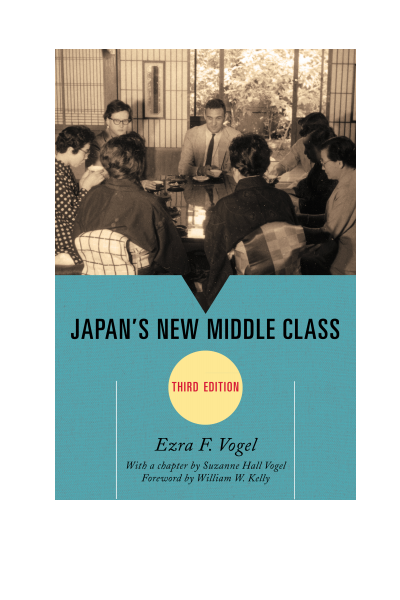
Japan's New Middle Class
- Authors:
- Publisher:
- 2013
Summary
This classic study on the sociology of Japan remains the only in-depth treatment of the Japanese middle class. Now in a fiftieth-anniversary edition that includes a new foreword by William W. Kelly, this seminal work paints a rich and complex picture of the life of the salaryman and his family.
In 1958, Suzanne and Ezra Vogel embedded themselves in a Tokyo suburb, living among and interviewing six middle-class families regularly for a year. Tracing the rapid postwar economic growth that led to hiring large numbers of workers who were provided lifelong employment, the authors show how this phenomenon led to a new social class—the salaried men and their families. It was a well-educated group that prepared their children rigorously for the same successful corporate or government jobs they held. Secure employment and a rising standard of living enabled this new middle class to set the dominant pattern of social life that influenced even those who could not share it, a pattern that remains fundamental to Japanese society today.
Keywords
Search publication
Bibliographic data
- Copyright Year
- 2013
- ISBN-Print
- 978-1-4422-2371-4
- ISBN-Online
- 978-1-4422-2196-3
- Publisher
- Rowman & Littlefield, Lanham
- Language
- English
- Pages
- 346
- Product Type
- Monograph
Table of contents
- Contents No access
- Foreword No access
- Acknowledgments No access
- The Double Structure No access
- The Setting: Mamachi No access
- The Successful Businessman No access
- The Independent Professional No access
- The Shopkeeper No access
- The Salary Man No access
- Preparing for and Taking Examinations No access
- The Family’s Contribution: Maternal Involvement No access
- The School’s Contribution: Teacher Involvement No access
- Mitigating the Harshness No access
- The Hypertrophy of Examinations No access
- Achievement Without Rivalry No access
- The Ordered Life No access
- The Limits of Frugality No access
- The Freedom to Shop No access
- The National Identity No access
- The Role of the Citizen No access
- Salary and the Moderation of Alienation No access
- The Separate Communities of Husbands, Wives, and Children No access
- The Narrow World No access
- Techniques of Social Control No access
- Loyalty No access
- Competence No access
- A Major Variation: Aesthetic Values No access
- The Moral Basis of the Salary Man No access
- The Concept of Ie No access
- The Branch No access
- The Decline of the Ie Authority and Welfare No access
- Symbolic Remnants No access
- The Decline of Family Principles No access
- Creeping Co-operation in the Home No access
- Housework: The Daily Round No access
- Housework: Inglorious and Glorious No access
- The Tradition of “Male Dominance” No access
- Maintenance of Decentralized Authority No access
- The Nature and Exercise of the Husband’s Authority No access
- The Art of Husband Management No access
- The Mother-in-Law and Daughter-in-Law No access
- The Household Unit No access
- The Basic Alignment: Mother and Children vs. Father No access
- Husband and Wife: Increasing Privacy and Intimacy No access
- Coalitions with Grandparents No access
- The Basic Relationship: Mutual Dependency of Mother and Child No access
- Variations on a Theme: Birth Order, Sex, and Parentage No access
- The Father No access
- Getting the Child to Understand No access
- Getting the Child’s Co-operation in Study No access
- The Transitional Order No access
- The Nature of the New Order No access
- The Diffusion of the New Order No access
- A New Confidence in Old Mamachi No access
- Salary Without Visions No access
- Approaching Affluence No access
- The Growth of National Pride No access
- “My Home-ism”: Old Wine in New Bottles No access
- Economic Progress, National and Family Pride No access
- Predominance of the Salaryman Way of Life No access
- Strains in the Salaryman’s Life No access
- Hypertrophy of the Examination System No access
- Ever-Declining Ie: Nuclear Families and Increasing Individualism No access
- Women’s Liberation, Mamachi Style No access
- Changing Expectations for Marriage: New Ideas, Old Habits No access
- Child-Training in an Era of Weakened Authority No access
- Beyond Success No access
- Afterword No access Pages 283 - 288
- Appendix No access Pages 289 - 300
- Notes No access Pages 301 - 328
- Selected Bibliography No access Pages 329 - 332
- Index No access Pages 333 - 346