, to see if you have full access to this publication.
Monograph No access
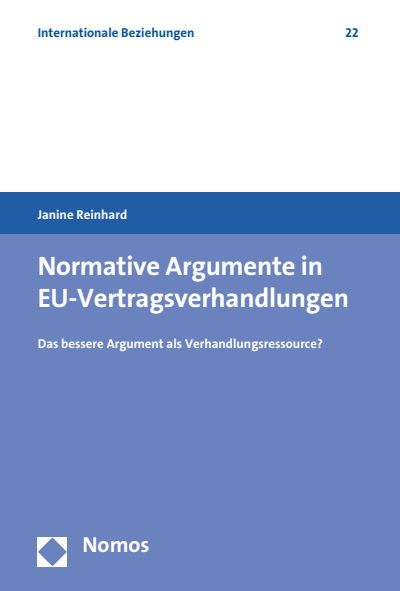
Normative Argumente in EU-Vertragsverhandlungen
Das bessere Argument als Verhandlungsressource?- Authors:
- Series:
- Internationale Beziehungen, Volume 22
- Publisher:
- 2014
Search publication
Bibliographic data
- Edition
- 1/2014
- Copyright Year
- 2014
- ISBN-Print
- 978-3-8487-0507-8
- ISBN-Online
- 978-3-8452-4797-7
- Publisher
- Nomos, Baden-Baden
- Series
- Internationale Beziehungen
- Volume
- 22
- Language
- German
- Pages
- 272
- Product Type
- Monograph
Table of contents
ChapterPages
- Titelei/Inhaltsverzeichnis No access Pages 1 - 6
- Inhaltsverzeichnis No access Pages 7 - 10
- Tabellenverzeichnis No access Pages 11 - 14
- Abbildungsverzeichnis No access Pages 15 - 16
- Einleitung No access Pages 17 - 23
- Literaturdiskussion: Normative Argumente in internationalen Verhandlungen No access Pages 24 - 51
- Untersuchungsgegenstand: EU-Vertragsverhandlungen No access Pages 52 - 68
- Theorie und Hypothesen: Verwendung und Wirkung normativer Argumente in EU-Vertragsverhandlungen No access Pages 69 - 115
- Forschungsdesign: Messung des Argumentationsverhaltens und der weiteren Variablen No access Pages 116 - 163
- Analyse und Ergebnisse: Normative Argumente in EU-Vertragsverhandlungen No access Pages 164 - 244
- Schlussfolgerungen und Ausblick No access Pages 245 - 252
- Literaturverzeichnis No access Pages 253 - 264
- Annex No access Pages 265 - 272
Bibliography (212 entries)
No match found. Try another term.
- Adler, E. (1997). Seizing the Middle Ground: Constructivism in World Politics. Euro-pean Journal of International Relations, 3(3), 319–363. Open Google Scholar DOI: 10.5771/9783845247977
- Alexa, M. (1997). Computer-assisted text analysis methodology in the social science (ZUMA Arbeitsbericht No. 97/07). Mannheim: ZUMA. Open Google Scholar DOI: 10.5771/9783845247977
- Arregui, J., & Thomson, R. (2009). States´ bargaining success in the European Union. Journal of European Public Policy, 16(5), 655–676. Open Google Scholar DOI: 10.5771/9783845247977
- Arrow, K. J. (Ed.) (1995). Barriers to Conflict Resolution. New York: Norton & Com-pany. Open Google Scholar DOI: 10.5771/9783845247977
- Aspinwall, M., & Schneider, G. (2001). Institutional research on the European Union: mapping the field. In M. Aspinwall & G. Schneider (Eds.), The Rules of Integration: Institutionalist Approaches to the Study of Europe (pp. 1–187). Manchester: Manchester University Press. Open Google Scholar DOI: 10.5771/9783845247977
- Aspinwall, M., & Schneider, G. (Eds.) (2001). The Rules of Integration: Institutionalist Approaches to the Study of Europe. Manchester: Manchester University Press. Open Google Scholar DOI: 10.5771/9783845247977
- Aubert, V. (1963). Competition and dissensus: two types of conflict and of conflict resolution. Journal of Conflict Resolution, 7, 26–42. Open Google Scholar DOI: 10.5771/9783845247977
- Bächtiger, A., & Steiner, J. (2005). Special Issue: Empirical Approaches to Deliberative Democracy. Acta Politica, 40(2). Open Google Scholar DOI: 10.5771/9783845247977
- Bailer, S. (2006a). Nationale Interessen in der Europäischen Union: Macht und Ver-handlungserfolg im Ministerrat. Frankfurt / New York: Campus Verlag. Open Google Scholar DOI: 10.5771/9783845247977
- Bailer, S. (2006b). The Dimensions of Power in the European Union. Comparative Eu-ropean Politics, (4), 355–378. Open Google Scholar DOI: 10.5771/9783845247977
- Bailer, S. (2004). Bargaining success in the European Union. European Union Politics, 5(1), 99–123. Open Google Scholar DOI: 10.5771/9783845247977
- Bailer, S. (2010). What factors determine bargainig power and success in EU negotiations? Journal of European Public Policy, 17(5), 743–757. Open Google Scholar DOI: 10.5771/9783845247977
- Bara, J., Weale, A., & Biquelet, A. (2007). Analysing Parliamentary Debate with Computer Assistance. Swiss Political Science Review, 13(4), 577–605. Open Google Scholar DOI: 10.5771/9783845247977
- Barry, B. (1980). Is it better to be powerful or lucky? Part 1. Political Studies, 28(2), 183–194. Open Google Scholar DOI: 10.5771/9783845247977
- Beach, D. (2004). The unseen hand in treaty reform negotiations: the role and influence of the Council Secretariat. Journal of European Public Policy, 11(3), 408–439. Open Google Scholar DOI: 10.5771/9783845247977
- Behnke, J. (2005). Lassen sich Signifikanztests auf Vollerhebungen anwenden? Einige essayistische Anmerkungen. Politische Vierteljahresschrift, 46(1), 1–15. Open Google Scholar DOI: 10.5771/9783845247977
- Behnke, N. (2009). Agenda-Setting für Verfassungsreformen. In S. Shikano, J. Behnke, & T. Bräuninger (Eds.), Jahrbuch für Handlungs- und Entscheidungstheorie: Verfassungsreformen (pp. 11–53). Open Google Scholar DOI: 10.5771/9783845247977
- Behnke, N., & Benz, A. (2006). Verfassungswandel und Verfassungspolitik (Antrag für eine DFG-Forschergruppe). Hagen. Open Google Scholar DOI: 10.5771/9783845247977
- Behnke, N., & Benz, A. (2009). The Politics of Constitutional Change between Reform and Evolution. Publius: The Journal of Federalism, 39(2), 213–240. Open Google Scholar DOI: 10.5771/9783845247977
- Benoit, K., Laver, M., Arnold, C., Pennings, P., & Hosli, M. O. (2005). Measuring Na-tional Delegate Positions at the Convention on the Future of Europe Using Comput-erized Word Scoring. European Union Politics, 6(3), 291–313. Open Google Scholar DOI: 10.5771/9783845247977
- Benoit, K., Laver, M., & Mikhaylov, S. (2009). Treating Words as Data with Error: Uncertainty in Text Statements of Policy Positions. American Journal of Political Science, 53(2), 495–513. Open Google Scholar DOI: 10.5771/9783845247977
- Benz, A. (1994). Kooperative Verwaltung: Funktionen, Voraussetzungen, Folgen. Ba-den-Baden: Nomos. Open Google Scholar DOI: 10.5771/9783845247977
- Biesenbender, J. (2011). The Dynamics of Treaty Change: Measuring the Distribution of Power in the European Union? European Integration Online Papers, (5), Article 5, from http://eiop.or.at/eiop/index.php/eiop/article/view/2011_005a. Open Google Scholar DOI: 10.5771/9783845247977
- Biesenbender, J. (2012). Bargaining at EU Intergovernmental Conferences 1996 - 2004. Dissertation Universität Konstanz. Unpublished manuscript, Konstanz. Open Google Scholar DOI: 10.5771/9783845247977
- Bräuninger, T., & König, T. (2000). Making Rules for Governing Global Commons: The case of deep-sea mining. Journal of Conflict Resolution, 44(5), 604–629. Open Google Scholar DOI: 10.5771/9783845247977
- Buchanan, J. M., & Tullock, G. (1962). The Calculus of Consent: Logical Foundation of Constitutional Democracy. Ann Arbor: Michigan University Press. Open Google Scholar DOI: 10.5771/9783845247977
- Bueno Mesquita, B. de (2003). Principles of International Politics. People´s Power, Preferences, and Perception (2nd ed.). Washington D.C.: CQ Press. Open Google Scholar DOI: 10.5771/9783845247977
- Bürgin, A. (2007). Die Legitimität der EU: Normative Standards als Verhandlungsres-source im Verfassungskonvent. Baden-Baden: Nomos. Open Google Scholar DOI: 10.5771/9783845247977
- Checkel, J. T. (2001). Why Comply? Social Learning and European Identity Change. International Organization, 55(3), 553–588. Open Google Scholar DOI: 10.5771/9783845247977
- Checkel, J. T., & Moravcsik, A. (2001). A Constructivist Research Program in EU Studies? European Union Politics, 2(2), 219–249. Open Google Scholar DOI: 10.5771/9783845247977
- Christiansen, T., Falkner, G., & Joergensen, K. E. (2002). Theorizing EU treaty reform: beyond diplomacy and bargaining. Journal of European Public Policy, 9(1), 12–32. Open Google Scholar DOI: 10.5771/9783845247977
- Christiansen, T., Joergensen, K. E., & Wiener, A. (Eds.) (1999). Special Issue on the Social Construction of Europe. Journal of European Public Policy, (6). Open Google Scholar DOI: 10.5771/9783845247977
- Christiansen, T. & Reh, C. (2009). Constitutionalizing the European Union. New York: Palgrave Macmillan. Open Google Scholar DOI: 10.5771/9783845247977
- Closa, C. The European Union Constitution Database: Universität Zaragossa. Retrieved May 20, 2012, from http://www.unizar.es/euroconstitucion/Treaties/ Open Google Scholar DOI: 10.5771/9783845247977
- Treaty_Const_Bibliography.htm. Open Google Scholar DOI: 10.5771/9783845247977
- Closa, C., & Fossum, J. E. (Eds.) (2004). Arena Report: No 5. Deliberative Constitu-tional Politics in the EU. Oslo. Open Google Scholar DOI: 10.5771/9783845247977
- Da Conceicaio-Heldt, E. (2006). Integrative and Distributive Bargaining Situations in the European Union: What Difference Does it Make? Negotiation Journal, 22(2), 145–165. Open Google Scholar DOI: 10.5771/9783845247977
- Deitelhoff, N. (2006). Überzeugung in der Politik: Grundzüge einer Diskurstheorie in-ternationalen Regierens. Franfurt am Main: Suhrkamp. Open Google Scholar DOI: 10.5771/9783845247977
- Deitelhoff, N. (2009). The Discursive Process of Legalization: Charting Islands of Per-suasion in the ICC Case. International Organization, 63, 33–65. Open Google Scholar DOI: 10.5771/9783845247977
- Deitelhoff, N., & Mueller, H. (2005). Theoretical Paradis- Empirically Lost? Arguing with Habermas. Review of International Studies, 31, 167–179. Open Google Scholar DOI: 10.5771/9783845247977
- Dingwerth, K. (2010). Research Project on Changing Norms of Global Governance: Universität Bremen, from http://www.globalnorms.uni-bremen.de/. Open Google Scholar DOI: 10.5771/9783845247977
- Dryzek, J. S. (1990). Discursive Democracy: Politics, Policy, and Political Science. Cambridge: Cambridge University Press. Open Google Scholar DOI: 10.5771/9783845247977
- Dryzek, J. S. (2006). Deliberative Global Politics. Cambridge: Polity Press. Open Google Scholar DOI: 10.5771/9783845247977
- Dür, A., & Mateo, G. (2010a). Bargaining Power and Negotiation Tactics: The Nego-tiations on the EU´s Financial Perspective, 2007-2010. Journal of Common Market Studies, 48(3), 557–578. Open Google Scholar DOI: 10.5771/9783845247977
- Dür, A., & Mateo, G. (2010b). Choosing a bargaining strategy in EU negotiations: power, preferences, and culture. Journal of European Public Policy, 17(5), 680–693. Open Google Scholar DOI: 10.5771/9783845247977
- Dür, A., Mateo, G., & Thomas, D. C. (2010). Negotiation theory and the EU: the state of the art. Journal of European Public Policy, 17(5), 613–618. Open Google Scholar DOI: 10.5771/9783845247977
- Elgström, O., & Jönsson, C. (2000). Negotiation in the European Union: Bargaining or Problem Solving? Journal of European Public Policy, 7(5), 684–704. Open Google Scholar DOI: 10.5771/9783845247977
- Elgström, O., & Jönsson, C. (2000). Negotiation in the European Union: bargaining or problem-solving? Journal of European Public Policy, 7(5), 684–704. Open Google Scholar DOI: 10.5771/9783845247977
- Elgström, O., & Smith, M. (Eds.) (2000). Negotiation and Policy Making in the Euro-pean Union. Journal of European Public Policy, 7(5). Open Google Scholar DOI: 10.5771/9783845247977
- Elster, J. (1986). The Market and the Forum: Three Varieties of Political Theory. In J. Elster & A. Hylland (Eds.), Foundations of Social Theory (pp. 103–132). Cam-bridge: Cambridge University Press. Open Google Scholar DOI: 10.5771/9783845247977
- Elster, J. (1995). Strategic Arguing. In K. J. Arrow (Ed.), Barriers to Conflict Resolu-tion (pp. 237–257). New York: Norton & Company. Open Google Scholar DOI: 10.5771/9783845247977
- Elster, J. (1998). Deliberation and constitution making. In J. Elster (Ed.), Deliberative Democracy (pp. 97–122). Cambridge: Cambridge University Press. Open Google Scholar DOI: 10.5771/9783845247977
- Elster, J. (Ed.) (1998). Deliberative Democracy. Cambridge: Cambridge University Press. Open Google Scholar DOI: 10.5771/9783845247977
- Eriksen, E. O., & Fossum, J. E. (2004). Europe in search of legitimacy: strategies of legitimation assessed. International Political Science Review, 25(4), 435–459. Open Google Scholar DOI: 10.5771/9783845247977
- European Commission (1978). General considerations on the problems of enlargement: Communication sent by the Commission to the Council. COM(78) 120 final. Open Google Scholar DOI: 10.5771/9783845247977
- European Commission (2004). Enlargement and institutional changes: MEMO/04/61. Open Google Scholar DOI: 10.5771/9783845247977
- European Council (1996). Turin European Council. Presidency Conclusion. 29 March 1996. Open Google Scholar DOI: 10.5771/9783845247977
- European Council (1999). Helsinki European Council. Presidency Conclusion. 11.12.1999. Open Google Scholar DOI: 10.5771/9783845247977
- European Council (2001). The Future of the European Union: The Laeken Declaration: Bulletin or the European Union 12. (14-15 December). Open Google Scholar DOI: 10.5771/9783845247977
- Falkner, G. (2002). EU treaty reform as a three-level process. Journal of European Public Policy, 9(1), 1–11. Open Google Scholar DOI: 10.5771/9783845247977
- Finke, D. (2009a). Domestic Politics and European Treaty Reform: Understanding the Dynamics of Governmental Position-Taking. European Union Politics, 10(4), 482–506. Open Google Scholar DOI: 10.5771/9783845247977
- Finke, D. (2009b). Challenges to Intergovernmentalism: An Empirical Anlaysis of EU Treaty Negotiations since Maastricht. West European Politics, 32(3), 466–495. Open Google Scholar DOI: 10.5771/9783845247977
- Finke, D. (2010). European Integration and its Limits: Intergovernmental conflicts and their domestic origins. Essex: ECPR Press. Open Google Scholar DOI: 10.5771/9783845247977
- Finke, D., König, T., Proksch, S.-O., & Tsebelis, G. (2012). Reforming the European Union: Realizing the Impossible. Princeton: Princeton University Press. Open Google Scholar DOI: 10.5771/9783845247977
- Finnemore, M., & Sikkink, K. (1998). International Norm Dynamics and Political Change. International Organization, 52(4), 887–921. Open Google Scholar DOI: 10.5771/9783845247977
- Fisher, R., & Ury, W. (1981). Getting to Yes: Negotiating an Agreement without giving in. London: Hutchinson Business. Open Google Scholar DOI: 10.5771/9783845247977
- Focault, M. (1974). Die Ordnung des Diskurses. Franfurt am Main: Fischer. Open Google Scholar DOI: 10.5771/9783845247977
- Franck, T. (1990). The Power of Legitimacy Among Nations. New York: Oxford Uni-versity Press. Open Google Scholar DOI: 10.5771/9783845247977
- Früh, W. (2011). Inhaltsanalyse: Theorie und Praxis. Konstanz: UVK Verlagsgesell-schaft. Open Google Scholar DOI: 10.5771/9783845247977
- Garret, G., & Tsebelis, G. (1999). Why resist the temptation to apply power indices to the European Union. Journal of Theoretical Politics, 11(3), 291–308. Open Google Scholar DOI: 10.5771/9783845247977
- Gelman, A., & Hill, J. (2007). Data Analysis Using Regression and Multi-level/Hierarchical Models. New York: Cambridge University Press. Open Google Scholar DOI: 10.5771/9783845247977
- Grobe, C. (2010). The power of words: Argumentative persuasion in international ne-gotiations. European Journal of International Relations, 16(1), 5–29. Open Google Scholar DOI: 10.5771/9783845247977
- Gross, C., & Kriwy, P. (2009). Kleine Fallzahlen in der empirischen Sozialforschung. In C. Gross & P. Kriwy (Eds.), Quantitative empirische Sozialforschung mit kleiner Fallzahl (pp. 9–21). Wiesbaden: VS Verlag. Open Google Scholar DOI: 10.5771/9783845247977
- Gross, C., & Kriwy, P. (Eds.) (2009). Quantitative empirische Sozialforschung mit kleiner Fallzahl. Wiesbaden: VS Verlag. Open Google Scholar DOI: 10.5771/9783845247977
- Gulliver, P. H. (1979). Disputes and negotiations: a cross-cultural perspective. New York: Academic Press Inc. Open Google Scholar DOI: 10.5771/9783845247977
- Haas, E. B. (1961). International Integration: The European and the Universal Process. International Organization, 15(3), 366–392. Open Google Scholar DOI: 10.5771/9783845247977
- Habeeb, W. M. (1988). Power and Tactics in International Negotiation: How Weak Nations Bargaining with Strong Nations. Baltimore: John Hopkins University Press. Open Google Scholar DOI: 10.5771/9783845247977
- Habermas, J. (1984). The Theory of Communicative Action: Vol. 1 of Reason and the Rationalization of Society. Boston: Beacon Press. Open Google Scholar DOI: 10.5771/9783845247977
- Hall, P. A., & Taylor, R. C. R. (1996). Political Science and the Three New Institu-tionalisms. Political Studies, 44, 936–957. Open Google Scholar DOI: 10.5771/9783845247977
- Hanrieder, T. (2008). Moralische Argumente in den Internationalen Beziehungen: Grenzen einer verständigungsorientierten "Erklärung" moralischer Debatten. Zeit-schrift für Internationale Beziehungen, 15(2), 161–186. Open Google Scholar DOI: 10.5771/9783845247977
- Hanrieder, T. (2011). The false promise of the better argument. International Theory, 3(3), 390–415. Open Google Scholar DOI: 10.5771/9783845247977
- Hatakoy, A. (2008). The Effectiveness of Decision Making in European Union Treaty Negotiations: An Empirical Analysis of Arguing and Bargaining in the Debates on the European Constitutional Convention. Dissertation FU Berlin. Unpublished manuscript. Open Google Scholar DOI: 10.5771/9783845247977
- Helbling, M., Hoeglinger, D. & Wüest, B. (2010). How Political Parties Frame European Integration. European Journal of Political Research, 49(4), 496-521. Open Google Scholar DOI: 10.5771/9783845247977
- Heppt, A. (2008). "Theoretical Paradise-empirically saved"? Vorschlag zur Konzepti-onalisierung und empirischen Identifikation "besserer Argumente". Unpublished manuscript. Open Google Scholar DOI: 10.5771/9783845247977
- Heritier, A. (2007). Explaining Institutional Change in Europe. Oxford: Oxford Uni-versity Press. Open Google Scholar DOI: 10.5771/9783845247977
- Hix, S. (2002). Constitutional Agenda Setting Through Discretion in Rule Interpretation: Why the European Parliament won at Amsterdam. British Journal of Political Science, 32(2), 259-280. Open Google Scholar DOI: 10.5771/9783845247977
- Hobolt, S. B. (2009). Europe in Question: Referendums on European Integration. Ox-ford: Oxford University Press. Open Google Scholar DOI: 10.5771/9783845247977
- Hoffman, S. (1966). Obstinate or Obsolete? The Fate of the Nation-State and the Case of Western Europe. Daedalus, (85), 862–915. Open Google Scholar DOI: 10.5771/9783845247977
- Holzinger, K. (2001a). Kommunikationsmodi und Handlungstypen in den Internatio-nalen Beziehungen. Anmerkungen zu einigen irreführenden Dichotomien. Zeitschrift für Internationale Beziehungen, 8, 243–286. Open Google Scholar DOI: 10.5771/9783845247977
- Holzinger, K. (2001b). Verhandeln statt Argumentieren oder Verhandeln durch Argu-mentieren? Eine empirische Analyse des Verhältnisses von Argumentieren und Verhandeln auf der Basis der Sprechakttheorie. Politische Vierteljahresschrift, 42(3), 414–446. Open Google Scholar DOI: 10.5771/9783845247977
- Holzinger, K. (2004a). Strategic Arguing. Swiss Political Science Review, 10, 201–210. Open Google Scholar DOI: 10.5771/9783845247977
- Holzinger, K. (2004b). Bargaining Through Arguing. An Empirical Analysis Based on Speech Act Theory. Political Communication, 21(2), 195–222. Open Google Scholar DOI: 10.5771/9783845247977
- Holzinger, K. (2005). Context or Conflict Types: Which Determines the Selection of Communication Mode. Acta Politica, 50, 239–254. Open Google Scholar DOI: 10.5771/9783845247977
- Hooghe, L., & Marks, G. (2009). A Postfunctionalist Theory of European Integra-tion: From Permissive Consensus to Constraining Dissensus. British Journal of Po-litical Science, 39, check, from doi: 10.1017/S0007123408000409. Open Google Scholar DOI: 10.5771/9783845247977
- Hopmann, P. T. (1995). Two Paradigms of Negotiation: Bargaining and Problem Solv-ing. Annals of the American Academy of Political and Social Science, (542), 24–47. Open Google Scholar DOI: 10.5771/9783845247977
- Hopmann, P. T. (1996). The Negotiation Process and the Resolution of International Conflicts. Columbia: University of South Carolina Press. Open Google Scholar DOI: 10.5771/9783845247977
- Hosli, M. O. (2008). Negotiating the European Economic and Monetary Union. Homo Oeconomicus, 25(2), 203–223. Open Google Scholar DOI: 10.5771/9783845247977
- Hug, S., & König, T. (2002). In view of Ratification: Governmental Preferences and Domestic Constraints at the Amsterdam Intergovernmental Conference. International Organization, 56(2), 447–476. Open Google Scholar DOI: 10.5771/9783845247977
- Hug, S., & König, T. (2007). Domestic structures and constitution-building in an inter-national organization. Review of International Organization, (2), 105–113. Open Google Scholar DOI: 10.5771/9783845247977
- Hurrelmann, A., Krell-Laluhová, Z., Nullmeier, F., Schneider, S., & Wiesner, A. (2009). Why the democratic nation-state is still legitimate: A study of media discourse. European Journal of Political Research, 48, 483–515. Open Google Scholar DOI: 10.5771/9783845247977
- Iklé, F. (1964). How nations negotiate. New York: Harper and Row. Open Google Scholar DOI: 10.5771/9783845247977
- Jachtenfuchs, M. (2002). Deepening and widening integration theory. Journal of Eu-ropean Public Policy, 9(4), 650–657. Open Google Scholar DOI: 10.5771/9783845247977
- Jachtenfuchs, M. (2002). Die Konstruktion Europas. Verfassungsideen und institutio-nelle Entwicklung. Baden-Baden: Nomos. Open Google Scholar DOI: 10.5771/9783845247977
- Katzenstein, P. (Ed.) (1996). The Culture of National Security. New York: Columbia University Press. Open Google Scholar DOI: 10.5771/9783845247977
- Kelemen, D. R. (2006). Comment: Shaming the shameless? The constitutionalization of the European Union. Journal of European Public Policy, 13(8), 1302–1307. Open Google Scholar DOI: 10.5771/9783845247977
- Keohane, R. O., & Nye, J. (1977). Power and Interdependence: world politics in tran-sition. Boston: Little, Brown and Co. Open Google Scholar DOI: 10.5771/9783845247977
- Klüver, H. (2009). Measuring Interest Group Influence Using Quantitative Text Anal-ysis. European Union Politics, 10(4), 535–549. Open Google Scholar DOI: 10.5771/9783845247977
- Kohler, U., & Kreuter, F. (2008). Datenanalyse mit Stata: Allgemeine Konzepte der Datenanalyse und ihre praktische Anwendung (3rd ed.). München: Oldenbourg Wissenschaftsverlag. Open Google Scholar DOI: 10.5771/9783845247977
- Kohler-Koch, B. (2000). Framing: the bottleneck of constructing legitimate institutions. Journal of European Public Policy, 7(4), 513–531. Open Google Scholar DOI: 10.5771/9783845247977
- König, T., & Hug, S. (Eds.) (2006). Policy-making Processes and the European Con-stitution: A Comparative Study of Member States and Accession Countries. London: Routledge. Open Google Scholar DOI: 10.5771/9783845247977
- König, T., & Luetgert, B. (2003). The Treaty of Nice. Intergovernmental Prenferences, Domestic Constraints and the Reform of European Institutions (Konferenzpapier ECPR General Conference Marburg). Open Google Scholar DOI: 10.5771/9783845247977
- König, T., Warntjen, A., & Burkhart, S. (2006). The European Convention: Consensus without unity? In T. König & S. Hug (Eds.), Policy-making Processes and the Eu-ropean Constitution: A Comparative Study of Member States and Accession Coun-tries. London: Routledge. Open Google Scholar DOI: 10.5771/9783845247977
- Kratochwil, F. (1989). Rules, Norms, and Decisions. On the Conditions of Practical and Legal Reasoning in International Relations and Domestic Affairs. Cambridge: Cambridge University Press. Open Google Scholar DOI: 10.5771/9783845247977
- Krippendorff, K. (2004). Content Analysis. An Introduction to Its Methodology. Thou-sands Oaks: Sage Publications. Open Google Scholar DOI: 10.5771/9783845247977
- Landwehr, C., & Holzinger, K. (2010). Institutional determinants of deliberative inter-action. European Political Science Review, 2(3), 373–400. Open Google Scholar DOI: 10.5771/9783845247977
- Laver, M., Benoit, K., & Garry, J. (2003). Extracting Policy Positions from Political Texts Using Words as Data. American Political Science Review, 97(2), 311–331. Open Google Scholar DOI: 10.5771/9783845247977
- Laver, M., & Garry, J. (2000). Estimating Policy Positions from Political Texts. Amer-ican Journal of Political Science, 44(3), 619–634. Open Google Scholar DOI: 10.5771/9783845247977
- Lax, D. A., & Sebenius, J. K. (1985). The Power of Alternatives or the Limits to Nego-tiation. Negotiation Journal, 163–179. Open Google Scholar DOI: 10.5771/9783845247977
- Lax, D. A., & Sebenius, J. K. (1986). The Manager as Negotiator. Bargaining for Co-operation and Competitive Gain. New York, London: The Free Press. Open Google Scholar DOI: 10.5771/9783845247977
- Liese, A. (2006). Staaten am Pranger. Zur Wirkung internationaler Regime auf die inner-staatliche Menschenrechtspolitik. Wiesbaden: VS Verlag. Open Google Scholar DOI: 10.5771/9783845247977
- Linhart, E. (2006). Die Erklärungskraft spiel- und tauschtheoretischer Verhandlungs-modelle in Abhängigkeit vom Institutionalisierungsgrad des Verhandlungssystems. Mannheim: Mannheim University Press. Open Google Scholar DOI: 10.5771/9783845247977
- Lorenz, A. (2008). Verfassungsänderungen in etablierten Demokratien: Motivlagen und Aushandlungsmuster. Wiesbaden: VS Verlag. Open Google Scholar DOI: 10.5771/9783845247977
- Lowe, W. (2008). Understanding Wordscores. Political Analysis, 16, 359–371. Open Google Scholar DOI: 10.5771/9783845247977
- Luhn, H.-P. (1958). A Business Intelligence System. IBM Journal, 314–319. Open Google Scholar DOI: 10.5771/9783845247977
- Magnette, P., & Nicolaidis, K. (2004). The European convention. Bargaining in the shadow of rhetoric. West European Politics, 27(3), 381–404. Open Google Scholar DOI: 10.5771/9783845247977
- McKibben, H. E. (2010). Issue characteristics, issue linkage, and states´ choice of bar-gaining strategies in the European Union. Journal of European Public Policy, 17(5), 694–707. Open Google Scholar DOI: 10.5771/9783845247977
- Milner, H. (1997). Interests, Institutions, and Information: Domestic Politics and Inter-national Relations. Princeton: Princeton University Press. Open Google Scholar DOI: 10.5771/9783845247977
- Monroe, B. L., & Schrodt, P. A. (2008). Introduction to the Special Issue: The Statistical Analysis of Political Text. Political Analysis, 16, 351–355. Open Google Scholar DOI: 10.5771/9783845247977
- Moravcsik, A. (1998). The Choice for Europe: Social Purpose and State Power from Messina to Maastricht. Ithaca: Cornell University Press. Open Google Scholar DOI: 10.5771/9783845247977
- Moravcsik, A., & Nicolaidis, K. (1999). Explaining the Treaty of Amsterdam: Interests, Influence, Institutions. Journal of Common Market Studies, 37(1), 59–85. Open Google Scholar DOI: 10.5771/9783845247977
- Moravcsik, A., & Vachudova, M. A. (2003). National Interests, State Power and EU Enlargement. East European Politics and Societies, 17(1), 42–57. Open Google Scholar DOI: 10.5771/9783845247977
- Morgenthau, H. J. (1952). The national interest of the United States. American Political Science Review, 46, 961–988. Open Google Scholar DOI: 10.5771/9783845247977
- Morgenthau, H. J. (1967). Politics Among Nations. The Struggle for Power and Peace (2nd ed.). New York: Knopf. Open Google Scholar DOI: 10.5771/9783845247977
- Morin, J.-F., & Gold, R. E. (2010). Consensus-seeking, distrust and rhetorical entrap-ment: The WTO decision on access to medicines. European Journal of Internatio-nal Relations, 16(4), 563–587. Open Google Scholar DOI: 10.5771/9783845247977
- Müller, H. (1994). Internationale Beziehungen als kommunikatives Handeln. Zeitschrift für Internationale Beziehungen, 1(1), 15–44. Open Google Scholar DOI: 10.5771/9783845247977
- Müller, H. (2004). Arguing, Bargaining and all that: Communicative Action, Rationalist Theory and the Logic of Appropriateness in International Relations. European Journal of International Relations, 10(3), 395–435. Open Google Scholar DOI: 10.5771/9783845247977
- Müller, H., & Deitelhoff, N. (2005). Theoretical Paradise – Empirically Lost? Arguing with Habermas. Review of International Studies, 31(1), 167–179. Open Google Scholar DOI: 10.5771/9783845247977
- Naurin, D. (2007). Deliberation Behind Closed Doors. Transparency and Lobbying in the European Union. Colchester: ECPR Press. Open Google Scholar DOI: 10.5771/9783845247977
- Naurin, D. (2010). Most Common When Least Important: Deliberation in the European Union Council of Ministers. British Journal of Political Science, 40(1), 31–50. Open Google Scholar DOI: 10.5771/9783845247977
- Naurin, D., & Wallace, H. (Eds.) (2008). Unveiling the Council of the European Union: Games Governments Play in Brussels. Basingstoke: Palgrave Macmillan. Open Google Scholar DOI: 10.5771/9783845247977
- Neuendorf, K. A. (2002). The Content Analysis Guidebook. London: Sage Publications. Open Google Scholar DOI: 10.5771/9783845247977
- Neyer, J. (2006). The Deliberative Turn in Integration Theory. Journal of European Public Policy, 13(5), 779–791. Open Google Scholar DOI: 10.5771/9783845247977
- Niemann, A. (2004). Between communicative action and strategic action: the Article 113 Committee and the negotiations on the WTO Basic Telecommunications Services Agreement. Journal of European Public Policy, 11(3), 379–407. Open Google Scholar DOI: 10.5771/9783845247977
- Odell, J. S. (2000). Negotiating the World Economy. Ithaca, NY: Cornell University Press. Open Google Scholar DOI: 10.5771/9783845247977
- Odell, J. S. (2010). Three islands of knowledge about negotiation in international or-ganizations. Journal of European Public Policy, 17(5), 619–632. Open Google Scholar DOI: 10.5771/9783845247977
- Ostrom, E. (1990). Governing the commons: The evolution of institutions for collectiv action. New York: Cambridge University Press. Open Google Scholar DOI: 10.5771/9783845247977
- Panke, D. (2006). More Arguing than Bargaining? The Institutional Design of the Eu-ropean Convention and Intergovernmental Conferences Compared. Europe-an Integration, 28(4), 357–379. Open Google Scholar DOI: 10.5771/9783845247977
- Panke, D. (2010). Small States in the European Union Structural Disadvantages in EU Policy-Making and Counter-strategies. Journal of European Public Policy, 17(6), 801–819. Open Google Scholar DOI: 10.5771/9783845247977
- Pierson, P. (1996). The Path to European Integration: A Historical Institutionalist Analysis. Comparative Political Studies, 29(2), 123–163. Open Google Scholar DOI: 10.5771/9783845247977
- Plümper, T., Schneider, C., & Troeger, V. (2005). The Politics of EU Eastern En-largement: Evidence from a Heckman Selection Model. British Journal of Political Science, 36, 17–38. Open Google Scholar DOI: 10.5771/9783845247977
- Pollack, M. A. (1996). The New Institutionalism and EC Governance: The Promise and Limits of Institutional Analysis. Governance, 9(4), 429–458. Open Google Scholar DOI: 10.5771/9783845247977
- Putnam, R. D. (1988). Diplomacy and domestic politics: the logic of two-level games. International Organization, 42(3), 427–460. Open Google Scholar DOI: 10.5771/9783845247977
- Rabe-Hesketh, S., & A.Skrondal (2008). Multilevel and longitudinal modeling using stata (2nd ed.). College Station Texas: Stata Press. Open Google Scholar DOI: 10.5771/9783845247977
- Raiffa, H. (1982). The Art and Science of Negotiation. Cambridge, MA: Harvard Uni-versity Press. Open Google Scholar DOI: 10.5771/9783845247977
- Reh, C. (2007). Pre-cooking the European Constitution? The role of government repre-sentatives in EU reform. Journal of European Public Policy, 14(8), 1186–1207. Open Google Scholar DOI: 10.5771/9783845247977
- Reh, C. (2009). The Lisbon Treaty: De-Constitutionalizing the European Union? Journal of Common Market Studies, 47(3), 625–650. Open Google Scholar DOI: 10.5771/9783845247977
- Reinhard, J. (2012). "Cause we are all Europeans!" When do EU Member States use normative arguments? Journal of European Public Policy (online first), from DOI:10.1080/13501763.2012.662072. Open Google Scholar DOI: 10.5771/9783845247977
- Risse, T. (2000). Let´s argue! Communicative Action in International Relations. Inter-national Organization, 54(1), 1–39. Open Google Scholar DOI: 10.5771/9783845247977
- Risse, T., & Kleine, M. (2010). Deliberation in Negotiations. Journal of European Public Policy, 17(5), 708–726. Open Google Scholar DOI: 10.5771/9783845247977
- Risse, T., Ropp, S., & Sikkink, K. (Eds.) (1999). The Power of Human Rights: Interna-tional Norms and Domestic Change. Cambridge: Cambridge University Press. Open Google Scholar DOI: 10.5771/9783845247977
- Rittberger, B. (2005). Building Europe´s Parliament: Democratic Representation Beyond the Nation State. Oxford: Oxford University Press. Open Google Scholar DOI: 10.5771/9783845247977
- Rittberger, B., & Schimmelfennig, F. (2006). Special Issue: The Constitutionalization of the European Union. Journal of European Public Policy, 13(8). Open Google Scholar DOI: 10.5771/9783845247977
- Schaal, G. S., & Ritzi, C. (2009). Empirische Deliberationsforschung (MPIfG Working Paper No. 09/9). Köln. Open Google Scholar DOI: 10.5771/9783845247977
- Scharpf, F. W. (1997). Games real actors play. Actor-centered institutionalism in policy research. Boulder, Colorado: Westview Press. Open Google Scholar DOI: 10.5771/9783845247977
- Scharpf, F. W. (1999). Governing in Europe: Effective and Democratic? Oxford: Ox-ford University Press. Open Google Scholar DOI: 10.5771/9783845247977
- Schelling, T. (1963). The Strategy of Conflict. Cambridge, MA: Harvard University Press. Open Google Scholar DOI: 10.5771/9783845247977
- Schimmelfennig, F. (2001). The Community Trap: Liberal Normen, Rhetorical Action, and the Eastern Enlargement of the European Union. International Organization, 55(1), 47–80. Open Google Scholar DOI: 10.5771/9783845247977
- Schimmelfennig, F. (2003). The EU, NATO and the integration of Europe: rules and rhetoric. Cambridge: Cambridge University Press. Open Google Scholar DOI: 10.5771/9783845247977
- Schimmelfennig, F., & Moravcsik, A. (2009). Liberal Intergovernmentalism. In A. Wiener & T. Diez (Eds.), European Integration Theory (2nd ed., pp. 67–87). Ox-ford: Oxford University Press. Open Google Scholar DOI: 10.5771/9783845247977
- Schimmelfennig, F., & Rittberger, B. (2006). Explaining the Constitutionalization of the European Union,. Journal of European Public Policy, 13(8), 1148–1167. Open Google Scholar DOI: 10.5771/9783845247977
- Schimmelfennig, F., Rittberger, B., Bürgin, A., & Schwellnus, G. (2006). Conditions for EU constitutionalization: a qualitative comparative analysis. Journal of European Public Policy, 13(8), 1168–1189. Open Google Scholar DOI: 10.5771/9783845247977
- Schneider, C. (2009). Conflict, Negotiation and European Union Enlargement. Cam-bridge: Cambridge University Press. Open Google Scholar DOI: 10.5771/9783845247977
- Schneider, G., & Cederman, L.-E. (1994). The change of tide in political cooperation: a limited information model of European integration. International Organization, 48(4), 633–662. Open Google Scholar DOI: 10.5771/9783845247977
- Schneider, G., Finke, D., & Bailer, S. (2010). Bargaining Power in the European Union: an evaluation of competing game-theoretic models. Political Studies, 58(1), 85–103. Open Google Scholar DOI: 10.5771/9783845247977
- Schnell, R., Hill, P. B., & Esser, E. (2005). Methoden der empirischen Sozialforschung (7th ed.). München: Oldenbourg Wissenschaftsverlag. Open Google Scholar DOI: 10.5771/9783845247977
- Schonhardt-Bailey, C. (2008). The congressional debate on partial-birth abortion: Con-stitutional gravitas and moral passion. British Journal of Political Science, 38, 383–410. Open Google Scholar DOI: 10.5771/9783845247977
- Schwellnus, G. (2006). Reasons for constitutionalization: non-discrimination, minority rights and social rights in the Convention on the EU Charter of Fundamental Rights. Journal of European Public Policy, 13(8), 1265–1283. Open Google Scholar DOI: 10.5771/9783845247977
- Sebenius, J. K. (1984). Negotiating the law of the sea. Cambridge, MA: Harvard Uni-versity Press. Open Google Scholar DOI: 10.5771/9783845247977
- Seeger, S. (2008). Die Institutionen- und Machtarchitektur der Europäischen Union mit dem Vertrag von Lissabon. In W. Weidenfeld (Ed.), Lissabon in der Analyse. (pp. 63–98). Baden-Baden: Nomos. Open Google Scholar DOI: 10.5771/9783845247977
- Selck, T. J. (2006). The effects of issue salience on political decision-making. Consti-tutional Political Economy, 17, 5–13. Open Google Scholar DOI: 10.5771/9783845247977
- Slapin, J. (2006). Who is Powerful? Examining Preferences and Testing Sources of Bargaining Strength at European Intergovernmental Conferences. European Union Politics, 7(1), 51–76. Open Google Scholar DOI: 10.5771/9783845247977
- Slapin, J. (2008). Bargaining Power at Europe´s Intergovernmental Conferences: Testing Institutional and Intergovernmental Theories. International Organization, 62, 131–162. Open Google Scholar DOI: 10.5771/9783845247977
- Slapin, J. (2009). Exit, Voice and Cooperation: Bargaining Power in International Or-ganizations and Federal Systems. Journal of Theoretical Politics, 21(2), 187–211. Open Google Scholar DOI: 10.5771/9783845247977
- Slapin, J., & Proksch, S.-O. (2008). A Scaling Model for Estimating Time-Series Party Positions from Texts. American Journal of Political Science, 52(3), 705–722. Open Google Scholar DOI: 10.5771/9783845247977
- Snow, D. A., Rochford, E. B., Wordon S.K., & Benford, R. D. (1986). Frame alignment processes, micromobilization, and movement participation. American Sociological Review, 51, 464–481. Open Google Scholar DOI: 10.5771/9783845247977
- Steiner, J., Bächtiger, A., Spörndli, M., & Steenbergen, M. R. (2004). Deliberative Politics in Action: Analyzing Parliamentary Discourse. Cambridge: Cambridge University Press. Open Google Scholar DOI: 10.5771/9783845247977
- Stone, P. D. D. C. S. M. S., & Ogilvie, D. M. (1966). The General Inquirer: A Com-puter Approach to Content Analysis. Cambridge, MA: MIT Press. Open Google Scholar DOI: 10.5771/9783845247977
- Stone Sweet, A., & Sandholtz, W. (1997). European integration and supranational governance. Journal of European Public Policy, 4(3), 297–317. Open Google Scholar DOI: 10.5771/9783845247977
- Sullivan, J., & Lowe, W. (2010). Chen Shui-bian: On independence. China Quarterly, (203), 619–638. Open Google Scholar DOI: 10.5771/9783845247977
- Tallberg, J. (2006). Leadership and Negotiation in the European Union. Cambridge: Cambridge University Press. Open Google Scholar DOI: 10.5771/9783845247977
- Tallberg, J. (2008). Bargaining Power in the European Council. Journal of Common Market Studies, 46(3), 685–708. Open Google Scholar DOI: 10.5771/9783845247977
- Tallberg, J. (2010). Explaining the institutional foundations of European Union negoti-ations. Journal of European Public Policy, 17(5), 633–647. Open Google Scholar DOI: 10.5771/9783845247977
- Thomson, R. (2008). Responsibility with Power: The Council Presidency of the Euro-pean Union. Journal of Common Market Studies, 46, 593–617. Open Google Scholar DOI: 10.5771/9783845247977
- Thomson, R., Stokman, F. N., Achen, C. H., & König, T. (Eds.) (2006). The European Union Decides. Cambridge: Cambridge University Press. Open Google Scholar DOI: 10.5771/9783845247977
- Thurner, P. W., & Pappi, F. U. (2009). European Union Intergovernmental Conferences: Domestic Preference Formation, Transgovernmental Networks, and the Dynamics of Compromise. New York/London: Routledge. Open Google Scholar DOI: 10.5771/9783845247977
- Thurner, P. W., Pappi, F. U., & Stoiber, M. (2002). EU Intergovernmental Conferences: A Quantitative Analytical Reconstruction and Data-Handbook of Domestic Preference Formation, Transnational Networks, and Dynamics of Compromise dur-ing the Amsterdam Treaty Negotiations (Arbeitspapiere No. 60). Mannheim: Mannheimer Zentrum für Europäische Sozialforschung. Open Google Scholar DOI: 10.5771/9783845247977
- Tsebelis, G. (1990). Nested games: rational choice in comparative politics. California series on social choice and political economy. Berkeley: University of California Press. Open Google Scholar DOI: 10.5771/9783845247977
- Tsebelis, G., & Proksch, S.-O. (2007). The Art of Political Manipulation in the Euro-pean Convention. Journal of Common Market Studies, 45(1), 157–186. Open Google Scholar DOI: 10.5771/9783845247977
- Ulbert, C., & Risse, T. (2005). Deliberately Changing the Discourse: What Does Make Arguing Effective? Acta Politica, (40), 351–367. Open Google Scholar DOI: 10.5771/9783845247977
- Voigt, S. (1999). Explaining constitutional change: a positive economics approach. Cheltenham: Elgar. Open Google Scholar DOI: 10.5771/9783845247977
- Walton, R. E., & McKersie, R. B. (1965). A Behavioural Theory of Labor Negotia-tions: An Analysis of a Social Interaction System. New York: McGraw-Hill. Open Google Scholar DOI: 10.5771/9783845247977
- Warntjen, A. (2008). The Council Presidency: Power Broker or Burden? An Empirical Analysis. European Union Politics, 9(3), 316–338. Open Google Scholar DOI: 10.5771/9783845247977
- Warntjen, A. (2010). Between bargaining and deliberation: decision-making in the Council of the European Union. Journal of European Public Policy, 17(5), 665–679. Open Google Scholar DOI: 10.5771/9783845247977
- Weidenfeld, W. (Ed.) (1998). Amsterdam in der Analyse: Strategien für Europa. Gü-tersloh: Bertelsmann Stiftung. Open Google Scholar DOI: 10.5771/9783845247977
- Weidenfeld, W. (Ed.) (2001). Nizza in der Analyse. Gütersloh: Verlag Bertelsmann Stiftung. Open Google Scholar DOI: 10.5771/9783845247977
- Weidenfeld, W. (Ed.) (2005). Die Europäische Verfassung in der Analyse. Gütersloh: Verlag Bertelsmann Stiftung. Open Google Scholar DOI: 10.5771/9783845247977
- Weidenfeld, W. (Ed.) (2008). Lissabon in der Analyse. Baden-Baden: Nomos. Open Google Scholar DOI: 10.5771/9783845247977
- Wiener, A. (2006). Comment: Fact or artefact? Analysing core constitutional norms in beyond-the-state contexts. Journal of European Public Policy, 13(8), 1308–1313. Open Google Scholar DOI: 10.5771/9783845247977
- Young, P. H. (1991). Chapter 1: Negotiation Analysis. In P. H. Young (Ed.), Negotia-tion Analysis (pp. 1–23). Ann Arbor: University of Michigan Press. Open Google Scholar DOI: 10.5771/9783845247977
- Young, P. H. (Ed.) (1991). Negotiation Analysis. Ann Arbor: University of Michigan Press. Open Google Scholar DOI: 10.5771/9783845247977
- Zangl, B., & Zürn, M. (1996). Argumentatives Handeln bei internationalen Verhand-lungen: Moderate Anmerkungen zur post-realistischen Debatte. Zeitschrift für In-ternationale Beziehungen, 3(2), 341–366. Open Google Scholar DOI: 10.5771/9783845247977
- Zürn, M., & Stephen, M. (2010). The View of Old and New Powers on the Legitimacy of International Institutions. Politics, 30(1), 91–101. Open Google Scholar DOI: 10.5771/9783845247977