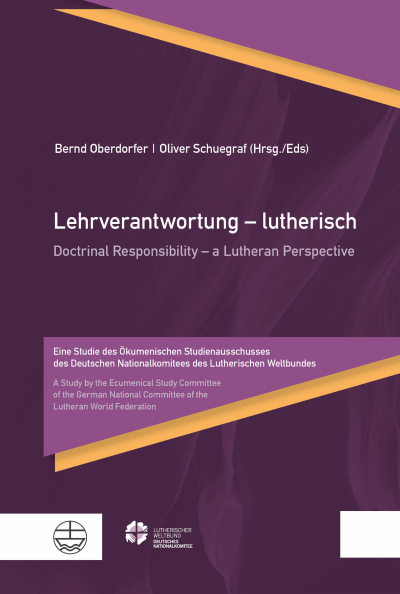
Lehrverantwortung – lutherisch / Doctrinal Responsibility – a Lutheran Perspective
Eine Studie des Ökumenischen Studienausschusses des Deutschen Nationalkomitees des Lutherischen Weltbundes / A Study by the Ecumenical Study Committee of the German National Committee of the Lutheran World Federation- Editors:
- |
- Publisher:
- 2023
Summary
[Doctrinal Responsibility – a Lutheran Perspective] What does »doctrine« mean in Lutheran churches? What is it based upon? How is it made binding? What instances and processes of doctrinal judgment have developed? Who can decide doctrinal questions and how? This study first presents current structures of doctrinal understanding in German Lutheranism and unfolds exemplary historical case studies of Lutheran doctrinal responsibility (Bultmann controversy; ordination of women; apartheid; doctrine of justification). A second part outlines the emergence of Lutheran doctrinal and confessional norms in the 16th century and traces the development of concepts of ecclesial doctrinal commitment in a historical cross-section up to the present. Concluding theses explore the relevance of Lutheran doctrinal responsibility for ecumenical dialogues.
Keywords
Search publication
Bibliographic data
- Copyright Year
- 2023
- ISBN-Print
- 978-3-374-07479-2
- ISBN-Online
- 978-3-374-07483-9
- Publisher
- EVA, Leipzig
- Language
- German
- Pages
- 233
- Product Type
- Edited Book
Table of contents
- Titelei/Inhaltsverzeichnis No access Pages 1 - 9
- Introduction No access Pages 10 - 10
- Einleitung No access Pages 11 - 17
- 1.1 Question No access
- 1.2 Doctrine is the precept for the church and its law No access
- 1.3 Magnus consensus No access
- 1.4 Doctrinal responsibility shared by the whole church No access
- 1.5 Shared responsibility of the church’s governing bodies No access
- 1.6 Doctrinal formation in setting limits: Procedures for testing conformity to confession and for objecting to doctrine No access
- 2.1 The course of events No access
- 2.2 Procedural uncertainties in matters of doctrinal formation No access
- 2.3 Conclusions No access
- 3.1 Theological insights of the Reformation on baptism, ministry and vocation No access
- 3.2 The discussion in the 20th century in the German context No access
- 3.3 The discussion in the Lutheran World Federation No access
- 3.4 Women’s ordination as a consistent application of Reformation teaching No access
- 4.1 The Fifth Assembly in Evian (1970) No access
- 4.2 The Sixth Assembly in Dar es Salaam (1977) No access
- 4.3 The Seventh Assembly in Budapest (1984) No access
- 5.1 Common doctrinal formulations gain in authority when the process of adoption is participatory No access
- 5.2 Doctrinal formation requires intensive theological preparation No access
- 5.3 Reception is an unfinished, ongoing process No access
- 5.4 Bilateral work on doctrinal issues can enrich other churches No access
- 1.1 Fragestellung No access
- 1.2 Lehre ist der Kirche und ihrem Recht vorgegeben No access
- 1.4 Gemeinsame Verantwortung der ganzen Kirche für die Lehre No access
- 1.5 Geteilte Verantwortung der kirchenleitenden Organe No access
- 1.6 Lehrbildung als Grenzmarkierung: Verfahren der Prüfung der Bekenntnisgemäßheit und der Lehrbeanstandung No access
- 2.1 Der Verlauf der Ereignisse No access
- 2.2 Verfahrensunsicherheiten in Angelegenheiten der Lehrbildung No access
- 2.3 Schlussfolgerungen No access
- 3.1 Tauf-, amts- und beruf(ungs)stheologische Einsichten der Reformation No access
- 3.2 Die Diskussion im 20. Jahrhundert im deutschen Kontext No access
- 3.3 Die Diskussion im Lutherischen Weltbund No access
- 3.4 Frauenordination als konsequente Anwendung reformatorischer Lehre No access
- 4.1 Die Fünfte Vollversammlung in Evian (1970) No access
- 4.2 Die Sechste Vollversammlung in Daressalam (1977) No access
- 4.3 Die Siebte Vollversammlung in Budapest (1984) No access
- 5.1 Gemeinsame Lehrformulierungen gewinnen an Verbindlichkeit durch partizipatorische Aneignungsprozesse No access
- 5.2 Lehrbildung braucht intensive theologische Vorarbeit No access
- 5.3 Rezeption ist ein unabgeschlossener, fortdauernder Prozess No access
- 5.4 Bilaterale Arbeit an Lehrfragen kann weitere Kirchen bereichern No access
- 1.1 Preliminary remark No access
- 1.2 Doctrine as a theological discipline No access
- 1.3 Doctrine as revealed truth No access
- 1.4 Doctrine as »scholarship« No access
- 2.1 Lutheran Baroque theology: »Back to the sources« and assurance of salvation No access
- 2.2 Pietism: Spiritual avant-garde and biblical piety No access
- 2.3 Enlightenment theology: Truth of reason and human history No access
- 2.4 Theology and philosophy in the 19th century: Questions of principle and certainty of faith No access
- 2.5 The 20th century: Confession, fundamental critique, doctrinal dialogue No access
- 3.1 On the relationship between faith and doctrine No access
- 3.2 Scripture and confession No access
- 3.3 Gift of doctrine under the guidance of the Spirit No access
- 3.4 Yardstick of doctrine and the question of doctrinal authority No access
- 3.5 Lutheran doctrine: Binding and under pneumatological proviso No access
- 1.1 Vorbemerkung No access
- 1.2 Lehre als theologische Disziplin No access
- 1.3 Lehre als Offenbarungswahrheit No access
- 1.4 Lehre als »Gelehrtheit« No access
- 2.1 Die lutherische Barocktheologie: »Zurück zu den Quellen« und Heilsgewissheit No access
- 2.2 Der Pietismus: Spirituelle Avantgarde und Bibelfrömmigkeit No access
- 2.3 Die Aufklärungstheologie: Vernunftwahrheit und Menschheitsgeschichte No access
- 2.4 Theologie und Philosophie im 19. Jahrhundert: Prinzipienfragen und Glaubensgewissheit No access
- 2.5 Das 20. Jahrhundert: Bekenntnis, Fundamentalkritik, Lehrdialog No access
- 3.1 Zum Verhältnis von Glauben und Lehre No access
- 3.2 Schrift und Bekenntnis No access
- 3.3 Gabe der Lehre unter der Leitung des Geistes No access
- 3.4 Maßstab von Lehre und die Frage nach Lehrautorität No access
- 3.5 Lutherische Lehre: verbindlich und unter pneumatologischem Vorbehalt No access
- PART C: Lutheran doctrinal responsibility against the ecumenical horizon – Nine theses No access Pages 218 - 218
- TEIL C: Lutherische Lehrverantwortung im ökumenischen Horizont – Neun Thesen No access Pages 219 - 225
- ECUMENICAL STUDY COMMITTEE No access Pages 226 - 226
- ÖKUMENISCHER STUDIENAUSSCHUSS No access Pages 227 - 233