, to see if you have full access to this publication.
Edited Book No access
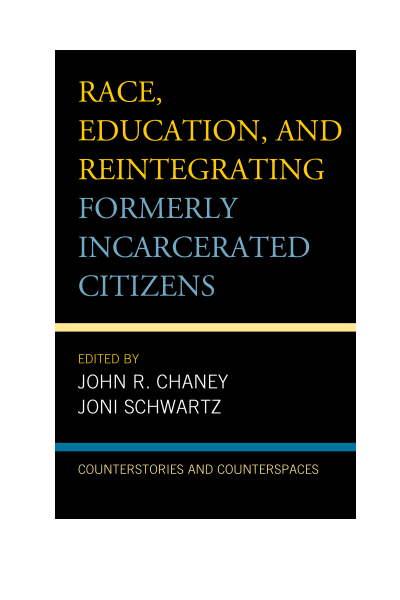
Race, Education, and Reintegrating Formerly Incarcerated Citizens
Counterstories and Counterspaces
Editors:
|
Publisher:
2017
Summary
This timely, readable text offers an authoritative and balanced analysis of how racially driven policies in America impact post release education as a leading pathway to social reintegration. Compelling research findings from an assemblage of college faculty, seasoned administrators, and criminal justice professionals are interwoven with first-person narratives from formerly incarcerated individuals. This book takes full advantage of its interdisciplinary mixture of voices and positionality to build its argument upon a three-part framework from Critical Race Theory (CRT). It convincingly utilizes the tools of academic research, counterstories, and counterspaces to make a persuasive case that the intersection of race, the criminal justice system, and education represent one of the greatest civil rights issues of our time.
Part 1, “Context, Critical Race Theory and College Re-Entry,” explores the historical and current dynamics of these uniquely American intersections while linking Critical Race Theory with the field of re-entry and offering serious analysis of post incarceration and education initiatives. Interest convergence, white privilege, and writing from returning citizens as a way of “coming to voice” are also explored in this section.
Part 2, “Counterstories,” offers case, comparative case, and phenomenological studies that include embedded quotations with first-person narratives contributed from formerly incarcerated students and graduates. This section also includes an honest and gripping analytic auto-ethnography from the book’s co-editor who readily reveals his experiences as both a faculty member and formerly incarcerated individual. Other highlighted topics include the issues of stigma, overcoming obstacles in the classroom, and the unique problems for returning citizens when acclimating to college culture.
Combining qualitative research and descriptions of successful programs Part 3,“Counterspaces,” explores the dynamics of creating places within programs and classrooms that support physical, emotional, spiritual, and intellectual engagement for and with the formerly incarcerated through learner-centered, culturally sensitive, and racially explicit pedagogy. This book is designed to be a most welcome addition to any serious academic discussion focusing upon institutionalized racism and education’s use as a tool in reversing the mass incarceration of people of color in America.
Keywords
Search publication
Bibliographic data
Edition
1/2017
Copyright Year
2017
ISBN-Print
978-1-4985-4090-2
ISBN-Online
978-1-4985-4091-9
Publisher
Lexington, Lanham
Language
English
Pages
190
Product Type
Edited Book
Table of contents
ChapterPages
Contents No access
Foreword No access
Acknowledgments No access
Editors’ Introduction No access
1 Schooling for Prison, Incarceration for Poverty No access
2 Education Outside of the Box No access
3 Do I Want to Be a 30 Percenter or 70 Percenter? No access
4 No Dismantling with the Master’s Tools No access
5 Writing Into Being and Post Incarceration No access
6 On the Other Side No access
7 Mentoring No access
8 Short-Term to Long-Term Incarceration and Educational Reengagement No access
9 A New Normal No access
10 Epiphany of a Prodigal Son No access
11 Returning to School after Incarceration No access
12 Infinite Space and Common Ground No access
13 A College Initiative Success Story No access
14 High School Equivalency as Counterspace No access
15 Creating Counterspaces in College No access
Index No access Pages 177 - 186
About the Contributors No access Pages 187 - 190
Similar publications
from the topics "Soziologie allgemein"
Edited Book Full access
Christoph T. Burmeister, Thorsten Hertel, Sophia Richter