, to see if you have full access to this publication.
Monograph No access
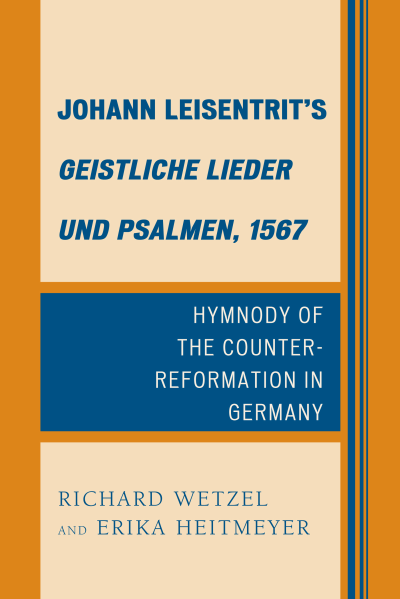
Johann Leisentrit's Geistliche Lieder und Psalmen 1567
Hymnody of the Counter-Reformation in Germany
Authors:
|
Publisher:
2012
Summary
Geistliche Lieder und Psalmen, 1567, was compiled and published by Johann Leisentrit, a Roman Catholic priest who from 1559 to the time of his death in 1586, was Dean at the Cathedral of St. Peter’s in Bautzen, a town in southeastern Germany. His hymnbook appeared in three complete editions (1567, 1573, 1584), and in abridged editions in 1575, 1576, and 1589. By adapting the vernacular hymn, a genre created by Protestant reformers, Leisentrit hoped to bring back to the “true church” (wahrglaubiger Christlicher Kirchen) those who had defected to Lutheranism. This was a formidable ambition because his diocese was located adjacent to the Moravian-Bohemian regions where the Protestant movement was born and remained vital.
Containing approximately 260 texts set to 175 notated melodies, many borrowed from Protestant sources and adapted to serve Roman Catholic objectives, Leisentrit’s book was the second Catholic hymnbook to be published in the sixteenth century. It surpassed its Protestant and Catholic precursors in scope and provided a model for the profusion of hymnbooks of numerous confessions that appeared in Germany in the seventeenth and eighteenth centuries .
Wetzel and Heitmeyer present their study in two parts: The first comprises six contextual chapters that survey earlier German achievements in hymnody, provide analyses of the texts and music in Leisentrit’s book, and assess his achievement within the volatile environment of the Counter Reformation. The second gives the melodies in modern notation along with the first stanzas of the texts; provides detailed concordances and references to sources that identify textual and musical provenances; and concludes with six appendixes to facilitate scholarly cross-references. Fourteen of the seventy wood engravings from Leisentrit’s book, many of which are visual representations of the prevailing confessional conflicts, are given in enlarged reproductions.
The authors provide the only comprehensive study in English of a unique religious figure and his efforts to achieve confessional reconciliation in the decades following the Council of Trent. They add to a more accurate interpretation of the relationship between Lutherans and Catholics in the sixteenth century and support the hypothesis that some Lutherans remained more liturgically formal than their Catholic contemporaries.
Keywords
Search publication
Bibliographic data
Edition
1/2012
Copyright Year
2012
ISBN-Print
978-1-61147-550-0
ISBN-Online
978-1-61147-551-7
Publisher
Lexington, Lanham
Language
English
Pages
354
Product Type
Monograph
Table of contents
ChapterPages
Contents No access
Preface No access
Ch01. Johann Leisentrit and the Council of Trent Decades No access
Ch02. Early Sixteenth-Century Hymnbooks No access
Ch03. The Texts of Leisentrit’s Geistliche Lieder und Psalmen, 1567 No access
Ch04. The Melodies of Geistliche Lieder und Psalmen, 1567 No access
Ch05. Illustrations, Borders, and Symbols No access
Photospread No access
Ch06. Epilogue No access
Part 2. THE MELODIES AND FIRST STANZAS OF GEISTLICHE LIEDER UND PSALMEN, 1567,TRANSCRIBED No access Pages 91 - 262
Appendix 1. Index of Melodies and Texts inOrder of Appearance in GeistlicheLieder und Psalmen, 1567 No access Pages 263 - 280
Appendix 2. Alphabetical Index ofMelodies with Text Titlesor First-Line Incipits No access Pages 281 - 298
Appendix 3. Alphabetical Index of First Lines No access Pages 299 - 312
Appendix 4. Modal Characteristicsof the Melodies No access Pages 313 - 328
Appendix 5. Wood Engravings and Subjects No access Pages 329 - 336
Appendix 6. Latin Hymns in GeistlicheLieder und Psalmen, 1567in Their Liturgical Season orFunctional Category, TheirNumbers in Part 2, and TheirLatin-German Adaptations No access Pages 337 - 342