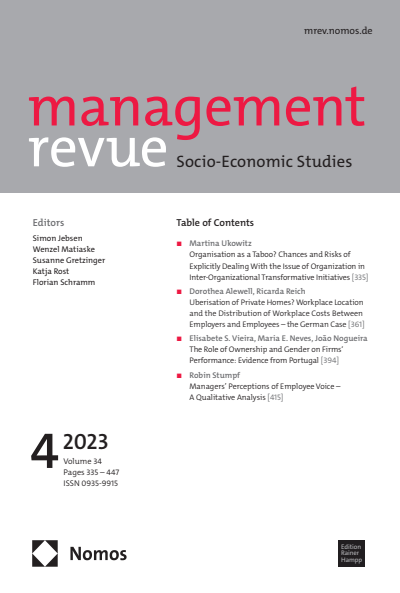
The management revue is a peer-reviewed interdisciplinary European journal publishing both qualitative and quantitative work as well as purely theoretical papers that advance the study of management, organisation and industrial relations.The management revue publishes articles that contribute to theory from a number of disciplines, including business and public administration, organizational behavior, economics, sociology and psychology. Reviews of books relevant to management and organisation studies are a regular feature.Special issues provide a unique and rich insight into the issue's research field. The journal offers insights into selected research topics by providing potentially controversial perspectives, new theoretical insights, valuable empirical analyses and brief reviews of key publications. The aim is to establish the management revue as a top quality symposium journal for the international academic community.The journal is available online via the Nomos eLibrary, ABI/INFORM Global and JSTOR. The management revue is indexed in the Web of Science™ Emerging Sources Citation Index (ESCI), Elesevier's Scopus and the RePEc services IDEAS and EconPapers.
This concluding discussion re-connects with some of the key themes presented in previous contributions to this Special Issue. Adopting a systems view, this discussion attempts to broaden the terms of reference for the aforementioned themes. Drawing...
Against a background of population ageing, and with it, concomitant effects on social welfare systems and labour markets, public policy makers in affected nations are seeking ways of pushing out the final age of withdrawal from their labour markets....
In response to demographic change organizations in Germany and Japan have recently begun to adapt their human resource management practices to embrace employees with diverse backgrounds: e.g. females, foreigners, or older workers (aged fifty and...
The objective of this discussion is to explain the evolution of the wage system in Japan in response to population ageing. Though focussing on the evolving situation in Japan, the nature of the policy responses discussed here are relevant for...
Owing to the ageing of their respective populations, policy-makers in Japan and Germany are challenged to extend the working life of individual employees. However, conditions of physical and mental ill health tend to increase with old age, leading...
This discussion draws on current literature and data from five case studies in order to highlight main explicative factors of the peculiarities in terms of how elderly workers continue to be employed in Japan. It assesses the direction followed by...
This concluding discussion re-connects with some of the key themes presented in previous contributions to this Special Issue. Adopting a systems view, this discussion attempts to broaden the terms of reference for the aforementioned themes. Drawing...