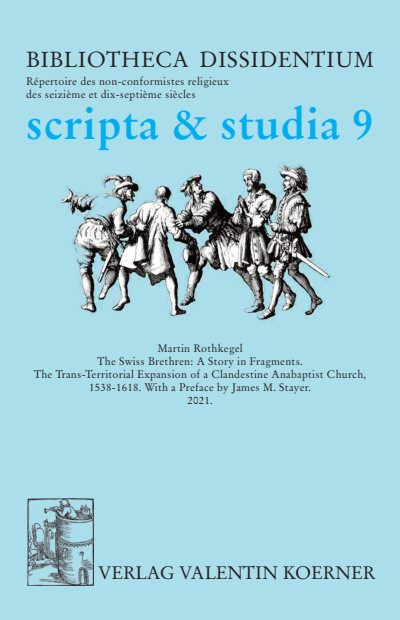
The Swiss Brethren: A Story in Fragments
The Trans-Territorial Expansion of a Clandestine Anabaptist Church, 1538-1618- Authors:
- Series:
- Bibliotheca Dissidentium scripta et studia, Volume 9
- Publisher:
- 2021
Summary
This study offers a new perspective on the question how the Upper German Anabaptist traditions of the 16th and 17th centuries became part of the Mennonite denominational family. In modern scholarship, it is a commonly accepted usage to apply the group name "Swiss Brethren" to early Swiss Anabaptism starting with the circle around Conrad Grebel and Felix Mantz in Zurich, who introduced the practice of believers' baptism in January, 1525. It was not before 1538/9 that the name "Swiss Brethren" first appeared in the sources, but referring to a group in Moravia and southwest Germany rather than in Switzerland. Based on a detailed analysis and contextualization of 141 sources which bear evidence of the group name "Swiss Brethren", dating from the 1530s to c.1618, the present study suggests to abandon the commonly accepted identification of the Swiss Brethren with early Anabaptist groups on Swiss territory or with a specifically Swiss tradition within Upper German Anabaptism. Instead, the bits and pieces of information contained in the analyzed sources adumbrate the picture of an expanding underground denomination. Until 1555, most Swiss Brethren congregations were located in Moravia and southwest Germany. In 1555, Anabaptist groups in the Lower Rhine area joined the clandestine network. In 1591, the Swiss Brethren formed a church union with the Frisian Mennonites, which was joined by the Waterlanders in 1601/2. A number of documents bear witness that even the Socinian Polish Brethren pressed to be received into the united Anabaptist church. Remnant groups of the Swiss Brethren/High German tradition survived the Thirty Years' War in the Swiss cantons of Zurich and Bern (whence many of them emigrated to Alsace and to the devastated Palatinate), in the duchies of Julich and Berg, and in the Netherlands. Most of them would eventually identify with the (Flemish) Mennonite tradition between the 1630s and the 1660s. Although the story of the Swiss Brethren can be reconstructed in outline, substantial questions remain open. It is therefore presented as a "story in fragments" rather than a synthetic narrative. Based on extensive archival research, the study is intended as the first of three volumes, the second of which will be devoted to the leadership and structures of the Swiss Brethren, and the third to their literature, doctrines and religious practices.
Keywords
Search publication
Bibliographic data
- Copyright year
- 2021
- ISBN-Print
- 978-3-87320-877-3
- ISBN-Online
- 978-3-7489-6480-3
- Publisher
- koernerverlag, Baden-Baden
- Series
- Bibliotheca Dissidentium scripta et studia
- Volume
- 9
- Language
- English
- Pages
- 248
- Product type
- Book Titles
Table of contents
- Titelei/Inhaltsverzeichnis No access Pages 1 - 14
- Introduction No access Pages 15 - 20
- 1.1 Tentative Interpretation of the Source Evidence No access
- 1.2 List of Locations No access
- 1.3 Documentation No access
- 2.1 Tentative Interpretation of the Source Evidence No access
- 2.2 List of Locations No access
- 2.3 Documentation No access
- 3.1 Tentative Interpretation of the Source Evidence No access
- 3.2 List of Locations No access
- 3.3 Documentation No access
- 4. Swiss Brethren Ministers, 1538-1618 No access Pages 187 - 190
- 1. Archival Sources No access
- 2. Sources Printed to 1750 No access
- 3. Published Sources No access
- 4. Research Literature No access
- List of Illustrations No access Pages 231 - 231
- Names of Persons and Places No access Pages 231 - 248