, to see if you have full access to this publication.
Monograph No access
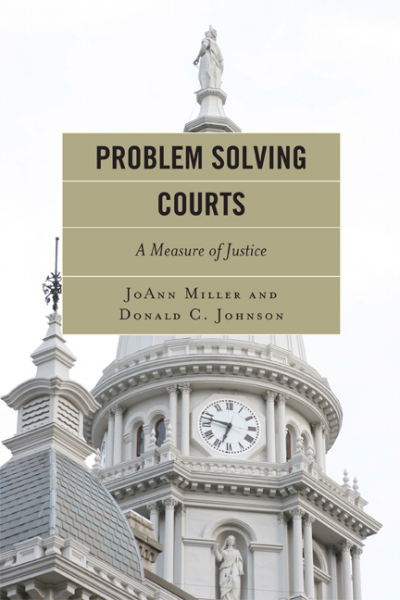
Problem Solving Courts
A Measure of Justice
Authors:
|
Publisher:
2009
Summary
Problem Solving Courts explores a relatively new approach to criminal justice—one that can have a powerful impact on how convicts connect with their communities. Problem solving courts, born out of the drug court movement in the 1980s, are run by judges who, with the assistance of law enforcement agents and mental health workers, meet with convicts on a weekly basis to talk about their treatment. Treatment programs often include therapy, in addition to the possibility of incarceration or early 'parole' in which an offender can complete his or her sentence under the jurisdiction of the court. In this unique collaboration, scholar JoAnn Miller and judge Donald C. Johnson, creators of three successful problem solving courts themselves, address the compelling needs for alternatives to prisons, analyze problem solving courts in depth, and assess the impact problem solving courts can have on convicts and their communities. Problem solving courts can include: community courts that seek to improve the quality of life in neighborhoods struggling with crime and disorder; drug treatment courts that link addicted offenders to drug treatment instead of incarceration; family treatment courts that seek to stop the cycle of drugs, child neglect, and foster care; and domestic violence courts that emphasize victim safety and defendant accountability.
Search publication
Bibliographic data
Edition
1/2009
Copyright Year
2009
ISBN-Print
978-1-4422-0080-7
ISBN-Online
978-1-4422-0082-1
Publisher
Rowman & Littlefield, Lanham
Language
English
Pages
278
Product Type
Monograph
Table of contents
ChapterPages
Contents No access
Acknowledgments No access
Introduction No access Pages 1 - 10
Chapter 01. Measured Justice and Problem Solving Court Principles No access
Chapter 02. The Purposes, Promises, and Magic of Contemporary Criminal Law and Criminal Justice in the United States No access
Chapter 03. A Problem Solving Court Jurisprudence No access
Chapter 04. Timeless Problems, Innovative Solutions No access
Chapter 05. Responding to Reality: They All Come Home No access
Chapter 06. Blended Social Institutions No access
Chapter 07. The Community: What It Needs and What It Deserves No access
Chapter 08. Words, Words, Words: Distinctions and Differences No access
Chapter 09. Transforming Master Status No access
Chapter 10. Backstage Action No access
Chapter 11. Front-Stage Performances No access
Chapter 12. Finale No access
Appendix A. Biographical Sketches No access Pages 199 - 206
Appendix B. Reentry Court Participation Agreement No access Pages 207 - 220
Appendix C. Waiver Forms No access Pages 221 - 224
Appendix D. Reentry Court Participant’s Handbook No access Pages 225 - 234
Notes No access Pages 235 - 242
Reference No access Pages 243 - 270
Index No access Pages 271 - 276
About the Authors No access Pages 277 - 278
Similar publications
from the topics "Recht allgemein, Übergreifende Werke und Sammlungen"