, to see if you have full access to this publication.
Monograph No access
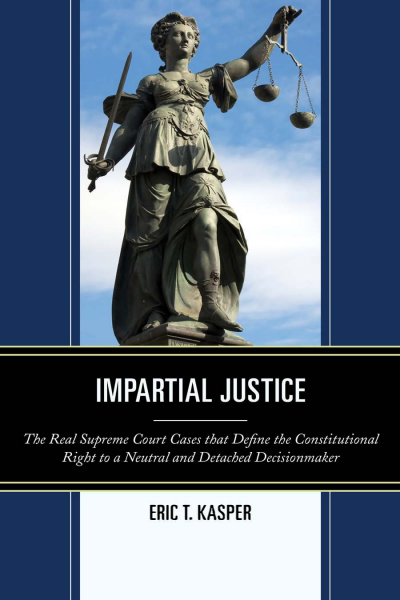
Impartial Justice
The Real Supreme Court Cases that Define the Constitutional Right to a Neutral and Detached Decisionmaker
Authors:
Publisher:
2013
Summary
This book examines the right to a neutral and detached decisionmaker as interpreted by the U.S. Supreme Court. This right resides in the Constitution’s Fifth Amendment and Fourteenth Amendment guarantees to procedural due process and in the Sixth Amendment’s promise of an impartial jury. Supreme Court cases on these topics are the vehicles to understand how these constitutional rights have come alive. First, the book surveys the right to an impartial jury in criminal cases by telling the stories of defendants whose convictions were overturned after they were the victims of prejudicial pretrial publicity, mob justice, and discriminatory jury selection. Next, the book articulates how our modern notion of judicial impartiality was forged by the Court striking down cases where judges were bribed, where they had other direct financial stakes in the outcome of the case, and where a judge decided the case of a major campaign supporter. Finally, the book traces the development of the right to a neutral decisionmaker in quasi-judicial, non-court settings, including cases involving parole revocation, medical license review, mental health commitments, prison discipline, and enemy combatants. Each chapter begins with the typically shocking facts of these cases being retold, and each chapter ends with a critical examination of the Supreme Court’s ultimate decisions in these cases.
Keywords
Search publication
Bibliographic data
Edition
1/2013
Copyright Year
2013
ISBN-Print
978-0-7391-7721-1
ISBN-Online
978-0-7391-7722-8
Publisher
Lexington, Lanham
Language
English
Pages
217
Product Type
Monograph
Table of contents
ChapterPages
Contents No access
Acknowledgements No access
Preface No access
Introduction: A Short History of What It Means to Be a Neutral, Impartial, and Unbiased Decisionmaker in Anglo-American Law No access Pages 1 - 18
1. Prejudicial Pretrial Publicity: Sheppard v.Maxwell (1966) No access
2. Avoiding Mob Justice: Frank v. Mangum (1915) and Moore v. Dempsey (1923) No access
3. Racial Discrimination in Jury Selection: Batson v. Kentucky (1986) and Miller-El v. Dretke (2005) No access
4. Sex Discrimination in Jury Selection: Hoyt v. Florida (1961) and Taylor v. Louisiana (1975) No access
5. Death-Qualified Juries: Witherspoon v. Illinois (1968) and Lockhart v. McCree (1986) No access
6. Mayor-Judges with a Financial Stake in the Outcome: Tumey v. Ohio (1927) and Ward v. Village of Monroeville (1972) No access
7. A Judge Hearing a Contempt Proceeding after Being Vilified by the Defendant: Mayberry v. Pennsylvania (1971) No access
8. Non-Lawyer Judges: North v. Russell (1976)` No access
9. The Judge Who Was Bribed in Other Cases: Bracy v. Gramley (1997) No access
10. A Judge Deciding a Case Involving a Major Campaign Supporter: Caperton v. A.T. Massey Coal Co. (2009) No access
11. Parole Revocation: Morrissey v. Brewer (1972) No access
12. Medical License Review: Withrow v. Larkin (1975) No access
13. Mental Health Commitments for Juveniles: Parham v. J.R. (1979) No access
14. Prison Discipline: Edwards v. Balisok (1997) No access
15. Enemy Combatant Cases: Hamdi v. Rumsfeld (2004) No access