, to see if you have full access to this publication.
Monograph No access
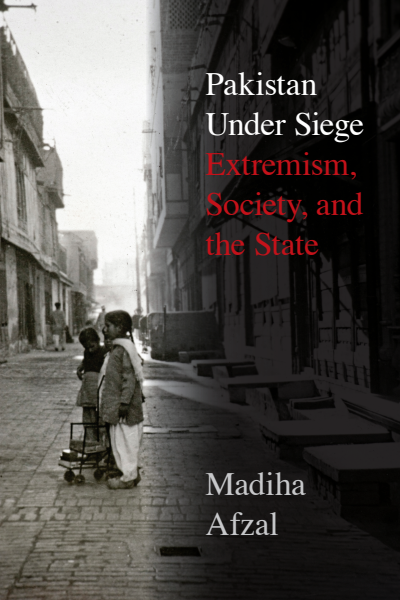
Pakistan under Siege
Extremism, Society, and the State
Authors:
Publisher:
2018
Summary
Over the last fifteen years, Pakistan has come to be defined exclusively in terms of its struggle with terror. But are ordinary Pakistanis extremists? And what explains how Pakistanis think?
Much of the current work on extremism in Pakistan tends to study extremist trends in the country from a detached position—a top-down security perspective, that renders a one-dimensional picture of what is at its heart a complex, richly textured country of 200 million people. In this book, using rigorous analysis of survey data, in-depth interviews in schools and universities in Pakistan, historical narrative reporting, and her own intuitive understanding of the country, Madiha Afzal gives the full picture of Pakistan’s relationship with extremism.
The author lays out Pakistanis’ own views on terrorist groups, on jihad, on religious minorities and non-Muslims, on America, and on their place in the world. The views are not radical at first glance, but are riddled with conspiracy theories. Afzal explains how the two pillars that define the Pakistani state—Islam and a paranoia about India—have led to a regressive form of Islamization in Pakistan’s narratives, laws, and curricula. These, in turn, have shaped its citizens’ attitudes.
Afzal traces this outlook to Pakistan’s unique and tortured birth. She examines the rhetoric and the strategic actions of three actors in Pakistani politics—the military, the civilian governments, and the Islamist parties—and their relationships with militant groups. She shows how regressive Pakistani laws instituted in the 1980s worsened citizen attitudes and led to vigilante and mob violence. The author also explains that the educational regime has become a vital element in shaping citizens’ thinking. How many years one attends school, whether the school is public, private, or a madrassa, and what curricula is followed all affect Pakistanis’ attitudes about terrorism and the rest of the world.
In the end, Afzal suggests how this beleaguered nation—one with seemingly insurmountable problems in governance and education—can change course.
Search publication
Bibliographic data
Edition
1/2018
Copyright Year
2018
ISBN-Print
978-0-8157-2945-7
ISBN-Online
978-0-8157-2946-4
Publisher
Rowman & Littlefield, Lanham
Language
English
Pages
1
Product Type
Monograph
Table of contents
ChapterPages
Table of Contents No access
Preface No access
Acknowledgments No access
A Country of Radicals? Not Quite No access Pages 1 - 26
Bound to Its Narrative: The Pakistani State and Terrorist Groups No access Pages 27 - 50
Pakistan's Legal Islamization No access Pages 51 - 74
An Ideological Education No access Pages 75 - 118
Islamists and Madrassas No access Pages 119 - 138
An Appraisal and a Way Forward No access Pages 139 - 160
Appendix A: The Objectives Resolutions No access Pages 161 - 162
Appendix B: Levels of Education No access Pages 163 - 164