Edited Book Open Access Full access
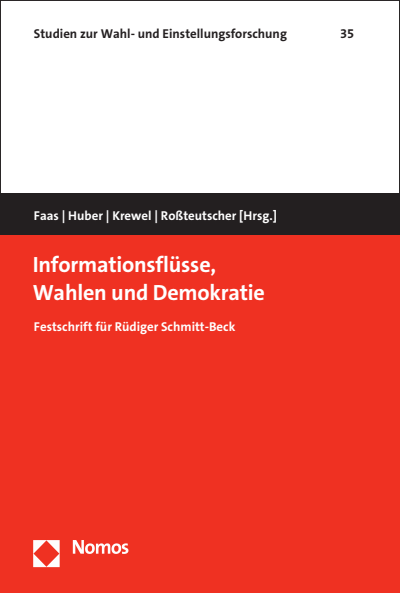
Informationsflüsse, Wahlen und Demokratie
Festschrift für Rüdiger Schmitt-Beck- Editors:
- | | |
- Series:
- Studien zur Wahl- und Einstellungsforschung, Volume 35
- Publisher:
- 2023
Keywords
Search publication
Bibliographic data
- Copyright Year
- 2023
- ISBN-Print
- 978-3-7560-0800-1
- ISBN-Online
- 978-3-7489-1555-3
- Publisher
- Nomos, Baden-Baden
- Series
- Studien zur Wahl- und Einstellungsforschung
- Volume
- 35
- Language
- German
- Pages
- 633
- Product Type
- Edited Book
Table of contents
ChapterPages
- Titelei/InhaltsverzeichnisPages 1 - 8 Download chapter (PDF)
- Informationsflüsse, Wahlen und Demokratie: Einleitung zur Festschrift für Rüdiger Schmitt-BeckPages 9 - 22Authors: | | |Download chapter (PDF)
- Authors: |Download chapter (PDF)
- 1. Introduction
- 2.1 Campaigns and political knowledge
- 2.2 Mass media and the transmission of political information
- 2.3 Political interest, education, demographics
- 2.4 Cognitive dispositions for information processing
- 2.5 Right-wing populist support and political knowledge
- 2.6 Possible moderation of political orientations by media use and cognitive closure
- 3. Data
- 4. Results
- 5. Conclusion
- Authors: |Download chapter (PDF)
- 1. Einleitung
- 2. Theoretischer Hintergrund: Lineare Trends, stabile Muster oder Kontextabhängigkeit in der Wahlkampfberichterstattung?
- 3. Datengrundlage und methodische Herangehensweise
- 4. Ergebnisse
- 5. Zusammenfassung und Fazit
- Mirror, Mirror on the Wall: How Social Projection and Social Sampling Interact in the Formation of Public Opinion PerceptionsPages 85 - 116Authors: |Download chapter (PDF)
- Authors:Download chapter (PDF)
- 1. Introduction
- 2. Correlates of COVID-19 Vaccination
- 3. Social Influences and COVID-19 Vaccination
- 4. Research Design and Data Collection
- 5. Data Analysis and Results
- 6. Conclusions and Discussion
- Authors: | | | |Download chapter (PDF)
- 1. Introduction
- 2. Propinquity and Homophily in Cross-Race Interactions
- 3. Individual-level Factors Producing Homophily
- 4. Method
- 5.1 Existing Network Exposure to Cross-Race Discussants (Propinquity in Operation)
- 5.2 Selection of Discussant for Purported Discussion Study (Propinquity Controlled by Design)
- 6. Discussion
- 7. Limitations and Future Directions
- Online Appendix
- Change My View: Do Moral Appeals Facilitate Compromise?Pages 169 - 196Authors:Download chapter (PDF)
- Authors: |Download chapter (PDF)
- 1. Einleitung
- 2. Generative KI als Wahlkampftool
- 3.1 Organisierte politische Kampagnen in einer sich verändernden Parteien- und Kommunikationssphäre
- 3.2 Von Parteikampagnen unabhängige Akteure (Bürgerinnen und Bürger, NGOs, Verbände und andere Staaten)
- 3.3 Akteure der Governance digitaler Kampagnenumgebungen und Wahlen
- 4. Zusammenfassung und Fazit
- Authors: | |Download chapter (PDF)
- 1. Introduction
- 2.1 The increasing professionalization of campaigning
- 2.2 The effectiveness of electoral campaigns
- 3.1 Key aspects of the organization of elections in Spain
- 3.2 Research design and data collection
- 4.1 Effects of the experimental interventions on turnout
- 4.2 Effects of the experimental interventions on the Socialist vote
- 5. Conclusion
- Authors:Download chapter (PDF)
- 1. Introduction
- 2.1 The US Original
- 2.2 Complications in the evidence
- 3.1 Core implications
- 3.2.1 Candidate/leader selection
- 3.2.2 The effective number of parties
- 3.2.3 Polarization
- 4.1 The rolling cross-section
- 4.2 Leader preference
- 4.3 Vote intention
- 4.4 Party identification
- 4.5 Estimation strategy
- 5.1 Variance in leader evaluation
- 5.2.1 Impact of leader evaluation on the vote
- 5.2.2 Mediation of partisan activation
- 6.1 Recapitulation
- 6.2 Discussion
- Authors:Download chapter (PDF)
- 1. Introduction
- 2. Literature review and theoretical argument
- 3. Case selection, data and methods
- 4. Results
- 5. Conclusions
- Online Appendix
- Authors:Download chapter (PDF)
- 1. Introduction
- 2.1 Multi-Election Variability in Party Contacting
- 2.2 Party Symmetry in Contacting
- 2.3 Parties of the Left versus Right in Contacting Effort
- 2.4 Contacting in New versus Old Democracies
- 2.5 Electoral and Party System Differences in Party Contacting
- 3. A Brief Detour to Examine Personal Party Contacts across Countries and Elections
- 4.1 Contacts From Own Party
- 4.2 Individual Characteristics Beyond Own Party Contacting
- 5.1 The U.S. Example
- 5.2 The South African Example
- 6. Conclusion
- Authors: |Download chapter (PDF)
- 1. Einleitung
- 2.1 Mehr Generationengerechtigkeit durch Wahlrechtsreform?
- 2.2 Die Einführung des Familienwahlrechts als game changer?
- 2.3 „Für Dich wähle ich anders“: Wann wählen Eltern für ihre Kinder anders als für sich selbst?
- 3. Daten und Operationalisierung
- 4.1 Unterschiede zwischen Ego- und stellvertretender Kinderwahl
- 4.2 Hintergründe abweichender Stimmabgaben
- 4.3 Multivariate Betrachtung der Hintergründe abweichender Stimmabgaben
- 4.4 Gewinnerinnen und Verliererinnen eines Familienwahlrechts im Parteiensystem?
- 5. Schlussfolgerungen
- Authors:Download chapter (PDF)
- 1. Politische Soziologie der Siamesischen Zwillinge
- 2. Die langfristige Entwicklung vor und nach der deutschen Einheit
- 3. Die sozialstrukturellen Mitgliederprobleme und Repräsentativität von Gewerkschaften
- 4. Die zunehmenden Organisationsprobleme nach der Vereinigung
- 5. Die politischen Einstellungen von Gewerkschaftsmitgliedern
- 6. Einstellungswandel in Bezug auf Sozialpolitikziele
- 7. Fazit: Die unterschiedlichen Tendenzen der Siamesische Zwillinge
- Authors: |Download chapter (PDF)
- 1. Einleitung
- 2. Literatur
- 3.1 Instrumentelle Wählermotivation
- 3.2 Expressive Wählermotivation
- 3.3 Wählerpräferenzen über Kandidaten-Parteien-Paare
- 4. Statistisches Modell
- 5.1 Instrumentelle Bewertung von Kandidaten und Parteien
- 5.2 Psychologische Wirkung der Wahlformel
- 5.3 Expressive Motivation zur Kandidaten- und Parteiwahl
- 6.1 Nicht-modellierte Substitutionsmuster
- 6.2 Vorhergesagte Stimmabgabe
- 7. Schlussfolgerungen
- A Amtliche Ergebnisse und Nachwahlbefragung
- B Verwendung von Parteieigenschaften als Stellvertreter für Kandidateneigenschaften
- Authors:Download chapter (PDF)
- 1. Vorbemerkung, Frage und ein kurzes Argument
- 2. Daten
- 3. Forschungsdesign
- 4. Ergebnisse
- 5. Schluss
- Authors:Download chapter (PDF)
- 1. Einführung
- 2.1 Zivilgesellschaften im Vergleich
- 2.2 Die Bedeutung qualitativ hochwertigen Regierens für die Zivilgesellschaft
- 3. Länderübergreifende Unterschiede im ehrenamtlichen Engagement (Mikroebene)
- 4. Schlussfolgerungen und Diskussion
- Danksagung
- Authors:Download chapter (PDF)
- 1. Introduction
- 2. A Constructivist Approach to Democracy
- 3. Investigating the Meaning of Democracy
- 4. Evaluation of Democracy: A Glass Half Empty
- 5.1 Freedom as Civil Liberties
- 5.2 Freedom as Equality
- 5.3 Freedom as a Decent Life
- 6. Conclusion
- Appendix
- Authors: |Download chapter (PDF)
- 1. Introduction
- 2.1 Electoral integrity: citizen-based and expert-based approaches
- 2.2.1 Individual-level perceptions of electoral integrity and voting
- 2.2.2 Contextual-level electoral integrity and voting
- 2.2.3 The micro-macro conditionality of electoral integrity (perceptions)
- 3.1 Data
- 3.2 Operationalization
- 3.3 Analytical approach
- 4.1 Citizen and expert evaluations of electoral integrity and voter turnout: a first descriptive analysis
- 4.2 Multivariate analysis
- 4.3 Sensitivity analysis
- 5. Conclusion
- Authors: |Download chapter (PDF)
- 1. Einleitung
- 2. Politischer Extremismus – Theorie und Hypothesen
- 3. Vertretungslücke – eine Operationalisierung
- 4. Extreme Politikziele und Vertretungslücke
- 5. Ideologisierung und Politisierung: Erklärung der Wahl der AfD
- 6. Fazit
- Authors: |Download chapter (PDF)
- 1. Introduction
- 2. Determinants of Voting for the Populist Radical-Right: Between Demand and Supply
- 3. Comparative Cases: Austria and Germany
- 4. Data and Methods
- 5. Analysis
- 6. Conclusion
- Authors: |Download chapter (PDF)
- 1. Introduction
- 2.1 Understanding Populism
- 2.2 Understanding Antisemitism
- 2.3 Linking Populism and Antisemitism
- 3. Measuring Antisemitism
- 4. Measuring populism
- 5.1 Measuring controls
- 5.2 Results
- 5. Conclusion
- Online Appendix
- Authors:Download chapter (PDF)
- 1. Einleitung
- 2. Die Erforschung antisemitischer Einstellung in Deutschland
- 3. Desiderata der Erforschung antisemitischer Einstellungen in Deutschland
- 4. Daten, Variablen und Methode
- 5. Ergebnisse
- 6. Zusammenfassung und Diskussion
- Anhang
- Authors: |Download chapter (PDF)
- 1. Einleitung
- 2. Der Transformationsbegriff
- 3. Politische Teilhabe, politische Partizipation und Transformationsnotwendigkeiten in Deutschland
- 4. Wandel politischer Partizipation – Teilhabe als Treiber der Transformation
- 5. Das Potential von Citizen Science: Einbezogen sein im Forschungsprozess und die „Nachfrage-Seite“ politischer Teilhabe und Partizipation in der Analyse
- 6. Schlussfolgerung: Routinen in Umbruchzeiten verstehen
- Autor:innen / List of ContributorsPages 631 - 633 Download chapter (PDF)