, to see if you have full access to this publication.
Monograph No access
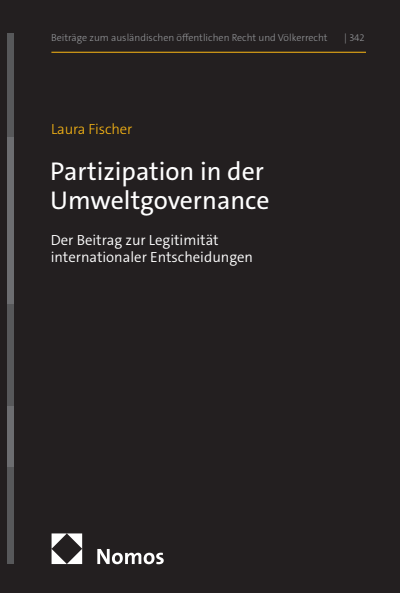
Partizipation in der Umweltgovernance
Der Beitrag zur Legitimität internationaler Entscheidungen- Authors:
- Series:
- Beiträge zum ausländischen öffentlichen Recht und Völkerrecht, Volume 342
- Publisher:
- 2026
Summary
Non-state actors play an increasingly significant role in shaping international decisions in environmental governance. This development – known in international law scholarship as the “participation explosion” – raises the question of whether and how the participation of non-state actors increases the acceptance of decisions that were previously the exclusive domain of nation states. To answer this question, the thesis draws upon a multi-pronged approach to participation in international environmental governance that compares perspectives from theory, law and practice.
Keywords
Search publication
Bibliographic data
- Edition
- 1/2026
- Copyright Year
- 2026
- ISBN-Print
- 978-3-7560-2375-2
- ISBN-Online
- 978-3-7489-5216-9
- Publisher
- Nomos, Baden-Baden
- Series
- Beiträge zum ausländischen öffentlichen Recht und Völkerrecht
- Volume
- 342
- Language
- German
- Pages
- 284
- Product Type
- Monograph
Table of contents
ChapterPages
- Vorwort No access
- A. Einführung No access
- 1. Forschungsstand zu internationaler Partizipation No access
- 2. Forschungsstand zum Beitrag von Partizipation zur Legitimität No access
- II. Leitfragen der Arbeit No access
- I. Theoretischer Referenzrahmen No access
- II. Untersuchung völkerrechtlicher Abkommen No access
- III. Praxistest durch problemzentrierte Expertise-Interviews No access
- I. Ursprung und Merkmale von Governance No access
- II. Verständnis von Umweltgovernance No access
- III. Formen von Umweltgovernance No access
- IV. Kontextualisierung No access
- 1. Partizipation nichtstaatlicher Akteure No access
- 2. Partizipation auf internationaler Ebene No access
- 3. Partizipation in der Umweltgovernance No access
- 1. Verwandte Begriffe No access
- 2. Verwandte Rechte No access
- III. Kontextualisierung No access
- 1. Objekt von Legitimität No access
- 2. Konzeptionen von Legitimität No access
- 1. Legalität und Legitimation No access
- 2. Demokratie No access
- III. Quellen von Legitimität No access
- IV. Kontextualisierung No access
- I. Global Administrative Law und Legitimität No access
- II. Globaler Konstitutionalismus und Legitimität No access
- III. Globaler Pluralismus und Legitimität No access
- a) Repräsentation der Zivilgesellschaft No access
- b) Repräsentation betroffener Personen/-gruppen No access
- 2. Deliberation durch Partizipation No access
- 3. Rechenschaftspflicht durch Partizipation No access
- 4. Information durch Partizipation No access
- 5. Expertise durch Partizipation No access
- 6. Transparenz durch Partizipation No access
- 7. Zwischenergebnis No access
- 1. Effektivität durch Partizipation No access
- 2. Gemeinwohl durch Partizipation No access
- 3. Zwischenergebnis No access
- C. Schlussfolgerung No access
- a) Völkerrechtssubjektivität von Individuen No access
- b) Subjektive Rechte von Individuen No access
- a) Partielle Völkerrechtssubjektivität von Gruppen No access
- b) Kollektive Rechte von Gruppen No access
- 3. Rechtsträgerschaft von nichtstaatlichen Organisationen No access
- 1. Möglichkeit der Rechtsbindung internationaler Institutionen No access
- 2. Rechtsbindung an völkerrechtliche Normen No access
- III. Zwischenergebnis No access
- I. Nationale und internationale Formen von Partizipation No access
- 1. Nichtverfasse Beteiligungsformen in menschenrechtlichen Dokumenten No access
- 2. Nichtverfasste Beteiligungsformen in Umweltfragen No access
- a) Auslegung von Artikel 8 Frauenrechtskonvention No access
- b) Funktionen von Partizipation in Artikel 8 Frauenrechtskonvention No access
- a) Auslegung von Artikel 12 KRK No access
- b) Funktion von Partizipation in Artikel 12 KRK No access
- a) Konsultation nichtstaatlicher Organisationen No access
- aa) Auslegung Artikel 4 Absatz 3 i.V.m. Artikel 33 Absatz 3 BRK No access
- bb) Funktionen von Artikel 4 Absatz 3 i.V.m. Artikel 33 Absatz 3 BRK No access
- a) Beteiligung der Öffentlichkeit in Aarhus-Konvention No access
- b) Beteiligung der Öffentlichkeit im Abkommen von Escazú No access
- a) Beobachtung in UNFCCC-Verfahren No access
- b) Beobachtung der Öffentlichkeit in Aarhus-Konvention No access
- aa) Auslegung von Artikel 15 Aarhus-Konvention i.V.m. Beschluss I/7 No access
- bb) Funktionen der Beteiligung im Rahmen des Überprüfungsverfahrens der Aarhus-Konvention No access
- b) Beteiligung der Öffentlichkeit in Espoo-Konvention No access
- c) Beteiligung von Sachverständigen in Umwelt- und Klima-Abkommen No access
- V. Zwischenergebnis No access
- C. Schlussfolgerung No access
- 1. Partizipation zur Interessenvertretung No access
- 2. Partizipation zur Förderung von Dialog und Diskurs No access
- 3. Partizipation zur Kontrolle staatlichen Handelns No access
- 4. Partizipation zur Informationsverbesserung No access
- 5. Partizipation zur fachlichen Beratung No access
- 6. Partizipation zur Information der Öffentlichkeit No access
- 1. Partizipation zur verbesserten Implementierung No access
- 2. Partizipation zur Beeinflussung des Entscheidungsinhalts No access
- 3. Partizipation zum Ausbau von Netzwerken und Partnerschaften No access
- I. Relevanz für Akzeptanz von Entscheidungen aus Sicht der Praxis No access
- 1. Unterrepräsentation marginalisierter Personen No access
- 2. Formalität der Verfahren als Hindernis No access
- 3. Mangel an informeller Kommunikation No access
- C. Schlussfolgerung No access
- I. Vergleich der Funktionen in Menschenrechtsabkommen und Legitimitätstheorien No access
- II. Vergleich der Funktionen in Umweltabkommen und Legitimitätstheorien No access
- III. Vergleichende Analyse No access
- I. Relevanz der Funktionen von Partizipation für Legitimität No access
- II. Überprüfung theoretischer Beiträge von Partizipation durch empirische Sicht No access
- III. Zwischenergebnis No access
- C. Schlussfolgerung No access
- Kapitel 7: Zusammenfassung und Schlussbemerkungen No access Pages 257 - 264
- Literaturverzeichnis No access Pages 265 - 284