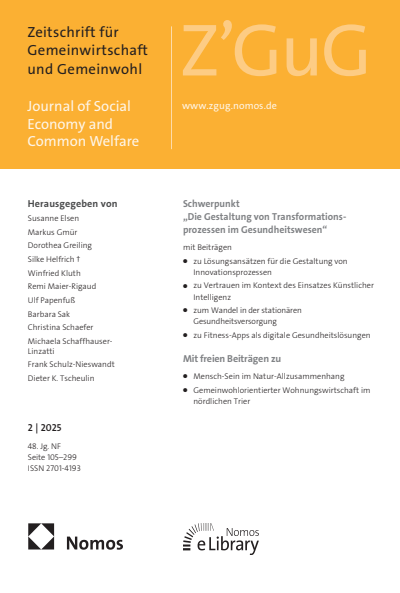
The Zeitschrift für Gemeinwirtschaft und Gemeinwohl (Z'GuG) is an interdisciplinary academic journal with relevance for professional practice (business, politics, civil society). The journal is published as a new series of the Zeitschrift für öffentliche und gemeinwirtschaftliche Unternehmen (ZögU) - Journal for Public and Nonprofit Services. The thematic focus is on public economics in its diversity of sponsors, administrative theory, the social economy, the third sector, cooperatives, as well as topics of importance to civil society such as communalization, neighborhood and district concepts, network development, and social space building. The Z'GuG is open to fundamental theoretical and methodological discussions and takes up topics that require a cultural-scientific, but also philosophical opening, including the social (medical, nursing, educational, etc.) care debates, gender and other diversity controversies, commons theory, and gift and reciprocity research. From these openings, Z'GuG is dedicated to the meta-theme of the common good.
Following the Action Plan on Financing Sustainable Growth and the Green Deal, European companies have been confronted with expanded obligations for sustainability reporting. These reporting obligations largely stem from the Corporate Sustainability...
This article examines the state of research on sustainability reporting by healthcare organizations based on a systematic literature review. Neo-institutionalism serves as the theoretical framework, in particular the three-phase model according to...
The Corporate Sustainability Reporting Directive establishes a mandatory double materiality analysis for many large state-owned hospitals to identify high-priority material topics in all three ESG (environmental, social, and governance) dimensions....
Corruption undermines health systems and public welfare. Yet evidence on remedies remains fragmented. This review synthesises 38 studies (2013–2022) and identifies 168 initiatives across seven corruption types. Legal and transparency initiatives...
This article provides an overview of the current doctrine of the Cologne morphological school of cooperative forms on the questions of whether cooperatives are a suitable form for public welfare tasks and what public welfare and transformative...
As a social movement, the “Last Generation” fought for a more decisive climate protection policy from 2021 to 2025, using the means of civil disobedience, in particular street blockades. However, although climate protection is supported by the...
How can the innovativeness of social innovations be critically measured in the context of aging, intergenerational relationships, and democratic culture? In this regard, the article explains index constructs in the context of generative social space...