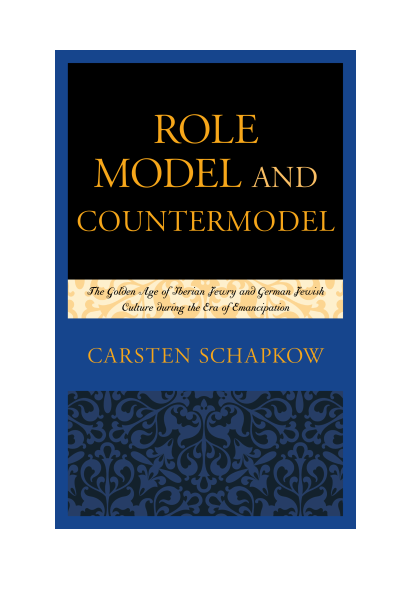
Role Model and Countermodel
The Golden Age of Iberian Jewry and German Jewish Culture during the Era of Emancipation- Authors:
- Publisher:
- 2015
Summary
This book explores the “Golden Age” of Sephardic Jewry on the Iberian Peninsula and its perception in German Jewish culture during the era of emancipation. For Jews living in Germany, the history of Sephardic Jewry developed into a historical example with its distinctive valence and signature against the pressure to assimilate and the emergence of anti-Semitism in Germany. It provided, moreover, a forum to engage in internal dialogue amongst Jews and external dialogue with German majority society about challenging questions of religious, political, and national identity. In this respect, the perception of prominent Sephardic Jews as intercultural mediators was key to emphasizing the skills and values Jews had to offer to civilizations in the past. German Jews invoked this past significance in their case for a Jewish role in present and future societies, especially in Germany.
Keywords
Search publication
Bibliographic data
- Edition
- 1/2015
- Copyright Year
- 2015
- ISBN-Print
- 978-1-4985-0802-5
- ISBN-Online
- 978-1-4985-0803-2
- Publisher
- Lexington, Lanham
- Language
- English
- Pages
- 305
- Product Type
- Monograph
Table of contents
- Contents No access
- Foreword No access
- Acknowledgments No access
- Notes No access
- Historical Foundations: Jewish History and Culture in Ancient Spain No access
- Jewish History under Muslim Rule in al-Andalus No access
- Jews in Christian Spain No access
- Forms of Perception in German Jewish Culture No access
- Methodological Approach and State of Research No access
- Notes No access
- The Haskalah as an Era of Upheaval No access
- Dohm’s On the Civil Improvement of the Jews No access
- History of Its Reception: Dohm’s Memorandum No access
- Educational Programs of the Maskilim and the Sephardic Model in Amsterdam No access
- The German Jewish Press in the Haskalah and the Iberian-Sephardic Ideal No access
- Biographies of Famous Men No access
- Moses Maimonides No access
- Maimonides’ Reception in the Haskalah No access
- Menasseh ben Israel No access
- The Maskilic Reception of Menasseh ben Israel No access
- Representations of Sephardic History in theJournal Sulamith No access
- Notes No access
- Representing German National History, the Jewish and non-Jewish Perspectives No access
- The Image of Spain in German Literature and Intellectual History No access
- Johann Gottfried Herder’s Idealization ofIberian Literatures No access
- Fichte’s Nationalism: The Free German Volkand the Jews No access
- Novalis: Christianity as PoliticalRegulatory Factor No access
- Rühs and Fries Attacks and Saul Ascher’s Response No access
- Counter-Images to the Concept of Nation in the “Society for Jewish Culture and Science” No access
- Saul Ascher’s Polemical Antithesis No access
- Leopold Zunz’s Organism Theory: The Example of Iberian-Sephardic Culture No access
- Isaak Markus Jost and his Political History of the Sephardic Jews No access
- Notes No access
- Jewish History as Reflected in Heinrich Graetz’s Depictions of Iberian-Sephardic andPolish-Jewish Life No access
- Graetz’s Construction of Jewish History and the Myth of al-Andalus No access
- Graetz’s Portrayal of Polish Jewish Life No access
- Reception History since Mendelssohn No access
- Abraham Geiger’s Interpretation of Iberian-Sephardic History as Counter-History No access
- Geiger and the Science of Judaism No access
- Geiger and the Iberian-Sephardic Role Model No access
- Representation of Poets in Geiger’s Works No access
- Notes No access
- Jewish Literature and German National Literature: Iberian-Sephardic Authors asIntercultural Mediators No access
- Point of Departure:Phöbus Philippson’s The Marranos No access
- Ludwig Philippson as Writer and Advocate No access
- Iberian-Sephardic History in Ludwig Philippson’s Fictional Works No access
- Neo-Orthodox Responses No access
- The Damascus-Affair: Starting Point for Ludwig Philippson’s Political Initiative in Spain No access
- The Politics of His Day: Ludwig Philippson’s Use of the Iberian-Sephardic Model No access
- The Middle Ages and Its Consequences No access
- Philippson’s Petition of 1854 No access
- Notes No access
- Conclusion No access Pages 265 - 268
- Bibliography No access Pages 269 - 288
- Index No access Pages 289 - 304
- About the Author No access Pages 305 - 305