, um zu prüfen, ob Sie einen Vollzugriff auf diese Publikation haben.
Monographie Kein Zugriff
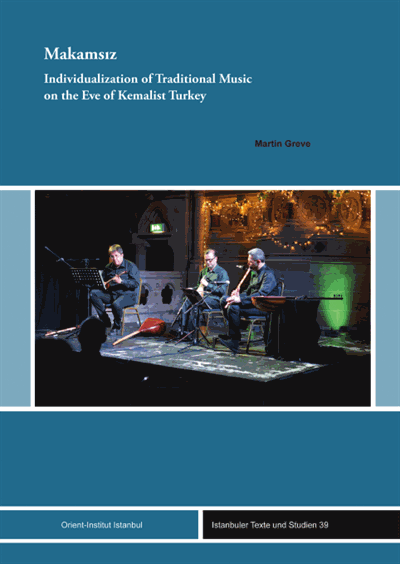
Makamsiz
Individualization of Traditional Music on the Eve of Kemalist Turkey- Autor:innen:
- Reihe:
- Istanbuler Texte und Studien (ITS), Band 39
- Verlag:
- 2017
Publikation durchsuchen
Bibliographische Angaben
- Auflage
- 1/2017
- Copyrightjahr
- 2017
- ISBN-Print
- 978-3-95650-278-1
- ISBN-Online
- 978-3-95650-371-9
- Verlag
- Ergon, Baden-Baden
- Reihe
- Istanbuler Texte und Studien (ITS)
- Band
- 39
- Sprache
- Englisch
- Seiten
- Produkttyp
- Monographie
Inhaltsverzeichnis
KapitelSeiten
- Titelei/Inhaltsverzeichnis Kein Zugriff Seiten 1 - 6
- Acknowledgements Kein Zugriff
- Istanbul – the Global Music City Kein Zugriff
- The Emergence of Public Music Life Kein Zugriff
- The Turkish Diaspora Kein Zugriff
- Old Neighbors Kein Zugriff
- New Markets: “World Music” Kein Zugriff
- Conclusion Kein Zugriff
- Musicians of the Past Kein Zugriff
- Relics from the Past Kein Zugriff
- Historisation of Past and Present Kein Zugriff
- Reconstructions and Revivals Kein Zugriff
- Kurdish Music Kein Zugriff
- Alevism and its Music Kein Zugriff
- Music from Dersim Kein Zugriff
- Conclusion Kein Zugriff
- Instruments in Flux Kein Zugriff
- Western Harmony Kein Zugriff
- New Ensembles for Traditional Music Kein Zugriff
- Melting Traditions Kein Zugriff
- Conclusion Kein Zugriff
- The Impact of Kemalism Kein Zugriff
- Education and Transmission Kein Zugriff
- Conclusion Kein Zugriff
- VI References Kein Zugriff Seiten 271 -
Literaturverzeichnis (812 Einträge)
Es wurden keine Treffer gefunden. Versuchen Sie einen anderen Begriff.
- Petropoulos, Elias, 2000, Songs of the Greek Underworld, London, Saqi. Google Scholar öffnen doi.org/10.5771/9783956503719
- Pieterse, Jan Nederveen, 1995, “Globalization as Hybridization”, Featherstone, Mike, Lash, Scott & Robertson, Roland (eds.), Global Modernities, London, Sage, pp 45-68. Google Scholar öffnen doi.org/10.5771/9783956503719
- Pohlit, Stefan, 2010a, “Musical Life and Westernization in the Republic of Turkey. Schismogenesis and Cultural Revisioning in Contemporary Music”, Paper presented at the conference “Europe in Opera – Musical Compositions of an Identity” at Casa de Mateus (Porto / Portugal). Google Scholar öffnen doi.org/10.5771/9783956503719
- Pohlit, Stefan 2010b, “Dialog mit der Türkei. Interkulturalität in Neuer Musik”, Neue Zeitschrift für Musik, 5, pp. 58-61. Google Scholar öffnen doi.org/10.5771/9783956503719
- Pohlit, Stefan 2011, Julien Jalâl ed-Dine Weiss – A New Qanun System: Its Application in the Performance Practice of the Ensemble “Al-Kindi” and in Contemporary Western Music, Ph.D. Thesis, Istanbul Technical University. Google Scholar öffnen doi.org/10.5771/9783956503719
- Pries, Ludger, 2010, Transnationalisierung. Theorie und Emperie grenzübergreifender Vergesellschaftung, Wiesbaden, VS-Verlag. Google Scholar öffnen doi.org/10.5771/9783956503719
- Popescu-Judetz, Eugenia, 1973, Dimitrie Cantemir, Cartea ştiinței muzicii, Bukarest, Editura musicalã a uniunii compozitorilor (Prince Dimitrie Cantemir, Istanbul, Pan, 2000). Google Scholar öffnen doi.org/10.5771/9783956503719
- Popescu-Judetz, Eugenia 1981, Studies in Oreintal Arts, Pittsburgh, Pennsylvania, pp. 99-170. Google Scholar öffnen doi.org/10.5771/9783956503719
- Popescu-Judetz, Eugenia 1996, “Trends in Musical Notation”, Popescu-Judetz, Eugenia, Meanings in Turkish Music, Istanbul, Pan, pp. 11-48. Google Scholar öffnen doi.org/10.5771/9783956503719
- Popescu-Judetz, Eugenia 1998, XVIII. Yüzyıl Musiki Yazmalarından Kevserî Mecmuası Üstüne Karşılastırmalı bir İnceleme (Turkish translation by Bülent Aksoy), Istanbul, Pan. Google Scholar öffnen doi.org/10.5771/9783956503719
- Popescu-Judetz, Eugenia 1999, Prince Dimitrie Cantemir, Istanbul, Pan. Google Scholar öffnen doi.org/10.5771/9783956503719
- Popescu-Judetz, Eugenia 2002, Tanburî Kücük Artin. A Musical treatise of the eighteenth Century, Istanbul, Pan. Google Scholar öffnen doi.org/10.5771/9783956503719
- Popescu-Judetz, Eugenia 2007a, A Summary Catalogue of the Turkish Makams, Istanbul, Pan. Google Scholar öffnen doi.org/10.5771/9783956503719
- Popescu-Judetz, Eugenia 2007b, Beyond the Glory of the Sultans. Cantemir’s View of the Turks, Istanbul, Pan. Google Scholar öffnen doi.org/10.5771/9783956503719
- Popescu-Judetz, Eugenia 2010, Three Comparative Essays on Turkish Music, Istanbul, Pan. Google Scholar öffnen doi.org/10.5771/9783956503719
- Popescu-Judetz, Eugenia & Neubauer, 2004, Eckhard, Seydî’s Book on Music – A 15th Century Turkish Discourse, (The Science of Music in Islam – Volume 6), Frankfurt am Main, Institute for of Arabic-Islamic-Science. Google Scholar öffnen doi.org/10.5771/9783956503719
- Popescu-Judetz, Eugenia & Sirli, Adriana Ababi, 2001, Sources of 18th Century Music, Panayiotes Chalatzoglu and Kyrillos Marmarinos’ Comparativ Treatises on Secular Music, Istanbul, Pan. Google Scholar öffnen doi.org/10.5771/9783956503719
- Poulos, Panagiotis C., 2005, Apostolos Konstas’ın Nazariyat Kitabı, Ph.D. Thesis, İTÜ. Google Scholar öffnen doi.org/10.5771/9783956503719
- Poulos, Panagiotis C. 2011, “Rethinking Orality in Turkish Classical Music: A Genealogy of Contemporary Musical Assemblages”, Middle East Journal of Culture and Communication 4, pp. 164-183. Google Scholar öffnen doi.org/10.5771/9783956503719
- Racy, Ali Jihad, 1977, Musical Change and Commercial Recording in Egypt, 1904-1932, PhD, University of Illinois, 1977. Google Scholar öffnen doi.org/10.5771/9783956503719
- Rasmussen, Anne, 1992, “An Evening in the Orient. The Middle Eastern Nightclub in America”, Asian Music, xxiii, 2, pp. 63-88. Google Scholar öffnen doi.org/10.5771/9783956503719
- Reents, Edo, 2006, “Der Sultan des Swing”, Tagesspigel, 15. December 2006. Google Scholar öffnen doi.org/10.5771/9783956503719
- Refiğ, Gülper, 1997, Atatürk ve Adnan Saygun. Özsoy Operası, Istanbul, Boyut Müzik. Google Scholar öffnen doi.org/10.5771/9783956503719
- Reigle, Robert, 2013, “A brief History of Kurdish Music Recordings in Turkey”, Hellenic Journal of Music, Education, and Culture, vol. 4, 2 (www.hejmec.eu). Google Scholar öffnen doi.org/10.5771/9783956503719
- Reigle, Robert & Whitehead, Paul (ed), 2008, Spectral World Music. Proceedings of the Istanbul Spectral Music Conference, Istanbul, Pan. Google Scholar öffnen doi.org/10.5771/9783956503719
- Reinhard, Kurt, 1972, “Grundlagen und Ergebnisse der Erforschung türkischer Musik”, Acta Musicologica, xliv, 266-280. Google Scholar öffnen doi.org/10.5771/9783956503719
- Reinhard, Kurt 1984, “Das Na’t des Itrî und seine Versionen”, Jahrbuch für musikalische Volks-und Völkerkunde, Vol. 2, pp. 9-30. Google Scholar öffnen doi.org/10.5771/9783956503719
- Reinhard, Ursula, 1987, “Türkische Musik. Ihre Interpreten in West-Berlin und in der Heimat. Ein Vergleich”, Jahrbuch für Volksliedforschung, pp. 81-92. Google Scholar öffnen doi.org/10.5771/9783956503719
- Reinhard, Ursula & Pinto, Tiago de Oliveira, 1989, Sänger und Poeten mit der Laute. Türkische Âşık und Ozan, Berlin, Staatliche Museen Preussischer Kulturbesitz. Museum für Völkerkunde Berlin. Google Scholar öffnen doi.org/10.5771/9783956503719
- Robertson, Roland (ed.), “Glocalization: Time-Space and Homogenity-Heterogenity”, Featherstone, Mike, Lash, Scott & Robertson, Roland (eds.), Global Modernities, London, pp. 25-44. Google Scholar öffnen doi.org/10.5771/9783956503719
- Roda, Frank, 1985, Wir singen zusammen. Neue Lieder für türkische und deutsche Kinder, Berlin, Express. Google Scholar öffnen doi.org/10.5771/9783956503719
- Rona, Mustafa, 1962, 50 Yıllık Türk Musikisi, Istanbul 1960. Google Scholar öffnen doi.org/10.5771/9783956503719
- Rona, Mustafa 1970, 20. Yüzyıl Türk Musikisi, Istanbul. Google Scholar öffnen doi.org/10.5771/9783956503719
- Ruskin, Jesse D. & Rice, Timothy, 2002, “The Individual in Musical Ethnography”, Ethnomusicology, vol. 56, no. 2 (spring / summer 2012), pp. 299-327. Google Scholar öffnen doi.org/10.5771/9783956503719
- Ryker, Harrison, 1991, New Music in the Orient. Essays on Composition in Asia since World War II, Buren. Google Scholar öffnen doi.org/10.5771/9783956503719
- Sağ, Arif & Erzincan, Erdal, 2009, Bağlama Metodu / Bağlama Method, Istanbul, Pan. Google Scholar öffnen doi.org/10.5771/9783956503719
- Sağlam, Hande, 2017, “Musikalische Vermittlungsmöglichkeiten der MigrantInnen aus der Türkei in Österreich/Wien”, Çiftçi & Greve 2017. Google Scholar öffnen doi.org/10.5771/9783956503719
- “Sahne Cağdas Sanatın”, Radikal, 24.11.2011: 42. Google Scholar öffnen doi.org/10.5771/9783956503719
- Salgar, M. Fatih, 2005, 50 Türk Müziği Bestekârı, Istanbul, Ötüken. Google Scholar öffnen doi.org/10.5771/9783956503719
- Salgar, M. Fatih 2008, The Music of Devine Love. Mevlevî Âyînlari, Istanbul, Ötüken. Google Scholar öffnen doi.org/10.5771/9783956503719
- Salgar, M. Fatih 2010, Dede Efendi, Hayatı, Sanatı, Eserleri, Istanbul, Ötüken. Google Scholar öffnen doi.org/10.5771/9783956503719
- Salgar, M. Fatih 2011a, Selim III. Hayatı, Sanatı, Eserleri, Istanbul, Ötüken. Google Scholar öffnen doi.org/10.5771/9783956503719
- Salgar, M. Fatih 2011b, Haci Arif Bey, Hayatı, Sanatı, Eserleri, Istanbul, Ötüken. Google Scholar öffnen doi.org/10.5771/9783956503719
- Salomoni, Fabio, 2014, “Just beyond the border: Azerbaijani and Armenian Migrants in Turkey”, Karacay, Ayşem Biris & Üstübici, Ayşen (eds.), Migration to and from Turkey: Changing Patterns and Shifting Policies, Istanbul, Isis Press, pp. 121-170. Google Scholar öffnen doi.org/10.5771/9783956503719
- Sanal, Haydar, 1964, Mehter Musikisi, Istanbul. Google Scholar öffnen doi.org/10.5771/9783956503719
- Sanlıkol, Mehmet Ali, 2011, Çalıcı Mehterler, Istanbul, Yapı Kredi Ya¬yın¬ları. Google Scholar öffnen doi.org/10.5771/9783956503719
- Sarı, Mehmet Ali, 2013, Kur’ân-ı Kerîm ve Dinî Mûsıkî, Istanbul, Marmara Üniversitesi Fakültesi Vakfı Ya¬yın¬ları. Google Scholar öffnen doi.org/10.5771/9783956503719
- Sarı, Ayhan, 2012, Türk Müziği Çalgıları, Istanbul, Nota. Google Scholar öffnen doi.org/10.5771/9783956503719
- Sarı, Ayhan 2010, “‘Asrı Kemençe’ yazması ve ‘damla kemençe’ye geliştirme bakışı”, paper presented at the I. Cüneyt Orhon Kemençe Sempozyumu, 2010 at İTÜ TMDK, İstanbul (http://www.musikidergisi.net/?p=2408 accessed October 21, 2016). Google Scholar öffnen doi.org/10.5771/9783956503719
- Sarı, Ayhan 2012a, “Geleneksel Türk Müziginde ile ‘kanun’, ‘bağlama’, ‘ney’ Koncertoları”, Musîki Dergisi, www.musikidergisi.net/?p=2122 (accessed 1 December, 2012). Google Scholar öffnen doi.org/10.5771/9783956503719
- Sarı, Ayhan 2015, II. Kanun Sempozyumu ve Festivali ardından, Musiki Dergisi = http://www.musikidergisi.com/yazar-94 ii._kanun_sempozyumu_ve_festivali_ardindan....html (accessed 2 November, 2016). Google Scholar öffnen doi.org/10.5771/9783956503719
- Sarı, Özgür, 2010, Tourism as a Tool for Development: The Case of Mawlana Tourism in Konya, unpublished Ph.D. Thesis Middle East Technical University. Google Scholar öffnen doi.org/10.5771/9783956503719
- Sarısözen, Muzaffer, 1952, Yurttan Sesler, Ankara, Akın. Google Scholar öffnen doi.org/10.5771/9783956503719
- Sarısözen, Muzaffer 1962, Türk Halk Müziğinde Usulleri, Ankara, Resimli Posta Matbaası. Google Scholar öffnen doi.org/10.5771/9783956503719
- Saritas, B. Siynem Ezgi, 2010, Articulation of Kurdish Identity through politicized Music of Komas, Master Thesis, Ankara, Middle Eastern Technical University. Google Scholar öffnen doi.org/10.5771/9783956503719
- Say, Ahmed, 1985, Müzik Ansiklopedesi, Ankara. Google Scholar öffnen doi.org/10.5771/9783956503719
- Say, Ahmed 1995, The Music Makers in Turkey, Ankara, Music Encyclopedia Publication. Google Scholar öffnen doi.org/10.5771/9783956503719
- Say, Ahmed 2014, “Türkiye’de Müzik Eğitimi Kurumlarına Genel Bir Bakış”, Say, Ahmet: Müzik Yazıları. Ankara, Müzik Ansiklopedisi Ya¬yın¬ları. Google Scholar öffnen doi.org/10.5771/9783956503719
- Saygun, Ahmet Adnan, 1936, Türk Halk Mûsıkîsinde Pentatonizm, Istanbul. Google Scholar öffnen doi.org/10.5771/9783956503719
- Saygun, Ahmet Adnan 1937, Rıze, Artvin ve Kars Havalisi Türkü, Saz Oyunları hakkında bazı Malûmat. Google Scholar öffnen doi.org/10.5771/9783956503719
- Saygun, Ahmet Adnan 1951, “Authenticity in Folk Music”, International Folk Music Journal, vol. 3, 7-10. Google Scholar öffnen doi.org/10.5771/9783956503719
- Saygun, Ahmet Adnan 1955, Sivas Düz Halayı, Ankara, Devlet Konservatuvarı Ya¬yın¬ları. Google Scholar öffnen doi.org/10.5771/9783956503719
- Saygun, Ahmet Adnan 1981 (1987), Atatürk ve Musıki, Ankara, Sevda – Cenap And Müzik Vakfı Ya¬yın¬ları. Google Scholar öffnen doi.org/10.5771/9783956503719
- Schedtler, Susanne, 1999, Das Eigene in der Fremde. Einwanderer-Musikkulturen in Hamburg, Münster, Lit. Google Scholar öffnen doi.org/10.5771/9783956503719
- Schneider, Albrecht, 1976, Musikwissenschaft und Kulturkreislehre. Zur Methodik und Geschichte der Vergleichenden Musikwissenschaft, Bonn-Bad Godesberg, Verlag für systematische Musikwissenschaft. Google Scholar öffnen doi.org/10.5771/9783956503719
- Seeman, Sonia Tamar, 2002, ‘You’re Roman!’ Music and Identity in Tukrish Roman Communities, Ph.D. Thesis, UCLA. Google Scholar öffnen doi.org/10.5771/9783956503719
- Sefarad Kültürü Araştırma Derneği, 2009, Türk Sefarad Sinagog Ilahileri / Turkish-Sephardic Synagogue Hymns / Kantas de Sinagoga Turko-Sefardi, Istanbul: Sefarad Kültürü Araştırma Derneği 2009. Google Scholar öffnen doi.org/10.5771/9783956503719
- Sels, Liselotte, 2014, Türkü and Halay Between Ghent and Turkey. An Ethnographic Study of Turkish Folk Music in a Transnational Context, Unpublished Ph.D. Thesis, University Ghent. Google Scholar öffnen doi.org/10.5771/9783956503719
- Senay, Banu, 2014, “The Fall and Rise of the Ney: From the Sufi Lodge to the World Stage”, Ethnomusicology Forum, Vol. 23, 3, pp. 405-424. Google Scholar öffnen doi.org/10.5771/9783956503719
- Senay, Banu 2015a, “Artists, Antagonisms and the ney in the popularization of ‘Sufi Music’ in Turkey”, European Journal of Cultural Studies, Vol. 18, 1, pp. 52-69. Google Scholar öffnen doi.org/10.5771/9783956503719
- Senay, Banu 2015b, Masterful Words: Musicianship and Ethics in Learning the Ney, Journal of the Royal Anthropological Institute (N.S.), 21, pp. 524-541. Google Scholar öffnen doi.org/10.5771/9783956503719
- Seroussi, Edwin, 1989, Mizmirat Qedem: The Live and Music of Rabi Isaac Algazi from Turkey, Jerusalem, „Renanot“, The Institute for Jewish Music. Google Scholar öffnen doi.org/10.5771/9783956503719
- Sezen, Armağan, 1992, Türk Müziğinde Nota Yayıncılığı (1875-1928), Master thesis İTÜ 1992. Google Scholar öffnen doi.org/10.5771/9783956503719
- Shamilly, Gultekin, 1992, “Mirza-Bey’s ‘Treatise on Music’”, Turkish Music Quaterly, 5,2/3, pp. 1-11. Google Scholar öffnen doi.org/10.5771/9783956503719
- Shannon, Jonathan H., 2003, “Sultans of Spin: Syrian Sacred Music on the World Stage”, American Anthropologist, 105, 2, pp. 266-277. Google Scholar öffnen doi.org/10.5771/9783956503719
- Siebert, Daniel, 2015, Musik im Zeitalter der Globalisierung. Prozesse – Perspektiven – Stile, Bielefeld, Transcript. Google Scholar öffnen doi.org/10.5771/9783956503719
- Signell, Karl, 1977, Makam: Modal Practice in Turkish Art Music, Seattle, Asian Muic Publishing. Google Scholar öffnen doi.org/10.5771/9783956503719
- Skalla, Eva & Amiri, Jemima, 1999, “Kurdish Music. Songs of the Stateless”. Broughton, Ellingham, & Trillo 1999, vol. 1, pp. 378-384. Google Scholar öffnen doi.org/10.5771/9783956503719
- Skoog, Gabriel, 2012, On Strange Shepherds, Golden Microphones, and Electric Guitars: Genre, Scene, and the Rise of Anadolu Pop in the Republic of Turkey, Ph.D. Thesis, University of Washington. Google Scholar öffnen doi.org/10.5771/9783956503719
- Slobin, Mark, 1992, Micromusics of the West: A Comparative Approach, Ethnomusicology, pp. 1-85. Google Scholar öffnen doi.org/10.5771/9783956503719
- Solmaz, Metin, 1996, Türkiye’de Pop Müzik. Dünü ve Bügünü ile bir Infilak Masalı, Istanbul. Google Scholar öffnen doi.org/10.5771/9783956503719
- Solomon, Thomas, 2005, “‘Living underground is tough’: authenticity and locality in the hip-hop community in Istanbul, Turkey”, Popular Music, vol 24, 1, pp. 1-20. Google Scholar öffnen doi.org/10.5771/9783956503719
- Solomon, Thomas 2005, “‘Listening to Istanbul’. Imaging Place in Turkish Rap Music”, Studia Musicologica Norvegica, vol 31, pp. 46-67. Google Scholar öffnen doi.org/10.5771/9783956503719
- Solomon, Thomas 2006, “Hardcore Muslims: Islamic Themes in Turkish Rap in Diaspora and in the Homeland”, Yearbook for Traditional Music, 38, pp. 59-78. Google Scholar öffnen doi.org/10.5771/9783956503719
- Solomon, Thomas 2007, “Articulation the historical moment: Turkey, Europe, and Eurovision 2003”, Raykoff, Ivan & Tobin, Robert (eds.), A Song for Europe: Popular Music and Politics in the Eurovision Song Contest, Aldershot, Ashgate, pp. 135-145. Google Scholar öffnen doi.org/10.5771/9783956503719
- Solomon, Thomas 2015, “Theorising Diaspora, Hybridity and Music”, Solomon, Thomas (ed.), African Musics in Context: Institutions, Culture, Identity, Kampala, Fountain Publishers, pp. 319-360. Google Scholar öffnen doi.org/10.5771/9783956503719
- Soydaş, Emin, 2007, Osmanlı Sarayında Çalgılar, Ph.D. Thesis, İTÜ. Google Scholar öffnen doi.org/10.5771/9783956503719
- Soydaş, Emin & Beşiroğlu, Şehvar Ş., 2007, Osmanlı Saray Müziğinde Yaylı Çalgılar, İTÜ Dergisi/b, vol. 4, No. 1, pp. 3-12. Google Scholar öffnen doi.org/10.5771/9783956503719
- Sözer, Vural, 1964 / 1986, Müzik ve Müsisyenler Ansiklopedisi, Istanbul. Google Scholar öffnen doi.org/10.5771/9783956503719
- Spinetti, Federico (ed.), 2010, Guiseppe Donizetti Pasha. Music and Historical Trajectories between Italy and Turkey, Bergamo, Fondazione Donizetti. Google Scholar öffnen doi.org/10.5771/9783956503719
- Steering Committee for Culture, Heritage and Landscape (CDCPP) (ed.), 2013, Cultural Policy in Turkey – National Report, Council of Europe, Strasbourg. Google Scholar öffnen doi.org/10.5771/9783956503719
- Steuerwald, Karl, 1963, Untersuchungen zur Türkischen Sprache der Gegenwart. Teil I Die Türkische Sprachpolitik seit 1928, Berlin, Langenscheidt. Google Scholar öffnen doi.org/10.5771/9783956503719
- Stock, Jonathan, 2001, “Ethnomusicology and the Individual”, The World of Music, vol. 43,1. Google Scholar öffnen doi.org/10.5771/9783956503719
- Stokes, Martin, 1992, The Arabesk Debate. Music and Musicians in Modern Turkey, Oxford, Clarendon. Google Scholar öffnen doi.org/10.5771/9783956503719
- Stokes, Martin 1996, “History, Memory, and Nostalgia in contemporary Turkish Musicology” www.umbc.edu/MA/index/number1/stokes1/st1.htm (1.November 2013). Google Scholar öffnen doi.org/10.5771/9783956503719
- Stokes, Martin 1999, “Turkey: Sounds of Anatolia”, Broughton, Ellingham & Trillo 1999: 396-410. Google Scholar öffnen doi.org/10.5771/9783956503719
- Stokes, Martin 2010, The Republic of Love. Cultural Intimacy in Turkish Popular Music, Chicago Studies in Ethnomusicology, Chicago, The University of Chicago Press. Google Scholar öffnen doi.org/10.5771/9783956503719
- Stokes, Martin 2013, “New Islamist popular culture in Turkey”, Salhi, Kamal (ed.), Music, Culture and Identity in the Muslim World, Abingdon, Routledge, pp. 15-34. Google Scholar öffnen doi.org/10.5771/9783956503719
- Strassberger, Katinka, 1984, “Frischer Wind aus dem Orient. Ein Gespräch mit dem türki¬schen Schlagzeuger Okay Temiz”, Fachblatt Musikmagazin, 5, pp. 90-95. Google Scholar öffnen doi.org/10.5771/9783956503719
- Strötbaum, Hugo, 1992, “Seventy-eight Revolutions per Minute in the Levant. Discography of Favorite’s Oriental Recordings”. De Turcicis Aliisque Rebus Commentarii Henry Hofman dedicati , Utrecht, Institut voor Oosterse Talen en Culturen, pp. 149-189. Google Scholar öffnen doi.org/10.5771/9783956503719
- Strötbaum, Hugo 2008, “Favorite Revisited: An Update”. 9. Diskographentag, Utrecht. Google Scholar öffnen doi.org/10.5771/9783956503719
- Strötbaum, Hugo 2012, “Goulash, Wiener Schnitzel and Şiş Kebap: Premier Record”, Gesellschaft für historische Tonträger: Lindström Projekt, Vol. 4, pp. 1-38. Google Scholar öffnen doi.org/10.5771/9783956503719
- Stubbs, Frederick W., 1994, The Art and Science of Taksim: An Empirical Analysis of Traditional Improvisation from 20th Century Istanbul, Ph.D. Thesis Wesleyan University. Google Scholar öffnen doi.org/10.5771/9783956503719
- Su, Ruhi, 1985, Ezgili Yürek. Şiirler Yazılar Konuşmalar, Istanbul, Adam. Google Scholar öffnen doi.org/10.5771/9783956503719
- Sürelsan, Ismail Baha, 1971, “Istanbul Konservatuvarina dair I-IV”, Musiki ve Nota, year 2, 1971, Vol. 16 (p.4-6), 19 (p.26-29), 22 (p.4-5), 23 (p.4-5). Google Scholar öffnen doi.org/10.5771/9783956503719
- Sürelsan, Ismail Baha 1972, “Rauf Yektâ Bey’in ‘1932 Kahire Şark Musıkîsi Kongresi’ne dair Notları”, Musıki ve Nota, 3, p. 28. Google Scholar öffnen doi.org/10.5771/9783956503719
- Sun, Sinemiş Adige, 2011, Muammer Sun’a Armağan, Ankara, Sevda-Cenap And Müzik Vakfı Ya¬yın¬ları. Google Scholar öffnen doi.org/10.5771/9783956503719
- Sun, Muammer, 2008, Çoksesli Halk Türküleri, Sun. Google Scholar öffnen doi.org/10.5771/9783956503719
- Sungurluoğlu, İ., 1961, Harput Yollarında, Ankara, Elazığ Kültür ve Tanıtma Vakfı Ya¬yın¬ları, no. 2, vol. 3. Google Scholar öffnen doi.org/10.5771/9783956503719
- Şahin, Nevin, 2009, Contested Belongings; Understanding the Meaning of Turkish Classical Music among Young Women in Germany, MA Thesis, Ankara, Middle East Technical University. Google Scholar öffnen doi.org/10.5771/9783956503719
- Şahin, Ahmed & Kemiksiz, Mehmet, 2010, Ramazan: Enderûn Terâvihi ve Cumhur Müezzinliği, http://www.enderunteravihi.com/, accessed November 22, 2016. Google Scholar öffnen doi.org/10.5771/9783956503719
- Şarman, Kansu, 2005, Türk Promethe’ler. Cumhurriyet’in Öğrencileri Avrupa’da (1925–1945), İstanbul, Türkiye İş Bankası Kültür Ya¬yın¬ları. Google Scholar öffnen doi.org/10.5771/9783956503719
- Şen, Besime, 2016, Devlet, Piyasa, Parti. Nizamettin Ariç ve Kürt Müziği, Istanbul, Avesta. Google Scholar öffnen doi.org/10.5771/9783956503719
- Şenel, Süleyman, 1994, Trabzon Bölgesi Halk Musikisine Giris, Istanbul, Anadolu Sanat Ya¬yın¬ları. Google Scholar öffnen doi.org/10.5771/9783956503719
- Şenel, Süleyman 1997, Kastamonulu Aşık Yorgansız Hakki Çavuş, Istanbul, Zafer Matbaasi. Google Scholar öffnen doi.org/10.5771/9783956503719
- Şenel, Süleyman 1995, Sadi Yaver Ataman, Istanbul. Google Scholar öffnen doi.org/10.5771/9783956503719
- Şenel, Süleyman 1999, “Cumhuriyet Dönemi’nde Türk Halk Müziği Araştırmaları”, Folklor / Edebiyat Vol 17, pp. 99-128. Google Scholar öffnen doi.org/10.5771/9783956503719
- Şenel, Süleyman 2000 (ed.), “Béla Bartók’un Türk Halk Müziği Çalışmaları İçindeki Yeri”, Şenel, Süleyman (ed.), Türkiye’ye Gelişin 60. Yıldönümü Anısına. Béla Bartók Paneli Bildirileri, Istanbul, pp. 26-36. Google Scholar öffnen doi.org/10.5771/9783956503719
- Şenel, Süleyman 2009a, Kastamonu’da Âşık Fasılları, Kastamonu, Kastamonu Valiliği. Google Scholar öffnen doi.org/10.5771/9783956503719
- Şenel, Süleyman 2009b (ed.), Adnan Ataman, Bu Toprağın Sesi, İstanbul Büyükşehir Belediyesi. Google Scholar öffnen doi.org/10.5771/9783956503719
- Şenel, Süleyman 2009c (ed.), Adnan Ataman: Safranbolu Türküleri ve Oyun Havaları, Istanbul, Safranbolu Kaymakamlığı. Google Scholar öffnen doi.org/10.5771/9783956503719
- Şenel, Süleyman 2010, Istanbul Cevresi Alan Araştırmaları, Istanbul, Istanbul Avrupa Kültür Başkenti. Google Scholar öffnen doi.org/10.5771/9783956503719
- Şenel, Süleyman 2015, Ottoman Türkü, Greve 2015: 195-209. Google Scholar öffnen doi.org/10.5771/9783956503719
- Şehsuvaroğlu, Bedi N., 1974, Halil Can, Istanbul, Hüsnütbiat Matbaası. Google Scholar öffnen doi.org/10.5771/9783956503719
- Şekeryan, Aris (ed), 2012, Kemani Sarkis Efendi Suciyan. Hayatı ve Eserleri, Istanbul, Aras. Google Scholar öffnen doi.org/10.5771/9783956503719
- Sener, Halil Ibrahim & Sari, Mehmet Ali, 1979-1980, “Muradname, Transliterated & Comments”, Musiki Mecmuası, pp. 362-364, 370-371. Google Scholar öffnen doi.org/10.5771/9783956503719
- Tambar, Kabir, 2010, “The Aesthetics of Public Visibility: Alevi Semah and the Paradoxes of Pluralism in Turkey”, Comparative Studies in Society and History, 52(3), pp. 652-679. Google Scholar öffnen doi.org/10.5771/9783956503719
- Tan, Ali & Çıpan, Mustafa, 2014, Ney..., Konya, Konya Valiliği İl Kültür ve Turizm Müdürlüğü. Google Scholar öffnen doi.org/10.5771/9783956503719
- Tanrıkorur, Çinuçen, 1998, “Ezikliğimiz Soruyor: ‘Sizin Konserlerinize Yabancılar Geliyormuş’”, Tanrıkorur, Çinuçen (ed.), Müzik Kimliğimiz üzerine Düşünceler, Istanbul, Ötüken, pp 161-175. Google Scholar öffnen doi.org/10.5771/9783956503719
- Tanrıkorur, Çinuçen 2001, “Bir Yarışma, Bir Cevap”, Tanrıkorur, Çinuçen, Biraz da Müzik, Istanbul, Zaman Kitab, pp. 60-62. Google Scholar öffnen doi.org/10.5771/9783956503719
- Tansuğ, Feza, 1991, “Ahmed Adnan Saygun (1907-1991), The Loss of a Pioneer”, Turkish Music Quaterly 4,2, pp. 9-11. Google Scholar öffnen doi.org/10.5771/9783956503719
- de Tapia, Stèphane, 1995, Turcs d’Europe et d’Ailleurs, Paris, Institut National des Langues et Civilisations Orientales. Google Scholar öffnen doi.org/10.5771/9783956503719
- Taşkın, Nilüfer, 2016, Bu bir İsyan Şarkısı Değil! Lazlar, Kimlik, Müzik, Istanbul, İletişim. Google Scholar öffnen doi.org/10.5771/9783956503719
- Tekelioğlu, Orhan, 1996, “The Rise of a Spontaneous Synthesis: The Historical Background of Turkish Popular Music”, Middle Eastern Studies, Vol. 32, 2, pp. 195-215. Google Scholar öffnen doi.org/10.5771/9783956503719
- Tekelioğlu, Orhan 2001, “The Inner History of ‘Turkish Music Revolution’ – Demise of a Music Magazine”, Hammarlund, Anders, Olsson, Tord & Ozdalga, Elisabeth (ed.), Sufism Music and Society in Turkey and the Middle East, Istanbul, Swedish Research Institute in Istanbul, pp. 111-116. Google Scholar öffnen doi.org/10.5771/9783956503719
- Tekelioğlu, Orhan 2011, “1940’li Yıllardan Itibaren Istanbul’un Caz Mekânları”, Aytar & Parmaksızoğlu, pp. 105-126. Google Scholar öffnen doi.org/10.5771/9783956503719
- Tekin, Gönül Alpay, 1992, Cengnâme, Ahmed-i Daî: Inceleme, Tenkidli Metin, Cambridge, Harvard University Press. Google Scholar öffnen doi.org/10.5771/9783956503719
- Tel, Mes’du Cemil, 1975 / 2002, Tanbûrî Cemil’in Hayâtı (1947), Istanbul, Kubealtı Nesriyâtı. Google Scholar öffnen doi.org/10.5771/9783956503719
- Terzet, Ahmet Şevket, 1975, Klâsik Türk Musikisi Antolojisi, Istanbul. Google Scholar öffnen doi.org/10.5771/9783956503719
- Terzi, Cihangir, 2015, Türk Halk Müziğinde Metrik Yapı. Nota Örnekleriyle Ölçüler ve Düzüm Sistematiği, Istanbul, İstanbul Teknik Üniversitesi Türk Musikisi Devlet Konservatuvarı Ya¬yın¬ları. Google Scholar öffnen doi.org/10.5771/9783956503719
- Terzi, Cihangir 2017, “Klassifizierung der in Anatolien gespielten Bağlama-Familie in terminologischer, typologischer und tonräumlicher Hinsicht”, Çiftçi & Greve 2017. Google Scholar öffnen doi.org/10.5771/9783956503719
- Tkachenko, Paul Steven, 2009, “The Musical Activities of the Young Turkish – Speaking Community in London: Identity and Nationalism”, Kucukcan, T & V Gungor (eds)., Turks in Europe: Culture, Identity, Integration, Amsterdam, Türkevi Research Centre. Google Scholar öffnen doi.org/10.5771/9783956503719
- Tohumcu, Z. Gonca Girgin, 2006, Müziği Yazmak. Müzik Notasyonunun Tarih içinde Yolculuğu, Istanbul, Nota Yayıncılık. Google Scholar öffnen doi.org/10.5771/9783956503719
- Toptaş, Barış, 2016, Türk Müziği Etütleri, 2 Vols. Google Scholar öffnen doi.org/10.5771/9783956503719
- Torun, Mutlu, 1996, Ud Metodu: “Gelenekten Geleceğe”, Istanbul, Çağlar Ya¬yın¬ları. Google Scholar öffnen doi.org/10.5771/9783956503719
- Toumajan, Mihran, 1972ff, Hayreni Yerg ou Ban, Yerevan. Google Scholar öffnen doi.org/10.5771/9783956503719
- Tuğlaci, Pars, 1986, Mehterhane’den Bando’ya / Turkish Bands of Past and Present, Istanbul, Cem Yayınevi. Google Scholar öffnen doi.org/10.5771/9783956503719
- Tura, Yalçın, 1976 / 2001 (ed.), Kantemiroğlu (Dimitrie Cantemir), Kitab-i ‘Ilmul-Musiki ‘ala vechi’l-Hurufat, Istanbul, Yapı Kredi Yayaınları. Google Scholar öffnen doi.org/10.5771/9783956503719
- Tura, Yalçın 1988, Türk Mûsıkîsinin Mes’eleleri, Istanbul. Google Scholar öffnen doi.org/10.5771/9783956503719
- Tura, Yalçın 2006, Tedkîk ü Tahkîk. Inceleme ve Gerçeği Araştırma, Istanbul, Pan. Google Scholar öffnen doi.org/10.5771/9783956503719
- Tura, Yalçın, Aksoy, Bülent, Behar, Cem, Ayangil, Ruhi & Beşiroğlu, Şehvar, 2001, “Kantemioğlu ve Osmanlı Müziğinde Yorum Sorunu Üstüne”, Sanat Dünyamiz, 79, pp. 69-85. Google Scholar öffnen doi.org/10.5771/9783956503719
- Turabi, Ahmet Hakkı, 2005, Gevrekzâde Hâfız Hasan Efendi ve Mûsikî Risâlesi, Istanbul, Ragbet Ya¬yın-ları. Google Scholar öffnen doi.org/10.5771/9783956503719
- Tüfekçi, Neriman & Nida, 1964, Memleket Türküleri, Istanbul, Hakan. Google Scholar öffnen doi.org/10.5771/9783956503719
- Tüfekçioğlu, Zeynep, 2016, “Contemporary Literary Depictions of the Ottoman Past: Neo-Ottomanism or Ottomania?” Paper presented at the Turkologentag 2016, 16 September, 2016 in Hamburg. Google Scholar öffnen doi.org/10.5771/9783956503719
- TÜIK, 2006, http://www.turkstat.gov.tr/icerikgetir.do?istab_id=171. Google Scholar öffnen doi.org/10.5771/9783956503719
- Türk Musikisinin Araştırma ve Uygulama Grubu, 1985, Tarih içinde Türk Musikisi, Istanbul, Istanbul Üniversitesi Güzel Sanatlar Bölümü. Google Scholar öffnen doi.org/10.5771/9783956503719
- Ulu, Esin, 2014, Kültürlerarası Hümanizmanın Müzikteki Simgesi. Çağdaş iki oratoryo: A. Adnan Saygun’un Yunus Emre ve Michael Tippett’in Zamanımızın Çocuğu Oratoryolarının Yapı, Stil ve İçerik Yönlerinden Karşılaştırmalı İncelemesi, Ankara, Gece Kitaplığı. Google Scholar öffnen doi.org/10.5771/9783956503719
- Unbehaun, Horst, 1995, “Migration Professionelle des Turcs vers le Proche-Orient, la Russie et L’Asie Centrale”, de Tapia 1995: 279-309. Google Scholar öffnen doi.org/10.5771/9783956503719
- Uluçay, Çağatay, 1948, “Mecmûa-i Sâz ü Söz”, Türk Musıki Dergisi, 14. Google Scholar öffnen doi.org/10.5771/9783956503719
- Uludemir, Muammer, 1989, Mecmua-i Saz u Söz: Bildiriler, Izmir, Bornova. Google Scholar öffnen doi.org/10.5771/9783956503719
- Uslu, Recep, 1999, “Osmanlılarda Batı Musikisi Teorisi Eserleri”, Orkestra, 307, 41-53. Google Scholar öffnen doi.org/10.5771/9783956503719
- Uslu, Recep 2001, Mehmet Hafid Efendi ve Musiki, Istanbul, Pan. Google Scholar öffnen doi.org/10.5771/9783956503719
- Uslu, Recep 2006, Müzikoloji ve Kaynakları, Istanbul, İTÜ Vakfı. Google Scholar öffnen doi.org/10.5771/9783956503719
- Uslu, Recep 2007, Fatih Döneminde Musiki ve Semsi-i Rûmî’nin Mecmûa-i Güfte’si, Istanbul, İstanbul Fetih Cemiyeti. Google Scholar öffnen doi.org/10.5771/9783956503719
- Uslu, Recep 2008, “Müzik Tarihi Açısından Es’ad Efendi’nin Atrabü’l Âsâri”, Musikisinas, 10, pp. 192-233. Google Scholar öffnen doi.org/10.5771/9783956503719
- Uslu, Recep 2009 / 2014, A Violinist in Ottoman Court: Saraydaki Kemancı, Istanbul / Ankara 2014 (www.academia.edu). Google Scholar öffnen doi.org/10.5771/9783956503719
- Uslu, Recep 2010, Selçuklu Topraklarında Müzik, Konya, Konya Valiliği Kültür İşleri. Google Scholar öffnen doi.org/10.5771/9783956503719
- Uslu, Recep 2015a, Meragi’den II. Murad’a Müziğin Maksatları. Makâsidu’l-Elhân, Ankara, Atatürk Kültür Merkezi Başkanlığı. Google Scholar öffnen doi.org/10.5771/9783956503719
- Uslu, Recep 2015b, “Is an Echo of Seljuk Music Audible? A Methodological Research”, Greve, 2015: 241-246. Google Scholar öffnen doi.org/10.5771/9783956503719
- Uslu, Recep & Dogrusöz Disiacik, Nilgün, 2009, Abdülbâki Nâsir Dede’nin Müzik Yazısı ‘Tahrîriye’, Türk Musikisi Devlet Konservatuarı Ya¬yın¬ları, Istanbul. Google Scholar öffnen doi.org/10.5771/9783956503719
- Utz, Chrstian, 2002, Neue Musik und Interkulturalität von John Cage bis Tan Dun, (Beihefte zum Archiv für Musikwissenschaft), Stuttgart. Google Scholar öffnen doi.org/10.5771/9783956503719
- Utz, Chrstian 2014, Komponieren im Kontext der Globalisierung, Bielefeld, Transcript. Google Scholar öffnen doi.org/10.5771/9783956503719
- Utz, Chrstian 2015, “Verflechtungen und Reflexionen. Transnationale Tendenzen neuer Musik seit 1945”, Hiekel, Jörk Peter & Utz, Christian (eds.), Lexikon Neue Musik, Stuttgart, Metzler/Bärenreiter, pp. 135-154. Google Scholar öffnen doi.org/10.5771/9783956503719
- Uysal, Sabri, 2001, Zum Musikleben der Türken in Nordrhein-Westfalen, Gräfelfing, Gräfelfing Buchverlag. Google Scholar öffnen doi.org/10.5771/9783956503719
- Uyar, Yaprak Melike, 2016, Jazz in Turkey: Cultural Connotation and the Process of Localization, Ph.D. Thesis IÜT Istanbul. Google Scholar öffnen doi.org/10.5771/9783956503719
- Uyar, Yaprak Melike & Beşiroğlu, Ş. Şehvar, 2012, “Recent Representations of the Music of the Mevlevi Order of Sufism”, Journal of Interdisciplinary Music Studies, Vol. 6, 2, pp. 137-150. Google Scholar öffnen doi.org/10.5771/9783956503719
- Uz, Kazim, 1894 /1964, Musiki Istilahatı, Oransay, Gültekin (ed.), Ankara, Küğ Yayını. Google Scholar öffnen doi.org/10.5771/9783956503719
- Uzcan, Nihat (ed.), 1978, Başlangıçtan Günümüze Kadar Türk Bestekârları Ansiklopedisi. Şarkı Güfteleri ve Türküler, Istanbul, İtimat Kitabevi. Google Scholar öffnen doi.org/10.5771/9783956503719
- Uzdilek, S.M., 1944, Ilim ve Musiki ve Türk Musikisi üzerinde Etüdler, Istan¬bul. Google Scholar öffnen doi.org/10.5771/9783956503719
- Uzunçarşılı, Ismail Hakkı, 1977, “Osmanlılar Zamanında Saraylarda Musiki Hayatı”, Belleten, xli. Google Scholar öffnen doi.org/10.5771/9783956503719
- Uzunçarşılı, Ismail Hakkı 1986, “Osmanli Sarayinda Ehl-i Hiref (sanatkârlar) defteri”, Türk Tarih Kurumu – Belgeler Dergisi, vol. xi, 15, pp. 23-77. Google Scholar öffnen doi.org/10.5771/9783956503719
- Ünal, Fehamet, 2000, Emin Ongan. Ömrünü Musıkiye Adayan İnsan, Istanbul, Pan. Google Scholar öffnen doi.org/10.5771/9783956503719
- Üngör, Etem, 1965, Türk Marşları, Ankara, Türk Kültür Araştırma Enstitüsü Ya¬yın¬ları. Google Scholar öffnen doi.org/10.5771/9783956503719
- Üngör, Etem 1981, Türk Mûsikîsi Güfteler Antolojisi, Istanbul, Erenler Ya¬yın¬ları. Google Scholar öffnen doi.org/10.5771/9783956503719
- Üngör, Ugur Ümit, 2011, The Making of Modern Turkey. Nation and State in Eastern Anatolia 1913-1959, Oxford, Oxford University Press. Google Scholar öffnen doi.org/10.5771/9783956503719
- Ünkan, Emin, Bedia & Hakan, 1984, Türk Sanat Musiki¬sinde Temel Bilgiler, Istanbul. Google Scholar öffnen doi.org/10.5771/9783956503719
- Ünlü, Cemal, 2004, Git Zaman Gel Zaman. Fonograf – Gramofon – Taş plak, Istanbul, Pan. Google Scholar öffnen doi.org/10.5771/9783956503719
- Ülkütaşır, M.Şakir (ed..), 1973, Türkiye’de Folklor ve Etnografya Çalışmaları, Ankara. Google Scholar öffnen doi.org/10.5771/9783956503719
- Üniter, Fatos, 1989, Kemençe’nin Tarihi Gelişime. Kemençe üzerine araştırma ve düşünceler, Master thesis ITÜ. Google Scholar öffnen doi.org/10.5771/9783956503719
- Ünver, O. Can, 2015, “Azerbaycan Türkleri Örneğinde Avrasya Coğrafyasından Türkiye’ye Yönelik Yüksek Nitelikli İnsan Göçü”, Erdoğan, M. Murat & Kaya, Ayhan (eds.), Türkiye’nin Göç Tarihi: 14. Yüzyıldan 21. Yüzyıla Türkiye’ye Göçler, Istanbul, Bilgi Üniversitesi Ya¬yın¬ları. Google Scholar öffnen doi.org/10.5771/9783956503719
- Üzel, Nezih, 2006, Radyoda bir Gün, Istanbul, Pan. Google Scholar öffnen doi.org/10.5771/9783956503719
- Vansina, Jan, 1985, Oral Tradition as History, Madison. Google Scholar öffnen doi.org/10.5771/9783956503719
- Väth, Gerhard, 1993, “Zur Diskussion über das Alevitentum”, Zeitschrift für Türkeistudien, 2, pp. 211-222. Google Scholar öffnen doi.org/10.5771/9783956503719
- Verlan, Sascha & Loh, Hannes, 2000, 20 Jahre Hiphop in Deutschland, Höfen, Hannibal. Google Scholar öffnen doi.org/10.5771/9783956503719
- Verband deutscher Musikschulen, 2012, Lehrplan Bağlama, Kassel, Gustav Bosse Verlag. Google Scholar öffnen doi.org/10.5771/9783956503719
- Vervelde, Leo & Greve, Martin, 2008, “The World in Sounds. The Academy for World Music”, Musikforum, 2, p.48-50. Google Scholar öffnen doi.org/10.5771/9783956503719
- Vicente, Victor A., 2007, The Aesthetics of Motion in Musics for the Mevlana Celal Ed-din Rumi, unpublished PhD dissertation, University of Maryland. Google Scholar öffnen doi.org/10.5771/9783956503719
- Vikár, Laszlo & Saygun, A. Adnan, 1976, Béla Bartók’s Folk Music Research in Turkey, Budapest. Google Scholar öffnen doi.org/10.5771/9783956503719
- Vorhoff, Karin, 1995, Zwischen Glaube, Nation und neuer Gemeinschaft: Alevitische Identität in der Türkei der Gegenwart, Berlin, Klaus Schwarz. Google Scholar öffnen doi.org/10.5771/9783956503719
- Vural, Feyzan Göher, 2011, Islamiyet’ten önce Türklerde Kültür ve Müzik. Hun, Kök Türk ve Uygur Devletleri, Istanbul, Cizgi. Google Scholar öffnen doi.org/10.5771/9783956503719
- Waltron, Jeremy F., “Practices of Neo-Ottomanism: Making Space and Place in Istanbul”, Göktürk, Soysal & Türeli 2010: 88-103. Google Scholar öffnen doi.org/10.5771/9783956503719
- Weich-Shahak, Susanna (ed), 2014, Judeo-Spanish Songs for the Life Cycle in the Eastern Mediterranean, (Anthology of Music Traditons in Israel), The Hebrew University of Jerusalem. Jewish Music Research Center. Google Scholar öffnen doi.org/10.5771/9783956503719
- Welsch, Wolfgang, 1992, “Transkulturalität. Lebensformen nach der Auflösung der Kulturen”, Informative Philosophie 2, pp. 5-20. Google Scholar öffnen doi.org/10.5771/9783956503719
- Woodard, Kathryn, 1999, Creating a national music in Turkey: The solo piano works of Ahmed Adnan Saygun, ProQuest Dissertations & Theses (PQDT). Google Scholar öffnen doi.org/10.5771/9783956503719
- Wright, Owen, 1988, “Aspects of Historical Change in the Turkish Classical Repertoire”, Musica Asiatica 5, pp. 1-108. Google Scholar öffnen doi.org/10.5771/9783956503719
- Wright, Owen 1992a (ed), Demetrie Cantemir. The Collection of Notations, London 1992 / 2000, London: Ashgate, Aldershot. Google Scholar öffnen doi.org/10.5771/9783956503719
- Wright, Owen 1992b, Words Without Songs, London. Google Scholar öffnen doi.org/10.5771/9783956503719
- Wright, Owen 1994, “17. ve 18. Yuzyıllardaki Yapısal Değişimler”, Dünden Bugüne Istanbul Ansiklopedisi, vol. 5. Google Scholar öffnen doi.org/10.5771/9783956503719
- Wright, Owen 1994/1995, “Abd al Qadir al-Maraghi and Ali B. Muhammad Bina’i: Two Fifteenth-century Examples of Notation”, Bulletin of the School of Oriental and African Studies, vol. 57, pp. 475-515, vol. 58, pp. 17-39. Google Scholar öffnen doi.org/10.5771/9783956503719
- Wright, Owen 1996a, “Middle Eastern Song-Text Colletions”, Early Music, 24, pp 454-469. Google Scholar öffnen doi.org/10.5771/9783956503719
- Wright, Owen 1996b, “On the Concept of a ‘Timurid’ Music”, Oriente Moderno, 15 (74), 2. Google Scholar öffnen doi.org/10.5771/9783956503719
- Wurm, Maria, 2006, Musik in der Migration. Beobachtungen zur Kulturellen Artikulation Türkischer Jugendlicher in Deutschland, Bielefeld. Google Scholar öffnen doi.org/10.5771/9783956503719
- Yahya Kaçar, Gülçin, 2011, Gülzâr-ı Mûsikî, Ankara: Maya Akademi Ya¬yın¬ları. Google Scholar öffnen doi.org/10.5771/9783956503719
- Wurm, Maria 2012 (2009), Türk Mûsikîsi Rehberi, Ankara, Maya Akademi. . Google Scholar öffnen doi.org/10.5771/9783956503719
- Wurm, Maria 2012, Türk Mûsikîsi Üzerine Görüşler (Analiz ve Yorumlar), Ankara, Maya Akademi. Google Scholar öffnen doi.org/10.5771/9783956503719
- Yalçın, Gökhan, 2016, Hâşim Bey Mecmuası, Ankara, Atatürk Kültür Merkezi. Google Scholar öffnen doi.org/10.5771/9783956503719
- Yalgin, Mahmet (ed.), 2009, Biraz Hayat Biraz Sanat Kemençeci bir Avukat, Nihat Doğu Kitabi, Izmir, Ege Üniversitesi Yayınevi. Google Scholar öffnen doi.org/10.5771/9783956503719
- Yarman, Ozan, 2007, 79-Tuning & Theory for Turkish Maqam Music. As A Solution to the Non-Conformance Between Current Model And Practice, Ph.D. Thesis ITÜ. Google Scholar öffnen doi.org/10.5771/9783956503719
- Yarman, Ozan 2010, „Alaturka Müziğinin Yasaklanmasında Atatürk: Belgeler Zemininde bir Çözümleme”, https://www.academia.edu (acessed 17 June, 2017). Google Scholar öffnen doi.org/10.5771/9783956503719
- Yavasca, Alâeddin, 2002, Türk Mûsikîsi’nde Kompozisyon ve Beste Biçimleri, Istanbul, Türk Kültürüne Hizmet Vakfı. Google Scholar öffnen doi.org/10.5771/9783956503719
- Yavuz, Elif Damla, 2014, Communities Within Individual in a Transcultural Work: Ali Baba und die 40 Räuber, Unpublished Ph.D. Thesis, Istanbul Technical University. Google Scholar öffnen doi.org/10.5771/9783956503719
- Yavuzoğlu, Nail, 2008/2010, 21. Yüzyılda Türk Müziği Teorisi, Istanbul, Pan. Google Scholar öffnen doi.org/10.5771/9783956503719
- Yavuzoğlu, Nail 2011, Türk Müziğinde Makamlar ve Seyir Özellilleri, Istanbul, Pan. Google Scholar öffnen doi.org/10.5771/9783956503719
- Yavuzoğlu, Nail 2013, Türk Makam Müziği ve Yani Notasyon, Istanbul, İnkilâp. Google Scholar öffnen doi.org/10.5771/9783956503719
- Yazıcı, Ümit, 2011, Tanbûri Ali Efendi. Hayatı ve Eserleri, İzmir, Dokuz Eylül Üniversitesi Ya¬yın¬ları. Google Scholar öffnen doi.org/10.5771/9783956503719
- Yazıcıoğlu, E. Taçlı, 2010, “Contesting the Global Consumption Ethos: Reterritorialization of Rock in Turkey”, Journal of Macromarketing, 30, 3, pp. 238-253. Google Scholar öffnen doi.org/10.5771/9783956503719
- Yedig, Serhan, 2007, “Erdal Erzincan’ı, Yo-Yo Ma’ya İpekyolu projesi için önereceğim. Interview with Kayhan Kalhor”, January 2007, http://www.muziksoylesileri.net/cms/index.php?option=com_content&task=view&id=177&Itemid=43 (accessed 25 August, 2015). Google Scholar öffnen doi.org/10.5771/9783956503719
- Rauf Yekta, 1318/1902, 2000, Esâtîz-i Elhân, Hâce Abdülkadir el-Merâgî, İstanbul, Mahmud Bey Matbaası, Nuri Akbayar (ed.), Istanbul, Pan. Google Scholar öffnen doi.org/10.5771/9783956503719
- Yedig, Serhan 1915 “Eski Türk Musikisine Dair Tetebbu’lar”, Milli Metebbular Mecmuası, 3. Google Scholar öffnen doi.org/10.5771/9783956503719
- Yedig, Serhan 1924, Şark Mûsikîsi Tarihi, Istanbul, Mahmud Bey Matbaası. Google Scholar öffnen doi.org/10.5771/9783956503719
- Yedig, Serhan 1913-1922, “La Musique Turque”, Lavignac (ed.), Encyclopédie de la Musique, vol. V, pp. 2945-3064. Google Scholar öffnen doi.org/10.5771/9783956503719
- Yiangou, Christiana, 2005, Smyrna and Asia Minor Revolution: The Birth of the Rembetiko Song, Master Thesis, California State University Dominguez-Hills. Google Scholar öffnen doi.org/10.5771/9783956503719
- Yıldırım, Imam, 2013, Bağlama, Band 1, Jedem Kind ein Instrument, Mainz, Schott. Google Scholar öffnen doi.org/10.5771/9783956503719
- Yıldız, Burcu, 2016, Experiencing Armenian Music in Turkey: An Ethnography of Musicultural Memory, Würzburg, Ergon. Google Scholar öffnen doi.org/10.5771/9783956503719
- Yılmaz, Altuğ & Kerovpyan, Aram, 2011, Klasik Osmanlı Müziği ve Ermeniler, İstanbul, Avrupa Kültür Başkent. Google Scholar öffnen doi.org/10.5771/9783956503719
- Yılmaz, Niyazi, 1996, Türk Halk Müziğinin Kurucu Hocası Muzaffer Sarısözen, Ankara, Ocak. Google Scholar öffnen doi.org/10.5771/9783956503719
- Yılmaz, Zeki, 1988 (1973) Türk Musikisi Dersleri, Istanbul. Google Scholar öffnen doi.org/10.5771/9783956503719
- Yöre, Seyit, 2015, The European Innovations in Ottoman Music Culture in the Context of Musical Composition, Uyanık (et. al. eds), International Conference on the Changing World and Social Research I, Vienna 2015, Proceedings Book, Konya: Palet. Google Scholar öffnen doi.org/10.5771/9783956503719
- Yöre, Seyit 2011, “Kültürleşmenin bir Parçası olarak Osmanlı’da Opera’nın Görünümü”, Zeitschrift für die Welt der Türken, Vol. 3,2, pp.53-69. Google Scholar öffnen doi.org/10.5771/9783956503719
- Yurdatapan, Sanar, 2016, “Turkey: Censorship Past and Present”, Freemuse 2016: 22-29. Google Scholar öffnen doi.org/10.5771/9783956503719
- Yücel, Clémence Scalbert, 2009, “The Invention of a Tradition: Diyarbakirs’s dengbêj Project”. European Journal of Turkish Studies, 10, http://ejts//revues.org/index4055.html. Google Scholar öffnen doi.org/10.5771/9783956503719
- Yücesoy, Eda Ünlü, 2011, Istanbul’da Medya. Çoğrafi Dağılım ve Üretim, İstanbul Bilgi Üniversitesi Ya-yın¬ları. Google Scholar öffnen doi.org/10.5771/9783956503719
- Yüksel, Metin, 2011, Dengbêj, Mullah, Intelligentsia: The Survival and Revival ot the Kurdish-Kurmanji Language in the Middle East, 1925–1960. Ph.D. Thesis Chicago, Illinois. Google Scholar öffnen doi.org/10.5771/9783956503719
- Yürür, Ahmet, 1995, “Processes in New Music in Turkey”, http://www.turkishmusic.org/cgi-bin/d?processes_7.htm (accessed October 25, 2016). Google Scholar öffnen doi.org/10.5771/9783956503719
- Zelepos, Ioannis, 2010, “Städte als Projektionsflöchen im griechischen Popularlied des 20. Jahrhunderts am Beispiel Istanbul, Izmirs und Thessalonikis”, Tischler, Ulrike & Zelepos, Ioannis (ed.), Bilderwelten – Weltenbilder. Die Gegenwart der Vergangenheit in postosmanischen Metropolen Südosteuropas: Thessaloniki, Istanbul, Izmir, Frankfurt, Peter Lang, pp. 63-99. Google Scholar öffnen doi.org/10.5771/9783956503719
- Zeren, M.Ayhan, 1978, Müzikte Ses Sistemleri: Genel Diziler, Ankara. Google Scholar öffnen doi.org/10.5771/9783956503719
- Zırh, Besım Can, 2008, “Euro-Alevis: From Gastarbeiter to Transnational Communiy”, Anghel, Remus Gabriel, Gerharz, Eva, Rescher, Gilberto & Salzbrunn, Monika (ed.), The Making of World Society. Perspectives from Transnational Research, Bielefeld, Transcript, pp. 103-131. Google Scholar öffnen doi.org/10.5771/9783956503719
- Zimmermann-Kalyoncu, Cornelia, 1985, Deutsche Musiker in der Türkei im 20. Jahrhundert, Frankfurt a.M. Peter Lang Verlag. Google Scholar öffnen doi.org/10.5771/9783956503719
- De Zorzi, Giovanni, 2008. “Learning the ney flute in Italy. A seven years “field” experience”, Hemetek & Sağlam 2008, 107-118. Google Scholar öffnen doi.org/10.5771/9783956503719
- Zimmermann-Kalyoncu, Cornelia 2010, Musiche di Turchia, Mailand, Ricordi. Google Scholar öffnen doi.org/10.5771/9783956503719
- Zümrüt, Mehmet Emin, 2000, “Türk Musikisi’nde Batı Etkisi ve Batı Musikisi Aletlerinin Kullanılması – II”, Musikişinas, 2000, Vol. 4, pp. 41-51. Google Scholar öffnen doi.org/10.5771/9783956503719
- Abacı, Tahir, 2000, Harput / Elazığ Türküleri, Istanbul, Pan Yayıncılık. Google Scholar öffnen doi.org/10.5771/9783956503719
- Abtuman, Elif 2012, “Talkin Drums”, The New Yorker, 9 July 2012 (http://www.newyorker.com/culture/culture-desk/talking-drums (24 October 2015). Google Scholar öffnen doi.org/10.5771/9783956503719
- Abu-Lughod, Lila 1991, “Writing against Culture”, Recapturing Anthropology, ed. Fox, R.G, Santa Fe, New Mexico, pp. 137-162. Google Scholar öffnen doi.org/10.5771/9783956503719
- Serhan Ada (ed) 2011, Istanbul’un Festivalleri, Istanbul, Istanbul Bilgi Üniversitesi Yayınları. Google Scholar öffnen doi.org/10.5771/9783956503719
- Abu-Lughod, Lila 1991 2009, “Bir Yeni Kültür Politikası için”, Ada & İnce 2009: 81-109. Google Scholar öffnen doi.org/10.5771/9783956503719
- Ada, Serhan & İnce, H.Ayca (ed.), 2009, Türkiye’de Kültür Politikalarına Giriş, Istanbul, Bilgi Üniversitesi Ya¬yın¬ları. Google Scholar öffnen doi.org/10.5771/9783956503719
- Agayeva, Sureya, 1995, “Ortaçağ Görsel Sanatlarında Nefesli Çalgılar Örnekleri”, Musiki Mecmuası, CDL. Google Scholar öffnen doi.org/10.5771/9783956503719
- Agayeva, Sureya 1999, “Türk Musikisinde Edvar”, Musiki Mecmuası, CDLXIII. Google Scholar öffnen doi.org/10.5771/9783956503719
- Agayeva, Sureya 2000, “Abdülkadir Meragi’de Türk Çalgıları”, Musiki Mecmuası, CDLXVII. Google Scholar öffnen doi.org/10.5771/9783956503719
- Agayeva, Sureya 2006, “Osmanlı Saraylarında Azerbaycan bilgin ve müzisyenleri”, Osmanli Dönem Türk Musikî Sempozyumu. Google Scholar öffnen doi.org/10.5771/9783956503719
- Agayeva, Sureya & Uslu, Recep 2009, Ruhperver, 2009, Vol. 1, Ankara: Ürün Yayınevi. Google Scholar öffnen doi.org/10.5771/9783956503719
- Akbıyık, Abuzer, 2006, Şanlıurfa Sıra Gecesi, Şanlıurfa, Elif Matbaası. Google Scholar öffnen doi.org/10.5771/9783956503719
- Açın, Cafer, 2000, Bağlama Yapım Sanatı ve Sanatçıları. İstanbul, Emek Basımevi. Google Scholar öffnen doi.org/10.5771/9783956503719
- Akçay, Ismail, 1993, “Musiki Tarihinden Belgeler (1): Musiki Encümeni ve Dar-ül-Elhan Talimatı Suretidir, Musiki Mecmuası, No. 437, pp. 13-24. Google Scholar öffnen doi.org/10.5771/9783956503719
- Akçura, Gökhan, 2002, Gramofon Çağı, Istanbul: Om Yayınevi. Google Scholar öffnen doi.org/10.5771/9783956503719
- Akdağ, Ali Kazım, 2017, “Strukturprobleme der Bağlama-Ausbildung in der Türkei und Bağlama-Lehrbücher im Rahmen der Lehrplan-Entwicklung”, Çiftçi & Greve, forthcoming. Google Scholar öffnen doi.org/10.5771/9783956503719
- Akdemir, Hayrettin, 1991, Die neue türkische Musik, Berlin, Hitit. Google Scholar öffnen doi.org/10.5771/9783956503719
- Akdoğan, Bayram 1996, “Hüccetü’s-Semâ’ adli Musikî Risâlesi ve Ankaravî Ismail B. Ahmed’in Mûsikî Anlayışı”, Ankara Üniversitesi İlahiyat Fakültesi: Ankara Dergisi, 35, 477-505. Google Scholar öffnen doi.org/10.5771/9783956503719
- Akdoğan, Bayram 1996 1999, “15. Yüzyıl Osmanlı Dönemininde Türk Mûsikîsi”; Diyanet Ilmi Dergi, vol. 35, 1, 135-170. Google Scholar öffnen doi.org/10.5771/9783956503719
- Akdoğan, Bayram 1996 2008, “Türk Din Musikisi Tarihine bir Bakiş”, Ankarana Üniversitesi Ilahiyat Fakültesi Dergisi, 1, 151-190. Google Scholar öffnen doi.org/10.5771/9783956503719
- Akdoğan, Bayram 1996 2009, Fethullah Şirvânî ve Mûsikî Risâlesi (Mecelletun Fi’l-Mûsîka), Ankara, Bilge Ajans ve Matbaası. Google Scholar öffnen doi.org/10.5771/9783956503719
- Akdoğan, Bayram 1996 2009, İsmâil-i Ankaravî ve Mûsıkî Risâlesi, İstanbul, Rağbet. Google Scholar öffnen doi.org/10.5771/9783956503719
- Akdoğu, Onur 1989a, Türk Müzigi Bibliografyası (9.yy – 1928), Izmir, E.Ü. Devlet Türk Musikisi Konservatuvarı Ya¬yın¬ları No. 89. Google Scholar öffnen doi.org/10.5771/9783956503719
- Akdoğu, Onur 1989a 1989b, Taksim Nedir Nasıl Yapılır, Izmir. Google Scholar öffnen doi.org/10.5771/9783956503719
- Akdoğu, Onur 1989a 1990, Tarihçi Müzikolog Yılmaz Öztuna, Izmir, Reform Matbaasi. Google Scholar öffnen doi.org/10.5771/9783956503719
- Akdoğu, Onur 1989a 1990, Lemi Atli, Hayati ve Eserleri, Ankara, Kültür Bakanlığı. Google Scholar öffnen doi.org/10.5771/9783956503719
- Akdoğu, Onur 1989a (ed.) 1992, Nâyî Osman Dede ve Rabt-i Tâbirât-i Mûsikî, Izmir. Google Scholar öffnen doi.org/10.5771/9783956503719
- Akdoğu, Onur 1989a 1994, Türk Müziğinde Perdeler, İzmir. Google Scholar öffnen doi.org/10.5771/9783956503719
- Akgün, Fehmi 1993, Yıllar Boyunca Tango 1865-1993, Istanbul, Pan. Google Scholar öffnen doi.org/10.5771/9783956503719
- Akkaş, Salih, 2015, Türkiye’de Cumhuriyet Dönemi Kültür ve Müzik Politikaları (1923–2000), Ankara, Son Çağ. Google Scholar öffnen doi.org/10.5771/9783956503719
- Akkaya, Ayhan, Özer, Diler, Çelik, Fehmiye & Uncu, Ülker (ed.) 2008, Kardeş Türküler 15 Yılın Öyküsü, Istanbul, bgst Ya¬yın¬ları. Google Scholar öffnen doi.org/10.5771/9783956503719
- Aksoy, Asu, 2009, “Zihinsel Değişim? AKP Iktidarı ve Kültür Politikası”, Ada & Ince, pp. 179-198. Google Scholar öffnen doi.org/10.5771/9783956503719
- Aksoy, Bülent, 1985, “Tanzi¬mat’tan Cumhuriyet’e Musiki ve Batılılaşma”, Tanzimat’tan Cumhuriyet’e Türkiye Ansiklopedisi, vol. 5, Belge, Murat (ed.), Istanbul, 1211-1236. Google Scholar öffnen doi.org/10.5771/9783956503719
- Aksoy, Bülent 1989, “Is the Question of the Origin of Turkish Music not redundant?”, Turkish Musical Quarterly, 2, 4. Google Scholar öffnen doi.org/10.5771/9783956503719
- Aksoy, Bülent (ed.), 1992, Sermüezzin Rifat Bey’in Ferahnak Mevlevî Ayını, Istanbul, Pan. Google Scholar öffnen doi.org/10.5771/9783956503719
- Aksoy, Bülent 1997, “Sultan III. Selim’in Öldürülmeden bir gece önce bestelediği Şarkı”, Türklük Arastırmaları Dergisi 8, Istanbul, Marmara Üniversitesi Fen-Edebiyat Fakültesi, Türk Tarihi Kurumu Matbaası. Google Scholar öffnen doi.org/10.5771/9783956503719
- Aksoy, Bülent 2000, Makam Tanıma Doğru, Musikişinas, Vol. 4, pp. 71-87. Google Scholar öffnen doi.org/10.5771/9783956503719
- Aksoy, Bülent 2005, CD Kemençe, liner notes, Kalan 2005. Google Scholar öffnen doi.org/10.5771/9783956503719
- Aksoy, Bülent 2008a, Avrupalı Gezginlerin Gözüyle Osmanlılarda Musiki, Istanbul, Pan. Google Scholar öffnen doi.org/10.5771/9783956503719
- Aksoy, Bülent 2008b, Geçmişin Musıki Mirasına Bakışlar, Istanbul, Pan. Google Scholar öffnen doi.org/10.5771/9783956503719
- Aksoy, Bülent 2009, Cüneyd Orhon anlatıyor: Radyo Günlerim, Istanbul, Pan. Google Scholar öffnen doi.org/10.5771/9783956503719
- Aksoy, Bülent 2010, “Musical Relationships between Italy and Turkey through Turkish Eyes”, Spinetti 2010, 61-77. Google Scholar öffnen doi.org/10.5771/9783956503719
- Aksoy, Bülent n.d., „Ottoman Music within the Makam Traditions of Middle-Easter art Music: An Overview”, (http://www.bulentsavas.com/english/althtml/ottomanmusicwithin.htm (accessed 15 September 2016). Google Scholar öffnen doi.org/10.5771/9783956503719
- Aksoy, Bülent 2015, “Prelimınary Notes on the Possibility (or Impossibility) of Writing Ottoman Music History”, Greve (ed.), 2015: 16-31. Google Scholar öffnen doi.org/10.5771/9783956503719
- Aksoy, Bülent, et al., 1994, “Musiki Hayatı”, Dünden Bugüne Istanbul Ansiklopedisi, vol. 5, Istanbul, Kültür Bakanlığı ve Tarih Vakfı Ortak Ya¬yın¬ları, pp. 521-540. Google Scholar öffnen doi.org/10.5771/9783956503719
- Aksu, Sema, 1990, Türk Musikisinde Rebab üzerine bir Araştırma, thesis, İstanbul, İTÜ. Google Scholar öffnen doi.org/10.5771/9783956503719
- Aksüt, Sadun 1983, Musikisi Güfteleri, Istanbul. Google Scholar öffnen doi.org/10.5771/9783956503719
- Aksüt, Sadun 1983 1967, 500 Yıllık Türk Musiki¬si Antolojisi, Istanbul. Google Scholar öffnen doi.org/10.5771/9783956503719
- Aksüt, Sadun 1983 1993, Türk Musikisinin 100 Bestekârları, Istanbul. Google Scholar öffnen doi.org/10.5771/9783956503719
- Aksüt, Sadun 1983 1994, Tanbur Metodu, Istanbul, Inkilâp Kitabevi. Google Scholar öffnen doi.org/10.5771/9783956503719
- Aksüt, Sadun 1983 (ed.) 2011, Şevkı Bey. Yâdigârı Şevk (Mahsûbi Tabiat), Istanbul, ITÜ TMDK Yayınları. Google Scholar öffnen doi.org/10.5771/9783956503719
- Akyol, Taner, 2017, “Bağlama und Zeitgenössische Klassische Musik”, Çiftçi & Greve (eds.), 2017. Google Scholar öffnen doi.org/10.5771/9783956503719
- Alaner, Bülent, 1986, Music Publications from Ottoman Empire Up Today, 1876-1986, Osmanlı İmperatorluğu’ndan Günümüze Belgelerle Müzik Yayıncılığı (1876-1986), Ankara. Google Scholar öffnen doi.org/10.5771/9783956503719
- Alaner, Bülent 2017 (a) “Osmanlı İmparatorluğu’nda Çok Sesli Müziğin Gelişimi”, Tarih Tarih Yayınevi, https://www.tarihtarih.com/?Syf=26&Syz=353046 (accessed 14 June 2017). Google Scholar öffnen doi.org/10.5771/9783956503719
- Alaner, Bülent 2017 (b), “Cumhuriyet Döneminde Çok Sesli Müzik”, Tarih Tarih Yayınevi, https://www.tarihtarih.com/?Syf=26&Syz=353046 (accessed 14 June 2017). Google Scholar öffnen doi.org/10.5771/9783956503719
- Ali, Filiz, 1983, “Türkiye Cumhuriyeti’nde Kon¬servatuvarlar”, Belge, Murat (ed.), Cuhuriyet Dönemi Türkiye Ansiklopedisi, Istanbul, pp. 1531-1534. Google Scholar öffnen doi.org/10.5771/9783956503719
- Ali, Filiz 2002, Bülent Arel. Elektronik Müziğin Öncüsü, Istanbul, Türkiye İş Bankası Ya¬yın¬ları. Google Scholar öffnen doi.org/10.5771/9783956503719
- Alimdar, Selçuk, 2016, Osmanlı’da Batı Müziği, Istanbul, İş Bankası Kültür Ya¬yın¬ları. Google Scholar öffnen doi.org/10.5771/9783956503719
- Almanya Alevi Birlikleri Federasyonu (ed.), 2000, Bin Yılın Türküsü. Das Epos des Jahrtausends. Saga of the Millenium, Köln AABF. Google Scholar öffnen doi.org/10.5771/9783956503719
- Alp, Sedat, 1999, Hititlerde Şarkı, Müzik ve Dans, Hitit Çağında Anadolu’da Üzüm ve Şarap, Ankara, Kavaklıdere Kültür Ya¬yın¬ları No: 6. Google Scholar öffnen doi.org/10.5771/9783956503719
- Alp, Sedat 2000, Song, Music, and Dance of Hittites (trans. Yaprak Eran), Ankara, Kavaklıdere Cultural Publications. Google Scholar öffnen doi.org/10.5771/9783956503719
- Altan, Ali , Doğrusöz, Nilgün & Uslu, Recep, 2012, Itri Izleri, Istanbul, Balat Ya¬yın¬ları. Google Scholar öffnen doi.org/10.5771/9783956503719
- Altan, Sinem 2013, Beni bağlama – don’t bind me. Konzert für Bağlama und Orchester, Berlin, Ries & Erler. Google Scholar öffnen doi.org/10.5771/9783956503719
- Altar, Cevad Memduh, 1989, Opera Tarihi, vol. 4, Istanbul, Kültür Bakanlığı Ya¬yın¬ları. Google Scholar öffnen doi.org/10.5771/9783956503719
- Altınay, Reyhan, 2004, Cumhurriyet Döneminde Türk Halk Müziği. Kitaplar, Makaleler, Nota Ya¬yın¬ları, Meta Basım, Izmir. Google Scholar öffnen doi.org/10.5771/9783956503719
- Altınay, Yeşim, 2010, Turkish Music Instruments, Istanbul, İstanbul Avrupa Kültür Baskenti Ajansi. Google Scholar öffnen doi.org/10.5771/9783956503719
- Altschiller, Donald, 1995, “Turkish Americans”, Galens, Judy, Sheets, Anna & Young, Robyn V. (ed.), Gale Encyclopedia of Multicultural America, vol. 2, New York, Gale Research, pp. 364-1373. Google Scholar öffnen doi.org/10.5771/9783956503719
- Ambros, A.W., 1968, Geschichte der Musik, vol. 1, (Leipzig 1862-1878), Hildesheim. Google Scholar öffnen doi.org/10.5771/9783956503719
- And, Metin, 2004, Başlangıcından 1983’e: Türk Tiyatro Tarihi, Istanbul, İletişim Ya¬yın¬ları. Google Scholar öffnen doi.org/10.5771/9783956503719
- And, Metin 1976, A Pictorial History of Turkish Dancing: From Folk Dancing to Whirling Dervishes-Belly Dancing to Ballett, Ankara, Dost 1976. Google Scholar öffnen doi.org/10.5771/9783956503719
- And, Metin 1982, Osmanlı Şenliklerinde Türk Sanatları, Ankara, Kültür ve Turizm Bakanlığı Ya¬yın¬ları. Google Scholar öffnen doi.org/10.5771/9783956503719
- And, Metin 1989, Türkiye’de Italyan Sahnesi, Italyan Sahnesinde Türkiye, Istanbul, Metis. Google Scholar öffnen doi.org/10.5771/9783956503719
- Anıl, Avni & Zakoğlu, Bünbey, 1979, Güfteler, Türk Sanat Musikisi Sözlü Eserler, Istanbul. Google Scholar öffnen doi.org/10.5771/9783956503719
- Andrews, Peter Alford, 1989, Ethnic Groups of Turkey, Wiesbaden, Reichert, pp. 142-147. Google Scholar öffnen doi.org/10.5771/9783956503719
- Anhegger, Robert, 1982, “Die Deutschlanderfahrung der Türken im Spiegel ihrer Lieder. Eine Einstimmung”, Birkenfeld, H. (ed.), Gastarbeiterkinder aus der Türkei. Zwischen Eingliederung und Rückkehr, München, Beck. Google Scholar öffnen doi.org/10.5771/9783956503719
- Apostolopoulos, Thomas, 2005, “The Socio-Cultural Context”, Feldman, Walter, Guettat, M., Kalaitzides, Kyriakos (eds.), Music in the Mediterranean, Volume I History, Thessaloniki, En Chordais, Project MediMuses in the context of European Union programme Euromed Heritage II., pp.477-484. Google Scholar öffnen doi.org/10.5771/9783956503719
- Apostolopoulos, Thomas & Kalaitzidis, Kyriakos, 2015, “Konstantinopolis’in Bizans öncesi ve Bizans sonrası Müzik Mirası”, Yılmaz, Coşkun (ed.), Büyük İstanbul Tarihi, Istanbul, İSAM, 20-35. Google Scholar öffnen doi.org/10.5771/9783956503719
- Aracı, Emre, 2001, Ahmed Adnan Saygun. Doğu-Batı Arası Müzik Köprüsü, Istanbul, YKY. Google Scholar öffnen doi.org/10.5771/9783956503719
- Aracı, Emre 2006, Donizetti Paşa. Osmanlı Sarayının İtalyan Maestrosu, Istanbul YKY. Google Scholar öffnen doi.org/10.5771/9783956503719
- Aracı, Emre 2010a, “From Napoleon to Mahmud: The Chequered Career of the Other Donizetti”, Spinetti 2010: 3-16. Google Scholar öffnen doi.org/10.5771/9783956503719
- Aracı, Emre 2010b, Naum Tiyatrosu. 19. Yüzyıl İstanbulu’nun İtalyan Operası. Yapı Kredi Ya¬yın¬ları. Google Scholar öffnen doi.org/10.5771/9783956503719
- Arel, Hüseyin Sadeddin, 1951, “300 Küsur Senelik Nota Mecmuası Hakkında”, Musıki Mecmuası, No 45. Google Scholar öffnen doi.org/10.5771/9783956503719
- Arel, Hüseyin Sadeddin 1969 (1939/49), Türk Musikisi Kimindir, Türk Musikisi Araştırma ve Değerlendirme Komisyonu Ya-yın¬ları 1, Istanbul. Google Scholar öffnen doi.org/10.5771/9783956503719
- Arel, Hüseyin Sadeddin 1991, Türk Musikisi Nazariyatı Dersleri, Ankara. Google Scholar öffnen doi.org/10.5771/9783956503719
- Arna, Sibel, 2006, “Ermeni sanatçı konuşuyor, Azeri meslektaşı tercüme ediyor”, Interview with Ilyas Mirzayev, Hürriyet, 1 July 2006, http://www.hurriyet.com.tr/cumartesi/4637746.asp (accessed 25 August, 2015). Google Scholar öffnen doi.org/10.5771/9783956503719
- Arnaud-Demir, Françoise, 1996, Littérature Populaire: En Suivant les Âşık, Montreuil, Ankara. Google Scholar öffnen doi.org/10.5771/9783956503719
- Arseven, Veysel, 1957, “Türk Halk Müziğinde Metrik Sistem”, Türk Folklor Araştırmaları Dergisi 100/101, 1590. Google Scholar öffnen doi.org/10.5771/9783956503719
- Arslan, Fazli, 2001, “Qur’ân’s Tacwîd at Qutb Al-Dîn al Shirâzî’s Music Notation”, International Journal of Humanities and Social Science, vol. 1, No. 10; 209-216. Google Scholar öffnen doi.org/10.5771/9783956503719
- Arslan, Fazli 2005, “Safiyyüddîn Abdülmümin el-Urmevî’nin er-Risâletü’ş-Şerefiyye’sinde Mûsikî Matematiği”, AÜIFD XLVI (2005), No II, 267-304. Google Scholar öffnen doi.org/10.5771/9783956503719
- Arslan, Fazli 2009, “Müzik Kuramcısı ve Efsanevi Kişilik olarak Safiyyüddîn-i Urmevî”, Sosyal Bilimler Dergisi, no. 26, 165-179. Google Scholar öffnen doi.org/10.5771/9783956503719
- Arsunar, Ferruh, 1937a, Anadolu’nun Pentatonik Melodileri Hakkında Birkaç Not, Istanbul, Numune Matbaası. Google Scholar öffnen doi.org/10.5771/9783956503719
- Arsunar, Ferruh 1937b, Tunceli-Dersim Halk Türküleri ve Pentatonik, Istanbul, Resimli Ay Matbaası. Google Scholar öffnen doi.org/10.5771/9783956503719
- Artun, Erman 2014, Aşıklık Geleneği ve Aşık Edebiyati, Istanbul, Kitabevi. Google Scholar öffnen doi.org/10.5771/9783956503719
- Arzruni, Şahan, 2001, USA, European Traditional Music, Armenian, Sadie, Stanley (ed.), The New Grove Dictionary of Music and Musicians, Vol. 26, London, MacMillan. Google Scholar öffnen doi.org/10.5771/9783956503719
- Aşkın, Cihat, 2010, “Murat Bardakcı’nın bir Yazışı Üzerine Çeşitlemeler”, Yeşilgazete, 11 November 2010. Google Scholar öffnen doi.org/10.5771/9783956503719
- Aslan, Üzeyir, (ed) 2007, Molla Cami – Hoca Neş’et: Ney’in Feryadı, Istanbul, Sufi Kitap. Google Scholar öffnen doi.org/10.5771/9783956503719
- Assmann, Jan, (1997) 2011, Cultural Memory and Early Civilization.Writing, Remembrance, and Political Imagination, Cambridge, Cambridge University Press. Google Scholar öffnen doi.org/10.5771/9783956503719
- Atagür, Zeki, 2013, Bağlama Egzersizleri, Ankara, Sonsöz Gazetecilik Matbaacılık. Google Scholar öffnen doi.org/10.5771/9783956503719
- Atalay, Adnan, 1984, “Müzik Yazısı”, Say, Ahmet (ed.), Müzik Ansiklopedisi, Ankara. Google Scholar öffnen doi.org/10.5771/9783956503719
- Ataman, Ahmet Muhtar 1928, Musiki Tarihi, Istanbul, Develt Matbaasi. Google Scholar öffnen doi.org/10.5771/9783956503719
- Ataman, Sadi Yaver, 1991, Atatürk ve Türk Musıkisi, Atatürk Dizisi 31, Ankara, Kültür Bakanlığı Ya¬yın-ları 1291. Google Scholar öffnen doi.org/10.5771/9783956503719
- Atilgan, Halil, 1992, “Halk Müziğimizde Anonimlik ve Beste Meselesi”, Turhan, Salih (ed.), Türk Halk Musikîsinde Çeşitli Görüşler, Ankara, Kültür Bakanlığı, pp.163-173. Google Scholar öffnen doi.org/10.5771/9783956503719
- Avrupa Kültür Başkenti, 2010, Klasik Türk Müziği. Program Kitapçığı, Istanbul. Google Scholar öffnen doi.org/10.5771/9783956503719
- Ayan, Dursun, 2011, Béla Bartók’un Türk Halk Müziği Derlemeleri üzerine Çalışmaları, Istanbul: Kitabevi. Google Scholar öffnen doi.org/10.5771/9783956503719
- Ayangil, Ruhi, 2008, “Western Notation in Turkish Music”, Journal of the Royal Asiatic Society, Vol. 18, 4, pp. 401-447. Google Scholar öffnen doi.org/10.5771/9783956503719
- Ayangil, Ruhi 2010, “Western Notation: A Debatable Matter in Turkish Makam Music Contributed by Guiseppe Donizetti Pasha”, Spinetti 2010: 39-57. Google Scholar öffnen doi.org/10.5771/9783956503719
- Ayas, Güneş, 2014, Mûsiki İnkılâbı’nın Sosyolojisi. Klasik Türk Müziği Geleneğinde Süreklilik ve Değişim, Istanbul, Doğu Kitabevi. Google Scholar öffnen doi.org/10.5771/9783956503719
- Ayas, Güneş 2015, Müzik Sosyolojisi. Sorunlar, Yaklaşımlar, Tartışmalar, Istanbul, Doğu Kitabevi. Google Scholar öffnen doi.org/10.5771/9783956503719
- Aydin, Yılmaz, 2003, Türkiye’de Avrupa ile Müzik İlişkileri Işığında Türk Beşleri, Ankara, Müzik Ansiklopedisi Ya¬yın¬ları. Google Scholar öffnen doi.org/10.5771/9783956503719
- Aydemir, Murat, 2010, Turkish Music Makam Guide (translated by Erman Dirikcan), Istanbul: Pan; (Greek translation by S. Kompotiati, Athens, Fagotto books 2012). Google Scholar öffnen doi.org/10.5771/9783956503719
- Aydın, Yılmaz, Türk Beşleri, Ankara, Müzik Ansiklopedisi Ya¬yın¬ları. Google Scholar öffnen doi.org/10.5771/9783956503719
- Aytar, Volkan & Parmaksızoğlu, Kübra, 2010, Istanbul’da Eğlence, Istanbul, Istanbul Bilgi Üniversitesi Ya¬yın¬ları. Google Scholar öffnen doi.org/10.5771/9783956503719
- Bachir-Loopuyt, Talia, 2013, Une Musique du Monde faite en Allemagne? Les compétitions Creole et l’idéale société plurielle dans l’Allemagne d’aujourd’hui, Ph.D. Thesis EHESS Paris. Google Scholar öffnen doi.org/10.5771/9783956503719
- Bakbaşa, Ceyda, 2011, “Istanbul’da Sanat Fuarları”, Ada 2011: 115-129. Google Scholar öffnen doi.org/10.5771/9783956503719
- Balkılıç, Özgür, 2009, Cumhuriyet, Halk ve Müzik, Ankara, Tan. Google Scholar öffnen doi.org/10.5771/9783956503719
- Balkır, Canan & Kaiser, Bianca, 2015, “Türkiye’de Avrupa Birliği Vatandaşları”, Erdoğan & Kaya, 2015, 223-241. Google Scholar öffnen doi.org/10.5771/9783956503719
- Bardakçı, Murat, 1986, Maragali Abdulkadir, Istanbul, Pan. Google Scholar öffnen doi.org/10.5771/9783956503719
- Bardakçı, Murat 1993, Fener Beyleri’ne Türk Şarkıları, Istanbul, Pan. Google Scholar öffnen doi.org/10.5771/9783956503719
- Bardakçı, Murat 1995, Refik Fersan ve Hatıraları, Istanbul, Pan. Google Scholar öffnen doi.org/10.5771/9783956503719
- Bardakçı, Murat 1997, Sultanî Besteler. Osmanoğulları’nın son Padişahı Mehmed Vahideddin’in. Eserleri, Istanbul, Pan. Google Scholar öffnen doi.org/10.5771/9783956503719
- Bardakçı, Murat 2000, “Derviş es-Seyyid Mehmed Efendi’in Tanbur Perdeleri Risalesi”, Musikişinas, p. 6-39. Google Scholar öffnen doi.org/10.5771/9783956503719
- Bardakçı, Murat 2010, “Musiki Inkılâbi ve Başarısızlık”, Habertürk, 8 November 2010. Google Scholar öffnen doi.org/10.5771/9783956503719
- Bardakçı, Murat 2012a, “Itrî Yılı”, Habertürk, 1 February 2012. Google Scholar öffnen doi.org/10.5771/9783956503719
- Bardakçı, Murat 2012b, 25 Yıla 25 Besteci, Istanbul, Pan. Google Scholar öffnen doi.org/10.5771/9783956503719
- Bardakçı, Murat 2012c, The Treatise of Ahmed Oglı Şükru’llah and Theory of Oriental Music in the 15th Century, Harvard (Doğu Dilleri ve Edebiyatlarının Kaynakları 51. Türkçe Kaynaklar XLIV). Google Scholar öffnen doi.org/10.5771/9783956503719
- Bartók, Béla, 1976, Turkish Folk Music from Asia Minor, ed. Benjamin Suchoff, Princeton. Google Scholar öffnen doi.org/10.5771/9783956503719
- Bartsch, Patrick, 2012, Musikpolitik im Kemalismus. Die Zeitschrift Radyo zwischen 1941 und 1949, Bamberg, University of Bamberg Press. Google Scholar öffnen doi.org/10.5771/9783956503719
- Başeğmezler, Nejat, 1992, Necil Kâzım Akses’e Armağan, Ankara, Sevda-Cenap And Müzik Vakfı Ya¬yın-ları. Google Scholar öffnen doi.org/10.5771/9783956503719
- Basgöz, Ilhan, 1979 (1994), Âsik Ali Izzet Özkan, Istanbul, Indiana Üniversitesi. Google Scholar öffnen doi.org/10.5771/9783956503719
- Basgöz, Ilhan 2002, “Turkish Folk Literature”, Inalcık, Halil & Renda, Güncel (eds.), Ottoman Civilization, Ankara, Ministery of Culture, pp. 597-623. Google Scholar öffnen doi.org/10.5771/9783956503719
- Beşikçi, Ismail, 1977, Türk-Tarih Tezi ve Kürd Sorunu, Ankara, Komal. Google Scholar öffnen doi.org/10.5771/9783956503719
- Bates, Eliot, 2008, Social Interaction, Musical Arrangements, and the Production of Digital Autio in Istanbul Recording Studios, PhD Dissertation University of California, Berkeley. Google Scholar öffnen doi.org/10.5771/9783956503719
- Bates, Eliot 2011, Music in Turkey. Experienting Music, Expressing Culture, Oxford, Oxford University Press. Google Scholar öffnen doi.org/10.5771/9783956503719
- Baumann, Max Peter (ed), 1985, Musik der Türken in Westberlin, Kassel, Yvonne Landec. Google Scholar öffnen doi.org/10.5771/9783956503719
- Baydar, Evren Kutlay, 2010, Osmanlı’nın Avrupalı Müzisyenleri, Istanbul, Kapı. Google Scholar öffnen doi.org/10.5771/9783956503719
- Bayley, Amanda, (forthcoming), “Cross-cultural Collaborations with the Kronos Quartet”, Clarke, E. and Doffman, M., eds. Creativity, Improvisation and Collaboration: Perspectives on the Performance of Contemporary Music. Oxford and New York: Oxford University Press. Google Scholar öffnen doi.org/10.5771/9783956503719
- Bayraktar, Ertuğrul, 1993, “An Outline of Kemal Ilerici Harmonic System”, Say, Ahmet (ed.), The Music Makers in Turkey, Ankara, pp. 51-54. Google Scholar öffnen doi.org/10.5771/9783956503719
- Beck, Ulrich, 1983, “Jenseits von Stand und Klasse”, R. Krechel (ed.), Soziale Ungleichheiten, Göttingen, Schwarz Verlag. Google Scholar öffnen doi.org/10.5771/9783956503719
- Begian, Harry, 1964, Gomitas Vartabed: His Life and Importance to Armenian Music, Ph.D. Thesis, University of Michigan. Google Scholar öffnen doi.org/10.5771/9783956503719
- Behar, Büsra Ersanlı, 1992, Iktidar ve Tarih: Türkiye’de ‘Resmi tarih’ Tezinin Oluşumu. (1929-1937), Istanbul, AFA. Google Scholar öffnen doi.org/10.5771/9783956503719
- Behar, Cem, 1987a, 18. Yüzyılında Türk Müziği, Charles Fonton, Istanbul. Google Scholar öffnen doi.org/10.5771/9783956503719
- Behar, Cem 1987b, Klasik Türk Musıkisi üzerinde Denemeler, Istanbul, Bağlam. Google Scholar öffnen doi.org/10.5771/9783956503719
- Behar, Cem 1990, Ali Ufkî ve Mezmurlar, Istanbul, Pan. Google Scholar öffnen doi.org/10.5771/9783956503719
- Behar, Cem 1997, “Manol of the Ud, Baron of the Kemençe: Turkish Musical Instruments and Makers”; Music & Art, Vol 7. Google Scholar öffnen doi.org/10.5771/9783956503719
- Behar, Cem 2001, “The Technical Modernization of Turkish Music: The Case of the Durak”. Hammarlund, Olsson & Özdalga 2001, pp. 97-109. Google Scholar öffnen doi.org/10.5771/9783956503719
- Behar, Cem 2005, Musıkiden Müziğe, Osmanlı / Türk Müziği: Gelenek ve Modernlik, Istanbul, Yapı Kredi Ya¬yın¬ları. Google Scholar öffnen doi.org/10.5771/9783956503719
- Behar, Cem 2006, “The Ottoman Musical Tradition”, The Cambridge History of Turkey, Vol. 3 (The Later Ottoman Empire, 1603–1839), Cambridge, Cambridge University Press, 393-408. Google Scholar öffnen doi.org/10.5771/9783956503719
- Behar, Cem 2008, Saklı Mecmua. Ali Ufkî’nin Bibliotheque Nationale de France’taki (Turc 292) Yazması, Istanbul, Yapı Kredi Ya¬yın¬ları. Google Scholar öffnen doi.org/10.5771/9783956503719
- Behar, Cem 2010, Şeyhülilâm’in Müziği. 18. Yüzyılda Osmanlı/Türk Musikisi ve Şeyhülislâm Es’ad Efendi’nin Atrabü’l-Âsâr’i, Istanbul, Yapı Kredi Ya¬yın¬ları. Google Scholar öffnen doi.org/10.5771/9783956503719
- Behar, Cem 2012 (1998), Aşk Olmayınca Meşk Olmaz. Geleneksel Osmanlı / Türk Müziğinde Öğretim ve İntikal, Istanbul, Yapı Kredi Ya¬yın¬ları. Google Scholar öffnen doi.org/10.5771/9783956503719
- Behar, Cem 2013a, “Dede Efendi’nin Eserlerine Tarih Koymak”, Musikişinas 11, pp. 20-50. Google Scholar öffnen doi.org/10.5771/9783956503719
- Behar, Cem 2013b, “Text and Memory in Ottoman/Turkish Musical Tradition”, Pennanen et.el. 2013: 3-11. Google Scholar öffnen doi.org/10.5771/9783956503719
- Behar, Cem 2015, Osmanlı / Türk Musıkisinin Kısa Tarihi, İstanbul, Yapı Kredi Ya¬yın¬ları. Google Scholar öffnen doi.org/10.5771/9783956503719
- Beken, Münir Nurettin, 1998, Musicians, Audience and Power: The Changing Aesthetics in the Music at the Maksim Gazino of Istanbul, PhD Theis University of Maryland. Google Scholar öffnen doi.org/10.5771/9783956503719
- Benjamin, Walter, (1935) 1939, “Das Kunstwerk im Zeitalter seiner technischen Reproduzierbarkeit”, Schöttker, Detlev (ed.), Walter Benjamin. Das Kunstwerk im Zeitalter seiner technischen Reproduzierbarkeit. Kommentar. Frankfurt a.M., Suhrkamp Verlag, 2002: 7-50. Google Scholar öffnen doi.org/10.5771/9783956503719
- Berkman, Esra, 2012, Kanun Virtüözü, Besteci ve Eğititci Haçatur Avetisyan (1926-1996) ve Kanun Çalgısı özelinde Ermenistan Sovyet Sosyalist Cumhuriyet’inde (1920-1991) Müziğin Dönüşümü, Ph.D. thesis Yıldız Teknik Üniversitesi. Google Scholar öffnen doi.org/10.5771/9783956503719
- Berliner Institut für Vergleichende Sozialforschung, 2005, Türkische TV-Sender in Deutschland, Berlin. Google Scholar öffnen doi.org/10.5771/9783956503719
- Berthier, Stephanos & Annie (ed.), Topkapı Sarayı’nda Yasam. Albertus Bobovius ya da Santuri Ali Ufki Bey’in Anıları. (1669), translated bz Ali Berktay, Istanbul, Kitab Yayınevi. Google Scholar öffnen doi.org/10.5771/9783956503719
- Beşiroğlu, Şehvar (ed.), 2008, III Selim, Istanbul, ITÜ Türk Musikisi Devlet Konservatuvarı Ya¬yın¬ları, ITÜ Bestekârlar Serisi 3. Google Scholar öffnen doi.org/10.5771/9783956503719
- Beşiroğlu, Şehvar & Ergur, Ali, 2009, “Modern Disappearance and Postmodern Rebirth of the Ceng”, CIM, 09, 2009 (http://cim09.lam.jussieu.fr/CIM09fr/Actes_files/Besiroglu-Ergur.pdf, accessed 3 December, 2013). Google Scholar öffnen doi.org/10.5771/9783956503719
- Beşiroğlu, Şehvar & Celasin, Cenk, 2006, “Hitit Medeniyeti Müzik Kültürünün Analizinde Arkeolojik Verileri Rolü”, İTÜ Dergisi, 2006, Vol. 3, 2, pp. 35-46. Google Scholar öffnen doi.org/10.5771/9783956503719
- Beşiroğlu, Şehvar, Çolakoğlu, Gözde, Tohumcu, Z. Gonca & Küçükaksoy, F. Merve (ed.), Prof. Ercüment Berker ve Yazıları, İTÜ Türk Musikisi Devlet Konservatuarı Ya¬yın¬ları. Google Scholar öffnen doi.org/10.5771/9783956503719
- Betzwieser, Thomas, 1993, Exotismus und “Türkenoper” in der französischen Musik des Ancien Régime, Neue Heidelberger Schriften zur Musikwissenschaft, Vol. 21, Laaber. Google Scholar öffnen doi.org/10.5771/9783956503719
- Bhabha, Homi K., 1990, “The Third Space”, Rutherford, J. (ed.), Identity: Community, Culture, Difference, London, Lawrence & Wishard. Google Scholar öffnen doi.org/10.5771/9783956503719
- Bilal, Melissa, 2013, Thou Need’st not Weep, for I have wept full score: An Affective Genealogy of the Armenian Lullaby in Turkey, Ph D Thesis, Chicago, Illinois. Google Scholar öffnen doi.org/10.5771/9783956503719
- Birdoğan, Nejat, 1992, “Halk Ezgilerimizdeki Söz Sakatlıkları”, Turhan, Salih (ed.), Türk Halk Musikîsinde Çeşitli Görüşler, Ankara, Kültür Bakanliği, pp. 174-191. Google Scholar öffnen doi.org/10.5771/9783956503719
- Bithell, Carole & Hill, Juniper, 2014a, “An Introduction to Music Revival as Concept, Cultural Process, and Medium of Change”, Bithell & Hill 2014b, pp. 3-42. Google Scholar öffnen doi.org/10.5771/9783956503719
- Bithell, Carole & Hill 2014b, (eds.), The Oxford Handbook of Music Revival, Oxford University Press. Google Scholar öffnen doi.org/10.5771/9783956503719
- Bohlmann, Philip V., 1987, “The European Discovery of Music in the Islamic World and the “Non-Western" in the 19th-Century Music History”, The Journal of Musicology, Vol. V, 2, pp. 147-163. Google Scholar öffnen doi.org/10.5771/9783956503719
- Bohlmann, Philip V. 1988, The Study of Folk Music in the Modern World, Bloomington, Indiana University Press. Google Scholar öffnen doi.org/10.5771/9783956503719
- Bohlmann, Philip V. 2013, Cambridge History of World Music, Cambridge University Press. Google Scholar öffnen doi.org/10.5771/9783956503719
- Bora, Emine, 2010, Klasik Osmanlı Müziğinde Ermeni Bestekârlar, Istanbul, Avrupa Kültür Baskenti. Google Scholar öffnen doi.org/10.5771/9783956503719
- Borrel, Eugene , 1928, “Contribution à la Bibliographie de la Musique Turque au XXe Siècle”, Revue des Etudes Islamiques, pp. 513-527. Google Scholar öffnen doi.org/10.5771/9783956503719
- Bozkurt, Barış, Yarman, Ozan, Karaosmanoğlu, M. Kemal, Akkoç, Can, 2009, „Weighing Diverse Theoretical Models on Turkish Maqam Music against Pitch Measurments: A Comparison of Peaks Automatically Derived from Frequency Histograms with Proposed Scale Tones“, Journal of New Music Research, Vol. 38, No. 1, pp. 45-70. Google Scholar öffnen doi.org/10.5771/9783956503719
- Brandl, Rudolf Maria, 1989, “Konstantinopolitanische Makamen des 19. Jahrhunderts in Neumen: Die Musik der Fanarioten”, Jürgen Elsner (ed), Maqam, Raga, Zeilenmelodik. Konzeptionen und Prinzipien der Musikproduktion. Materialien der 1. Arbeitstagung der Study Group „maqâm“ beim Internationalen Council for Traditional Music, Berlin, ppç 156-169. Google Scholar öffnen doi.org/10.5771/9783956503719
- Broughton, Simon, Ellingham, Mark & Trillo, Richard (ed.), 1999, World Music. The Rough Guide, London, Rough Guides. Google Scholar öffnen doi.org/10.5771/9783956503719
- Budak, Ogün Attilla, 2000 / 2006, Türk Müziğinin Kökeni-Gelişimi, Ankara, Phoenix. Google Scholar öffnen doi.org/10.5771/9783956503719
- Bunzl, John, 1989, Juden im Orient: Jüdische Gemeinschaften in der islamischen Welt und orientalische Juden in Israel, Wien, Junius. Google Scholar öffnen doi.org/10.5771/9783956503719
- Burada, Teodor T, 1911, Scrierile Muzicale ale lui Dimitrie Cantemir, Bukarest. Google Scholar öffnen doi.org/10.5771/9783956503719
- Caner, Yusuf, 2009, Benim Bağlama / Meine Bağlama, Duisburg, Verlag Hubert Nogatz. Google Scholar öffnen doi.org/10.5771/9783956503719
- Castles, Stephan & Miller, Mark J., 1993, The Age of Migration. International Population Movements in the Modern World, New York, The Guilford Press. Google Scholar öffnen doi.org/10.5771/9783956503719
- Celasin, Cenk, 2007, Orta Tunç Çağı’ndan Roma Dönemi’ne Anadolu Müzik Kültürünün Analizi, Ph.D. thesis, İTÜ, Istambul. Google Scholar öffnen doi.org/10.5771/9783956503719
- Cengiz, Halil Erdoğan (ed.), 1993, Yaşanmış Olaylarla Atatürk ve Müzik. Riyâset-i Cumhûr İnce Saz Hey’eti Şefi Binbaşı Hâfız Yaşar Okur’un Anıları (1924–1938), Ankara, Müzik Ansiklopedisi Ya¬yın¬ları. Google Scholar öffnen doi.org/10.5771/9783956503719
- Cevher. M. Hakan, 1993, Şerif Muhiddin Targan. Hayatı – Besteciliği – Eserleri, Izmir. Google Scholar öffnen doi.org/10.5771/9783956503719
- Cengiz, Halil Erdoğan (ed.) 2003, (ed.), Hâzâ mecmûa-i sâz ü söz, Izmir 2003. Google Scholar öffnen doi.org/10.5771/9783956503719
- Cengiz, Halil Erdoğan (ed.) 2004, Rûh-Perver. İnceleme, Günümüz Türkçesi, Çeviriyazım, Esas Metin, Istanbul, Saade. Google Scholar öffnen doi.org/10.5771/9783956503719
- Ceyhan, Adem, 1997, Bedr-i Dilsad’in Murâd-nâmesi, Ankara, Milli Eğitim Bakanlığı. Google Scholar öffnen doi.org/10.5771/9783956503719
- Chiannis, Sotirios & Brandl, Rudolf M., 2001, “Greece, §IV: Traditional Music”, Sadie, Stanley & Tyrell, John (eds.), The New Grove Dictionary of Music and Musicians, 2nd edition, London, Macmillan, Vol. 10, pp. 353-9. Google Scholar öffnen doi.org/10.5771/9783956503719
- Coggins, Peter, 1995, “The Experience of Turkish and Turkish Cypriot Life in the United Kingdom”, de Tapia, 1995, pp. 125-145. Google Scholar öffnen doi.org/10.5771/9783956503719
- Cohen, Judith, 1999, “Jewish Music, Sephardic”, Broughton, Ellingham & Trillo, 1999, vol. 1, pp. 370-377. Google Scholar öffnen doi.org/10.5771/9783956503719
- Coplan, David B., 1993, “Ethnomusicology and the Meaning of Tradition”, Blum, Stephen, Bohlman, Philip V. & Neuman, Daniel M. (eds.), Ethnomusicology and Modern Music History, pp.35-48. Google Scholar öffnen doi.org/10.5771/9783956503719
- Çoşkun, Zeki, 1999, “Azınlık Sesleri”, Pacacı, Gönül (ed.), Cumhuriyet’in Sesleri, Istanbul, Tarih Vakfı Ya¬yın¬ları. Google Scholar öffnen doi.org/10.5771/9783956503719
- Çağlar, Ayşe, 1998, “Verordnete Rebellion: Deutsch-türkischer Rap und türkischer Pop in Berlin”. Mayer, Ruth, Terkessidis, Mark (ed). Global Kolorit. Multikulturalismus und Populärkultur. St. Andrä/Wördern: Hannibal. Google Scholar öffnen doi.org/10.5771/9783956503719
- Raha Çamuroğlu 1998, “Alevi Revivalism in Turkey”, in T. Olsson, E. Özdalga & E. Raudvere (Hrsg.), Alevi Identity: Cultural Religious and Social Perspectives, Swedish Research Institute in Berlin, Istanbul, pp. 79-84. Google Scholar öffnen doi.org/10.5771/9783956503719
- Celik, Ece, 2013, “Yaptığım Müzik Hikâyelerden Etkileniyor”; Interview with Yinon Muallem, Radikal, 4 July 2013. Google Scholar öffnen doi.org/10.5771/9783956503719
- Çevik, Mehmet, 2013, Türkü ve Algı. Türkü Kültüründe Değişim Süreci, Ankara, Ürün Ya¬yın¬ları. Google Scholar öffnen doi.org/10.5771/9783956503719
- Çiftçi, Nevzat, 2011, “Vom Nomadeninstrument zum Weltinstrument: Die Emanzipation der türkischen Langhalslaute Bağlama (Saz)”, unpublished paper read at the Conference of the German National Comitee of the ICTM, February 11-12, 2011 in Hildesheim (Germany). Google Scholar öffnen doi.org/10.5771/9783956503719
- Çiftçi, Nevzat 2017, “Zur Geschichte der Baglama in Europa”, Çiftçi & Greve 2017. Google Scholar öffnen doi.org/10.5771/9783956503719
- Çiftçi, Nevzat & Greve, Martin &, forthcomming 2017, Das Erste Baglama Symposium in Deutschland, Berlin, Ries & Erler. Google Scholar öffnen doi.org/10.5771/9783956503719
- Çine, Hamit, 1997, “Boğaz Havaları ve Üçtelli Bağlama”, V. Milletlerarası Türk Halk Kültürü Kongresi. Halk Müziği, Oyun Tiyatro, Ankara 1997, pp. 100-103. Google Scholar öffnen doi.org/10.5771/9783956503719
- Çolakoğlu Sarı, Gözde, 2015, 1. Müzikoloji Bölümleri Çalıştayı, Istanbul, İstanbul Teknik Üniversitesi Türk Musikisi Devlet Konservatuvarı Ya¬yın¬ları. Google Scholar öffnen doi.org/10.5771/9783956503719
- Çine, Hamit 2016, Anadolu’dan Balkanlara Kemençe, Saarbrücken, Türkiye Alim Kitapları. Google Scholar öffnen doi.org/10.5771/9783956503719
- Dahlhaus, Carl, 1977, Grundlagen der Musikgeschichte, Köln, Gerig (Foundations of Music History, Cambridge University Press 1983). Google Scholar öffnen doi.org/10.5771/9783956503719
- Daniszâde, Sevket Gavsi, 1914, “Tarih-i Musik-i Sultan Selim”, Peyam Dergisi. Google Scholar öffnen doi.org/10.5771/9783956503719
- Dawe, Kevin & Eroğlu, Sinan Cem, 2013, “The Guitar in Turkey: Erkan Ogur and the Istanbul Guitarszene”, Ethnomusicology Forum, 22, 1, pp. 49-70. Google Scholar öffnen doi.org/10.5771/9783956503719
- Değirmenci, Koray, 2013, Creating Global Music in Turkey, Lanham, Lexington Books. Google Scholar öffnen doi.org/10.5771/9783956503719
- Deleon, Jak, 1986, Bale Tarihi, Istanbul, Imge. Google Scholar öffnen doi.org/10.5771/9783956503719
- Deleon, Jak 1988, Os¬manlı’dan Cumhuriyete Türk Balesi, Istan¬bul, Dönemli. Google Scholar öffnen doi.org/10.5771/9783956503719
- Deleon, Jak 1996, The White Russians in Istanbul, Istanbul, Remzi Kitabevi. Google Scholar öffnen doi.org/10.5771/9783956503719
- Deniz, Ünsal, 2015, Millî Mûsiki ve Türk Beşleri. Türk Beşleri tarafından Çokseslendirilmiş Olan Türkülerin Armoni Anlayışı Bakımdan İncelenmesi, Malatya, Gece. Google Scholar öffnen doi.org/10.5771/9783956503719
- Nur Derviş, 1989, “Cinuçen Tanrıkorur et la Tradition du Ud Turque”, Cahiers de Musique traditionel¬les 2, 255-262. Google Scholar öffnen doi.org/10.5771/9783956503719
- De Zeeuw, Hans, 2009, De Turkse Langhalsluit of Bağlama, Amsterdam, self publishing. Google Scholar öffnen doi.org/10.5771/9783956503719
- Díaz-Mas, Paloma, Pedrosa, José Manuel & Romero, Elena (ed), 1995, Alberto Hemsi: Cancionero Sefardí, Jerusalem, The Jewish Music Research Centre, The Hebrew University of Jerusalem. Google Scholar öffnen doi.org/10.5771/9783956503719
- Dietrich, Eberhard, 1987, Das Rebetiko. Eine Studie zur Städti¬schen Musik Griechenlands, (Beiträge zur Ethnomusikologie 17), Hamburg, Wagner. Google Scholar öffnen doi.org/10.5771/9783956503719
- Dinç, Kemal, 2012, Bağlama icin Denemeler, Istanbul, Pan. Google Scholar öffnen doi.org/10.5771/9783956503719
- Dinç, Kemal 2014, Kelebek in Konzert. Rhythmische Übungen für die Musikpraxis mit Kindern, Düsseldorf, Ministerium für Familie, Kinder, Jugend, Kultur und Sport NRW. Google Scholar öffnen doi.org/10.5771/9783956503719
- Djani-Zade, Tamila, 1998, “Music of Azerbaijan”, Nettl, Bruno, Danielson, Virjinia, Stone, Ruth M., Porter, James & Rice, Timothy (eds.), The Garland Encyclopedia to World Music, Garland Publ., pp. 921-933. Google Scholar öffnen doi.org/10.5771/9783956503719
- Dikmen, Mustafa Dogan & Türk Musikisi Vakfi, 2010, Dârü’l-Elhân Külliyâti, Istanbul Avrupa Kültür Baskenti. Google Scholar öffnen doi.org/10.5771/9783956503719
- Dogrusöz, Nilgün, 1993, Hâfiz Post Güfte Mecmuası (Türkçe Güfteler), Yayınlanmamış Yüksek Lisans Tezi, Istanbul Teknik Üniversitesi. Google Scholar öffnen doi.org/10.5771/9783956503719
- Dogrusöz, Nilgün 2007, Harîrî bin Muhammed’in Kirsehrî Edvari üzerine bir İnceleme, Ph.D. Thesis, Istanbul Teknik Üniversitesi. Google Scholar öffnen doi.org/10.5771/9783956503719
- Dogrusöz, Nilgün 2008, “The Architecture of Turkish Vocal Music: Münir Nurettin Selcuk”, Reagle & Whitehead, 2008, pp. 149-165. Google Scholar öffnen doi.org/10.5771/9783956503719
- Dogrusöz, Nilgün 2012, Mûsikî Risâleleri (Ankara Milli Kütüphane, 131 Numaralı Yazma), Istanbul, Bilim Kültür ve Sanat Derneği. Google Scholar öffnen doi.org/10.5771/9783956503719
- Dogrusöz, Nilgün 2015, “From Anatolian Edvâr (Musical Theory Book) Writers to Abdülbâkî Nâsır Dede: An Evaluation of the History of Ottoman/Turkish Music Theory”, Greve 2015: 77-86. Google Scholar öffnen doi.org/10.5771/9783956503719
- Doğuduyal, Meliha, 2016, Müzikten Söze, İstanbul, Bağlam. Google Scholar öffnen doi.org/10.5771/9783956503719
- Dorn, Pamela J., 1991, Change and Ideology: The Ethnomusicology of Turkish Jewry, Ph.D. Thesis Indiana University, Ann Arbour, UMI. Google Scholar öffnen doi.org/10.5771/9783956503719
- Dönmez, Banu Mustan, 2014, Alevi Müzik Uyanışı, Istanbul, Gece Kitaplığı. Google Scholar öffnen doi.org/10.5771/9783956503719
- Duygulu, Melih, 1995, Gaziantep Türküleri, Istanbul. Google Scholar öffnen doi.org/10.5771/9783956503719
- Duygulu, Melih 1997, Alevî-Bektaşi Müziğinde Deyişler, İstanbul, Sistem Ofset. Google Scholar öffnen doi.org/10.5771/9783956503719
- Duygulu, Melih 2006, Türkiye’de Çingene Müziği, Istanbul: Pan. Google Scholar öffnen doi.org/10.5771/9783956503719
- Duygulu, Melih 2014, Türk Halk Müziği Sözlüğü, Istanbul, Pan. Google Scholar öffnen doi.org/10.5771/9783956503719
- Dündar, Fuat, 2008, Modern Türkiye’nin Şifresi: İttihat ve Terakki’nin Etnisite Mühendisliği (1913-1918), Istanbul, İletişim. Google Scholar öffnen doi.org/10.5771/9783956503719
- Dündar, Fuat 2014, “Deportation Demos, Militarizing Natios: Forced Migration and Conflicts in the Ottoman Empire and Modern Turkey (1908-1947)”, Karaçay, Aysem Biriz & Üstübici, Aysem (ed.), Migration to and from Turkey: Changing Patterns and Shifting Policies, Istanbul, The Isis Press, pp. 39-72. Google Scholar öffnen doi.org/10.5771/9783956503719
- Ederer, Eric Bernard, 2007, The Cümbüş as Instrument of “the Other” in Modern Turkey, MA Thesis, University of California, Santa Barbara. Google Scholar öffnen doi.org/10.5771/9783956503719
- Ederer, Eric Bernard 2015, Makam and Beyond. A Progressive Approach to Near Eastern Music Theory, Santa Barbara, Plum Loco Publishing. Google Scholar öffnen doi.org/10.5771/9783956503719
- Ediboğlu, B.S., 1962, Ünlü Türk Bestekarları, Istanbul. Google Scholar öffnen doi.org/10.5771/9783956503719
- Moritz Eggert, 2011, Interview with Stefan Pohlit, http://blogs.nmz.de/badblog/2011/02/25/in-der-fremde-1-stefan-pohlit/, (25.2.2011). Google Scholar öffnen doi.org/10.5771/9783956503719
- Eker, Süer, 2010, “The Place of Dimitri Kantemiroglu’s Turkish in 18th Century Ottoman Turkish”, Bibliothèque Métropolitaine Bucarest, ed., Travaux de Symposium International le Livre. LaRoumanie. L’Europe 2010, Vol. IV, Bucarest, 69-78. Google Scholar öffnen doi.org/10.5771/9783956503719
- Ekici, Savaş, 2001, “Ramazan Güngör’ün Türk Halk Müzigi Içerisindeki Yeri ve Önemi”, Toplumbilim 12, 65-68. Google Scholar öffnen doi.org/10.5771/9783956503719
- Ekinci, Mehmet Uğur, 2012, “The Kevserî Mecmûası Unveiled: Exploring an Eighteenth-Century Collection of Ottoman Music”, Journal of the Royal Asiatic Society (third Series), Vol. 22, 2, pp. 199-225. Google Scholar öffnen doi.org/10.5771/9783956503719
- Ekinci, Mehmet Uğur 2015a, “Kantemiroğlu Notalarının Bilinmeyen Bir Nüshası”, Musikişinas, Vol. 13, 75-125. Google Scholar öffnen doi.org/10.5771/9783956503719
- Ekinci, Mehmet Uğur 2015b, Kevserî Mecmuası. 18. Yüzyıl Saz Müziği Külliyatı, Istanbul, Pan. Google Scholar öffnen doi.org/10.5771/9783956503719
- Elçi, Armağan Coşkun, 1997, Muzaffer Sarısözen (Hayatı, Eserleri ve Çalışmaları), Ankara, T.C. Kültür Bakanlığı. Google Scholar öffnen doi.org/10.5771/9783956503719
- Elçin, Şükru, (ed.) 1976, Ali Ufki, Mecmua-i Saz u Söz, Kultur Bakanlığı Ya¬yın¬ları, Ankara. Google Scholar öffnen doi.org/10.5771/9783956503719
- Elflein, Dietmar, “Vom neuen deutschen Sprechgesang zu Oriental Hip Hop – einigen Gedanken zur Geschichte von Hip Hop in der BRD”, Annette Kreutziger-Herr und Manfred Strack (ed.), Aus der Neuen Welt: Streifzüge durch die amerikani¬sche Musik des 20. Jahrhunderts, Hamburg, pp. 283-296. Google Scholar öffnen doi.org/10.5771/9783956503719
- Élias, Nicolas, 2012, Lavta, Étude pour un Lute d’Istanbul, (Les Cahiers du Bosphore LXVII), Istanbul, Les Editions Isis. Google Scholar öffnen doi.org/10.5771/9783956503719
- Élias, Nicolas 2015, L’Usage Communal des Sons Dans Les Montagnes Pontiques (Turquie), Ph.D. Thesis, l’Université Paris Ouest Nanteree La Défense. Google Scholar öffnen doi.org/10.5771/9783956503719
- Elschek, Oskár, 1985, “Die historische Erforschung mündlich, teilschriftlich und schriftlich überlieferter traditioneller Musikkulturen”, Beiträge zur Musikwissenschaft, Vol. 2, 103-109. Google Scholar öffnen doi.org/10.5771/9783956503719
- Emnalar, Atınç, 1992, Türk Müziğinde Koro, Izmir. Google Scholar öffnen doi.org/10.5771/9783956503719
- Emnalar, Atınç 1998, Tüm Yönleriyle Türk Halk Müziği ve Nazariyatı, İzmir. Google Scholar öffnen doi.org/10.5771/9783956503719
- Enlil, Zeynep & Evren, Yiğit, 2011, Yaratıcı İstanbul. Yaratıcı Sektörler ve Kent, Istanbul, Istanbul Bilgi Üniversitesi Ya¬yın¬ları. Google Scholar öffnen doi.org/10.5771/9783956503719
- Erdener, Yıldıray, 1995, The Song Contests of Turkish Ministrels. Improvised Poetry Sung to Traditional Music, New York & London, Garland Publishing. Google Scholar öffnen doi.org/10.5771/9783956503719
- Erdoğan, M. Murat & Kaya, Ayhan, 2015, Türkiye’nin Göç Tarihi. 14. Yüzyılından 21. Yüzyıla Türkye’ye Göçler, Istanbul, Bilgi Üniversitesi Ya¬yın¬ları. Google Scholar öffnen doi.org/10.5771/9783956503719
- Erdoğan, Esra Kaya 2011, “Hizmet, Girişim, Kültür Ekseninde Istanbul’da ilçe Festivalleri”, Ada 2011: 79-97. Google Scholar öffnen doi.org/10.5771/9783956503719
- Ergan, Mehmed Salih, 1994, Türkiye Müzik Bibliyografyası – Kitaplar, Notalar (1929-1993), Konya. Google Scholar öffnen doi.org/10.5771/9783956503719
- Ergin, Cafer 1968-1976, “Hazâ Mecmua-i Sâz ü Söz (Ali Ufkî Edvarı)”, Musiki Mecmuası, no. 233, 235-237, 239-243, 245-249, 250-259, 261-269, 270, 272-275, 277, 279-281. 285-289, 291-293, 296, 298, 300, 303, 308-309, 316, 318-320, 322-324. Google Scholar öffnen doi.org/10.5771/9783956503719
- Ergin, Nihat, 1999, Yıldız Sarayında Müzik, Ankara, T.C. Kültür Bakanlığı Ya¬yın¬ları. Google Scholar öffnen doi.org/10.5771/9783956503719
- Ergin, Osman, 1977, Türk Maarif Tarihi, Eser Kültür Ya¬yın¬ları. Google Scholar öffnen doi.org/10.5771/9783956503719
- Ergun, Sadeddin Nüzhet, 1943, Türk Musikisi Antolojisi, Vol. 1, Dini Eserler, Istanbul, Rıza Koşkun Matbaası. Google Scholar öffnen doi.org/10.5771/9783956503719
- Erguner, Kudsi, 2000, La Fontaine de la Sèparation. Voyages d’un Musicien Soufi, Aris, Le bois d’Orion. Google Scholar öffnen doi.org/10.5771/9783956503719
- Erguner, Süleyman, 1986 / 2002, Ney “Metod”, Istanbul, Ergüner Müzik. Google Scholar öffnen doi.org/10.5771/9783956503719
- Erguner, Süleyman 2003, Rauf Yektâ Bey. Neyzen – Müzikolog – Bestekâr, Istanbul, Kitabevi. Google Scholar öffnen doi.org/10.5771/9783956503719
- Erguner, Süleyman 2010, Şehrimini, Istanbul, Heyamola Yayınlar. Google Scholar öffnen doi.org/10.5771/9783956503719
- Ergür, Cumhur Enes, 2011, Salâhî Dede. Salâhaddîn Demirtaş, Hayatı ve Eserleri, Istanbul, Istanbul Kitabevi. Google Scholar öffnen doi.org/10.5771/9783956503719
- Erkan, Cağrıhan & Dinge, Ali, 2003, Piyano icin Saz Eserleri, Albüm 1, Izmir, Berke. Google Scholar öffnen doi.org/10.5771/9783956503719
- Erkan, Yusuf, 2014, Cumhuriyet Döneminde Teke Yöresi. Burdur Sanatçıları (Geleneksel Kuşak – Genç Kuşak), Istanbul; Narçiçeği Yayıncılık. Google Scholar öffnen doi.org/10.5771/9783956503719
- Eroğlu, Sinan Cem, 2009, Orta Asya’dan Anadolu’ya Kopuzun Gelişimi ve Türk Halk Müziği’ndeki Yeri ve Önemi, İstanbul MA Thesis İTÜ. Google Scholar öffnen doi.org/10.5771/9783956503719
- Eroğlu, Sinan Cem 2017, “Die Stellung der kopuz in der Türkischen Volksmusik”, Çiftçi & Greve 2017. Google Scholar öffnen doi.org/10.5771/9783956503719
- Erol, Ayhan, 2012, “Music, Power and Symbolic Violence: The Turkish State’s Music Policies During the Early Republican Policies”, European Journal of Cultural Studies, 15, 1, pp. 35-52. Google Scholar öffnen doi.org/10.5771/9783956503719
- Erol, Merih, 2003, “Türkçe Matbu Nota ve Solfej Kitabı: Hacı Emin Efendi ve Nota Muallimi (1885)”, Müteferrika, No. 23. Google Scholar öffnen doi.org/10.5771/9783956503719
- Erol, Merih 2009, Cultural Identification of the Greek Orthodox Elite of Constantinople: Discourse on Music in the Nineteenth and Early Twentieth Centuries, Ph.D. Thesis, Boğaziçi University. Google Scholar öffnen doi.org/10.5771/9783956503719
- Erol, Merih 2015, Greek Orthodox Music in Ottoman Istanbul. Nation and Community in the Era of Reform, Indiana University Press. Google Scholar öffnen doi.org/10.5771/9783956503719
- Erol, Merih 2017, “The Greek-Turkish Musical “Rapprochement” of the 2000s and Approaches to Ottoman Musical Heritage”, Turkish Journal of Sociology, 37 (forthcomming). Google Scholar öffnen doi.org/10.5771/9783956503719
- Ersanlı, Büşra 2003, İktidar ve Tarih. Türkiye’de ‘Resmî Tarih’ Tezinin Oluşumu (1929–1937), Istanbul, İletişim. Google Scholar öffnen doi.org/10.5771/9783956503719
- Ersoy, Özgür, 2013, Lehrbuch für Baglama, Berlin, Ries & Erler. Google Scholar öffnen doi.org/10.5771/9783956503719
- Ertan, Deniz 2007, “Cycles and Peripheries: An Ottoman Kitâb el Edvâr”, Asian Music, vol. 38, 1, 31-60. Google Scholar öffnen doi.org/10.5771/9783956503719
- Esen, Orhan, 2005, “Learning from Istanbul. Die Stadt Istanbul: Materielle Produktion und Produktion des Diskurses”, Esen, Orhan & Lanz, Stephan (ed.), Self Service City: Istanbul, Berlin, b books, pp. 33-52. Google Scholar öffnen doi.org/10.5771/9783956503719
- Ertaylan, I. 1958, Gazi Giray Han, Hayatı ve Eserleri, Istanbul. Google Scholar öffnen doi.org/10.5771/9783956503719
- Erten, Oğuz, 2010, “Sanat piyasasında modern, klasik geçti”, Radikal, 11.8. 2010: 20. Google Scholar öffnen doi.org/10.5771/9783956503719
- Erzincan, Erdal & Sağ, Arif, 2013, Bağlama Metodu / Bağlama Method, Istanbul: Pan. Google Scholar öffnen doi.org/10.5771/9783956503719
- Erzincan, Mercan, 2006, Türk Halk Müziğinde Uyarlama Kavramı ve Bağlama Uyarlayan Dört Zeybek Ezgisi üzerinde Müzikal Analiz, MA Thesis, Istanbul, Haliç Üniversitesi. Google Scholar öffnen doi.org/10.5771/9783956503719
- Ezgi, Suphi, 1933–1953, Türk Musikisi, Nazari ve Ameli, Istanbul. Google Scholar öffnen doi.org/10.5771/9783956503719
- Faist, Thomas, 2000, Transstaatliche Räume. Politik, Wirtschaft und Kultur in und zwischen Deutschland und der Türkei, Bielefeld, Transkript Verlag. Google Scholar öffnen doi.org/10.5771/9783956503719
- Farmer, Hanry George, 1937, “Turkish Instruments of Music in the Seventeenth Century”, Collection of Oriental Writers on Music, Glasgow, The Civic Press. Google Scholar öffnen doi.org/10.5771/9783956503719
- Featherstone, Mike, Lash, Scott, & Robertson, Roland (eds.), 1995, Global Modernities, London, Sage. Google Scholar öffnen doi.org/10.5771/9783956503719
- Feldman, Walter 1989, “Record Review: Classical Turkish Music in Greece”, Turkish Music Quarterly, pp. 8-10. Google Scholar öffnen doi.org/10.5771/9783956503719
- Feldman, Walter 1989 1990 / 1991, “Cultural Authority and Authenticity in the Turkish Repertoire”, Asian Music, pp. 73-111. Google Scholar öffnen doi.org/10.5771/9783956503719
- Feldman, Walter 1989 1993, “Ottoman Sources on the Development of the Taksîm”, Yearbook for Traditional Music, vol. 25, 1-28. Google Scholar öffnen doi.org/10.5771/9783956503719
- Feldman, Walter 1989 1996, Music of the Ottoman Court: Makam, Composition and the early Ottoman Instrumental Repertoire (= Intercultural Music Studies 10), Berlin. Google Scholar öffnen doi.org/10.5771/9783956503719
- Feldman, Walter 1989 2001, “Structure and Evolution of the Mevlevî Ayîn: The Case of the Third Selâm.” Hammarlund, Anders, Olsson, Tord & Ozdalga, Elisabeth (ed.), Sufism Music and Society in Turkey and the Middle East, Istanbul, Swedish Research Institute in Istanbul, pp. 49-59. Google Scholar öffnen doi.org/10.5771/9783956503719
- Feldman, Walter 1989 2007, “Ottoman Music”, Oxford Music Online, Oxford University Press. Google Scholar öffnen doi.org/10.5771/9783956503719
- Feldman, Walter 1989 2015, “The Musical ‘Renaissance’ of Late Seventeenth Century Ottoman Turkey: Reflections on the Musical Material of Ali Ufkî (ca. 1610-1675), Hâfız Post (d. 1694) and the ‚Marâghî’ Repertoire’, Greve 2015: 87-138. Google Scholar öffnen doi.org/10.5771/9783956503719
- Feldman, Walter 1989 2017, “The Art of Melodic Extension Within and Beyond the Usûl”, Helvacı, Olley & Jäger 2017: 153-176. Google Scholar öffnen doi.org/10.5771/9783956503719
- Ferid, Rusen, 1933, Bestegâr – Sair Nazîm. Hayatı, Eserleri hakkında Tetkikat, Istanbul, Hilâl Matbaası. Google Scholar öffnen doi.org/10.5771/9783956503719
- Filarmoni Derneği (ed.), 1982, Atatürk Türkiye’sinde Müzik Reformu Yılları. Opera, Bale, Senfonik Müzik, Istanbul. Google Scholar öffnen doi.org/10.5771/9783956503719
- Freemuse (ed.), 2016, The Freemuse Files: Turkey, Copenhagen, Freemuse. Google Scholar öffnen doi.org/10.5771/9783956503719
- Frith, Simon, 2000, “ The Discourse of World Music”, Born, Georgina & Desmondalgh, David (eds.), Western Music and its Others. Difference, Representation, and Appropriation in Music, University of California Press, pp. 305-323. Google Scholar öffnen doi.org/10.5771/9783956503719
- Fuchs, Martin & Rüpke, Jörg, 2015, “Religious Individualisation in Historical Perspective”, Religion, 45:3, 323-329, DOI: 10.1080/0048721X.2015.1041795. Google Scholar öffnen doi.org/10.5771/9783956503719
- Fuhrmann, Malte, 2009, “Down and Out the Quays of Izmir: ‘European’ Musicians, Innkeepers, and Prostitutes in the Ottoman Port-Cities”, Mediteranean Historical Review, Vol. 24,2, pp. 169-185. Google Scholar öffnen doi.org/10.5771/9783956503719
- Galpin, Francis, 1937, The Music of the Sumerians. Google Scholar öffnen doi.org/10.5771/9783956503719
- [Gazimihal], Mahmut Ragıp 1927, “Aperçus préliminaires sur l’origine asia¬tique de quelques instru-ments turque”, Bilten Inst. za prousa¬vanje folklora sarajevo, Saraje¬vo. Google Scholar öffnen doi.org/10.5771/9783956503719
- Galpin, Francis 1928, Anadolu Türküleri ve Musiki Istikbalımız, Marifet Matbaası. Google Scholar öffnen doi.org/10.5771/9783956503719
- Galpin, Francis 1929, Şarkî Anadolu Türküleri ve Oyunları. Istanbul Konservatuarı Folklôr Hey’eti’nin dördüncü Tetkik Seyahatı Münasebetiyle, Istanbul. Google Scholar öffnen doi.org/10.5771/9783956503719
- Galpin, Francis 1939, Türkiye-Avrupa Musiki Münasebetleri: 1600-1875, Istanbul: Numune Matbaası. Google Scholar öffnen doi.org/10.5771/9783956503719
- Galpin, Francis 1955, Türk Askerî Muzikaları Tarihi, Istanbul, Maarif Basımevi. Google Scholar öffnen doi.org/10.5771/9783956503719
- Galpin, Francis 1958, Asya ve Anadolu Kaynak¬larında Iklığ, Anka¬ra. Google Scholar öffnen doi.org/10.5771/9783956503719
- Galpin, Francis 1958 / 1975 / 2001, Ülke¬lerde Kopuz ve Tezeneli Sazları¬mız, An¬kara, T.C. Kültür Bakanlığı. Google Scholar öffnen doi.org/10.5771/9783956503719
- Galpin, Francis 1961, Musıki Söz¬lüğü, Istanbul, Milli Eğitim Basımevi 1961. Google Scholar öffnen doi.org/10.5771/9783956503719
- Gedikli, Necati, 1987, “Müzik Araştırmacısı ve Folklorcu olarak Ahmet Adnan Saygun”, Göğüsö M. Tuğrup (ed.), Ahmed Adnan Saygun Semineri, Izmir, Mars. Google Scholar öffnen doi.org/10.5771/9783956503719
- Giray, Selim, 2002, Ahmed Adnan Saygun’un Keman Yapıtlari: Bir Kemancıya Rehber, Ankara: T.C. Kültür Bakanlığı. Google Scholar öffnen doi.org/10.5771/9783956503719
- Glick-Schiller, Nina et al., 1997, “From Immigrant to Transmigrant: Theorizing Transnational Migration”, Pries, Ludger (ed.), Transnationale Migration, (Soziale Welt, Sonderband 12), Baden-Baden, Nomos, pp. 121-140. Google Scholar öffnen doi.org/10.5771/9783956503719
- Gökalp, Ziya, 1923 (1968), Türkçülüğün Esâsları, Ankara; (English): The Principles of Turkism, Translated by Robret Devereux, Leiden. Google Scholar öffnen doi.org/10.5771/9783956503719
- Göktepe, Salâhattin, 1971, Büyük Müzisyenler Ansiklopedisi, Izmir. Google Scholar öffnen doi.org/10.5771/9783956503719
- Göktürk, Deniz, Soysal, Levent & Türeli, Ipek, 2009, Orienting Istanbul. Cultural Capital of Europe?, Oxfordshire, Routledge. Google Scholar öffnen doi.org/10.5771/9783956503719
- Gölcen, Ilhami, 2007, Rauf Yekta. Fransızca Musıki Yazıları (Fransızca Metinlerin Tıpkıbasımı ile), Ankara, Ürün. Google Scholar öffnen doi.org/10.5771/9783956503719
- Gölpınarlı, Abdülbâki, 1953, Mevlânadan Sonra Mevlevîlik, Istanbul. Google Scholar öffnen doi.org/10.5771/9783956503719
- Görgün, Ayten, 2000, “Kadınlar Mevlevileri böldü”, Hürriyet, 13.1.2000: 22. Google Scholar öffnen doi.org/10.5771/9783956503719
- Greve, Martin, 1995, Die Europäisierung Orientalischer Kunstmusik in der Türkei, Frankfurt a.M: P. Lang. Google Scholar öffnen doi.org/10.5771/9783956503719
- Greve, Martin 2003, Die Musik der imaginären Türkei. Musik und Musikleben im Kontext der Migration aus der Türkei in Deutschland, Stuttgart, Metzler. Google Scholar öffnen doi.org/10.5771/9783956503719
- Greve, Martin 2008, “Turkish Music in European Institutions”, Hemetek, Ursula & Sağlam, Hande (ed.), Music from Turkey in the Diaspora, Universität für Musik und Darstellende Kunst Wien (Klanglese 5, Institut für Volksliedforschung und Ethnomusikologie), pp. 89-95. Google Scholar öffnen doi.org/10.5771/9783956503719
- Greve, Martin (ed.) 2015, Writing the History of „Ottoman Music“, Würzburg, Ergon. Google Scholar öffnen doi.org/10.5771/9783956503719
- Greve, Martin (2002) 2016, “Writing against Europe: On the Necessary Decline of Ethnomusicology”, translated by Férdia J. Stone-Davis, Ethnomusicology Translations, https://scholarworks.iu.edu/journals/index.php/emt/article/view/22461. Google Scholar öffnen doi.org/10.5771/9783956503719
- Greve, Martin & Kaya, Ayhan, 2004, “Islamic Force, Takım 34 und andere. Identitätsmixturen türkischer Rapper in Berlin und Istanbul”, Kimminich, Eva (ed.), Rap: More than Words, Welt – Körper – Sprache, vol. 4, pp. 161-179. Google Scholar öffnen doi.org/10.5771/9783956503719
- Greve, Martin & Şahin, Özay, forthcomming 2017, The Sound of Dersim. Dersimli Müzisyen Anlatıyor, Bilgi Üniversitesi Ya¬yın¬ları. Google Scholar öffnen doi.org/10.5771/9783956503719
- Gronow, Pekka, 1981, The Record Industry comes to the Orient, Ethnomuicology, pp. 251-284. Google Scholar öffnen doi.org/10.5771/9783956503719
- Gündogar, Sinan, 2005, Muhalif Müzik. Halk Şiirindeki Protesto Geleneğinden Günümüz Politik Şarkıları, İstanbul: Devin Ya¬yın¬ları. Google Scholar öffnen doi.org/10.5771/9783956503719
- Güngör, Necati, 2006, Safiye Ayla’nın Anıları, Istanbul. Heyamola. Google Scholar öffnen doi.org/10.5771/9783956503719
- Güngör, Nazife, 1990, Arabesk. Sosyokültürel Açıdan Arabesk Müzik, Istanbul, Bilgi. Google Scholar öffnen doi.org/10.5771/9783956503719
- Güntekin, Mehmet, 2010, Istanbul’un 100 Musikisinasi, Istanbul’un Yüzleri Serisi 17, Istanbul, Istanbul Büyükşehir Belediyesi Kültür Ya¬yın¬ları. Google Scholar öffnen doi.org/10.5771/9783956503719
- Güray, Cenk, 2012, Bin Yılın Mirası, Makam Var Eden Döngü: Edvar Geleneği, Istanbul, Pan. Google Scholar öffnen doi.org/10.5771/9783956503719
- Gürler, Mehmet, 2015, Islâmda Mûsikî ve Son Asır Osmanlı Musıkı-Şinasları, Istanbul, Sebil Yayınevi. Google Scholar öffnen doi.org/10.5771/9783956503719
- Hagopian, Harold, 1999, “Armenia: The Sorrow Sound”; Broughton, Ellingham & Trillo 1999, pp. 332-337. Google Scholar öffnen doi.org/10.5771/9783956503719
- Halbwachs, Maurice, 1967, Das kollektive Gedächtnis, Frankfurt. Google Scholar öffnen doi.org/10.5771/9783956503719
- Hall, Leslie, 1982, “Turkish Musical Culture in Toronto”, Canadian Folk Music Journal, 10, pp. 48-53. Google Scholar öffnen doi.org/10.5771/9783956503719
- Hammarlund, Anders, 1993, Yeni Sesler – Nya Stämmor. En väg till Musiken i det turkiska Sverige, Stockholm, Stockholm University. Google Scholar öffnen doi.org/10.5771/9783956503719
- Hamelink, Wendelmoet, 2016, The Sung Home. Narrative, Morality, and the Kurdish Nation, Leiden, Brill. Google Scholar öffnen doi.org/10.5771/9783956503719
- Hannerz, Ulf, 1987, “The World in Creolization”, Africa, 57, 4, pp. 546-559. Google Scholar öffnen doi.org/10.5771/9783956503719
- Hannerz, Ulf 1989, “Culture between Center and Periphery: Toward a Macroanthropology”, Ethnos, 54, 3-4, 200-216. Google Scholar öffnen doi.org/10.5771/9783956503719
- Hasgül, Necdet, 1996, “Türkiye popüler müzik tarihinde ‘Anadolu Pop’ akımının yeri, Folklore Doğru, Vol. 62, pp. 51-74. Google Scholar öffnen doi.org/10.5771/9783956503719
- Hassanpour, Amir, 1997, “MED-TV, Grossbritannien und der türkische Staat: Die Suche einer staatenlosen Nation nach Souveränität im Äther”. Borck, Carsten, Savelsberg, Eva & Hajo, Siamend (ed.): Ethnizität, Nationalismus, Religion und Politik in Kurdistan, Münster: Lit, vol 1, pp. 239-278. Google Scholar öffnen doi.org/10.5771/9783956503719
- Haug, Judith I., 2010, Der Genfer Psalter in den Niederlanden, Deutschland, England und dem Osmanischen Reich (16.–18. Jh), Tübinger Beiträge zur Musikwissenschaft, 30, Tutzing, Hans Schneider Verlag. Google Scholar öffnen doi.org/10.5771/9783956503719
- Haug, Judith I. 2017, “Representations of Usûl in Alî Ufukî’s Manuscrips”, Jäger, Olley & Helvacı (eds.), 2017: 91-107. Google Scholar öffnen doi.org/10.5771/9783956503719
- Hein, Carola, 2010, “The European Capital of Culture Programme and Istanbul 2010”, Göktürk, Soysal & Türeli, 2010: 253-266. Google Scholar öffnen doi.org/10.5771/9783956503719
- Helvacı, Zeynep, 2007, Lirin Tarihi: Eski ön Asya ve Yunan Uygarlıklarında kullanılan Lirlerin Karşılaştırılması, Ph.D. Thesis, Baskent Üniversitesi, Ankara. Google Scholar öffnen doi.org/10.5771/9783956503719
- Helvacı, Zeynep, Jacob Olley & Jäger, Ralf Martin (eds.), 2017, Rhythmic Cycles and Structures in the Art Music of the Middle East, Würzburg, Ergon. Google Scholar öffnen doi.org/10.5771/9783956503719
- Hemetek, Ursula & Sağlam, Hande (eds.), 2008, Music from Turkey in the Diaspora (= Klanglese 5), Wien, Institut für Volksmusikforschung und Ethnomusikologie. Google Scholar öffnen doi.org/10.5771/9783956503719
- Heper, Sadettin (ed.), 1979, Mevlevî Âyinleri, Konya, Konya Turizm Derneği Yayını. Google Scholar öffnen doi.org/10.5771/9783956503719
- Hiçyılmaz, Ergun, 1999, İstanbul Geceleri ve Kantolar, Istanbul, Sabah Kitabları. Google Scholar öffnen doi.org/10.5771/9783956503719
- Hindemith, Paul, 2013, Vorschläge für den Aufbau des türkischen Musikleben, Düsseldorf, Staccato Verlag, (Turkish translation by Elif Damla Yavuz: Hindemith Raporları 1935/1936/1937, Ankara: Sevda-Cenap And Vakfı Ya¬yın¬ları 2013). Google Scholar öffnen doi.org/10.5771/9783956503719
- Hobsbawm, Eric & Ranger, Terence, 1983, The In¬vention of Tradition, Cambridge, Cambridge University Press. Google Scholar öffnen doi.org/10.5771/9783956503719
- Hoffmann, Judith (ed.), 2007, Partnerschaft im Wachsen. Die deutsch-türkischen Kulturbeziehungen. Bestandsaufnahme und Empfehlungen, Stuttgart, IFA. Google Scholar öffnen doi.org/10.5771/9783956503719
- Holst, Gail, 1975/1979, Rebetika. Lieder einer griechischen Subkultur, Berlin, Gerhardt. Google Scholar öffnen doi.org/10.5771/9783956503719
- Hongur, G., 2014, Politics, Struggle, Violence, and the Transformation of Expressive Culture: An Ethnography of Kurds’ Musical Practices in Turkey, Ph.D. thesis, Istanbul. Google Scholar öffnen doi.org/10.5771/9783956503719
- Hough, Christina 2010, “Obscured Hybridity: The Kurdishness of Turkish Folk Music”, Pacific Review of Ethnomusicology, vol. 15. Google Scholar öffnen doi.org/10.5771/9783956503719
- İçduygu, Ahmet, 2015, “Türkiye’de Yönelen Düzensiz Göç Dalgaları İçinde ‘Transit Göç’”, Erdoğan & Kaya 2015: 279-294. Google Scholar öffnen doi.org/10.5771/9783956503719
- Idelsohn, A.Z., 1913, “Die Maqamen der arabischen Musik”, Sammelbände der inter¬nationalen Musikgesellschaft, 15, pp. 1-63. Google Scholar öffnen doi.org/10.5771/9783956503719
- İhsanoğlu, Ekmeleddin, Şeşen, Ramazan, Gündüz, Gülcan & M.Serdar Bekar (ed.), 2003, Osmanlı Mûsikî Literatürü Tarihi, Istanbul, Islam Tarihi, Sanat ve Kültür Araştırma Merkezi IRCICA. Google Scholar öffnen doi.org/10.5771/9783956503719
- Ilerici, Kemal, 1980 (1970), Bestecilik Bakımdan Türk Müziği ve Armonisi, Istanbul, Milli Eğitim Basımevi. Google Scholar öffnen doi.org/10.5771/9783956503719
- Ilyasoğlu, Evin, 1997, Cemal Reşit Rey. Müzikten ibaret bir Dünyada Gezintiler, Istanbul, Yapı Kredi Ya¬yın-ları. Google Scholar öffnen doi.org/10.5771/9783956503719
- Ilyasoğlu, Evin 2000, İlhan Usmanbaş. Ölümsüz Deniz Taşlarıydı, İstanbul, Yapı Kredi Ya¬yın¬ları. Google Scholar öffnen doi.org/10.5771/9783956503719
- Ilyasoğlu, Evin 2006, Bülent Tarcan. Bir Hekimin Senfonik Öyküsü, Istanbul, Dünya. Google Scholar öffnen doi.org/10.5771/9783956503719
- Ilyasoğlu, Evin 2007, 71 Türk Bestecisi / 71 Turkish Composers, Istanbul, Pan. Google Scholar öffnen doi.org/10.5771/9783956503719
- Ilyasoğlu, Evin 2009, Mersin’den Yükselen Çağdaş Bir Ses: Nevit Kodallı, Istanbul, Pan. Google Scholar öffnen doi.org/10.5771/9783956503719
- İnal, Ibnülemin Mahmut Kemal, 1958, Hoş Sadâ. Son Asır Türk Musikişinasları, Istanbul, Maarif Basimevi. Google Scholar öffnen doi.org/10.5771/9783956503719
- İnalcik, Halil, 2010, Has-Bağçede ‘ays u tarab. Nedîmler Sâirler Mutribler. Seçme Eserleri: III, Istanbul, Türkiye İş Bankası Kültür Ya¬yın¬ları 2010. Google Scholar öffnen doi.org/10.5771/9783956503719
- İnanç, Zeri, 2016, Erivan Radyosunda Kürt Sesi, Istanbul, İsmail Beşikçi Vakfı Ya¬yın¬ları. Google Scholar öffnen doi.org/10.5771/9783956503719
- İnci, Ayça, 2011, “Cultural Policy in Turkey Today: İntroduction and Overview”, Ada, Serhat (ed.), Turkish Cultuar Policy Report. A Civil Perspective, İstanbul: Bilgi Üniversitesi Ya¬yın¬ları, pp. 191-200. Google Scholar öffnen doi.org/10.5771/9783956503719
- Independent Commision on Turkey, 2004, Turkey in Europe: Moore than a Promise. www.independentcommissiononturkey.org/report.html. Google Scholar öffnen doi.org/10.5771/9783956503719
- Istanbul 2010, 2010a, Program: Müzik Projeler, Istanbul. Google Scholar öffnen doi.org/10.5771/9783956503719
- İnci, Ayça 2010b, Klasik Türk Müziği. Program Kitabcığı, Istanbul. Google Scholar öffnen doi.org/10.5771/9783956503719
- İnci, Ayça 2010c, Ramadan Istanbul 2010, Istanbul Kültür Baskent. Google Scholar öffnen doi.org/10.5771/9783956503719
- Istanbul Belediyesi, 2010, Ramadan Istanbul 2010, Istanbul Kültür Baskent. Google Scholar öffnen doi.org/10.5771/9783956503719
- Ivanoff, Alexandra, 2013, “In Retrospect: Istanbul’s Classical Music Scene in 2013”, Today’s Zaman, 24 December 2013. Google Scholar öffnen doi.org/10.5771/9783956503719
- Jackson, Maureen, 2013, Mixing Musics. Turkish Jewry and the Urban Landscape of a Sacred Song, Stanford Studies in Jewish History and Culture, Stanford, California, Stanford University Press. Google Scholar öffnen doi.org/10.5771/9783956503719
- Jäger, Ralf Martin, 1996a, Türkische Kunstmusik und ihre handschriftlichen Quellen aus dem 19. Jahrhundert, Eisenach. Google Scholar öffnen doi.org/10.5771/9783956503719
- Jäger, Ralf Martin 1996b, Katalog der hamparsun-notası-Manuskripte im Archiv des Konservatoriums der Universität Istanbul, Eisenach. Google Scholar öffnen doi.org/10.5771/9783956503719
- Jäger, Ralf Martin 1997, “Die türkische Janitscharenmusik: Mehterhane”, in: Die Musik in Geschichte und Gegenwart, vol. 9, Kassel, Bärenrei¬ter, pp. 1318-1329. Google Scholar öffnen doi.org/10.5771/9783956503719
- Jäger, Ralf Martin 1997a, “Türkei“, “IX: Ausbildungsstätten, Bibliothe¬ken, Ensembles”, Die Musik in Geschichte und Gegenwart, vol. 9, Kassel, Bärenrei¬ter, pp. 1070-1076. Google Scholar öffnen doi.org/10.5771/9783956503719
- Jäger, Ralf Martin 2006, “Osmanische Musikkultur zwischen Orient und Okzident: Der Beginn der kompositorischen Auseinandersetzung mit Europa an der Schwelle zum 20. Jahrhundert”, Christ, Heidi (ed.), Musik verbindet uns. Festschrift für Marianne Bröcker (Veröffentlichungsreihe der Forschungsstelle für fränkische Volksmusik der Bezirke Mittel-, Ober- und Unterfranken 62), Uffenheim, pp. 51-62. Google Scholar öffnen doi.org/10.5771/9783956503719
- Jäger, Ralf Martin 2015, “Concepts of Western and Ottoman Music History”, Greve 2015: 33-50. Google Scholar öffnen doi.org/10.5771/9783956503719
- Kahramankaptan, Şefik, 1998, Ismet Inönü ve Hârika Çocuklar, Ankara: Ümit. Google Scholar öffnen doi.org/10.5771/9783956503719
- Kaiser, Bianco, 2013, Living in Turkey as a Foreigner: Insights from the Perspective of German”, Paper read at the Conference Perceptions of International Migration in Turkey, Istanbul Bilgi University, April 12, 2013. Google Scholar öffnen doi.org/10.5771/9783956503719
- Kalaitzidis, Kyriakos, 2005, – 2005, “Instrumentarium”, Feldman, W., Guettat, M., Kalaitzides, Kyriakos (eds.), Music in the Mediterranean, Volume II Theory, Thessaloniki, En Chordais, Project MediMuses in the context of European Union programme Euromed Heritage II, pp. 111-117. Google Scholar öffnen doi.org/10.5771/9783956503719
- Kalaitzidis, Kyriakos 2012, Post-Byzantine Music Manuscripts as a Source for Oriental Secular Music 15th – 19th Century, Istanbuler Texte und Studien 28; Würzburg: Ergon Verlag. Google Scholar öffnen doi.org/10.5771/9783956503719
- Kalender, Ruhi, 1978, “Yüzyılımızın Başlarında İstanbul’un Musiki Hayatı”, Ankara Üniversitesi İlâhiyat Fakültesi Dergisi 23, Ankara, pp. 411-444. Google Scholar öffnen doi.org/10.5771/9783956503719
- Kaliviotis, Aristomenis, 2013 (original 2002), İzmir Rumalarının Müziği 1900–1922, Eğlence, Müzik Dükkanları, Plak Kayıtları, translated by Yılmaz Okyay, Istanbul, Yapı Kredi Ya¬yın¬ları. Google Scholar öffnen doi.org/10.5771/9783956503719
- Kalkan, Şenay (ed.), 2004, Muhalif Bağlama. „Arif Sağ Kitabi“, Istanbul, Türkiye İş Bankası Kültür Ya-yın¬ları 2004. Google Scholar öffnen doi.org/10.5771/9783956503719
- Kallimopoulou, Eleni, 2009, Paradosiaká: Music, Meaning and Identity in Modern Greece, Surrey, Ashgate. Google Scholar öffnen doi.org/10.5771/9783956503719
- Kalyoncu, Nesrin & Özata, Cemal, 2012, Instrument Teaching in the Context of Oral Tradition: A Field Study from Bolu, Turkey, Oral Tradition, 27/2, pp. 363-380. Google Scholar öffnen doi.org/10.5771/9783956503719
- Kaplan, Ayten, 2005, Kültürel Müzikoloji, Istanbul, Bağlam. Google Scholar öffnen doi.org/10.5771/9783956503719
- Karadağ, Burcu, 2013, Meşkte Ney Eğitimi. Teaching the Ney with the Mesk Method, Istanbul, Pan. Google Scholar öffnen doi.org/10.5771/9783956503719
- Karade¬niz, Ekrem, (1965) 1984, Türk Musikisinin Nazariye ve Esasları, Istanbul, İş Bankası Ya¬yın¬ları. Google Scholar öffnen doi.org/10.5771/9783956503719
- Karahasanoğlu, Songül, 2008, Muş Türküleri ve Oyun Havaları, Istanbul, Yalın Yayıncılık. Google Scholar öffnen doi.org/10.5771/9783956503719
- Karahasanoğlu, Songül & Skoog, Gabriel, 2011, “Innovative Neglect: Contextual Divergence and the Development of the Mey in Turkey”, The Galphin Society Journal, LXIV, 2001-2008. Google Scholar öffnen doi.org/10.5771/9783956503719
- Karahasanoğlu, Songül & Yavuz, Elif Damla, 2015, Müzikte Araştırma Yöntemleri, İstanbul, İTÜ. Google Scholar öffnen doi.org/10.5771/9783956503719
- Karakaya, Fikret, 2010, Unutulmuş Osmanlı Sazları, Istanbul, Avrupa Kültür Başkent. Google Scholar öffnen doi.org/10.5771/9783956503719
- Karolewski, Janina, 2014, “Ritual Text and Music in Turkish Alevism. Dimensions of Transmission and Bearers of Knowledge”, Schulze, Henrik (ed.), Musical Text as Ritual Object, Turnhout. Google Scholar öffnen doi.org/10.5771/9783956503719
- Karomatov, F.M. , Meskeris, V.A. & Vyzgo, T.S., 1987, Mittelasien; Musikgeschichte in Bildern, vol. II: Musik des Altertums, Lieferung 9, Leipzig, Deutscher Verlag für Musik. Google Scholar öffnen doi.org/10.5771/9783956503719
- Karaosmanoğlu, Defne, 2009, “Eating the Past: Multiple Spaces, Multiple Times Performing „Ottomanness“ in Istanbul”, International Journal of Cultural Studies, 12, 339-358. Google Scholar öffnen doi.org/10.5771/9783956503719
- Karpat, Kemal H., 1995, “The Turks in America”, Tapia, Stéphane de (ed.), 1995, Turcs d’Europe et d’Ailleurs, Paris, Institut National des Langues et Civilisations Orienta¬les, pp. 231-252. Google Scholar öffnen doi.org/10.5771/9783956503719
- Kartomi, Margaret J., “The Process and Results of Musical Culture Contact: A Discussion of Terminology and Concepts”, Ethnomusicology, pp. 227-249. Google Scholar öffnen doi.org/10.5771/9783956503719
- Kartomi, Margret J. & Blum, Stephen, (ed.), 1994, Music-Cultures in Contact. Convergences and Collisions, Basel, Gordon and Breach. Google Scholar öffnen doi.org/10.5771/9783956503719
- Katoğlu, Murat, 2009, “Cumhuriyet Döneminde Yüksek Kültürün Kamu Hizmeti Olarak Kurumlaşması”, Ada & Ince (ed.), 2009: 25-79. Google Scholar öffnen doi.org/10.5771/9783956503719
- Kaya, Ayhan. 2000. ‘Sicher in Kreuzberg’ Berlin’deki Küçük Istanbul. Diyasporada Kimliğin Oluşumu, Istanbul, Büke. Google Scholar öffnen doi.org/10.5771/9783956503719
- Kaygısız, Mehmet, 2000, Türklerde Müzik, Istanbul, Kaynak Ya¬yın¬ları. Google Scholar öffnen doi.org/10.5771/9783956503719
- Kaygusuz, Nermin, 2006, Muallim Ismail Hakki Bey ve Mûsikî Tekâmül Dersleri, Istanbul, ITÜ Vakfi Ya-yın¬ları. Google Scholar öffnen doi.org/10.5771/9783956503719
- Kehl-Bodrogi, Krisztina, 1992, Vom revolutionären Klassenkampf zum ‘wahren’ Is¬lam. Transformationsprozesse im Alevitentum in der Türkei nach 1980, Sozialanthropologische Arbeitspapiere Nr. 49, Berlin, Das Arabische Buch. Google Scholar öffnen doi.org/10.5771/9783956503719
- Kerovpyan, Aram & Yılmaz, Altuğ, 2010, Klasik Osmanli Müziği ve Ermeniler, Istanbul, Avrupa Kültür Başkenti. Google Scholar öffnen doi.org/10.5771/9783956503719
- Keskiner, Bora, 2006, “Risâle-I Edvâr: Kadı-zade Mehmed Tirevî (Süleymaniye Kütüphanesi / Reşid Efendi 1059/5“, Musikişinas, p. 33-46. Google Scholar öffnen doi.org/10.5771/9783956503719
- Keskiner, Bora 2009, Arap Harflı Türkçe Süreli Yayınlarda Türk Musikisi Teorisi Bibliyografyası, Türkiye Araştırmaları Literatür Dergisi 7/14, pp. 375-415. Google Scholar öffnen doi.org/10.5771/9783956503719
- Keupp, Heiner, et. al., 1999, Identitätskonstruktionen. Das Patchwork der Identitäten in der Spätmoderne, Reinbeck, Rohwolt. Google Scholar öffnen doi.org/10.5771/9783956503719
- Keyder, Çağlar (ed.), 1999a, Istanbul. Between the Global and the Local, Lanham, Rowman, Littlefield. Google Scholar öffnen doi.org/10.5771/9783956503719
- Keyder, Çağlar (ed.) 1999b, “The Setting”, Keyder (ed.) 1999, 3-28. Google Scholar öffnen doi.org/10.5771/9783956503719
- Keyder, Çağlar (ed.) 2010, “Istanbul into the Twenty-First Century”, Göktürk, Soysal & Türeli 2010. Google Scholar öffnen doi.org/10.5771/9783956503719
- Khalil, Alexander Konrad, 2009, Echoes of Constantinople: Oral and Written Tradition of the Psaltes of the Ecumenical Patriarchate of Constantinople, unpublished Ph. D. Thesis, University of California, San Diego. Google Scholar öffnen doi.org/10.5771/9783956503719
- Kip, Tarık (ed.), 1983, TRT Türk Sanat Musikisi Sözlü Eserler Repertuvarı, Ankara, TRT. Google Scholar öffnen doi.org/10.5771/9783956503719
- Kiesewetter, R.G., 1842 / 1968, Die Musik der Ara¬ber, Leipzig 1842, Reprint Wiesba¬den. Google Scholar öffnen doi.org/10.5771/9783956503719
- Kishibe, Shigeo, 1940, “The Origin of the Pipa”, Transactions of the Asiatic Society of Japan, 2nd series Vol. xiv: 259-303. Google Scholar öffnen doi.org/10.5771/9783956503719
- Kim, Jin-Ah, 2016, “Cross-Cultural Music Making: Conditions and Perspectives”, unpublished paper read at the Confernce “Integrative Approaches to Contemporary Cross-Culturall Music Making”, at the DHI Rome, Rome, 18-19 March, 2016. Google Scholar öffnen doi.org/10.5771/9783956503719
- Kim, Jin-Ah 2014, “Musik und Kulturtransfer. Ideen zu einem musikwissenschaftlichen Forschungsbereich”, Kim, Jin-Ah & Riva, Nepomuk (ed.), Entgrenzte Welt? Musik und Kulturtransfer, Berlin, Ries & Erler, 9-56. Google Scholar öffnen doi.org/10.5771/9783956503719
- Kişmir, Celâlettin, 1967, “Avrupa’da Mevlâna Sevgisi”, Mevlana Güldestesi, Konya, 26-31. Google Scholar öffnen doi.org/10.5771/9783956503719
- Klaser, Rajna, 2001, From an Imagined Paradise to an Imagined Nation: Interpreting Şarkı as a Cultural Play, unpublished Ph.D. Thesis, University of California, Berkeley. Google Scholar öffnen doi.org/10.5771/9783956503719
- Klebe, Dorit, 2008, “The Festival Türkgünü [Turkish Day] in Berlin and its Musical Forms of Expression”, Hemetek & Sağlam pp. 61-76. Google Scholar öffnen doi.org/10.5771/9783956503719
- Kocabaşoğlu, Uyğur, 1980, Şirket Telsizinden Devlet Radyosunaç TRT Öncesi Dönemde Radyonun Tarihsel Gelişimi ve Türk Siyasal Hayatı İçindeki Yeri, Ankara, Ankara Üniversitesi Siyasal Bilgiler Fakültesi Ya-yın¬ları No. 442, S.B.F. Basın ve Yayın Yüksek Okulu Basımevi. Google Scholar öffnen doi.org/10.5771/9783956503719
- Kolcu, Julia Aylin, 2009, Judeo-Spanische Musik vom Osmanischen Reich bis zur heutigen Musikpraxis in der Türkei. MA Thesis, Leuphana Universität Lüneburg. Google Scholar öffnen doi.org/10.5771/9783956503719
- Kolukırık, Kubilay, 2015, Türk Müzik Tarihinde Dârü’l-elhân ve Dârü’l-elhân Mecmuası, İstanbul, Barış Kitap. Google Scholar öffnen doi.org/10.5771/9783956503719
- Komische Oper Berlin (ed.), 2014, Selam Opera! Interkultur im Opernbetrieb, Leipzig, Henschel. Google Scholar öffnen doi.org/10.5771/9783956503719
- Korkmaz, Harun, 2015, The Catalog of Music Manuscripts in Istanbul University Library, Sources of Oriental Languages and Literatures 118, The Department of Near Eastern Languages and Civilizations, Harvard University. Google Scholar öffnen doi.org/10.5771/9783956503719
- Korkmaz, Zeynep, 1974, Cumhuriyet Döneminde Türk Dili, Ankara, Ankara Üniversitesi Dil ve Tarih-Coğrafya Fakültesi Ya¬yın¬ları. Google Scholar öffnen doi.org/10.5771/9783956503719
- Kosal, Vedat, 2003, Westliche Klassische Musik in dem Osmanischen Reich, Istanbul. Google Scholar öffnen doi.org/10.5771/9783956503719
- Kocabaşoğlu, Uygur, 1980, Şirket Telsizinden Devlet Radyosuna, Ankara, A. Ü. Siyasal Bilgiler Fakültesi Yayını. Google Scholar öffnen doi.org/10.5771/9783956503719
- Koç, Adnan, 2016a, “Teknolojik Gelişmeler ve Sosyokültürel Değişimler Sarmalında Günümüzde Bağlama İcracılığı”, Koç 2016 (b): 112-123. Google Scholar öffnen doi.org/10.5771/9783956503719
- Koç, Adnan, 2016b (ed.), 1. Uluslararası Nida Tüfekçi Bağlama Sempozyumu, Istanbul, İstanbul Teknik Üniversitesi Türk Musikisi Devlet Konservatuvarı. Google Scholar öffnen doi.org/10.5771/9783956503719
- Koz, M. Sabri 2012, “Cönk ve Mecmûa Zapraklarında Aşık Aramak”, Hatice Aynur et. al. (Eds.), Mecmûa: Osmanlı Edebiyatının Kırkambarı, Istanbul, Turkuaz 2012, pp. 157-200. Google Scholar öffnen doi.org/10.5771/9783956503719
- Kulin, Ayse, 1996, Bir Tatlı Huzur. Fotograflarla Münir Nurettin Selçuk’un Yaşam Öyküyü, Istanbul, Sel. Google Scholar öffnen doi.org/10.5771/9783956503719
- Köksal, Aykut, 2015, “Elliler Modernizmi ve İlhan Usmanbaş”, Köksal, Nemutlu & Şenürkmez 2015: 13-28. Google Scholar öffnen doi.org/10.5771/9783956503719
- Köksal, Aykut, Nemutlu, Mehmet & Şenürkmez, Kıvılcım Yıldız, 2015, Perpetuum Mobile. İlhan Usmanbaş’ın Yapıtı, İstanbul, Pan. Google Scholar öffnen doi.org/10.5771/9783956503719
- Kozanoğlu, Cevdet, 1988, Radyo Hatıralarım, Ankara, TRT Ya¬yın¬ları. Google Scholar öffnen doi.org/10.5771/9783956503719
- Kutluğ, Yakup Fikret, 2000, Türk Musikisinde Makamlar, Istanbul, Yapı Kredi Ya¬yın¬ları. Google Scholar öffnen doi.org/10.5771/9783956503719
- Kurt, Irfan, 1989, 1989, Bağlama Düzen ve Pozisyon, Istanbul, Pan. Google Scholar öffnen doi.org/10.5771/9783956503719
- Kuyumjian, Rita Soulahian, (2001) 2010, Deliliğin Arkeolojisi Gomidas. Bir Ermeni Ikonun Portresi, Istanbul, Birzaman. Google Scholar öffnen doi.org/10.5771/9783956503719
- Kütahyali, Önder, 1981, Çağdaş Müzik Tarihi, Ankara, Varol Matbaası. Google Scholar öffnen doi.org/10.5771/9783956503719
- Kütükçü, Tamer 2012, Radyoculuk Geleneğimiz ve Türk Musikisi, Istanbul, Ötüken. Google Scholar öffnen doi.org/10.5771/9783956503719
- Lo, Jasqueline, 2000, “Beyond Happy Hybridity: Performing Asian-Australian Identities”, Ang, Ien, Chalmers, Sharon, Law, Lisa & Thomas, Mandy (eds.), Alter/Asians: Asian-Australian identities in art, media and popular culture, Annandale, NSW, Australia, Pluto Press, pp. 152-168. Google Scholar öffnen doi.org/10.5771/9783956503719
- Levend, A.S., 1972, Türk Dilinde Gelişme ve Sadeleşme Evreleri, Ankara, Türk Dil Kurumu. Google Scholar öffnen doi.org/10.5771/9783956503719
- Lewis, Bernhard, 1961, The Emergence of Modern Turkey, London. Google Scholar öffnen doi.org/10.5771/9783956503719
- Livingston, Tamara E., 1999, “Music Revivals: Towards a General Theory”, Ethnomusicology, Vol. 43, No. 1, pp. 66-85. Google Scholar öffnen doi.org/10.5771/9783956503719
- Lucas, Ann E., 2012014, “Ancient Music, Modern Myth: Persian Music and the Pursuit of Methodology in Historical Ethnomusicology”, McCollum & Hebert 2015: 175-196. Google Scholar öffnen doi.org/10.5771/9783956503719
- Lundberg, Dan, 1994, Persikoträdgårdarnas musik, Stockholm Universitet. Google Scholar öffnen doi.org/10.5771/9783956503719
- Macar, Elçin, 2015, “Yunanistan’dan Anadolu’ya Göç: Nüfüs Mübadelesi”, Erdoğan & Kaya, pp. 173-190. Google Scholar öffnen doi.org/10.5771/9783956503719
- Mack, Dieter, 2004, Zeitgenössische Musik in Indonesien: zwischen lokalen Traditionen, nationalen Verpflichtungen und internationalen Einflüssen, Hildesheim, Olms Verlag. Google Scholar öffnen doi.org/10.5771/9783956503719
- Manav, Özkan & Nemutlu, Mehmet, 2011, Müzikte Alımlama, Istanbul, Pan. Google Scholar öffnen doi.org/10.5771/9783956503719
- Maraqa, Salah Eddin, 2015, Die traditionelle Kunstmusik in Syrien und Ägypten von 1500 bis 1800. Eine Untersuchung der musiktheoretischen und historisch-biographischen Quellen, Tutzing. Google Scholar öffnen doi.org/10.5771/9783956503719
- Maral, Alper & Lindley, Mark, 2011, Techniques of 20th-Century Turkish “Contemporary” Music. An Introductory Survey, Istanbul. Google Scholar öffnen doi.org/10.5771/9783956503719
- Marett, Allan, 1987, “Turkish Folk Music in Sidney. A Preliminary Investigation”. Transplanted European Music Cultures, Adelaide, Pagel, pp. 80-89. Google Scholar öffnen doi.org/10.5771/9783956503719
- Markoff, Irene Judith, 1986, Musical Theory, Performance and the Contemporary Bağlama Specialist in Turkey, Ann Arbour. Google Scholar öffnen doi.org/10.5771/9783956503719
- Markoff, Irene Judith “Aspects of Turkihs Folk Music Theory”, 2001, Danielson, Virginia, Marcus, Scott & Reynolds, Dwight (eds.), Garland Encyclopedia of World Music, vol 6, The Middle East, pp. 77-87. Google Scholar öffnen doi.org/10.5771/9783956503719
- Mar¬tin, Robert, 1988/89, Charles Fonton, Turkish Musical Qua¬terly, 1/2 –2/1. Google Scholar öffnen doi.org/10.5771/9783956503719
- Massicard, Elise, 2001, “Alevismus in der Türkei: Kollektive Identität ohne starken Inhalt?” Rammert, Werner et al. (ed.), Kollektive Identitäten und kulturelle Innova¬tionen. Eth¬nologische, soziologische und historische Studien, Leipzig, Leipziger Uni¬versitätsverlag, pp. 155-174. Google Scholar öffnen doi.org/10.5771/9783956503719
- McCollum, Jonathan & Hebert, David G., 2014, Theory and Method in Historical Ethnomusicology, Lanhan, Lexington Books. Google Scholar öffnen doi.org/10.5771/9783956503719
- McPherson, Eve, 2011, “Political History and Embodied Identity. Discourse in the Turkish Call to Prayer”. Music & Politics 5, Number 1. Google Scholar öffnen doi.org/10.5771/9783956503719
- Mendívis, Julio, 2009, Making Music History: Strategien der Historisierung „geschichtsloser“ Musikkulturen – Der Fall der Musik aus den Anden (Bolivien, Ecuador und Peru), unpublished Habilitationsschrift, Hochschule für Musik und Theater Hannover, Köln. Google Scholar öffnen doi.org/10.5771/9783956503719
- Meric, Murat, 1999, “Türkiye’de Caz: Bir uzun Serüven”, Paçacı 1999: 160-167. Google Scholar öffnen doi.org/10.5771/9783956503719
- Meric, Murat 2011, “Cumhurriyet Dönemi İstanbul Eğlence Hayatına bir Bakış”, Aytar & Parmaksızoğlu 2011. Google Scholar öffnen doi.org/10.5771/9783956503719
- Merkt, Irmgard, 1993, “Das Eigene und das Fremde. Zur Entwicklung interkultureller Musi¬k-Erziehung”, Böhle, Reinhard (ed.), Möglichkeiten der Interkulturellen Ästheti¬schen Er¬ziehung in Theorie und Praxis. Beiträge vom 1. Symposium zur Interkulturellen Ästheti¬schen Erziehung an der Hochschule der Künste Berlin, Frankfurt am Main, IKO, pp. 141-151. Google Scholar öffnen doi.org/10.5771/9783956503719
- Milli Eğitim Bakanlığı, 2009, Ortaöğretim Genel Müdürlüğü (ed.), Güzel Sanatlar ve Spor Lisesi Geleneksel Türk Müziği Tarihi Dersi Öğretim Programı, Ankara. Google Scholar öffnen doi.org/10.5771/9783956503719
- Mimaroğlu, Ilhan, 1991, Elektronik Müzik, Istanbul, Pan. Google Scholar öffnen doi.org/10.5771/9783956503719
- Nettl, Bruno, 1985, The Western Impact on World Music, New York, Schirmer Books. Google Scholar öffnen doi.org/10.5771/9783956503719
- Neubauer, Eckhard, 1969, “Musik zur Mongolenzeit in Iran und angrenzenden Ländern”, Der Islam, 45, pp. 233-261. Google Scholar öffnen doi.org/10.5771/9783956503719
- Neubauer, Eckhard 1985/1986, “1750 Charles Fonton: Essai sur la musique orientale, Istanbul”, Zeitschrift für Ge¬schichte der Arabisch-Islami¬schen Wissen¬schaften 2, 277-324 / 3, pp. 324-377. Google Scholar öffnen doi.org/10.5771/9783956503719
- Neubauer, Eckhard 1986, Codex on Music (Fethullah Mümin Sirvânî, Mecelle fi’l-Musiki), Frankfurt a.M., Institut for Arabic-Islamic Science der Johann Wolfgang von Goethe Universität. Google Scholar öffnen doi.org/10.5771/9783956503719
- Neubauer, Eckhard 1994, “15. ve 16. Yüzyıllarda Istanbul’da Musiki Hayatı”, Dünden Bügune Istanbul Ansiklopedisi, Vol. 5, pp. 523-533. Google Scholar öffnen doi.org/10.5771/9783956503719
- Neubauer, Eckhard 1997, “Zur Bedeutung der Begriffe Komponist und Komposition in der Musikgeschichte der islamischen Welt”, Zeitschrift für Geschichte der arabisch-islamischen Wissenschaften 11, pp. 307-363. Google Scholar öffnen doi.org/10.5771/9783956503719
- Neubauer, Eckhard 2000, “Glimpses of Arab Music in Ottoman Times from Syrian and Egyptian Sources”, Zeitschrift für Geschichte der Arabisch-Islamischen Wissenschaften, 13, pp. 317-365. Google Scholar öffnen doi.org/10.5771/9783956503719
- Neuhoff, Hans, 2017, “Weltmusik studieren – unterrichten – vermitteln”, Leggewie, Claus & Meyer, Erik (eds.), Global Pop, Stuttgart, J.B. Metzler, pp. 222-230. Google Scholar öffnen doi.org/10.5771/9783956503719
- Neumark, Fritz, 1980, Zuflucht am Bosporus. Gelehrte, Politiker und Künstler in der Emigration 1933-53, Frankfurt am Main, Knecht. Google Scholar öffnen doi.org/10.5771/9783956503719
- Neyzi, Leyla, 2002, “Metin-Kemal Kahraman’ın Müziği: Yaşlı Kuşağın Belleği Yoluyla Dersimli Kimliğinin Yeniden Keşfi”, Toplum ve Bilim 92, pp. 163-175. Google Scholar öffnen doi.org/10.5771/9783956503719
- Noordink, Marianne, 2010, “The Execution of Melody on Arab and Turkish Ney: Another Story?”, unpublished Article. Google Scholar öffnen doi.org/10.5771/9783956503719
- O’Connell, John Morgan, 1996, Alaturka Revisited: Style as History in Turkish Vocal Performance, PhD dissertation, University of California, Los Angeles. Google Scholar öffnen doi.org/10.5771/9783956503719
- Noordink, Marianne 2000, “Fine Art, Fine Music: Controlling Turkish Taste at the Fine Arts Academy in 1926”, Yearbook for Traditional Music, Vol. 32, pp. 117-142. Google Scholar öffnen doi.org/10.5771/9783956503719
- Noordink, Marianne 2001, “From Empire to Republic: Vocal Style in Twentieth-Century Turkey”, Danielson, Virginia, Marcus, Scott & Reynolds, Dwight (eds.), Garland Encyclopedia of World Music, vol 6, The Middle East, pp. 781-787. Google Scholar öffnen doi.org/10.5771/9783956503719
- Noordink, Marianne 2005, “In the Time of Alaturka: Identifying Difference in Musical Discouse”, Ethnomusicology, Vol. 49, 2, pp. 177-205. Google Scholar öffnen doi.org/10.5771/9783956503719
- Noordink, Marianne 2008, “War of the Waves: Cypriot Broadcasting in the United Kingdom”, Hemetek & Sağlam, 2008, pp. 119-130. Google Scholar öffnen doi.org/10.5771/9783956503719
- Noordink, Marianne 2010, “Alabanda: Brass Bands and Musical Methods in Turkey”, Spinetti 2010: 19-37. Google Scholar öffnen doi.org/10.5771/9783956503719
- Noordink, Marianne 2013, Alaturca: Style in Turkish Music (1923-1938), Farnham, Ashgate. Google Scholar öffnen doi.org/10.5771/9783956503719
- Noordink, Marianne 2017, “Usulsüz: Meter in the Concerts of Münir Nurettin Selçuk (1923-1938)”, Helvacı, Olley & Jäger 2017: 247-276. Google Scholar öffnen doi.org/10.5771/9783956503719
- Okyay, Erdoğan, 1973/74, “Die Schulmusikerziehung in der Türkei. Ihre geschichtliche Entwicklung und ihr heutiger Zustand”, Mitteilungen der deutschen Gesellschaft für Musik des Orients, Berlin, Vol. 12, pp. 6-39. Google Scholar öffnen doi.org/10.5771/9783956503719
- Okyay, Erdoğan 2009, Atatürk Devrimlerinin Simgesi Cumhurbaskanlığı Senfoni Orkestrası’na Armağan, Ankara, Sevda Cenap And Vakfı Ya¬yın¬ları. Google Scholar öffnen doi.org/10.5771/9783956503719
- Okyay, Erdoğan 2012, Ankara Devlet Konservatuvarı’na Armağan, Ankara, Sevda Cenap And Müzik Vakfı Ya¬yın¬ları. Google Scholar öffnen doi.org/10.5771/9783956503719
- Olley, Jacob, 2017, Writing Music in Nineteenth-Century Istanbul. Ottoman Armenian and the Intention of Hampartsum Notation, unpublished Ph.D. thesis, King’s College London. Google Scholar öffnen doi.org/10.5771/9783956503719
- Oransay, Gültekin, 1959, “Das Tonsystem der Türkei-Türkischen Kunstmusik”, Die Musikforschung Vol. 10, pp. 250-264. Google Scholar öffnen doi.org/10.5771/9783956503719
- Oransay, Gültekin 1964, Die traditionelle türkische Kunstmusik, Ankara, Küğ. Google Scholar öffnen doi.org/10.5771/9783956503719
- Oransay, Gültekin 1965, Batı Tekniğiyle Yazan 60 Türk Bağdar, Ankara, Küğ. Google Scholar öffnen doi.org/10.5771/9783956503719
- Oransay, Gültekin 1966, Die melodische Linie und der Begriff Makam der traditionellen türkischen Kunstmusik vom 15. bis zum 19. Jahrhundert, Ph.D. Thesis, München, Ankara, Türk Tarih Kurumu. Google Scholar öffnen doi.org/10.5771/9783956503719
- Oransay, Gültekin 1972, Ali Ufkî ve Türk Dini Musikisi, unpublished doçentlik thesis, Ankara. Google Scholar öffnen doi.org/10.5771/9783956503719
- Oransay, Gültekin 1973, “Cumhuriyetin ilk Elli Yılında Geleneksel Sanat Musıkimiz”, in: Öner, N. (ed.), 50.Yıl, Ankara, Ankara Üniversitesi Ilâhiyat Fakültesi Ya¬yın¬ları. Google Scholar öffnen doi.org/10.5771/9783956503719
- Oransay, Gültekin “Türkiye’de Defter ve Dergi Biçiminde Fasıl Ya¬yın¬ları 1875-1876”, İlâhiyat Fakültesi Dergisi XXII, Ankara. Google Scholar öffnen doi.org/10.5771/9783956503719
- Oransay, Gültekin 1983, “Çoksesli Müzik”; Belge, Murat, (ed.), Cumhuriyet Dönemi Türkiye Ansiklopedisi, Istanbul, Iletişim, pp. 1517-1730. Google Scholar öffnen doi.org/10.5771/9783956503719
- Oransay, Melâhat & Gültekin, 1969, Çağdaş Seslendiricilerimiz ve Küğ Yazarlarımız, Ankara, Küğ Yayını. Google Scholar öffnen doi.org/10.5771/9783956503719
- Osman, Ali Osman, 2001, Alamanya Türküleri. Türk Göçmen Edebiyatinin Sözlü/öncü kolu, Ankara, T.C. Kültür Bakanlığı Yayınlığı. Google Scholar öffnen doi.org/10.5771/9783956503719
- Dr. Oz, 2011, Miktrotonal Klavye Tasarımları, unpublished broshure. Google Scholar öffnen doi.org/10.5771/9783956503719
- Ölmez, Niyazi, 2008, Sesler Hazinesi, Istanbul, Turkuaz Ya¬yın¬ları. Google Scholar öffnen doi.org/10.5771/9783956503719
- Önaldı, Şenel, 1977, Türk Halk Musikîsi Ansiklopedisi, Istanbul, Alfa Matbaacılık. Google Scholar öffnen doi.org/10.5771/9783956503719
- Öner, Oguz, 2009, “Istanbul 2010 European Capital of Culture: Towards a Participatory Culture?”, Göktürk, Soysal & Türeli, 267-278. Google Scholar öffnen doi.org/10.5771/9783956503719
- Önüter, Fatos, 1989, Kemençe’nin Tarihi Gelişimi, Kemençe üzerine Araştırma ve Düşünceler, Master Thesis, İTÜ, Istanbul. Google Scholar öffnen doi.org/10.5771/9783956503719
- Örter, Erol, 1998, Buzuki Erol, Pan. Google Scholar öffnen doi.org/10.5771/9783956503719
- Özalp, M.N., 1976 / 1986 / 2000, Türk Musikisi Tarihi, Istanbul / Ankara, TRT / Istanbul, MEB Ya¬yın-ları. Google Scholar öffnen doi.org/10.5771/9783956503719
- Özbek, Mehmet, (1998) 2014, Türk Halk Müziği El Kitabı I Terimler Sözlüğü, Ankara: Atatürk Kültür Merkezi. Google Scholar öffnen doi.org/10.5771/9783956503719
- Özbek, Meral, 1991, Popüler Kültür ve Orhan Gencebay, Istanbul: Iletişim. Google Scholar öffnen doi.org/10.5771/9783956503719
- Özdek, Attila, 2014, Bağlama için Etüt, Egzersiz ve Eserler, Ankara, Plaka Matbaacılık. Google Scholar öffnen doi.org/10.5771/9783956503719
- Özdek, Attila 2016, “Günümüzde Bağlama Eğitiminde Görülen Problemler ve Çözüm Önerileri“, Koç, Adnan (ed.), 1. Uluslararası Nida Tüfekçi Bağlama Sempozyumu, İstanbul, İTÜ, pp. 177-207. Google Scholar öffnen doi.org/10.5771/9783956503719
- Özdemir, Ulas, 2007, Su Diyar-i Gurbet Elde, Aşık Mücrimî’nin Yasamı ve Şiirleri, Pan. Google Scholar öffnen doi.org/10.5771/9783956503719
- Özdemir, Ulas 2016, Kimlik, Ritüel, Müzik Icrası, İstanbul Cemevlerinde Zakirlik Hizmeti, Istanbul, Kolektif. Google Scholar öffnen doi.org/10.5771/9783956503719
- Özdogan, G., Üstel, F., Karakaslı, K. & Kentel, F., 2009, Türkiye’de Ermeniler: Cemaat-Birey-Yurtta. Istanbul, Istanbul Bilgi Üniversitesi Ya¬yın¬ları. Google Scholar öffnen doi.org/10.5771/9783956503719
- Özeke, Sezen, 2003, A History of Music Teacher Education in the Republic of Turkey, 1982–1998, unpublished PhD thesis at the Arizona State University. Google Scholar öffnen doi.org/10.5771/9783956503719
- Özer, Mehmet Ihsan, 1988, Ses Cinsleri ve Çeşitli Akortlar açısından Klasik Türk Müziğinde Koro, Thesis, İTÜ, Istanbul. Google Scholar öffnen doi.org/10.5771/9783956503719
- Özer, Zülfikar Yavuz, 2011, Türk Mûsikîsinde Piyano Kullanılır mı? Izmir, Ege Üniversitesi Yayınevi. Google Scholar öffnen doi.org/10.5771/9783956503719
- Özer, Yetkin, 1997, Bilim Perspektifinde Müzik, Izmir, Eylül 1997. Google Scholar öffnen doi.org/10.5771/9783956503719
- Özer, Yetkin 2002, Müzik Etnografisi. Alan Çalışmasında Yöntem ve Teknik, Izmir, Dokuz Eylül Ya¬yın¬ları. Google Scholar öffnen doi.org/10.5771/9783956503719
- Özkahraman, Hikmet, 2010, Basında Nevzat Atlığ ‘1949’dan Günümüze, Istanbul, Üstün Eserler. Google Scholar öffnen doi.org/10.5771/9783956503719
- Özkan, Derya (ed.), 2014, Cool Istanbul. Urban Enclosure and Resistance, Bielefeld, Transcript. Google Scholar öffnen doi.org/10.5771/9783956503719
- Özkan, İsmail Hakkı, 1984/2003, Türk Mûsıkîsi Nazariyatı ve Usûlleri, Ankara, Ötüken. Google Scholar öffnen doi.org/10.5771/9783956503719
- Özkoç, Önder, 2012, “Necil Kazim Akses’in “Neva Kâr” üzerine Scherzo’su”, paper presented at the symposium “Itrî ve Dönemine Disiplinlerarası Bakışlar”, Istanbul 3.12.2012. Google Scholar öffnen doi.org/10.5771/9783956503719
- Özpazarcık, Ismail, 1998, Alaturka Hayatlar Alafranga Masallar, Istanbul, Altın Kitaplar. Google Scholar öffnen doi.org/10.5771/9783956503719
- Özpekel, Osman Nuri, 1979, Hafiz Post Güfte Mecmuası, Istanbul, İstanbul Üniversitesi. Google Scholar öffnen doi.org/10.5771/9783956503719
- Öztuna, Yılmaz, 1949 / 1955, Türk Musikisi Lugatı, Musiki Mecmua¬sı, 15, 1949-91, 1955. Google Scholar öffnen doi.org/10.5771/9783956503719
- Öztuna, Yılmaz 1969, Türk Bestecileri Ansiklopedisi, Istanbul. Google Scholar öffnen doi.org/10.5771/9783956503719
- Öztuna, Yılmaz 1969 / 1974 / 1976 / 1980 / 1990, Türk Musikisi Ansiklopedisi, Ankara, Kültür Ba¬kanlığı. Google Scholar öffnen doi.org/10.5771/9783956503719
- Öztuna, Yılmaz 1983, Abdülkaa¬dir Merâği, Ankara, Kültür ve Turizm Bakanlığı Ya¬yın¬ları. Google Scholar öffnen doi.org/10.5771/9783956503719
- Öztuna, Yılmaz 1986, Sâdeddin Arel, Ankara, Kültür ve Turizm Bakanlığı Ya¬yın¬ları. Google Scholar öffnen doi.org/10.5771/9783956503719
- Öztuna, Yılmaz 1987a, Dede Efendi, Ankara, Kültür ve Turizm Bakanlığı Ya¬yın¬ları. Google Scholar öffnen doi.org/10.5771/9783956503719
- Öztuna, Yılmaz 1987b, Itrî, Ankara, Kültür ve Turizm Bakanlığı Ya¬yın¬ları. Google Scholar öffnen doi.org/10.5771/9783956503719
- Öztuna, Yılmaz 1987c, Türk Mûsikîsi. Teknik ve Tarih, Istanbul, Türkpetrol Vakfi Lâle Mecmuası. Google Scholar öffnen doi.org/10.5771/9783956503719
- Öztuna, Yılmaz 1988, Abdülkaadir Merâgi, Ankara, Kültür ve Turizm Bakanlığı Ya¬yın¬ları. Google Scholar öffnen doi.org/10.5771/9783956503719
- Öztürk, Ali Osman, 2001, Alamanya Türküleri, T.C. Kültür Bakanlığı Yayınlığı, An¬kara. Google Scholar öffnen doi.org/10.5771/9783956503719
- Öztürk, Okan Murat, 2006, Zeybek Kültürü ve Müziği, Istanbul, Pan. Google Scholar öffnen doi.org/10.5771/9783956503719
- Öztürk, Okan Murat 2014, Makam Müziğinde Ezgi ve Makam İlişkinin Analizi ve Yorumlanması Açısından Yeni bir Yaklaşım: Perde Düzenleri ve Makamsal Ezgi Çekirdekleri, Ph.D. thesis, İstanbul Teknik Üniversitesi. Google Scholar öffnen doi.org/10.5771/9783956503719
- Öztürk, Okan Murat 2015, “An Effective Means for Representing the Unity of Opposites: The Development of Ideology Concerning Folk Music in Turkey in the Context of Nationalism and Ethnic Identity”, Greve 2015: 177-193. Google Scholar öffnen doi.org/10.5771/9783956503719
- Öztürk, Okan Murat 2016, “Geleneksel Bağlama İcrasında Gelişiminde Üstadlık Kültürünün ve Belirleyiciliği”, Koç, Adnan 2016 (b): 127-142. Google Scholar öffnen doi.org/10.5771/9783956503719
- Öztürkmen, Arzu, 1998, Türkiye’de Folklor ve Milliyetçilik, Istanbul, İletişim. Google Scholar öffnen doi.org/10.5771/9783956503719
- Öztürkmen, Arzu 2005, “Staging a Ritual Dance out of its’s Context: The Role of an Individual Artist in Transforming the Alevi Semah”, Asian Folklor Studies, 64, pp. 247-260. Google Scholar öffnen doi.org/10.5771/9783956503719
- Öztürkmen, Arzu 2016, “Günhan Danışman (1943-2009): XII Oral History Conference in Istanbul, 2000,“ Santacana, Carles & Vilanova, Mercedes (eds.), Many Voives of Oral History, Barcelona, Icaria, pp. 34-40. Google Scholar öffnen doi.org/10.5771/9783956503719
- Özyıldırım, Murat, 2013, Arap ve Türk Musikisinin XX. Yüzyıl Birlikteliği, İstanbul, Bağlam. Google Scholar öffnen doi.org/10.5771/9783956503719
- Pack, William D., 1977, Paul Hindemith in Turkey: Some Contributions to Music Education, Ph.D. Thesis Brigham Young University. Google Scholar öffnen doi.org/10.5771/9783956503719
- Paçacı, Gönül, 1999 (ed.), Cumhuriyet’in Sesleri, İstanbul, Tarih Vakfı. Google Scholar öffnen doi.org/10.5771/9783956503719
- Paçacı, Gönül 2010, Osmanlı Müziğini Okumak. Neşriyât-i Musık, Istanbul, İstanbul 2010 Avrupa Kültür Başkenti. Google Scholar öffnen doi.org/10.5771/9783956503719
- Paçacı, Gönül 2015, „Changes in the Field of Turkish Music during the Late Ottoman/Early Republican Era”, Greve 2015: 151-165. Google Scholar öffnen doi.org/10.5771/9783956503719
- Parlak, Erol, 2000, Türkiye’de El ile (tezenesiz) Saz Çalma Geleneği ve Çalış Teknikleri, Ankara, T.C. Kültür Bakanliği. Google Scholar öffnen doi.org/10.5771/9783956503719
- Parlak, Erol 2001, Şelpe Tekniği Metodu 1, Istanbul, Maket Matbaacılık. Google Scholar öffnen doi.org/10.5771/9783956503719
- Parlak, Erol 2011, Bağlama Schule, Acoustic Music, Oldenburg. Google Scholar öffnen doi.org/10.5771/9783956503719
- Parlak, Erol 2013, Garip Bülbül Neşet Ertaş. Hayatı, Sanatı, Eserleri, Istanbul, Demos. Google Scholar öffnen doi.org/10.5771/9783956503719
- Parlak, Erol 2017, “Standardisierung und Notation der Bağlama von der Republiksgründung bis zur Gegenwart”, Çiftçi & Greve 2017. Google Scholar öffnen doi.org/10.5771/9783956503719
- Pekin, Ersu, 2003, “Surname’nin Müziği: 16. Yüzyılda İstanbul’da Çalgılar”, Dipnot, pp. 52-90. Google Scholar öffnen doi.org/10.5771/9783956503719
- Pekin, Ersu 2004, “Theory, Instruments and Music”, Inalcık, Halil & Renda, Günsel (eds.), Ottoman Civilization, Ankara , Ministery of Culture and Tourizm, Vol. 2. Google Scholar öffnen doi.org/10.5771/9783956503719
- Pekin, Ersu 2015, “Neither Dates nor Sources: A Methodological Problem in Writing the History of Ottoman Music”, Greve 2015: 57-74. Google Scholar öffnen doi.org/10.5771/9783956503719
- Pennanen, Risto Pekka, 2008, “Lost in Scales: Balkan Folk Music Research and the Ottoman Legacy”, Musicology, 8, 127-146. Google Scholar öffnen doi.org/10.5771/9783956503719
- Pennanen, Risto Pekka 2004, “The Nationalization of Ottoman Popular Music in Greece”, Ethnomusicology, Vol. 48, 1, pp. 1-25. Google Scholar öffnen doi.org/10.5771/9783956503719
- Pennanen, Risto Pekka, Poulos, Panagiotis C. & Theodosiou, Aspasia (eds.) 2013, Ottoman Intimacies, Balkan Musical Realities, (Papers and Monographs of the Finnish Institute at Athens, vol. XIX, Helsinki. Google Scholar öffnen doi.org/10.5771/9783956503719
- Perchinig, Bernhard, 2008, “Eine kurze Geschichte der türkischen Einwanderung nach Zentral- und Westeuropa”, Hemetek & Sağlam, pp. 11-19. Google Scholar öffnen doi.org/10.5771/9783956503719
- Peres de Silva, Glaucia, 2017, “Weltmusik: Ein politisch umstrittener Begriff”, Leggewie, Claus & Meyer, Erik (eds.), Global Pop, Stuttgart, J.B. Metzler, pp. 9-16. Google Scholar öffnen doi.org/10.5771/9783956503719
- Picken, Laurence, 1975, Folk Music Instruments of Turkey, London, Oxford University. Google Scholar öffnen doi.org/10.5771/9783956503719
- Pierini, Marc, 2011, “General Remarks”, Ada, Serhan (ed.), Turkish Cultural Policy Report. A Civil Perspective, Istanbul, İstanbul Bilgi Üniversitesti Ya¬yın¬ları, pp. 159-162. Google Scholar öffnen doi.org/10.5771/9783956503719