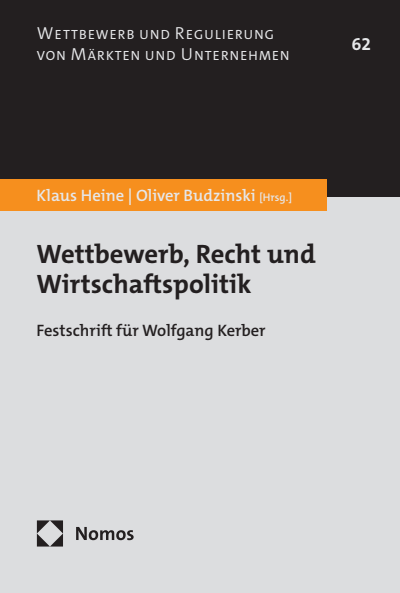
Wettbewerb, Recht und Wirtschaftspolitik
Festschrift für Wolfgang Kerber- Herausgeber:innen:
- |
- Reihe:
- Wettbewerb und Regulierung von Märkten und Unternehmen, Band 62
- Verlag:
- 2024
Zusammenfassung
In dieser Festschrift für Wolfgang Kerber würdigen Kolleginnen und Kollegen, Wegbegleiter und ehemalige Schüler sein wissenschaftliches Werk und Wirken in den Bereichen Wettbewerbspolitik, Rechtsökonomik sowie weiteren Teilbereichen der Wirtschaftspolitik. Zeitgemäß bilden Beiträge zu digitalen Märkten und datengetriebenen Phänomenen der Ökonomie mit ihrer Schnittstelle zum Recht einen Schwerpunkt, zu dem auch Wolfgang Kerber intensiv forscht und publiziert. Fragen der Interaktion von Innovation und Wettbewerb stellen einen weiteren inhaltlichen Kern der Beiträge dar, ein Themengebiet, das Wolfgang Kerber mit seinen vielfältigen Publikationen immer wieder bereichert hat.
Schlagworte
Publikation durchsuchen
Bibliographische Angaben
- Auflage
- 1/2024
- Copyrightjahr
- 2024
- ISBN-Print
- 978-3-7560-1736-2
- ISBN-Online
- 978-3-7489-4393-8
- Verlag
- Nomos, Baden-Baden
- Reihe
- Wettbewerb und Regulierung von Märkten und Unternehmen
- Band
- 62
- Sprache
- Deutsch
- Seiten
- 349
- Produkttyp
- Sammelband
Inhaltsverzeichnis
- Titelei/Inhaltsverzeichnis Kein Zugriff Seiten 1 - 6
- Autor:innen: | |
- 1. Der akademische Lehrer Kein Zugriff
- 2. Das wissenschaftliche Werk Kein Zugriff
- 3. Dieser Band Kein Zugriff
- Autor:innen: |
- 1. Einleitung Kein Zugriff
- 2.1.1. Theoretische Modelle Kein Zugriff
- 2.1.2. Empirische Befunde Kein Zugriff
- 2.2. Vertikale Fusionen und Innovation Kein Zugriff
- 2.3. Ex-Ante-Bewertung und Ermittlung von potenziell innovationsschädlichen Zusammenschlüssen Kein Zugriff
- 2.4. Innovationsbemühungen als Teil einer Effizienzverteidigung Kein Zugriff
- 2.5. Abhilfemaßnahmen Kein Zugriff
- 2.6. (Killer) Akquisitionen von potenziellen Wettbewerbern Kein Zugriff
- 3.1. Auswirkungen horizontaler Fusionen Kein Zugriff
- 3.2. Auswirkungen nicht-horizontaler Fusionen Kein Zugriff
- 3.3. Zusammenfassung und wettbewerbspolitische Implikationen Kein Zugriff
- 4. Nachhaltigkeit Kein Zugriff
- 5. Fusionen und Arbeitsmarkt Kein Zugriff
- 6. Schlussfolgerung Kein Zugriff
- Autor:innen: |
- 1. Introduction Kein Zugriff
- 2.1. Insights from price theory Kein Zugriff
- 2.2. Insights from transaction cost analysis Kein Zugriff
- 3.1. Abuse control: from ‘absolute’ to ‘relative’ market power Kein Zugriff
- 3.2. Merger control Kein Zugriff
- 4. Towards ex ante contract regulation Kein Zugriff
- 5. Conclusions Kein Zugriff
- Autor:innen:
- 1. Introduction Kein Zugriff
- 2.1. Kerber’s concept of dynamic competition as innovation and knowledge-generation Kein Zugriff
- 2.2. The effectiveness of knowledge-generating competition processes as policy goal Kein Zugriff
- 2.3. Developing new concepts for competition policy and the application of competition law Kein Zugriff
- 3.1. Compass to navigate the intricacies of the digital economy Kein Zugriff
- 3.2. Innovation competition in the AI sector: understanding how knowledge generation works Kein Zugriff
- 3.3. Capturing and reining in the ability to prevent, restrict or distort innovation competition Kein Zugriff
- 4. Conclusion Kein Zugriff
- Autor:innen:
- 1. Einleitung Kein Zugriff
- 2. Wettbewerb als dynamischer Hypothesentest Kein Zugriff
- 3.1. Anwendbarkeit und allgemeine Implikationen Kein Zugriff
- 3.2. Kartellpolitik Kein Zugriff
- 3.3.1. Verdrängung, Ausbeutung und Effizienz Kein Zugriff
- 3.3.2. Systemische Marktmacht Kein Zugriff
- 3.3.3. Anlassunabhängige Missbrauchsaufsicht und strukturelle Sanktionen Kein Zugriff
- 3.4. Zusammenschlusskontrolle Kein Zugriff
- 4. Fazit und Ausblick Kein Zugriff
- Autor:innen: |
- 1. Einleitung Kein Zugriff
- 2.1 Datengrundlage Kein Zugriff
- 2.2 Fusionen im Quer- und Längsschnitt Kein Zugriff
- 2.3 Entscheidungen Kein Zugriff
- 3.1 Textanalyse anhand der Fusionsentscheidungen Kein Zugriff
- 3.2.1. Innovationsbegriff Kein Zugriff
- 3.2.2. Innovationsbegriffe im Zeitverlauf Kein Zugriff
- 3.2.3. Innovationsbegriffe über die Sektoren Kein Zugriff
- 4.1 Innovationsfälle Kein Zugriff
- 4.2 Relevanz von Innovationen in den Entscheidungen Kein Zugriff
- 5. Fazit Kein Zugriff
- Autor:innen:
- 1. Introduction Kein Zugriff
- 2.1. Background Kein Zugriff
- 2.2. The relevant market for furniture retail Kein Zugriff
- 2.3. Substantive assessment Kein Zugriff
- 2.4. Conclusion of the case Kein Zugriff
- 3.1. Background Kein Zugriff
- 3.2. Relevant retail markets Kein Zugriff
- 3.3. Substantive assessment Kein Zugriff
- 3.4. Outcome of the “Real cases” Kein Zugriff
- 4. Concluding remarks Kein Zugriff
- Autor:innen: |
- Introduction Kein Zugriff
- 1.1 Oligopoly with price-setting firms – non-coordinated behavior Kein Zugriff
- 1.2 Collusive Behavior in Oligopoly Kein Zugriff
- 1.3 Price-setting learning algorithms Kein Zugriff
- 2.1 Programming and Simulation Kein Zugriff
- 3.1 Results for Logistic Demand Kein Zugriff
- 3.2 Results for Linear Demand Kein Zugriff
- 4 Discussion Kein Zugriff
- Autor:innen:
- 1. Einführung Kein Zugriff
- 2. Kerbers Modell von Recht als Selektionsumgebung für eine evolutorische Wirtschaft Kein Zugriff
- 3. Ökonomische Prozesse der Digitalwirtschaft durch die Linse des evolutorischen Modells Kein Zugriff
- 4. Veränderungen der rechtlichen Selektionsumgebung durch Big Tech Kein Zugriff
- 5. Folgerungen Kein Zugriff
- Autor:innen:
- 1. Einleitung Kein Zugriff
- 2. Was Rechtswissenschaft leisten muss Kein Zugriff
- 3.1. Die Accountability Gap als Ausgangspunkt Kein Zugriff
- 3.2. Die ökonomische Analyse des Rechts am Limit Kein Zugriff
- 3.3. Recht als Praxis Kein Zugriff
- 4. Die Vergangenheit als Ratgeber? Kein Zugriff
- Autor:innen: | |
- 1. Introduction Kein Zugriff
- 2.1. Economic Arguments Against Exclusive Control over Data Kein Zugriff
- 2.2.1. Elements of Exclusive (Individual) Control and Collective Interests in the GDPR Kein Zugriff
- 2.2.2. Elements of Exclusive (Individual) Control and Collective Interests in the Data Act Kein Zugriff
- 2.3. Conclusions on the Status Quo of Data Governance Kein Zugriff
- 3.1. Technological Solutions: Shared Servers and On-Device Application Platforms Kein Zugriff
- 3.2. Institutional Solutions: Data Trustees/PIMS as New Intermediaries Kein Zugriff
- 3.3. Regulatory Solutions: Collaborative and Integrated Approaches Kein Zugriff
- 4. Conclusion Kein Zugriff
- Autor:innen:
- 1. Introduction Kein Zugriff
- 2. Data Commons – An Overview Kein Zugriff
- 3. Data Commons against the Background of the EU Data Act Kein Zugriff
- 4. Conclusions Kein Zugriff
- Autor:innen: | |
- 1. Einleitung und Problemstellung Kein Zugriff
- 2. Methodische Herangehensweise und erster systematischer Überblick Kein Zugriff
- 3.1. Ziele Kein Zugriff
- 3.2. Probleme Kein Zugriff
- 4.1. Generelles Kein Zugriff
- 4.2. Fake News Kein Zugriff
- 4.3. ÖRR-Plattform als Lösung? Kein Zugriff
- 4.4. Modelldiskussion Kein Zugriff
- 5. Schlussbemerkungen Kein Zugriff
- Autor:innen:
- 1. Einleitung Kein Zugriff
- 2. Zum Ordnungsmodell hybrider Regime Kein Zugriff
- 3. Die Interdependenz von politischer Machtsicherung und ökonomischen Institutionen Kein Zugriff
- 4. Schlussfolgerungen für die Interdependenz der Ordnungen in hybriden Regimen Kein Zugriff
- 5. Schlussbemerkung Kein Zugriff
- Autor:innen:
- 1. Einleitung Kein Zugriff
- 2.1. Markt: Studienplatz-Konkurrenz Kein Zugriff
- 2.2. Organisation: Hochschul-Konkurrenz Kein Zugriff
- 2.3. Individuum: Wissenschaftler als Konkurrenten Kein Zugriff
- 3. Fazit Kein Zugriff
- Autor:innen: |
- 1. Einleitung Kein Zugriff
- 2. Politisches Ziel: Reduktion von CO2-Emmissionen Kein Zugriff
- 3. Ordnungspolitische Einordnung des Verbots Kein Zugriff
- 4. Wettbewerbspolitische Grundlagen Kein Zugriff
- 5. Wettbewerbspolitische Einordnung eines Verbots von e-fuels Kein Zugriff
- 6. Technologische Pfadabhängigkeiten Kein Zugriff
- 7. Pfadabhängigkeiten und das S-Kurven Konzept Kein Zugriff
- 8.1. Tankstellen und Ladeinfrastruktur Kein Zugriff
- 8.2. Speichertechnologien und kumulative F&E Aufwendungen Kein Zugriff
- 9. Fazit Kein Zugriff
- Ausklang Kein Zugriff Seiten 329 - 330
- Publikationsverzeichnis Prof. Dr. Wolfgang Kerber Kein Zugriff Seiten 331 - 349
Literaturverzeichnis (684 Einträge)
Es wurden keine Treffer gefunden. Versuchen Sie einen anderen Begriff.
- Strandburg, K. J.; Frischmann, B. M. & Madison, M. J. (eds.) (2017), Governing Medical Knowledge Commons, Cambridge: Cambridge University Press. Google Scholar öffnen doi.org/10.5771/9783748943938-241
- Tarkowski, A. & Vogelezang, F. (2022), Public Data Commons. A Public Interest Framework for Business-to-Government Data Sharing in the Data Act, Open Future Public Brief #3, URL: https://openfuture.eu/wp-content/uploads/2022/05/Public-data-commons-A-public-interest-framework-for-B2G-data-sharing-in-the-Data-Act.1.pdf (last access: 27 November 2023). Google Scholar öffnen doi.org/10.5771/9783748943938-241
- Tarkowski, A. & Zygmuntowski, J. J. (2022), Data Commons Primer - Democratizing the Information Society, URL: https://openfuture.eu/wp-content/uploads/2022/07/220723data-commons-primer.pdf (last access: 04 November 2023). Google Scholar öffnen doi.org/10.5771/9783748943938-241
- Wong, J.; Henderson, T. & Ball, K. (2022), Data Protection for the Common Good: Developing a Framework for a Data Protection-focused Data Commons, in: Data & Policy, Vol. 4: e3. Google Scholar öffnen doi.org/10.5771/9783748943938-241
- Zygmuntowski, J. J.; Zoboli, L. & Nemitz, P. (2021), Embedding European Values in Data Governance: A Case for Public Data Commons, in: Internet Policy Review, Vol. 10 (3). Google Scholar öffnen doi.org/10.5771/9783748943938-241
- Zygmuntowski, J. O. (2023), Data Governance in a Trilemma: A Qualitative Analysis of Rights, Values, and Goals in Building Data Commons, in: Digital Society, Vol. 2, Art. No. 30. Google Scholar öffnen doi.org/10.5771/9783748943938-241
- Literaturverzeichnis Google Scholar öffnen doi.org/10.5771/9783748943938-261
- Bonini, T. & Mazzoli, E. M. (2022), A convivial-agonistic framework to theorise public service media platforms and their governing systems, in: new media & society, Vol. 24 (4), 922-941. Google Scholar öffnen doi.org/10.5771/9783748943938-261
- Dobusch, L. (2018), Demokratisch-mediale Öffentlichkeiten im Zeitalter digitaler Plattformen, in: K. Mitschka & K. Unterberger (Hrsg.), Public Open Space: Zur Zukunft öffentlich-rechtlicher Medien, in: Beiträge aus österreichischer und internationaler Wissenschaft zur Medienzukunft, Vol. 55, Wien: facultas Universitätsverlag, 308-312. Google Scholar öffnen doi.org/10.5771/9783748943938-261
- Dobusch, L. (2019), Public Open Spaces, Von Sendern zu öffentlich-rechtlichen Plattformen, in: J. Krone & A. Gebesmair (Hrgs.), Zur Ökonomie gemeinwohlorientierter Medien. Massenkommunikation in Deutschland, Österreich und der Schweiz, Baden-Baden: Nomos, 24-36. Google Scholar öffnen doi.org/10.5771/9783748943938-261
- Dobusch, L. (2023), Chancen des Öffentlich-Rechtlichen Rundfunks, in: J. Legrand & H.-J. Arlt (Hrsg), Welche Öffentlichkeit brauchen wir?, Zur Zukunft des Journalismus und demokratischer Medien, Wiesbaden: Springer VS, 99-109. Google Scholar öffnen doi.org/10.5771/9783748943938-261
- Dobusch, L. & Parger, R. (2021), Formen digitaler Publikumseinbindung: Potentiale für öffentlich-rechtliche Medien, in: Österreichischer Rundfunk (Hrsg.), Public Value Studie. Öffentlich-Rechtliche Qualität im Diskurs. Digitale Transformation. Vom Broadcaster zum Qualitätsnetzwerk, Wien: Österreichischer Rundfunk, 97-120. Google Scholar öffnen doi.org/10.5771/9783748943938-261
- Dörr, D.; Holznagel, B. & Picot, A. (2016), Legitimation und Auftrag des öffentlich-rechtlichen Fernsehens in Zeiten der Cloud, in: Studien zum deutschen und europäischen Medienrecht, Band 62, Frankfurt a. Main: Peter Lang. Google Scholar öffnen doi.org/10.5771/9783748943938-261
- Gostomzyk, T.; Jarren, O. & Lobigs, F. (2021), Medienkooperationen in europäischen Ländern: Studie, vbw - Vereinigung der Bayerischen Wirtschaft e. V., München: vbw. Google Scholar öffnen doi.org/10.5771/9783748943938-261
- Gostomzyk, T.; Jarren, O.; Lobigs, F. & Neuberger, C. (2019), Kooperationsorientierte Weiterentwicklung der Medienordnung, Studie, vbw-Studie Medien, vbw - Vereinigung der Bayerischen Wirtschaft e. V., München: vbw. Google Scholar öffnen doi.org/10.5771/9783748943938-261
- Handelsblatt (2023), Elon Musks „X“ versagt beim Thema Krieg in Nahost, URL: https://www.handelsblatt.com/technik/it-internet/fake-news-und-propaganda-elon-musks-x-versagt-beim-thema-krieg-in-nahost/29438224.html, (zuletzt abgerufen am 13. Oktober 2023). Google Scholar öffnen doi.org/10.5771/9783748943938-261
- Hasebrink, U. (2016), Brücken schlagen: Public-Service-Medien in veränderten Medienumgebungen, in: epd medien, Vol. 45, 3-6. Google Scholar öffnen doi.org/10.5771/9783748943938-261
- Hillje, J. (2019), Plattform Europa. Warum wir schlecht über die EU reden und wie wir den Nationalismus mit einem neuen digitalen Netzwerk überwinden können, Bonn: Dietz Verlag. Google Scholar öffnen doi.org/10.5771/9783748943938-261
- Jarren, O. (2018), Öffentliche Medienhäuser: Der öffentlich-rechtliche Rundfunk braucht mehr Autonomie, in: epd medien, Vol. 51/52, 4-8. Google Scholar öffnen doi.org/10.5771/9783748943938-261
- Jarren, O. (2019), Öffentliche Medien als neue Intermediäre der Gesellschaft. Von der Notwendigkeit der Neuinstitutionalisierung öffentlicher Medien, in: Jahrbuch für Christliche Sozialwissenschaften, Vol. 60, 63-85. Google Scholar öffnen doi.org/10.5771/9783748943938-261
- Kagermann, H. & Wilhelm, U. (2020), European Public Sphere. Gestaltung der digitalen Souveränität Europas, acatech IMPULS, München: acatech – Deutsche Akademie der Technikwissenschaften. Google Scholar öffnen doi.org/10.5771/9783748943938-261
- Kerber, W. (2021), Datenrechtliche Aspekte des "Digital Markets Act", in: Zeitschrift für Datenschutz, Vol. 11 (10), 544-548. Google Scholar öffnen doi.org/10.5771/9783748943938-261
- Kuchinke, B. A. & Rösch, J. (2023), Die Rolle des öffentlich-rechtlichen Rundfunks im Zeitalter von TikTok: Ökonomische Anmerkungen, in: H.-J. Blanke & G. Grusser (Hrsg.), Die Rolle der Medien im Spannungsfeld von Meinungsmacht und gesellschaftlicher Polarisierung, Staatswissenschaftliches Forum e. V., Tagungsberichte 6/2023, 100-115. Google Scholar öffnen doi.org/10.5771/9783748943938-261
- Mayer-Schönberger, V. (2018), Empfehlungen zur Weiterentwicklung öffentlich-rechtlicher Medien, in: K. Mitschka & K. Unterberger (Hrsg.), Public Open Space: Zur Zukunft öffentlich-rechtlicher Medien, in: Beiträge aus österreichischer und internationaler Wissenschaft zur Medienzukunft, Vol. 55, Wien: facultas Universitätsverlag, 16-18. Google Scholar öffnen doi.org/10.5771/9783748943938-261
- Murschetz, P. C. (2022), Die Zukunft des ORF im digitalen Zeitalter. Drei Zukunftsszenarien und die Frage der Gebührenfinanzierung des öffentlich-rechtlichen Rundfunks, in: N. Alm; P. C. Murschetz; F. Weder & M. Friedrichsen (Hrsg.), Die digitale Transformation der Medien Leitmedien im Wandel, Heidelberg: Springer Gabler, 255-272. Google Scholar öffnen doi.org/10.5771/9783748943938-261
- Rat für die zukünftige Entwicklung des öffentlich-rechtlichen Rundfunks (2024). Bericht des Rates für die zukünftige Entwicklung des öffentlich-rechtlichen Rundfunks. https://rundfunkkommission.rlp.de/fileadmin/rundfunkkommission/Dokumente/Zukunftsrat/ZR_Bericht_18.1.2024.pdf. Google Scholar öffnen doi.org/10.5771/9783748943938-261
- Rotermund, H. (2018), Digital media culture and public service media in the platform era, in: H. Van den Bulck & K. Donders (Hrsg.), Public Service Media in the Networked Society, Göteborg: Nordicom, 75-89. Google Scholar öffnen doi.org/10.5771/9783748943938-261
- Rotermund, H. (2021a), Nach dem Rundfunk: Die Transformation eines Massenmediums zum Online-Medium, Köln: Herbert von Halem Verlag. Google Scholar öffnen doi.org/10.5771/9783748943938-261
- Rotermund, H. (2021b), Modell Youtube. Die ARD sollte ihre Mediathek dem Dialog öffnen, in: epd medien, Vol. 17, 3-6. Google Scholar öffnen doi.org/10.5771/9783748943938-261
- Thomaß, B. (2019), Rundfunk der Gesellschaft 3.0, in: Österreichischer Rundfunk (Hrsg.), Studie. Medienqualität im Diskurs. Allianzen, Kooperationen, Plattformen. Gemeinwohlorientierte Medienqualität in der Netzwerkgesellschaft, Wien: Österreichischer Rundfunk, 5-22. Google Scholar öffnen doi.org/10.5771/9783748943938-261
- Thomaß, B. (2020), Ein Public Open Space, Öffentliche Medien im digitalen Zeitalter, in: böll.brief Öffentliche Räume #8, Berlin: Heinrich-Böll-Stiftung e.V. Google Scholar öffnen doi.org/10.5771/9783748943938-261
- Thomaß, B.; Dobusch, L.; Euler, E.; Horz, C.; Herzog, C.; Ramsey, P. & Grassmuck, V. (2018), European Public Open Spaces (EPOS) - Kurzskizze 18. April 2018, URL: https://public open.space/epos/wp-content/uploads/2018/11/EPOS_short_180828.pdf, (zuletzt abgerufen am 17. Oktober 2023). Google Scholar öffnen doi.org/10.5771/9783748943938-261
- vbw - Vereinigung der Bayerischen Wirtschaft e. V. (2018), Konsensleitlinien für eine Auftrags- und Strukturreform des öffentlich-rechtlichen Rundfunks. Position. Die bayerische Wirtschaft, München: vbw. Google Scholar öffnen doi.org/10.5771/9783748943938-261
- Literaturverzeichnis Google Scholar öffnen doi.org/10.5771/9783748943938-279
- Acemoglu, D. & Robinson, J. A. (2012), Why Nations Fail: The Origins Of Power, Prosperity, and Poverty, New York: Crown. Google Scholar öffnen doi.org/10.5771/9783748943938-279
- Albrecht, H. & Frankenberger, R. (2010), Autoritarismus Reloaded: Neuere Ansätze und Erkenntnisse der Autokratieforschung, Baden-Baden: Nomos. Google Scholar öffnen doi.org/10.5771/9783748943938-279
- Baumol, W. J. (1990), Entrepreneurship: Productive, Unproductive, and Destructive, in: Journal of Political Economy, Vol. 98, 893-921 Google Scholar öffnen doi.org/10.5771/9783748943938-279
- Caldwell, B. & Montes, L. (2015), Hayek and his visits to Chile, in: The Review of Austrian Economics, Vol. 28 (3), 261-309. Google Scholar öffnen doi.org/10.5771/9783748943938-279
- Christophe, B. (2005), Metamorphosen des Leviathan in einer post-sozialistischen Gesellschaft. Georgiens Provinz zwischen Fassaden der Anarchie und regulativer Allmacht, Bielefeld: transcript Verlag. Google Scholar öffnen doi.org/10.5771/9783748943938-279
- Eisenstadt, S. (1973), Traditional patrimonialism and modern neopatrimonialism. London: Sage. Google Scholar öffnen doi.org/10.5771/9783748943938-279
- Eucken, W. (2004), Grundsätze der Wirtschaftspolitik, Tübingen: Mohr Siebeck. Google Scholar öffnen doi.org/10.5771/9783748943938-279
- Hayek, F. A. (1969), Grundsätze einer liberalen Wirtschaftsordnung, in: F. A., Hayek (Hrsg.), Freiburger Studien, Tübingen: Mohr, 108-125. Google Scholar öffnen doi.org/10.5771/9783748943938-279
- Hayek, F. A. (2005), Die Verfassung der Freiheit, Tübingen: Mohr. Google Scholar öffnen doi.org/10.5771/9783748943938-279
- Hindermann, C. (2018), The Impact of Economic Freedom on State Legitimacy. An Empirical Investigation, Wiesbaden: Springer. Google Scholar öffnen doi.org/10.5771/9783748943938-279
- Lawson, R. A. & Clark, J. R. (2010), Examining the Hayek–Friedman hypothesis on economic and political freedom, in: Journal of Economic Behavior and Organization, Vol. 74, 230-239. Google Scholar öffnen doi.org/10.5771/9783748943938-279
- Nazrullaeva, E.; Baranov, A. & Yakovlev, A. (2013), Criminal Persecution of Business in Russia’s Regions: Private Interests vs. “Stick” System, Working Paper of the Institute of Industrial and Market Studies. Moscow: Higher School of Economics. Google Scholar öffnen doi.org/10.5771/9783748943938-279
- Navia, P. (2013), From Limited Access to Open Access: Order in Chile, Take Two; in: D. North; J. J. Wallis; S. B. Webb; B. R. Weingast (Hrsg.), In the Shadow of Violence. Politics, Economics, and the Problems of Development, Cambridge: Cambridge University Press, 261-292. Google Scholar öffnen doi.org/10.5771/9783748943938-279
- North, D. C.; Wallis, J. J.; Weingast B. R. (2009), Violence and social orders: A conceptual framework for interpreting recorded human history, Cambridge: Cambridge University Press. Google Scholar öffnen doi.org/10.5771/9783748943938-279
- Olson, M. (2000), Power And Prosperity: Outgrowing Communists And Capitalist Dictatorships, New York: Basic Books. Google Scholar öffnen doi.org/10.5771/9783748943938-279
- Pickel, G. (2010), Staat, Bürger und politische Stabilität: Benötigen auch Autokratien politische Legitimität, in: H. Albrecht; R. Frankenberger (Hrsg.), Autoritarismus Reloaded. Neuere Ansätze und Erkenntnisse der Autokratieforschung, Baden-Baden: Nomos. Google Scholar öffnen doi.org/10.5771/9783748943938-279
- Stefes, C. (2006), Understanding Post-Soviet Transitions: Corruption, Collusion and Clientelism, Basingstoke: Palgrave Macmillan. Google Scholar öffnen doi.org/10.5771/9783748943938-279
- Streeck, W. (2013), Gekaufte Zeit. Die vertagte Krise des demokratischen Kapitalismus, Berlin: Suhrkamp Verlag. Google Scholar öffnen doi.org/10.5771/9783748943938-279
- Stykow, P. (2010), Bunte Revolutionen: Durchbruch zur Demokratie oder Modus der Google Scholar öffnen doi.org/10.5771/9783748943938-279
- autoritären Systemreproduktion?, in: Politische Vierteljahresschrift, Vol. 51 (1), 137-162 Google Scholar öffnen doi.org/10.5771/9783748943938-279
- Timm, C. (2010), Jenseits von Demokratiehoffnung und Autoritarismusverdacht: Eine herrschaftssoziologische Analyse posttransformatorischer Regime, in: H. Albrecht; R. Frankenberger (Hrsg.), Autoritarismus reloaded: Neue Ansätze und Erkenntnisse in der Autokratieforschung. Baden-Baden: Nomos. Google Scholar öffnen doi.org/10.5771/9783748943938-279
- Wegner, G. (2015), Capitalist transformation without political participation: German capitalism in the first half of the nineteenth century”; in: Constitutional Political Economy, Vol. 26, 61-86. Google Scholar öffnen doi.org/10.5771/9783748943938-279
- Wegner, G. (2019), Entrepreneurship in autocratic regimes: How neopatrimonialism constrains innovation, in: Journal of Evolutionary Economics, Vol. 29 (590), 1507-1529. Google Scholar öffnen doi.org/10.5771/9783748943938-279
- Wegner G.; Heinrich-Mechergui, M. & Mechergui, T. (2013), Limited Access Order in Tunisia: Elements of a Political Economy of Autocratic Regimes. International Journal of Public Administration, Vol. 36, 743-753. Google Scholar öffnen doi.org/10.5771/9783748943938-279
- Wehler, H.-U. (1987), Deutsche Gesellschaftsgeschichte: Vom Feudalismus des Alten Reiches bis zur Defensiven Modernisierung der Reformära: 1700 – 1815, München, C.H. Beck, 6-31. Google Scholar öffnen doi.org/10.5771/9783748943938-279
- Xu, C. (2011), The Fundamental Institutions of China’s Reforms and Development, in: Journal of Economic Literature, Vol. 49 (4), 1076-1151. Google Scholar öffnen doi.org/10.5771/9783748943938-279
- Yakovlev, A. (2013), Russian modernization: Between the need for new players and the fear of losing control of rent resources, in: Journal of Eurasian Studies, Vol. 5 (1), 10-20. Google Scholar öffnen doi.org/10.5771/9783748943938-279
- Yakovlev, A. (2021), Composition of the ruling elite, incentives for productive usage of rents, and prospects for Russia’s limited access order, in: Post-Soviet Affairs, Vol. 37 (5), 417-434. Google Scholar öffnen doi.org/10.5771/9783748943938-279
- Zimmer, K. (2005), Klientelismus im neopatrimonialen Staat, in: Osteuropa, Vol. 55 (10), 59-73. Google Scholar öffnen doi.org/10.5771/9783748943938-279
- Literaturverzeichnis Google Scholar öffnen doi.org/10.5771/9783748943938-297
- Afonso, A. (2016), Varieties of Academic Labor Markets in Europe, in: Political Science and Politics, Vol. 49 (4), 816-821. Google Scholar öffnen doi.org/10.5771/9783748943938-297
- Bahr, A.; Eichhorn, K. & Kubon, S. (2022), #IchBinHanna: Prekäre Wissenschaft in Deutschland, Berlin: Suhrkamp. Google Scholar öffnen doi.org/10.5771/9783748943938-297
- Block, H.-J. (1989), Maßnahmen für eine Förderung des leistungssteigernden Wettbewerbs im deutschen Hochschulsystem, in: U. Backes-Gellner & C. Helberger (Hrsg.): Ökonomie der Hochschule, Berlin: Duncker & Humblot, 153-179. Google Scholar öffnen doi.org/10.5771/9783748943938-297
- Brankovic, J.; Hamann, J. & Ringel, L. (2023), The Institutionalization of Rankings in Higher Education: Continuities, Interdependencies, Engagement, in: Higher Education, Vol. 86, 719-731. Google Scholar öffnen doi.org/10.5771/9783748943938-297
- Brankovic, M. (2021), F.A.Z.-Ökonomenranking: Deutschlands wichtigster Ökonom, in: Frankfurter Allgemeine Zeitung vom 16.09.2021. Google Scholar öffnen doi.org/10.5771/9783748943938-297
- Briviba, A. & Frey, B. S. (2023), The Role of the Top Five Economics Journals in Germany, in: Das Hochschulwesen, Vol. 71 (1+2), 18-26. Google Scholar öffnen doi.org/10.5771/9783748943938-297
- Budzinski, O. & Eckert, S. (2018), Wettbewerb und Regulierung, in: K. Mause; C. Müller & K. Schubert (Hrsg.), Politik und Wirtschaft: Ein integratives Kompendium, Wiesbaden: Springer, 375-400. Google Scholar öffnen doi.org/10.5771/9783748943938-297
- Der Spiegel (1989), Die neuen Unis sind die besten, in: Der Spiegel, Heft 19/1989, 70-87. Google Scholar öffnen doi.org/10.5771/9783748943938-297
- Destatis (2023), Studierendenstatistik WS 2022/23, Wiesbaden: Statistisches Bundesamt. Google Scholar öffnen doi.org/10.5771/9783748943938-297
- Die Zeit (2023), Studienführer 2023/24, Hamburg: Zeitverlag. Google Scholar öffnen doi.org/10.5771/9783748943938-297
- Donges, J. B.; Engels, W.; Hamm, W.; Möschel, W.; Neumann, M. J. M. & Sievert, O. (1993), Zur Reform der Hochschulen, Bad Homburg: Stiftung Marktwirtschaft und Politik/Kronberger Kreis. Google Scholar öffnen doi.org/10.5771/9783748943938-297
- Federkeil, G. (2013), Internationale Hochschulrankings – Eine kritische Bestandsaufnahme, in: Beiträge zur Hochschulforschung, Vol. 35 (2), 34-48. Google Scholar öffnen doi.org/10.5771/9783748943938-297
- Feld, L. P.; Haucap, J.; Wieland, V.; Wigger, B. U. (2013), Bildungsfinanzierung neu gestalten, Berlin: Stiftung Marktwirtschaft/Kronberger Kreis. Google Scholar öffnen doi.org/10.5771/9783748943938-297
- Hachmeister, C.-D. (2023), Promotionen am häufigsten in Naturwissenschaften und Medizin, in: DatenCHECK 1/2023, Gütersloh: Centrum für Hochschulentwicklung. Google Scholar öffnen doi.org/10.5771/9783748943938-297
- Heckman, J. J. & Moktan, S. (2020), Publishing and Promotion in Economics: The Tyranny of the Top Five, in: Journal of Economic Literature, Vol. 58 (2), 419-470. Google Scholar öffnen doi.org/10.5771/9783748943938-297
- Heine, K. & Ohliger, U. A. (2023), Lobbying und Soziale Medien: Wissenschaftskommunikation als Anwendungsfall, in: A. Polk & K. Mause (Hrsg.), Handbuch Lobbyismus, Wiesbaden: Springer VS, 475-497. Google Scholar öffnen doi.org/10.5771/9783748943938-297
- Hirschman, A. O. (1974), Abwanderung und Widerspruch. Reaktion auf Leistungsabfall bei Unternehmungen, Organisationen und Staaten, Tübingen: Mohr Siebeck. Google Scholar öffnen doi.org/10.5771/9783748943938-297
- Kerber, W. (1998), Bildung, Forschung und Entwicklung: Grenzen staatlicher Politik aus der Perspektive des internationalen Wettbewerbs, in: D. Cassel (Hrsg.), 50 Jahre Soziale Marktwirtschaft: Ordnungstheoretische Grundlagen, Realisierungsprobleme und Zukunftsperspektiven einer wirtschaftspolitischen Konzeption, Stuttgart: Lucius & Lucius, 321-365. Google Scholar öffnen doi.org/10.5771/9783748943938-297
- Kerber, W. (2019), Wettbewerbspolitik, in: T. Apolte; M. Erlei; M. Göcke; R. Menges; N. Ott; & A. Schmidt (Hrsg), Kompendium der Wirtschaftstheorie und Wirtschaftspolitik, Band III, Wiesbaden: Springer Gabler, 115-187. Google Scholar öffnen doi.org/10.5771/9783748943938-297
- Kornai, J. (1986), The Soft Budget Constraint, in: Kyklos, Vol. 39 (1), 3-30. Google Scholar öffnen doi.org/10.5771/9783748943938-297
- Krücken, G.; Bünstorf, G.; Cantner, U.; Frost, J.; Grebel, T.; Hamann, J.; Hottenrott, H.; Kosmützky, A.; Meier, F.; Schimank, U. & Serrano Velarde, K. (2021), Multipler Wettbewerb im Hochschulsystem – Interdisziplinäre Perspektiven und wissenschaftspolitische Implikationen, in: Das Hochschulwesen, Vol. 69 (3+4), 90-95. Google Scholar öffnen doi.org/10.5771/9783748943938-297
- Mause, K. (2002), Zertifizierung als Instrument der Qualitätssicherung im Hochschulwesen, in: Wirtschaftsdienst, Vol. 82 (7), S. 411-417. Google Scholar öffnen doi.org/10.5771/9783748943938-297
- Mause, K. (2003), Die Juniorprofessur – Anforderungen und Karriereaussichten, in: Wirtschaftswissenschaftliches Studium, Vol. 32 (1), 51-53. Google Scholar öffnen doi.org/10.5771/9783748943938-297
- Mause, K. (2007a), Konsumentenschutz im Hochschulbereich. Unvollständige Nachfragerinformation, Marktversagen und markt-basierte Schutzmechanismen, Berlin: Duncker & Humblot. Google Scholar öffnen doi.org/10.5771/9783748943938-297
- Mause, K. (2007b), Zur Ökonomik des Konsumentenschutzes im Hochschulsektor, in: Jahrbuch für Wirtschaftswissenschaften, Vol. 58 (3), 265-278. Google Scholar öffnen doi.org/10.5771/9783748943938-297
- Mause, K. (2008), Ist Bildung eine Ware? Ein Klärungsversuch, in: ORDO - Jahrbuch für die Ordnung von Wirtschaft und Gesellschaft, 59. Band, 363-380. Google Scholar öffnen doi.org/10.5771/9783748943938-297
- Mause, K. (2011), Transformations of the Educating Leviathan: The Restructuring of German Higher Education in the Noughties, in: Austausch - German Studies Online Journal, Vol. 1 (2), 13-35. Google Scholar öffnen doi.org/10.5771/9783748943938-297
- Mause, K. (2019), Higher Education, in: A. Marciano & G. B. Ramello (Hrsg.), Encyclopedia of Law & Economics, New York: Springer, 1081-1084. Google Scholar öffnen doi.org/10.5771/9783748943938-297
- Mause, K. & Gröteke, F. (2009), Hochschulwettbewerb, Hochschulpolitik und eine Paradoxie, in: S. Jaenichen; T. Steinrücken; N. Seifferth-Schmidt & A. Itzenplitz (Hrsg.): Empirische und theoretische Analysen aktueller wirtschafts- und finanzpolitischer Fragestellungen, Ilmenau: Universitätsverlag Ilmenau, 115-157. Google Scholar öffnen doi.org/10.5771/9783748943938-297
- Monopolkommission (2000), Wettbewerb als Leitbild für die Hochschulpolitik. Sondergutachten der Monopolkommission gemäß § 44 Abs. 1 Satz 4 GWB, Baden-Baden: Nomos. Google Scholar öffnen doi.org/10.5771/9783748943938-297
- Mueller, D. C. (2007), Wettbewerb und Leistung auf zwei ungewöhnlichen Märkten, in: Perspektiven der Wirtschaftspolitik, Vol. 8 (Sonderheft), 133-140. Google Scholar öffnen doi.org/10.5771/9783748943938-297
- Oberender, P. & Fleischmann, J. (2003), Wettbewerb als Reformperspektive für die Hochschulen, in: ORDO - Jahrbuch für die Ordnung von Wirtschaft und Gesellschaft, 54. Band, 93-112. Google Scholar öffnen doi.org/10.5771/9783748943938-297
- Oberender, P. (1987a), Verkäufermarkt; in: E. Dichtl & O. Issing (Hrsg.), Vahlens Großes Wirtschaftslexikon, Band II, München: Vahlen, 808. Google Scholar öffnen doi.org/10.5771/9783748943938-297
- Oberender, P. (1987b), Käufermarkt, in: E. Dichtl & O. Issing (Hrsg.), Vahlens Großes Wirtschaftslexikon, Band I, München: Vahlen, 955. Google Scholar öffnen doi.org/10.5771/9783748943938-297
- Osterloh, M. & Frey, B. S. (2015), Rankings und der Preis der Wissenschaft, in: Zeitschrift für Kulturwissenschaften, Vol. 9 (1), 65-78. Google Scholar öffnen doi.org/10.5771/9783748943938-297
- Priddat, B. P. (2009), Deutsche Privathochschulen – ein „emerging market“?, in: Wirtschaftsdienst, Vol. 89 (3), 172-175. Google Scholar öffnen doi.org/10.5771/9783748943938-297
- Röpke, J. (1977), Die Strategie der Innovation. Eine systemtheoretische Untersuchung der Interaktion von Individuum, Organisation und Markt im Neuerungsprozess, Tübingen: Mohr Siebeck. Google Scholar öffnen doi.org/10.5771/9783748943938-297
- Röttger, U. & Laukötter, E. (2019), Hochschulmarketing, in: B. Fähnrich; J. Metag; S. Post & M. Schäfer (Hrsg.), Forschungsfeld Hochschulkommunikation, Wiesbaden: Springer VS, 165-179. Google Scholar öffnen doi.org/10.5771/9783748943938-297
- Schreiterer, U. & Leibfried, S. (2015), Die Exzellenzinitiative: ein Fortsetzungsroman, Berlin: Berlin-Brandenburgische Akademie der Wissenschaften. Google Scholar öffnen doi.org/10.5771/9783748943938-297
- Schröder, M. (2015), Studienwahl unter den Folgen einer radikalen Differenzierung, Bad Heilbrunn: Verlag Julius Klinkhardt. Google Scholar öffnen doi.org/10.5771/9783748943938-297
- Ursprung, H. W. & Zimmer, M. (2007), Who is the „Platz-Hirsch“ of the German Economics Profession? A Citation Analysis, in: Jahrbücher für Nationalökonomie und Statistik, Vol. 227 (2), 187-208. Google Scholar öffnen doi.org/10.5771/9783748943938-297
- Watrin, C. (1984), Wettbewerb und Wettbewerbshindernisse im deutschen Hochschulsystem. Bemerkungen aus ökonomischer Sicht, in: H. Albert (Hrsg.), Ökonomisches Denken und soziale Ordnung. Festschrift für Erik Boettcher, Tübingen: Mohr, 245-260. Google Scholar öffnen doi.org/10.5771/9783748943938-297
- Weber, M. (1919/2011), Wissenschaft als Beruf, Berlin: Duncker & Humblot. Google Scholar öffnen doi.org/10.5771/9783748943938-297
- Wissenschaftsrat (1985), Empfehlungen zum Wettbewerb im deutschen Hochschulsystem, Köln: Wissenschaftsrat. Google Scholar öffnen doi.org/10.5771/9783748943938-297
- Woll, A. (1992), Deregulierung des Hochschulwesens, in: ORDO - Jahrbuch für die Ordnung von Wirtschaft und Gesellschaft, 43. Band, 337-345. Google Scholar öffnen doi.org/10.5771/9783748943938-297
- Woll, A. (2001), Reform der Hochschulausbildung durch Wettbewerb, Berlin: Duncker & Humblot. Google Scholar öffnen doi.org/10.5771/9783748943938-297
- Literaturverzeichnis Google Scholar öffnen doi.org/10.5771/9783748943938-313
- Agora Verkehrswende (2023), E-Fuels zwischen Wunsch und Wirklichkeit. Was strombasierte synthetische Kraftstoffe für die Energiewende im Verkehr leisten können – und was nicht, Diskussionspapier. Google Scholar öffnen doi.org/10.5771/9783748943938-313
- Arthur D. Little International (Hrsg., 1986), Management im Zeitalter der strategischen Führung, Wiesbaden: Gabler. Google Scholar öffnen doi.org/10.5771/9783748943938-313
- Arthur, W. B. (1994), Competing Technologies, Increasing Returns, and Lock-In by Historical Small Events, in: W. B. Arthur (Hrsg.), Increasing Returns and Path Dependence in the Economy, Ann Arbor: University of Michigan Press, 13-32. Google Scholar öffnen doi.org/10.5771/9783748943938-313
- Blank, J. & Ströbele, W. (1994), Das CO2-Problem aus umweltökonomischer Sicht, in: Wirtschaftsstudium, Heft 11, 552-557. Google Scholar öffnen doi.org/10.5771/9783748943938-313
- Cansier, D. (1994), Gefahrenabwehr und Risiko Vorsorge im Umweltschutz und der Spielraum für ökonomische Instrumente, in: Neue Zeitschrift für Verwaltungsrecht, Heft 7, 642-647. Google Scholar öffnen doi.org/10.5771/9783748943938-313
- Christiansen, A. (2010), Der “More Economic Approach” in der EU-Fusionskontrolle: Entwicklung, konzeptionelle Grundlagen und kritische Analyse, Frankfurt a.M.: Peter Lang Verlag. Google Scholar öffnen doi.org/10.5771/9783748943938-313
- Cowan, R. (1990), Nuclear Power Reactors: A Study in Technological Lock-in, in: Journal of Economic History, Vol. 50 (3), 541-567. Google Scholar öffnen doi.org/10.5771/9783748943938-313
- David, P. A. (1985), Clio and the Economics of QWERTY, in: The American Economic Review, Vol. 75 (2), 332-337. Google Scholar öffnen doi.org/10.5771/9783748943938-313
- Dosi, G. (1988), Sources, Procedures, and Microeconomic Effects of Innovation, in: Journal of Economic Literature, Vol. 26 (3), 1120-1171. Google Scholar öffnen doi.org/10.5771/9783748943938-313
- Elsser, S. (1993), Innovationswettbewerb: Determinanten und Unternehmensverhalten, in: Hohenheimer volkswirtschaftliche Schriften, Vol. 17, Berlin: Peter Lang International Academic Publishers. Google Scholar öffnen doi.org/10.5771/9783748943938-313
- Endres, A. (1985), Instrumente der Umweltpolitik, in: Zeitschrift für Rechtspolitik, Vol. 18 (7), 197-200. Google Scholar öffnen doi.org/10.5771/9783748943938-313
- FAZ (2023a), Nach Widerstand aus Berlin: EU-Abstimmung über pauschales Verbrenner-Aus wird verschoben, URL: https://www.faz.net/aktuell/wirtschaft/auto-verkehr/pauschales-verbrenner-aus-eu-abstimmung-wird-verschoben-18720058.html (zuletzt abgerufen am 30. Oktober 2023). Google Scholar öffnen doi.org/10.5771/9783748943938-313
- FAZ (2023b), Zukunft der Autoantriebe: Wissing pocht auf E-Fuel-Zusagen, URL: https://www.faz.net/aktuell/wirtschaft/wissing-pocht-auf-zusagen-zur-zukunft-von-e-fuel-autos-19201849.html#void (zuletzt abgerufen am 15. Oktober 2023). Google Scholar öffnen doi.org/10.5771/9783748943938-313
- Farrell, J. & Saloner, G. (1987), Competition, Compatibility, and Standards: The Economics of Horses, Penguins and Lemmings, in: H. L. Gabel (Hrsg.), Product Standardization and Competitive Strategy, Amsterdam: North Holland, 1-22. Google Scholar öffnen doi.org/10.5771/9783748943938-313
- Foster, R. N. (1986), Innovation: Die technologische Offensive, Wiesbaden: Gabler. Google Scholar öffnen doi.org/10.5771/9783748943938-313
- Frontier Economics (2020), The Concept of Efficiency in the German Climate Policy Debate on Road Transportation: A comprehensive approach to assessing the efficiency of technologies, URL: https://www.frontier-economics.com/media/d3nldhq4/the-concept-of-efficiency-in-the-german-climate-policy-debate-on-road-transport.pdf (zuletzt abgerufen am 06. November 2023). Google Scholar öffnen doi.org/10.5771/9783748943938-313
- Hayek, F. A. (1945), The Use of Knowledge in Society, in: American Economic Review, Vol. 35 (4), 519-530. Google Scholar öffnen doi.org/10.5771/9783748943938-313
- Hayek, F. A. (1952), Der Sinn des Wettbewerbs, in: F. A. Hayek (Hrsg.), Individualismus und wirtschaftliche Ordnung, Erlenbach-Zürich: Rentsch, 122-140. Google Scholar öffnen doi.org/10.5771/9783748943938-313
- Hayek, F. A. (1968), Der Wettbewerb als Entdeckungsverfahren, Kiel: Institut für Weltwirtschaft. Google Scholar öffnen doi.org/10.5771/9783748943938-313
- Hayek, F. A. (1975), Die Anmaßung von Wissen, in: ORDO, Vol. 26, 12-21. Google Scholar öffnen doi.org/10.5771/9783748943938-313
- Heine, K. & Kerber, W. (2002), European Corporate Laws, Regulatory Competition and Path Dependence, in: European Journal of Law and Economics, Vol. 13, 47-71. Google Scholar öffnen doi.org/10.5771/9783748943938-313
- Kerber, W. (1993), Rights, innovation and evolution. The distributional effects of different rights to innovate, in: Review of Political Economy, Vol. 5 (4), 427-252. Google Scholar öffnen doi.org/10.5771/9783748943938-313
- Kerber, W. (1994), Evolutorischer Wettbewerb: Zu den theoretischen und institutionellen Grundlagen der Wettbewerbsordnung, Habilitationsschrift. Google Scholar öffnen doi.org/10.5771/9783748943938-313
- Kerber, W. (2011), Competition, Innovation and Maintaining Diversity Through Competition Law, in: J. Drexl; W. Kerber & R. Podszun (Hrsg.), Economic Approaches to Competition Law: Foundations and Limitations, Cheltenham: Edward Elgar, 173-201. Google Scholar öffnen doi.org/10.5771/9783748943938-313
- Kerber, W. & Kern, B. (2014), Assessing Innovation Effects in US Merger Policy: Theory, Practice, in: MAGKS Joint Discussion Paper Series in Economics, No. 50-2014. Google Scholar öffnen doi.org/10.5771/9783748943938-313
- Kern, B.; Dewenter, R. & Kerber, W. (2015), Empirical Analysis of the Assessment of Innovation Effects in U.S. Merger Cases, in: Journal of Industry, Competition and Trade, Vol. 16 (3), 373-402. Google Scholar öffnen doi.org/10.5771/9783748943938-313
- SPD, Die Grünen & FDP (2021), Mehr Fortschritt wagen. Bündnis für Freiheit, Gerechtigkeit und Nachhaltigkeit, Koalitionsvertrag 2021 – 2025 zwischen der Sozialdemokratischen Partei Deutschlands (SPD), BÜNDNIS 90 / DIE GRÜNEN und den Freien Demokraten (FDP). Google Scholar öffnen doi.org/10.5771/9783748943938-313
- Liebowitz, S. J. & Margolis S. E. (1995), Path Dependence, Lock-In, and History, in: JLEO, Vol. 11, 205. Google Scholar öffnen doi.org/10.5771/9783748943938-313
- Linge, G. (2008), Competition Policy, Innovation, and Diversity. Marburg: Tectum. Google Scholar öffnen doi.org/10.5771/9783748943938-313
- Morimoto, M. (2015), Which is the First Electric Vehicle?, in: Electrical Engineering in Japan, Vol. 192 (2), 31-38. Google Scholar öffnen doi.org/10.5771/9783748943938-313
- Möhrle, M. G. (2018), Definition: S-Kurven-Konzept, Gabler Wirtschaftslexikon, URL: https://wirtschaftslexikon.gabler.de/definition/s-kurvenkonzept-43411 (zuletzt abgerufen am 10. September 2023). Google Scholar öffnen doi.org/10.5771/9783748943938-313
- Nelson, R. (1959), The Economics of Invention: A Survey of the Literature, in: The Journal of Business, Vol. 32 (2), 101-127. Google Scholar öffnen doi.org/10.5771/9783748943938-313
- Shapiro, C. & Varian, H. R. (1999), Information Rules: A Strategic Guide of the Network Economy, Boston: Harvard Business Press. Google Scholar öffnen doi.org/10.5771/9783748943938-313
- Schilling, M. (1999), Winning the Standards Race: Building Installed Base and the Availability of Complementary Goods, in: European Management Journal, Vol. 17 (3), 265–274. Google Scholar öffnen doi.org/10.5771/9783748943938-313
- Schumpeter, J. A. (1964), Theorie der wirtschaftlichen Entwicklung, 6. Auflage, Berlin: Duncker & Humblot. Google Scholar öffnen doi.org/10.5771/9783748943938-313
- Schumpeter, J. A. (1975), Kapitalismus, Sozialismus und Demokratie, 4. Auflage, München: Francke. Google Scholar öffnen doi.org/10.5771/9783748943938-313
- Ueckert, F. & Odenweller, A. (2003), E-Fuels – Aktueller Stand und Projektionen, Arbeitspapier des Potsdam-Institut für Klimafolgenforschung, URL: www.pik-potsdam.de%2Fmembers%2FUeckerdt%2FE-Fuels_Stand-und-Projektionen_PIK-Potsdam.pdf&psig=AOvVaw0Ez99P0ssiX0k6608vVDy3&ust=1685025362528632 (zuletzt abgerufen am 24. Mai 2023). Google Scholar öffnen doi.org/10.5771/9783748943938-313
- Witschel, M.; Plötz, P.; Dütschke, E.; Neuner, F.; Tröger, J. & Gnann, T. (2023), Eine kritische Diskussion der beschlossenen Maßnahmen zur E-Fuel-Förderung im Modernisierungspaket für Klimaschutz und Planungsbeschleunigung der Bundesregierung von 28.03.2023, Diskussionsbeitrag, Fraunhofer-Institut für System- und Innovationsforschung ISI, Karlsruhe, URL: https://www.isi.fraunhofer.de/de/presse/2023/presseinfo-05-efuels-nicht-sinnvoll-fuer-pkw-und-lkw.html (zuletzt abgerufen am 30. Oktober 2023). Google Scholar öffnen doi.org/10.5771/9783748943938-313
- Zimmer, W.; Blanck, R.; Kreye, K.; Graichen, J. & Kasten, P. (2022), Die Rolle der CO2-Bepreisung im Instrumentenmix für die Transformation im Verkehrssektor, Climate Change 27/2022, URL: https://www.umweltbundesamt.de/publikationen/die-rolle-der-co2-bepreisung-im-instrumentenmix-0 (zuletzt abgerufen am 16. Oktober 2023). Google Scholar öffnen doi.org/10.5771/9783748943938-313
- Literaturverzeichnis Google Scholar öffnen doi.org/10.5771/9783748943938-9
- Aigner, G.; Budzinski, O. & Christiansen, A. (2006), The Analysis of Coordinated Effects in European Merger Control: Where Do We Stand after Sony/BMG and Impala?, in: European Competition Journal, Vol. 2 (2), 119-140. Google Scholar öffnen doi.org/10.5771/9783748943938-9
- Budzinski, O. & Aigner, G. (2005), Institutionelle Rahmenbedingungen für internationale Mergers & Acquisitions - Auf dem Weg zu einem globalen Fusionskontrollregime?, in: M. F. Strohmer (Hrsg.), Internationale Mergers & Acquisitions, Frankfurt a. M.: Lang, 189-232. Google Scholar öffnen doi.org/10.5771/9783748943938-9
- Budzinski, O. & Christiansen, A. (2003), Neue Initiativen für eine internationale Wettbewerbspolitik, in: Orientierungen zur Wirtschafts- und Gesellschaftspolitik, Vol. 95 (1), 14-21. Google Scholar öffnen doi.org/10.5771/9783748943938-9
- Budzinski, O. & Christiansen, A. (2005a), Competence Allocation in EU Competition Policy as an Interest-Driven Process, in: Journal of Public Policy, Vol. 25 (3), 313-337. Google Scholar öffnen doi.org/10.5771/9783748943938-9
- Budzinski, O. & Christiansen, A. (2005b), Aktuelle Reformen in der Europäischen Wettbewerbspolitik, in: WiSt - Zeitschrift für Ausbildung und Hochschulkontakt, Vol. 34 (3), 165-169. Google Scholar öffnen doi.org/10.5771/9783748943938-9
- Budzinski, O. & Christiansen, A. (2007), The Oracle/PeopleSoft Case: Unilateral Effects, Simulation Models and Econometrics in Contemporary Merger Control, in: Legal Issues of Economic Integration, Vol. 34 (2), 133-166. Google Scholar öffnen doi.org/10.5771/9783748943938-9
- Budzinski, O. & Kerber, W. (2006), Internationale Wettbewerbspolitik aus ökonomischer Perspektive, in: P. Oberender (Hrsg.), Internationale Wettbewerbspolitik, Berlin: Duncker & Humblot, 9-40. Google Scholar öffnen doi.org/10.5771/9783748943938-9
- Budzinski, O. & Kretschmer, J. P. (2016a), Implications of Unprofitable Horizontal Mergers: A Positive External Effect Does Not Suffice To Clear A Merger! In: Contemporary Economics, Vol. 10 (1), 13-26. Google Scholar öffnen doi.org/10.5771/9783748943938-9
- Budzinski, O. & Kretschmer, J. P. (2016b), Horizontal Mergers, Involuntary Unemployment, and Welfare, in: Journal of Economic Research, Vol. 21 (3), 297-317. Google Scholar öffnen doi.org/10.5771/9783748943938-9
- Budzinski, O. & Schmidt, C. (2006), European Industrial Policy: Economic Foundations, Concepts, and Consequences, in: B. Sekulovska-Gaber (Hrsg.), Continuing Education in European Affairs, Skopje: Jugoreklam, 187-205. Google Scholar öffnen doi.org/10.5771/9783748943938-9
- Fehl, U. & Oberender, P. O. (2010), Nachruf auf Prof. Dr. Ernst T. V. Heuß, in: ORDO, Vol. 61 (1), 379-386. Google Scholar öffnen doi.org/10.5771/9783748943938-9
- Gröteke, F. & Heine, K. (2004a), Regionale Steuerkompetenzen und europäische Beihilfenkontrolle am Beispiel des Baskenlandes, in: List Forum für Wirtschafts- und Finanzpolitik, Vol. 30 (1), 137-152. Google Scholar öffnen doi.org/10.5771/9783748943938-9
- Gröteke, F. & Heine, K. (2004b), "Institutional Rigidities" and European State Aid Control, in: European Competition Law Review, Vol. 25, 322-331. Google Scholar öffnen doi.org/10.5771/9783748943938-9
- Gröteke, F. & Mause, K. (2009), Die deutsche ‘Schuldenbremse’: Ein wirksames Instrument zur Vermeidung eines Bailout? In: Zeitschrift für Wirtschaftspolitik, Vol. 58 (3), 309-335. Google Scholar öffnen doi.org/10.5771/9783748943938-9
- Hayek, F. A. von (1996a), Die Anmaßung von Wissen. Neue Freiburger Studien, herausgegeben von Wolfgang Kerber, Tübingen: Mohr Siebeck. Google Scholar öffnen doi.org/10.5771/9783748943938-9
- Hayek, F. A. von (1996b), Zur Bewältigung von Unwissenheit (übersetzt von Wolfgang Kerber), in: F. A. von Hayek, Die Anmaßung von Wissen. Neue Freiburger Studien (herausgegeben von Wolfgang Kerber), Tübingen: Mohr Siebeck, 307-316. Google Scholar öffnen doi.org/10.5771/9783748943938-9
- Heine, K. & Gröteke, F. (2003), Beihilfenkontrolle und Standortwettbewerb: "Institutionelle Rigiditäten" als Rechtfertigung für die Vergabe einer Beihilfe, in: Wirtschaft und Wettbewerb, Vol. 53 (2), 257-265. Google Scholar öffnen doi.org/10.5771/9783748943938-9
- Heine, K. & Gröteke, F. (2005), Beihilfenkontrolle und europäische Verfassung am Beispiel der Daseinsvorsorge, in: Aussenwirtschaft, Vol. 60 (4), 463-484. Google Scholar öffnen doi.org/10.5771/9783748943938-9
- Heine, K. & Gröteke, F. (2008), Europäische Beihilfenkontrolle und Market Preserving Federalism, in: M. Grusevaja; C. Wonke; U. Hösel & M. H. Dunn (Hrsg.), Quo vadis Wirtschaftspolitik? Festschrift für Norbert Eickhof, Frankfurt: Lang, 75-96. Google Scholar öffnen doi.org/10.5771/9783748943938-9
- Heine, K. & Kerber, W. (2002), European Corporate Laws, Regulatory Competition and Path Dependence, in: European Journal of Law and Economics, Vol. 13 (1), 47-71. Google Scholar öffnen doi.org/10.5771/9783748943938-9
- Heine, K. & Kerber, W. (2007, Hrsg.), Zentralität und Dezentralität von Regulierung in Europa, Stuttgart: Lucius & Lucius. Google Scholar öffnen doi.org/10.5771/9783748943938-9
- Heine, K. & Mause, K. (2003), Politikberatung als informationsökonomisches Problem, in: Jahrbücher für Nationalökonomie und Statistik, Vol. 223 (4), 479-490. Google Scholar öffnen doi.org/10.5771/9783748943938-9
- Heine, K. & Mause, K. (2004), Policy Advice as an Investment Problem, in: Kyklos, Vol. 57 (3), 403-428. Google Scholar öffnen doi.org/10.5771/9783748943938-9
- Heine, K. & Mause, K. (2008), Ökonomie der Politikberatung, in: S. Bröchler & R. Schützeichel (Hrsg.), Politikberatung, Stuttgart: Lucius und Lucius, 147-168. Google Scholar öffnen doi.org/10.5771/9783748943938-9
- Heuss, E. (1965), Allgemeine Markttheorie, Tübingen: Mohr Siebeck. Google Scholar öffnen doi.org/10.5771/9783748943938-9
- Kerber, W. (1989), Evolutionäre Marktprozesse und Nachfragemacht, Baden-Baden: Nomos. Google Scholar öffnen doi.org/10.5771/9783748943938-9
- Kerber, W. (1991), Evolutionäre Wettbewerbsprozesse über mehrere Wirtschaftsstufen: Das Beispiel "Industrie - Handel - Konsumenten", in: ORDO, Vol. 42 (1), 325-349. Google Scholar öffnen doi.org/10.5771/9783748943938-9
- Kerber, W. (1994a), Evolutorischer Wettbewerb. Zu den theoretischen und institutionellen Grundlagen der Wettbewerbsordnung, Habilitationsschrift. Google Scholar öffnen doi.org/10.5771/9783748943938-9
- Kerber, W. (1994b), Der EG-Fusionskontrollfall "Nestlé/Perrier", in: Wirtschaft und Wettbewerb, Vol. 44 (1), 21-35. Google Scholar öffnen doi.org/10.5771/9783748943938-9
- Kerber, W. (1997), Wettbewerb als Hypothesentest: Eine evolutorische Konzeption wissenschaffenden Wettbewerbs, in: K. von Delhaes & U. Fehl (Hrsg.), Dimensionen des Wettbewerbs: Seine Rolle in der Entstehung und Ausgestaltung von Wirtschaftsordnungen, Stuttgart: Fischer, 29-78. Google Scholar öffnen doi.org/10.5771/9783748943938-9
- Kerber, W. (1999), Wettbewerbspolitik als nationale und internationale Aufgabe, in: T. Apolte, R. Caspers & P. J. J. Welfens (Hrsg.), Standortwettbewerb - Wirtschaftspolitische Rationalität und internationale Ordnungspolitik, Baden-Baden: Nomos, 242-269. Google Scholar öffnen doi.org/10.5771/9783748943938-9
- Kerber, W. (2004, Hrsg.), Studien zur Evolutorischen Ökonomik, Vol. IX, Berlin: Duncker & Humblot. Google Scholar öffnen doi.org/10.5771/9783748943938-9
- Kerber, W. (2006), Competition, Knowledge, and Institutions, in: Journal of Economic Issues, Vol. 40 (2), 457-463. Google Scholar öffnen doi.org/10.5771/9783748943938-9
- Kerber, W. (2022), Taming Tech Giants: The Neglected Interplay Between Competition Law and Data Protection (Privacy) Law, in: The Antitrust Bulletin, Vol. 67 (2), 280-301. Google Scholar öffnen doi.org/10.5771/9783748943938-9
- Kerber, W. (2023a), Dynamic Competition and Innovation: An Evolutionary Approach of Knowledge-Generating Competition, manuscript. Google Scholar öffnen doi.org/10.5771/9783748943938-9
- Kerber, W. (2023b), Data Act and Competition: An Ambivalent Relationship, in: Concurrences, Vol. 20 (1), 30-36. Google Scholar öffnen doi.org/10.5771/9783748943938-9
- Kerber, W. & Saam, N. (2001), Competition as a Test of Hypotheses: Simulation of Knowledge-generating Market Processes, in: Journal of Artificial Societies and Social Simulation (JASSS), Vol. 4 (3). Google Scholar öffnen doi.org/10.5771/9783748943938-9
- Kerber, W. & Vanberg, V. (1995), Competition Among Institutions: Evolution Within Constraints, in: L. Gerken (Hrsg.), Competition Among Institutions, London: Palgrave Macmillan, 35-64. Google Scholar öffnen doi.org/10.5771/9783748943938-9
- Kerber, W. & Zolna, K. (2022), The German Facebook Case: The Law and Economics of the Relationship between Competition and Data Protection Law, in: European Journal of Law and Economics, Vol. 54 (2), 217-250. Google Scholar öffnen doi.org/10.5771/9783748943938-9
- Kretschmer, J. P. & Budzinski, O. (2011), Advertised Meeting-the-Competition Clauses: Collusion Instead of Price Discrimination, in: Economics Bulletin, Vol. 31 (4), 3153-3157. Google Scholar öffnen doi.org/10.5771/9783748943938-9
- Mause, K. & Gröteke, F. (2009), Hochschulwettbewerb, Hochschulpolitik und eine Paradoxie, in: S. Jaenichen, T. Steinrücken, N. Seifferth-Schmidt & A. Itzenplitz (Hrsg.): Empirische und theoretische Analysen aktueller wirtschafts- und finanzpolitischer Fragestellungen. Ilmenau: Universitätsverlag Ilmenau, 115–157. Google Scholar öffnen doi.org/10.5771/9783748943938-9
- Mause, K. & Heine, K. (2003), Ökonomische Analysen wissenschaftlicher Politikberatung, in: Politische Vierteljahresschrift, Vol. 44 (3), 395-410. Google Scholar öffnen doi.org/10.5771/9783748943938-9
- Schüller, A. (1983, Hrsg.), Property Rights und ökonomische Theorie, München: Vahlen. Google Scholar öffnen doi.org/10.5771/9783748943938-9
- Literaturverzeichnis Google Scholar öffnen doi.org/10.5771/9783748943938-23
- Aghion, P.; Bénabou, R.; Martin, R. & Roulet, A. (2023), Environmental preferences and technological choices: Is market competition clean or dirty, in: American Economic Review: Insights, Vol. 5 (1), 1-20. Google Scholar öffnen doi.org/10.5771/9783748943938-23
- Aghion, P.; Bloom, N.; Blundell, R.; Griffith, R. & Howitt, P. (2005), Competition and innovation: An inverted U relationship in: Quarterly Journal of Economics, Vol. 120 (2), 701-728. Google Scholar öffnen doi.org/10.5771/9783748943938-23
- Argentesi, E.; Buccirossi, P.; Calvano, E.; Duso, T.; Marrazzo, A. & Nava, S. (2021a), Merger policy in digital markets: An ex post assessment, in: Journal of Competition Law & Economics, Vol. 17 (1), 95-140. Google Scholar öffnen doi.org/10.5771/9783748943938-23
- Argentesi, E.; Buccirossi, P.; Cervone, R.; Duso, T. & A. Marrazzo (2021b), The effect of mergers on variety in grocery retailing, in: International Journal of Industrial Organization, Vol. 79, 1-19. Google Scholar öffnen doi.org/10.5771/9783748943938-23
- Arts, S.; Cassiman, B. & Gomez, J. C. (2018), Text matching to measure patent similarity, in: Strategic Management Journal, Vol. 39 (1), 62-84. Google Scholar öffnen doi.org/10.5771/9783748943938-23
- Arrow, K. (1962), Economic welfare and the allocation of resources for invention, in: Universities-National Bureau Committee for Economic Research, Committee on Economic Growth of the Social Science Research Council, The Rate and Direction of Inventive Activity: Economic and Social Factors, Princeton University Press, 609-626. Google Scholar öffnen doi.org/10.5771/9783748943938-23
- Arundel, A. & Kabla; I. (1998), What percentage of innovations are patented? Empirical estimates for European firms, in: Research Policy, Vol. 27 (2), 127-141. Google Scholar öffnen doi.org/10.5771/9783748943938-23
- Ashenfelter, O. C.; Hosken, D. S. & Weinberg, M. C. (2013), The price effects of a large merger of manufacturers: A case study of Maytag-Whirlpool, in: American Economic Journal: Economic Policy, Vol. 5 (1), 239-261. Google Scholar öffnen doi.org/10.5771/9783748943938-23
- Asker, J. & Nocke, V. (2021), Collusion, mergers, and related antitrust issues, in: K. Ho; A. Hortacsu & A. Lizzeri (Hrsg.), Handbook of Industrial Organization, Amsterdam: Elsevier, Vol. 5, 177-279. Google Scholar öffnen doi.org/10.5771/9783748943938-23
- Atalay, E.; Hortacsu, A. & Syverson, C. (2014), Vertical integration and input flows, in: American Economic Review, Vol. 104 (4), 1120-1148. Google Scholar öffnen doi.org/10.5771/9783748943938-23
- Atalay, E.; Sorensen, A.; Sullivan, C. & Zhu, W. (2023), Product repositioning by merging firms, erscheint in: Journal of Industrial Economics. Google Scholar öffnen doi.org/10.5771/9783748943938-23
- Autor, D.; Dorn, D.; Hanson, G. H.; Pisano, G. & Shu, P. (2020), Foreign competition and domestic innovation: Evidence from US patents, in: American Economic Review: Insights, Vol. 2 (3), 357-374. Google Scholar öffnen doi.org/10.5771/9783748943938-23
- Beck, M. & Scott Morton, F. M. (2021), Evaluating the evidence on vertical mergers, in: Review of Industrial Organization, Vol. 59, 273-302. Google Scholar öffnen doi.org/10.5771/9783748943938-23
- Bena, J. & Li, K. (2014), Corporate innovations and mergers and acquisitions, in: Journal of Finance, Vol. 69 (5), 1923-1960. Google Scholar öffnen doi.org/10.5771/9783748943938-23
- Bennato, A. R.; Davies, S.; Mariuzzo, F. & Ormosi, P. (2021), Mergers and innovation: Evidence from the hard disk drive market, in: International Journal of Industrial Organization, Vol. 77, Artikel 102755. Google Scholar öffnen doi.org/10.5771/9783748943938-23
- Berry, S. T. & Waldfogel, J. (2001), Do mergers increase product variety? Evidence from radio broadcasting, in: Quarterly Journal of Economics, Vol. 116 (3), 1009-1025. Google Scholar öffnen doi.org/10.5771/9783748943938-23
- Bertrand, O.; Hakkala, K. N.; Norbäck, P.-J. & Persson, L. (2012), Should countries block foreign takeovers of R&D champions and promote greenfield entry?, in: Canadian Journal of Economics, Vol. 45 (3), 1083-1124. Google Scholar öffnen doi.org/10.5771/9783748943938-23
- Blonigen, B. A.; Fontagné, L.; Sly, N. & Toubal, F. (2014), Cherries for sale: The incidence and timing of cross-border M&A, in: Journal of International Economics, Vol. 94 (2), 341-357. Google Scholar öffnen doi.org/10.5771/9783748943938-23
- Bombardini, M.; Li, B. & Wang, R. (2018), Import competition and innovation: Evidence from China, working paper, URL: https://drive.google.com/file/d/1nYqghqOgaKIksIsD4EdSCZBFSLi3P0VL/view (zuletzt abgerufen am 03. Februar 2024). Google Scholar öffnen doi.org/10.5771/9783748943938-23
- Bourreau, M.; Jullien, B. & Lefouili, Y. (2021), Mergers and demand-enhancing innovation, CEPR Discussion Paper No. DP16031. Google Scholar öffnen doi.org/10.5771/9783748943938-23
- Bourreau, M.; & de Streel, A. (2019), Digital conglomerates and EU competition policy, URL: http://dx.doi.org/10.2139/ssrn.3350512 (zuletzt abgerufen am 03. Februar 2024). Google Scholar öffnen doi.org/10.5771/9783748943938-23
- Bryan, K. A.; Lemus, J. & Marshall, G. (2022), R&D competition and the direction of innovation, in: International Journal of Industrial Organization, Vol. 82, Artikel 102841. Google Scholar öffnen doi.org/10.5771/9783748943938-23
- Calvano, E. & Polo, M. (2021), Market power, competition and innovation in digital markets: A survey, in: Information Economics and Policy, Vol. 54, Artikel 100853. Google Scholar öffnen doi.org/10.5771/9783748943938-23
- Cassiman, B.; Colombo, M. G.; Garrone, P. & Veugelers, R. (2005), The impact of M&A on the R&D process: An empirical analysis of the role of technological-and market-relatedness, in: Research Policy, Vol. 34 (2), 195-220. Google Scholar öffnen doi.org/10.5771/9783748943938-23
- Chen, Y. & Gayle, P. G. (2019), Mergers and product quality: Evidence from the airline industry, in: International Journal of Industrial Organization, Vol. 62, 96-135. Google Scholar öffnen doi.org/10.5771/9783748943938-23
- Chen, Z. & Rey, P. (2023), A Theory of Conglomerate Mergers, TSE Working Paper Nr. 23-1447, June 2023. Google Scholar öffnen doi.org/10.5771/9783748943938-23
- Chipty, T. (2001), Vertical integration, market foreclosure, and consumer welfare in the cable television industry, in: American Economic Review, Vol. 91 (3), 428-453. Google Scholar öffnen doi.org/10.5771/9783748943938-23
- Choi, J. P. & Stefanadis, C. (2001), Tying, investment, and the dynamic leverage theory, in: RAND Journal of Economics, Vol. 32 (1), 52-71. Google Scholar öffnen doi.org/10.5771/9783748943938-23
- Choi, P.-S.; Espínola-Arredondo, A. & Muñoz-García, F. (2022), Environmental policy helping antitrust decisions: Socially excessive and insufficient merger approvals, in: Resource and Energy Economics, Vol. 67, Artikel 101267. Google Scholar öffnen doi.org/10.5771/9783748943938-23
- Ciliberto, F. (2006), Does organizational form affect investment decisions?, in: Journal of Industrial Economics, Vol. 54 (1), 63-93. Google Scholar öffnen doi.org/10.5771/9783748943938-23
- Ciliberto, F.; Murry, C. & Tamer, E. (2021), Market structure and competition in airline markets, in: Journal of Political Economy, Vol. 129 (11), 2995-3038. Google Scholar öffnen doi.org/10.5771/9783748943938-23
- Coase, R. H. (1937), The nature of the firm, in: Economica, Vol. 4, 386-405. Google Scholar öffnen doi.org/10.5771/9783748943938-23
- Coase, R. H. (1960), The problem of social cost, in: Journal of Law and Economics, Vol. 3, 1-44. Google Scholar öffnen doi.org/10.5771/9783748943938-23
- Coase, R. H. (1974), The lighthouse in economics, in: Journal of Law and Economics, Vol. 17, 357-376. Google Scholar öffnen doi.org/10.5771/9783748943938-23
- Cohen, W. M.; Nelson, R. & Walsh, J. P. (2000), Protecting their intellectual assets: Appropriability conditions and why US manufacturing firms patent (or not), NBER Working Paper Nr. 7552. Google Scholar öffnen doi.org/10.5771/9783748943938-23
- Crawford, G. S. & Yurukoglu, A. (2012), The welfare effects of bundling in multichannel television markets, in: American Economic Review, Vol. 102 (2), 643-685. Google Scholar öffnen doi.org/10.5771/9783748943938-23
- Crawford, G. S.; Shcherbakov, O. & Shum, M. (2019), Quality overprovision in cable television markets, in: American Economic Review, Vol. 109 (3), 956-995. Google Scholar öffnen doi.org/10.5771/9783748943938-23
- Cunningham, C.; Ederer, F. & Ma, S. (2021), Killer acquisitions, in: Journal of Political Economy, Vol. 129 (3), 649-702. Google Scholar öffnen doi.org/10.5771/9783748943938-23
- da Cruz, V. & Newham, M. (2022). The impact of mergers on green innovation, working paper, URL: https://papers.ssrn.com/sol3/papers.cfm?abstract_id=4236137 (zuletzt abgerufen am 03. Februar 2024). Google Scholar öffnen doi.org/10.5771/9783748943938-23
- Dasgupta, P. & Stiglitz, J. (1980), Uncertainty, industrial structure, and the speed of R&D, in: The Bell Journal of Economics, Vol. 11 (1), 1-28. Google Scholar öffnen doi.org/10.5771/9783748943938-23
- Demsetz, H. (1969), Information and efficiency: Another viewpoint, in: Journal of Law and Economics, Vol. 12, 1-22. Google Scholar öffnen doi.org/10.5771/9783748943938-23
- Denicolo, V. & Polo, M. (2018), Duplicative research, mergers and innovation, in: Economics Letters, Vol. 166, 56-59. Google Scholar öffnen doi.org/10.5771/9783748943938-23
- Dijk, E.; Moraga-González, J. L. & Motchenkova, E. (2023), How do start-up acquisitions affect the direction of innovation?, erscheint in: Journal of Industrial Economics. Google Scholar öffnen doi.org/10.5771/9783748943938-23
- Doi, N. & Ohashi, H. (2019), Market structure and product quality: A study of the 2002 Japanese airline merger, in: International Journal of Industrial Organization, Vol. 62, 158-193. Google Scholar öffnen doi.org/10.5771/9783748943938-23
- Eliason, P. J.; Heebsh, B.; McDevitt, R. C. & Roberts, J. W. (2020), How acquisitions affect firm behavior and performance: Evidence from the dialysis industry, in: Quarterly Journal of Economics, Vol. 135 (1), 221-267. Google Scholar öffnen doi.org/10.5771/9783748943938-23
- Entezarkheir, M. & Moshiri, S. (2018), Mergers and innovation: Evidence from a panel of US firms, in: Economics of Innovation and New Technology, Vol. 27 (2), 132-153, Google Scholar öffnen doi.org/10.5771/9783748943938-23
- Fan, Y. (2013), Ownership consolidation and product characteristics: A study of the US daily newspaper market, in: American Economic Review, Vol. 103 (5), 1598-1628. Google Scholar öffnen doi.org/10.5771/9783748943938-23
- Fan, Y. & Yang, C. (2020), Competition, product proliferation, and welfare: A study of the US smartphone market, in: American Economic Journal: Microeconomics, Vol. 12 (2), 99-134. Google Scholar öffnen doi.org/10.5771/9783748943938-23
- Fan, Y. & Yang, C. (2023), Estimating discrete games with many firms and many decisions: An application to merger and product variety, working paper, URL: https://public.websites.umich.edu/~yingfan/Fan_Yang_discrete_games.pdf (zuletzt abgerufen am 03. Februar 2024). Google Scholar öffnen doi.org/10.5771/9783748943938-23
- Federico, G.; Langus, G. & Valletti, T. (2017), A simple model of mergers and innovation, in: Economics Letters, Vol. 157, 136-140. Google Scholar öffnen doi.org/10.5771/9783748943938-23
- Federico, G.; Langus, G. & Valletti, T. (2018), Horizontal mergers and product innovation, in: International Journal of Industrial Organization, Vol. 59, 1-23. Google Scholar öffnen doi.org/10.5771/9783748943938-23
- Federico, G.; Scott Morton, F. M. & Shapiro, C. (2020), Antitrust and innovation: Welcoming and protecting disruption, in: Innovation Policy and the Economy, Vol. 20 (1), 125-190. Google Scholar öffnen doi.org/10.5771/9783748943938-23
- Fikru, M. G. & Gautier, L. (2020), Are big mergers welfare enhancing when there is environmental externality?, in: Energy Economics, Vol. 87, Artikel 104718. Google Scholar öffnen doi.org/10.5771/9783748943938-23
- Fumagalli, C.; Motta, M. & Tarantino, E. (2022), Shelving or Developing? The Acquisition of Potential Competitors under Financial Constraints, CSEF Working Paper No. 637. Google Scholar öffnen doi.org/10.5771/9783748943938-23
- Gandhi, A.; Froeb, L.; Tschantz, S. & Werden, G. J. (2008), Post-merger product repositioning, in: Journal of Industrial Economics, Vol. 56 (1), 49-67. Google Scholar öffnen doi.org/10.5771/9783748943938-23
- Garrido, F. (2020), Mergers between multi-product firms with endogenous variety: Theory and an application to the ready-to-eat cereal industry, working paper, URL: https://repository.library.georgetown.edu/bitstream/handle/10822/1059465/Garrido_georgetown_0076D_14668.pdf?sequence=1 (zuletzt abgerufen am 03. Februar 2024). Google Scholar öffnen doi.org/10.5771/9783748943938-23
- Gaudin, G. (2021), Quality and imperfect competition, working paper, URL: https://sfb-seminar.uni-mannheim.de/material/Gaudin_2021.pdf (zuletzt abgerufen am 03. Februar 2024). Google Scholar öffnen doi.org/10.5771/9783748943938-23
- Gautier, A. & Lamesch, J. (2021), Mergers in the digital economy, in: Information Economics and Policy, Vol. 54, Artikel 100890. Google Scholar öffnen doi.org/10.5771/9783748943938-23
- George, L. M. (2002), Ownership concentration and product variety in daily newspaper markets, in. L. F. Cranor & S. Greenstein (Hrsg.), Communications policy and information technology: Promises, problems, prospects, Cambridge (Mass.): MIT-Press, 235-253. Google Scholar öffnen doi.org/10.5771/9783748943938-23
- Gil, R. & Warzynski, F. (2015), Vertical integration, exclusivity, and game sales performance in the US video game industry, in: Journal of Law, Economics, and Organization, Vol. 31 (1), 143-168. Google Scholar öffnen doi.org/10.5771/9783748943938-23
- Gilbert, R. J. (2006), Looking for Mr. Schumpeter: Where are we in the competition-innovation debate?, in: Innovation Policy and the Economy, Vol. 6, 159-215. Google Scholar öffnen doi.org/10.5771/9783748943938-23
- Gilbert, R. J. (2008), Competition and innovation, in: W. D. Collins & J. Angland (Hrsg.), Issues in Competition Law and Policy, Chicago: ABA Section of Antitrust Law, 577-600 Google Scholar öffnen doi.org/10.5771/9783748943938-23
- Gilbert, R. J. & Greene, H. (2014), Merging innovation into antitrust agency enforcement of the Clayton Act, in: George Washington Law Review, Vol. 83 (6), 1919-1947. Google Scholar öffnen doi.org/10.5771/9783748943938-23
- Gilbert, R. J. & Newbery, D. M. G. (1982), Preemptive patenting and the persistence of monopoly, in: American Economic Review, Vol. 72 (3), 514-526. Google Scholar öffnen doi.org/10.5771/9783748943938-23
- Grabowski, H. & Kyle, M. (2008), Mergers and alliances in pharmaceuticals: effects on innovation and R&D productivity, in: K. Gugler & B. Yurtoglu (Hrsg.), The Economics of Corporate Governance and Mergers, Cheltenham: Edward Elgar, 262-287. Google Scholar öffnen doi.org/10.5771/9783748943938-23
- Greenstein, S. & Ramey, G. (1998), Market structure, innovation and vertical product differentiation, in: International Journal of Industrial Organization, Vol. 16 (3), 285-311. Google Scholar öffnen doi.org/10.5771/9783748943938-23
- Grimpe, C. & Hussinger, K. (2008), Pre-empting technology competition through firm acquisitions, in: Economics Letters, Vol. 100 (2), 189-191. Google Scholar öffnen doi.org/10.5771/9783748943938-23
- Guadalupe, M.; Kuzmina, O. & Thomas, C. (2012), Innovation and foreign ownership, in: American Economic Review, Vol. 102 (7), 3594-3627. Google Scholar öffnen doi.org/10.5771/9783748943938-23
- Gugler, K. & Szücs, F. (2023), Market power and regulation in pharmaceutical markets, WU Vienna Working Paper Series No. 343. Google Scholar öffnen doi.org/10.5771/9783748943938-23
- Gutierrez, G. & Philippon, T. (2017), Declining competition and investment in the US. Technical Report, NBER Working Paper No. 23583. Google Scholar öffnen doi.org/10.5771/9783748943938-23
- Hansman, C.; Hjort, J.; Léon-Ciliotta, G. & Teachout, M. (2020), Vertical integration, supplier behavior, and quality upgrading among exporters, in: Journal of Political Economy, Vol. 128 (9), 3570-3625. Google Scholar öffnen doi.org/10.5771/9783748943938-23
- Haucap, J.; Rasch, A. & Stiebale, J. (2019), How mergers affect innovation: Theory and evidence, in: International Journal of Industrial Organization, Vol. 63, 283-325. Google Scholar öffnen doi.org/10.5771/9783748943938-23
- Herrera-Araujo, D. & Piechucka, J. (2021), Hospital mergers can impact the offer of health care services, in: DIW Wochenbericht, Vol. 11 (33), 239-245. Google Scholar öffnen doi.org/10.5771/9783748943938-23
- Igami, M. & Uetake, K. (2020), Mergers, innovation, and entry-exit dynamics: Consolidation of the hard disk drive industry, 1996–2016, in: Review of Economic Studies, Vol. 87 (6), 2672–2702. Google Scholar öffnen doi.org/10.5771/9783748943938-23
- Jaffe, A. (1986), Technological opportunity and spillovers of R&D: Evidence from firms' patents, profits, and market value, in: American Economic Review, Vol. 76 (5), 984-1001. Google Scholar öffnen doi.org/10.5771/9783748943938-23
- Jullien, B. & Lefouili, Y. (2018), Horizontal mergers and innovation, in: Journal of Competition Law & Economics, Vol. 14 (3), 364-392. Google Scholar öffnen doi.org/10.5771/9783748943938-23
- Katz, M. L. (2021), Big-tech mergers: Innovation, competition for the market, and the acquisition of emerging competitors, in: Information Economics and Policy, Vol. 54, Artikel 100883. Google Scholar öffnen doi.org/10.5771/9783748943938-23
- Katz, M. L. & Shelanski, H. A. (2007), Mergers and innovation, in: Antitrust Law Journal, Vol. 74, 1-85. Google Scholar öffnen doi.org/10.5771/9783748943938-23
- Kerber, W. (1992), Innovation, Handlungsrechte und evolutionärer Marktprozess, in: U. Witt (Hrsg.), Studien zur Evolutorischen Ökonomik II, Berlin: Duncker & Humblot, 171-195. Google Scholar öffnen doi.org/10.5771/9783748943938-23
- Kerber, W. (1993), Rights, innovations and evolution. The distributional effects of different rights to innovate, in: Review of Political Economy, Vol. 5, 427-452. Google Scholar öffnen doi.org/10.5771/9783748943938-23
- Kerber, W. (2011), Competition, innovation and maintaining diversity through competition law, in: J. Drexl; W. Kerber & R. Podszun (Hrsg.), Economic Approaches to Competition Law: Foundations and Limitations, Cheltenham: Edward Elgar, 173-201. Google Scholar öffnen doi.org/10.5771/9783748943938-23
- Kerber, W. (2018), Competition, innovation, and competition law: Dissecting the interplay, in: D. Gerard (Hrsg.), Dynamic Markets and Dynamic Enforcement – The Impact of the Digital Revolution and Globalisation on the Enforcement of Competition Law in Europe, Brüssel: Bruylant, 33-62. Google Scholar öffnen doi.org/10.5771/9783748943938-23
- Kerber, W. (2023a), Towards a dynamic concept of competition that includes innovation – Note, OECD DAF/COMP/WD(2023)42. Google Scholar öffnen doi.org/10.5771/9783748943938-23
- Kerber, W. (2023b), Dynamic competition, digital ecosystems, and competition policy, in: Network Law Review, URL: https://www.networklawreview.org/kerber-dynamic-competition/ (zuletzt abgerufen am 03. Februar 2024). Google Scholar öffnen doi.org/10.5771/9783748943938-23
- Kerber, W. & Vezzoso, S. (2005), EU competition policy, vertical restraints, and innovation: An analysis from an evolutionary perspective, in: World Competition, Vol. 28 (4), 507-532. Google Scholar öffnen doi.org/10.5771/9783748943938-23
- Kern, B. R.; Dewenter, R. & Kerber, W. (2016), Empirical analysis of the assessment of innovation effects in U.S. merger cases, in: Journal of Industry, Competition and Trade, Vol. 16, 373-402. Google Scholar öffnen doi.org/10.5771/9783748943938-23
- Lafontaine, F. & Slade, M. (2007), Vertical integration and firm boundaries: The evidence, in: Journal of Economic Literature, Vol. 45 (3), 629-685. Google Scholar öffnen doi.org/10.5771/9783748943938-23
- Lee, R. S.; Whinston, M. D. & Yurukoglu, A. (2021), Structural empirical analysis of contracting in vertical markets, in: K. Ho; A. Hortacsu & A. Lizzeri (Hrsg.), Handbook of Industrial Organization, Vol. 4, Amsterdam: Elsevier, 673-742. Google Scholar öffnen doi.org/10.5771/9783748943938-23
- Li, S.; Mazur, J.; Park, Y.; Roberts, J.; Sweeting, A. & Zhang, J. (2022), Repositioning and market power after airline mergers, in: RAND Journal of Economics, Vol. 53 (1), 166-199. Google Scholar öffnen doi.org/10.5771/9783748943938-23
- Liang, X.; Li, S.; Luo, P. & Li, Z. (2022), Green mergers and acquisitions and green innovation: An empirical study on heavily polluting enterprises, in: Environmental Science and Pollution Research, Vol. 29 (2), 48937–48952. Google Scholar öffnen doi.org/10.5771/9783748943938-23
- Malek, J.; Seldeslachts, J. & Veugelers, R. (2022), Are M&As spurring or stifling innovation? Evidence from antidiabetic drug development, Unveröffentlichtes Arbeitspapier. Google Scholar öffnen doi.org/10.5771/9783748943938-23
- Malek, J.; Newham, M.; Seldeslachts, J. & Veugelers, R. (2022), Acquiring innovation: Who, when, and what? Evidence from antidiabetic drug development, Unveröffentlichtes Arbeitspapier. Google Scholar öffnen doi.org/10.5771/9783748943938-23
- Mankiw, N. G. & Whinston, M. D. (1986), Free entry and social inefficiency, in: RAND Journal of Economics, Vol. 17, 48-58. Google Scholar öffnen doi.org/10.5771/9783748943938-23
- Marinescu, I. & Hovenkamp, H. (2019), Anticompetitive mergers in labor markets, in: Indiana Law Journal, Vol. 94 (3), 1031-1063. Google Scholar öffnen doi.org/10.5771/9783748943938-23
- Marshall, G. & Parra, A. (2019), Innovation and competition: The role of the product market, in: International Journal of Industrial Organization, Vol. 65, 221-247. Google Scholar öffnen doi.org/10.5771/9783748943938-23
- Mazzeo, M. J.; Seim, K. & Varela, M. (2018), The welfare consequences of mergers with endogenous product choice, in: Journal of Industrial Economics, Vol. 66 (4), 980-1016. Google Scholar öffnen doi.org/10.5771/9783748943938-23
- Mermelstein, B.; Nocke, V.; Satterthwaite, M. A. & Whinston, M. D. (2020), Internal versus external growth in industries with scale economies: A computational model of optimal merger policy, in: Journal of Political Economy, Vol. 128 (1), 301-341. Google Scholar öffnen doi.org/10.5771/9783748943938-23
- Montag, F. (2023), Mergers, Foreign Competition, and Jobs: Evidence from the U.S. Appliance Industry, Collaborative Research Center Transregio 190 Discussion Paper No. 413. Google Scholar öffnen doi.org/10.5771/9783748943938-23
- Moraga-Gonzalez, J. L.; Motchenkova, E. & Nevrekar, S. (2022), Mergers and innovation portfolios, in: RAND Journal of Economics, Vol. 53, 641-677. Google Scholar öffnen doi.org/10.5771/9783748943938-23
- Moresi, S. & Schwartz, M. (2023), Product innovation with vertical differentiation: Is a monopolist's incentive weaker?, in: International Journal of Industrial Organization, Vol. 89, Artikel 102951. Google Scholar öffnen doi.org/10.5771/9783748943938-23
- Morzenti, G. (2022), Antitrust Policy and Innovation, mimeo, Bocconi University. Google Scholar öffnen doi.org/10.5771/9783748943938-23
- Motta, M. & Peitz, M. (2021), Big tech mergers, in: Information Economics and Policy, Vol. 54, Artikel 100868. Google Scholar öffnen doi.org/10.5771/9783748943938-23
- Motta, M. & Tarantino, E. (2021), The effect of horizontal mergers, when firms compete in prices and investments, in: International Journal of Industrial Organization, Vol. 78, Artikel 102774. Google Scholar öffnen doi.org/10.5771/9783748943938-23
- Mukherjee, A. (2022), Merger and process innovation, in: Economics Letters, Vol. 213, Artikel 110366. Google Scholar öffnen doi.org/10.5771/9783748943938-23
- Neven, D. J. (2007), The analysis of conglomerate effects in EU merger control, in: P. Buccirossi (Hrsg.), Handbook of Antitrust Economics, Cambridge: MIT Press, Kapitel 5. Google Scholar öffnen doi.org/10.5771/9783748943938-23
- Neven, D. J. & Röller, L.-H. (1996), Rent sharing in the European airline industry, in: European Economic Review, Vol. 40, 933-940. Google Scholar öffnen doi.org/10.5771/9783748943938-23
- Nocke, V. & Schutz, N. (2018), An aggregative games approach to merger analysis in multiproduct-firm oligopoly, NBER Working Paper No. w24578. Google Scholar öffnen doi.org/10.5771/9783748943938-23
- Nocke, V. & Whinston, M. D. (2022), Concentration thresholds for horizontal mergers. In: American Economic Review, Vol. 112 (6), 1915-1948. Google Scholar öffnen doi.org/10.5771/9783748943938-23
- Nocke, V. & Yeaple, S. (2007), Cross-border mergers and acquisitions vs. greenfield foreign direct investment: The role of firm heterogeneity, in: Journal of International Economics, Vol. 72 (2), 336–365. Google Scholar öffnen doi.org/10.5771/9783748943938-23
- OECD (2012), The Role of Efficiency Claims in Antitrust Proceedings. OECD Policy Roundtables, Paris: OECD. Google Scholar öffnen doi.org/10.5771/9783748943938-23
- OECD (2018), Considering non-price effects in merger control – Background note by the Secretariat, DAF/COMP(2018)2, Paris: OECD. Google Scholar öffnen doi.org/10.5771/9783748943938-23
- OECD (2021), Environmental Considerations in Competition Enforcement, Background Paper by the Secretariat, DAF/COMP(2021)4, Paris: OECD. Google Scholar öffnen doi.org/10.5771/9783748943938-23
- Ornaghi, C. (2009), Mergers and innovation in big pharma, in: International Journal of Industrial Organization, Vol. 27 (1), 70-79. Google Scholar öffnen doi.org/10.5771/9783748943938-23
- Pires, T. & Trindade, A. (2018), Ex-post evaluation of mergers in the supermarket industry, in: Review of Industrial Organization, Vol. 52 (3), 473-496. Google Scholar öffnen doi.org/10.5771/9783748943938-23
- Posner, E. (2021), How Antitrust Failed Workers, Oxford: Oxford University Press. Google Scholar öffnen doi.org/10.5771/9783748943938-23
- Prager, E. & Schmitt, M. (2021), Employer consolidation and wages: Evidence from hospitals, in: American Economic Review, Vol. 111 (2), 397-427. Google Scholar öffnen doi.org/10.5771/9783748943938-23
- Prince, J. T & Simon, D. H. (2017), The impact of mergers on quality provision: Evidence from the airline industry, in: Journal of Industrial Economics, Vol. 65 (2), 336-362. Google Scholar öffnen doi.org/10.5771/9783748943938-23
- Röller, L.-H. (2010), Efficiencies in EU merger control: Do they matter?, in: H. J. Ramser & M. Stadler (Hrsg.), Marktmacht, Tübingen: Mohr Siebeck, 185-195. Google Scholar öffnen doi.org/10.5771/9783748943938-23
- Rey, P. & Tirole, J. (2007), A primer on foreclosure, in: M. Armstrong & R. Porter (Hrsg.), Handbook of Industrial Organization, Vol. 3, 2145-2220. Google Scholar öffnen doi.org/10.5771/9783748943938-23
- Rossi, F. (2023), Mergers with endogenous product choice: The case of the ready-to-eat cereal industry, in: Quantitative Marketing and Economics, Vol. 21 (1), 1-64. Google Scholar öffnen doi.org/10.5771/9783748943938-23
- Salop, S. (2018), Invigorating vertical merger enforcement, in: Yale Law Journal, Vol. 127, 1962-1994. Google Scholar öffnen doi.org/10.5771/9783748943938-23
- Schmutzler, A. (2013), Competition and investment – A unified approach, in: International Journal of Industrial Organization, Vol. 31 (5), 477-487. Google Scholar öffnen doi.org/10.5771/9783748943938-23
- Schumpeter, J. A. (1942), Capitalism, Socialism, and Democracy, New York: Harper. Google Scholar öffnen doi.org/10.5771/9783748943938-23
- Shu, P. & Steinwender, C. (2019), The impact of trade liberalization on firm productivity and innovation, in: Innovation Policy and the Economy, Vol. 19, 39-68. Google Scholar öffnen doi.org/10.5771/9783748943938-23
- Slade, M. E. (2021), Vertical mergers: A survey of ex post evidence and ex ante evaluation methods, in: Review of Industrial Organization, Vol. 58 (4), 493-511. Google Scholar öffnen doi.org/10.5771/9783748943938-23
- Song, M. (2015), A hybrid discrete choice model of differentiated product demand with an application to personal computers, in: International Economic Review, Vol. 56 (1), 265-301. Google Scholar öffnen doi.org/10.5771/9783748943938-23
- Stiebale, J. (2016), Cross-border M&As and innovative activity of acquiring and target firms, in: Journal of International Economics, Vol. 99, 1-15. Google Scholar öffnen doi.org/10.5771/9783748943938-23
- Sweeting, A. (2010), The effects of mergers on product positioning: Evidence from the music radio industry, in: RAND Journal of Economics, Vol. 41 (2), 372-397. Google Scholar öffnen doi.org/10.5771/9783748943938-23
- Szücs, F. (2014), M&A and R&D: Asymmetric effects on acquirers and targets?, in: Research Policy, Vol. 43 (7), 1264-1273. Google Scholar öffnen doi.org/10.5771/9783748943938-23
- Valletti, T. & Zenger, H. (2021), Mergers with differentiated products: Where do we stand?, in: Review of Industrial Organization, Vol. 58 (1), 179-212. Google Scholar öffnen doi.org/10.5771/9783748943938-23
- Veugelers, R. (2017), Competition Policy and Innovation, Update to Veugelers, R. (2012) “Innovation in EU merger control: Walking the talk”, Bruegel Policy Contribution 2012/708, presented at the Competition and Innovation Summer School (CISS) 2017. Google Scholar öffnen doi.org/10.5771/9783748943938-23
- Vives, X. (2008), Innovation and competitive pressure, in: Journal of Industrial Economics, Vol. 56 (3), 419-469. Google Scholar öffnen doi.org/10.5771/9783748943938-23
- Wollmann, T. G. (2018), Trucks without bailouts: Equilibrium product characteristics for commercial vehicles, in: American Economic Review, Vol. 108 (6), 1364-1406. Google Scholar öffnen doi.org/10.5771/9783748943938-23
- Yan, B. & Luo, J. (2017), Measuring technological distance for patent mapping, in: Journal of the Association for Information Science and Technology, Vol. 68 (2), 423-437. Google Scholar öffnen doi.org/10.5771/9783748943938-23
- Zhang, Y. & Tong, T. W. (2021), How vertical integration affects firm innovation: Quasi-experimental evidence, in: Organization Science, Vol. 32 (2), 455-479. Google Scholar öffnen doi.org/10.5771/9783748943938-23
- Literaturverzeichnis Google Scholar öffnen doi.org/10.5771/9783748943938-73
- Bakhoum, M. (2018), Abuse without dominance in competition law: abuse of economic dependence and its interface with abuse of dominance, in: F. Di Porto & R. Podszun, (Hrsg.), Abusive Practices in Competition Law, Cheltenham: Edward Elgar, 157-184. Google Scholar öffnen doi.org/10.5771/9783748943938-73
- Bechtold, R. (2013), §19, in: Gesetz gegen Wettbewerbsbeschränkungen: GWB, München: C.H. Beck. Google Scholar öffnen doi.org/10.5771/9783748943938-73
- Blair, R. D. & Harrison, J. L. (1991), Antitrust policy and monopsony, in: Cornell Law Review, Vol. 76, 297-340. Google Scholar öffnen doi.org/10.5771/9783748943938-73
- Blair, R. D. & Harrison, J. L. (2010), Monopsony in Law and Economics, Cambridge: Cambridge University Press. Google Scholar öffnen doi.org/10.5771/9783748943938-73
- Blair, R. D. & DePasquale, C. (2020), Monopsony and two-part tariffs, Managerial and Decision Economics, Vol. 41 (5), 730-734. Google Scholar öffnen doi.org/10.5771/9783748943938-73
- Blockx, J. (2021), Belgian prohibition of abuse of economic dependence enters into force, in: Journal of European Competition Law & Practice, Vol. 12 (4), 321-325. Google Scholar öffnen doi.org/10.5771/9783748943938-73
- Bundeskartellamt (2010), Tätigkeitsbericht des Bundeskartellamts 2009/2010, Dokumentenband – Zusammenstellung der veröffentlichten Entscheidungen, Fallberichte und Pressemeldungen. Google Scholar öffnen doi.org/10.5771/9783748943938-73
- Bunte, H.-J. (2017), Zum Missbrauch einer marktbeherrschenden Stellung durch Aufforderung zur Gewährung ungerechtfertigter Vorteile („Hochzeitsrabatte II“), in: Entscheidungen zum Wirtschaftsrecht, 157. Google Scholar öffnen doi.org/10.5771/9783748943938-73
- Calabresi, G. (1961), Some thoughts on risk distribution and the law of torts, in: Yale Law Journal, Vol. 70, 499-553. Google Scholar öffnen doi.org/10.5771/9783748943938-73
- Carstensen, P. (2017), Competition policy and the control of buyer power: a global issue, Cheltenham: Edward Elgar. Google Scholar öffnen doi.org/10.5771/9783748943938-73
- Chen, Z. (2007), Buyer power: economic theory and antitrust policy, in: Research in Law and Economics, Vol. 22, 17-40. Google Scholar öffnen doi.org/10.5771/9783748943938-73
- Chen, Z. (2008), Defining buyer power, in: Antitrust Bulletin, Vol. 53, 241-250. Google Scholar öffnen doi.org/10.5771/9783748943938-73
- Clarke, R.; Davies, S.; Dobson, P. & Waterson, M. (2002), Buyer power and competition in European food retailing, Cheltenham: Edward Elgar. Google Scholar öffnen doi.org/10.5771/9783748943938-73
- Crawford, V. (1990), Relation-specific investment, in: The Quarterly Journal of Economics, Vol. 105 (2), 561-574. Google Scholar öffnen doi.org/10.5771/9783748943938-73
- Dreher, M. & Kulka, M. (2023), Die sogenannte passive Diskriminierung (§ 19 Abs. 2 Nr. 5), in: M. Dreher & M. Kulka (Hrsg.), Wettbewerbs- und Kartellrecht, Heidelberg: C.F. Müller. Google Scholar öffnen doi.org/10.5771/9783748943938-73
- Erzene, S. (2012), Buyer power in the context of private label in the EU, accompanied with special reference to UK’s approach, in: Global Antitrust Review 2012, 106-137. Google Scholar öffnen doi.org/10.5771/9783748943938-73
- De Geest, G. (2002), The signing-without-reading problem: an economic analysis of the European Directive on unfair contract terms, in: H.-B. Schaefer & H.-J. Lwoski (Hrsg.), Konsequenzen wirtschaftlicher Normen, Wiesbaden: Deutscher Universitäts-Verlag, 213-235. Google Scholar öffnen doi.org/10.5771/9783748943938-73
- Dobson, P. & Inderst, R. (2008), The waterbed effect: where buying and selling power come together, in: Wisconsin Law Review, Vol. 2, 331-357. Google Scholar öffnen doi.org/10.5771/9783748943938-73
- Franzen, H. & Giessen, K. H. (1978), Einzelhandel und Nachfragemacht: UWG-Rechtsprechung zu Eintrittsgeld, kostenloser Preisauszeichnung und Schaufenstermiete, in: Betriebsberater, Vol. 33, 1642-1646. Google Scholar öffnen doi.org/10.5771/9783748943938-73
- Galbraith, J. K. (1956), American Capitalism. The Concept of Countervailing Power, Boston: Houghton Mifflin. Google Scholar öffnen doi.org/10.5771/9783748943938-73
- Gayk, A. (2019), Das Hochzeitsrabattverfahren – Neuorientierung und Klarstellungen zum Anzapfverbot, in: Wirtschaft und Wettbewerb, Vol. 69 (5), 245-251. Google Scholar öffnen doi.org/10.5771/9783748943938-73
- Haucap, J.; Heimeshoff, U.; Thorwarth, S. & Wey, C. (2015), Die Sektoruntersuchung des Bundeskartellamts zur Nachfragemacht im Lebensmitteleinzelhandel – Ein Kommentar aus ökonomischer Perspektive, in: Wirtschaft und Wettbewerb, Vol. 65, 605-618. Google Scholar öffnen doi.org/10.5771/9783748943938-73
- Köhler, H. (2006), Zur Kontrolle der Nachfragemacht nach dem neuen GWB und dem neuen UWG, in: Wettbewerb in Recht und Praxis, Februar 2006, 139-147. Google Scholar öffnen doi.org/10.5771/9783748943938-73
- Lademann, R. (2015), Zur Nachfragemacht von Unternehmen des Lebensmitteleinzelhandels über den Einfluss von Unternehmensgröße im Handel auf die Einkaufskonditionen, in: Wirtschaft und Wettbewerb, Heft 07-08/2015, 716-732. Google Scholar öffnen doi.org/10.5771/9783748943938-73
- Lande, R. H. (2004), Beware buyer power, in: Legal Times, Vol. 27 (28). Google Scholar öffnen doi.org/10.5771/9783748943938-73
- Leuschner, L. (2021), AGB-Recht im unternehmerischen Rechtsverkehr, München: C.H. Beck. Google Scholar öffnen doi.org/10.5771/9783748943938-73
- Motta, M. (2004), Competition policy: Theory and practice, Cambridge: Cambridge University Press. Google Scholar öffnen doi.org/10.5771/9783748943938-73
- Nevo, H. & Van den Bergh, R. (2017), Private labels: challenges for Competition Law and Economics, in: World Competition, Vol. 40 (2), 271-298. Google Scholar öffnen doi.org/10.5771/9783748943938-73
- Roloff, S. & Looschelders, D. (2020), § 310 Anwendungsbereich, in: Erman BGB, Kommentar, Köln: Otto Schmidt. Google Scholar öffnen doi.org/10.5771/9783748943938-73
- Schäfer, C. (2022), § 310 Anwendungsbereich, in: P. Ulmer; H. E. Brandner; & H.-D. Hensen (Hrsg.), AGB-Recht Kommentar, Köln: Otto Schmidt. Google Scholar öffnen doi.org/10.5771/9783748943938-73
- Stäuber, R. & Burger, A. (2021), Einführung der relativen Marktmacht in der Schweiz Ein taugliches Instrument gegen hohe Schweizer Preise?, in: Zeitschrift für Wettbewerbsrecht, Vol. 19 (2), 235-272. Google Scholar öffnen doi.org/10.5771/9783748943938-73
- Staudinger, J. & Piekenbrock, A. (2022), § 310, in, G. Mäsch; M. Wendland; D. Coester-Waltjen; A. Piekenbrock & M. Stoffels (Hrsg.), J. von Staudingers Kommentar zum Bürgerlichen Gesetzbuch: Staudinger BGB - Buch 2: Recht der Schuldverhältnisse: §§ 305-310, Köln: Otto Schmidt. Google Scholar öffnen doi.org/10.5771/9783748943938-73
- Thomas, S. (2019), Das Anzapfverbot des § 19 Abs. 1, 2 Nr. 5 i. V. mit § 20 Abs. 2 GWB unter Berücksichtigung vertikaler Wettbewerbsdynamiken – Auslegungsfragen (Teil 2), in: Wirtschaft und Wettbewerb, Vol. 69 (2), 62-67. Google Scholar öffnen doi.org/10.5771/9783748943938-73
- Wanderwitz, M. (2015), Der Missbrauch von Nachfragemacht: eine dogmatische Analyse der zentralen Norm zur Erfassung des Missbrauchs von Nachfragemacht im deutschen Kartellrecht, § 19 Abs. 2 Nr. 5, in: Wettbewerb in Recht und Praxis, Vol. 61 (2), 162-171. Google Scholar öffnen doi.org/10.5771/9783748943938-73
- Westermann, K. (2008), § 20, in: F. J. Säcker; F. Bien; P. Meier-Beck; & F. Montag (Hrsg.), Münchener Kommentar zum Europäischen und Deutschen Kartellrecht, Band 2: Gesetz gegen Wettbewerbsbeschränkungen, München: C.H. Beck. Google Scholar öffnen doi.org/10.5771/9783748943938-73
- Williamson, O. (1990), Economic Organization: Firms, Markets and Policy Control, New York: New York University Press. Google Scholar öffnen doi.org/10.5771/9783748943938-73
- References Google Scholar öffnen doi.org/10.5771/9783748943938-93
- CMA (2023a), AI Foundation Models: Initial Report. Google Scholar öffnen doi.org/10.5771/9783748943938-93
- CMA (2023b), Public cloud infrastructure services market investigation - Issues statement, URL: https://assets.publishing.service.gov.uk/media/652e958b6972600014ccf9f6/Issues_statement__updated.pdf, (last access: 25. January 2024). Google Scholar öffnen doi.org/10.5771/9783748943938-93
- Dosi, G. (2023), Foundations of Complex Evolving Economies. Part One: Innovation, Organization and Industrial Dynamics, Oxford: Oxford University Press. Google Scholar öffnen doi.org/10.5771/9783748943938-93
- FTC (2023), Generative AI Raises Competition Concerns, Technology Blog 29 June 2023, URL: https://www.ftc.gov/policy/advocacy-research/tech-at-ftc/2023/06/generative-ai-raises-competition-concerns, (last access: 25. January 2024). Google Scholar öffnen doi.org/10.5771/9783748943938-93
- Hayek, F. A. (1978), Competition as a Discovery Procedure, in: F. A. Hayek (Ed.), New Studies in Philosophy, Politics, Economics and the History of Ideas, Chicago: University of Chicago Press, 179-190. Google Scholar öffnen doi.org/10.5771/9783748943938-93
- Heuss, E. (1965), Allgemeine Markttheorie, Tübingen: Mohr. Google Scholar öffnen doi.org/10.5771/9783748943938-93
- Hoppmann, E. (1977), Marktmacht und Wettbewerb, Tübingen: Mohr. Google Scholar öffnen doi.org/10.5771/9783748943938-93
- Hummel, L. (2023), Innovation as a Competitive Constraint on Online Platforms in European Competition Law: The Industry Life Cycle and Dominant Designs in Digital Markets, in: K. Mathis & A. Tor (Eds.), Law and Economics of the Digital Transformation, Berlin: Springer, 281-304. Google Scholar öffnen doi.org/10.5771/9783748943938-93
- Kerber, W. (1989), Evolutionäre Marktprozesse und Nachfragemacht, in: Wirtschaftsrecht und Wirtschaftspolitik, Vol. 101, Baden-Baden: Nomos. Google Scholar öffnen doi.org/10.5771/9783748943938-93
- Kerber, W. (1994), Evolutorischer Wettbewerb. Zu den theoretischen und institutionellen Grundlagen der Wettbewerbsordnung, Freiburg: unpublished habilitation thesis. Google Scholar öffnen doi.org/10.5771/9783748943938-93
- Kerber, W. (1997), Wettbewerb als Hypothesentest: Ein evolutorisches Konzept wissenschaffenden Wettbewerbs, in: K. v. Delhaes & U. Fehl (Eds.), Dimensionen des Wettbewerbs, Stuttgart: Lucius & Lucius, 31-78. Google Scholar öffnen doi.org/10.5771/9783748943938-93
- Kerber, W (2011), Competition, Innovation and Maintaining Diversity Through Competition Law, in: J. Drexl; W. Kerber & R. Podszun (Eds.), Economic Approaches to Competition Law: Foundations and Limitations, Cheltenham: Edward Elgar, 173-201. Google Scholar öffnen doi.org/10.5771/9783748943938-93
- Kerber (2023a) Towards a dynamic concept of competition that includes innovation, OECD Competition Committee Meeting on 14-16 June 2023. Google Scholar öffnen doi.org/10.5771/9783748943938-93
- Kerber (2023b), Dynamic Competition, Digital Ecosystems, and Competition Policy, Network Law Review, July 2023, URL: https://www.networklawreview.org/kerber-dynamic-competition/, (last access: 25. January 2024). Google Scholar öffnen doi.org/10.5771/9783748943938-93
- Kerber, W. & Saam, N. J. (2001), Competition as a Test of Hypotheses: Simulation of Knowledge-generating Market Processes, in: Journal of Artificial Societies and Social Simulation, Vol. 4, No. 3. Google Scholar öffnen doi.org/10.5771/9783748943938-93
- Kerber, W. & Vezzoso, S. (2019), Dow/DuPont: Another Step Towards a Proper Assessment Concept of Innovation Effects of Mergers, Discussion Paper June 24, 2019. Google Scholar öffnen doi.org/10.5771/9783748943938-93
- Khan, L. (2018), The New Brandeis Movement: America’s Antimonopoly Debate, in: Journal of European Competition Law & Practice, Vol. 9 (3), 131-132. Google Scholar öffnen doi.org/10.5771/9783748943938-93
- OECD (2023), The Role of Innovation in Competition Enforcement, OECD Competition Policy Roundtable Background Note. Google Scholar öffnen doi.org/10.5771/9783748943938-93
- Schumpeter, J. A. (1934), The Theory of Economic Development. An Inquiry into Profits, Capital, Credit, Interest, and the Business Cycle, Cambridge/Massachusetts: Harvard University Press. Google Scholar öffnen doi.org/10.5771/9783748943938-93
- Schumpeter, J. A. (1942), Capitalism, Socialism And Democracy, New York: Harper. Google Scholar öffnen doi.org/10.5771/9783748943938-93
- Sidak, J. G. & Teece, D. J. (2009), Dynamic Competition in Antitrust Law, in: Journal of Competition Law & Economics, Vol. 5 (4), 581–631. Google Scholar öffnen doi.org/10.5771/9783748943938-93
- Teece, D. J. (2007), Explicating Dynamic Capabilities: The Nature and Microfoundations of (sustainable) enterprise performance, in: Strategic Management Journal, Vol. 28 (13), 1319-1350. Google Scholar öffnen doi.org/10.5771/9783748943938-93
- White House (2023), Executive Order on the Safe, Secure, and Trustworthy Development and Use of Artificial Intelligence, 30 October 2023. Google Scholar öffnen doi.org/10.5771/9783748943938-93
- Wu, T. (2012), Taking Innovation Seriously: Antitrust Enforcement If Innovation Mattered Most, in: Antitrust Law Journal, Vol. 78, 313-328. Google Scholar öffnen doi.org/10.5771/9783748943938-93
- Wörsdörfer, M. (2023), Brandeis and Eucken: Two Pioneers of the Modern Big Tech and Antitrust Debate, forthcoming in: History of Economic Ideas. Google Scholar öffnen doi.org/10.5771/9783748943938-93
- Literaturverzeichnis Google Scholar öffnen doi.org/10.5771/9783748943938-107
- Affeldt, P.; Duso, T.; Gugler, K. & Piechucka, J. (2021), Market Concentration in Europe: Evidence from Antitrust Markets, in: CESifo Working Paper No. 8866, Munich: Center for Economic Studies and Ifo Institute (CESifo). Google Scholar öffnen doi.org/10.5771/9783748943938-107
- Aghion, P.; Bloom, N.; Blundell, R.; Griffith, R. & Howitt, P. (2005), Competition and Innovation: An Inverted-U Relationship, in: The Quarterly Journal of Economics, Vol. 120 (2), 701-728. Google Scholar öffnen doi.org/10.5771/9783748943938-107
- Argentesi, E.; Buccirossi, P.; Cervone, R.; Duso, T. & Marazza, A. (2021), The Effects of Mergers on Variety in Grocery Retailing, in: International Journal of Industrial Organization, Vol. 79 (4), 102-789. Google Scholar öffnen doi.org/10.5771/9783748943938-107
- Arndt, H. (1952), Schöpferischer Wettbewerb und klassenlose Gesellschaft, Berlin: Duncker & Humblodt. Google Scholar öffnen doi.org/10.5771/9783748943938-107
- Autor, D.; Dorn, D.; Katz, L.; Patterson, C. & Van Reenen, J. (2017), Concentrating on the Fall of the Labor Share, in: The American Economic Review, Vol. 107 (5), 180-185. Google Scholar öffnen doi.org/10.5771/9783748943938-107
- Baker, J. B. & Shapiro, C. (2008), Reinvigorating Horizontal Merger Enforcement, in: R. Pitofsky (Hrsg.), How the Chicago School Overshot the Mark, Oxford: Oxford University Press, 235-291. Google Scholar öffnen doi.org/10.5771/9783748943938-107
- Beigi, M. H. & Budzinski, O. (2015), Generating Instead of Protecting Competition, in: M. S. Gal; M. Bakhoum; J. Drexl; E. M. Fox & D. J. Gerber (Hrsg.), The Economic Characteristics of Developing Jurisdictions: Their Implications for Competition Law, Cheltenham: Edward Elgar, 223-247. Google Scholar öffnen doi.org/10.5771/9783748943938-107
- Bengtsson, C. (2005), Simulating the Effect of Oracle’s Takeover of PeopleSoft, in: P. A. G. van Bergeijk & E. Kloosterhuis (Hrsg.), Modelling European Mergers: Theory, Competition Policy and Case Studies, Cheltenham: Edward Elgar, 133-149. Google Scholar öffnen doi.org/10.5771/9783748943938-107
- Bougette, P.; Budzinski, O. & Marty, F. (2019), Exploitative Abuse and Abuse of Economic Dependence: What Can We Learn from an Industrial Organization Approach?, in: Revue d'Economie Politique, Vol. 129 (2), 261-286. Google Scholar öffnen doi.org/10.5771/9783748943938-107
- Bougette, P.; Budzinski, O. & Marty, F. (2022), Self-Preferencing and Competitive Damages: A Focus on Exploitative Abuses, in: The Antitrust Bulletin, Vol. 67 (2), 190-207. Google Scholar öffnen doi.org/10.5771/9783748943938-107
- Bougette, P. & Turolla, S. (2008), Market Structures, Political Surroundings, and Merger Remedies: An Empirical Investigation of the EC’s Decisions, in: European Journal of Law and Economics, Vol. 25 (2), 125-150. Google Scholar öffnen doi.org/10.5771/9783748943938-107
- Breyer, S. (2009), Economic Reasoning and Judicial Review, in: The Economic Journal, Vol. 119, No. 535, 123-135. Google Scholar öffnen doi.org/10.5771/9783748943938-107
- Buchanan, J. M. & Vanberg, V. J. (1991), The Market as a Creative Process, in: Economics & Philosophy, Vol. 7 (1), 167-186. Google Scholar öffnen doi.org/10.5771/9783748943938-107
- Budzinski, O. (2000), Wirtschaftspolitische Implikationen evolutorischer Ordnungsökonomik: Das Beispiel ordnungskonformer ökologischer Wirtschaftspolitik, Marburg: Metropolis. Google Scholar öffnen doi.org/10.5771/9783748943938-107
- Budzinski, O. (2003), Cognitive Rules, Institutions, and Competition, in: Constitutional Political Economy, Vol. 14 (3), 213-233. Google Scholar öffnen doi.org/10.5771/9783748943938-107
- Budzinski, O. (2008), Monoculture versus Diversity in Competition Economics, in: Cambridge Journal of Economics, Vol. 32 (2), 295-324. Google Scholar öffnen doi.org/10.5771/9783748943938-107
- Budzinski, O. (2010), An Institutional Analysis of the Enforcement Problems in Merger Control, in: European Competition Journal, Vol. 6 (2), 445-474. Google Scholar öffnen doi.org/10.5771/9783748943938-107
- Budzinski, O. (2011), Modern Industrial Economics: Open Problems and Possible Limits, in: J. Drexl; W. Kerber & R. Podszun (Hrsg.), Competition Policy and the Economic Approach: Foundations and Limitations, Cheltenham: Edward Elgar, 111-138. Google Scholar öffnen doi.org/10.5771/9783748943938-107
- Budzinski, O. (2013), Zur Bedeutung der Ordnungsökonomik für eine moderne, ökonomiebasierte Wettbewerbspolitik, in: I. Pies (Hrsg.), Das weite Feld der Ökonomik, Festschrift zu Ehren von Prof. Dr. Karl-Hans Hartwig, Stuttgart: Lucius & Lucius, 145-167. Google Scholar öffnen doi.org/10.5771/9783748943938-107
- Budzinski, O.; Gaenssle, S. & Stöhr, A. (2020a), Outstanding Relevance across Markets: A New Concept of Market Power?, in: Concurrences, Vol. 17 (3), 38-43. Google Scholar öffnen doi.org/10.5771/9783748943938-107
- Budzinski, O.; Gaenssle, S. & Stöhr, A. (2020b), Der Entwurf zur 10. GWB Novelle: Interventionismus oder Laissezfaire?, in: List Forum für Wirtschafts- und Finanzpolitik, Vol. 46 (2), 157-184 Google Scholar öffnen doi.org/10.5771/9783748943938-107
- Budzinski, O. & Haucap, J. (2020), Kartellrecht und Ökonomik: Institutions Matter!, in: J. Haucap & O. Budzinski (Hrsg.), Recht und Ökonomie, Nomos: Baden-Baden, 331-361. Google Scholar öffnen doi.org/10.5771/9783748943938-107
- Budzinski, O.; Heine, K. & Stöhr, A. (2024), Einleitung, in diesem Band. Google Scholar öffnen doi.org/10.5771/9783748943938-107
- Budzinski, O. & Jasper, J. (2004; Hrsg.), Wettbewerb, Wirtschaftsordnung und Umwelt: Festschrift für Udo Müller, Frankfurt a. M.: Peter Lang. Google Scholar öffnen doi.org/10.5771/9783748943938-107
- Budzinski, O. & Kerber, W. (2003), Megafusionen, Wettbewerb und Globalisierung, Reihe Zukunft der Marktwirtschaft, Band 5, Stuttgart: Lucius & Lucius. Google Scholar öffnen doi.org/10.5771/9783748943938-107
- Budzinski, O. & Köhler, K. H. (2015), Is Amazon The Next Google?, in: ORDO, Vol. 66 (1), 263-288. Google Scholar öffnen doi.org/10.5771/9783748943938-107
- Budzinski, O. & Kuchinke, B. A. (2012), Deal Or No Deal: Consensual Arrangements as an Instrument of European Competition Policy?, in: Review of Economics, Vol. 63 (3), 265-292. Google Scholar öffnen doi.org/10.5771/9783748943938-107
- Budzinski, O. & Mendelsohn, J. (2023), Regulating Big Tech: From Competition Policy to Sector Regulation?, in: ORDO, Vol. 72-73 (3), 217-255. Google Scholar öffnen doi.org/10.5771/9783748943938-107
- Budzinski, O. & Noskova, V. (2022), Prospects and Limits of Merger Simulations as a Computational Antitrust Tool, in: Stanford Computational Antitrust Journal, Vol. 2 (4), 44-65. Google Scholar öffnen doi.org/10.5771/9783748943938-107
- Budzinski, O. & Ruhmer, I. (2010), Merger Simulation in Competition Policy: A Survey, in: Journal of Competition Law & Economics, Vol. 6 (2), 277-320. Google Scholar öffnen doi.org/10.5771/9783748943938-107
- Budzinski, O. & Stöhr, A. (2023), Wettbewerb und Nachhaltigkeit in Deutschland und der EU: Ökonomische Einschätzung der Studie im Auftrag des Bundesministeriums für Wirtschaft und Klimaschutz, in: Ilmenau Economics Discussion Papers, Vol. 28 (179). Google Scholar öffnen doi.org/10.5771/9783748943938-107
- Bundeskartellamt (2007), Die Zukunft der Missbrauchsaufsicht in einem ökonomisierten Wettbewerbsrecht, Arbeitspapier. Google Scholar öffnen doi.org/10.5771/9783748943938-107
- Bundeskartellamt (2023), Leitlinien zu Artikel 102 AEUV – Neue Maßstäbe für die Missbrauchsaufsicht? Arbeitspapier. Google Scholar öffnen doi.org/10.5771/9783748943938-107
- Christiansen, A. & Kerber, W. (2006), Competition Policy with Optimally Differentiated Rules Instead of "Per se Rules vs. Rule of Reason", in: Journal of Competition Law and Economics, Vol. 2 (2), 215-244. Google Scholar öffnen doi.org/10.5771/9783748943938-107
- Clark, J. M. (1961), Competition as a Dynamic Process, Washington D.C: The Brookings Institution. Google Scholar öffnen doi.org/10.5771/9783748943938-107
- Cowgil, B.; Prat, A. & Valletti, T. (2021), Political Power and Market Power, in: CEPR Discussion Paper No. DP17178. Google Scholar öffnen doi.org/10.5771/9783748943938-107
- De Loecker, J.; Eeckhout, J. & Unger, G. (2020), The Rise of Market Power and the Macroeconomic Implications, in: The Quarterly Journal of Economics, Vol. 135 (2), 561-644. Google Scholar öffnen doi.org/10.5771/9783748943938-107
- Duso, T. (2022), Fusionskontrolle in digitalen Märkten, Bundeskartellamt, Arbeitskreis Kartellrecht – Vortrag. Google Scholar öffnen doi.org/10.5771/9783748943938-107
- EAGCP (2005), An Economic Approach to Art. 82, Report of the Economic Advisory Group for Competition Policy for the European Commission, DG Competition, Brussels. Google Scholar öffnen doi.org/10.5771/9783748943938-107
- Eucken, W. (1952), Grundsätze der Wirtschaftspolitik, Tübingen: Mohr Siebeck. Google Scholar öffnen doi.org/10.5771/9783748943938-107
- Farrell, J. (2006), Complexity, Diversity, and Antitrust, in: The Antitrust Bulletin, Vol. 51 (1), 165-173. Google Scholar öffnen doi.org/10.5771/9783748943938-107
- Federico, G.; Scott Morton, F. & Shapiro C. (2020), Antitrust and Innovation: Welcoming and Protecting Disruption, in: Innovation Policy and the Economy, Vol. 20 (1), 125-190. Google Scholar öffnen doi.org/10.5771/9783748943938-107
- Fox, E. M. (2003), “We Protect Competition, You Protect Competitors”, in: World Competition, Vol. 26 (2), 149-165. Google Scholar öffnen doi.org/10.5771/9783748943938-107
- Froeb, L.; Tenn, S. & Tschantz, S. (2010), Mergers when Firms Compete by Choosing both Price and Promotion, in: International Journal of Industrial Organization, Vol. 28 (6), 695-707. Google Scholar öffnen doi.org/10.5771/9783748943938-107
- Gilbert, R. J. (2006), Looking for Mr. Schumpeter: Where Are We in the Competition-Innovation Debate?, in: Innovation Policy and the Economy, Vol. 6 (1), 159-215. Google Scholar öffnen doi.org/10.5771/9783748943938-107
- Grullon, G.; Larkin, Y. & Michaely, R. (2019), Are U.S. Industries Becoming more Concentrated?, in: Review of Finance, Vol. 23 (4), 697-743. Google Scholar öffnen doi.org/10.5771/9783748943938-107
- Gutiérrez, G. & Philippon, T. (2018), Ownership, Concentration, and Investment, in: AEA Papers and Proceedings, Vol. 108, 432-437. Google Scholar öffnen doi.org/10.5771/9783748943938-107
- Hayek, F. A. von (1945), The Use of Knowledge in Society, in: The American Economic Review, Vol. 35 (4), 519-530. Google Scholar öffnen doi.org/10.5771/9783748943938-107
- Hayek, F. A. von (1948), The Meaning of Competition”, in: F. A. von Hayek (Hrsg.) Individualism and Economic Order, Chicago: University of Chicago Press, 92-106. Google Scholar öffnen doi.org/10.5771/9783748943938-107
- Hayek, F. A. von (1968), Der Wettbewerb als Entdeckungsverfahren, Kieler Vorträge Neue Folge 56, Kiel: Institut für Weltwirtschaft. Google Scholar öffnen doi.org/10.5771/9783748943938-107
- Hayek, F. A. von (1975), The Pretence of Knowledge, in: The Swedish Journal of Economics 77 (4), 433-442. Google Scholar öffnen doi.org/10.5771/9783748943938-107
- Helfat, C. E. (2018), The Behavior and Capabilities of the Firms, in: R. R. Nelson & G. Dosi (Hrsg.), Modern Evolutionary Economics, Cambridge: Cambridge University Press, 85-103. Google Scholar öffnen doi.org/10.5771/9783748943938-107
- Heuss, E. (1965), Allgemeine Markttheorie, Tübingen: Mohr-Siebeck. Google Scholar öffnen doi.org/10.5771/9783748943938-107
- Hoppmann, E. (1977), Marktmacht und Wettbewerb, Tübingen: Mohr-Siebeck. Google Scholar öffnen doi.org/10.5771/9783748943938-107
- Kerber, W. (1994), Evolutorischer Wettbewerb. Zu den theoretischen und institutionellen Grundlagen der Wettbewerbsordnung, Habilitationsschrift. Google Scholar öffnen doi.org/10.5771/9783748943938-107
- Kerber, W. (1997), Wettbewerb als Hypothesentest: Eine evolutorische Konzeption wissenschaffenden Wettbewerbs, in: K. von Delhaes & U. Fehl (Hrsg.), Dimensionen des Wettbewerbs: Seine Rolle in der Entstehung und Ausgestaltung von Wirtschaftsordnungen, Stuttgart: Fischer, 29-78. Google Scholar öffnen doi.org/10.5771/9783748943938-107
- Kerber, W. (2006), Competition, Knowledge, and Institutions, in: Journal of Economic Issues, Vol. 40 (2), 457-463. Google Scholar öffnen doi.org/10.5771/9783748943938-107
- Kerber, W. (2009), Should Competition Law Promote Efficiency? - Some Reflections of an Economist on the Normative Foundations of Competition Law, in: J. Drexl; L. Idot & J. Moneger (Hrsg.), Economic Theory and Competition Law, Cheltenham: Edward Elgar, 93-120. Google Scholar öffnen doi.org/10.5771/9783748943938-107
- Kerber, W. (2011), Competition, Innovation, and Maintaining Diversity through Competition Law, in: J. Drexl; W. Kerber & R. Podszun (Hrsg.), Economic Approaches to Competition Law: Foundations and Limitations, Cheltenham: Edward Elgar, 173-201. Google Scholar öffnen doi.org/10.5771/9783748943938-107
- Kerber, W. (2019), Updating Competition Policy for the Digital Economy? An Analysis of Recent Reports in Germany, UK, EU, and Australia, URL: http://dx.doi.org/10.2139/ssrn.3469624 (zuletzt abgerufen am 03. Februar 2024). Google Scholar öffnen doi.org/10.5771/9783748943938-107
- Kerber, W. (2021a), Taming Tech Giants with a Per se Rules Approach? The Digital Markets Act from the "Rules vs. Standard" Perspective, in: Concurrences, Vol. 18 (3), 28-35. Google Scholar öffnen doi.org/10.5771/9783748943938-107
- Kerber, W. (2021b), Datenrechtliche Aspekte des "Digital Markets Act", in: Zeitschrift für Datenschutz, Vol. 11 (10), 544-548. Google Scholar öffnen doi.org/10.5771/9783748943938-107
- Kerber, W. (2023a), Towards a Dynamic Concept of Competition that Includes Innovation – Note, OECD DAF/COMP/WD(2023)42. Google Scholar öffnen doi.org/10.5771/9783748943938-107
- Kerber, W. (2023b), Dynamic Competition and Innovation: An Evolutionary Approach of Knowledge-Generating Competition, manuscript. Google Scholar öffnen doi.org/10.5771/9783748943938-107
- Kerber, W. & Kern, B. R. (2014), Assessing Innovation Effects in US Merger Policy: Theory, Practice, Recent Discussions, and Perspectives, discussion paper. Google Scholar öffnen doi.org/10.5771/9783748943938-107
- Kerber, W. & Saam, N. (2001), Competition as a Test of Hypotheses: Simulation of Knowledge-generating Market Processes, in: Journal of Artificial Societies and Social Simulation, Vol. 4 (3). Google Scholar öffnen doi.org/10.5771/9783748943938-107
- Kirk, A.; Offergeld, P. & Rohner, T. (2023; Hrsg.), Kartellrecht in der Zeitenwende: Auf dem Weg zur 11. und 12. GWB-Novelle, Baden-Baden: Nomos. Google Scholar öffnen doi.org/10.5771/9783748943938-107
- Klepper, S. (1997), Industry Life Cycles, in: Industrial and Corporate Change, Vol. 6 (1), 145-182. Google Scholar öffnen doi.org/10.5771/9783748943938-107
- Koltay, G.; Lorincz, S. & Valletti, T. (2023), Concentration and Competition: Evidence from Europe and Implications for Policy, in: Journal of Competition Law & Economics, Vol. 19 (3), 466-501. Google Scholar öffnen doi.org/10.5771/9783748943938-107
- Kwoka, J. & Valletti, T. (2021), Unscrambling the Eggs: Breaking up Consummated Mergers and Dominant Firms, in: Industrial and Corporate Change, Vol. 30 (5), 1286-1306. Google Scholar öffnen doi.org/10.5771/9783748943938-107
- Langlois, R. N. & Everett, M. J. (1994), What is Evolutionary Economics?, in: L. Magnusson (Hrsg.), Evolutionary and Neo-Schumpeterian Approaches to Economics, Boston: Kluwer Academic Publishers. Google Scholar öffnen doi.org/10.5771/9783748943938-107
- Leary, T. B. (2000), The Significance of Variety in Antitrust Analysis, Federal Trade Commission, FTC public statement, URL: https://www.ftc.gov/news-events/news/speeches/significance-variety-antitrust-analysis (zuletzt abgerufen am 03. Februar 2024). Google Scholar öffnen doi.org/10.5771/9783748943938-107
- McCallum, L.; Bernaerts, I.; Kadar, M.; Holzwarth, J.; Kovo, D.; Lagrue, M.; Leduc, E.; Manigrassi, L.; Ramos, J. M.; Pereira Alves, I.; Pozzato, V. & Stamou, P. (2023), A Dynamic and Workable Effects-based Approach to Abuse of Dominance, in: Competition Policy Brief, Vol. 2023 (1), 1-8. Google Scholar öffnen doi.org/10.5771/9783748943938-107
- Müller, U. & Stahlecker, P. (1975), Wettbewerb, Unternehmenskonzentration und Innovation, Göttingen: Schwartz. Google Scholar öffnen doi.org/10.5771/9783748943938-107
- Nelson, R. R. (1995), Recent Evolutionary Theorizing About Economic Change, in: Journal of Economic Literature, Vol. 33 (1), 48-90. Google Scholar öffnen doi.org/10.5771/9783748943938-107
- Nelson, R. R. & Winter, S. G. (1982), An Evolutionary Theory of Economic Change, Cambridge: Harvard University Press. Google Scholar öffnen doi.org/10.5771/9783748943938-107
- Neven, D. J. (2006), Competition Economics and Antitrust in Europe, in: Economic Policy, Vol. 21 (48), 742-791. Google Scholar öffnen doi.org/10.5771/9783748943938-107
- Neven, D. J. (2023), The As-Efficient Competitor Test and Principle. What Role in the Proposed Guidelines?, in: Journal of European Competition Law & Practice, Vol. 14 (8), 565–581. Google Scholar öffnen doi.org/10.5771/9783748943938-107
- Podszun, R.; Bongartz, P. & Langenstein, S. (2021), Proposals on how to Improve the Digital Markets Act. Policy paper in preparation of the information session on the Digital Markets Act in the European Parliament’s Committee on Internal Market and Consumer Protection (IMCO) on 19 February 2021. Google Scholar öffnen doi.org/10.5771/9783748943938-107
- Röller, L.-H. (2005), Der ökonomische Ansatz in der europäischen Wettbewerbspolitik, in: Monopolkommission (Hrsg.), Zukunftsperspektiven der Wettbewerbspolitik, Baden-Baden: Nomos, 37-46. Google Scholar öffnen doi.org/10.5771/9783748943938-107
- Salop, S. C. (2017), The Raising Rivals' Cost Foreclosure Paradigm, Conditional Pricing Practices, and the Flawed Incremental Price-cost Test, in: Antitrust Law Journal, Vol. 81 (2), 371-421. Google Scholar öffnen doi.org/10.5771/9783748943938-107
- Salop, S. C. (2018), Invigorating Vertical Merger Enforcement, in: Yale Law Journal, Vol. 127 (7), 1962-1994. Google Scholar öffnen doi.org/10.5771/9783748943938-107
- Schumpeter, J. A. (1911), Theorie der wirtschaftlichen Entwicklung, Berlin: Duncker & Humblot. Google Scholar öffnen doi.org/10.5771/9783748943938-107
- Schweitzer, H. (2023), Art. 102 AEUV: Irrwege und Auswege, in: Wirtschaft und Wettbewerb 2023, Heft 2, 61. Google Scholar öffnen doi.org/10.5771/9783748943938-107
- Schweitzer, H.; Haucap, J.; Kerber, W. & Welker, R. (2018), Modernisierung der Missbrauchsaufsicht für marktmächtige Unternehmen: Gutachten für das Bundesministerium für Wirtschaft und Energie, Baden-Baden: Nomos. Google Scholar öffnen doi.org/10.5771/9783748943938-107
- Seldeslachts, J.; Clougherty, J. A. & Barros, P. P. (2009), Settle for Now but Block for Tomorrow: The Deterrence Effects of Merger Policy Tools, in: The Journal of Law and Economics, Vol. 52 (3), 607-634. Google Scholar öffnen doi.org/10.5771/9783748943938-107
- Stöhr, A. & Mendelsohn, J. (2024), Durchsetzung des § 19a GWB: Erste Erfahrungen und Verhältnis zum Digital Markets Act, in: Ilmenau Economics Discussion Papers 29 (184). Google Scholar öffnen doi.org/10.5771/9783748943938-107
- Teece, D. J. (2007), Explicating Dynamic Capabilities: The Nature and Microfoundations of (Sustainable) Enterprise Performance, in: Strategic Management Journal, Vol. 28 (13), 1319-1350. Google Scholar öffnen doi.org/10.5771/9783748943938-107
- Teece, D. J. (2016), Dynamic Capabilities and Entrepreneurial Management in Large Organizations: Toward a Theory of the (Entrepreneurial) Firm, in: European Economic Review, Vol. 86 (2), 202-206. Google Scholar öffnen doi.org/10.5771/9783748943938-107
- Teece, D. J.; Pisano, G. & Shuen, A. (1997), Dynamic Capabilities and Strategic Management, in: Strategic Management Journal, Vol. 18 (7), 509-533. Google Scholar öffnen doi.org/10.5771/9783748943938-107
- Valletti, T. (2021), How to Tame the Tech Giants: Reverse the Burden of Proof in Merger Reviews, ProMarket.org-Blog, URL: https://www.promarket.org/2021/06/28/tech-block-merger-review-enforcement-regulators/ (zuletzt abgerufen am 03. Februar 2024). Google Scholar öffnen doi.org/10.5771/9783748943938-107
- Valletti, T. & Zenger, H. (2019), Increasing Market Power and Merger Control, in: Competition Law & Policy Debate, Vol. 5 (2), 40-49. Google Scholar öffnen doi.org/10.5771/9783748943938-107
- Vanberg, V. J. (1994), Rules and Choice in Economics, London: Routledge. Google Scholar öffnen doi.org/10.5771/9783748943938-107
- Vanberg, V. J. (2002), Rational Choice vs. Program-based Behaviour – Alternative Theoretical Approaches and their Relevance for the Study of Institutions, in: Rationality and Society, Vol. 14 (1), 7-53. Google Scholar öffnen doi.org/10.5771/9783748943938-107
- Wegner, G. (1996), Wirtschaftspolitik zwischen Selbst- und Fremdsteuerung, Baden-Baden: Nomos. Google Scholar öffnen doi.org/10.5771/9783748943938-107
- Literaturverzeichnis Google Scholar öffnen doi.org/10.5771/9783748943938-137
- Aghion, P.; Bloom, N.; Blundell, R.; Griffith, R & Howitt, P. (2005), Competition and innovation: An inverted-U relationship, in: The quarterly journal of economics, Vol. 120 (2), 701-728. Google Scholar öffnen doi.org/10.5771/9783748943938-137
- Arrow, K. J. (1962), Economic Welfare and the Allocation of Resources for Invention, in: The Rate and Direction of Inventive Activity: Economic and Social Factors, 609–625. Google Scholar öffnen doi.org/10.5771/9783748943938-137
- Bernhardt, L. (2022), Withdrawn and Prohibited Merger Cases in the EU, in: Journal of European Competition Law & Practice, Vol. 13 (4), 296–303. Google Scholar öffnen doi.org/10.5771/9783748943938-137
- Bernhardt, L. & Dewenter, R. (2022), The Impact of the More Economic Approach on EU Merger Decisions, Diskussionspapier No. 195 der Fächergruppe VWL der Helmut-Schmidt-Universität Hamburg. Google Scholar öffnen doi.org/10.5771/9783748943938-137
- Europäische Kommission (2016), EU merger control and innovation, Competition policy brief, April 2016. Google Scholar öffnen doi.org/10.5771/9783748943938-137
- Europäische Kommission (2020), Merger Cases, URL: https://ec.europa.eu/competition/elojade/isef/index.cfm?fuseaction=dsp_merger_ongoing (zuletzt abgerufen am 13. Januar 2024). Google Scholar öffnen doi.org/10.5771/9783748943938-137
- Federico, G.; Langus, G. & Valletti, T. (2017), A simpfedericole model of mergers and innovation, in: Economics Letters, Vol. 157, 136–140. Google Scholar öffnen doi.org/10.5771/9783748943938-137
- Geroski, P. A. (1984), On the relation between aggregate merger activity and the stock market, in: European Economic Review, Vol. 24, 223–233. Google Scholar öffnen doi.org/10.5771/9783748943938-137
- Gilbert, R. J. & Sunshine, S. C. (1995), Incorporating Dynamic Efficiency Concerns in Merger Analysis: The Use of Innovation Markets, in: Antitrust Law Journal, Vol. 63, 569–601. Google Scholar öffnen doi.org/10.5771/9783748943938-137
- Gugler, K.; Mueller, D. C. & Weichselbaumer, M. (2012), The determinants of merger waves: An international perspective, in: International Journal of Industrial Organization, Vol. 30 (1), 1–15. Google Scholar öffnen doi.org/10.5771/9783748943938-137
- Katz, M. L. & Shelanski, H. A. (2007), Mergers and Innovation, in: Antitrust Law Journal, Vol. 74, 1–85. Google Scholar öffnen doi.org/10.5771/9783748943938-137
- Kerber, W. (2011), Competition, Innovation and Maintaining Diversity Through Competition Law, in: J. Drexl; W. Kerber & R. Podszun (Hrsg.), Economic Approaches to Competition Law: Foundations and Limitations, Cheltenham: Edward Elgar, 173–201. Google Scholar öffnen doi.org/10.5771/9783748943938-137
- Kerber, W. (2017), Competition, Innovation, and Competition Law: Dissecting the Interplay, in: D. Gerard; B. Meyring & E. M. de Rivery (Hrsg.), Dynamic Markets and Dynamic Enforcement - The impact of the digital revolution and globalisation on the enforcement of competition law in Europe, Bruylant, 33–62. Google Scholar öffnen doi.org/10.5771/9783748943938-137
- Kerber, W. (2023), Towards a dynamic concept of competition that includes innovation – Note by Wolfgang Kerber, OECD Directorate for Financial and Enterprise Affairs Competition Committee, DAF/COMP/WD(2023)42, URL: https://one.oecd.org/document/DAF/COMP/WD(2023)42/en/pdf (zuletzt abgerufen am 13. Januar 2024). Google Scholar öffnen doi.org/10.5771/9783748943938-137
- Kerber, W. & Vezzoso, S. (2021), Dow/Dupont: Another Step Towards a Proper Assessment Concept of Innovation Effects of Mergers, URL: https://papers.ssrn.com/sol3/papers.cfm?abstract_id=3856885 (zuletzt abgerufen am 13. Januar 2024). Google Scholar öffnen doi.org/10.5771/9783748943938-137
- Kern, B. R.; Dewenter, R. & Kerber, W. (2016), Empirical Analysis of the Assessment of Innovation Effects in U.S. Merger Cases, in: Journal of Industry, Competition and Trade, Vol. 16 (3), 373–402. Google Scholar öffnen doi.org/10.5771/9783748943938-137
- Kleinert, J. & Klodt, H. (2002), Casues and Consequences of merger waves, Kiel Working Paper No. 1092, Kiel Institute of World Economics (IfW), Kiel. Google Scholar öffnen doi.org/10.5771/9783748943938-137
- Laermann-Nguyen, U. & Kerber, W. (2022), Ex-Post Analysis of Pharmaceutical Merger Cases in the EU and US: The Identification of the Relevant R&D Projects, URL: https://papers.ssrn.com/sol3/papers.cfm?abstract_id=4349627 (zuletzt abgerufen am 13. Januar 2024). Google Scholar öffnen doi.org/10.5771/9783748943938-137
- Maule, C. J. (1968), A Note on Mergers and the Business Cycle, in: The Journal of Industrial Economics, Vol. 16, 99–105. Google Scholar öffnen doi.org/10.5771/9783748943938-137
- Schumpeter, J. A. (1942), Capitalism, Socialism and Democracy, Harper and Brothers: New York. Google Scholar öffnen doi.org/10.5771/9783748943938-137
- Shleifer A. & Vishny, R. W. (1997), A survey of corporate governance, in: Journal of Finance, Vol. 52, 737–783. Google Scholar öffnen doi.org/10.5771/9783748943938-137
- Sidak, G. & Teece, D. (2009), Dynamic Competition in Antitrust Law, in: Journal of Competition Law & Economics, Vol. 5 (4), 581–631. Google Scholar öffnen doi.org/10.5771/9783748943938-137
- Sudarsanam, S. (2003), Creating Value from Mergers and Acquisitions, Challenges, Harlow, Pearson Education Ltd.: London. Google Scholar öffnen doi.org/10.5771/9783748943938-137
- Town, R. J. (1992), Merger waves and the structure of merger and acquisition time series, in: Journal of Applied Econometrics, Vol. 7, 83–100. Google Scholar öffnen doi.org/10.5771/9783748943938-137
- Veugelers, R. (2012), Innovation in EU Merger Control: Walking the Talk, Breugel Polica Distribution, 12/2004. Google Scholar öffnen doi.org/10.5771/9783748943938-137
- References Google Scholar öffnen doi.org/10.5771/9783748943938-159
- Bach, A. (2023), Wir hätten Besseres verdient – zum CK Telecoms-Urteil des EuGH, in: Neue Zeitschrift für Kartellrecht, Vol. 11, 382-384. Google Scholar öffnen doi.org/10.5771/9783748943938-159
- Böge, U. (2004), Der „more economic approach“ und die deutsche Wettbewerbspolitik, in: Wirtschaft und Wettbewerb, Vol. 54 (7&8), 726-733. Google Scholar öffnen doi.org/10.5771/9783748943938-159
- Böge, U. & Müller, E. (2002), From the market dominance test to the SLC test: Are there any reasons for a change?, in: European Competition Law Review, Vol. 23 (10), 495-498. Google Scholar öffnen doi.org/10.5771/9783748943938-159
- Budzinski, O. (2008), Monoculture versus Diversity in Competition Economics, in: Cambridge Journal of Economics, Vol. 32 (2), 295-324. Google Scholar öffnen doi.org/10.5771/9783748943938-159
- Budzinski, O. & Kerber, W. (2003), Megafusionen, Wettbewerb und Globalisierung, Stuttgart: Lucius & Lucius. Google Scholar öffnen doi.org/10.5771/9783748943938-159
- Bundeskartellamt (2020), Press Release, Kaufland can acquire 92 Real stores subject to conditions – Globus can acquire 24 Real stores, URL: https://www.bundeskartellamt.de/SharedDocs/Meldung/EN/Pressemitteilungen/2020/22_12_2020_Real_Kaufland_Globus.html?nn=3591568 (last accessed 22 January 2024). Google Scholar öffnen doi.org/10.5771/9783748943938-159
- Bundeskartellamt (2022a), Press Release, No proceeding initiated on account of purchasing agreement for further operation of 63 “real” stores, URL: https://www.bundeskartellamt.de/SharedDocs/Meldung/EN/Pressemitteilungen/2022/13_04_2022_Real_Rewe.html?nn=3591568 (last accessed 22 January 2024). Google Scholar öffnen doi.org/10.5771/9783748943938-159
- Bundeskartellamt (2022b), Press Release, Bundeskartellamt clears acquisition and further operation of 58 “Real” stores – purchasing agreement to be reviewed separately, URL: https://www.bundeskartellamt.de/SharedDocs/Meldung/EN/Pressemitteilungen/2022/02_03_2022_real.html?nn=3591568 (last accessed 22 January 2024). Google Scholar öffnen doi.org/10.5771/9783748943938-159
- Bundeskartellamt (2023a), Press Release, Online food retail sector: Knuspr can take over Bringmeister, URL: https://www.bundeskartellamt.de/SharedDocs/Meldung/EN/Pressemitteilungen/2023/10_08_2023_Kern_B_Fresh.html (last accessed 22 January 2024). Google Scholar öffnen doi.org/10.5771/9783748943938-159
- Bundeskartellamt (2023b), Press Release, REWE can take over 15 “Mein Real” stores, URL: https://www.bundeskartellamt.de/SharedDocs/Meldung/EN/Pressemitteilungen/2023/30_11_2023_REWE.html (last accessed 23 February 2024). Google Scholar öffnen doi.org/10.5771/9783748943938-159
- Christiansen, A. (2010), Der More Economic Approach in der EU-Fusionskontrolle. Darstellung, konzeptionelle Grundlagen und kritische Analyse, Frankfurt a. M.: Peter Lang. Google Scholar öffnen doi.org/10.5771/9783748943938-159
- Christiansen, A. & Kerber, W. (2006), Competition Policy with optimally differentiated Rules instead of “Per Se Rules vs Rule of Reason”, in: Journal of Competition Law & Economics, Vol. 2 (2), 215-244. Google Scholar öffnen doi.org/10.5771/9783748943938-159
- Crede, C. (2023), Zusammenschlusskontrolle in Gap Cases, in: Wirtschaft und Wettbewerb, Vol. 73 (9), 488-489. Google Scholar öffnen doi.org/10.5771/9783748943938-159
- Dewenter, R.; Kerber, W. & Kern, B. (2016), Empirical Analysis of the Assessment of Innovation Effects in U.S. Merger Cases, in: Journal of Industry, Competition and Trade, Vol. 16 (3), 373-402. Google Scholar öffnen doi.org/10.5771/9783748943938-159
- Emmerich, V. (2023), Fusionskontrolle 2022/23, in: AG, Vol. 68 (17), 610-615. Google Scholar öffnen doi.org/10.5771/9783748943938-159
- European Commission (2023), Press Release, Mergers: Commission clears acquisition of home24 by XXXLutz, URL: https://ec.europa.eu/commission/presscorner/detail/en/MEX_23_2261 (last accessed 22 January 2024). Google Scholar öffnen doi.org/10.5771/9783748943938-159
- Ewald, C. (2014), Der SIEC-Test im deutschen Recht. Grundansatz, materielle Detailfragen und praktische Auswirkungen aus ökonomischer Sicht, Wirtschaft und Wettbewerb, Vol. 64 (3), 261-281. Google Scholar öffnen doi.org/10.5771/9783748943938-159
- Göhsl, J.-F. & Rottmann, J. (2020), Nichtkoordinierte Effekte in der Europäischen Zusammenschlusskontrolle im Lichte der „CK Telecoms“-Entscheidung des Europäischen Gerichts, in: Zeitschrift für Wettbewerbsrecht, Vol. 18 (4), 493-532. Google Scholar öffnen doi.org/10.5771/9783748943938-159
- Immenga, U. (2006), Der SIEC-Test der europäischen Fusionskontrolle als Kompetenzfrage, in: C. Engel & W. Möschel (eds.), Recht und spontane Ordnung. Festschrift für Ernst-Joachim Mestmäcker zum achtzigsten Geburtstag, Baden-Baden: Nomos, 269-284. Google Scholar öffnen doi.org/10.5771/9783748943938-159
- Kerber, W. (1994a), Die Europäische Fusionskontrollpraxis und die Wettbewerbskonzeption der EG. Zwei Analysen zur Entwicklung des europäischen Wettbewerbsrechts, Bayreuth: P.C.O. Google Scholar öffnen doi.org/10.5771/9783748943938-159
- Kerber, W. (1994b), Der EG-Fusionskontrollfall "Nestlé/Perrier", in: Wirtschaft und Wettbewerb, Vol. 44 (1), 21-35. Google Scholar öffnen doi.org/10.5771/9783748943938-159
- Kerber, W. (2000), Europäische Fusionskontrolle: Entwicklung und Perspektiven, in: P. Oberender (ed.), Die Europäische Fusionskontrolle, Berlin: Duncker & Humblot, 69-97. Google Scholar öffnen doi.org/10.5771/9783748943938-159
- Kerber, W. & Vezzoso, S. (2019), Dow/DuPont: Another Step Towards a Proper Assessment Concept of Innovation Effects of Mergers, Discussion Paper June 24, 2019. Google Scholar öffnen doi.org/10.5771/9783748943938-159
- Laermann-Nguyen, U. & Kerber, W. (2022), Ex-Post Analysis of Pharmaceutical Merger Cases in the EU and US: The Identification of the Relevant R&D Projects, Discussion Paper November 7, 2022. Google Scholar öffnen doi.org/10.5771/9783748943938-159
- Monopolkommission (2012), Sondergutachten 63. Die 8. GWB-Novelle aus wettbewerbspolitischer Sicht, Bonn. Google Scholar öffnen doi.org/10.5771/9783748943938-159
- Monopolkommission (2014), Hauptgutachten XX: Eine Wettbewerbsordnung für die Finanzmärkte, Bonn. Google Scholar öffnen doi.org/10.5771/9783748943938-159
- Monopolkommission (2016), Hauptgutachten XXI: Wettbewerb 2016, Bonn. Google Scholar öffnen doi.org/10.5771/9783748943938-159
- Monopolkommission (2022), Hauptgutachten XXIV: Wettbewerb 2022, Bonn. Google Scholar öffnen doi.org/10.5771/9783748943938-159
- Monti, G. (2010), EC Competition Law: The Dominance of Economic Analysis?, in: R. Zäch; A. Heinemann & A. Kellerhals (eds.), The Development of Competition Law. Global Perspectives, Cheltenham: Edward Elgar, 3-28. Google Scholar öffnen doi.org/10.5771/9783748943938-159
- Monti, G. (2022), The Merger Control Regulation: What’s Past is Prologue, in: Common Market Law Review, Vol. 59 (SI), 13-24. Google Scholar öffnen doi.org/10.5771/9783748943938-159
- Schmidt, I. (2004), Fusionskontrolle – Effizienz durch Wettbewerb oder Konzentration, in: Wirtschaft und Wettbewerb, Vol. 54 (4), 359. Google Scholar öffnen doi.org/10.5771/9783748943938-159
- Schwalbe, U. & Zimmer, D. (2021), Kartellrecht und Ökonomie. Moderne ökonomische Ansätze in der europäischen und deutschen Zusammenschlusskontrolle. 3rd Ed., Frankfurt a. M.: Deutscher Fachverlag. Google Scholar öffnen doi.org/10.5771/9783748943938-159
- Stockburger, M. & Schulz, H. J. (2023), Mein Real stellt Insolvenzantrag, in: Lebensmittelzeitung, URL: https://www.lebensmittelzeitung.net/handel/nachrichten/sb-warenhaeuser-mein-real-stellt-insolvenzantrag-173635 (last accessed 22 January 2024). Google Scholar öffnen doi.org/10.5771/9783748943938-159
- Strassmair, S. & Christiansen, A. (2016), Die Anwendung des SIEC-Tests in der deutschen Fusionskontrolle am Beispiel des Falls EDEKA / Kaiser’s Tengelmann, in: Wirtschaft und Wettbewerb, Vol. 66 (12), 564-572. Google Scholar öffnen doi.org/10.5771/9783748943938-159
- Thomas, S. (2023a), Judicial Review of Merger Decisions in Germany: Reconciling Structural Concepts with Effects Analysis, in: D. H. Ginsburg & T. Eicke (eds.), Judicial Review of Competition Cases, Paris: Concurrences, 175-187. Google Scholar öffnen doi.org/10.5771/9783748943938-159
- Thomas, S. (2023b), Struktur und Anwendung des SIEC-Tatbestands – Eine Analyse der CK Telecoms-Entscheidung des EuGH, in: Zeitschrift für Wettbewerbsrecht, Vol. 21 (3), 281-308. Google Scholar öffnen doi.org/10.5771/9783748943938-159
- Völcker, S. B. (2023), The past, present and future of the SIEC standard in EU merger review, in: I. Kokkoris & N. Levy (eds.), Research Handbook on Global Merger Control, Cheltenham: Edward Elgar, 128-146. Google Scholar öffnen doi.org/10.5771/9783748943938-159
- References Google Scholar öffnen doi.org/10.5771/9783748943938-179
- Anderson, S. P. and A. de Palma (1992): The Logit as a Model of Product Differentiation, Oxford Economic Papers, Vol. 44, No. 1, pp. 51–67. Google Scholar öffnen doi.org/10.5771/9783748943938-179
- Calvano, E., G. Calzolari, V. Denicolò, and S. Pastorello (2020): Artificial intelligence, algorithmic pricing, and collusion, American Economic Review, Vol. 110, No. 10, pp. 3267–3329. Google Scholar öffnen doi.org/10.5771/9783748943938-179
- Chang, M.-H. (1991): The effects of product differentiation on collusive pricing, International Journal of Industrial Organization, Vol. 9, No. 3, pp. 453–469. Google Scholar öffnen doi.org/10.5771/9783748943938-179
- Epstein, R. J. and D. L. Rubinfeld (2004): Effects of mergers involving differentiated products - Technical Report COMP/B1/2003/07, Brussels, url: https://ec.europa.eu/competition/mergers/studies_reports/effects_mergers_involving_https://ec.europa.eu/competition/mergers/studies_reports/effects_mergers_involving_differentiated_products.pdf Google Scholar öffnen doi.org/10.5771/9783748943938-179
- Hausman, J., G. Leonard, and J. D. Zona (1994): Competitive Analysis with Differentiated Products, Annales d’Économie et de Statistique, No. 34, pp. 159–180. Google Scholar öffnen doi.org/10.5771/9783748943938-179
- Jehiel, P. (1992): Product differentiation and price collusion, International Journal of Industrial Organization, Vol. 10, No. 4, pp. 633–641. Google Scholar öffnen doi.org/10.5771/9783748943938-179
- Klein, T. (2021): Autonomous algorithmic collusion: Q-learning under sequential pricing, RAND Journal of Economics, Vol. 52, No. 3, pp. 538–599. Google Scholar öffnen doi.org/10.5771/9783748943938-179
- Rothschild, R. (1992): On the sustainability of collusion in differentiated duopolies, Economics Letters, Vol. 40, No. 1, pp. 33–37. Google Scholar öffnen doi.org/10.5771/9783748943938-179
- Shapiro, C. (1996): Mergers with differentiated products, Antitrust, pp. 23–30. Google Scholar öffnen doi.org/10.5771/9783748943938-179
- Tyagi, R. K. (1999): On the Relationship between Product Substitutability and Tacit Collusion, Managerial and Decision Economics, Vol. 20, No. 6, pp. 293–298. Google Scholar öffnen doi.org/10.5771/9783748943938-179
- Werden, Gregory, J. and L. M. Froeb (1994): The effects of mergers in differentiated products industries: Logit demand and merger policy, Journal of Competition Law & Economics, Vol. 10, No. 2, pp. 407–426. Google Scholar öffnen doi.org/10.5771/9783748943938-179
- Literaturverzeichnis Google Scholar öffnen doi.org/10.5771/9783748943938-195
- Alchian, A. (1950), Uncertainty, Evolution and Economic Theory, in: Journal of Political Economy, Vol. 58 (3), 211-221. Google Scholar öffnen doi.org/10.5771/9783748943938-195
- Andree, N. (2023), Innovationswettbewerb in der Fusionskontrolle, in: Beiträge zum Kartellrecht 25, Tübingen: Mohr Siebeck. Google Scholar öffnen doi.org/10.5771/9783748943938-195
- Budzinski, O. (2004), An Evolutionary Theory of Competition, URL: https://papers.ssrn.com/sol3/papers.cfm?abstract_id=534862 (zuletzt abgerufen am 27. Januar 2024). Google Scholar öffnen doi.org/10.5771/9783748943938-195
- Budzinski, O. & Mendelsohn, J. (2023), Regulating Big Tech: From Competition Policy to Sector Regulation?, in: ORDO, Vol. 72-73 (1), 215-255. Google Scholar öffnen doi.org/10.5771/9783748943938-195
- Bundeskartellamt (2016), Marktmacht von Plattformen und Netzwerken – Arbeitspapier, Bonn: Bundeskartellamt. Google Scholar öffnen doi.org/10.5771/9783748943938-195
- Crémer, J.; De Montjyoe, Y.-A. & Schweitzer, H. (2019), Competition policy for the digital era, Brüssel: European Commission. Google Scholar öffnen doi.org/10.5771/9783748943938-195
- Habermas, J. (2022), Ein neuer Strukturwandel der Öffentlichkeit und die deliberative Politik, Berlin: Suhrkamp. Google Scholar öffnen doi.org/10.5771/9783748943938-195
- Hesse, G. (1987), Innovationen und Restriktionen, in: M. Borchert; U. Fehl & P. Oberender (Hrsg.), Markt und Wettbewerb – Festschrift für Ernst Heuß, Bern/Stuttgart: Haupt, 195-226. Google Scholar öffnen doi.org/10.5771/9783748943938-195
- Hoppmann, E. (1966), Das Konzept der optimalen Wettbewerbsintensität, in: Jahrbuch für Nationalökonomie und Statistik 179, 286-323. Google Scholar öffnen doi.org/10.5771/9783748943938-195
- Kerber, W. (1996), Recht als Selektionsumgebung für evolutorische Wettbewerbsprozesse, in: B. Priddat & G. Wegner (Hrsg.), Zwischen Evolution und Institution – Neue Ansätze in der ökonomischen Theorie, Marburg: Metropolis, 301-330. Google Scholar öffnen doi.org/10.5771/9783748943938-195
- Kerber, W. (1997), Wettbewerb als Hypothesentest: Eine evolutorische Konzeption wissenschaffenden Wettbewerbs, in: K. v. Delhaes & U. Fehl (Hrsg.), Dimensionen des Wettbewerbs: Seine Rolle in der Entstehung und Ausgestaltung von Wirtschaftsordnungen, Stuttgart: Fischer, 29-78. Google Scholar öffnen doi.org/10.5771/9783748943938-195
- Kerber, W. (2016), Digital Markets, Data, and Privacy: Competition Law, Consumer Law and Data Protection, in: GRUR Int 2016, 639-647. Google Scholar öffnen doi.org/10.5771/9783748943938-195
- Kerber, W. (2019), Updating Competition Policy for the Digital Economy? An Analysis of Recent Reports in Germany, UK, EU, and Australia, URL: https://papers.ssrn.com/sol3/papers.cfm?abstract_id=3469624 (zuletzt abgerufen am 27. Januar 2024). Google Scholar öffnen doi.org/10.5771/9783748943938-195
- Kerber, W. (2021), Taming tech giants with a per se rules approach? The Digital Markets Act from the "rules vs. standard" perspective, in: Concurrences No.3, 28-35. Google Scholar öffnen doi.org/10.5771/9783748943938-195
- Kerber, W. (2023), Digital Revolution, Institutional Coevolution, and Legal Innovations, in: European Business Law Review, Vol. 34 (6), 993-1016. Google Scholar öffnen doi.org/10.5771/9783748943938-195
- Kerber, W. & Heine, K. (2003), Institutional Evolution, Regulatory Competition and Path Dependence, in: P. Pelikan & G. Wegner (Hrsg.), Evolutionary Analysis of Economic Policy, Cheltenham: Edward Elgar, 191-222. Google Scholar öffnen doi.org/10.5771/9783748943938-195
- Monopolkommission (2015), Sondergutachten 68: Wettbewerbspolitik: Herausforderung Digitale Märkte, Bonn. Google Scholar öffnen doi.org/10.5771/9783748943938-195
- North, D. C. (1990), Institutions, Institutional Change and Economic Performance, Cambridge: Cambridge University Press. Google Scholar öffnen doi.org/10.5771/9783748943938-195
- Podszun, R. (2014), Wirtschaftsordnung durch Zivilgerichte, Tübingen: Mohr Siebeck. Google Scholar öffnen doi.org/10.5771/9783748943938-195
- Podszun, R. (2017), Innovation, Vielfalt & faire Wahlmöglichkeiten – Neue Regeln für die digitale Wirtschaft, Gutachten für die Finanzplatz München Initiative. Google Scholar öffnen doi.org/10.5771/9783748943938-195
- Podszun, R. (2020), Empfiehlt sich eine stärkere Regulierung von Online-Plattformen und anderen Digitalunternehmen?, Hauptgutachten für die Wirtschaftsrechtliche Abteilung des 73. Deutschen Juristentags, München: C.H. Beck. Google Scholar öffnen doi.org/10.5771/9783748943938-195
- Rochet, J.-C. & Tirole, J. (2003), Platform Competition in Two-Sided Markets, in: Journal of the European Economic Association, Vol. 1 (4), 990–1029. Google Scholar öffnen doi.org/10.5771/9783748943938-195
- Schmidt, C. & Kerber, W. (2008), Microsoft, Refusal to License Intellectual Property Rights, and the Incentives Balance Test of the EU Commission, URL: https://papers.ssrn.com/sol3/papers.cfm?abstract_id=1297939 (zuletzt abgerufen am 27. Januar 2024. Google Scholar öffnen doi.org/10.5771/9783748943938-195
- Schweitzer, H. (2019), Digitale Plattformen als private Gesetzgeber: Ein Perspektivwechsel für die europäisches Plattformregulierung, in: Zeitschrift für Europäisches Privatrecht, Heft 1, 1-12. Google Scholar öffnen doi.org/10.5771/9783748943938-195
- Schweitzer, H.; Haucap, J.; Kerber, W. & Welker, R. (2018), Modernisierung der Missbrauchsaufsicht für marktmächtige Unternehmen, Baden-Baden: Nomos. Google Scholar öffnen doi.org/10.5771/9783748943938-195
- Spulber, D. F. (2023), Antitrust and Innovation Competition, in: Journal of Antitrust Enforcement, Vol. 11 (1), 5-50. Google Scholar öffnen doi.org/10.5771/9783748943938-195
- Thiel, P. (2014), Competition Is for Losers, in: The Wall Street Journal, URL: https://www.wsj.com/articles/peter-thiel-competition-is-for-losers-1410535536 (zuletzt abgerufen am 27. Januar 2024). Google Scholar öffnen doi.org/10.5771/9783748943938-195
- Literaturverzeichnis Google Scholar öffnen doi.org/10.5771/9783748943938-211
- Albert, H. (1989), Critical Rationalism: The Problem of Method in Social Sciences and Law, in: Ratio Juris, Vol. 1 (1), 1-19. Google Scholar öffnen doi.org/10.5771/9783748943938-211
- Anders, G. (2013), Die Antiquiertheit des Menschen 2 - Über die Zerstörung des Lebens im Zeitalter der dritten industriellen Revolution, 4. Aufl., München: C.H. Beck. Google Scholar öffnen doi.org/10.5771/9783748943938-211
- Arnold, M. S. (1979), Accident, Mistake, and Rules of Liability in the Fourteenth-Century Law of Torts, in: University of Pennsylvania Law Review, Vol. 128, 361-378. Google Scholar öffnen doi.org/10.5771/9783748943938-211
- Baecker, D. (2022), Form und Medium der Digitalisierung, in: Soziale Systeme, Vol. 25 (2), 476-490. Google Scholar öffnen doi.org/10.5771/9783748943938-211
- Buchanan, J. M. (1966), Economics and its Scientific Neighbors, in: Krupp, S. R. (Hrsg.), The Structure of Economic Science: Essays on Methodology, Englewood Cliffs: Prentice Hall, 166-183. Google Scholar öffnen doi.org/10.5771/9783748943938-211
- Eidenmüller, H. & Wagner, G. (2021), Law by Algorithm, Tübingen: Mohr-Siebeck. Google Scholar öffnen doi.org/10.5771/9783748943938-211
- Gehlen, A. (1957), Die Seele im technischen Zeitalter, Hamburg: Rowohlt. Google Scholar öffnen doi.org/10.5771/9783748943938-211
- Guerra, A.; Parisi, F. & Pi, D. (2022a), Liability for Robots I: Legal Challenges, in: Journal of Institutional Economics, Vol. 18, 331–343. Google Scholar öffnen doi.org/10.5771/9783748943938-211
- Guerra, A.; Parisi, F. & Pi, D. (2022b), Liability for Robots II: An Economic Analysis, in: Journal of Institutional Economics, Vol. 18, 553-568. Google Scholar öffnen doi.org/10.5771/9783748943938-211
- Heidegger, M. (1962), Die Technik und die Kehre, Pfullingen: Neske. Google Scholar öffnen doi.org/10.5771/9783748943938-211
- Heine, K. (2003), Regulierungswettbewerb im Gesellschaftsrecht, Berlin: Duncker & Humblot. Google Scholar öffnen doi.org/10.5771/9783748943938-211
- Heine, K. (2023), Human Rights, Legal Personality and Artificial Intelligence, in: Quintavalla, A. & Temperman, J. (Hrsg.), Artificial Intelligence and Human Rights, Oxford: Oxford University Press, 458-470. Google Scholar öffnen doi.org/10.5771/9783748943938-211
- Heine, K. (2024), Autonomous Decision Making as a Challenge for Legal Research, Working Paper. Google Scholar öffnen doi.org/10.5771/9783748943938-211
- Heine, K. & Kerber, W. (2002), European Corporate Laws, Regulatory Competition and Path Dependence, in: European Journal of Law and Economics, Vol. 13 (1), 47-71. Google Scholar öffnen doi.org/10.5771/9783748943938-211
- Heine, K. & Quintavalla, A. (2023), Bridging the Accountability Gap of Artificial Intelligence – What Can be Learned from Roman Law?, in: Legal Studies, 1-16 (online first). Google Scholar öffnen doi.org/10.5771/9783748943938-211
- Hyde, W. W. (1916), The Prosecution and Punishment of Animals and Lifeless Things in the Middle Ages and Modern Times, in: University of Pennsylvania Law Review and American Law Register, Vol. 64, 696-730. Google Scholar öffnen doi.org/10.5771/9783748943938-211
- Kerber, W. (2004), Evolutorische Ökonomik und Wirtschaftspolitik: Probleme und Perspektiven am Beispiel des Wettbewerbsföderalismus, in: Dopfer, K. (Hrsg.), Studien zur Evolutorischen Ökonomik, Vol. VIII, Berlin: Duncker & Humblot, 67-97. Google Scholar öffnen doi.org/10.5771/9783748943938-211
- Kerber, W. (2023), Governance of IoT Data: Why the EU Data Act Will not Fulfill Its Objectives, in: GRUR International, Vol. 72 (2), 120–135. Google Scholar öffnen doi.org/10.5771/9783748943938-211
- Lakatos, I. (1970), Falsification and the Methodology of Scientific Research Programmes, in: Lakatos, I. & Musgrave, A. (Hrsg.), Criticism and the Growth of Knowledge, Cambridge: Cambridge University Press, 91-196. Google Scholar öffnen doi.org/10.5771/9783748943938-211
- Matthias, A. (2004), The Responsibility Gap: Ascribing Responsibility for the Actions of Learning Automata, in: Ethics and Information Technology, Vol. 6 (3), 175-183. Google Scholar öffnen doi.org/10.5771/9783748943938-211
- Mehra, S. K. (2016), Antitrust and the Robo-seller: Competition in the Time of Algorithms, in: Minnesota Law Review, Vol. 100, 1323-1375. Google Scholar öffnen doi.org/10.5771/9783748943938-211
- Nagel, T. (1974), What Is It Like to Be a Bat?, in: The Philosophical Review, Vol. 83, 435-450. Google Scholar öffnen doi.org/10.5771/9783748943938-211
- Nietzsche, F. (1882), Die fröhliche Wissenschaft, Chemnitz: E. Schmeitzner. Google Scholar öffnen doi.org/10.5771/9783748943938-211
- Pagallo, U. (2011), Killers, Fridges, and Slaves: A Legal Journey in Robotics, in: AI & Society, Vol. 26 (4), 347-354. Google Scholar öffnen doi.org/10.5771/9783748943938-211
- Proust, M. (2017), Auf der Suche nach der verlorenen Zeit, Bd. 1-3, Frankfurt: Suhrkamp. Google Scholar öffnen doi.org/10.5771/9783748943938-211
- Searle, J. R. (1980), Minds, Brains and Programs, in: Behavioral and Brain Sciences, Vol. 3, 417-457. Google Scholar öffnen doi.org/10.5771/9783748943938-211
- Schweizer, U. (2020), But-for Causation and the Implementability of Compensatory Damages Rules, in: Journal of Law, Economics, and Organization, Vol. 36 (2), 231-254. Google Scholar öffnen doi.org/10.5771/9783748943938-211
- Schweizer, U. (2024), Liability for Accidents between Road Users whose Activity Levels Are Verifiable, erscheint in: Journal of Institutional and Theoretical Economics. Google Scholar öffnen doi.org/10.5771/9783748943938-211
- Shavell, S. (2020), On the Redesign of Accident Liability for the World of Autonomous Vehicles, in: Journal of Legal Studies, Vol. 49 (2), 243-285. Google Scholar öffnen doi.org/10.5771/9783748943938-211
- Teubner, G. (2018a), Digital Personhood: The Status of Autonomous Software Agents in Private Law, in: Ancilla Juris, Vol. 35, 107-149. Google Scholar öffnen doi.org/10.5771/9783748943938-211
- Teubner, G. (2018b), Digitale Rechtssubjekte, in: Archiv für die civilistische Praxis, Vol. 218 (2-4), 155-205. Google Scholar öffnen doi.org/10.5771/9783748943938-211
- References Google Scholar öffnen doi.org/10.5771/9783748943938-225
- Acquisti, A.; Taylor, C. & Wagman, L. (2016), The Economics of Privacy, in: Journal of Economic Literature, Vol. 54 (2), 442-492. Google Scholar öffnen doi.org/10.5771/9783748943938-225
- Eckardt, M. & Kerber, W. (2023), Property Rights Theory, Bundles of Rights on IoT Data, and the Data Act, Andrássy Working Paper Series in Economics and Business Administration, No. 51. Google Scholar öffnen doi.org/10.5771/9783748943938-225
- Gill, D. & Kerber, W. (2020), Data Portability Rights: Limits, Opportunities, and the Need for Going Beyond the Portability of Personal Data, in: Competition Policy International - CPI Antitrust Chronicle, Vol. 2 (2), 54-59. Google Scholar öffnen doi.org/10.5771/9783748943938-225
- Gill, D. & Metzger, J. (2022), Data Access through Data Portability – Economic and Legal Analysis of the Applicability of Art. 20 GDPR to the Data Access Problem in the Ecosystem of Connected Cars, in: EDPL, Vol. 8 (2), 221-237. Google Scholar öffnen doi.org/10.5771/9783748943938-225
- Graef, I.; Petročnik, T. & Tombal, T. (2023), Conceptualizing Autonomy in an Era of Collective Data Processing: From Theory to Practice, in: Digital Society (DISO), Vol. 2 (2), Article 19. Google Scholar öffnen doi.org/10.5771/9783748943938-225
- Kerber, W. (2016a), A New (Intellectual) Property Right for Non-Personal Data? An Economic Analysis, in: GRUR Int., 11/2016, 989-999. Google Scholar öffnen doi.org/10.5771/9783748943938-225
- Kerber, W. (2016b), Digital Markets, Data, and Privacy: Competition Law, Consumer Law and Data Protection, in: GRUR Int., 7/2016, 639-647. Google Scholar öffnen doi.org/10.5771/9783748943938-225
- Kerber, W. (2016c), Governance of Data: Exclusive Property vs. Access, in: International Review of Intellectual Property and Competition Law (IIC), Vol. 47, 759-762. Google Scholar öffnen doi.org/10.5771/9783748943938-225
- Kerber, W. (2017), Rights on Data: The EU Communication "Building a European Data Economy" from an Economic Perspective, in: S. Lohsse; R. Schulze & D. Staudenmayer (Hrsg.), Trading Data in the Digital Economy: Legal Concepts and Tools, Baden-Baden: Nomos, 109-133. Google Scholar öffnen doi.org/10.5771/9783748943938-225
- Kerber, W. (2018), Data Governance in Connected Cars: The Problem of Access to In-Vehicle Data, in: JIPITEC, Vol. 9 (3), 310-331. Google Scholar öffnen doi.org/10.5771/9783748943938-225
- Kerber, W. (2019), Data-sharing in IoT Ecosystems and Competition Law: The Example of Connected Cars, in: Journal of Competition Law & Economics, Vol. 15 (4), 381-426. Google Scholar öffnen doi.org/10.5771/9783748943938-225
- Kerber, W. (2023a), Governance of IoT Data: Why the EU Data Act will not fulfill its objectives, in: GRUR Int., 2/2023, 120-135. Google Scholar öffnen doi.org/10.5771/9783748943938-225
- Kerber, W. (2023b), Data Act and Competition: An Ambivalent Relationship, in: Concurrences, Issue 1/2023, 30-36. Google Scholar öffnen doi.org/10.5771/9783748943938-225
- Kerber, W. (2023c), Digital Revolution, Institutional Coevolution, and Legal Innovations, in: European Business Law Review, Vol. 34 (6), 993-1016. Google Scholar öffnen doi.org/10.5771/9783748943938-225
- Kerber, W. & Frank, J. S. (2017), Data Governance Regimes in the Digital Economy: The Example of Connected Cars, URL: https://dx.doi.org/10.2139/ssrn.3064794 (zuletzt abgerufen am 29. Oktober 2023). Google Scholar öffnen doi.org/10.5771/9783748943938-225
- Kerber, W. & Gill, D. (2019), Access to Data in Connected Cars and the Recent Reform of the Motor Vehicle Type Approval Regulation, in: JIPITEC, Vol. 10 (2), 244-256. Google Scholar öffnen doi.org/10.5771/9783748943938-225
- Kerber, W. & Schweitzer, H. (2017), Interoperability in the Digital Economy, in: JIPITEC, Vol. 8 (1), 39-58. Google Scholar öffnen doi.org/10.5771/9783748943938-225
- Kerber, W. & Specht-Riemenschneider, L. (2022), Designing Data Trustees – A Purpose-based Approach. Datentreuhänder – Ein problemlösungsorientierter Ansatz, Berlin: Konrad-Adenauer-Stiftung. Google Scholar öffnen doi.org/10.5771/9783748943938-225
- Kerber, W. & Zolna, K. K. (2022), The German Facebook Case: The Law and Economics of the Relationship between Competition and Data Protection Law, in: European Journal of Law and Economics, Vol. 54 (2), 217-250. Google Scholar öffnen doi.org/10.5771/9783748943938-225
- Krämer, J.; Senellart, P. & de Streel, A. (2020), Making Data Portability More Effective for the Digital Economy, Centre on Regulation in Europe (CERRE) Policy Report, 06/2020. Google Scholar öffnen doi.org/10.5771/9783748943938-225
- Martens, B. (2023), Pro- and anti-competitive provisions in the proposed European Union Data Act, TILEC Discussion Paper, No. 2023-03. Google Scholar öffnen doi.org/10.5771/9783748943938-225
- Martens, B. & Duch-Brown, N. (2020), The Economics of Business-to-Government Data Sharing, JRC Digital Economy Working Paper 2020-04. Google Scholar öffnen doi.org/10.5771/9783748943938-225
- Metzger, A. & Schweitzer, H. (2023), Shaping Markets: A Critical Evaluation of the Draft Data Act, in: ZEuP 2023, 42-82. Google Scholar öffnen doi.org/10.5771/9783748943938-225
- References Google Scholar öffnen doi.org/10.5771/9783748943938-241
- Abraham, R.; Schneider, J. & v. Brocke, J. (2019), Data Governance: A Conceptual Framework, Structured Review, and Research Agenda, in: International Journal of Information Management, Vol. 49, 424-438. Google Scholar öffnen doi.org/10.5771/9783748943938-241
- Bühler, M. M.; Nübel, K.; Jelinek, T.; Riechert, D.; Bauer, T.; Schmid, T. & Schneider, M. (2023a), Data Cooperatives as Catalysts for Collaboration, Data Sharing and the Transformation of the Digital Commons, in: Buildings, Vol. 13 (2), 442. Google Scholar öffnen doi.org/10.5771/9783748943938-241
- Bühler, M. M.; Calzada, I.; Cane, I.; Jelinek, T.; Kapoor, A.; Mannan, M.; Mehta, S.; Mookerje, V.; Nübel, K.; Pentland, A.; Schulz, T.; Siddarth, D.; Tait, J.; Vaitla, B. & Zhu, J. (2023b), Unlocking the Power of Digital Commons: Data Cooperatives as a Pathway for Data Sovereign, Innovative and Equitable Digital Communities, in: Digital, Vol. 3 (3), 146-171. Google Scholar öffnen doi.org/10.5771/9783748943938-241
- Calzati, S. & v. Loenen, B. (2023), Towards a Citizen‑ and Citizenry‑Centric Digitalization of the Urban Environment: Urban Digital Twinning as Commoning, in: Digital Society, Vol. 2, Art. No. 38. Google Scholar öffnen doi.org/10.5771/9783748943938-241
- de Angelis, M. (2017), Omnia Sunt Communia: On the Commons and the Transformation to Postcapitalism, London: Zed Books. Google Scholar öffnen doi.org/10.5771/9783748943938-241
- Dekker, E. & Kuchar, P. (eds.) (2022), Governing Markets as Knowledge Commons, Cambridge: Cambridge University Press. Google Scholar öffnen doi.org/10.5771/9783748943938-241
- Dulong de Rosnay, M. & Stalder, F. (2020), Digital Commons, in: Internet Policy Review, Vol. 9 (4), DOI: 10.14763/2020.4.1530. Google Scholar öffnen doi.org/10.5771/9783748943938-241
- Eckardt, M. & Kerber, W. (2024), Property Rights Theory, Bundle of Rights on IoT Data, and the EU Data Act, in: European Journal of Law and Economics, DOI: 10.1007/s10657-023-09791-8. Google Scholar öffnen doi.org/10.5771/9783748943938-241
- European Parliament/Council (2016), Regulation (EU) 2016/679 of the European Parliament and of the Council of 27 April 2016 on the Protection of Natural Persons with Regard to the Processing of Personal Data and on the Free Movement of Such Data, and Repealing Directive 95/46/EC (General Data Protection Regulation), Official Journal of the European Union, L 119, 1-88, 4.5.2016. Google Scholar öffnen doi.org/10.5771/9783748943938-241
- European Parliament/Council (2023), Regulation (EU) 2023/2854 of the European Parliament and of the Council of 13 December 2023 on Harmonised Rules on Fair Access to and Use of Data and Amending Regulation (EU) 2017/2394 and Directive (EU) 2020/1828 (Data Act), Official Journal of the European Union, L 22.12.2023 Google Scholar öffnen doi.org/10.5771/9783748943938-241
- Fernandez-Monge, F.; Barns, S.; Kattel, R. & Bria, F. (2023), Reclaiming Data for Improved City Governance: Barcelona’s New Data Deal, in: Urban Studies, Vol. 0 (0), ahead of Print, DOI: 10.1177/00420980231204835. Google Scholar öffnen doi.org/10.5771/9783748943938-241
- Fia, T. (2021), An Alternative to Data Ownership: Managing Access to Non-Personal Data through the Commons, in: Global Jurist, Vol. 21 (1), 181-210. Google Scholar öffnen doi.org/10.5771/9783748943938-241
- Frischmann, B. M. (2013), Infrastructure: The Social Value of Shared Resources, Oxford: Oxford University Press. Google Scholar öffnen doi.org/10.5771/9783748943938-241
- Frischmann, B. M.; Madison, M. J. & Sanfilippo, M. (eds.) (2023), Governing Smart Cities as Knowledge Commons, Cambridge: Cambridge University Press. Google Scholar öffnen doi.org/10.5771/9783748943938-241
- Grafenstein, M. (2022), Reconciling Conflicting Interests in Data through Data Governance. An Analytical Framework (and a Brief Discussion of the Data Governance Act Draft, the Data Act Draft, the AI Regulation Draft, as well as the GDPR), HIIG Discussion Papers Series No. 2022-02. Google Scholar öffnen doi.org/10.5771/9783748943938-241
- Hardin, G. (1968), The Tragedy of the Commons, in: Science, Vol. 162 (3859), 1243-1248. Google Scholar öffnen doi.org/10.5771/9783748943938-241
- Hayek, F. A. (1945), The Use of Knowledge in Society, in: American Economic Review, Vol. 35 (4), 519-530. Google Scholar öffnen doi.org/10.5771/9783748943938-241
- Hess, C. & Ostrom, E. (2003), Ideas, Artifacts, and Facilities: Information as a Common-Pool Resource, in: Law and Contemporary Problems, Vol. 66 (1), 111-146. Google Scholar öffnen doi.org/10.5771/9783748943938-241
- Hess, C. & Ostrom, E. (2007), Introduction: An Overview of the Knowledge Commons, in: Hess, C. & Ostrom, E. (eds.): Understanding Knowledge as a Commons: From Theory to Practice, Cambridge: The MIT Press, 3-26. Google Scholar öffnen doi.org/10.5771/9783748943938-241
- Kerber, W. (2023), Digital Revolution, Institutional Coevolution, and Legal Innovations, in: European Business Law Review, Vol. 34 (6), 993-1016. Google Scholar öffnen doi.org/10.5771/9783748943938-241
- Kolm, S.-C. & Ythier, J. M. (eds.) (2006a), Handbook of the Economics of Giving, Altruism and Reciprocity, Foundations, Vol. 1, Amsterdam: North Holland. Google Scholar öffnen doi.org/10.5771/9783748943938-241
- Kolm, S.-C. & Ythier, J. M. (eds.) (2006b), Handbook of the Economics of Giving, Altruism and Reciprocity, Applications, Vol. 2, Amsterdam: North Holland. Google Scholar öffnen doi.org/10.5771/9783748943938-241
- Madison, M. J. (2020), Tools for Data Governance, in: Technology and Regulation, Vol.2, 29-43, Special issue: Governing Data as a Resource. Google Scholar öffnen doi.org/10.5771/9783748943938-241
- Madison, M. J., Frischmann, B. M. & Strandburg, K. J. (2019), Knowledge Commons, in: Hudson, B.; Rosenbloom, J & Cole, D. (eds.): Routledge Handbook of the Study of the Commons, Abingdon: Routledge, Chapter 7. Google Scholar öffnen doi.org/10.5771/9783748943938-241
- Madison, M. J.; Strandburg, K. J. & Frischmann, B. M. (2016), Knowledge Commons, in: Menell, P. & Schwartz, D. (eds.): Research Handbook on the Economics of Intellectual Property Law Vol. 2 – Analytical Methods, Cheltenham: Edward Elgar. Google Scholar öffnen doi.org/10.5771/9783748943938-241
- Olk, C.; v. Grafenstein, M. & Wernick, A. (2019), Data Governance: Enhancing Innovation and Protecting Against its Risks, in: Intereconomics, Vol. 54 (4), 228-232. Google Scholar öffnen doi.org/10.5771/9783748943938-241
- Ostrom, E. (2005), Understanding Institutional Diversity, Princeton: Princeton University Press. Google Scholar öffnen doi.org/10.5771/9783748943938-241
- Ostrom, E. (2010), Beyond Markets and States: Polycentric Governments and Complex Economic Systems, in: American Economic Review, Vol. 100 (3), 641-672. Google Scholar öffnen doi.org/10.5771/9783748943938-241
- Øverby, H. & Audestad, J. A. (2021), Introduction to Digital Economics: Foundations, Business Models and Case Studies, 2nd ed., Cham: Springer. Google Scholar öffnen doi.org/10.5771/9783748943938-241
- Potts, J.; Torrance, A.; Harhoff, D. & v. Hippel, E. (2023), Profiting from Data Commons: Theory, Evidence, and Strategy Implications, in: Strategy Science, 1-17, Articles in Advance, DOI: 10.1287/stsc.2021.0080. Google Scholar öffnen doi.org/10.5771/9783748943938-241
- Prainsack, B. (2019), Logged Out: Ownership, Exclusion and Public Value in the Digital Data and Information Commons, in: Big Data & Society, Vol. 6 (1). Google Scholar öffnen doi.org/10.5771/9783748943938-241
- Purtova, N. & v. Maanen, G. (2023), Data as an Economic Good, Data as a Commons, and Data Governance, in: Law, Innovation and Technology (01 Nov 2023), DOI: 10.1080/17579961.2023.2265270. Google Scholar öffnen doi.org/10.5771/9783748943938-241
- Sanfilippo, M. R.; Frischmann, B. M. & Strandburg, K. J. (eds.) (2021), Governing Privacy in Knowledge Commons, Cambridge: Cambridge University Press. Google Scholar öffnen doi.org/10.5771/9783748943938-241
- Schlager, E. & Ostrom, E. (1992), Property-Rights Regimes and Natural Resources: A Conceptual Analysis, in: Land Economics, Vol. 68 (3), 249-262. Google Scholar öffnen doi.org/10.5771/9783748943938-241