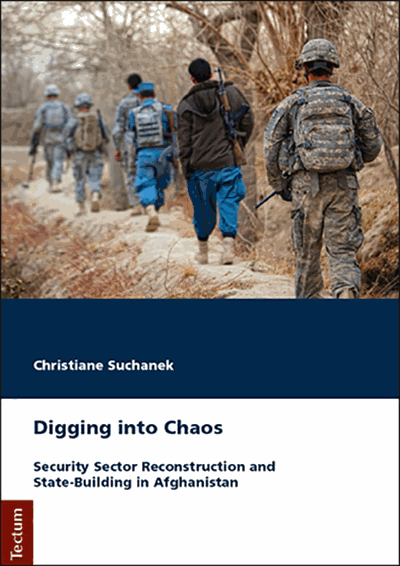
Digging into Chaos
Security Sector Reconstruction and State-Building in Afghanistan- Autor:innen:
- Reihe:
- Tectum - Masterarbeiten
- Verlag:
- 2018
Zusammenfassung
With the terrorist attacks of 9/11, international attention has shifted to Afghanistan. This event also marked the beginning of a fundamental transformation in the country: It was and is target of an enormous military campaign that toppled the Taliban in a “War on Terror”. With the previous government deposed, a new one had to be built. Guided by a multinational coalition, the Afghan state was quickly reformed, but instabilities and conflicts have not only been inherited but also unintentionally triggered. Even after more than 15 years of international intervention, neither peace nor political stability or security seem to have taken roots in the country. The book takes a closer look at the international state-building regime and evaluates the impact and outlook of such efforts in Afghanistan. In order to facilitate the analysis, the study concentrates on Security Sector Reform (SSR) with special emphasis on the reconstruction of the Afghan military and police. With this, the author presents critical insights into state-building prospects in Afghanistan and introduces an analytical approach that may also be transferred to other cases of state reconstruction.
Publikation durchsuchen
Bibliographische Angaben
- Auflage
- 1/2018
- Copyrightjahr
- 2018
- ISBN-Print
- 978-3-8288-4187-1
- ISBN-Online
- 978-3-8288-7080-2
- Verlag
- Tectum, Baden-Baden
- Reihe
- Tectum - Masterarbeiten
- Sprache
- Deutsch
- Seiten
- 108
- Produkttyp
- Monographie
Inhaltsverzeichnis
- Titelei/Inhaltsverzeichnis Teilzugriff Seiten I - VIII Download Kapitel (PDF)
- 1. Introduction: Situation under Control? Kein Zugriff Seiten 1 - 6
- 2.1.1. Central Principles of State Theory Kein Zugriff
- 2.1.2. Core Functions of the State Kein Zugriff
- 2.2.1. State-Building on the International Agenda Kein Zugriff
- 2.2.2. Contrasting State-Building Kein Zugriff
- 2.3. Study Focus: Security Sector Reform in State-Building Kein Zugriff
- 2.4. Stopover: The Knowns and Unknowns of State-Building Kein Zugriff
- 3.1. A Closer Look at Methodological Implications Kein Zugriff
- 3.2. Developing a Conceptual Framework for SSR Impact Kein Zugriff
- 4.1. Conflict Portrait and State-Building Approach Kein Zugriff
- 4.2.1. The Police Reform Agenda Starting from Scratch Kein Zugriff
- 4.2.2. The Police under Transition to Full Responsibility Kein Zugriff
- 4.2.3. Assessing the Reconstruction of the Police Kein Zugriff
- 4.3.1. The Military Reform Agenda Starting from Scratch Kein Zugriff
- 4.3.2. The Military under Transition to Full Responsibility Kein Zugriff
- 4.3.3. Assessing the Reconstruction of the Military Kein Zugriff
- 4.4. Lessons Learned about SSR and State-Building in Afghanistan Kein Zugriff
- 5. Conclusion: Digging into Chaos Kein Zugriff Seiten 95 - 98
- Literature Kein Zugriff Seiten 99 - 108
Literaturverzeichnis (112 Einträge)
Es wurden keine Treffer gefunden. Versuchen Sie einen anderen Begriff.
- Literature Google Scholar öffnen doi.org/10.5771/9783828870802
- Acemoglu, D., & Robinson, J. A. (2013). Why Nations Fail: The Origins of Power, Prosperity, and Poverty (First published in 2012 ed.). London: Profile Books LTD. Google Scholar öffnen doi.org/10.5771/9783828870802
- Afghanistan Research and Evaluation Unit (AREU). (2017). About Afghanistan Research and Evaluation Unit (AREU). Retrieved April 25, 2017, from Afghanistan Research and Evaluation Unit: Research for a Better Afghanistan: https://areu.org.af/about-us Google Scholar öffnen doi.org/10.5771/9783828870802
- Ansary, T. (2012). Games without Rules. Philadelphia: PublicAffairs. Google Scholar öffnen doi.org/10.5771/9783828870802
- Barton, F. D. (2010). Measuring Progress in International State-Building and Reconstruction. In J. Krause, & C. K. IV (Eds.), International State Building and Reconstruction Efforts: Experience Gained and Lessons Learned (pp. 17-32). Opladen & Farminton Hills, MI: Barbara Budrich Publishers. Google Scholar öffnen doi.org/10.5771/9783828870802
- Berger, M. T. (2006, August 08). From nation-building to state-building: The geopolitics of development, the nation-state system and the changing global order. Third World Quarterly, pp. 5-25. Google Scholar öffnen doi.org/10.5771/9783828870802
- Bertelsmann Stiftung. (2016). BTI 2016 - Afghanistan Country Report. Retrieved April 23, 2017, from Bertelsmann Stiftung: https://www.bti-project.org/fileadmin/files/BTI/Downloads/Reports/2016/pdf/BTI_2016_Afghanistan.pdf Google Scholar öffnen doi.org/10.5771/9783828870802
- Bertelsmann Stiftung. (2017). Transformation Index BTI 2016. Retrieved October 24, 2017, from https://www.bti-project.org/en/reports/country-reports/detail/itc/afg/itr/aso/ Google Scholar öffnen doi.org/10.5771/9783828870802
- Blatter, J. K., Janning, F., & Wagemann, C. (2007). Qualitative Politikanalyse: eine Einf�hrung in Forschungsans�tze und Methoden. Wiesbaden: VS Verlag f�r Sozialwissenschaften. Google Scholar öffnen doi.org/10.5771/9783828870802
- Call, C. T., & Cousens, E. M. (2008). Ending wars and building peace: International responses to war-torn societies. International Studies Perspectives, 9(1), pp. 1-21. Google Scholar öffnen doi.org/10.5771/9783828870802
- Caplan, R. (2005). International Governance of War-Torn Territories: Rule and Reconstruction. Oxford, New York: Oxford University Press. Google Scholar öffnen doi.org/10.5771/9783828870802
- Collier, P., Elliott, V. L., Hegre, H., Hoeffler, A., Reynal-Querol, M., & Sambanis, N. (2003). Breaking the Conflict Trap : Civil War and Development Policy. A World Bank policy research report. Washington, DC: World Bank and Oxford University Press. Google Scholar öffnen doi.org/10.5771/9783828870802
- Cordesman, A. H., & Lin, A. (2015). Afghanistan at Transition: Lessons of the Longest War. Washington, D.C.: Center for Strategic and International Studies. Google Scholar öffnen doi.org/10.5771/9783828870802
- Costantini, I. (2015, January 09). Statebuilding versus state formation: the political economy of transition in Iraq and Libya. Retrieved June 08, 2017, from PhD thesis, University of Trento: http://eprints-phd.biblio.unitn.it/1519/1/Costantini_dissertation_deposit.pdf Google Scholar öffnen doi.org/10.5771/9783828870802
- Debiel, T., & Reinhardt, D. (2004). Staatsverfall und Weltordnungspolitik: analytische Zug�nge und politische Strategien zu Beginn des 21. Jahrhunderts. Nord-S�d aktuell, 18(3), pp. 525-536. Google Scholar öffnen doi.org/10.5771/9783828870802
- Debiel, T., & Rinck, P. (2017). Statebuilding. In M. Dunn Cavelty, & T. Balzacq (Eds.), Routledge handbook of security studies (pp. 404-414). London; New York: Routledge, Taylor & Francis Group. Google Scholar öffnen doi.org/10.5771/9783828870802
- Deutsche Gesellschaft f�r Internationale Zusammenarbeit (GIZ) GmbH. (2015, August). Measuring Results, Contributing to Results: Findings and conclusions from monitoring and evaluation 2012-2014. Bonn: Deutsche Gesellschaft f�r Internationale Zusammenarbeit (GIZ) GmbH. Retrieved from https://www.giz.de/de/downloads/giz2016-en-monitoring.pdf Google Scholar öffnen doi.org/10.5771/9783828870802
- Eabrasu, M. (2012). Les �tats de la d�finition w�b�rienne de l'�tat. Raisons politiques, 1(No. 45), pp. 187-209. Google Scholar öffnen doi.org/10.5771/9783828870802
- Eriksen, S. S. (2016, August 05). State effects and the effects of state building: institution building and the formation of state-centred societies. Retrieved from Third World Quarterly: DOI: 10.1080/01436597.2016.1176854 Google Scholar öffnen doi.org/10.5771/9783828870802
- Fukuyama, F. (2005). State-Building: Governance and World Order in the Twenty-First Century (paperback edition of the 2004 published edition ed.). London: Profile Books LTD. Google Scholar öffnen doi.org/10.5771/9783828870802
- Ghani, A., & Lockhart, C. (2010). Lessons Unlearned: Why Most International Reconstruction Efforts in the Past Have Failed. In J. Krause, & C. K. IV (Eds.), International State Building and Reconstruction Efforts: Experience Gained and Lessons Learned (pp. 5-16). Opladen & Farminton Hills, MI: Barbara Budrich Publishers. Google Scholar öffnen doi.org/10.5771/9783828870802
- Giustozzi, A. (2015). The Army of Afghanistan: A Political History of a Fragile Institution. London: Hurst Publishers. Google Scholar öffnen doi.org/10.5771/9783828870802
- Giustozzi, A., & Ali, A. M. (2016, March). The Afghan National Army After ISAF. Retrieved August 25, 2017, from Afghan Research and Evaluation Unit (AREU): https://areu.org.af/wp-content/uploads/2016/03/1603E-The-Afghan-National-Army-after-ISAF.pdf Google Scholar öffnen doi.org/10.5771/9783828870802
- Giustozzi, A., & Isaqzadeh, M. (2013). Policing Afghanistan. London: Hurst Publishers. Google Scholar öffnen doi.org/10.5771/9783828870802
- Giustozzi, A., & Kalinovsky, A. M. (2016). Missionaries of Modernity: Advisory Missions and the Struggle for Hegemony in Afghanistan and Beyond. London: Hurst Publishers. Google Scholar öffnen doi.org/10.5771/9783828870802
- Gr�vingholt, J., G�nzle, S., & Ziaja, S. (2009). The convergence of peacebuilding and state building: addressing a common purpose from different perspectives. Retrieved June 06, 2017, from Deutsches Institut f�r Entwicklungspolitik (DIE): https://www.die-gdi.de/uploads/media/BP_4.2009.pdf Google Scholar öffnen doi.org/10.5771/9783828870802
- Grenier, S. M. (2015). Introduction: Framing the War in Afghanistan. In G. A. Mattox, & S. M. Grenier (Eds.), Coalition Challenges in Afghanistan: The Politics of Alliance (pp. 1-12). Stanford: Stanford University Press. Google Scholar öffnen doi.org/10.5771/9783828870802
- Grindle, M. S. (2004). Good Enough Governance: Poverty Reduction and Reform in Developing Countries. Governance: An International Journal of Policy, Administration, and Institutions, 4(17), pp. 525-548. Google Scholar öffnen doi.org/10.5771/9783828870802
- Gro�, L., & Grimm, S. (2016, March 10). Conflicts of preferences and domestic constraints: understanding reform failure in liberal state-building and democracy promotion. Contemporary Politics, pp. 1-19. Google Scholar öffnen doi.org/10.5771/9783828870802
- Hammes, T. X. (2015). Raising and Mentoring Security Forces in Afghanistan and Iraq. In R. D. Hooker, & J. J. Collins (Eds.), Lessons Encountered: Learning from the Long War (pp. 277-344). Washington, DC: National Defense University Press. Google Scholar öffnen doi.org/10.5771/9783828870802
- H�nggi, H. (2010). Establishing Security in Conflict-Affected Societies: How to Reform the Security Sector. In J. Krause, & C. K. IV (Eds.), International State Building and Reconstruction Efforts: Experience Gained and Lessons Learned (pp. 77-97). Opladen & Farminton Hills, MI: Barbara Budrich Publishers. Google Scholar öffnen doi.org/10.5771/9783828870802
- Harooni, M. (2017, May 09). Afghan forces try to push back Taliban from Kunduz city. (T. Heneghan, Ed.) Retrieved May 15, 2017, from Reuters: http://www.reuters.com/article/us-afghanistan-taliban-idUSKBN1851WN Google Scholar öffnen doi.org/10.5771/9783828870802
- Helmer, D. (2008, July-August). Twelve urgent steps for the Advisor Mission in Afghanistan. Military Review, pp. 73-81. Google Scholar öffnen doi.org/10.5771/9783828870802
- Hirschmann, K. (2016). Wie Staaten schwach werden: Fragilit�t von Staaten als internationale Herausforderung. Bonn: Bundeszentrale f�r politische Bildung (bpb). Google Scholar öffnen doi.org/10.5771/9783828870802
- Hobbes, T. (1894). Leviathan; or, The matter, form, and power of a commonwealth ecclesiastical and civil (4th ed.). (H. Morley, Ed.) London, Glasgow, New York: G. Routledge and Sons. Google Scholar öffnen doi.org/10.5771/9783828870802
- Holland, S., & Walcott, J. (2017, August 03). Insider - Trumps Top-Berater nach Afghanistan-Beratungen "fassungslos". Retrieved August 09, 2017, from Reuters: http://de.reuters.com/article/afghanistan-usa-trump-idDEKBN1AJ0G9 Google Scholar öffnen doi.org/10.5771/9783828870802
- Hughes, M. (2014, May). The Afghan National Police in 2015 and Beyond. Retrieved August 08, 2017, from United States Institut of Peace (USIP) - Special Report 346: https://www.usip.org/sites/default/files/SR346_The_Afghan_National_Police_in_2015_and_Beyond.pdf Google Scholar öffnen doi.org/10.5771/9783828870802
- International Crisis Group. (2017a, April 27). Watch List 2017. First Update. Retrieved May 05, 2017, from International Crisis Group: https://d2071andvip0wj.cloudfront.net/WL%202017-Update%201%20(1).pdf Google Scholar öffnen doi.org/10.5771/9783828870802
- International Crisis Group. (2017b, April 10). Afghanistan: The Future of the National Unity Government. Asia Report N�285. Retrieved August 15, 2017, from International Crisis Group: https://d2071andvip0wj.cloudfront.net/285-afghanistan-the-future-of-the-national-unity-government%20(1).pdf Google Scholar öffnen doi.org/10.5771/9783828870802
- Jellinek, G., & Jellinek, W. (1914). Allgemeine Staatslehre (3rd ed.). Berlin: Verlag von O. H�ring. Google Scholar öffnen doi.org/10.5771/9783828870802
- Katzman, K., & Thomas, C. (2017, August 22). Afghanistan: Post-Taliban Governance, Security, and U.S. Policy. Retrieved August 27, 2017, from Congressional Research Service (RL30588): https://fas.org/sgp/crs/row/RL30588.pdf Google Scholar öffnen doi.org/10.5771/9783828870802
- KfW. (2015). Ex post evaluation � Afghanistan: City Network Rehabilitation Kabul. Retrieved July 30, 2017, from KfW Development Bank: https://www.kfw-entwicklungsbank.de/PDF/Evaluierung/Ergebnisse-und-Publikationen/PDF-Dokumente-A-D_EN/Afghanistan_Stadtnetz_Kabul_2015_E.pdf Google Scholar öffnen doi.org/10.5771/9783828870802
- KfW. (2017). Evaluation Criteria. Retrieved June 26, 2017, from KfW Development Bank: https://www.kfw-entwicklungsbank.de/International-financing/KfW-Development-Bank/Evaluations/Evaluation-criteria/ Google Scholar öffnen doi.org/10.5771/9783828870802
- Knopf, J. W. (2004, August 08). Did Reagan Win the Cold War? Strategic Insights(3 (8)), p. http://hdl.handle.net/10945/11247. Google Scholar öffnen doi.org/10.5771/9783828870802
- Krause, J. (2010). The Future of International State-Building and Reconstruction Efforts: Summary and Recommendations. In J. Krause, & C. K. IV (Eds.), International State Building and Reconstruction Efforts: Experience Gained and Lessons Learned (pp. 157-171). Opladen & Farminton Hills, MI: Barbara Budrich Publishers. Google Scholar öffnen doi.org/10.5771/9783828870802
- Krause, J., & Mallory, C. K. (2010). Introduction. In J. Krause, & C. K. IV (Eds.), International State Building and Reconstruction Efforts: Experience Gained and Lessons Learned (pp. 1-4). Opladen & Farminton Hills, MI: Barbara Budrich Publishers. Google Scholar öffnen doi.org/10.5771/9783828870802
- Kr�ger, U. (2014). Schadensfall Afghanistan. Bonn: Bouvier Verlag. Google Scholar öffnen doi.org/10.5771/9783828870802
- Lee, G. (2012). Fighting Season: Tales of a British Officer in Afghanistan (International Edition ed.). London: Duckworth Publishing. Google Scholar öffnen doi.org/10.5771/9783828870802
- Mackenzie, J. (2017, April 28). Afghan Taliban launch spring offensive as U.S. reviews strategy. (M. Perry, Ed.) Retrieved May 15, 2017, from Reuters: http://www.reuters.com/article/us-afghanistan-taliban-idUSKBN17U0E9 Google Scholar öffnen doi.org/10.5771/9783828870802
- Mattox, G. A. (2015). Going Forward: Lessons Learned. In G. A. Mattox, & S. M. Grenier (Eds.), Coalition Challenges in Afghanistan: The Politics of Alliance (pp. 288-304). Stanford: Stanford University Press. Google Scholar öffnen doi.org/10.5771/9783828870802
- Mayer-Rieckh, A. (2013). Dealing with the Past in Security Sector Reform. (H. H�nggi, & A. Schnabel, Eds.) Geneva: The Geneva Centre for the Democratic Control of Armed Forces (DCAF). Google Scholar öffnen doi.org/10.5771/9783828870802
- Murray, T. (2007). Police-Building in Afghanistan: A Case Study of Civil Security Reform. International Peacekeeping, 14(1), pp. 108-126. doi:http://dx.doi.org/10.1080/13533310601114327 Google Scholar öffnen doi.org/10.5771/9783828870802
- Murray, T. (2011, January 01). Security Sector Reform in Afghanistan, 2002�2011: An Overview of a Flawed Process. International Studies, 48(1), pp. 43-63. doi:10.1177/002088171204800103 Google Scholar öffnen doi.org/10.5771/9783828870802
- NATO. (2013). ISAF Security Force Assistance Guide. International Security Assistance Forces (ISAF) and the Security Force Assistance (SFA). Retrieved from https://info.publicintelligence.net/ISAF-SecurityForceAssistance.pdf Google Scholar öffnen doi.org/10.5771/9783828870802
- NATO. (2016, July 09). Warsaw Summit Declaration on Afghanistan. Issued by the Heads of State and Government of Afghanistan and Allies and their Resolute Support Operational Partners. Press Release (2016) 121. North Atlantic Treaty Organization (NATO). Retrieved from http://nato.int/cps/en/natohq/official_texts_133171.htm?selectedLocale=en Google Scholar öffnen doi.org/10.5771/9783828870802
- Nelson, B. R. (2006). The Making of the Modern State. New York, Basingstoke: Palgrave Macmillan US. Google Scholar öffnen doi.org/10.5771/9783828870802
- OECD. (2007, April). Principles for Good International Engagement in Fragile States & Situations. Retrieved April 25, 2017, from OECD : http://www.oecd.org/dac/governance-peace/conflictfragilityandresilience/docs/38368714.pdf Google Scholar öffnen doi.org/10.5771/9783828870802
- OECD. (2008). The OECD DAC Handbook on Security System Reform: Supporting Security and Justice. Paris: OECD Publishing. Google Scholar öffnen doi.org/10.5771/9783828870802
- OECD. (2009, April 17). Concepts and dilemmas of State building in fragile situations: From fragility to resilience. OECD Journal on Development, Vol. 9/3, pp. 61�148. Google Scholar öffnen doi.org/10.5771/9783828870802
- OECD. (2010). Do No Harm: International Support for Statebuilding. Paris: OECD Publishing. doi:http://dx.doi.org/10.1787/9789264046245-en Google Scholar öffnen doi.org/10.5771/9783828870802
- OECD. (2011a). International Engagement in Fragile States: Can't We Do Better? Paris: OECD Publishing. Google Scholar öffnen doi.org/10.5771/9783828870802
- OECD. (2011b). Section 10: Monitoring and Evaluation. In The OECD DAC Handbook on Security System Reform: Supporting Security and Justice. Paris: OECD Publishing. doi:http://dx.doi.org/10.1787/9789264027862-13-en Google Scholar öffnen doi.org/10.5771/9783828870802
- Otlowski, T. (2014, December 31). Afghanistan after the ISAF - how to avoid failure? Retrieved April 24, 2017, from Pulaski Policy Papers. The Casimir Pulaski Foundation: https://pulaski.pl/wp-content/uploads/2015/02/Pulaski_Policy_Papers_No_17_14_EN.pdf Google Scholar öffnen doi.org/10.5771/9783828870802
- Porter, J. J. (2015). North Atlantic Treaty Organization: Transformation Under Fire. In G. A. Mattox, & S. M. Grenier (Eds.), Coalition Challenges in Afghanistan: The Politics of Alliance (pp. 184-198). Stanford: Stanford University Press. Google Scholar öffnen doi.org/10.5771/9783828870802
- Purcell, J., Martyris, D., Noor, N., & Rose, A. (2016, January). Meta-Analysis of Final Evaluations of USAID Projects Implemented in Afghanistan, 2010-2015. (U. A. Development, Ed.) Retrieved June 26, 2017, from USAID: http://pdf.usaid.gov/pdf_docs/PA00M8B2.pdf Google Scholar öffnen doi.org/10.5771/9783828870802
- Richmond, O. P. (2013). Failed Statebuilding versus Peace Formation. In T. D. David Chandler (Ed.), Routledge Handbook of International Statebuilding (pp. 130-140). Milton Park, Abingdon, Oxon: Routledge. Google Scholar öffnen doi.org/10.5771/9783828870802
- Rocha Menocal, A. (2011, November). State Building for Peace: A New Paradigm for International Engagement in Post-Conflict Fragile States? Third World Quarterly( 32, no. 10), pp. 1715�1736. doi:10.1080/01436597.2011 Google Scholar öffnen doi.org/10.5771/9783828870802
- Ruttig, T. (2015, November 08). Dossier Afghanistan: Konfliktportr�t. Retrieved April 24, 2017, from Bundeszentrale f�r politische Bilding (bpb.de): http://www.bpb.de/internationales/asien/afghanistan/55517/konfliktportraet Google Scholar öffnen doi.org/10.5771/9783828870802
- Ruttig, T. (2016). Fluchtursachen und "sichere Schutzzonen" in Afghanistan. In M. Johannsen, B. Schoch, M. M. Mutschler, C. Hauswedell, & J. Hippler, Friedensgutachten 2016 (pp. 114-126). Berlin: Lit Verlag Dr. W. Hopf. Google Scholar öffnen doi.org/10.5771/9783828870802
- Schetter, C. (2005, June). Warum zerfallen Staaten, und was genau passiert dabei? Entwicklung und l�ndlicher Raum, pp. 8-10. Google Scholar öffnen doi.org/10.5771/9783828870802
- Schetter, C. (2009). Die Taliban und die Neuordnung Afghanistans. In B. Chiari (Ed.), Wegweiser zur Geschichte: Afghanistan (pp. 83-99). Paderborn: Ferdinand Sch�ningh. Google Scholar öffnen doi.org/10.5771/9783828870802
- Schetter, C., & Mielke, K. (2016). Was von Kundus bleibt. Intervention, Gewalt und Soziale Ordnung in Afghanistan. Politische Vierteljahreszeitschrift (PVS), 57(4), pp. 614-642. Google Scholar öffnen doi.org/10.5771/9783828870802
- Schmidt, S. (2013). Good Governance als Entwicklungsvoraussetzung. In H. Ihne, & J. Wilhelm (Eds.), Einf�hrung in die Entwicklungspolitik (pp. 284-290). Bonn: Bundeszentrale f�r politische Bildung (bpb). Google Scholar öffnen doi.org/10.5771/9783828870802
- Schnabel, A., & Born, H. (2011). Security Sector Reform: Narrowing the Gap between Theory and Practice. (A. Bryden, & H. H�nggi, Eds.) Geneva: The Geneva Centre for the Democratic Control of Armed Forces (DCAF). Google Scholar öffnen doi.org/10.5771/9783828870802
- Sedra, M. (2006, August 06). Security sector reform in Afghanistan: The slide towards expediency. International Peacekeeping, pp. 94-110. Google Scholar öffnen doi.org/10.5771/9783828870802
- Sedra, M. (2007). Security Sector Reform in Afghanistan: An Instrument of the State-Building Project. In L. Andersen, B. M�ller, & F. Stepputat (Eds.), Fragile States and Insecure People? Violence, Security, and Statehood in the Twenty-First Century (1 ed., pp. 151-176). New York (USA), Hampshire (UK): Palgrave Macmillan US. Google Scholar öffnen doi.org/10.5771/9783828870802
- Sedra, M. (2010). Diagnosing the Failings of Security Sector Reform in Afghanistan. Sicherheit und Frieden (S+F) / Security and Peace, 4(28), pp. 233-238. Google Scholar öffnen doi.org/10.5771/9783828870802
- Sisk, T. (2010). Paradoxes and Dilemmas of Democratization and State-Building in War-Torn Countries: From Problems to Policy. In J. Krause, & C. K. IV (Eds.), International State Building and Reconstruction Efforts: Experience Gained and Lessons Learned (pp. 57-75). Opladen & Farminton Hills, MI: Barbara Budrich Publishers. Google Scholar öffnen doi.org/10.5771/9783828870802
- Sisk, T. (2013). Statebuilding: Consolidating Peace after Civil War. Cambridge (UK); Malden (USA): Polity Press. Google Scholar öffnen doi.org/10.5771/9783828870802
- Sopko, J. F. (2016, February 12). Assessing the Capabilities and Effectiveness of Afghan National Defense and Security Forces. Retrieved August 25, 2017, from Special Inspector General for Afghanistan Reconstruction (SIGAR): https://www.sigar.mil/pdf/testimony/SIGAR-16-17-TY.pdf Google Scholar öffnen doi.org/10.5771/9783828870802
- Special Inspector General for Afghanistan Reconstruction (SIGAR). (2011, July 30). Quarterly Report to the United States Congress. Retrieved August 29, 2017, from SIGAR Special Inspector General for Afghanistan Reconstruction: https://www.sigar.mil/pdf/quarterlyreports/2011-07-30qr.pdf Google Scholar öffnen doi.org/10.5771/9783828870802
- Special Inspector General for Afghanistan Reconstruction (SIGAR). (2014a, February). Afghan National Security Forces: Actions Needed to Improve Plans for Sustaining Capability Assessment Efforts. Retrieved August 25, 2017, from SIGAR Special Inspector General for Afghanistan Reconstruction: https://www.sigar.mil/pdf/audits/SIGAR_14-33-AR.pdf Google Scholar öffnen doi.org/10.5771/9783828870802
- Special Inspector General for Afghanistan Reconstruction (SIGAR). (2014b, January). Afghan National Security Forces: Despite Reported Successes, Concerns Remain about Literacy Program Results, Contract Oversight, Transition, and Sustainment. Retrieved August 25, 2017, from SIGAR Special Inspector General for Afghanistan Reconstruction: https://www.sigar.mil/pdf/audits/SIGAR_14-30-AR.pdf Google Scholar öffnen doi.org/10.5771/9783828870802
- Special Inspector General for Afghanistan Reconstruction (SIGAR). (2017, July 2017). Quarterly Report to the United States Congress. Retrieved August 08, 2017, from SIGAR Special Inspector General for Afghanistan Reconstruction: https://www.sigar.mil/pdf/quarterlyreports/2017-07-30qr.pdf Google Scholar öffnen doi.org/10.5771/9783828870802
- Stevenson, A. (Ed.). (2010). Oxford Dictionary of English (3. Edition ed.). Oxford: Oxford University Press. Google Scholar öffnen doi.org/10.5771/9783828870802
- Stewart, P., & Emmott, R. (2017, June 29). U.S. defense chief: U.S., allies withdrew from Afghanistan too fast. Retrieved August 09, 2017, from Reuters: http://www.reuters.com/article/us-nato-afghanistan-mattis-idUSKBN19K2PE Google Scholar öffnen doi.org/10.5771/9783828870802
- St�tz, J. (2008). "State-Building" - aus theoretischer und praktischer Perspektive. Baden-Baden: Nomos Verlag. Google Scholar öffnen doi.org/10.5771/9783828870802
- Tanner, S. (2012). Afghanistan: A Military History from Alexander the Great to the War Against the Taliban (Revised Edition ed.). Philadelphia: Da Capo Press. Google Scholar öffnen doi.org/10.5771/9783828870802
- The New York Times. (2017, August 21). Full Transcript and Video: Trump�s Speech on Afghanistan. Retrieved September 22, 2017, from https://www.nytimes.com/2017/08/21/world/asia/trump-speech-afghanistan.html?mcubz=0 Google Scholar öffnen doi.org/10.5771/9783828870802
- Tilly, C. (1985). War Making and State Making as Organized Crime. In P. B. Evans, D. R. Rhode Island, & T. Skocpol (Eds.), Bringing the State Back In (pp. 169-191). Cambridge: Cambridge University Press. Google Scholar öffnen doi.org/10.5771/9783828870802
- U.S. Army and U.S. Marince Corps. (2006, December 15). Field Manual No. 3-24. Washington, D.C.: Headquarter, Department of the Army. Retrieved from Headquarter Deparment of the Army: http://usacac.army.mil/cac2/Repository/Materials/COIN-FM3-24.pdf Google Scholar öffnen doi.org/10.5771/9783828870802
- U.S. Department of Defense (DOD). (2017, June). Enhancing Security and Stability in Afghanistan. Retrieved August 25, 2017, from RefID: 3-15EF0A8: https://www.defense.gov/Portals/1/Documents/pubs/June_2017_1225_Report_to_Congress.pdf Google Scholar öffnen doi.org/10.5771/9783828870802
- U.S. GAO. (2005, June). Afghanistan Security: Efforts to Establish Army and Police Have Made Progress, but Future Plans Need to Be Better Defined. Retrieved August 28, 2017, from GAO-05-575: http://www.gao.gov/new.items/d05575.pdf Google Scholar öffnen doi.org/10.5771/9783828870802
- U.S. GAO. (2009, April 21). Afghanistan: Key Issues for Congressional Oversight. Retrieved August 25, 2017, from GAO-09-473SP: https://www.gao.gov/assets/660/652075.pdf Google Scholar öffnen doi.org/10.5771/9783828870802
- U.S. GAO. (2011, January 27). Afghanistan Security: Afghan Army Growing, but Additional Trainers Needed; Long-term Costs Not Determined. Retrieved August 25, 2017, from GAO-11-66: https://www.gao.gov/assets/320/315200.pdf Google Scholar öffnen doi.org/10.5771/9783828870802
- U.S. GAO. (2012, July 24). Afghanistan Security: Long-standing Challenges May Affect Progress and Sustainment of Afghan National Security Forces. Retrieved August 25, 2017, from GAO-12-951T: https://www.gao.gov/assets/600/592913.pdf Google Scholar öffnen doi.org/10.5771/9783828870802
- U.S. GAO. (2013, February 11). Afghanistan: Key Oversight Issues. Retrieved August 25, 2017, from GAO-13-218SP: https://www.gao.gov/assets/660/652075.pdf Google Scholar öffnen doi.org/10.5771/9783828870802
- U.S. GAO. (2015, December 03). Afghanistan: State and USAID Should Evaluate Actions Taken to Mitigate Effects of Attrition among Local Staff. Retrieved August 25, 2017, from GAO-16-100: https://www.gao.gov/assets/680/673983.pdf Google Scholar öffnen doi.org/10.5771/9783828870802
- UNAMA. (2017, February). Afghanistan. Protection of Civilians in Armed Conflict. Annual Report 2016. Retrieved April 28, 2017, from United Nations Assistance Mission in Afghanistan (UNAMA): https://unama.unmissions.org/sites/default/files/protection_of_civilians_in_armed_conflict_annual_report_2016_final280317.pdf Google Scholar öffnen doi.org/10.5771/9783828870802
- United Nations. (2008, January 23). Securing peace and development: the role of the United Nations in supporting security sector reform. Report of the Secretary-General. A/62/659�S/2008/39. New York. Google Scholar öffnen doi.org/10.5771/9783828870802
- United Nations. (2013, August 13). Securing States and societies: strengthening the United Nations comprehensive support to security sector reform. Report of the Secretary-General. A/67/970�S/2013/480. New York. Google Scholar öffnen doi.org/10.5771/9783828870802
- United Nations Development Program (UNDP). (1994). Human Development Report 1994. Oxford, New York: Oxford University Press. Google Scholar öffnen doi.org/10.5771/9783828870802
- United Nations Educational, Scientific and Cultural Organization (UNESCO). (2016, September). Case Study 4: The effects of police literacy training in Afghanistan. Retrieved August 30, 2017, from Evaluation of UNESCO's Role in Emergencies and Protacted Crisis: http://unesdoc.unesco.org/images/0024/002464/246451E.pdf Google Scholar öffnen doi.org/10.5771/9783828870802
- Weber, M. (1946). Politics as a Vocation. In M. Weber, H. Gerth, & C. W. Mills, From Max Weber: Essays in Sociology (pp. 77-128). New York: Oxford University Press. Google Scholar öffnen doi.org/10.5771/9783828870802
- Webermann, J. (2017, April 22). Afghanistan: Mehr als 140 Tote bei Taliban-Angriff. Retrieved April 23, 2017, from tagesschau.de: https://www.tagesschau.de/ausland/afghanistan-taliban-angriff-fuenfzig-tote-103.html Google Scholar öffnen doi.org/10.5771/9783828870802
- Wieker, V. (2012). Afghanistan: Eine Bestandsaufnahme aus milit�rpolitischer Sicht � Ziele, Strategie und Perspektive des ISAF-Einsatzes. In A. Seiffert, P. C. Langer, & C. Pietsch (Eds.), Der Einsatz der Bundeswehr in Afghanistan: sozial- und politikwissenschaftliche Perspektiven (pp. 23-32). Wiesbaden: VS Verlag f�r Sozialwissenschaften. Google Scholar öffnen doi.org/10.5771/9783828870802
- Wilder, A. (2007, July). Cops or Robbers?: The Struggle to Reform the Afghan National Police. Retrieved April 04, 2017, from Afghanistan Research and Evaluation Unit (AREU): http://www.comw.org/warreport/fulltext/0707wilder.pdf Google Scholar öffnen doi.org/10.5771/9783828870802
- World Bank. (1997). World Development Report 1997 : The State in a Changing World. New York: Oxford University Press. Retrieved April 25, 2017, from https://openknowledge.worldbank.org/handle/10986/5980 Google Scholar öffnen doi.org/10.5771/9783828870802
- World Bank. (2011). World Development Report 2011: Conflict, Security, and Development. Washington, DC: The World Bank. Retrieved April 25, 2017, from https://openknowledge.worldbank.org/handle/10986/5980 Google Scholar öffnen doi.org/10.5771/9783828870802
- World Bank. (2012). Guidance for Supporting State-Building in Fragile and Conflict-Affected States: A Tool-Kit. Washington DC: The World Bank. Retrieved from The World Bank: http://siteresources.worldbank.org/PUBLICSECTORANDGOVERNANCE/Resources/285741-1343934891414/8787489-1347032641376/SBATGuidance.pdf Google Scholar öffnen doi.org/10.5771/9783828870802
- Zimmerman, S. R. (2015). The Afghan Government at War. In G. A. Mattox, & S. M. Grenier (Eds.), Coalition Challenges in Afghanistan: The Politics of Alliance (pp. 15-30). Stanford: Stanford University Press. Google Scholar öffnen doi.org/10.5771/9783828870802
- Z�rcher, C. (2005, September). Gewollte Schw�che: Vom schwierigen analytischen Umgang mit prek�rer Staatlichkeit. Internationale Politik, pp. 13-22. Google Scholar öffnen doi.org/10.5771/9783828870802