, um zu prüfen, ob Sie einen Vollzugriff auf diese Publikation haben.
Sammelband Kein Zugriff
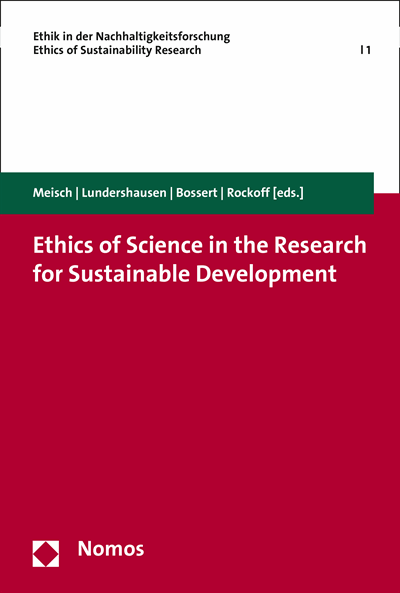
Ethics of Science in the Research for Sustainable Development
- Herausgeber:innen:
- | | |
- Verlag:
- 2015
Zusammenfassung
Im Zentrum des Bandes steht die Frage, welche Rolle der Wissenschaft bei der Findung von Antworten auf die Herausforderungen der nachhaltigen Entwicklung zukommt bzw. zukommen sollte. Die Beiträge präsentieren einen ambitionierten Überblick sowohl über die Grundlagendebatten als auch über die anwendungsorientierten Reflexionen über Themen wie Wasser, das Anthropozän-Konzept und die Mensch-Tier-Beziehungen.
In englischer Sprache.
Publikation durchsuchen
Bibliographische Angaben
- Auflage
- 1/2015
- Copyrightjahr
- 2015
- ISBN-Print
- 978-3-8487-1835-1
- ISBN-Online
- 978-3-8452-5843-0
- Verlag
- Nomos, Baden-Baden
- Reihe
- Ethik in der Nachhaltigkeitsforschung | Ethics of Sustainability Research
- Band
- 1
- Sprache
- Englisch
- Seiten
- 388
- Produkttyp
- Sammelband
Inhaltsverzeichnis
KapitelSeiten
- Titelei/Inhaltsverzeichnis Kein Zugriff Seiten 1 - 6
- Introduction Kein Zugriff Seiten 7 - 14Autor:innen:
- The Quality of Sustainability Science: A Philosophical Perspective Kein Zugriff Seiten 15 - 44Autor:innen: |
- Concepts and Conceptions of Sustainable Development: A Comparative Perspective Kein Zugriff Seiten 45 - 72Autor:innen: |
- The Foundations of Capability Theory: Comparing Nussbaum and Gewirth Kein Zugriff Seiten 73 - 98Autor:innen: |
- Post-Normal Science Kein Zugriff Seiten 99 - 112Autor:innen: |
- From Democratisation of Knowledge to Democratisation of Ignorance – and the Importance of Hermeneutics Kein Zugriff Seiten 113 - 128Autor:innen:
- Ethics in the Sciences beyond Hume, Moore and Weber: Taking Epistemic-Moral Hybrids Seriously Kein Zugriff Seiten 129 - 152Autor:innen:
- Ethics of Science and a New Social Contract for Knowledge Kein Zugriff Seiten 153 - 178Autor:innen:
- Security and the Absurd Event: What the Zombie Apocalypse Teaches us about Resilience Kein Zugriff Seiten 179 - 200Autor:innen:
- Shaping Science Policy – More Democracy and Sustainability Kein Zugriff Seiten 201 - 216Autor:innen:
- Don’t be such a meat-breath! Food and Sustainability in Margaret Atwood’s MaddAddam trilogy Kein Zugriff Seiten 217 - 246Autor:innen:
- “As if that God made Creatures for Mans meat”: Margaret Cavendish’s The Hunting of the Hare and Animal Ethics Kein Zugriff Seiten 247 - 272Autor:innen: |
- Climate Change in Early Modern Literature Which Place for Humanities in the Sustainability Sciences? Kein Zugriff Seiten 273 - 298Autor:innen: |
- Parameters of the Anthropocene Kein Zugriff Seiten 299 - 322Autor:innen:
- Sustainable Development and Nonhuman Animals: Why Anthropocentric Concepts of Sustainability Are Outdated and Need to Be Extended Kein Zugriff Seiten 323 - 352Autor:innen: |
- Water Ethics – Reflections on a Liquifying Topic Kein Zugriff Seiten 353 - 376Autor:innen:
- List of Contributors Kein Zugriff Seiten 377 - 378
- Index Kein Zugriff Seiten 379 - 388
Literaturverzeichnis (716 Einträge)
Es wurden keine Treffer gefunden. Versuchen Sie einen anderen Begriff.
- Potthast, Thomas; Meisch, Simon (Eds.) (2012): Climate Change and Sustainable Development: Ethical Perspectives on Land Use and Food Production. Wageningen: Wageningen Academic Publishers. Google Scholar öffnen doi.org/10.5771/9783845258430-273
- Reusswig, Fritz (2010): The New Climate Change Discourse: A Challenge for Environmental Sociology. In: Matthias Gross, Harald Heinrichs (Eds.): Environmental Sociology. European Perspectives and Interdisciplinary Challenges. Dordrecht: Springer, pp. 39-57. Google Scholar öffnen doi.org/10.5771/9783845258430-273
- Richter, Michael (2012): Klimawandel - Faktum oder Spuk? In: Karl Möseneder (Ed.): Klimawandel: Drei Vorträge. Erlangen: Universitätsbund Erlangen-Nürnberg e.V., pp. 13-40. Google Scholar öffnen doi.org/10.5771/9783845258430-273
- Rose, Deborah Bird; Dooren, Thom van; Chrulew, Matthew; Cook, Stuart; Kearnes, Matthew; O’Gorman; Emily (2012): Thinking Through the Environment, Unsettling the Humanities. In: Environmental Humanities 1, pp. 1-5. Google Scholar öffnen doi.org/10.5771/9783845258430-273
- Sandberg, Joakim (2011): “My Emissions Make No Difference”: Climate Change and the Argument from Inconsequentialism. In: Environmental Ethics 33 (3), pp. 229-248. Google Scholar öffnen doi.org/10.5771/9783845258430-273
- Strohschneider, Peter (2014): Zur Politik der Transformativen Wissenschaft. In: André Brodocz et al. (Ed.): Die Verfassung des Politischen. Wiesbaden: Springer VS, pp. 175-192. Google Scholar öffnen doi.org/10.5771/9783845258430-273
- Trexler, Adam; Johns-Putra, Adeline (2011): Climate Change in Literature and Literary Criticism. In: WIREs Climate Change 2 (2), pp. 185-200. Google Scholar öffnen doi.org/10.5771/9783845258430-273
- Welzer, Harald (2010): Klimakriege. Wofür im 21. Jahrhundert getötet wird. 2nd ed. Frankfurt am Main: Fischer: Google Scholar öffnen doi.org/10.5771/9783845258430-273
- White, Sam (2014): The Real Litte Ice Age. In: Journal of Interdisciplinary History 44 (3), pp. 327-352. Google Scholar öffnen doi.org/10.5771/9783845258430-273
- von Winterfeld, Uta (2012): Was heißt und zu welchem Ende betreiben wir sozialwissenschaftliche Anpassungsforschung? In: Gaia 21 (3), pp.168-170. Google Scholar öffnen doi.org/10.5771/9783845258430-273
- Wood, Gillen D’Arcy (2008): Introduction: Eco-historicism. In: The Journal for Early Modern Cultural Studies 8 (2), pp. 1-7. Google Scholar öffnen doi.org/10.5771/9783845258430-273
- Worster, Donald (1996): The Two Cultures Revisited: Environmental History and the Environmental Sciences. In: Environment and History 2 (1), pp. 3-14. Google Scholar öffnen doi.org/10.5771/9783845258430-273
- Autin, Whitney J.; Holbrook, John M. (2012): Is the Anthropocene an issue of stratigraphy or pop culture? In: GSAT, pp. 60-61. Google Scholar öffnen doi.org/10.5771/9783845258430-299
- Barnes, Trevor J. (2008): American Pragmatism: Towards a Geographical Introduction. In: Geoforum 39 (4), pp. 1542-1554. Google Scholar öffnen doi.org/10.5771/9783845258430-299
- Bonneuil, Christophe; Fressoz, Jean-Baptiste (2013): L’événement anthropocène. La Terre, l’histoire et nous. Paris: Editions du Seuil (Anthropocène Seuil). Google Scholar öffnen doi.org/10.5771/9783845258430-299
- Chakrabarty, Dipesh (2009): The Climate of History. Four Theses. In: Critical Inquiry 35, pp. 197-222. Google Scholar öffnen doi.org/10.5771/9783845258430-299
- Clark, Nigel (2012): Rock, Life, Fire: Speculative Geophysics and the Anthropocene. In: Oxford Lit Review 34 (2), pp. 259-276. Google Scholar öffnen doi.org/10.5771/9783845258430-299
- Clark, Nigel (2013): Geopolitics at the Threshold. In: Political Geography 37, pp. 48-50. Google Scholar öffnen doi.org/10.5771/9783845258430-299
- Cohen, Kim M.; Finney, Stanley C; Gibbard, Phil L. et al. (2013): The ICS International Chronostratigraphic Chart. In: Episodes 36 (3), pp. 199-204. Google Scholar öffnen doi.org/10.5771/9783845258430-299
- Cornell, Sarah E.; Downy, Cathrine J.; Fraser, Evan D.G. et al. (2012): Earth System Science and Society. A Focus on the Anthropocene. In: Sarah E. Cornell, I. Colin Prentice, Joanna I. House, Cathrine J. Downy (Eds.): Understanding the Earth System. Global Change Science for Application. Cambridge: Cambridge University Press, pp. 1-10. Google Scholar öffnen doi.org/10.5771/9783845258430-299
- Crist, Eileen (2013): On the Poverty of Our Nomenclature. In: Environmental Humanities 3, pp. 129-147. Google Scholar öffnen doi.org/10.5771/9783845258430-299
- Crowley, Thomas J. (2003): When Did Global Warming Start? An Editorial Comment. In: Climatic Change 61 (3), pp. 259-260. Google Scholar öffnen doi.org/10.5771/9783845258430-299
- Crutzen, Paul (2002): Geology of Mankind. In: Nature 145, p. 32. Google Scholar öffnen doi.org/10.5771/9783845258430-299
- Crutzen, Paul; Steffen, Will (2003): How Long Have We Been Living in the Anthropocene Era. Editorial Comment. In: Climate Change 61 (3), pp. 251-257. Google Scholar öffnen doi.org/10.5771/9783845258430-299
- Doyle, Peter; Bennett, Matthew; Baxter, Alistair N. (2001): The Key to Earth History. An Introduction to Stratigraphy. 2nd ed. Chichester, New York: Wiley. Google Scholar öffnen doi.org/10.5771/9783845258430-299
- Ellis, Erle C.; Fuller, Dorian Q.; Kaplan, Jed O. et al. (2013): Dating the Anthropocene: Towards an Empirical Global History of Human Transformation of the Terrestrial Biosphere. In: Elementa: Science of the Anthropocene 1, pp. 1-10. Google Scholar öffnen doi.org/10.5771/9783845258430-299
- Evans, Brad; Reid, Julian (2014): Resilient Life. The Art of Living Dangerously. Cambridge: Polity Press. Google Scholar öffnen doi.org/10.5771/9783845258430-299
- Gale, Stephen; Hoare, Peter (2012): The Stratigraphic Status of the Anthropocene. In: The Holocene 22 (12), pp. 1491-1494. Google Scholar öffnen doi.org/10.5771/9783845258430-299
- Gerasimov, Innokenti P. (1979): Anthropogene and its Major Problem. In: Boreas 8 (1), pp. 23-30. Google Scholar öffnen doi.org/10.5771/9783845258430-299
- Gurevitch, Leon (2014): Google Warming: Google Earth as Eco-machinima. In: Convergence: The International Journal of Research into New Media Technologies 20 (1), pp. 85-107. Google Scholar öffnen doi.org/10.5771/9783845258430-299
- Henrich, Joseph; Heine, Steven J.; Norenzayan, Ara (2010): The weirdest people in the world? In: Behavioral Brain Science 33 (2-3), pp. 61-83. Google Scholar öffnen doi.org/10.5771/9783845258430-299
- ICZN (undated): About the ICZN. Available online at http://iczn.org/content/about-iczn#, checked on 07/21/2014. Google Scholar öffnen doi.org/10.5771/9783845258430-299
- Jaquet, Jennifer (2013): The Anthropocebo Effect. In: Conservation Biology 27 (5), pp. 898-901. Google Scholar öffnen doi.org/10.5771/9783845258430-299
- Latour, Bruno (2014): Agency at the Time of the Anthropocene. In: New Literary History 45 (1), pp. 1-18. Google Scholar öffnen doi.org/10.5771/9783845258430-299
- Luke, Timothy W. (2013): The Anthropocene and Freedom. Terrestrial Time as Political Mystification. In: Platypus Review 60, pp. 1-9. Google Scholar öffnen doi.org/10.5771/9783845258430-299
- Malm, Andreas; Hornborg, Alf (2014): The Geology of Mankind? A Critique of the Anthropocene Narrative. In: The Anthropocene Review 1 (1), pp. 62-69. Google Scholar öffnen doi.org/10.5771/9783845258430-299
- Moore, Jason (2014a): The Capitalocene. Part II - Abstract Social Nature and the Limits to Capital. Available online at http://www.jasonwmoore.com/uploads/Moore __The_Capitalocene__for_website__Part_II.pdf, checked on 07/03/2014. Google Scholar öffnen doi.org/10.5771/9783845258430-299
- Moore, Jason (2014b): The Capitalocene. Part I - On Nature & Origins of Our Ecological Crisis. Available online at http://www.jasonwmoore.com/uploads/ The_Capitalocene__Part_I__June_2014.pdf, checked on 07/03/2014. Google Scholar öffnen doi.org/10.5771/9783845258430-299
- Norgaard, Richard B. (2013): The Econocene and the Delta. In: San Francisco Estuary and Watershed Science 11 (3). Available online at http://escholarship.org/uc/ item/4h98t2m0, checked on 07/15/2014. Google Scholar öffnen doi.org/10.5771/9783845258430-299
- Ogden, Laura; Heynen, Nik; Oslender, Ulrich; et al. (2013): Global Assemblages, Resilience, and Earth Stewardship in the Anthropocene. In: Frontiers in Ecology and the Environment 11 (7), pp. 341-347. Google Scholar öffnen doi.org/10.5771/9783845258430-299
- Ogg, James (2004): Status of Divisions of the International Geologic Time Scale. In: Lethaia 37 (2), pp. 183-199. Google Scholar öffnen doi.org/10.5771/9783845258430-299
- Palsson, Gisli; Szerszynski, Bronislaw; Sörlin, Sverker et al. (2013): Reconceptualizing the ‘Anthropos’ in the Anthropocene: Integrating the Social Sciences and Humanities in Global Environmental Change Research. In: Environmental Science & Policy 28, pp. 1-13. Google Scholar öffnen doi.org/10.5771/9783845258430-299
- Pyne, Stephen J. (1997): World Fire. The Culture of Fire on Earth. Seattle: University of Washington Press. Google Scholar öffnen doi.org/10.5771/9783845258430-299
- Rowan, Rory (2014): Notes on Politics after the Anthropocene. In: Elizabeth Johnson, Harlan Morehouse (Eds.): After the Anthropocene: Politics and Geographic Inquiry for a New Epoch. Progress in Human Geography 38 (3), pp. 9-12. Google Scholar öffnen doi.org/10.5771/9783845258430-299
- Ruddiman, William F. (2013): The Anthropocene. In: Annual Review of Earth and Planetary Science 41 (1), pp. 45-68. Google Scholar öffnen doi.org/10.5771/9783845258430-299
- Ruddiman, William F.; Crucifix, Michael C.; Oldfield, Frank A. (2011): Introduction to the Early-Anthropocene Special Issue. In: The Holocene 21 (5), p. 713. Google Scholar öffnen doi.org/10.5771/9783845258430-299
- Ruddiman, William F.; Thomson, Jonathan S. (2001): The Case for Human Causes of Increased Atmospheric CH4 over the last 5000 years. In: Quaternary Science Reviews 20 (18), pp. 1769-1777. Google Scholar öffnen doi.org/10.5771/9783845258430-299
- Rull, Valenti (2013): A Futurist Perspective on the Anthropocene. In: The Holocene 23 (8), pp. 1198-1201. Google Scholar öffnen doi.org/10.5771/9783845258430-299
- Sandler, Ronald L. (2012): The Ethics of Species. An Introduction. Cambridge, New York: Cambridge University Press. Google Scholar öffnen doi.org/10.5771/9783845258430-299
- Satterthwaite, David (2009): The Implications of Population Growth and Urbanization for Climate Change. In: Environment and Urbanization 21 (2), pp. 545-567. Google Scholar öffnen doi.org/10.5771/9783845258430-299
- Smith, Bruce D.; Zeder, Melinda A. (2013): The Onset of the Anthropocene. In: Anthropocene 4, pp. 8-13. Google Scholar öffnen doi.org/10.5771/9783845258430-299
- Solnick, Sam (2012): Reverse Transcribing Climate Change. In: Oxford Lit Review 34 (2), pp. 277-93. Google Scholar öffnen doi.org/10.5771/9783845258430-299
- Steffen, Will; Crutzen, Paul; McNeill, John (2007): The Anthropocene: Are Humans Now Overwhelming the Great Forces of Nature? In: AMBIO 36 (8), pp. 614-621. Google Scholar öffnen doi.org/10.5771/9783845258430-299
- Steffen, Will; Grinevald, Jacques; Crutzen, Paul (2011a): The Anthropocene: Conceptual and Historical Perspectives. In: Philosophical Transactions of the Royal Society A: Mathematical, Physical and Engineering Sciences 369 (1938), pp. 842-867. Google Scholar öffnen doi.org/10.5771/9783845258430-299
- Steffen, Will; Persson, Åsa; Deutsch, Lisa; et al. (2011b): The Anthropocene: From Global Change to Planetary Stewardship. In: AMBIO 40 (7), pp. 739-761. Google Scholar öffnen doi.org/10.5771/9783845258430-299
- The Economist (2011): The Anthropocene - A Man-made World: Science is Recognising Humans as a Geological Force to be Reckoned With. In: The Economist (05/26/2011). Available on at http://www.economist.com/node/18741749, checked on 2/24/2015. Google Scholar öffnen doi.org/10.5771/9783845258430-299
- Walsh, Stephen; Gradstein, Felix; Ogg, Jim (2004): History, Philosophy, and Application of the Global Stratotype Section and Point (GSSP). In: Lethaia 37 (2), pp. 201-218. Google Scholar öffnen doi.org/10.5771/9783845258430-299
- Yusoff, Kathryn (2013): Geologic Life: Prehistory, Climate, Futures in the Anthropocene. In: Environment and Planning D 31 (5), pp. 779-795. Google Scholar öffnen doi.org/10.5771/9783845258430-299
- Zalasiewicz, Jan; Cearreta, Alejandro; Crutzen, Paul et al. (2012): Response to Autin and Holbrook on “Is the Anthropocene an Issue of Stratigraphy or Pop Culture?” In: GSA Today 22, pp. e21-e22. Google Scholar öffnen doi.org/10.5771/9783845258430-299
- Zalasiewicz, Jan; Williams, Mark; Fortey, Richard et al. (2011): Stratigraphy of the Anthropocene. In: Philosophical Transactions of the Royal Society A: Mathematical, Physical and Engineering Sciences 369 (1938), pp. 1036-1055. Google Scholar öffnen doi.org/10.5771/9783845258430-299
- Zalasiewicz, Jan; Williams, Mark; Steffen, Will; Crutzen, Paul (2010): Response to “The Anthropocene Forces Us to Reconsider Adaptationist Models of Human-environment Interactions”. In: Environmental Science & Technology 44 (16), p. 6008. Google Scholar öffnen doi.org/10.5771/9783845258430-299
- Žižek, Slavoj (2011): Living in the End Times. London, New York: Verso. Google Scholar öffnen doi.org/10.5771/9783845258430-299
- Adams, Carol J. (2000): The Sexual Politics of Meat. A Feminist-vegetarian Critical Theory. 10th ed. New York: Continuum. Google Scholar öffnen doi.org/10.5771/9783845258430-323
- Adams, Carol J. (2011): After MacKinnon: Sexual Inequality in the Animal Movement. In: John Sanbonmatsu (Ed.) (2011a): Critical Theory and Animal Liberation. Lanham: Rowman & Littlefield. Google Scholar öffnen doi.org/10.5771/9783845258430-323
- Aitken, Gill (2004): A New Approach to Conservation. The Importance of the Individual through Wildlife Rehabilitation. Hants: Ashgate. Google Scholar öffnen doi.org/10.5771/9783845258430-323
- Andersen, Kip; Kuhn, Keegan (2014): Cowspiracy. The Sustainability Secret. Available online at http://cowspiracy.com/, checked on 08/07/2014. Google Scholar öffnen doi.org/10.5771/9783845258430-323
- Beckerman, Wilfred (1995): How Would You Like Your ‘Sustainability’, Sir? Weak or Strong? A Reply to my Critics. In: Environmental Values 4 (2), pp. 167-179. Google Scholar öffnen doi.org/10.5771/9783845258430-323
- Benton, Ted (1993): Natural Relations. Ecology, Animal Rights, and Social Justice. London, New York: Verso. Google Scholar öffnen doi.org/10.5771/9783845258430-323
- Benton, Ted (2003): Marxism and the Moral Status of Animals. In: Society & Animals 11 (1), pp. 73-79. Google Scholar öffnen doi.org/10.5771/9783845258430-323
- Boggs, Carl (2011): Corporate Power, Ecological Crisis, and Animal Rights. In: John Sanbonmatsu (Ed.): Critical Theory and Animal Liberation. Lanham: Rowman & Littlefield, pp. 71-98. Google Scholar öffnen doi.org/10.5771/9783845258430-323
- Budiansky, Stephen (1994): The Covenant of the Wild. Why Animals Chose Domestication. London: Weidenfeld & Nicolson. Google Scholar öffnen doi.org/10.5771/9783845258430-323
- Cassidy, Rebecca (2007): Introduction. In: Rebecca Cassidy, Molly H. Mullin (Eds.): Where the Wild Things Are Now. Domestication Reconsidered. Oxford, New York: Berg, pp. 1-26. Google Scholar öffnen doi.org/10.5771/9783845258430-323
- Cheke, Lucy G.; Clayton, Nicola. S. (2010): Mental Time Travels in Animals. In: Cognitive Science 1 (6), pp. 915-930. Google Scholar öffnen doi.org/10.5771/9783845258430-323
- Clark, Jonathan L. (2012): Ecological Biopower, Environmental Violence Against Animals, and the “Greening” of the Factory Farm. In: Journal for Critical Animal Studies 10 (4), pp. 109-129. Google Scholar öffnen doi.org/10.5771/9783845258430-323
- Clutton-Brock, Juliet (1994): The Unnatural World. In: Aubrey Manning, James Serpell (Eds.): Animals and Human Society. Changing Perspectives. London, New York: Routledge, pp. 23-35. Google Scholar öffnen doi.org/10.5771/9783845258430-323
- Daly, Herman E. (1995): On Wilfred Beckerman’s Critique of Sustainable Development. In: Environmental Values 4 (2), pp. 49-55. Google Scholar öffnen doi.org/10.5771/9783845258430-323
- Datar, Isha; Betti, Marco (2010): Possibilities for an In Vitro Meat Production System. In: Innovative Food Science & Emerging Technologies 11 (1), pp. 13-22. Google Scholar öffnen doi.org/10.5771/9783845258430-323
- DeGrazia, David (2002): Animal Rights. A very short Introduction. Oxford: Oxford University Press. Google Scholar öffnen doi.org/10.5771/9783845258430-323
- DeMello, Margo (2012): Animals and Society. An Introduction to Human-Animal Studies. New York: Columbia University Press. Google Scholar öffnen doi.org/10.5771/9783845258430-323
- Dingler, Johannes (2003): Postmoderne und Nachhaltigkeit. Eine diskurstheoretische Analyse der sozialen Konstruktionen von nachhaltiger Entwicklung. München: oekom verlag. Google Scholar öffnen doi.org/10.5771/9783845258430-323
- Dobson, Andrew (1998): Justice and the Environment. Conceptions of Environmental Sustainability and Theories of Distributive Justice. Oxford, New York: Oxford University Press. Google Scholar öffnen doi.org/10.5771/9783845258430-323
- Donaldson, Sue; Kymlicka, Will (2011): Zoopolis. A Political Theory of Animal Rights. Oxford, New York: Oxford University Press. Google Scholar öffnen doi.org/10.5771/9783845258430-323
- Dombrowski, Daniel A. (1997): Babies and Beasts. The Argument from Marginal Cases. Urbana: University of Illinois Press. Google Scholar öffnen doi.org/10.5771/9783845258430-323
- Eisnitz, Gail (2007): Slaughterhouse: The Shocking Story of Greed, Neglect, and Inhumane Treatment Inside the U.S. Meat Industry. Amherst: Prometheus. Google Scholar öffnen doi.org/10.5771/9783845258430-323
- Emel, Jody; Neo, Harvey (2011): Killing for Profit: Global Livestock Industries and their Socio-Ecological Implications. In: Richard Peet, Paul Robbins, Michael Watts (Eds.): Global Political Ecology. London, New York: Routledge, pp. 67-83. Google Scholar öffnen doi.org/10.5771/9783845258430-323
- Emel, Jody; Urbanik, Julie (2005): The New Species of Capitalism: An Ecofeminist Comment on Animal Biotechnology. In: Lise Nelson, Joni Seager (Eds.): A Companion to Feminist Geography. Malden: Blackwell, pp. 445-457. Google Scholar öffnen doi.org/10.5771/9783845258430-323
- FAO (2013a): Crop Prospects and Food Situation. July 2013. Available online at http://www.fao.org/docrep/018/aq114e/aq114e00.htm, checked on 08/04/2013. Google Scholar öffnen doi.org/10.5771/9783845258430-323
- FAO (2013b): FAO Statistical Yearbook 2013. World Food and Agriculture. Available online at http://www.fao.org/docrep/015/i2490e/i2490e00.htm, checked on 11/15/2013. Google Scholar öffnen doi.org/10.5771/9783845258430-323
- FAO Water (2013): Water Scarcity. Edited by FAO Water Development and Management Unit. Available online at http://www.fao.org/nr/water/topics_scarcity.html, checked on 07/09/2014. Google Scholar öffnen doi.org/10.5771/9783845258430-323
- FAOSTAT (2014a): Production: Livestock Primary. Edited by FAO Statistics Division. Available online at http://faostat.fao.org/site/569/default.aspx#ancor, checked on 05/06/2014. Google Scholar öffnen doi.org/10.5771/9783845258430-323
- FAOSTAT (2014b): World Fisheries Production, by Capture and Aquaculture, by Country (2012). Yearbook of Fishery Statistics, Summary tables. Edited by FAO Statistics Division, Fisheries and Aquaculture Department Statistics. Available online at ftp://ftp.fao.org/FI/STAT/summary/default.htm, checked on 07/07/2014. Google Scholar öffnen doi.org/10.5771/9783845258430-323
- FAO; WFP; IFAD (2012): The State of Food Insecurity in the World. Economic Growth is necessary but not sufficient to Accelerate Reduction of Hunger and Malnutrition. Rome: FAO Food and Agriculture Organization of the United Nations. Google Scholar öffnen doi.org/10.5771/9783845258430-323
- Fitzgerald, Amy. J.; Kalof, Linda; Dietz, Thomas (2009): Slaughterhouses and Increased Crime Rates: An Empirical Analysis of the Spillover From “The Jungle” Into the Surrounding Community. In: Organization & Environment 22 (2), pp. 158-184. Google Scholar öffnen doi.org/10.5771/9783845258430-323
- Garnett, Tara; Appleby, Michael C.; Balmford, Andrew et al. (2013): Sustainable Intensification in Agriculture: Premises and Policies. In: Science 341 (6141), pp. 33-34. Google Scholar öffnen doi.org/10.5771/9783845258430-323
- Garnett, Tara; Godfray, Charles (2012): Sustainable Intensification in Agriculture. Navigating a Course Through Competing Food System Priorities. Edited by Food Climate Research Network and the Oxford Martin Programme on the Future of Food: University of Oxford. Google Scholar öffnen doi.org/10.5771/9783845258430-323
- Gerber, Pierre J; Steinfeld, Henning; Henderson, Benjamin et al. (2013): Tackling Climate Change Through Livestock. A Global Assessment of Emissions and Mitigation Opportunities. Available online at http://www.fao.org/ag/againfo/resour-ces/en/publications/tackling_climate_change/ index.htm, checked on 11/15/2013. Google Scholar öffnen doi.org/10.5771/9783845258430-323
- Godfray, Charles; Beddington, John R.; Crute, Ian R. et al. (2010): Food Security: The Challenge of Feeding 9 Billion People. In: Science 327 (5967), pp. 812-818. Google Scholar öffnen doi.org/10.5771/9783845258430-323
- Goodland, Robert; Anhang, Jeff (2009): Livestock and Climate Change. What if the Key Actors in Climate Change are… Cows, Pigs, and Chickens? Edited by World Watch Institute (World Watch Magazine, November/December 2009). Available online at http://www.worldwatch.org/files/pdf/Livestock%20and%20Climate%20-Change.pdf, checked on 10/10/2011. Google Scholar öffnen doi.org/10.5771/9783845258430-323
- Goodpaster, Kenneth (1978): On Being Morally Considerable. In: The Journal of Philosophy 75 (6), pp. 308-325. Google Scholar öffnen doi.org/10.5771/9783845258430-323
- Grunwald, Armin; Kopfmüller, Jürgen (2012): Nachhaltigkeit. Eine Einführung. 2nd ed. Frankfurt am Main: Campus. Google Scholar öffnen doi.org/10.5771/9783845258430-323
- Heinrich BöllStiftung; Friends of the Earth Europe (Eds.) (2014): Meat Atlas. Facts and Figures about the Animals We Eat. Berlin, Brussels: Heinrich BöllStiftung; Friends of the Earth Europe. Google Scholar öffnen doi.org/10.5771/9783845258430-323
- Ilea, Ramona Cristina (2009): Intensive Livestock Farming: Global Trends, Increased Environmental Concerns, and Ethical Solutions. In: Journal of Agricultural and Environmental Ethics 22 (2), pp. 153-167. Google Scholar öffnen doi.org/10.5771/9783845258430-323
- IOM (2014): Migration, Climate Change and the Environment. A Complex Nexus. Edited by International Organization for Migration. Available online at http://www.iom.int/cms/en/sites/iom/home/what-we-do/migration-and-climatechange/a-complex-nexus.html #estimates, checked on 09/07/2014. Google Scholar öffnen doi.org/10.5771/9783845258430-323
- IPCC (2013): Summary for Policymakers. In: Thomas F. Stocker, Dong Qin, Gian-Kasper Plattner et al. (Eds.): Climate Change 2013: The Physical Science Basis. Contribution of Working Group I to the Fifth Assessment Report of the Intergovernmental Panel on Climate Change. Cambridge, New York: Cambridge University Press. Google Scholar öffnen doi.org/10.5771/9783845258430-323
- Kornegay, Ervin T.; Harper, Allen F. (1997): Environmental Nutrition: Nutrient Management Strategies to Reduce Nutrient Excretion of Swine. In: Professional Animal Scientist 13 (3), pp. 99-111. Google Scholar öffnen doi.org/10.5771/9783845258430-323
- Kymlicka, Will; Donaldson, Sue (2014): Animal Rights, Multiculturalism, and the Left. In: Journal of Socical Philosophy 45 (1), pp. 116-135. Google Scholar öffnen doi.org/10.5771/9783845258430-323
- Lappé, Frances Moore (2010): Diet for a Small Planet. 20thed. New York: Ballantine Books. Google Scholar öffnen doi.org/10.5771/9783845258430-323
- MacKinnon, Catharine (2006): Of Mice and Men: A Feminist Fragment on Animal Rights. In: Cass Sunstein, Martha C. Nussbaum (Eds.): Animal Rights. Oxford, New York: Oxford University Press, pp. 263-276. Google Scholar öffnen doi.org/10.5771/9783845258430-323
- Mol, Arthur P. J.; Sonnenfeld, David A.; Spaargaren, Gert (Eds.) (2009): The Ecological Modernisation Reader. Environmental Reform in Theory and Practice. London: Routledge. Google Scholar öffnen doi.org/10.5771/9783845258430-323
- Mood, Alison (2010): Worse Things Happen at Sea: The Welfare of Wild-caught Fish. Edited by fishcount.org.uk. Available online at http://fishcount.org.uk/fish-welfare-in-commercial-fishing/estimate-of-fish-numbers, updated on 19/01/2013, checked on 07/28/2013. Google Scholar öffnen doi.org/10.5771/9783845258430-323
- Nibert, David Alan (2002): Animal rights/human rights. Entanglements of Oppression and Liberation. Lanham: Rowman & Littlefield. Google Scholar öffnen doi.org/10.5771/9783845258430-323
- Nibert, David Alan (2012a): The Fire Next Time. The Coming Cost of Capitalism, Animal Oppression and Environmental Ruin. In: Journal of Human Rights and the Environment 3 (1), pp. 141-158. Google Scholar öffnen doi.org/10.5771/9783845258430-323
- Nibert, David Alan (2012b): Connecting the Dots: Legitimating Oppression. In: Margo DeMello (Ed.): Animals and Society. An Introduction to Human-Animal Studies. New York: Columbia University Press, pp. 277-279. Google Scholar öffnen doi.org/10.5771/9783845258430-323
- Nibert, David Alan (2013): Animal Oppression and Human Violence. Domesecration, Capitalism, and Global Conflict. New York: Columbia University Press. Google Scholar öffnen doi.org/10.5771/9783845258430-323
- Nobis, Nathan (2004): Carl Cohen’s ‘kind’ Arguments for Animal Rights and against Human Rights. In: Journal of Applied Philosophy 21 (1), pp. 43-59. Google Scholar öffnen doi.org/10.5771/9783845258430-323
- Nocella, Anthony J.; Sorenson, John; Socha, Kim; Matsuoka, Atsuko Karin (Eds.) (2013): Defining Critical Animal Studies. An Intersectional Social Justice Approach for Liberation. New York: Peter Lang. Google Scholar öffnen doi.org/10.5771/9783845258430-323
- Norton, Bryan G. (2005): Sustainability. A Philosophy of Adaptive Ecosystem Management. Chicago: University of Chicago Press. Google Scholar öffnen doi.org/10.5771/9783845258430-323
- Noske, Barbara (1989): Humans and Other Animals. Beyond the Boundaries of Anthropology. London, Winchester: Pluto Press. Google Scholar öffnen doi.org/10.5771/9783845258430-323
- Ott, Konrad; Döring, Ralf (2011): Theorie und Praxis starker Nachhaltigkeit. 3rd ed. Marburg: Metropolis. Google Scholar öffnen doi.org/10.5771/9783845258430-323
- Palmer, Clare (2010): Animal Ethics in Context. New York: Columbia University Press. Google Scholar öffnen doi.org/10.5771/9783845258430-323
- PETA (2014): PETA’s ‘In Vitro’ Chicken Contest. Available online at http://www.peta.org/ features/vitro-meat-contest/, checked on 15/07/2014. Google Scholar öffnen doi.org/10.5771/9783845258430-323
- Pimentel, David; Pimentel, Marcia (2003): Sustainability of Meat-based and Plant-based Diets and the Environment. In: American Journal of Clinical Nutrition 78 (Supplement), pp. 660-663. Google Scholar öffnen doi.org/10.5771/9783845258430-323
- Post, Mark J. (2012): Cultured Meat from Stem Cells: Challenges and Prospects. In: Meat Science 92 (3), pp. 297-301. Google Scholar öffnen doi.org/10.5771/9783845258430-323
- Raby, C.R.; Clayton, Nicloa S. (2009): Prospective Cognition in Animals. In: Behavioural Processes 80 (3), pp. 314-324. Google Scholar öffnen doi.org/10.5771/9783845258430-323
- Rockström, Johan; Steffen, Will; Noone, Kevin et al. (2009): Planetary Boundaries: Exploring the Safe Operating Space for Humanity. In: Ecology & Society 14 (2). Available online at http://www.ecologyandsociety.org/vol14/iss2/art32/, checked on 11/02/2015. Google Scholar öffnen doi.org/10.5771/9783845258430-323
- Rollin, Bernard (2006): Animal Rights & Human Morality. 3rd ed. New York: Prometheus Books. Google Scholar öffnen doi.org/10.5771/9783845258430-323
- Sanbonmatsu, John (Ed.) (2011a): Critical Theory and Animal Liberation. Lanham: Rowman & Littlefield. Google Scholar öffnen doi.org/10.5771/9783845258430-323
- Sanbonmatsu, John (2011b): Introduction. In: John Sanbonmatsu (Ed.): Critical Theory and Animal Liberation. Lanham: Rowman & Littlefield, pp. 1-34. Google Scholar öffnen doi.org/10.5771/9783845258430-323
- Schlatzer, Martin (2011): Tierproduktion und Klimawandel. Ein wissenschaftlicher Diskurs zum Einfluss der Ernährung auf Umwelt und Klima. 2nd ed. Wien, Berlin, Münster: Lit. Google Scholar öffnen doi.org/10.5771/9783845258430-323
- Schultz, Julia; Brand, Fridolin; Kopfmüller, Jürgen; Ott, Konrad (2008): Building a ‘Theory of Sustainable Development’: Two Salient Conceptions within the German Discourse. In: International Journal of Environment and Sustainable Development 7 (4), pp. 465-482. Google Scholar öffnen doi.org/10.5771/9783845258430-323
- Sezgin, Hilal (2011): Die Frankenstein-Industrie. High-Tech-Hühner, Designer-Kühe und Pharma-Cocktails - ein Blick in die Abgründe der globalen Fleischproduktion. In: Le Monde diplomatique (Ed.): Cola, Reis & Heuschrecken. Welternährung im 21. Jahrhundert. Le Monde diplomatique (10). Berlin: tazVerlag, pp. 32-37. Google Scholar öffnen doi.org/10.5771/9783845258430-323
- Sneeringer, Stacy (2009): Does Animal Feeding Operation Pollution Hurt Public Health? A National Longitudinal Study of Health Externalities Identified by Geographic Shifts in Livestock Production. In: American Journal of Agricultural Economics 91 (1), pp. 124-137. Google Scholar öffnen doi.org/10.5771/9783845258430-323
- Speedy, Andrew W. (2003): Global Production and Consumption of Animal Source Foods. In: The Journal of Nutrition 133 (11), pp. 4048-4053. Google Scholar öffnen doi.org/10.5771/9783845258430-323
- Stanescu, Vasile (2011): “Green” Eggs and Ham?: The Myth of Sustainable Meat and the Danger of the Local. In: John Sanbonmatsu (Ed.): Critical Theory and Animal Liberation. Lanham: Rowman & Littlefield, pp. 239-256. Google Scholar öffnen doi.org/10.5771/9783845258430-323
- Steinfeld, Henning; Gerber, Pierre; Wassenaar, Tom et al. (2006): Livestock’s Long Shadow. Environmental Issues and Options. Edited by Food and Agriculture Organization of the United Nations. Available online at http://www.fao.org/docrep/010/a0701e/a0701e00.HTM, checked on 10/02/2015. Google Scholar öffnen doi.org/10.5771/9783845258430-323
- Torres, Bob (2007): Making A Killing. The Political Economy of Animal Rights. Oakland, Edinburgh: AK Press. Google Scholar öffnen doi.org/10.5771/9783845258430-323
- Twine, Richard (2010): Animals as Biotechnology. Ethics, Sustainability and Critical Animal Studies. London; Washington, D. C.: Earthscan. Google Scholar öffnen doi.org/10.5771/9783845258430-323
- Twine, Richard (2012): Revealing the ‘Animal-Industrial Complex’ - A Concept & Method for Critical Animal Studies? In: Journal for Critical Animal Studies 10 (1), pp. 12-39. Google Scholar öffnen doi.org/10.5771/9783845258430-323
- UNEP (2011): Decoupling Natural Resource Use and Environmental Impacts from Economic Growth. A Report of the Working Group on Decoupling to the International Resource Panel. Google Scholar öffnen doi.org/10.5771/9783845258430-323
- United Nations Conference on Environment and Development (UNCED) (1992): Rio Declaration on Environment and Development. Rio de Janeiro. Available online at http://www.un-documents.net/rio-dec.htm, checked on 29/09/2011. Google Scholar öffnen doi.org/10.5771/9783845258430-323
- Weber, Christopher L.; Matthews, H. Scott (2008): Food-Miles and the Relative Climate Impacts of Food Choices in the United States. In: Environmental Science & Technology 42 (10), pp. 3508-3513. Google Scholar öffnen doi.org/10.5771/9783845258430-323
- Weis, Tony (2013): The Ecological Hoofprint. The Global Burden of Industrial Livestock. London: Zed Books. Google Scholar öffnen doi.org/10.5771/9783845258430-323
- West, Bridgett M.; Liggit, Peggy; Clemans, Daniel L.; Francoeur, Steven N. (2011): Antibiotic Resistance, Gene Transfer, and Water Quality Patterns Observed in Waterways near CAFO Farms and Wastewater Treatment Facilities. In: Water, Air & Soil Pollution 217 (1-4), pp. 473-489. Google Scholar öffnen doi.org/10.5771/9783845258430-323
- Wild, Markus (2012): Fische. Kognition, Bewusstsein und Schmerz. Eine philosophische Perspektive. Bern: BBL. Google Scholar öffnen doi.org/10.5771/9783845258430-323
- Wolf, Ursula (2008): Die Mensch-Tier-Beziehung und ihre Ethik. In: Ursula Wolf (Ed.): Texte zur Tierethik. Stuttgart: Reclam, pp. 170-192. Google Scholar öffnen doi.org/10.5771/9783845258430-323
- World Commission on Environment and Development (WCED) (1987): Our Common Future. Report of the World Commission on Environment and Development.Transmitted to the General Assembly as an Annex to document A/42/427 - Development and International Co-operation: Environment. Geneva. Available online at http://www.un-documents.net/wced-ocf.htm, checked on 09/29/2011. Google Scholar öffnen doi.org/10.5771/9783845258430-323
- Bals, Christoph; Harmeling, Sven; Windfuhr, Michael (2008): Climate Change, Food Security and the Right to Adequate Food. Study published by Bread for the World and germanwatch. Stuttgart. Available online at http://germanwatch.org/klima/ Google Scholar öffnen doi.org/10.5771/9783845258430-353
- climfood.pdf, checked on 3/27/2015. Google Scholar öffnen doi.org/10.5771/9783845258430-353
- Biswas, Asit K. (2008): Integrated Water Resources Management: Is It Working? In: Water Resources Development 24 (1), pp. 5-22. Google Scholar öffnen doi.org/10.5771/9783845258430-353
- Biswas, Asit K. (2004): Integrated Water Resources Management: A Reassessment. A Water Forum Contribution. In: Water International 29 (2), pp. 248-256. Google Scholar öffnen doi.org/10.5771/9783845258430-353
- Böhme, Gernot (1997): Ethik im Kontext - Über den Umgang mit ernsten Fragen. Frankfurt am Main: Suhrkamp. Google Scholar öffnen doi.org/10.5771/9783845258430-353
- Böhme, Hartmut (1988): Umriß einer Kulturgeschichte des Wassers. Eine Einleitung. In: Hartmut Böhme (Ed.): Kulturgeschichte des Wassers. Frankfurt am Main: Suhrkamp, pp. 7-47. Google Scholar öffnen doi.org/10.5771/9783845258430-353
- Brown, Peter G.; Schmidt, Jeremy J. (Eds.) (2010): Water Ethics. Foundational Readings for Students and Professionals. Washington, Covelo, London: Island Press. Google Scholar öffnen doi.org/10.5771/9783845258430-353
- Dellapenna, Joseph W.; Gupta, Joyeeta (Eds.) (2009): The Evolution of the Law and Politics of Water. Dordrecht: Springer. Google Scholar öffnen doi.org/10.5771/9783845258430-353
- Dietrich, Julia (2007a): Grundzüge einer Ethik der Ethik. In: Jochen Berendes (Ed.): Autonomie durch Verantwortung: Impulse für die Ethik in den Wissenschaften. Paderborn: Mentis, pp. 111-146. Google Scholar öffnen doi.org/10.5771/9783845258430-353
- Dietrich, Julia (2007b): Was ist ethische Kompetenz? Ein Philosophischer Versuch einer Systematisierung und Konkretion. In: Regina Ammicht Quinn et al. (Eds.): Wertloses Wissen? Fachunterricht als Ort ethischer Reflexion. Bad Heilbrunn: Klinkhardt, pp. 31-51. Google Scholar öffnen doi.org/10.5771/9783845258430-353
- Dobner, Petra (2010): Wasserpolitik. Zur politischen Theorie, Praxis und Kritik globaler Governance. Frankfurt am Main: Suhrkamp. Google Scholar öffnen doi.org/10.5771/9783845258430-353
- Dobner, Petra (2007): Des Menschen Recht auf Wasser. In: Blätter für deutsche und internationale Politik 1, pp. 9-13. Google Scholar öffnen doi.org/10.5771/9783845258430-353
- Doorn, Neelke (2013a): Book Review: Peter G. Brown and Jeremy J. Smith (Eds.): Water Ethics: Foundational Readings for Students and Professionals. In: Journal of Agricultural and Environmental Ethics 26 (3), pp. 723-725. Google Scholar öffnen doi.org/10.5771/9783845258430-353
- Doorn, Neelke (2013b): Water and Justice: Towards an Ethics of Water Governance. In: Public Reason 5 (1), pp. 97-114. Google Scholar öffnen doi.org/10.5771/9783845258430-353
- Düwell, Marcus (2012): Fähigkeiten - Rechte - Menschenwürde. Ethische Begründung und anthropologische Dimensionen der Menschenwürde bei Martha Nussbaum und Alan Gewirth. In: Jan Joerden, Eric Hilgendorf, Felix Thiele (Eds.): Menschenwürde und Medizin: Ein interdisziplinäres Handbuch. Berlin: Duncker und Humblot, pp. 99-119. Google Scholar öffnen doi.org/10.5771/9783845258430-353
- Düwell, Marcus (2008): Bioethik. Methoden, Theorien und Bereiche. Stuttgart: Metzler. Google Scholar öffnen doi.org/10.5771/9783845258430-353
- Düwell, Marcus (2005): Sozialwissenschaften, Gesellschaftstheorie und Ethik. In: Jahrbuch für Wissenschaft und Ethik 10 (1), pp. 5-22. Google Scholar öffnen doi.org/10.5771/9783845258430-353
- Düwell, Marcus; Hübenthal, Christoph; Werner, Micha H. (2011): Ethik: Begriff - Geschichte - Theorie - Applikation. In: Marcus Düwell, Christoph Hübenthal, Micha H. Werner (Eds.): Handbuch Ethik. Stuttgart: Metzler, pp. 1-23. Google Scholar öffnen doi.org/10.5771/9783845258430-353
- Dworkin, Roland (2013): Constitutional Cases. In: Dworkin, Roland: Taking Rights Seriously. London/New York: Bloomsbury, pp. 163-184. Google Scholar öffnen doi.org/10.5771/9783845258430-353
- Eibl, Karl (1983): Der Blick hinter den Spiegel. Sinnbild und gedankliche Bewegung in Hölderlins “Hälfte des Lebens”. In: Jahrbuch der deutschen Schillergesellschaft 27, pp. 222-235. Available online at: http://www.goethezeitportal.de/db/wiss/ hoelderlin/haelfte_eibl.pdf, checked on 03/27/2015. Google Scholar öffnen doi.org/10.5771/9783845258430-353
- Eser, Uta; Potthast, Thomas (1999): Naturschutzethik. Eine Einführung für die Praxis. Baden-Baden: Nomos. Google Scholar öffnen doi.org/10.5771/9783845258430-353
- Feldman, David L. (1995): Water Resources Management: In Search of an Environmental Ethic. Baltimore: Johns Hopkins University Press. Google Scholar öffnen doi.org/10.5771/9783845258430-353
- Gallie, Walter B. (1956): Essentially Contested Concepts. In: Proceedings of the Aristotelian Society 56, pp. 167-198. Google Scholar öffnen doi.org/10.5771/9783845258430-353
- Goodbody, Axel (2008): Wasserkultur: Kulturelle Dimensionen der ökologischen Wende im Umgang mit dem Wasser und die Leistung der literarischen Imagination. In: Goodbody, Axel; Wanning, Berbeli (Eds.): Wasser - Kultur - Ökologie. Beiträge zum Wande im Umgang mit dem Wasser und die Leistung der literarischen Imagination. Göttingen: V & R unipress, pp. 9-21. Google Scholar öffnen doi.org/10.5771/9783845258430-353
- Groenfeldt, David (2013): Water and Ethics: A Values Approach Solving the Water Crisis. London, New York: Routledge. Google Scholar öffnen doi.org/10.5771/9783845258430-353
- Groenfeldt, David; Schmidt, Jeremy J. (2013): Ethics and Water Governance. In: Ecology and Society 18 (1), 14. Google Scholar öffnen doi.org/10.5771/9783845258430-353
- Grunwald, Armin (2014a): Plädoyer gegen eine Inflation von Bereichsethiken. Das Beispiel der vermeintlichen Nano-Ethik. In: Matthias Maring (Ed.): Bereichsethiken im interdisziplinären Dialog. Karlsruhe: KIT Scientific Publishing, pp. 131-146. Google Scholar öffnen doi.org/10.5771/9783845258430-353
- Grunwald, Armin (2014b): Kann Wasser gerecht verteilt werden? In: GAIA 23 (4), p. 297. Google Scholar öffnen doi.org/10.5771/9783845258430-353
- Hölderlin, Friedrich (1984): Hymns and Fragments. Translated by Sieburth, Richard. Princeton: Princeton University Press. Google Scholar öffnen doi.org/10.5771/9783845258430-353
- Hoff, Holger (2011): Understanding the Nexus. Background Paper for the Bonn2011 Conference: The Water, Energy and Food Security Nexus. Stockholm: Stockholm Environment Institute. Google Scholar öffnen doi.org/10.5771/9783845258430-353
- Ingram, Helen (2011): Beyond Universal Remedies for Good Water Governance: a Political and Contextual Approach. In: Alberto Garrido, Helen Ingram (Eds.): Water for Food in a Changing World. London, New York: Routledge, pp. 241-261. Google Scholar öffnen doi.org/10.5771/9783845258430-353
- Ingram, Helen (2006): Water as a Multi-dimensional Value: Implications for Participation and Transparency. In: International Environmental Agreements 6, pp. 429-433. Google Scholar öffnen doi.org/10.5771/9783845258430-353
- Kowarsch, Martin (2011): Diversity of Water Ethics - A Literature Review. Available online at http://www.hfph.de/forschung/institute/gesellschaftspolitik/forschung/ Google Scholar öffnen doi.org/10.5771/9783845258430-353
- wirtschaft-und-ressourcen/wassermanagement/2nd-working-paper-sept-2011.pdf, checked on 2/15/2015. Google Scholar öffnen doi.org/10.5771/9783845258430-353
- Kowarsch, Martin; Schröer, Katharina (2011): What should water ethics be about? The problem with identifying problems. Available online at http://www.hfph.de/ Google Scholar öffnen doi.org/10.5771/9783845258430-353
- forschung/institute/gesellschaftspolitik/forschung/wirtschaft-und-ressourcen/ wassermanagement/2nd-working-paper-sept-2011.pdf, checked on 2/15/2015. Google Scholar öffnen doi.org/10.5771/9783845258430-353
- Krebs, Angelika (1997): Naturethik im Überblick. In: Krebs, Angelika (Ed.): Naturethik - Grundtexte der gegenwärtigen tier- und ökoethischen Diskussion. Frankfurt am Main: Suhrkamp, pp. 337-379. Google Scholar öffnen doi.org/10.5771/9783845258430-353
- Lagerlöf, Selma (2015): Nils Holgerssons wunderbare Reise durch Schweden. Berlin: Die Andere Bibliothek. Google Scholar öffnen doi.org/10.5771/9783845258430-353
- Leese, Matthias; Meisch, Simon (2015): Securitising Sustainability? Questioning the ‘Water, Energy and Food - Security Nexus’. In: Water Alternatives 8 (1), pp. 695-709. Google Scholar öffnen doi.org/10.5771/9783845258430-353
- Liu, Jie et al. (2011): Water Ethics and Water Resource Management. Ethics and Climate Change in Asia and the Pacific (ECCAP) Project, Working Group 14 Report. Available online at http://unesdoc.unesco.org/images/0019/001922/ 192256e.pdf, checked on 2/15/2015. Google Scholar öffnen doi.org/10.5771/9783845258430-353
- Llamas, M. Ramón; Martínez-Cortina, Luis; Mukherji, Aditi (Eds.) (2009): Water Ethics. Marcelino Botín Water Forum 2007. Boca Raton, London, New York, Leiden: CRC Press. Available online at http://waterethics.org/wp-content/uploads/ 2012/05/Foncacion-Botin-Water-Ethics-2007.pdf, checked on 2/15/2015. Google Scholar öffnen doi.org/10.5771/9783845258430-353
- Mepham, Ben et al. (2006): Ethical Matrix. LEI, The Hague. Available online at http://estframe.net/ethical_bio_ta_tools_project/content_2/text_2c81d261-b7a8-43e8-8f1e-d724b43e2ba3/1346076649086/et2_manual_em_binnenwerk_45p.pdf, checked on 2/15/2015. Google Scholar öffnen doi.org/10.5771/9783845258430-353
- Meisch, Simon (2014): The Need for a Value-reflexive Governance of Water in the Anthropocene. In: Anik Bhaduri, Janos Bogardi, Jan Leentvaar, Sina Marx (Eds.): The Global Water System in the Anthropocene: Challenges for Science and Governance. Cham: Springer, pp. 427-437. Google Scholar öffnen doi.org/10.5771/9783845258430-353
- Meisch, Simon (2013): Green Food Consumption: Whose Responsibility? In: Helena Röcklinsberg, Per Sandin (Eds.): The Ethics of Consumption. The Citizen, the Market and the Law. Proceedings of the 11th Conference of the European Society of Agricultural and Food Ethics. Wageningen: Wageningen Academic Publishers, pp. 160-165. Google Scholar öffnen doi.org/10.5771/9783845258430-353
- Meisch, Simon; Beck, Roman; Potthast, Thomas (2012): A Value-based Governance of Water. In: Thomas Potthast, Simon Meisch (Eds.): Climate Change and Sustainable Development: Ethical Perspectives on Land Use and Food Production. Proceedings of the 10th Conference of the European Society of Agricultural and Food Ethics. Wageningen: Wageningen Academic Publishers, pp. 413-418. Google Scholar öffnen doi.org/10.5771/9783845258430-353
- Mieth, Dietmar (2002): Was wollen wir können? Ethik im Zeitalter der Biotechnik. Freiburg im Breisgau: Herder. Google Scholar öffnen doi.org/10.5771/9783845258430-353
- Mieth, Dietmar (1993): Norm und Erfahrung. Die Relevanz der Erfahrung für die ethische Theorie und die sittliche Praxis. In: Zeitschrift für Evangelische Ethik 37 (1), pp. 33-45. Google Scholar öffnen doi.org/10.5771/9783845258430-353
- Müller-Koch, Uta (2005): Universalistische und relativistische Ansätze in der Ethik. In: Matthias Maring (Ed.): Ethisch-Philosophisches Grundlagenstudium. Ein Studienbuch. Münster: Lit-Verlag, pp. 110-125. Google Scholar öffnen doi.org/10.5771/9783845258430-353
- Nida-Rümelin, Julian (2005): Theoretische und angewandte Ethik: Paradigmen, Begründungen, Bereiche. In: Julian Nida-Rümelin (Ed.): Angewandte Ethik. Die Bereichsethiken und ihre theoretische Fundierung. Ein Handbuch. Stuttgart: Alfred Kröner Verlag, pp. 2-87. Google Scholar öffnen doi.org/10.5771/9783845258430-353
- Ostrom, Elinor (2010): Beyond Markets and States: Polycentric Governance of Complex Economic Systems. In: American Economic Review 100, pp. 641-672. Google Scholar öffnen doi.org/10.5771/9783845258430-353
- Ostrom, Elinor; Stern, Paul C.; Dietz, Thomas (2003): Water Rights in the Commons. In: American Water Resources Association, Water Resources IMPACT 5, pp. 9-12. Google Scholar öffnen doi.org/10.5771/9783845258430-353
- Peppard, Christiana Z. (2014): Just Water: Theology, Ethics, and the Global Water Crisis. Maryknoll: Orbis Books. Google Scholar öffnen doi.org/10.5771/9783845258430-353
- Pereira, Angela; Funtowicz, Silvio (Eds.) (2015): Science, Philosophy and Sustainability. The End of the Cartesian dream. London: Routledge. Google Scholar öffnen doi.org/10.5771/9783845258430-353
- Pieper, Annemarie; Thurnherr, Urs (1998): Angewandte Ethik: Eine Einführung. München: C.H. Beck. Google Scholar öffnen doi.org/10.5771/9783845258430-353
- Potthast, Thomas (2010): Epistemisch-moralische Hybride und das Problem interdisziplinärer Urteilsbildung. In: Michael Jungert et al. (Eds.): Inter-disziplinarität. Theorie, Praxis, Probleme. Darmstadt: Wissenschaftliche Buchgesellschaft, pp. 173-191. Google Scholar öffnen doi.org/10.5771/9783845258430-353
- Priscoli, Jerome; Dooge, James; Llamas, Ramón (2004): Water and Ethics. Overview. Available online at http://www.internationalwaterlaw.org/bibliography/articles/ Ethics/Overview.pdf, checked on 2/15/2015. Google Scholar öffnen doi.org/10.5771/9783845258430-353
- Quante, Michael (2013): Einführung in die Allgemeine Ethik. Darmstadt: Wissenschaftliche Buchgesellschaft. Google Scholar öffnen doi.org/10.5771/9783845258430-353
- Rawls, John (1971 [2005]): A Theory of Justice. Cambridge: Belknap Press. Google Scholar öffnen doi.org/10.5771/9783845258430-353
- Ricken, Friedo (2013): Allgemeine Ethik. Stuttgart: Kohlhammer. Google Scholar öffnen doi.org/10.5771/9783845258430-353
- Rockström, Johan et al. (2014): The Unfolding Water Drama in the Anthropocene: Towards a Resilience-based Perspective on Water for Global Sustainability. In: Ecohydrology 7, pp. 1249-1261. Google Scholar öffnen doi.org/10.5771/9783845258430-353
- Röckström, Johan et al. (2009): A Safe Operating Space for Humanity. In: Nature 461, pp. 472-475 Google Scholar öffnen doi.org/10.5771/9783845258430-353
- Saltelli, Andrea; Giampietro, Mario (2015): The Fallacy of Evidence Based Policy. Available online at http://www.andreasaltelli.eu/file/repository/PaperDraftPolicy CartesianDream_17d_Clean.pdf, checked on 6/6/2015. Google Scholar öffnen doi.org/10.5771/9783845258430-353
- Schmidt, Jeremy J.; Peppard, Christiana Z. (2014): Water Ethics on a Human-dominated Planet: Rationality, Context and Values in Global Governance. In: WIREs Water 2014. Google Scholar öffnen doi.org/10.5771/9783845258430-353
- Selborne, 4th Earl of (Palmer, John) (2000): The Ethics of Freshwater Use. A Survey. Paris: UNESCO. Available online at http://unesdoc.unesco.org/ images/0012/001220/122049e.pdf, checked on 08/13/2015. Google Scholar öffnen doi.org/10.5771/9783845258430-353
- Steffen, Will et al. (2014): Planetary Boundaries: Guiding Human Development on a Changing Planet. In: Science 347 (6223). Google Scholar öffnen doi.org/10.5771/9783845258430-353
- Stoecker, Ralf; Neuhäuser, Christian; Raters, Marie-Luise (2011). Einleitung. In: Ralf Stoecker, Christian Neuhäuser, Marie-Luise Raters (Eds.): Handbuch Angewandte Ethik. Stuttgart: Metzler, pp. 1-11. Google Scholar öffnen doi.org/10.5771/9783845258430-353
- Strohschneider, Peter (2014): Zur Politik der Transformativen Wissenschaft. In: André Brodocz et al. (Eds.): Die Verfassung des Politischen. Festschrift für Hans Vorländer. Wiesbaden: Springer VS, pp. 175-192. Google Scholar öffnen doi.org/10.5771/9783845258430-353
- Sultana, Farhana; Loftus, Alex (Eds.) (2012): The Right to Water. Politics, Governance and Social Struggles. London, New York: Earthscan. Google Scholar öffnen doi.org/10.5771/9783845258430-353
- Swyngedouw, Erik (2009): The Political Economy and Political Ecology of the Hydro-Social Cycle. In: Journal of Contemporary Water Research & Education 142, pp. 56-60. Google Scholar öffnen doi.org/10.5771/9783845258430-353
- Tugendhat, Ernst (1997): Wer sind alle? In: Krebs, Angelika (Ed.): Naturethik - Grundtexte der gegenwärtigen tier- und ökoethischen Diskussion. Frankfurt am Main: Suhrkamp, pp. 100-110. Google Scholar öffnen doi.org/10.5771/9783845258430-353
- Whiteley, John M; Ingram, Helen; Perry, Richard (Eds.) (2008): Water, Place, & Equity. Cambridge (MA), London: MIT Press. Google Scholar öffnen doi.org/10.5771/9783845258430-353
- Vörösmarty, Charles J.; Pahl-Wostl, Claudia, Bhaduri, Anik (2013): Water in the Anthropocene: New Perspectives for Global Sustainability. In: Current Opinion in Environmental Sustainability 5, pp. 535-538. Google Scholar öffnen doi.org/10.5771/9783845258430-353
- World Economic Forum Water Initiative (2011): Water security: The water-food-energy-climate nexus. Washington, Covelo, London: Island Press. Google Scholar öffnen doi.org/10.5771/9783845258430-353
- Ziegler, Rafael; Kerschbaumer, Lilin (2012): Wasserethik. Greifswald Environmental Ethics Paper 3. Available online at http://www.botanik.uni-greifswald.de/fileadmin/ umweltethik/Paper_No__3_Januar.pdf, checked on 2/15/2015. Google Scholar öffnen doi.org/10.5771/9783845258430-353
- Francis, Pope (2015): Encyclical letter Laudato si’ of the Holy Father Francis on care for our common home. Available online at: http://w2.vatican.va/content/dam/ francesco/pdf/encyclicals/documents/papa-francesco_20150524_enciclica-laudato-si_en.pdf, checked on 06/18/2015. Google Scholar öffnen doi.org/10.5771/9783845258430-7
- United Nations (2015): The road to dignity by 2030: ending poverty, transforming all lives and protecting the planet. Synthesis report of the Secretary-General on the post-2015 sustainable development agenda. Available online at: http://www.un.org/ ga/search/view_doc.asp?symbol=A/69/700&Lang=E, checked on 04/17/2015. Google Scholar öffnen doi.org/10.5771/9783845258430-7
- Pereira, Angela; Funtowicz, Silvio (Eds.) (2015): Science, Philosophy and Sustainability: The End of the Cartesian Dream. London; New York: Routledge. Google Scholar öffnen doi.org/10.5771/9783845258430-7
- Bergmann, Matthias; Schramm, Engelbert (2008): Grenzüberschreitung und Integration: Die formative Evaluation transdisziplinärer Forschung und ihre Kriterien. In: Matthias Bergmann, Engelbert Schramm (Eds.): Transdisziplinäre Forschung: Integrative Forschungsprozesse verstehen und bewerten. Frankfurt am Main: Campus, pp. 149-176. Google Scholar öffnen doi.org/10.5771/9783845258430-15
- Betz, Gregor (2006): Prediction or Prophecy? The Boundaries of Economic Foreknowledge and Their Socio-Political Consequences. Wiesbaden: Deutscher Universitäts-Verlag. Google Scholar öffnen doi.org/10.5771/9783845258430-15
- Clark, William C; Dickson, Nancy M. (2003): Sustainability Science: The Emerging Research Program. In: Proceedings of the National Academy of Sciences of the United States of America 100 (14), pp. 8059-8061. Google Scholar öffnen doi.org/10.5771/9783845258430-15
- Daly, Herman E. (1996): Beyond Growth: The Economics of Sustainable Development. Boston: Beacon Press. Google Scholar öffnen doi.org/10.5771/9783845258430-15
- Dobson, Andrew (1998): Justice and the Environment. Conceptions of Environmental Sustainability and Theories of Distributive Justice New York: Oxford University Press. Google Scholar öffnen doi.org/10.5771/9783845258430-15
- Funtowicz, Silvio; Ravetz, Jerome R. (1991): A Sew Scientific Methodology for Global Environmental Issues. In: Robert Costanza (Ed.): Ecological Economics: The Science and Management of Sustainability. New York: Columbia University Press, pp. 137-152. Google Scholar öffnen doi.org/10.5771/9783845258430-15
- Funtowicz, Silvio; Ravetz, Jerome R. (1993): Science for the Post-normal Age. In: Futures 25 (7), pp. 735-755. Google Scholar öffnen doi.org/10.5771/9783845258430-15
- Georgescu-Roegen, Nicholas (1971): The Entropy Law and the Economic Process. Cambridge: Harvard University Press. Google Scholar öffnen doi.org/10.5771/9783845258430-15
- Jacobs, Michael (1999): Sustainable Development as a Contested Concept. In: Andrew Dobson (Ed.): Fairness and Futurity. New York: Oxford University Press, pp. 21-45. Google Scholar öffnen doi.org/10.5771/9783845258430-15
- Jahn, Thomas (2008): Transdisziplinarität in der Forschungspraxis. In: Matthias Bergmann, Engelbert Schramm (Eds.): Transdisziplinäre Forschung: Integrative Forschungsprozesse verstehen und bewerten. Frankfurt am Main: Campus, pp. 21-38. Google Scholar öffnen doi.org/10.5771/9783845258430-15
- Kates, Robert W. et al. (2001): Sustainability Science. In: Science 292 (5517), pp. 641-642. Google Scholar öffnen doi.org/10.5771/9783845258430-15
- Komiyama, Hiroshi; Takeuchi, Kazuhiko (2006): Sustainability Science: Building a New Discipline. In: Sustainability Science 1 (1), pp. 1-6. Google Scholar öffnen doi.org/10.5771/9783845258430-15
- Kuhn, Thomas (1962 [1996]): The Structure of Scientific Revolutions. 3rd ed. Chicago: University of Chicago Press. Google Scholar öffnen doi.org/10.5771/9783845258430-15
- Lecourt, Dominique (1969): L’Epistémologie historique de Gaston Bachelard. Paris: Vrin. Google Scholar öffnen doi.org/10.5771/9783845258430-15
- Millenium Ecosystem Assessment [=MEA] (2005): Ecosystems and Human Well-Being: Synthesis. Washington, D.C.: Island Press. Google Scholar öffnen doi.org/10.5771/9783845258430-15
- Neumayer, Eric (2010): Weak versus Strong Sustainability: Exploring the Limits of Two Opposing Paradigms, 3rd ed. Northampton: Edward Elgar. Google Scholar öffnen doi.org/10.5771/9783845258430-15
- Neurath, Otto (1932): Protokollsätze. In: Erkenntnis 3, pp. 204-214. Google Scholar öffnen doi.org/10.5771/9783845258430-15
- Ott, Konrad (1997): Ipso Facto - zur ethischen Begründung normativer Implikate wissenschaftlicher Praxis. Frankfurt am Main: Suhrkamp. Google Scholar öffnen doi.org/10.5771/9783845258430-15
- Ott, Konrad; Döring, Ralf (2008): Theorie und Praxis Starker Nachhaltigkeit. Marburg: Metropolis-Verlag. Google Scholar öffnen doi.org/10.5771/9783845258430-15
- Petersen, Thomas (2006): Phronesis, Urteilskraft und Interdisziplinarität. In: Stefan Baumgärtner, Christian Becker (Eds.): Wissenschaftsphilosophie interdisziplinärer Umweltforschung. Marburg: Metropolis, pp. 25-40. Google Scholar öffnen doi.org/10.5771/9783845258430-15
- Popper, Karl (1963): Conjectures and Refutations. The Growth of Scientific Knowledge. New York: Routledge. Google Scholar öffnen doi.org/10.5771/9783845258430-15
- Potthast, Thomas (2006): Umweltforschung und das Problem epistemisch-moralischer Hybride. In: Stefan Baumgärtner, Christian Becker (Eds.): Wissenschaftsphilosophie interdisziplinärer Umweltforschung. Marburg: Metropolis, pp. 87-100. Google Scholar öffnen doi.org/10.5771/9783845258430-15
- Rawls, John (1971 [1999]): A Theory of Justice, Rev. Ed. New York: Oxford University Press. Google Scholar öffnen doi.org/10.5771/9783845258430-15
- Renn, Ortwin (2008): Anforderungen an eine integrative und transdisziplinäre Umweltforschung. In: Matthias Bergmann, Engelbert Schramm (Eds.): Transdisziplinäre Forschung: Integrative Forschungsprozesse verstehen und bewerten. Frankfurt am Main: Campus, pp. 119-148. Google Scholar öffnen doi.org/10.5771/9783845258430-15
- Scanlon, Thomas M. (2003): Rawls on Justification. In: Samuel R. Freeman (Ed.): The Cambridge Companion to Rawls. New York: Cambridge University Press, pp. 149-167. Google Scholar öffnen doi.org/10.5771/9783845258430-15
- Scholz, Roland W. et al. (2006): Transdisciplinary Case Studies as a Means of Sustainability Learning. In: International Journal of Sustainability in Higher Education 7 (3), pp. 226-251. Google Scholar öffnen doi.org/10.5771/9783845258430-15
- Schultz, Julia et al. (2008): Building a Theory of Sustainable Development: Two Salient Conceptions with the German Discourse. In: International Journal of Environment and Sustainable Development 7 (4), pp. 465-482. Google Scholar öffnen doi.org/10.5771/9783845258430-15
- Solow, Robert M. (1956): Contribution to the Theory of Economic Growth. In: The Quarterly Journal of Economics 70 (1), pp. 65-94. Google Scholar öffnen doi.org/10.5771/9783845258430-15
- Spash, Clive (2002): Greenhouse Economics: Value and Ethics. New York: Routledge. Google Scholar öffnen doi.org/10.5771/9783845258430-15
- van der Sluijs, Jeroen P.; Funtowicz, Silvio (2008): Sozialökologische Transformation bedingt neues Verhältnis von Wissenschaft und Politik. In: Judith Dellheim, Günther Krause (Eds.): Für eine neue Alternative: Herausforderungen für eine sozialökologische Transformation. Berlin: Karl Dietz Verlag, pp. 63-81. Google Scholar öffnen doi.org/10.5771/9783845258430-15
- van Kerkhoff, Lorrae; Lebel, Louis (2006): Linking Knowledge and Action for Sustainable Development. In: Annual Review of Environment and Resources 31, pp. 445-477. Google Scholar öffnen doi.org/10.5771/9783845258430-15
- Wätzold, Frank (2009): Interdisziplinarität am Beispiel der Zusammenarbeit von Ökologie und Ökonomie. Public Lecture, Historisches Institut, University of Greifswald, 18 November. Google Scholar öffnen doi.org/10.5771/9783845258430-15
- Ziegler, Rafael (2008): Science on the Marsh: On the Ground of Education (for Sustainable Development). In: Susan Allen-Gil, Lia Stelljes, Olena Borysova (Eds.): Addressing Global Environmental Security Through Innovative Educational Curricula. Berlin: Springer, pp. 11-26. Google Scholar öffnen doi.org/10.5771/9783845258430-15
- Zierhofer, Wolfgang; Burger, Paul (2007): Disentangling Transdisciplinarity: An Analysis of Knowledge Integration in Problem-oriented Research. In: Science Studies 20 (1), pp. 51-74. Google Scholar öffnen doi.org/10.5771/9783845258430-15
- Badura, Jens (2002): Die Suche nach Angemessenheit. Praktische Philosophie als ethische Beratung. Münster: Lit. Google Scholar öffnen doi.org/10.5771/9783845258430-45
- Becker, Christian (2012): Sustainability Ethics and Sustainability Research. Berlin: Springer. Google Scholar öffnen doi.org/10.5771/9783845258430-45
- Bell, Daniel (2013): Communitarianism. In: The Stanford Encyclopedia of Philosophy. Available online at http://plato.stanford.edu/archives/fall2013/entries/ Google Scholar öffnen doi.org/10.5771/9783845258430-45
- communitarianism/, checked on 04/08/2015. Google Scholar öffnen doi.org/10.5771/9783845258430-45
- Brand, Karl-Werner (2004): Strohhalme bieten keinen Halt. Kommentar 1 zu Jörg Tremmels Beitrag. In: Gaia 13 (1), pp. 35-37. Google Scholar öffnen doi.org/10.5771/9783845258430-45
- Burger, Paul; Christen, Marius (2011): Towards a Capability Approach of Sustainability. In: Journal of Cleaner Production 19 (8), pp. 787-795. Google Scholar öffnen doi.org/10.5771/9783845258430-45
- Christen, Marius; Schmidt, Stephan (2012): A Formal Framework for Conceptions of Sustainability - a Theoretical Contribution to the Discourse in Sustainable Development. In: Sustainable Development 20 (6), pp. 400-410. Google Scholar öffnen doi.org/10.5771/9783845258430-45
- Daniels, Norman (2013): Reflective Equilibrium. In: The Stanford Encyclopedia of Philosophy. Available online at http://plato.stanford.edu/archives/win2013/entries/ reflective-equilibrium/, checked on 02/01/2015. Google Scholar öffnen doi.org/10.5771/9783845258430-45
- Daniels, Norman (1979): Wide Reflective Equilibrium and Theory Acceptance in Ethics. In: The Journal of Philosophy 76 (5), pp. 256-282. Google Scholar öffnen doi.org/10.5771/9783845258430-45
- Dobson, Andrew (1998): Justice and the Environment: Conceptions of Environmental Sustainability and Theories of Distributive Justice. New York, Oxford: Oxford University Press. Google Scholar öffnen doi.org/10.5771/9783845258430-45
- Dworkin, Roland (2013): Constitutional Cases. In: Roland Dworkin: Taking Rights Seriously. London: Bloomsbury, pp. 163-184. Google Scholar öffnen doi.org/10.5771/9783845258430-45
- Funke, Peter (2012): Das Nachhaltigkeitsgeschwätz. Die erstaunliche Karriere eines Begriffs. In: Agora 42 (1), pp. 22-29. Google Scholar öffnen doi.org/10.5771/9783845258430-45
- Gallie, Walter B. (1956): Essentially Contested Concepts. In: Proceedings of the Aristotelian Society 56, pp. 167-198. Google Scholar öffnen doi.org/10.5771/9783845258430-45
- Grunwald, Armin (2009): Konzepte nachhaltiger Entwicklung vergleichen - aber wie? Diskursebenen und Vergleichsmaßstäbe. In: Tanja von Egan-Krieger, Julia Schultz, P. Philipp Thapa, Lieske Voget (Eds.): Die Greifswalder Theorie starker Nachhaltigkeit. Ausbau, Anwendung und Kritik. Marburg: Metropolis, pp. 41-64. Google Scholar öffnen doi.org/10.5771/9783845258430-45
- Grunwald, Armin; Kopfmüller, Jürgen (2006): Nachhaltigkeit. Frankfurt am Main: Campus. Google Scholar öffnen doi.org/10.5771/9783845258430-45
- Höffe, Otfried (2015): Gerechtigkeit. Eine philosophische Einführung. München: C.H. Beck. Google Scholar öffnen doi.org/10.5771/9783845258430-45
- Jacobs, Michael (1999): Sustainable Development as a Contested Concept. In: Andrew Dobson (Ed.): Fairness and Futurity: Essays on Environmental Sustainability and Social Justice. Oxford: Oxford University Press, pp. 21-45. Google Scholar öffnen doi.org/10.5771/9783845258430-45
- Kajikawa, Yuya (2008): Research Core and Framework of Sustainability Science. In: Sustainability Science 3 (2), pp. 215-239. Google Scholar öffnen doi.org/10.5771/9783845258430-45
- Krebs, Angelika (1997): Naturethik im Überblick. In: Angelika Krebs (Ed.): Grundtexte der gegenwärtigen tier- und ökoethischen Diskussion. Frankfurt am Main: Suhrkamp, pp. 337-379. Google Scholar öffnen doi.org/10.5771/9783845258430-45
- Loske, Reinhard (1997): Kein Platz für Menschen? Der Konflikt zwischen Naturschutz und Nachhaltigkeit. In: Universitas 52 (5), pp. 423-435. Google Scholar öffnen doi.org/10.5771/9783845258430-45
- Luke, Timothy W. (1995): Sustainable Development as a Power/Knowledge System: The problem of “Governmantality”. In: Frank Fischer, Michael Black (Eds.): Greening Environmental Policy. The Politics of a Sustainable Future. New York: St. Martin’s Press, pp. 21-32. Google Scholar öffnen doi.org/10.5771/9783845258430-45
- Meisch, Simon (2014a): Bildung für Nachhaltige Entwicklung - das Konzept und seine Potenziale für traditionelle Volluniversitäten. In: Tübinger Beiträge zur Hochschuldidaktik 10 (1). Google Scholar öffnen doi.org/10.5771/9783845258430-45
- Meisch, Simon (2014b): The Need for a Value-reflexive Governance of Water in the Anthropocene. In: Anik Bhaduri et al. (Eds.): The Global Water System in the Anthropocene: Challenges for Science and Governance. Cham: Springer, pp. 427-437. Google Scholar öffnen doi.org/10.5771/9783845258430-45
- Mieth, Dietmar (2002): Was wollen wir können? Ethik im Zeitalter der Biotechnik. Freiburg im Breisgau: Herder. Google Scholar öffnen doi.org/10.5771/9783845258430-45
- Müller-Koch, Uta (2005): Universalistische und relativistische Ansätze in der Ethik. In: Matthias Maring (Ed.): Ethisch-Philosophisches Grundlagenstudium. Ein Studienbuch, Münster: Lit, pp. 110-125. Google Scholar öffnen doi.org/10.5771/9783845258430-45
- Norton, Bryan G. (2005): Sustainability: A Philosophy of Adaptive Ecosystem Management. Chicago: University of Chicago Press. Google Scholar öffnen doi.org/10.5771/9783845258430-45
- Ott, Konrad (2009): Leitlinien einer starken Nachhaltigkeit - Ein Vorschlag zur Einbettung des Drei-Säulen-Modells. In: Gaia 18 (1), pp. 25-28. Google Scholar öffnen doi.org/10.5771/9783845258430-45
- Ott, Konrad; Döring, Ralf (2008a): Theorie und Praxis starker Nachhaltigkeit. 2nd ed. Marburg: Metropolis. Google Scholar öffnen doi.org/10.5771/9783845258430-45
- Ott, Konrad; Döring, Ralf (2008b): Strong Sustainability and Environmental Policy: Justification and Implementation. In: Colin L. Soskolne (Ed.): Sustaining Life on Earth. Environmental and Human Health Through Global Governance. Lanham: Lexington Books, pp. 109-123. Google Scholar öffnen doi.org/10.5771/9783845258430-45
- Parris, Thomas M.; Kates, Robert W. (2003): Characterizing and Measuring Sustainable Development. In: Annual Review of Environment and Resources 28, pp. 559-586. Google Scholar öffnen doi.org/10.5771/9783845258430-45
- Rawls, John (2005 [1979]): A Theory of Justice. Cambridge: Belknap Press. Google Scholar öffnen doi.org/10.5771/9783845258430-45
- Reid, Julian (2013): Interrogating the Neoliberal Biopolitics of the Sustainable Development Resilience Nexus. In: International Political Sociology 7 (4), pp. 353-367. Google Scholar öffnen doi.org/10.5771/9783845258430-45
- Sandel, Michael (2010): Justice: What’s the Right Thing to Do? London: Penguin. Google Scholar öffnen doi.org/10.5771/9783845258430-45
- Sen, Amartya (2010): The Idea of Justice. London: Penguin. Google Scholar öffnen doi.org/10.5771/9783845258430-45
- Schultz, Julia; Brand, Fridolin; Kopfmüller, Jürgen; Ott, Konrad (2008): Building a ‘Theory of Sustainable Development’: Two Salient Conceptions within the German Discourse. In: International Journal of Environment and Sustainable Development 7 (4), pp. 465-482. Google Scholar öffnen doi.org/10.5771/9783845258430-45
- Tremmel, Jörg (2014): Nachhaltigkeit. In: Dieter Sturma (Ed.): Handbuch Bioethik. Stuttgart: Metzler. Google Scholar öffnen doi.org/10.5771/9783845258430-45
- Tremmel, Jörg (2004): “Nachhaltigkeit” - definiert nach einem kriteriengebundenen Verfahren. In: Gaia 13 (1), pp. 26-34. Google Scholar öffnen doi.org/10.5771/9783845258430-45
- Voget-Kleschin, Lieske (2013a): Employing the Capability Approach in Conceptualizing Sustainable Development. In: Journal of Human Development and Capabilities 14 (4), pp. 1-20. Google Scholar öffnen doi.org/10.5771/9783845258430-45
- Voget-Kleschin, Lieske (2013b): Large-Scale Land Acquisition: Evaluating its Environmental Aspects Against the Background of Strong Sustainability. In: Journal of Agricultural and Environmental Ethics 26 (6), pp. 1105-1126. Google Scholar öffnen doi.org/10.5771/9783845258430-45
- Voget-Kleschin, Lieske (2014): Reasoning Claims for More Sustainable Food Consumption: A Capabilities Perspective. In: Journal of Agricultural and Environmental Ethics 28 (3), pp. 455-477. Google Scholar öffnen doi.org/10.5771/9783845258430-45
- World Commission on Environment and Development (WCED) (1987): Our Common Future. Available online at http://www.un-documents.net/our-common-future.pdf, checked on 04/08/2015. Google Scholar öffnen doi.org/10.5771/9783845258430-45
- The World Conservation Union (IUCN); United Nations Environment Programme (UNEP); World Wide Fund for Nature (WWF) (1991): Caring for the Earth: A Strategy for Sustainable Living. Gland, Switzerland. Available online at https://portals.iucn.org/library/efiles/documents/CFE-003.pdf, checked on 01/26/ 2015. Google Scholar öffnen doi.org/10.5771/9783845258430-45
- Beyleveld, Deryck (1991): The Dialectical Necessity of Morality. An Analysis and Defense of Alan Gewirth’s Argument to the Principle of Generic Consistency. Chicago: University of Chicago Press. Google Scholar öffnen doi.org/10.5771/9783845258430-73
- Beyleveld, Deryck; Brownsword, Roger (2001): Human Dignity in Bioethics and Biolaw. Oxford, New York: Oxford University Press. Google Scholar öffnen doi.org/10.5771/9783845258430-73
- Beyleveld, Deryck; Brownsword, Roger (2007): Consent in the Law. Oxford: Hart. Google Scholar öffnen doi.org/10.5771/9783845258430-73
- Boylan, Michael (Ed.) (1999): Gewirth. Critical Essays on Action, Rationality and Community. Lanham, Oxford: Rowman & Littlefield. Google Scholar öffnen doi.org/10.5771/9783845258430-73
- Crocker, David A. (2008): Ethics of Global Development. Agency, Capability, and Deliberative Democracy. Cambridge: Cambridge University Press. Google Scholar öffnen doi.org/10.5771/9783845258430-73
- Dowding, Keith (2006): Can Capabilities Reconcile Freedom and Equality? In: Journal of Political Philosophy 14 (3), pp. 323-336. Google Scholar öffnen doi.org/10.5771/9783845258430-73
- Gewirth, Alan (1978): Reason and Morality. Chicago: University of Chicago Press. Google Scholar öffnen doi.org/10.5771/9783845258430-73
- Gewirth, Alan (1982): Human Rights. Essays on Justification and Applications. Chicago: University of Chicago Press. Google Scholar öffnen doi.org/10.5771/9783845258430-73
- Gewirth, Alan (1992): Human Dignity as the Basis of Rights. In: Michael J. Meyer, William A. Parent (Eds.): The Constitution of Rights. Human Dignity and American Values. Ithaca: Cornell University Press. Google Scholar öffnen doi.org/10.5771/9783845258430-73
- Gewirth, Alan (1996): The Community of Rights. Chicago: University of Chicago Press. Google Scholar öffnen doi.org/10.5771/9783845258430-73
- Gewirth, Alan (1998): Self-fulfillment. Princeton: Princeton University Press. Google Scholar öffnen doi.org/10.5771/9783845258430-73
- Griffin, James (2008): On Human Rights. Oxford, New York: Oxford University Press. Google Scholar öffnen doi.org/10.5771/9783845258430-73
- Jaggar, Alison M. (2006): Reasoning About Well-Being: Nussbaum’s Methods of Justifying the Capabilities. In: Journal of Political Philosophy 14 (3), pp. 301-322. Google Scholar öffnen doi.org/10.5771/9783845258430-73
- Meyer, Michael J.; Parent, William A. (Eds.) (1992): The Constitution of Rights. Human Dignity and American Values. Ithaca: Cornell University Press. Google Scholar öffnen doi.org/10.5771/9783845258430-73
- Mulhall, Stephen; Swift, Adam (1996): Liberals and Communitarians. 2nd ed. Oxford, Cambridge: Blackwell. Google Scholar öffnen doi.org/10.5771/9783845258430-73
- Nelson, Eric (2008): From Primary Goods to Capabilities: Distributive Justice and the Problem of Neutrality. In: Political Theory 36 (1), pp. 93-122. Google Scholar öffnen doi.org/10.5771/9783845258430-73
- Nussbaum, Martha C. (1988): Nature, Function, and Capability: Aristotle on Political Distribution. In: Oxford Studies in Ancient Philosophy, Supplementary Volume I, pp. 145-184. Google Scholar öffnen doi.org/10.5771/9783845258430-73
- Nussbaum, Martha C. (1990): Aristotelian Social Democracy. In: Gerald M. Mara, Henry S. Richardson, Bruce Douglass (Eds.): Liberalism and the Good. New York: Routledge, pp. 203-252. Google Scholar öffnen doi.org/10.5771/9783845258430-73
- Nussbaum, Martha C. (1992): Human Functioning and Social Justice: In Defence of Aristotelian Essentialism. In: Political Theory 20 (2), pp. 202-246. Google Scholar öffnen doi.org/10.5771/9783845258430-73
- Nussbaum, Martha C. (1993): Non-relative Virtues: An Aristotelian Approach. In: Martha C. Nussbaum, Amyrta Sen (Eds.): The Quality of Life. A Study prepared for the World Institute for Development Economics Research (WIDER) of the United Nations University. Clarendon: Oxford, pp. 242-269. Google Scholar öffnen doi.org/10.5771/9783845258430-73
- Nussbaum, Martha C. (1995): Aristotle on Human Nature and the Foundation of Ethics. In: James Edwad John Altham, Harrison Ross (Eds.): Mind and Ethics. Essays on the Ethical Philosophy of Bernard Williams. Cambridge: Cambridge University Press, pp. 86-131. Google Scholar öffnen doi.org/10.5771/9783845258430-73
- Nussbaum, Martha C. (2000a): Women and Human Development. The Capabilities Approach. Cambridge: Cambridge University Press. Google Scholar öffnen doi.org/10.5771/9783845258430-73
- Nussbaum, Martha C. (2000b): Aristotle, Politics, and Human Capabilities: A Response to Antony, Arneson, Charlesworth, and Mulgan. In: Ethics 111 (1), pp. 102-140. Google Scholar öffnen doi.org/10.5771/9783845258430-73
- Nussbaum, Martha C. (2006): Frontiers of Justice. Cambridge: The Belknap Press. Google Scholar öffnen doi.org/10.5771/9783845258430-73
- Nussbaum, Martha C. (2008): Human Dignity and Political Entitlements. In: Human Dignity and Bioethics. Essays Commissioned by the President’s Council on Bioethics. Washington, D.C. Google Scholar öffnen doi.org/10.5771/9783845258430-73
- Nussbaum, Martha C. (2011): Perfectionist Liberalism and Political Liberalism. In: Philosophy & Public Affairs 39 (1). pp. 3-45. Google Scholar öffnen doi.org/10.5771/9783845258430-73
- Putnam, Hillary (2003): For Ethics and Economics without the Dichotomies. In: Review of Politcal Economy 15 (3), pp. 395-412. Google Scholar öffnen doi.org/10.5771/9783845258430-73
- Raz, Joseph (1990): Facing Diversity: The Case of Epistemic Abstinence. In: Philosophy & Public Affairs 19 (1), pp. 3-46. Google Scholar öffnen doi.org/10.5771/9783845258430-73
- Regis Jr., Edward (Ed.) (1984): Gewirth’s Ethical Rationalism. Critical Essays with a Reply by Alan Gewirth. Chicago: University of Chicago Press. Google Scholar öffnen doi.org/10.5771/9783845258430-73
- De Marchi, Bruna; Ravetz, Jerome (2001): Participatory Approaches to Environmental Policy. Environmental Valuation in Europe - Policy Research Brief, Number 10. Cambridge: Cambridge Research for the Environment. Google Scholar öffnen doi.org/10.5771/9783845258430-99
- Descartes, René (1637 [1998]): Discourse on the Method. Trans. by Donald A. Cress. 3rd edition. Indianapolis: Hackett. Google Scholar öffnen doi.org/10.5771/9783845258430-99
- Funtowicz, Silvio (2001): Peer Review and Quality Control. In: Neil J. Smelser, Paul B. Baltes (Eds.): International Encyclopedia of the Social and Behavioral Sciences. Amsterdam: Elsevier, pp. 11179-11183. Google Scholar öffnen doi.org/10.5771/9783845258430-99
- Funtowicz, Silvio; Martinez-Aler, Joan; Munda, Guiseppe; Ravetz, Jerome (1999): Information Tools for Environmental Policy Under Conditions of Complexity. Copenhagen: European Environment Agency (EEA). Google Scholar öffnen doi.org/10.5771/9783845258430-99
- Funtowicz, Silvio; Ravetz, Jerome (1990): Uncertainty and Quality in Science for Policy. Dordrect: Kluwer. Google Scholar öffnen doi.org/10.5771/9783845258430-99
- Funtowicz, Silvio; Ravetz, Jerome (1991): A New Scientific Methodology for Global Environmental Issues. In: Robert Constanza (Ed.): The Ecological Economics. New York: Columbia University Press, pp. 137-152. Google Scholar öffnen doi.org/10.5771/9783845258430-99
- Funtowicz, Silvio; Ravetz, Jerome (1992): Three Types of Risk Assessment and the Emergence of Post-Normal Science. In: Sheldon Krimsky, Dominic Golding (Eds.): Social Theories of Risk. Westport: Greenwood, pp. 251-273. Google Scholar öffnen doi.org/10.5771/9783845258430-99
- Funtowicz, Silvio; Ravetz, Jerome (1993): Science for the Post-Normal Age. In: Futures 25 (7), pp. 739-755. Google Scholar öffnen doi.org/10.5771/9783845258430-99
- Funtowicz, Silvio; Ravetz, Jerome (1994a): The Worth of a Songbird: Ecological Economics as a Post-normal Science. In: Ecological Economics, 10 (3), pp. 197-207. Google Scholar öffnen doi.org/10.5771/9783845258430-99
- Funtowicz, Silvio; Ravetz, Jerome (1994b): Emergent Complex Systems. In: Futures 26 (6), pp. 568-582. Google Scholar öffnen doi.org/10.5771/9783845258430-99
- Funtowicz, Silvio; Ravetz, Jerome; Shepherd, Iain; Wilkinson, David (2000): Science and Governance in the European Union. In: Science and Public Policy, 27 (5), pp. 327-336. Google Scholar öffnen doi.org/10.5771/9783845258430-99
- Gallopin, Gilberto C.; O’Connor, Martin; Funtowicz, Silvio; Ravetz, Jerome (2001): Science for the 21st Century: From Social Contract to the Scientific Core. In: International Journal of Social Science 53 (168), pp. 219-229. Google Scholar öffnen doi.org/10.5771/9783845258430-99
- Giampietro, Mario; Mayumi, Kozo; Martinez-Alier, Joan (2000): Introduction to the Special Issues on Societal Metabolism (Part 1 of 2): Blending New Insights from Complex System Thinking with Old Insights from Biophysical Analyses of the Economic Process. In: Population and Environment 22 (2), pp. 97-108. Google Scholar öffnen doi.org/10.5771/9783845258430-99
- Giampietro, Mario; Mayumi, Kozo; Martinez-Alier, Joan (2001): Societal Metabolism (Part 2 of 2): Specific Applications to Case Studies. In: Population and Environment 22 (3), pp. 257-352. Google Scholar öffnen doi.org/10.5771/9783845258430-99
- Kuhn, Thomas (1962 [1996]): The Structure of Scientific Revolutions. 3rd ed. Chicago: University of Chicago Press. Google Scholar öffnen doi.org/10.5771/9783845258430-99
- Laffont, Jean-Jaques (2002): Public Economics Yesterday, Today and Tomorrow. In: Journal of Public Economics 86, pp. 327-334. Google Scholar öffnen doi.org/10.5771/9783845258430-99
- Martinez-Alier, Joan (2002): The Environmentalism of the Poor. A Study of Ecological Conflicts and Valuation. Cheltenham: Edwards Elgar. Google Scholar öffnen doi.org/10.5771/9783845258430-99
- Munda, Guiseppe (2004): Social Multi-criteria Evaluation (SMCE): Methodological Foundations and Operational Consequences. In: European Journal of Operational Research 158, pp. 662-677. Google Scholar öffnen doi.org/10.5771/9783845258430-99
- O’Connor, Martin (2000): Pathways for Environmental Valuation: A Walk in the (Hanging) Gardens of Babylon. In: Ecological Economics 34 (2), pp. 175-194. Google Scholar öffnen doi.org/10.5771/9783845258430-99
- Ravetz, Jerome (1996): Scientific Knowledge and its Social Problems. New Brunswick, London: Transaction. Google Scholar öffnen doi.org/10.5771/9783845258430-99
- Stiglitz, Joseph E. (2002): New Perspectives on Public Finance: Recent Achievements and Future Challenges. In: Journal of Public Economics 86, pp. 341-360. Google Scholar öffnen doi.org/10.5771/9783845258430-99
- Aristotle (1984a): On the Heavens. In: Jonathan Barnes (Ed.): The Complete Works of Aristotle. Princeton: Princeton University Press, pp. 447-511. Google Scholar öffnen doi.org/10.5771/9783845258430-113
- Aristotle (1984b): Physics. In: Jonathan Barnes (Ed.): The Complete Works of Aristotle. Princeton: Princeton University Press, pp. 315-446. Google Scholar öffnen doi.org/10.5771/9783845258430-113
- Bush, Vannevar (1945 [1960]): Science, the Endless Frontier. Washington, D.C.: National Science Foundation. Google Scholar öffnen doi.org/10.5771/9783845258430-113
- Carr, Nicholas G. (2011): The Shallows. How the Internet is Changing the Way We Think, Read and Remember. London: Atlantic Books. Google Scholar öffnen doi.org/10.5771/9783845258430-113
- Cartwright, Nancy (1999): The Dappled World. Essays on the Perimeter of Science. New York: Cambridge University Press. Google Scholar öffnen doi.org/10.5771/9783845258430-113
- Descartes, René (1637 [1968]): Discourse on Method. In: S. E. Sutcliffe (Ed.): Discourse on Method and the Meditations. Harmondsworth: Penguin Books. Google Scholar öffnen doi.org/10.5771/9783845258430-113
- Fromm, Erich (1977): The Anatomy of Human Destructiveness. Harmondsworth: Pengiun Books. Google Scholar öffnen doi.org/10.5771/9783845258430-113
- Gadamer, Hans-Georg (1972): Wahrheit und Methode. Grundzüge einer philosophischen Hermeneutik. 3rd enlarged Edition. Tübingen: Mohr. Google Scholar öffnen doi.org/10.5771/9783845258430-113
- Gadamer, Hans-Georg (1975): Truth and Method. The Question of Truth as it Emerges in the Experience of Art. 2nd ed. London: Sheed and Ward. Google Scholar öffnen doi.org/10.5771/9783845258430-113
- Galilei, Galileo (1638 [1954]): Dialogues Concerning Two New Sciences. New York: Dover Publishing. Google Scholar öffnen doi.org/10.5771/9783845258430-113
- Gibbons, Michael (1999): Science’s New Social Contract with Society. In: Nature 402, pp. 81-84. Google Scholar öffnen doi.org/10.5771/9783845258430-113
- Gould, Stephen Jay (2002): The Structure of Evolutionary Theory. Cambridge: Harvard University Press. Google Scholar öffnen doi.org/10.5771/9783845258430-113
- Husserl, Edmund (1962): Die Krisis der Europäischen Wissenschaften und die Transzendentale Phänomenologie. Eine Einleitung in die Phänomenologische Philosophie. Haag: Martinus Nijhoff. Google Scholar öffnen doi.org/10.5771/9783845258430-113
- Jonas, Hans (1979): Das Prinzip Verantwortung. Frankfurt am Main: Insel. Google Scholar öffnen doi.org/10.5771/9783845258430-113
- Jungk, Robert (1977): Der Atomstaat. München: Kindler. Google Scholar öffnen doi.org/10.5771/9783845258430-113
- Kuhn, Thomas (1962 [1970]): The Structure of Scientific Revolutions. 2nd enlarged ed. Chicago: University of Chicago Press. Google Scholar öffnen doi.org/10.5771/9783845258430-113
- Kuhn, Thomas (1977): The Essential Tension. Selected Studies in Scientific Tradition and Change. Chicago: University of Chicago Press. Google Scholar öffnen doi.org/10.5771/9783845258430-113
- Lubchenco, Jane (1998): Entering the Century of the Environment: A New Social Contract for Science. In: Science 279 (5350), pp. 491-497. Google Scholar öffnen doi.org/10.5771/9783845258430-113
- Mumford, Lewis (1934 [1963]): Technics and Civilization. New York: Harcourt, Brace and World. Google Scholar öffnen doi.org/10.5771/9783845258430-113
- Plato (1973): Phaedrus. And, the seventh and eighth letters. Translated by Walter Hamilton. Harmondsworth: Penguin. Google Scholar öffnen doi.org/10.5771/9783845258430-113
- Pogue, David (2013): The Last Thing You’ll Memorize. Have Smartphones in Every Pocket Made Memorization Obsolete? In: Scientific American 309 (32), p. 25. Google Scholar öffnen doi.org/10.5771/9783845258430-113
- Popper, Karl (1972): The Logic of Scientific Discovery. London: Hutchinson. Google Scholar öffnen doi.org/10.5771/9783845258430-113
- Popper, Karl (1975): The Rationality of Scientific Revolutions. In: Rom Harré (Ed.): Problems of Scientific Revolution. Oxford: Clarendon Press, pp. 72-101. Google Scholar öffnen doi.org/10.5771/9783845258430-113
- Roszak, Theodore (1992): The Voice of the Earth. New York: Simon & Schuster. Google Scholar öffnen doi.org/10.5771/9783845258430-113
- Stokes, Donald E. (1997): Pasteur’s Quadrant. Basic Science and Technological Innovation. Washington, D.C.: Brookings Institution Press. Google Scholar öffnen doi.org/10.5771/9783845258430-113
- Taleb, Nassim (2012): Anti-fragile. How to Live in a World we don’t understand. London: Allen Lane. Google Scholar öffnen doi.org/10.5771/9783845258430-113
- Thompson, D’Arcy W. (1917 [1961]). On Growth and Form. An abridged edition. Cambridge: Cambridge University Press. Google Scholar öffnen doi.org/10.5771/9783845258430-113
- Ammicht Quinn, Regina; Potthast, Thomas (Eds.) (2015): Ethik in den Wissenschaften: 1 Konzept - 25 Jahre - 50 Perspektiven. Materialien zur Ethik in den Wissenschaften, Vol. 10. Tübingen: Internationales Zentrum für Ethik in den Wissenschaften. Google Scholar öffnen doi.org/10.5771/9783845258430-129
- Düwell, Marcus (2005): Sozialwissenschaften, Gesellschaftstheorie und Ethik. In: Jahrbuch für Wissenschaft und Ethik 10 (1), pp. 5-22. Google Scholar öffnen doi.org/10.5771/9783845258430-129
- Düwell, Marcus (2008): Bioethik. Methoden, Theorien und Bereiche. Stuttgart: Metzler. Google Scholar öffnen doi.org/10.5771/9783845258430-129
- Engels, Eve-Marie (2008): Was und wo ist ein ‘naturalistischer Fehlschluss’? Zur Definition und Identifikation eines Schreckgespenstes der Ethik. In: Cordula Brand, Eve-Marie Engels, Arianna Ferrari, László Kovács (Eds.): Wie funktioniert Bioethik? Paderborn: Mentis, pp. 125-141. Google Scholar öffnen doi.org/10.5771/9783845258430-129
- Fleck, Ludwik (1935): Entstehung und Entwicklung einer wissenschaftlichen Tatsache. Einführung in die Lehre vom Denkstil und Denkkollektiv. Basel: Schwabe. Google Scholar öffnen doi.org/10.5771/9783845258430-129
- Foucault, Michel (1998 [1976]): The History of Sexuality Vol. 1: The Will to Knowledge. London: Penguin. Google Scholar öffnen doi.org/10.5771/9783845258430-129
- Funtowicz, Silvio; Ravetz, Jerome (1993): The Emergence of Post-Normal Science. In: Rene von Schomberg (Ed.): Science, Politics, and Morality. Scientific Uncertainty and Decision Making. Dordrecht: Kluwer, pp. 85-123. Google Scholar öffnen doi.org/10.5771/9783845258430-129
- Geertz, Clifford (1973): The Interpretation of Cultures. New York: Basic Books. Google Scholar öffnen doi.org/10.5771/9783845258430-129
- Habermas, Jürgen (1973): Erkenntnis und Interesse. Frankfurt am Main: Suhrkamp. Google Scholar öffnen doi.org/10.5771/9783845258430-129
- Harding, Sandra (2008): Sciences from Below: Feminisms, Postcolonialities, and Modernities. Durham: Duke University Press. Google Scholar öffnen doi.org/10.5771/9783845258430-129
- Hoyningen-Huene, Paul (2013): Systematicity - The Nature of Science. Oxford, New York: Oxford University Press. Google Scholar öffnen doi.org/10.5771/9783845258430-129
- Hume, David (1739): A Treatise of Human Nature. London: John Noon. Available online at https://archive.org/details/treatiseonhuman00humegoog, checked on 03/31/2015. Google Scholar öffnen doi.org/10.5771/9783845258430-129
- Kitcher, Philip (2001): Science, Truth and Democracy. Oxford, New York: Oxford University Press. Google Scholar öffnen doi.org/10.5771/9783845258430-129
- Küppers, Günter; Lundgreen, Peter; Weingart, Peter (Eds.) (1978): Umweltforschung - die gesteuerte Wissenschaft? Frankfurt am Main: Suhrkamp. Google Scholar öffnen doi.org/10.5771/9783845258430-129
- Latour, Bruno (1993 [1991]): We Have Never Been Modern. Cambridge (MA): Harvard University Press. Available online at http://monoskop.org/images/e/e4/Latour_ Bruno_We_Have_Never_Been_Modern.pdf, checked on 03/31/2015. Google Scholar öffnen doi.org/10.5771/9783845258430-129
- Longino, Helen E. (2003): The Fate of Knowledge. Princeton: Princeton University Press. Google Scholar öffnen doi.org/10.5771/9783845258430-129
- Moore, George Edward (1903): Principia Ethica. Cambridge: Cambridge University Press, Available online at http://www.fair-use.org/g-e-moore/principia-ethica/, checked on 03/31/2015. Google Scholar öffnen doi.org/10.5771/9783845258430-129
- Nunner-Winkler, Gertrud (2003): Ethik der freiwilligen Selbstbindung. In: Erwägen, Wissen, Ethik 14 (4), pp. 579-589. Google Scholar öffnen doi.org/10.5771/9783845258430-129
- Ott, Konrad (1997): Ipso facto. Zur ethischen Begründung normativer Implikate wissenschaftlicher Praxis. Frankfurt am Main: Suhrkamp. Google Scholar öffnen doi.org/10.5771/9783845258430-129
- Petersen, Thomas (2005): Phronesis, Urteilskraft und Interdisziplinarität. In: Stefan Baumgärtner, Christian Becker (Eds.): Wissenschaftsphilosophie interdisziplinärer Umweltforschung. Marburg: Metropolis, pp. 25-39. Google Scholar öffnen doi.org/10.5771/9783845258430-129
- Potthast, Thomas (1996): Inventing Biodiversity: Genetics, Evolution, and Environmental Ethics. In: Theory in Bioscience (formerly: Biologisches Zentralblatt) 115 (2), pp. 177-185. Google Scholar öffnen doi.org/10.5771/9783845258430-129
- Potthast, Thomas (1999): Die Evolution und der Naturschutz. Zum Verhältnis von Evolutionsbiologie, Ökologie und Naturethik. Frankfurt am Main, New York: Campus. Google Scholar öffnen doi.org/10.5771/9783845258430-129
- Potthast, Thomas (2005): Umweltforschung und das Problem epistemisch-moralischer Hybride: Ein Kommentar zur Rhetorik, Programmatik und Theorie interdisziplinärer Forschung. In: Stefan Baumgärtner, Christian Becker (Eds.): Wissenschaftsphilosophie interdisziplinärer Umweltforschung. Marburg: Metropolis, pp. 87-100. Google Scholar öffnen doi.org/10.5771/9783845258430-129
- Potthast, Thomas (2008): Bioethik als inter- und transdisziplinäre Unternehmung. In: Cordula Brand, Eve-Marie Engels, Arianna Ferrari, László Kovács (Eds.): Wie funktioniert Bioethik? Interdisziplinäre Entscheidungsfindung im Spannungsfeld von theoretischem Begründungsanspruch und praktischem Regelungsbedarf. Paderborn: Mentis, pp. 255-277. Google Scholar öffnen doi.org/10.5771/9783845258430-129
- Potthast, Thomas (2014): The Values of Biodiversity. In: Dirk Lanzerath, Minou Friele (Eds.): Concepts and Values in Biodiversity. London: Routledge, pp. 131-146. Google Scholar öffnen doi.org/10.5771/9783845258430-129
- Proctor, Robert N. (1991): Value-free Science? Purity and Power in Modern Knowledge. Cambridge (MA), London: Harvard University Press. Google Scholar öffnen doi.org/10.5771/9783845258430-129
- Putnam, Hilary (2002): The Collapse of the Fact/Value Dichotomy. And other Essays. Cambridge (MA), London: Harvard University Press. Google Scholar öffnen doi.org/10.5771/9783845258430-129
- Radkau, Joachim (2002): Natur und Macht. Eine Weltgeschichte der Umwelt. München: C.H. Beck. Google Scholar öffnen doi.org/10.5771/9783845258430-129
- Takacs, David (1996): The Idea of Biodiversity - Philosophies of Paradise. Baltimore (MD): Johns Hopkins University Press. Google Scholar öffnen doi.org/10.5771/9783845258430-129
- van Roojen, Mark (2014): Moral Cognitivism vs. Non-Cognitivism. In: Edward N. Zalta (Ed.): The Stanford Encyclopedia of Philosophy. Available online at http://plato.stanford.edu/archives/fall2014/entries/moral-cognitivism/, checked on 03/31/2015. Google Scholar öffnen doi.org/10.5771/9783845258430-129
- United Nations (1992): Convention on Biological Diversity. Available online at http://www.cbd.int/convention/text/, checked on 03/31/2015. Google Scholar öffnen doi.org/10.5771/9783845258430-129
- Weber, Max (1917 [1985]): Der Sinn der »Wertfreiheit« der soziologischen und ökonomischen Wissenschaften. In: Max Weber: Gesammelte Aufsätze zur Wissenschaftslehre, ed. by Johannes Winckelmann. Tübingen: MohrSiebeck, pp. 488-539, available online at http://www.zeno.org/nid/20011440333, checked on 03/31/2015. Google Scholar öffnen doi.org/10.5771/9783845258430-129
- Weber, Max (1919 [1985]): Wissenschaft als Beruf. In: Max Weber: Gesammelte Aufsätze zur Wissenschaftslehre, ed. by Johannes Winckelmann. Tübingen: MohrSiebeck, pp. 524-55. Available online at http://textlog.de/weber_wissen_beruf.html, checked on 03/31/2015. English Version: Science as Vocation. Available online at http://anthropos-lab.net/wp/wp-content/uploads/2011/12/Weber-Science-as-a-Vocation.pdf, checked on 03/31/2015. Google Scholar öffnen doi.org/10.5771/9783845258430-129
- Williams, Bernard (1985): Ethics and the Limits of Philosophy. London: Fontana. Google Scholar öffnen doi.org/10.5771/9783845258430-129
- Wissenschaftsrat (Ed.) (1994): Stellungnahme zur Umweltforschung in Deutschland. Köln: Wissenschaftsrat. Google Scholar öffnen doi.org/10.5771/9783845258430-129
- Babbage, Charles (1830): Reflections on the Decline of Science in England, and on Some of Its Causes. London: B. Fellowes. Google Scholar öffnen doi.org/10.5771/9783845258430-153
- Bauer, Martin W.; George Gaskell (Eds.) (2002): Biotechnology - The Making of a Global Controversy. Cambridge: Cambridge University Press. Google Scholar öffnen doi.org/10.5771/9783845258430-153
- Berg, Paul; Baltimore, David; Brenner, Sydney et al. (1975): Summary Statement of the Asilomar Conference on Recombinant DNA Molecules. In: Proceedings of the National Academy of Sciences of the United States of America 72 (6), pp. 1981-1984. Google Scholar öffnen doi.org/10.5771/9783845258430-153
- Berg, Paul; Singer, Michael F. (1995): The Recombinant DNA Controversy: Twenty Years Later. In: Proceedings of the National Academy of Sciences of the United States of America 92 (20), pp. 9011-9013. Google Scholar öffnen doi.org/10.5771/9783845258430-153
- Brambell Committee (Ed.) (1965): Report of the Technical Committee to Enquire into the Welfare of Animals Kept under Intensive Livestock Husbandry Systems. Command report 2836. London: Her Majesty’s Stationery Office. Google Scholar öffnen doi.org/10.5771/9783845258430-153
- Broad, Williams; Wade, Nicholas (1983): Betrayers of the Truth. New York: Simon and Schuster. Google Scholar öffnen doi.org/10.5771/9783845258430-153
- Cilliers, Paul (1998): Complexity and Postmodernism: Understanding Complex Systems. London, New York: Routledge. Google Scholar öffnen doi.org/10.5771/9783845258430-153
- COMEST/UNESCO (2005): The Precautionary Principle, A report of an ad hoc Working Group. Paris: UNESCO. Available online at http://unesdoc.unesco.org/images/ 0013/001395/139578e.pdf, checked on 02/12/2015. Google Scholar öffnen doi.org/10.5771/9783845258430-153
- Copland, Paul (2003): Science and Ethics must not be separated. In: Nature 425 (6954), pp. 121-121. Google Scholar öffnen doi.org/10.5771/9783845258430-153
- De Marchi, Bruno (forthcoming): ‘Lost in translation’: Top-down Approaches to Public Participation. In: Ângela G. Pereira, Tom Wakeford (Eds.): Public Engagement for Social Change. Google Scholar öffnen doi.org/10.5771/9783845258430-153
- Einstein, Albert; Russell, Bertrand et al. (1955): The Pugwash Manifesto. In: Proceedings of the First World Conference on Science and World Affairs (1955). Available online at http://pugwash.org/1955/07/09/statement-manifesto/, checked on 02/15/ 2015. Google Scholar öffnen doi.org/10.5771/9783845258430-153
- Elgesem, Dag; Jåsund, Kristoffer; Kaiser, Matthias (1997): Fusk i forskning: Uredelig og diskutabel forskningspraksis i Norge (trans: An Empirical Study of Scientific Misconduct and Problematic Research Practices in Norway) Oslo: The National Committees for Research Ethics in Norway. Google Scholar öffnen doi.org/10.5771/9783845258430-153
- Elliot, Kevin C.; Resnik, David B. (2014): Science, Policy, and the Transparency of Values. In: Environmental Health Perspectives 122 (7), pp. 647-659. Google Scholar öffnen doi.org/10.5771/9783845258430-153
- Fenstad, Jens E. (1995): Relationships between the Social and the Natural Sciences. In: European Review 3 (1), pp. 61-71. Google Scholar öffnen doi.org/10.5771/9783845258430-153
- Fleck, Ludwig (1935 [2012]): Genesis and Development of a Scientific Fact. Chicago: University of Chicago Press. Google Scholar öffnen doi.org/10.5771/9783845258430-153
- Funtowicz, Silvio; Ravetz, Jerome (1990): Uncertainty and Quality in Science for Policy. Dordrecht: Kluwer Academic Publishers. Google Scholar öffnen doi.org/10.5771/9783845258430-153
- Funtowicz, Silvio; Ravetz, Jerome (1993): Science for the Post-Normal Age. In: Futures 26 (6), pp. 568-582. Google Scholar öffnen doi.org/10.5771/9783845258430-153
- Gaskell, Georg; Allum, Nick; Stares, Sally (2003): Europeans and Biotechnology in 2002. Available online at www.europa.eu.int/comm/public_opinion/archives/eb/ ebs_177_en.pdf, checked on 02/15/2015. Google Scholar öffnen doi.org/10.5771/9783845258430-153
- Gaskell, George; Einsiedel, Edna; Hallmann, William et al. (2005): Social Values and the Governance of Science. In: Science 310 (5756), pp. 1908-1909. Google Scholar öffnen doi.org/10.5771/9783845258430-153
- Gluckman, Peter (2014): The Art of Science Advice to Government. In: Nature 507, pp. 163-165. Google Scholar öffnen doi.org/10.5771/9783845258430-153
- Jonsen, Albert R. (2003): The Birth of Bioethics. Oxford: Oxford University Press. Google Scholar öffnen doi.org/10.5771/9783845258430-153
- Kaiser, Matthias (1997): Føre-var prinsippet - Mellom forskning og politikk, (“The Precautionary Principle: between Research and Politics”). Oslo: Den nasjonale forskningsetiske komité for naturvitenskap og teknologi. Google Scholar öffnen doi.org/10.5771/9783845258430-153
- Kaiser, Matthias (2002): Ethics of Science Now Maturing: Experiences so far and Outlooks Ahead. In: Kurt Pawlik, Dorothea Frede (Eds.): Forschungsfreiheit und ihre ethischen Grenzen. Göttingen: Vandenhoeck & Ruprecht, pp. 95-108. Google Scholar öffnen doi.org/10.5771/9783845258430-153
- Kaiser, Matthias (2003): Forskningsetikk i Norge - Norge viser veien? In: Knut Ruyter (Ed.): Forskningsetikk. Oslo: Gyldendal Forlag, pp. 39-60. Google Scholar öffnen doi.org/10.5771/9783845258430-153
- Kaiser, Matthias (2007): Scientific Dishonesty and Research Ethics in Norway. In: Annual Report 2006: The Danish Committees on Scientific Dishonesty. Copenhagen: Danish Agency for Science, Technology and Innovation, pp. 18-21. Google Scholar öffnen doi.org/10.5771/9783845258430-153
- Kaiser, Matthias (2012): Dilemmas for Ethical Guidelines for the Sciences. In: Tony Mayer, Nicholas Steneck (Eds.): Promoting Research Integrity in a Global Environment. Singapore: World Scientific Publishing, pp. 149-156. Google Scholar öffnen doi.org/10.5771/9783845258430-153
- Kaiser, Matthias (2014): The Integrity of Science - Lost in Translation? In: Best Practice & Research Clinical Gastroenterology 28 (2), pp. 339-347. Google Scholar öffnen doi.org/10.5771/9783845258430-153
- Kelly, Cynthia C. (Ed.) (2007): The Manhattan Project: The Birth of the Atomic Bomb in the Words of its Creators, Eyewitnesses and Historians. New York: Black Dog and Leventhal. Google Scholar öffnen doi.org/10.5771/9783845258430-153
- Kevles, Daniel J. (1998): The Baltimore Affair. A Trial of Politics, Science and Character. New York, London: W.W. Norton. Google Scholar öffnen doi.org/10.5771/9783845258430-153
- Kuhn, Thomas (1962): The Structure of Scientific Revolutions. Chicago: University of Chicago Press. Google Scholar öffnen doi.org/10.5771/9783845258430-153
- Lubchenco, Jane (1998): Entering the Century of the Environment: A New Social Contract for Science. In: Science 279 (5350), pp. 491-497. Google Scholar öffnen doi.org/10.5771/9783845258430-153
- Michalos, Alex C. (1983): Technology Assessment, Facts and Values. In: Boston Studies in the Philosophy and History of Science 83, pp. 59-81. Google Scholar öffnen doi.org/10.5771/9783845258430-153
- Nielsen, Torben H. (1997): Public Perception: Behind the Color Code of “no”. In: Nature Biotechnology 15 (13), pp. 1320-1321. Google Scholar öffnen doi.org/10.5771/9783845258430-153
- NOU (Walløe-report) (2000): 29. GMO-mat; Helsemessige konsekvenser ved bruk av genmodifiserte næringsmidler og næringsmiddelingredienser. Oslo: Statens forvaltningstjeneste. Google Scholar öffnen doi.org/10.5771/9783845258430-153
- NOU (Gjørv-report) 2001: 18, Xenotransplantasjon; medisinsk bruk av levende celler, vev og organer fra dyr. Oslo: Statens forvaltningstjeneste. Google Scholar öffnen doi.org/10.5771/9783845258430-153
- ORI 2011: Definition of Research Misconduct by The Office of Research Integrity. Available online at http://ori.hhs.gov/definition-misconduct, checked on 02/08/ 2014. Google Scholar öffnen doi.org/10.5771/9783845258430-153
- Pelley, Janet L. (2014): Science and Policy: Understanding the Role of Value Judgements. In: Environmental Health Perspectives 122 (7), p. A192. Google Scholar öffnen doi.org/10.5771/9783845258430-153
- Railton, Peter (1986): Facts and Values. In: Philosophical Topics 14 (2), pp. 5-31. Google Scholar öffnen doi.org/10.5771/9783845258430-153
- Ravetz, Jerome (1971): Scientific Knowledge and its Social Problems. Oxford: Clarendon Press. Google Scholar öffnen doi.org/10.5771/9783845258430-153
- Robbins, Peter T.; Pieri, Elisa; Cook, Guy (2004): GM Scientists and the Politics of the Risk Society. In: Anne K. Haugestad, J.D. Wulfhorst (Eds.): Future as Fairness: Ecological Justice and Global Citizenship. Amsterdam: Rodopi, pp. 85-104. Google Scholar öffnen doi.org/10.5771/9783845258430-153
- Rudner, Richard (1953): The Scientist Qua Scientist makes Value Judgements. In: Philosophy of Science 20 (1), pp. 1-6. Google Scholar öffnen doi.org/10.5771/9783845258430-153
- Russell, William M. S.; Burch, Rex L. (1959): The Principles of Humane Experimental Technique. London: Methuen. Google Scholar öffnen doi.org/10.5771/9783845258430-153
- Shrader-Frechette, Kristin S. (1991): Risk and Rationality: Philosophical Foundations for Populist Reforms. Berkeley, Los Angeles, Oxford: University of California Press. Google Scholar öffnen doi.org/10.5771/9783845258430-153
- Spruijt, Pita; Knol, Anne B.; Vaseleiadou, Eleftheria et al. (2014): Roles of Scientists as Policy Advisers on Complex Issues: A Literature Review. In: Environmental Science & Policy 40, pp.16-25. Google Scholar öffnen doi.org/10.5771/9783845258430-153
- Taleb, Nassim N. (2010): The Black Swan. The Impact of the Highly Improbable Fragility. New York: Random House. Google Scholar öffnen doi.org/10.5771/9783845258430-153
- Von Wright, George H. (1986): Is and Ought. In: Marinus C. Doeser, John N. Kraay, (Eds.): Facts and Values. Philosophical Reflections from Western and Non-Western Perspectives. Dordrecht: Martinus Nijhoff Publishers, pp. 31-48. Google Scholar öffnen doi.org/10.5771/9783845258430-153
- Weston, Anthony (2001). A 21st Century Ethical Toolbox. Oxford: Oxford University Press. Google Scholar öffnen doi.org/10.5771/9783845258430-153
- Wright, Susan (1986a): Molecular Biology or Molecular Politics? The Production of Scientific Consensus on the Hazards of Recombinant DNA Technology. In: Social Studies of Science 16 (4), pp. 593-620. Google Scholar öffnen doi.org/10.5771/9783845258430-153
- Wright, Susan (1986b): Recombinant DNA Technology and its Social Transformation, 1972-1982. In: Osiris 2nd Series, Vol. 2, pp. 303-360. Google Scholar öffnen doi.org/10.5771/9783845258430-153
- 9/11 Commission (2004): Final Report of the National Commission on Terrorist Attacks Upon the United States. Washington, D.C.: National Commission on Terrorist Attacks. Available online at http://govinfo.library.unt.edu/911/report/ 911Report.pdf, checked on 07/07/2014. Google Scholar öffnen doi.org/10.5771/9783845258430-179
- Aradau Claudia (2010a): The Myth of Preparedness. In: Radical Philosophy (161), pp. 2-7. Google Scholar öffnen doi.org/10.5771/9783845258430-179
- Aradau, Claudia (2010b): Security That Matters: Critical Infrastructure and Objects of Protection. In: Security Dialogue 41 (5), pp. 491-514. Google Scholar öffnen doi.org/10.5771/9783845258430-179
- Baudrillard, Jean (2002): The Spirit of Terrorism and Requiem for the Twin Towers. London, New York: Verso. Google Scholar öffnen doi.org/10.5771/9783845258430-179
- Beck, Ulrich (1999): World Risk Society. Cambridge: Polity Press. Google Scholar öffnen doi.org/10.5771/9783845258430-179
- Beck, Ulrich (2002): The Terrorist Threat: World Risk Society Revisited. In: Theory, Culture & Society 19 (4), pp. 39-55. Google Scholar öffnen doi.org/10.5771/9783845258430-179
- Bishop, Kyle W. (2008): The Sub-Subaltern Monster: Imperialist Hegemony and the Cinematic Voodoo Zombie. In: Journal of American Culture 31 (2), pp. 141-152. Google Scholar öffnen doi.org/10.5771/9783845258430-179
- Bishop, Kyle W. (2009): Dead Man Still Walking. In: Journal of Popular Film & Television 37 (1), pp. 16-25. Google Scholar öffnen doi.org/10.5771/9783845258430-179
- Blanton, Robert G. (2013): Zombies and International Relations: A Simple Guide for Bringing the Undead Into Your Classroom. In: International Studies Perspectives 14 (1), pp. 1-13. Google Scholar öffnen doi.org/10.5771/9783845258430-179
- Brooks, Max (2003): The Zombie Survival Guide: Complete Protection From the Living Dead. New York: Random House. Google Scholar öffnen doi.org/10.5771/9783845258430-179
- Brooks, Max (2006): World War Z: An Oral History of the Zombie War. New York: Three Rivers Press. Google Scholar öffnen doi.org/10.5771/9783845258430-179
- Buus, Stephanie (2009): Hell on Earth: Threats, Citizens and the State from Buffy to Beck. In: Cooperation and Conflict 44 (4), pp. 400-419. Google Scholar öffnen doi.org/10.5771/9783845258430-179
- Caso, Federica; Hamilton, Caitlin (Eds.) (2015): Popular Culture and World Politics: Theories, Methods, Pedagogies. Bristol: E-International Relations. Google Scholar öffnen doi.org/10.5771/9783845258430-179
- Chandler, David (2014): Resilience: The Governance of Complexity. Milton Park, New York: Routledge. Google Scholar öffnen doi.org/10.5771/9783845258430-179
- Comaroff, Jean; Comaroff, John L. (2002): Alien-Nation: Zombies, Immigrants, and Millennial Capitalism. In: South Atlantic Quarterly 101 (4), pp. 779-805. Google Scholar öffnen doi.org/10.5771/9783845258430-179
- Davis, Wade (1988): Passage of Darkness: The Ethnobiology of the Haitian Zombie. Chapel Hill: University of North Carolina Press. Google Scholar öffnen doi.org/10.5771/9783845258430-179
- Drezner, Daniel W. (2010): Night of the Living Wonks: Toward an International Relations Theory of Zombies. In: Foreign Policy (180), pp. 34-38. Google Scholar öffnen doi.org/10.5771/9783845258430-179
- Drezner, Daniel W. (2011): Theories of International Politics and Zombies. Princeton, Oxford: Princeton University Press. Google Scholar öffnen doi.org/10.5771/9783845258430-179
- Dunn Cavelty, Myriam; Kaufmann, Mareile; Søby Kristensen, Kristian (2015): Resilience and (In)security: Practices, Subjects, Temporalities. In: Security Dialogue 46 (1), pp. 3-14. Google Scholar öffnen doi.org/10.5771/9783845258430-179
- Ericson, Richard V.; Haggerty, Kevin D. (1997): Policing the Risk Society. Oxford: Clarendon Press. Google Scholar öffnen doi.org/10.5771/9783845258430-179
- Evans, Brad; Reid, Julian (2014): Resilient Life: The Art of Living Dangerously. Cambridge, Malden: Polity Press. Google Scholar öffnen doi.org/10.5771/9783845258430-179
- Ewald, François; Utz, Stephen (2002): The Return of Descartes’s Malicious Demon: An Outline of a Philosophy of Precaution. In: Tom Baker, Jonathan Simon (Eds.): Embracing Risk: The Changing Culture of Insurance and Responsibility. Chicago, London: The University of Chicago Press, pp. 273-301. Google Scholar öffnen doi.org/10.5771/9783845258430-179
- Foucault, Michel (2008): The Birth of Biopolitics. Lectures at the Collège de France 1978-79. New York: Palgrave Macmillan. Google Scholar öffnen doi.org/10.5771/9783845258430-179
- Garland, David (1996): The Limits of the Sovereign State: Strategies of Crime Control in Contemporary Society. In: British Journal of Criminology 36 (4), pp. 445-471. Google Scholar öffnen doi.org/10.5771/9783845258430-179
- Grayson Kyle; Davies, Matt; Philpott Simon (2009): Pop Goes IR? Researching the Popular Culture-World Politics Continuum. In: Politics 29 (3), pp. 155-163. Google Scholar öffnen doi.org/10.5771/9783845258430-179
- Grusin, Richard (2004): Premediation. In: Criticism 46 (1), pp. 17-39. Google Scholar öffnen doi.org/10.5771/9783845258430-179
- Grusin, Richard (2010): Premediation: Affect and Mediality After 9/11. New York: Palgrave Macmillan. Google Scholar öffnen doi.org/10.5771/9783845258430-179
- Hall, Derek (2011): Varieties of Zombieism: Approaching Comparative Political Economy through 28 Days Later and Wild Zero. In: International Studies Perspectives 12 (1), pp. 1-17. Google Scholar öffnen doi.org/10.5771/9783845258430-179
- Headquarters United States Strategic Command (2011) CDRUSSTRATCOM CONPLAN 8888-11 “Counter-Zombie Dominance”. Google Scholar öffnen doi.org/10.5771/9783845258430-179
- Horn, Eva (2012): Das Wetter von übermorgen. In: Merkur: Deutsche Zeitschrift für europäisches Denken 66 (12), pp. 1091-1105. Google Scholar öffnen doi.org/10.5771/9783845258430-179
- Horn, Eva (2014): Zukunft als Katastrophe. Frankfurt am Main: Fischer. Google Scholar öffnen doi.org/10.5771/9783845258430-179
- Lauro, Sarah Juliet; Embry, Karen (2008): A Zombie Manifesto: The Nonhuman Condition in the Era of Advanced Capitalism. In: Boundary2 35 (1), pp. 85-108. Google Scholar öffnen doi.org/10.5771/9783845258430-179
- Lebow, Richard Neb (2010): Forbidden Fruit: Counterfactuals and International Relations. Princeton, Oxford: Princeton University Press. Google Scholar öffnen doi.org/10.5771/9783845258430-179
- Lemke, Thomas (2001): ‘The Birth of Bio-Politics’: Michel Foucault’s Lecture at the Collège de France on Neo-liberal Governmentality. In: Economy and Society 30 (2), pp. 190-207. Google Scholar öffnen doi.org/10.5771/9783845258430-179
- Lundborg, Tom; Vaughan-Williams, Nick (2011): Resilience, Critical Infrastructure, and Molecular Security: The Excess of “Life” in Biopolitics. In: International Political Sociology 5 (4), pp. 367-383. Google Scholar öffnen doi.org/10.5771/9783845258430-179
- Massumi, Brian (2005): Fear (The Spectrum Said). In: Positions 13 (1), pp. 31-48. Google Scholar öffnen doi.org/10.5771/9783845258430-179
- Massumi, Brian (2007): Potential Politics and the Primacy of Preemption. In: Theory & Event 10 (2). Google Scholar öffnen doi.org/10.5771/9783845258430-179
- Massumi, Brian (2010): The Future Birth of the Affective Fact. In: Melissa Gregg, Gregory J. Seigworth (Eds.): The Affect Theory Reader. Durham, London: Duke University Press, pp. 52-70. Google Scholar öffnen doi.org/10.5771/9783845258430-179
- May, Jeff (2010): Zombie Geographies and the Undead City. Social & Cultural Geography 11 (3), pp. 285-298. Google Scholar öffnen doi.org/10.5771/9783845258430-179
- Methmann, Chris; Rothe, Delf (2012): Politics for the Day After Tomorrow: The Logic of Apocalypse in Global Climate Politics. In: Security Dialogue 43 (4), pp. 323-344. Google Scholar öffnen doi.org/10.5771/9783845258430-179
- Muller, Benjamin J. (2008): Securing the Political Imagination: Popular Culture, the Security Dispositif and the Biometric State. In: Security Dialogue 39 (2-3), pp. 199-220. Google Scholar öffnen doi.org/10.5771/9783845258430-179
- Munz, Philipp; Hudea, Ioan; Imad, Joe; Smith Robert J. (2009): When Zombies Attack! Mathematical Modelling of an Outbreak of Zombie Infection. In: Jean Michel Tchuenche, Christinah Chiyaka (Eds.): Infectious Disease Modelling Research Progress. New York: Nova Science Publishing, pp. 133-150. Google Scholar öffnen doi.org/10.5771/9783845258430-179
- Neocleous, Mark (2012): “Don’t Be Scared, Be Prepared”: Trauma-Anxiety-Resilience. In: Alternatives: Global, Local, Political 37 (3), pp. 188-198. Google Scholar öffnen doi.org/10.5771/9783845258430-179
- Phillips, Erica E. (2014): Zombie Studies Gain Ground on College Campuses: Students, Professors Study Culture of Living Dead. In: The Wall Street Journal, 3 March. Available online at http://online.wsj.com/news/articles/SB1000142405270 2304851104579361451951384512, checked on 04/01/2014. Google Scholar öffnen doi.org/10.5771/9783845258430-179
- Reid, Julian (2013): Interrogating the Neoliberal Biopolitics of the Sustainable Development-Resilience Nexus. In: International Political Sociology 7 (4), pp. 353-367. Google Scholar öffnen doi.org/10.5771/9783845258430-179
- Swyngedouw, Erik (2010): Apocalypse Forever? Post-political Populism and the Spectre of Climate Change. In: Theory, Culture & Society 27 (2-3), pp. 213-232. Google Scholar öffnen doi.org/10.5771/9783845258430-179
- Thomas, Kette (2010): Haitian Zombie, Myth, and Modern Identity. In: CLCWeb: Comparative Literature and Culture 12 (2). Google Scholar öffnen doi.org/10.5771/9783845258430-179
- Walker, Jeremy; Cooper, Melinda (2011): Genealogies of Resilience: From Systems Ecology to the Political Economy of Crisis Adaptation. In: Security Dialogue 42 (2), pp. 143-160. Google Scholar öffnen doi.org/10.5771/9783845258430-179
- Waller, Gregory A. (1986): The Living and the Undead: From Stoker’s Dracula to Romero’s Dawn of the Dead. Urbana, Chicago: University of Illinois Press. Google Scholar öffnen doi.org/10.5771/9783845258430-179
- Webb, Jen; Byrnand, Sam (2008): Some Kind of Virus: The Zombie as Body and as Trope. In: Body & Society 14 (2), pp. 83-98. Google Scholar öffnen doi.org/10.5771/9783845258430-179
- Žižek, Slavoj (2002): Welcome to the Desert of the Real! Five Essays on September 11 and Related Dates. London, New York: Verso. Google Scholar öffnen doi.org/10.5771/9783845258430-179
- Abels, Gabriele; Bora, Alfons (2004): Demokratische Technikbewertung. Bielefeld: Transcript. Google Scholar öffnen doi.org/10.5771/9783845258430-201
- Bammé, Arno (2004): Science Wars. Von der akademischen zur postakademischen Wissenschaft. Frankfurt am Main, New York: Campus. Google Scholar öffnen doi.org/10.5771/9783845258430-201
- Behlau, Lothar (2010): Nachhaltige Entwicklung und Fraunhofers Beitrag dazu. Einführung in die Nachhaltigkeit und Darstellung von Möglichkeiten, wie eine Forschungseinrichtung dazu beitragen kann. Jahrestagung der European Association of. Göteburg, 05/20/2010. Available online at http://www.nachhaltigkeit.fraunhofer.de/ content/dam/nachhaltigkeit/de/documents/Broschüre_Nachhaltgkeit_ und%20Fraunhofer.pdf, checked on 01/26/2015. Google Scholar öffnen doi.org/10.5771/9783845258430-201
- Bundesministerium für Bildung und Forschung (BMBF) (2012): The High-Tech Strategy for Germany. Available online at http://www.hightech-strategie.de/de/390.php, checked on 07/01/2014. Google Scholar öffnen doi.org/10.5771/9783845258430-201
- Bundesministerium für Bildung und Forschung (BMBF) (2013): Dialogue Platform: “Energiewende Research Forum”. Available online at http://www.bmbf.de/de/ 12337.php, checked on 07/01/2014. Google Scholar öffnen doi.org/10.5771/9783845258430-201
- Bundesministerium für Bildung und Forschung (BMBF) (2014): Bioeconomy - New Concepts for the use of Natural Resources. Available online at http://www.bmbf.de/ en/1024.php, checked on 07/01/2014. Google Scholar öffnen doi.org/10.5771/9783845258430-201
- Community Research and Development Information Service (CORDIS) (2005): The Lisbon Strategy for growth and jobs. Available online at http://cordis.europa.eu/ programme/rcn/843_en.html, checked on 10/14/2014. Google Scholar öffnen doi.org/10.5771/9783845258430-201
- Community Research and Development Information Service (CORDIS) (2013): About the European Technology Platforms. Available online at http://cordis.europa.eu/ technology-platforms/about_en.html, checked on 10/14/2014. Google Scholar öffnen doi.org/10.5771/9783845258430-201
- Cornell, Sarah; Berkhout, Frans; Tuinstra, Willemijn; Tàbara, J. David; Jäger, Jill; Chabay, Ilan et al. (2013): Opening up Knowledge Systems for Better Responses to Global Environmental Change. In: Environmental Science & Policy 28, pp. 60-70. Google Scholar öffnen doi.org/10.5771/9783845258430-201
- Ekardt, Felix (2012): Toward a New Approach in Discourse Theory of Justice and Law. In: Archiv für Rechts- und Sozialphilosphie 98 (3), pp. 377-395. Google Scholar öffnen doi.org/10.5771/9783845258430-201
- Expertenkommission für Forschung und Innovation (EFI) (2013): Gutachten zu Forschung, Innovation und technologischer Leistungsfähigkeit Deutschlands. Available online at http://www.e-fi.de/fileadmin/Gutachten/EFI_2013_Gutachten_deu.pdf, checked on 10/14/2014. Google Scholar öffnen doi.org/10.5771/9783845258430-201
- German Council for Sustainable Development (2013): Sustainability - Made in Germany. Available online at www.nachhaltigkeitsrat.de/uploads/media/RNE_Peer_ Review_Report_November_2009_03.pdf, checked on 01/26/2015. Google Scholar öffnen doi.org/10.5771/9783845258430-201
- Haraway, Donna (1995): Situated Knowledge. The Science Question in Feminism and the Privilege of Partial Perspective. In: Andrew Feenberg, Alastair Hannay (Eds.): Technology and the Politics of Knowledge. Bloomington: Indiana University Press, pp. 176-194. Google Scholar öffnen doi.org/10.5771/9783845258430-201
- Howaldt, Jürgen; Kopf, Hartmut; Kopp, Ralf et al. (2014): Soziale Innovationen für Deutschland (Erklärung). Available online at http://www.ebs-init.de/depraxis/ erklärung-soziale-innovationen-für-deutschland/, checked on 10/14/2014. Google Scholar öffnen doi.org/10.5771/9783845258430-201
- Ibisch, Pierre. L.; Vega, Alberto E.; Herrmann, Thora M. (Eds.) (2010): Interdependence of Biodiversity and Development under Global Change. Technical Series, 54. Montreal: Secretariat of the Convention on Biological Diversity. Google Scholar öffnen doi.org/10.5771/9783845258430-201
- Industry-Science Research Alliance (2009): Where the new Growth comes from. Innovation-Policy Impetus for a strong Germany on the Global Stage. Recommendations of the Industry-Science Research Alliance. Available online at http:// www.forschungsunion.de/pdf/where_the_new_growth_comes_from.pdf, checked on 01/26/2015. Google Scholar öffnen doi.org/10.5771/9783845258430-201
- Industry-Science Research Alliance (2013): Industry-Science Research Alliance Prospect Study. Prosperity through Research - What Tasks Lie ahead for Germany? Available online at http://www.forschungsunion.de/pdf/isra_prospect_study_ 2013.pdf, checked on 01/10/2014. Google Scholar öffnen doi.org/10.5771/9783845258430-201
- Jasanoff, Sheila (2004): States of Knowledge. The Co-production of Science and Social Order. London, New York: Routledge. Google Scholar öffnen doi.org/10.5771/9783845258430-201
- Krohn, Wolfgang (2006): Deliberative Constructivism. In: Science, Technology & Innovation Studies, Special Issue 1, pp. 25-40. Google Scholar öffnen doi.org/10.5771/9783845258430-201
- Luhmann, Niklas (1987): Soziale Systeme. Grundriss einer allgemeinen Theorie. Frankfurt am Main: Suhrkamp. Google Scholar öffnen doi.org/10.5771/9783845258430-201
- Mayntz, Renate (2005): Über Governance. Institutionen und Prozesse politischer Regelung. Frankfurt am Main, New York: Campus. Google Scholar öffnen doi.org/10.5771/9783845258430-201
- Münkler, Herfried; Fischer, Karsten (2002): Gemeinwohl und Gemeinsinn im Recht. Konkretisierung und Realisierung öffentlicher Interessen. Berlin: Akademie-Verlag. Google Scholar öffnen doi.org/10.5771/9783845258430-201
- Nowotny, Helga; Scott, Peter; Gibbons, Michael (2001): Re-Thinking Science. Knowledge and the Public in an Age of Uncertainty. Cambridge: Polity. Google Scholar öffnen doi.org/10.5771/9783845258430-201
- Nowotny, Helga; Scott, Peter; Gibbons, Michael (2003): Mode 2 Revisited. The New Production of Knowledge. In: Minerva 41, pp. 179-194. Google Scholar öffnen doi.org/10.5771/9783845258430-201
- Ober, Steffi (2014): Wissenschaftspolitik demokratischer gestalten. Making Science Policy More Democratic. In: GAIA 23 (1), pp. 11-13. Google Scholar öffnen doi.org/10.5771/9783845258430-201
- Polany, Michael (1962): The Republic of Science: Its Political and Economic Theory. In: Minerva 1, pp. 54-74. Google Scholar öffnen doi.org/10.5771/9783845258430-201
- Ronzheimer, Manfred (2014): Pluralismus ist nicht erwünscht. In: Tageszeitung Berlin, 2014. Available online at http://www.taz.de/!141685, checked on 01/26/2014. Google Scholar öffnen doi.org/10.5771/9783845258430-201
- Scherb, Johannes (2010): Lissabon-Strategie. In: Jan Bermann (Ed.): Handlexikon der Europäischen Union. Baden-Baden: Nomos, pp. 610-614. Google Scholar öffnen doi.org/10.5771/9783845258430-201
- Schneidewind, Uwe; Singer-Brodowski, Mandy (Eds.) (2013): Transformative Wissenschaft. Klimawandel im deutschen Wissenschafts- und Hochschulsystem. Marburg: Metropolis. Google Scholar öffnen doi.org/10.5771/9783845258430-201
- Schneidewind, Uwe; Augenstein, Karoline; Scheck, Hanna (2013): The Transition to Renewable Energy Systems - On the Way to a Comprehensive Transition Concept. In: Detlef Stolten, Viktor Scherer (Eds.): Transition to Renewable Energy Systems. Weinheim: Wiley-VCH, pp. 119-136. Google Scholar öffnen doi.org/10.5771/9783845258430-201
- Scholz, Roland W.; Binder, Claudia R. (2011): Environmental Literacy in Science and Society. From Knowledge to Decisions. Cambridge, New York: Cambridge University Press. Google Scholar öffnen doi.org/10.5771/9783845258430-201
- STEPS Centre (2010): Innovation, Sustainability, Development: A New Manifesto. Brighton: STEPS Centre. Google Scholar öffnen doi.org/10.5771/9783845258430-201
- Wissenschaftliche Beirat der Bundesregierung Globale Umweltveränderungen (WBGU) (2011): World in Transition: A Social Contract for Sustainability. Available online at http://www.wbgu.de/fileadmin/templates/dateien/veroeffentlichungen/ hauptgutachten/jg2011/wbgu_jg2011_kurz_en.pdf, checked on 01/26/2015. Google Scholar öffnen doi.org/10.5771/9783845258430-201
- Wissenschaftliche Beirat der Bundesregierung Globale Umweltveränderungen (WBGU) (2014): Human Progress within Planetary Guard Rails. A Contribution to the SDG Debate. Available online at http://www.wbgu.de/fileadmin/templates/ dateien/veroeffentlichungen/politikpapiere/pp2014pp8/wbgu_pp8_en.pdf, checked on 01/26/2015 Google Scholar öffnen doi.org/10.5771/9783845258430-201
- Wodopia, Franz-Josef (2010): Nachhaltige Kohlenutzung für den zukünftigen Energiemix in Deutschland. In: Glückauf 146 (6), pp. 318-325. Google Scholar öffnen doi.org/10.5771/9783845258430-201
- World Commission on Environment and Development (WCED) (1987): Our Common Future. Oxford, New York: Oxford University Press Google Scholar öffnen doi.org/10.5771/9783845258430-201
- Assadourian, Erik (2010): The Rise and Fall of Consumer Cultures. In: Erik Assadourian, Linda Starke, Lisa Mastny (Eds.): State of the World 2010. Transforming Cultures: From Consumerism to Sustainability. New York: W.W. Norton, pp. 3-22. Google Scholar öffnen doi.org/10.5771/9783845258430-217
- Assadourian, Erik (2013): Re-engineering Cultures to Create a Sustainable Civilization. In: Worldwatch Institute (Ed.): State of the World 2013. Is Sustainability Still Possible? Washington, D.C.: Islandpress, pp. 113-125. Google Scholar öffnen doi.org/10.5771/9783845258430-217
- Atwood, Margaret (1987): The Canlit Foodbook. From Pen to Palate: A Collection of Tasty Literary Fare. Toronto: Totem Books. Google Scholar öffnen doi.org/10.5771/9783845258430-217
- Atwood, Margaret (2003, OC): Oryx and Crake. New York: Doubleday. Google Scholar öffnen doi.org/10.5771/9783845258430-217
- Atwood, Margaret (2003): Perfect Storms: Writing Oryx & Crake. Available online at: http://shirbegi.weebly.com/uploads/1/3/8/2/13820171/writing_oryx_and_crake.pdf, checked on 02/14/2015. Google Scholar öffnen doi.org/10.5771/9783845258430-217
- Atwood, Margaret (2009, YF): The Year of the Flood. London: Bloomsbury. Google Scholar öffnen doi.org/10.5771/9783845258430-217
- Atwood, Margaret (2009): Interview with The Reading Room. Available online at https://www.thereadingroom.com/author/margaret-atwood/20958, checked on 02/21/2015. Google Scholar öffnen doi.org/10.5771/9783845258430-217
- Atwood, Margaret (2013, MA): MaddAddam. London: Bloomsbury. Google Scholar öffnen doi.org/10.5771/9783845258430-217
- Bergthaller, Hannes (2010): Housebreaking the Human Animal. Humanism and the Problem of Sustainability in Margaret Atwood’s Oryx and Crake and The Year of the Flood. In: English Studies 91 (7), pp. 728-743. Google Scholar öffnen doi.org/10.5771/9783845258430-217
- Bhat, Zuhaib Fayaz; Bhat, Hina (2011): Animal-free Meat Biofabrication. In: American Journal of Food Technology 6 (6), pp. 441-459. Google Scholar öffnen doi.org/10.5771/9783845258430-217
- Bouson, J. Brooks (2004). “It’s Game Over Forever”: Atwood’s Satiric Vision of a Bioengineered Posthuman Future in Oryx and Crake. In: The Journal of Commonwealth Literature 39 (3), pp. 139-156. Google Scholar öffnen doi.org/10.5771/9783845258430-217
- Chadd, Stephen (2007): Future Trends and Developments in Poultry Nutrition. In: Future Trends and Developments in Poultry Nutrition, pp. 1-29. Google Scholar öffnen doi.org/10.5771/9783845258430-217
- Cole, Amanda (2005): In Retrospect: Writing and Reading Oryx and Crake. In: Philament 5. Available online at http://sydney.edu.au/arts/publications/philament/issue6 _pdf/ACole_In%20Retrospect.pdf, checked on 02/24/2015. Google Scholar öffnen doi.org/10.5771/9783845258430-217
- Dobson, Andrew (2004): Genetic Engineering: Pigoons and ChickieNobs on the Other Side of ‘Enough’. In: Environmental Politics 13 (3), pp. 642-649. Google Scholar öffnen doi.org/10.5771/9783845258430-217
- Dunlap, Allison (2013). Eco-Dystopia. Reproduction and Destruction in Margaret Atwood’s Oryx and Crake. In: The Journal of Ecocriticism 4 (1), pp. 1-15. Google Scholar öffnen doi.org/10.5771/9783845258430-217
- Dvorak, Marta (2006): Margaret Atwood’s Humor. In: Carol Ann Howells (Ed.): The Cambridge Companion to Margaret Atwood. Cambridge: Cambridge University Press, pp. 114-129. Google Scholar öffnen doi.org/10.5771/9783845258430-217
- IFOAM; FiBL (2014): The World of Organic Agriculture. Statistics and Emerging Trends. Available online at: https://www.fibl.org/fileadmin/documents/shop/1636-organic-world-2014.pdf, checked on 02/17/2015. Google Scholar öffnen doi.org/10.5771/9783845258430-217
- Fiddes, Nick (1993). Fleisch. Symbol der Macht. Frankfurt am Main: Zweitausendeins. Google Scholar öffnen doi.org/10.5771/9783845258430-217
- Galbreath, Marcy (2010): A Consuming Read. The Ethics of Food in Margaret Atwood’s Oryx and Crake. 2nd Int. Humanities and Sustainability Conference, Fort Myers (Florida). Available online at: https://www.academia.edu/2284228/ A_Consuming_Read_the_Ethics_of_Food_in_Margaret_Atwood_s_Oryx_and_Crake, checked on 02/14/2015. Google Scholar öffnen doi.org/10.5771/9783845258430-217
- de Geus, Marius (2002): Ecotopia, Sustainability, and Vision. In: Organization & Environment 15 (2), pp. 187-202. Google Scholar öffnen doi.org/10.5771/9783845258430-217
- Goudie, Andrew (2006): The Human Impact on the Natural Environment. Past, Present, and Future. 6th edition. Malden: Blackwell. Google Scholar öffnen doi.org/10.5771/9783845258430-217
- Haraway, Donna (2008): When Species Meet. Minneapolis: University of Minnesota Press. Google Scholar öffnen doi.org/10.5771/9783845258430-217
- Harper, Gemma C.; Makatouni, Aikaterini (2002): Consumer Perception of Organic Food Production and Farm Animal Welfare. In: British Food Journal 104 (3/4/5), pp. 287-299. Google Scholar öffnen doi.org/10.5771/9783845258430-217
- Hauskeller, Michael (2006): Moral Disgust. In: Ethical Perspectives 13 (4), pp. 571-602. Google Scholar öffnen doi.org/10.5771/9783845258430-217
- Hopkins, Patrick D.; Dacey, Austin (2008): Vegetarian Meat: Could Technology Save Animals and Satisfy Meat Eaters? In: Journal of Agricultural and Environmental Ethics 21 (6), pp. 579-596. Google Scholar öffnen doi.org/10.5771/9783845258430-217
- Howells, Coral Ann (2006): Margaret Atwood’s Dystopian Visions: The Handmaid’s Tale and Oryx and Crake. In: Coral Ann Howells (Ed.): The Cambridge Companion to Margaret Atwood. Cambridge: Cambridge University Press, pp. 161-175. Google Scholar öffnen doi.org/10.5771/9783845258430-217
- Ingersoll, Earl G. (2009): Survival in Margaret Atwood’s Novel Oryx and Crake. In: Harold Bloom (Ed.): Bloom’s Modern Critical Views: Margaret Atwood (New Edition). New York: Bloom’s Literary Criticism, pp. 111-126. Google Scholar öffnen doi.org/10.5771/9783845258430-217
- Kuester, Martin (2010): Genetic Games of a Retiring God: Atwood’s “Divine Solution” in Oryx and Crake. In: Zeitschrift für Kanada-Studien 30 (2), pp. 76-86. Google Scholar öffnen doi.org/10.5771/9783845258430-217
- Labudová, Katarina (2010): Power, Pain, and Manipulation in Margaret Atwood’s Oryx and Crake and The Year of the Flood. In: Brno Studies in English 36 (1), pp. 135-146. Google Scholar öffnen doi.org/10.5771/9783845258430-217
- Liao, S. Matthew; Sandberg, Anders; Roache, Rebecca (2012): Human Engineering and Climate Change. In: Ethics, Policy, and Environment 15 (2), pp. 206-221. Google Scholar öffnen doi.org/10.5771/9783845258430-217
- Macpherson, Heidi Slettedahl (2010): The Cambridge Introduction to Margaret Atwood. Cambridge: Cambridge University Press. Google Scholar öffnen doi.org/10.5771/9783845258430-217
- Maniates, Michael (2014): Sustainable Consumption - Three Paradoxes. In: GAIA 23 (3), pp. 201-208. Google Scholar öffnen doi.org/10.5771/9783845258430-217
- Meisch, Simon (2014): Nachhaltige Entwicklung, Gesundheit und Fleischkonsum. In: Lieske Voget-Kleschin, Leonie Bossert, Konrad Ott (Eds.): Nachhaltige Lebensstile. Welchen Beitrag kann ein bewusster Fleischkonsum zu mehr Naturschutz, Klimaschutz und Gesundheit leisten? Marburg: Metropolis, pp. 112-132. Google Scholar öffnen doi.org/10.5771/9783845258430-217
- McEachern, Morven G.; Schröder, Monika J. A. (2002): The Role of Livestock Production Ethics in Consumer Values Towards Meat. In: Journal of Agricultural and Environmental Ethics 15 (2), pp. 221-237. Google Scholar öffnen doi.org/10.5771/9783845258430-217
- National Chicken Council (2011a): Statistics: Per Capita Consumption of Poultry and Livestock, 1965 to Estimated 2015, in pounds. Available online at: http://www.nationalchickencouncil.org/about-the-industry/statistics/per-capita-consumption-of-poultry-and-livestock-1965-to-estimated-2012-in-pounds/, checked on 02/14/2015. Google Scholar öffnen doi.org/10.5771/9783845258430-217
- National Chicken Council (2011b): How broilers a marketed. Available online at http://www.nationalchickencouncil.org/about-the-industry/statistics/how-broilers-are-marketed/, checked on 02/14/2015. Google Scholar öffnen doi.org/10.5771/9783845258430-217
- Nye, David E.; Flemming, James; Rugg, Linda et al. (2013): The Emergence of the Environmental Humanities. Available online at http://www.mistra.org/download/ 18.7331038f13e40191ba5a23/Mistra_Environmental_Humanities_May2013.pdf, checked 02/14/15. Google Scholar öffnen doi.org/10.5771/9783845258430-217
- Parry, Jovian (2009): Oryx and Crake and the New Nostalgia for Meat. In: Society & Animals 17 (3), pp. 241-256. Google Scholar öffnen doi.org/10.5771/9783845258430-217
- Post, Mark J. (2012): Cultured Meat from Stem Cells: Challenges and Prospects. In: Meat Science 92, pp. 297-301. Google Scholar öffnen doi.org/10.5771/9783845258430-217
- Rain, Holly (2014): Survival in Margaret Atwood’s Oryx and Crake and The Year of the Flood. In: diffusion 7 (1). Available online at http://atp.uclan.ac.uk/buddypress/ diffusion/?p=2037, checked on 02/16/2015. Google Scholar öffnen doi.org/10.5771/9783845258430-217
- Ramachandran, Ramesh (2014): Current and Future Reproductive Technologies for Avian Species. In: Advances in Experimental Medicine and Biology 752, pp. 23-31. Google Scholar öffnen doi.org/10.5771/9783845258430-217
- Rees, William (2010). What’s Blocking Sustainability. Human Nature, Cognition, and Denial. In: Sustainability: Science, Practice, & Policy 6 (2), pp. 13-25. Google Scholar öffnen doi.org/10.5771/9783845258430-217
- Rockoff, Marcus (2014): Literature. In: Robert Ranisch, Stefan Lorenz Sorgner (Eds.): Post- and Transhumanism. An Introduction. New York: Peter Lang, pp. 251-270. Google Scholar öffnen doi.org/10.5771/9783845258430-217
- Sasame, Kiyomi (2010): Food for Survial in Margaret Atwood’s Dystopian Worlds. In: The Japanese Journal of American Studies 21, pp. 89-109. Google Scholar öffnen doi.org/10.5771/9783845258430-217
- Schmidhuber, Josef; Tubiello, Franceso N. (2007): Global Food Security under Climate Change. In: PNAS 104 (50), pp. 19703-19708. Google Scholar öffnen doi.org/10.5771/9783845258430-217
- Siegel, Paul B.; Dodgson, Jerry B., Andersson, L. (2006): Progress from Chicken Genetics to the Chicken Genome. In: Poultry Science 85 (12), pp. 2050-2060. Google Scholar öffnen doi.org/10.5771/9783845258430-217
- Stein, Rachel (2013): Sex, Population, and Environmental Eugenics in Margaret Atwood’s Oryx and Crake and The Year of the Flood. In: Greta Gaard, Simon C. Estok, Serpil Oppermann (Eds.): International Perspectives in Feminist Ecocriticism. London: Routledge, pp. 184-202. Google Scholar öffnen doi.org/10.5771/9783845258430-217
- Steinfeld, Henning; Gerber, Pierre; Wassenarr, Tom et al. (2006): Livestock’s Long Shadow. Environmental Issues and Options. Rome: Food and Agriculture Organization of the United Nations (FAO). Google Scholar öffnen doi.org/10.5771/9783845258430-217
- Twine, Richard (2010): Animals as Biotechnology. Ethics, Sustainability and Critical Animal Studies. London: Earthscan. Google Scholar öffnen doi.org/10.5771/9783845258430-217
- Trexler, Adam; Johns-Putra, Adeline: Climate Change in Literature and Literary Criticism. In: Wiley Interdisciplinary Reviews: Climate Change 2 (2), pp.185-200. Google Scholar öffnen doi.org/10.5771/9783845258430-217
- Wagner, Erica (2009): The Conversation: Margaret Atwood, In: The Times (Review Section), p. 3. Available online at http://www.thetimes.co.uk/tto/arts/books/extracts/ article2457492.ece, checked on 02/21/2015. Google Scholar öffnen doi.org/10.5771/9783845258430-217
- Warkentin, Tracy (2006): Dis/integrating Animals: Ethical Dimensions of the Genetic Engineering of Animals for Human Consumption. In: Ai & Society 20 (1), pp. 82-102. Google Scholar öffnen doi.org/10.5771/9783845258430-217
- Zhang, Zhihua; Moore, John C.; Huising, Donald et al. (2014): Review of Geoengineering Approaches to Mitigating Climate Change. In: Journal of Cleaner Production. Available online at http://www.sciencedirect.com/science/article/pii/ S0959652614010154, checked on 02/15/2015. Google Scholar öffnen doi.org/10.5771/9783845258430-217
- Zuidhof, Martin J., Schneider, Brenda L., Carney, Valery L. (2014): Growth, Efficiency, and Yield of Commercial Broilers from 1957, 1978, and 2005. In: Poultry Science 93, pp. 1-13. Google Scholar öffnen doi.org/10.5771/9783845258430-217
- Adams, Carol; Donovan, Josephine (Eds.) (2006): Animals and Women. Feminist Theoretical Exporations. Durham, London: Duke University Press. Google Scholar öffnen doi.org/10.5771/9783845258430-247
- Aitken, Gill (2004): A New Approach to Conservation. The Importance of the Individual through Wildlife Rehabilitation. Hants: Ashgate. Google Scholar öffnen doi.org/10.5771/9783845258430-247
- Aitken, Gill (1997): Conservation and Individual Worth. In: Environmental Values 6 (4), pp. 439-454. Google Scholar öffnen doi.org/10.5771/9783845258430-247
- Battigelli, Anna (1998): Margaret Cavendish and the Exiles of the Mind. Lexington: University Press of Kentucky. Google Scholar öffnen doi.org/10.5771/9783845258430-247
- Benz-Schwarzburg, Judith (2012): Verwandte im Geiste, Fremde im Recht. Sozio-kognitive Fähigkeiten bei Tieren und ihre Relevanz für Tierethik und Tierschutz. Erlangen: Harald Fischer. Google Scholar öffnen doi.org/10.5771/9783845258430-247
- Bossert, Leonie (2014): Tierethik. Die verschiedenen Positionen und ihre Auswirkungen auf die Mensch- nichtmenschliches Tier-Beziehung, In: Lieske Voget-Kleschin, Leonie Bossert, Konrad Ott (Eds.): Nachhaltige Lebensstile - Welchen Beitrag kann ein bewussterer Fleischkonsum zu mehr Naturschutz, Klimaschutz und Gesundheit leisten? Marburg: Metropolis, pp. 32-57. Google Scholar öffnen doi.org/10.5771/9783845258430-247
- Carson, Anne Elizabeth (2005): The Hunted Stag and the Beheaded King, In: Studies in English Literature 1500-1900 45 (3), pp. 537-556. Google Scholar öffnen doi.org/10.5771/9783845258430-247
- Cavendish, Margaret (1653): Poems, and Fancies Written by the Right Honourable, the Lady Margaret Newcastle. London: Early English Books Online Reprint, pp. 113-117. Google Scholar öffnen doi.org/10.5771/9783845258430-247
- Cavendish, Margaret (1656): A True Relation of my Birth, Breeding, and Life. In: Sylvia Bowerbank, Sara Mendelsohn (Eds.) (2000): Paper Bodies. A Margaret Cavendish Reader. Peterborough: Broadview Press. Google Scholar öffnen doi.org/10.5771/9783845258430-247
- Cavendish, Margaret (1662): Orations of Divers Sorts. London. Available online at http://quod.lib.umich.edu/e/eebo/A53051.0001.001/1:1?rgn=div1;view=toc, checked on 02/03/2015. Google Scholar öffnen doi.org/10.5771/9783845258430-247
- Cavendish, Margaret (1667): The Life of the Thrice Noble, High and Puissant Prince William Cavendish, Duke, Marquess, and Earl of Newcastle. London: Maxwell. Google Scholar öffnen doi.org/10.5771/9783845258430-247
- Clairhout, Isabelle; Jung, Sandro (2011): Cavendish’s Body of Knowledge. In: English Studies 92 (7), pp. 729-743. Google Scholar öffnen doi.org/10.5771/9783845258430-247
- Clarke, Paul Barry; Linzey, Andrew (Eds.) (2002): Das Recht der Tiere in der menschlichen Gesellschaft. Wien, Mülheim an der Ruhr: Guthman-Peterson. Google Scholar öffnen doi.org/10.5771/9783845258430-247
- DeGrazia, David (2002): Animal Rights. A very short Introduction. Oxford: Oxford University Press. Google Scholar öffnen doi.org/10.5771/9783845258430-247
- De Waal, Frans (2010): The Age of Empathy: Nature’s Lessons for a Kinder Society. New York: Broadway Books. Google Scholar öffnen doi.org/10.5771/9783845258430-247
- Dierauer, Urs (1976): Tier und Mensch im Denken der Antike: Studien zur Tierpsychologie, Anthropologie und Ethik. Amsterdam: Gruener. Google Scholar öffnen doi.org/10.5771/9783845258430-247
- Dombrowski, Daniel A. (1997): Babies and Beasts. The Argument from Marginal Cases. Urbana: University of Illinois Press. Google Scholar öffnen doi.org/10.5771/9783845258430-247
- Donovan, Josephine; Adams, Carol (Eds.) (1996): Beyond Animal Rights. A Feminist Caring Ethic for the Treatment of Animals. New York, London: Continuum. Google Scholar öffnen doi.org/10.5771/9783845258430-247
- Donovan, Josephine (1996): Attention to Suffering: Sympathy as a Basis for Ethical Treatment of Animals, In: Josephine Donovan, Carol Adams (Eds.): Beyond Animal Rights. A Feminist Caring Ethic for the Treatment of Animals. New York, London: Continuum; Cassell, pp. 147-169. Google Scholar öffnen doi.org/10.5771/9783845258430-247
- Francione, Gary (2008): Animals as Persons. New York: Columbia University Press. Google Scholar öffnen doi.org/10.5771/9783845258430-247
- Franicone, Gary (2000): Introduction to Animal Rights. Your child or the dog? Philadelphia: Temple University Press. Google Scholar öffnen doi.org/10.5771/9783845258430-247
- Gascoigne, George (1575 [1908]): The Noble Arte of Venerie. Oxford: Clarendon Press. Google Scholar öffnen doi.org/10.5771/9783845258430-247
- Hagencord, Rainer (2008): Gott und die Tiere. Ein Perspektivenwechsel. Regensburg: Topos. Google Scholar öffnen doi.org/10.5771/9783845258430-247
- Hagencord, Rainer (Ed.) (2010): Wenn sich Tiere in der Theologie tummeln: Ansätze einer theologischen Zoologie. Regensburg: Pustet. Google Scholar öffnen doi.org/10.5771/9783845258430-247
- Hagencord, Rainer (2011): Die Würde der Tiere. Eine religiöse Wertschätzung. Gütersloh: Gütersloher Verlagshaus. Google Scholar öffnen doi.org/10.5771/9783845258430-247
- Hamrick, Stephen (2005): ‘Set in portraiture’: George Gascoigne, Queen Elizabeth, and Adapting the Royal Image. In: Early Modern Literary Studies 11 (1), pp. 1-30. Google Scholar öffnen doi.org/10.5771/9783845258430-247
- Hinde, William (1641): A Faithful Remonstrance of the Holy Life and Happy Death of John Bruen of Bruen-Stapleford, in the County of Chester, London. Google Scholar öffnen doi.org/10.5771/9783845258430-247
- Johns-Putra, Adeline (2013): Environmental Care Ethics: Notes towards a Materialist Critique. In: Symploke 21 (1-2), pp. 125-135. Google Scholar öffnen doi.org/10.5771/9783845258430-247
- Jones, Kathleen (1988): Margaret Cavendish: A Glorious Fame. The Life of the Duchess of Newcastle. London: Bloomsbury. Google Scholar öffnen doi.org/10.5771/9783845258430-247
- Kmylicka, Will; Donaldson, Sue (2013): Zoopolis. A Political Theory of Animal Rights. Oxford: Oxford University Press. Google Scholar öffnen doi.org/10.5771/9783845258430-247
- Korsgaard, Christine (2004): Fellow Creatures: Kantian Ethics and Our Duties to Animals. In: Grethe Peterson (Ed.): The Tanner Lectures on Human Values. Salt Lake City: University of Utah Press, pp. 79-110. Google Scholar öffnen doi.org/10.5771/9783845258430-247
- Landry, Donna (2000): Green Languages? Women Poets as Naturalists in 1653 and 1807. In: Huntingdon Library Quarterly 63 (4), pp. 467-489. Google Scholar öffnen doi.org/10.5771/9783845258430-247
- Linzey, Andrew (1987): Christianity and the Rights of Animals. New York: Crossroad. Google Scholar öffnen doi.org/10.5771/9783845258430-247
- Mayr, Petra (2013): Just for Fun oder Angst vor dem Tod? In: TIERethik 2 (7), pp.71-90. Google Scholar öffnen doi.org/10.5771/9783845258430-247
- More, Thomas (1516 [2003]): Utopia. Stuttgart: Reclam. Google Scholar öffnen doi.org/10.5771/9783845258430-247
- Nagel, Thomas (1974): What Is It Like to Be a Bat? In: The Philosophical Review 83 (4), pp. 435-450. Google Scholar öffnen doi.org/10.5771/9783845258430-247
- Nelson, Holly Faith (2002): “Worms in the Dull Earth of Ignorance”: Zoosemiotics and Sexual Politics in the Works of Margaret Cavendish, Duchess of Newcastle. In: English Language Notes 39 (4), pp. 12-24. Google Scholar öffnen doi.org/10.5771/9783845258430-247
- Nobis, Nathan (2004): Carl Cohen’s ‘Kind Arguments’ For Animal Rights and Against Human Rights. In: Journal of Applied Philosophy 21 (1), pp.43-59. Google Scholar öffnen doi.org/10.5771/9783845258430-247
- Ott, Konrad (2010): Umweltethik zur Einführung. Hamburg: Junius. Google Scholar öffnen doi.org/10.5771/9783845258430-247
- Palmer, Clare (2010): Animal Ethics in Context. New York: Columbia University Press. Google Scholar öffnen doi.org/10.5771/9783845258430-247
- Park, Katharine; Daston, Lorraine (Eds.) (2006): The Cambridge History of Science, Volume 3: Early Modern Science. Cambridge: Cambridge University Press. Google Scholar öffnen doi.org/10.5771/9783845258430-247
- Perler, Dominik; Wild, Markus (Eds.) (2005): Der Geist der Tiere. Philosophische Texte zu einer aktuellen Diskussion. Frankfurt am Main: Suhrkamp. Google Scholar öffnen doi.org/10.5771/9783845258430-247
- Petrus, Klaus; Wild, Markus (2013): Animal Minds & Animal Ethics. Connecting Two Separate Fields. Bielefeld: Transcript. Google Scholar öffnen doi.org/10.5771/9783845258430-247
- Regan, Tom (2004): The Case for Animal Rights. Berkeley: University of California Press. Google Scholar öffnen doi.org/10.5771/9783845258430-247
- Sanbonmatsu, John (Ed.) (2011): Critical Theory and Animal Liberation. Plymouth: Rowman and Littlefield. Google Scholar öffnen doi.org/10.5771/9783845258430-247
- Sarasohn, Lisa T. (2010): The Natural Philosophy of Margaret Cavendish. Reason and Fancy during the Scientific Revolution. Baltimore: The Johns Hopkins University Press. Google Scholar öffnen doi.org/10.5771/9783845258430-247
- Schmitz, Friederike (2014): Tierethik - Eine Einführung. In: Friederike Schmitz (Ed.): Tierethik. Grundlagentexte. Berlin: Suhrkamp, pp. 13-76. Google Scholar öffnen doi.org/10.5771/9783845258430-247
- Shelton, Jo-Ann (2004): Killing Animals That Don’t Fit. Moral Dimensions of Habitat Restoration. In: Between the Species 4. Google Scholar öffnen doi.org/10.5771/9783845258430-247
- Singer, Peter (2011): Practical Ethics. Cambridge: Cambridge University Press. Google Scholar öffnen doi.org/10.5771/9783845258430-247
- Singer, Peter (2009): Animal Liberation. New York: Harper Perennial Modern Classics. Google Scholar öffnen doi.org/10.5771/9783845258430-247
- Sorabji, Richard (1993): Animal Minds and Human Morals: The Origins of the Western Debate. Ithaca: Cornell University Press. Google Scholar öffnen doi.org/10.5771/9783845258430-247
- Stanescu, Vasile (2011): “Green” Eggs and Ham?: The Myth of Sustainable Meat and the Danger of the Local, In: John Sanbonmatsu (Ed.): Critical Theory and Animal Liberation. Plymouth: Rowman and Littlefield, pp. 239-256. Google Scholar öffnen doi.org/10.5771/9783845258430-247
- Sullivan, Nikki (2012): The Somatechnics of Perception and the Matter of the non/human: A Critical Response to the New Materialism. In: European Journal of Women’s Studies 19 (3), pp. 299-313. Google Scholar öffnen doi.org/10.5771/9783845258430-247
- Thomas, Keith (1984): Man and the Natural World. Changing Attitudes in England 1500-1800. Harmondsworth: Penguin. Google Scholar öffnen doi.org/10.5771/9783845258430-247
- Tuider, Jens; Wolf, Ursula (2013): Gibt es eine ethische Rechtfertigung der Jagd? In: TIERethik 2 (7), pp. 33-46. Google Scholar öffnen doi.org/10.5771/9783845258430-247
- Webster, Erin (2011): Margaret Cavendish’s Socio-Political Interventions into Descartes’ Philosophy. In: English Studies 92 (7), pp. 711-728. Google Scholar öffnen doi.org/10.5771/9783845258430-247
- Archer, Elisabeth; Marggraf Turley, Richard; Thomas, Howard (2013): Reading with the Grain: Sustainability and the Literary Imagination. Available online at http://www.sidthomas.net/pdf/paperpdfs/144.pdf, checked on 02/01/2014. Google Scholar öffnen doi.org/10.5771/9783845258430-273
- Beck, Silke et al. (2013): Jenseits des Anpassungsmanagements: Zu den Potenzialen sozialwissenschaftlicher Klimaforschung. In: Gaia 22 (1), pp. 592-603. Google Scholar öffnen doi.org/10.5771/9783845258430-273
- Behringer, Wolfgang; Lehmann, Hartmut; Pfister, Christian (Eds.) (2005): Kulturelle Konsequenzen der »Kleinen Eiszeit« / Cultural Consequences of the »Little Ice Age«. Göttingen: Vandenhoeck & Ruprecht. Google Scholar öffnen doi.org/10.5771/9783845258430-273
- Behringer, Wolfgang (2005): »Kleine Eiszeit« und Frühe Neuzeit. In: Wolfgang Behringer, Hartmut Lehmann, Christian Pfister (Eds.): Kulturelle Konsequenzen der »Kleinen Eiszeit« / Cultural Consequences of the »Little Ice Age«. Göttingen: Vandenhoeck & Ruprecht, pp. 415-508. Google Scholar öffnen doi.org/10.5771/9783845258430-273
- Behringer, Wolfgang (2011): Kulturgeschichte des Klimas. Von der Eiszeit bis zur globalen Erwärmung. Bonn: Bundeszentrale für politische Bildung. Google Scholar öffnen doi.org/10.5771/9783845258430-273
- Berendes, Jochen (2005): Literatur und Moral, Literaturwissenschaft und Ethik. In: Matthias Maring (Ed.): Ethisch-Philosophisches Grundlagenstudium 2. Ein Projektbuch. Münster: Lit, pp. 69-83. Google Scholar öffnen doi.org/10.5771/9783845258430-273
- Braungart, Georg (1999): Poetische Selbstbehauptung. Zur ästhetischen Krisenbewältigung in der deutschen Lyrik des 17. Jahrhunderts. In: Manfred Jakubowski-Tiessen (Ed.): Krisen des 17. Jahrhunderts. Interdisziplinäre Perspektiven. Göttingen: Vandenhoeck & Ruprecht, pp. 43-57. Google Scholar öffnen doi.org/10.5771/9783845258430-273
- Brand, Ulrich; Wissen, Markus (2011): Die Regulation der ökologischen Krise. In: Österreichische Zeitschrift für Soziologie 36 (2), pp. 12-34. Google Scholar öffnen doi.org/10.5771/9783845258430-273
- Brázdil, Rudolf; Pfister, Christian; Wanner, Heinz; von Storch, Hans; Luterbacher, Jürg (2005): Historical Climatology in Europe - The State Of The Art. In: Climatic Change 70 (3), pp. 363-430. Google Scholar öffnen doi.org/10.5771/9783845258430-273
- Brönnimann, Stefan; Hirsch Hadorn, Gertrude (2013): Lessons for Science from the “Year without a Summer” of 1816. In: Gaia 22 (3), pp. 169-173. Google Scholar öffnen doi.org/10.5771/9783845258430-273
- Büntgen, Ulf; Hellmann, Lena (2014): The Little Ice Age in Scientific Perspective: Cold Spells and Caveats. In: Journal of Interdisciplinary History 44 (3), pp. 353-368. Google Scholar öffnen doi.org/10.5771/9783845258430-273
- Clark, Timothy (2011): The Cambridge Introduction to Literature and the Environment. Cambridge: Cambridge University Press. Google Scholar öffnen doi.org/10.5771/9783845258430-273
- Clark, Timothy (2008): Towards A Deconstructive Environmental Criticism. In: Oxford Literature Review 30 (1), pp. 45-68. Google Scholar öffnen doi.org/10.5771/9783845258430-273
- Constanza, Robert et al. (2007): Sustainability or Collapse: What Can We Learn from Integrating the History of Human and the Rest of Nature? In: Ambio 36 (7), pp. 522-527. Google Scholar öffnen doi.org/10.5771/9783845258430-273
- Dearing, John; van der Leeuw, Sander; Costanza, Robert (2012): How to Learn from the Past. In: Solutions 3 (2), pp. 20-22. Google Scholar öffnen doi.org/10.5771/9783845258430-273
- Dearing, John (2011): Learning from the Past. In: Global Change 77, pp. 16-19. Google Scholar öffnen doi.org/10.5771/9783845258430-273
- Degroot, Dagomar (2015): Testing the Limits of Climate History: The Quest for a Northeast Passage during the Little Ice Age, 1594-1597. In: Journal of Interdisciplinary History 45 (4), pp. 459-484. Google Scholar öffnen doi.org/10.5771/9783845258430-273
- Ekardt, Felix (Ed.) (2012): Klimagerechtigkeit: Philosophische, juristische, ökonomische und transdisziplinäre Zugänge. Marburg: Metropolis. Google Scholar öffnen doi.org/10.5771/9783845258430-273
- Gardiner, Stephen M. (2010): Ethics and Climate Change: An Introduction. In: Wiley Interdisciplinary Reviews: Climate Change 1 (1), pp. 54-66. Google Scholar öffnen doi.org/10.5771/9783845258430-273
- Gerhardt, Paul (1867): Paul Gerhardt’s Spiritual Songs. Translated by John Kelly. London: Alexander Strahan 1867, pp. 294-297. Google Scholar öffnen doi.org/10.5771/9783845258430-273
- Gerhardt, Paul (1957): Dichtungen und Schriften. Edited by Eberhard von Cranach-Sichart. München: P. Müller, pp. 122-124. Google Scholar öffnen doi.org/10.5771/9783845258430-273
- Gerten, Dieter (2013): Sozialwissenschaftliche Klimaforschung: mehr Visionen wagen! In: Gaia 22 (3), pp. 156-159. Google Scholar öffnen doi.org/10.5771/9783845258430-273
- Giel, Klaus (2007): »Bildung« - wie der Verstand zur Vernunft kommt. In: Jochen Berendes (Ed.): Autonomie durch Verantwortung. Impulse für eine Ethik in den Wissenschaften. Paderborn: Mentis, pp. 253-283. Google Scholar öffnen doi.org/10.5771/9783845258430-273
- Glaser, Rüdiger; Hagedorn, Horst (1994): Klimageschichte - Antworten auf die Veränderlichkeit von Wetter, Witterung und Klima? In: Naturwissenschaften 81, pp. 97-107. Google Scholar öffnen doi.org/10.5771/9783845258430-273
- Groffman, Peter M. et al. (2010): Restarting the Conversation: Challenges at the Interface between Ecology and Society. In: Frontiers in Ecology and the Environment 8 (6), pp. 284-291. Google Scholar öffnen doi.org/10.5771/9783845258430-273
- Grothmann, Thorsten et al. (2011): Anpassung an den Klimawandel - Potenziale sozialwissenschaftlicher Forschung in Deutschland. In: Gaia 20 (2), pp. 84-90. Google Scholar öffnen doi.org/10.5771/9783845258430-273
- Grunwald, Armin (2012): Ende einer Illusion. Warum ökologischer Konsum die Umwelt nicht retten kann. München: oekom Verlag. Google Scholar öffnen doi.org/10.5771/9783845258430-273
- Hahn, Gerhard (2004): Literatur und Konfessionalisierung. In: Werner Röcke, Marina Münkler (Eds.): Die Literatur im Übergang vom Mittelalter zur Neuzeit. München: Carl Hanser Verlag, pp. 242-262. Google Scholar öffnen doi.org/10.5771/9783845258430-273
- Heise, Ursula K. (2008): Sense of Place and Sense of Planet. The Environmental Imagination of the Global. Oxford: Oxford University Press. Google Scholar öffnen doi.org/10.5771/9783845258430-273
- Hiltner, Ken (2009): Renaissance Literature and Our Contemporary Attitude toward Global Warming. In: Interdisciplinary Studies in Literature and Environment 16 (3), pp. 429-441. Google Scholar öffnen doi.org/10.5771/9783845258430-273
- Hofer, Stefan (2012): Literaturwissenschaft und nachhaltige Entwicklung. In: Studierendeninitiative Greening the University e.V., Tübingen (Ed.): Wissenschaft für nachhaltige Entwicklung! Multiperspektivische Beiträge zu einer verantwortungsbewussten Wissenschaft. Marburg: Metropolis, pp. 225-251. Google Scholar öffnen doi.org/10.5771/9783845258430-273
- Hulme, Mike (2014): Streitfall Klimawandel. Warum es für die größte Herausforderung keine einfachen Lösungen gibt. München: oekom. Google Scholar öffnen doi.org/10.5771/9783845258430-273
- Hulme, Mike (2011): Meet the Humanities. In: Nature Climate Change 1, pp. 177-179. Google Scholar öffnen doi.org/10.5771/9783845258430-273
- Intergovernmental Panel on Climate Change (IPCC) (2013): Climate Change 2013: The Physical Science Basis. Contribution of Working Group I to the 5th Assessment Report of the IPCC. Cambridge: Cambridge University Press. Available online at http://www.climatechange2013.org/images/report/WG1AR5_ALL_FINAL.pdf, checked on 03/20/2015. Google Scholar öffnen doi.org/10.5771/9783845258430-273
- Kemper, Hans-Georg (1987a): Deutsche Lyrik der frühen Neuzeit. Vol. 1: Epochen- und Gattungsprobleme. Reformationszeit. Tübingen: Niemeyer. Google Scholar öffnen doi.org/10.5771/9783845258430-273
- Kemper, Hans-Georg (1987b): Deutsche Lyrik der frühen Neuzeit. Vol. 2: Konfessionalismus. Tübingen: Niemeyer. Google Scholar öffnen doi.org/10.5771/9783845258430-273
- Kemper, Hans-Georg (2012): Geschichte der deutschen Lyrik. Vol. 2: Von der Reformation bis zum Sturm und Drang. Stuttgart: Reclam. Google Scholar öffnen doi.org/10.5771/9783845258430-273
- Lamb, Hubertus H. (1995 [1982]): Climate, History and the Modern World. 2nd ed. London, New York: Routledge. Google Scholar öffnen doi.org/10.5771/9783845258430-273
- Landsteiner, Erich (2005): Wenig Brot und saurer Wein. Kontinuität und Wandel in der zentraleuropäischen Ernährungskultur im letzten Drittel des 16. Jahrhunderts. In: In: Wolfgang Behringer, Hartmut Lehmann, Christian Pfister (Eds.): Kulturelle Konsequenzen der »Kleinen Eiszeit« / Cultural Consequences of the »Little Ice Age«. Göttingen: Vandenhoeck & Ruprecht, pp. 87-147. Google Scholar öffnen doi.org/10.5771/9783845258430-273
- Lehmann, Hartmut (2005): »Die Wolken gießen allzumal / die Tränen ohne Maß und Zahl.«. Paul Gerhardts Lied zur »Kleinen Eiszeit«. In: Wolfgang Behringer, Hartmut Lehmann, Christian Pfister (Eds.): Kulturelle Konsequenzen der »Kleinen Eiszeit« / Cultural Consequences of the »Little Ice Age«. Göttingen: Vandenhoeck & Ruprecht, pp. 215-221. Google Scholar öffnen doi.org/10.5771/9783845258430-273
- Lövbrandt, Eva et al. (2014): Taking the Human (Sciences) Seriously: Realizing the critical potential of the Anthropocene. Draft paper presented at the ECPR General Conference, Glasgow, 6 September 2014. Google Scholar öffnen doi.org/10.5771/9783845258430-273
- Malanima, Paolo (2006): Energy Crisis and Growth 1650-1850: The European Deviation in a Comparative Perspective. In: Journal of Global History 1 (1), pp. 101-121. Google Scholar öffnen doi.org/10.5771/9783845258430-273
- Matt, von Peter (1997): Verkommene Sohne, mißratene Töchter. Familiendesaster in der Literatur. München: Deutscher Taschenbuchverlag. Google Scholar öffnen doi.org/10.5771/9783845258430-273
- Mauelshagen, Franz (2010): Klimageschichte der Neuzeit. 1500-1900. Darmstadt: Wissenschaftliche Buchgesellschaft. Google Scholar öffnen doi.org/10.5771/9783845258430-273
- McCouat, Philip (2013): The Emergence of the Winter Landscape: Bruegel and his Predecessors. In: Journal of Art in Society. Available online at http://www.artinsociety.com/the-emergence-of-the-winter-landscape.html, checked on 07/02/2014. Google Scholar öffnen doi.org/10.5771/9783845258430-273
- Meisch, Simon (2013): Green Food Consumption: Whose Responsibility? In: Helena Röcklinsberg, Per Sandin (Eds.): The Ethics of Consumption. The citizen, the Market and the Law. Wageningen: Wageningen Academic Publishers, pp. 160-165. Google Scholar öffnen doi.org/10.5771/9783845258430-273
- Meisch, Simon (2014): Bildung für Nachhaltige Entwicklung - das Konzept und seine Potenziale für traditionelle Volluniversitäten. In: Tübinger Beiträge zur Hochschuldidaktik 10/1. Google Scholar öffnen doi.org/10.5771/9783845258430-273
- Melillo, Jerry M; Richmond, Terese (T.C.); Yohe, Gary W. (Eds.) (2014): Climate Change Impacts in the United States. The Third National Climate Assessment (NCA). Google Scholar öffnen doi.org/10.5771/9783845258430-273
- Mieth, Dietmar (2002): Sozialethik als hermeneutische Ethik. In: Jahrbuch für Christliche Sozialwissenschaften 43, pp. 217-240. Google Scholar öffnen doi.org/10.5771/9783845258430-273
- Müller, Timo; Sauter, Michael (Eds.) (2012): Literature, Ecology, Ethics. Recent Trends in Ecocriticism, Heidelberg: Winter. Google Scholar öffnen doi.org/10.5771/9783845258430-273
- Newald, Richard (1965): Die deutsche Literatur vom Späthumanismus zur Empfindsamkeit 1570-1750. München: C.H. Beck. Google Scholar öffnen doi.org/10.5771/9783845258430-273
- Nisbet, Matthew C.; Hixon, Mark A.; Dean Moore, Kathleen; Nelson, Michael (2010): Four Cultures: New Synergies for Engaging Society on Climate Change. In: Frontiers in Ecology and the Environment 8, pp. 329-331. Google Scholar öffnen doi.org/10.5771/9783845258430-273
- Ott, Konrad (2010): Umweltethik zur Einführung. Hamburg: Junius. Google Scholar öffnen doi.org/10.5771/9783845258430-273
- Ott, Konrad (2012): Domains of Climate Ethics. In: Jahrbuch für Wissenschaft und Ethik 16 (1), pp. 95-114. Google Scholar öffnen doi.org/10.5771/9783845258430-273
- Parker, Geoffrey (2013): Global Crisis. War, Climate Change & Catastrophe in the Seventeemth Century. New Haven: Yale University Press. Google Scholar öffnen doi.org/10.5771/9783845258430-273
- Piechocki, Reinhard; Potthast, Thomas (2014): Naturkatastrophen: Von der ‘Strafe Gottes’ zur ‘Rache der Natur’? Sünde, Schuld und Sühne unter den Bedingungen des Klimawandels. In: Natur und Landschaft 89, pp. 510-515. Google Scholar öffnen doi.org/10.5771/9783845258430-273
- Pfister, Christian (2007): Little Ice Age-type Impacts and the Mitigation of Social Vulnerability to Climate in the Swiss Canton of Bern prior to 1800. In: Robert Costanza, Lisa J. Graumlich, Will Steffen (Eds.): Sustainability or Collapse? An Integrated History and Future of People on Earth. Cambridge: MIT Press, pp. 197-212. Google Scholar öffnen doi.org/10.5771/9783845258430-273
- Pfister, Christian (2010a): The Vulnerability of Past Societies to Climatic Variation: A New Focus for Historical Climatology in the Twenty-first Century. In: Climatic Change 101 (1), pp. 281-310. Google Scholar öffnen doi.org/10.5771/9783845258430-273
- Pfister, Christian (2010b): Treibhausdebatte - die Bringschuld der Wissenschaft. In: ProClim Flash 48, pp. 1-3. Google Scholar öffnen doi.org/10.5771/9783845258430-273