, um zu prüfen, ob Sie einen Vollzugriff auf diese Publikation haben.
Monographie Kein Zugriff
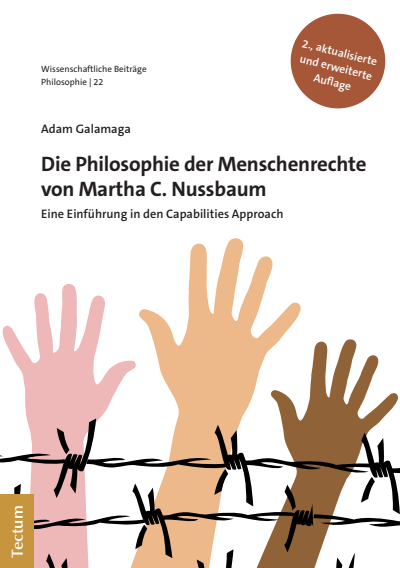
Die Philosophie der Menschenrechte von Martha C. Nussbaum
Eine Einführung in den Capabilities Approach- Autor:innen:
- Reihe:
- Wissenschaftliche Beiträge aus dem Tectum Verlag: Philosophie, Band 22
- Verlag:
- 2021
Zusammenfassung
In der zweiten, aktualisierten und erweiterten Auflage seiner Einführung in den Capabilities Approach unterzieht Adam Galamaga die neuesten Publikationen der Chicagoer Philosophin Martha C. Nussbaum einer kritischen Untersuchung. Besonderes Augenmerk wird auf die neuen Aspekte des Feminismus, die Rolle „politischer Gefühle“ im Kontext menschlicher Entwicklung sowie – Martha Nussbaums brandneuem Buch mit dem gleichnamigen Titel folgend – die Idee des Kosmopolitismus gelegt.
Adam Galamaga studierte Philosophie, Germanistik und Anglistik an der Goethe-Universität Frankfurt am Main und der Cardiff University.
Publikation durchsuchen
Bibliographische Angaben
- Auflage
- 2/2021
- Copyrightjahr
- 2021
- ISBN-Print
- 978-3-8288-4499-5
- ISBN-Online
- 978-3-8288-7535-7
- Verlag
- Tectum, Baden-Baden
- Reihe
- Wissenschaftliche Beiträge aus dem Tectum Verlag: Philosophie
- Band
- 22
- Sprache
- Deutsch
- Seiten
- 192
- Produkttyp
- Monographie
Inhaltsverzeichnis
KapitelSeiten
- Titelei/Inhaltsverzeichnis Kein Zugriff Seiten I - X
- 1.1 Anthropologische Begründungsversuche der Menschenrechte Kein Zugriff
- 1.2 Die Verortung des Capabilities Approach in der Politischen Philosophie Kein Zugriff
- 2.1 Nussbaums Neoaristotelismus Kein Zugriff
- 2.2 Die ambivalente Stellung des Liberalismus Kein Zugriff
- 2.3 Feministische Aspekte des Capabilities Approach Kein Zugriff
- 3.1 Anthropologische Annahmen Kein Zugriff
- 3.2 Der Katalog menschlicher Grundfähigkeiten Kein Zugriff
- 3.3 Der Capabilities Approach als eine Menschenrechtskonzeption Kein Zugriff
- 4.1 Die Idee der aristotelischen Sozialdemokratie Kein Zugriff
- 4.2 Exkurs: Der Human Development Index und die Kritik an herkömmlichen Messinstrumenten des Wohlstandes Kein Zugriff
- 4.3 Der Gedanke globaler Gerechtigkeit Kein Zugriff
- 5.1 Kritik am Utilitarismus Kein Zugriff
- 5.2 Kritik an der Theorie der Grundgüter von John Rawls Kein Zugriff
- 5.3 Mängel und Grenzen des Capabilities Approach Kein Zugriff
- 6 Schlussbemerkung Kein Zugriff Seiten 169 - 170
- 7 Literaturverzeichnis Kein Zugriff Seiten 171 - 188
- Register Kein Zugriff Seiten 189 - 192
Literaturverzeichnis (171 Einträge)
Es wurden keine Treffer gefunden. Versuchen Sie einen anderen Begriff.
- 7 Literaturverzeichnis Google Scholar öffnen DOI: 10.5771/9783828875357
- Quellen Google Scholar öffnen DOI: 10.5771/9783828875357
- Nussbaum, Martha C. (2020): Kosmopolitismus. Revision eines Ideals, Darmstadt: Wissenschaftliche Buchgesellschaft Google Scholar öffnen DOI: 10.5771/9783828875357
- Nussbaum, Martha (2019). The Cosmopolitan Tradition: A Noble but Flawed Ideal Harvard University Press Google Scholar öffnen DOI: 10.5771/9783828875357
- Nussbaum, Martha C. (2019): Fähigkeiten schaffen. Neue Wege zur Verbesserung menschlicher Lebensqualität, Freiburg/München: Verlag Karl Alber Google Scholar öffnen DOI: 10.5771/9783828875357
- Nussbaum, Martha C. (2019): Königreich der Angst. Gedanken zur aktuellen politischen Krise, Darmstadt: Wissenschaftliche Buchgesellschaft Google Scholar öffnen DOI: 10.5771/9783828875357
- Nussbaum, Martha and Levmore, Saul (2017). Aging Thoughtfully: Conversations about Retirement, Romance, Wrinkles, and Regret. New York, Oxford University Press Google Scholar öffnen DOI: 10.5771/9783828875357
- Nussbaum, Martha C. (2017): Zorn und Vergebung: Plädoyer für eine Kultur der Gelassenheit, Darmstadt: Wissenschaftliche Buchgemeinschaft Google Scholar öffnen DOI: 10.5771/9783828875357
- Nussbaum, Martha (2016). Anger and Forgiveness: Resentment, Generosity, Justice Google Scholar öffnen DOI: 10.5771/9783828875357
- Nussbaum, Martha C. (2014): Die neue religiöse Intoleranz. Ein Ausweg aus der Politik der Angst, Darmstadt: Wissenschaftliche Buchgesellschaft Google Scholar öffnen DOI: 10.5771/9783828875357
- Nussbaum, Martha C. (2014): Politische Emotionen: Warum Liebe für Gerechtigkeit wichtig ist, Frankfurt: Suhrkamp Verlag Google Scholar öffnen DOI: 10.5771/9783828875357
- Nussbaum, Martha C. (2013): Political Emotions. Why Love Matters for Justice, Harvard University Press Google Scholar öffnen DOI: 10.5771/9783828875357
- Nussbaum, Martha C. (2011): Creating Capabilities. The Human Development Approach, Cambridge (Mass.): Harvard University Press Google Scholar öffnen DOI: 10.5771/9783828875357
- Nussbaum, Martha C. (2010): Die Grenzen der Gerechtigkeit. Behinderung, Nationalität und Spezieszugehörigkeit, Berlin: Suhrkamp Google Scholar öffnen DOI: 10.5771/9783828875357
- Nussbaum, Martha C: (2009) Therapy of Desire. Theory and Practice in Hellenistic Ethics, 3. Auflage, Princeton University Press Google Scholar öffnen DOI: 10.5771/9783828875357
- Nussbaum, Martha C. (2008): Education for Profit, Education for Freedom. First annual Seymour J. Fox Memorial Lecture, The Hebrew University of Jerusalem, 16. Dezember 2007. Zuerst veröffentlicht am 24. Januar 2008. URL: https://de.scribd.com/document/271448004/Martha-Nussbaum-Education-for-Profit-Education-for-Freedom, zuletzt abgerufen am 9. Oktober 2012 Google Scholar öffnen DOI: 10.5771/9783828875357
- Nussbaum, Martha C. (2007): Human Rights and Human Capabilities. In: Harvard Human Rights Journal 20, S. 21–24 Google Scholar öffnen DOI: 10.5771/9783828875357
- Nussbaum, Martha C. (2007): Liberty of Conscience. In Defense of America’s Tradition of Religious Equality. New York: Basic Books 2007 Google Scholar öffnen DOI: 10.5771/9783828875357
- Nussbaum, Martha C. (2007): The Capabilities Approach and Ethical Cosmopolitanism. A Response to Noah Feldman, The Yale Law Journal 123, S. 123–129 Google Scholar öffnen DOI: 10.5771/9783828875357
- Nussbaum, Martha C. (2006): Frontiers of Justice. Disability, Nationality, Species Membership, Cambridge (Mass.): Harvard University Press Google Scholar öffnen DOI: 10.5771/9783828875357
- Nussbaum, Martha C. (2004): Hiding from Humanity. Disgust, Shame and the Law, Princeton: Princeton University Press Google Scholar öffnen DOI: 10.5771/9783828875357
- Nussbaum, Martha C. (2004): Reply to Okin. In: Philosophy and Public Affairs 32, S. 193–205 Google Scholar öffnen DOI: 10.5771/9783828875357
- Nussbaum, Martha C. (2003): Cultivating Humanity in Legal Education. In: The University of Chicago Law Review 70/1, S. 265–279 Google Scholar öffnen DOI: 10.5771/9783828875357
- Nussbaum, Martha C. (2003): Langfristige Fürsorge und soziale Gerechtigkeit. Eine Herausforderung der konventionellen Idee des Gesellschaftsvertrags. In: Deutsche Zeitschrift für Philosophie 51, Heft 2, S. 179–198 Google Scholar öffnen DOI: 10.5771/9783828875357
- Nussbaum, Martha C. (2003): Rawls and Feminism. In: Samuel Freeman (Hrsg.): The Cambridge Companion to Rawls, Cambridge University Press 2003, S. 488–520 Google Scholar öffnen DOI: 10.5771/9783828875357
- Nussbaum, Martha C. (2003): Upheavals of Thought. The Intelligence of Emotions, 3. Auflage, Cambridge University Press Google Scholar öffnen DOI: 10.5771/9783828875357
- Nussbaum, Martha C. (2002): Capabilities and Disabilities. Justice for Mentally Disabled Citizens. In: Philosophical Topics 30, Bd. 2, S. 133–165 Google Scholar öffnen DOI: 10.5771/9783828875357
- Nussbaum, Martha C. (2002): Konstruktionen der Liebe, des Begehrens und der Fürsorge. Drei philosophische Aufsätze, Stuttgart: Reclam Google Scholar öffnen DOI: 10.5771/9783828875357
- Nussbaum, Martha C. (2000): Women and Human Development. The Capabilities Approach, Cambridge University Press 2000 Google Scholar öffnen DOI: 10.5771/9783828875357
- Nussbaum, Martha C. (1999): Gerechtigkeit oder das gute Leben, hrsg. v. Herlinde Pauer-Studer, Frankfurt am Main: Suhrkamp Google Scholar öffnen DOI: 10.5771/9783828875357
- Nussbaum, Martha C. (1997): Cababilities and Human Rights, in: The Philosophy of Human Rights, hrsg. v. Patrick Hayden, St. Paul: Paragon, S. 212–240 Google Scholar öffnen DOI: 10.5771/9783828875357
- Nussbaum, Martha C. (1996): Patriotism and Cosmopolitanism. In: Joshua Cohen (Hrsg.): For Love of Country: Debating the Limits of Patriotism. Martha C. Nussbaum with respondents, Boston: Beacon Press, S. 2–17 Google Scholar öffnen DOI: 10.5771/9783828875357
- Nussbaum, Martha C. (1995): Menschliches Tun und soziale Gerechtigkeit. Zur Verteidigung des aristotelischen Essentialismus. In: Michael Brumlik/Hauke Brunkhorst (Hrsg.): Gemeinschaft und Gerechtigkeit. Frankfurt am Main: Fischer, S. 323–361 Google Scholar öffnen DOI: 10.5771/9783828875357
- Nussbaum, Martha C./Jonathan Glover (Hrsg.) (1995): Women, Culture, and Development. A Study of Human Capabilities, Oxford: Clarendon Press Google Scholar öffnen DOI: 10.5771/9783828875357
- Nussbaum, Martha C./Amartya Sen (Hrsg.) (1993): The Quality of Life. A Study for the World Institute for Development Economics Research (WIDER) of the United Nations University, Oxford: Clarendon Press Google Scholar öffnen DOI: 10.5771/9783828875357
- Nussbaum, Martha C. (1992): Aristotle, Feminism, and Needs for Functioning. In: Texas Law Review 70, S. 1019–1028 Google Scholar öffnen DOI: 10.5771/9783828875357
- Nussbaum, Martha C. (1992): Human Functioning and Social Justice. In Defense of Aristotelian Essentialism. In: Political Theory 20, S. 202–246 Google Scholar öffnen DOI: 10.5771/9783828875357
- Nussbaum, Martha C. (1990): Aristotelian Social Democracy. In: R. Bruce Douglass/Gerald M. Mara/Henry S. Richardson (Hrsg.): Liberalism and the Good. New York/London: Routledge, S. 203–252 Google Scholar öffnen DOI: 10.5771/9783828875357
- Sekundärliteratur Google Scholar öffnen DOI: 10.5771/9783828875357
- Alkire, Sabina (2002): Valuing Freedoms: Sen’s Capability Approach and Poverty Reduction, Oxford: Oxford University Press Google Scholar öffnen DOI: 10.5771/9783828875357
- Alkire, Sabina; Wangdi, Karma; Zangmo, Tshoki (2012). Alkire, Sabina; Wangdi, Karma; Zangmo, Tshoki (2012). An extensive analysis of GNH index, hrsg. v. Centre for Bhutan Studies, Thimphu Google Scholar öffnen DOI: 10.5771/9783828875357
- Amerika ist nicht bereit für eine Präsidentin. Ein Interview mit Martha C. Nussbaum. In: „Cicero“ vom 20. Dezember 2006. URL: http://www.cicero.de/weltb%C3%BChne/amerika-ist-nicht-bereit-f%C3%BCr-eine-pr%C3%A4sidentin/37727, zuletzt abgerufen am 5. Oktober 2020 Google Scholar öffnen DOI: 10.5771/9783828875357
- An Interview with Martha Nussbaum. In: Philosophy for Life, URL: https://www.philosophyforlife.org/blog/an-interview-with-martha-nussbaum, zuletzt abgerufen am 5. Oktober 2020 Google Scholar öffnen DOI: 10.5771/9783828875357
- Appiah, Kwame Anthony (1996): Cosmopolitan Patriots. In: Joshua Cohen (Hrsg.): For Love of Country: Debating the Limits of Patriotism. Martha C. Nussbaum with respondents, Boston: Beacon Press, S. 21–29 Google Scholar öffnen DOI: 10.5771/9783828875357
- Appiah, Kwame Anthony (2007): Cosmopolitanism. Ethics in a World of Strangers, London: Penguin Google Scholar öffnen DOI: 10.5771/9783828875357
- Aristoteles (1989): Politik. Übers. u. hrsg. v. Franz F. Schwarz, Stuttgart: Reclam (=Schriften zur Staatstheorie) Google Scholar öffnen DOI: 10.5771/9783828875357
- Aristoteles (2005): Metaphysik. Hrsg. v. Ursula Wolf, übers. v. Hermann Bonitz, Hamburg: Rowohlt Google Scholar öffnen DOI: 10.5771/9783828875357
- Aristoteles (2006): Nikomachische Ethik. Übers. u. hrsg. v. Ursula Wolf, Hamburg: Rowohlt Google Scholar öffnen DOI: 10.5771/9783828875357
- Baier, Annette (1995): The Need for More than Justice. In: Held, Boulder (Hrsg.): Justice and Care. Essential Readings in Feminist Ethics, Westview, S. 47–60 Google Scholar öffnen DOI: 10.5771/9783828875357
- Bendik-Keymer: From humans to all of life: Nussbaum’s transformation of dignity, in: Capabilities, Gender, Equality: Towards Fundamental Entitlements, hrsg. v. Falvio Comim u. Martha C. Nussbaum, Cambridge University Press 2014, S. 175–187 Google Scholar öffnen DOI: 10.5771/9783828875357
- Bentham, Jeremy (1977): A Fragment on Government. In: J.H. Burns/H.L.A. Hart (Hrsg.): The Collected Works of Jeremy Bentham, London, S. 391–551 Google Scholar öffnen DOI: 10.5771/9783828875357
- Bentham, Jeremy (1987): Anarchical Fallacies. In: Jeremy Waldron (Hrsg.): Nonsense on Stilts: Bentham, Burke and Marx on the Rights of Man, London/New York Google Scholar öffnen DOI: 10.5771/9783828875357
- Bielefeldt, Heiner (1998): Philosophie der Menschenrechte. Grundlagen eines weltweiten Freiheitsethos, Darmstadt: Wissenschaftliche Buchgesellschaft Google Scholar öffnen DOI: 10.5771/9783828875357
- Brighouse, Harry/Ingrid Robeyns (Hrsg.) (2010): Measuring Justice. Primary Goods and Capabilities. Cambridge University Press Google Scholar öffnen DOI: 10.5771/9783828875357
- Broszies, Christoph/Henning Hahn (Hrsg.) (2010): Globale Gerechtigkeit. Schlüsseltexte zur Debatte zwischen Partikularismus und Kosmopolitismus, Frankfurt am Main: Suhrkamp Google Scholar öffnen DOI: 10.5771/9783828875357
- Brugger, Winfried/Ulfrid Neumann/Stephan Kirste (Hrsg.) (2008): Rechtsphilosophie im 21. Jahrhundert, Frankfurt am Main: Suhrkamp Google Scholar öffnen DOI: 10.5771/9783828875357
- Brumlik, Michael/Hauke Brunkhorst (Hrsg.) (1995): Gemeinschaft und Gerechtigkeit, Frankfurt am Main: Fischer Google Scholar öffnen DOI: 10.5771/9783828875357
- Brunkhorst, Hauke u. a. (Hrsg.) (2015): Habermas-Handbuch. Sonderausgabe, Stuttgart: J. B. Metzler Google Scholar öffnen DOI: 10.5771/9783828875357
- Bundeszentrale für politische Bildung (2005): Entwicklung und Entwicklungspolitik, Informationen zur politischen Bildung Nr. 286 (1/4), Bonn Google Scholar öffnen DOI: 10.5771/9783828875357
- Burchardt, Tania u. Rod Hick (2018): Inequality, Advantage and the Capability Approach. Journal of Human Development and Capabilities 19 (1): 38–52 Google Scholar öffnen DOI: 10.5771/9783828875357
- Chen, Martha (1995): A Matter of Survival. Women’s Right to Employment in India and Bangladesh. In: Jonathan Glover/Martha C. Nussbaum (Hrsg.): Women, Culture, and Development. A Study of Human Capabilities, Oxford: Clarendon Press Google Scholar öffnen DOI: 10.5771/9783828875357
- Clark, David A. (2006): Capability Approach. In: Ders. (Hrsg.): The Elgar Companion to Development Studies, Cheltenham: Edward Elgar, S. 32–44 Google Scholar öffnen DOI: 10.5771/9783828875357
- Crocker, David A. (1992): Functioning and Capability. The Foundations of Sen’s and Nussbaum’s Development Ethic. In: Political Theory 20, S. 584–611 Google Scholar öffnen DOI: 10.5771/9783828875357
- Crocker, David A. (1995): Functioning and Capability. The Foundations of Sen’s and Nussbaum’s Development Ethics. Part 2. In: Glover, Jonathan/Martha. C Nussbaum (Hrsg.): Women, Culture, and Development. A Study of Human Capabilities. Oxford: Clarendon Press, S. 153–198 Google Scholar öffnen DOI: 10.5771/9783828875357
- Demko, Daniela u. a. (Hrsg.) (2015): Menschenrechte: Begründung, Bedeutung, Durchsetzung, Würzburg: Verlag Königshausen & Neumann Google Scholar öffnen DOI: 10.5771/9783828875357
- Deneulin, Severine (2002): Perfectionism, paternalism and liberalism in Sen and Nussbaum’s capability approach. In: Review of Political Economy 14(4), S. 497–518 Google Scholar öffnen DOI: 10.5771/9783828875357
- Deneulin, Séverine (2013). „Recovering Nussbaum’s Aristotelian roots“. International Journal of Social Economics. Emerald Insight. 40 (7): 624–632, Google Scholar öffnen DOI: 10.5771/9783828875357
- Deneulin, Séverine (2014). Wellbeing, justice and development ethics. London New York: Routledge (Human Development and Capability Debates Series), Google Scholar öffnen DOI: 10.5771/9783828875357
- Deneulin, Séverine/Lila Shahani (Hrsg.) (2009): An Introduction to the Human Development and Capability Approach. Freedom and Agency, London/Washington: Earthscan Google Scholar öffnen DOI: 10.5771/9783828875357
- Deutsche Gesellschaft für die Vereinten Nationen (Hrsg): Gleiche Menschenrechte für alle. Dokumente zur Menschenrechtsweltkonferenz der Vereinten Nationen in Wien 1993, Bonn: DGVN 1994 Google Scholar öffnen DOI: 10.5771/9783828875357
- Die Regierung ignoriert die teure Glücksformel. In: Welt Online, URL: https://www.welt.de/wirtschaft/article127460986/Die-Regierung-ignoriert-die-teure-Gluecksformel.html, zuletzt abgerufen am 7. Oktober 2020 Google Scholar öffnen DOI: 10.5771/9783828875357
- Die Verwandlung: Ringen um einen neuen Wohlstandsbegriff. Löst der Genuine Progress Indicator (GPI) die ökologische und feministische Kritik am Bruttoinlandsprodukt (BIP) auf? In: Exploring Eco-nomics, URL: https://www.exploring-economics.org/de/entdecken/die-Verwandlung-neuer-Wohlstandsbe/, zuletzt abgerufen am 8. Oktober 2020 Google Scholar öffnen DOI: 10.5771/9783828875357
- Entwicklung braucht wenig Wachstum. In: „Badische Zeitung“ vom 6. Dezember 2010. URL: http://www.badische-zeitung.de/ausland–1/entwicklung-braucht-wenig-wachstum-–37423773.html, zuletzt abgerufen am 5. Oktober 2020 Google Scholar öffnen DOI: 10.5771/9783828875357
- Fateh-Moghadam, Bijan: Religiös-weltanschauliche Neutralität und Geschlechterordnung: Strafrechtliche Burka-Verbote zwischen Paternalismus und Moralismus Google Scholar öffnen DOI: 10.5771/9783828875357
- Fitoussi, Jean Paul/Joseph Stiglitz/Amartya Sen (2010): Mismeasuring Our Lives. Why GDP Doesn‘t Add Up. New York: The New Press Google Scholar öffnen DOI: 10.5771/9783828875357
- Forst, Rainer (1997): Gerechtigkeit als Fairneß: ethisch, politisch oder moralisch? In: Philosophische Gesellschaft Bad Homburg/Wilfried Hinsch (Hrsg.): Zur Idee des politischen Liberalismus. John Rawls in der Diskussion, Frankfurt am Main: Suhrkamp, S. 396–419 Google Scholar öffnen DOI: 10.5771/9783828875357
- Freedom in the World – Qatar. In: „Freedom House“. URL: https://freedomhouse.org/country/qatar/freedom-world/2020, zuletzt abgerufen am 5. Oktober 2020 Google Scholar öffnen DOI: 10.5771/9783828875357
- Gesang, Bernward u. Julius Schälike (Hrsg.) (2011): Die großen Kontroversen der Rechtsphilosophie, Paderborn: mentis Verlag Google Scholar öffnen DOI: 10.5771/9783828875357
- Glover, Jonathan (1995): The Research Programme of Development Ethics. In: Glover, Jonathan/Martha C. Nussbaum (Hrsg.): Women, Culture, and Development. A Study of Human Capabilities. Oxford: Clarendon Press, S. 116–139 Google Scholar öffnen DOI: 10.5771/9783828875357
- Goodhill, Jane (Hrsg.) (2011): Menschenpflichten. Eine Liebeserklärung in 19 Artikeln, Frankfurt: Büchergilde Gutenberg Google Scholar öffnen DOI: 10.5771/9783828875357
- Gosepath, Stefan (2010): John Rawls. Gerechtigkeit für eine pluralistische Gesellschaft. In: Ansgar Beckermann/Dominik Perler (Hrsg.): Klassiker der Philosophie heute, Stuttgart: Reclam, S. 811–830 Google Scholar öffnen DOI: 10.5771/9783828875357
- Green, Thomas Hill (1908): Lecture on Liberal Legislation and Freedom of Contract. In: R. L. Nettleship (Hrsg.): The Works of Thomas Hill Green, Band 3, London [u. a.] Google Scholar öffnen DOI: 10.5771/9783828875357
- Griffin, James (1986): Well-Being. Its Meaning, Measurement and Moral Importance, Oxford: Clarendon Press Google Scholar öffnen DOI: 10.5771/9783828875357
- Gutschker, Thomas (2002): Aristotelische Diskurse. Aristoteles in der politischen Philosophie des 20. Jahrhunderts, Stuttgart: Metzler Google Scholar öffnen DOI: 10.5771/9783828875357
- Habermas, Jürgen (1996): Die Einbeziehung des Anderen. Studien zur politischen Theorie, Frankfurt am Main: Suhrkamp Google Scholar öffnen DOI: 10.5771/9783828875357
- Habermas, Jürgen (1998), Die postnationale Konstellation. Politische Essays, Suhrkamp Verlag Google Scholar öffnen DOI: 10.5771/9783828875357
- Habermas, Jürgen (2008): Konstitutionalisierung des Völkerrechts und die Legitimationsprobleme einer verfassten Weltgesellschaft. In: Brugger, Winfried/Ulfrid Neumann/Stephan Kirste (Hrsg.): Rechtsphilosophie im 21. Jahrhundert, Frankfurt am Main: Suhrkamp, S. 360–379 Google Scholar öffnen DOI: 10.5771/9783828875357
- Heckman, James J. u. Chase O. Corbin: Capabilities and Skills, Journal of Human Development and Capabilities, Band 17(3), S. 342–359 Google Scholar öffnen DOI: 10.5771/9783828875357
- Heinrichs, Jan-Hendrik (2006): Grundbefähigungen. Zum Verhältnis von Ethik und Ökonomie, Paderborn: mentis Google Scholar öffnen DOI: 10.5771/9783828875357
- Hilpert, Konrad (2019): Ethik der Menschenrechte. Zwischen Rhetorik und Verwirklichung, Paderborn: Fredinand Schöningh Google Scholar öffnen DOI: 10.5771/9783828875357
- Hinkmann, Jens (2002): Ethik der Menschenrechte. Eine Studie zur philosophischen Begründung von Menschenrechten als universalen Normen, Marburg: Tectum Google Scholar öffnen DOI: 10.5771/9783828875357
- Hobe, Stephan u. Otto Kimminich (Hrsg.) (2004): Einführung in das Völkerrecht, 8. Auflage, Tübingen: A. Francke Verlag Google Scholar öffnen DOI: 10.5771/9783828875357
- Höffe, Otfried (1992): Ein transzendentaler Tausch. Zur Anthropologie der Menschenrechte, In: Philosophisches Jahrbuch 99, 1. Halbband, S. 1–28 Google Scholar öffnen DOI: 10.5771/9783828875357
- Höffe, Otfried (1999): Demokratie im Zeitalter der Globalisierung, München: C. H. Beck Google Scholar öffnen DOI: 10.5771/9783828875357
- Höffe, Otfried (2006): Aristoteles. Politik. In: Manfred Brocker (Hrsg.): Geschichte des politischen Denkens. Ein Handbuch, Frankfurt am Main: Suhrkamp, S. 31–46 Google Scholar öffnen DOI: 10.5771/9783828875357
- Hurley, Susan u. Stephen Shute (Hrsg.) (1996): Die Idee der Menschenrechte, Frankfurt am Main: Fischer Google Scholar öffnen DOI: 10.5771/9783828875357
- Hursthouse, Rosalind (2004): On the Grounding of the Virtues in Human Nature. In: Lutz-Bachmann, Matthias/Jan Szaif (Hrsg.): Was ist das für den Menschen Gute? Menschliche Natur und Güterlehre/What Is Good for a Human Being? Human Nature and Values, Berlin/New York: Walter de Gruyter, S. 263–275 Google Scholar öffnen DOI: 10.5771/9783828875357
- International Monetary Fund: World Economic Outlook Database. URL: https://www.imf.org/external/pubs/ft/weo/2019/02/weodata/index.aspx, zuletzt abgerufen am 6. Oktober 2020 Google Scholar öffnen DOI: 10.5771/9783828875357
- John Alexander, Capabilities and Social Justice. The Political Philosophy of Amartya Sen and Martha Nussbaum Google Scholar öffnen DOI: 10.5771/9783828875357
- Jörke, Dirk (2005): Politische Anthropologie. Eine Einführung, Wiesbaden: Verl. für Sozialwiss. Google Scholar öffnen DOI: 10.5771/9783828875357
- Kersting, Wolfgang (2000): Theorien der sozialen Gerechtigkeit, Stuttgart/Weimar: Metzler Google Scholar öffnen DOI: 10.5771/9783828875357
- Kleist, Chad (2010): Global Ethics. Capabilites Approach. In: Internet Encyclopedia of Philosophy, veröffentlicht am 17. Dezember 2010. URL: http://www.iep.utm.edu/ge-capab, zuletzt abgerufen am 9. Oktober 2020 Google Scholar öffnen DOI: 10.5771/9783828875357
- Knoll, Manuel (2009): Aristokratische oder demokratische Gerechtigkeit? Die politische Philosophie des Aristoteles und Martha Nussbaums egalitaristische Rezeption, München/Paderborn: Fink Google Scholar öffnen DOI: 10.5771/9783828875357
- Krebs, Angelika (1999): Werden Menschen schwanger? Das „gute menschliche Leben“ und die Geschlechterdifferenz. In: Holmer Steinfath (Hrsg.): Was ist ein gutes Leben? Philosophische Reflexionen, S. 235–247 Google Scholar öffnen DOI: 10.5771/9783828875357
- Krenberger, Verena (2008): Anthropologie der Menschenrechte. Hermeneutische Untersuchungen rechtlicher Quellen. Würzburg: Ergon [= Studien zur Phänomenologie und praktischen Philosophie] Google Scholar öffnen DOI: 10.5771/9783828875357
- Kunze, Axel Bernd (2005): Emanzipatorischer Essentialismus. Die Gerechtigkeitstheorie der amerikanischen Philosophin Martha C. Nussbaum, Berlin: Verlag für Wissenschaft und Forschung Google Scholar öffnen DOI: 10.5771/9783828875357
- Lukes, Steven (1996): Fünf Fabeln über Menschenrechte. In: Susan Hurley/Stephen Shute (Hrsg.): Die Idee der Menschenrechte. Frankfurt am Main: Fischer Verlag Google Scholar öffnen DOI: 10.5771/9783828875357
- MacIntyre, Alasdair (1995): Der Verlust der Tugend. Zur moralischen Krise der Gegenwart, Frankfurt am Main: Suhrkamp Google Scholar öffnen DOI: 10.5771/9783828875357
- MacKinnon, Catherine (1996): Kriegsverbrechen – Friedensverbrechen. In: Hurley, Susan/ Stephen Shute (Hrsg.): Die Idee der Menschenrechte. Frankfurt am Main: Fischer, S. 104–143 Google Scholar öffnen DOI: 10.5771/9783828875357
- Maihofer, Andrea (2000): Martha C. Nussbaum. Gerechtigkeit und das gute Leben. In: Soziologische Revue 23 Google Scholar öffnen DOI: 10.5771/9783828875357
- Menke, Christoph/Arnd Pollmann (2007): Philosophie der Menschenrechte zur Einführung, Hamburg: Junius Google Scholar öffnen DOI: 10.5771/9783828875357
- Mill, John Stuart (2004): Der Utilitarismus. Übers. v. Dieter Birnbacher, Stuttgart: Reclam Google Scholar öffnen DOI: 10.5771/9783828875357
- Mügge, Cornelia: Menschenrechte, Geschlecht, Religion: Das Problem der Universalität und der Fähigkeitenansatz von Martha Nussbaum, Bielefeld 2017: transcript Verlag Google Scholar öffnen DOI: 10.5771/9783828875357
- Nagel, Thomas (2003): Rawls and Liberalism. In: Samuel Freeman (Hrsg.): The Cambridge Companion to Rawls, Cambridge University Press, S. 62–85. Google Scholar öffnen DOI: 10.5771/9783828875357
- Nelson, Eric (2008): From Primary Goods to Capabilities. Distributive Justice and the Problem of Neutrality. In: Political Theory 36, S. 93–122 Google Scholar öffnen DOI: 10.5771/9783828875357
- O‘Neill, Onora (1995): Justice, Capabilities, and Vulnerabilities. In: Jonathan Glover/Martha C. Nussbaum (Hrsg.): Women, Culture, and Development. A Study of Human Capabilities, Oxford: Clarendon Press, S. 140–152 Google Scholar öffnen DOI: 10.5771/9783828875357
- Oosterlaken, Ilse (2012): Is Pogge a Capability Theorist in Disguise? A Critical Examination of Thomas Pogge’s Defence of Rawlsian Resourcism. In: Ethical Theory and Moral Practice, 27 January 2012. URL: https://link.springer.com/article/10.1007/s10677–012–9344–9, zuletzt abgerufen am 9. Oktober 2020 Google Scholar öffnen DOI: 10.5771/9783828875357
- Philosophy and public life. Interview with Martha Nussbaum. In: Cogito 5/2006. URL: https://www.eurozine.com/philosophy-and-public-life, zuletzt abgerufen am 5. Oktober 2020 Google Scholar öffnen DOI: 10.5771/9783828875357
- Pinker, Steven (2018): Enlightenment Now. The Case for Reason, Science, Humanism, and Progress, New York: Penguin Google Scholar öffnen DOI: 10.5771/9783828875357
- Pogge, Thomas (2002): Can the Capability Approach Be Justified? In: Philosophical Topics 30, Bd. 2, S. 167–228 Google Scholar öffnen DOI: 10.5771/9783828875357
- Pollis, Adamantia/Peter Schwab (1979): Human Rights. A Western Construct with Limited Applicability. In: Dies. (Hrsg.): Human Rights. Cultural and Ideologiacal Perspectives. New York: Praeger, S. 1–18 Google Scholar öffnen DOI: 10.5771/9783828875357
- Putnam, Hilary (1993): Objectivity and the Science-Ethics Distinction. In: Martha C. Nussbaum/Amartya Sen (Hrsg.): The Quality of Life. A Study for the World Institute for Development Economics Research (WIDER) of the United Nations University, Oxford: Clarendon Press, S. 143–164 Google Scholar öffnen DOI: 10.5771/9783828875357
- Putnam, Hilary (1996): Must We Choose between Patriotism and Univeral Reason? In: Joshua Cohen (Hrsg.): For Love of Country: Debating the Limits of Patriotism. Martha C. Nussbaum with respondents, Boston: Beacon Press, S. 91–97 Google Scholar öffnen DOI: 10.5771/9783828875357
- Rawls, John (1988): Der Vorrang des Rechten und die Ideen des Guten. In: Hinsch, Wilfried (Hrsg.): John Rawls: Die Idee des politischen Liberalismus. Aufsätze 1978–1989, Frankfurt/Main. Google Scholar öffnen DOI: 10.5771/9783828875357
- Rawls, John (1993): Eine Theorie der Gerechtigkeit, 7. Auflage, Frankfurt am Main: Suhrkamp Google Scholar öffnen DOI: 10.5771/9783828875357
- Rawls, John (2002): Das Recht der Völker, Berlin/New York: Walter de Gruyter Google Scholar öffnen DOI: 10.5771/9783828875357
- Reese-Schäfer, Walter (1997): Grenzgötter der Moral. Der neuere europäisch-amerikanische Diskurs zur politischen Ethik, Frankfurt am Main: Suhrkamp Google Scholar öffnen DOI: 10.5771/9783828875357
- Richardson, Henry S. (1990): The Problem of Liberalism and the Good. In: R. Bruce Douglass [u. a.] (Hrsg.): Liberalism and the Good, New York/London, S. 1–28 Google Scholar öffnen DOI: 10.5771/9783828875357
- Ricken, Friedo (1997): Ist eine moralische Konzeption der politischen Gerechtigkeit ohne umfassende moralische Lehre möglich? In: Philosophische Gesellschaft Bad Homburg/Wilfried Hinsch (Hrsg.): Zur Idee des politischen Liberalismus. John Rawls in der Diskussion, Frankfurt am Main: Suhrkamp, S. 420–437 Google Scholar öffnen DOI: 10.5771/9783828875357
- Riesenkampff, Isabelle (2005): Ethik und Politik – Aristoteles und Martha C. Nussbaum. Antike Elemente in einem zeitgenössischen, ethischen Ansatz der Entwicklungspolitik, Justus-Liebig-Universität Gießen (Diss.) Google Scholar öffnen DOI: 10.5771/9783828875357
- Robeyns, Ingrid (2005): The Capability Approach. A Theoretical Survey. In: Journal of Human Development, 6(1), S. 93–114 Google Scholar öffnen DOI: 10.5771/9783828875357
- Robeyns, Ingrid (2011): Rezension zu „Creating Capabilities. The Human Development Approach“ (2011), zuerst veröffentlicht am 19.09.2011 in College of Arts and Letters Philosophical Reviews, University of Notre Dame, URL: http://ndpr.nd.edu/news/26146-creating-capabilities-the-human-development-approach-2/, zuletzt abgerufen am 8. Oktober 2020 Google Scholar öffnen DOI: 10.5771/9783828875357
- Robeyns, Ingrid (2011): The Capability Approach. In: Zalta, Edward N. (Hrsg.): The Stanford Encyclopedia of Philosophy. Summer 2011 Edition, URL: https://plato.stanford.edu/entries/capability-approach, zuletzt abgerufen am 8. Oktober 2020 Google Scholar öffnen DOI: 10.5771/9783828875357
- Robeyns, Ingrid (2019) (2019). „What, if Anything, is Wrong with Extreme Wealth?“. Journal of Human Development and Capabilities. Journal of Human Development and Capabilities 20:3. 20 (3): 251–266 Google Scholar öffnen DOI: 10.5771/9783828875357
- Robeyns, Ingrid, Capabilitarianism, Journal of Human Development and Capabilities, 17(3), 2016, pp. 397–414, Google Scholar öffnen DOI: 10.5771/9783828875357
- Robeyns, Ingrid, Wellbeing, Freedom and Social Justice: The Capability Approach Re-examined, Cambridge: Open Book Publishers 2017 Google Scholar öffnen DOI: 10.5771/9783828875357
- Robeyns, Ingrid: An unworkable idea or a promising alternative? Sen’s capab-ility approach re-examined, Econometrics Center for Economic Studies, December 2000, URL: https://core.ac.uk/download/pdf/6979068.pdf, zuletzt abgerufen am 8. Oktober 2020 Google Scholar öffnen DOI: 10.5771/9783828875357
- Romero, Julian Molina (2016): Die politische Philosophie von Amartya Sen. Soziale Gerechtigkeit und globale Entwicklung auf Grundlage des Capability Approach, Münster: Mentis-Verlag Google Scholar öffnen DOI: 10.5771/9783828875357
- Rorty, Richard (1988): Solidarität oder Objektivität? Drei philosophische Essays. Stuttgart: Reclam Google Scholar öffnen DOI: 10.5771/9783828875357
- Sandel, Michael (1982): Liberalism and the Limits of Justice, Cambridge University Press Google Scholar öffnen DOI: 10.5771/9783828875357
- Scherer, Christiane (1993): Das Menschliche und das gute menschliche Leben. Martha Nussbaum über Essentialismus und menschliche Fähigkeiten. In: Deutsche Zeitschrift für Philosophie 41 (5) 1993, S. 905–920 Google Scholar öffnen DOI: 10.5771/9783828875357
- Seelmann, Kurt (Hrsg.): Menschenrechte: Begründung - Universalisierbarkeit – Genese, Berlin 2017: Walter de Gruyter Google Scholar öffnen DOI: 10.5771/9783828875357
- Sen, Amartya (1980): Equality of What? In: S. McMurrin (Hrsg.): The Tanner Lectures on Human Values, Band 1, Salt Lake City,S. 196–220 Google Scholar öffnen DOI: 10.5771/9783828875357
- Sen, Amartya (1982): Rational Fools. A Critique of the Behavioral Foundations of Economic Theory. In: Ders.: Choice, Welfare and Measurement, Oxford 1982 Google Scholar öffnen DOI: 10.5771/9783828875357
- Sen, Amartya (1984): Resources, Values and Development, Oxford: Basil Blackwell Google Scholar öffnen DOI: 10.5771/9783828875357
- Sen, Amartya (1989): On Ethics and Economics, Oxford [u. a.]: Blackwell Google Scholar öffnen DOI: 10.5771/9783828875357
- Sen, Amartya (1992): Inequality Re-examined, Oxford: Clarendon Press Google Scholar öffnen DOI: 10.5771/9783828875357
- Sen, Amartya (1995): Gender Inequality and Theories of Justice. In: Glover, Jonathan/Martha C. Nussbaum (Hrsg.): Women, Culture, and Development. A Study of Human Capabilities. Oxford: Clarendon Press, S. 259–273 Google Scholar öffnen DOI: 10.5771/9783828875357
- Sen, Amartya (2001): Development as Freedom, Oxford University Press Google Scholar öffnen DOI: 10.5771/9783828875357
- Sen, Amartya (2002): Globale Gerechtigkeit. Jenseits internationaler Gleichberechtigung. In: Christoph Horn/Nico Scarano (Hrsg.): Philosophie der Gerechtigkeit. Texte von der Antike bis zur Gegenwart, Frankfurt am Main: Suhrkamp Google Scholar öffnen DOI: 10.5771/9783828875357
- Sen, Amartya (2004): ,Capabilities, Lists and Public Reason. Continuing the Conversation‘. In: Feminist Economics, 10(3), S. 77–80 Google Scholar öffnen DOI: 10.5771/9783828875357
- Sen, Amartya (2005): Human Rights and Capabilities. In: Journal of Human Development, 6(2), S. 151–166 Google Scholar öffnen DOI: 10.5771/9783828875357
- Sen, Amartya (2010): Die Idee der Gerechtigkeit. München: C. H. Beck Google Scholar öffnen DOI: 10.5771/9783828875357
- Sen, Amartya (2010): The Idea of Justice, London: Penguin Google Scholar öffnen DOI: 10.5771/9783828875357
- Siep, Ludwig (1997): Rawls’ politische Theorie der Person. In: Philosophische Gesellschaft Bad Homburg/Wilfried Hinsch (Hrsg.): Zur Idee des politischen Liberalismus. John Rawls in der Diskussion. Frankfurt am Main: Suhrkamp, S. 380–395 Google Scholar öffnen DOI: 10.5771/9783828875357
- Siep, Ludwig (2004): Gibt es eine menschliche Natur? In: Matthias Lutz-Bachmann/Jan Szaif (Hrsg.): Was ist das für den Menschen Gute? Menschliche Natur und Güterlehre/What Is Good for a Human Being? Human Nature and Values, Berlin/New York: Walter de Gruyter, S. 307–323 Google Scholar öffnen DOI: 10.5771/9783828875357
- Singer, Peter (1972): Famine, Affluence, and Morality. In: Philosophy and Public Affairs 1, S. 229–243 Google Scholar öffnen DOI: 10.5771/9783828875357
- Singer, Peter (2002): One World. The Ethics of Globalization, Yale University Press Google Scholar öffnen DOI: 10.5771/9783828875357
- Straßenberger, Grit (2019): Rezension: Wie liberal ist der Capabilities Approach? Cornelia Mügge und Katja Winkler kommen zu unterschiedlichen Bewertungen. (Ethik und Gesellschaft 1/2019: Öffentliche Theologie). Google Scholar öffnen DOI: 10.5771/9783828875357
- Streeten, Paul (1981): First Things First. Meeting Basic Human Needs in Developing Countries, Oxford University Press Google Scholar öffnen DOI: 10.5771/9783828875357
- Sturma, Dieter (2000): Universalismus und Neuaristotelismus. Amartya Sen und Martha C. Nussbaum über Ethik und soziale Gerechtigkeit. In: Kersting, Wolfgang (Hrsg.): Politische Philosophie des Sozialstaates. Weilerswist: Velbrück, S. 257–292 Google Scholar öffnen DOI: 10.5771/9783828875357
- Szaif, Jan (2004): Naturbegriff und Güterlehre in der Ethik des Aristoteles, in: Lutz- Bachmann, Matthias u. Jan Szaif (Hrsg.): Was ist das für den Menschen Gute? Menschliche Natur und Güterlehre/What Is Good for a Human Being? Human Nature and Values, Berlin/New York: Walter de Gruyter, S. 54–100 Google Scholar öffnen DOI: 10.5771/9783828875357
- United Nations: Defining and measuring human development. In: Human Development Report 1990, S. 10. URL: http://hdr.undp.org/sites/default/files/reports/219/hdr_1990_en_complete_nostats.pdf, zuletzt abgerufen am 06.10.2020 Google Scholar öffnen DOI: 10.5771/9783828875357
- United Nations: Human Development Report 1990. URL: http://hdr.undp.org/sites/default/files/reports/219/hdr_1990_en_complete_nostats.pdf, zuletzt abgerufen am 5. Oktober 2020 Google Scholar öffnen DOI: 10.5771/9783828875357
- United Nations: Human Development Report 2000. URL: http://hdr.undp.org/sites/default/files/reports/261/hdr_2000_en.pdf, zuletzt abgerufen am 09.10.2020. Google Scholar öffnen DOI: 10.5771/9783828875357
- Wall, Steven: Perfectionism in Moral and Political Philosophy. In: Edward N. Zalta (Hrsg.): The Stanford Encyclopedia of Philosophy (Fall 2008 Edition), URL: https://plato.stanford.edu/entries/perfectionism-moral, zuletzt abgerufen am 8. Oktober 2020 Google Scholar öffnen DOI: 10.5771/9783828875357
- Wallach, John (1992): Contemporary Aristotelism. In: Political Theory 20, S. 613–641 Google Scholar öffnen DOI: 10.5771/9783828875357
- Walzer, Michael (1996): Lokale Kritik – globale Standards, Hamburg: Rotbuch Google Scholar öffnen DOI: 10.5771/9783828875357
- Winkler, Katja (2016): Semantiken der Befähigung. Die Rezeption des Capabilities Approach in der theologischen Sozialethik, Baden-Baden: Nomos Google Scholar öffnen DOI: 10.5771/9783828875357
- Wolf, Susan (1995): Commentary to „Human Capabilities, Female Human Beings“ by Martha C. Nussbaum. In: Jonathan Glover/Martha C. Nussbaum (Hrsg.): Women, Culture, and Development. A Study of Human Capabilities, Oxford: Clarendon Press, S. 105–115 Google Scholar öffnen DOI: 10.5771/9783828875357
- Wolf, Ursula (1998): Zur Struktur der Frage nach dem guten Leben. In: Steinfath, Holmer (Hrsg.): Was ist ein gutes Leben? Philosophische Reflexionen. Frankfurt am Main: Suhrkamp, S. 32–46 Google Scholar öffnen DOI: 10.5771/9783828875357