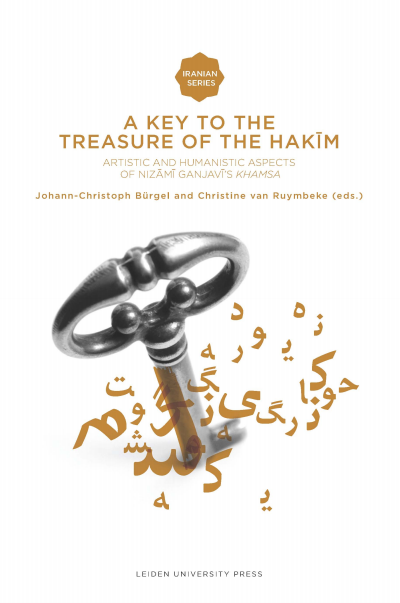
A Key to the Treasure of the Hakim
Artistic and Humanistic Aspects of Nizami Ganjavi’s Khamsa- Herausgeber:innen:
- |
- Reihe:
- Iranian Studies Series
- Verlag:
- 2011
Zusammenfassung
This “Key” to the Khamsa consists of thirteen essays by eminent scholars in the field of Persian Studies, each focusing on different aspects of the Khamsa, which is a collection of five long poems written by the Persian poet Nizami of Ganja.
Nizami (1141-1209) lived and worked in Ganja in present-day Azerbaijan. He is widely recognized as one of the main poets of Medieval Persia, a towering figure who produced outstanding poetry, straddling mysticism, romances and epics. He has left his mark on the whole Persian-speaking world and countless younger poets in the area stretching from the Ottoman to the Mughal worlds (present-day Turkey, Azerbaijan, Armenia, Georgia, Iran, Afghanistan, Uzbekistan, Tajikistan, Pakistan, India) have found him an inspiration and have tried to emulate him. His work has influenced such other immense poets as Hafez, Rumi, and Saadi.
His five masnavis (long poems) address a variety of topics and disciplines and have all enjoyed enormous fame, as the countless surviving manuscripts of his work indicate. His heroes, Khosrow and Shirin, Leili and Majnun, Iskandar count amongst the stars of the Persian literary firmament and have become household names all over the Islamic world.
The essays in the present volume constitute a significant development in the field of Nizami-studies, and on a more general level, of classical Persian literature. They focus on topics such as mysticism, art history, comparative literature, science, and philosophy. they show how classical Greek knowledge mingles in a unique manner with the Persian past and the Islamic culture in Nizami’s world. They reflect a high degree of engagement with the existing scholarship in the field, they revive and challenge traditional views on the poet and his work and are indispensable both for specialists in the field and for anyone interested in the movement of ideas in the Medieval world.
Publikation durchsuchen
Bibliographische Angaben
- Auflage
- 1/2011
- Copyrightjahr
- 2011
- ISBN-Print
- 978-90-8728-097-0
- ISBN-Online
- 978-94-006-0014-0
- Verlag
- Leiden University Press, Leiden
- Reihe
- Iranian Studies Series
- Sprache
- Englisch
- Seiten
- 306
- Produkttyp
- Sammelband
Inhaltsverzeichnis
- Contents
- Acknowledgment
- 2 The Hidden Pearls of Wisdom: Desire and Initiation in Laylī u MajnūnSeiten 53 - 76Autor:innen:Download Kapitel (PDF)
- 3 Descriptions and Images – Remarks on Gogand Magog in Nizāmī’s Iskandar Nāma, Firdawsī’s Shāh Nāma and Amīr Khusraw’s A’īna-yi IskandarīSeiten 77 - 94Autor:innen:Download Kapitel (PDF)
- 4 Nizāmī’s Cosmographic Vision and Alexander in Search of the Fountain of LifeSeiten 95 - 106Autor:innen:Download Kapitel (PDF)
- 5 Drinking from the Water of Life – Nizāmī, Khizr and the Symbolism of Poetical Inspiration in Later Persianate LiteratureSeiten 107 - 126Autor:innen:Download Kapitel (PDF)
- 6 The Enigma of Turandot in Nizāmī’s Pentad. Azāda and Bahrām between Esther and SindbādSeiten 127 - 144Autor:innen:Download Kapitel (PDF)
- 7 What is it that Khusraw learns from the Kalīla-Dimna stories?Seiten 145 - 166Autor:innen:Download Kapitel (PDF)
- 8 The “Wasteland” and Alexander, the Righteous King, in Nizāmī’s Iqbāl NāmaSeiten 167 - 180Autor:innen:Download Kapitel (PDF)
- 9 A Mystical Reading of Nizāmī’s Use of Nature in the Haft PaykarSeiten 181 - 194Autor:innen:Download Kapitel (PDF)
- 10 The Nizāmī Manuscript of Shāh Tahmāsp: A Reconstructed HistorySeiten 195 - 210Autor:innen: |Download Kapitel (PDF)
- 11 Nizāmī Ganjavi, the Wordsmith: The Concept of sakhun in Classical Persian PoetrySeiten 211 - 244Autor:innen:Download Kapitel (PDF)
- 13 “Let Even a Cat Win your Heart!” Nizāmī on Animal and ManSeiten 253 - 266Autor:innen:Download Kapitel (PDF)
- Illustrations to Chapter 10Seiten 267 - 274 Download Kapitel (PDF)
- BibliographySeiten 275 - 290 Download Kapitel (PDF)
- IndexSeiten 291 - 304 Download Kapitel (PDF)
- Already published in the Iranian Studies Series:Seiten 305 - 305 Download Kapitel (PDF)