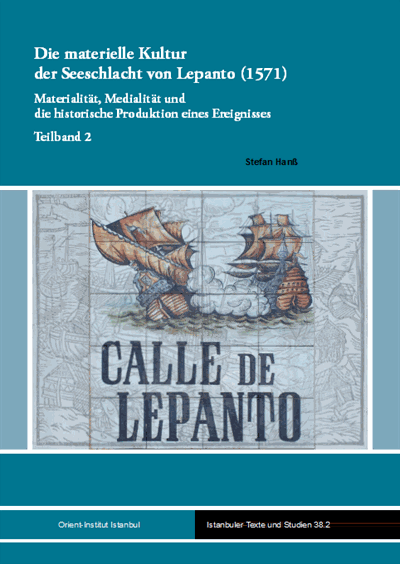
Die materielle Kultur der Seeschlacht von Lepanto (1571)
Materialität, Medialität und die historische Produktion eines Ereignisses- Autor:innen:
- Reihe:
- Istanbuler Texte und Studien (ITS), Band 38
- Verlag:
- 2017
Zusammenfassung
Ausgehend von einer Geschichte der Ereignisproduktion (histoire de l’événement) erforscht Stefan Hanß in einer quellenreichen Studie den Beitrag frühneuzeitlicher materieller Kultur zur Produktion von Geschichte. Am Beispiel der Seeschlacht von Lepanto (1571) wird dargelegt, wie historische Akteure im Rückgriff auf Aspekte eines historischen Ereignisses ein Paradigma formten, das für binäre Weltkonstruktionen herangezogen wurde und wird. Die Monografie beleuchtet die Produktion, Zirkulation und Rezeption von Texten ebenso wie den Gebrauch osmanischer Beutestücke und ligistischer Gegenstände, die zugehörigen Bild-, Imaginations- und Klangwelten sowie Münzen und Medaillen zur Seeschlacht. Am Beispiel der während des Ereignisses versklavten Muslime und ‚befreiten‘ Christen werden etwa die Kommodifizierungslogiken von Lepanto aufgezeigt. Die Erforschung der Heroenkulte und Wunderdiskurse wiederum legt die Problematik der nationalen und religiösen Vereinnahmungen Lepantos dar. Hanß eröffnet in beeindruckendem Detailreichtum und auf hohem methodischen Reflexionsniveau den Blick darauf, wie zeitgenössische Reaktionen auf Umgangsweisen mit Materialität und Medialität die (Re-)Produktion von Geschichte(n) prägten. Die Verdinglichung Lepantos, so ist zu schlussfolgern, ging dabei mit Selbst- und Fremdverortungen durch Dinge einher: Insofern über Materialität und Medialität Zeugenschaft als Interpretationsanspruch auf Geschichte(n) beansprucht und durchgesetzt wurde, dient(e) die Ereignisproduktion Lepantos vor allem der Postulierung von Gruppenzugehörigkeiten. Als ein Ereignis der Teilhabe stellte Lepanto demnach kein Ereignis dar, das Kulturen trennte, sondern vielmehr eines, das Menschen verband.
Publikation durchsuchen
Bibliographische Angaben
- Auflage
- 1/2017
- Copyrightjahr
- 2017
- ISBN-Print
- 978-3-95650-264-4
- ISBN-Online
- 978-3-95650-373-3
- Verlag
- Ergon, Baden-Baden
- Reihe
- Istanbuler Texte und Studien (ITS)
- Band
- 38
- Sprache
- Deutsch
- Seiten
- 1010
- Produkttyp
- Monographie
Inhaltsverzeichnis
- Titelei/Inhaltsverzeichnis Kein Zugriff Seiten 1 - 10
- Vorwort Kein Zugriff Seiten 11 - 14
- Vorbemerkungen zu Sprachen und Transkriptionen Kein Zugriff Seiten 15 - 16
- I.1. Die historische Wirkmächtigkeit der Seeschlacht: Lepanto und Türkenfurcht Kein Zugriff Seiten 17 - 40
- I.2.i. Histoire de l’événement Kein Zugriff
- I.2.ii. Materialität, Medialität und symbolische Kommunikationsformen Kein Zugriff
- I.3. Quellen Kein Zugriff Seiten 59 - 66
- II.1.i. Lepanto als Nachrichtenereignis Kein Zugriff
- II.1.ii. Lepanto als Druckereignis Kein Zugriff
- II.1.iii. Lepanto als Ereignis und Möglichkeit Kein Zugriff
- II.2.i. Beutestücke und -praktiken Kein Zugriff
- II.2.ii. Memorabilia, Materialität und Zeugenschaft Kein Zugriff
- II.3.i. „Im Land dieser Ungläubigen“: Muslimische Sklaven und Gefangene Kein Zugriff
- II.3.ii. „Befreit von der Knechtschaft dieser Hunde“: Christliche Sklaven und Lepanto Kein Zugriff
- II.3.iii. „Es gibt keinen Gott außer Gott. Mohammed ist der Gesandte Gottes“: Konvertiten, Lepanto und die römische Inquisition Kein Zugriff
- II.3.iv. „Entweder sterben oder erlangen wir heute unsere Freiheit!“: Galeerensträflinge bei Lepanto Kein Zugriff
- Inhalt (Teilband 1) Kein Zugriff Seiten 547 - 548
- Inhalt (Teilband 2) Kein Zugriff Seiten 549 - 550
- II.4.i. Lepanto als gefeiertes Ereignis Kein Zugriff
- II.4.ii. Lepanto als Klangereignis Kein Zugriff
- II.4.iii. Bildordnungen eines Ereignisses Kein Zugriff
- II.4.iv. Lepanto als numismatisches Ereignis Kein Zugriff
- II.5.i. Heroenkulte Kein Zugriff
- II.5.ii. Lepanto als himmlisches Ereignis Kein Zugriff
- III.1. Symbolische Kommunikation und die Repetition von Praktiken Kein Zugriff Seiten 803 - 808
- III.2. Medialität, Akteure und Gruppenzugehörigkeiten Kein Zugriff Seiten 809 - 816
- III.3. Materialität, Akteure und Gruppenzugehörigkeiten Kein Zugriff Seiten 817 - 824
- III.4. Die Teilhabe am Ereignis – ein Ereignis der Teilhabe: Lepanto und die histoire de l’événement Kein Zugriff Seiten 825 - 832
- IV.1.i. Handschriftliche Quellen und museale Artefakte Kein Zugriff
- IV.1.ii. Gedruckte und edierte Quellen Kein Zugriff
- IV.2. Literaturverzeichnis Kein Zugriff
- IV.3. Verzeichnis der Abbildungen, Grafiken und Karten Kein Zugriff
- IV.4.i. Allgemeine Abkürzungen Kein Zugriff
- IV.4.ii. Abkürzungen von Archiven, Bibliotheken und Museen Kein Zugriff
- Farbtafeln Kein Zugriff Seiten 969 - 998
- Ortsverzeichnis Kein Zugriff Seiten 999 - 1010
Literaturverzeichnis (895 Einträge)
Es wurden keine Treffer gefunden. Versuchen Sie einen anderen Begriff.
- Abulafia, D. 2011. The Great Sea. A Human History of the Mediterranean. Oxford u. a.: Lane. Google Scholar öffnen DOI: 10.5771/9783956503733
- Acidini Luchinat, C. (ed.). 2009. Botticelli nel suo tempo. Mailand: Electa. Google Scholar öffnen DOI: 10.5771/9783956503733
- Ács, P. 2000. Tarjumans Mahmud and Murad. Austrian and Hungarian Renegades as Sultan’s Interpreters. In B. Guthmüller, W. Kühlmann (eds.) Europa und die Türken in der Renaissance. Tübingen: Niemeyer, 307-316. Google Scholar öffnen DOI: 10.5771/9783956503733
- Adams, N. 1999. Censored Anecdotes from Francesco Maria I della Rovere’s „Discorsi Militari“. Renaissance Studies: 55-62. Google Scholar öffnen DOI: 10.5771/9783956503733
- Ágoston, G. 2007. Information, Ideology, and Limits of Imperial Policy. Ottoman Grand Strategy in the Context of Ottoman-Habsburg Rivalry. In V. H. Aksan, D. Goffman (eds.) The Early Modern Ottomans. Remapping the Empire. Cambridge u. a.: Cambridge University Press, 75-103. Google Scholar öffnen DOI: 10.5771/9783956503733
- Ágoston, G. 2009. Lepanto, Battle of. In G. Ágoston, B. Masters (eds.) Encyclopedia of the Ottoman Empire. New York: Facts on File, 331-332. Google Scholar öffnen DOI: 10.5771/9783956503733
- Alam, M., S. Subrahmanyam. 1998. The Muġhal State. 1526-1750. Oxford u. a.: Oxford University Press. Google Scholar öffnen DOI: 10.5771/9783956503733
- Alden, J., D. C. Landis. 1980. European Americana. A Chronological Guide to Works Printed in Europe Relating to the America 1: 1493-1600. New York: Readex Books. Google Scholar öffnen DOI: 10.5771/9783956503733
- Alexander, P. J. 1985. The Byzantine Apocalyptic Tradition. ed. D. de F. Abrahamse. Berkeley, Los Angeles, London: University of California Press. Google Scholar öffnen DOI: 10.5771/9783956503733
- Algazi, G. 1995. „Sie würden hinten nach so gail.“ Vom sozialen Gebrauch der Fehde im 15. Jahrhundert. In T. Lindenberger, A. Lüdtke (eds.) Physische Gewalt. Studien zur Geschichte der Neuzeit. Frankfurt a. M.: Suhrkamp, 39-77. Google Scholar öffnen DOI: 10.5771/9783956503733
- Algazi, G. 1996. Herrengewalt und Gewalt der Herren im späten Mittelalter. Herrschaft, Gegenseitigkeit und Sprachgebrauch. Frankfurt a. M., New York: Campus. Google Scholar öffnen DOI: 10.5771/9783956503733
- Algazi, G. 2000. Kulturkult und die Rekonstruktion von Handlungsrepertoires. L’homme. Zeitschrift für feministische Geschichtswissenschaft: 105-119. Google Scholar öffnen DOI: 10.5771/9783956503733
- Allegri, E., A. Cecchi. 1980. Palazzo Vecchio e i Medici. Guida storica. Florenz: Studi per Edizioni Scelte. Google Scholar öffnen DOI: 10.5771/9783956503733
- Allouche, A. 1983. The Origins and Development of the Ottoman-Safavid Conflict (906-962/1500-1555). Berlin: Schwarz. Google Scholar öffnen DOI: 10.5771/9783956503733
- Almási, G. 2009. The Uses of Humanism. Johannes Sambucus (1531-1584), Andreas Dudith (1533-1589), and the Republic of Letters in East Central Europe. Leiden, Boston: Brill. Google Scholar öffnen DOI: 10.5771/9783956503733
- Amabile, L. 1892. Il Santo Officio della Inquisizione in Napoli. Narrazione con molti documenti inediti. 2 Bde. Castello: Lapi 1892. Google Scholar öffnen DOI: 10.5771/9783956503733
- Amelang, J. S. 1998. The Flight of Icarus. Artisan Autobiography in Early Modern Europe. Stanford u. a.: Stanford University Press. Google Scholar öffnen DOI: 10.5771/9783956503733
- Amelang, J. S. 2007. Exchanges between Italy and Spain. Culture and Religion. In T. J. Dandelet, J. A. Marino (eds.) Spain in Italy. Politics, Society, and Religion. 1500-1700. Leiden, Boston: Brill, 433-455. Google Scholar öffnen DOI: 10.5771/9783956503733
- Amelang, J. S. 2011. Tracing Lives. The Spanish Inquisition and the Act of Autobiography. In A. Baggerman, R. Dekker, M. Mascuch (eds.) Controlling Time and Shaping the Self. Developments in Autobiographical Writing Since the Sixteenth Century. Leiden, Boston: Brill, 33-48. Google Scholar öffnen DOI: 10.5771/9783956503733
- Andermann, U. 2000. Geschichtsdeutung und Prophetie. Krisenerfahrung und -bewältigung am Beispiel der osmanischen Expansion im Spätmittelalter und in der Reformationszeit. In B. Guthmüller, W. Kühlmann (eds.) Europa und die Türken in der Renaissance. Tübingen: Niemeyer, 29-54. Google Scholar öffnen DOI: 10.5771/9783956503733
- Anderson, B. R. O. 1983. Imagined Communities. Reflections on the Origin and Spread of Nationalism. London: Verso. Google Scholar öffnen DOI: 10.5771/9783956503733
- Andretta, S. 2001. Le biografie papali e l’informazione politica tra Cinque e Seicento. In E. F. Guarini, M. Rosa (eds.) L’informazione politica in Italia (secoli XVI-XVIII). Pisa: Scuola Normale Superiore, 239-279. Google Scholar öffnen DOI: 10.5771/9783956503733
- Andrews, W. G., M. Kalpaklı. 2005. The Age of the Beloveds. Love and the Beloved in Early-Modern Ottoman and European Culture and Society. Durham u. a.: Duke University Press. Google Scholar öffnen DOI: 10.5771/9783956503733
- Anonym („Gonlor“). 2010. Acto de regreso del „Santo Cristo de Lepanto“ en la Catedral de Barcelona (1939). Fotos y vídeos de la guerra civil española. URL: http://rayosycentellas.net/guerracivil/?p=231, 7. März 2010 [Zugriff am: 30. September 2014]. Google Scholar öffnen DOI: 10.5771/9783956503733
- Anonym. 1965. Consegnata alla Autorità Turche la bandiera di Lepanto. L’Osservatore romano [06. März 1965]: 1-2. Google Scholar öffnen DOI: 10.5771/9783956503733
- Anonym. 2013. Protest mit roten Rosen. Don Juan und sein Türkenschädel. regensburg-digital, URL: http://www.regensburg-digital.de/don-juan-und-sein-turkenschadel/05022013/ [Zugriff am: 27. Januar 2014]. Google Scholar öffnen DOI: 10.5771/9783956503733
- Appadurai, A. (ed.). 2010a. The Social Life of Things. Commodities in Cultural Perspective. 8. Aufl. Cambridge u. a.: Cambridge University Press [1986]. Google Scholar öffnen DOI: 10.5771/9783956503733
- Appadurai, A. 2010b. Introduction. Commodities and the Politics of Value. In A. Appadurai (ed.) The Social Life of Things. Commodities in Cultural Perspective. 8. Aufl. Cambridge u. a.: Cambridge University Press [1986], 3-63. Google Scholar öffnen DOI: 10.5771/9783956503733
- Apponyi, A. 2004. Hungarica. Ungarn betreffende im Auslande gedruckte Bücher und Flugschriften. Neubearb. v. J. Vekerdi. 3 Teile. Budapest: Országos Széchényi Könyvtár. Google Scholar öffnen DOI: 10.5771/9783956503733
- Appuhn, K. 2000. Inventing Nature. Forests, Forestry, and State Power in Renaissance Venice. The Journal of Modern History: 861-889. Google Scholar öffnen DOI: 10.5771/9783956503733
- ʿArafat, W. 1960. Bilāl b. Rabāḥ. In H. A. R. Gibb u. a. (eds.) The Encyclopaedia of Islam. New Edition 1. Leiden, London: Brill, 1215. Google Scholar öffnen DOI: 10.5771/9783956503733
- Arbel, B. 1995. Trading Nations: Jews and Venetians in the Early Modern Eastern Mediterranean. Leiden u. a.: Brill. Google Scholar öffnen DOI: 10.5771/9783956503733
- Archivio di Stato di Modena (ed.). 1953. Archivio segreto Estense. Sezione „Casa e Stato“. Inventario. Rom: Ministero dell’interno. Google Scholar öffnen DOI: 10.5771/9783956503733
- Archivio di Stato di Napoli (ed.). 1998. Napoli e Filippo II. La nascita della società moderna nel secondo Cinquecento. Neapel: Macchiaroli. Google Scholar öffnen DOI: 10.5771/9783956503733
- Arkoun, M. 2002. The Unthought in Contemporary Islamic Thought. London: Saqi. Google Scholar öffnen DOI: 10.5771/9783956503733
- Armand, A. 1883-7. Les médailleurs italiens des quinzième et seizième siècles. 3 Bde. Paris: Forni. Google Scholar öffnen DOI: 10.5771/9783956503733
- Arnade, P. 2008. Beggars, Iconoclasts, and Civic Patriots. The Political Culture of the Dutch Revolt. Ithaca, London: Cornell University Press. Google Scholar öffnen DOI: 10.5771/9783956503733
- Arnold, D. 1959. The Significance of „Cori Spezzati“. Music and Letters: 4-14. Google Scholar öffnen DOI: 10.5771/9783956503733
- Aronna, M. 2009. The Mapping of Empire. Evolving Notions of Christendom and Europe in the Poetry of Fernando de Herrera Commemorating the Battle of Lepanto. In A. Davison, H. Muppidi (eds.) Europe and its Boundaries. Words and Worlds, Within and Beyond. Lanham, Md u. a.: Lexington Books, 145-170. Google Scholar öffnen DOI: 10.5771/9783956503733
- Aschoff, H.-G. 1999. Otto IV., Graf von Schaumburg (auch Schauenburg). In Historische Kommission bei der Bayerischen Akademie der Wissenschaften (ed.) Neue Deutsche Biographie 19. Berlin, 693-694. Google Scholar öffnen DOI: 10.5771/9783956503733
- Atil, E. 1973. Ottoman Miniature Painting under Sultan Mehmed II. Ars Orientalis: 103-120. Google Scholar öffnen DOI: 10.5771/9783956503733
- Aubrey, P. 1979. The Defeat of James Stuart’s Armada 1692. Leicester: Leicester University Press. Google Scholar öffnen DOI: 10.5771/9783956503733
- Aune, M. G. 2005. Review Article. Early Modern European Travel Writing After Orientalism. Journal for Early Modern Cultural Studies: 120-138. Google Scholar öffnen DOI: 10.5771/9783956503733
- Aymard, M. 1974. Chiourmes et galères dans la seconde moitié du XVIe siècle. In G. Benzoni (ed.) Il Mediterraneo nella seconda metà del ’500 alla luce di Lepanto. Florenz: Olschki, 71-94. Google Scholar öffnen DOI: 10.5771/9783956503733
- Bachmann-Medick, D. 2007. Cultural Turns. Neuorientierungen in den Kulturwissenschaften. 2. Aufl. Reinbek: Rowohlt. Google Scholar öffnen DOI: 10.5771/9783956503733
- Baer, M. D. 2004. Islamic Conversion Narratives of Women. Social Change and Gendered Religious Hierarchy in Early Modern Ottoman Istanbul. Gender & History: 425-458. Google Scholar öffnen DOI: 10.5771/9783956503733
- Bähr, A. 2008. Die Furcht der Frühen Neuzeit. Paradigmen, Hintergründe und Perspektiven einer Kontroverse. Historische Anthropologie: 291-309. Google Scholar öffnen DOI: 10.5771/9783956503733
- Bähr, A. 2013. Furcht und Furchtlosigkeit. Göttliche Gewalt und Selbstkonstitution im 17. Jahrhundert. Göttingen: Vandenhoeck & Ruprecht unipress. Google Scholar öffnen DOI: 10.5771/9783956503733
- Barbarics, Z., R. Pieper. 2007. Handwritten Newsletters as a Means of Communication in Early Modern Europe. In F. Bethencourt, F. Egmond (eds.) Cultural Exchange in Early Modern Europe 3: Correspondence and Cultural Exchange in Europe. 1400-1700. Cambridge u. a.: Cambridge University Press, 53-79. Google Scholar öffnen DOI: 10.5771/9783956503733
- Barbarics-Hermanik, Z. 2009. Reale oder gemachte Angst? Türkengefahr und Türkenpropaganda im 16. und 17. Jahrhundert. In H. Heppner, Z. Barbarics-Hermanik (eds.) Türkenangst und Festungsbau. Wirklichkeit und Mythos. Frankfurt a. M. u. a.: Lang, 43-75. Google Scholar öffnen DOI: 10.5771/9783956503733
- Barbero, A. 2010. Lepanto. La battaglia dei tre imperi. 3. Aufl. Rom, Bari: Editori Laterza. Google Scholar öffnen DOI: 10.5771/9783956503733
- Barocchi, P. 1964. Vasari. Pittore. Mailand: Club del Libro. Google Scholar öffnen DOI: 10.5771/9783956503733
- Baron, S. A., E. N. Lindquist, E. F. Shevlin (eds.). 2007. Agent of Change. Print Culture Studies after Elizabeth L. Eisenstein. Amherst, Boston: University of Massachusetts Press. Google Scholar öffnen DOI: 10.5771/9783956503733
- Barthold, F. W. 1850. Geschichte der deutschen Seemacht. Historisches Taschenbuch: 59-192. Google Scholar öffnen DOI: 10.5771/9783956503733
- Barton, W. 1991. Die Schlacht von Altenoythe (Weihnachten 1623) und das Ende von Mansfelds Herrschaft in Ostfriesland als Medienereignisse ihrer Zeit. Oldenburg: Holzberg. Google Scholar öffnen DOI: 10.5771/9783956503733
- Bazzano, N. 2003. Marco Antonio Colonna. Rom: Salerno. Google Scholar öffnen DOI: 10.5771/9783956503733
- Beaufort-Spontin, C., M. Pfaffenbichler. 2005. Meisterwerke der Hofjagd- und Rüstkammer. Wien: Kunsthistorisches Museum Wien. Google Scholar öffnen DOI: 10.5771/9783956503733
- Beck, H.-G. 1971. Geschichte der byzantinischen Volksliteratur. München: Beck. Google Scholar öffnen DOI: 10.5771/9783956503733
- Becker, U. 2001. El Greco: Kunsthistorisches Museum Wien. Heidelberg: Vernissage-Verlag. Google Scholar öffnen DOI: 10.5771/9783956503733
- Behringer, W. 2003. Im Zeichen des Merkur. Reichspost und Kommunikationsrevolution in der Frühen Neuzeit. Göttingen: Vandenhoeck & Ruprecht. Google Scholar öffnen DOI: 10.5771/9783956503733
- Bekkaoui, K. 2011. White Women Captives in North Africa. Narratives of Enslavement, 1735-1830. Houndmills, Basingstoke: Palgrave Macmillan. Google Scholar öffnen DOI: 10.5771/9783956503733
- Belting, H. 1990. Bild und Kult. Eine Geschichte des Bildes vor dem Zeitalter der Kunst. München: Beck. Google Scholar öffnen DOI: 10.5771/9783956503733
- Belting, H. 2001. Bild-Anthropologie. Entwürfe für eine Bildwissenschaft. München: Fink. Google Scholar öffnen DOI: 10.5771/9783956503733
- Ben-Aryeh Debby, N. 2014. The Cult of St Clare of Assisi in Early Modern Italy. Farnham, Burlington: Ashgate. Google Scholar öffnen DOI: 10.5771/9783956503733
- Bennassar, B. 2001. Juan de Austria. El héroe de Lepanto. Historia y vida: 56-65. Google Scholar öffnen DOI: 10.5771/9783956503733
- Bennassar, B., L. Bennassar. 1989. Les Chrétiens d’Allah. L’histoire extraordinaire des renégats. XVIe-XVIIe siècles. Paris: Perrin. Google Scholar öffnen DOI: 10.5771/9783956503733
- Benzoni, G. 1985. Il „farsi turco“, ossia l’ombra del rinnegato. In C. Pirovano (ed.) Venezia e i Turchi. Scontri e confronti di due civiltà. Mailand: Electa, 91-133. Google Scholar öffnen DOI: 10.5771/9783956503733
- Benzoni, G. 1998. Francesco Maria II della Rovere, duca di Urbino. In Istituto della Enciclopedia Italiana (ed.) Dizionario biografico degli Italiani 50. Rom: Istituto della Enciclopedia Italiana, 55-60. Google Scholar öffnen DOI: 10.5771/9783956503733
- Berchet, G. 1865. La Repubblica di Venezia e la Persia. Turin: Paravia. Google Scholar öffnen DOI: 10.5771/9783956503733
- Bernardini, R. 2005. L’istituzione dei Cavalieri di Santo Stefano. Origine, sviluppo, attività. Pisa: Edizioni ETS. Google Scholar öffnen DOI: 10.5771/9783956503733
- Bernstein, J. A. 1998. Music Printing in Renaissance Venice. The Scotto Press (1539-1572). Oxford u. a.: Oxford University Press. Google Scholar öffnen DOI: 10.5771/9783956503733
- Bethencourt, F. 2011. The Inquisition. A Global History, 1478-1834. 2. Aufl. Cambridge u. a.: Cambridge University Press. Google Scholar öffnen DOI: 10.5771/9783956503733
- Bevilacqua, A., H. Pfeifer. 2013. Turquerie. Culture in Motion, 1650-1750. Past & Present: 75-118. Google Scholar öffnen DOI: 10.5771/9783956503733
- Bianchi, M. T. 1992. La difesa di Giacomo Malatesta davanti alla Serenissima (1572). Archivio veneto, 134-154. Google Scholar öffnen DOI: 10.5771/9783956503733
- Bicheno, H. 2003. Crescent and Cross. The Battle of Lepanto 1571. London: Cassell. Google Scholar öffnen DOI: 10.5771/9783956503733
- Bietenholz, P. G. (ed.). 1985-1987. Contemporaries of Erasmus. A Biographical Register of the Renaissance and Reformation. 3 Bde. Toronto, Buffalo, London: University of Toronto Press. Google Scholar öffnen DOI: 10.5771/9783956503733
- Bisaha, N. 2004. Creating East and West. Renaissance Humanists and the Ottoman Turks. Philadelphia: University of Pennsylvania Press. Google Scholar öffnen DOI: 10.5771/9783956503733
- Biscione, F. M. 1995. Fedele, Pietro. In Istituto della Enciclopedia Italiana (ed.) Dizionario biografico degli italiani 45. Rom: Istituto della Enciclopedia Italiana, 572-575. Google Scholar öffnen DOI: 10.5771/9783956503733
- Blaak, J. 2009. Literacy in Everyday Life. Reading and Writing in Early Modern Dutch Diaries. Übers. v. B. Jackson. Leiden, Boston: Brill. Google Scholar öffnen DOI: 10.5771/9783956503733
- Black, C. F. 2004. Church, Religion and Society in Early Modern Italy. Houndmills, Basingstoke: Palgrave Macmillan. Google Scholar öffnen DOI: 10.5771/9783956503733
- Black, R. 2007. The Philosopher and Renaissance Culture. In J. Hankins (ed.) The Cambridge Companion to Renaissance Philosophy. Cambridge u. a.: Cambridge University Press, 13-29. Google Scholar öffnen DOI: 10.5771/9783956503733
- Blair, A. 2007. Errata Lists and the Reader as Corrector. In S. A. Baron, E. N. Lindquist, E. F. Shevlin (eds.) Agent of Change. Print Culture Studies after Elizabeth L. Eisenstein. Amherst, Boston: University of Massachusetts Press, 21-41. Google Scholar öffnen DOI: 10.5771/9783956503733
- Blair, A. M. 2010. Too Much To Know. Managing Scholarly Information before the Modern Age. New Haven, London: Yale University Press. Google Scholar öffnen DOI: 10.5771/9783956503733
- Bley, H. u. a. 2006. Expanisonen. In Friedrich Jaeger im Auftrag d. Kulturwissenschaftlichen Instituts Essen (eds.) Enzyklopädie der Neuzeit 3. Stuttgart: Metzler, 689-722. Google Scholar öffnen DOI: 10.5771/9783956503733
- Bloch, M. 1992. The Historian’s Craft. Eingeleitet v. P. Burke. Manchester: Manchester University Press. Google Scholar öffnen DOI: 10.5771/9783956503733
- Blumenthal, D. 2009. Enemies and Familiars. Slavery and Mastery in 15th-Century Valencia. Ithaca u. a.: Cornell University Press. Google Scholar öffnen DOI: 10.5771/9783956503733
- Blunt, A. 1939-40. El Greco’s „Dream of Philipp II“. An Allegory of the Holy League. Journal of the Warburg and Courtauld Institutes: 58-69. Google Scholar öffnen DOI: 10.5771/9783956503733
- Bobzin, H. 1995. Der Koran im Zeitalter der Reformation. Studien zur Frühgeschichte der Arabistik und Islamkunde in Europa. Stuttgart: Steiner. Google Scholar öffnen DOI: 10.5771/9783956503733
- Boccadamo, G. 1985. La redenzione dei cattivi a Napoli nel Cinquecento. Lo statuto di una confraternita. Neapel: D’Auria. Google Scholar öffnen DOI: 10.5771/9783956503733
- Boccadamo, G. 2010. Napoli e l’Islam. Storie di musulmani, schiavi e rinnegati in età moderna. Neapel: D’Auria. Google Scholar öffnen DOI: 10.5771/9783956503733
- Boge, B., R. G. Bogner (ed.). 1999. Oratio funebris. Die katholische Leichenpredigt der frühen Neuzeit. Amsterdam u. a.: Rodopi. Google Scholar öffnen DOI: 10.5771/9783956503733
- Bonnell, E. 1962. Lexicon Quintilianeum. Hildesheim: Olms. Google Scholar öffnen DOI: 10.5771/9783956503733
- Bono, S. 1999. Schiavi musulmani nell’Italia moderna. Galeotti, vu’ compra’, domestici. Neapel: Edizioni scientifiche italiane. Google Scholar öffnen DOI: 10.5771/9783956503733
- Bono, S. 2014. Schiavi, europei, ottomano-maghrebini, neri e altri nel mondo mediterraneo. Un confronto (XVI-XIX secolo). In S. Hanß, J. Schiel (eds.) Mediterranean Slavery Revisited (500-1800). Neue Perspektiven auf mediterrane Sklaverei (500-1800). Zürich: Chronos, 445-471. Google Scholar öffnen DOI: 10.5771/9783956503733
- Borino, G. B., A. Galieti, G. Navone. 1938. Il trionfo di Marc’Antonio Colonna. Rom: Biblioteca Vallicelliana. Google Scholar öffnen DOI: 10.5771/9783956503733
- Borofsky, R. 1987. Making History. Pukapukan and Anthropological Constructions of Knowledge. Cambridge u. a.: Cambriidge University Press. Google Scholar öffnen DOI: 10.5771/9783956503733
- Bösch, F. 2010. Europäische Medienereignisse. Europäische Geschichte Online, URL: http://www.ieg-ego.eu/de/threads/europaeische-medien/europaeische-medien Google Scholar öffnen DOI: 10.5771/9783956503733
- ereignisse [Zugriff am: 26. November 2011]. Google Scholar öffnen DOI: 10.5771/9783956503733
- Bostan, İ. 2000. İnebahtı deniz savaşı. In Bekir Topaloğlu (ed.) Türkiye Diyanet Vakfı İslâm Ansiklopedisi 22. Istanbul: Türkiye Diyanet Vakfı İslâm Ansiklopedisi Genel Müdürlüğü, pp. 287-289. Google Scholar öffnen DOI: 10.5771/9783956503733
- Bourdieu, P. 1993. Sozialer Sinn. Kritik der theoretischen Vernunft. Frankfurt a. M.: Suhrkamp. Google Scholar öffnen DOI: 10.5771/9783956503733
- Boutier, J. 2001. Fernand Braudel als Historiker des Ereignisses. In A. Suter, M. Hettling (eds.) Struktur und Ereignis. Göttingen: Vandenhoeck & Ruprecht, 138-157. Google Scholar öffnen DOI: 10.5771/9783956503733
- Boyar, E., K. Fleet. 2010. A Social History of Ottoman Istanbul. Cambridge u. a.: Cambridge University Press. Google Scholar öffnen DOI: 10.5771/9783956503733
- Boyd, C. P. 1997. Historia Patria. Politics, History, and National Identity in Spain. 1875-1975. Princeton: Princeton University Press. Google Scholar öffnen DOI: 10.5771/9783956503733
- Boyden, J. M. 1995. The Courtier and the King. Ruy Gómez de Silva, Philipp II, and the Court of Spain. Berkeley, Los Angeles, London: University of California Press. Google Scholar öffnen DOI: 10.5771/9783956503733
- Braudel, F. 1949. La Méditerranée et le Monde méditerranéen à l’époque de Philippe II. Paris: Colin. Google Scholar öffnen DOI: 10.5771/9783956503733
- Braudel, F. 1974. Bilan d’une bataille. In G. Benzoni (ed.) Il Mediterraneo nella seconda metà del ’500 alla luce di Lepanto. Florenz: Olschki, 109-120. Google Scholar öffnen DOI: 10.5771/9783956503733
- Braudel, F. 1990. Die Suche nach einer Sprache der Geschichte. Wie ich Historiker wurde. In: F. Braudel u. a. (eds.) Der Historiker als Menschenfresser. Über den Beruf des Geschichtsschreibers. Berlin: Wagenbach, 7-14. Google Scholar öffnen DOI: 10.5771/9783956503733
- Braudel, F. 2001. Das Mittelmeer und die mediterrane Welt in der Epoche Philipps II. 3 Bde. Übers. nach der vierten, durchges. u. berichtigt. Auflage (1979) v. Günter Seib. 2. Aufl. Frankfurt a. M.: Suhrkamp. Google Scholar öffnen DOI: 10.5771/9783956503733
- Braudel, F. 2013. Geschichte als Schlüssel zur Welt. Vorlesungen in deutscher Kriegsgefangenschaft 1941. Ed. P. Schöttler. Stuttgart: Klett-Cotta. Google Scholar öffnen DOI: 10.5771/9783956503733
- Brecht, B. 2004. Die Gedichte von Bertolt Brecht in einem Band. 12. Aufl. Frankfurt a. M.: Suhrkamp. Google Scholar öffnen DOI: 10.5771/9783956503733
- Brook, A. 2012. From Borgo Pinti to Doccia. The Afterlife of Pietro Tacca’s Moors for Livorno. In E. McGrath, J. M. Massing (eds.) The Slave in European Art. From Renaissance Trophy to Abolitionist Emblem. London: The Warburg Institute, Turin: Nino Aragno Editore, 165-191. Google Scholar öffnen DOI: 10.5771/9783956503733
- Brotton, J. 2002. The Renaissance Bazaar. From the Silk Road to Michelangelo. Oxford u. a.: Oxford University Press. Google Scholar öffnen DOI: 10.5771/9783956503733
- Brown, N. C. 2007. The Mystery of Harry Potter. A Catholic Family Guide. Huntington: Our Sunday Visitor Pub. Division. Google Scholar öffnen DOI: 10.5771/9783956503733
- Brummett, P. J. 1987. The Jacopo Castelvetro Collection. A Renaissance Man with Documents on Istanbul. The Turkish Studies Association Bulletin: 1-8. Google Scholar öffnen DOI: 10.5771/9783956503733
- Brummett, P. J. 1994. Ottoman Seapower and Levantine Diplomacy in the Age of Discovery. Albany: State University of New York Press. Google Scholar öffnen DOI: 10.5771/9783956503733
- Brummett, P. J. 2013. The Lepanto Paradigm Revisited. Knowing the Ottomans in the Sixteenth Century. In A. Contadini, C. Norton (eds.) The Renaissance and the Ottoman World. Farnham, Burkington: Taylor and Francis, 63-93. Google Scholar öffnen DOI: 10.5771/9783956503733
- Brunschvig, R. 1960. ʿAbd. In B. Lewis, C. Pellat, J. Schacht (eds.) The Encyclopaedia of Islam. New Edition 1. Leiden: Brill, 24-40. Google Scholar öffnen DOI: 10.5771/9783956503733
- Bryant, D. D. 1981a. Liturgy, Ceremonial and Sacred Music in Venice at the Time of the Counter-Reformation. PhD thesis. London: King’s College, University of London. Google Scholar öffnen DOI: 10.5771/9783956503733
- Bryant, D. D. 1981b. The ‚Cori Spezzati‘ of St Mark’s. Myth and Reality. Early Music History: 165-186. Google Scholar öffnen DOI: 10.5771/9783956503733
- Buchmann, B. M. 1999. Österreich und das Osmanische Reich. Eine bilaterale Geschichte. Wien: WUV-Universitäts-Verlag. Google Scholar öffnen DOI: 10.5771/9783956503733
- Bulgarelli, T. 1961. La battaglia di Lepanto e il giornalismo romano del Cinquecento. Accademie e biblioteche d’Italia: 231-239. Google Scholar öffnen DOI: 10.5771/9783956503733
- Bulgarelli, T. 1967. Gli avvisi a stampa in Roma nel cinquecento. Rom: Istituto di Studi Romani. Google Scholar öffnen DOI: 10.5771/9783956503733
- Burckhardt, J. 1860. Die Cultur der Renaissance in Italien. Ein Versuch. Basel: Schweighauser. Google Scholar öffnen DOI: 10.5771/9783956503733
- Burke, P. 1987. Beleidigungen und Gotteslästerungen im frühneuzeitlichen Italien. In P. Burke Städtische Kultur in Italien zwischen Hochrenaissance und Barock. Eine historische Anthropologie. Berlin: Wagenbach, 96-110. Google Scholar öffnen DOI: 10.5771/9783956503733
- Burke, P. 1990. The French Historical Revolution. The Annales School, 1929-89. Cambridge: Polity. Google Scholar öffnen DOI: 10.5771/9783956503733
- Burke, P. 1991. History of Events and the Revival of Narrative. In P. Burke (ed.) New Perspectives on Historical Writing. Cambridge, Oxford: Polity, 233-248. Google Scholar öffnen DOI: 10.5771/9783956503733
- Burke, P. 1992. The Fabrication of Louis XIV. New Haven, London: Yale University Press. Google Scholar öffnen DOI: 10.5771/9783956503733
- Burke, P. 1995. The Fortunes of the Courtier. The European Reception of Castiglione’s Cortigiano. Cambridge u. a.: Polity. Google Scholar öffnen DOI: 10.5771/9783956503733
- Burke, P. 2000. Early Modern Venice as a Center of Information and Communication. In J. Martin, D. Romano (eds.) Venice Reconsidered. The History and Civilization of an Italian City-State, 1297-1797. Baltimore: Johns Hopkins University Press, 389-419. Google Scholar öffnen DOI: 10.5771/9783956503733
- Burke, P. 2001. Eyewitnessing. The Uses of Images as Historical Evidence. Ithaca: Cornell University Press. Google Scholar öffnen DOI: 10.5771/9783956503733
- Burke, P. 2009. Ludwig XIV. Die Inszenierung des Sonnenkönigs. Übers. v. Matthias Fienbork. 3. Aufl. Berlin: Wagenbach. Google Scholar öffnen DOI: 10.5771/9783956503733
- Burkhardt, J. (ed.). 2005. Kommunikation und Medien in der Frühen Neuzeit. München: Oldenbourg. Google Scholar öffnen DOI: 10.5771/9783956503733
- Burkhardt, J. 2009. Deutsche Geschichte in der Frühen Neuzeit. München: Beck. Google Scholar öffnen DOI: 10.5771/9783956503733
- Burman, T. E. 2007. Reading the Qur’ān in Latin Christendom. 1140-1560. Philadelphia: University of Pennsylvania Press. Google Scholar öffnen DOI: 10.5771/9783956503733
- Burschel, P. 2004. Sterben und Unsterblichkeit. Zur Kultur des Martyriums in der frühen Neuzeit. München: Oldenbourg. Google Scholar öffnen DOI: 10.5771/9783956503733
- Burschel, P. 2007. Der Sultan und das Hündchen. Zur politischen Ökonomie des Schenkens in interkultureller Perspektive. Historische Anthropologie: 408-421. Google Scholar öffnen DOI: 10.5771/9783956503733
- Burschel, P. 2009. Verlorene Söhne. Bilder osmanischer Gefangenschaft in der frühen Neuzeit. In B. Emich, G. Signori (eds.) Kriegs/ Bilder in Mittelaler und Früher Neuzeit. Berlin: Duncker & Humblot, 157-182. Google Scholar öffnen DOI: 10.5771/9783956503733
- Butler, J. 1990. Gender Trouble. Feminism and the Subversion of Identity. New York u. a.: Routledge. Google Scholar öffnen DOI: 10.5771/9783956503733
- Butler, J. 1993. Bodies that Matter. On the Discursive Limits of „Sex“. New York, London: Routledge. Google Scholar öffnen DOI: 10.5771/9783956503733
- Butler, J. 2005. Gefährdetes Leben. Politische Essays. Frankfurt a. M.: Surhkamp. Google Scholar öffnen DOI: 10.5771/9783956503733
- Butler, J. 2008. Sexual Politics, Torture, and Secular Time. The British Journal of Sociology: 1-23. Google Scholar öffnen DOI: 10.5771/9783956503733
- Butters, S. B. 2002. Ferdinando de’ Medici and the Art of the Possible. In C. Acidini Lucinat (ed.) The Medici, Michelangelo and the Art of Late Renaissance Florence. New Haven, London: Yale University Press, 67-76. Google Scholar öffnen DOI: 10.5771/9783956503733
- Bůžek, V. 2009. Ferdinand von Tirol zwischen Prag und Innsbruck. Der Adel aus den böhmischen Ländern auf dem Weg zu den Höfen der ersten Habsburger. Wien, Köln, Weimar: Böhlau. Google Scholar öffnen DOI: 10.5771/9783956503733
- Bynum, C. W. 2011. Christian Materiality. An Essay on Religion in Late Medieval Europe. New York: Zone Books. Google Scholar öffnen DOI: 10.5771/9783956503733
- Cabanelas Rodríguez, D. 1991. El morisco granadino Alonso del Castillo. Granada: Patronato de la Alhambra y Generalife. Google Scholar öffnen DOI: 10.5771/9783956503733
- Cacciavillani, I. 1998. Otto storie veneziane. Padua: Signum. Google Scholar öffnen DOI: 10.5771/9783956503733
- Cacciavillani, I. 2003. Lepanto. Prefazione di Giannantonio Paladini. Venedig: Corbo e Fiore. Google Scholar öffnen DOI: 10.5771/9783956503733
- Caffiero, M. 2007. Battesimi, libertà e frontiere. Conversioni di musulmani ed ebrei a Roma in età moderna. Quaderni storici, 819-839. Google Scholar öffnen DOI: 10.5771/9783956503733
- Cambiaso, D. 1917. L’anno ecclesiastico e le feste dei Santi in Genova nel loro svolgimento storico. Genua: Società Tipo-Litografica Ligure. Google Scholar öffnen DOI: 10.5771/9783956503733
- Camille, M. 1989. The Gothic Idol. Ideology and Image-Making in Medieval Art. Cambridge u. a.: Cambridge University Press. Google Scholar öffnen DOI: 10.5771/9783956503733
- Canosa, R. 2000. Lepanto. Storia della „Lega Santa“ contro i Turchi. Rom: Sapere. Google Scholar öffnen DOI: 10.5771/9783956503733
- Capotorti, M. 2011. Lepanto tra storia e mito. Arte e cultura visiva della Controriforma. Galatina: Congedo. Google Scholar öffnen DOI: 10.5771/9783956503733
- Capponi, N. 2006. Victory of the West. The Story of the Battle of Lepanto. London: Macmillan. Google Scholar öffnen DOI: 10.5771/9783956503733
- Carande Herrero, R. 1990. Mal-Lara y Lepanto. Los epigramas latinos de la Galera real de Don Juan de Austria. Sevilla: Caja San Fernando. Google Scholar öffnen DOI: 10.5771/9783956503733
- Carando, S. 1962. Arnigio, Bartolomeo. In Istituto della Enciclopedia Italiana (ed.) Dizionario biografico degli Italiani 4. Rom: Istituto della Enciclopedia Italiana, 253-254. Google Scholar öffnen DOI: 10.5771/9783956503733
- Carl, H., H.-J. Bömelburg. 2011. Einleitung. Beutepraktiken – Historische und systematische Dimensionen des Themas „Beute“. In H. Carl, H.-J. Bömelburg (eds.) Lohn der Gewalt. Beutepraktiken von der Antike bis zur Neuzeit. Paderborn u. a.: Schöningh, 11-30. Google Scholar öffnen DOI: 10.5771/9783956503733
- Carl, H., U. Planert. 2012. Einleitung. Militärische Erinnerungskulturen – Militär als Gegenstand und Träger kollektiver Erinnerung. In H. Carl, U. Planert (eds.) Militärische Erinnerungskulturen vom 14. bis zum 19. Jahrhundert. Träger – Medien – Deutungskonkurrenzen. Göttingen: Vandenhoeck & Ruprecht unipress, 11-26. Google Scholar öffnen DOI: 10.5771/9783956503733
- Carlos, A. de. 1971. Armas y trofeos de Lepanto en la Real Armería de Madrid. Reales sitios: 29-36. Google Scholar öffnen DOI: 10.5771/9783956503733
- Carmen Iglesias, M. del (ed.). 1998. Felipe II: un monarca y su época. La monarquía hispánica. Madrid: Sociedad Estatal para la Conmemoración de los Centenarios de Felipe II y Carlos V. Google Scholar öffnen DOI: 10.5771/9783956503733
- Caro, G. de. 1969. Bolognetti, Francesco. In: Istituto della Enciclopedia Italiana (eds.) Dizionario biografico degli Italiani 11. Rom: Istituto della Enciclopedia Italiana, 320-326. Google Scholar öffnen DOI: 10.5771/9783956503733
- Caro, G. de. 1976. Carafa, Ferrante. In Istituto della Enciclopedia Italiana (ed.) Dizionario biografico degli Italiani 19. Rom: Istituto della Enciclopedia Italiana, 543-545. Google Scholar öffnen DOI: 10.5771/9783956503733
- Carrero Blanco, L. 1948. La victoria del Cristo de Lepanto. Madrid: Editora Nacional. Google Scholar öffnen DOI: 10.5771/9783956503733
- Carrero Blanco, L. 1971. Lepanto (1571-1971). Madrid: Salvat Editores. Google Scholar öffnen DOI: 10.5771/9783956503733
- Cascardi, A. J. 2002. Don Quixote and the Invention of the Novel. In A. J. Cascardi (ed.) The Cambridge Companion to Cervantes. Cambridge u. a.: Cambridge University Press, 58-79. Google Scholar öffnen DOI: 10.5771/9783956503733
- Casey, J. 1999. Early Modern Spain. A Social History. London, New York: Routledge. Google Scholar öffnen DOI: 10.5771/9783956503733
- Castellani, M. 1973. A 1593 Veronese Inventory. The Galpin Society Journal: 15-24. Google Scholar öffnen DOI: 10.5771/9783956503733
- Cecconi, G. 1986. Le voci e gli echi. Antologia di testi per l’audio. In M. Redolfi (ed.) Venezia e la difesa del Levante. Da Lepanto a Candia, 1570-1670. Venedig: Arsenale Ed., 36-46. Google Scholar öffnen DOI: 10.5771/9783956503733
- Cerbo, A. 2005. Sacre scene sul Mediterraneo. Il „Trionfo della Lega“ di Cesare Tomeo. Sacra scaena: 55-68. Google Scholar öffnen DOI: 10.5771/9783956503733
- Cereijo Soto, P., M. Lourdes de Luis. 1992. Bandera de Lepanto. Reales sitios: 59. Google Scholar öffnen DOI: 10.5771/9783956503733
- Chaline, O. 1999. La Bataille de la Montagne Blanche (8 novembre 1620). Un mystique chez les guerriers. Paris: Ed. Noesis. Google Scholar öffnen DOI: 10.5771/9783956503733
- Chaline, O. 2005. La bataille comme objet d’histoire. Francia. Forschungen zur westeuropäischen Geschichte: 1-14. Google Scholar öffnen DOI: 10.5771/9783956503733
- Chambers, D. S. 1992. A Renaissance Cardinal and His Worldly Goods. The Will and Inventory of Francesco Gonzaga (1444-1483). London: The Warburg Institute. Google Scholar öffnen DOI: 10.5771/9783956503733
- Chartier, R. 1989. Le monde comme représentation. Annales. Economies Sociétés Civilisations: 1505-1520. Google Scholar öffnen DOI: 10.5771/9783956503733
- Chioetto, A. (ed.). 2004. Veronese. Gods, Heroes and Allegories. Mailand: Skira. Google Scholar öffnen DOI: 10.5771/9783956503733
- Christian, W. A. 1981. Local Religion in Sixteenth-Century Spain. Princeton: Princeton University Press. Google Scholar öffnen DOI: 10.5771/9783956503733
- Christian, W. A. 1992. Moving Crucifixes in Modern Spain. Princeton: Princeton University Press. Google Scholar öffnen DOI: 10.5771/9783956503733
- Christiansen, K., S. Weppelmann (eds.). 2011. Gesichter der Renaissance. Meisterwerke italienischer Portrait-Kunst. München: Hirmer. Google Scholar öffnen DOI: 10.5771/9783956503733
- Ciprini, G. 1992. Gli ex voto del Santuario della Madonna della Quercia di Viterbo. Viterbo: Cassa di Risparmio della Provincia di Viterbo. Google Scholar öffnen DOI: 10.5771/9783956503733
- Ciprini, G. 2005a. La Madonna della Quercia. Monografie. Appendice documentaria. Viterbo: Tipolitografia Quatrini. Google Scholar öffnen DOI: 10.5771/9783956503733
- Ciprini, G. 2005b. La Madonna della Quercia. Una meravigliosa storia di fede. Viterbo: Quatrini. Google Scholar öffnen DOI: 10.5771/9783956503733
- Civale, G. 2009. Guerrieri di Cristo. Inquisitori, gesuiti e soldati alla battaglia di Lepanto. Mailand: Unicopli. Google Scholar öffnen DOI: 10.5771/9783956503733
- Claretta, G. 1890. Dell’Ordine Mauriziano nel primo secolo dalla sua ricostituzione e del suo grand’ammiraglio Andrea Provana di Leinì. Notizie storiche con documenti. Florenz, Turin, Rom: Frat. Bocca. Google Scholar öffnen DOI: 10.5771/9783956503733
- Clough, C. H. 1976. The Cult of Antiquity. Letters and Letter Collections. In C. H. Clough (ed.) Cultural Aspects of the Italian Renaissance. Essays in Honour of Paul O. Kristeller. Manchester: Manchester University Press, 33-67. Google Scholar öffnen DOI: 10.5771/9783956503733
- Cluse, C. 2005. Frauen in Sklaverei. Beobachtungen aus genuesischen Notariatsregistern des 14. und 15. Jahrhunderts. In F. G. Hirschmann, G. Mentgen (eds.) Campana pulsante convocati. Festschrift anläßlich der Emeritierung von Prof. Dr. Alfred Haverkamp. Trier: Kliomedia, 85-123. Google Scholar öffnen DOI: 10.5771/9783956503733
- Cluse, C. 2010. Zur Repräsentation von Sklaven und Sklavinnen in Statuten und Notariatsinstrumenten italienischer Städte um 1400. In P. Bell, D. Suckow, G. Wolf (eds.) Fremde in der Stadt. Ordnungen, Repräsentationen und soziale Praktiken (13.-15. Jahrhundert). Frankfurt a. M. u. a.: Lang, 383-408. Google Scholar öffnen DOI: 10.5771/9783956503733
- Cocke, R. 1984. Veronese’s Drawings. A Catalogue Raisonne. Oxford: Sotheby. Google Scholar öffnen DOI: 10.5771/9783956503733
- Cocke, R. 1992. The Changing Face of the Temple of Janus in Mantegna’s The Prisoners. Politics and the Patronage of the Triumph of Caesar. Zeitschrift für Kunstgeschichte: 268-274. Google Scholar öffnen DOI: 10.5771/9783956503733
- Coco, C., F. Manzonetto. 1985. Baili veneziani alla sublime porta. Storia e caratteristiche dell’ambasciata veneta a Costantinopoli. Venedig: Stamperia di Venezia. Google Scholar öffnen DOI: 10.5771/9783956503733
- Cohen, D. W. 1994. The Combing of History. Chicago, London: University of Chicago Press. Google Scholar öffnen DOI: 10.5771/9783956503733
- Cohen, S. 2000. Titian’s London Allegory and the three beasts of his selva oscura. Renaissance Studies: 46-69. Google Scholar öffnen DOI: 10.5771/9783956503733
- Collet, D. 2007. Die Welt in der Stube. Begegnungen mit Außereuropa in Kunstkammern der Frühen Neuzeit. Göttingen: Vandenhoeck & Ruprecht. Google Scholar öffnen DOI: 10.5771/9783956503733
- Concina, E., P. Codato, B. Simonutti. 1995. Le chiese di Venezia. L’arte e la storia. Udine: Magnus. Google Scholar öffnen DOI: 10.5771/9783956503733
- Conforti, L. 1886. I napoletani a Lepanto. Ricerche storiche. Neapel: Casa Editrice Artistico-Letteraria. Google Scholar öffnen DOI: 10.5771/9783956503733
- Conrad, S. 2012. Enlightenment in Global History. A Historiographical Critique. American Historical Review: 999-1027. Google Scholar öffnen DOI: 10.5771/9783956503733
- Contadini, A. 2013. Sharing a Taste? Material Culture and Intellectual Curiosity around the Mediterranean, from the Eleventh to the Sixteenth Century. In A. Contadini, C. Norton (eds.) The Renaissance and the Ottoman World. Farnham, Burkington: Taylor and Francis, 23-61. Google Scholar öffnen DOI: 10.5771/9783956503733
- Contamine, P. 1986. Mourir pour la patrie. P. Nora (ed.) Les lieux de mémoire 2: La Nation. Paris: Gallimard, 11-43. Google Scholar öffnen DOI: 10.5771/9783956503733
- Contamine, P. 1999. War in the Middle Ages. Oxford u. a.: Blackwell. Google Scholar öffnen DOI: 10.5771/9783956503733
- Contant, I. M. 2005. Kruisbeeld tegen kromzwaard. De neerslag van de zeeslag van Lepanto in de Italiaanse kunst ten tijde van de Contrareformatie. Rotterdam: Optima. Google Scholar öffnen DOI: 10.5771/9783956503733
- Cook, J. M. 1987. A Picture of the Battle of Lepanto. The Annual of the British School at Athens: 33-36. Google Scholar öffnen DOI: 10.5771/9783956503733
- Corbin, A. 1993. Wunde Sinne. Über die Begierde, den Schrecken und die Ordnung der Zeit im 19. Jahrhundert. Stuttgart: Klett-Cotta, 197-211. Google Scholar öffnen DOI: 10.5771/9783956503733
- Cortés López, J. L. 1989. La esclavitud negra en la España peninsular del siglo XVI. Salamanca: Ediciones Universidad de Salamanca. Google Scholar öffnen DOI: 10.5771/9783956503733
- Couto, D. 2007. Spying in the Ottoman Empire. Sixteenth-Century Encrypted Correspondence. In F. Bethencourt, F. Egmond (eds.) Cultural Exchange in Early Modern Europe 3: Correspondence and Cultural Exchange in Europe. 1400-1700. Cambridge u. a.: Cambridge University Press, 274-312. Google Scholar öffnen DOI: 10.5771/9783956503733
- Coxe, H. O. 1853. Catalogi codicum manuscriptorum Bibliothecæ Bodleianæ 1: Recensionem codicum græcorum continens. Oxford: Typogr. Academia. Google Scholar öffnen DOI: 10.5771/9783956503733
- Cressy, D. 1989. Bonfires and Bells. National Memory and the Protestant Calendar in Elizabethan and Stuart England. London: Weidenfeld and Nicolson. Google Scholar öffnen DOI: 10.5771/9783956503733
- Crook y Navarrot, J. 1898. Catálogo Histórico-descriptivo de la Real Armería de Madrid. Madrid: Hauser & Menet. Google Scholar öffnen DOI: 10.5771/9783956503733
- Curtius, E. R. 1973. Europäische Literatur und lateinisches Mittelalter. 8. Aufl. München: Francke. Google Scholar öffnen DOI: 10.5771/9783956503733
- Cutinelli Rendina, E., J.-J. Marchand, M. Melera-Morettini. 2004. Ipotesi per una ricerca. L’emergenza del discorso politico dalla storiografia toscana minore tra Quattro e Cinquecento. In A. Fontana (ed.) Langues et écritures de la République et de la guerre. Études sur Machiavel. Genua: Name, 22-35. Google Scholar öffnen DOI: 10.5771/9783956503733
- D’Addio, M. 1955. „Les six livres de la République“ e il pensiero cattolico del Cinquecento in una lettera del Mons. Minuccio Minucci al Possevino. Medioevo e Rinascimento. Studi in onore di Bruno Nardi 1. Florenz: Sansoni, 127-144. Google Scholar öffnen DOI: 10.5771/9783956503733
- D’Agostino, G. 1998. Napoli al tempo di Filippo II. In Archivio di Stato di Napoli (ed.) Napoli e Filippo II. La nascita della società moderna nel secondo Cinquecento. Neapel: Macchiaroli, 27-34. Google Scholar öffnen DOI: 10.5771/9783956503733
- D’Elia, U. R. 2005. The Poetics of Titian’s Religious Paintings. Cambridge u. a.: Cambridge University Press. Google Scholar öffnen DOI: 10.5771/9783956503733
- Dandelet, T. J. 2014. The Renaissance Empire in Early Modern Europe. Cambridge u. a.: Cambridge University Press. Google Scholar öffnen DOI: 10.5771/9783956503733
- Dandelet, T. J., J. A. Marino (eds.). 2007a. Spain in Italy. Politics, Society, and Religion. 1500-1700. Leiden, Boston: Brill. Google Scholar öffnen DOI: 10.5771/9783956503733
- Dandelet, T. J., J. A. Marino. 2007b. Introduction. In T. J. Dandelet, J. A. Marino (eds.) Spain in Italy. Politics, Society, and Religion. 1500-1700. Leiden, Boston: Brill, 1-19. Google Scholar öffnen DOI: 10.5771/9783956503733
- Daneu Lattanzi, A. 1953. Il codice degli oracoli di Leone della Biblioteca Nazionale di Palermo. In Atti dello VIII Congresso Internazionale di Studi Bizantini 1. Rom: Associazione Nazionale per gli Studi Bizantini, 36-39. Google Scholar öffnen DOI: 10.5771/9783956503733
- Dannenfeldt, K. H. 1985. Egyptian Mumia. The Sixteenth Century Experience and Debate. Sixteenth Century Journal: 163-180. Google Scholar öffnen DOI: 10.5771/9783956503733
- Darling, L. T. Ottoman Turkish. Written Language and Scribal Practice, 13th to 20th Centuries. In B. Spooner, W. L. Hanaway (eds.) Literacy in the Persianate World. Writing and the Social Order. Philadelphia: University of Pennsylvania Press, 2012, 171-195. Google Scholar öffnen DOI: 10.5771/9783956503733
- Davis, N. Z. 1975a. Printing and the People. In N. Z. Davis Society and Culture in Early Modern France. London: Duckworth, 189-226. Google Scholar öffnen DOI: 10.5771/9783956503733
- Davis, N. Z. 1975b. Women on Top. In N. Z. Davis Society and Culture in Early Modern France. London: Duckworth, 124-151. Google Scholar öffnen DOI: 10.5771/9783956503733
- Davis, N. Z. 1983a. Beyond the Market. Books as Gifts in Sixteenth-Centuy France. Transactions of the Royal Historical Society. 5. Folge, 69-88. Google Scholar öffnen DOI: 10.5771/9783956503733
- Davis, N. Z. 1983b. The Return of Martin Guerre. Cambridge, Massachusetts u. a.: Harvard University Press. Google Scholar öffnen DOI: 10.5771/9783956503733
- Davis, N. Z. 1988. Der Kopf in der Schlinge. Gnadengesuche und ihre Erzähler. Berlin: Wagenbach. Google Scholar öffnen DOI: 10.5771/9783956503733
- Davis, N. Z. 2002. Die schenkende Gesellschaft. Zur Kultur der französischen Renaissance. München: Beck. Google Scholar öffnen DOI: 10.5771/9783956503733
- Davis, N. Z. 2004. Die wahrhaftige Geschichte von der Wiederkehr des Martin Guerre. Mit einem Nachwort von Carlo Ginzburg. Berlin: Wagenbach. Google Scholar öffnen DOI: 10.5771/9783956503733
- Davis, N. Z. 2007a. Trickster Travels. A Sixteenth-Century Muslim Between Worlds. London: Faber and Faber. Google Scholar öffnen DOI: 10.5771/9783956503733
- Davis, N. Z. 2007b. Was ist an Geschichte universal? Historische Anthropologie: 126-131. Google Scholar öffnen DOI: 10.5771/9783956503733
- Davis, N. Z. 2011. Decentering History. Local Stories and Cultural Crossings in a Global World. History and Theory: 188-202. Google Scholar öffnen DOI: 10.5771/9783956503733
- Davis, N. Z. 2013. Enthüllen und Verbergen. Autobiographische Erzählweisen in der Frühen Neuzeit. L’homme. Zeitschrift für feministische Geschichtswissenschaft: 103-118. Google Scholar öffnen DOI: 10.5771/9783956503733
- Davis, R. C. 2000. Slave Redemption in Venice, 1585-1797. In J. Martin, D. Romano (eds.) Venice Reconsidered. The History and Civilization of an Italian City-State, 1297-1797. Baltimore: Johns Hopkins University Press, 454-487. Google Scholar öffnen DOI: 10.5771/9783956503733
- Davis, R. C. 2001. Counting European Slaves on the Barbary Coast. Past & Present: 87-124. Google Scholar öffnen DOI: 10.5771/9783956503733
- Davis, R. C. 2004. Christian Slaves, Muslim Masters. White Slavery in the Mediterranean, the Barbary Coast, and Italy, 1500-1800. Houndmills, Basingstoke: Palgrave Macmillan. Google Scholar öffnen DOI: 10.5771/9783956503733
- Davis, R. C. 2014. Christian Slavery During the Alaouite Dynasty. The Building of the Royal Palace at Meknes. In S. Hanß, J. Schiel (eds.) Mediterranean Slavery Revisited (500-1800). Neue Perspektiven auf mediterrane Sklaverei (500-1800). Zürich: Chronos, 257-274. Google Scholar öffnen DOI: 10.5771/9783956503733
- Dawkins, R. M. 1930. A Picture of the Battle of Lepanto. The Journal of Hellenic Studies: 1-3. Google Scholar öffnen DOI: 10.5771/9783956503733
- Defontain-Maxange. 1930. Alger avant la conquête. Eudj’Ali, corsaire barbaresque, beglier-bey d’Afrique et grand-admiral. Paris: Pedone. Google Scholar öffnen DOI: 10.5771/9783956503733
- Degering, H. 1906. Gottfried von Raesfeld. Sein Geschlecht, sein Leben und sein Testament. Ein Beitrag zur Geschichte des westfälischen Adels. Münster: Coppenrath. Google Scholar öffnen DOI: 10.5771/9783956503733
- Dejob, C. 1881. Marc-Antoine Muret. Un professeur français en Italie dans la seconde moitié du XVIe siècle. Paris: Thorin. Google Scholar öffnen DOI: 10.5771/9783956503733
- Dekker, R. 2013. Family, Culture and Society in the Diary of Constantijn Huygens Jr, Secretary to Stadholder-King William of Orange. Leiden, Boston: Brill. Google Scholar öffnen DOI: 10.5771/9783956503733
- Dekker, R. M., L. van de Pol. 1990. Frauen in Männerkleidern. Weibliche Transvestiten und ihre Geschichte. Berlin: Wagenbach. Google Scholar öffnen DOI: 10.5771/9783956503733
- Del Col, A. 1998. L’inquisizione nel patriarcato e diocesi di Aquileia, 1557-1559. Triest: Ed. Università di Trieste. Google Scholar öffnen DOI: 10.5771/9783956503733
- Dell’Aja, G. 1971. 14 Agosto 1571. Un avvenimento storico in S. Chiara di Napoli. Neapel: Officine grafiche napoletane F. Giannini. Google Scholar öffnen DOI: 10.5771/9783956503733
- Di Montechiaro, G. A. 1886. La Sicilia nella Battaglia di Lepanto. Pisa: Dir. Del Giornale Araldico. Google Scholar öffnen DOI: 10.5771/9783956503733
- Dietz, B. 2012. Neo-Tories. Britische Konservative im Ausland gegen Demokratie und politische Moderne (1929-1939). München: Oldenbourg. Google Scholar öffnen DOI: 10.5771/9783956503733
- Djuvara, T. G. 1914. Cent projects de partage de la Turquie. 1281-1913. Paris: F. Alcan. Google Scholar öffnen DOI: 10.5771/9783956503733
- Dohrn-van Rossum, G. 1992. Die Geschichte der Stunde. Uhren und moderne Zeitordnung. München u. a.: Hanser. Google Scholar öffnen DOI: 10.5771/9783956503733
- Dominioni, M. 2008. Lo sfascio dell’impero. Gli italiani in Etiopia. 1936-1941. Rom, Bari: Laterza. Google Scholar öffnen DOI: 10.5771/9783956503733
- Droste, H. 2003. Patronage in der Frühen Neuzeit – Institution und Kulturform. Zeitschrift für Historische Forschung: 555-590. Google Scholar öffnen DOI: 10.5771/9783956503733
- Duby, G. 1973. Le dimanche de Bouvines. 27 juillet 1214. Paris: Gallimard. Google Scholar öffnen DOI: 10.5771/9783956503733
- Duby, G. 1988. Der Sonntag von Bouvines. 27. Juli 1214. Berlin: Wagenbach. Google Scholar öffnen DOI: 10.5771/9783956503733
- Dunning, A. 1969. Die Staatsmotette. 1480-1555. Utrecht: Oosthoek. Google Scholar öffnen DOI: 10.5771/9783956503733
- Dupont, L. 1972. Humanisme et croisade. Torrentius et les turcs. Revue belge de philologie et d’histoire: 447-458. Google Scholar öffnen DOI: 10.5771/9783956503733
- Dursteler, E. R. 2008. Venetians in Constantinople. Nation, Identity, and Coexistence in the Early Modern Mediterranean. Baltimore: Johns Hopkins University Press. Google Scholar öffnen DOI: 10.5771/9783956503733
- Dursteler, E. R. 2009. Power and Information. The Venetian Postal System in the Early Modern Eastern Mediterranean. In D. R. Curto u. a. (eds.) From Florence to the Mediterranean. Studies in Honor of Anthony Molho 2. Florenz: Olschki, 601-623. Google Scholar öffnen DOI: 10.5771/9783956503733
- Dursteler, E. R. 2011. Renegade Women. Gender, Identity, and Boundaries in the Early Modern Mediterranean. Baltimore: Johns Hopkins University Press. Google Scholar öffnen DOI: 10.5771/9783956503733
- Earle, T. F., K. J. P. Lowe (eds.). 2005. Black Africans in Renaissance Europe. Cambridge u. a.: Cambridge University Press. Google Scholar öffnen DOI: 10.5771/9783956503733
- Ebermann, R. 1904. Die Türkenfurcht, ein Beitrag zur Geschichte der öffentlichen Meinung in Deutschland während der Reformationszeit. Halle a. d. S.: C. A. Kaemmerer & Co. Google Scholar öffnen DOI: 10.5771/9783956503733
- Eco, U. 2009. Die unendliche Liste. München: Hanser. Google Scholar öffnen DOI: 10.5771/9783956503733
- Édouard, S. 2005. Un songe pour triompher. La décoration de la galère royale de don Juan d’Autriche à Lépante (1571). Revue historique, 821-848. Google Scholar öffnen DOI: 10.5771/9783956503733
- Ehmann, J. 2008. Luther, Türken und Islam. Eine Untersuchung zum Türken- und Islambild Martin Luthers (1515-1546). Heidelberg: Gütersloher Verlagshaus. Google Scholar öffnen DOI: 10.5771/9783956503733
- Ehrensberger, H. 1900. Zur Geschichte der Türkensteuer, insbesondere in Franken, und das Subsidium charitativum des Kapitels Taubergau. Freiburger Diöcesan-Archiv. Zeitschrift des kirchengeschichtlichen Vereins für Geschichte, christliche Kunst, Altertums= und Litteraturkundes des Erzbistums Freiburg mit Berücksichtigung der angrenzenden Bistümer. Neue Folge, 396-433. Google Scholar öffnen DOI: 10.5771/9783956503733
- Eibach, J., H. Carl (eds.). 2008. Europäische Wahrnehmungen 1650-1850. Interkulturelle Kommunikation und Medienereignisse. Hannover: Wehrhahn. Google Scholar öffnen DOI: 10.5771/9783956503733
- Eisenstein, E. L. 1969. The Advent of Printing and the Problem of the Renaissance. Past & Present: 19-89. Google Scholar öffnen DOI: 10.5771/9783956503733
- Eisenstein, E. L. 1971. Debate. The Advent of Printing and the Problem of the Renaissance. A Reply. Past & Present, 140-144. Google Scholar öffnen DOI: 10.5771/9783956503733
- Eisenstein, E. L. 1983. The Printing Revolution in Early Modern Europe. Cambridge u. a.: Cambridge University Press. Google Scholar öffnen DOI: 10.5771/9783956503733
- Emich, B. 2008. Bildlichkeit und Intermedialität in der Frühen Neuzeit. Zeitschrift für Historische Forschung, 31-56. Google Scholar öffnen DOI: 10.5771/9783956503733
- Enenkel, K. A. E., W. S. Melion. 2011. Introduction. Types and Functions of Meditation in the Transition from Late Medieval to Early Modern Intellectual Culture. In K. A. E. Enenkel, W. S. Melion (eds.) Meditatio – Refashioning the Self. Theory and Practice in Late Medieval and Early Modern Intellectual Culture. Leiden, Boston: Brill, 1-23. Google Scholar öffnen DOI: 10.5771/9783956503733
- Epstein, S. A. 2001. Speaking of Slavery. Color, Ethnicity and Human Bondage in Italy. Ithaca, London: Cornell University Press. Google Scholar öffnen DOI: 10.5771/9783956503733
- Esch, A. 1994. Zeitalter und Menschenalter. Der Historiker und die Erfahrung vergangener Gegenwart. München: Beck. Google Scholar öffnen DOI: 10.5771/9783956503733
- Essen, L. van der. 1960. Alessandro Farnese, duca di Parma, Piacenza e Castro. In Istituto della Enciclopedia Italiana (ed.) Dizionario biografico degli Italiani 2. Rom: Istituto della Enciclopedia Italiana, 219-230. Google Scholar öffnen DOI: 10.5771/9783956503733
- Farge, A. 1989. Le goût de l’archive. Paris: Ed. du Seuil. Google Scholar öffnen DOI: 10.5771/9783956503733
- Faroqhi, S. 2004. The Ottoman Empire and the World Around It. London u. a.: I. B. Tauris. Google Scholar öffnen DOI: 10.5771/9783956503733
- Faroqhi, S. 2006. Geschichte des Osmanischen Reiches. 4. Aufl. München: Beck. Google Scholar öffnen DOI: 10.5771/9783956503733
- Faroqhi, S. 2013. Ottoman Textiles in European Markets. In A. Contadini, C. Norton (eds.) The Renaissance and the Ottoman World. Farnham, Burkington: Taylor and Francis, 231-244. Google Scholar öffnen DOI: 10.5771/9783956503733
- Febo, G. di. 2002. Ritos de guerra y victoria en la España franquista. Bilbao: Universitat de València. Google Scholar öffnen DOI: 10.5771/9783956503733
- Fedalto, G. 2002. La comunità greca, la chiesa di Venezia, la chiesa di Roma. In M. F. Tiepolo, E. Tonetti (eds.) I greci a Venezia. Atti del convegno internazionale di studio Venezia, 5-7 novembre 1998. Venedig: Istituto Veneto di Scienze, Lettere ed Arti, 83-102. Google Scholar öffnen DOI: 10.5771/9783956503733
- Fedele, P. 1903. Lo stendardo di Marco Antonio Colonna a Lepanto. Perugia: Unione Tipografica Cooperativa. Google Scholar öffnen DOI: 10.5771/9783956503733
- Fedele, P. 1909. Il vessillo di Lepanto. Archivio storico per le province napoletane: 540-550. Google Scholar öffnen DOI: 10.5771/9783956503733
- Feghelm-Aebersold, D. 1991. Zeitgeschichte in Tizians religiösen Historienbildern. Hildesheim, Zürich, New York: Olms. Google Scholar öffnen DOI: 10.5771/9783956503733
- Feindt, G., F. Krawatzek, D. Mehler, F. Pestel, R. Trimçev. 2014a. Europäische Erinnerung? Erinnerungsforschung jenseits der Nation. In Dies. (eds.) Europäische Erinnerung als verflochtene Erinnerung. Vielstimmige und vielschichtige Vergangenheitsdeutungen jenseits der Nation. Göttingen: Vandenhoeck & Ruprecht, 11-36. Google Scholar öffnen DOI: 10.5771/9783956503733
- Feindt, G., F. Krawatzek, D. Mehler, F. Pestel, R. Trimçev. 2014b. Entangled Memory. Toward a Third Wave in Memory Studies. History and Theory, 24-44. Google Scholar öffnen DOI: 10.5771/9783956503733
- Feindt, G., F. Krawatzek, D. Mehler, F. Pestel, R. Trimçev. 2014c. Funktionen europäischer Erinnerung in der postnationalen Konstellation. In Dies. (eds.) Europäische Erinnerung als verflochtene Erinnerung. Vielstimmige und vielschichtige Vergangenheitsdeutungen jenseits der Nation. Göttingen: Vandenhoeck & Ruprecht, 237-263. Google Scholar öffnen DOI: 10.5771/9783956503733
- Fenlon, I. 1987. In Destructione Turcharum. The Victory of Lepanto in Sixteenth-Century Music and Letters. In F. Degrada (ed.) Andrea Gabrieli e il suo tempo. Atti del convegno internazionale (Venezia 16-18 Settembre 1985). Florenz: Olschki, 293-317. Google Scholar öffnen DOI: 10.5771/9783956503733
- Fenlon, I. 1991. Lepanto. Le arti della celebrazione nella Venezia del rinascimento. In V. Branca, C. Ossola (eds.) Crisi e rinnovamenti nell’autunno del rinascimento a Venezia. Florenz: Olschki, 373-406. Google Scholar öffnen DOI: 10.5771/9783956503733
- Fenlon, I. 2002. Lepanto. Music, Ceremony, and Celebration in Counter-Reformation Rome. In: I. Fenlon Music and Culture in Late Renaissance Italy. Oxford u. a.: Oxford University Press, 139-161. Google Scholar öffnen DOI: 10.5771/9783956503733
- Fenlon, I. 2004. Music and Festival. In J. R. Mulryne, H. Watanabe-O’Kelly, M. Shewring (eds.) Europa Triumphans. Court and Civic Festivals in Early Modern Europe 1. Aldershot: Ashgate, 47-55. Google Scholar öffnen DOI: 10.5771/9783956503733
- Fenlon, I. 2007. The Ceremonial City. History, Memory and Myth in Renaissance Venice. New Haven, London: Yale University Press. Google Scholar öffnen DOI: 10.5771/9783956503733
- Fenlon, I. 2008. Old Testament Motets for the War of Cyprus (1570-71). In M. Delaere, P. Bergé (eds.) „Recevez ce mien petit labeur“. Studies in Renaissance Music in Honour of Ignace Bossuyt. Leuven: Leuven University Press, 71-82. Google Scholar öffnen DOI: 10.5771/9783956503733
- Fenlon, I. 2009. Sung Histories. The Battle of Lepanto between Orality and Print. In P. V. Bohlman, M. Sorce Keller (eds.) Antropologia della musica nelle culture mediterranee. Interpretazione, performance, identità. Alla memoria di Tullia Magrini. Bologna: CLUEB, 71-80. Google Scholar öffnen DOI: 10.5771/9783956503733
- Fenlon, I. 2014. The Memoralization of Lepanto in Music, Liturgy, and Art. In B. Paul (ed.) Celebrazione e autocritica. La Serenissima e la ricerca dell’identità veneziana nel tardo Cinquecento. Venedig: Centro Tedesco di Studi Veneziani, 61-78. Google Scholar öffnen DOI: 10.5771/9783956503733
- Ferraccioli, M. M., G. Giraudo, A. Pavan. 2003. Entre esprit de croisade et vision géopolitique une lettre de Minuccio Minucci sur les tartares. Eurasian Studies: 165-196. Google Scholar öffnen DOI: 10.5771/9783956503733
- Ferris, K. 2012. Everyday Life in Fascist Venice. 1929-40. Houndmills, Basingstoke: Palgrave Macmillan. Google Scholar öffnen DOI: 10.5771/9783956503733
- Findlen, P. 1994. Possessing Nature. Museums, Collections, and Scientific Culture in Early Modern Italy. Berkeley, California u. a.: University of California Press. Google Scholar öffnen DOI: 10.5771/9783956503733
- Finlay, R. 1998. Prophecy and Politics in Istanbul. Charles V, Sultan Süleyman, and the Habsburg Embassy of 1533-1534. Journal of Early Modern History: 1-31. Google Scholar öffnen DOI: 10.5771/9783956503733
- Firpo, L. 1979. Castelvetro, Giacomo. In Istituto della Enciclopedia Italiana (ed.) Dizionario biografico degli Italiani 22. Rom: Istituto della Enciclopedia Italiana, 1-4. Google Scholar öffnen DOI: 10.5771/9783956503733
- Fischer-Galati, S. A. 1959. Ottoman Imperialism and German Protestantism. 1521-1555. Cambridge, Massachusetts: Harvard University Press. Google Scholar öffnen DOI: 10.5771/9783956503733
- Fischer-Lichte, E. 2012. Performativität. Eine Einführung. Bielefeld: Transcript. Google Scholar öffnen DOI: 10.5771/9783956503733
- Fisher, A. W. 1980. Chattel Slavery in the Ottoman Empire. Slavery and Abolition, 25-45. Google Scholar öffnen DOI: 10.5771/9783956503733
- Flathe, H. T. 1878. Friedrich August I., Kurfürst von Sachsen. In Historische Commission b. d. Königl. Akademie der Wissenschaften (ed.) Allgemeine Deutsche Biographie 7. Leipzig: Duncker & Humblot, 781-784. Google Scholar öffnen DOI: 10.5771/9783956503733
- Fleet, K. 1999. European and Islamic Trade in the Early Ottoman State. The Merchants of Genoa and Turkey. Cambridge u. a.: Cambridge University Press. Google Scholar öffnen DOI: 10.5771/9783956503733
- Fleischer, C. H. 1986. Bureaucrat and Intellectual in the Ottoman Empire. The Historian Mustafa Âli (1541-1600). Princeton: Princeton University Press. Google Scholar öffnen DOI: 10.5771/9783956503733
- Fleischer, C. H. 1992. The Lawgiver as Messiah. The Making of the Imperial Image in the Reign of Süleyman. In Gilles Veinstein (ed.) Soliman le Magnifique et son temps. Paris: La Documentation française, 159-177. Google Scholar öffnen DOI: 10.5771/9783956503733
- Fleischer, C. H. 2001. Seer to the Sultan. Haydar-i Remmal and Sultan Süleyman. In J. Warner (ed.) Cultural Horizons. A Festschrift in Honor of Talat S. Halman 1. Syracuse: Syracuse University Press, 290-299. Google Scholar öffnen DOI: 10.5771/9783956503733
- Fleischer, C. H. 2007. Shadows of Shadows. Prophecy in Politics in 1530s İstanbul. In B. Tezcan, K. K. Barbir (eds.) Identity and Identity Formation in the Ottoman World. A Volume of Essays in Honor of Norman Itzkowitz. Madison, Wisconsin: The Center for Turkish Studies at the University of Wisconsin u. a., 51-62. Google Scholar öffnen DOI: 10.5771/9783956503733
- Fleisher, K. The Bear River Massacre and the Making of History. Albany: State University of New York Press, 2004. Google Scholar öffnen DOI: 10.5771/9783956503733
- Flemming, B. H. 1994. The Sultan’s Prayer Before Battle. In C. Heywood, C. Imber (eds.) Studies in Ottoman History in Honour of Professor V. L. Ménage. Istanbul: Isis, 63-75. Google Scholar öffnen DOI: 10.5771/9783956503733
- Fortis, U., P. Zolli. 1979. La parlata giudeo-veneziana. Assisi u. a.: Giuntina. Google Scholar öffnen DOI: 10.5771/9783956503733
- Foucault, M. 1983. Archäologie des Wissens. Frankfurt a. M.: Suhrkamp. Google Scholar öffnen DOI: 10.5771/9783956503733
- Friedman, T. L. 2003. Longitudes and Attitudes. The World in the Age of Terrorism. New York: Anchor Books. Google Scholar öffnen DOI: 10.5771/9783956503733
- Frigo, D. (ed.). Politics and Diplomacy in Early Modern Italy. The Structure of Diplomatic Practice, 1450-1800. Cambridge u. a.: Cambridge University Press, 2000. Google Scholar öffnen DOI: 10.5771/9783956503733
- Furet, F. 1971. L’histoire quantitative et la construction du fait historique. Annales. Économies, Sociétés, Civilisations: 63-75. Google Scholar öffnen DOI: 10.5771/9783956503733
- Galasso, G., C. Russo (eds.). 1978. L’Archivio Storico Diocesano di Napoli 2. Neapel: Guida. Google Scholar öffnen DOI: 10.5771/9783956503733
- Gallo, V. 2003. Groto (Grotto), Luigi. In Istituto della Enciclopedia Italiana (ed.) Dizionario biografico degli Italiani 60. Rom: Istituto della Enciclopedia Italiana, 21-24. Google Scholar öffnen DOI: 10.5771/9783956503733
- Gamrath, H. 2007. Farnese. Pomp, Power and Politics in Renaissance Italy. Rom: „L’Erma” di Bretschneider. Google Scholar öffnen DOI: 10.5771/9783956503733
- Garcés, M. A. 2002. Cervantes in Algiers. A Captive’s Tale. Nashville: Vanderbilt University Press. Google Scholar öffnen DOI: 10.5771/9783956503733
- García Bernal, José J. 2007. Velas y estandartes. Imágenes festivas de la Batalla de Lepanto. Revista científica de información y comunicación: 178-217. Google Scholar öffnen DOI: 10.5771/9783956503733
- García Hernán, D., E. García Hernán. 1999. Lepanto. El día después. Madrid: Actas. Google Scholar öffnen DOI: 10.5771/9783956503733
- García Hernán, E. 2003. The Price of Spying at the Battle of Lepanto. Eurasian Studies: 227-250. Google Scholar öffnen DOI: 10.5771/9783956503733
- Garrioch, D. 2003. Sounds of the City. The Soundscape of Early Modern European Towns. Urban History: 5-25. Google Scholar öffnen DOI: 10.5771/9783956503733
- Gatalani, L. 1845. Le chiese di Napoli 1. Neapel: Tipografia Fu Migliaccio. Google Scholar öffnen DOI: 10.5771/9783956503733
- Gerstenberg, A. 2015. Perspektiven einer länder- und textsortenvergleichenden Nachrichten-Geschichte. In M. Bernsen, E. Eggert, A. Schrott (eds.) Historische Sprachwissenschaft als philologische Kulturwissenschaft. Festschrift für Franz Lebsanft zum 60. Geburtstag. Göttingen: Vandenhoeck & Ruprecht: Unipress, 427-437. Google Scholar öffnen DOI: 10.5771/9783956503733
- Ghobrial, J.-P. A. 2013. The Whispers of Cities. Information Flows in Istanbul, London, and Paris in the Age of William Trumbull. Oxford u. a.: Oxford University Press. Google Scholar öffnen DOI: 10.5771/9783956503733
- Gibellini, C. 2008. L’immagine di Lepanto. La celebrazione della vittoria nella letteratura e nell’arte veneziana. Venedig: Marsilio. Google Scholar öffnen DOI: 10.5771/9783956503733
- Gier, H., J. Jonata (eds.). 1997. Augsburger Buchdruck und Verlagswesen von den Anfängen bis zur Gegenwart. Wiesbaden: Harrassowitz. Google Scholar öffnen DOI: 10.5771/9783956503733
- Giesecke, M. 1991. Der Buchdruck in der frühen Neuzeit. Eine historische Fallstudie über die Durchsetzung neuer Informations- und Kommunikationstechnologien. Frankfurt a. M.: Suhrkamp. Google Scholar öffnen DOI: 10.5771/9783956503733
- Gilmont, J.-F. 1998. The Reformation and the Book. La réforme et le livre. Aldersho u. a.: Ashgate. Google Scholar öffnen DOI: 10.5771/9783956503733
- Ginzburg, C. 1989. The Inquisitor as Anthropologist. In C. Ginzburg (ed.) Clues, Myths and the Historical Method. Baltimore u. a.: Johns Hopkins University Press, 156-164. Google Scholar öffnen DOI: 10.5771/9783956503733
- Gioffredo, P. 1839. Storia delle alpi marittime 5. Turin: Stamp. reale. Google Scholar öffnen DOI: 10.5771/9783956503733
- Giurleo, F. 2012. La famiglia Farnese. Il Ducato di Castro fra storia e leggenda (1537-1649). Viterbo: Archeoares. Google Scholar öffnen DOI: 10.5771/9783956503733
- Göçek, F. M., M. D. Baer. 1997. Social Boundaries of Ottoman Women’s Experience in 18th-Century Galata Court Records. In M. C. Zilfi (ed.) Women in the Ottoman Empire. Middle Eastern Women in the Early Modern Era. Leiden u. a.: Brill, 48-65. Google Scholar öffnen DOI: 10.5771/9783956503733
- Goffman, D. 2002. The Ottoman Empire and Early Modern Europe. Cambridge u. a.: Cambridge University Press. Google Scholar öffnen DOI: 10.5771/9783956503733
- Göllner, C. 1961-78. Tvrcica. Die europäischen Türkendrucke des XVI. Jahrhunderts. 3 Bde. Bukarest: Ed. Academiei R. P. R., Berlin, Baden-Baden: Koerner. Google Scholar öffnen DOI: 10.5771/9783956503733
- Göllner, C. 1975. Die Türkenfrage im Spannungsfeld der Reformation. Südost-Forschungen: 61-78. Google Scholar öffnen DOI: 10.5771/9783956503733
- Gombrich, E. H. 1967. Celebrations in Venice of the Holy League and of the Victory of Lepanto. In Studies in Renaissance and Baroque Art presented to Anthony Blunt on his 60th Birthday. London, New York: Phaidon, 62-68. Google Scholar öffnen DOI: 10.5771/9783956503733
- González de Canales, F. 2002. Catálogo de pinturas del Museo Naval 4. Madrid: Ministerio de Defensa. Google Scholar öffnen DOI: 10.5771/9783956503733
- González, C. 2013. La Barcelona más oscura. Los ños de posguerra. Público.es, URL: http://blogs.publico.es/fuera-de-foco/2013/04/19/la-barcelona-mas-oscura- Google Scholar öffnen DOI: 10.5771/9783956503733
- los-anos-de-posguerra/ [Zugriff am: 30. September 2014]. Google Scholar öffnen DOI: 10.5771/9783956503733
- González, H. 1920. Trofeos gloriosos. Las banderas de Lepanto. La Catedral de Toledo, de gala. O. O. [Toledo]: Imp. Colegio María Cristina. Google Scholar öffnen DOI: 10.5771/9783956503733
- González-Aller Hierro, J. I. 1996. Catálogo-guía del Museo Naval de Madrid 1. Madrid: Ministerio de Defensa. Google Scholar öffnen DOI: 10.5771/9783956503733
- Gorini, G. 1974. Lepanto nelle medaglie. In G. Benzoni (ed.) Il Mediterraneo nella seconda metà del ’500 alla luce di Lepanto. Florenz: Olschki, 153-162. Google Scholar öffnen DOI: 10.5771/9783956503733
- Görke, A., K. Hirschler (eds.). 2011. Manuscript Notes as Documentary Sources. Würzburg: Ergon. Google Scholar öffnen DOI: 10.5771/9783956503733
- Graf, G. 1949. Geschichte der christlichen arabischen Literatur 3: Die Schriftsteller von der Mitte des 15. bis zum Ende des 19. Jahrhunderts. Melchiten, Maroniten. Vatikan: Biblioteca Apostolica Vaticana. Google Scholar öffnen DOI: 10.5771/9783956503733
- Gräf, H. T. 2005. „Erbfeind der Christenheit“ oder potentieller Bündnispartner? Das Osmanenreich im europäischen Mächtesystem des 16. und 17. Jahrhunderts – gegenwartspolitisch betrachtet. In Marlene Kurz u. a. (eds.) Das Osmanische Reich und die Habsburgermonarchie. München, 37-51. Google Scholar öffnen DOI: 10.5771/9783956503733
- Grafton, A. 2011. The Culture of Correction in Renaissance Europe. London: The British Library. Google Scholar öffnen DOI: 10.5771/9783956503733
- Grauert, Hermann von. 1901. Meister Johann von Toledo. München: Verlag der k. Akademie. Google Scholar öffnen DOI: 10.5771/9783956503733
- Graullera Sanz, V. 1978. La esclavitud en Valencia en los siglos XVI y XVII. Valencia: Soler. Google Scholar öffnen DOI: 10.5771/9783956503733
- Grazia, V. de. 2002. The Culture of Consent. Mass Organization of Leisure in Fascist Italy. Cambridge u. a.: Cambridge University Press [1981]. Google Scholar öffnen DOI: 10.5771/9783956503733
- Greenblatt, S. 1991. Marvellous Posessions. The Wonder of the New World. Oxford u. a.: Clarendon Press. Google Scholar öffnen DOI: 10.5771/9783956503733
- Greene, M. 2000. A Shared World. Christians and Muslims in the Early Modern Mediterranean. Princeton: Princeton University Press. Google Scholar öffnen DOI: 10.5771/9783956503733
- Gregorovius, F. 1873. Wanderjahre in Italien 4: Von Ravenna bis Mentana. 2. Aufl. Leipzig: Brockhaus. Google Scholar öffnen DOI: 10.5771/9783956503733
- Grendi, E. 1977. Micro-analisi e storia sociale. Quaderni storici, 506-520. Google Scholar öffnen DOI: 10.5771/9783956503733
- Grendler, P. F. 1969. Francesco Sansovino and Italian Popular History. 1560-1600. Studies in the Renaissance: 139-180. Google Scholar öffnen DOI: 10.5771/9783956503733
- Grimaldi, F. C. 1857. Della città di Napoli al tempo della sua fondazione sino al presente. Neapel: Stamperia e calcografia. Google Scholar öffnen DOI: 10.5771/9783956503733
- Groebner, V. 2004. Der Schein der Person. Steckbrief, Ausweis und Kontrolle im Mittelalter. München: Beck. Google Scholar öffnen DOI: 10.5771/9783956503733
- Groebner, V. 2003. Haben Hautfarben eine Geschichte? Personenbeschreibungen und ihre Kategorien zwischen dem 13. und dem 16. Jahrhundert. Zeitschrift für Historische Forschung: 1-17. Google Scholar öffnen DOI: 10.5771/9783956503733
- Groebner, V. 2007. Mit dem Feind schlafen. Nachdenken über Hautfarben, Sex und ‚Rasse‘ im spätmittelalterlichen Europa. Historische Anthropologie: 327-338. Google Scholar öffnen DOI: 10.5771/9783956503733
- Grote, A. (ed.). 1994. Macrocosmos in microcosmo. Die Welt in der Stube. Zur Geschichte des Sammelns. 1450 bis 1800. Opladen: Leske und Budrich. Google Scholar öffnen DOI: 10.5771/9783956503733
- Grundmann, H. 1928. Die Papstprophetien des Mittelalters. Archiv für Kulturgeschichte: 77-138. Google Scholar öffnen DOI: 10.5771/9783956503733
- Gruzinski, S. 2006. Les quatre parties du monde. Histoire d’une mondialisation. Paris: Éd. Du Seuil. Google Scholar öffnen DOI: 10.5771/9783956503733
- Gschwend, A. J., A. Pérez de Tudela. 2003. Exotica habsburgica. La casa de Austria y las colecciones exóticas en el renacimiento temprano. In M. Sánchez-Ramón u. a. (eds.) Oriente en Palacio. Tesoros asiáticos en las colecciones reales españolas. Madrid: Patrimonio Nacional, 27-38. Google Scholar öffnen DOI: 10.5771/9783956503733
- Guarnieri, G. 1973. Il „Registro delle prede“ dei Cavalieri di S. Stefano. Archivio storico italiano: 257-286. Google Scholar öffnen DOI: 10.5771/9783956503733
- Guglielmotti, A. 1887. Marcantonio Colonna alla battaglia di Lepanto 1570-1573. Rom: Tipogr. Vaticana. Google Scholar öffnen DOI: 10.5771/9783956503733
- Guglielmotti, A. 1862. Marcantonio Colonna alla battaglia di Lepanto 1570-1573. Florenz: Felice Le Monnier. Google Scholar öffnen DOI: 10.5771/9783956503733
- Guillén, C. 1986. Notes Toward the Study of the Renaissance Letter. In B. Kiefer Lewalski (ed.) Renaissance Genres. Essays on Theory, History, and Interpretation. Cambridge, Mass.: Harvard University Press, 70-101. Google Scholar öffnen DOI: 10.5771/9783956503733
- Gumbrecht, H. U. 2004. Diesseits der Hermeneutik. Produktion von Präsenz. Frankfurt a. M.: Suhrkamp. Google Scholar öffnen DOI: 10.5771/9783956503733
- Gumbrecht, H. U. 2009. Präsenz. Frankfurt a. M.: Suhrkamp. Google Scholar öffnen DOI: 10.5771/9783956503733
- Gumilev, L. N. 1987. Searches for an Imaginary Kingdom. The Legend of the Kingdom of Prester John. Cambridge u. a.: Cambridge University Press. Google Scholar öffnen DOI: 10.5771/9783956503733
- Habich, G. 1929-1934. Die deutschen Schaumünzen des XVI. Jahrhunderts. 2 Bde. München: Bruckmann. Google Scholar öffnen DOI: 10.5771/9783956503733
- Hadler, S. 2014. Zugehörigkeit durch Abgrenzung – Der Türke als der Andere Europas. In G. Feindt, F. Krawatzek, D. Mehler, F. Pestel, R. Trimçev (eds.) Europäische Erinnerung als verflochtene Erinnerung. Vielstimmige und vielschichtige Vergangenheitsdeutungen jenseits der Nation. Göttingen: Vandenhoeck & Ruprecht, 93-118. Google Scholar öffnen DOI: 10.5771/9783956503733
- Hageböck, M. 2008. Kunst des Bucheinbandes. Historische und moderne Einbände der Herzogin Anna Amalia Bibliothek. Berlin: Meissner. Google Scholar öffnen DOI: 10.5771/9783956503733
- Hamilton, A. 1989. ‚Nam tirones sumus‘. Franciscus Raphelengius’ Lexicon Arabico-Latinum (Leiden 1613). In M. de Schepper, F. de Nave (eds.) Ex Officina Plantiniana. Studia in memoriam Christophori Plantini (ca. 1520-1589). Antwerpen: Vereeniging der Antwerpsche Bibliophilen, 557-589. Google Scholar öffnen DOI: 10.5771/9783956503733
- Hamilton, A. 2001. Arab Culture and Ottoman Magnificence in Antwerp’s Golden Age. London u. a.: Oxford University Press. Google Scholar öffnen DOI: 10.5771/9783956503733
- Hamilton, A. 2011. Bridge of Knowledge. Western Appreciation of Arab and Islamic Civilization in the Arcadian Library. London, Oxford: Arcadian Library. Google Scholar öffnen DOI: 10.5771/9783956503733
- Hampton, T. 1993. „Turkish Dogs“. Rabelais, Erasmus, and the Rhetoric of Alterity. Representations: 58-82. Google Scholar öffnen DOI: 10.5771/9783956503733
- Hankins, J. 1991. The Myth of the Platonic Academy of Florence. Renaissance Quarterly: 429-475. Google Scholar öffnen DOI: 10.5771/9783956503733
- Hankins, J. 1995. Renaissance Crusaders. Humanist Crusade Literature in the Age of Mehmed II. Dumbarton Oaks Papers: 111-207. Google Scholar öffnen DOI: 10.5771/9783956503733
- Hankins, J. 2000. Rhetoric, History, and Ideology. The Civic Panegyrics of Leonardo Bruni. In J. Hankins Renaissance Civic Humanism. Reappraisals and Reflections. Cambridge u. a.: Cambridge University Press, 143-178. Google Scholar öffnen DOI: 10.5771/9783956503733
- Hanson, V. D. 2001. Carnage and Culture. Landmark Battles in the Rise of Western Power. New York: Doubleday. Google Scholar öffnen DOI: 10.5771/9783956503733
- Hanß, S. (eingereicht). Eine Zeit-Geschichte der Seeschlacht von Lepanto. Militär und Gesellschaft in der Frühen Neuzeit. Google Scholar öffnen DOI: 10.5771/9783956503733
- Hanß, S. 2011. „PER LA FELICE VITTORIA“. Venezianische Reaktionen auf die Seeschlacht von Lepanto (1571). Frühneuzeit-Info: 98-111. Google Scholar öffnen DOI: 10.5771/9783956503733
- Hanß, S. 2012a. „Bin auff diße Welt gebohren worden“. Geburtsdatierungen in frühneuzeitlichen Selbstzeugnissen. In Achim Landwehr (ed.) Frühe Neue Zeiten. Zeitwissen zwischen Reformation und Revolution. Bielefeld: Transcript, 105-153. Google Scholar öffnen DOI: 10.5771/9783956503733
- Hanß, S. 2012b. „Io ritorno, serenissimo principe dal sultan Solimano [...]“. Devşirme and Yeñi çeri in a Record of the Venetian Bailo Bernardo Navagero, 1553. Eurasian Studies: 97-125. Google Scholar öffnen DOI: 10.5771/9783956503733
- Hanß, S. 2012c. Eine Untersuchung auf Diskurse, symbolische Kommunikationsformen und Inszenierungsstrategien. Eine „Türckhische fahne“ in der Neuburger Pfarrkirche St. Peter (1687). Archiv für Kulturgeschichte: 87-112. Google Scholar öffnen DOI: 10.5771/9783956503733
- Hanß, S. 2012d. Perspektivenwechsel. Mittelmeer, Geschlecht, Sklaverei. L’Homme. Europäische Zeitschrift für Feministische Geschichtswissenschaft [A. Höfert, C. Opitz-Belakhal, C. Ulbrich (eds.) Geschlechtergeschichte global]: 121-128. Google Scholar öffnen DOI: 10.5771/9783956503733
- Hanß, S. 2013a. Baili e ambasciatori. Bayloslar ve Büyükelçiler. In M. P. Pedani (ed.) Il Palazzo di Venezia a Istanbul e i suoi antichi abitanti: İstanbul’daki Venedik Sarayı ve Eski Yaşayanları. Venedig: Edizioni Ca’Foscari, 35-52. Google Scholar öffnen DOI: 10.5771/9783956503733
- Hanß, S. 2013b. Sklaverei im vormodernen Mediterraneum. Tendenzen aktueller Forschungen. Zeitschrift für Historische Forschung: 623-661. Google Scholar öffnen DOI: 10.5771/9783956503733
- Hanß, S. 2014a. Gefangen und versklavt. Muslimische Sklaven aus der Seeschlacht von Lepanto in Rom. In S. Hanß, J. Schiel (eds.) Mediterranean Slavery Revisited (500-1800). Neue Perspektiven auf mediterrane Sklaverei (500-1800). Zürich: Chronos, 337-379. Google Scholar öffnen DOI: 10.5771/9783956503733
- Hanß, S. 2014b. Udienza und Divan-ı Hümayun. Venezianisch-osmanische Audienzen des 16. und 17. Jahrhunderts. In P. Burschel, C. Vogel (eds.) Die Audienz. Ritualisierter Kulturkontakt in der Frühen Neuzeit. Köln, Weimar, Wien: Böhlau, 161-220. Google Scholar öffnen DOI: 10.5771/9783956503733
- Hanß, S. 2016. Giorgio del Giglio Pannilini und die Seeschlacht von Lepanto: Rekonversionen, Selbstzeugnisse und Mehrfachzugehörigkeiten im 16. Jahrhundert. Quellen und Forschungen aus italienischen Archiven und Bibliotheken: 264-307. Google Scholar öffnen DOI: 10.5771/9783956503733
- Hanß, S. 2017a. Lepanto als Ereignis: Dezentrierende Geschichte(n) der Seeschlacht von Lepanto (1571). Göttingen: Vandenhoeck & Ruprecht unipress. Google Scholar öffnen DOI: 10.5771/9783956503733
- Hanß, S. 2017b. „War and Peace: Shaping Politics in Reformation Germany after the Battle of Lepanto“, in:The Muslim World [special issue: Islam and the Protestant Reformation] 107/ 4 (2017), pp. 652-664. Google Scholar öffnen DOI: 10.5771/9783956503733
- Hanß, S. (im Druck). „The Catholic Ambassador will sing the Mass“. Ambassadorial Service and Venetian Festivities after the Battle of Lepanto (1571). In M. Hüttler, H. E. Weidinger (eds.) Culture of Politics or Cultural Politics. Ambassadors as Cultural Actors in the Ottoman-European Relations. Google Scholar öffnen DOI: 10.5771/9783956503733
- Hanß, S., J. Schiel (eds.). 2014. Mediterranean Slavery Revisited (500-1800). Neue Perspektiven auf mediterrane Sklaverei (500-1800). Zürich: Chronos. Google Scholar öffnen DOI: 10.5771/9783956503733
- Harleß, W. 1898. Wilhelm III. In Historischen Commission b. d. Königl. Akademie der Wissenschaften (ed.) Allgemeine Deutsche Biographie 43. Leipzig: Duncker & Humblot, 106-113. Google Scholar öffnen DOI: 10.5771/9783956503733
- Harms, W. 1992. Feindbilder im illustrierten Flugblatt der Frühen Neuzeit. In F. Bosbach (ed.) Feindbilder. Die Darstellung des Gegners in der politischen Publizistik des Mittelalters und der Neuzeit. Köln, Wien, Weimar: Böhlau, 141-173. Google Scholar öffnen DOI: 10.5771/9783956503733
- Hartlaub, F. 1940. Don Juan d’Austria und die Schlacht bei Lepanto. Berlin: Junker & Dünnhaupt. Google Scholar öffnen DOI: 10.5771/9783956503733
- Hathaway, J. 2003. A Tale of Two Factions. Myth, Memory, and Identity in Ottoman Egypt and Yemen. Albany: State University of New York. Google Scholar öffnen DOI: 10.5771/9783956503733
- Hausen, K. 1998. Die Nicht-Einheit der Geschichte als historiographische Herausforderung. Zur historischen Relevanz und Anstößigkeit der Geschlechtergeschichte. In H. Medick, A.-C. Trepp (eds.) Geschlechtergeschichte und Allgemeine Geschichte. Herausforderungen und Perspektiven. Göttingen: Wallstein, 15-55. Google Scholar öffnen DOI: 10.5771/9783956503733
- Heal, B. 2007. The Cult of the Virgin Mary in Early Modern Germany. Protestant and Catholic Piety. 1500-1648. Cambridge u. a.: Cambridge University Press. Google Scholar öffnen DOI: 10.5771/9783956503733
- Heffening, W. 1991. al-MarȺīnānī. In C. E. Bosworth u. a. (eds.) Encyclopaedia of Islam. New Edition 6. Leiden: Brill, 557-558. Google Scholar öffnen DOI: 10.5771/9783956503733
- Heinz, A. 1998. Rosenkranz. II. Im Christentum. In Horst Balz u. a. (eds.) Theologische Realenzyklopädie 29. Berlin, New York: de Gruyter, 403-407. Google Scholar öffnen DOI: 10.5771/9783956503733
- Hengerer, M. 2005. Zur Konstellation der Körper höfischer Kommunikation. In J. Burkhardt, C. Werkstetter (eds.) Kommunikation und Medien in der Frühen Neuzeit. München: Oldenbourg, 519-546. Google Scholar öffnen DOI: 10.5771/9783956503733
- Henige, D. 1986. Measuring the Immeasurable. The Atlantic Slave Trade, West African Population and the Pyrrhonian Critique. Journal of African History: 295-313. Google Scholar öffnen DOI: 10.5771/9783956503733
- Hess, A. C. 1972. The Battle of Lepanto and its Place in Mediterranean History. Past & Present: 53-73. Google Scholar öffnen DOI: 10.5771/9783956503733
- Hess, D. 2010. Zwischen Hochkonjunktur und Krise. Malerei und Glasmalerei von 1500 bis 1550. In D. Hess, D. Hirschfelder (eds.) Renaissance. Barock. Aufklärung. Kunst und Kultur vom 16. bis zum 18. Jahrhundert. Nürnberg: Germanisches Nationalmuseum, 47-59. Google Scholar öffnen DOI: 10.5771/9783956503733
- Hill, G. 1948. A History of Cyprus 3: The Frankish Period. 1432-1571. Cambridge u. a.: Cambridge University Press. Google Scholar öffnen DOI: 10.5771/9783956503733
- Hill, G. 1952. A History of Cyprus 4: The Ottoman Province. The British Colony. 1571-1948. Cambridge u. a.: Cambridge University Press. Google Scholar öffnen DOI: 10.5771/9783956503733
- Hillenbrand, C. 2007. Turkish Myth and Muslim Symbol. The Battle of Manzikert. Edinburgh: Edinburgh University Press. Google Scholar öffnen DOI: 10.5771/9783956503733
- Hillgarth, J. N. 2000. The Mirror of Spain, 1500-1700. The Formation of a Myth. Ann Arbor: University of Michigan Press. Google Scholar öffnen DOI: 10.5771/9783956503733
- Hills, P. 1993. Tintoretto’s Marketing. In B. Roeck, K. Bergdolt, A. J. Martin (ed.) Venedig und Oberdeutschland in der Renaissance. Beziehungen zwischen Kunst und Wirtschaft. Sigmaringen: Thorbecke, 107-120. Google Scholar öffnen DOI: 10.5771/9783956503733
- Hirschi, C. 2012. The Origins of Nationalism. An Alternative History from Ancient Rome to Early Modern Germany. Cambridge u. a.: Cambridge University Press. Google Scholar öffnen DOI: 10.5771/9783956503733
- Hobsbawm, E. J., T. O. Ranger (eds.). 1983. The Invention of Traditon. Cambridge u. a.: Cambridge University Press. Google Scholar öffnen DOI: 10.5771/9783956503733
- Höfert, A. 2000. The Order of Things and the Discourse of the Turkish Threat. The Conceptualisation of Islam in the Rise of Occidental Anthropology in the Fifteenth and Sixteenth Centuries. In A. Höfert, A. Salvatore (eds.) Between Europe and Islam. Shaping Modernity in a Transcultural Space. Brüssel u. a.: Lang, 39-69. Google Scholar öffnen DOI: 10.5771/9783956503733
- Höfert, A. 2003a. Den Feind beschreiben. „Türkengefahr“ und europäisches Wissen über das Osmanische Reich 1450-1600. Frankfurt a. M. u. a.: Campus. Google Scholar öffnen DOI: 10.5771/9783956503733
- Höfert, A. 2003b. Ist das Böse schmutzig? Das Osmanische Reich in den Augen europäischer Reisender des 15. und 16. Jahrhunderts. Historische Anthropologie: 176-192. Google Scholar öffnen DOI: 10.5771/9783956503733
- Höfert, A. 2010. Rezension zu: Thomas Kaufmann, „Türckenbüchlein“. Zur christlichen Wahrnehmung „türkischer Religion“ in Spätmittelalter und Reformation. (Forschungen zur Kirchen- und Dogmengeschichte, Bd. 97.) Göttingen, Vandenhoeck & Ruprecht 2008. 299 S., € 59,90. Historische Zeitschrift: 417-418. Google Scholar öffnen DOI: 10.5771/9783956503733
- Hohkamp, M. 1997. Vom Wirtshaus zum Amtshaus. Werkstatt Geschichte: 8-18. Google Scholar öffnen DOI: 10.5771/9783956503733
- Hölzle, G. 2002. „MARIA die Siges=Frau“. Die literarische Marienverehrung in Bayern im Zuge der Lepanto-Schlacht. Jahrbuch des Vereins für Augsburger Bistumsgeschichte: 530-550. Google Scholar öffnen DOI: 10.5771/9783956503733
- Hopkins, T. C. F. 2006. Confrontation at Lepanto. Christendom vs. Islam. New York: Tom Doherty Assoc. Google Scholar öffnen DOI: 10.5771/9783956503733
- Horodowich, E. 2011. Language and Statecraft in Early Modern Venice. Cambridge u. a.: Cambridge University Press. Google Scholar öffnen DOI: 10.5771/9783956503733
- Houben, H. (ed.). 2008. La conquista turca di Otranto (1480) tra storia e mito. Atti del convegno internazionale di studio, Otranto-Muro Leccese, 28-31 marzo 2007. Galatina: Congedo Ed. Google Scholar öffnen DOI: 10.5771/9783956503733
- Howard, D., L. Moretti. 2009. Sound and Space in Renaissance Venice. Architecture, Music, Acoustics. New Haven, London: Yale University Press. Google Scholar öffnen DOI: 10.5771/9783956503733
- Howard, D. 2007. Cultural Transfer between Venice and the Ottomans in the Fifteenth and Sixteenth Centuries. In H. Roodenburg (ed.) Cultural Exchange in Early Modern Europe 4: Forging European Identities, 1400-1700. Cambridge u. a.: Cambridge University Press, 138-177. Google Scholar öffnen DOI: 10.5771/9783956503733
- Howard, D. 2014. Power and Practicality at Palmanova. The Role of Marc’Antonio Barbaro. In B. Paul (ed.) Celebrazione e autocritica. La Serenissima e la ricerca dell’-identità veneziana nel tardo Cinquecento. Rom u. a.: Viella, 107-121. Google Scholar öffnen DOI: 10.5771/9783956503733
- Howard, D. 2011. Venice Disputed. Marc’Antonio Barbaro and Venetian Architecture, 1550-1600. New Haven, London: Yale University Press. Google Scholar öffnen DOI: 10.5771/9783956503733
- Howell, M. C. 2010. Commerce Before Capitalism in Europe, 1300–1600. Cambridge u. a.: Cambridge University Press. Google Scholar öffnen DOI: 10.5771/9783956503733
- Hunt, L. (ed.). 1989. The New Cultural History. Berkeley u. a.: University of California Press. Google Scholar öffnen DOI: 10.5771/9783956503733
- Huntington, S. P. 2007. Kampf der Kulturen. Die Neugestaltung der Weltpolitik im 21. Jahrhundert. Hamburg: Spiegel-Verlag. Google Scholar öffnen DOI: 10.5771/9783956503733
- Husain, A. A., K. E. Fleming (eds.). 2007. A Faithful Sea. The Religious Cultures of the Mediterranean, 1200-1700. Oxford: Oneworld. Google Scholar öffnen DOI: 10.5771/9783956503733
- Hüsing, A. 1883. Der Kampf um die katholische Religion im Bisthum Münster, nach Vertreibung der Wiedertäufer 1535-1585. Actenstücke und Erläuterungen. Münster: Regensberg. Google Scholar öffnen DOI: 10.5771/9783956503733
- Husmeier, G. 2002. Graf Otto IV. von Holstein-Schaumburg (1517-1576). Landesherrschaft, Reichspolitik und Niederländischer Aufstand. Bielefeld: Verlag für Regionalgeschichte. Google Scholar öffnen DOI: 10.5771/9783956503733
- Ilg, U. (ed.). 2008. Text und Bild in Reiseberichten des 16. Jahrhunderts. Westliche Zeugnisse über Amerika und das Osmanische Reich. Venedig: Marsilio. Google Scholar öffnen DOI: 10.5771/9783956503733
- Imber, C. 1980. The Navy of Süleyman the Magnificent. Archivum Ottomanicum: 211-282. Google Scholar öffnen DOI: 10.5771/9783956503733
- Imber, C. 1996. The Reconstruction of the Ottoman Fleet after the Battle of Lepanto. In C. Imber (ed.) Studies in Ottoman History and Law. Istanbul: Isis, 85-102. Google Scholar öffnen DOI: 10.5771/9783956503733
- Impey, O. R. (ed.). 1987. The Origins of Museums. The Cabinet of Curiosities in 16th- and 17th-Century Europe. Oxford: Clarendon. Google Scholar öffnen DOI: 10.5771/9783956503733
- İnalcık, H. 1974. Lepanto in the Ottoman Documents. In G. Benzoni (ed.) Il Mediterraneo nella seconda metà del ’500 alla luce di Lepanto. Florenz: Olschki, 185-192. Google Scholar öffnen DOI: 10.5771/9783956503733
- İnalcık, H. 1995. Rūmeli. In C. E. Bosworth u. a. (eds.) The Encyclopaedia of Islam. New Edition 8. Leiden: Brill, 607-611. Google Scholar öffnen DOI: 10.5771/9783956503733
- Infelise, M. 2002a. Prima dei giornali. Alle origini della pubblica informazione (secoli XVI e XVII). Rom, Bari: Laterza. Google Scholar öffnen DOI: 10.5771/9783956503733
- Infelise, M. 2002b. Roman Avvisi. Information and Politics in the Seventeenth Century. In G. Signorotto, M. A. Visceglia (eds.) Court and Politics in Papal Rome, 1492-1700. Cambridge u. a.: Cambridge University Press, 212-228. Google Scholar öffnen DOI: 10.5771/9783956503733
- Inkpen, R., P. Collier, M. Riley. 2007. Topographic Relations. Developing a Heuristic Device for Conceptualising Network Relations. Area, 536-543. Google Scholar öffnen DOI: 10.5771/9783956503733
- Internationales Lagerkomitee Buchenwald. [1946]. KL Bu. Konzentrationslager Buchenwald. Bericht des internationalen Lagerkomitees Buchenwald. Weimar: Lagerkomitee Buchenwald. Google Scholar öffnen DOI: 10.5771/9783956503733
- Jaeger, F., J. Rüsen. 1992. Geschichte des Historismus. Eine Einführung. München: Beck. Google Scholar öffnen DOI: 10.5771/9783956503733
- Jaitner, K. 1994. Minucci (Minutii), Minuccio (Minutius). In Historische Kommission bei der Bayerischen Akadademie der Wissenschaften (ed.) Neue Deutsche Biographie 17. Berlin: Duncker & Humblot, 547-549. Google Scholar öffnen DOI: 10.5771/9783956503733
- Jancke, G., C. Ulbrich. 2005. Vom Individuum zur Person. Neue Konzepte im Spannungsfeld von Autobiographietheorie und Selbstzeugnisforschung. In G. Jancke, C. Ulbrich (eds.) Vom Individuum zur Person. Neue Konzepte im Spannungsfeld von Autobiographietheorie und Selbstzeugnisforschung. Göttingen: Wallstein, 7-27. Google Scholar öffnen DOI: 10.5771/9783956503733
- Jancke, G., D. Schläppi. 2011. Ökonomie sozialer Beziehungen. Wie Gruppen in frühneuzeitlichen Gesellschaften Ressourcen bewirtschafteten. L’Homme. Europäische Zeitschrift für Feministische Geschichtswissenschaft: 85-97. Google Scholar öffnen DOI: 10.5771/9783956503733
- Jancke, G. 2002. Autobiographie als soziale Praxis. Beziehungskonzepte in Selbstzeugnissen des 15. und 16. Jahrhunderts im deutschsprachigen Raum. Köln, Weimar, Wien: Böhlau. Google Scholar öffnen DOI: 10.5771/9783956503733
- Jardine, L. 1993. Erasmus, Man of Letters. The Construction of Charisma in Print. Princeton: Princeton University Press. Google Scholar öffnen DOI: 10.5771/9783956503733
- Jardine, L. 1997. Worldly Goods. A New History of the Renaissance. London u. a.: Papermac. Google Scholar öffnen DOI: 10.5771/9783956503733
- Jedin, H. 1974. Papst Pius V., die Heilige Liga und der Kreuzzugsgedanke. In G. Benzoni (ed.) Il Mediterraneo nella seconda metà del ’500 alla luce di Lepanto. Florenz: Olschki, 191-213. Google Scholar öffnen DOI: 10.5771/9783956503733
- Jennings, O. 1908. Early Woodcut Initials. Containing over Thirteen Hundred Reproductions of Ornamental Letters of the Fifteenth and Sixteenth Centuries. London: Methuen. Google Scholar öffnen DOI: 10.5771/9783956503733
- Jennings, R. C. 1987. Black Slaves and Free Blacks in Ottoman Cyprus, 1590-1640. Journal of the Economic and Social History of the Orient: 286-302. Google Scholar öffnen DOI: 10.5771/9783956503733
- Jennings, R. C. 1993. Christians and Muslims in Ottoman Cyprus and the Mediterranean World. 1571-1640. New York u. a.: New York University Press. Google Scholar öffnen DOI: 10.5771/9783956503733
- Johnson, C. L. 2011. Cultural Hierarchy in Sixteenth-Century Europe. The Ottomans and Mexicans. Cambridge u. a.: Cambridge University Press. Google Scholar öffnen DOI: 10.5771/9783956503733
- Johnson, W. 2003. On Agency. Journal of Social History: 113-124. Google Scholar öffnen DOI: 10.5771/9783956503733
- Jones, R. 1987. Piracy, War, and the Acquisition of Arabic Manuscripts in Renaissance Europe. Manuscripts of the Middle East: 96-110. Google Scholar öffnen DOI: 10.5771/9783956503733
- Jong, J. L. de. 2011. Cultivating Piety. Religious Art and Artists after the Council of Trent. In K. A. E. Enenkel, W. S. Melion (eds.) Meditatio – Refashioning the Self. Theory and Practice in Late Medieval and Early Modern Intellectual Culture. Leiden, Boston: Brill, 367-389. Google Scholar öffnen DOI: 10.5771/9783956503733
- Jong, P. de, M. J. de Goeje. 1866. Catalogus codicum orientalium bibliothecae adademiae Lugduno Batavae 4. Leiden: Brill. Google Scholar öffnen DOI: 10.5771/9783956503733
- Jubinal, A. 1839. La Armeria Real de Madrid ou collection des principales pièces de la galerie d’armes anciennes de Madrid. Paris: Bureau des anciennes tapisseries. Google Scholar öffnen DOI: 10.5771/9783956503733
- Jucker, M. 2011. Vom Chaos zur Ordnung. Beuteökonomie und deren Repräsentation als methodische und pluridisziplinäre Herausforderung. In H. Carl, H.-J. Bömelburg (eds.) Lohn der Gewalt. Beutepraktiken von der Antike bis zur Neuzeit. Paderborn u. a.: Schöningh, 33-54. Google Scholar öffnen DOI: 10.5771/9783956503733
- Junquera, P. 1971. La batalla de Lepanto en el arte de su tiempo. Reales Sitios: 17-28. Google Scholar öffnen DOI: 10.5771/9783956503733
- Justel Calabozo, B. 1978. La Real Biblioteca de El Escorial y sus manuscrittos arabes. Sinopsis histórico-descriptiva. Madrid: Instituto Hispano-Arabe de Cultura. Google Scholar öffnen DOI: 10.5771/9783956503733
- Jütte, D. 2011. Das Zeitalter des Geheimnisses. Juden, Christen und die Ökonomie des Geheimen (1400-1800). Göttingen u. a.: Vandenhoeck & Ruprecht. Google Scholar öffnen DOI: 10.5771/9783956503733
- Kafadar, C. 1995. Between Two Worlds. The Construction of the Ottoman State. Berkeley, Los Angeles: University of California Press. Google Scholar öffnen DOI: 10.5771/9783956503733
- Kaiser, W. 2008. Le commerce des captifs. Les intermédiaires dans l’échange et le rachat des prisonniers en Méditerranée, 15e-18e siècle. Rom: École Française de Rome. Google Scholar öffnen DOI: 10.5771/9783956503733
- Kaiser, W. 2009. Sprechende Ware. Gefangenenfreikauf und Sklavenhandel im frühneuzeitlichen Mittelmeerraum. Zeitschrift für Ideengeschichte: 29-39. Google Scholar öffnen DOI: 10.5771/9783956503733
- Kamen, D. 2011. Slave Agency and Resistance in Martial. In R. Alston (ed.) Reading Ancient Slavery. London u. a.: Bristol Classical Press, 192-203. Google Scholar öffnen DOI: 10.5771/9783956503733
- Kamen, H. 1998. Philip of Spain. New Haven u. a.: Yale University Press. Google Scholar öffnen DOI: 10.5771/9783956503733
- Kantorowicz, E. H. 1951. Pro Patria Mori in Medieval Political Thought. The American Historical Review: 472-492. Google Scholar öffnen DOI: 10.5771/9783956503733
- Kaplan, P. H. D. 1990. Veronese’s Images of Foreigners. In M. Gemin (ed.) Nuovi studi su Paolo Veronese. Venedig: Arsenale Ed., 308-316. Google Scholar öffnen DOI: 10.5771/9783956503733
- Karataş, A. 2011. Bir İnebahtı Gâzisinin Esâret Hâtıraları. Sergüzeştnâme-i Hindî Mahmûd. Osmanlı Araştırmaları. The Journal of Ottoman Studies: 17-48. Google Scholar öffnen DOI: 10.5771/9783956503733
- Kármán, G., L. Kunčević (ed.). 2013. The European Tributary States of the Ottoman Empire in the Sixteenth and Seventeenth Centuries. Leiden, Boston: Brill. Google Scholar öffnen DOI: 10.5771/9783956503733
- Kaufmann, T. 2008. „Türckenbüchlein“. Zur christlichen Wahrnehmung „türkischer Religion“ in Spätmittelalter und Reformation. Göttingen: Vandenhoeck & Ruprecht. Google Scholar öffnen DOI: 10.5771/9783956503733
- Kelemen, P. 1961. El Greco Revisited. Candia, Venice, Toledo. New York: MacMillan. Google Scholar öffnen DOI: 10.5771/9783956503733
- Kellner-Heinkele, B. 1994. Der arabische Osten unter osmanischer Herrschaft. 1517-1800. In U. Haarmann (ed.) Geschichte der arabischen Welt. 3. Aufl. München: Beck, 323-364. Google Scholar öffnen DOI: 10.5771/9783956503733
- Kelly, F. M. 1933. Tintoretto’s Sebastiano Veniero. The Burlington Magazine for Connoisseurs: 36-41. Google Scholar öffnen DOI: 10.5771/9783956503733
- Kilcher, A. B. 2000. Ars memorativa und ars cabalistica. Die Kabbala in der Mnemonik der Frühen Neuzeit. In J. J. Berns, W. Neuber (eds.) Seelenmaschinen. Gattungstraditionen, Funktionen und Leistungsgrenzen der Mnemotechniken vom späten Mittelalter bis zum Beginn der Moderne. Wien, Köln, Weimar: Böhlau, 199-248. Google Scholar öffnen DOI: 10.5771/9783956503733
- Kissling, H. J. 1964. Türkenfurcht und Türkenhoffnung im 15./16. Jahrhundert. Zur Geschichte eines „Komplexes“. Südost-Forschungen: 1-18. Google Scholar öffnen DOI: 10.5771/9783956503733
- Klaniczay, T. 1991. A Bibliotheca Zriniana története és állománya. History and Stock of the Bibliotheca Zriniana. Budapest u. a.: Argumentum K. Google Scholar öffnen DOI: 10.5771/9783956503733
- Kloosterhuis, E. M. 2006. Erasmusjünger als politische Reformer. Humanismusideal und Herrschaftspraxis am Niederrhein im 16. Jahrhundert. Köln, Weimar, Wien: Böhlau. Google Scholar öffnen DOI: 10.5771/9783956503733
- Kohl, W. 1987. Das Domstift St. Paulus zu Münster 4. Berlin, New York: De Gruyter. Google Scholar öffnen DOI: 10.5771/9783956503733
- Köhler, E.-B. 1997. Der soziale Ort des Briefs im 16. Jahrhundert. In H. Wenzel (ed.) Gespräche – Boten – Briefe. Körpergedächtnis und Schriftgedächtnis im Mittelalter. Berlin: Schmidt, 244-258. Google Scholar öffnen DOI: 10.5771/9783956503733
- Koller, A. 2010a. Minucci, Minuccio. In Istituto della Enciclopedia Italiana (ed.) Dizionario biografico degli Italiani 74. Rom: Istituto della Enciclopedia Italiana, 710-714. Google Scholar öffnen DOI: 10.5771/9783956503733
- Koller, A. 2010b. Traiano Mario, seine Geheimmission nach Graz und Prag und der gescheiterte antiosmanische Liga-Plan Gregors XIII. von 1579. In J. Gießauf, M. Schennach, R. Murauer (ed.) Päpste, Privilegien, Provinzen, Festschrift für Werner Maleczek zum 65. Geburtstag. Wien u. a.: Böhlau, Oldenbourg, 197-212. Google Scholar öffnen DOI: 10.5771/9783956503733
- Koller, A. 2012. Imperator und Pontifex. Forschungen zum Verhältnis von Kaiserhof und römischer Kurie im Zeitalter der Konfessionalisierung (1555-1648). Münster: Aschendorff. Google Scholar öffnen DOI: 10.5771/9783956503733
- Konstam, A. 2003. Lepanto 1571. The Greatest Naval Battle of the Renaissance. Oxford: Osprey. Google Scholar öffnen DOI: 10.5771/9783956503733
- Kopytoff, I. 2010. The Cultural Biography of Things. Commoditization as Process. In A. Appadurai (ed.) The Social Life of Things. Commodities in Cultural Perspective. 8. Aufl. Cambridge u. a.: Cambridge University Press [1986], 64-91. Google Scholar öffnen DOI: 10.5771/9783956503733
- Koselleck, R. 1989. Vergangene Zukunft in der frühen Neuzeit. In R. Koselleck Vergangene Zukunft. Zur Semantik geschichtlicher Zeiten. Frankfurt a. M.: Suhrkamp, 17-37. Google Scholar öffnen DOI: 10.5771/9783956503733
- Koselleck, R. 2003. Zeitschichten. Studien zur Historik. Frankfurt a. M.: Suhrkamp. Google Scholar öffnen DOI: 10.5771/9783956503733
- Krawatzek, F., R. Trimçev. 2013. Eine Kritik des Gedächtnisbegriffes als soziale Kategorie. Jahrbuch für Politik und Geschichte: 159-176. Google Scholar öffnen DOI: 10.5771/9783956503733
- Krekler, I. 1999. Die Handschriften der Württembergischen Landesbibliothek Stuttgart. Sonderreihe 3: Stammbücher bis 1625. Wiesbaden: Harrassowitz. Google Scholar öffnen DOI: 10.5771/9783956503733
- Kretzschmar, H. 1961. Friedrich August I. In Historische Kommission bei der Bayerischen Akademie der Wissenschaften (ed.) Neue Deutsche Biographie 5. Berlin: Duncker & Humblot, 572-573. Google Scholar öffnen DOI: 10.5771/9783956503733
- Kretzschmar, o. V. 1893. Strupp, Joachim. In Historische Commission b. d. Königl. Akademie der Wissenschaften (ed.) Allgemeine Deutsche Biographie 36. Leipzig: Duncker & Hunblot, 670-671. Google Scholar öffnen DOI: 10.5771/9783956503733
- Kreutel, R. F. 1976-7. Der Schädel des Kara Mustafa Pascha. Jahrbuch des Vereines für Geschichte der Stadt Wien: 63-77. Google Scholar öffnen DOI: 10.5771/9783956503733
- Kreutel, R. F. 1965. Osmanisch-türkische Chrestomathie. Wiesbaden: Harrassowitz. Google Scholar öffnen DOI: 10.5771/9783956503733
- Krischer, A. 2011. Das Gesandtschaftswesen und das vormoderne Völkerrecht. In M. Jucker, M. Kintzinger, R. C. Schwinges (eds.) Rechtsformen internationaler Politik. Theorie, Norm und Praxis vom 12. bis 18. Jahrhundert. Berlin: Duncker & Humblot, 197-240. Google Scholar öffnen DOI: 10.5771/9783956503733
- Krischer, A. 2009. Souveränität als sozialer Status. Zur Funktion des diplomatischen Zeremoniells in der Frühen Neuzeit. In R. Kauz, G. Rota, J. P. Niederkorn (eds.) Diplomatisches Zeremoniell in Europa und im Mittleren Osten in der Frühen Neuzeit. Wien: Österreichische Akademie der Wissenschaften, 1-32. Google Scholar öffnen DOI: 10.5771/9783956503733
- Kuchenbuch, L. 2014. Vom caput zum corpus. Basisthesen und hominologische Hypothesen zur servitus im mittelalterlichen Millennium. In A. Jendorff, A. Pühringer (eds.) Pars pro toto. Historische Miniaturen zum 75. Geburtstag von Heide Wunder. Neustadt a. d. Aisch: Schmidt, 3-25. Google Scholar öffnen DOI: 10.5771/9783956503733
- Kühn, S. 2011. Wissen, Arbeit, Freundschaft. Ökonomien und soziale Beziehungen an den Akademien in London, Paris und Berlin um 1700. Göttingen: Vandenhoeck & Ruprecht unipress. Google Scholar öffnen DOI: 10.5771/9783956503733
- Kunt, İ. M. 1974. Ethnic-Regional (Cins) Solidarity in the 17th-Century Ottoman Establisment. International Journal of Middle East Studies: 233-239. Google Scholar öffnen DOI: 10.5771/9783956503733
- Kunt, İ. M. 1975. Kulların kulları. Boğaziçi Üniversitesi Dergisi. Hümaniter Bilimler: 27-42. Google Scholar öffnen DOI: 10.5771/9783956503733
- Kunt, İ. M. 1983. The Sultan’s Servants. The Transformation of Ottoman Provincial Government, 1550-1650. New York: Columbia University Press. Google Scholar öffnen DOI: 10.5771/9783956503733
- La comunidad de pasión en Sevilla (Cofrades). 2012. Triduo a la Virgen del Rosario, URL: http://cofrades.pasionensevilla.tv/events [Zugriff am: 7. Oktober 2012]. Google Scholar öffnen DOI: 10.5771/9783956503733
- Ladurner, J. P. 1861. Beiträge zur specielen Geschichte der Deutsch-Ordens-Comende Sterzing vom 14. Jahrhundert angefangen. Zeitschrift des Ferdinandeums für Tirol und Vorarlberg. Folge 3: 233-272. Google Scholar öffnen DOI: 10.5771/9783956503733
- Lahrkamp, H. 1979. Rückwirkungen der Türkenkriege auf Münster. 1560-1685. Westfälische Zeitschrift. Zeitschrift für vaterländische Geschichte und Altertumskunde: 89-108. Google Scholar öffnen DOI: 10.5771/9783956503733
- Laiou, S. 2007. Christian Women in an Ottoman World. Interpersonal and Family Cases Brought Before the Shariʻa Courts During the 17th and 18th Centuries (Cases Involving the Greek Community). In A. Buturović, İ. C. Schick (eds.) Women in the Ottoman Balkans. Gender, Culture and History. London, New York: I. B. Tauris, 243-271. Google Scholar öffnen DOI: 10.5771/9783956503733
- Langedijk, K. 1968. De portretten van de Medici tot omstreeks 1600. Assen: Van Gorcum. Google Scholar öffnen DOI: 10.5771/9783956503733
- Langedijk, K. 1981-7. The Portraits of the Medici. 15th-18th Centuries. 3 Bde. Florenz: Studio per Edizioni Scelte. Google Scholar öffnen DOI: 10.5771/9783956503733
- Lannon, F. 2002. The Spanish Civil War. 1936-1939. Oxford: Osprey. Google Scholar öffnen DOI: 10.5771/9783956503733
- Layton, E. 1994. The Sixteenth Century Greek Book in Italy. Printers and Publishers for the Greek World. Venedig: Istituto ellenico di studi bizantini e postbizantini di Venezia. Google Scholar öffnen DOI: 10.5771/9783956503733
- Lazzaro, C. 1995. Animals as Cultural Signs. A Medici Menagerie in the Grotto at Castello. In C. J. Farago (ed.) Reframing the Renaissance. Visual Culture in Europe and Latin America. 1450-1650. New Haven, London : Yale University Press, 197-228. Google Scholar öffnen DOI: 10.5771/9783956503733
- Le Goff, J. 1960. Au Moyen Âge. Temps de l’Église et temps du marchand. Annales. Économies, Sociétés, Civilisations: 417-433. Google Scholar öffnen DOI: 10.5771/9783956503733
- Le Mollé, R. 1998. Giorgio Vasari. Im Dienst der Medici. Stuttgart: Klett-Cotta. Google Scholar öffnen DOI: 10.5771/9783956503733
- Le Roy Ladurie, E. 1972. Événement et longue durée dans l’histoire sociale. L’exemple chouan. Communications, 72-84. Google Scholar öffnen DOI: 10.5771/9783956503733
- Le Roy Ladurie, E. 1973. Le territoire de l’historien. Paris: Gallimard. Google Scholar öffnen DOI: 10.5771/9783956503733
- Leitch, S. 2010. Mapping Ethnography in Early Modern Germany. New Worlds in Print Culture. New York u. a.: Palgrave Macmillan. Google Scholar öffnen DOI: 10.5771/9783956503733
- Lemaitre, N. 1994. Saint Pie V. Paris: Fayard. Google Scholar öffnen DOI: 10.5771/9783956503733
- Lenz, R. (ed.). 1981. Studien zur deutschsprachigen Leichenpredigt der frühen Neuzeit. (Marburger Personalschriften-Forschungen, Bd. 4). Marburg a. d. Lahn: Schwarz. Google Scholar öffnen DOI: 10.5771/9783956503733
- Lesure, M. 1972. Lépante. La crise de l’empire ottoman. Paris: Julliard. Google Scholar öffnen DOI: 10.5771/9783956503733
- Levi Della Vida, G. 1939. Ricerche sulla formazione del più antico fondo dei manoscritti orientali della Biblioteca vaticana. Vatikanstadt: Biblioteca Apostolica Vaticana. Google Scholar öffnen DOI: 10.5771/9783956503733
- Levin, M. J., S. Zohn. 2005. Don Juan de Austria and the Venetian Music Trade. Early Music: 439-448. Google Scholar öffnen DOI: 10.5771/9783956503733
- Levin, M. J. 2005. Agents of Empire. Spanish Ambassadors in Sixteenth-Century Italy. Ithaca, London: Cornell University Press. Google Scholar öffnen DOI: 10.5771/9783956503733
- Levin, M. J. 2010. Diego Guzmán de Silva and Sixteenth-Century Venice. A Case Study in Structural Intelligence Failure. In D. Szechi (ed.) The Dangerous Trade. Spies, Spymasters and the Making of Europe. Dundee: Dundee University Press, 22-44. Google Scholar öffnen DOI: 10.5771/9783956503733
- Lindell, R. 1990. The Wedding of Archduke Charles and Maria of Bavaria in 1571. Early Music: 253-269. Google Scholar öffnen DOI: 10.5771/9783956503733
- Lochner, G. W. K. 1856. Zur Sittengeschichte von Nürnberg in der zweiten Hälfte des sechzehnten Jahrhunderts. Zeitschrift für deutsche Kulturgeschichte. Bilder und Züge aus dem Leben des deutschen Volkes, 221-236. Google Scholar öffnen DOI: 10.5771/9783956503733
- Lopez Serrano, M. 1971. Lepanto en sus representaciones grabadas. Reales Sitios: 12-16. Google Scholar öffnen DOI: 10.5771/9783956503733
- Love, H. 1998. The Culture and Commerce of Texts. Scribal Publication in Seventeenth-Century England. Amherst: University of Massachusetts Press. Google Scholar öffnen DOI: 10.5771/9783956503733
- Lowe, K. 2001. Elections of Abbesses and Notions of Identity in Fifteenth- and Sixteenth-Century Italy, with Special Reference to Venice. Renaissance Quarterly: 389-429. Google Scholar öffnen DOI: 10.5771/9783956503733
- Lucchesi, G. 2006. Museum of the Opera del Duomo of Pisa. Pisa: Pacini. Google Scholar öffnen DOI: 10.5771/9783956503733
- Ludwig, F. 1999. Spanische Galeere „Maria von Castilien“. Lepanto 1571. Eine europäische Entscheidung. Bearb. v. Uwe Greve. Hamburg: Maximilian-Verlag. Google Scholar öffnen DOI: 10.5771/9783956503733
- Luis Sierra, L. de, M. Moreno García. 2003. Estudio y restauración del caftán de la Real Armería. Reales Sitios: 73-77. Google Scholar öffnen DOI: 10.5771/9783956503733
- Luttenberger, A. P. 1994. Kurfürsten, Kaiser und Reich. Politische Führung und Friedenssicherung unter Ferdinand I. und Maximilian II. Mainz: von Zabern. Google Scholar öffnen DOI: 10.5771/9783956503733
- Mack-Andrick, J. 2005. Pietro Tacca. Hofbildhauer der Medici (1577-1640). Politische Funktion und Ikonographie des frühabsolutistischen Herrscherdenkmals unter den Großherzögen Ferdinando I., Cosimo II. und Ferdinando II. Weimar: VDG. Google Scholar öffnen DOI: 10.5771/9783956503733
- Magazin Estafeta literaria. Revista quincenal de libros, artes y espectáculos Nr. 477 (1971). Google Scholar öffnen DOI: 10.5771/9783956503733
- Magdaleno, R. 1972. Papeles de Estado Genova (siglos XVI-XVIII). Catalogo XXV del Archivo de Simancas. Valladolid: Archivo General de Simancas. Google Scholar öffnen DOI: 10.5771/9783956503733
- Magno, A. M. 2013. Bound in Venice. The Serene Republic and the Dawn of the Book. New York: Europa Editions. Google Scholar öffnen DOI: 10.5771/9783956503733
- Majer, H. G. 2000. Giovio, Veronese und die Osmanen. Zum Sultansbild der Renaissance. In B. Guthmüller, W. Kühlmann (eds.) Europa und die Türken in der Renaissance. Tübingen: Niemeyer, 345-371. Google Scholar öffnen DOI: 10.5771/9783956503733
- Malcolm, N. 2015. Agents of Empire. Knights, Corsairs, Jesuits and Spies in the Sixteenth-Century Mediterranean World. London: Allen Lane. Google Scholar öffnen DOI: 10.5771/9783956503733
- Malettke, K. 2000. Die Vorstöße der Osmanen im 16. Jahrhundert aus französischer Sicht. In B. Guthmüller, W. Kühlmann (eds.) Europa und die Türken in der Renaissance. Tübingen: Niemeyer, 373-394. Google Scholar öffnen DOI: 10.5771/9783956503733
- Mallett, M. E., J. R. Hale. 1984. The Military Organization of a Renaissance State. Venice, c. 1400 to 1617. Cambridge u. a.: Cambridge University Press. Google Scholar öffnen DOI: 10.5771/9783956503733
- Mammana, S. 2007. Lèpanto. Rime per la vittoria sul Turco. Regesto (1571-1573) e studio critico. Rom: Bulzoni. Google Scholar öffnen DOI: 10.5771/9783956503733
- Mandelli, V. 2007. Malatesta, Giacomo. In Istituto della Enciclopedia Italiana (ed.) Dizionario biografico degli Italiani 68. Rom: Istituto della Enciclopedia Italiana, 52-53. Google Scholar öffnen DOI: 10.5771/9783956503733
- Manoussacas, M. 1974. Lepanto e i Greci. In G. Benzoni (ed.) Il Mediterraneo nella seconda metà del ’500 alla luce di Lepanto. Florenz: Olschki, 215-241. Google Scholar öffnen DOI: 10.5771/9783956503733
- Mantran, R. 1974. L’écho de la Bataille de Lépante à Constantinople. In G. Benzoni (ed.) Il Mediterraneo nella seconda metà del ’500 alla luce di Lepanto. Florenz: Olschki, 243-256. Google Scholar öffnen DOI: 10.5771/9783956503733
- March, J. M. 1943. El Comendador Mayor de Castilla. Don Luis de Requeséns en el gobierno de Milán. 1571-1573. Estudio y narración documentada de fuentes inéditas. Madrid: Edición del Ministerio de Asuntos exteriores. Google Scholar öffnen DOI: 10.5771/9783956503733
- Marchand, S. L. 2010. German Orientalism in the Age of Empire. Religion, Race, and Scholarship. Cambridge u. a.: Cambridge University Press. Google Scholar öffnen DOI: 10.5771/9783956503733
- Mariani, V. 1965. La bandiera di Lepanto. Giornale d’Italia [03. Februar 1965]. Google Scholar öffnen DOI: 10.5771/9783956503733
- Marín López, J. 2008. The Musical Inventory of Mexico Cathedral, 1589. A Lost Document Rediscovered. Early Music: 575-596. Google Scholar öffnen DOI: 10.5771/9783956503733
- Martín Casares, A. 2013. The Royal Decree (Philip II, 1573) on Slavery of Morisco Men, Women and Children and Its Consequences. World Journal of Islamic History and Civilization: 150-162. Google Scholar öffnen DOI: 10.5771/9783956503733
- Martin, J. J. 2007. The Venetian Territorial State. Constructing Boundaries in the Shadow of Spain. In T. J. Dandelet, J. A. Marino (eds.) Spain in Italy. Politics, Society, and Religion. 1500-1700. Leiden, Boston: Brill, 227-248. Google Scholar öffnen DOI: 10.5771/9783956503733
- Martin, J. J. 1993. Venice’s Hidden Enemies. Italian Heretics in a Renaissance City. Berkeley, Los Angeles, London: University of California Press. Google Scholar öffnen DOI: 10.5771/9783956503733
- Martínez y Martínez, F. 1930. Fiestas en Valencia con motivo de la victoria de Lepanto. In Facultad de Filosofía y Letras de la Universidad Central (ed.) Estudios eruditos in memoriam de Adolfo Bonilla y San Martín (1875-1926) 2. Mit einem Vorwort v. Jacinto Benavente. Madrid : Ratés, 163-175. Google Scholar öffnen DOI: 10.5771/9783956503733
- Mas, A. 1967. Les turcs dans la littérature espagnole du Siècle d’or. Recherches sur l’évolution d’un thème littéraire. 2 Bde. Paris: Centre de Recherches Hispaniques. Google Scholar öffnen DOI: 10.5771/9783956503733
- Mas, J. Notes históriques del Bisbat de Barcelona 1. Barcelona: J. Vives, 1906. Google Scholar öffnen DOI: 10.5771/9783956503733
- Matar, N. I. 2014. British Captives in Salé (1721). A Case Study. In S. Hanß, J. Schiel (eds.) Mediterranean Slavery Revisited (500-1800). Neue Perspektiven auf mediterrane Sklaverei (500-1800). Zürich: Chronos, 515-540. Google Scholar öffnen DOI: 10.5771/9783956503733
- Mauelshagen, F. 2005. Netzwerke des Nachrichtenaustauschs. Für einen Paradigmenwechsel in der Erforschung der ‚neuen Zeitungen‘. In J. Burkhardt, C. Werkstetter. Kommunikation und Medien in der Frühen Neuzeit. (Historische Zeitschrift. Beihefte N. F., Bd. 41). München: Oldenbourg, 409-425. Google Scholar öffnen DOI: 10.5771/9783956503733
- Mauelshagen, F. 2000. Verbreitung von Wundernachrichten als christliche Pflicht. Das Weltbild legitimiert das Medium. In F. Mauelshagen, B. Mauer (eds.) Medien und Weltbilder im Wandel der Frühen Neuzeit. Augsburg: Wißner, 133-154. Google Scholar öffnen DOI: 10.5771/9783956503733
- Mauelshagen, F. 2011. Wunderkammer auf Papier. Die „Wickiana“ zwischen Reformation und Volksglaube. Epfendorf a. Neckar: Bibliotheca-Academica-Verlag. Google Scholar öffnen DOI: 10.5771/9783956503733
- Mayer, T. F. 2013. The Roman Inquisition. A Papal Bureaucracy and Its Laws in the Age of Galileo. Philadelphia: University of Pennsylvania Press. Google Scholar öffnen DOI: 10.5771/9783956503733
- Mazur, P. A. 2009. Combating „Mahommedan Indecency“. The Baptism of Muslim Slaves in Spanish Naples, 1563-1667. Journal of Early Modern History: 25-48. Google Scholar öffnen DOI: 10.5771/9783956503733
- Mazur, P. A. 2013. The New Christians of Spanish Naples, 1528-1671. A Fragile Elite. Houndmills, Basingstoke: Palgrace Macmillan. Google Scholar öffnen DOI: 10.5771/9783956503733
- McKee, S. 2008. Domestic Slavery in Renaissance Italy. Slavery and Abolition: 305-328. Google Scholar öffnen DOI: 10.5771/9783956503733
- McKee, S. 2004. Inherited Status and Slavery in Late Medieval Italy and Venetian Crete. Past & Present: 31-53. Google Scholar öffnen DOI: 10.5771/9783956503733
- McKee, S. 2014. The Familiarity of Slaves in Medieval and Early Modern Households. In S. Hanß, J. Schiel (eds.) Mediterranean Slavery Revisited (500-1800). Neue Perspektiven auf mediterrane Sklaverei (500-1800). Zürich: Chronos, 501-514. Google Scholar öffnen DOI: 10.5771/9783956503733
- McKee, S. 2007. The Implications of Slave Women’s Sexual Service in Late Medieval Italy. In M. E. Kabadayi, T. Reichardt (eds.) Unfreie Arbeit. Ökonomische und kulturgeschichtliche Perspektiven. Hildesheim, Zürich, New York: Olms, 101-114. Google Scholar öffnen DOI: 10.5771/9783956503733
- McLuhan, M. 1962. The Gutenberg Galaxy. London: Routledge and Kegan Paul. Google Scholar öffnen DOI: 10.5771/9783956503733
- Medick, H. 2001a. Historisches Ereignis und zeitgenössische Erfahrung. Die Eroberung und Zerstörung Magdeburgs 1631. In B. von Krusenstjern, H. Medick (eds.) Zwischen Alltag und Katastrophe. Der Dreißigjährige Krieg aus der Nähe. 2. Aufl. Göttingen: Vandenhoeck & Ruprecht, 377-407. Google Scholar öffnen DOI: 10.5771/9783956503733
- Medick, H. 2001b. Quo vadis Historische Anthropologie? Geschichtsforschung zwischen Historischer Kulturwissenschaft und Mikro-Historie. Historische Anthropologie: 78-92. Google Scholar öffnen DOI: 10.5771/9783956503733
- Medick, H. 2007. Sondershausen als „Schindershausen“. Selbstverortungen und Wahrnehmungshorizonte der Gewalt in Volkmar Happes Chronicon Thuringiae aus der Zeit des Dreißigjährigen Krieges. In A. Bähr, P. Burschel, G. Jancke (eds.) Räume des Selbst. Selbstzeugnisforschung transkulturell. Köln, Weimar, Wien: Böhlau, 173-185. Google Scholar öffnen DOI: 10.5771/9783956503733
- Medick, H. 2010. The Thirty Years’ War as Experience and Memory. Contemporary Perceptions of a Macro-Historical Event. In L. Tatlock (ed.) Enduring Loss in Early Modern Germany. Cross Disciplinary Perspectives. Leiden, Boston: Brill, 25-49. Google Scholar öffnen DOI: 10.5771/9783956503733
- Medick, H. 2008. Wallensteins Tod. Auf den medialen Schlachtfeldern des Dreißigjährigen Krieges. Daphnis. Zeitschrift für Mittlere Deutsche Literatur und Kultur der Frühen Neuzeit: 111-130. Google Scholar öffnen DOI: 10.5771/9783956503733
- Medick, H. 1997. Weben und Überleben in Laichingen. 1650-1900. Lokalgeschichte als Allgemeine Geschichte. 2. Aufl. Göttingen: Vandenhoeck & Ruprecht. Google Scholar öffnen DOI: 10.5771/9783956503733
- Mertens, F. H., K. L. Torfs. 1840. Geschiedenis van Antwerpen sedert de stichting der stad tot onze tyden. T. 5. Antwerpen: Torfs. Google Scholar öffnen DOI: 10.5771/9783956503733
- Meserve, M. 2008. Empires of Islam in Renaissance Historical Thought. Cambridge, Massachusetts u. a.: Harvard University Press. Google Scholar öffnen DOI: 10.5771/9783956503733
- Messana, M. S. 2007. La „resistenza“ musulmana e i „martiri“ dell’islam. Moriscos, schiavi e cristiani rinnegati di fronte all’Inquisizione spagnola di Sicilia. Quaderni storici: 743-772. Google Scholar öffnen DOI: 10.5771/9783956503733
- Mikhail, A. 2014. The Animal in Ottoman Egypt. Oxford u. a.: Oxford University Press. Google Scholar öffnen DOI: 10.5771/9783956503733
- Miller, J. C. 2012. The Problem of Slavery as History. A Global Approach. New Haven, London: Yale University Press. Google Scholar öffnen DOI: 10.5771/9783956503733
- Mioni, E. 1984. Gli oracoli dello Pseudo-Leone (tre carmi dell’età dei Paleologi). In Lirica greca da Archiloco a Elitis. Studi in onore di Filippo Maria Pontani. Padua: Liviana, 291-308. Google Scholar öffnen DOI: 10.5771/9783956503733
- Missfelder, J.-F. 2012a. Akustische Reformation. Lübeck 1529. Historische Anthropologie: 108-121. Google Scholar öffnen DOI: 10.5771/9783956503733
- Missfelder, J.-F. 2012b. Period Ear. Perspektiven einer Klanggeschichte der Neuzeit. Geschichte und Gesellschaft, 21-47. Google Scholar öffnen DOI: 10.5771/9783956503733
- Mondfeld, W. zu. 1973. Der sinkende Halbmond. Die Seeschlacht von Lepanto im Jahre 1571. Vorbereitungen, Schlachtgeschehen, Auswirkungen. Würzburg: Arena. Google Scholar öffnen DOI: 10.5771/9783956503733
- Montini, R. U. 1950. Le tombe dei papi. Rom: Centauro. Google Scholar öffnen DOI: 10.5771/9783956503733
- Mori, E. 2011. L’onore perduto di Isabella de’ Medici. Mailand: Garzanti. Google Scholar öffnen DOI: 10.5771/9783956503733
- Morin, E. 1972. Le retour de l’événement. Communications: 6-20. Google Scholar öffnen DOI: 10.5771/9783956503733
- Mosto, A. da. 1940. L’Archivio di Stato di Venezia. Archivi dell’amministrazione provinciale della Repubblica Veneta, archivi delle rappresentanze diplomatiche e consolari, archivi dei governi succeduti alla Repubblica Veneta, archivi degli istitituti religiosi e archivi minori. Rom: Biblioteca d’arte ed. Google Scholar öffnen DOI: 10.5771/9783956503733
- Muir, E. 1981. Civic Ritual in Renaissance Venice. Princeton: Princeton University Press. Google Scholar öffnen DOI: 10.5771/9783956503733
- Mulcahy, R. 2006. Celebrar o no celebrar. Felipe II y las representaciones de la Batalla de Lepanto. Reales Sitios: 2-15. Google Scholar öffnen DOI: 10.5771/9783956503733
- Müller, J. 2011. „The Sound of Silence“. Von der Unhörbarkeit der Vergangenheit zur Geschichte des Hörens. Historische Zeitschrift: 1-29. Google Scholar öffnen DOI: 10.5771/9783956503733
- Mulsow, M. 2012. Prekäres Wissen. Eine andere Ideengeschichte der Frühen Neuzeit. Berlin: Suhrkamp. Google Scholar öffnen DOI: 10.5771/9783956503733
- Mulsow, M. 2010. Socinianism, Islam and the Radical Uses of Arabic Scholarship. El socinianismo, el islam y los usos radicales de la erudición árabe. Al-Qanṭara: 549-586. Google Scholar öffnen DOI: 10.5771/9783956503733
- Murray, J. 1867. A Handbook for Travellers in Central Italy. 7. Aufl. London: Murray. Google Scholar öffnen DOI: 10.5771/9783956503733
- Murry, G. The Medicean Succession. Monarchy and Sacral Politics in Ducke Cosimo dei Medici’s Florence. Cambridge, Mass.: Harvard University Press, 2014. Google Scholar öffnen DOI: 10.5771/9783956503733
- Museum für Kunsthandwerk Frankfurt a. M. (ed.). 1985. Türkische Kunst und Kultur aus osmanischer Zeit. 2 Bde. Recklinghausen: Museum für Kunsthandwerk Frankfurt a. M. Google Scholar öffnen DOI: 10.5771/9783956503733
- Musi, A. 2003. Alle origini di una nazione. Antispagnolismo e identità italiana. Mailand: Guerini e Associati. Google Scholar öffnen DOI: 10.5771/9783956503733
- Nanz, T., J. Pause. 2015. Politiken des Ereignisses. Einleitung. In: T. Nanz, J. Pause (eds.) Politiken des Ereignisses. Mediale Formierung von Vergangenheit und Zukunft. Bielefeld: Transcript, 7-32. Google Scholar öffnen DOI: 10.5771/9783956503733
- Needell, J. D. 2001. The Abolition of the Brazilian Slave Trade in 1850. Historiography, Slave Agency and Statesmanship. Journal of Latin American Studies: 681-711. Google Scholar öffnen DOI: 10.5771/9783956503733
- Neu, P. 1990. Manderscheid. In Historische Kommission bei der Bayerischen Akademie der Wissenschaften (ed.) Neue Deutsche Biographie 16. Berlin: Duncker & Humblot, 13-16. Google Scholar öffnen DOI: 10.5771/9783956503733
- Niccoli, O. 1990. Prophecy and People in Renaissance Italy. Princeton: Princeton University Press. Google Scholar öffnen DOI: 10.5771/9783956503733
- Nicolai, F. 2009. Pittura di storia e nascita di un mito. Il Trionfo di Marcantonio Colonna nella fortezza di Paliano. In P. Tosini (ed.) Arte e committenza nel Lazio nell’età di Cesare Baronio. Rom: Gangemi, 267-292. Google Scholar öffnen DOI: 10.5771/9783956503733
- Nocera, I. di. 1998. Lepanto. La preparazione di un grande evento. In Archivio di Stato di Napoli (ed.) Napoli e Filippo II. La nascita della società moderna nel secondo Cinquecento. Neapel: Macchiaroli, 56-63. Google Scholar öffnen DOI: 10.5771/9783956503733
- Nora, P. 1974. Le retour de l’événement. In J. Le Goff, P. Nora (eds.) Faire de l’histoire. Nouveaux problèmes 1. Paris: Gallimard, 210-228. Google Scholar öffnen DOI: 10.5771/9783956503733
- Notizen. 1893. Mittheilungen der K. K. Central-Commission zur Erforschung und Erhaltung der Kunst- und Historischen Denkmale. N. F., 185-198. Google Scholar öffnen DOI: 10.5771/9783956503733
- Novak, G., V. Maštrović (eds.). 1974. Lepantska bitka. Udio hrvatskih pomoraca u Lepantskoj bitki 1571. godine. (Adriatica maritima, Bd. 1). Zadar: JAZU. Google Scholar öffnen DOI: 10.5771/9783956503733
- O’Malley, M., E. Welch (eds.). 2007. The Material Renaissance. Manchester u. a.: Manchester University Press. Google Scholar öffnen DOI: 10.5771/9783956503733
- O’Reilly, W. 2001. Turks and Indians on the Margins of Europe. Belleten: 243-256. Google Scholar öffnen DOI: 10.5771/9783956503733
- Obeyesekere, G. 1992. The Apotheosis of Captain Cook. European Mythmaking in the Pacific. Princeton: Princeton University Press. Google Scholar öffnen DOI: 10.5771/9783956503733
- Olivari, M. 2012. Los discursos festivos en Barcelona tras la Batalla de Lepanto. Alcance e implicaciones de un gran acontecimiento sentimental. Historia social: 145-166. Google Scholar öffnen DOI: 10.5771/9783956503733
- Olivieri, A. 1974. Il significativo escatologico di Lepanto nella storia religiosa del Mediterranea del Cinquecento. In G. Benzoni (ed.) Il Mediterraneo nella seconda metà del ’500 alla luce di Lepanto. Florenz: Olschki, 257-278. Google Scholar öffnen DOI: 10.5771/9783956503733
- Oschema, K. Ein Karl für alle Fälle – Historiografische Verortungen Karls des Großen zwischen Nation, Europa und der Welt. In G. Feindt, F. Krawatzek, D. Mehler, F. Pestel, R. Trimçev (eds.) Europäische Erinnerung als verflochtene Erinnerung. Vielstimmige und vielschichtige Vergangenheitsdeutungen jenseits der Nation. Göttingen: Vandenhoeck & Ruprecht, 39-63. Google Scholar öffnen DOI: 10.5771/9783956503733
- Pallucchini, A. 1974. Echi della battaglia di Lepanto nella pittura veneziana del ’500. In G. Benzoni (ed.) Il Mediterraneo nella seconda metà del ’500 alla luce di Lepanto. Florenz: Olschki, 279-287. Google Scholar öffnen DOI: 10.5771/9783956503733
- Pallucchini, R., P. Rossi. 1982. Tintoretto. Le opere sacre e profane. 2 Bde. Mailand: Alfieri. Google Scholar öffnen DOI: 10.5771/9783956503733
- Pallucchini, R. 1984. Veronese. Mailand: Mondadori. Google Scholar öffnen DOI: 10.5771/9783956503733
- Panella, A. 1966. Archivio Mediceo del Principato. Inventario Sommario. Rom: Ministero dell’interno. Google Scholar öffnen DOI: 10.5771/9783956503733
- Panikkar, K. N., T. J. Byres, U. Patnaik (eds.). 2002. The Making of History. Essays presented to Irfan Habib. London: Anthem Press. Google Scholar öffnen DOI: 10.5771/9783956503733
- Panofsky, E. 1969. Problems In Titian Mostly Iconographic. New York u. a.: Phaidon. Google Scholar öffnen DOI: 10.5771/9783956503733
- Panzer, M. A. 1995. Barbara Blomberg (1527-1597). Bürgerstochter und Kaisergeliebte. Regensburg: Pustet. Google Scholar öffnen DOI: 10.5771/9783956503733
- Panzer, M. A. 2004. Don Juan de Austria (1547-1578). Karriere eines Bastards. Regensburg: Pustet. Google Scholar öffnen DOI: 10.5771/9783956503733
- Papatheodorou, G. u. a. 2009. The Battle of Lepanto Search and Survey Mission (Greece), 1971-72, by Throckmorton, Edgerton and Yalouris. Following their Traces 36 Years Later. In Hellenic Centre for Marine Research (ed.) 9th Symposium on Oceanography & Fisheries 1. Athen: Hellenic Centre for Marine Research, 134-139. Google Scholar öffnen DOI: 10.5771/9783956503733
- Papatheodorou, G., M. Geraga, G. Ferentinos. 2005. The Navarino Naval Battle Site, Greece – an Integrated Remote Sensing Survey and a Rational Management Approach. International Journal of Nautical Archaeology: 95-109. Google Scholar öffnen DOI: 10.5771/9783956503733
- Paris, E. 1999. La genèse intellectuelle de l’œuvre de Fernand Braudel. La Méditerranée et le Monde Méditerranéen à l’époque de Philippe II (1923-1947). Vorwort v. Emmanuel Le Roy Ladurie. Athen: Institut de recherches néohelléniques. Google Scholar öffnen DOI: 10.5771/9783956503733
- Parker, G., I. A. A. Thompson. 1992. The Battle of Lepanto, 1571. The Costs of Victory. In I. A. A. Thompson War and Society in Habsburg Spain. Selected Essays. Aldershot: Variorum, (I)13-21. Google Scholar öffnen DOI: 10.5771/9783956503733
- Parker, G. 1996. The Military Revolution. Military Innovation and the Rise of the West. 1500-1800. Cambridge u. a.: Cambridge University Press. Google Scholar öffnen DOI: 10.5771/9783956503733
- Pàstine, O. 1952. Genova e l’Impero ottomano nel secolo XVII. Genua: Società Ligure di Storia Patria. Google Scholar öffnen DOI: 10.5771/9783956503733
- Pastor, L. 1920. Geschichte der Päpste seit dem Ausgang des Mittelalters 8: Geschichte der Päpste im Zeitalter der katholischen Reformation und Restauration. Pius V. (1566-1572). Freiburg i. Br.: Herder. Google Scholar öffnen DOI: 10.5771/9783956503733
- Patterson, O. 1982. Slavery and Social Death. A Comparative Study. Cambridge, Mass.: Harvard University Press. Google Scholar öffnen DOI: 10.5771/9783956503733
- Paul, B. 2014. „Convertire in se medesimo questo flagello“. Autocritica del Doge Alvise Mocenigo nel bozzetto di Tintoretto per il dipinto votivo a Palazzo Ducale. In B. Paul (ed.) Celebrazione e autocritica. La Serenissima e la ricerca dell’identità veneziana nel tardo Cinquecento. Rom: Viella, 123-156. Google Scholar öffnen DOI: 10.5771/9783956503733
- Paul, B. 2005. Identità e alterità nella pittura veneziana al tempo della battaglia di Lepanto. Venezia Cinquecento: 155-187. Google Scholar öffnen DOI: 10.5771/9783956503733
- Payne, S. G. 1999. Fascism in Spain, 1923-1977. Madison: University of Wisconsin Press. Google Scholar öffnen DOI: 10.5771/9783956503733
- Payne, S. G. 2006. The Collapse of the Spanish Republic. 1933-1936. Origins of the Civil War. New Haven, London: Yale University Press. Google Scholar öffnen DOI: 10.5771/9783956503733
- Payne, S. G. 1987. The Franco Regime, 1936-1975. Madison: University of Wisconsin Press. Google Scholar öffnen DOI: 10.5771/9783956503733
- Payne, S. G. 2004. The Spanish Civil War, the Soviet Union, and Communism. New Haven, London: Yale University Press. Google Scholar öffnen DOI: 10.5771/9783956503733
- Payne, S. G. 2012. The Spanish Civil War. Cambridge u. a.: Cambridge University Press. Google Scholar öffnen DOI: 10.5771/9783956503733
- Pedani, M. P. (ed.). 2010. Inventory of the Lettere e Scritture Turchesche in the Venetian State Archives. Based on the Materials Compiled by Alessio Bombaci. Leiden, Boston: Brill. Google Scholar öffnen DOI: 10.5771/9783956503733
- Pedani, M. P. 2014. Venetian Slaves in the Ottoman Empire in the Early Modern Period. In S. Hanß, J. Schiel (eds.) Mediterranean Slavery Revisited (500-1800). Neue Perspektiven auf mediterrane Sklaverei (500-1800). Zürich: Chronos, 309-323. Google Scholar öffnen DOI: 10.5771/9783956503733
- Pedani, M. P. 2009. Relazione. In G. Ágoston, B. Masters (eds.) Encyclopedia of the Ottoman Empire. New York: Facts on File, 487. Google Scholar öffnen DOI: 10.5771/9783956503733
- Peirce, L. P. 1993. The Imperial Harem. Women and Sovereignty in the Ottoman Empire. New York, Oxford: Oxford University Press. Google Scholar öffnen DOI: 10.5771/9783956503733
- Peirce, L. P. 2003. Morality Tales. Law and Gender in the Ottoman Court of Aintab. Berkeley, Los Angeles, London: University of California Press. Google Scholar öffnen DOI: 10.5771/9783956503733
- Pelizza, A. 2013. Riammessi a respirare l’aria tranquilla. Venezia e il riscatto degli schiavi in età moderna. Venedig: Istituto veneto di scienze, lettere ed arti. Google Scholar öffnen DOI: 10.5771/9783956503733
- Pellegrini, A. de. 1921. Di due turchi schiavi del conte Silvio di Porcia e Brugnera dopo la battaglia di Lepanto. Nuovo Archivio Veneto: 232-235. Google Scholar öffnen DOI: 10.5771/9783956503733
- Petacco, A. 2005. La croce e la mezzaluna. Lepanto 7 ottobre 1571. Quando la cristianità respinse l'islam. Mailand: Mondadori. Google Scholar öffnen DOI: 10.5771/9783956503733
- Pettegree, A. 2011. The Book in the Renaissance. New Haven, London: Yale University Press. Google Scholar öffnen DOI: 10.5771/9783956503733
- Pettegree, A. 2014. The Invention of News. How the World Came to Know About Itself. New Haven, London: Yale University Press. Google Scholar öffnen DOI: 10.5771/9783956503733
- Pfaffenbichler, M. 1998. Die türkischen Waffen in der Kunstkammer Rudolfs II. In L. Konečný, B. Bukovinská, I. Muchka (eds.) Rudolf II, Prague and the World. Prag: Artefactum, 161-165. Google Scholar öffnen DOI: 10.5771/9783956503733
- Philipp, M. 2011. Ehrenpforten für Kaiser Karl V. Festdekorationen als Medien politischer Kommunikation. Münster: Lit. Google Scholar öffnen DOI: 10.5771/9783956503733
- Pierozzi, L. 1994. La vittoria di Lepanto nell’escatologia e nella profezia. Rinascimento S. S.: 317-363. Google Scholar öffnen DOI: 10.5771/9783956503733
- Pierson, P. 1999. Lepanto, Battle of. In P. F. Grendler (eds.) Encyclopedia of the Renaissance 3. New York: Scribner, 413-415. Google Scholar öffnen DOI: 10.5771/9783956503733
- Pietromarchi, A. 1998. Alessandro Farnese. L’eroe italiano delle Fiandre. Rom: Gangemi. Google Scholar öffnen DOI: 10.5771/9783956503733
- Pollard, J. G. 1984-5. Medaglie italiane del Rinascimento nel Museo Nazionale de Bargello. 3 Bde. Florenz: Associazione amici del Bargello. Google Scholar öffnen DOI: 10.5771/9783956503733
- Polverini Fosi, I. 1988. Della Cornia (Della Corgna, Della Corgnia, Della Corna), Ascanio. In Istituto della Enciclopedia Italiana (ed.) Dizionario biografico degli Italiani 36. Rom: Istituto della Enciclopedia Italiana, 761-767. Google Scholar öffnen DOI: 10.5771/9783956503733
- Poole, J. E. 1981. English Delftware Dishes from the Glaisher Collection. Cambridge: Fitzwilliam Museum. Google Scholar öffnen DOI: 10.5771/9783956503733
- Porfyriou, H. 2002. La diaspora greca in Italia dopo la caduta di Costantinopoli. Ancona, Napoli, Livorno e Genova. In I greci a Venezia. Atti del convegno internazionale di studio Venezia, 5-7 novembre 1998. Hg. v. Maria F. Tiepolo u. Eurigio Tonetti. Venedig: Istituto veneto di scienze, lettere ed arti, 151-184. Google Scholar öffnen DOI: 10.5771/9783956503733
- Posch, A., H. Schauerte. 1965. Türkenkriege. In J. Höfer, K. Rahner (eds.) Lexikon für Theologie und Kirche 10. 2., völlig neu bearb. Aufl. Freiburg u. a.: Herder, 409-411. Google Scholar öffnen DOI: 10.5771/9783956503733
- Praga, G. 1993. History of Dalmatia. Pisa: Giardini. Google Scholar öffnen DOI: 10.5771/9783956503733
- Prass, R. 2001. Das Kreuz mit den Unterschriften. Von der Alphabetisierung zur Schriftkultur. Historische Anthropologie: 384-404. Google Scholar öffnen DOI: 10.5771/9783956503733
- Pražáková, K. 2010. Das kommunikative Bild Ostmitteleuropas und des osmanischen Reichs in der Zeitungssammlung der letzten Rosenberger. Frühneuzeit-Info: 180-197. Google Scholar öffnen DOI: 10.5771/9783956503733
- Preto, P. 1994. I servizi segreti di Venezia. Mailand: Il Saggiatore. Google Scholar öffnen DOI: 10.5771/9783956503733
- Preto, P. 1979. Le relazioni dei baili veneziani di Costantinopoli. Il veltro: 125-130. Google Scholar öffnen DOI: 10.5771/9783956503733
- Priesching, N. 2012. Von Menschenfängern und Menschenfischern. Sklaverei und Loskauf im Krichenstaat des 16.-18. Jahrhunderts. Hildesheim, Zürich, New York: Olms. Google Scholar öffnen DOI: 10.5771/9783956503733
- Prieto, A. I. 2004. El segundo Carlomagno. Las visiones proféticas de San Quintín y Lepanto en La Araucana de Ercilla. Hispanófila. Ensayos de literatura: 81-99. Google Scholar öffnen DOI: 10.5771/9783956503733
- Pühringer, A. 2005. „Christen contra Heiden?“ Die Dartellung von Gewalt in den Türkenkriegen. In Marlene Kurz u. a. (eds.) Das Osmanische Reich und die Habsburgermonarchie. (Mitteilungen des Instituts für Österreichische Geschichtsforschung, Bd. 48). München: Oldenbourg, 97-119. Google Scholar öffnen DOI: 10.5771/9783956503733
- Puppi, L. 2002. El Greco a Venezia. In I greci a Venezia. Atti del convegno internazionale di studio Venezia, 5-7 novembre 1998. Hg. v. Maria F. Tiepolo u. Eurigio Tonetti. Venedig: Istituto veneto di scienze, lettere ed arti, 643-667. Google Scholar öffnen DOI: 10.5771/9783956503733
- Quarti, G. A. 1930. La battaglia di Lepanto nei canti popolari dell’epoca. Mailand: Ist. Ed. avio-navale. Google Scholar öffnen DOI: 10.5771/9783956503733
- Quarti, G. A. 1935. La guerra contro il turco a Cipro e a Lepanto. MDLXX-MDLXXI. Storia documentata. Venedig: Bellini. Google Scholar öffnen DOI: 10.5771/9783956503733
- R., G. 1965. Restituita ai turchi dal Vaticano la bandiera conquistata a Lepanto. [Artikel unbekannter Herkunft, März 1965]. Google Scholar öffnen DOI: 10.5771/9783956503733
- Rabb, T. K. 1971. Debate. The Advent of Printing and the Problem of the Renaissance. A Comment. Past & Present: 135-140. Google Scholar öffnen DOI: 10.5771/9783956503733
- Raines, D. 2014. La storiografia pubblica allo specchio. La „ragion di Stato“ della Repubblica da Paola Paruta ad Andrea Morosini. In B. Paul (ed.) Celebrazione e autocritica. La Serenissima e la ricerca dell’identità veneziana nel tardo Cinquecento. Rom: Viella, 157-176. Google Scholar öffnen DOI: 10.5771/9783956503733
- Ranke, L. von. 1877. Die Osmanen und die Spanische Monarchie im 16. und 17. Jahrhundert. Leipzig: Duncker & Humblot. Google Scholar öffnen DOI: 10.5771/9783956503733
- Ranke, L. von. Geschichten der romanischen und germanischen Völker von 1494 bis 1514. Zur Kritik neuerer Geschichtsschreiber. 3. Aufl. Leipzig: Duncker & Humblot, 1885. Google Scholar öffnen DOI: 10.5771/9783956503733
- Rauscher, P. 2012. Die Erinnerung an den Erbfeind. Die „Zweite Türkenbelagerung“ Wiens 1683 im öffentlichen Bewusstsein Österreichs im 19. und 20. Jahrhundert. (Vortrag im Rahmen des 46. Deutschen Historikertages, Konstanz, 19.-22. September 2006). URL: http://homepage.univie.ac.at/peter.rauscher/erinnerung%20an%20den%20erbfeind.pdf [Zugriff am: 6. Juni 2012]. Google Scholar öffnen DOI: 10.5771/9783956503733
- Rearick, W. R. 1988. The Art of Paolo Veronese. 1528-1588. Cambridge u. a.: Cambridge University Press. Google Scholar öffnen DOI: 10.5771/9783956503733
- Redlich, F. 1956. De Praeda Militari. Looting and Booty 1500-1815. Wiesbaden: Steiner. Google Scholar öffnen DOI: 10.5771/9783956503733
- Redolfi, M. (ed.). 1986. Venezia e la difesa del Levante. Da Lepanto a Candia, 1570-1670. Venedig: Arsenale. Google Scholar öffnen DOI: 10.5771/9783956503733
- Reeves, M. 1999. Joachim of Fiore and the Prophetic Future. A Medieval Study in Historical Future. Stroud: Sutton. Google Scholar öffnen DOI: 10.5771/9783956503733
- Reeves, M. 1969. The Influence of Prophecy in the Later Middle Ages. A Study in Joachimism. Oxford: Clarendon. Google Scholar öffnen DOI: 10.5771/9783956503733
- Rein, N. 2008. The Chancery of God. Protestant Print, Polemic and Propaganda against the Empire, Magdeburg (1546-1551). Aldershot u. a.: Ashgate. Google Scholar öffnen DOI: 10.5771/9783956503733
- Reinhardt, V. 2007. Die Renaissance in Italien. Geschichte und Kultur. 2. Aufl. München: Beck. Google Scholar öffnen DOI: 10.5771/9783956503733
- Reinhardt, V. 2004. Metahistorische Tatenberichte. Die Papstgrabmäler der Cappella Sistina in S. Maria Maggiore. In H. Bredekamp, V. Reinhardt (eds.) Totenkult und Wille zur Macht. Die unruhigen Ruhestätten der Päpste in St. Peter. Darmstadt: Wissenschaftliche Buchgesellschaft, 141-157. Google Scholar öffnen DOI: 10.5771/9783956503733
- Reske, C. 2007. Die Buchdrucker des 16. und 17. Jahrhunderts im deutschen Sprachgebiet. Wiesbaden: Harrassowitz. Google Scholar öffnen DOI: 10.5771/9783956503733
- Revel, J. 2001. Die Wiederkehr des Ereignisses – ein historiographischer Streifzug. In A. Suter, M. Hettling (eds.) Struktur und Ereignis. Göttingen: Vandenhoeck & Ruprecht, 158-174. Google Scholar öffnen DOI: 10.5771/9783956503733
- Rhodes, D. E. 1995-6. La battaglia di Lepanto e la stampa popolare a Venezia. Studio bibliografico. Miscellanea Marciana: 9-63. Google Scholar öffnen DOI: 10.5771/9783956503733
- Ribot García, L. A. 2006. Soldados españoles en Italia. El castillo de Milán a finales del siglo XVI. In E. García-Hernán, D. Maffi (eds.) Guerra y sociedad en la monarquía hispánica. Política, estrategia y cultura en la Europa moderna (1500-1700) 1. Madrid: Laberinto u. a., 401-444. Google Scholar öffnen DOI: 10.5771/9783956503733
- Ribouillault, D. 2013. Artiste ou espion? Dessiner le paysage dans l’Italie du XVIe siècle. Les carnets du paysages: 169-185. Google Scholar öffnen DOI: 10.5771/9783956503733
- Ricci, G. 2011. Appello al Turco. I confini infranti del Rinascimento. Rom: Viella. Google Scholar öffnen DOI: 10.5771/9783956503733
- Ricci, G. 2002. Ossessione turca. In una retrovia cristiana dell’Europa moderna. Bologna: Il Mulino. Google Scholar öffnen DOI: 10.5771/9783956503733
- Richardson, B. 2000. From Scribal Publication to Print Publication. Pietro Bembo’s Rime, 1529-1535. The Modern Language Review: 684-695. Google Scholar öffnen DOI: 10.5771/9783956503733
- Richardson, B. 2009. Manuscript Culture in Renaissance Italy. Cambridge u. a.: Cambridge University Press. Google Scholar öffnen DOI: 10.5771/9783956503733
- Richardson, B. 1994. Print Culture in Renaissance Italy. The Editor and the Vernacular Text, 1470-1600. Cambridge: Cambridge University Press. Google Scholar öffnen DOI: 10.5771/9783956503733
- Richardson, B. 1999. Printing, Writers and Readers in Renaissance Italy. Cambridge u. a.: Cambridge University Press. Google Scholar öffnen DOI: 10.5771/9783956503733
- Ricœur, P. 1983-5. Temps et récrit. 3 Bde. Paris: Éd. Du Seuil. Google Scholar öffnen DOI: 10.5771/9783956503733
- Ricotti, E. 1861. Storia della monarchia piemontese 2. Florenz: Barbèra. Google Scholar öffnen DOI: 10.5771/9783956503733
- Riello, G. 2009. Things that Shape History. Material Culture and Historical Narratives. In K. Harvey (ed.) History and Material Culture. A Student’s Guide to Approaching Alternative Sources. London: Routledge, 24-46. Google Scholar öffnen DOI: 10.5771/9783956503733
- Rodríguez, R. 2008. La batalla de Lepanto. Cruzada, guerra santa e identidad confesional. Madrid: Silex. Google Scholar öffnen DOI: 10.5771/9783956503733
- Rogelio Buendía, J. 2000. El Prado. Colecciones de pintura. Barcelona u. a.: Lunwerg. Google Scholar öffnen DOI: 10.5771/9783956503733
- Romeo, G. 2004. Il fondo Sant’Ufficio dell’Archivio Storico Diocesano di Napoli. Inventario (1549-1647). Neapel: Editoriale Comunicazioni Sociali. Google Scholar öffnen DOI: 10.5771/9783956503733
- Roque, R. 2010. Headhunting and Colonialism. Anthropology and the Ciculation of Human Skulls in the Portuguese Empire, 1870-1930. Cambridge u. a.: Cambridge University Press. Google Scholar öffnen DOI: 10.5771/9783956503733
- Rosand, D. 2001. Myths of Venice. The Figuration of a State. Chapel Hill: University of North Carolina Press. Google Scholar öffnen DOI: 10.5771/9783956503733
- Rosand, D. 2014. Vltra quid faciam? La crisi degli epigoni. In B. Paul (ed.) Celebrazione e autocritica. La Serenissima e la ricerca dell’identità veneziana nel tardo Cinquecento. Rom: Viella, 177-192. Google Scholar öffnen DOI: 10.5771/9783956503733
- Rosand, E. 1977. Music in the Myth of Venice. Renaissance Quarterly: 511-537. Google Scholar öffnen DOI: 10.5771/9783956503733
- Rosen, M. 2009. A New Chronology of the Construction and Restoration of the Medici Guardaroba in the Palazzo Vecchio, Florence. Mitteilungen des Kunsthistorischen Institutes in Florenz: 285-308. Google Scholar öffnen DOI: 10.5771/9783956503733
- Rosi, M. 1898. Alcuni documenti relativi alla liberazione dei principali prigionieri turchi presi a Lepanto. Archivio della R. Società Romana di Storia Patria: 141-220. Google Scholar öffnen DOI: 10.5771/9783956503733
- Rosi, M. 1901. Nuovi documenti relativi alla liberazione dei principali prigionieri turchi presi a Lepanto. Archivio della R. Società Romana di Storia Patria: 5-47. Google Scholar öffnen DOI: 10.5771/9783956503733
- Rossbach, H. 1885. Die Türkengefahr des Jahres 1541 und die Schlesier. Zeitschrift des Vereins für Geschichte und Alterthum Schlesiens: 338-353. Google Scholar öffnen DOI: 10.5771/9783956503733
- Rossi, E. 1937. La leggenda turco-bizantina del Pomo Rosso. Studi bizantini e neoellenici: 541-553. Google Scholar öffnen DOI: 10.5771/9783956503733
- Rostagno, L. 1983. Mi faccio turco. Esperienze ed immagini dell’islam nell’Italia moderna. Rom: Istituto per l’Oriente C. A. Nallino. Google Scholar öffnen DOI: 10.5771/9783956503733
- Rota, G. 2009. Under Two Lions. On the Knowledge of Persia in the Republic of Venice (ca. 1450-1797). Wien: Verlag der Österreichischen Akademie der Wissenschaften. Google Scholar öffnen DOI: 10.5771/9783956503733
- Rothman, E.-N. 2006a. Becoming Venetian. Conversion and Transformation in the Seventeenth-Century Mediterranean. Mediterranean Historical Review: 39-75. Google Scholar öffnen DOI: 10.5771/9783956503733
- Rothman, E.-N. 2006b. Between Venice and Istanbul. Trans-Imperial Subjects and Cultural Mediation in the Early Modern Mediterranean. PhD thesis, University of Michigan. Google Scholar öffnen DOI: 10.5771/9783956503733
- Rozzo, U. 2000. La battaglia di Lepanto nell’editoria dell’epoca e una miscellanea fontaniniana. Rara volumina: 41-69. Google Scholar öffnen DOI: 10.5771/9783956503733
- Rubinstein, N. 1995. The Palazzo Vecchio, 1298-1532. Government, Architecture, and Imagery in the Civic Palace of the Florentine Republic. Oxford u. a.: Clarendon. Google Scholar öffnen DOI: 10.5771/9783956503733
- Rublack, U. 2003. Die Reformation in Europa. Frankfurt a. M.: Fischer. Google Scholar öffnen DOI: 10.5771/9783956503733
- Rublack, U. 2010. Dressing Up. Cultural Identity in Renaissance Europe. Oxford u. a.: Oxford University Press. Google Scholar öffnen DOI: 10.5771/9783956503733
- Rublack, U. 1998. Magd, Metz’ oder Mörderin. Frauen vor frühneuzeitlichen Gerichten. Frankfurt a. M.: Fischer. Google Scholar öffnen DOI: 10.5771/9783956503733
- Rublack, U. 2013. Matter in the Material Renaissance. Past & Present: 41-85. Google Scholar öffnen DOI: 10.5771/9783956503733
- Rublack, U. 2011. The Status of Historical Knowledge. In U. Rublack (ed.) A Concise Companion to History. Oxford u. a.: Oxford University Press, 57-78. Google Scholar öffnen DOI: 10.5771/9783956503733
- Rudolph, H. 2012. Lepanto – Die Ordnung der Schlacht und die Ordnung der Erinnerung. In H. Carl, U. Planert (eds.) Militärische Erinnerungskulturen vom 14. bis zum 19. Jahrhundert. Träger – Medien – Deutungskonkurrenzen. Göttingen: Vandenhoeck & Ruprecht unipress, 101-127. Google Scholar öffnen DOI: 10.5771/9783956503733
- Rudt de Collenberg, W. 1989. Le baptême des musulmans esclaves à Rome aux XVIIe et XVIIIe siècles. Mélanges de l’École française de Rome: 9-181, 519-670. Google Scholar öffnen DOI: 10.5771/9783956503733
- Ruiz Martin, F. 1974. Las finanzas de la monarquía hispanica y la Liga Santa. In G. Benzoni (ed.) Il Mediterraneo nella seconda metà del ’500 alla luce di Lepanto. Florenz: Olschki, 325-370. Google Scholar öffnen DOI: 10.5771/9783956503733
- Russo, C. 1976. Carafa, Cesare. In Istituto della enciclopedia italiana (ed.) Dizionario biografico degli italiani 19. Rom: Istituto della enciclopedia italiana, 519-521. Google Scholar öffnen DOI: 10.5771/9783956503733
- Ryan, M. T. 1981. Assimilating New Worlds in the Sixteenth and Seventeenth Centuries. Comparative Studies in Society and History: 519-538. Google Scholar öffnen DOI: 10.5771/9783956503733
- Ryantová, M. 2007. Památníky aneb štambuchy, to jest alba amicorum. Kulturně historický fenomén raného novověku. Budweis: Jihočeská univerzita. Filozofická fakulta. Google Scholar öffnen DOI: 10.5771/9783956503733
- Safa Gürkan, E. 2012. The Efficacy of Ottoman Counter-Intelligence in the 16th Century. Acta Orientalia Academiae Scientiarum Hungaricae: 1-38. Google Scholar öffnen DOI: 10.5771/9783956503733
- Sahillioğlu, H. 1985. Slaves in the Social and Economic Life of Bursa in the Late 15th and Early 16th Centuries. Turcica: 43-112. Google Scholar öffnen DOI: 10.5771/9783956503733
- Sahlins, M. 1985. Islands of History. Chicago: University of Chicago Press. Google Scholar öffnen DOI: 10.5771/9783956503733
- Said, E. 1978. W. Orientalism. London: Routledge. Google Scholar öffnen DOI: 10.5771/9783956503733
- Said, E. W. 2001a. The Edward Said Reader. Ed. by M. Bayoumi. London: Granta Books. Google Scholar öffnen DOI: 10.5771/9783956503733
- Said, E. W. 2001b. The Scope of Orientalism (1978). In E. W. Said The Edward Said Reader. Ed. by M. Bayoumi. London: Granta Books, 93-113. Google Scholar öffnen DOI: 10.5771/9783956503733
- Sánchez-Marcos, F. 2012. Don Juan de Austria in European Historical Culture. The Twentieth-Century Metamorphosis of a Popular Hero. In B. Korte, S. Paletschek (ed.) Popular History Now and Then. International Perspectives. Bielefeld: Transcript, 203-230. Google Scholar öffnen DOI: 10.5771/9783956503733
- Sandbichler, V. 2011. Identifikationen. Helden, Götter und Triumphe. Die Habsburger und ihre antiken Vorbilder im 16. Jahrhundert. In S. Haag (ed.) All’Antica. Götter und Helden auf Schloss Ambras. Wien: Kunsthistorisches Museum Wien, 120-123. Google Scholar öffnen DOI: 10.5771/9783956503733
- Sandbichler, V. 1997. Türkische Kostbarkeiten aus dem Kunsthistorischen Museum. Wien: Kunsthistorisches Museum Wien. Google Scholar öffnen DOI: 10.5771/9783956503733
- Sander, S. K. 2012. Mobilität und Reisetätigkeit im venezianischen Adriaraum zwischen den Seeschlachten von Preveza und Lepanto. In E. Taddei, M. Müller, R. Rebitsch (eds.) Migration und Reisen. Mobilität in der Neuzeit. Innsbruck, Wien, Bozen: Studien-Verlag, 29-42. Google Scholar öffnen DOI: 10.5771/9783956503733
- Santoro, M. 1973. Riccoboni, Antonio. In Istituto della Enciclopedia Italiana (ed.) Enciclopedia Dantesca 4. Rom: Istituto della Enciclopedia Italiana, 910. Google Scholar öffnen DOI: 10.5771/9783956503733
- Sarre, F., O. Neubecker. 1938. Die Seeschlacht von Lepanto. Ein Unbekanntes Bild aus der Werkstatt Tintorettos. Mit einem Anhang über seine historische Bedeutung. Jahrbuch der Preußischen Kunstsammlungen, 233-246. Google Scholar öffnen DOI: 10.5771/9783956503733
- Satkowski, L. 1993. Giorgio Vasari. Architect and Courtier. Princeton: Princeton University Press. Google Scholar öffnen DOI: 10.5771/9783956503733
- Schafer, R. M. 1977. The Tuning of the World. New York u. a.: Knopf. Google Scholar öffnen DOI: 10.5771/9783956503733
- Schestag, F. 1883. Kaiser Maximilian I. Triumph. Jahrbuch der kunsthistorischen Sammlungen des allerhöchsten Kaiserhauses: 154-181. Google Scholar öffnen DOI: 10.5771/9783956503733
- Schiel, J. 2011. Mongolensturm und Fall Konstantinopels. Dominikanische Erzählungen im diachronen Vergleich. Berlin: Akademie Verlag. Google Scholar öffnen DOI: 10.5771/9783956503733
- Schiel, J., S. Hanß. 2014. Semantics, Practices and Transcultural Perspectives on Mediterranean Slavery. In S. Hanß, J. Schiel (eds.) Mediterranean Slavery Revisited (500-1800). Neue Perspektiven auf mediterrane Sklaverei (500-1800). Zürich: Chronos, 11-23. Google Scholar öffnen DOI: 10.5771/9783956503733
- Schilling, R. 2007a. Die ganze Stadt und die Christenheit? Feiern und Gedenken an die Schlacht von Lepanto im frühneuzeitlichen Venedig und Rom. In V. Isaiasz u. a. (eds.) Stadt und Religion in der frühen Neuzeit. Soziale Ordnungen und ihre Repräsentationen. Frankfurt a. M., New York: Campus, 103-124. Google Scholar öffnen DOI: 10.5771/9783956503733
- Schilling, R. 2007b. Osmanische ‚Bedrohung‘, ‚christliche Identität‘? Konfessionelle und politische Repräsentationen von Gruppenzugehörigkeit in den Reaktionen auf den Sieg von Lepanto in Venedig um 1600. In C. Dartmann, C. Meyer (eds.) Identität und Krise? Zur Deutung vormoderner Selbst-, Welt- und Fremderfahrungen. Münster: Rhema-Verlag, 137-154. Google Scholar öffnen DOI: 10.5771/9783956503733
- Schilling, R. 2012. Stadtrepublik und Selbstbehauptung. Venedig, Bremen, Hamburg und Lübeck im 16. und 17. Jahrhundert. Köln, Weimar, Wien: Böhlau. Google Scholar öffnen DOI: 10.5771/9783956503733
- Schilling, R. 2014. Wandel durch Annäherung? Französisch-siamesische Audienzen 1684-1686. In P. Burschel, C. Vogel (eds.) Die Audienz. Ritualisierter Kulturkontakt in der Frühen Neuzeit. Köln, Weimar, Wien: Böhlau, 247-263. Google Scholar öffnen DOI: 10.5771/9783956503733
- Schnabel, W. W. 2003. Das Stammbuch. Konstitution und Geschichte einer textbezogenen Sammelform bis ins erste Drittel des 18. Jahrhunderts. Tübingen: Niemeyer. Google Scholar öffnen DOI: 10.5771/9783956503733
- Schnabel, W. W. 1998. Repertorium Alborum Amicorum. Internationales Verzeichnis von Stammbüchern und Stammbuchfragmenten in öffentlichen und privaten Sammlungen. URL: http://www.raa.phil.uni-erlangen.de/index.shtml [Zugriff am: 7. Mai 2014]. Google Scholar öffnen DOI: 10.5771/9783956503733
- Schnitzler, T. 1957. Angelusläuten. In J. Höfer, K. Rahner (eds.) Lexikon für Theologie und Kirche 1. 2., völlig neu bearb. Aufl. Freiburg u. a.: Herder, 542-543. Google Scholar öffnen DOI: 10.5771/9783956503733
- Scholz Williams, G., W. Layher. 2008. Consuming News. Newspaper and Print Culture in Early Modern Europe (1500-1800). Daphnis. Zeitschrift für Mittlere Deutsche Literatur und Kultur der Frühen Neuzeit: 3-10. Google Scholar öffnen DOI: 10.5771/9783956503733
- Schramm, P. E. 1974. Jenisch. In Historische Kommission bei der Bayerischen Akademie der Wissenschaften (ed.) Neue Deutsche Biographie 10. Berlin: Duncker & Humblot, 400-402. Google Scholar öffnen DOI: 10.5771/9783956503733
- Schraven, M. 2009. Out of Sight, Yet Still in Place. On the Use of Italian Renaissance Portrait Medals as Building Deposits. Anthropology and Aesthetics, 182-193. Google Scholar öffnen DOI: 10.5771/9783956503733
- Schreiber, G. 1953-4. Deutsche Türkennot und Westfalen. Westfälische Forschungen. Mitteilungen des Provinzialinstituts für westfälische Landes- und Volkskunde: 62-79. Google Scholar öffnen DOI: 10.5771/9783956503733
- Schuckelt, H. 2010. Die Türckische Cammer. Sammlung orientalischer Kunst in der kurfürstlich-sächsischen Rüstkammer Dresden. Dresden: Sandstein. Google Scholar öffnen DOI: 10.5771/9783956503733
- Schulze, H. (ed.). 2008. Sound Studies. Traditionen – Methoden – Desiderate. Eine Einführung. Bielefeld: Transcript. Google Scholar öffnen DOI: 10.5771/9783956503733
- Schulze, W. 1978. Reich und Türkengefahr im späten 16. Jahrhundert. Studien zu den politischen und gesellschaftlichen Auswirkungen einer äußeren Bedrohung. München: Beck. Google Scholar öffnen DOI: 10.5771/9783956503733
- Schwedt, H. H. 2009. Gli inquisitori di Siena, 1560-1782. In O. di Simplicio (ed.) Le lettere della congregazione del Sant’Ufficio all’inquisitore di Siena. 1581-1721. Triest: EUT, IX-LXXVI. Google Scholar öffnen DOI: 10.5771/9783956503733
- Scorza, R. 2012a. Messina 1535 to Lepanto 1571. Vasari, Borghini and the Imagery of Moors, Barbarians and Turks. In E. McGrath, J. M. Massing (eds.) The Slave in European Art. From Renaissance Trophy to Abolitionist Emblem. London: The Warburg Institute, Turin: Nino Aragno Editore, 121-164. Google Scholar öffnen DOI: 10.5771/9783956503733
- Scorza, R. 2012b. Vasari’s Lepanto Frescoes. Apparati, Medals, Prints and the Celebration of Victory. Journal of the Warburg and Courtauld Institutes: 141-203. Google Scholar öffnen DOI: 10.5771/9783956503733
- Scott, J. W. 2011. Storytelling. History and Theory: 203-209. Google Scholar öffnen DOI: 10.5771/9783956503733
- Sebastiani, V. 2014. Childhood and Emotion in a Printing House (1497-1508). In C. Jarzebowski, T. M. Safley (eds.) Childhood and Emotion. Across Cultures. 1450-1800. London, New York; Routledge, 143-156. Google Scholar öffnen DOI: 10.5771/9783956503733
- Seng, Y. J. 1999. A Liminal State. Slavery in 16th-Century Istanbul. In S. E. Marmon (ed.) Slavery in the Islamic Middle East. Princeton: Wiener, 25-42. Google Scholar öffnen DOI: 10.5771/9783956503733
- Seng, Y. J. 1996. Fugitives and Factotums. Slaves in Early 16th-Century Istanbul. Journal of Economic and Social History of the Orient: 136-169. Google Scholar öffnen DOI: 10.5771/9783956503733
- Senn, M. L. 1973. Johann Jakob Wick (1522-1588) und seine Sammlung von Nachrichten zur Zeitgeschichte. Zürich: Leemann. Google Scholar öffnen DOI: 10.5771/9783956503733
- Setton, K. M. 1984. The Papacy and the Levant (1204-1571) 4: The Sixteenth Century from Julius III to Pius V. Philadelphia: American Philosophical Society. Google Scholar öffnen DOI: 10.5771/9783956503733
- Sewell, W. H. Jr. 2001. Eine Theorie des Ereignisses. Überlegungen zur „möglichen Theorie der Geschichte“ von Marshall Sahlins. In A. Suter, M. Hettling (eds.) Struktur und Ereignis. Göttingen: Vandenhoeck & Ruprecht, 46-74. Google Scholar öffnen DOI: 10.5771/9783956503733
- Sewell, W. H. Jr. 2005. Logics of History. Social Theory and Social Transformation. Chicago, London: University of Chicago Press. Google Scholar öffnen DOI: 10.5771/9783956503733
- Sider, G., G. Smith (eds.). 1997. Between History and Histories. The Making of Silences and Commemorations. Toronto, Buffalo, London: University of Toronto Press. Google Scholar öffnen DOI: 10.5771/9783956503733
- Siebenhüner, K. 2008. Conversion, Mobility and the Roman Inquisition in Italy around 1600. Past & Present: 5-35. Google Scholar öffnen DOI: 10.5771/9783956503733
- Siebenhüner, K. 2013. Entwerfen, Modelle bauen, ausstellen. Joseph Furttenbach und seine Rüst- und Kunstkammer. In K. von Greyerz, K. Siebenhüner, R. (eds.) Zaugg, Joseph Furttenbach. Lebenslauff 1652-1664. Unter Mitarbeit v. A. Trautmann. Köln, Weimar, Wien: Böhlau, 45-65. Google Scholar öffnen DOI: 10.5771/9783956503733
- Siebenhüner, K. 2007. Glaubenswechsel in der Frühen Neuzeit. Chancen und Tendenzen einer historischen Konversionsforschung. Zeitschrift für Historische Forschung: 243-272. Google Scholar öffnen DOI: 10.5771/9783956503733
- Silenzio, R. del. 2002. Bibliografia delle opere dei musicisti bresciani pubblicate a stampa nei secoli XVI e XVII. Opere in antologie 1. (Biblioteca di bibliografia italiana, Bd. 173). Florenz: Olschki. Google Scholar öffnen DOI: 10.5771/9783956503733
- Simoncelli, P. 2006. The Turbulent Life of the Florentine Community in Venice. In R. K. Delph, M. M. Fontaine, J. J. Martin (eds.) Heresy, Culture, and Religion in Early Modern Italy. Contexts and Contestations. Kirksville: Truman State University Press, 113-133. Google Scholar öffnen DOI: 10.5771/9783956503733
- Sinding-Larsen, S. 1974. Christ in the Council Hall. Studies in the Religious Iconography of the Venetian Republic. Rom: „L’Erma“ di Bretschneider. Google Scholar öffnen DOI: 10.5771/9783956503733
- Sinding-Larsen, S. 1956. The Changes in the Iconography and Composition of Veronese’s Allegory of the Battle of Lepanto in the Doge’s Palace. Journal of the Warburg and Courtauld Institutes: 298-302. Google Scholar öffnen DOI: 10.5771/9783956503733
- Skilliter, S. A. 1976. The Sultan’s Messenger, Gabriel Defrens. An Ottoman Master Spy of the Sixteenth Century. Wiener Zeitschrift für die Kunde des Morgenlandes: 47-59. Google Scholar öffnen DOI: 10.5771/9783956503733
- Slanička, S. 2009. Bastarde als Grenzgänger, Kreuzfahrer und Eroberer. Von der mittelalterlichen Alexanderrezeption bis zu Juan de Austria. Werkstatt Geschichte: 5-21. Google Scholar öffnen DOI: 10.5771/9783956503733
- Smith, B. R. 1999. The Acoustic World of Early Modern England. Chicago: University of Chicago Press. Google Scholar öffnen DOI: 10.5771/9783956503733
- Smith, D. A. 1980. The Musical Instrument Inventory of Raymund Fugger. The Galpin Society Journal: 36-44. Google Scholar öffnen DOI: 10.5771/9783956503733
- Smith, M. M. (ed.). 2004. Hearing History. A Reader. Athens, Georgia: Athens University of Georgia Press. Google Scholar öffnen DOI: 10.5771/9783956503733
- Soler del Campo, Á. 2003. Los trofeos de Lepanto en la Real Armería. In M. Sánchez-Ramón u. a. (eds.) Oriente en Palacio. Tesoros asiáticos en las colecciones reales españolas. Madrid: Patrimonio Nacional, 45-57. Google Scholar öffnen DOI: 10.5771/9783956503733
- Sommer-Mathis, A. 2013. Türckische Tragödia und Christliche Comödia. Die ‚Türkenfeiern‘ 1683 in Europa. In J. Feichtinger, J. Heiss (eds.) Geschichtspolitik und „Türkenbelagerung“. Wien: Mandelbaum, 89-118. Google Scholar öffnen DOI: 10.5771/9783956503733
- Soucek, S. 2000. ‘Ulūdj ‘Alī. In P. J. Bearman u. a. (ed.) The Encyclopaedia of Islam. New Edition 10. Leiden: Brill, 810-811. Google Scholar öffnen DOI: 10.5771/9783956503733
- Spadaro, G. 1966. Sulle fonti dell’Assedio di Malta di Antonio Achelis. Ὁ Ἐρανιστής: 80-116. Google Scholar öffnen DOI: 10.5771/9783956503733
- Sporhan-Krempel, L. 1968. Nürnberg als Nachrichtenzentrum zwischen 1400 und 1700. Nürnberg: Verein für Geschichte der Stadt Nürnberg. Google Scholar öffnen DOI: 10.5771/9783956503733
- St.-Stephans-Orden (ed.). 2001. L’ordine di Santo Stefano e il mare. Pisa: ETS. Google Scholar öffnen DOI: 10.5771/9783956503733
- Stagl, J. 2002. Eine Geschichte der Neugier. Die Kunst des Reisens 1550-1800. Wien, Köln, Weimar: Böhlau. Google Scholar öffnen DOI: 10.5771/9783956503733
- Stahl, A. M. 2000. Zecca. The Mint of Venice in the Middle Ages. Baltimore: Johns Hopkins University Press. Google Scholar öffnen DOI: 10.5771/9783956503733
- Stahl, A. B. 2004. Making History in Banda. Anthropological Visions of Africa’s Past. Cambridge u. a.: Cambridge University Press. Google Scholar öffnen DOI: 10.5771/9783956503733
- Stapleford, R. 1987. Botticelli’s Portrait of a Young Man Holding a Trecento Medaillon. Burlington Magazine: 428-436. Google Scholar öffnen DOI: 10.5771/9783956503733
- Starn, R. 1986. Reinventing Heroes in Renaissance Italy. The Journal of Interdisciplinary History: 67-84. Google Scholar öffnen DOI: 10.5771/9783956503733
- Stella, A. 2007. Lepanto nella storia e nella storiografia alla luce di nuovi documenti. Studi veneziani. N. S.: 205-278. Google Scholar öffnen DOI: 10.5771/9783956503733
- Sternberg, G. 2009. Epistolary Ceremonial. Corresponding Status at the Time of Louis XIV. Past & Present: 33-88. Google Scholar öffnen DOI: 10.5771/9783956503733
- Stevens, W. 2009. History of Sea Power. Bremen: Salzwasser-Verlag. Google Scholar öffnen DOI: 10.5771/9783956503733
- Stinger, C. L. 1981. Roma Triumphans. Triumphs in the Thought and Ceremonies of Rome. Medievalia et humanistica: 189-201. Google Scholar öffnen DOI: 10.5771/9783956503733
- Stockmann, D. 1975. Der Kampf um die Glocken im deutschen Bauernkrieg. In H. Strobach (ed.) Der arm man 1525. Volkskundliche Studien. Berlin (Ost): Akademie-Verlag, 309-340. Google Scholar öffnen DOI: 10.5771/9783956503733
- Stollberg-Rilinger, B. 2008. Des Kaisers alte Kleider. Verfassungsgeschichte und Symbolsprache des Alten Reiches. München: Beck. Google Scholar öffnen DOI: 10.5771/9783956503733
- Stollberg-Rilinger, B. 2004. Symbolische Kommunikation in der Vormoderne. Begriffe – Thesen – Forschungsperspektiven. Zeitschrift für Historische Forschung: 489-527. Google Scholar öffnen DOI: 10.5771/9783956503733
- Stouraiti, A. 2003. Costruendo un luogo della memoria. Lepanto. Storia di Venezia. Rivista 1: 65-88. Google Scholar öffnen DOI: 10.5771/9783956503733
- Strong, R. 1984. Art and Power. Renaissance Festivals. 1450-1650. Woodbridge: Boydell. Google Scholar öffnen DOI: 10.5771/9783956503733
- Strunck, C. 2007. Berninis unbekanntes Meisterwerk. Die Galleria Colonna in Rom und die Kunstpatronage des römischen Uradels. München: Hirmer. Google Scholar öffnen DOI: 10.5771/9783956503733
- Subrahmanyam, S. 1997. Connected Histories. Notes towards a Reconfiguration of Early Modern Eurasia. Modern Asian Studies: 735-762. Google Scholar öffnen DOI: 10.5771/9783956503733
- Subrahmanyam, S. 2005a. From the Tagus to the Ganges. Oxford u. a.: Oxford University Press. Google Scholar öffnen DOI: 10.5771/9783956503733
- Subrahmanyam, S. 2005b. Mughals and Franks. Oxford u. a.: Oxford University Press. Google Scholar öffnen DOI: 10.5771/9783956503733
- Subrahmanyam, S. 2012. Courtly Encounters. Translating Courtliness and Violence in Early Modern Eurasia. Cambridge, Massachusetts: Harvard University Press. Google Scholar öffnen DOI: 10.5771/9783956503733
- Suter, A., M. Hettling (eds.). 2001. Struktur und Ereignis. Göttingen: Vandenhoeck & Ruprecht. Google Scholar öffnen DOI: 10.5771/9783956503733
- Suter, A. 1997. Der schweizerische Bauernkrieg von 1653. Politische Sozialgeschichte – Sozialgeschichte eines politischen Ereignisses. Tübingen: Bibliotheca Academica. Google Scholar öffnen DOI: 10.5771/9783956503733
- Suter, A. 1998. Theorien und Methoden für eine Sozialgeschichte historischer Ereignisse. Zeitschrift für Historische Forschung: 209-243. Google Scholar öffnen DOI: 10.5771/9783956503733
- Sweet, J. H. 2011. Domingos Álvares, African Healing, and the Intellectual History of the Atlantic World. Chapel Hill: University of North Carolina Press. Google Scholar öffnen DOI: 10.5771/9783956503733
- Swidler, A. 2001. What Anchors Cultural Practices. In T. R. Schatzki, K. Knorr Cetina, E. von Savigny (eds.) The Practice Turn in Contemporary Theory. London, New York: Routledge, 74-92. Google Scholar öffnen DOI: 10.5771/9783956503733
- Syson, L. 2002. Holes and Loops. The Display and Collection of Medals in Renaissance Italy. Journal of Design History: 229-244. Google Scholar öffnen DOI: 10.5771/9783956503733
- Taccone-Gallucci, D. 1911. Monografia della patriarcale Basilica di Santa Maria Maggiore. Rom: Nilo. Google Scholar öffnen DOI: 10.5771/9783956503733
- Tamborra, A. 1961. Gli stati italiani, l’Europa e il problema Turco dopo Lepanto. Florenz: Olschki. Google Scholar öffnen DOI: 10.5771/9783956503733
- Tedeschi, J. 1991. The Dispersed Archives of the Roman Inquisition. In J. Tedeschi The Prosecution of Heresy. Collected Studies on the Inquisition in Early Modern Italy. Binghampton, New York: Medieval and Renaissance Texts and Studies, 23-45. Google Scholar öffnen DOI: 10.5771/9783956503733
- Téglásy, I. 1989. Über das Schicksal der Donatio Constantiniana im 16. Jahrhundert. Ein unbekanntes Werk des Johannes Sambucus (Zsámboky) über die kaiserliche Plenipotenz. In A. Buck, T. Klaniczay, S. K. Németh (eds.) Geschichtsbewusstsein und Geschichtsschreibung in der Renaissance. Leiden u. a.: Brill, 85-96. Google Scholar öffnen DOI: 10.5771/9783956503733
- Telesko, W. 2013. Die habsburgischen ‚Türkenmedaillen‘ des 17. und frühen 18. Jahrhunderts. Historische Gedächtnissetzung als Form monarchischer Repräsentation. In J. Feichtinger, J. Heiss (eds.) Geschichtspolitik und „Türkenbelagerung“. Wien: Mandelbaum, 143-166. Google Scholar öffnen DOI: 10.5771/9783956503733
- Teply, K. 1978. Der Kopf des Abaza Kör Hüseyin Pascha. Sonderabdruck aus dem Jahrbuch des Vereines für Geschichte der Stadt Wien: 165-179. Google Scholar öffnen DOI: 10.5771/9783956503733
- Tersch, H. 2006. Jankau und die Folgen. Kriegserfahrung und Identitätsstiftung in den habsburgischen Ländern. In V. Bůžek, P. Král (eds.) Společnost v zemích habsburské monarchie a její obraz v pramenech (1526-1740). Budweis: Jihočeská univerzita. Filozofická fakulta, 507-540. Google Scholar öffnen DOI: 10.5771/9783956503733
- Tersch, H. 1998. Österreichische Selbstzeugnisse des Spätmittelalters und der Frühen Neuzeit (1400-1650). Eine Darstellung in Einzelbeiträgen. Wien, Köln, Weimar: Böhlau. Google Scholar öffnen DOI: 10.5771/9783956503733
- Thaller, F. 1916. Glaubensstreit und Türkennot. 1519-1648. Graz u. a.: Styria. Google Scholar öffnen DOI: 10.5771/9783956503733
- Thöndl, M. 2007. Der Abessinienkrieg und das totalitäre Potential des italienischen Faschismus in Italienisch-Ostafrika (1935-1941). Quellen und Forschungen aus italienischen Archiven und Bibliotheken: 402-419. Google Scholar öffnen DOI: 10.5771/9783956503733
- Throckmorton, P., H. E. Edgerton, E. Yalouris. 1973. The Battle of Lepanto Search and Survey Mission (Greece), 1971–72. The International Journal of Nautical Archeology and Underwater Exploration: 121-130. Google Scholar öffnen DOI: 10.5771/9783956503733
- Thuillier, J. 1987. Dauphin, Charles. In Istituto della Enciclopedia Italiana (ed.) Dizionario biografico degli Italiani 33. Rom: Istituto della Enciclopedia Italiana, 79-82. Google Scholar öffnen DOI: 10.5771/9783956503733
- Thumser, M. 1997. Türkenfrage und öffentliche Meinung. Zeitgenössische Zeugnisse nach dem Fall von Konstantinopel (1453). In F.-R. Erkens (ed.) Europa und die osmanische Expansion im ausgehenden Mittelalter. Berlin: Duncker & Humblot, 59-78. Google Scholar öffnen DOI: 10.5771/9783956503733
- Tietze, A. 1982. Mustafā ʿĀlī on Luxury and the Status Symbols of an Ottoman Gentleman. In A. Galotta (ed.) Studia turcologica memoriae Alexii Bombaci dicata. Neapel: Istituto universitario orientale, 577-590. Google Scholar öffnen DOI: 10.5771/9783956503733
- Toledano, E. R. 2011. Enslavement in the Ottoman Empire in the Early Modern Period. In D. Eltis, S. L. Engerman (eds.) The Cambridge World History of Slavery 3: AD 1420-AD 1804. Cambridge u. a.: Cambridge University Press, 25-46. Google Scholar öffnen DOI: 10.5771/9783956503733
- Tougher, S. The Reign of Leo VI (886-912). Politics and People. Leiden, New York, Köln: Brill 1997. Google Scholar öffnen DOI: 10.5771/9783956503733
- Trouillot, M.-R. 2003. Global Transformations. Anthropology and the Modern World. New York u. a.: Palgrave MacMillan. Google Scholar öffnen DOI: 10.5771/9783956503733
- Trouillot, M.-R. 1995. Silencing the Past. Power and the Production of History. Boston, Massachusetts: Beacon. Google Scholar öffnen DOI: 10.5771/9783956503733
- Tschopp, S. S. 2008. Wie aus Nachrichten Geschichte wird. Die Bedeutung publizistischer Quellen für die Augsburger Chronik des Georg Kölderer. Daphnis. Zeitschrift für Mittlere Deutsche Literatur und Kultur der Frühen Neuzeit: 33-78. Google Scholar öffnen DOI: 10.5771/9783956503733
- Tucci, U. 1974. Il processo a Girolamo Zane mancato difensore di Cipro. In G. Benzoni (ed.) Il Mediterraneo nella seconda metà del ’500 alla luce di Lepanto. Florenz: Olschki, 409-433. Google Scholar öffnen DOI: 10.5771/9783956503733
- Tupputi, C. L. 1989. L’Archivio di Stato di Roma. Rom: Herder. Google Scholar öffnen DOI: 10.5771/9783956503733
- Turpin, A. 2006. The New World Collections of Duke Cosimo I de’ Medici and Their Role in the Creation of a Kunst- and Wunderkammer in the Palazzo Vecchio. In R. J. W. Evans, A. Marr (eds.) Curiosity and Wonder from the Renaissance to the Enlightenment. Aldershot u. a.: Ashgate, 63-85. Google Scholar öffnen DOI: 10.5771/9783956503733
- Tusell, J. 1993. Carrero. La eminencia gris del regimen de Franco. Madrid: Temas de hoy. Google Scholar öffnen DOI: 10.5771/9783956503733
- Ulbrich, C. 1990. Unartige Weiber. Präsenz und Renitenz von Frauen im frühneuzeitlichen Deutschland. In R. van Dülmen (ed.) Arbeit, Frömmigkeit und Eigensinn. Frankfurt a. M.: Fischer, 13-42, 300-304. Google Scholar öffnen DOI: 10.5771/9783956503733
- Ulbrich, C. 2006. „Hat man also bald ein solches Blutbad, Würgen und Wüten in der Stadt gehört und gesehen, daß mich solches jammert wider zu gedenken…“. Religion und Gewalt in Michael Heberer von Brettens „Aegyptiaca Servitus“ (1610). In K. von Greyerz, K. Siebenhüner (eds.) (Religion und Gewalt. Konflikte, Rituale, Deutungen (1500-1800). Göttingen: Vandenhoeck & Ruprecht, 85-108. Google Scholar öffnen DOI: 10.5771/9783956503733
- Ulbrich, C. 2009. Libri di casa e di famiglia in area tedesca nel tardo medioevo. Un bilancio storiografico. In G. Ciappelli (ed.) Memoria, famiglia, identità tra Italia ed Europa nell’età moderna. Bologna: Il Mulino, 39-61. Google Scholar öffnen DOI: 10.5771/9783956503733
- Ulbrich, C. 2012. Tränenspektakel. Die Lebensgeschichte der Luise Charlotte von Schwerin (1731) zwischen Frömmigkeitspraxis und Selbstinszenierung. L’homme. Zeitschrift für feministische Geschichtswissenschaft: 27-42. Google Scholar öffnen DOI: 10.5771/9783956503733
- Ulbrich, C. 2014. Heberer, (Johann) Michael. In Wilhelm Kühlmann u. a. (ed.) Frühe Neuzeit in Deutschland. 1520-1620. Literaturwissenschaftliches Verfasserlexikon 3. Berlin, Boston: De Gruyter, 196-203. Google Scholar öffnen DOI: 10.5771/9783956503733
- Ulbrich, C., C. Jarzebowski, M. Hohkamp (eds.). 2005. Gewalt in der Frühen Neuzeit. Beiträge zur 5. Tagung der Arbeitsgemeinschaft Frühe Neuzeit im VHD. Berlin: Duncker & Humblot. Google Scholar öffnen DOI: 10.5771/9783956503733
- Uzunçarşılı, İ. H. Osmanlı Devleti teşkilâtından Kapukulu Ocaklari 1: Acemi Ocağı ve Yeniçeri Ocağı. Ankara: Türk Tarih Kurumu Basımevi, 1984. Google Scholar öffnen DOI: 10.5771/9783956503733
- Vallauri, T. 1841. Storia della poesia in Piemonte 1. Turin: Chirio e Mina. Google Scholar öffnen DOI: 10.5771/9783956503733
- Valsassina, M. B. 1965. Vicende di una vecchia bandiera. Giornale d’Italia [16./17.02.1965]. Google Scholar öffnen DOI: 10.5771/9783956503733
- Vanek, K. 2007. „Ars corrigendi“ in der Frühen Neuzeit. Studien zur Geschichte der Textkritik. Berlin, New York: De Gruyter. Google Scholar öffnen DOI: 10.5771/9783956503733
- Vaughan, D. M. 1954. Europe and the Turk. A Pattern of Alliances. 1350-1700. Liverpool: Liverpool University Press. Google Scholar öffnen DOI: 10.5771/9783956503733
- Vecsey, C. 2011. Following 9/11. Religion Coverage in the New York Times. Syracuse, New York: Syracuse University Press. Google Scholar öffnen DOI: 10.5771/9783956503733
- Verri, P. 1836. Storia di Milano 5. Mailand: Vittoria Gatti-Cairo. Google Scholar öffnen DOI: 10.5771/9783956503733
- Vierhaus, R. 1977. Rankes Begriff der historischen Objektivität. In R. Koselleck, W. J. Mommsen, J. Rüsen (eds.) Objektivität und Parteilichkeit in der Geschichtswissenschaft. München: Deutscher Taschenbuch-Verlag, 63-76. Google Scholar öffnen DOI: 10.5771/9783956503733
- Viguera Molins, María J. 2003. Libros islámicos en las colecciones reales españolas. In M. Sánchez-Ramón u. a. (eds.) Oriente en Palacio. Tesoros asiáticos en las colecciones reales españolas. Madrid: Patrimonio Nacional, 169-173. Google Scholar öffnen DOI: 10.5771/9783956503733
- Villain-Gandossi, C. 1977-8. Les dépêches chiffrées de Vettore Bragadin, baile de Constantinople (12 juillet 1564-15 juin 1566). Turcica, 52-106. Google Scholar öffnen DOI: 10.5771/9783956503733
- Viroli, M. 2003. For Love of Country. An Essay on Patriotism and Nationalism. Oxford u. a.: Clarendon. Google Scholar öffnen DOI: 10.5771/9783956503733
- Vivo, F. de. 2007a. Information and Communication in Venice. Rethinking Early Modern Politics. Oxford u. a.: Oxford University Press. Google Scholar öffnen DOI: 10.5771/9783956503733
- Vivo, F. de. 2007b. Pharmacies as Centres of Communication in Early Modern Venice. Renaissance Studies: 505-521. Google Scholar öffnen DOI: 10.5771/9783956503733
- Vocelka, K. 1976. Habsburgische Hochzeiten. 1550-1600. Kulturgeschichtliche Studien zum manieristischen Repräsentationsfest. Wien, Köln, Graz: Böhlau. Google Scholar öffnen DOI: 10.5771/9783956503733
- Voet, L., J. Voet-Grisolle. 1980-3. The Plantin Press. A Bibliography of the Works Printed and Published by Christopher Plantin at Antwerp and Leiden. 6 Bde. Amsterdam: Van Hoeve. Google Scholar öffnen DOI: 10.5771/9783956503733
- Voet, L. 1969-72. The Golden Compasses. A History and Evaluation of the Printing and Publishing Activities of the Officina Plantiniana in Antwerp. 2 Bde. Amsterdam: Vangendt. Google Scholar öffnen DOI: 10.5771/9783956503733
- Vogel, C., H. Schneider, H. Carl (eds.). 2009. Medienereignisse im 18. und 19. Jahrhundert. Beiträge zur interdisziplinären Tagung aus Anlass des 65. Geburtstages von Rolf Reichardt. München: Oldenbourg. Google Scholar öffnen DOI: 10.5771/9783956503733
- Vogt, W. 1889. Rem, Wolfgang Andreas. In Historische Commission b. d. Königl. Akademie der Wissenschaften (ed.) Allgemeine Deutsche Biographie 28. Leipzig: Duncker & Humblot, 190. Google Scholar öffnen DOI: 10.5771/9783956503733
- Vryonis Jr., S. 1975. Byzantine and Turkish Societies and Their Sources of Manpower. In V. J. Parry, M. E. Yapp (ed.) War, Technology and Society in the Middle East. London u. a.: Oxford University Press, 125-152. Google Scholar öffnen DOI: 10.5771/9783956503733
- Wandruszka, A. 1974. L’impero, la casa d’Austria e la sacra lega. In G. Benzoni (ed.) Il Mediterraneo nella seconda metà del ’500 alla luce di Lepanto. Florenz: Olschki, 435-443. Google Scholar öffnen DOI: 10.5771/9783956503733
- Ward, J. O. 2001. Cicero and Quintilian. In G. P. Norton (ed.) The Cambridge History of Literary Criticism 3: The Renaissance. 2. Aufl. Cambridge u. a.: Cambridge University Press, 77-87. Google Scholar öffnen DOI: 10.5771/9783956503733
- Warncke, C.-P. 2005. Symbol, Emblem, Allegorie. Die zweite Sprache der Bilder. Köln: Deubner-Verlag für Kunst, Theorie und Praxis. Google Scholar öffnen DOI: 10.5771/9783956503733
- Watanabe-O’Kelly, H. 1988. Festival Books in Europe from Renaissance to Rococo. The Seventeenth Century: 181-201. Google Scholar öffnen DOI: 10.5771/9783956503733
- Watanabe-O’Kelly, H. 2004. The Early Modern Festival Book. Function and Form. In J. R. Mulryne, H. Watanabe-O’Kelly, M. Shewring (eds.) Europa Triumphans. Court and Civic Festivals in Early Modern Europe 1. Aldershot: Ashgate, 3-17. Google Scholar öffnen DOI: 10.5771/9783956503733
- Weatherbe, S. 2012. The Spear of Lepanto by Leon J. Radomile. [Rezension]. Catholic Fiction.net, URL: http://catholicfiction.net/book-review/the-spear-of-lepanto-by-leon-j-radomile/ [Zugriff am: 5. Juli 2012]. Google Scholar öffnen DOI: 10.5771/9783956503733
- Webster, R. A. 1960. The Cross and the Fasces. Christian Democracy and Fascism in Italy. Stanford: Stanford University Press. Google Scholar öffnen DOI: 10.5771/9783956503733
- Wegmann, N. 2000. Bücherlabyrinthe. Suchen und Finden im alexandrinischen Zeitalter. Köln, Weimar, Wien: Böhlau. Google Scholar öffnen DOI: 10.5771/9783956503733
- Wehn, A. 1913. Des Publizisten Fabio Albergati Leben und Werk. Bonn: Rost. Google Scholar öffnen DOI: 10.5771/9783956503733
- Weiss, G. 2011. Captives and Corsairs. France and Slavery in the Early Modern Mediterranean. Stanford: Stanford University Press. Google Scholar öffnen DOI: 10.5771/9783956503733
- Welch, E. 2009. Art on the Edge. Hair and Hands in Renaissance Italy. Renaissance Studies: 241-268. Google Scholar öffnen DOI: 10.5771/9783956503733
- Welch, E. 2009. Shopping in the Renaissance. Consumer Cultures in Italy. 1400-1600. 2. Aufl. New Haven, London: Yale University Press. Google Scholar öffnen DOI: 10.5771/9783956503733
- Werner, E. A. 2011. Feindbild. In U. Fleckner, M. Warnke, H. Ziegler (eds.) Handbuch der politischen Ikonographie 1. München: Beck, 301-305. Google Scholar öffnen DOI: 10.5771/9783956503733
- Wettinger, G. 2002. Slavery in the Islands of Malta and Gozo, ca. 1000-1812. Malta: PEG. Google Scholar öffnen DOI: 10.5771/9783956503733
- Wheeler, J. 2000. Neighbourhoods and Local Loyalties in Renaissance Venice. In A. Cowan (ed.) Mediterranean Urban Culture. 1400-1700. Exeter: University of Exeter Press, 31-42. Google Scholar öffnen DOI: 10.5771/9783956503733
- White, H. 1986. Auch Klio dichtet oder die Fiktion des Faktischen. Studien zur Tropologie des historischen Diskurses. Stuttgart: Klett-Cotta. Google Scholar öffnen DOI: 10.5771/9783956503733
- White, H. 1991. Metahistory. Die historische Einbildungskraft im 19. Jahrhundert in Europa. Frankfurt a. M.: Fischer. Google Scholar öffnen DOI: 10.5771/9783956503733
- Widmer, P. 2007. Bullinger und die Türken. Zeugnis des geistigen Widerstandes gegen eine Renaissance der Kreuzzüge. In E. Campi, P. Opitz (eds.) Heinrich Bullinger. Life – Thought – Influence 2. Zürich: Theologischer Verlag,593-624. Google Scholar öffnen DOI: 10.5771/9783956503733
- Wieland, C. 2004. Diplomaten als Spiegel ihrer Herren? Römische und florentinische Diplomatie zu Beginn des 17. Jahrhunderts. Zeitschrift für Historische Forschung: 359-379. Google Scholar öffnen DOI: 10.5771/9783956503733
- Williams, M. 2008. After Lepanto. Visualizing Time, History, and Prophecy in the Chronographia of Georgios Klontzas. Notre Dame, Indiana: MA thesis, University of Notre Dame. Google Scholar öffnen DOI: 10.5771/9783956503733
- Wilson, T. 1996. Italian Maiolica of the Renaissance. Mailand: Bocca. Google Scholar öffnen DOI: 10.5771/9783956503733
- Wislicenus, G. 1896. Deutschlands Seemacht. Leipzig: Grunow. Google Scholar öffnen DOI: 10.5771/9783956503733
- Wolf, E. R. 1982. Europe and the People Without History. Berkeley, Los Angeles, London: University of California Press. Google Scholar öffnen DOI: 10.5771/9783956503733
- Wolter, M. 1992. Der Gegner als endzeitlicher Widersacher. Die Darstellung des Feindes in der jüdischen und christlichen Apokalyptik. In F. Bosbach (ed.) Feindbilder. Die Darstellung des Gegners in der politischen Publizistik des Mittelalters und der Neuzeit. Köln, Wien, Weimar: Böhlau, 23-40. Google Scholar öffnen DOI: 10.5771/9783956503733
- Wolters, W. 1983. Der Bilderschmuck des Dogenpalastes. Untersuchungen zur Selbstdarstellung der Republik Venedig im 16. Jahrhundert. Wiesbaden: Steiner. Google Scholar öffnen DOI: 10.5771/9783956503733
- Woodhead, C. 2007. Reading Ottoman Şehnames. Official Historiography in the Late Sixteenth Century. Studia Islamica: 67-80. Google Scholar öffnen DOI: 10.5771/9783956503733
- Wrede, M. 2006. Feindbild. In Friedrich Jaeger im Auftrag d. Kulturwissenschaftlichen Instituts Essen (eds.) Enzyklopädie der Neuzeit 3. Stuttgart: Metzler, 878-890. Google Scholar öffnen DOI: 10.5771/9783956503733
- Wrede, M. 2011. Türkenkriege. In Friedrich Jaeger im Auftrag d. Kulturwissenschaftlichen Instituts Essen (eds.) Enzyklopädie der Neuzeit 13. Stuttgart: Metzler, 827-839. Google Scholar öffnen DOI: 10.5771/9783956503733
- Wyatt, M. 2005. The Italian Encounter with Tudor England. A Cultural Politics of Translation. Cambridge u. a. : Cambridge University Press. Google Scholar öffnen DOI: 10.5771/9783956503733
- Yerasimos, S. 1991. Les voyageurs dans l’empire ottoman (XIV-XVIème siècles). Bibliographie, itinéraire et inventaires des lieux habités. Ankara : Société turque d’histoire. Google Scholar öffnen DOI: 10.5771/9783956503733
- Yildirim, O. 2007. The Battle of Lepanto and its Impact on Ottoman History and Historiography. In R. Cancila (ed.) Mediterraneo in armi (secc. XV-XVIII) 2. Palermo: Associazione Mediterranea, 533-556. Google Scholar öffnen DOI: 10.5771/9783956503733
- Yücesoy, H. 2009. Messianic Beliefs and Imperial Politics in Medieval Islam. The ʿAbbāsid Caliphate in the Early Ninth Century. Columbia, South Carolina: University of South Carolina Press. Google Scholar öffnen DOI: 10.5771/9783956503733
- Zago, R. 1997. Foscarini, Giacomo (Jacopo). In Istituto della Enciclopedia Italiana (ed.) Dizionario biografico degli Italiani 49. Rom: Istituto della Enciclopedia Italiana, 365-370. Google Scholar öffnen DOI: 10.5771/9783956503733
- Zago, R. 2007. Manolesso, Emilio Maria (Emiliano). In Istituto della Enciclopedia Italiana (ed.) Dizionario biografico degli Italiani 69. Rom: Istituto della Enciclopedia Italiana, 140-142. Google Scholar öffnen DOI: 10.5771/9783956503733
- Zerner, H. 2004. Looking for the Unknowable. The Visual Experience of Renaissance Festivals. In J. R. Mulryne, H. Watanabe-O’Kelly, M. Shewring (eds.) Europa Triumphans. Court and Civic Festivals in Early Modern Europe 1. Aldershot: Ashgate, 75-98. Google Scholar öffnen DOI: 10.5771/9783956503733
- Zilfi, M. C. 2010. Women and Slavery in the Late Ottoman Empire. The Design of Difference. Cambridge u. a.: Cambridge University Press. Google Scholar öffnen DOI: 10.5771/9783956503733
- Zirpolo, L. H. 2010. Historical Dictionary of Baroque Art and Architecture. Lanham, Plymouth: Scarecrow Press. Google Scholar öffnen DOI: 10.5771/9783956503733
- Žižek, S. 2014. Event. Philosophy in Transit. London: Penguin. Google Scholar öffnen DOI: 10.5771/9783956503733
- Zöpf, B. 1861. Geschichte der Pfarrei Obertaufkirchen und der zu dieser Pfarrei gehörigen Filialen und ehemaligen Edelsitze. Oberbayerisches Archiv für vaterländische Geschichte: 277-298. Google Scholar öffnen DOI: 10.5771/9783956503733
- Zuijlen, R. A. van Jr. 1863. Inventaris der Archieven van de Stad ’s Hertogenbosch, chronologisch opgemaakt en de voornaamste gebeurtenissen bevallende 5. ’s Hertogenbosch: Lutkie & Cranenburg. Google Scholar öffnen DOI: 10.5771/9783956503733
- Zuliani, F. 2011. Giacomo Castelvetro e Machiavelli. Appunti sulla conoscenza dell’opera e sull’edizione londinese dei ‚Discorsi‘ (1584). Bibliothèque d’humanisme et renaissance: 593-605. Google Scholar öffnen DOI: 10.5771/9783956503733
- Zwierlein, C. 2006. Discorso und Lex Dei. Die Entstehung neuer Denkrahmen im 16. Jahrhundert und die Wahrnehmung der französischen Religionskriege in Italien und Deutschland. Göttingen: Vandenhoeck & Ruprecht. Google Scholar öffnen DOI: 10.5771/9783956503733
- Zwierlein, C. 2010. Fuggerzeitungen als Ergebnis von italienisch-deutschem Kulturtransfer 1552-1570. Quellen und Forschungen aus italienischen Archiven und Bibliotheken: 169-224. Google Scholar öffnen DOI: 10.5771/9783956503733
- Żygulski, Z. 1962. Dzieje zbiorów puławskich. Świątynia sybilli i dom gotycki. Rozprawy i sprawozdania Muzeum Narodowego w Krakowie: 5-264. Google Scholar öffnen DOI: 10.5771/9783956503733
- Żygulski, Z. 1998. Muzeum Czartoryskich. Historia i zbiory. Kraków; Muzeum Narodowe. Google Scholar öffnen DOI: 10.5771/9783956503733