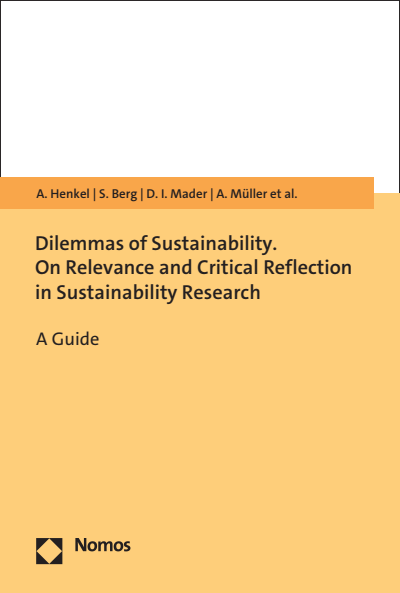
Dilemmas of Sustainability. On Relevance and Critical Reflection in Sustainability Research
A Guide- Autor:innen:
- | | | | | | |
- Verlag:
- 2023
Zusammenfassung
Der Begriff der Nachhaltigkeit verliert zunehmend an Kontur. Vor diesem Hintergrund gibt dieser Leitfaden die Möglichkeit, das jeweils verwendete Verständnis von Nachhaltigkeit in Forschung und Wissenschaft zu reflektieren und damit den konkreten Beitrag zu Nachhaltigkeit, aber auch die verbundenen Grenzen konkret festzustellen. Ausgehend von einem analytischen Nachhaltigkeitsverständnis und der Klärung der Grundstruktur praktischer Dilemmata benennt der Leitfaden typische Konflikte als Ursache von Dilemmata. Meta-Kriterien der Nachhaltigkeit erlauben, Dilemmata-Früherkennung, -Aufklärung und -Bearbeitung zu unterstützen. Diese werden abschließend mittels Reflexionsleitfaden für die Anwendung in konkreten Projektkontexten operationalisiert.
Schlagworte
Publikation durchsuchen
Bibliographische Angaben
- Copyrightjahr
- 2023
- ISBN-Print
- 978-3-7560-1354-8
- ISBN-Online
- 978-3-7489-1882-0
- Verlag
- Nomos, Baden-Baden
- Sprache
- Englisch
- Seiten
- 0
- Produkttyp
- Monographie
Inhaltsverzeichnis
- Titelei/InhaltsverzeichnisSeiten 1 - 4 Download Kapitel (PDF)
- Introductory remarksSeiten 5 - 12 Download Kapitel (PDF)
- ForewordSeiten 13 - 14 Download Kapitel (PDF)
- General acceptance of sustainability
- Sustainability as an empty signifier?
- Resulting challenge for sustainability projects and their funding
- Analytical understanding of sustainability as a “third way”
- Aims of the Guide
- Dilemmas of sustainability
- Early recognition, clarification and processing of dilemmas
- Target group of the guide
- Metacriteria of sustainability
- The basis of this guide
- 2. Instructions for useSeiten 23 - 24 Download Kapitel (PDF)
- 3.1 Sustainability – Analytical understanding of sustainability
- 3.2 Dilemmas – On the basic structure of practical dilemmas
- 3.3.1 Conflicting goals as a potential cause of dilemmas
- 3.3.2 Conflicts of time as a potential cause of dilemmas
- 3.3.3 Conflicts of interest as a potential cause of dilemmas
- 3.3.4 Conflicts between different forms of knowledge as a potential cause of dilemmas
- 3.3.5 Conflicts between different understandings of sustainability as a potential cause of dilemmas
- 3.3.6 Conflicts over responsibility as a potential cause of dilemmas
- 3.3.7 Dilemmas as a touchstone for the feasibility of norms of action
- 3.4.1 Implicit assumptions in the project context
- 3.4.2 Cooperation and participation in inter- and transdisciplinary research projects
- 3.4.3 (Transdisciplinary) research in structures of funding and science
- 3.4.4 Research in the context of social framework conditions
- 3.5 Clarification: Strategic assertion and denial of dilemmas
- 3.6.1 Two basic prerequisites for overcoming dilemmas
- 3.6.2 Processing of dilemmas at the level of obvious objective conditions for action (technical solutions)
- 3.6.3 Processing of dilemmas at the level of obvious subjective premises (justification of trade-offs through rules of prioritisation)
- 3.6.4 Processing of dilemmas at the level of underlying objective conditions for action (change of fundamental social institutions and structures)
- 3.6.5 Processing of dilemmas at the level of underlying subjective premises (change of fundamental values and norms)
- Block A: Reflection on the use of the concept of sustainability and the concept of dilemma
- Block B: Reflecting on one's own premises for action – project planning phase
- 4.1 Metacriterion 1: The understanding of sustainability used in the project is reflected upon with regard to its possibilities and limitations. (Block A)
- Reflection question 1: Is the concept of sustainability used in the project defined?
- Reflection question 2: Does the definition used correspond to one of the classic understandings of sustainability?
- Reflection question 3: Does the project make clear what contribution it wants to make to sustainability in the project's own understanding of sustainability?
- 4.2 Metacriterion 2: The description of the problem and the objectives are reflected upon by all participants as a framework for action. (Block B)
- Reflection question 5: Has an understanding on a common description of a problem taken place between all participants?
- Reflection question 6: Are multiple objectives identified in the project?
- Reflection question 7: In the case of several objectives, is prioritisation carried out and what criteria does it follow?
- 4.3 Metacriterion 3: The forms of knowledge underlying the project with their opportunities and limitations are reflected upon. (Block B)
- Reflection question 9: Is the project based on different scientific knowledge?
- Reflection question 10: Is the project based on non-scientific forms of knowledge?
- Reflection question 11: Are different types of knowledge along the lines of systems-, target-, and transformation knowledge (in the sense of transdisciplinary research) included and adjusted to the un...
- 4.4 Metacriterion 4: Basic decisions and implicit assumptions are reflected upon in the project. (Block B)
- Reflection question 13: Are the basic terms of the call for proposals or the project defined and their meaning and significance reflected upon?
- Reflection question 14: Are implicit assumptions of individual disciplines about the research subject disclosed and communicated transparently in the project network?
- 4.5 Metacriterion 5: The processes and possible tensions of inter- and transdisciplinary cooperation are reflected upon. (Block C)
- Reflection question 16: Are the criteria for selecting the actors involved reflected upon?
- Reflection question 17: Are processes of participation designed in an open and participatory way so that barriers are removed from the outset?
- Reflection question 18: Is it clear who in the project network contributes which competencies and (professional) resources to achieve the objectives?
- Reflection question 19: Are there tensions between the individual objectives of the actors involved in the project?
- Reflection question 20: Are there fixed, regulated communication structures in the project network that enable open, transparent communication between all actors involved?
- 4.6 Metacriterion 6: The policies with regard to time in the project are reflected upon. (Block C)
- Reflection question 22: Are the time resources of the actors involved in the project network known and communicated?
- Reflection question 23: Are the time schedules and processes of the project participants coordinated and communicated?
- 4.7 Metacriterion 7: If attributions of responsibility exist, they are actively reflected upon in terms of their justification, their limitations and their effects. (Block C)
- Reflection question 25: Are attributions of responsibility formulated in the project itself or brought to the project from outside?
- Reflection question 26: What is the relationship between any attribution of responsibility and the project's understanding of sustainability?
- 4.8 Metacriterion 8: A use of the term “dilemma” is actively considered. (Block A)
- Reflection question 28: Is the term “dilemma” used in the research project?
- Reflection question 29: Can a strategic use of the term “dilemma” be identified in critical reflection?
- Reflection question 30: Could the term “dilemma” be used meaningfully in the research project to raise awareness of possible tensions or conflicts?
- Reflection question for funding organisations 1: Does the (maximum) funding period and the amount of funding allow for a transdisciplinary approach in which time and financial resources are available ...
- Reflection question for funding organisations 2: Are the basic terms of the call for proposals defined and their meaning and significance reflected upon?
- Reflection question for funding organisations 3: Does the call for proposals reflect on the relationship between political goals and the current scientific status and discourse on sustainability?
- Reflection question for funding organisations 4: Are the evaluation criteria and procedures of applications tailored to the characteristics of transdisciplinary sustainability research?
- LiteratureSeiten 73 - Download Kapitel (PDF)
Literaturverzeichnis (54 Einträge)
Es wurden keine Treffer gefunden. Versuchen Sie einen anderen Begriff.
- Badmington, Neil ed. (2000): Posthumanism. New York: Palgrave. Google Scholar öffnen DOI: 10.5771/9783748918820
- Bayertz, Kurt (1995): Eine kurze Geschichte der Herkunft der Verantwortung p. 3–71 in K. Bayertz (ed.), Verantwortung. Prinzip oder Problem? Darmstadt: Wissenschaftliche Buchgesellschaft. Google Scholar öffnen DOI: 10.5771/9783748918820
- Bergmann, Matthias / Brohmann, Bettina / Hofmann, Esther / Loibl, M. Céline / Rehaag, Regine / Schramm, Engelbert / Voß, Jan-Peter (2005): Qualitätskriterien transdisziplinärer Forschung. Ein Leitfaden für die formative Evaluation von Forschungsprojekten. ISOE-Studientexte, 13. Frankfurt am Main: ISOE – Institut für sozial-ökologische Forschung. Google Scholar öffnen DOI: 10.5771/9783748918820
- Bergmann, Matthias / Jahn, Thomas (2023): Dilemmata der Nachhaltigkeit – Herausforderungen für die transdisziplinäre Forschungspraxis p. 347–362 in A. Henkel / S. Berg / M. Bermann / H. Gruber / T. Jahn / N. C. Karafyllis / D. Mader / A. Müller / B. Siebenhüner / K. Speck / D.-P. Zorn (eds.), Dilemmata der Nachhaltigkeit. Ba den-Baden: Nomos. Google Scholar öffnen DOI: 10.5771/9783748918820
- Bergmann, Matthias / Jahn, Thomas / Knobloch, Tobias / Krohn, Wolfgang / Pohl, Christian / Schramm, Engelbert (2010): Methoden transdisziplinärer Forschung. Ein Überblick mit Anwendungsbeispielen. Frankfurt am Main: Campus. Google Scholar öffnen DOI: 10.5771/9783748918820
- Bonneuil, Christophe / Fressoz, Jean-Baptiste (2016): The Shock of the Anthropocene: The Earth, History and Us. London: Verso. Google Scholar öffnen DOI: 10.5771/9783748918820
- Carr, David (2012): Educating the virtues: An essay on the philosophical psychology of moral development and education. Routledge. Google Scholar öffnen DOI: 10.5771/9783748918820
- Foster, John (2017): On letting go. Global Discourse 7 (1): 1–17. Google Scholar öffnen DOI: 10.5771/9783748918820
- Galaz, Victor (2012): Geo-engineering, governance, and social-ecological systems: critical issues and joint research needs. Ecology and Society 17. Google Scholar öffnen DOI: 10.5771/9783748918820
- Gottwald, Franz-Theo / Krätzer, Anita (2014): Irrweg Bioökonomie. Kritik an einem totalitären Ansatz. Berlin: Suhrkamp. Google Scholar öffnen DOI: 10.5771/9783748918820
- Grunwald, Armin (2012): Ende einer Illusion. Warum ökologisch korrekter Konsum die Umwelt nicht retten kann. München: Oekom. Google Scholar öffnen DOI: 10.5771/9783748918820
- Hauff, Volker ed.. (1987): Unsere Gemeinsame Zukunft. Der Brundtland-Bericht der Weltkommission für Umwelt und Entwicklung. Greven: Eggenkamp. Google Scholar öffnen DOI: 10.5771/9783748918820
- Heidbrink, Ludger (2006): Grenzen der Verantwortungsgesellschaft: Widersprüche der Verantwortung p. 129–150 in L. Heidbrink / A. Hirsch (eds.), Verantwortung in der Zivilgesellschaft. Frankfurt am Main: Campus. Google Scholar öffnen DOI: 10.5771/9783748918820
- Henkel, Anna (2016): Natur, Wandel, Wissen. Beiträge der Soziologie zur Debatte um nachhaltige Entwicklung. SuN Soziologie und Nachhaltigkeit – Beiträge zur sozial-ökologischen Transformationsforschung 01 (2): 1–23. Google Scholar öffnen DOI: 10.5771/9783748918820
- Henkel, Anna (2020): Genealogie: Verantwortung für Nachhaltigkeit p. 19–32 in T. Barth / A. Henkel (eds.), 10 Minuten Soziologie: Nachhaltigkeit. Bielefeld: transcript. Google Scholar öffnen DOI: 10.5771/9783748918820
- Henkel, Anna / Åkerstrøm-Andersen, Niels (2013 / 2014): Precarious Responsibility. Soziale Systeme, Sonderheft. Google Scholar öffnen DOI: 10.5771/9783748918820
- Henkel, Anna / Bergmann, Matthias / Karafyllis, Nicole C. / Siebenhüner, Bernd / Speck, Karsten (2018): Dilemmata der Nachhaltigkeit zwischen Evaluation und Re flexion. Begründete Kriterien und Leitlinien für Nachhaltigkeitswissen p. 147–172 in N. Lüdtke / A. Henkel (eds.), Das Wissen der Nachhaltigkeit. Herausforderungen zwischen Forschung und Beratung. München: oekom. Google Scholar öffnen DOI: 10.5771/9783748918820
- Henkel, Anna / Luedtke, Nico / Buschmann, Nikolaus / Hochmann, Lars eds. (2018): Reflexive Responsibilisierung. Verantwortung für nachhaltige Entwicklung. Bielefeld: transcript. Google Scholar öffnen DOI: 10.5771/9783748918820
- Hirsch-Hadorn, Gertrude / Hoffmann-Riem, Holger / Biber-Klemm, Susette / Grossenbacher-Mansuy, Walter / Joye, Dominique / Pohl, Christian / Wiesmann, Urs / Zemp, Elisabeth (2008): Emergence of Transdisciplinarity as a Form of Re search p. 19–39 in G. Hirsch Hardon / H. Hoffmann-Riem / S. Biber-Klemm / W. Grossenbacher-Mansuy / D. Joye / C. Pohl / U. Wiesmann / E. Zemp (eds.), Handbook of Transdisciplinary Research. Springer. Google Scholar öffnen DOI: 10.5771/9783748918820
- Hirsch Hadorn, Gertrude / Hoffmann-Riem, Holger / Biber-Klemm, Susette / Grossenbacher-Mansuy, Walter / Joye, Dominique / Pohl, Christian / Wiesmann, Urs / Zempt, Elisabeth eds. (2008): Handbook of Transdisciplinary Research. Berlin: Springer. Google Scholar öffnen DOI: 10.5771/9783748918820
- Hoff, Ernst-H. (1992): Arbeit, Freizeit und Persönlichkeitsentwicklung. Heidelberg: Asanger. Google Scholar öffnen DOI: 10.5771/9783748918820
- Hoff, Ernst-H. / Lecher, Thomas (1995): Ökologisches Verantwortungsbewußtsein p. 213–224, https://doi.org/210.1007/1978-1003-1642-79015-79017_79015 in M.Jänicke / H. J. Bolle / A. Carius (eds.), Umwelt Global. Berlin: Springer. Google Scholar öffnen DOI: 10.5771/9783748918820
- Hoffmann, Sabine / Pohl, Christian / Hering, Janet G. (2017): Methods and proced ures of transdisciplinary knowledge integration: empirical insights from four them atic synthesis processes. Ecology and Society 22 (1): Article 27. https://doi.org/10.5751/ES-08955–220127 Google Scholar öffnen DOI: 10.5771/9783748918820
- Jackson, Tim (2017): Prosperity without growth. Foundations for the economy of tomorrow. London, New York: Routledge. Google Scholar öffnen DOI: 10.5771/9783748918820
- Jahn, Thomas / Bergmann, Matthias / Keil, Florian (2012): Transdisciplinarity: Between mainstreaming and marginalization. Ecological Economics 79 (0): 1–10. https://doi.org/10.1016/j.ecolecon.2012.1004.1017 Google Scholar öffnen DOI: 10.5771/9783748918820
- Jahn, Thomas (2012): Theorie(n) der Nachhaltigkeit? Überlegungen zum Grundverständnis einer “Nachhaltigkeitswissenschaft” p. 47–64 in J. C. Enders / M. R. Remig (eds.), Perspektiven nachhaltiger Entwicklung. Theorien am Scheideweg. Beiträge zur sozialwissenschaftlichen Nachhaltigkeitsforschung. Marburg: Metropolis Verlag. Google Scholar öffnen DOI: 10.5771/9783748918820
- Karrasch, Leena / Grothmann, Torsten / Michel, Theresa A. / Wesselow, Maren / Wolter, Hendrik / Unger, Alexandra / Wegner, Alkje / Giebels, Diana / Siebenhüner, Bernd (2022): Integrating knowledge within and between knowledge types in transdisciplinary sustainability research: Seven case studies and an indicator framework. Environmental Science & Policy 131 (14–25): https://doi.org/https://doi. org/10.1016/j.envsci.2022.1001.1014 Google Scholar öffnen DOI: 10.5771/9783748918820
- Koehler, Gabriele (2016): Tapping the Sustainable Development Goals for progressive gender equity and equality policy? Gender & Development 24: 53–68. Google Scholar öffnen DOI: 10.5771/9783748918820
- Kohlberg, Lawrence (1984): Essays on moral development: The psychology of moral development: Harper & Row. Google Scholar öffnen DOI: 10.5771/9783748918820
- Kohlberg, Lawrence / Kramer, Richard (1969): Continuities and discontinuities in childhood and adult moral development. Human Development 12 (2): 93–120. Google Scholar öffnen DOI: 10.5771/9783748918820
- Kollock, Peter (1998): Social dilemmas: The anatomy of cooperation. Annual Review of Sociology 24: 183–214. Google Scholar öffnen DOI: 10.5771/9783748918820
- Lang, Daniel J. / Wiek, Arnim / Bergmann, M. Matthias / Stauffacher, Michael / Martens, Pim / Mol, Peter / Swilling, Mark / Thomas, Christopher J. (2012): Trans disciplinary research in sustainability science: practice, principles, and challenges. Sustainability Science 7 (Supplement 1): 25–43. Google Scholar öffnen DOI: 10.5771/9783748918820
- Mader, Dimitri (2022): Herrschaft und Handlungsfähigkeit. Elemente einer kritischen Sozialtheorie. Frankfurt: Campus. Google Scholar öffnen DOI: 10.5771/9783748918820
- Mader, Dimitri (2023): Dilemmata der Nachhaltigkeit und die Wiedererlangung von Handlungsfähigkeit. Strategische Dilemma-Bezüge im Nachhaltigkeitsdiskurs und Dilemma-Analyse als Reflexionsmethode p. 25–51 in A. Henkel / S. Berg / M. Ber mann / H. Gruber / N. C. Karafyllis / D. Mader / A. Müller / B. Siebenhüner / K. Speck / D.-P. Zorn (eds.), Dilemmata der Nachhaltigkeit. Baden-Baden: Nomos. Google Scholar öffnen DOI: 10.5771/9783748918820
- Meadows, Dennis / Meadows, Donella / Zahn, Erich (1972): Limits to Growth – A Report for the Club of Rome’s Project on the Predicament of Mankind. London: Potomac Associates – Universe Books. Google Scholar öffnen DOI: 10.5771/9783748918820
- Müller-Christ, Georg (2007): Formen der Bewältigung von Widersprüchen – Die Rechtfertigung von Trade-offs als Kernproblem p. 128–177 in G. Müller-Christ / L. Arndt / I. Ehnert (eds.), Nachhaltigkeit und Widersprüche. Eine Managementper spektive. Münster: Lit Verlag. Google Scholar öffnen DOI: 10.5771/9783748918820
- Müller-Christ, Georg (2011): Sustainable Management. Coping with the Dilemmas of Resource-Oriented Management. Berlin und Heidelberg: Springer. Google Scholar öffnen DOI: 10.5771/9783748918820
- Müller-Christ, Georg (2023): Dilemmaentscheidungen und ihre Trade-offs in Systemaufstellungen visualisieren und verstehen lernen p. 327–345 in A. Henkel / S. Berg / M. Bergmann / H. Gruber / N. Karafyllis / D. Mader / A. Müller / B. Siebenhüner / K. Speck / D.-P. Zorn (eds.), Dilemmata der Nachhaltigkeit. Baden-Baden: Nomos. Google Scholar öffnen DOI: 10.5771/9783748918820
- Müller, Ann-Kristin / Berg, Sophie (2023): Forschungsförderung im Spannungsfeld der Nachhaltigkeit – Eine Analyse von Förderprogrammen der Nachhaltigkeitsfor schung in Deutschland p. 53–72 in A. Henkel / S. Berg / M. Bermann / H. Gruber / N. C. Karafyllis / D. Mader / A. Müller / B. Siebenhüner / K. Speck / D.-P. Zorn (eds.), Dilemmata der Nachhaltigkeit. Baden-Baden: Nomos. Google Scholar öffnen DOI: 10.5771/9783748918820
- Ostrom, Elinor (1998): A behavioral approach to the rational choice theory of collective action. American Political Science Review 92: 1–22. Google Scholar öffnen DOI: 10.5771/9783748918820
- Patt, Anthony / Zeckhauser, Richard (2000): Action Bias and Environmental Decisions. Journal of Risk and Uncertainty 21 (1): 45–72, https://doi.org/10.1023/A:1 026517309871 Google Scholar öffnen DOI: 10.5771/9783748918820
- Pfister, Thomas / Schweighofer, Martin / Reichel, André (2016): Sustainability. London: Routledge. Google Scholar öffnen DOI: 10.5771/9783748918820
- Piaget, Jean (1986, zuerst 1948): Das moralische Urteil beim Kinde. München/Stuttgart: dtv Klett-Cotta. Google Scholar öffnen DOI: 10.5771/9783748918820
- Ribot, Jesse (2014): Cause and response: vulnerability and climate in the Anthropocene. The Journal of Peasant Studies 41 (5): 667–705. Google Scholar öffnen DOI: 10.5771/9783748918820
- Schäpke, Niko / Stelzer, Franziska / Bergmann, Matthias / Singer-Brodowski, Mandy / Wanner, Matthias / Caniglia, Guido / Lang, Daniel J. (2017): Reallabore im Kontext transformativer Forschung: Ansatzpunkte zur Konzeption und Einbettung in den internationalen Forschungsstand IETSR discussion papers in transdisciplinary sus tainability research. Google Scholar öffnen DOI: 10.5771/9783748918820
- Schneidewind, Uwe / Scheck, Hanna (2013): Die Stadt als “Reallabor “für Systeminnovationen p. 229–248 in (eds.), Soziale Innovation und Nachhaltigkeit. Wiesbaden: Springer VS. Google Scholar öffnen DOI: 10.5771/9783748918820
- Simon-Kumar, Rachel / Macbride-Stewart, Sara / Baker, Susan / Patnaik Saxena, Lopa mudra (2017): Towards North-South Interconnectedness: a Critique of Gender Du alistics in Sustainable Development, the Environment and Women's Health. Gender, Work and Organization online first 4 Aug. 2017, doi: 10.1111/gwao.12193. Google Scholar öffnen DOI: 10.5771/9783748918820
- Stevens, Casey / Kanie, Norichika (2016): The transformative potential of the Sustain able Development Goals (SDGs). International Environmental Agreements: Politics, Law and Economics 16: 393–396. Google Scholar öffnen DOI: 10.5771/9783748918820
- Strohschneider, Peter (2014): Zur Politik der Transformativen Wissenschaft p. 175–192 in A. Brodocz / D. Hermann / R. Schmidt / D. Schulz (eds.), Die Verfassung des Politischen. Wiesbaden: Springer. Google Scholar öffnen DOI: 10.5771/9783748918820
- Sustein, Cass R. / Reisch, Lucia A. eds. (2017): The Economics of Nudge. Routledge. Google Scholar öffnen DOI: 10.5771/9783748918820
- Thomson, Judith Jarvis (1976): Killing, letting die, and the trolley problem. The Monist 59 (2): 204–217. Google Scholar öffnen DOI: 10.5771/9783748918820
- Vilsmaier, Ulli / Engbers, Moritz / Luthardt, Philip / Maas-Deipenbrock, Rina Marie / Wunderlich, Sebastian / Scholz, Roland W. (2015): Case-based Mutual Learning Ses sions: knowledge integration and transfer in transdisciplinary processes. Sustainabi lity Science 10 (4): 563–580. https://doi.org/510.1007/s11625-11015-10335-11623 Google Scholar öffnen DOI: 10.5771/9783748918820
- Wagner, Felix / Grunwald, Armin (2019): Reallabore zwischen Beliebtheit und Belie bigkeit: Eine Bestandsaufnahme des transformativen Formats. GAIA-Ecological Per spectives for Science and Society 28 (3): 260–264. Google Scholar öffnen DOI: 10.5771/9783748918820
- Wehling, Peter (2022): Transdisziplinarität und Solutionismus. Ein verfehlter Vorwurf, aus dem sich trotzdem einiges lernen lässt. GAIA 31 (1): 19–23. https://doi.org/10.1451 2/gaia.14531.14511.14516 Google Scholar öffnen DOI: 10.5771/9783748918820