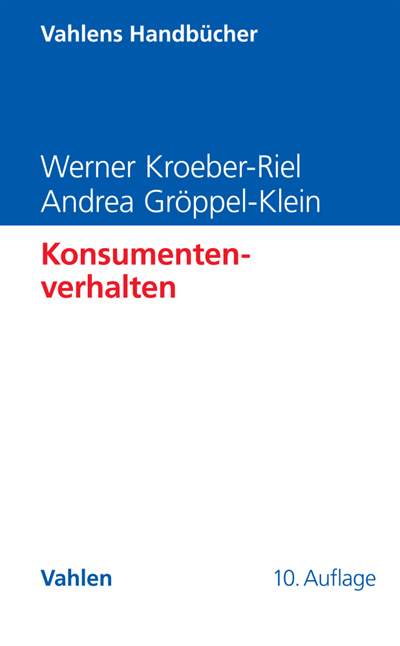
Konsumentenverhalten
- Autor:innen:
- |
- Verlag:
- 2013
Zusammenfassung
Prof. Dr. Werner Kroeber-Riel, Begründer des Instituts für Konsum- und Verhaltensforschung (IKV) an der Universität des Saarlandes. Prof. Dr. Andrea Gröppel-Klein, seit 2006 Direktorin des IKV an der Universität des Saarlandes.
Das als internationales Standardwerk bekannte Buch beschäftigt sich mit der Erklärung und Beeinflussung des Konsumentenverhaltens. Es bietet einen Überblick über theoretische Ansätze und empirische Ergebnisse der Konsumentenforschung. Die 10. Auflage ist in Bezug auf die psychischen Determinanten des Konsumentenverhaltens und die Erfahrungs- und Medienumwelt vollständig überarbeitet und stellt den neuesten Stand der inter-
nationalen Forschung dar.
• Entwicklung, Herausforderungen und Trends der Konsumentenverhaltensforschung
• Aktivierende Prozesse: Aktivierung, Emotion, Motivation und Einstellung
• Kognitive Prozesse: Gedächtnis, Aufnahme, Verarbeitung und Lernen von Informationen
• Das Kaufentscheidungsverhalten der Konsumenten
• Das System der Umweltvariablen: Erfahrungsumwelt und Medienumwelt
• Konsumentenverhalten in unterschiedlichen Lebensphasen
• Konsumentenverhalten am Point-of-Sale
• Wirkungsmuster der Medien und der Massenkommunikation
• Wirkung von klassischer Werbung, Alternativen und Werbevermeidung
• Virtuelle Welten und Social Media
• Die mehrfach erfahrene Umwelt: Vernetzung von Erfahrungs- und Medienumwelt
• Zum Problem der Konsumentensouveränität und Verbraucherdemokratie
• Verbraucherpolitik und Verbraucherschutz
Publikation durchsuchen
Bibliographische Angaben
- Auflage
- 10/2013
- Copyrightjahr
- 2013
- ISBN-Print
- 978-3-8006-4618-0
- ISBN-Online
- 978-3-8006-4619-7
- Verlag
- Vahlen, München
- Reihe
- Vahlens Handbücher der Wirtschafts- und Sozialwissenschaften
- Sprache
- Deutsch
- Seiten
- 908
- Produkttyp
- Monographie
Inhaltsverzeichnis
- Titelei/Inhaltsverzeichnis Kein Zugriff Seiten 1 - 26
- A. Die Entwicklung der Konsumentenforschung Kein Zugriff Seiten 27 - 36
- B. Einführung in die Verhaltenswissenschaften und aktuelle Trends Kein Zugriff Seiten 36 - 49
- I. Zum Entdeckungszusammenhang: Konsumentenforschung im Wandel Kein Zugriff Seiten 49 - 57
- II. Zum Begründungszusammenhang: Empirische Verankerung verhaltenswissenschaftlicher Theorien Kein Zugriff Seiten 57 - 64
- III. Zum Verwendungszusammenhang: Forschungstransfer mittels Sozialtechnik Kein Zugriff Seiten 64 - 73
- A. Das System der psychischen Variablen Kein Zugriff Seiten 73 - 78
- I. Grundbegriffe Kein Zugriff Seiten 78 - 84
- II. Aktivierung Kein Zugriff Seiten 84 - 123
- III. Emotion Kein Zugriff Seiten 123 - 201
- IV. Motivation Kein Zugriff Seiten 201 - 255
- V. Einstellung Kein Zugriff Seiten 255 - 327
- I. Einführung Kein Zugriff Seiten 327 - 329
- II. Das Gedächtnis Kein Zugriff Seiten 329 - 360
- III. Aufnahme von Informationen Kein Zugriff Seiten 360 - 386
- IV. Verarbeitung von Informationen Kein Zugriff Seiten 386 - 432
- V. Lernen von Informationen Kein Zugriff Seiten 432 - 481
- I. Das Zusammenwirken von aktivierenden und kognitiven Prozessen Kein Zugriff Seiten 481 - 490
- II. Entscheidungen mit überwiegender kognitiver Kontrolle Kein Zugriff Seiten 490 - 508
- III. Entscheidungen mit geringer kognitiver Kontrolle Kein Zugriff Seiten 508 - 520
- A. Das System der Umweltvariablen: Erfahrungsumwelt und Medienumwelt Kein Zugriff Seiten 520 - 527
- I. Die physische Umwelt der Konsumenten Kein Zugriff Seiten 527 - 543
- II. Die nähere soziale Umwelt Kein Zugriff Seiten 543 - 653
- III. Die weitere soziale Umwelt der Konsumenten Kein Zugriff Seiten 653 - 674
- I. Die zweite Wirklichkeit der Konsumenten Kein Zugriff Seiten 674 - 677
- II. Wirkungsmuster der Medien Kein Zugriff Seiten 677 - 693
- III. Werbung als Massenkommunikation Kein Zugriff Seiten 693 - 738
- IV. Virtuelle Welten und Neue Medien Kein Zugriff Seiten 738 - 746
- V. Die mehrfach erfahrene Umwelt Kein Zugriff Seiten 746 - 762
- A. Zum Problem der Konsumentensouveränität und zum Leitbild der Verbraucherdemokratie Kein Zugriff Seiten 762 - 770
- I. Einrichtungen der Verbraucherpolitik Kein Zugriff Seiten 770 - 774
- II. Relevanz der bisherigen Verbraucherpolitik und Ableitung von Zielen Kein Zugriff Seiten 774 - 777
- III. Verhaltenswissenschaftliche Studien mit Verbraucherschutzrelevanz Kein Zugriff Seiten 777 - 786
- Literaturverzeichnis Kein Zugriff Seiten 786 - 892
- Stichwortverzeichnis Kein Zugriff Seiten 892 - 908
- Impressum Kein Zugriff Seiten 908 - 908
Literaturverzeichnis (2804 Einträge)
Es wurden keine Treffer gefunden. Versuchen Sie einen anderen Begriff.
- Aaker, D. A./Bruzzone, D. E. (1981): Viewer Perceptions of Prime-time Television Advertising, in: Journal of Advertising Research, Jg. 21, Nr. 5, S. 15–23. Google Scholar öffnen DOI: 10.15358/9783800646197
- Aaker, D. A./Stayman, D. M./Hagerty, M. R. (1986): Warmth in Advertising: Measurement, Impact, and Sequence Effects, in: Journal of Consumer Research, Jg. 12, Nr. 4, S. 365–381. Google Scholar öffnen DOI: 10.15358/9783800646197
- Aaker, J. L./Lee, A. Y. (2001): “I” Seek Pleasures and “We” Avoid Pains: The Role of Self Regulatory Goals in Information Processing and Persuasion, in: Journal of Consumer Research, Jg. 28, Nr. 1, S. 33–49. Google Scholar öffnen DOI: 10.15358/9783800646197
- Aaker, J./Drolet, A./Griffin, D. (2008): Recalling Mixed Emotions, in: Journal of Consumer Research, Jg. 35, Nr. 35, S. 268–278. Google Scholar öffnen DOI: 10.15358/9783800646197
- Aaker, J./Fournier, S./Brasel, S. A. (2004): When Good Brands Do Bad, in: Journal of Consumer Research, Jg. 31, Nr. 1, S. 1–16. Google Scholar öffnen DOI: 10.15358/9783800646197
- Abdulla, R. A./Garrison, B./Salwen, M./Driscoll, P./Casey, D. (2002): The credibility of newspapers, television news, and online news (Annual Convention of the Mass Communication and Society Division of the Association for Education in Journalism and Mass Communication). Google Scholar öffnen DOI: 10.15358/9783800646197
- Miami Beach, FL. Online verfügbar unter http://com.miami.edu/car/miamibeach1.htm, zuletzt geprüft am 05.04.2007. Google Scholar öffnen DOI: 10.15358/9783800646197
- Abelson, R. P. (1981): Psychological Status of the Script Concept, in: American Psychologist, Jg. 36, Nr. 7 , S. 715–729. Google Scholar öffnen DOI: 10.15358/9783800646197
- Aberg, L. (1991): Facet Theory of Communication. Arbeitspapier der Universität Helsinki, H e l s in ki . Google Scholar öffnen DOI: 10.15358/9783800646197
- Abraham, A./Schubotz, R. I./von Cramon, D. Y. (2008): Thinking about the future versus the past in personal and non-personal contexts, in: Brain Research, 1233, S. 106–119. Google Scholar öffnen DOI: 10.15358/9783800646197
- Abraham, A./von Cramon, D. Y. (2009): Reality = Relevance? Insights from spontaneous modulations of the brain’s default network when telling apart reality from fiction, in: PLoS ONE, Jg. 4, Nr. 3, S. e4741. Google Scholar öffnen DOI: 10.15358/9783800646197
- Acker, F. (2008): New findings on unconscious versus conscious thought in decision making: Additional empirical data and meta-analysis, in: Judgment and Decision Making, Jg. 3, Nr. 4, S. 292–303. Google Scholar öffnen DOI: 10.15358/9783800646197
- ACTA-Studie (2012): Handel 3.0. Dynamische Veränderung des Handels. Online verfügbar unter http://www.ifd-allensbach.de/fileadmin/ACTA/ACTA_Praesentationen/2012/ACTA2012_ Koecher.pdf, zuletzt geprüft am 20.05.2013. Google Scholar öffnen DOI: 10.15358/9783800646197
- Adamski, A. (2011): Archetypes and the Collective Unconscious of Carl G. Jung in the Light of Quantum Psychology, in: NeuroQuantology, Jg. 9, Nr. 3, S. 563–571. Google Scholar öffnen DOI: 10.15358/9783800646197
- Adolphs, R. (2006): Physiologie und Anatomie der Emotionen, in: Karnath, H.-O./Thier, P. (Hrsg.): Neuropsychologie. 2. aktualisierte und erweiterte Auflage. Heidelberg, S. 535–544. Google Scholar öffnen DOI: 10.15358/9783800646197
- Adt, P. (1983): Untersuchungen zur Wirkung von Schlagermusik. Arbeitspapier des Instituts für Konsum- und Verhaltensforschung an der Universität des Saarlandes, Saarbrücken. Google Scholar öffnen DOI: 10.15358/9783800646197
- ag.ma (2008): Plakat. Arbeitsgemeinschaft Media-Analyse e.V. Online verfügbar unter http:// www.agma-mmc.net/03_forschung/plakat.asp?topnav=10&subnav=199, zuletzt geprüft am 27.7.2008. Google Scholar öffnen DOI: 10.15358/9783800646197
- Aggarwal, P./McGill, A. L. (2012): When Brands Seem Human, Do Human Act Like Brands? Automatic Behavioral Priming Effects of Brand Anthropomorphism, in: Journal of Consumer Research, Jg. 39, Nr. 2, S. 307–323. Google Scholar öffnen DOI: 10.15358/9783800646197
- Agrawal, N./Duhachek, A. (2010): Emotional Compatibility and the Effectiveness of Antidrinking Messages: A Defensive Processing Perspective on Shame and Guilt, in: Journal of Marketing Research, Jg. 47, Nr. 2, S. 263–273. Google Scholar öffnen DOI: 10.15358/9783800646197
- Ahlert, D./Hubert, M. (2010): Consumer Neuroscience – Anwendung und Nutzen neurowissenschaftlicher Mess- und Analysemethoden in der Konsumentenverhaltensforschung, in: 767 Bruhn, M./Köhler, R. (Hrsg.): Wie Marken wirken. Impulse aus der Neuroökonomie für die Markenführung. München, S. 59–74. Google Scholar öffnen DOI: 10.15358/9783800646197
- Ahrholdt, D. C. (2011): Empirical Identification of Success-Enhancing Web Site Signals in E-Tailing: An Analysis Based on Known E-Tailers and the Theory of Reasoned Action, in: The Journal of Marketing Theory and Practice, Jg. 19, Nr. 4, S. 441–458. Google Scholar öffnen DOI: 10.15358/9783800646197
- Ahtola, O. T. (1975): The Vector Model of Preferences: An Alternative to the Fishbein Model, in: Journal of Marketing Research, Jg. 12, Nr. 1, S. 52–59. Google Scholar öffnen DOI: 10.15358/9783800646197
- Ajzen, I. (1985): From intentions to actions: a theory of planned behavior, in: Kuhl, J./Beckman, J. (Hrsg.): Action control: from cognition to behavior. Berlin et al., S. 11–39. Google Scholar öffnen DOI: 10.15358/9783800646197
- Ajzen, I. (1987): Attitudes, traits, and actions: dispositional prediction of behavior in personality and social psychology, in: Berkowitz, L. (Hrsg.): Advances in Experimental Social Psychology (Vol. 20). New York, S. 1–63. Google Scholar öffnen DOI: 10.15358/9783800646197
- Ajzen, I. (1991): The theory of planned behavior, in: Organizational Behavior and Human Decision Processes, Jg. 50, Nr. 2, S. 179–211. Google Scholar öffnen DOI: 10.15358/9783800646197
- Ajzen, I. (1996): The Directive Influence of Attitudes on Behavior, in: Gollwitzer, P. M./Bargh, J. Google Scholar öffnen DOI: 10.15358/9783800646197
- A. (Hrsg.): The psychology of action. Linking cognition and motivation to behavior. New York, S. 385–403. Google Scholar öffnen DOI: 10.15358/9783800646197
- Ajzen, I. (2002): Perceived behavioral control, self-efficacy, locus of control, and the theory of planned behavior, in: Journal of Applied Social Psychology, Jg. 32, Nr. 4, S. 665–683. Google Scholar öffnen DOI: 10.15358/9783800646197
- Ajzen, I./Czasch, C./Flood, M. G. (2009): From Intentions to Behavior: Implementation Intention, Commitment, and Conscientiousness, in: Journal of Applied Social Psychology, Jg. 39, Nr. 6, S. 1356–1372. Google Scholar öffnen DOI: 10.15358/9783800646197
- Ajzen, I./Fishbein, M. (1973): Attitudinal and Normative Variables as Predictors of Specific Behavior, in: Journal of Personality and Social Psychology, Jg. 27, Nr. 1, S. 41–57. Google Scholar öffnen DOI: 10.15358/9783800646197
- Ajzen, I./Joyce, N./Sheikh, S./Gilbert Cote, N. (2011). Knowledge and the prediction of behavior: The role of information accuracy in the theory of planned behavior, in: Basic and Applied Social Psychology, Jg. 33, Nr. 2, S. 101–117. Google Scholar öffnen DOI: 10.15358/9783800646197
- Ajzen, I./Madden, T. J. (1986): Prediction of goal-directed behaviour: attitudes, intentions, and perceived behavioral control, in: Journal of Experimental Social Psychology, Jg. 22, Nr. 5, S. 453–474. Google Scholar öffnen DOI: 10.15358/9783800646197
- Alba, J. W./Hutchinson, J. W. (1987): Dimensions of consumer expertise, in: Journal of Consumer Research, Jg. 13, Nr. 4, S. 411–454. Google Scholar öffnen DOI: 10.15358/9783800646197
- Alba, J. W./Hutchinson, J. W. (2000): Knowledge Calibration: What Consumers Know and What They Think They Know, in: Journal of Consumer Research, Jg. 27, Nr. 2, S. 123–156. Google Scholar öffnen DOI: 10.15358/9783800646197
- Alba, J. W./Hutchinson, J. W./Lynch, J. G. (1991): Memory and Decision Making, in: Robertson, T. S./Kassarjian, H. H. (Hrsg.): Handbook of Consumer Behavior. Englewood Cliffs, NJ, S. 1–49. Google Scholar öffnen DOI: 10.15358/9783800646197
- Alba, J. W./Marmorstein, H. (1987): The Effects of Frequency Knowledge on Consumer Decision Making, in: Journal of Consumer Research, Jg. 14, Nr. 1, S. 14–25. Google Scholar öffnen DOI: 10.15358/9783800646197
- Alba, J. W./Mela, C. F./Shimp, T. A./Urbany, J. E. (1999): The Effect of Discount Frequency and Depth on Consumer Price Judgments, in: Journal of Consumer Research, Jg. 26, Nr. 2, S. 99–114. Google Scholar öffnen DOI: 10.15358/9783800646197
- Albach, H. (1961): Werbung, in: Beckerath, E. von/Brinkmann, C./Bente, H. (Hrsg.): Handwörterbuch der Sozialwissenschaften, Band 11. Stuttgart, S. 624–632. Google Scholar öffnen DOI: 10.15358/9783800646197
- Alden, D. L./Hoyer, W. D./Lee, C. (1993): Identifying Global and Culture-Specific Dimensions of Humor in Advertising: A Multinational Analysis, in: Journal of Marketing, Jg. 57, Nr. 2, S. 64–75. Google Scholar öffnen DOI: 10.15358/9783800646197
- Allard, A./Babin, B. J./Chebat, J.-C. (2009): When income matters: customers evaluation of shopping malls' hedonic and utilitarian orientations, in: Journal of retailing and consumer services, Jg. 16, Nr. 1, S. 40–49. Google Scholar öffnen DOI: 10.15358/9783800646197
- Allport, G. W. (1935): Attitudes, in: Murchison, C. (Hrsg.): Handbook of Social Psychology. Worcester, Mass., S. 798–844. Google Scholar öffnen DOI: 10.15358/9783800646197
- Alter, A./Oppenheimer, D. M. (2008): Effects of Fluency on Psychological Distance and Mental Construal, in: Psychological Science, Jg. 19, Nr. 2, S. 161–167. Google Scholar öffnen DOI: 10.15358/9783800646197
- Amatulli, C./Guido, G. (2011): Determinants of purchasing intention for fashion luxury goods in the Italian market: A laddering approach, in: Journal of Fashion Marketing and Management, Jg. 15, Nr. 1, S. 123–136. Google Scholar öffnen DOI: 10.15358/9783800646197
- Ambler, T. (2000): Persuasion, pride and prejudice: how ads work, in: International Journal of Advertising, Jg. 19, Nr. 3, S. 299–315. Google Scholar öffnen DOI: 10.15358/9783800646197
- Ambler, T./Burne, T. (1999): The Impact of Affect on Memory of Advertising, in: Journal of Advertising Research, Jg. 39, Nr. 2, S. 25–34. Google Scholar öffnen DOI: 10.15358/9783800646197
- 768 Amos, C./Holmes, G./Strutton, D. (2008): Exploring the relationship between celebrity endorser effects and advertising effectiveness, in: International Journal of Advertising, Jg. 27, Nr. 2, S. 209–234. Google Scholar öffnen DOI: 10.15358/9783800646197
- An, S./Stern, S. (2011): Mitigating the effects of advergames on children, in: Journal of Advertising, Jg. 40, Nr. 1, S. 43–56. Google Scholar öffnen DOI: 10.15358/9783800646197
- Anastasi, A. (1976): Angewandte Psychologie. 2. Aufl. Weinheim. Google Scholar öffnen DOI: 10.15358/9783800646197
- Anders, F. (2005): Berlin beugt Vogelgrippe vor. Jedoch Kritik an mangelnden Vorkehrungen auf dem Flughafen Tegel für den Fall einer Pandemie, in: Die Welt, Ausgabe 246-42 (21.10.2005), S. 37. Online verfügbar unter http://appl3.welt.de/media/download/7ed1472ab87163114df6 98a475da0748/2005-10-21_archiv_37.pdf., zuletzt geprüft am 15.10.2007. Google Scholar öffnen DOI: 10.15358/9783800646197
- Anderson, H. H./Anderson, G. M. (1951): An introduction to projective techniques & other devices for understanding the dynamics of human behavior. New York. Google Scholar öffnen DOI: 10.15358/9783800646197
- Anderson, J. R. (2007): Kognitive Psychologie. 6. Aufl. Berlin, Heidelberg et al. Andersson, P. K./Kristensson, P./Wästlund, E./Gustafsson, A. (2012): Let the music play … or Not: The Influence of Backgorund Music on Consumer Behavior, in: Journal of Reataling and Consumer Services, Jg. 19, Nr. 6, S. 553–560. Google Scholar öffnen DOI: 10.15358/9783800646197
- Andrade, E. B./Cohen, J. B. (2007): On the Consumption of Negative Feelings, in: Journal of Consumer Research, Jg. 34, Nr. 3, S. 283–300. Google Scholar öffnen DOI: 10.15358/9783800646197
- Andreasen, A. R./Kotler, P. (2008): Strategic marketing for nonprofit organizations. 7. Aufl. Upper Saddle River, NJ. Google Scholar öffnen DOI: 10.15358/9783800646197
- Andreasen, A. A. (1984): Life Status Changes and Changes in Consumer Preferences and Satisfaction, in: Journal of Consumer Research, Jg. 11, Nr. 3, S. 784–794. Google Scholar öffnen DOI: 10.15358/9783800646197
- Andresen, T. B. (1988): Anzeigenkontakt und Informationsüberschuß – eine empirische Untersuchung über die Determinanten des Anzeigenkontaktes in Publikumszeitschriften mit Hilfe der Blickaufzeichnung. Wirtschaftswissenschaftliche Dissertation. Saarbrücken. Google Scholar öffnen DOI: 10.15358/9783800646197
- Universität des Saarlandes. Google Scholar öffnen DOI: 10.15358/9783800646197
- Andrews, J. C./Netemeyer, R. G./Burton, S. (1998): Consumer Generalization of Nutrient Content Claims in Advertising, in: Journal of Marketing, Jg. 62, Nr. 4, S. 62–75. Google Scholar öffnen DOI: 10.15358/9783800646197
- Andritzky, K. (1972): OLISSA – Erste Marke in einem anonymen Markt. Deutsche Unilever GmbH. Google Scholar öffnen DOI: 10.15358/9783800646197
- Angerer, T. (2004): Beziehungsanalyse in Verkaufsgesprächen. Ergebnisse einer empirischen Transaktionsanalyse, in: Marketing – Zeitschrift für Forschung und Praxis, Jg. 26, Nr. 4, S. 297–318. Google Scholar öffnen DOI: 10.15358/9783800646197
- Angie, A. D./Connelly, S./Waples, E. P./Kligyte, V. (2011): The influence of discrete emotions on judgement and decision-making: A meta-analytic review, in: Cognition and Emotion, Jg. 25, Nr. 8, S. 1393–1422. Google Scholar öffnen DOI: 10.15358/9783800646197
- Anhut, R./Heitmeyer, W. (2005): Desintegration, Anerkennungsbilanzen und die Rolle sozialer Vergleichsprozesse für unterschiedliche Verarbeitungsmuster von Prekarität, in: Heitmeyer, W./Imbusch, P. (Hrsg.): Integrationspotenziale moderner Gesellschaften. Wiesbaden, S. 75–100. Google Scholar öffnen DOI: 10.15358/9783800646197
- Anhut, R./Heitmeyer, W. (2009): Desintegration, Anerkennungsbilanzen und die Rolle sozialer Vergleichsprozesse für unterschiedliche Verarbeitungsmuster, in: Preyer, G. (Hrsg.): Neuer Mensch und kollektive Identität in der Kommunikationsgesellschaft. Wiesbaden, S. 212–236. Google Scholar öffnen DOI: 10.15358/9783800646197
- Ansorge, U./Leder, H. (2011): Wahrnehmung und Aufmerksamkeit. Wiesbaden. Google Scholar öffnen DOI: 10.15358/9783800646197
- Antonides, G./van Raaij, W. F. (1998): Consumer behaviour. A European perspective. New York, NY. Google Scholar öffnen DOI: 10.15358/9783800646197
- Antonides, G./van Raaij, W. F./Maital, S. (Hrsg.) (1997): Advances in Economic Psychology. New York, NY et al. Appel, M. (2008): Fictional Narratives Cultivate Just-World Beliefs, in: Journal of Communication, Jg. 58, Nr. 1, S. 62–83. Google Scholar öffnen DOI: 10.15358/9783800646197
- Appel, V. (1971): On Advertising Wear-out, in: Journal of Advertising Research, Jg. 11, Nr. 1, S. 11–13. Google Scholar öffnen DOI: 10.15358/9783800646197
- Appleton-Knapp, S. L./Bjork, R. A./Wickens, T. D. (2005): Examining the Spacing Effect in Advertising: Encoding Variability, Retrieval Processes, and Their Interaction, in: Journal of Consumer Research, Jg. 32, Nr. 2, S. 266–276. Google Scholar öffnen DOI: 10.15358/9783800646197
- ARD-Forschungsdienst (2007): Nutzung und Funktionen neuer Medien bei Kindern und Jugendlichen, in: Media Perspektiven, Nr. 10, S. 529–534. Google Scholar öffnen DOI: 10.15358/9783800646197
- ARD-Forschungsdienst (2008): Zuschauerforschung: Unterhaltung im Fernsehen, in: Media Perspektiven, Nr. 4, S. 215–221. Google Scholar öffnen DOI: 10.15358/9783800646197
- ARD-Forschungsdienst (2013): Zuschauerforschung: Nachrichtensendung, Pressemitteilung vom 05.02.2013. Google Scholar öffnen DOI: 10.15358/9783800646197
- 769 ARD Mediennutzung (2012): Mediennutzung und Freizeitbeschäftigung 2012. Online verfügbar unter http://www.ard.de/intern/medienbasisdaten/mediennutzung/mediennutzung_20 und_20freizeitbesch_26_23228_3Bfti/-/id=54992/15w2mhl/index.html, zuletzt geprüft am 23.05.2013. Google Scholar öffnen DOI: 10.15358/9783800646197
- Areni, C. S./Cox, K. C. (1994): The Persuasive Effects of Evaluation, Expectancy and Relevancy Dimensions of Incongruent Visual and Verbal Information, in: Allen, C. T./Roedder John, D. (Hrsg.): Advances in Consumer Research (Vol. 21), Provo, UT, S. 337–342. Google Scholar öffnen DOI: 10.15358/9783800646197
- Areni, C. S./Kim, D. (1993): The influence of background music on shopping behavior: Classical versus top-forty music in a wine-store, in: McAlister, L./Rothschild, M. L. (Hrsg.): Advances in Consumer Research (Vol. 20), Provo, UT, S. 336–340. Google Scholar öffnen DOI: 10.15358/9783800646197
- Argo, J. J./Dahl, D. W./Manchanda, R. V. (2005): The influence of a mere social presence in a retail context, in: Journal of Consumer, Jg. 32, Nr. 2, S. 207–212. Google Scholar öffnen DOI: 10.15358/9783800646197
- Argo, J. J./Dahl, D. W./Morales, A. C. (2006): Consumer Contamination: How Consumers React to Products Touched by Others, in: Journal of Marketing, Jg. 70, Nr. 2, S. 81–94. Google Scholar öffnen DOI: 10.15358/9783800646197
- Argo, J. J./Dahl, D. W./Morales, A. C. (2008): Positive Consumer Contagion: Responses to Attractive Others in a Retail Context, in: Journal of Marketing Research: Jg. 45, Nr. 6, S. 690–701. Google Scholar öffnen DOI: 10.15358/9783800646197
- Argo, J. J./Main, K. J. (2004): Meta-Analyses of the Effectiveness of Warning Labels, in: Journal of Public Policy & Marketing, Jg. 23, Nr. 2, S. 193–208. Google Scholar öffnen DOI: 10.15358/9783800646197
- Argo, J. J./Popa, M./Smith, M. C. (2010): The Sound of Brands, in: Jour-nal of Marketing, Jg. 74, Nr. 4, S. 97–109. Google Scholar öffnen DOI: 10.15358/9783800646197
- Argyle, M. (1992): The Social Psychology of Everyday Life. London et al. Argyle, M. (2005): Körpersprache und Kommunikation. 9. Aufl. Paderborn. Google Scholar öffnen DOI: 10.15358/9783800646197
- Argyle, M./Trower, P. (1981): Signale von Mensch zu Mensch. Weinheim et al. Argyriou, E./Melewar, T. C. (2011): Consumer Attitudes Revisited: integration of approaches to attitude formation, in: International Journal of Management Reviews, Jg. 13, Nr. 4, S. 431–451. Google Scholar öffnen DOI: 10.15358/9783800646197
- Ariely, D./Berns, G. S. (2010): Neuromarketing: the hope and hype of neuroimaging in business, in: Nature Reviews Neuroscience, Jg. 11, Nr. 4, S. 284–292. Google Scholar öffnen DOI: 10.15358/9783800646197
- Arnhold, K. (2003): Digital divide. Zugangs- oder Wissenskluft?. München. Google Scholar öffnen DOI: 10.15358/9783800646197
- Arnold, W./Eysenck, H. J./Meili, R. (1997): Lexikon der Psychologie. 3 Bände. Augsburg. Google Scholar öffnen DOI: 10.15358/9783800646197
- Arnould, E. J./Price, L. L. (2000): Authenticating Acts and Authoritative Performances: Questing for Self and Community, in: Huffman, C./Ratneswar, S./Mick, D. G. (Hrsg.): The Why of Consumption: Contemporary Perspectives on Consumer Motives. New York, S. 140–163. Google Scholar öffnen DOI: 10.15358/9783800646197
- Arnould, E. J./Thompson, C. J. (2005): Consumer Culture Theory (CCT): Twenty Years of Research, in: Journal of Consumer Research, Jg. 31, Nr. 4, S. 868–882. Google Scholar öffnen DOI: 10.15358/9783800646197
- Aronson, E. (1978): The Theory of Cognitive Dissonance, in: Berkowitz, L. (Hrsg.): Cognitive Theories in Social Psychology. New York et al., S. 181–220. Google Scholar öffnen DOI: 10.15358/9783800646197
- Aronson, E. (1994): Sozialpsychologie. Menschliches Verhalten und gesellschaftlicher Einfluss. Google Scholar öffnen DOI: 10.15358/9783800646197
- Heidelberg. Google Scholar öffnen DOI: 10.15358/9783800646197
- Aronson, E./Wilson, T. D./Akert, R. M. (1998): Social psychology. 3. Aufl. New York. Google Scholar öffnen DOI: 10.15358/9783800646197
- Aronson, E./Wilson, T. D./Akert, R. M. (2010): Social psychology. 7. Aufl. New York. Google Scholar öffnen DOI: 10.15358/9783800646197
- Asch, S. E. (1946): Forming impressions of personality, in: Journal of Abnormal and Social Psychology, Jg. 41, Nr. 3, S. 258–290. Google Scholar öffnen DOI: 10.15358/9783800646197
- Asch, S. E. (1951): Effects of Group Pressure Upon the Modification and Distortion of Judgement, in: Guetzkow, H. (Hrsg.): Group, Leadership, and Men. Pittsburgh, S. 177–190. Google Scholar öffnen DOI: 10.15358/9783800646197
- Aschemann-Witzel, J./Hamm, U. (2011): Measuring Consumers‘ Information Acquisition and Decision Behavior With the Computer-Based Information-Display-Matrix, in: Methodology, Jg. 7 , Nr. 1, S. 1–10. Google Scholar öffnen DOI: 10.15358/9783800646197
- Aschenbrenner, K. M. (1980): Kaufentscheidung, in: Hoyos, C./Kroeber-Riel, W./Rosenstiel, L. von/ Strümpel, B. (Hrsg.): Grundbegriffe der Wirtschaftspsychologie. Gesamtwirtschaft – Markt – Organisation – Arbeit. München, S. 151–161. Google Scholar öffnen DOI: 10.15358/9783800646197
- Asendorpf, J./Banse, R. (2000): Psychologie der Beziehung. Bern. Google Scholar öffnen DOI: 10.15358/9783800646197
- Assael, H. (1998): Consumer behavior and marketing action. 6. Aufl. Cincinnati, Ohio. Google Scholar öffnen DOI: 10.15358/9783800646197
- Atalay, A. S./Bodur, H. O./Rasolofoarison, D. (2012): Shining in the Center: Central Gaze Cascade Effect on Product Choice, in: Journal of Consumer Research, Jg. 39, Nr. 4, S. 848–866. Google Scholar öffnen DOI: 10.15358/9783800646197
- Atkin, C. K. (1978): Observation of Parent-Child Interaction in Supermarket Decision-Making, in: Journal of Marketing, Jg. 42, Nr. 4, S. 41–45. Google Scholar öffnen DOI: 10.15358/9783800646197
- Atkinson, J. W. (1975): Einführung in die Motivationsforschung. Stuttgart. Google Scholar öffnen DOI: 10.15358/9783800646197
- Atkinson, R. C./Shiffrin, R. M. (1968): Human Memory: A Proposed System and Its Control Processes, in: Spence, K. W./Spence, J. T. (Hrsg.): The Psychology of Learning and Motivation: Advances in Research and Theory (2). New York et al., S. 89–195. Google Scholar öffnen DOI: 10.15358/9783800646197
- 770 Atkinson, R. C./Shiffrin, R. M. (1971): The control of short-term memory, in: Scientific American, Jg. 225, Nr. 2, S. 82–90. Google Scholar öffnen DOI: 10.15358/9783800646197
- Atteslander, P. (2006): Methoden der empirischen Sozialforschung. 10. Aufl. Berlin. Google Scholar öffnen DOI: 10.15358/9783800646197
- Atwal, G./Williams, A. (2009): Luxury brand marketing – The experience is everything!, in: Journal of Brand Management, Jg. 16, S. 338–346. Google Scholar öffnen DOI: 10.15358/9783800646197
- Autio, M./Wilska, T.-A./Kaartinen, R./Lähteenmaa, J. (2009): The use of small instant loans among young adults – a gateway to a consumer insolvency, in: International Journal of Consumer Studies, Jg. 33, Nr. 4, S. 407–415. Google Scholar öffnen DOI: 10.15358/9783800646197
- Auty, S./Elliott, R. (2001): Being Like or Being Liked: Identity vs. Approval in a Social Context, in: Gilly, M. C./Meyers-Levy, J. (Hrsg.): Advances in Consumer Research (Vol. 28). Valdosta, GA, S. 235–241. Google Scholar öffnen DOI: 10.15358/9783800646197
- Averill, J. R. (1983): Studies on Anger and Aggression: Implications for Theories of Emotion, in: American Psychologist, Jg. 38, S. 1145–1162. Google Scholar öffnen DOI: 10.15358/9783800646197
- Aziz, R. (1990): C. G. Jung’s Psychology of Religion and Synchronicity. New York. Google Scholar öffnen DOI: 10.15358/9783800646197
- B Babin, B. J./Darden, W. R./Griffin, M. (1994): Work and/or Fun: Measuring Hedonic and Utilitarian Shopping Value, in: Journal of Consumer Research, Jg. 20, Nr. 4, S. 644–656. Google Scholar öffnen DOI: 10.15358/9783800646197
- Babin, B. J./Hardesty, D. M./Suter, T. A. (2003): Color and shopping intentions: The intervening effect of price fairness and perceived affect, in: Journal of Business Research, Jg. 56, Nr. 7, S. 541–551. Google Scholar öffnen DOI: 10.15358/9783800646197
- Babin, L. A./Burns, A. C. (1998): A modified scale for the measurement of communication-evoked mental imagery, in: Psychology and Marketing, Jg. 15, Nr. 3, S. 261–278. Google Scholar öffnen DOI: 10.15358/9783800646197
- Backhaus, K. (Hrsg.) (2000): Deutschsprachige Marketingforschung. Bestandsaufnahme und Perspektiven. Stuttgart: Schäffer-Poeschel. Google Scholar öffnen DOI: 10.15358/9783800646197
- Backhaus, K./Erichson, B./Plinke, W,/Weiber, R. (2011): Multivariate Analysemethoden – Eine anwendungsorientierte Einführung. Berlin. Google Scholar öffnen DOI: 10.15358/9783800646197
- Backhaus, K./Kleinschmidt, M./Vollmer, B. (1983): Die Stimmfrequenz. Ein erfolgversprechender Aktivierungsindikator bei der Analyse von Verhandlungsprozessen im InvestitionsgüterMarketing?, in: Marketing – Zeitschrift für Forschung und Praxis, Jg. 5, Nr. 2, S. 113–121. Google Scholar öffnen DOI: 10.15358/9783800646197
- Baddeley, A. D. (1986): Working memory. Oxford. Google Scholar öffnen DOI: 10.15358/9783800646197
- Baddeley, A. D. (2000): The episodic buffer: a new component of working memory?, in: Trends in Cognitive Sciences, Jg. 4, Nr. 11, S. 417–423. Google Scholar öffnen DOI: 10.15358/9783800646197
- Baddeley, A. D. (2003): Working Memory: Looking back and looking forward, in: Nature Reviews Neuroscience, Jg. 4, S. 829–839. Google Scholar öffnen DOI: 10.15358/9783800646197
- Bagozzi, R. P. (1982): A Field Investigation of Causal Relations Among Cognitions, Affect, Intentions, and Behavior, in: Journal of Marketing Research, Jg. 19, Nr. 4, S. 562–583. Google Scholar öffnen DOI: 10.15358/9783800646197
- Bagozzi, R. P. (1991): The Role of Psychophysiology in Consumer Research, in: Robertson, T. S./ Kassarjian, H. H. (Hrsg.): Handbook of Consumer Behavior. Englewood Cliffs, NJ, S. 124–161. Google Scholar öffnen DOI: 10.15358/9783800646197
- Bagozzi, R. P. (1992): Acrimony in the ivory tower: Stagnation or evolution?, in: Journal of the Academy of Marketing Science, Jg. 20, Nr. 4, S. 355–359. Google Scholar öffnen DOI: 10.15358/9783800646197
- Bagozzi, R. P. (2003): Benefits and costs of positive and negative emotions: the role of self-regulation, in: Cameron, K. S./Dutton, J. E./Quinn, R. E. (Hrsg.): Positive Organizational Scholarship. Google Scholar öffnen DOI: 10.15358/9783800646197
- San Francisco, CA, S. 176–193. Google Scholar öffnen DOI: 10.15358/9783800646197
- Bagozzi, R. P. (2006): The Role of Social and Self-conscious Emotions in the Regulation of Businessto-Business Relationships in Salesperson-customer Interactions, in: Journal of Business & Industrial Marketing, Jg. 21, Nr. 7, S. 453–457. Google Scholar öffnen DOI: 10.15358/9783800646197
- Bagozzi, R. P./Baumgartner, H./Pieters, F. G. M. (1998): Goal-directed emotions, in: Cognition and Emotion, Jg. 12, Nr. 1, S. 1–26. Google Scholar öffnen DOI: 10.15358/9783800646197
- Bagozzi, R. P./Bergami, M./Leone, L. (2003): Hierarchical representation of motives in goal setting, in: Journal of Applied Psychology, Jg. 88, Nr. 5, S. 915–943. Google Scholar öffnen DOI: 10.15358/9783800646197
- Bagozzi, R. P./Dholakia, U. (1999): Goal Setting and Goal Striving in Consumer Behavior, in: Journal of Marketing, Jg. 63, Nr. 4, S. 19–32. Google Scholar öffnen DOI: 10.15358/9783800646197
- Bagozzi, R. P./Edwards, J. R. (1998): A General Approach for Representing Constructs in Organizational Research, in: Organizational Research Methods, Jg. 1, Nr. 1, S. 45–87. Google Scholar öffnen DOI: 10.15358/9783800646197
- Bagozzi, R. P./Gopinath, M./Nyer, P. U. (1999): The Role of Emotions in Marketing, in: Journal of the Academy of Marketing Science, Jg. 27, Nr. 2, S. 184–206. Google Scholar öffnen DOI: 10.15358/9783800646197
- 771 Bagozzi, R. P./Lee, K. H. (1999): Consumer Resistance to, and Acceptance of, Innovations, in: Arnould, E. J./Scott, L. H. (Hrsg.): Advances in Consumer Research (Vol. 26). Provo, UT, S. 218–225. Google Scholar öffnen DOI: 10.15358/9783800646197
- Bagozzi, R. P./Silk, A. J. (1983): Recall, Recognition, and the Measurement of Memory for Print Advertisements, in: Marketing Science, Jg. 2, Nr. 2, S. 95–134. Google Scholar öffnen DOI: 10.15358/9783800646197
- Bagozzi, R. P./Wong, N./Abe, S./Bergami, M. (2000): Cultural and Situational Contingencies and the Theory of Reasoned Action: Application to Fast Food Restaurant Consumption, in: Journal of Consumer Psychology, Jg. 9, Nr. 2, S. 97–106. Google Scholar öffnen DOI: 10.15358/9783800646197
- Bahr, G. S./Ford, R. A. (2011): How and why pop-ups don’t work: Pop-up prompted eye movements, user affect and decision making, in: Computers in Human Behavior, Jg. 27, Nr. 2, S. 776–783. Google Scholar öffnen DOI: 10.15358/9783800646197
- Bahrdt, H. P. (2003): Schlüsselbegriffe der Soziologie. Eine Einfürung mit Lehrbeispielen. 9. Aufl. München. Google Scholar öffnen DOI: 10.15358/9783800646197
- Baker, A./Moschis, G./Rigdon, E./Marthur, A. (2011): Effects of family structure on Compulsive Buying: A Life Course Perspective, in: Building Connections, Jg. 39, S. 422. Google Scholar öffnen DOI: 10.15358/9783800646197
- Baker, J./Berry, L. L./Parasuraman, A. (1988): The marketing impact of branch facility design, in: Journal of Retail Banking, Jg. 10, Nr. 2, S. 33–42. Google Scholar öffnen DOI: 10.15358/9783800646197
- Baker, J./Parasuraman, A./Grewal, D./Voss, G. B. (2002): The Influence of Multiple Store Environment Cues on Perceived Merchandise Value and Patronage Intentions, in: Journal of Marketing, Jg. 66, Nr. 2, S. 120–141. Google Scholar öffnen DOI: 10.15358/9783800646197
- Balabanis, G./Diamantopoulos, A./Mueller, R. D./Melewar, T. C. (2001): The Impact of Nationalism, Patriotism and Internationalism on Consumer Ethnocentric Tendencies, in: Journal of International Business Studies, Jg. 32, Nr. 1, S. 157–175. Google Scholar öffnen DOI: 10.15358/9783800646197
- Balconi, M./Mazza, G. (2010): Lateralisation effect in comprehension of emotional facial expression: A comparison between EEG alpha band power and behavioural inhibition (BIS) and activation (BAS) systems, in: Laterality: Asymmetries of Body, Brain and Cognition, Jg. 15, Nr. 3, S. 361–384. Google Scholar öffnen DOI: 10.15358/9783800646197
- Balderjahn, I. (1986): Das umweltbewußte Konsumentenverhalten. Eine empirische Studie. Berlin. Google Scholar öffnen DOI: 10.15358/9783800646197
- Balderjahn, I. (2013): Nachhaltiges Management und Konsumentenverhalten. Stuttgart. Google Scholar öffnen DOI: 10.15358/9783800646197
- Balderjahn, I./Scholderer, J. (2007): Konsumentenverhalten und Marketing. Grundlagen für Strategien und Maßnahmen. Stuttgart. Google Scholar öffnen DOI: 10.15358/9783800646197
- Bales, R. F. (1950): Interaction Process Analysis. Cambridge. Google Scholar öffnen DOI: 10.15358/9783800646197
- Bales, R. F. (1970): Personality and interpersonal behavior. New York. Google Scholar öffnen DOI: 10.15358/9783800646197
- Bales, R. F. (1976): Interaction Process Analysis. Reprint. Chicago, IL. Google Scholar öffnen DOI: 10.15358/9783800646197
- Bales, R. F./Cohen, S. P. (1982): SYMLOG. Ein System für die mehrstufige Beobachtung von Gruppen. Stuttgart. Google Scholar öffnen DOI: 10.15358/9783800646197
- Bambauer-Sachse, S./Gierl, H. (2009): Can a positive mood counterbalance weak arguments in personal sales conversations?, in: Journal of Retailing and Consumer Service, Jg. 16, Nr. 3, S. 190–196. Google Scholar öffnen DOI: 10.15358/9783800646197
- Bandura, A. (Hrsg.) (1976): Lernen am Modell – Ansätze zu einer sozial-kognitiven Lerntheorie. Stuttgart. Google Scholar öffnen DOI: 10.15358/9783800646197
- Bandura, A. (1977): Social Learning Theory. Englewood Cliffs, NJ. Google Scholar öffnen DOI: 10.15358/9783800646197
- Bandura, A. (1979): Sozial-kognitive Lerntheorie. Stuttgart. Google Scholar öffnen DOI: 10.15358/9783800646197
- Bandura, A. (1982): Self-efficacy mechanism in human agency, in: American Psychologist, Jg. 37, Nr. 2, S. 122–147. Google Scholar öffnen DOI: 10.15358/9783800646197
- Bandura, A. (2002): Selective moral disengagement in the exercise of moral agency, in: Journal of Moral Education, Jg. 31, Nr. 2, S. 101–119. Google Scholar öffnen DOI: 10.15358/9783800646197
- Bandyopadhyay, S./Kindra, G./Sharp, L. (2001): Is television advertising good for children? Areas of concerns and policy implications, in: International Journal of Advertising, Jg. 20, Nr. 1, S. 89–116. Google Scholar öffnen DOI: 10.15358/9783800646197
- Banning, T. E. (1987): Lebensstilorientierte Marketing-Theorie. Heidelberg. Google Scholar öffnen DOI: 10.15358/9783800646197
- Bänsch, A. (1998): Käuferverhalten. 8. Aufl. München, Wien. Google Scholar öffnen DOI: 10.15358/9783800646197
- Bänsch, A. (2002): Käuferverhalten. 9. Aufl. München. Google Scholar öffnen DOI: 10.15358/9783800646197
- Bao, Y./Fern, E. F./Sheng, S. (2007): Parental style and adolescent influence in family consumption decisions: An integrative approach, in: Journal of Business Research, Jg. 60, Nr. 7, S. 672–680. Google Scholar öffnen DOI: 10.15358/9783800646197
- Barden, J./Petty, R. E. (2008): The mere perception of elaboration creates attitude certainty: Exploring the thoughtfulness heuristic, in: Journal of Personality and Social Psychology, Jg. 95, Nr. 3, S. 489–509 Barg, C.-D. (1977): Messung und Wirkung der psychischen Aktivierung durch die Werbung. Google Scholar öffnen DOI: 10.15358/9783800646197
- Wirtschaftswissenschaftliche Dissertation an der Universität des Saarlandes, Saarbrücken. Google Scholar öffnen DOI: 10.15358/9783800646197
- 772 Bargh, J. A. (2002): Losing Consciousness: Automatic Influences in Consumer Judgment, Behavior, and Motivation, in: Journal of Consumer Research, Jg. 29, September, S. 280–285. Google Scholar öffnen DOI: 10.15358/9783800646197
- Bargh, J. A. (2007): Social psychology and the unconscious: The automaticity of higher mental processes. Frontiers of social psychology. New York, NY. Google Scholar öffnen DOI: 10.15358/9783800646197
- Bargh, J. A. (2011): Unconscious Thoughts Theory and its discontents: a Critique of the Critiques, in: Social Cognition, Jg. 29, Nr. 6, S. 629–647. Google Scholar öffnen DOI: 10.15358/9783800646197
- Bargh, J. A./Chartrand, T. L. (1999): The Unbearable Automaticity of Being, in: American Psychologist, Jg. 54, Nr. 7, S. 462–479. Google Scholar öffnen DOI: 10.15358/9783800646197
- Bargh, J. A./Chen, M./Burrows, L. (1996): Automaticity of Social Behavior: Direct Effects of Trait Construct and Stererotype Activation on Action, in: Journal of Personality and Social Psychology, Jg. 71, Nr. 2, S. 230–244. Google Scholar öffnen DOI: 10.15358/9783800646197
- Bargh, J. A./Morsella, E. (2008): The Unconscious Mind, in: Perspectives on Psychological Science, Jg. 3, Nr. 1, S. 73–79. Google Scholar öffnen DOI: 10.15358/9783800646197
- Barlovic, I./Middelmann-Motz, A./Henneberger, K. (2000): Wie gewinnt man Mütter, wenn es um Produkte für Kinder geht?, in: Marketing Journal, Nr. 6, S. 320–325. Google Scholar öffnen DOI: 10.15358/9783800646197
- Baron, A. S./Banaji, M. R. (2006): The Development of Implicit Attitudes, in: Psychological Science, Jg. 17, Nr. 1, S. 53–58. Google Scholar öffnen DOI: 10.15358/9783800646197
- Baron, R. A./Byrne, D. E. (1999): Social Psychology – Unterstanding Human Interaction. 9. Aufl. Boston, Mass. Google Scholar öffnen DOI: 10.15358/9783800646197
- Baron, R. M./Kenny, D. A. (1986): The Moderator-Mediator Variable Distinction in Social Psychological Research: Conceptual, Strategic, and Statistical Considerations, in: Journal of Personality and Social Psychology, Jg. 51, Nr. 6, S. 1173–1182. Google Scholar öffnen DOI: 10.15358/9783800646197
- Barrena, R./Sánchez, M. (2011): Urban or Rural Living as a Moderator of the Effects of Consumer Emotions and Habits on Acceptance of Food Product Innovation, in: International Journal of Management, Jg. 28, Nr. 4, S. 321–345. Google Scholar öffnen DOI: 10.15358/9783800646197
- Barrett, L. F. (2006): Solving the Emotion Paradox: Categorization and the Experience of Emotion, in: Personality and Social Psychology Review, Jg. 10, Nr. 1, S. 20–46. Google Scholar öffnen DOI: 10.15358/9783800646197
- Barsalou, L. W. (2008): Grounded Cognition, in: Annual Review of Psychology, Jg. 59, S. 617–645. Google Scholar öffnen DOI: 10.15358/9783800646197
- Barsalou, L. W. (2010): Grounded Cognition: Past, present, and future, in: Topics in Cognitive Science, Jg. 2, Nr. 4, S. 716–724. Google Scholar öffnen DOI: 10.15358/9783800646197
- Barthelmes, J./Sander, E. (1997): Medien in Familie und Peer-Group. München. Google Scholar öffnen DOI: 10.15358/9783800646197
- Barthelmes, J./Sander, E. (2001): Erst die Freunde, dann die Medien. München. Google Scholar öffnen DOI: 10.15358/9783800646197
- Bartmann, B. (2010): Methoden zur Messung von Mental Maps und des Orientierungsverhaltens von Konsumenten am Point-of-Sale. München. Google Scholar öffnen DOI: 10.15358/9783800646197
- Baskerville, R. F. (2003): Hofstede never studied culture, in: Accounting, Organizations & Society, Jg. 28, Nr. 1, S. 1–14. Google Scholar öffnen DOI: 10.15358/9783800646197
- Bass, F. M./Bruce, N./Majumdar, S./Murthi, B. P. S. (2007): Wearout effects of different advertising themes: A dynamic Bayesian model of the advertising-sales relationship, in: Marketing Science, Jg. 26, Nr. 2, S. 179–195. Google Scholar öffnen DOI: 10.15358/9783800646197
- Bass, F. M./Norris, B./Sumit, M./Murthi, B. P. S. (2007): Wearout Effects of Different Advertising Themes: A Dynamic Bayesian Model of Advertising-Sales Relationship, in: Marketing Science, Jg. 26, Nr. 2, S. 179–195. Google Scholar öffnen DOI: 10.15358/9783800646197
- Bassett, J. F./Dabbs, J. M. (2005): A portable version of the go/no-go association task (GNAT), in: Behavior Research Methods, Jg. 37, Nr. 3, S. 506–512. Google Scholar öffnen DOI: 10.15358/9783800646197
- Batra, R./Ahuvia, A. C./Bagozzi, R. P. (2012): Brand Love, in: Journal of Marketing, Jg. 76, Nr. 3, S. 1–16. Google Scholar öffnen DOI: 10.15358/9783800646197
- Batra, R./Ray, M. L. (1985): How Advertising Works at Contact, in: Alwitt, L./Mitchell, A. (Hrsg.): Psychological Processes and Advertising Effects. London, S. 13–43. Google Scholar öffnen DOI: 10.15358/9783800646197
- Bauer, H. H./Albrecht, C.-M./Neumann, M. M./Tobias E. Haber (2007): Die Wirkung irrelevanter Attribute in der Markenkommunikation, in: Marketing – Zeitschrift für Forschung und Praxis, Jg. 29, Nr. 2, S. 73–89. Google Scholar öffnen DOI: 10.15358/9783800646197
- Bauer, H. H./Barnes, S. J./Reichhardt, T./Neumann, M. M. (2005): Driving Consumer Acceptance of Mobile Marketing: A Theoretical Framework and Empirical Study, in: Journal of Electronic Commerce Research, Jg. 6, Nr. 3, S. 181–192. Google Scholar öffnen DOI: 10.15358/9783800646197
- Bauer, H. H./Neumann, M. M./Mäder, R. (2005): Die Wirkung von Avataren im elektronischen Handel, in: Marketing – Zeitschrift für Forschung und Praxis, Jg. 26, Nr. 2, S. 98–114. Google Scholar öffnen DOI: 10.15358/9783800646197
- Bauer, H. H./Neumann, M. M./Mäder, R. (2007): Virtuelle Verkaufsberater in interaktiven Medien, in: Bauer, H. H./Große-Leege, D./Rösler, J. (Hrsg.): Interactive Marketing im Web 2.0+. Konzepte und Anwendungen für ein erfolgreiches Marketingmanagement im Internet. München, S. 215–234. Google Scholar öffnen DOI: 10.15358/9783800646197
- 773 Bauer, H. H./Schüle, A./Neumann, M.M. (Hrsg.) (2006): Konsumentenvertrauen. Konzepte und Anwendungen für ein nachhaltiges Kundenbindungsmanagement. München: Vahlen. Google Scholar öffnen DOI: 10.15358/9783800646197
- Bauer Media KG (2005): Now and Forever – Jugendliche Markenbeziehungen in der Retrospektive. Google Scholar öffnen DOI: 10.15358/9783800646197
- BRAVO Faktor Jugend 8. Online verfügbar unter http://www.bauermedia.com/fileadmin/ user_upload/pdf/studien/zielgruppe/jugend/jugend8.pdf, zuletzt geprüft am 15.10.2007. Google Scholar öffnen DOI: 10.15358/9783800646197
- Bauer Media KG (2006a): Beauty Guide 2006. Online verfügbar unter http://www.bauermedia. Google Scholar öffnen DOI: 10.15358/9783800646197
- com/fileadmin/user_upload/pdf/studien/branchen/kosmetic/Beauty_Guide_2006_DEKORATIVE_KOSMETIK.PDF., zuletzt geprüft am 15.10.2007. Google Scholar öffnen DOI: 10.15358/9783800646197
- Bauer Media KG (2006b): BRAVO Trend-Barometer. BRAVO Faktor Jugend 7. Online verfügbar unter http://www.bauermedia.com/fileadmin/user_upload/pdf/studien/zielgruppe/generation_internet/BRAVO.de-Trendbarometer_II.pdf, zuletzt geprüft am 15.10.2007. Google Scholar öffnen DOI: 10.15358/9783800646197
- Bauer, R. A. (1960): Consumer Behavior as Risk Taking, in: Hancock, R. S. (Hrsg.): Dynamic marketing for a changing world. Proceedings of the 43rd Conference of the American Marketing Association. Chicago, IL, S. 389–398. Google Scholar öffnen DOI: 10.15358/9783800646197
- Baumeister, R. F. (2002): Yielding to Temptation: Self-Control Failure, Impulsive Purchasing, and Consumer Behavior, in: Journal of Consumer Research, Jg. 28, Nr. 4, S. 670–676. Google Scholar öffnen DOI: 10.15358/9783800646197
- Baumeister, R. F./Leary, M. R. (1995): The need to belong: Desire for interpersonal attachments as a fundamental human motivation, in: Psychological Bulletin, Jg. 117, Nr. 3, S. 497–529 Baumeister, R. F./Sommer, K. L. (1997): What do men want? Gender differences and two spheres of belongingness: Comment on Cross and Madson, in: Psychological Bulletin, Jg. 122, Nr. 1, S. 38–44. Google Scholar öffnen DOI: 10.15358/9783800646197
- Baumgartner, H./Pieters, R. (2008): Goal-directed consumer behavior: motivation, volition, and affect, in: Haugtvedt, C. P./Herr, P. M./Kardes, F. R. (Hrsg.): Handbook of consumer psychology, S. 367–392. Google Scholar öffnen DOI: 10.15358/9783800646197
- Baun, D. (2003): Impulsives Kaufverhalten am Point of Sale. Wiesbaden. Google Scholar öffnen DOI: 10.15358/9783800646197
- Baun, D./Gröppel-Klein, A. (2003): Joy and Surprise as Guides to a Better Understanding of Impulse Buying Behaviour, in: Brown, S./Turley, D. (Hrsg.): European Advances in Consumer Research (Vol. 6). Valdosta, GA, S. 290–299. Google Scholar öffnen DOI: 10.15358/9783800646197
- Baxter, S./Lowrey, T. M. (2011): Phonteic symbolism and children’s brand name preferences, in: Journal of Consumer Marketing, Jg. 28, Nr. 7, S. 16–523. Google Scholar öffnen DOI: 10.15358/9783800646197
- Baym, N. (2006): Interpersonal life online, in: Lievrouw, L. A./Livingstone, S. (Hrsg.): The handbook of new media – updated student edition. London et al., S. 35–54. Google Scholar öffnen DOI: 10.15358/9783800646197
- Baym, N. K. (2000): Tune in, log on: Soaps, fandom, and online community. Thousand Oaks, CA. Google Scholar öffnen DOI: 10.15358/9783800646197
- Bazerman, M. H. (2001): Consumer Research for Consumers, in: Journal of Consumer Research, Jg. 27 , Nr. 4, S. 499–504. Google Scholar öffnen DOI: 10.15358/9783800646197
- Bearden, W. O./Etzel, M. J. (1982): Reference Group Influence on Product and Brand Purchase Decisions, in: Journal of Consumer Research, Jg. 9, Nr. 2, S. 183–194. Google Scholar öffnen DOI: 10.15358/9783800646197
- Bearden, W. O./Money, R. B./Nevins, J. L. (2006): A Measure of Long-Term Orientation: Development and Validation, in: Journal of the Academy of Marketing Science, Jg. 34, Nr. 3, S. 456–467. Google Scholar öffnen DOI: 10.15358/9783800646197
- Bearden, W. O./Rose, R. L. (1990): Attention to Social Comparison Information: An Individual Difference Factor Affecting Consumer Conformity, in: Journal of Consumer Research, Jg. 16, Nr. 4, S. 461–471. Google Scholar öffnen DOI: 10.15358/9783800646197
- Beatty, S. E./Ferrell, M. E. (1998): Impulse Buying: Modeling its Precursors, in: Journal of Retailing, Jg. 74, Nr. 2, S. 169–191. Google Scholar öffnen DOI: 10.15358/9783800646197
- Beatty, S. E./Kahle, L. R./Homer, P./Misra, S. (1985): Alternative Measurement Approaches to Consumer Values: The List of Values and the Rokeach Value Survey, in: Psychology & Marketing, Jg. 2, Nr. 3, S. 181–200. Google Scholar öffnen DOI: 10.15358/9783800646197
- Beatty, S. E./Smith, S. M. (1987): External Search Effort: An Investigation Across Several Product Categories, in: Journal of Consumer Research, Jg. 14, Nr. 1, S. 83–95. Google Scholar öffnen DOI: 10.15358/9783800646197
- Beatty, S. E./Talpade, S. (1994): Adolescent Influence in Family Decision Making: A Replication with Extension, in: Journal of Consumer Research, Jg. 21, Nr. 2, S. 332–341. Google Scholar öffnen DOI: 10.15358/9783800646197
- Beba, W. (1988): Die Bedeutung der interpersonellen Kommunikation – Wandlung des Meinungsführerkonzeptes. Arbeitspapiere des Instituts für Marketing der Universität der Bundeswehr (Nr. 24), Hamburg. Google Scholar öffnen DOI: 10.15358/9783800646197
- Bechara, A./Damasio, A. R. (2005): The somatic marker hypothesis: A neural theory of economic decision, in: Games and Economic Behavior, Jg. 52, Nr. 2, S. 336–372. Google Scholar öffnen DOI: 10.15358/9783800646197
- Bechara, A./Damasio, H./Damasio, A. R./Lee, G. P. (1999): Different Contributions of the Human Amygdala and Ventromedial Prefrontal Cortex to Decision-Making, in: The Journal of Neuroscience, Jg. 19, Nr. 13, S. 5473–5481. Google Scholar öffnen DOI: 10.15358/9783800646197
- Bechtel, R. B./Churchman, A. (2002): Handbook of environmental psychology. New York. Google Scholar öffnen DOI: 10.15358/9783800646197
- 774 Beckmann, S. C./Langer, R. (2007): Netnographie, in: Buber, R./Holzmüller, H. (Hrsg.): Qualitative Marktforschung. Konzepte – Methoden – Analysen. Wiesbaden, S. 219–226. Google Scholar öffnen DOI: 10.15358/9783800646197
- Beckmann, S. C./Langer, R. (2009): Netnographie, in: Buber, R./Holzmüller, H. H. (Hrsg.): Qualitative Marktforschung. Konzepte – Methoden – Analysen. 2. Aufl. Wiesbaden, S. 219–226. Google Scholar öffnen DOI: 10.15358/9783800646197
- Bee, C. C. (2006): Mixed Emotions: What If I Feel Good and Bad? Dissertation. University of Oregon. Online verfügbar unter http://gradworks.umi.com/31/90/3190507.html. Google Scholar öffnen DOI: 10.15358/9783800646197
- Behrens, G. (1982): Das Wahrnehmungsverhalten der Konsumenten. Thun. Google Scholar öffnen DOI: 10.15358/9783800646197
- Behrens, G. (1991): Konsumentenverhalten. Entwicklung, Abhängigkeiten, Möglichkeiten. 2. Aufl. Heidelberg. Google Scholar öffnen DOI: 10.15358/9783800646197
- Behrens, G. (1995a): Verhaltenswissenschaftliche Grundlagen des Marketing, in: Tietz, B./Köhler, R./Zentes, J. (Hrsg.): Handwörterbuch des Marketing (Enzyklopädie der Betriebswirtschaftslehre, Bd. 4). 2 Aufl. Stuttgart, Sp. 2554–2564. Google Scholar öffnen DOI: 10.15358/9783800646197
- Behrens, G. (1995b): Lerntheorien, in: Tietz, B./Köhler, R./Zentes, J. (Hrsg.): Handwörterbuch des Marketing. 2 Aufl. Stuttgart (Enzyklopädie der Betriebswirtschaftslehre, Bd. 4), S. 1405–1415. Google Scholar öffnen DOI: 10.15358/9783800646197
- Behrens, G./Neumaier, M. (2004): Der Einfluss des Unbewussten auf das Konsumentenverhalten, in: Gröppel-Klein, A. (Hrsg.): Konsumentenverhaltensforschung im 21. Jahrhundert. Gewidmet Peter Weinberg zum 65. Geburtstag. Wiesbaden, S. 3–27. Google Scholar öffnen DOI: 10.15358/9783800646197
- Behrens, G./Schneider, R./Weinberg, P. (1978): Messung der Qualität von Produkten – eine empirische Studie, in: Topritzhofer, E. (Hrsg.): Marketing. Neue Ergebnisse aus Forschung und Praxis. Wiesbaden, S. 131–143. Google Scholar öffnen DOI: 10.15358/9783800646197
- Behrmann, M./Moscovitch, M./Winocur, G. (1999): Vision and Mental Imagery, in: Humphreys, G. W. (Hrsg.): Case studies in the neuropsychology of vision. Hove, S. 81–110. Google Scholar öffnen DOI: 10.15358/9783800646197
- Beitelspacher, L. S./Hansen, J. D./Johnston, A. C./Deitz, G. D. (2012): Exploring Consumer Privacy Concerns and RFID Technology: The Impact of Fear Appeals on Consumer Behaviors, in: The Journal of Marketing Theory and Practice, Jg. 20, Nr. 2, S. 147–160. Google Scholar öffnen DOI: 10.15358/9783800646197
- Bekmeier, S. (1989a): Nonverbale Kommunikation in der Fernsehwerbung. Heidelberg. Google Scholar öffnen DOI: 10.15358/9783800646197
- Bekmeier, S. (1989b): Nonverbale Kommunikation in der Fernsehwerbung, in: Marketing – Zeitschrift für Forschung und Praxis, Jg. 11, Nr. 2, S. 93–102. Google Scholar öffnen DOI: 10.15358/9783800646197
- Bekmeier, S. (1994a): Emotionale Bildkommunikation mittels nonverbaler Kommunikation. Google Scholar öffnen DOI: 10.15358/9783800646197
- Eine interdisziplinäre Betrachtung der Wirkung nonverbaler Bildreize, in: Forschungsgruppe Konsum und Verhalten (Hrsg.): Konsumentenforschung. München, S. 89–105. Google Scholar öffnen DOI: 10.15358/9783800646197
- Bekmeier, S. (1994b): Stichwort „Berner System“, Stichwort „Facial Action Coding System“, in: Diller, H. (Hrsg.): Vahlens Großes Marketing Lexikon. Taschenbuchausgabe. München, S. 98–99, 309. Google Scholar öffnen DOI: 10.15358/9783800646197
- Bekmeier, S./Schoppe, M. (1985): Facial Action Coding System – eine Validierungsstudie im Rahmen der Konsumentenforschung. Schriften aus dem Arbeitskreis betriebswirtschaftliche Verhaltensforschung. Paderborn. Google Scholar öffnen DOI: 10.15358/9783800646197
- Bekmeier-Feuerhahn, S. (1998): Marktorientierte Markenbewertung: Eine konsumenten- und unternehmensbezogene Betrachtung. Wiesbaden. Google Scholar öffnen DOI: 10.15358/9783800646197
- Bekmeier-Feuerhahn, S. (2009): Museum als Marke – Identitätsverlust oder Erfolgsstrategie?, in: Höhne, S./Ziegler, R. P. (Hrsg.): Kulturbranding II – Konzepte und Perspektiven der Markenbildung im Kulturbereich Weimarer Studien zu Kulturpolitik und Kulturökonomie. Band 4. Leipzig, S. 73–100. Google Scholar öffnen DOI: 10.15358/9783800646197
- Bekmeier-Feuerhahn, S./Eichenlaub, A. (2008): Aufbau von Vertrauen durch Öffentlichkeitsarbeit mit Online-Medien aus attributionstheoretischer Perspektive, in: Gröppel-Klein, A./Germelmann, C. C. (Hrsg.): Medien im Marketing. Wiesbaden, S. 293–316. Google Scholar öffnen DOI: 10.15358/9783800646197
- Belch, G. E./Belch, M. A. (2009): Advertising and promotion. An integrated marketing communications perspective. 8. Aufl. Boston, Mass. Google Scholar öffnen DOI: 10.15358/9783800646197
- Belk, R. W. (1979): Gift Giving Behavior, in: Sheth, J. N. (Hrsg.): Research in Marketing. Greenwich, S. 95–126. Google Scholar öffnen DOI: 10.15358/9783800646197
- Belk, R. W. (1988): Possessions and the Extended Self, in: Journal of Consumer Research, Jg. 15, Nr. 2, S. 139–168. Google Scholar öffnen DOI: 10.15358/9783800646197
- Belk, R. W. (Hrsg.) (1991): Highways and Buyways: Naturalistic Research from the Consumer Behavior Odyssey. Provo, UT. Google Scholar öffnen DOI: 10.15358/9783800646197
- Belk, R. W. (1995): Studies in the New Consumer Behavior, in: Miller, D. (Hrsg.): Acknowledging consumption. Areview of new studies. London et al. (Material cultures), S. 58–95. Google Scholar öffnen DOI: 10.15358/9783800646197
- Belk, R. W./Ger, G./Askegaard, S. (2003): The Fire of Desire: A Multisited Inquiry into Consumer Passion, in: Journal of Consumer Research, Jg. 30, Nr. 3, S. 326–351. Google Scholar öffnen DOI: 10.15358/9783800646197
- Belk, R. W./Sherry, J. F. (jr.) (2007): Consumer Culture Theory. Research in Consumer Behavior, Band 11. Oxford, Amsterdam. Google Scholar öffnen DOI: 10.15358/9783800646197
- 775 Belk, R. W./Tumbat, G. (2005): The Cult of Macintosh, in: Consumption Markets & Culture, Jg. 8, Nr. 3, S. 205–217. Google Scholar öffnen DOI: 10.15358/9783800646197
- Belk, R. W./Wallendorf, M./Sherry, J. F. (1989): The Sacred and the Profane in Consumer Behavior: Theodicy on the Odyssey, in: Journal of Consumer Research, Jg. 16, Nr. 1, S. 1–38. Google Scholar öffnen DOI: 10.15358/9783800646197
- Bell, D. E. (1982): Regret in Decision Making under Uncertainty, in: Operations Research, Jg. 30, Nr. 5, S. 961–981. Google Scholar öffnen DOI: 10.15358/9783800646197
- Bellenger, D. N./Korgaonkar, P. K. (1980): Profiling the Recreational Shopper, in: Journal of Retailing, Jg. 56, Nr. 3, S. 77–92. Google Scholar öffnen DOI: 10.15358/9783800646197
- Bellizzi, J. A./Crowley, A. E./Hasty, R. W. (1983): The effects of color in store design, in: Journal of Retailing, Jg. 59, Nr. 1, S. 21–45. Google Scholar öffnen DOI: 10.15358/9783800646197
- Bellmann, S./Schweda, A./Varan, D. (2010): The Residual Impact of Avoided Television Advertising, in: Journal of Advertising, Jg. 39, Nr. 1, S. 67–81. Google Scholar öffnen DOI: 10.15358/9783800646197
- Benady, D. (2004): Marketing’s age concern, in: Marketing Week, Jg. 27, Nr. 44, S. 22–25. Google Scholar öffnen DOI: 10.15358/9783800646197
- Benedek, M./Kaernbach, C. (2010): Decomposition of skin conductance data by means of nonnegative deconvolution, in: Psychophysiology, Jg. 47, Nr. 4, S. 647–658. Google Scholar öffnen DOI: 10.15358/9783800646197
- Benson, A. L. (2000): I Shop, Therefore I Am: Compulsive Buying and the Search for Self. Lanham. Google Scholar öffnen DOI: 10.15358/9783800646197
- Benson, A. L. (2005): Persönliche Kommunikation auf der Association for Consumer Research Conference, San Antonio, TX, am 30. September 2005. Google Scholar öffnen DOI: 10.15358/9783800646197
- Benz, K. H. (1997): Taste tests and more – Welche Rolle Geschmackstests in der modernen Produktentwicklungsforschung spielen, was man damit alles ermitteln kann und warum sie immer häufiger im Sensoriklabor durch Packungstests ergänzt werden, in: planung & analyse, Jg. 5, S. 18–22. Google Scholar öffnen DOI: 10.15358/9783800646197
- Berekoven, L./Eckert, W./Ellenrieder, P. (2001): Marktforschung: Methodische Grundlagen und praktische Anwendung. 9. Aufl. Wiesbaden. Google Scholar öffnen DOI: 10.15358/9783800646197
- Berelson, B./Steiner, G. A. (1972): Menschliches Verhalten: Grundlegende Ergebnisse empirischer Forschung. Soziale Aspekte. Band 2. Weinheim. Google Scholar öffnen DOI: 10.15358/9783800646197
- Berelson, B./Steiner, G. A. (1974): Menschliches Verhalten: Grundlegende Ergebnisse empirischer Forschung. Forschungsmethoden/Individuelle Aspekte. Band 1. Weinheim. Google Scholar öffnen DOI: 10.15358/9783800646197
- Berg, L./Teigen, M. (2009): Gendered consumer competences in households with one vs. two adults, in: International Journal of Consumer Studies, Jg. 33, Nr. 1, S. 31–41. Google Scholar öffnen DOI: 10.15358/9783800646197
- Berger, I. E./Ratchford, B. T./Haines, G. H. (1994): Subjective product knowledge as a moderator of the relationship between attitudes and purchase intentions for a durable product, in: Journal of Economic Psychology, Jg. 15, Nr. 2, S. 301–314. Google Scholar öffnen DOI: 10.15358/9783800646197
- Berger, J./Fitzsimons, G. (2008): Dogs on the Street, Pumas on Your Feet: How Cues in the Environment Influence Product Evaluation and Choice, in: Journal of Marketing Research, Jg. 45, Nr. 1, S. 1–14. Google Scholar öffnen DOI: 10.15358/9783800646197
- Berger, J./Heath, C. (2008): Who drives divergence? Identity signaling, outgroup dissimilarity, and the abandonment of cultural tastes, in: Journal of Personality and Social Psychology, Jg. 95, Nr. 3, S. 593–607. Google Scholar öffnen DOI: 10.15358/9783800646197
- Berger, J./Schwartz, E. (2011): What Drives Immediate and Ongoing Word of Mouth?, in: Journal of Marketing Research, Jg. 48, Nr. 5, S. 869–880. Google Scholar öffnen DOI: 10.15358/9783800646197
- Berger, S. C./Messerschmidt, C. M. (2009): Babbling before banking? Online communities and pre-purchase information seeking, in: International Journal of Bank Marketing, Jg. 27, Nr. 6, S. 446–466. Google Scholar öffnen DOI: 10.15358/9783800646197
- Berghaus, N. (2005): Eye-Tracking im stationären Einzelhandel. Eine empirische Analyse der Wahrnehmung von Kunden am Point of Purchase. Lohmar. Google Scholar öffnen DOI: 10.15358/9783800646197
- Bergler, R. (1984): Psychologie des Marken- und Firmenbildes. Hamburg et al. Bericht der Sachverständigenkommission (2010): Sechster Bericht zur Lage der älteren Generation in der Bundesrepublik Deutschland. Altersbilder in der Gesellschaft. Berlin. Google Scholar öffnen DOI: 10.15358/9783800646197
- Bericht zur Verbraucherpolitik (1971): Bericht zur Verbraucherpolitik. Bundestagsdrucksache VI/2724. Bonn. Google Scholar öffnen DOI: 10.15358/9783800646197
- Bericht zur Verbraucherpolitik (1975): Zweiter Bericht der Bundesregierung zur Verbraucherpolitik. Google Scholar öffnen DOI: 10.15358/9783800646197
- BT-Drucksache 7/4181. Bonn. Google Scholar öffnen DOI: 10.15358/9783800646197
- Berlo, D. K./Lemert, J. B./Mertz, R. J. (1970): Dimensions for Evaluating the Acceptability of Message Sources, in: Public Opinion Quarterly, Jg. 33, Nr. 4, S. 563–576. Google Scholar öffnen DOI: 10.15358/9783800646197
- Berlyne, D. E. (1974): Konflikt, Erregung, Neugier. Zur Psychologie der kognitiven Motivation. Stuttgart. Google Scholar öffnen DOI: 10.15358/9783800646197
- Bermeitinger, C./Goelz, R./Johr, N./Neumann, M./Ecker, U. K. H./Doerr, R.(2009): The hidden persuaders break into the tired brain, in: Journal of Experimental Social Psychology, Jg. 45, Nr. 2, S. 320–326. Google Scholar öffnen DOI: 10.15358/9783800646197
- 776 Bernhard, U. (1978): Blickverhalten und Gedächtnisleistung beim visuellen Werbekontakt. Unter besonderer Berücksichtigung von Platzierungseinflüssen. Frankfurt/Main. Google Scholar öffnen DOI: 10.15358/9783800646197
- Bernhard, U. (1983): Das Verfahren der Blickaufzeichnung, in: Forschungsgruppe Konsum und Verhalten (Hrsg.): Innovative Marktforschung (Konsum und Verhalten, 3). Würzburg et al., S. 105–121. Google Scholar öffnen DOI: 10.15358/9783800646197
- Berns, G. S./McClure, S. M./Pagnoni, G./Montague, P. R. (2001): Predictability modulates human brain response to reward, in: Journal of Neuroscience, Jg. 21, Nr. 8, S. 2793–2798. Google Scholar öffnen DOI: 10.15358/9783800646197
- Berridge, K. C. (2001): Reward Learning: Reinforcement, Incentives and Expectations, in: The Psychology of Learning and Motivation, Jg. 40, S. 223–278. Google Scholar öffnen DOI: 10.15358/9783800646197
- Berridge, K./Grill, H. (1984): Isohedonic tastes support a two-dimensional hypothesis of palatability, in: Appetite, Jg. 5, S. 221–231. Google Scholar öffnen DOI: 10.15358/9783800646197
- Berthon, P./Pitt L./Campbell, C. (2008): Ad lib: when customers create the ad, in: California Management Review, Jg. 50, Nr. 4, S. 6–30. Google Scholar öffnen DOI: 10.15358/9783800646197
- Berthon, P./Pitt, L./DesAutels, P. (2011): Unveiling Videos: Consumer-Generated Ads as Qualitative Inquiry, in: Psychology & Marketing, Jg. 28, Nr. 10, S. 1044–1060. Google Scholar öffnen DOI: 10.15358/9783800646197
- Bertini, M./Dholakia, U. M. (2010): Backfiring incentives, Working Paper, Rice University, Houston, Texas. Google Scholar öffnen DOI: 10.15358/9783800646197
- Besemer, S. (2004): Shopping-Center der Zukunft. Planung und Gestaltung. Wiesbaden. Google Scholar öffnen DOI: 10.15358/9783800646197
- Best, J. B. (1998): Cognitive Psychology. 5. Aufl. St. Paul et al. Best, S./Engel, B. (2007): Qualitäten der Mediennutzung. Ergebnisse auf Basis der ARD/ZDFStudie Massenkommunikation, in: Media Perspektiven, Nr. 1, S. 20–36. Google Scholar öffnen DOI: 10.15358/9783800646197
- Bettingen, J.-F./Luedicke, M. K. (2009): Can Brands Make us Happy?, in: McGill, A. L./Shavitt, S. (Hrsg.): Association for Consumer Research (Vol. 36). Duluth, MN, S. 308–318. Google Scholar öffnen DOI: 10.15358/9783800646197
- Bettman, J. R. (1979): An Information Processing Theory of Consumer Choice. Reading, Mass u. a. Google Scholar öffnen DOI: 10.15358/9783800646197
- Bettman, J. R./Johnson, E. J./Payne, J. W. (1991): Consumer Decision Making, in: Robertson, T. S./ Kassarjian, H. H. (Hrsg.): Handbook of Consumer Behavior. Englewood Cliffs, NJ, S. 50–84. Google Scholar öffnen DOI: 10.15358/9783800646197
- Bettman, J. R./Luce, M. F./Payne, J. W. (1998): Constructive Consumer Choice Processes, in: Journal of Consumer Research, Jg. 25, Nr. 3, S. 187–217. Google Scholar öffnen DOI: 10.15358/9783800646197
- Beverland, M. B. (2005): Crafting Brand Authenticity: The Case of Luxury Wines, in: Journal of Management Studies, Jg. 42, Nr. 5, S. 1003–1029. Google Scholar öffnen DOI: 10.15358/9783800646197
- Beverland, M. B./Farrelly, F. J. (2010): The Quest for Authenticity in Consumption: Consumers' Purposive Choice of Authentic Cues to Shape Experienced Outcomes, in: Journal of Consumer Research, Jg. 36, Nr. 5, S. 838–856. Google Scholar öffnen DOI: 10.15358/9783800646197
- Bhat, S./Leigh, T. W./Wardlow, D. L. (1998): The Effect of Consumer Prejudices on Ad Processing: Heterosexual Consumers‘ Responses to Homosexual Imagery in Ads, in: Journal of Advertising, Jg. 27, Nr. 4, S. 9–28. Google Scholar öffnen DOI: 10.15358/9783800646197
- Bialkova, S./van Trijp, H. C. M. (2010): What determines consumer attention to nutrition labels?, in: Food Quality and Preference, Jg. 21, Nr. 8, S. 1042–1051. Google Scholar öffnen DOI: 10.15358/9783800646197
- Bianchi, C./Andrews, L. (2012): Risk, trust, and consumer online purchasing behaviour: a Chilean perspective, in: International Marketing Review, Jg. 29, Nr. 3, S. 253–275. Google Scholar öffnen DOI: 10.15358/9783800646197
- Bierbrauer, G. (1996): Sozialpsychologie. Stuttgart et al. Bierhoff, H. W. (2000): Sozialpsychologie. 5. Aufl. Stuttgart et al. Bierhoff, H. W. (2006): Sozialpsychologie. 6. Aufl. Stuttgart. Google Scholar öffnen DOI: 10.15358/9783800646197
- Bierhoff, H. W./Buck, E. (1997): Wer vertraut wem? Soziodemographische Merkmale des Vertrauens, in: Schweer, M. K. W. (Hrsg.): Vertrauen und soziales Handeln. Neuwied et al., S. 99–114. Google Scholar öffnen DOI: 10.15358/9783800646197
- Biervert, B./Fischer-Winkelmann, W. F./Haarland, H.-P./Köhler, G./Rock, R. (1978): Plädoyer für eine neue Verbraucherpolitik. Wiesbaden. Google Scholar öffnen DOI: 10.15358/9783800646197
- Biervert, B./Fischer-Winkelmann, W. F./Rock, R. (1977a): Grundlagen der Verbraucherpolitik: Eine gesamt- und einzelwirtschaftliche Analyse. Reinbek. Google Scholar öffnen DOI: 10.15358/9783800646197
- Biervert, B./Fischer-Winkelmann, W. F./Rock, R. (1977b): Verbraucherpolitik. Diskussionsbeiträge für das 3. Wuppertaler Wirtschaftswissenschaftliche Kolloquium (WWK). Wuppertal. Google Scholar öffnen DOI: 10.15358/9783800646197
- Biervert, B./Fischer-Winkelmann, W. F./Rock, R. (1978): Verbraucherpolitik in der Marktwirtschaft. Google Scholar öffnen DOI: 10.15358/9783800646197
- Reinbek bei Hamburg. Google Scholar öffnen DOI: 10.15358/9783800646197
- BildOnline (2013): Der Irrsinn mit den Güte-Siegeln. Online verfügbar unter: http://www.bild.de/ ratgeber/verbrauchertipps/guetesiegel/guetesiegel-irrsinn-pferdefleisch-skandal-29189538. Google Scholar öffnen DOI: 10.15358/9783800646197
- bild.html, zuletzt geprüft am 25.03.2013. Google Scholar öffnen DOI: 10.15358/9783800646197
- Billeter, D./Kalra, A./Loewenstein, G. (2011): Underpredicting Learning after Initial Experience with a Product, in: Journal of Consumer Research, Jg. 37, Nr. 5, S. 723–736. Google Scholar öffnen DOI: 10.15358/9783800646197
- Birbaumer, N. (1975): Physiologische Psychologie – eine Einführung an ausgewählten Themen für Studenten der Psychologie, Medizin und Zoologie. Berlin et al. 777 Birbaumer, N./Schmidt, R. F. (2006): Biologische Psychologie. 6. Aufl. Heidelberg. Google Scholar öffnen DOI: 10.15358/9783800646197
- Birbaumer, N./Schmidt, R. F. (2010): Biologische Psychologie. 7. Aufl. Heidelberg. Google Scholar öffnen DOI: 10.15358/9783800646197
- Bishop, M./Barber, N. (2012): A market segmentation approach to esteem and efficacy in information search, in: Journal of Consumer Marketing, Jg. 29, Nr. 1, S. 13–21. Google Scholar öffnen DOI: 10.15358/9783800646197
- Bither, S. W. (1972): Effects of Distraction and Commitment on the Persuasiveness of Television Advertising, in: Journal of Marketing Research, Jg. 9, Nr. 1, S. 1–5. Google Scholar öffnen DOI: 10.15358/9783800646197
- Bitzios, M./Fraser, I./Haddock-Fraser, J. (2011): Functional ingredients and food choice: Results from a dual-mode study employing means-end-chain analysis and a choice experiment, in: Food Policy, Jg. 36, Nr. 5, S. 715–725. Google Scholar öffnen DOI: 10.15358/9783800646197
- Blackwell, R. D./Miniard, P. W./Engel, J. F. (2006): Consumer behavior. 10. Aufl. Forth Worth et al. Blake, R./Sekuler, R. (2005): Perception. 5. Aufl. Boston, Mass. Google Scholar öffnen DOI: 10.15358/9783800646197
- Blaxton, T. A. (1989): Investigating dissociations among memory measures: Support for a transfer-appropriate processing framework, in: Journal of Experimental Psychology: Learning, Memory, and Cognition, Jg. 15, Nr. 4, S. 657–668. Google Scholar öffnen DOI: 10.15358/9783800646197
- Bleicker, U. (1983): Produktbeurteilung der Konsumenten. Eine psychologische Theorie der Informationsverarbeitung. Würzburg, Wien. Google Scholar öffnen DOI: 10.15358/9783800646197
- Bless, H./Fiedler, K. (2006): Mood and the regulation of information processing and behavior, in: Forgas, J. P. (Hrsg.): Affect in social thinking and behavior. New York. S. 65–84. Google Scholar öffnen DOI: 10.15358/9783800646197
- Bloch, P. H./Commuri, S./Arnold, T. J. (2009): Exploring the origins of enduring product involvement, in: Qualitative Market Research: An International Journal, Jg. 12, Nr. 1, S. 49–69. Google Scholar öffnen DOI: 10.15358/9783800646197
- Block, L. G./Morwitz, V. G. (1999): Shopping Lists as an External Memory Aid for Grocery Shopping: Influences on List Writing and List Fulfillment, in: Journal of Consumer Psychology, Jg. 8, Nr. 4, S. 343–375. Google Scholar öffnen DOI: 10.15358/9783800646197
- Bloemer, J. M. M./Kasper, H. D. (1995): The Complex Relationship between Consumer Satisfaction and Brand Loyalty, in: Journal of Economic Psychology, Jg. 16, Nr. 2, S. 311–329. Google Scholar öffnen DOI: 10.15358/9783800646197
- Blümelhuber, C./Schnitzer, T. (2009): Medienmenschen als Quellen von Botschaften, in: GröppelKlein, A./Germelmann, C. C. (Hrsg.): Medien im Marketing: Optionen der Unternehmenskommunikation. Wiesbaden, S. 317–342. Google Scholar öffnen DOI: 10.15358/9783800646197
- BMELV (2012): Einheitliche Kennzeichnung von Lebensmitteln in der EU schafft mehr Transparenz für Verbraucher, Online verfügbar unter http://www.bmelv.de/SharedDocs/Standardartikel/Ernaehrung/SichereLebensmittel/Kennzeichnung/Ueberarbeitung-EU-Lebensmittel-Naehrwertkennzeichnungsrecht.html, zuletzt geprüft am 20.05.2013. Google Scholar öffnen DOI: 10.15358/9783800646197
- Boatwright, P./Kalra, A./Zhang, W. (2008): Should Consumers Use the Halo to Form Product Evaluations?, in: Management Science, Jg. 54 , Nr. 1, S. 217–223. Google Scholar öffnen DOI: 10.15358/9783800646197
- Böcker, F. (1987): Die Bildung von Präferenzen für langlebige Konsumgüter in Familien, in: Marketing – Zeitschrift für Forschung und Praxis, Jg. 9, Nr. 1, S. 16–24. Google Scholar öffnen DOI: 10.15358/9783800646197
- Böcker, F./Thomas, L. (1983): Der Einfluß von Kindern auf die Produktpräferenzen ihrer Mütter, in: Marketing – Zeitschrift für Forschung und Praxis, Jg. 5, Nr. 4, S. 245–252. Google Scholar öffnen DOI: 10.15358/9783800646197
- Boddy, C. (2005): Projective techniques in market research: valueless subjectivity or insightful reality? A look at the evidence for the usefulness, reliability and validity of projective techniques in market research, in: International Journal of Market Research, Jg. 47, Nr. 3, S. 239–254. Google Scholar öffnen DOI: 10.15358/9783800646197
- Bodur, H. O./Grohmann, B. (2005): Consumer responses to gift receipt in business-to-consumer contexts, in: Psychology & Marketing, Jg. 22, Nr. 5, S. 441–456. Google Scholar öffnen DOI: 10.15358/9783800646197
- Boeree, G. C. (1997): Carl Jung. Online verfügbar unter http://www.ship.edu/~cgboeree/jung. Google Scholar öffnen DOI: 10.15358/9783800646197
- html, zuletzt geprüft am 27.05.2013. Google Scholar öffnen DOI: 10.15358/9783800646197
- Böhme-Dürr, K. (2000): Fernsehen als Ersatzwelt – zur Realitätsorientierung von Kindern, in: Hoppe-Graff, S./Oerter, R. (Hrsg.): Spielen und Fernsehen. Weinheim et al., S. 133–152. Google Scholar öffnen DOI: 10.15358/9783800646197
- Bohner, G./Dickel, N. (2011): Attitudes and attitude change, in: Annual Review of Psychology, Jg. 62, S. 391–417. Google Scholar öffnen DOI: 10.15358/9783800646197
- Bolton, L. E./Keh, H. T./Alba, J. W. (2010): How Do Price Fairness Perceptions Differ Across Culture?, in: Journal of Marketing Research, Jg. 47, Nr. 3, S. 564–576. Google Scholar öffnen DOI: 10.15358/9783800646197
- Bolton, L. E./Warlop, L./Alba, J. W. (2003): Consumer Perceptions of Price (Un)Fairness, in: Journal of Consumer Research, Jg. 29, Nr. 4, S. 474–491. Google Scholar öffnen DOI: 10.15358/9783800646197
- Boltz, D.-M. (1994): Konstruktion von Erlebniswelten. Berlin. Google Scholar öffnen DOI: 10.15358/9783800646197
- Bone, P. F. (1992): Determinants of Word-Of-Mouth Communications During Product Consumption, in: Sherry, J. F., Jr./Sternthal, B. (Hrsg.): Advances in Consumer Research (Vol. 19). Google Scholar öffnen DOI: 10.15358/9783800646197
- Provo, UT, S. 579–583. Google Scholar öffnen DOI: 10.15358/9783800646197
- Bonfadelli, H. (2009): Moderne Medienwirkungsforschung, in: Gröppel-Klein, A./Germelmann, C. Google Scholar öffnen DOI: 10.15358/9783800646197
- C. (Hrsg.): Medien im Marketing. Berlin, S. 5–39. Google Scholar öffnen DOI: 10.15358/9783800646197
- Bonfadelli, H./Friemel, T. N. (2011): Medienwirkungsforschung. Stuttgart. Google Scholar öffnen DOI: 10.15358/9783800646197
- 778 Bonfadelli, H./Marr, M. (2008): Kognitive Medienwirkungen, in: Batinic, B./Appel, M. (Hrsg.): Medienpsychologie. Berlin et al., S. 127–147. Google Scholar öffnen DOI: 10.15358/9783800646197
- Bonsu, S. K./Belk, R. W. (2003): Do Not Go Cheaply into That Good Night: Death-Ritual Consumption in Asante, Ghana, in: Journal of Consumer Research, Jg. 30, Nr. 1, S. 41–55. Google Scholar öffnen DOI: 10.15358/9783800646197
- Borg, I./Staufenbiel, T. (2007): Lehrbuch Theorien und Methoden der Skalierung. 4. Aufl. Bern. Google Scholar öffnen DOI: 10.15358/9783800646197
- Borghini, S./Diamond, N./Kozinets, R. V./McGrath, M. A./Muniz Jr, A. M./Sherry Jr, J. F. (2009): Why Are Themed Brandstores So Powerful? Retail Brand Ideology at American Girl Place, in: Journal of Retailing, Jg. 85, Nr. 3, S. 363–375. Google Scholar öffnen DOI: 10.15358/9783800646197
- Borst, G./Kosslyn, S. M. (2010): Fear selectively modulates visual mental imagery and visual perception, in: The Quarterly Journal of Experimental Psychology, Jg. 63, Nr. 5, S. 833–839. Google Scholar öffnen DOI: 10.15358/9783800646197
- Bortz, J./Döring, N. (2006): Forschungsmethoden und Evaluation für Human- und Sozialwissenschaftler. 4. Aufl. Berlin. Google Scholar öffnen DOI: 10.15358/9783800646197
- Bos, M. W./Dijksterhuis, A./vanBaaren, R. (2012):Food for thought? Trust your unconscious when energy is low, in: Journal of Neuroscience, Psychology, and Economics, Jg. 5, Nr. 2, S. 124–130. Google Scholar öffnen DOI: 10.15358/9783800646197
- Bosch, C./Schiel, S./Winder, T. (2006): Emotionen im Marketing. Wiesbaden. Google Scholar öffnen DOI: 10.15358/9783800646197
- Bost, E. (1987): Ladenatmosphäre und Konsumentenverhalten. Heidelberg. Google Scholar öffnen DOI: 10.15358/9783800646197
- Botschen, G./Thelen, E.-M. (1998): Hard versus soft laddering: implications for appropriate use, in: Balderjahn, I. (Hrsg.): New developments and approaches in consumer behaviour research. Stuttgart, S. 322–339. Google Scholar öffnen DOI: 10.15358/9783800646197
- Boucsein, W. (1992): Electrodermal Activity. New York, NY et al. Boucsein, W. (1995): Die elektrodermale Aktivität als Emotionsindikator, in: Debus, G./Erdmann, G./Kallus, K. W. (Hrsg.): Biopsychologie von Stress und emotionalen Reaktionen. Ansätze interdisziplinärer Forschung. Göttingen, S. 143–161. Google Scholar öffnen DOI: 10.15358/9783800646197
- Boucsein, W. (1997): Aktivierung, in: Luczak, H./Volpert, W. (Hrsg.): Handbuch Arbeitswissenschaft, S. 309–312. Google Scholar öffnen DOI: 10.15358/9783800646197
- Boucsein, W. (2001): Physiologische Grundlagen und Meßmethoden der dermalen Aktivität, in: Rösler, F. (Hrsg.): Grundlagen und Methoden der Psychophysiologie. Göttingen, Bern, Toronto, Seattle (Enzyklopädie der Psychologie), S. 551–623. Google Scholar öffnen DOI: 10.15358/9783800646197
- Boucsein, W. (2012): Electrodermal Activity. 2. Aufl. New York, NY et al. Boucsein, W./Backs, R. W. (2009): The Psychophysiology of Emotion, Arousal and Personality: Methods and Models, in: Duffy, V. G. (Hrsg.): Handbook of Digital Human Modeling – Research for Applied Ergonomics and Human Factors Engineering. Boca Raton, S. 35.1–35.18. Google Scholar öffnen DOI: 10.15358/9783800646197
- Bougie, R./Pieters, R./Zeelenberg, M. (2003): Angry customers don‘t come back, they get back: the experience and behavioral implications of anger and dissatisfaction in services, in: Journal of the Academy of Marketing Science, Jg. 31, Nr. 4, S. 377–393. Google Scholar öffnen DOI: 10.15358/9783800646197
- Bourdieu, P. (1998): Über das Fernsehen. Frankfurt a. M. Google Scholar öffnen DOI: 10.15358/9783800646197
- Bourne, F. S. (1972): Der Einfluß der Bezugsgruppen beim Marketing, in: Kroeber-Riel, W. (Hrsg.): Marketingtheorie. Verhaltensorientierte Erklärungen von Marktreaktionen. Köln, S. 141–155. Google Scholar öffnen DOI: 10.15358/9783800646197
- Boutrolle, I./Delarue, J./Köster, E./Aranz, D./Danzart, M. (2009): Use of a test of perceived authenticity to trigger affective responses when testing food, in: Food Quality and Preference, Jg. 20, Nr. 6, S. 418–426. Google Scholar öffnen DOI: 10.15358/9783800646197
- Bower, A. (2001): Highly Attractive Models in Advertising and the Women Who Loathe Them: The Implications of Negative Affect for Spokesperson Effectiveness, in: Journal of Advertising, Jg. 30, Nr. 3, S. 51–63. Google Scholar öffnen DOI: 10.15358/9783800646197
- Bower, A./Landreth, S. L. (2001): Is Beauty Best?: Highly Versus Normally Attractive Models in Advertising, in: Journal of Advertising, Jg. 30, Nr. 1, S. 1–12. Google Scholar öffnen DOI: 10.15358/9783800646197
- Bower, G. H. (1981): Mood and Memory, in: American Psychologist, Jg. 36, Nr. 2, S. 129–148. Google Scholar öffnen DOI: 10.15358/9783800646197
- Bower, G. H./Hilgard, E. R. (1981): Theories of Learning. 5. Aufl. Englewood Cliffs et al. Bower, G. H./Hilgard, E. R. (1984): Theories of Learning. Stuttgart. Google Scholar öffnen DOI: 10.15358/9783800646197
- Bowlby, J. (1973): Separation. Anxiety and anger. New York, N.Y. Google Scholar öffnen DOI: 10.15358/9783800646197
- Bowlby, J. (1988): A secure base. Clinical applications of attachment theory. London. Google Scholar öffnen DOI: 10.15358/9783800646197
- Boyd, D. E./Bahn, K. D. (2009): When Do Large Product Assortments Benefit Consumers? An Information-Processing Perspective, in: Consumer Behavior and Retailing, Jg. 85, Nr. 3, S. 288–297. Google Scholar öffnen DOI: 10.15358/9783800646197
- Bradford, K. D./Crant, J. M./Phillips, J. M. (2009): How Suppliers Affect Trust with Their Customers: The Role of Salesperson Job Satisfaction and Perceived Customer Importance, in: The Journal of Marketing Theory and Practice, Jg. 17, Nr. 4, S. 383–394. Google Scholar öffnen DOI: 10.15358/9783800646197
- Braeutigam, S. (2005): Neuroeconomics – From neural systems to economic behaviour, in: Brain Research Bulletin, Jg. 67, Nr. 5, S. 355–360. Google Scholar öffnen DOI: 10.15358/9783800646197
- Brake, A. (2008): Der Wandel familialen Zusammenlebens und seine Bedeutung für die schulische Bildungsbiographien der Kinder, in: Rohlfs, C./Harring, M./Palentien, C. (Hrsg.): Kom779 petenz-Bildung. Soziale, emotionale und kommunikative Kompetenzen von Kindern und Jugendlichen. München, S. 95–126. Google Scholar öffnen DOI: 10.15358/9783800646197
- Brandstätter, H. (1983): Sozialpsychologie – Psychologie sozialer Erfahrung. Stuttgart et al. Brasel, S. A./Gips, J. (2008): Breaking Through Fast-Forwarding: Brand Information and Visual Attention, in: Journal of Marketing, Jg. 72, Nr. 6, S. 31–48. Google Scholar öffnen DOI: 10.15358/9783800646197
- Braun, K. A. (1999): Postexperience Advertising Effects on Consumer Memory, in: Journal of Consumer Research, Jg. 25, Nr. 4, S. 319–334. Google Scholar öffnen DOI: 10.15358/9783800646197
- Braun, W. (2010): Die (Psycho-) Logik des Entscheidens. Fallstricke, Strategien und Techniken im Umgang mit schwierigen Situationen. Bern. Google Scholar öffnen DOI: 10.15358/9783800646197
- Braun-LaTour, K. A./LaTour, M. S./Zinkhan, G. M. (2007): Using Childhood Memories to Gain Insight into Brand Meaning, in: Journal of Marketing, Jg. 71, Nr. 2, S. 45–60. Google Scholar öffnen DOI: 10.15358/9783800646197
- Breazeale, M./Lueg, J. E. (2011): Retail shopping typology of American teens, in: Journal of Business Research, Jg. 64, Nr. 6, S. 565–571. Google Scholar öffnen DOI: 10.15358/9783800646197
- Breedlove, S. M./Watson, N. V./Rosenzweig, M. R. (2010): Biological psychology. An introduction to behavioral, cognitive, and clinical neuroscience. 6. Aufl. Sunderland, MA. Google Scholar öffnen DOI: 10.15358/9783800646197
- Brehm, J. W. (1966): A theory of psychological reactance. New York. Google Scholar öffnen DOI: 10.15358/9783800646197
- Brehm, S. S./Kassin, S. M./Fein, S. (1999): Social Psychology. 4. Aufl. Boston, Mass. et al. Brennan, I. (2008): Brand placement in novels: A test of the generation effect, in: International Journal of Advertising, Jg. 27, Nr. 4, S. 495–509. Google Scholar öffnen DOI: 10.15358/9783800646197
- Brexendorf, T. O. (2010): Markenloyalität durch persönliche Kommunikation: Eine dyadische Analyse von Verkäufer-Kunden-Interaktionen am Beispiel der Marke BMW. Cuvillier. Google Scholar öffnen DOI: 10.15358/9783800646197
- BRIGITTE KommunikationsAnalyse (2012): online verfügbar unter: http://ems.guj.de/print/ portfolio/brigitte/brigitte-studien/, zuletzt geprüft am 10.10.2012. Google Scholar öffnen DOI: 10.15358/9783800646197
- Bristol, T. (1996): Persuading Senior Adults: The Influence of Endorser Age on Brand Attitudes, in: Journal of Current Issues and Research in Advertising, Jg. 18, Nr. 2, S. 59–67. Google Scholar öffnen DOI: 10.15358/9783800646197
- Broadbent, D. E. (1958): Perception and communication. Oxford. Google Scholar öffnen DOI: 10.15358/9783800646197
- Broeckelmann, P. (2010): Konsumentenentscheidungen im Mobile Commerce: Eine empirische Untersuchung des Einflusses von mobilen Services auf das Kaufverhalten. Wiesbaden. Google Scholar öffnen DOI: 10.15358/9783800646197
- Broeckelmann, P./Groeppel-Klein, A. (2008): Usage of Mobile Price Comparison Sites at the Point of Sale and Its Influence on Consumers’ Shopping Behaviour, in: International Review of Retail, Distribution and Consumer Research, Jg. 18, Nr. 2, S. 149–167. Google Scholar öffnen DOI: 10.15358/9783800646197
- Broekemier, G./Marquardt, R./Gentry, J. W. (2008): An exploration of happy/sad and liked/disliked music effects on shopping intentions in a women‘s clothing store service setting, in: Journal of Services Marketing, Jg. 22, Nr. 1, S. 59–67. Google Scholar öffnen DOI: 10.15358/9783800646197
- Bronnenberg, B. J./Dube, J.-P./Mela, C. F. (2010): Do Digital Video Recorders Influence Sales?, in: Journal of Marketing Research, Jg. 47, Nr. 6, S. 998–1010. Google Scholar öffnen DOI: 10.15358/9783800646197
- Brooker, G./Wheatley J. J. (1994): Music and Radio Advertising: Effects of Tempo and Placement, in: Allen, C. T./John, D. R. (Hrsg.): Advances in Consumer Research (Vol. 21). Provo, UT, S. 286–290. Google Scholar öffnen DOI: 10.15358/9783800646197
- Bröring, S./Griese, K.-M. (2011): Kaufverhalten der Konsumenten, in: Griese, K.-M./Bröring, S. (Hrsg.): Marketing Grundlagen. Wiesbaden, S. 61–83. Google Scholar öffnen DOI: 10.15358/9783800646197
- Brown, B. L. (1982): Experimentelle Untersuchungen zur Personenwahrnehmung aufgrund vokaler Hinweisreize, in: Scherer, K. R. (Hrsg.): Vokale Kommunikation. Nonverbale Aspekte des Sprachverhaltens. Weinheim et al., S. 211–227. Google Scholar öffnen DOI: 10.15358/9783800646197
- Brown, D. (2006): Subliminal Advertising. Online verfügbar unter: http://www.youtube.com/ watch?v=ZyQjr1YL0zg, zuletzt geprüft am 17.01.2013. Google Scholar öffnen DOI: 10.15358/9783800646197
- Brown, J./Broderick, A. J./Lee, N. (2007): Word of mouth communication within online communities: Conceptualizing the online social network, in: Journal of Interactive Marketing, Jg. 21, Nr. 3, S. 2–20. Google Scholar öffnen DOI: 10.15358/9783800646197
- Brown, S. (1999): Marketing and Literature: The Anxiety of Academic Influence, in: Journal of Marketing, Jg. 63, Nr. 1, S. 1–15. Google Scholar öffnen DOI: 10.15358/9783800646197
- Brown, S. (2000): Theodore Levitt, Morris Holbrook, and the Anxiety of Immanence, in: Journal of Marketing, Jg. 64, Nr. 1, S. 88–90. Google Scholar öffnen DOI: 10.15358/9783800646197
- Brown, S. (2001): Marketing for Muggles-Harry Potter and the Retro Revolution, in: Journal of Marketing Management, Jg. 17, Nr. 5/6, S. 463–479. Google Scholar öffnen DOI: 10.15358/9783800646197
- Brown, S. (2002): Harry Potter and the Marketing Mystery: A Review and Critical Assessment of the Harry Potter Books, in: Journal of Marketing, Jg. 66, Nr. 1, S. 126–130. Google Scholar öffnen DOI: 10.15358/9783800646197
- Brown, S. (2006): Recycling Postmodern Marketing, in: The Marketing Review, Jg. 6, Nr. 3, S. 211–230. Google Scholar öffnen DOI: 10.15358/9783800646197
- Brown, S./Patterson, A. (2000): Knick-knack Paddy-whack, Give a Pub a Theme, in: Journal of Marketing Management, Jg. 16, Nr. 6, S. 647–662. Google Scholar öffnen DOI: 10.15358/9783800646197
- 780 Browne, B. A. (1998): Gender Stereotypes in Advertising on Children‘s Television in the 1990s: A Cross-National Analysis, in: Journal of Advertising, Jg. 27, Nr. 1, S. 83–96. Google Scholar öffnen DOI: 10.15358/9783800646197
- Brucks, M./Zeithaml, V. A./Naylor, G. (2000): Price and Brand Name As Indicators of Quality Dimensions for Consumer Durables, in: Journal of the Academy of Marketing Science, Jg. 28, Nr. 3, S. 359–374. Google Scholar öffnen DOI: 10.15358/9783800646197
- Bruhn, M. (2009): Kommunikationspolitik. Systematischer Einsatz der Kommunikation für Unternehmen. 5. Aufl. München. Google Scholar öffnen DOI: 10.15358/9783800646197
- Bruhn, M. (2011): Unternehmens- und Marketingkommunikation. Handbuch für ein integriertes Kommunikationsmanagement. 2. Aufl. München. Google Scholar öffnen DOI: 10.15358/9783800646197
- Bruhn, M. (2012): Kommunikationspolitik. Systematischer Einsatz der Kommunikation für Unternehmen. 6. Aufl. München. Google Scholar öffnen DOI: 10.15358/9783800646197
- Bruhn, M. (2013): Relationship Marketing- Das Management von Kundenbeziehungen. 3. Aufl. München. Google Scholar öffnen DOI: 10.15358/9783800646197
- Bruhn, M./Hadwich, K. (Hrsg.) (2012): Dienstleistungsproduktivität. Band 2: Innovationsentwicklung, Internationalität, Mitarbeiterperspektive. Forum Dienstleistungsmanagement. Wiesbaden. Google Scholar öffnen DOI: 10.15358/9783800646197
- Bruhn, M./Homburg, C. (2008): Handbuch Kundenbindungsmanagement. Strategien und Instrumente für ein erfolgreiches CRM. 6. Aufl. Wiesbaden. Google Scholar öffnen DOI: 10.15358/9783800646197
- Bruhn, M./Homburg, C. (Hrsg.) (2010): Handbuch Kundenbindungsmanagement. Strategien und Instrumente für ein erfolgreiches CRM. 7. Aufl. Wiesbaden. Google Scholar öffnen DOI: 10.15358/9783800646197
- Bruhn, M./Schäfer, D. B./Schwarz, J./Lauber, M. (2011): Facebook, Twitter, YouTube und Co. – Erwartungen der Nutzer an Social-Media-Plattformen, in: Marketing Review St. Gallen, Jg. 28, Nr. 5, S. 36–42. Google Scholar öffnen DOI: 10.15358/9783800646197
- Brunel, F. F./Tietje, B. C./Greenwald, A. G. (2004): Is the Implicit Association Test a valid and valuable measure of implicit consumer social cognition, in: Journal of Consumer Psychology, Jg. 14, Nr. 4, S. 385–404. Google Scholar öffnen DOI: 10.15358/9783800646197
- Brünner, B. O. (1997): Die Zielgruppe Senioren. Eine interdisziplinäre Analyse der älteren Konsumenten. Frankfurt am Main. Google Scholar öffnen DOI: 10.15358/9783800646197
- Buber, R. (2009): Denke-Laut-Protokolle, in: Buber, R./Holzmüller, H. H. (Hrsg.): Qualitative Marktforschung, Konzepte-Methoden-Analysen. 2. Aufl. Wiesbaden, S. 555–568. Google Scholar öffnen DOI: 10.15358/9783800646197
- Buber, R./Holzmüller, H. (Hrsg.) (2007): Qualitative Marktforschung. Konzepte – Methoden – Analysen. 1. Aufl. Wiesbaden. Google Scholar öffnen DOI: 10.15358/9783800646197
- Buber, R./Holzmüller, H. (Hrsg.) (2009): Qualitative Marktforschung. Konzepte – Methoden – Analysen. 2. Aufl. Wiesbaden. Google Scholar öffnen DOI: 10.15358/9783800646197
- Buchner, A./Brandt, M. (2008): Gedächtniskonzeptionen und Wissensrepräsentationen, in: Müsseler, J. (Hrsg.): Allgemeine Psychologie. 2 Aufl. Berlin, S. 428–464. Google Scholar öffnen DOI: 10.15358/9783800646197
- Buck, R. (1988): Human motivation and emotion. 2. Aufl. New York. Google Scholar öffnen DOI: 10.15358/9783800646197
- Buller, D./Burgoon, J. K. (1996): Interpersonal Deception Theory, in: Common Theory, Jg. 6, Nr. 3, S. 203–242. Google Scholar öffnen DOI: 10.15358/9783800646197
- Bundesinstitut für Bevölkerungsforschung (2013): Bevölkerungsentwicklung 2013. Daten, Fakten, Trends zum demographischen Wandel. Online verfügbar unter: http://www.bib-demografie. Google Scholar öffnen DOI: 10.15358/9783800646197
- de/SharedDocs/Meldungen/DE/TopThema/broschuere_daten_fakten_trends_2013.html, zuletzt geprüft am 27.05.2013. Google Scholar öffnen DOI: 10.15358/9783800646197
- Bundesministerium für Familie, Senioren, Frauen und Jugend (Hrsg.) (2007): Studie Wirtschaftsmotor Alter. Berlin. Google Scholar öffnen DOI: 10.15358/9783800646197
- Bundesministerium für Familie, Senioren, Frauen und Jugend (Hrsg.) (2011): Familienreport 2011. Google Scholar öffnen DOI: 10.15358/9783800646197
- Leistungen, Wirkungen, Trends. Berlin. Google Scholar öffnen DOI: 10.15358/9783800646197
- Burda-Marktforschung (1987): Blickaufzeichnung – Anzeigen-Kontakte in BUNTE, in: BUNTE. Google Scholar öffnen DOI: 10.15358/9783800646197
- Burgdorf, J./Panksepp, J. (2006): The neurobiology of positive emotions, in: Neuroscience and Biobehavioral Reviews, Jg. 30, Nr. 2, S. 173–187. Google Scholar öffnen DOI: 10.15358/9783800646197
- Burgoon, J. K./Kelley, D. L./Newton, D. A./Keeley-Dyreson, M. (1989): The Nature of Arousal and Nonverbal Indices, in: Human Communication Research, Jg. 16, Nr. 2, S. 217–255. Google Scholar öffnen DOI: 10.15358/9783800646197
- Burgoon, J. K./Le Poire, B. A./Beutler, L. E./Bergan, J./Engle, D. (1992): Nonverbal Behaviors as Indices of Arousal: Extension to the Psychotherapy Context, in: Journal of Nonverbal Behavior, Jg. 16, Nr. 3, S. 159–178. Google Scholar öffnen DOI: 10.15358/9783800646197
- Burnett, M. S./Lunsford, D. A. (1994): Conceptualizing Guilt in the Consumer Decision-Making Process, in: Journal of Consumer Marketing, Jg. 11, Nr. 3, S. 33–43. Google Scholar öffnen DOI: 10.15358/9783800646197
- Burns, A. C./Gentry, J. W. (1990): Toward Improving Household Consumption Behavior Research: Avoidance of Pitfalls in Using Alternative Household Data Collection Procedures, 781 in: Goldberg, M. E./Gorn, G./Pollay, R. W. (Hrsg.): Advances in Consumer Research (Vol. 17). Google Scholar öffnen DOI: 10.15358/9783800646197
- Provo, UT, S. 515–530. Google Scholar öffnen DOI: 10.15358/9783800646197
- Burns, D. J./Warren, H. B. (1995): Need for uniqueness: shopping mall preference and choice activity, in: International Journal of Retail & Distribution Management, Jg. 23, Nr. 12, S. 4–12. Google Scholar öffnen DOI: 10.15358/9783800646197
- Burroughs, J. E./Chaplin, L. N./Pandelaere, M./Norton, M. I./Ordabayeva, N./Gunz, A./Dinauer, L. (2012): Using Motivation Theory to Develop a Transformative Consumer Research Agenda for Reducing Materialism in Society, in: Journal of Public Policy & Marketing, Jg. 32, Nr. 1, S. 18–31. Google Scholar öffnen DOI: 10.15358/9783800646197
- Burt, S./Gabbott, M. (1995): The elderly consumer and non-food purchase behavior, in: European Journal of Marketing, Jg. 29, Nr. 2, S. 43–43. Google Scholar öffnen DOI: 10.15358/9783800646197
- Bush, R. R./Mosteller, F. (1955): Stochastic Models for Learning. 2. Aufl. New York. Google Scholar öffnen DOI: 10.15358/9783800646197
- Buss, D. M. (2011): Evolutionary Psychology. The New Science of the Mind. 4. Aufl. Boston. Google Scholar öffnen DOI: 10.15358/9783800646197
- Büttner, O. B./Rauch, M./Silberer, G. (2005a): Consumer Cognition at the Point of Sale: Results from a Process Tracing Study, in: Ekström, K. M./Brembeck, H. (Hrsg.): European Advances in Consumer Research (Vol. 7). Valdosta, GA, S. 557–558. Google Scholar öffnen DOI: 10.15358/9783800646197
- Büttner, O. B./Rauch, M./Silberer, G. (2005b): Customer Behavior and Cognitive Processes at the Point of Sale: An Integrated Process Tracing Methodology, in: DeMoranville, C. (Hrsg.): Marketing in an Inter-Connected World: Opportunities and Challenges (Proceedings of the 12th World Marketing Congress), S. 505–509. Google Scholar öffnen DOI: 10.15358/9783800646197
- C Cabeza, R./Nyberg, L. (2000): Imaging Cognition II: An Empirical Review of 275 PET and fMRI Studies, in: Journal of Cognitive Neuroscience, Jg. 12, Nr. 1, S. 1–47. Google Scholar öffnen DOI: 10.15358/9783800646197
- Cacioppo, J. T. (1979): Effects of exogenous changes in heart rate on facilitation of thought and resistance to persuasion, in: Journal of Personality and Social Psychology, Jg. 37, Nr. 4, S. 489–498. Google Scholar öffnen DOI: 10.15358/9783800646197
- Cacioppo, J. T./Berntson, G. G. (1994): Relationship between attitudes and evaluative space: A critical review, with emphasis on the separability of positive and negative substrates, in: Psychological Bulletin, Jg. 115, Nr. 3, S. 401–423. Google Scholar öffnen DOI: 10.15358/9783800646197
- Cacioppo, J. T./Gardner, W. L./Berntson, G. G. (1997): Beyond Bipolar Conceptualizations and Measure: The Case of Attitudes and Evaluative Space, in: Personality and Social Psychology Review, Jg. 1, Nr. 1, S. 3–25. Google Scholar öffnen DOI: 10.15358/9783800646197
- Cacioppo, J. T./Petty, R. E. (1983): Social Psychophysiology. New York, NY et al. Cacioppo, J. T./Priester, J. R./Berntson, G. G. (1993): Rudimentary determinants of attitudes. II: Arm flexion and extension have differential effects on attitudes, in: Journal of Personality and Social Psychology, Jg. 65, Nr. 1, S. 5–17. Google Scholar öffnen DOI: 10.15358/9783800646197
- Cacioppo, J. T./Tassinary, L. G./Berntson, G. G. (Hrsg.) (2007): Handbook of psychophysiology. 3. Aufl. Cambridge England, New York. Google Scholar öffnen DOI: 10.15358/9783800646197
- Cai, F./Shen, H./Hui, M. K. (2012): The Effect of Location on Price Estimation: Understanding Number–Location and Number–Order Associations, in: Journal of Marketing Research, Jg. 49, Nr. 5, S. 718–724. Google Scholar öffnen DOI: 10.15358/9783800646197
- Cai, H./Chen, Y./Fang, H. (2009): Observational Learning: Evidence from a Randomized Natural Field Experiment, in: American Economic Review, Jg. 99, Nr. 3, S. 864–882. Google Scholar öffnen DOI: 10.15358/9783800646197
- Calder B. J./Malthouse E. (2008): Media Engagement and Advertising Effectiveness, in: Calder B. Google Scholar öffnen DOI: 10.15358/9783800646197
- J. (Hrsg.): Kellogg on Media and Advertising. New York, S. 1–36. Google Scholar öffnen DOI: 10.15358/9783800646197
- Calder, B. J./Malthouse, E. C. (2009). Media Engagement, in: Gröppel-Klein, A./Germelmann, C. C. Google Scholar öffnen DOI: 10.15358/9783800646197
- G. (Hrsg.): Medien im Marketing. Wiesbaden, S. 253–291. Google Scholar öffnen DOI: 10.15358/9783800646197
- Caldwell, M./Henry, P./Alman, A. (2010): Constructing audio-visual representations of consumer archetypes, in: Qualitative Market Research: An International Journal, Jg. 13, Nr. 1, S. 84–96. Google Scholar öffnen DOI: 10.15358/9783800646197
- Camerer, C. F./Loewenstein, G./Prelec, D. (2004): Neuroeconomics: Why Economics Needs Brains, in: Scandinavian Journal of Economics, Jg. 106, Nr. 3, S. 555–579. Google Scholar öffnen DOI: 10.15358/9783800646197
- Camerer, C. F./Loewenstein, G./Prelec, D. (2005): Neuroeconomics: How Neuroscience Can Inform Economics, in: Journal of Economic Literature, Jg. 43, Nr. 1, S. 9–64. Google Scholar öffnen DOI: 10.15358/9783800646197
- Campbell, C./Pitt, L. F./Parent, M./Berthon, P. (2011): Understanding Consumer Conversations Around Ads in a Web 2.0 World, in: Journal of Advertising, Jg. 40, Nr. 1, S. 87–102. Google Scholar öffnen DOI: 10.15358/9783800646197
- Campbell, J. D./Trapnell, P. D./Heine, S. J./Katz, I. M./Lavellee, L. F./Lehman, D. R. (1996): SelfConcept Clarity: Measurement, Personality Correlates, and Cultural Boundaries, in: Journal of Personality and Social Psychology, Jg. 70, Nr. 1, S. 141–156. Google Scholar öffnen DOI: 10.15358/9783800646197
- 782 Campbell, J. D./Trapnell, P. D./Heine, S. J./Katz, I. M./Lavallee, L. F./Lehman, D. R. (1996): Selfconcept clarity: Measurement, personality correlates, and cultural boundaries, in: Journal of Personality and Social Psychology, Jg. 70, Nr. 1, S. 141–156. Google Scholar öffnen DOI: 10.15358/9783800646197
- Campbell, M. C. (1999): Perceptions of Price unfairness, in: Journal of Marketing Research, Jg. 36, Nr. 2, S. 187–199. Google Scholar öffnen DOI: 10.15358/9783800646197
- Campbell, M. C./Keller, K. L./Mick, D. G./Hoyer, W. D. (2003): Brand Familiarity and Advertising Repetition Effects, in: Journal of Consumer Research, Jg. 30, Nr. 2, S. 292–304. Google Scholar öffnen DOI: 10.15358/9783800646197
- Campbell, M./Kirmani, A. (2000): Consumers' Use of Persuasion Knowledge: The Effects of Accessibility and Cognitive Capacity on Perceptions of an Influence Agent, in: Journal of Consumer Research, Jg. 27, Nr. 1, S. 69–83. Google Scholar öffnen DOI: 10.15358/9783800646197
- Cannon, W. B. (1927): The James-Lange theory of emotions: A critical examination and an alternative theory, in: American Journal of Psychology, Jg. 39, Nr. 1, S. 106–127. Google Scholar öffnen DOI: 10.15358/9783800646197
- Capella, M. L./Hill, R. P./Rapp, J. M./Kees, J. (2010): The Impact of Violence Against Women in Advertisements, in: Journal of Advertising, Jg. 39, Nr. 4, S. 37–52. Google Scholar öffnen DOI: 10.15358/9783800646197
- Capon, N./Hulbert, J. (1973): The Sleeper Effect – An Awakening, in: Public Opinion Quarterly, Jg. 37 , Nr. 3, S. 333–358. Google Scholar öffnen DOI: 10.15358/9783800646197
- Carlson, L./Laczniak, R. N./Wertley, C. (2011): Parental Style. The Implications of What We Know (and Think We Know), in: Journal of Advertising Research, Jg. 51, Nr. 2, S. 427–435. Google Scholar öffnen DOI: 10.15358/9783800646197
- Carlson, N. R. (2007): Physiology of behavior. 9. Aufl. Boston, Mass. et al. Carlson, N. R. (2010): Physiology of behavior. 10. Aufl. Boston, Mass. et al. Carlson, N. R./Buskist, W. (1999): Psychology – The Science of Behavior. 5. Aufl. Boston, Mass. et al. Carlson, N. R./Miller, H./Heth, C. D./Donahoe, J. W./Martin, G. N. (2009): Psychology – The Science of Behavior. 7. Aufl. Upper Saddle River, NJ. Google Scholar öffnen DOI: 10.15358/9783800646197
- Carver, C. S. (1980): Perceived Coercion, Resistance to Persuasion, and the Type A Behavior Pattern, in: Journal of Research in Personality, Jg. 14, Nr. 11, S. 467–481. Google Scholar öffnen DOI: 10.15358/9783800646197
- Cassel, S./Thomas, T. (2012): Informieren statt Bevormunden: Die Gefahr des Nudgings. Online verfügbar unter http://test.insm-lexikon.de/5604-informieren-statt-bevormunden-die-gefahren-des-nudging/, zuletzt geprüft am 25.03.2013. Google Scholar öffnen DOI: 10.15358/9783800646197
- Cauberghe, V./De Pelsmacker, P. (2010): The effectiveness of telescopic ads delivered via interactive digital television: the impact of the amount of information and the level of interactivity on brand responses, in: Journal of interactive marketing, Jg. 24, Nr. 4, S. 297–308. Google Scholar öffnen DOI: 10.15358/9783800646197
- Cauberghe, V./De Pelsmacker, P. (2010b): Advergames: The Impact of Brand Prominence and Game Repetition on Brand Responses, in: Journal of Advertising, Jg. 39, Nr. 1, S. 5–18. Google Scholar öffnen DOI: 10.15358/9783800646197
- Cavazza, F. (2012): Media Landscape 2012. Online verfügbar unter http://www.fredcavazza. Google Scholar öffnen DOI: 10.15358/9783800646197
- net/2012/02/22/social-media-landscape-2012/, zuletzt geprüft am 22.03.2013. Google Scholar öffnen DOI: 10.15358/9783800646197
- Cave, K. R./Pinker, S./Giorgi, L./Thomas, C. E./Heller, L. M./Wolfe, J. M./Lin, H. (1994): The representation of location in visual images, in: Cognitive Psychology, Jg. 26, Nr. 1, S. 1–32. Google Scholar öffnen DOI: 10.15358/9783800646197
- Celsi, R. L./Olson, J. C. (1988): The Role of Involvement in Attention and Comprehension Processes, in: Journal of Consumer Research, Jg. 15, Nr. 2, S. 210–224. Google Scholar öffnen DOI: 10.15358/9783800646197
- Center for a New American Dream (Hrsg.) (2002): Just the facts about advertising and marketing to children. Online verfügbar unter www.newdream.org/campaign/kids/facts.html., zuletzt geprüft am 15.10.2007. Google Scholar öffnen DOI: 10.15358/9783800646197
- Chaffey, D./Ellis-Chadwick, F./Mayer, R./Johnston, K. (2009): Internet Marketing: Strategy, Implementation, Practice. Prentice Hall. Google Scholar öffnen DOI: 10.15358/9783800646197
- Chaiken, S. (1980): Heuristic versus systematic information processing and the use of source versus message cues in persuasion, in: Journal of Personality and Social Psychology, Jg. 39, Nr. 5, S. 752–766. Google Scholar öffnen DOI: 10.15358/9783800646197
- Chaiken, S. (1987): The Heuristic Model of Persuasion, in: Zanna, M. P. (Hrsg.): Social influence. Google Scholar öffnen DOI: 10.15358/9783800646197
- Hillsdale, NJ (The Ontario Symposium, 5), S. 3–39. Google Scholar öffnen DOI: 10.15358/9783800646197
- Chalmers, A. F. (1999): Grenzen der Wissenschaft. Berlin et al. Chalmers, A. F. (2007): Wege der Wissenschaft. Einführung in die Wissenschaftstheorie. 6. Aufl. Berlin et al. Chalmers, T. D./Price, L. L. (2009): Perceptions of Authenticity in Advertisements: Negotiating the Inauthentic, in: McGill, A. L./Shavitt, S. (Hrsg.): Advances in Consumer Research (Vol. 36). Duluth, MN, S. 73–74. Google Scholar öffnen DOI: 10.15358/9783800646197
- Chan, E./Mukhopadhyay, A./Sengupta, J. (2011): The Dual Effects of Optimism on Post-Purchase Goal, in: Ahluwalia, R./Chartrand, T. L./Ratner, R. K. (Hrsg.): Advances in Consumer Research (Vol. 39), Duluth, MN, S. 157–158. Google Scholar öffnen DOI: 10.15358/9783800646197
- Chan, E./Sengupta, J./Mukhopadhyay, A. (2012): The Antecedents of Anticipatory Purchase: Reconciling the Two Routes to Optimism, in: Journal of Consumer Psychology, Jg. 23, Nr. 1, S. 90–105. Google Scholar öffnen DOI: 10.15358/9783800646197
- 783 Chandon, P./Hutchinson, J. W./Bradlow, E. T./Young, S. H. (2009): Does In-Store Marketing Work? Effects of the Number and Position of Shelf Facings on Brand Attention and Evaluation at the Point of Purchase, in: Journal of Marketing, Jg, 73, Nr. 6, S. 1–17. Google Scholar öffnen DOI: 10.15358/9783800646197
- Chandon, P./Hutchinson, J. W./Bradlow, E./Young, Scott H. (2007): Measuring the Value of Pointof-Purchase Marketing with Commercial Eye-Tracking Data. Research Paper No. 2007/22/ MKT/ACGRD. INSEAD Business School, Fontainebleau. Online verfügbar unter http://ssrn. Google Scholar öffnen DOI: 10.15358/9783800646197
- com/abstract=1032162. Google Scholar öffnen DOI: 10.15358/9783800646197
- Chandon, P./Morwitz, V. G./Reinartz, W. J. (2005): Do Intentions Really Predict Behavior? SelfGenerated Validity Effects in Survey Research, in: Journal of Marketing, Jg. 69, Nr. 2, S. 1–14. Google Scholar öffnen DOI: 10.15358/9783800646197
- Chandon, P./Ordabayeva, N. (2009): Supersize in One Dimension, Downsize in Three Dimensions: Effects of Spatial Dimensionality on Size Perceptions and Preferences, in: Journal of Marketing Research, Jg. 46, Nr. 6, S. 739–753. Google Scholar öffnen DOI: 10.15358/9783800646197
- Chandon, P./Smith, R. J./Morwitz, V. G./Spangenberg, E. R./Sprott, D. E. (2011): When Does the Past Repeat Itself? The Interplay of Behavior Prediction and Personal Norms, in: Journal of Consumer Research, Jg. 38, Nr. 3, S. 420–430. Google Scholar öffnen DOI: 10.15358/9783800646197
- Chandon, P./Wansink, B. (2007): Is Obesity Caused by Calorie Underestimation? A Psychophysical Model of Meal Size Estimation, in: Journal of Marketing Research, Jg. 44, Nr. 1, S. 84–99. Google Scholar öffnen DOI: 10.15358/9783800646197
- Chaney, I. M./Lin, K.-H./Chaney, J. (2004): The Effect of Billboards Within the Gaming Environment, in: Journal of Interactive Advertising, Jg. 5, Nr. 1, S. 54–69. Google Scholar öffnen DOI: 10.15358/9783800646197
- Chang, C. (2009): Repetition Variation Strategies for Narrative Advertising, in: Journal of Advertising, Jg. 38, Nr. 3, S. 51–66. Google Scholar öffnen DOI: 10.15358/9783800646197
- Chang, C.-T. (2011): Guilt appeals in cause-related marketing: the subversive roles of product type and donation magnitude, in: International Journal of Advertising , Jg. 30, Nr. 4, S. 587–616. Google Scholar öffnen DOI: 10.15358/9783800646197
- Chang, W./Lii, L. P. (2008): Luck of the Draw: Creating Chinese Brand Names, in: Journal of Advertising Research, Jg. 48, Nr. 4, S. 523–530. Google Scholar öffnen DOI: 10.15358/9783800646197
- Chang, Y./Thorson, E. (2004): Television and Web Advertising Synergies, in: Journal of Advertising, Jg. 33, Nr. 2, S. 75–84. Google Scholar öffnen DOI: 10.15358/9783800646197
- Chaniotakis, I. E./Lymperopoulos, C. (2009): Service quality effect on satisfaction and word of mouth in the health care industry, in: Managing Service Quality, Jg. 19, Nr. 2, S. 229–242. Google Scholar öffnen DOI: 10.15358/9783800646197
- Charlesworth, A. (2005): Smoking in the Movies Increases Adolescent Smoking: A Review, in: Pediatrics, Jg. 116, Nr. 6, S. 1516–1528. Google Scholar öffnen DOI: 10.15358/9783800646197
- Charlier, J./Buquet, C. (1991): Experience with an Eye Tracker in Visual Communication Evaluation, in: Schmid, R./Zambarbieri, D. (Hrsg.): Oculumotor Control and Cognitive Processes. Google Scholar öffnen DOI: 10.15358/9783800646197
- North-Holland, S. 457–464. Google Scholar öffnen DOI: 10.15358/9783800646197
- Chartrand, T. L./Bargh, J. A. (1996): Automatic activation of impression formation and memorization goals: Nonconscious goal priming reproduces effects of explicit task instructions, in: Journal of Personality and Social Psychology, Jg. 71, Nr. 3, S. 464–478. Google Scholar öffnen DOI: 10.15358/9783800646197
- Chartrand, T. L./Huber, J./Shiv, B./Tanner, R. (2008): Nonconscious goals and consumer choice, in: Journal of Consumer Research, Jg. 35, Nr. 2, S. 189–201. Google Scholar öffnen DOI: 10.15358/9783800646197
- Chartrand, T. L./Jefferis, V. E. (2004): Priming, in: Lewis-Beck, M./Bryman, A./Futing Liao, T. (Hrsg.): Encyclopedia of social science research methods. New York, S. 854–855. Google Scholar öffnen DOI: 10.15358/9783800646197
- Chatterjee, P. (2008): Are Unclicked Ads Wasted? Enduring Effects of Banner and Pop-Up Ad Exposures on Brand Memory and Attitudes, in: Journal of Electronic Commerce Research, Jg. 9, Nr. 1, S. 51–61. Google Scholar öffnen DOI: 10.15358/9783800646197
- Chebat, J.-C./Morrin, M./Chebat, D.-R. (2009): Does Age Attenuate the Impact of Pleasant Ambient Scent on Consumer Response?, in: Environment and Behavior, Jg. 41, Nr. 2, S. 258–267. Google Scholar öffnen DOI: 10.15358/9783800646197
- Cheema, A./Kaikati, A. M. (2010): The effect of need for uniqueness on word of mouth, in: Journal of marketing research, Jg. 47, Nr. 3, S. 553–563. Google Scholar öffnen DOI: 10.15358/9783800646197
- Cheema, A./Papatla, P. (2010): Relative Importance of online versus offline Information for Internet Purchases: Product Category and Internet experience effects, in: Journal of Business Research, Jg. 63, Nr. 9, S. 979–985. Google Scholar öffnen DOI: 10.15358/9783800646197
- Chekaluk, E./Llewelynn, K. (Hrsg.) (1992): The Role of Eye Movements in Perceptual Processes (Advances in psychology, 88). Amsterdam. Google Scholar öffnen DOI: 10.15358/9783800646197
- Chen, M./Bargh, J. A. (1999): Consequences of Automatic Evaluation: Immediate Behavioral Predispositions to Approach or Avoid the Stimulus, in: Personality and Social Psychology Bulletin, Jg. 25, Nr. 2, S. 215–224. Google Scholar öffnen DOI: 10.15358/9783800646197
- Chen, S./Chaiken, S. (1999): The Heuristic-Systematic Model in Its Broader Context, in: Chaiken, S./Trope, Y. (Hrsg.): Dual-Process Theories in Social Psychology. New York et al., S. 73–96. Google Scholar öffnen DOI: 10.15358/9783800646197
- 784 Chen, Y./Wang, Q./Xie, J. (2011): Online Social Interactions: A Natural Experiment on Word of Mouth versus Obervational Learning, in: Journal of Marketing Research, Jg. 48, Nr. 2, S. 238–254. Google Scholar öffnen DOI: 10.15358/9783800646197
- Chernev, A. (2004): Goal Orientation and Consumer Preference for the Status Quo, in: Journal of Consumer Research, Jg. 31, Nr. 3, S. 557–565. Google Scholar öffnen DOI: 10.15358/9783800646197
- Chernev, A. (2007): Jack of All Trades or Master of One? Product Differentiation and Compensatory Reasoning in Consumer Choice, in: Journal of Consumer Research, Jg. 33, Nr. 4, S. 430–444. Google Scholar öffnen DOI: 10.15358/9783800646197
- Chernev, A. (2011): Semantic Anchoring in Sequential Evaluations of Vices and Virtues, in: Journal of Consumer Research, Jg. 37, Nr. 5, S. 761–774. Google Scholar öffnen DOI: 10.15358/9783800646197
- Chernev, A./Hamilton, R./Gal, D. (2011): Competing for Consumer Identity: Limits to Self-Expression and the Perils of Lifestyle Branding, in: Journal of Marketing, Jg. 75, Nr. 3, S. 66–82. Google Scholar öffnen DOI: 10.15358/9783800646197
- Cherrier, H./Murray, J. (2002): Drifting Away from Excessive Consumption: A New Social Movement Based on Identity Construction, in: Broniarczyk, S. M./Nakamoto, K. (Hrsg.): Advances in Consumer Research (Vol. 29). Valdosta, GA, S. 245–248. Google Scholar öffnen DOI: 10.15358/9783800646197
- Childers, T. L./Carr, C. L./Peck, J./Carson, S. (2001): Hedonic and utilitarian motivations for online retail shopping behavior, in: Journal of Retailing, Jg. 77, Nr. 4, S. 511–535. Google Scholar öffnen DOI: 10.15358/9783800646197
- Childers, T. L./Houston, M. J. (1984): Conditions for a Picture-Superiority Effect on Consumer Memory, in: Journal of Consumer Research, Jg. 11, Nr. 2, S. 643–654. Google Scholar öffnen DOI: 10.15358/9783800646197
- Childers, T. L./Rao, A. R. (1992): The influence of familial and peer-based reference groups on consumer decisions, in: Journal of Consumer Research, Jg. 19, Nr. 2, S. 198–211. Google Scholar öffnen DOI: 10.15358/9783800646197
- Chiu, H.-C./Hsieh, Y.-C./Kuo, Y.-C. (2012): How to Align your Brand Stories with Your Products, in: Journal of Retailing, Jg. 88, Nr. 2, S. 262–275. Google Scholar öffnen DOI: 10.15358/9783800646197
- Cho, C.-H./Cheon, H. J. (2004): Why Do People Avoid Advertising on the Internet?, in: Journal of Advertising, Jg. 33, Nr. 4, S. 89–97. Google Scholar öffnen DOI: 10.15358/9783800646197
- Choi, J. A./Koo, M./Choi, I./Seigyoung, A. (2008): Need for cognitive closure and information search strategy, in: Psychology & Marketing, Jg. 25, Nr. 11, S. 1027–1042. Google Scholar öffnen DOI: 10.15358/9783800646197
- Chonko, L. B./Hunt, S. D. (2000): Ethics and Marketing Management: A Retrospective and Prospective Commentary, in: Journal of Business Research, Jg. 50, Nr. 3, S. 235–244. Google Scholar öffnen DOI: 10.15358/9783800646197
- Chuang, S.-C./Kao, D. T./Cheng, Y.-H./Chou, C.-A. (2012): The effect of incomplete information on the compromise effect, in: Judgment and Decision Making, Jg. 7, Nr. 2, S. 196–206. Google Scholar öffnen DOI: 10.15358/9783800646197
- Chuang; S.-C./Tsai; C.-C./Cheng; Y.-H./Sun, Y.-C. (2009): The effect of terminologies on attitudes toward advertisements and brands: consumer product knowledge as a moderator, in: Journal of business and psychology, Jg. 24, Nr. 4, S. 485–491. Google Scholar öffnen DOI: 10.15358/9783800646197
- Cialdini, R. B./Trost, M. R./Newsom, J. T. (1995): Preference for Consistency: The Development of a Valid Measure and the Discovery of Surprising Behavioral Implications, in: Journal of Personality and Social Psychology, Jg. 69, Nr. 2, S. 318–328. Google Scholar öffnen DOI: 10.15358/9783800646197
- Cian, L./Cervai, S. (2011): The Multi-Sensory Sort (MuSeS): A new projective technique to investigate and improve the brand image, in: Qualitative Market Research: An International Journal, Jg. 14, Nr. 2, S. 138–159. Google Scholar öffnen DOI: 10.15358/9783800646197
- Claessen, J. P./Overbeeke, C. J./Smets, G. J. F. (1995): Puzzling Colours, in: Color Research and Application, Jg. 20, Nr. 6, S. 388–396. Google Scholar öffnen DOI: 10.15358/9783800646197
- Clark, L. H. (1955): The life cycle and consumer behavior. Washington Square, New York. Google Scholar öffnen DOI: 10.15358/9783800646197
- Clee, M. A./Wicklund, R. A. (1980): Consumer Behavior and Psychological Reactance, in: Journal of Consumer Research, Jg. 6, Nr. 4, S. 389–405. Google Scholar öffnen DOI: 10.15358/9783800646197
- Clement, M./Proppe, D./Sambeth, F. (2006): Der Einfluß von Meinungsführern auf den Erfolg von hedonistischen Produkten. Eine empirische Analyse der Wirkung des Literarischen Quartetts auf den Bucherfolg, in: Zeitschrift für Betriebswirtschaft, Jg. 76, Nr. 7/8, S. 797–823. Google Scholar öffnen DOI: 10.15358/9783800646197
- Cohen, J. B./Areni, C. S. (1991): Affect and Consumer Behavior, in: Robertson, T. S./Kassarjian, H. Google Scholar öffnen DOI: 10.15358/9783800646197
- H. (Hrsg.): Handbook of Consumer Behavior. Englewood Cliffs, NJ, S. 188–240. Google Scholar öffnen DOI: 10.15358/9783800646197
- Cohen, J. B./Reed II, A. (2006): A Multiple Pathway Anchoring and Adjustment (MPAA) Model of Attitude Generation and Recruitment, in: Journal of Consumer Research, Jg. 33, Nr. 1, S. 1–15. Google Scholar öffnen DOI: 10.15358/9783800646197
- Cohen, M. A./Alvarez, G. A./Nakayama, K. (2011): Natural-Scene Perception Requires Attention, in: Psychological Science, Jg. 22, Nr. 9, S. 1165–1172. Google Scholar öffnen DOI: 10.15358/9783800646197
- Cohn, J. F./Kanade, T. (2007): Automated Facial Image Analysis for Measurement of Emotion Expression, in: Coan, J. A./Allen, J. J. B. (Hrsg.): Handbook of emotion elicitation and assessment (Series in affective science). New York, NY et al., S. 222–238. Google Scholar öffnen DOI: 10.15358/9783800646197
- Cohn, J. F./Kanade, T./Moriyama, T./Ambadar, Z./Xiao, J./Gao, J./Imamura, H. (2001): A Comparative Study of Alternative FACS Coding Algorithms. Technical Report, CMU-RI-TR-02-06, Carnegie Mellon University, Pittsburgh. Google Scholar öffnen DOI: 10.15358/9783800646197
- 785 Cohn, J. F./Zlochower, A. J./Lien, J./Kanade, T. (1999): Automated face analysis by feature point tracking has high concurrent validity with manual FACS coding, in: Psychophysiology, Jg. 36, Nr. 1, S. 35–43. Google Scholar öffnen DOI: 10.15358/9783800646197
- Coker, B. L. S./Ashill, N. J./Hope, B. (2011): Measuring internet product purchase risk, in: European Journal of Marketing, Jg. 45, Nr. 7/8, S. 1130–1151. Google Scholar öffnen DOI: 10.15358/9783800646197
- Coleman, J. S./Katz, E./Menzel, H. (1966): Medical Innovation: A diffusion study. Indianapolis, IN. Google Scholar öffnen DOI: 10.15358/9783800646197
- Colley, R. H. (1961): Defining Advertising Goals for Measured Advertising Results. New York. Google Scholar öffnen DOI: 10.15358/9783800646197
- Collins, A. M./Loftus, E. F. (1975): A spreading-activation theory of semantic processing, in: Psychological Review, Jg. 82, Nr. 6, S. 407–428. Google Scholar öffnen DOI: 10.15358/9783800646197
- Collins, N. L./Read, S. J. (1994): Cognitive Representations of Attachment: The Structure and Function of Working Models, in: Bartholomew, K./Perlman, D. (Hrsg.): Attachment processes in adulthood (Advances in personal relationships, 5). London, S. 53–90. Google Scholar öffnen DOI: 10.15358/9783800646197
- Comer, J. S./Furr, J. M./Beidas, R. S./Babyar, H./Kendall, P. C. (2008): Media use and children’s perceptions of societal threat and personal vulnerability, in: Journal of Clinical Child and Adolescent Psychology, Jg. 37, Nr. 3, S. 622–630. Google Scholar öffnen DOI: 10.15358/9783800646197
- Commission of the European Communities (2008): Proposal for a regulation of the European Parliament and of the council on the provision of food information to consumers. Brussels. Google Scholar öffnen DOI: 10.15358/9783800646197
- Commuri, S. (2009): The Impact of Counterfeiting on Genuine-Item Consumers' Brand Relationships, in: Journal of Marketing, Jg. 73, Nr. 3, S. 86–98. Google Scholar öffnen DOI: 10.15358/9783800646197
- Conley, T. D./Ramsey, L. R. (2011): Killing Us Softly? Investigating Portrayals of Women and Men in Contemporary Magazine Advertisements, in: Psychology of Women Quarterly, Jg. 35, Nr. 3, S. 469–478. Google Scholar öffnen DOI: 10.15358/9783800646197
- Conrady, R. (1990): Die Motivation zur Selbstdarstellung und ihre Relevanz für das Konsumentenverhalten. Eine theoretische und empirische Analyse. Frankfurt am Main et al. Cooil, B./Keiningham, T. L./Aksoy, L./Hsu, M. (2007): A Longitudinal Analysis of Customer Satisfaction and Share of Wallet: Investigating the Moderating Effect of Customer Characteristics, in: Journal of Marketing, Jg. 71, Nr. 1, S. 67–83. Google Scholar öffnen DOI: 10.15358/9783800646197
- Cook, D. T. (2009): Knowing the child consumer: historical and conceptual insights on qualitative children’s consumer research, in: Young Consumers, Jg. 10, Nr. 4, S. 269–282. Google Scholar öffnen DOI: 10.15358/9783800646197
- Cook, T./Gruder, C./Hennigan, K./Flay, B. (1979): The history of the sleeper effect: Some logical pitfalls in accepting the null hypothesis, in: Psychological Bulletin, Jg. 86, Nr. 4, S. 662–679. Google Scholar öffnen DOI: 10.15358/9783800646197
- Cooper, H./Schembri, S./Miller, D. (2010): Brand-self identity narratives in the James Bond movies, in: Psychology & Marketing, Jg. 27, Nr. 6, S. 557–567. Google Scholar öffnen DOI: 10.15358/9783800646197
- Cooper, J. (1992): Dissonance and the Return of the Self-Concept, in: Psychological Inquiry, Jg. 3, Nr. 4, S. 320–323. Google Scholar öffnen DOI: 10.15358/9783800646197
- Cooper, J./Cooper, G. (2002): Subliminal motivation: A story revisited, in: Journal of Applied Social Psychology, Jg. 32, Nr. 11, S. 2213–2227. Google Scholar öffnen DOI: 10.15358/9783800646197
- Coppetti, C./Wentzel, D./Tomczak, T./Henkel, S. (2009): Improving incongruent sponsorships through articulation of the sponsorship and audience participation, in: Journal of Marketing Communications, Jg. 15, Nr. 1, S. 17–34. Google Scholar öffnen DOI: 10.15358/9783800646197
- Costa, P. T./McCrae, R. R. (1985): The NEO personality inventory: Manual, form S and form R. Google Scholar öffnen DOI: 10.15358/9783800646197
- Psychological Assessment Resources. Google Scholar öffnen DOI: 10.15358/9783800646197
- Coull, J. T. (1998): Neural correlates of attention and arousal: insights from electrophysiology, functional neuroimaging and psychopharmacology, in: Progress in Neurobiology, Jg. 55, Nr. 4, S. 343–361. Google Scholar öffnen DOI: 10.15358/9783800646197
- Coulter, R. A./Feick, L. F./Price, L. L. (2002): Changing faces: cosmetics opinion leadership among women in the new Hungary, in: European Journal of Marketing, Jg. 36, Nr. 11/12, S. 1287–1308. Google Scholar öffnen DOI: 10.15358/9783800646197
- Coulter, R. H./Pinto, M. B. (1995): Guilt Appeals in Advertising: What Are Their Effects?, in: Journal of Applied Psychology, Jg. 80, Nr. 6, S. 697–705. Google Scholar öffnen DOI: 10.15358/9783800646197
- Cowan, N. (2001): The magical number 4 in short-term memory: A reconsideration of mental storage capacity, in: Behavioral and Brain Sciences, Jg. 24, Nr. 1, S. 87–114. Google Scholar öffnen DOI: 10.15358/9783800646197
- Cowles, D./Crosby, L. A. (1986): Measure Validation on Consumer Research: A Confirmatory Factor-Analysis of the Voluntary Simplicity Scale, in: Lutz, R. J. (Hrsg.): Advances in Consumer Research (Vol. 13). Provo, UT, S. 392–397. Google Scholar öffnen DOI: 10.15358/9783800646197
- Cowley, E./Mitchell, A. A. (2003): The Moderating Effect of Product Knowledge on the Learning and Organization of Product Information, in: Journal of Consumer Research, Jg. 30, Nr. 3, S. 443–454. Google Scholar öffnen DOI: 10.15358/9783800646197
- Cox, D. F. (1967): The Audience as Communicators, in: Cox, D. F. (Hrsg.): Risk Taking and Information Handling in Consumer Behavior. Boston, S. 172–187. Google Scholar öffnen DOI: 10.15358/9783800646197
- 786 Cox, D. F. (1976): Informationssuche und Kommunikationskanal, in: Specht, K. G./Wiswede, G. (Hrsg.): Marketing-Soziologie. Soziale Interaktionen als Determinanten des Marktverhaltens. Berlin, S. 219–234. Google Scholar öffnen DOI: 10.15358/9783800646197
- Cox, S. M. L./Andrade, A./Johnsrude, I. S. (2005): Learning to Like: A Role for Human Orbitofrontal Cortex in Conditional Reward, in: Journal of Neuroscience, Jg. 25, Nr. 10, S. 2733–2740. Google Scholar öffnen DOI: 10.15358/9783800646197
- Craik, F. I. M./Lockhart, R. S. (1972): Level of Processing – A Framework for Memory Research, in: Journal of Verbal Learning and Verbal Behavior, Jg. 11, Nr. 6, S. 671–684. Google Scholar öffnen DOI: 10.15358/9783800646197
- Craton, L. G./Lantos, G. P. (2011): Attitude toward the advertising music: an overlooked potential pitfall in commercials, in: Journal of Consumer Marketing, Jg. 28, Nr. 6, S. 396–411. Google Scholar öffnen DOI: 10.15358/9783800646197
- Crick, F./Koch, C. (2003): A framework for consciousness, in: Nature Neuroscience, Jg. 6, Nr. 2, S. 119–126. Google Scholar öffnen DOI: 10.15358/9783800646197
- Critchley, H. D. (2002): Electrodermal Responses: What Happens in the Brain, in: The Neuroscientist, Jg. 8, Nr. 2, S. 132–142. Google Scholar öffnen DOI: 10.15358/9783800646197
- Critchley, H. D./Elliott, R./Mathias, C. J./Dolan, R. J. (2000): Neural Activity Relating to Generation and Representation of Galvanic Skin Conductance Responses: A Functional Magnetic Resonance Imaging Study, in: Journal of Neuroscience, Jg. 20, Nr. 8, S. 3033–3040. Google Scholar öffnen DOI: 10.15358/9783800646197
- Crites Jr., S. L./Aikman-Eckenrode, S. N. (2001): Making Inferences Concerning Physiological Responses: A Reply to Rossiter, Silberstein, Harris, and Nield, in: Journal of Advertising Research, Jg. 41, Nr. 2, S. 23–25. Google Scholar öffnen DOI: 10.15358/9783800646197
- Cross, S. E./Madson, L. (1997): Models of the Self: Self-Construals and Gender, in: Psychological Bulletin, Jg. 122, Nr. 1, S. 5–37. Google Scholar öffnen DOI: 10.15358/9783800646197
- Crowley, A. E. (1993): The two-dimensional impact of color on shopping, in: Marketing Letters, Jg. 4, Nr. 1, S. 59–69. Google Scholar öffnen DOI: 10.15358/9783800646197
- Crutcher, R. J./Beer, J. M. (2011): An auditory analog of the picture superiority effect, in: Memory and Cognition, Jg. 39, Nr. 1, S. 63–74. Google Scholar öffnen DOI: 10.15358/9783800646197
- Csikszentmihalyi, M. (1990): Flow: the psychology of optimal experience. New York. Google Scholar öffnen DOI: 10.15358/9783800646197
- Cuceloglu, D. (1972): Facial code in affective communication, in: Small Group Research, Jg. 3, Nr. 4, S. 395–408. Google Scholar öffnen DOI: 10.15358/9783800646197
- Cui, X./Jeter, C. B./Yang, D./Montague, P. R./Eagleman, D. M. (2007): Vividness of mental imagery: Individual variability can be measured objectively, in: Vision Research, Jg. 47, Nr. 4, S. 474–478. Google Scholar öffnen DOI: 10.15358/9783800646197
- Cushing, P./Douglas-Tate, M. (1985): The Effect of People/Product Relationships on Advertising Processing, in: Alwitt, L. F./Mitchell, A. A. (Hrsg.): Psychological processes and advertising effects. Theory, research, and applications. Hillsdale, NJ, S. 241–260. Google Scholar öffnen DOI: 10.15358/9783800646197
- Czaplicki, A./Rothe, G. (2004): Kartographie macht Einkaufswege sichtbar, in: planung & analyse, Jg. 31, Nr. 4, S. 38–43. Google Scholar öffnen DOI: 10.15358/9783800646197
- D D’Astous, A. (1990): An Inquiry into the Compulsive Side of “Normal” Consumers, in: Journal of Consumer Policy, Jg. 13, Nr. 1, S. 15–32. Google Scholar öffnen DOI: 10.15358/9783800646197
- D’Ydewalle, G./Rensbergen, J. van (Hrsg.) (1993): Perception and cognition. Advances in eye movement research. Amsterdam. Google Scholar öffnen DOI: 10.15358/9783800646197
- Dabic, M./Schweiger, G./Ebner, U. (2008): Printwerbung: Der erste Eindruck zählt! Werbeforschung mit dem Tachistoskop, in: Transfer. Werbeforschung & Praxis, Jg. 8, Nr. 1, S. 26–35. Google Scholar öffnen DOI: 10.15358/9783800646197
- Daghfous, N./Petrof, J. V./Pons, F. (1999): Values and adoption of innovations: a cross-cultural study, in: Journal of Consumer Marketing, Jg. 16, Nr. 4/5, S. 314–331. Google Scholar öffnen DOI: 10.15358/9783800646197
- Dahlén, M. (2005): The medium as a contextual cue: effects of creative media choice, in: Journal of Advertising, Jg. 34, Nr. 3, S. 89–98. Google Scholar öffnen DOI: 10.15358/9783800646197
- Dahlén, M./Rosengren, S./Törn, F./Öhman, N. (2008): Could Placing Ads Wrong Be Right?, in: Journal of Advertising, Jg. 37, Nr. 3, S. 57–67. Google Scholar öffnen DOI: 10.15358/9783800646197
- Dahlhoff, H.-D. (1979): Ungeplante und impulsive Kaufentscheidungen. Arbeitspapier des Instituts für Marketing an der Universität Münster (Nr. 19). Google Scholar öffnen DOI: 10.15358/9783800646197
- Dahlhoff, H.-D. (1980): Kaufentscheidungsprozesse von Familien. Empirische Untersuchung zur Beteiligung von Mann und Frau an der Kaufentscheidung. Frankfurt am Main et al. Dahrendorf, R. (1977): Homo Sociologicus. Ein Versuch zur Geschichte, Bedeutung und Kritik der Kategorie der sozialen Rolle. 15. Aufl. Opladen et al. Dalgleish, T./Dunn, B. D./Mobbs, D. (2009): Affective Neuroscience: Past, Present, and Future, in: Emotion Review Jg. 1, Nr. 4, S. 355–368. Google Scholar öffnen DOI: 10.15358/9783800646197
- 787 Dallimore, K. S./Sparks, B. A./Butcher, K. (2007): The influence of angry customer outbursts on service providers' facial displays and affective states, in: Journal of Service Research, Jg. 10, Nr. 1, S. 78–92. Google Scholar öffnen DOI: 10.15358/9783800646197
- Damasio, A. R. (1994): Descartes’ Error: Emotion, Reason and the Human Brain. New York. Google Scholar öffnen DOI: 10.15358/9783800646197
- Damasio, A. R. (2000): Ich fühle, also bin ich. Die Entschlüsselung des Bewusstseins. 2. Aufl. München. Google Scholar öffnen DOI: 10.15358/9783800646197
- Damasio, A. R. (2004): Descartes’ Irrtum. Fühlen, Denken und das menschliche Gehirn. München. Google Scholar öffnen DOI: 10.15358/9783800646197
- Dammler, A./Barlovic, I./Melzer-Lena, B. (2000): Marketing für Kids und Teens. Wie Sie Kinder und Jugendliche als Zielgruppe richtig ansprechen. Landsberg/Lech. Google Scholar öffnen DOI: 10.15358/9783800646197
- Darke, P. R./Chattopadhyay, A./Ashworth, L. (2006): The Importance and Functional Significance of Affective Cues in Consumer Choice, in: Journal of Consumer Research, Jg. 33, Nr. 3, S. 322–328. Google Scholar öffnen DOI: 10.15358/9783800646197
- Darwin, C. (1872): The expression of emotions in man and animals. London. Google Scholar öffnen DOI: 10.15358/9783800646197
- Daugherty, T./Li, H./Biocca, F. (2008): Consumer learning and the effects of virtual experience relative to indirect and direct product experience, in: Psychology & Marketing, Jg. 25, Nr. 7, S. 568–586. Google Scholar öffnen DOI: 10.15358/9783800646197
- Davidov, E./Schmidt, P./Schwartz, S. (2008): Bringing Values Back In: The Adequacy of the European Social Survey to Measure Values in 20 countries, in: Public Opinion Quarterly, Jg. 72, Nr. 3, S. 420–445. Google Scholar öffnen DOI: 10.15358/9783800646197
- Davis, F. D. (1986): A technology acceptance model for empirically testing new end-user information systems. Theory and results. Dissertation. Massachusetts Institute of Technology, Sloan School of Management. Online verfügbar unter http://hdl.handle.net/1721.1/15192. Google Scholar öffnen DOI: 10.15358/9783800646197
- Davis, F. D. (1989): Perceived Usefulness, Perceived Ease of Use, and User Acceptance of Information Technology, in: MIS Quarterly, Jg. 13, Nr. 3, S. 319–340. Google Scholar öffnen DOI: 10.15358/9783800646197
- Davis, H. L. (1991): Decision Making Within the Household, in: Robertson, T. S./Kassarjian, H. H. (Hrsg.): Handbook of Consumer Behavior. Englewood Cliffs, NJ, S. 357–379. Google Scholar öffnen DOI: 10.15358/9783800646197
- Davis, H. L./Rigaux, B. (1974): Perception of Marital Roles in Decision Processes, in: Journal of Consumer Research, Jg. 1, Nr. 1, S. 51–62. Google Scholar öffnen DOI: 10.15358/9783800646197
- Davis, R./Sajtos, L./Chaudhri, A. A. (2011): Do Consumers Trust Mobile Service Advertising?, in: Contemporary Management Research, Jg. 7, Nr. 4, S. 245–270. Google Scholar öffnen DOI: 10.15358/9783800646197
- Davis, S./Gerstner, E./Hagerty, M. (1995): Money back guarantees in retailing: Matching products to consumer tastes, in: Journal of Retailing, Jg. 71, Nr. 1, S. 7–22. Google Scholar öffnen DOI: 10.15358/9783800646197
- Davis, T./Love, B. C./Preston, A. R. (2012): Striatal and Hippocampal Entropy and Recognition Signals in Category Learning: Simultaneous Processes Revealed by Model-Based fMRI, in: Journal of Experimental Psychology: Learning, Memory, and Cognition, Jg. 38, Nr. 4, S. 821–839. Google Scholar öffnen DOI: 10.15358/9783800646197
- Davison, W. P. (1983): The Third-Person Effect in Communications, in: The Public Opinion Quarterly, Jg. 47, Nr. 1, S. 1–15. Google Scholar öffnen DOI: 10.15358/9783800646197
- Dawar, N./Parker, P. (1994): Marketing Universals: Consumers‘ Use of Brand Name, Price, Physical Appearance, and Retailer Reputation as Signals of Produkt Quality, in: Journal of Marketing, Jg. 58, Nr. 2, S. 81–95. Google Scholar öffnen DOI: 10.15358/9783800646197
- Day, R.-F./Lin, C.-H./Huang, W.-H./Chuang, S.-H. (2009): Effects of music tempo and task difficulty on multi-attribute decision-making: An eye-tracking approach, in: Computers in Human Behavior, Jg. 25, Nr.1, S. 130–143. Google Scholar öffnen DOI: 10.15358/9783800646197
- De Houwer, J./Baeyens, F./Field, A. P. (2005): Associative learning of likes and dislikes: Some current controversies and possible ways forward, in: Cognition and Emotion, Jg. 19, Nr. 2, 161–174. Google Scholar öffnen DOI: 10.15358/9783800646197
- De Houwer, J./Beckers, T./Moors, A. (2007): Novel attitudes can be faked on the Implicit Association Test, in: Journal of Experimental Social Psychology, Jg. 43, Nr. 6, S. 972–978. Google Scholar öffnen DOI: 10.15358/9783800646197
- De Houwer, J./Teige-Mocigemba, S./Spruyt, A./Moors, A. (2009): Implicit measures: A normative analysis and review, in: Psychological Bulletin, Jg. 135, Nr. 3, S. 347–368. Google Scholar öffnen DOI: 10.15358/9783800646197
- De la Torre, F./Cohn, J. F. (2011): Facial Expression Analysis, in: Moeslund, T. B./Hilton, A./Krüger, V./Sigal, L. (Hrsg.): Visual Analysis of Humans. London et al., S. 377–408. Google Scholar öffnen DOI: 10.15358/9783800646197
- De Mascio, R. (2010): The Service Models of Frontline Employees, in: Journal of Marketing, Jg. 74, Nr. 4, S. 63–80. Google Scholar öffnen DOI: 10.15358/9783800646197
- De Pelsmacker, P./Geuens, M./Anckaert, P. (2002): Media Context and Advertising Effectiveness: The Role of Context Appreciation and Context/Ad Similarity, in: Journal of Advertising, Jg. 31, Nr. 2, S. 49–61. Google Scholar öffnen DOI: 10.15358/9783800646197
- DeBerry-Spence, B. (2008): Consumer creations of product meaning in the context of African-style clothing, in: Journal of the Academy of Marketing Science, Jg. 36, Nr. 3, S. 395–408. Google Scholar öffnen DOI: 10.15358/9783800646197
- DeBono, K. G./Snyder, M. (1995): Acting on One‘s Attitudes: The Role of a History of Choosing Situations, in: Personality and Social Psychology Bulletin, Jg. 21, Nr. 6, S. 629–636. Google Scholar öffnen DOI: 10.15358/9783800646197
- 788 DeCharms, R./Shea, D. J. (1976): Enhancing Motivation: Change in the Classroom. New York. Google Scholar öffnen DOI: 10.15358/9783800646197
- Decker, M./Bulander, R./Högler, T./Schiefer, G. (2006): m-Advertising: Werbung mit mobilen Endgeräten – ein Überblick, in: Institut AIFB (Hrsg.): Mobile Informationssysteme – Potentiale, Hindernisse, Einsatz. Proceedings der 1. Fachtagung “Mobilität und Mobile Informationssysteme” (MMS), S. 103–114. Google Scholar öffnen DOI: 10.15358/9783800646197
- Deese, J. (1959): On the prediction of particular verbal intrusions in immediate recall, in: Journal of Experimental Psychology, Jg. 58, Nr. 1, S. 17–22. Google Scholar öffnen DOI: 10.15358/9783800646197
- Defever, C./Pandelaere, M./Roe, K. (2011): Inducing Value-Congruent Behavior Through Advertising and the Moderating Role of Attitudes Toward Advertising, in: Journal of Advertising, Jg. 40, Nr. 2, S. 25–38. Google Scholar öffnen DOI: 10.15358/9783800646197
- DeFleur, M. L./d‘Antonio, W. V./DeFleur, L. (1984): Sociology: Human Society. 4. Aufl. New York. Google Scholar öffnen DOI: 10.15358/9783800646197
- DeFleur, M. L./Dennis, E. E. (1998): Understanding mass communication. A liberal arts perspective. 6. Aufl. Boston. Google Scholar öffnen DOI: 10.15358/9783800646197
- Degner, J. (2009): On the (un-)controllability of affective priming: Strategic manipulation is feasible but can possibly be prevented, in: Cognition & Emotion, Jg. 23, Nr. 2, S. 327–354. Google Scholar öffnen DOI: 10.15358/9783800646197
- Deighton, J./Romer, D./McQueen, J. (1989): Using Drama to Persuade, in: Journal of Consumer Research, Jg. 16, Nr. 3, S. 335–343. Google Scholar öffnen DOI: 10.15358/9783800646197
- Deimel, K. (1989): Grundlagen des Involvement und Anwendung im Marketing, in: Marketing – Zeitschrift für Forschung und Praxis, Jg. 11, Nr. 8, S. 153–161. Google Scholar öffnen DOI: 10.15358/9783800646197
- Delattre, E./Colovic, A. (2009): Memory and perception of brand mentions and placement of brands in songs, in: International Journal of Advertising, Jg. 28, Nr. 5, S. 807–842. Google Scholar öffnen DOI: 10.15358/9783800646197
- Demangeot, C./Broderick, A. J. (2010): Consumer Perceptions of Online Shopping Environments: A Gestalt Approach, in: Psychology & Marketing, Jg. 27, Nr. 2, S. 117–140. Google Scholar öffnen DOI: 10.15358/9783800646197
- De Matos, C. A./Rossi, C. A. V. (2008): Word-of-mouth communications in marketing: a metaanalytic review of the antecedents and moderators, in: Journal of the Academy of Marketing Science, Jg. 36, Nr. 4, S. 578–596. Google Scholar öffnen DOI: 10.15358/9783800646197
- Demoscope (1997): Sieben Stationen auf dem Lebensbogen erlauben einen Einblick in neue Märkte, in: Marketing Journal, Jg. 30, Nr. 3, S. 194–195. Google Scholar öffnen DOI: 10.15358/9783800646197
- Demoulin, N. T. M. (2011): Music congruency in a service setting: The mediating role of emotional and cognitive responses, in: Journal of Retailing and Consumer Services, Jg. 18, Nr. 1, S. 10–18. Google Scholar öffnen DOI: 10.15358/9783800646197
- Dens, N./Pelsmacker, P. de/Janssens, W. (2008): Exploring consumer reactions to incongruent mild disgust appeals, in: Journal of Marketing Communications, Jg. 14, Nr. 4, S. 249–269. Google Scholar öffnen DOI: 10.15358/9783800646197
- DePaulo, B. M./Lindsay, J. J./Malone, B. E./Muhlenbruck, L./Charlton, K./Cooper, H. (2003): Cues to deception, in: Psychological Bulletin, Jg. 129, Nr. 1, S. 74–118. Google Scholar öffnen DOI: 10.15358/9783800646197
- DePaulo, P. J. (1992): Applications of Nonverbal Behavior Research in Marketing and Management, in: Feldman, R. S. (Hrsg.): Applications of Nonverbal Behavioral Theories and Research. Google Scholar öffnen DOI: 10.15358/9783800646197
- Hillsdale et al., S. 63–87. Google Scholar öffnen DOI: 10.15358/9783800646197
- Depue, R. A./Collins, P. F. (1999): Neurobiology of the structure of personality: Dopamine, facilitation of incentive motivation, and extraversion, in: Behavioral and Brain Sciences, Jg. 22, Nr. 3, S. 491–569. Google Scholar öffnen DOI: 10.15358/9783800646197
- Derbaix, C. (1983): Perceived risk and risk relievers: An empirical investigation, in: Journal of Economic Psychology, Jg. 3, Nr. 1, S. 19–38. Google Scholar öffnen DOI: 10.15358/9783800646197
- DeSarbo, W. S./Grewal, R./Scott, C. (2008): A Clusterwise Bilinear Multidimensional Scaling Methodology for Simultaneous Segmentation and Positioning, in: Journal of Marketing Research, Jg. 45, Nr. 3, S. 280–292. Google Scholar öffnen DOI: 10.15358/9783800646197
- Desmet, P. M. A. (2002): Designing Emotions. Delft. Google Scholar öffnen DOI: 10.15358/9783800646197
- DeVere, S. P./Scott, C. D./Shulby, W. L. (1983): Consumer Perceptions of Gift-Giving Occasions: Attribute Saliency and Structure, in: Bagozzi, R./Tybout, A. (Hrsg.): Advances in Consumer Research (Vol. 10). Ann Arbor, S. 108–190. Google Scholar öffnen DOI: 10.15358/9783800646197
- Devezer, B./Sprott, D. E./Spangenberg, E. R. (2008): Is Failure a Blessing or a Curse? Behavioral Goal Violation, Cognitive Dissonance and Consumer Welfare, in: Lee, A. Y./Soman, D. (Hrsg.): Advances in Consumer Research (Vol. 35). Duluth, MN, S. 667–668. Google Scholar öffnen DOI: 10.15358/9783800646197
- Dhar, R./Huber, J./Khan, U. (2007): The Shopping Momentum Effect, in: Journal of Marketing Research, Jg. 44, Nr. 3, S. 370–378. Google Scholar öffnen DOI: 10.15358/9783800646197
- Dichter, E. (1964): Handbook of consumer motivations: The psychology of the world of objects. New York. Google Scholar öffnen DOI: 10.15358/9783800646197
- Didem, K./Inman, J. J./Argo, J. J. (2011): The Influence of Friends on Consumer Spending: The Role of Agency – Communion Orientation and Self-Monitoring, in: Journal of Marketing Research, Jg. 48, Nr. 4, S. 741–754. Google Scholar öffnen DOI: 10.15358/9783800646197
- 789 Die Süddeutsche (2010): Geld verdienen mit Youtube- Guck! Mich! An! Online verfügbar unter http://www.sueddeutsche.de/digital/geld-verdienen-mit-youtube-guck-mich-an-1.22243. Google Scholar öffnen DOI: 10.15358/9783800646197
- Die WELT (2003): Neue Luxusläden heizen Immobilienmarkt an. Online verfügbar unter www. welt.de/data/2003/07/18/136575.html, zuletzt aktualisiert am 18. Juli 2003, zuletzt geprüft am 27.06.2008. Google Scholar öffnen DOI: 10.15358/9783800646197
- Die WELT (2012): Kaufkraft deutscher Rentner dramatisch gesunken. Online verfügbar unter http://www.welt.de/wirtschaft/article109810733/Kaufkraft-deutscher-Rentner-dramatischgesunken.html, zuletzt geprüft am 24.05.2013. Google Scholar öffnen DOI: 10.15358/9783800646197
- Dieckmann, A./Groeppel-Klein, A./Hupp, O./Broeckelmann, P./Walter, K. (2008): Beyond Verbal Scales: Measurement of Emotions in Advertising Effectiveness Research, in: Yearbook of Marketing and Consumer Research, Jg. 6, Nr. 4, S. 72–99. Google Scholar öffnen DOI: 10.15358/9783800646197
- Diehl, K./Poynor, C. (2010): Great Expectations?! Assortment Size, Expectations, and Satisfaction, in: Journal of Marketing Research, Jg. 47, Nr. 2, S. 312–322. Google Scholar öffnen DOI: 10.15358/9783800646197
- Diehl, K./Zauberman, G. (2005): Searching Ordered Sets: Evaluations from Sequences under Search, in: Journal of Consumer Research, Jg. 31, Nr. 4, S. 824–832. Google Scholar öffnen DOI: 10.15358/9783800646197
- Diehl, S. (2002): Erlebnisorientiertes Internet-Marketing. Analyse, Konzeption und Umsetzung von Internetshops aus verhaltenswissenschaftlicher Perspektive. Wiesbaden. Google Scholar öffnen DOI: 10.15358/9783800646197
- Diehl, S./Terlutter, R./Müller, B. (2007): The influence of culture on responses to performance orientation in international advertising messages: preliminary results from five countries: Proceedings of the 6th International Conference on Research in Advertising (ICORIA). Google Scholar öffnen DOI: 10.15358/9783800646197
- Lisbon, Portugal. Google Scholar öffnen DOI: 10.15358/9783800646197
- Dienes, Z./Berry, D. (1997): Implicit learning: Below the subjective threshold, in: Psychonomic Bulletin and Review, Jg. 4, Nr. 1, S. 3–23. Google Scholar öffnen DOI: 10.15358/9783800646197
- Dieterich, M. (1986): Konsument und Gewohnheit. Eine theoretische und empirische Untersuchung zum habituellen Kaufverhalten. Heidelberg. Google Scholar öffnen DOI: 10.15358/9783800646197
- Dieterle, G. (1989): Tiefenpsychologische Ansätze als heuristische Quelle für psychologisch relevante Bildmotive in der Werbung. Arbeitspapiere der Forschungsgruppe Konsum und Verhalten (Nr. 8), Saarbrücken. Google Scholar öffnen DOI: 10.15358/9783800646197
- Dijksterhuis, A./Aarts, H./Smith, P. K. (2005): The power of the subliminal: Subliminal perception and possible applications, in: Hassin, R./Uleman, J./Bargh, J. A. (Hrsg.): The new unconsciousness. New York, S. 77–106. Google Scholar öffnen DOI: 10.15358/9783800646197
- Dijksterhuis, A./Albers, L. W./Bongers, K. C. A. (2009): Digging for the real attitude: Lessons from research on implicit and explicit self-esteem, in: Petty, R. E./Fazio, R. H./Briñol, Pablo (Hrsg.): Attitudes: Insights from the new implicit measures. New York, S. 229–250. Google Scholar öffnen DOI: 10.15358/9783800646197
- Dijksterhuis, A./Bargh, J. A. (2001): The Perception-Behavior Expressway: Automatic Effects of Social Perception on Social Behavior, in: Zanna, M. P. (Hrsg.): Advances in Experimental Social Psychology (Vol. 33). San Diego, S. 1–40. Google Scholar öffnen DOI: 10.15358/9783800646197
- Dijksterhuis, A./Bos, M./Nordgren, L. F./van Baaren, R. B. (2006): On Making the Right Choice: The Deliberation-Without-Attention Effect, in: Science, Jg. 311, Nr. 5763, S. 1005–1007. Google Scholar öffnen DOI: 10.15358/9783800646197
- Dijksterhuis, A./Nordgren, L. F. (2006): A Theory of Unconscious Thought, in: Perspectives on Psychological Science, Jg. 10, Nr. 2, S. 95–109. Google Scholar öffnen DOI: 10.15358/9783800646197
- Dijkstra, M./Buijtels, H. E. J. J. M./van Raaij, W. F. (2005): Separate and joint effects of medium type on consumer responses: a comparison of television, print, and the Internet, in: Journal of Business Research, Jg. 58, Nr. 3, S. 377–386. Google Scholar öffnen DOI: 10.15358/9783800646197
- Dillard, J. P./Anderson, J. W. (2004): The role of fear in persuasion, in: Psychology & Marketing, Jg. 21, Nr. 11, S. 909–926. Google Scholar öffnen DOI: 10.15358/9783800646197
- Diller, H. (1978a): Theoretische und empirische Grundlagen zur Erfassung der Irreführung über die Preisbemessung, in: WiSt – Wirtschaftswissenschaftliches Studium, Jg. 7, Nr. 6, S. 249–255. Google Scholar öffnen DOI: 10.15358/9783800646197
- Diller, H. (1978b): Verbesserungsmöglichkeiten der Verbraucherinformation durch Berücksichtigung verhaltenstheoretischer Erkenntnisse, in: Zeitschrift für Verbraucherpolitik, Jg. 2, Nr. 1, S. 24–41. Google Scholar öffnen DOI: 10.15358/9783800646197
- Diller, H. (2008): Preispolitik. 4. Aufl. Stuttgart et al. Diller, H./Goerdt, T./Geis, G. (1997): Marken- und Einkaufsstättentreue bei Konsumgütern. Empirische Analyse anhand von Haushaltspaneldaten. Nürnberg. (Arbeitspapiere des Lehrstuhls für Marketing, Internationales Marketing und Handel der Universität Erlangen-Nürnberg, 58). Google Scholar öffnen DOI: 10.15358/9783800646197
- Diller, H./Kusterer, M. (1986): Erlebnisbetonte Ladengestaltung im Einzelhandel, eine empirische Studie, in: Trommsdorff, V. (Hrsg.): Handelsforschung. Heidelberg, S. 105–123. Google Scholar öffnen DOI: 10.15358/9783800646197
- Dimberg, U./Thunberg, M. (1998): Rapid Facial Reactions to Emotional Facial Expressions, in: Scandinavian Journal of Psychology, Jg. 39, Nr. 1, S. 39–45. Google Scholar öffnen DOI: 10.15358/9783800646197
- 790 Dimbleby, R./Burton, G. (2007): More than words. An introduction to communication. 4. Aufl. Abingdon, New York. Google Scholar öffnen DOI: 10.15358/9783800646197
- Dimofte, C. (2010): Implicit Measures of Consumer Cognition: A Review, in: Psychology & Marketing, Jg. 27, Nr. 10, S. 921–937. Google Scholar öffnen DOI: 10.15358/9783800646197
- Dimofte, C. V./Yalch, R. F. (2011): The mere association effect and brand evaluations, in: Journal of Consumer Psychology, Jg. 21, Nr. 1, S. 24–37. Google Scholar öffnen DOI: 10.15358/9783800646197
- Dimofte, C.V./Yalch, R. F. (2007): Consumer Response to Polysemous Brand Slogans, in: Journal of Consumer Research, Jg. 33, Nr. 4, S. 515–522. Google Scholar öffnen DOI: 10.15358/9783800646197
- Ding, C. G./Lin, C.-H (2012): How does background music tempo work for online shopping?, in: Electronic Commerce Research and Applications, Jg. 11, Nr. 3, S. 299–307. Google Scholar öffnen DOI: 10.15358/9783800646197
- Dittmar, H./Beattie, J. (1995): Gender identity and material symbols: Objects and decision considerations in impulse purchases, in: Journal of Economic Psychology, Jg. 16, Nr. 3, S. 491–511. Google Scholar öffnen DOI: 10.15358/9783800646197
- Dix, S./Phau, I. (2009): Spotting the disguises and masquerades: Revisiting the boundary between editorial and advertising, Marketing Intelligence & Planning, Jg. 27, Nr. 3, S.413–427. Google Scholar öffnen DOI: 10.15358/9783800646197
- Dixon, A. L./Spiro, R. L./Maqbul, J. (2001): Successful and Unsuccessful Sales Calls: Measuring Salesperson Attributions and Behavioral Intentions, in: Journal of Marketing, Jg. 65, Nr. 3, S. 64–78. Google Scholar öffnen DOI: 10.15358/9783800646197
- Djursaa, M./Kragh, S. U. (1997): Central and Peripheral Consumption Contexts: The Uneven Globalization of Consumer Behaviour. Discussion Paper. Copenhagen Business School. Google Scholar öffnen DOI: 10.15358/9783800646197
- Dodds, R. E./Tseelon, E./Weitkamp, E. L. C. (2008): Making Sense scientific claims in advertising. Google Scholar öffnen DOI: 10.15358/9783800646197
- A study of scientifically aware consumers, in: Public Understanding of Science, Jg. 17, Nr. 2, S. 211–230. Google Scholar öffnen DOI: 10.15358/9783800646197
- Doherty, S./Nelson, R. (2010): Using projective techniques to tap into consumers' feelings, perceptions and attitudes … getting an honest opinion, in: International Journal of Consumer Studies, Jg. 34, Nr. 4, S. 400–404. Google Scholar öffnen DOI: 10.15358/9783800646197
- Dombrowski, S./Luszczynska, A. (2009): The interplay between conscious and automatic selfregulation and adolescents’ physical activity: the role of planning, intentions, and lack of awareness, in: Applied Psychology, Jg. 58, Nr. 2, S. 257–273. Google Scholar öffnen DOI: 10.15358/9783800646197
- Domma, P. (2010): Der Einfluss des Web 2.0 auf das Konsumentenverhalten im E-Commerce: Eine experimentelle verhaltens-wissenschaftliche Untersuchung der Wirkung von Web 2.0-Instrumenten in Online-Shops. Dissertation. Hamburg. Google Scholar öffnen DOI: 10.15358/9783800646197
- Doney, P. M./Cannon, J. P. (1997): An examination of the nature of trust in buyer-seller relationships, in: Journal of Marketing, Jg. 61, Nr. 2, S. 35–51. Google Scholar öffnen DOI: 10.15358/9783800646197
- Dong, M. C./Li, S. Y. (2007): Conflict resolution in Chinese family purchase decisions: The impact of changing female roles and marriage duration, in: International Journal of Conflict Management, Jg. 18, Nr. 4, S. 308–324. Google Scholar öffnen DOI: 10.15358/9783800646197
- Donnelly, J. H., Jr./Ivancevich, J. M. (1970): Post-Purchase Reinforcement and Back-Out Behavior, in: Journal of Marketing Research, Jg. 7, Nr. 3, S. 399–400. Google Scholar öffnen DOI: 10.15358/9783800646197
- Donovan, R. J./Rossiter, J. R. (1982): Store Atmosphere: An Environmental Psychology Approach, in: Journal of Retailing, Jg. 58, Nr. 1, S. 34–57. Google Scholar öffnen DOI: 10.15358/9783800646197
- Donovan, R. J./Rossiter, J. R./Marcoolyn, G./Nesdale, A. (1994): Store Atmosphere and Purchasing Behavior, in: Journal of Retailing, Jg. 70, Nr. 3, S. 283–294. Google Scholar öffnen DOI: 10.15358/9783800646197
- Dotson, M. J./Hyatt, E. M. (2005): Major influence factors in children’s consumer socialization, in: Journal of Consumer Marketing, Jg. 22, Nr. 1, S. 35–42. Google Scholar öffnen DOI: 10.15358/9783800646197
- Doucé, L./Janssens, W. (2011): The Presence of a Pleasant Ambient Scent in a Fashion Store: The Moderating Role of Shopping Motivation and Affect Intensity, in: Environment and Behavior, Jg. 45, Nr. 2, S. 215–238. Google Scholar öffnen DOI: 10.15358/9783800646197
- Dougal, S./Rotello, C. M. (1999): Context Effects in Recognition Memory, in: American Journal of Psychology, Jg. 112, Nr. 2, S. 277–295. Google Scholar öffnen DOI: 10.15358/9783800646197
- Dowling, G. R. (1986): Perceived risk: the concept and its measurement, in: Psychology & Marketing, Jg. 3, Nr. 3, S. 193–210. Google Scholar öffnen DOI: 10.15358/9783800646197
- Dowling, G. R./Staelin, R. (1994): A Model of Perceived Risk and Intended Risk-handling Activity, in: Journal of Consumer Research, Jg. 21, Nr. 1, S. 119–134. Google Scholar öffnen DOI: 10.15358/9783800646197
- Draganska, M./Klapper, D. (2011): Retail environment and manufacturer competitive intensity, in: Journal of Retailing, Jg. 83, Nr. 2, S. 183–198. Google Scholar öffnen DOI: 10.15358/9783800646197
- Dräger, P. (2011): Shopperbasiertes In-Store Design, in: Frey, U. D./Hunstiger, G./Dräger, P (Hrsg.): Shopper-Marketing: Mit Shopper Insights zu effektiver Markenführung bis an den POS. Wiesbaden, S. 194–207. Google Scholar öffnen DOI: 10.15358/9783800646197
- Drexl, J. (1998): Die wirtschaftliche Selbstbestimmung des Verbrauchers. Eine Studie zum Privatund Wirtschaftsrecht unter Berücksichtigung gemeinschaftsrechtlicher Bezüge. Tübingen. Google Scholar öffnen DOI: 10.15358/9783800646197
- 791 Drieseberg, T. J. (1995): Lebensstil-Forschung. Heidelberg. Google Scholar öffnen DOI: 10.15358/9783800646197
- Drolet, A. (2002): Inherent Rule Variability in Consumer Choice: Changing Rules for Change’s Sake, in: Journal of Consumer Research, Jg. 29, Nr. 3, S. 293–305. Google Scholar öffnen DOI: 10.15358/9783800646197
- Drolet, A./Luce, M. F. (2004): The Rationalizing Effects of Cognitive Load on Emotion-Based Trade-off Avoidance, in: Journal of Consumer Research, Jg. 31, Nr. 1, S. 63–77. Google Scholar öffnen DOI: 10.15358/9783800646197
- dtv-Atlas zur Psychologie (1997): dtv-Atlas zur Psychologie. Bd. 1, 6. Aufl., Bd. 2, 5. Aufl. München. Google Scholar öffnen DOI: 10.15358/9783800646197
- dtv-Atlas zur Psychologie (2006): dtv-Atlas zur Psychologie. Bd. 1, 8. Aufl., München. Google Scholar öffnen DOI: 10.15358/9783800646197
- Du Plessis, E. (2009): Digital Video Recorder And Inherent Advertising Exposure, in: Journal of Advertising Research, Jg. 49, Nr. 2, S. 236–239. Google Scholar öffnen DOI: 10.15358/9783800646197
- Dubé, L./Cervellon, M.-C./Han, J. (2003): Should consumer attitudes be reduced to their affective and cognitive bases? Validation of a hierarchical model, in: International Journal of Research in Marketing, Jg. 20, Nr. 3, S. 259–272. Google Scholar öffnen DOI: 10.15358/9783800646197
- Dubé, L./Morgan, M. S. (1998): Capturing the dynamics of in-process consumption emotions and satisfaction in extended service transactions, in: International Journal of Research in Marketing, Jg. 15, Nr. 4, S. 309–320. Google Scholar öffnen DOI: 10.15358/9783800646197
- Dubois, B./Laurent, G. (1996): The functions of luxury: A situational approach to excursionism, in: Corfman, K. P./Lynch, J. G. (Hrsg.): Advances in Consumer Research (Vol. 23). Provo, UT, S. 470–477. Google Scholar öffnen DOI: 10.15358/9783800646197
- Duckworth, K. L./Bargh, J. A./Garcia, M./Chaiken, S. (2002): The Automatic Evaluation of Novel Stimuli, in: Psychological Science, Jg. 13, Nr. 6, S. 513–519. Google Scholar öffnen DOI: 10.15358/9783800646197
- Dudzik, T. (2006): Die Werbewirkung von Sportsponsoring. Wiesbaden. Google Scholar öffnen DOI: 10.15358/9783800646197
- Duesenberry, J. S. (1949): Income, Saving, and the Theory of Consumer Behavior. 4. Aufl. Cambridge (Mass.). Google Scholar öffnen DOI: 10.15358/9783800646197
- Duesenberry, J. S. (1967): Income, Saving, and the Theory of Consumer Behavior. 5. Aufl. Cambridge (Mass.). Google Scholar öffnen DOI: 10.15358/9783800646197
- Duffy, E. (1962): Activation and behavior. New York, London. Google Scholar öffnen DOI: 10.15358/9783800646197
- DuFrene, D. D./Engelland, B. T./Lehman, C. M./Pearson, R. A. (2005): Changes in Consumer Attitudes Resulting from Participation in a Permission E-mail Campaign, in: Journal of Current Issues and Research in Advertising, Jg. 27, Nr. 1, S. 65–77. Google Scholar öffnen DOI: 10.15358/9783800646197
- Duhachek, A. (2005): Coping: A Multidimensional, Hierarchical Framework of Responses to Stressful Consumption Episodes, in: Journal of Consumer Research, Jg. 32, Nr. 1, S. 41–53. Google Scholar öffnen DOI: 10.15358/9783800646197
- Duhachek, A./Zhang, S./Krishnan, S. (2007): Anticipated Group Interaction: Coping with Valence Asymmetries in Attitude Shift, in: Journal of Consumer Research, Jg. 34, Nr. 3, S. 395–405. Google Scholar öffnen DOI: 10.15358/9783800646197
- Duncan, C. P./Olshavsky, R. W. (1982): External Search: The Role of Consumer Beliefs, in: Journal of Marketing Research, Jg. 19, Nr. 3, S. 32–44. Google Scholar öffnen DOI: 10.15358/9783800646197
- Dunn, B. D./Dalgleish, T./Lawrence, A. D. (2006): The Somatic Marker Hypothesis: A Critical Evaluation, in: Neuroscience and Biobehavioral Reviews, Jg. 30, Nr. 2, S. 239–271. Google Scholar öffnen DOI: 10.15358/9783800646197
- Durgee, J. F./O’Connor, G. C./Veryzer, R. W. (1996): Observations: Translating Values into Product Wants, in: Journal of Advertising Research, Jg. 36, Nr. 6, S. 90–102. Google Scholar öffnen DOI: 10.15358/9783800646197
- Duvinage, P. (2000): Der Sport im Fernsehen-Die Sicht der Rechteagenturen. Institut für Rundfunkökonomie an der Universität zu Köln, Heft 130. Google Scholar öffnen DOI: 10.15358/9783800646197
- E Eagly, A. H./Ashmore, R. D./Makhijani, M. G./Longo, L. C. (1991): What is beautiful is good, but…: A meta-analytic review of research on the physical attractiveness stereotype, in: Psychological Bulletin, Jg. 110, Nr. 1, S. 109–128. Google Scholar öffnen DOI: 10.15358/9783800646197
- Eagly, A. H./Chaiken, S. (1993): The psychology of attitudes. Fort Worth. Google Scholar öffnen DOI: 10.15358/9783800646197
- Eagly, A. H./Chaiken, S. (2007): The Advantages of an Inclusive Definition of Attitude, in: Social Cognition, Jg. 25, Nr. 5, S. 582–602. Google Scholar öffnen DOI: 10.15358/9783800646197
- East, R./Hammond, K./Harris, P./Lomax, W. (2000): First-store loyalty and Retention, in: Journal of Marketing Management, Jg. 16, Nr. 4, S. 307–325. Google Scholar öffnen DOI: 10.15358/9783800646197
- Eberhard, K. (1999): Einführung in die Erkenntnistheorie und Wissenschaftstheorie. Geschichte und Praxis der konkurrierenden Erkenntniswege. 2. Aufl. Stuttgart et al. Ebster, C./Jandrisits, M. (2003): Die Wirkung kongruenten Duftes auf die Stimmung des Konsumenten am Point of Sale. Ergebnisse einer experimentellen Untersuchung, in: Marketing – Zeitschrift für Forschung und Praxis, Jg. 25, Nr. 2, S. 99–106. Google Scholar öffnen DOI: 10.15358/9783800646197
- 792 Ebster, C./Wagner, U./Bumberger, C. (2007): Die Wirkung der kontextbezogenen Verbundpräsentation auf die emotionale Produktbeurteilung, in: Marketing – Zeitschrift für Forschung und Praxis, Jg. 29, Nr. 1, S. 40–53. Google Scholar öffnen DOI: 10.15358/9783800646197
- Ecarius, J./Köbel, N./Wahl, K. (2011): Familie, Erziehung und Sozialisation. Wiesbaden. Google Scholar öffnen DOI: 10.15358/9783800646197
- Eckhardt, G. (2002): Culture’s Consequences: Comparing Values, Behaviors, Institutions and Organisations Across Nations. Review, in: Australian Journal of Management, Jg. 27, Nr. 1, S. 89–94. Google Scholar öffnen DOI: 10.15358/9783800646197
- Eckmen, M./Wagner, J. (1994): Judging the Attractiveness of Product Design: The Effect of Visual Attributes and Consumer Characteristics, in: Allen, C. T./John, D. R. (Hrsg.): Advances in Consumer Research (Vol. 21). Provo, UT, S. 560–565. Google Scholar öffnen DOI: 10.15358/9783800646197
- Eco, U. (1994): Einführung in die Semiotik. 8. Aufl. München. Google Scholar öffnen DOI: 10.15358/9783800646197
- Edell, J. A./Burke, M. C. (1987): The Power of Feelings in Understanding Advertising Effects, in: Journal of Consumer Research, Jg. 14, Nr. 3, S. 421–433. Google Scholar öffnen DOI: 10.15358/9783800646197
- Edell, J. A./Staelin, R. (1983): The Information Processing of Pictures in Print Advertisements, in: Journal of Consumer Research, Jg. 10, Nr. 1, S. 45–61. Google Scholar öffnen DOI: 10.15358/9783800646197
- Edelman (2012): Edelman Trust Barrometer 2012. Online verfügbar unter http://trust.edelman. Google Scholar öffnen DOI: 10.15358/9783800646197
- com/, zuletzt geprüft am 28.05.2013. Google Scholar öffnen DOI: 10.15358/9783800646197
- Edelmann, W. (2000): Lernpsychologie. 6. Aufl. Weinheim. Google Scholar öffnen DOI: 10.15358/9783800646197
- Edelmann, W./Wittmann, S. (2012): Lernpsychologie. 7. Aufl. Weinheim. Google Scholar öffnen DOI: 10.15358/9783800646197
- Edwards, J. S. A./Gustafsson, I.-B. (2008): The room and atmosphere as aspects of the meal: a review, in: Journal of Foodservice, Jg. 19, Nr. 1, S. 22–34. Google Scholar öffnen DOI: 10.15358/9783800646197
- Edwards, S. M./Li, H./Lee, J.-H. (2002): Forced Exposure and Psychological Reactance: Antecedents and Consequences of the Perceived Intrusiveness of Pop-Up Ads, in: Journal of Advertising, Jg. 31, Nr. 3, S. 83–95. Google Scholar öffnen DOI: 10.15358/9783800646197
- Egmont Ehapa Verlag (Hrsg.) (2006): KidsVerbraucherAnalyse 2006. Online verfügbar unter http://www.ehapa-media.de/pdf_download/KVA06_Praesentation.pdf, zuletzt geprüft am 10.11.2007. Google Scholar öffnen DOI: 10.15358/9783800646197
- Egmont Ehapa Verlag (Hrsg.) (2012): KidsVerbraucherAnalyse 2012. Online verfügbar unter: http://www.wissen.dsft-berlin.de/KidsVerbraucherAnalyse_2012/Info-alle-1697-4-1.0.html, zuletzt geprüft am 28.05.2013. Google Scholar öffnen DOI: 10.15358/9783800646197
- Ehrenberg, A. S. C./Hammond, K./Goodhardt, G. J. (1994): The After-Effects of Price-Related Consumer Promotions, in: Journal of Advertising Research, Jg. 34, Nr. 4, S. 11–21. Google Scholar öffnen DOI: 10.15358/9783800646197
- Ehrich, K. R./Irwin, J. R. (2005): Willful Ignorance in the Request for Product Attribute Information, in: Journal of Marketing Research, Jg. 42, Nr. 3, S. 266–277. Google Scholar öffnen DOI: 10.15358/9783800646197
- Ehrlich, D./Guttmann, I./Schönbach, P./Mills, J. (1957): Postdecision Exposure to Relevant Information, in: Journal of Abnormal and Social Psychology, Jg. 54, Nr. 1, S. 98–102. Google Scholar öffnen DOI: 10.15358/9783800646197
- Eibl-Eibesfeldt, I. (1978): Der Widerspruch zwischen Erbe und Umwelt ist künstlich, in: Psychologie heute, Jg. 5, Nr. 3, S. 33–38. Google Scholar öffnen DOI: 10.15358/9783800646197
- Eibl-Eibesfeldt, I. (1995): Der vorprogrammierte Mensch. Das Ererbte als bestimmender Faktor im menschlichen Verhalten. Neuaufl. Kiel. Google Scholar öffnen DOI: 10.15358/9783800646197
- Eigler, F. (2002): Frauen und im Männer im Gespräch: Eine empirische Untersuchung des Kommunikationsverhalten von nordamerikanischen Studentinnen und Studenten. Marburg. Google Scholar öffnen DOI: 10.15358/9783800646197
- Einwiller, S. (2003): Vertrauen durch Reputation im elektronischen Handel. Wiesbaden. Google Scholar öffnen DOI: 10.15358/9783800646197
- Eisend, M. (2003): Glaubwürdigkeit in der Marketingkommunikation. Konzeption Einflussfaktoren und Wirkungspotenzial. Wiesbaden. Google Scholar öffnen DOI: 10.15358/9783800646197
- Eisend, M. (2004): Is it Still Worth to be Credible? A Meta-Analysis of Temporal Patterns of Source Credibility Effects in Marketing, in: Kahn, B. E./Luce, M. F. (Hrsg.): Advances in Consumer Research (Vol. 31). Valdosta, GA, S. 352–357. Google Scholar öffnen DOI: 10.15358/9783800646197
- Eisend, M. (2010): A meta-analysis of gender roles in advertising, in: Journal of the Academy of Marketing Science, Jg. 38, Nr. 4, S. 418–440. Google Scholar öffnen DOI: 10.15358/9783800646197
- Eisend, M. (2011): How humor in advertising works: A meta-analytic test of alternative models, in: Marketing Letters, Jg. 22, Nr. 2, S. 115–132. Google Scholar öffnen DOI: 10.15358/9783800646197
- Ekman, P. (1988): Gesichtsausdruck und Gefühl. 20 Jahre Forschung von Paul Ekman. Paderborn. Google Scholar öffnen DOI: 10.15358/9783800646197
- Ekman, P./Friesen, W. V. (1978): Facial Action Coding System: A Technique for the Measurement of Facial Movement. Palo Alto, CA. Google Scholar öffnen DOI: 10.15358/9783800646197
- Ekman, P./Friesen, W. V. (1981): The Repertoire of Nonverbal Behavior – Categories, Origins, Usage and Coding, in: Kendon, A. (Hrsg.): Nonverbal Communication, Interaction, and Gesture. Paris, S. 57–105. Google Scholar öffnen DOI: 10.15358/9783800646197
- Ekman, P./Friesen, W. V. (1993): Facial Action Coding System. Palo Alto, CA. Google Scholar öffnen DOI: 10.15358/9783800646197
- Ekman, P./Friesen, W. V./Tomkins, S. S. (1971): Facial Affect Scoring Technique: A First Validity Study, in: Semiotica, Jg. 3, Nr. 1, S. 37–58. Google Scholar öffnen DOI: 10.15358/9783800646197
- 793 Ekman, P./Oster, H. (1979): Facial Expressions of Emotion, in: Annual Review of Psychology, Jg. 30, Nr. 1, S. 527–554. Google Scholar öffnen DOI: 10.15358/9783800646197
- Ekström, K. M. (2004): Guest editor’s introduction: family consumption, in: Consumption Markets & Culture, Jg. 7, Nr. 3, S. 185–190. Google Scholar öffnen DOI: 10.15358/9783800646197
- Ekström, K. M. (2003): Revisiting the family tree: historical and future consumer behavior research, in: Academy of Marketing Science Review, Nr. 1, S. 1–29. Google Scholar öffnen DOI: 10.15358/9783800646197
- Elder, R. S./Krishna, A. (2010): The Effects of Advertising Copy on Sensory Thoughts and Perceived Taste, in: Journal of Consumer Research, Jg. 36, Nr. 5, S. 748–756. Google Scholar öffnen DOI: 10.15358/9783800646197
- Elger, C./Weber, B. (2010): Die Rolle des Belohnungssystems in der Wahrnehmung von Produkten, in: Bruhn, M./Köhler, R. (Hrsg.): Wie Marken wirken. Impulse aus der Neuroökonomie für die Markenführung. München, S. 109–118. Google Scholar öffnen DOI: 10.15358/9783800646197
- Ellen, P. S./Bone, P. F. (1991): Measuring Communication-evoked Imagery Processing, in: Holman, R. H./Solomon, M. R. (Hrsg.): Advances in Consumer Research (Vol. 18). Provo, UT, S. 806–812. Google Scholar öffnen DOI: 10.15358/9783800646197
- Elsner, M./Gumbrecht, H. U./Müller, T./Spangenberg, P. (1994): Zur Kulturgeschichte der Medien, in: Merten, K./Schmidt, S. J./Weischenberg, S. (Hrsg.): Die Wirklichkeit der Medien. Eine Einführung in die Kommunikationswissenschaft. Opladen, S. 163–187. Google Scholar öffnen DOI: 10.15358/9783800646197
- Emmerling, D. (2013): Geburten, Sterbefälle, Eheschließungen 2011, in: Wirtschaft und Statistik, Nr. 12, S. 1065–1078. Google Scholar öffnen DOI: 10.15358/9783800646197
- Enders, A. (1997): Informationsintegration bei der Produktbeurteilung. Eine empirische Studie unter besonderer Berücksichtigung der Produktvertrautheit und des Produktinvolvements. Google Scholar öffnen DOI: 10.15358/9783800646197
- Heidelberg. Google Scholar öffnen DOI: 10.15358/9783800646197
- Engel B./Best, S. (2012): Stream, Audio und Page – die Rezeptionsformen in der konvergenten Medienwelt. Analysen auf Basis der ARD/ZDF-Langzeitstudie Massenkommunikation, in: Media Perspektiven, Nr. 2, S. 62–71. Google Scholar öffnen DOI: 10.15358/9783800646197
- Engel, J. F./Blackwell, R. D./Miniard, P. W. (2004): Consumer Behavior. 10. Aufl. Fort Worth et al. Engel, J. F./Kollat, D. T./Blackwell, R. D. (1968): Consumer Behavior. New York. Google Scholar öffnen DOI: 10.15358/9783800646197
- Engelkamp, J. (1991): Das menschliche Gedächtnis. Das Erinnern von Sprache, Bildern und Handlungen. 2. Aufl. Göttingen. Google Scholar öffnen DOI: 10.15358/9783800646197
- Epp, A. M./Price, L. L. (2008): Family Identity: A Framework of Identity Interplay in Consumption Practices, in: Journal of Consumer Research, Jg. 35, Nr. 1, S. 50–70. Google Scholar öffnen DOI: 10.15358/9783800646197
- Erdem, T./Keane, M. P./Sun, B. (2008): A Dynamic Model of Brand Choice When Price and Advertising Signal Product Quality, in: Marketing Science, Jg. 27, Nr. 6, S. 1111–1125. Google Scholar öffnen DOI: 10.15358/9783800646197
- Erdmann, G./Ising, M./Janke, W. (2000): Chemopsychologische Methoden, in: Otto, J. H./Euler, H. A./Mandl, H. (Hrsg.): Emotionspsychologie – ein Handbuch. Weinheim, S. 438–468. Google Scholar öffnen DOI: 10.15358/9783800646197
- Erdogan, Z. (1999). Celebrity endorsement: a literature review, in: Journal of Marketing Management, Jg. 15, Nr. 4, S. 291–314. Google Scholar öffnen DOI: 10.15358/9783800646197
- Ericsson, K. A./Simon, H. A. (1999): Protocol analysis. Verbal reports as data. 3. Aufl. Cambridge, Mass. Google Scholar öffnen DOI: 10.15358/9783800646197
- Eroglu, S. A./Machleit, K. A. (1990): An empirical study of retail crowding: antecedents and consequences, in: Journal of Retailing, Jg. 66, Nr. 2, S. 201–221. Google Scholar öffnen DOI: 10.15358/9783800646197
- Eroglu, S. A./Machleit, K./Barr, T. F. (2005): Perceived retail crowding and shopping satisfaction: the role of shopping values, in: Journal of Business Research, Jg. 58, Nr. 8, S. 1146–1153. Google Scholar öffnen DOI: 10.15358/9783800646197
- Escalas, J. E. (2007): Self-Referencing and Persuasion: Narrative Transportation versus Analytical Elaboration, in: Journal of Consumer Research, Jg. 33, Nr. 4, S. 421–429. Google Scholar öffnen DOI: 10.15358/9783800646197
- Escalas, J. E./Bettman, J. R. (2003): Your Are What They Eat: The Influence of Reference Groups on Consumers´ Connections to Brands, in: Journal of Consumer Psychology, Jg. 13, Nr. 3, S. 339–348. Google Scholar öffnen DOI: 10.15358/9783800646197
- Escalas, J. E./Stern, B. B. (2003): Sympathy and Empathy: Emotional Responses to Advertising Dramas, in: Journal of Consumer Research, Jg. 29, March, S. 566–578. Google Scholar öffnen DOI: 10.15358/9783800646197
- Esch, F.-R. (1990): Expertensystem zur Beurteilung von Anzeigenwerbung. Heidelberg. Google Scholar öffnen DOI: 10.15358/9783800646197
- Esch, F.-R. (2008a): Moderne Markenführung. Wiesbaden. Google Scholar öffnen DOI: 10.15358/9783800646197
- Esch, F.-R. (2008b): Strategie und Technik der Markenführung. 5. Aufl. München. Google Scholar öffnen DOI: 10.15358/9783800646197
- Esch, F.-R./Herrmann, A./Sattler, H. (2008): Marketing – Eine managementorientierte Einführung. 2. Aufl. München. Google Scholar öffnen DOI: 10.15358/9783800646197
- Esch, F.-R./Herrmann, A./Sattler, H. (2011): Marketing – Eine managementorientierte Einführung. 3. Aufl. München. Google Scholar öffnen DOI: 10.15358/9783800646197
- Esch, F.-R./Kroeber-Riel, W. (1994): Expertensysteme für die Werbung. München. Google Scholar öffnen DOI: 10.15358/9783800646197
- Esch, F.-R./Möll, T. (2004): Mensch und Marke – Neuromarketing als Zugang zur Erfassung der Wirkung von Marken, in: Gröppel-Klein, A. (Hrsg.): Konsumentenverhaltensforschung im 21. Jahrhundert. Gewidmet Peter Weinberg zum 65. Geburtstag. Wiesbaden, S. 69–100. Google Scholar öffnen DOI: 10.15358/9783800646197
- 794 Esch, F.-R./Möll, T./Elger, C. E./Neuhaus, C./Weber, B. (2008): Wirkung von Markenemotionen: Neuromarketing als neuer verhaltenswissenschaftlicher Zugang, in: Marketing – Zeitschrift für Forschung und Praxis, Jg. 30, Nr. 2, S. 109–127. Google Scholar öffnen DOI: 10.15358/9783800646197
- Esch, F.-R./Muffler, T. (1989): Expertensysteme im Marketing, in: Marketing – Zeitschrift für Forschung und Praxis, Jg. 11, Nr. 3, S. 145–152. Google Scholar öffnen DOI: 10.15358/9783800646197
- Esch, F.-R./Thelen, E. (1997): Ein konzeptionelles Modell zum Suchverhalten von Kunden in Einzelhandelsunternehmen, in: Trommsdorff, V. (Hrsg.): Handelsforschung. Kundenorientierung im Handel. Wiesbaden, S. 297–314. Google Scholar öffnen DOI: 10.15358/9783800646197
- Europäische Kommission (1996): Leitfaden für europäische Verbraucher im Binnenmarkt. Brüssel. Google Scholar öffnen DOI: 10.15358/9783800646197
- Evanschitzky, H./Woisetschläger, D. M. (2008): Too Old to Choose? The Effects of Age and Age Related Constructs on Consumer Decision Making, in: Lee, A. Y./Soman, D. (Hrsg.): Advances in Consumer Research (Vol. 35). Provo, UT, S. 630–636. Google Scholar öffnen DOI: 10.15358/9783800646197
- Exline, R./Thibaut, J./Gumpert, P./Brannon, C. (1984): Machiavellismus, unethisches Verhalten und visuelle Interaktion, in: Scherer, K. R./Wallbott, H. G. (Hrsg.): Nonverbale Kommunikation: Forschungsberichte zum Interaktionsverhalten. 2 Aufl. Weinheim et al., S. 86–103. Google Scholar öffnen DOI: 10.15358/9783800646197
- Eysenck, M. W. (1982): Attention and arousal. Cognition and performance. Berlin. Google Scholar öffnen DOI: 10.15358/9783800646197
- Eysenck, M. W. (1984): A Handbook of Cognitive Psychology. London et al. Eysenck, M. W./Keane, T. K. (2010): Cognitive Psychology: A Student's Handbook. 6. Aufl. London. Google Scholar öffnen DOI: 10.15358/9783800646197
- F Faber, R. J./Christenson, G. A./De Zwaan, M./Mitchell, J. (1995): Two Forms of Compulsive Consumption: Comorbidity of Compulsive Buying and Binge Eating, in: Journal of Consumer Research, Jg. 22, Nr. 3, S. 296–304. Google Scholar öffnen DOI: 10.15358/9783800646197
- Fam, K.-S. (2008): Attributes of likeable television commercials in Asia, in: Journal of Advertising Research., Jg. 48, Nr. 3, S. 418–432. Google Scholar öffnen DOI: 10.15358/9783800646197
- Farah, M. J./Gazzaniga, M. S./Holtzman, J. D./Kosslyn, S. M. (1985): A left hemisphere basis for visual mental imagery?, in: Neuropsychologia, Jg. 23, Nr. 1, S. 115–118. Google Scholar öffnen DOI: 10.15358/9783800646197
- Fatke, R./Schneider, H. (2005): Kinder- und Jugendpartizipation in Deutschland. Daten, Fakten, Perspektiven. Gütersloh. Google Scholar öffnen DOI: 10.15358/9783800646197
- Fazio, R. H. (1990): Multiple processes which attitudes guide behavior: The MODE model as an integrative framework, in: Zanna, M. P. (Hrsg.): Advances in Experimental Social Psychology (Vol. 23). New York, S. 75–109. Google Scholar öffnen DOI: 10.15358/9783800646197
- Fazio, R. H./Jackson, J. R./Dunton, B. C./Williams, C. J. (1995): Variability in automatic activation as an unobtrusive measure of racial attitudes: a bona fide pipeline?, in: Journal of Personality and Social Psychology, Jg. 69, Nr. 6, S. 1013–1027. Google Scholar öffnen DOI: 10.15358/9783800646197
- Fazio, R. H./Olson, M. A. (2003): Implicit Measures in Social Cognition Research: Their Meaning and Use, in: Annual Review of Psychology, Jg. 54, Nr. 1, S. 297–327. Google Scholar öffnen DOI: 10.15358/9783800646197
- Fazio, R. H./Towles-Schwen, T. (1999): The MODE model of attitude-behavior processes, in: Chaiken, S./Trope, Y. (Hrsg.): Dual-Process Theories in Social Psychology. New York et al., S. 97–116. Google Scholar öffnen DOI: 10.15358/9783800646197
- Fazio, R. H./Zanna, M. P. (1978): Attitudinal Qualities Relating to the Strength of the AttitudeBehavior-Relationship, in: Journal of Experimental Social Psychology, Jg. 14, Nr. 4, S. 398–408. Google Scholar öffnen DOI: 10.15358/9783800646197
- Fazio, R. H./Zanna, M. P. (1981): Direct Experience and Attitude-Behavior Consistency, in: Berkowitz, L. (Hrsg.): Advances in experimental social psychology (Vol. 14). New York, S. 161–202. Google Scholar öffnen DOI: 10.15358/9783800646197
- Feather, N. T. (1975): Values in education and society. New York, NY et al. Fecteau, S./Pascual-Leone, A./Zald, D. H./Liguori, P./Theoret, H./Boggio, P. S./Fregni, F. (2007): Activation of Prefrontal Cortex by Transcranial Direct Current Stimulation Reduces Appetite for Risk during Ambiguous Decision Making, in: Journal of Neuroscience, Jg. 27, Nr. 23, S. 6212–6218. Google Scholar öffnen DOI: 10.15358/9783800646197
- Fehr, B./Russell, J. A. (1984): Concept of emotion viewed from a prototype perspective, in: Journal of Experimental Psychology: General, Jg. 113, Nr. 3, S. 464–486. Google Scholar öffnen DOI: 10.15358/9783800646197
- Feick, L. F./Price, L. L./Higie, R. A. (1986): People Who Other Side of Opinion Leadership, in: Lutz, R. J. (Hrsg.): Advances in Consumer Research (Vol. 13). Provo, UT, S. 301–305. Google Scholar öffnen DOI: 10.15358/9783800646197
- Feierabend S./Klingler W. (2008): Was Kinder sehen: Eine Analyse der Fernsehnutzung Drei- bis 13-Jähriger 2007, in: Media Perspektiven, Nr. 4, S. 190–204. Google Scholar öffnen DOI: 10.15358/9783800646197
- Feierabend, S./Klingler, W. (2007): Kinder und Medien: Ergebnisse der KIM-Studie 2006. Der Medienumgang Sechs- bis 13-Jähriger nach Sinus-Milieus, in: Media Perspektiven, Nr. 10, S. 492–505. Google Scholar öffnen DOI: 10.15358/9783800646197
- 795 Feierabend, S./Klingler, W. (2009): Kinder und Medien: Ergebnisse der KIM-Studie 2008, in: Media Perspektiven, Nr. 8, 398–412. Google Scholar öffnen DOI: 10.15358/9783800646197
- Feierabend, S./Klingler, W. (2011): Was Kinder sehen. Eine Analyse der Fernsehnutzung Drei- bis 13-Jähriger 2010, in: Media Perspektiven, Nr. 4, S. 170–181. Google Scholar öffnen DOI: 10.15358/9783800646197
- Feil, T. (2005): Trennung zwischen Information und Werbung. Online verfügbar unter http:// www.recht-freundlich.de/download/Redaktionelle_Beitraege_2005-08-05.pdf, zuletzt geprüft am 05.08.2005. Google Scholar öffnen DOI: 10.15358/9783800646197
- Feldman, R. S. (2000): Social Psychology. 3. Aufl. Englewood Cliffs, NJ. Google Scholar öffnen DOI: 10.15358/9783800646197
- Felser, G. (1998): Inkonsistenzen zwischen Selbstbild und der Wahrnehmung durch den Partner. Google Scholar öffnen DOI: 10.15358/9783800646197
- Lengerich et al. Felser, G. (2001): Werbe- und Konsumentenpsychologie. 2. Aufl. Stuttgart et al. Felser, G. (2007): Werbe- und Konsumentenpsychologie. 3. Aufl. Stuttgart et al. Fennis, B. M. (2008): Persuasion Pleasure and Selling Stress: the Role of Non-Verbal Communication in Consumer Influence Settings, in: Lee, A. Y./Soman, D. (Hrsg.): Advances in Consumer Research (Vol. 35). Duluth, MN, S. 797–798. Google Scholar öffnen DOI: 10.15358/9783800646197
- Fennis, B. M./Das, E./Fransen, M. L. (2012): Print advertising: Vivid content, in: Journal of Business Research, Jg. 65, Nr. 6, S. 861–864. Google Scholar öffnen DOI: 10.15358/9783800646197
- Ferguson, J. L./Johnston, W. J. (2011): Customer response to dissatisfaction: a synthesis of literature and conceptual framework, in: Industrial marketing management, Jg. 40, Nr. 1, S. 118–127. Google Scholar öffnen DOI: 10.15358/9783800646197
- Fernandez-Villaverde, J./Krueger, D. (2007): Consumption over the Life Cycle: Facts from Consumer Expenditure Survey Data, in: The Review of Economics and Statistics, Jg. 89, Nr. 3, S. 552–565. Google Scholar öffnen DOI: 10.15358/9783800646197
- Ferraro, R./Bettman, J. R./Chartrand, T. L. (2009): The Power of Strangers: The Effect of Incidental Consumer Brand Encounters on Brand Choice, in: Journal of Consumer Research, Jg. 35, Nr. 5, S. 729–741. Google Scholar öffnen DOI: 10.15358/9783800646197
- Festinger, L. (1954): A Theory of Social Comparison Processes, in: Human Relation, Jg. 7, Nr. 2, S. 117–140. Google Scholar öffnen DOI: 10.15358/9783800646197
- Festinger, L. (1957): A theory of cognitive dissonance. Stanford, Calif. Google Scholar öffnen DOI: 10.15358/9783800646197
- Festinger, L./Irle, M. (1978): Theorie der kognitiven Dissonanz. Bern. Google Scholar öffnen DOI: 10.15358/9783800646197
- Feyerabend, P. K. (2004): Wider den Methodenzwang. 2. Aufl. Frankfurt am Main. Google Scholar öffnen DOI: 10.15358/9783800646197
- Fiedler, K./Bluemke, M. (2005): Faking the IAT: Aided and Unaided Response Control on the Implicit Association Tests, in: Basic and Applied Social Psychology, Jg. 27, Nr. 4, S. 307–316. Google Scholar öffnen DOI: 10.15358/9783800646197
- Firat, A. F./Venkatesh, A. (1995): Liberatory Postmodernism and the Reenchantment of Consumption, in: Journal of Consumer Research, Jg. 22, Nr. 3, S. 239–267. Google Scholar öffnen DOI: 10.15358/9783800646197
- Fischer, A. (2012): Motorische Markenhandlungen. Eine verhaltenswissenschaftliche Analyse des Einflusses der Handlungsausführung auf die Handlungs- und Markennamenerinnerung. Google Scholar öffnen DOI: 10.15358/9783800646197
- Dissertation. Wiesbaden. Google Scholar öffnen DOI: 10.15358/9783800646197
- Fischer, E./Arnold, S. J. (1990): More than a Labor of Love: Gender Roles and Christmas Gift Shopping, in: Journal of Consumer Research, Jg. 17, Nr. 3, S. 333–345. Google Scholar öffnen DOI: 10.15358/9783800646197
- Fischer, L./Wiswede, G. (2002): Grundlagen der Sozialpsychologie. 2. Aufl. München, Wien. Google Scholar öffnen DOI: 10.15358/9783800646197
- Fischer, L./Wiswede, G. (2009): Grundlagen der Sozialpsychologie. 3. Aufl. München. Google Scholar öffnen DOI: 10.15358/9783800646197
- Fischer, P./Jonas, E./Frey, D./Schulz-Hardt, S. (2005): Selective exposure to information: the impact of information limits, in: European Journal of Social Psychology, Jg. 35, Nr. 4, S. 469–492. Google Scholar öffnen DOI: 10.15358/9783800646197
- Fischer, W. (2000): Sozialmarketing für Non-Profit-Organisationen. Ein Handbuch. Zürich. Google Scholar öffnen DOI: 10.15358/9783800646197
- Fishbach, A./Friedman, R. S./Kruglanski, A. W. (2003): Leading Us Not Into Temptation: Momentary Allurements Elicit Overriding Goal Activation, in: Journal of Personality and Social Psychology, Jg. 84, Nr. 2, S. 296–309. Google Scholar öffnen DOI: 10.15358/9783800646197
- Fishbein, M./Ajzen, I. (1974): Attitudes Toward Objects as Predictors of Single and Multiple Behavioral Criteria, in: Psychological Review, Jg. 81, Nr. 1, S. 59–74. Google Scholar öffnen DOI: 10.15358/9783800646197
- Fishbein, M./Ajzen, I. (1975): Belief, attitude, intention and behavior: an introduction to theory and research. Reading, MA et al. Fisher, D. F./Monty, R. A./Senders, J. W. (Hrsg.) (1981): Eye Movements: Cognition and Visual Perception. Hillsdale, NJ. Google Scholar öffnen DOI: 10.15358/9783800646197
- Fisher, E./Arnold, S. J. (1994): Sex, Gender Identity, Gender Role Attitudes, and Consumer Behavior, in: Psychology & Marketing, Jg. 11, Nr. 2, S. 163–182. Google Scholar öffnen DOI: 10.15358/9783800646197
- Fiske, C. A./Luebbehusen, L. A./Miyazaki, A. D./Urbany, J. E. (1994): The Relationship between Knowledge and Search: It Depends, in: Allen, C. T./John, D. R. (Hrsg.): Advances in Consumer Research (Vol. 21). Provo, UT, S. 43–50. Google Scholar öffnen DOI: 10.15358/9783800646197
- Fiske, S. T./Gilbert, D. T./Lindzey, G. (Hrsg.) (2010): Handbook of social psychology. 5. Aufl. H obo ke n , N J . Google Scholar öffnen DOI: 10.15358/9783800646197
- 796 Fiske, S. T./Linville, P. W. (1980): What does the schema concept buy us?, in: Personality and Social Psychology Bulletin, Jg. 6, Nr. 4, S. 543–557. Google Scholar öffnen DOI: 10.15358/9783800646197
- Fitzsimons, G./Chartrand, T. L./Fitzsimons, G. J. (2008): Automatic Effects of Brand Exposure on Motivated Behavior: How Apple Makes You “Think Different”, in: Journal of Consumer Research, Jg. 35, Nr. 1, S. 21–35. Google Scholar öffnen DOI: 10.15358/9783800646197
- Flaig, B. B./Ganier-Raymond, M./Ueltzhöffer, J. (1993): Frauen-Lebenswelten, Rollenwandel und soziale Milieus in Deutschland, in: Reigber, D. (Hrsg.): Frauen-Welten, Marketing in der postmodernen Gesellschaft. Düsseldorf et al., S. 201–229. Google Scholar öffnen DOI: 10.15358/9783800646197
- Floch, J.-M. (2001): Semiotics, marketing and communication. Beneath the signs, the strategies. Basingstoke, Hampshire. Google Scholar öffnen DOI: 10.15358/9783800646197
- Florack, A./Scarabis, M. (2007): Psychologie der Markenführung. 1.Aufl. München. Google Scholar öffnen DOI: 10.15358/9783800646197
- Flurry, L. A. (2007): Children‘s influence in family decision-making: Examining the impact of the changing American family, in: Journal of Business Research, Jg. 60, Nr. 4, S. 322–330. Google Scholar öffnen DOI: 10.15358/9783800646197
- Flurry, L. A./Burns, A. C. (2005): Children‘s influence in purchase decisions: a social power theory approach, in: Journal of Business Research, Jg. 58, Nr. 5, S. 593–601. Google Scholar öffnen DOI: 10.15358/9783800646197
- FocusOnline (2011): Online-Pranger für Lebensmittel kollabiert. Online verfügbar unter http:// www.focus.de/finanzen/recht/lebensmittelklarheit-de-online-pranger-fuer-lebensmittelkollabiert_aid_647774.html, zuletzt geprüft am 25.03.2013. Google Scholar öffnen DOI: 10.15358/9783800646197
- Folkes, V. S. (1988a): The Availability Heuristic and Perceived Risk, in: Journal of Consumer Research, Jg. 15, Nr. 1, S. 13–23. Google Scholar öffnen DOI: 10.15358/9783800646197
- Folkes, V. S. (1988b): Recent Attribution Research in Consumer Behavior: A Review and New Direction, in: Journal of Consumer Research, Jg. 14, Nr. 4, S. 548–565. Google Scholar öffnen DOI: 10.15358/9783800646197
- Folkes, V. S. (1991): Recent Attribution Research in Consumer Behavior – A Review and New Diretion, in: Robertson, T. S./Kassarjian, H. H. (Hrsg.): Handbook of Consumer Behavior. Google Scholar öffnen DOI: 10.15358/9783800646197
- Englewood Cliffs, NJ, S. 358–382. Google Scholar öffnen DOI: 10.15358/9783800646197
- Fong, C. P. S./Wyer Jr., R. S. (2012): Consumers’ Reactions to a Celebrity Endorser Scandal, in: Psychology & Marketing, Jg. 29, Nr. 11, S. 885–896. Google Scholar öffnen DOI: 10.15358/9783800646197
- Foppa, K. (1975): Lernen, Gedächtnis, Verhalten. Ergebnisse und Probleme der Lernpsychologie. 9. Aufl. Köln et al. Fordermaier, G. (2006): Optimierung des Kaufprozesses durch klare Struktur am Regal. Veranstaltung des Instituts für Konsum- und Verhaltensforschung vom 8.11.2006, Saarbrücken. Google Scholar öffnen DOI: 10.15358/9783800646197
- Foreman, N./Stanton-Fraser, D./Wilson, P. N./Duffy, H./Parnell, R. (2005): Transfer of Spatial Knowledge to a Two-Level Shopping Mall in Older People, Following Virtual Exploration, in: Environment and Behavior, Jg. 37, Nr. 2, S. 275–292. Google Scholar öffnen DOI: 10.15358/9783800646197
- Forgas, J. P. (1983): The effects of prototypicality and cultural salience on perceptions of people, in: Journal of Research in Personality, Jg. 17, Nr. 2, S. 153–173. Google Scholar öffnen DOI: 10.15358/9783800646197
- Forgas, J. P. (1999): Soziale Interaktion und Kommunikation. Eine Einführung in die Sozialpsychologie. 4. Aufl. Weinheim. Google Scholar öffnen DOI: 10.15358/9783800646197
- Forgas, J. P. (2011): Can negative affect eliminate the power of first impressions? Affective influences on primacy and recency effects in impression formation, in: Journal of Experimental Social Psychology, Jg. 47, Nr. 2, S. 425–429. Google Scholar öffnen DOI: 10.15358/9783800646197
- Fornell, C. (1992): A National Customer Satisfaction Barometer: The Swedish Experience, in: Journal of Marketing, Jg. 56, Nr. 1, S. 6–21. Google Scholar öffnen DOI: 10.15358/9783800646197
- Forschungsgruppe Konsum und Verhalten (Hrsg.) (1994): Konsumentenforschung. München. Google Scholar öffnen DOI: 10.15358/9783800646197
- Foscht, T./Swoboda, B. (2007): Käuferverhalten. Grundlagen – Perspektiven – Anwendungen. 3. Aufl. Wiesbaden. Google Scholar öffnen DOI: 10.15358/9783800646197
- Foscht, T./Swoboda, B. (2011): Käuferverhalten. Grundlagen – Perspektiven – Anwendungen. 4. Aufl. Wiesbaden. Google Scholar öffnen DOI: 10.15358/9783800646197
- Fösken, S. (2006): Im Reich der Sinne, in: Absatzwirtschaft, Sonderausgabe Marken, S. 72–76. Google Scholar öffnen DOI: 10.15358/9783800646197
- Fournier, S./Alvarez, C. (2012): Brands as relationship partners: Warmth, competence, and inbetween, in: Journal of Consumer Psychology, Jg. 22, Nr. 2, S. 177–185. Google Scholar öffnen DOI: 10.15358/9783800646197
- Fournier, S./Mick, D. G. (1999): Rediscovering Satisfaction, in: Journal of Marketing, Jg. 63, October, S. 5–23. Google Scholar öffnen DOI: 10.15358/9783800646197
- Fouts, G./Burggraf, K. (1999): Television Situation Comedies: Female Body Images and Verbal Reinforcements, in: Sex Roles, Jg. 40, Nr. 5, S. 473–481. Google Scholar öffnen DOI: 10.15358/9783800646197
- Fowler, K./Bridges, E. (2012): Service environment, provider mood, and provider-customer interaction, in: Managing Service Quality, Jg. 22, Nr. 2, S. 165–183. Google Scholar öffnen DOI: 10.15358/9783800646197
- Fox, M. C./Ericsson, K. A./Best, R. (2011): Do procedures for verbal reporting of thinking have to be reactive? A meta-analysis and recommendations for best reporting methods, in: Psychological Bulletin, Jg. 137, Nr. 2, S. 316–344. Google Scholar öffnen DOI: 10.15358/9783800646197
- 797 Foxall, G. R./Goldsmith, R. E./Brown, S. (1998): Consumer psychology for marketing. 2. Aufl. London. Google Scholar öffnen DOI: 10.15358/9783800646197
- Foxall, G./Hackett, P. M. W. (1992): Consumers’ perceptions of micro-retail location: way finding and cognitive mapping in planned and organic shopping environments, in: International Review of Retail, Distribution and Consumer Research, Jg. 2, Nr. 3, S. 309–327. Google Scholar öffnen DOI: 10.15358/9783800646197
- Fram, E. H./Grady, D. B. (1995): Internet buyers: Will the surfers become buyers?, in: Direct Marketing, Jg. 58, Nr. 6, S. 63–65. Google Scholar öffnen DOI: 10.15358/9783800646197
- Franck, G. (1998): Ökonomie der Aufmerksamkeit: Ein Entwurf. München. Google Scholar öffnen DOI: 10.15358/9783800646197
- Frank, L. K. (1948): Projective methods. Springfield. Google Scholar öffnen DOI: 10.15358/9783800646197
- Franke, N./Keinz, P./Steger, C. J. (2009): Testing the Value of Customization: When Do Customers Really Prefer Products Tailored to Their Preferences?, in: Journal of Marketing, Jg. 73, Nr. 5, S. 103–121. Google Scholar öffnen DOI: 10.15358/9783800646197
- Franz, G. (2010): Digital Natives and Digital Immigrants: Social Media als Treffpunkt von zwei Generationen, in: Media Perspektiven, Nr. 9, S. 399–409. Google Scholar öffnen DOI: 10.15358/9783800646197
- TM Fraunhofer IIS (2012): Mimikdetektion in der Marktforschung mit SHORE . Online verfügbar unter http://www.iis.fraunhofer.de/Images/Produktblatt_SHORE_dt_10-2011_tcm182-96877. Google Scholar öffnen DOI: 10.15358/9783800646197
- pdf, zuletzt geprüft am 26.07.2012. Google Scholar öffnen DOI: 10.15358/9783800646197
- Fredrickson, B. (2003). The value of positive emotions: The emerging science of positive psychology is coming to understand why it’s good to feel good, in: American Scientist, Jg. 91, Nr. 4, S. 330–335. Google Scholar öffnen DOI: 10.15358/9783800646197
- Freud, S. (1915): Psychologie des Unbewussten. Frankfurt am Main. Google Scholar öffnen DOI: 10.15358/9783800646197
- Freud, S. (1933): New Introductory Lectures on Psychoanalysis. New York. Google Scholar öffnen DOI: 10.15358/9783800646197
- Freund, A. M./Nikitin, J. (2012): Junges und mittleres Erwachsenenalter, in: Schneider, W./Lindenberger, U. (Hrsg.): Entwicklungspsychologie. 7. Aufl. Weinheim, S. 359–282. Google Scholar öffnen DOI: 10.15358/9783800646197
- Frey, D./Greif, S. (Hrsg.) (1997): Sozialpsychologie. Ein Handbuch in Schlüsselbegriffen. 4. Aufl. Weinheim. Google Scholar öffnen DOI: 10.15358/9783800646197
- Frey, S. (Hrsg.) (1984): Die nonverbale Kommunikation (Stiftungs-Reihe/SEL-Stiftung für Technische und Wirtschaftliche Kommunikationsforschung im Stifterverband für die Deutsche Wissenschaft, 1). Stuttgart. Google Scholar öffnen DOI: 10.15358/9783800646197
- Frey, S. (1999): Die Macht des Bildes. Der Einfluß der nonverbalen Kommunikation auf Kultur und Politik. Bern. Google Scholar öffnen DOI: 10.15358/9783800646197
- Frey, S./Hirsbrunner, H.-P./Pool, J./Daw, W. (1981): Das Berner System zur Untersuchung nonverbaler Interaktion: I. Die Erhebung des Rohdatenprotokolls, in: Winkler, P. (Hrsg.): Methoden der Analyse von Face-to-Face-Situationen. Stuttgart, S. 203–236. Google Scholar öffnen DOI: 10.15358/9783800646197
- Friedman, M. (1985): Consumer Boycotts in the United States, 1970–1980: Contemporary Events in Historical Perspective, in: Journal of Consumer Affairs, Jg. 19, Nr. 1, S. 96–117. Google Scholar öffnen DOI: 10.15358/9783800646197
- Friedrichs, J. (1999): Methoden empirischer Sozialforschung. 15. Aufl. Opladen. Google Scholar öffnen DOI: 10.15358/9783800646197
- Friedrichs, J./Schluchter, W./Solga, H. (Hrsg.) (2008): Kölner Zeitschrift für Soziologie und Sozialpsychologie. Wiesbaden. Google Scholar öffnen DOI: 10.15358/9783800646197
- Friedrichsen, M./Friedrichsen, S. (2004): Grundlagen der TV-Werbewirkungsforschung, in: Friedrichsen, M./Friedrichsen, S. (Hrsg.): Fernsehwerbung – quo vadis: Auf dem Weg in die digitale Medienwelt. Wiesbaden, S. 15–34. Google Scholar öffnen DOI: 10.15358/9783800646197
- Friemel, Thomas N. (2008): Anatomie von Kommunikationsrollen. Methoden zur Identifizierung von Akteursrollen in gerichteten Netzwerken, in: KZfSS Kölner Zeitschrift für Soziologie und Sozialpsychologie, Jg. 60, Nr. 3, S. 473–499. Google Scholar öffnen DOI: 10.15358/9783800646197
- Friese, M./Wänke, M./Plessner, H. (2006): Implicit consumer preferences and their influence on product choice, in: Psychology & Marketing, Jg. 23, Nr. 9, S. 727–740. Google Scholar öffnen DOI: 10.15358/9783800646197
- Friestad, M./Thorson, E. (1986): Emotion-Eliciting Advertising: Effects on Long Term Memory and Judgment, in: Lutz, R. J. (Hrsg.): Advances in Consumer Research (Vol. 13). Provo, UT, S. 111–116. Google Scholar öffnen DOI: 10.15358/9783800646197
- Fuchs, W. (2004): Glaubwürdigkeit und Fernsehwerbung, in: Friedrichsen, M./Friedrichsen, S. (Hrsg.): Fernsehwerbung – quo vadis: Auf dem Weg in die digitale Medienwelt. Wiesbaden, S. 41–54. Google Scholar öffnen DOI: 10.15358/9783800646197
- Fuchs-Heinritz, W./Barlösius, E. (2007): Lexikon zur Soziologie. 4. Aufl. Wiesbaden. Google Scholar öffnen DOI: 10.15358/9783800646197
- Fuchs-Heinritz, W./Klimke, D./Lautmann, R./Rammstedt, O./Stäheli, U./Weischer, C./Wienhold, H. (Hrsg.) (2011): Lexikon zur Soziologie. 5. Aufl. Wiesbaden. Google Scholar öffnen DOI: 10.15358/9783800646197
- Füller, J./Mühlbacher, H./Bartl, M. (2006): Beziehungsmanagement durch virtuelle Kundeneinbindung in den Innovationsprozess, in: Hinterhuber, H. H./Matzler, K. (Hrsg.): Kundenorientierte Unternehmensführung. Kundenorientierung – Kundenzufriedenheit – Kundenbindung. Google Scholar öffnen DOI: 10.15358/9783800646197
- 5 Aufl. Wiesbaden, S. 193–217. Google Scholar öffnen DOI: 10.15358/9783800646197
- 798 Funches, V. (2011): The consumer anger phenomena: causes and consequences, in: Journal of Services Marketing, Jg. 25, Nr. 6, S. 420–428. Google Scholar öffnen DOI: 10.15358/9783800646197
- Funke, J./Frensch, P. A. (2006): Handbuch der Allgemeinen Psychologie – Kognition. Göttingen. Google Scholar öffnen DOI: 10.15358/9783800646197
- Furnham, A./Lewis, A./Webley, P. (1995): The New Economic Mind. The social psychology of economic behaviour. New York. Google Scholar öffnen DOI: 10.15358/9783800646197
- G Gabrielsson, A. (1983): Perception and Performance of Musical Rhythm, in: Clynes, M. (Hrsg.): Music, mind, and brain. The neuropsychology of music; an expanded version of proceedings from the 3. Workshop on the Physical and Neuropsychological Foundation of Music held August 8 – 12 1980 in Ossiach, Austria. 2. Aufl. New York, NY et al., S. 159–169. Google Scholar öffnen DOI: 10.15358/9783800646197
- Gainotti, G. (2012): Unconscious processing of emotions and the right hemisphere, in: Neuropsychologia Jg. 50, Nr. 2, S. 205–218. Google Scholar öffnen DOI: 10.15358/9783800646197
- Gale, A. G./Johnson, F. (Hrsg.) (1984): Theoretical and Applied Aspects of Eye Movement Research. Google Scholar öffnen DOI: 10.15358/9783800646197
- Proceedings of the Second European Conference on Eye Movements (Advances in psychology, 22). Nottingham, England, 19.–23. Sept. 1983. Amsterdam et al. Garaus, M. (2013): Retail Shopper Confusion. The Dark Side of Shopping Experience. Unveröffentlichte Dissertation. Google Scholar öffnen DOI: 10.15358/9783800646197
- Garber, L. L./Hyatt, E. M./Boya, Ü. Ö. (2009): The Effect of Package Shape on Apparent Volume: An Exploratory Study with Implications for Package Design, in: The Journal of Marketing Theory and Practice, Jg. 17, Nr. 3, S. 215–234. Google Scholar öffnen DOI: 10.15358/9783800646197
- Gardial, S. F./Schumann, D. W./Smith, R./Petkus, E., Jr. (1993): The Effects of Memory Set Accessibility and Relevance of the use of Memory Information During Product Choice, in: Marketing Letters, Jg. 4, Nr. 3, S. 241–251. Google Scholar öffnen DOI: 10.15358/9783800646197
- Garlin, F. V./Owen, K. (2006): Setting the tone with the tune: A meta-analytic review of the effects of background music in retail settings, in: Journal of Business Research, Jg. 59, Nr. 6, S. 755–764. Google Scholar öffnen DOI: 10.15358/9783800646197
- Garretson, J. A./Burton, S. (2000): Effects of Nutrition Facts Panel Values, Nutrition Claims, and Health Claims on Consumer Attitudes, Perceptions of Disease-Related Risks, and Trust, in: Journal of Public Policy and Marketing, Jg. 19, Nr. 2, S. 213–227. Google Scholar öffnen DOI: 10.15358/9783800646197
- Garrett, B. (2003): Brain and Behavior. Belmont, CA. Google Scholar öffnen DOI: 10.15358/9783800646197
- Gaspar, C. (2009): Wirtschaftsfaktor Senioren, ausgewählte Untersuchungsergebnisse der GfK für den Workshop zum Altenbericht der Bundesregierung in Köln im September 2009. Google Scholar öffnen DOI: 10.15358/9783800646197
- Gatignon, H./Robertson, T. S. (1985): A Propositional Inventory for New Diffusion Research, in: Journal of Consumer Research, Jg. 11, Nr. 4, S. 849–867. Google Scholar öffnen DOI: 10.15358/9783800646197
- Gatignon, H./Robertson, T. S. (1991): Innovative Decision Processes, in: Robertson, T. S./Kassarjian, H. H. (Hrsg.): Handbook of Consumer Behavior. Englewood Cliffs, NJ, S. 316–348. Google Scholar öffnen DOI: 10.15358/9783800646197
- Gattermann, R./Hoffmann, H.-J. (1993): Verhaltensbiologie. Jena. Google Scholar öffnen DOI: 10.15358/9783800646197
- Gauntlett, D. (2005): Moving experiences. Media effects and beyond. 2. Aufl. Eastleigh. Google Scholar öffnen DOI: 10.15358/9783800646197
- Gawronski, B. (2007): Editorial: Attitudes can be Measured! But What is an Attitude?, in: Social Cognition, Jg. 25, Nr. 4, S. 573–581. Google Scholar öffnen DOI: 10.15358/9783800646197
- Gawronski, B. (2009): Ten frequently asked questions about implicit measures and their frequently supposed, but not entirely correct answers, in: Canadian Psychology/Psychologie canadienne, Jg. 50, Nr. 3, S. 141–150. Google Scholar öffnen DOI: 10.15358/9783800646197
- Gawronski, B./Bodenhausen, G. V. (2007): Unraveling the Processes Underlying Evaluation: Attitudes from the Perspective of the Ape Model, in: Social Cognition, Jg. 25, Nr. 5, S. 687–717. Google Scholar öffnen DOI: 10.15358/9783800646197
- Gazzola, V./Rizzolatti, G./Wicker, B./Keyers, C. (2007): The anthropomorphic brain: The mirror neuron system respond to human and robotic actions, in: NeuroImage, Jg. 35, Nr. 4, S. 1674–1684. Google Scholar öffnen DOI: 10.15358/9783800646197
- Gehrau, V. (1999): Zapping: Werbung als ein Grund für Fernsehzuschauer umzuschalten, in: Friedrichsen, M./Jenzowsky, S. (Hrsg.): Fernsehwerbung. Theoretische Analysen und empirische Befunde. Opladen, S. 147–166. Google Scholar öffnen DOI: 10.15358/9783800646197
- Geiser, G./Reinig H.-J. (1980): Der ratlose Reisende vor dem Fahrkartenautomaten. Forschung, in: Mitteilungen der DFG, Nr. 4, S. 26–28. Google Scholar öffnen DOI: 10.15358/9783800646197
- Geissner, E. (2005): Risikofaktoren und Präventionsmaßnahmen bei Essstörungen, in: Zeitschrift für Gesundheitspsychologie, Jg. 13, Nr. 2, S. 41–43. Google Scholar öffnen DOI: 10.15358/9783800646197
- Gemünden, H. G. (1985): Perceived risk and information search. A systematic meta-analysis of the empirical evidence, in: International Journal of Research in Marketing, Jg. 2, Nr. 2, S. 79–100. Google Scholar öffnen DOI: 10.15358/9783800646197
- 799 Genschow, O./Reutner, L./Wänke, M. (2012): The color red reduces snack food and soft drink intake, in: Appetite, Jg. 58, Nr. 2, S. 699–702. Google Scholar öffnen DOI: 10.15358/9783800646197
- Gentile, D. A./Bushman, B. J. (2012): Reassessing Media Violence Effects Using a Risk and R esilience Approach to Understanding Aggression, in: Psychology of Popular Media Culture, Jg. 1, Nr. 3, S. 138–151. Google Scholar öffnen DOI: 10.15358/9783800646197
- Gentry, J./Doering, M. (1977): Masculinity-femininity related to consumer choice, in: Greenberg, B. A./Bellenger, D. N. (Hrsg.): Contemporary marketing thought (Educators‘ proceedings). Google Scholar öffnen DOI: 10.15358/9783800646197
- Chicago, S. 423–427. Google Scholar öffnen DOI: 10.15358/9783800646197
- Ger, G. (2007): Interpretivist Approaches and Qualitative Methods: The Main Course, NOT the Appetizer. Veranstaltung vom 19.1.2007, aus der Reihe „37. Jahrestagung der Wissenschaftlichen Kommission „Marketing“ im Verband der Hochschullehrer für Betriebswirtschaft e.V.“. Berlin. Google Scholar öffnen DOI: 10.15358/9783800646197
- Ger, G./Belk, R. W. (1996): Cross-cultural differences in materialism, in: Journal of Economic Psychology, Jg. 17, Nr. 1, S. 55–77. Google Scholar öffnen DOI: 10.15358/9783800646197
- Ger, G./Csaba, F. F. (2000): Flying Carpets: The Production and Consumption of Tradition and Mystique, in: Hoch, S. J./Meyer, R. J. (Hrsg.): Advances in Consumer Research (Vol. 27). Provo, UT, S. 132–137. Google Scholar öffnen DOI: 10.15358/9783800646197
- Gerbner, G. (1973): Cultural Indicators: The third voice, in: Gerbner, G./Gross, L. P./Melody, W. H. (Hrsg.): Communications Technology and Social Policy. Understanding the New Cultural Revolution. New York, S. 555–573. Google Scholar öffnen DOI: 10.15358/9783800646197
- Gerbner, G./Gross, L./Eleey, M. F./Jackson-Beeck, M./Jeffries-Fox, S./Signorielli, N. (1977): TV Violence Profile No. 8: The Highlights, in: Journal of Communication, Jg. 27, Nr. 2, S. 171–180. Google Scholar öffnen DOI: 10.15358/9783800646197
- Gerbner, G./Gross, L./Morgan, M./Signorielli, N./Shanahan, J. (2002): Growing Up with Television: Cultivation Processes, in: Bryant, J./Zillmann, D. (Hrsg.): Media effects. Advances in theory and research (LEA’s communication series). 2 Aufl. Mahwah, NJ, S. 43–67. Google Scholar öffnen DOI: 10.15358/9783800646197
- Gerhards, J. (1988): Soziologie der Emotionen. Weinheim et al. Germelmann, C. C. (2003): Kundenorientierte Einkaufszentrengestaltung. Wiesbaden. Google Scholar öffnen DOI: 10.15358/9783800646197
- Germelmann, C. C. (2009): Der Einfluss der Medienberichterstattung über Produkte und Dienstleistungen auf deren Vermarktung. Habilitationsschrift, eingereicht an der Universität des Saarlandes, Institut für Konsum- und Verhaltensforschung. Google Scholar öffnen DOI: 10.15358/9783800646197
- Germelmann, C. C./Gröppel-Klein, A. (2004): State of the Art der Imagery-Forschung und ihre Bedeutung für den Handel, in: Gröppel-Klein, A. (Hrsg.): Konsumentenverhaltensforschung im 21. Jahrhundert. Gewidmet Peter Weinberg zum 65. Geburtstag. Wiesbaden, S. 101–128. Google Scholar öffnen DOI: 10.15358/9783800646197
- Germelmann, C. C./Gröppel-Klein, A. (2007): Wenn doppelt (nicht) besser hält: Kann die Wirkung von positiven Medienberichten über eine Marke durch Werbung verstärkt werden?, in: Marketing – Zeitschrift für Forschung und Praxis, Jg. 29, Nr. 4, S. 219–234. Google Scholar öffnen DOI: 10.15358/9783800646197
- Germelmann, C. C./Gröppel-Klein, A. (2009): Forciert Forced-exposure Fehler bei der Datenerhebung? Zur Problematik des forcierten Werbekontakts in der experimentellen Werbewirkungsforschung, in: Die Betriebswirtschaft, Jg. 69, Nr. 2, S. 231–253. Google Scholar öffnen DOI: 10.15358/9783800646197
- Germelmann, C. C./Gröppel-Klein, A. (2011): Revealing an Advertising Myth: How Supportive is Editorial Support?, in: Dahl, D. W./Johar, G. V./van Osselaer, S. M. J. (Hrsg.): Advances in Consumer Research (Vol. 38). Duluth, MN, S. 669–670. Google Scholar öffnen DOI: 10.15358/9783800646197
- Gerrig, R. J./Zimbardo, P. G. (2008): Psychologie. 18. Aufl. München. Google Scholar öffnen DOI: 10.15358/9783800646197
- Gesellschaft für Konsumforschung (2010): GfK Kaufkraft-Studie: Leichter Rückgang in 2010 erwartet. Online verfügbar unter http://www.gfk-geomarketing.de/gfk_kaufkraft_deutschland_2010.html, zuletzt geprüft am 23.05.2013. Google Scholar öffnen DOI: 10.15358/9783800646197
- Geuens, M./de Pelsmacker, P. (1999): Affect Intensity Revisited: Individual Differences and the Communication Effects of Emotional Stimuli, in: Psychology & Marketing, Jg. 16, Nr. 3, S. 195–209. Google Scholar öffnen DOI: 10.15358/9783800646197
- Ghazizadeh, U. R. (1987): Werbewirkungen durch emotionale Konditionierung, Theorie, Anwendung und Meßmethode. Frankfurt am Main et al. Gibson, B. (2008): Can Evaluative Conditioning Change Attitudes toward Mature Brands? New Evidence from the Implicit Association Test, in: Journal of Consumer Research, Jg. 35, Nr. 1, S. 178–188. Google Scholar öffnen DOI: 10.15358/9783800646197
- Gibson, L. D. (1983): “Not Recall”, in: Journal of Advertising Research, Jg. 23, Nr. 1, S. 39–46. Google Scholar öffnen DOI: 10.15358/9783800646197
- Gibson, L. D. (1994): Recall Revisited: Recall Redux – Some Reactions, in: Journal of Advertising Research, Jg. 34, Nr. 3, S. 107–108. Google Scholar öffnen DOI: 10.15358/9783800646197
- Giddens, A./Duneier, M./Appelbaum, R. P. (2007): Introduction to sociology. 6. Aufl. New York. Google Scholar öffnen DOI: 10.15358/9783800646197
- Giddens, A./Duneier, M./Appelbaum, R. P./Carr, D. (2011): Introduction to sociology. 8. Aufl. New York. Google Scholar öffnen DOI: 10.15358/9783800646197
- 800 Giere, R. N. (1998): Understanding Scientific Reasoning. 4. Aufl. New York. Google Scholar öffnen DOI: 10.15358/9783800646197
- Giere, R. N. (1999): Science without Laws. Chicago, IL. Google Scholar öffnen DOI: 10.15358/9783800646197
- Giere, R. N./Bickle, J./Mauldin, R. F. (2006): Understanding scientific reasoning. 5. Aufl. Belmont, CA. Google Scholar öffnen DOI: 10.15358/9783800646197
- Gierl, H. (1987): Die Erklärung der Diffusion technischer Produkte. Berlin. Google Scholar öffnen DOI: 10.15358/9783800646197
- Gierl, H. (2004): Bereitschaft von Konsumenten zu einem Markenwechsel bei Konsumgütern, in: Journal für Betriebswirtschaft, Jg. 54, Nr. 2, S. 44–62. Google Scholar öffnen DOI: 10.15358/9783800646197
- Gierl, H./Eleftheriadou, C. (2006): Der Effekt von New-Attribute-Ködern auf Präferenzen, in: Betriebswirtschaftliche Forschung und Praxis, Heft 5, S. 495–518. Google Scholar öffnen DOI: 10.15358/9783800646197
- Gierl, H./Großmann, T. (2008): Werbung mit irrelevanten Attributen, in: Der Markt, Jg. 47, Nr. 186, S. 148–162. Google Scholar öffnen DOI: 10.15358/9783800646197
- Gierl, H./Helm, R./Stumpp, S. (1999): Erklärung des Konsumentenverhaltens durch die Optimum Stimulation Level Theorie, in: Marketing – Zeitschrift für Forschung und Praxis, Jg. 21, Nr. 3, S. 217–235. Google Scholar öffnen DOI: 10.15358/9783800646197
- Gierl, H./Huettl, V. (2010): Are scarce products always more attractive? The interaction of different types of scarcity signals with products’ suitability for conspicuous consumption, in: International Journal of Research in Marketing, Jg. 27, Nr. 3, S. 225–235. Google Scholar öffnen DOI: 10.15358/9783800646197
- Gierl, H./Stumpp, L./Skeide, O. (1998): Produktbezogene Determinanten des Prestigewertes demonstrativer Güter, in: Werbeforschung & Praxis, Jg. 43, Nr. 3–4, S. 34–38. Google Scholar öffnen DOI: 10.15358/9783800646197
- Giesler, M./Luedicke, M. K. (2009): American Self-Enhancement Culture and the Cyborg Consumer: Consumer Identity Construction Beyond the Dominance of Authencity, in: McGill, A. L./Shavitt, S. (Hrsg.): Advances in Consumer Research (Vol. 36). Symposium Summary, Duluth, MN, S. 72–73. Google Scholar öffnen DOI: 10.15358/9783800646197
- Gilbert, D. T. (1991): How mental systems believe, in: American Psychologist, Jg. 46, Nr. 2, S. 107–119. Google Scholar öffnen DOI: 10.15358/9783800646197
- Gillies, D. (1993): Philosophy of Science in the Twentieth Century. Oxford et al. Gilly, M. C./Enis, B. M. (1982): Recycling the Family Life Cycle: A Proposal for Redefinition, in: Mitchell, A. (Hrsg.): Advances in Consumer Research (Vol. 9). Ann Arbor, S. 271–276. Google Scholar öffnen DOI: 10.15358/9783800646197
- Gleich, U. (1997): Aktuelle Ansätze und Probleme der Werbeforschung, in: Media Perspektiven, Nr. 6, S. 330–338. Google Scholar öffnen DOI: 10.15358/9783800646197
- Gleich, U./Burst, M. (1996): Parasoziale Beziehungen von Fernsehzuschauern mit Personen auf dem Bildschirm, in: Medienpsychologie, Jg. 8, Nr. 3, S. 182–200. Google Scholar öffnen DOI: 10.15358/9783800646197
- Glogauer, W. (1999): Die neuen Medien machen uns krank. Gesundheitliche Schäden durch Medien-Nutzung bei Kindern, Jugendlichen und Erwachsenen. Weinheim. Google Scholar öffnen DOI: 10.15358/9783800646197
- Gobbini, M. I./Leibenluft, E./Santiago, N./Haxby, J. V. (2004): Social and emotional attachment in the neural representation of faces, in: NeuroImage, Jg. 22, Nr. 4, S. 1628–1635. Google Scholar öffnen DOI: 10.15358/9783800646197
- Godden, D. R./Baddeley, A. D. (1975): Context-dependent Memory in Two Natural Environments: On Land and Underwater, in: British Journal of Social Psychology, Jg. 66, Nr. 3, S. 325–331. Google Scholar öffnen DOI: 10.15358/9783800646197
- Godey, B./Pederzoli, D./Aiello, G./Donvito, R./Chan, P./Oh, H./Singh, R./Skorobogatykhg, I. I./Tsuchiyah, J./Weitz, B. (2012): Brand and country-of-origin effect on consumers' decision to purchase luxury products, in: Journal of Business Research, Jg. 65, Nr. 10, S. 1461–1470. Google Scholar öffnen DOI: 10.15358/9783800646197
- Godfrey, A./Seiders, K./Voss, G. B. (2011): Enough Is Enough! The Fine Line in Executing Multichannel Relational Communication, in: Journal of Marketing, Jg. 75, Nr. 4, S. 94–109. Google Scholar öffnen DOI: 10.15358/9783800646197
- Godin, G./Kok, G. (1996): The theory of planned behavior: a review of its applications to healthrelated behaviors, in: American Journal of Health Promotion, Jg. 11, Nr. 2, S. 87–98. Google Scholar öffnen DOI: 10.15358/9783800646197
- Goetz, T./Frenzel, A. C./Pekrun, R. (2006): The Domain Specifity of Academic Emotional Experiences, in: Journal of Experimental Education, Jg. 75, Nr. 1, S. 5–29. Google Scholar öffnen DOI: 10.15358/9783800646197
- Goffman, E. (2003): Wir alle spielen Theater. 11. Aufl. München. Google Scholar öffnen DOI: 10.15358/9783800646197
- Goldberg, L. R./Stimson, M. J./Lewenstein, M./Scott, N./Wichansky, A. M. (2002): Eye tracking in web search tasks: design implications, in: Duchowski, A. T. (Hrsg.): Eye Tracking Research & Application (Proceedings of the 2002 symposium on Eye tracking research & applications). Google Scholar öffnen DOI: 10.15358/9783800646197
- New Orleans, LA, S. 51–58. Google Scholar öffnen DOI: 10.15358/9783800646197
- Goldberg, M. E. (2003a): American Media and the Smoking-related Behaviors of Asian Adolescents, in: Journal of Advertising Research, Jg. 43, Nr. 1, S. 2–11. Google Scholar öffnen DOI: 10.15358/9783800646197
- Goldberg, M. E. (2003b): Correlation, Causation, and Smoking Initiation among Youths, in: Journal of Advertising Research, Jg. 43, Nr. 4, S. 431–440. Google Scholar öffnen DOI: 10.15358/9783800646197
- Goldberg, M. E./Gorn, G. J. (1987): Happy and Sad TV Programs: How They Affect Reactions to Commercials, in: Journal of Consumer Research, Jg. 14, Nr. 3, S. 387–403. Google Scholar öffnen DOI: 10.15358/9783800646197
- Goldberg, M. E./Gorn, G./Pollay, R. W. (Hrsg.) (1990): Advances in Consumer Research (Vol. 17). Google Scholar öffnen DOI: 10.15358/9783800646197
- Provo, UT. Google Scholar öffnen DOI: 10.15358/9783800646197
- 801 Goldenberg, J./Han, S./Lehmann, D. R./Hong, J. W. (2009): The Role of Hubs in the Adoption Process, in: Journal of Marketing, Jg. 73, Nr. 2, S. 1–13. Google Scholar öffnen DOI: 10.15358/9783800646197
- Goldhaber, M. (1998): Die Aufmerksamkeits-Ökonomie und das Netz. Online verfügbar unter http://www.heise.de/tp/artikel/6/6195/1.html, zuletzt geprüft am 28.05.2013. Google Scholar öffnen DOI: 10.15358/9783800646197
- Goldstein, E. B. (1997): Wahrnehmungspsychologie. Eine Einführung. Heidelberg. Google Scholar öffnen DOI: 10.15358/9783800646197
- Goldstein, E. B. (2011): Cognitive Psychology. 3. Aufl. Wadsworth. Google Scholar öffnen DOI: 10.15358/9783800646197
- Golledge, R. G. (1999): Human Wayfinding and Cognitive Maps, in: Golledge, R. G. (Hrsg.): Wayfinding Behavior: Cognitive Mapping and Other Spatial Processes. Baltimore, London, S. 5–45. Google Scholar öffnen DOI: 10.15358/9783800646197
- González-Vallejo, C./Lassiter, G. D./Bellezza, F. S./Lindberg, M. J. (2008): "Save angels perhaps": A critical examination of unconscious thought theory and the deliberation-without-attention effect, in: Review of General Psychology, Jg. 12, Nr. 3, S. 282–296. Google Scholar öffnen DOI: 10.15358/9783800646197
- Goodstein, R. C. (1993): Category-based Applications and Extensions in Advertising: Motivating more Extensive Ad Processing, in: Journal of Consumer Research, Jg. 20, Nr. 1, S. 87–99. Google Scholar öffnen DOI: 10.15358/9783800646197
- Goodwin, B. C. (2001): How the leopard changed its spots. The evolution of complexity. 1. Princeton Aufl. Princeton, NJ. Google Scholar öffnen DOI: 10.15358/9783800646197
- Gordon, W./Corr, D. (1990): The space between words: the application of a new model of communication to quantitative brand image measurement, in: Journal of the Market Research Society, Jg. 32, Nr. 3, S. 409–434. Google Scholar öffnen DOI: 10.15358/9783800646197
- Gorn, G. J. (1982): The Effects of Music in Advertising on Choice Behavior: A Classical Conditioning Approach, in: Journal of Marketing, Jg. 46, Nr. 1, S. 94–101. Google Scholar öffnen DOI: 10.15358/9783800646197
- Gorn, G. J./Jacobs, W. J./Mana, M. J. (1987): Observations on Awareness and Conditioning, in: Wallendorf, M./Anderson, P. F. (Hrsg.): Advances in Consumer Research (Vol. 14). Provo, UT, S. 415–416. Google Scholar öffnen DOI: 10.15358/9783800646197
- Gorn, G. J./Jiang, Y./Johar, G. V. (2008): Babyfaces, Trait Inferences, and Company Evaluations in a Public Relations Crisis, in: Journal of Consumer Research, Jg. 35, Nr. 1, S. 36–49. Google Scholar öffnen DOI: 10.15358/9783800646197
- Goukens, S./Dewitte, S./Warlop, L. (2009): Me, Myself, and My Choices: The Influence of Private Self-Awareness on Choice, in: Journal of Marketing Research, Jg. 46, Nr. 5, S. 682–692. Google Scholar öffnen DOI: 10.15358/9783800646197
- Goulding, C. (1999): Consumer Research: Interpretive Paradigm and Methods logical Ambiguities, in: European Journal of Marketing, Jg. 33, Nr. 9/10, S. 859–873. Google Scholar öffnen DOI: 10.15358/9783800646197
- Grant, I. J./Stephen, G. R. (2006): Communicating culture: An examination of the buying behaviour of ‘tweenage’ girls and the key societal communicating factors influencing the buying process of fashion clothing, in: Journal of Targeting, Measurement & Analysis for Marketing, Jg. 14, Nr. 2, S. 101–114. Google Scholar öffnen DOI: 10.15358/9783800646197
- Graumann, C. F./Kruse, L. (2008): Umweltpsychologie – Ort, Gegenstand, Herkünfte, Trends, in: Lautermann, E.-D./Linneweber, V. (Hrsg.): Enzyklopädie der Psychologie. Göttingen, S. 4–68. Google Scholar öffnen DOI: 10.15358/9783800646197
- Grayson, K./Martinec, R. (2004): Consumer Perceptions of Iconicity and Indexicality and Their Influence on Assessments of Authentic Market Offerings, in: Journal of Consumer Research, Jg. 31, September, S. 296–312. Google Scholar öffnen DOI: 10.15358/9783800646197
- Green, D. P./Goldman, S. L./Salovey, P. (1993): Measurement Error Masks Bipolarity in Affect Ratings, in: Journal of Personality and Social Psychology, Jg. 64, June, S. 1029–1041. Google Scholar öffnen DOI: 10.15358/9783800646197
- Green, M. C./Brock, T. C. (2000): The Role of Transportation in the Persuasiveness of Public Narratives, in: Journal of Personality and Social Psychology, Jg. 79, Nr. 5, S. 701–721. Google Scholar öffnen DOI: 10.15358/9783800646197
- Green, M. C./Garst, J./Brock, T. C. (2004): The power of fiction: Determinants and boundaries, in: Shrum, L. J. (Hrsg.): The psychology of entertainment media. Blurring the lines between entertainment and persuasion (Advertising and consumer psychology). Mahwah, NJ et al., S. 161–176. Google Scholar öffnen DOI: 10.15358/9783800646197
- Green, P. E./Tull, D. S./Albaum, G. (1988): Research for marketing decisions. 5. Aufl. Englewood Cliffs, N.J. Google Scholar öffnen DOI: 10.15358/9783800646197
- Greenacre, P. (1956): Experiences of Awe in Childhood, in: Psychoanalytic Study of the Child, Jg. 11, S. 9–30. Google Scholar öffnen DOI: 10.15358/9783800646197
- Greene, K./Hale, J. L./Rubin, D. L. (1997): A test of the theory of reasoned action in the context of condom use and AIDS, in: Communication Reports, Jg. 10, Nr. 1, S. 21–33. Google Scholar öffnen DOI: 10.15358/9783800646197
- Greenwald, A. G./Banaji, M. R. (1995): Implicit social cognition: Attitudes, self-esteem, and stereotypes, in: Psychological Review, Jg. 102, Nr. 1, S. 4–27. Google Scholar öffnen DOI: 10.15358/9783800646197
- Greenwald, A. G./McGhee, D. E./Schwartz, J. L. K. (1998): Measuring individual differences in implicit cognition: The implicit association test, in: Journal of Personality and Social Psychology, Jg. 74, Nr. 6, S. 1464–1480. Google Scholar öffnen DOI: 10.15358/9783800646197
- Greenwald, A. G./Nosek, B. A./Banaji, M. R. (2003): Understanding and using the Implicit Association Test: I. An improved scoring algorithm, in: Journal of Personality and Social Psychology, Jg. 85, Nr. 2, S. 197–216. Google Scholar öffnen DOI: 10.15358/9783800646197
- 802 Greenwald, A. G./Poehlman, T. A./Uhlmann, E./Banaji, M. R. (2009): Understanding and using the Implicit Association Test: III. Meta-analysis of predictive validity, in: Journal of Personality and Social Psychology, Jg. 97, Nr. 1, S. 17–41. Google Scholar öffnen DOI: 10.15358/9783800646197
- Greenwald, A. G./Pratkanis, A. R./Leippe, M. R./Baumgardner, M. H. (1986): Under what conditions does theory obstruct research progress?, in: Psychological Review, Jg. 93, Nr. 2, S. 216–229. Google Scholar öffnen DOI: 10.15358/9783800646197
- Gregan-Paxton, J./Loken, B. (1997): Understanding Consumer Memory for Ads – A Process View, in: Wells, W. (Hrsg.): Measuring Advertising Effectiveness. Advertising and Consumer Psychology Series. Mahwah, NJ, S. 183–202. Google Scholar öffnen DOI: 10.15358/9783800646197
- Greifeneder, R./Scheibehenne, B./Kleber, N. (2010): Less may be more when choosing is difficult: Choice complexity and too much choice, in: Acta Psychologica, Jg. 133, Nr. 1, S. 45–50. Google Scholar öffnen DOI: 10.15358/9783800646197
- Griffin, D./Drolet, A./Aaker, J. L. (2003): The Difficulty in Remembering Mixed Emotions. Paper im Rahmen der special session “Mixed Emotional Experiences: Reactions to Affective Reality” (Aimee Drolet und Loraine Lau-Gesk), in: Keller, P. A./Rook, D. W. (Hrsg.): Advances in Consumer Research (Vol. 30). Valdosta, GA, S. 289. Google Scholar öffnen DOI: 10.15358/9783800646197
- Griffith, D. A. (2005): An examination of the influences of store layout in online retailing, in: Journal of Business Research, Jg. 58, Nr. 10, S. 1391–1396. Google Scholar öffnen DOI: 10.15358/9783800646197
- Griffith, D. A./Chen, Q. (2004): The Influence of Virtual Direct Experience (VDE) on On-Line Ad Message Effectiveness, in: Journal of Advertising, Jg. 33, Nr. 1, S. 55–68. Google Scholar öffnen DOI: 10.15358/9783800646197
- Grinblatt, M./Han, B. (2005): Prospect theory, mental accounting, and momentum, in: Journal of Financial Economics, Jg. 78, Nr. 2, S. 311–339. Google Scholar öffnen DOI: 10.15358/9783800646197
- Griskevicius, V./Cantú, S. M./Vugt, M. V. (2012): The evolutionary bases for sustainable behavior: Implications for marketing, policy, and social entrepreneurship, in: Journal of Public Policy & Marketing, Jg. 31, Nr. 1, S. 115–128. Google Scholar öffnen DOI: 10.15358/9783800646197
- Griskevicius, V./Tybur, J. M./Van den Bergh, B. (2010): Going green to be seen: Status, reputation, and conspicuous conservation, in: Journal of Personality and Social Psychology, Jg. 98, Nr. 3, S. 392–404. Google Scholar öffnen DOI: 10.15358/9783800646197
- Groebel, J. (1994): Kinder und Medien: Nutzung, Vorlieben, Wirkungen, in: Media Perspektiven, Nr. 1, S. 21–27. Google Scholar öffnen DOI: 10.15358/9783800646197
- Gröppel, A. (1991): Erlebnisstrategien im Einzelhandel. Analyse der Zielgruppen der Ladengestaltung und der Warenpräsentation zur Vermittlung von Einkaufserlebnissen. Heidelberg. Google Scholar öffnen DOI: 10.15358/9783800646197
- Groeppel, A./Bloch, B. (1990): An investigation of experience-orientated consumers in retailing, in: The International Review of Retail, Distribution and Consumer Research, Jg. 1, Nr. 1, S. 101–118. Google Scholar öffnen DOI: 10.15358/9783800646197
- Groeppel-Klein, A. (1998): The Influence of the Dominance Perceived at the Point-of-Sale on the Price Assessment, in: Englis, B. G./Olofsson, A. (Hrsg.): European Advances in Consumer Research (Vol. 3). Provo, UT, S. 304–311. Google Scholar öffnen DOI: 10.15358/9783800646197
- Gröppel-Klein, A. (1998): Wettbewerbsstrategien im Einzelhandel. Chancen und Risiken von Preisführerschaft und Differenzierung. Wiesbaden. Google Scholar öffnen DOI: 10.15358/9783800646197
- Groeppel-Klein, A. (2001): The avoidance of usury-images evoked by exclusive store-designs, in: Breivik, E./Falkenberg, A. W./Grønhaug, K. (Hrsg.): Rethinking European Marketing. Proceeth dings from the 30 EMAC Conference. Bergen, S. 193–200. Google Scholar öffnen DOI: 10.15358/9783800646197
- Gröppel-Klein, A. (Hrsg.) (2004a): Konsumentenverhaltensforschung im 21. Jahrhundert. Gewidmet Peter Weinberg zum 65. Geburtstag. Wiesbaden. Google Scholar öffnen DOI: 10.15358/9783800646197
- Gröppel-Klein, A. (2004b): Aktivierungsforschung und Konsumentenverhalten, in: Gröppel-Klein, A. (Hrsg.): Konsumentenverhaltensforschung im 21. Jahrhundert. Gewidmet Peter Weinberg zum 65. Geburtstag. Wiesbaden, S. 29–66. Google Scholar öffnen DOI: 10.15358/9783800646197
- Gröppel-Klein, A. (2004c): Internationale Kundensegmentierung, in: Zentes, J./Morschett, D./ Schramm-Klein, H. (Hrsg.): Außenhandel: Marketingstrategie und Managementkonzepte. Wiesbaden, S. 309–328. Google Scholar öffnen DOI: 10.15358/9783800646197
- Gröppel-Klein, A. (2004d): Lifestyle-Markenstrategien, in: Bruhn, M. (Hrsg.): Handbuch Markenführung. Kompendium zum erfolgreichen Markenmanagement. Strategien – Instrumente – Erfahrungen. 2. Aufl. Wiesbaden, S. 903–926. Google Scholar öffnen DOI: 10.15358/9783800646197
- Groeppel-Klein, A. (2005): Arousal and consumer in-store behavior, in: Brain Research Bulletin, Jg. 67 , Nr. 5, S. 428–437. Google Scholar öffnen DOI: 10.15358/9783800646197
- Gröppel-Klein, A. (2006): Point-of-Sale-Marketing, in: Zentes, J. (Hrsg.): Handbuch Handel. Strategien – Perspektiven – internationaler Wettbewerb. Wiesbaden, S. 671–692. Google Scholar öffnen DOI: 10.15358/9783800646197
- Gröppel-Klein, A. (2007): Verhaltenswissenschaftliche Ansätze im Marketing, in: Köhler, R./ Küpper, H.-U./Pfingsten, A. (Hrsg.): Handwörterbuch der Betriebswirtschaft (Enzyklopädie der Betriebswirtschaftslehre, 1). 6 Aufl. Stuttgart, S. 1880–1888. Google Scholar öffnen DOI: 10.15358/9783800646197
- 803 Gröppel-Klein, A. (2008): Lebenslange Markenbindung, in: Gesellschaft zur Erforschung des Markenwesens e.V (Hrsg.): Wie lassen sich Marken im demographischen Wandel führen?. Berlin, S. 59–72. Google Scholar öffnen DOI: 10.15358/9783800646197
- Gröppel-Klein, A. (2010a): Psychophysiologie und Konsumentenverhaltensforschung, in: Bruhn, M./Köhler, R. (Hrsg.): Wie Marken wirken. Impulse aus der Neuroökonomie für die Markenführung. München, S. 75–92. Google Scholar öffnen DOI: 10.15358/9783800646197
- Gröppel-Klein, A. (2010b): Die "schizophrene Beziehung" von Marken zum Alter, in: Kruse, A. (Hrsg.): Leben im Alter: Eigen- und Mitverantwortlichkeit in Gesellschaft, Kultur und Politik – Festschrift zum 80. Geburtstag von Frau Prof. Dr. Ursula Lehr. Heidelberg, S. 117–130. Google Scholar öffnen DOI: 10.15358/9783800646197
- Gröppel-Klein, A. (2012a): Die komplizierte Beziehung zwischen Marken, Händlern, Altersbildern und älteren Menschen, in: Dokumentation des Bundesministeriums für Familie, Senioren, Frauen und Jugend zu der Konferenz „Altersbilder im Wandel“, S. 140–160. Online verfügbar unter http://www.bmfsfj.de/RedaktionBMFSFJ/Broschuerenstelle/Pdf-Anlagen/ Altersbilder-im-Wandel,property=pdf,bereich=bmfsfj,sprache=de,rwb=true.pdf, zuletzt geprüft am 28.05.2013. Google Scholar öffnen DOI: 10.15358/9783800646197
- Gröppel-Klein, A. (2012b): PoS-Marketing, in: Zentes, J./Swoboda, B./Schramm-Klein, H. (Hrsg.): Handbuch Handel. Wiesbaden, S. 645–670. Google Scholar öffnen DOI: 10.15358/9783800646197
- Gröppel-Klein, A. (2012c): 30 Jahre „Erlebnismarketing“ und„Erlebnisgesellschaft“ – Die Entwicklung des Phänomens „Erlebnisorientierung“ und State-of-the-Art der Forschung, in: Bruhn, M/Hadwich, K.(Hrsg.): Customer Experience. Wiesbaden, S. 37–60. Google Scholar öffnen DOI: 10.15358/9783800646197
- Gröppel-Klein, A. (2013): Aktuelle Forschungsergebnisse zum Konsumverhalten bei Lebensmitteln, Dokumentation der BMELV-Tagung „Täuschungsschutz bei Lebensmitteln: Erfahrungen, Herausforderungen, Lösungsansätze“ 2012 in Berlin. Berlin, im Druck. Google Scholar öffnen DOI: 10.15358/9783800646197
- Groeppel-Klein, A./Bartmann, B. (2009): Turning Bias and Walking Patterns: Consumers' Orientation in a Discount Store, in: Marketing – Journal of Research and Management, Jg. 29, Nr. 1, S. 41–53. Google Scholar öffnen DOI: 10.15358/9783800646197
- Gröppel-Klein, A./Bartmann, B./Germelmann, C. C. (2006): Die Bedeutung von Mental Maps für die Orientierung am Point-of-Sale, in: NeuroPsychoEconomics, Jg. 1, Nr. 1, S. 30–47. Google Scholar öffnen DOI: 10.15358/9783800646197
- Groeppel-Klein, A./Baun, D. (2001): The Role of Customers’ Arousal for Retail Stores – Results from An Experimental Pilot Study Using Electrodermal Activity as Indicator, in: Gilly, M. Google Scholar öffnen DOI: 10.15358/9783800646197
- C./Meyers-Levy, J. (Hrsg.): Advances in Consumer Research (Vol. 28). Valdosta, GA, S. 412–419. Google Scholar öffnen DOI: 10.15358/9783800646197
- Gröppel-Klein, A./Broeckelmann, P. (2008): Einflüsse des Mobile Commerce auf das Entscheidungsverhalten, in: Bauer, H. H./Dirks, T./Bryant, M. D. (Hrsg.): Erfolgsfaktoren des Mobile Marketing. München. Google Scholar öffnen DOI: 10.15358/9783800646197
- Groeppel-Klein, A./Broeckelmann, P. (2012): The influence of location-aware mobile marketing messages on consumers' buying behavior, in: Diamantopoulos, A./Fritz, W./Hildebrandt, L. (Hrsg.): Quantitative Marketing and Marketing Management – Marketing Models and Methods in Theory and Practice. Wiesbaden, S. 353–377. Google Scholar öffnen DOI: 10.15358/9783800646197
- Gröppel-Klein, A./Domke, A./Bartmann, B. (2005): Bewußte und unbewußte Wirkungen von Archetypen in der Werbung und in Kinofilmen – Ergebnisse einer experimentellen Studie, in: Posselt, T./Schade, C. (Hrsg.): Quantitative Marketingforschung in Deutschland. Berlin, S. 33–57. Google Scholar öffnen DOI: 10.15358/9783800646197
- Groeppel-Klein, A./Domke, A./Bartmann, B. (2006): Pretty Woman or Erin Brockovich? Unconscious and Conscious Reactions to Commercials and Movies Shaped by Fairy Tale Archetypes – Results from Two Experimental Studies, in: Pechmann, C./Price, L. L. (Hrsg.): Advances in Consumer Research (Vol. 33). Duluth, MN, S. 163–174. Google Scholar öffnen DOI: 10.15358/9783800646197
- Groeppel-Klein, A./Esch, F.-R. (Hrsg.) (2002): European Advances in Consumer Research (Vol. 5). Valdosta, GA. Google Scholar öffnen DOI: 10.15358/9783800646197
- Groeppel-Klein, A./Germelmann, C. C. (2003): “Minding the Mall”: Do We Remember What We See?, in: Keller, P. A./Rook, D. W. (Hrsg.): Advances in Consumer Research (Vol. 30). Valdosta, GA, S. 56–67. Google Scholar öffnen DOI: 10.15358/9783800646197
- Gröppel-Klein, A./Germelmann, C. C. (2004): „Genügsamkeit“ oder „Hang zum Luxus“?: Werte und ihre Bedeutung für das Konsumentenverhalten, in: Wiedmann, K.-P. (Hrsg.): Fundierung des Marketing. Verhaltenswissenschaftliche Erkenntnise als Grundlage einer angewandten Marketingforschung. Wiesbaden, S. 177–203. Google Scholar öffnen DOI: 10.15358/9783800646197
- Groeppel-Klein, A./Germelmann, C. C. (2005): The Impact of Terminal Values and Yellow Press on Consumer Behavior. Herausgegeben von Department of Business Administration and Economics. European University Viadrina Frankfurt Oder (Nr. 224). Online verfügbar unter http://www.wiwi.euv-frankfurt-o.de/de/forschung/discussionpaper/224_Groeppel-Klein_ Germelmann.pdf, zuletzt geprüft am 15.10.2007. Google Scholar öffnen DOI: 10.15358/9783800646197
- 804 Gröppel-Klein, A./Germelmann C. C. (2006): Vertrauen in Menschen, Medien, ,,Medienmenschen“ - eine verhaltenswissenschaftliche Analyse, in: Bauer, H. H./Neumann M. M./Schüle A. (Hrsg.): Konsumentenvertrauen: Konzepte und Anwendungen für ein nachhaltiges Kundenbindungsmanagement. München, S. 119–134. Google Scholar öffnen DOI: 10.15358/9783800646197
- Gröppel-Klein, A./Germelmann, C. C. (Hrsg.) (2009a): Medien im Marketing. Wiesbaden. Google Scholar öffnen DOI: 10.15358/9783800646197
- Gröppel-Klein, A./Germelmann, C. C. (2009b): Medienberichte und Vertrauensverlust von Spendern in Krisen von Spendenorganisationen, in: Gröppel-Klein, A./Germelmann, C. C. (Hrsg.): Medien im Marketing. Optionen der Unternehmenskommunikation. Wiesbaden, S. 343–368. Google Scholar öffnen DOI: 10.15358/9783800646197
- Groeppel-Klein, A./Germelmann, C. C. (2011): Improving Attitude towards Compliance with Medication through a Public Health Campaign. A Field Study, in: Bradshaw, A./Hackley, C./ Pauline, M. (Hrsg.): European Advances in Consumer Research (Vol 9). London, UK, S. 500–501. Google Scholar öffnen DOI: 10.15358/9783800646197
- Groeppel-Klein, A./Germelmann, C. C./Woratschek, H. (2007): Arousal and Decision Making, in: Engilbertsson, H. Ö. (Hrsg.): Flexible Marketing in an Unpredictable World. Proceedings of the 36th EMAC Conference. Reykjavik, Iceland. Google Scholar öffnen DOI: 10.15358/9783800646197
- Groeppel-Klein, A./Hupp, O./Broeckelmann, P./Dieckmann, A. (2009): Measurement of Emotions, in: Helfer, J. P./Nicolas, J.-L. (Hrsg.): Marketing and the Core Disciplines: Rediscovering References? Proceedings of the 38th European Marketing Academy Conference, Nantes, France. Google Scholar öffnen DOI: 10.15358/9783800646197
- Groeppel-Klein, A./Hupp, O./Broeckelmann, P./Dieckmann, A. (2010): Measurement of Emotions Elicited by Advertising, in: Campbell, M. C./Inman J./Pieters R. (Hrsg.): Advances in Consumer Research (Vol. 37). Duluth, MN, S. 497. Google Scholar öffnen DOI: 10.15358/9783800646197
- Gröppel-Klein, A./Königstorfer, J. (2011a): Sportsponsoring und Ambushing, in: Bauer, H. H./ Heinrich, D./Samak, M. (Hrsg.): Erlebniskommunikation. Erfolgsfaktoren für die Marketingpraxis. Berlin, S. 185–206. Google Scholar öffnen DOI: 10.15358/9783800646197
- Gröppel-Klein, A./Königstorfer, J. (2011b): Präsentation der Ergebnisse zu „Impact of an Ideal Baseline Nutrition Label on Consumers‘ Buying Behaviour at the Point-of-Sale“ bei der FLABEL-Abschlusstagung, November. Google Scholar öffnen DOI: 10.15358/9783800646197
- Gröppel-Klein, A./Königstorfer, J. (2007a): Projektive Verfahren in der Marktforschung, in: Buber, R./Holzmüller, H. (Hrsg.): Qualitative Marktforschung. Konzepte – Methoden – Analysen. Wiesbaden, S. 537–554. Google Scholar öffnen DOI: 10.15358/9783800646197
- Groeppel-Klein, A./Königstorfer, J. (2007b): New Insights into the Acceptance of Mobile Internet Services: A Mixed Method Approach, in: International Journal of Internet Marketing and Advertising, Jg. 4, Nr. 1, S. 72–92. Google Scholar öffnen DOI: 10.15358/9783800646197
- Groeppel-Klein, A./Königstorfer, J. (2013): Nutrition information and consumer behaviour at the Point-of-Sale, in: Scholderer, J./Brunso, K. (Hrsg.): Marketing, Food and the Consumer, Festschrift für Klaus Grunert. Aarhus, S. 173–188. Google Scholar öffnen DOI: 10.15358/9783800646197
- Gröppel-Klein, A./Königstorfer, J./Terlutter, R. (2008): Verhaltenswissenschaftliche Aspekte der Kundenbindung, in: Bruhn, M./Homburg, C. (Hrsg.): Handbuch Kundenbindungsmanagement. Strategien und Instrumente für ein erfolgreiches CRM. 6 Aufl. Wiesbaden, S. 41–76. Google Scholar öffnen DOI: 10.15358/9783800646197
- Gröppel-Klein, A./Königstorfer, J./Terlutter, R. (2013): Verhaltenswissenschaftliche Aspekte der Kundenbindung, in: Bruhn, M./Homburg, C. (Hrsg.): Handbuch Kundenbindungsmanagement. Google Scholar öffnen DOI: 10.15358/9783800646197
- Strategien und Instrumente für ein erfolgreiches CRM. 8. Aufl. Wiesbaden. Google Scholar öffnen DOI: 10.15358/9783800646197
- Gröppel-Klein, A./Spilski, A. (2006): Ist normal originell? Die Wirkung authentischer Werbemodels, in: Strebinger, A./Mayerhofer, W./Kurz, H. (Hrsg.): Werbe- und Markenforschung. Meilensteine – State of the art – Perspektiven. Günter Schweiger zum 65. Geburtstag. Wiesbaden, S. 277–306. Google Scholar öffnen DOI: 10.15358/9783800646197
- Gröppel-Klein, A./Spilski, A. (2009): Die Relevanz fiktionaler Medienwelten für das Marketing, in: Gröppel-Klein, A./Germelmann, C. C. (Hrsg.): Medien im Marketing. Wiesbaden, S. 97–129. Google Scholar öffnen DOI: 10.15358/9783800646197
- Gröppel-Klein, A./Spilski, A. (2011): Biometrics, Vortrag GfK, Nürnberg, am 31.5.2011. Google Scholar öffnen DOI: 10.15358/9783800646197
- Gröppel-Klein, A./Thelen, E./Antretter, C. (1998): Der Einfluß von Einkaufsmotiven auf die Einkaufsstättenbeurteilung – Eine empirische Untersuchung am Beispiel des Möbeleinzelhandels, in: Trommsdorff, V. (Hrsg.): Handelsforschung 1998/99. Wiesbaden, S. 77–99. Google Scholar öffnen DOI: 10.15358/9783800646197
- Gronhoj, A./Bech-Larsen, T. (2010): Using vignettes to study family consumption processes, in: Psychology and Marketing, Jg. 27, Nr. 5, S. 445–464. Google Scholar öffnen DOI: 10.15358/9783800646197
- Grossbart, S. L./Rammohan, B. (1981): Cognitive Maps and Shopping Convenience, in: Monroe, K. Google Scholar öffnen DOI: 10.15358/9783800646197
- B. (Hrsg.): Advances in Consumer Research (Vol. 8). Ann Arbor, S. 128–133. Google Scholar öffnen DOI: 10.15358/9783800646197
- Grouzet, F. M. E./Kasser, T./Ahuvia, A./Fernández Dolls, J. M./Kim, Y./Lau, S./Ryan, R. M./Saunders, S./Schmuck, P./Sheldon, K. M. (2005): The Structure of Goal Contents Across 15 Cultures, in: Journal of Personality and Social Psychology, Jg. 89, Nr. 5, S. 800–816. Google Scholar öffnen DOI: 10.15358/9783800646197
- Gruneberg, M. M./Morris, P. E. (1992): Applying Memory Research, in: Gruneberg, M. M./Morris, P. E. (Hrsg.): Aspects of Memory. The Practical Aspects. 2. Aufl. London et al., S. 1–17. Google Scholar öffnen DOI: 10.15358/9783800646197
- Gruner + Jahr (1999): Dialoge 5. Trend, Werte, Ziele. Hamburg. Google Scholar öffnen DOI: 10.15358/9783800646197
- 805 Gruner + Jahr AG & Co KG (2012): BRIGITTE Kommunikationsanalyse 2012. Online verfügbar unter: http://ems.guj.de/print/portfolio/brigitte/brigitte-studien/, zuletzt geprüft am 10.10.2012. Google Scholar öffnen DOI: 10.15358/9783800646197
- Grunert, K. G. (1982): Informationsverarbeitungsprozesse bei der Kaufentscheidung. Ein gedächtnispsychologischer Ansatz. Frankfurt am Main. Google Scholar öffnen DOI: 10.15358/9783800646197
- Grunert, K. G. (1988): Research in Consumer Behaviour: Beyond Attitudes and Decision-Making, in: European Research, Jg. 16, S. 172–183. Google Scholar öffnen DOI: 10.15358/9783800646197
- Grunert, K. G. (1990): Kognitive Strukturen in der Konsumforschung. Entwicklung und Erprobung eines Verfahrens zur offenen Erhebung assoziativer Netzwerke. Heidelberg. Google Scholar öffnen DOI: 10.15358/9783800646197
- Grunert, K. G. (1996): Automatic and Strategic Processes in Advertising Effects, in: Journal of Marketing, Jg. 60, Nr. 2, S. 88–101. Google Scholar öffnen DOI: 10.15358/9783800646197
- Grunert, K. G. (2007): Zwanzig Jahre Forschung über Ziel-Mittel-Ketten (means-end-analysis). Google Scholar öffnen DOI: 10.15358/9783800646197
- Vortrag bei der 36. Jahrestagung der Wissenschaftlichen Kommission „Marketing“ im Verband der Hochschullehrer für Betriebswirtschaft e.V., am 19. Januar 2007 im Harnack-Haus, Berlin. Google Scholar öffnen DOI: 10.15358/9783800646197
- Grunert, K. G./Bech-Larsen, T. (2005): Explaining choice option attractiveness by beliefs elicited by the laddering method, in: Journal of Economic Psychology, Jg. 26, Nr. 2, S. 223–241. Google Scholar öffnen DOI: 10.15358/9783800646197
- Grunert, K. G./Grunert, S. C. (1995): Measuring subjective meaning structures by the laddering method: Theoretical considerations and methodological problems, in: International Journal of Research in Marketing, Jg. 12, Nr. 3, S. 209–225. Google Scholar öffnen DOI: 10.15358/9783800646197
- Grunert, K. G./Wills, J. M./Fernandéz-Celemín, L. (2010): Nutrition knowledge, and use and understanding of nutrition information on food labels among consumers in the UK, in: Appetite, Jg. 55, Nr. 2, S. 177–189. Google Scholar öffnen DOI: 10.15358/9783800646197
- Grunewald, B./Peifer, K.-N. (2010): Verbraucherschutz im Zivilrecht. Heidelberg et al. Grünweg, T. (2012): Als Bond BMW fuhr: Liebesgrüße aus München, in: Spiegel Online vom 01.12.2012. Online verfügbar unter http://www.spiegel.de/auto/aktuell/als-james-bond-nochbmw-fuhr-der-trick-mit-der-fernsteuerung-a-863975.html, zuletzt geprüft am 28.05.2013. Google Scholar öffnen DOI: 10.15358/9783800646197
- Guilford, J. P. (1954): Psychometric methods. 2. Aufl. New York. Google Scholar öffnen DOI: 10.15358/9783800646197
- Günter, B./Helm, S. (Hrsg.) (2006): Kundenwert. Grundlagen – Innovative Konzepte – Praktische Umsetzungen. 3. Aufl. Wiesbaden. Google Scholar öffnen DOI: 10.15358/9783800646197
- Gunther, A. C./Storey, J. D. (2003): The Influence of Presumed Influence, in: Journal of Communication, Jg. 53, Nr. 2, S. 199–215. Google Scholar öffnen DOI: 10.15358/9783800646197
- Guthey, E./Jackson, B. (2005): CEO Portraits and the Authenticity Paradox, in: Journal of Management Studies, Jg. 42, Nr. 5, S. 1057–1082. Google Scholar öffnen DOI: 10.15358/9783800646197
- Gutjahr, G. (2011): Markenpsychologie: Wie Marken wirken – Was Marken stark macht. 1. Aufl. Wiesbaden. Google Scholar öffnen DOI: 10.15358/9783800646197
- Guven, C. (2012): Reversing the question: Does happiness affect consumption and savings behavior?, in: Journal of Economic Psychology, Jg. 33, Nr. 4, S. 701–717. Google Scholar öffnen DOI: 10.15358/9783800646197
- H Ha, L./McCann, K. (2008): An integrated model of advertising clutter in offline and online media, in: International Journal of Advertising, Jg. 27, Nr. 4, S. 569–592. Google Scholar öffnen DOI: 10.15358/9783800646197
- Habermas, J. (1985): Zur Logik der Sozialwissenschaften. Erw. Ausg. Frankfurt am Main. Google Scholar öffnen DOI: 10.15358/9783800646197
- Hackett, P. M. W./Foxall, G. R./van Raaij, W. F. (1993): Consumers in Retail Environments, in: Gärling, T./Golledge, R. (Hrsg.): Behavior and Environment: Psychological and Geographical Approaches. Amsterdam et al., S. 378–399. Google Scholar öffnen DOI: 10.15358/9783800646197
- Hagen, I./Wasko, J. (2000): Consuming audiences? Production and reception in media research. Google Scholar öffnen DOI: 10.15358/9783800646197
- Cresskill, N.J. Google Scholar öffnen DOI: 10.15358/9783800646197
- Hagendorf, H./Krummenacher, J./Müller, H.-J./Schubert, T. (2011): Allgemeine Psychologie für Bachelor: Wahrnehmung und Aufmerksamkeit. 1. Aufl. Heidelberg. Google Scholar öffnen DOI: 10.15358/9783800646197
- Hagger, M. S./Wood, C./Stiff, C./Chatzisarantis, N. D. (2010): Ego depletion and the strength model of self-control: A meta-analysis, in: Psychological Bulletin, Jg. 136, Nr. 4, S. 495–525. Google Scholar öffnen DOI: 10.15358/9783800646197
- Haisch, J./Frey, D. (1993): Die Theorie sozialer Vergleichsprozesse, in: Frey, D./Irle, M. (Hrsg.): Theorien der Sozialpsychologie: Kognitive Theorien. 2., vollst. überarb. u. erw. Aufl. Bern et al., S. 75–97. Google Scholar öffnen DOI: 10.15358/9783800646197
- Haldeman, V.A. (Hrsg.) (1992): Proceedings of the 38th Annual Conference of the American Council on Consumer Interests. Columbia, MO. Google Scholar öffnen DOI: 10.15358/9783800646197
- 806 Hale, J. L./Householder, B. J./Greene, K. L. (2003): The theory of reasoned action, in: Dillard, J. P./ Pfau, M. (Hrsg.): The persuasion handbook: developments in theory and practice. Thousand Oaks, CA, S. 259–286. Google Scholar öffnen DOI: 10.15358/9783800646197
- Hallahan, K. (1999): No, Virginia, it’s not true what they say about publicity’s “implied ThirdParty Endorsement” effect, in: Public Relations Review, Jg. 25, Nr. 3, S. 331–350. Google Scholar öffnen DOI: 10.15358/9783800646197
- Ham, J. R. C./van den Bos, K. (2011): On unconscious and conscious thought and the accuracy of implicit and explicit judgments, in: Social Cognition, Jg. 29, Nr. 6, S. 648–667. Google Scholar öffnen DOI: 10.15358/9783800646197
- Hamilton, K. (2009): Consumer decision making in low-income families: The case of conflict avoidance, in: Journal of Consumer Behaviour, Jg. 8, Nr. 5, S. 252–267. Google Scholar öffnen DOI: 10.15358/9783800646197
- Hamm, A. O./Vaitl, D. (1993): Emotionsinduktion durch visuelle Reize, in: Psychologische Rundschau, Jg. 44, Nr. 3, S. 143–161. Google Scholar öffnen DOI: 10.15358/9783800646197
- Hammann, P./Erichson, B. (2000): Marktforschung. 4. Aufl. Stuttgart et al. Hammann, P./Palupski, R./Bofinger, P. (1997): Markenstreß-Ergebnisse einer explorativen Erhebung unter Jugendlichen, in: Marketing – Zeitschrift für Forschung und Praxis, Jg. 19, Nr. 3, S. 177–183. Google Scholar öffnen DOI: 10.15358/9783800646197
- Hamrouni, A. D./Touzi, M. (2011): Technique of collage for store design atmospherics, in: Qualitative Market Research: An International Journal, Jg. 14 , Nr. 3, S. 304–323. Google Scholar öffnen DOI: 10.15358/9783800646197
- Han, S./Lerner, J. S./Zeckhauser, R. (2010): Disgust Promotes Disposal: Souring the Status Quo by Zeckhauser, in: Journal of Risk and Uncertainty, Jg. 44, Nr. 2, S. 101–113. Google Scholar öffnen DOI: 10.15358/9783800646197
- Handelman, J. M/Kozinets, R. V. (2009): The Cultural Privileging of Personal Authenticity: a Critical Postmodern Perspective, in: McGill, A. L./Shavitt, S. (Hrsg.): Advances in Consumer Research (Vol. 36). Duluth, MN, S. 72–75. Google Scholar öffnen DOI: 10.15358/9783800646197
- Hang, H. (2012): The implicit influence of bimodal brand placement on children, in: International Journal of Advertising, Jg. 31, Nr. 3, S. 465–484. Google Scholar öffnen DOI: 10.15358/9783800646197
- Hang, H./Auty, S. (2011): Children playing branded video games: The impact of interactivity on product placement effectiveness, in: Journal of Consumer Psychology, Jg. 21, Nr. 1. S. 65–72. Google Scholar öffnen DOI: 10.15358/9783800646197
- Hanna, N./Wozniak, R./Hanna, M. (2009): Consumer Behavior. An Applied Approach. 3. Aufl. Dubuque, IA. Google Scholar öffnen DOI: 10.15358/9783800646197
- Hansen, U. (Hrsg.) (1995a): Verbraucher- und umweltorientiertes Marketing. Spurensuche einer dialogischen Marketingethik. Schäffer-Poeschel. Google Scholar öffnen DOI: 10.15358/9783800646197
- Hansen, U. (1995b): Ökologisches Marketing im Handel, in: Hansen, U. (Hrsg.): Verbraucher- und umweltorientiertes Marketing. Spurensuche einer dialogischen Marketingethik. Stuttgart, S. 349–372. Google Scholar öffnen DOI: 10.15358/9783800646197
- Hansen, U./Bode, M. (1999): Religion und Konsum: GfK Jahrbuch der Absatz- und Verbrauchsforschung, Jg. 45. Berlin, S. 86–111. Google Scholar öffnen DOI: 10.15358/9783800646197
- Hansen, U./Jeschke, K. (1992): Nachkaufmarketing, ein neuer Trend im Konsumgütermarketing?, in: Marketing – Zeitschrift für Forschung und Praxis, Jg. 14, Nr. 2, S. 88–97. Google Scholar öffnen DOI: 10.15358/9783800646197
- Hansen, U./Raabe, T./Stauss, B. (1989): Verbraucherabteilungen als strategische Antwort auf verbraucher- und umweltpolitische Herausforderungen, in: Raffée, H./Wiedmann, K.-P. (Hrsg.): Strategisches Marketing. 2 Aufl. Stuttgart, S. 637–661. Google Scholar öffnen DOI: 10.15358/9783800646197
- Hansen, U./Schoenheit, I./Devries, J. (1994): Sustainable Consumption und der unternehmensbezogene Informationsbedarf. Herausgegeben von Forschungsgruppe Konsum und Verhalten (Konsumentenforschung). München, S. 227–244. Google Scholar öffnen DOI: 10.15358/9783800646197
- Hansen, U./Schrader, U. (2005): Corporate Social Responsibility als aktuelles Thema der Betriebswirtschaftslehre, in: Die Betriebswirtschaft, Jg. 65, Nr. 6, S. 373–395. Google Scholar öffnen DOI: 10.15358/9783800646197
- Hansen, U./Stauss, B./Reimer, M. (Hrsg.) (1982): Marketing und Verbraucherpolitik. Stuttgart. Google Scholar öffnen DOI: 10.15358/9783800646197
- Hanser, H. (2005): Lexikon der Neurowissenschaft. Gesamtausgabe. Heidelberg, Neckar. Google Scholar öffnen DOI: 10.15358/9783800646197
- Harlaar, N./Spinath, F. M./Dale, P. S./Plomin, R. (2004): Genetic influences on early word recognition abilities and disabilities: a study of 7-year-old twins, in: Journal of Child Psychology and Psychiatry, Jg. 46, Nr. 4, S. 373–384. Google Scholar öffnen DOI: 10.15358/9783800646197
- Harmon-Jones, E. (2000): Cognitive Dissonance and Experienced Negative Affect: Evidence that Dissonance Increases Experienced Negative Affect Even in the Absence of Aversive Consequences, in: Personality and Social Psychology Bulletin, Jg. 26, Nr. 12, S. 1490–1501. Google Scholar öffnen DOI: 10.15358/9783800646197
- Harmon-Jones, E. (2004): Contributions from research on anger and cognitive dissonance to understanding the motivational functions of asymmetrical frontal brain activity, in: Biological Psychology, Jg. 67, Nr. 1–2, S. 51–76. Google Scholar öffnen DOI: 10.15358/9783800646197
- Harmon-Jones, E./Harmon-Jones, C./Fearn, M./Sigelman, J. D./Johnson, P. (2008): Left frontal cortical activation and spreading of alternatives: Tests of the action-based model of dissonance, in: Journal of Personality and Social Psychology, Jg. 94, Nr. 1, S. 1–15. Google Scholar öffnen DOI: 10.15358/9783800646197
- 807 Harms, A.-K. (2003): Die Bedeutung von Inhibitoren im Adoptionsprozess technologiebasierter Self-Service-Innovationen, in: Marketing – Zeitschrift für Forschung und Praxis, Jg. 25, Nr. 4, S. 273–288. Google Scholar öffnen DOI: 10.15358/9783800646197
- Harradine, R./Ross, J. (2007): Branding: a generation gap?, in: Journal of Fashion Marketing and Management, Jg. 11, Nr. 2, S. 189–200. Google Scholar öffnen DOI: 10.15358/9783800646197
- Harris, J. L./Bargh, J. A./Brownell, K. D. (2009): Priming Effects of Television Food Advertising on Eating Behavior, in: Health Psychology, Jg. 28, Nr. 4, S. 404–413. Google Scholar öffnen DOI: 10.15358/9783800646197
- Harrison, K. (2003): Television Viewers‘ Ideal Body Proportions: The Case of the Curvaceously Thin Woman, in: Sex Roles, Jg. 48, Nr. 5, S. 255–264. Google Scholar öffnen DOI: 10.15358/9783800646197
- Hartmann, D. (1990): Sozialtechnologie, in: Grubitzsch, S./Rexilius, G. (Hrsg.): Psychologische Grundbegriffe. Mensch und Gesellschaft in der Psychologie: Ein Handbuch. Reinbek bei Hamburg, S. 1013–1018. Google Scholar öffnen DOI: 10.15358/9783800646197
- Hartmann, T./Schramm, H./Klimmt, C. (2004): Vorbereitende Überlegungen zur theoretischen Modellierung parasozialer Interaktionen im Prozess der Medienrezeption. Online verfügbar unter http://www.ijk.hmt-hannover.de/psi, zuletzt geprüft am 15.12.2005. Google Scholar öffnen DOI: 10.15358/9783800646197
- Hartston, H. (2012): The Case for Compulsive Shopping as an Addiction, in: Journal of Psychoactive Drugs, Jg. 44, Nr. 1, S. 64–67. Google Scholar öffnen DOI: 10.15358/9783800646197
- Hasler, C. M. (2002): Functional Foods: Benefits, Concerns and Challenges – A Position Paper from the American Council on Science and Health, in: Journal of Nutrition, Jg. 132, Nr. 12, S. 3772–3781. Google Scholar öffnen DOI: 10.15358/9783800646197
- Hassay, D. N./Smith, M. C. (1996): Compulsive Buying: An Examination of the Consumption Motive, in: Psychology & Marketing, Jg. 13, Nr. 8, S. 741–752. Google Scholar öffnen DOI: 10.15358/9783800646197
- Hasselhorn, M./Silbereisen, R. K./Birbaumer, N. (2008): Enzyklopädie der Psychologie. Entwicklungspsychologie des Säuglings- und Kindesalters. Göttingen, Bern. Google Scholar öffnen DOI: 10.15358/9783800646197
- Hastak, M./Hong, S.-T. (1991): Country-of-Origin-Effects on Product Quality Judgements: An Information Integration Perspektive, in: Psychology & Marketing, Jg. 8, Nr. 2, S. 129–143. Google Scholar öffnen DOI: 10.15358/9783800646197
- Haug, A. (2012): Multisensuelle Unternehmenskommunikation – Erfolgreicher Markenaufbau durch die Ansprache aller Sinne. Wiesbaden. Google Scholar öffnen DOI: 10.15358/9783800646197
- Hauke, O./Opitz, W. (1996): Mathematische Unternehmensplanung. Eine Einführung. Landsberg/Lech. Google Scholar öffnen DOI: 10.15358/9783800646197
- Hauke, O./Opitz, W. (2003): Mathematische Unternehmensplanung. Eine Einführung. 2. Aufl. Norderstett. Google Scholar öffnen DOI: 10.15358/9783800646197
- Häusel, H.-G. (2008): Brain View. Warum Kunden kaufen. 2. Aufl. Freiburg im Breisgau. Google Scholar öffnen DOI: 10.15358/9783800646197
- Häusel, H.-G. (2009): Emotional Boosting. Die hohe Kunst der Kaufverführung, 1. Aufl. München. Google Scholar öffnen DOI: 10.15358/9783800646197
- Häusel, H.-G. (2012): Neuromarketing. Erkenntnisse der Hirnforschung für Markenführung, Werbung und Verkauf. Freiburg et al. Hauser, J./Toubia, T./Evgeniou, T./Befurt, R./Dzyabura, D. (2010): Disjunctions of Conjunctions, Cognitive Complexity, and Consideration Sets, in: Journal of Marketing Research, Jg. 47, Nr. 3, S. 485–496. Google Scholar öffnen DOI: 10.15358/9783800646197
- Hausruckinger, G./Helm, R. (1996): Die Bedeutung des Country-of-Origin Effekts vor dem Hintergrund der Internationalisierung von Unternehmen, in: Marketing – Zeitschrift für Forschung und Praxis, Jg. 18, Nr. 4, S. 267–278. Google Scholar öffnen DOI: 10.15358/9783800646197
- Haustein, S./Bierhoff, H. W. (1999): Zusammen und getrennt wohnende Paare – Unterschiede in grundlegenden Beziehungsdimensionen, in: Zeitschrift für Familienforschung, Jg. 11, Nr. 1, S. 59–76. Google Scholar öffnen DOI: 10.15358/9783800646197
- Hawkins, S. A./Hoch, S. J./Meyers-Levy, J. (2001): Low-Involvement Learning: Repetition and Coherence in Familiarity and Belief, in: Journal of Consumer Psychology, Jg. 11, Nr. 1, S. 1–11. Google Scholar öffnen DOI: 10.15358/9783800646197
- Hayes, A. F. (2009): Beyond Baron and Kenny: Statistical Mediation Analysis in the New Millennium, in: Communication Monographs, Jg. 76, Nr. 4, S. 408–420. Google Scholar öffnen DOI: 10.15358/9783800646197
- Hazan, C./Shaver, P. R. (1990): Love and Work: An Attachment-Theoretical Perspective, in: Journal of Personality and Social Psychology, Jg. 59, Nr. 2, S. 270–280. Google Scholar öffnen DOI: 10.15358/9783800646197
- Hazlett, R. L./Hazlett, S. Y. (1999): Emotional Response to Television Commercials: Facial EMG vs. Self-Report, in: Journal of Advertising Research, Jg. 39, Nr. 2, S. 7–23. Google Scholar öffnen DOI: 10.15358/9783800646197
- Healey, M. K./Hasher, L. (2009): Limitations to the deficit attenuation hypothesis: Aging and decision making, in: Journal of Consumer Psychology, Jg. 19, Nr. 1, S. 17–22. Google Scholar öffnen DOI: 10.15358/9783800646197
- Hecker, S./Stewart, D. W. (1988): Nonverbal Communication in Advertising. Lexington. Google Scholar öffnen DOI: 10.15358/9783800646197
- Hedgcock, W./Rao, A. R./Chen, H. (2009): Could Ralph Nader´s entrance and exit have helped Al Gore? The impact of decoy dynamics on consumer choice, in: Journal of Marketing Research, Jg. 46, Nr. 3, S. 330–343. Google Scholar öffnen DOI: 10.15358/9783800646197
- 808 Heidbrink, L./Schmidt, I./Ahaus, B. (Hrsg.) (2011): Die Verantwortung der Konsumenten. Über das Verhältnis von Markt, Moral und Konsum. Frankfurt et al. Heider, F. (1958): The psychology of interpersonal relations. New York. Google Scholar öffnen DOI: 10.15358/9783800646197
- Heilman, C. M./Bowman, D./Wright, G. P. (2000): The Evolution of Brand Preferences and Choice Behaviors of Consumers New to a Market, in: Journal of Marketing Research, Jg. 37, Nr. 2, S. 139–155. Google Scholar öffnen DOI: 10.15358/9783800646197
- Heimel, J. P./Hruschka, H./Natter, M./Taudes, A. (1998): Konnexionistische Kaufakt-und Markenwahlmodelle, in: Zeitschrift für betriebswirtschaftliche Forschung, Jg. 50, Nr. 7/8, S. 596–613. Google Scholar öffnen DOI: 10.15358/9783800646197
- Heinze, F./Farwer, H. (2009): Beobachtung mit SYMLOG, in: Kühl, S./Strodtholz, P./Taffertshofer, A. (Hrsg.): Handbuch Methoden der Organisationsforschung – Quantitative und Qualitative Methoden. Wiesbaden, S. 600–625. Google Scholar öffnen DOI: 10.15358/9783800646197
- Heisley, D. D./Levy, S. J. (1991): Autodriving: A Photoelicitation Technique, in: Journal of Consumer Research, Jg. 18, Nr. 3, S. 257–272. Google Scholar öffnen DOI: 10.15358/9783800646197
- Hellbrück, J./Kals, E. (2012): Umweltpsychologie.Wiesbaden. Google Scholar öffnen DOI: 10.15358/9783800646197
- Hellén, K./Sääksjärvi, M. (2011): Happiness as a predictor of service quality and commitment for utilitarian and hedonic services, in: Psychology & Marketing, Jg. 28, Nr. 9, S. 934–957. Google Scholar öffnen DOI: 10.15358/9783800646197
- Heller, E. (2000): Wie Farben auf Gefühl und Verstand wirken. Farbpsychologie, Farbsymbolik, Lieblingsfarben, Farbgestaltung. München. Google Scholar öffnen DOI: 10.15358/9783800646197
- Helm, R./Gehrer, M. (2006): Antezedenzen des Aufbaus von Vertrauen im extensiven Kaufentscheidungsprozess: Eine empirische Analyse der Wirkung des Ersten Eindrucks, in: Bauer, H. Google Scholar öffnen DOI: 10.15358/9783800646197
- H./Schüle, A./Neumann, M. M. (Hrsg.): Konsumentenvertrauen. Konzepte und Anwendungen für ein nachhaltiges Kundenbindungsmanagement. München, S. 105–118. Google Scholar öffnen DOI: 10.15358/9783800646197
- Helm, R./Landschulze, S. (2013): How does Consumer Age affect the Desire for new Products and Brands. A multi-group causal analysis, in: Review of Managerial Science, Jg. 7, Nr. 1, S. 29–59. Google Scholar öffnen DOI: 10.15358/9783800646197
- Helm, R./Scheunert, U./Landschulze, S. (2012). Was wissen wir zum (Konsumenten-) Verhalten von Senioren?, in: Betriebswirtschaft, Jg. 72, Nr. 5, S. 427–446. Google Scholar öffnen DOI: 10.15358/9783800646197
- Helm, S. (2008): Kundenbindung und Kundenempfehlungen, in: Bruhn, M./Homburg, C. (Hrsg.): Handbuch Kundenbindungsmanagement. Strategien und Instrumente für ein erfolgreiches CRM. 6 Aufl. Wiesbaden, S. 135–153. Google Scholar öffnen DOI: 10.15358/9783800646197
- Hemberle, G./Keitz, W. von (1978): Verhaltenswissenschaftliche Verbraucherpolitik, in: Arbeitnehmer, Nr. 5, S. 190–200. Google Scholar öffnen DOI: 10.15358/9783800646197
- Hemetsberger, A. (2002): Fostering Cooperation on the Internet: Social Exchange Processes in Innovative Virtual Consumer Communities, in: Broniarczyk, S. M./Nakamoto, K. (Hrsg.): Advances in Consumer Research (Vol. 29). Valdosta, GA, S. 354–356. Google Scholar öffnen DOI: 10.15358/9783800646197
- Hemetsberger, A. (2006): When David becomes Goliath. Ideological Discourse in New Online Consumer Movements, in: Pechmann, C./Price, L. L. (Hrsg.): Advances in Consumer Research (Vol. 33). Duluth, MN, S. 494–500. Google Scholar öffnen DOI: 10.15358/9783800646197
- Hemetsberger, A./Pirker, C./Pretterhofer, H. (2009): Medienbilder von Schönheit in der Werbung, in: Gröppel-Klein, A./Germelmann, C. C. (Hrsg.): Medien im Marketing. Wiesbaden, S. 131–150. Google Scholar öffnen DOI: 10.15358/9783800646197
- Hempel, C. G./Oppenheim, P. (1965): Studies in the logic of Explanation, in: Hempel, C. G. (Hrsg.): Aspects of Scientific Explanation. And other essays in the philosophy of science. New York, S. 245–290. Google Scholar öffnen DOI: 10.15358/9783800646197
- Hendrick, C./Clark, M. (1990): Research methods in personality and social psychology. Newbury Park, CA. Google Scholar öffnen DOI: 10.15358/9783800646197
- Henecka, H. P. (2009): Grundkurs Soziologie. 9. überarbeitete Aufl. Konstanz. Google Scholar öffnen DOI: 10.15358/9783800646197
- Henkel, S./Tomczak, T./Jenewein, W. (2012): Werbung als Verhaltensvorbild für Mitarbeiter – Wie Mitarbeiter die Marke stärken, in: Tomczak, T./Esch, F.-R./Kernstock, J./Hermann, A. (Hrsg.): Behavioral Branding. Wiesbaden, S. 443–467. Google Scholar öffnen DOI: 10.15358/9783800646197
- Henneberg, S. (1997): Statistische Methoden in der modernen Sensorikforschung: Sensometrie, in: planung & analyse, Nr. 5, S. 54–59. Google Scholar öffnen DOI: 10.15358/9783800646197
- Hennig-Thurau, T./Groth, M./Paul, M./Gremler, D. D. (2006): Are All Smiles Created Equal? How Emotional Contagion and Emotional Labor Affect Service Relationships, in: Journal of Marketing, Jg. 70, Nr. 3, S. 58–73. Google Scholar öffnen DOI: 10.15358/9783800646197
- Hentschel, B. (1991): Beziehungsmarketing, in: Das Wirtschaftsstudium, Jg. 20, Nr. 1, S. 25–28. Google Scholar öffnen DOI: 10.15358/9783800646197
- Hera, A. (1978): Die Identifikationsgeschwindigkeit für plakative Werbedarbietungen mit emotionalen Blickfängen – eine experimentelle Untersuchung mit Hilfe der Tachistoskopie und Psychophysiologie. Dissertation. Saarbrücken. Google Scholar öffnen DOI: 10.15358/9783800646197
- Herkner, W. (1992): Psychologie. 2. Aufl. Berlin, Wien. Google Scholar öffnen DOI: 10.15358/9783800646197
- Herkner, W. (2001): Lehrbuch Sozialpsychologie. 2. Aufl. Bern. Google Scholar öffnen DOI: 10.15358/9783800646197
- Herkner, W. (2008): Lehrbuch Sozialpsychologie. 5. Aufl. Bern. Google Scholar öffnen DOI: 10.15358/9783800646197
- 809 Herr, P. M./Page, C. M./Pfeiffer, B. E./Davis, D. F. (2012): Affective Influences on Evaluative Processing, in: Journal of Consumer Research, Jg. 38, Nr. 5, S. 833–845. Google Scholar öffnen DOI: 10.15358/9783800646197
- Herrmann, A. (1996): Nachfrageorientierte Produktgestaltung: ein Ansatz auf Basis der „meansend“-Theorie. Wiesbaden. Google Scholar öffnen DOI: 10.15358/9783800646197
- Herrmann, A./Homburg, C./Klarmann, M. (Hrsg.) (2008): Handbuch Marktforschung. Methoden, Anwendungen, Praxisbeispiele. 3. Aufl. Wiesbaden. Google Scholar öffnen DOI: 10.15358/9783800646197
- Herrmann, A./Huber, F./Wricke, M. (1999): Die Herausbildung von Zufriedenheitsurteilen bei Alternativenbetrachtung, in: Zeitschrift für betriebswirtschaftliche Forschung (zfbf), Jg. 51, Nr. 8, S. 677–692. Google Scholar öffnen DOI: 10.15358/9783800646197
- Herrmann, A./Wricke, M./Huber, F. (2000): Kundenzufriedenheit durch Preisfairness, in: Marketing – Zeitschrift für Forschung und Praxis, Jg. 22, Nr. 2, S. 131–143. Google Scholar öffnen DOI: 10.15358/9783800646197
- Herrmann, A./Zidansek, M./Sprott, D. E./Spangenberg, E. R. (2012): The Power of Simplicity: Processing Fluency and the Effects of Olfactory Cues on Retail Sales, in: Journal of Retailing, Jg. 89, Nr. 1, S. 30–43. Google Scholar öffnen DOI: 10.15358/9783800646197
- Hertzer, K. (2005): „Sprich, damit ich dich sehe“, in: Psychologie heute, Jg. 32, Nr. 4, S. 64–69. Google Scholar öffnen DOI: 10.15358/9783800646197
- Hervet, G./Guérard, K./Tremblay, S./Chtourou, M. (2011): Is banner blindness genuine? Eye tracking internet text advertising, in: Applied Cognitive Psychology, Jg. 25, Nr. 5, S. 708–716. Google Scholar öffnen DOI: 10.15358/9783800646197
- Hewstone, M. R./Antaki, C. (1992): Attributionstheorie und soziale Erklärungen, in: Stroebe, W./ Hewstone, M./Codol, J. P./Stephenson, M. (Hrsg.): Sozialpsychologie: Eine Einführung. 2. Aufl. Berlin et al., S. 112–143. Google Scholar öffnen DOI: 10.15358/9783800646197
- Hieke, S./Wilczynski, P. (2012): Colour Me In – An Empirical Study on Consumer Responses to the Traffic Light Signposting System in Nutrition Labelling, in: Public Health Nutrition, Jg. 15, Nr. 5, S. 773–782. Google Scholar öffnen DOI: 10.15358/9783800646197
- Higgins, E. T. (1997): Beyond pleasure and pain, in: American Psychologist, Jg. 52, Nr. 12, S. 1280– 1300. Google Scholar öffnen DOI: 10.15358/9783800646197
- Higgins, E. T. (1998): Promotion and Prevention: Regulatory Focus as a Motivational Principle, in: Zanna, M. P. (Hrsg.): Advances in Experimental Psychology (Vol. 30). San Diego, CA, S. 1–46, Higgins, E. T. (2005): Value From Regulatory Fit, in: Current Directions in Psychological Science, Jg. 4, Nr. 14, S. 209–213. Google Scholar öffnen DOI: 10.15358/9783800646197
- Hildebrandt, L./Homburg, C. (1998): Die Kausalanalyse. Ein Instrument der empirischen betriebswirtschaftlichen Forschung. Stuttgart. Google Scholar öffnen DOI: 10.15358/9783800646197
- Hildt, E. (2010): Neuromarketing und die Illusion von freier individueller Wahlentscheidung, in: Bruhn, M./Köhler, R. (Hrsg.): Wie Marken wirken. Impulse aus der Neuroökonomie für die Markenführung. München. S. 318–325. Google Scholar öffnen DOI: 10.15358/9783800646197
- Himmelsbach, S. (2012): Harry Potters literarischer Zauber. Eine Analyse zum Erfolg der Buchserie. Marburg. Google Scholar öffnen DOI: 10.15358/9783800646197
- Hinz, O./Skiera, B./Barrot, C./Becker, J. (2011): An Empirical Comparison of Seeding Strategies for Viral Marketing, in: Journal of Marketing, Jg. 75, Nr. 6, S. 55–71. Google Scholar öffnen DOI: 10.15358/9783800646197
- Hirschi, F./Fuhrer, P. (1990): „Ich innoviere – also bin ich“ – aber wie innovativ ist denn der Konsument? Eine Motiv-Studie des Dichter-Instituts, in: Index, Nr. 3, S. 50–55. Google Scholar öffnen DOI: 10.15358/9783800646197
- Hirschman, A. O. (1970): Exit, voice, and loyalty. Responses to decline in firms, organizations, and states. Cambridge, Mass. Google Scholar öffnen DOI: 10.15358/9783800646197
- Hirschman, E. C. (1988): The Ideology of Consumption: A Structural-Syntactical Analysis of "Dallas" and "Dynasty", in: Journal of Consumer Research, Jg. 15, Nr. 3, S. 344–359. Google Scholar öffnen DOI: 10.15358/9783800646197
- Hirschman, E. C. (1989): Interpretive Consumer Research. Provo, UT. Google Scholar öffnen DOI: 10.15358/9783800646197
- Hirschman, E. C. (1991): Secular Mortality and the Dark Side of Consumer Behavior, in: Holman, R. H./Solomon, M. R. (Hrsg.): Advances in Consumer Research (Vol. 18). Provo, UT, S. 1–4. Google Scholar öffnen DOI: 10.15358/9783800646197
- Hirschman, E. C. (2000): Consumers’ Use of Intertextuality and Archetypes, in: Hoch, S. J./Meyer, R. J. (Hrsg.): Advances in Consumer Research (Vol. 27). Provo, UT, S. 57–63. Google Scholar öffnen DOI: 10.15358/9783800646197
- Hirschman, E. C./Holbrook, M. B. (1992): Postmodern consumer research. The study of consumption as text. Newbury Park, Calif. Google Scholar öffnen DOI: 10.15358/9783800646197
- Hirschman, E. C./Panther-Yates, D. (2006): Romancing the gene: making myth from ‘hard science’, in: Belk, R. W. (Hrsg.): Handbook of qualitative research methods in marketing. Cheltenham. Google Scholar öffnen DOI: 10.15358/9783800646197
- Hirschman, E. C./Ruvio, A. A./Touzani, M. (2011): Breaking bread with Abrahams children: Christians, Jews and Muslims holiday consumption in dominant, minority and diasporic communities, in: Journal of the Academy of Marketing Science, Jg. 39, Nr. 3, S. 429–448. Google Scholar öffnen DOI: 10.15358/9783800646197
- Hirschman, E. C./Stern, B. B. (1999): The Role of Emotions in Consumer Research, in: Arnould, E. Google Scholar öffnen DOI: 10.15358/9783800646197
- J./Scott, L. H. (Hrsg.): Advances in Consumer Research (Vol. 26). Provo, UT, S. 4–11. Google Scholar öffnen DOI: 10.15358/9783800646197
- Hoch, S. J./Loewenstein, G. F. (1991): Time-inconsistent preferences and consumer self-control, in: Journal of Consumer Research, Jg. 17, Nr. 4, S. 492–507. Google Scholar öffnen DOI: 10.15358/9783800646197
- 810 Hoegg, J./Lewis, M. (2011): The Impact of Candidate Appearance and Advertising Strategies on Election Results, in: Journal of Marketing Research, Jg. 48, Nr. 5, S. 895–909. Google Scholar öffnen DOI: 10.15358/9783800646197
- Hofacker, T. (1984): Identifying Consumer Information Processing Strategies: New Methods of Analyzing Information Display Board Data, in: Kinnear, T. (Hrsg.): Advances in Consumer Research (Vol. 11). Provo, UT, S. 579–584. Google Scholar öffnen DOI: 10.15358/9783800646197
- Hoffman, D. L./Novak, T. P. (1996): Marketing in hypermedia computer-mediated environments: conceptual foundations, in: Journal of Marketing, Jg. 60, Nr. 3, S. 50–68. Google Scholar öffnen DOI: 10.15358/9783800646197
- Hoffmann, R. G./Rodrigue, J. R./Johnson, J. H. (1999): Effectiveness of a school-based program to enhance knowledge of sun exposure: attitudes toward sun exposure and sunscreen among children, in: Children’s Health Care, Jg. 28, Nr. 1, S. 69–86. Google Scholar öffnen DOI: 10.15358/9783800646197
- Hofmann, W./De Houwer, J./Perugini, M./Baeyens, F./Crombez, G. (2010): Evaluative conditioning in humans: A meta-analysis, in: Psychological Bulletin, Jg. 136, Nr. 3, S. 390–421. Google Scholar öffnen DOI: 10.15358/9783800646197
- Hofstede, G. H. (1991): Cultures and Organizations: Software of the Mind. Berkshire, UK. Google Scholar öffnen DOI: 10.15358/9783800646197
- Hofstede, G. H. (1992): Culture’s consequences. International differences in work-related values. 3. Aufl. Newbury Park, Calif. Google Scholar öffnen DOI: 10.15358/9783800646197
- Hofstede, G. H. (2001): Lokales Denken, globales Handeln. Interkulturelle Zusammenarbeit und globales Management. 2. Aufl. München. Google Scholar öffnen DOI: 10.15358/9783800646197
- Hogg, M. A./Abrams, D. (1993): Group motivation. Social psychological perspectives. New York. Google Scholar öffnen DOI: 10.15358/9783800646197
- Holbrook, M. B. (2000): The Influence of Anxiety: Ephebes, Epees, Posterity, and Preposterity in the World of Stephen Brown, in: Journal of Marketing, Jg. 64, Nr. 1, S. 84–86. Google Scholar öffnen DOI: 10.15358/9783800646197
- Holbrook, M. B./Grayson, M. W. (1986): The Semiology of Cinematic Consumption: Symbolic Consumer Behavior in Out of Africa, in: Journal of Consumer Research, Jg. 13, Nr. 3, S. 374–381. Google Scholar öffnen DOI: 10.15358/9783800646197
- Holbrook, M. B./Hirschman, E. C. (1982): The Experiential Aspects of Consumption: Consumer Fantasies, Feelings, and Fun, in: Journal of Consumer Research, Jg. 9, Nr. 2, S. 132–140. Google Scholar öffnen DOI: 10.15358/9783800646197
- Holbrook, M. B./Moore, W. L. (1981): Feature Interactions in Consumer Judgments of Verbal versus Pictorial Presentations, in: Journal of Consumer Research, Jg. 8, Nr. 1, S. 103. Google Scholar öffnen DOI: 10.15358/9783800646197
- Holbrook, M. B./Olney, T. J. (1995): Romanticism and Wanderlust: An Effect of Personality on Consumer Preference, in: Psychology & Marketing, Jg. 12, Nr. 3, S. 207–222. Google Scholar öffnen DOI: 10.15358/9783800646197
- Holbrook, M. B./Westwood, R. (1989): The Role of Emotion in Advertising Revisited: Testing a Typology of Emotional Responses, in: Cafferata, P./Tybout, A. M. (Hrsg.): Cognitive and Affective Responses to Advertising. Lexington, S. 353–371. Google Scholar öffnen DOI: 10.15358/9783800646197
- Holzwarth, M./Janiszewski, C./Neumann, M. M. (2006): The Influence of Avatars on Online Consumer Shopping Behavior, in: Journal of Marketing, Jg. 70, Nr. 4, S. 19–36. Google Scholar öffnen DOI: 10.15358/9783800646197
- Homans, G. C. (1972): Elementarformen sozialen Verhaltens. 2. Aufl. Köln et al. Homans, G. C. (1978): Theorie der sozialen Gruppe. 7. Aufl. Köln et al. Homans, G. C. (1993a): The Human Group. Piscataway, NJ. Google Scholar öffnen DOI: 10.15358/9783800646197
- Homans, G. C. (1993b): Social Behaviour as Exchange. Piscataway, NJ. Google Scholar öffnen DOI: 10.15358/9783800646197
- Homburg, C. (2008): Kundenzufriedenheit. Konzepte – Methoden – Erfahrungen. 7. Aufl. Wiesbaden. Google Scholar öffnen DOI: 10.15358/9783800646197
- Homburg, C. (2012): Marketingmanagement: Strategie – Instrumente – Umsetzung – Unternehmensführung. 4. Aufl. Wiesbaden. Google Scholar öffnen DOI: 10.15358/9783800646197
- Homburg, C./Becker, A./Hentschel, F. (2008): Der Zusammenhang zwischen Kundenzufriedenheit und Kundenbindung, in: Bruhn, M./Homburg, C. (Hrsg.): Handbuch Kundenbindungsmanagement. Strategien und Instrumente für ein erfolgreiches CRM. 6 Aufl. Wiesbaden, S. 103–134. Google Scholar öffnen DOI: 10.15358/9783800646197
- Homburg, C./Giering, A. (1996): Konzeptualisierung und Operationalisierung komplexer Konstrukte, in: Marketing – Zeitschrift für Forschung und Praxis, Jg. 18, Nr. 1, S. 5–24. Google Scholar öffnen DOI: 10.15358/9783800646197
- Homburg, C./Klarmann, M. (2006): Die Kausalanalyse in der empirischen betriebswirtschaftlichen Forschung – Problemfelder und Anwendungsempfehlungen, in: Die Betriebswirtschaft, Jg. 66, Nr. 6, S. 727–748. Google Scholar öffnen DOI: 10.15358/9783800646197
- Homburg, C./Koschate, N. (2004): Wie reagieren Kunden auf Preiserhöhungen? Eine Untersuchung zur Rolle von wahrgenommener Fairness des Preisanstiegs und Kundenzufriedenheit, in: Marketing – Zeitschrift für Forschung und Praxis, Jg. 26, Nr. 4, S. 316–329. Google Scholar öffnen DOI: 10.15358/9783800646197
- Homburg, C./Koschate, N./Hoyer, W. D. (2005): Do Satisfied Customers Really Pay More? A Study of the Relationship Between Customer Satisfaction and Willingness to Pay, in: Journal of Marketing, Jg. 69, Nr. 2, S. 84–96. Google Scholar öffnen DOI: 10.15358/9783800646197
- Homburg, C./Krohmer, H. (2006): Marketingmanagement. Strategie – Instrumente – Umsetzung – Unternehmensführung. 2. Aufl. Wiesbaden. Google Scholar öffnen DOI: 10.15358/9783800646197
- Hong, I. B./Cho, H. (2011): The impact of consumer trust on attitudinal loyalty and purchase intentions in B2C e-marketplaces: Intermediary trust vs. seller trust, in: International Journal of Information Management, Jg. 31, Nr. 5, S. 469–479. Google Scholar öffnen DOI: 10.15358/9783800646197
- 811 Hong, J./Lee, A. Y. (2010): Feeling Mixed but Not Torn: The Moderating Role of Construal Level in Mixed Emotions Appeals, in: Journal of Consumer Research, Jg. 37, Nr. 3, S. 456–472. Google Scholar öffnen DOI: 10.15358/9783800646197
- Hong, Y.-Y./Morris, M. W./Chiu, C.-Y. (2000): Multicultural Minds – A Dynamic Constructivist Approach to Culture and Cognition, in: American Psychologist, Jg. 55, Nr. 7, S. 709–720. Google Scholar öffnen DOI: 10.15358/9783800646197
- Hopkins, C. D./Roster, C. A./Wood, C. M. (2006): Making the transition to retirement: appraisals, post-transition lifestyle, and changes in consumption patterns, in: Journal of Consumer Marketing, Jg. 23, Nr. 2, S. 87–99. Google Scholar öffnen DOI: 10.15358/9783800646197
- Hoppe-Graff, S./Oerter, R. (2000): Spielen und Fernsehen – Erfahrungs- und Erlebnisräume von Kindern, in: Hoppe-Graff, S./Oerter, R. (Hrsg.): Spielen und Fernsehen. Weinheim, München, S. 11–20. Google Scholar öffnen DOI: 10.15358/9783800646197
- Horbel, C./Woratschek, H. (2009): Integration von Weiterempfehlungsgebern als Erfolgsfaktor für die Vermarktung komplexer Dienstleistungen, in: Bruhn, M./Stauss, B. (Hrsg.): Kundenintegration. Forum Dienstleistungsmanagement. Wiesbaden, S. 423–449. Google Scholar öffnen DOI: 10.15358/9783800646197
- HORIZONT (2011): Abgeschminkt: Digitale Nachbearbeitungen provozieren Glaubenskampf in der Beauty-Werbung, Ausgabe vom 18.08.2011. Online verfügbar unter: http://www.horizont. Google Scholar öffnen DOI: 10.15358/9783800646197
- net/aktuell/marketing/pages/protected/Abgeschminkt-Digitale-Nachbearbeitungen-provozieren-Glaubenskampf-in-der-Beauty-Werbung_102059.html?id=102059&page=5¶ms=, zuletzt geprüft am 25.03.2013. Google Scholar öffnen DOI: 10.15358/9783800646197
- Hornikx, J./van Meurs, F./de Boer, A. (2010): English or a local language in advertising? The appreciation of easy and difficult English slogans in the Netherlands, in: Journal of Business Communication, Jg. 47, Nr. 2, S. 169–188. Google Scholar öffnen DOI: 10.15358/9783800646197
- Horton, D./Strauss, A. (1957): Interaction in Audience-Participation Shows, in: American Journal of Sociology, Jg. 62, Nr. 6, S. 579. Google Scholar öffnen DOI: 10.15358/9783800646197
- Horton, D./Wohl, R. R. (1956): Mass communication and para-social interaction: Observations on intimacy at a distance, in: Psychiatry, Jg. 19, Nr. 3, S. 215–229. Google Scholar öffnen DOI: 10.15358/9783800646197
- Horton, P. B./Leslie, G. R./Larson, R. F./Horton, R. L. (1997): The Sociology of Social Problems. 12. Aufl. Englewood Cliffs, NJ. Google Scholar öffnen DOI: 10.15358/9783800646197
- Hossinger, H.-P. (1982): Pretests in der Marktforschung. Die Validität von Pretestverfahren der Marktforschung unter besonderer Berücksichtigung der Tachistoskopie. Würzburg et al. Hotchkiss, G./Alston, S./Edwards, G. (2005): Enquiro Eye Tracking Report I: Google. An In Depth Look at Interactions with Google using Eye Tracking Methodology. Enquiroresearch, Eyetools, Did-it. Online verfügbar unter http://www.enquiroresearch.com/images/Eyetracking2Sample.pdf, zuletzt geprüft am 15.10.2007. Google Scholar öffnen DOI: 10.15358/9783800646197
- House, R. J./Hanges, P. J./Javidan, M./Dorfman, P. W./Gupta, V. (Hrsg.) (2004): Leadership, culture and organizations: The GLOBE study of 62 societies. Thousand Oaks. Google Scholar öffnen DOI: 10.15358/9783800646197
- Houston, D. A./Sherman, S. J. (1995): Cancellation and Focus: The Role of Shared and Unique Features in the Choice Process, in: Journal of Experimental Social Psychology, Jg. 31, Nr. 4, S. 357–378. Google Scholar öffnen DOI: 10.15358/9783800646197
- Houwer, J. de/Teige-Mocigemba, S./Spruyt, A./Moors, A. (2009): Implicit measures: A normative analysis and review, in: Psychological Bulletin, Jg. 135, Nr. 3, S. 347–368. Google Scholar öffnen DOI: 10.15358/9783800646197
- Hovland, C. I./Janis, I. L./Kelley, H. H. (1953): Communication and persuasion. Psychological studies of opinion change. New Haven, Conn. Google Scholar öffnen DOI: 10.15358/9783800646197
- Hovland, C. I./Weiss, W. (1951): The Influence of Source Credibility on Communication Effectiveness, in: The Public Opinion Quarterly, Jg. 15, Nr. 4, S. 635–650. Google Scholar öffnen DOI: 10.15358/9783800646197
- Howard, J. A. (1977): Consumer behavior. Application of theory. New York. Google Scholar öffnen DOI: 10.15358/9783800646197
- Howard, J. A./Sheth, J. N. (1969): The Theory of Buyer Behavior. New York et al. Hoyer, W. D. (1984): An Examination of Consumer Decision Making for a Common Repeat Purchase Product, in: Journal of Consumer Research, Jg. 11, Nr. 3, S. 822–829. Google Scholar öffnen DOI: 10.15358/9783800646197
- Hoyer, W. D./MacInnis, D. J. (2010): Consumer behavior. 5. Aufl. Mason, OH. Google Scholar öffnen DOI: 10.15358/9783800646197
- Hoyos, G. C./Kroeber-Riel, W./Rosenstiel, L. von/Strümpel, B. (Hrsg.) (1990): Wirtschaftspsychologie in Grundbegriffen. 2. Aufl. München. Google Scholar öffnen DOI: 10.15358/9783800646197
- Hsee, C. K./Leclerc, F. (1998): Will Products Look More Attractive When Presented Separately or Together?, in: Journal of Consumer Research, Jg. 25, Nr. 2, S. 175–186. Google Scholar öffnen DOI: 10.15358/9783800646197
- Hsiao, C.-C./Yen, H. J. R./Li, E. Y. (2012): Exploring consumer value of multi-channel shopping: a perspective of means-end theory, in: Internet Research, Jg. 22, Nr. 3, S. 318–339. Google Scholar öffnen DOI: 10.15358/9783800646197
- Hubel, W. (1986): Der Einfluß der Familienmitglieder auf gemeinsame Kaufentscheidungen. Berlin. Google Scholar öffnen DOI: 10.15358/9783800646197
- Huber, F./Beckmann, S. C./Hermann, A. (2004): Means-end analysis: Does the affective state influence information processing style?, in: Psychology & Marketing, Jg. 21, Nr. 9, S. 715–737. Google Scholar öffnen DOI: 10.15358/9783800646197
- 812 Huber, F./Matthes, I. (2007): Sponsorwirkung auf Einstellung und Kaufabsicht. Theoretische Grundlagen und Ergebnisse einer empirischen Studie, in: Marketing Zeitschrift für Forschung und Praxis, Jg. 29, Nr. 2, S. 90–104. Google Scholar öffnen DOI: 10.15358/9783800646197
- Huber, J./Payne, J. W./Puto, C. (1982): Adding Asymmetrically Dominated Alternatives: Violations of Regularity and the Similarity Hypothesis, in: Journal of Consumer Research, Jg. 9, Nr. 1, S. 90–98. Google Scholar öffnen DOI: 10.15358/9783800646197
- Hubert Burda Media (2012): Typologie der Wünsche Intermedia. Online verfügbar unter http:// www.imuk.de/tdw.html, zuletzt geprüft am 19.05.2013. Google Scholar öffnen DOI: 10.15358/9783800646197
- Hudson, S./Hudson, D. (2006): Branded Entertainment: A New Advertising Technique or Product Placement in Disguise?, in: Journal of Marketing Management, Jg. 22, Nr. 5–6, S. 489–504. Google Scholar öffnen DOI: 10.15358/9783800646197
- Huesmann, L. R./Moise-Titus, J./Podolski, C./Eron, L. D. (2003): Longitudinal relations between children’s exposure to TV violence and their aggressive and violent behavior in young adulthood: 1977–1992, in: Developmental Psychology, Jg. 39, Nr. 2, S. 201–221. Google Scholar öffnen DOI: 10.15358/9783800646197
- Hugger, K.-U. (2008): Uses-and-Gratification-Approach und Nutzenansatz, in: Sander, U./Gross, F. von/Hugger, K.-U. (Hrsg.): Handbuch Medienpädagogik. Wiesbaden, S. 173–178. Google Scholar öffnen DOI: 10.15358/9783800646197
- Hughes, G. D. (1992): Realtime Response Measures Redefine Advertising Wearout, in: Journal of Advertising Research, Jg. 32, Nr. 3, S. 61–77. Google Scholar öffnen DOI: 10.15358/9783800646197
- Huhmann, B. A./Brotherton, T. P. (1997): A Content Analysis of Guilt Appeals in Popular Magazine Advertisements, in: Journal of Advertising, Jg. 29, Nr. 2, S. 35–45. Google Scholar öffnen DOI: 10.15358/9783800646197
- Hull, C. L. (1974): A Behavior System: An Introduction to Behavior Theory Concerning the Individual Organism. Westport. Google Scholar öffnen DOI: 10.15358/9783800646197
- Humphreys, M. S./Revelle, W. (1984): Personality, motivation, and performance: A theory of the relationship between individual differences and information processing, in: Psychological Review, Jg. 91, Nr. 2, S. 153–184. Google Scholar öffnen DOI: 10.15358/9783800646197
- Hupp, O. (1998): Das Involvement als Erklärungsvariable für das Entscheidungs- und Informationsverhalten von Konsumenten (Arbeitspapier/Forschungsgruppe Konsum und Verhalten, Nr. 22). Institut für Konsum- und Verhaltensforschung der Universität des Saarlandes, Saarbrücken.. Google Scholar öffnen DOI: 10.15358/9783800646197
- Hupp, O. (2000): Seniorenmarketing. Informations- und Entscheidungsverhalten älterer Konsumenten. Hamburg. Google Scholar öffnen DOI: 10.15358/9783800646197
- Hurrelmann, K. (2004): Lebensphase Jugend: Eine Einführung in die sozialwissenschaftliche Jugendforschung. 7. Aufl. München. Google Scholar öffnen DOI: 10.15358/9783800646197
- Hutton, S. B./Nolte, S. (2011): The effect of gaze cues on attention to print advertisements in: Applied Cognitive Psychology, Jg. 25, Nr. 6, S. 887–892. Google Scholar öffnen DOI: 10.15358/9783800646197
- Hyman, H. H. (1942): The Psychology of Status, in: Archives of Psychology, Jg. 38, Nr. 269, S. 5–94. Google Scholar öffnen DOI: 10.15358/9783800646197
- I Imdahl, I. (2012): Authentische Werbung kann auch nerven, in: Handelsblatt online. Online verfügbar unter http://www.handelsblatt.com/meinung/kolumnen/werber-rat/neuertrend-authentische-werbung-kann-auch-nerven/7227152.html, zuletzt geprüft am 10.10.2012. Google Scholar öffnen DOI: 10.15358/9783800646197
- Inglehart, R. (1980): Zusammenhang zwischen sozioökonomischen Bedingungen und individuellen Wertprioritäten, in: Kölner Zeitschrift für Soziologie und Sozialpsychologie, Jg. 32, Nr. 1, S. 144–153. Google Scholar öffnen DOI: 10.15358/9783800646197
- Inglehart, R. (1995): Changing values, economic development and political change, in: International Social Science Journal, Jg. 47, Nr. 3, S. 379–403. Google Scholar öffnen DOI: 10.15358/9783800646197
- Initiative D21 e.V./TNS Infratest GmbH (Hrsg.) (2012): (N)Onliner Atlas 2012 – Basiszahlen für Deutschland. Online verfügbar unter http://www.initiatived21.de/wp-content/uploads/2012/06/NONLINER-Atlas-2012-Basiszahlen-f%C3%BCr-Deutschland.pdf, zuletzt geprüft am 23.05.2013. Google Scholar öffnen DOI: 10.15358/9783800646197
- Inman, J. J. (2001): The Role of Sensory-Specific Satiety in Attribute-Level Variety Seeking, in: Journal of Consumer Research, Jg. 28, Nr. 1, S. 105–120. Google Scholar öffnen DOI: 10.15358/9783800646197
- Institut Dr. von Keitz (2007): Mit dem Eye Tracking Entscheidungen treffen. Case Study NIVEA BEAUTÉ. Online verfügbar unter http://www.vonkeitz.com/blickaufzeichnung_fallbeispiel. Google Scholar öffnen DOI: 10.15358/9783800646197
- html, zuletzt geprüft am 28.05.2013. Google Scholar öffnen DOI: 10.15358/9783800646197
- Irle, M. (1975): Lehrbuch der Sozialpsychologie. Göttingen. Google Scholar öffnen DOI: 10.15358/9783800646197
- Irle, M./Möntmann, V. (Hrsg.) (1978): Leon Festinger: Theorie der kognitiven Dissonanz. Bern. Google Scholar öffnen DOI: 10.15358/9783800646197
- Issing, L. J./Klimsa, P. (2002): Information und Lernen mit Multimedia und Internet. Landsberg. Google Scholar öffnen DOI: 10.15358/9783800646197
- 813 Ittelson, W. H./Proshansky, H. M./Rivlin, L. G. (1977): Einführung in die Umweltpsychologie. Stuttgart. Google Scholar öffnen DOI: 10.15358/9783800646197
- Izard, C. E. (1971): The Face of Emotion. New York. Google Scholar öffnen DOI: 10.15358/9783800646197
- Izard, C. E. (1977): Human Emotion. New York. Google Scholar öffnen DOI: 10.15358/9783800646197
- Izard, C. E. (1991): The Psychology of Emotion. New York. Google Scholar öffnen DOI: 10.15358/9783800646197
- Izard, C. E. (1994): Die Emotionen des Menschen: Eine Einführung in die Grundlagen der Emotionspsychologie. Weinheim et al. Izard, C. E. (1999): Die Emotionen des Menschen: Eine Einführung in die Grundlagen der Emotionspsychologie. Weinheim. Google Scholar öffnen DOI: 10.15358/9783800646197
- Izard, C. E. (2007): Basic Emotions, Natural Kinds, Emotion Schemas, and a New Paradigm, in: Perspectives on Psychological Science, Jg. 2, Nr. 3, S. 260–280. Google Scholar öffnen DOI: 10.15358/9783800646197
- Izard, C. E. (2009): Emotion Theory and Research: Highlights, Unanswered Questions, and Emerging Issues, in: Annual Review of Psychology, Jg. 60, S. 1–25. Google Scholar öffnen DOI: 10.15358/9783800646197
- Izard, C. E. (2010): The Many Meanings/Aspects of Emotion: Definitions, Functions, Activation, and Regulation, in: Emotion Review, Jg. 2, Nr. 4, S. 363–370. Google Scholar öffnen DOI: 10.15358/9783800646197
- J Jäckel, M. (1993): Fernsehwanderungen – Eine empirische Untersuchung zum Zapping. München. Google Scholar öffnen DOI: 10.15358/9783800646197
- Jackson, L. A./Hunter, J. E./Hodge, C. N. (1995): Physical Attractiveness and Intellectual Competence: A Meta-Analytic Review, in: Social Psychology Quarterly, Jg. 58, Nr. 2, S. 108–122. Google Scholar öffnen DOI: 10.15358/9783800646197
- Jackson, S. J./Andrews, D. L. (2004): Aggressive Marketing: Interrogating the Use of Violence in Sport-related Advertising, in: Kahle, L. R./Riley, C. (Hrsg.): Sports marketing and the psychology of marketing communication (Advertising and consumer psychology). Mahwah N. J., S. 307–325. Google Scholar öffnen DOI: 10.15358/9783800646197
- Jacoby, J. (1977): Information Load and Decision Quality: Some Contested Issues, in: Journal of Marketing Research, Jg. 14, Nr. 4, S. 569–573. Google Scholar öffnen DOI: 10.15358/9783800646197
- Jacoby, J./Chestnut, R. W./Fisher, W. A. (1978): A behavioral process approach to information acquisition in nondurable purchasing, in: Journal of Marketing Research, Jg. 15, Nr. 4, S. 532–544. Google Scholar öffnen DOI: 10.15358/9783800646197
- Jacoby, J./Szybillo, G. J./Busato-Schach, J. (1977): Information Acquisition Behavior in Brand Choice Situations, in: Journal of Consumer Research, Jg. 3, Nr. 4, S. 209–216. Google Scholar öffnen DOI: 10.15358/9783800646197
- Jain, R./Bagdare, S. (2011): Music and consumption experience: a review, in: International Journal of Retail & Distribution Management, Jg. 39, Nr. 4, S. 289–302. Google Scholar öffnen DOI: 10.15358/9783800646197
- James, W. (1884): What is an emotion?, in: Mind, Jg. 9, Nr. 34, S. 188–205. Google Scholar öffnen DOI: 10.15358/9783800646197
- Janis, I. J./Mann, L. (1977): Decision-making: a psychological analysis of conflict, choice and commitment. New York. Google Scholar öffnen DOI: 10.15358/9783800646197
- Janiszewski, C. (1993): Preattentive Mere Exposure Effects, in: Journal of Consumer Research, Jg. 20, December, S. 376–392. Google Scholar öffnen DOI: 10.15358/9783800646197
- Janiszewski, C. (1998): The Influence of Display Characteristics on Visual Exploratory Search Behavior, in: Journal of Consumer Research, Jg. 25, Nr. 3, S. 290–301. Google Scholar öffnen DOI: 10.15358/9783800646197
- Janiszewski, C./Noel, H./Sawyer, A. G. (2003): A Meta-analysis of the Spacing Effect in Verbal Learning: Implications for Research on Advertising Repetition and Consumer Memory, in: Journal of Consumer Research, Jg. 30, Nr. 1, S. 138–149. Google Scholar öffnen DOI: 10.15358/9783800646197
- Janiszewski, C./Warlop, L. (1993): The influence of classical conditioning procedures on subsequent attention to the conditioned brand, in: Journal of Consumer Research, Jg. 20, Nr. 2, S. 171–189. Google Scholar öffnen DOI: 10.15358/9783800646197
- Janssens, W./de Pelsmacker, P./Weverbergh, M. (2007): The effect of mixed emotions in advertising: the moderating role of discomfort with ambiguity, in: Taylor, C. R./Lee, D.-H. (Hrsg.): Crosscultural buyer behavior (Advances in international marketing, 18). Amsterdam, S. 63–92. Google Scholar öffnen DOI: 10.15358/9783800646197
- Jarcho, J. M./Berkman, E. T./Lieberman, M. D. (2011): The neural basis of rationalization: cognitive dissonance reduction during decision-making, in: Social Cognitive & Affective Neuroscience, Jg. 6, Nr. 4, S. 460–467. Google Scholar öffnen DOI: 10.15358/9783800646197
- Jarvis, C. B./MacKenzie, S. B./Podsakoff, P. M. (2003): A Critical Review of Construct Indicators and Measurement Model Misspecification in Marketing and Consumer Research, in: Journal of Consumer Research, Jg. 30, Nr. 2, S. 199–218. Google Scholar öffnen DOI: 10.15358/9783800646197
- Jayanti, R. K./Singh, J. (2010): Pragmatic Learning Theory: An Inquiry-Action Framework for Distributed Consumer Learning in Online Communities, in: Journal of Consumer Research, Jg. 36, Nr. 6, S. 1058–1081. Google Scholar öffnen DOI: 10.15358/9783800646197
- 814 Jeck-Schlottman, G. (1987): Visuelle Informationsverarbeitung bei wenig involvierten Konsumenten. Eine empirische Untersuchung zur Anzeigenbetrachtung mittels Blickaufzeichnung. Google Scholar öffnen DOI: 10.15358/9783800646197
- Wirtschaftswissenschaftliche Dissertation. Universität des Saarlandes, Saarbrücken. Google Scholar öffnen DOI: 10.15358/9783800646197
- Jeck-Schlottman, G. (1988): Anzeigenbetrachtung bei geringem Involvement, in: Marketing – Zeitschrift für Forschung und Praxis, Jg. 10, Nr. 1, S. 33–43. Google Scholar öffnen DOI: 10.15358/9783800646197
- Jedidi, K./Jagpal, H. S./Ferjani, M. (2009): A Conjoint Approach for Consumer – and Firm-Level Brand Valuation, in: Journal of Marketing Research, Jg. 46, Nr. 6, S. 846–862. Google Scholar öffnen DOI: 10.15358/9783800646197
- Jeffery, K. J. (2010): Theoretical accounts of spatial learning: A neurobiological view (commentary on Pearce, 2009), in: The Quarterly Journal of Experimental Psychology, Jg. 63, Nr. 9, S. 1683–1699. Google Scholar öffnen DOI: 10.15358/9783800646197
- Jellinek, J. S. (1997): Per fumum. Semiotik und Psychodynamik des Parfums. Heidelberg. Google Scholar öffnen DOI: 10.15358/9783800646197
- Jenzowsky, S./Friedrichsen, M. (1999): Fernsehwerbung: Werbewirkung im Kontext des Fernsehprogrammmaterials, in: Friedrichsen, M./Jenzowski, S. (Hrsg.): Fernsehwerbung – Theoretische Analysen und empirische Befunde. Opladen, S. 261–306. Google Scholar öffnen DOI: 10.15358/9783800646197
- Jeong, E. J./Biocca, F. A. (2012): Are there optimal levels of arousal to memory? Effects of arousal, centrality, and familiarity on brand memory in video games, in: Computers in Human Behavior, Jg. 28, Nr. 2, S. 285–291. Google Scholar öffnen DOI: 10.15358/9783800646197
- Jeschke, K. (1995): Nachkaufmarketing. Kundenzufriedenheit und Kundenbindung auf Konsumgütermärkten. Frankfurt am Main. Google Scholar öffnen DOI: 10.15358/9783800646197
- Jhang, J. H./Grant, S. J./Campbell, M. C. (2012): Get It? Got It. Good! Enhancing New Product Acceptance by Facilitating Resolution of Extreme Incongruity, in: Journal of Marketing Research, Jg. 49, Nr. 2, S. 247–259. Google Scholar öffnen DOI: 10.15358/9783800646197
- Ji, S. M./Wood, W. (2007): Habitual purchase and consumption: Not always what you intend, in: Journal of Consumer Psychology, Jg. 17 , Nr. 4, S. 261–276. Google Scholar öffnen DOI: 10.15358/9783800646197
- Jin, S.-A. (2011): The Impact of 3d virtual Haptics in Marketing, in: Psychology & Marketing, Jg. 28, Nr. 3, S. 240–255. Google Scholar öffnen DOI: 10.15358/9783800646197
- Jing, X./Lewis, M. (2011): Stockouts in Online Retailing, in: Journal of Marketing Research, Jg. 48, Nr. 2, S. 342–354. Google Scholar öffnen DOI: 10.15358/9783800646197
- John, D. R. (1999): Consumer Socialization of Children: A Retrospective Look at Twenty-Five Years of Research, in: Journal of Consumer Research, Jg. 26, Nr. 3, S. 183–213. Google Scholar öffnen DOI: 10.15358/9783800646197
- John, D. R./Cole, C. A. (1986): Age Differences in Information Processing: Understanding Deficits in Young and Elderly Consumers, in: Journal of Consumer Research, Jg. 13, Nr. 3, S. 297–315. Google Scholar öffnen DOI: 10.15358/9783800646197
- John, D. R./Loken, B./Kim, K./Monga, A. B. (2006): Brand Concept Maps: A Methodology for Identifying Brand Association Networks, in: Journal of Marketing Research, Jg. 43, Nr. 4, S. 549–563. Google Scholar öffnen DOI: 10.15358/9783800646197
- Jonas, E./Schulz-Hardt, S./Frey, D. (2005): Giving Advice or Making Decisions in Someone Else‘s Place: The Influence of Impression, Defense, and Accuracy Motivation on the Search for New Information, in: Personality and Social Psychology Bulletin, Jg. 31, Nr. 7, S. 977–990. Google Scholar öffnen DOI: 10.15358/9783800646197
- Jonas, K./Stroebe, W./Hewstone, M. R./Lebherz, C./Reiss, M. (Hrsg.) (2007): Sozialpsychologie. Eine Einführung. 5. Aufl. Heidelberg. Google Scholar öffnen DOI: 10.15358/9783800646197
- Jones, B. E. (2003): Arousal systems, in: Frontiers in Bioscience, Jg. 8, Nr. 5, S. 438–451. Google Scholar öffnen DOI: 10.15358/9783800646197
- Jones, M. A./Reynolds, K. E./Weun, S./Beatty, S. E. (2003): The product-specific nature of impulse buying tendency, in: Journal of Business Research, Jg. 56, Nr. 7, S. 505–511. Google Scholar öffnen DOI: 10.15358/9783800646197
- Jones, M. Y./Pentecost, R./Requena, G. (2005): Memory for Advertising and Information Content: Comparing the Printed Page to the Computer Screen, in: Psychology & Marketing, Jg. 22, Nr. 8, S. 623–648. Google Scholar öffnen DOI: 10.15358/9783800646197
- Joshi, A./Hanssens, D. M. (2010): The Direct and Indirect Effects of Advertising Spending on Firm Value, in: Journal of Marketing, Jg. 74 , Nr. 1, S. 20–33. Google Scholar öffnen DOI: 10.15358/9783800646197
- Ju, H. W./Johnson, K. K. (2010): Fashion advertisements and young women: Determining visual attention using eye tracking, in: Clothing and Textiles Research Journal, Jg. 28, Nr. 3, S. 159–173. Google Scholar öffnen DOI: 10.15358/9783800646197
- Jung, C. G. (1953): Two Essays on Analytical Psychology, in: Read, H./Fordham, M./Adler, G. (Hrsg.): The Collected Works of C. G. Jung, Vol. 7. New York. Google Scholar öffnen DOI: 10.15358/9783800646197
- Jung, C. G. (1954/1959a): Psychological Aspects of the Mother Archetype, in: Read, H./Fordham, M./Adler, G. (Hrsg.): The Collected Works of C. G. Jung, Vol. 9, Part I. New York, S. 75–110. Google Scholar öffnen DOI: 10.15358/9783800646197
- Jung, C. G. (1954/1959b): The Archetypes and the Collective Unconscious, in: Read, H./Fordham, M./Adler, G. (Hrsg.): The Collected Works of C. G. Jung, Vol. 9, Part I. New York, S. 3–41. Google Scholar öffnen DOI: 10.15358/9783800646197
- Jung, C. G. (1961): Memories, dreams, reflections. New York. Google Scholar öffnen DOI: 10.15358/9783800646197
- Jungwirth, G. (1997): Geschäftstreue im Einzelhandel. Determinanten, Erklärungsansätze, Meßkonzepte. Wiesbaden. Google Scholar öffnen DOI: 10.15358/9783800646197
- 815 Kaas, K. P. (1973): Diffusion und Marketing. Das Konsumentenverhalten bei der Einführung neuer Produkte. Stuttgart. Google Scholar öffnen DOI: 10.15358/9783800646197
- Kaas, K. P. (1977): Empirische Preisabsatzfunktionen bei Konsumgütern. Berlin. Google Scholar öffnen DOI: 10.15358/9783800646197
- Kaas, K. P./Dieterich, M. (1979): Die Entstehung von Kaufgewohnheiten bei Konsumgütern, in: Marketing – Zeitschrift für Forschung und Praxis, Jg. 1, Nr. 1, S. 13–22. Google Scholar öffnen DOI: 10.15358/9783800646197
- Kaas, K. P./Runow, H. (1984): Wie befriedigend sind die Ergebnisse der Forschung zur Verbraucherzufriedenheit?, in: Die Betriebswirtschaft, Jg. 44, Nr. 3, S. 451–460. Google Scholar öffnen DOI: 10.15358/9783800646197
- Kaas, K.-P. (1990): Meinungsführung, in: Hoyos, G. C./Kroeber-Riel, W./Rosenstiel, L. von/Strümpel, B. (Hrsg.): Wirtschaftspsychologie in Grundbegriffen. 2. Aufl. München, S. 188–194. Google Scholar öffnen DOI: 10.15358/9783800646197
- Kacen, J. J./Lee, J. A. (2002): The Influence of Culture on Consumer Impulsive Buying Behavior, in: Journal of Consumer Psychology, Jg. 12, Nr. 2, S. 163–176. Google Scholar öffnen DOI: 10.15358/9783800646197
- Kaciak, E./Cullen, C. W. (2009): A method of abbreviating a laddering survey, in: Measurement and Analysis for Marketing, Jg. 17, Nr. 2, S. 105–113. Google Scholar öffnen DOI: 10.15358/9783800646197
- Kaciak, E./Cullen, C. W./Sagan, A. (2010): The quality of ladders generated by abbreviated hard laddering, in: Measurement and Analysis for Marketing, Jg. 18, Nr. 3–4, S. 159–166. Google Scholar öffnen DOI: 10.15358/9783800646197
- Kafitz, W. (1977): Der Einfluß der musikalischen Stimulierung auf die Werbewirkung – eine experimentelle Untersuchung. Universität des Saarlandes, Dissertation, Saarbrücken. Google Scholar öffnen DOI: 10.15358/9783800646197
- Kahle, L. R. (1983): Social values and social change. Adaptation to life in America. New York. Google Scholar öffnen DOI: 10.15358/9783800646197
- Kahle, L. R. (1995): Role Relaxed Consumers – A Trend of the Nineties, in: Journal of Advertising Research, Jg. 36, Nr. 2, S. 66–71. Google Scholar öffnen DOI: 10.15358/9783800646197
- Kahle, L. R./Beatty, S. E./Homer, P. (1986): Alternative Measurement Approaches to Consumer Values: The List of Values (LOV) and Values and Life Style (VALS), in: Journal of Consumer Research, Jg. 13, Nr. 3, S. 405–409. Google Scholar öffnen DOI: 10.15358/9783800646197
- Kahle, L. R./Chiagouris, L. (1997): Values, lifestyles, and psychographics. Mahwah. Google Scholar öffnen DOI: 10.15358/9783800646197
- Kahneman, D. (2003): Maps of Bounded Rationality: Psychology for Behavioral Economics, in: American Economic Review, Jg. 93, Nr. 5, S. 1449–1475. Google Scholar öffnen DOI: 10.15358/9783800646197
- Kahneman, D./Tversky, A. (1979): Prospect Theory: An Analysis of Decision Under Risk, in: Econometrica, Jg. 47, Nr. 2, S. 263–291. Google Scholar öffnen DOI: 10.15358/9783800646197
- Kalat, J. W. (2007): Biological psychology. 9. Aufl. Belmont, CA. Google Scholar öffnen DOI: 10.15358/9783800646197
- Kalat, J. W. (2012): Biological psychology. 11. Aufl. Belmont, CA. Google Scholar öffnen DOI: 10.15358/9783800646197
- Kalisch, E. (2000): Aspekte einer Begriffs- und Problemgeschichte von Authentizität und Darstellung, in: Fischer-Lichte, E./Pflug, I. (Hrsg.): Inszenierung von Authentizität (Theatralität, 1). Tübingen, S. 31–44. Google Scholar öffnen DOI: 10.15358/9783800646197
- Kamakura, W. A./Mazzon, J. A. (1991): Value Segmentation: A Model for the Measurement of Values and Value Systems, in: Journal of Consumer Research, Jg. 18, Nr. 2, S. 208–218. Google Scholar öffnen DOI: 10.15358/9783800646197
- Kamakura, W. A./Novak, T. P. (1992): Value-System Segmentation: Exploring the Meaning of LOV, in: Journal of Consumer Research, Jg. 19, Nr. 1, S. 119–132. Google Scholar öffnen DOI: 10.15358/9783800646197
- Kamins, M. A. (1990): An Investigation into the "Match-up" Hypothesis in Celebrity Advertising: When Beauty May be Only Skin Deep, in: Journal of Advertising, Jg. 19, Nr. 1, S. 4–13. Google Scholar öffnen DOI: 10.15358/9783800646197
- Kapferer, J.-N. (2001): Luxusmarken, in: Esch, F.-R. (Hrsg.): Moderne Markenführung. Grundlagen, innovative Ansätze, praktische Umsetzungen. 3., erw. und aktualisierte Aufl. Wiesbaden, S. 345–364. Google Scholar öffnen DOI: 10.15358/9783800646197
- Kapferer, J.-N./Bastien, V. (2009): The Luxury Strategy: Break the Rules of Marketing to Build Luxury Brands. Pentonville. Google Scholar öffnen DOI: 10.15358/9783800646197
- Kapferer, J.-N./Laurent, G. (1985): Consumer‘s Involvement Profile: New Empirical Results, in: Hirschman, E. C./Holbrook, M. B. (Hrsg.): Advances in Consumer Research (Vol. 12). Provo, UT, S. 290–295. Google Scholar öffnen DOI: 10.15358/9783800646197
- Kaplan, A. M./Haenlein, M. (2010): Users of the world, unite! The challenges and opportunities of Social Media, in: Business Horizons, Jg. 53, Nr. 1, S. 59–68. Google Scholar öffnen DOI: 10.15358/9783800646197
- Kardes, F. R. (1988): Base Rate Information, Causal Inference and Preference, in: Houston, M. J. (Hrsg.): Advances in Consumer Research (Vol. 15). Provo, UT, S. 96–100. Google Scholar öffnen DOI: 10.15358/9783800646197
- Kardes, F. R./Cronley, M. L./Kellaris, J. J./Posavac, S. S. (2004): The Role of Selective Information Processing in Price-Quality Inference, in: Journal of Consumer Research, Jg. 31, Nr. 2, S. 368–374. Google Scholar öffnen DOI: 10.15358/9783800646197
- Karlsson, G. (1967): Ein mathematisches Modell der Nachrichtenverbreitung, in: Mayntz, R. (Hrsg.): Formalisierte Modelle in der Soziologie. Neuwied, S. 73–82. Google Scholar öffnen DOI: 10.15358/9783800646197
- Karpinski, A./Steinman, R. B. (2006): The Single Category Implicit Association Test as a measure of implicit social cognition, in: Journal of Personality and Social Psychology, Jg. 9, Nr. 1, S. 16–32. Google Scholar öffnen DOI: 10.15358/9783800646197
- 816 Karpinski, A./Steinman, R. B. (2008): The Single Category Implicit Association Test (SC-IAT) as a measure of implicit consumer attitudes, in: European Journal of Social Sciences, Jg. 7, Nr. 1, S. 32–42. Google Scholar öffnen DOI: 10.15358/9783800646197
- Karremans, J. C./Stroebe, W./Claus, J. (2006): Beyond Vicary’s fantasies: The Impact of subliminal priming and brand choice, in: Journal of Experimental Social Psychology, Jg. 42, Nr. 6, S. 792–798. Google Scholar öffnen DOI: 10.15358/9783800646197
- Karrh, J. A. (1998): Brand Placement: A Review, in: Journal of Current Issues & Research in Advertising, Jg. 20, Nr. 2, S. 31–49. Google Scholar öffnen DOI: 10.15358/9783800646197
- Kassarjian, H. H. (1974): Projective Methods, in: Ferber, R. (Hrsg.): Handbook of marketing research. New York, S. 85–100. Google Scholar öffnen DOI: 10.15358/9783800646197
- Kassarjian, H. H. (1982): Consumer Psychology, in: Annual Review of Psychology, Jg. 33, Nr. 1, S. 619–649. Google Scholar öffnen DOI: 10.15358/9783800646197
- Kassarjian, H. H. (1987): How We Spend Our Summer Vacation: A Preliminary Report on the 1986 Consumer Behavior Odyssey, in: Wallendorf, M./Anderson, P. F. (Hrsg.): Advances in Consumer Research (Vol. 14). Provo, UT, S. 376–377. Google Scholar öffnen DOI: 10.15358/9783800646197
- Kassarjian, H. H./Cohen, J. B. (1965): Cognitive Dissonance and Consumer Behavior, in: California Management Review, Jg. 8, Nr. 1, S. 55–64. Google Scholar öffnen DOI: 10.15358/9783800646197
- Katona, G. (1960): Das Verhalten der Verbraucher und Unternehmer: Über die Beziehungen zwischen Nationalökonomie, Psychologie und Sozialpsychologie. Tübingen. Google Scholar öffnen DOI: 10.15358/9783800646197
- Katz, E. (1992): Wird das Fernsehen überschätzt? Konzepte der Medienwirkungsforschung, in: Fröhlich, W. D./Postman, N./Hoffmann, H. (Hrsg.): Die verstellte Welt. Beiträge zur Medienökologie (Beltz Stiftung Lesen). Weinheim, S. 190–221. Google Scholar öffnen DOI: 10.15358/9783800646197
- Katz, E./Lazarsfeld, P. F. (1964): Personal Influence. New York et al. Katz, E./Lazarsfeld, P. F. (1972): Persönlicher Einfluß und Meinungsbildung sowie Meinungsführer beim Einkauf, in: Kroeber-Riel, W. (Hrsg.): Marketingtheorie. Verhaltensorientierte Erklärungen von Marktreaktionen. Köln, S. 107–121. Google Scholar öffnen DOI: 10.15358/9783800646197
- Kay, A. C./Jimenez, M. C./Jost, J. T. (2002): Sour Grapes, Sweet Lemons, and the Anticipatory Rationalization of the Status Quo, in: Personality and Social Psychology Bulletin, Jg. 28, Nr. 9, S. 1300–1312. Google Scholar öffnen DOI: 10.15358/9783800646197
- Kaye-Blake, W. H./Abell, W. L./Zellman, E. (2009): Respondents’ ignoring of attribute information in a choice modelling survey, in: Australian Journal of Agricultural and Resource Economics, Jg. 53, Nr. 4, S. 547–564. Google Scholar öffnen DOI: 10.15358/9783800646197
- Kebeck, G. (1997): Wahrnehmung. Theorien, Methoden und Forschungsergebnisse der Wahrnehmungspsychologie. 2. Aufl. Weinheim. Google Scholar öffnen DOI: 10.15358/9783800646197
- Keeling, K. A./McGoldrick P. J. (2008): Relationships with a Byte? Attraction, Interaction and Intention for Avatar Use on a Retail Website, in: Lee, A. Y./Soman, D. (Hrsg.): Advances in Consumer Research (Vol. 35). Duluth, MN, S. 86–87. Google Scholar öffnen DOI: 10.15358/9783800646197
- Keiningham, T. L./Cooil, B./Aksoy, L./Andreassen, T. W./Weiner, J. (2007): The value of different customer satisfaction and loyalty metrics in predicting customer retention, recommendation, and share-of-wallet, in: Managing Service Quality, Jg. 17, Nr. 4, S. 361–384. Google Scholar öffnen DOI: 10.15358/9783800646197
- Keitz, B. v. (1983a): Wirksame Fernsehwerbung. 2. Aufl. Würzburg et al. Keitz, B. v. (1983b): Der Test von TV-Werbung. Neue Ansätze auf der Basis der Aktivierungstheorie, in: planung & analyse, Jg. 10, Nr. 8, S. 340–344. Google Scholar öffnen DOI: 10.15358/9783800646197
- Keitz, B. v./Gunawardena, S./Hallemann, M./Händler, F. (2007): Wirkungen des Anzeigenformats: Case Study Nivea Beauté, in: planung & analyse, Jg. 34, Nr. 5, S. 54–57. Google Scholar öffnen DOI: 10.15358/9783800646197
- Keitz, W. v. (1981): Der Saarbrücker Aktivierungs-Test (SAT). Schriftenreihe Annales Universitatis Saraviensis, Rechts- und Wirtschaftswissenschaftliche Abteilung, Band 97. Universität des Saarlandes, Saarbrücken. Google Scholar öffnen DOI: 10.15358/9783800646197
- Keitz-Krewel, B. v. (1994): Werbe-Tests mit apparativen Methoden: Das Beispiel Anzeigen-Tests mit Blickaufzeichnung, in: Forschungsgruppe Konsum und Verhalten (Hrsg.): Konsumentenforschung. München, S. 45–59. Google Scholar öffnen DOI: 10.15358/9783800646197
- Kellaris, J. J./Cox, A. D./Cox, D. (1993): The Effect of Background Music on Ad Processing: A Contingency Explanation, in: Journal of Marketing, Jg. 57, Nr. 4, S. 114–125. Google Scholar öffnen DOI: 10.15358/9783800646197
- Keller, E./Fay, B. (2009): The Role of Advertising in Word of Mouth, in: Journal of Advertising Research, Jg. 49, Nr. 2, S. 154–158. Google Scholar öffnen DOI: 10.15358/9783800646197
- Keller, K. L. (1993): Conceptualizing, measuring, and managing customer-based brand equity, in: Journal of Marketing, Jg. 57, Nr. 1, S. 1–22. Google Scholar öffnen DOI: 10.15358/9783800646197
- Keller, R./Fischer, J.-H. (2008): Die Informationsüberlastung der Konsumenten: Eine empirische Studie aus Sicht der Marketingkommunikation. Diplomarbeit. Universität des Saarlandes, Institut für Konsum- und Verhaltensforschung, Saarbrücken. Google Scholar öffnen DOI: 10.15358/9783800646197
- 817 Kelley, H. H. (1968): Two Functions of Reference Groups, in: Hyman, H./Singer, E. (Hrsg.): Readings in Reference Groups Theory and Research. New York, S. 77–83. Google Scholar öffnen DOI: 10.15358/9783800646197
- Kelley, H. H. (1972): Causal schemata and the attribution process. Morristown, N.J. Google Scholar öffnen DOI: 10.15358/9783800646197
- Kelley, H. H. (1978): Kausalattribution: Die Prozesse der Zuschreibung von Ursachen, in: Stroebe, W. (Hrsg.): Sozialpsychologie. Darmstadt, S. 212–265. Google Scholar öffnen DOI: 10.15358/9783800646197
- Kelly, L./Kerr, G./Drennan, J. (2010): Avoidance of Advertising in Social Networking Sites: The Teenage Perspective, in: Journal of Interactive Advertising, Jg. 10, Nr. 2, S. 16–27. Google Scholar öffnen DOI: 10.15358/9783800646197
- Keltner, D./Haidt, J. (1999): Social Functions of Emotions at Four Levels of Analysis, in: Cognition & Emotion, Jg. 13, Nr. 5, S. 505–521. Google Scholar öffnen DOI: 10.15358/9783800646197
- Kemper, R. (1994): Verbraucherschutzinstrumente. Baden-Baden. Google Scholar öffnen DOI: 10.15358/9783800646197
- Kemper, T. D. (1991): An Introduction to the Sociology of Emotions, in: Strongman, K. T. (Hrsg.): International review of studies on emotion. Chichester, S. 301–350. Google Scholar öffnen DOI: 10.15358/9783800646197
- Kendon, A. (Hrsg.) (1981): Nonverbal Communication, Interaction, and Gesture, The Hague. Paris. Google Scholar öffnen DOI: 10.15358/9783800646197
- Kenkel, W. F. (1963): Obeservational Studies of Husband-Wife Interaktion in Family Decision Making, in: Sussmann, M. (Hrsg.): Sourcebook in Marriage and the Family. Boston, S. 144–156. Google Scholar öffnen DOI: 10.15358/9783800646197
- Kenning, P. (2010): Fünf Jahre neuroökonomische Forschung – eine Zwischenbilanz und ein Ausblick, in: Bruhn, M./Köhler, R. (Hrsg.): Wie Marken wirken. Impulse aus der Neuroökonomie für die Markenführung. München. S. 31–46. Google Scholar öffnen DOI: 10.15358/9783800646197
- Kenning, P./Plassmann, H. (2005): NeuroEconomics: An overview from an economic perspective, in: Brain Research Bulletin, Jg. 67, Nr. 5, S. 343–354. Google Scholar öffnen DOI: 10.15358/9783800646197
- Kenning, P./Plassmann, H./Ahlert, D. (2007a): Applications of functional magnetic resonance imaging for market research, in: Qualitative Market Research: An International Journal, Jg. 10, Nr. 2, S. 135–152. Google Scholar öffnen DOI: 10.15358/9783800646197
- Kenning, P./Plassmann, H./Ahlert, D. (2007b): Consumer Neuroscience, Implikationen neurowissenschaftlicher Forschung für das Marketing, in: Marketing – Zeitschrift für Forschung und Praxis, Jg. 29, Nr. 1, S. 57–68. Google Scholar öffnen DOI: 10.15358/9783800646197
- Kerrane, B./Hogg. M. K. (2011): How best to get their own way? Children’s influence strategies within families, in: Dahl, D. W./Johar, G. V./van Osselaer, S. M. J. (Hrsg.): Advances in Consumer Research (Vol. 39). Provo, UT, S. 366–373. Google Scholar öffnen DOI: 10.15358/9783800646197
- Keysers, C./Wicker, B./Gazzola, V./Anton, J.-L./Fogassi, L./Gallese, V. (2004): A Touching Sight: SII/ PV Activation during the Observation and Experience of Touch, in: Neuron, Jg. 42, Nr. 2, S. 335–346. Google Scholar öffnen DOI: 10.15358/9783800646197
- Kiefer, M. (2008): Bewusstsein, in: Müsseler, J. (Hrsg.): Allgemeine Psychologie. 2. Aufl. Berlin, S. 154–188. Google Scholar öffnen DOI: 10.15358/9783800646197
- Kilian, K. (2010): Mensch Marke! Testemonials in der Werbung, in: Absatzwirtschaft Marken, S. 106–109. Google Scholar öffnen DOI: 10.15358/9783800646197
- Kim, B. (2011): Understanding Antecedents of Continuance Intention in Social-Networking Services, in: Cyberpsychology, Behavior, and Social Networking, Jg. 14, Nr. 4, S. 199–205. Google Scholar öffnen DOI: 10.15358/9783800646197
- Kim, H./Park, K./Schwarz, N. (2010): Will This Trip Really Be Exciting? The Role of Incidental Emotions in Product Evaluation, in: Journal of Consumer Research, Jg. 36, Nr. 6, S. 983–991. Google Scholar öffnen DOI: 10.15358/9783800646197
- Kim, J. S./Ratchford, B. T. (2012): Consumer Choice and Use of Multiple Information Sources for Automobile Purchases, in: International Journal of Electronic Commerce, Jg. 16, Nr. 3, S. 7–40. Google Scholar öffnen DOI: 10.15358/9783800646197
- Kim, J./Paek, H.-J. (2009): How People Process Divisive Media Messages: Testing Multi-motive Heuristic-Systematic Model, in: Risk Analysis, Jg. 29, Nr. 12, S. 1–14. Google Scholar öffnen DOI: 10.15358/9783800646197
- Kim, M. G./Mattila, A. S. (2010): The impact of mood states and surprise cues on satisfaction, in: International Journal of Hospitality Management, Jg. 29, Nr. 3, S. 432–436. Google Scholar öffnen DOI: 10.15358/9783800646197
- Kim, T. T./Kim, W.G./Kim, H. B. (2009): The effects of perceived justice on recovery satisfaction, trust, word-of-mouth, and revisit intention in upscale hotels, in: Tourism Management, Jg. 30, Nr. 1, S. 51–62. Google Scholar öffnen DOI: 10.15358/9783800646197
- Kimura, A./Wada, Y./Tsuzuki, D./Goto, S. I./Cai, D./Dan, I. (2008): Consumer Valuation of Packaged Foods. Interactive Effects of Amount and Accessibility of Information, in: Appetite, Jg. 51, Nr. 3, S. 628–634. Google Scholar öffnen DOI: 10.15358/9783800646197
- King, L. A./Hicks, J. A./Abdelkhalik, J. (2009): Death, Life, Scarcity and Value: An alternative approach to the meaning of death, in: Psychological Science, Jg. 20, Nr. 12, S. 1459–1462. Google Scholar öffnen DOI: 10.15358/9783800646197
- Kirchler, E. (1989): Kaufentscheidungen im privaten Haushalt. Göttingen et al. Kirchler, E. (1993): Beeinflussungstaktiken von Eheleuten, in: Zeitschrift für experimentelle und angewandte Psychologie, Jg. 40, Nr. 1, S. 103–132. Google Scholar öffnen DOI: 10.15358/9783800646197
- Kirmani, A. (1997): Advertising Repetition as a Signal of Quality: If It Is Advertised So Much, Something Must Be Wrong, in: Journal of Advertising, Jg. 26, Nr. 3, S. 77–86. Google Scholar öffnen DOI: 10.15358/9783800646197
- 818 Kitchin, R. (1994): Cognitive Maps: What are they and why study them?, in: Journal of Experimental Psychology, Jg. 14, Nr. 1, S. 1–19. Google Scholar öffnen DOI: 10.15358/9783800646197
- Kivetz, R. (1999): Advances in Research on Mental Accounting and Reason-Based Choice, in: Marketing Letters, Jg. 10, Nr. 3, S. 249–266. Google Scholar öffnen DOI: 10.15358/9783800646197
- Kivetz, R./Simonson, I. (2000): The Effects of Incomplete Information on Consumer Choice, in: Journal of Marketing Research, Jg. 37, Nr. 4, S. 427–448. Google Scholar öffnen DOI: 10.15358/9783800646197
- Kivetz, R./Simonson, I. (2002): Self-Control for the Righteous: Toward a Theory of Precommitment to Indulgence, in: Journal of Consumer Research, Jg. 29, Nr. 2, S. 199–217. Google Scholar öffnen DOI: 10.15358/9783800646197
- Klammer, M. (1989): Nonverbale Kommunikation beim Verkauf. Heidelberg. Google Scholar öffnen DOI: 10.15358/9783800646197
- Klapper, D. (2012): Do Super Bowl Ads Affect Brand Shares? Vortrag Jahrestagung der Forschungsgruppe Konsum und Verhalten, Göttingen. Google Scholar öffnen DOI: 10.15358/9783800646197
- Klapper, J. T. (1960): The effects of mass communication. Glencoe. Google Scholar öffnen DOI: 10.15358/9783800646197
- Klapper, J. T. (1973a): Die gesellschaftlichen Auswirkungen der Massenkommunikation, in: Schramm, W. (Hrsg.): Grundfragen der Kommunikationsforschung (Juventa PaperbackSerie Kommunikation). 5. Aufl. München, S. 85–98. Google Scholar öffnen DOI: 10.15358/9783800646197
- Klapper, J. T. (1973b): Massenkommunikation. Einstellungskonstanz und Einstellungsänderung, in: Aufermann, J./Bohrmann, H./Sülzer, R. (Hrsg.): Gesellschaftliche Kommunikation und Information. Forschungsrichtungen und Problemstellungen. Ein Arbeitsbuch zur Massenkommunikation. Frankfurt am Main, S. 49–63. Google Scholar öffnen DOI: 10.15358/9783800646197
- Klarmann, C./Wiedmann, K. P./Hennings, N. (2013): Luxury Longing and Counterfeit Complicity: A Consumer Typology based on the Perception of Luxury Value and Counterfeit Risk, in: Wiedmann, K.-P./Hennigs, N. (Hrsg.): Luxury Marketing. A Challenge for Theory and Practice. Wiesbaden, S. 261–278. Google Scholar öffnen DOI: 10.15358/9783800646197
- Klein, J. G./Smith, N. C./John, A. (2004): Why We Boycott: Consumer Motivations for Boycott Participation, in: Journal of Marketing, Jg. 68, Nr. 3, S. 92–109. Google Scholar öffnen DOI: 10.15358/9783800646197
- Klein, N. (2000): No logo: taking aim at the brand bullies. New York. Google Scholar öffnen DOI: 10.15358/9783800646197
- Kleinmuntz, D. N./Schkade, D. A. (1993): Information Displays and Decision Processes, in: Psychological Science, Jg. 4, Nr. 4, S. 221–227. Google Scholar öffnen DOI: 10.15358/9783800646197
- Klingler, W./Groebel, J. (1994): Kinder und Medien 1990: Eine Studie der ARD/ZDF-Medienkommission. Berlin. Google Scholar öffnen DOI: 10.15358/9783800646197
- Klink, R./Athaide, G. A. (2012): Creating brand personality with brand names, in: Marketing Letters, Jg. 23, Nr. 1, S. 109–117. Google Scholar öffnen DOI: 10.15358/9783800646197
- Klinke, R./Pape, H.-C./Kurtz, A./Silbernagl, S. (Hrsg.) (2010): Physiologie. Stuttgart. Google Scholar öffnen DOI: 10.15358/9783800646197
- Kloss, I. (2007): Werbung. Handbuch für Studium und Praxis. 4. Aufl. München. Google Scholar öffnen DOI: 10.15358/9783800646197
- Kluge, F. (1995): Etymologisches Wörterbuch der deutschen Sprache. 23. Aufl. Berlin, New York. Google Scholar öffnen DOI: 10.15358/9783800646197
- Knapp, A. (1996): Über den Erwerb und Konsum von materiellen Gütern – Eine Theorienübersicht, in: Zeitschrift für Sozialpsychologie, Jg. 3, S. 193–206. Google Scholar öffnen DOI: 10.15358/9783800646197
- Knapp, M. L./Hall, J. A. (2009): Nonverbal Communication in Human Interaction. 7. Aufl. Boston et al. Knapp, M. L./Hill, J. (2002): Nonverbal communication in human interaction. 5. Aufl. Fort Worth. Google Scholar öffnen DOI: 10.15358/9783800646197
- Knappe, H.-J. (1981): Informations- und Kaufverhalten unter Zeitdruck. Frankfurt am Main. Google Scholar öffnen DOI: 10.15358/9783800646197
- Knoblich, H./Schubert, B. (1995): Marketing mit Duftstoffen. 3. Aufl. München et al. Knoll, S./Eisend, M./Steinhagen, J. (2011): Gender roles in advertising. Measuring and comparing gender stereotyping on public and private TV channels in Germany, in: International Journal of Advertising, Jg. 30, Nr. 5, S. 867–888. Google Scholar öffnen DOI: 10.15358/9783800646197
- Ko, H./Cho, C.-H./Roberts, M. S. (2005): Internet Uses and Gratifications, in: Journal of Advertising, Jg. 34, Nr. 2, S. 57–70. Google Scholar öffnen DOI: 10.15358/9783800646197
- Koch, I. (2008): Konditionierung und implizites Lernen, in: Müsseler, J. (Hrsg.): Allgemeine Psychologie. 2 Aufl. Berlin, S. 339–374. Google Scholar öffnen DOI: 10.15358/9783800646197
- Koch, L. C./Rumrill, P. D. (2008): Assessing consumer satisfaction in rehabilitation and allied health care settings, in: Work: A Journal of Prevention, Assessment, and Rehabilitation, Jg. 31, Nr. 3, S. 357–363. Google Scholar öffnen DOI: 10.15358/9783800646197
- Köcher, R. (2011): Das Auseinanderdriften der sozialen Schichten als Herausforderung für Information und Kommunikation, AWA 2011. Online verfügbar unter http://www.ifdallensbach.de/fileadmin/AWA/AWA_Praesentationen/2011/AWA2011_Koecher.pdf, zuletzt geprüft am 29.05.2013. Google Scholar öffnen DOI: 10.15358/9783800646197
- Köcher-Schulz, B. (2000): Was leisten Anzeigen in Wochen- und Monatsmagazinen?, in: TransferWerbeforschung und Praxis, Nr. 2, S. 16–17. Google Scholar öffnen DOI: 10.15358/9783800646197
- Koeppler, K.-F. (1984): Opinion Leaders. Merkmale und Wirkung. Hamburg. Google Scholar öffnen DOI: 10.15358/9783800646197
- 819 Koestner, R./Bernieri, F./Zuckerman, M. (1992): Self-Regulation and Consistency between Attitudes, Traits, and Behaviors, in: Personality and Social Psychology Bulletin, Jg. 18, Nr. 1, S. 52–59. Google Scholar öffnen DOI: 10.15358/9783800646197
- Koku, P. S. (2012): On the effectiveness of consumer boycotts organized through the internet: the market model, in: Journal of Services Marketing, Jg. 26, Nr. 1, S. 20–26. Google Scholar öffnen DOI: 10.15358/9783800646197
- Koll, O./von Wallpach, S./Kreuzer, M. (2010): Multi-Method Research on Consumer-Brand Associations: Comparing Free Associations, Storytelling, and Colllages, in: Psychology & Marketing, Jg. 27, Nr. 6, 584–602. Google Scholar öffnen DOI: 10.15358/9783800646197
- Kollmann, T. (1998): Akzeptanz innovativer Nutzungsgüter. Konsequenzen für die Einführung von Telekommunikations- und Multimediasystemen. Wiesbaden. Google Scholar öffnen DOI: 10.15358/9783800646197
- Kommer, S. (1996): Kinder im Werbenetz. Eine qualitative Studie zum Werbeangebot und zum Werbeverhalten von Kindern. Opladen. Google Scholar öffnen DOI: 10.15358/9783800646197
- Konert, F.-J. (1981): Informationsverarbeitung mittels Entscheidungsregeln – Theoretische Grundlagen und empirische Überprüfung mit Hilfe der IDM. Unveröffentlichte Diplomarbeit. Google Scholar öffnen DOI: 10.15358/9783800646197
- Betreut von P. Weinberg. Universität-Gesamthochschule Paderborn. Google Scholar öffnen DOI: 10.15358/9783800646197
- König, T. (1926): Reklame-Psychologie – ihr gegenwärtiger Stand – ihre praktische Bedeutung. 3. Aufl. München, Berlin. Google Scholar öffnen DOI: 10.15358/9783800646197
- Königstorfer, J. (2008): Akzeptanz von technologischen Innovationen. Nutzungsentscheidungen von Konsumenten dargestellt am Beispiel von mobilen Internetdiensten. Wiesbaden. Google Scholar öffnen DOI: 10.15358/9783800646197
- Königstorfer, J./Gröppel-Klein, A. (2007): Experiences of Failure and Anger when Using the Mobile and Wired Internet: The Interference of Acceptance- and Resistance-driving Factors, in: Marketing – Journal of Research and Management, Jg. 27, Nr. 1, S. 34–47. Google Scholar öffnen DOI: 10.15358/9783800646197
- Königstorfer, J./Gröppel-Klein, A. (2010): Examining the Use of Nutrition Labelling with Photoelicitation, in: Qualitative Market Research: An International Journal, Jg. 13, Nr. 4, S. 389–413. Google Scholar öffnen DOI: 10.15358/9783800646197
- Königstorfer, J./Gröppel-Klein, A. (2012a): Wahrnehmungs- und Kaufverhaltenswirkungen von Nährwertkennzeichnungen auf Lebensmitteln, in: Marketing ZFP – Journal of Research and Management, Jg. 34, Nr. 3, S. 213–226. Google Scholar öffnen DOI: 10.15358/9783800646197
- Königstorfer, J./Gröppel-Klein, A. (2012b): Consumer Acceptance of the Mobile Internet, in: Marketing Letters, Jg. 23, Nr. 4, S. 917–928. Google Scholar öffnen DOI: 10.15358/9783800646197
- Königstorfer, J./Gröppel-Klein, A./Kamm, F./Rohr, M./Wentura, D. (2013): The Traffic Light Colors Red and Green in the Context of Healthy Food Decision-Making, in: Gurhan-Canli, Z./Otnes, C./Rui Zhu J. (Hrsg.): Advances in Consumer Research (Vol. 40), forthcoming. Google Scholar öffnen DOI: 10.15358/9783800646197
- Königstorfer, J./Gröppel-Klein, A./Pla, S. (2008): The Motivations Underlying the Use of Technological Innovations: New Insights from Projective Techniques, in: International Journal of Business Environment, Jg. 2, Nr. 2, S. 215–241. Google Scholar öffnen DOI: 10.15358/9783800646197
- Konijn, E. A./van der Molen, J. H. W./van Nes, S. (2009): Emotions bias perceptions of realism in audiovisual media: Why we may take fiction for real, in: Discourse Processes, Jg. 46, Nr. 4., S. 1–32. Google Scholar öffnen DOI: 10.15358/9783800646197
- Koo, D.-M./Ju, S.-H. (2010): The interactional effects of atmospherics and perceptual curiosity on emotions and online shopping intention, in: Computers in Human Behavior, Jg. 26, Nr. 3, S. 377–388. Google Scholar öffnen DOI: 10.15358/9783800646197
- Koo, M./Fishbach, A. (2010): Climbing the goal ladder: How upcoming actions increase level of aspiration, in: Journal of Personality and Social Psychology, Jg. 99, Nr. 1, S. 1–13. Google Scholar öffnen DOI: 10.15358/9783800646197
- Koole, S. L./Dijksterhuis, A./van Knippenberg, A. (2001): What‘s in a name: Implicit self-esteem and the automatic self, in: Journal of Personality and Social Psychology, Jg. 80, Nr. 4, S. 669–685. Google Scholar öffnen DOI: 10.15358/9783800646197
- Kopp, J./Schäfers, B. (Hrsg.) (2010): Grundbegriffe der Soziologie, 10. Aufl. Wiesbaden. Google Scholar öffnen DOI: 10.15358/9783800646197
- Koppelmann, U. (1981): Produktwerbung. Stuttgart et al. Koschate-Fischer, N./Diamantopoulos, A./Oldenkotte, K. (2012): Are Consumers Really Willing to Pay More for a Favorable Country Image? A Study of Country-of-Origin Effects on Willingness to Pay, in: Journal of International Marketing, Jg. 20, Nr. 1, S. 19–41. Google Scholar öffnen DOI: 10.15358/9783800646197
- Kosfeld, M./Heinrichs, M./Zak, P. J./Fischbacher, U./Fehr, E. (2005): Oxytocin increases trust in humans, in: Nature, Jg. 435, Nr. 7042, S. 673–676. Google Scholar öffnen DOI: 10.15358/9783800646197
- Koski, N. (2004): Impulse Buying on the Internet: Encouraging and Discouraging Factors, in: Frontiers of E-Business Research, S. 23–35. Google Scholar öffnen DOI: 10.15358/9783800646197
- Kosslyn, S. M. (1995): Mental Imagery, in: Kosslyn, S. M./Osherson, D. N./Lasnik, H. (Hrsg.): Visual cognition. 2. Aufl. Cambridge, Mass., S. 267–296. Google Scholar öffnen DOI: 10.15358/9783800646197
- Kosslyn, S. M./Ganis, G./Thompson, W. L. (2001): Neural foundations of imagery, in: National Review of Neuroscience, Jg. 2, Nr. 9, S. 635–642. Google Scholar öffnen DOI: 10.15358/9783800646197
- Köszegi, S. (2002): Vertrauen und Risiko in virtuellen Organisationen, in: Scholz, C. (Hrsg.): Systemdeknen und Virtualisierung: Unternehmensstrategien zur Vitalisierung und Virtualisierung auf der Grundlage von Systemtheorien und Kybernetik. Berlin, S. 109–123. Google Scholar öffnen DOI: 10.15358/9783800646197
- 820 Kotler, P./Armstrong, G. (2006): Principles of marketing. 11. Aufl. Upper Saddle River, NJ. Google Scholar öffnen DOI: 10.15358/9783800646197
- Kotler, P./Keller, K. L./Bliemel, F. W. (2007): Marketing-Management. Strategien für wertschaffendes Handeln. 12. Aufl. München. Google Scholar öffnen DOI: 10.15358/9783800646197
- Kotler, P./Roberto, E. L./Hugo, H./Reineke, U. (1991): Social marketing. Düsseldorf. Google Scholar öffnen DOI: 10.15358/9783800646197
- Kowler, E. (1990): Eye Movements and Their Role in Visual and Cognitive Processes. Amsterdam. Google Scholar öffnen DOI: 10.15358/9783800646197
- Kozinets, R. V. (1998): On Netnography: Initial Reflections on Consumer Research Investigations of Cyberculture, in: Alba, J. W./Hutchinson, J. W. (Hrsg.): Advances in Consumer Research (Vol. 25). Provo, UT, S. 366–372. Google Scholar öffnen DOI: 10.15358/9783800646197
- Kozinets, R. V. (2002): The Field Behind the Screen: Using Netnography for Marketing Research in Online Communities, in: Journal of Marketing Research, Jg. 39, Nr. 1, S. 61–72. Google Scholar öffnen DOI: 10.15358/9783800646197
- Kozinets, R. V./de Valck, K./Wojnicki, A. C./Wilner, S. J. S. (2010): Networked Narratives: Understanding Word-of-Mouth Marketing in Online Communities, in: Journal of Marketing, Jg. 74, Nr. 2, S. 71–89. Google Scholar öffnen DOI: 10.15358/9783800646197
- Kozinets, R. V./Handelman, J. M. (2004): Adversaries of Consumption: Consumer Movements, Activism, and Ideology, in: Journal of Consumer Research, Jg. 31, Nr. 3, S. 691–704. Google Scholar öffnen DOI: 10.15358/9783800646197
- Kozup, J. C./Creyer, E. H./Burton, S. (2003): Making healthful choices: The influence of health claims and nutrition information on consumers’ evaluations of packaged food products and restaurant menu items, in: Journal of Marketing, Jg. 67, Nr. 2, S. 19–34. Google Scholar öffnen DOI: 10.15358/9783800646197
- Krafft, M./Götz, O. (2011): Der Zusammenhang zwischen Kundennähe, Kundenzufriedenheit und Kundenbindung sowie deren Erfolgswirkungen, in: Hippner, H./Hubrich, B./Wilde, K. D. (Hrsg.): Grundlagen des CRM. Wiesbaden, S. 213–246. Google Scholar öffnen DOI: 10.15358/9783800646197
- Kraus, S. J. (1995): Attitudes and the Prediction of Behavior – A Metaanalysis of the Empirical Literature, in: Personality and Social Psychology Bulletin, Jg. 21, Nr. 1, S. 58–75. Google Scholar öffnen DOI: 10.15358/9783800646197
- Kray, J./Schaefer, S. (2012): Mittlere und späte Kindheit (6–11 Jahre), in: Schneider, W./Lindenberger, U. (Hrsg.): Entwicklungspsychologie. Hogrefe, S. 211–233. Google Scholar öffnen DOI: 10.15358/9783800646197
- Kretchmer, S. B. (2005): Changing Views of Commercialization in Digital Games: In-Game Advertising and Advergames as Worlds in Play, paper presented at DIGTAR conference, Vancouver, June 2005. Google Scholar öffnen DOI: 10.15358/9783800646197
- Krieger, K. H./Esch, F.-R./Osinsky, R./Hennig, J. (2012): Die Aktivierungskraft von Guerilla Produktinszenierungen: Ein Vergleich von Guerilla Marketing und klassischer Plakatwerbung mittels Aktivierungsindikatoren im EEG, in: Marketing Zeitschrift für Forschung und Praxis, Jg. 34, Nr. 3, S. 196–214. Google Scholar öffnen DOI: 10.15358/9783800646197
- Krishna, A. (2010): Sensory marketing: research on the sensuality of products, New York. Google Scholar öffnen DOI: 10.15358/9783800646197
- Krishna, A. (2012): An integrative review of sensory marketing: Engaging the senses to affect perception, judgment and behavior, in: Journal of Consumer Psychology, Jg. 22, Nr. 3, S. 332–351. Google Scholar öffnen DOI: 10.15358/9783800646197
- Krishna, A./Lewin, M. O./Morrin, M. (2010): Product Scent and Memory, in: Journal of Consumer Research, Jg. 37, Nr. 1, S. 57–67. Google Scholar öffnen DOI: 10.15358/9783800646197
- Krishnamurthy, P./Nagpal, A. (2010): Making choices under conflict: The impact of decision frames, in: Marketing Letters, Jg. 21, Nr. 1, S. 37–51. Google Scholar öffnen DOI: 10.15358/9783800646197
- Kroeber, A. L./Kluckhohn, C. (1952): Culture: A Critical Review of Concepts and Definitions. Google Scholar öffnen DOI: 10.15358/9783800646197
- Harvard University, Cambridge, Mass. (Peabody Museum of American Archeology and Ethnology Papers, 47). Google Scholar öffnen DOI: 10.15358/9783800646197
- Kroeber-Riel, W. (1969): Wissenschaftstheoretische Sprachkritik in der Betriebswirtschaftslehre. Google Scholar öffnen DOI: 10.15358/9783800646197
- Semantische und pragmatische Untersuchungen betriebswirtschaftlicher Sprachen. Zugl.: Habil.-Schr., Techn. Univ., Berlin. Google Scholar öffnen DOI: 10.15358/9783800646197
- Kroeber-Riel, W. (1972a): Theoretische Konstruktionen und empirische Basis in mikroökonomischen Darstellungen des Konsumentenverhaltens, in: Dlugos, G./Eberlein, G./Steinmann, H. (Hrsg.): Wissenschaftstheorie und Betriebswirtschaftslehre. Eine methodologische Kontroverse (Wissenschaftstheorie der Wirtschafts- und Sozialwissenschaften, 2). Düsseldorf, S. 209–219. Google Scholar öffnen DOI: 10.15358/9783800646197
- Kroeber-Riel, W. (1972b): Über die Schönfärberei in der Werbelehre – faktische und normative Aspekte der menschlichen Verhaltenssteuerung, in: WiSt – Wirtschaftswissenschaftliches Studium, Jg. 1, S. 127–129. Google Scholar öffnen DOI: 10.15358/9783800646197
- Kroeber-Riel, W. (Hrsg.) (1973): Konsumentenverhalten und Marketing (Arbeitspapiere des Instituts für Konsum- und Verhaltensforschung an der Universität des Saarlandes). Opladen. Google Scholar öffnen DOI: 10.15358/9783800646197
- Kroeber-Riel, W. (1974): Ideologische Komponenten der entscheidungsorientierten Absatztheorie, in: Weinberg, P./Behrens, G./Kaas, K. P. (Hrsg.): Marketingentscheidungen (Neue wissenschaftliche Bibliothek: Wirtschaftswissenschaften, 66). Köln, S. 29–49. Google Scholar öffnen DOI: 10.15358/9783800646197
- Kroeber-Riel, W. (1977): Ziele der Verbraucherpolitik, in: Arbeitnehmer, Nr. 5, S. 221–229. Google Scholar öffnen DOI: 10.15358/9783800646197
- 821 Kroeber-Riel, W. (1978): Verhaltenswissenschaftliche Marketingforschung, in: Weinhold-Stünzi, H. (Hrsg.): Unternehmung und Markt. Systemtheoretische u. prognostische Betrachtung zu Marketing u. Distribution. Festschrift zum 10-jährigen Bestehen des Forschungsinstituts für Absatz und Handel der Hochschule St. Gallen (MI-Betriebswirtschaft). Zürich, S. 139–161. Google Scholar öffnen DOI: 10.15358/9783800646197
- Kroeber-Riel, W. (1979): Activation Research: Psychobiological Approaches in Consumer Research, in: Journal of Consumer Research, Jg. 5, Nr. 4, S. 240–250. Google Scholar öffnen DOI: 10.15358/9783800646197
- Kroeber-Riel, W. (1981): Wirkungen von Warentestinformationen im Anbieter- und Konsumentenbereich, in: Fleischmann, G. (Hrsg.): Der kritische Verbraucher. Information, Organisation, Durchsetzung seiner Interessen. Herausgegeben von Forschungsverbund „Empirische Verbraucherforschung“. Frankfurt am Main, New York, S. 43–52. Google Scholar öffnen DOI: 10.15358/9783800646197
- Kroeber-Riel, W. (1982): Die Wirkung von Bildern in der Werbung. Theorie – Anwendung – Messung. Referat einer Fachveranstaltung von BILD. Hamburg. Google Scholar öffnen DOI: 10.15358/9783800646197
- Kroeber-Riel, W. (1983): Neuere Methoden der Marktforschung, in: Die Betriebswirtschaft, Jg. 43, Nr. 2, S. 277–285. Google Scholar öffnen DOI: 10.15358/9783800646197
- Kroeber-Riel, W. (1984a): Analysis of Non-Cognitive Behavior – Especially by Nonverbal Measurement. Saarbrücken. (Arbeitspapiere des Instituts für Konsum- und Verhaltensforschung an der Universität des Saarlandes ; 18). Google Scholar öffnen DOI: 10.15358/9783800646197
- Kroeber-Riel, W. (1984b): Emotional Product Differentiation by Classical Conditioning (with Consequences for the “Low-Involvement Hierarchy”), in: Kinnear, T. (Hrsg.): Advances in Consumer Research (Vol. 11). Provo, UT, S. 538–543. Google Scholar öffnen DOI: 10.15358/9783800646197
- Kroeber-Riel, W. (1984c): Effects of Emotional Pictorial Elements in Ads Analyzed by Means of Eye Movement Monitoring, in: Kinnear, T. (Hrsg.): Advances in Consumer Research (Vol. 11). Google Scholar öffnen DOI: 10.15358/9783800646197
- Provo, UT, S. 591–596. Google Scholar öffnen DOI: 10.15358/9783800646197
- Kroeber-Riel, W. (1984d): Konsumentenverhalten. 3. Aufl. München. Google Scholar öffnen DOI: 10.15358/9783800646197
- Kroeber-Riel, W. (1985): Vorteile der bildbetonten Werbung, in: Werbeforschung & Praxis, Jg. 30, Nr. 4, S. 122–126. Google Scholar öffnen DOI: 10.15358/9783800646197
- Kroeber-Riel, W. (1986a): Erlebnisbetontes Marketing, in: Belz, C. (Hrsg.): Realisierung des Marketing. Band 1 und Band 2. Savosa, S. 1137–1151. Google Scholar öffnen DOI: 10.15358/9783800646197
- Kroeber-Riel, W. (1986b): Die inneren Bilder der Konsumenten – Messung. Verhaltenswirkung, Konsequenzen für das Marketing, in: Marketing – Zeitschrift für Forschung und Praxis, Jg. 8, Nr. 6, S. 81–94. Google Scholar öffnen DOI: 10.15358/9783800646197
- Kroeber-Riel, W. (1987): Informationsüberlastung durch Massenmedien und Werbung in Deutschland, in: Die Betriebswirtschaft, Jg. 47, Nr. 3, S. 257–261. Google Scholar öffnen DOI: 10.15358/9783800646197
- Kroeber-Riel, W. (1988): Kommunikation im Zeitalter der Informationsüberlastung, in: Marketing – Zeitschrift für Forschung und Praxis, Jg. 12, Nr. 3, S. 182–189. Google Scholar öffnen DOI: 10.15358/9783800646197
- Kroeber-Riel, W. (1989a): Das Suchen nach Erlebniskonzepten für das Marketing – Grundlagen für den sozialtechnischen Forschungs- und Entwicklungsprozeß, in: Specht, G./Silberer, G./ Engelhardt, W. H. (Hrsg.): Marketing-Schnittstellen. Herausforderungen für das Management. Stuttgart, S. 247–263. Google Scholar öffnen DOI: 10.15358/9783800646197
- Kroeber-Riel, W. (1989b): Die Werbung von morgen muß Firmen und Marken inszenieren, in: Harvard Manager, Nr. 3, S. 78–86. Google Scholar öffnen DOI: 10.15358/9783800646197
- Kroeber-Riel, W. (1991): Kommunikationspolitik: Forschungsgegenstand und Forschungsperpektive, in: Marketing – Zeitschrift für Forschung und Praxis, Jg. 13, Nr. 3, S. 164–171. Google Scholar öffnen DOI: 10.15358/9783800646197
- Kroeber-Riel, W. (1992a): Globalisierung der Euro-Werbung, in: Marketing – Zeitschrift für Forschung und Praxis, Jg. 14, Nr. 4, S. 261–267. Google Scholar öffnen DOI: 10.15358/9783800646197
- Kroeber-Riel, W. (1992b): Konsumentenverhalten. 5. Aufl. München. Google Scholar öffnen DOI: 10.15358/9783800646197
- Kroeber-Riel, W. (1993a): Bildkommunikation. Imagerystrategien für die Werbung. München. Google Scholar öffnen DOI: 10.15358/9783800646197
- Kroeber-Riel, W. (1993b): Marketing-Kommunikation, in: Wittmann, W./Kern, W./Köhler, R./ Küpper, H.-U./Wysocki, K. v. (Hrsg.): Handwörterbuch der Betriebswirtschaft. 5. Aufl. Stuttgart, Sp. 2720–2733. Google Scholar öffnen DOI: 10.15358/9783800646197
- Kroeber-Riel, W. (1993c): Strategie und Technik der Werbung. Verhaltenswissenschaftliche Ansätze. 4. Aufl. Stuttgart et al. Kroeber-Riel, W. (1995): Konsumentenverhalten, in: Tietz, B./Köhler, R./Zentes, J. (Hrsg.): Handwörterbuch des Marketing. 2. Aufl. Stuttgart (Enzyklopädie der Betriebswirtschaftslehre, Bd. 4), S. 1234–1246. Google Scholar öffnen DOI: 10.15358/9783800646197
- Kroeber-Riel, W. (1996): Bildkommunikation. Imagerystrategien für die Werbung. München. Google Scholar öffnen DOI: 10.15358/9783800646197
- Kroeber-Riel, W./Barg, C.-D./Bernhard, U. (1975): Die Reizstärke politischer Schlagworte im Wahlkampf. (Arbeitspapiere des Instituts für Konsum- und Verhaltensforschung an der Universität des Saarlandes). Google Scholar öffnen DOI: 10.15358/9783800646197
- 822 Kroeber-Riel, W./Behle, I. (1995): Computer Aided Advertising System (CAAS) – Einsatz wissensbasierter Conputersysteme für die (Pharma-)Werbung, in: Lonsert, M./Preuß, K.-J./Kucher, E. (Hrsg.): Handbuch Pharma-Management. Wiesbaden, S. 621–648. Google Scholar öffnen DOI: 10.15358/9783800646197
- Kroeber-Riel, W./Behrens, G./Dombrowski, I. (1998): Kommunikative Beeinflussung in der Gesellschaft. Kontrollierte und unbewusste Anwendung von Sozialtechniken. Wiesbaden. Google Scholar öffnen DOI: 10.15358/9783800646197
- Kroeber-Riel, W./Esch, F.-R. (1992): Expertensysteme im Marketing, in: Hermanns, A./Flegel, V. (Hrsg.): Handbuch des Electronic Marketing. Funktionen und Anwendungen der Informations- und Kommunikationstechnik im Marketing. München, S. 249–269. Google Scholar öffnen DOI: 10.15358/9783800646197
- Kroeber-Riel, W./Esch, F.-R. (2004): Strategie und Technik der Werbung. Verhaltenswissenschaftliche Ansätze. 6. Aufl. Stuttgart. Google Scholar öffnen DOI: 10.15358/9783800646197
- Kroeber-Riel, W./Esch, F.-R. (2011): Strategie und Technik der Werbung. 7. Aufl. München. Google Scholar öffnen DOI: 10.15358/9783800646197
- Kroeber-Riel, W./Jung, H./Esch, F.-R. (1994): Wirkung von Gefängnisfassaden – Theoretische Ansätze, empirische Ergebnisse und rechtspolitische Folgen, in: Monatszeitschrift für Kriminologie und Strafrechtsreform, Jg. 77, Nr. 3, S. 156–172. Google Scholar öffnen DOI: 10.15358/9783800646197
- Kroeber-Riel, W./Lorson, T./Neibecker, B. (1992): Expertensysteme in der Werbung, in: Die Betriebswirtschaft, Jg. 52, Nr. 1, S. 91–108. Google Scholar öffnen DOI: 10.15358/9783800646197
- Kroeber-Riel, W./Meyer-Hentschel, G. (1982): Werbung. Steuerung des Konsumentenverhaltens. Google Scholar öffnen DOI: 10.15358/9783800646197
- Würzburg. Google Scholar öffnen DOI: 10.15358/9783800646197
- Kroeber-Riel, W./Möcks, R./Neibecker, B. (1982): Zur Wirkung von Duftstoffen. Untersuchungsbericht des Instituts für Konsum- und Verhaltensforschung an der Universität des Saarlandes für die Firma Henkel (Düsseldorf), Saarbrücken. Google Scholar öffnen DOI: 10.15358/9783800646197
- Kroeber-Riel, W./Weinberg, P. (2003): Konsumentenverhalten. 8. Aufl. München. Google Scholar öffnen DOI: 10.15358/9783800646197
- Krug, C. (2008): Kollektiv der Rückgratlosen, in: Der Spiegel, Nr. 26, S. 94–96. Online verfügbar unter http://www.spiegel.de/spiegel/0,1518,561518,00.html. Google Scholar öffnen DOI: 10.15358/9783800646197
- Kruger, J./Vargas, P. (2008): Consumer confusion of percent differences, in: Journal of Consumer Psychology, Jg. 18, Nr. 1, S. 46–61. Google Scholar öffnen DOI: 10.15358/9783800646197
- Krüger, U. M. (1988): Infos – Infotainment – Entertainment. Programmanalyse 1988, in: Media Perspektiven, Nr. 10, S. 637–663. Google Scholar öffnen DOI: 10.15358/9783800646197
- Kruglanski, A. W./Webster, D. M. (1996): Motivated closing of the mind: “seizing” and “freezing”, in: Psychological Review, Jg. 103, Nr. 2, S. 263–283. Google Scholar öffnen DOI: 10.15358/9783800646197
- Kruglanski, A.W./Shah, J.Y./Fishbach, A./Friedman, R. S./Chun, W. Y./Sleeth- Keppler, D. (2002). A theory of goal systems: Implications for social cognition, affect, and action, in: Advances in experimental social psychology, Nr. 34, S. 331–376. Google Scholar öffnen DOI: 10.15358/9783800646197
- Krugman, H. E. (1965): The Impact of Television Advertising: Learning Without Involvement, in: Public Opinion Quarterly, Jg. 29, Nr. 3, S. 349–356. Google Scholar öffnen DOI: 10.15358/9783800646197
- Krugman, H. E. (1967): The Measurement of Advertising Involvement, in: Public Opinion Quarterly, Jg. 30, Nr. 4, S. 583–596. Google Scholar öffnen DOI: 10.15358/9783800646197
- Krugman, H. E. (1975): What Makes Advertising Effective?, in: Harvard Business Review, Jg. 53, Nr. 2, S. 96–103. Google Scholar öffnen DOI: 10.15358/9783800646197
- Krugman, H. E. (1994): Observations: Pavlov’s Dog and the Future of Consumer Psychology, in: Journal of Advertising Research, Jg. 34, Nr. 6, S. 67–70. Google Scholar öffnen DOI: 10.15358/9783800646197
- Kruse, A. (2010): Potenziale im Altern. Heidelberg. Google Scholar öffnen DOI: 10.15358/9783800646197
- Kruse, A./Schmitt, E. (2005): Zur Veränderung des Altersbilds in Deutschland, in: Aus Politik und Zeitgeschichte, Bd. 49/50, S. 9–17. Google Scholar öffnen DOI: 10.15358/9783800646197
- Kruse, A./Schmitt, E. (2012): Generativity as a route to active ageing, in: Current Gerontology and Geriatrics Research, S. 1–9. Google Scholar öffnen DOI: 10.15358/9783800646197
- Kruse, P./Stadler, M. (1994): Der psychische Apparat des Menschen, in: Merten, K./Schmidt, S. J./ Weischenberg, S. (Hrsg.): Die Wirklichkeit der Medien. Eine Einführung in die Kommunikationswissenschaft. Opladen, S. 20–42. Google Scholar öffnen DOI: 10.15358/9783800646197
- Kuehn, A. A. (1972): Die Produktwahl des Konsumenten als Lernprozeß, in: Kroeber-Riel, W. (Hrsg.): Marketingtheorie. Verhaltensorientierte Erklärungen von Marktreaktionen. Köln, S. 156–170. Google Scholar öffnen DOI: 10.15358/9783800646197
- Kuhlmann, E. (1990): Verbraucherpolitik. Grundzüge ihrer Theorie und Praxis. München. Google Scholar öffnen DOI: 10.15358/9783800646197
- Kuhlmann, E./Brünne, M./Sowarka, B. H. (1992): Interaktive Informationssysteme in der Marktkommunikation. Heidelberg. Google Scholar öffnen DOI: 10.15358/9783800646197
- Kuhn, T. S. (1962): The structure of scientific revolutions. Chicago, IL. Google Scholar öffnen DOI: 10.15358/9783800646197
- Kuhn, T. S. (1967): Die Struktur wissenschaftlicher Revolutionen. Frankfurt am Main. Google Scholar öffnen DOI: 10.15358/9783800646197
- Kuhn, T. S. (1972): Postskript: – 1969: zur Analyse der Struktur wissenschaftlicher Revolutionen, in: Weingart, P. (Hrsg.): Wissenschaftliche Entwicklung als sozialer Prozeß. Frankfurt a. M. Google Scholar öffnen DOI: 10.15358/9783800646197
- (Wissenschaftssoziologie, 1), S. 287–319. Google Scholar öffnen DOI: 10.15358/9783800646197
- 823 Kühnel, S./Markowitsch, H. J. (2009): Falsche Erinnerungen. Die Sünden des Gedächtnisses. Google Scholar öffnen DOI: 10.15358/9783800646197
- Heidelberg. Google Scholar öffnen DOI: 10.15358/9783800646197
- Kuisma, J./Simola, J./Uusitalo, L./Öörni, A. (2010): The effects of animation and format on the perception and memory of online advertising, in: Journal of Interactive Marketing, Jg. 24, Nr. 4, S. 269–282. Google Scholar öffnen DOI: 10.15358/9783800646197
- Kukar-Kinney, M./Ridgway, N. M./Monroe, K. B. (2009): The Relationship Between Consumers’ Tendencies to Buy Compulsively and Their Motivations to Shop and Buy on the Internet, in: Journal of Retailing, Jg. 85, Nr. 3, S. 298–307. Google Scholar öffnen DOI: 10.15358/9783800646197
- Kümpel, M./Brunso, K. (2011): Family Conflicts and Conflict Resolution regarding Food Choices, in: Journal of Consumer Behaviour, Jg. 10, S. 141–151. Google Scholar öffnen DOI: 10.15358/9783800646197
- Kumpf, M. (1983): Bezugsgruppen und Meinungsführer, in: Irle, M. (Hrsg.): Marktpsychologie, 1. Google Scholar öffnen DOI: 10.15358/9783800646197
- Halbbd.: Marktpsychologie als Sozialwissenschaft, 2. Halbbd.: Methoden und Anwendungen in der Marktpsychologie. Göttingen et al., S. 282–330. Google Scholar öffnen DOI: 10.15358/9783800646197
- Kunczik, M. (1993): Gewalt im Fernsehen. Stand der Wirkungsforschung und neue Befunde, in: Media Perspektiven, Nr. 3, S. 98–107. Google Scholar öffnen DOI: 10.15358/9783800646197
- Küpper, H.-U. (1999): Normenanalyse – eine betriebswirtschaftliche Aufgabe, in: Wagner, G. R. (Hrsg.): Unternehmensführung, Ethik und Umwelt. Wiesbaden, S. 55–73. Google Scholar öffnen DOI: 10.15358/9783800646197
- Kurt, D./Inman, J. J./Argo, J. J. (2011): The Influence of Friends on Consumer Spending: The Role of Agency– Communion Orientation and Self-Monitoring, in: Journal of Marketing Research, Jg. 48, Nr. 4, S. 741–754. Google Scholar öffnen DOI: 10.15358/9783800646197
- Kurz-Milcke, E./Gigerenzer, G. (2007): Heuristic decision making, in: Marketing JRM, Jg. 1, S. 48–60. Google Scholar öffnen DOI: 10.15358/9783800646197
- Kuss, A. (Hrsg.) (1987): Information und Kaufentscheidung. Methoden und Ergebnisse empirischer Konsumentenforschung (Marketing Management, 10). Berlin et al. Kuß, A./Tomczak, T. (2004): Käuferverhalten. Eine marketingorientierte Einführung. 3. Aufl. Stuttgart. Google Scholar öffnen DOI: 10.15358/9783800646197
- Kuß, A./Tomczak, T. (2007): Käuferverhalten. Eine marketingorientierte Einführung. 4. Aufl. Stuttgart. Google Scholar öffnen DOI: 10.15358/9783800646197
- Küster-Rhode, F. (2010): Die Wirkung von Glaubwürdigkeit in der Markenkommunikation: Eine Analyse der kurz- und langfristigen Effekte. Wiesbaden. Google Scholar öffnen DOI: 10.15358/9783800646197
- L LaBarbera, P. A./Weingard, P./Yorkston, E. A. (1998): Matching the Message to the Mind: Advertising Imagery and Consumer Processing Styles, in: Journal of Advertising Research, Jg. 38, Nr. 3, S. 29–41. Google Scholar öffnen DOI: 10.15358/9783800646197
- Labrecque, J./Ricard, L. (2001): Children’s influence on family decision-making: a restaurant study, in: Journal of Business Research, Jg. 54, Nr. 2, S. 173–176. Google Scholar öffnen DOI: 10.15358/9783800646197
- LaBrie, J. W./Lac, A./Kenney, S. R./Mirza, T. (2011): Protective behavioral strategies mediate the effect of drinking motives on alcohol use among heavy drinking college students: Gender and race differences, in: Addictive Behaviors, Jg. 35, Nr. 4, S. 354–361. Google Scholar öffnen DOI: 10.15358/9783800646197
- Labroo, A. A./Dhar, R./Schwarz, N. (2008): Of Frog Wines and Frowning Watches: Semantic Priming, Perceptual Fluency, and Brand Evaluation, in: Journal of Consumer Research, Jg. 34, Nr. 6, S. 819–831. Google Scholar öffnen DOI: 10.15358/9783800646197
- Labroo, A. A./Ramanathan, S. (2005): Feeling Good, Feeling Bad … Feeling Sad, Feeling Glad: Order and Perceived Relevance of Ad-Emotion Affect Processing of Neutral Information. Google Scholar öffnen DOI: 10.15358/9783800646197
- Paper im Rahmen der special session “Ordering, Layering, and Mixing Emotions: The Impact on Advertising Response” (Kirsten Grasshoff und Patti Williams), in: Menon, G./Rao, A. R. (Hrsg.): Advances in Consumer Research (Vol. 32). Duluth, MN, S. 76–78. Google Scholar öffnen DOI: 10.15358/9783800646197
- Lacey, J. I. (1967): Somatic response patterning and stress: Some revisions of activation theory, in: Appley, M. H./Trumbull, R. (Hrsg.): Psychological stress. Issues in research. New York, S. 14–38. Google Scholar öffnen DOI: 10.15358/9783800646197
- Laczniak, R. N./Palan, K. M. (2004): Under the influence, in: Marketing Research, Jg. 16, Nr. 1, S. 34–39. Google Scholar öffnen DOI: 10.15358/9783800646197
- Lai, C.-J./Wu, Y.-L./Hsieh, M.-Y./Kung, C.-Y./Lin, Y.-H. (2011): Effect of Background Music Tempo and Playing Method on Shopping Website Browsing, in: Watada, J./Watanabe, T./Phillips-Wren, G./Howlett, R. J./Jain, L. C. (Hrsg.): Intelligent Decision Technologies – Smart Innovation, Systems and Technologies (Vol. 10), S. 439–447. Google Scholar öffnen DOI: 10.15358/9783800646197
- 824 Lajos, J./Chattopadhyay, A. (2010): Effects of Color on Consumers’ Perceptions of Package Volumes, in: Campbell, M. C./Inman, J./Pieters, R.(Hrsg.): Advances in Consumer Research (Vol. 37). Duluth, MN, S. 838–839. Google Scholar öffnen DOI: 10.15358/9783800646197
- Lam, S. K./Ahearne, M./Hu, Y./Schillewaert, N. (2010): Resistance to Brand Switching When a Radically New Brand is Introduced: A Social Identity Theory Perspective, in: Journal of Marketing, Jg. 74, Nr. 6, S. 128–146. Google Scholar öffnen DOI: 10.15358/9783800646197
- Lambert-Pandraud R./Laurent G./Lapersonne E. (2005): Repeat Purchasing of New Automobiles by Older Consumers: Empirical Evidence and Interpretations, in: Journal of Marketing, Jg. 69, April, S. 97–113. Google Scholar öffnen DOI: 10.15358/9783800646197
- Lamla, J. (2011): Verbraucherdemokratie. Ein Zwischenbericht zur Politik der Konsumgesellschaft, in: Heidbrink, L./Schmidt, I./Ahaus, B. (Hrsg.): Die Verantwortung der Konsumenten. Google Scholar öffnen DOI: 10.15358/9783800646197
- Über das Verhältnis von Markt, Moral und Konsum. Frankfurt et al., S. 93–112. Google Scholar öffnen DOI: 10.15358/9783800646197
- Lancaster, A. R./Lancaster, K. M. (2003): Teenage Exposure to Cigarette Advertising in Popular Consumer Magazines, in: Journal of Advertising, Jg. 32, Nr. 3, S. 69–76. Google Scholar öffnen DOI: 10.15358/9783800646197
- Landwehr, J. R./McGill, A. L./Herrmann, A. (2011): It’s Got the Look: The Effect of Friendly and Aggressive “Facial” Expressions on Product Liking and Sales, in: Journal of Marketing Research, Jg. 75, Nr. 3, S. 132–146. Google Scholar öffnen DOI: 10.15358/9783800646197
- Lang, P. J. (1980): Behavioral Treatment and Biobehavioral Assessment: Computer Applications, in: Sidowski, J. B./Johnson, J. H./Williams, T. A. (Hrsg.): Technology in Mental Health Care Delivery Systems. Norwood, NJ. Google Scholar öffnen DOI: 10.15358/9783800646197
- Lange, C. G. (1885): Om Sindsbevoegelser: Et psykofysiologiske Studie. Kopenhagen (deutsch 1887: Über Gemuethsbewegungen, Leipzig). Google Scholar öffnen DOI: 10.15358/9783800646197
- Langner, T. (2003): Integriertes Branding. Baupläne zur Gestaltung erfolgreicher Marken. Wiesbaden. Google Scholar öffnen DOI: 10.15358/9783800646197
- Lanseng, E. J./Sivertsen, H. (2011): Rethinking the Schema-Incongruity Effect in Consumer Judgements, in: Advances in Consumer Research, Jg. 39, S. 525–526. Google Scholar öffnen DOI: 10.15358/9783800646197
- Lantermann, E. D./Linneweber, V. (2008): Grundlagen, Paradigmen und Methoden der Umweltpsychologie. Enzyklopädie der Psychologie: Themenbereich C, Theorie und Forschung: Ser. Google Scholar öffnen DOI: 10.15358/9783800646197
- 9, Umweltpsychologie; Bd. 1. Göttingen. Google Scholar öffnen DOI: 10.15358/9783800646197
- LaPiere, R. T. (1934): Attitudes vs. Actions, in: Social Forces, Jg. 13, Nr. 2, S. 230–237. Google Scholar öffnen DOI: 10.15358/9783800646197
- Laran, J./Janiszewski, C. (2009): Work or Fun? How Task Construal and Completion Influence Regulatory Behavior, in: Journal of Consumer Research, Jg. 37, Nr. 6, S. 967–983. Google Scholar öffnen DOI: 10.15358/9783800646197
- Laroche, M./Kim, C./Matsui, T. (2003): Which decision heuristics are used in consideration set formation?, in: Journal of Consumer Marketing, Jg. 20, Nr. 3, S. 192–209. Google Scholar öffnen DOI: 10.15358/9783800646197
- Laroche, M./Kim, C./Zhou, L. (1996): Brand familiarity and confidence as determinants of purchase intention: an empirical test in a multiple brand context, in: Journal of Business Research, Jg. 37 , Nr. 2, S. 115–120. Google Scholar öffnen DOI: 10.15358/9783800646197
- Larsen, J. T./McGraw, A. P. (2011): Further Evidence for Mixed Emotions, in: Journal of Personality and Social Psychology, Jg. 100, Nr. 6, S. 1095–1110. Google Scholar öffnen DOI: 10.15358/9783800646197
- Larsen, J. T./McGraw, A. P./Cacioppo, J. T. (2001): Can People Feel Happy and Sad at the Same Time?, in: Journal of Personality and Social Psychology, Jg. 81, Nr. 4, S. 684–696. Google Scholar öffnen DOI: 10.15358/9783800646197
- Larsen, J. T./McGraw, A. P./Mellers, B. A./Cacioppo, J. T. (2004): The Agony of Victory and Thrill. Google Scholar öffnen DOI: 10.15358/9783800646197
- Mixed Emotional Reactions to Disappointing Wins and Relieving Losses, in: Psychological Science, Jg. 15, Nr. 5, S. 325–330. Google Scholar öffnen DOI: 10.15358/9783800646197
- Larsen, J. T./Norris, C. J./Cacioppo, J. T. (2005): The Evaluative Space Grid: A Single-Item Measure of Positive and Negative Evaluative Reactions. Working Paper, Texas Tech University, Lubbock. Google Scholar öffnen DOI: 10.15358/9783800646197
- Larsen, J. T./To, Y. M./Fireman, G. (2007): Children‘s Understanding and Experience of Mixed Emotions, in: Psychological Science, Jg. 18, Nr. 2, S. 186–191. Google Scholar öffnen DOI: 10.15358/9783800646197
- Larson, J. S./Bradlow, E. T./Fader, P. S. (2005): An exploratory look at supermarket shopping paths, in: International Journal of Research in Marketing, Jg. 22, Nr. 4, S. 395–414. Google Scholar öffnen DOI: 10.15358/9783800646197
- Lass, P./Hart, S. (2004): National Cultures, Values and Lifestyles Influencing Consumers’ Perception towards Sexual Imagery in Alcohol Advertising: An Exploratory Study in the UK, Germany and Italy, in: Journal of Marketing Management, Jg. 20, Nr. 5/6, S. 607–623. Google Scholar öffnen DOI: 10.15358/9783800646197
- Lasswell, H. D. (1967): The Structure and Function of Communication in Society, in: Berelson, B./Janowitz, M. (Hrsg.): Reader in Public Opinion and Communication. 2. Aufl. New York et al., S. 178–190. Google Scholar öffnen DOI: 10.15358/9783800646197
- Lastovicka, J. L./Bettencourt, L. A./Shaw Hughner, R./Kuntze, R. J. (1999): Lifestyle of the Tight and Frugal: Theory and Measurement, in: Journal of Consumer Research, Jg. 26, Nr. 1, S. 85–98. Google Scholar öffnen DOI: 10.15358/9783800646197
- Lastovicka, J. L./Sirianni, N. J. (2011): Truly, Madly, Deeply: Consumers in the Throes of Material Possession Love, in: Journal of Consumer Research, Jg. 38, Nr. 2, S. 323–342. Google Scholar öffnen DOI: 10.15358/9783800646197
- 825 LaTour, K. A./LaTour, M. S. (2009): Positive Mood and Susceptibility to False Advertising, in: Journal of Advertising, Jg. 38, Nr. 3, S. 127–142. Google Scholar öffnen DOI: 10.15358/9783800646197
- LaTour, K./LaTour, M. S./Zinkhan, G. M. (2010): Coke is It: How stories in childhood memories illuminate an icon, in: Journal of Business Research, Jg. 63, Nr. 3, S. 328–336. Google Scholar öffnen DOI: 10.15358/9783800646197
- Lauter, E./Rupprecht, C. S. (1985): Feminist archetypal theory. Knoxville. Google Scholar öffnen DOI: 10.15358/9783800646197
- Lazarsfeld, P. F./Berelson, B./Gaudet, H. (1969): Wahlen und Wähler. Soziologie des Wahlverhaltens. Neuwied. Google Scholar öffnen DOI: 10.15358/9783800646197
- Lazarus, R. S. (1991): Emotion and adaptation. New York, NY et al. Lazer, W. (1964): Life Style Concepts and Marketing, in: Greyser, S. A. (Hrsg.): Toward Scientific Marketing. American Marketing Association, Proceedings of the Winter Conference 1963. Google Scholar öffnen DOI: 10.15358/9783800646197
- Chicago, S. 130–150. Google Scholar öffnen DOI: 10.15358/9783800646197
- LeBlanc, R. P./Herndon Jr, N. C. (2011): A Multivariate Analysis of Evoked Sets As A Marketing Universal, in: Journal of Applied Business Research, Jg. 18, Nr. 3, S. 45–52. Google Scholar öffnen DOI: 10.15358/9783800646197
- Lebok, U./Döring, K. (2005): Auswirkungen der demographischen Alterung auf das Kaufverhalten und Markenbindung, in: Zeitschrift für Bevölkerungswissenschaften, Jg. 30, Nr. 1, S. 81–108. Google Scholar öffnen DOI: 10.15358/9783800646197
- Lebrenz, S. (1996): Länderimages: Einflußfaktor und Bedeutung für das Konsumentenverhalten. Google Scholar öffnen DOI: 10.15358/9783800646197
- Lohmar. Google Scholar öffnen DOI: 10.15358/9783800646197
- Leclerc, F./Schmitt, B. H./Dubé, L. (1994): Foreign Branding and its Effects on Product Perceptions and Attitudes, in: Journal of Marketing Research, Jg. 31, Nr. 2, S. 263–270. Google Scholar öffnen DOI: 10.15358/9783800646197
- Ledgerwood, A./Trope, Y./Chaiken, S. (2010): Flexibility Now, Consistency Later: Psychological Distance and Construal Shape Evaluative Responding, in: Journal of Personality and Social Psychology, Jg. 99, Nr. 1, S. 32–51. Google Scholar öffnen DOI: 10.15358/9783800646197
- LeDoux, J. E. (1996): The emotional brain. The mysterious underpinnings of emotional life. New York. Google Scholar öffnen DOI: 10.15358/9783800646197
- Lee, A. Y./Sternthal, B. (1999): The Effects of Positive Mood on Memory, in: Journal of Consumer Research, Jg. 26, Nr. 2, S. 115–127. Google Scholar öffnen DOI: 10.15358/9783800646197
- Lee, J./Lee, M. (2011): Factors influencing the intention to watch online video advertising, in: Cyberpsychology, Behavior, and Social Networking, Jg. 14, Nr. 10, S. 619–624. Google Scholar öffnen DOI: 10.15358/9783800646197
- Lee, L./Amir, O./Ariely, D. (2009). In Search of Homo Economicus: Cognitive Noise and the Role of Emotion in Preference Consistency, in: Journal of Consumer Research, Jg. 36, Nr. 2, S. 173–187. Google Scholar öffnen DOI: 10.15358/9783800646197
- Lee, S./Rao, V. S. (2010): Color and store choice in Electronic Commerce: The explanatory role of trust, in: Journal of Electronic Commerce Research, Jg. 11, Nr. 2, S. 110–126. Google Scholar öffnen DOI: 10.15358/9783800646197
- Lee, W.-I./Chang, C.-Y./Liu, Y.-L. (2010): Exploring customers’ store loyalty using the means-end chain approach, in: Journal of Retailing and Consumer Services, Jg. 17, Nr. 5, S. 395–405. Google Scholar öffnen DOI: 10.15358/9783800646197
- Leeflang, P. S. H./Parreno-Selva, J. (2012): Cross-category demand effects of price promotion, in: Journal of the Academy of Marketing Science, Jg. 40, Nr. 4, S. 572–586. Google Scholar öffnen DOI: 10.15358/9783800646197
- Lee-Wingate, S. N./Corfman, K. P. (2011): The Effect of Consumer Emotional Disclosure on Fairness Perceptions, in: Psychology & Marketing, Jg. 28, Nr. 9, S. 897–908. Google Scholar öffnen DOI: 10.15358/9783800646197
- Leffers, J. (2004): Denglish in der Werbung – Komm rein und finde wieder heraus, in: Spiegel online vom 28.07.2004. Online verfügbar unter http://www.spiegel.de/unispiegel/wunderbar/denglisch-in-der-werbung-komm-rein-und-finde-wieder-raus-a-310548.html, zuletzt geprüft am 28.05.2013. Google Scholar öffnen DOI: 10.15358/9783800646197
- Lefrancois, G. R. (2006): Psychologie des Lernens. 4. Aufl. Heidelberg et al. Legewie, H. (1969): Indikatoren für Kreislauf, Atmung und Energieumsatz, in: Schönpflug, W. (Hrsg.): Methoden der Aktivierungsforschung. Bern et al., S. 157–194. Google Scholar öffnen DOI: 10.15358/9783800646197
- Lehmann, D. R. (1999): Consumer Behavior and Y2K, in: Journal of Marketing, Jg. 63, Nr. 4, S. 14–18. Google Scholar öffnen DOI: 10.15358/9783800646197
- Leibniz, G. W. (1996): Philosophische Werke: Hauptschriften zur Grundlegung der Philosophie 3 (Vol. 496). Hamburg. Google Scholar öffnen DOI: 10.15358/9783800646197
- Leigh, T. W./McGraw, P. F. (1989): Mapping the Procedural Knowledge of Industrial Sales Personnel: A Script-Theoretic Investigation, in: Journal of Marketing, Jg. 53, Nr. 1, S. 16–34. Google Scholar öffnen DOI: 10.15358/9783800646197
- Leinfellner, W. (1974): Wissenschaftstheorie und Begründung der Wissenschaften, in: Eberlein, G./ Kroeber-Riel, W./Leinfellner, W./Albert, H. (Hrsg.): Forschungslogik der Sozialwissenschaften. Google Scholar öffnen DOI: 10.15358/9783800646197
- Düsseldorf (Wissenschaftstheorie der Wirtschafts- und Sozialwissenschaften, 3), S. 11–35. Google Scholar öffnen DOI: 10.15358/9783800646197
- Leon, K./Angst, E. (2005): Portrayals of Stepfamilies in Film: Using Media Images in Remarriage Education, in: Family Relations, Jg. 54, Nr. 1, S. 3–23. Google Scholar öffnen DOI: 10.15358/9783800646197
- Leong, S. M./Busch, P. S./John, D. R. (1989): Knowledge bases and salesperson effectiveness: a script-theoretic analysis, in: Journal of Marketing Research, Jg. 26, Nr. 2, S. 164–178. Google Scholar öffnen DOI: 10.15358/9783800646197
- Lerner, J. S./Keltner, D. (2000): Beyond valence: toward a model of emotion-specific influences on judgment and choice, in: Cognition and Emotion, Jg. 14, Nr. 4, S. 473–493. Google Scholar öffnen DOI: 10.15358/9783800646197
- 826 Lesakova, D. (2011): Analysis of Childhood Habits influence on Consumption Behavior in Adulthood, in: Scientific Paper of the University of Pardubice, Jg. 21, Nr. 3, S. 119–126. Google Scholar öffnen DOI: 10.15358/9783800646197
- Lessne, G./Venkatesan, M. (1989): Reactance Theory in Consumer Research: The Past, Present and Future, in: Srull, T. K. (Hrsg.): Advances in Consumer Research (Vol. 16). Provo, UT, S. 76–78. Google Scholar öffnen DOI: 10.15358/9783800646197
- Levav, J./Kivetz, R./Cho, C. K. (2010): Motivational Compatibility and Choice Conflict, in: Journal of Consumer Research, Jg. 37, Nr. 3, S. 429–442. Google Scholar öffnen DOI: 10.15358/9783800646197
- Levav, J./Zhu, R. J. (2009): Seeking freedom through variety, in: Journal of Consumer Research, Jg. 36, Nr. 4, S. 600–610. Google Scholar öffnen DOI: 10.15358/9783800646197
- Leven, W. (1983): Informationsaufnahme und Informationsspeicherung beim Betrachten von Werbeanzeigen, in: Marketing – Zeitschrift für Forschung und Praxis, Jg. 5, Nr. 1, S. 13–29. Google Scholar öffnen DOI: 10.15358/9783800646197
- Leven, W. (1986): Blickregistrierung in der Werbeforschung, in: Issing, L. J. (Hrsg.): Blickbewegung und Bildverarbeitung. Kognitionspsychologische Aspekte visueller Informationsverarbeitung. Frankfurt am Main (Europäische Hochschulschriften Reihe 6, 186), S. 147–172. Google Scholar öffnen DOI: 10.15358/9783800646197
- Leven, W. (1991): Blickverhalten von Konsumenten. Grundlagen, Messung und Anwendung in der Werbeforschung. Heidelberg. Google Scholar öffnen DOI: 10.15358/9783800646197
- Leven, W. (1995): Imagery-Forschung, in: Tietz, B./Köhler, R./Zentes, J. (Hrsg.): Handwörterbuch des Marketing. 2. Aufl. Stuttgart (Enzyklopädie der Betriebswirtschaftslehre, 4), S. 928–938. Google Scholar öffnen DOI: 10.15358/9783800646197
- Leventhal, R. C. (1997): Aging consumers and their effects on the marketplace, in: Journal of Consumer Marketing, Jg. 14, Nr. 4, S. 276–281. Google Scholar öffnen DOI: 10.15358/9783800646197
- Levin, A. M./Martin, G. S. (2010): High-Involvement Learning: The Student Insight Panel, in: Marketing Education Review, Jg. 20, Nr. 2, S. 173–177. Google Scholar öffnen DOI: 10.15358/9783800646197
- Levitt, T. (2000): Anxiety Not, in: Journal of Marketing, Jg. 64, Nr. 1, S. 87. Google Scholar öffnen DOI: 10.15358/9783800646197
- Levy, S. J. (2005): The evolution of qualitative research in consumer behavior. Special Section: Marketing Communications and Consumer Behavior, in: Journal of Business Research, Jg. 58, Nr. 3, S. 341–347. Google Scholar öffnen DOI: 10.15358/9783800646197
- Lewicki, P./Hill, T./Czyzewska, M. (1992): Nonconscious acquisition of information, in: American Psychologist, Jg. 47, Nr. 6, S. 796–801. Google Scholar öffnen DOI: 10.15358/9783800646197
- Lewin, K. (1958): Group Decision and Social Change, in: Maccoby, E. E./Newcomb, T. M./Hartley, E. L. (Hrsg.): Readings in Social Psychology. 3. Aufl. New York et al., S. 197–211. Google Scholar öffnen DOI: 10.15358/9783800646197
- Lewin, K. (1963): Feldtheorie in den Sozialwissenschaften, ausgewählte theoretische Schriften. Google Scholar öffnen DOI: 10.15358/9783800646197
- Bern et al. Lewis, A./Webley, P./Furnham, A. (1995): The New Economic Mind – The Social Psychology of Economic Behavior. New York. Google Scholar öffnen DOI: 10.15358/9783800646197
- Li, W.-K./Wong, N. (1998): Culture and consumption: Luxury and leisure consumption in Asia, in: Alba, J. W./Hutchinson, J. W. (Hrsg.): Advances in Consumer Research (Vol. 25). Provo, UT, S. 209–212. Google Scholar öffnen DOI: 10.15358/9783800646197
- Lichter, S. R./Lichter, L. S./Rothman, S. (1994): Prime time. How TV portrays American culture. Washington D.C. Google Scholar öffnen DOI: 10.15358/9783800646197
- Liebmann, H.-P./Zentes, J./Swoboda, B. (2008): Handelsmanagement. 2. Aufl. München. Google Scholar öffnen DOI: 10.15358/9783800646197
- Liefeld, J. P. (2004): Consumer knowledge and use of country-of-origin information at the point of purchase, in: Journal of Consumer Behaviour, Jg. 4, Nr. 2, S. 85–96. Google Scholar öffnen DOI: 10.15358/9783800646197
- Lien, J. J.-J./Kanade, T./Cohn, J. F./Li, C.-C. (2000): Detection, Tracking, and Classification of Action Units in Facial Expression, in: Journal of Robotics and Autonomous Systems, Jg. 31, Nr. 3, S. 131–146. Google Scholar öffnen DOI: 10.15358/9783800646197
- Likert, R. (1932): A Technique for the Measurement of Attitudes, in: Archives of Psychology, Jg. 140, S. 44–53. Google Scholar öffnen DOI: 10.15358/9783800646197
- Lin, C.-F. (2011): Use of dynamic programming to improve the detection of means-end chains from laddering data, in: Quality and Quantity, Jg. 45, Nr. 6, S. 1385–1396. Google Scholar öffnen DOI: 10.15358/9783800646197
- Lindenberger, U./Burzynska, A. Z./Nagel, I. E. (2012): Heterogeneity in frontal-lobe aging, in: Suss, D. T./Knight, R. T. (Hrsg.): Principles of frontal lobe functions. 2. Aufl. New York. Google Scholar öffnen DOI: 10.15358/9783800646197
- Lindenberger, U./Staudinger, U. M. (2012): Höheres Erwachsenenalter, in: Schneider, W./Lindenberger, U. (Hrsg.): Entwicklungspsychologie. Göttingen, S. 283–309. Google Scholar öffnen DOI: 10.15358/9783800646197
- Lindesmith, A. R./Strauss, A./Denzin, N. K. (1999): Social psychology. Thousand Oaks etc. Google Scholar öffnen DOI: 10.15358/9783800646197
- Lindgren, H. C. (1974): Einführung in die Sozialpsychologie. 2. Aufl. Weinheim. Google Scholar öffnen DOI: 10.15358/9783800646197
- Lindsay, P. H./Norman, D. A. (1981): Einführung in die Psychologie: Informationsaufnahme und -verarbeitung beim Menschen. 2. Aufl. Berlin et al. Lindsley, D. B. (1951): Emotions, in: Stevens, S. S. (Hrsg.): Handbook of experimental psychology. New York, NY, S. 473–516. Google Scholar öffnen DOI: 10.15358/9783800646197
- Lindstrom, M. (2004): Branding is no longer child‘s play!, in: Journal of Consumer Marketing, Jg. 21, Nr. 3, S. 175–182. Google Scholar öffnen DOI: 10.15358/9783800646197
- 827 Lindzey, G./Thorpe, J. S. (1968): Projective Techniques, in: Sills, D. L. (Hrsg.): International encyclopedia of the social sciences. New York, NY, S. 561–567. Google Scholar öffnen DOI: 10.15358/9783800646197
- Litt, A./Shiv, B. (2012): Manipulation Basic Taste Perception to explore how Product Information affects Experience, in: Journal of Consumer Psychology, Jg. 22, Nr. 1, S. 55–66. Google Scholar öffnen DOI: 10.15358/9783800646197
- Liu, J. (E.)/Smeesters, D. (2010): Have You Seen the News Today? The Effect of Death-Related Media Contexts on Brand Preferences, in: Journal of Marketing Research, Jg. 47, Nr. 2, S. 251–262. Google Scholar öffnen DOI: 10.15358/9783800646197
- Lo, H.-Y./Harvey, N. (2011): Shopping without pain: Compulsive buying and the effects of credit card availability in Europe and the Far East, in: Journal of Economic Psychology, Jg. 32, Nr. 1, S. 79–92. Google Scholar öffnen DOI: 10.15358/9783800646197
- Löbler, H./Woratschek, H. (Hrsg.) (2012): Service-Dominant Logic – Quo vadis? [DBW-Sonderheft]. Google Scholar öffnen DOI: 10.15358/9783800646197
- Lodge, M. (1997): Magnitude scaling. Quantitative measurement of opinions. 9. Aufl. Newbury Park, Calif. Google Scholar öffnen DOI: 10.15358/9783800646197
- Loewenstein, J./Raghunathan, R./Heath, C. (2011): The Repetition-Break Plot Structure Makes Effective Television Advertisements, in: Journal of Marketing, Jg. 75, Nr. 5, S. 105–119. Google Scholar öffnen DOI: 10.15358/9783800646197
- Loftus, E. F./Loftus, G. R. (1980): On the Permanence of Stored Information in the Human Brain, in: American Psychologist, Jg. 35, Nr. 5, S. 409–420. Google Scholar öffnen DOI: 10.15358/9783800646197
- Lois, D. (2011): Wie verändert sich die Religiosität im Lebensverlauf ?, in: Kölner Zeitschrift für Soziologie und Sozialpsychologie, Jg. 63, Nr. 1, S. 83–110. Google Scholar öffnen DOI: 10.15358/9783800646197
- Loomes, G./Sugden, R. (1982): Regret Theory: An Alternative Theory of Rational Choice Under Uncertainty, in: The Economic Journal, Jg. 92, Nr. 368, S. 805–824. Google Scholar öffnen DOI: 10.15358/9783800646197
- López-Nores, M./Pazos-Arias, J. J./García-Duque, J./Blanco-Fernández, Y./Martín-Vicente, M. I./ Fernández-Vilas, A./Ramos-Cabrer, M./Gil-Solla, A. (2010): MiSPOT: dynamic product placement for digital TV through MPEG-4 processing and semantic reasoning, in: Knowledge and Information Systems, Jg. 22, Nr. 1, S. 101–128. Google Scholar öffnen DOI: 10.15358/9783800646197
- Lord, K. R./Burnkrant, R. E. (1993): Attention versus Distraction: The Interactive Effect of Program Involvement and Attentional Devices on Commercial Processing, in: Journal of Advertising, Jg. 22, Nr. 1, S. 47–60. Google Scholar öffnen DOI: 10.15358/9783800646197
- Lord, K. R./Burnkrant, R. E./Unnava, H. R. (2001): The Effects of Program-Induced Mood States on Memory for Commercial Information, in: Journal of Current Issues and Research in Advertising, Jg. 23, Nr. 1, S. 1–15. Google Scholar öffnen DOI: 10.15358/9783800646197
- Loudon, D. L./Della Bitta, A. J. (1993): Consumer behavior. Concepts and applications. 4. Aufl. New York. Google Scholar öffnen DOI: 10.15358/9783800646197
- Louro, M. J./Pieters, R./Zeelenberg, M. (2005): Negative returns on positive emotions: the influence of pride and self-regulatory goals on repurchase decisions, in: Journal of Consumer Research, Jg. 31, March, S. 833–840. Google Scholar öffnen DOI: 10.15358/9783800646197
- Lowenthal, D. (1992): Authenticity? The dogma of self-delusion, in: Jones, M. (Hrsg.): Why fakes matters. Essays on problems of authenticity. London, S. 184–192. Google Scholar öffnen DOI: 10.15358/9783800646197
- Lowrey, T. M./Shrum, L. J. (2007): Phonetic symbolism and brand name preference, in: Journal of Consumer Research, Jg. 34, Nr. 3, S. 406–414. Google Scholar öffnen DOI: 10.15358/9783800646197
- Luce, M. F. (1998): Choosing to avoid: coping with negatively emotion-laden consumer decisions, in: Journal of Consumer Research, Jg. 24, March, S. 409–432. Google Scholar öffnen DOI: 10.15358/9783800646197
- Luce, M. F./Bettmann, J. R./Payne, J. W. (1997): Choice Processing in Emotionally Difficult Decisions, in: Journal of Experimental Psychology, Jg. 23, Nr. 2, S. 384–405. Google Scholar öffnen DOI: 10.15358/9783800646197
- Luce, M. F./Payne, J. W./Bettman, J. R. (1999): Emotional Trade-Off Difficulty and Choice, in: Journal of Marketing Research, Jg. 36, Nr. 2, S. 143–159. Google Scholar öffnen DOI: 10.15358/9783800646197
- Lüer, G./Lass, U. (Hrsg.) (1988): Eye Movement Research. Physiological and psychological aspects. Google Scholar öffnen DOI: 10.15358/9783800646197
- Fourth European Conference on Eye movements (2), Toronto. Google Scholar öffnen DOI: 10.15358/9783800646197
- Luhmann, N. (2000): Vertrauen. Ein Mechanismus der Reduktion sozialer Komplexität. 4. Aufl. Stuttgart. Google Scholar öffnen DOI: 10.15358/9783800646197
- Luhmann, N. (2004): Die Realität der Massenmedien. 3. Aufl. Wiesbaden. Google Scholar öffnen DOI: 10.15358/9783800646197
- Lunardo, R. (2012): Negative effects of ambient scents on consumers’ skepticism about retailer’s motives, in: Journal of Retailing and Consumer Services, Jg. 19, Nr. 2, S. 179–185. Google Scholar öffnen DOI: 10.15358/9783800646197
- Lutz, C./White, G. M. (1986): The anthropology of emotions, in: Annual review of anthropology, Jg. 15, S. 405–436. Google Scholar öffnen DOI: 10.15358/9783800646197
- Lykken, D./Tellegen, A. (1996): Happiness is a Stochastic Phenomenom, in: Psychological Science, Jg. 7 , Nr. 3, S. 186–189. Google Scholar öffnen DOI: 10.15358/9783800646197
- Lynn, M./Harris, J. (1997): The Desire for Unique Consumer Products: A New Individual Differences Scale, in: Psychology & Marketing, Jg. 14, Nr. 6, S. 601–616. Google Scholar öffnen DOI: 10.15358/9783800646197
- Lysinski, E. (1919): Zur Psychologie der Schaufensterreklame, in: Zeitschrift für Handelswissenschaft und Handelspraxis, Jg. 12, S. 6–19. Google Scholar öffnen DOI: 10.15358/9783800646197
- 828 MacEvoy, B. (1997): Change Leaders and New Media, in: Kahle, L. R./Chiagouris, L. (Hrsg.): Values, lifestyles, and psychographics. Mahwah N.J. (Advertising and consumer psychology), S. 283–298. Google Scholar öffnen DOI: 10.15358/9783800646197
- Machill, M./Köhler, S./Waldhauser, M. (2006): Narrative Fernsehnachrichten: Ein Experiment zur Innovation journalistischer Darstellungsformen, in: Publizistik, Jg. 51, Nr. 4, S. 479–497. Google Scholar öffnen DOI: 10.15358/9783800646197
- Machleit, K. A./Eroglu, S. A./Mantel, S. P. (2000): Perceived Retail Crowding and Shopping Satisfaction: What Modifies This Relationship?, in: Journal of Consumer Psychology, Jg. 9, Nr. 1, S. 29–42. Google Scholar öffnen DOI: 10.15358/9783800646197
- MacInnis, D. J./de Mello, G. E. (2005): The concept of hope and its relevance to product evaluation and choice, in: Journal of Marketing Research, Jg. 69, Nr. 1, S. 1–14. Google Scholar öffnen DOI: 10.15358/9783800646197
- MacInnis, D. J./Folkes, V. S. (2010): The Disciplinary Status of Consumer Behavior: A Sociology of Science Perspective on Key Controversies, in: Journal of Consumer Research, Jg. 36, Nr. 6, S. 899–914. Google Scholar öffnen DOI: 10.15358/9783800646197
- MacInnis, D. J./Nakamoto, K./Mani, G. (1992): Cognitive Associations and Product Category Comparisons: The Role of Knowledge Structure and Context, in: Sherry, J. F., Jr./Sternthal, B. (Hrsg.): Advances in Consumer Research (Vol. 19). Provo, UT, S. 260–267. Google Scholar öffnen DOI: 10.15358/9783800646197
- MacInnis, D. J./Price, L. L. (1987): The Role of Imagery in Information Processing: Review and Extensions, in: Journal of Consumer Research, Jg. 13, Nr. 4, S. 473–491. Google Scholar öffnen DOI: 10.15358/9783800646197
- Macionis, J. J. (2008): Sociology. 12. Aufl. Upper Saddle River, NJ. Google Scholar öffnen DOI: 10.15358/9783800646197
- Macionis, J. J. (2011): Sociology. 14. Aufl. Upper Saddle River, NJ. Google Scholar öffnen DOI: 10.15358/9783800646197
- MacLean, P. D. (1952): Some psychiatric implications of physiological studies on frontotemporal portion of limbic system (visceral brain), in: Electroencephalography & Clinical Neurophysiology, Jg. 4, Nr. 4, S. 407–418. Google Scholar öffnen DOI: 10.15358/9783800646197
- Madrigal, R. (2000): The Influence of Social Alliances with Sport Teams on Intentions to Purchase Corporate Sponsors’ Products, in: Journal of Advertising, Jg. 29, Nr. 4, S. 13–24. Google Scholar öffnen DOI: 10.15358/9783800646197
- Madrigal, R./Bee, C. C. (2005): Suspense as an Experience of Mixed Emotions: Feelings of Hope and Fear While Watching Suspenseful Commercials, in: Menon, G./Rao, A. R. (Hrsg.): Advances in Consumer Research (Vol. 32). Duluth, MN, S. 561–567. Google Scholar öffnen DOI: 10.15358/9783800646197
- Mägi, A. W. (2003): Share of wallet in retailing: the effects of customer satisfaction, loyalty cards and shopper characteristics, in: Journal of Retailing, Jg. 79, Nr. 2, S. 97–106. Google Scholar öffnen DOI: 10.15358/9783800646197
- Maheswaran, D./Chen, C. Y. (2006): Nation Equity: Incidental Emotions in Country-of-Origin Effects, in: Journal of Consumer Research, Jg. 33, Nr. 3, S. 370–376. Google Scholar öffnen DOI: 10.15358/9783800646197
- Mähling, F. W. (1983): Werbung, Wettbewerb und Verbraucherpolitik. München. Google Scholar öffnen DOI: 10.15358/9783800646197
- Mai, L.-W./Schoeller, G. (2009): Emotions, attitudes and memorability associated with TV commercials, in: Journal of Targeting, Measurement & Analysis for Marketing, Jg. 17, Nr. 1, S. 55–63. Google Scholar öffnen DOI: 10.15358/9783800646197
- Mair, R. G./Onos, K. D./Hembrook, J. R. (2011): Cognitive Activation by Central Thalamic Stimulation: The Yerkes-Dodson Law Revisited, in: Dose-Response, Jg. 9, Nr. 3, S. 313–331. Google Scholar öffnen DOI: 10.15358/9783800646197
- Makens, J. C. (1965): Effect of Brand Preference Upon Consumers’ Perceived Taste of Turkey Meat, in: Journal of Applied Psychology, Jg. 49, Nr. 4, S. 261–263. Google Scholar öffnen DOI: 10.15358/9783800646197
- Malaviya, P. (2007): The Moderating Influence of Advertising Context on Ad Repetition Effects: The Role of Amount and Type of Elaboration, in: Journal of Consumer Research, Jg. 34, Nr. 1, S. 32–40. Google Scholar öffnen DOI: 10.15358/9783800646197
- Maletzke, G. (1998): Kommunikationswissenschaft im Überblick. Grundlagen, Probleme, Perspektiven. Opladen. Google Scholar öffnen DOI: 10.15358/9783800646197
- Malewski, A. (1977): Verhalten und Interaktion. 2. Aufl. Tübingen. Google Scholar öffnen DOI: 10.15358/9783800646197
- Malkoc, S./Gneezy, A./Botti, S. (2011): When thinking positive gets the better of us: the role of optimism in uniformed consumer choice, in: Advances in Consumer Research, Jg. 39, S. 50–51. Google Scholar öffnen DOI: 10.15358/9783800646197
- Manager-Magazin (Hrsg.) (2005): Mister Tagesthemen gibt den Ton an. Online verfügbar unter http://www.manager-magazin.de/life/mode/0,2828,387464,00.html, zuletzt geprüft am 23.05.2013. Google Scholar öffnen DOI: 10.15358/9783800646197
- Mandl, H./Friedrich, H. F./Horn, A. (1988): Theoretische Ansätze zum Wissenserwerb, in: Mandl, H./Spada, H. (Hrsg.): Wissenspsychologie. München, Weinheim, S. 123–160. Google Scholar öffnen DOI: 10.15358/9783800646197
- Mandler, G. P. (1982): The Structure of Value: Accounting for Taste, in: Clark, M. S./Fiske, S. T. (Hrsg.): Affect and Cognition: The 17th Annual Carnegie Symposium. Hillsdale, N.J., S. 3–36. Google Scholar öffnen DOI: 10.15358/9783800646197
- Mangleburg, T. F./Bristol, T. (1998): Socialization and Adolescents‘ Skepticism toward Advertising, in: Journal of Advertising, Jg. 27, Nr. 3, S. 11–21. Google Scholar öffnen DOI: 10.15358/9783800646197
- 829 Mangleburg, T. F./Doney, P. M./Bristol, T. (2004): Shopping with friends and teens’ susceptibility to peer influence, in: Journal of Retailing, Jg. 80, Nr. 2, S. 101–116. Google Scholar öffnen DOI: 10.15358/9783800646197
- Mangold, R. (2003). Massenmedien: Rundfunk und Fernsehen, in: Rickheit, G./Herrmann, T./ Deutsch, W. (Hrsg.): Psycholinguistik. Ein internationales Handbuch. Berlin. S. 854–863. Google Scholar öffnen DOI: 10.15358/9783800646197
- Mangold, W. G./Faulds, D. J. (2009): Social Media: The new hybrid element of the promotion mix, in: Business Horizons, Jg. 52, Nr. 4, S. 357–365. Google Scholar öffnen DOI: 10.15358/9783800646197
- Manning, A. (1979): Verhaltensforschung. Eine Einführung. Berlin. Google Scholar öffnen DOI: 10.15358/9783800646197
- Mansel, J./Fromme, J./Kommer, S./Treumann, K.-P. (1999): Selbstsozialisation, Kinderkultur und Mediennutzung, in: Fromme, J./Kommer, S./Mansel, J./Treumann, K.-P. (Hrsg.): Selbstsozialisation, Kinderkultur und Mediennutzung. Opladen, S. 9–22. Google Scholar öffnen DOI: 10.15358/9783800646197
- March, J. G./Simon, H. A./Guetzkow, H. (1994): Organizations. 2. Aufl. Cambridge, Mass. Google Scholar öffnen DOI: 10.15358/9783800646197
- Marcketti, S. B./Shelley, M. C. (2009): Consumer concern, knowledge and attitude towards counterfeit apparel products, in: International Journal of Consumer Studies, Jg. 33, Nr. 3, S. 327–337. Google Scholar öffnen DOI: 10.15358/9783800646197
- Markowitsch, H.-J. (1993): Lernen: Bewusst-unbewusst-implizit-explizit-prozedural-semantischepisodisch-priming. Ein Kommentar zu Hoffmanns Bericht über „Unbewusstes Lernen“, in: Psychologische Rundschau, Jg. 44, Nr. 2, S. 106–108. Google Scholar öffnen DOI: 10.15358/9783800646197
- Markowitsch, H.-J. (2005): Dem Gedächtnis auf der Spur. Vom Erinnern und Vergessen. 2. Aufl. Darmstadt. Google Scholar öffnen DOI: 10.15358/9783800646197
- Markowitsch, H.-J. (2009): Dem Gedächtnis auf der Spur. Vom Erinnern und Vergessen. 3. Aufl. Darmstadt. Google Scholar öffnen DOI: 10.15358/9783800646197
- Markowitsch, H.-J./Piefke, M. (2008): The functional anatomy of learning and memory, in: Halligan, P./Kischka, U./Beaumont, G. (Hrsg.): Handbook of clinical neuropsychology. Oxford. Google Scholar öffnen DOI: 10.15358/9783800646197
- Marks, L. J./Kamins, M. A. (1988): The Use of Product Sampling and Advertising: Effects of Sequence of Exposure and Degree of Advertising Claim Exaggeration on Consumers’ Belief Strength, Belief Confidence, and Attitudes, in: Journal of Marketing Research, Jg. 25, Nr. 3, S. 266–281. Google Scholar öffnen DOI: 10.15358/9783800646197
- Markus, H. R./Kitayama, S. (1991): Culture and the Self: Implications for Cognition, Emotion, and Motivation, in: Psychological Review, Jg. 98, Nr. 2, S. 224–253. Google Scholar öffnen DOI: 10.15358/9783800646197
- Markus, H. R./Zajonc, R. B. (1985): The Cognitive Perspektive in Social Psychology, in: Lindzey, G./Aronson, E. (Hrsg.): Theory and method. 3. Aufl. New York (Handbook of social psychology, 1), S. 137–230. Google Scholar öffnen DOI: 10.15358/9783800646197
- Markus, H./Nurius, P. (1986): Possible selves, in: American Psychologist, Jg. 41, Nr. 9, S. 954–969. Google Scholar öffnen DOI: 10.15358/9783800646197
- Martin, B. A. S./Lee, M. S. W./Lacey, C. (2011): Countering negative country of origin effects using imagery processing, in: Journal of Consumer Behaviour, Jg. 10, Nr. 2, S. 80–92. Google Scholar öffnen DOI: 10.15358/9783800646197
- Martin, M. C./Peters, C. O. (2005): Exploring Adolescent Girls’ Identification of Beauty Types through Consumer Collages, in: Journal of Fashion Marketing and Management, Jg. 9, April, S. 391–406. Google Scholar öffnen DOI: 10.15358/9783800646197
- Martin, N./Morich, K. (2011): Unconscious mental processes in consumer choice: Toward a new model of consumer behavior, in: Journal of Brand Management, Jg. 18, Nr. 7, S. 483–505. Google Scholar öffnen DOI: 10.15358/9783800646197
- Martínez-López, F. J./Luna, P./Martínez, F. J. (2005): Consumption motivations on the web: a theoretic modelling approach based on a holistic perspective, in: Troilo, G. (Hrsg.): Proceedings of the 34th EMAC Conference, Milan. Google Scholar öffnen DOI: 10.15358/9783800646197
- Maslow, A. H. (1954): Motivation and personality. New York, NY. Google Scholar öffnen DOI: 10.15358/9783800646197
- Maslow, A. H. (1975): Motivation and Personality, in: Levine, F. M. (Hrsg.): Theoretical Readings in Motivation: Perspectives on Human Behavior. Chicago, S. 258–379. Google Scholar öffnen DOI: 10.15358/9783800646197
- Mathur, A./Moschis, G. P./Lee, E. (2008): A longitudinal study of the effects of life status changes on changes in consumer preferences, in: Journal of the Academy of Marketing Science, Jg. 36, Nr. 2, S. 234–246. Google Scholar öffnen DOI: 10.15358/9783800646197
- Mathwick, C./Rigdon, E. (2004): Play, flow, and the online search experience, in: Journal of Consumer Research, Jg. 31, Nr. 2, S. 324–332. Google Scholar öffnen DOI: 10.15358/9783800646197
- Matsumoto, D./LeRoux, J./Wilson-Cohn, C./Raroque, J./Kooken, K./Ekman, P./Yrizarry, N./Loewinger, S./Uchida, H./Yee, A./Amo, L./Goh, A. (2000): A New Test to Measure Emotion Recognition Ability: Matsumoto and Ekman’s Japanese and Caucasian Brief Affect Recognitio Test (JACBART), in: Journal of Nonverbal Behavior, Jg. 24, Nr. 3, S. 179–209. Google Scholar öffnen DOI: 10.15358/9783800646197
- Matzler, K./Grabner-Kräuter, S./Bidmon, S. (2008): Risk aversion and brand loyalty: the mediating role of brand trust and brand affect, in: Journal of Product & Brand Management, Jg. 17, Nr. 3, S. 154–162. Google Scholar öffnen DOI: 10.15358/9783800646197
- Mayer, H./Illmann, T. (2000): Markt- und Werbepsychologie. 3. Aufl. Stuttgart. Google Scholar öffnen DOI: 10.15358/9783800646197
- Mayer, R. E. (1990): The Promise of Cognitive Psychology. Lanham. Google Scholar öffnen DOI: 10.15358/9783800646197
- 830 Mazanec, J. (1978): Strukturmodelle des Konsumverhaltens. Empirische Zugänglichkeit und praktischer Einsatz zur Vorbereitung absatzwirtschaftlicher Positionierungs- und Segmentierungsentscheidungen. Wien. Google Scholar öffnen DOI: 10.15358/9783800646197
- McAlister, A. R./Cornwell, T. B. (2010): Children’s brand symbolism understanding: Links to theory of mind and executive functioning, in: Psychology and Marketing, Jg. 27, Nr. 3, S. 203–228. Google Scholar öffnen DOI: 10.15358/9783800646197
- McAlister, L./Pessemier, E. (1982): Variety Seeking Behavior: An Interdisciplinary Review, in: Journal of Consumer Research, Jg. 9, Nr. 3, S. 311–322. Google Scholar öffnen DOI: 10.15358/9783800646197
- McClelland, D. C. (1985): Human motivation. Glenview. Google Scholar öffnen DOI: 10.15358/9783800646197
- McClelland, D. C./Atkinson, J./Clark, R./Lowell, E. (1976): The achievement motive. New York. Google Scholar öffnen DOI: 10.15358/9783800646197
- McClure, S. M./Li, J./Tomlin, D./Cypert, K. S./Montague, L. M./Montague, P. R. (2004): Neural Correlates of Behavioral Preference for Culturally Familiar Drinks, in: Neuron, Jg. 44, Nr. 2, S. 379–387. Google Scholar öffnen DOI: 10.15358/9783800646197
- McConnell, A. R./Rydell, R. J./Strain, L. M./Mackie, D. M. (2008): Forming implicit and explicit attitudes toward individuals: Social group association cues, in: Journal of Personality and Social Psychology, Jg. 94, Nr. 5, S. 792–807. Google Scholar öffnen DOI: 10.15358/9783800646197
- McConnell, J. D. (1968): An Experimental Examination of the Price-Quality Relationship, in: Journal of Business, Jg. 41, Nr. 4, S. 439–444. Google Scholar öffnen DOI: 10.15358/9783800646197
- McCorkle, D./Reardon, J./Dalenberg, D./Pryor, A./Wicks, J. (2012): Purchase or Pirate: A Model of Consumer Intellectual Property Theft, in: Journal of Marketing Theory and Practice, Jg. 1, Winter, S. 77–90. Google Scholar öffnen DOI: 10.15358/9783800646197
- McCrae, R. R./Costa, P. T. (1987): Validation of the five-factor model of personality across instruments and observers, in: Journal of personality and social psychology, Jg. 52, Nr. 1, S. 81–90. Google Scholar öffnen DOI: 10.15358/9783800646197
- McCrae, R. R./Costa, P. T., Jr. (1985): Comparison of EPI and Psychoticism scales with measures of the five-factor model of personality, in: Personality and Individual Differences, Jg. 6, S. 587–597. Google Scholar öffnen DOI: 10.15358/9783800646197
- McDaniel, M. A.; Pressley, M. (Hrsg.) (1987): Imagery and Related Mnemonic Processes. Theories, Individual Differences and Applications. New York et al. McDougall, W. (1921): An introduction to social psychology. London. Google Scholar öffnen DOI: 10.15358/9783800646197
- McEwen, W. J. (2004): Getting Emotional about Brands, in: Gallup Management Journal Online vom 09.09.2004, S. 1–4. Google Scholar öffnen DOI: 10.15358/9783800646197
- McFarland, D. (1999): Biologie des Verhaltens. Evolution, Physiologie, Psychologie. 2. Aufl. Heidelberg et al. McFerran, B./Dahl, D. W./Fitzsimons, G. J./Morales, A. C. (2010): I'll have what she's having: Effects of social influence and body type on the food choices of others, in: Journal of Consumer Research, Jg. 36, Nr. 6, S. 915−929. Google Scholar öffnen DOI: 10.15358/9783800646197
- McGoldrick, P. J./Keeling, K./Beatty, S. (2008): A typology of roles for avatars in online retailing, in: Journal of Marketing Management, Jg. 24, Nr. 3–4, S. 433–461. Google Scholar öffnen DOI: 10.15358/9783800646197
- McGrath, M. A./Sherry, J. F./Levy, S. J. (1993): Giving Voice to the Gift: The Use of Projective Techniques to Recover Lost Meanings, in: Journal of Consumer Psychology, Jg. 2, Nr. 2, S. 171–191. Google Scholar öffnen DOI: 10.15358/9783800646197
- McGraw, A. P./Larsen, J. T. (2008): Midway between the Two? The Case for Mixed Emotions, in: Lee, A. Y./Soman, D. (Hrsg.): Advances in Consumer Research (Vol. 35). Duluth, MN. Google Scholar öffnen DOI: 10.15358/9783800646197
- McGuire, W. J. (1985): Attitudes and Attitude Change, in: Lindzey, G./Aronson, E. (Hrsg.): Theory and method (Handbook of social psychology). 3. Aufl. New York, S. 233–346. Google Scholar öffnen DOI: 10.15358/9783800646197
- McLachlan, J./LaBarbera, P. A. (1978): Time Compressed Speech in Television Commercials, in: Journal of Advertising Research, Jg. 18, Nr. 4, S. 11–15. Google Scholar öffnen DOI: 10.15358/9783800646197
- McLuhan, M. (1951): The Mechanical Bride: Folklore of Industrial Man. 1. Aufl. New York. Google Scholar öffnen DOI: 10.15358/9783800646197
- McLuhan, M. (1996): Die mechanische Braut. Volkskultur des industriellen Menschen. Amsterdam. Google Scholar öffnen DOI: 10.15358/9783800646197
- McMahon, K./Sparrow, B./Chatman, L./Riddle, T. (2011): Driven to distraction: Impacts of distractor type and heuristic use in unconscious and conscious decision making, in: Social Cognition, Jg. 29, Nr. 6, S. 683–698. Google Scholar öffnen DOI: 10.15358/9783800646197
- McMillan, W./Stice, E./Rohde, R. (2011): High- and low-level dissonance-based eating disorder prevention programs with young women with body image concerns: An experimental trial, in: Journal of Consulting and Clinical Psychology, Jg. 79, S. 129–134. Google Scholar öffnen DOI: 10.15358/9783800646197
- McNeal, J. U./Yeh, C.-H. (1993): Born to shop, in: American Demographics, Jg. 15, Nr. 6, S. 34–39. Google Scholar öffnen DOI: 10.15358/9783800646197
- McQuail, D. (2010): McQuail’s mass communication theory. 6. Aufl. London, Thousand Oaks, Calif. Google Scholar öffnen DOI: 10.15358/9783800646197
- McQuarrie, E. F./Mick, D. G. (1999): Visual Rhetoric in Advertising: Text-Interpretive, Experimental, and Reader-Response Analyses, in: Journal of Consumer Research, Jg. 26, Nr. 1, S. 37–54. Google Scholar öffnen DOI: 10.15358/9783800646197
- 831 McQuarrie, E. F./Mick, D. G. (2003): Visual and Verbal Rhetorical Figures under Directed Processing versus Incidental Exposure to Advertising, in: Journal of Consumer Research, Jg. 29, Nr. 4, S. 579–587. Google Scholar öffnen DOI: 10.15358/9783800646197
- McSweeney, F. K./Bierley, C. (1984): Recent Developments in Classical Conditioning, in: Journal of Consumer Research, Jg. 11, Nr. 2, S. 619–631. Google Scholar öffnen DOI: 10.15358/9783800646197
- Mead, N. L./Baumeister, R. F./Stillman, T. F./Rawn, C. D./Vohs, K. D. (2011): Social exclusion causes people to spend and consume strategically in the service of affiliation, in: Journal of Consumer Research, Jg. 37, Nr. 5, S. 902–919. Google Scholar öffnen DOI: 10.15358/9783800646197
- Meffert, H./Dahlhoff, H.-D. (1980): Kollektive Kaufentscheidung und Kaufwahrscheinlichkeiten, Analysen und methodische Ergebnisse zu Basisproblemen der Käuferverhaltensforschung. Hamburg. Google Scholar öffnen DOI: 10.15358/9783800646197
- Mehrabian, A. (1972): Nonverbal Communication. Chicago, IL. Google Scholar öffnen DOI: 10.15358/9783800646197
- Mehrabian, A. (1978): Räume des Alltags oder wie die Umwelt unser Verhalten bestimmt. Frankfurt/Main, New York. Google Scholar öffnen DOI: 10.15358/9783800646197
- Mehrabian, A. (1987): Räume des Alltags. Wie die Umwelt unser Verhalten bestimmt. Gekürzte Neuausg. Frankfurt am Main et al. Mehrabian, A. (2007): Nonverbal Communication. New Brunswick. Google Scholar öffnen DOI: 10.15358/9783800646197
- Mehrabian, A./Russell, J. A. (1974): An approach to environmental psychology. Cambridge, Mass. Google Scholar öffnen DOI: 10.15358/9783800646197
- Mehrabian, A./Russell, J. A. (1978): A questionnaire measure of habitual alcohol use, in: Psychological Reports, Jg. 43, S. 803–806. Google Scholar öffnen DOI: 10.15358/9783800646197
- Mehta, R./Zhu, R. J./Cheema, A. (2012): Is Noise Always Bad? Exploring the Effects of Ambient Noise on Creative Cognition, in: Journal of Consumer Research, Jg. 39, Nr. 4, S. 273–289. Google Scholar öffnen DOI: 10.15358/9783800646197
- Meißner, M./Decker, R./Pfeiffer, J. (2010): Ein empirischer Vergleich der Prozessaufzeichnungsmethoden Mouselab und Eyetracking bei Präferenzmessungen mittels Choice-based ConjointAnalyse, in: Marketing Zeitschrift für Forschung und Praxis, Jg. 32, Nr. 3, S. 135–145. Google Scholar öffnen DOI: 10.15358/9783800646197
- Mellens, M./Dekimpe, M. G./Steenkamp, J. E. (1996): A Review of Brand Loyalty Measures in Marketing, in: Tijdschrift voor Economie en Management, Jg. 41, Nr. 4, S. 507–533. Google Scholar öffnen DOI: 10.15358/9783800646197
- Melnyk, V./van Osselaer, S. M. J./Bijmolt, T. H. A. (2009): Are Women More Loyal Custmers Than Men? Gender Differences in Loyalty to Firms and Individual Service Providers, in: Journal of Marketing, Jg. 73, S. 82–96. Google Scholar öffnen DOI: 10.15358/9783800646197
- Merten, K. (1986): Hierarchische Medienwirkungen, in: Mahle, W. (Hrsg.): Langfristige Medienwirkung, Nr. 27 der AKM Studien. Berlin, S. 111–118. Google Scholar öffnen DOI: 10.15358/9783800646197
- Merten, K. (1994): Evolution der Kommunikation, in: Merten, K./Schmidt, S. J./Weischenberg, S. (Hrsg.): Die Wirklichkeit der Medien. Eine Einführung in die Kommunikationswissenschaft. Opladen, S. 141–162. Google Scholar öffnen DOI: 10.15358/9783800646197
- Merten, K. (2007): Grundlagen der Kommunikationswissenschaft. 3. Aufl. Berlin. Google Scholar öffnen DOI: 10.15358/9783800646197
- Messner, C./Vosgerau, J. (2010): Cognitive Inertia and the Implicit Association Test, in: Journal of Marketing Research, Jg. 47, Nr. 2, S. 374–386. Google Scholar öffnen DOI: 10.15358/9783800646197
- Meyer, K./Damasio, A. (2009): Convergence and divergence in a neural architecture for recognition and memory, in: Trends in Neurosciences, Jg. 32, Nr. 7, S. 376–382. Google Scholar öffnen DOI: 10.15358/9783800646197
- Meyer, S. (2001): Produkthaptik. Wiesbaden. Google Scholar öffnen DOI: 10.15358/9783800646197
- Meyer, S./Strittmatter, M./Fischer, C./Georg, T./Schmitz, B. (2003): Lateralization in Autonomic Dysfunction in Ischemic Stroke Involving the Insular Cortex, in: NeuroReport, Jg. 15, Nr. 2, S. 357–361. Google Scholar öffnen DOI: 10.15358/9783800646197
- Meyer, W.-U./Schützwohl, A./Reizenzein, R. (1993): Einführung in die Emotionspsychologie. Google Scholar öffnen DOI: 10.15358/9783800646197
- Bern et al. Meyer-Hentschel, G. (1983): Aktivierungswirkung von Anzeigen. Meßverfahren für die Praxis. Google Scholar öffnen DOI: 10.15358/9783800646197
- Würzburg et al. Meyer-Hentschel, G. (1993): Erfolgreiche Anzeigen. Kriterien und Beispiele zur Beurteilung und Gestaltung. Wiesbaden. Google Scholar öffnen DOI: 10.15358/9783800646197
- Meyers-Levy, J. (1988): The Influence of Sex Roles on Judgment, in: Journal of Consumer Research, Jg. 14, Nr. 4, S. 522–530. Google Scholar öffnen DOI: 10.15358/9783800646197
- Meyers-Levy, J. (1989): The influence of brand name’s association set size and word frequency on brand memory, in: Journal of Consumer Research (Vol. 16). Provo. UT, S. 197–207. Google Scholar öffnen DOI: 10.15358/9783800646197
- Meyers-Levy, J./Malaviya, P. (1999): Consumers’ Processing of Persuasive Advertisements: An Integrative Framework of Persuasion Theories, in: Journal of Marketing, Jg. 63, Nr. 4, S. 45–60. Google Scholar öffnen DOI: 10.15358/9783800646197
- Meyers-Levy, J./Tybout, A. M. (1989): Schema Congruity as a Basis for Product Evaluation, in: Journal of Consumer Research, Jg. 16, Nr. 1, S. 39–54. Google Scholar öffnen DOI: 10.15358/9783800646197
- 832 Meyvis, T./Janiszewski, C. (2002): Consumers’ Beliefs about Product Benefits: The Effect of Obviously Irrelevant Product Information, in: Journal of Consumer Research, Jg. 28, Nr. 4, S. 618–635. Google Scholar öffnen DOI: 10.15358/9783800646197
- Michaelidou, N./Dibb, S. (2008): Consumer involvement: a new perspective, in: The Marketing Review, Jg. 8, Nr. 1, S. 83–99. Google Scholar öffnen DOI: 10.15358/9783800646197
- Mick, D. G. (1986): Consumer Research and Semiotics: Exploring the Morphology of Signs, Symbols, and Significance, in: Journal of Consumer Research, Jg. 13, Nr. 2, S. 196–213. Google Scholar öffnen DOI: 10.15358/9783800646197
- Mick, D. G. (1996): Are Studies of Dark Side Variables Confounded by Socially Desirable Responding? The Case of Materialism, in: Journal of Consumer Research, Jg. 23, Nr. 2, S. 106–119. Google Scholar öffnen DOI: 10.15358/9783800646197
- Mick, D. G. (2006): Meaning and Mattering Through Transformative Consumer Research. Presidential Address before the Association for Consumer Research, in: Pechmann, C./Price, L. Google Scholar öffnen DOI: 10.15358/9783800646197
- L. (Hrsg.): Advances in Consumer Research (Vol. 33). Duluth, MN, S. 1–4. Google Scholar öffnen DOI: 10.15358/9783800646197
- Mick, D. G. (2008): Transformative Consumer Research. Online verfügbar unter http://www. acrwebsite.org/fop/index.asp?itemID=325. Google Scholar öffnen DOI: 10.15358/9783800646197
- Mick, D. G./DeMoss, M./Faber, R. J. (1992): A Projective Study of Motivations and Meanings of Self-Gifts: Implications for Retail Management, in: Journal of Retailing, Jg. 68, Nr. 2, S. 122–144. Google Scholar öffnen DOI: 10.15358/9783800646197
- Mick, D. G./Fournier, S. (1998): Paradoxes of Technology: Consumer Cognizance, Emotions, and Coping Strategies, in: Journal of Consumer Research, Jg. 25, Nr. 2, S. 123–143. Google Scholar öffnen DOI: 10.15358/9783800646197
- Mick, D. G./Pettigrew, S./Pechmann, C./Ozanne, J. L. (2012): Transformative Consumer Research for Personal and Collective Well-being, New York, NY. Google Scholar öffnen DOI: 10.15358/9783800646197
- Micu, A. C./Plummer, J. T. (2010): Measurable Emotions: How Television Ads Really Work – Patterns of Reactions to Commercials Can Demonstrate Advertising Effectiveness, in: Journal of Advertising Research, Jg. 50, Nr. 2, S. 137–153. Google Scholar öffnen DOI: 10.15358/9783800646197
- Micu, A. C./Thorson, E./Antecol, M. (2009): In the Mood for a Commercial Break? A Model of Consumer Response to Television Commercials During Sensitive News, in: Management & Marketing, Jg. 4, Nr. 3, S. 35–52. Google Scholar öffnen DOI: 10.15358/9783800646197
- Mietzel, G. (2006): Wege in die Psychologie. 13. Aufl. Stuttgart. Google Scholar öffnen DOI: 10.15358/9783800646197
- Mietzel, G. (2008): Wege in die Psychologie. 14. Aufl. Stuttgart. Google Scholar öffnen DOI: 10.15358/9783800646197
- Mikhailitchenko, A./Javalgi, R. R. G./Mikhailitchenko, G./Laroche, M. (2009): Cross-cultural advertising communication: visual imagery, brand familiarity, and brand recall, in: Journal of Business Research, Jg. 62, Nr. 10, S. 931–938. Google Scholar öffnen DOI: 10.15358/9783800646197
- Mikula, G. (1985): Psychologische Theorien des sozialen Austausches, in: Frey, D./Irle, M. (Hrsg.): Theorien der Sozialpsychologie 3. Bern, S. 273–305. Google Scholar öffnen DOI: 10.15358/9783800646197
- Milgram, S. (1977): The individual in a social world. Essays and experiments. Reading, Mass. Google Scholar öffnen DOI: 10.15358/9783800646197
- Miller, G. A. (1956): The Magical Number Seven, Plus or Minus Two: Some Limits on our Capacity for Processing Information, in: Psychological Review, Jg. 63, Nr. 2, S. 81–97. Google Scholar öffnen DOI: 10.15358/9783800646197
- Miller, N. E. (1944): Experimental Studies of Conflict, in: Hunt, J. M. (Hrsg.): Personality and the Behavior Disorders. Bd. 1. New York, S. 431–465. Google Scholar öffnen DOI: 10.15358/9783800646197
- Miller, N. E. (1959): Liberalization of basic S-R concepts: Extensions to conflict behaviour, motivation, and social learning, in: Koch, S. (Hrsg.): Psychology: A study of a science. Study 1. New York, S. 196–292. Google Scholar öffnen DOI: 10.15358/9783800646197
- Miller, N. E. (1964): On the Functions of Theory, in: Sanford, F. H./Capaldi, E. J. (Hrsg.): Research in Perception, Learning, and Conflict. Belmont, Cal., S. 97–103. Google Scholar öffnen DOI: 10.15358/9783800646197
- Milliman, R. E. (1982): Using background music to affect the behaviour of supermarket shoppers, in: Journal of Marketing, Jg. 46, Nr. 3, S. 86–91. Google Scholar öffnen DOI: 10.15358/9783800646197
- Milliman, R. E. (1986): The influence of background music on the behavior of restaurant patrons, in: Journal of Consumer Research, Jg. 13, Nr. 2, S. 286–289. Google Scholar öffnen DOI: 10.15358/9783800646197
- Mishra, A./Nayakankuppam, D. (2006): Consistency and Validity Issues in Consumer Judgments, in: Journal of Consumer Research, Jg. 33, Nr. 3, S. 291–303. Google Scholar öffnen DOI: 10.15358/9783800646197
- Mitchell, A. (1983): The Nine American-Lifestyles. New York. Google Scholar öffnen DOI: 10.15358/9783800646197
- Mitchell, A. A./Dacin, P. A. (1996): The Assessment of Alternative Measures of Consumer Expertise, in: Journal of Consumer Research, Jg. 23, Nr. 3, S. 219–239. Google Scholar öffnen DOI: 10.15358/9783800646197
- Mitchell, A. A./Olson, J. C. (1981): Are Product Attribute Beliefs the Only Mediator of Advertising Effects on Brand Attitude?, in: Journal of Marketing Research, Jg. 18, Nr. 3, S. 318–332. Google Scholar öffnen DOI: 10.15358/9783800646197
- Mitchell, D. J./Kahn, B. E./Knasko, S. C. (1995): There’s Something in the Air: Effects of Congruent or Incongruent Ambient Odor on Consumer Decision Making, in: Journal of Consumer Research, Jg. 22, Nr. 2, S. 229–238. Google Scholar öffnen DOI: 10.15358/9783800646197
- Mitropoulos, S. (1997): Verbraucherpolitik in der Marktwirtschaft. Konzeptionen und internationale Erfahrungen. Berlin. Google Scholar öffnen DOI: 10.15358/9783800646197
- 833 Mittag, W. (1995): Self-Concept and Information-Processing: Methodological Problems and Theoretical Implications, in: Oosterwegel, A./Wicklund, R. A. (Hrsg.): The self in European and North American culture. Development and processes. Dordrecht, Boston (NATO ASI series. Google Scholar öffnen DOI: 10.15358/9783800646197
- Series D, Behavioural and social sciences, 84), S. 143–158. Google Scholar öffnen DOI: 10.15358/9783800646197
- Mittelstraß, J. (2010): Enzyklopädie Philosophie und Wissenschaftstheorie. 2. Aufl. Stuttgart. Google Scholar öffnen DOI: 10.15358/9783800646197
- Moav, O./Neeman, Z. (2008): Conspicuous Consumption, CEPR Discussion Papers, Nr. 6864. Google Scholar öffnen DOI: 10.15358/9783800646197
- Mocek, R. (1990): Wissenschaftstheorie, in: Sandkühler, H. J./Regenbogen, A./Friemert, C. (Hrsg.): Europäische Enzyklopädie zu Philosophie und Wissenschaften. Hamburg, S. 952–965. Google Scholar öffnen DOI: 10.15358/9783800646197
- Mogilner, C./Aaker, J. L./Kamvar, S. (2012): How Happiness Affects Choice, in: Journal of Consumer Research, Jg. 39, Nr. 2, S. 429–443. Google Scholar öffnen DOI: 10.15358/9783800646197
- Mohler, P. P./Wohn, K. (2005): Persönliche Wertorientierungen im European Social Survey. Google Scholar öffnen DOI: 10.15358/9783800646197
- ZUMA. Mannheim. (ZUMA-Arbeitsbericht, 2005/01). Online verfügbar unter http://www. gesis.org/publikationen/Berichte/ZUMA_Arbeitsberichte/05/AB_05_01.pdf, zuletzt geprüft am 15.10.2007. Google Scholar öffnen DOI: 10.15358/9783800646197
- Money, R./Shimp, T./Sakano, T. (2006): Celebrity Endorsements in Japan and the United States: Is Negative Information All That Harmful?, in: Journal of Advertising Research, Jg. 46, Nr. 1, S. 113. Google Scholar öffnen DOI: 10.15358/9783800646197
- Monroe, K. B./Lee, A. V. (1999): Remembering Versus Knowing: Issues in Buyers’ Processing of Price Information, in: Journal of the Academy of Marketing Science, Jg. 27, Nr. 2, S. 207–225. Google Scholar öffnen DOI: 10.15358/9783800646197
- Montoro-Rios, F. J./Luque-Martinez, T./Rodriguez-Molina, M.-A. (2008): How green should you be: can environmental associations enhance brand performance?, in: Journal of Advertising Research, Jg. 48, Nr. 4, S. 547–561. Google Scholar öffnen DOI: 10.15358/9783800646197
- Moore, D. J./Homer, P. M. (2000): Dimensions of Temperament: Affect Intensity and Consumer Lifestyles, in: Journal of Consumer Psychology, Jg. 9, Nr. 4, S. 231–242. Google Scholar öffnen DOI: 10.15358/9783800646197
- Moore-Shay, E. S./Wilkie, W. L. (1988): Recent Developments in Research on Family Decisions, in: Houston, M. J. (Hrsg.): Advances in Consumer Research (Vol. 15). Provo, UT, S. 454–460. Google Scholar öffnen DOI: 10.15358/9783800646197
- Moorman, C. (1996): A quasi Experiment to Assess the Consumer and Information Determinants of Nutrition processing Activities: The Case of Nutrition Labeling and Education Act, in: Journal of Public Policy & Marketing, Jg. 15, Nr. 1, S. 28–44. Google Scholar öffnen DOI: 10.15358/9783800646197
- Moorman, C./Diehl, K./Brinberg, D./Kidwell, B. (2004): Subjective Knowledge, Search Locations, and Consumer Choice, in: Journal of Consumer Research, Jg. 31, Nr. 3, S. 673–680. Google Scholar öffnen DOI: 10.15358/9783800646197
- Moorman, M. (2003): Context Considered: The Relationship between Media Environments and Advertising Effects, unpublished PhD thesis, Universität Amsterdam. Google Scholar öffnen DOI: 10.15358/9783800646197
- Moorman, M./Neijens, P. C./Smit, E. G. (2002): The Effects of Magazine-Induced Psychological Responses and Thematic Congruence on Memory and Attitude toward the Ad in a Real-Life Setting, in: Journal of Advertising, Jg. 31, Nr. 4, S. 27–41. Google Scholar öffnen DOI: 10.15358/9783800646197
- Moosmayer, D. C./Wendlandt, M./Patz, O. (2009): Determinanten und Verhaltensfolgen eines erhöhten Preisinteresses, in: Marketing – Zeitschrift für Forschung und Praxis, Jg. 31, Nr. 3, S. 159–170. Google Scholar öffnen DOI: 10.15358/9783800646197
- Morales, A. C./Wu, E. C./Fitzsimons, G. J. (2012): How Disgust Enhances the Effectiveness of Fear Appeals, in: Journal of Marketing Research, Jg. 49, Nr. 3, S. 383–393. Google Scholar öffnen DOI: 10.15358/9783800646197
- Moreno, J. L. (1934): Who Shall Survive? A New Approach to the Problem of Human Interrelations. Washington (D.C.). Google Scholar öffnen DOI: 10.15358/9783800646197
- Moreno, J. L. (1955): Die Grundlagen der Soziometrie: Wege zur Neuordnung der Gesellschaft. 4. Aufl. Opladen. Google Scholar öffnen DOI: 10.15358/9783800646197
- Morgan, R. M./Hunt, S. D. (1994): The Commitment-Trust Theory of Relationship Marketing, in: Journal of Marketing, Jg. 58, Nr. 3, S. 20–38. Google Scholar öffnen DOI: 10.15358/9783800646197
- Moriyama, T./Kanade, T./Cohn, J. F./Xiao, J./Ambadar, Z./Gao, J./Imamura, H. (2002): Automatic Recognition of Eye Blinking in Spontaneously Occuring Behavior (Proceedings of the International Conference on Pattern Recognition). Quebec, S. 78–81. Google Scholar öffnen DOI: 10.15358/9783800646197
- Morrin, M./Chebat, J.-C. (2005): Person-Place Congruency: The Interactive Effects of Shopper Style and Atmospherics on Consumer Expenditures, in: Journal of Service Research, Jg. 8, Nr. 2, S. 181–191. Google Scholar öffnen DOI: 10.15358/9783800646197
- Morrin, M./Ratneshwar, S. (2000): The Impact of Ambient Scent on Evaluation, Attention, and Memory for Familiar and Unfamiliar Brands, in: Journal of Business Research, Jg. 49, Nr. 2, S. 157–165. Google Scholar öffnen DOI: 10.15358/9783800646197
- Morrin, M./Ratneshwar, S. (2003): Does It Make Sense to Use Scents to Enhance Brand Memory?, in: Journal of Marketing Research, Jg. 40, Nr. 1, S. 10–25. Google Scholar öffnen DOI: 10.15358/9783800646197
- Morris, C. E./Colman, A. M. (1993): Context Effects on Memory for Television Advertisements, in: Social Behavior and Personality, Jg. 21, Nr. 4, S. 279–296. Google Scholar öffnen DOI: 10.15358/9783800646197
- 834 Morris, J. D. (1995): Observations SAM: The Self-Assessment Manikin, in: Journal of Advertising Research, Jg. 35, Nr. 6, S. 63–68. Google Scholar öffnen DOI: 10.15358/9783800646197
- Morrison, M./Gan, S./Dubelaar, C./Oppewal, H. (2011): In-store music and aroma influences on shopper behavior and satisfaction, in: Journal of Business Research, Jg. 64, Nr. 6, S. 558–564. Google Scholar öffnen DOI: 10.15358/9783800646197
- Morschett, D. (2002): Retail-Branding und integriertes Handelsmarketing. Eine verhaltenswissenschaftliche und wettbewerbsstrategische Analyse. Wiesbaden. Google Scholar öffnen DOI: 10.15358/9783800646197
- Morwitz, V. G./Johnson, E./Schmittlein, D. (1993): Does Measuring Intent Change Behavior?, in: Journal of Consumer Research, Jg. 20, Nr. 1, S. 46–61. Google Scholar öffnen DOI: 10.15358/9783800646197
- Morwitz, V. G./Schmittlein, D. (1992): Using Segmentation to Improve Sales Forecasts Based on Purchase Intent: Which “Intenders” Actually Buy?, in: Journal of Marketing Research, Jg. 29, Nr. 4, S. 391–405. Google Scholar öffnen DOI: 10.15358/9783800646197
- Moschis, G. P. (1987): Consumer Socialization – A Life-Cycle Perspective. Lexington, Mass. et al. Moschis, G. P. (2003): Marketing to older adults: an updated overview of present knowledge and practice, in: Journal of Consumer Marketing, Jg. 20, Nr. 6, S. 516–525. Google Scholar öffnen DOI: 10.15358/9783800646197
- Moschis, G. P./Moore, R. L. (1978): An analysis of the acquisition of some consumer competencies among adolescents, in: Journal of Consumer Affairs, Jg. 12, Nr. 2, S. 277–291. Google Scholar öffnen DOI: 10.15358/9783800646197
- Moser, H. (2010): Einführung in die Medienpädagogik – Aufwachsen im Medienzeitalter. Berlin et al. Moser, K./Döring, K. (2008): Modelle und Evaluation der Werbewirkung, in: Batinic, B./Appel, M. (Hrsg.): Medienpsychologie. Berlin, S. 241–268. Google Scholar öffnen DOI: 10.15358/9783800646197
- Moser, K./Hertel, G. (1998): Der Dritte Person-Effekt in der Werbung, in: Zeitschrift für Sozialpsychologie, Jg. 29, Nr. 2, S. 147–155. Google Scholar öffnen DOI: 10.15358/9783800646197
- Moskowitz, H. R./Jacobs, B. (1980): Ratio Scaling of Perception vs. Image: Its Use in Evaluating Advertising Promise vs. Product Delivery, in: Leigh, J./Martin, C. R., Jr. (Hrsg.): Current issues and research in advertising. Ann Arbor/Mich., S. 59–95. Google Scholar öffnen DOI: 10.15358/9783800646197
- Mowen, J. C./Harris, E. G./Bone, S. A. (2004): Personality traits and fear response to print advertisements: Theory and an empirical study, in: Psychology & Marketing, Jg. 21, Nr. 11, S. 927–943. Google Scholar öffnen DOI: 10.15358/9783800646197
- Mowen, J. C./Minor, M. S. (2001): Consumer behavior. A framework. Upper Saddle River, NJ. Google Scholar öffnen DOI: 10.15358/9783800646197
- Mowrer, O. H. (1960): Learning Theory and Behavior. New York. Google Scholar öffnen DOI: 10.15358/9783800646197
- Muda, M./Musa, R./Putit, L. (2011): Celebrity Endorsement in advertising: A Double Edged Sword, in: Journal of Asian Behavioural Studies, Jg. 1, Nr. 3, S. 1–12. Google Scholar öffnen DOI: 10.15358/9783800646197
- Mühlbacher, H./Leihs, H./Dahringer, L. (2006): International marketing. A global perspective. 3. Aufl. London. Google Scholar öffnen DOI: 10.15358/9783800646197
- Mühlbacher, S./Kirchler, E. (2003): Informations-Display-Matrix. Einsatz- und Analysemöglichkeiten, in: Der Markt: Zeitschrift für Absatzwirtschaft und Marketing, Jg. 42, S. 147–152. Google Scholar öffnen DOI: 10.15358/9783800646197
- Mühlen-Achs, G. (1995): Körpersprache, Macht und Geschlecht, in: Rosenbusch, H. S./Schober, O. (Hrsg.): Körpersprache in der schulischen Erziehung. 2. Aufl. Baltmannsweiler, S. 54–77. Google Scholar öffnen DOI: 10.15358/9783800646197
- Mukhopadhyay, A./Yeung, C. W. M. (2010): Building Character: Effects of Lay Theories of SelfControl on the Selection of Products for Children, in: Journal of Marketing Research, Jg. 47, Nr. 2, S. 240–250. Google Scholar öffnen DOI: 10.15358/9783800646197
- Müllbacher, S. (2007): Effekte von Fusionen. Dissertation. Wien. Universität Wien. Google Scholar öffnen DOI: 10.15358/9783800646197
- Muller, D./Judd, C. M./Yzerbyt, V. Y. (2005): When moderation is mediated and mediation is moderated, in: Journal of Personality and Social Psychology, Jg. 89, Nr. 6, S. 852–863. Google Scholar öffnen DOI: 10.15358/9783800646197
- Müller, H./Krummenacher, J. (2008): Aufmerksamkeit, in: Müsseler, J. (Hrsg.): Allgemeine Psychologie. 2 Aufl. Berlin, S. 103–152. Google Scholar öffnen DOI: 10.15358/9783800646197
- Müller-Böling, D./Müller, M. (1986): Akzeptanzfaktoren der Bürokommunikation. München et al. Müller-Hagedorn, L. (1984): Die Erklärung von Käuferverhalten mit Hilfe des Lebenszykluskonzeptes, in: WiSt – Wirtschaftswissenschaftliches Studium, Jg. 13, Nr. 11, S. 561–569. Google Scholar öffnen DOI: 10.15358/9783800646197
- Müller-Hagedorn, L./Vornberger, E. (1979): Die Eignung der Grid-Methode für die Suche nach einstellungsrelevanten Dimensionen, in: Meffert, H./Steffenhagen, H./Freter, H./Bruhn, M. (Hrsg.): Konsumentenverhalten und Information. Wiesbaden (Schriftenreihe Markt und Marketing), S. 185–207. Google Scholar öffnen DOI: 10.15358/9783800646197
- Mumel, D./Prodnik, J. (2005): Grey consumers are all the same, they even dress the same-myth or reality?, in: Journal of Fashion Marketing and Management, Jg. 9, Nr. 4, S. 434–449. Google Scholar öffnen DOI: 10.15358/9783800646197
- Mummendey, H. D. (1988): Die Beziehung zwischen Verhalten und Einstellung, in: Mummendey, H. D. (Hrsg.): Verhalten und Einstellung. Berlin et al., S. 1–26. Google Scholar öffnen DOI: 10.15358/9783800646197
- Mummendey, H. D. (1997). Die Ausführung unterschiedlicher Arten selbstschädigenden Verhaltens zum Zwecke der Eindruckssteuerung. Bielefeld. Google Scholar öffnen DOI: 10.15358/9783800646197
- Mummendey, H.-D./Bolten, H.-G. (1985): Die Impression – Management – Theorie, in: Frey, D./ Irle, M. (Hrsg.): Theorien der Sozialpsychologie. Bern, S. 57–78. Google Scholar öffnen DOI: 10.15358/9783800646197
- 835 Münkler, H. (2004): Machiavelli. Die Begründung des politischen Denkens der Neuzeit aus der Krise der Republik Florenz. Frankfurt am Main. Zugl.: Univ. Diss., 1981, Frankfurt (Main). Google Scholar öffnen DOI: 10.15358/9783800646197
- Murnane, K./Phelps, M. P. (1993): A global activation approach to the effect of changes in environmental context on recognition, in: Journal of Experimental Psychology: Learning, Memory, and Cognition, Jg. 19, Nr. 4, S. 882–894. Google Scholar öffnen DOI: 10.15358/9783800646197
- Murray, H. A. (1943): Thematic Apperception Test. Cambridge. Google Scholar öffnen DOI: 10.15358/9783800646197
- Murray, H. A. (1946): The TAT Technique in the Study of Culture-Personality Relations. Provincetown, MA. Google Scholar öffnen DOI: 10.15358/9783800646197
- Murray, J. P. (2008): Media Violence-The Effects Are Both Real and Strong, in: American Behavioral Scientist, Jg. 51, Nr. 8, S. 1212–1230. Google Scholar öffnen DOI: 10.15358/9783800646197
- Murray, L. J./Ranganath, C. (2007): The Dorsolateral Prefrontal Cortex Contributes to Successful Relational Memory Encoding, in: Journal of Neuroscience, Jg. 27, Nr. 20, S. 5515–5522. Google Scholar öffnen DOI: 10.15358/9783800646197
- Murstein, B.I. (Hrsg.) (1965): Handbook of Projective Techniques. New York, London: Basic Books. Google Scholar öffnen DOI: 10.15358/9783800646197
- N Näätänen, R. (1973): The Inverted-U Relationship between Activation and Performance: A Critical Review, in: Kornblum, S. (Hrsg.): Attention and performance IV. New York (International Symposium on Attention and Performance, 4), S. 155–174. Google Scholar öffnen DOI: 10.15358/9783800646197
- Nabih, M. I./Bloem, J. G./Poiesz, T. B. C. (1997): Conceptual Issues in the Study of Innovation Adoption Behavior, in: Brucks, M./MacInnis, D. J. (Hrsg.): Advances in Consumer Research (Vol. 24). Provo, UT, S. 190–196. Google Scholar öffnen DOI: 10.15358/9783800646197
- Nagengast, W. E./Trasselli, B. C. (2005): Evaluative conditioning and social psychology: Facts and speculations, in: Cognition and Emotion, Jg. 19, S. 175–196. Google Scholar öffnen DOI: 10.15358/9783800646197
- Nair, H. S./Manchanda, P./Bhatia, T. (2010): Asymmetric Social Interactions in Physician Prescription Behavior: The Role of Opinion Leaders, in: Journal of Marketing Research: Jg. 47, Nr. 5, S. 883–895. Google Scholar öffnen DOI: 10.15358/9783800646197
- Nakicenovic, N./Grübler, A. (1991): Diffusion of technologies and social behavior. Berlin. Google Scholar öffnen DOI: 10.15358/9783800646197
- Nam, C. S./Lyons, J. B./Hwang, H.-S./Kim, S. (2009): The process of team communication in multi-cultural contexts: An empirical study using Bales’ interaction process analysis (IPA), in: International Journal of Industrial Ergonomics, Jg. 39, Nr. 5, S. 771–782. Google Scholar öffnen DOI: 10.15358/9783800646197
- Nam, M./Sternthal, B. (2008): The Effects of a Different Category Context on Target Brand Evaluations, in: Journal of Consumer Research, Jg. 35, Nr. 4, S. 668–679. Google Scholar öffnen DOI: 10.15358/9783800646197
- Nave-Herz, R. (2010): Die Familie im Wandel, in: Faulbaum, F./Wolf, C. (Hrsg.): Gesellschaftliche Entwicklungen im Spiegel der empirischen Sozialforschung. Wiesbaden, S. 39–57. Google Scholar öffnen DOI: 10.15358/9783800646197
- Neal, D. T./Wood, W./Wu, M./Kurlander, D. (2011): The pull of the past: When do habits persist despite conflict with motives?, in: Personality and Social Psychology Bulletin, Jg. 37, Nr. 11, S. 1428–1437. Google Scholar öffnen DOI: 10.15358/9783800646197
- Neath, I. (2010): Evidence for similar principles in episodic and semantic memory: The presidential serial position function, in: Memory & Cognition, Jg. 38, S. 659–666. Google Scholar öffnen DOI: 10.15358/9783800646197
- Neath, I./Surprenant, A. M. (2003): Human memory. An introduction to research, data, and theory. 2. Aufl. Belmont, Calif. et al. Neelamegham, R./Jain, D. (1999): Consumer Choice Process for Experience Goods: An Econometric Model and Analysis, in: Journal of Marketing Research, Jg. 36, Nr. 3, S. 373–386. Google Scholar öffnen DOI: 10.15358/9783800646197
- Neibecker, B. (1983a): Elektronische Datenerhebung: Computergestützte Reaktionsmessung, in: Forschungsgruppe Konsum und Verhalten (Hrsg.): Innovative Marktforschung. Würzburg und Wien (Konsum und Verhalten, 3), S. 209–234. Google Scholar öffnen DOI: 10.15358/9783800646197
- Neibecker, B. (1983b): Computer-controlled Magnitude Scaling: An Application to Measure Emotional Impact. (Arbeitspapiere des Instituts für Konsum- und Verhaltensforschung an der Universität des Saarlandes). Google Scholar öffnen DOI: 10.15358/9783800646197
- Neibecker, B. (1985): Konsumentenemotionen. Messung durch computergestützte Verfahren. Google Scholar öffnen DOI: 10.15358/9783800646197
- Eine empirische Validierung nicht-verbaler Methoden. Würzburg et al. Neibecker, B. (1988): Einsatz von Expertensystemen im Marketing, in: Scheer, A.-W. (Hrsg.): Einsatz von Expertensystemen in der Betriebswirtschaft. Eine Bestandsaufnahme. Wiesbaden (Schriften zur Unternehmensführung, 36), S. 55–82. Google Scholar öffnen DOI: 10.15358/9783800646197
- Neibecker, B. (1990): Werbewirkungsanalyse mit Expertensystemen. Heidelberg. Google Scholar öffnen DOI: 10.15358/9783800646197
- Neisser, U. (1974): Kognitive Psychologie. Stuttgart. Google Scholar öffnen DOI: 10.15358/9783800646197
- 836 Nelson, L. D./Meyvis, T./Galak, J. (2009): Enhancing the Television-Viewing Experience through Commercial Interruptions, in: Journal of Consumer Research, Jg. 36, Nr. 2, S. 160–172. Google Scholar öffnen DOI: 10.15358/9783800646197
- Nelson, M. R./Yaros, R. A./Keum, H. (2006): Examining the Influence of Telepresence on Spectator and Player Processing of Real and Fictitious Brands in a Computer Games, in: Journal of Advertising, Jg. 35, Nr. 1, S. 87–99. Google Scholar öffnen DOI: 10.15358/9783800646197
- Netzer, O./Srinivasan, V. (2011): Adaptive Self-Explication of Multiattribute Preferences, in: Journal of Marketing Research, Jg. 48, Nr. 1, S. 140–156. Google Scholar öffnen DOI: 10.15358/9783800646197
- Netzer, O./Toubia, O./Bradlow, E. T./Dahan, E./Evgeniou, T./Feinberg, F. M. (2008): Beyond conjoint analysis: Advances in preference measurement, in: Marketing Letters, Jg. 19, Nr. 3–4, S. 337–354. Google Scholar öffnen DOI: 10.15358/9783800646197
- Neulinger, A./Simon, J. (2011): Food consumption patterns and healthy eating across the household life cycle in Hungary, in: International Journal of Consumer Studies, Jg. 35, Nr. 5, S. 538–544. Google Scholar öffnen DOI: 10.15358/9783800646197
- Neumaier, M. (2000): Image-Design. Wiesbaden. Google Scholar öffnen DOI: 10.15358/9783800646197
- Neumaier, M./Schaefer, F. (2006): Der Einfluß von Vertrauen in Entscheidungssituationen – Untersuchung unter Verwendung von ereigniskorrelierten Potentialen im EEG, in: NeuroPsychoEconomics, Jg. 1, Nr. 1, S. 48–61. Google Scholar öffnen DOI: 10.15358/9783800646197
- Nevid, J. S./Dimofte, C. V. (2010): Implicit measures of consumer cognition: A review, in: Psychology & Marketing, Jg. 27, Nr. 10, S. 921–937. Google Scholar öffnen DOI: 10.15358/9783800646197
- Nevid, J. S./McClelland, N. (2010): Measurement of implicit and explicit attitudes toward Barack Obama, in: Psychology & Marketing, Jg. 27, Nr. 10, S. 989–1000. Google Scholar öffnen DOI: 10.15358/9783800646197
- Newell, B.R./Rakow, T. (2011): Revising beliefs about the merits of unconscious thought: Evidence in favor of the null hypothesis, in: Social Cogniton, Jg. 29, Nr. 6, S. 711–726. Google Scholar öffnen DOI: 10.15358/9783800646197
- Ng, J./Stice, E./Yokum, S./Bohon, C. (2011): An fMRI study of obesity, food reward, and perceived caloric density. Does a low-fat label make food less appealing?, in: Apetite, Jg. 57, Nr. 1, S. 65–72. Google Scholar öffnen DOI: 10.15358/9783800646197
- Nielsen, J. H./Shapiro, S. A./Mason, C. H. (2010): Emotionality and Semantic Onsets: Exploring Orienting Attention Responses in Advertising, in: Journal of Marketing Research, Jg. 47, Nr. 6, S. 1138–1150. Google Scholar öffnen DOI: 10.15358/9783800646197
- Niemeyer, H.-G. (1993): Begründungsmuster von Konsumenten. Attributionstheoretische Grundlagen und Einflußmöglichkeiten im Marketing. Heidelberg. Google Scholar öffnen DOI: 10.15358/9783800646197
- Nieschlag, R./Dichtl, E./Hörschgen, H. (2002): Marketing. 19. Aufl. Berlin. Google Scholar öffnen DOI: 10.15358/9783800646197
- Nighswonger, N. J./Martin, C. R., Jr. (1981): On Using Voice Analysis in Marketing Research, in: Journal of Marketing Research, Jg. 18, Nr. 3, S. 350–355. Google Scholar öffnen DOI: 10.15358/9783800646197
- Noelle-Neumann, E. (1985): Die Identifizierung der Meinungsführer, in: ESOMAR (Hrsg.): Broadening the Uses of Research. Helsinki, S. 125–171. Google Scholar öffnen DOI: 10.15358/9783800646197
- Noelle-Neumann, E. (2001): Die Schweigespirale. Öffentliche Meinung – unsere soziale Haut. 6. Aufl. München. Google Scholar öffnen DOI: 10.15358/9783800646197
- Noone, B./Mattila, A. (2009): Consumer reaction to crowding for extended service encounters, in: Managing Service Quality, Jg. 19, Nr. 1, S. 31–40. Google Scholar öffnen DOI: 10.15358/9783800646197
- Norgaard, M. K./Karen, B. (2011): Family conflicts and conflict resolution redarding food choices, in: Journal of Consumer Behaviour, Jg. 10, Nr. 3, S. 141–151. Google Scholar öffnen DOI: 10.15358/9783800646197
- Noriega, J./Blair, E. (2008): Advertising to bilinguals: Does the language of advertising influence the nature of thoughts?, in: Journal of Marketing, Jg. 72, Nr. 5, S. 69–83. Google Scholar öffnen DOI: 10.15358/9783800646197
- Norman, D. A./Rumelhart, D. E. (1978): Gedächtnis und Wissen, in: Norman, D. A./Rumelhart, D. E. (Hrsg.): Strukturen des Wissens. Wege der Kognitionsforschung. Stuttgart (Klett-CottaPsychologieForschung), S. 21–50. Google Scholar öffnen DOI: 10.15358/9783800646197
- Norman, E. (2010): “The Unconscious” in Current Psychology, in: European Psychologist, Jg. 15, Nr. 3, S. 193–201. Google Scholar öffnen DOI: 10.15358/9783800646197
- North, A. C./Hargreaves, D. J./McKendrick, J. (1999): The influence of in-store music on wine selections, in: Journal of Applied Psychology, Jg. 84, Nr. 2, S. 271–276. Google Scholar öffnen DOI: 10.15358/9783800646197
- North, A. C./Shilcock, A./Hargreaves, D. J. (2003): The Effect of Musical Style on Restaurant Customers‘ Spending, in: Environment and Behavior, Jg. 35, Nr. 5, S. 712–718. Google Scholar öffnen DOI: 10.15358/9783800646197
- Nosek, B. A./Banaji, M. R. (2001): The go/no-go association task, in: Social Cognition, Jg. 19, Nr. 6, S. 161-176. Google Scholar öffnen DOI: 10.15358/9783800646197
- Noseworthy, T. J./Cotte, J./Lee, S. H. (2011): The Effects of Ad Context and Gender on the Identification of Visually Incongruent Products, in: Journal of Consumer Research, Jg. 38, Nr. 2, S. 358–375. Google Scholar öffnen DOI: 10.15358/9783800646197
- Nowicka, A./Marchewka, A./Jednoróg, K./Tacikowski, P./Brechmann, A. (2011): Forgetting of Emotional Information Is Hard: An fMRI Study of Directed Forgetting, in: Cerebral Cortex, Jg. 21, Nr. 3, S. 539–549. Google Scholar öffnen DOI: 10.15358/9783800646197
- 837 Nowlis, S. M./Mandel, N./Brown McCabe, D. (2004): The Effect of a Delay between Choice and Consumption on Consumption Enjoyment, in: Journal of Consumer Research, Jg. 31, Nr. 3, S. 502–510. Google Scholar öffnen DOI: 10.15358/9783800646197
- Nowlis, S. M./Shiv, B. (2005): The Influence of Consumer Distractions on the Effectiveness of Food-Sampling Programs, in: Journal of Marketing Research, Jg. 42, Nr. 2, S. 157–168. Google Scholar öffnen DOI: 10.15358/9783800646197
- O O‘Guinn, T. C./Shrum, L. J. (1997): The Role of Television in the Construction of Consumer Reality, in: Journal of Consumer Research, Jg. 23, Nr. 4, S. 278–294. Google Scholar öffnen DOI: 10.15358/9783800646197
- O‘Keefe, D. J. (2006): Persuasion. Theory & Research. 2. Aufl. [Nachdr.]. Thousand Oaks. Google Scholar öffnen DOI: 10.15358/9783800646197
- O‘Malley, D./Latimer, A./Berenbaum, E. (2011): Using Eye Tracking Technology to Determine the Most Effective Viewing Format and Content for Osteoporosis Prevention Print Advertisements, in: Journal of Applied Biobehavioral Research, Jg. 16, Nr. 3–4, S. 167–186. Google Scholar öffnen DOI: 10.15358/9783800646197
- O‘Shaughnessy, J./O‘Shaughnessy, N. J. (2003): The marketing power of emotion. Oxford. Google Scholar öffnen DOI: 10.15358/9783800646197
- Oatley, K./Johnson-Laird, P. N. (1987): Towards a cognitive theory of emotions, in: Cognition and Emotion, Jg. 1, Nr. 1, S. 29–50. Google Scholar öffnen DOI: 10.15358/9783800646197
- Obermiller, C. (1988): When Do Consumers Infer Quality From Price?, in: Houston, M. J. (Hrsg.): Advances in Consumer Research (Vol. 15). Provo, UT, S. 304–310. Google Scholar öffnen DOI: 10.15358/9783800646197
- Oehler, A./Reisch, L. A. (2012): Sie lebt! Zur Verbraucherforschung im deutschsprachigen Raum: Eine empirische Analyse, in: Journal für Verbraucherschutz und Lebensmittelsicherheit, Jg. 7 , Nr. 1, S. 105–115. Google Scholar öffnen DOI: 10.15358/9783800646197
- Ofir, C. (2004): Reexamining Latitude of Price Acceptability and Price Thresholds: Predicting Basic Consumer Reaction to Price, in: Journal of Consumer Research, Jg. 30, Nr. 4, S. 612–621. Google Scholar öffnen DOI: 10.15358/9783800646197
- Öhman, A./Flykt, A./Esteves, F. (2001): Emotion drives attention: Detecting the snake in the grass, in: Journal of Experimental Psychology: General, Jg. 130, Nr. 3, S. 466–478. Google Scholar öffnen DOI: 10.15358/9783800646197
- Ohme, R./Matukin, M./Pacula-Le´sniak, B. (2011): Biometric Measures for Interactive Advertising Research, in: Journal of Interactive Advertising, Jg. 11, Nr. 2, S. 60–72. Google Scholar öffnen DOI: 10.15358/9783800646197
- Oikawa, M./Aarts, H./Oikawa, H. (2011): There is a fire burning in my heart: The role of causal attribution in affect transfer, in: Cognition & Emotion., Jg. 25, Nr. 1, S. 156–163. Google Scholar öffnen DOI: 10.15358/9783800646197
- Oksaar, E. (1993): Spracherwerb als Kulturerwerb, in: Mitteilungen der Alexander von Humboldt Stiftung, Jg. 62, S. 23–30. Google Scholar öffnen DOI: 10.15358/9783800646197
- Oliver, M. B./Kalyanaraman, S./Mahood, C./Ramasubramanian, S. (2007): Sexual and Violent Imagery in Movie Previews: Effects on Viewers‘ Perceptions and Anticipated Enjoyment, in: Journal of Broadcasting & Electronic Media, Jg. 51, Nr. 4, S. 596–614. Google Scholar öffnen DOI: 10.15358/9783800646197
- Oliver, R. L. (1989): Processing of the Satisfaction Response in Consumption: A Suggested Framework and Research Propositions, in: Journal of Consumer Satisfaction/Dissatisfaction and Complaining Behavior, Jg. 2, S. 1–16. Google Scholar öffnen DOI: 10.15358/9783800646197
- Oliver, R. L. (1993): Cognitive, affective, and attribute bases of the satisfaction response, in: Journal of Consumer Research, Jg. 20, December, S. 418–430. Google Scholar öffnen DOI: 10.15358/9783800646197
- Oliver, R. L. (1999): Whence Consumer Loyalty?, in: Journal of Marketing, Jg. 63, Nr. 4, S. 33–44. Google Scholar öffnen DOI: 10.15358/9783800646197
- Oliver, R. L. (2010): Satisfaction: A behavioral Perspective on the Consumer. 2. Aufl. New York, NY. Google Scholar öffnen DOI: 10.15358/9783800646197
- Olsen, A./Kildegaard, H./Gabrielsen, G./Thybo, A. K./Moeller, P. (2012): Measuring Children’s Food Preferences: Using Pictures in a Computerized Conjoint Analysis, in: Journal of Sensory Studies, Jg. 27, Nr. 4, S. 264–276. Google Scholar öffnen DOI: 10.15358/9783800646197
- Olson, M. A./Fazio, R. H. (2003): Relations between implicit measures of prejudice:what are we measuring?, in: Psychological Science, Jg. 14, Nr. 6, S. 636–639. Google Scholar öffnen DOI: 10.15358/9783800646197
- Önal-Hartmann, C./Pauli, P./Ocklenburg, S./Güntürkün, O. (2012): The motor side of emotions: investigating the relationship between hemispheres, motor reactions and emotional stimuli, in: Psychological Research, Jg. 76, Nr. 3, S. 311–316. Google Scholar öffnen DOI: 10.15358/9783800646197
- Opaschowski, H. W. (2000): Kathedralen des 21. Jahrhunderts. Erlebniswelten im Zeitalter der Eventkultur. Hamburg. Google Scholar öffnen DOI: 10.15358/9783800646197
- Opp, K.-D. (2005): Methodologie der Sozialwissenschaften. Einführung in Probleme ihrer Theorienbildung und praktischen Anwendung. 6. Aufl. Wiesbaden. Google Scholar öffnen DOI: 10.15358/9783800646197
- Oppenhuisen, J./Sikkel, D. (2001): A Value Inventory and Value Dimensions, in: Gröppel-Klein, A./ Esch, F.-R. (Hrsg.): European Advances in Consumer Research (Vol. 5). Valdosta, GA, S. 73–81. Google Scholar öffnen DOI: 10.15358/9783800646197
- 838 Oppenhuisen, J./Sikkel, D. (2003): A Values Inventory: Methods, Results and Marketing Applications, in: Journal of Customer Behaviour, Jg. 2, Nr. 1, S. 55–73. Google Scholar öffnen DOI: 10.15358/9783800646197
- Opwis, K. (1992): Kognitive Modellierung: Zur Verwendung wissensbasierter Systeme in der Psychologischen Theoriebildung. Bern et al. Ordabayeva, N./Chandon, P. (2011): Getting Ahead of the Joneses: When Equality Increases Conspicuous Consumption among Bottom-Tier Consumers, in: Journal of Consumer Research, Jg. 38, S. 27–40. Google Scholar öffnen DOI: 10.15358/9783800646197
- Orsingher, C./Marzocchi, G. L./Valentini, S. (2011): Consumer (goal) satisfaction: A means-ends chain approach, in: Psychology & Marketing, Jg. 28, Nr. 7, S. 730–748. Google Scholar öffnen DOI: 10.15358/9783800646197
- Orth, U. R./Malkewitz, K./Bee, C. (2010): Gender and Personality Drivers of Consumer Mixed Emotional Response to Advertising, in: Journal of Current Issues and Research in Advertising, Jg. 32, Nr. 1, S. 69–80. Google Scholar öffnen DOI: 10.15358/9783800646197
- Orth, U. R./Stöckl, A./Veale, R./Brouard, J./Cavicchi, A./Faraoni, M./Larreina, M./Lecat, B./Olsen, J./ Rodriguez-Santos, C./Santini, C./Wilson, D. (2012): Using attribution theory to explain tourists' attachments to place-based brands, in: Journal of Business Research, Jg. 65, Nr. 9, S. 1321–1327. Google Scholar öffnen DOI: 10.15358/9783800646197
- Osgood, C. E. (1973): Eine Entdeckungsreise in die Welt der Begriffe und Bedeutungen, in: Schramm, W. (Hrsg.): Grundfragen der Kommunikationsforschung. 5. Aufl. München, S. 39–54. Google Scholar öffnen DOI: 10.15358/9783800646197
- Osgood, C. E./Suci, G. J./Tannenbaum, P. H. (1957): The measurement of meaning. Urbana Ill. et al. Otnes, C./Lowrey, T. M./Shrum, L. J. (1997): Toward an understanding of Consumer Ambivalence, in: Journal of Consumer Research, Jg. 24, Nr. 1, S. 80–93. Google Scholar öffnen DOI: 10.15358/9783800646197
- Otto, J. H./Euler, H. A./Mandl, H. (Hrsg.) (2000): Emotionspsychologie. Ein Handbuch. Weinheim. Google Scholar öffnen DOI: 10.15358/9783800646197
- Ozanne, J. L./Brucks, M./Grewal, D. (1992): A Study of Information Search Behavior During the Categorization of New Products, in: Journal of Consumer Research, Jg. 18, Nr. 4, S. 452–463. Google Scholar öffnen DOI: 10.15358/9783800646197
- P Packard, V. (1958): Die geheimen Verführer: Der Griff nach dem Unbewussten in Jedermann. Google Scholar öffnen DOI: 10.15358/9783800646197
- Düsseldorf. Google Scholar öffnen DOI: 10.15358/9783800646197
- Paek, H.-J./Nelson, M. R./Vilela, A. M. (2011): Examination of Gender-role Portrayals in Television Advertising across Seven Countries, in: Sex Roles, Jg. 64, Nr. 3, S. 192–207. Google Scholar öffnen DOI: 10.15358/9783800646197
- Pagani, M./Hofacker, C. F./Goldsmith, R. E. (2011): The Influence of Personality on Active and Passive Use of Social Networking Sites, in: Psychology & Marketing, Jg. 28, Nr. 5, S. 441–456. Google Scholar öffnen DOI: 10.15358/9783800646197
- Paivio, A. (1971): Imagery and verbal processes. New York. Google Scholar öffnen DOI: 10.15358/9783800646197
- Paivio, A. (1979): Imagery and verbal processes. Hillsdale. Google Scholar öffnen DOI: 10.15358/9783800646197
- Paivio, A. (1991): Dual coding theory: retrospect and current status, in: Canadian Journal of Psychology, Jg. 45, Nr. 3, S. 255–287. Google Scholar öffnen DOI: 10.15358/9783800646197
- Paivio, A./Csapo, K. (1973): Picture superiority in free recall: Imagery or dual coding, in: Cognitive Psychology, Jg. 5, Nr. 2, S. 176–206. Google Scholar öffnen DOI: 10.15358/9783800646197
- Palan, K. M./Morrow, P. C./Trapp, A./Blackburn, V. (2011): Compulsive Buying Behavior in College Students: The Mediating Role of Credit Card Misuse, in: The Journal of Marketing Theory and Practice, Jg. 19, Nr. 1, S. 81–96. Google Scholar öffnen DOI: 10.15358/9783800646197
- Palan, K. M./Wilkes, R. E. (1997): Adolescent – Parent Interaction in Family Decision Making, in: Journal of Consumer Research, Jg. 24, Nr. 2, S. 159–169. Google Scholar öffnen DOI: 10.15358/9783800646197
- Pan, Y./Siemens, J. (2011): The Differential Effects of Retail Density: An Investigation of Goods versus Service Settings, in: Journal of Business Research, Jg. 64, Nr. 2, S. 105–112. Google Scholar öffnen DOI: 10.15358/9783800646197
- Parboteeah, D.V./Valacich, J. S./Wells, J. D. (2009): The Influence of Website Characteristics on a Consumer’s Urge to Buy Impulsively, in: Information Systems Research, Jg. 20, Nr. 1, S. 60–78. Google Scholar öffnen DOI: 10.15358/9783800646197
- Park, C. W./Mothersbaugh, D. L./Feick, L. F. (1994): Consumer Knowledge Assessment, in: Journal of Consumer Research, Jg. 21, Nr. 1, S. 71–82. Google Scholar öffnen DOI: 10.15358/9783800646197
- Park, C.-W./Moon, B.-J. (2003): The relationship between product involvement and product knowledge: Moderating roles of product type and product knowledge type, in: Psychology & Marketing, Jg. 20, Nr. 11, S. 977–997. Google Scholar öffnen DOI: 10.15358/9783800646197
- Park, C.-Y. (2001): News Media Exposure and Self-Perceived Knowledge: The Illusion of Knowing, in: International Journal of Public Opinion Research, Jg. 13, Nr. 4, S. 419–425. Google Scholar öffnen DOI: 10.15358/9783800646197
- Park, J./Stoel, L. (2005): Effect of brand familiarity, experience and information on online apparel purchase, in: International Journal of Retail & Distribution Management, Jg. 33, Nr. 2, S. 148–160. Google Scholar öffnen DOI: 10.15358/9783800646197
- 839 Parker, B. T. (2009): A comparison of brand personality and brand user-imagery congruence, in: Journal of Consumer Marketing, Jg. 26, Nr. 3, S. 175–184. Google Scholar öffnen DOI: 10.15358/9783800646197
- Parker, J. R./Schrift, R. Y. (2011): The Rejectable Choice-Set: How Seemingly Irrelevant NoChoice Options Affect Consumer Decisions, in: Journal of Marketing Research, Jg. 48, Nr. 5, S. 840–854. Google Scholar öffnen DOI: 10.15358/9783800646197
- Parmenter, K./Waller, J./Wardle, J. (2000): Demographic Variation in Nutrition Knowledege in England, in: Health Education, Jg. 15, Nr. 2, S. 163–174. Google Scholar öffnen DOI: 10.15358/9783800646197
- Parrott, W.G. (Hrsg.) (2001): Emotions in social psychology. Essential readings. Philadelphia, PA et al. Parsons, A. G. (2009): Use of scent in a naturally odourless store, in: International Journal of Retail & Distribution Management, Jg. 37, Nr. 5, S. 440–452. Google Scholar öffnen DOI: 10.15358/9783800646197
- Patterson, A./Hodgson, J./Shi, J. (2008): Chronicles of ‘Customer Experience’: The Downfall of Lewis’s Foretold, in: Journal of Marketing Management, Jg. 24, Nr. 1, S. 29–45. Google Scholar öffnen DOI: 10.15358/9783800646197
- Paulssen, M. (2009): Attachment Orientations in Business-to-Business Relationships, in: Psychology & Marketing, Jg. 26, Nr. 6, S. 507–533. Google Scholar öffnen DOI: 10.15358/9783800646197
- Paulssen, M./Fournier, S. (2007): Attachment Security and the Strength of Commercial Relationships: A Longitudinal Study. Working Paper, Boston University School of Management. Google Scholar öffnen DOI: 10.15358/9783800646197
- Online verfügbar unter http://stakeholder.bu.edu/Docs/Fournier,%20Susan.%20Attachment%20Security.pdf. Google Scholar öffnen DOI: 10.15358/9783800646197
- Pavia, T. (1994): Brand Names and Consumer Inference: The Effect of Adding a Numeric Component to a Brand Name, in: Allen, C. T./John, D. R. (Hrsg.): Advances in Consumer Research (Vol. 21). Provo, UT, S. 195–201. Google Scholar öffnen DOI: 10.15358/9783800646197
- Pawle, J./Cooper, P. (2006): Measuring Emotion – Lovemarks, The Future Beyond Brands, in: Journal of Advertising Research, Jg. 46, Nr. 1, S. 38–48. Google Scholar öffnen DOI: 10.15358/9783800646197
- Pawlik, K./Buse, L. (1996): Verhaltensbeobachtung in Labor und Feld, in: Pawlik, K. (Hrsg.): Grundlagen und Methoden der Differentiellen Psychologie. Göttingen, S. 359–394. Google Scholar öffnen DOI: 10.15358/9783800646197
- Pawlik, K./Buse, L. (2008): Umweltpsychologische Methoden der Beobachtung und Datenerhebung, in: Lantermann, E.-D./Linneweber V. (Hrsg.): Enzyklopädie der Psychologie. Umweltpsychologie, Band 1: Grundlagen, Paradigmen und Methoden der Umweltpsychologie. Göttingen, S. 751–783. Google Scholar öffnen DOI: 10.15358/9783800646197
- Payne, B. K./Burkley, M. A./Stokes, M. B. (2008): Why do implicit and explicit attitude tests diverge? The role of structural fit, in: Journal of Personality and Social Psychology, Jg. 94, Nr. 1, S. 16–31 Payne, J. W./Samper, A./Bettman, J. R./Luce, M. L. (2008): Boundary Conditions on Unconscious Thought in Complex Decision Making, in: Psychological Science November, Jg. 19, Nr. 11, S. 1118–1123. Google Scholar öffnen DOI: 10.15358/9783800646197
- Pechmann, C./Price, L.L. (Hrsg.) (2006): Advances in Consumer Research (Vol. 33). Duluth, MN. Google Scholar öffnen DOI: 10.15358/9783800646197
- Pechtl, H. (2011): Die Präferenzwirkung nicht-verfügbarer Alternativen: der Phantomeffekt Diskussionspapier 01/11. Ernst-Moritz-Arndt-Universität Greifswald. Wirtschaftswissenschaftliche Diskussionspapiere. Google Scholar öffnen DOI: 10.15358/9783800646197
- Peck, J./Childers, T. L. (2006): If I touch it I have to have it: Individual and environmental influences on impulse purchasing, in: Journal of Business Research, Jg. 59, Nr. 6, S. 765–769. Google Scholar öffnen DOI: 10.15358/9783800646197
- Peck, J./Wiggins, J. (2006): It Just Feels Good: Customers’ Affective Response to Touch and Its Influence on Persuasion, in: Journal of Marketing, Jg. 70, Nr. 4, S. 56–69. Google Scholar öffnen DOI: 10.15358/9783800646197
- Pelzer, K. E. (1980): Irradiation, in: Arnold, W./Eysenck, H. J./Meili, R. (Hrsg.): Herders Lexikon der Psychologie. Erftstadt, S. 232. Google Scholar öffnen DOI: 10.15358/9783800646197
- Penaloza, L./Price, L. L. (1993): Consumer Resistance: A Conceptual Overview, in: McAlister, L./ Rothschild, M. L. (Hrsg.): Advances in Consumer Research (Vol. 20). Provo, UT, S. 123–128. Google Scholar öffnen DOI: 10.15358/9783800646197
- Peng, L./Wong, A. H. K./Wan, L. C.-Y. (2012): The Effects of Image Congruence and Self-Monitoring on Product Evaluations: A Comparison Between Genuine and Counterfeit Products, in: Journal of Global Marketing, Jg. 25, Nr.1, S. 17–28. Google Scholar öffnen DOI: 10.15358/9783800646197
- Penz, E./Hogg, M. K. (2011): The role of mixed emotions in consumer behaviour: investigating ambivalence in consumers' experiences of approach-avoidance conflicts in online and offline settings, in: European Journal of Marketing, Jg. 45, Nr. 1/2, S. 104–132. Google Scholar öffnen DOI: 10.15358/9783800646197
- Peracchio, L. A./Tybout, A. M. (1996): The Moderating Role of Prior Knowledge in Schema-Based Product Evaluation, in: Journal of Consumer Research, Jg. 23, Nr. 3, S. 177–192. Google Scholar öffnen DOI: 10.15358/9783800646197
- Percy, L./Rossiter, J. R./Elliott, R. H. (2002): Strategic advertising management. Reprinted with corrections. Oxford. Google Scholar öffnen DOI: 10.15358/9783800646197
- Perkins, A./Forehand, M./Greenwald, A. G./Maison, D. (2008): :The influence of implicit social cognition on consumer behavior: Measuring the non-conscious., in: Haugtvedt, C./Herr, P./ Kardes, F. (Hrsg.): Handbook of Consumer Psychology. Hillsdale, NJ, S. 461–475 840 Perry, D. K. (1987): The Image Gap: How International News Affects Perceptions of Nations, in: Journalism Quarterly, Jg. 64, Nr. 2–3, S. 416–421. Google Scholar öffnen DOI: 10.15358/9783800646197
- Peter, J. P./Olson, J. C. (1989): The Relativistic/Constructionist Perspective on Scientific Knowledge and Consumer Research, in: Hirschman, E. C. (Hrsg.): Interpretive Consumer Research. Google Scholar öffnen DOI: 10.15358/9783800646197
- Provo, UT, S. 24–28. Google Scholar öffnen DOI: 10.15358/9783800646197
- Peter, J. P./Olson, J. C. (1998): Consumer behavior and marketing strategy. 5. Aufl. Homewood, IL. Google Scholar öffnen DOI: 10.15358/9783800646197
- Peter, J. P./Olson, J. C. (2008): Consumer behavior and marketing strategy. 8. Aufl. Boston, Mass. Google Scholar öffnen DOI: 10.15358/9783800646197
- Peter, J. P./Olson, J. C. (2010): Consumer behavior and marketing strategy. 9. Aufl. New York. Google Scholar öffnen DOI: 10.15358/9783800646197
- Peter, J. P./Tarpey Sr., L. X. (1975): A Comparative Analysis of Three Consumer Decision Strategies, in: Journal of Consumer Research, Jg. 2, Nr. 1, S. 29–37. Google Scholar öffnen DOI: 10.15358/9783800646197
- Peterson, R. L. (2005): The neuroscience of investing: fMRI of the reward system, in: Brain Research Bulletin, Jg. 67, Nr. 5, S. 391–397. Google Scholar öffnen DOI: 10.15358/9783800646197
- Pettigrew, S./Roberts, M./Chapman, K./Quester, P./Miller, C. (2011): The use of negative themes in television food advertising, in: Appetite, Jg. 58, Nr. 2, S. 496–503. Google Scholar öffnen DOI: 10.15358/9783800646197
- Petty, R. E./Briñol, P./DeMarree, K. G. (2007): The Meta–Cognitive Model (MCM) of Attitudes: Implications for Attitude Measurement, Change, and Strength, in: Social Cognition, Jg. 25, Nr. 5, S. 657–686. Google Scholar öffnen DOI: 10.15358/9783800646197
- Petty, R. E./Cacioppo, J. T. (1983): Central and Peripheral Routes to Persuasion: Application to Advertising, in: Percy, L./Woodside, A. G. (Hrsg.): Advertising and Consumer Psychology. Google Scholar öffnen DOI: 10.15358/9783800646197
- Lexington, S. 3–24. Google Scholar öffnen DOI: 10.15358/9783800646197
- Petty, R. E./Cacioppo, J. T. (1986a): Communication and persuasion. Central and peripheral routes to attitude change. New York, NY. Google Scholar öffnen DOI: 10.15358/9783800646197
- Petty, R. E./Cacioppo, J. T. (1986b): The Elaboration Likelihood Model of Persusasion, in: Berkowitz, L. (Hrsg.): Advances in Experimental Social Psychology (19). New York, S. 123–205. Google Scholar öffnen DOI: 10.15358/9783800646197
- Petty, R. E./Fazio, R. H./Brinol, P. (2008): Attitudes: Insights from the New Implicit Measures. Google Scholar öffnen DOI: 10.15358/9783800646197
- Corvallis, OR. Google Scholar öffnen DOI: 10.15358/9783800646197
- Petty, R. E./Ostrom, T./Brock, T. C. (1981): Historical Foundations of the Cognitive Response Approach to Attitudes and Persuasion, in: Petty, R. E./Ostrom, T. M./Brock, T. C. (Hrsg.): Cognitive responses in persuasion. Hillsdale, NJ, S. 5–29. Google Scholar öffnen DOI: 10.15358/9783800646197
- Petty, R. E./Unnava, R. H./Strathman, A. J. (1991): Theories of attitude change, in: Robertson, T. S./ Kassarjian, H. H. (Hrsg.): Handbook of Consumer Behavior. Englewood Cliffs, NJ, S. 241–280. Google Scholar öffnen DOI: 10.15358/9783800646197
- Petty, R. E./Wegener, D. T. (1999): The Elaboration Likelihood Model: Current Status and Controversies, in: Chaiken, S./Trope, Y. (Hrsg.): Dual-Process Theories in Social Psychology. New York et al., S. 41–72. Google Scholar öffnen DOI: 10.15358/9783800646197
- Peymani, B. (2001): Generationswechsel unterm Markendach, in: werben & verkaufen, Nr. 40, S. 62. Google Scholar öffnen DOI: 10.15358/9783800646197
- Pham, M. T. (1996): Cue Representation and Selection Effects of Arousal on Persuasion, in: Journal of Consumer Research, Jg. 22, Nr. 4, S. 373–387. Google Scholar öffnen DOI: 10.15358/9783800646197
- Pham, M. T. (1998): Representativeness, Relevance, and the Use of Feelings in Decision Making, in: Journal of Consumer Research, Jg. 25, Nr. September, S. 144–159. Google Scholar öffnen DOI: 10.15358/9783800646197
- Pham, M. T. (2004): The Logic of Feeling, in: Journal of Consumer Psychology, Jg. 14, Nr. 4, S. 360–369. Google Scholar öffnen DOI: 10.15358/9783800646197
- Pham, M. T. (2007): Emotion and rationality: A critical review and interpretation of empirical evidence, in: Review of General Psychology, Jg. 11, Nr. 2, S. 155–178. Google Scholar öffnen DOI: 10.15358/9783800646197
- Pham, M. T./Higgins, E. T. (2005): Promotion and Prevention in Consumer Decision Making: A Propositional Inventory, in: Ratneshwar, S./Mick, D. G. (Hrsg.): Inside Consumption: Frontiers of Research on Consumer Motives, Goals, and Desires. London, S. 8–43. Google Scholar öffnen DOI: 10.15358/9783800646197
- Pham, T. H./Yap, K./Dowling, N. A. (2012): The impact of financial management practices and financial attitudes on the relationship between materialism and compulsive buying, in: Journal of Economic Psychology, Jg. 33, Nr. 3, S. 461–470. Google Scholar öffnen DOI: 10.15358/9783800646197
- Phillips, B. J. (2000): The Impact of Verbal Anchoring on Consumer Response to Image Ads, in: Journal of Advertising, Jg. 29, Nr. 1, S. 15–24. Google Scholar öffnen DOI: 10.15358/9783800646197
- Phillips, J. M./Reynolds, T. J. (2009): A hard look at hard laddering: A comparison of studies examining the hierarchical structure of means-end theory, in: Qualitative Market Research: An International Journal, Jg. 12, Nr. 1, S. 83–99. Google Scholar öffnen DOI: 10.15358/9783800646197
- Pi, S.-M./Sangruang, J. (2011): The Perceived Risks of Online Shopping in Taiwan, in: Social Behavior and Personality: An International Journal, Jg. 39, Nr. 2, S. 275–286. Google Scholar öffnen DOI: 10.15358/9783800646197
- Pichler, E. A./Hemetsberger, A. (2008): Driven by Devotion – How Consumers Interact with their Objects of Devotion, in: Lee, A. Y./Soman, D. (Hrsg.): Advances in Consumer Research (Vol. 35). Duluth, MN, S. 439–444. Google Scholar öffnen DOI: 10.15358/9783800646197
- 841 Pickett, L. L./Ginsburg, H. J./Mendez, R. V./Lim, D. E./Blankenship, K. R./Foster, L. E./Lewis, D. H./ Ramon, S. W./Saltis, B. M./Sheffield, S. B. (2012): Ajzen's Theory of Planned Behavior as It Relates to Eating Disorders and Body Satisfaction, in: North American Journal of Psychology, Jg. 14, Nr. 2, S. 339–354. Google Scholar öffnen DOI: 10.15358/9783800646197
- Piepenbrock, H./Schroeder, C. (1987): Verbraucherpolitik kontrovers. Köln. Google Scholar öffnen DOI: 10.15358/9783800646197
- Pies, I./Leschke, M. (1999): Karl Poppers kritischer Rationalismus. Tübingen. Google Scholar öffnen DOI: 10.15358/9783800646197
- Pieters, R./Wedel, M. (2004): Attention Capture and Transfer in Advertising: Brand, Pictorial, and Text-Size Effects, in: Journal of Marketing, Jg. 68, Nr. 2, S. 36–50. Google Scholar öffnen DOI: 10.15358/9783800646197
- Pieters, R./Wedel, M. (2008): Informativeness of eye-movements for visual marketing: Six cornerstones, in: Wedel, M./Pieters, R. (Hrsg.): Visual Marketing: From Attention to Action. New York, S. 43–71. Google Scholar öffnen DOI: 10.15358/9783800646197
- Pieters, R./Wedel, M./Batra, R. (2010): The stopping power of advertising: Measures and effects of visual complexity, in: Journal of Marketing, Jg. 74, Nr. 5, S. 48–60. Google Scholar öffnen DOI: 10.15358/9783800646197
- Pieters, R. G. M./van Raaij, W. F. (1992): Reclamewerking. Leiden. Google Scholar öffnen DOI: 10.15358/9783800646197
- Piirto, R. (1991): VALS the second time, in: American Demographics, Jg. 13, Nr. 7, S. 6. Google Scholar öffnen DOI: 10.15358/9783800646197
- Pike, S. (2012): Destination positioning opportunities using personal values: Elicited through the Repertory Test with Laddering Analysis, in: Tourism Management, Jg. 33, Nr. 1, S. 100–107. Google Scholar öffnen DOI: 10.15358/9783800646197
- Piller, I. (2003): Advertising as a Site of Language Contact, in: Annual Review of Applied Linguistics, Jg. 23, S. 170–183. Google Scholar öffnen DOI: 10.15358/9783800646197
- Pilz, G. A. (2006): Fußball ist unser Leben!? Wandlungen und Ausdifferenzierungen der Fußballfankultur, in: Woyke, W. (Hrsg.): Sport und Politik. Schwalbach, S. 114–139. Google Scholar öffnen DOI: 10.15358/9783800646197
- Pilz, G.A. (o.J.): Massenemotionen in der Sportarena – beherrschbare Sicherheitsrisiken?. Online verfügbar unter http://www.sportwiss.uni-hannover.de/fileadmin/sport/pdf/onlinepublikationen/pil_sportarena.pdf, zuletzt geprüft am 19. Juni 2012. Google Scholar öffnen DOI: 10.15358/9783800646197
- Pine, B. J. II/Gilmore, J. H. (1999): The Experience Economy. 1. Aufl. Boston, Ma. Google Scholar öffnen DOI: 10.15358/9783800646197
- Pinel, J. P. J./Pauli, P. (2007): Biopsychologie. 6. Aufl. München et al. Pinel, J. P. J./Pauli, P. (2011): Biopsychologie. 8. Aufl. Boston et al. Pinker, S. (1998): Wie das Denken im Kopf entsteht. Unter Mitarbeit von Martina Wiese. München. Google Scholar öffnen DOI: 10.15358/9783800646197
- Piron, F. (1991): Defining Impulse Purchasing, in: Holman, R. H./Solomon, M. R. (Hrsg.): Advances in Consumer Research (Vol. 18). Provo, UT, S. 509–514. Google Scholar öffnen DOI: 10.15358/9783800646197
- Pitrelli, N./Manzoli, F./Montolli, B. (2006): Science in advertising: uses and consumption in the Italian press, in: Public Understanding of Science, Jg. 15, Nr. 2, S. 207–220. Google Scholar öffnen DOI: 10.15358/9783800646197
- Plant, S. (2000): On the mobile. The effects of mobile telephones on social and individual life. Google Scholar öffnen DOI: 10.15358/9783800646197
- Herausgegeben von Motorola. Online verfügbar unter http://www.motorola.com/mot/ doc./0/234_MotDoc.pdf. Google Scholar öffnen DOI: 10.15358/9783800646197
- Plassmann, H./Ambler, T./Braeutigam, S./Kenning, P. (2007): What can advertisers learn from neuroscience?, in: International Journal of Advertising, Jg. 26, Nr. 2, S. 151–175. Google Scholar öffnen DOI: 10.15358/9783800646197
- Plassmann, H./O‘Doherty, J./Shiv, B./Rangel, A. (2008): Marketing actions can modulate neural representations of experienced pleasantness, in: Proceedings of the National Academy of Sciences of the United States of America, Jg. 105, Nr. 3, S. 1050–1054. Google Scholar öffnen DOI: 10.15358/9783800646197
- Plomin, R./DeFries, J. C./McClearn, G. E./Rutter, M. (1999): Gene, Umwelt und Verhalten. Bern. Google Scholar öffnen DOI: 10.15358/9783800646197
- Plutchik, R. E. (1958): Outlines of a New Theory of Emotion, in: Transactions of the New York Academy of Sciences, Jg. 20, S. 394–403. Google Scholar öffnen DOI: 10.15358/9783800646197
- Plutchik, R. E. (1962): The Emotions: Facts, Theories, and a New Model. New York. Google Scholar öffnen DOI: 10.15358/9783800646197
- Plutchik, R. E. (1991): The Emotions. 2. Aufl. Lanham, Maryland. Google Scholar öffnen DOI: 10.15358/9783800646197
- Plutchik, R. E. (2000): Emotions in the Practice of Psychotherapy: Clinical Implications of Affect Theories. Washington, D.C. Google Scholar öffnen DOI: 10.15358/9783800646197
- Plutchik, R. E. (2003): Emotions and Life. Perspectives from Psychology, Biology, and Evolution. Washington, D.C. Google Scholar öffnen DOI: 10.15358/9783800646197
- Pocheptsova, A./Amir, O./Dhar, R./Baumeister, R. F. (2009): Deciding Without Resources: Resource Depletion and Choice in Context, in: Journal of Marketing Research, Jg. 46, Nr. 3, S. 344–355. Google Scholar öffnen DOI: 10.15358/9783800646197
- Poels, K./Dewitte, S. (2006): How to capture the Heart? Reviewing 20 Years of Emotion Measurement in Advertising, in: Journal of Advertising Research, Jg. 46, Nr. 1, S. 18–37. Google Scholar öffnen DOI: 10.15358/9783800646197
- Poiesz, T. B. C./de Bont, C. J. P. M. (1995): Do We Need Involvement to Understand Consumer Behavior?, in: Kardes, F. R./Sujan, M. (Hrsg.): Advances in Consumer Research (Vol. 22). Provo, UT, S. 448–452. Google Scholar öffnen DOI: 10.15358/9783800646197
- Pollai, M./Hoelzl, E./Possas, F. (2010): Consumption-related emotions over time: Fit between prediction and experience, in: Marketing Letters, Jg. 21, Nr. 4, S. 397–411. Google Scholar öffnen DOI: 10.15358/9783800646197
- Polman, E. (2012): Effects of Self-Other Decision Making on Regulatory Focus and Choice Overload, in: Journal of Personality and Social Psychology, Jg. 102, Nr. 5, S. 980–993. Google Scholar öffnen DOI: 10.15358/9783800646197
- 842 Poncin, I./Derbaix, C. (2009): Commercials as Context for Other Commercials: Threat or Opportunity?, in: Journal of Advertising, Jg. 38, Nr. 3, S. 33–49. Google Scholar öffnen DOI: 10.15358/9783800646197
- Poncin, I./Pieters, R./Ambaye, M. (2006): Cross-advertisement affectivity: The influence of similarity between commercials and processing modes of consumers on advertising processing, in: Journal of Business Research, Jg. 59, Nr. 6, S. 745–754. Google Scholar öffnen DOI: 10.15358/9783800646197
- POPAI (1999): European Consumer Buying Habits Study. Results of the German Study. Frankfurt (Main). Google Scholar öffnen DOI: 10.15358/9783800646197
- Popcorn, F. (1999): Clicking – Der neue Popcorn-Report. 5. Aufl. München. Google Scholar öffnen DOI: 10.15358/9783800646197
- Popper, K. R. (1997): Auf der Suche nach einer besseren Welt. Vorträge und Aufsätze aus dreißig Jahren. 9. Aufl. München, Zürich. Google Scholar öffnen DOI: 10.15358/9783800646197
- Popper, K. R./Eccles, J. C. (2000): Das Ich und sein Gehirn. 7. Aufl. München. Google Scholar öffnen DOI: 10.15358/9783800646197
- Porat, T./Tractinsky, N. (2012): It's a Pleasure Buying Here: The Effects of Web-Store Design on Consumers' Emotions and Attitudes, in: Eminds – International Journal of Human Computer Interaction, Jg. 27 , Nr. 3, S. 235–276. Google Scholar öffnen DOI: 10.15358/9783800646197
- Pornpitakpan, C. (2004): The persuasiveness of source credibility: A critical review of five decades’ evidence, in: Journal of Applied Social Psychology, Jg. 34, Nr. 2, S. 243–281. Google Scholar öffnen DOI: 10.15358/9783800646197
- Pornpitakpan, C. (2012): A critical review of classical conditioning effects on consumer behavior, in: Australasian Marketing Journal, Jg. 20, Nr. 4, S. 282–296. Google Scholar öffnen DOI: 10.15358/9783800646197
- Posner, M. I./Raichle, M. E. (2004): Images of Mind. 2. Aufl. Basingstoke. Google Scholar öffnen DOI: 10.15358/9783800646197
- Postman, N. (2000): Wir amüsieren uns zu Tode. Urteilsbildung im Zeitalter der Unterhaltungsindustrie. 13. Aufl. Frankfurt am Main. Google Scholar öffnen DOI: 10.15358/9783800646197
- Pratkanis, A. R./Farquhar, P. H. (1992): Decision Structuring with Phantom Alternatives, in: Management Science, Jg. 39, Nr. 10, S. 1214–1226. Google Scholar öffnen DOI: 10.15358/9783800646197
- Preacher, K. J./Hayes, A. F. (2008): Contemporary Approaches to Asessing Mediation in Communication Research, in: Hayes, A. F./Slater, M. D./Snyder, L. B. (Hrsg.): The Sage Sourcebook of Advanced Data Analysis Methods for Communication Research. Los Angeles, S. 852–863. Google Scholar öffnen DOI: 10.15358/9783800646197
- Prendergast, G./Ko, D./Yuen, S. Y. V. (2010): Online word of mouth and consumer purchase intentions, in: International Journal of Advertising, Jg. 29, Nr. 5, S. 687–708. Google Scholar öffnen DOI: 10.15358/9783800646197
- Preyer, G. (2012): Rolle, Status, Erwartungen und soziale Gruppe. Wiesbaden. Google Scholar öffnen DOI: 10.15358/9783800646197
- Priester, J. R./Godek, J./Nayakankuppum, D. J./Park, K. (2004): Brand Congruity and Comparative Advertising: When and Why Comparative Advertisements Lead to Greater Elaboration, in: Journal of Consumer Psychology, Jg. 14, Nr. 1/2, S. 115–123. Google Scholar öffnen DOI: 10.15358/9783800646197
- Priester, J. R./Petty, R. E. (1996): The gradual threshold model of ambivalence: Relating the positive and negative bases of attitudes to subjective ambivalence, in: Journal of Personality and Social Psychology, Jg. 71, Nr. 3, S. 431–449. Google Scholar öffnen DOI: 10.15358/9783800646197
- Prim, R./Tilmann, H. (2000): Grundlagen einer kritisch-rationalen Sozialwissenschaft. Studienbuch zur Wissenschaftstheorie Karl R. Poppers. 8. Aufl. Wiebelsheim. Google Scholar öffnen DOI: 10.15358/9783800646197
- Pritzel, M./Brand, M./Markowitsch, H. J. (2003): Gehirn und Verhalten. Ein Grundkurs der physiologischen Psychologie. Heidelberg. Google Scholar öffnen DOI: 10.15358/9783800646197
- Puca, R. M./Langens, T. A. (2008): Motivation, Volition und Emotion, in: Müsseler, J. (Hrsg.): Allgemeine Psychologie. 2. Aufl. Berlin, S. 191–229. Google Scholar öffnen DOI: 10.15358/9783800646197
- Puccinelli, N. M./Motyka, S./Grewal, D (2010): Can You Trust a Customer’s Expression? Insights into Nonverbal Communication in the Retail Context, in: Psychology & Marketing, Jg. 27, Nr. 10, S. 964–988. Google Scholar öffnen DOI: 10.15358/9783800646197
- Punj, G. N./Staelin, R. (1983): A model of consumer information search behavior for new automobiles, in: Journal of Consumer Research, Jg. 9, Nr. 4, S. 366–380. Google Scholar öffnen DOI: 10.15358/9783800646197
- Puntoni, S./de Langhe, B./van Osselaer, S. M. J. (2009): Bilingualism and the Emotional Intensity of Advertising Language, in: Journal of Consumer Research, Jg. 35, Nr. 6, S. 1012–1025. Google Scholar öffnen DOI: 10.15358/9783800646197
- Puri, R. (1996): Measuring and Modifying Consumer Impulsiveness: A Cost-Benefit Accessibility Framework, in: Journal of Consumer Psychology, Jg. 5, Nr. 2, S. 87–113. Google Scholar öffnen DOI: 10.15358/9783800646197
- Putrevu, S. (2001): Exploring the Origins and Information Processing Differences Between Men and Women: Implications for Advertisers, in: Academy of Marketing Science Review, Jg. 10, S. 1–14. Google Scholar öffnen DOI: 10.15358/9783800646197
- Pütter, C. (2002): Luxus hat Konjunktur, in: werben & verkaufen, Nr. 21, S. 32. Google Scholar öffnen DOI: 10.15358/9783800646197
- Pylyshyn, Z. W. (1973): What the mind’s eye tells the mind’s brain: A critique of mental imagery, in: Psychological Bulletin, Jg. 80, Nr. 1, S. 1–24. Google Scholar öffnen DOI: 10.15358/9783800646197
- Pylyshyn, Z. W. (1981): The Imagery Debate: Analogue Media Versus Tacit Knowledge, in: Psychological Review, Jg. 88, Nr. 1, S. 16–45. Google Scholar öffnen DOI: 10.15358/9783800646197
- 843 Qualls, W. J./Jaffe, F. (1992): Measuring Conflict in Household Decision Behavior, in: Sherry, J. Google Scholar öffnen DOI: 10.15358/9783800646197
- F., Jr./Sternthal, B. (Hrsg.): Advances in Consumer Research (Vol. 19). Provo, UT, S. 522–531. Google Scholar öffnen DOI: 10.15358/9783800646197
- Quelch, J. (1978): Behavioural and Attitudinal Measure of the Relative Importance of Attributes: The Case of Cold Breakfast Cereals. Forschungsbericht des Marketing Science Institute, Cambridge, Mass, S. 78–109. Google Scholar öffnen DOI: 10.15358/9783800646197
- R Raffée, H. (1969): Konsumenteninformation und Beschaffungsentscheidung des privaten Haushalts. Stuttgart. Google Scholar öffnen DOI: 10.15358/9783800646197
- Raffée, H./Gosslar, H./Hiss, W./Kandler, C./Welzel, H. (1976): Irreführende Werbung. Wiesbaden. Google Scholar öffnen DOI: 10.15358/9783800646197
- Raffée, H./Wiedmann, K.-P. (1985): Wertewandel und gesellschaftsorientiertes Marketing – Die Bewährungsprobe strategischer Unternehmensführung, in: Raffée, H./Wiedmann, K.-P. (Hrsg.): Strategisches Marketing. Stuttgart, S. 552–611. Google Scholar öffnen DOI: 10.15358/9783800646197
- Raghubir, P./Greenleaf, E. A. (2006): Ratios in Proportion: What Should the Shape of the Package Be?, in: Journal of Marketing Research, Jg. 70, Nr. 2, S. 95–107. Google Scholar öffnen DOI: 10.15358/9783800646197
- Raghubir, P./Krishna, A. (1999): Vital Dimensions in Volume Perception: Can the Eye fool the Stomach?, in: Journal of Marketing Research, Jg. 36, Nr. 3, S. 313–326. Google Scholar öffnen DOI: 10.15358/9783800646197
- Raichle, M. E. (1998): Behind the scenes of functional brain imaging: A historical and physiological perspective, in: Proceedings of the National Academy of Sciences, Jg. 95, Nr. 3, S. 765–772. Google Scholar öffnen DOI: 10.15358/9783800646197
- Rajagopal, P./Montgomery, N. (2011): I Imagine, I Experience, I Like: The False Experience Effect, in: Journal of Consumer Research, Jg. 38, Nr. 3, S. 578–59. Google Scholar öffnen DOI: 10.15358/9783800646197
- Raju, P. S. (1980): Optimum Stimulation Level: Its Relationship to Personality, Demographics, and Exploratory Behavior, in: Journal of Consumer Research, Jg. 7, Nr. 3, S. 272–281. Google Scholar öffnen DOI: 10.15358/9783800646197
- Ramanathan, S./Menon, G. (2006): Time-Varying Effects of Chronic Hedonic Goals on Impulsive Behavior, in: Journal of Marketing Research, Jg. 43, Nr. 4, S. 628–641. Google Scholar öffnen DOI: 10.15358/9783800646197
- Ramanathan, S./Williams, P. (2007): Immediate and delayed emotional consequences of indulgence: the moderating influence of personality type on mixed emotions, in: Journal of Consumer Research, Jg. 34, Nr. 2, S. 212–223. Google Scholar öffnen DOI: 10.15358/9783800646197
- Rammert, W./Schlese, M./Wagner, G./Wehner, J./Weingarten, R. (1998): Wissensmaschinen. Soziale Konstruktion eines technischen Mediums: Das Beispiel Expertensysteme. Frankfurt/Main. Google Scholar öffnen DOI: 10.15358/9783800646197
- Ramsamy, P./Haffegee, A./Jamieson, R./Alexandrov, V. (2006): Using Haptics to Improve Immersion in Virtual Environments, in: Computational Science – ICCS, S. 603–609. Google Scholar öffnen DOI: 10.15358/9783800646197
- Ranjbaryan, B./Kia, M. (2010): The Influence of Personality Traits on Consideration Set Size, in: Iranian Business Management, Jg. 3, Nr. 7, S. 1–165. Google Scholar öffnen DOI: 10.15358/9783800646197
- Ratchford, B. T./van Raaij, F. (1980): Information Acquisition Process and Monetary Loss due to Incorrect Choice. Paper prepared for the 5th Annual Colloquium on Economic Psychology. Google Scholar öffnen DOI: 10.15358/9783800646197
- Leuven-Brüssel. Google Scholar öffnen DOI: 10.15358/9783800646197
- Ratchford, B.T./Talukdar, D./Lee, M.-S. (2007): The Impact of the Internet on Consumers’ Use of Information Sources for Automobiles: A Re-Inquiry, in: Journal of Consumer Research, Jg. 34, Nr. 1, S. 111–119. Google Scholar öffnen DOI: 10.15358/9783800646197
- Rath, M. (Hrsg.) (2000): Medienethik und Medienwirkungsforschung. Wiesbaden. Google Scholar öffnen DOI: 10.15358/9783800646197
- Ratnayake, N./Broderick, A. J./Mitchell, R. L. C. (2010): A neurocognitive approach to brand memory, in: Journal of Marketing Management, Jg. 26, Nr. 13, S. 1295–1318. Google Scholar öffnen DOI: 10.15358/9783800646197
- Ratner, R. K./Kahn, B. E./Kahneman, D. (1999): Choosing Less-Preferred Experiences for the Sake of Variety, in: Journal of Consumer Research, Jg. 26, Nr. 1, S. 1–15. Google Scholar öffnen DOI: 10.15358/9783800646197
- Ratneshwar, S./Shocker, A. D./Stewart, D. W. (1987): Toward Understanding the Attraction Effect: The Implications of Product Stimulus Meaningfulness and Familiarity, in: Journal of Consumer Research, Jg. 13, Nr. 4, S. 520–533. Google Scholar öffnen DOI: 10.15358/9783800646197
- Ray, M. L. (1973): Marketing Communications and the Hierachy of Effects, in: Clark, P. (Hrsg.): New Models for Mass Communication Research. Beverly Hills, CA. Google Scholar öffnen DOI: 10.15358/9783800646197
- Rayner, K. (1992): Eye Movements and Visual Cognition: Scene Perception and Reading. New York. Google Scholar öffnen DOI: 10.15358/9783800646197
- Rayner, K./Miller, B./Rotello, C.-M. (2008): Eye movements when looking at print advertisements: the goal of the viewer matters, in: Applied Cognitive Psychology, Jg. 22, Nr. 5, S. 697–707. Google Scholar öffnen DOI: 10.15358/9783800646197
- 844 Reardon, K. K. (1991): Persuasion in Practice. Newbury Park et al. Reber, R./Schwarz, N. (1999): Effects of Perceptual Fluency on Judgments of Truth, in: Consciousness and Cognition, Jg. 8, Nr. 3, S. 338–342. Google Scholar öffnen DOI: 10.15358/9783800646197
- Reeb, M. (1998): Lebensstilanalysen in der strategischen Marktforschung. Wiesbaden. Google Scholar öffnen DOI: 10.15358/9783800646197
- Reichenbach, H. (1938): Experience and prediction. An analysis of the foundations and the structure of knowledge. Chicago, IL. Google Scholar öffnen DOI: 10.15358/9783800646197
- Reid, L. N./Soley, L. C. (1983): Decorative Models and the Readership of Magazine Ads, in: Journal of Advertising Research, Jg. 23, Nr. 2, S. 27–32. Google Scholar öffnen DOI: 10.15358/9783800646197
- Reigber, D. (1994): Das Androgynie-Konzept, in: planung & analyse, Jg. 21, Nr. 2, S. 10–17. Google Scholar öffnen DOI: 10.15358/9783800646197
- Reimann M./Bechara A. (2010): The somatic marker framework as a neurological theory of decision-making: review, conceptual comparisons, and future neuroeconomic research, in: Journal of Economic Psychology, Jg. 31, Nr. 5, S. 767–776. Google Scholar öffnen DOI: 10.15358/9783800646197
- Reimann, M./Zaichkowsky, J./Neuhaus, C./Bender, T./Weber, B. (2010): Aesthetic package design: A behavioral, neural, and psychological investigation, in: Journal of Consumer Psychology, Jg. 20, Nr. 4, S. 431–441. Google Scholar öffnen DOI: 10.15358/9783800646197
- Reinhold, G. (Hrsg.) (2000): Soziologie-Lexikon. 4. Aufl. München. Google Scholar öffnen DOI: 10.15358/9783800646197
- Rennhak, C. H. (2001): Die Wirkung vergleichender Werbung. Wiesbaden. Google Scholar öffnen DOI: 10.15358/9783800646197
- Revers, W. J. (1979): Mensch und Musik, in: Simon, W. C. (Hrsg.): Mensch und Musik. Festschrift für Herbert von Karajan. Salzburg, S. 10–28. Google Scholar öffnen DOI: 10.15358/9783800646197
- Reynolds, T. J./Gutman, J. (1988): Laddering Theory, Method, Analysis, and Interpretation, in: Journal of Advertising Research, Jg. 28, Nr. 1, S. 11–31. Google Scholar öffnen DOI: 10.15358/9783800646197
- Rhee, J./Johnson, K. K. P. (2012): Predicting adolescents‘ apparel brand preferences, in: Journal of Product & Brand Management, Jg. 21, Nr. 4, S. 255–264. Google Scholar öffnen DOI: 10.15358/9783800646197
- Richardson, A. (1969): Mental Imagery. London. Google Scholar öffnen DOI: 10.15358/9783800646197
- Richardson, A. (1983): Imagery: Definition and Types, in: Sheikh, A. A. (Hrsg.): Imagery: Current Theory, Research, and Application. New York, S. 3–42. Google Scholar öffnen DOI: 10.15358/9783800646197
- Richins, M. L. (1988): Social Comparison and the Idealized Images of Advertising, in: Journal of Consumer Research, Jg. 18, Nr. 1, S. 71–83. Google Scholar öffnen DOI: 10.15358/9783800646197
- Richins, M. L. (1997): Measuring Emotions in the Consumption Experience, in: Journal of Consumer Research, Jg. 24, Nr. 2, S. 127–146. Google Scholar öffnen DOI: 10.15358/9783800646197
- Ridder, C.-M./Engel, B. (2005): Massenkommunikation 2005: Images und Funktionen der Massenmedien im Vergleich. Ergebnisse der 9. Welle der ARD-ZDF-Langzeitstudie zur Mediennutzung und -bewertung, in: Media Perspektiven, Nr. 9, S. 422–448. Google Scholar öffnen DOI: 10.15358/9783800646197
- Ridder, C.-M./Engel, B. (2010): Massenkommunikation 2010: Funktionen und Images der Medien im Vergleich, in: Media Perspektiven, Nr. 11, S. 537–548. Google Scholar öffnen DOI: 10.15358/9783800646197
- Ridgway, N. M./Kukar-Kinney, M./Monroe, K. (2008): An expanded conceptualization and a new measure of compulsive buying, in: Journal of Consumer Research, Jg. 35, Nr. 4, S. 350–406. Google Scholar öffnen DOI: 10.15358/9783800646197
- Riesman, D. (1966): The Lonely Crowd. Reinbek. Google Scholar öffnen DOI: 10.15358/9783800646197
- Rindfleisch, A./Burroughs, J. E. (2004): Terrifying Thoughts, Terrible Materialism? Contemplations on a Terror Management Account of Materialism and Consumer Behavior, in: Journal of Consumer Psychology, Jg. 14, Nr. 3, S. 219–224. Google Scholar öffnen DOI: 10.15358/9783800646197
- Rizzolatti, G. (2005): The mirror neuron system and its function in humans, in: Anatomy and Embryology, Jg. 210, Nr. 5–6, S. 419–421. Google Scholar öffnen DOI: 10.15358/9783800646197
- Robbins, T. W. (1997): Arousal systems and attentional processes, in: Biological Psychology, Jg. 45, Nr. 1–3, S. 57–71. Google Scholar öffnen DOI: 10.15358/9783800646197
- Robertson, K. R. (1987): Recall and Recognition Effects of Brand Name Imagery, in: Psychology & Marketing, Jg. 4, Nr. 1, S. 3–15. Google Scholar öffnen DOI: 10.15358/9783800646197
- Robertson, T. S. (1971): Innovative behavior and communication. New York. Google Scholar öffnen DOI: 10.15358/9783800646197
- Robertson, T. S./Kassarjian, H. H. (Hrsg.) (1991): Handbook of Consumer Behavior. Englewood Cliffs, NJ. Google Scholar öffnen DOI: 10.15358/9783800646197
- Robinson, M. J./Kohut, A. (1988): Believability and the Press, in: Public Opinion Quarterly, Jg. 52, Nr. 2, S. 174–189. Google Scholar öffnen DOI: 10.15358/9783800646197
- Robinson, S. J./Rollings, L. J. L. (2011): The Effect of Mood-Context on Visual Recognition and Recall Memory, in: Journal of General Psychology, Jg. 138, Nr. 1, S. 66–79 Rock, R./Schaffartzik, K.-H. (1983): Verbraucherarbeit. Herausforderungen der Zukunft – Dialog zwischen Praxis und Wissenschaft. Frankfurt, New York. Google Scholar öffnen DOI: 10.15358/9783800646197
- Roediger, H. L./McDermott, K. B. (1995): Creating false memories: Remembering words not presented in lists, in: Journal of Experimental Psychology: Learning, Memory, and Cognition, Jg. 21, Nr. 4, S. 803–814. Google Scholar öffnen DOI: 10.15358/9783800646197
- Rogers, E. M. (1962): Diffusion of innovations. New York. Google Scholar öffnen DOI: 10.15358/9783800646197
- 845 Rogers, E. M. (2003): Diffusion of innovations. 5. Aufl. New York, NY. Google Scholar öffnen DOI: 10.15358/9783800646197
- Rogge, H.-J. (2004): Werbung. 6. Aufl. Ludwigshafen (Rhein). Google Scholar öffnen DOI: 10.15358/9783800646197
- Röhner, C. (2000): Jungen im Netz. Selbstsozialisation im virtuellen und realen Raum, in: Kaiser, A./Röhner, C. (Hrsg.): Kinder im 21. Jahrhundert (Beiträge zur Welt der Kinder, 8). Münster, S. 63–78. Google Scholar öffnen DOI: 10.15358/9783800646197
- Rojahn, K./Pettigrew, T. F. (1992): Memory for Schema-Relevant Information: A Meta-Analytic Resolution, in: British Journal of Social Psychology, Jg. 31, Nr. 2, S. 81–109. Google Scholar öffnen DOI: 10.15358/9783800646197
- Rokeach, M. (1973): The nature of human values. New York. Google Scholar öffnen DOI: 10.15358/9783800646197
- Rolls, E. T. (2000): Précis of „The Brain and Emotion“, in: Behavioral and Brain Sciences, Jg. 23, S. 177–234. Google Scholar öffnen DOI: 10.15358/9783800646197
- Rolls, E. T./Grabenhorst, F. (2008): The orbitofrontal cortex and beyond: From affect to decisionmaking, in: Progress in Neurobiology, Jg. 86, Nr. 3, S. 216–244. Google Scholar öffnen DOI: 10.15358/9783800646197
- Rolls, E. T./Grabenhorst, F./Parris, B. A. (2010): Neural Systems Underlying Decisions about Affective Odors, in: Journal of Cognitive Neuroscience, Jg. 22, Nr. 5, S. 1069–1082. Google Scholar öffnen DOI: 10.15358/9783800646197
- Roman, M./Medvedev, K. (2011): The importance of peer approval in the sartorial purchasing patterns of the University of Georgia students, in: College Student Journal, Jg. 45, Nr. 1, S. 164–176. Google Scholar öffnen DOI: 10.15358/9783800646197
- Romani, S./Grappi, S./Dalli, D. (2012): Emotions that drive consumers away from brands: Measuring negative emotions toward brands and their behavioral effects. Special section on Global Brand Management, in: International Journal of Research in Marketing, Jg. 29, Nr. 1, S. 55–67. Google Scholar öffnen DOI: 10.15358/9783800646197
- Rook, D. W. (1985): The Ritual Dimension of Consumer Behavior, in: Journal of Consumer Research, Jg. 12, Nr. 3, S. 251–264. Google Scholar öffnen DOI: 10.15358/9783800646197
- Rook, D. W. (1987): The Buying Impulse, in: Journal of Consumer Research, Jg. 14, Nr. 2, S. 189–199. Google Scholar öffnen DOI: 10.15358/9783800646197
- Rook, D. W./Fisher, R. J. (1995): Normative Influences on Impulsive Buying Behavior, in: Journal of Consumer Research, Jg. 22, Nr. 3, S. 305–313. Google Scholar öffnen DOI: 10.15358/9783800646197
- Rook, D. W./Levy, S. J. (1983): Psychosocial Themes in Consumer Grooming Rituals, in: Bagozzi, R./Tybout, A. (Hrsg.): Advances in Consumer Research (Vol. 10). Ann Arbor, S. 329–333. Google Scholar öffnen DOI: 10.15358/9783800646197
- Roper, S./La Niece, C. (2009): The importance of brands in the lunch-box choices of low-income British school children, in: Journal of Consumer Behaviour, Jg. 8, Nr 2–3, S. 84–99. Google Scholar öffnen DOI: 10.15358/9783800646197
- Rose, G. M./Bush, V. D./Kahle, L. (1998): The Influence of Family Communication Patterns on Parental Reactions toward Advertising: A Cross-National Examination, in: Journal of Advertising, Jg. 27, Nr. 4, S. 71–85. Google Scholar öffnen DOI: 10.15358/9783800646197
- Rose, N. S./Craik F. I. M. (2012): A Processing Approach to the Working Memory/Long-Term Memory Distinction: Evidence From the Levels-of-Processing Span Task, in: Journal of Experimental Psychology. Learning, Memory & Cognition, Jg. 38, Nr. 4, S. 1019–1029. Google Scholar öffnen DOI: 10.15358/9783800646197
- Rose, N. S./Myerson, J./Roediger, III., H. L./Hale, S. (2010): Similarities and differences between working memory and long-term memory: Evidence from the levels-of-processing span task, in: Journal of Experimental Psychology: Learning, Memory, and Cognition, Jg. 36, Nr. 2, S. 471–483. Google Scholar öffnen DOI: 10.15358/9783800646197
- Rose, R. L./Wood, S. L. (2005): Paradox and the Consumption of Authenticity through Reality Television, in: Journal of Consumer Research, Jg. 32, Nr. 2, S. 284–296. Google Scholar öffnen DOI: 10.15358/9783800646197
- Roseman, I. J. (1991): Appraisal determinants of discrete emotions, in: Cognition and Emotion, Jg. 5, Nr. 3, S. 161–200. Google Scholar öffnen DOI: 10.15358/9783800646197
- Roseman, I. J. (2001): A model of appraisal in the emotion system: integrating theory, research, and applications, in: Scherer, K. R./Schorr, A./Johnstone, T. (Hrsg.): Appraisal processes in emotion: theory, methods, research. Oxford, S. 68–91. Google Scholar öffnen DOI: 10.15358/9783800646197
- Roseman, I. J./Antoniou, A. A./Jose, P. E. (1991): Appraisal Determinants of Emotions: Constructing a More Accurate and Comprehensive Theory, in: Cognition and Emotion, Jg. 10, Nr. 3, S. 241–277. Google Scholar öffnen DOI: 10.15358/9783800646197
- Rosenberg, M. J. (1956): Cognitive structure and attitudinal affect, in: The Journal of Abnormal and Social Psychology, Jg. 53, Nr. 3, S. 367–372. Google Scholar öffnen DOI: 10.15358/9783800646197
- Rosenberg, M. J. (1969): An Analysis of Affective-Cognitive Consistency, in: Rosenberg, M./Hovland, C. (Hrsg.): Attitude organization and change. An analysis of consistency among attitude components. 4. Aufl. New Haven (Yale studies in attitude and communication), S. 15–64. Google Scholar öffnen DOI: 10.15358/9783800646197
- Rosenberg, M. J. (1996): Einstellungsbezogener Affekt und kognitive Struktur. Deutsche Übersetzung, in: Stroebe, W. (Hrsg.): Sozialpsychologie, Bd. 1: Interpersonale Wahrnehmung und soziale Einstellungen. 3. Aufl. Darmstadt, S. 277–292. Google Scholar öffnen DOI: 10.15358/9783800646197
- Rosenstiel, L. v./Ewald, G. (1979): Konsumverhalten und Kaufentscheidung. Stuttgart. Google Scholar öffnen DOI: 10.15358/9783800646197
- Rosenstiel, L. v./Kirsch, A. (1996): Psychologie der Werbung. 6. Aufl. Rosenheim. Google Scholar öffnen DOI: 10.15358/9783800646197
- Rosenstiel, L. v./Neumann, P. (1990): Die Macht des ersten Eindrucks, in: Absatzwirtschaft, Jg. 33, S. 64–72. Google Scholar öffnen DOI: 10.15358/9783800646197
- 846 Rosenstiel, L. v./Neumann, P. (1991): Einführung in die Markt- und Werbepsychologie. 2. Aufl. Darmstadt. Google Scholar öffnen DOI: 10.15358/9783800646197
- Rosenstiel, L. v./Neumann, P. (1992): Psychologie in Marketing und Werbung, in: Frey, D./Hoyos, C./Stahlberg, D. (Hrsg.): Angewandte Psychologie. Ein Lehrbuch. München, S. 208–228. Google Scholar öffnen DOI: 10.15358/9783800646197
- Rosenzweig, S. (1945): The Picture-Association Method and its Application in a Study of Reactions to Frustration, in: Journal of Personality, Jg. 14, S. 3–23. Google Scholar öffnen DOI: 10.15358/9783800646197
- Roskos-Ewoldsen, B./Davies, J./Roskos-Ewoldsen, D. R. (2004): Implications of the mental models approach for cultivation theory, in: Communications: Internationale Zeitschrift für Kommunikationsforschung, Jg. 29, Nr. 3, S. 345–363. Google Scholar öffnen DOI: 10.15358/9783800646197
- Rossion, B./Dricot, L./Devolder, A./Bodart, J. M./Crommelinck, M./Gelder, B. D./Zoontjes, R. (2000): Hemispheric asymmetries for whole-based and part-based face processing in the human fusiform gyrus, in: Journal of Cognitive Neuroscience, Jg. 12, Nr. 5, S. 793–802. Google Scholar öffnen DOI: 10.15358/9783800646197
- Rossiter, J. R (2012): Advertising Management principles are derived mostly from logic and very little from empirical generalizations, in: Marketing Theory, Jg. 12, Nr. 2, S. 103–116. Google Scholar öffnen DOI: 10.15358/9783800646197
- Rossiter, J. R./Percy, L. (1997): Advertising and Promotion Management. 2. Aufl. New York et al. Rossiter, J. R./Silberstein, R. B./Harris, P. G./Nield, G. (2001): Brain-Imaging Detection of Visual Scene Encoding in Long-term Memory for TV Commercials, in: Journal of Advertising Research, Jg. 41, Nr. 2, S. 13–21. Google Scholar öffnen DOI: 10.15358/9783800646197
- Rössler, P. (1997): Agenda-Setting. Theoretische Annahmen und empirische Evidenzen einer Medienwirkungshypothese. Opladen. Google Scholar öffnen DOI: 10.15358/9783800646197
- Rossmann, C. (2003): Zu Risiken und Nebenwirkungen fragen Sie die Patienten. Eine Studie zur Darstellung von Ärzten in Krankenhausserien und ihrem Einfluss auf das Arztbild von Patienten, in: Medien & Kommunikationswissenschaft, Jg. 51, Nr. 3–4, S. 497–522. Google Scholar öffnen DOI: 10.15358/9783800646197
- Rossmann, C./Brosius, H.-B. (2005): Vom hässlichen Entlein zum schönen Schwan? Zur Darstellung und Wirkung von Schönheitsoperationen im Fernsehen, in: Medien & Kommunikationswissenschaft, Jg. 53, Nr. 4, S. 507–532. Google Scholar öffnen DOI: 10.15358/9783800646197
- Rossmann, R. (2000): Werbeflucht per Knopfdruck: Ausmaß und Ursachen der Vermeidung von Fernsehwerbung, München. Google Scholar öffnen DOI: 10.15358/9783800646197
- Roth, G. (2003): Fühlen, Denken, Handeln. Wie das Gehirn unser Verhalten steuert. 4. Aufl. Frankfurt am Main. Google Scholar öffnen DOI: 10.15358/9783800646197
- Roth, G. (2004): Warum sind Lehren und Lernen so schwierig?, in: Zeitschrift für Pädagogik, Jg. 50, Nr. 4, S. 496–506. Google Scholar öffnen DOI: 10.15358/9783800646197
- Roth, G. (2010): Wie einzigartig ist der Mensch? Die lange Evolution der Gehirne und des Geistes. Berlin et al. Roth, R. (1983): Die Sozialisation des Konsumenten. Einflüsse von Familie, Schule, Gleichaltrigen und Massenmedien auf das Konsumverhalten von Kindern und Jugendlichen. Thun. Google Scholar öffnen DOI: 10.15358/9783800646197
- Rothermund, K./Eder, A. B. (2011): Allgemeine Psychologie: Motivation und Emotion. Wiesbaden. Google Scholar öffnen DOI: 10.15358/9783800646197
- Rothermund, K./Wentura, D. (2001): Figure-Ground Asymmetries in the Implicit Association Test (IAT), in: Experimental Psychology, Jg. 48, Nr. 2, S. 94–106. Google Scholar öffnen DOI: 10.15358/9783800646197
- Rothermund, K./Wentura, D. (2004): Underlying Processes in the Implicit Association Test: Dissociating Salience From Associations, in: Journal of Experimental Psychology: General, Jg. 133, Nr. 2, S. 139–165. Google Scholar öffnen DOI: 10.15358/9783800646197
- Rothmund, J./Schreier, M./Groeben, N. (2001): Fernsehen und erlebte Wirklichkeit II: Ein integratives Modell zu Realitäts-Fiktions-Unterscheidungen bei der (kompetenten) Mediennutzung, in: Zeitschrift für Medienpsychologie, Jg. 13, Nr. 2, S. 85–95. Google Scholar öffnen DOI: 10.15358/9783800646197
- Rothschild, M. L. (1987): Marketing communications. From fundamentals to strategies. Lexington, Mass. Google Scholar öffnen DOI: 10.15358/9783800646197
- Rottenstreich, Y./Sood, S./Brenner, L. (2007): Feeling and Thinking in Memory-Based versus Stimulus-Based Choices, in: Journal of Consumer Research, Jg. 33, Nr. 4, S. 461–469. Google Scholar öffnen DOI: 10.15358/9783800646197
- Rotter, J. B. (1967): A new scale for the measurement of interpersonal trust, in: Journal of Personality, Jg. 35, Nr. 4, S. 651–665. Google Scholar öffnen DOI: 10.15358/9783800646197
- Rötzer, F. (1998): Digitale Weltentwürfe-Streifzüge durch die Netzkultur. München. Google Scholar öffnen DOI: 10.15358/9783800646197
- Rozendaal, E./Buijzen, M./Valkenburg, P. (2011): Children’s understanding of advertisers’ persuasive tactics, in: International Journal of Advertising, Jg. 30, Nr. 2, S. 329–350. Google Scholar öffnen DOI: 10.15358/9783800646197
- Rüdell, M. (1993): Konsumentenbeobachtung am Point-of-Sale. Ludwigsburg et al. Rudman, L. A. (2004): Sources of Implicit Attitudes, in: Current Directions in Psychological Science, Jg. 13, Nr. 2, S. 79–82. Google Scholar öffnen DOI: 10.15358/9783800646197
- Rudolph, T./Schmickler, M. (1999): Ansatzpunkte zur Steigerung der Leistungsqualität am Point of Sales, in: Trommsdorff, V. (Hrsg.): Handelsforschung. Verhalten im Handel und gegenüber dem Handel. Wiesbaden, S. 141–161. Google Scholar öffnen DOI: 10.15358/9783800646197
- 847 Ruge, H.-D. (1988): Die Messung bildhafter Konsumerlebnisse. Heidelberg. Google Scholar öffnen DOI: 10.15358/9783800646197
- Russell, C. A. (2002): Investigating the Effectiveness of Product Placements in Television Shows: The Role of Modality and Plot Connection Congruence on Brand Memory and Attitude, in: Journal of Consumer Research, Jg. 29, Nr. 3, S. 306–318. Google Scholar öffnen DOI: 10.15358/9783800646197
- Russell, C. A./Belch, M. (2005): A Managerial Investigation into the Product Placement Industry, in: Journal of Advertising Research, Jg. 45, Nr. 1, S. 73–92. Google Scholar öffnen DOI: 10.15358/9783800646197
- Russell, C. A./Norman, A. T./Heckler, S. E. (2004): The Consumption of Television Programming: Development and Validation of the Connectedness Scale, in: Journal of Consumer Research, Jg. 31, Nr. June, S. 150–161. Google Scholar öffnen DOI: 10.15358/9783800646197
- Russell, C. A./Russell, D. W./Grube, J. W. (2009): Nature and Impact of Alcohol Messages in a Youth-Oriented Television Series, in: Journal of Advertising Research, Jg. 38, Nr. 3, S. 97–111. Google Scholar öffnen DOI: 10.15358/9783800646197
- Russell, J. A. (2003): Core affect and the psychological construction of emotion, in: Psychological review, Jg. 110, Nr. 1, S. 145–172. Google Scholar öffnen DOI: 10.15358/9783800646197
- Russell, J. A./Carroll, J. M. (1999): On the Bipolarity of Positive and Negative Affect, in: Psychological Bulletin, Jg. 125, Nr. 1, S. 3–30. Google Scholar öffnen DOI: 10.15358/9783800646197
- Russell, J. A./Mehrabian, A. (1977): Evidence for a three-factor theory of emotions, in: Journal of Research in Personality, Jg. 11, Nr. 3, S. 273–294. Google Scholar öffnen DOI: 10.15358/9783800646197
- Russell, J. A./Ward, L. M. (1982): Environmental Psychology, in: Annual Review of Psychology, Jg. 33, S. 651–688. Google Scholar öffnen DOI: 10.15358/9783800646197
- Russo, J. E. (1978): Eye Fixations Can Save the World: A Critical Evaluation and a Comparison Between Eye Fixations and Other Information Processing Methodologies, in: Hunt, K. (Hrsg.): Advances in Consumer Research (Vol. 5). Ann Arbor, S. 561–570. Google Scholar öffnen DOI: 10.15358/9783800646197
- Russo, J. E./Leclerc, F. (1994): An Eye-Fixation Analysis of Choice Processes for Consumer Nondurables, in: Journal of Consumer Research, Jg. 21, Nr. 2, S. 274–290. Google Scholar öffnen DOI: 10.15358/9783800646197
- Rust, R. T./Oliver, R. L. (2000): Should We Delight the Customer?, in: Journal of the Academy of Marketing Science, Jg. 28, Nr. 1, S. 86–94. Google Scholar öffnen DOI: 10.15358/9783800646197
- Ruth, J. A./Brunel, F. F./Otnes, C. C. (2002): Linking Thoughts to Feelings: Investigating Cognitive Appraisals and Consumption Emotions in a Mixed-Emotions Context, in: Journal of the Academy of Marketing Science, Jg. 30, Nr. 1, S. 44–58. Google Scholar öffnen DOI: 10.15358/9783800646197
- Rydell, R. J./McConnell, A. R./Mackie, D. M./Strain, L. M. (2006): Of Two Minds: Forming and Changing Valence-Inconsistent Implicit and Explicit Attitudes, in: Psychological Science, Jg. 17 , Nr. 11, S. 954–958. Google Scholar öffnen DOI: 10.15358/9783800646197
- Rydell, R. J./McConnell, A. R./Strain, L. M./Claypool, H. M./Hugenberg, K. (2007): Implicit and explicit attitudes respond differently to increasing amounts of counterattitudinal information, in: European Journal of Social Psychology, Jg. 37, Nr. 5, S. 867–878. Google Scholar öffnen DOI: 10.15358/9783800646197
- S Saad, G./Gill, T. (2003): An Evolutionary Psychology Perspective on Gift Giving among Young Adults, in: Psychology & Marketing, Jg. 20, Nr. 9, S. 765–784. Google Scholar öffnen DOI: 10.15358/9783800646197
- Sabbane, L. I./Lowrey, T. M./Chebat, J. C. (2009): The effectiveness of cigarette warning label threats on nonsmoking adolescents, in: Journal of Consumer Affairs, Jg. 43, Nr. 2, S. 332–345. Google Scholar öffnen DOI: 10.15358/9783800646197
- Sadalla, E. K./Vershure, B./Burroughs, J. (1987): Identity Symbolism in Housing, in: Environment and Behavior, Jg. 19, Nr. 5, S. 569–587. Google Scholar öffnen DOI: 10.15358/9783800646197
- Saini, R./Monga, A. (2008): How I Decide Depends on What I Spend: Use of Heuristics is Greater for Time than for Money, in: Journal of Consumer Research, Jg. 34, Nr. 6, S. 914–922. Google Scholar öffnen DOI: 10.15358/9783800646197
- Salehi, B./Cordero, M. I./Sandi, C. (2010): Learning under stress: The inverted-U-shape function revisited, in: Learning & Memory, Jg. 17, Nr. 10, S. 522–530. Google Scholar öffnen DOI: 10.15358/9783800646197
- Salmon, C. T. (Hrsg.) (2010): Communication Yearbook. Band 34. London. Google Scholar öffnen DOI: 10.15358/9783800646197
- Salzmann, R. (2007): Multimodale Erlebnisvermittlung am Point of Sale. Eine verhaltenswissenschaftliche Analyse unter besonderer Berücksichtigung der Wirkungen von Musik und Duft. Wiesbaden. Google Scholar öffnen DOI: 10.15358/9783800646197
- Samu, S./Krishnan, S. (2010): Brand related information as context: the impact of brand name characteristics on memory and choice, in: Journal of the Academy of Marketing Science, Jg. 38, Nr. 4, S. 456–470. Google Scholar öffnen DOI: 10.15358/9783800646197
- San Martín Gutiérrez, S. (2006): A model of consumer relationships with store brands, personnel and stores in Spain, in: The International Review of Retail, Distribution and Consumer Research, Jg. 16, Nr. 4, S. 453–469. Google Scholar öffnen DOI: 10.15358/9783800646197
- 848 Sanbonmatsu, D. M./Kardes, F. R. (1988): The Effects of Physiological Arousal on Information Processing and Persuasion, in: Journal of Consumer Research, Jg. 15, Nr. 3, S. 379–385. Google Scholar öffnen DOI: 10.15358/9783800646197
- Sander, U. (2007): Werbung und ihre Wirkung bei Kindern, in: tv diskurs, Jg. 11, Nr. 3, S. 16–19. Google Scholar öffnen DOI: 10.15358/9783800646197
- Sandikci, Ö./Ger, G. (2005): Aesthetics, Ethics and Politics of the Turkish Headscarf, in: Kuchler, S./Miller, D. (Hrsg.): Clothing as Material Culture. Oxford, S. 61–82. Google Scholar öffnen DOI: 10.15358/9783800646197
- Sandikci, Ö./Ger, G. (2010): Veiling in Style: How Does a Stigmatized Practice Become Fashionable?, in: Journal of Consumer Research, Jg. 37, Nr. 17, S. 15–36. Google Scholar öffnen DOI: 10.15358/9783800646197
- Sanguanpiyapan, T./Jasper, C. (2010): Consumer insights into luxury goods: Why they shop where they do in a jewelry shopping setting, in: Journal of Retailing and Consumer Services, Jg. 17, Nr. 2, S. 152–160. Google Scholar öffnen DOI: 10.15358/9783800646197
- Sattler, H./Nitschke, T. (2003): Ein empirischer Vergleich von Instrumenten zur Erhebung von Zahlungsbereitschaften, in: Schmalenbachs Zeitschrift für Betriebswirtschaftliche Forschung, Jg. 55, Nr. 6, S. 364–381. Google Scholar öffnen DOI: 10.15358/9783800646197
- Scammon, D./Shaw, R. T./Bamossy, G. B. (1982): Is a Gift Always a Gift? An Investigation of Flower Purchasing Behavior Across Situations, in: Mitchell, A. (Hrsg.): Advances in Consumer Research (Vol. 9). Ann Arbor, S. 531–536. Google Scholar öffnen DOI: 10.15358/9783800646197
- Schachter, S. (1971): Emotion, obesity and crime. New York. Google Scholar öffnen DOI: 10.15358/9783800646197
- Schachter, S./Singer, J. (1962): Cognitive, Social and Physiological Determinants of Emotional State, in: Psychological Review, Jg. 69, S. 379–399. Google Scholar öffnen DOI: 10.15358/9783800646197
- Schacter, D. L. (1999): The Seven Sins of Memory, in: American Psychologist, Jg. 54, Nr. 3, S. 182–203. Google Scholar öffnen DOI: 10.15358/9783800646197
- Schade, C. (1999): Konsumentenentscheidungen bei Versicherungen. Experimentelle Untersuchungen zu ausgewählten Marketingproblemen. Unveröffentlichte Habilitationsschrift. Google Scholar öffnen DOI: 10.15358/9783800646197
- Betreut von Klaus Peter Kaas. Frankfurt (Main). Johann Wolfgang Goethe-Universität, Lehrstuhl für Marketing I. Google Scholar öffnen DOI: 10.15358/9783800646197
- Schäfers, B. (2006): Grundbegriffe der Soziologie. 9. Aufl. Wiesbaden. Google Scholar öffnen DOI: 10.15358/9783800646197
- Scharf, A. (1995): Positionierung neuer bzw. modifizierter Nahrungs- und Genußmittel durch integrierte Markt- und Sensorikforschung, in: Marketing – Zeitschrift für Forschung und Praxis, Jg. 17, S. 5–17. Google Scholar öffnen DOI: 10.15358/9783800646197
- Scharf, A./Volkmer, H.-P. (1997): Geschmackswahrnehmungen und Geschmackspräferenzen bei Nahrungs- und Genußmitteln unter besonderer Berücksichtigung von Produkterwartungen, in: Marketing – Zeitschrift für Forschung und Praxis, Jg. 19, S. 93–106. Google Scholar öffnen DOI: 10.15358/9783800646197
- Scharrer, E. (2004): Virtual Violence: Gender and Aggression in Video Game Advertisements, in: Mass Communication and Society, Jg. 7, Nr. 4, S. 393–412. Google Scholar öffnen DOI: 10.15358/9783800646197
- Scheibehenne, B./Greifeneder, R./Todd, P. M. (2010): Can There Ever be Too Many Options? A MetaAnalytic Review of Choice Overload, in: Journal of Consumer Research, Jg. 37, Nr. 3, S. 409–425. Google Scholar öffnen DOI: 10.15358/9783800646197
- Scheibehenne, B./Miesler, L./Todd, P. M. (2007). Fast and frugal food choices. Uncovering individual decision heuristics, in: Appetite, Jg. 49, S. 578–589. Google Scholar öffnen DOI: 10.15358/9783800646197
- Scheid, D. (1984): Psychophysiologische Aktivierung und Erinnerungsleistung als Reaktionen auf erotische Reize in der Anzeigenwerbung. Dissertation. Saarbrücken. Universität des Saarlandes. Google Scholar öffnen DOI: 10.15358/9783800646197
- Scheier, C. (2006): Das Unbewusste meßbar machen, in: Absatzwirtschaft, Nr. 10, S. 42–45. Google Scholar öffnen DOI: 10.15358/9783800646197
- Schemer, C./Matthes, J./Wirth, W./Textor, S. (2008): Does “Passing the Courvoisier” always pay off? Positive and negative evaluative conditioning effects of brand placements in music videos, in: Psychology & Marketing, Jg. 25, Nr. 10, S. 923–943. Google Scholar öffnen DOI: 10.15358/9783800646197
- Schenk, M. (1987): Medienwirkungen. Tübingen. Google Scholar öffnen DOI: 10.15358/9783800646197
- Schenk, M. (1997): Massenkommunikation und ihre Wirkungen, in: Fünfgeld, H./Mast, C. (Hrsg.): Massenkommunikation. Ergebnisse und Perspektiven. Festschrift für Gerhard Maletzke. Opladen. Google Scholar öffnen DOI: 10.15358/9783800646197
- Scherer, K. R. (Hrsg.) (1982): Vokale Kommunikation. Nonverbale Aspekte des Sprachverhaltens. Weinheim et al. Scherer, K. R. (2005): What are Emotions? And How Can They Be Measured?, in: Social Science Information, Jg. 44, Nr. 4, S. 695–729. Google Scholar öffnen DOI: 10.15358/9783800646197
- Scherer, K. R./Walbott, H. G. (1990): Ausdruck von Emotionen, in: Scherer, K. R. (Hrsg.): Enzyklopädie der Psychologie: Motivation und Emotion. Göttingen, S. 345–422. Google Scholar öffnen DOI: 10.15358/9783800646197
- Scherhag, K. (2003): Destinationsmarken und ihre Bedeutung im touristischen Wettbewerb. Google Scholar öffnen DOI: 10.15358/9783800646197
- Lohmar. Google Scholar öffnen DOI: 10.15358/9783800646197
- Scherhorn, G. (1975): Verbraucherinteresse und Verbraucherpolitik. Göttingen. Google Scholar öffnen DOI: 10.15358/9783800646197
- Scherhorn, G./Reisch, L. A./Raab, G. (1990): Addictive Buying in West Germany: an Empirical Study, in: Journal of Consumer Policy, Jg. 13, Nr. 4, S. 355–387. Google Scholar öffnen DOI: 10.15358/9783800646197
- 849 Schiebel, B. (1988): Verhalten und Einstellung – Zusammenhangsanalysen mit Strukturvergleichsmodellen, in: Mummendey, H. D. (Hrsg.): Verhalten und Einstellung. Berlin et al., S. 189–216. Google Scholar öffnen DOI: 10.15358/9783800646197
- Schiele, T. P. (1997): Bezugsobjekt normenbestimmten Verhaltens oder Druckmittel von Markenartikelhersteller?, in: Marketing – Zeitschrift für Forschung und Praxis, Jg. 19, Nr. 3, S. 185–188. Google Scholar öffnen DOI: 10.15358/9783800646197
- Schießl, M./Diekmann, S. (2007): Lost in the Supermarket: Untersuchung von Point-of-Sale-Promotion mit Eye Tracking, in: planung & analyse, Nr. 1, S. 20–23. Google Scholar öffnen DOI: 10.15358/9783800646197
- Schiffman, L. G./Kanuk, L. L. (2000): Consumer behavior. 7. Aufl. Upper Saddle River, N.J. Google Scholar öffnen DOI: 10.15358/9783800646197
- Schiffman, L. G./Kanuk, L. L. (2007): Consumer behavior. 9. Aufl. Upper Saddle River, NJ. Google Scholar öffnen DOI: 10.15358/9783800646197
- Schiffman, L. G./Kanuk, L. L. (2009): Consumer behavior. 10. Aufl. Upper Saddle River, NJ. Google Scholar öffnen DOI: 10.15358/9783800646197
- Schmalen, H./Binninger, F.-M. (1994): Ist die klassische Diffusionsmodellierung wirklich am Ende?, in: Marketing – Zeitschrift für Forschung und Praxis, Jg. 16, Nr. 5, S. 5–11. Google Scholar öffnen DOI: 10.15358/9783800646197
- Schmidt, A. P. (1998): E-CYAS, Endo-CYbernetic Artificial Avatar im Internet. Avatare und ein Gespräch mit Bernd Kolb, dem Geschäftsführer der I-D-Mediengruppe. (Teleopolis). Online verfügbar unter http://www.heise.de/tp/r4/artikel/2/2367/1.html. Google Scholar öffnen DOI: 10.15358/9783800646197
- Schmidt, S. J. (1994): Die Wirklichkeit des Beobachters, in: Merten, K./Schmidt, S. J./Weischenberg, S. (Hrsg.): Die Wirklichkeit der Medien. Eine Einführung in die Kommunikationswissenschaft. Opladen, S. 3–19. Google Scholar öffnen DOI: 10.15358/9783800646197
- Schmidt, S. J. (2008): Die Erwartbarkeit des Unerwarteten, in: Pörksen, B./Loosen, W./Scholl, A. (Hrsg.): Paradoxien des Journalismus. Berlin, S. 313–325. Google Scholar öffnen DOI: 10.15358/9783800646197
- Schmidt, S. J./Weischenberg, S. (1994): Mediengattungen, Berichterstattungsmuster, Darstellungsformen, in: Merten, K./Schmidt, S. J./Weischenberg, S. (Hrsg.): Die Wirklichkeit der Medien. Eine Einführung in die Kommunikationswissenschaft. Opladen, S. 212–236. Google Scholar öffnen DOI: 10.15358/9783800646197
- Schmitt, B. (1999): Experiential Marketing: How to Get Customers Sense, Feel, Think, Act, and Relate to Your Company and Brands. New York. Google Scholar öffnen DOI: 10.15358/9783800646197
- Schmittlein, D. C./Morrison, D. G. (2003): A Live Baby or Your Money Back: The Marketing of In Vitro Fertilization Procedures, in: Management Science, Jg. 49, Nr. 12, S. 1617–1635. Google Scholar öffnen DOI: 10.15358/9783800646197
- Schnabel, K./Asendorpf, J. B./Greenwald, A. G. (2008): Assessment of individual differences in implicit cognition: A review of IAT measures, in: European Journal of Psychological Assessment, Jg. 24 , S. 210–217. Google Scholar öffnen DOI: 10.15358/9783800646197
- Schneider, G. (1990): Kognitive Karte und Kartierung, in: Kruse, L./Graumann, C. F./Lantermann, E.-D. (Hrsg.): Ökologische Psychologie – ein Handbuch in Schlüsselbegriffen. Weinheim, S. 268–277. Google Scholar öffnen DOI: 10.15358/9783800646197
- Schneider, W./Hasselhorn, M. (2012): Frühe Kindheit (3–6 Jahre), in: Schneider, W./Lindenberger, U. (Hrsg.): Entwicklungspsychologie, Hogrefe, S. 187–209. Google Scholar öffnen DOI: 10.15358/9783800646197
- Schneller, J. (2006): Trends im Jugendmarkt. AWA 2006. Institut für Demoskopie Allensbach. Google Scholar öffnen DOI: 10.15358/9783800646197
- (Allensbacher Markt- und Werbeträgeranalyse). Google Scholar öffnen DOI: 10.15358/9783800646197
- Scholderer, J./Balderjahn, I. (2006): Was unterscheidet harte und weiche Strukturgleichungsmodelle nun wirklich? Ein Klärungsversuch zur LISREL-PLS-Frage, in: Marketing – Zeitschrift für Forschung und Praxis, Jg. 28, Nr. 1, S. 57–70. Google Scholar öffnen DOI: 10.15358/9783800646197
- Scholderer, J./Brunso, K./Grunert, K. G. (2002): Means-End Theory of Lifestyle – A Replication in the UK, in: Broniarczyk, S. M./Nakamoto, K. (Hrsg.): Advances in Consumer Research (Vol. 29). Valdosta, GA, S. 551–557. Google Scholar öffnen DOI: 10.15358/9783800646197
- Schrader, U./Hansen, U. (Hrsg.) (2001): Nachhaltiger Konsum. Forschung und Praxis im Dialog. Frankfurt am Main: Campus (Schwerpunktreihe Marketing und Verbraucherarbeit, 10). Google Scholar öffnen DOI: 10.15358/9783800646197
- Schrader, U./Hansen, U./Halbes, S. (2006): Why do Companies Communicate with Consumer about CSR? Conceptualization and empirical insights from Germany. IFSAM World Congress. Google Scholar öffnen DOI: 10.15358/9783800646197
- Schramm, W. (1977): Wanted Middleman – Mittler gesucht. Über Schwierigkeiten, Forschungsergebnisse umzusetzen, in: Feil, G. (Hrsg.): Fernsehforschung, Feedback oder Anpassung? (AfK-Studien, 8). Berlin, S. 161–167. Google Scholar öffnen DOI: 10.15358/9783800646197
- Schramm-Klein, H. (2003): Multi-Channel-Retailing. Wiesbaden. Google Scholar öffnen DOI: 10.15358/9783800646197
- Schramm-Klein, H. (2008): Standortstrategien von Handelsunternehmen. Habilitationsschrift. Google Scholar öffnen DOI: 10.15358/9783800646197
- Saarbrücken. Universität des Saarlandes. Google Scholar öffnen DOI: 10.15358/9783800646197
- Schreier, M./Groeben, N./Nickel-Bacon, I./Rothmund, J. (1999): Realitäts-Fiktions-Unterscheidung(en): Ausprägungen, Bedingungen und Funktionen, in: Groeben, N. (Hrsg.): Lesesozialisation in der Mediengesellschaft. Ein Schwerpunktprogramm. Tübingen (Internationales Archiv für Sozialgeschichte der deutschen Literatur. Sonderheft, 10), S. 233–247. Google Scholar öffnen DOI: 10.15358/9783800646197
- Schröder, H./Berghaus, N./Zimmermann, G. (2005): Das Blickverhalten der Kunden als Grundlage für die Warenplatzierung im Lebensmitteleinzelhandel, in: Der Markt, Jg. 44, Nr. 172, S. 31–42. Google Scholar öffnen DOI: 10.15358/9783800646197
- Schubert, B. (1995): Conjoint-Analyse, in: Tietz, B./Köhler, R./Zentes, J. (Hrsg.): Handwörterbuch des Marketing. 2. Aufl. Stuttgart (Enzyklopädie der Betriebswirtschaftslehre, Bd. 4), Sp. 376–389. Google Scholar öffnen DOI: 10.15358/9783800646197
- 850 Schuchert-Güler, P. (2000): Kundenwünsche im persönlichen Verkauf. Wiesbaden. Google Scholar öffnen DOI: 10.15358/9783800646197
- Schudson, M. (1984): Advertising: The Uneasy Persuasion. New York. Google Scholar öffnen DOI: 10.15358/9783800646197
- Schulze, G. (2000): Die Erlebnisgesellschaft. Kultursoziologie der Gegenwart. 8. Aufl. Frankfurt a. M. Google Scholar öffnen DOI: 10.15358/9783800646197
- Schumacher, H. (1999): From the True, the Good, the Beautiful to the Truly Beautiful Goods – Audience Identification Strategies on German ’B-Television’ Programs, in: New German Critique, Nr. 78, S. 152. Google Scholar öffnen DOI: 10.15358/9783800646197
- Schumann, D. W./Thorson, E. (Hrsg.) (2006): Internet advertising. Theory and practice. Revised edition. Mahwah, N.J. Google Scholar öffnen DOI: 10.15358/9783800646197
- Schüppenhauer, A. (1998): Multioptionales Konsumentenverhalten und Marketing. Erklärungen und Empfehlungen auf Basis der Autopoiesetheorie. Wiesbaden. Google Scholar öffnen DOI: 10.15358/9783800646197
- Schürer-Necker, E. (1994): Gedächtnis und Emotion. Zum Einfluß von Emotionen auf das Behalten von Texten. Weinheim. Google Scholar öffnen DOI: 10.15358/9783800646197
- Schuster, M./Woschek, B.P. (Hrsg.) (1989): Nonverbale Kommunikation durch Bilder. Stuttgart: Verlag für Angewandte Psychologie. Google Scholar öffnen DOI: 10.15358/9783800646197
- Schwab, F. (2000): Information oder Unterhaltung? Das multimediale Zeitalter aus medienpsychologischer Sicht, in: Koziol, K./Hunold, G. W. (Hrsg.): Wissen, Spielen, Unterhalten. Einblicke in multimediale Welten. München, S. 38–48. Google Scholar öffnen DOI: 10.15358/9783800646197
- Schwan, P. (2009): Der informierte Verbraucher? Das verbraucherpolitische Leitbild auf dem Prüfstand: Eine Untersuchung am Beispiel des Lebensmittelsektors. Wiesbaden. Google Scholar öffnen DOI: 10.15358/9783800646197
- Schwartz, J. L. K./Bilsky, W. (1987): Toward a universal psychological structure of human values, in: Journal of Personality and Social Psychology, Jg. 53, Nr. 3, S. 550–562. Google Scholar öffnen DOI: 10.15358/9783800646197
- Schwartz, J. L. K./Bilsky, W. (1990): Toward a theory of the universal content and structure of values: extensions and cross-cultural replications, in: Journal of Personality and Social Psychology, Jg. 58, Nr. 5, S. 878–891. Google Scholar öffnen DOI: 10.15358/9783800646197
- Schwartz, S. H. (1992): Universals in the Content and Structure of Values: Theoretical Advances and Empirical Tests in 20 Countries, in: Zanna, M. P. (Hrsg.): Advances in Experimental Social Psychology (Vol. 25). New York, S. 1–65. Google Scholar öffnen DOI: 10.15358/9783800646197
- Schwartz, S. H./Rubel-Lifschitz, T. (2009): Cross-national variation in the size of sex differences in values: effects of gender equality, in: Journal of personality and social psychology, Jg. 97, Nr. 1, S. 171–185. Google Scholar öffnen DOI: 10.15358/9783800646197
- Schwartz, S. H./Sagiv, L. (1995): Identifying Culture-Specifics in the Content and Structure of Values, in: Journal of Cross-Cultural Psychology, Jg. 26, Nr. 1, S. 92–116. Google Scholar öffnen DOI: 10.15358/9783800646197
- Schwarz, F. (2012): Kampf der Barbiefizierung, in: Die Süddeutsche.de vom 4.01.2012. Online verfügbar unter http://www.sueddeutsche.de/kultur/digitale-bilder-manipulation-kampfder-barbiefizierung-1.1249959, zuletzt geprüft am 29.05.2013. Google Scholar öffnen DOI: 10.15358/9783800646197
- Schwarz, G. (2005): Konfliktmanagement. Konflikte erkennen, analysieren, lösen. 7. Aufl. Wiesbaden. Google Scholar öffnen DOI: 10.15358/9783800646197
- Schwarz, N. (1985): Theorien konzeptgesteuerter Informationsverarbeitung in der Sozialpsychologie, in: Frey, D./Irle, M. (Hrsg.): Theorien der Sozialpsychologie. Band 3. Bern, S. 269–292. Google Scholar öffnen DOI: 10.15358/9783800646197
- Schwarz, N. (2007): Attitude Construction: Evaluation in Context, in: Social Cognition, Jg. 25, Nr. 5, S. 638–656. Google Scholar öffnen DOI: 10.15358/9783800646197
- Schwarz, N./Bless, H. (1991): Happy and mindless, but sad and smart? The impact of affective states on analytic reasoning, in: Forgas, J. P. (Hrsg.): Emotion and social judgments. Elmsford, NY, S. 55–71. Google Scholar öffnen DOI: 10.15358/9783800646197
- Schwarz, N./Clore, G. L. (1983): Mood, misattribution, and judgments of well-being: Informative and directive functions of affective states, in: Journal of Personality and Social Psychology, Jg. 45, Nr. 3, S. 513–523. Google Scholar öffnen DOI: 10.15358/9783800646197
- Schwarz, N./Clore, G. L. (1988): How do I feel about it? Informative functions of affective states, in: Fiedler, K./Forgas, J. P. (Hrsg.): Affect, cognition, and social behavior. New evidence and integrative attempts. Toronto et al., S. 44–62. Google Scholar öffnen DOI: 10.15358/9783800646197
- Schweidel, D. A./Kent, R. J. (2010): Predictors of the Gap Between Program and Commercial Audiences: An Investigation Using Live Tuning Data, in: Journal of Marketing, Jg. 74, Nr. 3, S. 18–33. Google Scholar öffnen DOI: 10.15358/9783800646197
- Schweiger, G. (1995): Image und Imagetransfer, in: Tietz, B./Köhler, R./Zentes, J. (Hrsg.): Handwörterbuch des Marketing. 2 Aufl. Stuttgart (Enzyklopädie der Betriebswirtschaftslehre, Bd. 4), S. 915–928. Google Scholar öffnen DOI: 10.15358/9783800646197
- Scitovsky, T. (1989): Psychologie des Wohlstandes – die Bedürfnisse des Menschen und der Bedarf des Verbrauchers. 2. Aufl. Frankfurt a. M. Google Scholar öffnen DOI: 10.15358/9783800646197
- 851 Scott, L. M. (1992): Playing with Pictures: Postmodernism, Poststructuralism, and Advertising Visuals, in: Sherry, J. F., Jr./Sternthal, B. (Hrsg.): Advances in Consumer Research (Vol. 19). Google Scholar öffnen DOI: 10.15358/9783800646197
- Provo, UT, S. 596–612. Google Scholar öffnen DOI: 10.15358/9783800646197
- Scott, W. D. (1908): The Psychology of Advertising, in: The Literary Digest, 28. November 1908. Google Scholar öffnen DOI: 10.15358/9783800646197
- Sears, D. O./Freedman, J. L./Peplau, L. A. (1985): Social Psychology. 5. Aufl. Englewood Cliffs, NJ. Google Scholar öffnen DOI: 10.15358/9783800646197
- Sebeok, T.A. (Hrsg.) (1994): Encyclopedic Dictionary of Semiotics. 2. Aufl. Berlin et al. Secord, P. F./Backman, C. W. (1997): Sozialpsychologie. Ein Lehrbuch für Psychologen, Soziologen, Pädagogen. 5. Aufl. Eschborn bei Frankfurt am Main. Google Scholar öffnen DOI: 10.15358/9783800646197
- Seel, N. M. (2003): Psychologie des Lernens. 2. Aufl. München. Google Scholar öffnen DOI: 10.15358/9783800646197
- Segrin, C./Nabi, R. L. (2002): Does Television Viewing Cultivate Unrealistic Expectations About Marriage?, in: The Journal of Communication, Jg. 52, Nr. 2, S. 247–263. Google Scholar öffnen DOI: 10.15358/9783800646197
- Seiffert, H. (2003): Einführung in die Wissenschaftstheorie. 13. Aufl. München. Google Scholar öffnen DOI: 10.15358/9783800646197
- Seiffert, H./Radnitzky, G. (1992): Handlexikon zur Wissenschaftstheorie. München. Google Scholar öffnen DOI: 10.15358/9783800646197
- Sejwacz, A./Fishbein, M. (1980): Predicting and understanding weight loss: intentions, behaviors, and outcomes, in: Ajzen, I./Fishbein, M. (Hrsg.): Understanding attitudes and predicting social behaviour. Englewood Cliffs, NJ, S. 101–112. Google Scholar öffnen DOI: 10.15358/9783800646197
- Sekuler, R./Blake, R. (1994): Perception. 3. Aufl. Boston, Mass. Google Scholar öffnen DOI: 10.15358/9783800646197
- Selter, G. (1982): Idee und Organisation des Konsumerismus – eine empirische Untersuchung der Verbraucherbewegung in den USA, in: Hansen, U./Stauss, B./Reimer, M. (Hrsg.): Marketing und Verbraucherpolitik. Stuttgart, S. 22–42. Google Scholar öffnen DOI: 10.15358/9783800646197
- Sengupta, J./Fitzsimons, G. J. (2000): The Effects of Analyzing Reasons for Brand Preferences: Disruption or Reinforcement?, in: Journal of Marketing Research, Jg. 37, Nr. 3, S. 318–330. Google Scholar öffnen DOI: 10.15358/9783800646197
- SevenOne Media (2012): Nebenbei Bemerkt – Parallelnutzung als Alltagsphänomen, in: SevenOne Navigator Mediennutzung 2012, S. 14–23. Google Scholar öffnen DOI: 10.15358/9783800646197
- Shanahan, J./Glynn, C./Hayes, A. (2007): The Spiral of Silence: A Meta-Analysis and Its Impact, in: Preiss, R. G./Gayle, B. M./Burrell, N./Allen, M./Bryant, J. (Hrsg.): Mass Media Effects Research. Google Scholar öffnen DOI: 10.15358/9783800646197
- Advances Through Meta-Analysis. Mahwah, NJ, S. 415–427. Google Scholar öffnen DOI: 10.15358/9783800646197
- Shankar, A./Horton, B. (1999): Ambient media: advertising’s new media opportunity?, in: International Journal of Advertising, Jg. 18, Nr. 3, S. 305–321. Google Scholar öffnen DOI: 10.15358/9783800646197
- Shao, C. Y./Baker, J. A./Wagner, J. (2004): The Effects of Appropriateness of Service Contact Personnel Dress on Customer Expectations of Service Quality and Purchase Intent: The Moderating Influences of Involvement and Gender, in: Journal of Business Research, Jg. 57, Nr. 10, 1164–1176. Google Scholar öffnen DOI: 10.15358/9783800646197
- Shapiro, S. (1999): When an Ad’s Influence Is beyond Our Conscious Control: Perceptual and Conceptual Fluency Effects Caused by Incidental Ad Exposure, in: Journal of Consumer Research, Jg. 26, June, S. 16–36. Google Scholar öffnen DOI: 10.15358/9783800646197
- Shapiro, S./Krishnan, H. S. (2001): Memory-Based Measures for Assessing Advertising Effects: A Comparison of Explicit and Implicit Memory Effects, in: Journal of Advertising, Jg. 30, Nr. 3, S. 1–13. Google Scholar öffnen DOI: 10.15358/9783800646197
- Shapiro, S./MacInnis, D. J./Heckler, S. E. (1997): The Effects of Incidental Ad Exposure on the Formation of Consideration Sets, in: Journal of Consumer Research, Jg. 24, June, S. 94–104. Google Scholar öffnen DOI: 10.15358/9783800646197
- Shapiro, S./MacInnis, D. J./Park, C. W. (2002): Understanding Program-Induced Mood Effects: Decoupling Arousal from Valence, in: Journal of Advertising, Jg. 31, Nr. 4, S. 15–26. Google Scholar öffnen DOI: 10.15358/9783800646197
- Shapiro, S./Spence, M. T. (2002): Factors Affecting Encoding, Retrieval, and Alignment of Sensory Attributes in a Memory-Based Brand Choice Task, in: Journal of Consumer Research, Jg. 28, Nr. 4, S. 603–617. Google Scholar öffnen DOI: 10.15358/9783800646197
- Sharma, A./Stafford, T. F. (2000): The Effect of Retail Atmospherics on Customers’ Perceptions of Salespeople and Customer Persuasion: An Empirical Investigation, in: Journal of Business Research, Jg. 49, Nr. 2, S. 183–191. Google Scholar öffnen DOI: 10.15358/9783800646197
- Sharma, P./Sivakumaran,B./Marshall, R. (2010): Impulse buying and variety seeking: A traitcorrelates perspective, in: Journal of Business Research, Jg. 63, Nr. 3, S. 276–283. Google Scholar öffnen DOI: 10.15358/9783800646197
- Sheeran, P./Taylor, S. (1999): Predicting intentions to use condoms: a meta-analysis and comparison of the theories of reasoned action and planned behaviour, in: Journal of Applied Psychology, Jg. 29, Nr. 8, S. 1624–1675. Google Scholar öffnen DOI: 10.15358/9783800646197
- Sheluga, D. A./Jaccard, J./Jacoby, J. (1979): Preference, Search, and Choice: An Integrative Approach, in: Journal of Consumer Research, Jg. 6, Nr. 2, S. 166–176. Google Scholar öffnen DOI: 10.15358/9783800646197
- Shen, H./Jiang, Y./Adaval, R. (2010): Contrast and Assimilation Effects of Processing Fluency, in: Journal of Consumer Research, Jg. 36, Nr. 5, S. 876–889. Google Scholar öffnen DOI: 10.15358/9783800646197
- 852 Sheppard, B. H./Hartwick, J./Warshaw, P. R. (1988): The theory of reasoned action: a meta-analysis of past research with recommendations for modifications and future research, in: Journal of Consumer Research, Jg. 15, Nr. 3, S. 325–343. Google Scholar öffnen DOI: 10.15358/9783800646197
- Sherif, M. (1936): The Psychology of Social Norms. New York. Google Scholar öffnen DOI: 10.15358/9783800646197
- Sherry, J. F., Jr. (1990): A Sociocultural Analysis of a Midwestern American Flea Market, in: Journal of Consumer Research, Jg. 17, Nr. 1, S. 13–30. Google Scholar öffnen DOI: 10.15358/9783800646197
- Sherry, J. F., Jr. (1991): Postmodern Alternatives. The Interpretative Turn in Consumer Research, in: Robertson, T. S./Kassarjian, H. H. (Hrsg.): Handbook of Consumer Behavior. Englewood Cliffs, NJ, S. 548–591. Google Scholar öffnen DOI: 10.15358/9783800646197
- Sheth, J. N. (Hrsg.) (1974): Models of buyer behavior. Conceptual, quantitative and empirical. New York. Google Scholar öffnen DOI: 10.15358/9783800646197
- Sheth, J. N. (1979): Buyer-Seller-Interaction. A Conceptual Framework, in: Wallendorf, M./Zaltman, G. (Hrsg.): Readings in consumer behavior. Individuals, groups, and organizations. New York, S. 135–142. Google Scholar öffnen DOI: 10.15358/9783800646197
- Sheth, J. N./Parvatiyar, A. (1995): The evolution of relationship marketing, in: International Business Review, Jg. 4, Nr. 4, S. 297–418. Google Scholar öffnen DOI: 10.15358/9783800646197
- Shih, C.-F./Venkatesh, A. (2004): Beyond Adoption: Development and Application of a UseDiffusion Model, in: Journal of Marketing, Jg. 68, Nr. 1, S. 59–72. Google Scholar öffnen DOI: 10.15358/9783800646197
- Shiller, R. J. (2003): From Efficient Markets Theory to Behavioral Finance, in: Journal of Economic Perspectives, Jg. 17, Nr. 1, S. 83–104. Google Scholar öffnen DOI: 10.15358/9783800646197
- Shim, S. (1996): Adolescent Consumer Decision-Making Styles – The Consumer Socialization Perspektive, in: Psychology & Marketing, Jg. 13, Nr. 6, S. 547–569. Google Scholar öffnen DOI: 10.15358/9783800646197
- Shim, S./Lee, Y. (2011): Consumer's perceived risk reduction by 3D virtual model, in: International Journal of Retail & Distribution Management, Jg. 39, Nr. 12, S. 945–959. Google Scholar öffnen DOI: 10.15358/9783800646197
- Shimp, T. A. (1991): Neo Pavlovian Conditioning and its Implications for Consumer Theory and Research, in: Robertson, T. S./Kassarjian, H. H. (Hrsg.): Handbook of Consumer Behavior. Google Scholar öffnen DOI: 10.15358/9783800646197
- Englewood Cliffs, NJ, S. 162–187. Google Scholar öffnen DOI: 10.15358/9783800646197
- Shimp, T. A./Bearden, W. O. (1982): Warranty and other extrinsic cue effects on consumer’s risk perception, in: Journal of Consumer Research, Jg. 9, Nr. 1, S. 38–46. Google Scholar öffnen DOI: 10.15358/9783800646197
- Shimp, T. A./Stuart, E. W. (2004): The Role of Disgust as an Emotional Mediator of Advertising Effects, in: Journal of Advertising, Jg. 33, Nr. 1, S. 43–53. Google Scholar öffnen DOI: 10.15358/9783800646197
- Shiv, B./Fedorikhin, A. (1999): Heart and Mind in Conflict: The Interplay of Affect and Cognition in Consumer Decision Making, in: Journal of Consumer Research, Jg. 26, Nr. 3, S. 278–292. Google Scholar öffnen DOI: 10.15358/9783800646197
- Shocker, A. D./Ben-Akiva, M./Boccara, B./Nedungadi, P. (1991): Consideration set influences on consumer decision-making and choice: Issues, models, and suggestions, in: Marketing Letters, Jg. 2, Nr. 3, S. 181–197. Google Scholar öffnen DOI: 10.15358/9783800646197
- Shoham, A./Dalakas, V. (2005): He said, she said … they said: parents’ and children’s assessment of children’s influence on family consumption decisions, in: Journal of Consumer Marketing, Jg. 22, Nr. 3, S. 152–160. Google Scholar öffnen DOI: 10.15358/9783800646197
- Shoham, A./Dalakas, V. (2006): How our adolescent children influence us as parents to yield to their purchase requests, in: Journal of Consumer Marketing, Jg. 23, Nr. 6, S. 344–350. Google Scholar öffnen DOI: 10.15358/9783800646197
- Shoham, A./Dalakas, V./Saker, M./Brencic, M. M. (2002): An Empirical Study of Consumption Frugality, in: Farhangmehr, M. (Hrsg.): Marketing in a Changing World: Scope, Opportunities and Challenges: Proceedings of the 31st EMAC Conference, May 28–31, 2002. Google Scholar öffnen DOI: 10.15358/9783800646197
- Shoham, A./Ruvio, A. (2008): Opinion leaders and followers: A replication and extension, in: Psychology & Marketing, Jg. 25, Nr. 3, S. 280–297. Google Scholar öffnen DOI: 10.15358/9783800646197
- Shrum, L. J. (Hrsg.) (2004): The psychology of entertainment media: blurring the lines between entertainment and persuasion. Mahwah, NJ. Google Scholar öffnen DOI: 10.15358/9783800646197
- Shrum, L. J./Burroughs, J. E./Rindfleisch, A. (2005): Television‘s Cultivation of Material Values, in: Journal of Consumer Research, Jg. 32, Nr. 3, S. 473–479. Google Scholar öffnen DOI: 10.15358/9783800646197
- Sieglerschmidt, S. (2008): Werbung im thematisch passenden Medienkontext, Theoretische Grundlagen und empirische Befunde am Beispiel von Fernsehwerbung. Wiesbaden. Google Scholar öffnen DOI: 10.15358/9783800646197
- Silbereisen, R. K./Weichold, K. (2012): Jugend (12–19 Jahre), in: Schneider, W./Lindenberger, U. (Hrsg.): Entwicklungspsychologie. Göttingen, S. 235–258. Google Scholar öffnen DOI: 10.15358/9783800646197
- Silberer, G. (1979): Warentest, Informationsmarketing, Verbraucherverhalten. Die Verbreitung von Gütertestinformationen und deren Verwendung im Konsumentenbereich. Berlin. Google Scholar öffnen DOI: 10.15358/9783800646197
- Silberer, G. (1991): Werteforschung und Werteorientierung im Unternehmen. Stuttgart. Google Scholar öffnen DOI: 10.15358/9783800646197
- Silberer, G. (1995): Wertedynamik und Wertemarketing, in: Tietz, B./Köhler, R./Zentes, J. (Hrsg.): Handwörterbuch des Marketing. 2. Aufl. Stuttgart (Enzyklopädie der Betriebswirtschaftslehre, Bd. 4), S. 2703–2708. Google Scholar öffnen DOI: 10.15358/9783800646197
- 853 Silberer, G. (1999): Die Stimmung als Werbewirkungsfaktor, in: Marketing – Zeitschrift für Forschung und Praxis, Jg. 21, Nr. 2, S. 131–148. Google Scholar öffnen DOI: 10.15358/9783800646197
- Silberer, G./Jaekel, M. (1996a): Konsumentenverhalten: Ist Ihr Kunde in Stimmung?, in: Absatzwirtschaft, Jg. 39, Nr. 3, S. 13–33. Google Scholar öffnen DOI: 10.15358/9783800646197
- Silberer, G./Jaekel, M. (1996b): Marketingfaktor Stimmungen. Grundlagen, Aktionsinstrumente, Fallbeispiele. Stuttgart. Google Scholar öffnen DOI: 10.15358/9783800646197
- Silberer, G./Mau, G./Roth, S. (2008): Differences in Mood Behavior on Club Vacations: The Impact of Vacationer‘s and Holiday‘s Attributes. Arbeitsbericht der Georg-August-Universität Göttingen, Institut für Marketing und Handel. Göttingen. Google Scholar öffnen DOI: 10.15358/9783800646197
- Silhouette-Dercourt, V. (2012): Learning how to become German consumers: the integration program of immigrants at the Volkshochschule. Vortrag: French Austrian German Workshop on Consumer Behavior, 29.11.2012. Google Scholar öffnen DOI: 10.15358/9783800646197
- Silverstein, B./Perdue, L./Peterson, B./Kelly, E. (1986): The role of the mass media in promoting a thin standard of bodily attractiveness for women, in: Sex Roles, Jg. 14, Nr. 9, S. 519–532. Google Scholar öffnen DOI: 10.15358/9783800646197
- Silverstein, M. J./Fiske, N. (2003): Luxury for the Masses, in: Harvard Business Review, Jg. 81, Nr. 4, S. 48–57. Google Scholar öffnen DOI: 10.15358/9783800646197
- Simola, J./Kuisma, J./Öörni, A./Uusitalo, L./Hyönä, J. (2011): The impact of salient advertisements on reading and attention on web pages, in: Journal of Experimental Psychology, Jg. 17, Nr. 2, S. 174–190. Google Scholar öffnen DOI: 10.15358/9783800646197
- Simon, H. (2004): Ertragssteigerung durch effektivere Pricing-Prozesse, in: Zeitschrift für Betriebswirtschaft, Jg. 74, Nr. 11, S. 1083–1102. Google Scholar öffnen DOI: 10.15358/9783800646197
- Simons, D. J./Chabris, C. F. (1999): Gorillas in our midst: sustained inattentional blindness for dynamic events, in: Perception, Jg. 28, Nr. 9, S. 1059–1074. Google Scholar öffnen DOI: 10.15358/9783800646197
- Simonson, I. (1989): Choice Based on Reasons: The Case of Attraction and Compromise Effects, in: Journal of Consumer Research, Jg. 16, Nr. 2, S. 158–174. Google Scholar öffnen DOI: 10.15358/9783800646197
- Simonson, I. (1990): The Effect of Purchase Quantity and Timing on Variety-Seeking Behavior, in: Journal of Marketing Research, Jg. 27, Nr. 2, S. 150–162. Google Scholar öffnen DOI: 10.15358/9783800646197
- Simonson, I. (2008): Will I like a Medium Pillow? Another Look at Constructed and inherent Preferences, in: Journal of Consumer Psychology, Jg. 18, Nr. 3, S. 155–169. Google Scholar öffnen DOI: 10.15358/9783800646197
- Simonson, I./Sela, A. (2011): On the Heritability of Consumer Decision Making: An Exploratory Approach for Studying Genetic Effects on Judgment and Choice, in: Journal of Consumer Research, Jg. 37, Nr. 6, S. 951–966. Google Scholar öffnen DOI: 10.15358/9783800646197
- Singer, T. (2006): The neuronal basis and ontogeny of empathy and mind reading: Review of literature and implications for future research, in: Neuroscience & Biobehavioral Reviews, Jg. 30, Nr. 6, S. 855–863. Google Scholar öffnen DOI: 10.15358/9783800646197
- Singh, K./Leong, S. M./Tan, C. T./Cheong Wong, K. (1995): A Theory of Reasoned Action Perspective of Voting Behavior: Model and Empirical Test, in: Psychology & Marketing, Jg. 12, Nr. 1, S. 37–51. Google Scholar öffnen DOI: 10.15358/9783800646197
- Singh, M./Balasubramanian, S. K./Chakraborty, G. (2000): A Comparative Analysis of Three Communication Formats: Advertising, Infomercial, and Direct Experience, in: Journal of Advertising, Jg. 29, Nr. 4, S. 59–75. Google Scholar öffnen DOI: 10.15358/9783800646197
- Singh, S. N./Lessig, V. P./Dongwook Kim/Gupta, R./Hocutt, M. A. (2000): Does Your Ad Have Too Many Pictures?, in: Journal of Advertising Research, Jg. 40, Nr. 1/2, S. 11–27. Google Scholar öffnen DOI: 10.15358/9783800646197
- Singh, S. N./Mishra, S./Bendapudi, N. (1994): Enhancing Memory of Television Commercials through Message Spacing, in: Journal of Marketing Research, Jg. 31, Nr. 3, S. 384–392. Google Scholar öffnen DOI: 10.15358/9783800646197
- Singh, S./Kaur, J. P. (2011): The impact of advertisements on children and their parents‘ buying behavior: an analytical study, in: The IUP Journal of Marketing Management, Jg. 10, Nr. 3, S. 18–41. Google Scholar öffnen DOI: 10.15358/9783800646197
- Sinkovics, R. (1999): Ethnozentrismus und Konsumentenverhalten. Wiesbaden. Google Scholar öffnen DOI: 10.15358/9783800646197
- Sinus (2011): Sinus-Milieus® 2011. Online verfügbar unter http://www.sinus-institut.de/service/ downloadcenter.html, zuletzt geprüft am 17.05.2013. Google Scholar öffnen DOI: 10.15358/9783800646197
- Sirgy, M. J. (1982): Self-Concept in Consumer Behavior: A Critical Review, in: Journal of Consumer Research, Jg. 9, Nr. 3, S. 287. Google Scholar öffnen DOI: 10.15358/9783800646197
- Sirgy, M. J./Lee, D. J./Kosenko, R./Meadow, H. L./Rahtz, D./Cicic, M./Guang Xi Jin/Yarsuvat, D./ Blenkhorn, D. L./Wright, N. (1998): Does Television Viewership Play a Role in the Perception of Quality of Life?, in: Journal of Advertising, Jg. 27, Nr. 1, S. 125–142. Google Scholar öffnen DOI: 10.15358/9783800646197
- Sit, J./Merrilees, B./Birch, D. (2003): Entertainment-seeking shopping centre patrons: the missing segments, in: International Journal of Retail & Distribution Management, Jg. 31, Nr. 2, S. 80–94. Google Scholar öffnen DOI: 10.15358/9783800646197
- Sjurts, I. (o. J.): Soziale Medien, online verfügbar unter: http://wirtschaftslexikon.gabler.de/ Definition/soziale-medien.html, zuletzt geprüft am 22.03.2013. Google Scholar öffnen DOI: 10.15358/9783800646197
- 854 Skiera, B./Lambrecht, A. (2007): Erlösmodelle im Internet, in: Albers, S./Hermann, A. (Hrsg.):Handbuch Produktmanagement. Wiesbaden, S. 869–886. Google Scholar öffnen DOI: 10.15358/9783800646197
- Skiera, B./Revenstorff, I. (1999): Auktionen als Instrument zur Erhebung von Zahlungsbereitschaften, in: Schmalenbachs Zeitschrift für Betriebswirtschaftliche Forschung, Jg. 51, Nr. 3, S. 224–242. Google Scholar öffnen DOI: 10.15358/9783800646197
- Skinner, B. F. (1973a): Jenseits von Freiheit und Würde. Deutsch v. Edwin Ortmann. Reinbek. Google Scholar öffnen DOI: 10.15358/9783800646197
- Skinner, B. F. (1973b): Wissenschaft und menschliches Verhalten. München. Google Scholar öffnen DOI: 10.15358/9783800646197
- Slodczyk, K. (2012): Mein Name ist Brand, James Brand, in: Handelsblatt online, vom 01.11.2012. Google Scholar öffnen DOI: 10.15358/9783800646197
- Online verfügbar unter http://www.handelsblatt.com/panorama/kultur-literatur/productplacement-bei-bond-mein-name-ist-brand-james-brand/7330038.html, zuletzt geprüft am 29.05.2013. Google Scholar öffnen DOI: 10.15358/9783800646197
- Small, D. H./Verrochi, N. M. (2009): The Face of Need: Facial Emotion Expression on Charity Advertisements, in: Journal of Marketing Research, Jg. 46, Nr. 6, S. 777–787. Google Scholar öffnen DOI: 10.15358/9783800646197
- Smidts, A./Fernández, G./Klucharev, V. (2006): Why celebrities are effective: Brain mechanisms of social persuasion, in: Avlonitis, G. J./Papavassiliou, N./Papastathopoulou, P. (Hrsg.): Sustainable Marketing Leadership. A Synthesis of Polymorphous Axioms, Strategies and Tactics, Proceedings of the 35th EMAC Conference, Athen. Google Scholar öffnen DOI: 10.15358/9783800646197
- Smith, A. D. (2002): Imaging the progression of Alzheimer pathology through the brain, in: Proceedings of the National Academy of Sciences, Jg. 99, Nr. 7, S. 4135. Google Scholar öffnen DOI: 10.15358/9783800646197
- Smith, A. K./Bolton, R. N. (2002): The effect of customers‘ emotional responses to service failures on their recovery effort evaluations and satisfaction judgments, in: Journal of the Academy of Marketing Science, Jg. 30, Nr. 1, S. 5–23. Google Scholar öffnen DOI: 10.15358/9783800646197
- Smith, C. A./Ellsworth, P. C. (1985): Patterns of Cognitive Appraisal in Emotion, in: Journal of Personality and Social Psychology, Jg. 48, Nr. 4, S. 813–838. Google Scholar öffnen DOI: 10.15358/9783800646197
- Smith, D. N./Sivakumar, K. (2004): Flow and Internet shopping behavior: A conceptual model and research propositions. Selected Papers from the third Retail Seminar of the SMA, in: Journal of Business Research, Jg. 57, Nr. 10, S. 1199–1208. Google Scholar öffnen DOI: 10.15358/9783800646197
- Smith, E. E./Jonides, J. (1997): Working Memory: A View from Neuroimaging, in: Cognitive Psychology, Jg. 33, Nr. 1, S. 5–42. Google Scholar öffnen DOI: 10.15358/9783800646197
- Smith, G. H./Engel, R. (1968): Influence of a Female Model on Perceived Characteristics of an Automobile: Proceedings of the 76th Annual Convention of the American Psychological Association, S. 681–682. Google Scholar öffnen DOI: 10.15358/9783800646197
- Smith, J. R./Terry, D. J./Manstead, A. S. R./Louis, W. R./Kotterman, D./Wolfs, J. (2008): The AttitudeBehavior Relationship in Consumer Conduct: The Role of Norms, Past Behavior, and SelfIdentity, in: Journal of Social Psychology, Jg. 148, Nr. 3, S. 311–333. Google Scholar öffnen DOI: 10.15358/9783800646197
- Smith, K. (2006): Rhetorical figures and the translation of advertising headlines, in: Language and Literature, Jg. 15, Nr. 2, S. 159–182. Google Scholar öffnen DOI: 10.15358/9783800646197
- Smith, K. H./Natesan, N. C. (1999): Consumer Price-Quality Beliefs: Schema Variables Predicting Individual Differences, in: Arnould, E. J./Scott, L. H. (Hrsg.): Advances in Consumer Research (Vol. 26). Provo, UT, S. 562–568. Google Scholar öffnen DOI: 10.15358/9783800646197
- Smith, L. H./Holm, L. (2010): Social Class and Body Management. A qualitative Exploration of differences in Perceptions and Personal Body Weight, in: Appetite, Jg. 55, Nr. 2, S. 311–318. Google Scholar öffnen DOI: 10.15358/9783800646197
- Smith, V. L. (2002): Constructivist and Ecological Rationality in Economics. Prize Lecture, December 8, 2002. (The Sveriges Riksbank Prize in Economic Sciences in Memory of Alfred Nobel). Google Scholar öffnen DOI: 10.15358/9783800646197
- Online verfügbar unter http://nobelprize.org/nobel_prizes/economics/laureates/2002/ smith-lecture.pdf, zuletzt geprüft am 29.05.2013. Google Scholar öffnen DOI: 10.15358/9783800646197
- Sneath, J. Z./Lacey, R./Kennett-Hensel, P. A. (2009): Coping with a natural disaster: Losses, emotions, and impulsive and compulsive buying, in: Marketing Letters, Jg. 20, Nr. 1, S. 45–60. Google Scholar öffnen DOI: 10.15358/9783800646197
- Snyder, M. (1974): Self-monitoring of expressive behavior, in: Journal of Personality and Social Psychology, Jg. 30, Nr. 4, S. 526–537. Google Scholar öffnen DOI: 10.15358/9783800646197
- Soh, H./Reid, L. N./King, K. W. (2009): Measuring trust in advertising: Development and validation of the ADTRUST Scale, in: Journal of Advertising, Jg. 38, Nr. 2, S. 83–103. Google Scholar öffnen DOI: 10.15358/9783800646197
- Sokolowski, K. (2008): Emotion, in: Müsseler, J. (Hrsg.): Allgemeine Psychologie. 2. Aufl. Berlin, S. 295–333. Google Scholar öffnen DOI: 10.15358/9783800646197
- Solarz, A. (1960): Latency of instrumental responses as a function of compatibility with the meaning of eliciting verbal signs, in: Journal of Experimental Psychology, Jg. 59, Nr. 4, S. 239– 245. Google Scholar öffnen DOI: 10.15358/9783800646197
- Solomon, M. R. (1983): The Role of Products as Social Stimuli: A Symbolic Interactionism Perspective, in: Journal of Consumer Research, Jg. 10, Nr. 3, S. 319–329. Google Scholar öffnen DOI: 10.15358/9783800646197
- 855 Solomon, M. R./Ashmore, R./Longo, L. C. (1992): The Beauty Match-Up Hypothesis: Congruence Between Types of Beauty and Product Images in Advertising, in: Journal of Advertising, Jg. 21, Nr. 4, S. 23–34. Google Scholar öffnen DOI: 10.15358/9783800646197
- Solomon, M./Bamossy, G./Askegaard, S./Hogg, M. K. (2006): Consumer behaviour. A European perspective. 3. Aufl. Harlow. Google Scholar öffnen DOI: 10.15358/9783800646197
- Solomon, M./Bamossy, G./Askegaard, S./Hogg, M. K. (2010): Consumer behaviour. A European perspective. 4. Aufl. Harlow et al. Solomon, M./Englis, B. (1994): The Big Picture: Product Complementarily and Integrated Communications, in: Journal of Advertising Research, Jg. 34, Nr. 1, S. 57–63. Google Scholar öffnen DOI: 10.15358/9783800646197
- Solso, R. L. (2005): Kognitive Psychologie. Heidelberg. Google Scholar öffnen DOI: 10.15358/9783800646197
- Sommer, R. (1998): Psychologie der Marke. Die Marke aus der Sicht des Verbrauchers. Frankfurt am Main. Google Scholar öffnen DOI: 10.15358/9783800646197
- Sommer, R./Aitkens, S. (1982): Mental Mapping of Two Supermarkets, in: Journal of Consumer Research, Jg. 9, Nr. 2, S. 211–215. Google Scholar öffnen DOI: 10.15358/9783800646197
- Son, L./Ahearne, M./Hu, Y./Schillewaert, N. (2010): Resistance to Brand Switching when a Radically New Brand is Introduced: A Social Identity Theory Perspective, in: Journal of Marketing, Jg. 74, Nr. 3, 65–69. Google Scholar öffnen DOI: 10.15358/9783800646197
- Soutar, G. N./Sweeney, J. C. (2003): Are There Cognitive Dissonance Segments?, in: Australian Journal of Management, Jg. 28, Nr. 3, S. 227–249. Google Scholar öffnen DOI: 10.15358/9783800646197
- Spada, H. (Hrsg.) (2006): Lehrbuch allgemeine Psychologie. 3. Aufl. Bern. Google Scholar öffnen DOI: 10.15358/9783800646197
- Spada, H./Rummel, N./Ernst, A. (2006): Lernen, in: Spada, H. (Hrsg.): Lehrbuch allgemeine Psychologie. 3. Aufl. Bern, S. 343–434. Google Scholar öffnen DOI: 10.15358/9783800646197
- Sparks B. A./Bradley, G. L./Callan, V. (1997): The impact of staff empowerment and communication style on customer evaluations: The special case of service failure, in: Psychology and Marketing, Jg. 14, Nr. 5, S. 475–493. Google Scholar öffnen DOI: 10.15358/9783800646197
- Sparks, G. G./Greene, J. O. (1992): On the Validity of Nonverbal Indicators as Measures of Physiological Arousal. A Response to Burgoon, Kelley, Newton, and Keeley-Dyreson, in: Human Communication Research, Jg. 18, Nr. 3, S. 445–471. Google Scholar öffnen DOI: 10.15358/9783800646197
- Sparks, P./Shepherd, R./Frewer, L. J. (1995): Assessing and structuring attitudes toward the use of gene technology in food production: The role of perceived ethical obligation, in: Basic and Applied Social Psychology, Jg. 16, Nr. 3, S. 267–285. Google Scholar öffnen DOI: 10.15358/9783800646197
- Specht, N./Fichtel, S./Meyer, A. (2007): Perception and attribution of employees‘ effort and abilities: The Impact on customer encounter satisfaction, in: International Journal of Service Industry Management, Jg. 18, Nr. 5, S. 534–554. Google Scholar öffnen DOI: 10.15358/9783800646197
- Speer, N. K./Reynolds, J. R./Swallow, K. M./Zacks, J. M. (2009): Reading Stories Activates Neural Representations of Visual and Motor Experiences, in: Psychological Science, Jg. 20, Nr. 8, S. 989–999. Google Scholar öffnen DOI: 10.15358/9783800646197
- Spiegel Online (8.10.2007): Geld-zurück-Garantie: Supermarkt zahlt, wenn das Essen nicht schmeckt. Online verfügbar unter http://www.spiegel.de/wirtschaft/0,1518,druck-510067,00. Google Scholar öffnen DOI: 10.15358/9783800646197
- html, zuletzt geprüft am 23.10.2007. Google Scholar öffnen DOI: 10.15358/9783800646197
- Spiegel, B. (1961): Die Struktur der Meinungsverteilung im sozialen Feld. Das psychologische Marktmodell. Bern. Google Scholar öffnen DOI: 10.15358/9783800646197
- Spiegel, B. (1970): Werbepsychologische Untersuchungsmethoden. Experimentelle Forschungsund Prüfverfahren. 2. Aufl. Berlin. Google Scholar öffnen DOI: 10.15358/9783800646197
- SPIEGEL-Gruppe (2008): Crossmediale Möglichkeiten 2008. Online verfügbar unter http://media. Google Scholar öffnen DOI: 10.15358/9783800646197
- spiegel.de/internet/media.nsf/9D2CF5AC516714BDC12572B4002A4D0A/$file/CrossmediaFolder_07_2008_DE.pdf, zuletzt geprüft am 15.10.2007. Google Scholar öffnen DOI: 10.15358/9783800646197
- Spilski, A. (2011): Werbecharaktere im Umfeld fiktionaler Medienwelten: Eine Analyse der Übertragbarkeit fikionaler Bedeutungen auf die Werbung. Wiesbaden. Google Scholar öffnen DOI: 10.15358/9783800646197
- Spilski, A./Groeppel-Klein, A. (2008): The Persistence of Fictional Character Images beyond the Program and their Use in Celebrity Endorsement: Experimental Results from a Media Context Perspective, in: Lee, A. Y./Soman, D. (Hrsg.): Advances in Consumer Research (Vol. 39). Google Scholar öffnen DOI: 10.15358/9783800646197
- Duluth, MN, S. 868–870. Google Scholar öffnen DOI: 10.15358/9783800646197
- Spilski, A./Gröppel-Klein, A./Hagner, F. (2012): Die Ansprache von Materialismus in der Werbung für Finanzdienstleistungsunternehmen, in: Marketing – Zeitschrift für Forschung und Praxis, Jg. 34, Nr. 2, S. 92–109. Google Scholar öffnen DOI: 10.15358/9783800646197
- Spilski, A./Leick, S./Groeppel-Klein, A./Spinath, F. (2013): Re-considering the effects of congruence between media content and advertising: The case of fear-arousing movies as a media context for TV commercials, Arbeitspapier an der Universität des Saarlandes. Google Scholar öffnen DOI: 10.15358/9783800646197
- 856 Spiro, R. L. (1983): Persuasion in Family Decision-Making, in: Journal of Consumer Research, Jg. 9, Nr. 4, S. 393–402. Google Scholar öffnen DOI: 10.15358/9783800646197
- Spitzer, M. (2006): Musik, Wein und Bahnungseffekte, in: Nervenheilkunde, Jg. 25, Nr. 12, S. 1062–1064. Google Scholar öffnen DOI: 10.15358/9783800646197
- Spörrle, M./Tumasjan,A./Becker, F./Moser, K. (2008): “…But the Name will never be forgotten” – Eine Bestandsaufnahme der Psychologie des Markennamens, in: Wirtschaftspsychologie, Jg. 10, Nr. 4, S. 5–14. Google Scholar öffnen DOI: 10.15358/9783800646197
- Sprott, D. E./Shimp, T. A. (2004): Using product sampling to augment the perceived quality of store brands, in: Journal of Retailing, Jg. 80, Nr. 4, S. 305–315. Google Scholar öffnen DOI: 10.15358/9783800646197
- Srivastava, J./Chakravarti, D. (2011): Price Presentation Effects in Purchases Involving Trade-Ins, in: Journal of Marketing Research, Jg. 48, Nr. 5, S. 910–919. Google Scholar öffnen DOI: 10.15358/9783800646197
- Srnka, K. J./Ebster, C./Koeszegi, S. T. (2006): Lässt sich Sympathie im persönlichen Verkauf erfolgreich vortäuschen? Eine Analyse nonverbaler und verbaler Kommunikation, in: Marketing ZFP, Jg. 28, Nr. 1, S. 39–56. Google Scholar öffnen DOI: 10.15358/9783800646197
- Staats, A. W./Staats, C. K. (1958): Attitudes Established by Classical Conditioning, in: Journal of Abnormal and Social Psychology, Jg. 57, Nr. 1, S. 37–40. Google Scholar öffnen DOI: 10.15358/9783800646197
- Stadler, F. (2000): Elemente moderner Wissenschaftstheorie. Zur Interaktion von Philosophie, Geschichte, und Theorie der Wissenschaften. Wien et al. Städtler, T. (1998): Lexikon der Psychologie: Wörterbuch, Handbuch, Studienbuch. Stuttgart. Google Scholar öffnen DOI: 10.15358/9783800646197
- Städtler, T. (2003): Lexikon der Psychologie: Wörterbuch, Handbuch, Studienbuch. Sonderausgabe. Stuttgart. Google Scholar öffnen DOI: 10.15358/9783800646197
- Stallen, M./Smidts, A./Rijpkema, M./Smit, G./Klucharev, V./Fernandez, G. (2010): Celebrities and shoes on the female brain: the neural correlates of processing in the context of fame, in: Journal of Economic Psychology, Jg. 31, Nr. 5, S. 802–811. Google Scholar öffnen DOI: 10.15358/9783800646197
- Stange, S. (2003): Aktivierungs- und Einstellungswirkung der Werbung. Eine empirische Untersuchung am Beispiel prämierter Werbespots der Cannes-Rolle. Diplomarbeit. EuropaUniversität Viadrina, Lehrstuhl für Internationales Marketing, Konsum- und Handelsforschung, Frankfurt (Oder). Google Scholar öffnen DOI: 10.15358/9783800646197
- Stanton, J. L./Burke, J. (1998): Comparative Effectiveness of Executional Elements in TV-Advertising: 15- versus 30-send Commercials, in: Journal of Advertising Research, Jg. 38, Nr. 6, S. 7–14. Google Scholar öffnen DOI: 10.15358/9783800646197
- Stapel, J. (1998): Recall and Recognition: A Very Close Relationship, in: Journal of Advertising Research, Jg. 38, Nr. 3, S. 41–45. Google Scholar öffnen DOI: 10.15358/9783800646197
- Stark, R. (2004): Sociology. 9. Aufl. Belmont, CA. Google Scholar öffnen DOI: 10.15358/9783800646197
- Stark, R. (2007): Sociology. 10. Aufl. Belmont, CA. Google Scholar öffnen DOI: 10.15358/9783800646197
- Statistisches Bundesamt (Hrsg.) (2011): Demographischer Wandel in Deutschland. Bevölkerungsund Haushaltsentwicklung im Bund und in den Ländern, Heft 1. Wiesbaden. Google Scholar öffnen DOI: 10.15358/9783800646197
- Statistisches Bundesamt (Hrsg.) (2012): Statistisches Jahrbuch. Deutschland und Internationales. Wiesbaden. Google Scholar öffnen DOI: 10.15358/9783800646197
- Statistisches Bundesamt (2013): Mobilfunk weltweit – Statista-Dossier 2013, Online verfügbar unter http://de.statista.com/download/MTM2OTEyNjMxNSMjOTM0MTEjIzEzNjI0IyMxIyNzdHVkeQ==/, zuletzt geprüft am 21.05.2013. Google Scholar öffnen DOI: 10.15358/9783800646197
- Stauss, B. (2009): Beschwerdemanagement als Instrument der Kundenbindung, in: Hinterhuber, H.H./Matzler, K. (Hrsg.): Kundenorientierte Unternehmensführung – Kundenorientierung – Kundenzufriedenheit – Kundenbindung, 6. überarbeitete und erweiterte Aufl. Wiesbaden, S. 345–365. Google Scholar öffnen DOI: 10.15358/9783800646197
- Stegmüller, W. (1989): Hauptströmungen der Gegenwartsphilosophie. Eine kritische Einführung. Stuttgart. Google Scholar öffnen DOI: 10.15358/9783800646197
- Stehr, N./Adolf, M. (2009): Konsum zwischen Markt und Moral: Eine soziokulturelle Betrachtung moralisierter Märkte, in: Jansen, S. A./Schröter, E./Stehr, N. (Hrsg.): Mehrwertiger Kapitalismus. Google Scholar öffnen DOI: 10.15358/9783800646197
- Multidisziplinäre Beiträge zu Formen des Kapitalismus und seiner Kapitalien. Wiesbaden, S. 195–217. Google Scholar öffnen DOI: 10.15358/9783800646197
- Stehr, N./Adolf, M. (2010): Consumption between Market and Morals. A Sociocultural Consideration of Moralised Markets, in: European Journal of Social Theory, Jg. 13, Nr. 2, S. 213–228. Google Scholar öffnen DOI: 10.15358/9783800646197
- Steiger, A. (1988): Computergestützte Aktivierungsmessung in der Marketingforschung. Entwicklung eines Computerprogramms zur Erfassung elektrodermaler Daten und zur marketingorientierten Auswertung unter besonderer Berücksichtigung von Werbespots. Frankfurt am Main et al. Steiner, W./Hanisch, E./Schwarze, D. (1978): Der Einfluß erogener Duftstoffe für die visuelle Wahrnehmung erotischer Reize, in: Journal of the Society of Cosmetic Chemists, Jg. 29, S. 545–558. Google Scholar öffnen DOI: 10.15358/9783800646197
- 857 Steinman, R. B./Karpinski, A. (2008): The single category implicit association test as a measure of implicit consumer attitudes, in: European Journal of Social Sciences, Jg. 7, Nr. 1, S. 32–42. Google Scholar öffnen DOI: 10.15358/9783800646197
- Stern, B. B. (1988): Figurative Language in Services Advertising: The Nature and Uses of Imagery, in: Houston, M. J. (Hrsg.): Advances in Consumer Research (Vol. 15). Provo, UT, S. 185–190. Google Scholar öffnen DOI: 10.15358/9783800646197
- Stern, B. B. (1994): Authenticity and the textual persona: postmodern paradoxes in advertising narrative, in: International Journal of Research in Marketing, Jg. 11, Nr. 4, S. 387–400. Google Scholar öffnen DOI: 10.15358/9783800646197
- Stern, S. E./Faber, J. E. (1997): The lost e-mail method: Milgram’s lost-letter technique in the age of the Internet, in: Behavior Research Methods, Instruments, & Computers, Jg. 29, Nr. 2, S. 260–263. Google Scholar öffnen DOI: 10.15358/9783800646197
- Sternthal, B./Craig, C. S. (1982): Consumer Behavior – An Information Processing Perspective. Google Scholar öffnen DOI: 10.15358/9783800646197
- Englewood Cliffs, N. J. Google Scholar öffnen DOI: 10.15358/9783800646197
- Sternthal, B./Phillips, L. W./Dholakia, R. (1978): The Persuasive Effect of Source credibility: the Situational Analysis, in: Public Opinion Quarterly, Jg. 42, Nr. 3, S. 285–314. Google Scholar öffnen DOI: 10.15358/9783800646197
- Steul, M. (2003): Risikoverhalten privater Kapitalanleger. Implikationen für das Finanzdienstleistungsmarketing. Wiesbaden. Google Scholar öffnen DOI: 10.15358/9783800646197
- Stevens, A. (1982): Archetypes: a natural history of the self. New York. Google Scholar öffnen DOI: 10.15358/9783800646197
- Stiftung Verbraucherinstitut (Hrsg.) (1997): Marketing und Verbraucherbildung. Dokumentation der Europäischen Tagung 1997, Berlin. Google Scholar öffnen DOI: 10.15358/9783800646197
- Stockebrand, N./Spiller, A. (2008): Authentizität als Erfolgsfaktor in der Regionalvermarktung – eine erste Skizze, in: Antoni-Komar, I. (Hrsg.): Ernährung, Kultur, Lebensqualität – Wege regionaler Nachhaltigkeit. Marburg. Google Scholar öffnen DOI: 10.15358/9783800646197
- Stöhr, A. (1995): Olfaktorische Stimulation am POS (Arbeitspapiere der Forschungsgruppe Konsum und Verhalten, 16). Paderborn. Google Scholar öffnen DOI: 10.15358/9783800646197
- Stöhr, A. (1998): Air-Design als Erfolgsfaktor im Handel. Wiesbaden. Google Scholar öffnen DOI: 10.15358/9783800646197
- Stoll, M./Baecke, S./Kenning, P. (2008): What they see is what they get? An fMRI-study on neural correlates of attractive packaging, in: Journal of Consumer Behavior, Jg. 7, Nr. 4/5, S. 342–359. Google Scholar öffnen DOI: 10.15358/9783800646197
- Stone, R. N./Mason, J. B. (1995): Attitude and risk: Exploring the relationship, in: Psychology & Marketing, Jg. 12, Nr. 2, S. 135–153. Google Scholar öffnen DOI: 10.15358/9783800646197
- Stone, T. H./Jawahar, I. M./Kisamore, J. L. (2010): Predicting academic misconduct intentions and behavior using the theory of planned behavior and personality, in: Basic and Applied Social Psychology, Jg. 32, Nr. 1, S. 35–45. Google Scholar öffnen DOI: 10.15358/9783800646197
- Storcksdieck genannt Bonsmann S./Fernández Celemín L./Larrañaga, A./Egger S./Wills J. M./Hodgkins, C./Raats, M. on behalf of the FLABEL consortium (2010): Penetration of nutrition information on food labels across the EU-27 plus Turkey, in: European Journal of Clinical Nutrition, Jg. 64, Nr. 12, S. 1379–1385. Google Scholar öffnen DOI: 10.15358/9783800646197
- Storp, F. (1997): Geruch & Gefühl. Eine empirische Studie über den Einfluß von olfaktorischen Reizen auf Emotionen. Baierbrunn. Google Scholar öffnen DOI: 10.15358/9783800646197
- Stötzel, C. (2010): Corporate Social Responsibility – Adipositas als Herausforderung für Nahrungsmittelhersteller: Marketingmaßnahmen zwischen Gewinn und Gewissen. Hamburg. Google Scholar öffnen DOI: 10.15358/9783800646197
- Strahan, E. J./Spencer, S. J./Zanna, M. P. (2002): Subliminal priming and persuasion: Striking while the iron is hot, in: Journal of Experimental and Social Psychology, Jg. 38, Nr. 6, S. 556–568. Google Scholar öffnen DOI: 10.15358/9783800646197
- Straßburger, H. (1991): Wiederkaufentscheidungsprozeß bei Verbrauchsgütern. Ein verhaltenswissenschaftliches Erklärungsmodell. Frankfurt am Main. Google Scholar öffnen DOI: 10.15358/9783800646197
- Strick, M./Dijksterhuis, A./Bos, M. W./Sjoerdsma, A./vanBaaren, R./Nordgren, L. F. (2011): A MetaAnalysis on Unconscious Though Effects, in: Social Cognition, Jg. 29, Nr. 6, S. 738–762. Google Scholar öffnen DOI: 10.15358/9783800646197
- Strick, M./Dijksterhuis, A./van Baaren, R. (2010): Unconscious-Thought Effects Take Place Off-Line, Not On-Line, in: Psychological Science, Jg. 21, Nr. 4, S. 484–488. Google Scholar öffnen DOI: 10.15358/9783800646197
- Strick, M./Holland, R. W./van Baaren, R./Van Knippenberg, A. (2010): Humor in the Eye Tracker: Attention Capture and Distraction from Context Cues, in: The Journal of General Psychology, Jg. 137 , Nr. 1, S. 37–48.A Stroebe, W. (Hrsg.) (1996): Sozialpsychologie. Interpersonale Wahrnehmung und soziale Einstellungen. 3. Aufl. Darmstadt. Google Scholar öffnen DOI: 10.15358/9783800646197
- Ströer Marktforschung (2007): MA 2007 Plakat. Keyfacts und Planungsrelevanz. Online verfügbar unter http://www.stroeer.de/fileadmin/user_upload/Bilder/Forschung_Wissen/MediaForschung/Media-Analyse_2007_Plakat_Download-Internet_ohne_Animation_04.09.07. Google Scholar öffnen DOI: 10.15358/9783800646197
- pdf, zuletzt geprüft am 17.05.2013. Google Scholar öffnen DOI: 10.15358/9783800646197
- Stuart, E. W./Shimp, T. A./Engle, R. W. (1987): Classical Conditioning of Consumer Attitudes: Four Experiments in an Advertising Context, in: Journal of Consumer Research, Jg. 14, Nr. 3, S. 334–349. Google Scholar öffnen DOI: 10.15358/9783800646197
- 858 Stutzer, E. (1999): Methodische und empirische Ergebnisse zur Abbildung von Familienphasen mit Mikrozensus-Daten, in: Lüttinger, P. (Hrsg.): Sozialstrukturanalysen mit dem Mikrozensus, ZUMA-Nachrichten Spezial, Bd. 6. Mannheim, S. 212–234. Google Scholar öffnen DOI: 10.15358/9783800646197
- Su, C./Fern, E. F./Ye, K. (2003): A Temporal Dynamic Model of Spousal Family Purchase-Decision Behavior, in: Journal of Marketing Research, Jg. 40, Nr. 3, S. 268–281. Google Scholar öffnen DOI: 10.15358/9783800646197
- Su, C./Zhou, K. Z./Zhou, N./Li, J. J. (2008): Harmonizing conflict in husband-wife purchase decision making: perceived fairness and spousal influence dynamics, in: Journal of the Academy of Marketing Science, Jg. 36, Nr. 3, S. 378–394. Google Scholar öffnen DOI: 10.15358/9783800646197
- Sujan, M./Tybout, A. M. (1988): Applications and Extensions of Categorization Research in Consumer Behavior, in: Houston, M. J. (Hrsg.): Advances in Consumer Research (Vol. 15). Google Scholar öffnen DOI: 10.15358/9783800646197
- Provo, UT, S. 50–54. Google Scholar öffnen DOI: 10.15358/9783800646197
- Sukhdial, A. S./Chakraborty, G./Steger, E. K. (1995): Measuring Values can Sharpen Segmentation in the Luxury Auto Market, in: Journal of Advertising Research, Jg. 35, Nr. 1, S. 9–22. Google Scholar öffnen DOI: 10.15358/9783800646197
- Sultan, A. J./Joireman, J./Sprott, D. E. (2012): Building Consumer Self-Control: The Effect of SelfControl Exercises on Impulse Buying Urges, in: Marketing Letters, Jg. 23, Nr. 1, S. 61–72. Google Scholar öffnen DOI: 10.15358/9783800646197
- Sun, B./Morwitz, V. G. (2010): Stated intentions and purchase behavior: A unified model, in: International Journal of Research in Marketing, Jg. 27, Nr. 4, S. 356–366. Google Scholar öffnen DOI: 10.15358/9783800646197
- Sunghwan, Y./Baumgartner, H. (2004): Coping With Negative Emotions in Purchase-Related Situations, in: Journal of Consumer Psychology, Jg. 14, Nr. 3, S. 303–317. Google Scholar öffnen DOI: 10.15358/9783800646197
- Süßlin, W. (18.12.2007): Persönliche Auskunft (Email), Institut für Demoskopie Allensbach. Google Scholar öffnen DOI: 10.15358/9783800646197
- Süßlin, W. (2006): Erosion des Markenartikelgedankens – Faszination der Marke. Institut für Demoskopie, Allensbach. Google Scholar öffnen DOI: 10.15358/9783800646197
- Sweeney, J. C./Hausknecht, D./Soutar, G. N. (2000): Cognitive dissonance after purchase: A multidimensional scale, in: Psychology & Marketing, Jg. 17, Nr. 5, S. 369–385. Google Scholar öffnen DOI: 10.15358/9783800646197
- Sweldens, S./van Osselaer, S. M. J./Janiszewski, C. (2010): Evaluative Conditioning Procedures and the Resilience of Conditioned Brand Attitudes, in: Journal of Consumer Research, Jg. 37, Nr. 3, S. 473–489. Google Scholar öffnen DOI: 10.15358/9783800646197
- Szymanski, D. M./Hise, R. T. (2000): e-Satisfaction: An Initial Examination, in: Journal of Retailing, Jg. 76, Nr. 3, S. 309–322. Google Scholar öffnen DOI: 10.15358/9783800646197
- T Tal-Or, N./Cohen, J. (2010): Understanding audience involvement: Conceptualizing and manipulating identification and transportation, in: Poetics, Jg. 38, Nr. 4, S. 402–418. Google Scholar öffnen DOI: 10.15358/9783800646197
- Tal-Or, N./Cohen, J./Tsfati, Y./Gunther, A. C. (2010): Testing Causal Direction in the Influence of Presumed Media Influence, in: Communication Research, Jg. 37, Nr. 6, S. 801–824. Google Scholar öffnen DOI: 10.15358/9783800646197
- Tanner, R./Ferraro, R./Chartrand, T. L./Bettman, J./van Baaren, R. (2008): Of chameleons and consumption: The impact of mimicry on choice and preferences, in: Journal of Consumer Research, Jg. 34, Nr. 6, S. 754–766. Google Scholar öffnen DOI: 10.15358/9783800646197
- Tauber, E. M. (1972): Why Do People Shop?, in: Journal of Marketing, Jg. 36, Nr. 4, S. 46–49. Google Scholar öffnen DOI: 10.15358/9783800646197
- Tauchnitz, J. (1990): Werbung mit Musik. Theoretische Grundlagen und experimentelle Studien zur Wirkung von Hintergrundmusik in der Rundfunk- und Fernsehwerbung. Heidelberg. Google Scholar öffnen DOI: 10.15358/9783800646197
- Taylor, A./Sluckin, W./Davies, D. R./Reason, J./Thomson, R./Colman, A. (1982): Introducing Psychology. 2. Aufl. Harmondsworth. Google Scholar öffnen DOI: 10.15358/9783800646197
- Taylor, C. R./Bonner, P. G. (2003): Comment on ‘American Media and the Smoking-related Behaviors of Asian Adolescents’, in: Journal of Advertising Research, Jg. 43, Nr. 4, S. 419–430. Google Scholar öffnen DOI: 10.15358/9783800646197
- Taylor, C. R./Franke, G. R./Bang, H.-K. (2006): Use and Effectiveness of Billboards, in: Journal of Advertising, Jg. 35, Nr. 4, S. 21–34. Google Scholar öffnen DOI: 10.15358/9783800646197
- Taylor, D. G./Lewin, J. E./Strutton, D. (2011): Friends, Fans, and Followers: Do Ads Work on Social Networks? How Gender and Age Shape Receptivity, in: Journal of Advertising Research, Jg. 51, Nr. 1, S. 258–275. Google Scholar öffnen DOI: 10.15358/9783800646197
- Teichert, T./Sattler, H./Völckner, F. (2008): Traditionelle Verfahren der Conjoint-Analyse, in: Herrmann, A./Homburg, C./Klarmann, M. (Hrsg.): Handbuch Marktforschung. Methoden, Anwendungen, Praxisbeispiele. 3 Aufl. Wiesbaden, S. 651–686. Google Scholar öffnen DOI: 10.15358/9783800646197
- Teichert, T./Schöntag, K. (2010): Exploring consumer knowledge structures using associative network analysis, in: Psychology & Marketing, Jg 27, Nr. 4, S. 369–398. Google Scholar öffnen DOI: 10.15358/9783800646197
- Teixeira, T./Wedel, M./Pieters, R. (2012): Emotion-induced engagement in Internet video advertisements, in: Journal of Marketing Research, Jg. 49, Nr. 2, S. 144–159. Google Scholar öffnen DOI: 10.15358/9783800646197
- 859 Teller, C./Dennis, C. (2012): The Effect of Ambient Scent on Consumers’Perception, Emotions and Behaviour – a Critical Review, in: Journal of Marketing Management, Jg. 28, Nr. 1/2, S. 14–36. Google Scholar öffnen DOI: 10.15358/9783800646197
- Temme, D. (2006): Die Spezifikation und Identifikation formativer Messmodelle der Marketingforschung in Kovarianzstrukturanalysen, in: Marketing – Zeitschrift für Forschung und Praxis, Jg. 28, Nr. 3, S. 183–196. Google Scholar öffnen DOI: 10.15358/9783800646197
- Terlutter, R. (2000): Lebensstilorientiertes Kulturmarketing. Wiesbaden. Google Scholar öffnen DOI: 10.15358/9783800646197
- Texeira, T./Wedel, M./Pieters, F .G. M. (2010): Moment-to-moment optimal branding in TV-commercials: Preventing avoidance by pulsing, in: Marketing Science, Jg. 29, Nr. 5, S. 783–804. Google Scholar öffnen DOI: 10.15358/9783800646197
- Thaler, R. H. (1985): Mental Accounting and Consumer Choice, in: Marketing Science, Jg. 4, Nr. 3, S. 199. Google Scholar öffnen DOI: 10.15358/9783800646197
- Thaler, R. H. (1999): Mental accounting matters, in: Journal of Behavioral Decision Making, Jg. 12, Nr. 3, S. 183–206. Google Scholar öffnen DOI: 10.15358/9783800646197
- Thaler, R. H. (Hrsg.) (2005): Advances in Behavioral Finance. New Jersey. Google Scholar öffnen DOI: 10.15358/9783800646197
- The Telegraph (2011): Tesco builds virtual shops for Korean commuters. A visual experiment in mobile supermarket shopping has done very well for Tesco in South Korea, 27.06.2011. Google Scholar öffnen DOI: 10.15358/9783800646197
- Online verfügbar unter http://www.telegraph.co.uk/technology/mobile-phones/8601147/ Tesco-builds-virtual-shops-for-Korean-commuters.html, zuletzt geprüft am 28.03.2012. Google Scholar öffnen DOI: 10.15358/9783800646197
- Thiagarajan, P./Ponder, N./Lueg, J. E./Worthy, S. L./Taylor, R. D. (2009): The effects of role strain on the consumer decision process for groceries in single-parent households, in: Journal of Retailing and Consumer Services, Jg. 16, Nr. 3, S. 207–215. Google Scholar öffnen DOI: 10.15358/9783800646197
- Thibaut, J. W./Kelley, H. H. (1959): The Social Psychology of Groups. New York. Google Scholar öffnen DOI: 10.15358/9783800646197
- Thibaut, J. W./Kelley, H. H. (1966): The Social Psychology of Groups. 2. Aufl. New York. Google Scholar öffnen DOI: 10.15358/9783800646197
- Thompson, C. J./Arsel, Z. (2004): The Starbucks Brandscape and Consumers’ (Anticorporate) Experiences of Glocalization, in: Journal of Consumer Research, Jg. 31, Nr. 3, S. 631–642. Google Scholar öffnen DOI: 10.15358/9783800646197
- Thompson, D. V./Norton, M. I. (2011): The Social Utility of Feature Creep, in: Journal of Marketing Research, Jg. 48, Nr. 3, S. 555–565. Google Scholar öffnen DOI: 10.15358/9783800646197
- Thomson, E./Laing, A. W./McKee, L. (2007): Family purchase decision making: exploring child influence behaviour, in: Journal of Consumer Behaviour, Jg. 6, Nr. 4, S. 182–202. Google Scholar öffnen DOI: 10.15358/9783800646197
- Thomson, M./Whelan, J./Johnson, A. R. (2012): Why brands should fear fearful consumers: How attachment style predicts retaliation, in: Journal of Consumer Psychology, Jg. 22, Nr. 2, S. 289–298. Google Scholar öffnen DOI: 10.15358/9783800646197
- Thorelli, H. B./Thorelli, S. V. (1977): Consumer Information Systems and Consumer Policy. Cambridge, Mass. Google Scholar öffnen DOI: 10.15358/9783800646197
- Thorndike, E. L. (1913): The Psychology of Learning. New York. Google Scholar öffnen DOI: 10.15358/9783800646197
- Thorndike, E. L. (1932): The Fundamentals of Learning. New York. Google Scholar öffnen DOI: 10.15358/9783800646197
- Thorndike, E. L. (1969): Educations Psychology – Three Volumes in One. New York. Google Scholar öffnen DOI: 10.15358/9783800646197
- Thornhill, R./Palmer, C. T. (2000): A Natural History of Rape: Biological Bases of Sexual Coercion. Cambridge, Mass. Google Scholar öffnen DOI: 10.15358/9783800646197
- Thorpe, W. (1944): Some problems of animal learning. London. Google Scholar öffnen DOI: 10.15358/9783800646197
- Thwaites, D./Lowe, B./Monkhouse, L. L/Barnes, B. R. (2012): The Impact of Negative Publicity on Celebrity Ad Endorsements, in: Psychology & Marketing, Special Issue: Psychology, Marketing, and Celebrities, Jg. 29, Nr. 9, S. 663–673. Google Scholar öffnen DOI: 10.15358/9783800646197
- Tian, K. T./Bearden, W. O./Hunter, G. L. (2001): Consumers’ Need for Uniqueness: Scale Development and Validation, in: Journal of Consumer Research, Jg. 28, Nr. 1, S. 50–66. Google Scholar öffnen DOI: 10.15358/9783800646197
- Tian, K. T./McKenzie, K. (2001): The Long-Term Predictive Validity of the Consumers’ Need for Uniqueness Scale, in: Journal of Consumer Psychology, Jg. 10, Nr. 3, S. 171–193. Google Scholar öffnen DOI: 10.15358/9783800646197
- Tiedens, L. Z./Leach, C. W. (Hrsg.) (2004): The Social Life of Emotions. Cambridge. Google Scholar öffnen DOI: 10.15358/9783800646197
- Till, B. D./Busler, M. (2000): The Match-Up Hypothesis: Physical Attractiveness, Expertise, and the Role of Fit on Brand Attitude, Purchase Intent and Brand Beliefs, in: Journal of Advertising, Jg. 29, Nr. 3, S. 1–13. Google Scholar öffnen DOI: 10.15358/9783800646197
- Till, B./Shimp, T. (1998): Endorsers in advertising: The case of negative celebrity information. Google Scholar öffnen DOI: 10.15358/9783800646197
- Journal of Advertising, Jg. 27, Nr. 1, S. 67–82. Google Scholar öffnen DOI: 10.15358/9783800646197
- Tinson, J./Nancarrow, C. (2007): “GROw”ing up: tweenagers’ involvement in family decision making, in: Journal of Consumer Marketing, Jg. 24, Nr. 3, S. 160–170. Google Scholar öffnen DOI: 10.15358/9783800646197
- Todd, S./Lawson, R. (2002): Values and Frugality, in: Farhangmehr, M. (Hrsg.): Marketing in a Changing World: Scope, Opportunities and Challenges: Proceedings of the 31st EMAC Conference, May 28-31, 2002. Google Scholar öffnen DOI: 10.15358/9783800646197
- Tölle, K./Hofacker, T./Kaas, K. P. (1981): Der ’Information Seeker‘: Konsumbegeistert oder konsumkritisch?, in: Marketing – Zeitschrift für Forschung und Praxis, Jg. 3, Nr. 1, S. 47–50. Google Scholar öffnen DOI: 10.15358/9783800646197
- Tolman, E. C. (1967): Purposive Behavior in Animals and Men. 2. Aufl. New York. Google Scholar öffnen DOI: 10.15358/9783800646197
- 860 Tomkins, S. S. (1962): The positive affects. New York. Google Scholar öffnen DOI: 10.15358/9783800646197
- Tomkins, S. S. (1963): The negative affects. New York. Google Scholar öffnen DOI: 10.15358/9783800646197
- Topritzhofer, E. (Hrsg.) (1978): Marketing. Neue Ergebnisse aus Forschung und Praxis (Markt und Marketing). Wiesbaden. Google Scholar öffnen DOI: 10.15358/9783800646197
- Torelli, C. J./Özsomer, A./Carvalho, S. W./Keh, H. T./Maehle, N. (2012): Brand Concepts as Representations of Human Values: Do Cultural Congruity and Compatibility Between Values Matter?, in: Journal of Marketing: Jg. 76, Nr. 4, S. 92–108. Google Scholar öffnen DOI: 10.15358/9783800646197
- Trenholm, S./Jensen, A. (2011): Interpersonal Communication. New York. Google Scholar öffnen DOI: 10.15358/9783800646197
- Trepte, S. (1999): Forschungsstand der Medienpsychologie, in: Medienpsychologie, Jg. 11, Nr. 3, S. 200–218. Google Scholar öffnen DOI: 10.15358/9783800646197
- Trip, G./Huirne, R./Renkema, J. A. (2001): Evaluating Farmers‘ Choice Processes in the Laboratory: Workshops with Flower Producers, in: Review of Agricultural Economics, Jg. 23, Nr. 1, S. 185–201. Google Scholar öffnen DOI: 10.15358/9783800646197
- Tripp, C./Jensen, T. D./Carlsen, L. (1994): The effects of multiple product endorsements by celebrities on consumers’ attitudes and intentions, in: Journal of Consumer Research, Jg. 20, Nr. 4, S. 535–547. Google Scholar öffnen DOI: 10.15358/9783800646197
- Trocha, B. (08.11.2007): Zeitreihenanalyse zu Markenprofile 12. Email. Google Scholar öffnen DOI: 10.15358/9783800646197
- Trommsdorff, V. (1975): Die Messung von Produktimages für das Marketing – Grundlagen und Operationalisierung. Köln et al. Trommsdorff, V. (1995): Involvement, in: Tietz, B./Köhler, R./Zentes, J. (Hrsg.): Handwörterbuch des Marketing. 2 Aufl. Stuttgart (Enzyklopädie der Betriebswirtschaftslehre, Bd. 4), S. 1067–1078. Google Scholar öffnen DOI: 10.15358/9783800646197
- Trommsdorff, V. (1998): Konsumentenverhalten. 3., überarb. und erw. Aufl. Stuttgart. Google Scholar öffnen DOI: 10.15358/9783800646197
- Trommsdorff, V. (2004): Konsumentenverhalten. 6. Aufl. Stuttgart. Google Scholar öffnen DOI: 10.15358/9783800646197
- Trommsdorff, V. (2008): Konsumentenverhalten. 7. Aufl. Stuttgart. Google Scholar öffnen DOI: 10.15358/9783800646197
- Trommsdorff, V./Paulssen, M. (2005): Messung und Gestaltung der Markenpositionierung, in: Esch, F.-R. (Hrsg.): Moderne Markenführung. Grundlagen, innovative Ansätze, praktische Umsetzungen. 4 Aufl. Wiesbaden, S. 1363–1379. Google Scholar öffnen DOI: 10.15358/9783800646197
- Trommsdorff, V./Schuster, H. (1987): Wettbewerbsorientierte Imageanalysen, in: Marktforschung, Nr. 2, S. 63–67. Google Scholar öffnen DOI: 10.15358/9783800646197
- Trommsdorff, V./Steinhoff, F. (2007): Innovationsmarketing. München. Google Scholar öffnen DOI: 10.15358/9783800646197
- Trommsdorff, V./Teichert, T. (2011): Konsumentenverhalten. 8. Aufl. Stuttgart. Google Scholar öffnen DOI: 10.15358/9783800646197
- Trommsdorff, V./Zellerhoff, C. (1994): Produkt- und Markenpositionierung, in: Bruhn, M. (Hrsg.): Handbuch Markenartikel. Stuttgart, S. 349–373. Google Scholar öffnen DOI: 10.15358/9783800646197
- Tronvoll, B. (2011): Negative emotions and their effect on customer complaint behaviour, in: Journal of Service Management, Jg. 22, Nr. 1, S. 111–134. Google Scholar öffnen DOI: 10.15358/9783800646197
- Trope, Y./Liberman, N. (2010): Construal-level theory of psychological distance, in: Psychological Review, Jg. 117, Nr. 2, S. 440–463. Google Scholar öffnen DOI: 10.15358/9783800646197
- Trusov, M./Bodapati, A./Bucklin, R. E. (2010): Determining Influential Users in Internet Social Networks, in: Journal of Marketing Research, Jg. 47, Nr. 4, S. 643–658. Google Scholar öffnen DOI: 10.15358/9783800646197
- Tsai, C. I./McGill, L. (2011): No Pain, No Gain? How Fluency and Construal Level Affect Consumer Confidence, in: Journal of Consumer Research, Jg. 37, Nr. 5, S. 807–821. Google Scholar öffnen DOI: 10.15358/9783800646197
- Tscheulin, D. K./Helmig, B. (1999): Zur Effizienz verschiedener Ausgestaltungsformen vergleichender Werbung. Internationale Rechtslage, „State-of-the-art“ und Ergebnisse einer empirischen Studie, in: Zeitschrift für betriebswirtschaftliche Forschung, Jg. 51, Nr. 6, S. 550–578. Google Scholar öffnen DOI: 10.15358/9783800646197
- Tscheulin, K./Helmig, B. (2007): Markentreue, Wiederkauf- und Wechselverhalten, in: Albers, S./ Herrmann, A. (Hrsg.): Handbuch Produktmanagement. Wiesbaden, S. 539–560. Google Scholar öffnen DOI: 10.15358/9783800646197
- Tsiros, M./Mittal, V. (2000): Regret: A Model of Its Antecedents and Consequences in Consumer Decision Making, in: Journal of Consumer Research, Jg. 26, Nr. 4, S. 401–417. Google Scholar öffnen DOI: 10.15358/9783800646197
- Tubbs, S. L./Moss, S. (2000): Human Communication. 8. Aufl. New York. Google Scholar öffnen DOI: 10.15358/9783800646197
- Tubbs, S. L./Moss, S. (2002): Human communication: principles and contexts. 9.Aufl. Boston. Google Scholar öffnen DOI: 10.15358/9783800646197
- Tucker, D. M. (1981): Lateral Brain Function, Emotion, and Conceptualization, in: Psychological Bulletin, Jg. 89, Nr. 1, S. 19–46. Google Scholar öffnen DOI: 10.15358/9783800646197
- Tuncay, L./Otnes, C. C. (2008): Exploring the link between masculinity and consumption, in: Lowrey, T. M. (Hrsg.): Brick & Mortar Shopping in the 21st Century. New York, S. 153–169. Google Scholar öffnen DOI: 10.15358/9783800646197
- Turkle, S. (1999): Leben im Netz. Identität in Zeiten des Internet. Reinbek. Google Scholar öffnen DOI: 10.15358/9783800646197
- Turley, D. (2004): Grüße aus dem Jenseits – Sterblichkeit und Marketing, in: Gröppel-Klein, A. (Hrsg.): Konsumentenverhaltensforschung im 21. Jahrhundert. Gewidmet Peter Weinberg zum 65. Geburtstag. Wiesbaden, S. 587–622. Google Scholar öffnen DOI: 10.15358/9783800646197
- Turley, D. (2012): Qualitative Consumer Research. Vortrag an der Universität des Saarlandes, 18. April 2012. Google Scholar öffnen DOI: 10.15358/9783800646197
- 861 Turley, L. W./Milliman, R. E. (2000): Atmospheric Effects on Shopping Behavior: a Review of the Experimental Evidence, in: Journal of Business Research, Jg. 49, Nr. 2, S. 193–211. Google Scholar öffnen DOI: 10.15358/9783800646197
- Tusche, A./Bode, S./Haynes, J.-D. (2010): Neural Responses to Unattended Products Predict Later Consumer Choices, in: The Journal of Neuroscience, Jg. 30, Nr. 23, S. 8024–8031. Google Scholar öffnen DOI: 10.15358/9783800646197
- Twardawa, W./Wildner, R. (1998): Innovationsforschung mit Paneldaten, in: planung & analyse, Nr. 3, S. 10–14. Google Scholar öffnen DOI: 10.15358/9783800646197
- U Uhrich, S./Luck, M. (2012): Not too many but also not too few: Exploring the explanatory mechanisms for the negative effects of low customer density in retail settings, in: Qualitative Market Research: An International Journal, Jg. 15, Nr. 3, S. 290–308. Google Scholar öffnen DOI: 10.15358/9783800646197
- Ulich, D. (1989): Konflikt-Modelle. 2. Aufl. München. Google Scholar öffnen DOI: 10.15358/9783800646197
- Umiker-Sebeok, J. (1981): The Seven Ages of Women: A View from American Magazine Advertisements, in: Mayo, C./Henley, N. M. (Hrsg.): Gender and Nonverbal Behavior. New York et al., S. 209–252. Google Scholar öffnen DOI: 10.15358/9783800646197
- Unfried, P. (2008): Öko: Al Gore, der neue Kühlschrank und ich. Köln. Google Scholar öffnen DOI: 10.15358/9783800646197
- Unger, F./Durante, N.-V./Gabrys, E./Koch, R./Wailersbacher, R. (2007): Mediaplanung. Methodische Grundlagen und praktische Anwendungen. 5. Aufl. Berlin et al. Unsworth, N./Brewer, G. A./Spillers, G. J. (2010): Understanding the dynamics of correct and error responses in free recall: Evidence from externalized free recall, in: Memory & Cognition, Jg. 38, Nr. 4, S. 419–430. Google Scholar öffnen DOI: 10.15358/9783800646197
- V Vakratsas, D./Ambler, T. (1999): How Advertising Works: What Do We Really Know?, in: Journal of Marketing, Jg. 63, Nr. 1, S. 26–43. Google Scholar öffnen DOI: 10.15358/9783800646197
- Valence, G./d‘Astous, A./Fortier, L. (1988): Compulsive Buying: Concept and Measurement, in: Journal of Consumer Policy, Jg. 11, Nr. 4, S. 419–433. Google Scholar öffnen DOI: 10.15358/9783800646197
- Valenzuela, A./Mellers, B./Strebel, J. (2010): Pleasurable Surprises: A Cross-Cultural Study of Consumer Responses to Unexpected Incentives, in: Journal of consumer research, Jg. 36, Nr. 5, S. 792–805. Google Scholar öffnen DOI: 10.15358/9783800646197
- Valenzuela, A./Raghubir, P./Mitakakis, C. (2012): Shelf space schemas: Myth or reality?, in: Journal of Business Research, im Druck. Google Scholar öffnen DOI: 10.15358/9783800646197
- Van der Lans, R./van Bruggen, G./Eliashberg,J./Wierenga, B. (2010): A Viral Branching Model for Predicting the Spread of Electronic Word-of-Mouth, in: Marketing Science, Jg. 29, Nr. 2, S. 348–365. Google Scholar öffnen DOI: 10.15358/9783800646197
- Van der Rijt, G./D’Haenens, L./van Straten, P. (2004): Subcultural grounding of teenage smoking, drinking and use of drugs, in: Communications: Internationale Zeitschrift für Kommunikationsforschung, Jg. 28, Nr. 1, S. 1–15. Google Scholar öffnen DOI: 10.15358/9783800646197
- Van Eck, P. S./Jager, W./Leeflang, P. S. H. (2011): Opinion Leaders' Role in Innovation Diffusion: A Simulation Study, in: Journal of Product Innovation Management, Jg. 28, Nr. 2, S. 187–203. Google Scholar öffnen DOI: 10.15358/9783800646197
- Van Eimeren, B./Frees, B. (2007): Internetnutzung zwischen Pragmatismus und YouTube-Euphorie. Google Scholar öffnen DOI: 10.15358/9783800646197
- ARD/ZDF-Onlinestudie 2007, in: Media Perspektiven, Nr. 8, S. 362–378. Google Scholar öffnen DOI: 10.15358/9783800646197
- Van Eimeren, B./Frees, B. (2010): Bewegtbild im Web – Multioptional im digitalen Zeitalter, in: Media Perspektiven, Nr. 7–8, S. 350–358. Google Scholar öffnen DOI: 10.15358/9783800646197
- Van Eimeren, B./Ridder, C.-M. (2005): Trends in der Nutzung und Bewertung der Medien 1970 bis 2005. Ergebnisse der ARD/ZDF-Langzeitstudie Massenkommunikation, in: Media Perspektiven, Nr. 10, S. 490–504. Google Scholar öffnen DOI: 10.15358/9783800646197
- Van Herpen, E./van Trijp, H. C. M. (2011): Front-of-pack nutrition labels. Their effect on attention and choices when consumers have varying goals and time constraints, in: Appetite, Jg. 57, Nr. 1, S. 148–160. Google Scholar öffnen DOI: 10.15358/9783800646197
- Van Kenhove, P./de Wulf, K./van den Poel, D. (2003): Does Attitudinal Commitment to Stores Always Lead to Behavioral Loyalty? The Moderating Effect of Age (Working Paper, 168). Google Scholar öffnen DOI: 10.15358/9783800646197
- Universität Gent. Google Scholar öffnen DOI: 10.15358/9783800646197
- 862 Van Kenhove, P./Desrumaux, P. (1997): The relationship between emotional states and approach or avoidance responses in a retail environment, in: The International Review of Retail, Distribution and Consumer Research, Jg. 7, Nr. 4, S. 351–368. Google Scholar öffnen DOI: 10.15358/9783800646197
- Van Meurs, L./Aristoff, M. (2009): Split-Second Recognition: What Makes Outdoor Advertising Work?, in: Journal of Advertising Research, Jg. 49, Nr. 1, S. 82–92. Google Scholar öffnen DOI: 10.15358/9783800646197
- Van Nierop, E./Bronnenberg, B. J./Paap, R./Wedel, M./Franses, P.-H. (2010): Retrieving Unobserved Consideration Sets from Household Panel Data, in: Journal of Marketing Research, Jg. 47, Nr. 1, S. 63–74. Google Scholar öffnen DOI: 10.15358/9783800646197
- Van Osselaer, S./Janiszewski, C. (2012): A Goal-Based Model of Product Evaluation and Choice, in: Journal of Consumer Research, Jg. 39, Nr. 2, S. 260–292. Google Scholar öffnen DOI: 10.15358/9783800646197
- Van Raaij, W. F. (1980): Die Erleichterung von Wahrentscheidungen der Konsumenten durch optimale Informationsdarbietung, in: Hartmann, K. D./Koeppler, K. (Hrsg.): Fortschritte der Marktpsychologie (2). Frankfurt am Main, S. 259–279. Google Scholar öffnen DOI: 10.15358/9783800646197
- Van Raaij, W. F./Bamossy, G. J. (Hrsg.) (1993): European Advances in Consumer Research (Vol. 1). Provo, UT. Google Scholar öffnen DOI: 10.15358/9783800646197
- Van Reijmersdal, E. A./Neijens, P. C./Smit, E. G. (2007): Effects of Television Brand Placement on Brand Image, in: Psychology & Marketing, Jg. 24, Nr. 5, S. 403–420. Google Scholar öffnen DOI: 10.15358/9783800646197
- Van Reijmersdal, E. A./Neijens, P. C./Smit, E. G. (2009): A New Branch of Advertising: Reviewing Factors That Influence Reactions to Product Placements, in: Journal of Advertising Research, Jg. 49, Nr. 2, S. 429–449. Google Scholar öffnen DOI: 10.15358/9783800646197
- Van Rompay, T. J. L./Krooshoop, J./Verhoeven, J. W. M./Pruyn, A. T. H. (2012): With or without you: Interactive effects of retail density and need for affiliation on shopping pleasure and spending, in: Journal of Business Research, Jg. 65, Nr. 8, S. 1126–1131. Google Scholar öffnen DOI: 10.15358/9783800646197
- Van Steenburg, E./Spears, N. (2011): Understanding the Relationship between Brand Loyalty, the Prevailing Economic Environment, and Optimum Stimulation Level, in: Journal of Brand Management, Jg. 18, Nr. 8, S. 597–610. Google Scholar öffnen DOI: 10.15358/9783800646197
- Van Trijp, H. C. M./Hoyer, W. D./Inman, J. (1996): Why Switch? Product Category-Level Explanations for True Variety-Seeking Behavior, in: Journal of Marketing Research, Jg. 33, Nr. 3, S. 281–292. Google Scholar öffnen DOI: 10.15358/9783800646197
- Vargo, S. L./Lusch, R. F. (2004): Evolving to a new dominant logic for marketing, in: Journal of Marketing, Jg. 68, Januar, S. 1–17. Google Scholar öffnen DOI: 10.15358/9783800646197
- Vargo, S. L./Lusch, R. F. (2006): Service-Dominant Logic: What It Is, What It Is Not, What It Might Be, in: Vargo, S. L./Lusch, R. F. (Hrsg.): The Service-dominant Logic of Marketing. Dialog, Debate, and Directions. Armonk, NY, S. 43–56. Google Scholar öffnen DOI: 10.15358/9783800646197
- Vargo, S. L./Lusch, R. F. (2008): Service-dominant logic: continuing the evolution, in: Journal of the Academy of Marketing Science, Jg. 36, Nr. 1, S. 1–10. Google Scholar öffnen DOI: 10.15358/9783800646197
- Varlam, D. (2000): Die Liberalisierung vergleichender Werbung in Deutschland. Erste empirische Befunde und wettbewerbspolitische Beurteilung. Frankfurt am Main et al. Veblen, T. (1899): The Theory of the leisure class. An economic study in the evolution of institutions. New York et al. Veblen, T. (2000): Theorie der feinen Leute. Eine ökonomische Untersuchung der Institutionen. 6. Aufl. Frankfurt am Main. Google Scholar öffnen DOI: 10.15358/9783800646197
- Veen, S. V. (1994): The Consumption of Heroes and the Hero Hierarchy of Effects, in: Allen, C. T./ John, D. R. (Hrsg.): Advances in Consumer Research (Vol. 21). Provo, UT, S. 332–336. Google Scholar öffnen DOI: 10.15358/9783800646197
- Venables, P. H./Christie, M. J. (1980): Electrodermal activity, in: Martin, I./Venables, P. H. (Hrsg.): Techniques in psychophysiology. Chichester et al., S. 3–67. Google Scholar öffnen DOI: 10.15358/9783800646197
- Venkataraman, V. K. (1981): The Price-Quality Relationship in an Experimental Setting, in: Journal of Advertising Research, Jg. 21, Nr. 4, S. 49–52. Google Scholar öffnen DOI: 10.15358/9783800646197
- Venkatesan, M. (1966): Experimental Study of Consumer Behavior Conformity and Independence, in: Journal of Marketing Research, Jg. 3, Nr. 4, S. 384–387. Google Scholar öffnen DOI: 10.15358/9783800646197
- Venkatesan, M. (1976): Konformitätsdruck und Konsumverhalten, in: Specht, K. G./Wiswede, G. (Hrsg.): Marketing-Soziologie. Soziale Interaktionen als Determinanten des Marktverhaltens. Berlin, S. 85–93. Google Scholar öffnen DOI: 10.15358/9783800646197
- Verbeke, W./Bagozzi, R. P. (2003): Exploring the role of self- and customer-provoked embarrassment in personal selling, in: International Journal of Research in Marketing, Jg. 20, Nr. 3, S. 233–258. Google Scholar öffnen DOI: 10.15358/9783800646197
- Verbeke, W./Belschak, F./Bagozzi, R. P. (2004): The Adaptive Consequences of Pride in Personal Selling, in: Journal of the Academy of Marketing Science, Jg. 32, Nr. 4, S. 386–402. Google Scholar öffnen DOI: 10.15358/9783800646197
- 863 Verbraucherzentrale Hamburg (2010): Beispiele für „Mehr drin, aber übermäßig teurer“. Online verfügbar unter http://www.vzhh.de/ernaehrung/32532/mogelpackung-untersuchungsergebnisse-mehr-drin-uebermaessig-teurer.aspx, zuletzt geprüft am 21.05.2013. Google Scholar öffnen DOI: 10.15358/9783800646197
- Verbraucherzentrale Hamburg (2013): Anbieter sparen – Verbraucher zahlen: Kleinere Menge zum gleichen Preis! Online verfügbar unter http://www.vzhh.de/ernaehrung/32535/mogelpackung-gesamtliste-produkte.aspx, zuletzt geprüft am 21.05.2013. Google Scholar öffnen DOI: 10.15358/9783800646197
- Verlagsgruppe Bauer (1996): Die Zielgruppe „Familie“ verändert sich erneut, in: Marketing Journal, Jg. 29, Nr. 3, S. 182. Google Scholar öffnen DOI: 10.15358/9783800646197
- Verwijmeren, T./Karremans, J. C./Stroebe, W./Wigboldus, D. H. J.(2011): The workings and limits of subliminal advertising: The role of habits, in: Journal of Consumer Psychology, Jg. 21, Nr. 2, 206–213. Google Scholar öffnen DOI: 10.15358/9783800646197
- Vester, H.-G (2009): Kompendium der Soziologie I: Grundbegriffe. Wiesbaden. Google Scholar öffnen DOI: 10.15358/9783800646197
- Vézina, R./Paul, O. (1997): Provocation in advertising: A conceptualization and an empirical assessment, in: International Journal of Research in Marketing, Jg. 14, Nr. 2, S. 177–192. Google Scholar öffnen DOI: 10.15358/9783800646197
- Vieth, M./Eisenbeiß, M. (2011): Die Geld-zurück-Garantie – Mehr als nur ein Qualitätsindikator?, in: Zeitschrift für Betriebswirtschaft, Jg. 81, Nr. 12, S. 1285–1323. Google Scholar öffnen DOI: 10.15358/9783800646197
- Visch, V. T./Tan, E. S./Molenaar, D. (2010): The emotional and cognitive effect of immersion in film viewing, in: Cognition and Emotion, Jg. 24, Nr. 8, S. 1439–1445. Google Scholar öffnen DOI: 10.15358/9783800646197
- Vlachos, I./Herry, C./Lüthi, A./Aertsen, A./Kumar, A. (2011): Context-dependent encoding of fear and extinction memories in a large-scale network model of the basal amygdala, in: PLoS computational biology, Jg. 7, Nr. 3, S. 1–15. Google Scholar öffnen DOI: 10.15358/9783800646197
- Vlachos, P. A./Vrechopoulos, A. P. (2012): Consumer–retailer love and attachment: Antecedents and personality moderators, in: Journal of Retailing and Consumer Services, Jg. 19, Nr. 2, S. 218–228. Google Scholar öffnen DOI: 10.15358/9783800646197
- Vlaev, I./Chater, N./Lewis, R./Davies, G. (2009): Reason-based judgments: Using reasons to decouple perceived price-quality correlation, in: Journal of Economic Psychology, Jg. 30, Nr. 5, S. 721–731. Google Scholar öffnen DOI: 10.15358/9783800646197
- Vohs, K. D./Baumeister, R. F./Loewenstein, G. (2007): Do Emotions Help or Hurt Decision Making?: A Hedgefoxian Perspective. New York, NY. Google Scholar öffnen DOI: 10.15358/9783800646197
- Vohs, K. D./Faber, R. J. (2007): Spent Resources: Self-Regulatory Resource Availability Affects Impulse Buying, in: Journal of Consumer Research, Jg. 33, Nr. 4, S. 537–547. Google Scholar öffnen DOI: 10.15358/9783800646197
- Vohs, K. D./Mead, N. L./Goode, M. R. (2006): The Psychological Consequences of Money, in: Science, Jg. 314, Nr. 5802, S. 1154–1156. Google Scholar öffnen DOI: 10.15358/9783800646197
- Voland, E. (2000): Grundriss der Soziobiologie. 2. Aufl. Heidelberg. Google Scholar öffnen DOI: 10.15358/9783800646197
- Völckner, F. (2006): Determinanten der Informationsfunktion des Preises: Eine empirische Analyse, in: Zeitschrift für Betriebswirtschaft, Jg. 76, Nr. 5, S. 473–497. Google Scholar öffnen DOI: 10.15358/9783800646197
- Völckner, F./Sattler, H. (2006): Drivers of Brand Extension Success, in: Journal of Marketing, Jg. 70, Nr. 2, S. 18–34. Google Scholar öffnen DOI: 10.15358/9783800646197
- Völckner, F./Sattler, H./Teichert, T. (2008): Wahlbasierte Verfahren der Conjoint-Analyse, in: Herrmann, A./Homburg, C./Klarmann, M. (Hrsg.): Handbuch Marktforschung. Methoden, Anwendungen, Praxisbeispiele. 3 Aufl. Wiesbaden, S. 687–712. Google Scholar öffnen DOI: 10.15358/9783800646197
- Vorderer, P./Knobloch, S. (1996): Parasoziale Beziehungen zu Serienfiguren: Ergänzung oder Ersatz, in: Medienpsychologie, Jg. 8, Nr. 3, S. 201–216. Google Scholar öffnen DOI: 10.15358/9783800646197
- Vrechopoulos, A. (2010): Who controls store atmosphere customization in electronic retailing?, in: International Journal of Retail & Distribution Management, Jg. 38, Nr. 7, S. 518–537. Google Scholar öffnen DOI: 10.15358/9783800646197
- Vrechopoulos, A. P./O‘Keefe, R. M./Doukidis, G. I./Siomkos, G. J. (2004): Virtual store layout: an experimental comparison in the context of grocery retail, in: Journal of Retailing, Jg. 80, Nr. 1, S. 13–22. Google Scholar öffnen DOI: 10.15358/9783800646197
- Vuchinich, S./Angelelli, J. (1995): Family Interaction During Problem Solving, in: Fitzpatrick, M. Google Scholar öffnen DOI: 10.15358/9783800646197
- A./Vangelista, A. L. (Hrsg.): Explaining Family Interactions. Thousand Oaks, S. 177–205. Google Scholar öffnen DOI: 10.15358/9783800646197
- W Wachenfeld, H. (1987): Freizeitverhalten und Marketing. Grundlagen des Marketing für Freizeitangebote. Heidelberg. Google Scholar öffnen DOI: 10.15358/9783800646197
- Wagner, U./Srnka, K. J. (2003): Zur Bedeutung von Information im Marketing, in: Dosoudil, I. (Hrsg.):Information und Wirtschaft. Wien, S. 25–52. Google Scholar öffnen DOI: 10.15358/9783800646197
- Wahl, H.-W./Schilling, O. (2012): Hohes Alter, in: Schneider, W./Lindenberger, U. (Hrsg.): Entwicklungspsychologie. Hogrefe, S. 311–334. Google Scholar öffnen DOI: 10.15358/9783800646197
- 864 Walle, A. (1986): Archetypes, Athletes and Advertising. A Jungian Approach To Promotion, in: Journal of Consumer Marketing, Jg. 3, Nr. 4, S. 21–29. Google Scholar öffnen DOI: 10.15358/9783800646197
- Wallendorf, M./Arnould, E. J. (1991): “We Gather Together”: Consumption Rituals of Thanksgiving Day, in: Journal of Consumer Research, Jg. 18, June, S. 13–31. Google Scholar öffnen DOI: 10.15358/9783800646197
- Walsh, G./Shiu, E./Hassan, L./Michaeldiou, N./Beatty, S. E. (2011): Emotions, store-environmental cues, store-choice criteria, and marketing outcomes , in: Journal of Business Research, Jg. 64, Nr. 7 , S. 737–744. Google Scholar öffnen DOI: 10.15358/9783800646197
- Walter, H./Abler, B./Ciaramidaro, A./Erk, S. (2005): Motivating forces of human actions: Neuroimaging reward and social interaction, in: Brain Research Bulletin, Jg. 67, Nr. 5, S. 368–381. Google Scholar öffnen DOI: 10.15358/9783800646197
- Walters, C. G./Bergiel, B. J. (1989): Consumer behavior. A decision-making approach. Cincinnati, Ohio. Google Scholar öffnen DOI: 10.15358/9783800646197
- Walther, E./Nagengast, B./Trasselli, C. (2005): Evaluative conditioning in social psychology: Facts and speculations, in: Cognition & Emotion, Jg. 19, Nr. 2, S. 175–196. Google Scholar öffnen DOI: 10.15358/9783800646197
- Wang J./Minor, M. S. (2008): Validity, reliability, and applicability of psychophysiological techniques in marketing research, in: Psychology & Marketing, Jg. 25, Nr. 2, S. 197–232. Google Scholar öffnen DOI: 10.15358/9783800646197
- Wang, J./Calder, B. J. (2006): Media Transportation and Advertising, in: Journal of Consumer Research, Jg. 33, Nr. 2, S. 151–162. Google Scholar öffnen DOI: 10.15358/9783800646197
- Wang, L. C./Chang, L. H./Wysong, S. (2012): An empirical investigation of the influence of optimum stimulation levels in retailing, in: International Journal of Retail & Distribution Management, Jg. 40, Nr. 1, S. 6–20. Google Scholar öffnen DOI: 10.15358/9783800646197
- Wang, Y. J./Minor, M. S./Wei, J. (2011): Aesthetics and the Online Shopping Environment: Understanding Consumer Responses, in: Journal of Retailing, Jg. 87, Nr. 1, S. 46–58. Google Scholar öffnen DOI: 10.15358/9783800646197
- Wangenheim, F. v. (2003): Weiterempfehlung und Kundenwert. Ein Ansatz zur persönlichen Kommunikation. Wiesbaden. Google Scholar öffnen DOI: 10.15358/9783800646197
- Wangenheim, F. v./Bayón, T. (2004): The effect of word of mouth on services switching, in: European Journal of Marketing, Jg. 38, Nr. 9–10, S. 1173–1185. Google Scholar öffnen DOI: 10.15358/9783800646197
- Wangenheim, F. v./Bayón, T. (2007): The chain from customer satisfaction via word-of-mouth referrals to new customer acquisition, in: Journal of the Academy of Marketing Science, Jg. 35, Nr. 2, S. 233–249. Google Scholar öffnen DOI: 10.15358/9783800646197
- Wansink, B./Chandon, P. (2006): Can “Low-Fat” Nutrition Labels Lead to Obesity?, in: Journal of Marketing Research, Jg. 43, Nr. 4, S. 605–617. Google Scholar öffnen DOI: 10.15358/9783800646197
- Wansink, B./Painter, J. E./North, J. (2005): Bottomless bowls: Why visual cues of portion size may influence intake, in: Obesity Research, Jg. 13, Nr. 1, S. 93–100. Google Scholar öffnen DOI: 10.15358/9783800646197
- Wansink, B./Park, S. B. (2000): Methods and Measures That Profile Heavy Users, in: Journal of Advertising Research, Jg. 40, Nr. 4, S. 61–72. Google Scholar öffnen DOI: 10.15358/9783800646197
- Wansink, B./van Ittersum, K. (2003): Bottoms up! The Influence of Elongation on Pouring and Consumption Volume, in: Journal of Consumer Research, Jg. 30, Nr. 3, S. 455–463. Google Scholar öffnen DOI: 10.15358/9783800646197
- Ward, J. C./Ostrom, A. L. (2006): Complaining to the Masses: The Role of Protest Framing in Customer-Created Complaint Web Sites, in: Journal of Consumer Research, Jg. 33, Nr. 2, S. 220–230. Google Scholar öffnen DOI: 10.15358/9783800646197
- Ward, J./Gaidis, W. (1990): Metaphor in Promotional Communication: A Review of Research on Metaphor Comprehension and Quality, in: Goldberg, M. E./Gorn, G./Pollay, R. W. (Hrsg.): Advances in Consumer Research (Vol. 17). Provo, UT, S. 636–642. Google Scholar öffnen DOI: 10.15358/9783800646197
- Ward, S. (1974): Consumer Socialization, in: Journal of Consumer Research, Jg. 1, Nr. 2, S. 1–14. Google Scholar öffnen DOI: 10.15358/9783800646197
- Waroquier, L./Marchiori, D./Klein, O./Cleeremans, A. (2010): Is it better to think unconsciously or to trust your first impression? A reassessment of unconscious thought theory, in: Social Psychological and Personality Science, Jg. 1, Nr. 2, S. 111–118. Google Scholar öffnen DOI: 10.15358/9783800646197
- Watkins, L./Gnoth, J. (2011): The Value Orientation Approach to Understanding Culture, in: Annals of Tourism Research, Jg. 38, Nr. 4, S. 1274–1299. Google Scholar öffnen DOI: 10.15358/9783800646197
- Watson, D./Clark, L. A./Tellegen, A. (1988): Development and validation of brief measures of positive and negative affect: The PANAS scales, in: Journal of Personality and Social Psychology, Jg. 54, Nr. 6, S. 1063–1070. Google Scholar öffnen DOI: 10.15358/9783800646197
- Watson, D./Tellegen, A. (1985): Toward a consensual structure of mood, in: Psychological Bulletin, Jg. 98, Nr. 2, S. 219–235. Google Scholar öffnen DOI: 10.15358/9783800646197
- Waugh, I. M./Flake, E. V./Rienzi, B. M. (2000): Assessing attitudes toward gay marriage among selected Christian groups using lost-letter technique, in: Psychological Reports, Jg. 86, Nr. 1, S. 215–218. Google Scholar öffnen DOI: 10.15358/9783800646197
- Webb, J. R. (2002): Understanding and designing market research. 2. Aufl. London. Google Scholar öffnen DOI: 10.15358/9783800646197
- 865 Wedel, M./Pieters, R./Liechty, J. (2008): Attention switching during scene perception: How goals influence the time course of attention cross advertisements, in: Journal of Experimental Psychology, Jg. 14, Nr. 2, S. 129–138. Google Scholar öffnen DOI: 10.15358/9783800646197
- Weiber, R. (1992): Diffusion von Telekommunikation. Problem der kritischen Masse. Wiesbaden. Google Scholar öffnen DOI: 10.15358/9783800646197
- Weiber, R./Mühlhaus, D. (2010): Strukturgleichungsmodellierung: Eine anwendungsorientierte Einführung in die Kausalanalyse mit Hilfe von AMOS, SmartPLS und SPSS. Berlin. Google Scholar öffnen DOI: 10.15358/9783800646197
- Weimann, G. (1991): The Influentials: Back to the Concept of Opinion Leaders, in: Public Opinion Quarterly, Jg. 55, Nr. 2, S. 267–279. Google Scholar öffnen DOI: 10.15358/9783800646197
- Weinberg, P. (1977): Die Produkttreue der Konsumenten. Wiesbaden. Google Scholar öffnen DOI: 10.15358/9783800646197
- Weinberg, P. (1979): Habitualisierte Kaufentscheidungen von Konsumenten, in: Die Betriebswirtschaft, Jg. 39, Nr. 4, S. 563–571. Google Scholar öffnen DOI: 10.15358/9783800646197
- Weinberg, P. (1980): Vereinfachung von Kaufentscheidungen bei Konsumgütern, in: Marketing – Zeitschrift für Forschung und Praxis, Jg. 2, Nr. 2, S. 87–94. Google Scholar öffnen DOI: 10.15358/9783800646197
- Weinberg, P. (1981): Das Entscheidungsverhalten der Konsumenten. Paderborn et al. Weinberg, P. (1986): Nonverbale Marktkommunikation. Heidelberg. Google Scholar öffnen DOI: 10.15358/9783800646197
- Weinberg, P. (1992a): Erlebnismarketing. München. Google Scholar öffnen DOI: 10.15358/9783800646197
- Weinberg, P. (1992b): Euro-Brands: Erlebnismarketing auf europäischen Märkten, in: Marketing – Zeitschrift für Forschung und Praxis, Jg. 14, Nr. 4, S. 257–260. Google Scholar öffnen DOI: 10.15358/9783800646197
- Weinberg, P. (1994): Emotionale Aspekte des Entscheidungsverhaltens. Ein Vergleich von Erklärungskonzepten, in: Forschungsgruppe Konsum und Verhalten (Hrsg.): Konsumentenforschung. München, S. 171–181. Google Scholar öffnen DOI: 10.15358/9783800646197
- Weinberg, P. (1995a): Erlebnismarketing, in: Tietz, B./Köhler, R./Zentes, J. (Hrsg.): Handwörterbuch des Marketing. 2. Aufl. Stuttgart (Enzyklopädie der Betriebswirtschaftslehre, Bd. 4), S. 607–615. Google Scholar öffnen DOI: 10.15358/9783800646197
- Weinberg, P. (1995b): Kommunikation im Erlebnismarketing, in: Tomczak, T./Müller, F./Müller, R. (Hrsg.): Die Nicht-Klassiker der Unternehmenskommunikation. St. Gallen, S. 98–103. Google Scholar öffnen DOI: 10.15358/9783800646197
- Weinberg, P. (1998a): Globalisierungschancen im Handel aus Kundensicht, in: Zentes, J./Swoboda, B. (Hrsg.): Globales Handelsmanagement. Stuttgart, S. 129–142. Google Scholar öffnen DOI: 10.15358/9783800646197
- Weinberg, P. (1998b): Behavioral Aspects of Customer Commitment, in: Englis, B. G./Olofsson, A. (Hrsg.): European Advances in Consumer Research (Vol. 3). Provo, UT, S. 267–272. Google Scholar öffnen DOI: 10.15358/9783800646197
- Weinberg, P. (2000): Verhaltenswissenschaftliche Aspekte der Kundenbindung, in: Bruhn, M./ Homburg, C. (Hrsg.): Handbuch Kundenbindungsmanagement. 3. Aufl. Wiesbaden, S. 40–53. Google Scholar öffnen DOI: 10.15358/9783800646197
- Weinberg, P./Behrens, G./Schneider, R. (1976): Bericht über das Forschungsprojekt: Messung der Qualität von Produkten im Forschungsschwerpunkt „Marktprozesse“ 1975–1976. Arbeitspapier des Fachbereiches Wirtschaftswissenschaft. Universität Paderborn. Google Scholar öffnen DOI: 10.15358/9783800646197
- Weinberg, P./Gottwald, W. (1982): Impulsive Consumer Buying as a Result of Emotions, in: Journal of Business Research, Jg. 10, Nr. 1, S. 43–57. Google Scholar öffnen DOI: 10.15358/9783800646197
- Weinberg, P./Gröppel, A. (1988): Formen und Wirkungen erlebnisorientierter Kommunikation, in: Marketing – Zeitschrift für Forschung und Praxis, Jg. 10, Nr. 3, S. 190–197. Google Scholar öffnen DOI: 10.15358/9783800646197
- Weinberg, P./Salzmann, R. (2004): Neuere Ansätze der Emotionsforschung aus Marketingsicht, in: Wiedemann, K. (Hrsg.): Fundierung des Marketing. Verhaltenswissenschaftliche Erkenntnisse als Grundlage einer angewandten Marketingforschung. Wiesbaden. Google Scholar öffnen DOI: 10.15358/9783800646197
- Weinberg, P./Schulte-Frankenfeld, H. (1983): Informations-Display-Matrizen zur Analyse der Informationsaufnahme von Konsumenten, in: Forschungsgruppe Konsum und Verhalten (Hrsg.): Innovative Marktforschung, S. 63–74. Google Scholar öffnen DOI: 10.15358/9783800646197
- Weiner, B. (1986): An Attributional Theory of Motivation and Emotion. Berlin. Google Scholar öffnen DOI: 10.15358/9783800646197
- Weiner, B. (1994): Motivationspsychologie. 3. Aufl. München. Google Scholar öffnen DOI: 10.15358/9783800646197
- Weiner, B. (1996): Human motivation. Metaphors, theories, and research. 2. Aufl. Newbury Park, Calif. Google Scholar öffnen DOI: 10.15358/9783800646197
- Weis, S./Hoppe, C./Weber, B./Baumann, A./Fernández, G./Elger, C. E. (05.07.2005): Why are celebrities so useful for commercial advertisements? – An fMRI study. NeuroPsychoEconomics Conference. Veranstaltung vom 05.07.2005. Münster. Google Scholar öffnen DOI: 10.15358/9783800646197
- Weis, S./Hoppe, C./Weber, B./Baumann, A./Fernández, G./Elger, C. E. (2006): Warum sind Prominente in der Werbung so wirkungsvoll – Eine funktionelle MRT Studie, in: NeuroPsychoEconomics, Jg. 1, Nr. 1, S. 7–17. Google Scholar öffnen DOI: 10.15358/9783800646197
- Weisbuch, M./Seery, M. D./Ambady, N./Blascovich, J. (2009): On the Correspondence Between Physiological and Nonverbal Responses: Nonverbal Behavior Accompanying Challenge and Threat, in: Journal of Nonverbal Behavior, Jg. 33, Nr. 2, S. 141–148. Google Scholar öffnen DOI: 10.15358/9783800646197
- Wells, M. (2003): In Search of the Buy Button, in: Forbes, 1st September 2003, S. 62–70. Google Scholar öffnen DOI: 10.15358/9783800646197
- 866 Wells, W. D./Tigert, D. J. (1971): Activities, Interests and Opinions, in: Journal of Advertising Research, Jg. 11, Nr. 4, S. 27–35. Google Scholar öffnen DOI: 10.15358/9783800646197
- Welt Online (9.6.2008): Second Life rät Firmen von Online-Filialen ab. Online verfügbar unter http://www.welt.de/webwelt/article2083372/Second_Life_raet_Firmen_von_Online-Filialen_ab.html, zuletzt aktualisiert am 9.6.2008. Google Scholar öffnen DOI: 10.15358/9783800646197
- Wentura, D./Frings, C. (2010): Kognitive Psychologie. 1. Aufl. Wiesbaden. Google Scholar öffnen DOI: 10.15358/9783800646197
- Wentura, D./Frings, C. (2013): Kognitive Psychologie (Basiswissen Psychologie). Wiesbaden. Google Scholar öffnen DOI: 10.15358/9783800646197
- Wentzel, D./Tomczak, T./Herrmann, A (2010): The moderating effect of manipulative intent and cognitive resources on the evaluation of narrative ads, in: Psychology & Marketing, Jg. 27, Nr. 5, S. 510–530. Google Scholar öffnen DOI: 10.15358/9783800646197
- Werner, H. (1966): Intermodale Qualitäten (Synästhesien), in: Metzger, W./Bischof, N./Lersch, P./ Gottschaldt, K. (Hrsg.): Wahrnehmung und Bewußtsein (Der Aufbau des Erkennens, Halbbd. 1). Göttingen, S. 279–303. Google Scholar öffnen DOI: 10.15358/9783800646197
- Werner, U. (1993): Möglichkeiten der Anwendung semiotischer Erkenntnisse im multikulturellen Marketing, in: Marketing – Zeitschrift für Forschung und Praxis, Jg. 15, Nr. 3, S. 181–196. Google Scholar öffnen DOI: 10.15358/9783800646197
- Werth, L./Förster, J. (2007): Regulatorischer Fokus, in: Zeitschrift für Sozialpsychologie, Jg. 38, Nr. 1, S. 33–42. Google Scholar öffnen DOI: 10.15358/9783800646197
- Westbrook, R. A. (1987): Product/consumption-based affective responses and postpurchase processes, in: Journal of Marketing Research, Jg. 24, August, S. 258–270. Google Scholar öffnen DOI: 10.15358/9783800646197
- Westbrook, R. A./Black, W. C. (1985): A Motivation-Based Shopper Typology, in: Journal of Retailing, Jg. 61, Nr. 1, S. 78–103. Google Scholar öffnen DOI: 10.15358/9783800646197
- Wettler, M./Weber, A./Böhnisch, M./Rapp, R./Marten, U. (1998): Assoziative Textanalyse: Ein Verfahren zur Antizipation der kommunikativen Wirkung von Werbung, in: Marketing – Zeitschrift für Forschung und Praxis, Jg. 20, Nr. 4, S. 255–264. Google Scholar öffnen DOI: 10.15358/9783800646197
- Weun, S./Jones, M. A./Beatty, S. E. (1998): Development and Validation of the Impulse Buying Tendency Scale, in: Psychological Reports, Jg. 82, Nr. 3, S. 1123–1133. Google Scholar öffnen DOI: 10.15358/9783800646197
- White, F. A./Charles, M. A./Nelson, J. K. (2008): The role of persuasive arguments in changing affirmative action attitudes and expressed behavior in higher education, in: Journal of Applied Psychology, Jg. 93, Nr. 6, S. 1271–1286. Google Scholar öffnen DOI: 10.15358/9783800646197
- White, K./Dahl, D. W. (2006): To Be or Not Be? The Influence of Dissociative Reference Groups on Consumer Preferences, in: Journal of Consumer Psychology, Jg. 16, Nr. 4, S. 404–414. Google Scholar öffnen DOI: 10.15358/9783800646197
- Whiting, A. (2009): Push, scream or leave: How do consumers cope with crowded retail stores?, in: Journal of Services Marketing, Jg. 23, Nr. 7, S. 487–495. Google Scholar öffnen DOI: 10.15358/9783800646197
- Whorf, B. L. (1999): Sprache, Denken, Wirklichkeit. 22. Aufl. Reinbek. Google Scholar öffnen DOI: 10.15358/9783800646197
- Wiedmann, K.-P./Hennigs, N./Klarmann, C. (2012): Multisensuale Gestaltungsansätze des Customer Experience Managements im Dienstleistungsmarketing, in: Bruhn, M./Hadwich, K. (Hrsg.): Customer Experience – Forum Dienstleistungsmarketing. Wiesbaden, S. 331–346. Google Scholar öffnen DOI: 10.15358/9783800646197
- Wiedmann, K.-P./Hennigs, N./Siebels, A. (2009): Value-based segmentation of luxury consumption behavior, in: Psychology & Marketing, Jg. 26, Nr. 7, S. 625–651. Google Scholar öffnen DOI: 10.15358/9783800646197
- Wilcox, K./Kramer, T./Sen, S. (2011): Indulgence or Self-Control: A Dual Process Model of the Effect of Incidental Pride on Indulgent Choice, in: Journal of Consumer Research, Jg. 38, Nr. 1, S. 151–163. Google Scholar öffnen DOI: 10.15358/9783800646197
- Wildner, R./Jäncke, L. (2010): Validierung von Messinstrumenten für die Markenstärke mit bildgebenden Verfahren, in: Bruhn, M./Köhler, R. (Hrsg.): Wie Marken wirken. Impulse aus der Neuroökonomie für die Markenführung. München. S. 93–107. Google Scholar öffnen DOI: 10.15358/9783800646197
- Wiles, M. A./Danielova, A. (2009): The Worth of Product Placement in Successful Firms: An Event Study Analysis, in: Journal of Marketing, Jg. 73, Nr. 4, S. 44–53. Google Scholar öffnen DOI: 10.15358/9783800646197
- Wilhoit, C. G. (1980–1987): Mass Communication review yearbook. Thousand Oaks, CA. Google Scholar öffnen DOI: 10.15358/9783800646197
- Wilkes, R. E. (1995): Household Life-Cycle Stages, Transitions, and Product Expenditures, in: Journal of Consumer Research, Jg. 22, Nr. 1, S. 27–42. Google Scholar öffnen DOI: 10.15358/9783800646197
- Wilkie, W. L./Moore, E. S. (2003): Scholarly Research in Marketing: Exploring the „4 Eras“ of Thought Development, in: Journal of Public Policy & Marketing, Jg. 22, Nr. 2, S. 116–146. Google Scholar öffnen DOI: 10.15358/9783800646197
- Wilkie, W. L./Pessemier, E. A. (1973): Issues in Marketing‘s use of multi-attribute models, in: Journal of Marketing Research, Jg. 10, November, S. 428–441. Google Scholar öffnen DOI: 10.15358/9783800646197
- Williams, P./Aaker, J. L. (2002): Can Mixed Emotions Peacefully Coexist?, in: Journal of Consumer Research, Jg. 28, March, S. 636–649. Google Scholar öffnen DOI: 10.15358/9783800646197
- Wilson, E. O. (1998): Die Einheit des Wissens. Berlin. Google Scholar öffnen DOI: 10.15358/9783800646197
- Wilson, T. D./Lindsey, S./Schooler, T. Y. (2000): A model of dual attitudes, in: Psychological Review, Jg. 107 , Nr. 1, S. 101–126. Google Scholar öffnen DOI: 10.15358/9783800646197
- 867 Wilson, T. D./Schooler, J. W. (1991): Thinking Too Much: Introspection Can Reduce the Quality of Preferences and Decisions, in: Journal of Personality and Social Psychology, Jg. 60, Nr. 2, S. 181–192. Google Scholar öffnen DOI: 10.15358/9783800646197
- Wimmer, R. M. (1980): Wiederholungswirkungen der Werbung. Eine empirische Untersuchung zur Auswirkung von Kontaktwiederholungen bei emotionaler Werbung. Hamburg. Google Scholar öffnen DOI: 10.15358/9783800646197
- Wind, Y. J./Green, P. E. (1974): Some Conceptual Measurement and Analytical Problems in Life Style Research, in: Wells, W. D. (Hrsg.): Life Style and Psychographics. Chicago, S. 99–125. Google Scholar öffnen DOI: 10.15358/9783800646197
- Winterhoff-Spurk, P. (1989): Fernsehen und Weltwissen. Der Einfluss von Medien auf Zeit-, Raum- und Personenschemata. Opladen. Google Scholar öffnen DOI: 10.15358/9783800646197
- Winterhoff-Spurk, P. (1993): Nonverbale Kommunikation von Führungskräften, in: Magazin, Forschung der Universität des Saarlandes, Nr. 2, S. 2–7. Google Scholar öffnen DOI: 10.15358/9783800646197
- Winterhoff-Spurk, P. (2004): Medienpsychologie. Eine Einführung. 2. Aufl. Stuttgart. Google Scholar öffnen DOI: 10.15358/9783800646197
- Winterhoff-Spurk, P. (2005): Kalte Herzen. Wie das Fernsehen unseren Charakter formt. Stuttgart. Google Scholar öffnen DOI: 10.15358/9783800646197
- Winterhoff-Spurk, P./Unz, D./Schwab, F. (2001): „In the Mood“ – Zur Kultivierung von Emotionen durch das Fernsehen, in: Magazin, Forschung der Universität des Saarlandes, Nr. 2, S. 20–33. Google Scholar öffnen DOI: 10.15358/9783800646197
- Online verfügbar unter http://www.uni-saarland.de/mediadb/profil/veroeffentlichungen/ ffmagazin/2-2001/3.pdf, zuletzt geprüft am 15.10.2007. Google Scholar öffnen DOI: 10.15358/9783800646197
- Wirth, H. (2000): Selektive soziale Interaktion – Klassenspezifische Heiratsmuster in Westdeutschland, in: Wirtschaft und Statistik, Nr. 9, S. 696–708. Google Scholar öffnen DOI: 10.15358/9783800646197
- Wirtschaftsdienst (2011): Versagt die Verbraucherpolitik?, in: Wirtschaftsdienst: Zeitschrift für Wirtschaftspolitik, Nr. 3, S. 155–168. Google Scholar öffnen DOI: 10.15358/9783800646197
- Wiswede, G. (1972): Soziologie des Verbraucherverhaltens. Stuttgart. Google Scholar öffnen DOI: 10.15358/9783800646197
- Wiswede, G. (1979): Reaktanz. Zur Anwendung einer sozialwissenschaftlichen Theorie auf Probleme der Werbung und des Verkaufs, in: Jahrbuch der Absatz- und Verbrauchsforschung, Jg. 25, Nr. 2, S. 81–110. Google Scholar öffnen DOI: 10.15358/9783800646197
- Wiswede, G. (1985): Eine Lerntheorie des Konsumverhaltens, in: Die Betriebswirtschaft, Jg. 45, Nr. 5, S. 544–557. Google Scholar öffnen DOI: 10.15358/9783800646197
- Wiswede, G. (1988): Umrisse einer integrativen Lerntheorie sozialen Verhaltens, in: Zeitschrift für Sozialpsychologie, Jg. 19, S. 17–30. Google Scholar öffnen DOI: 10.15358/9783800646197
- Wiswede, G. (1990): Motivation des Kauferhaltens, in: Hoyos, G. C./Kroeber-Riel, W./Rosenstiel, L. von/Strümpel, B. (Hrsg.): Wirtschaftspsychologie in Grundbegriffen. 2. Aufl. München, S. 420–427. Google Scholar öffnen DOI: 10.15358/9783800646197
- Wiswede, G. (1991): Der „neue Konsument“ im Lichte des Wertewandels, in: Szallies, R./Wiswede, G. (Hrsg.): Wertewandel und Konsum. Fakten, Perspektiven und Szenarien für Markt und Marketing. 2. Aufl. Landsberg am Lech, S. 11–40. Google Scholar öffnen DOI: 10.15358/9783800646197
- Wiswede, G. (1992): Konsum- und Kaufverhalten, in: Frey, D./Hoyos, C./Stahlberg, D. (Hrsg.): Angewandte Psychologie. Ein Lehrbuch. München, S. 229–241. Google Scholar öffnen DOI: 10.15358/9783800646197
- Wiswede, G. (1998a): Psychologie im Wirtschaftsleben. 2. Aufl. Stuttgart. Google Scholar öffnen DOI: 10.15358/9783800646197
- Wiswede, G. (1998b): Soziologie. Grundlagen und Perspektiven für den wirtschafts- und sozialwissenschaftlichen Bereich. 3. Aufl. Landsberg am Lech. Google Scholar öffnen DOI: 10.15358/9783800646197
- Wiswede, G. (2000): Einführung in die Wirtschaftspsychologie. 3. Aufl. München et al. Wiswede, G. (2007): Einführung in die Wirtschaftspsychologie. 4. Aufl. München et al. Witkowski, T. H. (2010): A Brief History of Frugality Discourses in the United States, in: Consumption Markets & Culture, Jg. 13, Nr. 3, S. 235–258. Google Scholar öffnen DOI: 10.15358/9783800646197
- Witt, D. (1977): Blickverhalten und Erinnerung bei emotionaler Anzeigenwerbung. Eine experimentelle Untersuchung mit der Methode der Blickaufzeichnung. Dissertation, Universität des Saarlandes. Google Scholar öffnen DOI: 10.15358/9783800646197
- Woisetschläger, D. M./Lentz, P./Evanschitzky, H. (2011): How habits, social ties, and economic switching barriers affect customer loyalty in contractual service settings, in: Journal of Business Research, Jg. 64, Nr. 8, S. 800–808. Google Scholar öffnen DOI: 10.15358/9783800646197
- Wolburg, J. M./Venger, O. (2009): “Regulating Sin” Across Cultures: A Comparison of Alcohol Ads in Ukrainian and American Magazines, in: Journal of Advertising, Jg. 28, Nr. 4, S. 15–36. Google Scholar öffnen DOI: 10.15358/9783800646197
- Wolman, B. B. (1981): Contemporary Theories and Systems in Psychology. 2. Aufl. New York, N.Y. et al. Wood, M. (1998): Socio-economic status, delay of gratification, and impulse buying, in: Journal of Economic Psychology, Jg. 19, Nr. 3, S. 295–320. Google Scholar öffnen DOI: 10.15358/9783800646197
- Wood, N. T./Solomon, M. R./Englis, B. G. (2005): Personalization of Online Avatars: Is the Messenger as Important as the Message?, in: International Journal of Internet Marketing and Advertising, Jg. 2, Nr. 1–2, S. 143–161. Google Scholar öffnen DOI: 10.15358/9783800646197
- 868 Wood, S. L./Bettman, J. R. (2007): Predicting Happiness: How Normative Feeling Rules Influence (and Even Reverse) Durability Bias, in: Journal of Consumer Psychology, Jg. 17, Nr. 3, S. 188–201. Google Scholar öffnen DOI: 10.15358/9783800646197
- Wood, S. L./Lynch Jr., J. G. (2002): Prior Knowledge and Complacency in New Product Learning, in: Journal of Consumer Research, Jg. 29, Nr. 3, S. 416–426. Google Scholar öffnen DOI: 10.15358/9783800646197
- Wood, S. L./Moreau, P. (2006): From fear to loathing? How emotion influences the evaluation and early use of innovations, in: Journal of Marketing Research, Jg. 70, Nr. 3, S. 44–57. Google Scholar öffnen DOI: 10.15358/9783800646197
- Wood, W./Hayes, T. (2012): Social Influence on consumer decisions: Motives, modes, and consequences, in: Journal of Consumer Psychology, Jg. 22, Nr. 3, S. 324–328. Google Scholar öffnen DOI: 10.15358/9783800646197
- Wood, W./Neal, D. T. (2009): The habitual consumer, in: Journal of Consumer Psychology, Jg. 19, Nr. 4, S. 579–592. Google Scholar öffnen DOI: 10.15358/9783800646197
- Wood, W./Quinn, J. M./Kashy, D. (2002): Habits in Everyday Life: Thought, Emotion, and Action, in: Journal of Personality and Social Psychology, Jg. 83, Nr. 6, S. 1281–1297. Google Scholar öffnen DOI: 10.15358/9783800646197
- Woodside, A. G. (2010): Brand–Consumer Storytelling. Theory and Research: Introduction to a Psychology & Marketing Special Issue, in: Psychology & Marketing, Jg. 27, Nr. 6, S. 531–540. Google Scholar öffnen DOI: 10.15358/9783800646197
- Woodside, A. G./Cooper, H./Schembri, S./Miller, D. (2010): Brand-self identity narratives in the James Bond movies, in: Psychology and Marketing, Jg. 27, Nr. 6, S. 557–567. Google Scholar öffnen DOI: 10.15358/9783800646197
- Woodside, A. G./Megehee, C. M./Sood, S. (2012): Conversations with(in) the collective unconscious by consumers, brands, and relevant others, in: Journal of Business Research, Jg. 65, Nr. 5, S. 594–602. Google Scholar öffnen DOI: 10.15358/9783800646197
- Woolley, B. (1992): Virtual worlds. A journey in hype and hyperreality. Oxford et al. Wooten, D. B. (2006): From Labeling Possessions to Possessing Labels Ridicule and Socialization among Adolescents, in: Journal of Consumer Research, Jg. 33, Nr. 2, S. 188–198. Google Scholar öffnen DOI: 10.15358/9783800646197
- Woratschek, H./Horbel, C. (2003a): Are Variety Seekers Bad Customers? An Analysis of the Role of Recommendation in the Service Profit Chain. in: Palmer, A. (Hrsg.): Proceedings of the 11th Colloquium in Relationship Marketing, Cheltenham. Google Scholar öffnen DOI: 10.15358/9783800646197
- Woratschek, H./Horbel, C. (2003b): Variety Seeking Behavior and Recommendations – Empirical Findings and Consequences for the Management of the Service Profit Chain, in: Brown, S./ Turley, D. (Hrsg.): European Advances in Consumer Research (Vol. 6). Valdosta, GA, S. 82–87. Google Scholar öffnen DOI: 10.15358/9783800646197
- Woratschek, H./Horbel, C./Popp, B./Roth, S. (2007): A Videographic Analysis of „Weird Guys“: What Do Relationships Mean to Football Fans?, Wirtschaftswissenschaftliche Diskussionspapiere, 05_07, herausgegeben von Rechts- und Wirtschaftswissenschaftliche Fakultät. Google Scholar öffnen DOI: 10.15358/9783800646197
- Universität Bayreuth. Google Scholar öffnen DOI: 10.15358/9783800646197
- Woratschek, H./Roth, S./Horbel, C. (2009): “Sorry, We Are Fully Booked!” – An Experimental Study of Preference Formation through Unavailable Services, in: Australasian Marketing Journal, Jg. 17, Nr. 1, S. 27–35. Google Scholar öffnen DOI: 10.15358/9783800646197
- Workman, J. E./Studak, C. M. (2007): Relationships among fashion consumer groups, locus of control, boredom proneness, boredom coping and intrinsic enjoyment, in: International Journal of Consumer Studies, Jg. 31, Nr. 1, S. 66. Google Scholar öffnen DOI: 10.15358/9783800646197
- Wright, A./Lynch, J. G. (1995): Communication Effects of Advertising Versus Direct Experience When Both Search and Experience Attributes are Present, in: Journal of Consumer Research, Jg. 21, Nr. 4, S. 708–718. Google Scholar öffnen DOI: 10.15358/9783800646197
- Wu, K.-L./Holmes, K./Tribe, J. (2010): Where do you want to go today? An analysis of family group decisions to visit museums, in: Journal of Marketing Management, Jg. 26, Nr. 7–8, S. 706–726. Google Scholar öffnen DOI: 10.15358/9783800646197
- Wu, W.-Y./Fu, C.-S. (2011): Integrating qualitative and quantitative methods to enhance meansend approach, in: Quality and Quantity, Jg. 45, Nr. 4, S. 885–899. Google Scholar öffnen DOI: 10.15358/9783800646197
- Wulff, H. J. (1992): Fernsehkommunikation als parasoziale Interaktion: Notizen zu einer interaktionistischen Fernsehtheorie, in: Semiotische Berichte, Jg. 16, Nr. 3–4, S. 279–296. Google Scholar öffnen DOI: 10.15358/9783800646197
- X Xia, L./Monroe, K. B./Cox, J. L. (2004): The Price Is Unfair! A Conceptual Framework of Price Fairness Perceptions, in: Journal of Marketing, Jg. 68, Nr. 4, S. 1–15. Google Scholar öffnen DOI: 10.15358/9783800646197
- Xu, J./Shen, H./Wyer, R. S. (2012): Does the distance between us matter? Influences of physical proximity to others on consumer choice, in: Journal of Consumer Psychology, Jg. 22, Nr. 3, S. 418–423. Google Scholar öffnen DOI: 10.15358/9783800646197
- Xu, Q./Sundar, S. S. (2012): Lights, Camera, Music, Interaction! Interactive Persuasion in E-commerce, in: Communication Research, Jg. 20, Nr. 10, S. 1–27. Google Scholar öffnen DOI: 10.15358/9783800646197
- 869 Yan, R.-N./Yurchisin, J./Watchravesringkan K. (2011): Does formality matter? Effects of employee clothing formality on consumers´ service quality expectations and store image perceptions, in: International Journal of Retail & Distribution Management, Jg. 39, Nr. 5, S. 346–362. Google Scholar öffnen DOI: 10.15358/9783800646197
- Yang, S./Raghubir, P. (2005): Can Bottles speak Volumes? The Effect of Package Shape on How Much to Buy, in: Journal of Retailing, Jg. 81, Nr. 4, S. 269–281. Google Scholar öffnen DOI: 10.15358/9783800646197
- Yang, S./Zhao, Y./Erdem, T./Zhao, Y. (2010): Modeling the intrahousehold behavioral interaction, in: Journal of Marketing Research; Jg. 47, Nr. 3, S. 470–484. Google Scholar öffnen DOI: 10.15358/9783800646197
- Yaveroglu, I./Donthu, N. (2008): Advertising Repetition and Placement Issues in On-Line Environments, in: Journal of Advertising, Jg. 37, Nr. 2, S. 31–43. Google Scholar öffnen DOI: 10.15358/9783800646197
- Yerkes, R. M./Dodson, J. D. (1908): The relation of strength of stimulus to the rapidity of habitformation, in: Journal of Comparative Neurology and Psychology, Jg. 18, Nr. 5, S. 459–482. Google Scholar öffnen DOI: 10.15358/9783800646197
- Yi, S./Baumgartner, H. (2011): Coping with guilt and shame in the impulse buying context, in: Journal of Economic Psychology, Jg. 32, Nr. 3, S. 458–467. Google Scholar öffnen DOI: 10.15358/9783800646197
- Yi, Y. (1990): Cognitive and Affective Priming Effects of the Context for Print Advertisements, in: Journal of Advertising, Jg. 19, Nr. 2, S. 40–48. Google Scholar öffnen DOI: 10.15358/9783800646197
- Yi, Y. (1993): Contextual Priming Effects in Print Advertisements: The Moderating Role of Prior Knowledge, in: Journal of Advertising, Jg. 22, Nr. 1, S. 1–10. Google Scholar öffnen DOI: 10.15358/9783800646197
- Yoh, E./Damhorst, M. L./Sapp, S./Laczniak, R. N. (2003): Consumer adoption of the internet: the case of apparel shopping, in: Psychology & Marketing, Jg. 20, Nr. 12, S. 1095–1118. Google Scholar öffnen DOI: 10.15358/9783800646197
- Youn, S./Faber, R. J. (2000): Impulse Buying: Its Relation to Personality Traits and Cues, in: Hoch, S. J./Meyer, R. J. (Hrsg.): Advances in Consumer Research (Vol. 27). Provo, UT, S. 179–185. Google Scholar öffnen DOI: 10.15358/9783800646197
- Young, B. (2003): Does food advertising make children obese?, in: Young Consumers: Insight and Ideas for Responsible Marketers, Jg. 4, Nr. 3, S. 19–26. Google Scholar öffnen DOI: 10.15358/9783800646197
- Young, C. E./Robinson, M. (1992): Visual Connectedness and Persuasion, in: Journal of Advertising Research, Jg. 32, Nr. 2, S. 51–59. Google Scholar öffnen DOI: 10.15358/9783800646197
- Young, M. J./Tiedens, L. Z./Jung, H./Tsai, M.-H. (2011): Mad enough to see the other side: Anger and the search for disconfirming information, in: Cognition & Emotion, Jg. 25, Nr. 1, S. 10–21. Google Scholar öffnen DOI: 10.15358/9783800646197
- Yuille, J. C./Marschark, M. (1983): Imagery Effects on Memory: Theoretical Implications, in: Sheikh, A. A. (Hrsg.): Imagery: Current Theory, Research, and Application. New York, S. 131–155. Google Scholar öffnen DOI: 10.15358/9783800646197
- Z Zago, L./Fenske, M. J./Aminoff, E./Bar, M. (2005): The Rise and Fall of Priming: How Visual Exposure Shapes Cortical Representations of Objects, in: Cerebral Cortex, Jg. 15, Nr. 11, S. 1655–1665. Google Scholar öffnen DOI: 10.15358/9783800646197
- Zaichkowsky, J. L. (1985): Measuring the Involvement Construct, in: Journal of Consumer Research, Jg. 12, Nr. 3, S. 341–352. Google Scholar öffnen DOI: 10.15358/9783800646197
- Zaichkowsky, J. L. (1987): The Emotional Aspect of Product Involvement, in: Wallendorf, M./ Anderson, P. F. (Hrsg.): Advances in Consumer Research (Vol. 14). Provo, UT, S. 32–35. Google Scholar öffnen DOI: 10.15358/9783800646197
- Zaidel, D. W. (2001): Different Organization of Concepts and Meaning Systems in the Two Cerebral Hemispheres, in: The Psychology of Learning and Motivation, Jg. 40, S. 1–21. Google Scholar öffnen DOI: 10.15358/9783800646197
- Zajonc, R. B. (1968): Attitudinal Effects of Mere Exposure, in: Journal of Personality and Social Psychology Monograph Supplement, Jg. 9, Nr. 2, Part 2, S. 1–27. Google Scholar öffnen DOI: 10.15358/9783800646197
- Zajonc, R. B. (1980): Feeling and Thinking. Preferences Need no Inferences, in: American Psychologist, Jg. 35, Nr. 2, S. 151–175. Google Scholar öffnen DOI: 10.15358/9783800646197
- Zajonc, R. B. (1984): On the primacy of affect, in: American Psychologist, Jg. 39, Nr. 2, S. 117–123. Google Scholar öffnen DOI: 10.15358/9783800646197
- Zajonc, R. B. (2001): Mere Exposure: A Gateway to the Subliminal, in: Current Directions in Psychological Science, Jg. 10, Nr. 6, S. 224–228. Google Scholar öffnen DOI: 10.15358/9783800646197
- Zaltman, G. (1965): Marketing. Contributions from the behavioral sciences. New York. Google Scholar öffnen DOI: 10.15358/9783800646197
- Zaltman, G. (1997): Rethinking Market Research: Putting People Back In, in: Journal of Marketing Research, Jg. 34, Nr. 4, S. 424–437. Google Scholar öffnen DOI: 10.15358/9783800646197
- Zaltman, G. (2000): Consumer Researchers: Take a Hike!, in: Journal of Consumer Research, Jg. 26, Nr. 4, S. 423–428. Google Scholar öffnen DOI: 10.15358/9783800646197
- Zaltman, G. (2003): How customers think. Essential insights into the mind of the market. Boston, Mass. Google Scholar öffnen DOI: 10.15358/9783800646197
- 870 Zaltman, G./Coulter, R. H. (1995): Seeing the Voice of the Customer: Metaphor-Based Advertising Research, in: Journal of Advertising Research, Jg. 35, Nr. 4, S. 35–51. Google Scholar öffnen DOI: 10.15358/9783800646197
- Zaltman, G./Wallendorf, M. (1983): Consumer Behavior: Basic Findings and Management Implications. 2. Aufl. New York et al. Zaltman, G./Zaltman, L. H. (2008): Marketing Metaphoria. What deep metaphors reveal about the minds of consumers. Boston, Mass. Google Scholar öffnen DOI: 10.15358/9783800646197
- Zander, K./Hamm, U. (2010): Consumer preferences for additional ethical attributes of organic food, in: Food Quality and Preference, Jg. 21, Nr. 5, S. 495–503. Google Scholar öffnen DOI: 10.15358/9783800646197
- Zanger, C. (2004): Markenstrategien für junge Zielgruppen, in: Bruhn, M. (Hrsg.): Handbuch Markenführung. Kompendium zum erfolgreichen Markenmanagement. Strategien – Instrumente – Erfahrungen. 2. Aufl. Wiesbaden, S. 1023–1047. Google Scholar öffnen DOI: 10.15358/9783800646197
- Zanger, C./Baier, G./Gaus, H. (2004): Wertesysteme und Automobilkauf: Eine empirische Untersuchung, in: Wiedmann, K.-P. (Hrsg.): Fundierung des Marketing. Verhaltenswissenschaftliche Erkenntnise als Grundlage einer angewandten Marketingforschung. Wiesbaden, S. 205–230. Google Scholar öffnen DOI: 10.15358/9783800646197
- ZAW (2012): Werbung in Deutschland 2008. Berlin. Google Scholar öffnen DOI: 10.15358/9783800646197
- ZDH (2010a): Startschuss für Imagekampagne des Handwerks. Online verfügbar unter http:// www.zdh.de/fileadmin/user_upload/IK_2010/4_Medialeistung.pdf, zuletzt geprüft am 20.05.2013. Google Scholar öffnen DOI: 10.15358/9783800646197
- ZDH (2010b): Handwerk setzt TV-Spot der Imagekampagne aus. Online verfügbar unter http:// www.zdh.de/presse/pressemeldungen/archiv-pressemeldungen/handwerk-setzt-tv-spotder-imagekampagne-aus.html, zuletzt geprüft am 20.05.2013. Google Scholar öffnen DOI: 10.15358/9783800646197
- Zeelenberg, M./Pieters, R. (2004): Beyond valence in customer dissatisfaction: a review and new findings on behavioral responses to regret and disappointment in failed services, in: Journal of Business Research, Jg. 57, Nr. 4, S. 445–455. Google Scholar öffnen DOI: 10.15358/9783800646197
- Zeitlin, D. M./Westwood, R. A. (1986): Measuring Emotional Response, in: Journal of Advertising Research, Jg. 26, Nr. 5, S. 34–44. Google Scholar öffnen DOI: 10.15358/9783800646197
- Zellman, E./Kaye-Blake, W./Abell, W. (2010): Identifying consumer decision-making strategies using alternative methods, in: Qualitative Market Research: An International Journal, Jg. 13, Nr. 3, S. 271–286. Google Scholar öffnen DOI: 10.15358/9783800646197
- Zentes, J./Kolb, S./Rittinger, S. (2010): Erfolgreiche Handelsstrategien: Gestern – Heute – Morgen. 1. Aufl. Pieterlen. Google Scholar öffnen DOI: 10.15358/9783800646197
- Zentes, J./Morschett, D. (2004): Sortimentsdiversifikation im Handel – Eine theoretische und empirische Analyse, in: Gröppel-Klein, A. (Hrsg.): Konsumentenverhaltensforschung im 21. Jahrhundert. Gewidmet Peter Weinberg zum 65. Geburtstag. Wiesbaden, S. 159–183. Google Scholar öffnen DOI: 10.15358/9783800646197
- Zhang, J./Wedel, M./Pieters, R. (2009): Sale effects of attention to feature advertisements: A Bayesian mediation analysis, in: Journal of Marketing Research, Jg. 46, Nr. 5, S. 669–681. Google Scholar öffnen DOI: 10.15358/9783800646197
- Zhang, J./Zhou, R./Oei, T. P. S. (2011): The Effects of Valence and Arousal on Hemispheric Asymmetry of Emotion, in: Journal of Psychophysiology, Jg. 25, Nr. 2, S. 95–103. Google Scholar öffnen DOI: 10.15358/9783800646197
- Zhang, L./Baumeister, R. F. (2006): Your Money or Your Self-Esteem: Threatened Egotism Promotes Costly Entrapment in Losing Endeavors, in: Personality and Social Psychology Bulletin, Jg. 32, Nr. 7 , S. 881–893. Google Scholar öffnen DOI: 10.15358/9783800646197
- Zhang, Y./Xu, J./Jiang, Z./Huang, S. C. (2011): Been There, Done That: The Impact of Effort Investment on Goal Value and Consumer Motivation, in: Journal of Consumer Research, Jg. 38, Nr. 1, S. 78–93. Google Scholar öffnen DOI: 10.15358/9783800646197
- Zhang, Y./Zinkhan, G. M. (2006): Responses to Humorous Ads: Does Audience Involvement Matter?, in: Journal of Advertising, Jg. 35, Nr. 4, S. 113–127. Google Scholar öffnen DOI: 10.15358/9783800646197
- Zhao, X./Lynch, J. G./Chen, Q. (2010): Reconsidering Baron and Kenny: Myths and Truths about Mediation Analysis, in: Journal of Consumer Research, Jg. 27. Nr. 2, S. 197–206. Google Scholar öffnen DOI: 10.15358/9783800646197
- Zhong, C.-B./Leonardelli, J. L. (2008): Cold and lonely – Does Social Exclusion Literally Feel Cold?, in: Psychology Science, Jg. 19, Nr. 9, S. 838–842. Google Scholar öffnen DOI: 10.15358/9783800646197
- Zhou, L./Whitla, P. (2012): How negative celebrity publicity influences consumer attitudes: The mediating role of moral reputation, in: Journal of Business Research, Jg. 66, Nr. 8, S. 1013–1020. Google Scholar öffnen DOI: 10.15358/9783800646197
- Zielke, S. (2011): Integrating emotions in the analysis of retail price images, in: Psychology & Marketing, Jg. 28, Nr. 4, S. 330–359. Google Scholar öffnen DOI: 10.15358/9783800646197
- Zillien, N. (2006): „Nächste Folie bitte!“ Der Einsatz von Präsentationsprogrammen zur Wissensvermittlung und Wissensbewahrung, in: Swertz, C./Ohly, P./Sieglerschmidt, J. (Hrsg.): Wissensorganisation und Verantwortung. Würzburg, S. 159–168. Google Scholar öffnen DOI: 10.15358/9783800646197
- Zimmer, D. E. (1974): Der große Streit um die Intelligenz. Psychologie als Politikum: Ein Amerikaner erschüttert eine verbreitete Hoffnung. [Der große Streit um die Intelligenz – Wissenschaftsreport, Teil 1 (Feuilleton, 42/11.Oktober 1974, S. 17–18). Teil 2: Was IQ-Tests messen 871 – Eine unerklärte und undefinierte und dennoch faßbare Größe (Feuilleton, 43/18.Oktober 1974, S. 25–26). Teil 3: Grenzen, die die Gene setzen – Wie die Erbforschung zu ihren Hypothesen kam (Feuilleton, 44/25.Oktober 1974, S. 26–27). Teil 4: Das Vexierwort Gleichheit – Wo aus Zahlen Politik wird (Feuilleton, 45/1.November 1974, S. 20)]. Google Scholar öffnen DOI: 10.15358/9783800646197
- Zimmer, D. E. (1998): Eineiige Zwillinge sollen Zufall bleiben, in: DIE ZEIT, Jg. 12, Nr. 1998, S. 28. Google Scholar öffnen DOI: 10.15358/9783800646197
- Zimpel, G. (1972): Selbstbestimmung oder Akklamation. Politische Teilnahme in der bürgerlichen Demokratietheorie. Stuttgart. Google Scholar öffnen DOI: 10.15358/9783800646197
- Zola, É. (1883): Au bonheur des dames. Paris. [Deutsch : Zola, É. (2004): Das Paradies der Damen. Google Scholar öffnen DOI: 10.15358/9783800646197
- Übersetzung von Hilda Westphal. Frankfurt am Main.] Zola-Morgan, S./Squire, L. R. (1993): Neuroanatomy of Memory, in: Annual Review of Neuroscience, Jg. 16, Nr. 1, S. 547–563. Google Scholar öffnen DOI: 10.15358/9783800646197
- 872 Kroeber-Riel/Weinberg/Gröppel-Klein, Konsumentenverhalten, 10. Auflage, Verlag Franz Vahlen Herst.: Frau Deuringer – Stand: 16.07.2013 – Status: Druckdaten Google Scholar öffnen DOI: 10.15358/9783800646197