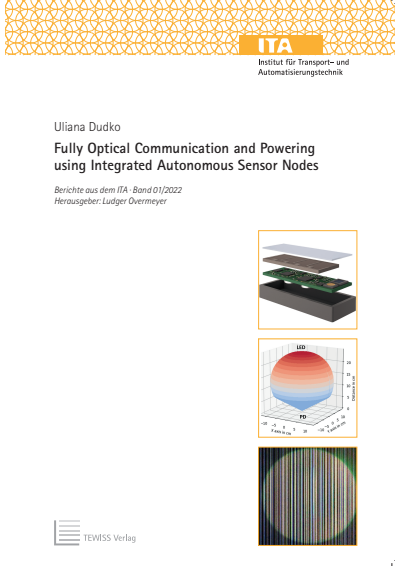
Cover des Buchs: Fully Optical Communication and Powering using Integrated Autonomous Sensor Nodes
, um zu prüfen, ob Sie einen Vollzugriff auf diese Publikation haben.
Monographie Kein Zugriff

Fully Optical Communication and Powering using Integrated Autonomous Sensor Nodes

Autor:innen:
Reihe:
Berichte aus dem ITA, Band ITA 01/2022
Verlag:
 2022

Zusammenfassung

Wireless sensor networks are key instruments in a wide range of scientific and industrial processes, such as environmental sensing, structural health, and equipment condition monitoring. In conventional wireless communication technology, the gradual saturation of the radio-frequency (RF) spectrum drives the need for alternative technologies to support a high density of users. An alternative to conventional RF technology is visible light communication, which offers license-free data transmission with bandwidth up to the terahertz range and can be applied in environments where an RF signal is distorted or prohibited. To provide wireless sensor networks with power autonomy, energy can be harvested from ambient light using solar cells. The main scientific challenge of this work is combining both technologies and finding an energy balance between high-power requirements of optical data transfer and scarce power generated by a solar cell. In this work the design of an optical autonomous sensor node that combines fully optical communication and solar powering in one miniaturized device is comprehensively discussed. The proposed device is capable of not only node-to-node interaction but also communication with a smartphone as an end terminal. The resulting dimensions of the node are 42 mm x 14 mm x 15 mm.

Schlagworte


Publikation durchsuchen


Bibliographische Angaben

Copyrightjahr
2022
ISBN-Online
978-3-95900-681-1
Verlag
TEWISS, Garbsen
Reihe
Berichte aus dem ITA
Band
ITA 01/2022
Sprache
Deutsch
Seiten
160
Produkttyp
Monographie

Inhaltsverzeichnis

KapitelSeiten
  1. Titelei/Inhaltsverzeichnis Kein Zugriff Seiten I - XVI
  2. 1 Introduction Kein Zugriff Seiten 1 - 4
    1. 2.1 WSNs Kein Zugriff
    2. 2.2 Visible Light Communication Kein Zugriff
    3. 2.3 Energy Harvesting Kein Zugriff
    1. 3.1 Challenges of This Work Kein Zugriff
    2. 3.2 Setting the Objectives Kein Zugriff
    1. 4.1 Main Structural Blocks of the Node Schematic Kein Zugriff
    2. 4.2 Microcontroller Kein Zugriff
    1. 5.1 Research on the Efficient Transmitter Design Kein Zugriff
    2. 5.2 Receiver Circuit Design Kein Zugriff
    3. 5.3 Single-Carrier Modulation Techniques Kein Zugriff
    4. 5.4 Spatial Light Distribution Model Kein Zugriff
    5. 5.5 VLC with Smartphone Kein Zugriff
    6. 5.6 Optical Approach on Communication Distance Extension Kein Zugriff
    1. 6.1 Research on Solar Cell Material Efficiency Kein Zugriff
    2. 6.2 Optical Activation (Wake-Up) of the Sensor Module Kein Zugriff
    3. 6.3 Calculation of Energy-Harvesting Parameters Kein Zugriff
    4. 6.4 Power Management Integration Circuits Kein Zugriff
    5. 6.5 Validation of the Energy-Harvesting Unit Kein Zugriff
    1. 7.1 Module Assembly and Interconnection Kein Zugriff
    2. 7.2 Communication in a Chain Kein Zugriff
    3. 7.3 Demonstrator Kein Zugriff
    1. 8.1 Conceptual Design of a Multidirectional Optical Sensor Node Kein Zugriff
    2. 8.2 Algorithm of Intelligent Networking Kein Zugriff
    3. 8.3 Integration in Production Systems Kein Zugriff
    1. 9.1 Summary Kein Zugriff
    2. 9.2 Outlook Kein Zugriff
  3. List of Figures Kein Zugriff Seiten 137 - 142
  4. List of Tables Kein Zugriff Seiten 143 - 144
  5. Bibliography Kein Zugriff Seiten 145 - 160