, um zu prüfen, ob Sie einen Vollzugriff auf diese Publikation haben.
Ausgabe Kein Zugriff

Jahrgang 69 (2018), Heft 1

SozW Soziale Welt
Autor:innen:
Zeitschrift:
SozW Soziale Welt
Verlag:
 2018

Über die Zeitschrift

Die Soziale Welt ist eine der großen, auch im Ausland gelesenen Fachzeitschriften innerhalb der deutschen Soziologie. Sie bringt empirische und theoretische Arbeiten aus allen Bereichen des Faches und versucht auf diese Weise, die Entwicklung der Soziologie einerseits zu spiegeln und ihr andererseits auch neue Impulse zu geben. Dies geschieht neben den viermal pro Jahr erscheinenden regulären Heften auch durch die Arbeit an Sonderbänden mit einheitlicher Thematik. Die Zeitschrift "Soziale Welt" wendet sich an Soziologen, Sozialwissenschaftler, Interessierte allgemein. Homepage: www.soziale-welt.de

Publikation durchsuchen


Bibliographische Angaben

ISSN-Print
0038-6073
ISSN-Online
2942-3414
Verlag
Nomos, Baden-Baden
Sprache
Deutsch
Produkttyp
Ausgabe

Artikel

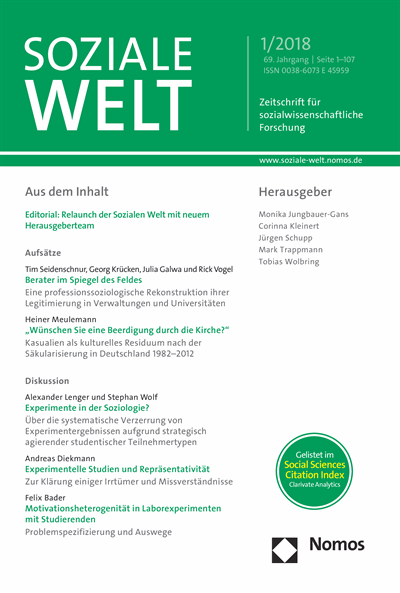
Cover der Ausgabe: SozW Soziale Welt Jahrgang 69 (2018), Heft 1
Artikel
Vollzugriff

Seite 1 - 2
Nomos Verlagsgesellschaft mbH & Co. KG, Baden-Baden 2018

Cover der Ausgabe: SozW Soziale Welt Jahrgang 69 (2018), Heft 1
Artikel
Vollzugriff

Seite 3 - 5
Nomos Verlagsgesellschaft mbH & Co. KG, Baden-Baden 2018
Autor:innen:

Cover der Ausgabe: SozW Soziale Welt Jahrgang 69 (2018), Heft 1
Artikel
Vollzugriff

Seite 6 - 32
Unternehmensberater spielen eine wichtige Rolle für die Verbreitung von Managementtrends in unterschiedlichen organisationalen Feldern. Sie profitieren zugleich von diesen Trends, weil sie neue Beratungsmärkte abseits des angestammten Geschäfts...
Nomos Verlagsgesellschaft mbH & Co. KG, Baden-Baden 2018
Autor:innen:

Cover der Ausgabe: SozW Soziale Welt Jahrgang 69 (2018), Heft 1
Artikel
Vollzugriff

Seite 33 - 63
Der Wunsch einer kirchlichen Beerdigung sollte vom Rahmungsbedürfnis biographischer Übergänge und von der Christlichkeit positiv, von der religiösen Skepsis - Kirchenkritik, Religionskritik, naturalistisches Weltbild und religiöse Indifferenz -...
Nomos Verlagsgesellschaft mbH & Co. KG, Baden-Baden 2018
Autor:innen:

Cover der Ausgabe: SozW Soziale Welt Jahrgang 69 (2018), Heft 1
Artikel
Vollzugriff

Seite 64 - 94
In der Soziologie wird vermehrt für eine Verwendung von Labor- und Feldexperimenten plädiert. Bis heute stößt die experimentelle Methode aber auf ein gewisses Unbehagen und gehört auch weiterhin nicht zu den Standardverfahren der empirischen...
Nomos Verlagsgesellschaft mbH & Co. KG, Baden-Baden 2018
Autor:innen:

Cover der Ausgabe: SozW Soziale Welt Jahrgang 69 (2018), Heft 1
Artikel
Vollzugriff

Seite 95 - 100
Alexander Lenger und Stephan Wolf (2018; im Folgenden LW) führen in ihrem Beitrag „Experimente in der Soziologie?“ eine kritische Diskussion über Vorteile, Risiken, und Nebenwirkungen experimenteller Methoden in der Soziologie. Über drei...
Nomos Verlagsgesellschaft mbH & Co. KG, Baden-Baden 2018
Autor:innen:

Cover der Ausgabe: SozW Soziale Welt Jahrgang 69 (2018), Heft 1
Artikel
Vollzugriff

Seite 101 - 107
Der Beitrag von Alexander Lenger und Stephan Wolf (2018) zeigt, dass die Motivation von Studierenden, an sozialwissenschaftlichen Laborexperimenten teilzunehmen, heterogen ist. Das ist wenig überraschend, musste so aber auch erst einmal gezeigt...
Nomos Verlagsgesellschaft mbH & Co. KG, Baden-Baden 2018
Autor:innen:

Literaturverzeichnis (242 Einträge)

  1. Abbott, Andrew D. (1988): The System of Professions. An Essay on the Division of Expert Labor. Chicago: University of Chicago Press. Google Scholar öffnen doi.org/10.5771/0038-6073-2018-1-6
  2. Abrahamson, Eric (1996): Management fashion. Academy of Management Review 21 (1): 254– Google Scholar öffnen doi.org/10.5771/0038-6073-2018-1-6
  3. 285. Google Scholar öffnen doi.org/10.5771/0038-6073-2018-1-6
  4. Alvesson, Mats & Johansson, Anders W. (2002): Professionalism and politics in management consultancy work, in: Timothy Clark & Robin Fincham (Hrsg.), Critical consulting. New Perspectives on the Management Advice Industry. Oxford: John Wiley & Sons. S. 228–246. Google Scholar öffnen doi.org/10.5771/0038-6073-2018-1-6
  5. Alvesson, Mats, Kärreman, Dan, Sturdy, Andrew & Handley, Karen (2009): Unpacking the client(s): Constructions, positions and client-consultant dynamics. Scandinavian Journal of Management 25 (3): 253–263. Google Scholar öffnen doi.org/10.5771/0038-6073-2018-1-6
  6. Ameln, Falko, Kramer, Josef & Stark, Heike (2009): Organisationsberatung beobachtet. Hidden Agendas und Blinde Flecken. Wiesbaden: VS Verlag für Sozialwissenschaften. Google Scholar öffnen doi.org/10.5771/0038-6073-2018-1-6
  7. Armbrüster, Thomas, Banzhaf, Johannes & Dingemann, Lars (2010): Unternehmensberatung im öffentlichen Sektor. Institutionenkonflikt, praktische Herausforderungen, Lösungen. Wiesbaden: Gabler Verlag. Google Scholar öffnen doi.org/10.5771/0038-6073-2018-1-6
  8. Bäcklund, Jonas & Werr, Andreas (2008): Constructing the legitimate buyer of management consulting services. Journal of Organizational Change Management 21 (6): 758–772. Google Scholar öffnen doi.org/10.5771/0038-6073-2018-1-6
  9. Bartel, Carolina A. & Garud, Raghu (2009): The role of narratives in sustaining organizational innovation. Organization Science 20 (1): 107–117. Google Scholar öffnen doi.org/10.5771/0038-6073-2018-1-6
  10. BDU (2015): Facts & Figures zum Beratermarkt 2014/2015. Der Deutsche Unternehmensberatermarkt in Zahlen. Bonn: Bundesverband Deutscher Unternehmensberater BDU e.V. Google Scholar öffnen doi.org/10.5771/0038-6073-2018-1-6
  11. Boltanski, Luc & Chiapello, Ève (2006): Der neue Geist des Kapitalismus. Konstanz: UVK. Bryson, John M., Crosby, Barbara C. & Bloomberg, Laura (2014): Public value governance. Google Scholar öffnen doi.org/10.5771/0038-6073-2018-1-6
  12. Moving beyond traditional public administration and the New Public Management. Public Google Scholar öffnen doi.org/10.5771/0038-6073-2018-1-6
  13. Administration Review 74 (4): 445–446. Google Scholar öffnen doi.org/10.5771/0038-6073-2018-1-6
  14. Czarniawska-Joerges, Barbara (1997): Narrating the Organization. Dramas of Institutional Identity. Chicago: University of Chicago Press. Google Scholar öffnen doi.org/10.5771/0038-6073-2018-1-6
  15. Czarniawska, Barbara & Mazza, Carmelo. (2003): Consulting as a liminal space. Human Relations 56 (3): 267–290. Google Scholar öffnen doi.org/10.5771/0038-6073-2018-1-6
  16. David, Robert J., Sine, Wesley D. & Haveman, Heather A. (2013): Seizing opportunity in emerging fields. How institutional entrepreneurs legitimated the professional form of management consulting. Organization Science 24 (2): 356–377. Google Scholar öffnen doi.org/10.5771/0038-6073-2018-1-6
  17. DiMaggio, Paul J. & Powell, Walter W. (1983): The iron cage revisited: Institutional isomorphism and collective rationality in organizational fields. American Sociological Review 48 (2): 147–160. Google Scholar öffnen doi.org/10.5771/0038-6073-2018-1-6
  18. Dunn, Mary B. & Jones, Candace (2010): Institutional logics and institutional pluralism. The contestation of care and science logics in medical education, 1967–2005. Administrative Science Quarterly 55 (1): 114–149. Google Scholar öffnen doi.org/10.5771/0038-6073-2018-1-6
  19. Engwall, Lars & Kipping, Matthias (2013): Management consulting: Dynamics, debates, and directions. International Journal of Strategic Communication 7 (2): 84–98. Google Scholar öffnen doi.org/10.5771/0038-6073-2018-1-6
  20. Ernst, Berit & Kieser, Alfred (2002): In search of explanations for the consulting explosion, in: Kerstin Sahlin-Andersson & Lars Engwall (Hrsg.), The Expansion of Management Knowledge. Carriers, Flows, and Sources. Palo Alto-CA: Stanford University Press. S. 47–73. Google Scholar öffnen doi.org/10.5771/0038-6073-2018-1-6
  21. Freidson, Eliot (1988): Professional Powers. A Study of the Institutionalization of Formal Knowledge. Chicago: University of Chicago Press. Google Scholar öffnen doi.org/10.5771/0038-6073-2018-1-6
  22. Freidson, Eliot (2001): Professionalism. The Third Logic. Chicago: Polity. Google Scholar öffnen doi.org/10.5771/0038-6073-2018-1-6
  23. Hargadon, Andrew B. (1998): Firms as knowledge brokers: Lessons in pursuing continuous innovation. California Management Review 40 (3): 209–227. Google Scholar öffnen doi.org/10.5771/0038-6073-2018-1-6
  24. Hasse, Raimund & Krücken, Georg (2005): Neo-Institutionalismus. Bielefeld: VS Verlag für Sozialwissenschaften. Google Scholar öffnen doi.org/10.5771/0038-6073-2018-1-6
  25. Hasse, Raimund & Krücken, Georg (2009): Neo-institutionalistische Wirtschaftssoziologie, in: Jens Beckert & Christoph Deutschmann (Hrsg.), Wirtschaftssoziologie, Sonderheft 49 der Kölner Zeitschrift für Soziologie und Sozialpsychologie. Wiesbaden: VS Verlag für Sozialwissenschaften. S. 194–207. Google Scholar öffnen doi.org/10.5771/0038-6073-2018-1-6
  26. Hasse, Raimund (2010): Ökonomisierungstendenzen bei Non-Profits, Großunternehmen und Start-ups – eine theoriegeleitete Diskussion empirischer Trends, in: Martin Endreß & Thomas Matys (Hrsg.), Die Ökonomie der Organisation – die Organisation der Ökonomie. Wiesbaden: VS Verlag für Sozialwissenschaften. S. 93–119. Google Scholar öffnen doi.org/10.5771/0038-6073-2018-1-6
  27. Hüther, Otto & Krücken, Georg (2016): Hochschulen. Fragestellungen, Ergebnisse und Perspektiven der sozialwissenschaftlichen Hochschulforschung. Wiesbaden: Springer VS. Google Scholar öffnen doi.org/10.5771/0038-6073-2018-1-6
  28. KGSt (1993): Das Neue Steuerungsmodell. Begründung. Konturen. Umsetzung, Köln: KGSt. Kipping, Matthias (2011): Hollow from the start? Image professionalism in management consul- Google Scholar öffnen doi.org/10.5771/0038-6073-2018-1-6
  29. ting. Current Sociology 59 (4): 530–550. Google Scholar öffnen doi.org/10.5771/0038-6073-2018-1-6
  30. Kloke, Katharina (2014): Qualitätsentwicklung an deutschen Hochschulen. Professionstheoretische Untersuchung eines neuen Tätigkeitsfeldes. Wiesbaden: VS Verlag für Sozialwissenschaften. Google Scholar öffnen doi.org/10.5771/0038-6073-2018-1-6
  31. Kozica, Arjan, Brandl, Julia & Kaiser, Stephan (2013): Verwaltungsberatung. Wie lernen öffentliche Verwaltungen aus externer Beratung?, in: Sabine Kropp & Sabine Kuhlmann (Hrsg.), Wissen und Expertise in Politik und Verwaltung. Opladen: Budrich. S. 305–324. Google Scholar öffnen doi.org/10.5771/0038-6073-2018-1-6
  32. Kreiswirth, Martin (2000). Merely telling stories? Narrative and knowledge in the human sciences. Poetics Today 21 (2): 293–318. Google Scholar öffnen doi.org/10.5771/0038-6073-2018-1-6
  33. Krücken, Georg (2017). Die Transformation von Universitäten in Wettbewerbsakteure. Beiträge zur Hochschulforschung 39 (3-4): 10–29. Google Scholar öffnen doi.org/10.5771/0038-6073-2018-1-6
  34. Krücken, Georg & Serrano-Velarde, Kathia (2016): Der Berater als Fremder. Eine soziologische Studie zur Managementberatung in Universitäten. Kölner Zeitschrift für Soziologie und Sozialpsychologie 68 (1): 29–51. Google Scholar öffnen doi.org/10.5771/0038-6073-2018-1-6
  35. Krücken, Georg, Mazza, Carmelo, Meyer, Renate E. & Walgenbach, Peter (Hrsg.) (2017.): New Themes in Institutional Analysis. Topics and Issues from European Research. Cheltenham: Edward Elgar Publishing Ltd. Google Scholar öffnen doi.org/10.5771/0038-6073-2018-1-6
  36. Lounsbury, Michael & Boxenbaum, Eva (Hrsg.) (2013): Institutional Logics in Action. Research in the Sociology of Organizations 39. Bingley: Emerald Group Publishing Limited. Google Scholar öffnen doi.org/10.5771/0038-6073-2018-1-6
  37. McKenna, Christopher D. (2007): Give professionalization a chance! Why management consulting may yet become a full profession, in: Daniel Muzio, Stephan Ackroyd & Jean-Francois Chalant (Hrsg.), Redirections in the Study of Expert Labour: Law, Medicine and Management Consultancy. London: Palgrave Macmillan. S. 204–216. Google Scholar öffnen doi.org/10.5771/0038-6073-2018-1-6
  38. Marquis, Christopher & Lounsbury, Michael (2007): Vive la resistance: Competing logics and the consolidation of U.S. community banking. Academy of Management Journal 50 (4): 799– 820. Google Scholar öffnen doi.org/10.5771/0038-6073-2018-1-6
  39. Meyer, John W. & Rowan, Brian (1977): Institutionalized organizations: Formal structure as myth and ceremony. American Journal of Sociology 83 (2): 340–363. Google Scholar öffnen doi.org/10.5771/0038-6073-2018-1-6
  40. Mládková, Ludmila (2013): Leadership and storytelling. The second international conference on leadership. Technology and innovation management. Procedia – Social and Behavioral Sciences 75: 83–90. Google Scholar öffnen doi.org/10.5771/0038-6073-2018-1-6
  41. Muzio, Daniel, Kirkpatrick, Ian & Kipping, Matthias (2011): Professions, organizations and the state: Applying the sociology of the professions to the case of management consultancy. Current Sociology 59 (6): 805–824. Google Scholar öffnen doi.org/10.5771/0038-6073-2018-1-6
  42. Nikolova, Natalia, Reihlen, Markus & Schlapfner, Jan-Florian (2009): Client–Consultant interaction: Capturing social practices of professional service production. Scandinavian Journal of Management 25 (3): 289–298. Google Scholar öffnen doi.org/10.5771/0038-6073-2018-1-6
  43. Ocasio, William, Thornton, Patricia H. & Lounsbury, Michael (2017): Advances to the institutional logics perspective, in: Royston Greenwood, Christine Oliver, Thomas B. Lawrence & Renate Meyer (Hrsg.), The Sage Handbook of Organizational Institutionalism (2nd edition), London: Sage Publications Ltd. S. 509-532. Google Scholar öffnen doi.org/10.5771/0038-6073-2018-1-6
  44. Oevermann, Ulrich (1996): Theoretische Skizze einer revidierten Theorie professionalisierten Handelns, in: Arno Combe & Werner Helsper (Hrsg.), Pädagogische Professionalität. Untersuchungen zum Typus pädagogischen Handelns. Frankfurt am Main: Suhrkamp. S. 70–182. Google Scholar öffnen doi.org/10.5771/0038-6073-2018-1-6
  45. Parsons, Talcott (1964): The Social System. New York: Macmillan USA. Google Scholar öffnen doi.org/10.5771/0038-6073-2018-1-6
  46. Parsons, Talcott (1968): Professions, in: David L. Sills (Hrsg.), International Encyclopedia of the Social Sciences. New York: Macmillan. S. 536–547. Google Scholar öffnen doi.org/10.5771/0038-6073-2018-1-6
  47. Pfadenhauer, Michaela (2003): Professionalität. Eine wissenssoziologische Rekonstruktion institutionalisierter Kompetenzdarstellung. Opladen: VS Verlag für Sozialwissenschaften. Google Scholar öffnen doi.org/10.5771/0038-6073-2018-1-6
  48. Pfadenhauer, Michaela (2004). Die Definition des Problems aus der Verwaltung der Lösung. Professionelles Handeln revisited, in: Michaela Pfadenhauer (Hrsg.), Professionelles Handeln. Wiesbaden: VS Verlag für Sozialwissenschaften. S. 9–27. Google Scholar öffnen doi.org/10.5771/0038-6073-2018-1-6
  49. Powell, Walter W., Oberg, Achim, Korff, Valeska, Oelberger, Carrie & Kloos, Karina (2017): Institutional analysis in a digital era: Mechanisms and methods to understand emerging fields. Topics and issues from European research, in: Georg Krücken, Carmelo Mazza, Renate E. Meyer & Peter Walgenbach (Hrsg.), New Themes in Institutional Analysis. Topics and Issues from European Research. Cheltenham: Edward Elgar. S. 305–344. Google Scholar öffnen doi.org/10.5771/0038-6073-2018-1-6
  50. Quirke, Linda (2013): Rogue resistance: Sidestepping isomorphic pressures in a patchy institutional field. Organization Studies 34 (11): 1675–1699. Google Scholar öffnen doi.org/10.5771/0038-6073-2018-1-6
  51. Reay, Trish & Hinings, C. R. (2009): Managing the rivalry of competing institutional logics. Organization Studies 30 (6): 629–652. Google Scholar öffnen doi.org/10.5771/0038-6073-2018-1-6
  52. Reihlen, Markus, Smets, Michael & Veit, Andreas (2010): Management consultancies as institutional agents: Strategies for creating and sustaining institutional capital. Schmalenbach Business Review 62 (3): 317–339. Google Scholar öffnen doi.org/10.5771/0038-6073-2018-1-6
  53. Saint-Martin, Dennis (2005): Management consultancy, in: Ewan Ferlie, Laurence E. Lynn & Christopher Pollitt (Hrsg.), The Oxford Handbook of Public Management. Oxford: Oxford University Press. S. 671–694. Google Scholar öffnen doi.org/10.5771/0038-6073-2018-1-6
  54. Schimank, Uwe & Volkmann, Ute (2017): Das Regime der Konkurrenz: Gesellschaftliche Ökonomisierungsdynamiken heute. Weinheim/Basel: Beltz Juventa. Google Scholar öffnen doi.org/10.5771/0038-6073-2018-1-6
  55. Schützeichel, Rainer & Brüsemeister, Thomas (2004): Die beratene Gesellschaft. Zur gesellschaftlichen Bedeutung von Beratung. Wiesbaden: VS Verlag für Sozialwissenschaften. Google Scholar öffnen doi.org/10.5771/0038-6073-2018-1-6
  56. Seidenschnur, Tim, Krücken, Georg, Vogel, Rick & Galwa, Julia (2016): Beratung von Universitäten. Lernprozesse zwischen universitärem Denken und ökonomischer Logik. Hochschulmanagement 11 (3): 66-72. Google Scholar öffnen doi.org/10.5771/0038-6073-2018-1-6
  57. Smets, Michael, Greenwood, Royston & Lounsbury, Michael (2015 a): An institutional perspective on strategy as practice, in: Damon Golsorkhi, Linda Rouleau, David Seidl & Eero Vaara (Hrsg.), Cambridge Handbook of Strategy as Practice (2nd edition). Cambridge: Cambridge University Press. S. 283–300. Google Scholar öffnen doi.org/10.5771/0038-6073-2018-1-6
  58. Smets, Michael, Jarzabkowski, Paula, Burke, Gary T. & Spee, Paul (2015 b): Reinsurance trading in Lloyd's of London. Balancing conflicting-yet-complementary logics in practice. Academy of Management Journal 58 (3): 932–970. Google Scholar öffnen doi.org/10.5771/0038-6073-2018-1-6
  59. Stichweh, Rudolf (1996): Professionen in einer funktional differenzierten Gesellschaft, in: Arno Combe & Werner Helsper (Hrsg), Pädagogische Professionalität. Untersuchungen zum Typus pädagogischen Handelns. Frankfurt a. M.: Suhrkamp. S. 4–9. Google Scholar öffnen doi.org/10.5771/0038-6073-2018-1-6
  60. Sturdy, Andrew (1997): The consultancy process – An insecure business? Journal of Management Studies 34 (3) 389–413. Google Scholar öffnen doi.org/10.5771/0038-6073-2018-1-6
  61. Sturdy, Andrew, Clark, Timothy, Fincham, Robin & Handley, Karen (2009): Between innovation and legitimation – Boundaries and knowledge flow in management consultancy. Organization 16 (5): 627–653. Google Scholar öffnen doi.org/10.5771/0038-6073-2018-1-6
  62. Sturdy, Andrew, Wright, Christopher (2011): The active client. The boundary-spanning roles of internal consultants as gatekeepers, brokers and partners of their internal counterparts. Management Learning 42(5): 485–503. Google Scholar öffnen doi.org/10.5771/0038-6073-2018-1-6
  63. Suchman, Mark C. (1995): Managing legitimacy. Strategic and institutional approaches. Academy of Management Review 20 (3): 571–610. Google Scholar öffnen doi.org/10.5771/0038-6073-2018-1-6
  64. Suddaby, Roy, Bitektine, Alex & Haack, Patrick (2017): Legitimacy. Academy of Management Annals 11 (1): 451–478. Google Scholar öffnen doi.org/10.5771/0038-6073-2018-1-6
  65. Thornton, Patricia H. & Ocasio, William (2008): Institutional logics, in: Royston Greenwood, Christine Oliver, Kerstin Sahlin & Roy Suddaby (Hrsg.), The SAGE Handbook of Organizational Institutionalism. Thousand Oaks: Sage Publications Ltd. S. 99–129. Google Scholar öffnen doi.org/10.5771/0038-6073-2018-1-6
  66. Thornton, Patricia H., Ocasio, William & Lounsbury, Michael (2012): The Institutional Logics Perspective. Foundations, Research, and Theoretical Elaboration. Oxford, New York: Oxford University Press. Google Scholar öffnen doi.org/10.5771/0038-6073-2018-1-6
  67. Todorova, Gergana (2004): Exploring knowledge issues in the consulting relationship. A client centered perspective, in: Anthony F. Buono (Hrsg.), Creative Consulting. Innovative Perspectives on Management Consulting. Greenwich: Information Age Publishing. S. 73–98. Google Scholar öffnen doi.org/10.5771/0038-6073-2018-1-6
  68. Vogel, Rick (2006): Zur Institutionalisierung von New Public Management. Disziplindynamik der Verwaltungswissenschaft unter dem Einfluss ökonomischer Theorie. Wiesbaden: Deutscher Universitätsverlag. Google Scholar öffnen doi.org/10.5771/0038-6073-2018-1-6
  69. Vogel, Rick (2009): Aufkommen und Verbreitung von New Public Management in Deutschland. Eine institutionalistische Diskursanalyse mit bibliometrischen Methoden. Der moderne Staat 2(2): 367–390. Google Scholar öffnen doi.org/10.5771/0038-6073-2018-1-6
  70. Vogel, Rick (2012): Framing and counterframing New Public Management: The German case. Public Administration 90(2): 370–392. Google Scholar öffnen doi.org/10.5771/0038-6073-2018-1-6
  71. Vogel, Rick & Frost, Jetta (2009): Innovating in the German public sector: How a think tank frames the debate on NPM. The Innovation Journal: The Public Sector Innovation Journal 14(2): 1–21. Google Scholar öffnen doi.org/10.5771/0038-6073-2018-1-6
  72. Vogel, Rick, Galwa, Julia, Krücken, Georg & Tim Seidenschnur (2016): Legitimierungsprobleme und -strategien von Managementberatern im öffentlichen Sektor. Der moderne Staat 9 (2), S. 253–275. Google Scholar öffnen doi.org/10.5771/0038-6073-2018-1-6
  73. Walgenbach, Peter & Meyer, Renate E. (2008): Neoinstitutionalistische Organisationstheorie. Stuttgart: Kohlhammer. Google Scholar öffnen doi.org/10.5771/0038-6073-2018-1-6
  74. Werr, Andreas & Styhre, Alexander (2002): Management consultants – friend or foe? Understanding the ambiguous client-consultant relationship. International Studies of Management & Organization 32 (4): 43–66. Google Scholar öffnen doi.org/10.5771/0038-6073-2018-1-6
  75. Wooten, Melissa & Hoffman, Andrew J. (2017): Organizational fields: Past, present and future, in: Royston Greenwood, Christine Oliver, Thomas B. Lawrence & Renate E. Meyer (Hrsg.), The SAGE Handbook of Organizational Institutionalism (2nd ed.), Thousand Oaks: Sage Publications Ltd. S. 55–74. Google Scholar öffnen doi.org/10.5771/0038-6073-2018-1-6
  76. Zietsma, Charlene, Groenewegen, Peter, Logue, Danielle M. & Hinings, C. R. (Bob) (2017): Field or fields? Building the scaffolding for cumulation of research on institutional fields, in: Academy of Management Annals 11 (1): 391–450. Google Scholar öffnen doi.org/10.5771/0038-6073-2018-1-6
  77. ALLBUS. Allgemeine Bevölkerungsumfrage der Sozialwissenschaften. http://www.gesis.org/ allbus/studienprofile/ Google Scholar öffnen doi.org/10.5771/0038-6073-2018-1-33
  78. Aries, P. (1981): Studien zur Geschichte des Todes im Abendland. München 1981 (frz. Original 1975) Google Scholar öffnen doi.org/10.5771/0038-6073-2018-1-33
  79. Baker, J. O. / Smith, B. G. (2015): American Secularism. Cultural Contours of Nonreligious Belief Systems. New York: New York University Press Google Scholar öffnen doi.org/10.5771/0038-6073-2018-1-33
  80. Belliger, A. / D. J. Krieger (Hrsg.), (2006): Ritualtheorien. Ein einführendes Handbuch. 3. Auflage. Wiesbaden. Google Scholar öffnen doi.org/10.5771/0038-6073-2018-1-33
  81. Burkimsher, M. (2014): Is Religious Attendance Bottoming Out? An Examination of Current Trends across Europe. Journal for the Scientific Study of Religion 53. S. 432-445. Google Scholar öffnen doi.org/10.5771/0038-6073-2018-1-33
  82. Davie, G. (2007): Vicarious Religion: A Methodological Challenge. In: Nancy T. Ammerman (Hrsg.). Everyday Religion. Oxford. Oxford University Press, S. 21-37. Google Scholar öffnen doi.org/10.5771/0038-6073-2018-1-33
  83. Davie, G. (2010): Vicarious Religion: A Response. Journal of Contemporary Religion 25. S. 261-266. Google Scholar öffnen doi.org/10.5771/0038-6073-2018-1-33
  84. Davie, G. (2013): The Sociology of Religion. Acritical Agenda. Second Edition. Los Angeles usw. Demerath, N. J. (2000): The Rise of ‘Cultural Religion’ in European Christianity: Learning from Google Scholar öffnen doi.org/10.5771/0038-6073-2018-1-33
  85. Poland, Northern Ireland, and Sweden. Social Compass 47, S. 127-136. Google Scholar öffnen doi.org/10.5771/0038-6073-2018-1-33
  86. Drewermann, E. (1989): Kleriker – Psychogramm eines Ideals. Olten. Google Scholar öffnen doi.org/10.5771/0038-6073-2018-1-33
  87. EVS, European Value Survey, Longitudinal-Datensatz 1981-2008. GESIS Datensatz ZA4804. http://www.europeanvaluesstudy.eu/ Google Scholar öffnen doi.org/10.5771/0038-6073-2018-1-33
  88. Feldmann, K. (2010): Soziologie des Sterbens und des Todes. Sozialwissenschaftliche Thanatologie. Wiesbaden. Google Scholar öffnen doi.org/10.5771/0038-6073-2018-1-33
  89. Felling, A. / Peters, J. / Schreuder, O. (1987): Religion im Vergleich: Bundesrepublik Deutschland und Niederlande. Frankfurt. Google Scholar öffnen doi.org/10.5771/0038-6073-2018-1-33
  90. Firebaugh, G. (1997): Analyzing Repeated Surveys. Thousand Oaks etc.: Sage. Google Scholar öffnen doi.org/10.5771/0038-6073-2018-1-33
  91. Grimes, R. (2006): Typen ritueller Erfahrung. In: Belliger /Krieger (Hrsg), a.a.O., S. 117-132. Hahn, A. (1974): Religion und der Verlust der Sinngebung. Frankfurt. Google Scholar öffnen doi.org/10.5771/0038-6073-2018-1-33
  92. Happe, B. (2012): Der Tod gehört mir. Die Vielfalt der heutigen Bestattungskultur und ihre Ursprünge. Google Scholar öffnen doi.org/10.5771/0038-6073-2018-1-33
  93. Jagodzinski, W. / Dobbelaere, K. (1995). Secularization and Church Religiosity. in: Jan W. Van Deth & Elinor Scarbough (Hrsg.) The Impact of Values, Oxford, S. 76-119. Google Scholar öffnen doi.org/10.5771/0038-6073-2018-1-33
  94. Kasselstrand, I. (2015): Nonbelievers in the Church: A Study of Cultural Religion in Sweden. Sociology of Religion 76, S. 275-294. Google Scholar öffnen doi.org/10.5771/0038-6073-2018-1-33
  95. Meulemann, H. (1979): Soziale Herkunft und Schullaufbahn. Frankfurt. Google Scholar öffnen doi.org/10.5771/0038-6073-2018-1-33
  96. Meulemann, H (2015): Nach der Säkularisierung. Religiosität in Deutschland 1982-2012. Wiesbaden: Springer. Google Scholar öffnen doi.org/10.5771/0038-6073-2018-1-33
  97. Moser, T. (1976): Gottesvergiftung. Frankfurt am Main. Google Scholar öffnen doi.org/10.5771/0038-6073-2018-1-33
  98. Müller, O. (2011): Kirchlichkeit und Religiosität in Ostmittel- und Osteuropa. Wiesbaden. Pickel, G. (2011): Religionssoziologie. Eine Einführung in zentrale Themenbereiche. Wiesbaden. Pickel, G. (2017): Religiosität in Deutschland und Europa – Religiöse Pluralisierung und Säkula- Google Scholar öffnen doi.org/10.5771/0038-6073-2018-1-33
  99. risierung auf soziokulturell variierenden Pfaden. Zeitschrift für Religion, Gesellschaft und Poli- Google Scholar öffnen doi.org/10.5771/0038-6073-2018-1-33
  100. tik 1: 37-74. Google Scholar öffnen doi.org/10.5771/0038-6073-2018-1-33
  101. Pollack, D. / Laube, M. / Liskowsky, A. (2014): Intensive Mitgliedschaftspraxis S. 43-49 in: Evangelische Kirche Deutschlands (Hrsg.): Engagement und Indifferenz. Kirchenmitgliedschaft als soziale Praxis. V. EKD-Erhebung über Kirchenmitgliedschaft. Hannover. Google Scholar öffnen doi.org/10.5771/0038-6073-2018-1-33
  102. Pollack, D. / Rosta, G. (2015): Religion in der Moderne. Ein internationaler Vergleich. Frankfurt. Pollack, D. / Wohlrab-Sahr, M. / Gärtner, C. (2003): Einleitung. S. 9-20 in: C. Gärtner / D. Pol- Google Scholar öffnen doi.org/10.5771/0038-6073-2018-1-33
  103. lack / M. Wohlrab-Sahr (Hrsg.), Atheismus und religiöse Indifferenz. Opladen. Google Scholar öffnen doi.org/10.5771/0038-6073-2018-1-33
  104. Putnam, R. D. / Campbell, D. E. (2010). American. Grace. How Religion Divides and Unites Us. New York. Google Scholar öffnen doi.org/10.5771/0038-6073-2018-1-33
  105. Olson, M. (1965): The Logic of Collective Action. Cambridge. Oz, A. / Oz-Sulzberger, F. (2012): Jews and Words. New Haven. Google Scholar öffnen doi.org/10.5771/0038-6073-2018-1-33
  106. Peuckert, R. (2005): Familienformen im sozialen Wandel. 6. Auflage. Wiesbaden. Sörries, Reiner, (2016): Ein letzter Gruß. Kevelaer. Google Scholar öffnen doi.org/10.5771/0038-6073-2018-1-33
  107. Spring, H. / Moosbrugger, H. / Zwingmann, C. / Frank, D. (1993): Kirchlicher Dogmatismus und ekklesiogene Neurosen. Zeitschrift für Klinische Psychologie, Psychopathologie und Psychotherapie, 41, S. 31-42. Google Scholar öffnen doi.org/10.5771/0038-6073-2018-1-33
  108. Stark, R. (1996): The Rise of Christianity. A Sociologist Reconsiders History. Princeton. Google Scholar öffnen doi.org/10.5771/0038-6073-2018-1-33
  109. Stark, R. / Hamberg, E. / Miller, A. S. (2005): Exploring Spirituality an Unchurched Religion in America, Sweden, and Japan. Journal of Contemporary Religion 20, S. 3-23. Google Scholar öffnen doi.org/10.5771/0038-6073-2018-1-33
  110. Treiman, D. J. (1977): Occupational Prestige in Comparative Perspective. New York. Google Scholar öffnen doi.org/10.5771/0038-6073-2018-1-33
  111. Thieme, F. (2013): Der gegenwärtige Wandel der deutschen Bestattungskultur als Widerspiegelung gesellschaftlicher Entwicklungstrends. SWS-Rundschau 53. S. 320-336. Google Scholar öffnen doi.org/10.5771/0038-6073-2018-1-33
  112. Turner, V. W. (2006): Liminalität und Communitas. In: Belliger & Krieger (Hrsg.), a.a.O., S. 247-259. Google Scholar öffnen doi.org/10.5771/0038-6073-2018-1-33
  113. Vaas, R. / Blume, M. (2102): Gott, Gene und Gehirn. Warum der Glaube nützt; die Evolution der Religiosität. 3. Auflage. Stuttgart. Google Scholar öffnen doi.org/10.5771/0038-6073-2018-1-33
  114. Voas, D. (2009): The Rise and Fall of Fuzzy Fidelity in Europe. European Sociological Review 35, S. 155-169. Google Scholar öffnen doi.org/10.5771/0038-6073-2018-1-33
  115. Voas, D. / McAndrew, S. / Storm, I. (2013): Modernization and the gender gap in religiosity: Evidence from cross-nation European surveys. In: C. Wolf / M. Koenig (Hrsg.): Religion und Gesellschaft. Sonderheft 53 Kölner Zeitschrift für Soziologie und Sozialpsychologie. Wiesbaden, S. 269-283. Google Scholar öffnen doi.org/10.5771/0038-6073-2018-1-33
  116. Wilson, E. O. (2013): The social conquest of earth. New York. Google Scholar öffnen doi.org/10.5771/0038-6073-2018-1-33
  117. Wunn, I. / Urban, P. / Klein, C. (2015): Götter – Gene – Genesis. Die Biologie der Religionsentstehung. Berlin-Heidelberg. Google Scholar öffnen doi.org/10.5771/0038-6073-2018-1-33
  118. Abeler, Johannes / Nosenzo, Daniele (2015): Self-Selection into Laboratory Experiments: Pro-Social Motives Versus Monetary Incentives, in: Experimental Economics 18, S. 195-214. Google Scholar öffnen doi.org/10.5771/0038-6073-2018-1-64
  119. Albert, Hans (1965): Modell-Platonismus. Der neoklassische Stil des ökonomischen Denkens in kritischer Beleuchtung, in: Ernst Topitsch (Hg.): Logik der Sozialwissenschaften. Berlin, S. 406-434. Google Scholar öffnen doi.org/10.5771/0038-6073-2018-1-64
  120. Arnett, Jeffrey J. (2008): The Neglected 95%. Why American Psychology Needs to Become Less American, in: American Psychologist 63, S. 602-614. Google Scholar öffnen doi.org/10.5771/0038-6073-2018-1-64
  121. Aronson, Elliot / Wilson, Timothy D. / Akert, Robin M. (2004): Sozialpsychologie. 4., aktualisierte Aufl. München. Google Scholar öffnen doi.org/10.5771/0038-6073-2018-1-64
  122. Bahr, Gunter / Requate, Till (2013): Reciprocity and Giving in a Consecutive Three-Person Dictator Game with Social Interaction, in: German Economic Review 15, 374-392. Google Scholar öffnen doi.org/10.5771/0038-6073-2018-1-64
  123. Bailey, Phoebe E. / Ruffman, Ted / Rendell, Peter G. (2013): Age-Related Differences in Social Economic Decision Making: The Ultimatum Game, in: Journal of Gerontology B Series 68, S. 356-363. Google Scholar öffnen doi.org/10.5771/0038-6073-2018-1-64
  124. Ball, Sheryl B. / Cech, Paula-Ann (1996): Subject Pool Choice and Treatment Effects in Economic Laboratory Research, Research in Experimental Economics 6, S. 239-292. Google Scholar öffnen doi.org/10.5771/0038-6073-2018-1-64
  125. Bardsley, Nicholas (2005): Experimental Economics and the Artificiality of Alteration, in: Journal of Economic Methodology 12, S. 239-251. Google Scholar öffnen doi.org/10.5771/0038-6073-2018-1-64
  126. Becker, Rolf / Zangger, Christoph (2015): Experimentelle Bildungsforschung. Beiträge experimenteller Forschung zur Bildungssoziologie und -ökonomie, in: Marc Keuschnigg / Tobias Wolbring (Hg.): Experimente in den Sozialwissenschaften. Soziale Welt, Sonderband 22. Baden-Baden, S. 105-131. Google Scholar öffnen doi.org/10.5771/0038-6073-2018-1-64
  127. Benz, Matthias / Meier, Stephan (2008): Do People Behave in Experiments as in the Field? Evidence from Donations, in: Experimental Economics 11, S. 268-281. Google Scholar öffnen doi.org/10.5771/0038-6073-2018-1-64
  128. Berger, Joël / Diekmann, Andreas (2015): The Logic of Relative Frustration: Boudon’s Competition Model and Experimental Evidence, in: European Sociological Review 31, S. 725-737. Google Scholar öffnen doi.org/10.5771/0038-6073-2018-1-64
  129. Berger, Roger (2015): Das Laborexperiment als sozialer Prozess, in: Marc Keuschnigg / Tobias Wolbring (Hg.): Experimente in den Sozialwissenschaften. Soziale Welt, Sonderband 22. Baden-Baden, S. 53-76. Google Scholar öffnen doi.org/10.5771/0038-6073-2018-1-64
  130. Binmore, Ken / Shaked, Avner (2010): Experimental Economics: Where Next?, in: Journal of Economic Behavior and Organization 73, S. 87-100. Google Scholar öffnen doi.org/10.5771/0038-6073-2018-1-64
  131. Brown, Thomas C. (2003): Introduction to Stated Preference Methods, in: Patricia A. Champ / Kevin J. Boyle / Thomas C. Brown (Hg.): A Primer on Nonmarket Valuation. Dordrecht, Boston, S. 99-110. Google Scholar öffnen doi.org/10.5771/0038-6073-2018-1-64
  132. Bundesministerium für Bildung und Forschung (BMBF) (2004): Die wirtschaftliche und die soziale Lage der Studierenden in der Bundesrepublik Deutschland 2003, Berlin. Google Scholar öffnen doi.org/10.5771/0038-6073-2018-1-64
  133. Burger, Jerry M. (2009): Replicating Milgram. Would People Still Obey Today?, in: American Psychologist 64, S. 1-11. Google Scholar öffnen doi.org/10.5771/0038-6073-2018-1-64
  134. Camerer, Colin F. (2003): Behavioral Game Theory. Experiments in Strategic Interaction, Princeton. Google Scholar öffnen doi.org/10.5771/0038-6073-2018-1-64
  135. Carpenter, Jeffrey P. / Harrison, Glenn W. / List, John A. (2005): Field Experiments in Economics: An Introduction, in: Research in Experimental Economics 10, S. 1-16. Google Scholar öffnen doi.org/10.5771/0038-6073-2018-1-64
  136. Charness, Gary / Rabin, Matthew (2002): Understanding Social Preferences with Simple Tests, in: Quarterly Journal of Economics 117, S. 817-869. Google Scholar öffnen doi.org/10.5771/0038-6073-2018-1-64
  137. Chuah, Swee-Hoon / Hoffmann, Robert / Jones, Martin / Williams, Geoffrey (2007): Do Cultures Clash? Evidence From Cross-National Ultimatum Game Experiments, in: Journal of Economic Behavior & Organization 64, S. 35-48. Google Scholar öffnen doi.org/10.5771/0038-6073-2018-1-64
  138. Cleave, B. L. / Nikiforakis, N. / Slonim, R. (2013): Is There Selection Bias in Laboratory Experiments? The Case of Social and Risk Preferences, in: Experimental Economics 16, S. 372-382. Google Scholar öffnen doi.org/10.5771/0038-6073-2018-1-64
  139. Cook, Thomas D. / Campbell, Donald T. (1979): Quasi-Experimentation. Design and Analysis Issues for Field Settings, Boston. Google Scholar öffnen doi.org/10.5771/0038-6073-2018-1-64
  140. Croson, Rachel (1996): Information in Ultimatum Games: An Experimental Study, in: Journal of Economic Behavior and Organization 30, S. 197-212. Google Scholar öffnen doi.org/10.5771/0038-6073-2018-1-64
  141. Croson, Rachel / Gächter, Simon (2010): The Science of Experimental Economics, in: Journal of Economic Behavior & Organization 73, S. 122-131. Google Scholar öffnen doi.org/10.5771/0038-6073-2018-1-64
  142. Davis, Douglas D. / Holt, Charles A. (1993): Experimental Economics, Princeton. Google Scholar öffnen doi.org/10.5771/0038-6073-2018-1-64
  143. Diekmann, Andreas (2008): Soziologie und Ökonomie: Der Beitrag experimenteller Wirtschaftsforschung zur Sozialtheorie, in: Kölner Zeitschrift für Soziologie und Sozialpsychologie 60, S. 528-550. Google Scholar öffnen doi.org/10.5771/0038-6073-2018-1-64
  144. Diekmann, Andreas (2015): Geleitwort, in: Marc Keuschnigg / Tobias Wolbring (Hg.): Experimente in den Sozialwissenschaften. Soziale Welt, Sonderband 22. Baden-Baden, S. 3-5. Google Scholar öffnen doi.org/10.5771/0038-6073-2018-1-64
  145. Falk, Armin (2001): Wirtschaftswissenschaftliche Experimente: Homo Oeconomicus auf dem Prüfstand, in: Wirtschaftsdienst – Zeitschrift für Wirtschaftspolitik 81, S. 300-304. Google Scholar öffnen doi.org/10.5771/0038-6073-2018-1-64
  146. Falk, Armin / Meier, Stephen / Zehnder, C. (2013): Do Lab Experiments Misrepresent Social Preferences? The Case of Self-Selected Student Samples, in: Journal of the European Economic Association 11, S. 839-852. Google Scholar öffnen doi.org/10.5771/0038-6073-2018-1-64
  147. Fehr, Ernst / Fischbacher, Urs (2002): Why Social Preferences Matter. The Impact of Non-Selfish Motives on Competition, Cooperation and Incentives, in: The Economic Journal 112, C1-C33. Fehr, Ernst / Schmidt, Klaus M. (1999): A Theory of Fairness, Competition and Cooperation, in: Google Scholar öffnen doi.org/10.5771/0038-6073-2018-1-64
  148. Quarterly Journal of Economics 114, S. 817-868. Google Scholar öffnen doi.org/10.5771/0038-6073-2018-1-64
  149. Frey, Bruno S. (1997): Not Just for the Money. An Economic Theory of Personal Motivation, Cheltenham. Google Scholar öffnen doi.org/10.5771/0038-6073-2018-1-64
  150. Friedman, Daniel / Cassar, Alessandra (2004): Economics Lab. An Introduction to Experimental Economics, London. Google Scholar öffnen doi.org/10.5771/0038-6073-2018-1-64
  151. Friedman, Daniel / Sunder, Shyam (1994): Experimental Methods. A Primer for Economists, Cambridge. Google Scholar öffnen doi.org/10.5771/0038-6073-2018-1-64
  152. García-Gallego, Aurora / Georgantzís, Nikolaos / Jaramillo-Gutiérrez, Ainhoa (2012): Gender Differences in Ultimatum Games. Despite Rather than Due to Risk Attitudes, in: Journal of Economic Behavior & Organization 83, S. 42-49. Google Scholar öffnen doi.org/10.5771/0038-6073-2018-1-64
  153. Guillén, Pablo / Veszteg, Róbert F. (2012): On "Lab Rats", in: The Journal of Socio-Economics 41, S. 714-720. Google Scholar öffnen doi.org/10.5771/0038-6073-2018-1-64
  154. Güth, Werner / Kocher, Martin G. (2014): More than Thirty Years of Ultimatum Bargaining Experiments: Motives, Variations, and a Survey of the Recent Literature, in: Journal of Economic Behavior & Organization 108, S. 396-409. Google Scholar öffnen doi.org/10.5771/0038-6073-2018-1-64
  155. Güth, Werner / Schmittberger, Rolf / Schwarze, Bernd (1982): An Experimental Analysis of Ultimatum Bargaining, in: Journal of Economic Behavior and Organization 3, S. 367-388. Google Scholar öffnen doi.org/10.5771/0038-6073-2018-1-64
  156. Güth, Werner / van Damme, Eric (1998): Information, Strategic Behavior, and Fairness in Ultimatum Bargaining: An Experimental Study, in: Journal of Mathematical Psychology 42, S. 227-247. Google Scholar öffnen doi.org/10.5771/0038-6073-2018-1-64
  157. Harbaugh, William T. / Krause, Kate / Vesterlung, Lise (2007): Learning to Bargain, in: Journal of Economic Psychology 28, S. 127-142. Google Scholar öffnen doi.org/10.5771/0038-6073-2018-1-64
  158. Harrison, Glenn W. / List, John A. (2004): Field Experiments, in: Journal of Economic Literature Google Scholar öffnen doi.org/10.5771/0038-6073-2018-1-64
  159. 42, S. 1009-1055. Google Scholar öffnen doi.org/10.5771/0038-6073-2018-1-64
  160. Held, Martin / Kubon-Gilke, Gisela / Sturn, Richard (Hg.) (2003): Experimente in der Ökonomik, Marburg. Google Scholar öffnen doi.org/10.5771/0038-6073-2018-1-64
  161. Helfferich, Cornelia (2011): Die Qualität qualitativer Daten. Manual für die Durchführung qualitativer Interviews. 4. Aufl., Wiesbaden. Google Scholar öffnen doi.org/10.5771/0038-6073-2018-1-64
  162. Henrich, Joseph (2000): Does Culture Matter in Economic Behavior? Ultimatum Game Bargaining among the Machiguenga of the Peruvian Amazon, in: American Economic Review 90, S. 973-979. Google Scholar öffnen doi.org/10.5771/0038-6073-2018-1-64
  163. Henrich, Joseph / Boyd, Robert / Bowles, Samuel / Camerer, Colin / Fehr, Ernst / Gintis, Herbert / McElreath, Richard (2001): In Search of Homo Economicus: Behavioral Experiments in 15 Small-Scale Societies", in: American Economic Review 91, S. 74-78. Google Scholar öffnen doi.org/10.5771/0038-6073-2018-1-64
  164. Henrich, Joseph / et al. (2005): 'Economic Man' in Cross-Cultural Perspective: Behavioral Experiments in 15 Small-Scale Societies, in: Behavioral and Brain Sciences 28, S. 1-61. Google Scholar öffnen doi.org/10.5771/0038-6073-2018-1-64
  165. Henrich, Joseph / Heine, Steven J. / Norenzayan, Ara (2010): The Weirdest People in the World?, in: Behavioral and Brain Sciences 33, S. 61-83. Google Scholar öffnen doi.org/10.5771/0038-6073-2018-1-64
  166. Hoffmann, Robert / Tee, Jin-Yee (2006): Adolescent–Adult Interactions and Culture in the Ultimatum Game, in: Journal of Economic Psychology 27, S. 98-116. Google Scholar öffnen doi.org/10.5771/0038-6073-2018-1-64
  167. Jackson, M. / Cox, D. R. (2013): The Principles of Experimental Design and Their Application, in: Annual Review of Sociology 39, S. 27-49. Google Scholar öffnen doi.org/10.5771/0038-6073-2018-1-64
  168. Kahneman, Daniel / Knetsch, Jack L. / Thaler, Richard (1986): Fairness as a Constraint on Profit Seeking: Entitlements in the Market, in: American Economic Review 76, S. 728-741. Google Scholar öffnen doi.org/10.5771/0038-6073-2018-1-64
  169. Kelle, Udo / Kluge, Susanne (1999): Vom Einzelfall zum Typus. Fallvergleich und Fallkontrastierung in der qualitativen Sozialforschung, Opladen. Google Scholar öffnen doi.org/10.5771/0038-6073-2018-1-64
  170. Keuschnigg, Marc / Wolbring, Tobias (Hg.) (2014): Themenheft Experimente, in: Soziale Welt Google Scholar öffnen doi.org/10.5771/0038-6073-2018-1-64
  171. 2/14, Baden-Baden. Google Scholar öffnen doi.org/10.5771/0038-6073-2018-1-64
  172. Keuschnigg, Marc / Wolbring, Tobias (2015 a): Einleitung, in: Marc Keuschnigg / Tobias Wolbring (Hg.): Experimente in den Sozialwissenschaften. Soziale Welt, Sonderband 22. Baden-Baden, S. 7-13. Google Scholar öffnen doi.org/10.5771/0038-6073-2018-1-64
  173. Keuschnigg, Marc / Wolbring, Tobias (Hg.) (2015 b): Experimente in den Sozialwissenschaften, Soziale Welt Sonderband 22, Baden-Baden. Google Scholar öffnen doi.org/10.5771/0038-6073-2018-1-64
  174. Kleining, Gerhard (1982): Umriss zu einer Methodologie qualitativer Sozialforschung, in: Kölner Zeitschrift für Soziologie und Sozialpsychologie 34, S. 224-253. Google Scholar öffnen doi.org/10.5771/0038-6073-2018-1-64
  175. Konow, James (2003): Which Is the Fairest One of All? A Positive Analysis of Justice Theories, in: Google Scholar öffnen doi.org/10.5771/0038-6073-2018-1-64
  176. Journal of Economic Literature 41, S. 1188-1239. Google Scholar öffnen doi.org/10.5771/0038-6073-2018-1-64
  177. Krawczyk, Michal (2011): What Brings Your Subjects to the Lab? A Field Experiment, in: Experimental Economics 14, S. 482-489. Google Scholar öffnen doi.org/10.5771/0038-6073-2018-1-64
  178. Kruse, Jan (2014): Qualitative Interviewforschung. Ein integrativer Ansatz, Weinheim. Google Scholar öffnen doi.org/10.5771/0038-6073-2018-1-64
  179. Kuckartz, Udo / Dresing, Thorsten / Rädiker, Stefan / Stefer, Claus (2008): Qualitative Evaluation – Der Einstieg in die Praxis. 2., aktualisierte Auflage, Wiesbaden. Google Scholar öffnen doi.org/10.5771/0038-6073-2018-1-64
  180. Levitt, Steven D. / List, John A. (2007): What Do Laboratory Experiments Measuring Social Preferences Reveal about the Real World?, in: Journal of Economic Perspectives 21, S. 153-174. Google Scholar öffnen doi.org/10.5771/0038-6073-2018-1-64
  181. Levitt, Steven D. / List, John A. (2009): Field Experiments in Economics: The Past, the Present, and the Future, in: European Economic Review 53, S. 1-18. Google Scholar öffnen doi.org/10.5771/0038-6073-2018-1-64
  182. Lorenz, Stephan / Gross, Matthias (2010): Wissen, Experimente, Verfahren. Zur Methodologisierung von Unsicherheit, in: Sozialwissenschaftlicher Fachinformationsdienst (Hg.): Methoden und Instrumente der Sozialwissenschaften. Bonn, S. 11-18. Google Scholar öffnen doi.org/10.5771/0038-6073-2018-1-64
  183. Mayring, Philipp (2015): Qualitative Inhaltsanalyse. Grundlagen und Techniken. 12., überarbeitete Auflage, Weinheim. Google Scholar öffnen doi.org/10.5771/0038-6073-2018-1-64
  184. Milgram, Stanley (1974): Das Milgram-Experiment. Zur Gehorsamsbereitschaft gegenüber Autorität, Reinbek bei Hamburg. Google Scholar öffnen doi.org/10.5771/0038-6073-2018-1-64
  185. Nowak, Martin A. / Page, Karen M. / Sigmund, Karl (2000): Fairness versus Reason in the Ultimatum Game, in: Science 5485, S. 1773-1775. Google Scholar öffnen doi.org/10.5771/0038-6073-2018-1-64
  186. Oevermann, Ulrich (1996): Krise und Muße. Struktureigenschaften ästhetischer Erfahrung aus soziologischer Sicht. Vortrag am 19.6. in der Städel-Schule. Online verfügbar unter publikationen.ub.uni-frankfurt.de/files/4953/Krise-und-Musse-1996.pdf, zuletzt geprüft am 29. September 2015. Google Scholar öffnen doi.org/10.5771/0038-6073-2018-1-64
  187. Oosterbeek, Hessel / Sloof, Radolph, Van den Kuilen (2004): Cultural Differences in Ultimatum Game Experiments: Evidence from a Meta-Analysis, in: Experimental Economics 7, S. 171-188. Plott, Charles R. (1991): Will Economics Become an Experimental Science?, in: Southern Econo- Google Scholar öffnen doi.org/10.5771/0038-6073-2018-1-64
  188. mic Journal 57, S. 901-919. Google Scholar öffnen doi.org/10.5771/0038-6073-2018-1-64
  189. Roe, Brian E. / Just, David R. (2009): Internal and External Validity in Economic Research: Tradeoffs between Experiments, Field Experiments, Natural Experiments, and Field Data, in: American Agricultural Economics Journal 91, S. 1266-1271. Google Scholar öffnen doi.org/10.5771/0038-6073-2018-1-64
  190. Rosenthal, Robert / Rosnow, Ralph L. (1975): The Volunteer Subject, New York. Google Scholar öffnen doi.org/10.5771/0038-6073-2018-1-64
  191. Saad, Gad / Gill, Tripat (2001): Sex Differences in the Ultimatum Game: An Evolutionary Psychological Perspective, in: Journal of Bioeconomics 3, S. 171-193. Google Scholar öffnen doi.org/10.5771/0038-6073-2018-1-64
  192. Salganik / Matthew J. / Dodds, Peter Sheridan / Watts, Duncan J. (2006): Experimental Study of Inequality and Unpredictability in an Artificial Cultural Market, in: Science 311, S. 854-856. Google Scholar öffnen doi.org/10.5771/0038-6073-2018-1-64
  193. Sánches-Pagés, Santiago / Vorsatz, Marc (2009): Enjoy the Silence: An Experiment on Truth-Telling, in: Experimental Economics 12, S. 200-241. Google Scholar öffnen doi.org/10.5771/0038-6073-2018-1-64
  194. Schnell, Rainer / Hill, Paul B. / Esser, Elke (1999): Methoden der empirischen Sozialforschung. Google Scholar öffnen doi.org/10.5771/0038-6073-2018-1-64
  195. 6. völlig überarb. und erw. Aufl., München. Google Scholar öffnen doi.org/10.5771/0038-6073-2018-1-64
  196. Schoefer, Martin (2005): Ökonomik – experimentelle Wirtschaftsforschung – Wirtschaftsethik, Münster. Google Scholar öffnen doi.org/10.5771/0038-6073-2018-1-64
  197. Schröder, Martin (2011): Vom Experiment zur Praxis: Wie moralische Argumente wirtschaftliche Selbstinteressen beeinflussen, Kölner Zeitschrift für Soziologie und Sozialpsychologie 63, S. 61-81. Google Scholar öffnen doi.org/10.5771/0038-6073-2018-1-64
  198. Shadish, William R. / Cook, Thomas D. / Campbell, Donald T. (2002): Experimental and Quasi-Experimental Designs for Generalized Causal Inference, Boston. Google Scholar öffnen doi.org/10.5771/0038-6073-2018-1-64
  199. Slonim, Robert / Wang, Carmen / Garbarino, Ellen / Merrett, Danielle (2013): Opting-In: Participation Bias in Economic Experiments, in: Journal of Economic Behavior & Organization 90, S. 43-70. Google Scholar öffnen doi.org/10.5771/0038-6073-2018-1-64
  200. Smith, Vernon L. (2008): Experimental Methods in Economics, in: Steven N. Durlauf / Lawrence E. Blume (Hg.): The New Palgrave Dictionary of Economics. 2nd Edition. Houndmills. Google Scholar öffnen doi.org/10.5771/0038-6073-2018-1-64
  201. Solnick, Sara J. (2001): Gender Differences in the Ultimatum Game, in: Economic Inquiry 39, S. 189-200. Google Scholar öffnen doi.org/10.5771/0038-6073-2018-1-64
  202. Sowi-Forum (2008). Thema: Ökonomische Experimente: Ein einfacher Nebenverdienst, URL: https://www.sowi-forum.com/forum/threads/30767-%C3%96konomische-Experimente-Ein-einfacher-Nebenverdienst/page2 [19.01.2018] Google Scholar öffnen doi.org/10.5771/0038-6073-2018-1-64
  203. The Penny Hoarder (2014). Get Paid to Be a Test Subject: 5 Ways to Earn Money as a Human Guinea Pig, URL: https://www.thepennyhoarder.com/make-money/side-gigs/get-paid-test-subject-5-ways-earn-money-human-guinea-pig [19.01.2018] Google Scholar öffnen doi.org/10.5771/0038-6073-2018-1-64
  204. Tisserand, Jean-Christian (2016): Do they Act Rationally? The Ultimatum Game, a Meta-Analysis of Three Decades of Experimental Research, in: Empirical Economics Letters 15. Google Scholar öffnen doi.org/10.5771/0038-6073-2018-1-64
  205. Wardman, Mark (1988): A Comparison of Revealed Preference and Stated Preference Models of Travel Behaviour, in: Journal of Transport Economics and Policy 22, S. 71-91. Google Scholar öffnen doi.org/10.5771/0038-6073-2018-1-64
  206. Webster, Murray / Sell, Jane (Hg.) (2014): Laboratory Experiments in the Social Sciences. 2nd Edition, London. Google Scholar öffnen doi.org/10.5771/0038-6073-2018-1-64
  207. Weimann, Joachim (1994): Individual Behaviour in a Free Riding Experiment, in: Journal of Public Economics 54, S. 185-200. Google Scholar öffnen doi.org/10.5771/0038-6073-2018-1-64
  208. Winter, Fabian / Rauhut, Heiko / Helbling, Dirk (2012): How Norms Can Generate Conflict: An Experiment on the Failure of Cooperative Micro-Motives on the Macro-Level, in: Social Forces 90, S. 919-948. Google Scholar öffnen doi.org/10.5771/0038-6073-2018-1-64
  209. Wolf, Stephan / Dron, Cameron (2015): Intergenerational Sharing of Non-Renewable Resources: An Experimental Study Using Rawls’s Veil of Ignorance, Freiburg. Online verfügbar unter http://www.wipo.uni-freiburg.de/dateien/research/cen-papers/cen01-2015 [12.1.2018]. Google Scholar öffnen doi.org/10.5771/0038-6073-2018-1-64
  210. Wolf, Stephan / Lenger, Alexander (2014): Utilitarianism, the Difference Principle, or Else? An Experimental Analysis of the Impact of Social Immobility on the Democratic Election of Distributive Rules, in: Christoph Lütge / Hannes Rusch / Matthias Uhl (Hg.): Experimental Ethics. Toward an Empirical Moral Philosophy. Houndmills, S. 94-111. Google Scholar öffnen doi.org/10.5771/0038-6073-2018-1-64
  211. Zimmermann, Ekkart (2015): Das Experiment in den Sozialwissenschaften. Entwicklungen und Chancen, in: Marc Keuschnigg / Tobias Wolbring (Hg.): Experimente in den Sozialwissenschaften. Soziale Welt, Sonderband 22. Baden-Baden, S. 17-33. Google Scholar öffnen doi.org/10.5771/0038-6073-2018-1-64
  212. Bigoni, Maria, Bortolotti, Stefania, Casari, Marco, Gambetta, Diego, Pancotto, Francesca, 2016. Amoral Familism, Social Capital, or Trust? The Behavioural Foundations of the Italian North-South Divide. The Economic Journal. Google Scholar öffnen doi.org/10.5771/0038-6073-2018-1-95
  213. Darley, John M., Latané, Bibb, 1968. Bystander Intervention in Emergencies. Diffusion of Responsibility. Journal of Personality and Social Psychology 8: 377-383. Google Scholar öffnen doi.org/10.5771/0038-6073-2018-1-95
  214. Diekmann, Andreas, 2017. Empirische Sozialforschung. Grundlagen, Methoden, Anwendungen. Google Scholar öffnen doi.org/10.5771/0038-6073-2018-1-95
  215. 28. Aufl. Reinbek: Rowohlt. Google Scholar öffnen doi.org/10.5771/0038-6073-2018-1-95
  216. Fischer, Peter, Krueger, Joachim I., Greitemeyer, Tobias, Vogrincic, Claudia, Kastenmüller, Andreas, Frey, Dieter, Heene, Moritz, Wicher, Magdalena, Kainbacher, Martina, 2011. The Bystander-Effect: A Meta-Analytic Review on Bystander Intervention in Dangerous and Non-Dangerous Emergencies. Psychological Bulletin 137: 517-537. Google Scholar öffnen doi.org/10.5771/0038-6073-2018-1-95
  217. Henrich, Joseph, Boyd, Robert, Bowles, Samuel, Camerer, Colin, Fehr, Ernst, Gintis, Herbert, McElreath, Richard, 2001. In Search of Homo Economicus: Behavioral Experiments in 15 Small-Scale Societies. American Economic Review 91: 73-78. Google Scholar öffnen doi.org/10.5771/0038-6073-2018-1-95
  218. Herrmann, Benedikt, Thöni, Christian, Gächter, Simon, 2008. Antisocial Punishment Across Societies. Science 319: 1362-1367. Google Scholar öffnen doi.org/10.5771/0038-6073-2018-1-95
  219. Kerr, Norbert L., 1998. HARKing: Hypothesizing After the Results are Known. Personality and Social Psychology Review 2: 196-217. Google Scholar öffnen doi.org/10.5771/0038-6073-2018-1-95
  220. Lenger, Alexander und Stephan Wolf (2018): Experimente in der Soziologie? Über die systematische Verzerrung von Experimentergebnissen aufgrund strategisch agierender studentischer Teilnehmertypen. Soziale Welt 1/18. Google Scholar öffnen doi.org/10.5771/0038-6073-2018-1-95
  221. Young, Neal S., Ioannidis, John P. A., Al-Ubaydli, Omar, 2008. Why Current Publication Practices May Distort Science. PLoS Medicine 5: 1418-1422. Google Scholar öffnen doi.org/10.5771/0038-6073-2018-1-95
  222. Andersen, Steffen / Harrison, Glenn W. / Lauc, Morten I. / Rutström, E. Elisabet (2010): Preference Heterogeneity in Experiments: Comparing the Field and Laboratory. Journal of Economic Behavior & Organization 73, S. 209-224. Google Scholar öffnen doi.org/10.5771/0038-6073-2018-1-101
  223. Anderson, Brilé / Bernauer, Thomas / Balietti, Stefano (2017): Effects of Fairness Principles on Willingness to Pay for Climate Change Mitigation. Climatic Change 142, S. 447-461. Google Scholar öffnen doi.org/10.5771/0038-6073-2018-1-101
  224. Bader, Felix / Baumeiser, Bastian / Berger, Roger / Keuschnigg, Marc (2018): On the Transportability of Laboratory Results. Unveröffentlichtes Manuskript, Institute for Analytical Sociology, Schweden. Google Scholar öffnen doi.org/10.5771/0038-6073-2018-1-101
  225. Bader, Felix / Keuschnigg, Marc (2018): Conducting Large-Scale Online Experiments on a Crowdsourcing Platform. SAGE Research Methods Cases. Google Scholar öffnen doi.org/10.5771/0038-6073-2018-1-101
  226. Balietti, Stefano / Goldstone, Robert L. / Helbing Dirk (2016): Peer Review and Competition in the Art Exhibition Game. Proceedings of the National Academy of Sciences 113, S. 8414-8419. Google Scholar öffnen doi.org/10.5771/0038-6073-2018-1-101
  227. Falk, Armin / Zehnder, Christian (2013): A City-Wide Experiment on Trust Discrimination. Google Scholar öffnen doi.org/10.5771/0038-6073-2018-1-101
  228. Journal of Public Economics 100, S. 15-27. Google Scholar öffnen doi.org/10.5771/0038-6073-2018-1-101
  229. Fehr, Ernst / Fischbacher, Urs / von Rosenbladt, Bernhard / Schupp, Jürgen und Wagner, Gert G. (2002): A Nation-Wide Laboratory: Examining Trust and Trustworthiness by Integrating Behavioral Experiments into Representative Surveys. Schmollers Jahrbuch 122, S. 519-542. Google Scholar öffnen doi.org/10.5771/0038-6073-2018-1-101
  230. Fréchette, Guillaume R. (2016): Experimental Economics Across Subject Populations, in: John Google Scholar öffnen doi.org/10.5771/0038-6073-2018-1-101
  231. H. Kagel und Alvin E. Roth (Hg.): The Handbook of Experimental Economics, Vol. 2. Princeton, NJ, S. 435-480. Google Scholar öffnen doi.org/10.5771/0038-6073-2018-1-101
  232. Henrich, Joseph / Boyd, Richard / Bowles, Samuel / Camerer, Colin F. / Fehr, Ernst / Gintis, Herbert / McElreath, Richard (2001): In Search of Homo Economicus: Behavioral Experiments in 15 Small-Scale Societies. American Economic Review 91, S. 73-78. Google Scholar öffnen doi.org/10.5771/0038-6073-2018-1-101
  233. Hergueux, Jérôme / Jacquemet, Nicolas (2015): Social Preferences in the Online Laboratory: A Randomized Experiment. Experimental Economics 18, S. 251-283. Google Scholar öffnen doi.org/10.5771/0038-6073-2018-1-101
  234. Horton, John J. / Rand, David G. / Zeckhauser, Richard J. (2011): The Online Laboratory: Conducting Experiments in a Real Labor Market, in: Experimental Economics 14, S. 399-425. Google Scholar öffnen doi.org/10.5771/0038-6073-2018-1-101
  235. Initiative D21 (2018): D21-Digital-Index 2017/2018, Berlin. Online verfügbar unter https:// initiatived21.de/app/uploads/2018/01/d21-digital-index_2017_2018.pdf [23.02.2018]. Google Scholar öffnen doi.org/10.5771/0038-6073-2018-1-101
  236. Keuschnigg, Marc / Bader, Felix / Bracher, Johannes (2016): Using Crowdsourced Online Experiments to Study Context-Dependency of Behavior. Social Science Research 59, S. 68-82. Google Scholar öffnen doi.org/10.5771/0038-6073-2018-1-101
  237. Lenger, Alexander und Stephan Wolf (2018): Experimente in der Soziologie? Über die systematische Verzerrung von Experimentergebnissen aufgrund strategisch agierender studentischer Teilnehmertypen. Soziale Welt 1/18. Google Scholar öffnen doi.org/10.5771/0038-6073-2018-1-101
  238. Pearl, Judea / Bareinboim, Elias (2014): External Validity: From Do-Calculus to Transportability Across Populations. Statistical Science 29, S. 579-595. Google Scholar öffnen doi.org/10.5771/0038-6073-2018-1-101
  239. Rauhut, Heiko / Winter, Fabian (2010): A Sociological Perspective Measuring Social Norms by Means of Strategy Method Experiments. Social Science Research 39, S. 1181-1194. Google Scholar öffnen doi.org/10.5771/0038-6073-2018-1-101
  240. Suri, Siddharth / Watts, Duncan J. (2011): Cooperation and Contagion in Web-Based, Networked Public Goods Experiments. PLoS ONE 6, e16836. Google Scholar öffnen doi.org/10.5771/0038-6073-2018-1-101
  241. Williamson, Vanessa (2016): On the Ethics of Crowdsourced Research. Political Science & Politics Google Scholar öffnen doi.org/10.5771/0038-6073-2018-1-101
  242. 49, S. 77-81. Google Scholar öffnen doi.org/10.5771/0038-6073-2018-1-101

Neuesten Ausgaben

SozW Soziale Welt
Alle Ausgaben anzeigen
Cover der Ausgabe: SozW Soziale Welt Jahrgang 76 (2025), Heft 4
Ausgabe Teilzugriff
Zeitschrift für sozialwissenschaftliche Forschung. The German Sociological Review
Jahrgang 76 (2025), Heft 4
Cover der Ausgabe: SozW Soziale Welt Jahrgang 76 (2025), Heft 3
Ausgabe Teilzugriff
Zeitschrift für sozialwissenschaftliche Forschung. The German Sociological Review
Jahrgang 76 (2025), Heft 3
Cover der Ausgabe: SozW Soziale Welt Jahrgang 76 (2025), Heft 1-2
Ausgabe Teilzugriff
Zeitschrift für sozialwissenschaftliche Forschung. The German Sociological Review
Jahrgang 76 (2025), Heft 1-2
Cover der Ausgabe: SozW Soziale Welt Jahrgang 75 (2024), Heft 4
Ausgabe Teilzugriff
Zeitschrift für sozialwissenschaftliche Forschung. The German Sociological Review
Jahrgang 75 (2024), Heft 4
Cover der Ausgabe: SozW Soziale Welt Jahrgang 75 (2024), Heft 3
Ausgabe Kein Zugriff
Zeitschrift für sozialwissenschaftliche Forschung. The German Sociological Review
Jahrgang 75 (2024), Heft 3