, to see if you have full access to this publication.
Volume No access

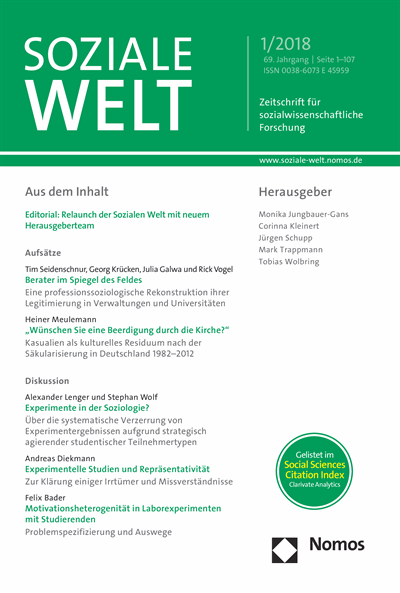
Volume 69 (2018), Edition 1

SozW Soziale Welt
Authors:
Journal:
SozW Soziale Welt
Publisher:
 2018


Bibliographic data

ISSN-Print
0038-6073
ISSN-Online
2942-3414
Publisher
Nomos, Baden-Baden
Language
German
Product type
Volume

Articles

Cover of Volume: SozW Soziale Welt Volume 69 (2018), Edition 1
Article
Full access

Page 1 - 2
Nomos Verlagsgesellschaft mbH & Co. KG, Baden-Baden 2018

Cover of Volume: SozW Soziale Welt Volume 69 (2018), Edition 1
Article
Full access

Page 3 - 5
Nomos Verlagsgesellschaft mbH & Co. KG, Baden-Baden 2018
Authors:

Cover of Volume: SozW Soziale Welt Volume 69 (2018), Edition 1
Article
Full access

Page 6 - 32
Nomos Verlagsgesellschaft mbH & Co. KG, Baden-Baden 2018
Authors:

Cover of Volume: SozW Soziale Welt Volume 69 (2018), Edition 1
Article
Full access

Page 33 - 63
Nomos Verlagsgesellschaft mbH & Co. KG, Baden-Baden 2018
Authors:

Cover of Volume: SozW Soziale Welt Volume 69 (2018), Edition 1
Article
Full access

Page 64 - 94
Nomos Verlagsgesellschaft mbH & Co. KG, Baden-Baden 2018
Authors:

Cover of Volume: SozW Soziale Welt Volume 69 (2018), Edition 1
Article
Full access

Page 95 - 100
Nomos Verlagsgesellschaft mbH & Co. KG, Baden-Baden 2018
Authors:

Cover of Volume: SozW Soziale Welt Volume 69 (2018), Edition 1
Article
Full access

Page 101 - 107
Nomos Verlagsgesellschaft mbH & Co. KG, Baden-Baden 2018
Authors:

Bibliography (242 entries)

  1. Abbott, Andrew D. (1988): The System of Professions. An Essay on the Division of Expert Labor. Chicago: University of Chicago Press. Open Google Scholar doi.org/10.5771/0038-6073-2018-1-6
  2. Abrahamson, Eric (1996): Management fashion. Academy of Management Review 21 (1): 254– Open Google Scholar doi.org/10.5771/0038-6073-2018-1-6
  3. 285. Open Google Scholar doi.org/10.5771/0038-6073-2018-1-6
  4. Alvesson, Mats & Johansson, Anders W. (2002): Professionalism and politics in management consultancy work, in: Timothy Clark & Robin Fincham (Hrsg.), Critical consulting. New Perspectives on the Management Advice Industry. Oxford: John Wiley & Sons. S. 228–246. Open Google Scholar doi.org/10.5771/0038-6073-2018-1-6
  5. Alvesson, Mats, Kärreman, Dan, Sturdy, Andrew & Handley, Karen (2009): Unpacking the client(s): Constructions, positions and client-consultant dynamics. Scandinavian Journal of Management 25 (3): 253–263. Open Google Scholar doi.org/10.5771/0038-6073-2018-1-6
  6. Ameln, Falko, Kramer, Josef & Stark, Heike (2009): Organisationsberatung beobachtet. Hidden Agendas und Blinde Flecken. Wiesbaden: VS Verlag für Sozialwissenschaften. Open Google Scholar doi.org/10.5771/0038-6073-2018-1-6
  7. Armbrüster, Thomas, Banzhaf, Johannes & Dingemann, Lars (2010): Unternehmensberatung im öffentlichen Sektor. Institutionenkonflikt, praktische Herausforderungen, Lösungen. Wiesbaden: Gabler Verlag. Open Google Scholar doi.org/10.5771/0038-6073-2018-1-6
  8. Bäcklund, Jonas & Werr, Andreas (2008): Constructing the legitimate buyer of management consulting services. Journal of Organizational Change Management 21 (6): 758–772. Open Google Scholar doi.org/10.5771/0038-6073-2018-1-6
  9. Bartel, Carolina A. & Garud, Raghu (2009): The role of narratives in sustaining organizational innovation. Organization Science 20 (1): 107–117. Open Google Scholar doi.org/10.5771/0038-6073-2018-1-6
  10. BDU (2015): Facts & Figures zum Beratermarkt 2014/2015. Der Deutsche Unternehmensberatermarkt in Zahlen. Bonn: Bundesverband Deutscher Unternehmensberater BDU e.V. Open Google Scholar doi.org/10.5771/0038-6073-2018-1-6
  11. Boltanski, Luc & Chiapello, Ève (2006): Der neue Geist des Kapitalismus. Konstanz: UVK. Bryson, John M., Crosby, Barbara C. & Bloomberg, Laura (2014): Public value governance. Open Google Scholar doi.org/10.5771/0038-6073-2018-1-6
  12. Moving beyond traditional public administration and the New Public Management. Public Open Google Scholar doi.org/10.5771/0038-6073-2018-1-6
  13. Administration Review 74 (4): 445–446. Open Google Scholar doi.org/10.5771/0038-6073-2018-1-6
  14. Czarniawska-Joerges, Barbara (1997): Narrating the Organization. Dramas of Institutional Identity. Chicago: University of Chicago Press. Open Google Scholar doi.org/10.5771/0038-6073-2018-1-6
  15. Czarniawska, Barbara & Mazza, Carmelo. (2003): Consulting as a liminal space. Human Relations 56 (3): 267–290. Open Google Scholar doi.org/10.5771/0038-6073-2018-1-6
  16. David, Robert J., Sine, Wesley D. & Haveman, Heather A. (2013): Seizing opportunity in emerging fields. How institutional entrepreneurs legitimated the professional form of management consulting. Organization Science 24 (2): 356–377. Open Google Scholar doi.org/10.5771/0038-6073-2018-1-6
  17. DiMaggio, Paul J. & Powell, Walter W. (1983): The iron cage revisited: Institutional isomorphism and collective rationality in organizational fields. American Sociological Review 48 (2): 147–160. Open Google Scholar doi.org/10.5771/0038-6073-2018-1-6
  18. Dunn, Mary B. & Jones, Candace (2010): Institutional logics and institutional pluralism. The contestation of care and science logics in medical education, 1967–2005. Administrative Science Quarterly 55 (1): 114–149. Open Google Scholar doi.org/10.5771/0038-6073-2018-1-6
  19. Engwall, Lars & Kipping, Matthias (2013): Management consulting: Dynamics, debates, and directions. International Journal of Strategic Communication 7 (2): 84–98. Open Google Scholar doi.org/10.5771/0038-6073-2018-1-6
  20. Ernst, Berit & Kieser, Alfred (2002): In search of explanations for the consulting explosion, in: Kerstin Sahlin-Andersson & Lars Engwall (Hrsg.), The Expansion of Management Knowledge. Carriers, Flows, and Sources. Palo Alto-CA: Stanford University Press. S. 47–73. Open Google Scholar doi.org/10.5771/0038-6073-2018-1-6
  21. Freidson, Eliot (1988): Professional Powers. A Study of the Institutionalization of Formal Knowledge. Chicago: University of Chicago Press. Open Google Scholar doi.org/10.5771/0038-6073-2018-1-6
  22. Freidson, Eliot (2001): Professionalism. The Third Logic. Chicago: Polity. Open Google Scholar doi.org/10.5771/0038-6073-2018-1-6
  23. Hargadon, Andrew B. (1998): Firms as knowledge brokers: Lessons in pursuing continuous innovation. California Management Review 40 (3): 209–227. Open Google Scholar doi.org/10.5771/0038-6073-2018-1-6
  24. Hasse, Raimund & Krücken, Georg (2005): Neo-Institutionalismus. Bielefeld: VS Verlag für Sozialwissenschaften. Open Google Scholar doi.org/10.5771/0038-6073-2018-1-6
  25. Hasse, Raimund & Krücken, Georg (2009): Neo-institutionalistische Wirtschaftssoziologie, in: Jens Beckert & Christoph Deutschmann (Hrsg.), Wirtschaftssoziologie, Sonderheft 49 der Kölner Zeitschrift für Soziologie und Sozialpsychologie. Wiesbaden: VS Verlag für Sozialwissenschaften. S. 194–207. Open Google Scholar doi.org/10.5771/0038-6073-2018-1-6
  26. Hasse, Raimund (2010): Ökonomisierungstendenzen bei Non-Profits, Großunternehmen und Start-ups – eine theoriegeleitete Diskussion empirischer Trends, in: Martin Endreß & Thomas Matys (Hrsg.), Die Ökonomie der Organisation – die Organisation der Ökonomie. Wiesbaden: VS Verlag für Sozialwissenschaften. S. 93–119. Open Google Scholar doi.org/10.5771/0038-6073-2018-1-6
  27. Hüther, Otto & Krücken, Georg (2016): Hochschulen. Fragestellungen, Ergebnisse und Perspektiven der sozialwissenschaftlichen Hochschulforschung. Wiesbaden: Springer VS. Open Google Scholar doi.org/10.5771/0038-6073-2018-1-6
  28. KGSt (1993): Das Neue Steuerungsmodell. Begründung. Konturen. Umsetzung, Köln: KGSt. Kipping, Matthias (2011): Hollow from the start? Image professionalism in management consul- Open Google Scholar doi.org/10.5771/0038-6073-2018-1-6
  29. ting. Current Sociology 59 (4): 530–550. Open Google Scholar doi.org/10.5771/0038-6073-2018-1-6
  30. Kloke, Katharina (2014): Qualitätsentwicklung an deutschen Hochschulen. Professionstheoretische Untersuchung eines neuen Tätigkeitsfeldes. Wiesbaden: VS Verlag für Sozialwissenschaften. Open Google Scholar doi.org/10.5771/0038-6073-2018-1-6
  31. Kozica, Arjan, Brandl, Julia & Kaiser, Stephan (2013): Verwaltungsberatung. Wie lernen öffentliche Verwaltungen aus externer Beratung?, in: Sabine Kropp & Sabine Kuhlmann (Hrsg.), Wissen und Expertise in Politik und Verwaltung. Opladen: Budrich. S. 305–324. Open Google Scholar doi.org/10.5771/0038-6073-2018-1-6
  32. Kreiswirth, Martin (2000). Merely telling stories? Narrative and knowledge in the human sciences. Poetics Today 21 (2): 293–318. Open Google Scholar doi.org/10.5771/0038-6073-2018-1-6
  33. Krücken, Georg (2017). Die Transformation von Universitäten in Wettbewerbsakteure. Beiträge zur Hochschulforschung 39 (3-4): 10–29. Open Google Scholar doi.org/10.5771/0038-6073-2018-1-6
  34. Krücken, Georg & Serrano-Velarde, Kathia (2016): Der Berater als Fremder. Eine soziologische Studie zur Managementberatung in Universitäten. Kölner Zeitschrift für Soziologie und Sozialpsychologie 68 (1): 29–51. Open Google Scholar doi.org/10.5771/0038-6073-2018-1-6
  35. Krücken, Georg, Mazza, Carmelo, Meyer, Renate E. & Walgenbach, Peter (Hrsg.) (2017.): New Themes in Institutional Analysis. Topics and Issues from European Research. Cheltenham: Edward Elgar Publishing Ltd. Open Google Scholar doi.org/10.5771/0038-6073-2018-1-6
  36. Lounsbury, Michael & Boxenbaum, Eva (Hrsg.) (2013): Institutional Logics in Action. Research in the Sociology of Organizations 39. Bingley: Emerald Group Publishing Limited. Open Google Scholar doi.org/10.5771/0038-6073-2018-1-6
  37. McKenna, Christopher D. (2007): Give professionalization a chance! Why management consulting may yet become a full profession, in: Daniel Muzio, Stephan Ackroyd & Jean-Francois Chalant (Hrsg.), Redirections in the Study of Expert Labour: Law, Medicine and Management Consultancy. London: Palgrave Macmillan. S. 204–216. Open Google Scholar doi.org/10.5771/0038-6073-2018-1-6
  38. Marquis, Christopher & Lounsbury, Michael (2007): Vive la resistance: Competing logics and the consolidation of U.S. community banking. Academy of Management Journal 50 (4): 799– 820. Open Google Scholar doi.org/10.5771/0038-6073-2018-1-6
  39. Meyer, John W. & Rowan, Brian (1977): Institutionalized organizations: Formal structure as myth and ceremony. American Journal of Sociology 83 (2): 340–363. Open Google Scholar doi.org/10.5771/0038-6073-2018-1-6
  40. Mládková, Ludmila (2013): Leadership and storytelling. The second international conference on leadership. Technology and innovation management. Procedia – Social and Behavioral Sciences 75: 83–90. Open Google Scholar doi.org/10.5771/0038-6073-2018-1-6
  41. Muzio, Daniel, Kirkpatrick, Ian & Kipping, Matthias (2011): Professions, organizations and the state: Applying the sociology of the professions to the case of management consultancy. Current Sociology 59 (6): 805–824. Open Google Scholar doi.org/10.5771/0038-6073-2018-1-6
  42. Nikolova, Natalia, Reihlen, Markus & Schlapfner, Jan-Florian (2009): Client–Consultant interaction: Capturing social practices of professional service production. Scandinavian Journal of Management 25 (3): 289–298. Open Google Scholar doi.org/10.5771/0038-6073-2018-1-6
  43. Ocasio, William, Thornton, Patricia H. & Lounsbury, Michael (2017): Advances to the institutional logics perspective, in: Royston Greenwood, Christine Oliver, Thomas B. Lawrence & Renate Meyer (Hrsg.), The Sage Handbook of Organizational Institutionalism (2nd edition), London: Sage Publications Ltd. S. 509-532. Open Google Scholar doi.org/10.5771/0038-6073-2018-1-6
  44. Oevermann, Ulrich (1996): Theoretische Skizze einer revidierten Theorie professionalisierten Handelns, in: Arno Combe & Werner Helsper (Hrsg.), Pädagogische Professionalität. Untersuchungen zum Typus pädagogischen Handelns. Frankfurt am Main: Suhrkamp. S. 70–182. Open Google Scholar doi.org/10.5771/0038-6073-2018-1-6
  45. Parsons, Talcott (1964): The Social System. New York: Macmillan USA. Open Google Scholar doi.org/10.5771/0038-6073-2018-1-6
  46. Parsons, Talcott (1968): Professions, in: David L. Sills (Hrsg.), International Encyclopedia of the Social Sciences. New York: Macmillan. S. 536–547. Open Google Scholar doi.org/10.5771/0038-6073-2018-1-6
  47. Pfadenhauer, Michaela (2003): Professionalität. Eine wissenssoziologische Rekonstruktion institutionalisierter Kompetenzdarstellung. Opladen: VS Verlag für Sozialwissenschaften. Open Google Scholar doi.org/10.5771/0038-6073-2018-1-6
  48. Pfadenhauer, Michaela (2004). Die Definition des Problems aus der Verwaltung der Lösung. Professionelles Handeln revisited, in: Michaela Pfadenhauer (Hrsg.), Professionelles Handeln. Wiesbaden: VS Verlag für Sozialwissenschaften. S. 9–27. Open Google Scholar doi.org/10.5771/0038-6073-2018-1-6
  49. Powell, Walter W., Oberg, Achim, Korff, Valeska, Oelberger, Carrie & Kloos, Karina (2017): Institutional analysis in a digital era: Mechanisms and methods to understand emerging fields. Topics and issues from European research, in: Georg Krücken, Carmelo Mazza, Renate E. Meyer & Peter Walgenbach (Hrsg.), New Themes in Institutional Analysis. Topics and Issues from European Research. Cheltenham: Edward Elgar. S. 305–344. Open Google Scholar doi.org/10.5771/0038-6073-2018-1-6
  50. Quirke, Linda (2013): Rogue resistance: Sidestepping isomorphic pressures in a patchy institutional field. Organization Studies 34 (11): 1675–1699. Open Google Scholar doi.org/10.5771/0038-6073-2018-1-6
  51. Reay, Trish & Hinings, C. R. (2009): Managing the rivalry of competing institutional logics. Organization Studies 30 (6): 629–652. Open Google Scholar doi.org/10.5771/0038-6073-2018-1-6
  52. Reihlen, Markus, Smets, Michael & Veit, Andreas (2010): Management consultancies as institutional agents: Strategies for creating and sustaining institutional capital. Schmalenbach Business Review 62 (3): 317–339. Open Google Scholar doi.org/10.5771/0038-6073-2018-1-6
  53. Saint-Martin, Dennis (2005): Management consultancy, in: Ewan Ferlie, Laurence E. Lynn & Christopher Pollitt (Hrsg.), The Oxford Handbook of Public Management. Oxford: Oxford University Press. S. 671–694. Open Google Scholar doi.org/10.5771/0038-6073-2018-1-6
  54. Schimank, Uwe & Volkmann, Ute (2017): Das Regime der Konkurrenz: Gesellschaftliche Ökonomisierungsdynamiken heute. Weinheim/Basel: Beltz Juventa. Open Google Scholar doi.org/10.5771/0038-6073-2018-1-6
  55. Schützeichel, Rainer & Brüsemeister, Thomas (2004): Die beratene Gesellschaft. Zur gesellschaftlichen Bedeutung von Beratung. Wiesbaden: VS Verlag für Sozialwissenschaften. Open Google Scholar doi.org/10.5771/0038-6073-2018-1-6
  56. Seidenschnur, Tim, Krücken, Georg, Vogel, Rick & Galwa, Julia (2016): Beratung von Universitäten. Lernprozesse zwischen universitärem Denken und ökonomischer Logik. Hochschulmanagement 11 (3): 66-72. Open Google Scholar doi.org/10.5771/0038-6073-2018-1-6
  57. Smets, Michael, Greenwood, Royston & Lounsbury, Michael (2015 a): An institutional perspective on strategy as practice, in: Damon Golsorkhi, Linda Rouleau, David Seidl & Eero Vaara (Hrsg.), Cambridge Handbook of Strategy as Practice (2nd edition). Cambridge: Cambridge University Press. S. 283–300. Open Google Scholar doi.org/10.5771/0038-6073-2018-1-6
  58. Smets, Michael, Jarzabkowski, Paula, Burke, Gary T. & Spee, Paul (2015 b): Reinsurance trading in Lloyd's of London. Balancing conflicting-yet-complementary logics in practice. Academy of Management Journal 58 (3): 932–970. Open Google Scholar doi.org/10.5771/0038-6073-2018-1-6
  59. Stichweh, Rudolf (1996): Professionen in einer funktional differenzierten Gesellschaft, in: Arno Combe & Werner Helsper (Hrsg), Pädagogische Professionalität. Untersuchungen zum Typus pädagogischen Handelns. Frankfurt a. M.: Suhrkamp. S. 4–9. Open Google Scholar doi.org/10.5771/0038-6073-2018-1-6
  60. Sturdy, Andrew (1997): The consultancy process – An insecure business? Journal of Management Studies 34 (3) 389–413. Open Google Scholar doi.org/10.5771/0038-6073-2018-1-6
  61. Sturdy, Andrew, Clark, Timothy, Fincham, Robin & Handley, Karen (2009): Between innovation and legitimation – Boundaries and knowledge flow in management consultancy. Organization 16 (5): 627–653. Open Google Scholar doi.org/10.5771/0038-6073-2018-1-6
  62. Sturdy, Andrew, Wright, Christopher (2011): The active client. The boundary-spanning roles of internal consultants as gatekeepers, brokers and partners of their internal counterparts. Management Learning 42(5): 485–503. Open Google Scholar doi.org/10.5771/0038-6073-2018-1-6
  63. Suchman, Mark C. (1995): Managing legitimacy. Strategic and institutional approaches. Academy of Management Review 20 (3): 571–610. Open Google Scholar doi.org/10.5771/0038-6073-2018-1-6
  64. Suddaby, Roy, Bitektine, Alex & Haack, Patrick (2017): Legitimacy. Academy of Management Annals 11 (1): 451–478. Open Google Scholar doi.org/10.5771/0038-6073-2018-1-6
  65. Thornton, Patricia H. & Ocasio, William (2008): Institutional logics, in: Royston Greenwood, Christine Oliver, Kerstin Sahlin & Roy Suddaby (Hrsg.), The SAGE Handbook of Organizational Institutionalism. Thousand Oaks: Sage Publications Ltd. S. 99–129. Open Google Scholar doi.org/10.5771/0038-6073-2018-1-6
  66. Thornton, Patricia H., Ocasio, William & Lounsbury, Michael (2012): The Institutional Logics Perspective. Foundations, Research, and Theoretical Elaboration. Oxford, New York: Oxford University Press. Open Google Scholar doi.org/10.5771/0038-6073-2018-1-6
  67. Todorova, Gergana (2004): Exploring knowledge issues in the consulting relationship. A client centered perspective, in: Anthony F. Buono (Hrsg.), Creative Consulting. Innovative Perspectives on Management Consulting. Greenwich: Information Age Publishing. S. 73–98. Open Google Scholar doi.org/10.5771/0038-6073-2018-1-6
  68. Vogel, Rick (2006): Zur Institutionalisierung von New Public Management. Disziplindynamik der Verwaltungswissenschaft unter dem Einfluss ökonomischer Theorie. Wiesbaden: Deutscher Universitätsverlag. Open Google Scholar doi.org/10.5771/0038-6073-2018-1-6
  69. Vogel, Rick (2009): Aufkommen und Verbreitung von New Public Management in Deutschland. Eine institutionalistische Diskursanalyse mit bibliometrischen Methoden. Der moderne Staat 2(2): 367–390. Open Google Scholar doi.org/10.5771/0038-6073-2018-1-6
  70. Vogel, Rick (2012): Framing and counterframing New Public Management: The German case. Public Administration 90(2): 370–392. Open Google Scholar doi.org/10.5771/0038-6073-2018-1-6
  71. Vogel, Rick & Frost, Jetta (2009): Innovating in the German public sector: How a think tank frames the debate on NPM. The Innovation Journal: The Public Sector Innovation Journal 14(2): 1–21. Open Google Scholar doi.org/10.5771/0038-6073-2018-1-6
  72. Vogel, Rick, Galwa, Julia, Krücken, Georg & Tim Seidenschnur (2016): Legitimierungsprobleme und -strategien von Managementberatern im öffentlichen Sektor. Der moderne Staat 9 (2), S. 253–275. Open Google Scholar doi.org/10.5771/0038-6073-2018-1-6
  73. Walgenbach, Peter & Meyer, Renate E. (2008): Neoinstitutionalistische Organisationstheorie. Stuttgart: Kohlhammer. Open Google Scholar doi.org/10.5771/0038-6073-2018-1-6
  74. Werr, Andreas & Styhre, Alexander (2002): Management consultants – friend or foe? Understanding the ambiguous client-consultant relationship. International Studies of Management & Organization 32 (4): 43–66. Open Google Scholar doi.org/10.5771/0038-6073-2018-1-6
  75. Wooten, Melissa & Hoffman, Andrew J. (2017): Organizational fields: Past, present and future, in: Royston Greenwood, Christine Oliver, Thomas B. Lawrence & Renate E. Meyer (Hrsg.), The SAGE Handbook of Organizational Institutionalism (2nd ed.), Thousand Oaks: Sage Publications Ltd. S. 55–74. Open Google Scholar doi.org/10.5771/0038-6073-2018-1-6
  76. Zietsma, Charlene, Groenewegen, Peter, Logue, Danielle M. & Hinings, C. R. (Bob) (2017): Field or fields? Building the scaffolding for cumulation of research on institutional fields, in: Academy of Management Annals 11 (1): 391–450. Open Google Scholar doi.org/10.5771/0038-6073-2018-1-6
  77. ALLBUS. Allgemeine Bevölkerungsumfrage der Sozialwissenschaften. http://www.gesis.org/ allbus/studienprofile/ Open Google Scholar doi.org/10.5771/0038-6073-2018-1-33
  78. Aries, P. (1981): Studien zur Geschichte des Todes im Abendland. München 1981 (frz. Original 1975) Open Google Scholar doi.org/10.5771/0038-6073-2018-1-33
  79. Baker, J. O. / Smith, B. G. (2015): American Secularism. Cultural Contours of Nonreligious Belief Systems. New York: New York University Press Open Google Scholar doi.org/10.5771/0038-6073-2018-1-33
  80. Belliger, A. / D. J. Krieger (Hrsg.), (2006): Ritualtheorien. Ein einführendes Handbuch. 3. Auflage. Wiesbaden. Open Google Scholar doi.org/10.5771/0038-6073-2018-1-33
  81. Burkimsher, M. (2014): Is Religious Attendance Bottoming Out? An Examination of Current Trends across Europe. Journal for the Scientific Study of Religion 53. S. 432-445. Open Google Scholar doi.org/10.5771/0038-6073-2018-1-33
  82. Davie, G. (2007): Vicarious Religion: A Methodological Challenge. In: Nancy T. Ammerman (Hrsg.). Everyday Religion. Oxford. Oxford University Press, S. 21-37. Open Google Scholar doi.org/10.5771/0038-6073-2018-1-33
  83. Davie, G. (2010): Vicarious Religion: A Response. Journal of Contemporary Religion 25. S. 261-266. Open Google Scholar doi.org/10.5771/0038-6073-2018-1-33
  84. Davie, G. (2013): The Sociology of Religion. Acritical Agenda. Second Edition. Los Angeles usw. Demerath, N. J. (2000): The Rise of ‘Cultural Religion’ in European Christianity: Learning from Open Google Scholar doi.org/10.5771/0038-6073-2018-1-33
  85. Poland, Northern Ireland, and Sweden. Social Compass 47, S. 127-136. Open Google Scholar doi.org/10.5771/0038-6073-2018-1-33
  86. Drewermann, E. (1989): Kleriker – Psychogramm eines Ideals. Olten. Open Google Scholar doi.org/10.5771/0038-6073-2018-1-33
  87. EVS, European Value Survey, Longitudinal-Datensatz 1981-2008. GESIS Datensatz ZA4804. http://www.europeanvaluesstudy.eu/ Open Google Scholar doi.org/10.5771/0038-6073-2018-1-33
  88. Feldmann, K. (2010): Soziologie des Sterbens und des Todes. Sozialwissenschaftliche Thanatologie. Wiesbaden. Open Google Scholar doi.org/10.5771/0038-6073-2018-1-33
  89. Felling, A. / Peters, J. / Schreuder, O. (1987): Religion im Vergleich: Bundesrepublik Deutschland und Niederlande. Frankfurt. Open Google Scholar doi.org/10.5771/0038-6073-2018-1-33
  90. Firebaugh, G. (1997): Analyzing Repeated Surveys. Thousand Oaks etc.: Sage. Open Google Scholar doi.org/10.5771/0038-6073-2018-1-33
  91. Grimes, R. (2006): Typen ritueller Erfahrung. In: Belliger /Krieger (Hrsg), a.a.O., S. 117-132. Hahn, A. (1974): Religion und der Verlust der Sinngebung. Frankfurt. Open Google Scholar doi.org/10.5771/0038-6073-2018-1-33
  92. Happe, B. (2012): Der Tod gehört mir. Die Vielfalt der heutigen Bestattungskultur und ihre Ursprünge. Open Google Scholar doi.org/10.5771/0038-6073-2018-1-33
  93. Jagodzinski, W. / Dobbelaere, K. (1995). Secularization and Church Religiosity. in: Jan W. Van Deth & Elinor Scarbough (Hrsg.) The Impact of Values, Oxford, S. 76-119. Open Google Scholar doi.org/10.5771/0038-6073-2018-1-33
  94. Kasselstrand, I. (2015): Nonbelievers in the Church: A Study of Cultural Religion in Sweden. Sociology of Religion 76, S. 275-294. Open Google Scholar doi.org/10.5771/0038-6073-2018-1-33
  95. Meulemann, H. (1979): Soziale Herkunft und Schullaufbahn. Frankfurt. Open Google Scholar doi.org/10.5771/0038-6073-2018-1-33
  96. Meulemann, H (2015): Nach der Säkularisierung. Religiosität in Deutschland 1982-2012. Wiesbaden: Springer. Open Google Scholar doi.org/10.5771/0038-6073-2018-1-33
  97. Moser, T. (1976): Gottesvergiftung. Frankfurt am Main. Open Google Scholar doi.org/10.5771/0038-6073-2018-1-33
  98. Müller, O. (2011): Kirchlichkeit und Religiosität in Ostmittel- und Osteuropa. Wiesbaden. Pickel, G. (2011): Religionssoziologie. Eine Einführung in zentrale Themenbereiche. Wiesbaden. Pickel, G. (2017): Religiosität in Deutschland und Europa – Religiöse Pluralisierung und Säkula- Open Google Scholar doi.org/10.5771/0038-6073-2018-1-33
  99. risierung auf soziokulturell variierenden Pfaden. Zeitschrift für Religion, Gesellschaft und Poli- Open Google Scholar doi.org/10.5771/0038-6073-2018-1-33
  100. tik 1: 37-74. Open Google Scholar doi.org/10.5771/0038-6073-2018-1-33
  101. Pollack, D. / Laube, M. / Liskowsky, A. (2014): Intensive Mitgliedschaftspraxis S. 43-49 in: Evangelische Kirche Deutschlands (Hrsg.): Engagement und Indifferenz. Kirchenmitgliedschaft als soziale Praxis. V. EKD-Erhebung über Kirchenmitgliedschaft. Hannover. Open Google Scholar doi.org/10.5771/0038-6073-2018-1-33
  102. Pollack, D. / Rosta, G. (2015): Religion in der Moderne. Ein internationaler Vergleich. Frankfurt. Pollack, D. / Wohlrab-Sahr, M. / Gärtner, C. (2003): Einleitung. S. 9-20 in: C. Gärtner / D. Pol- Open Google Scholar doi.org/10.5771/0038-6073-2018-1-33
  103. lack / M. Wohlrab-Sahr (Hrsg.), Atheismus und religiöse Indifferenz. Opladen. Open Google Scholar doi.org/10.5771/0038-6073-2018-1-33
  104. Putnam, R. D. / Campbell, D. E. (2010). American. Grace. How Religion Divides and Unites Us. New York. Open Google Scholar doi.org/10.5771/0038-6073-2018-1-33
  105. Olson, M. (1965): The Logic of Collective Action. Cambridge. Oz, A. / Oz-Sulzberger, F. (2012): Jews and Words. New Haven. Open Google Scholar doi.org/10.5771/0038-6073-2018-1-33
  106. Peuckert, R. (2005): Familienformen im sozialen Wandel. 6. Auflage. Wiesbaden. Sörries, Reiner, (2016): Ein letzter Gruß. Kevelaer. Open Google Scholar doi.org/10.5771/0038-6073-2018-1-33
  107. Spring, H. / Moosbrugger, H. / Zwingmann, C. / Frank, D. (1993): Kirchlicher Dogmatismus und ekklesiogene Neurosen. Zeitschrift für Klinische Psychologie, Psychopathologie und Psychotherapie, 41, S. 31-42. Open Google Scholar doi.org/10.5771/0038-6073-2018-1-33
  108. Stark, R. (1996): The Rise of Christianity. A Sociologist Reconsiders History. Princeton. Open Google Scholar doi.org/10.5771/0038-6073-2018-1-33
  109. Stark, R. / Hamberg, E. / Miller, A. S. (2005): Exploring Spirituality an Unchurched Religion in America, Sweden, and Japan. Journal of Contemporary Religion 20, S. 3-23. Open Google Scholar doi.org/10.5771/0038-6073-2018-1-33
  110. Treiman, D. J. (1977): Occupational Prestige in Comparative Perspective. New York. Open Google Scholar doi.org/10.5771/0038-6073-2018-1-33
  111. Thieme, F. (2013): Der gegenwärtige Wandel der deutschen Bestattungskultur als Widerspiegelung gesellschaftlicher Entwicklungstrends. SWS-Rundschau 53. S. 320-336. Open Google Scholar doi.org/10.5771/0038-6073-2018-1-33
  112. Turner, V. W. (2006): Liminalität und Communitas. In: Belliger & Krieger (Hrsg.), a.a.O., S. 247-259. Open Google Scholar doi.org/10.5771/0038-6073-2018-1-33
  113. Vaas, R. / Blume, M. (2102): Gott, Gene und Gehirn. Warum der Glaube nützt; die Evolution der Religiosität. 3. Auflage. Stuttgart. Open Google Scholar doi.org/10.5771/0038-6073-2018-1-33
  114. Voas, D. (2009): The Rise and Fall of Fuzzy Fidelity in Europe. European Sociological Review 35, S. 155-169. Open Google Scholar doi.org/10.5771/0038-6073-2018-1-33
  115. Voas, D. / McAndrew, S. / Storm, I. (2013): Modernization and the gender gap in religiosity: Evidence from cross-nation European surveys. In: C. Wolf / M. Koenig (Hrsg.): Religion und Gesellschaft. Sonderheft 53 Kölner Zeitschrift für Soziologie und Sozialpsychologie. Wiesbaden, S. 269-283. Open Google Scholar doi.org/10.5771/0038-6073-2018-1-33
  116. Wilson, E. O. (2013): The social conquest of earth. New York. Open Google Scholar doi.org/10.5771/0038-6073-2018-1-33
  117. Wunn, I. / Urban, P. / Klein, C. (2015): Götter – Gene – Genesis. Die Biologie der Religionsentstehung. Berlin-Heidelberg. Open Google Scholar doi.org/10.5771/0038-6073-2018-1-33
  118. Abeler, Johannes / Nosenzo, Daniele (2015): Self-Selection into Laboratory Experiments: Pro-Social Motives Versus Monetary Incentives, in: Experimental Economics 18, S. 195-214. Open Google Scholar doi.org/10.5771/0038-6073-2018-1-64
  119. Albert, Hans (1965): Modell-Platonismus. Der neoklassische Stil des ökonomischen Denkens in kritischer Beleuchtung, in: Ernst Topitsch (Hg.): Logik der Sozialwissenschaften. Berlin, S. 406-434. Open Google Scholar doi.org/10.5771/0038-6073-2018-1-64
  120. Arnett, Jeffrey J. (2008): The Neglected 95%. Why American Psychology Needs to Become Less American, in: American Psychologist 63, S. 602-614. Open Google Scholar doi.org/10.5771/0038-6073-2018-1-64
  121. Aronson, Elliot / Wilson, Timothy D. / Akert, Robin M. (2004): Sozialpsychologie. 4., aktualisierte Aufl. München. Open Google Scholar doi.org/10.5771/0038-6073-2018-1-64
  122. Bahr, Gunter / Requate, Till (2013): Reciprocity and Giving in a Consecutive Three-Person Dictator Game with Social Interaction, in: German Economic Review 15, 374-392. Open Google Scholar doi.org/10.5771/0038-6073-2018-1-64
  123. Bailey, Phoebe E. / Ruffman, Ted / Rendell, Peter G. (2013): Age-Related Differences in Social Economic Decision Making: The Ultimatum Game, in: Journal of Gerontology B Series 68, S. 356-363. Open Google Scholar doi.org/10.5771/0038-6073-2018-1-64
  124. Ball, Sheryl B. / Cech, Paula-Ann (1996): Subject Pool Choice and Treatment Effects in Economic Laboratory Research, Research in Experimental Economics 6, S. 239-292. Open Google Scholar doi.org/10.5771/0038-6073-2018-1-64
  125. Bardsley, Nicholas (2005): Experimental Economics and the Artificiality of Alteration, in: Journal of Economic Methodology 12, S. 239-251. Open Google Scholar doi.org/10.5771/0038-6073-2018-1-64
  126. Becker, Rolf / Zangger, Christoph (2015): Experimentelle Bildungsforschung. Beiträge experimenteller Forschung zur Bildungssoziologie und -ökonomie, in: Marc Keuschnigg / Tobias Wolbring (Hg.): Experimente in den Sozialwissenschaften. Soziale Welt, Sonderband 22. Baden-Baden, S. 105-131. Open Google Scholar doi.org/10.5771/0038-6073-2018-1-64
  127. Benz, Matthias / Meier, Stephan (2008): Do People Behave in Experiments as in the Field? Evidence from Donations, in: Experimental Economics 11, S. 268-281. Open Google Scholar doi.org/10.5771/0038-6073-2018-1-64
  128. Berger, Joël / Diekmann, Andreas (2015): The Logic of Relative Frustration: Boudon’s Competition Model and Experimental Evidence, in: European Sociological Review 31, S. 725-737. Open Google Scholar doi.org/10.5771/0038-6073-2018-1-64
  129. Berger, Roger (2015): Das Laborexperiment als sozialer Prozess, in: Marc Keuschnigg / Tobias Wolbring (Hg.): Experimente in den Sozialwissenschaften. Soziale Welt, Sonderband 22. Baden-Baden, S. 53-76. Open Google Scholar doi.org/10.5771/0038-6073-2018-1-64
  130. Binmore, Ken / Shaked, Avner (2010): Experimental Economics: Where Next?, in: Journal of Economic Behavior and Organization 73, S. 87-100. Open Google Scholar doi.org/10.5771/0038-6073-2018-1-64
  131. Brown, Thomas C. (2003): Introduction to Stated Preference Methods, in: Patricia A. Champ / Kevin J. Boyle / Thomas C. Brown (Hg.): A Primer on Nonmarket Valuation. Dordrecht, Boston, S. 99-110. Open Google Scholar doi.org/10.5771/0038-6073-2018-1-64
  132. Bundesministerium für Bildung und Forschung (BMBF) (2004): Die wirtschaftliche und die soziale Lage der Studierenden in der Bundesrepublik Deutschland 2003, Berlin. Open Google Scholar doi.org/10.5771/0038-6073-2018-1-64
  133. Burger, Jerry M. (2009): Replicating Milgram. Would People Still Obey Today?, in: American Psychologist 64, S. 1-11. Open Google Scholar doi.org/10.5771/0038-6073-2018-1-64
  134. Camerer, Colin F. (2003): Behavioral Game Theory. Experiments in Strategic Interaction, Princeton. Open Google Scholar doi.org/10.5771/0038-6073-2018-1-64
  135. Carpenter, Jeffrey P. / Harrison, Glenn W. / List, John A. (2005): Field Experiments in Economics: An Introduction, in: Research in Experimental Economics 10, S. 1-16. Open Google Scholar doi.org/10.5771/0038-6073-2018-1-64
  136. Charness, Gary / Rabin, Matthew (2002): Understanding Social Preferences with Simple Tests, in: Quarterly Journal of Economics 117, S. 817-869. Open Google Scholar doi.org/10.5771/0038-6073-2018-1-64
  137. Chuah, Swee-Hoon / Hoffmann, Robert / Jones, Martin / Williams, Geoffrey (2007): Do Cultures Clash? Evidence From Cross-National Ultimatum Game Experiments, in: Journal of Economic Behavior & Organization 64, S. 35-48. Open Google Scholar doi.org/10.5771/0038-6073-2018-1-64
  138. Cleave, B. L. / Nikiforakis, N. / Slonim, R. (2013): Is There Selection Bias in Laboratory Experiments? The Case of Social and Risk Preferences, in: Experimental Economics 16, S. 372-382. Open Google Scholar doi.org/10.5771/0038-6073-2018-1-64
  139. Cook, Thomas D. / Campbell, Donald T. (1979): Quasi-Experimentation. Design and Analysis Issues for Field Settings, Boston. Open Google Scholar doi.org/10.5771/0038-6073-2018-1-64
  140. Croson, Rachel (1996): Information in Ultimatum Games: An Experimental Study, in: Journal of Economic Behavior and Organization 30, S. 197-212. Open Google Scholar doi.org/10.5771/0038-6073-2018-1-64
  141. Croson, Rachel / Gächter, Simon (2010): The Science of Experimental Economics, in: Journal of Economic Behavior & Organization 73, S. 122-131. Open Google Scholar doi.org/10.5771/0038-6073-2018-1-64
  142. Davis, Douglas D. / Holt, Charles A. (1993): Experimental Economics, Princeton. Open Google Scholar doi.org/10.5771/0038-6073-2018-1-64
  143. Diekmann, Andreas (2008): Soziologie und Ökonomie: Der Beitrag experimenteller Wirtschaftsforschung zur Sozialtheorie, in: Kölner Zeitschrift für Soziologie und Sozialpsychologie 60, S. 528-550. Open Google Scholar doi.org/10.5771/0038-6073-2018-1-64
  144. Diekmann, Andreas (2015): Geleitwort, in: Marc Keuschnigg / Tobias Wolbring (Hg.): Experimente in den Sozialwissenschaften. Soziale Welt, Sonderband 22. Baden-Baden, S. 3-5. Open Google Scholar doi.org/10.5771/0038-6073-2018-1-64
  145. Falk, Armin (2001): Wirtschaftswissenschaftliche Experimente: Homo Oeconomicus auf dem Prüfstand, in: Wirtschaftsdienst – Zeitschrift für Wirtschaftspolitik 81, S. 300-304. Open Google Scholar doi.org/10.5771/0038-6073-2018-1-64
  146. Falk, Armin / Meier, Stephen / Zehnder, C. (2013): Do Lab Experiments Misrepresent Social Preferences? The Case of Self-Selected Student Samples, in: Journal of the European Economic Association 11, S. 839-852. Open Google Scholar doi.org/10.5771/0038-6073-2018-1-64
  147. Fehr, Ernst / Fischbacher, Urs (2002): Why Social Preferences Matter. The Impact of Non-Selfish Motives on Competition, Cooperation and Incentives, in: The Economic Journal 112, C1-C33. Fehr, Ernst / Schmidt, Klaus M. (1999): A Theory of Fairness, Competition and Cooperation, in: Open Google Scholar doi.org/10.5771/0038-6073-2018-1-64
  148. Quarterly Journal of Economics 114, S. 817-868. Open Google Scholar doi.org/10.5771/0038-6073-2018-1-64
  149. Frey, Bruno S. (1997): Not Just for the Money. An Economic Theory of Personal Motivation, Cheltenham. Open Google Scholar doi.org/10.5771/0038-6073-2018-1-64
  150. Friedman, Daniel / Cassar, Alessandra (2004): Economics Lab. An Introduction to Experimental Economics, London. Open Google Scholar doi.org/10.5771/0038-6073-2018-1-64
  151. Friedman, Daniel / Sunder, Shyam (1994): Experimental Methods. A Primer for Economists, Cambridge. Open Google Scholar doi.org/10.5771/0038-6073-2018-1-64
  152. García-Gallego, Aurora / Georgantzís, Nikolaos / Jaramillo-Gutiérrez, Ainhoa (2012): Gender Differences in Ultimatum Games. Despite Rather than Due to Risk Attitudes, in: Journal of Economic Behavior & Organization 83, S. 42-49. Open Google Scholar doi.org/10.5771/0038-6073-2018-1-64
  153. Guillén, Pablo / Veszteg, Róbert F. (2012): On "Lab Rats", in: The Journal of Socio-Economics 41, S. 714-720. Open Google Scholar doi.org/10.5771/0038-6073-2018-1-64
  154. Güth, Werner / Kocher, Martin G. (2014): More than Thirty Years of Ultimatum Bargaining Experiments: Motives, Variations, and a Survey of the Recent Literature, in: Journal of Economic Behavior & Organization 108, S. 396-409. Open Google Scholar doi.org/10.5771/0038-6073-2018-1-64
  155. Güth, Werner / Schmittberger, Rolf / Schwarze, Bernd (1982): An Experimental Analysis of Ultimatum Bargaining, in: Journal of Economic Behavior and Organization 3, S. 367-388. Open Google Scholar doi.org/10.5771/0038-6073-2018-1-64
  156. Güth, Werner / van Damme, Eric (1998): Information, Strategic Behavior, and Fairness in Ultimatum Bargaining: An Experimental Study, in: Journal of Mathematical Psychology 42, S. 227-247. Open Google Scholar doi.org/10.5771/0038-6073-2018-1-64
  157. Harbaugh, William T. / Krause, Kate / Vesterlung, Lise (2007): Learning to Bargain, in: Journal of Economic Psychology 28, S. 127-142. Open Google Scholar doi.org/10.5771/0038-6073-2018-1-64
  158. Harrison, Glenn W. / List, John A. (2004): Field Experiments, in: Journal of Economic Literature Open Google Scholar doi.org/10.5771/0038-6073-2018-1-64
  159. 42, S. 1009-1055. Open Google Scholar doi.org/10.5771/0038-6073-2018-1-64
  160. Held, Martin / Kubon-Gilke, Gisela / Sturn, Richard (Hg.) (2003): Experimente in der Ökonomik, Marburg. Open Google Scholar doi.org/10.5771/0038-6073-2018-1-64
  161. Helfferich, Cornelia (2011): Die Qualität qualitativer Daten. Manual für die Durchführung qualitativer Interviews. 4. Aufl., Wiesbaden. Open Google Scholar doi.org/10.5771/0038-6073-2018-1-64
  162. Henrich, Joseph (2000): Does Culture Matter in Economic Behavior? Ultimatum Game Bargaining among the Machiguenga of the Peruvian Amazon, in: American Economic Review 90, S. 973-979. Open Google Scholar doi.org/10.5771/0038-6073-2018-1-64
  163. Henrich, Joseph / Boyd, Robert / Bowles, Samuel / Camerer, Colin / Fehr, Ernst / Gintis, Herbert / McElreath, Richard (2001): In Search of Homo Economicus: Behavioral Experiments in 15 Small-Scale Societies", in: American Economic Review 91, S. 74-78. Open Google Scholar doi.org/10.5771/0038-6073-2018-1-64
  164. Henrich, Joseph / et al. (2005): 'Economic Man' in Cross-Cultural Perspective: Behavioral Experiments in 15 Small-Scale Societies, in: Behavioral and Brain Sciences 28, S. 1-61. Open Google Scholar doi.org/10.5771/0038-6073-2018-1-64
  165. Henrich, Joseph / Heine, Steven J. / Norenzayan, Ara (2010): The Weirdest People in the World?, in: Behavioral and Brain Sciences 33, S. 61-83. Open Google Scholar doi.org/10.5771/0038-6073-2018-1-64
  166. Hoffmann, Robert / Tee, Jin-Yee (2006): Adolescent–Adult Interactions and Culture in the Ultimatum Game, in: Journal of Economic Psychology 27, S. 98-116. Open Google Scholar doi.org/10.5771/0038-6073-2018-1-64
  167. Jackson, M. / Cox, D. R. (2013): The Principles of Experimental Design and Their Application, in: Annual Review of Sociology 39, S. 27-49. Open Google Scholar doi.org/10.5771/0038-6073-2018-1-64
  168. Kahneman, Daniel / Knetsch, Jack L. / Thaler, Richard (1986): Fairness as a Constraint on Profit Seeking: Entitlements in the Market, in: American Economic Review 76, S. 728-741. Open Google Scholar doi.org/10.5771/0038-6073-2018-1-64
  169. Kelle, Udo / Kluge, Susanne (1999): Vom Einzelfall zum Typus. Fallvergleich und Fallkontrastierung in der qualitativen Sozialforschung, Opladen. Open Google Scholar doi.org/10.5771/0038-6073-2018-1-64
  170. Keuschnigg, Marc / Wolbring, Tobias (Hg.) (2014): Themenheft Experimente, in: Soziale Welt Open Google Scholar doi.org/10.5771/0038-6073-2018-1-64
  171. 2/14, Baden-Baden. Open Google Scholar doi.org/10.5771/0038-6073-2018-1-64
  172. Keuschnigg, Marc / Wolbring, Tobias (2015 a): Einleitung, in: Marc Keuschnigg / Tobias Wolbring (Hg.): Experimente in den Sozialwissenschaften. Soziale Welt, Sonderband 22. Baden-Baden, S. 7-13. Open Google Scholar doi.org/10.5771/0038-6073-2018-1-64
  173. Keuschnigg, Marc / Wolbring, Tobias (Hg.) (2015 b): Experimente in den Sozialwissenschaften, Soziale Welt Sonderband 22, Baden-Baden. Open Google Scholar doi.org/10.5771/0038-6073-2018-1-64
  174. Kleining, Gerhard (1982): Umriss zu einer Methodologie qualitativer Sozialforschung, in: Kölner Zeitschrift für Soziologie und Sozialpsychologie 34, S. 224-253. Open Google Scholar doi.org/10.5771/0038-6073-2018-1-64
  175. Konow, James (2003): Which Is the Fairest One of All? A Positive Analysis of Justice Theories, in: Open Google Scholar doi.org/10.5771/0038-6073-2018-1-64
  176. Journal of Economic Literature 41, S. 1188-1239. Open Google Scholar doi.org/10.5771/0038-6073-2018-1-64
  177. Krawczyk, Michal (2011): What Brings Your Subjects to the Lab? A Field Experiment, in: Experimental Economics 14, S. 482-489. Open Google Scholar doi.org/10.5771/0038-6073-2018-1-64
  178. Kruse, Jan (2014): Qualitative Interviewforschung. Ein integrativer Ansatz, Weinheim. Open Google Scholar doi.org/10.5771/0038-6073-2018-1-64
  179. Kuckartz, Udo / Dresing, Thorsten / Rädiker, Stefan / Stefer, Claus (2008): Qualitative Evaluation – Der Einstieg in die Praxis. 2., aktualisierte Auflage, Wiesbaden. Open Google Scholar doi.org/10.5771/0038-6073-2018-1-64
  180. Levitt, Steven D. / List, John A. (2007): What Do Laboratory Experiments Measuring Social Preferences Reveal about the Real World?, in: Journal of Economic Perspectives 21, S. 153-174. Open Google Scholar doi.org/10.5771/0038-6073-2018-1-64
  181. Levitt, Steven D. / List, John A. (2009): Field Experiments in Economics: The Past, the Present, and the Future, in: European Economic Review 53, S. 1-18. Open Google Scholar doi.org/10.5771/0038-6073-2018-1-64
  182. Lorenz, Stephan / Gross, Matthias (2010): Wissen, Experimente, Verfahren. Zur Methodologisierung von Unsicherheit, in: Sozialwissenschaftlicher Fachinformationsdienst (Hg.): Methoden und Instrumente der Sozialwissenschaften. Bonn, S. 11-18. Open Google Scholar doi.org/10.5771/0038-6073-2018-1-64
  183. Mayring, Philipp (2015): Qualitative Inhaltsanalyse. Grundlagen und Techniken. 12., überarbeitete Auflage, Weinheim. Open Google Scholar doi.org/10.5771/0038-6073-2018-1-64
  184. Milgram, Stanley (1974): Das Milgram-Experiment. Zur Gehorsamsbereitschaft gegenüber Autorität, Reinbek bei Hamburg. Open Google Scholar doi.org/10.5771/0038-6073-2018-1-64
  185. Nowak, Martin A. / Page, Karen M. / Sigmund, Karl (2000): Fairness versus Reason in the Ultimatum Game, in: Science 5485, S. 1773-1775. Open Google Scholar doi.org/10.5771/0038-6073-2018-1-64
  186. Oevermann, Ulrich (1996): Krise und Muße. Struktureigenschaften ästhetischer Erfahrung aus soziologischer Sicht. Vortrag am 19.6. in der Städel-Schule. Online verfügbar unter publikationen.ub.uni-frankfurt.de/files/4953/Krise-und-Musse-1996.pdf, zuletzt geprüft am 29. September 2015. Open Google Scholar doi.org/10.5771/0038-6073-2018-1-64
  187. Oosterbeek, Hessel / Sloof, Radolph, Van den Kuilen (2004): Cultural Differences in Ultimatum Game Experiments: Evidence from a Meta-Analysis, in: Experimental Economics 7, S. 171-188. Plott, Charles R. (1991): Will Economics Become an Experimental Science?, in: Southern Econo- Open Google Scholar doi.org/10.5771/0038-6073-2018-1-64
  188. mic Journal 57, S. 901-919. Open Google Scholar doi.org/10.5771/0038-6073-2018-1-64
  189. Roe, Brian E. / Just, David R. (2009): Internal and External Validity in Economic Research: Tradeoffs between Experiments, Field Experiments, Natural Experiments, and Field Data, in: American Agricultural Economics Journal 91, S. 1266-1271. Open Google Scholar doi.org/10.5771/0038-6073-2018-1-64
  190. Rosenthal, Robert / Rosnow, Ralph L. (1975): The Volunteer Subject, New York. Open Google Scholar doi.org/10.5771/0038-6073-2018-1-64
  191. Saad, Gad / Gill, Tripat (2001): Sex Differences in the Ultimatum Game: An Evolutionary Psychological Perspective, in: Journal of Bioeconomics 3, S. 171-193. Open Google Scholar doi.org/10.5771/0038-6073-2018-1-64
  192. Salganik / Matthew J. / Dodds, Peter Sheridan / Watts, Duncan J. (2006): Experimental Study of Inequality and Unpredictability in an Artificial Cultural Market, in: Science 311, S. 854-856. Open Google Scholar doi.org/10.5771/0038-6073-2018-1-64
  193. Sánches-Pagés, Santiago / Vorsatz, Marc (2009): Enjoy the Silence: An Experiment on Truth-Telling, in: Experimental Economics 12, S. 200-241. Open Google Scholar doi.org/10.5771/0038-6073-2018-1-64
  194. Schnell, Rainer / Hill, Paul B. / Esser, Elke (1999): Methoden der empirischen Sozialforschung. Open Google Scholar doi.org/10.5771/0038-6073-2018-1-64
  195. 6. völlig überarb. und erw. Aufl., München. Open Google Scholar doi.org/10.5771/0038-6073-2018-1-64
  196. Schoefer, Martin (2005): Ökonomik – experimentelle Wirtschaftsforschung – Wirtschaftsethik, Münster. Open Google Scholar doi.org/10.5771/0038-6073-2018-1-64
  197. Schröder, Martin (2011): Vom Experiment zur Praxis: Wie moralische Argumente wirtschaftliche Selbstinteressen beeinflussen, Kölner Zeitschrift für Soziologie und Sozialpsychologie 63, S. 61-81. Open Google Scholar doi.org/10.5771/0038-6073-2018-1-64
  198. Shadish, William R. / Cook, Thomas D. / Campbell, Donald T. (2002): Experimental and Quasi-Experimental Designs for Generalized Causal Inference, Boston. Open Google Scholar doi.org/10.5771/0038-6073-2018-1-64
  199. Slonim, Robert / Wang, Carmen / Garbarino, Ellen / Merrett, Danielle (2013): Opting-In: Participation Bias in Economic Experiments, in: Journal of Economic Behavior & Organization 90, S. 43-70. Open Google Scholar doi.org/10.5771/0038-6073-2018-1-64
  200. Smith, Vernon L. (2008): Experimental Methods in Economics, in: Steven N. Durlauf / Lawrence E. Blume (Hg.): The New Palgrave Dictionary of Economics. 2nd Edition. Houndmills. Open Google Scholar doi.org/10.5771/0038-6073-2018-1-64
  201. Solnick, Sara J. (2001): Gender Differences in the Ultimatum Game, in: Economic Inquiry 39, S. 189-200. Open Google Scholar doi.org/10.5771/0038-6073-2018-1-64
  202. Sowi-Forum (2008). Thema: Ökonomische Experimente: Ein einfacher Nebenverdienst, URL: https://www.sowi-forum.com/forum/threads/30767-%C3%96konomische-Experimente-Ein-einfacher-Nebenverdienst/page2 [19.01.2018] Open Google Scholar doi.org/10.5771/0038-6073-2018-1-64
  203. The Penny Hoarder (2014). Get Paid to Be a Test Subject: 5 Ways to Earn Money as a Human Guinea Pig, URL: https://www.thepennyhoarder.com/make-money/side-gigs/get-paid-test-subject-5-ways-earn-money-human-guinea-pig [19.01.2018] Open Google Scholar doi.org/10.5771/0038-6073-2018-1-64
  204. Tisserand, Jean-Christian (2016): Do they Act Rationally? The Ultimatum Game, a Meta-Analysis of Three Decades of Experimental Research, in: Empirical Economics Letters 15. Open Google Scholar doi.org/10.5771/0038-6073-2018-1-64
  205. Wardman, Mark (1988): A Comparison of Revealed Preference and Stated Preference Models of Travel Behaviour, in: Journal of Transport Economics and Policy 22, S. 71-91. Open Google Scholar doi.org/10.5771/0038-6073-2018-1-64
  206. Webster, Murray / Sell, Jane (Hg.) (2014): Laboratory Experiments in the Social Sciences. 2nd Edition, London. Open Google Scholar doi.org/10.5771/0038-6073-2018-1-64
  207. Weimann, Joachim (1994): Individual Behaviour in a Free Riding Experiment, in: Journal of Public Economics 54, S. 185-200. Open Google Scholar doi.org/10.5771/0038-6073-2018-1-64
  208. Winter, Fabian / Rauhut, Heiko / Helbling, Dirk (2012): How Norms Can Generate Conflict: An Experiment on the Failure of Cooperative Micro-Motives on the Macro-Level, in: Social Forces 90, S. 919-948. Open Google Scholar doi.org/10.5771/0038-6073-2018-1-64
  209. Wolf, Stephan / Dron, Cameron (2015): Intergenerational Sharing of Non-Renewable Resources: An Experimental Study Using Rawls’s Veil of Ignorance, Freiburg. Online verfügbar unter http://www.wipo.uni-freiburg.de/dateien/research/cen-papers/cen01-2015 [12.1.2018]. Open Google Scholar doi.org/10.5771/0038-6073-2018-1-64
  210. Wolf, Stephan / Lenger, Alexander (2014): Utilitarianism, the Difference Principle, or Else? An Experimental Analysis of the Impact of Social Immobility on the Democratic Election of Distributive Rules, in: Christoph Lütge / Hannes Rusch / Matthias Uhl (Hg.): Experimental Ethics. Toward an Empirical Moral Philosophy. Houndmills, S. 94-111. Open Google Scholar doi.org/10.5771/0038-6073-2018-1-64
  211. Zimmermann, Ekkart (2015): Das Experiment in den Sozialwissenschaften. Entwicklungen und Chancen, in: Marc Keuschnigg / Tobias Wolbring (Hg.): Experimente in den Sozialwissenschaften. Soziale Welt, Sonderband 22. Baden-Baden, S. 17-33. Open Google Scholar doi.org/10.5771/0038-6073-2018-1-64
  212. Bigoni, Maria, Bortolotti, Stefania, Casari, Marco, Gambetta, Diego, Pancotto, Francesca, 2016. Amoral Familism, Social Capital, or Trust? The Behavioural Foundations of the Italian North-South Divide. The Economic Journal. Open Google Scholar doi.org/10.5771/0038-6073-2018-1-95
  213. Darley, John M., Latané, Bibb, 1968. Bystander Intervention in Emergencies. Diffusion of Responsibility. Journal of Personality and Social Psychology 8: 377-383. Open Google Scholar doi.org/10.5771/0038-6073-2018-1-95
  214. Diekmann, Andreas, 2017. Empirische Sozialforschung. Grundlagen, Methoden, Anwendungen. Open Google Scholar doi.org/10.5771/0038-6073-2018-1-95
  215. 28. Aufl. Reinbek: Rowohlt. Open Google Scholar doi.org/10.5771/0038-6073-2018-1-95
  216. Fischer, Peter, Krueger, Joachim I., Greitemeyer, Tobias, Vogrincic, Claudia, Kastenmüller, Andreas, Frey, Dieter, Heene, Moritz, Wicher, Magdalena, Kainbacher, Martina, 2011. The Bystander-Effect: A Meta-Analytic Review on Bystander Intervention in Dangerous and Non-Dangerous Emergencies. Psychological Bulletin 137: 517-537. Open Google Scholar doi.org/10.5771/0038-6073-2018-1-95
  217. Henrich, Joseph, Boyd, Robert, Bowles, Samuel, Camerer, Colin, Fehr, Ernst, Gintis, Herbert, McElreath, Richard, 2001. In Search of Homo Economicus: Behavioral Experiments in 15 Small-Scale Societies. American Economic Review 91: 73-78. Open Google Scholar doi.org/10.5771/0038-6073-2018-1-95
  218. Herrmann, Benedikt, Thöni, Christian, Gächter, Simon, 2008. Antisocial Punishment Across Societies. Science 319: 1362-1367. Open Google Scholar doi.org/10.5771/0038-6073-2018-1-95
  219. Kerr, Norbert L., 1998. HARKing: Hypothesizing After the Results are Known. Personality and Social Psychology Review 2: 196-217. Open Google Scholar doi.org/10.5771/0038-6073-2018-1-95
  220. Lenger, Alexander und Stephan Wolf (2018): Experimente in der Soziologie? Über die systematische Verzerrung von Experimentergebnissen aufgrund strategisch agierender studentischer Teilnehmertypen. Soziale Welt 1/18. Open Google Scholar doi.org/10.5771/0038-6073-2018-1-95
  221. Young, Neal S., Ioannidis, John P. A., Al-Ubaydli, Omar, 2008. Why Current Publication Practices May Distort Science. PLoS Medicine 5: 1418-1422. Open Google Scholar doi.org/10.5771/0038-6073-2018-1-95
  222. Andersen, Steffen / Harrison, Glenn W. / Lauc, Morten I. / Rutström, E. Elisabet (2010): Preference Heterogeneity in Experiments: Comparing the Field and Laboratory. Journal of Economic Behavior & Organization 73, S. 209-224. Open Google Scholar doi.org/10.5771/0038-6073-2018-1-101
  223. Anderson, Brilé / Bernauer, Thomas / Balietti, Stefano (2017): Effects of Fairness Principles on Willingness to Pay for Climate Change Mitigation. Climatic Change 142, S. 447-461. Open Google Scholar doi.org/10.5771/0038-6073-2018-1-101
  224. Bader, Felix / Baumeiser, Bastian / Berger, Roger / Keuschnigg, Marc (2018): On the Transportability of Laboratory Results. Unveröffentlichtes Manuskript, Institute for Analytical Sociology, Schweden. Open Google Scholar doi.org/10.5771/0038-6073-2018-1-101
  225. Bader, Felix / Keuschnigg, Marc (2018): Conducting Large-Scale Online Experiments on a Crowdsourcing Platform. SAGE Research Methods Cases. Open Google Scholar doi.org/10.5771/0038-6073-2018-1-101
  226. Balietti, Stefano / Goldstone, Robert L. / Helbing Dirk (2016): Peer Review and Competition in the Art Exhibition Game. Proceedings of the National Academy of Sciences 113, S. 8414-8419. Open Google Scholar doi.org/10.5771/0038-6073-2018-1-101
  227. Falk, Armin / Zehnder, Christian (2013): A City-Wide Experiment on Trust Discrimination. Open Google Scholar doi.org/10.5771/0038-6073-2018-1-101
  228. Journal of Public Economics 100, S. 15-27. Open Google Scholar doi.org/10.5771/0038-6073-2018-1-101
  229. Fehr, Ernst / Fischbacher, Urs / von Rosenbladt, Bernhard / Schupp, Jürgen und Wagner, Gert G. (2002): A Nation-Wide Laboratory: Examining Trust and Trustworthiness by Integrating Behavioral Experiments into Representative Surveys. Schmollers Jahrbuch 122, S. 519-542. Open Google Scholar doi.org/10.5771/0038-6073-2018-1-101
  230. Fréchette, Guillaume R. (2016): Experimental Economics Across Subject Populations, in: John Open Google Scholar doi.org/10.5771/0038-6073-2018-1-101
  231. H. Kagel und Alvin E. Roth (Hg.): The Handbook of Experimental Economics, Vol. 2. Princeton, NJ, S. 435-480. Open Google Scholar doi.org/10.5771/0038-6073-2018-1-101
  232. Henrich, Joseph / Boyd, Richard / Bowles, Samuel / Camerer, Colin F. / Fehr, Ernst / Gintis, Herbert / McElreath, Richard (2001): In Search of Homo Economicus: Behavioral Experiments in 15 Small-Scale Societies. American Economic Review 91, S. 73-78. Open Google Scholar doi.org/10.5771/0038-6073-2018-1-101
  233. Hergueux, Jérôme / Jacquemet, Nicolas (2015): Social Preferences in the Online Laboratory: A Randomized Experiment. Experimental Economics 18, S. 251-283. Open Google Scholar doi.org/10.5771/0038-6073-2018-1-101
  234. Horton, John J. / Rand, David G. / Zeckhauser, Richard J. (2011): The Online Laboratory: Conducting Experiments in a Real Labor Market, in: Experimental Economics 14, S. 399-425. Open Google Scholar doi.org/10.5771/0038-6073-2018-1-101
  235. Initiative D21 (2018): D21-Digital-Index 2017/2018, Berlin. Online verfügbar unter https:// initiatived21.de/app/uploads/2018/01/d21-digital-index_2017_2018.pdf [23.02.2018]. Open Google Scholar doi.org/10.5771/0038-6073-2018-1-101
  236. Keuschnigg, Marc / Bader, Felix / Bracher, Johannes (2016): Using Crowdsourced Online Experiments to Study Context-Dependency of Behavior. Social Science Research 59, S. 68-82. Open Google Scholar doi.org/10.5771/0038-6073-2018-1-101
  237. Lenger, Alexander und Stephan Wolf (2018): Experimente in der Soziologie? Über die systematische Verzerrung von Experimentergebnissen aufgrund strategisch agierender studentischer Teilnehmertypen. Soziale Welt 1/18. Open Google Scholar doi.org/10.5771/0038-6073-2018-1-101
  238. Pearl, Judea / Bareinboim, Elias (2014): External Validity: From Do-Calculus to Transportability Across Populations. Statistical Science 29, S. 579-595. Open Google Scholar doi.org/10.5771/0038-6073-2018-1-101
  239. Rauhut, Heiko / Winter, Fabian (2010): A Sociological Perspective Measuring Social Norms by Means of Strategy Method Experiments. Social Science Research 39, S. 1181-1194. Open Google Scholar doi.org/10.5771/0038-6073-2018-1-101
  240. Suri, Siddharth / Watts, Duncan J. (2011): Cooperation and Contagion in Web-Based, Networked Public Goods Experiments. PLoS ONE 6, e16836. Open Google Scholar doi.org/10.5771/0038-6073-2018-1-101
  241. Williamson, Vanessa (2016): On the Ethics of Crowdsourced Research. Political Science & Politics Open Google Scholar doi.org/10.5771/0038-6073-2018-1-101
  242. 49, S. 77-81. Open Google Scholar doi.org/10.5771/0038-6073-2018-1-101

Latest issues

SozW Soziale Welt
See all issues
Cover der Ausgabe: SozW Soziale Welt Jahrgang 76 (2025), Heft 4
Ausgabe Partial access
Zeitschrift für sozialwissenschaftliche Forschung. The German Sociological Review
Jahrgang 76 (2025), Heft 4
Cover der Ausgabe: SozW Soziale Welt Jahrgang 76 (2025), Heft 3
Ausgabe Partial access
Zeitschrift für sozialwissenschaftliche Forschung. The German Sociological Review
Jahrgang 76 (2025), Heft 3
Cover der Ausgabe: SozW Soziale Welt Jahrgang 76 (2025), Heft 1-2
Ausgabe Partial access
Zeitschrift für sozialwissenschaftliche Forschung. The German Sociological Review
Jahrgang 76 (2025), Heft 1-2
Cover der Ausgabe: SozW Soziale Welt Jahrgang 75 (2024), Heft 4
Ausgabe Partial access
Zeitschrift für sozialwissenschaftliche Forschung. The German Sociological Review
Jahrgang 75 (2024), Heft 4
Cover der Ausgabe: SozW Soziale Welt Jahrgang 75 (2024), Heft 3
Ausgabe No access
Zeitschrift für sozialwissenschaftliche Forschung. The German Sociological Review
Jahrgang 75 (2024), Heft 3