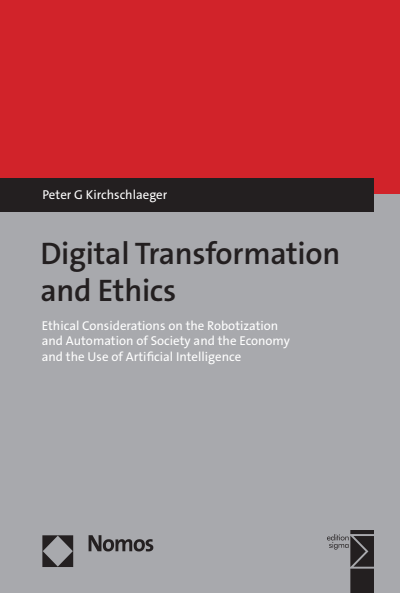
Digital Transformation and Ethics
Ethical Considerations on the Robotization and Automation of Society and the Economy and the Use of Artificial Intelligence- Autor:innen:
- Verlag:
- 2021
Zusammenfassung
Dieses Buch diskutiert die Digitalisierung, Robotisierung und Automatisierung der Gesellschaft und Wirtschaft und den Einsatz von künstlicher Intelligenz aus einer ethischen Perspektive. Nach einer Einleitung zur Beziehung zwischen Moral und Technologie und einer Bewertung der Moralfähigkeit von Technologien führt das Buch ethische Prinzipien ein, die der ethischen Beurteilung der digitalen Transformation der Gesellschaft und Wirtschaft zugrunde liegen. Anschließend werden Chancen und Herausforderungen der digitalen Transformation aus einer ethischen Sicht analysiert. Schließlich werden hinsichtlich der Herausforderungen ethische Lösungsansätze entwickelt.
Einer der Forschungsschwerpunkte von Peter G. Kirchschläger (Ordinarius für Theologische Ethik und Leiter des Instituts für Sozialethik ISE an der Universität Luzern; zuvor Visiting Fellow an der Yale University) liegt auf der Ethik der Digitalisierung, Robotisierung, Automatisierung und künstlichen Intelligenz.
Publikation durchsuchen
Bibliographische Angaben
- Auflage
- 1/2021
- Copyrightjahr
- 2021
- ISBN-Print
- 978-3-8487-4287-5
- ISBN-Online
- 978-3-8452-8550-4
- Verlag
- Nomos, Baden-Baden
- Sprache
- Englisch
- Seiten
- 537
- Produkttyp
- Monographie
Inhaltsverzeichnis
- Titelei/Inhaltsverzeichnis Kein Zugriff Seiten 1 - 28
- Prologue Kein Zugriff Seiten 29 - 30
- 1 Introduction Kein Zugriff Seiten 31 - 48
- 2.1 Introduction Kein Zugriff
- 2.2.1 Justifying Ends Kein Zugriff
- 2.2.2 Providing Means Kein Zugriff
- 2.2.3 Way of Functioning of Technological Progress Kein Zugriff
- 2.3 Reciprocal Interactions Kein Zugriff
- 2.4 Reciprocal Challenges Kein Zugriff
- 2.5 Ethical Principles and Ethical Points of Reference for Technology Kein Zugriff
- 3.1 Introduction Kein Zugriff
- 3.2 Vulnerability Kein Zugriff
- 3.3 Conscience Kein Zugriff
- 3.4 Freedom Kein Zugriff
- 3.5 Responsibility Kein Zugriff
- 3.6 Autonomy Kein Zugriff
- 3.7 Ethical Judgement by Humans Kein Zugriff
- 3.8 Overcoming the “Humans - Machines” Dichotomy Using the Interactionist Model Kein Zugriff
- 4.1 Clarification of Terms Kein Zugriff
- 4.2 Robots Kein Zugriff
- 4.3 Artificial Intelligence Kein Zugriff
- 4.4 Data-Based Systems Kein Zugriff
- 4.5 Digital Transformation Kein Zugriff
- 4.6 Machine Ethics – Roboethics Kein Zugriff
- 5.1 Ethics Is Not Democracy Kein Zugriff
- 5.2 Ethics Beyond Principles and Norms Kein Zugriff
- 6.1 Introduction Kein Zugriff
- 6.2.1 Introduction Kein Zugriff
- 6.2.2 Short Outline of the Historical Development of the Term Responsibility Kein Zugriff
- 6.2.3 Eighth Dimensions of Responsibility Kein Zugriff
- 6.2.4 Responsibility as Ethical Principle for Data-Based Systems Kein Zugriff
- 6.3.1 What Is “Justice”? Kein Zugriff
- 6.3.2 The Tension Between Law and Justice Kein Zugriff
- 6.3.3 Omni-Dynamic Social Justice Kein Zugriff
- 6.3.4 Omni-Dynamic Social Justice and Intergenerational Justice Kein Zugriff
- 6.3.5 Justice as Ethical Principle for Data-Based Systems Kein Zugriff
- 6.4.1 Human Rights – A Minimal Standard Kein Zugriff
- 6.4.2 The Multidimensionality of Human Rights Kein Zugriff
- 6.4.3 The Characteristics of Human Rights Kein Zugriff
- 6.4.4 The Need for an Ethical Justification of the Universality of Human Rights Kein Zugriff
- First step of filtering Kein Zugriff
- Second step of filtering Kein Zugriff
- Third step of filtering Kein Zugriff
- 6.4.6 Universal Human Rights Protect From Exclusion Kein Zugriff
- 6.4.7 Universal Human Rights Foster Plurality Kein Zugriff
- 6.4.8 Human Rights as Ethical Frame of Reference for Data-Based Systems Kein Zugriff
- 7.1 Illegitimate Path Kein Zugriff
- 7.2 “Dual Use” Kein Zugriff
- 7.3 Ambivalence Kein Zugriff
- 7.4 Beta Versions Kein Zugriff
- 7.5 Coerciveness Kein Zugriff
- 7.6 The Paradox of Potent Impotence Kein Zugriff
- 7.7 Risk of Anthropocentrism Kein Zugriff
- 7.8 Transhumanism Kein Zugriff
- 7.9.1 Access to Health Care Kein Zugriff
- 7.9.2 Personalized Medicine and Health Care Kein Zugriff
- 7.9.3 Data-Based Health Care Kein Zugriff
- 7.10.1 Digitalization and Automation of Finance Kein Zugriff
- 7.10.2 Cryptocurrencies and Blockchain Technology Kein Zugriff
- 7.11 Automated Weapons Kein Zugriff
- 7.12.1 Data-Based Systems as Democratizing Force Kein Zugriff
- 7.12.2 Data-Based Systems as Threat for Democracy Kein Zugriff
- 7.12.3 Online Racist Hate Speech Kein Zugriff
- 7.13.1 It Is Not All about “Moral Dilemmas” … Kein Zugriff
- 7.13.2 Automated, not “Autonomous” Mobility Kein Zugriff
- 7.13.3 Subjectivity of Responsibility Kein Zugriff
- 7.13.4 Security Facing the Ironies of Automation Kein Zugriff
- 7.13.5 Risks for the Human Right to Privacy and to Data-Protection Kein Zugriff
- 7.13.6 Fewer Accidents Kein Zugriff
- 7.13.7 Less Pollution Kein Zugriff
- 7.13.8 Fewer Vehicles – More Travel Miles Kein Zugriff
- 7.13.9 Automated Mobility as Disruption Kein Zugriff
- 7.13.10 Globally Unequal Distribution of Advantages and Disadvantages Kein Zugriff
- 7.14 Internet of Things Kein Zugriff
- 7.15 Internet of Humans Kein Zugriff
- 7.16 Wearables Kein Zugriff
- 7.17.1 It’s All About Data Kein Zugriff
- 7.17.2 Data-Tyranny Kein Zugriff
- 7.17.3 Datadeology Kein Zugriff
- 7.17.4 Violations of the Human Right to Privacy and Data-Protection Kein Zugriff
- 7.17.5 Manipulation of Humans – The Example of “Nudging” Kein Zugriff
- 7.17.6 Total Manipulation – the Example of “Hyper-Nudging” Kein Zugriff
- 7.18.1 Creation or Destruction of Paid Jobs? Kein Zugriff
- 7.18.2 Massive Reduction in Paid Professional Tasks – the Uniqueness of Digital Transformation and Data-Based Systems Kein Zugriff
- 7.19 Global Injustice Kein Zugriff
- 7.20 Ecological Impact Kein Zugriff
- 8.1.1 Data-Based Systems Should Serve Humans and the Earth Kein Zugriff
- 8.1.2 Human Responsibility Kein Zugriff
- 8.1.3 Ethical and Legal Norms for Data-Based Systems Kein Zugriff
- 8.1.4 Datethics Kein Zugriff
- 8.1.5 Human Rights-Based Data-Based Systems HRBDS Kein Zugriff
- 8.1.6 International Data-Based Systems Agency DSA Kein Zugriff
- 8.1.7 Addressing the Second Paradox of Digital Transformation and Data-Based Systems: Empowerment of Data-Based Systems and Human Fear of Powerlessness Kein Zugriff
- 8.1.8 Ethics Committees Back to Ethicists! Kein Zugriff
- 8.2.1 Relief as a Burden – the End of Striving for Full Employment Kein Zugriff
- 8.2.2 Unconditional Basic Income Kein Zugriff
- 8.2.3 Society-, Entrepreneurship-, Research-Time-Model (SERT) Kein Zugriff
- 8.2.4 SERT as Ethical Impulse for Interdisciplinary Dialogue Kein Zugriff
- 8.3 Equal Participation in Digital Transformation and Data-Based Systems Kein Zugriff
- 8.4 Insurance Kein Zugriff
- 8.5 Taxes Kein Zugriff
- 8.6.1 Patents as Conventional Instruments of Innovation Kein Zugriff
- 8.6.2 Corporations’ Ethical Responsibilities for Driving Innovation Kein Zugriff
- 8.6.3 Legitimate Examination of Conventional Instruments of Innovation Kein Zugriff
- 8.6.4 The Impact of Patents on Innovation and Their Ethical Significance Kein Zugriff
- 8.6.5 Possibilities for Adaptation of Patents Kein Zugriff
- 8.7 Research Kein Zugriff
- 8.8 Education “Empowering” Reason, Not Just Training “Technical Rationality” Kein Zugriff
- 8.9.1 Humans and the Life With Data-Based Systems Kein Zugriff
- 8.9.2 Humans Shaping Digital Transformation and Data-Based Systems Kein Zugriff
- 8.9.3 The Responsibility of States and Non-State Actors for Digital Transformation and Data-Based Systems Kein Zugriff
- 8.9.4 What World With Data-Based Systems Do We Dream Of? Kein Zugriff
- 8.10 One World Kein Zugriff
- 8.11 Trust Kein Zugriff
- 8.12 Sustainable Development Kein Zugriff
- 8.13 “Homo Dignitatis” Instead of “Homo Digitalis” Kein Zugriff
- 8.14 The COVID-19-Pandemic and Mastering Threats in Times of Data-Based Systems Kein Zugriff
- 8.15 At Last, The Question of Focus and Priorities Kein Zugriff
- Epilogue I Kein Zugriff Seiten 423 - 424
- Epilogue II Kein Zugriff Seiten 425 - 426
- References Kein Zugriff Seiten 427 - 537
Literaturverzeichnis (1588 Einträge)
Es wurden keine Treffer gefunden. Versuchen Sie einen anderen Begriff.
- Abney, Keith Yann (2017): “Robots and Space Ethics”. In: Lin, Patrick / Abney, Keith / Jenkins, Ryans (Eds.): Robot Ethics 2.0: From Autonomous Cars to Artificial Intelligence. New York: Oxford University Press, 354-368. Google Scholar öffnen DOI: 10.5771/9783845285504
- Acemoglu, Daron / Restrepo, Pascual (2020): Robots and Jobs: Evidence from US Labor Markets. In: Journal of Political Economy 128(6), 2188-2244. Google Scholar öffnen DOI: 10.5771/9783845285504
- Achtner, Wolfgang (2010): Willensfreiheit in Theologie und Naturwissenschaften: Ein historisch-systematischer Wegweiser. Darmstadt: Wissenschaftliche Buchgesellschaft. Google Scholar öffnen DOI: 10.5771/9783845285504
- Adams, Richard / Beth, Kewell / Glenn, Parry (2018): “Blockchain for Good? Digital Ledger Technology and Sustainable Development Goals”. In: Filho, Walter Leal / Marans, Robert W. / Callewaert, John (Eds.): Handbook of Sustainability and Social Science Research. Cham: Springer, 127-140. Google Scholar öffnen DOI: 10.5771/9783845285504
- Adnan, Nadia / Nordin, Shahrina Md / Bin Bahruddin, Mohamad Ariff (2019): “Sustainable Interdependent Networks from Smart Autonomous Vehicle to Intelligent Transportation Networks”. In: Amini, M. Hadi / Boroojeni, Kianoosh / Iyengar, S. Sitharama / Pardalos, Panos M. / Blaabjerg, Frede / Madni, Asad M. (Eds.): Sustainable Interdependent Networks II. Studies in Systems, Decision and Control 186. Cham: Springer, 121-134. Google Scholar öffnen DOI: 10.5771/9783845285504
- Aeberhard, Michael / Rauch, Sebastian / Bahram, Mohammed / Tanzmeister, Georg / Thomas, Julian / Pilat, Yves / Homm, Florian / Huber, Werner / Kaempchen, Nico (2015): “Experience, Results and Lessons Learned from Automated Driving on Germany's Highways.” In: IEEE Intelligent Transportation Systems Magazine 7(1), 42-57. Google Scholar öffnen DOI: 10.5771/9783845285504
- African Charter on Human and Peoples’ Rights of 1981 (1981). Online: https://www.achpr.org/public/Document/file/English/banjul_charter.pdf [08.02.2021]. Google Scholar öffnen DOI: 10.5771/9783845285504
- Agar, Nicholas (2016): “Don’t Worry about Superintelligence”. In: Journal of Evolution and Technology 26 (1 February), 73-82. Google Scholar öffnen DOI: 10.5771/9783845285504
- Agrawal, Ajay / Gans, Joshua S. / Goldfarb, Avi (2018): Prediction, Judgment and Complexity: A Theory of Decision Making and Artificial Intelligence. Rotman School of Management. Working Paper 3103156. Online: https://ssrn.com/abstract=3103156 [08.02.2021]. Google Scholar öffnen DOI: 10.5771/9783845285504
- Aiolfi, Sergio (2019): “Novartis kooperiert mit Microsoft”. In: Neue Zuercher Zeitung, October, 1. Online: https://www.nzz.ch/wirtschaft/novartis-kooperiert-mit-microsoft-ld.1512611 [08.02.2021]. Google Scholar öffnen DOI: 10.5771/9783845285504
- Albert, Anika Christina (2016): “Fremd im vertrauten Quartier. Perspektiven einer kritischen Theologie des Helfens unter den Bedingungen von Alter(n), Demenz und Technik”. In: Ethik und Gesellschaft 2, 1-29. Google Scholar öffnen DOI: 10.5771/9783845285504
- Alessandrini, Adriano / Cattivera, Alessio / Holguin, Carlos / Stam, Daniele (2014): “CityMobil2: Challenges and Opportunities of Fully Automated Mobility”. In: Meyer, Gereon / Beiker, Sven (Eds.): Road Vehicle Automation: Lecture Notes in Mobility. Cham: Springer, 169-184. Google Scholar öffnen DOI: 10.5771/9783845285504
- Aletras, Nikolaos / Tsarapatsanis, Dimitrios / Preoţiuc-Pietro, Daniel / Lampos, Vasileios (2016): “Predicting judicial decisions of the European Court of Human Rights: A natural language processing perspective”. In: PeerJ Computer Science 2(e93). Online: https://peerj.com/articles/cs-93https://peerj.com/articles/cs-93/ [08.02.2021]. Google Scholar öffnen DOI: 10.5771/9783845285504
- Alexander, Brian (2003): Rapture: How Biotech Became the New Religion. New York: Basic Books. Google Scholar öffnen DOI: 10.5771/9783845285504
- Alexy, Robert (1986): Theorie der Grundrechte. Frankfurt am Main: Suhrkamp. Google Scholar öffnen DOI: 10.5771/9783845285504
- Alexy, Robert (1998): “Die Institutionalisierung der Menschenrechte im demokratischen Verfassungsstaat”. In: Gosepath, Stefan / Lohmann, Georg (Eds.): Philosophie der Menschenrechte. Frankfurt am Main: Suhrkamp, 244-264. Google Scholar öffnen DOI: 10.5771/9783845285504
- Alkim, Tom (2018): “Connected and Automated Driving in The Netherlands – Challenge, Experience and Declaration”. In: Meyer, Gereon / Beiker, Sven (Eds.): Road Vehicle Automation 4: Lecture Notes in Mobility. Cham: Springer, 25-31. Google Scholar öffnen DOI: 10.5771/9783845285504
- Allen, Colin / Wallach, Wendell (2014): “Moral Machines: Contradiction in Terms or Abdication of Human Responsibility?”. In: Lin, Patrick / Abney, Keith / Bekey, George A. (Eds.): Robot Ethics: The Ethical and Social Implications of Robotics. Intelligent Robotics and Autonomous Agents. New York: MIT Press, 55-68. Google Scholar öffnen DOI: 10.5771/9783845285504
- Altmann, Juergen / Asaro, Peter / Sharkey, Noel / Sparrow, Robert (2013): “Armed military robots: editorial”. In: Ethics and Information Technology 15, 73-76. Google Scholar öffnen DOI: 10.5771/9783845285504
- Allen, Mike (2017): “Sean Parker unloads on Facebook: ‘God only knows what it’s doing to our children's brains’”. In: AXIOS, November 9. Online: https://www.axios.com/sean-parker-unloads-on-facebook-god-only-knows-what-its-doing-to-our-childrens-brains-1513306792-f855e7b4-4e99-4d60-8d51-2775559c2671.htmlhttps://www.axios.com/sean-parker-unloads-on-facebook-god-only-knows-what-its-doing-to-our-childrens-brains-1513306792-f855e7b4-4e99-4d60-8d51-2775559c2671.html [08.02.2021]. Google Scholar öffnen DOI: 10.5771/9783845285504
- Alwang, Jeffrey / Siegel, Paul B. / Jorgenson, Steen L. (2002): “Vulnerability as Viewed from Different Disciplines”. In: International Symposium: Sustaining Food Security and Managing Natural Resources in Southeast Asia: Challenges for the 21st Century. January 8–11, Chiang Mai, Thailand. Online: https://studylib.net/doc/18294386/vulnerability-as-viewed-from-different-disciplines [08.02.2021]. Google Scholar öffnen DOI: 10.5771/9783845285504
- American Society of Mechanical Engineers (ASME) (n.d.): Standards. Online: https://www.asme.org/codes-standardshttps://www.asme.org/codes-standards [08.02.2021]. Google Scholar öffnen DOI: 10.5771/9783845285504
- Amnesty International (2016): Kinderarbeit für Mobiltelefone und Elektroautos. January 19. Online: https://www.amnesty.ch/de/laender/afrika/demokr-rep-kongo/dok/2016/bericht-kinderarbeit-fuer-mobiltelefone-und-elektroautoshttps://www.amnesty.ch/de/laender/afrika/demokr-rep-kongo/dok/2016/bericht-kinderarbeit-fuer-mobiltelefone-und-elektroautos [08.02.2021]. Google Scholar öffnen DOI: 10.5771/9783845285504
- Amnesty International (2020a): “Digitale Gesellschaft, Stiftung für Konsumentenschutz: Überwachungsmassnahmen müssen auch unter Notrecht verhältnismässig sein”. Online: https://www.amnesty.ch/de/themen/coronavirus/dok/2020/ueberwachungsmassnahmen-muessen-auch-unter-notrecht-verhaeltnismaessig [08.02.2021]. Google Scholar öffnen DOI: 10.5771/9783845285504
- Amnesty International (2020b): Human Rights and the Environment: Water Pollution, Water Scarcity and Floods. Submission to the UN Special Rapporteur on Environment and Human Rights. November 13, 2020. Online: https://www.ohchr.org/Documents/Issues/Environment/EnvironmentWater/Civil%20Society/Amensty%20International.docxhttps://www.ohchr.org/Documents/Issues/Environment/EnvironmentWater/Civil%20Society/Amensty%20International.docx [08.02.2021]. Google Scholar öffnen DOI: 10.5771/9783845285504
- Amnesty International Switzerland (2019): “China: Auf dem Weg zur totalen Kontrolle”. In: Amnesty. Magazin der Menschenrechte 99, 10-23. Google Scholar öffnen DOI: 10.5771/9783845285504
- Amnesty International (n.d.): Corporations. Online: https://www.amnesty.org/en/what-we-do/corporate-accountabilityhttps://www.amnesty.org/en/what-we-do/corporate-accountability/ [08.02.2021]. Google Scholar öffnen DOI: 10.5771/9783845285504
- Ananny, Mike (2016): “Toward an Ethics of Algorithms: Convening, Observation, Probability, and Timeliness”. In: Science, Technology, & Human Values 41(1), 93-117. Google Scholar öffnen DOI: 10.5771/9783845285504
- Anderson, Chris (2008): “The End of Theory: The Data Deluge Makes the Scientific Method Obsolete”. In: Wired, June 23. Online: https://www.wired.com/2008/06/pb-theory/ [08.02.2021]. Google Scholar öffnen DOI: 10.5771/9783845285504
- Anderson, Kenneth / Waxman, Matthew C. (2017): “Debating Autonomous Weapon Systems: Their Ethics, and Their Regulation Under International Law”. In: Brownsword, Roger / Scotford, Eloise / Yeung, Karen (Eds.): The Oxford Handbook of Law, Regulation, and Technology. Washington: American University Washington College of Law Research Paper 21. Oxford: Oxford University Press, 1097-1117. Google Scholar öffnen DOI: 10.5771/9783845285504
- Anderson, Michael / Anderson, Susan (2011): “General Introduction”. In: Anderson, Michael / Anderson, Susan (Eds.): Machine Ethics. Cambridge: Cambridge University Press, 1-4. Google Scholar öffnen DOI: 10.5771/9783845285504
- Andrews, Edmund L. (2008): “Greenspan Concedes Error on Regulation”. In: The New York Times, October 23. Online: https://www.nytimes.com/2008/10/24/business/economy/24panel.html [08.02.2021]. Google Scholar öffnen DOI: 10.5771/9783845285504
- Angel, James / McCabe, Douglas M. (2013): “Fairness in Financial Markets: The Case of High Frequency Trading”. In: Journal of Business Ethics 112(4), 590-591. Google Scholar öffnen DOI: 10.5771/9783845285504
- Anrich, Bert / Mayora, Oscar / Bardram, Jakob E. / Troester, Gerhard (2010): “Pervasive healthcare: paving the way for pervasive, user-centered and preventive healthcare model”. In: Methods of Information in Medicine 49(1), 67-73. Google Scholar öffnen DOI: 10.5771/9783845285504
- Antonopolous, Andreas (2016): “Bitcoin Security Model: Trust by Computation”. In: Medium, June 3. Online: https://medium.com/@aantonop/bitcoin-security-model-trust-by-computation-d5b93a37da6ehttps://medium.com/@aantonop/bitcoin-security-model-trust-by-computation-d5b93a37da6e [08.02.2021]. Google Scholar öffnen DOI: 10.5771/9783845285504
- Anzenbacher, Arno (1998): Christliche Sozialethik: Einführung und Prinzipien. Paderborn: Ferdinand Schoeningh. Google Scholar öffnen DOI: 10.5771/9783845285504
- Anzenbacher, Arno (2015): “Moralität, Gewissen und der Wille Gottes: Überlegungen zu Summa theologiae I-II, q. 19”. In: ET-Studies 6(2), 273-300. Google Scholar öffnen DOI: 10.5771/9783845285504
- Apel, Karl-Otto (1986): “Verantwortung heute – nur noch Prinzip der Bewahrung und Selbstbeschränkung oder immer noch der Befreiung und Verwirklichung von Humanität”. In: Meyer, Thomas / Miller, Susanne (Eds.): Zukunftsethik und Industriegesellschaft. Zukunftsethik 1. Muenchen: J. Schweitzer, 15-40. Google Scholar öffnen DOI: 10.5771/9783845285504
- Apel, Karl-Otto (1988): Diskurs und Verantwortung: Das Problem des Überganges zur postkonventionellen Moral. Frankfurt am Main: Suhrkamp. Google Scholar öffnen DOI: 10.5771/9783845285504
- Appiah, Kwame Anthony (2006): Cosmopolitanism: ethics in a world of strangers. New York: Penguin. Google Scholar öffnen DOI: 10.5771/9783845285504
- Apple (2020): Apple Watch Series 5. You’ve never seen a watch like this. Online: https://www.apple.com/apple-watch-series-5https://www.apple.com/apple-watch-series-5/ [08.02.2021]. Google Scholar öffnen DOI: 10.5771/9783845285504
- Apple (2012): Apple-TV-Commercial: 1984 Apple’s Macintosh Commercial. Online: https://www.youtube.com/watch?v=VtvjbmoDx-Ihttps://www.youtube.com/watch?v=VtvjbmoDx-I [08.02.2021]. Google Scholar öffnen DOI: 10.5771/9783845285504
- Arendt, Hannah (1949): “Es gibt nur ein einziges Menschenrecht”. In: Die Wandlung 4, 754-770. Google Scholar öffnen DOI: 10.5771/9783845285504
- Arendt, Hannah (1958): The human condition. Chicago: University of Chicago Press. Google Scholar öffnen DOI: 10.5771/9783845285504
- Arendt, Hannah (2001): Vita activa oder vom tätigen Leben. Muenchen: Piper. Google Scholar öffnen DOI: 10.5771/9783845285504
- Arendt, Rieke (2016): Völkerrechtliche Probleme beim Einsatz autonomer Waffensysteme, Menschenrechtszentrum der Universitaet Potsdam 41. Berlin: BWV Berliner Wissenschafts-Verlag. Google Scholar öffnen DOI: 10.5771/9783845285504
- Arens, Edmund (2007): “Was ist Religion? Analytische Differenzierungen – theoretische Zugänge – theologische Reflexion”. In: Durst, Michael / Muenk, Hans J. (Eds.): Religion und Gesellschaft, Freiburg im Uechtland: Paulusverlag, 35-93. Google Scholar öffnen DOI: 10.5771/9783845285504
- Aristoteles (1983): Nikomachische Ethik. Dirlmeier, Franz (Ed.). Stuttgart: Reclam. Google Scholar öffnen DOI: 10.5771/9783845285504
- Arkin, Ronald C. (1998): Behavior-Based Robotics. Cambridge: MIT Press. Google Scholar öffnen DOI: 10.5771/9783845285504
- Arkin, Ronald C. (2009): Governing Lethal Behavior in Autonomous Robots. New York: Chapman and Hall / CRC. Google Scholar öffnen DOI: 10.5771/9783845285504
- Arkin, Ronald C. (2018): “Lethal Autonomous Systems and the Plight of the Non-combatant”. In: AISB Quarterly: Newsletter of the Society for the Study of Artificial Intelligence and Simulation of Behaviour 137, 1-14. Google Scholar öffnen DOI: 10.5771/9783845285504
- Armand, Jean-Louis (2012): “The bringing together of technology, sustainability and ethics”. In: Sustainability Science 7(2), 113-116. Google Scholar öffnen DOI: 10.5771/9783845285504
- Armstrong, Stuart (2014): Smarter Than Us: The Rise of Machine Intelligence. Berkeley: MIRI. Google Scholar öffnen DOI: 10.5771/9783845285504
- Arnaldi, Simone / Bianchi, Luca (2016): Responsibility in Science and Technology: Elements of a Social Theory. Wiesbaden: Springer. Google Scholar öffnen DOI: 10.5771/9783845285504
- Article 36 (2015): “Killing by Machine: Key Issues for Understanding Meaningful Human Control”. Online: http://www.article36.org/weapons/autonomous-weapons/killing-by-machine-key-issues-for-understanding-meaningful-human-control/ [08.02.2021]. Google Scholar öffnen DOI: 10.5771/9783845285504
- Asad, Ullah / Wang, Aimin / Mansoora, Ahmed (2018): “Smart Automation, Customer Experience and Customer Engagement in Electric Vehicles”. In: Sustainability 10(5), 1-11. Google Scholar öffnen DOI: 10.5771/9783845285504
- Asaro, Peter M. (2006): “What Should We Want From a Robot Ethic?”. In: International Review of Information Ethics 6(12), 9-16. Google Scholar öffnen DOI: 10.5771/9783845285504
- Asaro, Peter M. (2008): “How just could a robot war be?”. In: Briggle, Adam / Waelbers, Katinka / Brey, Philip A. E. (Eds.): Current Issues in Computing And Philosophy. IOS Press: Amsterdam, 50-64. Google Scholar öffnen DOI: 10.5771/9783845285504
- Asaro, Peter M. (2012): “On banning autonomous weapon systems: human rights, automation, and the dehumanization of lethal decision-making”. In: International Review of the Red Cross 94(886), 687-709. Google Scholar öffnen DOI: 10.5771/9783845285504
- Asaro, Peter M. (2019): “Algorithms of Violence: Criticial Social Perspectives on Autonomous Weapons”. In: Social Research 86(2), 537-555. Google Scholar öffnen DOI: 10.5771/9783845285504
- Asimov, Isaac (1982): Meine Freunde, die Roboter. Bibliothek der Science Fiction Literatur. Muenchen: Heyne. Google Scholar öffnen DOI: 10.5771/9783845285504
- Assheuer, Thomas (2019): “Die neue Sklavenhaltergesellschaft”. In: Die Zeit, December 6. Online: https://www.zeit.de/2018/51/crispr-china-biotechnologie-genomveraenderung-ethik-gentechnik [08.02.2021]. Google Scholar öffnen DOI: 10.5771/9783845285504
- Association for Computing Machinery’s Committee on Professional Ethics (2017): “2018 ACM Code of Ethics and Professional Conduct: Draft 3”. Association for Computing Machinery Committee on Professional Ethics. Online: https://ethics.acm.org/2018-code-draft-3/ [08.02.2021]. Google Scholar öffnen DOI: 10.5771/9783845285504
- Association for Computing Machinery US Public Policy Council (2017): Statement on Algorithmic Transparency and Accountability. January 12. Online: https://www.acm.org/binaries/content/assets/public-policy/2017_usacm_statement_algorithms.pdfhttps://www.acm.org/binaries/content/assets/public-policy/2017_usacm_statement_algorithms.pdf [08.02.2021]. Google Scholar öffnen DOI: 10.5771/9783845285504
- Aste, Tomaso (2016): “The Fair Cost of Bitcoin Proof of Work”. In: SSRN Electronic Journal, June 27. Online: https://papers.ssrn.com/sol3/papers.cfm?abstract_id=2801048 [08.02.2021]. Google Scholar öffnen DOI: 10.5771/9783845285504
- Aste, Tomaso / Tasca, Paolo / Di Matteo, Tiziana (2018): “Blockchain Technologies: The Foreseeable Impact on Society and Industry”. In: Computer 9(50), 18-28. Google Scholar öffnen DOI: 10.5771/9783845285504
- Atkinson, David. J. / Clark, Micah H. (2013): “Autonomous agents and human interpersonal trust: Can we engineer a human-machine social interface for trust?”. In: Trust and Autonomous Systems – Papers from the AAAI Spring Symposium. Online: https://www.aaai.org/ocs/index.php/SSS/SSS13/paper/viewFile/5739/6004 [08.02.2021]. Google Scholar öffnen DOI: 10.5771/9783845285504
- Atzori, Marcella (2015): Blockchain Technology and Decentralized Governance: Is the State Still Necessary?. Online: https://static.nzz.ch/files/9/3/1/blockchain+Is+the+State+Still+Necessary_1.18689931.pdfhttps://static.nzz.ch/files/9/3/1/blockchain+Is+the+State+Still+Necessary_1.18689931.pdf [08.02.2021]. Google Scholar öffnen DOI: 10.5771/9783845285504
- Auer, Alfons (1982): “Darf der Mensch, was er kann?”. In: Busch, Alois J. / Splett, Joerg (Eds.): Wissenschaft – Technik – Humanität. Frankfurt am Main: Verlag Josef Knecht, 11-35. Google Scholar öffnen DOI: 10.5771/9783845285504
- Australian Human Rights Commission (2019): “Human Rights and Technology”. Discussion Paper. Online: https://tech.humanrights.gov.au/?_ga=2.211445781.1641337062.1609843370-1930064430.1609843370 [08.02.2021]. Google Scholar öffnen DOI: 10.5771/9783845285504
- Austrian Council on Robotics and Artificial Intelligence (2018): “Die Zukunft Österreichs mit Robotik und Künstlicher Intelligenz: White Paper”. Online: https://www.acrai.at/wp-content/uploads/2019/04/ACRAI_whitebook_online_2018.pdf [08.02.2021]. Google Scholar öffnen DOI: 10.5771/9783845285504
- Austrian Gene Technology Act 1994 (2015): Online: https://www.ecolex.org/details/legislation/genetic-technology-act-lex-faoc089381https://www.ecolex.org/details/legislation/genetic-technology-act-lex-faoc089381/ [08.02.2021]. Google Scholar öffnen DOI: 10.5771/9783845285504
- Austrian Federal Act on Civil Liability for Damage Caused by Radioactivity (1999): Online: https://www.oecd-nea.org/law/legislation/austria/AUSTRIA-AtomicLiabilityAct.pdf [08.02.2021]. Google Scholar öffnen DOI: 10.5771/9783845285504
- Axhausen, Kay W. (2016): „Autonome Fahrzeuge: Erste Überlegungen: Lecture in the occasion of the Summer-Academy of the Swiss Study Foundation on the topic: Automatization of Mobility”. September 6. Online: https://www.research-collection.ethz.ch/bitstream/handle/20.500.11850/119702/v600.pdf?sequence=2&isAllowed=y [08.02.2021]. Google Scholar öffnen DOI: 10.5771/9783845285504
- Bachelet, Michelle (2019): “Human rights in the digital age – Can they make a difference?”. Keynote speech by Michelle Bachelet, UN High Commissioner for Human Rights. Japan Society, New York, October 17. United Nations. Online: https://www.ohchr.org/EN/NewsEvents/Pages/DisplayNews.aspx?NewsID=25158&LangID=E [08.02.2021]. Google Scholar öffnen DOI: 10.5771/9783845285504
- Bachinger, Leo Matteo / Fuchs, Walter (2013): “Rechtliche Herausforderungen des Technikeinsatzes in der Altenpflege: eine rechtssoziologische Perspektive auf Ambient Assisted Living”. In: SWS-Rundschau 53(1), 73-94. Google Scholar öffnen DOI: 10.5771/9783845285504
- Bacon, Francis (1990): Neues Organon (Novum Organon) 1. Krohn, Wolfgang (Ed.). Hamburg: Felix Meiner. Google Scholar öffnen DOI: 10.5771/9783845285504
- Bacon, Francis (2000): The Instauratio Magna: Last Writings. Rees, Graham (Ed.). The Oxford Francis Bacon 13. Oxford: Oxford Clarendon Press. Google Scholar öffnen DOI: 10.5771/9783845285504
- Bacon, Francis (2003): The Advancement of Learning. Kiernan, Michael (Ed.). The Oxford Francis Bacon 4. Oxford: Oxford Clarendon Press. Google Scholar öffnen DOI: 10.5771/9783845285504
- Bacon, Francis (2004): The Instauratio Magna Part II: Novum Organum and Associated Texts. Rees, Graham / Wakely, Maria (Eds.). The Oxford Francis Bacon 11. Oxford: Oxford Clarendon Press. Google Scholar öffnen DOI: 10.5771/9783845285504
- Bacon, Francis (2007): The Instauratio Magna Part III: Historia naturalis et experimentalis: Historia ventorum and Historia vitæ & mortis. Rees, Graham / Wakely, Maria (Eds.). The Oxford Francis Bacon 12. Oxford: Oxford Clarendon Press. Google Scholar öffnen DOI: 10.5771/9783845285504
- Bahnsen, Ulrich (2018): “Darf er, was er kann?”. In: Die Zeit, November 29. Online: https://www.zeit.de/autoren/B/Ulrich_Bahnsen/index.xml [08.02.2021]. Google Scholar öffnen DOI: 10.5771/9783845285504
- Baier, Kurt (1974): Der Standpunkt der Moral: Eine rationale Grundlegung der Ethik. Duesseldorf: Patmos. Google Scholar öffnen DOI: 10.5771/9783845285504
- Bainbridge, Lisanne (1983): Ironies of automation. In: Automatica 19(6), 775-779. Google Scholar öffnen DOI: 10.5771/9783845285504
- Bajari, Patrick / Chernozhukov, Victor / Hortaçsu, Ali / Suzuki, Junichi (2019): “The Impact of Big Data on Firm Performance: An Empirical Investigation”. In: AEA Papers and Proceedings, American Economic Association 109, 33-37. Google Scholar öffnen DOI: 10.5771/9783845285504
- Barlow, John Perry (1996): “A Declaration of the Independence of Cyberspace”. In: Electronic Frontier Foundation, February 8. Online: https://projects.eff.org/~barlow/Declaration-Final.htmlhttps://projects.eff.org/~barlow/Declaration-Final.html [08.02.2021]. Google Scholar öffnen DOI: 10.5771/9783845285504
- Barnes, Michael (2002): Theology and the Dialogue of Religions. Cambridge Studies in Christian Doctrine. Cambridge: Cambridge University Press. Google Scholar öffnen DOI: 10.5771/9783845285504
- Barocas, Solon / Selbst, Andrew D. (2016): “Big data’s disparate impact”. In: California Law Review 104, 671-729. Online: http://www.californialawreview.org/wp-content/uploads/2016/06/2Barocas-Selbst.pdf [08.02.2021]. Google Scholar öffnen DOI: 10.5771/9783845285504
- Bartlett, Albert (2007): Dr. Albert Bartlett on Compounding. Online: https://www.peakprosperity.com/dr_albert_bartlett/ [08.02.2021]. Google Scholar öffnen DOI: 10.5771/9783845285504
- Bartoletti, Ivana (2018): “Women must act now, or male-designed robots will take over our lives”. In: The Guardian, March 13. Online: https://www.theguardian.com/commentisfree/2018/mar/13/women-robots-ai-male-artificial-intelligence-automation [08.02.2021]. Google Scholar öffnen DOI: 10.5771/9783845285504
- Bashir, Qasim (2000): “Technology vs. morality”. In: Surgical Neurology 54(1), 92. Google Scholar öffnen DOI: 10.5771/9783845285504
- Bassi, Eleonora (2019): “European Drones Regulation: Today’s Legal Challenges”. In: Institute of Electrical and Electronics Engineers (IEEE) (Ed.): International Conference on Unmanned Aircraft Systems (ICUAS). Atlanta: Institute of Electrical and Electronics Engineers (IEEE), 443-450. Google Scholar öffnen DOI: 10.5771/9783845285504
- Basu, Rounaq / Andrea, Araldo / Arun, Prakash Akkinepally / Bat Hen Nahmias, Biran / Kalaki, Basak / Ravi, Seshadri / Neeraj, Deshmukh / Nishant, Kumar / Lima Azevedo, Carlos / Moshe, Ben-Akiva (2018): “Automated Mobility-on-Demand vs. Mass Transit: A Multi-Modal Activity-Driven Agent-Based Simulation Approach”. In: Transportation Research Record: Journal of the Transportation Research Board 2672(8), 608-618. Google Scholar öffnen DOI: 10.5771/9783845285504
- Bathaee, Yavar (2018): “The Artificial Intelligence Black Box and the Failure of Intent and Causation”. In: Harvard Journal of Law & Technology 31(2), 889-938. Google Scholar öffnen DOI: 10.5771/9783845285504
- Battaglia, Fiorella (2016): “Vorstellungen über die ‘Natur des Menschen’ in Technik-Debatten”. In: Manzeschke, Arne / Karsch, Fabian (Eds.): Roboter, Computer und Hybride. Was ereignet sich zwischen Menschen und Maschinen?. TTN-Studien 5. Baden-Baden: Nomos Verlagsgesellschaft, 67-87. Google Scholar öffnen DOI: 10.5771/9783845285504
- Baudrillard, Jean (1993): “Xeros and Infinity”. In: Baudrillard, Jean: The Transparency of Evil: Essays on Extreme Phenomena. London: Verso, 51-59. Google Scholar öffnen DOI: 10.5771/9783845285504
- Bauer, Emmanuel J. (Ed.) (2007): Freiheit in philosophischer, neurowissen¬schaftlicher und psychotherapeutischer Perspektive. Muenchen: Wilhelm Fink. Google Scholar öffnen DOI: 10.5771/9783845285504
- Bauernhansl, Thomas (Ed.) (2015): Technische Assistenzsysteme in der Pflege. Stuttgart: Verein zur Förderung Produktionstechnischer Forschung. Google Scholar öffnen DOI: 10.5771/9783845285504
- Baumann-Hoelzle, Ruth (1999): “Autonomie und Freiheit in der Medizin-Ethik”. Freiburg im Breisgau / Muenchen: Karl Alber. Google Scholar öffnen DOI: 10.5771/9783845285504
- Bavelier, Daphne / Green, C. Shawn / Han, Doug Hyun / Renshaw, Perry / Merzenich, Michael M. / Gentile, Douglas A. (2011): “Brains on video games”. In: Nature Reviews Neuroscience 12(12), 763-768. Google Scholar öffnen DOI: 10.5771/9783845285504
- Bavitz, Christopher / Hessekiel, Kira (2018): Algorithms and Justice: Examining the Role of the State in the Development and Deployment of Algorithmic Technologies. Berkman Klein Center for Internet and Society. Online: https://cyber.harvard.edu/story/2018-07/algorithms-and-justice [08.02.2021]. Google Scholar öffnen DOI: 10.5771/9783845285504
- Bayertz, Kurt (1995): “Eine kurze Geschichte der Herkunft der Verantwortung”. In: Bayertz, Kurt: Verantwortung. Prinzip oder Problem? Darmstadt: WBG, 3-71. Google Scholar öffnen DOI: 10.5771/9783845285504
- Bayertz, Kurt (2009): “Hat der Mensch eine ‘Natur’? Und ist sie wertvoll?”. In: Weiss, Martin G. (Ed.): Bios und Zoe. Die menschliche Natur im Zeitalter ihrer technischen Reproduzierbarkeit. Frankfurt am Main: Suhrkamp, 191-218. Google Scholar öffnen DOI: 10.5771/9783845285504
- Bayertz, Kurt (2010): “Art. Verantwortung”. In: Sandkuehler, Hans Joerg (Ed.): Enzyklopädie Philosophie 3 (Q-Z). Hamburg: Felix Meiner, 2861-2862. Google Scholar öffnen DOI: 10.5771/9783845285504
- Beard, Jack M. (2014): “Autonomous Weapons and Human Responsibilities”. In: Georgetown Journal of International Law 45, 617-681. Google Scholar öffnen DOI: 10.5771/9783845285504
- Beck, Susanne (2012): “Roboter und Cyborgs – erobern sie unsere Welt?”. In: Beck, Susanne (Ed.): Jenseits von Mensch und Maschine. Ethische und rechtliche Fragen zum Umgang mit Robotern, Künstlicher Intelligenz und Cyborgs. Robotik und Recht 1. Baden-Baden: Nomos Verlagsgesellschaft, 9-21. Google Scholar öffnen DOI: 10.5771/9783845285504
- Beck, Susanne / Grzegorzek, Marcin / Lichtenthaeler, Christina / Macke, Jakob / Muhl, Claudia / Reiser, Ulrich / Scholz, Ingo / Seibel, Benjamin / Urban, Iris (2013): “Mit Robotern gegen den Pflegenotstand”. In: Stiftung Neue Verantwortung 4(13), 1-10. Google Scholar öffnen DOI: 10.5771/9783845285504
- Beer, Stafford (1973): Fanfare for Effective Freedom: Cybernetic Praxis in Government. The Polytechnic: Brighton. Google Scholar öffnen DOI: 10.5771/9783845285504
- Bellamy, Carol / Zermatten, Jean / Kirchschlaeger, Peter G. / Kirchschlaeger, Thomas (Eds.) (2007): Realizing the Rights of the Child. Swiss Human Rights Book 2. Zurich: Rueffer & Rub. Google Scholar öffnen DOI: 10.5771/9783845285504
- Benanti, Paolo (2018): Le Macchine Sapienti: Intelligenze artificiali e decisioni umane. Bologna: Marietti. Google Scholar öffnen DOI: 10.5771/9783845285504
- Bendel, Oliver (2015): “Die Industrie 4.0 aus ethischer Sicht”. In: Zeitschrift HMD Praxis der Wirtschaftsinformatik 52, 739-748. Google Scholar öffnen DOI: 10.5771/9783845285504
- Bendel, Oliver (2016): “Die Datenbrille aus Sicht der Informationsethik”. In: Informatik-Spektrum 39(1), 21-29. Google Scholar öffnen DOI: 10.5771/9783845285504
- Benedek, Jávor (2006): “Institutional protection of succeeding generations – Ombudsman for Future Generations in Hungary”. In: Tremmel, Joerg Chet (Ed.): Handbook of Intergenerational Justice. Cheltenham: Edward Elgar Publishing, 282-298. Google Scholar öffnen DOI: 10.5771/9783845285504
- Benedek, Wolfgang (2008): “Internet Governance and human rights”. In: Benedek, Wolfgang / Bauer, Veronika / Kettemann, Matthias C. (Eds.): Internet governance and the information society: global perspectives and European dimensions. Utrecht: Eleven, 31-49. Google Scholar öffnen DOI: 10.5771/9783845285504
- Benedek, Wolfgang / Kettemann, Matthias C. (2013): Freedom of Expression and the Internet. Strasbourg: Council of Europe. Google Scholar öffnen DOI: 10.5771/9783845285504
- Bengler, Klaus / Dietmayer, Klaus / Farber, Berthold / Maurer, Markus / Stiller, Christoph / Winner, Hermann (2014): “Three Decades of Driver Assistance Systems: Review and Future Perspectives”. In: IEEE Intelligent Transportation Systems Magazine 6(4), 6-22. Google Scholar öffnen DOI: 10.5771/9783845285504
- Bensinger, Greg (2020): “Google Gives Cover to Trump’s Lies”. In: The New York Times, March 21. Online: https://www.nytimes.com/2020/03/21/opinion/google-covid-trump.html [08.02.2021]. Google Scholar öffnen DOI: 10.5771/9783845285504
- Bentham, Jeremy (2007): An Introduction to the Principles of Morals and Legislation. Dover Philosophical Classics. New York: Dover. Google Scholar öffnen DOI: 10.5771/9783845285504
- Berendt, Bettina / Dettmar, Gebhard / Esslinger, Bernhard / Gramm, Andreas / Grillenberger, Andreas / Hug, Alexander / Witten, Helmut (2015): “Datenschutz im 21. Jahrhundert – Ist Schutz der Privatsphäre (noch) möglich?”. In: Gallenbacher, Jens (Ed.): Informatik allgemeinbildend begreifen. Bonn: Gesellschaft für Informatik, 33-42. Google Scholar öffnen DOI: 10.5771/9783845285504
- Berković, Mirza / Kosovac, Amel (2020): “Predictive Model of Personalization of Services of Automated Mobility Based on the Records of User Movement in Mobile Networks”. In: Karabegović, Isak (Ed.): New Technologies: Development and Application III. Lecture Notes in Networks and Systems 128. Cham: Springer, 581-595. Google Scholar öffnen DOI: 10.5771/9783845285504
- Bernau, Varinia (2017) Joy Boulamwini: “Haben Algorithmen Vorurteile?”. In: Wirtschaftswoche, September 1, 54-57. Google Scholar öffnen DOI: 10.5771/9783845285504
- Bernaz, Nadia (2013): “Enhancing Corporate Accountability for Human Rights Violations: Is Extraterritoriality the Magic Potion?”. In: Journal of Business Ethics 117, 493-511. Google Scholar öffnen DOI: 10.5771/9783845285504
- Bertarelli, Ernesto (2002): “Science Between Goals and Limits”. In: 32nd ISC-Symposium at the University of St. Gallen (Ed.): Pushing Limits – Questioning Goals. St Gallen: ISC-Symposium, 47-50. Google Scholar öffnen DOI: 10.5771/9783845285504
- Besson, Samantha (2015): “Human Rights and Constitutional Law”. In: Cruft, Rowan / Liao, S. Matthew / Renzo, Massimo (Eds.): Philosophical Foundations of Human Rights. Oxford: Oxford University Press, 279-299. Google Scholar öffnen DOI: 10.5771/9783845285504
- Betschon, Stefan (2015): “Automatisierung. Ein neues Maschinenzeitalter”. In: Neue Zuercher Zeitung, August 21. Online: https://www.nzz.ch/gesellschaft/lebensart/gesellschaft/ein-neues-maschinenzeitalter-1.18599135 [08.02.2021]. Google Scholar öffnen DOI: 10.5771/9783845285504
- Betts, Jennifer / Sezer, Sakir (2014): “Ethics and Privacy in National Security and Critical Infrastructure Protection”. In: IEEE International Symposium on Ethics in Science, Technology and Engineering, Chicago, 1-7. Online: https://ieeexplore.ieee.org/abstract/document/6893417/similar#similar [08.02.2021]. Google Scholar öffnen DOI: 10.5771/9783845285504
- Bhargava, Vikram / Kim, Tae Wan (2017): “Autonomous Vehicles and Moral Uncertainty”. In: Lin, Patrick / Jenkins, Ryan / Abney, Keith (Eds.): Robot ethics 2.0: From autonomous cars to artificial intelligence. New York: Oxford University Press, 5-19. Google Scholar öffnen DOI: 10.5771/9783845285504
- Bieber, Christoph (2013): Die Veränderung politischer Kommunikation im Internetzeitalter: Medien und Demokratie und die These von der Postdemokratie. In: Jahrbuch für Christliche Sozialwissenschaften 54, 155-180. Google Scholar öffnen DOI: 10.5771/9783845285504
- Bielefeldt, Heiner (1993): “Zur Doppeldeutigkeit der staatlichen ‘Neutralität’”. In: Schwartlaender, Johannes (Ed.): Freiheit der Religion: Christentum und Islam unter dem Anspruch der Menschenrechte. Mainz: Matthias-Gruenewald-Verlag, 464-466. Google Scholar öffnen DOI: 10.5771/9783845285504
- Bieri, Matthias / Dickow, Marcel (2014): “Letale autonome Waffensysteme als He-rausforderung”. In: CSS Analysen zur Sicherheitspolitik 164, 1-4. Google Scholar öffnen DOI: 10.5771/9783845285504
- Birnbacher, Dieter (2006): “Responsibility for future generations”. In: Tremmel, Joerg Chet (Ed.): Handbook of Intergenerational Justice. Cheltenham: Edward Elgar Publishing, 23-38. Google Scholar öffnen DOI: 10.5771/9783845285504
- Birnbacher, Dieter (2009): “Wieweit lassen sich moralische Normen mit der ‘Natur des Menschen’ begründen?” In: Weiss, Martin G. (Ed.): Bios und Zoe. Die menschliche Natur im Zeitalter ihrer technischen Reproduzierbarkeit. Frankfurt am Main: Suhrkamp, 219-239. Google Scholar öffnen DOI: 10.5771/9783845285504
- Birnie, Patricia / Boyle, Alan / Redgwell, Catherine (1992): International Law and the Environment. New York: Oxford University Press. Google Scholar öffnen DOI: 10.5771/9783845285504
- Birrer, Frans A. J. (2005): “Data mining to combat terrorism and the roots of privacy concerns”. In: Ethics and Information Technology 7(4), 211-220. Google Scholar öffnen DOI: 10.5771/9783845285504
- Bishop, Christopher M. (2006): Pattern Recognition and Machine Learning. Information Science and Statistics 1. New York: Springer. Google Scholar öffnen DOI: 10.5771/9783845285504
- Bleecker, Julian (2009): Design Function. A Short Essay on Design, Science, Fact, and Fiction. Online: http://blog.nearfuturelaboratory.com/2009/03/17/design-fiction-a-short-essay-on-design-science-fact-and-fiction/ [08.02.2021]. Google Scholar öffnen DOI: 10.5771/9783845285504
- Bleich, Erik (2013): “Freedom of Expression versus Racist Hate Speech: Explaining Differences Between High Court Regulations in the US and Europe”. In: Journal of Ethnic and Migration Studies 40(2), 2-37. Google Scholar öffnen DOI: 10.5771/9783845285504
- Bloch, Ernst (1959): Das Prinzip Hoffnung: Kapitel 1-32. Werkausgabe 5. Frankfurt am Main: Suhrkamp. Google Scholar öffnen DOI: 10.5771/9783845285504
- Bloch, Walter (2011): Willensfreiheit? Neue Argumente in einem alten Streit. Hodos – Wege bildungsbezogener Ethikforschung in Philosophie und Theologie 11. Frankfurt am Main: Peter Lang. Google Scholar öffnen DOI: 10.5771/9783845285504
- Bloching, Bjoern / Luck, Lars / Ramge, Thomas (2012): Data Unser: Wie Kundendaten die Wirtschaft verändern. Muenchen: Redline. Google Scholar öffnen DOI: 10.5771/9783845285504
- Blumenberg, Hans (2015): “Technik und Wahrheit”. Schmitz, Alexander / Stiegler, Bernd (Eds.). Blumenberg, Hans: Schriften zur Technik. Berlin: Suhrkamp, 42-50. Google Scholar öffnen DOI: 10.5771/9783845285504
- Bobbert, Monika / Scherzinger, Gregor (Eds.) (2019): Gute Begutachtung?: Ethi¬sche Perspektiven der Evaluation von Ethikkommissionen zur medizinischen Forschung am Menschen. Wiesbaden: Springer. Google Scholar öffnen DOI: 10.5771/9783845285504
- Boddington, Paula (2017): Towards a Code of Ethics for Artificial Intelligence. Cham: Springer. Google Scholar öffnen DOI: 10.5771/9783845285504
- Bode, Ingvild / Huelss, Hendrik (2018): “Autonomous weapons systems and changing norms in international relations”. In: Review of International Studies 44(3), 393-413. Google Scholar öffnen DOI: 10.5771/9783845285504
- Boden, Margaret A. (2016): AI: Its Nature and Future. Oxford: Oxford University Press. Google Scholar öffnen DOI: 10.5771/9783845285504
- Boeckenfoerde, Ernst-Wolfgang (2006): “Die Entstehung des Staates als Vorgang der Säkularisation”. In: Boeckenfoerde, Ernst-Wolfgang: Recht, Staat, Freiheit. Studien zur Rechtsphilosophie, Staatstheorie und Verfassungsgeschichte. 4. Auf¬lage. Frankfurt am Main: Suhrkamp, 92-114. Google Scholar öffnen DOI: 10.5771/9783845285504
- Boesch, Patrick M. / Ciari, Francesco / Axhausen, Kay W. (2016): “Autonomous Vehicle Fleet Sizes Required to Serve Different Levels of Demand”. In: Transportation Research Record: Journal of the Transportation Research Board 2542(1), 111-119. Google Scholar öffnen DOI: 10.5771/9783845285504
- Bołtuć, Piotr (2017): “Church-Turing Lovers”. In: Lin, Patrick / Abney, Keith / Jenkins, Ryans (Eds.): Robot Ethics 2.0: From Autonomous Cars to Artificial Intelligence. New York: Oxford University Press, 214-228. Google Scholar öffnen DOI: 10.5771/9783845285504
- Bond, Robert M. / Fariss, Christopher J. / Jones, Jason / Kramer, Adam D. (2012): “A 61-Million-Person Experiment in Social Influence and Political Mobilization”. In: Nature 489(7415), 295-298. Google Scholar öffnen DOI: 10.5771/9783845285504
- Bondolfi, Alberto (2009): “Justice et droit”. In: Causse, Jean-Daniel / Mueller, Denis (Eds.): Introdcution à l’éthique. Penser, croire, agir. Le Champ Éthique 51. Geneva: Éditions Labor et Fides, 481-509. Google Scholar öffnen DOI: 10.5771/9783845285504
- Bonhoeffer, Dietrich (1992): Ethik. Werke 6. Guetersloh: Guetersloher Verlagshaus. Google Scholar öffnen DOI: 10.5771/9783845285504
- Bonnefon, Jean-François / Shariff, Azim / Rahwan, Iyad (2016): “The social dilemma of autonomous vehicles”. In: Science 352(6293), 1573-1576. Google Scholar öffnen DOI: 10.5771/9783845285504
- Borenstein, Jason / Howard, Ayanna / Wagner, Alan R. (2017): “Pediatric Robotics and Ethics. The Robot is Ready to See You Now, But Should it Be Trusted?”. In: Lin, Patrick / Jenkins, Ryan / Abney, Keith (Eds.): Robot ethics 2.0: From autonomous cars to artificial intelligence. New York: Oxford University Press, 127-141. Google Scholar öffnen DOI: 10.5771/9783845285504
- Borgman, Albert (1992): Crossing the Postmodern Divide. Chicago: University of Chicago. Google Scholar öffnen DOI: 10.5771/9783845285504
- Borgmann, Albert (1995): “The Moral Significance of Material Culture”. In: Feenberg, Andrew / Hannay, Alistair (Eds.): Technology and the Politics of Knowledge. Bloomington: Indiana University Press, 85-93. Google Scholar öffnen DOI: 10.5771/9783845285504
- Bossard, Carl (2018): “Digital first! Reflexion second”. In: Luzerner Zeitung, March 9. Online: https://www.luzernerzeitung.ch/schweiz/digital-first-reflexion-second-ld.81789 [08.02.2021]. Google Scholar öffnen DOI: 10.5771/9783845285504
- Bostrom, Nick (2005): “In defense of posthuman dignity”. In: Bioethics 19(3), 202-214. Google Scholar öffnen DOI: 10.5771/9783845285504
- Bostrom, Nick (2006): “How long before superintelligence?”. In: Linguistic and Philosophical Investigations 5(1), 11-30. Google Scholar öffnen DOI: 10.5771/9783845285504
- Bostrom, Nick (2008a): “Why I Want to be a Posthuman When I Grow Up”. In: Gordijn, Bert / Chadwick, Ruth (Eds.): Medical Enhancement and Posthumanity. Doldrecht: Springer 107-137. Google Scholar öffnen DOI: 10.5771/9783845285504
- Bostrom, Nick (2008b): “Dignity and Enhancement”. In: Schulman, Alan (Ed.): Human Dignity and Bioethics: Essays Commissioned by the President’s Council on Bioethics. Washington: US President’s Council on Bioethics, 173-207. Google Scholar öffnen DOI: 10.5771/9783845285504
- Bostrom, Nick (2009): “The Future of Humanity”. In: Olsen, Jan-Kyrre Berg / Selinger, Evan / Riis, Soren (Eds.): New Waves in Philosophy of Technology. New York: Palgrave McMillan, 186-216. Google Scholar öffnen DOI: 10.5771/9783845285504
- Bostrom, Nick (2012): “The Superintelligent Will: Motivation and Instrumental Rationality in Advanced Artificial Agents”. In: Minds and Machines 22(2), 71-85. Google Scholar öffnen DOI: 10.5771/9783845285504
- Bostrom, Nick (2013): “Existential Risk Prevention as Global Priority”. In: Global Policy 4(1), 15-31. Google Scholar öffnen DOI: 10.5771/9783845285504
- Bostrom, Nick (2014): Superintelligence: Paths, Dangers, Strategies. New York: Oxford University Press. Google Scholar öffnen DOI: 10.5771/9783845285504
- Bostrom, Nick / Sandberg, Anders (2008): Whole Brain Emulation: A Roadmap. Oxford: Future of Humanity Institute. Google Scholar öffnen DOI: 10.5771/9783845285504
- Bostrom, Nick / Yudkowsky, Eliezer (2014): “The ethics of artificial intelligence”. In: Ramsey, William, M. / Frankish, Keith (Eds.): The Cambridge Handbook of Artificial Intelligence. Cambridge: Cambridge University Press, 316-334. Google Scholar öffnen DOI: 10.5771/9783845285504
- Bourg, Dominique (2006): “The French Constitutional Charter for the environment: an effective instrument?”. In: Tremmel, Joerg Chet (Ed.): Handbook of Intergenerational Justice. Cheltenham: Edward Elgar Publishing, 230-243. Google Scholar öffnen DOI: 10.5771/9783845285504
- Boutellier, Roman / Heinzen, Mareike / Raus, Marta (2010): “Paradigms, Science, and Technology: The Case of E-Customs”. In: Becker, S. Ann / Niebuhr, Robert E. (Eds.): Cases on Technology Innovation: Entrepreneurial Successes and Pitfalls. New York: Business Science Reference, 134-155. Google Scholar öffnen DOI: 10.5771/9783845285504
- Bowles, Nellie (2018): “Early Facebook and Google Employees Form Coalition to Fight What They Built”. In: The New York Times, February 4. Online: https://www.nytimes.com/2018/02/04/technology/early-facebook-google-employees-fight-tech.htmlhttps://www.nytimes.com/2018/02/04/technology/early-facebook-google-employees-fight-tech.html [08.02.2021]. Google Scholar öffnen DOI: 10.5771/9783845285504
- Braidotti, Rosi (2014): Posthumanismus. Leben jenseits des Menschen. Frankfurt am Main: Campus. Google Scholar öffnen DOI: 10.5771/9783845285504
- Braun, Hans (2009): “Verantwortung”. In: Die Neue Ordnung 63(4), 244-252. Google Scholar öffnen DOI: 10.5771/9783845285504
- Braendle, Claudia / Grunwald, Armin (2019): “Autonomes Fahren aus Sicht der Maschinenethik”. In: Rath, Matthias / Krotz, Friedrich / Karmasin, Matthias (Eds.): Maschinenethik. Wiesbaden: Springer, 281-300. Google Scholar öffnen DOI: 10.5771/9783845285504
- Brayne, Sarah / Rosenblat, Alex / Boyd, Danah (2015): “Predictive policing. Data & civil rights: A new era of policing and justice”. In: Data & Civil Rights. Online: https://datacivilrights.org/pubs/2015-1027/Predictive_Policing.pdf [08.02.2021]. Google Scholar öffnen DOI: 10.5771/9783845285504
- Breazal, Cynthia (2002): Designing Sociable Robots. Cambridge: MIT Press. Google Scholar öffnen DOI: 10.5771/9783845285504
- Breiding, James R. / Christen, Markus / Helbing, Dirk (2015): “Lost Robustness”. In: Helbing, Dirk: Thinking Ahead – Essays on Big Data, Digital Revolution, and Participatory Market Society. Cham: Springer, 27-37. Google Scholar öffnen DOI: 10.5771/9783845285504
- Brenner, Walter / Witte, Christoph (2011): Business Innovation: CIOs im Wettbewerb der Ideen. Frankfurt am Main: Frankfurter Allgemeine Buch. Google Scholar öffnen DOI: 10.5771/9783845285504
- Brey, Philip A. E. (2014): “From Moral Agents to Moral Factors: The Structural Ethics Approach”. In: Kroes, Peter / Verbeek, Peter-Paul (Eds.): The Moral Status of Technical Artefacts. Philosophy of Engineering and Technology 17. Dordrecht: Springer, 124-142. Google Scholar öffnen DOI: 10.5771/9783845285504
- Brey, Philip A. E. / Soraker, Johnny (2009): Philosophy of Computing and Information Technology. Amsterdam: Elsevier. Google Scholar öffnen DOI: 10.5771/9783845285504
- Broad, William J. (2014): “Billionaires With Big Ideas Are Privatizing American Science”. In: The New York Times, March 15. Online: https://www.nytimes.com/2014/03/16/science/billionaires-with-big-ideas-are-privatizing-american-science.htmlhttps://www.nytimes.com/2014/03/16/science/billionaires-with-big-ideas-are-privatizing-american-science.html [08.02.2021]. Google Scholar öffnen DOI: 10.5771/9783845285504
- Brodmerkel, Sven (2017): “Dynamic pricing: Retailers using artificial intelligence to predict top price you’ll pay”. In: ABC, June 27. Online: http://www.abc.net.au/news/2017-06-27/dynamic-pricing-retailers-using-artificial-intelligence/8638340 [08.02.2021]. Google Scholar öffnen DOI: 10.5771/9783845285504
- Broeckling, Ulrich (2015): “Heldendämmerung? Der Drohnenkrieg und die Zukunft des militärischen Heroismus”. In: BEHEMOTH, A Journal on Civilisation 8(2), 97-107. Google Scholar öffnen DOI: 10.5771/9783845285504
- Brooks, David (2013): “The Philosophy of Data”. In: The New York Times, February 4. Online: https://www.nytimes.com/2013/02/05/opinion/brooks-the-philosophy-of-data.html [08.02.2021]. Google Scholar öffnen DOI: 10.5771/9783845285504
- Brooks, Rodney (2017): “The Seven Deadly Sins of AI Predictions”. In: MIT Technology Review, October 6. Online: https://www.technologyreview.com/s/609048/the-seven-deadly-sins-of-ai-predictions/ [08.02.2021]. Google Scholar öffnen DOI: 10.5771/9783845285504
- Brost, Marc / Hamann, Goetz (2018): “Ein autonom fahrendes Auto erkennt bei Nacht kein Wildschwein”. In: Die Zeit, July 26. Online: https://www.zeit.de/2018/31/kuenstliche-intelligenz-autonomes-fahren-wolfgang-wahlster-interview [08.02.2021] Google Scholar öffnen DOI: 10.5771/9783845285504
- Broussard, Meredith (2019): “Artificial Unintelligence: How Computers Misunderstand the World”. In: The Information Society 35(5), 1-3. Google Scholar öffnen DOI: 10.5771/9783845285504
- Brown Weiss, Edith (1989): In Fairness to Future Generations: International Law, Common Patrimony, and Intergenerational Equity. Tokyo: United Nations University / Transnational Publishing. Google Scholar öffnen DOI: 10.5771/9783845285504
- Brown, Jennings (2017): “Former Facebook Exec: ‘You Don’t Realize It But You Are Being Programmed’”. In: Gizmodo, November 12. Online: https://gizmodo.com/former-facebook-exec-you-don-t-realize-it-but-you-are-1821181133https://gizmodo.com/former-facebook-exec-you-don-t-realize-it-but-you-are-1821181133 [08.02.2021]. Google Scholar öffnen DOI: 10.5771/9783845285504
- Brugger, Walter (1992): “Stufen der Begründung von Menschenrechten”. In: Der Staat 31(1), 19-31. Google Scholar öffnen DOI: 10.5771/9783845285504
- Brundage, Miles / Future of Humanity Institute, University of Oxford / Centre for the Study of Existential Risk / University of Cambridge / Centre for a New American Security / Electronic Frontier Foundation / Open AI (2018): “The Malicious Use of Artificial Intelligence: Forecasting, Prevention, and Mitigation”. In: arXiv. Online: https://arxiv.org/ftp/arxiv/papers/1802/1802.07228.pdf [08.02.2021]. Google Scholar öffnen DOI: 10.5771/9783845285504
- Brynjolfsson, Erik / McAffee, Andrew (2011): Race Against the Machine: How the Digital Revolution is Accelerating Innovation, Driving Productivity, and Irreversibly Transforming Employment and the Economy. Lexington: Digital Frontier Press. Google Scholar öffnen DOI: 10.5771/9783845285504
- Brynjolfsson, Erik / McAfee, Andrew (2014): The Second Machine Age: Work, Progress, and Prosperity in a Time of Brilliant Technologies. New York / London: W. W. Norton & Company. Google Scholar öffnen DOI: 10.5771/9783845285504
- Bryson, Joanna (2010): “Robots Should Be Slaves”. In: Wilks, Yorick (Ed.): Close Engagements with Artificial Companions: Key Social, Psychological, Ethical and Design Issues. Amsterdam: John Benjamins Publishing, 63-74. Google Scholar öffnen DOI: 10.5771/9783845285504
- Buchanan, Allen (2015): “Why International Legal Human Rights?”. In: Cruft, Rowan / Liao, S. Matthew / Renzo, Massimo (Eds.): Philosophical Foundations of Human Rights. Oxford: Oxford University Press, 244-262. Google Scholar öffnen DOI: 10.5771/9783845285504
- Buchholz, Rogene A. / Rosenthal, Sandra B. (2002): “Technology and Business: Rethinking the Ethical Dilemma”. In: Journal of Business Ethics 41(1), 45-50. Google Scholar öffnen DOI: 10.5771/9783845285504
- Buchwald, Sabine (2019): “Sind die Forscher am von Facebook finanzierten Ethik-Institut wirklich frei?”. In: Sueddeutsche Zeitung, December 13. Online: https://www.sueddeutsche.de/muenchen/muenchen-tu-finanzierung-facebook-1.4723566https://www.sueddeutsche.de/muenchen/muenchen-tu-finanzierung-facebook-1.4723566 [08.02.2021]. Google Scholar öffnen DOI: 10.5771/9783845285504
- Budde, Jannica / Oevel, Gudrun (2016): “Innovationsmanagement an Hochschulen: Massnahmen zur Unterstützung der Digitalisierung von Studium und Lehre”. In: Mayr, Heinrich C. / Pinzger, Martin (Eds.): INFORMATIK 2016. Series of the Gesellschaft für Informatik (GI). Bonn: Koellen Druck + Verlag GmbH, 947-960. Google Scholar öffnen DOI: 10.5771/9783845285504
- Buehl, Walter L. (1998): Verantwortung für soziale Systeme: Grundzüge einer globalen Gesellschaftsordnung. Stuttgart: Cotta’sche Buchhandlung. Google Scholar öffnen DOI: 10.5771/9783845285504
- Buiter, Wilhelm H. (2009): Lessons from the global financial crisis for regulators and supervisors. European Institute, London School of Economics and Political Science, CEPR and NBER. Discussion Paper 635. Online: http://www.lse.ac.uk/fmg/workingPapers/discussionPapers/fmgdps/DP635.pdfhttp://www.lse.ac.uk/fmg/workingPapers/discussionPapers/fmgdps/DP635.pdf [08.02.2021]. Google Scholar öffnen DOI: 10.5771/9783845285504
- Buolamwini, Joy / Gebru, Timnit (2018): “Gender Shades: Intersectional Accuracy Disparities in Commercial Gender Classification”. In: Proceedings of Machine Learning Research 81, 1-15. Google Scholar öffnen DOI: 10.5771/9783845285504
- Burger, Paul (2007): “Nachhaltigkeitstheorie als Gesellschaftstheorie. Ein philosophisches Plädoyer”. In: Kaufmann-Hayoz, Ruth / Burger, Paul / Stoffel, Martine (Eds.): Nachhaltigkeitsforschung – Perspektiven der Sozial- und Geisteswissenschaften, Bern: Schweizerische Akademie der Geistes- und Sozialwissenschaften, 13-34. Google Scholar öffnen DOI: 10.5771/9783845285504
- Burgess, Matt (2016): “Holding AI to account: Will algorithms ever be free of bias if they are created by humans?”. In: WIRED, January 11. Online: https://www.wired.co.uk/article/creating-transparent-ai-algorithms-machine-learning [08.02.2021]. Google Scholar öffnen DOI: 10.5771/9783845285504
- Burkert, Andreas (2017): “Die Ethik und die Gefahren der künstlichen Intelligenz”. In: ATZ – Automobiltechnische Zeitschrift 119, 8-13. Google Scholar öffnen DOI: 10.5771/9783845285504
- Burrell, Jenna (2016): “How the machine ‘thinks’: Understanding opacity in machine learning algorithms”. In: Big Data & Society 3(1), 1-12. Google Scholar öffnen DOI: 10.5771/9783845285504
- Burridge, Brian (2003): “UAVs and the dawn of post-modern warfare: a perspective on recent operations”. In: RUSI Journal 148(5), 18-23. Google Scholar öffnen DOI: 10.5771/9783845285504
- Burt, Andrew / Shirrell, Stuart / Leong, Brenda / Wang, Xiangnong Georg (2018): “Beyond Explainability: A Practical Guide to Managing Risk in Machine Learning Models”. In: The Future of Privacy Forum. Online: https://fpf.org/wp-content/uploads/2018/06/Beyond-Explainability.pdf [08.02.2021]. Google Scholar öffnen DOI: 10.5771/9783845285504
- Buschauer, Regine (2014): “Autos und Information”. In: POP. Kultur und Kritik 3, 19-23. Google Scholar öffnen DOI: 10.5771/9783845285504
- Butler, Judith (2004): Le pouvoir des mots. Politique du performatif. Paris: Éditions Amsterdam. Google Scholar öffnen DOI: 10.5771/9783845285504
- Bynum, Terrell Ward (2004): “Ethics and the Information Revolution”. In: Spinello, Richard A. / Tavani, Herman T. (Eds.): Readings in Cyberethics. Massachusetts: Jones and Bartlett Publishers, 13-29. Google Scholar öffnen DOI: 10.5771/9783845285504
- Cachelin, Joël Luc (2017): Internetgott: Die Religion des Silicon Valley. Bern: Staempfli. Google Scholar öffnen DOI: 10.5771/9783845285504
- Cadwalladr, Carole (2018): “I Made Steve Bannon’s Psychological Warfare Tool: meet the data war whistleblower”. In: The Guardian, March 18. Online: https://www.theguardian.com/news/2018/mar/17/data-war-whistleblower-christopher-wylie-faceook-nix-bannon-trump [08.02.2021]. Google Scholar öffnen DOI: 10.5771/9783845285504
- Callicott, Baird (1989): In Defense of the Land Ethic: Essays in Environmental Philosophy. Albany: State University Press of New York Press. Google Scholar öffnen DOI: 10.5771/9783845285504
- Calvo, Patrici (2020): “The ethics of Smart City (EoSC): moral implications of hyperconnectivity, algorithmization and the datafication of urban digital society”. In: Ethics and Information Technology 22, 141-149. Google Scholar öffnen DOI: 10.5771/9783845285504
- Cambridge Dictionary (n.d.): Digital. Online: https://dictionary.cambridge.org/dictionary/english/digital [08.02.2021]. Google Scholar öffnen DOI: 10.5771/9783845285504
- Campaign to Stop Killer Robots (2020): “Who wants to Ban Fully Autonomous Weapons?”. Online: stopkillerrobots.org [08.02.2021]. Google Scholar öffnen DOI: 10.5771/9783845285504
- Čapek, Karel (2017): W.U.R. Werstands universal Robots. Intelligent Robotics and Autonomous Agents. Translated by Otto Pick. Berlin: Contumax-Verlag. Google Scholar öffnen DOI: 10.5771/9783845285504
- Capurro, Rafael (2017): Homo Digitalis. Beiträge zur Ontologie, Anthropologie und Ethik der digitalen Technik. Wiesbaden: Springer. Google Scholar öffnen DOI: 10.5771/9783845285504
- Carnevale, Antonio (2016): “Will robots know us better than we know ourselves?”. In: Robotics and Autonomous Systems 86 (Supplement C), 144-151. Google Scholar öffnen DOI: 10.5771/9783845285504
- Carrico, Dale (2013): “Futorological Discourses and Posthuman Terrain”. In: Existenz. An International Journal in Philosophy, Religion, Politics, and Arts 8(2), 47-63. Google Scholar öffnen DOI: 10.5771/9783845285504
- Carroll, Archie B. (1991). “The pyramid of corporate social responsibility: Toward the moral management of organizational stakeholders”. In: Business Horizons 34(4), 39-48. Google Scholar öffnen DOI: 10.5771/9783845285504
- Carroll, Archie B. (1999): “Corporate Social Responsibility. Evolution of a Definitional Construct”. In: Business and Society 38(3), 268-295. Google Scholar öffnen DOI: 10.5771/9783845285504
- Carvalho, Ashwin / Lefévre, Stéphanie / Schildbach, Georg / Kong, Jason / Borrelli, Francesco (2015): “Automated driving: The role of forecasts and uncertainty – A control perspective”. In: European Journal of Control 24, 14-32. Google Scholar öffnen DOI: 10.5771/9783845285504
- Casanova, José (2015): “Der säkulare Staat, religiöser Pluralismus und Liberalismus”. In: Schwarz, Gerhard / Sitter-Liver, Beat / Holderegger, Adrian / Tag, Brigitte (Eds.): Religion, Liberalität und Rechtsstaat: Ein offenes Spannungsverhältnis. Zuerich: Verlag Neue Zuercher Zeitung, 19-25. Google Scholar öffnen DOI: 10.5771/9783845285504
- Casner, Stephen M. / Hutchins, Edwin L. / Norman, Don (2016): “The challenges of partially automated driving”. In: Communications of the ACM 59(5), 70-77. Google Scholar öffnen DOI: 10.5771/9783845285504
- Cass, Kelly (2015): “Autonomous Weapons and Accountability: Seeking Solutions in the Law of War”. In: Loyola of Los Angeles Law Review 48, 1017-1067. Google Scholar öffnen DOI: 10.5771/9783845285504
- Cassirer, Ernst (1985): “Form und Technik”. In: Cassirer, Ernst: Symbol, Technik, Sprache. Hamburg: Felix Meiner, 39-91. Google Scholar öffnen DOI: 10.5771/9783845285504
- Castelvecchi, Davide (2016): “Can We Open the Black Box of AI?”. In: Nature 538(7623), 20-23. Google Scholar öffnen DOI: 10.5771/9783845285504
- Catton, William/Dunlap, Riley (1980): “A New Ecological Paradigm for Post-Exuberant Sociology”. In: American Behavioral Scientist 24(1), 15-47. Google Scholar öffnen DOI: 10.5771/9783845285504
- Cellarius, Mathias (2017): “Artificial Intelligence and the Right to Informational Self-determination”. In: The OECD Forum. Online: https://www.oecd-forum.org/users/75927-mathias-cellarius/posts/28608-artificial-intelligence-and-the-right-to-informational-self-determination [08.02.2021]. Google Scholar öffnen DOI: 10.5771/9783845285504
- Center of Human Rights Education (ZMRB) (n.d.): International Human Rights Forum Lucerne (IHRF). Online: www.ihrf.ch [08.02.2021]. Google Scholar öffnen DOI: 10.5771/9783845285504
- Cernea, Mihail-Valentin (2018): “The Ethical Troubles of Future Warfare. On the Prohibition of Autonomous Weapon Systems”. In: Annals of the University of Bucharest – Philosophy Series 66(2), 67-89. Google Scholar öffnen DOI: 10.5771/9783845285504
- Chalmers, David (2010): “The Singularity: A Philosophical Analysis”. In: Journal of Consciousness Studies 17(9-10), 7-65. Google Scholar öffnen DOI: 10.5771/9783845285504
- Chandler, Geoffrey (2000): “Foreword”. In: Frankental, Peter / House, Frances (Eds.): Human Rights – Is It Any of Your Business?. London: Amnesty International / The Prince of Wales Business Leaders Forum, 5. Google Scholar öffnen DOI: 10.5771/9783845285504
- Chapman, Audrey R. (2009): “Towards an Understanding of the Right to Enjoy the Benefits of Scientific Progress and Its Applications”. In: Journal of Human Rights 8(1), 1-36. Google Scholar öffnen DOI: 10.5771/9783845285504
- Charter of Fundamental Digital Rights of the European Union (n.d.): Revised version of 2018. Online: https://digitalcharta.euhttps://digitalcharta.eu/ [08.02.2021]. Google Scholar öffnen DOI: 10.5771/9783845285504
- Cheok, Adrian David / Karunanayaka, Kasun / Zhang, Emma Yann (2017): “Lovotics: Human - Robot Love and Sex Relationships”. In: Lin, Patrick / Abney, Keith / Jenkins, Ryans (Eds.): Robot Ethics 2.0: From Autonomous Cars to Artificial Intelligence. New York: Oxford University Press, 193-213. Google Scholar öffnen DOI: 10.5771/9783845285504
- Childs, James M. Jr. (2015): “Beyond the Boundaries of Current Human Nature: Some Theological and Ethical Reflections on Transhumanism”. In: Dialog, 54(1), 8-19. Google Scholar öffnen DOI: 10.5771/9783845285504
- Chorost, Michael (2005): Rebuilt. How Becoming Part Machine Made Me More Human. New York: Houghton Mifflin. Google Scholar öffnen DOI: 10.5771/9783845285504
- Chouldechova, Alexandra (2016): “Fair prediction with disparate impact: A study of bias in recidivism prediction instruments”. In: Big Data 5(2), 153-163. Google Scholar öffnen DOI: 10.5771/9783845285504
- Chow, Marvin (2017): “AI and machine learning get us one step closer to relevance at scale”. In: Think with Google, September. Online: https://www.thinkwithgoogle.com/marketing-resources/ai-personalized-marketing/ [08.02.2021]. Google Scholar öffnen DOI: 10.5771/9783845285504
- Christin, Angèle / Rosenblat, Alex / Boyd, Danah (2015): Courts and Predictive Algorithms. Presentation at the Data & Civil Rights: A New Era of Policing and Justice Conference. Washington, October 27. Online: http://www.law.nyu.edu/sites/default/files/upload_documents/Angele%20Christin.pdf [08.02.2021]. Google Scholar öffnen DOI: 10.5771/9783845285504
- Citron, Danielle K. / Pasquale, Frank A. (2014): “The scored society: Due process for automated predictions”. In: Washington Law Review 89(8), 1-35. Google Scholar öffnen DOI: 10.5771/9783845285504
- Clark, Andy (1999): “An Embodied Cognitive Science?”. In: Trends in Cognitive Sciences 3(9), 345-351. Google Scholar öffnen DOI: 10.5771/9783845285504
- Clarke, Cris / Tooker, Lauren (2017): “Social finance meets financial innovation: contemporary experiments in payments, money and debt”. In: Theory, Culture & Society 35(3), 3-11. Google Scholar öffnen DOI: 10.5771/9783845285504
- Clever, Peter / Ramb, Christina (2010): “Freiheit ohne Verantwortung verkommt. Die Finanz- und Wirtschaftskrise – Folgen für unternehmerisches Handeln und die gesellschaftliche Verantwortung von Unternehmen”. In: Heimbach-Steins, Marianne (Ed.): Weltwirtschaft und Gemeinwohl. Eine Zwischenbilanz der Wirtschaftskrise. Muenster: Aschendorff, 53-63. Google Scholar öffnen DOI: 10.5771/9783845285504
- Clifford, Catherine (2018) Elon Musk: “Mark my words – A.I. is far more dangerous than nukes”. In: CNBC, March 13. Online: https://www.cnbc.com/2018/03/13/elon-musk-at-sxsw-a-i-is-more-dangerous-than-nuclear-weapons.htmlhttps://www.cnbc.com/2018/03/13/elon-musk-at-sxsw-a-i-is-more-dangerous-than-nuclear-weapons.html [08.02.2021]. Google Scholar öffnen DOI: 10.5771/9783845285504
- Clynes, Manfred E. / Kline, Nathan S. (1995): “Cyborgs and Space”. In: Gray, Chris Hables (Ed.): The Cyborg Handbook. New York: Routledge, 29-34. Google Scholar öffnen DOI: 10.5771/9783845285504
- CNN Money (2010): “Facebook broadcasts engagement ring purchase”. In: CNN Money, December 14. Online: https://money.cnn.com/galleries/2010/technology/1012/gallery.5_data_breaches/3.htmlhttps://money.cnn.com/galleries/2010/technology/1012/gallery.5_data_breaches/3.html [08.02.2021]. Google Scholar öffnen DOI: 10.5771/9783845285504
- Coeckelbergh, Mark (2012): Growing Moral Relations: Critique of Moral Status Ascription. New York: Palgrave Macmillan. Google Scholar öffnen DOI: 10.5771/9783845285504
- Coeckelbergh, Mark (2013): Human Being @ Risk: Enhancement, Technology, and the Evaluation of Vulnerability Transformations. Cham: Springer. Google Scholar öffnen DOI: 10.5771/9783845285504
- Coeckelbergh, Mark (2017): New Romantic Cyborgs: Romanticism, Information Technology, and the End of Machine. Cambridge: MIT Press. Google Scholar öffnen DOI: 10.5771/9783845285504
- Coeckelbergh, Mark (2020): AI Ethics. The MIT Press Essential Knowledge. Cambridge: MIT Press. Google Scholar öffnen DOI: 10.5771/9783845285504
- Coeckelbergh, Mark / Wackers, Ger (2007): “Imagination, distributed responsibility, and vulnerability: The case of Snorre A”. In: Science and Engineering Ethics 13(2), 235-248. Google Scholar öffnen DOI: 10.5771/9783845285504
- Contratto, Franca (2017): “Technologie und Finanzmarktregulierung: Narrative von Interdependenz und Co-Evolution”. In: Weber, Rolf H. / Stoffel, Walter A. / Chenaux, Jean-Luc / Sethe, Rolf (Eds.): Aktuelle Herausforderungen des Gesellschafts- und Finanzmarktrechts: Festschrift für Hans Caspar von der Crone zum 60. Geburtstag. Zuerich: Schulthess, 421-440. Google Scholar öffnen DOI: 10.5771/9783845285504
- Cooper, Rick / Davis, Michael / Van Vliet, Ben (2016): “The Mysterious Ethics of High-Frequency Trading”. In: Business Ethics Quarterly 26(1), 1-22. Google Scholar öffnen DOI: 10.5771/9783845285504
- Corillon, Carol (1989): “The Role of Science and Scientists in Human Rights”. In: The Annals of American Academy of Political and Social Science 506(1), 129-140. Google Scholar öffnen DOI: 10.5771/9783845285504
- Council of Europe (2018a): Discrimination, Artificial Intelligence and Algorithmic Decision-Making. Online: https://rm.coe.int/discrimination-artificial-intelligence-and-algorithmic-decision-making/1680925d73https://rm.coe.int/discrimination-artificial-intelligence-and-algorithmic-decision-making/1680925d73 [08.02.2021]. Google Scholar öffnen DOI: 10.5771/9783845285504
- Council of Europe (2018b): Algorithms and human rights – Study on the human rights dimensions of automated data processing techniques and possible regulatory implications. Online: https://rm.coe.int/algorithms-and-human-rights-en-rev/16807956b5 [08.02.2021]. Google Scholar öffnen DOI: 10.5771/9783845285504
- Council of Europe (2018c): Recommendation CM/Rec(2018)7 of the Committee of Ministers: Guidelines to respect, protect and fulfil the rights of the child in the digital environment. Online: https://edoc.coe.int/en/children-and-the-internet/7921-guidelines-to-respect-protect-and-fulfil-the-rights-of-the-child-in-the-digital-environment-recommendation-cmrec20187-of-the-committee-of-ministers.html [08.02.2021]. Google Scholar öffnen DOI: 10.5771/9783845285504
- Council of Europe (2019a): Consultative Committee of the Convention for the Protection of Individuals with regard to the Processing of Personal Data (Convention 108): Guidelines on Artificial Intelligence and Data Protection. Online: https://rm.coe.int/guidelines-on-artificial-intelligence-and-data-protection/168091f9d8 [08.02.2021]. Google Scholar öffnen DOI: 10.5771/9783845285504
- Council of Europe (2019b): Committee of Ministers: Declaration on the manipulative capabilities of algorithmic processes. Online: https://search.coe.int/cm/pages/result_details.aspx?ObjectId=090000168092dd4b [08.02.2021]. Google Scholar öffnen DOI: 10.5771/9783845285504
- Council of Europe (2019c): European Ethical Charter on the use of artificial intelligence (AI) in judicial systems and their environment. Online: https://rm.coe.int/ethical-charter-en-for-publication-4-december-2018/16808f699chttps://rm.coe.int/ethical-charter-en-for-publication-4-december-2018/16808f699c [08.02.2021]. Google Scholar öffnen DOI: 10.5771/9783845285504
- Council of Europe (2003): Additional Protocol to the Council of Europe Convention on Cybercrime concerning the criminalization of acts of a racist and xenophobic nature committed through computer systems of January 28, 2003. Online: https://www.coe.int/en/web/conventions/full-list/-/conventions/treaty/189?desktop=truehttps://www.coe.int/en/web/conventions/full-list/-/conventions/treaty/189?desktop=true [08.02.2021]. Google Scholar öffnen DOI: 10.5771/9783845285504
- Council of Europe: European Commission against Racism and Intolerance (ECRI) (2014): Annual Report. Online: https://www.coe.int/en/web/european-commission-against-racism-and-intolerance/annual-reportshttps://www.coe.int/en/web/european-commission-against-racism-and-intolerance/annual-reports [08.02.2021]. Google Scholar öffnen DOI: 10.5771/9783845285504
- Counts, Laura (2018): “Minority homebuyers face widespread statistical lending discrimination, study finds”. In: Newsroom, November 13. Online: https://newsroom.haas.berkeley.edu/minority-homebuyers-face-widespread-statistical-lending-discrimination-study-finds/ [08.02.2021]. Google Scholar öffnen DOI: 10.5771/9783845285504
- Cowen, Tyler (2013): Average is over: Powering America Beyond the Age of the Great Stagnation. New York: Dutton. Google Scholar öffnen DOI: 10.5771/9783845285504
- Crawford, Kate (2016): “Artificial intelligence’s white guy problem”. In: The New York Times, June 25. Online: https://www.nytimes.com/2016/06/26/opinion/sunday/artificial-intelligences-white-guy-problem.html?_r=0 [08.02.2021]. Google Scholar öffnen DOI: 10.5771/9783845285504
- Crawford, Kate / Calo, Ryan (2016): “There is a Blind Spot in AI Research”. In: Nature 538, 311-313. Google Scholar öffnen DOI: 10.5771/9783845285504
- Credit Suisse (2015): Global Wealth Report 2015. Online: https://www.credit-suisse.com/media/assets/corporate/docs/about-us/research/publications/global-wealth-report-2015.pdfhttps://www.credit-suisse.com/media/assets/corporate/docs/about-us/research/publications/global-wealth-report-2015.pdf [08.02.2021]. Google Scholar öffnen DOI: 10.5771/9783845285504
- Crichton, Danny (2018): “Liquid democracy uses blockchain to fix politics, and now you can vote for it”. In: Tech Crunch, February 24. Online: https://techcrunch.com/2018/02/24/liquid-democracy-uses-blockchainhttps://techcrunch.com/2018/02/24/liquid-democracy-uses-blockchain/ [08.02.2021]. Google Scholar öffnen DOI: 10.5771/9783845285504
- Crouch, Colin (2008): Postdemokratie. Frankfurt am Main: Suhrkamp. Google Scholar öffnen DOI: 10.5771/9783845285504
- Cunningham, Lilian (2011): “Google’s Eric Schmidt Expounds on His Senate Testimony”. In: The Washington Post, September 30. Online: https://www.washingtonpost.com/national/on-leadership/googles-eric-schmidt-expounds-on-his-senate-testimony/2011/09/30/gIQAPyVgCL_story.html [08.02.2021]. Google Scholar öffnen DOI: 10.5771/9783845285504
- Czarnecki, Krzysztof / Salay, Rick (2018): “Towards a Framework to Manage Perceptual Uncertainty for Safe Automated Driving”. In: Gallina, Barbara / Skavhaug, Amund / Schoitsch, Erwin / Bitsch, Friedemann (Eds.): Computer Safety, Reliability, and Security. SAFECOMP. Lecture Notes in Computer Science 11094. Cham: Springer, 439-445. Google Scholar öffnen DOI: 10.5771/9783845285504
- Dabrock, Peter (2017): “Wenn Autos Menschen fahren. Warum die wirklichen ethischen Herausforderungen des autonomen Fahrens jenseits der Trolley-Probleme lauern”. In: Zeitschrift für evangelische Ethik 61, 83-88. Google Scholar öffnen DOI: 10.5771/9783845285504
- Daniels, Jessie (2009): Cyber Racism. White Supremacy Online and the New Attack on Civil Rights. Lanham: Rowman & Littlefield Publishers. Google Scholar öffnen DOI: 10.5771/9783845285504
- Danish Ministry of Finance, Agency for Digitalisation (n.d.): Denmark’s National Strategy for Artificial Intelligence. Online: https://en.digst.dk/policy-and-strategy/denmark-s-national-strategy-for-artificial-intelligence/ [08.02.2021]. Google Scholar öffnen DOI: 10.5771/9783845285504
- Darling, Kate (2017): “‘Who’s Jonny?’ Anthropomorphic Framing in Human-Robot Interaction, Integration, and Policy”. In: Lin, Patrick / Abney, Keith / Jenkins, Ryans (Eds.): Robot Ethics 2.0: From Autonomous Cars to Artificial Intelligence. New York: Oxford University Press, 173-191. Google Scholar öffnen DOI: 10.5771/9783845285504
- Davis, Ernest (2015): “Ethical Guidelines for A Superintelligence”. In: Artificial Intelligence 220, 121-124. Google Scholar öffnen DOI: 10.5771/9783845285504
- Davis, Michael / Kumiega, Andrew / Van Vliet, Ben (2013): “Ethics, Finance, and Automation: A Preliminary Survey of Problems in High Frequency Trading”. In: Science and Engineering Ethics 19(3), 1-8. Google Scholar öffnen DOI: 10.5771/9783845285504
- De Jesus, Ayn (2018): “Augmented Reality Shopping and Artificial Intelligence – Near-Term Applications”. In: Emerj, April 20. Online: https://www.techemergence.com/augmented-reality-shopping-and-artificial-intelligence/ [08.02.2021]. Google Scholar öffnen DOI: 10.5771/9783845285504
- De Melo-Martín, Immaculada (2010): “The Two Cultures: An introduction and assessment”. In: Technology in Society 32(1), 5-9. Google Scholar öffnen DOI: 10.5771/9783845285504
- De Saint-Exupéry, Antoine (1948): Citadelle. Paris: Gallimard. Google Scholar öffnen DOI: 10.5771/9783845285504
- De Soto, Hernando (2003): The Mystery of Capital. Why Capitalism Triumphs in the West and Fails Everywhere Else. New York: Basic Books. Google Scholar öffnen DOI: 10.5771/9783845285504
- De Soto, Hernando / Cheneval, Francis (2006): Realizing Property Rights. Swiss Human Rights Book 1. Zurich: Rueffer and Rub. Google Scholar öffnen DOI: 10.5771/9783845285504
- De Vries, Katja (2010): “Identity, profiling algorithms and a world of ambient intelligence”. In: Ethics and Information Technology 12(1), 71-85. Google Scholar öffnen DOI: 10.5771/9783845285504
- Decker, Michael (2013): “Mein Roboter handelt moralischer als ich? Ethische Aspekte einer Technikfolgenabschätzung der Robotik”. In: Bogner, Alexander (Ed.): Ethisierung der Technik – Technisierung der Ethik: Der Ethik-Boom im Lichte der Wissenschafts- und Technikforschung. Wissenschafts- und Technikforschung 11. Baden-Baden: Nomos Verlagsgesellschaft, 215-231. Google Scholar öffnen DOI: 10.5771/9783845285504
- Decker, Michael (2019a): “Autonome Systeme und ethische Reflexion”. In: Thimm, Caja / Bächle, Thomas Christian (Eds.): Freund oder Feind?. Wiesbaden: Springer, 135-158. Google Scholar öffnen DOI: 10.5771/9783845285504
- Decker, Michael (2019b): “Ethische Fragen bei autonomen Systemen”. In: Mueller, Oliver / Liggieri, Kevin (Eds.): Mensch-Maschine-Interaktion. Stuttgart: J.B. Metz¬ler, 309-315. Google Scholar öffnen DOI: 10.5771/9783845285504
- DeepMind (n.d.): Exploring the real-world impacts of AI. Online: https://deepmind.com/about/ethics-and-society#fellowshttps://deepmind.com/about/ethics-and-society#fellows [08.02.2021]. Google Scholar öffnen DOI: 10.5771/9783845285504
- Deleuze, Gilles (1992): “Postcript on the societies of control”. In: October 59, 3-7. Google Scholar öffnen DOI: 10.5771/9783845285504
- Delmas-Marty, Mireille (2013): “Foreword: The Internet: disrupting, revealing and producing rules”. In: Massit-Folléa, Françoise / Méadel, Cécile / Monnoyer-Smith, Laurence (Eds.): Normative Experience in Internet Politics. Paris: Presses des Mines, 11-18. Google Scholar öffnen DOI: 10.5771/9783845285504
- Demiridi, Elissavet / Kopelias, Pantelis / Nathanail, Efithia / Skabardonis, Alexander (2019): “Connected and Autonomous Vehicles – Legal Issues in Greece, Europe and USA”. In: Nathanail, Eftihia / Karakikes, Ioannis D. (Eds.): Data Analytics: Paving the Way to Sustainable Urban Mobility. Advances in Intelligent Systems and Computing 879. Cham: Springer, 756-763. Google Scholar öffnen DOI: 10.5771/9783845285504
- Demmer, Klaus (2000): Shaping the Moral Life: An Approach to Moral Theology. Washington: Georgetown University Press. Google Scholar öffnen DOI: 10.5771/9783845285504
- Demmer, Klaus (2010): Bedrängte Freiheit. Die Lehre von der Mitwirkung – neu bedacht. Studien zur Theologischen Ethik 127. Freiburg im Uechtland: Herder. Google Scholar öffnen DOI: 10.5771/9783845285504
- Demuth, Yves (2018) Cathy O’Neil: “Die unheimliche Macht der Algorithmen”. In: Beobachter, April 26. Online: https://www.beobachter.ch/digital/multimedia/big-data-die-unheimliche-macht-der-algorithmen [08.02.2021]. Google Scholar öffnen DOI: 10.5771/9783845285504
- Dengler, Katharina / Matthes, Britta (2015): Folgen der Digitalisierung für die Arbeitswelt: Substituierbarkeitspotenziale von Berufen in Deutschland. Forschungsbericht 11. Institut für Arbeitsmarkt und Berufsforschung: Nuremberg. Google Scholar öffnen DOI: 10.5771/9783845285504
- Der Grosse Herder (1935): “Verantwortung”. In: Nachschlagewerk für Wissen und Leben 12. 4. Auflage. Freiburg im Breisgau: Herder, 153-154. Google Scholar öffnen DOI: 10.5771/9783845285504
- Derrick, Dominic / Chhawri, Sumeet / Eustice, Ryan M. / Ma, Di / Weimerskirch, André (2016): “Risk Assessment for Cooperative Automated Driving“. In: Association for Computing Machinery (Ed.): CPS-SPC ‘16: Proceedings of the 2nd ACM Workshop on Cyber-Physical Systems Security and Privacy. Vienna: Association for Computing Machinery, 47-58. Google Scholar öffnen DOI: 10.5771/9783845285504
- Deva, Surya (2007): “Globalisation and its Impact on the Realisation of Human Rights: Indian Perspective on a Global Canvas”. In: Kumar, C. Raj / Chockalingam, Kumaravelu (Eds.): Human rights, Justice and Constitutional Empowerment. New Delhi: Oxford University Press, 237-263. Google Scholar öffnen DOI: 10.5771/9783845285504
- Deva, Surya (2012a): “Guiding Principles on Business and Human Rights: Implications for Companies”. In: European Company Law 9(2), 101-109. Google Scholar öffnen DOI: 10.5771/9783845285504
- Deva, Surya (2012b): “Corporate Human Rights Violations: A Case for Extraterritorial Regulation”. In: Luetge, Christoph (Ed.): Handbook of the Philosophical Foundations of Business Ethics. New York: Springer, 1077-1090. Google Scholar öffnen DOI: 10.5771/9783845285504
- Deva, Surya (2012c): Regulating Corporate Human Rights Violations: Humanizing Business. New York: Routledge. Google Scholar öffnen DOI: 10.5771/9783845285504
- Di Giovanna, James (2017): “Artificial Identity”. In: Lin, Patrick / Abney, Keith / Jenkins, Ryans (Eds.): Robot Ethics 2.0: From Autonomous Cars to Artificial Intelligence. New York: Oxford University Press, 307-321. Google Scholar öffnen DOI: 10.5771/9783845285504
- Di Lorenzo, Giovanni (2018): “Übernehmen Sie Verantwortung!” In: Die Zeit, February 8, 63-64. Online: https://www.zeit.de/2018/07/studenten-leben-verantwortung-universitaet-idealismushttps://www.zeit.de/2018/07/studenten-leben-verantwortung-universitaet-idealismus [08.02.2021]. Google Scholar öffnen DOI: 10.5771/9783845285504
- Dickow, Marcel (2015): Robotik – ein Game-Changer für Militär und Sicher¬heits¬politik?. SWP-Studie 14. Berlin: Stiftung Wissenschaft und Politik – Deutsches Institut für Internationale Politik und Sicherheit. Google Scholar öffnen DOI: 10.5771/9783845285504
- Dickow, Marcel / Linnenkamp, Hilmar (2012): “Kampfdrohnen – Killing Drones: Ein Plädoyer gegen die fliegenden Automaten”. In: SWP-Aktuell 75, 1-8. Google Scholar öffnen DOI: 10.5771/9783845285504
- Die Zeit (2020): “Social Media: Friedrich Merz weist Kritik an Medien-Äusserung zurück”. In: Die Zeit, February 17. Online: https://www.zeit.de/kultur/2020-02/friedrich-merz-social-media-klassische-medien-berichterstattung-djvhttps://www.zeit.de/kultur/2020-02/friedrich-merz-social-media-klassische-medien-berichterstattung-djv [08.02.2021]. Google Scholar öffnen DOI: 10.5771/9783845285504
- Dierksmeier, Claus (2006): “John Rawls on the rights of future generations”. In: Tremmel, Joerg Chet (Ed.): Handbook of Intergenerational Justice. Cheltenham: Edward Elgar Publishing, 72-85. Google Scholar öffnen DOI: 10.5771/9783845285504
- Dierksmeier, Claus (2012): “How should we do Business? Global Ethics in the Age of Globality”. In: Tenth Global Ethic Lecture. Online: https://www.weltethos.org/1-pdf/20-aktivitaeten/eng/we-reden-eng/speech_Dierksmeier_eng.pdf [08.02.2021]. Google Scholar öffnen DOI: 10.5771/9783845285504
- Dierksmeier, Claus / Seele, Peter (2018): “Cryptocurrencies and Business Ethics”. In: Journal of Business Ethics 152(1), 1-14. Google Scholar öffnen DOI: 10.5771/9783845285504
- Digital Health & AI Research Collaborative (I-DAIR) (n.d.): Homepage. Online: https://graduateinstitute.ch/I-DAIR [08.02.2021]. Google Scholar öffnen DOI: 10.5771/9783845285504
- Dignum, Virginia (2019): Responsible Artificial Intelligence: How to Develop and Use AI in a Responsible Way. Cham: Springer. Google Scholar öffnen DOI: 10.5771/9783845285504
- Dillard, Jesse (2013): “Human Rights within an Ethic of Accountability”. In: Haynes, Kathryn / Murray, Alan / Dillard, Jesse (Eds.): Corporate Social Responsibility. A research handbook. London: Routledge, 196-220. Google Scholar öffnen DOI: 10.5771/9783845285504
- Dillard, Jesse / Murray, Allan (2013): “Deciphering the Domain of Corporate Social Responsibility”. In: Haynes, Kathryn / Dillard, Jesse / Murray, Allan (Eds.): Corporate Social Responsibility. A research handbook. London: Routledge, 10-27. Google Scholar öffnen DOI: 10.5771/9783845285504
- Dittmann, Frank (2016): “Mensch und Roboter – ein ungleiches Paar”. In: Manzeschke, Arne / Karsch, Fabian (Eds.): Roboter, Computer und Hybride. Was ereignet sich zwischen Menschen und Maschinen?. TTN-Studien 5. Baden-Baden: Nomos Verlagsgesellschaft, 17-46. Google Scholar öffnen DOI: 10.5771/9783845285504
- Dix, Alexander (2016): “Datenschutz im Zeitalter von Big Data. Wie steht es um den Schutz der Privatsphäre?”. In: Stadtforschung und Statistik: Zeitschrift des Verbandes Deutscher Städtestatistiker 29(1), 59-64. Google Scholar öffnen DOI: 10.5771/9783845285504
- Donders, Yvonne (2015): “Balancing Interests: Limitations to the Right to Enjoy the Benefits of Scientific Progress and Its Applications”. In: European Journal of Human Rights 4, 486-503. Google Scholar öffnen DOI: 10.5771/9783845285504
- Doorn, Neelke / van de Poel, Ibo (2012): “‘Editors’ Overview: Moral Ethical Responsibility in Technology and Engineering”. In: Science and Engineering Ethics 18(1), 1-11. Google Scholar öffnen DOI: 10.5771/9783845285504
- Doshi-Velez, Finale / Kortz, Mason (2017): “Accountability of AI Under the Law: The Role of Explanation”. Berkman Klein Center Working Group on Explanation and the Law, Berkman Klein Center for Internet & Society working paper. In: arXiv. Online: https://arxiv.org/ftp/arxiv/papers/1711/1711.01134.pdf [08.02.2021]. Google Scholar öffnen DOI: 10.5771/9783845285504
- Dove, Edward S. / Townend, David / Meslin, Eric M. / Bobrow, Martin / Littler, Katherine / Dianne, Nicol / de Vries, Jantina / Junker, Anne / Garattini, Chiara / Bovenberg, Jasper / Shabani, Mahsa / Lévesque, Emmanuelle / Knoppers, Bartha M. (2016): “Ethics review for international data-intensive research”. In: Science 351(6280), 1399-1400. Google Scholar öffnen DOI: 10.5771/9783845285504
- Dreyfus, Hubert L. (1972): What Computers Can’t Do: The Limits of Artificial Intelligence. New York: MIT Press. Google Scholar öffnen DOI: 10.5771/9783845285504
- Dreyfus, Hubert L. / Dreyfus, Stuart E. (1986): Mind Over Machine: The Power of Human Intuition and Expertise in the Era of the Computer. New York: Free Press. Google Scholar öffnen DOI: 10.5771/9783845285504
- Droesser, Christoph (2018): “Eine Überdosis Facebook”. In: Die Zeit, May 3, 31-32. Online: https://www.zeit.de/2018/19/medienverhalten-facebook-twitter-youtube-silicon-valley-manipulation-alternativen [08.02.2021]. Google Scholar öffnen DOI: 10.5771/9783845285504
- Druga, Stefania / Williams, Randi (2017): “Kids, AI Devices, and Intelligent Toys”. In: MIT Media Lab, June 6. Online: https://www.media.mit.edu/posts/kids-ai-devices/ [08.02.2021]. Google Scholar öffnen DOI: 10.5771/9783845285504
- Duerrenmatt, Friedrich (1962): Die Physiker. Zuerich: Arche. Google Scholar öffnen DOI: 10.5771/9783845285504
- Duewell, Marcus (2010): “Menschenwürde als Grundlage der Menschenrechte”. In: Debus, Tessa / Kreide, Regina / Krennerich, Michael / Malowitz, Karsten / Pollmann, Arnd / Zwingel, Susanne (Eds.): Zeitschrift für Menschenrechte 4, 64-79. Google Scholar öffnen DOI: 10.5771/9783845285504
- Duewell, Marcus / Neumann, Josef J. (Eds.) (2005): Wie viel Ethik verträgt die Medizin?. Paderborn: Mentis. Google Scholar öffnen DOI: 10.5771/9783845285504
- Duttge, Gunnar (2016): “Das Recht auf Nichtwissen in einer informationell vernetz¬ten Gesundheitsversorgung.”. In: Medizinrecht 34(9), 664-669. Google Scholar öffnen DOI: 10.5771/9783845285504
- Dutton, Ian R. (1990): “Engineering code of ethics”. In: IEEE Potentials 9(4), 30-31. Online: https://ieeexplore.ieee.org/document/65865https://ieeexplore.ieee.org/document/65865 [08.02.2021]. Google Scholar öffnen DOI: 10.5771/9783845285504
- Deutsche Welle (DW) (2020): “‘No time to wait’ for tax reforms, says German finance minister”. Online: https://www.dw.com/en/no-time-to-wait-for-tax-reforms-says-german-finance-minister/a-52475061 [08.02.2021]. Google Scholar öffnen DOI: 10.5771/9783845285504
- Dziobek, Isabel / Lucke, Ulrike / Manzeschke, Arne (2017): “Emotions-sensitive Trainingssysteme für Menschen mit Autismus”. In: Eibl, Maximilian / Gaedke, Martin (Eds.): INFORMATIK 2017. Bonn: Gesellschaft für Informatik, 369-380. Google Scholar öffnen DOI: 10.5771/9783845285504
- Edwards, Douglas (2011): I’m Feeling Lucky. Boston: Houghton Mifflin Harcourt. Google Scholar öffnen DOI: 10.5771/9783845285504
- Eggers, Dave (2013): The Circle. New York: Penguin Random House. Google Scholar öffnen DOI: 10.5771/9783845285504
- Eggers, William D. (2014): “Social by the numbers: An interview with Sandy Pentland”. In: Deloitte Review 15. Online: https://www2.deloitte.com/us/en/insights/deloitte-review/issue-15/sandy-pentland-mit-interview.html. [08.02.2021]. Google Scholar öffnen DOI: 10.5771/9783845285504
- Ehrenhauser, Astrid / Knuth, Hannah (2019): “Wer darf mitmachen?”. In: Die Zeit, August 8, 55-56. Online: https://www.zeit.de/2019/33/digitalisierung-schule-it-konzerne-kooperation [08.02.2021]. Google Scholar öffnen DOI: 10.5771/9783845285504
- Eichhorst, Werner / Hinte, Holger / Rinne, Ulf / Tobsch, Verena (2016): Digitalisierung und Arbeitsmarkt: Aktuelle Entwicklungen und sozialpolitische Herausforderungen. Institut zur Zukunft der Arbeit 85. Bonn: Institut zur Zukunft der Arbeit. Google Scholar öffnen DOI: 10.5771/9783845285504
- Eiholzer, Stefan (2019): “Schnelleres Digitalisieren: Google Books spannt mit Schweizer Bibliotheken zusammen”. In: Swiss National Radio Television SRF News. Online: https://www.srf.ch/news/schweiz/schnelleres-digitalisieren-google-books-spannt-mit-schweizer-bibliotheken-zusammen [08.02.2021]. Google Scholar öffnen DOI: 10.5771/9783845285504
- Eimler, Sabrina / Geisler, Stefan / Mischewski, Philipp (2018): “Ethik im autonomen Fahrzeug: Zum menschlichen Verhalten in drohenden Unfallsituationen”. In: Dachselt, Raimund / Weber, Gerhard (Eds.): Mensch und Computer. Bonn: Gesellschaft für Informatik, 709-716. Google Scholar öffnen DOI: 10.5771/9783845285504
- Ekmekçi, Asli (2014): “An Examination of the Relationship Between Companies’ Corporate Social Responsibility (CSR): Acitivites and Consumers’ Purchase Behavior”. In: Yueksel Mermod, Asli / Idowu, Samuel O. (Eds.): Corporate Social Responsibility in the Global Business World. Heidelberg: Springer, 49-73. Google Scholar öffnen DOI: 10.5771/9783845285504
- Elder, Alexis (2017): “Robot Friends for Autistic Children. Monopoly Money or Counterfeit Currency?”. In: Lin, Patrick / Abney, Keith / Jenkins, Ryans (Eds.): Robot Ethics 2.0: From Autonomous Cars to Artificial Intelligence. New York: Oxford University Press, 113-126. Google Scholar öffnen DOI: 10.5771/9783845285504
- Electronic Privacy Information Centre (n.d.): Homepage. Online: https://www.epic.orghttps://www.epic.org/ [08.02.2021]. Google Scholar öffnen DOI: 10.5771/9783845285504
- El-Hitami, Hannah (2017): “Kalte Logik der Algorithmen”. In: Amnesty International Switzerland, Magazin der Menschenrechte, June, 28-29. Google Scholar öffnen DOI: 10.5771/9783845285504
- Eliasson, Jan (2015): “Deputy Secretary-General, Marking Fiftieth Anniversary of Anti-Racism Convention, Urges Internet to Be Used as Powerful Tool in Fight against Racial Discrimination”. United Nations, December 2. Online: https://www.un.org/press/en/2015/dsgsm921.doc.htm [08.02.2021]. Google Scholar öffnen DOI: 10.5771/9783845285504
- Elliot, Robert (1992): “Intrinsic value, environmental obligation, and naturalness”. In: The Monist 75, 138-160. Google Scholar öffnen DOI: 10.5771/9783845285504
- Ellul, Jacques (1964): The Technological Society. New York: Vintage Books. Google Scholar öffnen DOI: 10.5771/9783845285504
- Elsbernd, Astrid / Lehmeyer, Sonja / Schilling, Ulrike (2014): Technikgestützte Pflege: Grundlagen, Perspektiven und Entwicklungen. Online: https://hses.bsz-bw.de/frontdoor/deliver/index/docId/84/file/Grundlagenartikel_Technik_und_PflegeAE08.pdf [08.02.2021]. Google Scholar öffnen DOI: 10.5771/9783845285504
- Elstner, Steffen / Feld, Lars P. / Schmidt, Christoph M. (2016): “Bedingt abwehrbereit – Deutschland im digitalen Wandel”. In: Wirtschaftspolitische Blaetter 2, 287-308. Google Scholar öffnen DOI: 10.5771/9783845285504
- Emunds, Bernhard (2014): Politische Wirtschaftsethik globaler Finanzmärkte. Wiesbaden: Springer. Google Scholar öffnen DOI: 10.5771/9783845285504
- Enderle, Georges (2002): “Veränderungen der Ökonomie im Kontext von Globa-lisierungsprozessen”. In: Virt, Guenter (Ed.): Der Globalisierungsprozess: Facetten einer Dynamik aus ethischer und theologischer Perspektive. Freiburg im Breisgau: Herder, 19-40. Google Scholar öffnen DOI: 10.5771/9783845285504
- Enderle, Georges (2015a): “Ethical innovation in business and economy – a challenge that cannot be postponed”. In: Enderle, Georges / Murphy, Patrick E. (Eds.): Ethical Innovation in Business and the Economy. Cheltenham: Edward Elgar Publishing, 1-22. Google Scholar öffnen DOI: 10.5771/9783845285504
- Enderle, Georges (2015b): “The Theme of the Sixth World Congress of the International Society of Business, Economics, and Ethics in 2016 in Shanghai, China: ‘Ethics, Innovation, and Well-Being in Business and the Economy’”. In: ISBEE, July 22. Online: http://isbee.org/the-theme-of-the-sixth-world-congress-of-the-international-society-of-business-economics-and-ethics-in-2016-in-shanghai-china-ethics-innovation-and-well-being-in-business-and-the-econom/ [08.02.2021]. Google Scholar öffnen DOI: 10.5771/9783845285504
- Engel Bromwich, Jonah / Victor, Daniel / Isaac, Mike (2016): “Police Use Surveillance Tool to Scan Social Media, A.C.L.U. Says”. In: The New York Times, October 11. Online: https://www.nytimes.com/2016/10/12/technology/aclu-facebook-twitter-instagram-geofeedia.html [08.02.2021]. Google Scholar öffnen DOI: 10.5771/9783845285504
- Engineering and Physical Sciences Research Council (2011): EPSRC Principles of Robotics 2011. Online: https://www.epsrc.ac.uk/research/ourportfolio/themes/engineering/activities/principlesofroboticshttps://www.epsrc.ac.uk/research/ourportfolio/themes/engineering/activities/principlesofrobotics/ [08.02.2021]. Google Scholar öffnen DOI: 10.5771/9783845285504
- Engineering and Physical Sciences Research Council (2010): Principles of robotics. Online: https://epsrc.ukri.org/research/ourportfolio/themes/engineering/activities/principlesofroboticshttps://epsrc.ukri.org/research/ourportfolio/themes/engineering/activities/principlesofrobotics/ [08.02.2021]. Google Scholar öffnen DOI: 10.5771/9783845285504
- Englert, Matthias / Siebert, Sandra / Ziegler, Martin (2014): “Logical Limitations to Machine Ethics with Consequences to Lethal Autonomous Weapons”. In: arXiv. Online: https://arxiv.org/abs/1411.2842https://arxiv.org/abs/1411.2842 [08.02.2021]. Google Scholar öffnen DOI: 10.5771/9783845285504
- Etienne, Hubert (2020): “When AI Ethics Goes Astray: A Case Study of Autonomous Vehicles”. In: Social Science Computer Review 28, 608-618. Google Scholar öffnen DOI: 10.5771/9783845285504
- Etzioni, Amitai / Etzioni, Oren (2017): “Pros and Cons of Autonomous Weapons Systems”. In: Military Review (May-June), 72-80. Google Scholar öffnen DOI: 10.5771/9783845285504
- European Commission (2018): Knowledge for Policy. Dual-Use Technologies. Online: https://ec.europa.eu/knowledge4policy/foresight/topic/changing-security-paradigm/artificial-intelligence-quantum-cryptography_en [08.02.2021]. Google Scholar öffnen DOI: 10.5771/9783845285504
- European Commission (n.d.): Artificial Intelligence. Online: https://ec.europa.eu/digital-single-market/en/artificial-intelligencehttps://ec.europa.eu/digital-single-market/en/artificial-intelligence [08.02.2021]. Google Scholar öffnen DOI: 10.5771/9783845285504
- European Digital Rights (EDRi) (2014): The Charter of Digital Rights. Online: https://edri.org/wp-content/uploads/2014/06/EDRi_DigitalRightsCharter_web.pdfhttps://edri.org/wp-content/uploads/2014/06/EDRi_DigitalRightsCharter_web.pdf [08.02.2021]. Google Scholar öffnen DOI: 10.5771/9783845285504
- European Group on Ethics in Science and New Technologies (2009): Ethics of information and communication technologies. Online: https://op.europa.eu/en/publication-detail/-/publication/c35a8ab5-a21d-41ff-b654-8cd6d41f6794/language-en/format-PDF/source-77404276 [08.02.2021]. Google Scholar öffnen DOI: 10.5771/9783845285504
- European Group on Ethics in Science and New Technologies (2014): Ethics of Security and Surveillance Technologies. Online: https://op.europa.eu/en/publication-detail/-/publication/6f1b3ce0-2810-4926-b185-54fc3225c969 [08.02.2021]. Google Scholar öffnen DOI: 10.5771/9783845285504
- European Group on Ethics in Science and New Technologies (2015): The ethical implications of new health technologies and citizen participation. Online: https://op.europa.eu/en/publication-detail/-/publication/e86c21fa-ef2f-11e5-8529-01aa75ed71a1/language-en/format-PDF/source-77404221 [08.02.2021]. Google Scholar öffnen DOI: 10.5771/9783845285504
- European Group on Ethics in Science and New Technologies (2018a): Statement on Artificial Intelligence, Robotics and ‘Autonomous’ Systems. Online: http://ec.europa.eu/research/ege/pdf/ege_ai_statement_2018.pdf [08.02.2021]. Google Scholar öffnen DOI: 10.5771/9783845285504
- European Group on Ethics in Science and New Technologies (2018b): Future of Work, Future of Society. Online: https://ec.europa.eu/info/sites/info/files/research_and_innovation/ege/ege_future-of-work_opinion_122018.pdf [08.02.2021]. Google Scholar öffnen DOI: 10.5771/9783845285504
- European Parliament (2017a): “Rise of the robots: Mady Delvaux on why their use should be regulated”. In: European Parliament, February 15. Online: https://www.europarl.europa.eu/news/en/headlines/economy/20170109STO57505/rise-of-the-robots-mady-delvaux-on-why-their-use-should-be-regulatedhttps://www.europarl.europa.eu/news/en/headlines/economy/20170109STO57505/rise-of-the-robots-mady-delvaux-on-why-their-use-should-be-regulated [08.02.2021]. Google Scholar öffnen DOI: 10.5771/9783845285504
- European Parliament (2017b): “Robots and artificial intelligence: MEPs call for EU-wide liability rules”. In: European Parliament, February 16. Online: https://www.europarl.europa.eu/news/en/press-room/20170210IPR61808/robots-and-artificial-intelligence-meps-call-for-eu-wide-liability-ruleshttps://www.europarl.europa.eu/news/en/press-room/20170210IPR61808/robots-and-artificial-intelligence-meps-call-for-eu-wide-liability-rules [08.02.2021]. Google Scholar öffnen DOI: 10.5771/9783845285504
- European Standard (1992): Manipulating industrial robots: Safety. EN775/1992. Brussels: European Comitee for Standardization. Online: https://standards.iteh.ai/catalog/standards/cen/0f2ba937-d2ff-48ce-adc4-ef36fcd95371/en-775-1992 [08.02.2021]. Google Scholar öffnen DOI: 10.5771/9783845285504
- Evans, David (2014): “Economic Aspects of Bitcoin and Other Decentralized Public-Ledger Currency Platforms”. In: Coase-Sandor Institute for Law & Economics Research Paper No. 685. Online: https://papers.ssrn.com/sol3/Delivery.cfm/SSRN_ID2438085_code249436.pdf?abstractid=2424516&mirid=1 [08.02.2021]. Google Scholar öffnen DOI: 10.5771/9783845285504
- Ewers, Michael (2010): “Vom Konzept zur klinischen Realität – Desiderata und Perspektiven in der Forschung über die technikintensive häusliche Versorgung in Deutschland”. In: Pflege & Gesellschaft 4, 314-328. Google Scholar öffnen DOI: 10.5771/9783845285504
- Fairness, Accountability, and Transparency in Machine Learning (FAT/ML) (2016): Principles for Accountable Algorithms and a Social Impact Statement for Algorithms. Online: www.fatml.org/resources/principles-for-accountable-algorithms [08.02.2021]. Google Scholar öffnen DOI: 10.5771/9783845285504
- Falenczyk, Tanya (2019): “Per Rechtsklick”. In: Die Zeit, August 14. Online: https://www.zeit.de/2019/34/rechte-propaganda-junge-identitaere-youtubehttps://www.zeit.de/2019/34/rechte-propaganda-junge-identitaere-youtube [08.02.2021]. Google Scholar öffnen DOI: 10.5771/9783845285504
- Farooq, Omer / Khan, Salman Ahmed / Khalid, Sadaf (2014): “Financial Ethics: A Review of 2010 Flash Crash”. In: International Journal of Computer and Information Engineering 8(6), 1652-1654. Google Scholar öffnen DOI: 10.5771/9783845285504
- Feige, Edgar L. (1989): Taxing all Transactions: The Automated Payment Transactions (APT) Tax System. Buenos Aires: International Institute of Public Finance Conference on Public Finance and Steady Economic Growth. Google Scholar öffnen DOI: 10.5771/9783845285504
- Ferguson, Andrew Guthrie (2014): “Big Data and Predictive Reasonable Suspicion”. In: University of Pennsylvania Law Review 163(2/1), 327-373. Google Scholar öffnen DOI: 10.5771/9783845285504
- Ferkiss, Victor (1969): Technological Man: The Myth and the Reality. New York: Braziller. Google Scholar öffnen DOI: 10.5771/9783845285504
- Ferrarese, Estelle (2009): “‘Gabba-Gabba, We Accept you, One of us’: Vulnerability and Power in the Relationship of Recognition”. In: Constellations 16(4), 604-614. Google Scholar öffnen DOI: 10.5771/9783845285504
- Ferraris, Maurizio (2019): “Chinesische Briefe 3: China ist das Reich des neuen Kapitals”. In: Neue Zuercher Zeitung, February 12. Online: https://www.nzz.ch/feuilleton/ferraris-chinesische-briefe-3-china-daten-sind-gold-wert-ld.1458857?reduced=true [08.02.2021]. Google Scholar öffnen DOI: 10.5771/9783845285504
- Ferrell, O. C. (2017): “Broadening marketing’s contribution to data privacy”. In: Journal of the Academy of Marketing Science 45(2), 160-163. Google Scholar öffnen DOI: 10.5771/9783845285504
- Fichter, Adrienne (2019): “Der Spion im Schulzimmer”. In: Die Republik, July 2. Online: https://www.republik.ch/2019/07/02/der-spion-im-schulzimmerhttps://www.republik.ch/2019/07/02/der-spion-im-schulzimmer [08.02.2021]. Google Scholar öffnen DOI: 10.5771/9783845285504
- Fiedler, Christoph (2002): Meinungsfreiheit in einer vernetzten Welt. Staatliche Inhaltskontrolle, gesetzliche Providerhaftung und die Inhaltsneutralität des Internets. Law and Economics of International Telecommunications 48. Baden-Baden: Nomos Verlagsgesellschaft. Google Scholar öffnen DOI: 10.5771/9783845285504
- Fields, A. Belden / Narr, Wolf-Dieter (1992): “Human Rights as Holistic Concept”. In: Human Rights Quarterly 14(1), 1-20. Google Scholar öffnen DOI: 10.5771/9783845285504
- Filipović, Alexander (2015): “Die Datafizierung der Welt. Eine ethische Vermessung des digitalen Wandels”. In: Communicatio Socialis 48(1), 6-15. Google Scholar öffnen DOI: 10.5771/9783845285504
- Finanzen.ch (2014): “Finma ermittelt gegen UBS-Banker”. In: Finanzen.ch, November 12. Online: https://www.finanzen.ch/nachrichten/aktien/finma-ermittelt-gegen-ubs-banker-1000371702https://www.finanzen.ch/nachrichten/aktien/finma-ermittelt-gegen-ubs-banker-1000371702 [08.02.2021]. Google Scholar öffnen DOI: 10.5771/9783845285504
- Finanzen.ch (2018): “Roche will digitaler Vorreiter sein – Kein Kontakt zu Trump-Anwalt”. In: Finanzen.ch, May, 18. Online: https://www.finanzen.ch/nachrichten/aktien/roche-will-digitaler-vorreiter-sein-kein-kontakt-zu-trump-anwalt-1024857354 [08.02.2021]. Google Scholar öffnen DOI: 10.5771/9783845285504
- Fine, Arthur (2001): “The Natural Ontological Attitude”. In: Papineau, David (Ed.): Oxford Readings in The Philosophy of Science. New York: Oxford University Press, 21-44. Google Scholar öffnen DOI: 10.5771/9783845285504
- Fink, Helmut / Rosenzweig, Rainer (Eds.) (2006): Freier Wille – frommer Wunsch? Gehirn und Willensfreiheit. Paderborn: Mentis. Google Scholar öffnen DOI: 10.5771/9783845285504
- Finn, Rachel L. / Wright, David (2016): “Privacy, data protection and ethics for civil drone practice. A survey of industry, regulators and civil society organisations”. In: Computer Law & Security Review 32(4), 577-586. Google Scholar öffnen DOI: 10.5771/9783845285504
- Flaiz, Bettina / Meiler, Manuela (2014): “Dementia Care Mapping (DCM) und das Heidelberger Instrument zur Erfassung der Lebensqualität Demenzkranker (H.I.L.D.E) – eine pflegewissenschaftliche Betrachtung und Diskussion”. In: Pflege & Gesellschaft 15, 235-367. Google Scholar öffnen DOI: 10.5771/9783845285504
- Fleischer, Margot (2012): Menschliche Freiheit – ein vielfältiges Phänomen: Perspektiven von Aristoteles, Augustin, Kant, Fichte, Sartre und Jonas. Freiburg im Breisgau: Karl Alber. Google Scholar öffnen DOI: 10.5771/9783845285504
- Floridi, Luciano (2011): “On the Morality of Artificial Agents”. In: Anderson, Michael / Anderson, Susan Leigh (Eds.): Machine Ethics. Cambridge: Cambridge University Press, 184-212. Google Scholar öffnen DOI: 10.5771/9783845285504
- Floridi, Luciano (2014): “Artificial Agents and Their Moral Nature”. In: Kroes, Peter / Verbeek, Peter-Paul (Eds.): The Moral Status of Technical Artefacts. Philosophy of Engineering and Technology 17. Dordrecht: Springer, 185-212. Google Scholar öffnen DOI: 10.5771/9783845285504
- Floridi, Luciano (2015a): “Hyperhistory and the Philosophy of Information Policies”. In: Floridi, Luciano (Ed.): The Onlife Manifesto: Being Human in a Hyperconnected Era. Cham: Springer, 36-49. Google Scholar öffnen DOI: 10.5771/9783845285504
- Floridi, Luciano (2015b): Die 4. Revolution: Wie die Infosphäre unser Leben verändert. Frankfurt am Main: Suhrkamp. Google Scholar öffnen DOI: 10.5771/9783845285504
- Floridi, Luciano / Sanders, Jeff W. (2004a): “On the Morality of Artificial Agents”. In: Minds and Machines 14(3), 349-379. Google Scholar öffnen DOI: 10.5771/9783845285504
- Floridi, Luciano / Sanders, Jeff W. (2004b): “The Foundationalist Debate in Computer Ethics”. In: Spinello, Richard A. / Tavani, Herman T. (Eds.): Readings in Cyberethics. Massachusetts: Jones and Bartlett Publishers, 81-95. Google Scholar öffnen DOI: 10.5771/9783845285504
- Floridi, Luciano (2012): “Big Data and Their Epistemological Challenge”. In: Philosophy & Technology 25(4), 435-437. Google Scholar öffnen DOI: 10.5771/9783845285504
- Fofiu, Adela (2013): Apocalypse on the net. Extreme Threat and the Majority-Minority Relationship on the Romanian Internet. European University Studies 451, Series 22 Sociology. Frankfurt am Main: Peter Lang. Google Scholar öffnen DOI: 10.5771/9783845285504
- Foot, Philippa (2002): The Problem of Abortion and the Doctrine of Double Effect, in: Foot, Philippa: Virtues and Vices and Other Essays in Moral Philosophy. Oxford: Oxford University Press, 19-32. Google Scholar öffnen DOI: 10.5771/9783845285504
- Ford, Martin (2009): The Lights in the Tunnel: Automation, Accelerating Technology and the Economy of the Future. United States: Acculant Publishing. Google Scholar öffnen DOI: 10.5771/9783845285504
- Ford, Martin (2015): Rise of the Robots: Technology and the Threat of a Jobless Future. New York: Basic Books. Google Scholar öffnen DOI: 10.5771/9783845285504
- Forman, Lisa (2007): “Trade Rules, Intellectual Property, and the Right to Health”. In: Ethics & International Affairs 21(3), 337-357. Google Scholar öffnen DOI: 10.5771/9783845285504
- Fortmann-Roe, Scott (2012): Understanding the Bias-Variance Tradeoff. Online: http://scott.fortmann-roe.com/docs/BiasVariance.html [08.02.2021]. Google Scholar öffnen DOI: 10.5771/9783845285504
- Foucault, Michael (1984): “What is Enlightenment?”. In: Rabinow, Paul (Ed.): The Foucault Reader. New York: Pantheon Books, 32-50. Google Scholar öffnen DOI: 10.5771/9783845285504
- Foy, James (2014): “Autonomous Weapon Systems: Taking the Human Out of International Humanitarian Law”. In: Dalhousie Journal of Legal Studies 23, 47-70. Google Scholar öffnen DOI: 10.5771/9783845285504
- Fraedrich, Eva / Beiker, Sven / Lenz, Barbara (2015): “Transition pathways to fully automated driving and its implications for the sociotechnical system of automobility”. In: European Journal of Futures Research 3(11), 1-11. Google Scholar öffnen DOI: 10.5771/9783845285504
- Franke, Ulrike Esther / Leveringhaus, Alexander (2015): “Militärische Robotik“. In: Jaeger, Thomas (Ed.): Handbuch Sicherheitsgefahren. Globale Gesellschaft und internationale Beziehungen. Wiesbaden: Springer, 297-311. Google Scholar öffnen DOI: 10.5771/9783845285504
- Franssen, Maarten (2014): “The Good, the Bad, the Ugly … and the Poor: Instrumental and Non-instrumental Value of Artefacts”. In: Kroes, Peter / Verbeek, Peter-Paul (Eds.): The Moral Status of Technical Artefacts. Philosophy of Engineering and Technology 17. Dordrecht: Springer, 213-234. Google Scholar öffnen DOI: 10.5771/9783845285504
- Frebel, Lisa (2015): “Roboter gegen das Vergessen? Technische Assistenz bei Altersdemenz im Spielfilm aus medizinethischer Sicht”. In: Weber, Karsten / Frommeld, Debora / Manzeschke, Arne / Fingerau, Heiner (Eds.): Technisierung des Alltags. Beitrag für ein gutes Leben? Stuttgart: Franz Steiner, 99-116. Google Scholar öffnen DOI: 10.5771/9783845285504
- Frehe, Volker / Teuteberg, Frank / Ickerott, Ingmar (2016): “IKT als Enabler für soziale Innovationen in Smart Rural Areas – Das Alter im ländlichen Raum hat Zukunft”. In: Nissen, Volker / Stelzer, Dirk / Strassburger, Steffen / Fischer, Daniel (Eds.): Multikonferenz Wirtschaftsinformatik (MKWI) 2016. Technische Universität Ilmenau, 09.-11. März 2016, Ilmenau: Universitätsverlag, 631-642. Google Scholar öffnen DOI: 10.5771/9783845285504
- Frey, Carl Benedikt / Osborne, Michael A. (2013): The future of employment: How susceptible are jobs to computerisation?. Oxford Martin School 7. Online: http://www.oxfordmartin.ox.ac.uk/downloads/academic/The_Future_of_Employment.pdf [08.02.2021]. Google Scholar öffnen DOI: 10.5771/9783845285504
- Freyth, Antje (2020): Veränderungsbereitschaft stärken. Impulse und Übungen für Mitarbeiter und Führungskräfte. Cham: Springer. Google Scholar öffnen DOI: 10.5771/9783845285504
- Frezzo, Mark (2015): The Sociology of Human Rights: An Introduction. Cambridge: Polity Press. Google Scholar öffnen DOI: 10.5771/9783845285504
- Fricke, Ernst (2011): “Achtung der Menschenwürde als ständige Herausforderung. Virtualität und Inszenierung – auch ein Rechtsproblem?”. In: Communicatio Socialis 44(4), 455-461. Google Scholar öffnen DOI: 10.5771/9783845285504
- Friederich, Ueli (1993): Kirchen und Glaubensgemeinschaften im pluralistischen Staat: Zur Bedeutung der Religionsfreiheit im schweizerischen Staatskirchenrecht. Bern: Staempfli. Google Scholar öffnen DOI: 10.5771/9783845285504
- Friedman, Batya / Nissenbaum, Helen (1996): “Bias in computer systems”. In: ACM Transactions on Information Systems 14(3), 330-347. Google Scholar öffnen DOI: 10.5771/9783845285504
- Friesacher, Heiner (2014): “Pflege und Technik – eine kritische Analyse”. In: Pflege & Gesellschaft 15, 293-313. Google Scholar öffnen DOI: 10.5771/9783845285504
- Fritsche, Wolfgang / Zerling Lutz (2002): Umwelt und Mensch – Langzeitfolgen und Schlussfolgerungen für die Zukunft. Stuttgart: Hirzel. Google Scholar öffnen DOI: 10.5771/9783845285504
- Fritzsche, K.arl Peter (2016): Menschenrechte: Eine Einführung mit Dokumenten. Paderborn: Ferdinand Schoeningh. Google Scholar öffnen DOI: 10.5771/9783845285504
- Fritzsche, Karl K. Peter. / Kirchschläger, Peter G. / Kirchschläger, Thomas (2017): Grundlagen der Menschenrechtsbildung: Theoretische Überlegungen und Praxisorientierungen. Schwalbach: Wochenschau. Google Scholar öffnen DOI: 10.5771/9783845285504
- Fry, Hannah (2018): Hello World. Being Human in the Age of Algorithms. New York: Independent Publishers Since 1923. Google Scholar öffnen DOI: 10.5771/9783845285504
- Fuchs, Christian (2014): Digital Labour and Karl Marx. New York: Routledge. Google Scholar öffnen DOI: 10.5771/9783845285504
- Fuchs, Michael (2021): “Digitalisierung als Herausforderung für Anthropologie und Ethik”. In: Ulshoefer, Gotlind / Kirchschlaeger, Peter G. / Huppenbauer, Markus (Eds.): Digitalisierung aus theologischer und ethischer Perspektive. Konzeptionen – Anfragen – Impulse. Zuerich: Pano (in print). Google Scholar öffnen DOI: 10.5771/9783845285504
- Fukuyama, Francis (2002): Our posthuman future. Consequences of the Biotechnology Revolution. New York: Farrar, Straus and Giroux. Google Scholar öffnen DOI: 10.5771/9783845285504
- Future of Life Institute (2015): Autonomous Weapons: An Open Letter from AI & Robotics Researchers. Online: https://futureoflife.org/open-letter-autonomous-weapons/ [08.02.2021]. Google Scholar öffnen DOI: 10.5771/9783845285504
- Future of Life Institute (2017): Asilomar AI Principles. Online: https://futureoflife.org/ai-principles/ [08.02.2021]. Google Scholar öffnen DOI: 10.5771/9783845285504
- Future of Life Institute (n.d.): Lethal Autonomous Weapons Systems. Online: https://futureoflife.org/lethal-autonomous-weapons-systems/?cn-reloaded=1 [08.02.2021]. Google Scholar öffnen DOI: 10.5771/9783845285504
- Gabriel, Ingeborg / Kirchschlaeger, Peter G. / Sturn, Michael (Eds.) (2017): Eine Wirtschaft, die Leben fördert. Wirtschafts- und unternehmensethische Reflexionen im Anschluss an Papst Franziskus. Ostfildern: Matthias-Gruenewald-Verlag. Google Scholar öffnen DOI: 10.5771/9783845285504
- Gagliardone, Iginio (2015): Countering Online Hate Speech. Paris: UNESCO. Google Scholar öffnen DOI: 10.5771/9783845285504
- Gandia, Rodrigo Marçal / Braga, Ricardo / Antonialli, Fabio / Cavazza, Bruna Habib / Yutaka Sugano, Joel / Castro, Cleber / Luiz Zambalde, André / Neto, Arthur Miranda / Nicolai, Isabelle (2017): The quintuple helix model and the future of mobility: The case of autonomous vehicles. Presentation at the 25th International Colloquium of Gerpisa - R/Evolutions. New technologies and services in the automotive industry. Paris, June. Online: https://pdfs.semanticscholar.org/25d6/6e9ed72fb933b3330645e6f44c895bbf2c47.pdf [08.02.2021]. Google Scholar öffnen DOI: 10.5771/9783845285504
- Gariup, Deane (2011): “Der harzige Weg zum Frauenstimmrecht”. In: POLITHINK.ch, February 7. Online: https://swisspolithink.wordpress.com/2011/02/07/der-harzige-weg-zum-frauenstimmrechthttps://swisspolithink.wordpress.com/2011/02/07/der-harzige-weg-zum-frauenstimmrecht/ [11.15.2020]. Google Scholar öffnen DOI: 10.5771/9783845285504
- Geert, Bernard (1970): The Moral Rules: A New Rational Foundation for Morality. New York: Harper & Row. Google Scholar öffnen DOI: 10.5771/9783845285504
- Geiss, Robin (2015): The International Law-Dimension of Autonomous Weapon Systems. Friedrich-Ebert-Stiftung. Online: http://library.fes.de/pdf-files/id/ipa/11673.pdf [08.02.2021]. Google Scholar öffnen DOI: 10.5771/9783845285504
- Gerding, Jonas (2019): “Ein Rohstoff und sein Preis”. In: Die Zeit, July 18. Online: https://www.zeit.de/2019/30/kobalt-kongo-rohstoff-elektroautos-smartphones-bergbau [08.02.2021]. Google Scholar öffnen DOI: 10.5771/9783845285504
- Gerhardt, Volker (2019): Humanität. Über den Geist der Menschheit. Muenchen: C. H. Beck. Google Scholar öffnen DOI: 10.5771/9783845285504
- German Federal Ministry of Justice and Consumer Protection (2015): Gemeinsam gegen Hassbotschaften – Task Force stellt Ergebnisse vor. Online: http://www.bmjv.de/SharedDocs/Artikel/DE/2015/12152015_ErgebnisrundeTaskForce.htmlhttp://www.bmjv.de/SharedDocs/Artikel/DE/2015/12152015_ErgebnisrundeTaskForce.html [08.02.2021]. Google Scholar öffnen DOI: 10.5771/9783845285504
- German Federal Ministry of Labour and Social Affairs (2017): Weissbuch: Arbeiten 4.0. Arbeit weiter denken 48. Online: https://www.bmas.de/SharedDocs/Downloads/DE/PDF-Publikationen/a883-weissbuch.pdf?__blob=publicationFile [08.02.2021]. Google Scholar öffnen DOI: 10.5771/9783845285504
- Gertz, Nolen (2016): “Autonomy online: Jacques Ellul and the Facebook emotional manipulation study”. In: Research Ethics 12(1), 55-61. Google Scholar öffnen DOI: 10.5771/9783845285504
- Gesang, Bernward (2007): Perfektionierung des Menschen. Berlin: De Gruyter. Google Scholar öffnen DOI: 10.5771/9783845285504
- Geser, Hans (2011): “Waffensysteme als ‚derivierte‘ Akteure: Kampfroboter im asymmetrischen Krieg”: In: Technikfolgenabschätzung – Theorie und Praxis 20(1), 52-59. Google Scholar öffnen DOI: 10.5771/9783845285504
- Gibbs, Samuel (2017). “Elon Musk Leads 116 Experts Calling for Outright Ban of Killer Robots”. In: The Guardian, August 20. Online: https://www.theguardian.com/technology/2017/aug/20/elon-musk-killer-robots-experts-outright-ban-lethal-autonomous-weapons-war [08.02.2021]. Google Scholar öffnen DOI: 10.5771/9783845285504
- Giddens, Anthony (1995): Die Konsequenzen der Moderne. Frankfurt am Main: Suhrkamp. Google Scholar öffnen DOI: 10.5771/9783845285504
- Giers, Joachim (1957): “Zum Begriff der iustitia socialis: Ergebnisse der theologi¬schen Diskussion seit dem Erscheinen der Enzyklika ‘Quadragesimo anno’ 1931”. In: Muenchener Theologische Zeitschrift 7, 61-74. Google Scholar öffnen DOI: 10.5771/9783845285504
- Gigerenzer, Gerd / Schlegel-Matthies, Kirsten / Wagner, Gert G. (2016): Digitale Welt und Gesundheit. EHealth und mHealth-Chancen und Risiken der Digitalisierung im Gesundheitsbereich. Berlin: Sachverständigenrat für Verbraucherfragen beim Bundesministerium der Justiz und für Verbraucherschutz. Google Scholar öffnen DOI: 10.5771/9783845285504
- Gladden, Matthew E. (2015): “Cryptocurrency with a Conscience: Using Artificial Intelligence to Develop Money that Advances Human Ethical Values.” In: Annales. Ethics in Economic Life 18(4), 85-98. Google Scholar öffnen DOI: 10.5771/9783845285504
- Glatzel, Norbert (2000): “‘Soziale Gerechtigkeit’ – ein umstrittener Begriff”. In: Nothelle-Wildfeuer, Ursula / Glatzel, Norbert (Eds.): Christliche Sozialethik im Dialog: Zur Zukunftsfähigkeit von Wirtschaft, Politik und Gesellschaft. Festschrift für Lothar Roos zum 65. Geburtstag. Grafschaft: Vektor, 139-150. Google Scholar öffnen DOI: 10.5771/9783845285504
- Gobry, Pascal-Emmanuel (2011): “Eric Schmidt To World Leaders at eG8: Don’t Regulate Us, Or Else”. In: Business Insider, May 24. Online: https://static4.businessinsider.com/eric-schmidt-google-eg8-2011-5 [08.02.2021]. Google Scholar öffnen DOI: 10.5771/9783845285504
- Goebel, Randy / Chander, Ajay / Holzinger, Katharina / Lecue, Freddy / Akata, Zeynep / Stumpf, Simone / Kieseberg, Peter / Holzinger, Andreas (2018): “Explainable AI: The new 42?”. In: Holzinger, Andreas / Kieseberg, Peter / Tjoa, A Min / Weippl, Edgar (Eds.): 2nd International Cross-Domain Conference for Machine Learning and Knowledge Extraction, Hamburg, August 27-30. Lecture Notes in Computer Science. Heidelberg: Springer, 295-303. Google Scholar öffnen DOI: 10.5771/9783845285504
- Gogoll, Jan / Mueller, Julian F. (2017): “Autonomous Cars: In Favor of a Mandatory Ethics Setting”. In: Science and Engineering Ethics 23(3), 681-700. Google Scholar öffnen DOI: 10.5771/9783845285504
- Goldstein, Steve (2018): “Here’s the staggering amount banks have been fined since the financial crisis”. In: Market Watch, February 24. Online: https://www.marketwatch.com/story/banks-have-been-fined-a-staggering-243-billion-since-the-financial-crisis-2018-02-20https://www.marketwatch.com/story/banks-have-been-fined-a-staggering-243-billion-since-the-financial-crisis-2018-02-20 [08.02.2021]. Google Scholar öffnen DOI: 10.5771/9783845285504
- Good, Irving John (1966): “Speculations Concerning the First Ultraintelligent Machine”. In: Advances in Computers 6, 31-88. Google Scholar öffnen DOI: 10.5771/9783845285504
- Goodall, Noah J. (2014): “Machine Ethics and Automated Vehicles”. In: Meyer, Gereon / Beiker, Sven (Eds.): Road Vehicle Automation. Lecture Notes in Mobility. Cham: Springer, 93-102. Google Scholar öffnen DOI: 10.5771/9783845285504
- Goodfellow, Ian / Bengio, Yoshua / Courville, Aaron (2017): Deep Learning. Adaptive Computation and Machine Learning. Cambridge: MIT Press. Google Scholar öffnen DOI: 10.5771/9783845285504
- Google (2011): “Google Management Discusses Q3 (2011): Results – Earnings Call Transcript About Alphabet Inc. (GOOG)”. In: Seeking Alpha, October 14. Online: https://seekingalpha.com/article/299518-google-management-discusses-q3-2011-results-earnings-call-transcript [08.02.2021]. Google Scholar öffnen DOI: 10.5771/9783845285504
- Gordon, Robert J. (2016): The Rise and Fall of American Growth: The U.S. Standard of Living since the Civil war. Princeton: Princeton University Press. Google Scholar öffnen DOI: 10.5771/9783845285504
- Gore, Al (2015): “Introduction”. In: World Economic Forum (WEF) (Ed.): Top 10 Trends of 2015. Online: http://reports.weforum.org/outlook-global-agenda-2015/top-10-trends-of-2015http://reports.weforum.org/outlook-global-agenda-2015/top-10-trends-of-2015/ [08.02.2021]. Google Scholar öffnen DOI: 10.5771/9783845285504
- Gosepath, Stefan (2010): “Gerechtigkeit”. In: Sandkuehler, Hans Joerg (Ed.): Enzyklopädie Philosophie 1. Hamburg: Felix Meiner, 835-839. Google Scholar öffnen DOI: 10.5771/9783845285504
- Gosseries, Axel (2008): “Theories of intergenerational justice: A synopsis”. In: Surveys and Perspectives Integrating Environment and Society 1(1), 61-71. Google Scholar öffnen DOI: 10.5771/9783845285504
- Gould, Carol C. (2015): “A Social Ontology of Human Rights”. In: Cruft, Rowan / Liao, S. Matthew / Renzo, Massimo (Eds.): Philosophical Foundations of Human Rights. Oxford: Oxford University Press, 177-195. Google Scholar öffnen DOI: 10.5771/9783845285504
- Graef, Inge / Husovec, Martin / van den Boom, Jasper (2019): Spill-Overs in Data Governance: The Relationship Between the GDPR’s Right to Data Portability and EU Sector-Specific Data Access Regimes. TILEC Discussion Paper No. DP 2019-005. Online: https://papers.ssrn.com/sol3/papers.cfm?abstract_id=3369509 [08.02.2021]. Google Scholar öffnen DOI: 10.5771/9783845285504
- Graf, Friedrich Willhelm (2015): “Der freiheitliche Rechtsstaat und die Religion”. In: Schwarz, Gerhard / Sitter-Liver, Beat / Holderegger, Adrian / Tag, Brigitte (Eds.): Religion, Liberalität und Rechtsstaat: Ein offenes Spannungsverhältnis. Zuerich: Verlag Neue Zuercher Zeitung, 79-86. Google Scholar öffnen DOI: 10.5771/9783845285504
- Grahle, Alexander / Song, Young-Woo / Brueske, K. / Bender, Beate / Goehlich, Dietmar (2020): “Autonomous shuttles for urban mobility on demand applications – ecosystem dependent requirement elicitation”. In: International Conference in Engineering Design (Ed.): Proceedings of the Design Society: International Conference on Engineering Design. Cambridge: Cambridge University Press, 887-896. Google Scholar öffnen DOI: 10.5771/9783845285504
- Grassie, William J. (2012): “Is Transhumanism Scientifically Plausible? Posthuman Predictions and the Human Predicament”. In: Tirosh-Samuelson, Hava / Mossman, Kenneth L. (Eds.): Building Better Humans? Frankfurt am Main: Peter Lang, 465-480. Google Scholar öffnen DOI: 10.5771/9783845285504
- Grassie, William J. (2017): “Foreword”. In: Trothen, Tracy J. / Mercer, Calvin (Eds.): Religion and Human Enhancement: Death, Values, and Morality. Palgrave Studies in the Future of Humanity and its Successors. Cham: Palgrave Macmillan, v-viii. Google Scholar öffnen DOI: 10.5771/9783845285504
- Graves, Mark (2017): “Shared Moral and Spiritual Development Among Human Persons and Artificially Intelligent Agents”. In: Theology and Science 15(3), 333-351. Google Scholar öffnen DOI: 10.5771/9783845285504
- Gray, Alex (2017): “These are the world’s 10 biggest corporate giants”. In: World Economic Forum (WEF), January 16. Online: https://www.weforum.org/agenda/2017/01/worlds-biggest-corporate-giantshttps://www.weforum.org/agenda/2017/01/worlds-biggest-corporate-giants/ [08.02.2021]. Google Scholar öffnen DOI: 10.5771/9783845285504
- Green, Nancy / Rubinelli, Sara / Scott, Donia / Visser, Adriaan (2013): “Introduction: Health communication meets artificial intelligence”. In: Patient Education and Counseling 92, 139-141. Google Scholar öffnen DOI: 10.5771/9783845285504
- Greenblatt, Jeffery B. / Shaheen, Susan (2015): “Automated Vehicles, On-Demand Mobility, and Environmental Impacts”. In: Current Sustainable / Renewable Energy Reports 2, 74-81. Google Scholar öffnen DOI: 10.5771/9783845285504
- Greene, Kate (2009): “TR10: Reality Mining”. In: MIT Technology Review, February 19. Online: https://www.technologyreview.com/2009/02/19/215785/tr10-reality-mining-2/ [08.02.2021]. Google Scholar öffnen DOI: 10.5771/9783845285504
- Grefe, Christian (2018): “Der Stromhunger wächst“. In: Die Zeit, February 1. Online: https://www.zeit.de/2018/06/digitalisierung-klimaschutz-nachhaltigkeit-strombedarf [08.02.2021]. Google Scholar öffnen DOI: 10.5771/9783845285504
- Grewe, Torsten (2015): “Subjektive Sicherheit in altersgerechten Assistenzsystemen”. In: Weber, Karsten / Frommeld, Debora / Manzeschke, Arne / Fingerau, Heiner (Eds.): Technisierung des Alltags. Beitrag für ein gutes Leben?, Stuttgart: Franz Steiner, 151-178. Google Scholar öffnen DOI: 10.5771/9783845285504
- Griffin, James (2001): “First Steps in an Account of Human Rights”. In: European Journal of Philosophy 9(3), 306-327. Google Scholar öffnen DOI: 10.5771/9783845285504
- Griffin, James (2008): On Human Rights. Oxford: Oxford University Press. Google Scholar öffnen DOI: 10.5771/9783845285504
- Griffin, James (2015): “The Relativity and Ethnocentricity of Human Rights”. In: Cruft, Rowan / Liao, S. Matthew / Renzo, Massimo (Eds.): Philosophical Foundations of Human Rights. Oxford: Oxford University Press, 555-569. Google Scholar öffnen DOI: 10.5771/9783845285504
- Grimal, Francis / Sundaram, Jae (2018): “Combat Drones: Hives, Swarms, and Autonomous Action?”. In: Journal of Conflict & Security Law 23(1), 105-135. Google Scholar öffnen DOI: 10.5771/9783845285504
- Grimm, Jacob / Grimm, Wilhelm (1956): “Verantwortung”. In: Wörterbuch 12(1). Muenchen: Deutscher Taschenbuch Verlag, columns 79-82. Google Scholar öffnen DOI: 10.5771/9783845285504
- Grimm, Petra / Keber, Tobias O. / Zoellner, Oliver (2015): Anonymität und Transparenz in der digitalen Gesellschaft. Stuttgart: Franz Steiner. Google Scholar öffnen DOI: 10.5771/9783845285504
- Grimm, Petra / Krah, Hans (2014): Ende der Privatheit? Eine Sicht der Medien- und Kommunikationswissenschaft. Institut für Digitale Ethik. Online: https://www.zbw-mediatalk.eu/wp-content/uploads/2016/08/Ende_der_Privatheit_Grimm_Krah.pdf [08.02.2021]. Google Scholar öffnen DOI: 10.5771/9783845285504
- Grimm, Ruediger / Braeunlich, Katharina (2015): “Vertrauen und Privatheit”. In: Datenschutz und Datensicherheit-DuD 39(5), 289-294. Google Scholar öffnen DOI: 10.5771/9783845285504
- Gringsjord, Salendra / Govindarajulu, Naveen Sundar (2018): “Artificial Intelligence”. In: The Stanford Encyclopedia of Philosophy Archive. Online: https://plato.stanford.edu/archives/fall2018/entries/artificial-intelligence/ [08.02.2021]. Google Scholar öffnen DOI: 10.5771/9783845285504
- Grobner, Cornelia (2018): “Das Paradoxon der digitalen Freiheit“. In: Die Presse, August 25. Online: https://www.diepresse.com/5485360/das-paradoxon-der-digitalen-freiheit [08.02.2021]. Google Scholar öffnen DOI: 10.5771/9783845285504
- Gross, Grant (2014): “The future of artificial intelligence: Will computers take your job?”. In: Computerworld, October 7. Online: https://www.computerworld.com/article/2692377/the-future-of-artificial-intelligence-will-computers-take-your-job.html [08.02.2021]. Google Scholar öffnen DOI: 10.5771/9783845285504
- Gruber, Malte C. (2013): “Gefährdungshaftung für informationstechnologische Risiken: Verantwortungszurechnung im ‘Tanz der Agenzien’”. In: Kritische Justiz 46(4), 356-371. Google Scholar öffnen DOI: 10.5771/9783845285504
- Gruber, Malte C. (2014): “Vermittler, Störer, Rechtsverletzer: Zur Hybridhaftung im Internet”. In: Zeitschrift für Geistiges Eigentum 3, 302-324. Google Scholar öffnen DOI: 10.5771/9783845285504
- Grunwald, Armin (2018): “Ethik-Dilemma – Wie schlimm?” In: ATZ – Automobiltechnische Zeitschrift 120(74), 3. Google Scholar öffnen DOI: 10.5771/9783845285504
- Grut, Chantal (2013): “The Challenge of Autonomous Lethal Robotics to International Humanitarian Law”. In: Journal of Conflict & Security Law 18(1), 5-23. Google Scholar öffnen DOI: 10.5771/9783845285504
- Guarini, Marcello / Bello, Paul (2012): “Robotic warfare: some challenges in moving from noncivilian to civilian theaters”. In: Lin, Patrick / Abney, Keith / Bekey, George A. (Eds.): Robot Ethics: The Ethical and Social Implications of Robotics. Intelligent Robotics and Autonomous Agents. New York: MIT Press, 129-144. Google Scholar öffnen DOI: 10.5771/9783845285504
- Guckes, Barbara (2003): Ist Freiheit eine Illusion? Eine metaphysische Untersuchung. Paderborn: Mentis. Google Scholar öffnen DOI: 10.5771/9783845285504
- Guersenzvaig, Ariel (2018): “Autonomous Weapon Systems. Failing the Principle of Discrimination”. In: IEEE Technology and Society Magazine, 55-61. Google Scholar öffnen DOI: 10.5771/9783845285504
- Guetlein, Mike (2005): “Lethal Autonomous Weapons – Ethical and Doctrinal Implications”. In: Joint Military Operations Department. Online: https://apps.dtic.mil/dtic/tr/fulltext/u2/a464896.pdf [08.02.2021]. Google Scholar öffnen DOI: 10.5771/9783845285504
- Gunkel, David J. (2018): “The Other Question: Can and Should Robots Have Rights?”. In: Ethics and Information Technology 20(2), 87-99. Google Scholar öffnen DOI: 10.5771/9783845285504
- Gunkel, David J. (2021): “Lingua Ex Machina 2.0: The Theological Origins and Destinations of Machine Translation”. In: Ulshoefer, Gotlind / Kirchschlaeger, Peter G. / Huppenbauer, Markus (Eds.): Digitalisierung aus theologischer und ethischer Perspektive. Konzeptionen – Anfragen – Impulse. Zuerich: Pano (in print). Google Scholar öffnen DOI: 10.5771/9783845285504
- Gurbuz, Ali Osman / Gokmen, Mehpare Karahan / Aybars, Asli (2014): “Do Institutional Investors Prefer to Invest in Socially Responsible Companies? An Empirical Analysis in Turkey”. In: Corporate Social Responsibility in the Global Business World. Berlin: Springer, 311-324. Google Scholar öffnen DOI: 10.5771/9783845285504
- Gurdus, Lizzy (2019): “Tim Cook: Apple’s greatest contribution will be ‘about health’”. In: CNBC, January 8. Online: https://www.cnbc.com/2019/01/08/tim-cook-teases-new-apple-services-tied-to-health-care.html [08.02.2021]. Google Scholar öffnen DOI: 10.5771/9783845285504
- Gurkaynak, Gonenc / Yilmaz, Gonenc / Haksever, Gunes (2016): “Stifling Artificial Intelligence: Human Perils”. In: Computer Law & Security Review 32(5), 749-758. Google Scholar öffnen DOI: 10.5771/9783845285504
- Gurney, Jeffrey K. (2017): “Imputing Driverhood. Applying a Reasonable Driver Standard to Accidents Caused by Autonomous Vehicles”. In: Lin, Patrick / Abney, Keith / Jenkins, Ryan (Eds.): Robot Ethics 2.0: From Autonomous Cars to Artificial Intelligence. New York: Oxford University Press, 51-65. Google Scholar öffnen DOI: 10.5771/9783845285504
- Gut, Walter (2008): “Eine Sternstunde der Menschheit: Die Allgemeine Erklärung der Menschenrechte von 1948”. In: Schweizerische Kirchenzeitung 176(49), 816-819. Google Scholar öffnen DOI: 10.5771/9783845285504
- Guthrie, Clifton F. (2013): “Smart Technology and the Ethical Life”. In: Ethics & Behavior 23(4), 324-337. Google Scholar öffnen DOI: 10.5771/9783845285504
- Haas, Michael Carl / Fischer, Sophie-Charlotte (2017): “The evolution of targeted killing practices: Autonomous weapons, future conflict, and the international order”. In: Contemporary Security Policy 38(2), 281-306. Google Scholar öffnen DOI: 10.5771/9783845285504
- Haasis, Heinrich (2012): “Werte, Werteorientierung und Wertewandel. Die Rolle der Finanzwirtschaft und ihrer Akteure nach der Finanzkrise”. In: Brun-Hagen, Hennerkes / George, Augustin (Eds.): Wertewandel mitgestalten. Guthandeln in Gesellschaft und Wirtschaft. Freiburg im Breisgau: Herder, 493-513. Google Scholar öffnen DOI: 10.5771/9783845285504
- Habermas, Juergen (1998): “Konzeptionen der Moderne, Ein Rückblick auf zwei Traditionen”. In: Habermas, Juergen: Die postnationale Konstellation: Politische Essays. Frankfurt am Main: Suhrkamp, 195-231. Google Scholar öffnen DOI: 10.5771/9783845285504
- Habermas, Juergen (1999a): “Richtigkeit versus Wahrheit”. In: Habermas, Juergen: Wahrheit und Rechtfertigung. Frankfurt am Main: Suhrkamp, 271-318. Google Scholar öffnen DOI: 10.5771/9783845285504
- Habermas, Juergen (1999b): “Zur Legitimation durch Menschenrechte”. In: Brunkhorst, Hauke / Niesen, Peter (Eds.): Das Recht der Republik. Frankfurt am Main: Suhrkamp, 386-403. Google Scholar öffnen DOI: 10.5771/9783845285504
- Habermas, Juergen (2001a): Die Zukunft der menschlichen Natur. Auf dem Weg zu einer liberalen Eugenik? Frankfurt am Main: Suhrkamp. Google Scholar öffnen DOI: 10.5771/9783845285504
- Habermas, Juergen (2001b): “Glauben und Wissen”. In: Börsenverein des Deutschen Buchhandels (Ed.): Friedenspreis des Deutschen Buchhandels 2001: Jürgen Habermas. Frankfurt am Main: Suhrkamp, 37-54. Google Scholar öffnen DOI: 10.5771/9783845285504
- Habermas, Juergen (2004): “Intoleranz und Diskriminierung”. In: Mattioli, Aram / Ries, Markus / Rudolph, Enno (Eds.): Intoleranz im Zeitalter der Revolutionen – Europa 1770 - 1848. Kultur – Philosophie – Geschichte 1. Zuerich: Orell Fuessli, 43-56. Google Scholar öffnen DOI: 10.5771/9783845285504
- Habermas, Juergen (2008): “Vorwort”. In: Sandel, Michael J.: Plädoyer gegen die Perfektion. Ethik im Zeitalter der genetischen Technik. Berlin: Berlin University Press, 7-14. Google Scholar öffnen DOI: 10.5771/9783845285504
- Habermas, Juergen (2011a): “‘The Political’. The Rational Meaning of Questionable Inheritance of Political Theology”. In: Mendieta, Eduardo / VanAntwerpen, Jonathan (Eds.): The Power of Religion in the Public Sphere. New York: Columbia University Press, 15-33. Google Scholar öffnen DOI: 10.5771/9783845285504
- Habermas, Juergen (2011b): “Das Konzept der Menschenwürde und die realistische Utopie der Menschenrechte”. In: Habermas, Juergen: Zur Verfassung Europas: Ein Essay. Berlin: Suhrkamp, 13-38. Google Scholar öffnen DOI: 10.5771/9783845285504
- Habermas, Juergen (2015): “Wie viel Religion verträgt der liberale Staat?”. In: Schwarz, Gerhard / Sitter-Liver, Beat / Holderegger, Adrian / Tag, Brigitte (Eds.): Religion, Liberalität und Rechtsstaat: Ein offenes Spannungsverhältnis. Zuerich: Verlag Neue Zuercher Zeitung. Google Scholar öffnen DOI: 10.5771/9783845285504
- Haerle, Wilfried (2011): Ethik. Berlin: De Gruyter. Google Scholar öffnen DOI: 10.5771/9783845285504
- Haibach, Holger / Zeidler, Stephan (2005): “Internet-Zensur auf dem Vormarsch”. In: Die Politische Meinung Nr. 428, 49-53. Google Scholar öffnen DOI: 10.5771/9783845285504
- Hamann, Nikolaus (2014): “Ethische Aspekte geistigen Eigentums”. In: Mitteilungen der VOEB 67(1), 88-108. Google Scholar öffnen DOI: 10.5771/9783845285504
- Hammarberg, Thomas (2008): Viewpoint of the Council of Europe Commissioner for Human Rights. October 6. Online: http://www.coe.int/t/commissioner/Viewpoints/081006_en.asphttp://www.coe.int/t/commissioner/Viewpoints/081006_en.asp [08.02.2021]. Google Scholar öffnen DOI: 10.5771/9783845285504
- Hammond, Daniel N. (2015): “Autonomous Weapons and the Problem of State Accountability.” In: Chicago Journal of International Law 15(2), 652-687. Google Scholar öffnen DOI: 10.5771/9783845285504
- Hanson, F. Allan (2014): “Which Came First, the Doer or the Deed?”. In: Kroes, Peter / Verbeek, Peter-Paul (Eds.): The Moral Status of Technical Artefacts. Philosophy of Engineering and Technology 17. Dordrecht: Springer, 55-73. Google Scholar öffnen DOI: 10.5771/9783845285504
- Hao, Karen (2020): “KI: Das ‘Greenwashing’ muss ein Ende haben”. In: heise online. Online: https://www.heise.de/tr/artikel/KI-Das-Greenwashing-muss-ein-Ende-haben-4647795.html [08.02.2021]. Google Scholar öffnen DOI: 10.5771/9783845285504
- Harari, Yuval Noah (2017): Homo Deus: A Brief History of Tomorrow. London: Harvill Secker. Google Scholar öffnen DOI: 10.5771/9783845285504
- Harari, Yuval Noah (2020): “The World after Coronavirus”. In: Financial Times, March 20. Online: https://www.ft.com/content/19d90308-6858-11ea-a3c9-1fe6fedcca75https://www.ft.com/content/19d90308-6858-11ea-a3c9-1fe6fedcca75 [08.02.2021]. Google Scholar öffnen DOI: 10.5771/9783845285504
- Haraway, Donna (1991): “A Cyborg Manifesto. Science, Technology, and Socialist-Feminism in the Late Twentieth Century”. In: Haraway, Donna: Simians, Cyborgs and Women: The Reinvention of Nature. New York: Routledge,149-181. Google Scholar öffnen DOI: 10.5771/9783845285504
- Hare, Richard Mervyn (1992): Moralisches Denken: Seine Ebenen, seine Methode, sein Witz. Frankfurt am Main: Suhrkamp. Google Scholar öffnen DOI: 10.5771/9783845285504
- Hartmann, Martin (2011): Die Praxis des Vertrauens. Frankfurt am Main: Suhrkamp. Google Scholar öffnen DOI: 10.5771/9783845285504
- Hasselbalch, Gry / Tranberg, Penille (2016): Data Ethics: The New Competitive Advantage. Tel Aviv: Publishare / Spintype. Google Scholar öffnen DOI: 10.5771/9783845285504
- Hauptman, Allyson (2013): “Autonomous Weapons and the Law of Armed Conflict”. In: Military Law Review 218, 170-195. Google Scholar öffnen DOI: 10.5771/9783845285504
- Hausmanninger, Thomas / Capurro, Rafael (Eds.) (2002): Netzethik. Grundlegungsfragen der Internetethik. Schriftenreihe des International Center for Information Ethics (ICIE) 1. Muenchen: Fink. Google Scholar öffnen DOI: 10.5771/9783845285504
- Haux, Reinhold (2010): “Medical Informatics: past, present, future”. In: International Journal of Medical Informatics 79(9), 599-610. Google Scholar öffnen DOI: 10.5771/9783845285504
- Haux, Reinhold / Marschollek, Michael / Wolf, Klaus-Hendrik (2016): “Über assistierende Gesundheitstechnologien und neue Formen kooperativer Gesundheitsversorgung durch Menschen und Maschinen”. In: Manzeschke, Arne / Karsch, Fabian (Eds.): Roboter, Computer und Hybride. Was ereignet sich zwischen Menschen und Maschinen?, TTN-Studien Bd. 5. Baden-Baden: Nomos Verlagsgesellschaft, 131-143. Google Scholar öffnen DOI: 10.5771/9783845285504
- Hayes, Tom (2011): “America Needs a Department of ‘Creative Destruction’”. In: Huffpost, October 27. Online: https://www.huffpost.com/entry/america-needs-a-departmen_b_1033573 [08.02.2021]. Google Scholar öffnen DOI: 10.5771/9783845285504
- Heesen, Jessica (2014): “Mensch und Technik. Ethische Aspekte einer Handlungspartnerschaft zwischen Personen und Robotern”. In: Hilgendorf, Eric (Ed.): Robotik im Kontext von Recht und Moral. Robotik und Recht 3. Baden-Baden: Nomos Verlagsgesellschaft, 251-269. Google Scholar öffnen DOI: 10.5771/9783845285504
- Heidbrink, Ludger (2003): Kritik der Verantwortung: Zu den Grenzen verantwortlichen Handelns in komplexen Kontexten. Weilerswist: Velbrueck. Google Scholar öffnen DOI: 10.5771/9783845285504
- Heilinger, Jan-Christoph (2010): Anthropologie und Ethik des Enhancements. Berlin: De Gruyter. Google Scholar öffnen DOI: 10.5771/9783845285504
- Heilinger, Jan-Christoph / Mueller, Oliver (2016): “Der Cyborg. Anthropologische und ethische Überlegungen”. In: Manzeschke, Arne / Karsch, Fabian (Eds.): Roboter, Computer und Hybride. Was ereignet sich zwischen Menschen und Maschinen?. TTN-Studien 5. Baden-Baden: Nomos Verlagsgesellschaft, 47-66. Google Scholar öffnen DOI: 10.5771/9783845285504
- Heimbach-Steins, Marianne (2012a): Religionsfreiheit. Ein Menschenrecht unter Druck. Paderborn: Ferdinand Schoeningh. Google Scholar öffnen DOI: 10.5771/9783845285504
- Heimbach-Steins, Marianne (2012b): “Christliche Sozialethik – im Gespräch mit der Bibel”. In: Heimbach-Steins, Marianne / Steins, Georg (Eds.): Bibelhermeneutik und Christliche Sozialethik. Stuttgart: Wilhelm Kohlhammer, 11-36. Google Scholar öffnen DOI: 10.5771/9783845285504
- Heinrich, Christian (2018): “Digitaler Hausbesuch”. In: Die Zeit, April 26, 35-36. Online: https://www.zeit.de/2018/18/telemedizin-digitalisierung-internet-telefon-aerzte-patienten-versorgunghttps://www.zeit.de/2018/18/telemedizin-digitalisierung-internet-telefon-aerzte-patienten-versorgung [08.02.2021]. Google Scholar öffnen DOI: 10.5771/9783845285504
- Heinrichs, Dirk / Cyganski, Rita (2015): “Automated Driving: How It Could Enter Our Cities and How This Might Affect Our Mobility Decisions”. In: The Planning Review 51(2), 74-79. Google Scholar öffnen DOI: 10.5771/9783845285504
- Helbing, Dirk (2015a): “Introduction – Have We Opened Pandora’s Box?” In: Helbing, Dirk: Thinking Ahead – Essays on Big Data, Digital Revolution, and Participatory Market Society. Cham: Springer, 1-26. Google Scholar öffnen DOI: 10.5771/9783845285504
- Helbing, Dirk (2015b): “Big Data – A Powerful New Resource of the Twenty-first Century”. In: Helbing, Dirk: Thinking Ahead – Essays on Big Data, Digital Revolution, and Participatory Market Society. Cham: Springer, 75-81. Google Scholar öffnen DOI: 10.5771/9783845285504
- Helbing, Dirk (2015c): “How and Why Our Conventional Economic Thinking Causes Global Crises”. In: Helbing, Dirk: Thinking Ahead – Essays on Big Data, Digital Revolution, and Participatory Market Society. Cham: Springer, 39-52. Google Scholar öffnen DOI: 10.5771/9783845285504
- Helbing, Dirk (2015d): “‘Networked Minds’ Require a Fundamentally New Kind of Economics”. In: Helbing, Dirk: Thinking Ahead – Essays on Big Data, Digital Revolution, and Participatory Market Society. Cham: Springer, 53-56. Google Scholar öffnen DOI: 10.5771/9783845285504
- Helbing, Dirk (2015e): “A New Kind of Economy is Born. Social Decision-Makers Beat the ‘Homo Economicus’”. In: Helbing, Dirk: Thinking Ahead – Essays on Big Data, Digital Revolution, and Participatory Market Society. Cham: Springer, 57-65. Google Scholar öffnen DOI: 10.5771/9783845285504
- Helbing, Dirk (2015f): “Global Networks Must be Redesigned”. In: Helbing, Dirk: Thinking Ahead – Essays on Big Data, Digital Revolution, and Participatory Market Society. Cham: Springer, 67-73. Google Scholar öffnen DOI: 10.5771/9783845285504
- Helbing, Dirk (2015g): “Societal, Economic, Ethical and Legal Challenges of the Digital Revolution”. In: Jusletter IT, 21 May, 1-23. Google Scholar öffnen DOI: 10.5771/9783845285504
- Helbing, Dirk (2015h): “From Technology-Driven Society to Socially Oriented Technology: The Future of Information Society – Alternatives to Surveillance”. In: Helbing, Dirk: Thinking Ahead – Essays on Big Data, Digital Revolution, and Participatory Market Society. Cham: Springer, 95-102. Google Scholar öffnen DOI: 10.5771/9783845285504
- Helbing, Dirk (2015i): “Big Data, Privacy, and Trusted Web: What Needs to Be Done”. In: Helbing, Dirk: Thinking Ahead – Essays on Big Data, Digital Revolution, and Participatory Market Society. Cham: Springer, 115-176. Google Scholar öffnen DOI: 10.5771/9783845285504
- Helbing, Dirk (2015j): “What the Digital Revolution Means for Us”. In: Helbing, Dirk: Thinking Ahead – Essays on Big Data, Digital Revolution, and Participatory Market Society. Cham: Springer, 177-187. Google Scholar öffnen DOI: 10.5771/9783845285504
- Helbing, Dirk (2015k): “Creating (‘Making’) a Planetary Nervous System as Citizen Web”. In: Helbing, Dirk: Thinking Ahead – Essays on Big Data, Digital Revolution, and Participatory Market Society. Cham: Springer, 187-194. Google Scholar öffnen DOI: 10.5771/9783845285504
- Helbing, Dirk (2015l): “Google as God? Opportunities and Risks of the Information Age”. In: Helbing, Dirk: Thinking Ahead – Essays on Big Data, Digital Revolution, and Participatory Market Society. Cham: Springer, 83-93. Google Scholar öffnen DOI: 10.5771/9783845285504
- Helbing, Dirk (2015m): “Big Data Society: Age of Reputation or Age of Discrimination?”. In: Dirk Helbing: Thinking Ahead – Essays on Big Data, Digital Revolution, and Participatory Market Society. Cham: Springer, 103-114. Google Scholar öffnen DOI: 10.5771/9783845285504
- Helbing, Dirk (2018): “Facebook & Co.: How to Stop Surveillance Capitalism”. In: The Globalist, April 26. Online: https://www.theglobalist.com/capitalism-democracy-technology-surveillance-privacyhttps://www.theglobalist.com/capitalism-democracy-technology-surveillance-privacy/ [08.02.2021]. Google Scholar öffnen DOI: 10.5771/9783845285504
- Helft, Miguel (2012): “Larry Page on Google”. In: Fortune, December 11. Online: https://fortune.com/2012/12/11/fortune-exclusive-larry-page-on-google/ [08.02.2021]. Google Scholar öffnen DOI: 10.5771/9783845285504
- Heller, Ágnes (2016): Von der Utopie zur Dystopie: Was können wir uns wünschen?. Wien: Edition Konturen. Google Scholar öffnen DOI: 10.5771/9783845285504
- Hennchen, Esther (2014): “Royal Dutch Shell in Nigeria: Where Do Responsibilities End?”. In: Journal of Business Ethics 129(1), 1-25. Google Scholar öffnen DOI: 10.5771/9783845285504
- Henne, Melissa / Friedhof, Sonja / Kopp, Stefan (2016): Übertragung ethischer Bewertungen in das Design und die Ausgestaltung technischer Assistenzsysteme. Presentation at the Conference: Zukunft Lebensräume, 20.04.2016 - 21.04.2016 in Frankfurt am Main. Berlin: VDE-Verlag. Online: https://www.vde-verlag.de/proceedings-en/454212065.htmlhttps://www.vde-verlag.de/proceedings-en/454212065.html [08.02.2021]. Google Scholar öffnen DOI: 10.5771/9783845285504
- Henschke, Adam (2017): “The Internet of Things and Dual Layers of Concern”. In: Lin, Patrick / Jenkins, Ryan / Abney, Keith (Eds.): Robot ethics 2.0: From Autonomous Cars to Artificial Intelligence. New York: Oxford University Press, 229-243. Google Scholar öffnen DOI: 10.5771/9783845285504
- Herbst, Tobias (2016): “Rechtliche und ethische Probleme des Umgangs mit Proben und Daten bei grossen Biobanken”. In: Datenschutz und Datensicherheit-DuD 40(6), 371-375. Google Scholar öffnen DOI: 10.5771/9783845285504
- Herrmann, Andreas / Brenner, Walter (2018): Die autonome Revolution: Wie selbst¬fahrende Autos unsere Welt erobern. Frankfurt am Main: Frankfurter Allgemeine Buch. Google Scholar öffnen DOI: 10.5771/9783845285504
- Herrmann, Christian / Rohlfs, Ingo (2011): “DigiTheo – Deutsche Theologie digital”. In: Bibliotheksdienst 45(3/4), 259-273. Google Scholar öffnen DOI: 10.5771/9783845285504
- Hersch, Jeanne (1992): Im Schnittpunkt der Zeit. Zuerich: Benzinger. Google Scholar öffnen DOI: 10.5771/9783845285504
- Herzberg, Stephan (2019): “Die menschliche Natur und das gute Leben. Eine aristotelische Kritik des Transhumanismus”. In: ET-Studies 10(2), 207-228. Google Scholar öffnen DOI: 10.5771/9783845285504
- Herzog, Roman (2016): “Geleitwort”. In: Schliesky, Ute / Schulz, Soenke E. / Gott¬berg, Friedrich / Kuhlmann, Florian: Demokratie im digitalen Zeitalter, DIVSI-Perspektiven 5. Baden-Baden: Nomos Verlagsgesellschaft, 5-8. Google Scholar öffnen DOI: 10.5771/9783845285504
- Hessler, Martina (2016): “Zur Persistenz der Argumente im Automatisierungsdiskurs”“. In: Aus Politik und Zeitgeschichte 66(18-19), 17-24. Online: https://www.bpb.de/apuz/225690/zur-persistenz-der-argumente-im-automatisierungsdiskurs [08.02.2021]. Google Scholar öffnen DOI: 10.5771/9783845285504
- Hetzer, Dirk / Muehleisen, Maciej / Kousaridas, Apostolos / Alonso-Zarate, Jesus (2019): “5G Connected and Automated Driving: Use Cases and Technologies in Cross-border Environments”. In: Institute of Electrical and Electronics Engineers IEEE (Ed.): 2019 European Conference on Networks and Communications (EuCNC), Valencia, June 18-21, 78-82. Google Scholar öffnen DOI: 10.5771/9783845285504
- Heuser, Jean (2015): “Die unheimliche Mission von Mr. Google”. In: Die Zeit, May 21, 21-23. Google Scholar öffnen DOI: 10.5771/9783845285504
- Heuser, Jean (2018): “Peter Thiel gründete PayPal und war Facebooks erster Investor – jetzt verliert er den Glauben an das Silicon Valley”. In: Die Zeit, December 19, 21-22. Online: https://www.zeit.de/2018/53/peter-thiel-gruender-paypal-facebook-silicon-valley [08.02.2021]. Google Scholar öffnen DOI: 10.5771/9783845285504
- Heuser, Uwe Jean / Nezik, Ann-Kathrin (2019): “Der Facebook-Fluch”. In: Die Zeit, December 18, 23. Online: https://time.com/5669537/brad-smith-microsoft-big-tech/ [08.02.2021]. Google Scholar öffnen DOI: 10.5771/9783845285504
- Hevelke, Alexander / Nida-Rümelin, Julia (2016): “Selbstfahrende Autos und Trolley Probleme: Zum Aufrechnen von Menschenleben im Falle unausweichlicher Unfälle”. In: Sturma, Dieter / Honnefelder, Ludger / Fuchs, Michael (Eds.): Jahrbuch für Wissenschaft und Ethik 19(1), Berlin: De Gruyter, 5-24. Google Scholar öffnen DOI: 10.5771/9783845285504
- Heylighen, Francis (2015): “Return to Eden? Promises and Perils on the Road to a Global Superintelligence”. In: Goertzl, Ben / Goertzl, Ted (Eds.): The End of the Beginning: Life, Society and Economy on the Brink of the Singularity. Los Angeles: Humanity+ Press, 243-305. Google Scholar öffnen DOI: 10.5771/9783845285504
- Heyns, Christof (2013): Report of the Special Rapporteur on Extra-Judicial, Summary or Arbitrary Executions. United Nations. Online: http://www.ohchr.org/Documents/HRBodies/HRCouncil/RegularSession/Session23/A-HRC-23-47_en.pdf [08.02.2021]. Google Scholar öffnen DOI: 10.5771/9783845285504
- Heyns, Christof (2014): Autonomous weapons systems and human rights law. Presentation made at the informal expert meeting organized by the state parties to the Convention on Certain Conventional Weapons, May 13-16, Geneva, Switzerland. Online: https://www.unog.ch/80256EDD006B8954/(httpAssets)/DDB079530E4FFDDBC1257CF3003FFE4D/$file/Heyns_LAWS_otherlegal_2014.pdf [08.02.2021]. Google Scholar öffnen DOI: 10.5771/9783845285504
- Hielscher, Volker / Nock, Lukas / Kirchen-Peters, Sabine / Blass, Kerstin (2013): Zwischen Kosten, Zeit und Anspruch: Das alltägliche Dilemma sozialer Dienst¬leistungsarbeit. Wiesbaden: Springer. Google Scholar öffnen DOI: 10.5771/9783845285504
- High-Level Expert Group on Artificial Intelligence HLEG AI of the European Commission (2019): Ethics Guidelines for Trustworthy Artificial Intelligence. Online: https://ec.europa.eu/digital-single-market/en/high-level-expert-group-artificial-intelligence [08.02.2021]. Google Scholar öffnen DOI: 10.5771/9783845285504
- High-Level Expert Group on Artificial Intelligence HLEG AI of the European Commission (2020): Robotics and Artificial Intelligence (Unit A.1). Online: https://ec.europa.eu/digital-single-market/en/high-level-expert-group-artificial-intelligencehttps://ec.europa.eu/digital-single-market/en/high-level-expert-group-artificial-intelligence [08.02.2021]. Google Scholar öffnen DOI: 10.5771/9783845285504
- Hilgendorf, Eric (2012): “Können Roboter schuldhaft handeln? Zur Übertragbarkeit unseres normativen Grundvokabulars auf Maschinen”. In: Beck, Susanne (Ed.): Jenseits von Mensch und Maschine: Ethische und rechtliche Fragen zum Umgang mit Robotern, Künstlicher Intelligenz und Cyborgs. Robotik und Recht 1. Baden-Baden: Nomos Verlagsgesellschaft, 119-132. Google Scholar öffnen DOI: 10.5771/9783845285504
- Hilgendorf, Eric (2017): “Dilemma-Problem gelöst. Ergebnisse der Ethikkommission zum automatisierten Fahren”. In: ATZelektronik 12, 46-49. Google Scholar öffnen DOI: 10.5771/9783845285504
- Hilgendorf, Eric (2020): “Automatisiertes Fahren als Herausforderung für Ethik und Rechtswissenschaft”. In: Rath, Matthias / Krotz, Friedrich / Karmasin, Matthias (Eds.): Maschinenethik. Wiesbaden: Springer, 1-18. Google Scholar öffnen DOI: 10.5771/9783845285504
- Hilpert, Konrad (1995): “Das Recht, anders zu sein”. In: ETHICA 3, 339-363. Google Scholar öffnen DOI: 10.5771/9783845285504
- Hilpert, Konrad (2006): “Abschied von der Toleranz? Kultur und Religion in der offenen Gesellschaft”. In: Hilpert, Konrad / Bohrmann, Thomas (Eds.): Solidarische Gesellschaft. Christliche Sozialethik als Auftrag zur Weltgestaltung im Konkreten. Regensburg: Friedrich Pustet, 271-282. Google Scholar öffnen DOI: 10.5771/9783845285504
- Hilpert, Konrad (2013): “Christlicher Ethos und Erkenntniszuwachs. Methodologische Vergewisserung über die Notwendigkeit des Lernens in theologischer Ethik”. In: Goertz, Stephan / Hein, Rudolf B. / Kloecker, Katharina (Eds.): Fluchtpunkt Fundamentalismus? Gegenwartsdiagnosen katholischer Moral. Freiburg im Breisgau: Herder, 123-139. Google Scholar öffnen DOI: 10.5771/9783845285504
- Hilty, Reto / Henning-Bodewig, Frauke (2014): “Vorwort und Einführung in die Thematik”. In: Hilty, Reto M. / Henning-Bodewig, Frauke (Eds.): Corporate Social Responsibility – Verbindliche Standards des Wettbewerbsrechts? MPI Studies on Intellectual Property and Competition Law 21. Berlin: Springer, 3-5. Google Scholar öffnen DOI: 10.5771/9783845285504
- Hinds, Rebecca (2018): “How Natural Language Processing is shaping the Future of Communication”. In: MarTechSeries, February 5. Online: https://martechseries.com/mts-insights/guest-authors/how-natural-language-processing-is-shaping-the-future-of-communication/ [08.02.2021]. Google Scholar öffnen DOI: 10.5771/9783845285504
- Hoeffe, Otfried (1991): “Transzendentale Interessen: Zur Anthropologie der Menschenrechte”. In: Kerber, Walter (Ed.): Menschenrechte und kulturelle Identität. Muenchen: Kindt, 15-36. Google Scholar öffnen DOI: 10.5771/9783845285504
- Hoeffe, Otfried (1994): “Wann ist eine Forschungsethik kritisch? Plädoyer für eine judikative Kritik”. In: Baumgartner, Hans Michael / Becker, Werner (Eds.): Grenzen der Ethik. Ethik der Wissenschaften 9, Paderborn: Wilhelm Fink / Ferdinand Schoeningh, 41-56. Google Scholar öffnen DOI: 10.5771/9783845285504
- Hoefling, Wolfram (2014): “Gewissens- und religionsfreiheitlich fundierte Profi¬lierung kirchlicher Gesundheitseinrichtungen?”. In: Bormann, Franz-Josef / Wetz¬stein, Verena (Eds.): Gewissen: Dimensionen eines Grundbegriffs medizini¬scher Ethik. Berlin: De Gruyter, 89-99. Google Scholar öffnen DOI: 10.5771/9783845285504
- Hoernle, Tatjana (2011): “Zur Konkretisierung des Begriffs ‘Menschenwürde’”. In: Joerden, Jan C. / Hilgendorf, Eric / Petrillo, Natalia / Thiele, Felix (Eds.): Menschenwürde und moderne Medizintechnik. Baden-Baden: Nomos Verlagsgesellschaft, 57-76. Google Scholar öffnen DOI: 10.5771/9783845285504
- Hoffmann, Christian / Luch, Anika / Schulz, Soenke / Borchers, Kim Corinna (2015): Die digitale Dimension der Grundrechte. Das Grundgesetz im digitalen Zeitalter. Baden-Baden: Nomos Verlagsgesellschaft. Google Scholar öffnen DOI: 10.5771/9783845285504
- Hoffmann, Gerd E. (1979): Computer, Macht und Menschenwürde. Frankfurt am Main: Fischer. Google Scholar öffnen DOI: 10.5771/9783845285504
- Hoffmann-Riem, Wolfgang (2001): “Art. 5”. In: Wassermann, Rudolf (Ed.): Alternativkommentar zum Grundgesetz für die Bundesrepublik Deutschland. Neuwied: Hermann Luchterhand. Google Scholar öffnen DOI: 10.5771/9783845285504
- Hoffmaster, Barry (2006): “What Does Vulnerability Mean?” In: Hastings Center Report 36(2), 38-45. Google Scholar öffnen DOI: 10.5771/9783845285504
- Hofheinz, Marco (2008): Gezeugt, nicht gemacht. In-vitro-Fertilisation in theologischer Perspektive. Muenster: LIT-Verlag. Google Scholar öffnen DOI: 10.5771/9783845285504
- Hofstetter, Yvonne (2014): Sie wissen alles. Wie intelligente Maschinen in unser Leben eindringen und warum wir für unsere Freiheit kämpfen müssen. Muenchen: C. Bertelsmann. Google Scholar öffnen DOI: 10.5771/9783845285504
- Hofstetter, Yvonne (2017): “EMANZIPIERT EUCH! Menschwerdung im digitalen Zeitalter”. In: Spiess, Brigitte / Fabisch, Nicole (Eds.): CSR und neue Arbeitswelten: Perspektivwechsel in Zeiten von Nachhaltigkeit, Digitalisierung und Industrie 4.0. Management-Reihe Corporate Social Responsibility. Berlin: Springer, 73-90. Google Scholar öffnen DOI: 10.5771/9783845285504
- Hogan, Linda (2004): “Conscience in the Documents of Vatican 2”. In: Curran, Charles E. (Ed.): Conscience. Readings in Moral Theology 14. New York: Paulist Press, 82-88. Google Scholar öffnen DOI: 10.5771/9783845285504
- Holder, Martin Friedrich / Rosenberger, Philipp / Bert, Felix / Winner, Hermann (2018): Data-driven Derivation of Requirements for a Lidar Sensor Model. Universitäts- und Landesbibliothek Darmstadt: Darmstadt. Google Scholar öffnen DOI: 10.5771/9783845285504
- Holderegger, Adrian (2006): “Verantwortung”. In: Wils, Jean-Pierre / Huebenthal, Christoph (Eds.): Lexikon der Ethik. Paderborn: Ferdinand Schoeningh, 394-403. Google Scholar öffnen DOI: 10.5771/9783845285504
- Holderegger, Adrian (2015): “Religion – Säkularisierung – Postsäkularität: Marginalien zu umstrittenen Begriffen”. In: Schwarz, Gerhard / Sitter-Liver, Beat / Holderegger, Adrian / Tag, Brigitte (Eds.): Religion, Liberalität und Rechtsstaat: Ein offenes Spannungsverhältnis. Zuerich: Verlag Neue Zuercher Zeitung, 65-77. Google Scholar öffnen DOI: 10.5771/9783845285504
- Holderegger, Adrian / Sitter-Liver, Beat / Hess, Christian W. / Rager, Guenther (Eds.) (2007): Hirnforschung und Menschenbild: Beiträge zur interdisziplinären Verständigung. Basel: Schwabe / Academic Press Fribourg. Google Scholar öffnen DOI: 10.5771/9783845285504
- Holderegger, Adrian / Weichlein, Siegfried / Zurbuchen, Simone (Eds.) (2011): Humanismus: Sein kritisches Potential für Gegenwart und Zukunft. Basel: Schwabe. Google Scholar öffnen DOI: 10.5771/9783845285504
- Hollis, Aidan / Pogge, Thomas (2008): The Health Impact Fund: Making new medicines available for all. New Haven: Incentives for Global Health. Google Scholar öffnen DOI: 10.5771/9783845285504
- Holstein, Tobias / Dodig-Crnkovic, Gordana / Pelliccione, Patrizio (2018): “Ethical and Social Aspects of Self-Driving Cars, Computers and Society”. In: arXiv. Online: https://arxiv.org/abs/1802.04103 [08.02.2021]. Google Scholar öffnen DOI: 10.5771/9783845285504
- Holzhey, Helmut (1975): “Soll man sich des Gewissens wegen ein Gewissen machen? (Vorwort)”. In: Holzhey, Helmut (Ed.): Gewissen?. Philosophie aktuell 4. Basel: Schwabe, 7-10. Google Scholar öffnen DOI: 10.5771/9783845285504
- Honecker, Martin (1990): Einführung in die Theologische Ethik: Grundlagen und Grundbegriffe. Berlin: De Gruyter. Google Scholar öffnen DOI: 10.5771/9783845285504
- Hong, Paul (2017): “Using Machine Learning to Boost Click-Through Rate for your Ads”. In: Linkedin, August 27. Online: https://www.linkedin.com/pulse/using-machine-learning-boost-click-through-rate-your-ads-tay/ [08.02.2021]. Google Scholar öffnen DOI: 10.5771/9783845285504
- Honnefelder, Ludger (1982): “Praktische Vernunft und Gewissen”. In: Hertz, Anselm / Korff, Wilhelm / Rendtorff, Trutz / Ringeling, Hermann (Eds.): Handbuch der Christlichen Ethik 3. Freiburg im Breisgau: Herder, 19-43. Google Scholar öffnen DOI: 10.5771/9783845285504
- Honnefelder, Ludger (1993): “Vernunft und Gewissen: Gibt es eine philosophische Begründung für die Normativität des Gewissens?”. In: Hoever, Gerhard / Honnefelder, Ludger (Eds.): Der Streit um das Gewissen. Paderborn: Schoeningh. Google Scholar öffnen DOI: 10.5771/9783845285504
- Honnefelder, Ludger (2012): “Theologische und metaphysische Menschenrechtsbegründungen”. In: Pollmann, Arnd / Lohmann, Georg (Eds.): Menschenrechte. Ein interdisziplinäres Handbuch. Stuttgart: J.B. Metzler, 171-178. Google Scholar öffnen DOI: 10.5771/9783845285504
- Honnefelder, Ludger (Eds.) (1998): Der Streit um das Gewissen. Paderborn: Ferdinand Schoeningh. Google Scholar öffnen DOI: 10.5771/9783845285504
- Honneth, Axel (2011): Das Recht der Freiheit: Grundriss einer demokratischen Sitt¬lichkeit. Berlin: Suhrkamp. Google Scholar öffnen DOI: 10.5771/9783845285504
- Hood, Joel (2015): “The Equilibrium of Violence: Accountability in the Age of Autonomous Weapons Systems”. In: International Law & Management Review 11, 12-40. Google Scholar öffnen DOI: 10.5771/9783845285504
- Hopkins, Debbie / Schwanen, Tim (2018): “Automated Mobility Transitions: Governing Processes in the UK”. In: Sustainability 10(4), 1-19. Google Scholar öffnen DOI: 10.5771/9783845285504
- Hoppe, Thomas (2002): “Soziale Gerechtigkeit – ein zentrales Anliegen der katholischen Soziallehre”. In: Rauscher, Anton (Ed.): Soziale Gerechtigkeit. Koeln: J.P. Bachem, 31-56. Google Scholar öffnen DOI: 10.5771/9783845285504
- Horizon 2020 Commission Expert Group to advise on specific ethical issues raised by driverless mobility (2020): Ethics of Connected and Automated Vehicles: recommendations on road safety, privacy, fairness, explainability and responsibility. Luxembourg: European Union. Google Scholar öffnen DOI: 10.5771/9783845285504
- House of Commons of the United Kingdom – Science and Technology Committee (2017): Algorithms in Decision-Making. Fourth Report of Session 2017-19, HC351, May 23. Online: https://publications.parliament.uk/pa/cm201719/cmselect/cmsctech/351/351.pdf [08.02.2021]. Google Scholar öffnen DOI: 10.5771/9783845285504
- Howard, Don / Riek, Laurel (2015): A Code of Ethics for the Human-Robot Interaction Profession. Presentation at the Conference “We Robot 2014: Risks & Opportunities”. Miami, April 4-5. Online: http://robots.law.miami.edu/2014/wp-content/uploads/2014/03/a-code-of-ethics-for-the-human-robot-interaction-profession-riek-howard.pdf [08.02.2021]. Google Scholar öffnen DOI: 10.5771/9783845285504
- Hubbard, Patrick F. (2011): “‘Do Androids Dream?’ Personhood and Intelligent Artefacts”. In: Temple Law Review 83, 405-441. Google Scholar öffnen DOI: 10.5771/9783845285504
- Huber, Wolfgang (2015): “Human Rights and Globalization”. In: Graeb, Wilhelm / Charbonnier, Lars (Eds.): Religion and Human Rights: Global Challenges from Intercultural Perspectives. Berlin: De Gruyter, 7-23. Google Scholar öffnen DOI: 10.5771/9783845285504
- Hubig, Christoph (2007): Die Kunst des Möglichen II, Grundlinien einer dialektischen Philosophie der Technik 2: Ethik der Technik als provisorische Moral. Bielefeld: Transcript-Verlag. Google Scholar öffnen DOI: 10.5771/9783845285504
- Hubig, Christoph (2008): “Der technisch aufgerüstete Mensch – Auswirkungen auf unser Menschenbild”. In: Rossnagel, Alexander / Sommerlatte, Tom / Winand, Udo (Eds.): Digitale Visionen. Berlin: Springer, 165-176. Google Scholar öffnen DOI: 10.5771/9783845285504
- Hubig, Christoph (2011): “Technikethik”. In: Stoecker, Ralf / Neuhaeuser, Christian / Raters, Marie-Luise (Eds.): Handbuch Angewandte Ethik. Stuttgart: J. B. Metzler, 170-175. Google Scholar öffnen DOI: 10.5771/9783845285504
- Hubig, Christoph (2018): “Mensch-Maschine-Interaktion in hybriden Systemen”. In: Hubig, Christoph / Koslowski, Jana / Koslowski, Peter (Eds.): Maschinen, die unsere Brüder werden: Mensch-Maschine-Interaktion in hybriden Systemen. Muenchen: Paderborn, 9-17. Google Scholar öffnen DOI: 10.5771/9783845285504
- Huebner, Dietmar / Spranger, Tade Matthias (2010): “Patente”. In: Fuchs, Michael / Heinemann, Thomas / Heinrichs, Bert / Huebner, Dietmar / Kipper, Jens / Rottlaender, Kathrin / Runkel, Thomas / Spranger, Tade Matthias / Vermeulen, Verena / Voelker-Albert, Moritz (Eds.): Forschungsethik: Eine Einführung. Stuttgart: J. B. Metzler, 136-155. Google Scholar öffnen DOI: 10.5771/9783845285504
- Huebner, Dietmar / White, Lucie / Ahlers, Markus (2020): “Ethische Aspekte von Crash Algorithmen für autonome Fahrzeuge: Rechte, Ansprüche und die Konstitutivität von Verkehrsregeln”. In: Oppermann, Bernd / Stender-Vorwachs, Jutta (Eds.): Autonomes Fahren. Muenchen: C.H. Beck, 61-74. Google Scholar öffnen DOI: 10.5771/9783845285504
- Huebsch, Stefan (1995): Philosophie des Gewissens: Beiträge zur Rehabilitierung des philosophischen Gewissensbegriffs. Neue Studien zur Philosophie 10. Goettingen: Vandenhoeck and Ruprecht. Google Scholar öffnen DOI: 10.5771/9783845285504
- Huelsken-Giesler, Manfred (2014): “Technikkompetenzen in der Pflege – Anforderungen im Kontext der Etablierung Neuer Technologien in der Gesundheitsversorgung”. In: Pflege & Gesellschaft 15, 330-352. Google Scholar öffnen DOI: 10.5771/9783845285504
- Huelsken-Giesler, Manfred (2015): “Technische Assistenzsysteme in der Pflege in pragmatischer Perspektive der Pflegewissenschaft”. In: Weber, Karsten / Frommeld, Debora / Manzeschke, Arne / Fingerau, Heiner (Eds.): Technisierung des Alltags. Beitrag für ein gutes Leben?. Stuttgart: Franz Steiner, 117-130. Google Scholar öffnen DOI: 10.5771/9783845285504
- Hueper, Melanie (2004): Zensur und neue Kommunikationstechnologien. Aachen: Shaker. Google Scholar öffnen DOI: 10.5771/9783845285504
- Human Rights Watch (n.d.): Killer Robot. Online: https://www.hrw.org/topic/arms/killer-robotshttps://www.hrw.org/topic/arms/killer-robots [08.02.2021]. Google Scholar öffnen DOI: 10.5771/9783845285504
- Humanity Plus (2009): Transhumanist Declaration. Online: https://humanityplus.org/philosophy/transhumanist-declaration/ [08.02.2021]. Google Scholar öffnen DOI: 10.5771/9783845285504
- Hunt, Paul (2008): Promotion and protection of human rights: human rights questions, including alternative approaches for improving the effective enjoyment of human rights and fundamental freedoms: The right to health. Report of the Special Rapporteur on the right of everyone to the enjoyment of the highest attainable standard of physical and mental health. UN Human Rights Council. Sixty-third Session. A/63/263. United Nations. Online: https://undocs.org/A/63/263https://undocs.org/A/63/263 [08.02.2021]. Google Scholar öffnen DOI: 10.5771/9783845285504
- Hunter, Richard S. (2002): World Without Secrets: Business, Crime, and Privacy in the Age of Ubiquitous Computing. New York: John Wiley & Sons. Google Scholar öffnen DOI: 10.5771/9783845285504
- Huriet, Claude (2009): “Ethics Committees”. In: Have, Henk A. M. J. ten / Jean, Michele S. (Eds.): The UNESCO Universal Declaration on Bioethics and Human Rights: Background, principles and application. Ethics Series. Paris: UNESCO Publishing, 265-270. Google Scholar öffnen DOI: 10.5771/9783845285504
- Hurlburt, George F. / Miller, Keith W. / Voas, Jeffrey M. (2008): “An Ethical Analysis of Automation, Risk, and the Financial Crisis of 2008”. In: IEEE Reliability Society 2008 Annual Technology Report. Online: https://rs.ieee.org/images/files/Publications/2008/2008-02.pdf [08.02.2021]. Google Scholar öffnen DOI: 10.5771/9783845285504
- Hurst, Samia / Belser, Eva Maria / Burton-Jeangros, Claudine / Mahon, Pascal / Hummel, Cornelia / Monteverde, Settimio / Krones, Tanja / Dagron, Stéphanie / Bensimon, Cécile / Schaffert, Bianca / Trechsel, Alexander / Chiapperino, Luca / Kloetzer, Laure / Zittoun, Tania / Jox, Ralf / Fischer, Marion / Dalle Ave, Anne / Kirchschlaeger, Peter G. / Moon, Suerie (2020): “Continued Confinement of Those Most Vulnerable to COVID-19”. In: Kennedy Institute of Ethics Journal 30(3/4), 401-418. Online: https://kiej.georgetown.edu/continued-confinement-covid-19-special-issuehttps://kiej.georgetown.edu/continued-confinement-covid-19-special-issue/ [08.02.2021]. Google Scholar öffnen DOI: 10.5771/9783845285504
- Hurtz, Simon (2020): “Neues Jahr, neuer Skandal?”. In: Die Sueddeutsche Zeitung, January 7. Online: https://www.sueddeutsche.de/digital/cambridge-analytica-facebook-brittany-kaiser-1.4747594https://www.sueddeutsche.de/digital/cambridge-analytica-facebook-brittany-kaiser-1.4747594 [08.02.2021]. Google Scholar öffnen DOI: 10.5771/9783845285504
- Hutson, Matthew (2017): “Artificial intelligence prevails at predicting Supreme Court decisions”. In: Science Magazine, May 2. Online: http://www.sciencemag.org/news/2017/05/artificial-intelligence-prevails-predicting-supreme-court-decisions [08.02.2021]. Google Scholar öffnen DOI: 10.5771/9783845285504
- Huxley, Aldous (1932): Brave New World. London: Vintage Classics. Google Scholar öffnen DOI: 10.5771/9783845285504
- Huxley, Julian (1967): Religion without Revelation. London: Watts. Google Scholar öffnen DOI: 10.5771/9783845285504
- International Committee of the Red Cross (ICRC) (1977): Protocol Additional to the Geneva Conventions of 12 August 1949, and relating to the Protection of Victims of International Armed Conflicts (Protocol I), 8 June 1977. Online: https://ihl-databases.icrc.org/ihl/INTRO/470 [08.02.2021]. Google Scholar öffnen DOI: 10.5771/9783845285504
- Idowu, Samuel / Yuksel Mermod, Asli (2014): “Investing Peacefully. A Global Overview of Socially Responsible Investing”. In: Yüksel Mermod, Asli / Idowu, Samuel O. (Eds.): Corporate Social Responsibility in the Global Business World, Springer: Cham, 325-355. Google Scholar öffnen DOI: 10.5771/9783845285504
- Institute of Electrical and Electronic Engineers (IEEE) (n.d.): Ethically Aligned Design Version 2. Institute of Electrical and Electronics Engineers IEEE. Online: https://standards.ieee.org/industry-connections/ec/ead-v1.html [08.02.2021]. Google Scholar öffnen DOI: 10.5771/9783845285504
- Institute of Electrical and Electronic Engineers (IEEE) Standards Association (n.d.): The IEEE Global Initiative on Ethics of Autonomous and Intelligent Systems. Online: https://standards.ieee.org/industry-connections/ec/autonomous-systems.htmlhttps://standards.ieee.org/industry-connections/ec/autonomous-systems.html [08.02.2021]. Google Scholar öffnen DOI: 10.5771/9783845285504
- Ihde, Don (1990): Technology and the Lifeworld: From Garden to Earth. Bloomington: Indiana University Press. Google Scholar öffnen DOI: 10.5771/9783845285504
- Idhe, Don (2011) “Smart: Amsterdam urinals and autonomic computing”. In: Hildebrandt, Mireille / Rouvroy, Antoinette (Eds.): The Philosophy of Law Meets the Philosophy of Technology: Autonomic Computing and Transformations of Human Agency. Routledge: London, 12-26. Google Scholar öffnen DOI: 10.5771/9783845285504
- International Monetary Fund (IMF) (2018): “Money, Transformed. The future of currency in a digital world”. In: Finance & Development 55(2), June 2018. Online: https://www.imf.org/external/pubs/ft/fandd/2018/06/pdf/fd0618.pdfhttps://www.imf.org/external/pubs/ft/fandd/2018/06/pdf/fd0618.pdf [08.02.2021]. Google Scholar öffnen DOI: 10.5771/9783845285504
- Institut für Innovation und Technik (Ed.) (2011): Facetten des Demographischen Wandels. Neue Sichtweisen auf einen gesellschaftlichen Veränderungsprozess. Berlin: IIT. Google Scholar öffnen DOI: 10.5771/9783845285504
- Institute for Ethics in Artificial Intelligence (n.d.): Homepage. Online: https://ieai.mcts.tum.dehttps://ieai.mcts.tum.de/ [08.02.2021]. Google Scholar öffnen DOI: 10.5771/9783845285504
- Intel (2017): Artificial Intelligence: The Public Policy Opportunity. Online: https://blogs.intel.com/policy/files/2017/10/Intel-Artificial-Intelligence-Public-Policy-White-Paper-2017.pdf [08.02.2021]. Google Scholar öffnen DOI: 10.5771/9783845285504
- International Atomic Energy Agency (IAEA) (n.d.): Homepage. Online: https://www.iaea.orghttps://www.iaea.org./ [08.02.2021]. Google Scholar öffnen DOI: 10.5771/9783845285504
- International Conference of Data Protection and Privacy Commissioners (ICDPP) (2018): Declaration on Ethics and Data Protection in Artificial Intelligence. Online: https://edps.europa.eu/sites/edp/files/publication/icdppc-40th_ai-declaration_adopted_en_0.pdf [08.02.2021]. Google Scholar öffnen DOI: 10.5771/9783845285504
- Internet Governance Forum (IGF) (2014): The Global Multistakeholder for Dialogue on Internet Governance Issues. Online: http://intgovforum.org/cms/2014/IGFBrochure.pdfhttp://intgovforum.org/cms/2014/IGFBrochure.pdf [08.02.2021]. Google Scholar öffnen DOI: 10.5771/9783845285504
- Internet Governance Forum (IGF) (2019): Best Practice Forum on Internet of Things, Big Data, Artificial Intelligence. Online: https://www.intgovforum.org/multilingual/filedepot_download/8398/1915 [08.02.2021]. Google Scholar öffnen DOI: 10.5771/9783845285504
- Introna, Lucas D. (2014): “Towards a Post-human Intra-actional Account of Sociomaterial Agency (and Morality)”. In: Kroes, Peter / Verbeek, Peter-Paul (Eds.): The Moral Status of Technical Artefacts. Philosophy of Engineering and Technology 17. Dordrecht: Springer, 31-53. Google Scholar öffnen DOI: 10.5771/9783845285504
- Ionita, Silviu (2017): “Autonomous vehicles: from paradigms to technology”. In: IOP Conference Series: Materials Science and Engineering 252(1). Online: https://iopscience.iop.org/article/10.1088/1757-899X/252/1/012098/meta [08.02.2021]. Google Scholar öffnen DOI: 10.5771/9783845285504
- Irrgang, Bernhard (2005): Posthumanes Menschsein? Künstliche Intelligenz, Cyberspace, Roboter, Cyborgs und Designer-Mensch – Anthropologie des künstlichen Menschen im 21. Jahrhundert. Wiesbaden: Franz Steiner. Google Scholar öffnen DOI: 10.5771/9783845285504
- Isaac, Alistair M. C. / Bridewell, Will (2017): “White Lies on Silver Tongues. Why Robots Need to Deceive (and How)”. In: Lin, Patrick / Abney, Keith / Jenkins, Ryans (Eds.): Robot Ethics 2.0: From Autonomous Cars to Artificial Intelligence. New York: Oxford University Press, 157-172. Google Scholar öffnen DOI: 10.5771/9783845285504
- Isler, Thomas (2019): “Wer die falschen Filme schaut, kann keine Flugtickets mehr kaufen: Wie China den totalen Überwachungsstaat errichtet”. In: Neue Zuercher Zeitung am Sonntag, June 30, 18-19. Online: https://nzzas.nzz.ch/hintergrund/ein-ueberwachungsstaat-wie-bei-george-orwell-nein-nein-das-ist-viel-konsequenter-und-intensiver-als-bei-orwell-ld.1492616?reduced=true [08.02.2021]. Google Scholar öffnen DOI: 10.5771/9783845285504
- ISO (2020): “Information technology – Electronic discovery – Part 3: Code of practice for electronic discovery”. Online: https://www.iso.org/standard/78648.html [08.02.2021]. Google Scholar öffnen DOI: 10.5771/9783845285504
- Issenberg, Sasha (2013): The Victory Lab: The Secret Science of Winning Campaigns. New York: Crown. Google Scholar öffnen DOI: 10.5771/9783845285504
- International Transport Forum (ITF) (2018): Safer Roads with Automated Vehicles?. Online: https://www.itf-oecd.org/sites/default/files/docs/safer-roads-automated-vehicles.pdf [08.02.2021]. Google Scholar öffnen DOI: 10.5771/9783845285504
- Information Technology Industry Council (ITIC) (2017): AI Policy Principles. Online: www.itic.org/resources/AI-Policy-Principles-FullReport2.pdf [08.02.2021]. Google Scholar öffnen DOI: 10.5771/9783845285504
- Iversen, Gudmund R. / Gergen, Mary (1997): Statistics: The Conceptual Approach. Springer Undergraduate Textbooks in Statistics. New York: Springer. Google Scholar öffnen DOI: 10.5771/9783845285504
- Jacobs Henderson, Jennifer (2013): “The Boundaries of Free Speech in Social Media”. In: Stewart, Daxton R. (Ed.): Social Media and the Law. A Guidebook for Communication Students and Professionals. New York: Routledge, 1-22. Google Scholar öffnen DOI: 10.5771/9783845285504
- Jagtiani, Julapa / Lemieux, Catharine (2019): The roles of alternative data and machine learning in Fintech lending: Evidence from the LendingClub Consumer Platform. Federal Reserve Bank of Philadelphia Working Paper 18-15. Online: https://www.philadelphiafed.org/-/media/frbp/assets/working-papers/2018/wp18-15r.pdf?la=enhttps://www.philadelphiafed.org/-/media/frbp/assets/working-papers/2018/wp18-15r.pdf?la=en [08.02.2021]. Google Scholar öffnen DOI: 10.5771/9783845285504
- Jahangir, Asma (2008): “Religionsfreiheit und Meinungsfreiheit”. In: Bielefeldt, Heiner (Ed.): Jahrbuch Menschenrechte 2009. Wien: Boehlau, 117-122. Google Scholar öffnen DOI: 10.5771/9783845285504
- Jain, Devaki (2004): “Human Rights and Development”. In: Kirchschlaeger, Peter G. / Kirchschlaeger, Thomas / Belliger, Andrea / Krieger, David (Eds.): Menschenrechte und Wirtschaft im Spannungsfeld zwischen State und Nonstate Actors. Internationales Menschenrechtsforum Luzern (IHRF) II. Bern: Staempfli, 297-311. Google Scholar öffnen DOI: 10.5771/9783845285504
- Jain, Sarthak (2017): “NanoNets: How to use deep learning when you have limited data: Part 2: Building object detection models with almost no hardware”. In: Medium, January 30. Online: https://medium.com/nanonets/nanonets-how-to-use-deep-learning-when-you-have-limited-data-f68c0b512cabhttps://medium.com/nanonets/nanonets-how-to-use-deep-learning-when-you-have-limited-data-f68c0b512cab [08.02.2021]. Google Scholar öffnen DOI: 10.5771/9783845285504
- Jansen, Philip / Broadhead, Stearns / Rodrigues, Rowena / Wright, David / Brey, Philp / Fox, Alice / Wang, Ning (2018): State-of-the-Art Review, Draft of the D4.1 deliverable submitted to the European Commission on April 13, 2018. A report for the SIENNA Project, an EU H2020 research and innovation program under grant agreement No. 741716. Online: https://ec.europa.eu/research/participants/documents/downloadPublic?documentIds=080166e5b9f93f94&appId=PPGMS [08.02.2021]. Google Scholar öffnen DOI: 10.5771/9783845285504
- Jarzebski, Sebastian (2014): “Regulierung durch Algorithmen?”. Online: https://regierungsforschung.de/regulierung-durch-algorithmen/ [08.02.2021]. Google Scholar öffnen DOI: 10.5771/9783845285504
- Jaspers, Karl (1931): Die geistige Situation der Zeit. Berlin: De Gruyter. Google Scholar öffnen DOI: 10.5771/9783845285504
- Jaume-Palasi, Lorena / Spielkamp, Matthias (2017): Ethik und algorithmische Prozesse zur Entscheidungsfindung oder -vorbereitung. AlgorithmWatch Working Papers 4. Online: https://algorithmwatch.org/wp-content/uploads/2017/06/AlgorithmWatch_Arbeitspapier_4_Ethik_und_Algorithmen.pdf [08.02.2021]. Google Scholar öffnen DOI: 10.5771/9783845285504
- Javers, Eamon (2020): “Facebook and Twitter decline Pelosi request to delete Trump video”. In: CNBC, February 7. Online: https://www.cnbc.com/2020/02/07/facebook-and-twitter-decline-pelosi-request-to-delete-trump-video.htmlhttps://www.cnbc.com/2020/02/07/facebook-and-twitter-decline-pelosi-request-to-delete-trump-video.html [08.02.2021]. Google Scholar öffnen DOI: 10.5771/9783845285504
- Jedok, Kim / Young-Jun, Moon / Suh, In-Soo (2015): “Smart Mobility Strategy in Korea on Sustainability, Safety and Efficiency Toward 2025”. In: IEEE Intelligent Transportation Systems Magazine 7(4), 58-67. Google Scholar öffnen DOI: 10.5771/9783845285504
- Jenkins, Holman W. (2010): “Google and the Search for the Future”. In: Wall Street Journal, August 14. Online: https://www.wsj.com/articles/SB10001424052748704901104575423294099527212 [08.02.2021]. Google Scholar öffnen DOI: 10.5771/9783845285504
- Jennings, Bruce (2010): “Enlightenment and enchantment: Technology and ethical limits”. In: Technology in Society 32(1), 25-30. Google Scholar öffnen DOI: 10.5771/9783845285504
- Jensen, Bjornar / Koch, Markus (2015): Mensch und Maschine: Roboter auf dem Vormarsch? Folgen der Automatisierung für den Schweizer Arbeitsmarkt. Deloitte: Zuerich. Online: https://www2.deloitte.com/content/dam/Deloitte/ch/Documents/innovation/ch-de-innovation-automation-report.pdf [08.02.2021]. Google Scholar öffnen DOI: 10.5771/9783845285504
- Jessen, Jens (2013): “Transhumanismus. Die Besten sind Bestien”. In: Die Zeit, May 23. Online: https://www.zeit.de/2013/22/klonen-optimierter-mensch [08.02.2021]. Google Scholar öffnen DOI: 10.5771/9783845285504
- Jessen, Jens (2014): “Der neue Mensch”. In: Die Zeit, December 17. Online: https://www.zeit.de/2014/52/jahresrueckblick-2014-social-freezing-gendertheorie-sterbehilfe [08.02.2021]. Google Scholar öffnen DOI: 10.5771/9783845285504
- Joas, Hans (2011): Die Sakralität der Person: Eine neue Genealogie der Menschenrechte. Berlin: Suhrkamp. Google Scholar öffnen DOI: 10.5771/9783845285504
- Joas, Hans (2015a): Sind die Menschenrechte westlich?. Muenchen: Koesel-Verlag, 71-80. Google Scholar öffnen DOI: 10.5771/9783845285504
- Joas, Hans (2015b): “Führt Säkularisierung zum Moralverfall? Einige empirisch gestützte Überlegungen”. In: Schwarz, Gerhard / Sitter-Liver, Beat / Holderegger, Adrian / Tag, Brigitte (Eds.): Religion, Liberalität und Rechtsstaat: Ein offenes Spannungsverhältnis. Zuerich: Verlag Neue Zuercher Zeitung, 105-120. Google Scholar öffnen DOI: 10.5771/9783845285504
- Joh, Elizabeth E. (2017): “The undue influence of surveillance technology companies on policing”. In: New York University Law Review Online 92(19), 19-47. Online: https://www.nyulawreview.org/wp-content/uploads/2017/08/NYULawReviewOnline-92-Joh_0.pdf [08.02.2021]. Google Scholar öffnen DOI: 10.5771/9783845285504
- Johannes Reiter (1991): “Die Frage nach dem Gewissen”. In: Seidel, Walter (Ed.): Befreiende Moral: Handeln aus christlicher Verantwortung. Wuerzburg: Echter, 11-31. Google Scholar öffnen DOI: 10.5771/9783845285504
- Johansson, Henrik (2013): High Frequency Trading. Market abuse and how to reestablish confidence in the market?. Master thesis within Economics. Joenkoeping International Business School. Online: http://www.diva-portal.org/smash/get/diva2:627869/FULLTEXT01.pdfhttp://www.diva-portal.org/smash/get/diva2:627869/FULLTEXT01.pdf [08.02.2021]. Google Scholar öffnen DOI: 10.5771/9783845285504
- Johnson, Bobbie (2010): “Privacy No Longer a Social Norm, Says Facebook Founder”. In: The Guardian, January 10. Online: https://www.theguardian.com/technology/2010/jan/11/facebook-privacy [08.02.2021]. Google Scholar öffnen DOI: 10.5771/9783845285504
- Johnson, Deborah (2006a): “Computer Systems: Moral Entities but not Moral Agents”. In: Ethics and Information Technology 8(4), 195-204. Google Scholar öffnen DOI: 10.5771/9783845285504
- Johnson, Deborah (2011): “Computer Systems: Moral Entities but not Moral Agents”. In: Anderson, Michael / Anderson, Susan Leigh (Eds.): Machine Ethics. Cambridge: Cambridge University Press, 168-183. Google Scholar öffnen DOI: 10.5771/9783845285504
- Johnson, Deborah / Noorman, Merel (2014): “Artefactual Agency and Artefactual Moral Agency”. In: Kroes, Peter / Verbeek, Peter-Paul (Eds.): The Moral Status of Technical Artefacts. Philosophy of Engineering and Technology 17. Dordrecht: Springer, 143-158. Google Scholar öffnen DOI: 10.5771/9783845285504
- Johnson, Jeffrey Alan (2006b): “Technology and pragmatism: From value neutrality to value criticality”. In: SSRN Scholarly Paper. Online: http://papers.ssrn.com/abstract=2154654http://papers.ssrn.com/abstract=2154654 [08.02.2021]. Google Scholar öffnen DOI: 10.5771/9783845285504
- Jonas, Hans (1984): “Warum wir heute eine Ethik der Selbstbeschränkung brauchen”. In: Stoecker, Elisabeth (Ed.): Grenzen der Ethik. Ethik der Wissenschaften 1. Paderborn: Wilhelm Fink / Ferdinand Schoeningh, 75-86. Google Scholar öffnen DOI: 10.5771/9783845285504
- Jonas, Hans (1985a): Technik, Medizin und Ethik. Zur Praxis des Prinzips der Verantwortung. Frankfurt am Main: Suhrkamp. Google Scholar öffnen DOI: 10.5771/9783845285504
- Jonas, Hans (1985b): Das Prinzip Verantwortung: Versuch einer Ethik für die technologische Zivilisation. 4. Auflage. Frankfurt am Main: Insel. Google Scholar öffnen DOI: 10.5771/9783845285504
- Jones, Charles (1999): Global Justice: Defending Cosmopolitanism. Oxford: Oxford University Press. Google Scholar öffnen DOI: 10.5771/9783845285504
- Jones, Emily (2018): “A Posthuman-Xenofeminist Analysis of the Discourse on Autonomous Weapons Systems and Other Killing Machines”. In: Australian Feminist Law Journal 44(1), 93-118. Google Scholar öffnen DOI: 10.5771/9783845285504
- Jonietz, David / Bucher, Dominik (2018): “Continuous Trajectory Pattern Mining for Mobility Behaviour Change Detection”. In: Kiefer, Peter / Huang, Haosheng / van de Weghe, Nico / Raubal, Martin (Eds.): Progress in Location Based Services. Lecture Notes in Geoinformation and Cartography. Cham: Springer, 211-230. Google Scholar öffnen DOI: 10.5771/9783845285504
- Japanese Society for Artificial Intelligence (JSAI) (2017): The Japanese Society for Artificial Intelligence Ethical Guidelines. Online: http://ai-elsi.org/wp-content/uploads/2017/05/JSAI-Ethical-Guidelines-1.pdf [08.02.2021]. Google Scholar öffnen DOI: 10.5771/9783845285504
- Joy, Bill (2000): “Why the Future Doesn’t Need Us”. In: Wired, April 1. Online: https://www.wired.com/2000/04/joy-2/ [08.02.2021]. Google Scholar öffnen DOI: 10.5771/9783845285504
- Kaelin, Walter (2004): “What Are Human Rights?”. In: Kaelin, Walter / Mueller, Lars / Wyttenbach, Judith (Eds.): The face of human rights. Baden: Lars Mueller Publishers, 14-37. Google Scholar öffnen DOI: 10.5771/9783845285504
- Kaeser, Eduard (2019): “Magie und Technik: Warum Handys unser Voodoo sind”. In: Neue Zuercher Zeitung am Sonntag, February 9, 49-50. Online: https://nzzas.nzz.ch/wissen/wie-unser-glaube-an-magische-kraefte-unsere-beziehung-zu-moderner-technik-praegt-ld.1458439?reduced=true [08.02.2021]. Google Scholar öffnen DOI: 10.5771/9783845285504
- Kahl, Anne / Puig Larrauri, Helena (2013): “Technology for Peacebuilding, Stability”. In: International Journal of Security & Development 2(3), 1-15. Google Scholar öffnen DOI: 10.5771/9783845285504
- Kahn, Leonard (2017): “Military Robots and the Likelihood of Armed Combat”. In: Lin, Patrick / Abney, Keith / Jenkins, Ryans (Eds.): Robot Ethics 2.0: From Autonomous Cars to Artificial Intelligence. New York: Oxford University Press, 274-287. Google Scholar öffnen DOI: 10.5771/9783845285504
- Kainz, Georg Markus (2016): “‘Datenschutz ist Menschenrecht’ – Privatsphäre und das Recht auf Informationsfreiheit”. In: Russmann, Uta / Beinsteiner, Andreas / Ortner, Heike (Eds.): Grenzenlose Enthüllungen. Medien zwischen Öffnung und Schliessung. Innsbruck: Innsbruck University Press, 111-124. Google Scholar öffnen DOI: 10.5771/9783845285504
- Kaivo-oja, Jari / Roth, Steffen (2015): The Technological Future of Work and Robotics. Kiel and Hamburg: ZBW – Deutsche Zentralbibliothek für Wirtschaftswissenschaften, Leibniz-Informationszentrum Wirtschaft. Google Scholar öffnen DOI: 10.5771/9783845285504
- Kane, Edward J. (2008): Regulation and Supervision: An Ethical Perspective. NBER Working Paper 13895. Online: https://www.nber.org/papers/w13895https://www.nber.org/papers/w13895 [08.02.2021]. Google Scholar öffnen DOI: 10.5771/9783845285504
- Kant, Immanuel (1784): “Beantwortung der Frage: Was ist Aufklärung?”. In: Berlinische Monatsschrift 12, 481-494. Google Scholar öffnen DOI: 10.5771/9783845285504
- Kant, Immanuel (1974): Grundlegung zur Metaphysik der Sitten. Weischedel, Wilhelm (Ed.). Werkausgabe 7. Frankfurt am Main: Suhrkamp. Google Scholar öffnen DOI: 10.5771/9783845285504
- Kant, Immanuel (1990): Eine Vorlesung über Ethik. Gerhardt, Gerd (Ed.). Frankfurt am Main: Frankfurter Fischer Taschenbuch Verlag. Google Scholar öffnen DOI: 10.5771/9783845285504
- Kant, Immanuel (1995a): Kritik der reinen Vernunft 2. Weischedel, Wilhelm (Ed.). Werkausgabe 4. Frankfurt am Main: Suhrkamp. Google Scholar öffnen DOI: 10.5771/9783845285504
- Kant, Immanuel (1995b): “Über Pädagogik”. In: Kant, Immanuel: Schriften zur Anthropologie, Geschichtsphilosophie, Politik und Pädagogik 2. Weischedel, Wilhelm (Ed.). Werkausgabe 12. Frankfurt am Main: Suhrkamp, 691-761. Google Scholar öffnen DOI: 10.5771/9783845285504
- Kant, Immanuel (1997): Die Metaphysik der Sitten. Weischedel, Wilhelm (Ed.). Werkausgabe 8. Frankfurt am Main: Suhrkamp. Google Scholar öffnen DOI: 10.5771/9783845285504
- Kaplan, Andreas / Haenlein, Michael (2018): “Siri, Siri in my Hand, who’s the Fairest in the Land? On the Interpretations, Illustrations and Implications of Artificial Intelligence”. In: Business Horizons 62(1), 15-25. Google Scholar öffnen DOI: 10.5771/9783845285504
- Karsch, Fabian / Roche, Matthias (2016): “Die Vermessung des Selbst. Digitale Selbstvermessung zwischen Empowerment, Medikalisierung und neuer Technosozialität”. In: Manzeschke, Arne / Karsch, Fabian (Eds.): Roboter, Computer und Hybride. Was ereignet sich zwischen Menschen und Maschinen? TTN-Studien 5. Baden-Baden: Nomos Verlagsgesellschaft, 145-160. Google Scholar öffnen DOI: 10.5771/9783845285504
- Kastan, Benjamin (2013): “Autonomous Weapons Systems: A Coming Legal ‘Singularity’?”. In: Journal of Law, Technology & Policy 45(1), 46-82. Google Scholar öffnen DOI: 10.5771/9783845285504
- Katz, Eric (1992): The call of the wild. In: Environmental Ethics 14, 265-273. Google Scholar öffnen DOI: 10.5771/9783845285504
- Kaufmann, Stefan (2010): “Der ‘digitale Soldat’. Eine Figur an der Front der Informationsgesellschaft”. In: Apelt, Maja (Ed.): Forschungsthema: Militär. Wiesbaden: Springer, 271-294. Google Scholar öffnen DOI: 10.5771/9783845285504
- Kavanagh, Camino (2019): New Tech, New Threats, and New Governance Challenges: An Opportunity to Craft Smarter Responses? Washington: Carnegie Endowment for International Peace. Online: https://carnegieendowment.org/files/WP_Camino_Kavanagh___New_Tech_New_Threats1.pdf [08.02.2021]. Google Scholar öffnen DOI: 10.5771/9783845285504
- Kaye, David (2018): Promotion and protection of human rights: human rights questions, including alternative approaches for improving the effective enjoyment of human rights and fundamental freedoms. Promotion and protection of the right to freedom of opinion and expression. Report of the Special Rapporteur on the promotion and protection of the right to freedom of opinion and expression. UN Human Rights Council. Seventy-third Session. A/73/348. United Nations. Online: https://digitallibrary.un.org/record/1643488/files/A_73_348-EN.pdfhttps://digitallibrary.un.org/record/1643488/files/A_73_348-EN.pdf [08.02.2021]. Google Scholar öffnen DOI: 10.5771/9783845285504
- Kedmey, Dan (2015): “Here’s What Really Makes Microsoft’s Cortana So Amazing”. In: Time, July 20. Online: https://time.com/3960670/windows-10-cortanahttps://time.com/3960670/windows-10-cortana/ [08.02.2021]. Google Scholar öffnen DOI: 10.5771/9783845285504
- Keen, Andrew (2015): Das digitale Debakel. Muenchen: Deutsche Verlags-Anstalt (DVA). Google Scholar öffnen DOI: 10.5771/9783845285504
- Keenan, James F. (2010): A History of Catholic Moral Theology in the Twentieth Century: From Confessing Sins to Liberating Conscience. New York: Continuum. Google Scholar öffnen DOI: 10.5771/9783845285504
- Kehl, Danielle / Guo, Priscilla / Kessler, Samuel (2017): Algorithms in the Criminal Justice System: Assessing the Use of Risk Assessment in Sentencing. Responsive Communities Initiative, Berkman Klein Center for Internet & Society, Harvard Law School. Online: https://dash.harvard.edu/bitstream/handle/1/33746041/2017-07_responsivecommunities_2.pdf [08.02.2021]. Google Scholar öffnen DOI: 10.5771/9783845285504
- Kelleher, John D. / Tierney, Brendan (2018): Data Science. Cambridge: MIT Press. Google Scholar öffnen DOI: 10.5771/9783845285504
- Kellermann, Paul (2014): “Werden Roboter uns das Grundeinkommen bringen?”. In: Der Standard, November 13. Online: https://www.derstandard.at/story/2000008033740/werden-roboter-uns-das-grundeinkommen-bringen [08.02.2021]. Google Scholar öffnen DOI: 10.5771/9783845285504
- Kelley, Scott B. / Lane, Bradley / DeCicco, John (2019): “Pumping the Brakes on Robot Cars: Current Urban Traveler Willingness to Consider Driverless Vehicles”. In: Sustainability 11(18), 1-15. Google Scholar öffnen DOI: 10.5771/9783845285504
- Kergueno, Raphaël (2018): “It’s Always Sunny in Silicon Valley: How Big Tech Dominates Digital Lobbying”. Transparency International EU. Online: https://transparency.eu/sunny-silicon-vallley/ [08.02.2021]. Google Scholar öffnen DOI: 10.5771/9783845285504
- Kernaghan, Kenneth (2014): “Digital dilemmas: Values, ethics and information technology”. In: Canadian Public Administration 57(2), 295-317. Google Scholar öffnen DOI: 10.5771/9783845285504
- Kersten, Jens (2013): “Personalisierte Medizin”. In: Zeitschrift für Evangelische Ethik 57(1), 23-33. Google Scholar öffnen DOI: 10.5771/9783845285504
- Kersten, Jens (2016): “Die maschinelle Person – Neue Regeln für den Maschinenpark”. In: Manzeschke, Arne / Karsch, Fabian (Eds.): Roboter, Computer und Hybride. Was ereignet sich zwischen Menschen und Maschinen?. TTN-Studien 5. Baden-Baden: Nomos Verlagsgesellschaft, 89-105. Google Scholar öffnen DOI: 10.5771/9783845285504
- Kettner, Matthias (2001): “Moralische Verantwortung in individueller und kollektiver Form”. In: Wieland, Josef (Ed.): Die moralische Verantwortung kollektiver Akteure. Heidelberg: Physica-Verlag, 146-170. Google Scholar öffnen DOI: 10.5771/9783845285504
- Keynes, John Maynard (1936): The General Theory of Employment, Interest and Money. Cambridge: Macmillian Cambridge University Press. Google Scholar öffnen DOI: 10.5771/9783845285504
- Kharpal, Arjun (2017): “Stephen Hawking says A.I. could be ‘worst event in the history of our civilization’”. In: CNBC, November 6. Online: https://www.cnbc.com/2017/11/06/stephen-hawking-ai-could-be-worst-event-in-civilization.htmlhttps://www.cnbc.com/2017/11/06/stephen-hawking-ai-could-be-worst-event-in-civilization.html [08.02.2021]. Google Scholar öffnen DOI: 10.5771/9783845285504
- Kidd, Cory D. / Orr, Robert / Abowd, Gregory D. / Atkeson, Christopher G. / Essa, Irfan A. / MacIntyre, Blair / Mynatt, Elizabeth / Starner, Thad E. / Newstetter, Wendy (1999): “The Aware Home: A Living Laboratory for Ubiquitous Computing Research”. In: Streitz, Norbert A. / Hartkopf, Volker / Siegel, Jane / Konomi, Shin’ichi (Eds.): Proceedings of the Second International Workshop on Cooperative Buildings, Integrating Information, Organization, and Architecture, CoBuild ’99, Pittsburgh on October 1-2, 1999. London: Springer, 191-198. Google Scholar öffnen DOI: 10.5771/9783845285504
- Kim, Gunoo (2017): “Robot Ethics vs. Robot Law: Apart and Together”. In: Studies in Legal Philosophy 20(2), 7-44. Google Scholar öffnen DOI: 10.5771/9783845285504
- King, Hope (2016): “Mark Zuckerberg to tear down and rebuild four houses surrounding his home”. In: CNN Business, May 25. Online: https://money.cnn.com/2016/05/25/technology/mark-zuckerberg-palo-alto-house/index.htmlhttps://money.cnn.com/2016/05/25/technology/mark-zuckerberg-palo-alto-house/index.html [08.02.2021]. Google Scholar öffnen DOI: 10.5771/9783845285504
- Kipke, Roland (2011): Besser werden. Eine ethische Untersuchung zu Selbstformung und Neuro-Enhancement. Paderborn: Mentis. Google Scholar öffnen DOI: 10.5771/9783845285504
- Kirchschlaeger, Peter G. (2007a): “Brauchen die Menschenrechte eine (moralische) Begründung?”. In: Kirchschlaeger, Peter G. / Kirchschlaeger, Thomas / Belliger, Andrea / Krieger, David (Eds.): Menschenrechte und Kinder. Internationales Menschenrechtsforum Luzern (IHRF) 4. Bern: Staempfli, 55-64. Google Scholar öffnen DOI: 10.5771/9783845285504
- Kirchschlaeger, Peter G. (2010a): “Human Rights Education for a Sustainable Future: The Relationship between Human Rights Education and Education for Sustainable Development”. In: Waldron, Fionnuala / Ruane, Brian (Eds.): Human Rights Education: Reflections on Theory and Practice. Dublin: The Liffexy Press, 67-85. Google Scholar öffnen DOI: 10.5771/9783845285504
- Kirchschlaeger, Peter G. (2010b): Nur ich bin die Wahrheit: Der Absolutheitsanspruch des johanneischen Christus und das Gespräch zwischen den Religionen. Herders Biblische Studien 63. Freiburg im Breisgau: Herder. Google Scholar öffnen DOI: 10.5771/9783845285504
- Kirchschlaeger, Peter G. (2011): “Das ethische Charakteristikum der Universalisierung im Zusammenhang des Universalitätsanspruchs der Menschenrechte”. In: Ast, Stephan / Mathis, Klaus / Haenni, Julia / Zabel, Benno (Eds.): Gleichheit und Universalität. Archiv für Rechts- und Sozialphilosophie 128. Stuttgart: Franz Steiner, 301-312. Google Scholar öffnen DOI: 10.5771/9783845285504
- Kirchschlaeger, Peter G. (2012a): “Evolution of the International Environment Law and Position of Child from a Philosophical Perspective”. In: Institut international des Droits de l’Enfant (Ed.): Changement Climatique: Impacts sur les enfants et leurs droits. Sion: Institut international des Droits de l’Enfant, 73-87. Google Scholar öffnen DOI: 10.5771/9783845285504
- Kirchschlaeger, Peter G. (2012b): “Ich bin der Weg, die Wahrheit und das Leben (Joh 14,6). Der Wahrheitsanspruch des joh Christus und Wahrheit in anderen Religionen”. In: Bibel und Liturgie 85(2), 123-147. Google Scholar öffnen DOI: 10.5771/9783845285504
- Kirchschlaeger, Peter G. (2013a): Wie können Menschenrechte begründet werden? Ein für religiöse und säkulare Menschenrechtskonzeptionen anschlussfähiger Ansatz. ReligionsRecht im Dialog 15. Muenster: LIT-Verlag. Google Scholar öffnen DOI: 10.5771/9783845285504
- Kirchschlaeger, Peter G. (2013b). “Human Rights as an Ethical Basis for Science”. In: Journal of Law, Information and Science 22(2), 1-17. Google Scholar öffnen DOI: 10.5771/9783845285504
- Kirchschlaeger, Peter G. (2013c): “Gerechtigkeit und ihre christlich-sozialethische Relevanz”. In: Zeitschrift für katholische Theologie 135(4), 433-456. Google Scholar öffnen DOI: 10.5771/9783845285504
- Kirchschlaeger, Peter G. (2013d): “Die Multidimensionalität der Menschenrechte – Chance oder Gefahr für den universellen Menschenrechtsschutz?”. In: MenschenRechtsMagazin 18(2), 77-95. Google Scholar öffnen DOI: 10.5771/9783845285504
- Kirchschlaeger, Peter G. (2013e): “Menschenrechte und Politik”. In: Yousefi, Hamid Reza (Ed.): Menschenrechte im Weltkontext: Geschichten – Erscheinungsformen – Neuere Entwicklungen. Heidelberg: Springer, 255-260. Google Scholar öffnen DOI: 10.5771/9783845285504
- Kirchschlaeger, Peter G. (2013f): “Religionsfreiheit – ein Menschenrecht im Konflikt”. In: Freiburger Zeitschrift für Philosophie und Theologie 60(2), 353-374. Google Scholar öffnen DOI: 10.5771/9783845285504
- Kirchschlaeger, Peter G. (2014a): “Verantwortung aus christlich-sozialethischer Perspektive”. In: ETHICA 22(1), 29-54. Google Scholar öffnen DOI: 10.5771/9783845285504
- Kirchschlaeger, Peter G. (2014b): “Human Rights and Corresponding Duties and Duty Bearers”. In: International Journal of Human Rights and Constitutional Studies 2(4), 309-321. Google Scholar öffnen DOI: 10.5771/9783845285504
- Kirchschlaeger, Peter G. (2014c): “Ethics and Human Rights”. In: Ancilla Juris 9, 59-98. Google Scholar öffnen DOI: 10.5771/9783845285504
- Kirchschlaeger, Peter G. (2014d): “The Relation between Democracy and Human Rights”. In: Grinin, Leonid E. / Ilyin, Ilya V. / Korotayev, Andrey V. (Eds.): Globalistics and Globalization Studies: Aspects & Dimensions of Global Views, Yearbook. Volgograd: Uchitel Publishing House, 112-125. Google Scholar öffnen DOI: 10.5771/9783845285504
- Kirchschlaeger, Peter G. (2015a): “Das Prinzip der Verletzbarkeit als Begründungsweg der Menschenrechte”. In: Freiburger Zeitschrift für Philosophie und Theologie 62(1), 121-141. Google Scholar öffnen DOI: 10.5771/9783845285504
- Kirchschlaeger, Peter G. (2015b): “Wie kann eine humanitäre Intervention begründet werden?”. In: Manzeschke, Arne / Reuters, Lars (Eds.): Proceedings from The Ethics of War and Peace. 51st Annual Conference of the Societas Ethica, Maribor, Slovenia, August 21-24. Linkoeping: Linkoeping University Electronic Press, 77-95. Google Scholar öffnen DOI: 10.5771/9783845285504
- Kirchschlaeger, Peter G. (2015c): “Multinationale Konzerne und Menschenrechte”. In: ETHICA 23(3), 261-280. Google Scholar öffnen DOI: 10.5771/9783845285504
- Kirchschlaeger, Peter G. (2015d): “Adaptation – A Model for Bringing Human Rights and Religions Together”. In: Acta Academica 47(2), 163-191. Google Scholar öffnen DOI: 10.5771/9783845285504
- Kirchschlaeger, Peter G. (2015e): “CSR zwischen Greenwashing und ethischer Reflexion – Menschenrechte als ethischer Referenzrahmen für Corporate Social Responsibility (CSR)”. In: Zeitschrift für Wirtschafts- und Unternehmensethik 16(3), 264-287. Google Scholar öffnen DOI: 10.5771/9783845285504
- Kirchschlaeger, Peter G. (2015f): ”Menschenrechte als kontinuierliche Quelle von Wertegeneralisierung”. In: Jahrbuch für Christliche Sozialwissenschaften 56, 227-250. Google Scholar öffnen DOI: 10.5771/9783845285504
- Kirchschlaeger, Peter G. (2016a): “Zensur zum Schutz vor Rassismus versus Informationsfreiheit – ein Spannungsfeld im Internet”. In: Communicatio Socialis 49(4), 354-366. Google Scholar öffnen DOI: 10.5771/9783845285504
- Kirchschlaeger, Peter G. (2016b): “Digitalisierung und Robotisierung der Gesellschaft aus ethischer Perspektive”. In: feinschwarz.net, March 30. Online: http://www.feinschwarz.net/digitalisierung-und-robotisierung-der-gesellschaft-aus-theologisch-ethischer-perspektive/ [08.02.2021]. Google Scholar öffnen DOI: 10.5771/9783845285504
- Kirchschlaeger, Peter G. (2016c): “KonsumActors – mehr Macht beim Einkauf als an der Urne? Konsumethische Überlegungen zur Verantwortung beim Einkaufen”. In: ETHICA 24(2), 133-157. Google Scholar öffnen DOI: 10.5771/9783845285504
- Kirchschlaeger, Peter G. (2016d): “Globale Gerechtigkeit aus einer finanzethischen Perspektive”. In: Freiburger Zeitschrift für Philosophie und Theologie 63(2), 534-552. Google Scholar öffnen DOI: 10.5771/9783845285504
- Kirchschlaeger, Peter G. (2016e): “How Can We Justify Human Rights?”. In: International Journal of Human Rights and Constitutional Studies 4(4), 313-329. Google Scholar öffnen DOI: 10.5771/9783845285504
- Kirchschlaeger, Peter G. (2016f): Menschenrechte und Religionen. Nichtstaatliche Akteure und ihr Verhältnis zu den Menschenrechten. Gesellschaft – Ethik – Religion 7. Paderborn: Ferdinand Schoeningh. Google Scholar öffnen DOI: 10.5771/9783845285504
- Kirchschlaeger, Peter G. (2016g): “The Interplay of the Legal and the Moral Dimension of Human Rights for the Implementation of Human Rights”. In: International Journal of Human Rights and Constitutional Studies 4(1), 31-44. Google Scholar öffnen DOI: 10.5771/9783845285504
- Kirchschlaeger, Peter G. (2016h): “To What Extent Should the State Protect Human Beings from Themselves? An Analysis from a Human Rights Perspective”. In: Mathis, Klaus / Tor, Avishalom (Eds.): ‘Nudging’ – Possibilities, Limitations and Applications in European Law and Economics. Cham: Springer, 59-67. Google Scholar öffnen DOI: 10.5771/9783845285504
- Kirchschlaeger, Peter G. (2016i): “Missachtung der Menschenwürde als Schlüsselerfahrung”. In: Kraemer, Klaus / Vellguth, Klaus (Eds.): Menschenwürde. Diskurse zur Universalität und Unveräusserlichkeit. Theologie der Einen Welt 8. Freiburg im Breisgau: Herder, 193-206. Google Scholar öffnen DOI: 10.5771/9783845285504
- Kirchschlaeger, Peter G. (2017a): “Roboter und Ethik”. In: Aktuelle Juristische Praxis 26(2), 240-249. Google Scholar öffnen DOI: 10.5771/9783845285504
- Kirchschlaeger, Peter G. (2017b): “Automatisierung der Mobilität – theologisch-ethische Überlegungen”. In: feinschwarz.net, January 13. Online: http://www.feinschwarz.net/automatisierung-der-mobilitaet-theologisch-ethische-ueberlegungen/ [08.02.2021]. Google Scholar öffnen DOI: 10.5771/9783845285504
- Kirchschlaeger, Peter G. (2017c): “Die Rede von ‘moral technologies’: Eine Kritik aus theologisch-ethischer Sicht”. In: feinschwarz.net, March 20. Online: https://www.feinschwarz.net/die-rede-von-moral-technologieshttps://www.feinschwarz.net/die-rede-von-moral-technologies/ [08.02.2021]. Google Scholar öffnen DOI: 10.5771/9783845285504
- Kirchschlaeger, Peter G. (2017d). “Gewissen aus moraltheologischer Sicht”. In: Zeitschrift für katholische Theologie 139(2), 1525-177. Google Scholar öffnen DOI: 10.5771/9783845285504
- Kirchschlaeger, Peter G. (2017f): “Wirtschaft und Menschenrechte”. In: Gabriel, Ingeborg / Kirchschlaeger, Peter G. / Sturn, Michael (Eds.): Eine Wirtschaft, die Leben fördert. Wirtschafts- und unternehmensethische Reflexionen im Anschluss an Papst Franziskus. Ostfildern: Matthias-Gruenewald-Verlag, 241-264. Google Scholar öffnen DOI: 10.5771/9783845285504
- Kirchschlaeger, Peter G. (2017g): “Religionen als moralische Akteure”. In: Bergold, Ralph / Sautermeister, Jochen / Schroeder, André (Eds.): Dem Wandel eine menschliche Gestalt geben. Sozialethische Perspektiven für die Gesellschaft von morgen. Festschrift zur Neueröffnung und zum 70-jährigen Bestehen des Katholisch-Sozialen Instituts. Freiburg im Breisgau: Herder, 133-158. Google Scholar öffnen DOI: 10.5771/9783845285504
- Kirchschlaeger, Peter G. (2018): “Die Menschenrechte als hermeneutischer Schlüssel zu ethischen Grundfragen des 21. Jahrhunderts: Begründung und Ausblick”. In: Zeitschrift für katholische Theologie 140, 361-379. Google Scholar öffnen DOI: 10.5771/9783845285504
- Kirchschlaeger, Peter G. (2019a): “Homo Dignitatis – ethische Orientierung im Zeitalter digitaler Transformation”. In: Psychologie in Österreich 4, 274-284. Google Scholar öffnen DOI: 10.5771/9783845285504
- Kirchschlaeger, Peter G. (2019b): “Digital Transformation of Society and Economy Ethical Considerations from a Human Rights Perspective”. In: International Journal of Human Rights and Constitutional Studies 6(4), 301-321. Google Scholar öffnen DOI: 10.5771/9783845285504
- Kirchschlaeger, Peter G. (2019c): “Bedingungsloses Grundeinkommen – eine menschenrechtsethische Betrachtung”. In: Hladschik, Patricia / Steinert, Fiona (Eds.): Menschenrechten Gestalt und Wirksamkeit verleihen: Making Human Rights Work. Festschrift für Hannes Tretter und Manfred Nowak. Wien: NWV, 551-563. Google Scholar öffnen DOI: 10.5771/9783845285504
- Kirchschlaeger, Peter G. (2020a): “The Correlation between Ethics and Technology”. In: Isetti, Giulia / Innerhofer, Elisa / Pechlaner, Harald / de Rachewiltz, Michael (Eds.): Religion in the Age of Digitalization: From New Media to Spiritual Machines. Routledge: London, 165-180. Google Scholar öffnen DOI: 10.5771/9783845285504
- Kirchschlaeger, Peter G. (2020b): “Omni-dynamische soziale Gerechtigkeit und ihre Bedeutung für medienethische Überlegungen”. In: Ulshoefer, Gotlind / Wilhelm, Monika (Eds.): Theologische Medienethik im digitalen Zeitalter. Ethik – Grundlagen und Handlungsfelder 14. Stuttgart: Wilhelm Kohlhammer, 237-254. Google Scholar öffnen DOI: 10.5771/9783845285504
- Kirchschlaeger, Peter G. (2020c): “Artificial Intelligence and the Complexity of Ethics”. In: Asian Horizons 14(3), 587-600. Google Scholar öffnen DOI: 10.5771/9783845285504
- Kirchschlaeger, Peter G. (2020d): “Human Dignity and Human Rights: Fostering and Protecting Pluralism and Particularity”. In: Interdisciplinary Journal for Religion and Transformation in Contemporary Society 6(1), 90-106. Google Scholar öffnen DOI: 10.5771/9783845285504
- Kirchschlaeger, Peter G. (2020e): “Kollektive versus individuelle Religionsfreiheit – was ist gerecht?”. In: Freiburger Zeitschrift für Philosophie und Theologie 67(1), 52-66. Google Scholar öffnen DOI: 10.5771/9783845285504
- Kirchschlaeger, Peter G. (2020f): Wie sähe die Welt ohne UNO aus? 75 Jahre UN-Charta. In: feinschwarz.net, October 22. Online: https://www.feinschwarz.net/75-jahre-un-chartahttps://www.feinschwarz.net/75-jahre-un-charta/ [08.02.2021]. Google Scholar öffnen DOI: 10.5771/9783845285504
- Kirchschlaeger, Peter G. (2021): “Ethics of Blockchain Technology”. In: Ulshoefer, Gotlind / Kirchschlaeger, Peter G. / Huppenbauer, Markus (Eds.): Digitalisierung aus theologischer und ethischer Perspektive. Konzeptionen – Anfragen – Impulse. Zuerich: Pano (in print). Google Scholar öffnen DOI: 10.5771/9783845285504
- Kirchschlaeger, Peter G. (Ed.) (2017e): Die Verantwortung von nichtstaatlichen Akteuren gegenüber den Menschenrechten. Religionsrechtliche Studien 4. Zuerich: TVZ. Google Scholar öffnen DOI: 10.5771/9783845285504
- Kirchschlaeger, Peter G. / Belliger, Andréa / Krieger, David J. (Eds.) (2003): Stammzellenforschung. SCIENCE & SOCIETY 1. Zuerich: Seismo-Verlag. Google Scholar öffnen DOI: 10.5771/9783845285504
- Kirchschlaeger, Peter G. / Belliger, Andréa / Krieger, David J. (Eds.) (2005): Forschung am Menschen. SCIENCE & SOCIETY 2. Zuerich: Seismo-Verlag. Google Scholar öffnen DOI: 10.5771/9783845285504
- Kirchschlaeger, Peter G. / Kirchschlaeger, Thomas / Belliger, Andrea / Krieger, David (Eds.) (2005): Menschenrechte und Wirtschaft im Spannungsfeld zwischen State und Nonstate Actors. Internationales Menschenrechtsforum Luzern (IHRF) 2. Bern: Staempfli. Google Scholar öffnen DOI: 10.5771/9783845285504
- Kirchschlaeger, Peter G. / Kirchschlaeger, Thomas (2007): “Rights of the Child and Human Rights”. In: Bellamy, Carol / Zermatten, Jean / Kirchschlaeger, Peter G. / Kirchschlaeger, Thomas (Eds.): Realizing the Rights of the Child. Swiss Human Rights Book 2. Zuerich: Rueffer & Rub, 23-27. Google Scholar öffnen DOI: 10.5771/9783845285504
- Kirchschlaeger, Peter G. / Kirchschlaeger, Thomas (Eds.) (2010): Human Rights and Pervasive Computing. International Human Rights Forum (IHRF) 7. Bern: Staempfli. Google Scholar öffnen DOI: 10.5771/9783845285504
- Kirkpatrick, David (2011): The Facebook Effect: The Inside Story of the Company That Is Connecting the World. New York: Simon & Schuster. Google Scholar öffnen DOI: 10.5771/9783845285504
- Kirkpatrick, Jesse / Hahn, Erin N. / Haufler, Amy J. (2017): “Trust and Human-Robot Interaction”. In: Lin, Patrick / Abney, Keith / Jenkins, Ryans (Eds.): Robot Ethics 2.0: From Autonomous Cars to Artificial Intelligence. New York: Oxford University Press, 142-156. Google Scholar öffnen DOI: 10.5771/9783845285504
- Kirschbaum, Markus (2015): “Highly automated driving for commercial vehicles”. In: Pfeffer, Peter (Eds.): 6th International Munich Chassis Symposium 2015. Proceedings. Wiesbaden: Springer, 5-15. Google Scholar öffnen DOI: 10.5771/9783845285504
- Kitchin, Rob (2016): “The ethics of smart cities and urban science”. In: Philosophical transactions. Series A, Mathematical, physical, and engineering sciences, 374(2083). Online: https://www.ncbi.nlm.nih.gov/pmc/articles/PMC5124065/#idm140704258514688titlehttps://www.ncbi.nlm.nih.gov/pmc/articles/PMC5124065/#idm140704258514688title [08.02.2021]. Google Scholar öffnen DOI: 10.5771/9783845285504
- Klaus, Tim / Elzweig, Brian (2017): “The market impact of HFT systems and potential regulation”. In: Law and Financial Markets Review 11(1), 13-19. Google Scholar öffnen DOI: 10.5771/9783845285504
- Klein, Eckart (1997): Menschenrechte: Stille Revolution des Völkerrechts und Auswirkungen auf die innerstaatliche Rechtsanwendung. Baden-Baden: Nomos Verlagsgesellschaft. Google Scholar öffnen DOI: 10.5771/9783845285504
- Klincewicz, Michal (2015): “Autonomous Weapons Systems, the Frame Problem and Computer Security”. In: Journal of Military Ethics 14(2), 162-176. Google Scholar öffnen DOI: 10.5771/9783845285504
- Klincewicz, Michał (2017): “Challenges to Engineering Moral Reasoners”. In: Lin, Patrick / Jenkins, Ryan / Abney, Keith (Eds.): Robot ethics 2.0: From Autonomous Cars to Artificial Intelligence. New York: Oxford University Press, 244-257. Google Scholar öffnen DOI: 10.5771/9783845285504
- Klumpp, Dieter (2014): “Aufhaltsamer Abstieg zur Heteronomie in einer Softwarewelt?”. In: Coy, Wolfgang / Garstka, Hansjuergen (Eds.): Wovon – für wen – wozu? Systemdenken wider die Diktatur der Daten. Wilhelm Steinmueller zum Gedächtnis. Berlin: Helmholtz Zentrum für Kulturtechnik, 145-160. Google Scholar öffnen DOI: 10.5771/9783845285504
- Kneser, Jakob / Dietsche, Pina (2015): Das Ende des Zufalls. Documentary. Online: https://www.3sat.de/wissen/wissenschaftsdoku/das-ende-des-zufalls-100.html?mode=play&obj=71022 [08.02.2021]. Google Scholar öffnen DOI: 10.5771/9783845285504
- Knight, Victoria / van de Steene, Steven (2017): “The Capacity and Capability of Digital Innovation in Prisons: Towards Smart Prisons”. In: Advancing Corrections 4(8), 88-101. Google Scholar öffnen DOI: 10.5771/9783845285504
- Knight, Will (2017a): “The Dark Secret at the Heart of AI”. In: MIT Technology Review, April 11. Online: https://www.technologyreview.com/s/604087/the-dark-secret-at-the-heart-of-ai/ [08.02.2021]. Google Scholar öffnen DOI: 10.5771/9783845285504
- Knight, Will (2017b): “The Financial World Wants to Open AI’s Black Boxes”. In: MIT Technology Review, April 13. Online: https://www.technologyreview.com/s/604122/the-financial-world-wants-to-open-ais-black-boxes/ [08.02.2021]. Google Scholar öffnen DOI: 10.5771/9783845285504
- Ko, Insok (2017): “Can Artificial Intelligence Be an Autonomous Entity?”. In: Korean Journal of Philosophy 133, 163-187. Google Scholar öffnen DOI: 10.5771/9783845285504
- Kobrin, Stephen. J. (2009): “Private Political Authority and Public Responsibility: Transnational Politics, Transnational Firms, and Human Rights”. In: Business Ethics Quarterly 19(3), 349-374. Google Scholar öffnen DOI: 10.5771/9783845285504
- Koch, Kurt (2012): “‘Ihr seid mehr wert als viele Spatzen’: Zum Beitrag der christlichen Ökumene bei der Revitalisierung menschlicher Werte”. In: Hennerkes, Brun-Hagen / Augustin, George (Eds.): Wertewandel mitgestalten: Gut handeln in Gesellschaft und Wirtschaft. Freiburg im Breisgau: Herder, 119-148. Google Scholar öffnen DOI: 10.5771/9783845285504
- Koch, Sabine / Marschollek, Michael / Wolf, Klaus-Hendrik (2009): “On health-enabling and ambient-assistive technologies. What has been achieved and where do we have to go?” In: Methods of Information in Medicine 48(1), 29-37. Google Scholar öffnen DOI: 10.5771/9783845285504
- Koertner, Ulrich H. J. (2010): “Der machbare Mensch? Ethische Bewertungen und implizite Menschenbilder aus theologischer Sicht”. In: Boehlemann, Peter / Hattenbach, Almut / Klinnert, Lars / Markus, Peter (Eds.): Der machbare Mensch? Moderne Hirnforschung, biomedizinisches Enhancement und christliches Menschenbild. Berlin: LIT-Verlag, 115-133. Google Scholar öffnen DOI: 10.5771/9783845285504
- Koespsell, David R. (2000): The Ontology of Cyberspace. Philosophy, Law, and the Future of Intellectual Property. Open Court: Chicago. Google Scholar öffnen DOI: 10.5771/9783845285504
- Koeszegi, Sabine (2019): “Künstliche Intelligenz: ‘Wenige wissen, wie manipulierbar sie werden’”. In: Die Presse, August 24. Online: https://www.diepresse.com/5678566/kunstliche-intelligenz-bdquowenige-wissen-wie-manipulierbar-sie-werdenldquo [08.02.2021]. Google Scholar öffnen DOI: 10.5771/9783845285504
- Kohlberg, Lawrence (1981): Essays on Moral Development, Vol. I: The Philosophy of Moral Development, Harper & Row: San Francisco. Google Scholar öffnen DOI: 10.5771/9783845285504
- Kohlberg, Lawrence (1984): Essays on Moral Development, Vol. II: The Psychology of Moral Development, Harper & Row: San Francisco. Google Scholar öffnen DOI: 10.5771/9783845285504
- Koller, Peter (1990): “Die Begründung von Rechten”. In: Koller, Peter / Varga, Csaba / Weinberger, Ota (Eds.): Theoretische Grundlagen der Rechtspolitik. Ungarisch-Österreichisches Symposium der internationalen Vereinigung für Rechts- und Sozialphilosophie. Archiv für Rechts- und Sozialphilosophie 54. Stuttgart: Franz Steiner, 74-84. Google Scholar öffnen DOI: 10.5771/9783845285504
- Koller, Peter (2005): Zum Verhältnis von Domestischer und Globaler (Un)Gerechtigkeit. Lecture at the Conference ‘The Diversitiy of Human Rights: Constitution and Human Rights’. Dubrovnik: Inter University Centre, 3-10 September (manuscript kindly provided by the author). Google Scholar öffnen DOI: 10.5771/9783845285504
- Responsible Business Initiative (2020): Homepage. Online: https://konzern-initiative.chhttps://konzern-initiative.ch/ [08.02.2021]. Google Scholar öffnen DOI: 10.5771/9783845285504
- Koreng, Ansgar (2010): Zensur im Internet. Der verfassungsrechtliche Schutz der digitalen Massenkommunikation. Leipzig: Nomos Verlagsgesellschaft. Google Scholar öffnen DOI: 10.5771/9783845285504
- Korff, Wilhelm (1989): “Zur naturrechtlichen Grundlegung der katholischen Soziallehre”. In: Baadte, Guenter / Rauscher, Anton (Eds.): Christliche Gesellschaftslehre: Eine Ortsbestimmung. Graz: Styria, 11-52. Google Scholar öffnen DOI: 10.5771/9783845285504
- Korff, Wilhelm / Wilhelms, Guenter (2001): “Verantwortung”. In: Lexikon für Theologie und Kirche 10, Freiburg im Breisgau: Herder, 597-600. Google Scholar öffnen DOI: 10.5771/9783845285504
- Kos, Barbara / Krawczyk, Grzegorz / Tomanek, Robert (2020): “The Paradigm of Sustainable Transport and Mobility in Modern Transport Policy – A Case Study of the Mobility of the Creative Class in Poland”. In: Sładkowski, Aleksander (Ed.): Ecology in Transport: Problems and Solutions. Lecture Notes in Networks and Systems. Cham: Springer, 381-439. Google Scholar öffnen DOI: 10.5771/9783845285504
- Kosack, Stephen / Fung, Archon (2014): “Does transparency improve governance?”. In: Annual Review of Political Science 17(1), 65-87. Online: https://www.annualreviews.org/doi/pdf/10.1146/annurev-polisci-032210-144356 [08.02.2021]. Google Scholar öffnen DOI: 10.5771/9783845285504
- Kosinski, Michael / Stillwell, David / Graepel, Thore (2013): “Private traits and attributes are predictable from digital records of human behavior”. In: PNAS, March 11. Online: http://www.pnas.org/content/pnas/early/2013/03/06/1218772110.full.pdf [08.02.2021]. Google Scholar öffnen DOI: 10.5771/9783845285504
- Kottow, Miguel H. (2004): “Vulnerability: What kind of principle is it?”. In: Medicine, Health Care and Philosophy 7(3), 281-287. Google Scholar öffnen DOI: 10.5771/9783845285504
- Kraemer, Felicitas / van Overveld, Kees / Peterson, Martin (2011): “Is there an ethics of algorithms?”. In: Ethics and Information Technology 13(3), 251-260. Google Scholar öffnen DOI: 10.5771/9783845285504
- Kramer, Adam / Guillory, Jamie / Hancock, Jeffrey (2014): “Experimental Evidence of Massive-Scale Emotional Contagion Through Social Networks”. In: Proceedings of the National Academy of Sciences of the United States of America 111(24), 8788-8790. Google Scholar öffnen DOI: 10.5771/9783845285504
- Kramer, Rolf (1992): Soziale Gerechtigkeit – Inhalt und Grenzen. Sozialwissenschaftliche Schriften 18. Berlin: Duncker & Humblot. Google Scholar öffnen DOI: 10.5771/9783845285504
- Kranich-Stroetz, Christiane (2008): Selbstbewusstsein und Gewissen: Zur Rekonstruktion der Individualitätskonzeption bei Peter Abaelard. Subjekt – Zeit – Geschichte 2. Muenster: LIT-Verlag. Google Scholar öffnen DOI: 10.5771/9783845285504
- Krech, Carol Anne / Ruether, Frauke / Gassmann, Oliver (2015): “Profiting From Invention: Business Models of Patent Aggregating Companies”. In: International Journal of Innovation Management 19(3), 1-26. Google Scholar öffnen DOI: 10.5771/9783845285504
- Kremer, Michael / Glennerster, Rachel (2004): Strong Medicine: Creating Incentives for Pharmaceutical Research on Neglected Diseases. Princeton: Princeton University Press. Google Scholar öffnen DOI: 10.5771/9783845285504
- Krenn, Brigitte (2016): “Multiuse Tool and Ethical Agent”. In: Trappl, Robert (Ed.): A Construction Manual for Ethical Systems. Cham: Springer, 11-29. Google Scholar öffnen DOI: 10.5771/9783845285504
- Krieger, Bernhard / Grubmueller, Verena / Schaefer, Claudia (2014): “Ethische Herausforderungen bei der sozialwissenschaftlichen Analyse von Social-Media-Inhalten”. In: SWS-Rundschau 54(2), 201-216. Google Scholar öffnen DOI: 10.5771/9783845285504
- Krings, Bettina-Johanna / Boehle, Knud / Decker, Michael / Nierling, Linda / Schneider, Christoph (2014): “Serviceroboter in Pflegearrangements”. In: Decker, Michael / Fleischer, Torsten / Schippl, Jens / Weinberger, Nora (Eds.): Zukünftige Themen der Innovations- und Technikanalyse: Lessons learned und ausgewählte Ergebnisse. Karlsruhe: KIT Scientific Publishing, 63-121. Google Scholar öffnen DOI: 10.5771/9783845285504
- Krishnan, Armin (2009a): Killer Robots: The Legality and Ethicality of Autonomous Weapons. London: Routledge. Google Scholar öffnen DOI: 10.5771/9783845285504
- Krishnan, Armin (2009b): “Automating War: The Need for Regulation”. In: Contemporary Security Policy 30(1), 172-193. Google Scholar öffnen DOI: 10.5771/9783845285504
- Kroes, Peter / Verbeek, Peter-Paul (Eds.) (2014): The Moral Status of Technical Artefacts. Philosophy of Engineering and Technology 17. Dordrecht: Springer. Google Scholar öffnen DOI: 10.5771/9783845285504
- Kroes, Peter (2009): “Technical Artifacts, Engineering Practice, and Emergence”. In: Krohs, Ulrich / Kroes, Peter (Eds.): Functions in Biological and Artificial Worlds. Comparative Philosophical Perspectives. Cambridge: MIT Press, 277-292. Google Scholar öffnen DOI: 10.5771/9783845285504
- Krugman, Paul (2013): “The Conscience of a Liberal”. In: The New York Times, December 28. Online: https://krugman.blogs.nytimes.com/2013/12/28/bitcoin-is-evilhttps://krugman.blogs.nytimes.com/2013/12/28/bitcoin-is-evil/ [08.02.2021]. Google Scholar öffnen DOI: 10.5771/9783845285504
- Kshetri, Nir (2014): “Big Data’s Impact on Privacy, Security and Consumer Welfare”. In: Telecommunications Policy 38(1), 1134-1145. Google Scholar öffnen DOI: 10.5771/9783845285504
- Kugler, Logan (2018): “Why Cryptocurrencies Use So Much Energy – and What to Do About It”. In: Communications of the ACM 61(7), 15-17. Google Scholar öffnen DOI: 10.5771/9783845285504
- Kuhn, Thomas S. (1962): The Structure of Scientific Revolutions. Chicago: University of Chicago Press. Google Scholar öffnen DOI: 10.5771/9783845285504
- Kurzweil, Ray (1999): The Age of Spiritual Machines: When Computers Exceed Human Intelligence. New York: Viking. Google Scholar öffnen DOI: 10.5771/9783845285504
- Kurzweil, Ray (2001): The law of accelerating returns. Kurzweil Accelerating Intelligence. Online: https://www.kurzweilai.net/the-law-of-accelerating-returns [08.02.2021]. Google Scholar öffnen DOI: 10.5771/9783845285504
- Kurzweil, Ray (2005): The Singularity is Near: When Humans Transcend Biology. New York: Viking. Google Scholar öffnen DOI: 10.5771/9783845285504
- Kyriakidis, Miltos / Happee, Riender / de Winter, Joost (2015): “Public opinion on automated driving: Results of an international questionnaire among 5000 respondents”. In: Transportation Research Part F: Traffic Psychology and Behaviour 32, 127-140. Google Scholar öffnen DOI: 10.5771/9783845285504
- La Mettrie, Julien Offray (2009): Die Maschine Mensch. Becker, Claudia (Ed.). Philosophische Bibliothek 407. Hamburg: Felix Meiner. Google Scholar öffnen DOI: 10.5771/9783845285504
- La Pointe, Cara / Fishbane, Lara (2018): “The Blockchain Ethical Design Framework”. In: Innovations 12(3), 50-71. Google Scholar öffnen DOI: 10.5771/9783845285504
- La Rue, Frank (2011): Report of the Special Rapporteur on the Promotion and Protection of the Right to Freedom of Opinion and Expression. UN Human Rights Council. U.N. Doc. A/HRC, 17/27. May 16. Online: http://www2.ohchr.org/english/bodies/hrcouncil/docs/17session/a.hrc.17.27_en.pdfhttp://www2.ohchr.org/english/bodies/hrcouncil/docs/17session/a.hrc.17.27_en.pdf [08.02.2021]. Google Scholar öffnen DOI: 10.5771/9783845285504
- Laaff, Meike (2020): “Ok, Zoomer”. In: Die Zeit, March 31. Online: https://www.zeit.de/digital/2020-03/videokonferenzen-zoom-app-homeoffice-quarantaene-coronavirus/komplettansichthttps://www.zeit.de/digital/2020-03/videokonferenzen-zoom-app-homeoffice-quarantaene-coronavirus/komplettansicht [08.02.2021]. Google Scholar öffnen DOI: 10.5771/9783845285504
- LaBossiere, Michael (2017): “Testing the Moral Status of Artificial Beings; Or ‘I’m Going to Ask You Some Questions…’”. In: Lin, Patrick / Abney, Keith / Jenkins, Ryans (Eds.): Robot Ethics 2.0: From Autonomous Cars to Artificial Intelligence. New York: Oxford University Press, 293-306. Google Scholar öffnen DOI: 10.5771/9783845285504
- Ladwig, Bernd (2007): “Das Recht auf Leben – nicht nur für Personen”. In: Deutsche Zeitschrift für Philosophie 55(1), 17-39. Google Scholar öffnen DOI: 10.5771/9783845285504
- Laidlaw, Emily B. (2015): Regulating Speech in Cyberspace. Gatekeepers, Human Rights and Corporate Responsibility. Cambridge: Cambridge University Press. Google Scholar öffnen DOI: 10.5771/9783845285504
- Land, Molly (2013): “Toward an International Law of the Internet”. In: Harvard International Law Journal 54(2), 393-458. Google Scholar öffnen DOI: 10.5771/9783845285504
- Landini, Sara (2020): “Ethical Issues, Cybersecurity and Automated Vehicles”. In: Marano, Pierpaolo / Noussia, Kyriaki (Eds.): InsurTech: A Legal and Regulatory View. AIDA Europe Research Series on Insurance Law and Regulation 1. Cham: Springer, 291-312. Google Scholar öffnen DOI: 10.5771/9783845285504
- Langan, John (1982): “Human Rights in Roman Catholicism”. In: Swidler, Arlene (Ed.): Human Rights in Religious Traditions. New York: The Pilgrim Press, 25-39. Google Scholar öffnen DOI: 10.5771/9783845285504
- Lanier, Jaron (2018): Zehn Gründe, warum du deine Social Media Accounts sofort löschen musst. Hamburg: Hoffmann und Campe. Google Scholar öffnen DOI: 10.5771/9783845285504
- Lanzing, Marjolein (2019): “Strongly Recommended: Revisiting Decisional Privacy to Judge Hypernudging in Self-Tracking Technologies”. In: Philosophy & Technology 32(3), 549-568. Google Scholar öffnen DOI: 10.5771/9783845285504
- Latour, Bruno (1992): “Where Are the Missing Masses? The Sociology of a Few Mundane Artifacts”. In: Bijker, Wiebe E. / Law, John (Eds.): Shaping Technology / Building Society. Cambridge: MIT Press, 151-180. Google Scholar öffnen DOI: 10.5771/9783845285504
- Latour, Bruno (1994): “On Technical Mediation – Philosophy, Sociology, Genealogy”. In: Common Knowledge 3(2), 29-64. Google Scholar öffnen DOI: 10.5771/9783845285504
- Laudan, Larry (1977): Progress and Its Problems: Towards a Theory of Scientific Growth. Berkeley: University of California Press. Google Scholar öffnen DOI: 10.5771/9783845285504
- Lauricella, Tom / McKay, Peter A. (2010): “Dow Takes a Harrowing 1,010.14-point Trip”. In: The Wall Street Journal, May 7. Online: https://www.wsj.com/articles/SB10001424052748704370704575227754131412596 [08.02.2021]. Google Scholar öffnen DOI: 10.5771/9783845285504
- Lazarus, Jessica R. / Shaheen, Susan A. / Young, Stanley E. / Fagnant, Daniel (2018): “Shared Automated Mobility and Public Transport”. In: Meyer, Gereon / Beiker, Sven (Eds.): Road Vehicle Automation 4. Lecture Notes in Mobility. Cham: Springer, 141-161. Google Scholar öffnen DOI: 10.5771/9783845285504
- Lazer, David / Baum, Matthew / Benkler, Yochai / Berinsky, Adam / Greenhill, Kelly / Menczer, Filippo / Metzger, Miriam / Nyhan, Brendan / Pennycook, Gordon / Rothschild, David / Schudson, Michael / Sloman, Steven / Sunstein, Cass R. / Thorson, Emily / Watts, Duncan / Zittrain, Jonathan (2018): “The Science of Fake News”. In: Science 359, 1094-1096. Google Scholar öffnen DOI: 10.5771/9783845285504
- Le Cun, Yann / Bengio, Yoshua / Hinton, Geoffrey (2015): “Deep learning”. In: Nature 521(7553), 436-444. Google Scholar öffnen DOI: 10.5771/9783845285504
- Lee, Kai-Fu (2018): AI Superpowers. China, Silicon Valley, and the New World Order. Boston: Houghton Mifflin Harcourt. Google Scholar öffnen DOI: 10.5771/9783845285504
- Lee, Lisa M. (2017): “Ethics and Subsequent Use of Electronic Health Record Data”. In: Journal of Biomedical Informatics 71, 143-146. Google Scholar öffnen DOI: 10.5771/9783845285504
- Lee, Min Kyung / Kusbit, Daniel / Metsky, Evan / Dabbish, Laura (2015): Working with Machines: The Impact of Algorithmic and Data-Driven Management on Human Workers. Seoul: Economy Record. Google Scholar öffnen DOI: 10.5771/9783845285504
- Lee, Timothy B. (2018): “Fully driverless Waymo taxis are due out this year, alarming critics”. In: Ars Technica, October 1. Online: https://arstechnica.com/cars/2018/10/waymo-wont-have-to-prove-its-driverless-taxis-are-safe-before-2018-launch/ [08.02.2021]. Google Scholar öffnen DOI: 10.5771/9783845285504
- Lehmann, Karl (2015): Toleranz und Religionsfreiheit: Geschichte und Gegenwart in Europa. Freiburg im Breisgau: Herder. Google Scholar öffnen DOI: 10.5771/9783845285504
- Lehmann-Maldonado, Stephan (2016) Joël Luc Cachelin: “Du sollst online sein! Interview mit Joël Luc Cachelin”. In: UBS Magazin, October 2016, 6-13. Google Scholar öffnen DOI: 10.5771/9783845285504
- Leibowitz, Jon (2009): “Introductory Remarks for FTC Privacy Roundtable”. Online: https://www.ftc.gov/public-statements/2009/12/introductory-remarks-ftc-privacy-roundtable [08.02.2021]. Google Scholar öffnen DOI: 10.5771/9783845285504
- Lele, Ajey (2019): “Debating Lethal Autonomous Weapon Systems”. In: Journal of Defense Studies 13(1), 51-70. Google Scholar öffnen DOI: 10.5771/9783845285504
- Lenartowicz, Marta (2017): “Creatures of the semiosphere: A problematic third party in the ‘humans plus technology’ cognitive architecture of the future global superintelligence”. In: Technological Forecasting and Social Change 144, 35-42. Google Scholar öffnen DOI: 10.5771/9783845285504
- Lenk, Hans / Maring, Matthias (2001): “Responsibility and Technology”. In: Auhagen, Ann Elisabeth / Bierhoff, Hans-Werner (Eds.): Responsibility: The many faces of a social phenomenon. London: Routledge, 93-107. Google Scholar öffnen DOI: 10.5771/9783845285504
- Lepping, Joachim / Palzkill, Matthias (2016): “Die Chance der digitalen Souveränität”. In: Wittpahl, Volker (Eds.): Digitalisierung. Bildung, Technik, Innovation. Berlin: Springer, 17-25. Google Scholar öffnen DOI: 10.5771/9783845285504
- Leutheusser-Schnarrenberger, Sabine (2015): “Vom Vergessen und Erinnern“. In: Datenschutz und Datensicherheit - DuD 39(9), 586-588. Google Scholar öffnen DOI: 10.5771/9783845285504
- Levy, Frank / Murnane, Richard (2004): The New Division of Labor. Princeton: Princeton University Press. Google Scholar öffnen DOI: 10.5771/9783845285504
- Levy, Steven (2011): In the Plex: How Google Thinks, Works, and Shapes Our Lives. New York: Simon & Schuster Publishing. Google Scholar öffnen DOI: 10.5771/9783845285504
- Lewis, John (2015): “The Case for Regulating Fully Autonomous Weapons”. In: The Yale Law Journal 124, 1309-1325. Google Scholar öffnen DOI: 10.5771/9783845285504
- Lewis, Paul (2017): “‘Our minds can be hijacked’: the tech insiders who fear a smartphone dystopia”. In: The Guardian, October 6. Online: https://www.theguardian.com/technology/2017/oct/05/smartphone-addiction-silicon-valley-dystopia [08.02.2021]. Google Scholar öffnen DOI: 10.5771/9783845285504
- Leys, Nathan (2018): “Autonomous Weapon Systems and International Crises”. In: Strategic Studies Quarterly 12(1), 48-73. Google Scholar öffnen DOI: 10.5771/9783845285504
- Li, Yeti / Burns, Catherine / Hu, Rui (2015): “Understanding Automated Financial Trading Using work Domain Analysis”. In: Proceedings of the Human Factors and Ergonomics Society Annual Meeting 59(1), 165-169. Google Scholar öffnen DOI: 10.5771/9783845285504
- Liessmann, Konrad Paul (2016): “Neue Menschen! Bilden, optimieren, perfektionieren”. In: Liessmann, Konrad Paul (Ed.): Neue Menschen! Bilden, optimieren, perfektionieren. Philosophicum Lech 19. Wien: Zsolnay, 7-26. Google Scholar öffnen DOI: 10.5771/9783845285504
- Liessmann, Konrad Paul (2019): “In der Ich-Falle”. In: Die Presse, September 28. Online: https://www.diepresse.com/1458209/in-der-ich-falle [08.02.2021]. Google Scholar öffnen DOI: 10.5771/9783845285504
- Lim, Hazel Si Min Lim / Taeihagh, Araz (2019): “Algorithmic Decision-Making in AVs: Understanding Ethical and Technical Concerns for Smart Cities”. In: Sustainability 11(20), 1-28. Google Scholar öffnen DOI: 10.5771/9783845285504
- Lin, Patrick (2014): “The Robot Car of Tomorrow May Just Be Programmed to Hit You”. In: Wired, June 5. Online: https://www.wired.com/2014/05/the-robot-car-of-tomorrow-might-just-be-programmed-to-hit-youhttps://www.wired.com/2014/05/the-robot-car-of-tomorrow-might-just-be-programmed-to-hit-you/ [08.02.2021]. Google Scholar öffnen DOI: 10.5771/9783845285504
- Lin, Patrick / Bekey, George / Abney, Keith (2008): Autonomous Military Robotics: Risk, Ethics, and Design. Ballston: US Department of Navy, Office of Naval Research. Google Scholar öffnen DOI: 10.5771/9783845285504
- Lin, Patrick / Jenkins, Ryan / Abney, Keith (2017): “Moral and Legal Responsibility”. In: Lin, Patrick / Jenkins, Ryan / Abney, Keith (Eds.): Robot ethics 2.0: From Autonomous Cars to Artificial Intelligence. New York: Oxford University Press, 1-3. Google Scholar öffnen DOI: 10.5771/9783845285504
- Linke, Anna F. (2015): “Autonomie bei technischen Assistenzsystemen. Ein Trade-Off zwischen Privatheit, Unabhängigkeit und Sicherheit”. In: Weber, Karsten / Frommeld, Debora / Manzeschke, Arne / Fingerau, Heiner (Eds.): Technisierung des Alltags. Beitrag für ein gutes Leben?. Stuttgart: Franz Steiner, 179-193. Google Scholar öffnen DOI: 10.5771/9783845285504
- Lippert, John / Gruley, Bryan / Inoue, Kae / Coppola, Gabrielle (2018): “Toyota’s vision of autonomous cars is not exactly driverless”. In: Bloomberg Business Week, September 19. Online: https://www.bloomberg.com/news/features/2018-09-19/toyota-s-vision-of-autonomous-cars-is-not-exactly-driverless [08.02.2021]. Google Scholar öffnen DOI: 10.5771/9783845285504
- Liu, Hin-Yan (2012): “Categorization and legality of autonomous and remote weapons systems”. In: International Review of the Red Cross 94(886), 627-652. Google Scholar öffnen DOI: 10.5771/9783845285504
- LobbyControl (2020): “Big Tech: Google, Amazon & Co. üben undurchsichtig Einfluss aus”. In: LobbyControl, September 24. Online: https://www.lobbycontrol.de/2020/09/big-tech-google-amazon-co-ueben-undurchsichtigen-einfluss-aushttps://www.lobbycontrol.de/2020/09/big-tech-google-amazon-co-ueben-undurchsichtigen-einfluss-aus/ [08.02.2021]. Google Scholar öffnen DOI: 10.5771/9783845285504
- Locke, John (2006): Versuch über den menschlichen Verstand. Hamburg: Felix Meiner. Google Scholar öffnen DOI: 10.5771/9783845285504
- Loh, Janina (2018): Trans- und Posthumanismus zur Einführung. Hamburg: Junius. Google Scholar öffnen DOI: 10.5771/9783845285504
- Loh, Wulf / Loh, Janina (2017): “Autonomy and Responsibility in Hybrid Systems”. In: Lin, Patrick / Abney, Keith / Jenkins, Ryans (Eds.): Robot Ethics 2.0: From Autonomous Cars to Artificial Intelligence. New York: Oxford University Press, 35-50. Google Scholar öffnen DOI: 10.5771/9783845285504
- Lohmann, Georg (2000): “Die unterschiedlichen Menschenrechte”. In: Fritzsche, K. Peter / Lohmann, Georg (Eds.): Menschenrechte zwischen Anspruch und Wirklichkeit. Wuerzburg: Ergon, 9-23. Google Scholar öffnen DOI: 10.5771/9783845285504
- Lohmann, Georg (2004): “Menschenrechte in Theorie und Praxis”. In: Kirchschlaeger, Peter G. / Kirchschlaeger, Thomas / Belliger, Andrea / Krieger, David (Eds.): Menschenrechte und Terrorismus. Internationales Menschenrechtsforum Luzern (IHRF) 1. Bern: Staempfli, 305-309. Google Scholar öffnen DOI: 10.5771/9783845285504
- Lohmann, Georg (2008a): “Zu einer relativen Begründung der Universalisierung der Menschenrechte”. In: Nooke, Guenter / Lohmann, Georg / Wahlers, Gerhard (Eds.): Gelten Menschenrechte universal? Begründungen und Infragestellungen. Freiburg im Breisgau: Herder, 218-228. Google Scholar öffnen DOI: 10.5771/9783845285504
- Lohmann, Georg (2008b): “Zur Verständigung über die Universalität der Menschenrechte. Eine Einführung”. In: Nooke, Guenter / Lohmann, Georg / Wahlers, Gerhard (Eds.): Gelten Menschenrechte universal? Begründungen und Infragestellungen. Freiburg im Breisgau: Herder, 47-60. Google Scholar öffnen DOI: 10.5771/9783845285504
- Lohmann, Georg / Pollmann, Arnd / Mahler, Claudia / Weiss, Norman / Gosepath, Stefan (2005): Die Menschenrechte: Unteilbar und gleichgewichtig? Potsdam Studien zu Grund- und Menschenrechten 11. Potsdam: Universitaetsverlag Potsdam. Google Scholar öffnen DOI: 10.5771/9783845285504
- Lohmann, Melinda Florina (2016): “Liability Issues Concerning Self-Driving Vehicles”. In: European Journal of Risk Regulation EJRR 7(2), 335-340. Google Scholar öffnen DOI: 10.5771/9783845285504
- Lohmann, Melinda (2018): “Rise and Regulation of Algorithms”. In: Berkeley Global Society (BGS) Perspectives, November 1. Online: https://berkeleylawsociety.com/en/perspectives/rise-and-regulation-of-algorithmshttps://berkeleylawsociety.com/en/perspectives/rise-and-regulation-of-algorithms [08.02.2021]. Google Scholar öffnen DOI: 10.5771/9783845285504
- Loretan, Adrian (2011): “Kirche und Staat in der Schweiz im Horizont einer globalisierten Gesellschaft”. In: Loretan, Adrian (Ed.): Religionsfreiheit im Kontext der Grundrechte: Religionsrechtliche Studien, 2. Zuerich: TVZ, 414-442. Google Scholar öffnen DOI: 10.5771/9783845285504
- Love, James / Hubbard, Tim (2007): “The Big Idea: Prizes to Stimulate R&D for New Medicines”. In: Chicago-Kent Law Review 82(3), 1519-1554. Google Scholar öffnen DOI: 10.5771/9783845285504
- Luca, Michael / Wu, Timothy / Couvidat, Sebastian / Frank, Daniel / Seltzer, William (2015): Does Google Content Degrade Google Search?: Experimental Evidence. Harvard Business School Working Paper 16-035. Online: http://nrs.harvard.edu/urn-3:HUL.InstRepos:23492375 [08.02.2021]. Google Scholar öffnen DOI: 10.5771/9783845285504
- Lucchi, Nicola (2016): The Impact of Science and Technology on the Rights of the Individual. Law, Governance and Technology 26. Cham: Springer. Google Scholar öffnen DOI: 10.5771/9783845285504
- Ludwig, Wolfram / Wolf, Klaus-Hendrik / Duwenkamp, Christopher / Gusew, Nathalie / Hellrung, Nils / Marschollek, Michael / Von Bargen, Tobias / Wag¬ner, Markus / Haux, Reinold (2010): “Health information systems for home telehealth services – a nomenclature for sensor-enhanced transinstitutional information system architectures”. In: Informatics for Health and Social Care 35(3-4), 211-225. Google Scholar öffnen DOI: 10.5771/9783845285504
- Luebbe, Hermann (1990a): Der Lebenssinn der Industriegesellschaft: Über die moralische Verfassung der wissenschaftlich-technischen Zivilisation. Berlin: Springer. Google Scholar öffnen DOI: 10.5771/9783845285504
- Luebbe, Hermann (1990b): Religion nach der Aufklärung. Graz: Styria. Google Scholar öffnen DOI: 10.5771/9783845285504
- Luebbe, Herrmann (2001): “Religion und Ethik: Sind sie austauschbar?”. In: Luebbe, Herrmann: Aufklärung anlasshalber. Philosophische Essays zu Politik, Religion und Moral. Graefelfing: Resch, 125-129. Google Scholar öffnen DOI: 10.5771/9783845285504
- Luetge, Christoph (2017): “The German Ethics Code for Automated and Connected Driving”. In: Philosophy & Technology 30, 547-558. Google Scholar öffnen DOI: 10.5771/9783845285504
- Luetge, Christoph / Kriebitz, Alexander / Raphael, Max (2019): “Ethische und rechtliche Herausforderungen des autonomen Fahrens”. In: Mainzer, Klaus (Ed.): Philosophisches Handbuch Künstliche Intelligenz. Cham: Springer, 1-18. Google Scholar öffnen DOI: 10.5771/9783845285504
- Lugano, Giuseppe (2017): “Virtual assistants and self-driving cars”. In: Institute of Electrical and Electronic Engineers (IEEE) (Ed.): 15th International Conference on ITS Telecommunications. Warsaw, May 29-31. Online: https://ieeexplore.ieee.org/document/7972192https://ieeexplore.ieee.org/document/7972192 [08.02.2021]. Google Scholar öffnen DOI: 10.5771/9783845285504
- Lyotard, Jean-Francois (1988): Le Postmoderne expliqué aux enfants. Correspondence 1982-1985. Paris: Galilée. Google Scholar öffnen DOI: 10.5771/9783845285504
- Macdonald, Kate (2011): “Re-thinking ‘Spheres of Responsibility’: Business Responsibility for Indirect Harm”. In: Journal of Business Ethics 99(4), 549-563. Google Scholar öffnen DOI: 10.5771/9783845285504
- Mackworth, Alan K. (2011): “Architectures and Ethics for Robots: Constraint Satisfaction as a Unitary Design Framework”. In: Anderson, Michael / Anderson, Susan Leigh (Eds.): Machine Ethics. Cambridge: Cambridge University Press, 335-360. Google Scholar öffnen DOI: 10.5771/9783845285504
- Mackworth, Norman H. (1950): Researches on the measurement of human performance. Medical Research Council. Special Report Series 268. London: H. M. Stationery Office. Google Scholar öffnen DOI: 10.5771/9783845285504
- Madrigal, Alexis (2019): “The Coalition Out to Kill Tech as We Know It”. In: The Atlantic, June 4. Online: https://www.theatlantic.com/technology/archive/2019/06/how-politicians-and-scholars-turned-against-big-tech/591052/ [08.02.2021]. Google Scholar öffnen DOI: 10.5771/9783845285504
- Mancini, Anna (2005): Internet Justice. Philosophy of Law for the Virtual World. Dover: Buenos Books America. Google Scholar öffnen DOI: 10.5771/9783845285504
- Mangold, Patrizia (2016) Angela Merkel: “Daten sind die Rohstoffe des 21. Jahrhunderts”. In: Frankfurter Allgemeine Zeitung, March 3. Online: https://www.faz.net/aktuell/wirtschaft/cebit/angela-merkel-fordert-mehr-modernisierte-digitale-technologien-14120493.html [08.02.2021]. Google Scholar öffnen DOI: 10.5771/9783845285504
- Mannino, Adriano / Althaus, David / Erhardt, Jonathan / Gloor, Lukas / Hutter, Adrian / Metzinger, Thomas (2015): “Künstliche Intelligenz: Chancen und Risiken”. In: Diskussionspapiere der Stiftung für effektiven Altruismus 2, 1-17. Google Scholar öffnen DOI: 10.5771/9783845285504
- Manzscheke, Arne (2014): “Digitales Operieren und Ethik”. In: Niederlag, Wolfgang / Lemke, Heinz U. / Strauss, Gero / Feussner, Hubertus (Eds.): Der digitale Operationssaal. Berlin: De Gruyter, 227-249. Google Scholar öffnen DOI: 10.5771/9783845285504
- Manzeschke, Arne (2015): “Angewandte Ethik organisieren: MEESTAR – ein Mo¬dell zur ethischen Deliberation in sozio-technischen Arrangements”. In: Maring, Matthias (Ed.): Vom Praktischwerden der Ethik in interdisziplinärer Sicht: Ansätze und Beispiele der Institutionalisierung, Konkretisierung und Implementierung der Ethik. Zentrum für Technik- und Wirtschaftsethik 7. Karlsruhe: KIT Scientific Publishing, 315-330. Google Scholar öffnen DOI: 10.5771/9783845285504
- Manzeschke, Arne (2019): “Roboter in der Pflege: Von Menschen, Maschinen und anderen hilfreichen Wesen”. In: Ethik Journal 5(1), 1-11. Online: https://www.ethikjournal.de/fileadmin/user_upload/ethikjournal/Texte_Ausgabe_1_11_2019/Manzeschke_1.Nov_FINAL.pdf [08.02.2021]. Google Scholar öffnen DOI: 10.5771/9783845285504
- Manzeschke, Arne / Assadi, Galia / Karsch, Fabian / Viehoever, Willy (2016): “Funktionale Emotionen und emotionale Funktionalität. Über die neue Rolle von Emotionen und Emotionalität in der Mensch-Technik-Interaktion”. In: Manzeschke, Arne / Karsch, Fabian (Eds.): Roboter, Computer und Hybride. Was ereignet sich zwischen Menschen und Maschinen?. TTN-Studien 5. Baden-Baden: Nomos Verlagsgesellschaft, 109-129. Google Scholar öffnen DOI: 10.5771/9783845285504
- Manzeschke, Arne / Brink, Alexander (2020): “Ethik der Digitalisierung in der Automobilbranche am Beispiel selbstfahrender Autos”. In: Walter, Franz (Ed.): Handbuch Industrie 4.0: Recht, Technik und Gesellschaft. Heidelberg: Springer, 713-718. Google Scholar öffnen DOI: 10.5771/9783845285504
- Manzeschke, Arne / Karsch, Fabian (2016): “Einleitung”“. In: Manzeschke, Arne / Karsch, Fabian (Eds.): Roboter, Computer und Hybride. Was ereignet sich zwischen Menschen und Maschinen? TTN-Studien 5, Baden-Baden: Nomos Verlagsgesellschaft, 7-14. Google Scholar öffnen DOI: 10.5771/9783845285504
- Manzeschke, Arne / Weber, Karsten / Rother, Elisabeth / Fangerau, Heiner (2013): Ethische Fragen im Bereich Altersgerechter Assistenzsysteme: Ergebnisse der Studie. Ludwigsfelde: Druckerei Thiel Gruppe. Google Scholar öffnen DOI: 10.5771/9783845285504
- Marauhn, Thilo (2014): An Analysis of the Potential Impact of Lethal Autonomous Weapons Systems on Responsibility and Accountability for Violations of International Law. Presentation on the occasion of the CCW expert meeting on lethal autonomous systems, Geneva, May 13-16. Online: https://www.unog.ch/80256EDD006B8954/(httpAssets)/35FEA015C2466A57C1257CE4004BCA51/$file/Marauhn_MX_Laws_SpeakingNotes_2014.pdf [08.02.2021]. Google Scholar öffnen DOI: 10.5771/9783845285504
- Marchant, Gary E. / Allenby, Braden / Arkin, Ronald / Barrett, Edward T. / Borenstein, Jason / Gaudet, Lyn M. / Kittrie, Orde F. / Lin, Patrick / Lucas, George R. / O’Meara, Richard / Silberman, Jared (2011): “International Governance of Autonomous Military Robots”. In: The Columbia Science and Technology Law Review 7, 272-315. Google Scholar öffnen DOI: 10.5771/9783845285504
- Marcuse, Herbert (1964): One-Dimensional Man. Studies in the ideology of advanced industrial society. Boston: Beacon Press. Google Scholar öffnen DOI: 10.5771/9783845285504
- Mărcuţ, Mirela (2020): The Governance of Digital Policies. Towards a New Competence in the European Union. Cham: Springer. Google Scholar öffnen DOI: 10.5771/9783845285504
- Margalit, Avishai (1998): The Decent Society. Cambridge: Harvard University Press. Google Scholar öffnen DOI: 10.5771/9783845285504
- Maritain, Jacques (1948): “Introduction”. In: UNESCO (Ed.): Human Rights: Comments and interpretations. UNESCO/PHS/3 (rev.). Paris: UNESCO, I-IX. Google Scholar öffnen DOI: 10.5771/9783845285504
- Marketers Media (2018): Global Smart Homes Market 2018 by Evolving Technologies, Projections & Estimations, Business Competitors, Cost Structure, Key Companies and Forecast to 2023. Online: https://marketersmedia.com/global-smart-homes-market-2018-by-evolving-technology-projections-estimations-business-competitors-cost-structure-key-companies-and-forecast-to-2023/302165 [08.02.2021]. Google Scholar öffnen DOI: 10.5771/9783845285504
- Marr, Bernhard (2018): “How AI and machine learning are transforming law firms and the legal sector”. In: Forbes, May 23. Online: https://www.forbes.com/sites/bernardmarr/2018/05/23/how-ai-and-machine-learning-are-transforming-law-firms-and-the-legal-sector/#7587475832c3 [08.02.2021]. Google Scholar öffnen DOI: 10.5771/9783845285504
- Marschollek, Michel / Becker, Clemens (2013): “Assistierende Gesundheitstechnologien in der geriatrischen Sturzforschung. Auf dem Weg zur Evidenz”. In: Zeitschrift für Gerontologie und Geriatrie 46(8), 704-705. Google Scholar öffnen DOI: 10.5771/9783845285504
- Marschuetz, Gerhard (2009): Theologisch ethisch nachdenken 1: Grundlagen. Wuerzburg: Echter. Google Scholar öffnen DOI: 10.5771/9783845285504
- Marsh, Sarah (2017): “Girls suffer under pressure of online ‘perfection’, poll finds”. In: The Guardian, August 23. Online: https://www.theguardian.com/society/2017/aug/23/girls-suffer-under-pressure-of-online-perfection-poll-finds [08.02.2021]. Google Scholar öffnen DOI: 10.5771/9783845285504
- Marten, Rainer (1975): “Versuch über die philosophische Bestimmung des Gewissens”. In: Holzhey, Helmut (Ed.): Gewissen? Philosophie aktuell 4. Basel: Schwabe, 119-133. Google Scholar öffnen DOI: 10.5771/9783845285504
- Martinesco, Andrea / Netto, Mariana / Miranda Neto, Arthur / Etgens, Victor H. (2019): “A Note on Accidents Involving Autonomous Vehicles: Interdependence of Event Data Recorder, Human-Vehicle Cooperation and Legal Aspects”. In: IFAC-PapersOnLine 51(34), 407-410. Google Scholar öffnen DOI: 10.5771/9783845285504
- Martínez-Díaz, Margarita / Soriguera, Francesc / Pérez, Ignacio (2018): “Autonomous driving: a bird’s eye view”. In: IET Intelligent Transport Systems 13(4), 563-579. Google Scholar öffnen DOI: 10.5771/9783845285504
- Martini, Carlo Maria (2001): Damit Leben stimmig wird. Orientierungen. Muenchen: Neue Stadt. Google Scholar öffnen DOI: 10.5771/9783845285504
- Martinot, Eric (2000): Ten cases of technology transfer. Washington, D.C.: World Bank Group. Online: http://documents.worldbank.org/curated/en/783611480673964102/Ten-cases-of-technology-transfer [08.02.2021]. Google Scholar öffnen DOI: 10.5771/9783845285504
- Martinsen, Renate (2004): Staat und Gewissen im technischen Zeitalter: Prolegomena einer politologischen Aufklärung. Weilerswist: Velbrueck. Google Scholar öffnen DOI: 10.5771/9783845285504
- Martin-Shields, Charles (2013): “Inter-ethnic Cooperation Revisited: Why Mobile Phones Can Help Prevent Discrete Events of Violence, Using the Kenyan Case Study”. In: International Journal of Security and Development 2(58), 1-13. Google Scholar öffnen DOI: 10.5771/9783845285504
- Massit-Folléa, Françoise (2013): “Standards, Agreements, and Normative Collissions in Internet Governance”. In: Massit-Folléa, Françoise / Méadel, Cécile / Monnoyer-Smith, Laurence (Eds.): Normative Experience in Internet Politics. Paris: Presses des Mines, 67-89. Google Scholar öffnen DOI: 10.5771/9783845285504
- Mateescu, Alexandra / Brunton, Douglad / Rosenblat, Alex / Patton, Desmond / Gold, Zachary / Boyd, Danah (2015): “Social Media Surveillance and Law Enforcement”. In: Data & Civil rights: A new era of policing and justice. Online: https://datasociety.net/wp-content/uploads/2015/10/Social_Media_Surveillance_and_Law_Enforcement.pdfhttps://datasociety.net/wp-content/uploads/2015/10/Social_Media_Surveillance_and_Law_Enforcement.pdf [08.02.2021]. Google Scholar öffnen DOI: 10.5771/9783845285504
- Mathias, Paul (2007): “The last frontier? L’Internet au-delà de tout territoire”. In: Cités 3(31), 93-103. Google Scholar öffnen DOI: 10.5771/9783845285504
- Mathieu, Nadine / Loehnhardt, Benjamin / Gruetz, Romanus / Weil, Philipp / Krawczak, Michael (2013): “Ethische und rechtliche Implikationen der Spei¬cherung humaner Genomdaten”. In: Medizinische Genetik 25(2), 278-283. Google Scholar öffnen DOI: 10.5771/9783845285504
- Mathis, Klaus / Tor, Avishalom (Eds.) (2016): ‘Nudging’ – Possibilities, Limitations and Applications in European Law and Economics. Cham: Springer. Google Scholar öffnen DOI: 10.5771/9783845285504
- Mathis, Leonie (2019): ‘Sexroboter’: Repräsentanten, funktionale Dienstleister und beziehungsstiftende Spielzeuge. Masters Seminar Paper (Supervisor: Peter G. Kirchschlaeger), Faculty of Humanities and Social Sciences: Philosophy, University of Lucerne. Google Scholar öffnen DOI: 10.5771/9783845285504
- Mathwig, Frank (2000): Technikethik – Ethiktechnik: Was leistet Angewandte Ethik?. Forum Systematik 3. Stuttgart: Wilhelm Kohlhammer. Google Scholar öffnen DOI: 10.5771/9783845285504
- Matthias, Andreas (2004): “The responsibility gap: ascribing responsibility for the actions of learning automata”. In: Ethics Information Technology 6, 175-183. Google Scholar öffnen DOI: 10.5771/9783845285504
- Matzner, Tobias (2019): “Autonome Trolleys und andere Probleme. Konfigurationen Künstlicher Intelligenz in ethischen Debatten über selbstfahrende Kraftfahrzeuge”. In: Zeitschrift für Medienwissenschaft 21(11), 46-55. Google Scholar öffnen DOI: 10.5771/9783845285504
- MaxAudience (2016): “Millennials check their phones 157 times a day!” Online: https://www.facebook.com/maxaudiencemarketing/posts/millennials-check-their-phones-157-times-a-day/1072911816083584https://www.facebook.com/maxaudiencemarketing/posts/millennials-check-their-phones-157-times-a-day/1072911816083584/ [08.02.2021]. Google Scholar öffnen DOI: 10.5771/9783845285504
- Maxwell, Maltz (2015): Psycho-Cybernetics: Updated and Expanded. New York: Tarcher Perigee. Google Scholar öffnen DOI: 10.5771/9783845285504
- Mayer-Tasch, Peter Cornelius (2006): Mitte und Mass: Leitbild des Humanismus von den Ursprüngen bis zur Gegenwart. Baden-Baden: Nomos Verlagsgesellschaft. Google Scholar öffnen DOI: 10.5771/9783845285504
- McCarthy, John / Minsky, Marvin L. / Rochester, Nathaniel/ Shannon, Claude E. (1995): “A Proposal for the Dartmouth Summer Research Project on Artificial Intelligence: August 31, 1955”. In: AI Magazine 27(4), 12-14. Google Scholar öffnen DOI: 10.5771/9783845285504
- McCorquodale, Robert (2009): “Corporate Social Responsibility and International Human Rights Law”. In: Journal of Business Ethics 87, 385-400. Google Scholar öffnen DOI: 10.5771/9783845285504
- McCorquodale, Robert / Simons, Penelope (2007): “Responsibility Beyond Borders: State Responsibility for Extraterritorial Violations by Corporations of International Human Rights Law”. In: Modern Law Review 70, 598-625. Google Scholar öffnen DOI: 10.5771/9783845285504
- McDonald, Aleecia M. / Cranor, Lorrie Faith (2008): “The Cost of Reading Privacy Policies”. In: Journal of Policy for the Information Society 4(3), 540-565. Google Scholar öffnen DOI: 10.5771/9783845285504
- McDonald, Shannon Sanders / Rodier, Caroline (2015): “Envisioning Automated Vehicles within the Built Environment: 2020, 2035, and 2050”. In: Meyer, Gereon / Beiker, Sven (Eds.): Road Vehicle Automation 2. Lecture Notes in Mobility. Cham: Springer, 225-233. Google Scholar öffnen DOI: 10.5771/9783845285504
- McFarland, Tim / McCormack, Tim (2014): “Mind the Gap: Can Developers of Autonomous Weapons Systems be Liable for War Crimes?”. In: International Law Studies 90, 361-385. Google Scholar öffnen DOI: 10.5771/9783845285504
- McGee, Ellen / Maguire, Gerald (2001): “Implantable Brain Chips: Ethical and Policy Issues”. In: Journal of Medical Ethics 24(2), 1-8. Google Scholar öffnen DOI: 10.5771/9783845285504
- McKinnnon, Rebecca (2012): Consent of the Networked: The Worldwide Struggle For Internet Freedom. New York: Basic Books. Google Scholar öffnen DOI: 10.5771/9783845285504
- McKinsey Global Institute (2017): Jobs lost, jobs gained: What the future of work will mean for jobs, skills, and wages. Online: https://www.mckinsey.com/~/media/McKinsey/Industries/Public%20and%20Social%20Sector/Our%20Insights/What%20the%20future%20of%20work%20will%20mean%20for%20jobs%20skills%20and%20wages/MGI-Jobs-Lost-Jobs-Gained-Executive-summary-December-6-2017.pdf. [08.02.2021]. Google Scholar öffnen DOI: 10.5771/9783845285504
- McLaren, Bruce (2011): “Computational Models of Ethical Reasoning: Challenges, Initial Steps, and Future Directions”. In: Anderson, Michael / Anderson, Susan Leigh (Eds.): Machine Ethics. Cambridge: Cambridge University Press, 297-315. Google Scholar öffnen DOI: 10.5771/9783845285504
- McNamara, Steven (2016): “The Law and Ethics of High-Frequency Trading”. In: Minnesota Journal of Law, Science & Technology 17(1), 71-152. Google Scholar öffnen DOI: 10.5771/9783845285504
- Meacharm, Darian / Studley, Matthew (2017): “Could a Robot Care? It’s All in the Movement”. In: Lin, Patrick / Abney, Keith / Jenkins, Ryans (Eds.): Robot Ethics 2.0: From Autonomous Cars to Artificial Intelligence. New York: Oxford University Press, 97-112. Google Scholar öffnen DOI: 10.5771/9783845285504
- Meadows, Donella / Meadows, Dennis / Randers, Jørgen / Behrens, William W. III (1972): The limits to growth. New York: Universe books. Google Scholar öffnen DOI: 10.5771/9783845285504
- Médecins Sans Frontières (2001): A Matter of Life and Death: The Role of Patents in Access to Essential Medicines. Geneva: Médecins Sans Frontières. Google Scholar öffnen DOI: 10.5771/9783845285504
- Médecins Sans Frontières (2016): Patent Opposition Database. Online: https://www.patentoppositions.org/en/about [08.02.2021]. Google Scholar öffnen DOI: 10.5771/9783845285504
- Mehta, Krishen / Shubert, Esther / Dayle Siu, Erika (2020): Tax Justice and Global Inequality. London: Zed Books Ltd. Google Scholar öffnen DOI: 10.5771/9783845285504
- Meissner, Anne (2017): “Technisierung der professionellen Pflege. Einfluss. Wirkung. Veränderung”. In: Hagemann, Tim (Ed.): Gestaltung des Sozial- und Gesundheitswesen im Zeitalter von Digitalisierung und technischer Assistenz. Forschung und Entwicklung in der Sozialwirtschaft 11. Baden-Baden: Nomos Verlagsgesellschaft, 153-172. Google Scholar öffnen DOI: 10.5771/9783845285504
- Meixner, Werner (2016): Die Gefahr der totalen Vernetzung. TU Muenchen, Institut für Informatik, April 25. Online: http://wwwmayr.in.tum.de/personen/meixner/GefahrTotalerVernetzung_Mannheim.pdf [08.02.2021]. Google Scholar öffnen DOI: 10.5771/9783845285504
- Meixner, Werner (2017): Vernetzte Smarte Diktatur oder Ethische Reformation?. Technische Universität Muenchen, Institut für Informatik, July. Online: http://wwwmayr.in.tum.de/personen/meixner/SmarteDiktaturOderEthischeReformation.pdfhttp://wwwmayr.in.tum.de/personen/meixner/SmarteDiktaturOderEthischeReformation.pdf [08.02.2021]. Google Scholar öffnen DOI: 10.5771/9783845285504
- Menez, Raphael / Pfeiffer, Sabine / Oestreicher, Elke (2016): Leitbilder von Mensch und Technik im Diskurs zur Zukunft der Fabrik und Computer Integrated Manufacturing (CIM). Universitaet Hohenheim, Lehrstuhl für Soziologie. Working Paper 01-2016. Online: http://docplayer.org/32557644-Leitbilder-von-mensch-und-technik-im-diskurs-zur-zukun8-der-fabrik-und-computer-integrated-manufacturing-cim.htmlhttp://docplayer.org/32557644-Leitbilder-von-mensch-und-technik-im-diskurs-zur-zukun8-der-fabrik-und-computer-integrated-manufacturing-cim.html [08.02.2021]. Google Scholar öffnen DOI: 10.5771/9783845285504
- Menke, Christoph / Pollmann, Arnd (2007): Philosophie der Menschenrechte zur Einführung. Hamburg: Junius. Google Scholar öffnen DOI: 10.5771/9783845285504
- Mensching, Christian (2014): Hassrede im Internet. Grundrechtsvergleich und re¬gulatorische Konsequenzen. Schriften zum Internationalen Recht 196. Berlin: Duncker & Humblot. Google Scholar öffnen DOI: 10.5771/9783845285504
- Merat, Natasha / Jamson, Hamish A. (2009): “Is Drivers’ Situation Awareness Influenced by a Fully Automated Driving Scenario?”. In: de Waard, Dick / Godthelp, Hans / Kooi, Frank / Brookhuis, Karel (Eds.): Human Factors, Security and Safety. Human Factors and Ergonomics Society Europe Chapter Conference, Soesterberg, the Netherlands. Maastricht: Shaker Publishing, 15-17. Google Scholar öffnen DOI: 10.5771/9783845285504
- Merkel, Miriam (2018): Mein Kopf gehört mir. Eine Reise durch die schöne neue Welt des Brainhacking. Muenchen: Piper. Google Scholar öffnen DOI: 10.5771/9783845285504
- Mertes, Michael (2010): “Menschenrechtsschutz im Cyberspace”. In: Die Politische Meinung 492, 10-14. Google Scholar öffnen DOI: 10.5771/9783845285504
- Mertz, Marcel / Jannes, Marc / Schlomann, Anna / Manderscheid, Enza / Rietz, Christian / Woopen, Christiane (2016): Digitale Selbstbestimmung. Cologne: Cologne center for ethics, rights, economics, and social sciences of health. Online: https://kups.ub.uni-koeln.de/6891/1/ceres_Digitale_Selbstbestimmung.pdf [08.02.2021]. Google Scholar öffnen DOI: 10.5771/9783845285504
- Metzinger, Thomas (2019): “Nehmt der Industrie die Ethik weg!”. In: Tagesspiegel, April 8. Online: https://www.tagesspiegel.de/politik/eu-ethikrichtlinien-fuer-kuenstliche-intelligenz-nehmt-der-industrie-die-ethik-weg/24195388.htmlhttps://www.tagesspiegel.de/politik/eu-ethikrichtlinien-fuer-kuenstliche-intelligenz-nehmt-der-industrie-die-ethik-weg/24195388.html [08.02.2021]. Google Scholar öffnen DOI: 10.5771/9783845285504
- Metzler, Marco (2016) Martin Ford: “Automatisierung wird die ganze Arbeitswelt erfassen”. In: Neue Zuercher Zeitung, February 19. Online: https://nzzas.nzz.ch/wirtschaft/martin-ford-automatisierung-wird-die-ganze-arbeitswelt-erfassen-ld.145015?reduced=truehttps://nzzas.nzz.ch/wirtschaft/martin-ford-automatisierung-wird-die-ganze-arbeitswelt-erfassen-ld.145015?reduced=true [08.02.2021]. Google Scholar öffnen DOI: 10.5771/9783845285504
- Meyer, Gereon (2019): “European Roadmaps, Programs, and Projects for Innovation in Connected and Automated Road Transport”. In: Meyer, Gereon / Beiker, Sven (Eds.): Road Vehicle Automation 5. Lecture Notes in Mobility. Cham: Springer, 27-39. Google Scholar öffnen DOI: 10.5771/9783845285504
- Meyer, Matthias (2015): “Die Digitalisierung als sozialethische Herausforderung”. In: Kirche und Gesellschaft 16(424), 6-7. Google Scholar öffnen DOI: 10.5771/9783845285504
- Meyer, Michelle N. (2014b): “Misjudgements will drive social trials underground”. In: Nature 511, 265. Google Scholar öffnen DOI: 10.5771/9783845285504
- Meyer, Sibylle (2016): Technische Unterstützung im Alter – was ist möglich, was ist sinnvoll? Expertise zum Siebten Altenbericht der Bundesregierung. Berlin: Deutsches Zentrum für Altersfragen. Google Scholar öffnen DOI: 10.5771/9783845285504
- Meyer, Stephan (2014a): “Der Einsatz von Robotern zur Gefahrenabwehr”. In: Hilgendorf, Eric (Ed.): Robotik im Kontext von Recht und Moral. Robotik und Recht 3, 211-237. Google Scholar öffnen DOI: 10.5771/9783845285504
- Meyer, Wolfgang / Huffziger, Anne (2015): “Einsatz technischer Assistenzsysteme in ambulanten Wohngemeinschaften. Ein Mehrwert für Bewohner, Mitarbeiter und Unternehmen”. In: Becher, Berthold / Hoelscher, Martin (Eds.): Wohnen und die Pflege von Senioren. Neue Versorgungsarrangements, neue Geschäfts¬modelle. Hannover: Vincentz Network, 284-294. Google Scholar öffnen DOI: 10.5771/9783845285504
- Michels-Riess, Birgit / Johnigk, Ulrich (2017): “Altenhilfe integriert smarte Technik”. In: Heilberufe / Das Pflegemagazin 68(9), 44-45. Google Scholar öffnen DOI: 10.5771/9783845285504
- Mieth, Dietmar (1992): “Gewissen”. In: Wils, Jean-Pierre / Mieth, Dietmar (Eds.): Grundbegriffe der christlichen Ethik. Paderborn: Ferdinand Schoeningh, 225-242. Google Scholar öffnen DOI: 10.5771/9783845285504
- Mikkelae, Julius (2015): Should I Cyborg? A study into public opinion on Human Enhancement Technologies. Oerebro: Oerebro University School of Business. Google Scholar öffnen DOI: 10.5771/9783845285504
- Millar, Jason (2017): “Ethics Settings for Autonomous Vehicles”. In: Lin, Patrick / Abney, Keith / Jenkins, Ryans (Eds.): Robot Ethics 2.0: From Autonomous Cars to Artificial Intelligence. New York: Oxford University Press, 20-35. Google Scholar öffnen DOI: 10.5771/9783845285504
- Miller, David (1992): Distributive Justice: What the People Think. In: Ethics 102(April), 555-593. Google Scholar öffnen DOI: 10.5771/9783845285504
- Miller, Paul D. (2012) Bruce Sterling: “Bruce Sterling: Notes From the Near Future”. In: Origin Magazine, May 10. Google Scholar öffnen DOI: 10.5771/9783845285504
- Miller, Seumas (2018): Dual Use Science and Technology, Ethics and Weapons of Mass Destruction. Cham: Springer. Google Scholar öffnen DOI: 10.5771/9783845285504
- Misselhorn, Catrin (2018): Grundfragen der Maschinenethik. Stuttgart: Reclam. Google Scholar öffnen DOI: 10.5771/9783845285504
- Misselhorn, Catrin (2019): Roboterethik. Konrad-Adenauer-Stiftung. Analysen & Argumente 340, February. Online: https://www.kas.de/documents/252038/4521287/AA340_Roboterethik.pdf/34379c53-23dc-bfb0-239f-4b0fcc6a8947?version=1.0&t=1549957355653 [08.02.2021]. Google Scholar öffnen DOI: 10.5771/9783845285504
- MIT Connection Science (2018): The Technology of Innovation. Online: https://connection.mit.eduhttps://connection.mit.edu/ [08.02.2021]. Google Scholar öffnen DOI: 10.5771/9783845285504
- Mitcham, Carl (2014): “Agency in Humans and in Artifacts: A Contested Discourse”. In: Kroes, Peter / Verbeek, Peter-Paul (Eds.): The Moral Status of Technical Artefacts. Philosophy of Engineering and Technology 17. Dordrecht: Springer, 11-29. Google Scholar öffnen DOI: 10.5771/9783845285504
- Mittelstadt, Brent Daniel / Wachter, Sandra / Allo, Patrick / Taddeo, Mariarosaria / Floridi, Luciano (2016): “The ethics of algorithms: Mapping the debate”. In: Big Data & Society 3(2), 1-21. Google Scholar öffnen DOI: 10.5771/9783845285504
- Mittler, Elmar (2014): “Nachhaltige Infrastruktur für die Literatur- und Informationsversorgung: Im digitalen Zeitalter ein überholtes Paradigma – oder so wichtig wie noch nie?”. In: Bibliothek, Forschung und Praxis 38(3), 344-364. Google Scholar öffnen DOI: 10.5771/9783845285504
- Mladenović, Milos N. / Abbas, Montasir / McPherson, Tristram (2014): “Development of socially sustainable traffic-control principles for self-driving vehicles: The ethics of anthropocentric design”. In: Institute of Electrical and Electronic Engineers (IEEE) (Ed.): IEEE International Symposium on Ethics in Science, Technology and Engineering, 1-8. Online: https://ieeexplore.ieee.org/document/6893448https://ieeexplore.ieee.org/document/6893448 [08.02.2021]. Google Scholar öffnen DOI: 10.5771/9783845285504
- Mladenović, Milos N. / McPherson, Tristram (2016): “Engineering Social Justice into Traffic Control for Self-Driving Vehicles?”. In: Science and Engineering Ethics 22, 1131-1149. Google Scholar öffnen DOI: 10.5771/9783845285504
- Moeckli, Andreas (2019): “Roche-Präsident über Digitalisierung: ‘Ich halte nichts von Angstmacherei’”. In: Luzerner Zeitung, February 11. Online: https://www.luzernerzeitung.ch/wirtschaft/roche-praesident-ueber-digitalisierung-ich-halte-nichts-von-angstmacherei-ld.1092784 [08.02.2021]. Google Scholar öffnen DOI: 10.5771/9783845285504
- Moehring-Hesse, Matthias (1997): Theozentrik, Sittlichkeit und Moralität christlicher Glaubenspraxis. Theologische Reflexionen. Studien zur Theologischen Ethik 75. Freiburg im Uechtland: Herder. Google Scholar öffnen DOI: 10.5771/9783845285504
- Mohammed, Amina (2015): “Deepening income inequality”. In: World Economic Forum (WEF) (Ed.): Top 10 Trends of 2015. Online: http://reports.weforum.org/outlook-global-agenda-2015/top-10-trends-of-2015/1-deepening-income-inequalityhttp://reports.weforum.org/outlook-global-agenda-2015/top-10-trends-of-2015/1-deepening-income-inequality/ [08.02.2021]. Google Scholar öffnen DOI: 10.5771/9783845285504
- Montag, Ali (2018): “Nobel-winning economist: Authorities will bring down ‘hammer’ on bitcoin”. In: CNBC, July 9. Online: https://www.cnbc.com/2018/07/09/nobel-prize-winning-economist-joseph-stiglitz-criticizes-bitcoin.htmlhttps://www.cnbc.com/2018/07/09/nobel-prize-winning-economist-joseph-stiglitz-criticizes-bitcoin.html [08.02.2021]. Google Scholar öffnen DOI: 10.5771/9783845285504
- Montreal Declaration (2018): For a Responsible Development of AI. Online: https://www.montrealdeclaration-responsibleai.com/the-declarationhttps://www.montrealdeclaration-responsibleai.com/the-declaration [08.02.2021]. Google Scholar öffnen DOI: 10.5771/9783845285504
- Montreal Protocol on Substances that Deplete the Ozone Layer (1987): About Montreal Protocol. UN Environment Programme (UNEP). Online: https://www.unep.org/ozonaction/who-we-are/about-montreal-protocolhttps://www.unep.org/ozonaction/who-we-are/about-montreal-protocol [08.02.2021]. Google Scholar öffnen DOI: 10.5771/9783845285504
- Moor, James H. (1985): “What is Computer Ethics?”. In: Metaphilosophy 16(4), 266-275. Google Scholar öffnen DOI: 10.5771/9783845285504
- Moor, James H. (1995): “Is Ethics Computable?”. In: Metaphilosophy 26(1/2), 1-21. Google Scholar öffnen DOI: 10.5771/9783845285504
- Moor, James H. (2006): “The Nature, Importance, and Difficulty of Machine Ethics”. In: IEEE Intelligent Systems 21(4), 18-21. Google Scholar öffnen DOI: 10.5771/9783845285504
- Moral Machine (n.d.): Homepage. Online: https://www.moralmachine.nethttps://www.moralmachine.net/ [08.02.2021]. Google Scholar öffnen DOI: 10.5771/9783845285504
- Moravec, Hans (1988): Mind Children: The Future of Robot and Human Intelligence. Cambridge: Harvard University Press. Google Scholar öffnen DOI: 10.5771/9783845285504
- Morgan Stanley (2018): “Power Play: What Impact Will Cryptocurrencies Have on Global Utilities?”. Online: https://www.morganstanley.com/ideas/cryptocurrencies-global-utilitieshttps://www.morganstanley.com/ideas/cryptocurrencies-global-utilities [08.02.2021]. Google Scholar öffnen DOI: 10.5771/9783845285504
- Morozov, Evgeny (2013): To Save Everything, Click Here. London: Penguin Books. Google Scholar öffnen DOI: 10.5771/9783845285504
- Morsink, Johannes (2010): “The Universal Declaration and the Conscience of Humanity”. In: Huhle, Rainer (Ed.): Human Rights and History: A Challenge for Education. Foundation Remembrance, Responsibility and Future. Berlin: Stiftung Erinnerung, Verantwortung und Zukunft, 25-36. Google Scholar öffnen DOI: 10.5771/9783845285504
- Mousave, Seyed Sajad / Schukat, Michael / Howley, Enda (2018): “Deep reinforcement learning: An overview”. In: arXiv. Online: https://arxiv.org/abs/1806.08894 [08.02.2021]. Google Scholar öffnen DOI: 10.5771/9783845285504
- Moyn, Samuel (2010): The Last Utopia: Human Rights in History. Cambridge: Harvard University Press. Google Scholar öffnen DOI: 10.5771/9783845285504
- Mueller, Joerg Paul (2005): “Menschenrechte als Grundlage einer globalen wirtschaftlichen und politischen Ordnung”. In: Kirchschlaeger, Peter G. / Kirchschlaeger, Thomas / Belliger, Andrea / Krieger, David (Eds.): Menschenrechte und Wirtschaft im Spannungsfeld zwischen State und Nonstate Actors. Internationales Menschenrechtsforum Luzern (IHRF) 2. Bern: Staempfli, 185-196. Google Scholar öffnen DOI: 10.5771/9783845285504
- Mueller, Julian F. / Gogoll, Jan (2020): “Should Manual Driving be (Eventually) Outlawed?”. In: Science and Engineering Ethics 26, 1549-1567. Google Scholar öffnen DOI: 10.5771/9783845285504
- Mueller, Vincent C. (2014): “Autonomous killer robots are probably good news”. In: Frontiers in Artificial Intelligence and Applications 273, 297-305. Google Scholar öffnen DOI: 10.5771/9783845285504
- Mueller, Vincent C. / Bostrom, Nick (2014): “Future Progress in artificial intelligence: A poll among experts”. In: AI Matters 1(1), 9-11. Google Scholar öffnen DOI: 10.5771/9783845285504
- Mueller, Vincent C. / Bostrom, Nick (2016): “Future progress in artificial intelligence: A survey of expert opinion”. In: Mueller, Vincent C. (Ed.): Fundamental Issues of Artificial Intelligence. Synthese Library. Berlin: Springer, 553-571. Google Scholar öffnen DOI: 10.5771/9783845285504
- Mueller-Dott, Christoph (2019): “KI und Ethik – Wenn autonome Fahrzeuge Fehler machen”. In: ATZelektronik 14(11), 16-19. Google Scholar öffnen DOI: 10.5771/9783845285504
- Muggah, Robert / Diniz, Gustavo (2013): “Digitally Enhanced Violence Prevention in the Americas”. In: International Journal of Security and Development 2(57), 1-23. Google Scholar öffnen DOI: 10.5771/9783845285504
- Mukerji, Nikil / Nida-Ruemelin, Julian (2014): “Towards a Moderate Stance on Human Enhancement”. In: Humana.mente – Journal of Philosophical Studies 7(26), 17-33. Google Scholar öffnen DOI: 10.5771/9783845285504
- Mullins, Brody / Nicas, Jack (2017): “Paying Professors: Inside Google’s Academic Influence Campaign”. In: The Wall Street Journal, July 14. Online: https://www.wsj.com/articles/paying-professors-inside-googles-academic-influence-campaign-1499785286 [08.02.2021]. Google Scholar öffnen DOI: 10.5771/9783845285504
- Murray, Shanahan (2015): The Technological Singularity. Cambridge: MIT Press. Google Scholar öffnen DOI: 10.5771/9783845285504
- Musgrave, Alan (2001): “NOA’s Ark – Fine for Realism”. In: Papineau, David (Ed.): Oxford Readings in The Philosophy of Science. New York: Oxford University Press, 45-60. Google Scholar öffnen DOI: 10.5771/9783845285504
- Nadella, Satya (2016): “The Partnership of the Future: Microsoft’s CEO explores how humans and A.I. can work together to solve society’s greatest challenges”. In: Slate, June 28. Online: http://www.slate.com/articles/technology/future_tense/2016/06/microsoft_ceo_satya_nadella_humans_and_a_i_can_work_together_to_solve_society.htmlhttp://www.slate.com/articles/technology/future_tense/2016/06/microsoft_ceo_satya_nadella_humans_and_a_i_can_work_together_to_solve_society.html [08.02.2021]. Google Scholar öffnen DOI: 10.5771/9783845285504
- Nakamura, Lisa (2013): Cybertypes: Race, Ethnicity, and Identity on the Internet. New York: Routledge. Google Scholar öffnen DOI: 10.5771/9783845285504
- National Society of Professional Engineers (NSPE) (n.d.): Code of Ethics. Online: https://www.nspe.org/resources/ethics/code-ethics [08.02.2021]. Google Scholar öffnen DOI: 10.5771/9783845285504
- Nature (2016): “Digital intuition”. In: Nature, January 27. Online: http://www.nature.com/news/digital-intuition-1.19230 [08.02.2021]. Google Scholar öffnen DOI: 10.5771/9783845285504
- Neher, Peter (2013): “Zwischen Wirtschaftlichkeit und Menschlichkeit”. In: Kirche und Gesellschaft 41(405), 3-16. Google Scholar öffnen DOI: 10.5771/9783845285504
- Nemitz, Paul Friedrich (2018): “Constitutional Democracy and Technology in the Age of Artificial Intelligence”. In: Philosophical Transactions of the Royal Society 376(2133). Online: https://royalsocietypublishing.org/doi/10.1098/rsta.2018.0089https://royalsocietypublishing.org/doi/10.1098/rsta.2018.0089 [08.02.2021]. Google Scholar öffnen DOI: 10.5771/9783845285504
- Neue Zuercher Zeitung (2011): “Der lange Weg zum Frauenstimmrecht”. In: Neue Zuercher Zeitung, February 4. Online: https://www.nzz.ch/frauenstimmrecht-1.9350588?reduced=true [11.15.2020]. Google Scholar öffnen DOI: 10.5771/9783845285504
- Neuhaeuser, Christian (2011): Unternehmen als moralische Akteure. Berlin: Suhrkamp. Google Scholar öffnen DOI: 10.5771/9783845285504
- Neuhaeuser, Christian (2012): “Künstliche Intelligenz und ihr moralischer Standpunkt”. In: Beck, Susanne (Ed.): Jenseits von Mensch und Maschine: Ethische und rechtliche Fragen zum Umgang mit Robotern, Künstlicher Intelligenz und Cyborgs. Robotik und Recht 1. Baden-Baden: Nomos Verlagsgesellschaft, 23-42. Google Scholar öffnen DOI: 10.5771/9783845285504
- Neuhaeuser, Christian (2014): “Roboter und moralische Verantwortung”. In: Hilgendorf, Eric (Ed.): Robotik im Kontext von Recht und Moral. Robotik und Recht 3. Baden-Baden: Nomos Verlagsgesellschaft, 269-286. Google Scholar öffnen DOI: 10.5771/9783845285504
- Neuman, Gerald (2003): “Human Rights and Constitutional Rights”. In: Stanford Law Review 55(5), 1863-1900. Google Scholar öffnen DOI: 10.5771/9783845285504
- Neuss, Robert (2001): Usability Engineering als Ansatz zum Multimodalen Mensch-Maschine-Dialog. Muenchen: Technische Universitaet. Google Scholar öffnen DOI: 10.5771/9783845285504
- Nevejans, Nathalie (2016): European Civil Law Rules in Robotics. Study for the JURI Committee, European Parliament. Strasbourg: European Parliament. Online: https://www.europarl.europa.eu/RegData/etudes/STUD/2016/571379/IPOL_STUhttps://www.europarl.europa.eu/RegData/etudes/STUD/2016/571379/IPOL_STU(2016)571379_EN.pdf [08.02.2021]. Google Scholar öffnen DOI: 10.5771/9783845285504
- Newell, Sue / Marabelli, Marco (2015): “Strategic opportunities (and challenges) of algorithmic decision-making: A call for action on the long-term societal effects of ‘datification’”. In: The Journal of Strategic Information Systems 24(1), 3-14. Google Scholar öffnen DOI: 10.5771/9783845285504
- Newmann, Jared (2009): “Google’s Schmidt Roasted for Privacy Comments”. In: PC World, December 11. Online: https://www.pcworld.com/article/184446/googles_schmidt_roasted_for_privacy_comments.html [08.02.2021]. Google Scholar öffnen DOI: 10.5771/9783845285504
- Newton, Michael A. (2015): “Back to the Future: Reflections on the Advent of Autonomous Weapons Systems”. In: Journal of International Law 47, 5-23. Google Scholar öffnen DOI: 10.5771/9783845285504
- Nezik, Ann-Kathrin (2019): “Regelt das!”. In: Die Zeit, September 19, 24. Online: https://www.zeit.de/2019/39/digitalunternehmen-facebook-apple-google-digitalisierung-regelung [08.02.2021]. Google Scholar öffnen DOI: 10.5771/9783845285504
- Nickel, James W. (2015): “Personal Deserts and Human Rights”. In: Cruft, Rowan / Liao, S. Matthew / Renzo, Massimo (Eds.): Philosophical Foundations of Human Rights. Oxford: Oxford University Press, 153-165. Google Scholar öffnen DOI: 10.5771/9783845285504
- Nickel, Philip J. / Frank, Lily E. (2020): “Trust in medicine”. In: Simon, Judith (Ed.): Routledge Handbook of Trust and Philosophy. London: Routledge Taylor & Francis Group, 367-377. Google Scholar öffnen DOI: 10.5771/9783845285504
- Nickel, Philip J./ Franssen, Maarten P. M. / Kroes, Peter A. (2010): “Can we make sense of the notion of trustworthy technology?”. In: Knowledge, Technology & Policy 23(3-4), 429-444. Google Scholar öffnen DOI: 10.5771/9783845285504
- Nida-Ruemelin, Julian (2005): Über menschliche Freiheit. Stuttgart: Reclam. Google Scholar öffnen DOI: 10.5771/9783845285504
- Nida-Ruemelin, Julian (2011): Verantwortung. Stuttgart: Reclam. Google Scholar öffnen DOI: 10.5771/9783845285504
- Nida-Ruemelin, Julian (2018): “Vorwort von Julian Nida-Rümelin”. In: Nida-Ruemelin, Julian / Weidenfeld, Nathalie (Eds.): Digitaler Humanismus: Eine Ethik für das Zeitalter der Künstlichen Intelligenz. Muenchen: Piper, 9-11. Google Scholar öffnen DOI: 10.5771/9783845285504
- Nida-Ruemelin, Julian / Weidenfeld, Nathalie (Eds.) (2018): Digitaler Humanismus: Eine Ethik für das Zeitalter der Künstlichen Intelligenz. Muenchen: Piper. Google Scholar öffnen DOI: 10.5771/9783845285504
- Nienaber, Andre (2017): “Versorgungskonzepte und technische Assistenz”. In: Hagemann, Tim (Ed.): Gestaltung des Sozial- und Gesundheitswesen im Zeitalter von Digitalisierung und technischer Assistenz. Forschung und Entwicklung in der Sozialwirtschaft 11. Baden-Baden: Nomos Verlagsgesellschaft, 169-182. Google Scholar öffnen DOI: 10.5771/9783845285504
- Nienhaus, Lisa (2019): “Operation Grössenwahn”. In: Die Zeit, June 27. Online: https://www.zeit.de/2019/27/digitalwaehrung-facebook-visa-mastercard-geld-notenbanken/komplettansicht [08.02.2021]. Google Scholar öffnen DOI: 10.5771/9783845285504
- Noble, Safiya (2018): Algorithms of Oppression. New York: New York University Press. Google Scholar öffnen DOI: 10.5771/9783845285504
- Nodder, Chris (2013): Evil by Design: Interaction Design to Lead Us into Temptation. Indianapolis: John Wiley & Sons. Google Scholar öffnen DOI: 10.5771/9783845285504
- Noichl, Franz (1993): Gewissen und Ideologie: Zur Möglichkeit der Rekonstruktion eines unbedingten Sollens. Freiburger theologische Studien 152. Freiburg im Breisgau: Herder. Google Scholar öffnen DOI: 10.5771/9783845285504
- Norwawi, Norita Md / Alwi, Najwa Hayaati Mohd / Ismail, Roesnita / Wahid, Fauziah / Alkaenay, Nader M. (2014): “Promoting Islamic Ethics on Privacy in Digital Social Network For User Data Protection and Trust”. In: Ulūm Islāmiyyah Journal 13, 115-127. Google Scholar öffnen DOI: 10.5771/9783845285504
- Nosthoff, Anna-Verena / Maschewski, Felix (2019): Die Gesellschaft der Wearables. Digitale Verführung und soziale Kontrolle. Berlin: Nicolai Publishing & Intelligence GmbH. Google Scholar öffnen DOI: 10.5771/9783845285504
- Nothelle-Wildfeuer, Ursula (1999): Soziale Gerechtigkeit und Zivilgesellschaft. Paderborn: Ferdinand Schoeningh. Google Scholar öffnen DOI: 10.5771/9783845285504
- Nothelle-Wildfeuer, Ursula (2008): “Die Sozialprinzipien der Katholischen Soziallehre”. In: Rauscher, Anton (Ed.): Handbuch der Katholischen Soziallehre. Berlin: Duncker & Humblot, 143-163. Google Scholar öffnen DOI: 10.5771/9783845285504
- Novet, Jordan (2018): “Facebook forms a special ethics team to prevent bias in its A.I. software”. In: CNBC, May 3. Online: https://www.cnbc.com/2018/05/03/facebook-ethics-team-prevents-bias-in-ai-software.htmlhttps://www.cnbc.com/2018/05/03/facebook-ethics-team-prevents-bias-in-ai-software.html [08.02.2021]. Google Scholar öffnen DOI: 10.5771/9783845285504
- Nowak, Manfred (2002): Einführung in das internationale Menschenrechtssystem. Wien: NWV. Google Scholar öffnen DOI: 10.5771/9783845285504
- Nussbaum, Martha C. (1993): “Menschliches Tun und soziale Gerechtigkeit. Zur Verteidigung des aristotelischen Essentialismus”. In: Brumlik, Micha / Brunkhorst, Hauke (Eds.): Gemeinschaft und Gerechtigkeit. Frankfurt am Main: Suhrkamp, 324-363. Google Scholar öffnen DOI: 10.5771/9783845285504
- Nussbaum, Martha C. (1995): “Human Capabilities, Female Human Beings”. In: Nussbaum, Martha C. / Glover, Jonathan (Eds.): Women, culture, and development: A study of human capabilities. Oxford: Oxford University Press, 61-104. Google Scholar öffnen DOI: 10.5771/9783845285504
- Nussbaum, Martha C. (2002): Capabilities and Human Rights. In: De Greiff, Pablo/Ciaran, Cronin P. (Eds.): Global Justice and Transnational Politics: Essays on the Moral and Political Challenges of Globalization. Cambridge: MIT Press, 117–149. Google Scholar öffnen DOI: 10.5771/9783845285504
- Nussbaum, Martha C. (2006): Frontiers of Justice. Disability, Nationality, Species Membership. Cambridge: Harvard University Press. Google Scholar öffnen DOI: 10.5771/9783845285504
- Nyholm, Sven / Smids, Jilles (2020): “Automated cars meet human drivers: responsible human-robot coordination and the ethics of mixed traffic”. In: Ethics and Information Technology 22, 335-344. Google Scholar öffnen DOI: 10.5771/9783845285504
- O’Connor, Tom (2016): “The Value of Competent Human Advisers”. In: CFA Institute Magazine 27(2), 22. Google Scholar öffnen DOI: 10.5771/9783845285504
- O’Neil, Cathy (2016): Weapons of Math Destruction: How Big Data Increases Inequality and Threatens Democracy. New York: Broadway Books. Google Scholar öffnen DOI: 10.5771/9783845285504
- Odiot, Alice / Gallet, Audrey (2012): Sambia: Wer profitiert vom Kupfer?. Online: https://www.youtube.com/watch?v=_D2N4QwGOQUhttps://www.youtube.com/watch?v=_D2N4QwGOQU [08.02.2021]. Google Scholar öffnen DOI: 10.5771/9783845285504
- OECD (2015): Data-Driven Innovation: Big Data for Growth and Well-Being. Online: https://read.oecd.org/10.1787/9789264229358-en?format=pdfhttps://read.oecd.org/10.1787/9789264229358-en?format=pdf [08.02.2021]. Google Scholar öffnen DOI: 10.5771/9783845285504
- OECD (2016): The Internet of Things: Seizing the Benefits and Addressing the Challenges. Background report for Ministerial Panel 2.2. Directorate for Science, Technology and Innovation Committee on Digital Economy Policy. May 24. Online: http://www.oecd.org/officialdocuments/publicdisplaydocumentpdf/?cote=DSTI/ICCP/CISP%282015%293/FINAL&docLanguage=En [08.02.2021]. Google Scholar öffnen DOI: 10.5771/9783845285504
- OECD (2019a): Artificial Intelligence in Society. Online: https://read.oecd.org/10.1787/eedfee77-en?format=pdfhttps://read.oecd.org/10.1787/eedfee77-en?format=pdf [08.02.2021]. Google Scholar öffnen DOI: 10.5771/9783845285504
- OECD (2019b): OECD Principles on Artificial Intelligence. Online: https://www.oecd.org/going-digital/ai/principleshttps://www.oecd.org/going-digital/ai/principles/ [08.02.2021]. Google Scholar öffnen DOI: 10.5771/9783845285504
- OECD (2019c): Recommendation of the Council on Artificial Intelligence. OECD Legal Instruments. OECD/LEGAL/0449. Online: https://legalinstruments.oecd.org/api/print?ids=648&lang=enhttps://legalinstruments.oecd.org/api/print?ids=648&lang=en [08.02.2021]. Google Scholar öffnen DOI: 10.5771/9783845285504
- OECD (2020): OECD presents analysis showing significant impact of proposed international tax reforms. February 13. Online: https://www.oecd.org/tax/oecd-presents-analysis-showing-significant-impact-of-proposed-international-tax-reforms.htmhttps://www.oecd.org/tax/oecd-presents-analysis-showing-significant-impact-of-proposed-international-tax-reforms.htm [08.02.2021]. Google Scholar öffnen DOI: 10.5771/9783845285504
- OECD (n.d.): What is BEPS? Inclusive Framework on Base Erosion and Profit Shifting. Online: http://www.oecd.org/tax/beps/about/#mission-impacthttp://www.oecd.org/tax/beps/about/#mission-impact [08.02.2021]. Google Scholar öffnen DOI: 10.5771/9783845285504
- Oehler, Andreas (2015): Digitale Welt und Finanzen. Zahlungsdienste und Finanzberatung unter einer Digitalen Agenda. Sachverständigenrat für Verbraucherfragen. Berlin: Sachverständigenrat für Verbraucherfragen beim Bundesministerium der Justiz und für Verbraucherschutz. Online: https://www.svr-verbraucherfragen.de/dokumente/digitale-welt-und-finanzen-ergebnisse-und-handlungsempfehlungenhttps://www.svr-verbraucherfragen.de/dokumente/digitale-welt-und-finanzen-ergebnisse-und-handlungsempfehlungen/ [08.02.2021]. Google Scholar öffnen DOI: 10.5771/9783845285504
- Oerder, Katharina (2016): “Mitbestimmung 4.0. Der Wandel der Arbeitswelt als Chance für mehr Beteiligung”. In: WISO Direkt 24, 1-4. Google Scholar öffnen DOI: 10.5771/9783845285504
- Office of the UN High Commissioner for Human Rights (n.d.): The Right to Privacy in the Digital Age. Online: https://www.ohchr.org/en/issues/digitalage/pages/digitalageindex.aspxhttps://www.ohchr.org/en/issues/digitalage/pages/digitalageindex.aspx [08.02.2021]. Google Scholar öffnen DOI: 10.5771/9783845285504
- Office of the UN High Commissioner for Human Rights (2000): Business and Human Rights: A Progress Report. Online: https://www.ohchr.org/Documents/Publications/BusinessHRen.pdf [08.02.2021]. Google Scholar öffnen DOI: 10.5771/9783845285504
- Ohly, Lukas (2019a): Ethik der Robotik und der Künstlichen Intelligenz. Theologisch-Philosophische Beiträge zu Gegenwartsfragen 22. Berlin: Peter Lang. Google Scholar öffnen DOI: 10.5771/9783845285504
- Ohly, Lukas (2019b): “Was heisst hier autonom? Über die moralische Autorenschaft selbstfahrender Autos”. In: Zeitschrift für Evangelische Ethik 63(4), 294-300. Google Scholar öffnen DOI: 10.5771/9783845285504
- Ong-Van-Cung, Kim Sang (2010): “Reconaissance et vulnérabilité: Honneth et Butler”. In: Archives de Philosophie 73(1), 119-141. Google Scholar öffnen DOI: 10.5771/9783845285504
- Opitz, Peter J. (2002): Menschenrechte und internationaler Menschenrechtsschutz im 20. Jahrhundert: Geschichte und Dokumente. Muenchen: Wilhelm Fink. Google Scholar öffnen DOI: 10.5771/9783845285504
- On-Road Automated Driving (ORAD) Committee, Society of Automotive Engineers SAE International (2016): “Taxonomy and definitions for terms related to driving automation systems for on-road motor vehicles”. Online: https://saemobilus.sae.org/content/j3016_201609 [08.02.2021]. Google Scholar öffnen DOI: 10.5771/9783845285504
- OSCE (2013): Guidelines on Human Rights Education for Health Workers. Online: https://www.osce.org/odihr/105053 [08.02.2021]. Google Scholar öffnen DOI: 10.5771/9783845285504
- Organization of American States (OAS) (1988): Protocol of San Salvador. Online: http://www.oas.org/juridico/english/Treaties/a-52.html [08.02.2021]. Google Scholar öffnen DOI: 10.5771/9783845285504
- Ortega y Gasset, José (1949): Betrachtungen über die Technik. Stuttgart: Deutsche Verlags-Anstalt. Google Scholar öffnen DOI: 10.5771/9783845285504
- Orwell, Georges (1949): Nineteen Eighty-Four. London: Ullstein. Google Scholar öffnen DOI: 10.5771/9783845285504
- Ott, Konrad (2005): “Technikethik”. In: Nida-Ruemelin, Julian (Ed.): Angewandte Ethik: Die Bereichsethiken und ihre theoretische Fundierung: Ein Handbuch. Stuttgart: Alfred Kroener, 569-590. Google Scholar öffnen DOI: 10.5771/9783845285504
- Oxfam (2016): An Economy for the 1%. How privilege and power in the economy drive extreme inequality and how this can be stopped. Online: https://www.oxfam.org/en/research/economy-1https://www.oxfam.org/en/research/economy-1 [08.02.2021]. Google Scholar öffnen DOI: 10.5771/9783845285504
- Pagallo, Ugo (2014): “The Legal Challenges of the Information Revolution and the Principle of ‘Privacy by Design’”. In: Luppicini, Rocci (Ed.): Evolving Issues Surrounding Technoethics and Society in the Digital Age. Pennsylvania: Hershey, 128-148. Google Scholar öffnen DOI: 10.5771/9783845285504
- Partnership on AI (PAI) (2016): Tenets. Online: www.partnershiponai.org/tenets/ [08.02.2021]. Google Scholar öffnen DOI: 10.5771/9783845285504
- Parfit, Derek (1984): Reasons and Persons, Oxford: Clarendon Press. Google Scholar öffnen DOI: 10.5771/9783845285504
- Palazzani, Laura (2017): Dalla bio-etica alla tecno-etica: nuove sfide al diritto. Torino: Giappichelli. Google Scholar öffnen DOI: 10.5771/9783845285504
- Palm, Julian (2013): Berechtigung und Aktualität des Böckenförde-Diktums. Eine Überprüfung vor dem Hintergrund der religiös-weltanschaulichen Neutralität des Staates: Möglichkeiten des Staates zur Pflege seiner Voraussetzungen durch Werteerziehung in der öffentlichen Schule. Frankfurt am Main: Peter Lang. Google Scholar öffnen DOI: 10.5771/9783845285504
- Panek, Paul / Dangl, Hannes / Hlauschek, Walter / Mayer, Peter / Wagner, Peter / Werner, Franz / Zagler, Wolfgang (2014): “Ein ambientes Assistenzsystem im Alltagseinsatz – Erfahrungen und Ausblick”. In: Kempter, Guido / Ritter, Walter (Eds.): Conference: uday XII, At FH Vorarlberg, Dornbirn, Volume: Assistenztechnik für betreutes Wohnen, Beiträge zum Usability Day XII, Lengerich: Pabst Science Publisher, 68-77. Google Scholar öffnen DOI: 10.5771/9783845285504
- Papa, Enrica / Ferreira, Antonio (2018): “Sustainable Accessibility and the Implementation of Automated Vehicles: Identifying Critical Decisions”. In: Urban Science 2(5), 1-14. Google Scholar öffnen DOI: 10.5771/9783845285504
- Papacharissi, Zizi (2002): “The virtual sphere: the internet as a public sphere”. In: Media & Society 4, 9-27. Google Scholar öffnen DOI: 10.5771/9783845285504
- Pappenberger, Manfred (2013): “Schattenkriege im 21. Jahrhundert. Die Automatisierung des Krieges durch Drohnen und Roboterwaffen”. In: Forum Pazifismus 2, 38-44. Google Scholar öffnen DOI: 10.5771/9783845285504
- Pawlikowski, John T. (2001): “The Holocaust: Its Challenges for Understanding Human Responsibility”. In: Bank, Judith H. / Pawolikowski, John T. (Eds.): Ethics in the Shadow of the Holocaust: Christian and Jewish Perspectives. Chicago: Sheed & Ward, 261-289. Google Scholar öffnen DOI: 10.5771/9783845285504
- Pech, Timo / Gabriel, Matthias / Jaehn, Benjamin / Kuehnert, David / Reisdorf, Pierre / Wanielik, Gerd (2016): “Prototyping Framework for Cooperative Interaction of Automated Vehicles and Vulnerable Road Users”. In: Schulze, Tim / Mueller, Beate / Meyer, Gereon (Eds.): Advanced Microsystems for Automotive Applications 2016. Lecture Notes in Mobility. Cham: Springer, 43-53. Google Scholar öffnen DOI: 10.5771/9783845285504
- Pentland, Alex (2007): “On The Collective Nature of Human Intelligence”. In: Journal of Adaptive Behavior 15(2), 189-198. Google Scholar öffnen DOI: 10.5771/9783845285504
- Pentland, Alex (2008): Honest Signals: How they shape our world. Cambridge: MIT Press. Google Scholar öffnen DOI: 10.5771/9783845285504
- Pentland, Alex (2009): “Society’s Nervous System: A Key to Effective Government, Energy Efficiency, and Public Health”. In: MIT Faculty Newsletter 21(5). Online: http://web.mit.edu/fnl/volume/215/pentland.htmlhttp://web.mit.edu/fnl/volume/215/pentland.html [08.02.2021]. Google Scholar öffnen DOI: 10.5771/9783845285504
- Pentland, Alex (2014a): Social Physics: How Social Networks can make us smarter. New York: Penguin. Google Scholar öffnen DOI: 10.5771/9783845285504
- Pentland, Alex (2014b): Social Physics: How Good Ideas Spread: The Lessons from a new Science. New York: Penguin. Google Scholar öffnen DOI: 10.5771/9783845285504
- Pentland, Alex (2014c): Alex Pentland’s response to Javier Livas. Online: https://twitter.com/alex_pentland/status/460086689956761600https://twitter.com/alex_pentland/status/460086689956761600 [08.02.2021]. Google Scholar öffnen DOI: 10.5771/9783845285504
- Pereira, Andre Maia / Anany, Hossam / Přibyl, Ondrej / Přikryl, Jan (2017): “Automated vehicles in smart urban environment: A review”. In: Institute of Electrical and Electronic Engineers (IEEE) (Ed.): 2017 Smart City Symposium Prague (SCSP). Prague, May, 25-26. Online: https://ieeexplore.ieee.org/document/7973864https://ieeexplore.ieee.org/document/7973864 [08.02.2021]. Google Scholar öffnen DOI: 10.5771/9783845285504
- Pereira, Luís Monz / Saptawijaya, Ari (2016): Programming Machine Ethics. Studies in Applied Philosophy, Epistemology and Rational Ethics. Cham: Springer. Google Scholar öffnen DOI: 10.5771/9783845285504
- Perret, Fabienne / Arnold, Tobias / Fischer, Remo / de Haan, Peter / Haefeli, Ueli (2018): Automatisiertes Fahren in der Schweiz: Das Steuer aus der Hand geben?. Online: https://www.ebp.ch/sites/default/files/2020-02/3996_Automatisiertes-Fahren-in-der-Schweiz_OA.pdf [08.02.2021]. Google Scholar öffnen DOI: 10.5771/9783845285504
- Perry, Michael J. (2005): “The Morality of Human Rights: A Nonreligious Ground?”. In: Emory Law Journal 54, 97-150. Google Scholar öffnen DOI: 10.5771/9783845285504
- Peters, Michael A. / Jandrić, Petar / Hayes, Sarah (2018): “The curious promise of educationalising technological unemployment: What can places of learning really do about the future of work?”. In: Educational Philosophy and Theory 51(3), 242-254. Google Scholar öffnen DOI: 10.5771/9783845285504
- Peters, Ted (2011): “Progress and provolution: Will transhumanism leave sin behind?”. In: Cole-Turner, Ronald (Ed.): Transhumanism and Transcendence: Christian Hope in an Age of Technological Enhancement. Washington: Georgetown University Press, 63-86. Google Scholar öffnen DOI: 10.5771/9783845285504
- Peters, Ted (2015): “Theologians Testing Transhumanism”. In: Theology and Science 13(2), 130-149. Google Scholar öffnen DOI: 10.5771/9783845285504
- Petersen, Steve (2017): “Superintelligence as Superethical”. In: Lin, Patrick / Jenkins, Ryan / Abney, Keith (Eds.): Robot ethics 2.0: From autonomous cars to artificial intelligence. New York: Oxford University Press, 322-337. Google Scholar öffnen DOI: 10.5771/9783845285504
- Peterson, Bela (2014): “The vision of automated driving: What is it good for? Answers from society with economical and organizational perspectives”. In: IEEE (Ed.): 11th European Radar Conference, 420-426. Online: https://ieeexplore.ieee.org/document/6991297https://ieeexplore.ieee.org/document/6991297 [08.02.2021]. Google Scholar öffnen DOI: 10.5771/9783845285504
- Peterson, Martin (2009): An Introduction to Decision Theory. Stockholm: Cambridge University Press. Google Scholar öffnen DOI: 10.5771/9783845285504
- Pfeifer, Rolf / Scheier, Christian (1999): Understanding Intelligence. Cambridge: MIT Press. Google Scholar öffnen DOI: 10.5771/9783845285504
- Pianalto, Matthew (2012): “Moral Courage and Facing Others”. In: International Journal of Philosophical Studies 20(2), 165-184. Google Scholar öffnen DOI: 10.5771/9783845285504
- Piater, Justus (2020): Künstliche Intelligenz: Grundlagen, Erfolge, Herausforderungen. Keynote at the Annual Meeting of the “Innsbrucker Kreis von Moraltheo¬log*innen und Sozialethiker*innen” 2020 (manuscript kindly provided by the author). Google Scholar öffnen DOI: 10.5771/9783845285504
- Pichai, Sundar (2018): AI at Google: Our Principles. Online: https://www.blog.google/technology/ai/ai-principles/ [08.02.2021]. Google Scholar öffnen DOI: 10.5771/9783845285504
- Pieper, Annemarie (1994): Einführung in die Ethik. Tuebingen: UTB. Google Scholar öffnen DOI: 10.5771/9783845285504
- Piepgras, Ilka (2019) Olivia Sudjic: “Je mehr ich poste, desto schlechter fühle ich mich”. In: Die Zeit, November 6. Online: https://www.zeit.de/zeit-magazin/2019/46/olivia-sudjic-roman-internet-psyche-menschenhttps://www.zeit.de/zeit-magazin/2019/46/olivia-sudjic-roman-internet-psyche-menschen [08.02.2021]. Google Scholar öffnen DOI: 10.5771/9783845285504
- Pinker, Steven (2007): The language instinct: How the mind creates language. New York: Brilliance Publishing. Google Scholar öffnen DOI: 10.5771/9783845285504
- Pitts, Chip (2015): For a Treaty on Business & Human Rights. Online: https://international.nd.edu/assets/133586/remarks_pro_treaty_by_chip_pitts.pdf [08.02.2021]. Google Scholar öffnen DOI: 10.5771/9783845285504
- Platon (1989): Der Staat: Über das Gerechte. Apelt, Otto / Bormann, Karl (Eds.). Philosophische Bibliothek 80. Hamburg: Felix Meiner. Google Scholar öffnen DOI: 10.5771/9783845285504
- Plummer, Libby (2017): “This is how Netflix’s top-secret recommendation system works”. In: Wired, August 22. Online: https://www.wired.co.uk/article/how-do-netflixs-algorithms-work-machine-learning-helps-to-predict-what-viewers-will-like [08.02.2021]. Google Scholar öffnen DOI: 10.5771/9783845285504
- Pogge, Thomas (1999): “Menschenrechte als moralische Ansprüche an globale Institutionen”. In: Gosepath, Stefan / Lohmann, Georg (Eds.): Philosophie der Menschenrechte. Frankfurt am Main: Suhrkamp, 378-400. Google Scholar öffnen DOI: 10.5771/9783845285504
- Pogge, Thomas (2002): World Poverty and Human Rights. Cambridge: John Wiley & Sons Publishing. Google Scholar öffnen DOI: 10.5771/9783845285504
- Pogge, Thomas (2011): The Health Impact Fund: More justice and efficiency in global health. Development Policy Centre Discussion Paper 7, Crawford School of Public Policy. Canberra: The Australian National University. Google Scholar öffnen DOI: 10.5771/9783845285504
- Pogge, Thomas (2012): “The Health Impact Fund: Enhancing Justice and Efficiency in Global Health. The 2011 Mahbub ul Haq Memorial Lecture of the Human Development and Capability Association”. In: Journal of Human Development and Capabilities 13(4), 537-559. Google Scholar öffnen DOI: 10.5771/9783845285504
- Pogge, Thomas / Mehta, Krishen (2016): Global Tax Fairness. Oxford: Oxford University Press. Google Scholar öffnen DOI: 10.5771/9783845285504
- Polrot, Simon (2017): “‘Blockchain’: State of the Art and Prospective”. January 31. Online: https://medium.com/@si-monpolrot/blockchain-state-of-the-art-and-prospective-4777e329df14https://medium.com/@si-monpolrot/blockchain-state-of-the-art-and-prospective-4777e329df14 [08.02.2021]. Google Scholar öffnen DOI: 10.5771/9783845285504
- Portmess, Lisa / Tower, Sara (2014): “Data barns, ambient intelligence and cloud computing: The tacit epistemology and linguistic representation of Big Data”. In: Ethics and Information Technology 17(1), 1-9. Google Scholar öffnen DOI: 10.5771/9783845285504
- Posé, Ulf (2019): “Digitale Ethik: Digitalisierung und künstliche Intelligenz – wie behalten wir das ethisch im Griff?” In: Ökologisches Wirtschaften 2, 12-13. Google Scholar öffnen DOI: 10.5771/9783845285504
- Postman, Neil (1985): Amusing Ourselves to Death: Public Discourse in the Age of Show Business. New York: Penguin Random House. Google Scholar öffnen DOI: 10.5771/9783845285504
- Prainsack, Barbara / Buyx, Alena (2017): Solidarity in Biomedicine and Beyond. Cambridge: Cambridge University Press. Google Scholar öffnen DOI: 10.5771/9783845285504
- Prensky, Marc (2001): “Digital Natives, Digital Immigrants, Part II: Do They Really Think Differently?”. In: On the Horizon 9(6), 1-9. Google Scholar öffnen DOI: 10.5771/9783845285504
- PricewaterhouseCoopers (2016): “The Un(der)banked is FinTech’s Largest Opportunity”. In: DeNovo Q2 2016 FinTech ReCap and Funding ReView, 1-48. Google Scholar öffnen DOI: 10.5771/9783845285504
- PricewaterhouseCoopers United States (2017): Making sense of bitcoin, cryptocurrency and blockchain. Online: https://www.pwc.com/us/en/industries/financial-services/fintech/bitcoin-blockchain-cryptocurrency.htmlhttps://www.pwc.com/us/en/industries/financial-services/fintech/bitcoin-blockchain-cryptocurrency.html [08.02.2021]. Google Scholar öffnen DOI: 10.5771/9783845285504
- Price, Antoinette. (2018): “First international standards committee for entire AI ecosystem”. In: IE e-tech, Issue 3. Online: https://iecetech.org/Technical-Committees/2018-03/First-International-Standards-committee-for-entire-AI-ecosystem [08.02.2021]. Google Scholar öffnen DOI: 10.5771/9783845285504
- Prodhan, Georgina (2017): “European parliament calls for robot law, rejects robot tax”. In: Reuters, February 16. Online: https://www.reuters.com/article/us-europe-robots-lawmaking/european-parliament-calls-for-robot-law-rejects-robot-tax-idUSKBN15V2KMhttps://www.reuters.com/article/us-europe-robots-lawmaking/european-parliament-calls-for-robot-law-rejects-robot-tax-idUSKBN15V2KM [08.02.2021]. Google Scholar öffnen DOI: 10.5771/9783845285504
- Project Baseline (n.d.): Homepage. Online: https://www.projectbaseline.com/ [08.02.2021]. Google Scholar öffnen DOI: 10.5771/9783845285504
- Przybylski, Andrew / Murayama, Kou / de Haan, Cody R. / Gladwell, Valerie (2013): “Motivational, Emotional, and Behavioral Correlates of Fear of Missing Out”. In: Computers in Human Behavior 29(3), 1841-1848. Google Scholar öffnen DOI: 10.5771/9783845285504
- Pugh, Jeffrey C. (2017): “The Disappearing Human: Gnostic Dreams in a Transhumanist World”. In: Religions 8(5), 81-91. Google Scholar öffnen DOI: 10.5771/9783845285504
- Rabossi, Eduardo (1990): “La teoria de los derechos umanos naturalizada”. In: Revista del Centro de Estudio Constitucionales 5(Enero-marzo), 159-175. Google Scholar öffnen DOI: 10.5771/9783845285504
- Radbruch, Gustav (1932): Rechtsphilosophie. Leipzig: Quelle & Mayer. Google Scholar öffnen DOI: 10.5771/9783845285504
- Radin, Margaret Jane (2012): Boilerplate: The Fine Print, Vanishing Rights, and the Rule of Law. Princeton: Princeton University Press. Google Scholar öffnen DOI: 10.5771/9783845285504
- Radlmayr, Jonas / Gold, Christian / Lorenz, Lutz / Mehdi, Farid / Bengler, Klaus (2014): “How Traffic Situations and Non-Driving Related Tasks Affect the Take-Over Quality in Highly Automated Driving”. In: Proceedings of Human Factors and Ergonomics Society Annual Meeting 58(1), 2063-2067. Google Scholar öffnen DOI: 10.5771/9783845285504
- Rainey, Stephen / Goujon, Phillipe (2011): “Toward a normative ethics for technology development”. In: Journal of Information, Communication and Ethics in Society 9(3), 157-179. Google Scholar öffnen DOI: 10.5771/9783845285504
- Raisaro, Jean Louis / Ayday, Erman / Hubaux, Jean-Pierre (2014): “Patient privacy in the genomic era”. In: Praxis 103(10), 579-586. Google Scholar öffnen DOI: 10.5771/9783845285504
- Ramge, Thomas (2019): Mensch und Maschine. Wie künstliche Intelligenz und Roboter unser Leben verändern. Stuttgart: Reclam. Google Scholar öffnen DOI: 10.5771/9783845285504
- Rammert, Werner (2003): Die Zukunft der künstlichen Intelligenz: verkörpert – verteilt – hybrid. Technical University Technology Studies Working Papers 4. Fak. VI Planen, Bauen, Umwelt, Institut für Soziologie Fachgebiet Techniksozio¬logie. Berlin: Technische Universitaet Berlin. Google Scholar öffnen DOI: 10.5771/9783845285504
- Rammert, Werner (2004): “Technik als verteilte Aktion: Wie technisches Wirken als Agentur in hybridgen Aktionszusammenhängen gedeutet werden kann”. In: Kornwachs, Klaus (Ed.): Technik – System – Verantwortung. Berlin: Technische Universitaet Berlin, 219-231. Google Scholar öffnen DOI: 10.5771/9783845285504
- Randolph, John / Masters, Gilbert M. (2018): “Whole Community Energy, Mobility, and Land Use”. In: Randolph, John / Masters, Gilbert M. (Eds.): Energy for Sustainability. Washington: Island Press, 461-494. Google Scholar öffnen DOI: 10.5771/9783845285504
- Rath, Johannes / Ischi, Monique / Perkins, Dana (2014): “Evolution of Different Dual-use Concepts in International and National Law and Its Implications on Research Ethics and Governance”. In: Science and engineering ethics 20(3), 769-790. Google Scholar öffnen DOI: 10.5771/9783845285504
- Rauterberg, Hanno (2012): “Die Diktatur der Einfachheit”. In: Die Zeit, August 9. Online: https://www.zeit.de/2012/33/Apple-Design-Ideologiekritik [08.02.2021]. Google Scholar öffnen DOI: 10.5771/9783845285504
- Rauterberg, Hanno (2019): “Malende Maschinen”. In: Die Zeit, December 14, 57-58. Online: https://www.zeit.de/2019/52/kuenstliche-intelligenz-kunst-algorithmen [08.02.2021]. Google Scholar öffnen DOI: 10.5771/9783845285504
- Ravvin, Michael (2008): “Incentivizing Access and Innovation for Essential Medicines: A Survey of the Problem and Proposed Solutions”. In: Public Health Ethics 1(2), 110-123. Google Scholar öffnen DOI: 10.5771/9783845285504
- Rawls, John (1971): A Theory of Justice. Cambridge: Harvard University Press. Google Scholar öffnen DOI: 10.5771/9783845285504
- Rawls, John (1993): Political Liberalism. New York: Columbia University Press. Google Scholar öffnen DOI: 10.5771/9783845285504
- Rawls, John (1999): The Law of Peoples. Cambridge: Harvard University Press. Google Scholar öffnen DOI: 10.5771/9783845285504
- Raz, Joseph (1986): The Morality of Freedom. Oxford: Clarendon Press. Google Scholar öffnen DOI: 10.5771/9783845285504
- Raz, Joseph (2015): “Human Rights in the Emerging World Order”. In: Cruft, Rowan / Liao, S. Matthew / Renzo, Massimo (Eds.): Philosophical Foundations of Human Rights. Oxford: Oxford University Press, 217-231. Google Scholar öffnen DOI: 10.5771/9783845285504
- Reder, Michael (2013): Religion in säkularer Gesellschaft. Über die neue Aufmerksamkeit für Religion in der politischen Philosophie. Freiburg im Breisgau: Karl Alber. Google Scholar öffnen DOI: 10.5771/9783845285504
- Reeder, John P. (2015): “On Grounding Human Rights: Variations on Themes by Little”. In: Twiss, Sumner B. / Simion, Marian G. / Petersen, Rodney L. (Eds.): Religion and Public Policy: Human Rights, Conflict, and Ethics. New York: Cambridge University Press, 96-119. Google Scholar öffnen DOI: 10.5771/9783845285504
- Reiijers, Wessel / Coeckelbergh, Mark (2018): “The Blockchain as a Narrative Technology: Investigating the Social Ontology and Normative Configurations of Cryptocurrencies”. In: Philosophy & Technology 31(1), 103-130. Google Scholar öffnen DOI: 10.5771/9783845285504
- Remele, Kurt (2009): “Gerechtigkeit lehren, gerecht leben: Katholische Sozialethik und Soziallehre als institutionalisierte Gesellschaftsreflexion und praktisches Handeln”. In: Salzburger Theologische Zeitschrift 13, 192-205. Google Scholar öffnen DOI: 10.5771/9783845285504
- Remmers, Hartmut (2016): Ethische Implikationen der Nutzung alternsgerechter technischer Assistenzsysteme: Expertise zum Siebten Altenbericht der Bundesregierung. Berlin: Deutsches Zentrum für Altersfragen. Google Scholar öffnen DOI: 10.5771/9783845285504
- Renda, Andrea (2019): “Artificial Intelligence: Ethics, governance, and policy challenges: Report of a CEPS Task Force”. In: CEPS Centre for European Policy Studies. Online: https://www.ceps.eu/download/publication/?id=10869&pdf=AI_TFR.pdfhttps://www.ceps.eu/download/publication/?id=10869&pdf=AI_TFR.pdf [08.02.2021]. Google Scholar öffnen DOI: 10.5771/9783845285504
- Richter, Wolfgang (2013): “Rüstungskontrolle für Kampfdrohnen”. In: SWP-Aktuell 29, 1-8. Google Scholar öffnen DOI: 10.5771/9783845285504
- Rietz, Helga (2017): “Autonome Fahrzeuge brauchen keine Ethik-Software”. In: Neue Zuercher Zeitung, August 30. Online: https://www.nzz.ch/meinung/autonome-fahrzeuge-brauchen-keine-ethik-software-ld.1308201?reduced=truehttps://www.nzz.ch/meinung/autonome-fahrzeuge-brauchen-keine-ethik-software-ld.1308201?reduced=true [08.02.2021]. Google Scholar öffnen DOI: 10.5771/9783845285504
- Righetti, Ludovic / Quang Cuong, Pham / Madhavan, Radhamadhavan / Chatila, Raja (2018): “Lethal Autonomous Weapon Systems: Ethical, Legal, and Societal Issues”. In: IEEE Robotics & Automation Magazine 25(1), 123-126. Google Scholar öffnen DOI: 10.5771/9783845285504
- Rippe, Klaus Peter (2004): “Von der Robo-Roach zum RoboCop. Cyborg-Technologie aus ethischer Sicht”. In: Vierteljahresschrift der Naturforschenden Gesellschaft in Zuerich 149(1), 23-28. Google Scholar öffnen DOI: 10.5771/9783845285504
- Robinson, Joan (1958): The Accumulation of Capital. London: Macmillan. Google Scholar öffnen DOI: 10.5771/9783845285504
- Robolaw (2014): Guidelines for regulating robotics. Online: http://www.robolaw.euhttp://www.robolaw.eu/ [08.02.2021]. Google Scholar öffnen DOI: 10.5771/9783845285504
- Roddick, Anita (2009): The Body Shop International. Living Our Values, Values Report 2009. London: The Body Shop International. Google Scholar öffnen DOI: 10.5771/9783845285504
- Rodrigues, Paulo (2019): “Anthropologie chrétienne et transhumanisme”. In: ET-Studies 10(2), 229-248. Google Scholar öffnen DOI: 10.5771/9783845285504
- Roemelt, Josef (2011): Das Geschenk der Freiheit: Christlicher Glaube und morali¬sche Verantwortung. Innsbruck: Tyrolia. Google Scholar öffnen DOI: 10.5771/9783845285504
- Roff, Heather M. (2014): “The Strategic Robot Problem: Lethal Autonomous Weapons in War”. In: Journal of Military Ethics 13(3), 211-227. Google Scholar öffnen DOI: 10.5771/9783845285504
- Roff, Heather M. (2015): “Lethal Autonomous Weapons and Jus Ad Bellum Proportionality: 47 Case Western Reserve”. In: Journal of International Law 47(1), 37-52. Google Scholar öffnen DOI: 10.5771/9783845285504
- Rogers, Jay Logan (2014): “Legal Jugement Day for the Rise of the Machines: A National Approach to Regulating Fully Autonomous Weapons”. In: Arizona Law Review 56(4), 1257-1272. Google Scholar öffnen DOI: 10.5771/9783845285504
- Rolston, Holmes III. (1986): Philosophy Gone Wild: Essays in Environmental Ethics. Amherst: Prometheus. Google Scholar öffnen DOI: 10.5771/9783845285504
- Romar, Daniel (2015): On the moral agency for high frequency trading systems and their role in distributed morality. Student Thesis. Umea: Umea Universiteit. Google Scholar öffnen DOI: 10.5771/9783845285504
- Romm, Tony (2020): “Tech giants led by Amazon, Facebook and Google spent nearly half a billion on lobbying over the past decade, new data shows”. In: The Washington Post, January 22. Online: https://www.washingtonpost.com/technology/2020/01/22/amazon-facebook-google-lobbying-2019https://www.washingtonpost.com/technology/2020/01/22/amazon-facebook-google-lobbying-2019/ [08.02.2021]. Google Scholar öffnen DOI: 10.5771/9783845285504
- Rorty, Richard (1996): “Menschenrechte, Rationalität und Gefühl”. In: Shute, Stephen / Hurley, Susan (Eds.): Die Idee der Menschenrechte. Frankfurt am Main: Suhrkamp, 144-170. Google Scholar öffnen DOI: 10.5771/9783845285504
- Rosenfeld, Michel (2012): “Hate Speech in Constitutional Jurisprudence”. In: Herz, Michael (Ed.): The Content and Context of Hate Speech, Cambridge: Cambridge University Press, 242-289. Google Scholar öffnen DOI: 10.5771/9783845285504
- Rosenzweig, Franz (1979): Der Mensch und sein Werk: Briefe und Tagebücher 1: Gesammelte Schriften. Rosenzweig, Rachel / Rosenzweig, Edith / Casper, Bernhard (Eds.). Den Haag: Martinus Nijhoff Publishers. Google Scholar öffnen DOI: 10.5771/9783845285504
- Roth, Gerhard (2003): Aus Sicht des Gehirns. Frankfurt am Main: Suhrkamp. Google Scholar öffnen DOI: 10.5771/9783845285504
- Rotman, David (2013): “How Technology is Destroying Jobs”. In: MIT Technology Review 16(4), 28-35. Online: https://www.technologyreview.com/s/515926/how-technology-is-destroying-jobshttps://www.technologyreview.com/s/515926/how-technology-is-destroying-jobs/ [08.02.2021]. Google Scholar öffnen DOI: 10.5771/9783845285504
- Rudin, Cynthia (2019): “Stop explaining black box machine learning models for high stakes decisions and use interpretable models instead”. In: Nature Machine Intelligence 1(May), 206-215. Google Scholar öffnen DOI: 10.5771/9783845285504
- Rueegger, Heinz (2016): “Ethische Fragen zur Technikanwendung im Kontext der Betreuung und Pflege alter Menschen”. In: Angewandte GERONTOLOGIE Appliquée, 15-17. Google Scholar öffnen DOI: 10.5771/9783845285504
- Runggaldier, Edmund (2003): “Deutung menschlicher Grunderfahrungen im Hinblick auf unser Selbst”. In: Rager, Guenter / Quitterer, Josef / Runggaldier, Edmund (Eds.): Unser Selbst – Identität im Wandel neuronaler Prozesse. Paderborn: Ferdinand Schoeningh, 143-221. Google Scholar öffnen DOI: 10.5771/9783845285504
- Runkel, Thomas (2010): Enhancement und Identität. Die Idee einer biomedizini¬schen Verbesserung des Menschen als normative Herausforderung. Tuebingen: Mohr Siebeck. Google Scholar öffnen DOI: 10.5771/9783845285504
- Russel, Stuart J. / Norvig, Peter (2009): Artificial Intelligence: A Modern Approach. London: Pearson Education. Google Scholar öffnen DOI: 10.5771/9783845285504
- Russell, Stuart / Dewey, Daniel / Tegmark, Max (2015): “Research Priorities for Robust and Beneficial Artificial Intelligence”. In: AI Magazine 36(4), 105-114. Google Scholar öffnen DOI: 10.5771/9783845285504
- Russell, Stuart / Dewey, Daniel / Temark, Max (2013): “Research priorities for robust and beneficial artificial intelligence”. Boston: Future of Life Institute. Google Scholar öffnen DOI: 10.5771/9783845285504
- Russell, Stuart J. (2015): “Will They Make Us Better People?”. In: Edge. Online: https://www.edge.org/response-detail/26157 [08.02.2021]. Google Scholar öffnen DOI: 10.5771/9783845285504
- Rutkin, Aviva (2016): “Blockchain grid to let neighbours trade solar power in Australia”. In: NewScientist, August 18. Online: https://www.newscientist.com/article/2101667-blockchain-grid-to-let-neighbours-trade-solar-power-in-australiahttps://www.newscientist.com/article/2101667-blockchain-grid-to-let-neighbours-trade-solar-power-in-australia/ [08.02.2021]. Google Scholar öffnen DOI: 10.5771/9783845285504
- Ryan, Mark (2020): “The Future of Transportation: Ethical, Legal, Social and Economic Impacts of Self-driving Vehicles in the Year 2025”. In: Science and Engineering Ethics 26, 1185-1208. Google Scholar öffnen DOI: 10.5771/9783845285504
- Sabaliauskaite, Giedre / Cui, Jin / Liew, Lin Shen / Zhou, Fengjun (2018): “Integrated Safety and Cybersecurity Risk Analysis of Cooperative Intelligent Transport Systems”. In: IEEE (Ed.): Joint 10th International Conference on Soft Computing and Intelligent Systems (SCIS) and 19th International Symposium on Advanced Intelligent Systems (ISIS)”. Toyama: IEEE, 723-728. Google Scholar öffnen DOI: 10.5771/9783845285504
- Sachs, Jeffrey D. (2019): “Roundtable: AI and the future of Global Affairs”. In: Ethics & International Affairs 33(2), 159-167. Google Scholar öffnen DOI: 10.5771/9783845285504
- Sacks, Jonathan (2015): “Sword Into Plowshares”. In: The Wall Street Journal Review, October 3, C1-C2. Online: https://www.wsj.com/articles/swords-to-plowshares-unlikely-any-time-soon-1444422562 RonaldLethal Autonomous Systems [08.02.2021]. Google Scholar öffnen DOI: 10.5771/9783845285504
- Salmon, Wesley C. (1983): Logik. Stuttgart: Reclam. Google Scholar öffnen DOI: 10.5771/9783845285504
- Samek, Wojciech / Wiegand, Thomas / Mueller, Klaus-Robert (2017): “Explainable Artificial Intelligence: Understanding, Visualizing and Interpreting Deep Learning Models”. In: arXiv. Online: https://arxiv.org/abs/1708.08296 [08.02.2021]. Google Scholar öffnen DOI: 10.5771/9783845285504
- Sample, Ian (2017): “‘Big Tech Firms’ AI Hiring Frenzy Leads to Brain Drain at UK Universities”. In: The Guardian, November 2. Online: https://www.theguardian.com/science/2017/nov/02/big-tech-firms-google-ai-hiring-frenzy-brain-drain-uk-universities [08.02.2021]. Google Scholar öffnen DOI: 10.5771/9783845285504
- Sandel, Michael (2007): The Case Against Perfection: Ethics in the Age of Genetic Engineering. Cambridge: Harvard University Press. Google Scholar öffnen DOI: 10.5771/9783845285504
- Sandkuehler, Hans-Joerg (2010): “Menschenrechte”. In: Sandkuehler, Hans-Joerg (Ed.): Enzyklopädie Philosophie 2. Hamburg: Felix Meiner, 1530-1553. Google Scholar öffnen DOI: 10.5771/9783845285504
- Sandler, Ronald L. (2014): Ethics and Emerging Technologies. New York: Palgrave Macmillan. Google Scholar öffnen DOI: 10.5771/9783845285504
- Santoni de Sio, Filippo (2016): Ethics and Self-driving Cars: A White Paper on Responsible Innovation in Automated Driving Systems. Online: https://repository.tudelft.nl/islandora/object/uuid:851eb5fb-0271-47df-9ab4-b9edb75b58e1?collection=research [08.02.2021]. Google Scholar öffnen DOI: 10.5771/9783845285504
- Santoni de Sio, Filippo / van den Hoven, Jeroen (2018): “Meaningful Human Control over Autonomous Systems: A Philosophical Account”. In: Frontiers in Robotics and AI 5, 1-14. Google Scholar öffnen DOI: 10.5771/9783845285504
- Santos de Carvalho, Juliana (2018): “A ‘Male’ Future?: An Analysis on the Gendered Discourses Regarding Lethal Autonomous Weapons”. In: Amsterdam Law Forum 10(2), 41-61. Google Scholar öffnen DOI: 10.5771/9783845285504
- Sartre, Jean-Paul (1943): Das Sein und das Nichts: Versuch einer phänomenologi¬schen Ontologie. Hamburg: Rowohlt. Google Scholar öffnen DOI: 10.5771/9783845285504
- Sassòli, Marco (2014): “Autonomous Weapons and International Humanitarian Law: Advantages, Open Technical Questions and Legal Issues to be Clarified”. In: International Law Studies Naval War College 90, 308-340. Google Scholar öffnen DOI: 10.5771/9783845285504
- Savov, Vlad (2018): “Google’s selfish Ledger is an unsettling vision of Silicon Valley social engineering”. In: The Verge, May 17. Online: https://www.theverge.com/2018/5/17/17344250/google-x-selfish-ledger-video-data-privacyhttps://www.theverge.com/2018/5/17/17344250/google-x-selfish-ledger-video-data-privacy [08.02.2021]. Google Scholar öffnen DOI: 10.5771/9783845285504
- Savulescu, Julian / Kahane, Guy (2009): “The Moral Obligation to Create Children With the Best Chance of the Best Life”. In: Bioethics 23(5), 274-290. Google Scholar öffnen DOI: 10.5771/9783845285504
- Saxon, Dan (2014): “A Human Touch: Autonomous Weapons, Directive 3000.09, and the ‘Appropriate Levels of Human Judgment over the Use of Force’”. In: Georgetown Journal of International Affairs 15(2), 100-109. Google Scholar öffnen DOI: 10.5771/9783845285504
- Scanlon, Thomas M. (2008): Moral Dimensions. Permissibility, Meaning, Blame. Cambridge: Harvard University Press. Google Scholar öffnen DOI: 10.5771/9783845285504
- Schaar, Peter (2016): “Schutz der Privatsphäre im Gesundheitswesen. Zu den rechtlichen Grenzen der Überwachung in der Medizin”. In: Zeitschrift für medizinische Ethik 62(1), 31-39. Google Scholar öffnen DOI: 10.5771/9783845285504
- Schaefer, Kristin / Chen, Jessie / Szalma, James / Hancock, Peter (2016): “A Meta-Analysis of Factors Influencing the Development of Trust in Automation: Implications for Understanding Autonomy in Future Systems”. In: The Journal of the Human Factors and Ergonomics Society 58, 1-62. Google Scholar öffnen DOI: 10.5771/9783845285504
- Schaeffner, Vanessa (2020): “Wenn Ethik zum Programm wird: Eine risikoethische Analyse moralischer Dilemmata des autonomen Fahrens”. In: Zeitschrift für Ethik und Moralphilosophie 4, 27-49. Google Scholar öffnen DOI: 10.5771/9783845285504
- Scharre, Paul (2016): Autonomous Weapons and Operational Risk: Ethical Autonomy Project. Online: https://s3.amazonaws.com/files.cnas.org/documents/CNAS_Autonomous-weapons-operational-risk.pdf [08.02.2021]. Google Scholar öffnen DOI: 10.5771/9783845285504
- Scharre, Paul (2018): Army of None: Autonomous Weapons and the Future of War. New York: W.W Norton & CO. Google Scholar öffnen DOI: 10.5771/9783845285504
- Scharre, Paul (2019): “Killer Apps: The Real Dangers of an AI Arms Race”. In: Foreign Affairs 98, 135-144. Google Scholar öffnen DOI: 10.5771/9783845285504
- Schaudel, Dieter (2012): “Ethik und/oder/wegen Automatisierung?!”. In: at – Automatisierungstechnik 60(1), 4-9. Google Scholar öffnen DOI: 10.5771/9783845285504
- Schaupp, Walter (2014): “Zwischen personal beliefs und professional duties: Weltanschaulich-religiöser Pluralismus als neue Herausforderung für das ärztliche Gewissen”. In: Bormann, Franz-Josef / Wetzstein, Verena (Eds.): Gewissen: Dimensionen eines Grundbegriffs medizinischer Ethik. Berlin: De Gruyter, 3-23. Google Scholar öffnen DOI: 10.5771/9783845285504
- Scheck, Justin / Shifflett, Shane (2018): “How dirty money disappears into the black hole of cryptocurrency”. In: The Wall Street Journal, September 28. Online: https://www.wsj.com/articles/how-dirty-money-disappears-into-the-black-hole-of-cryptocurrency-1538149743https://www.wsj.com/articles/how-dirty-money-disappears-into-the-black-hole-of-cryptocurrency-1538149743 [08.02.2021]. Google Scholar öffnen DOI: 10.5771/9783845285504
- Schell, Bernadette H. (2014): Internet Censorship: A Reference Handbook. Santa Barbara: ABC-CLIO. Google Scholar öffnen DOI: 10.5771/9783845285504
- Schildmann, Jan / Marckmann, Georg / Vollmann, Jochen (2013): “Personalisierte Medizin. Medizinische, ethische, rechtliche und ökonomische Analysen”. In: Ethik in der Medizin 25(3), 169-172. Google Scholar öffnen DOI: 10.5771/9783845285504
- Schindlbeck, Corinne (2008): “Ein übergrosser Teil der Patente ist rein taktisch und nicht innovativ”. In: Markt&Technik, June 24, 62-64. Google Scholar öffnen DOI: 10.5771/9783845285504
- Schleidgen, Sebastian / Marckmann, Georg (2013): “Alter Wein in neuen Schläuchen? Ethische Implikationen der Individualisierten Medizin”. In: Ethik in der Medizin 25(3), 223-231. Google Scholar öffnen DOI: 10.5771/9783845285504
- Schloegl-Flierl, Kerstin (2016): “Die Tugend der Epikie im Spannungsfeld von Recht und Ethik”. In: Chittilappilly, Paul-Chummar (Ed.): Horizonte gegenwärtiger Ethik. Festschrift Josef Schuster. Freiburg im Breisgau: Herder, 29-39. Google Scholar öffnen DOI: 10.5771/9783845285504
- Schmidhuber, Juergen (2006): “Gödel Machines: Fully Self-Referential Optimal Universal Self-Improvers”. In: Goertzel, Ben / Pennachin, Cassio (Eds): Artificial General Intelligence. Cognitive Technologies. Berlin: Springer, 119-226. Google Scholar öffnen DOI: 10.5771/9783845285504
- Schmidt, Eric (2015): “Eric Schmidt on How to Build a Better Web”. In: The New York Times, December 7. Online: http://www.nytimes.com/2015/12/07/opinion/eric-schmidt-on-how-to-build-a-better-web.html?_r=1http://www.nytimes.com/2015/12/07/opinion/eric-schmidt-on-how-to-build-a-better-web.html?_r=1 [08.02.2021]. Google Scholar öffnen DOI: 10.5771/9783845285504
- Schmidt, Eric / Cohen, Jared (2013): Die Vernetzung der Welt. Reinbek: Rowohlt. Google Scholar öffnen DOI: 10.5771/9783845285504
- Schmidt, Eric / Cohen, Jared (2014): The New Digital Age: Transforming Nations, Businesses, and Our Lives. New York: Vintage Books. Google Scholar öffnen DOI: 10.5771/9783845285504
- Schmidt, Hermann (1941): Denkschrift zur Gründung eines Institutes für Regelungstechnik. Berlin: Schnelle. Google Scholar öffnen DOI: 10.5771/9783845285504
- Schmitt, Hanspeter (2008): Sozialität und Gewissen. Anthropologische und theologisch-ethische Sondierung der klassischen Gewissenslehre. Studien der Moraltheologie 40. Wien: LIT-Verlag. Google Scholar öffnen DOI: 10.5771/9783845285504
- Schneider, Friedrich / Dreer, Elisabeth (2017): Grundeinkommen in Österreich?. Linz: Linz Johannes Kepler Universitaet. Google Scholar öffnen DOI: 10.5771/9783845285504
- Schockenhoff, Eberhard (2013): “Vom Ethos der Moraltheologie”. In: Sautermeister, Jochen (Ed.): Verantwortung und Integrität heute: Theologische Ethik unter dem Anspruch der Redlichkeit. Freiburg im Breisgau: Herder, 58-68. Google Scholar öffnen DOI: 10.5771/9783845285504
- Schockenhoff, Eberhard (2014a): Grundlegung der Ethik: Ein theologischer Ent¬wurf. Freiburg im Breisgau: Herder. Google Scholar öffnen DOI: 10.5771/9783845285504
- Schockenhoff, Eberhard (2014b): “Glaube und Toleranz. Überlegungen zu ihrem schwierigen Verhältnis”. In: Schloegl-Flierl, Kerstin / Prueller-Jagenteufel, Gunter M. (Eds.): Aus Liebe zu Gott – im Dienst der Menschen: Spirituelle, pastorale und ökumenische Dimensionen der Moraltheologie. Festschrift Herbert Schloegel. Muenster: Aschendorff, 465-475. Google Scholar öffnen DOI: 10.5771/9783845285504
- Schockenhoff, Eberhard (2015): “Aufgaben und gegenwärtige Herausforderungen der Moraltheologie”. In: Amesbury, Richard / Ammann, Christoph (Eds.): Was ist theologische Ethik? Beiträge zu ihrem Selbstverständnis und Profil. Zuerich: Institut fuer Sozialethik der Universitaet Zuerich, 49-73. Google Scholar öffnen DOI: 10.5771/9783845285504
- Schoenauer, Hermann / Horneber, Markus (2011): “Ethisch vertretbarer Technikeinsatz in der Sozial- und Gesundheitswirtschaft”. In: Rueter, Georg / Da-Cruz, Patrick / Schwegel, Philipp (Eds.): Gesundheitsökonomie und Wirt¬schafts¬politik. Festschrift Peter Oberender. Stuttgart: Lucius & Lucius, 431-444. Google Scholar öffnen DOI: 10.5771/9783845285504
- Schoenheit, Ingo (2014): Corporate Social Responsibility and Consumers. Berlin: Springer. Google Scholar öffnen DOI: 10.5771/9783845285504
- Schoenherr-Mann, Hans-Martin (2010): Die Macht der Verantwortung. Freiburg im Breisgau: Karl Alber. Google Scholar öffnen DOI: 10.5771/9783845285504
- Schoernig, Niklas (2010): “Die Automatisierung des Krieges”. In: HSFK-Standpunkt 5, 1-12. Google Scholar öffnen DOI: 10.5771/9783845285504
- Scholz, Olaf / Calvino, Nadia / Gualtieri, Roberto / Le Maire, Bruno (2020): “Ein gerechtes internationales Steuersystem”. In: Die Welt, February 22. Online: https://www.welt.de/print/die_welt/debatte/article206059379/Gastkommentar-Ein-gerechtes-internationales-Steuersystem.html [08.02.2021]. Google Scholar öffnen DOI: 10.5771/9783845285504
- Scholz, Roland W. / Bartelsman, Eric J. / Diefenbach, Sarah / Franke, Lude / Grunwald, Arnim / Helbing, Dirk / Hill, Richard / Hilty, Lorenz / Hoejer, Mattias / Klauser, Stefan / Montag, Christian / Parycek, Peter / Prote, Jan Philipp / Renn, Ortwin / Reichel, André / Schuh, Guenther / Steiner, Gerald / Viale Pereira, Gabriela (2018): “Unintended Side Effects of the Digital Transition: European Scientists Message from a Proposition-Based Expert Round Table”. In: Sustainability 10(6), 1-48. Google Scholar öffnen DOI: 10.5771/9783845285504
- Scholz, Volker / Kempf, Marius (2016): “Autonomes Fahren: Autos im moralischen Dilemma?”. In: Proff, Heike / Fojcik, Thomas Martin (Eds.): Nationale und internationale Trends in der Mobilität. Wiesbaden: Springer, 217-230. Google Scholar öffnen DOI: 10.5771/9783845285504
- Schreurs, Miranda A. / Steuwer, Sibyl D. (2015): “Autonomous Driving – Political, Legal, Social, and Sustainability Dimensions”. In: Maurer, Markus / Gerdes, Christan J. / Lenz, Barbara / Winner, Hermann (Eds.): Autonomes Fahren. Technische, rechtliche und gesellschaftliche Aspekte. Berlin: Springer, 151-173. Google Scholar öffnen DOI: 10.5771/9783845285504
- Schroeder, Bernd (2003): “Religion und Ethik”. In: Nissen, Ulrich / Andersen, Svend / Reuter, Lars (Eds.): The Sources of Public Morality – On the ethics and religion debate: Proceedings of the annual conference of the Societas Ethica in Berlin. Muenster: LIT-Verlag, 15-35. Google Scholar öffnen DOI: 10.5771/9783845285504
- Schroeder, Doris / Gefenas, Eugenijus (2009): “Vulnerability: Too Vague and Too Broad?”. In: Cambridge Quarterly of Healthcare Ethics 18(2), 113-121. Google Scholar öffnen DOI: 10.5771/9783845285504
- Schueller, Bruno (1980): Die Begründung sittlicher Urteile. Typen ethischer Argumentation in der katholischen Moraltheologie. Duesseldorf: Patmos-Verlag. Google Scholar öffnen DOI: 10.5771/9783845285504
- Schulz, Peter J. / Rubinelli, Sara (2010): “Internet-enhanced health communication”. In: Social Semiotics 20(1), 3-7. Google Scholar öffnen DOI: 10.5771/9783845285504
- Schulz, Soehnke E. (2016): “Ausblick”. In: Schliesky, Ute / Schulz, Soenke E. / Gott¬berg, Friedrich / Kuhlmann, Florian (Eds.): Demokratie im digitalen Zeitalter, DIVSI-Perspektiven 5. Baden-Baden: Nomos Verlagsgesellschaft, 136-137. Google Scholar öffnen DOI: 10.5771/9783845285504
- Schulz, Wolfgang H. / Wieker, Horst / Arnegger, Bettina (2019): “Cooperative, Connected and Automated Mobility”. In: Kruessel, Peter (Ed.): Future Telco. Cham: Springer, 219-229. Google Scholar öffnen DOI: 10.5771/9783845285504
- Schulzke, Marcus (2011): “Robots as Weapons in Just Wars”. In: Philosophy and Technology 24(3), 293-306. Google Scholar öffnen DOI: 10.5771/9783845285504
- Schulzke, Marcus (2013): “Autonomous Weapons and Distributed Responsibility”. In: Philosophy and Technology, 26(2), 203-219. Google Scholar öffnen DOI: 10.5771/9783845285504
- Schumann, Florian (2018): “In der Chat-Therapie”. In: Die Zeit, May 17. Online: https://www.zeit.de/2018/21/psychotherapie-therapieplatz-online-hilfe-wartezeithttps://www.zeit.de/2018/21/psychotherapie-therapieplatz-online-hilfe-wartezeit [08.02.2021]. Google Scholar öffnen DOI: 10.5771/9783845285504
- Schumann, Florian (2019): “Strahlendes Experiment”. In: Die Zeit, January 17, 34. Online: https://www.zeit.de/2019/04/mobilfunknetz-5g-datenuebertragung-gesundheitsgefahr-strahlenbelastung [08.02.2021]. Google Scholar öffnen DOI: 10.5771/9783845285504
- Schumpeter, Joseph A. (1972): Kapitalismus, Sozialismus und Demokratie. Bern: Francke. Google Scholar öffnen DOI: 10.5771/9783845285504
- Schumpeter, Joseph A. (1991): The Economics and Sociology of Capitalism. Princeton: Princeton University Press. Google Scholar öffnen DOI: 10.5771/9783845285504
- Schumpeter, Joseph A. (2008): Capitalism, Socialism and Democracy. New York: Harper Perennial Modern Classics. Google Scholar öffnen DOI: 10.5771/9783845285504
- Schuster, Johannes / Kerber, Walter (2016): “Gewissen”. In: Brugger, Walter (Ed.): Philosophisches Wörterbuch. Freiburg im Breisgrau: Herder, 144-146. Google Scholar öffnen DOI: 10.5771/9783845285504
- Schuurman, Egbert (2010): “Responsible Ethics for Global Technology”. In: Axiomathes 20(1), 107-127. Google Scholar öffnen DOI: 10.5771/9783845285504
- Schwab, Katharine (2018): “The Exploitation, Injustice, and Waste Powering Our AI”. In: Fast Company, September 18. Online: https://www.fastcompany.com/90237802/the-exploitation-injustice-and-waste-powering-our-ai [08.02.2021]. Google Scholar öffnen DOI: 10.5771/9783845285504
- Schwartz, Paul M. (1989): “The Computer in German and American Constitutional Law: Towards an American Right of Informational Self-Determination”. In: American Journal of Comparative Law 37, 675-702. Google Scholar öffnen DOI: 10.5771/9783845285504
- Schweighofer, Johannes (2016): “Zur Befreiung des Menschen von mühevoller Arbeit und Plage durch Maschinen, Roboter und Computer – Auswirkungen der Digitalisierung auf die Arbeitsmärkte”. In: Wirtschaft und Gesellschaft 42(2), 219-255. Google Scholar öffnen DOI: 10.5771/9783845285504
- Schweitzer, Doris (2017): “Die digitale Person: Die Anrufung des Subjekts im Recht auf Vergessenwerden”. In: Österreichische Zeitschrift für Soziologie 42(3), 237-257. Google Scholar öffnen DOI: 10.5771/9783845285504
- Schweizer, Daniel (2015): Dirty Gold War – Dreckiges Gold. Arte Doku. Online: https://www.youtube.com/watch?v=WoK8cmdarIU [08.02.2021]. Google Scholar öffnen DOI: 10.5771/9783845285504
- Schweizerische Nationalkommission Justitia et Pax (1998): Machbares Leben? Ethik in der Medizin. Zuerich: NZN Buchverlag. Google Scholar öffnen DOI: 10.5771/9783845285504
- Searle, John R. (1980): “Minds, Brains, and Programs”. In: Behavioral and Brain Sciences 3(3), 417-457. Google Scholar öffnen DOI: 10.5771/9783845285504
- Securities & Exchange Commission / The Commodity Futures Trading Commission (2010): Findings Regarding the Market Events of May 6, 2010. Report of the Staffs of the CFTC and SEC to the Joint Advisory Committee on Emerging Regulatory Issues. Online: https://www.sec.gov/news/studies/2010/marketevents-report.pdf [08.02.2021]. Google Scholar öffnen DOI: 10.5771/9783845285504
- Seele, Peter (2016): “Digitally unified reporting how XBRL-based real-time transparency helps in combining integrated sustainability reporting and performance control”. In: Journal of Cleaner Production 136 (Part A), 65-77. Google Scholar öffnen DOI: 10.5771/9783845285504
- Seele, Peter (2018): “Let Us Not Forget: Crypto Means Secret. Cryptocurrencies as Enabler of Unethical and Illegal Business and the Question of Regulation”. In: Humanist Management Journal 3, 133-139. Google Scholar öffnen DOI: 10.5771/9783845285504
- Segal, Adam (2017): “Teaching Morality to Machines”. In: Council on Foreign Relations, November 14. Online: https://www.cfr.org/blog/teaching-morality-machines [08.02.2021]. Google Scholar öffnen DOI: 10.5771/9783845285504
- Sen, Amartya (1999): Development as Freedom. New York: Alfred A. Knopf. Google Scholar öffnen DOI: 10.5771/9783845285504
- Sen, Amartya (2004): “Elements of a Theory of Human Rights”. In: Philosophy & Public Affairs 32(4), 315-356. Google Scholar öffnen DOI: 10.5771/9783845285504
- Seseri, Rudina (2018): “The Problem with Explainable AI”. In: Tech Crunch, June 14. Online: https://techcrunch.com/2018/06/14/the-problem-with-explainable-ai/ [08.02.2021]. Google Scholar öffnen DOI: 10.5771/9783845285504
- Sevini, Filippo / Colpo, Pascal / Lequarré, Anne-Sophie / Charatsis, Christos / Barrero, Josefa / Michel, Quentin / Janssens, Willem Alfons Marc / Novau, Xavier Arnes (2018): Emerging Dual-Use Technologies and Global Supply Chain Compliance. Presentation at the IAEA Symposium on International Safeguards 2018. Vienna, January: Online: https://www.researchgate.net/profile/F-Sevini/publication/330258872_EMERGING_DUAL-USE_TECHNOLOGIES_AND_GLOBAL_SUPPLY_CHAIN_COMPLIANCE/links/5c35f8d7458515a4c718cf94/EMERGING-DUAL-USE-TECHNOLOGIES-AND-GLOBAL-SUPPLY-CHAIN-COMPLIANCE.pdfhttps://www.researchgate.net/profile/F-Sevini/publication/330258872_EMERGING_DUAL-USE_TECHNOLOGIES_AND_GLOBAL_SUPPLY_CHAIN_COMPLIANCE/links/5c35f8d7458515a4c718cf94/EMERGING-DUAL-USE-TECHNOLOGIES-AND-GLOBAL-SUPPLY-CHAIN-COMPLIANCE.pdf [08.02.2021]. Google Scholar öffnen DOI: 10.5771/9783845285504
- Shanahan, Murray (2015): The Technological Singularity. Cambridge: MIT Press. Google Scholar öffnen DOI: 10.5771/9783845285504
- Shannon, Claude E. (1950): “XXII. Programming a computer for playing chess”. In: The London, Edinburgh and Dublin Philosophical Magazine and Journal of Science 41(314), 256-275. Google Scholar öffnen DOI: 10.5771/9783845285504
- Sharkey, Amanda (2018): “Autonomous weapons systems, killer robots and human dignity”. In: Ethics and Information Technology 21, 75-87. Google Scholar öffnen DOI: 10.5771/9783845285504
- Sharkey, Noel E. (2007): “Automated killers and the computing profession”. In: Computer 40(11), 122-124. Google Scholar öffnen DOI: 10.5771/9783845285504
- Sharkey, Noel E. (2012): “Killing made easy”. In: Lin, Patrick / Abney, Keith / Bekey, George A. (Eds.): Robot Ethics: The Ethical and Social Implications of Robotics. Intelligent Robotics and Autonomous Agents. New York: MIT Press, 111-128. Google Scholar öffnen DOI: 10.5771/9783845285504
- Sharkey, Noel E. (2011): “The automation and proliferation of military drones and the protection of civilians”. In: Law Innovation Technology 3, 229-240. Google Scholar öffnen DOI: 10.5771/9783845285504
- Sharon, Tamar (2016): “The Googlization of health research”. In: Personalized Medicine 13(6), 563-574. Google Scholar öffnen DOI: 10.5771/9783845285504
- Sharon, Tamar (2018): “When digital health meets digital capitalism, how many common goods are at stake?”. In: Big Data & Society (July-December), 1-12. Google Scholar öffnen DOI: 10.5771/9783845285504
- Shaver, Lea (2015): “The Right to Science: Ensuring that Everyone Benefits from Scientific and Technological Progress”. In: European Journal of Human Rights 4, 411-430. Google Scholar öffnen DOI: 10.5771/9783845285504
- Shaw, Gienna (2019): “Hackers Tap Deep Learning and AI for Nefarious Purposes”. In: Health Tech Magazine, May 24. Online: https://healthtechmagazine.net/article/2019/05/hackers-tap-deep-learning-and-ai-nefarious-purposes [08.02.2021]. Google Scholar öffnen DOI: 10.5771/9783845285504
- Shead, Sam (2019): “Google Announced An AI Advisory Council, But The Mysterious AI Ethics Board Remains A Secret”. In: Forbes, March 27. Online: https://www.forbes.com/sites/samshead/2019/03/27/google-announced-an-ai-council-but-the-mysterious-ai-ethics-board-remains-a-secret/#34ba580e614ahttps://www.forbes.com/sites/samshead/2019/03/27/google-announced-an-ai-council-but-the-mysterious-ai-ethics-board-remains-a-secret/#34ba580e614a [08.02.2021]. Google Scholar öffnen DOI: 10.5771/9783845285504
- Shelton Dinah (1991): “Human Rights, Environmental Rights, and the Right to Environment”. In: Stanford Journal of International Law 28, 103-138. Google Scholar öffnen DOI: 10.5771/9783845285504
- Shetty, Salil (2015): “Corporations have rights. Now we need a global treaty on their responsibilities”. In: The Guardian, January 21. Online: https://www.theguardian.com/global-development-professionals-network/2015/jan/21/corporations-abuse-rights-international-law [08.02.2021]. Google Scholar öffnen DOI: 10.5771/9783845285504
- Shibasaki, Fumikazu (2005): “Technology and ethics”. In: Philosophy & Criticism 31(18), 487-498. Google Scholar öffnen DOI: 10.5771/9783845285504
- Shift Project (2019): “Lean ICT: Towards digital sobriety”. Online: https://theshiftproject.org/wp-content/uploads/2019/03/Lean-ICT-Report_The-Shift-Project_2019.pdf [08.02.2021]. Google Scholar öffnen DOI: 10.5771/9783845285504
- Shoham, Shlomo / Lamay, Nira (2006): “Commission for Future Generations in the Knesset: lessons learnt”. In: Tremmel, Joerg Chet (Ed.): Handbook of Intergenerational Justice. Cheltenham: Edward Elgar Publishing, 244-281. Google Scholar öffnen DOI: 10.5771/9783845285504
- Shooman, Yasemin (2014): “… weil ihre Kultur so ist”. Narrative des antimuslimi¬schen Rassismus. Bielefeld: Transcript. Google Scholar öffnen DOI: 10.5771/9783845285504
- Silva, Daniel / Cunha, Liliana / Barros, Carla / Baylina, Pilar (2019): “Preparing the Future Scenario of Automated Vehicles: Recommendations Drawn from the Analysis of the Work Activity of Road Transport Workers”. In: Cotrim, Teresa / Serranheira, Florentino / Sousa, Paulo / Hignett, Sue / Albolino, Sara / Tartaglia, Riccardo (Eds.): Health and Social Care Systems of the Future: Demographic Changes, Digital Age and Human Factors. HEPS 2019: Advances in Intelligent Systems and Computing 1012. Cham: Springer, 301-310. Google Scholar öffnen DOI: 10.5771/9783845285504
- Simon, Judith (2015): “Distributed Epistemic Responsibility in a Hyperconnected Era”. In: Floridi, Luciano (Ed.): The Onlife Manifesto. Being Human in a Hyperconnected Era. Cham: Springer, 135-151. Google Scholar öffnen DOI: 10.5771/9783845285504
- Simonite, Tom (2018): “Probing the dark side of Google’s ad-targeting system”. In: MIT Technology Review, 6 July. Online: https://www.technologyreview.com/s/539021/probing-the-dark-side-of-googles-ad-targeting-system/ [08.02.2021]. Google Scholar öffnen DOI: 10.5771/9783845285504
- Singer, Peter (2004): “One Community”. In: Singer, Peter: One World: The Ethics of Globalization. New Haven: Yale University Press, 150-193. Google Scholar öffnen DOI: 10.5771/9783845285504
- Singer, Peter (2009): Wired for War: The Robotics Revolution and Conflict in the 21st Century. New York: Penguin Press. Google Scholar öffnen DOI: 10.5771/9783845285504
- Singularity 2030 (n.d.): Homepage. Online: https://singularity2030.ch/ [08.02.2021]. Google Scholar öffnen DOI: 10.5771/9783845285504
- Smith, Adam (2004): Theorie der ethischen Gefühle. Hamburg: Felix Meiner. Google Scholar öffnen DOI: 10.5771/9783845285504
- Smith, Brad / Browne, Carol Ann (2019): Tools and Weapons: The Promise and the Peril of the Digital Age. New York: Penguin Press. Google Scholar öffnen DOI: 10.5771/9783845285504
- Smith, Dave (2015): “GOOGLE CHAIRMAN: ‘The Internet Will Disappear’”. In: Business Insider, January 25. Online: https://www.businessinsider.com/google-chief-eric-schmidt-the-internet-will-disappear-2015-1?r=US&IR=Thttps://www.businessinsider.com/google-chief-eric-schmidt-the-internet-will-disappear-2015-1?r=US&IR=T [08.02.2021]. Google Scholar öffnen DOI: 10.5771/9783845285504
- Smith, Noah (2013): “The End Of Labor: How to Protect Workers From the Rise of Robots”. In: The Atlantic, January 14. Online: https://www.theatlantic.com/business/archive/2013/01/the-end-of-labor-how-to-protect-workers-from-the-rise-of-robots/267135/ [08.02.2021]. Google Scholar öffnen DOI: 10.5771/9783845285504
- Snower, Dennis J./Twomey, Paul/Farrell, Maria (2020): “Revisiting Digital Governance”. In: Social Macroeconomics Working Paper Series of the Blavatnik School of Governance, Oxford University (30 September 2020). Online: https://www.bsg.ox.ac.uk/sites/default/files/2020-10/SM-WP-2020-003%20Revisiting%20digital%20governance.pdfhttps://www.bsg.ox.ac.uk/sites/default/files/2020-10/SM-WP-2020-003%20Revisiting%20digital%20governance.pdf [08.02.2021]. Google Scholar öffnen DOI: 10.5771/9783845285504
- Soares, Nate / Fallenstein, Benya (2017): “Agent Foundations for Aligning Machine Intelligence with Human Interests: A Technical Research Agenda”. In: Callaghan, Victor / Miller, James / Yampolskiy, Roman / Armstrong, Stuart (Eds.): The Technological Singularity: Managing the Journey. Berlin: Springer, 103-125. Google Scholar öffnen DOI: 10.5771/9783845285504
- Soeiro, Diana (2020): “Smart Cities, Well-Being and Good Business: The 2030 Agenda and the Role of Knowledge in the Era of Industry 4.0”. In: Matos, Florinda / Vairinhos, Valter / Salavisa, Leif Edvinsson / Massaro, Maurizio (Eds.): Knowledge, People, and Digital Transformation. Contributions to Management Science. Cham: Springer, 55-67. Google Scholar öffnen DOI: 10.5771/9783845285504
- Sohangir, Sahar / Wang, Dingding / Pomerantes, Anna / Koshgoftaar, Taghi M. (2018): “Big data: Deep learning for financial sentiment analysis”. In: Journal of Big Data (5)1. Online: https://journalofbigdata.springeropen.com/articles/10.1186/s40537-017-0111-6https://journalofbigdata.springeropen.com/articles/10.1186/s40537-017-0111-6 [08.02.2021]. Google Scholar öffnen DOI: 10.5771/9783845285504
- Sokolin, Lex / Low, Matthew James (2018): “Machine Intelligence and Augmented Finance: How Artificial Intelligence Creates $1 Trillion Dollar of Change in the Front, Middle and Back Office”. In: Autonomous Research LLP. Online: https://next.autonomous.com/augmented-finance-machine-intelligence [08.02.2021]. Google Scholar öffnen DOI: 10.5771/9783845285504
- Solomonoff, Ray (1985): “The Time Scale of Artificial Intelligence: Reflections on Social Effects”. In: Human Systems Management 5, 149-153. Google Scholar öffnen DOI: 10.5771/9783845285504
- Son, Hugh (2017): “JPMorgan software does in seconds what took lawyers 360,000 hours”. In: Bloomberg, February 28. Online https://www.bloomberg.com/news/articles/2017-02-28/jpmorgan-marshals-an-army-of-developers-to-automate-high-finance [08.02.2021]. Google Scholar öffnen DOI: 10.5771/9783845285504
- Sonderholm, Jorn (2009): “A Reform Proposal in Need of Reform: A Critique of Thomas Pogge’s Proposal for How to Incentivize Research and Development of Essential Drugs”. In: Public Health Ethics 3(2), 1-11. Google Scholar öffnen DOI: 10.5771/9783845285504
- Sonderholm, Jorn (2014): “A critique of an argument against patent rights for essential medicines”. In: Ethics & Global Politics 7(3), 119-136. Google Scholar öffnen DOI: 10.5771/9783845285504
- Sorensen, Roy (2003): A Brief History of the Paradox. Philosophy and Labyrinths of Mind. Oxford: Oxford University Press. Google Scholar öffnen DOI: 10.5771/9783845285504
- Sorgner, Stefan Lorenz (2016): Transhumanismus. “Die gefährlichste Idee der Welt”!? Freiburg im Breisgau. Herder. Google Scholar öffnen DOI: 10.5771/9783845285504
- South African Government (1996): Constitution of the Republic of South Africa. Online: https://www.gov.za/documents/constitution-republic-south-africa-1996 [08.02.2021]. Google Scholar öffnen DOI: 10.5771/9783845285504
- Sovacool, Benjamin / Griffiths, Steve (2020): “Culture and low-carbon energy transitions”. In: Nature Sustainability, 1-9. Google Scholar öffnen DOI: 10.5771/9783845285504
- Spahn, Andreas (2013): “Freie Fahrt für freie Maschinen – Zur Ethik des vernetzten Autos”. In: ATZagenda 2, 34-37. Google Scholar öffnen DOI: 10.5771/9783845285504
- Sparrow, Robert (2009): “Building a Better WarBot: Ethical Issues in the Design of Unmanned Systems for Military Applications”. In: Science and Engineering Ethics 15, 169-187. Google Scholar öffnen DOI: 10.5771/9783845285504
- Sparrow, Robert (2017): “Killer Robots”. In: Journal of Applied Philosophy 24(1), 62-77. Google Scholar öffnen DOI: 10.5771/9783845285504
- Sparrow, Robert / Howard, Mark (2020): “Make way for the wealthy? Autonomous vehicles, markets in mobility, and social justice”. In: Mobilities 15(4), 514-526. Google Scholar öffnen DOI: 10.5771/9783845285504
- Spenlé, Christoph A. (2005): “Neue Entwicklungen im Völkerrecht: Zur Umsetzung des internationalen Paktes über wirtschaftliche, soziale und kulturelle Rechte von 1966 (UNO-Pakt I)”. In: Kirchschlaeger, Peter G. / Kirchschlaeger, Thomas / Belliger, Andrea / Krieger, David (Eds.): Menschenrechte und Wirtschaft im Spannungsfeld zwischen State und Nonstate Actors. Internationales Menschenrechtsforum Luzern (IHRF) 2. Bern: Staempfli, 197-224. Google Scholar öffnen DOI: 10.5771/9783845285504
- Sperling, Daniel / van der Meer, Ellen / Pike, Susan (2018): “Vehicle Automation: Our Best Shot at a Transportation Do-Over?”. In: Sperling, Daniel (Eds.): Three Revolutions. Washington: Island Press, 77-108. Google Scholar öffnen DOI: 10.5771/9783845285504
- Sperling, Joshua / Young, Stanley E. / Beck, John M. / Garikapati, Venu / Hou, Yi / Duvall, Andrew L. (2019): “Exploring Energy-Efficient and Sustainable Urban Mobility Strategies: An Initial Framework to Curate Data/Models, Measure Performance, and Diffuse Innovation: Preprint”. In: National Renewable Energy Laboratory. U.S. Department of Energy. Office of Scientific and Technical Information. Online: https://www.osti.gov/biblio/1557548https://www.osti.gov/biblio/1557548 [08.02.2021]. Google Scholar öffnen DOI: 10.5771/9783845285504
- Spice, Byron (2017): “Carnegie Mellon Artificial Intelligence Beats Top Poker Pros”. In: Carnegie Mellon University, January 31. Online: https://www.cmu.edu/news/stories/archives/2017/january/AI-beats-poker-pros.html [08.02.2021]. Google Scholar öffnen DOI: 10.5771/9783845285504
- Spiekermann, Sarah (2019): Digitale Ethik: Ein Wertesystem für das 21. Jahrhundert. Muenchen: Droemer. Google Scholar öffnen DOI: 10.5771/9783845285504
- Spielkamp, Matthias (2019a): “Wenn Algorithmen über den Job entscheiden”. In: Die Presse, July 20. Online: https://www.diepresse.com/5662249/wenn-algorithmen-uber-den-job-entscheiden?from=rsshttps://www.diepresse.com/5662249/wenn-algorithmen-uber-den-job-entscheiden?from=rss [08.02.2021]. Google Scholar öffnen DOI: 10.5771/9783845285504
- Spielkamp, Matthias (2019b): Automating Society: Taking Stock of Automated Decision-Making in the EU. Berlin: Bertelsmannstiftung Studies. Google Scholar öffnen DOI: 10.5771/9783845285504
- Spieser, Kevin / Treleaven, Kyle. / Zhang, Rick / Frazzoli, Emilio / Morton, Daniel / Pavone, Marco (2014): “Toward a Systematic Approach to the Design and Evaluation of Automated Mobility-on-Demand Systems: A Case Study in Singapore.” In: Meyer Gereon / Beiker, Sven (Eds.): Road Vehicle Automation. Lecture Notes in Mobility. Cham: Springer, 229-245. Google Scholar öffnen DOI: 10.5771/9783845285504
- Spinello, Richard A. (2002): Regulating Cyberspace. The Policies and Technologies of Control. Westport: Greenwood Publishing Group. Google Scholar öffnen DOI: 10.5771/9783845285504
- Spinello, Richard A. (2011): Cyberethics. Morality and Law in Cyberspace. Sudbury: Jones & Bartlett Learning. Google Scholar öffnen DOI: 10.5771/9783845285504
- Swiss National Radio Television SRF (2018): Facebook erhält Höchststrafe im Datenskandal. October 25. Online: https://www.srf.ch/news/international/cambridge-analytica-skandal-facebook-erhaelt-hoechststrafe-im-datenskandalhttps://www.srf.ch/news/international/cambridge-analytica-skandal-facebook-erhaelt-hoechststrafe-im-datenskandal [08.02.2021]. Google Scholar öffnen DOI: 10.5771/9783845285504
- Srivastava, Lara (2010): “Mobile Phones and the Evolution of Social Behaviour”. In: Behaviour & Information Technology 24(2), 111-129. Google Scholar öffnen DOI: 10.5771/9783845285504
- Staab, Philipp / Nachtwey, Oliver (2016): “Die Digitalisierung der Dienstleistungsarbeit”. In: Politik und Zeitgeschichte 18-19, 24-31. Google Scholar öffnen DOI: 10.5771/9783845285504
- Stadler, Wilfried (2017): “Über autonomes Fahren und Denken”. In: Furche-Kolumne 218, 29. Online: https://www.wilfried-stadler.com/218https://www.wilfried-stadler.com/218 [08.02.2021]. Google Scholar öffnen DOI: 10.5771/9783845285504
- Stadler, Wilfried (2019): Nice to Have. Gedanken zu Gesinnungs- und Verantwortungsethik in der Finanzwirtschaft. EthicsImpulse at the Institute of Social Ethics ISE of the University of Lucerne on October 30, 2019 (manuscript kindly provided by the author). Google Scholar öffnen DOI: 10.5771/9783845285504
- Stalinsky, Steven (2018): “The cryptocurrency-terrorism connection is too big to ignore”. In: The Washington Post, December 17. Online: https://www.washingtonpost.com/opinions/the-cryptocurrency-terrorism-connection-is-too-big-to-ignore/2018/12/17/69ed6ab4-fe4b-11e8-83c0-b06139e540e5_story.html?noredirect=on&utm_term=.d54c66c1e78ahttps://www.washingtonpost.com/opinions/the-cryptocurrency-terrorism-connection-is-too-big-to-ignore/2018/12/17/69ed6ab4-fe4b-11e8-83c0-b06139e540e5_story.html?noredirect=on&utm_term=.d54c66c1e78a [08.02.2021]. Google Scholar öffnen DOI: 10.5771/9783845285504
- Staszkiewicz, Piotr (2015): “High Frequency Trading Readiness in Central Europe”. In: Journal on Business Review 4(2), 61-67. Google Scholar öffnen DOI: 10.5771/9783845285504
- Steil, Jochen J. (2019): “Roboterlernen ohne Grenzen? Lernende Roboter und ethische Fragen”. In: Woopen, Christiane / Jannes, Marc (Eds.): Roboter in der Gesellschaft. Studies on Health and Society 2. Berlin: Springer, 15-33. Google Scholar öffnen DOI: 10.5771/9783845285504
- Steinbuch, Karl (1963): Automat und Mensch. Berlin: Springer. Google Scholar öffnen DOI: 10.5771/9783845285504
- Steiner, Jutta (2015): “Blockchain Can Bring Transparency to Supply Chains. The Business of Fashion”. In: The Business of Fashion, June 19. Online: http://www.businessoffashion.com/articles/opinion/op-ed-blockchain-can-bring-transparency-to-supply-chainshttp://www.businessoffashion.com/articles/opinion/op-ed-blockchain-can-bring-transparency-to-supply-chains [08.02.2021]. Google Scholar öffnen DOI: 10.5771/9783845285504
- Stephens, Lara (2018): “Alt und Pummelig”. In: Die Zeit, May 2. Online: https://www.zeit.de/2018/19/facebook-jugendliche-nutzungsverhalten-soziale-medienhttps://www.zeit.de/2018/19/facebook-jugendliche-nutzungsverhalten-soziale-medien [08.02.2021]. Google Scholar öffnen DOI: 10.5771/9783845285504
- Sterckx, Sigrid (2006): “The Moral Justifiability of Patents”. In: Ethical Perspectives 13(2), 249-265. Google Scholar öffnen DOI: 10.5771/9783845285504
- Sterling, Greg (2014): “Google Co-Founder Sergey Brin: I Wish I Could Forget The Right To Be Forgotten”. In: Search Engine Land, May 28. Online: https://searchengineland.com/google-co-founder-brin-wish-forget-right-forgotten-192648 [08.02.2021]. Google Scholar öffnen DOI: 10.5771/9783845285504
- Stiglitz, Joseph E. (1994): The Role of the State in Financial Markets. Proceedings of the World Bank Annual Conference on Development Economics. Washington: The International Bank for Reconstruction and Development. Google Scholar öffnen DOI: 10.5771/9783845285504
- Stiglitz, Joseph E. (2006): “Scrooge and Intellectual Property Rights”. In: British Medical Journal (BMJ) 333, 1279-1280. Google Scholar öffnen DOI: 10.5771/9783845285504
- Stiglitz, Joseph E. (2015): The Great Divide. Unequal Societies and What We Can Do About Them. New York: W. W. Norton & Company. Google Scholar öffnen DOI: 10.5771/9783845285504
- Stocker, Adam / Shaheen, Susan (2018): “Shared Automated Mobility: Early Exploration and Potential Impacts”. In: Meyer, Gereon / Beiker, Sven (Eds.): Road Vehicle Automation 4. Lecture Notes in Mobility. Cham: Springer, 125-139. Google Scholar öffnen DOI: 10.5771/9783845285504
- Stoeber, Rudolf (2011): “Meinungsfreiheit: zu wichtig, um sie durch Generalverbote zu schützen”. In: Publizistik 56, 127-132. Google Scholar öffnen DOI: 10.5771/9783845285504
- Storino, John R. / Steffen, Justin C. / Gordon, Matthew T. (2017): “Decrypting the Ethical Implications of Blockchain Technology”. In: Legaltech News, November 13. Online: https://www.law.com/legaltechnews/sites/legaltechnews/2017/11/13/decrypting-the-ethical-implications-of-blockchain-technology/?slreturn=20210021143635https://www.law.com/legaltechnews/sites/legaltechnews/2017/11/13/decrypting-the-ethical-implications-of-blockchain-technology/?slreturn=20210021143635 [08.02.2021]. Google Scholar öffnen DOI: 10.5771/9783845285504
- Streit, Guenther (1993): Computer und Informatisierung der Gesellschaft. Sozialethische Überlegungen zur dritten Phase der Industriellen Revolution. Erfahrung und Theologie. Schriften zur Praktischen Theologie 22. Frankfurt am Main: Peter Lang, 183-191. Google Scholar öffnen DOI: 10.5771/9783845285504
- Strumpf, Dan / Wenxin, Fan (2017): “Who Wants to Supply China’s Surveillance State? The West”. In: The Wall Street Journal, November 1. Online: https://www.wsj.com/articles/who-wants-to-supply-chinas-surveillance-state-the-west-1509540111 [08.02.2021]. Google Scholar öffnen DOI: 10.5771/9783845285504
- Sturma, Dieter (2003): “Autonomie: Über Personen, Künstliche Intelligenz und Robotik”. In: Christaller, Thomas / Wehner, Josef (Eds.): Autonome Maschinen. Wiesbaden: Westdeutscher Verlag, 38-55. Google Scholar öffnen DOI: 10.5771/9783845285504
- Sudmann, Lena (2015): Schnittstelle Mensch – Maschine: Die Prothese. Diploma thesis, Theatre, Film and Media studies, University of Vienna. Online: http://othes.univie.ac.at/37151/ [08.02.2021]. Google Scholar öffnen DOI: 10.5771/9783845285504
- Sullins, John P. (2006): “When Is a Robot a Moral Agent”. In: International Review of Information Ethics 6(12), 23-30. Google Scholar öffnen DOI: 10.5771/9783845285504
- Sullins, John P. (2010): “Rights and Computer Ethics”. In: Floridi, Luciano (Ed.): The Cambridge Handbook of Information and Computer Ethics. Cambridge: Cambridge University Press, 116-133. Google Scholar öffnen DOI: 10.5771/9783845285504
- Sullins, John P. (2013): “An Ethical Analysis of the Case for Robotic Weapons Arms Control”. In: Podins, Karls / Stinissen, Jan / Maybaum, Markus (Eds.): 5th International Conference on Cyber Conflict. Tallinn: NATO CCD COE Publications, 1-20. Google Scholar öffnen DOI: 10.5771/9783845285504
- Summers, Lawrence / Summers, Victoria P. (1989): “When Financial Markets Work Too Well: A Cautious Case for a Securities Transactions Tax”. In: Journal of Financial Services Research 3(2-3), 261-286. Google Scholar öffnen DOI: 10.5771/9783845285504
- Susskind, Richard / Susskind, Daniel (2015): The Future of the Professions. How Technology Will Transform the Work of Human Experts. New York: Oxford University Press. Google Scholar öffnen DOI: 10.5771/9783845285504
- Swan, Melanie (2015): Blockchain. Blueprint for a New Economy. Sebastopol: O’'Reilly Media. Google Scholar öffnen DOI: 10.5771/9783845285504
- Swan, Melanie / de Filippi, Primavera (2015): “Toward A Philosophy of Blockchain: A Symposium Introduction”. In: Metaphilosophy 48(5), 603-619. Google Scholar öffnen DOI: 10.5771/9783845285504
- Sweeney, Latanya (2013): “Discrimination in online ad delivery”. In: arXiv. Online: https://arxiv.org/abs/1301.6822https://arxiv.org/abs/1301.6822 [08.02.2021]. Google Scholar öffnen DOI: 10.5771/9783845285504
- Swiss Federal Council (2020): “Leitlinien Künstliche Intelligenz für den Bund. Orientierungsrahmen für den Umgang mit künstlicher Intelligenz in der Bundesverwaltung”. Bern: Swiss Federal Council. Google Scholar öffnen DOI: 10.5771/9783845285504
- Swiss Federal Office for the Environment (FOEN) (2020): Bundesrat entscheidet über weiteres Vorgehen im Bereich Mobilfunk und 5G. Online: https://www.bafu.admin.ch/bafu/de/home/themen/elektrosmog/dossiers/bericht-arbeitsgruppe-mobilfunk-und-strahlung.htmlhttps://www.bafu.admin.ch/bafu/de/home/themen/elektrosmog/dossiers/bericht-arbeitsgruppe-mobilfunk-und-strahlung.html [08.02.2021]. Google Scholar öffnen DOI: 10.5771/9783845285504
- Swiss Financial Market Supervisory Authority FINMA (2013): Annual Report 2013. Online: https://www.finma.ch/en/~/media/finma/dokumente/dokumentencenter/myfinma/finma-publikationen/geschaeftsbericht/jb13_d_finma.pdf?la=enhttps://www.finma.ch/en/~/media/finma/dokumente/dokumentencenter/myfinma/finma-publikationen/geschaeftsbericht/jb13_d_finma.pdf?la=en [08.02.2021]. Google Scholar öffnen DOI: 10.5771/9783845285504
- Swiss Learning Health System (n.d.): About the Project. Online: https://www.slhs.ch/en/about-the-project [08.02.2021]. Google Scholar öffnen DOI: 10.5771/9783845285504
- Taddeo, Mariarosaria / Floridi, Luciano (2018): “How AI can be a force for good”. In: Science 361(6404), 751-752. Google Scholar öffnen DOI: 10.5771/9783845285504
- Taddeo, Mariarosaria / Floridi, Luciano (2015): “The Debate on the Moral Responsibilities of Online Service Providers”. In: Science and Engineering Ethics 22, 1-29. Google Scholar öffnen DOI: 10.5771/9783845285504
- Taddy, Matt (2019): “The Technological Elements of Artificial Intelligence”. In: Agrawal, Ajay / Gans, Joshua / Goldfarb, Avi (Eds.): The Economics of Artificial Intelligence: An Agenda. Chicago: University of Chicago Press, 61-87. Google Scholar öffnen DOI: 10.5771/9783845285504
- Taiebat, Morteza / Brown, Austin L. / Safford, Hannah R. / Qu, Shen / Xu, Ming (2018): “A Review on Energy, Environmental, and Sustainability Implications of Connected and Automated Vehicles”. In: Environmental Science Technology 52(20), 11449-11465. Google Scholar öffnen DOI: 10.5771/9783845285504
- Talbot, Brian / Jenkins, Ryan / Purves, Duncan (2017a): “When Robots Should Do the Wrong Thing”. In: Lin, Patrick / Jenkins, Ryan / Abney, Keith (Eds.): Robot ethics 2.0: From Autonomous Cars to Artificial Intelligence. New York: Oxford University Press, 258-273. Google Scholar öffnen DOI: 10.5771/9783845285504
- Talbot, David / Kim, Levin / Goldstein, Elena / Sherman, Jenna (2017b): “Charting a roadmap to ensure AI benefits all”. In: Medium, November 30. Online: https://medium.com/berkman-klein-center/charting-a-roadmap-to-ensure-artificial-intelligence-ai-benefits-all-e322f23f8b59 [08.02.2021]. Google Scholar öffnen DOI: 10.5771/9783845285504
- Taleb, Nassim Nicholas (2010): The Black Swan: The Impact of the Highly Improbable: The Impact of the Highly Improbable With a New Section: ‘on Robustness and Fragility’. New York: Random House. Google Scholar öffnen DOI: 10.5771/9783845285504
- Taparelli, Luigi (1855): Saggio teoretico di diritto naturale appoggiato sul fatto 1. Roma: La Civiltà cattolica. Google Scholar öffnen DOI: 10.5771/9783845285504
- Tasioulas, John (2015): “On the Foundations of Human Rights”. In: Cruft, Rowan / Liao, S. Matthew / Renzo, Massimo (Eds.): Philosophical Foundations of Human Rights. Oxford: Oxford University Press, 45-70. Google Scholar öffnen DOI: 10.5771/9783845285504
- Tavani, Herman T. (2004): Ethics and Technology: Ethical Issues in an Age of Information and Communication Technology. New York: John Wiley and Sons. Google Scholar öffnen DOI: 10.5771/9783845285504
- Tax Justice Network-Africa (2005): Tax Us If You Can: Why Africa should stand up for Tax Justice. London: Tax Justice Network. Online: https://www.taxjustice.net/cms/upload/pdf/tuiyc_-_eng_-_web_file.pdfhttps://www.taxjustice.net/cms/upload/pdf/tuiyc_-_eng_-_web_file.pdf [08.02.2021]. Google Scholar öffnen DOI: 10.5771/9783845285504
- Taylor, Charles (2015): “Für eine grundlegende Neubestimmung des Säkularismus”. In: Schwarz, Gerhard / Sitter-Liver, Beat / Holderegger, Adrian (Eds.): Religion, Liberalität und Rechtsstaat: Ein offenes Spannungsverhältnis. Zuerich: Verlag Neue Zuercher Zeitung, 27-45. Google Scholar öffnen DOI: 10.5771/9783845285504
- Taylor, Kate / Goggin, Benjamin (2019): “49 of the biggest scandals in Uber’s history”. In: Business Insider, May 10. Online: https://www.businessinsider.com/uber-company-scandals-and-controversies-2017-11?r=US&IR=Thttps://www.businessinsider.com/uber-company-scandals-and-controversies-2017-11?r=US&IR=T [08.02.2021]. Google Scholar öffnen DOI: 10.5771/9783845285504
- Teichtweiter, Georg (1976): “Moral – wieder gefragt?”. In: Hirschmann, Johannes (Ed.): Der Christ in der Welt 5(7a/b). Aschaffenburg: Paul Pattloch, 102-123. Google Scholar öffnen DOI: 10.5771/9783845285504
- Teller, Astro (2012): “Speed of Dreams”. In: Think with Google. Online: https://www.thinkwithgoogle.com/marketing-resources/speed-of-dreams-astro-teller/ [08.02.2021]. Google Scholar öffnen DOI: 10.5771/9783845285504
- Tezuka, Osamu (2009): “Ten Principles of Robot Law”. In: Schodt, Frederik L. (Ed.): Inside the Robot Kingdom. Japan, Mechatronics, and the Coming Robotopia. Online: http://www.realtechsupport.org/UB/MC/JapaneseRobots_lecture_2009.pdfhttp://www.realtechsupport.org/UB/MC/JapaneseRobots_lecture_2009.pdf [08.02.2021]. Google Scholar öffnen DOI: 10.5771/9783845285504
- The Economist (2019): “The rise of the financial machines”. In: The Economist, October 3. Online: https://www.economist.com/leaders/2019/10/03/the-rise-of-the-financial-machines [08.02.2021]. Google Scholar öffnen DOI: 10.5771/9783845285504
- The Seasteading Institute (2017): The Floating Island Project: French Polynesia. Online: https://www.seasteading.org/floating-city-projecthttps://www.seasteading.org/floating-city-project/ [08.02.2021]. Google Scholar öffnen DOI: 10.5771/9783845285504
- the world UNPLUGGED (2019): Homepage. Online: https://theworldunplugged.wordpress.comhttps://theworldunplugged.wordpress.com/ [08.02.2021]. Google Scholar öffnen DOI: 10.5771/9783845285504
- Thierer, Adam (2014): Permissionless Innovation: The Continuing Case for Comprehensive Technological Freedom. Washington: Mercatus Center at George Mason University. Google Scholar öffnen DOI: 10.5771/9783845285504
- Thimm, Caja / Bächle, Thomas Christian (2018): “Autonomie der Technologie und autonome Systeme als ethische Herausforderung”. In: Rath, Matthias / Krotz, Friedrich / Karmasin, Matthias (Eds.): Maschinenethik. Wiesbaden: Springer, 73-87. Google Scholar öffnen DOI: 10.5771/9783845285504
- Thomas Aquinas (1937): Summa Theologica 6. Katholischer Akademikerverband (Ed.). Übersetzt von Dominikanern und Benediktinern Deutschlands und Österreichs. Salzburg: Anton Pustet. Google Scholar öffnen DOI: 10.5771/9783845285504
- Thomas, Bradan T. (2015): “Autonomous Weapon Systems: The Anatomy of Autonomy and the Legality of Lethality”. In: Houston Journal of International Law 37, 235-261. Google Scholar öffnen DOI: 10.5771/9783845285504
- Thomopoulos, Nikolas / Givoni, Moshe (2015): “The autonomous car – a blessing or a curse for the future of low carbon mobility? An exploration of likely vs. desirable outcomes”. In: European Journal of Futures Research 3(14). Online: https://eujournalfuturesresearch.springeropen.com/articles/10.1007/s40309-015-0071-zhttps://eujournalfuturesresearch.springeropen.com/articles/10.1007/s40309-015-0071-z [08.02.2021]. Google Scholar öffnen DOI: 10.5771/9783845285504
- Thompson, Derek (2010): “Google’s CEO: ‘The Laws Are Written by Lobbyists’”. In: The Atlantic, October 1. Online: https://www.theatlantic.com/technology/archive/2010/10/googles-ceo-the-laws-are-written-by-lobbyists/63908/ [08.02.2021]. Google Scholar öffnen DOI: 10.5771/9783845285504
- Thompson, Janna (2010): “What is Intergenerational Justice?”. In: Future Justice, 5-20. Online: http://www.futureleaders.com.au/book_chapters/pdf/Future_Justice/Janna_Thompson.pdfhttp://www.futureleaders.com.au/book_chapters/pdf/Future_Justice/Janna_Thompson.pdf. [08.02.2021]. Google Scholar öffnen DOI: 10.5771/9783845285504
- Thompson, Nicholas / Vogelstein, Fred (2018): “Inside the Two Years That Shook Facebook – and the World”. In: Wired, December 2. Online: https://www.wired.com/story/inside-facebook-mark-zuckerberg-2-years-of-hell/ [08.02.2021]. Google Scholar öffnen DOI: 10.5771/9783845285504
- Thomson, Judith Jarvis (1985): “The Trolley Problem”. In: Yale Law Journal 94, 1395-1415. Google Scholar öffnen DOI: 10.5771/9783845285504
- Thuerkauf, Max (1980): Technomanie – die Todeskrankheit des Materialismus: Ursachen und Konsequenzen der technologischen Masslosigkeiten unserer Zeit. Schaffhausen: Novalis. Google Scholar öffnen DOI: 10.5771/9783845285504
- Thun-Hohenstein, Christoph (2017): “Sense and Sensibility in the Digital Age: Let Us Wake Up and Take Action! Introductory Essay”. In: Thun-Hohenstein, Christoph (Ed.): Vienna Biennale 2017. Wien: Verlag für Moderne Kunst, 16-30. Google Scholar öffnen DOI: 10.5771/9783845285504
- Tingyang, Zhao (2020): Alles unter dem Himmel. Vergangenheit und Zukunft der Weltordnung. Berlin: Suhrkamp. Google Scholar öffnen DOI: 10.5771/9783845285504
- Tiqqun, Ronald Voullié (2007): Kybernetik und Revolte. Zuerich: Diaphanes. Google Scholar öffnen DOI: 10.5771/9783845285504
- Tirosh-Samuelson, Hava (2017): “Technological Transcendence: A Critique of Transhumanism”. In: Trothen, Tracy J. / Mercer, Calvin (Eds.): Religion and Human Enhancement. Death, Values, and Morality, Palgrave Studies in the Future of Humanity and its Successors. London: Palgrave Macmillan, 267-283. Google Scholar öffnen DOI: 10.5771/9783845285504
- Tobin, James (1978). “A proposal for international monetary reform”. In: Eastern Economic Journal 4(3-4), 153-159. Google Scholar öffnen DOI: 10.5771/9783845285504
- Tomasi, Silvano M. (2013): “Annual Meeting of the High Contracting Parties to the Convention on Prohibitions or Restrictions on the Use of Certain Conventional Weapons Which May Be Deemed to Be Excessively Injurious or to Have Indiscriminate Effects, 10 October 1980”. In: United Nations (Ed.), Treaty Series 1342. Geneva: UN. Google Scholar öffnen DOI: 10.5771/9783845285504
- Tomuschat, Christian (2003): Human rights: Between idealism and realism. Oxford: Oxford University Press. Google Scholar öffnen DOI: 10.5771/9783845285504
- Topol, Sarah A. (2017): “Der Frieden braucht neue Formen”. In: Greenpeace Magazin 2, 21-33. Google Scholar öffnen DOI: 10.5771/9783845285504
- Torrance, Steve (2008): “Ethics and consciousness in artificial agents”. In: AI & Society 22, 495-521. Google Scholar öffnen DOI: 10.5771/9783845285504
- Torrance, Steve (2011): “Machine Ethics and the Idea of a More-Than-Human-World”. In: Anderson, Michael / Anderson, Susan Leigh (Eds.): Machine Ethics. Cambridge: Cambridge University Press, 115-137. Google Scholar öffnen DOI: 10.5771/9783845285504
- Toscano, Christopher P. (2015): “Friend of Humans: An Argument for Developing Autonomous Weapons Systems”. In: Journal of National Security and Policy 8, 189-246. Google Scholar öffnen DOI: 10.5771/9783845285504
- Tracy, David (1981): The Analogical Imagination: Christian Theology and Culture of Pluralism. New York: Crossroad. Google Scholar öffnen DOI: 10.5771/9783845285504
- Trappl, Robert (2016): “Robots’ Ethical Systems: From Asimov’s Laws to Principlism, from Assistive Robots to Self-Driving Cars”. In: Trappl, Robert (Ed.): A Construction Manual for Ethical Systems: Requirements, Methods, Implementations. Cham: Springer, 1-8. Google Scholar öffnen DOI: 10.5771/9783845285504
- Tremmel, Joerg Chet (2006): “Establishing intergenerational justice in national constitutions”. In: Tremmel, Joerg Chet (Ed.): Handbook of Intergenerational Justice. Cheltenham: Edward Elgar Publishing, 187-214. Google Scholar öffnen DOI: 10.5771/9783845285504
- Tripathi, Salil (2005): “Social human rights and international economical policy”. In: Kirchschlaeger, Peter G. / Kirchschlaeger, Thomas / Belliger, Andrea / Krieger, David (Eds.): Menschenrechte und Wirtschaft im Spannungsfeld zwischen State und Nonstate Actors. Internationales Menschenrechtsforum Luzern (IHRF) 2. Bern: Staempfli, 151-169. Google Scholar öffnen DOI: 10.5771/9783845285504
- Trotter Cockburn, Catherine (1702): A Defence of Mr. Lock’s [sic.] Essay of Human Understanding. London: William Turner & John Nutt. Google Scholar öffnen DOI: 10.5771/9783845285504
- Tucker, Patrick / One, Defense (2014): “Can the Military Really Teach Robots Right from Wrong?”. In: The Atlantic, May 14. Online: https://www.theatlantic.com/technology/archive/2014/05/the-military-wants-to-teach-robots-right-from-wrong/370855/ [08.02.2021]. Google Scholar öffnen DOI: 10.5771/9783845285504
- Tufekci, Zeynep (2019): “Think You’re Discreet Online? Think Again”. In: The New York Times, April 21. Online: https://www.nytimes.com/2019/04/21/opinion/computational-inference.html [08.02.2021]. Google Scholar öffnen DOI: 10.5771/9783845285504
- Tuffley, David (2015): “Job survival in the age of robots and intelligent machines”. In: The Conversation, January 1. Online: https://theconversation.com/job-survival-in-the-age-of-robots-and-intelligent-machines-33906 [08.02.2021]. Google Scholar öffnen DOI: 10.5771/9783845285504
- Tugendhat, Ernst (1999): “Die Kontroverse um die Menschenrechte”. In: Gosepath, Stefan / Lohmann, Georg (Eds.): Philosophie der Menschenrechte. Frankfurt am Main: Suhrkamp, 48-61. Google Scholar öffnen DOI: 10.5771/9783845285504
- Turing, Alan M. (2009): “Computing Machinery and Intelligence”. In: Epstein, Robert / Roberts, Gary / Beber, Grace (Eds.): Parsing the Turing Test: Philosophical and Methodological Issues in the Quest for the Thinking Computer. Springer: Berlin, 23-65. Google Scholar öffnen DOI: 10.5771/9783845285504
- Turkle, Sherry (2007): “Authenticity in the age of digital companions”. In: Interaction Studies 50(8/3), 501-517. Google Scholar öffnen DOI: 10.5771/9783845285504
- Turner, Bryan S. (2006): Vulnerability and Human Rights. Pennsylvania: Pennsylvania State University Press. Google Scholar öffnen DOI: 10.5771/9783845285504
- Tussyadiah, Iis P. / Zach, Florian J. / Wang, Jianxi (2017): “Attitudes Toward Autonomous on Demand Mobility System: The Case of Self-Driving Taxi”. In: Schegg, Roland / Stangl, Brigitte (Eds.): Information and Communication Technologies in Tourism 2017. Cham: Springer, 755-766. Google Scholar öffnen DOI: 10.5771/9783845285504
- Tutt, Andrew (2016): “An FDA for algorithms”. In: SSRN Scholarly Paper. Online: http://www.datascienceassn.org/sites/default/files/An%20FDA%20for%20Algorithms.pdf [08.02.2021]. Google Scholar öffnen DOI: 10.5771/9783845285504
- Tzafestas, Spyros G. (2016): Roboethics: A Navigating Overview. Intelligent Systems, Control and Automation: Science and Engineering. Cham: Springer. Google Scholar öffnen DOI: 10.5771/9783845285504
- Uenver, Halit (2015): Globale Vernetzung, Kommunikation und Kultur – Konflikt oder Konvergenz? Dissertation, Universitaet Ulm. Google Scholar öffnen DOI: 10.5771/9783845285504
- The Public Voice Coalition (2018): “Universal Guidelines on Artificial Intelligence (UGAI)”. In: The Public Voice Coalition. Online: https://thepublicvoice.org/ai-universal-guidelines/ [08.02.2021]. Google Scholar öffnen DOI: 10.5771/9783845285504
- Ullrich, Stefan (2014): “Informationelle Mü(n)digkeit”. In: Datenschutz und Datensicherheit - DuD 38(10), 696-700. Google Scholar öffnen DOI: 10.5771/9783845285504
- Ulpian, Domitius (2005): Corpus Iuris Civilis: Digesten 1. Knuetel, Rolf / Kupisch, Berthold / Seiler, Hans Hermann / Behrends, Okko (Eds.). Heidelberg: C. F. Mueller. Google Scholar öffnen DOI: 10.5771/9783845285504
- UN Committee on Economic, Social and Cultural Rights (2000): General Comment No. 14: The Right to the Highest Attainable Standard of Health, 11 August 2000. Online: https://digitallibrary.un.org/record/425041https://digitallibrary.un.org/record/425041 [08.02.2021]. Google Scholar öffnen DOI: 10.5771/9783845285504
- UN Committee on the Elimination of Racial Discrimination (CERD) (2013): International Convention on the Elimination of all Forms of Racial Discrimination. General recommendation No. 35: Combating racist hate speech. Online: http://docstore.ohchr.org/SelfServices/FilesHandler.ashx?enc=6QkG1d%2fPPRiCAqhKb7yhssyNNtgI51ma08CMa6o7Bglz8iG4SuOjovEP%2bcqr8joDoVEbW%2bQ1MoWdOTNEV99v6FZp9aSSA1nZya6gtpTo2JUBMI0%2boOmjAwk%2b2xJW%2bC8e [08.02.2021]. Google Scholar öffnen DOI: 10.5771/9783845285504
- UN Human Rights Committee (1983): General Comment No. 11: Prohibition of propaganda for war and inciting national, racial or religious hatred (Art. 20). July 29. Online: https://www.ohchr.org/Documents/Issues/Opinion/CCPRGeneralCommentNo11.pdfhttps://www.ohchr.org/Documents/Issues/Opinion/CCPRGeneralCommentNo11.pdf [08.02.2021]. Google Scholar öffnen DOI: 10.5771/9783845285504
- UN Human Rights Committee (1988): General Comment No. 16: Article 17 (The right to respect of privacy, family, home and correspondence, and protection of honour and reputation). Online: https://tbinternet.ohchr.org/Treaties/CCPR/Shared%20Documents/1_Global/INT_CCPR_GEC_6624_E.dochttps://tbinternet.ohchr.org/Treaties/CCPR/Shared%20Documents/1_Global/INT_CCPR_GEC_6624_E.doc [08.02.2021]. Google Scholar öffnen DOI: 10.5771/9783845285504
- UN Human Rights Council (2019): New and emerging digital technologies and human rights. Online: https://www.ohchr.org/EN/HRBodies/HRC/AdvisoryCommittee/Pages/DigitalTechnologiesandHR.aspx [08.02.2021]. Google Scholar öffnen DOI: 10.5771/9783845285504
- UN Special Rapporteur on Freedom of Opinion and Expression (2011): International Mechanisms for Promoting Freedom of Expression. Joint Declaration on Freedom of Expression on the Internet, June 1. Online: www.osce.org/fom/78309www.osce.org/fom/78309 [08.02.2021]. Google Scholar öffnen DOI: 10.5771/9783845285504
- UNESCO (2005): Towards knowledge societies: UNESCO world report. Online: https://unesdoc.unesco.org/ark:/48223/pf0000141843https://unesdoc.unesco.org/ark:/48223/pf0000141843 [08.02.2021]. Google Scholar öffnen DOI: 10.5771/9783845285504
- UNESCO (2018): The UNESCO Courier: Many Voices, One World. A lexicon for artificial intelligence. Online: https://en.unesco.org/courier/2018-3/lexicon-artificial-intelligence [08.02.2021]. Google Scholar öffnen DOI: 10.5771/9783845285504
- UNESCO (2019): Steering AI and Advanced ICTs for Knowledge Societies: A Rights, Openness, Access, and Multi-stakeholder Perspective. Online: https://unesdoc.unesco.org/ark:/48223/pf0000372132https://unesdoc.unesco.org/ark:/48223/pf0000372132 [08.02.2021]. Google Scholar öffnen DOI: 10.5771/9783845285504
- UNESCO (2020): Elaboration of a Recommendation on the ethics of artificial intelligence. Online: https://en.unesco.org/artificial-intelligence/ethicshttps://en.unesco.org/artificial-intelligence/ethics [08.02.2021]. Google Scholar öffnen DOI: 10.5771/9783845285504
- UNESCO COMEST (2017): Report of COMEST on Robotics Ethics. World Commission on the Ethics of Scientific Knowledge and Technology (COMEST). Online: http://unesdoc.unesco.org/images/0025/002539/253952E.pdf [08.02.2021]. Google Scholar öffnen DOI: 10.5771/9783845285504
- Ungerer, Aria (2019): “Als Vater war er gleichermassen grossartig und furchtbar”. In: Die Zeit Magazin, October 16. Online: https://www.zeit.de/zeit-magazin/2019/43/aria-ungerer-tomi-ungerer-tochter-literatur [08.02.2021]. Google Scholar öffnen DOI: 10.5771/9783845285504
- UNI Global Union (2017): “Top 10 Principles for Ethical Artificial Intelligence”. Online: www.thefutureworldofwork.org/media/35420/uni_ethical_ai.pdf [08.02.2021]. Google Scholar öffnen DOI: 10.5771/9783845285504
- UNICEF (2017): The State of the World’s Children: Children in a Digital World. https://www.unicef.org/publications/index_101992.html [08.02.2021]. Google Scholar öffnen DOI: 10.5771/9783845285504
- Universal Declaration of Human Rights of 1948 (1948). United Nations. Online: https://www.un.org/en/universal-declaration-human-rights/ [08.02.2021]. Google Scholar öffnen DOI: 10.5771/9783845285504
- United Nations (1950): French Delegate to the Sixth Commission on Human Rights 1950. Summary Record of the 165th meeting: Draft International covenant on human rights. Economic and Social Council. Commission on Human Rights. Sixth Session. E/CN.4/SR.165. Paris: United Nations. Google Scholar öffnen DOI: 10.5771/9783845285504
- United Nations (1987): Report of the World Commission on Environment and Development: Our Common Future. New York: Oxford University Press. Google Scholar öffnen DOI: 10.5771/9783845285504
- United Nations Declaration on the Rights of Indigenous Peoples of 2007 (2007). Online: https://www.un.org/development/desa/indigenouspeoples/declaration-on-the-rights-of-indigenous-peoples.html [08.02.2021]. Google Scholar öffnen DOI: 10.5771/9783845285504
- United Nations (2011): Guiding Principles on Business and Human Rights: Implementing the United Nations ‘Protect, Respect and Remedy’ Framework. Promotion and Protection of all Human Rights, Civil, Political, Economic, Social and Cultural Rights Including the Right to Development. Report of the Special Representative of the UN Secretary-General on the Issue of Human Rights and Transnational Corporations and Other Business Enterprises, John Ruggie. Human Rights Council, Seventeenth Session, A/HRC/17/31. United Nations. Online: https://undocs.org/en/A/HRC/17/31https://undocs.org/en/A/HRC/17/31 [08.02.2021]. Google Scholar öffnen DOI: 10.5771/9783845285504
- United Nations (2012): “Countries must boost measures to combat Internet racism – UN independent expert”. In: UN News, November 5. Online: https://news.un.org/en/story/2012/11/424852-countries-must-boost-measures-combat-internet-racism-un-independent-experthttps://news.un.org/en/story/2012/11/424852-countries-must-boost-measures-combat-internet-racism-un-independent-expert [08.02.2021]. Google Scholar öffnen DOI: 10.5771/9783845285504
- United Nations (2015): UN Sustainable Development Goals. Online: https://sustainabledevelopment.un.org/?menu=1300 [08.02.2021]. Google Scholar öffnen DOI: 10.5771/9783845285504
- United Nations (2019): Moving Together to build a healthier World. High-level Meeting at the UN General Assembly. Political Declaration on Universal Health Coverage, September 23, para. 5. United Nations. Online: https://www.un.org/pga/73/wp-content/uploads/sites/53/2019/07/FINAL-draft-UHC-Political-Declaration.pdfhttps://www.un.org/pga/73/wp-content/uploads/sites/53/2019/07/FINAL-draft-UHC-Political-Declaration.pdf [08.02.2021]. Google Scholar öffnen DOI: 10.5771/9783845285504
- UN Secretary-General’s High-level Panel on Digital Cooperation (2019): The Age of Digital Interdependence. Report of the UN Secretary-General’s High-level Panel on Digital Cooperation, June 2019. Online: http://www.un.org/en/pdfs/DigitalCooperation-report-for%20web.pdfhttp://www.un.org/en/pdfs/DigitalCooperation-report-for%20web.pdf [08.02.2021]. Google Scholar öffnen DOI: 10.5771/9783845285504
- Urban, Tim (2015): “The AI Revolution: The Road to Superintelligence”. In: Wait but Why: New post every sometimes, January 22. Online: https://waitbutwhy.com/2015/01/artificial-intelligence-revolution-1.html [08.02.2021]. Google Scholar öffnen DOI: 10.5771/9783845285504
- U.S. Department of Health and Human Services: National Toxicology Program (2018): Cell Phone Radio Frequency Radiation. Online: https://ntp.niehs.nih.gov/whatwestudy/topics/cellphones/index.htmlhttps://ntp.niehs.nih.gov/whatwestudy/topics/cellphones/index.html [08.02.2021]. Google Scholar öffnen DOI: 10.5771/9783845285504
- U.S. President National Science and Technology Council Committee on Technology (2016a): Preparing for the Future of Artificial Intelligence. October 12. Online: https://obamawhitehouse.archives.gov/sites/default/files/whitehouse_files/microsites/ostp/NSTC/preparing_for_the_future_of_ai.pdf [08.02.2021]. Google Scholar öffnen DOI: 10.5771/9783845285504
- U.S. President National Science and Technology Council Committee on Technology (2016b): The national artificial intelligence research and development strategic plan. October 13. Online: https://www.nitrd.gov/PUBS/national_ai_rd_strategic_plan.pdf [08.02.2021]. Google Scholar öffnen DOI: 10.5771/9783845285504
- University of Washington (2006): The History of Artificial Intelligence. University of Washington. History of Computing Course (CSEP 590A). Online: https://courses.cs.washington.edu/courses/csep590/06au/projects/history-ai.pdf [08.02.2021]. Google Scholar öffnen DOI: 10.5771/9783845285504
- Vallor, Shannon / Bekey, George A. (2017): “Artificial Intelligence and the Ethics of Self-Learning”. In: Lin, Patrick / Jenkins, Ryan / Abney, Keith (Eds.): Robot Ethics 2.0 from Autonomous cars to Artificial Intelligence. New York: Oxford University Press, 338-353. Google Scholar öffnen DOI: 10.5771/9783845285504
- Van Eeten, Michel (2017): “Patching Security Governance: An Empirical View of Emergent Governance Mechanisms for Cybersecurity”. In: Digital Policy, Regulation and Governance 19(6), 429-448. Google Scholar öffnen DOI: 10.5771/9783845285504
- Van Est, Rinie / Stemerding, Dirk (2012): Making Perfect Life. European Governance Challenges in 21st Century Bioengineering. STOA Science and Technology Options Assessment. Brussels: European Union. Google Scholar öffnen DOI: 10.5771/9783845285504
- Van Opstal, Rocus / Timmerhuis, Jacqueline (2006): “The role of CPB in Dutch economic policy”. In: Tremmel, Joerg Chet (Ed.): Handbook of Intergenerational Justice. Cheltenham: Edward Elgar Publishing, 299-316. Google Scholar öffnen DOI: 10.5771/9783845285504
- Van Vliet, Benjamin Edward (2012): Systematic Finance: Essays on Ethics, Methodology and Quality Control in High Frequency Trading. Chicago: Illinois Institute of Technology. Google Scholar öffnen DOI: 10.5771/9783845285504
- Van Wynsberghe, Aimee (2015): Healthcare Robots: Ethics, Design and Implementation. Farnham: Ashgate. Google Scholar öffnen DOI: 10.5771/9783845285504
- Vance, Ashlee (2010) Andrew Orlowski: “Merely Human? That’s So Yesterday”. In: The New York Times, June 12. Online: https://www.nytimes.com/2010/06/13/business/13sing.htmlhttps://www.nytimes.com/2010/06/13/business/13sing.html [08.02.2021]. Google Scholar öffnen DOI: 10.5771/9783845285504
- Varian, Hal (2014a): “Beyond Big Data”. In: Business Economics 49(1), 27-31. Google Scholar öffnen DOI: 10.5771/9783845285504
- Varian, Hal (2014b): “Big Data: New Tricks for Econometrics”. In: Journal of Economic Perspectives 28(2), 3-28. Google Scholar öffnen DOI: 10.5771/9783845285504
- Varian, Hal (2018): Artificial Intelligence, Economics and Industrial Organization. NBER Working Paper 24839. Online: https://www.nber.org/papers/w24839https://www.nber.org/papers/w24839 [08.02.2021]. Google Scholar öffnen DOI: 10.5771/9783845285504
- Veith, Werner (2014): “Gerechtigkeit”. In: Heimbach-Steins, Marianne (Ed.): Christliche Sozialethik: Ein Lehrbuch 1. Studienliteratur. Regensburg: Friedrich Pustet, 315-326. Google Scholar öffnen DOI: 10.5771/9783845285504
- Verbeek, Peter-Paul (2005): What Things Do: Philosophical Reflections on Technology, Agency, and Design. Pennsylvania: Penn State University Press. Google Scholar öffnen DOI: 10.5771/9783845285504
- Verbeek, Peter-Paul (2011a): Moralizing Technology: Understanding and Designing the Morality of Things. Chicago: Chicago University Press. Google Scholar öffnen DOI: 10.5771/9783845285504
- Verbeek, Peter-Paul (2011b): “Subject to Technology: on autonomic computing and human autonomy”. In: Rouvroy, Antoinette / Hildebrandt, Mireille (Eds.): Law, Human Agency, and Autonomic Computing: The Philosophy of Law meets the Philosophy of Technology. London: Routledge, 27-45. Google Scholar öffnen DOI: 10.5771/9783845285504
- Verbeek, Peter-Paul (2014): “Some Misunderstandings About the Moral Significance of Technology”. In: Kroes, Peter / Verbeek, Peter-Paul (Eds.): The Moral Status of Technical Artefacts. Philosophy of Engineering and Technology 17. Dordrecht: Springer, 75-88. Google Scholar öffnen DOI: 10.5771/9783845285504
- Verbeek, Peter-Paul (2015a): “Designing the Public Sphere: Information Technologies and the Politics of Mediation”. In: Floridi, Luciano (Ed.): The Onlife Manifesto: Being Human in a Hyperconnected Era. Cham: Springer, 208-219. Google Scholar öffnen DOI: 10.5771/9783845285504
- Veruggio, Gianmarco / Operto, Fiorella (2008): “Roboethics: Social and Ethical Implications of Robotics”. In: Siciliano, Bruno / Katib, Oussama (Eds.): Springer Handbook of Robotics. Berlin: Springer, 1499-1524. Google Scholar öffnen DOI: 10.5771/9783845285504
- Viehl, Alexander / Gleich, Udo / Post, Hendrik / ASSUME Partners (2017): “Affordable Safe and Secure Mobility Evolution”. In: Watzenig, Daniel / Horn, Martin (Eds.): Automated Driving. Cham: Springer, 583-588. Google Scholar öffnen DOI: 10.5771/9783845285504
- Villani, Cédric (2018): For a Meaningful Artificial Intelligence: Towards a French and European Strategy. Online: https://www.aiforhumanity.fr/pdfs/MissionVillani_Report_ENG-VF.pdf [08.02.2021]. Google Scholar öffnen DOI: 10.5771/9783845285504
- Villhauer, Bernd (2016): “Finanzmarktkriminalität und Ethik”. In: Zoche, Peter / Kaufmann, Stefan / Arnold, Harald (Eds.): Grenzenlose Sicherheit?: Gesellschaftliche Dimensionen der Sicherheitsforschung. Berlin: LIT-Verlag, 235-250. Google Scholar öffnen DOI: 10.5771/9783845285504
- Virt, Guenter (2007): Damit Menschsein Zukunft hat: Theologische Ethik im Einsatz für eine humane Gesellschaft. Marschuetz, Gerhard / Prueller-Jagenteufel, Gunter M. (Eds.). Wuerzburg: Echter. Google Scholar öffnen DOI: 10.5771/9783845285504
- Voegeli, Vogeli (2016): “Credit Suisse, CIA-funded palantir to target rogue bankers”. In: Bloomberg, March 22. Online: https://www.bloomberg.com/news/articles/2016-03-22/credit-suisse-cia-funded-palantir-build-joint-compliance-firm [08.02.2021]. Google Scholar öffnen DOI: 10.5771/9783845285504
- Vogel, Johan (2019): “Spielregeln für Giganten”. In: Die Zeit, July 25. Online: https://www.zeit.de/2019/31/datenschutz-internetkonzerne-kontrolle-eu-wettberwerbsrecht [08.02.2021]. Google Scholar öffnen DOI: 10.5771/9783845285504
- Vogel, Kenneth (2017): “Google Critic Ousted From Think Tank Funded by the Tech Giant”. In: The New York Times, August 30. Online: https://www.nytimes.com/2017/08/30/us/politics/eric-schmidt-google-new-america.html [08.02.2021]. Google Scholar öffnen DOI: 10.5771/9783845285504
- Vogt, Markus (2005): “Natürliche Ressourcen und intergenerationelle Gerechtigkeit”. In: Heimbach-Steins, Marianne (Ed.): Christliche Sozialethik: Ein Lehrbuch 2. Studienliteratur. Regensburg: Friedrich Pustet, 137-162. Google Scholar öffnen DOI: 10.5771/9783845285504
- Von Cranach, Xaver (2019): “Er hat einen Traum”“. In: Die Zeit, October 30. Online: https://www.zeit.de/2019/45/raj-chetty-big-data-soziale-ungleichheit-oekonomie [08.02.2021]. Google Scholar öffnen DOI: 10.5771/9783845285504
- Wachter, Sandra / Mittelstadt, Bernt / Russell, Chris (2017): “Counterfactual explanations without opening the black box: Automated decisions and the GDPR”. In: Harvard Journal of Law & Technology 31(2), 841-887. Google Scholar öffnen DOI: 10.5771/9783845285504
- Wagner, Markus (2014): “The Dehumanization of International Humanitarian Law: Legal, Ethical, and Political Implications of Autonomous Weapon Systems”. In: Vanderbilt Journal of Transnational Law 47, 1371-1424. Google Scholar öffnen DOI: 10.5771/9783845285504
- Waid, Bill (2018): “AI-enabled personalization: The new frontier in dynamic pricing”. In: Forbes, July 9. Online: https://www.forbes.com/sites/forbestechcouncil/2018/07/09/ai-enabled-personalization-the-new-frontier-in-dynamic-pricing/#71e470b86c1b [08.02.2021]. Google Scholar öffnen DOI: 10.5771/9783845285504
- Wakefield, Jane (2019): “Google’s ethics board shut down”. In: BBC News, April 5. Online: https://www.bbc.com/news/technology-47825833https://www.bbc.com/news/technology-47825833 [08.02.2021]. Google Scholar öffnen DOI: 10.5771/9783845285504
- Walker, Francesco / Verwey, Willem / Martens, Marieke (2018): “Gaze Behaviour as a Measure of Trust in Automated Vehicles”. In: Van Nes, Nicole / Voegelé, Charlotte (Eds.): Proceedings of the 6th Humanist Conference, The Hague, Netherlands, June 13-14. Online: https://www.humanist-vce.eu/fileadmin/contributeurs/humanist/TheHague2018/29-walker.pdf [08.02.2021]. Google Scholar öffnen DOI: 10.5771/9783845285504
- Walker-Smith, Bryant (2013): “Automated vehicles are probably legal in the United States”. In: Texas A&M Law Review 1(3), 411-521. Google Scholar öffnen DOI: 10.5771/9783845285504
- Wallace-Wells, Benjamin (2015): “As Jeopardy! Robot Watson Grows Up, How Afraid of It Should We Be?”. In: New York Magazine, May 20. Online: https://nymag.com/intelligencer/2015/05/jeopardy-robot-watson.html [08.02.2021]. Google Scholar öffnen DOI: 10.5771/9783845285504
- Wallach, Wendell (2015): A Dangerous Master: How to Keep Technology from Slipping Beyond Our Control. New York: Basic Books. Google Scholar öffnen DOI: 10.5771/9783845285504
- Wallach, Wendell (2017): “Toward a ban on lethal autonomous weapons: surmounting the obstacles”. In: Communications of the ACM 60(5), 28-34. Google Scholar öffnen DOI: 10.5771/9783845285504
- Wallach, Wendell / Allen, Collin (2009): Moral Machines: Teaching Robots Right from Wrong. Oxford: Oxford University Press. Google Scholar öffnen DOI: 10.5771/9783845285504
- Wallach, Wendell / Allen, Collin / Smit, Iva (2008): “Machine Morality: Bottom-up and Top-down Approaches for Modeling Human Moral Faculties”. In: AI & Society 22(4), 565-582. Google Scholar öffnen DOI: 10.5771/9783845285504
- Walsh, James Igoe (2015): “Political Accountability and autonomous weapons”. In: Research & Politics 2(4), 1-6. Google Scholar öffnen DOI: 10.5771/9783845285504
- Wandschneider, Dieter (1993): “‘Neuer ‘Ethikbedarf’. Technische Machbarkeit und Massentechnisierung als philosophisch-ethisches Problem”. In: Daecke, Sigurd Martin / Henning, Klaus (Eds.): Verantwortung in der Technik: Ethische Aspekte der Ingenieurwissenschaften. Mannheim: BI Wissenschaftsverlag, 47-65. Google Scholar öffnen DOI: 10.5771/9783845285504
- Wang, Zhangjing / Yu, Wu / Qingqing, Niu (2020): “Multi-Sensor Fusion in Automated Driving: A Survey”. In: IEEE Access 8, 2847-2868. Google Scholar öffnen DOI: 10.5771/9783845285504
- Wardrop, Murray (2010): “‘Young will have to change names to escape cyber past’ warns Google”. In: Telegraph, August 18. Online: https://www.telegraph.co.uk/technology/google/7951269/Young-will-have-to-change-names-to-escape-cyber-past-warns-Googles-Eric-Schmidt.html [08.02.2021]. Google Scholar öffnen DOI: 10.5771/9783845285504
- Warwick, Kevin (2002): I, Cyborg. London: Century. Google Scholar öffnen DOI: 10.5771/9783845285504
- Waters, Richard (2014a): “Google’s Larry Page resists secrecy but accepts privacy concerns”. In: Financial Times, May 30. Online: https://www.ft.com/content/f3b127ea-e708-11e3-88be-00144feabdc0 [08.02.2021]. Google Scholar öffnen DOI: 10.5771/9783845285504
- Waters, Richard (2014b): “FT interview with Google co-founder and CEO Larry Page”. In: Financial Times, October 31. Online: https://www.ft.com/content/3173f19e-5fbc-11e4-8c27-00144feabdc0 [08.02.2021]. Google Scholar öffnen DOI: 10.5771/9783845285504
- Watzenig, Daniel / Horn, Martin (Eds.) (2016): Automated Driving: Safer and More Efficient Future Driving. Cham: Springer. Google Scholar öffnen DOI: 10.5771/9783845285504
- Weber, Karsten (2014). “Normative Herausforderungen an Technik für die Pflege im Alter. Hauswirtschaft und Wissenschaft”. In: Europäische Zeitschrift für Haushaltsökonomie, Haushaltstechnik und Sozialmanagement 62, 116-121. Google Scholar öffnen DOI: 10.5771/9783845285504
- Weber, Karsten (2015): “MEESTAR: Ein Modell zur ethischen Evaluierung sozio-technischer Arrangements in der Pflege- und Gesundheitsversorgung”. In: Weber, Karsten / Frommeld, Debora / Manzeschke, Arne / Fangerau, Heiner (Eds.): Technisierung des Alltags – Beitrag für ein gutes Leben?. Stuttgart: Franz Steiner, 247-262. Google Scholar öffnen DOI: 10.5771/9783845285504
- Weber, Karsten / Wackerbarth, Alena (2015): “Partizipative Gestaltung verlässlicher Assistenzsysteme für die Pflege alter und hochbetagter Menschen”. In: Cunningham, Douglas / Hofstedt, Petra / Meer, Klaus / Schmitt, Ingo (Eds.): Informatik 2015. Bonn: Gesellschaft für Informatik, 1247-1249. Google Scholar öffnen DOI: 10.5771/9783845285504
- Weber, Sebastian / Hanke, John (2015): “Reality as Virtual Playground”. In: Making Games, January 22. Online: https://www.makinggames.biz/feature/reality-as-a-virtual-playground7286.html [08.02.2021]. Google Scholar öffnen DOI: 10.5771/9783845285504
- Wegmann, Fabian (2014): Autonomie unbemannter Waffensysteme: das CCW-Expertentreffen zum Thema ‘lethal autonomous weapons systems’ und der gegenwärtige Stand der Technik. IFSH IFAR Working Paper 19. Online: http://edoc.vifapol.de/opus/volltexte/2014/5677/pdf/IFAR_WP_19.pdfhttp://edoc.vifapol.de/opus/volltexte/2014/5677/pdf/IFAR_WP_19.pdf [08.02.2021]. Google Scholar öffnen DOI: 10.5771/9783845285504
- Wegner, Jochen (2018): “Künstliche Intelligenzen überlegen nicht, was sie nach Feierabend machen”. In: Die Zeit, April 17, 29-30. Online: https://www.zeit.de/wissen/2019-04/computerlinguistik-kuenstliche-intelligenz-sprachverarbeitung-richard-socher [08.02.2021]. Google Scholar öffnen DOI: 10.5771/9783845285504
- WeGovNow (2020): Towards #WeGovernment: Collective and participative approaches for addressing local policy challenges. Online: https://wegovnow.eu// [08.02.2021]. Google Scholar öffnen DOI: 10.5771/9783845285504
- Weichert, Thilo (2014): “Big Data, Gesundheit und der Datenschutz”. In: Datenschutz und Datensicherheit - DuD 38(12), 831-838. Google Scholar öffnen DOI: 10.5771/9783845285504
- Weinberger, David (2018): “Optimization over explanation: Maximizing the benefits of machine learning without sacrificing its intelligence”. In: Medium, January 28. Online: https://medium.com/@dweinberger/optimization-over-explanation-maximizing-the-benefits-we-want-from-machine-learning-without-347ccd9f3a66 [08.02.2021]. Google Scholar öffnen DOI: 10.5771/9783845285504
- Weiser, Mark (1999): “The Computer for the 21st Century”. In: Scientific American 265(3), 94-105. Google Scholar öffnen DOI: 10.5771/9783845285504
- Weiss, Norman (2007): “Menschenrechtsschutz”. In: Volger, Helmut (Ed.): Grundlagen und Strukturen der Vereinten Nationen. Muenchen: De Gruyter Oldenbourg, 163-188. Google Scholar öffnen DOI: 10.5771/9783845285504
- Weizenbaum, Joseph (1976): Computer Power and Human Reason: From Judgment to Calculation. New York: W. H. Freeman and Company. Google Scholar öffnen DOI: 10.5771/9783845285504
- Weizenbaum, Joseph (1987): “Not Without Us”. In: ETC: A Review of General Semantics 44(1), 42-48. Google Scholar öffnen DOI: 10.5771/9783845285504
- Welzer, Harald (2019): “Fröhliche Unbedarftheit in Sachen Wirklichkeit”. In: Die Zeit, August 14. Online: https://www.zeit.de/2019/34/digitalisierung-kuenstliche-intelligenz-algorithmen-denken-dummheithttps://www.zeit.de/2019/34/digitalisierung-kuenstliche-intelligenz-algorithmen-denken-dummheit [08.02.2021]. Google Scholar öffnen DOI: 10.5771/9783845285504
- Wertheim, Margaret (1999): The Pearly Gates of Cyberspace: A History of Space from Dante to the Internet. New York: W.W. Norton. Google Scholar öffnen DOI: 10.5771/9783845285504
- Wettstein, Florian (2010): “The Duty to Protect: Corporate Complicity, Political Responsibility, and Human Rights Advocacy”. In: Journal of Business Ethics 96(1), 33-47. Google Scholar öffnen DOI: 10.5771/9783845285504
- Wettstein, Florian (2012a): “Human Rights as a Critique of Instrumental CSR: Corporate Responsibility Beyond the Business Case”. In: Notizie di Politeia 28(106), 18-33. Google Scholar öffnen DOI: 10.5771/9783845285504
- Wettstein, Florian (2012b): “CSR and the Debate on Business and Human Rights: Bridging the Great Divide”. In: Business Ethics Quarterly 22(4), 739-770. Google Scholar öffnen DOI: 10.5771/9783845285504
- Wettstein, Florian (2012c): “Human Rights as Ethical Imperatives for Business: The UN Global Compact’s Human Rights Principles”. In: Lawrence, Joanne T. / Beamish, Paul W. (Eds.): Globally Responsible Leadership: Managing According to the UN global compact. Thousand Oaks: Sage Publications, 73-88. Google Scholar öffnen DOI: 10.5771/9783845285504
- Wetz, Franz Josef (1998): Die Würde des Menschen ist antastbar: Eine Provokation. Stuttgart: Klett-Cotta. Google Scholar öffnen DOI: 10.5771/9783845285504
- Weyer, Johannes (2015): “Creating Order in Hybrid Systems: Reflexions on the Interaction of Man and Smart Machines”. Working Paper 7. Dortmund: Technische Universitaet Dortmund. Online: https://www.ssoar.info/ssoar/bitstream/handle/document/10974/ssoar-2005-weyer_et_al-creating_order_in_hybrid_systems.pdf?sequence=1&isAllowed=y&lnkname=ssoar-2005-weyer_et_al-creating_order_in_hybrid_systems.pdf [08.02.2021]. Google Scholar öffnen DOI: 10.5771/9783845285504
- White, Trevor N. / Baum, Seth D. (2017): “Liability for Present and Future Robotics Technology”. In: Lin, Patrick / Abney, Keith / Jenkins, Ryans (Eds.): Robot Ethics 2.0: From Autonomous Cars to Artificial Intelligence. New York: Oxford University Press, 66-79. Google Scholar öffnen DOI: 10.5771/9783845285504
- Wiemeyer, Joachim (2013): “Unternehmensethik aus christlich-sozialethischer Sicht”. In: Kirche und Gesellschaft 41(403), 3-16. Google Scholar öffnen DOI: 10.5771/9783845285504
- Wiener, Nobert (1988): The Human Use of Human Beings: Cybernetics and Society. Cambridge: Da Capo Press. Google Scholar öffnen DOI: 10.5771/9783845285504
- Wiener, Norbert (1948): Cybernetics: Or Control and Communication in the Animal and the Machine. Massachusetts: MIT Press. Google Scholar öffnen DOI: 10.5771/9783845285504
- Wildhaber, Isabelle / Lohmann, Melinda F. / Kasper, Gabriel (2019): “Diskriminierung durch Algorithmen – Überlegungen zum schweizerischen Recht am Beispiel von prädiktiver Analytik am Arbeitsplatz”. In: Zeitschrift für Schweizerisches Recht 138(1), 459-489. Google Scholar öffnen DOI: 10.5771/9783845285504
- Wilhelms, Guenter (2018): “Wie die Digitalisierung das Verhältnis des Menschen zu seiner Arbeit verändert: Versuch einer Kritik”. In: Amosinternational 12, 3-9. Google Scholar öffnen DOI: 10.5771/9783845285504
- Wilk, Asher (2019): “Teaching AI, Ethics, Law and Policy, Computers and Society”. In: arXiv. Online: https://arxiv.org/ftp/arxiv/papers/1904/1904.12470.pdf [08.02.2021]. Google Scholar öffnen DOI: 10.5771/9783845285504
- Willoweit, Dietmar (1992): “Die Veräusserung der Freiheit. Über den Unterschied von Rechtsdenken und Menschenrechtsdenken”. In: Bielefeldt, Heiner / Brugger, Winfried / Dicke, Klaus (Eds.): Würde und Recht des Menschen. Festschrift Johannes Schwartlaender. Wuerzburg: Koenigshausen & Neumann, 255-268. Google Scholar öffnen DOI: 10.5771/9783845285504
- Wils, Jean-Pierre (2004): “Sakrale Gewalt. Elemente einer Urgeschichte der Transzendenz”. In: Wils, Jean-Pierre (Ed.): Die Moral der Religion. Kritische Sichtungen und konstruktive Vorschläge. Paderborn: Ferdinand Schoeningh, 9-51. Google Scholar öffnen DOI: 10.5771/9783845285504
- Wils, Jean-Pierre / Mieth, Dietmar (1989): “Vorwort der Herausgeber”. In: Wils, Jean-Pierre / Mieth, Dietmar (Eds.): Ethik ohne Chance? Erkundungen im technologischen Zeitalter. Tuebingen: Attempto, VII-XII. Google Scholar öffnen DOI: 10.5771/9783845285504
- Winfield, Alan F. T. / Jirotka, Marina (2017): “The Case for an Ethical Black Box”. In: Gao, Yang / Fallah, Saber / Jin, Yaochu / Lekakou, Constantina (Eds.): Towards Autonomous Robotic Systems. Proceedings of TAROS 2017, Cham: Springer, 262-273. Google Scholar öffnen DOI: 10.5771/9783845285504
- Winikoff, Michael (2018): “Towards Trusting Autonomous Systems”. In: El Fallah Segrouchni, Amal / Ricci, Alessandro / Trao, Son (Eds.): Engineering Multi-Agent Systems. Cham: Springer, 3-20. Google Scholar öffnen DOI: 10.5771/9783845285504
- Winkler, Eva C. / Ose, Dominik / Glimm, Hanno / Tanner, Klaus / Von Kalle, Christof (2013): “Personalisierte Medizin und Informed Consent. Klinische und ethische Erwägungen im Rahmen der Entwicklung einer Best Practice Leitlinie für die biobankbasierte Ganzgenomforschung in der Onkologie”. In: Ethik in der Medizin 25(3), 195-203. Google Scholar öffnen DOI: 10.5771/9783845285504
- Winner, Hermann / Wachenfeld, Walter / Junietz, Phillip (2018): “Validation and Introduction of Automated Driving”. In: Winner, Hermann / Prokop, Gunter / Maurer, Markus (Eds.): Automotive Systems Engineering II. Cham: Springer, 177-196. Google Scholar öffnen DOI: 10.5771/9783845285504
- Winner, Langdon (1980): “Do Artifacts Have Politics?” In: Daedalus 109(1), 121-136. Google Scholar öffnen DOI: 10.5771/9783845285504
- Winston, Patrick Henry (1992): Artificial Intelligence. Reading: Addison-Wesley Publishing. Online: https://courses.csail.mit.edu/6.034f/ai3/rest.pdf [08.02.2021]. Google Scholar öffnen DOI: 10.5771/9783845285504
- Winter, Clemens (2005): Robotik in der Medizin. Eine strafrechtliche Untersuchung. Recht & Medizin 74. Frankfurt am Main: Peter Lang. Google Scholar öffnen DOI: 10.5771/9783845285504
- Winter, Sabrina (2020): “Undurchsichtige Lobbyarbeit der US-Techkonzerne aufgedeckt. Verstösse gegen EU-Transparenzregeln”. In: Der Spiegel, September 28. Online: https://www.spiegel.de/netzwelt/netzpolitik/facebook-google-amazon-apple-microsoft-undurchsichtige-lobbyarbeit-aufgedeckt-a-432bb716-0844-4a1a-95c0-6bfec6e733c5https://www.spiegel.de/netzwelt/netzpolitik/facebook-google-amazon-apple-microsoft-undurchsichtige-lobbyarbeit-aufgedeckt-a-432bb716-0844-4a1a-95c0-6bfec6e733c5 [08.02.2021]. Google Scholar öffnen DOI: 10.5771/9783845285504
- Witschen, Dieter (1999): “Menschenrechte – Menschenpflichten: Anmerkungen zu einer Korrelation”. In: Theologie und Glaube 42, 191-202. Google Scholar öffnen DOI: 10.5771/9783845285504
- Witschen, Dieter (2002): Christliche Ethik der Menschenrechte: Systematische Studien. Studien der Moraltheologie 28. Muenster: LIT-Verlag. Google Scholar öffnen DOI: 10.5771/9783845285504
- Witt, Elke (2015): “Digitale Spiegelbilder – Ethische Aspekte grosser Datensammlungen”. In: Bundesgesundheitsblatt – Gesundheitsforschung – Gesundheits¬schutz 58(8), 853-858. Google Scholar öffnen DOI: 10.5771/9783845285504
- Woelm, Erik (2018): “Warum mein Auto nie allein schuld sein wird”. In: Rath, Matthias / Krotz, Friedrich / Karmasin, Matthias (Eds.): Maschinenethik. Wiesbaden: Springer, 173-191. Google Scholar öffnen DOI: 10.5771/9783845285504
- Wodak, Ruth (2016): Politik mit der Angst: Zur Wirkung rechtspopulistischer Diskurse. Horn: Edition Konturen. Google Scholar öffnen DOI: 10.5771/9783845285504
- Wohlfart, Guenter (2002): “Alte Geschichten zum wuwei”. In: Eberfeld, Rolf / Wohlfart, Guenter (Eds.): Komparative Ethik: Das gute Leben zwischen den Kulturen. Koeln: Edition Chora. Google Scholar öffnen DOI: 10.5771/9783845285504
- Woisetschlaeger, David M. (2016): “Consumer Perceptions of Automated Driving Technologies: An Examination of Use Cases and Branding Strategies”. In: Mau¬rer, Markus / Gerdes, Christian J. / Lenz, Barbara / Winner, Hermann (Eds.): Autonomous Driving. Berlin: Springer, 687-706. Google Scholar öffnen DOI: 10.5771/9783845285504
- Wolbert, Werner (2003): “Menschenwürde, Menschenrechte und Theologie”. In: Salzburger Theologische Zeitschrift 7(2), 161-179. Google Scholar öffnen DOI: 10.5771/9783845285504
- Wolbert, Werner (2008): Gewissen und Verantwortung: Gesammelte Studien. Studien zur Theologischen Ethik 118. Freiburg im Breisgau: Herder. Google Scholar öffnen DOI: 10.5771/9783845285504
- Wolf, Clark (2003): “Intergenerational Justice”. In: Frey, Raymond G. / Wellman, Christopher Heath (Eds.): A Companion to Applied Ethics. Malden: Wiley Blackwell Publishing, 279-294. Google Scholar öffnen DOI: 10.5771/9783845285504
- Wolf, Ingo (2015): “Wechselwirkung Mensch und autonomer Agent”. In: Maurer, Markus / Gerdes, Christan J. / Lenz, Barbara / Winner, Hermann (Eds.): Autonomes Fahren. Technische, rechtliche und gesellschaftliche Aspekte. Berlin: Springer, 103-125. Google Scholar öffnen DOI: 10.5771/9783845285504
- Wolf, Jean-Claude (1993): Utilitarismus, Pragmatismus und kollektive Verantwortung. Freiburg im Breisgau: Herder. Google Scholar öffnen DOI: 10.5771/9783845285504
- Wolfangel, Eva (2019): “Die Angst der Maschine”. In: Die Zeit, August 8, 27-28. Online: https://www.zeit.de/2019/33/robotik-kuenstliche-intelligenz-emotionen-angst [08.02.2021] Google Scholar öffnen DOI: 10.5771/9783845285504
- Woodward, Alan (2012): “Viewpoint: Changing the way the internet is governed is risky”. In: BBC, June 14. Online: http://www.bbc.com/news/technology-18440558http://www.bbc.com/news/technology-18440558 [08.02.2021]. Google Scholar öffnen DOI: 10.5771/9783845285504
- World Food Programme (2020): “COVID-19 will double number of people facing food crises unless swift action is taken”. In: World Food Programme News. Online: https://www.wfp.org/news/covid-19-will-double-number-people-facing-food-crises-unless-swift-action-takenhttps://www.wfp.org/news/covid-19-will-double-number-people-facing-food-crises-unless-swift-action-taken [08.02.2021]. Google Scholar öffnen DOI: 10.5771/9783845285504
- World Government Summit (2017): The future of money. Back to the future – the internet of money. Online: https://www.worldgovernmentsummit.org/api/publications/document?id=23747dc4-e97c-6578-b2f8-ff0000a7ddb6https://www.worldgovernmentsummit.org/api/publications/document?id=23747dc4-e97c-6578-b2f8-ff0000a7ddb6 [08.02.2021]. Google Scholar öffnen DOI: 10.5771/9783845285504
- World Health Organization (n.d.): Dual Use Research of Concern (DURC). Online: https://www.who.int/csr/durc/enhttps://www.who.int/csr/durc/en/ [08.02.2021]. Google Scholar öffnen DOI: 10.5771/9783845285504
- World Summit on the Information Society (2003): Declaration of Principles, Building the Information Society: a global challenge in the new Millennium. December 12, 2003. Document WSIS-03/GENEVA/DOC/4-E. Online: https://www.itu.int/net/wsis/docs/geneva/official/dop.htmlhttps://www.itu.int/net/wsis/docs/geneva/official/dop.html [08.02.2021]. Google Scholar öffnen DOI: 10.5771/9783845285504
- Worstall, Tim (2012): “That Robot Economy And The Rentier Class”. In: Forbes, December 10. Online: https://www.forbes.com/sites/timworstall/2012/12/10/that-robot-economy-and-the-rentier-class/#4e678294763f [08.02.2021]. Google Scholar öffnen DOI: 10.5771/9783845285504
- Wrobel, Stefan / Voss, Hans / Koehler, Joachim / Beyer, Uwe / Auer, Soeren (2015): “Big Data, Big Opportunities”. In: Informatik-Spektrum 38(5), 370-378. Google Scholar öffnen DOI: 10.5771/9783845285504
- Wyllie, Doug (2013): “How ‘big data’ is helping law enforcement”. In: Police One, August 20. Online: https://www.policeone.com/police-products/software/Data-Information-Sharing-Software/articles/6396543-How-Big-Data-is-helping-law-enforcement/ [08.02.2021]. Google Scholar öffnen DOI: 10.5771/9783845285504
- Yampolski, Roman V. (2013): “Artificial Intelligence Safety Engineering: Why Machine Ethics Is a Wrong Approach”. In: Mueller, Vincent C. (Ed.): Philosophy and Theory of Artificial Intelligence. Cham: Springer, 289-296. Google Scholar öffnen DOI: 10.5771/9783845285504
- Yampolskiy, Roman V. (2018): “Could an artificial intelligence be considered a person under the law?”. In: Science, October 7. Online: https://www.pbs.org/newshour/science/could-an-artificial-intelligence-be-considered-a-person-under-the-law [08.02.2021]. Google Scholar öffnen DOI: 10.5771/9783845285504
- Yang, Xifan (2018): “Europa ist abgemeldet”. In: Die Zeit, September 20. Online: https://www.zeit.de/2018/39/weltkonferenz-kuenstliche-intelligenz-shanghai-technologie-china-usa [08.02.2021]. Google Scholar öffnen DOI: 10.5771/9783845285504
- Yarrow, Jay (2013): “Google CEO Larry Page Wants a Totally Separate World Where Tech Companies Can Conduct Experiments On People”. In: Business Insider, May 16. Online: https://www.businessinsider.com/google-ceo-larry-page-wants-a-place-for-experiments-2013-5?r=US&IR=T [08.02.2021]. Google Scholar öffnen DOI: 10.5771/9783845285504
- Yehya, Naief (2005): Homo cyborg: Il corpo postumano tra realtà e fantascienza. Milano: Elèuthera. Google Scholar öffnen DOI: 10.5771/9783845285504
- Yeung, Karen (2017): “‘Hypernudge’: Big data as a mode of regulation by design”. In: Information, Communication & Society 20(1), 118-136. Google Scholar öffnen DOI: 10.5771/9783845285504
- Yom-Tov, Elad / Horvitz, Eric J. / White Ryen, William / De Choudhury, Munmun / Counts, Scott J. (2016): User behavior monitoring on a computerized device. US9427185. Online: https://www.freshpatents.com/-dt20141225ptan20140377727.php [08.02.2021] Google Scholar öffnen DOI: 10.5771/9783845285504
- Young, Simon (2006): Designer Evolution: A Transhumanist Manifesto. New York: Amherst. Google Scholar öffnen DOI: 10.5771/9783845285504
- Zenger, Erich (2009): “Du sollst keine anderen Götter haben neben mir: Der biblische Dekalog als Verfassungsurkunde einer humanen Gesellschaft”. In: Nacke, Bernhard (Ed.): Orientierung und Innovation: Beiträge der Kirche für Staat und Gesellschaft. Freiburg im Breisgau: Herder, 207-222. Google Scholar öffnen DOI: 10.5771/9783845285504
- Zentrum für Digitalen Fortschritt D 64 (n.d.): Der Einfluss künstlicher Intelligenz auf Freiheit, Gerechtigkeit und Solidarität. Online: d-64.org [08.02.2021]. Google Scholar öffnen DOI: 10.5771/9783845285504
- Zhenji, Lua / Happee, Riender / Cabrall, Christopher D. D. / Kyriakidis, Miltos / de Winter, Joost C.F. (2016): “Human factors of transitions in automated driving: A general framework and literature survey”. In: Transportation Research Part F: Traffic Psychology and Behaviour 43, 183-198. Google Scholar öffnen DOI: 10.5771/9783845285504
- Zhou, Yijia / Huang, Jiaqi / Li, Guiqin / Chen, Feng / Gao, Zhiyuan (2019): “Autonomous Driving Ethics Case Study for Engineering Ethics Education”. In: Association for Computing Machinery (Ed.): Proceedings of the 2019 International Conference on Modern Educational Technology. New York: Association for Computing Machinery, 106-110. Google Scholar öffnen DOI: 10.5771/9783845285504
- Ziegler, Sven (2016): “Robotik in der Pflege von Personen mit Demenz”. In: Burzan, Nicole / Hitzler, Ronald / Kirschner, Heiko (Eds.): Materiale Analysen. Erlebniswelten. Wiesbaden: Springer, 53-69. Google Scholar öffnen DOI: 10.5771/9783845285504
- Ziemer, Laura (2001): “Application to Tibet of the principles on human rights and the environment”. In: Harvard Human Rights Journal 14, 233-275. Google Scholar öffnen DOI: 10.5771/9783845285504
- Zimmer, Oliver: “Mythos Fortschritt: Jene, die sich auf ihn berufen, beanspruchen oftmals bloss das Deutungsmonopol über die Gegenwart”. In: Neue Zuercher Zeitung, February 9, 43. Online: https://www.nzz.ch/feuilleton/mythos-fortschritt-es-geht-staendig-und-nur-um-deutungshoheit-ld.1457501?reduced=true [08.02.2021] Google Scholar öffnen DOI: 10.5771/9783845285504
- Zimmerli, Walther C. (1993): “Wandelt sich Verantwortung mit technischem Wandel?”. In: Lenk, Hans / Rophl, Guenther (Eds.): Technik und Ethik. Stuttgart: Reclam, 92-111. Google Scholar öffnen DOI: 10.5771/9783845285504
- Zimmermann, Klaus F. (2015b): Nur noch Roboter und Selbstausbeutung? Über die Herausforderungen und Chancen der neuen Welt der Arbeit. IZA-Standpunkte 80. Bonn: Institute of Labor Economics IZA. Google Scholar öffnen DOI: 10.5771/9783845285504
- Zimmermann, Markus (2015a): “Grenzverschiebungen – Zur Natur des Menschen in bioethischen Diskursen”. In: Bogner, Daniel / Muegge, Cornelia (Eds.): Natur des Menschen. Brauchen die Menschenrechte ein Menschenbild? Studien zur Theologischen Ethik 144. Freiburg im Uechtland: Academic Press, 175-195. Google Scholar öffnen DOI: 10.5771/9783845285504
- Zlotowski, Jakub / Proudfoot, Diane / Yogeeswaran, Kumar / Bartneck, Christoph (2014): “Anthropomorphism: Opportunities and challenges in human-robot interaction”. In: International Journal of Social Robotics 7(3), 347-360. Google Scholar öffnen DOI: 10.5771/9783845285504
- Zoglauer, Thomas (2006): “Klone, Chimären und Cyborgs: Hybridwesen zwischen Natur und Technik”. In: Erwägen – Wissen – Ethik 17, 611-612. Google Scholar öffnen DOI: 10.5771/9783845285504
- Zoller, David (2017): “Skilled Perception, Authenticity, and the Case Against Automation”. In: Lin, Patrick / Abney, Keith / Jenkins, Ryans (Eds.): Robot Ethics 2.0: From Autonomous Cars to Artificial Intelligence. New York: Oxford University Press, 97-188. Google Scholar öffnen DOI: 10.5771/9783845285504
- Zuboff, Shoshana (2019): The Age of Surveillance Capitalism. The Fight for a Human Future at the New Frontier of Power. London: PublicAffairs. Google Scholar öffnen DOI: 10.5771/9783845285504