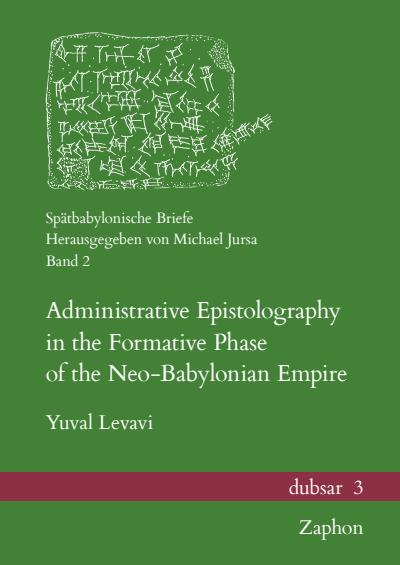
Administrative Epistolography in the Formative Phase of the Neo-Babylonian Empire
- Autor:innen:
- Verlag:
- 2018
Zusammenfassung
Die 215 früh-neubabylonischen Verwaltungsbriefe, die in dieser Studie erörtert werden, stammen aus den beiden wichtigsten neubabylonischen Tempel-Archiven: dem Eanna und dem Ebabbar. Der Begriff "Formative Phase" des neubabylonischen Reiches bezieht sich auf die ca. 40 Jahre zwischen Nabopolassars Thronbesteigung und 626 v.Chr. und der Mitte der Regierungszeit seines Sohnes und Nachfolgers Nebukadnezars, ca. 585 v.Chr. In vielfacher Hinsicht stellen diese Briefe den direktesten Zugang zum Alltagsleben der Bitte des 1. vorchristlichen Jahrtausends dar. Die Briefe sind wesentliches Werkzeug der Verwaltung, notwendig das Funktionieren der Institutionen zu gewährleisten. Als solche bieten sie Zeugnisse aus erster Hand für die Aufgaben und Probleme, mit denen sich die neubabylonische Bürokratie konfrontiert sah. Dies gilt freilich auch in gewissem Sinne für die Rechtstexte der Archive und in geringerem Umfang auch für die Verwaltungsnotizen. Beide Gruppen sind zwar durchaus zahlreicher bezeugt. Aber die ephemere und die Ad-hoc-Natur der Briefe und ihre nicht-standardisierte Phraseologie gewährt uns einen Blick in das Denken der Autoren. Überdies sind die Muster der Kommunikation zwischen den Beamten eine bedeutende Informationsquelle zu Verwaltungshierarchien, Netzwerken der Abhängigkeit und der Patronage und der bürokratischen Prozeduren. Bislang sind die neubabylonischen Verwaltungsbriefe Briefe noch nicht umfassend datiert, kontextualisiert und als Gruppe erörtert worden. Die Studie hat sich drei Ziele gesetzt: 1. Erarbeitung einer aktuellen Edition der früh-neubabylonischen Briefe der Archive des Eanna und des Ebabbar; 2. Erörterung der Briefe als Gruppe; 3. Kontextualisierung der Briefe. – Umfassende Indices vervollständigen die Studie.
Publikation durchsuchen
Bibliographische Angaben
- Auflage
- 1/2018
- Copyrightjahr
- 2018
- ISBN-Print
- 978-3-96327-006-2
- ISBN-Online
- 978-3-96327-007-9
- Verlag
- Zaphon, Münster
- Reihe
- dubsar / Altorientalistische Publikationen / Publications on the Ancient Near East
- Band
- 3
- Sprache
- Englisch
- Seiten
- 683
- Produkttyp
- Monographie
Inhaltsverzeichnis
- Acknowledgments Kein Zugriff
- Table of contents Kein Zugriff
- Tables and figures Kein Zugriff
- Abbreviations and orthographic conventions Kein Zugriff
- 1.1. Periodisation Kein Zugriff
- 1.2. Goals and methods Kein Zugriff
- 1.3.1. The Eanna archive Kein Zugriff
- 1.3.2. The (early) Ebabbar archive Kein Zugriff
- 1.3.3. The corpus Kein Zugriff
- 1.4.1. Previous publications of letters in the corpus Kein Zugriff
- 1.4.2. Previous literature Kein Zugriff
- 1.5. On the translation Kein Zugriff
- 2.1.1.1. Letter proper Kein Zugriff
- 2.1.1.2. Letter order Kein Zugriff
- 2.1.1.3. “Memorandum” Kein Zugriff
- 2.1.1.4.1. Hierarchical relation between the writers and the addressees Kein Zugriff
- 2.1.1.4.2. Incoming/Outgoing Kein Zugriff
- 2.2.1.1.1. ṭuppi PN address Kein Zugriff
- 2.2.1.1.2. Servant (ardu) address Kein Zugriff
- 2.2.1.1.3. ana PN umma address Kein Zugriff
- 2.2.1.1.4. šulmu šâlu address Kein Zugriff
- 2.2.1.1.5. Royal formal address (amāt šarri) Kein Zugriff
- 2.2.1.1.6. Variables within the formal address Kein Zugriff
- 2.2.1.2.1. May the gods decree (liqbû) Kein Zugriff
- 2.2.1.2.2. Daily I pray (ūmussu uṣalla) Kein Zugriff
- 2.2.1.2.3. May you be well (lū šulmu) Kein Zugriff
- 2.2.1.2.4. May the gods bless … (likrubū) Kein Zugriff
- 2.2.1.2.5. Royal (I am well …) Kein Zugriff
- 2.2.1.2.6. “Double” greeting formula Kein Zugriff
- 2.2.2.1.1. ana muḫḫi, ina muḫḫi, ša (at the head of a sentence) Kein Zugriff
- 2.2.2.1.2. amur Kein Zugriff
- 2.2.2.1.3. enna, adû, enna adû, and enna amur Kein Zugriff
- 2.2.2.1.4. kapdu and ḫanṭiš Kein Zugriff
- 2.2.2.1.5. umma Kein Zugriff
- 2.2.2.2.1. DN (lū īdû) kī oath Kein Zugriff
- 2.2.2.2.2. DN (lū īdû) kī adī oath Kein Zugriff
- 2.2.2.2.3. ḫarrānu ana šēpē šakānu Kein Zugriff
- 2.2.2.2.4. kī nakutti šapāru Kein Zugriff
- 2.2.2.2.5. kī pāni (bēli) maḫir Kein Zugriff
- 2.2.2.2.6. lā šelû Kein Zugriff
- 2.2.2.2.7. libbu (ša PN) lū ṭâbu Kein Zugriff
- 2.2.2.2.8. lū īdû and (lū) īdû kī Kein Zugriff
- 2.2.2.2.9. nubattu lā bâtu Kein Zugriff
- 2.2.2.2.10. suddir-ma (take care of …) Kein Zugriff
- 2.2.2.2.11. ṭēmu (u šulmu) lū šemû Kein Zugriff
- 2.2.3. Closing formulae Kein Zugriff
- 2.3. Letters as administrative reports Kein Zugriff
- 2.4.1. Rational argumentation Kein Zugriff
- 2.4.2. Emotions Kein Zugriff
- 2.4.3. Appeal to personal relationships Kein Zugriff
- 2.4.4.1. Threats Kein Zugriff
- 2.5.1. “Museum archaeology” and archival context Kein Zugriff
- 2.5.2. Physical attributes (of tablet and text) Kein Zugriff
- 2.5.3. Lexical and stylistic considerations Kein Zugriff
- 2.5.4. Contents Kein Zugriff
- 2.5.5. Prosopography Kein Zugriff
- 3.1. Language Kein Zugriff
- 3.2.1. Seals Kein Zugriff
- 3.3. Sending a letter Kein Zugriff
- 3.4. The messengers (mār šipri) Kein Zugriff
- 4.1.1.1. The royal resident (qīpu) Kein Zugriff
- 4.1.1.2. Temple administrator (šatammu) Kein Zugriff
- 4.1.1.3. Temple scribe (ṭupšar bīti) Kein Zugriff
- 4.1.2.1. Royal resident (qīpu) Kein Zugriff
- 4.1.2.2.1. Temple administrator (šatammu) of the Ebabbar Kein Zugriff
- 4.1.2.2.2. Chief priest (šangû) of the Ebabbar Kein Zugriff
- 4.2.1.1. maṣṣartu owed by/for x? Kein Zugriff
- 4.2.1.2. Institutional maṣṣartu: maṣṣartu of the temple Kein Zugriff
- 4.2.1.3.1. Between patrimonial and formal relations Kein Zugriff
- 4.2.1.3.2. “My maṣṣartu” in the letters of the governor of the Sealand Kein Zugriff
- 4.2.1.4. The (absence of) royal maṣṣartu Kein Zugriff
- 4.2.1.5. Conclusions (maṣṣartu) Kein Zugriff
- 4.2.2.1. Sin vs. punishment Kein Zugriff
- 4.2.2.2. The administrative context of ḫīṭu Kein Zugriff
- 4.2.2.3. Legal aspects of ḫīṭu Kein Zugriff
- 4.2.3.1.1. Identification: between Nabû-bān-aḫi1 and Nabû-bān-aḫi2 Kein Zugriff
- 4.2.3.1.2. The interaction of Nabû-bān-aḫi1 with other temple officials Kein Zugriff
- 4.2.3.2. The dossier of Mušēzib-Bēl and Ibni-Ištar Kein Zugriff
- 4.2.3.3. Piggyback messages Kein Zugriff
- 4.2.3.4. The interaction between the high-ranking Eanna officials Kein Zugriff
- 4.2.3.5. The royal resident of Ebabbar and the local Ebabbar officials Kein Zugriff
- 4.2.4.1.1. The “Urukeans” Kein Zugriff
- 4.2.4.2.1. Larsa Kein Zugriff
- 4.2.4.2.2. Udannu Kein Zugriff
- 4.2.4.2.3. Conclusions (Larsa and Udannu) Kein Zugriff
- 4.2.4.3.1. Identifying the “Sealand letters” Kein Zugriff
- 4.2.4.3.2.1. The governor of the Sealand Kein Zugriff
- 4.2.4.3.2.2. The deputy and the royal resident of the Sealand Kein Zugriff
- 4.2.4.3.3. Administrative aspects of Eanna/Sealand interaction Kein Zugriff
- 4.2.4.3.4.1. Nabû-ēṭer-napšāti and Nabû-nādin-šumi (aka Nādin) Kein Zugriff
- 4.2.4.3.5. Summary Eanna – Sealand Kein Zugriff
- 4.2.4.4.1.1. Royal letters Kein Zugriff
- 4.2.4.4.1.2. Interaction with the king in letters of others Kein Zugriff
- 4.2.5. Interactions in the Ebabbar letters Kein Zugriff
- 5.1.1. Palace Kein Zugriff
- 5.1.2. Temple Kein Zugriff
- 5.1.3. The system at work Kein Zugriff
- 5.2. Military service Kein Zugriff
- 5.3.1. Legal and administrative aspects Kein Zugriff
- 5.3.2. Storage Kein Zugriff
- 5.3.3. Transportation Kein Zugriff
- 5.4. Cult Kein Zugriff
- 5.5. Management of personnel; legal problemsand court procedure Kein Zugriff
- 6.1. The Babylonian letters from the “State Archives of Assyria” (SAA) Kein Zugriff
- 6.2. Achaemenid (and late Neo-Babylonian)letters from Eanna and Ebabbar Kein Zugriff
- 7.1. Letters from Eanna (Uruk) Kein Zugriff
- 7.2. Letters from Ebabbar (Sippar) Kein Zugriff
- 7.3. Appendix A: Cavigneaux 1981: 139f. Kein Zugriff
- 7.4. Appendix B: CT 22,160 Kein Zugriff
- 8. Glossary Kein Zugriff Seiten 494 - 602
- 9. Bibliography Kein Zugriff Seiten 603 - 617
- Genaral index Kein Zugriff
- Month names: in the editions Kein Zugriff
- Akkadian words Kein Zugriff
- Hebrew words Kein Zugriff
- Aramaic words Kein Zugriff
- Toponyms and hydronyms: general Kein Zugriff
- Toponyms and hydronyms: in the editions Kein Zugriff
- Temple names: in the editions Kein Zugriff
- Divine names: general Kein Zugriff
- Divine names: in the editions Kein Zugriff
- Personal names: general Kein Zugriff
- Personal names: in the editions Kein Zugriff
- Letters according to publication Kein Zugriff
- Letters according to museum number Kein Zugriff
- Letters in the corpus (+ appendixes A and B) Kein Zugriff
- Texts Kein Zugriff
- Biblical texts Kein Zugriff