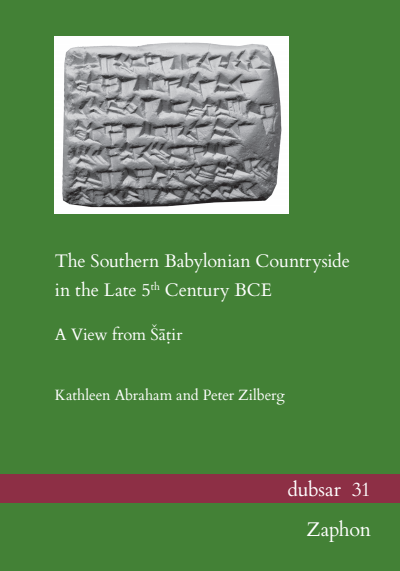
The Southern Babylonian Countryside in the Late 5th Century BCE
A View from Šāṭir- Autor:innen:
- |
- Verlag:
- 2025
Zusammenfassung
The study is dedicated to the small city of Šāṭir, which was situated in the southern Babylonian countryside, near the major urban center of Uruk and in the Chaldean region of Bīt-Amukānu. What is known about it comes from legal and administrative texts drafted in the city itself, in towns or small villages in its vicinity and from the neighbouring urban centre of Uruk. This study focuses on those primary sources dated to the 5th century BCE, a period when all of Babylonia was under Persian Achaemenid rule. It contains 28 documents published here for the first time, supplemented by updated editions of 10 previously published documents from Šāṭir and nearby sites. As limited as this textual evidence is, it nevertheless allows a view on agricultural and cultural life in rural southern Babylonia. It will be argued that the evidence from Šāṭir can serve as a promising micro-historical case study of the hinterland of Uruk, because of the scarcity of comparable textual evidence from 5th century Babylonia, the texts’ pronounced focus on local issues and concerns, and the unique location of Šāṭir, between two disparate cultural and political spheres of influence, namely the world of urban Babylonia on the one hand and that of the Chaldean tribes from Bīt-Amukānu on the other. The discussion and analysis of the evidence shows that Šāṭir was an example of how local urban centres functioned and ruled over various population groups in the southern Babylonian periphery. The reality of life in Šāṭir under Achaemenid rule was one of agrarian opportunities, challenges, and local resilience, in an environment of linguistic and cultural complexity.
Die Studie ist der Kleinstadt Šāṭir gewidmet, die im südlichen babylonischen Umland nahe dem bedeutenden urbanen Zentrum Uruk und in der chaldäischen Region Bīt-Amukānu lag. Das über sie bekannte Material stammt aus juristischen und administrativen Texten, die in der Stadt selbst, in umliegenden Städten und kleinen Dörfern sowie im benachbarten urbanen Zentrum Uruk verfasst wurden. Der Schwerpunkt dieser Studie liegt auf den Quellen aus dem 5. Jahrhundert v. Chr., einer Zeit, als Babylonien unter der Herrschaft der persischen Achämeniden stand. Sie bietet 28 hier erstmals veröffentlichte Dokumente, ergänzt durch aktualisierte Ausgaben von 10 bereits veröffentlichten Dokumenten aus Šāṭir und nahegelegenen Orten. So begrenzt diese Textbelege auch sind, ermöglichen sie dennoch einen Einblick in das landwirtschaftliche und kulturelle Leben im ländlichen Südbabylonien. Die Funde aus Šāṭir können als mikrohistorische Fallstudie des Hinterlandes von Uruk dienen. Grund dafür sind der Mangel an vergleichbaren Textfunden aus dem Babylonien des 5. Jahrhunderts, der starke Fokus der Texte auf lokale Probleme und Anliegen und die einzigartige Lage Šāṭirs zwischen zwei unterschiedlichen kulturellen und politischen Einflusssphären, nämlich der Welt des städtischen Babyloniens einerseits und der Welt der chaldäischen Stämme aus Bīt-Amukānu andererseits. Die Lebensrealität in Šāṭir unter der Herrschaft der Achämeniden war geprägt von landwirtschaftlichen Chancen, Herausforderungen und lokaler Widerstandsfähigkeit in einem Umfeld sprachlicher und kultureller Komplexität. Šāṭir kann so als ein Beispiel dafür dienen, wie lokale städtische Zentren funktionierten und über verschiedene Bevölkerungsgruppen in der südlichen babylonischen Peripherie herrschten.
Publikation durchsuchen
Bibliographische Angaben
- Auflage
- 1/2025
- Copyrightjahr
- 2025
- ISBN-Print
- 978-3-96327-260-8
- ISBN-Online
- 978-3-96327-261-5
- Verlag
- Zaphon, Münster
- Reihe
- dubsar / Altorientalistische Publikationen / Publications on the Ancient Near East
- Band
- 31
- Sprache
- Englisch
- Seiten
- 264
- Produkttyp
- Monographie
Inhaltsverzeichnis
- TABLE OF CONTENTS Kein Zugriff
- PREFACE Kein Zugriff
- PART I:INTRODUCTION Kein Zugriff Seiten 1 - 4
- 1 GEOGRAPHIC FRAMEWORK Kein Zugriff
- 2.1 Discovery and Acquisition of the Tablets Kein Zugriff
- 2.2 Physical Characteristics of the Tablets Kein Zugriff
- 2.3 Text Groups and Intertextuality Kein Zugriff
- 2.4.1 Promissory Notes Kein Zugriff
- 2.4.2.1 Sale Records for Arable Land Kein Zugriff
- 2.4.2.2 Promissory Notes Resulting from Sales Kein Zugriff
- 2.4.2.3 Uncertain Kein Zugriff
- 2.4.3 Land Farming Agreements (Lease and Sharecropping) Kein Zugriff
- 2.4.4 Prebend Leases Kein Zugriff
- 2.4.5 Receipts Kein Zugriff
- 2.4.6 Bird-Keeping Agreement Kein Zugriff
- 2.4.7 Partition Wall Agreement Kein Zugriff
- 2.4.8 Cancellation of Promissory Notes Kein Zugriff
- 2.4.9 Undetermined Contract Types Kein Zugriff
- 3.1 Â-nād Kein Zugriff
- 3.2 Sons of Â-nād Kein Zugriff
- 3.3 Grandsons of Â-nād Kein Zugriff
- 3.4 Great-Grandsons of Â-nād Kein Zugriff
- 1.1 Introduction Kein Zugriff
- 1.2 The Land Kein Zugriff
- 1.3.1 Holders of Royal Land Grants Kein Zugriff
- 1.3.2 Holders of Bow-Land Kein Zugriff
- 1.3.3 The Temple as Landholder Kein Zugriff
- 1.3.4 Local Residents (as Landowners and Farmers) Kein Zugriff
- 1.4 The Agricultural Landscape in Historical Perspective Kein Zugriff
- 2.1.1 Key Features Kein Zugriff
- 2.1.2 West-Semitic Names Kein Zugriff
- 2.1.3 Iranian and Elamite Names Kein Zugriff
- 2.1.4 Absence of Family Names Kein Zugriff
- 2.1.5 Onomastic Trends in 5th Century BCE Šāṭir and Uruk Kein Zugriff
- 2.2.1 Structure and Content Kein Zugriff
- 2.2.2 Palaeography and the Question of the Scribes Kein Zugriff
- 2.2.3 Personal Names Kein Zugriff
- 2.2.4 Aramaic Words Kein Zugriff
- 2.2.5 The Aramaic Notations: their Scribes and Raison d’être Kein Zugriff
- 2.3 Seals and Seal-Bearers Kein Zugriff
- 2.5 Religion and Cult Kein Zugriff
- PART IV:CONCLUSIONS Kein Zugriff Seiten 111 - 116
- No. 1 Kein Zugriff
- No. 2 Kein Zugriff
- No. 3 Kein Zugriff
- No. 4 Kein Zugriff
- No. 5 Kein Zugriff
- No. 6 Kein Zugriff
- No. 7 Kein Zugriff
- No. 8 Kein Zugriff
- No. 9 Kein Zugriff
- No. 10 Kein Zugriff
- No. 11 Kein Zugriff
- No. 12 Kein Zugriff
- No. 13 Kein Zugriff
- No. 14 Kein Zugriff
- No. 15 Kein Zugriff
- No. 16 Kein Zugriff
- No. 17 Kein Zugriff
- No. 18 Kein Zugriff
- No. 19 Kein Zugriff
- No. 20 Kein Zugriff
- No. 21 Kein Zugriff
- No. 22 Kein Zugriff
- No. 23 Kein Zugriff
- No. 24 Kein Zugriff
- No. 25 Kein Zugriff
- No. 26 Kein Zugriff
- No. 27 Kein Zugriff
- No. 28 Kein Zugriff
- No. 29 Kein Zugriff
- No. 30 Kein Zugriff
- No. 31 Kein Zugriff
- No. 32 Kein Zugriff
- No. 33 Kein Zugriff
- No. 34 Kein Zugriff
- No. 35 Kein Zugriff
- No. 36 Kein Zugriff
- No. 37 Kein Zugriff
- No. 38 Kein Zugriff
- CONVENTIONS AND ABBREVIATIONS Kein Zugriff Seiten 219 - 222
- BIBLIOGRAPHY Kein Zugriff Seiten 223 - 234
- 1.1 Personal Names in Aramaic Notations Kein Zugriff
- 1.2 Personal Names in Cuneiform Texts Kein Zugriff
- 1.3 Fragmentary and Broken Personal Names Kein Zugriff
- 1.4 Toponyms Kein Zugriff
- 1.5 Hydronyms Kein Zugriff
- 1.6 Deities and Temples Kein Zugriff
- 2.1 Texts Edited in this Volume Kein Zugriff
- 2.2 Other Cuneiform Texts Kein Zugriff