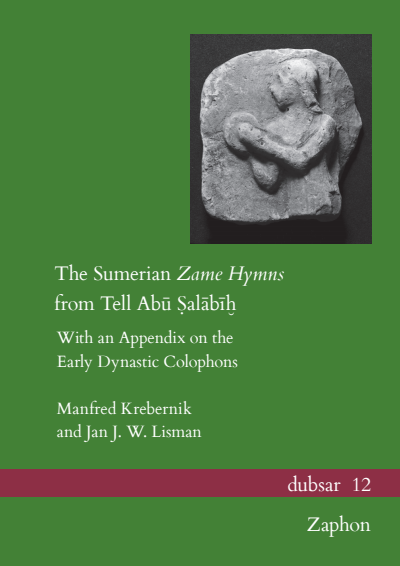
M. Krebernik and J.J.W. Lisman offer the first comprehensive score edition of and the first attempt at an integral translation of the Early Dynastic Sumerian hymns, known in the literature as the Zame Hymns (zà-mì), published by R.D. Biggs in 1974 in his ‘Inscriptions from Tell Abū Ṣalābīkh’ (IAS). Most of the deities featuring in the collection of the short Zame Hymns also occur in the god lists from Abū Ṣalābīḫ and Fāra. The hymns are embedded in a narrative which relates to the institution of the cult places for the great gods by the supreme god Enlil in Nippur. The last hymn is dedicated to Lisin and her cult place ĜEŠ.GI, which is most probably to be identified with Abū Ṣalābīḫ, where Lisin is installed as city goddess. If one considers these facts, it becomes very likely that the Zame Hymns were performed when the temple of Lisin was inaugurated and/or when the foundation of her temple and her installation there were re-enacted in the course of a cyclic (annual?) festival. The score edition and translation are supplemented by a detailed commentary on various cultural, historical, grammatical and orthographic aspects. An appendix is devoted to the colophons of contemporary texts from Tell Abū Ṣalābīḫ, Fāra and Ebla. The additional ‘Synopsis of the Cuneiform Manuscripts of the Zame Hymns’ will enable an easy verification of the transcription.
M. Krebernik und J.J.W. Lisman legen die erste umfassende Partitur-Edition und den ersten Versuche einer integralen Übersetzung der frühdynastischen sumerischen Hymnen vor, die als Zame-Hymnen (zà-mì) bekannt geworden sind, zuerst publiziert 1974 von R.D. Biggs in ‘Inscriptions from Tell Abū Ṣalābīkh’ (IAS). Die meisten Götter, denen die jeweils kurzen Zame-Hymnen gewidmet sind, werden auch in den Götterlisten von Abū Ṣalābīḫ and Fāra genannt. Die Hymnen sind eingebettet in ein Narrativ, das von der Einrichtung von Kultplätzen für die großen Götter durch den obersten Gott Enlil in Nippur handelt. Die letzte Zymne ist Lisin und ihrem Kultplatz ĜEŠ.GI gewidmet, welcher wahrscheinlich mit Abū Ṣalābīḫ zu identifizieren ist, wo Lisin als Stadtgöttin fungierte. Vor diesem Hintergrund ist anzunehmen, dass die Zame-Hymnen vorgetragen wurden, als der Temple von Lisin inauguriert und/oder wenn die Gründung ihres Temples ‚re-enacted‘ wurde im Rahme eines zyklischen (jährlichen?) Festes. Die Partitur-Edition und die Übersetzung werden ergänzt um einen ausführlichen Kommentar zu kulturellen, historischen, grammatischen und orthographischen Aspekten. Ein Appendix ist den Kolophonen zeitgenössischer Texte aus Tell Abū Ṣalābīḫ, Fāra und Ebla gewidmet. Die zusätzliche Synopse der Manuskripte der Zame-Hymnen ermöglicht es, die Umschrift nachzuvollziehen.
Reihe
E009677100 - Band 12
Publikation durchsuchen
Bibliographische Angaben
Auflage
1/2020
Copyrightjahr
2020
ISBN-Print
978-3-96327-034-5
ISBN-Online
978-3-96327-035-2
Verlag
Zaphon, Münster
Reihe
dubsar / Altorientalistische Publikationen / Publications on the Ancient Near East
Band
12
Sprache
Englisch
Seiten
280
Produkttyp
Monographie
Inhaltsverzeichnis
KapitelSeiten
Contents Kein Zugriff
Preface Kein Zugriff
1.1 History of research Kein Zugriff
1.2 The manuscripts Kein Zugriff
1.3 Orthography Kein Zugriff
1.4 The structure of the Zame Hymns Kein Zugriff
1.5 The gods of the Zame Hymns and their cities Kein Zugriff
1.6 The Zame Hymns in the context of early cuneiform literature Kein Zugriff
1.7 The ‘Sitz im Leben’ of the Zame Hymns Kein Zugriff
Table 1: The Zame Hymns: a general survey of place names and deities Kein Zugriff
Table 2. Theonyms in Zame Hymns, Early Dynastic god lists, and Temple Hymns Kein Zugriff
Table 3: Toponyms in Zame Hymns, city lists, City Seals, and Temple Hymns Kein Zugriff
3. List of Manuscripts of the Zame Hymns Kein Zugriff Seiten 29 - 32
4. Transliteration and Translation Kein Zugriff Seiten 33 - 48
5. Score Kein Zugriff Seiten 49 - 80
6. Commentary Kein Zugriff Seiten 81 - 166
Index of deities Kein Zugriff
Index of (cult)-places and temple names Kein Zugriff
Index of signs (according to LAK numbers) Kein Zugriff
Index of Sumerian words Kein Zugriff
Index of Akkadian/Semitic words Kein Zugriff
Index of textual references Kein Zugriff
Index of Sumerian literary texts (quoted after ETCSL) Kein Zugriff
Index of Early Dynastic inscriptions (quoted after RIME) Kein Zugriff
8.1 Some general remarks on the colophons and the scribes Kein Zugriff
8.2.1 Comparative table of the colophons of the Zame Hymns Kein Zugriff
8.2.2 Index of the personal names in the colophons of the Zame Hymns, with references to other colophons from Tell Abū Salābīḫ Kein Zugriff
8.2.3 The colophons from Tell Abū Salābīḫ in transliteration Kein Zugriff
8.2.4 Index to the colophons from Tell Abū Salābīḫ, with references to the administrative texts from Tell Abū Salābīḫ Kein Zugriff
8.3.1 The colophons from Fāra in transliteration Kein Zugriff
8.3.2 Colophons from other Early Dynastic cities in transliteration Kein Zugriff
8.3.3 Index to the colophons from Fāra and other Early Dynastic cities Kein Zugriff
8.4.1 The colophons from Ebla in transliteration Kein Zugriff
8.4.2 Index to the colophons from Ebla Kein Zugriff
9. Abbreviations Kein Zugriff Seiten 227 - 234
10. Bibliography Kein Zugriff Seiten 235 - 258
11. Maps of Sumer and Tell Abū Ṣalābīḫ Kein Zugriff Seiten 259 - 262
12. Synopsis of the Cuneiform Manuscripts of the Zame Hymns Kein Zugriff Seiten 263 - 278
Ähnliche Veröffentlichungen
aus der Reihe "dubsar / Altorientalistische Publikationen / Publications on the Ancient Near East"
Sammelband Kein Zugriff
Doris Prechel, Alexander Pruß, Thomas Richter, Dirk Wicke