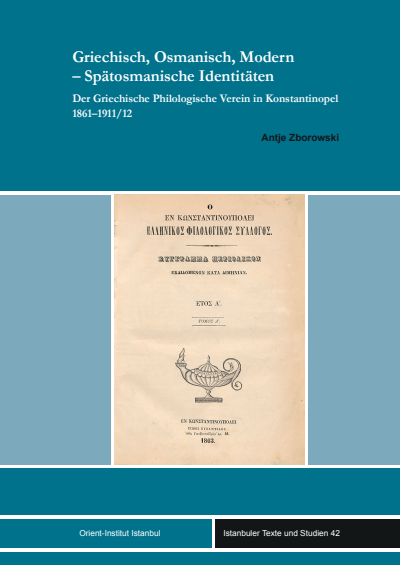
Griechisch, Osmanisch, Modern - Spätosmanische Identitäten
Der Griechische Philologische Verein in Konstantinopel 1861-1911/12- Autor:innen:
- Reihe:
- Istanbuler Texte und Studien (ITS), Band 42
- Verlag:
- 2019
Zusammenfassung
Die Studie problematisiert die osmanisch-griechische Identität anhand des entsprechenden Diskurses im Vereinsjournal des Griechischen Philologischen Vereins in Konstantinopel. Als Hauptstadt verkörperte Konstantinopel die Transformationen, denen der osmanische Staat und die osmanische Gesellschaft im 19. Jahrhundert unterlagen. Die im Vereinsjournal gespiegelten Aktivitäten der Gesellschaft sind als Antwort auf diese Transformationen zu sehen und somit Ausdruck des zugrunde liegenden Selbstbildes. Daher gilt das Interesse gleichermaßen der Aufzeichnung der relevanten Informationen wie den damit zusammenhängenden Interpretationen. Über den griechisch-orthodoxen Kontext des Vereins hinaus erörtert die Arbeit in diesem Zusammenhang das Konzept der Moderne sowohl im internationalen Rahmen als auch innerhalb des osmanischen Reichs.
Publikation durchsuchen
Bibliographische Angaben
- Auflage
- 1/2019
- Copyrightjahr
- 2019
- ISBN-Print
- 978-3-95650-566-9
- ISBN-Online
- 978-3-95650-567-6
- Verlag
- Ergon, Baden-Baden
- Reihe
- Istanbuler Texte und Studien (ITS)
- Band
- 42
- Sprache
- Deutsch
- Seiten
- 444
- Produkttyp
- Monographie
Inhaltsverzeichnis
- Titelei/Inhaltsverzeichnis Kein Zugriff Seiten 1 - 10
- Methodische Anmerkungen Kein Zugriff
- Kollektive Identität Kein Zugriff
- Vereine Kein Zugriff
- III. Der Griechische Philologische Verein in Konstantinopel Kein Zugriff Seiten 55 - 70
- 1. Sprachwissenschaft und Sprachphilosophie Kein Zugriff
- 2.1. Allgemeine Beobachtungen Kein Zugriff
- 2.2.1. Reflexionen der Sprachfrage Kein Zugriff
- a) Die Homerische Frage Kein Zugriff
- b) Die Erasmische (Schul-)Aussprache Kein Zugriff
- c) Humanisten vs. Realisten Kein Zugriff
- a) O Zographeios Agon Kein Zugriff
- b) I Zographeios Bibliothiki Kein Zugriff
- 3. Andere Sprachen und Philologien Kein Zugriff
- 4. Die Philologische Kommission Kein Zugriff
- Fazit Kein Zugriff
- Archäologie und Geschichte Kein Zugriff
- 1. Archäologie als Wissenschaft Kein Zugriff
- 2. Archäologie als Verantwortung Kein Zugriff
- 3. Die Archäologische Kommission Kein Zugriff
- 1.1. Frühgeschichte und Antike Kein Zugriff
- 1.2. Byzanz Kein Zugriff
- 1.3. Geschichte seit 1453 Kein Zugriff
- 2. Nichtgriechische Geschichte Kein Zugriff
- Fazit Kein Zugriff
- Religion und weitere Wissenschaften Kein Zugriff
- 1. Die Bedeutung des orthodoxen Christentums Kein Zugriff
- 2. Die Rolle religiöser Autorität/en: Anbindung und Abgrenzung Kein Zugriff
- 1. Vorbemerkung Kein Zugriff
- 2. Naturwissenschaften Kein Zugriff
- 3. Gesellschaftswissenschaften Kein Zugriff
- 4. Rechtswissenschaften Kein Zugriff
- 5. Internationale Kongresse und (Welt-)Ausstellungen Kein Zugriff
- 6. Die Wissenschaftliche/n Kommission/en Kein Zugriff
- 7. Exkurs: Philosophie und Ethik Kein Zugriff
- Fazit Kein Zugriff
- 1.1. Der allgemeine Bildungs- und Erziehungsbegriff, das allgemeine Bildungsund Erziehungsverständnis Kein Zugriff
- 1.2. Bestandsaufnahme: Die aktuelle Situation der (griechischen) Bildung und erste Vorschläge Kein Zugriff
- 2.1. Der EPhS als Bildungsforum Kein Zugriff
- 2.2.1. Berichte zur Lage der (griechischen) Bildung im Osmanischen Reich Kein Zugriff
- 2.2.2. Schulprojekte des EPhS Kein Zugriff
- 2.2.3. Lehrerbildung Kein Zugriff
- a) O Karapaneios Agon Kein Zugriff
- b) O Voutsinaios Agon Kein Zugriff
- 3. Die Pädagogische Kommission Kein Zugriff
- Fazit Kein Zugriff
- Interpretation: Der (griechische) Identitätsdiskurs des EPhS Kein Zugriff
- 1. Exkurs I Kein Zugriff
- 2. Reflexion im Diskurs des EPhS Kein Zugriff
- 1. Exkurs II Kein Zugriff
- 2.1. Seitens des osmanischen Staates Kein Zugriff
- 2.2. Seitens des EPhS Kein Zugriff
- 3. Konstruktion und Reflexion des gesellschaftlichen Diskurses Kein Zugriff
- Interpretation: Der (griechische) Identitätsdiskurs des EPhS im Rahmen des osmanischen Reform- und Modernediskurses Kein Zugriff
- VI. Kritische Schlussfolgerungen und Überlegungen Kein Zugriff Seiten 361 - 398
- Personenregister Kein Zugriff Seiten 399 - 402
- Journal des EPhS Kein Zugriff
- Literatur Kein Zugriff
Literaturverzeichnis (540 Einträge)
Es wurden keine Treffer gefunden. Versuchen Sie einen anderen Begriff.
- Ahmad, Feroz. The Young Turks. The Committee of Union and Progress in Turkish Politics 1908–1914. Oxford 1969. Google Scholar öffnen DOI: 10.5771/9783956505676
- Alexandris, Alexis. „The Greek Census of Anatolia and Thrace (1910–1912): A Contribution to Ottoman Historical Demography“. Hrsg. Dimitri Gondicas, Charles Issawi. Ottoman Greeks in the Age of Nationalism: Politics, Economy, and Society in the Nineteenth Century. Princeton N.J. 1999. 45–66. Google Scholar öffnen DOI: 10.5771/9783956505676
- Alexandris, Alexis. „Oi Ellines stin Ypiresia tis Othomanikis Avtokratorias 1850–1922 „. Deltion tis Istorikis kai Ethnologikis Etaireias tis Ellados. Bulletin de la Société Historique et Ethnologique de la Grèce 23 (1980). 365–404. Google Scholar öffnen DOI: 10.5771/9783956505676
- Alexandris, Alexis. The Greek Minority of Istanbul and Greek–Turkish Relations 1918–1974. Athen 1992. Google Scholar öffnen DOI: 10.5771/9783956505676
- Alexiou, Margaret. „Modern Greek Studies in the West: Between the Classics and the Orient“. Journal of Modern Greek Studies 4/1 (1986). 3–15. Google Scholar öffnen DOI: 10.5771/9783956505676
- Ammann, Ludwig. „Privatsphäre und Öffentlichkeit in der muslimischen Zivilisation“. Hrsg. Nilüfer Göle, Ludwig Ammann. Islam in Sicht. Der Auftritt von Muslimen im Öffentlichen Raum. Bielefeld 2003. 69–117. Google Scholar öffnen DOI: 10.5771/9783956505676
- Ammon, Ulrich (Hrsg.). Status and Function of Languages and Language Varieties. Berlin, New York 1989. Google Scholar öffnen DOI: 10.5771/9783956505676
- Anagnostopoulou, Athanasia. „Oi Metarrythmiseis tou Tanzimat kai to Thesmiko Plaisio tou Millet ton Romion. Patriarcheio, Koinotikoi Thesmoi, Paideia“. I Parousia ton Ethnikon Meionotiton stin Konstantinoupoli ton 19o Aiona. Praktika tis Epistimonikis Imeridas tou Syndesmou ton en Athinais Megaloscholiton, (5.10.1996). Athen 1997. 17–89. Google Scholar öffnen DOI: 10.5771/9783956505676
- Anagnostopoulou, Sia: „Église Œcuménique, Église Nationale. Le Problème des Rapports entre Religion et Nation dans les Balkans, XIXème Début XXème Siècles. L’Exemple Grec“. Sia Anagnostopoulou. The Passage from the Ottoman Empire to the Nation–States. A long and difficult process: The Greek case. Istanbul 2004. 56–73. Google Scholar öffnen DOI: 10.5771/9783956505676
- Anagnostopoulou, Sia. „Introduction“. Sia Anagnostopoulou. The Passage from the Ottoman Empire to the Nation–States. A long and difficult process: The Greek case. Istanbul 2004. 7–10. Google Scholar öffnen DOI: 10.5771/9783956505676
- Anagnostopoulou, Sia. „L’Historicité des Termes: Les Grecs et la Domination Ottomane XVIe – XIXe Siècles“. Sia Anagnostopoulou. The Passage from the Ottoman Empire to the Nation–States. A long and difficult process: The Greek case. Istanbul 2004. 21–36. Google Scholar öffnen DOI: 10.5771/9783956505676
- Anagnostopoulou, Sia. Mikra Asia, 19os ai. – 1919. Oi Ellinorthodoxes Koinotites. Apo to Millet ton Romion sto Elliniko Ethnos. Athen 1997. Google Scholar öffnen DOI: 10.5771/9783956505676
- Anagnostopoulou, Sia. The Passage from the Ottoman Empire to the Nation–States. A long and difficult process: The Greek case. Istanbul 2004. Google Scholar öffnen DOI: 10.5771/9783956505676
- Anagnostopoulou, Sia. „The Terms Millet, Genos, Ethnos, Oikoumenikotita, Alytrotismos in Greek Historiogrpahy“. Sia Anagnostopoulou. The Passage from the Ottoman Empire to the Nation–States. A long and difficult process: The Greek case. Istanbul 2004. 37–55. Google Scholar öffnen DOI: 10.5771/9783956505676
- Anagnostopoulou, Sia. „‘Tyranny’ and ‘Despotism’ as National and Historical Terms in Greek Historiography“. Sia Anagnostopoulou. The Passage from the Ottoman Empire to the Nation–States. A long and difficult process: The Greek case. Istanbul 2004. 11–19. Google Scholar öffnen DOI: 10.5771/9783956505676
- Anastassiadou, Méropi. Les Grecs d’Istanbul au XIXe Siècle. Histoire Socioculturelle de la Communauté de Péra. Leiden, Boston 2012. Google Scholar öffnen DOI: 10.5771/9783956505676
- Anastassiadou–Dumont, Méropi (Hrsg.). Médecins et ingénieurs ottomans à l’âge des nationalismes. Paris 2003. Google Scholar öffnen DOI: 10.5771/9783956505676
- Anderson, Benedict. Imagined Communities. Reflections on the Origin and Spread of Nationalism. Revised and extended Edition. London, New York 1991. Google Scholar öffnen DOI: 10.5771/9783956505676
- Arai, Masami. „An Imagined Nation. The Idea of the Ottoman Nation as a Key to Modern Ottoman History“. Orient 27 (1991). 1–20. Google Scholar öffnen DOI: 10.5771/9783956505676
- Arkalı, Engin Deniz. „The Tangled Ends of An Empire: Ottoman Encounters with the West and Problems of Westernization – an Overview“. Comparative Studies of South Asia, Africa and the Middle East 26/2 (2006). 353–366. Google Scholar öffnen DOI: 10.5771/9783956505676
- Ash, Mitchell G. „Wissenschaftspopularisierung und Bürgerliche Kultur im 19. Jahrhundert“. Geschichte und Gesellschaft 28/2 (2002). 322–334. Google Scholar öffnen DOI: 10.5771/9783956505676
- Assmann, Aleida / Assmann, Jan. „Nachwort: Schrift und Gedächtnis“, in: Aleida Assmann, Jan Assmann, Christian Hardmeier (Hgg.). Schrift und Gedächtnis. Archäologie der literarischen Kommunikation I, München 1983. 265–284. Google Scholar öffnen DOI: 10.5771/9783956505676
- Awde, Nicholas (Hrsg.). Armenian Perspectives. 10th Anniversary Conference of the Association Internationale des Etudes Arméniennes. Richmond Surrey 1997. Google Scholar öffnen DOI: 10.5771/9783956505676
- Aydin, Cemil. „Between Occidentalism and the Global Left: Islamist Critiques of the West in Turkey“. Comparative Studies of South Asia, Africa and the Middle East 26/2 (2006). 446–461. Google Scholar öffnen DOI: 10.5771/9783956505676
- Aydin, Cemil. „Beyond Civilization: Pan–Islamism, Pan–Asianism and the Revolt against the West“. Journal of Modern European History 4/2 (2006). 204–223. Google Scholar öffnen DOI: 10.5771/9783956505676
- Aydin, Cemil. „Beyond Culturalism? An Overview of the Historiography on Ottoman Sciences in Turkey“. Hrsg. Ekmeleddin İhsanoğlu, Kostas Chatzis, Efthymios Nicolaïdis. Multicultural Science in the Ottoman Empire. Brepols 2003. 201–215. Google Scholar öffnen DOI: 10.5771/9783956505676
- Aydin, Cemil. „Orientalism, Imperialism and the Renan Debates: The Formations of Modern Muslim Narratives on Islamic Science“. Hrsg. Mustafa Kaçar, Zeynep Durukal.Essays in Honour of Ekmeleddin İhsanoğlu. I. Societies, Cultures, Sciences: a Collection of Articles. Istanbul 2006. 817–832. Google Scholar öffnen DOI: 10.5771/9783956505676
- Aydin, Cemil. The Politics of Anti–Westernism in Asia. Visions of World Order in Pan–Islamic and Pan–Asian Thought. New York 2007. Google Scholar öffnen DOI: 10.5771/9783956505676
- Babes, Mircea / Kaeser, Marc–Antoine (Hrsg.). Archaeologists without Boundaries. Towards a History of International Archaeological Congresses (1866–2006). Proceedings of the XV World Congress of the International Union for Prehistoric Sciences (Lisbon, 4–9 September 2006. Oxford 2009. Google Scholar öffnen DOI: 10.5771/9783956505676
- Bacqué–Grammont, Jean–Louis / Dumont, Paul (Hrsg.). Contributions à l’Histoire Economique et Sociale de l’Empire Ottoman. Leuven 1983. Google Scholar öffnen DOI: 10.5771/9783956505676
- Bahn, Paul (Hrsg.). The History of Archaeology. An Introduction. London, New York 2014. Google Scholar öffnen DOI: 10.5771/9783956505676
- Bahrani, Zainab / Çelik, Zeynep / Eldem, Edhem, „Introduction: Archaeology and Empire“. Hrsg. Zainab Bahrani, Zeynep Çelik, Edhem Eldem. Scramble for the Past. A Story of Archaeology in the Ottoman Empire, 1753–1914. Istanbul 2011. 13–43. Google Scholar öffnen DOI: 10.5771/9783956505676
- Bahrani, Zainab / Çelik, Zeynep / Eldem, Edhem (Hrsg.). Scramble for the Past. A Story of Archaeology in the Ottoman Empire, 1753–1914. Istanbul 2011. Google Scholar öffnen DOI: 10.5771/9783956505676
- Bacqué–Grammont, Jean–Louis / Dumont, Paul (Hrsg.). Contributions à l’Histoire Economique et Sociale de l’Empire Ottoman. Leuven 1983. Google Scholar öffnen DOI: 10.5771/9783956505676
- Barchard, David. „Modernity, Muslims, and British Archaeologists: Michael Gough and His Nineteenth Century Predcessors“. Hrsg. David Shankland. Archaeology, Anthropology and Heritage in the Balkans and Anatolia. The Life and Times of F. W. Hasluck, 1878 –1920. Istanbul 2004. Bd. 2, 257 –280. Google Scholar öffnen DOI: 10.5771/9783956505676
- Barmeyer, Heide. „Zum Wandel des Verhältnisses von Staat und Gesellschaft im 19. Jahrhundert“. Westfälische Forschungen. Mitteilungen des Provinzialinstituts für Westfälische Landes– und Volksforschung des Landschaftsverbandes Westfalen–Lippe 29 (1978–79). 119–145. Google Scholar öffnen DOI: 10.5771/9783956505676
- Barth, Fredrik. „Introduction“. Hrsg. Fredrik Barth. Ethnic Groups and Boundaries. The Social Organization of Culture Difference. Bergen, Oslo, London 1969. 9–38. Google Scholar öffnen DOI: 10.5771/9783956505676
- Bektaş, Yakup. „Crossing Communal Boundaries: Technology and Cultural Diversity in the 19th Century Ottoman Empire“. Hrsg. Ekmeleddin İhsanoğlu, Kostas Chatzis, Efthymios Nicolaïdis. Multicultural Science in the Ottoman Empire. Brepols 2003. 139–147. Google Scholar öffnen DOI: 10.5771/9783956505676
- Bélia, Hélène. „«Le Syllogue pour la Propagation des Lettres Grecques» et les Écoles de Thrace“. Actes du IIe Congès International des Études du Sud–Est Européen (Athènes 7–13 mai 1970). IV: Linguistique et Littérature. Athen 1978. 370–376. Google Scholar öffnen DOI: 10.5771/9783956505676
- Benedict, Peter / Tümertekin, Erol / Mansur, Fatma (Hrsg.). Turkey. Geography and Social Perspectives. Leiden 1974. Google Scholar öffnen DOI: 10.5771/9783956505676
- Berkes, Niyazi. The Development of Secularism in Turkey. Montreal 1964. Google Scholar öffnen DOI: 10.5771/9783956505676
- Berman, Marshall. All That Is Solid Melts Into Air. The Experience of Modernity. Edition with New Preface. London u.a. 1988. Google Scholar öffnen DOI: 10.5771/9783956505676
- Bernal, Martin. Black Athena. The Afro–asiatic Roots of Classical Cilvilization. Vol. I.: The Fabrication of Ancient Greece 1785–1985. London 1987. Google Scholar öffnen DOI: 10.5771/9783956505676
- Blaschke, Jochen. „Von der Modernisierung durch Nationenbildung zu den Folgen industrialisierter Arbeitsteilung – Stationen sozialwissenschaftlicher Nationalismusforschung“. Peripherie. Zeitschrift für Politik und Ökonomie in der Dritten Welt 18–19 (1984–85). 24–45. Google Scholar öffnen DOI: 10.5771/9783956505676
- Blok, Josine H. „Quests for a Scientific Mythology: F. Creuzer and K. O. Müller on History and Myth“– History and Theory 33/4 (1994). 26–52. Google Scholar öffnen DOI: 10.5771/9783956505676
- Boden, Petra / Müller, Dorit (Hrsg.). Populäres Wissen im medialen Wandel seit 1850. Berlin 2009. Google Scholar öffnen DOI: 10.5771/9783956505676
- Boden, Petra / Müller, Dorit. „Popularität – Wissen – Medien“. Hrsg. Petra Boden, Dorit Müller. Populäres Wissen im medialen Wandel seit 1850. Berlin 2009. 7–14. Google Scholar öffnen DOI: 10.5771/9783956505676
- Boockmann, H. / Jürgensen, K. (Hrsg.). Nachdenken über Geschichte. Beiträge aus der Ökumene der Historiker. Neumünster 1991. Google Scholar öffnen DOI: 10.5771/9783956505676
- Bosbach, Franz / Davis, John R. (Hrsg.). Die Weltausstellung von 1851 und ihre Folgen. The Great Exhibition and its Legacy. München 2002. Google Scholar öffnen DOI: 10.5771/9783956505676
- Boyar, Ebru. „The Press and the Palace: the two–way relationship between Abdülhamid II and the press, 1876–1908“. Bulletin of the School of Oriental and Asian Studies 69/3 (2006). 417–432. Google Scholar öffnen DOI: 10.5771/9783956505676
- Boyar, Ebru / Fleet, Kate. A Social History of Ottoman Istanbul. Cambridge 2010. Google Scholar öffnen DOI: 10.5771/9783956505676
- Bozdoğan, Sibel. Modernism and Nation Building. Turkish Architectural Culture in the Early Republic. Seattle, London 2001. Google Scholar öffnen DOI: 10.5771/9783956505676
- Brass, Paul R. Ethnicity and Nationalism. Theory and Comparison. London 1991. Google Scholar öffnen DOI: 10.5771/9783956505676
- Braude, Benjamin. „Foundation Myths of the Millet System“. Hrsg. Benjamin Braude, Bernard Lewis. Christians and Jews in the Ottoman Empire. The Functioning of a Plural Society. I: The Central Lands. New York, London 1982. 69–88. Google Scholar öffnen DOI: 10.5771/9783956505676
- Braude, Benjamin / Lewis, Bernard (Hrsg.). Christians and Jews in the Ottoman Empire. The Functioning of a Plural Society. 2 Bde. New York, London 1982. Google Scholar öffnen DOI: 10.5771/9783956505676
- Braude, Benjamin / Lewis, Bernard. „Introduction“. Hrsg. Benjamin Braude, Bernard Lewis. Christians and Jews in the Ottoman Empire. The Functioning of a Plural Society. I: The Central Lands. New York, London 1982. 1–33. Google Scholar öffnen DOI: 10.5771/9783956505676
- Brendemoen, Bernt. „The Turkish Language Reform and Language Policy in Turkey“.Hrsg. György Hazai. Handbuch der Türkischen Sprachwissenschaft I. Budapest 1990. 454–493. Google Scholar öffnen DOI: 10.5771/9783956505676
- Brooke, John L. „Reason and Passion in the Public Sphere: Habermas and the Cultural Historians“. The Journal of Interdisciplinary History 29/1 (1998). 43–67. Google Scholar öffnen DOI: 10.5771/9783956505676
- Browning, Robert. Medieval and Modern Greek. London 1969. Google Scholar öffnen DOI: 10.5771/9783956505676
- Burmeister, Stefan / Müller–Scheeßel, Nils (Hrsg.). Fluchtpunkt Geschichte. Archäologie und Geschichtswissenschaft im Dialog. Münster, New York, München, Berlin 2011. Google Scholar öffnen DOI: 10.5771/9783956505676
- Calhoun, Craig. Dictionary of the Social Sciences. Oxford, New York 2002. Google Scholar öffnen DOI: 10.5771/9783956505676
- Calhoun, Craig (Hrsg.). Habermas and the Public Sphere. Cambridge 1992. Google Scholar öffnen DOI: 10.5771/9783956505676
- Calhoun, Craig: „Nationalism and Civil Society: Democracy, Diversity and Self–Determination“. Hrsg. Craig Calhoun. Social Theory and the Politics of Identity. Cambridge Mass. 1994. 304–335. Google Scholar öffnen DOI: 10.5771/9783956505676
- Calhoun, Craig (Hrsg.). Social Theory and the Politics of Identity. Cambridge Mass. 1994. Google Scholar öffnen DOI: 10.5771/9783956505676
- Calhoun, Craig. „Social Theory and the Politics of Identity“ Hrsg. Craig Calhoun. Social Theory and the Politics of Identity. Cambridge Mass. 1994. 9–36. Google Scholar öffnen DOI: 10.5771/9783956505676
- Canefe, Nergis. „The Legacy of Forced Migrations in Modern Turkish Society: Remembrance of the Things Past?“. Balkanologie V/1–2 (2001). 153–177. Google Scholar öffnen DOI: 10.5771/9783956505676
- Caner, Beatrix. „Tendenzen der Moderne im Osmanischen Reich“. Zeitschrift für Türkeikunde 12/2 (1999). 175–198. Google Scholar öffnen DOI: 10.5771/9783956505676
- Carabott, Philip (Hrsg.). Greek Society in the Making, 1863–1913. Realities, Symbols and Visions. Ashgate 1997. Google Scholar öffnen DOI: 10.5771/9783956505676
- Casanova, José. Public Religions in the Modern World. Chicago, London 1994. Google Scholar öffnen DOI: 10.5771/9783956505676
- Çelik, Zeynep. „Defining Empire’s Patrimony: Late Ottoman Perceptions of Antiquities“. Hrsg. Zainab Bahrani, Zeynep Çelik, Edhem Eldem. Scramble for the Past. A Story of Archaeology in the Ottoman Empire, 1753–1914. Istanbul 2011. 443–477. Google Scholar öffnen DOI: 10.5771/9783956505676
- Çelik, Zeynep. The Impact of Westernization on Istanbul’s Urban Form, 1838–1908 (Dissertation). Berkeley 1984. Google Scholar öffnen DOI: 10.5771/9783956505676
- Çelik, Zeynep. The Remaking of Istanbul. Portrait of an Ottoman City in the Nineteenth Century. Seattle, London 1986. Google Scholar öffnen DOI: 10.5771/9783956505676
- Çıkar, Jutta R. M. Fortschritt durch Wissen. Osmanisch–türkische Enzyklopädien der Jahre 1870–1936. Wiesbaden 2004. Google Scholar öffnen DOI: 10.5771/9783956505676
- Çıkar, Mustafa. Von der Osmanischen Dynastie zur Türkischen Nation. Politische Gemeinschaften in osmanisch–türkischen Schulbüchern der Jahre 1876–1938. Stuttgart 2001. Google Scholar öffnen DOI: 10.5771/9783956505676
- Cioeta, Donald J. „Islamic Benevolent Societies and Public Education in Ottoman Syria, 1875–1882“. The Islamic Quarterly. A Review of Islamic Culture XXVI/1 (1982). 40–55. Google Scholar öffnen DOI: 10.5771/9783956505676
- Clay, Christopher. „Labour Migration and Economic Conditions in Nineteenth–Century Anatolia“. Middle Eastern Studies 34/4 (1998). 1–32 Google Scholar öffnen DOI: 10.5771/9783956505676
- Clogg, Richard. Anatolica. Studies on the Greek East in the 18th and 19th Centuries. Aldershot 1996. Google Scholar öffnen DOI: 10.5771/9783956505676
- Clogg, Richard. „The Greek Millet in the Ottoman Empire“. Hrsg. Benjamin Braude, Bernard Lewis. Christians and Jews in the Ottoman Empire. The Functioning of a Plural Society. I: The Central Lands. New York, London 1982. 185–207. Google Scholar öffnen DOI: 10.5771/9783956505676
- Cocks, Geoffrey / Rausch, Konrad H. (Hrsg.). German Professions, 1800–1950. New York, Oxford 1990. Google Scholar öffnen DOI: 10.5771/9783956505676
- Codd, John. „Making Distinctions: The Eye of the Beholder“. Hrsg. Richard Harker, Cheleen Mahar, Chris Wilkes. An Introduction to the Work of Pierre Bourdieu. The Practice of Theory. London u.a. 1990. 132–159. Google Scholar öffnen DOI: 10.5771/9783956505676
- Conrad, Sebastian. „«Europa» aus der Sicht nichtwestlicher Eliten, 1900–1930“. Journal of Modern European History 4/2 (2006). 158–170. Google Scholar öffnen DOI: 10.5771/9783956505676
- Cooter, Roger / Pumfrey, Stephen. „Separate Spheres and Public Places: Reflections on the History of Science Populariszation and Science in Popular Culture“. History of Science 32/3 (1994). 237–267. Google Scholar öffnen DOI: 10.5771/9783956505676
- Crowley, Tony. „That Obscure Object of Desire: A Science of Language“. Hrsg. John E. Joseph, Talbot J. Taylor. Ideologies of Language. London, New York 1990. 27–50. Google Scholar öffnen DOI: 10.5771/9783956505676
- Çisken, Engin. Photography in the Ottoman Empire. Istanbul 1987. Google Scholar öffnen DOI: 10.5771/9783956505676
- Daheim in Konstantinopel. Deutsche Spuren am Bosporus ab 1850. Memleketimiz Dersaadet. 1850’den İtibaren Boğaziçi’ndeki Alman İzleri. Nürnberg 2014. Google Scholar öffnen DOI: 10.5771/9783956505676
- Dann, Otto: Die Anfänge politischer Vereinsbildung in Deutschland, in: Engelhardt, Ulrich / Sellin, Volker / Stuke, Horst (Hgg.): Soziale Bewegung und politische Verfassung. Beiträge zur Geschichte der modernen Welt, Stuttgart 1976, S. 197–232. Google Scholar öffnen DOI: 10.5771/9783956505676
- Dann, Otto. „Einleitung des Herausgebers: Die Lesegesellschaften und die Herausbildung einer modernen bürgerlichen Gesellschaft in Europa“. Hrsg. Otto Dann. Lesegesellschaften und bürgerliche Emanzipation. Ein europäischer Vergleich. München 1981. 9–28. Google Scholar öffnen DOI: 10.5771/9783956505676
- Daskalov, Roumen / Marinov, Tchavdar (Hrsg). Entangled Histories of the Balkans. 2 Bde. Leiden, Boston 2013. Google Scholar öffnen DOI: 10.5771/9783956505676
- Daum, Andreas. Wissenschaftspopularisierung im 19. Jahrhundert. Bürgerliche Kultur, naturwissenschaftliche Bildung und die deutsche Öffentlichkeit 1848–1914. 2. erg. Auflage. Oldenburg 2002. Google Scholar öffnen DOI: 10.5771/9783956505676
- Davison, Roderic H. „The Millets as Agents of Change in the Nineteenth–Century Ottoman Empire“, Christians and Jews in the Ottoman Empire. The Functioning of a Plural Society. I: The Central Lands. Benjamin Braude, Bernard Lewis. New York, London 1982. 319–337. Google Scholar öffnen DOI: 10.5771/9783956505676
- Davison, Roderic H. „Turkish Attitudes Concerning Christian–Muslim Equality in the Nineteenth Century“. American Historical Review 59/4 (1954). 844–864. Google Scholar öffnen DOI: 10.5771/9783956505676
- Der Neue Pauly. Enzyklopädie der Antike, s.v. Philhellenismus, Bd. 15/2, 2001, Sp. 231–237. Google Scholar öffnen DOI: 10.5771/9783956505676
- Deringil, Selim. „Legitimacy Structures in the Ottoman State: the Reign of Abdülhamid II (1876–1909)“. International Journal of Middle East Studies 23/3 (1991). 345–359. Google Scholar öffnen DOI: 10.5771/9783956505676
- Deringil, Selim. „New Approaches to the Study of the Nineteenth Century“. Hrsg. Çiğdem Kafescioğlu, Lucienne Thys–Şenocak. Aptullah Kuran için Yazılar. Essays in Honour of Aptullah Kuran. Istanbul 1999. 345–348. Google Scholar öffnen DOI: 10.5771/9783956505676
- Deringil, Selim. „“They Live in a State of Nomadism and Savagery”: The Late Ottoman Empire and the Post–Colonial Debate“. Comparative Studies in Society and History 45/2 (2003). 311–342. Google Scholar öffnen DOI: 10.5771/9783956505676
- Deringil, Selim. „The Invention of Tradition as Public Image in the Late Ottoman Empire, 1808 to 1908“. Comparative Studies in Society and History 35/1 (1993). 3–27. Google Scholar öffnen DOI: 10.5771/9783956505676
- Deringil Selim. „The Ottoman Origins of Kemalist Nationalism: Namik Kemal to Mustafa Kemal“. European History Quarterly 23/2 (1993). 165–191. Google Scholar öffnen DOI: 10.5771/9783956505676
- Deringil, Selim. The Well–Protected Domains. Ideology and the Legitimation of Power in the Ottoman Empire 1876–1909. London, New York 1998. Google Scholar öffnen DOI: 10.5771/9783956505676
- Dieterle, Martina. Dodona. Religionsgeschichtliche und historische Untersuchungen zur Entstehung und Entwicklung des Zeus–Heiligtums. Hildesheim, Zürich, New York 2007. Google Scholar öffnen DOI: 10.5771/9783956505676
- Dinçkal, Noyan. Istanbul und das Wasser. Zur Geschichte der Wasserversorgung und Abwasserentsorgung von der Mitte des 19. Jahrhunderts bis 1966. München 2004. Google Scholar öffnen DOI: 10.5771/9783956505676
- Dirlik, Arif. „Globalization Now and Then: Some Thoughts on Contemporary Readings of Late 19th/Early 20th Century Responses to Modernity“. Journal of Modern European History 4/2 (2006). 137–157. Google Scholar öffnen DOI: 10.5771/9783956505676
- Dogan, İlyas. „Säkularisierungstendenzen im Osmanischen Reich“. Hrsg. Otto Depenheuer, İlyas Dogan, Osman Can. Zwischen Säkularität und Laizismus. Münster 2005. 27–60. Google Scholar öffnen DOI: 10.5771/9783956505676
- Doganalp–Votzi, Heidemarie. „Das Bürgerliche Zeitalter und dessen Rezeption in der Sprache der osmanischen politischen Elite“. Hrsg. Radoslav Katičić. ‚Herrschaft‘ und ‚Staat‘. Untersuchungen zum Zivilisationswortschatz im südosteuropäischen Raum 1840–1870. Eine erste Bilanz. Wien 2008. 257–267. Google Scholar öffnen DOI: 10.5771/9783956505676
- Doganalp–Votzi, Heidemarie / Römer, Claudia. Herrschaft und Staat: Politische Terminologie des Osmanischen Reiches der Tanzimatzeit. Wien 2009. Google Scholar öffnen DOI: 10.5771/9783956505676
- Doganalp–Votzi, Heidemarie. „The State and its Subjects according to the 1876 Ottoman Constitution. Some Lexicographic Aspects“. Aspects of the Political Language in Turkey (19th–20th centuries). Hrgs. Hand-Lukas Kieser. Istanbul 2002. 61–69. Google Scholar öffnen DOI: 10.5771/9783956505676
- Drerup, Engelbert. Die Schulaussprache des Griechischen von der Renaissance bis zur Gegenwart. Im Rahmen einer Allgemeinen Geschichte des griechischen Unterrichts. 2 Bde. Paderborn 1930–32 [Nachdruck New York 1968]. Google Scholar öffnen DOI: 10.5771/9783956505676
- Droulia, Loukia. „The Cancellation of the International Congress of Literary Societies for the Furthering of Hellenic Studies Constantinople, 1886“. Actes du IIe Congrès International des Etudes du Sud–Est Européen (Athènes 7–13 mai 1970). IV: Linguistique et Littérature. Athen 1978. 519–526. Google Scholar öffnen DOI: 10.5771/9783956505676
- Ducuing, François (Hrsg.). Exposition Universelle de 1867 Illustrée. 2 Bde. Paris 1867. Google Scholar öffnen DOI: 10.5771/9783956505676
- Dumont, Paul / Georgeon, François (Hrsg.). Villes Ottomanes à la Fin de l’Empire. Paris 1992. Google Scholar öffnen DOI: 10.5771/9783956505676
- Eckert, Manfred. Die Schulpolitische Instrumentalisierung des Bildungsbegriffes. Zum Abgrenzungsstreit zwischen Realschule und Gymnasium im 19. Jahrhundert. Frankfurt a.M. 1984. Google Scholar öffnen DOI: 10.5771/9783956505676
- Eggert, Manfred K. H. Archäologie: Grundzüge einer Historischen Kulturwissenschaft. Tübingen, Basel 2006. Google Scholar öffnen DOI: 10.5771/9783956505676
- Eisenstadt, Shmuel N. „Multiple Modernities“. Daedalus 129/1 (2000). 1–29. Google Scholar öffnen DOI: 10.5771/9783956505676
- Eisenstadt, Shmuel N. „Die Öffentlichkeit in muslimischen Gesellschaften“. Hrsg. Nilüfer Göle, Ludwig Ammann. Islam in Sicht. Der Auftritt von Muslimen im Öffentlichen Raum. Bielefeld 2003. 311–325. Google Scholar öffnen DOI: 10.5771/9783956505676
- Eisenstadt, Shmuel N. / Schluchter, Wolfgang. „Introduction: Paths to Early Modernities – A Comparative View“. Daedalus 127/3 (1998). 1–78. Google Scholar öffnen DOI: 10.5771/9783956505676
- Eldem, Edhem / Goffman, Daniel / Masters, Bruce. The Ottoman City between East and West. Aleppo, Izmir, and Istanbul. Cambridge 1999. Google Scholar öffnen DOI: 10.5771/9783956505676
- Eldem, Edhem. „Culture et Signature: Quelques Remarques sur les Signatures de Clients de la Banque Impériale Ottomane au Début du XXe Siècle“. Revue des Mondes Musulmans et de la Méditerranée 75–76 (1995). 181–195. Google Scholar öffnen DOI: 10.5771/9783956505676
- Eldem, Edhem. „Istanbul 1903–1918: A Quantitative Analysis of a Bourgeoisie“. Boğaziçi Journal. Review of Social, Economic and Administrative Studies 11/1–2 (1997). 53–98 Google Scholar öffnen DOI: 10.5771/9783956505676
- Eldem, Edhem. „Konstantinoupoli 1903–1919. Posotiki analysi mias astikis taxis“. I Elliniki Koinotita tis Konstantinopoulis (19os–20os aionas). Aphieroma. Sygchrona Themata 74–75 (2000). 124–147. Google Scholar öffnen DOI: 10.5771/9783956505676
- Elena, Alberto. „Models of European Scientific Expansion: the Ottoman Empire as a Source of Evidence“. Hrsg. Patrick Petitjean et al. Sciences and Empires. Historical Studies about Scientific Development and European Expansion. Dordrecht, Boston, London 1992. 259–267. Google Scholar öffnen DOI: 10.5771/9783956505676
- Eley, Geoff. „Nations, Publics, and Political Cultures: Placing Habermas in the Nineteenth Century“. Hrsg. Craig Calhoun. Habermas and the Public Sphere. Cambridge 1992. 289–339. Google Scholar öffnen DOI: 10.5771/9783956505676
- Enlil, Zeynep S. Continuity and Change in Istanbul’s Nineteenth Century Neighborhoods: From Traditional House to Apartment House (Dissertation). Washington 1994. Google Scholar öffnen DOI: 10.5771/9783956505676
- Ergil, Doğu. „A Reassessment: The Young Turks, their Politics and Anti–Colonial Struggle“. Balkan Studies 16/2 (1975). 26–72. Google Scholar öffnen DOI: 10.5771/9783956505676
- Ersoy, Ahmet A. Architecture and the Late Ottoman Historical Imaginary. Reconfiguring the Architectural Past in a Modernizing Empire. Farnham Surrey 2015. Google Scholar öffnen DOI: 10.5771/9783956505676
- Ersoy, Ahmet. „Architecture and the Search for Ottoman Origins in the Tanzimat Period“. Muqarnas 24 (2007). 117–139. Google Scholar öffnen DOI: 10.5771/9783956505676
- Ersoy, Ahmet A. On the Sources of the „Ottoman Renaissance“: Architectural Revival and its Discourse During the Abdülaziz Era (1861–76) (Dissertation). Cambridge Mass. 2000. Google Scholar öffnen DOI: 10.5771/9783956505676
- Esenbel, Selçuk. „A Comparison of the Modernization of Japan and Turkey“. Hrsg. Çiğdem Kafescioğlu, Lucienne Thys–Şenocak. Aptullah Kuran için Yazılar. Essays in Honour of Aptullah Kuran. Istanbul 1999. 357–266. Google Scholar öffnen DOI: 10.5771/9783956505676
- Esenbel, Selçuk. „The Anguish of Civilized Behavior: The Use of Western Cultural Forms in the Everyday Lives of the Meiji Japanese and the Ottoman Turks During the Nineteenth Century“. Japan Review 5 (1994). 145–185. Google Scholar öffnen DOI: 10.5771/9783956505676
- Evered, Emine Ö. Empire and Education under the Ottomans. Politics, Reform and Resistance from the Tanzimat to the Young Turks. London, New York 2012. Google Scholar öffnen DOI: 10.5771/9783956505676
- Exertzoglou, Charis. „I orthodoxi koinotita tis Konstantinoupolis: Apo to Tanzimat mechri ton Megalo Polemo“. I Elliniki Koinotita tis Konstantinopoulis (19os–20os aionas). Aphieroma. Sygchrona Themata 74–75 (2000). 114–123. Google Scholar öffnen DOI: 10.5771/9783956505676
- Exertzoglou, Charis. Ek Dysmon to Phos? Exellinismos kai Orientalismos stin Othomaniki Avtokratoria (mesa 19ou–arches 20ou aiona). Athen 2015. Google Scholar öffnen DOI: 10.5771/9783956505676
- Exertzoglou, Charis. Ethniki Tavtotita stin Konstantinoupoli to 19o aiona. O Ellinikos Philologikos Syllogos Konstantinoupoleos 1861–1912. Athen 1996. Google Scholar öffnen DOI: 10.5771/9783956505676
- Exertzoglou, Charis. „Koinoniki ierarchia, ideologia kai ethniki tavtotita; to noima tis idrysis tis Philekpaidevtikis Adelphotitas «Agapate Allilous»“. Ta Istorika 22 (1995). 85–118. Google Scholar öffnen DOI: 10.5771/9783956505676
- Exertzoglou, Charis. „«Meta Megalis Parataxeos»: symvolikes praktikes kai koinotiki sygkrotisi stis astikes orthodoxes koinotites tis ysteris othomanikis periodou“. Ta Istorika 31 (1999). 349–380. Google Scholar öffnen DOI: 10.5771/9783956505676
- Exertzoglou, Haris. „Shifting boundaries: language, community and the “non–speaking Greeks”“. Historein 1 (1999). 75–92. Google Scholar öffnen DOI: 10.5771/9783956505676
- Exertzoglou, Haris. „The Development of a Greek Ottoman Bourgeoisie: Investment Patterns in the Ottoman Empire, 1850–1914“. Hrsg. Dimitri Gondicas, Charles Issawi.Ottoman Greeks in the Age of Nationalism: Politics, Economy, and Society in the Nineteenth Century. Princeton N.J. 1999. 89–107. Google Scholar öffnen DOI: 10.5771/9783956505676
- Farah, Caesar E. „Reassessing Sultan Abdülhamid II’s Islamic Policy“. Archivum Ottomanicum 14 (1995–96). 191–212. Google Scholar öffnen DOI: 10.5771/9783956505676
- Felt, Ulrike. „Die Stadt als verdichteter Raum zwischen Wissenschaft und Öffentlichkeit. Reflexionen zu einem Vergleich der Wissenschaftspopularisierung in Wien und Berlin um die Jahrhundertwende“. Hrsg. Constantin Goschler. Wissenschaft und Öffentlichkeit in Berlin, 1870–1930. Stuttgart 2000. 185–220. Google Scholar öffnen DOI: 10.5771/9783956505676
- Findley, Carter Vaughn. Turkey, Islam, Nationalism, and Modernity. A History, 1789–2007. New Haven, London 2010. Google Scholar öffnen DOI: 10.5771/9783956505676
- Flora, Peter. „Die Bildungsentwicklung im Prozess der Staaten– und Nationenbildung. Eine vergleichende Analyse“. Hrsg. Ulrich Herrmann. Schule und Gesellschaft im 19. Jahrhundert. Sozialgeschichte der Schule im Übergang zur Industriegesellschaft. Weinheim, Basel 1977. 422–447. Google Scholar öffnen DOI: 10.5771/9783956505676
- Fortna, Benjamin C. „Education and Autobiography at the End of the Ottoman Empire“. Die Welt des Islams 41/1 (2001). 1–31. Google Scholar öffnen DOI: 10.5771/9783956505676
- Fortna, Benjamin Carr. Education for the Empire: Ottoman State Secondary Schools During the Reign of Abdülhamid II (1876–1909) (Dissertation). Chicago 1992. Google Scholar öffnen DOI: 10.5771/9783956505676
- Fortna, Benjamin C. „Islamic Morality in Late Ottoman “Secular” Schools“. International Journal of Middle East Studies 32/3 (2000). 369–393. Google Scholar öffnen DOI: 10.5771/9783956505676
- Foucault, Michel. Archäologie des Wissens. Frankfurt a.M. 142008. Google Scholar öffnen DOI: 10.5771/9783956505676
- Foucault, Michel. Die Ordnung der Dinge. Eine Archäologie der Humanwissenschaften. Frankfurt a.M. 202008. Google Scholar öffnen DOI: 10.5771/9783956505676
- Foucault, Michel. Die Ordnung des Diskurses. Inauguralvorlesung am Collège de France, 2. Dezember 1970. Frankfurt a.M. 102007. Google Scholar öffnen DOI: 10.5771/9783956505676
- Fraser, Nancy. „Rethinking the Public Sphere: A Contribution to the Critique of Actually Existing Democracy“. Hrsg. Craig Calhoun. Habermas and the Public Sphere. Cambridge 1992. 109–142. Google Scholar öffnen DOI: 10.5771/9783956505676
- Freitag, Ulrike / Fuhrmann, Malte / Lafi, Nora / Riedler, Florian (Hrsg.). The City in the Ottoman Empire. Migration and the Making of Urban Modernity. London, New York 2011. Google Scholar öffnen DOI: 10.5771/9783956505676
- Frierson, Elizabeth B. „Cheap and Easy: The Creation of Consumer Culture in Late Ottoman Society“. Consumption Studies and the History of the Ottoman Empire, 1550–1922. An Introduction. Hrsg. Donald Quataert. New York 2000. 243–260. Google Scholar öffnen DOI: 10.5771/9783956505676
- Frierson, Elizabeth B. „Gender, Consumption and Patriotism: The Emergence of an Ottoman Public Sphere“. Hrsg. Armando Salvatore, Dale F. Eickelman. Public Islam and the Common Good. Leiden, Boston 2006. 99–125. Google Scholar öffnen DOI: 10.5771/9783956505676
- Frierson, Elizabeth B. „Women in Late Ottoman Intellectual History“. Hrsg. Elisabeth Özdalga. Late Ottoman Society. The Intellectual Legacy. London, New York 2005. 135–161. Google Scholar öffnen DOI: 10.5771/9783956505676
- Fuchs, Eckhardt (Hrsg.). Bildung International. Historische Perspektiven und aktuelle Entwicklungen. Würzburg 2006. Google Scholar öffnen DOI: 10.5771/9783956505676
- Fuchs, Eckhardt. „Popularisierung, Standardisierung und Politisierung: Wissenschaft auf den Weltausstellungen des 19. Jahrhunderts“. Hrsg. Franz Bosbach, John R. Davis. Die Weltausstellung von 1851 und ihre Folgen. The Great Exhibition and its Legacy. München 2002. 205–221. Google Scholar öffnen DOI: 10.5771/9783956505676
- Fuchs, Eckhardt: „Wissenschaft, Kongreßbewegung und Weltausstellungen: Zu den Anfängen der Wissenschaftsinternationale vor dem Ersten Weltkrieg“. Comparativ 6/5–6 (1996). 156–177. Google Scholar öffnen DOI: 10.5771/9783956505676
- Führ, Christoph. „Die preußischen Schulkonferenzen von 1890 und 1900“. Hrsg. Peter Baumgart. Bildungspolitik in Preußen zur Zeit des Kaiserreichs. Stuttgart 1980. 189–223. Google Scholar öffnen DOI: 10.5771/9783956505676
- Fuhrmann, Malte. „‚I Would Rather Be In The Orient‘. European Lower Class Immigrants into the Ottoman Lands“. Hrsg. Ulrike Freitag, Malte Fuhrmann, Nora Lafi, Florian Riedler. The City in the Ottoman Empire. Migration and the Making of Urban Modernity. London, New York 2011. 228–241. Google Scholar öffnen DOI: 10.5771/9783956505676
- Gaitanou Gianniou, Athina. „Ta Philologika Salonia tis Polis“. Nea Estia 44/504 (1948). 838–841 und 44/505 (1948). 917–920. Google Scholar öffnen DOI: 10.5771/9783956505676
- Georgeon, François. „Lire et écrire à la fin de l’Empire Ottoman: Quelques Remarques Introductives“. Revue des Mondes Musulmans et de la Méditerrannée 75–76 (1995). 169–179. Google Scholar öffnen DOI: 10.5771/9783956505676
- Georgiadou, Maria. „Expert Knowledge between Tradition and Reform. The Carathéodorys: a Neo–Phanariot Family in 19th Century Constantinople“. Hrsg. Méropi Anastassiadou–Dumont. Médecins et ingénieurs ottomans à l’âge des nationalismes. Paris 2003. 243–294. Google Scholar öffnen DOI: 10.5771/9783956505676
- Georgiadou, Maria. „Vom ersten zum zweiten Phanar und die Carathéodorys“. Südost–Forschungen 59–60 (2000–01). 164–217. Google Scholar öffnen DOI: 10.5771/9783956505676
- Geulen, Christian. „Symmetrie und Politik: Überlegungen zur Theoriegeschichte des Öffentlichen“. Hrsg. Nilüfer Göle, Ludwig Ammann. Islam in Sicht. Der Auftritt von Muslimen im Öffentlichen Raum. Bielefeld 2003. 45–68. Google Scholar öffnen DOI: 10.5771/9783956505676
- Geyikdağı, V. Necla. Foreign Investment in the Ottoman Empire. International Trade and Relations, 1854–1914. London, New York 2011. Google Scholar öffnen DOI: 10.5771/9783956505676
- Giannakopoulos, Giorgos A. O Ellinikos Philologikos Syllogos Konstantinoupoleos (1861–1922): I Elliniki Paideia kai Epistimi os Ethniki Politiki stin Othomaniki Avtokratoria (Dissertation). Athen 1998. Google Scholar öffnen DOI: 10.5771/9783956505676
- Giannakopoulos, Giorgos A. „I Vivliothiki tou Ellinikou Philologikou Syllogou Konstantinoupoleos (1863–1922)“. Deltio Kentrou Mikrasiatikon Spoudon 6 (1986–87). 287–322. Google Scholar öffnen DOI: 10.5771/9783956505676
- Giesen, Bernhard. Kollektive Identität. Die Intellektuellen und die Nation 2. Frankfurt a.M. 1999. Google Scholar öffnen DOI: 10.5771/9783956505676
- Gilcher–Holtey, Ingrid. „Kulturelle und Symbolische Praktiken: das Unternehmen Pierre Bourdieu“. Hrsg. Wolfgang Hardtwig, Hans–Ulrich Wehler. Kulturgeschichte Heute. (Geschichte und Gesellschaft. Zeitschrift für Historische Sozialwissenschaft, Sonderheft 16). Göttingen 1996. 111–130. Google Scholar öffnen DOI: 10.5771/9783956505676
- Gilcher–Holtey, Ingrid. „„Métier militant“: Zum Tode Pierre Bourdieus 1. August 1930–23. Januar 2002“. Geschichte und Gesellschaft 28/4 (2002). 637–644. Google Scholar öffnen DOI: 10.5771/9783956505676
- Göçek, Fatma Müğe. Rise of the Bourgeoisie, Demise of Empire. Ottoman Westernization and Social Change. New York, Oxford 1996. Google Scholar öffnen DOI: 10.5771/9783956505676
- Göle, Nilüfer. „Die Sichtbare Präsenz des Islam und die Grenzen der Öffentlichkeit“. Hrsg. Nilüfer Göle, Ludwig Ammann. Islam in Sicht. Der Auftritt von Muslimen im Öffentlichen Raum. Bielefeld 2003. 11–44. Google Scholar öffnen DOI: 10.5771/9783956505676
- Göle, Nilüfer / Ammann, Ludwig (Hrsg.). Islam in Sicht. Der Auftritt von Muslimen im Öffentlichen Raum. Bielefeld 2003. Google Scholar öffnen DOI: 10.5771/9783956505676
- Goltz, Hermann / Meissner, Axel. Deutschland, Armenien und die Türkei 1895–1925. Teil 3: Thematisches Lexikon zu Personen, Institutionen, Orten, Ereignissen. München 2004. Google Scholar öffnen DOI: 10.5771/9783956505676
- Gondicas, Dimitri / Issawi, Charles (Hrsg.). Ottoman Greeks in the Age of Nationalism: Politics, Economy, and Society in the Nineteenth Century. Princeton N.J. 1999. Google Scholar öffnen DOI: 10.5771/9783956505676
- Gonon, Philipp: „Reisen und Reform: Internationalisierungsimpulse im Bildungsdiskurs des 19. Jahrhunderts“. Hrsg. Eckhardt Fuchs. Bildung International. Historische Perspektiven und aktuelle Entwicklungen. Würzburg 2006. 115–137. Google Scholar öffnen DOI: 10.5771/9783956505676
- Goschler, Constantin (Hrsg.). Wissenschaft und Öffentlichkeit in Berlin, 1870–1930. Stuttgart 2000. Google Scholar öffnen DOI: 10.5771/9783956505676
- Goschler, Constantin. „Wissenschaft und Öffentlichkeit in Berlin (1870–1930). Einleitung“. Hrsg. Constantin Goschler. Wissenschaft und Öffentlichkeit in Berlin, 1870–1930. Stuttgart 2000. 7–29. Google Scholar öffnen DOI: 10.5771/9783956505676
- Goschler, Constantin. „Wissenschaftliche „Vereinsmenschen“. Wissenschaftliche Vereine in Berlin im Spannungsfeld von Wissenschaft und Öffentlichkeit, 1870–1900“. Hrsg. Constantin Goschler. Wissenschaft und Öffentlichkeit in Berlin, 1870–1930. Stuttgart 2000. 31–63. Google Scholar öffnen DOI: 10.5771/9783956505676
- Gradmann, Christoph. „Die kleinsten, aber gefährlichsten Feinde der Menschheit. Bakteriologie, Sprache und Politik im Deutschen Kaiserreich“. Hrsg. Stefanie Samida. Inszenierte Wissenschaft. Zur Popularisierung von Wissen im 19. Jahrhundert. Bielefeld 2011. 61–82. Google Scholar öffnen DOI: 10.5771/9783956505676
- Greifenhagen, Adolf. „Zu den Funden von Dodona“. Jahrbuch der Berliner Museen 23 (1981). 5–10. Google Scholar öffnen DOI: 10.5771/9783956505676
- Günergun, Feza. „Diseases in Turkey: A Preliminary Study for the Second Half of the 19th Century“. Hrsg. Shigehisa Kuriyama. The Imagination of the Body and the History of Bodily Experience. International Symposium 15, 2000. Kyoto 2001. 169–191. Google Scholar öffnen DOI: 10.5771/9783956505676
- Günergun, Feza / Şengör, Celal A.M. „Ein Österreichischer Flüchtling begründet die Geologie in der Türkei: Dr. jur. Dr. med. Karl Eduard Hammerschmidt / Abdullah (1800?–1874)“. 10. Tagung der Österreichischen Arbeitsgruppe „Geschichte der Erdwissenschaften“, Wissenschaftshistorischer Workshop „GeoGeschichte und Archiv“, 2. Dezember 2011, Wien, Beiträge, hg. J. Seidl, B. Hubmann, Berichte der Geologischen Bundesanstalt 89. Wien 2011. 13–19. Google Scholar öffnen DOI: 10.5771/9783956505676
- Günergun, Feza: „Osmanlı Mühendis ve Mimarları Arasinda İlk Cemiyetleşme Teşebbüsleri“. Hrsg. Ekmeleddin İhsanoğlu. Osmanlı İlmî ve Meslekî Cemiyetleri. 1. Millî Türk Bilim Tarihi Sempozyumu 3–5 Nisan 1987. Istanbul 1987. 155–183. Google Scholar öffnen DOI: 10.5771/9783956505676
- Gumbrecht, Hans–Ulrich. „Modern. Modernität. Moderne“. Hrsg. Otto Brunner, Werner Conze, Reinhart Koselleck. Geschichtliche Grundbegriffe. Historisches Lexikon zur politisch–sozialen Sprache in Deutschland. Stuttgart 1978. Bd. 4. 93–131. Google Scholar öffnen DOI: 10.5771/9783956505676
- Habermas, Jürgen. Strukturwandel der Öffentlichkeit. Untersuchungen zu einer Kategorie der bürgerlichen Gesellschaft. Mit einem Vorwort zur Neuauflage 1990. Frankfurt a.M. 1990. Google Scholar öffnen DOI: 10.5771/9783956505676
- Habermas. Jürgen: The Public Sphere: An Encyclopedia Article (1964). New German Critique 3 (1994). 49–55. Google Scholar öffnen DOI: 10.5771/9783956505676
- Hacikyan, Ago / Basmajian, Gabriel / Franchuk, Edward S. / Ouzounian, Nourhan (Hrsg.). The Heritage of Armenian Literature, Vol. III: From the Eighteenth Century to Modern Times. Detroit 2005. Google Scholar öffnen DOI: 10.5771/9783956505676
- Hajdarpašić, Edin: Out of the Ruins of the Ottoman Empire: Reflections on the Ottoman Legacy in South–Eastern Europe. Middle Eastern Studies 44/5 (2008). 715–734. Google Scholar öffnen DOI: 10.5771/9783956505676
- Hall, Stuart. „Die Zentralität von Kultur. Anmerkungen über die kulturelle Revolution unserer Zeit“. Hrsg. Andreas Hepp, Martin Löffelholz. Grundlagentexte zur transkulturellen Kommunikation. Konstanz 2002. 95–117. Google Scholar öffnen DOI: 10.5771/9783956505676
- Hanisch, Ernst. „Die linguistische Wende. Geschichtswissenschaft und Literatur“. Hrsg. Wolfgang Hardtwig, Hans–Ulrich Wehler. Kulturgeschichte Heute (Geschichte und Gesellschaft. Zeitschrift für Historische Sozialwissenschaft, Sonderheft 16). Göttingen 1996. 111–130. Google Scholar öffnen DOI: 10.5771/9783956505676
- Hanioğlu, M. Şükrü. „Blueprints for a future society. Late Ottoman Materialists on Science, Religion, and Art“. Hrsg. Elisabeth Özdalga. Late Ottoman Society. The Intellectual Legacy. London, New York 2005. 28–116. Google Scholar öffnen DOI: 10.5771/9783956505676
- Hanioğlu, M. Şükrü. „Transformation of the Ottoman Intelligentsia and the Idea of Science“. Annuarul Institutului de Istore si Arheologie “A. D. Xenopol” 24/2 (1987). 29–34. Google Scholar öffnen DOI: 10.5771/9783956505676
- Hanioğlu, M. Şükrü. „Turkism and the Young Turks, 1889–1908“. Hrsg. Hans–Lukas Kieser. Turkey Beyond Nationalism. Towards Post–Nationalist Identities. London, New York 1988. 3–19. Google Scholar öffnen DOI: 10.5771/9783956505676
- Hanssen, Jens. „Imperial Discourses and an Ottoman Excavation in Lebanon“.Hrsg. Hélène Sader, Thomas Scheffler, Angelika Neuwirth. Baalbek: Image and Monument 1898–1998. Stuttgart u.a.1998. 157–172. Google Scholar öffnen DOI: 10.5771/9783956505676
- Hanssen, Jens. „Practices of Integration – Center–Periphery Relations in the Ottoman Empire“. Hrsg. Jens Hanssen, Thomas Philipp, Stefan Weber. The Empire in the City. Arab Provincial Capitals in the Late Ottoman Empire. Würzburg 2002. 49–74. Google Scholar öffnen DOI: 10.5771/9783956505676
- Hanssen, Jens / Philipp, Thomas / Weber, Stefan (Hrsg.). The Empire in the City. Arab Provincial Capitals in the Late Ottoman Empire. Würzburg 2002. Google Scholar öffnen DOI: 10.5771/9783956505676
- Harker, Richard. „Bourdieu – Education and Reproduction“. Hrsg. Richard Harker, Cheleen Mahar, Chris Wilkes. An Introduction to the Work of Pierre Bourdieu. The Practice of Theory. London u.a. 1990. 86–108. Google Scholar öffnen DOI: 10.5771/9783956505676
- Harker, Richard / Mahar, Cheleen / Wilkes, Chris (Hrsg.). An Introduction to the Work of Pierre Bourdieu. The Practice of Theory. London u.a. 1990. Google Scholar öffnen DOI: 10.5771/9783956505676
- Harootunian, Harry. Overcome by Modernity. History, Culture, and Community in Interwar Japan. Princeton, Oxford 2000. Google Scholar öffnen DOI: 10.5771/9783956505676
- Hardtwig, Wolfgang / Wehler, Hans–Ulrich (Hrsg.). Kulturgeschichte Heute (Geschichte und Gesellschaft. Zeitschrift für Historische Sozialwissenschaft, Sonderheft 16). Göttingen 1996. Google Scholar öffnen DOI: 10.5771/9783956505676
- Heinzelmann, Tobias. „Die Konstruktion eines osmanischen Patriotismus und die Entwicklung des Begriffs Vatan in der ersten Hälfte des 19. Jahrhunderts”. Hrsg. Hans–Lukas Kieser. Aspects of the Political Language in Turkey (19th–20th centuries). Istanbul 2002. 41–51. Google Scholar öffnen DOI: 10.5771/9783956505676
- Hendrich, Béatrice. Milla–millet–Nation. Von der Religionsgemeinschaft zur Nation? Über die Veränderung eines Wortes und die Wandlung eines Staates. Frankfurt a.M. u.a. 2003. Google Scholar öffnen DOI: 10.5771/9783956505676
- Hepp, Andreas / Löffelholz, Martin. „Transkulturelle Kommunikation. Einführung in die Grundlagentexte“. Grundlagentexte zur transkulturellen Kommunikation. Hrsg. Andreas Hepp, Martin Löffelholz. Konstanz 2002. 11–33. Google Scholar öffnen DOI: 10.5771/9783956505676
- Hepp, Andreas / Löffelholz, Martin (Hrsg.). Grundlagentexte zur transkulturellen Kommunikation, Konstanz 2002. Google Scholar öffnen DOI: 10.5771/9783956505676
- Hering, Gunnar. „Die Osmanenzeit im Selbstverständnis der Völker Südosteuropas“. Hrsg. Hans–Georg Majer. Die Staaten Südosteuropas und die Osmanen. München 1989. 355–380. Google Scholar öffnen DOI: 10.5771/9783956505676
- Herrmann, Ulrich (Hrsg.). Schule und Gesellschaft im 19. Jahrhundert. Sozialgeschichte der Schule im Übergang zur Industriegesellschaft. Weinheim, Basel 1977. Google Scholar öffnen DOI: 10.5771/9783956505676
- Herzog, Christoph. „Die Entwicklung der türkisch–muslimischen Presse im Osmanischen Reich bis ca. 1875“. Hrsg. Dietmar Rothermund. Aneignung und Selbstbehauptung. Antworten auf die europäische Expansion. Oldenburg 1999. 15–44. Google Scholar öffnen DOI: 10.5771/9783956505676
- Herzog, Christoph. „Migration and the State. On Ottoman Regulations concerning Migration since the Age of Mahmud II“. Hrsg. Ulrike Freitag, Malte Fuhrmann, Nora Lafi, Nora, Florian Riedler. The City in the Ottoman Empire. Migration and the Making of Urban Modernity. London, New York 2011. 117–134. Google Scholar öffnen DOI: 10.5771/9783956505676
- Herzog, Christoph / Motika, Raoul. „Orientalism Alla Turca. Late 19th/Early 20th Century Ottoman Voyages into the Muslim ‘Outback’“. Die Welt des Islams 40/2 (2000). 139–195. Google Scholar öffnen DOI: 10.5771/9783956505676
- Herzog, Christoph / Motika, Raoul / Ursinus, Michael (Hrsg.). Querelles Privées et Contestations Publiques. Le Rôle de la Presse dans la Formation de l’Opinion Publique au Proche Orient. Istanbul 2002. Google Scholar öffnen DOI: 10.5771/9783956505676
- Heyberger, Bernard / Verdeil, Chantal (Hrsg). Hommes de l’entre–deux. Parcours individuels et portraits de groups sur la frontière de la Mediterranée (XVIe–XXe Siècle). Paris 2009. Google Scholar öffnen DOI: 10.5771/9783956505676
- Heyd, Uriel. Language Reform in Modern Turkey. Jerusalem 1954. Google Scholar öffnen DOI: 10.5771/9783956505676
- Hirschon, Renée. Heirs of the Greek Catastrophe: the Social Life of the Asia Minor Refugees in Piraeus. New York, Oxford 1998. Google Scholar öffnen DOI: 10.5771/9783956505676
- Hirschon, Renée. „Knowledge of Diversity: Towards a More Differentiated Set of ‘Greek’ Perceptions of ‘Turks’“. South European Society & History 11/1 (2006). 61–78. Google Scholar öffnen DOI: 10.5771/9783956505676
- Hirschon, Renée. „‘We got on well with the Turks’: Christian–Muslim Relations in Late Ottoman Times“. Archaeology, Anthropology and Heritage in the Balkans and Anatolia. The Life and Times of F. W. Hasluck, 1878–1920. Hrsg. David Shankland. Istanbul 2004. Bd. 2. 325–343. Google Scholar öffnen DOI: 10.5771/9783956505676
- Historisches Wörterbuch der Philosophie, s.v. Identifikation, Bd. 4, 1976, Sp. 138–144. Google Scholar öffnen DOI: 10.5771/9783956505676
- Historisches Wörterbuch der Philosophie, s.v. Identität, Bd. 4, 1976, Sp. 144–151. Google Scholar öffnen DOI: 10.5771/9783956505676
- Historisches Wörterbuch der Philosophie, s.v. Kultur, Bd. 4, 1976, Sp. 1309–1324. Google Scholar öffnen DOI: 10.5771/9783956505676
- Historisches Wörterbuch der Philosophie, s.v. Modern(e), Bd. 6, 1984, Sp. 54–62. Google Scholar öffnen DOI: 10.5771/9783956505676
- Historisches Wörterbuch der Philosophie, s.v. Zivilisation, Bd. 12, 2004, Sp. 1365–1379. Google Scholar öffnen DOI: 10.5771/9783956505676
- Hitzel, Frédéric (Hrsg.). Istanbul et les Langues Orientales. Paris 1997. Google Scholar öffnen DOI: 10.5771/9783956505676
- Hitzler, Ronald / Honer, Anne. „Lebenswelt – Milieu – Situation: terminologische Vorschläge zur theoretischen Verständigung“. Kölner Zeitschrift für Soziologie und Sozialpsychologie 36/1 (1984). 58–74. Google Scholar öffnen DOI: 10.5771/9783956505676
- Hobsbawm, Eric. Nationen und Nationalismus. Mythos und Realität seit 1780. Frankfurt a.M., Wien 1991. Google Scholar öffnen DOI: 10.5771/9783956505676
- Hobsbawm, Eric / Ranger, Terence (Hrsg.). The Invention of Tradition. Cambridge 1983. Google Scholar öffnen DOI: 10.5771/9783956505676
- Horrocks, Geoffrey. Greek. A History of the Language and its Speakers. London, New York 1997. Google Scholar öffnen DOI: 10.5771/9783956505676
- Hovannisian, Richard G. / Payaslian, Simon (Hrsg.). Armenian Constantinople. Costa Meza Ca. 2010. Google Scholar öffnen DOI: 10.5771/9783956505676
- Huet, Maurice. „L’Institut Impérial de Bactériologie de Constantinople“. Histoire des Sciences Médicales XXXIV/3 (2000). 289–294. Google Scholar öffnen DOI: 10.5771/9783956505676
- Huxley, George. „Aspects of Modern Greek Historiography of Byzantium“. Hrsg. David Ricks, Paul Magdalino. Byzantium and the Modern Greek Identity. Ashgate 1998. 15–23. Google Scholar öffnen DOI: 10.5771/9783956505676
- I Elliniki Koinotita tis Konstantinopoulis (19os–20os aionas). Aphieroma. Sygchrona Themata 74–75 (2000). 85–186. Google Scholar öffnen DOI: 10.5771/9783956505676
- İhsanoğlu, Ekmeleddin. „Genesis of Learned Societies and Professional Associations in Ottoman Turkey“. Archivum Ottomanicum 14 (1995–96). 161–189. Google Scholar öffnen DOI: 10.5771/9783956505676
- İhsanoğlu, Ekmeleddin. Osmanlı İlmî ve Meslekî Cemiyetleri. 1. Millî Türk Bilim Tarihi Sempozyumu 3–5 Nisan 1987. Istanbul 1987. Google Scholar öffnen DOI: 10.5771/9783956505676
- İhsanoğlu, Ekmeleddin. „Ottomans and European Science“. Hrsg. Patrick Petitjean et al. Sciences and Empires. Historical Studies about Scientific Development and European Expansion. Dordrecht, Boston, London 1992. 37–48. Google Scholar öffnen DOI: 10.5771/9783956505676
- İhsanoğlu, Ekmeleddin / Chatzis, Kostas / Nicolaïdis, Efthymios (Hrsg.). Multicultural Science in the Ottoman Empire. Brepols 2003. Google Scholar öffnen DOI: 10.5771/9783956505676
- Imhof, Kurt. „Öffentlichkeit und Identität“. Hrsg. Carsten Winter, Tanja Thomas, Andreas Hepp. Medienidentitäten. Identität im Kontext von Globalisierung und Medienkultur. Köln 2003. 71–93. Google Scholar öffnen DOI: 10.5771/9783956505676
- Imhof, Kurt. „Theorie der Öffentlichkeit als Theorie der Moderne“. Hrsg. Carsten Winter, Andreas Hepp, Friedrich Krotz. Theorien der Kommunikations– und Medienwissenschaft. Wiesbaden 2008. 65–89. Google Scholar öffnen DOI: 10.5771/9783956505676
- Immerfall, Stefan. „Theorien und Theoretiker der Moderne. Zur Diskussion um den Gehalt des neuzeitlichen Modernisierungsprozesses“. Sozialwissenschaftliche Information 16/1 (1987). 57–64. Google Scholar öffnen DOI: 10.5771/9783956505676
- Inalcik, Halil. „The Rise of Ottoman Historiography“. Hrsg. Bernard Lewis, P. M. Holt. Historians of the Middle East. London, New York, Toronto 1962. 152–167. Google Scholar öffnen DOI: 10.5771/9783956505676
- Introduction: Towards a New Urban Paradigm. Hrsg. Jens Hanssen, Thomas Philipp, Stefan Weber. The Empire in the City. Arab Provincial Capitals in the Late Ottoman Empire. Würzburg 2002. 1–25. Google Scholar öffnen DOI: 10.5771/9783956505676
- Issawi, Charles. „Introduction“. Hrsg. Dimitri Gondicas, Charles Issawi. Ottoman Greeks in the Age of Nationalism: Politics, Economy, and Society in the Nineteenth Century. Princeton N.J. 1999. 1–16. Google Scholar öffnen DOI: 10.5771/9783956505676
- Issawi, Charles. „The Transformation of the Economic Position of the Millets in the Nineteenth Century“. Hrsg. Benjamin Braude, Bernard Lewis. Christians and Jews in the Ottoman Empire. The Functioning of a Plural Society. I: The Central Lands. New York, London 1982. 261–285. Google Scholar öffnen DOI: 10.5771/9783956505676
- James, Alice. „Memories of Anatolia: Generating Greek Refugee Identity“. Balkanologie V/1–2 (2001). 229–238. Google Scholar öffnen DOI: 10.5771/9783956505676
- Jirousek, Charlotte. „The Transition to Mass Fashion System Dress in the Late Ottoman Empire“. Hrsg. Donald Quataert. Consumption Studies and the History of the Ottoman Empire, 1550–1922. An Introduction. New York 2000. 201–241. Google Scholar öffnen DOI: 10.5771/9783956505676
- Joseph, John E. „Popular and Scientific Beliefs about Language Status: An Historical Sketch“. Hrsg. Ulrich Ammon. Status and Function of Languages and Language Varieties. Berlin, New York 1989. 243–255. Google Scholar öffnen DOI: 10.5771/9783956505676
- Kaiwar, Vasant / Mazumdar, Sucheta (Hrsg.). Antinomies of Modernity. Essays on Race, Orient, Nation. Durham, London 2003. Google Scholar öffnen DOI: 10.5771/9783956505676
- Kaiwar, Vasant / Mazumdar, Sucheta. „Race, Orient, Nation in the Time–Space of Modernity“. Hrsg. Vasant Kaiwar, Sucheta Mazumdar. Antinomies of Modernity. Essays on Race, Orient, Nation. Durham, London 2003. 261–298. Google Scholar öffnen DOI: 10.5771/9783956505676
- Kaiwar, Vasant. „The Aryan Model of History and the Oriental Renaissance: The Politics of Identity in an Age of Revolutions, Colonialism, and Nationalism“. Hrsg. Vasant Kaiwar, Sucheta Mazumdar. Antinomies of Modernity. Essays on Race, Orient, Nation. Durham, London 2003. 13–61. Google Scholar öffnen DOI: 10.5771/9783956505676
- Kara, İsmail: Les notions de “sciences“ (ulûm, fünûn) et d’“art“ (san’at) à l’âge des Réformes ottomans. Hrsg. Méropi Anastassiadou–Dumont. Médecins et ingéneurs ottomans à l’âge des nationalismes. Paris 2003. 31–47. Google Scholar öffnen DOI: 10.5771/9783956505676
- Karmasin, Matthias. „Die Cultural Theory als Beschreibungsperspektive von transkultureller Kommunikation“. Hrsg. Andreas Hepp, Martin Löffelholz. Grundlagentexte zur transkulturellen Kommunikation. Konstanz 2002. 835–860. Google Scholar öffnen DOI: 10.5771/9783956505676
- Karpat, Kemal H. „A Language in Search of a Nation: Turkish in the Nation–State“. Hrsg. Aldo Scaglione. The Emergence of National Languages. Ravenna 1984. 175–208. Google Scholar öffnen DOI: 10.5771/9783956505676
- Karpat, Kemal H. „Millets and Nationality: The Roots of the Incongruity of Nation and State in the Post–Ottoman Era“. Hrsg. Benjamin Braude, Bernard Lewis. Christians and Jews in the Ottoman Empire. The Functioning of a Plural Society. I: The Central Lands. New York, London 1982. 141–169. Google Scholar öffnen DOI: 10.5771/9783956505676
- Karpat, Kemal H. Ottoman Population 1830–1914. Demographic and Social Characteristics. Madison, London 1985. Google Scholar öffnen DOI: 10.5771/9783956505676
- Karpat, Kemal H. „Ottoman Population Records and the Census of 1881/82–1893“. International Journal of Middle East Studies 9/3 (1978). 237–274. Google Scholar öffnen DOI: 10.5771/9783956505676
- Karpat, Kemal H. „Population Movements in the Ottoman State in the Nineteenth Century: an Outline“. Contributions à l’Histoire Economique et Sociale de l’Empire Ottoman. Jean–Louis Bacqué–Grammont, Paul Dumont. Leuven 1983. 385–428. Google Scholar öffnen DOI: 10.5771/9783956505676
- Karpat, Kemal H. The Politicization of Islam. Reconstructing Identity, State, Faith, and Community in the Late Ottoman State. Oxford 2001. Google Scholar öffnen DOI: 10.5771/9783956505676
- Karpat, Kemal H. „The Social and Economic Transformation of Istanbul in the Nineteenth Century“. Istanbul à la Jonction des Cultures Balkaniques, Mediterranéennes, Slaves et Orientales, Aux XVIe–XIX Siècles. Actes du Colloque International organisé par l’AIESEE, en collaboration avec les Commissions Internationales d’Histoire Maritime et des Etudes sur la Méditerranée et les Comités Internationaux de l’Asie Centrale et des Etudes Slaves, Istanbul 15–20 Octobre 1973. Bucarest 1977. 395–436. Google Scholar öffnen DOI: 10.5771/9783956505676
- Karpat, Kemal H. „The Transformation of the Ottoman State, 1789–1908“. International Journal of Middle East Studies 3 (1972). 243–281. Google Scholar öffnen DOI: 10.5771/9783956505676
- Katičić, Radoslav (Hrsg.). ‚Herrschaft‘ und ‚Staat‘. Untersuchungen zum Zivilisationswortschatz im südosteuropäischen Raum 1840–1870. Eine erste Bilanz. Wien 2004. Google Scholar öffnen DOI: 10.5771/9783956505676
- Katsikas, Sergios. „Aspekte Lexikalischer und Semantischer Entwicklungen im Neugriechischen des 19. Jahrhunderts“. Hrsg. Radoslav Katičić. ‚Herrschaft‘ und ‚Staat‘. Untersuchungen zum Zivilisationswortschatz im südosteuropäischen Raum 1840–1870. Eine erste Bilanz. Wien 2004. 141–169. Google Scholar öffnen DOI: 10.5771/9783956505676
- Kechriotis, Vangelis: „Greek–Orthodox, Ottoman Greeks or just Greeks? Theories of Coexistence in the Aftermath of the Young Turk Revolution“. Etudes Balkaniques 1 (2005). 51–71. Google Scholar öffnen DOI: 10.5771/9783956505676
- Kevorkian, Raymond. „Littérature Arménienne: Constantinople et son Activité Littéraire au XIXe Siècle“. Revue de Littérature Comparée 59/2 (1985). 199–209. Google Scholar öffnen DOI: 10.5771/9783956505676
- Khalid, Adeeb: „Pan–Islamis in Practice: The rhetoric of Muslim Unity and its uses“. Hrsg. Elisabeth Özdalga. Late Ottoman Society. The Intellectual Legacy. London, New York 2005. 201–224. Google Scholar öffnen DOI: 10.5771/9783956505676
- Kieser, Hans–Lukas (Hrsg.). Aspects of the Political Language in Turkey (19th–20th centuries). Istanbul 2002. Google Scholar öffnen DOI: 10.5771/9783956505676
- Kieser, Hans–Lukas. „Die Sprache politisierter Ärzte im ausgehenden Osmanischen Reich“. Hrsg. Hans–Lukas Kieser. Aspects of the Political Language in Turkey (19th–20th centuries). Istanbul 2002. 71–90. Google Scholar öffnen DOI: 10.5771/9783956505676
- Kieser, Hans– Lukas. „Introduction“. Hrsg. Hans–Lukas Kieser. Aspects of the Political Language in Turkey (19th–20th centuries). Istanbul 2002. 7–14. Google Scholar öffnen DOI: 10.5771/9783956505676
- Kieser, Hans–Lukas (Hrsg.). Turkey Beyond Nationalism. Towards Post–Nationalist Identities. London, New York 1988. Google Scholar öffnen DOI: 10.5771/9783956505676
- Kieser, Hans–Lukas. Vorkämpfer der «Neuen Türkei». Revolutionäre Bildungseliten am Genfersee (1870–1939). Zürich 2005. Google Scholar öffnen DOI: 10.5771/9783956505676
- Kilıçdağı, Ohannes. „The Armenian Community of Constantinople in the Late Ottoman Empire“. Hrsg. Richard G. Hovannisian, Simon Payaslian. Armenian Constantinople. Costa Meza Ca. 2010. 229–242. Google Scholar öffnen DOI: 10.5771/9783956505676
- Kırlı, Cengiz. „Coffeehouses: Public Opinion in the Nineteenth–Century Ottoman Empire“. Hrsg. Armando Salvatore, Dale F. Eickelman. Public Islam and the Common Good. Leiden, Boston 2006. 75–97. Google Scholar öffnen DOI: 10.5771/9783956505676
- Kırlı, Cengiz. The Struggle over Space: Coffeehouses of Ottoman İstanbul, 1780–1845 (Dissertation). New York 2000. Google Scholar öffnen DOI: 10.5771/9783956505676
- Kirkorian, Mesrob K. Armenians in the Service of the Ottoman Empire 1860–1908,. London, Henley, Boston 1977. Google Scholar öffnen DOI: 10.5771/9783956505676
- Kirtsoglou, Elisabeth / Theodossopoulos, Dimitrios. „Fading Memories, Flexible Identities: The Rhetoric About the Self and the Other in a Community of ‘Christian’ Refugees from Anatolia“. Journal of Mediterranean Studies 11/2 (2001). 395–415. Google Scholar öffnen DOI: 10.5771/9783956505676
- Kitromelides, Paschalis M. „ ‘Imagined Communities’ and the Origins of the National Question in the Balkans“. European History Quarterly 19/2 (1989). 149–192. Google Scholar öffnen DOI: 10.5771/9783956505676
- Klein, Natalie: »L’Humanité, Le Christianisme, et la Liberté«. Die Internationale Philhellenische Vereinsbewegung der 1820er Jahre. Mainz 2000. Google Scholar öffnen DOI: 10.5771/9783956505676
- Kluckhohn, Clyde et al. „Values and Value–Orientations in the Theory of Action. An Exploration in Definition and Classification“. Hrsg. Talcott Parsons, Edward Shils. Towards a General Theory of Action. Cambridge Mass. 61967. 388–433. Google Scholar öffnen DOI: 10.5771/9783956505676
- Knobloch, Clemens. „Die Tücken der Zivilisation“. Mittelweg 36. Zeitschrift des Hamburger Instituts für Sozialforschung 3 (1995). 61–67. Google Scholar öffnen DOI: 10.5771/9783956505676
- Kocabaş, Rezan. „Müzecilik Hareketi ve İlk Müze Okulunun Açılışı“. Belgelerle Türk Tarihi Dergisi 21 (1969). 74–78. Google Scholar öffnen DOI: 10.5771/9783956505676
- Koçak, Alev. The Ottoman Empire and the Archaeological Excavations. Ottoman Policy from 1840–1906, Foreign Archaeologists, and the Formation of the Ottoman Museum. Istanbul 2011. Google Scholar öffnen DOI: 10.5771/9783956505676
- Köksal, Yonca. „Rethinking Nationalism. State Projects and Community Networks in 19th–Century Ottoman Empire“. American Behavioral Scientist (Special Issue: Mediterranean Political Processes 1400–2006. Part I: Historical Perspectives) 51/10 (2008). 1498–1515. Google Scholar öffnen DOI: 10.5771/9783956505676
- Konortas, Paraskevas. „From Tâ’ife to Millet: Ottoman Terms for the Ottoman Greek Orthodox Community“. Hrsg. Dimitri Gondicas, Charles Issawi. Ottoman Greeks in the Age of Nationalism: Politics, Economy, and Society in the Nineteenth Century. Princeton N.J. 1999. 169–179. Google Scholar öffnen DOI: 10.5771/9783956505676
- Konstantinou, Evangelos (Hrsg.). Das Bild Griechenlands im Spiegel der Völker (17. bis 20. Jahrhundert). Frankfurt a.M. 2008. Google Scholar öffnen DOI: 10.5771/9783956505676
- Kouroupou, Matoula. „Bibliographia Entypon ton Mikrasiatikon Idrymaton kai Syllogon 1846–1922“. Deltio Kentrou Mikrasiatikon Spoudon 3 (1982). 149–183. Google Scholar öffnen DOI: 10.5771/9783956505676
- Kraelitz–Greifenhorst, Friedrich. Die Verfassungsgesetze des Osmanischen Reiches. Wien 21919. Google Scholar öffnen DOI: 10.5771/9783956505676
- Krappmann, Lothar. Soziologische Dimensionen der Identität. Strukturelle Bedingungen für die Teilnahme an Interaktionsprozessen. Stuttgart 122016. Google Scholar öffnen DOI: 10.5771/9783956505676
- Kretschmann, Carsten. „Einleitung: Wissenspopularisierung – ein altes, neues Forschungsfeld“. Hrsg. Carsten Kretschmann. Wissenspopularisierung. Konzepte der Wissensverbreitung im Wandel. Berlin 2003. 7–21. Google Scholar öffnen DOI: 10.5771/9783956505676
- Kretschmann, Carsten (Hrsg.). Wissenspopularisierung. Konzepte der Wissensverbreitung im Wandel. Berlin 2003. Google Scholar öffnen DOI: 10.5771/9783956505676
- Kretschmann, Carsten: Wissenspopularisierung. Verfahren und Beschreibungsmodelle – ein Aufriss, in: Boden, Petra / Müller, Dorit (Hgg.): Populäres Wissen im medialen Wandel seit 1850, Berlin 2009, S. 17–34. Google Scholar öffnen DOI: 10.5771/9783956505676
- Kretschmann, Carsten / Pahl, Henning / Scholz, Peter. „Institutionen des Wissens in gesellschaftlichen Krisen – Ein Problemaufriß“. Hrsg. Carsten Kretschmann, Henning Pahl, Peter Scholz. Wissen in der Krise. Institutionen des Wissens im gesellschaftlichen Wandel. Berlin 2004. 7–16. Google Scholar öffnen DOI: 10.5771/9783956505676
- Kretschmann, Carsten / Pahl, Henning / Scholz, Peter (Hrsg.). Wissen in der Krise. Institutionen des Wissens im gesellschaftlichen Wandel. Berlin 2004. Google Scholar öffnen DOI: 10.5771/9783956505676
- Krikorian, Robert O. „The Ottoman Empire and the Armenian Intelligentsia in Constantinople, 1908–1914“. Richard G. Hovannisian, Simon Payaslian. Armenian Constantinople. Costa Meza Ca. 2010. 353–368. Google Scholar öffnen DOI: 10.5771/9783956505676
- Kuran, Ercüment. „Ottoman Historiography of the Tanzimat Period“. Bern, in: Lewis, Bernard / Holt, P. M. (Hgg.): Historians of the Middle East. London, New York, Toronto 1962. 422–429 Google Scholar öffnen DOI: 10.5771/9783956505676
- Kuruyazıcı, Hasan. „Istanbul’un Unutulmuş Mimarları“. Istanbul 28 (1999). 68–73. Google Scholar öffnen DOI: 10.5771/9783956505676
- Kuruyazıcı, Hasan. Batılılaşan İstanbul’un Ermeni Mimarları. Armenian Architects of Istanbul in the Era of Westernization. Istanbul 2010. Google Scholar öffnen DOI: 10.5771/9783956505676
- Kuruyazıcı, Hasan / Şarlak, Eva. Batılılaşan İstanbul’un Rum Mimarları. Oi Rōmioi Architektones tēs Polēs stēn Periodo tou Ekdytikismou. Istanbul 2010. Google Scholar öffnen DOI: 10.5771/9783956505676
- Kushner, David. The Rise of Turkish Nationalism 1876–1908. London, New York 1977. Google Scholar öffnen DOI: 10.5771/9783956505676
- La Vopa, Anthony J. „Specialists against Specialization: Hellenism as Professional Ideology in German Classical Studies“. Hrsg. Geoffrey Cocks, Konrad H. Rausch. German Professions, 1800–1950. New York, Oxford 1990. 27–45. Google Scholar öffnen DOI: 10.5771/9783956505676
- Lafi, Nora. „The Ottoman Urban Governance of Migrations and the Stakes of Modernity“. Hrsg. Ulrike Freitag, Malte Fuhrmann, Nora Lafi, Florian Riedler. The City in the Ottoman Empire. Migration and the Making of Urban Modernity. London, New York 2011. 8–25. Google Scholar öffnen DOI: 10.5771/9783956505676
- Latacz, Joachim. „Einleitung“. Hrsg. Joachim Latacz. Zweihundert Jahre Homer–Forschung: Rückblick und Ausblick. Stuttgart, Leipzig 1991. 1–7. Google Scholar öffnen DOI: 10.5771/9783956505676
- Laut, Jens Peter. „Chronologie wichtiger Ereignisse im Verlauf der türkischen Sprachreform“. Materialia Turcica 24 (2003). 69–102. Google Scholar öffnen DOI: 10.5771/9783956505676
- Laut, Jens Peter. Das Türkische als Ursprache? Sprachwissenschaftliche Theorien in der Zeit des erwachenden türkischen Nationalismus. Wiesbaden 2000. Google Scholar öffnen DOI: 10.5771/9783956505676
- Lehmann, Hartmut (Hrsg.). Wege zu einer neuen Kulturgeschichte. Göttingen 1995. Google Scholar öffnen DOI: 10.5771/9783956505676
- Lemke, Wolf–Dieter. „Ottoman Photography: Recording and Contributing to Modernity“. Hrsg. Jens Hanssen, Thomas Philipp, Stefan. The Empire in the City. Arab Provincial Capitals in the Late Ottoman Empire. Würzburg 2002. 237–249. Google Scholar öffnen DOI: 10.5771/9783956505676
- Lesky, E. (Hrsg.). Wien und die Weltmedizin. Wien 1974. Google Scholar öffnen DOI: 10.5771/9783956505676
- Levend, Agâh Sırrı: Türk Dilinde Gelişme ve Sadeleşme Evreleri. Ankara 31972. Google Scholar öffnen DOI: 10.5771/9783956505676
- Lewis, Bernard / Holt, P. M. (Hrsg.). Historians of the Middle East. London, New York, Toronto 1962. Google Scholar öffnen DOI: 10.5771/9783956505676
- Lewis, Bernard. The Emergence of Modern Turkey. London, New York, Toronto 1961. Google Scholar öffnen DOI: 10.5771/9783956505676
- Lewis, Bernard. „Watan“. Journal of Contemporary History 26 (1991). 523–533. Google Scholar öffnen DOI: 10.5771/9783956505676
- List, W.F. / Kernbauer, A. / Kenner, Th. „Karl E. Hammerschmidt. Humanist, Naturwissenschaftler und Narkosepionier”. Der Anästhesist 47/1 (1998). 65–70. Google Scholar öffnen DOI: 10.5771/9783956505676
- Livanos, Dimitris. „Christians, Heroes and Barbarians: Serbs and Bulgarians in the Modern Greek Historical Imagination (1602–1950)“. Hrsg. Dimitris Tziovas. Greece and the Balkans. Identities, Perceptions and Cultural Encounters since the Enlightenment, Aldershot 2003. 68–83. Google Scholar öffnen DOI: 10.5771/9783956505676
- Lyons, Francis Stewart Leland. Internationalism in Europe 1815–1914. Leyden 1963. Google Scholar öffnen DOI: 10.5771/9783956505676
- Mackridge, Peter. „Byzantium and the Greek Language Question in the Nineteenth Century“. Hrsg. David Ricks, Paul Magdalino. Byzantium and the Modern Greek Identity. Ashgate 1998. 49–61. Google Scholar öffnen DOI: 10.5771/9783956505676
- Mackridge, Peter. Language and National Identity in Greece 1766–1976. Oxford 2009. Google Scholar öffnen DOI: 10.5771/9783956505676
- Mahar, Cheleen / Harker, Richard / Wilkes, Chris. „The Basic Theoretical Position“. Hrsg. Richard Harker, Cheleen Mahar, Chris Wilkes. An Introduction to the Work of Pierre Bourdieu. The Practice of Theory. London u.a. 1990. 1–25. Google Scholar öffnen DOI: 10.5771/9783956505676
- Majer, Hans–Georg (Hrsg.). Die Staaten Südosteuropas und die Osmanen. München 1989. Google Scholar öffnen DOI: 10.5771/9783956505676
- Makdisi, Ussama: After 1860: Debating Religion, Reform, and Nationalism in the Ottoman Empire, in: International Journal of Middle East Studies 34/4, 2002, S. 601–617. Google Scholar öffnen DOI: 10.5771/9783956505676
- Makdisi, Ussama. „Ottoman Orientalism“. American Historical Review 107/3 (2002). 768–796. Google Scholar öffnen DOI: 10.5771/9783956505676
- Makdisi, Ussama. „Reclaiming the Land of the Bible: Missionaries, Secularism, and Evangelical Modernity“. The American Historical Review 102/3 (1997). 680–713. Google Scholar öffnen DOI: 10.5771/9783956505676
- Makdisi, Ussama. „Rethinking American missionaries and nineteenth–century historiography of the Middle East“. Hrsg. Thomas Philipp, Christoph Schumann. From the Syrian Land to the States of Syria and Lebanon. Würzburg 2004. 209–224. Google Scholar öffnen DOI: 10.5771/9783956505676
- Makdisi, Ussama. „Rethinking Ottoman Imperialism: Modernity, Violence and the Cultural Logic of Ottoman Reform“. Hrsg. Jens Hanssen, Thomas Philipp, Stefan Weber. The Empire in the City. Arab Provincial Capitals in the Late Ottoman Empire. Würzburg 2002. 29–48. Google Scholar öffnen DOI: 10.5771/9783956505676
- Makdisi, Ussama. „The “Rediscovery” of Baalbek: A Metaphor for Empire in the Nineteenth Century“. Hrsg. Hélène Sader, Thomas Scheffler, Angelika Neuwirth. Baalbek: Image and Monument 1898–1998- Stuttgart 1998. 137–156. Google Scholar öffnen DOI: 10.5771/9783956505676
- Malečková, Jitka. „Ludwig Büchner versus Nat Pinkerton: Turkish Translations from Western Languages, 1880–1914“. Mediterranean Historical Review 9/1 (1994). 73–99. Google Scholar öffnen DOI: 10.5771/9783956505676
- Mamoni, Kyriaki. „Les Associations pour la Propagation de l’Instruction Grecque à Constantinople (1861–1922)“. Balkan Studies 16/1 (1975). 103–112. Google Scholar öffnen DOI: 10.5771/9783956505676
- Mamoni, Kyriaki. „O Ellinikos Philologikos Syllogos Konstantinoupoleos, o Venizelos kai i Mikrasiatika Ekstrateia“. Deltio Kentrou Mikrasiatikon Spoudon 4 (1983). 276–297. Google Scholar öffnen DOI: 10.5771/9783956505676
- Mamoni, Kyriaki. „Somateiaki Organosi tou Ellinismou sti Mikra Asia [I]“. Deltion tis Istorikis kai Ethnologikis Etaireias tis Ellados. Bulletin de la Société Historique et Ethnologique de la Grèce 26 (1983). 63–114. Google Scholar öffnen DOI: 10.5771/9783956505676
- Mamoni, Kyriaki. „Somateiaki Organosi tou Ellinismou sti Mikra Asia [II]: Syllogoi tis Ionias“. Deltion tis Istorikis kai Ethnologikis Etaireias tis Ellados. Bulletin de la Société Historique et Ethnologique de la Grèce 28 (1985). 54–166. Google Scholar öffnen DOI: 10.5771/9783956505676
- Mamoni, Kyriaki. „Somateiaki Organosi tou Ellinismou sti Mikra Asia [III]: Syllogoi Kappadokias kai Pontou“. Deltio Kentrou Mikrasiatikon Spoudon 6 (1986–87). 155–225. Google Scholar öffnen DOI: 10.5771/9783956505676
- Mamoni, Kyriaki / Istikopoulou, Lida. „Somateiaki Organosi tou Ellinismou sti Mikra Asia [IV]: Syllogoi Kilikias, Mysias kai Paphlagonias. Prosthikes sta Dimosievmata [I], [II], [III]“. Deltio Kentrou Mikrasiatikon Spoudon 14 (2004). 67–112. Google Scholar öffnen DOI: 10.5771/9783956505676
- Mamoni, Kyriaki / Istikopoulou, Lida. Somateiaki Organosi tou Ellinismou sti Mikra Asia (1861-1922). Athen 2006. Google Scholar öffnen DOI: 10.5771/9783956505676
- Mamoni, Kyriaki / Istikopoulou, Lida. Syllogoi Konstantinoupoleos (1861–1922). Athen 2009. Google Scholar öffnen DOI: 10.5771/9783956505676
- Mandaville, Peter. Transnational Muslim Politics. Reimagining the Umma. London, New York 2001. Google Scholar öffnen DOI: 10.5771/9783956505676
- Mango, Cyril. Byzantium and Its Image. History and Culture of the Empire and its Heritage. London 1984. Google Scholar öffnen DOI: 10.5771/9783956505676
- Marchand, Suzanne L. Down from Olympus. Archaeology and Philhellenism in Germany, 1750–1970. Princeton, N.J. 1996. Google Scholar öffnen DOI: 10.5771/9783956505676
- Mardin, Şerif. „Super Westernization in Urban Life in the Ottoman Empire in the Last Quarter of the Nineteenth Century“. Hrsg. Peter Benedict, Erol Tümertekin, Fatma Mansur. Turkey. Geography and Social Perspectives. Leiden 1974. 402–446. Google Scholar öffnen DOI: 10.5771/9783956505676
- Mardin, Şerif. The Genesis of the Young Ottoman Thought. A Study in Modernization of Turkish Political Ideas. Princeton N.J. 1962. Google Scholar öffnen DOI: 10.5771/9783956505676
- Martykánová, Darina. „Expert Knowledge and the State in Spain and the Ottoman Empire. An Exercise in Comparative and Global History“. Hrsg. Daniel Brauer, Iwan D’Aprile, Günther Lottes, Concha Roldán. New Perspectives in Global History. Hannover 2013. 135–154. Google Scholar öffnen DOI: 10.5771/9783956505676
- Martykánová, Darina. Los Ingenieros en España y en El Imperio Ottomanos en El Siglo XIX. Una Historia Comprada (Dissertation). Madrid 2010. Google Scholar öffnen DOI: 10.5771/9783956505676
- Martykánová, Darina. Reconstructing Ottoman Engineers. Archaeology of a Profession (1789–1914). Pisa 2010. Google Scholar öffnen DOI: 10.5771/9783956505676
- Meijer, Roel (Hrsg.). Cosmopolitanism, Identity and Authenticity in the Middle East. Richmond Surrey 1999. Google Scholar öffnen DOI: 10.5771/9783956505676
- Meijer, Roel. „Introduction“. Hrsg. Roel Meijer. Cosmopolitanism, Identity and Authenticity in the Middle East. Richmond Surrey 1999. 1–11. Google Scholar öffnen DOI: 10.5771/9783956505676
- Milioris, Nikos E. „O Syllogos ton Mikrasiaton I «Anatoli»“. Mikrasiatika Chronika 12 (1965). 337– 367. Google Scholar öffnen DOI: 10.5771/9783956505676
- Ménage, V. L. „The Beginnings of Ottoman Historiography“. Hrsg. Bernard Lewis, P. M. Holt. Historians of the Middle East. London, New York, Toronto 1962. 168–179. Google Scholar öffnen DOI: 10.5771/9783956505676
- Mennel, Stephen. „The Formation of We–Images: A Process Theory“. Hrsg. Craig Calhoun. Social Theory and the Politics of Identity. Cambridge Mass. 1994. 175–197. Google Scholar öffnen DOI: 10.5771/9783956505676
- Mergel, Thomas / Welskopp, Thomas (Hrsg.). Geschichte zwischen Kultur und Gesellschaft. Beiträge zur Theoriedebatte. München 1997. Google Scholar öffnen DOI: 10.5771/9783956505676
- Meyer, Birgit / Moors, Annelies (Hrsg.). Religion, Media, and the Public Sphere. Bloomington 2006. Google Scholar öffnen DOI: 10.5771/9783956505676
- Meyer, Thomas. Identitätspolitik. Vom Mißbrauch kultureller Unterschiede. Frankfurt a.M. 2002. Google Scholar öffnen DOI: 10.5771/9783956505676
- Meißner, Axel. Martin Rades „Christliche Welt“ und Armenien. Berlin 2010. Google Scholar öffnen DOI: 10.5771/9783956505676
- Midhat Pascha. „The Past, Present, and Future of Turkey“. The Nineteenth Century 16 (1878). 981–1000. Google Scholar öffnen DOI: 10.5771/9783956505676
- Mills, Amy. „Boundaries of the Nation in the Space of the Urban: landscape and social memory in Istanbul“. Cultural Geographies 13/3 (2006). 367–394. Google Scholar öffnen DOI: 10.5771/9783956505676
- Mills, Amy. „Gender and Mahalle (Neighborhood) Space in Istanbul“. Gender, Place and Culture. A Journal of Feminist Geography 14/3 (2007). 335–354. Google Scholar öffnen DOI: 10.5771/9783956505676
- Mills, Amy. „Narratives in City Landscapes: Cultural Identity in Istanbul“. Geographical Review. New Geographies of the Middle East 95/3 (2005). 441–462. Google Scholar öffnen DOI: 10.5771/9783956505676
- Mills, Amy. Streets of Memory. Landscape, Tolerance, and National Identity in Istanbul. Athens GA., London 2010. Google Scholar öffnen DOI: 10.5771/9783956505676
- Mills, Amy. „The Place of Locality for Identity in the Nation: Minority Narratives of Cosmopolitan Istanbul“. International Journal of Middle East Studies 40/3 (2008). 383–401. Google Scholar öffnen DOI: 10.5771/9783956505676
- Mordtmann, Andreas David. „Entzifferung und Erklärung der armenischen Keilinschriften von Van und der Umgegend“. Zeitschrift der Deutschen Morgenländischen Gesellschaft 26 (1872). 465–696. Google Scholar öffnen DOI: 10.5771/9783956505676
- Mordtmann, Andreas David. „Über die Keilinschriften von Armenien“. Zeitschrift der Deutschen Morgenländischen Gesellschaft 32 (1877). 406–438. Google Scholar öffnen DOI: 10.5771/9783956505676
- Moulin, Anne Marie. „L’hygiène dans la ville: la médicine ottomane à l’heure pastorienne (1887–1908)“. Hrsg.Paul Dumont, François Georgeon. Villes Ottomanes à la Fin de l’Empire. Paris 1992. 186–209. Google Scholar öffnen DOI: 10.5771/9783956505676
- Moutafidou, Ariadni. „Von der „aufgeklärten Vaterlandsliebe“ zum „privilegierten Patriotismus“: Zur Entwicklung und Veränderung politischer Begriffe in Griechenland im 19. Jahrhundert“. Anzeiger der Philosophisch–Historischen Klasse der Österreichischen Akademie der Wissenschaften 136 (2001). Wien 2002. 177–198. Google Scholar öffnen DOI: 10.5771/9783956505676
- Moutafidou, Ariadni. „Zur Entwicklung politisch–sozialer Begriffe in Griechenland 1843–1864“. Hrsg. Radoslav Katičić. ‚Herrschaft‘ und ‚Staat‘. Untersuchungen zum Zivilisationswortschatz im südosteuropäischen Raum 1840–1870. Eine erste Bilanz. Wien 2004. 123–139. Google Scholar öffnen DOI: 10.5771/9783956505676
- Murphey, Rhoads. „Communal Living in Ottoman Istanbul. Searching for the Foundations of an Urban Tradition“. Journal of Urban History 16/2 (1990). 115–131. Google Scholar öffnen DOI: 10.5771/9783956505676
- Murphey, Rhoads. „The Ottoman Attitude Towards the Adoption of Western Technology: The Role of the Efrencî Technicians in Civil and Military Applications“. Hrsg. Jean–Louis Bacqué–Grammont, Paul Dumont. Contributions à l’Histoire Economique et Sociale de l’Empire Ottoman. Leuven 1983. 287–298. Google Scholar öffnen DOI: 10.5771/9783956505676
- Murphey, Rhoads. „Westernization in the eighteenth–century Ottoman Empire: how far, how fast?“. Byzantine and Modern Greek Studies 23 (1999). 116–139. Google Scholar öffnen DOI: 10.5771/9783956505676
- Neumann, Christoph K. „Ottoman Provincial Towns from the Eighteenth to the Nineteenth Century. A Re–Assessment of their Place in the Transformation of the Empire“. Hrsg. Jens Hanssen, Thomas Philipp, Stefan Weber. The Empire in the City. Arab Provincial Capitals in the Late Ottoman Empire. Würzburg 2002. 131–144. Google Scholar öffnen DOI: 10.5771/9783956505676
- Nicolas, Michèle. „La Pharmacie Ottomane à Istanbul“. Revue d’Histoire de la Pharmacie 90/334 (2002). 257–270. Google Scholar öffnen DOI: 10.5771/9783956505676
- Nipperdey, Thomas. Gesellschaft, Kultur, Theorie. Gesammelte Aufsätze zur neueren Geschichte. Göttingen 1976. Google Scholar öffnen DOI: 10.5771/9783956505676
- Nipperdey, Thomas. „Verein als soziale Struktur in Deutschland im späten 18. und frühen 19. Jahrhundert. Eine Fallstudie zur Modernisierung“. Thomas Nipperdey. Gesellschaft, Kultur, Theorie. Gesammelte Aufsätze zur neueren Geschichte. Göttingen 1976. 174–205. Google Scholar öffnen DOI: 10.5771/9783956505676
- Nora, Pierre. „Between Memory and History: Les Lieux de Mémoire“. Representation 26 (1989). 7–25. Google Scholar öffnen DOI: 10.5771/9783956505676
- Örenç, Ali Fuad. „Andreas Kopasis. The Prince of Sisam“. Osmanlı Araştırmaları XX (2000). 305–311. Google Scholar öffnen DOI: 10.5771/9783956505676
- Örs, İlay Romain. „Beyond the Greek and Turkish Dichotomy: The Rum Polites of Istanbul and Athens“. South European Society & Politics 11/1 (2006). 79–94. Google Scholar öffnen DOI: 10.5771/9783956505676
- Örs, İlay. „Coffeehouses, Cosmopolitanism, and Pluralizing Modernities in Istanbul“. Journal of Mediterranean Studies 12/1 (2002). 119–145. Google Scholar öffnen DOI: 10.5771/9783956505676
- Örs, İlay Romain. “The Last of the Cosmopolitans?” Rum Polites of Istanbul in Athens: Exploring the Identity of the City (Dissertation). Cambridge Mass. 2006. Google Scholar öffnen DOI: 10.5771/9783956505676
- Önsöy, Rifat. Tanzimat Dönemi Osmanlı Sanayii ve Sanayileşme Politikası. Ankara 1988. Google Scholar öffnen DOI: 10.5771/9783956505676
- Özbek, Nadir. „Imperial Gifts and Sultanic Legitimation during the Late Ottoman Empire, 1876–1909“. Hrsg. Michael Bonner, Mine Ener, Amy Singer. Poverty and Charity in Middle Eastern Contexts. Albany 2003. 203–220. Google Scholar öffnen DOI: 10.5771/9783956505676
- Özbek, Nadir. „Philanthropic Activity, Ottoman Patriotism, and the Hamidian Regime, 1876–1909“. International Journal of Middle East Studies 37/1 (2005). 59–81. Google Scholar öffnen DOI: 10.5771/9783956505676
- Özbek, Nadir. „The Politics of Poor Relief in the Late Ottoman Empire 1876–1914“. New Perspectives on Turkey 21/3 (1999). 1–33. Google Scholar öffnen DOI: 10.5771/9783956505676
- Özbek, Nadir. The Politics of Wellfare: Philanthropy, Voluntarism and Legitimacy in the Ottoman Empire, 1876–1914 (Dissertation). New York 2001. Google Scholar öffnen DOI: 10.5771/9783956505676
- Özdalga, Elisabeth. „Introduction“. Hrsg. Elisabeth Özdalga. Late Ottoman Society. The Intellectual Legacy. London, New York 2005. 1–13. Google Scholar öffnen DOI: 10.5771/9783956505676
- Ortaylı, İlber. „Greeks in the Administration During the Tanzimat Period“. Hrsg. Dimitri Gondicas, Charles Issawi. Ottoman Greeks in the Age of Nationalism: Politics, Economy, and Society in the Nineteenth Century. Princeton N.J. 1999. 161–167. Google Scholar öffnen DOI: 10.5771/9783956505676
- Ortaylı, İlber. Studies on Ottoman Transformation. Istanbul 1994. Google Scholar öffnen DOI: 10.5771/9783956505676
- Ortaylı, İlber. „Le Tanzimat et le Modèle Français: Mimétisme ou Adaption?“. Ortaylı, İlber. Studies on Ottoman Transformation. Istanbul 1994. 99–108. Google Scholar öffnen DOI: 10.5771/9783956505676
- Ostle, Robin (Hrsg.). Modern Literature in the Near and Middle East, 1850–1970. London, New York 1991. Google Scholar öffnen DOI: 10.5771/9783956505676
- Ousterhout, Robert. „The Rediscovery of Constantinople and the Beginning of Byzantine Archaeology: A Historical Survey“. Hrsg. Zainab Bahrani, Zeynep Çelik, Edhem Eldem. Scramble for the Past. A Story of Archaeology in the Ottoman Empire, 1753–1914. Istanbul 2011. 180–211. Google Scholar öffnen DOI: 10.5771/9783956505676
- Papadaki, Lydia. „Tosoutoi oxyphonoi alektores anaphonountes «grigoreite»: oi ellinikoi politistikoi syllogoi ton 19o aiona“. Ta Istorika 27 (1997). 303–322. Google Scholar öffnen DOI: 10.5771/9783956505676
- Papadopoulos, Stephanos I. „Eisagogi stin Istoria ton Ellinikon Philekpaidevtikon Syllogon tis Othomanikis Avtokratorias kata ton 19o kai 20o Aiona“. Parnassos 4/1 (1962). 247–258. Google Scholar öffnen DOI: 10.5771/9783956505676
- Papers on Inter–Racial Problems Communicated to the First Universal Races Congress held at the University of London July 26–29, 1911. London 1911 Google Scholar öffnen DOI: 10.5771/9783956505676
- Papoulia, Vasilike. „Die Osmanenzeit in der griechischen Geschichtsforschung seit der Unabhängigkeit“. Hrsg. Hans–Georg Majer. Die Staaten Südosteuropas und die Osmanen. München 1989. 113–126. Google Scholar öffnen DOI: 10.5771/9783956505676
- Parker, Saliha. „Turkey“. Hrsg. Robin Ostle. Modern Literature in the Near and Middle East, 1850–1970. London, New York 1991. 17–32. Google Scholar öffnen DOI: 10.5771/9783956505676
- Petitjean, Patrick et al. (Hrsg.). Sciences and Empires. Historical Studies about Scientific Development and European Expansion. Dordrecht, Boston, London 1992. Google Scholar öffnen DOI: 10.5771/9783956505676
- Philipp, Thomas / Schumann, Christoph (Hrsg.). From the Syrian Land to the States of Syria and Lebanon. Würzburg 2004. Google Scholar öffnen DOI: 10.5771/9783956505676
- Philliou, Christine M. Biography of an Empire. Governing Ottomans in an Age of Revolution. Berkeley, Los Angeles, London 2011. Google Scholar öffnen DOI: 10.5771/9783956505676
- Philliou, Christine. „The Paradox of Perceptions: Interpreting the Ottoman Past through the National Present“. Middle Eastern Studies 44/5 (2008). 661–675. Google Scholar öffnen DOI: 10.5771/9783956505676
- Politis, Alexis. „From Christian Roman Emperors to the Glorious Greek Ancestors“. Hrsg. David Ricks, Paul Magdalino. Byzantium and the Modern Greek Identity. Ashgate 1998. 1–14. Google Scholar öffnen DOI: 10.5771/9783956505676
- Preschel, Pearl L. The Jews of Corfu (Dissertation). New York 1984. Google Scholar öffnen DOI: 10.5771/9783956505676
- Preuße, Ute. Humanismus und Gesellschaft. Zur Geschichte des altsprachlichen Unterrichts in Deutschland von 1890 bis 1933. Frankfurt a.M., Bern, New York, Paris 1988. Google Scholar öffnen DOI: 10.5771/9783956505676
- Quataert, Donald (Hrsg.). Consumption Studies and the History of the Ottoman Empire, 1550–1922. An Introduction. New York 2000. Google Scholar öffnen DOI: 10.5771/9783956505676
- Quartaert, Donald. The Ottoman Empire, 1700–1923. Cambridge 2000. Google Scholar öffnen DOI: 10.5771/9783956505676
- Raphael, Lutz. „Diskurse, Lebenswelten und Felder. Implizite Vorannahmen über das Soziale Handeln von Kulturproduzenten im 19. und 20. Jahrhundert“. Hrsg. Wolfgang Hardtwig, Hans–Ulrich Wehler. Kulturgeschichte Heute (Geschichte und Gesellschaft. Zeitschrift für Historische Sozialwissenschaft, Sonderheft 16). Göttingen 1996. 165–181. Google Scholar öffnen DOI: 10.5771/9783956505676
- Raymond, André. „Islamic City, Arab City. Oriental Myths and Recent Views“. British Journal of Middle Eastern Studies 21/1 (1994). 3–18. Google Scholar öffnen DOI: 10.5771/9783956505676
- Record of the Proceedings of the First Universal Races Congress held at the University of London July 26–29, 1911. London 1911. Google Scholar öffnen DOI: 10.5771/9783956505676
- Reetz, Dietrich. „The Concept of the Public Sphere and its Evolution“. Dietrich Reetz. Islam in the Public Sphere. Religious Groups in India, 1900–1947. Delhi, Oxford 2006. Google Scholar öffnen DOI: 10.5771/9783956505676
- Reichardt, Sven. „Bourdieu für Historiker? Ein kultursoziologisches Angebot an die Sozialgeschichte“. Hrsg. Thomas Mergel, Thomas Welskopp. Geschichte zwischen Kultur und Gesellschaft. Beiträge zur Theoriedebatte. München 1997. 71–93. Google Scholar öffnen DOI: 10.5771/9783956505676
- Reiter, Norbert. „Die Schule der Nation“. Hrsg. Norbert Reiter, Holm Sundhaussen. Allgemeinbildung als Modernisierungsfaktor. Zur Geschichte der Elementarbildung in Südosteuropa von der Aufklärung bis zum Zweiten Weltkrieg. Beiträge zur Tagung vom 29. Oktober – 2. November 1990 in Berlin. Wiesbaden 1994. 11–20. Google Scholar öffnen DOI: 10.5771/9783956505676
- Reiter, Norbert / Sundhaussen, Holm (Hrsg.). Allgemeinbildung als Modernisierungsfaktor. Zur Geschichte der Elementarbildung in Südosteuropa von der Aufklärung bis zum Zweiten Weltkrieg. Beiträge zur Tagung vom 29. Oktober – 2. November 1990 in Berlin. Wiesbaden 1994. Google Scholar öffnen DOI: 10.5771/9783956505676
- Ricks, David / Magdalino, Paul (Hrsg.). Byzantium and the Modern Greek Identity. Ashgate 1998. Google Scholar öffnen DOI: 10.5771/9783956505676
- Riedler, Florian. „Armenian Labour Migration to Istanbul and the Migration Crisis of the 1890s“. Hrsg. Ulrike Freitag, Malte Fuhrmann, Nora Lafi, Florian Riedler. The City in the Ottoman Empire. Migration and the Making of Urban Modernity. London, New York 2011. 160–176. Google Scholar öffnen DOI: 10.5771/9783956505676
- Ringer, Fritz K. Education and Society in Modern Europe. Bloomington, London 1979. Google Scholar öffnen DOI: 10.5771/9783956505676
- Robbins, Derek. The Work of Pierre Bourdieu. Recognizing Society, Milton Keynes 1991. Google Scholar öffnen DOI: 10.5771/9783956505676
- Robins, R. H. A Short Story of Linguistics. London, New York 31990. Google Scholar öffnen DOI: 10.5771/9783956505676
- Rodi, Frithjof. „Kultur und Zivilisation. Versuch einer Neubesinnung auf ein abgewertetes Begriffspaar“. Hrsg. Arno Baruzzi, Akihiro Takeichi. Ethos des Interkulturellen. Was ist das, woran wir uns jetzt und in Zukunft halten können. Würzburg 1998. 90–105. Google Scholar öffnen DOI: 10.5771/9783956505676
- Rosenthal, Steven. „Foreigners and Municipal Reform in Istanbul: 1855–1865“. International Journal of Middle East Studies 11/2 (1980). 227–245. Google Scholar öffnen DOI: 10.5771/9783956505676
- Rosenthal, Steven. „Minorities and Municipal Reform in Istanbul, 1850–1870“. Hrsg. Benjamin Braude, Bernard Lewis. Christians and Jews in the Ottoman Empire. The Functioning of a Plural Society. I: The Central Lands. New York, London 1982. 369–385. Google Scholar öffnen DOI: 10.5771/9783956505676
- Rosenthal, Steven T. Politics of Dependency. Urban Reform in Istanbul. Westport, London 1980. Google Scholar öffnen DOI: 10.5771/9783956505676
- Rothermund, Dietmar (Hrsg.). Aneignung und Selbstbehauptung. Antworten auf die europäische Expansion. Oldenburg 1999. Google Scholar öffnen DOI: 10.5771/9783956505676
- Rothermund, Dietmar. „Einleitung“. Hrsg. Dietmar Rothermund. Aneignung und Selbstbehauptung. Antworten auf die europäische Expansion. Oldenburg 1999. 1–14. Google Scholar öffnen DOI: 10.5771/9783956505676
- Rowe, Victoria. A History of Armenian Women’s Writing: 1880–1922. Cambridge 2003. Google Scholar öffnen DOI: 10.5771/9783956505676
- Rowe, Victoria. The ‘New Armenian Woman’: Armenian Women’s Writing in the Ottoman Empire, 1880–1915 (Dissertation). Toronto 2000. Google Scholar öffnen DOI: 10.5771/9783956505676
- Rowe, Victoria. „Three Literary Views of Armenian Constantinople and its Inhabitants“. Hrsg. Richard G. Hovannisian, Simon Payaslian. Armenian Constantinople. Costa Meza Cal. 2010. 243–264. Google Scholar öffnen DOI: 10.5771/9783956505676
- Ruchatz, Jens. „Vorträge sind Silber, Dias sind Gold. Medienkonkurrenz im Projektionsvortrag“, Hrsg. Petra Boden, Dorit Müller. Populäres Wissen im medialen Wandel seit 1850. Berlin 2009. 101–118. Google Scholar öffnen DOI: 10.5771/9783956505676
- Sader, Hélène / Scheffler, Thomas / Neuwirth, Angelika (Hrsg.). Baalbek: Image and Monument 1898–1998. Stuttgart 1998. Google Scholar öffnen DOI: 10.5771/9783956505676
- Salvatore, Armando / LeVine, Mark: „Introduction: Reconstructing the Public Sphere in Muslim Majority Societies“. Armando Salvatore, Mark LeVine. Religion, Social Practice, and Contested Hegemonies. Reconstructing the Public Sphere in Muslim Majority Societies. New York 2005. 1–25. Google Scholar öffnen DOI: 10.5771/9783956505676
- Salvatore, Armando / Eickelman, Dale F. „Preface: Public Islam and the Common Good“. Hrsg. Armando Salvatore, Dale F. Eickelman. Public Islam and the Common Good. Leiden, Boston 2006. xi–xxv. Google Scholar öffnen DOI: 10.5771/9783956505676
- Salvatore, Armando / Eickelman, Dale F. „Muslim Publics“. Hrsg. Armando Salvatore, Dale F. Eickelman. Public Islam and the Common Good. Leiden, Boston 2006. 3–27. Google Scholar öffnen DOI: 10.5771/9783956505676
- Samida, Stefanie. „Heinrich Schliemann, Troia und die deutsche Presse: Medialisierung, Popularisierung, Inszenierung“. Hrsg. Petra Boden, Dorit Müller. Populäres Wissen im medialen Wandel seit 1850. Berlin 2009. 135–151. Google Scholar öffnen DOI: 10.5771/9783956505676
- Samida, Stefanie (Hrsg.). Inszenierte Wissenschaft. Zur Popularisierung von Wissenschaft im 19. Jahrhundert. Bielefeld 2011. Google Scholar öffnen DOI: 10.5771/9783956505676
- Samida, Stefanie. „‚Inszenierte Wissenschaft‘. Einführung in die Thematik“. Hrsg. Stefanie Samida. Inszenierte Wissenschaft. Zur Popularisierung von Wissenschaft im 19. Jahrhundert. Bielefeld 2011. 11–21. Google Scholar öffnen DOI: 10.5771/9783956505676
- Samida, Stefanie. „Literatur, Geschichte und Archäologie im 19. Jahrhundert: Der Burghügel von Hisarlık“. Hrsg. Stefan Burmeister, Nils Müller–Scheeßel. Fluchtpunkt Geschichte. Archäologie und Geschichtswissenschaft im Dialog. Münster, New York, München, Berlin 2011. 73–92. Google Scholar öffnen DOI: 10.5771/9783956505676
- Samida, Stefanie. „Schliemanns Erbe? Populäre Bilder von Archäologie in der Öffentlichkeit“. Hrsg. Hans–Joachim Gehrke, Miriam Sénécheau. Geschichte. Archäologie, Öffentlichkeit. Für einen Dialog zwischen Wissenschaft und Medien, Bielefeld 2004. Google Scholar öffnen DOI: 10.5771/9783956505676
- Samida, Stefanie. „Vom Heros zum Lügner? Wissenschaftliche ›Medienstars‹ im 19. Jahrhundert“. Hrsg. Stefanie Samida. Inszenierte Wissenschaft. Zur Popularisierung von Wissenschaft im 19. Jahrhundert. Bielefeld 2011. 245–272. Google Scholar öffnen DOI: 10.5771/9783956505676
- Sarasin, Philipp. „Die Wirklichkeit der Fiktion. Zum Konzept der ‚imagined communities‘“. Philipp Sarasin. Geschichtswissenschaft und Diskursanalyse, Frankfurt a.M. 2003. 150–176. Google Scholar öffnen DOI: 10.5771/9783956505676
- Sarasin, Philipp. Geschichtswissenschaft und Diskursanalyse. Frankfurt a.M. 2003. Google Scholar öffnen DOI: 10.5771/9783956505676
- Sarasin, Philipp. „Subjekte, Diskurse, Körper. Überlegungen zu einer diskursanalytischen Kulturgeschichte“. Hrsg. Wolfgang Hardtwig, Hans–Ulrich Wehler. Kulturgeschichte Heute (Geschichte und Gesellschaft. Zeitschrift für Historische Sozialwissenschaft, Sonderheft 16). Göttingen 1996. 131–164. Google Scholar öffnen DOI: 10.5771/9783956505676
- Sarioglou, Irini. Turkish Policy towards Greek Education in Istanbul 1923–1974. Secondary Education and Cultural Identity. Athen 2004. Google Scholar öffnen DOI: 10.5771/9783956505676
- Scaglione, Aldo (Hrsg.). The Emergence of National Languages. Ravenna 1984. Google Scholar öffnen DOI: 10.5771/9783956505676
- Scaglione, Aldo. „The Rise of National Languages: East and West“. Hrsg. Aldo Scaglione. The Emergence of National Languages. Ravenna 1984. 9–49. Google Scholar öffnen DOI: 10.5771/9783956505676
- Schäbler, Birgit. „Civilizing Others. Global Modernity and the Local Boundaries (French/German, Ottoman, and Arab) of Savagery“. Hrsg. Birgit Schäbler, Leif Stenberg. Globalization and the Muslim World. Culture, Religion, and Modernity. Syracuse, N.Y. 2004. 3–29. Google Scholar öffnen DOI: 10.5771/9783956505676
- Schäbler, Birgit. „Einleitung: Westasien und die Moderne“. Periplus 2003. Jahrbuch für Außereuropäische Geschichte. 1–8. Google Scholar öffnen DOI: 10.5771/9783956505676
- Schäbler, Birgit. „From urban notables to “noble Arabs”: shifting discourses in the emergence of nationalism in the Arab East, 1910–1916“. Hsg. Thomas Philipp, Christoph Schumann. From the Syrian Land to the States of Syria and Lebanon. Würzburg 2004. 175–198. Google Scholar öffnen DOI: 10.5771/9783956505676
- Schäbler, Birgit. „Globale Moderne und die Geburt der Zivilisationsmission an der kulturellen Binnengrenze: Die mission civilisatrice ottomane“. Periplus 2003. Jahrbuch für Außereuropäische Geschichte. 9–29. Google Scholar öffnen DOI: 10.5771/9783956505676
- Schäbler, Birgit. „Religion, Rasse und Wissenschaft. Ernst Renan im Disput mit Jamal al–Din al–Afghani“. Themenportal Europäische Geschichte (2007). http://www.europa.clio–online.de/2007/Article=274, zuletzt abgerufen am: 23.02.2012 Google Scholar öffnen DOI: 10.5771/9783956505676
- Schäbler, Birgit. „Universale Zivilisationsmission in der europäischen Phase außereuropäischer Expansion: Anregungen aus der Globalisierungsdebatte“. Loccumer Protokolle 26/29. „Transformation der europäischen Expansion vom 16. bis zum 20. Jahrhundert“, 4. Jahrestagung des Schwerpunktprogrammes der Deutschen Forschungsgemeinschaft. Forschungen zur kognitiven Interaktion europäischer mit außereuropäischen Gesellschaften. Dokumentation eines wissenschaftlichen Kolloquiums in der Evangelischen Akademie Loccum vom 5. bis 7. Januar 1996, hg. von Andreas Eckert, Jürgen Müller. Loccum 1997. 187–197. Google Scholar öffnen DOI: 10.5771/9783956505676
- Schäbler, Birgit. „Von “wilden Barbaren“ zur „Blüte der Zivilisation“: Zur Transformation eines Konzepts und zur Neubewertung des frühen arabischen Nationalismus“. Hrsg. Dietmar Rothermund. Aneignung und Selbstbehauptung. Antworten auf die europäische Expansion. Oldenburg 1999. 85–110. Google Scholar öffnen DOI: 10.5771/9783956505676
- Schäbler, Birgit / Stenberg, Leif (Hrsg.). Globalization and the Muslim World. Culture, Religion, and Modernity. Syracuse N.Y. 2004. Google Scholar öffnen DOI: 10.5771/9783956505676
- Scheffler, Thomas. „The Kaiser in Baalbek: Tourism, Archaeology, and the Politics of Imagination“. Hrsg. Hélène Sader, Thomas Scheffler, Angelika Neuwirth. Baalbek: Image and Monument 1898–1998. Stuttgart 1998. 13–49. Google Scholar öffnen DOI: 10.5771/9783956505676
- Schiel, Tilman. „Alltag und Geborgenheit“. Peripherie. Zeitschrift für Politik und Ökonomie in der Dritten Welt 32 (1988). 53–79. Google Scholar öffnen DOI: 10.5771/9783956505676
- Schiel, Tilman. „Ethnie, Stamm, Nation – was ist Fiktion, was ist Realität?“. Peripherie. Zeitschrift für Politik und Ökonomie in der Dritten Welt 18–19 (1984–1985). 162–171. Google Scholar öffnen DOI: 10.5771/9783956505676
- Schieffelin, Bambi B. / Woolard, Kathryn A. / Kraskrity, Paul V. (Hrsg.). Language Ideologies. Practice and Theory. Oxford 1998. Google Scholar öffnen DOI: 10.5771/9783956505676
- Schirbel, Gabriele. Strukturen des Internationalismus. First Universal Races Congress, London 1911. Der Weg zur Gemeinschaft der Völker. 2 Bde. Münster, Hamburg 1991. Google Scholar öffnen DOI: 10.5771/9783956505676
- Schirrmacher, Arne. „Nach der Popularisierung. Zur Relation von Wissenschaft und Öffentlichkeit im 20. Jahrhundert“. Geschichte und Gesellschaft 34/2 (2008). 73–95. Google Scholar öffnen DOI: 10.5771/9783956505676
- Schlee, Günther. „Conclusion“. Günther Schlee. Identities on the Move. Clanship and Pastoralization in Northern Kenya. Manchester, New York 1989. 243–236. Google Scholar öffnen DOI: 10.5771/9783956505676
- Schlee, Günther. „Introduction“. Günther Schlee. Identities on the Move. Clanship and Pastoralization in Northern Kenya, Manchester, New York 1989. 1–7. Google Scholar öffnen DOI: 10.5771/9783956505676
- Schlee, Günther / Werner, Karin. Inklusion und Exklusion. Die Dynamik von Grenzziehungen im Spannungsfeld von Markt, Staat und Ethnizität. Hrsg. Günther Schlee, Karin Werner. Inklusion und Exklusion. Die Dynamik von Grenzziehungen im Spannungsfeld von Markt, Staat und Ethnizität. Köln 1996. 9–36. Google Scholar öffnen DOI: 10.5771/9783956505676
- Schlee, Günther / Werner, Karin (Hrsg). Inklusion und Exklusion. Die Dynamik von Grenzziehungen im Spannungsfeld von Markt, Staat und Ethnizität. Köln 1996. Google Scholar öffnen DOI: 10.5771/9783956505676
- Schlesier, Renate. Kulte, Mythen und Gelehrte. Anthropologie der Antike seit 1800. Frankfurt a.M. 1994. Google Scholar öffnen DOI: 10.5771/9783956505676
- Schlesier, Renate. „Olympische Religion und Chthonische Religion. Creuzer, K. O. Müller und die Folgen“. Renate Schlesier. Kulte, Mythen und Gelehrte. Anthropologie der Antike seit 1800. Frankfurt a.M. 1994. 21–32. Google Scholar öffnen DOI: 10.5771/9783956505676
- Schlochauer, Hans–Jürgen (Hrsg). Wörterbuch des Völkerrechts. 2. völlig neu bearbeitete Ausgabe. 3 Bände und Reg.-Bd. Berlin 1960–1962. Google Scholar öffnen DOI: 10.5771/9783956505676
- Schmitt, Oliver Jens. Levantiner. Lebenswelten und Identitäten einer ethnokonfessionellen Gruppe im osmanischen Reich im „langen 19. Jahrhundert“. München 2005. Google Scholar öffnen DOI: 10.5771/9783956505676
- Schreiner, Peter. Byzanz. München 1994. Google Scholar öffnen DOI: 10.5771/9783956505676
- Schroeder–Gudehus, Brigitte / Rasmussen, Anne. Les Fastes du Progrès. Le Guide des Expositions Universelles 1851–1992. Paris 1992. Google Scholar öffnen DOI: 10.5771/9783956505676
- Schroeder–Gudehus, Brigitte. „Internationale Kongresse und die Organisation der Wissenschaft: Ein Blick auf die Jahrhundertwende“. Hrsg. H. Boockmann, K. Jürgensen. Nachdenken über Geschichte. Beiträge aus der Ökumene der Historiker. Neumünster 1991. Google Scholar öffnen DOI: 10.5771/9783956505676
- Schulze, Reinhard. „Das Islamische Achtzehnte Jahrhundert. Versuch einer historiographischen Kritik“. Die Welt des Islams XXX (1990). 140–159. Google Scholar öffnen DOI: 10.5771/9783956505676
- Schulze, Reinhard. „Der lange Bart des Propheten“. Kursbuch 93 (1988). 137–150. Google Scholar öffnen DOI: 10.5771/9783956505676
- Schulze, Reinhard. „Gräber, Kaffeehäuser und Salons: Räume und Orte islamischer Kultur im 18. Jahrhundert“. Asiatische Studien. Zeitschrift der Schweizerischen Asiengesellschaft L 4 (1996). 761–778. Google Scholar öffnen DOI: 10.5771/9783956505676
- Schulze, Reinhard. „Islamische Kultur und soziale Bewegung“. Peripherie. Zeitschrift für Politik und Ökonomie in der Dritten Welt 18–19 (1984–85). 60–84. Google Scholar öffnen DOI: 10.5771/9783956505676
- Schulze, Reinhard. „Mass Culture and Islamic Cultural Production in the 19th Century Middle East“. Hrsg. Georg Stauth, Sami Zubaida. Mass Culture, Popular Culture, and Social Life in the Middle East. Frankfurt a.M., Boulder CO. 1987. 189–222. Google Scholar öffnen DOI: 10.5771/9783956505676
- Schulze, Reinhard. „Was ist die islamische Aufklärung“. Die Welt des Islams 36/3 (1996). 277–325. Google Scholar öffnen DOI: 10.5771/9783956505676
- Schulze, Reinhard. „Zur Geschichte der islamischen Moderne. Probleme und Perspektiven der Forschung“. Hrsg. Joachim Heidrich. Changing Identities. The Transformation of Asian and African Societies under Colonialism. Berlin 1994. 25–40. Google Scholar öffnen DOI: 10.5771/9783956505676
- Schumann, Christoph. „The Turkish Press in Germany: A Public In–Between two Publics?“. Hrsg. Ala Al–Hamarneh, Jörn Thielmann. Islam and Muslims in Germany. Leiden, Boston 2008. 441–461. Google Scholar öffnen DOI: 10.5771/9783956505676
- Schwarz, Angela. „Bilden, überzeugen, unterhalten: Wissenschaftspopularisierung und Wissenskultur im 19. Jahrhundert“. Hrsg. Carsten Kretschmann. Wissenspopularisierung. Konzepte der Wissensverbreitung im Wandel. Berlin 2003. 221–234. Google Scholar öffnen DOI: 10.5771/9783956505676
- Schwarz, Angela. Der Schlüssel zur modernen Welt. Wissenschaftspopularisierung in Großbritannien und Deutschland im Übergang zur Moderne (ca. 1870–1914). Stuttgart 1999. Google Scholar öffnen DOI: 10.5771/9783956505676
- Schwarz, Angela. „Vom Maschinenpark zum Futurama: Popularisierung von Wissenschaft und Technik auf Weltausstellungen (1851–1940)“. Hrsg. Petra Boden, Dorit Müller. Populäres Wissen im medialen Wandel seit 1850. Berlin 2009. 83–99. Google Scholar öffnen DOI: 10.5771/9783956505676
- Scott, Stan J. „The Romantic Mythology of Language“. Diogenes 86 (1974). 111–132. Google Scholar öffnen DOI: 10.5771/9783956505676
- Seibert, Peter. Der literarische Salon. Literatur und Geselligkeit zwischen Aufklärung und Vormärz. Stuttgart, Weimar 1993. Google Scholar öffnen DOI: 10.5771/9783956505676
- Sfini, Alexandra. „De l’Empire Ottoman a l’Etat Grec: La Formation du Vocabulaire Politique. Hrsg. Radoslav Katičić. ‚Herrschaft‘ und ‚Staat‘. Untersuchungen zum Zivilisationswortschatz im südosteuropäischen Raum 1840–1870. Eine erste Bilanz. Wien 2004. 173–182. Google Scholar öffnen DOI: 10.5771/9783956505676
- Shankland, David (Hrsg.). Archaeology, Anthropology and Heritage in the Balkans and Anatolia. The Life and Times of F.W. Hasluck. 2. Bde. Istanbul 2004. Google Scholar öffnen DOI: 10.5771/9783956505676
- Shaw, Stanford J. „The Population of Istanbul in the Nineteenth Century“. International Journal of Middle East Studies 10/2 (1979). 265–277. Google Scholar öffnen DOI: 10.5771/9783956505676
- Shaw, Wendy M. K. „From Mausoleum to Museum: Resurrecting Antiquity for Ottoman Modernity“. Hrsg. Zainab Bahrani, Zeynep Çelik, Edhem Eldem. Scramble for the Past. A Story of Archaeology in the Ottoman Empire, 1753–1914. Istanbul 2011. 423–441. Google Scholar öffnen DOI: 10.5771/9783956505676
- Shaw, Wendy. Possessors and Possessed. Museums, Archaeology, and the Visualization of History in the Late Ottoman Empire. Berkeley, Los Angeles, London 2003. Google Scholar öffnen DOI: 10.5771/9783956505676
- Shils, Edward. Tradition. Chicago 1981. Google Scholar öffnen DOI: 10.5771/9783956505676
- Skopec, Manfred. „Ergänzungen zur Biographie von Karl Eduard Hammerschmidt (1801–1874) anhand österreichischer Quellen“. Hrsg. Arslan Terzioğlu, Erwin Lucius. Die Hohe Medizinschule Galatasaray und ihre Bedeutung für die Moderne Türkische Medizin. Berichte des Symposions am 18.9.1989 anlässlich des 150. Gründungsjahres. Istanbul 1993. 91–94. Google Scholar öffnen DOI: 10.5771/9783956505676
- Skopetea, Elli. I Dysi tis Anatolis. Athen 1992. Google Scholar öffnen DOI: 10.5771/9783956505676
- Skopetea [Scopeteas], Ellie. “The Balkans and the Notion of the “Crossroads between East and West”“. Hrsg. Dimitris Tziovas. Greece and the Balkans. Identities, Perceptions and Cultural Encounters since the Enlightenment. Aldershot 2003. 171–176. Google Scholar öffnen DOI: 10.5771/9783956505676
- Skopetea, Elli. To «Protypo Vasileio» kai i Megali Idea. Athen 1988. Google Scholar öffnen DOI: 10.5771/9783956505676
- Skutnabb–Kangas, Tove / Phillipson, Robert. „ ‘Mother Tongue’: The Theoretical and Sociopolitical Construction of a Concept“. Ulrich Ammon. Status and Function of Languages and Language Varieties. Berlin, New York 1989. 450–477. Google Scholar öffnen DOI: 10.5771/9783956505676
- Snook, Ivan. „Language, Truth and Power: Bourdieu’s Ministerium“. Hrsg. Richard Harker, Cheleen Mahar, Chris Wilkes. An Introduction to the Work of Pierre Bourdieu. The Practice of Theory. London u.a. 1990. 160–179. Google Scholar öffnen DOI: 10.5771/9783956505676
- Somel, Selçuk Akşin. „Christian Community Schools during the Ottoman Reform Period“. Hrsg. Elisabeth Özdalga. Late Ottoman Society. The Intellectual Legacy. London, New York 2005. 254–273. Google Scholar öffnen DOI: 10.5771/9783956505676
- Somel, Selçuk Akşin. The Modernization of Public Education in the Ottoman Empire 1839–1908, Islamization, Autocracy and Discipline. Leiden, Boston, Köln 2001. Google Scholar öffnen DOI: 10.5771/9783956505676
- Stamatopoulos, Dimitrios. „Apo ton Kratylo ston Erdero: Diastaseis tou Glossikou Zitimatos stin Othomaniki Avtokratoria (Teli 19ou Aiona). From Cratylus to Herder: Dimensions of the Language Question in the Ottoman Empire (Late 19th Century)“. Hrsg. F.A. Christidis. Glossa, Koinonia, Istoria: Ta Valkanika. Language, Society, History: The Balkans. Thessaloniki 2007. 239–251 und 253–264. Google Scholar öffnen DOI: 10.5771/9783956505676
- Stamatopoulos, Dimitrios. „Hellenism versus Latinism in the Ottoman East: Some Reflections on the Decline of the French Influence in the Greek Literary Society“. Etudes Balkaniques 3 (2007). 79–106. Google Scholar öffnen DOI: 10.5771/9783956505676
- Stassinopoulou, Maria A. / Zelepos, Ioannis (Hrsg.). Griechische Kultur in Südosteuropa in der Neuzeit. Beiträge zum Symposium in memoriam Gunnar Hering (Wien, 16.–18. Dezember 2004). Wien 2008. Google Scholar öffnen DOI: 10.5771/9783956505676
- Stassinopoulou, Maria A. „Interdisziplinarität im Forschungsalltag: Geschichts– und Sprachwissenschaft in Begegnung“. Hrsg. Radoslav Katičić. ‚Herrschaft‘ und ‚Staat‘. Untersuchungen zum Zivilisationswortschatz im südosteuropäischen Raum 1840–1870. Eine erste Bilanz. Wien 2004. 111–122. Google Scholar öffnen DOI: 10.5771/9783956505676
- Strauss, Johann. „An den Ursprüngen des modernen politischen Wortschatzes des Osmanisch–Türkischen“. Hrsg. Radoslav Katičić. ‚Herrschaft‘ und ‚Staat‘. Untersuchungen zum Zivilisationswortschatz im südosteuropäischen Raum 1840–1870. Eine erste Bilanz. Wien 2008. 195–256. Google Scholar öffnen DOI: 10.5771/9783956505676
- Strauss, Johann. „Aretos yacni Sevdâ: The Nineteenth Century Ottoman Translation of the ‘Erotokritos’“. Byzantine and Modern Greek Studies 16 (1992). 189–197. Google Scholar öffnen DOI: 10.5771/9783956505676
- Strauss, Johann. „Die nichtmuslimischen Minderheiten in Istanbul“. Hrsg. Hans-Georg Majer. Die Staaten Südosteuropas und die Osmanen. München 1989. 255–269. Google Scholar öffnen DOI: 10.5771/9783956505676
- Strauss, Johann. „Diglossie dans le domaine ottoman. Évolution et péripéties d’une situation linguistique“. Revue des Mondes Musulmans et de la Méditerranée 75–76 (1995). 221–255. Google Scholar öffnen DOI: 10.5771/9783956505676
- Strauss, Johann. „Graeco–turcica: die Muslime in Griechenland und ihr Beitrag zur osmanischen Kultur“. Hrsg. Reinhard Lauer, Peter Schreiner. Die Kultur Griechenlands in Mittelalter und Neuzeit. Bericht über das Kolloquium der Südosteuropa–Kommission 28.–31. Oktober 1992. Göttingen 1996. 325–351. Google Scholar öffnen DOI: 10.5771/9783956505676
- Strauss, Johann. „Istanbul im 19. Jahrhundert: Anatomie eines west–östlichen Kulturzentrums“. Hrsg. Benedikt Reinert, Johannes Thomann. Islamische Grenzen und Grenzübergänge. Bern u.a. 2007. 131–169. Google Scholar öffnen DOI: 10.5771/9783956505676
- Strauss, Johann. „,Kütüp ve Resail–i Mevkute’. Printing and publishing in a multi-ethnic society“. Hrsg. Elisabeth Özdalga. Late Ottoman Society. The Intellectual Legacy. London, New York 2005. 225–253. Google Scholar öffnen DOI: 10.5771/9783956505676
- Strauss, Johann. „La Tradition Phanariote et l’Art de la Traduction“. Hrsg. Frédéric Hitzel. Istanbul et les Langues Orientales. Paris 1997. 373–401. Google Scholar öffnen DOI: 10.5771/9783956505676
- Strauss, Johann. „Les Voies de la Transmission du Savoir dans un Milieu Cosmopolite. Lettrés et Savants à Istanbul aux XIXe Siècle (1830–1860)“. Hrsg. Floréal Sanaugustin. Les Intellectuels en Orient Musulman. Statut & Fonction. Kairo 1998. 109–125. Google Scholar öffnen DOI: 10.5771/9783956505676
- Strauss, Johann. „L’Image Moderne dans l’Empire Ottoman: Quelques Points de Repère“. Hrsg. Bernard Heyberger, Silvia Naef. La Multiplication des Images en Pays d’Islam: De l’estampe à la télévision (17e–21e siècle). Actes du colloque: Images, functions et langages. L’incursion de l’image moderne dans l’Orient musulman et ca périphérie. Istanbul, Université du Bosphore (Boğaziçi Universitesi) 25–27 mars 1999. Würzburg 2003. 139–176. Google Scholar öffnen DOI: 10.5771/9783956505676
- Strauss, Johann. „Mouvements de Convergence et de Divergence dans le Développement d’un Vocabulaire de Civilisation des Langues Islamiques (Turc–Arabe–Persan)“. Hrsg. Michel Bozdémir, Somel Bosnali. Contact des Langues II: Les mots Voyageurs et l’Orient. Actes du colloque organisé par l’Université de Boğaziçi, L’Institut National des Langues et Civilisations Orientales, L’Institut Français d’Etudes Anatoliennes, L’Université Technique de Yıldız (2–3 Juin 2003, Istanbul). Istanbul 2006. 87–127. Google Scholar öffnen DOI: 10.5771/9783956505676
- Strauss, Johann. „Notes on the First Satirical Journals in the Ottoman Empire“. Hrsg. Anja Pistor–Hatam. Amtsblatt, vilayet gazetesi und unabhängiges Journal. Die Anfänge der Presse im Nahen Osten. Frankfurt a.M. u.a. 2001. 121–138. Google Scholar öffnen DOI: 10.5771/9783956505676
- Strauss, Johann. „Ottomanisme et “Ottomanité“: Le Témoignage Linguistique“. Hrsg. Hans–Lukas Kieser. Aspects of the Political Language in Turkey (19th–20th centuries). Istanbul 2002. 15–39. Google Scholar öffnen DOI: 10.5771/9783956505676
- Strauss, Johann. „Oubliés, exclus ou «entre deux chaises»: les auteurs non–musulmans dans l’activité littéraire de l’Empire ottoman“. Hrsg. Bernard Heyberger, Chantal Verdeil. Hommes de l’entre–deux. Parcours individuels et portraits de groups sur la frontière de la Mediterranée (XVIe–Xxe siècle). Paris 2009. 151–178. Google Scholar öffnen DOI: 10.5771/9783956505676
- Strauss, Johann. „Romanlar, Ah! O Romanlar! Les Débuts de la Lecture Moderne dans L’Empire Ottoman (1850–1900)“. Turcica 26 (1994). 125–163. Google Scholar öffnen DOI: 10.5771/9783956505676
- Strauss, Johann. „The Greek Connection in Nineteenth–Century Ottoman Intellectual History“. Hrsg. Dimitris Tziovas. Greece and the Balkans. Identities, Perceptions and Cultural Encounters since the Enlightenment. Aldershot 2003. 47–67. Google Scholar öffnen DOI: 10.5771/9783956505676
- Strauss, Johann. „The Millets and the Ottoman Language: The Contribution of Ottoman Greeks to Ottoman Letters (19th –20th Centuries)“. Die Welt des Islams 35/2 (1995). 189–249. Google Scholar öffnen DOI: 10.5771/9783956505676
- Strauss, Johann. „Who Read What in the Ottoman Empire (19–20th Centuries)?“. Middle Eastern Literatures 6/1 (2003). 39–76. Google Scholar öffnen DOI: 10.5771/9783956505676
- Strauss, Johann. „Zum Istanbuler Buchwesen in der zweiten Hälfte des 19. Jahrhunderts“. Osmanlı Araştırmaları XII (1992). 307–338. Google Scholar öffnen DOI: 10.5771/9783956505676
- Svolopoulos, Konstantinos. Konstantinoupoli 1856–1908. I Akmi tou Ellinismou. Athen 1994. Google Scholar öffnen DOI: 10.5771/9783956505676
- Tauber, Peter. „„Die Leibesübungen sind eine Art des Kampfes ums Dasein“ – Popularisierter Darwinismus in der Auseinandersetzung um die Körperkultur in Deutschland um die Jahrhundertwende“. Hrsg. Carsten Kretschmann. Wissenspopularisierung. Konzepte der Wissensverbreitung im Wandel. Berlin 2003. 293–207. Google Scholar öffnen DOI: 10.5771/9783956505676
- Tavakoli-Targhi, Mohamad. „Orientalism’s General Amnesia“. Hrsg. Vasant Kaiwar, Sucheta Mazumdar. Antinomies of Modernity. Essays on Race, Orient, Nation. Durham, London 2003. 98–125. Google Scholar öffnen DOI: 10.5771/9783956505676
- Taylor, Charles. „Die Religion und die Identitätskämpfe der Moderne“. Hrsg. Nilüfer Göle, Ludwig Ammann. Islam in Sicht. Der Auftritt von Muslimen im Öffentlichen Raum. Bielefeld 2003. 342–378. Google Scholar öffnen DOI: 10.5771/9783956505676
- Terzioğlu, Arslan. „Die Verdienste der Österreichischen Ärzte bei der Gründung der modernen medizinischen Fakultät in der osmanischen Reichshauptstadt Istanbul am Anfang des 19. Jahrhunderts“. Hrsg. E. Lesky. Wien und die Weltmedizin. Wien 1974. 136–145 Google Scholar öffnen DOI: 10.5771/9783956505676
- Terzioğlu, Arslan / Lucius, Erwin (Hrsg.). Die Hohe Medizinschule Galatasaray und ihre Bedeutung für die Moderne Türkische Medizin. Berichte des Symposions am 18.9.1989 anlässlich des 150. Gründungsjahres. Istanbul 1993. Google Scholar öffnen DOI: 10.5771/9783956505676
- Terzioğlu, Arslan / Lucius, Erwin (Hrsg.). Verhandlungen des V. Symposions über Österreichisch–Türkische Medizinische Beziehungen (5. Oktober 1994). Anlässlich des 120. Todesjahres des Mitbegründers des Türkischen Halbmondes Dr. Abdullah Bey und des 150. Todesjahres des Schöpfers der Medizinschule Galatasaray Dr. K. A. Bernard. Istanbul 1995. Google Scholar öffnen DOI: 10.5771/9783956505676
- Tietze, Andreas. „Ethnicity and Change in Ottoman Intellectual History“. Turcica 21–23 (1991). 385–395. Google Scholar öffnen DOI: 10.5771/9783956505676
- Tischler, Ulrike. „Bilder in den Köpfen: Der Mythos Pera/Σταυροδρομι im Κοινοτητα–Bewusstsein der Istanbuler Griechen im 20./21. Jahrhundert“. Hrsg. Maria A. Stassinopoulou, Ioannis Zelepos. Griechische Kultur in Südosteuropa in der Neuzeit. Beiträge zum Symposium in memoriam Gunnar Hering (Wien, 16.–18. Dezember 2004). Wien 2008. 387–396. Google Scholar öffnen DOI: 10.5771/9783956505676
- Tziovas, Dimitris (Hrsg.). Greece and the Balkans. Identities, Perceptions and Cultural Encounters since the Enlightenment. Aldershot 2003. Google Scholar öffnen DOI: 10.5771/9783956505676
- Union des Associations Internationales. Les Congrès Internationaux. Liste Complète / International Congresses. Full List. Bd. I: 1681–1899, Brüssel 1960. Bd. II: 1900–1919, Brüssel 1964. Google Scholar öffnen DOI: 10.5771/9783956505676
- Ursinus, Michael. „Gazette and Independent: Early Disputes between Ottoman Newspapers, Metropolitan versus Provincial“. Hrsg. Christoph Herzog, Raoul Motika Michael Ursinus. Querelles Privées et Contestations Publiques. Le Rôle de la Presse dans la Formation de l’Opinion Publique au Proche Orient. Istanbul 2002. 99–114. Google Scholar öffnen DOI: 10.5771/9783956505676
- Ursinus, Michael. Quellen zur Geschichte des Osmanischen Reiches und ihre Interpretation. Istanbul 1994. Google Scholar öffnen DOI: 10.5771/9783956505676
- Ursinus, Michael. „Zur Diskussion um „Millet“ im Osmanischen Reich“. Michael Ursinus. Quellen zur Geschichte des Osmanischen Reiches und ihre Interpretation. Istanbul 1994. 185–197. Google Scholar öffnen DOI: 10.5771/9783956505676
- Ülkü, Uysalm. Die Gesellschaft vom Türkischen Roten Halbmond mit einer Darstellung der historischen Wurzeln der Rotkreuzidee im abendländischen und im islamischen Raum des Nahen Ostens (Dissertation). Wien 1967. Google Scholar öffnen DOI: 10.5771/9783956505676
- Varvaritis, Dimitrios. „‚The Jews have got into trouble again...’: Responses to the Publication of „Cronaca Israelitica“ and the Question of Jewish Emancipation in the Ionian Islands (1861–1863)“. Quest. Issues in Contemporary Jewish History. Journal of Fondazione CDEC, n. 7 July 2014. Google Scholar öffnen DOI: 10.5771/9783956505676
- www.quest–cdecjournal.it/focus.php?issue=7&id=355, zuletzt abgerufen am: 29.11.2014. Google Scholar öffnen DOI: 10.5771/9783956505676
- Vassiadis, George A. The Syllogos Movement of Constantinople and Ottoman Greek Education 1861–1923. Athen 2007. Google Scholar öffnen DOI: 10.5771/9783956505676
- Vierhaus, Rudolph. „Die Rekonstruktion historischer Lebenswelten. Probleme moderner Kulturgeschichtsschreibung“. Hrsg. Hartmut Lehmann. Wege zu einer neuen Kulturgeschichte. Göttingen 1995. 7–25. Google Scholar öffnen DOI: 10.5771/9783956505676
- Watenpaugh, Keith David. Being Modern in the Middle East. Revolution, Nationalism, Colonialism, and the Arab Middle Class. Princeton, N.J. 2006. Google Scholar öffnen DOI: 10.5771/9783956505676
- Watenpaugh, Keith David. Bourgeois Modernity, Historical Memory, and Imperialism: The Emergence of an Urban Middle Class in the Late Ottoman and Inter–war Middle East Aleppo, 1908–1939 (Dissertation). Los Angeles 1999. Google Scholar öffnen DOI: 10.5771/9783956505676
- Watenpaugh, Keith. „Die Grenzen der „Alternativen Moderne“ in der Geschichte des spätosmanischen östlichen Mittelmeers“. Periplus 2003. Jahrbuch für Außereuropäische Geschichte. 71–83. Google Scholar öffnen DOI: 10.5771/9783956505676
- Weder, Franzisca. „Produktion und Reproduktion von Öffentlichkeit: Über die Möglichkeiten, die Strukturationstheorie von Anthony Giddens für die Kommunikationswissenschaft nutzbar zu machen“. Hrsg. Carsten Winter, Andreas Hepp, Friedrich Krotz. Theorien der Kommunikations– und Medienwissenschaft. Wiesbaden 2008. 345–359. Google Scholar öffnen DOI: 10.5771/9783956505676
- Wegmann, Thomas. „Kosmetik und Hygiene: Zur Formatierung bakteriologischen Wissens in der Reklame des frühen 20. Jahrhunderts“. Hrsg. Petra Boden, Dorit Müller. Populäres Wissen im medialen Wandel seit 1850. Berlin 2009. 119–134. Google Scholar öffnen DOI: 10.5771/9783956505676
- Wehberg, Hans. „Institut de Droit International“. Wörterbuch des Völkerrechts. Hrsg. Hans–Jürgen Schlochauer. Bd. 2. Berlin 1961. 22–25. Google Scholar öffnen DOI: 10.5771/9783956505676
- Wieland, Carsten. Nationalstaat wider Willen. Politisierung von Ethnien und Ethnisierung der Politik: Bosnien, Indien, Pakistan. Frankfurt a.M., New York 2000. Google Scholar öffnen DOI: 10.5771/9783956505676
- Wilkes, Chris. „Bourdieu’s Class“. Hrsg, Richard Harker, Cheleen Mahar, Chris Wilkes. An Introduction to the Work of Pierre Bourdieu. The Practice of Theory. London u.a. 1990. 109–131. Google Scholar öffnen DOI: 10.5771/9783956505676
- Wimmer, Jeffrey. „Identität der Gegenöffentlichkeit – Proteste gegen die Liberalisierung des Welthandels“. Hrsg. Carsten Winter, Tanja Thomas, Andreas Hepp. Medienidentitäten. Identität im Kontext von Globalisierung und Medienkultur. Köln 2003. 362–375. Google Scholar öffnen DOI: 10.5771/9783956505676
- Wittrock, Björn. „Modernity: One, None, or Many? European Origins and Modernity as a Global Condition“. Daedalus 129/1 (2000). 31–60. Google Scholar öffnen DOI: 10.5771/9783956505676
- Woolard, Kathryn A. „Introduction: Language as a Field of Inquiry“. Hrsg. Bambi B. Schieffelin, Kathryn A. Woolard, Paul V. Kraskrity. Language Ideologies. Practice and Theory. Oxford 1998. 3–47. Google Scholar öffnen DOI: 10.5771/9783956505676
- Xanthopoulos, Th. „Deux Savants Grecs. Constantinos Sathas et Athanasios Papadopoulos–Kerameus. Notes Biographiques“. Echos d’Orient 17/107 (1914). 345–348. Google Scholar öffnen DOI: 10.5771/9783956505676
- Yılmaz, Şuhnaz / Yosmaoglu, İpek K. „Fighting the Spectres of the Past: Dilemmas of Ottoman Legacy in the Balkans and the Middle East“. Middle Eastern Studies 44/5 (2008). 677–693. Google Scholar öffnen DOI: 10.5771/9783956505676
- Zekiyan, Boghos Levon. „Modern Armenian Culture: Some Basic Trends between Continuity and Change, Specificity and Universality“. Hrsg. Nicholas Awde. Armenian Perspectives. 10th Anniversary Conference of the Association Internationale des Etudes Arméniennes. Richmond Surrey 1997. 323–431. Google Scholar öffnen DOI: 10.5771/9783956505676
- Zelepos, Ioannis. Die Ethnisierung griechischer Identität 1870–1912. Staat und private Akteure vor dem Hintergrund der „Megali Idea“. München 2002. Google Scholar öffnen DOI: 10.5771/9783956505676
- Zürcher, Erik–Jan. „Ottoman Sources of Kemalist Thought“. Hrsg. Elisabeth Özdalga. Late Ottoman Society. The Intellectual Legacy. London, New York 2005. 14–27. Google Scholar öffnen DOI: 10.5771/9783956505676
- Zürcher, Erik–Jan. „The Core Terminology of Kemalism: Mefkûre, Millî, Muasır, Medenî“. Hrsg. Hans–Lukas Kieser. Aspects of the Political Language in Turkey (19th–20th centuries). Istanbul 2002. 105–116. Google Scholar öffnen DOI: 10.5771/9783956505676
- Zürcher, Erik J. The Young Turk Legacy and Nationbuilding. From the Ottoman Empire to Ataturk’s Turkey. London, New York 2010. Google Scholar öffnen DOI: 10.5771/9783956505676