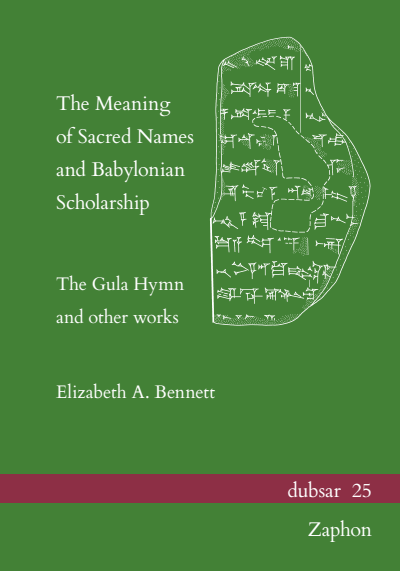
The Meaning of Sacred Names and Babylonian Scholarship
The Gula Hymn and other works- Autor:innen:
- Verlag:
- 2022
Zusammenfassung
Dieses Buch untersucht die Art und Weise, wie babylonische Gelehrte im 2. und im 1. Jahrtausend v.Chr. die Namen ihrer Götter und Göttinnen und ihrer heiligen Orte verstanden, in einem breiten Spektrum von Texten, die von erklärenden Listen bis hin zu den großen religiösen Werken reichen. Diese außergewöhnlichen Gelehrten entwickelten und erläuterten ihr religiöses Denken und erklärten die Bedeutung heiliger Namen, sowohl offensichtliche als auch verborgene, durch etymologische und andere Methoden, wobei sie große Gelehrsamkeit, Raffinesse und Erfindungsgabe anwandten. Anhand eines umfangreichen Textkorpus erweitert diese Studie das Verständnis der Antike: Die hier untersuchten Kompositionen zeigen Gelehrsamkeit, die höchst erfindungsreich ist und bei der Suche nach Bedeutung flexible Assoziationen eingeht. Während sich frühere Studien auf den etymologischen Ansatz dieser Form der Wissenschaft konzentriert haben, zeigt dieses Buch, dass auch andere, weniger verbreitete, spekulative Methoden am Werk sind. Die detaillierte Klassifizierung der spekulativen Methoden der Gelehrten kann weitere Studien zur babylonischen Wissenschaft anregen, ein Gebiet, das nicht auf die Erklärung heiliger Namen beschränkt ist, sondern eine breitere Anwendung findet, insbesondere im lexikalischen Korpus, in der Omen-Tradition und in Kommentaren.
Im Zentrum der Analyse steht die ausführlich kommentierte Edition der an wissenschaftlichen Spekulationen reichen Gula-Hymne. Dieser literarische Text ist zuerst von W.G. Lambert als eine kohärente Komposition identifiziert worden; er vereint die von E. Ebeling veröffentlichten Tafeln KAR 109 + KAR 343 und die Tafeln K 232 + K 3371 + K 13776 der Kouyunjik-Sammlung des British Museum.
This book explores the remarkable ways by which Babylonian scholars in the second and first millennia BCE understood the names of their gods and goddesses and the places sacred to them in a wide spectrum of texts, ranging from explanatory lists to great religious works. Developing and expounding their religious thinking, these extraordinary scholars elucidated the meaning of sacred names, both obvious and hidden, by etymological and other means, using great erudition, sophistication and invention. Using a substantial text corpus, this study enlarges on the understanding of the ancients’ explanatory approach, which has been previously observed by modern scholars in individual works. The compositions examined here display scholarship that is erudite and highly inventive, making flexible associations in the search for meaning. Tantalising indications of the influence of the spoken word can perhaps be detected in this scholarly written tradition. While previous studies have focussed on the etymological approach of this form of scholarship, this book demonstrates that other, less common, speculative methods are also at work. The detailed classification of the scholars’ speculative methods may inform and provoke further analysis of Babylonian scholarship, a field which is not confined to the explanation of sacred names but has wider application, most particularly in the lexical corpus and the omen tradition and in commentary texts. It is a key tool in the quest for meaning which characterises Babylonian thought.
At the center of the analysis is the extensively annotated edition of the Gula Hymn, which is rich in scientific speculation. This literary text has first been identified by W.G. Lambert as a coherent composition; it combines the tablets KAR 109 + KAR 343 published by E. Ebeling and the tablets K 232 + K 3371 + K 13776 of the British Museum's Kouyunjik Collection.
Reihe
E009677100 - Band 25
Publikation durchsuchen
Bibliographische Angaben
- Auflage
- 1/2022
- Copyrightjahr
- 2022
- ISBN-Print
- 978-3-96327-170-0
- ISBN-Online
- 978-3-96327-171-7
- Verlag
- Zaphon, Münster
- Reihe
- dubsar / Altorientalistische Publikationen / Publications on the Ancient Near East
- Band
- 25
- Sprache
- Englisch
- Seiten
- 463
- Produkttyp
- Monographie
Inhaltsverzeichnis
- Table of Contents Kein Zugriff
- Preface and acknowledgements Kein Zugriff
- 1.1 Names Kein Zugriff
- 1.2 Babylonian speculative scholarship Kein Zugriff
- 1.3 The Gula hymn Kein Zugriff
- 1.4 Implications and conclusions Kein Zugriff
- 2.1.1 Lexical tradition Kein Zugriff
- 2.1.2 Bilingual translations Kein Zugriff
- 2.1.3 Omen tradition Kein Zugriff
- 2.2 Commentary texts Kein Zugriff
- 2.3 Sacred names and speculative scholarship Kein Zugriff
- 2.4.1 Expository texts Kein Zugriff
- 2.4.2 Explanatory works Kein Zugriff
- 2.4.3 Commentary texts Kein Zugriff
- 2.4.4 Akkadian expressions Kein Zugriff
- 2.4.5 Speculative interpretation in the Old Babylonian period Kein Zugriff
- 2.5 Modern scholarship Kein Zugriff
- 2.6 Text corpus Kein Zugriff
- 3.1.1 Translation Kein Zugriff
- 3.1.2 Free rendering Kein Zugriff
- 3.1.3 Speculative interpretation Kein Zugriff
- 3.2.1 Translation of individual elements Kein Zugriff
- 3.2.2 Speculative translation Kein Zugriff
- 3.2.3 Free rendering and free association Kein Zugriff
- 3.2.4 Free handling of order Kein Zugriff
- 3.2.5 Not all elements used Kein Zugriff
- 3.2.6 Determinative given equivalence Kein Zugriff
- 3.2.7 Element interpreted as determinative Kein Zugriff
- 3.2.8 Form freedom Kein Zugriff
- 3.2.9 Plural freely inferred Kein Zugriff
- 3.2.10 Emesal Kein Zugriff
- 3.2.11 Homophony Kein Zugriff
- 3.2.12 Polyvalence Kein Zugriff
- 3.2.13 Homophony and polyvalence together Kein Zugriff
- 3.2.14 Akkadian homophony Kein Zugriff
- 3.2.15 Near-homophony Kein Zugriff
- 3.2.16 Vowels Kein Zugriff
- 3.2.17 Consonantal groups Kein Zugriff
- 3.2.18 Part only of element used Kein Zugriff
- 3.2.19 Contrived orthography Kein Zugriff
- 3.2.20 Different elements, single equivalence Kein Zugriff
- 3.2.21 Repeated use of elements Kein Zugriff
- 3.2.22 Reduplicated elements Kein Zugriff
- 3.2.23 Abbreviation Kein Zugriff
- 3.2.24 Phonological reversal Kein Zugriff
- 3.2.25 Graphic interpretation Kein Zugriff
- 3.2.26 Older forms Kein Zugriff
- 3.2.27 Multiple possibilities Kein Zugriff
- 4.1 The texts Kein Zugriff
- 4.2 The overlap Kein Zugriff
- 4.3.1 Synopsis of the Gula hymn Kein Zugriff
- 4.3.2 Themes and Motifs in the Gula hymn Kein Zugriff
- 4.3.3 The Gula hymn as a literary and scholarly composition Kein Zugriff
- 4.4 The context of the Gula hymn Kein Zugriff
- 4.5 Date of composition Kein Zugriff
- 5.1.1 K 232+3371+13776 (Ms. A) Kein Zugriff
- 5.1.2 VAT 9670 + VAT 9931 (KAR 109+343) (Ms. B) Kein Zugriff
- 5.1.3 BM 36333 (Ms. a) Kein Zugriff
- 5.1.4 BM 34399 (Ms. b) Kein Zugriff
- 5.1.5 BM 37616 (Ms. c) Kein Zugriff
- 5.1.6 BM 75974 (Ms. d) Kein Zugriff
- 5.1.7 BM 76319 (Ms. e) Kein Zugriff
- 5.1.8 BM 68611 (Ms. f) Kein Zugriff
- 5.2 Table of Manuscripts and earlier editions Kein Zugriff
- 5.3.1 The Manuscripts and the text of the Gula hymn Kein Zugriff
- 5.3.2 Textual variations and orthography Kein Zugriff
- 5.3.3 Logographic writing Kein Zugriff
- 5.3.4 Forms Kein Zugriff
- 5.4 Transliteration and Translation of the Gula hymn Kein Zugriff
- 5.5 Commentary Kein Zugriff
- 6.1 Analysis: Speculative interpretation in the Gula hymn Kein Zugriff
- 6.2 Encoded names Kein Zugriff
- 6.3.1 Akkadian homophony Kein Zugriff
- 6.3.2 Near-homophony Kein Zugriff
- 6.3.3 Unusual writings Kein Zugriff
- 6.3.4 Graphic interpretation Kein Zugriff
- 6.3.5 Other features and speculative methods Kein Zugriff
- 7.1.1 A written phenomenon? Kein Zugriff
- 7.1.2 Were there any limits? Kein Zugriff
- 7.2 The Gula hymn Kein Zugriff
- 7.3 Babylonian speculative scholarship and Jewish scholarship Kein Zugriff
- 7.4 The meaning of biblical names – Babylonian parallels? Kein Zugriff
- 7.5 Conclusion Kein Zugriff
- Appendix 1 Copy of BM 34399 (Sp. 518) Kein Zugriff Seiten 429 - 430
- Appendix 2 Temples and shrines found only in the Gula hymn Kein Zugriff Seiten 431 - 432
- Bibliographical and other abbreviations Kein Zugriff Seiten 433 - 436
- Bibliography Kein Zugriff Seiten 437 - 454
- Index Kein Zugriff Seiten 455 - 461