Monographie Open Access Vollzugriff
Staging China
The Politics of Mass Spectacle- Autor:innen:
- Verlag:
- 2019
Zusammenfassung
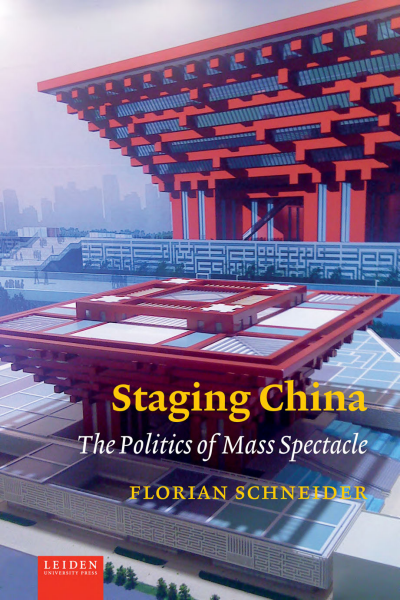
The People’s Republic of China began the 21st century with a new-and-improved public relations approach that was meant to counter anxieties about China’s role in the world while simultaneously showcasing the leadership’s policies to a domestic audience. Crucial to this communication strategy have been networked spectacles: elaborate mass event, designed to reconfigure organisations, ideas, and the relations between people. In Staging China, Florian Schneider analyses large-scale projects like the Beijing Olympics and Shanghai Expo to show how such spectacles became part of the ruling party’s governance toolkit under Hu Jintao’s leadership, and how their legacy informs politics and political communication in China to this day.
Publikation durchsuchen
Bibliographische Angaben
- Auflage
- 1/2019
- Copyrightjahr
- 2019
- ISBN-Print
- 978-90-8728-324-7
- ISBN-Online
- 978-94-006-0346-2
- Verlag
- Leiden University Press, Leiden
- Sprache
- Englisch
- Seiten
- 331
- Produkttyp
- Monographie
Inhaltsverzeichnis
KapitelSeiten
- Acknowledgements
- Note on Conventions
- List of Abbreviations
- 1.1 Why China’s staged spectacles matter
- 1.2 Power in networked politics
- 1.3 How actor networks assemble society
- 1.4 Meaning-making in networks
- 1.5 An example of discursive innovation: the mascot’sbutt crack
- 1.6 Analysing networked spectacles
- 1.7 Overview of the book
- 2.1 Mass events and modernity
- 2.2 Common themes in mass events
- 2.3 From mass event to media spectacle
- 2.4 Programming the spectacle
- 2.5 The psychology of networked spectacles
- 2.6 Conclusion
- 3.1 Media politics in contemporary China
- 3.2 The CCP’s cultural governance strategies
- 3.3 Organising the Olympic opening ceremony
- 3.4 International networks at the Shanghai Expo
- 3.5 How Shanghai’s Expo territory came to be assembled
- 3.6 Building a Shanghai Expo pavilion
- 3.7 The discursive horizons of networked spectacles
- 3.8 Conclusion
- 4.1 The Beijing Olympics opening ceremony
- 4.2 The PRC anniversary parade
- 4.3 China’s crown jewel
- 4.4 A tour of the China Pavilion
- 4.5 Framing China’s networked spectacles
- 4.6 Conclusion
- 5.1 Mediating the Chinese nation
- 5.2 Designing the watch signs of official discourse
- 5.3 The nation as a person
- 5.4 Reimagining China’s past
- 5.5 Ritual entrainment and the governance of emotion
- 5.6 Conclusion
- 6.1 Modernity and the ‘Confucian revival’
- 6.2 Harmonising all under heaven
- 6.3 From peaceful rise to peaceful development
- 6.4 Reinterpreting the classics
- 6.5 The logic of urban modernity
- 6.6 Sustaining the future of modernity
- 6.7 Conclusion
- 7.1 Soft power and nation branding in China
- 7.2 Who speaks for China? Human rights NGOs andthe Olympics discourse
- 7.3 How China’s Olympic symbols were sold
- 7.4 Making sense of China’s Olympic efforts in Taiwan
- 7.5 Generating awe among Taiwan’s media gatekeepers
- 7.6 Conclusion
- 8.1 The hypermodern spectacle: a simulacrum?
- 8.2 Subversive expo pavilions
- 8.3 Modernity revisited
- 8.4 Fractured visions of the future
- 8.5 How one state media conglomerate revisited nationalistdiscourse
- 8.6 Conclusion
- 9.1 The CCP’s networked approach to power
- 9.2 China’s cultural governance: learning to live withfragmented discourses
- 9.3 From Hu to Xi: the media management of a strongman?
- 9.4 Xi’s networked spectacles and the future ofCCP propaganda
- 9.5 Conclusion
- List of ReferencesSeiten 277 - 306 Download Kapitel (PDF)
- GlossarySeiten 307 - 312 Download Kapitel (PDF)
- IndexSeiten 313 - 330 Download Kapitel (PDF)