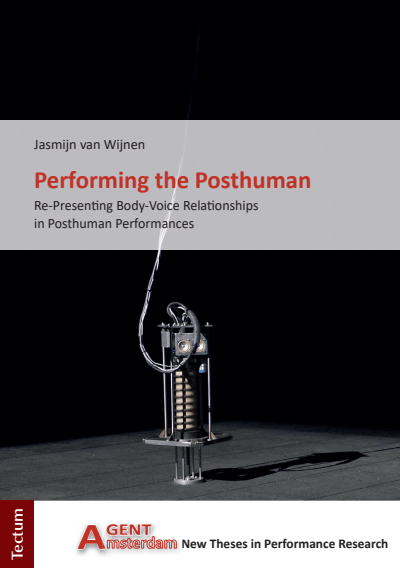
Performing the Posthuman
Re-Presenting Body-Voice Relationships in Posthuman Performances- Autor:innen:
- Reihe:
- AGent. New Theses in Performance Research, Band 10
- Verlag:
- 2021
Zusammenfassung
“Performing the Posthuman" ist eine Untersuchung über neu erfundene Darstellungen oder Re-Präsentationen von Körper-Stimme-Beziehungen in (Musik-)Theateraufführungen, die als posthuman bezeichnet werden können. Performance-Analysen legen die Art und Weise offen, in der diese Körper-Stimm-Beziehungen als Strategien zur theatralen Darstellung eines posthumanen Zustands verwendet werden. Durch die Kombination von neuen Theorien zum Posthumanismus, dem neuen Materialismus und neueren Erkenntnissen zur Konstruktion der Stimme, taucht die Studie in die Art und Weise ein, wie sowohl die Stimme als auch der Körper als schwebende Signifikanten in einer wechselseitigen und veränderlichen Beziehung behandelt werden können. Die Untersuchung der verschiedenen Arten, wie das Post-Humane aufgeführt wird, legt wiederkehrende Spannungen zwischen den Modi der Darstellung und Präsentation auf der Bühne frei.
Schlagworte
Publikation durchsuchen
Bibliographische Angaben
- Auflage
- 1/2021
- Copyrightjahr
- 2021
- ISBN-Print
- 978-3-8288-4680-7
- ISBN-Online
- 978-3-8288-7762-7
- Verlag
- Tectum, Baden-Baden
- Reihe
- AGent. New Theses in Performance Research
- Band
- 10
- Sprache
- Englisch
- Seiten
- 114
- Produkttyp
- Monographie
Inhaltsverzeichnis
- Titelei/Inhaltsverzeichnis Kein Zugriff Seiten I - X
- The posthuman and new materialism Kein Zugriff
- A new materialist approach: the voice Kein Zugriff
- Chapter outline Kein Zugriff
- 1.1.1 The Internet of Things/Prometheus de Vuurbrenger Kein Zugriff
- 1.2 The body-voice gap Kein Zugriff
- 1.3 The thing and/as the body Kein Zugriff
- 1.4.1 The grain of the voice Kein Zugriff
- 1.4.2 Text to speech Kein Zugriff
- 1.4.3 When man and machine meet: the use of Auto Tune Kein Zugriff
- 1.5 Breaking the illusion: from presentation to representation Kein Zugriff
- 1.6 Conclusion: The Internet of Things Kein Zugriff
- 2.1.1 Death and the Powers Kein Zugriff
- 2.2.1 The chorus of Operabots Kein Zugriff
- 2.3.1 Body-voice relationship of a Disembodied Performance Kein Zugriff
- 2.4 The System as cybernetic posthumanism Kein Zugriff
- 2.5 Conclusion: Death and the Powers as postopera Kein Zugriff
- 3.1 Introduction Kein Zugriff
- 3.2 The ‘sincere’ objects of Kris Verdonck Kein Zugriff
- 3.3.1 The thing as body and sound as voice Kein Zugriff
- 3.4 Conclusion: A new spectatorship Kein Zugriff
- Conclusion. Performing the Posthuman Kein Zugriff Seiten 97 - 106
- Bibliography Kein Zugriff Seiten 107 - 114
Literaturverzeichnis (63 Einträge)
Es wurden keine Treffer gefunden. Versuchen Sie einen anderen Begriff.
- Abbate, Carolyn. In Search of Opera. Princeton: Princeton University Press, 2001. Google Scholar öffnen DOI: 10.5771/9783828877627
- Anderson, Jon. “Assemblage”. Oxford Bibliographies. www.oxfordbibliographies.com (last modified 29 April 2015). Google Scholar öffnen DOI: 10.5771/9783828877627
- Aristotle, The Basic Writings of Aristotle (Modern Library Classics). Edited by Richard McKeon. New York: Modern Library, 2001. Google Scholar öffnen DOI: 10.5771/9783828877627
- Barad, Karen. “Posthumanist Performativity: Toward an Understanding of How Matter Comes to Matter”. Signs: Journal of Women in Culture and Society 28, no. 3 (2003): 801–831. Google Scholar öffnen DOI: 10.5771/9783828877627
- Barthes, Roland. Image Music Text. Waukegan: Fontana Press, 1989. Google Scholar öffnen DOI: 10.5771/9783828877627
- Bay-Cheng, Sarah. “Intermediate Bodies: Media Theory in Theatre”. Playing with Theory in Theatre Practice. Edited by Megan Alrutz, Julia Listengarten and M. Van Duyn Wood, 63–74. New York: Palgrave Macmillan, 2012. Google Scholar öffnen DOI: 10.5771/9783828877627
- Bell, Gelsey. “Driving Deeper into That Thing. The Humanity of Heiner Goebbels’s Stifters Dinge”. TDR: The Drama Review 54, no. 3 (2010): 150–158. Google Scholar öffnen DOI: 10.5771/9783828877627
- Bennett, Jane. Vibrant Matter. A Political Ecology of Things. Durham: Duke University Press, 2010. Google Scholar öffnen DOI: 10.5771/9783828877627
- Braidotti, Rosi. The Posthuman. Cambridge: Polity Press, 2013. Google Scholar öffnen DOI: 10.5771/9783828877627
- Braidotti, Rosi and Maria Hlavajova. Posthuman Glossary. London: Bloomsbury, 2018. Google Scholar öffnen DOI: 10.5771/9783828877627
- Braidotti, Rosi and Timotheus Vermeulen. “Borrowed Energy”. Frieze (14 August 2014). https://frieze.com/article/borrowed-energy (accessed on 8 June 2019). Google Scholar öffnen DOI: 10.5771/9783828877627
- Brown, Bill. ‘Thing Theory”. Critical Inquiry 28, no. 1 (2001): 1–22. Google Scholar öffnen DOI: 10.5771/9783828877627
- Buhaiciuc, Mihaela. “When Human Emotion Meets Technology. A Study of Machover’s “Death and the Powers”, the Robot Opera”. Bulletin of the Transilvania University of Braşov, Series VIII: Performing Arts no. 2 (2013): 41–48. Google Scholar öffnen DOI: 10.5771/9783828877627
- Cavarero, Adriana. For More than One Voice. Stanford: Stanford University Press, 2005. Google Scholar öffnen DOI: 10.5771/9783828877627
- Connor, Steven. “Violence, Ventriloquism and the Vocalic Body”. Psychoanalysis and Performance. Edited by Patrick Campbell and Adrian Kear, 75–94. London and New York: Routledge, 2001. Google Scholar öffnen DOI: 10.5771/9783828877627
- Corse, Sandra. Operatic Subjects: The Evolution of Self in Modern Opera. London: Associated University Presses, 2000. Google Scholar öffnen DOI: 10.5771/9783828877627
- Cusick, S.G. “On musical performances of gender and sex”. Audible Traces: Gender, Identity and Music. Edited by E. Barkin and L. Hammessley. Los Angeles: Carciofoli Verlagshaus, 1999. Google Scholar öffnen DOI: 10.5771/9783828877627
- Davis, C.B. “Reading the Ventriloquist’s Lips: The Performance Genre behind the Metaphor”. TDR 42, no. 4 (Winter, 1998): 133–156. Google Scholar öffnen DOI: 10.5771/9783828877627
- Dolar, Mladen. A Voice and Nothing More. Cambridge: The MIT Press, 2006. Google Scholar öffnen DOI: 10.5771/9783828877627
- Eckersall, Peter, Helena Grehan and Edward Sheer. New Media Dramaturgy. Performance, Media and New-Materialism. London: Palgrave Macmillan, 2017. Google Scholar öffnen DOI: 10.5771/9783828877627
- Eckersall, Peter. “Locations of Dramaturgy – Kris Verdonck”. Performance Research 17, no. 3 (2012): 68–75. Google Scholar öffnen DOI: 10.5771/9783828877627
- Edgers, Geoff. “Powered up and programmed to perform. Chorus of robots in a starring role”. The Boston Globe. Last modified March 13, 2011. http://archive.boston.com/business/technology/articles/2011/03/13/chorus_of_robots_in_starring_role_in_death_and_the_powers/?page=1. Google Scholar öffnen DOI: 10.5771/9783828877627
- Eidsheim, Nina Sun. “The micropolitics of listening to vocal timbre”. Postmodern Culture 24, no. 3 (2014). Google Scholar öffnen DOI: 10.5771/9783828877627
- Fast, Heidi & Milla Tiainen, “Voice”. New Materialism. http://newmaterialism.eu/almanac/v/voice (accessed on 12 December 2018). Google Scholar öffnen DOI: 10.5771/9783828877627
- Ferrando, Francesca. “Posthumanism, Transhumanism, Antihumanism, Metahumanism, and New Materialisms: Differences and Relations”. Existenz 8, no. 2 (2013): 26–32. Google Scholar öffnen DOI: 10.5771/9783828877627
- Grehan, Helena. “Actors, Spectators, and “Vibrant” Objects”. TDR: The Drama Review 59, no. 3 (2015): 132–139. Google Scholar öffnen DOI: 10.5771/9783828877627
- Griffioen, Tamara. “Not to be Human. Understanding movements and interactions made by technological non-human performers in a theatre setting”. Utrecht University: MA Dissertation, 2017. Google Scholar öffnen DOI: 10.5771/9783828877627
- Hayles, Katherine. How we became posthuman: virtual bodies in cybernetics, literature, and informatics. Chicago: University of Chicago Press, 1999. Google Scholar öffnen DOI: 10.5771/9783828877627
- Ihde, Don. Listening and Voice. Phenomenologies of Sound (Second Edition). Albany: State University of New York Press, 2007. Google Scholar öffnen DOI: 10.5771/9783828877627
- Jameson, Fredric. Postmodernism, Or, The Cultural Logic of Late Capitalism. Durham: Duke University Press, 1992. Google Scholar öffnen DOI: 10.5771/9783828877627
- Jessop, Elena, Peter Alexander and Benjamin Bloomberg. “Music and Technology in Death and the Powers”. NIME, no. 11 (2011): np. Google Scholar öffnen DOI: 10.5771/9783828877627
- Joe, Jeongwon. “The acousmêtre on stage and screen: The power of the bodiless voice.” The Legacy of Opera. Reading Music Theatre as Experience and Performance. Edited Dominic Symonds and Pamela Karantonis, 149–165. Amsterdam/New York: Rodopi, 2013. Google Scholar öffnen DOI: 10.5771/9783828877627
- Johnston, John. “Machinic Vision”. In Critical Inquiry 26, no. 1 (1999): 27–48. Google Scholar öffnen DOI: 10.5771/9783828877627
- Kennicott, Philip. “Man and Machine”. Opera News 78, no. 4 (2013): 18–19. Google Scholar öffnen DOI: 10.5771/9783828877627
- Kirkkopelto, Esa. “Joints and Strings: Body and Object in Performance”. Performance Philosophy Journal 2, no. 1 (2016): np. http://www.performancephilosophy.org/journal/article/view/70/100 Google Scholar öffnen DOI: 10.5771/9783828877627
- Lamb, Gregory M. “A thoroughly modern opera: Robots enter a new frontier.” The Christian Science Monitor. Last modified March 4, 2011. https://www.csmonitor.com/The-Culture/Music/2011/0304/A-thoroughly-modern-opera-Robots-enter-a-new-frontier. Google Scholar öffnen DOI: 10.5771/9783828877627
- Latour, Bruno. Reassembling the Political. London: Pluto Press, 2014. Google Scholar öffnen DOI: 10.5771/9783828877627
- Lavender, Andy. Performance in the Twenty-First Century. Theatres of Engagement. London: Routledge, 2016. Google Scholar öffnen DOI: 10.5771/9783828877627
- Lay, Stephanie. “Uncanny valley: why we find human-like robots and dolls so creepy”. The Guardian. Last modified November 13, 2015. https://www.theguardian.com/commentisfree/2015/nov/13/robots-human-uncanny-valley. Google Scholar öffnen DOI: 10.5771/9783828877627
- Minsky, Marvin. “Why Computer Science Is the Most Important Thing That Has Happened to the Humanities in 5,000 Years”, public lecture. Japan: Nara, May 15, 1996. Google Scholar öffnen DOI: 10.5771/9783828877627
- Mori, Masahiro. “The Uncanny Valley”. Translated by K.F. MacDorman and T. Minato. Energy 7, no. 4 (1970): 33–35. Google Scholar öffnen DOI: 10.5771/9783828877627
- “MS DOS/Prometheus geketend”. https://urland.nl/werk/ms-dos-prometheus-geketend (accessed on January 11, 2019). Google Scholar öffnen DOI: 10.5771/9783828877627
- Munster, Anne. Materializing New Media: Embodiment in Information Aesthetics. Hanover: Dartmouth College Press, 2006. Google Scholar öffnen DOI: 10.5771/9783828877627
- Novak, Jelena. Postopera: Reinventing the Voice-Body. New York: Routledge, 2015. Google Scholar öffnen DOI: 10.5771/9783828877627
- Novak, Jelena. “Voices Beyond Corporeality”. Studies in Musical Theatre 6, no. 1 (2012): 73-88. Google Scholar öffnen DOI: 10.5771/9783828877627
- Ochsner, Jeffrey Karl. “Meditations on the Empty Chair: The Form of Mourning and Reverie”. American Imago 73, no. 2 (2016): 131–163. Google Scholar öffnen DOI: 10.5771/9783828877627
- “Opera of the Future”. https://www.media.mit.edu/groups/opera-of-the-future/overview/ (accessed on April 30, 2019). Google Scholar öffnen DOI: 10.5771/9783828877627
- Peimani, Michael A. “Pitch Correction for the Human Voice”. Dissertation University of California, 2009. Google Scholar öffnen DOI: 10.5771/9783828877627
- Potter, John. Vocal Authority. Cambridge: Cambridge University Press, 1998. Google Scholar öffnen DOI: 10.5771/9783828877627
- Rapmund, Rop; Geurts, Arjan. “Het ‘Internet der dingen’. Wanneer de fysieke en de virtuele wereld samenkomen.” SURFnet/Kennisnet Innovatieprogramma. https://www.slideshare.net/socialmediadna/essayhetinternetderdingenwanneerdefysiekeendevirtuelewereldsamenkomen (accessed on November 27, 2018). Google Scholar öffnen DOI: 10.5771/9783828877627
- Remshardt, Ralf. “Posthumanism.” In Mapping Intermediality in Performance. Edited by Sarah Bay-Cheng, Chiel Kattenbelt, Andy Lavender and Robin Nelson, 135–41. Amsterdam: Amsterdam University Press, 2010. Google Scholar öffnen DOI: 10.5771/9783828877627
- Sencindiver, Susan Yi. “New Materialism.” Oxford Bibliographies. Last modified July 26, 2017. http://www.oxfordbibliographies.com. Google Scholar öffnen DOI: 10.5771/9783828877627
- Scheer, Edward. “Robotics as New Media Dramaturgy: The Case of the Sleepy Robot”. TDR: The Drama Review 59, no. 3 (2015): 140–149. Google Scholar öffnen DOI: 10.5771/9783828877627
- Sigman, Alexander. “Robot Opera: The Mechanized Eccentric, or the Eccentric Mechanism?” Sonic Arts Today 10, no. 1 (2018): 18–27. Google Scholar öffnen DOI: 10.5771/9783828877627
- “The Internet of Things/Prometheus de Vuurbrenger.”https://urland.nl/werk/internet-of-things-prometheus-de-vuurbrenger-1 (accessed on November 26, 2018). Google Scholar öffnen DOI: 10.5771/9783828877627
- Tiainen, Milla (2013). “Revisiting the Voice in Media and as Medium: New Materialist Propositions”. NECSUS – European Journal of Media Studies 2, no. 2. https://nescus-ejms.org/revisiting-the-voice-in-media-and-as-medium-new-materialist-propositions/. Thomaidis, Konstantinos. Theatre&Voice. London: Palgrave Mcmillan, 2017. Google Scholar öffnen DOI: 10.5771/9783828877627
- Torpey, Peter Alexander. “Digital systems for live multimodal performances in Death and the Powers”. International Journal of Performance Arts and Digital Media 8, no. 1 (2012): 109–123. Google Scholar öffnen DOI: 10.5771/9783828877627
- Torpey, Peter Alexander. “Disembodied Performance. Abstraction of Representation in Live Theater”. Dissertation University of Arizona, 2003. Google Scholar öffnen DOI: 10.5771/9783828877627
- Van Alphen, Ernst; Bal, Mieke. “Introduction”. In The Rhetoric of Sincerity. Edited by Ernst van Alphen, Mieke Bal and Carel Smith, 1–16. Stanford: Stanford University Press, 2009. Google Scholar öffnen DOI: 10.5771/9783828877627
- Van Baarle, Kristof. “The performer is absent: spaces of absence in the contemporary performing arts.” In CARPA4: The Non-Human and the Inhuman in Performing Arts—Bodies, Organisms and Objects in Conflict, 2015. Google Scholar öffnen DOI: 10.5771/9783828877627
- Van Baarle, Kristof. “From the cyborg to the apparatus. Figures of posthumanism in the philosophy of Giorgio Agamben and the contemporary performing arts of Kris Verdonck”. PhD Dissertation, Ghent University, 2018. Google Scholar öffnen DOI: 10.5771/9783828877627
- Vanhoutte, Kurt. “Two-fold Origin: Performing Hybrids between Theatre and Media.” Contemporary Theatre Review 20, no. 4 (2010): 475–485. Google Scholar öffnen DOI: 10.5771/9783828877627
- Young, Miriama. Singing the Body Electric. The human voice and sound technology. Farnham Surrey: Ashgate Publishing Limited, 2015. Google Scholar öffnen DOI: 10.5771/9783828877627