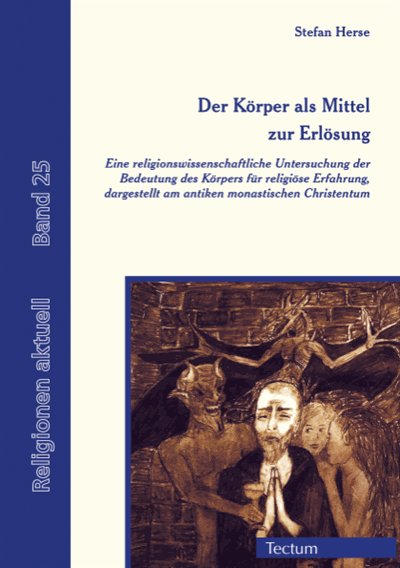
Der Körper als Mittel zur Erlösung
Eine religionswissenschaftliche Untersuchung der Bedeutung des Körpers für religiöse Erfahrung, dargestellt am antiken monastischen Christentum- Autor:innen:
- Reihe:
- Religionen aktuell, Band 25
- Verlag:
- 2018
Zusammenfassung
Der Körper erhält zusehends auch in der Religionswissenschaft größere Aufmerksamkeit. Dabei wird immer deutlicher, dass Religionen „reale“ und – natürlich auch mit dem Körper – gelebte und praktizierte Symbolsysteme sind. Die vorliegende Studie kann als ein Vorhaben gelten, dieser Einsicht Rechnung zu tragen, indem sie dessen Bedeutung anhand eines spezifischen religiösen Phänomens, namentlich den frühen christlichen Asketen, exemplifiziert und danach fragt, welche Rolle und Funktion der Körper für sogenannte religiöse Erfahrungen spielt. Insofern sich auch die Religionswissenschaft als eine den Sozial- und Geisteswissenschaften zuzurechnende Disziplin modernen wissenschaftlichen Erkenntnissen gegenüber nicht verschließen kann, stellt die Arbeit den Versuch dar, medizinische und biologische Variablen für diesen Diskurs fruchtbar zu machen, ohne anachronistischen Fehlinterpretationen anheim zu fallen.
„So gibt das vorliegende Werk einen tiefen Einblick in die religiösen Voraussetzungen der Asketen und zeigt zugleich die psychophysischen Wechselwirkungen ihrer Übungen in anschaulicher Weise auf. Eine uralte, weit entfernt liegende Tradition des frühen Christentums wird so in anschauliche Nähe gerückt und durch einen neuen Verständnisweg zugänglich gemacht. Naturwissenschaftliche und medizinische Herangehensweisen werden konstruktiv für eine religionswissenschaftliche Auswertung nutzbar gemacht, die sich des primär und für das Verständnis unverzichtbar religiösen Charakters ihres Gegenstandes bewusst ist.“
Professor Dr. Dr. Bertram Schmitz (Hannover/Jena 2018)
Publikation durchsuchen
Bibliographische Angaben
- Auflage
- 1/2018
- Copyrightjahr
- 2018
- ISBN-Print
- 978-3-8288-4256-4
- ISBN-Online
- 978-3-8288-7139-7
- Verlag
- Tectum, Baden-Baden
- Reihe
- Religionen aktuell
- Band
- 25
- Sprache
- Deutsch
- Seiten
- 336
- Produkttyp
- Monographie
Inhaltsverzeichnis
- Titelei/Inhaltsverzeichnis Teilzugriff Seiten I - XII
- 1. Problemannäherung Kein Zugriff
- 2. Zielrichtung und Methodisches Kein Zugriff
- 1.1 Der Körper in der Religionswissenschaft: symbol- und sozialtheoretische Fokussierung Kein Zugriff
- 1.2 Anthropologische und instrumentelle Fragen bis hin zu religionsästhetischen Ansätzen Kein Zugriff
- 1.3 Die Gefahr, den Körper ausschließlich historisch und sozial zu konstruieren Kein Zugriff
- 2.1 Religiöse Erfahrung als abendländische Verstehens- und Argumentationskategorie Kein Zugriff
- 2.2 Gibt es einen unvermittelten und universellen Charakter von religiöser Erfahrung? Kein Zugriff
- 2.3 Religionswissenschaftliche Positionen und Probleme kulturalistischer Ansätze Kein Zugriff
- 2.4 Wie also religiöse Erfahrung definieren? Kein Zugriff
- 2.5 Für eine kontextuelle und körperbezogene Interdisziplinarität von religiöser Erfahrung ! Kein Zugriff
- 3.1 Der Körper als „Erfahrender“ Kein Zugriff
- 3.2 Der Körper am Scheideweg von Subjekt-Objekt-Dualismus und Religion- Naturwissenschaft-Isolierung Kein Zugriff
- 3.3 Leibphänomenologie und Embodiment Kein Zugriff
- 3.4 Eine ganzheitliche Auffassung des Menschen: Relativierung des Körperbooms Kein Zugriff
- 3.5 Probleme bei der Behandlung von (religiöser) Erfahrung seitens biologischer Wissenschaften Kein Zugriff
- 3.6.1 Kognitive Prozesse: verkörpert, handlungsorientiert und situativ Kein Zugriff
- 3.6.2 Neurophänomenologische Zugänge Kein Zugriff
- 3.6.3 Der Körper als Paradigma von Multimodalität Kein Zugriff
- 3.7 Religiöse „Transformation“ und Identitätsbildung:Körper – Imagination – Technik Kein Zugriff
- 4. Quintessenz: ein nonduales Körpererleben Kein Zugriff
- Teil II: Zur Auswahl, Historizität und religionswissenschaftlichen Relevanz der monastischen Literatur Kein Zugriff Seiten 61 - 68
- 1.1 Eine unitarische Auflösung des Menschen: das jüdisch-christliche Erbe Kein Zugriff
- 1.2 Hellenistische Rezeption: die dualistische Konzeption Kein Zugriff
- 2.1 Der Körper und der imago Dei-Gedanke Kein Zugriff
- 2.2 Der Körper und seine Bedeutung für die christliche Heilsgeschichte: die imitatio Christi bei den Mönchen Kein Zugriff
- 2.3 Exkurs: Der Körper der Mönche – Zeugnis der Heiligkeit und Gottverbundenheit Kein Zugriff
- 2.4 Der Körper als Hindernis: negative Konnotationen des Körpers bei den Mönchen Kein Zugriff
- 3.1 Der Körper in der Askese: allgemeine Überlegungen für die Mönche Kein Zugriff
- 3.2.1 Askese als Einübung des körperlichen Sterbens und eschatologisches Neuwerden Kein Zugriff
- 3.2.2 Askese als Disziplinierung und Formung des Körpers: die Mönche als „Athleten Christi“ Kein Zugriff
- 4.1 Die Stellung des Körperlichen bei transzendenten Erlebnissen:Wo ist der „Ort“ der Gotteserfahrung? Kein Zugriff
- 4.2 Die Vorstellung des Körpers in der Erlösung Kein Zugriff
- 5. Quintessenz: der Körper als Mittel zur Erlösung Kein Zugriff
- 1.1.1 … verstanden als körperlicher Modus und Mechanismus Kein Zugriff
- 1.1.2 … verstanden als veränderter Bewusstseins- und Wahrnehmungsmodus Kein Zugriff
- 1.2 Andere körperbezogene Modi Kein Zugriff
- 2.1.1 Isolierung und Deprivation Kein Zugriff
- 2.1.2 Bezugnahme auf medizinisch-psychologische Erkenntnisse zu Sensorischer Deprivation Kein Zugriff
- 2.2.1 Nahrungsrestriktion Kein Zugriff
- 2.2.2 Schlafrestriktion Kein Zugriff
- a. Schlafrestriktion: Kein Zugriff
- b. Nahrungsrestriktion: Kein Zugriff
- 2.2.4 Über das Zusammenwirken der einzelnen physischen Restriktionsmethoden Kein Zugriff
- 2.3.1 Methoden der Schmerz- und Krankheitszufügung und Erduldung Kein Zugriff
- 2.3.2 Das Weinen der Mönche Kein Zugriff
- a. Schmerz und Krankheit: Kein Zugriff
- b. Weinen: Kein Zugriff
- A. Das posturale und anrufende Gebet Kein Zugriff
- B. Die Psalmodie: Rezitation oder Gesang eines Psalmverses Kein Zugriff
- C. Das rezitierende, „murmelnde“ Gebet: Die „Mélēte“ Kein Zugriff
- 3.1.1.2 Arbeiten und handwerkliches Praktizieren Kein Zugriff
- A. Simultane bzw. parallelisierte Praktiken Kein Zugriff
- B. periodisch kombinierte Techniken Kein Zugriff
- 3.1.3 Bezugnahme auf medizinisch-psychologische Erkenntnisse zu repetitiven und rhythmischen Praktiken Kein Zugriff
- 3.2.1 Das meditative Sitzen der Wüstenväter: achtsam und still Kein Zugriff
- 3.2.2 Gedankenerforschung und -kontrolle Kein Zugriff
- 3.2.3 Fokussierung auf konkrete gedankliche Inhalte Kein Zugriff
- 3.2.4 Bezugnahme auf medizinisch-psychologische Erkenntnisse zu imaginativen und kognitiven Techniken Kein Zugriff
- 4. Quintessenz: gleichzeitig eine Kritik Kein Zugriff
- Schlussbetrachtung Kein Zugriff Seiten 265 - 270
- 1. Quellen (Textausgaben und Übersetzungen) Kein Zugriff
- 2. Hilfsmittel Kein Zugriff
- 3.1.1 Sammelbände und Zeitschriften Kein Zugriff
- 3.1.2 Lexikonartikel Kein Zugriff
- 3.2 Monographien Kein Zugriff
Literaturverzeichnis (1146 Einträge)
Es wurden keine Treffer gefunden. Versuchen Sie einen anderen Begriff.
- Literaturverzeichnis Google Scholar öffnen DOI: 10.5771/9783828871397
- 1. Quellen (Textausgaben und Übersetzungen) Google Scholar öffnen DOI: 10.5771/9783828871397
- Apophthegmata Patrum: Alphabetische Sammlung, PG 65, col. 71 – 440, dt.: B. Miller (Hg./Übers.), Weisung der Väter: Apophthegmata Patrum, auch Gerontikon oder Alphabeticum genannt, Freiburg i.Br. 1965. Google Scholar öffnen DOI: 10.5771/9783828871397
- Les Apophthegmes des Pères: collection sytématique, t. I-III, Introduction, texte critique, traduction et notes par J.-C. Guy, Sources Chrétiennes 387/474/498, Paris 1993, 2003, 2005. Google Scholar öffnen DOI: 10.5771/9783828871397
- Anonyme Sprüche, in: F. Nau (Hg.), Histoires des solitaires égyptiens, in: Revue des l’Orient chrétien 12 (1907): 47-57; 13 (1908): 266-283; 14 (1909): 357-379; 17 (1912): 204-211, 294-301; 18 (1913): 137-146, engl.: J. Wortley (Hg./Übers.), The Anonymous Sayings the Desert Fathers. A Selected Edition and Complete English Translation, Cambridge 2013. Google Scholar öffnen DOI: 10.5771/9783828871397
- Athanasios von Alexandreia, vita Antonii: Athanase d’Alexandrie, Vie d’Antoine, Introduction, texte critique, traduction, notes et index par G.J.M. Bartelink, Souces Chrétiennes 400, Paris 1994. Google Scholar öffnen DOI: 10.5771/9783828871397
- Cassian, Collationes: Jean Cassien. Conférences VIII– XVII, Sources Chrétiennes 54, Paris 1958 Google Scholar öffnen DOI: 10.5771/9783828871397
- Euagrios Pontikos, Praktikos: Évagre le Pontique, Traité Pratique ou le Moine, 2 Bde, Introduction, traduction, commentaire et tables par A. et C. Guillaumont, Sources Chrétiennes 170, 171, Paris 1971, dt.: G. Bunge (Hg.), Evagrios Pontikos, Praktikos, Beuron 2008. Google Scholar öffnen DOI: 10.5771/9783828871397
- Ad Monachos: The „ad monachos“ of Evagrius Ponticus, hg. v. J. Driscoll, StAns 104, Rom 1991, 45-70 Google Scholar öffnen DOI: 10.5771/9783828871397
- De oratione: Evagrius Ponticus, On Prayer, übers. und hg. v. A.M. Casiday, New York 2006, 185–201. Google Scholar öffnen DOI: 10.5771/9783828871397
- Evagrios Pontikos, Briefe aus der Wüste, hg. v. G. Bunge, Trier 1986. Google Scholar öffnen DOI: 10.5771/9783828871397
- Historia Monachorum in Aegypto: Historia Monachorum in Aegypto, hg. v. P. Festugière, Brüssel 1961, deutsch: Mönche im frühchristlichen Ägypten (Historia Monachorum in Aegypto), aus dem Griechischen übers. und eingeleitet v. K.S. Frank, Düsseldorf 1967. Google Scholar öffnen DOI: 10.5771/9783828871397
- Ioannes Klimakos: Scala Paradisi, PG 88, col 632-1209. Google Scholar öffnen DOI: 10.5771/9783828871397
- Origenes, de Principiis: Origène Traite des Principes, Les Editions du Cerf. vols. I–V, Sources Chrétiennes 252, 253, 268, 269, 312), Paris 1978–84. Google Scholar öffnen DOI: 10.5771/9783828871397
- Palladius, Historia Lausiaca: The Lausiac History of Palladius, a critical discussion together with notes on early Egyptian monasticismhg ed. C. Butler, Hildesheim 1962, deutsch: Palladius, Historia Lausiaca: Die frühen Heiligen in der Wüste, übers. v. J. Laager, Zürich 1987. Google Scholar öffnen DOI: 10.5771/9783828871397
- Vita Pachomii: Le Corpus athénien de saint Pachome, hg. v. F. Halkin, Genf 1982. Google Scholar öffnen DOI: 10.5771/9783828871397
- 2. Hilfsmittel Google Scholar öffnen DOI: 10.5771/9783828871397
- Aland, K./B. Aland, Griechisch-deutsches Wörterbuch zu den Schriften des Neuen Testaments und der frühchristlichen Literatur von Walter Bauer, unter Mitwirkung v. V. Reichmann, 6. Aufl., Berlin/New York 1988. Google Scholar öffnen DOI: 10.5771/9783828871397
- Danker, R.W., Greek- English Lexicon of the New Testament and other Early Christian Literature, 3. Aufl., Chicago 2000. Google Scholar öffnen DOI: 10.5771/9783828871397
- Bornemann, E./E. Risch, Griechische Grammatik, 2. Aufl., Frankfurt a.M. 1978. Google Scholar öffnen DOI: 10.5771/9783828871397
- Kühner, R./F. Blass/B. Gerth, Ausführliche Grammatik der griechischen Sprache, 4 Bände, Darmstadt 1963. Google Scholar öffnen DOI: 10.5771/9783828871397
- Liddell, H.G/R. Scott, A Greek-English Lexicon, revised and augmented through-out by H. Jones, Oxford (Nachdruck der 9. Auflage 1940), 1985. Google Scholar öffnen DOI: 10.5771/9783828871397
- Menge, H., Langenscheidts Größwörterbuch Griechisch-Deutsch. Unter Berücksichtigung der Etymologie, 23. Aufl., 1979. Google Scholar öffnen DOI: 10.5771/9783828871397
- 3. Sekundärliteratur Google Scholar öffnen DOI: 10.5771/9783828871397
- 3.1 Aufsätze Google Scholar öffnen DOI: 10.5771/9783828871397
- 3.1.1 Sammelbände und Zeitschriften Google Scholar öffnen DOI: 10.5771/9783828871397
- ACHTERBERG, J. ET AL., The Role of Rituals in Psychotherapy, in: I.A. Serlin (Hg.), Whole Person Healthcare, Bd. 2, Westport 2007, 263-288. Google Scholar öffnen DOI: 10.5771/9783828871397
- AFTANAS, L./S. GOLOCHEIKINE, Human Anterior and Frontal Midline Theta and Lower Alpha Reflect Emotionally Positive State and Internalized Attention: High-resolution EEG Investigation of Meditation, in: Neuroscience Letters 310 (2001), 57-60. Google Scholar öffnen DOI: 10.5771/9783828871397
- Changes in Cortical Activity in Altered States of Consciousness: The Study of Meditation by High Resolution EEG, in: Human Physiology 29 (2003), 143-151. Google Scholar öffnen DOI: 10.5771/9783828871397
- Human Anterior and Frontal Midline Theta and Lower Alpha Reflect Emotionally Positive State and Internalized Attention: High-resolution EEG Investigation on Meditation, in: Neuroscience Letters 310 (2001), 57-60. Google Scholar öffnen DOI: 10.5771/9783828871397
- ALABDULWAHAB, S. ET AL., Physical Activity Associated with Prayer Regimes Improves Standing Dynamic Balance of Healthy People, in: Journal of Physical Therapy Science 25 (2013), 1565–1568. Google Scholar öffnen DOI: 10.5771/9783828871397
- ALAVI, A. ET AL., The Measurement of Regional Cerebral Blood Flow during the Complex Cognitive Task of Meditation: a Preliminary SPECT Study, in: Psychiatry Research 106 (2001), 113–122. Google Scholar öffnen DOI: 10.5771/9783828871397
- A Case Series Study of the Neurophysiological Effects of Altered States of Mind during Intense Islamic Prayer, in: Journal of Physiology (Paris) 109 (2015), 214-220. Google Scholar öffnen DOI: 10.5771/9783828871397
- ALHOLA, P./P. POLO-KANTOLA, Sleep Deprivation: Impact on Cognitve Performance, in: Neuropsychiatric Disease and Treatment 3.5 (2007), 553-567. Google Scholar öffnen DOI: 10.5771/9783828871397
- ALLADIN, A., The Power of Belief and Expectancy in Understanding and Management of Depression, in: American Journal of Clinical Hypnosis 55 (2013), 249-271. Google Scholar öffnen DOI: 10.5771/9783828871397
- ALLAZ, A.F./C. CEDRASCHI, Emotional Aspects of Chronic Pain, in: G. Pckering/S. Gibson (Hg.), Pain, Emotion and Cognition. A Complex Nexus, Heidelberg u. a. 2015, 21-34. Google Scholar öffnen DOI: 10.5771/9783828871397
- ALLOA, E., Maurice Merleau-Ponty II, Fleisch und Differenz, in: Ders. u.a. (Hg.), Leiblichkeit. Geschichte und Aktualität eines Konzepts, Tübingen 2012, 37-51. Google Scholar öffnen DOI: 10.5771/9783828871397
- ALTSCHULE, M., Acedia: Its Evolution from Deadly Sin to Psychiatric Syndrome, in: British Journal of Psychiatry 111 (1965), 117-119. Google Scholar öffnen DOI: 10.5771/9783828871397
- ANDERSON, J.W./P.A. NUNNELLEY, Private Prayer Associations with Depression, Anxiety and other Health Conditions: an Analytical Review of Clinical Studies, in: Postgraduate Medicine 128 (2016), 635-641. Google Scholar öffnen DOI: 10.5771/9783828871397
- ANDRESEN, J./R. FORMAN, Methodological Pluralism in the Study of Religion. How the Study of Consciousness and Mapping Spiritual Experiences Can Reshape Religious Methodology, Journal of Consciousness Studies 7 (2000), 7-14. Google Scholar öffnen DOI: 10.5771/9783828871397
- ANSON, J., The Female Transvestite in Early Monasticism: The Origin and Development of a Motif, in: Viator 5 (1974), 1-32. Google Scholar öffnen DOI: 10.5771/9783828871397
- ANTES, P., Mystische Erfahrung als Problem von Übersetzungen, in: Chr. Elsas (Hg.), Tradition und Translation. Zum Problem der interkulturellen Übersetzbarkeit religiöser Phänomene, Berlin/New York 1994, 1-9. Google Scholar öffnen DOI: 10.5771/9783828871397
- ANTROBUS, J./M. BERTINI, Introduction, in: ID. (Hg.), The Neuropsychology of Sleep and Dreaming, Hillsdale 1992, 1-16. Google Scholar öffnen DOI: 10.5771/9783828871397
- APKARIAN, A.V. ET AL., Human Brain Mechanisms of Pain Perception and Regulation in Health and Disease, in: European Journal of Pain 9 (2005), 463-484. Google Scholar öffnen DOI: 10.5771/9783828871397
- ARNAL, W.E., Definition. A Guide to the Study of Religion, in: W. Braun and R.T. McCutcheon (Hg.), Guide to the Study of Religion. London 2000, 21-34. Google Scholar öffnen DOI: 10.5771/9783828871397
- ASAD, T., Notes on Body Pain and Truth, in: Medieval Christian Ritual, Economy and Society 12.3 (1983), 287-327. Google Scholar öffnen DOI: 10.5771/9783828871397
- Remarks on the Anthropology of the Body, in: S. Coakley (Hg.), Religion and the Body, Cambridge 1997, 42-52. Google Scholar öffnen DOI: 10.5771/9783828871397
- ASHBROOK HARVEY, S., Locating the Sensing Body. Perception and Relgious Identity in Late Antiquity, in: D. Brakke u. a. (Hg.), Religion and the Self in Antiquity, Bloomington 2005, 140-162. Google Scholar öffnen DOI: 10.5771/9783828871397
- AUS DER AU, C./D. PLÜSS, Einleitung, in: ID. (Hg.), Körper – Kulte. Wahrnehmungen von Leiblichkeit in Theologie, Religions- und Kulturwissenschaften, Zürich 2007, 7-13. Google Scholar öffnen DOI: 10.5771/9783828871397
- AWN, P.J., Sensuality and Mysticism – The Islamic Tradition, in: V.L. Wimbush/R. Valantasis (Hg.), Asceticism, Oxford 1988, 369-374. Google Scholar öffnen DOI: 10.5771/9783828871397
- AZARI, N. ET AL., Neural Correlates of Religious Experience, in: European Journal of Neuroscience 13 (2001), 1649-52. Google Scholar öffnen DOI: 10.5771/9783828871397
- Short Communication. Neural Correlates of Religious Experience, European Journal of Neuroscience 13 (2001), 1649-1652. Google Scholar öffnen DOI: 10.5771/9783828871397
- AZARI, N./M. SLORS, From Brain Imaging Religious Experience to Explaining Religion: A Critique, in: Archive of the Psychology of Religion 29 (2007), 67-85. Google Scholar öffnen DOI: 10.5771/9783828871397
- AZARI, N.P./D. BIRNBACHER, The Role of Cognition and Feeling in Religious Experience, in: Zygon 39 (2012), 901-917. Google Scholar öffnen DOI: 10.5771/9783828871397
- AZZONE, P., Sin of Sadness: "acedia vel tristitia" between Sociocultural Conditionings and Psychological Dynamics of Negative Emotions, in: Journal of Psychology and Christianity 31 (2012),16-30. Google Scholar öffnen DOI: 10.5771/9783828871397
- BABKOFF, B. ET AL., The Effects of 72 Hours of Sleep Loss on Psychological Variables, in: British Journal of Psychology 80 (1989), 145-162. Google Scholar öffnen DOI: 10.5771/9783828871397
- BACHT, H., „Meditatio“ in den ältesten Mönchsquellen, in: Ders., Das Vermächtnis des Ursprungs. Studien zum frühen Mönchtum, Würzburg 1972, 244-264. Google Scholar öffnen DOI: 10.5771/9783828871397
- Das „Jesus-Gebet“. Seine Geschichte und Problematik, in: Ders., Weltnähe und Weltdistnaz?, Frankfurt a.M. 1961, 141-162. Google Scholar öffnen DOI: 10.5771/9783828871397
- BAER, R., Mindfulness Training as a Clinical Intervention: a Conceptual and Empirical Review, in: Clinical Psychology: Science and Practice 10 (2003), 125–143. Google Scholar öffnen DOI: 10.5771/9783828871397
- BAGNALL, R., Monks and Property. Rhetoric, Law, and Patronage in the Apophthtegmata Patrum and the Papyri, in: Ders., Hellenistic and Roman Egypt. Sources and Approaches, Cornwall 2006, 7-24. Google Scholar öffnen DOI: 10.5771/9783828871397
- BAIJAL, S./N. SRINIVASAN, Theta Activity and Meditative States: Spectral Changes during Concentrative Meditation, in: Cognitive Processing 11 (2010), 31-38. Google Scholar öffnen DOI: 10.5771/9783828871397
- BALKIN, T. ET AL., Gambling When Sleep Deprived: Don’t Bet on Stimulants, in: Chronobiology International 29.1 (2012), 43-54. Google Scholar öffnen DOI: 10.5771/9783828871397
- BARABASZ, M., REST: A Key Facilitator in the Treatment of Eating Disorders, in: A. Barabasz/ID., Clinical and Experimental Restricted Environmental Stimulation, 121-126 Google Scholar öffnen DOI: 10.5771/9783828871397
- BARBAEZ, A., Restricted Environmental Stimulation and the: Pain, EEG Alpha, Skin Conductance and Temperature Responses, in: International Journal of Clinical and Experimental Hypnosis 30 (1982), 147-166. Google Scholar öffnen DOI: 10.5771/9783828871397
- BARTELINK, G., Die Rolle der Bibel in den asketischen Kreisen des vierten und fünften Jahrhunderts, in: J. Den Boeft/M.L. Van Poll-Van de Lisdonk (Hg.), The Impact of Scripture in Early Christianity, Leiden u. a. 1999, 27-38. Google Scholar öffnen DOI: 10.5771/9783828871397
- BASSETTI, C./M.S. ALDRICH, Narcolepsy, Idiopathic Hypersomnia, and Periodic Hypersomnias, in: A. Culebras (Hg.), Sleep Disorders, 282-311. Google Scholar öffnen DOI: 10.5771/9783828871397
- BAUER, T.J., Philosophen, Mönche und Hetären. Die Apophthegmata Patrum im Schnittfeld von Theologie und Klassischer Philologie, in: U. Egelhaaf-Geiser u.a. (Hg.), Kultur der Antike. Transdisziplinäres Arbeiten in den Altertumswissenschaften, Berlin 2011, 112-128. Google Scholar öffnen DOI: 10.5771/9783828871397
- BAUMEISTER, R.F., Religion and Psychology: Introduction to the Special Issue, in: Psychological Inquiry 13 (2002), 165-267. Google Scholar öffnen DOI: 10.5771/9783828871397
- BAUMEISTER, T., Die Mentalität des frühen ägyptischen Mönchtums. Zur Frage der Ursprünge des christlichen Mönchtums, in: Zeitschrift für Kirchengeschichte 88 (1977), 148-158. Google Scholar öffnen DOI: 10.5771/9783828871397
- BEATRICE, P., Ascetical Fasting and Original Sin in the Early Christian Writers, in: P. Allen u. a. (Hg.), Prayer and Spirituality in the Early Church I, Everton Park/Queensland 1998, 211-228. Google Scholar öffnen DOI: 10.5771/9783828871397
- BEATTIE, L. ET AL., Social Interactions, Emotion and Sleep: A Systematic Review and Research Agenda, in: Sleep Medicine Reviews 24 (2015), 83-100. Google Scholar öffnen DOI: 10.5771/9783828871397
- BEGLEY, S., Religion and the Brain, in: Newsweek 137 (2001), 50-57. Google Scholar öffnen DOI: 10.5771/9783828871397
- BELL, C., ‚Embodiment‘, in: J. Kreinath et al. (Hg.), Theorizing Rituals, Bd. I: Issues, Topics, Approaches, Concepts, Leiden/Boston 2006, 533-543. Google Scholar öffnen DOI: 10.5771/9783828871397
- BENEDETTI, F. ET AL., The Biochemical and Neuroendocrine Bases of the Hyperalgesic Nocebo Effect, in: The Journal of Neuroscience 26 (2006), 12014-12022. Google Scholar öffnen DOI: 10.5771/9783828871397
- BENNETT, M./P. HACKER, Philosophie und Neurowissenschaft, in: D. Sturma (Hg.), Philosophie und Neurowissenschaft, Frankfurt a.M. 2006, 20-42. Google Scholar öffnen DOI: 10.5771/9783828871397
- BERGER, Some Second Thoughts on Substantive versus Functional Definitions of Religion, in: Journal for the Scientific Study of Religion13 (1974), 125-133. Google Scholar öffnen DOI: 10.5771/9783828871397
- BERMAN, A.E./L. STEVENS, EEG Manifestations of Nondual Experiences in Meditators, in: Consciousness and Cognition 31 (2015), 1-11. Google Scholar öffnen DOI: 10.5771/9783828871397
- BERNARDI, L. ET AL., Cardiorespiratory Interactions to External Stimuli, in: Archives de Italiennes de Biologie 143 (2005), 215-221. Google Scholar öffnen DOI: 10.5771/9783828871397
- Effect of Rosary Prayer and Yoga Mantras on Autonomic Cardiovascular Rhythms: Comparative Study, in: BMJ 323 (2001), 1446-1449. Google Scholar öffnen DOI: 10.5771/9783828871397
- BEUTTLER, U., Leib und Seele, Gehirn und Geist. Geschichte und Systematik möglicher Verhältnisbestimmungen, Glaube und Denken 21 (2008), 9-32. Google Scholar öffnen DOI: 10.5771/9783828871397
- BIRBAUMER, D., Hirnforscher als Psychoanalytiker, in: C. Geyer (Hg.), Hirnforschung und Willensfreiheit. Zur Deutung der neuesten Experimente, Frankfurt a.M. 2004, 27-29. Google Scholar öffnen DOI: 10.5771/9783828871397
- BISHOP, S. ET AL., Mindfulness: a Proposed Operational Definition, in: Clinical Psychology: Science and Practice 11 (2004), 230–241. Google Scholar öffnen DOI: 10.5771/9783828871397
- BITTON-ASHKELONY, B., Demons and Prayers: Spiritual Exercises in the Monastic Community of Gaza in the Fifth and Sixth Centuries, in: Vigiliae Christianae 57.2 (2003), 200-221. Google Scholar öffnen DOI: 10.5771/9783828871397
- BJÖRKVIST, K., Ecstasy from a Physiological Point of View, in: N.G. Holm (Hg.), Religious Ecstasy, Stockholm 1982, 74-86. Google Scholar öffnen DOI: 10.5771/9783828871397
- BLACK, D./G.M. SLAVICH, Mindfulness Meditation and the Immune System: a Systematic Review of Randomized Controlled Trials, in: Annals of the New York Acadamy of Sciences 1373 (2016), 13-24. Google Scholar öffnen DOI: 10.5771/9783828871397
- BLOWS, W.T., Neurotransmitter in the Brain: Serotonin, Noradrenaline (Norepinephrine), and Dopamine, in: The Journal of Neuroscience Nursing 32 (2000), 234-238. Google Scholar öffnen DOI: 10.5771/9783828871397
- BLUMENTAHL, J. ET AL., Is Exercise a Viable Treatment for Depression?, in: ACSMs Health Fitness Journal 16 (2012), 14-21. Google Scholar öffnen DOI: 10.5771/9783828871397
- BOECKER, H. ET AL., The Runner’s High: Opiodergic Mechanisms in the Human Brain, in: Cerebral Cortex 18 (2008), 2523-2531. Google Scholar öffnen DOI: 10.5771/9783828871397
- BONNET, M./D.L. ARAND, Clinical Effects Sleep Fragmentation Versus Sleep Deprivation, in: Sleep Medicine Reviews 7 (2003), 297-310. Google Scholar öffnen DOI: 10.5771/9783828871397
- BONNET, M.H., Art. ‚Partial Sleep Deprivation‘; in: Encyclopedia of Sleep and Dreams. The Evolution, Function, Nature, and Mysteries of Slumber. Vol. 2: M-Y, hg. v. D. Barrett/P. McNamara, Santa Barbara 2012, 485-487. Google Scholar öffnen DOI: 10.5771/9783828871397
- BORN, J./H.L. FEHM, Interactions between the Hypothalamus-Pituitary-Adrenal System and Sleep in Humans, in: J.H. Peter et al. (Hg.), Sleep and Health Risk, Berlin 1991, 503-511. Google Scholar öffnen DOI: 10.5771/9783828871397
- BOUSSET, W., Das Mönchtum der sketischen Wüste, in: Zeitschrift für Kirchengeschichte (1923), 1-41. Google Scholar öffnen DOI: 10.5771/9783828871397
- BOVON, F., These Christians Who Dream: The Authority of Dreams in the First Centuries of Christianity, in: Ders. (Hg.), Studies in Early Christianity, Tübingen 2003, 144-162. Google Scholar öffnen DOI: 10.5771/9783828871397
- BOWER, P., Awareness, the Unconscious and Repression: An Experimental Psychologist’s Perspective, in: J. Singer (Hg.), Repression and Dissociation, Chicago 1990, 209-231. Google Scholar öffnen DOI: 10.5771/9783828871397
- BRAKKE, D., The Lady Appears: Materializations of “Woman” in Early Monastic Literature, in: D.B. Martin/P. Cox Miller (Hg.), The Cultural Turn in Late Ancient Studies. Gender, Asceticism, and Historiography, Durham/London 2005. Google Scholar öffnen DOI: 10.5771/9783828871397
- The Problem of Nocturnal Emissions in Early Christian Syria, Egypt and Gaul, in: Journal for Early Christian Studies 3 (1995), 419-460. Google Scholar öffnen DOI: 10.5771/9783828871397
- BRANDMEYER./A. DELORME, Reduced Mind Wandering in Experienced Meditators and Associated EEG Correlates, in: Experimental Brain Research (2016), 1-10. Google Scholar öffnen DOI: 10.5771/9783828871397
- BRÄUNLEIN, P., „Zurück zu den Sachen!”, Religionswissenschaft vor dem Objekt, in: Ders. (Hg.), Religion und Museum, Bielefeld 2004, 7-29. Google Scholar öffnen DOI: 10.5771/9783828871397
- BRONDEL, L. ET AL., Acute Partial Sleep Deprivation Increases Food Intake in Healthy Men, in: American Journal of Clinical Nutrition 91 (2010), 1550–1559. Google Scholar öffnen DOI: 10.5771/9783828871397
- BRONKHORST, J., Asceticism, Religion and Biological Evolution, in: Method and Theory in the Study of Religion 13 (2001), 374-418. Google Scholar öffnen DOI: 10.5771/9783828871397
- BROWN, D./J. ENGLER, The Stages of Mindfulness Meditation: a Validation Study, Part II: Discussion, in K. Wilber et al. (Hg.), Transformation of Consciousness: Conventional and Contemplative Perspectives on Development, Boston 1986, 193-216. Google Scholar öffnen DOI: 10.5771/9783828871397
- BROWN, K. ET AL., Mindfulness: Theoretical Foundations and Evidence for its Salutary Effects, in: Psychological Inquiry 18 (2007), 211-237. Google Scholar öffnen DOI: 10.5771/9783828871397
- BROWN, P., The Notion of Virginity in the Early Church, in: B. McGinn u. a. (Hg.), Christian Spirituality: Origins to the Twelth Century, New York 1985, 429-433. Google Scholar öffnen DOI: 10.5771/9783828871397
- The Rise and Function of the Holy Man in Late Antiquity, in: J. Martin/B. Quint (Hg.), Christentum und Antike Gesellschaft, Darmstadt 1990, 391-439. Google Scholar öffnen DOI: 10.5771/9783828871397
- The Saint as Exemplar in Late Antiquity, in: Representations 2 (1983), 1-25. Google Scholar öffnen DOI: 10.5771/9783828871397
- BROWNING, R., The ‘Low Level’ Saint’s Life in the Early Byzantine World, in: G. Nagy (Hg.), Greek Literature in the Byzantine Period, London 2001, 223-233. Google Scholar öffnen DOI: 10.5771/9783828871397
- BRYNER, E., Das Jesusgebet in der orthodoxen Spiritualität, in: Hermeneutische Blätter 14 (2014), 64-78. Google Scholar öffnen DOI: 10.5771/9783828871397
- BUCHSBAUM, M., Self-Regulation of Stimulus Intensity: Augmenting/Reducing and the Average Evoked Response, in: G.Schwartz/D. Shapiro (Hg.), Consciousness and Self-Regulation: Advances in Research, Bd. 1, New York 1976, 101-136. Google Scholar öffnen DOI: 10.5771/9783828871397
- BUMAZHNOV, D., Der Reigentanz der zwölf Tugenden in der Seele eines Demütigen: eine Plotinreminiszenz bei dem koptischen Mönch Paulus von Tamma. Zum Problem der Traditionszuordnungen im frühen ägyptischen Mönchtum, in: Ders. (Hg.), Christliches Ägypten, 93-111. Google Scholar öffnen DOI: 10.5771/9783828871397
- The Evil Angels in the Vita and the Letters of St. Antony the Great, in: Zeitschrift für antikes Christentum 11 (2007), 500-516. Google Scholar öffnen DOI: 10.5771/9783828871397
- BURDETTE, B./E.N. GALE, Pain as a Learned Response: a Review of Behavioral Factors in Chronic Pain, in: Journal of maerican Dental Association 116 (1988), 881-885. Google Scholar öffnen DOI: 10.5771/9783828871397
- BURGER, H., Willensfreiheit als philosophisches Problem, in: Leviathan 38 (2010), 119-130. Google Scholar öffnen DOI: 10.5771/9783828871397
- BURKE, A. ET AL., Prevalence and Patterns of Use of Mantra, Mindfulness and Spiritual Meditation among Adults in the United States, in: BMC Complementary and Alternative Medicine 17 (2017), 316. Google Scholar öffnen DOI: 10.5771/9783828871397
- BURKERT, W., Fitness oder Opium? Die Fragestellung der Soziobiologie im Bereich alter Religionen, in: F. Stolz (Hg.), Homo naturaliter religiosus: Gehört Religion notwendig zum Mensch-Sein?, Bern 1997, 13-38. Google Scholar öffnen DOI: 10.5771/9783828871397
- Zwischen Biologie und Geisteswissenschaft. Probleme einer interdisziplinären Anthropologie, in: A. Bierl/W. Braungart (Hg.), Gewalt und Opfer: IM Dialog mit Walter Burkert, Berlin/New York 2010, 57-70. Google Scholar öffnen DOI: 10.5771/9783828871397
- BURTON-CHRISTIE, D., ‘Practice Makes Perfect’: Interpretation of Scripture in the Apophthegmata Patrum, in: Studia Patristica 20 (1989), 213-218. Google Scholar öffnen DOI: 10.5771/9783828871397
- BUSCH, V. ET AL., Sleep Deprivation in Chronic Somatoform Pain-Effects on Mood and Pain Regulation, in: Psychiatry Research 195 (2012), 134-143. Google Scholar öffnen DOI: 10.5771/9783828871397
- BUSH, G. ET AL., Cognitive and Emotional Influences in Anterior Cingulate Cortex, in: Trends in Cognitive Science 4 (2000), 215-222. Google Scholar öffnen DOI: 10.5771/9783828871397
- BUSHELL, W.C., Psychophysiological and Comparative Analysis of Ascetico-Meditational Discipline: Toward a New Theory of Asceticism, in: V.L. Wimbush/R. Valantasis, Asceticism, 553-567. Google Scholar öffnen DOI: 10.5771/9783828871397
- BUTTLE, H., Attention and Working Memory in Mindfulness-meditation Practices, in: Journal of Mind and Behavior 32 (2011), 123–134. Google Scholar öffnen DOI: 10.5771/9783828871397
- Measuring a Journey without a Goal: Meditation, Spirituality, and Physiology, BioMed Research International (2015): [1-8] 891671, doi:10.1155/2015/891671. Google Scholar öffnen DOI: 10.5771/9783828871397
- BYNUM, C., Warum das ganze Theater mit dem Körper? Die Sicht einer Mediävistin, in: Historische Anthroplogie 4 (1996), 1-33. Google Scholar öffnen DOI: 10.5771/9783828871397
- CAMERON, A., Form and Meaning: The Vita Constantini und die Vita Antonii, in: T. Hägg/P. Rousseau (Hg.), Greek Biography and Panegyric in Late Antiquity, Berkeley u.a. 2000, 72-88. Google Scholar öffnen DOI: 10.5771/9783828871397
- On Defining the Holy Man, in: J. Howard-Johnston/P. Hayward (Hg.), The Cult of Saints in Late Antiquity and the Middle Ages. Essays on the Contribution of Peter Brown, Oxford 1999, 27-43. Google Scholar öffnen DOI: 10.5771/9783828871397
- CANNING, K., Problematische Dichotomien. Erfahrung zwischen Narrativität und Materialtät, in: Historische Anthroplogie 10 (2002), 163-182. Google Scholar öffnen DOI: 10.5771/9783828871397
- CANTNER, P., The Therapeutic Effects of Meditation. The Conditions Treated are StressRealted, and the Evidence is Weak, in: BMJ 326 (2003), 1049-1050. Google Scholar öffnen DOI: 10.5771/9783828871397
- CARDOSO; R: ET AL., Meditation in Health. An Operational Definition, in: Brain Research. Brain Research Protocolls 14 (2004), 58-60. Google Scholar öffnen DOI: 10.5771/9783828871397
- CASPI, O./K.O. BURLESON, Methodological Challenges in Meditation Research, in: Advances in Mind-Body Medicine 21 (2005), 4-11. Google Scholar öffnen DOI: 10.5771/9783828871397
- CASTELLI, E.A., Mortifying the Body, Curing the Soul: Beyond Ascetic Dualism in ‚The Life of Saint Syncletica‘, in: Differneces: A Journal of Feminist Cultural Studies 4 (1992), 134-52. Google Scholar öffnen DOI: 10.5771/9783828871397
- CHALMERS, D., Facing up the Problem of Consciousness, in: Journal of Consciousness Studies 2 (1995), 200-219. Google Scholar öffnen DOI: 10.5771/9783828871397
- What is an Neural Correlate of Consciousness?, in T. Metzinger (Hg.), Neural Correlates of Consciousness. Empirical and Conceptual Questions, Cambridge 2000, 17-40. Google Scholar öffnen DOI: 10.5771/9783828871397
- CHAMBERS, R. ET AL., The Impact of Intensive Mindfulness Training on Attentional Control, Cognitive Style, and Affect, in: Cognitive Therapy and Research 32 (2008), 303–322 Google Scholar öffnen DOI: 10.5771/9783828871397
- CHERIF, A. ET AL., Effects of Intermittent Fasting, Caloric Restriction, and Ramadan Intermittent Fasting on Cognitive Performance at Rest and During Exercise in Adults, in: Sports Medicine (Auckland) 46 (2016), 35-47. Google Scholar öffnen DOI: 10.5771/9783828871397
- CHIEL, J./R.D. BEER, The Brain has a Body: Adaptive Behaviour Emerges From Interactions of Nervous System, Body and Environment, in: Trends in Neuroscience 20 (1997), 553-557. Google Scholar öffnen DOI: 10.5771/9783828871397
- CHITTARANJAN, A./R. RADHAKRISHNAN, Prayer and Healing: A Medical and Scientific Perspective on Randomized Controlled Trials, in: Indian Journal of Psychiatry 51 (2009), 247-253. Google Scholar öffnen DOI: 10.5771/9783828871397
- CHOAT, M./M.C. GIORDA, Communicating Monasticism: Reading and Writing Monastic Texts in Late Antique Egypt, in: Dies. (Hg.), Writing and Communication in Early Egyptian Monasticism, Leuven/Boston 2017, 5-16. Google Scholar öffnen DOI: 10.5771/9783828871397
- CHOKROVERTY, S., An Overview of Normal Sleep, in: Ders. et al. (Hg.), Sleep and Movement Disorders, New York 22013, 22-45. Google Scholar öffnen DOI: 10.5771/9783828871397
- CHRYSSAVGIS, J., The Sources of St John Climacus, Ostkirchliche Studien 37 (1988) 3-13. Google Scholar öffnen DOI: 10.5771/9783828871397
- CLARK, A., An Embodied Cognitve Science?, in: TRENDS in Cognitive Science 3 (1999), 345-351. Google Scholar öffnen DOI: 10.5771/9783828871397
- CLARK, A./D. CHALMERS, The Extended Mind, in: Analysis 58 (1998), 7-19. Google Scholar öffnen DOI: 10.5771/9783828871397
- CLARK, E., ,Spiritual Reading': The Profit and Peril of Figurative Exegesis in Early Christian Asceticism, in: P. Allen u.a., Prayer and Spirituality I, Melbourne 1998, 251–274. Google Scholar öffnen DOI: 10.5771/9783828871397
- CLARK, G., Bodies and Blood. Late Antique Debate on Martyrdom, Virginity and Resurrection, in: D. Montserrat (Hg.), Changing Bodies, Changing Meanings. Studies on the Human Body in Antiquity, 99-115. Google Scholar öffnen DOI: 10.5771/9783828871397
- CLARKE, D., Self-Injurious and Agressive Behaviours, in: G. O‘ Brien (Hg.), Behavioural Phenotypes in Clinical Practice, London 2002, 16-30. Google Scholar öffnen DOI: 10.5771/9783828871397
- CLORE, G.L., Psychology and the Rationality of Emotion, in: Modern Theology 27 (2011), 325-338. Google Scholar öffnen DOI: 10.5771/9783828871397
- COCHRAN, D. ET AL., The Role of Oxytocin in Psychiatric Disorders: A Review of Biological and Therapetic Research Findings, in: Harvard Review of Psychiatry 21 (2013), 219-247. Google Scholar öffnen DOI: 10.5771/9783828871397
- COLPE, C., Was macht eine Erfahrung zu einer religiösen Erfahrung? Überlegungen aus der Sicht der Religionswissenschaften, in: F. Ricken (Hg.), Religiöse Erfahrung. Ein interdisziplinärer Klärungsversuch, Stuttgart 2004, 56-68. Google Scholar öffnen DOI: 10.5771/9783828871397
- COLT, E. ET AL., The Effect of Running on ß-Endorphins, in: Life Sciences 28 (1981), 632-640. Google Scholar öffnen DOI: 10.5771/9783828871397
- CORNELIUS, R., Crying and Catharsis, in: J.M. Vingerhoets/ders. (Hg.), Adult Crying, 199-212. Google Scholar öffnen DOI: 10.5771/9783828871397
- Toward a New Understanding of Weeping and Catharsis?, in: F.J. Van Bussel et al. (Hg.), The (Non) Expression of Emotions in Health and Disease, Tilburg 1997, 303–322. Google Scholar öffnen DOI: 10.5771/9783828871397
- CORNELIUS, R./S. LABOTT, The Social Psychological Aspects of Crying, in: J.M. Vingerhoets/R. Cornelius (Hg.), Adult Crying, 159-176. Google Scholar öffnen DOI: 10.5771/9783828871397
- COTE, K.A. ET AL., Sleep Deprivation Lowers Reactive Aggression and Testosterone in Men, in: Biological Psychology 92 (2013), 249-256. Google Scholar öffnen DOI: 10.5771/9783828871397
- COX MILLER, P., Desert Asceticism and ‘The Body from Nowhere’, Journal of Early Christian Studies 2 (1994), 137-53. Google Scholar öffnen DOI: 10.5771/9783828871397
- Dreaming the Body: An Aesthetics of Asceticism, in: V.L. Wimbush/R. Valantasis (Hg.), Asceticism, Oxford 1998, 281-300. Google Scholar öffnen DOI: 10.5771/9783828871397
- Shifting Selves in Late Atiquity, in: D. Brakke (Hg.), Religion and the Self, 15-39. Google Scholar öffnen DOI: 10.5771/9783828871397
- Strategies of Representation in Collective Biography: Constructing the Subject as Holy, in: T. Hägg/P. Rousseau(Hg.), Greek Biography and Panegyric in Late Antiquity, Berkeley u. a. 2000, 209-254. Google Scholar öffnen DOI: 10.5771/9783828871397
- COYLE, K.J., Early Monks, Prayer, and the Devil, in:P. Allen (Hg.) Prayer and Spirituality in the Early Church, Bd. I, 229-249. Google Scholar öffnen DOI: 10.5771/9783828871397
- CRAFFERT, P.E., Shamanism and Shamanic Complex, in: Biblical Theology Bulletin 41 (2011), 151-161. Google Scholar öffnen DOI: 10.5771/9783828871397
- CRAIG, A.D., A New View of Pain as a Homeostatic Emotion, in: Trends in Neurosciences 26 (2003), 303-307. Google Scholar öffnen DOI: 10.5771/9783828871397
- Interoception and Emotion: A Neuroanatomical Perspective, in: M. Lewis et al. (Hg.), Handbook of Emotions, New York 2008, 272-288. Google Scholar öffnen DOI: 10.5771/9783828871397
- CRISLIP, A., “I Have Chosen Sickness”, in: O. Freiberger (hg.), Asceticism and ist Critics. Historical Accounts and Comparative Perspectives, New York 2006, 179-210. Google Scholar öffnen DOI: 10.5771/9783828871397
- Illness and Ascetic Merit: The Moral Signification of Health and Sickness in Early Egyptian Monasticism, in: W. Kappeler (Hg.), Essays on Honour of Frederik Wisse. Scholar, Churchman, Mentor, Montréal 2005, 151-182. Google Scholar öffnen DOI: 10.5771/9783828871397
- The Sin of Sloth or the Illness of the Demons? The Demon of Acedia in Early Christian Monasticism, in: Harvard Theological Review 98 (2005), 143-169. Google Scholar öffnen DOI: 10.5771/9783828871397
- CRUSE, H., Ich bin mein Gehirn. Nichts spricht gegen ein materialistischen Monismus, in: C. Geyer (Hg.), Hirnforschung und Willensfreiheit. Zur Deutung der neuesten Experimente, Frankfurt a.M. 2004, 223-228. Google Scholar öffnen DOI: 10.5771/9783828871397
- CVETKOVIC, D., Introduction to States of Consciousness, in: ders./I. Cosic (Hg.), States of Consciousness: Experimental Insights Into Meditation, Waking, Sleep and Dreams, Berlin 2011, 1-28. Google Scholar öffnen DOI: 10.5771/9783828871397
- CZORDAS, T., Embodiment as a Paradigm of Anthropology, in: Ethos 18 (1990), 5-47. Google Scholar öffnen DOI: 10.5771/9783828871397
- D‘ AGOSTINO, A. ET AL., Non-Pathological Association – Sleep and Dreams, Deprivation and Bereavement, in: in D. Collerton u. a. (Hg.), The Visual Neuroscience of Hallucinations, Oxford 2015, 59-89. Google Scholar öffnen DOI: 10.5771/9783828871397
- D’AQUILI, E., The Myth-Ritual Complex. A Biogenetic Structural Analysis, in: Zygon: Journal of Religion & Science 18 (1983), 247-269. Google Scholar öffnen DOI: 10.5771/9783828871397
- DALEY, B., Patristische Eschatologie, in: M. Schmaus u.a. (Hg.), Handbuch der Dogmengeschichte, Bd. IV 7a: Eschatologie in der Schrift und Patristik, Freiburg 1986, 84-248 Google Scholar öffnen DOI: 10.5771/9783828871397
- DANTZER, R., Behavioral, Physiological and Functional Aspects of Stereotyped Behavior: a Review and a Re-Interpretation, in: Journal of Animal Science 62 (1986), 1776-1786. Google Scholar öffnen DOI: 10.5771/9783828871397
- DAUTZENBERG, G., Seele (naefaeš-psyche) im biblischen Denken sowie das Verhältnis von Unsterblichkeit und Auferstehung, in: K. Kremer (Hg.), Seele. Ihre Wirklichkeit, ihr Verhältnis zum Leib und zur menschlichen Person, Leiden 1984, 186-203. Google Scholar öffnen DOI: 10.5771/9783828871397
- DAVANGER, S. ET AL., Meditation-specific Prefrontal Cortical Activation during Acem Meditation: an fMRI Study, in: Perceptual and Motor Skills 111 (2010), 291-306. Google Scholar öffnen DOI: 10.5771/9783828871397
- DAVANGER, S., The Natural Science of Meditation: A ‚Black Box‘ Perspective?, in: H. Eifring (Hg.), Meditation in Judaism, Christianity and Islam. Cultural Histories, 228-236. Google Scholar öffnen DOI: 10.5771/9783828871397
- DAVIDSON, R.J. ET AL., Alterations in Brain and Immune Function Produced by Mindfulness Meditation, in: Psychosomatic Medicine 65 (2003), 564-570. Google Scholar öffnen DOI: 10.5771/9783828871397
- DAVIDSON, R.J./A.W. KRASZNIAK, Conceptual and Methodological Issues in Research in Mindfulness and Meditation , in: The American Psychologist 70 (2015), 581-592. Google Scholar öffnen DOI: 10.5771/9783828871397
- DAVIS, B./P. SCHOFIELD, Sensory Deprivation and Chronic Pain: a Review of the Literature, in: Disability and Rehabilitation 20 (1998), 357-366. Google Scholar öffnen DOI: 10.5771/9783828871397
- DAVIS, G., Endorphins and Pain, in: The Psychiatric Clinics of North America 6 (1983), 473-487. Google Scholar öffnen DOI: 10.5771/9783828871397
- DAVRIL, A., Die Psalmodie der Wüstenväter, in: Erbe und Auftrag 63 (1987), 454-461. Google Scholar öffnen DOI: 10.5771/9783828871397
- DE JAEGHER, H./E. DI PAOLO, Participatory Sense-Making: An Enactive Approach to Social Cognition, in: Phenomenology and Cognitive Science 6.4 (2007), 485-507. Google Scholar öffnen DOI: 10.5771/9783828871397
- DE VIGNEMONT, F., Review of Shaun Ghallager, How the Body Shapes the Mind, in: Psyche 12 (2006), 1-7. Google Scholar öffnen DOI: 10.5771/9783828871397
- DEAL, W.E., Toward a Politics of Asceticism. Response to the Three Preceding Papers, in V.L. Wimbush/R. Valantasis (Hg.), Aseticism, 424-442. Google Scholar öffnen DOI: 10.5771/9783828871397
- DEHAENE, S./L. NACCACHE, Towards a Cognitive Neuroscience of Consciousness: Basic Evidence and a Workspace Framework, in: Cognition 79 (2001), 1-37. Google Scholar öffnen DOI: 10.5771/9783828871397
- DENNETT, D., Are We Explaining Consciousness Yet?, in: Cognition 79 (2001), 221-237. Google Scholar öffnen DOI: 10.5771/9783828871397
- DÉROCHE, V./S. EFTHYMIADIS, Greek Hagiography in Late Antiquity – Forth-Seventh Centuries, in: S. Efthymiadis (Hg.), The Ashgate Research Companion to Byzantine Hagiography, I: Periods and Places, Farnham 2011, 35-94. Google Scholar öffnen DOI: 10.5771/9783828871397
- DESCOEUDRES, G., Die Mönchssiedlung Kellia: Archäologische Erkenntnisse als Quellen zur Spiritualität der Wüstenväter, in: J. Kaffanke (Hg.), Zu den Quellen. Die Spiritualität der Wüstenväter und des hl. Benedikt, Freiburg 21998, 24-41. Google Scholar öffnen DOI: 10.5771/9783828871397
- Die Mönchssiedlungen in der nitrischen und sketischen Wüste Ägyptens, in: K. Lange/R. Sörries (Hg.), Vom Orient bis an den Rhein, Dettelbach 1997, 75-89. Google Scholar öffnen DOI: 10.5771/9783828871397
- DESEILLE,P., Acedia According to the Monastic Tradition, in: Cistercian Studies Quaterly 37 (2002), 297-301. Google Scholar öffnen DOI: 10.5771/9783828871397
- DI SIMPLICIO, M./C.J. HARMER, Oxytocin and Emotion Processing, in: Journal of Psychopharmacology 30 (2016), 1156-1159. Google Scholar öffnen DOI: 10.5771/9783828871397
- DIETRICH, Functional Neuroanatomy of Altered States Consciousness: the Transient Hypofrontality Hypothesis, in: Consciousness and Cognition 12 (2003), 231-256. Google Scholar öffnen DOI: 10.5771/9783828871397
- DIETRICH, T. ET AL., Placebo in Emotional Processing: Induced Expectations of Anxiety Relief Activate a Generalized Modulatory Network, in: Neuron 46 (2005), 957-969. Google Scholar öffnen DOI: 10.5771/9783828871397
- DINGES, D. ET AL., Cumulative Sleepiness, Mood Disturbance, and Psychomotor Vigilance Performance Decrements During a Week of Sleep Restricted to 4-5 Hours per Night, in: Sleep 20 (1997), 267-277. Google Scholar öffnen DOI: 10.5771/9783828871397
- DODEL, F., Vom Sitzen der Wüstenväter, in: Stimme der Orthodoxie 3. Festschrift für F. von Lilienfeld (1997), 50-53. Google Scholar öffnen DOI: 10.5771/9783828871397
- DÖRRIES, H., Die Bibel im ältesten Mönchtum, in: Theologische Literaturzeitung 72 (1947), 215-222. Google Scholar öffnen DOI: 10.5771/9783828871397
- Die Vita Antonii als Geschichtsquelle, in: Nachrichten der Akademie der Wissenschaften in Göttingen 14 (1949), 345-410. Google Scholar öffnen DOI: 10.5771/9783828871397
- Mönchtum und Arbeit, in: Ders., Wort und Stunde, Bd. 1: Gesammelte Studien zur Kirchengeschichte des vierten Jahrhunderts, Göttingen 1966, 277-301. Google Scholar öffnen DOI: 10.5771/9783828871397
- DOSAMANTES-ALPERSON, I., Experiencing Movement in Psychotherapy, in: American Journal of Dance Therapy 4 (1981), 33-44. Google Scholar öffnen DOI: 10.5771/9783828871397
- DOUFESH, H. ET AL., EEG Spectral Analysis on Muslim Prayer, in: Applied Psychophysiology and Biofeedback 37 (2012), 11-18. Google Scholar öffnen DOI: 10.5771/9783828871397
- DOUFESH, H. ET AL., Effect of Muslim Prayer (Salat) on a Electroencephalography and Its Relationship with Autonomic Nervous System Activity, in: Journal of Alternative and Complementary Medicine 20 (2014), 558-562. Google Scholar öffnen DOI: 10.5771/9783828871397
- Effects of Muslims Praying (Salat) on EEG Gamma Activity, in: Complementary Therapies in Clinical Practice 24 (2016), 6-10. Google Scholar öffnen DOI: 10.5771/9783828871397
- DOWNEY, G., The Importance of Repetition: Ritual as a Support to Mind, in: J. Mitchell/M. Bull (Hg.), Ritual, Performance and the Senses, London 2015, 45-62. Google Scholar öffnen DOI: 10.5771/9783828871397
- DRIJVERS, H.J., The Saint as Symbol. Conceptions of the Person in Late Antiquity, in: H.G. Kippenberg u. a. (Hg.), Concepts of Person in Religion and Thought, Berlin 1990, 137-57. Google Scholar öffnen DOI: 10.5771/9783828871397
- DUMOULIN, H., Buddhistische Meditation und Christentum, in: Geist und Leben 34 (1961), 32—45 Google Scholar öffnen DOI: 10.5771/9783828871397
- DUNN, B. ET AL., Concentration and Mindfulness Meditations: Unique Forms of Consciousness?, in: Applied Psychophysiology and Biofeedback 24 (1999), 147-165. Google Scholar öffnen DOI: 10.5771/9783828871397
- DUQUETTE, M. ET AL., Cerebral Mechanisms Involved in the Interaction between Pain and Emotion, in: Revue Neurologique 163 (2007), 169-179. Google Scholar öffnen DOI: 10.5771/9783828871397
- DURMER, J./D.F. DINGES, Neurocognitive Consequences of Sleep Deprivation, in: Seminars on Neurology 25 (2005), 117-129. Google Scholar öffnen DOI: 10.5771/9783828871397
- DUSSAULT, A./A.M.GAGNÉ-JULIEN, Health, Homeostasis, and the Situation-Specifity of Normaility, in: Theoretical Medicine and Bioethics 36 (2015), 61-81. Google Scholar öffnen DOI: 10.5771/9783828871397
- DYER, J., The Desert, the City and Psalmody in the Late Fourth Century, in: S. Gallagher et al. (Hg.), Western Plainchant in the First Millenium. Studies in the Medieval Liturgy and ita Music, London/New York 2003, 11-44. Google Scholar öffnen DOI: 10.5771/9783828871397
- The Psalms in Monastic Prayer, in: N. Van Deusen (Hg.), The Place of the Psalms in the Intellectual Culture of Middle Ages, Albany 1999, 59-89. Google Scholar öffnen DOI: 10.5771/9783828871397
- ECKBERG, D.L., Physiological Basis for Human Autonomic Rhythms, in: Annals of Medicine 32 (2000), 341-349. Google Scholar öffnen DOI: 10.5771/9783828871397
- EIFRING, H., Meditation in Judaism, Christianity and Islam: Technical Aspects of Devotional Practices, in: Ders. (Hg.), Meditation in Judaism, Christianity and Islam. Cultural Histories, London 2013, 1-13. Google Scholar öffnen DOI: 10.5771/9783828871397
- Meditative Practice and Cultural Context, in: Ders. (Hg.), Meditation and Culture: The Interplay of Practice and Context, London/New York 2015, 3-10. Google Scholar öffnen DOI: 10.5771/9783828871397
- Types of Meditation, in: Ders. (Hg.), Asian Traditions of Meditation, Honolulu 2016, 27-47. Google Scholar öffnen DOI: 10.5771/9783828871397
- What is Meditation?, in: Ders. (Hg.), Asian Traditions of Meditation, 1-26. Google Scholar öffnen DOI: 10.5771/9783828871397
- EIFRING, H./A. HOLEN, The Uses of Attention: Elements of Meditative Practice, in: H. Eifring (Hg.), Hindu, Buddhist and Daoist Meditation: Cultural Histories, Oslo 2014, 1-26. Google Scholar öffnen DOI: 10.5771/9783828871397
- ELLINGSEN, Ø./A. HOLEN, Modern Meditation in the Context of Science, in: H. Eifring (Hg.), Meditation and Culture, 36-54. Google Scholar öffnen DOI: 10.5771/9783828871397
- ELMHOLDT, E. ET AL., Reduced Pain Sensation and Reduced BOLD Signal in Paritalfrontal Networks during Religious Prayer, in: Fontiers in Human Neuroscience 11 (2017), 337. Google Scholar öffnen DOI: 10.5771/9783828871397
- ENGEDAL, L., Homo Viator. The Search for Identity and Authentic Spirituality in a Post-modern Context, in: K. Tirri (Hg.), Religion, Spirituality, and Identity, Bern u. a. 2008, 45-64. Google Scholar öffnen DOI: 10.5771/9783828871397
- ERNST, U., Der Körper der Asketen. Zur Theatralik von ‚Heiligkeit‘ in legendarischen Texten von der Spätantike bis zur frühen Neuzeit, in: K. Ridder/O. Langer (Hg.), Körperinszenierungen in mittelalterlicher Literatur, Berlin 2002, 275-307. Google Scholar öffnen DOI: 10.5771/9783828871397
- FABREGA, H./S. TYMA, Culture, Language and the Shaping of Illness: An Illustration Based on Pain, in: Journal of Psychosomatic Research 20 (1976), 323-337. Google Scholar öffnen DOI: 10.5771/9783828871397
- FABRY, H.J., Art. ‚Leb‘, in: Theologisches Wörterbiuch zum Alten Testament 4 (1984), 413-451. Google Scholar öffnen DOI: 10.5771/9783828871397
- FACHNER, J., Music and Altered States of Consciousness: An Overview, in: ders./D. Aldridge (Hg.), Music and Altered States. Consciousness, Transcendence, Therapy and Addictions, London 2006, 15-37. Google Scholar öffnen DOI: 10.5771/9783828871397
- FADDA, P. ET AL., Dopamine and Opiode Interactions in Sleep Deprivation, Progress in Neuro-Pharmacology and Biological Psychiatry 17 (1993), 269-278. Google Scholar öffnen DOI: 10.5771/9783828871397
- FALKENBERG, B., Was heißt es, determiniert zu sein?, in: D. Sturma (Hg.), Philosophie und Neurowissenschaft, Frankfurt a.M. 2006, 43-74. Google Scholar öffnen DOI: 10.5771/9783828871397
- FARAGGIANA DI SARZANA, C., Apophthegmata Patrum. Some Crucial Points of Their Textual Transmission of a Critical Transmission, in: Studia Patristica 29 (1967), 455-467. Google Scholar öffnen DOI: 10.5771/9783828871397
- FARRÉ-I-BARRIL, N.M., Sleep Deprivation: Asceticism, Religious Experience and Neurological Quandaries, in: D. Cave/R. Sachs Norris (Hg.), Religio and the Body. Modern Science and the Construction of Religious Meaning, Leiden 2012, 217-234. Google Scholar öffnen DOI: 10.5771/9783828871397
- FARTHING, G.W. ET AL., Suggestion and Distraction in the Control of Pain: Test of Two Hypotheses, in: Journal of Abnormal Psychology 93 (1984), 266-276. Google Scholar öffnen DOI: 10.5771/9783828871397
- FEICHTINGER, B., „mens desideriis aestuabat in frigido corpore… (Hier. Ep. 22,7,2)“ Zur Ambivalenz asketischer Körperkonzepte der Spätantike, in: J. Funk/C. Brück (Hg.), Körper-konzepte, Tübingen 1999, 111-125. Google Scholar öffnen DOI: 10.5771/9783828871397
- Einleitung, in: Dies./H. Seng (Hg.), Die Christen und der Körper. Aspekte der Körperlichkeit in der christlichen Literatur der Spätantike, München/Leipzig 2004, 9-28. Google Scholar öffnen DOI: 10.5771/9783828871397
- Epilog: Überlegungen zu Aspekten radikaler Arbeit am Körper in Spätantike und (Post-)Moderne, in: Dies. u. a. (Hg.), Körper und Seele. Aspekte spätantiker Anthropologie, München/Leipzig 2006, 237-265. Google Scholar öffnen DOI: 10.5771/9783828871397
- FELL, J. ET AL., From Alpha to Gamma: Electrophysiological Correlates of Meditation-related States of Consciousness, in: Medical Hypotheses 75 (2010), 218-224. Google Scholar öffnen DOI: 10.5771/9783828871397
- FÉNELON, G., Hallucinations Associated with Neurological Disorders and Sensory Loss, in: R. Jardri u. a. (Hg.), The Neuroscience of Hallucinations, New York 2013, 59-84. Google Scholar öffnen DOI: 10.5771/9783828871397
- FERNANDEZ, E./D.C. TURK, Sensory and Affective Components of Pain: Separation and Synthesis, in: Psychological Bulletin 112 (1992), 205-217. Google Scholar öffnen DOI: 10.5771/9783828871397
- FICHTER, M./K.-M. PIRKE, Psychobiology of Human Starvation, in: H. Remschmidt/M.H. Schmidt (Hg.), Anorexia Nervosa, Toronto 1990, 13-29. Google Scholar öffnen DOI: 10.5771/9783828871397
- FIELDS, H., State-dependent Opioid Control of Pain, in: Natural Review Neuroscience 5 (2004), 565-575. Google Scholar öffnen DOI: 10.5771/9783828871397
- FIELDS, H./A. Basbaum, Central Nervous System Mechanisms of Pain Modulation, in: P. Wall/R. Melzack (Hg.), Textbook of Pain, London 1999, 309-329. Google Scholar öffnen DOI: 10.5771/9783828871397
- FINE, T./J TURNER, Hormonal Changes Associated with Restricted Environmental Stimulation Therapy, in: P. Suedfeld et al. (Hg.), Restricted Environmental Stimulation: Theoretical and Empirical Developments in Flotation REST, New York 1990, 71-92. Google Scholar öffnen DOI: 10.5771/9783828871397
- REST-Assisted Relaxation and Chronic Pain, in: Health and Clinical Psychology 4 (1985), 511-518. Google Scholar öffnen DOI: 10.5771/9783828871397
- Restricting Environmental Stimulation Influences Levels and Variability of Plasma Cortisol, in: Journal of Applied Physiology 70 (1991), 2010-2013. Google Scholar öffnen DOI: 10.5771/9783828871397
- The Effect of Brief Restricted Environmental Stimulation Therapy in the Treatment of Essential Hypertension, Behavioral Research Therapy 20 (1980), 567–570. Google Scholar öffnen DOI: 10.5771/9783828871397
- FISHER, C.N., Pain as Purgation: The Role of Pathologizing in the Life oft he Mystics, in: Pastoral Psychology 27 (1978), 62-70. Google Scholar öffnen DOI: 10.5771/9783828871397
- FLASCHE, R., Joachim Wach (1898-1955), in: A. Michaels (Hg.), Klassiker der Religionswissenschaft: von Friedrich Schleiermacher bis Mircea Eliade, München 32010, 290-302. Google Scholar öffnen DOI: 10.5771/9783828871397
- Religionsmodelle und Erkenntnisprinzipien der Religionswissenschaft in der Weimarer Zeit, in: H. Cancik (Hg.), Religions- und Geistesgeschichte der Weimarer Republik, Düsseldorf 1982, 262-276. Google Scholar öffnen DOI: 10.5771/9783828871397
- Von der Selbstbeschränkung und Selbstbegründung der Religionswissenschaft, in: Ders. u.a. (Hg.), Religionswissenschaft in Konsequenz. Beiträge im Anschluß an Impulse von Kurt Rudolph, Münster 2000, 163-174. Google Scholar öffnen DOI: 10.5771/9783828871397
- FLOROVSKY, G.,The Anthropomorphites in the Egyptian Desert, in: F. Dölger/H.G. Beck (Hg.), Akten des XI. Interantionalen Byzantinistenkongresses München 1958, München 1960, 154-159. Google Scholar öffnen DOI: 10.5771/9783828871397
- FLYNN, M., The Spiritual Uses of Pain in Spanish Mysticism, in: Journal of the American Academy of Religion 64 (1996), 257-278. Google Scholar öffnen DOI: 10.5771/9783828871397
- FORMAN, M., Purity of Heart in the Life and Words of Amma Syncletica, in: H.A. Luckman/L. Kulzer (Hg.), Purity of Heart in Early Ascetic and Monastic Literature: Essays in Honor of Juana Raasch, O.S.B., Collegeville 1999, 161-174. Google Scholar öffnen DOI: 10.5771/9783828871397
- FOSTER, P., Role of Physical and Mental Training in Brain Network Configuration,, in: Frontiers in Aging Neuroscience 7 (2015), 117. Google Scholar öffnen DOI: 10.5771/9783828871397
- FOUCAULT, M., Technologies of the Self: a Seminar with Michel Foucault, hg. von L.H. Martin u.a., Boston 1988, 16-49. Google Scholar öffnen DOI: 10.5771/9783828871397
- FRAAS, H.J., Anthropologie als Basis des Diskurses zwischen Theologie und Psychologie, in: C. Henning/E. Nestler (Hg.), Religionspsychologie heute, Frankfurt u. a. 2000, 105-121. Google Scholar öffnen DOI: 10.5771/9783828871397
- FRANK, G., Miracles, Monks, and Monuments The Historia Monachorum in Aegypto as Pilgrims‘ Tales, in: D. Frankfurter (Hg.), Pilgrimage and Holy Space in Late Antique Egypt, Leiden 1998, 483-507. Google Scholar öffnen DOI: 10.5771/9783828871397
- FRANK, K.S., Abbas Poimen. Versuch über die Apophthtegmata Patrum, in: Münchener Theologische Zeitschrift 40 (1989), 337-347. Google Scholar öffnen DOI: 10.5771/9783828871397
- Asketinnen in den Apophthegmata Patrum – insbesondere der Amma Synkletike, in: Ders., Die selige Synkletike wurde gefragt. Vita der Amma Synkletike, Beuron 2008, 75-94. Google Scholar öffnen DOI: 10.5771/9783828871397
- Asketinnen in den Apophthegmata Patrum, in: J. Kaffanke (Hg.), „…weil sie mehr liebte.“ Frauen im frühen Mönchtum, Beuron 2002, 30-36. Google Scholar öffnen DOI: 10.5771/9783828871397
- Johannes Cassian und seine Schriften. Das ägyptische Mönchtum als spiritueller Mutterboden des abendländischen Mönchtums, Erbe und Auftrag 73 (1997), 288–304. Google Scholar öffnen DOI: 10.5771/9783828871397
- FRANKE, E., Fachliche Spezialisierung, methodische Integration, Mut zur Theorie und die Marginalität der Kognitionswissenschaft, in: Dies./V. Maske, Religionswissenschaft zwischen Sozialwissenschaften, Geschichtswissenschaften und Kognitionsforschung, Marburg 2014, 33-42. Google Scholar öffnen DOI: 10.5771/9783828871397
- FREEDMAN, L.S., Determinants and Measurements of Daytime Sleepiness, in: J.F. Sagel/S.R. Pandi-Perumal (Hg.), Primary Care Sleep Medicine. A Practical Guide, Totowa 2007, 61-82. Google Scholar öffnen DOI: 10.5771/9783828871397
- FREIBERGER, O., Introduction: The Criticism of Ascticism in Comparative Perspective, in: Ders. (Hg.), Asceticism and ist Critics, 3-21. Google Scholar öffnen DOI: 10.5771/9783828871397
- FUCHS, F., Die Weltflucht der Mönche: Zur Funktion des monastisch-aszetischen Schweigens, in: Zeitschrift für Soziologie 15 (1986), 393-405. Google Scholar öffnen DOI: 10.5771/9783828871397
- FUREY, C.M., Body, Society, and Subjectivity in Religious Studies, in: Journal of the American Academy of Religion 80,1 (2012), 7–33. Google Scholar öffnen DOI: 10.5771/9783828871397
- GAGER, J., Body-Symbols and Social Reality: Resurrection, Incarnation and Asceticism in Early Christianity, Religion 12 (1982), 345-364. Google Scholar öffnen DOI: 10.5771/9783828871397
- GALLAZZI, C., P. Cair. SR 37,26: fragmenti degli Apophthegmata Patrum, in: Deutsche Zeitschrift für Papyrologie und Epigraphik 84 (1990), 53-56. Google Scholar öffnen DOI: 10.5771/9783828871397
- GALLESE, V./G. LAKOFF, The Brain’s Concepts: The Role of the Sensory-Motor System in Conceptual Knowledge, in: Cognitve Neuropsychology 22 (2005), 455-479. Google Scholar öffnen DOI: 10.5771/9783828871397
- GAMSA, A., The Role of Psychological Factors in Chronic Pain. II. A Critical Appraisal, in: Pain 57 (1994), 5–30. Google Scholar öffnen DOI: 10.5771/9783828871397
- GAO,J. ET AL., Repetitive Religious Chanting Modulates the Late-Stage Brain Response to Fear- and Stress-Provoking Pictures, in: Frontiers of Psychology 7 (2016), 2055. Google Scholar öffnen DOI: 10.5771/9783828871397
- GEERTZ, A., Brain, Body and Culture: A Biocultural Theory of Religion, in: Method and Theory in the Study of Religion 22 (2010), 304-321. Google Scholar öffnen DOI: 10.5771/9783828871397
- GEMEINHARDT, P., Christian Hagiography and Narratology: A Fresh Approach to Late Antique Lives of Saints, in: Ders., Die Kirche und ihre Heiligen. Studien zur Ekklesiologie und Hagiographie in der Spätantike, Tübingen 2014, 309-326. Google Scholar öffnen DOI: 10.5771/9783828871397
- Vita Antonii oder Passio Antonii? Biographisches Genre und martyrologische Topik in der ersten Asketenvita, in: Ders./J. Leemans (Hg.), Christian Martyrdom in Late Antiquity. History and Discourse, Tradition and Religious Identity, Berlin 2012, 79-114. Google Scholar öffnen DOI: 10.5771/9783828871397
- GEMEINHARDT, P./L. VAN HOOF/L. VAN NUFFELEN, Education and Religion in Late Antiquity: An Introduction, in: Dies. (Hg.), Education and Religion in Late Antique Christianity. Reflections, Social Contexts and Genres, New York 2016, 1-10. Google Scholar öffnen DOI: 10.5771/9783828871397
- GHALLAGER, S., Kognitionswissenschaften: Leiblichkeit und Embodiment, in: E. Alloa et al. (Hg.), Leiblichkeit. Begriff, Geschichte und Aktualität eines Begriffs, Tübingen 2013, 320-333. Google Scholar öffnen DOI: 10.5771/9783828871397
- Mutual Enlightment: Recent Phenomenology in Cognitive Science, in: Journal of Consciousness Studies 4 (1997), 195-214. Google Scholar öffnen DOI: 10.5771/9783828871397
- Phenomenology and Non-Reductive Cognitive Science, in: Ders./D. Schmicking (Hg.), Handbook of Phenomenology and Cognitive Science, New York 2010, 21-34. Google Scholar öffnen DOI: 10.5771/9783828871397
- Philosophical Concepts of the Self: Implications for Cognitive Science, in: TRENDS in Cognitive Science 4 (2000), 14-21. Google Scholar öffnen DOI: 10.5771/9783828871397
- GIBSON, J., The Theory of Affordances, in: R.E. Snow/J. Bransford (Hg.), Perceiving, Acting and Knowing: Toward an Ecological Psychology, Hillsdale 1979, 33-48. Google Scholar öffnen DOI: 10.5771/9783828871397
- GLADIGOW, B., Ekstase und Enthusiasmus. Zur Anthropologie und Soziologie ekstatischer Phänomene, in: H. Cancik (Hg.), Rausch, Ekstase, Mystik: Grenzformen religiöser Erfahrung, Düsseldorf 1978, 23-40. Google Scholar öffnen DOI: 10.5771/9783828871397
- Von der ‚Lesbarkeit der Religion’ zum ‚iconic turn‘, in: G.Thomas (Hg), Religiöse Funktionen des Fernsehen?, Wiesbaden 2000, 107-124. Google Scholar öffnen DOI: 10.5771/9783828871397
- GLUCKLICH, A., Sacred Pain: The Use of Self-inflicted Pain in Religion, in: J. Corns (Hg.), The Routledge Handbook of Philosophy of Pain, New York 2017, 279-287. Google Scholar öffnen DOI: 10.5771/9783828871397
- GOEHRING, J.E., The Dark Side of the Landscape. Ideology and Power in the Christian Myth of the Desert, in: D.B. Martin/P. Cox Miller (Hg.), The Cultural Turn in Late Ancient Studies. Gender, Asceticism, and Historiography, Durham/London 2005, 136-149. Google Scholar öffnen DOI: 10.5771/9783828871397
- Monastic Diversity and Ideological Boundaries in Fourth-Century Chrsitian Egypt, Journal of Early Christian Studies 5 (1997), 61-84 (= DERS., Ascetics, Society and the Desert. Studies in Early Egyptian Monasticism, Harrisburg 1999, 196-218). Google Scholar öffnen DOI: 10.5771/9783828871397
- The Encroaching Desert: Literary Production and Ascetic Space in Early Christian Egypt, in: Journal of Early Christian Studies 1 (1993), 281-296. Google Scholar öffnen DOI: 10.5771/9783828871397
- GOEL, N. ET AL., Circadian Rhythms, Sleep Deprivation, and Human Performance, in: Progress in Molecular Biology and Translational Science 119 (2013), 155-178. Google Scholar öffnen DOI: 10.5771/9783828871397
- GOLDIN, P./J. GROSS, Effect of Mindfulness Meditation Training on the Neural Bases of Emotion Regulation in Social Anxiety Disorder, in: Emotion 10 (2010), 83–91. Google Scholar öffnen DOI: 10.5771/9783828871397
- GOLITZIN, A., Liturgy and Mysticism: The Experience of God in Eastern Orthodox Christianity, in: Pro Ecclesia 8 (1999), 159-186. Google Scholar öffnen DOI: 10.5771/9783828871397
- “The Demons suggest an Illusion of God’s Glory in a Form”: Controversy over the Divine Body and Vision of Glory, in: Studia Monastica 44 (2002), 13-43. Google Scholar öffnen DOI: 10.5771/9783828871397
- GOTTSCHALK, L.A., ET AL., Effect of Sensory Overload on Psychological State. Changes in Social Alienation-Personal Disorganization and Cognitive-Intellectual Impairment, in: Archives of General Psychiatry 27 (1972), 451-457. Google Scholar öffnen DOI: 10.5771/9783828871397
- GOULD, E., A Note on the Apophthegmata Patrum, in: Journal of Theological Studies 37 (1986), 133-138. Google Scholar öffnen DOI: 10.5771/9783828871397
- GOULD, G., Lay Christians, Bishops, and Clergy in the Apophthegmata Patrum, in: Studia Patristica 25 (1993), 397-404. Google Scholar öffnen DOI: 10.5771/9783828871397
- The Image of God and the Anthropomorphite Controversy in Fourth-Century Monasticism, in: R.J. Daly (Hg.), Origeniana Quinta; Leuven 1992, 547-557. Google Scholar öffnen DOI: 10.5771/9783828871397
- The Influence of Origen on Fourth-Century Monasticism. Some Further Remarks, in: G. Dorival/A. Le Boulluec (Hg.), Origeniana Sexta. Origen and the Bible, Leuven 1993, 591-598. Google Scholar öffnen DOI: 10.5771/9783828871397
- The Preservation of Some Authentic Material in a Latin Collection of the Apophthegmata Patrum, in: Studia Patristica 35 (2001), 81-89. Google Scholar öffnen DOI: 10.5771/9783828871397
- GRACANIN, A. ET AL., Is Crying a Self-Soothing Behaviour?, in: Frontiers in Psychology 5 (2014), 502. Google Scholar öffnen DOI: 10.5771/9783828871397
- Why Crying Does and Sometimes Does not Seem to Alleviate Mood: a Quasi-experimental Study, in: Motivation and Emotion 39 (2015), 953-960. Google Scholar öffnen DOI: 10.5771/9783828871397
- GRAF, F.W., Brain me up. Gibt es einen neurobiologischen Gottesbeweis?, in: C. Geyer (Hg.), Hirnforschung und Willensfreiheit. Zur Deutung der neuesten Experimente, Frankfurt a.M. 2004, 143-147. Google Scholar öffnen DOI: 10.5771/9783828871397
- GRASSIAN, S., Psychopathological Effects of Solitary Confinement, in: American Journal of Psychiatry 140 (1983), 1450-1454. Google Scholar öffnen DOI: 10.5771/9783828871397
- GREEN, E. ET AL., Volentary Control of Internal States: Psychological and Physiological, in: Journal of Transpersonal Psychology 1 (1970), 1-26. Google Scholar öffnen DOI: 10.5771/9783828871397
- GREER, S. ET AL., The Impact of Sleep Deprivation on Food Desire in the Human Brain, in: Nature Communications 4 (2013), 2259. Google Scholar öffnen DOI: 10.5771/9783828871397
- GRIMES, R., Performance Theory and the Study of Ritual, in: P. Antes et al., New Approaches to Study of Religion, Bd II: Textual, Comparative, Sociological, and Cognitive Approaches, Berlin/New York 2004, 109-138. Google Scholar öffnen DOI: 10.5771/9783828871397
- GROM, B., Was ist religiöses Erleben und wie entsteht es?, in: R. Barth/C. Zarnow (Hg.), Theologie der Gefühle, Berlin/Boston 2015, 23-46. Google Scholar öffnen DOI: 10.5771/9783828871397
- GROSS, J.J. ET AL., The Psychophysiology of Crying, in: Psychophysiology 31 (1994), 460-468. Google Scholar öffnen DOI: 10.5771/9783828871397
- GROSSBERG, J.M., Brain Wave Feedback Experiments and the Concepts of Mental Mechanisms, in: Journal of Behavior Therapy and Experimental Psychiatry 3 (1972), 245-251. Google Scholar öffnen DOI: 10.5771/9783828871397
- GROSSMAN; P: ET AL., Mindfulness-based Stress Reduction and Health Benefits. A Meta-analysis, in: Journal of Psychosomatic Research 57 (2004), 35-43. Google Scholar öffnen DOI: 10.5771/9783828871397
- GRUBER, R./J. CASSOFF, The Interplay between Sleep and Emotion Regulation: Conceptual Framework, Empirical Evidence and Future Directions, in: Current Psychiatry Reports 16 (2014), 500. Google Scholar öffnen DOI: 10.5771/9783828871397
- GRÜN, A., Reinheit des Herzens. Askese und Bewältigung der „Gedanken“ im Alten Mönchtum, in: Erbe und Auftrag 53 (1977), 258-270. Google Scholar öffnen DOI: 10.5771/9783828871397
- GUGUTZER, R., Der body turn in der Soziologie. Eine programmatische Einführung, in: Ders. (Hg.), body turn: Perspektiven der Soziologie des Körpers und des Sports, Bielefeld 2006, 9-56. Google Scholar öffnen DOI: 10.5771/9783828871397
- GUILLAUMONT, A., Die Handarbeit im Alten Mönchtum: Bestreitung und Wertung, in: Ders., An den Wurzeln, 142-153. Google Scholar öffnen DOI: 10.5771/9783828871397
- Geschichte der Mönche in den Kellien, in: Ders., An den Wurzeln des christlichen Mönchtums. Weisungen der Väter 4, Beuron 2007, 11-30. Google Scholar öffnen DOI: 10.5771/9783828871397
- The Jesus Prayer among the Monks of Egypt, in: Eastern Churches Review, 6 (1974), 66-71. Google Scholar öffnen DOI: 10.5771/9783828871397
- HAAG, S., Seele und Unsterblichkeit in biblischer Sicht, in: W. Breuning (Hg.), Seele. Problembegriff christlicher Eschatologie, Freiburg i.Br. 1986, 31-93. Google Scholar öffnen DOI: 10.5771/9783828871397
- HADOT, P., „Exercises spirituels“, in: Annuaire de la Ve Section de l’Ècole patrique des hautes études 84 (1977), 25-70. Google Scholar öffnen DOI: 10.5771/9783828871397
- HAEFFNER, G., Erfahrung – Lebenserfahrung – religiöse Erfahrung. Versuch einer Begriffsklärung, in: Theologie und Philosophie 78 (2003), 161-192. Google Scholar öffnen DOI: 10.5771/9783828871397
- HÄGG, T., Fiction and Factography in the Life of St Antony, in: R. Poilos (Hg.), Byzantine Fictional Narrative, Cambridge 2013, 18-34. Google Scholar öffnen DOI: 10.5771/9783828871397
- The Life of St. Antony between Biography and Hagiography, in: S. Efthymiadis (Hg.), The Ahgate Research Companion to Byzantine Hagiography, I: Periods and Places, Farnham 2011, 18-34. Google Scholar öffnen DOI: 10.5771/9783828871397
- HALL, H.A., The Role of the Eucharist in the Lives of the Desert Fathers, in: Studia Patristica 39 (2006), 367-372. Google Scholar öffnen DOI: 10.5771/9783828871397
- HALLING, S./J.D. NILL, Demystifying Psychopathology: Understanding Disturbed Persons, in: R. Valle/S. Halling (Hg.), Existential-Phenomenological Perspectives in Psychology, New York 1989, 179-192. Google Scholar öffnen DOI: 10.5771/9783828871397
- HAMM, R./B.G. LYETH, Nociceptive Thresholds following food restriction and return to free-feeding, in: Physiology and Behaviour 33 (1984), 499-501. Google Scholar öffnen DOI: 10.5771/9783828871397
- HAMMERLING, R., Introduction Prayer – A Simply Complicated Scolarly Problem, in: Ders. (Hg.), A History of Prayer: The First to the Fifteenth Century, Leiden 2008, 1-30. Google Scholar öffnen DOI: 10.5771/9783828871397
- HAN, H./C. PAE, Pain and Depression: A Neurobiological Perspective of their Relationship, in: Psychiatry Investigation 12 (2015), 1-8. Google Scholar öffnen DOI: 10.5771/9783828871397
- HANOCH KUMAR, K./P. ELAVARASI, Definition of Pain and Classification of Pain Disorders, in: Journal of Advanced Clinical and Research Insights 3 (2016), 87-90. Google Scholar öffnen DOI: 10.5771/9783828871397
- HANSEN, G./J. STRELTZER, The Psychology of Pain, in: Emergency Medical Clinics of North America 23 (2005), 339-348. Google Scholar öffnen DOI: 10.5771/9783828871397
- HARALAMBIE, G., Changes in Electrolytes and Trace Elements during Long-lasting Exercise, in: H. Howald/J. Poortmans (Hg.), Metabolic Adaptations to Prolonged Physical Exercise, Basel 1975, 340-351. Google Scholar öffnen DOI: 10.5771/9783828871397
- HARBACH, H. ET AL., Beta-endorphin (1-31) in the Plasma of Male Volunteers Undergoing Physical Exercise, in: Psychoneuroendocrinology 25 (2000), 551-562. Google Scholar öffnen DOI: 10.5771/9783828871397
- HARISON, A. ET AL., Sensitivity to Reward and Punishment in Eating Disorders, in: Psychiatry Research 177 (2010), 1-11. Google Scholar öffnen DOI: 10.5771/9783828871397
- HARMON, R.L./M.A. MYERS, Prayer and Meditation in Medical Therapies, in: Physical Medicine and Rehabilitation Clinics of North America 10 (1999), 651-662. Google Scholar öffnen DOI: 10.5771/9783828871397
- HARVEY, S.A., On Holy Stentch: When the Odor of Sanctity Sickens, in: M.F. Wiles/E.J. Yarnold (Hg.), Studia Patristica XXXV: Ascetica, Gnostica, Liturgica, Orientalia, Bd. 2, Leuven 2001, 90-101. Google Scholar öffnen DOI: 10.5771/9783828871397
- HASLAM, The Incentive Effect and Sleep Deprivation, in: Sleep 6 (1983), 362-368. Google Scholar öffnen DOI: 10.5771/9783828871397
- HAUSAMANN, S., „Betet ohne Unterlass“ (1. Thess 5,17) im altkirchlichen und byzantinsichen Mönchtum und im Leben von Christen in der Welt, in: Dies., Annäherungen: Das Zeugnis der altkirchlichen und byzantinischen Väter von der Erkenntnis Gottes, Göttingen 2016, 104-112. Google Scholar öffnen DOI: 10.5771/9783828871397
- Das Schweigen und das Mysterium der Gotteserfahrung bei den monastischen Vätern und Müttern im Osten, in: Dies., Annäherungen. Das Zeugnis der altkirchlichen und byzantinsichen Vätern von der Erkenntnis Gottes, Göttingen 2016, 85-103. Google Scholar öffnen DOI: 10.5771/9783828871397
- HEBB, A. ET AL., Cholecystokinin and Endogenous Opioid Peptides: Interactive Influence of Pain, Cognition, and Emotion, in: Progress in Neuro-Psychopharmacology and Biological Psychiatry 29 (2005), 1225–1238. Google Scholar öffnen DOI: 10.5771/9783828871397
- Endogenous Opioids, Stress, and Psychpathology, in: T. Strecker u. a. (Hg.), Handbook of Stress and the Brain, Part 1: The Neurbiology of Stress, Amsterdam u. a. 2005, 561-583. Google Scholar öffnen DOI: 10.5771/9783828871397
- HEBERT, R./D. LEHMANN, Theta Bursts: an EEG Pattern in Normal Subjects Practicing the Transcendental Meditation Technique, in: Electroencephalography and Clinical Neurophysiology 42 (1977), 397-405. Google Scholar öffnen DOI: 10.5771/9783828871397
- HENDRIKS, M. ET AL., Why Crying Improves our Well-being: an Attachment-theory Perspective on the Functions of Adult Crying, in: J.M. Vingerhoets u.a (Hg.), Emotion Regulation: Conceptual and Clinical Issues, New York 2008, 87–96. Google Scholar öffnen DOI: 10.5771/9783828871397
- HILL, P.C. ET AL., Conceptualizing Religion. Points of Commodality, Points of Departure, in: Journal for the Theory of Social Behaviour 30 (2000), 51-77. Google Scholar öffnen DOI: 10.5771/9783828871397
- HINTERBERGER, M., Byzantine Hagiography and its Literary Genres. Some Critical Observations, in: The Ashgate Research Companion to Byzantine Hagiography, Vol. II: Genres and Contexts, hg. v. S. Efthymiadis, Farnham 2014, 25-60. Google Scholar öffnen DOI: 10.5771/9783828871397
- Probleme der Texterstellung der Apophthegmata Patrum, in: Jahrbuch der Österreichischen Byzantinistik 46 (1996), 25-43. Google Scholar öffnen DOI: 10.5771/9783828871397
- HJELDE, S., Die Geburt der Religionswissenschaften aus dem Geist der Protestantischen Theologie, in: F.W. Graf/ F. Voigt (Hg.): Religion(en) deuten. Transformationen der Religionsforschung, Berlin/New York 2010, 9-28. Google Scholar öffnen DOI: 10.5771/9783828871397
- HOCK, K., Religion als transkulturelles Phänomen. Implikationen eines kulturwissenschaftlichen Paradigmas für die Religionsforschung, in: Berliner Theologische Zeitschrift 19 (1), 67-82. Google Scholar öffnen DOI: 10.5771/9783828871397
- HOGERVORST, E. ET AL., Cognitive Performance after Strenuous Physical Exercise, in: Perceptual and Motor Skills 83 (1996), 479–488. Google Scholar öffnen DOI: 10.5771/9783828871397
- HOLLYWELL, C./J. WALKER, Private Prayer as a Suitable Intervention for Hospitalised Patients: a Critical Review of the Literature, in: Journal of Clinical Nursing 18 (2009), 637-51. Google Scholar öffnen DOI: 10.5771/9783828871397
- HOLZE, H., ANAPAUSIS im anachoretischen Mönchtum und in der Gnosis, Zeitschrift für Kirchengeschichte 106 (1995), 1-17. Google Scholar öffnen DOI: 10.5771/9783828871397
- Schweigen und Gotteserfahrung bei den ägyptischen Mönchsvätern, in: Erbe undAuftrag 69 (1993), 314-321. Google Scholar öffnen DOI: 10.5771/9783828871397
- HOOD, R.W., Religious Orientation and the Report of Religious Experience, Journal for the Scientific Study of Religion 9 (1970), 285-292. Google Scholar öffnen DOI: 10.5771/9783828871397
- HOOD, R.W/R.J. MORRIS, Knowledge and Experience Criteria in the Report of Mystical Experience, Review of Religious Research 23 (1981), 76-84. Google Scholar öffnen DOI: 10.5771/9783828871397
- HUGDAHL, K., Cognitive Influences on Human Autonomic Nervous System Function, in: Current Opinion in Neurobiology 6 (1998), 252-258. Google Scholar öffnen DOI: 10.5771/9783828871397
- HUTTER, M., Religionswissenschaft im Kontext der Humanwissenschaft, in: Zeitschrift für Missionswissenschaft und Religionwissenschaft 87 (2003) 3-20. Google Scholar öffnen DOI: 10.5771/9783828871397
- Vergleichende Religionswissenschaft als Kulturwissenschaft, in: S. Conermann (Hg.), Was ist Kulturwissenschaft? – Zehn Antworten aus den „Kleinen Fächern“, Bielefeld 2012, 175-198. Google Scholar öffnen DOI: 10.5771/9783828871397
- HUTTO, D. ET AL. Extensive Enactivism: Why keep it all in?, in: Frontiers in Human Neuroscience 8 (2014), 1-11. Google Scholar öffnen DOI: 10.5771/9783828871397
- HVALVIK, R., Praying with Outstretched Hands: Nonverbal Aspects of Early Christian Prayer and the Question of Identity, in: Ders./K.O. Sandnes (Hg.), Early Christian Prayer and Identity Formation, Tübingen 2014, 57-90. Google Scholar öffnen DOI: 10.5771/9783828871397
- ISAKSSON, S. ET AL., Effects of Sleep or Food Deprivation During Civilian Survival Training on Cognition, Blood Glucose and 3-OH-Butyrate, in: Wilderness and Environmental Medicine 22.3 (2011), 202-210. Google Scholar öffnen DOI: 10.5771/9783828871397
- IVANENKO, A./S. RELIA, Sleep Related Hallucinations, in: S.V. Kothare/A. Ivanenko (Hg.), Parasomnias. Clinical Characteristics and Treatment, New York 2013, 207-220. Google Scholar öffnen DOI: 10.5771/9783828871397
- JACOBSEN, A.L.,Irenaeus and Origen on Body and Soul, in: B. Feichtinger u.a. (Hg.), Körper und Seele. Aspekte spätantiker Anthropologie, München 2006, 67-94. Google Scholar öffnen DOI: 10.5771/9783828871397
- JACUBOWSKI, A. ET AL., The Impact of Long-term Confinement and Exercise on Central and Peripheral Stress Markers, in: Physiology and Behaviour 152 (2015), 106-111. Google Scholar öffnen DOI: 10.5771/9783828871397
- JAMES, W., Does Consciousness Exist, in: Journal of Philosophy, Psychology, and Scientific Methods 1 (1904), 477-491. Google Scholar öffnen DOI: 10.5771/9783828871397
- JANICH, P., Der Streit der Welt- und Menschenbilder in der Hirnforschung, in: D. Sturma (Hg.), Philosophie und Neurowissenschaft, Frankfurt a.M. 2006, 75-96. Google Scholar öffnen DOI: 10.5771/9783828871397
- JANOWSKI, B., Die lebendige næpæš, Das Alte Testament und die Frage nach der Seele, in: Ders./Chr. Schwöbel (Hg.), Gott – Seele – Welt. Interdisziplinäre Beiträge zur Rede von der Seele, Neukirchen-Vluyn 2013, 12-43. Google Scholar öffnen DOI: 10.5771/9783828871397
- JEGINDØ, E.M. ET AL., Pain and Sacrifice. Experience and Modulation of Pain in a Religious Piercing Ritual, in: International Journal for the Psychology of Religion, 23(2013), 171-187. Google Scholar öffnen DOI: 10.5771/9783828871397
- Expectations Contribute to Reduced Pain Levels during Prayer in Highly Religious Participants, in: Journal of Behavioral Medicine 36 (2013), 413-426. Google Scholar öffnen DOI: 10.5771/9783828871397
- JENSEN, The Neurophysiology of Pain Perception and Hypnotic Analgesia: Implications for Clinical Practice, in: American Journal of Clinical Hypnosis 51 (2008), 123-148. Google Scholar öffnen DOI: 10.5771/9783828871397
- JILEK, W., Altered States of Consciousness in North American Indian Ceremonies, in: Ethos 10 (1982), 326-343. Google Scholar öffnen DOI: 10.5771/9783828871397
- JOHN, E.R., A Model of Consciousness, in: G. Schwartz/R. Shapiro (Hg.), Consciousness and Self-Regulation, New York 1976, 6-50. Google Scholar öffnen DOI: 10.5771/9783828871397
- JOHNSÉN, R.H., The Early Jesus Prayer and Meditation in Greco-Roman Philosophy, in: H. Eifring (Hg.), Meditation in Judaism, Christianity and Islam, 93-106. Google Scholar öffnen DOI: 10.5771/9783828871397
- JOHNSON, L.C., A Psychophysiology for All States, in: Psychophysiology 6 (1970), 501-516. Google Scholar öffnen DOI: 10.5771/9783828871397
- JOHNSON, M.H., How Does Distraction Work in the Management of Pain?, in: Current Pain and HeadacheRepor9 (2005), 90-95. Google Scholar öffnen DOI: 10.5771/9783828871397
- JOHNSON, R.D., Opioid Involvement in Feeding Behaviour and the Pathogenesis of Certain Eating Disorders, in: Medical Hypotheses 45 (1995), 491-497. Google Scholar öffnen DOI: 10.5771/9783828871397
- JOHNSTON, W., Breathing and Rythm in Christian and Buddhist Prayer, in: P. Laude (Hg.), Pray without Ceasing: The Way of the Invocations in World Religions, Bloomington 2006, 178-180. Google Scholar öffnen DOI: 10.5771/9783828871397
- JONVEAUX, I., Body as a Medium in Religion. A Sociology of the Religious Body, in: A.-K. Höpflinger u.a. (Hg.), Communicating Bodies – Body as a Medium in Religious Symbol Systems, Zürich 2014, 213-234. Google Scholar öffnen DOI: 10.5771/9783828871397
- JOSEPH, R., The Limbic System and the Soul: Evolution and Neuroanatomy of Religious Experience, in: Zygon 36 (2001), 105-136. Google Scholar öffnen DOI: 10.5771/9783828871397
- JUDGE, E.A., The Earliest Use of Monachos for 'Monk' (P. Coll. Youtie 77) and the Origins of Monasticism, in: Jahrbuch für Antike und Christentum 20 (1977) 72-89. Google Scholar öffnen DOI: 10.5771/9783828871397
- KABAT-ZINN, J. ET AL., The Clinical Use of Mindfulness Meditation for the Self-regulation of Chronic Pain, in: Journal of Behavioral Medicine 8 (1985), 163–190. Google Scholar öffnen DOI: 10.5771/9783828871397
- KALLIO, S./A. REVONSUO/P. SIKKA, What is an Altered State of Consciousness?, in: Philosophical Psychology 22 (2009), 187-204. Google Scholar öffnen DOI: 10.5771/9783828871397
- KAMPPINEN, M., The Concept of the Body in Religious Studies, in: T. Ahlbäck (Hg.), Religion and the Body: Based on Papers Read at the Symposium on Religion and the Body, Held at Åbo, Finland on 16-18 June 2010, Åbo 2011, 206-215. Google Scholar öffnen DOI: 10.5771/9783828871397
- KAPSTEIN, M., Rethinking Religious Experience. Seeing the Light in the History of Religions, in: Ders. (Hg.), The Presence of Light. Divine Radiance and Religious Experience, Chicago 2004, 265-99. Google Scholar öffnen DOI: 10.5771/9783828871397
- KARNI, A. ET AL., Dependence on REM Sleep of Overnight Improvement of a Perceptual Skill, in: Science 265 (1994), 679-682. Google Scholar öffnen DOI: 10.5771/9783828871397
- KASHIHARA, K. ET AL., Positive Effects of Acute and Moderate Physical Exercise on Cognitive Function, in: Journal of Physiological Anthropology 28 (2009), 155-164. Google Scholar öffnen DOI: 10.5771/9783828871397
- KASTEN, I., Körperlichkeit und Performanz in der Frauenmystik, in: K. Ridder/O. Langer (Hg.), Körperinszenierungen in mittelalterlicher Literatur, Berlin 2002, 159-174. Google Scholar öffnen DOI: 10.5771/9783828871397
- KATZ, S., Language, Epistemology, and Mysticism, in: Ders. (Hg.), Mysticism and Philosophical Analysis, New York 1978, 22-74. Google Scholar öffnen DOI: 10.5771/9783828871397
- The Conservative Character of Mystical Experience, in: Ders. (Hg.), Mysticism and Religious Traditions, Oxford 1983. Google Scholar öffnen DOI: 10.5771/9783828871397
- KAYE, W.H. ET AL., Cerebrospinal Fluid Opioid Activity in Arexia Nervosa, in: American Journal of Psychiatry 139 (1982), 643-645. Google Scholar öffnen DOI: 10.5771/9783828871397
- KAZHDAN, A./H. MAGUIRE, Byzantine Hagiographical Texts as Sources on Art, Dumbarton Oakes Papers 45 (1991), 1-22. Google Scholar öffnen DOI: 10.5771/9783828871397
- KEGLER, J., Beobachtungen zur Körpererfahrung in der hebräischen Bibel, in: F. Crüsemann/R. Kessler (Hg.), Was ist der Mensch…? Beiträge zur Anthropologie des AltenTestaments (FS H.W. Wolff), München 1992, 28-41. Google Scholar öffnen DOI: 10.5771/9783828871397
- KELLER, C., Mystical Literature, in: S. Katz (Hg.), Mysticism and Philosophical Analysis, New York 1978, 75-100. Google Scholar öffnen DOI: 10.5771/9783828871397
- KELLER, D.G., Stillness and Silence: Being Present to God, Ourselves, and the World, in: Ders., Oasis of Wisdom. The Worlds of the Desert Fathers and Mothers, Collegeville 2005, 78-94. Google Scholar öffnen DOI: 10.5771/9783828871397
- KELLER, H., Wüste. Kleiner Rundgang durch einen Topos der Askese, in: W. Röcke/J. Weitbrecht (Hg.), Askese und Identität, 191-208. Google Scholar öffnen DOI: 10.5771/9783828871397
- KEMP, S., Demonic Possession and Mental Disorder in Medieval and Early Modern Europe, in: Psychological Medicine 17 (1987), 21-29. Google Scholar öffnen DOI: 10.5771/9783828871397
- KEMPF, P./J. GROSS, Deprivationsforschung und Psychiatrie, in: K.P. Kisker et al. (Hg.), Psychiatrie der Gegenwart. Forschung und Praxis, Band I/2: Grundlagen und Methoden der Psychiatrie, Berlin 21980, 707-752. Google Scholar öffnen DOI: 10.5771/9783828871397
- KENNEDY, G.A., Codons of Consciousness: Neurological Characteristics of Ordinary and Pathological States of Consciousness, in: D. Cvetkovic/ I. Cosic (Hg.), States of Consciousness, 57-92. Google Scholar öffnen DOI: 10.5771/9783828871397
- KHALSA, D. ET AL., Cerebral Blood Flow Changes during Chanting Meditation, in: Nuclear Medicine Communications 30 (2009), 956-961. Google Scholar öffnen DOI: 10.5771/9783828871397
- KHAN-GREENE, E.T. ET AL., The Effects of Sleep Deprivation on Symptoms of Psychopathology in Healthy Adults, in: Sleep Medicine 8 (2007), 215-221. Google Scholar öffnen DOI: 10.5771/9783828871397
- KIHLSTROM, F., Conscious, Unconscious Processes, in: Neuroscience Year. The Yearbook of the Encyclopedia of Neuroscience, hg. v. G. Adelman, Boston 1989, 34-36. Google Scholar öffnen DOI: 10.5771/9783828871397
- What This Discipline Needs is a Good Ten-Cent Taxonomy of Consciousness, in: Canadian Psychology 28 (1987), 116-118. Google Scholar öffnen DOI: 10.5771/9783828871397
- KIHLSTROM, F./E. EICH, Altering States of Consciousness, in: D. Druckman/R.A. Bjork (Hg.), Learning, Remembering, Believing: Enhancing Human Performance, Washington 1994, 207-248. Google Scholar öffnen DOI: 10.5771/9783828871397
- KILLGORE, W. ET AL., Sleep Deprivation Reduces Perceived Emotional Intelligence and Constructive Thinking Skills, in: Sleep Medicine 9 (2008), 517-526. Google Scholar öffnen DOI: 10.5771/9783828871397
- KILLGORE, W./M. WEBER, Sleep Deprivation and Cognitive Performance, in: M.T. Bianchi (Hg.), Sleep Deprivation and Disease. Effects on the Body, Brain, and Behaviour, New York 2014, 209-230. Google Scholar öffnen DOI: 10.5771/9783828871397
- KING, S.B., Two Epistemological Models for the Interpretation of Mysticism, in: Journal of the American Academy of Religion 56/2 (1988), 257-279. Google Scholar öffnen DOI: 10.5771/9783828871397
- KINNARD, I., Imitatio Christi in Christian Martyrdom and Asceticism: A Critical Dialogue, in: O. Freiberger (Hg.), Asceticism and its Critics. Historical Accounts and Comparative Perspectives, Oxford 2006, 131-152. Google Scholar öffnen DOI: 10.5771/9783828871397
- KINSBOURNE, M., Do Repetitive Movement Patterns in Children and Adults Serve a Dearousing Function?, in: Journal of Developmental and Behavioral Pediatrics 1 (1980), 39–42. Google Scholar öffnen DOI: 10.5771/9783828871397
- Gestures as Embodied Cognition, in: Gesture 6 (2006), 205–214. Google Scholar öffnen DOI: 10.5771/9783828871397
- KIRSCH, I/C.B. LOW, Suggestion in the Treatment of Depression, in: The American Journal of Clinical Hypnosis 55 (2013), 221-229. Google Scholar öffnen DOI: 10.5771/9783828871397
- KIRSCHNER, R., The Vocation of Holiness in Late Antiquity, in: Vigiliae Christianae 38 (1984), 105-124. Google Scholar öffnen DOI: 10.5771/9783828871397
- KLEIN, H.-D., Der Begriff der Seele in Philosophie und Religion, in: Ders.(J. Figl (Hg.), Der Begriff der Seele in der Religionswissenschaft, Würzburg 2002, 27-44. Google Scholar öffnen DOI: 10.5771/9783828871397
- KLEINMAN, A. ET AL., Pain as Human Experience: An Introduction, in: M. Good (Hg.), Pain as Human Experience: An Anthropological Perspective, Berkeley 1992, 1-28. Google Scholar öffnen DOI: 10.5771/9783828871397
- KLOPPENBORG, J., Making Sense of Difference: Asceticism, Gospel Literature, and the Jesus Tradition, in: L.E. Vaage/V.L. Wimbush (Hg.), Asceticism and the New Testament, New York/London 1999, 149-156. Google Scholar öffnen DOI: 10.5771/9783828871397
- KNABB, J., Centering Prayer as an Alternative to Mindfulness-based Cognitive Therapy for Depression Relapse Prevention, in: Journal of Religion and Health 51 (2012), 908-924. W.E. Google Scholar öffnen DOI: 10.5771/9783828871397
- KNIGHT, W.D. et al., The Cultural Context of Visual Hallucinations, in: Postgraduate Medical Journal 84 (2008), 103-105. Google Scholar öffnen DOI: 10.5771/9783828871397
- KNOBLAUCH, H., Die Soziologie der religiösen Erfahrung, in: F. Ricken (Hg.), Religiöse Erfahrung. Ein interdisziplinärer Klärungsversuch, Stuttgart 2006, 69-80. Google Scholar öffnen DOI: 10.5771/9783828871397
- KOCH, A. ET AL., Imaginationstechniken, in: L. Traut/A. Wilke (Hg.), Religion – Imagination – Ästhetik: Vorstellungs- und Sinneswelten in Religion und Kultur, Göttingen 2015, 75-79. Google Scholar öffnen DOI: 10.5771/9783828871397
- KOCH, A., „Körperwissen“: Modewort oder Grundstein einer Religionssomatik und Religionsästhetik?, in: O. Krüger/N. Weibel (Hg.), Der Körper der Religionen – Les corps de la religion, Zürich 2015, 15-39. Google Scholar öffnen DOI: 10.5771/9783828871397
- Reasons for the Boom of Body Discourses in Humanities and Social Sciences. A Chapter in European History of Religion, in: A. Berlejung u.a. (Hg.), Menschenbilder und Körperkonzepte: Kulturanthropologische Studien zum Alten Testament, Alten Orient und Alten Ägypten, Tübingen 2013, 3-41. Google Scholar öffnen DOI: 10.5771/9783828871397
- Themenheft: Ästhetik – Kunst – Religion, in: Münchner Theologische Zeitschrift 55 (2004), 289-384. Google Scholar öffnen DOI: 10.5771/9783828871397
- KOCH, AL., „Leibesübungen“ im Frühchristentum und in der beginnenden Völkerwanderungszeit, in: H. Ueberhorst (Hg.), Geschichte der Leibesübungen, Bd. 2, Berlin u.a. 1986, 312-340. Google Scholar öffnen DOI: 10.5771/9783828871397
- Das biblische Menschenbild und seine Bedeutung für die Wertung der Leiblichkeit und der Leibesübungen, in: W. Schwank/Ders. (Hg.), Begegnungen – Schriftenreihe zur Geschichte der Beziehung Christentum und Sport, Bd. 2, Aachen 2000, 51-78. Google Scholar öffnen DOI: 10.5771/9783828871397
- KOH, K. ET AL., The Relation between Anger Management Style, Mood and Somatic Symptoms in Anxiety Disorders and Somatoform Disorders, in: Psychiatry Research 160 (2008), 372-379. Google Scholar öffnen DOI: 10.5771/9783828871397
- KOMJATHY, L., Approaching Contemplative Practices, in: Ders. (Hg.), Contemplative Literature. A Comparative Sourcebook on Meditation and Contemplative Prayer, New York 2015, 3-52. Google Scholar öffnen DOI: 10.5771/9783828871397
- KÖNIG, E., Selbsterkenntnis des Menschen und Erniedrigung des Körpers – Zivilisationskritische Anmerkungen zum abendländisch-christlichen Interesse am Körper, in: H.-G. Ulrichs u.a. (Hg.), Körper, Sport und Religion, Heidelberg 2004, 15-30. Google Scholar öffnen DOI: 10.5771/9783828871397
- KOSLOWSKY, M./H. BABKOFF, Meta-Analysis of the Relationship between Total Sleep Deprivation and Performance, in: Chronobiology International 9 (1992), 132-136. Google Scholar öffnen DOI: 10.5771/9783828871397
- KRAUSE, A. ET AL., The Sleep-Deprived Human Brain, in: Nature Reviews Neuroscience 18 (2017), 404-418. Google Scholar öffnen DOI: 10.5771/9783828871397
- KREAHLING MCKAY, G., The Eastern Exegetical Tradition of Daniel’s Vision of the Ancient Days, in: Journal of Early Christian Studies 7 (1999), 139-161. Google Scholar öffnen DOI: 10.5771/9783828871397
- KRECH, V., Wie protestantisch war die ältere Religionswissenschaft?, in: Der Protestantismus: Ideologie, Konfession oder Kultur?, 207–229. Google Scholar öffnen DOI: 10.5771/9783828871397
- Wohin mit der Religionswissenschaft? Skizze zur Lage der Religionsforschung und zu Möglichkeiten ihrer Entwicklung, in: Zeitschrift für Religions- und Geistesgeschichte 58.2 (2006), 97-113. Google Scholar öffnen DOI: 10.5771/9783828871397
- KRIEG, M., Leiblichkeit im Alten Testament, in. Ders./H. Weder (Hg.), Leiblichkeit, Zürich 1983, 7-29. Google Scholar öffnen DOI: 10.5771/9783828871397
- KRIPPNER, S., The Epistemology and Technologies of Shamanic States of Consciousness, in: Journal of Consciousness Studies 7 (2000), 93-118. Google Scholar öffnen DOI: 10.5771/9783828871397
- KRIPPNER, S./J. ACHTERBERG, Anomalous Healing Experiences, in: S.J. Lynn et al. (Hg.), Varieties of Anomalous Experience: Examining the Scientific Evidence, Washington 2000, 353-395 Google Scholar öffnen DOI: 10.5771/9783828871397
- KRÖNUNG, B., Ecstasy as a Form of Visionary Experience, in: G. Calofonos/C. Angelidi (Hg.), Dreaming in Byzantium and Beyond, Farnham 2014, 35-52. Google Scholar öffnen DOI: 10.5771/9783828871397
- KRUEGER, D., Hagiography as an Ascetic Practice in the Early Christian East, in: The Journal of Religion 79 (1999), 216-252. Google Scholar öffnen DOI: 10.5771/9783828871397
- KRÜGER, H.-P., Die neurobiologische Naturalisierung reflexiver Innerlichkeit, in: C. Geyer (Hg.), Hirnforschung und Willensfreiheit. Zur Deutung der neuesten Experimente, Frankfurt a.M. 2004, 183-193. Google Scholar öffnen DOI: 10.5771/9783828871397
- KUBESCH, S. ET AL., Aerobic Endurance Exercise Improves Executive Functions in Depressed Patients, in: The Journal of Clinical Psychiatry 64 (2003), 1005-1012. Google Scholar öffnen DOI: 10.5771/9783828871397
- KUTZ; I: ET AL., Meditation and Psychotherapy: a Rationale for the Integration of Dynamic Psychotherapy, the Relaxation Response, and Mindfulness Meditation, in: The American Journal of Psychiatry 142 (1985), 1-8. Google Scholar öffnen DOI: 10.5771/9783828871397
- LABOUVIE, E., Leiblichkeit und Emotionalität: Zur Kulturwissenschaft des Körpers und der Gefühle, in: F. Jaeger/B. Liebsch (Hg.), Handbuch der Kulturwissenschaften, Bd. 1: Grundlagen und Schlüsselbegriffe, Stuttgart 2011, 79-91. Google Scholar öffnen DOI: 10.5771/9783828871397
- LACKNER, J., Some Proprioceptive Influences on the Perceptual Representation of Body Shape and Orientation, in: Brain 111 (1988), 281-297. Google Scholar öffnen DOI: 10.5771/9783828871397
- LADD, K./B. SPILKA, Inward, Outward, and Upward: Cognitive Aspects of Prayer, in: Journal for Scientific Study of Religion 41 (2002), 475-484. Google Scholar öffnen DOI: 10.5771/9783828871397
- LARGIER, N., Das Theater der Askese. Gewalt, Affekt, Imagination, in: W. Röcke/J. Weitbrecht (Hg.), Askese und Identität in Spätantike, Mittelalter und Früher Neuzeit, Berlin/New York 2010, 207-222. Google Scholar öffnen DOI: 10.5771/9783828871397
- Inner Senses – Outer Senses: The Practices of Emotions in Medieval Mysticism, in: S, Jager/I. Kasten (Hg.), Codierungen von Emotionen im Mittelalter / Emotions and Sensibilities in the Middle Ages, Berlin/New York 2003, 3-15. Google Scholar öffnen DOI: 10.5771/9783828871397
- LARØI, F. ET AL., Culture and Hallucinations: Overview and Future Directions, in: Schizophrenia Bulletin 40 (2014), 213-220. Google Scholar öffnen DOI: 10.5771/9783828871397
- LARSEN, L., The Apophthegmata Patrum and the Classical Rhetorical Tradition, in: M. Edwards/P. Parvis (Hg.), Studia Patristica XXXIX: Historica, Biblica, Ascetica et Hagiographica. Papers Presented at the FourtheenthInternational Conference on Patristic Studies Held in Oxford 2003, Leuven 2006, 409-415. Google Scholar öffnen DOI: 10.5771/9783828871397
- The Apophthtegmata Patrum: Rustic Rumination or Rhetorical Recitation?, in: Meddelanden fran Collegium Patristicum Lundense 22 (2008), 21-31. Google Scholar öffnen DOI: 10.5771/9783828871397
- LAUGHLIN, C. ET AL., Mature Contemplation, in: Zygon: Journal of Religion and Science 28 (1993), 133-176. Google Scholar öffnen DOI: 10.5771/9783828871397
- LEACH, J., Psychological Factors in Exceptional, Extreme and Torturous Environments, in: Extreme Physiology and Medicine, 5 (2016), 1-15. Google Scholar öffnen DOI: 10.5771/9783828871397
- LEDEGANG, F., Anthropomorphites and Origenists in Egypt at the End of Fourth Century, in: W. Bienert/U. Kühneweg (Hg.), Origeniana Septima. Origenes in den Auseinandersetzungen des 4. Jahrhunderts, Leuven 1999, 375-380. Google Scholar öffnen DOI: 10.5771/9783828871397
- LEE, E.M. ET AL., Altered States of Consciousness During an Extreme Ritual, in: PloS One 11.5 (2016), e0153126. doi:10.1371/journal.pone.0153126. Google Scholar öffnen DOI: 10.5771/9783828871397
- LEHMANN, D. ET AL., Brain Sources of EEG gamma Frequency during Volitionally Meditation-induced, Altered States of Consciousness, and Experience of the Self, in: Psychiatry Research 108 (2001), 111-121. Google Scholar öffnen DOI: 10.5771/9783828871397
- LEHMANN, K./S. KURTH, Kulturwissenschaftliche Methoden in der Religionswissenschaft, in: Dies. (Hg.), Religionen erforschen. Kulturwissenschaftliche Methoden in der Religionswissenschaft, Wiesbaden 2011, 7-20. Google Scholar öffnen DOI: 10.5771/9783828871397
- LEKNES, S./I. TRACEY, A Common Neurobiology for Pain and Pleasure, in: Nature Reviews Neuroscience 9 (2008), 314-320. Google Scholar öffnen DOI: 10.5771/9783828871397
- LELOIR, L., The Message of the Desert Fathers: The and Now, in: The American Benedict Review 40 (1989), 221-249. Google Scholar öffnen DOI: 10.5771/9783828871397
- LEVY, R., Emotion, Knowing, and Culture, in: R. Shweder/R. LeVine (Hg.), Culture Theory: Essays on Mind, Self, and Emotion, Cambridge 1993, 214-37. Google Scholar öffnen DOI: 10.5771/9783828871397
- LIBET, B., Haben wir einen freien Willen?, C. Geyer (Hg.), Hirnforschung und Willensfreiheit. Zur Deutung der neuesten Experimente, Frankfurt a.M. 2004, 268-289. Google Scholar öffnen DOI: 10.5771/9783828871397
- LICHTSTEIN, K. ET AL., Daytime Sleepiness in Insomnia: Behavioural, Biological, und Subjective Indices, in: Sleep 17 (1994), 693-702. Google Scholar öffnen DOI: 10.5771/9783828871397
- LIFSHITZ, F., Beyond Positivism and Genre: „Hagiographical“ Texts as Historical Narrative, Viator 25 (1994), 96-113. Google Scholar öffnen DOI: 10.5771/9783828871397
- LINDHOLM, C., Creating an Anthropology of Emotion, in: C. Casey/R. Edgerton (Hg.), A Companion to Psychological Anthropology: Modernity and Anthropological Change, Oxford 2004, 30-47. Google Scholar öffnen DOI: 10.5771/9783828871397
- LIPOWSKI, Z.J., Sensory and Information Inputs Overload: Behavioral Effects, in: Comprehensive Psychiatry 16 (1975), 199–221. Google Scholar öffnen DOI: 10.5771/9783828871397
- LOENHOFF, J., Tacit Knowledge: Shared and Embodied, in: F. Adloff u.a. (Hg.), Revealing Tacit Knowledge: Embodiment and Explication, Bielefeld 2015, 21-40. Google Scholar öffnen DOI: 10.5771/9783828871397
- LØØF, M., ACEM: Disenchanted Meditation, in: J.R. Lewis/I. Bårdsen Tøllefsen (Hg.), Handbook of Nordic New Religions, Leiden 2015, 254-257. Google Scholar öffnen DOI: 10.5771/9783828871397
- LOUCHAKOVA-SCHWARTZ, O., Cognitive Phenomenology in the Study of Tibetan Meditation: Phenomenological Descriptions versus Meditation Styles, in: S. Gordon (Hg.), Neurophenomenology and Its Applications to Psychology New York 2013, 61-87. Google Scholar öffnen DOI: 10.5771/9783828871397
- LUDWIG, A.M., “Psychedelic” Effects Produced by Sensory Overload, in: The American Journal for Psychiatry 128.10 (1972), 1294-1297. Google Scholar öffnen DOI: 10.5771/9783828871397
- LUTZ, A. ET AL., Attention Regulation and Monitoring in Meditation, in: Trends in Cognitive Sciences 12 (2008), 163-169. Google Scholar öffnen DOI: 10.5771/9783828871397
- Guiding the Study of Brain Dynamics by Using First-Person Data: Synchrony Patterns Correlate with Ongoing Conscious States During a Simple Visual Task, Proceedings of the National Academy of Sciences 99 (2002), 1586-91. Google Scholar öffnen DOI: 10.5771/9783828871397
- LUTZ, A., Toward a Neurophenomenology as an Account of Generative Passages: a First Empirical Case Study, in: Phenomenology and the Cognitive Sciences 1 (2002), 133-167. Google Scholar öffnen DOI: 10.5771/9783828871397
- LUTZ, C./G. WHITE, The Anthropology of Emotions, in: Annual Review of Anthropology 15 (1986), 405-36. Google Scholar öffnen DOI: 10.5771/9783828871397
- LUTZ, H.A. ET AL., Attention Regulation and Monitoring in Meditation, in: Trends in Cognitive Sciences 12 (2008), 163–169. Google Scholar öffnen DOI: 10.5771/9783828871397
- LYMAN, J.R., Origen as Ascetic Theologian: Orthodoxy and Authority in the Fourth Century Church, in: W. Bienert/U. Kühneweg (Hg.), Origeniana Septima, 184-197. Google Scholar öffnen DOI: 10.5771/9783828871397
- LYSNE, C.J./A.B. WACHHOLTZ, Pain, Spirituality, and Meaning Making: What Can We Learn from the Literature?, in: Religions 2 (2011), 1-16. Google Scholar öffnen DOI: 10.5771/9783828871397
- MADHUKAR, H.T., The Link between Depression and Physical Symptoms, in: The Primary Care Companion to the Journal of Clinical Psychiatry 6 (2004), 12-16. Google Scholar öffnen DOI: 10.5771/9783828871397
- MAHOWALD, M.,/C.H. SCHENCK, State Boundary Dyscontrol and Complex (Including Violent) Sleep Behaviours, in: S. Chokroverty (Hg.), Sleep and Movement Disorders, 417-429. Google Scholar öffnen DOI: 10.5771/9783828871397
- Dissociated States of Brain and Mind, in: A. Culebras (Hg.), Sleep Disorders and Neurological Disease, New York /Basel 1999, 97-119. Google Scholar öffnen DOI: 10.5771/9783828871397
- MAHR, G., Was St. Antony Crazy? Visionary Experiences and the Desert Fathers, in: J. Phillips/J. Morley (Hg.), Imagination and its Pathologies, Cambridge 2003, 253-262. Google Scholar öffnen DOI: 10.5771/9783828871397
- MAIER, B., Apatheia bei den Stoikern und Akedia bei Evagrius Ponticus – ein Ideal und die Kehrseite der Realität, in: Oriens Christianus 78 (1994), 230-249. Google Scholar öffnen DOI: 10.5771/9783828871397
- MALINA, J., Pain, Power, and Personhood. Ascetic Behaviour in the Ancient Mediterranean, in: L. Wimbsu&R. Valantasis, Asceticism, 162-177. Google Scholar öffnen DOI: 10.5771/9783828871397
- MALONY, H.N., Religious Experience: Inclusive and Exclusive, in: W.H. Clark u.a. (Hg.), Religious Experience. Its Nature and Function in the Human Psyche, Springfield 1973, 77-91. Google Scholar öffnen DOI: 10.5771/9783828871397
- MARKSCHIES, C., Körper und Körperlichkeit im antiken Mönchtum, in: B. Feichtinger/H. Seng (Hg.), Die Christen und der Körper. Aspekte der Körperlichkeit in der christlichen Literatur der Spätantike, Leipzig 2004, 189-212. Google Scholar öffnen DOI: 10.5771/9783828871397
- MARTIN, B. ET AL., Sex-Dependent Metabolic, Neuroendocrine, and Cognitive Responses to Dietary Energy Restriction and Excess, in: Endocrinolgy 148.9 (2007), 4318-4333. Google Scholar öffnen DOI: 10.5771/9783828871397
- MARTIN, G./R.D. CLARK, Distress Crying in Neonates: Species and Peer Specifity, in: Developmental Psychology 18 (1982), 3-9. Google Scholar öffnen DOI: 10.5771/9783828871397
- MARTIN, J., Die Macht der Heiligen, in: Ders./B. Quint (Hg.), Christentum und antike Gesellschaft, Darmstadt 1990, 440-474. Google Scholar öffnen DOI: 10.5771/9783828871397
- MARTIN, L.H., Towards a Cognitive History of Religions, in: Revista de Estudos da Religiao 4 (2005), 7-18. Google Scholar öffnen DOI: 10.5771/9783828871397
- MARTIN, R./S. LABOTT, Mood Following Emotional Crying: Effects of the Situation, in: Journal of Research in Personality 25 (1991), 218–244. Google Scholar öffnen DOI: 10.5771/9783828871397
- MASON, W.A., Stereotypies: a Critical Review, in: Animal Behaviour 41 (1991), 1015–1031. Google Scholar öffnen DOI: 10.5771/9783828871397
- MASTERS, K./G.I. SPIELMANS, Prayer and Health: Review, Meta-analysis, and Research Agenda, in: Journal of Behavioral Medicine 30 (2007), 329–338. Google Scholar öffnen DOI: 10.5771/9783828871397
- MAUGHAN, R. ET AL., The Effects of Fasting on Metabolism and Performance, in: British Journal of Sports Medicine 44 (2010), 490-494. Google Scholar öffnen DOI: 10.5771/9783828871397
- MAUSS, M., Die Techniken des Körpers, in: R. König/A. Schmalfuss (Hg.), Kulturanthropologie, Düsseldorf/Wien 1972, 91-108. Google Scholar öffnen DOI: 10.5771/9783828871397
- MCCLENON, J., The Ritual Healing Theory. Therapeutic Suggestion and the Origin of Religion, in: P. McNamara (Hg.), Where God and Science Meet, Vol I, 135-158. Google Scholar öffnen DOI: 10.5771/9783828871397
- MCGUCKIN, J.A., The Prayer of the Heart in Patrictic and Early Byzantine Tradition, in: P. Allen et al. (Hg.), Prayer and Spirituality in the Early Chuch, Bd. II, Everton Park/Queensland 1999, 69-108. Google Scholar öffnen DOI: 10.5771/9783828871397
- MCGUIRE, M., Religion and the Body: Rematerializing the Human Body in the Social Sciences of Religion, in: Journal of the Scientific Study of Religion 29 (1990), 283-296. Google Scholar öffnen DOI: 10.5771/9783828871397
- MCKINNON, J. Desert Monasticism and the Later Fourth-Century Psalmodic Movement, in: Music and Letters 75 (1994), 505-521. Google Scholar öffnen DOI: 10.5771/9783828871397
- MCVEY, C., The Chreia and the Desert: Rhetoric and the Bible in the Apophthegmata Patrum, in: A.J. Malherbe u.a. (Hg.), The Early Church in its Context. Essays in Honor of Everett Ferguson, Leiden u.a. 1998, 245-255. Google Scholar öffnen DOI: 10.5771/9783828871397
- MEADOR, K. ET AL., Gamma Coherence and Conscious Perception, in: Neurology 59 (2002), 847-854. Google Scholar öffnen DOI: 10.5771/9783828871397
- MEERWIJK, E.L. ET AL., Brain Regions Associated with Psychological Pain: Implictations for a Neural Network and its Relationship to Physical Pain, in: Brain Imaging and Behavior 7 (2013), 1-14. Google Scholar öffnen DOI: 10.5771/9783828871397
- MEEUSEN, M./M. PIACENTINI, Exercise, Fatigue, Neurotransmission and the Influence of the Neuroendocrine Axis, in: Advances in Experiemental Medicine and Biology 57 (2003), 521-525. Google Scholar öffnen DOI: 10.5771/9783828871397
- MEISER, M., Muss ein Mönch arbeiten? Augustin, De opere monachorum im Horizont der altkirchlichen Diskussion, in: D. Dormeyer et al. (Hg.), Arbeit in der Antike, Judentum und Christentum, Berlin 2006, 114-140. Google Scholar öffnen DOI: 10.5771/9783828871397
- MELLOR, P., Embodiment and Religious Experience: Religion, Culture and the Charismatic Body, in: A. Beckford/N.J. Demerath (Hg.), The SAGE Handbook of the Sociology of Religion, Band III, Los Angeles 2007, 587-607. Google Scholar öffnen DOI: 10.5771/9783828871397
- MERKELBACH, R., Der griechische Wortschatz und die Christen, in: Zeitschrift für Papyrologie und Epigraphik 18 (1995), 101-148. Google Scholar öffnen DOI: 10.5771/9783828871397
- MÉSZÁROS, I., ET AL., Hypnotic Susceptibility and Alterations in Subjective Experiences, in: Acta Biologica Hungarica 53 (2002), 499-514. Google Scholar öffnen DOI: 10.5771/9783828871397
- METZ, J.B., Caro cardo salutis. Zum christlichen Verständnis des Leibes, in: Hochland 55 (1962), 97-107. Google Scholar öffnen DOI: 10.5771/9783828871397
- MEUSER, M., Zwischen „Leibvergessenheit“ und „Körperboom“. Die Soziologie und der Körper, in: Sport und Gesselschaft 1 (2004), 197-218. Google Scholar öffnen DOI: 10.5771/9783828871397
- MEYER, B./D. HOUTMAN, Material Religion. How Things Matter, in: Dies. (Hg.), Things. Religion and the Question of Materiality, New York 2012, 1-23. Google Scholar öffnen DOI: 10.5771/9783828871397
- MITCHELL, J./C. POMEROY, Medical Complications and Management of Eating Disorders, in: Psychiatric Annals 19 (1989), 488-493. Google Scholar öffnen DOI: 10.5771/9783828871397
- MOHN, J., Körperkonzepte in der Religionswissenschaft und der Religionsgeschichte, in: Chr. Aus der Au/D. Plüss (Hg.), Körper – Kulte. Wahrnehmungen von Leiblichkeit in Theologie, Religions- und Kulturwissenschaft, Zürich 2007, 47-73. Google Scholar öffnen DOI: 10.5771/9783828871397
- Von der Religionsphänomenologie zur Religionsästhetik, in: MThZ 55/4 (2004), 300-309. Google Scholar öffnen DOI: 10.5771/9783828871397
- MOHR, H., Kultischer Reizausschluss, in: S. Lanwerd (Hg.), Der Kanon und die Sinne. Religionsästhetik als akademische Disziplin, Luxembourg 2003, 47-67. Google Scholar öffnen DOI: 10.5771/9783828871397
- Religion in Bewegung: religionsästhetische Überlegungen zur Aktivierung und Nutzung menschlicher Motorik, in: Münchner Theologische Zeitschrift 55 (2004), 321-335. Google Scholar öffnen DOI: 10.5771/9783828871397
- MOLENDIJK, A.L., In Defense of Pragmatism, in: J. Platvoet/Ders. (Hg.), The Pragmatics of Defining Religion. Contexts, Concepts, and Contests, Boston 1999, 3-19. Google Scholar öffnen DOI: 10.5771/9783828871397
- MONTEIRO, M. ET AL., Traditional and Contemporary Mindfulness: Finding the Middle Path in the Tangle of Concerns, in: Mindfulness 6 (2014), 1–13. Google Scholar öffnen DOI: 10.5771/9783828871397
- MOORE, S.F./B.G. MYERHOFF, Introduction. Secular Ritual: Forms and Meanings, in: Dies. (Hg.), Secular Ritual, Amsterdam 1977, 3-24. Google Scholar öffnen DOI: 10.5771/9783828871397
- MORRIS, A., The Ritual Experience: Pain and the Transformation of Consciousness in Ordeals of Initiation, in: Ethos 13 (1985), 150-174. Google Scholar öffnen DOI: 10.5771/9783828871397
- MORTON, D. ET AL., Brain Imaging of Pain: State of Art, in: Journal of Pain Research 9 (2016), 613-624. Google Scholar öffnen DOI: 10.5771/9783828871397
- MÜLLER, B., Die sieben Todsünden. Von der frühmonastischen Psychologie bis zur hochmittelalterlichen Volkstheologie, in: Lust und Laster. Die 7 Todsünden von Dürer bis Naumann, Ausstellungskatalog, hg. v. Kunstmuseum Bern und Zentrum Paul Klee, Bern/Ostfildern 2010, 16-28. Google Scholar öffnen DOI: 10.5771/9783828871397
- Die Tränen der Wüstenväter. Das Penthos in den Apophthegmata Patrum, in: Ostkirchliche Studien 46 (1997), 281-313. Google Scholar öffnen DOI: 10.5771/9783828871397
- Ruhe von Kirche und Kaiser? Reflexionen zur monastischen Hesychia ausgehend von Athanasius, Vita Antonii 85, in: U. Heil/J. Ulrich (Hg.), Kirche und Kaiser in Antike und Spätantike, Berlin/Boston 2017, 153-178. Google Scholar öffnen DOI: 10.5771/9783828871397
- Von der Kraft der Seele und der Spannkraft des Körpers nach den ägyptischen Wüstenmönchen, in: C. Sedmak/M. Bogaczyk-Vormayr (Hg.), Patristik und Resilienz. Früchrostliche Einsichten in die Seelenkraft, Berlin 2012, 53-72. Google Scholar öffnen DOI: 10.5771/9783828871397
- Zur hesychastischen Gebetsmethode der ägyptischen Wüstenväter, in: Zeitschrift für Kirchengeschichte 112 (2001), 168-188. Google Scholar öffnen DOI: 10.5771/9783828871397
- NAGEL, P., Action-Parables in Earliest Monasticism: An Examination of the Apophthegmata Patrum, in: Hallel 5 [1978], 251-261. Google Scholar öffnen DOI: 10.5771/9783828871397
- NAGY, P., Religious Weeping as Ritual in the Medieval West, in: D. Handelman/G. Lindquist (Hg.), Ritual in ist Own Right. Exploring the Dynamics of Transformation, New York 2005, 119-137. Google Scholar öffnen DOI: 10.5771/9783828871397
- NATSOULAS, T., “Consciousness”, in: American Psychologist 33 (1978), 906-914. Google Scholar öffnen DOI: 10.5771/9783828871397
- NAURATH, E., Theologie zwischen Leibfeindlichkeit und Körperboom. Aspekte christlicher Anthropologie, in: H. Macha/C. Fahrenwald (Hg.), Körperbilder zwischen Natur und Kultur. Interdisziplinäre Beiträge zur Genderforschung, Wiesbaden 2003, 69-82. Google Scholar öffnen DOI: 10.5771/9783828871397
- NEBEL, K. ET AL., On the Neural Basis of Focused and Divided Attention, in: Brain Research. Cognitive Brain Research 25 (2005), 760-776. Google Scholar öffnen DOI: 10.5771/9783828871397
- NEHRING, A., Präsenz und implizites Wissen. Religionswissenschaftliche Perspektiven, in: C. Ernst/H. Paul (Hg.), Präsenz und implizites Wissen. Zur Interdependenz zweier Schlüsselbegriffe der Kultur- und Sozialwissenschaften, Bielefeld 2013, 341-372. Google Scholar öffnen DOI: 10.5771/9783828871397
- NELSON, J.K., Crying in Psychotherapy: Its Meaning, Assessment and Management Based on Attachment Theory, in: J.M. Vingerhoets et al. (Hg.), Emotion Regulation, 202–214. Google Scholar öffnen DOI: 10.5771/9783828871397
- NEU, R., Die Analogie von buddhistischen und christlichen Mönchtum, in: Zeitschrift für Religions- und Geistesgeschichte 42 (1990), 97-121. Google Scholar öffnen DOI: 10.5771/9783828871397
- NEUNER, J., Indische und christliche Meditation, in: Geist und Leben 26 (1953), 445-461. Google Scholar öffnen DOI: 10.5771/9783828871397
- Indische und Christliche Meditation: Eine vergleichende Studie der Bhagavadgita und der Ignatianischen Exerzitien, in: Geist und Leben 27 (1952): 439-57. Google Scholar öffnen DOI: 10.5771/9783828871397
- NEWBERG, A. ET AL., Cerebral Blood Flow during Meditative Prayer: Preliminary Findings and Methodological Issues, in: Perceptual and Motor Skills 97 (2003), 625-630. Google Scholar öffnen DOI: 10.5771/9783828871397
- NIEDENTHAL, P.M. ET AL., Embodiment in Attitudes, Social Perception, and Emotion, in: Personality and Social Psychology Review 9.3 (2005), 184-211. Google Scholar öffnen DOI: 10.5771/9783828871397
- NIELSEN, T.A. ET AL., Partial REM Sleep Deprivation Increases the Dream-Like Quality of Mentation from REM Sleep and Sleep Onset, in: Sleep 28 (2005), 1083-1089. Google Scholar öffnen DOI: 10.5771/9783828871397
- NÖLLE, W., Hesychasmus und Yoga, in: Byzantinische Zeitschrift 47 (1954), 95-103. Google Scholar öffnen DOI: 10.5771/9783828871397
- NORLANDER, T. ET AL., The Experience of Flotation-Rest as a Function of Setting and Previous Experience of Altered State of Consciousness, in: Imaginantion, Cognition and Personality 20 (2000), 161-178. Google Scholar öffnen DOI: 10.5771/9783828871397
- NORRIS, N.S., Examining the Structure and Role of Emotion: Contributions of Neurobiology to the Study of Embodied Religious Experience, Zygon: Journal of Religion and Science 40.1 (2005), 181-199. Google Scholar öffnen DOI: 10.5771/9783828871397
- NORRIS, R.S., The Paradox of Healing Pain, in: Religion 39 (2009), 22-33. Google Scholar öffnen DOI: 10.5771/9783828871397
- OGUSHI, M., Ist nur das Herz die Mitte des Menschen?, in: F. Crüsemann/R. Kessler (Hg.), Was ist der Mensch…? Beiträge zur Anthropologie des AltenTestaments (FS H.W. Wolff), München 1992, 42-47. Google Scholar öffnen DOI: 10.5771/9783828871397
- OKIFUJI, A./B.D. HARE, Do Sleep Disorders Contribute to Pain Sensitivity?, in: Current Rheumatology Report 13 (2011), 528-534. Google Scholar öffnen DOI: 10.5771/9783828871397
- OLIVELLE, P., Deconstruction of the Body in Indian Asceticism, in: V.L. Wimbush/R. Valantasis (Hg.), Asceticism, 188-210. Google Scholar öffnen DOI: 10.5771/9783828871397
- OLIVOLA, C./E. SHAFIR, The Martyrdom Effect: When Pain and Effort Increase Prosocial Contributions, in: Journal of Behavioral Decision Making 26 (2013), 91-105. Google Scholar öffnen DOI: 10.5771/9783828871397
- ONEN, S. ET AL., The Effects of Total Sleep Deprivation, Selective Sleep Interruption and Sleep Recovery on Pain Tolerance Thresholds in Healthy Subjects, in: Journal of Sleep Research 19 (2001), 35-42. Google Scholar öffnen DOI: 10.5771/9783828871397
- ORLANDI, T., Coptic Monastic Literature: the Forgotten Names, in: M. Bielawski/D. Hombergen (Hg.), Il monachesimo tra ereditá aperture. Atti del simposio „Testi e temi nella tradizione del monachesimo cristiano“ per il 50’ anniversario dell` istituto Monastico di Sant` Anselmo, Rom 28. Mai-1. Juni 2002, Rom 2004, 175-195. Google Scholar öffnen DOI: 10.5771/9783828871397
- OSPINA, M.B., ET AL., Meditation Practices for Health: State of the Research = Evidence Report/Technology Assessment No. 155, Rockville 2007, 1-263. Google Scholar öffnen DOI: 10.5771/9783828871397
- OUMAN, D., Defining Religion and Spirituality, in: R.F. Paloutzian/C.L. Park (Hg.), Handbook of the Psychology of Religion and Spirituality, New York 22013, 23-47. Google Scholar öffnen DOI: 10.5771/9783828871397
- OVERWIEN, O., Neues zu den Quellen der Vita Antonii des Athanasius, in: Millenium 3 (2006), 159-184. Google Scholar öffnen DOI: 10.5771/9783828871397
- PALOMA, M./B.F. PENDLETON, The Effects of Prayer and Prayer Experiences on Measures of General Well-being, in: Journal of Psychology and Theology 19 (1991), 71–83. Google Scholar öffnen DOI: 10.5771/9783828871397
- PALOUTZIAN, R. ET AL., Religious Conversion. Spiritual Transformation, and the Neurocognition of Meaning Making, in: P. McNamara (Hg.), Where God and Science Meet, Vol. 2, 151-170. Google Scholar öffnen DOI: 10.5771/9783828871397
- PALOUTZIAN, R., Religious Conversion and Spiritual Transformation: A Meaning-system Analysis, in: Ders./C.L. Park (Hg.), Handbook of the Psychology of Religion and Spirituality, New York 2005, 331-347. Google Scholar öffnen DOI: 10.5771/9783828871397
- PALOUTZIAN, R.F./C.L. PARK, Integrative Themes in the Current Science of the Psychology of Religion, in: Dies. (Hg.), Handbook of the Psychology of Religion and Spirituality, New York 2005, 3-20. Google Scholar öffnen DOI: 10.5771/9783828871397
- PANI, K., Neuroprotective Effects of Dietary Restriction: Evidence and Mechanisms, in: Seminars in Cell and Developmental Biology 40 (2015), 106-114. Google Scholar öffnen DOI: 10.5771/9783828871397
- PAPADOGIANNAKIS, Y., Individuality and the Resurrection in Some Late Antique Texts, in: A. Torrance/J. Zachhuber (Hg.), Individuality in Late Antiquity, Farnham u. a. 2014, 129-142. Google Scholar öffnen DOI: 10.5771/9783828871397
- PARDO, J. ET AL., Localization of a Human System for Sustained Attention by Positron Emission Tomography, in: Nature (1991), 349, 61–64. Google Scholar öffnen DOI: 10.5771/9783828871397
- PARGAMENT, K.I., Of Means and Ends. Religion and the Search for Significance, in: The International Journal for the Psychology of Religion 2 (1992), 201-229. Google Scholar öffnen DOI: 10.5771/9783828871397
- PARK, C.L., Religion and Meaning, in: R.F. Paloutzian/Ders. (Hg.), Handbook of the Psychology of Religion and Spirituality, New York 2005, 295-314. Google Scholar öffnen DOI: 10.5771/9783828871397
- PARPULOV, G., Psalters and Personal Piety in Byzantium, in: P. Magdalino/R. Nelson (Hg.), The Old Testament in Byzantium, Washington 2010, 77-105. Google Scholar öffnen DOI: 10.5771/9783828871397
- PATEL, V., Crying Behavior and Psychiatric Disorder in Adults: a Review, in: Comprehensive Psychiatry 34 (1993), 206-211. Google Scholar öffnen DOI: 10.5771/9783828871397
- PATRICH, J., Monastic Landscapes, in: W. Bowden et al. (Hg.), Recent Research on the Late Antique Countryside, Leiden/Boston 2004, 413-446. Google Scholar öffnen DOI: 10.5771/9783828871397
- PATTISON, E.M., "Psychosocial Interpretations of Exorcism," Journal of Operational Psychiatry 8.2 (1977), 5-19. Google Scholar öffnen DOI: 10.5771/9783828871397
- PENNINGTON, M., Centering Prayer: Refining the Rules, in: Review for Religious 45 (1986), 386-393. Google Scholar öffnen DOI: 10.5771/9783828871397
- PERKINS, J., Early Christian and Judicial Bodies, in: T. Fögen/M.M. Lee (Hg.), Bodies and Boundaries in Graeco-Roman Antiquity, Berlin 2009, 237-259. Google Scholar öffnen DOI: 10.5771/9783828871397
- PERSINGER, M., Religious and Mystical Experiences as Artifacts of Temporal Lobe Function: A General Hypothesis, in: Perceptional and Motor Skills 57 (1983), 1255-1262. Google Scholar öffnen DOI: 10.5771/9783828871397
- PETROVIC, P. ET AL., Placebo and Opioid Analgesia: Imaging a Shared Neuronal Network, in: Science 295 (2002), 1737-1740. Google Scholar öffnen DOI: 10.5771/9783828871397
- PEZZOLI-OLGIATI, D./A.-K. HÖPFLINGER, Second Skin: Ein religionstheoretischer Zugang zu Körper und Kleidung, in: M. Glavac u.a. (Hg.), Second Skin - Körper, Kleidung Religion, Göttingen 2013, 7-28. Google Scholar öffnen DOI: 10.5771/9783828871397
- PHILIPS, E., Prayer in the First Four Centuries A.D., in: R. Hammerling (Hg.), A History of Prayer, 31-58. Google Scholar öffnen DOI: 10.5771/9783828871397
- PILCH, J., Altered States of Consciousness: A “Kitbashed” Model, in: Biblical Theology Bulletin 26 (1996), 133-138. Google Scholar öffnen DOI: 10.5771/9783828871397
- The Ascension of Jesus: A Social Scientific Perspective, in: C. Strecker (Hg.), Kultur, Politik, Religion, Sprache – Text. Kontexte der Schrift: Für Wolfgang Stegemann zum 60. Geburtstag, Bd. 2, Stuttgart 2005, 75-82. Google Scholar öffnen DOI: 10.5771/9783828871397
- The Transfiguration of Jesus: An Experience of Alternate Reality, in: P.E. Esler (Hg.), Modeling Early Christianity: Social Scientific Studies of the New Testament in Its Context, London/New York 1995, 47-64. Google Scholar öffnen DOI: 10.5771/9783828871397
- Visions in Revelation and Alternate Consciousness: A Perspective from Cultural Anthropology, in: Listening - Journal of Religion and Culture 28 (1993), 231-244. Google Scholar öffnen DOI: 10.5771/9783828871397
- PILCHER, J./A.I. HUFFCUTT, Effects of Sleep Deprivation on Performance: A Meta-Analysis, in: Sleep 19 (1996), 318-326. Google Scholar öffnen DOI: 10.5771/9783828871397
- PIRKE, K.M., Disturbances of Reproductive Function in Eating Disorders, in: Ders. et al. (Hg.), The Mentrual Cycle and ist Disorders, Berlin 1989, 179-188. Google Scholar öffnen DOI: 10.5771/9783828871397
- POLIVY, J., Psychological Consequences of Food Restriction, in: Journal of the American Dietetic Association 96 (1996), 589-592. Google Scholar öffnen DOI: 10.5771/9783828871397
- POLLATOS, O. ET AL., Food Deprivation Sensitizes Pain Perception, in: Journal of Psychophysiology 26 (2012), 1-9. Google Scholar öffnen DOI: 10.5771/9783828871397
- POLLOK, J., The Present State of Studies on the Apophthegmata Patrum: an Outline of Samuel Rubenson’s and Graham Gould’s Perspectives, in: M. Starowieyski (Hg.), The Spirituality of Ancient Monasticism: Acts of the InternationaL Coloquium Held at Cracow-Tymic, Krakau 1995, 79-89. Google Scholar öffnen DOI: 10.5771/9783828871397
- PÖPPEL, E., Kosmos im Kopf. Wie das Gehirn funktioniert, in: L. Vieth (Hg.), Gehirn und Denken. Kosmos im Kopf, Ostfildern 2000, 20-27. Google Scholar öffnen DOI: 10.5771/9783828871397
- PORZELT, B., „Ein Erlebnis, das mir wirklich wichtig war.“ Jugendliche Intensiverfahrungen als Prüfstein korrelativer Didaktik, in: Ders./R. Güth (Hg.), Empirische Religionspädagogik. Grundlagen – Zugänge – Aktuelle Projekte, Münster 2000, 153-166. Google Scholar öffnen DOI: 10.5771/9783828871397
- POSNER, M., Attention: The Mechanism of Consciousness, in: Proceedings of the National Academy of Sciences 91 (1994), 398-403. Google Scholar öffnen DOI: 10.5771/9783828871397
- PRATSCH, T., Exploring the Jungle: Hagiographical Literature between Fact and Fiction, in: A. Cameron (Hg.), Fifty Years of Prosopography, London 2003, 59-72. Google Scholar öffnen DOI: 10.5771/9783828871397
- PRICE, D. ET AL., Integrating Experiential-Phenomenological Methods and Neuroscience to Study Neural Mechanisms of Pain and Consciousness, in: Consciousness and Cognition 11 (2002), 593–608. Google Scholar öffnen DOI: 10.5771/9783828871397
- PRICE, D., Psychological and Neural Mechanisms of the Affective Dimension of Pain, in: Science 288 (2000), 1768-1772. Google Scholar öffnen DOI: 10.5771/9783828871397
- PRIDKOV, P.N., Mental Effort and Fatigue as Consequences of Monotony, in: The Behavioral nad Brain Sciences 36 (2013), 707-726. Google Scholar öffnen DOI: 10.5771/9783828871397
- PRIESTLEY, J., Some Jungian Parallels to the Sayings of the Desert Fathers, in: Cistercian Studies 11 (1976), 102-123. Google Scholar öffnen DOI: 10.5771/9783828871397
- PROUDFOOT, W./P. SHAVER, Attribution Theory and the Psychology of Religion, Journal for the Scientific Study of Religion 14,4 (1975), 317-330. Google Scholar öffnen DOI: 10.5771/9783828871397
- PÜTZ, P. ET AL., EEG Correlates of Multimodal Ganzfeld-Induced Hallucinatory Imagery, in: International Journal of Psychophysiology 61 (2006), 167-178. Google Scholar öffnen DOI: 10.5771/9783828871397
- PYYSIÄINEN, I., Cognition, Emotion, and Religious Experience, in: J. Andresen (Hg.), Religion in Mind, Cambridge 2001, 70-93. Google Scholar öffnen DOI: 10.5771/9783828871397
- QUANTE, M., Ein stereokopischer Blick?, Lebenswissenschaften, Philosophie des Geistes und Begriff der Natur, in: D. Sturma (Hg.), Philosophie und Neurowissenschaft, Frankfurt a.M. 2006, 124-145. Google Scholar öffnen DOI: 10.5771/9783828871397
- RAASCH, J., The Monastic Concept of Purity of Heart and Its Sources: V, Symeon-Macarius, the School of Evagrius Ponticus, and the Apophthegmata Patrum, Studia Monastica 12 (1970), 7-41. Google Scholar öffnen DOI: 10.5771/9783828871397
- RAGER, G., Hirnforschung und die Frage nach dem Ich, in: Ders. (Hg.), Ich und mein Gehirn. Persönliches Erleben, verantwortliches Handeln und objektive Wissenschaft, Freiburg/München 2000, 13-51. Google Scholar öffnen DOI: 10.5771/9783828871397
- RAINVILLE, P. ET AL., Pain Affect Encoded in Human Anterior Cingulate but not Somatosensory Cortex, in: Science 277 (1997), 968-971. Google Scholar öffnen DOI: 10.5771/9783828871397
- RAINVILLE, P., Brain Mechanisms of Pain Affect and Pain Modulation, in: Current Opinion in Neurobiology 12 (2002), 195-204. Google Scholar öffnen DOI: 10.5771/9783828871397
- RANKE-HEINEMANN, U., Todessehnsucht und Parusieerwartung im frühen Mönchtum, in: Evangelium und Auftrag 35 (1959), 351-356. Google Scholar öffnen DOI: 10.5771/9783828871397
- U., Zum Ideal der vita angelica im frühen Mönchtum, in: Geist und Leben 29 (1956), 347-357. Google Scholar öffnen DOI: 10.5771/9783828871397
- RAPGAY, L. ET AL., Exploring the Nature and Function of the Mind: A Tibetan Buddhist Meditative Perspective, in: E.A. Mayer/C.B. Saper (Hg.), The Biological Basis fpr Mind Body Interactions, Amsterdam u. a. 2000, 507-516. Google Scholar öffnen DOI: 10.5771/9783828871397
- RAPP, C., „For next to God, you are my salvation.“ Reflections on the Rise of the Holy Man in Late Antiquity, in: P. Hayward/J. Howard- Johnston (Hg.), The Cult of Saints in Late Antiquity and the Middle Ages. Essays on the Contribution of Peter Brown, Oxford 1999, 63-81. Google Scholar öffnen DOI: 10.5771/9783828871397
- The Origins of Hagiography and the Literature of Early Monasticism: Purpose and Genre between Tradition and Innovation, in: Ch. Kelly u.a. (Hg.), Unclassical Traditions. Alternatives to the Classical Past in Late Antiquity, Cambridge 2010. Google Scholar öffnen DOI: 10.5771/9783828871397
- REED, G.F., Sensory Deprivation, in: G. Underwood/R. Stevens (Hg.), Aspects of Consciousness, Vol. 1: Psychological Issues, New York 1979, 155-178. Google Scholar öffnen DOI: 10.5771/9783828871397
- RÉGERAT, P., Vir Dei als Leitbild in der Spätantike. Das Beispiel der Via Severini des Eugippius, in: M. Vielberg/J. Dummer (Hg.), Zwischen Historiographie und Hagiographie. Ausgewählte Beiträge zur Erforschung der Spätantike, Wiesbaden 2005, 61-78. Google Scholar öffnen DOI: 10.5771/9783828871397
- REGNAULT, L., Immerwährendes Gebet bei den Vätern, in: W. Nyssen (Hg.), Studia patristica et liturgica, Beiheft 27, Köln 1999, 17-35. Google Scholar öffnen DOI: 10.5771/9783828871397
- The Beatitudes in the Apophthegmata Patrum, in: Eastern Churches Review 6 (1974), 22–43. Google Scholar öffnen DOI: 10.5771/9783828871397
- REUSTER, T., Achtsamkeit aus philosophischer Sicht, in: U. Anderssen-Reuster (Hg.), Achtsamkeit in Psychotherapie und Psychosomatik. Haltung und Methode, Stuttgart 2007, 7-15. Google Scholar öffnen DOI: 10.5771/9783828871397
- REYNOLDS, A./S. BANKS, Total Sleep Deprivation, Chronic Sleep Restriction and Sleep Disruption, in: G.A. Kerkhof/A. van Dongen (Hg.), Human Sleep and Cognition, Part 1: Basic Research, London 2012, 91-104. Google Scholar öffnen DOI: 10.5771/9783828871397
- REZA, M. ET AL., Evaluation of a New Physical Exercise Taken from Salat (Prayer) as a Short-duration and Frequent Physical Activity in the Rehabilitation of Geriatric and Disabled Patients, in: Annals of Saudi Medicine 22 (2002), 177-180. Google Scholar öffnen DOI: 10.5771/9783828871397
- RICKEN, F., Analogie der Erfahrung, in: M. Laarmann/T. Trappe (Hg.): Erfahrung – Geschichte – Identität, Freiburg 1997, 91–109. Google Scholar öffnen DOI: 10.5771/9783828871397
- ROBBINS, P./M. AYDEDE, A Short Primer on Situated Cognition, in: The Cambridge Handbook of Situated Cognition, hg. v. Dens., Cambridge u.a. 2009, 3-10. Google Scholar öffnen DOI: 10.5771/9783828871397
- RÖNNEGÅRD, P., Mélete in Early Christian Ascetic Texts, in: H. Eifring (Hg.), Meditation in Judaism, Christianity and Islam, 79-92. Google Scholar öffnen DOI: 10.5771/9783828871397
- The Use of Scripture in Apophthegmata Patrum in Light of the Ergasia Pattern, in: J. Baun u.a. (Hg.), Studia Patristica XLV. Papers presented at the Fiftheenth International Conference on Patristic Studies Held in Oxford 2007, Leuven u.a. 2010, 34-41. Google Scholar öffnen DOI: 10.5771/9783828871397
- ROPER, L., Jenseits des linguistic turn, in: Historische Anthropologie 7 (1999), 452-466. Google Scholar öffnen DOI: 10.5771/9783828871397
- ROSALDO, M., Toward an Anthropology of Self and Feeling, in: R. Shweder/R. LeVine (Hg.), Culture Theory: Essays on Mind, Self, and Emotion, Cambridge 1993, 137-57. Google Scholar öffnen DOI: 10.5771/9783828871397
- ROSS, J., Neurological Findings After Prolonged Sleep Deprivation, in: Archives of Neurology 12 (1965), 399-403. Google Scholar öffnen DOI: 10.5771/9783828871397
- ROTT, U., Die Freiheit oder Determinismus. Die Freiheit in den Zeiten neurowissenschaftlichen Fortschritts, in: M. Mühling (Hg.), Gezwungene Freiheit. Personale Freiheit im pluralistischen Europa, Göttingen 2009, 117-134. Google Scholar öffnen DOI: 10.5771/9783828871397
- ROTTENBERG, J. ET AL., Is Crying Beneficial?, in: Current Directions in Psychological Science 17 (2008), 400–404. Google Scholar öffnen DOI: 10.5771/9783828871397
- ROTTENBERG, R. ET AL., Crying Threshold and Intensity in Major Depressive Disorder, in: Journal of Abnormal Psychology 111 (2002), 302-312. Google Scholar öffnen DOI: 10.5771/9783828871397
- ROUSSEAU, P., Ascetics as Mediators and as Teachers, in: J. Howard-Johnston/P.A. Hayward (Hg.), The Cult of Saints in Late Antiquity and the Middle Ages. Essays on the Contribution of Peter Brown, Oxford 1999, 45-62. Google Scholar öffnen DOI: 10.5771/9783828871397
- ROY, J.M. ET AL., Beyond the Gap: An Introduction to Naturalizing Phenomenology, in: J. Petitot et al. (Hg.), Naturalizing Phenomenology. Issues in Contemporary Phenomenology and Cognitive Science, Stanford 1999, 1-82. Google Scholar öffnen DOI: 10.5771/9783828871397
- RUBENSON, S., Anthony and Pythagoras: A Reappraisal of the Appropriation of Classical Biography in Athanasius’ Vita Antonii, in: D. Brakke u.a. (Hg.), Beyond Reception – Mutual Influences between Antique Religion, Judaism, and Early Christianity, Frankfurt 2006, 191-208. Google Scholar öffnen DOI: 10.5771/9783828871397
- Monasticism and the Philosophical Heritage, in: The Oxford Handbook of Late Antiquity, hg. v. S. Johnson, New York 2012, 487-512. Google Scholar öffnen DOI: 10.5771/9783828871397
- Origen in the Egyptian Monastic Tradition of the Fourth Century, in: W. Bienert/U. Kühneweg (Hg.), Origeniana Septima. Origenes in den Auseinandersetzungen des 4. Jahrhunderts, Leuven 1999, 319-338. Google Scholar öffnen DOI: 10.5771/9783828871397
- Paraenesis and the Roots of Monasticism, in: J. Star/T. Engberg-Pedersen (Hg.), Early Christian Paraenesis in Context, Berlin/New York 2004, 521-534. Google Scholar öffnen DOI: 10.5771/9783828871397
- Textual Fluidity in Early Monasticism: Sayings, Sermons, and Stories, in: L.I. Lied/H. Lundhaug (Hg.), Snapshots of Evolving Traditions. Jewisch and Christian Manuscript Culture, Textual Fluidity, and New Philology, Berlin/Boston 2017, 178-200. Google Scholar öffnen DOI: 10.5771/9783828871397
- The Formation and Reformation of the Sayings of the Desert Fathers, in: M. Vinzent (Hg.), Studia Patristica LV, Bd. 3: Early Monasticism and the Classical Paideia. Papers Presented at the Sixteenth International Conference on Patristic Studies Held at Oxford 2011, Leuven 2013, 5-22. Google Scholar öffnen DOI: 10.5771/9783828871397
- The Image of St. Antony, in: Ders., The Letters of St. Antony: Monasticism and the Making of a Saint, Minneapolis 1995. Google Scholar öffnen DOI: 10.5771/9783828871397
- The Letter-Collection of Anthony and Ammonas: Shaping an Community, in: B. Neil/P. Allen (Hg.), Collecting Early Christian Letters. From the Apostle Paul to Late Antiquity, Cambridge 2015, 68-79. Google Scholar öffnen DOI: 10.5771/9783828871397
- The Transformation of the Ascetic in Early Egyptian Monastcism, in: T.K. Seim/J. Økland (Hg.), Metamorphoses. Resurrection, Body and Transformative Practices in Early Christianity, Berlin 2009, 271-289. Google Scholar öffnen DOI: 10.5771/9783828871397
- To Tell the Truth. Fact and Fiction in Early Monastic Sources, in: Cistercian Studies Quarterly 48 (2013), 317-324. Google Scholar öffnen DOI: 10.5771/9783828871397
- RUDIKOFF, S., How They Thought about Sexuality in Late Antiquity, in: The Hudson Review 42 (1989), 307-313. Google Scholar öffnen DOI: 10.5771/9783828871397
- RUDRAUF, D. ET AL., From Autopoiesis to Neurophenomenology: Francesco Varela’s Exploration of the Biophysics of Being, in: Biological Research 36 (2003), 27-65. Google Scholar öffnen DOI: 10.5771/9783828871397
- RUPPERT, F., Meditatio – Ruminatio. Zu einem Grundbegriff christlicher Meditation, in: Evangelium und Auftrag 53 (1977), 83-93. Google Scholar öffnen DOI: 10.5771/9783828871397
- RUSSEL, R./WEGTER-MCNELLY, Die Verzahnung von Naturwissenschaft und Theologie, in: T. Peters/G. Bennett/ K.P. Seng (Hg.), Brücken bauen: Naturwissenschaft und Religion, Göttingen 2006, 52-74. Google Scholar öffnen DOI: 10.5771/9783828871397
- SABOURIN, M.E. ET AL., EEG Correlates of Hypnotic Susceptibility and Hypnotic Trance: Spectral Analysis and Coherence, in: International Journal of Psychophysiology 10 (1980), 125-142. Google Scholar öffnen DOI: 10.5771/9783828871397
- SACHS-NORRIS, R., Examining the Structure and Role of Emotion: Contributions of Neurobiology to the Study of Embodied Religious Experience, in: Zygon 40 (2005), 181-199. Google Scholar öffnen DOI: 10.5771/9783828871397
- SAFEE, M. ET AL., Electromyographic Activity of the Lower Limb Muscles during Salat and Specific Exercises, in: Journal of Physical Therapy Science 24 (2012), 549-552. Google Scholar öffnen DOI: 10.5771/9783828871397
- SANDMAN, S., The Opiate Thesis in Autism and Self-Injury, in: Journal of Child and Adolescence Psychopharmacology 1 (1991). Google Scholar öffnen DOI: 10.5771/9783828871397
- SARASIN, P., Mapping the Body. Körpergeschichte zwischen Konstruktivismus, Politik und Erfahrung, in: Historische Anthroplogie 7 (1999), 437-451. Google Scholar öffnen DOI: 10.5771/9783828871397
- SARBADHIKARI, S./A. SAHA, Moderate Exercise and Chronic Stress Produce Counteractive Effects on Different Areas of the Brain by Acting through Various Neurotransmitter Receptor Subtypes: a Hypothesis, in: Theoretical Biology and Medical Modelling 23 (2006), 33. Google Scholar öffnen DOI: 10.5771/9783828871397
- SCHÄFER, P., Der vorrabbinische Pharisäismus, in: M. Hengel/U. Heckel (Hg.), Paulus und das antike Christentum, Tübingen 1991, 125-176. Google Scholar öffnen DOI: 10.5771/9783828871397
- SCHACHTER, S./J.E. SINGER, Cognitive, Social, and Psychological Determinants of Emotional State, in: Psychological Review 69 (1962), 379-399. Google Scholar öffnen DOI: 10.5771/9783828871397
- SCHEIDEGGER, M., Neurophänomenologie. Vom Versuch unser Erleben greifbarer zu machen, (Oktober 2012), [1]-[12], in: [www.milans.name/resources/Neurophenomenology_web.pdf] (letzter Zugriff: 25.01.2017). Google Scholar öffnen DOI: 10.5771/9783828871397
- SCHERER, K., Theorien und aktuelle Probleme der Emotionspsychologie, in: Ders. (Hg.), Psychologie der Emotion, Göttingen 1990, 1-38. Google Scholar öffnen DOI: 10.5771/9783828871397
- SCHERER, K./M.R. ZENTNER, Partikuläre und integrative Ansätze, in: J.H. Otto u.a. (Hg.), Emotionspsychologie. Ein Handbuch, Weinheim 2000, 151-164. Google Scholar öffnen DOI: 10.5771/9783828871397
- SCHEYDT, S. ET AL., Sensory Overload: A Concept Analysis, in: International Journal of Mental Health Nursing 26 (2017), 110-120. Google Scholar öffnen DOI: 10.5771/9783828871397
- SCHNEIDER, G., Bibel und Meditation. Hinweise zum meditativen Umgang mit der Heiligen Schrift, in: Geist und Leben 38 (1965), 13-38. Google Scholar öffnen DOI: 10.5771/9783828871397
- SCHNEIDER, S. ET AL., Exercise as a Countermeasure to Psycho-physiological Deconditioning during Long-term Confinement, in: Behavioural Brain Research 211 (2010), 208-214. Google Scholar öffnen DOI: 10.5771/9783828871397
- SCHNELLE, U., Neutestamentliche Anthropologie: Jesus, Paulus, Johannes, Neukirchen-Vluyn 1991. Google Scholar öffnen DOI: 10.5771/9783828871397
- SCHOTT, H., The Role of Imagination in Modern Medicine, in: Berichte zur Wissenschaftsgeschichte 27 2004), 99-108. Google Scholar öffnen DOI: 10.5771/9783828871397
- SCHREDL, M./D. ERLACHER, Dream Consciousness and Sleep Physiology, in: D. Cetkovic/I. Cosic (Hg.), States of Consciousness, 93-108. Google Scholar öffnen DOI: 10.5771/9783828871397
- SCHREINER, K., „Brot der Mühsal“ – Körperliche Arbeit im Mönchtum des hohen und späten Mittelalters. Theologisch motivierte Einstellungen, regelgebundene Normen, geschichtliche Praxis, in: V. Postel (Hg.), Arbeti im Mittelalter. Vorstellungen und Wirklichkeiten, Berlin 2006, 133-170. Google Scholar öffnen DOI: 10.5771/9783828871397
- SCHROEDER, C.T., Child Sacrifice in Egyptian Monastic Culture: From Familial Renunciation to Jephthah´s Lost Daughter, in: Journal of Early Christian Studies 20 (2012), 269-302. Google Scholar öffnen DOI: 10.5771/9783828871397
- Children in Early Egyptian Monasticism, in: C. Horn/R. Phoenix (Hg.), Children in Late Antique Christianity, Tübingen 2009, 317-338. Google Scholar öffnen DOI: 10.5771/9783828871397
- Queer Eye for the Ascetic Guy? Homoeroticism, Children, and the Making of Monks in Late Antique Egypt, in: Journal of the American Academy of Religion 77 (2009), 333-347 Google Scholar öffnen DOI: 10.5771/9783828871397
- SCHÜLER, S., Der Körper, die Sinne und die Phänomenologie der Wahrnehmung: Vom Embodiment-Paradigma zur Religionsästhetik, in: G. Klinkhammer/E. Tolksdorf (Hg.), Somatisierung des Religiösen. Empirische Studien zum rezenten religiösen Heilungs- und Therapiemarkt, Bremen 2015, 13-46. Google Scholar öffnen DOI: 10.5771/9783828871397
- Religion zwischen Kognition, Körper und kollektiver Dynamik: Versuch einer religionswissenschaftlichen Dialektik, in: E. Franke/V. Maske (Hg.), Religionswissenschaft zwischen Sozialwissenschaft, Geschichtswissenschaft und Kognitionsforschung, Marburg 2014, 143-161. Google Scholar öffnen DOI: 10.5771/9783828871397
- Zwischen Naturalismus und Sozialkonstruktivismus. Kognitive, körperliche, emotionale und soziale Dimensionen von Religion, in: Zeitschrift für Religionswissenschaft 22 (2014) 5-36. Google Scholar öffnen DOI: 10.5771/9783828871397
- SCHULZ, G./J. ZIEMER, Sarrha, Synkletika und Theodora (4./5. Jh.). Mütter der Wüste, in: P. Zimmerling (Hg.), Evangelische Seelsorgerinnen. Biografische Skizzen, Texte und Programme, Göttingen 2005, 19-45. Google Scholar öffnen DOI: 10.5771/9783828871397
- SCHULZ, G./R. MELZACK, Visual Hallucinations and Mental State: A Study of 14 Charles Bonnet Syndrome Hallucinators, in: Journal of Nervous and Mental Disease 181 (1993), 639-643. Google Scholar öffnen DOI: 10.5771/9783828871397
- SCHULZ, S./C.-H. KASPAR, Neuroendocrine and Psychological Effects of Restricted Environmental Stimulation in a Flotation Tank, in: Biological Psychology 37 (1994),161–175. Google Scholar öffnen DOI: 10.5771/9783828871397
- SCHULZ-FLÜGEL, E., The Function of Apophthegmata in vitae and itineraria, in: Studia Patristica 18 (1989), 281-291. Google Scholar öffnen DOI: 10.5771/9783828871397
- SCHUMACHER, R., Die prinzipielle Unbestimmtheit der Hirnforschung im Hinblick auf die Gestaltung schulischen Lernens, in: D. Sturma (Hg.), Philosophie und Neurowissenschaft, Frankfurt a.M. 2006, 167-186. Google Scholar öffnen DOI: 10.5771/9783828871397
- SCHUMAN, M., The Psychophysiological Model of Meditation and Altered States of Consciousness: A Critical Review, in: J. Davidson/R. Davidson (Hg.), The Psychobiology of Consciousness, New York 1980, 333-378. Google Scholar öffnen DOI: 10.5771/9783828871397
- SCHWANK, W., Christentum und Sport – Gesamtdarstellung des Problemfeldes, in: Ders./A. Koch (Hg.), Begegnungen – Schriftenreihe zur Geschichte der Beziehung Christentum und Sport, Bd. 1, Aachen 1999, 13-41. Google Scholar öffnen DOI: 10.5771/9783828871397
- SCOTT, J.W., The Evidence of Experience, in: J. Chandler et al. (Hg.), Questions of Evidence: Proof, Practice, and Persuasion across the Disciplines, Chicago/London 1994, 363-387. Google Scholar öffnen DOI: 10.5771/9783828871397
- SEIWERT, H., Religionswissenschaft zwischen Sozialwissenschaft, Geschichtswissenschaft und Kognitionswissenschaft, in: E. Franke/V. Maske (Hg.), Religionswissenschaft zwischen Sozialwissenschaft, Geschichtswissenschaft und Kognitionswissenschaft, Marburg 2014, 15-32. Google Scholar öffnen DOI: 10.5771/9783828871397
- SELIGMAN, R./R.A. BROWN, Theory and Method at the Intersection of Anthropology and Cultural Neuroscience, in: Social Cognitive and Affective Neuroscience (2009), 1-9. Google Scholar öffnen DOI: 10.5771/9783828871397
- SFAMENI GASPARRO, G., Asceticism and Anthropology. Enkrateia and ‚Double Creation‘ in Early Christianity, in: V. Wimbush/R. Valantasis (Hg.), Asceticism, 127-146. Google Scholar öffnen DOI: 10.5771/9783828871397
- SHANTZ, C., Opening the Black Box. New Prospects for Analyzing Religious Experience, in: Dies./R.A. Werline, Experientia, Volume 2: Linking Text and Experience, Atlanta 2012, 1-15. Google Scholar öffnen DOI: 10.5771/9783828871397
- SHARF, R., Buddhist Modernism and the Rhetoric of Meditative Experience, in: Numen 42 (1995), 228-283. Google Scholar öffnen DOI: 10.5771/9783828871397
- The Rhetoric of Experience and the Study of Religion, in: Journal of Consciousness Studies 7 (2000), 267-87. Google Scholar öffnen DOI: 10.5771/9783828871397
- SHARPE, R.A., How Having the Concept of Pain Depends on Experiencing it, in: Philosophical Investigations 6 (1983), 142-144. Google Scholar öffnen DOI: 10.5771/9783828871397
- SHAW, B., Body/Power/Identity: Passions of the Martyrs, in: Journal of Early Christian Studies 4 (1996), 269-312. Google Scholar öffnen DOI: 10.5771/9783828871397
- SHEAR, J., On Mystical Experiences as Empirical Support for the Perennial Philosophy, in: Journal of the American Academy of Religion 62 ,2 (1994), 319-42. Google Scholar öffnen DOI: 10.5771/9783828871397
- SHERIDAN, M., Il mondo spirituale e intelletuale des primo monachesimo egiziano, in: A. Camplani (Hg.), L' Egito cristiano. Aspetti e problemi in età tardo-antica, Rom 1997, 177-216. Google Scholar öffnen DOI: 10.5771/9783828871397
- The Development of the Interior Life in Certain Early Monastic Writings in Egypt, in: M. Starowiesyki (Hg.), The Spirituality of Ancient Monasticism. Acts of the International Colloquium held in Cracau-Tyniec 16.-19. November 1994, Krakau 1995, 91-104. Google Scholar öffnen DOI: 10.5771/9783828871397
- The Spiritual and Intellectual World of Early Egyptian Monasticism, in: Ders., From the Nile to the Rhone and Beyond: Studies in Early Monastic Literature and Scriptural Interpretation, Rom 2012, 47-88. Google Scholar öffnen DOI: 10.5771/9783828871397
- SHURLEY, J., Hallucinations in Sensory Deprivation and Sleep Deprivation, in: L.J. West (Hg.), Hallucinations, 87-91. Google Scholar öffnen DOI: 10.5771/9783828871397
- SIMONS, G. ET AL., Why Try (not) to Cry: Intra- and Inter-personal Motives for Crying Regulation, in: Frontiers in Psychology 3 (2012), 1-9. Google Scholar öffnen DOI: 10.5771/9783828871397
- SINGH, A. ET AL., Exercise-induced Changes in Immune-Function: Effects of Zinc Supplementation, in: Journal of Applied Physiology 76 (1994), 2298-2303. Google Scholar öffnen DOI: 10.5771/9783828871397
- SIPE, W.E./S.J. EISENDRAHT, Mindfulness-based Cognitive Therapy: Theory and Practice, in: Canadian Journal of Psychiatry 57 (2012), 63-69. Google Scholar öffnen DOI: 10.5771/9783828871397
- SMITH, G. ET AL., Understanding Endorphins and Their Importance in Pain Management, in: Hawaii Medical Journal 69 (2010), 70-71. Google Scholar öffnen DOI: 10.5771/9783828871397
- SNAITH, P., Meditation and Psychotherapy, in: The British Journal of Psychiatry 173 (1998), 193-195. Google Scholar öffnen DOI: 10.5771/9783828871397
- SOEDER, U, Achtsamkeit als psychotherapeutische und wissenschaftliche Methode, in: U. Anderssen-Reuster (Hg.), Achtsamkeit in Psychotherapie, 37-46. Google Scholar öffnen DOI: 10.5771/9783828871397
- SPERRY, L. ET AL., Spirituality in Achieving Physical and Psychological Health and Well-being, in: L. L’Abate (Hg.), Low-cost Approaches to Physical and Mental Health: Theory, Research, and Practice, New York 2007, 435-452. Google Scholar öffnen DOI: 10.5771/9783828871397
- SPERRY, R.W., In Defense of Mentalism and Emergent Interaction, in: Journal of Mind and Behaviour 12 (1991), 221-245. Google Scholar öffnen DOI: 10.5771/9783828871397
- ŠPIDLIK, T., Die Gabe der Tränen in der ostkirchlichen Tradition, in: Internationale Katholische Zeitschrift „Communio“ 20 (1991), 405-419. Google Scholar öffnen DOI: 10.5771/9783828871397
- SPILKA ET AL., The Structure of Religious Mystical Experience in Relation to Pre- and Post-Expereince Lifestyles, in: International Journal of Psychology and Religion 2 (1992), 241-257. Google Scholar öffnen DOI: 10.5771/9783828871397
- SPILKA, B. ET AL., The Content of Religious Experience: The Roles of Expectancy and Desirability, in: The International Journal for the Psychology of Religion 6 (1996), 95-105. Google Scholar öffnen DOI: 10.5771/9783828871397
- SPILKA, B./D.N. MCINTOSH, Attribution Theory and Religious Experience, in: R.W. Hood (Hg.), Handbook of Religious Experience, Birmingham 1995, 421-455. Google Scholar öffnen DOI: 10.5771/9783828871397
- SPIRO, M., Some Reflections on Cultural Determinism and Relativism with Special Reference to Emotion and Reason, in: R. Shweder/R. LeVine (Hg.), Culture Theory: Essays on Mind, Self, and Emotion, Cambridge 1993, 323-46. Google Scholar öffnen DOI: 10.5771/9783828871397
- STANLEY, B. ET AL., Non-Suicidal Self-Injurious Behaviour, Endogenous Opioids and Monoamine Neurotransmitters, in: Journal of Affective Disorders 124 (2010), 134-140. Google Scholar öffnen DOI: 10.5771/9783828871397
- STEIDLE, B., “Homo Dei Antonius”. Zum Bild des „Mannes Gottes“ im alten Mönchtum, in: Studia Anselmiana 38 (1956), 148-158. Google Scholar öffnen DOI: 10.5771/9783828871397
- STENDEBACH, F.J., Das Menschenbild des Jahwisten, Bibel und Kirche 42 (1987), 15-20. Google Scholar öffnen DOI: 10.5771/9783828871397
- STEWART, C., Anthony of the Desert, in: P.F. Esler (Hg.), The early Christian World, New York 2000, 1088-1101. Google Scholar öffnen DOI: 10.5771/9783828871397
- Erotic Dreams and Nightmares from Antiquity tot he Present, in: Journal of the Royal Anthropological Institute 8 (2002), 279-309. Google Scholar öffnen DOI: 10.5771/9783828871397
- STIGSBY, B. ET AL., Electroencephalographic Findings during Mantra Meditation (Transcendental Meditation). A Controlled, Quantitative Study of Experienced Meditators, in: Electroencephalography and Clinical Neurophysiology 51 (1981), 434-442. Google Scholar öffnen DOI: 10.5771/9783828871397
- STRICKLING, B.L., Early Christians and Their Dreams, in: K. Bulkeley et al. (Hg.), Dreaming in Christianity and Islam. Culture, Conflict, and Creativity, New Brusnwick/London 2009, 32-42. Google Scholar öffnen DOI: 10.5771/9783828871397
- STRÜDER, H./H. WEICKER, Physiology and Pathophysiology of the Serotonergic System and its Implications on Mental and Physical Performance. Part I, in: International Journal of Sports Medicine 22 (2001), 467-481. Google Scholar öffnen DOI: 10.5771/9783828871397
- STURMA, D., Ausdruck von Freiheit. Neurowissenschaften und die menschliche Lebensform, in: Ders. (Hg.), Philosophie und Neurowissenschaft, Frankfurt a.M. 2006, 187-214. Google Scholar öffnen DOI: 10.5771/9783828871397
- Zur Einführung: Philosophie und Neurowissenschaft, in: Ders. (Hg.), Philosophie und Neurowissenschaft, Frankfurt a.M. 2006, 7-19. Google Scholar öffnen DOI: 10.5771/9783828871397
- SUEDFELD, P., Anticipated and Experienced Stress in Sensory Deprivation as a Function of Orientation and Ordinal Position, in: Journal of Social Psychology 76 (1968), 259-263. Google Scholar öffnen DOI: 10.5771/9783828871397
- Environmental Restriction and „Stimulus Hunger“: Theories and Applications, in: H.I. Day (Hg.), Advances in Intrinsic Motivation and Aesthetics, New York 1981, 71-86. Google Scholar öffnen DOI: 10.5771/9783828871397
- The Cognitive Effects of Sensory Deprivation: The Role of Task Complexity, in: Canadian Journal of Psychology 22 (1968), 302-307. Google Scholar öffnen DOI: 10.5771/9783828871397
- SUEDFELD, P./G. BAKER-BROWN, Restricted Environmental Stimulation Therapy of Smoking: A Parametric Study, in: Addictive Behaviour 12 (1987), 263-267. Google Scholar öffnen DOI: 10.5771/9783828871397
- SUEDFELD, P./J. VERNON, Visual Hallucinations in Sensory Deprivation: A Problem of Criteria, in: Science 145 (1964), 412-413. Google Scholar öffnen DOI: 10.5771/9783828871397
- SUEDFELD, P./P. LANDON, Information and Meaningfulness Needs in Sensory Deprivation, in: Psychonomic Science 17 (1969), 248. Google Scholar öffnen DOI: 10.5771/9783828871397
- SUEDFELD, P./J.C. CLARKE, Specific Food Aversion Acquired During Restricted Environmental Stimulation, in: Journal of Applied Social Psychology 11 (1982), 538-547. Google Scholar öffnen DOI: 10.5771/9783828871397
- SUEDFELD, P./R.A. BORRIE, Therapeutic Application of Chamber and Flotation Restricted Environmental Stimulation Therapies (REST), in: Psychology and Health 14 (1999), 545-466. Google Scholar öffnen DOI: 10.5771/9783828871397
- SULLIVAN, L.E., Body Works: Knowledge of the Body in the Study of Religion”, in: History of Religions 30 (1990), 86-99. Google Scholar öffnen DOI: 10.5771/9783828871397
- SULLIVAN, M., Key Concepts: Pain, in: Philosophy, Psychiatry, Psychology 2 (1996), 278-280. Google Scholar öffnen DOI: 10.5771/9783828871397
- SUZUKI; H: ET AL., Dreaming During Non-Rapid Eye Movement Sleep in the Absence of Prior Rapid Eye Movement Sleep, in: Sleep 27 (2004), 1486-1490. Google Scholar öffnen DOI: 10.5771/9783828871397
- TANNER, J., Wie machen Menschen Erfahrungen? Zur Historizität und Semiotik des Körpers, in: Bielefelder Graduiertenkolleg für Sozialgeschichte (Hg.), Körper macht Geschichte. Geschichte macht Körper – Körpergeschichte als Sozialgeschichte, 16-34. Google Scholar öffnen DOI: 10.5771/9783828871397
- TART, C., A Systems Approach to Altered States of Consciousness, in: J. Davidson/R. Davidson (Hg.), The Psychobiology of Consciousness, 243-269. Google Scholar öffnen DOI: 10.5771/9783828871397
- Introduction, in: Ders. (Hg.), Altered States of Consciousness, New York 1969, 1-7. Google Scholar öffnen DOI: 10.5771/9783828871397
- TESKE, J., Neuroscience and Spirit: The Genesis of Mind and Spirit, in: Zygon 36 (2001), 93-102. Google Scholar öffnen DOI: 10.5771/9783828871397
- THAUT, M.H., ET AL., The Connection between Rhythmicity and Brain Function, in: Engineering in Medicine and Biology Magazin 18 (1999), 101-108. Google Scholar öffnen DOI: 10.5771/9783828871397
- THOMPSON, E. ET AL., Neurophenomenology: An Introduction for Neurophilosophers, in: A. Brook/K. Akins (Hg.), Cognition and the Brain: The Philosophy and Neuroscience Movement, New York 2005, 40-97. Google Scholar öffnen DOI: 10.5771/9783828871397
- THOMPSON, E., Neurophenomenology and Contemplative Experience, in: The Oxford Handbook of Science and Religion, hg. v. P. Clayton, Oxford 2006, 226-235. Google Scholar öffnen DOI: 10.5771/9783828871397
- THOMPSON, E./A. LUTZ, Neurophenomenology. Integrating Subjective Experience and Brain Dynamics in the Neuroscience of Consciousness, in: Journal of Consciousness Studies 10 (2003), 31-52. Google Scholar öffnen DOI: 10.5771/9783828871397
- THOMPSON, E./F.J. VARELA, Radical Embodiment: Neural Dynamics and Consciousness, in: TRENDS in Cognitive Science 5 (2001), 418-425. Google Scholar öffnen DOI: 10.5771/9783828871397
- THOMPSON, R.W., How ist he Law Fulfilled in Us? An Interpretation of Rom. 8,4, in: Louvain Studies 11 (1986), 31-40. Google Scholar öffnen DOI: 10.5771/9783828871397
- THORNE, D. ET AL., Perceptual Distortions and Hallucinations Reported During the Course of Sleep Deprivation, in: Perceptual and Motor Skills 68 (1989), 787-798. Google Scholar öffnen DOI: 10.5771/9783828871397
- TILLEY, M., The Ascetic Body and (Un)Making of the World of the Martyr, in: Journal of the American Academy of Religion 59 (1991), 467-479. Google Scholar öffnen DOI: 10.5771/9783828871397
- TONONI, G./G.M. EDELMANN, Consciousness and Complexity, in: Science 282 (1998), 1846-51. Google Scholar öffnen DOI: 10.5771/9783828871397
- TORRANCE, A., Individuality and Identity-formation in Late Antique Monasticism, in: Ders./J. Zachhuber (Hg.), Individuality in Late Antiquity, 111-128. Google Scholar öffnen DOI: 10.5771/9783828871397
- TRAUT, L./A. WILKE, Einleitung, in: Dies. (Hg.), Religion – Imagination – Ästhetik: Vorstellungs- und Sinneswelten in Religion und Kultur, Göttingen 2015, 17-69. Google Scholar öffnen DOI: 10.5771/9783828871397
- TRISCOLL, J., Apatheia and Purity of Heart in Evagrius Ponticus, in: H.A. Luckman/L. Kulzer (Hg.), Purity of Heart in Early Ascetic and Monastic Literature: Essays in Honor of Juana Raasch, O.S.B., Collegeville 1999. Google Scholar öffnen DOI: 10.5771/9783828871397
- TSCHACHER, W., Wie Embodiment zum Thema wurde, in: M. Storch u.a. (Hg.), Embodiment. Die Wechselwirkung von Körper und Psyche verstehen und nutzen, Bern 22011, 11-34. Google Scholar öffnen DOI: 10.5771/9783828871397
- TWEED, T.A., „Space“, in: Material Religion 7.1 (2011), 116-123. Google Scholar öffnen DOI: 10.5771/9783828871397
- TWENGE, J.M. ET AL., Social Exclusion and the Deconstructed State: Time Perception, Meaninglessness, Lethargy, Lack of Emotion, and Self-awareness, in: Journal of Personality and Social Psychology 85 (2003), 409-423. Google Scholar öffnen DOI: 10.5771/9783828871397
- ULBRICHT, O., Körpererfahrung in der Frühen Neuzeit II, in: P. Münch (Hg.), „Erfahrung“ als Kategorie der Frühneuzeitgeschichte, München 2001, 91-97. Google Scholar öffnen DOI: 10.5771/9783828871397
- VAITL, D. ET AL., Psychobiology of Altered States of Consciousness, in: Psychological Bulletin 131 (2005), 98-127. Google Scholar öffnen DOI: 10.5771/9783828871397
- VALANTASIS, R., A Theory of the Social Function of Asceticism, in: V.L. Wimbush/Ders. (Hg.), Asceticism, 544-552. Google Scholar öffnen DOI: 10.5771/9783828871397
- Constructions of Power in Asceticism, in: Journal of the American Academy of Religions 63 (1995), 775-821. Google Scholar öffnen DOI: 10.5771/9783828871397
- Daemons and the Perfecting of the Monk’s Body, in: Ders., The Making of the Self. Ancient and Modern Asceticism, Cambridge 2008, 134-168. Google Scholar öffnen DOI: 10.5771/9783828871397
- VALENTINE, R./P. L. SWEET, Meditation and Attention: a Comparison of the Effects of Concentrative and Mindfulness Meditation on Sustained Attention, in: Mental Health, Religion and Culture 2 (1999), 59–70. Google Scholar öffnen DOI: 10.5771/9783828871397
- VAN BELZEN, J., Was ist spezifisch an einer religiösen Erfahrung? Überlegungen aus religionspsychologischer Perspektive, in: F. Ricken (Hg.), Religiöse Erfahrung. Interdisziplinäre Perspektiven, Stuttgart 2004, 40-55. Google Scholar öffnen DOI: 10.5771/9783828871397
- VAN BOXTEL, A., The Functionality of Expressive Motor Activities for Emotion, Cognition and Health: A Neuropharmacological Hypothesis, in: A.M. Vingerhoets u.a (Hg.), The (Non-) Expression of Emotions in Health and Disease, Tilburg 1997, 303-321. Google Scholar öffnen DOI: 10.5771/9783828871397
- VAN EIJK, T., Marriage and Virginity, Death and Immortality, in: J. Fontaine/C. Kannengiesser (Hg.), Epektasis: Mélanges patristiques offerts au Cardinal Jean Daniélou, Paris 1972, 209-235. Google Scholar öffnen DOI: 10.5771/9783828871397
- VAN HERINGEN, N., The (Neuro)anatomy of the Lacrimal System and the Biological Aspects of Crying, in: J.M. Vingerhoets/ R. Cornelius (Hg.), Adult Crying: A Biopsychosocial Approach, London/New York 2001, 19-36. Google Scholar öffnen DOI: 10.5771/9783828871397
- VARELA, F., Neurophenomenology. A Methodological Remedy for the Hard Problem, Journal of Consciousness Studies 3 (1996), 330-349. Google Scholar öffnen DOI: 10.5771/9783828871397
- VASTAG, B. Scientists Find Connections in the Brain between Physical and Emotional Pain, in: Journal of American Medical Association 290 (2003), 289-290. Google Scholar öffnen DOI: 10.5771/9783828871397
- VESCOLI, F., Writing and Monastic Doctrine, in: M. Choat/M.C. Giorda (Hg.), Writing and Communication, Leiden/Boston 2017, 165-186. Google Scholar öffnen DOI: 10.5771/9783828871397
- VIDAL, F., Brains, Bodies, Selves, and Science: Anthropologies of Identity and the Resurrection of the Body, in: Critical Inquiry 28.4 (2002), 930-974. Google Scholar öffnen DOI: 10.5771/9783828871397
- VINGERHOETS, J. ET AL., Crying: A Biopsychosocial Phenomenon, in: T. Fögen (Hg.), Tears in the Graeco-Roman World, Berlin 2009, 439-476. Google Scholar öffnen DOI: 10.5771/9783828871397
- The Situational and Emotional Context of Adult Crying, in: Ders./R. Cornelius (Hg.), Adult Crying, 71-90. Google Scholar öffnen DOI: 10.5771/9783828871397
- VINGERHOETS, J./C. KIRSCHBAUM, Crying, Mood and Cortisol, in: Psychosomatic Medicine 59 (1997), 92-93. Google Scholar öffnen DOI: 10.5771/9783828871397
- VINGERHOETS, J./J. SCHEIRS, Crying and Health, in: J.M. Vingerhoets/ R. Cornelius (Hg.), Adult Crying, 227-246. Google Scholar öffnen DOI: 10.5771/9783828871397
- VOGELEY, K./A. ROEPSTORFF, Contextualizing Culture and Social Cognition, in: TRENDS in Cognitive Science 13.12 (2009), 511-16. Google Scholar öffnen DOI: 10.5771/9783828871397
- VON LILIENFELD, F., Anthropos Pneumatikos – Pater Pneumatophoros. Neues Testament und Apophthegmata Patrum, in: Ders., Spiritualität des frühen Wüstenmönchtums. Gesammelte Aufsätze 1962-1971, hg. v. R. Albrecht/F. Müller, Erlangen 1983, 1-8. Google Scholar öffnen DOI: 10.5771/9783828871397
- Jesus-Logion und Väterspruch. Die synoptischen Jesus-Reden in der Auslegung der Agroikoi der ägyptischen Wüste nach den Apophthegmata patrum, in: Studia Byzantina. Beiträge aus der byzantinistischen Forschung der Deutschen Demokratischen Republik zum XIII. Internationalen Byzantinistenkongreß in Oxford 1966, Halle/Saale 1968. Google Scholar öffnen DOI: 10.5771/9783828871397
- Paulus-Zitate und paulinische Gedanken in den Apophthegmata Patrum, in: F.L. Cross (Hg.), Studia Evangelica, Bd. V: Papers Presented to Third International Congess on New Testament Studies Held at Christ Church, Oxford 1965, Berlin (Ost) 1968, 286-295. Google Scholar öffnen DOI: 10.5771/9783828871397
- VON SEVERUS, E., Das Wort „Meditare“ im Sprachgebrauch der Heiligen Schrift, in: Geist und Leben 26 (1953), 365-375. Google Scholar öffnen DOI: 10.5771/9783828871397
- WAGENAAR, C., Das Beten der Wüstenmönche. Zur Geschichte des Jesus –Gebets, in: Geist und Leben 59 (1986), 93-103. Google Scholar öffnen DOI: 10.5771/9783828871397
- WALLACE, B.A., The Intersubjective Worlds of Science and Religion, in: J. Proctor (Hg.), Science, Religion, and the Human Experience, New York/Oxford 2005, 309-327. Google Scholar öffnen DOI: 10.5771/9783828871397
- WALLBAUM, A. ET AL., Progressive Muscle Relaxation and Restricted Environmental Stimulation Therapy for Chronic Tension Headache: A Pilot Study, in: International Journal of Psychosomatics 38 (1991), 33-39. Google Scholar öffnen DOI: 10.5771/9783828871397
- WALSH, R./S.L. SHAPIRO: The Meeting of Meditative Disciplines and Western Psychology: a Mutually Enriching Dialogue, in: The American Psychologist 61 (2006), 227-239. Google Scholar öffnen DOI: 10.5771/9783828871397
- WARD, B., Foreword, in: The Sayings of the Desert Fathers: The Historia Monachorum in Aegypto, übers. und hg. v. N. Russell, Kalamazoo 1981, XVII-XXVII. Google Scholar öffnen DOI: 10.5771/9783828871397
- WARE, K., ‘My helper and enemy': the Body in Greek Christianity, in: S. Coakley (Hg.), Religion and the Body, Cambridge 1997, 90-110. Google Scholar öffnen DOI: 10.5771/9783828871397
- ‚Pray without Ceasing‘. The Ideal of Continual Prayer in Eatern Monasticism, in: Eastern Churches Review 2 (1969), 253-261. Google Scholar öffnen DOI: 10.5771/9783828871397
- “An Obscure Matter“: The Mystery of Tears in Orthodox Spirituality, in: J.S. Hawley/K.S. Patton (Hg.), Holy Tears. Weeping in the Religious Imagination, Princeton/Oxford 2005, 242-254. Google Scholar öffnen DOI: 10.5771/9783828871397
- Introduction, in: C. Luibheid/N. Russell (Hg.), John Climacus. The Ladder of Divine Ascent, New York 1982, 1-70. Google Scholar öffnen DOI: 10.5771/9783828871397
- Praying with the Body: the Hesychast Method and Non-Christian Parallels, in: Sobornost 14 (1992), 6-35. Google Scholar öffnen DOI: 10.5771/9783828871397
- Silence in Prayer: The Meaning of Hesychia, in: Ders., The Inner Kingdom: Collected Works, Vol. I, New York 2000, 89-110. Google Scholar öffnen DOI: 10.5771/9783828871397
- The Way of Ascetics: Negative or Affirmative, in: V.L. Wimbush/R. Valantasis (Hg.), Asceticism, New York 1995, 3-15. Google Scholar öffnen DOI: 10.5771/9783828871397
- WASMUTH, W., Wo aber bleibt die Seele?, in: Ders. (Hg.), Wo aber bleibt die Seele? Interdisziplinäre Annäherungen, Münster 2004, 5-20. Google Scholar öffnen DOI: 10.5771/9783828871397
- WEDER, H., Leiblichkeit im Neuen Testament, in: M. Krieg/Ders. (Hg.), Leiblichkeit, Zürich 1983, 31-49. Google Scholar öffnen DOI: 10.5771/9783828871397
- WEIGEL, S., Tränen im Gesicht. Zur Ikonologie der Tränen in einer vergleichenden Kulturgeschichte von Trauergebärden, in: Dies./T. KUTSCHBACH (Hg.), Gesichter. Kulturgeschichtliche Szenen aus der Arbeit am Bildnis des Menschen, München 2013, 103-126. Google Scholar öffnen DOI: 10.5771/9783828871397
- WEISMAYER, J., Pachomius und die Gemeinschaft der „Tabennisioten“, in: Ders. (Hg.), Mönchsväter und Ordensgründer. Männer und Frauen in der Nachfolge Jesu, Würzburg 1991, 11-32. Google Scholar öffnen DOI: 10.5771/9783828871397
- WELLER, M./P. WIEDEMANN, Visual Hallucinations. An Outline of Etiological and Pathogenetic Concepts, in: International Ophthalmology 13 (1989), 193-199. Google Scholar öffnen DOI: 10.5771/9783828871397
- WEST, M.A., Meditation and the EEG, in: Psychological Medicine 10 (1980), 369-375. Google Scholar öffnen DOI: 10.5771/9783828871397
- WHITTINGTON, B.L./S.J. SCHER, Prayer and Subjective Well-being: An Examination of Six Different Types of Prayer, in: International Journal for the Psychology of Religion 20 (2010), 59-68. Google Scholar öffnen DOI: 10.5771/9783828871397
- WIECH, K. ET AL., Modulation of Pain Processing in Hyperalgesia by Cognitive Demand, in: NeuroImage 27 (2005), 59-69. Google Scholar öffnen DOI: 10.5771/9783828871397
- WIECH, K./I. TRACEY, The Influence of Negative Emotions on Pain: Behavioral Effects and Neural Mechanisms, in: NeuroImage 47 (2009), 987-994. Google Scholar öffnen DOI: 10.5771/9783828871397
- WIESER, M./P. PAULI, Neuroscience of Pain and Emotion, in: M. al’ Absi/M.A. Flaten (Hg.), Pain, Stress, and Emotion. Psychological and Clinical Implications, London 2016, 3-28. Google Scholar öffnen DOI: 10.5771/9783828871397
- WIGGINS, D., Ein vernünftiger Subjektivismus, in: S.A. Döring (Hg.), Philosophie der Gefühle, Frankfurt a.M. 2009, 496-510. Google Scholar öffnen DOI: 10.5771/9783828871397
- WILL, U./E. BERG, Brain Wave Synchronisation and Entrainment to Periodic Acoustic Stimuli, in: Neuroscience Letters 424 (2007), 55-60. Google Scholar öffnen DOI: 10.5771/9783828871397
- WILSON, M., The re-tooled Mind: How Culture re-engineers Cognition, in: Social Cognitive and Affective Neuroscience 5 (2010), 180-187. Google Scholar öffnen DOI: 10.5771/9783828871397
- WIMBUSH, V.L., Introduction, in: Ders./R. Valantasis (Hg.), Asceticism, New York 1995, XIX-XXXIII. Google Scholar öffnen DOI: 10.5771/9783828871397
- WINGERT, L., Grenzen der naturalistischen Selbstobjektivierung, in: D. Sturma (Hg.), Philosophie und Neurowissenschaft, Frankfurt a.M. 2006, 240-260. Google Scholar öffnen DOI: 10.5771/9783828871397
- WINKELMAN, M., A Paradigm for Understanding Altered Consciousness: The Integrative Mode of Consciousness, in: E. Cardena/Ders. (Hg.), Altering Consciousness. Multidisciplinary Perspectives, Vol. 1: History, Culture, and the Humanities, Santa Barbara 2011, 23-44. Google Scholar öffnen DOI: 10.5771/9783828871397
- Neuropsychology of Shamanism, in: M. Walker/E. Fridman (Hg.), Shamanism: Am Encyclopedia of World Beliefs, Practices and Culture, Santa Barbara 2004, 187-195. Google Scholar öffnen DOI: 10.5771/9783828871397
- Altered States of Consciousness and Religious Behavior, in: S. Glazier (Hg.), Anthropology of Religion: A Handbook of Method and Theory, Westport 1997, 393-428. Google Scholar öffnen DOI: 10.5771/9783828871397
- Trance States: A Theoretical Model and Cross-Cultural Analysis, in: Ethos 14 (1986), 174-203. Google Scholar öffnen DOI: 10.5771/9783828871397
- WIPSZYCKA, E., Biblical Recitations and Their Function in the Piety of Monastic Egypt, in: M. Choat/M.C. Giorda (Hg.), Writing and Communication, 213-220. Google Scholar öffnen DOI: 10.5771/9783828871397
- WISE, R., Brain Neuronal Systems Mediating Reward Processes, in: J.E. Smith/J.D. Lane (Hg.), Neurobiology of Opiate Reward Systems, New York 1983, 405-437. Google Scholar öffnen DOI: 10.5771/9783828871397
- WOLFF, H.W., Anthropologie des Alten Testaments, München 1973. Google Scholar öffnen DOI: 10.5771/9783828871397
- WORTHINGTON, E.L. ET AL., Empirical Research on Religion and Counseling: a Ten-year Update and Prospectus, in: Psychological Bulletin 119 (1996), 448-487. Google Scholar öffnen DOI: 10.5771/9783828871397
- WORTLEY, J., How the Desert Fathers Meditated, in: Greek, Roman, and Byzantine Studies 46 (2006), 315-328. Google Scholar öffnen DOI: 10.5771/9783828871397
- WUBBEN, M./J. VINGERHOETS, The Health Benefits of Crying, in: Emotion Researcher 23 (2008), 15-17. Google Scholar öffnen DOI: 10.5771/9783828871397
- WUCHERER-HULDENFELD, A., Maskierte Depression und „Trägheit“ in der klassischen Achtlasterlehre. Zur Aktualität der Frühgeschichte christlicher Spiritualität und Psychotherapie, in: Evangelische Theologie 57 (1997), 338-363. Google Scholar öffnen DOI: 10.5771/9783828871397
- WUTTKE-GRONEBERG, W., Religiöse Thematisierung vitaler Vorgänge. Bemerkungen zur Religionsphysiologie, in: B. Gladigow/H. Kippenberg (Hg.), Neue Ansätze in der Religionswissenschaft, München 1983, 113-130. Google Scholar öffnen DOI: 10.5771/9783828871397
- XYGALATAS, D., Can the Study of Religion be Scientific?, in: D. Wiebe/P. Pachis (Hg.); Chasing Down Religion: In the Sights of History and the Cognitive Sciences. Essays in Honour of Luther H. Martin, Thessaloniki 2010, 531-549. Google Scholar öffnen DOI: 10.5771/9783828871397
- Firewalking and the Brain: The Physiology of High-arousal Rituals, in: J. Bulbulia et al. (Hg.), The Evolution of Religion. Studies, Theories, and Critiques, Santa Margarita 2008, 189-195. Google Scholar öffnen DOI: 10.5771/9783828871397
- YANG, C.-J., ET AL., The Cortisol, Serotonin und Oxytocin are Associated with Repetitive Behaviour in Autism Spectrum Disorder, in: Research in Autism Spectrum Disorder 18 (2015), 12-20. Google Scholar öffnen DOI: 10.5771/9783828871397
- YOUNG, R.K., Sloth: Some Historical Reflections on Laziness, Effort, and Resistance to the Demands of Love, in: K.Timpe/C. Boyd (Hg.), Virtues and their Vices, New York 2014, 177-198. Google Scholar öffnen DOI: 10.5771/9783828871397
- ZAHAVI, D., Naturalized Phenomenology, in: S. Ghallager/D. Schmicking (Hg.), Handbook of Phenomenology and Cognitive Science, New York 2010, 3-19. Google Scholar öffnen DOI: 10.5771/9783828871397
- ZANGWILL, N., The Myth of Religious Experience, in: Religious Studies 40 (2004), 1-22. Google Scholar öffnen DOI: 10.5771/9783828871397
- ZANGWILL, O., Isolation Experiments, in: The Oxford Companion to the Mind, hg. v. R.L. Gregory, Oxford 1987, 393-394. Google Scholar öffnen DOI: 10.5771/9783828871397
- ZENGER, E., Der Psalter als Buch: Beobachtungen zu seiner Entstehung, Komposition und Funktion, in: ID. (Hg.) Der Psalter im Judentum und Christentum, Freiburg i.Br. 1998, 1-57. Google Scholar öffnen DOI: 10.5771/9783828871397
- ZETTELBBAUER, H., Embodiment · Verkörperungen. Geschlecht, Körper, Kultur, in: Dies. u.a. (Hg.), Embodiment · Verkörperungen: Transdisziplinäre Analysen zu Geschlecht und Körper in der Geschichte, Göttingen 2017, 9-44. Google Scholar öffnen DOI: 10.5771/9783828871397
- ZHANG, Y. ET AL., The Effects of Calorie Restriction in Depression and Potential Mechanisms, in: Current Neurpharmacology 13 (2015), 536-542. Google Scholar öffnen DOI: 10.5771/9783828871397
- ZOLADZ, J./A. PILC, The Effect of Physical Activity on the Brain Derived Neurotrophic Factor: from Animal to Human Studies, in: Journal of Physiology and Pharmacology 61 (2010), 533-541. Google Scholar öffnen DOI: 10.5771/9783828871397
- ZUCKERMAN, M./T.R. HOPKINS, Need for Stimulation as a Source of Stress Response to Perceptual Isolation, in: Journal of Abnormal and Social Psychology 70 (1966), 371–377. Google Scholar öffnen DOI: 10.5771/9783828871397
- 3.1.2 Lexikonartikel Google Scholar öffnen DOI: 10.5771/9783828871397
- ALSTON, [W.P.], Art. “Religious Experience”, in: Routledge Encyclopedia of Philosophy 8 (1998), 250-55. Google Scholar öffnen DOI: 10.5771/9783828871397
- BÄUMER, [B.]/G. HÖDL, Gebet/Meditation/Mystik – Ekstase, in: J. Figl (Hg.), Handbuch Religionswissenschaft: Religionen und ihre zentralen Themen, Innsbruck 22017, 702-717. Google Scholar öffnen DOI: 10.5771/9783828871397
- CANCIK, [H]/H. MOHR, „Religionsästhetik“, in: Handbuch religionswissenschaftlicher Grundbegriffe (HrwG), Bd. I, hg. v. H. Cancik et al., Stuttgart 1988, 120-156. Google Scholar öffnen DOI: 10.5771/9783828871397
- CHRYSSAVGIS, [J.], Art. „Hesychasm”, in: W. Johnston/C. Kleinhenz (Hg.), Encyclopdia of Monasticism, Bd. 1&2: A-Z, London/New York 2000, 586-587. Google Scholar öffnen DOI: 10.5771/9783828871397
- COUE, [S.]/T. BAUMEISTER, Art. Vita, hagiographische V, in: Lexikon für Theologie und Kirche 10, 821-23. Google Scholar öffnen DOI: 10.5771/9783828871397
- FLOGAUS, [R.], Art. ‚Hesychasmus/Hesychastischer Streit, in: Religion in Geschichte und Gegenwart, Bd. 3, Tübingen 52000, 1712-1713. Google Scholar öffnen DOI: 10.5771/9783828871397
- GAHBAUER, [F.R.], Art. Mensch V, Alte Kirche, Theologische Realenzyklopädie 22, Berlin/New York 1992, 493-501. Google Scholar öffnen DOI: 10.5771/9783828871397
- GOODMAN, [F.], Art. „Ekstase“, in: Wörterbuch der Religionspsychologie, hg. v. S.R. Dunde, Gütersloh 1993, 62-67. Google Scholar öffnen DOI: 10.5771/9783828871397
- GÖRNITZ, [B.], „Phantasie/Imagination“, in: Metzler Lexikon Religion, Band 3, 20-23. Google Scholar öffnen DOI: 10.5771/9783828871397
- GRIBOMONT, [J.], Art. 'Askese IV. NT und Alte Kirche‘, in: Theologische Realenzyklopädie 4 (1979), 204-225. Google Scholar öffnen DOI: 10.5771/9783828871397
- GRIESER, [H.], Art. „Synkletika“, in: Lexikon für Theologie und Kirche 9, hg. v. W. Kasper et al., Freiburg 32000, Sp. 1077-1078. Google Scholar öffnen DOI: 10.5771/9783828871397
- GRIESER, A., „Aesthetics“, in: Vocabulary for the Study of Religion, hg. von R. Segal und K. von Stuckrad, Leiden 2015, 14-23. Google Scholar öffnen DOI: 10.5771/9783828871397
- GUILLAUMONT, [A.] ET AL., Art. „Kellia“ und „Nitria“, in: The Coptic Encyclopedia, hg. v. A.S. Atiya, New York 1991, Bd. 5: 1396-1410, Bd. 6: 1794-1796. Google Scholar öffnen DOI: 10.5771/9783828871397
- HARICH-SCHWARZBAUER ET AL., [H.], Art. „Askese“, in: Religion in Geschichte und Gegenwart, Bd. 1, hg. v. H.D. Betz, Tübingen 41998, 830-842. Google Scholar öffnen DOI: 10.5771/9783828871397
- KAELBER, [W.], „Asceticism“, in: Encyclopedia of Religions, Bd. 1, hg. v. M. Eliade, New York 1987, 441-445. Google Scholar öffnen DOI: 10.5771/9783828871397
- LAFLEUR, [W.], Art. ‚Body‘, in: Taylor/Lopez (ed.), Critical Terms for Religious Studies, Chicago/London 1998, 36-54. Google Scholar öffnen DOI: 10.5771/9783828871397
- LYRE, H./S. WALTER, Situierte Kognition (situated cognition), in: A. Stephan/J. Walter (Hg.), Handbuch Kognitionswissenschaft, Stuttgart 2013, 184-185. Google Scholar öffnen DOI: 10.5771/9783828871397
- MOHR, [H.], Art. „Religionsästhetik", in: Wörterbuch der Religionen, hg. von Ch. Auffarth u.a., Stuttgart 2006, 431-433. Google Scholar öffnen DOI: 10.5771/9783828871397
- Art. „Wahrnehmung", in: Wörterbuch der Religionen, hg. von Ch. Auffarth u.a., Stuttgart 2006, 562-563. Google Scholar öffnen DOI: 10.5771/9783828871397
- Art. „Wahrnehmung/Sinnessystem", in: Metzler Lexikon Religion: Gegenwart – Alltag – Medien, Bd. 3, hg. v. C. Auffarth u.a., Stuttgart u.a. 2000, 620-633. Google Scholar öffnen DOI: 10.5771/9783828871397
- PAULI, [J.], Art. „Apophthegmata Patrum“, in: Dictionary in Early Christian Literature, hg. v. S. Döpp/W. Geerlings, New York 2000, 52. Google Scholar öffnen DOI: 10.5771/9783828871397
- REGNAULT, [L.], Apophthegmata Patrum, in: The Coptic Encyclopedia, hg. v. A.S. Atiya, Bd. 1, New York 1991, 177-178. Google Scholar öffnen DOI: 10.5771/9783828871397
- RIDGEON, [L.], Art. ‘Dhikr’, in: Encyclopedia of Islamic Civilization and Religion, hg. v. I.R. Netton, New York 2008, 143-144. Google Scholar öffnen DOI: 10.5771/9783828871397
- RUDDER BAKER, [L.], Death and the Afterlife, in: The Oxford Handbook of Philosophy and Religion, hg. v. W.J. Wainwright, New York 2005, 366-391. Google Scholar öffnen DOI: 10.5771/9783828871397
- SAUTERMEISTER, [J.], Art. „Schwermut/Verzagtheit“, in: Handwörterbuch Theologische Anthropologie. Römisch-katholisch – Russisch-orthodox: Eine Gegenüberstelllung, hg. v. B. Stubenrauch/A. Lorgus, Freiburg 2013, 504-509. Google Scholar öffnen DOI: 10.5771/9783828871397
- SCHLATTER, [G.], „Askese“, in: Handbuch religionswissenschaftlicher Grundbegriffe, Bd. 2, hg. v. H. Cancik, Stuttgart 1990, 60-82. Google Scholar öffnen DOI: 10.5771/9783828871397
- SCHNACKENBURG, [R.], Art. ‚Paulus‘, in: Lexikon Theologie und Kirche 8 (1963), Sp. 216-228. Google Scholar öffnen DOI: 10.5771/9783828871397
- SCHREY, [H.-H.], Art. Leib/Leiblichkeit, in: Theologische Realenzyklopädie 20, Berlin/New York 1990, 638-643. Google Scholar öffnen DOI: 10.5771/9783828871397
- SCHULTE-SASSE, [J.], „Einbildungskraft/Imagination“, in: Ästhetische Grundbegriffe: Historisches Wörterbuch. Band 2, hg. v. K.H. Barck et al., Stuttgart 2001, 88-120. Google Scholar öffnen DOI: 10.5771/9783828871397
- SCHWEIZER, [E.], Art. s???, in: Theologisches Wörterbuch zum Neuen Testament VII (1964), 98-151. Google Scholar öffnen DOI: 10.5771/9783828871397
- Art. s?µa ?t?., in: Theologisches Wörterbuch zum Neuen Testament VII (1964), 1024-1091. Google Scholar öffnen DOI: 10.5771/9783828871397
- STEWART, [C.], Art. „Prayer”, in: S. Ashbrook Harvey/D. Hun+mter (Hg.), The Oxford Handbook of Early Christian Studies, New York 2008, 744-763. Google Scholar öffnen DOI: 10.5771/9783828871397
- VON BRAUN, [Chr], Art. ‚Körper‘, in: Chr. Auffarth u.a. (Hg.), Metzler Lexikon Religion. Gegenwart-Alltag-Medien, Bd. 2, Stuttgart 1999, 236-241. Google Scholar öffnen DOI: 10.5771/9783828871397
- WARE, [K.], Art. ‘Apatheia‘, in: The Westminster Dictionary of Christian Spirituality, hg. v. G.S. WAKEFIELD,, Philadelphia 1983, 18-19. Google Scholar öffnen DOI: 10.5771/9783828871397
- Art. ‚Hesychasm’, in: The Westminster Dictionary of Christian Spirituality, hg. v. G.S. Wakefield, Philadelphia 1983, 189-190. Google Scholar öffnen DOI: 10.5771/9783828871397
- WARNACH, [V.], Art. „Mensch“ II: Biblisch, in: Handbuch Theologischer Grundbegriffe 2, 145-160. Google Scholar öffnen DOI: 10.5771/9783828871397
- WELTE, [F.M.], Art. ‚Trance(techniken), in: Metzler Lexikon Religion, Bd. 3, 521-525. Google Scholar öffnen DOI: 10.5771/9783828871397
- ZINSER, [H.], Art. „Ekstase“, in: Handbuch religionswissenschaftlicher Grundbegriffe 2, hg. v. H. Cancik u. a., Stuttgart u. a. 1990, 253-258. Google Scholar öffnen DOI: 10.5771/9783828871397
- 3.2 Monographien Google Scholar öffnen DOI: 10.5771/9783828871397
- ABRAMS REBILLARD, S., Speaking for Salvation: Gregor of Nazianzus as Poet and Priest in His Autobiographical Poems, Diss. Brown University 2003. Google Scholar öffnen DOI: 10.5771/9783828871397
- AGAIBY, E., Manual Labor in Early Egyptian Monasticism: From the Late Fourth to the Mid-Fifth Century, Springfield 2015. Google Scholar öffnen DOI: 10.5771/9783828871397
- ALMOND, P., Mystical Experience and Religious Doctrine. An Investigation of the Study of Mysticism in World Religions, Berlin/New York 1982. Google Scholar öffnen DOI: 10.5771/9783828871397
- ANTES, P./B. UHDE, Aufbruch zur Ruhe. Texte und Gedanken über Meditation in Hinduismus, Buddhismus und Islam, Mainz 1974. Google Scholar öffnen DOI: 10.5771/9783828871397
- ARCHER, M.S., Being Human, Cambridge 2000. Google Scholar öffnen DOI: 10.5771/9783828871397
- ASAAD, G., Hallucinations in Clinical Psychiatry – A Guide for Mental Health Professionals, New York/London 1990. Google Scholar öffnen DOI: 10.5771/9783828871397
- ASAD, T., Genealogies of Religion. Discipline und Reasons of Power in Christianity and Islam, Baltimore 1993. Google Scholar öffnen DOI: 10.5771/9783828871397
- ASHBROOK HARVEY, S., Scenting Salvation. Ancient Christianity and the Olfactory Imagination, Berkeley 2006. Google Scholar öffnen DOI: 10.5771/9783828871397
- AUSTIN, J., Zen and the Brain, Cambridge 1998. Google Scholar öffnen DOI: 10.5771/9783828871397
- BAGNALL, R., Egypt in Late Antiquity, Princeton 1993. Google Scholar öffnen DOI: 10.5771/9783828871397
- BAR-ASHAL SIEGAL, M., Early Christian Monastic Literature and the Babylonian Talmud, New York 2013. Google Scholar öffnen DOI: 10.5771/9783828871397
- BEHR, J., Asceticism and Anthropology in Irenaeus and Clement, Oxford 2000. 135-151. Google Scholar öffnen DOI: 10.5771/9783828871397
- BELL, C., Ritual Theory, Ritual Practice, New York 1992. Google Scholar öffnen DOI: 10.5771/9783828871397
- BIELER, L., T???S ????. Das Bild des göttlichen Menschen, Darmstadt 1967. Google Scholar öffnen DOI: 10.5771/9783828871397
- BLOM, J.D., A Dictionary of Hallucinations, New York 2010. Google Scholar öffnen DOI: 10.5771/9783828871397
- BLUM, G., Byzantinische Mystik. Ihre Praxis und Theologie vom 7. Jahrhundert bis zum Beginn der Turkokratie, ihre Fortdauer in der Neuzeit, Berlin 2009. Google Scholar öffnen DOI: 10.5771/9783828871397
- BLUME, M./R. VAAS, Gott, Gene und Gehirn. Warum Glaube nützt. Zur Evolution der Religiosität, Stuttgart 22009. Google Scholar öffnen DOI: 10.5771/9783828871397
- BOTTOMLEY, F., Attitudes to the Body in Western Christendom, London 1979. Google Scholar öffnen DOI: 10.5771/9783828871397
- BOURDIEU, P., Outline for a Theory of Practice, Cambidge 1977. Google Scholar öffnen DOI: 10.5771/9783828871397
- BOURGUIGNON, E., Psychological Anthropology: An Introduction to Human Nature and Cultural Differences, New York 1979. Google Scholar öffnen DOI: 10.5771/9783828871397
- BOUSSET, W., Apophthegmata. Studien zur Geschichte des ältesten Mönchtums, Tübingen 1923. Google Scholar öffnen DOI: 10.5771/9783828871397
- BRAKKE, D., Demons and the Making of the Monk. Spiritual Combat in Early Christianity, Cambridge 2006. Google Scholar öffnen DOI: 10.5771/9783828871397
- BREFCZYNSKI-LEWIS, J. ET AL., Neural Correlates of Attentional Expertise in Long-term Meditation Practitioners, in: Proceedings of the National Academy of Sciences of the United States of America 104 (2007), 11483-11488. Google Scholar öffnen DOI: 10.5771/9783828871397
- BREIDBACH, O., Expeditionen ins Innere des Kopfes. Von Nervenzellen, Geist und Seele, Stuttgart 1993. Google Scholar öffnen DOI: 10.5771/9783828871397
- BRENA, F., Pain and Religion: A psychophysiological Study, Springfield 1972 Google Scholar öffnen DOI: 10.5771/9783828871397
- BROOKS HEDSTROM, D.L., The Monastic Landscape of Late Antique Egypt, New York 2017. Google Scholar öffnen DOI: 10.5771/9783828871397
- BROWN, P., The Body and Society. Men, Women and Sexual Renunciation in Early Christianity, London 1989. Google Scholar öffnen DOI: 10.5771/9783828871397
- The Rise of Western Christendom: Triumph and Diversity, B. C. 200-1000, Oxford 2003. Google Scholar öffnen DOI: 10.5771/9783828871397
- BUMAZHNOV, D., Der Mensch als Gottes Bild im christlichen Ägypten. Studien zu Gen 1,26 in zwei koptischen Quellen des 4. und 5. Jahrhunderts, Tübingen 2006. Google Scholar öffnen DOI: 10.5771/9783828871397
- visio mystica im Spannungsfeld frühchristlicher Überlieferungen: Die Lehre der sogenannten Antoniusbriefe von der Gottes- und Engelschau und das Problem unterschiedlicher spiritueller Traditionen im frühen ägyptischen Mönchtum, Tübingen 2008. Google Scholar öffnen DOI: 10.5771/9783828871397
- BUNGE, G., Akedia. Die geistliche Lehre des Evagrios Pontikos vom Überdruss, Würzburg 2009. Google Scholar öffnen DOI: 10.5771/9783828871397
- Earthen Vessels. The Practice of Personel Prayer According to the Patristic Tradition, übers. v. M.J. MILLER, San Francisco 2002 ( = Irdene Gefässe. Die Praxis des persönlichen Gebets nach der Überlieferung der heiligen Väter, Würzburg 42009). Google Scholar öffnen DOI: 10.5771/9783828871397
- Gastrimargia: Wissen und Lehre der Wüstenväter von Essen und Trinken. Dargestellt anhand der Schriften des Evagrios Pontikos, Münster 2012. Google Scholar öffnen DOI: 10.5771/9783828871397
- Geistliche Vaterschaft, Berlin 2010. Google Scholar öffnen DOI: 10.5771/9783828871397
- BURTON-CHRISTIE, D., The Word in the Desert. Scripture and the Quest for Holiness in Early Christian Monasticism, New York 1993. Google Scholar öffnen DOI: 10.5771/9783828871397
- BYASSEE, J., An Introduction to the Desert Fathers, Eugene 2007. Google Scholar öffnen DOI: 10.5771/9783828871397
- BYNUM, C., Fragmentation and Redemption: Essays on Gender and the Human Body in Medieval Religion, New York 1992. Google Scholar öffnen DOI: 10.5771/9783828871397
- The Resurrection of the Body in Western Christianity, 200-1336, New York 22010. Google Scholar öffnen DOI: 10.5771/9783828871397
- CAIN, A., The Greek Historia monachorum in Aegypto. Monastic Hagiography in the Late Fourth Century, New York 2016. Google Scholar öffnen DOI: 10.5771/9783828871397
- CAMERON, A., Christianity and the Rhetoric of Empire. The Development of Christian Discourse, Berkeley/Los Angeles 1991. Google Scholar öffnen DOI: 10.5771/9783828871397
- CARRIER, M./J. MITTELSTRAß, Mind, Brain, Behavior. The Mind-Body Problem and the Philosophy of Psychology, Ber¬lin/New York 1991. Google Scholar öffnen DOI: 10.5771/9783828871397
- CARTER, D., Wandering Begging Monks. Spiritual Authority and the Promotion of Monasticism in Late Antiquity, Berkeley 2002. Google Scholar öffnen DOI: 10.5771/9783828871397
- CASEY, P./B. KELLY, Fish’s Clinical Psychopathology. Signs and Symptoms in Psychiatry, London 32007. Google Scholar öffnen DOI: 10.5771/9783828871397
- CASIDAY, A.M., Evagrius Ponticus, London/New York 2006. Google Scholar öffnen DOI: 10.5771/9783828871397
- CEMING, C., Einheit im Nichts. Die mystische Theologie des Christentums, des Hinduismus und des Buddhismus im Vergleich, Augsburg 2004. Google Scholar öffnen DOI: 10.5771/9783828871397
- CEMING, K., Ab in die Wüste! Mut zur Selbsterkenntnis – den Wüstenvätern abgeschaut, München 2013. Google Scholar öffnen DOI: 10.5771/9783828871397
- CHADWICK, H., John Cassian. A Study in Primitive Monasticism, Cambridge 1950. Google Scholar öffnen DOI: 10.5771/9783828871397
- CHALMERS, D., The Conscious Mind, Oxford 1996. Google Scholar öffnen DOI: 10.5771/9783828871397
- CHEMERO, A., Radical Embodied Cognitive Science, Cambridge 2009. Google Scholar öffnen DOI: 10.5771/9783828871397
- CHITTICK, W., In Search of the Lost Heart: Explorations in Islamic Thought, hg. v. M. Rustom u. a., New York 2012. Google Scholar öffnen DOI: 10.5771/9783828871397
- CHITTY, D., The Desert a City. An Introduction to the Study of Egyptian and Palestinian Monasticism under the Christian Empire, Oxford 1966. Google Scholar öffnen DOI: 10.5771/9783828871397
- The Letters of Anthony the Great, übers. und hg. v. D. CHITTY, Oxford 1977. Google Scholar öffnen DOI: 10.5771/9783828871397
- CHRISTOPH, M., Pneuma und das neue Sein des Glaubenden. Studien zur Semantik und Pragmatik der Rede von Pneuma in Röm 8, Frankfurt a.M. 2005. Google Scholar öffnen DOI: 10.5771/9783828871397
- CHRYSSAVGIS, J., In the Heart of the Desert, Revised: The Spirituality of the Desert Fathers and Mothers, Bloomington 2008. Google Scholar öffnen DOI: 10.5771/9783828871397
- CLARK, A., Being There. Putting Brain, Body, and World Together Again, Cambridge 1997. Google Scholar öffnen DOI: 10.5771/9783828871397
- Mindware. An Introduction to the Philosophy of Cognitive Science, New York/Oxford 2001. Google Scholar öffnen DOI: 10.5771/9783828871397
- CLARK, E., Reading Renunciation. Asceticism and Scripture in Early Christianity, Princeton 1999. Google Scholar öffnen DOI: 10.5771/9783828871397
- CLARK, G., Women in Late Antiquity. Pagan and Christian Lifestyles, Oxford 1993. Google Scholar öffnen DOI: 10.5771/9783828871397
- COLTEN, H./B.M. ALTEVOGT, Sleep Disorders und Sleep Deprivation. An Unmet Public Health Problem, Washington D.C. 2006. Google Scholar öffnen DOI: 10.5771/9783828871397
- COOEY, P.M., Religious Imagination and the Body. A Feminist Analysis, Oxford 1994. Google Scholar öffnen DOI: 10.5771/9783828871397
- COON, B./J.O. MITTERER, Introduction to Psychology. Gateways to Mind and Behaviour, Belmont 122010. Google Scholar öffnen DOI: 10.5771/9783828871397
- Psychology. A Journey, Belmont 42011. Google Scholar öffnen DOI: 10.5771/9783828871397
- CORMACK, M. (Hg.), Sacrificing the Self: Perspectives on Martyrdom and Religion, New York 2002. Google Scholar öffnen DOI: 10.5771/9783828871397
- CORRIGAN, K., Evagrius and Gregory. Mind, Soul and Body in the 4th Century London/New York 2016. Google Scholar öffnen DOI: 10.5771/9783828871397
- COX MILLER, P., Dreams in Late Antiquity. Studies in the Imagination of a Culture, Princeton 1994. Google Scholar öffnen DOI: 10.5771/9783828871397
- The Corporeal Imagination Signifying the Holy in Late Ancient Christianity, Philadelphia 2009. Google Scholar öffnen DOI: 10.5771/9783828871397
- COX, P., Biography in Late Antiquity: a Quest for the Holy Man, Berkeley/Los Angeles 1983. Google Scholar öffnen DOI: 10.5771/9783828871397
- CRAMER, W., Der Geist Gottes und des Menschen in frühsyrischer Theologie, Münster 1979. Google Scholar öffnen DOI: 10.5771/9783828871397
- CRICK, F., The Astonishing Hypothesis. The Scientific Search for the Soul, New York 1995. Google Scholar öffnen DOI: 10.5771/9783828871397
- CRISLIP, A., From Monastery to Hospital. Christian Monasticism and the Transformation of Health Care in Late Antiquity, Ann Arbor 2008. Google Scholar öffnen DOI: 10.5771/9783828871397
- Thorns in the Flesh. Illness and Sanctity in Late Ancient Christiantiy, Philadelphia 2012. Google Scholar öffnen DOI: 10.5771/9783828871397
- CSORDAS, T., The Sacred Self. A Cultural Phenomenology of Charismatic Healing, Berkeley 1994. Google Scholar öffnen DOI: 10.5771/9783828871397
- DAHL, D., Zum Verständnis von Körper, Bewegung und Sport in Christentum, Islam und Buddhismus, Berlin 2008. Google Scholar öffnen DOI: 10.5771/9783828871397
- DALEY, B., The Hope of the Early Church: A Handbook of Patristic Eschatology, Cambridge 1991. Google Scholar öffnen DOI: 10.5771/9783828871397
- DAMASIO, A.R., The Feeling of What Happens, San Diego/New York 1999. Google Scholar öffnen DOI: 10.5771/9783828871397
- Descartes‘ Error: Emotion, Reason and the Human Brain, New York 1994. Google Scholar öffnen DOI: 10.5771/9783828871397
- The Feeling of What Happens: Body and Emotion in the Making of Consciousness, London 1999. Google Scholar öffnen DOI: 10.5771/9783828871397
- DAVIDSON, D. Essays on Actions and Events, Oxford 1980. Google Scholar öffnen DOI: 10.5771/9783828871397
- DE DREUILLE, M., The Rule of Saint Benedict and the Ascetic Traditions from Asia to the West, Leominster 2000. Google Scholar öffnen DOI: 10.5771/9783828871397
- DIETRICH, A., Introduction to Consciousness. Neuroscience, Cognitive Science, and Pilosophy, London 2007. Google Scholar öffnen DOI: 10.5771/9783828871397
- DÖBLER, M., Die Mystik und die Sinne. Eine religionshistorische Untersuchung am Beispiel Bernhards von Clairvaux, Göttingen 2013. Google Scholar öffnen DOI: 10.5771/9783828871397
- DODDS, E.R., The Greeks and the Irrational, Berkeley 1951. Google Scholar öffnen DOI: 10.5771/9783828871397
- DODEL, F., Das Sitzen der Wüstenväter. Eine Untersuchung anhand der Apophthegmata Patrum, Freiburg/CH 1997. Google Scholar öffnen DOI: 10.5771/9783828871397
- Weisung aus der Stille. Sitzen und Schweigen mit den Wüstenvätern, Zürich 1999. Google Scholar öffnen DOI: 10.5771/9783828871397
- DREWAL, M.T., Yoruba Ritual. Performers, Play, Agency, Bloomington 1992. Google Scholar öffnen DOI: 10.5771/9783828871397
- DUDEN, B., A Repertory of Body History, in: M. Feher u.a. (Hg.): Fragments for a History of the Human Body, Bd. III, New York 1989. Google Scholar öffnen DOI: 10.5771/9783828871397
- DUMOULIN, H., Östliche Meditation und christliche Mystik, Freiburg 1966. Google Scholar öffnen DOI: 10.5771/9783828871397
- Zen-Buddhismus, Bd. 1, Bern 1985. Google Scholar öffnen DOI: 10.5771/9783828871397
- DUNN, M., The Emergence of Christian Monasticism. From the Desert Fathers to the Early Middle Ages, Oxford 2000. Google Scholar öffnen DOI: 10.5771/9783828871397
- DURKHEIM, E., Die elementaren Formen des religiösen Lebens, Frankfurt/M 2005. Google Scholar öffnen DOI: 10.5771/9783828871397
- DYSINGER, L., Psalmody and Prayer in the Writings of Evagrius Ponticus, Oxford 2005. Google Scholar öffnen DOI: 10.5771/9783828871397
- ECCLESTON, C./G. CROMBEZ, Pain Demands Attention: A Cognitive-Affective Model of the Interruptive Function of Pain, in: Psychological Bulletin 125 (1999), 356-366. Google Scholar öffnen DOI: 10.5771/9783828871397
- ELM, S., Virgins of God. The Making of Asceticism in Late Antiquity, Oxford 1994. Google Scholar öffnen DOI: 10.5771/9783828871397
- ENDSJØ, D.Ø., Primordial Landscapes, Incorruptible Bodies. Desert Asceticism and the Christian Appropriation of Greek Ideas on Geography, Bodies, and Immortality, New York 2008. Google Scholar öffnen DOI: 10.5771/9783828871397
- FINN, R.D., Asceticism in the Graeco-Roman World, Cambridge 2009. Google Scholar öffnen DOI: 10.5771/9783828871397
- FINNERAN, N., The Archaeology of Christianity in North Africa, Stroud 2002. Google Scholar öffnen DOI: 10.5771/9783828871397
- FITSCHEN, K., Messalianismus und Antimessalianismus: ein Beispiel ostkirchlicher Ketzergeschichte, Göttingen 1998. Google Scholar öffnen DOI: 10.5771/9783828871397
- FLECK, L., Die Entstehung und Entwicklung einer wissenschaftlichen Tatsache. Einführung in die Lehre vom Denkstil und Denkkollektiv, Frankfurt am Main 1980. Google Scholar öffnen DOI: 10.5771/9783828871397
- FLOOD, G., Beyond Phenomenology. Rethinking the Study of Religion, London/New York 1999. Google Scholar öffnen DOI: 10.5771/9783828871397
- FOULCHER, J., Reclaiming Humility. Four Studies in the Monastic Tradition, Collegeville 2015. Google Scholar öffnen DOI: 10.5771/9783828871397
- FRANK, G., The Memory of the Eyes. Pilgrims to Living Saints in Christian Late Antiquity, Berkeley 2000. Google Scholar öffnen DOI: 10.5771/9783828871397
- FRANK, K.S., Geschichte des christlichen Mönchtums, Darmstadt 51993. Google Scholar öffnen DOI: 10.5771/9783828871397
- ???S ?GG?????S. Begriffsanalytische und begriffsgeschichtliche Untersuchung zum „engelgleichen Leben“ im frühen Mönchtum, Münster 1964. Google Scholar öffnen DOI: 10.5771/9783828871397
- FRANKS DAVIS, C., The Evidential Force of Religious Experience, New York 1989. Google Scholar öffnen DOI: 10.5771/9783828871397
- FRAZER, R., The Morphology of Desert Wisdom in the Apophthegmata Patrum, zugleich Diss., Chicago 1977. Google Scholar öffnen DOI: 10.5771/9783828871397
- FREEMAN, A., Consciousness. A Guide tot he Debates, Santa Barbara 2003. Google Scholar öffnen DOI: 10.5771/9783828871397
- FREIBERGER, O., Der Askesediskurs in der Religionsgschichte. Eine vergleichende Untersuchung brahmanischer und frühchristlicher Texte, Wiesbaden 2009. Google Scholar öffnen DOI: 10.5771/9783828871397
- GAHBAUER, F.R., Das anthropologische Modell. Ein Beitrag zur Anthropologie der frühen Kirche bis Chalkedon, Würzburg 1984. Google Scholar öffnen DOI: 10.5771/9783828871397
- GALLAGHER, S., How the Body Shapes the Mind, Oxford 2005. Google Scholar öffnen DOI: 10.5771/9783828871397
- GALLAGHER, S./D. ZAHAVI, The Phenomenological Mind, New York 22012. Google Scholar öffnen DOI: 10.5771/9783828871397
- GEMEINHARDT, P., Antonius: der erste Mönch. Leben, Lehre, Legende, München 2013. Google Scholar öffnen DOI: 10.5771/9783828871397
- GIBBS JR., R.W., Embodiment and Cognitive Science, Cambridge 2005. Google Scholar öffnen DOI: 10.5771/9783828871397
- GILHUS, I.S., Laughing Gods, Weeping Virgins. Laughter in the History of Religions, London/New York 1997. Google Scholar öffnen DOI: 10.5771/9783828871397
- GILL, C., The Structured Self in Hellenistic and Roman Thought, Oxford 2006. Google Scholar öffnen DOI: 10.5771/9783828871397
- GLUCKLICH, A., Sacred Pain. Hurting the Body for the Sake of the Soul, New York 2001. Google Scholar öffnen DOI: 10.5771/9783828871397
- GOEHRING, J.E., The Letter of Ammon and Pachomian Monasticism, Berlin/New York 1986. Google Scholar öffnen DOI: 10.5771/9783828871397
- GÖRG, P., Die Wüstenväter. Antonius und die Anfänge des Mönchtums, Augsburg 2008. Google Scholar öffnen DOI: 10.5771/9783828871397
- GOULD, G., The Desert Fathers on Monastic Community, Oxford 1993. Google Scholar öffnen DOI: 10.5771/9783828871397
- GRAY HARDCASTLE, V., The Myth of Pain, Boston 1999. Google Scholar öffnen DOI: 10.5771/9783828871397
- GREEN, P., Alexander to Actium. The Historical Evolution of the Hellenistic Age, Berkeley/Los Angeles 1990. Google Scholar öffnen DOI: 10.5771/9783828871397
- GRIESER, A., Transformationen von Unsterblichkeit. Zum Wandel religiöser Plausibilitätsmuster in der Moderne, zugl. Dissertationsschrift, Frankfurt a.M. 2008. Google Scholar öffnen DOI: 10.5771/9783828871397
- GUNDRY, R.H., Soma in Biblical Theology with Emphasis on Pauline Anthropology, London 1976. Google Scholar öffnen DOI: 10.5771/9783828871397
- HADOT, P., Philosophie als Lebensform. Geistige Übungen in der Antike, Berlin 1991. Google Scholar öffnen DOI: 10.5771/9783828871397
- Wege zur Weisheit oder was lehrt uns die antike Philosophie?, aus dem Französischem v. H. Pollmeier, Frankfurt a.M. 1999. Google Scholar öffnen DOI: 10.5771/9783828871397
- HÄGG, T., The Art of Biography in Antiquity, Cambridge 2012. Google Scholar öffnen DOI: 10.5771/9783828871397
- HANSBERGER, A., Wird der Glaube durch Erfahrung gerechtfertigt? Zum erkenntnistheoretischen Status des Gehalts religiöser Erfahrung, Stuttgart 2009. Google Scholar öffnen DOI: 10.5771/9783828871397
- HARMLESS, W., Desert Christians: An Introduction to the Literature of Early Monasticism, Oxford 2004. Google Scholar öffnen DOI: 10.5771/9783828871397
- HARPHAM, G., The Ascetic Imperative in Culture and Criticism, Chicago 1987. Google Scholar öffnen DOI: 10.5771/9783828871397
- HARRIS, P., The Work of Imagination, Malden u.a. 2000. Google Scholar öffnen DOI: 10.5771/9783828871397
- HAUSAMANN, S., Alte Kirche, Bd. 5: Der andere Weg der Orthodoxen Kirche im Osten. Zur Geschichte und Theologie vom 10. bis 15. Jahrhundert, Neukirchen 2005. Google Scholar öffnen DOI: 10.5771/9783828871397
- HAUSCHILD, W.-D., Gottes Geist und der Mensch. Studien zur frühchristlichen Pneumatologie, München 1972. Google Scholar öffnen DOI: 10.5771/9783828871397
- HEIMANN, P., Erwähltes Schicksal. Präexistenz der Seele und christlicher Glaube im Denkmodell des Origenes, Tübingen 1988. Google Scholar öffnen DOI: 10.5771/9783828871397
- HEIMERL, T., Das Wort gewordene Fleisch. Die Textualisierung des Körpers in Patristik, Gnosis und Manichäismus, Frankfurt 2003. Google Scholar öffnen DOI: 10.5771/9783828871397
- HEINE, M., Die Spiritualität der Asketinnen. Von den Wüstenmüttern zum städtischen Asketinnentum im östlichen Mittelmeerraum und in Rom vom 3. bis zum 5. Jahrhundert, Münster 2008. Google Scholar öffnen DOI: 10.5771/9783828871397
- HEINE, S., Grundlagen der Religionspsychologie. Modelle und Methoden, Göttingen 2005. Google Scholar öffnen DOI: 10.5771/9783828871397
- HELL, Die Sprache der Seele verstehen. Die Wüstenväter als Therapeuten, Freiburg i.Br. 42013. Google Scholar öffnen DOI: 10.5771/9783828871397
- HENRY, F., Inkarnation. Eine Philosophie des Fleisches, Freiburg/München 2002. Google Scholar öffnen DOI: 10.5771/9783828871397
- Philosophy and the Phenomenology of the Body, The Hague 1975. Google Scholar öffnen DOI: 10.5771/9783828871397
- HENSE, E., Frühchristliche Profilierungen der Spiritualität. Unterscheidung der Geister in ausgewählten Schriften, Berlin 2010. Google Scholar öffnen DOI: 10.5771/9783828871397
- HEUSSI, K., Der Ursprung des Mönchtums, Tübingen 1936. Google Scholar öffnen DOI: 10.5771/9783828871397
- HEWITT, K., Mutilating the Body. Identity in Blood and Ink, Bowling Green 1997. Google Scholar öffnen DOI: 10.5771/9783828871397
- HJELDE, S., Die Religionswissenschaft und das Christentum. Eine historische Untersuchung über das Verhältnis von Religionswissenschaft und Theologie, Leiden 1994. Google Scholar öffnen DOI: 10.5771/9783828871397
- HOLMES KATZ, M., Prayer in Islamic Thought and Practice, New York 2013. Google Scholar öffnen DOI: 10.5771/9783828871397
- HOLMQUIST, A., Alternative States of Consciousness in Shamanism, Imaginal Psychotherapies, Hypnotherapy, and Meditation including a Shamanism and Meditation Inspired Personal and Professional Training Program for the 21st Century, PhD Dissertation, Honolulu 2000. Google Scholar öffnen DOI: 10.5771/9783828871397
- HOLZE, H., Erfahrung und Theologie im frühen Mönchtum. Untersuchungen zu einer Theologie des monastischen Lebens bei den ägyptischen Mönchsvätern, Johannes Cassian und Benedikt von Nursia, Göttingen 1992. Google Scholar öffnen DOI: 10.5771/9783828871397
- HORN, C., Antike Lebenskunst. Glück und Moral von Sokrates bis zu den Neuplatonikern, München 1998. Google Scholar öffnen DOI: 10.5771/9783828871397
- HØYSTAD, O.M., Kulturgeschichte des Herzens. Von der Antike bis zur Gegenwart, aus dem Norwegischen v. F. Zuber, Köln u.a. 2006. Google Scholar öffnen DOI: 10.5771/9783828871397
- HUNT, H., Clothed in the Body. Asceticism, the Body and the Spiritual in the Late Antique Era, New York 2016. Google Scholar öffnen DOI: 10.5771/9783828871397
- HUNTER, D.G., Marriage, Celibacy, and Heresy in Ancient Christianity: The Jovinianist Controversy, New York 2007. Google Scholar öffnen DOI: 10.5771/9783828871397
- HUSSERL, E., Ideen zu einer reinen Phänomenologie und phänomenologischen Philosophie, Buch II: Phänomenologische Untersuchungen zur Konstitution, Haag 1952. Google Scholar öffnen DOI: 10.5771/9783828871397
- IYADURAL, J., Transformative Religious Experience. A Phenomenological Understanding of Religious Conversion, Eugene 2015. Google Scholar öffnen DOI: 10.5771/9783828871397
- JAMES, W., Essays in Radical Empiricism, hg. von F. Burkhardt, Cambridge 1976. Google Scholar öffnen DOI: 10.5771/9783828871397
- The Principles of Pschology, Cambridge 1981. Google Scholar öffnen DOI: 10.5771/9783828871397
- The Varieties of Religious Experience. A Study in Human Nature, Hammondsworth 1902/1982. Google Scholar öffnen DOI: 10.5771/9783828871397
- JOHNSON, C., The Globalization of Hesychasm and the Jesus Prayer: Contesting Contemplation, London/New York 2010. Google Scholar öffnen DOI: 10.5771/9783828871397
- JOHNSON, M., The Body in the Mind: The Bodily Basis of Meaning, Imagination, and Reason, Chicago 1987. Google Scholar öffnen DOI: 10.5771/9783828871397
- JOHNSTON, W., Spiritualität und Transformation. Erneuerung aus den Quellen östlicher und westlicher Mystik, München 1986. Google Scholar öffnen DOI: 10.5771/9783828871397
- JUNG, M., Erfahrung und Religion. Grundzüge einer hermeneutisch-pragmatischen Religionsphilosophie, Freiburg i.Br./München 1999. Google Scholar öffnen DOI: 10.5771/9783828871397
- KÄBISCH, D., Erfahrungsbezogener Religionsunterricht. Eine religionspädagogische Programmformel in historischer und systematischer Perspektive, Tübingen 2009. Google Scholar öffnen DOI: 10.5771/9783828871397
- KAELBER, W., Understanding Asceticism – Testing a Typology, in: V.L. Wimbush/R. Valantasis (Hg.), Asceticism, New York 1995. Google Scholar öffnen DOI: 10.5771/9783828871397
- KAMPER, D. / CHR. WULF (HG), Die Wiederkehr des Körpers, Frankfurt/M. 1982. Google Scholar öffnen DOI: 10.5771/9783828871397
- KARPP, H., Probleme altchristlicher Anthropologie. Biblische Anthropologie und philosophische Psychologie bei den Kirchenvätern des dritten Jahrhunderts, Gütersloh 1950. Google Scholar öffnen DOI: 10.5771/9783828871397
- KATZ, J., How Emotions Work, Chicago/London 1999. Google Scholar öffnen DOI: 10.5771/9783828871397
- KATZ, S. (Hg.), Mysticism and Language, New York 1992. Google Scholar öffnen DOI: 10.5771/9783828871397
- Mysticism and Sacred Scripture, New York 2000. Google Scholar öffnen DOI: 10.5771/9783828871397
- KIPPENBERG, H.G./K. VON STUCKRAD, Einführung in die Religionswissenschaft, München 2003. Google Scholar öffnen DOI: 10.5771/9783828871397
- KISSIN, B., Conscious and Unconscious Programs in the Brain, New York 1986. Google Scholar öffnen DOI: 10.5771/9783828871397
- KLUGE, S.A., Sufis and Saints’ Bodies: Mysticism, Corporeality, and Sacred Power in Islam, Chapel Hill 2007. Google Scholar öffnen DOI: 10.5771/9783828871397
- KNOBLAUCH, H., Die kommunikative Konstruktion der Wirklichkeit, Wiesbaden 2017. Google Scholar öffnen DOI: 10.5771/9783828871397
- KOCH, A., Die Leibesübungen im Urteil der Antiken und frühchristlichen Anthropologie. Ein Beitrag zur Geschichte des Sports, Stuttgart 1965. Google Scholar öffnen DOI: 10.5771/9783828871397
- KOCH, A., Körperwissen. Grundlegung einer Religionsaisthetik (Reihe: Perspektiven der Religionswissenschaft), zugl. Habilitationsschrift, Open-access Publikation der UB München, Universität München 2007 (URL: http://epub.ub.uni-muenchen.de/12438/). Google Scholar öffnen DOI: 10.5771/9783828871397
- KOKOSZKA, A., States of Consciousness: Models for Psychology and Psychotherapy, New York 2007. Google Scholar öffnen DOI: 10.5771/9783828871397
- KOLL, J., Körper beten: Religiöse Praxis und Körpererleben, Stuttgart 2007. Google Scholar öffnen DOI: 10.5771/9783828871397
- KOMJATHY, L., Introducing Contemplative Practices, Oxford 2018. Google Scholar öffnen DOI: 10.5771/9783828871397
- KONYNDYK DEYOUNG, R., Glittering Vices. A New Look at the Seven Deadly Sins and Their Remedies, Grand Rapids 2009. Google Scholar öffnen DOI: 10.5771/9783828871397
- KROLL, J./B. BACHRACH, The Mystic Mind. The Psychology of Medieval Mystics and Ascetics, New York/London 2005. Google Scholar öffnen DOI: 10.5771/9783828871397
- KRÖNUNG, B., Gottes Werk und Teufels Wirken. Traum, Vision und Imanigation in der frühbyzantinischen monastischen Literatur, Berlin/Boston 2014. Google Scholar öffnen DOI: 10.5771/9783828871397
- KRUEGER, D., Writing and Holiness. The Practice of Authorship in the Early Christian East, Philadelphia 2004. Google Scholar öffnen DOI: 10.5771/9783828871397
- KURZEWITZ, C., Weisheit und Tod. Die Ätiologie des Todes in der Sapientia Salomonis, Tübingen 2010. Google Scholar öffnen DOI: 10.5771/9783828871397
- KUSHIDA, C.A. (Hg.), Sleep Deprivation. Basic Science, Physiology, and Behaviour, New York 2004. Google Scholar öffnen DOI: 10.5771/9783828871397
- LAKOFF, G., Women, Fire, and Dangerous Things, Chicago 1987. Google Scholar öffnen DOI: 10.5771/9783828871397
- LAKOFF, G./M. JOHNSON, Metaphers We Live By, Chicago 1980. Google Scholar öffnen DOI: 10.5771/9783828871397
- Philosophy of the Flesh. The Embodied Mind and its Challenge to Western Thought, New York 1999. Google Scholar öffnen DOI: 10.5771/9783828871397
- LÄMMERMANN, G., Einführung in die Religionspsychologie. Grundfragen – Theorien – Themen, Neukirchen-Vluyn 2006. Google Scholar öffnen DOI: 10.5771/9783828871397
- LANWERD, S., Religionsästhetik. Studien zum Verhältnis von Symbol und Sinnlichkeit, Würzburg 2002. Google Scholar öffnen DOI: 10.5771/9783828871397
- LARCHAT, J.-C., The Theology of Illness, übers. v. J. und M. Breck, New York 2002 Google Scholar öffnen DOI: 10.5771/9783828871397
- LARSON, L., Pedagogical Parallels: Re-reading the Apophthegmata Patrum, New York 2006. Google Scholar öffnen DOI: 10.5771/9783828871397
- LAUGHLIN, C.D., Body, Brain, and Behaviour: The Neuroanthroplogy of the Body Image, in: Anthropology of Consciousness 8 (1997), 49-68. Google Scholar öffnen DOI: 10.5771/9783828871397
- LAUSBERG, H., Handbuch der literarischen Rhetorik, Stuttgart 31990. Google Scholar öffnen DOI: 10.5771/9783828871397
- LAWSON, E.T./R.N. MCCAULEY, Rethinking Religion. Connecting Cognition and Culture, Cambridge 1993. Google Scholar öffnen DOI: 10.5771/9783828871397
- LEDOUX, J., The Synaptic Self. How Our Brains Become Who We Are, New York 2002. Google Scholar öffnen DOI: 10.5771/9783828871397
- LEGRAIN, V. ET AL., A Neurocognitive Model of Attention to Pain: Behavioural and Neuroimaging Evidence, in: Pain 144 (2009), 230-232. Google Scholar öffnen DOI: 10.5771/9783828871397
- LEHTIPUU, O., Debates over the Resurrection of the Dead. Constructing Early Christian Debates, New York 2015. Google Scholar öffnen DOI: 10.5771/9783828871397
- LEWIS, I.M., Ecstatic Religion: A Study of Shamanism and Spirit Possession, London 1971. Google Scholar öffnen DOI: 10.5771/9783828871397
- LINDEMANN, U./M. SCHMITZ-EMANS (Hg.), Was ist eine Wüste? Interdisziplinäre Annäherungen an einen interkulturellen Topos, Würzburg 2000. Google Scholar öffnen DOI: 10.5771/9783828871397
- LORENZ, M., Leibhaftige Vergangenheit. Einführung in die Körpergeschichte, Berlin 2000. Google Scholar öffnen DOI: 10.5771/9783828871397
- LUNDHAUG, H./L. JENOTT, The Monastic Origins of the Nag Hammadi Codices, Tübingen 2015. Google Scholar öffnen DOI: 10.5771/9783828871397
- MALONE, E., The Monk and the Martyr. The Monk as the Successor of the Martyr, Washington 1950. Google Scholar öffnen DOI: 10.5771/9783828871397
- MARGREITER, R., Erfahrung und Mystik. Grenzen der Symbolisierung, Berlin 1997. Google Scholar öffnen DOI: 10.5771/9783828871397
- MARKSCHIES, C., Gottes Körper. Jüdische, christliche und pagane Gottesvorstellungen in der Antike, München 2016. Google Scholar öffnen DOI: 10.5771/9783828871397
- MARROU, H., A History of Education in Antiquity, New York 1956. Google Scholar öffnen DOI: 10.5771/9783828871397
- MARTIN, C./T. MCCUTCHEON (Hg.), Religious Experience. A Reader, London 2008. Google Scholar öffnen DOI: 10.5771/9783828871397
- MCDOWELL, J., Mind and World, Cambridge 1996. Google Scholar öffnen DOI: 10.5771/9783828871397
- MCCAFFERY , M. ET AL., Schmerz. Ein Handbuch für die Pflegepraxis, Berlin 1997. Google Scholar öffnen DOI: 10.5771/9783828871397
- MCWILLIAM DEWART, J., Death and Resurrection, Wilmington 1986. Google Scholar öffnen DOI: 10.5771/9783828871397
- MELLOR, P./C. SHILLING, Reforming the Body, London 1997. Google Scholar öffnen DOI: 10.5771/9783828871397
- MERLEAU-PONTY, M., Das Primat der Wahrnehmung, hg. v. L. Wiesing, übers. v. J. Schröder, Frankfurt a.M. 2003. Google Scholar öffnen DOI: 10.5771/9783828871397
- Das Sichtbare und das Unsichtbare, hg. v. C. Lefort, übers. v. R. Giuliani u. B. Waldenfels, München 1994. Google Scholar öffnen DOI: 10.5771/9783828871397
- Phänomenologie der Wahrnehmung, hg. u. übers. v. R. Boehm, Berlin 1974. Google Scholar öffnen DOI: 10.5771/9783828871397
- MERTON, T., The Wisdom of the Desert. Sayings from the Desert Fathers of the Fourth Century, übers. und hg. v. T. Merton, New York 1960. Google Scholar öffnen DOI: 10.5771/9783828871397
- MEYER, B., Mediation and the Genesis of Presence: Towards a Material Approach to Religion, Utrecht 2012. Google Scholar öffnen DOI: 10.5771/9783828871397
- MICHAELS, A., Die Kunst des einfachen Lebens. Eine Kulturgeschichte der Askese, München 2004. Google Scholar öffnen DOI: 10.5771/9783828871397
- MILCHNER, H.J., Nachfolge Jesu und Imitatio Christi. Die theologische Entfaltung der Nachfolgethematik seit den Anfängen der Christenheit bis in die Zeit der Devotio Moderna – unter besonderer Berücksichtigung religionspädagogischer Ansätze, Münster 2004. Google Scholar öffnen DOI: 10.5771/9783828871397
- MILES, M.R., Fullness of Life. Historical Foundations for a New Asceticism, Westminster 1981. Google Scholar öffnen DOI: 10.5771/9783828871397
- Practicing Christianity. Critical Perspectives for an Embodied Spirituality, Eugene 1990. Google Scholar öffnen DOI: 10.5771/9783828871397
- MILLER-KIPP, G., Wie ist Bildung möglich? Die Bildung des Geistes unter pädagogischem Aspekt, Weinheim 1992. Google Scholar öffnen DOI: 10.5771/9783828871397
- MOGRABI, G., Meditation and the Brain: Attention, Control and Emotion, in: Mens Sana Monographs 9 (2011), 276-283. Google Scholar öffnen DOI: 10.5771/9783828871397
- MOLLENHAUSER, K/C. WULF (Hg.), Aisthesis/Ästhetik. Zwischen Wahrnehmung und Bewusstsein, Weinheim 1996. Google Scholar öffnen DOI: 10.5771/9783828871397
- MORRIS, B., Religion and Anthropology. A Critical Introduction, New York 2006. Google Scholar öffnen DOI: 10.5771/9783828871397
- MORRIS, E., Rhythm in Acting and Performance Embodied Approaches and Understandings, London/New York 2017. Google Scholar öffnen DOI: 10.5771/9783828871397
- MOSCHOS, D., Eschatologie im ägyptischen Mönchtum. Die Rolle christlicher eschatologischer Denkvarianten in der Geschichte des frühen ägyptischen Mönchtums und seiner sozialen Funktion, Tübingen 2010. Google Scholar öffnen DOI: 10.5771/9783828871397
- MUEHLBERGER, E., Angels in Late Ancient Christianity, New York 2013. Google Scholar öffnen DOI: 10.5771/9783828871397
- MÜLLER, B., Der Weg des Weinens. Die Tradition des „Penthos“ in den Apophthegmata Patrum, Göttingen 2000. Google Scholar öffnen DOI: 10.5771/9783828871397
- NAGEL, P., Die Motivierung der Askese in der alten Kirche und Ursprung des Mönchtums, Berlin 1966. Google Scholar öffnen DOI: 10.5771/9783828871397
- NATTERER, P., Philosophie des Geistes. Mit einem systematischen Abriss zur biologischen Psychologie und Kognitionswissenschaft, Norderstedt 2011. Google Scholar öffnen DOI: 10.5771/9783828871397
- NELSON, J.M., Psychology, Religion, and Spirituality, New York 2009. Google Scholar öffnen DOI: 10.5771/9783828871397
- NEWCOMB, T.W., Social Psychology, London 1952. Google Scholar öffnen DOI: 10.5771/9783828871397
- NICHOLAS, J.G. ET AL., Vom Neuron zum Gehirn. Zum Verständnis der zellulären und molekularen Funktion des Nervensystems, Heidelberg u.a. 22002. Google Scholar öffnen DOI: 10.5771/9783828871397
- NOË, A., Action in Perception, Cambridge 2004. Google Scholar öffnen DOI: 10.5771/9783828871397
- NORTHOFF, G., Das Gehirn. Eine neurophilosophische Bestandsaufnahme, Paderborn 2000. Google Scholar öffnen DOI: 10.5771/9783828871397
- NOVAK, K., Das Christentum. Geschichte, Glaube, Ethik, München 42007. Google Scholar öffnen DOI: 10.5771/9783828871397
- OESER, E./F. SEITELBERGER, Gehirn, Bewußtsein und Erkenntnis, Darmstadt 21995. Google Scholar öffnen DOI: 10.5771/9783828871397
- OTTO, R., Das Heilige, München 1963/1917. Google Scholar öffnen DOI: 10.5771/9783828871397
- PAGELS, E., Adam, Eve and the Serpent, New York 1988. Google Scholar öffnen DOI: 10.5771/9783828871397
- PAINTNER, C., Desert Fathers and Mothers: Early Christian Wisdom Sayings – Annotated and Explained, Woodstock 2012. Google Scholar öffnen DOI: 10.5771/9783828871397
- PARGAMENT, K.I, Spiritually Integrated Psychotherapy. Understanding and Addressing the Sacred, New York 2007. Google Scholar öffnen DOI: 10.5771/9783828871397
- The Psychology of Religion and Coping, New York 1997. Google Scholar öffnen DOI: 10.5771/9783828871397
- PATTERSON, P.A., Visions of Christ. The Anthropomorphite Controversy of 399 CE, Tübingen 2012. Google Scholar öffnen DOI: 10.5771/9783828871397
- PEKALA, R., Quantifying Consciousness: An Empirical Approach, New York 1991. Google Scholar öffnen DOI: 10.5771/9783828871397
- PENNINGTON, M., Centering Prayer: Renewing an Ancient Christian Prayer Form, New York 1980. Google Scholar öffnen DOI: 10.5771/9783828871397
- PERKINS, J., The Suffering Self. Pain and Narrative Representation in the Early Christian Era, London/New York 1995. Google Scholar öffnen DOI: 10.5771/9783828871397
- PETRI, H./J. GOVERN, Motivation. Theory, Research and Application, Belmont 62013 Google Scholar öffnen DOI: 10.5771/9783828871397
- PETTERSEN, A., Athanasius and the Human Body, Bristol 1990. Google Scholar öffnen DOI: 10.5771/9783828871397
- PROUDFOOT, W., Religious Experience, Berkley/Los Angeles/London 1985. Google Scholar öffnen DOI: 10.5771/9783828871397
- PUJIULA, M., Körper und christliche Lebensweise. Clemens von Alexandreia und sein Paidagogos, Berlin/New York 2006. Google Scholar öffnen DOI: 10.5771/9783828871397
- RANKE-HEINEMANN, U., Das frühe Mönchtum. Seine Motive nach den Selbstzeugnissen, Essen 1964. Google Scholar öffnen DOI: 10.5771/9783828871397
- RAPP, C., Brother Making in Late Antiquity and Byzantium. Monks, Laymen, and Christian Ritual, New York 2016. Google Scholar öffnen DOI: 10.5771/9783828871397
- Holy Bishops in Late Antiquity. The Nature of Christian Leadership in an Age of Transition, Berkeley/Los Angeles 2005. Google Scholar öffnen DOI: 10.5771/9783828871397
- ROBINSON, A.T., The Body: A Study in Pauline Theology, Londo 1952. Google Scholar öffnen DOI: 10.5771/9783828871397
- ROBINSON, S., The Religious Ideas of the Old Testament, Edinburgh 1949. Google Scholar öffnen DOI: 10.5771/9783828871397
- RÖNNEGARD, P., Threads and Images: The Use of Scripture in Apophthegmata Patrum, Lund 2007. Google Scholar öffnen DOI: 10.5771/9783828871397
- ROTH, G., Aus Sicht des Gehirns, Frankfurt a.M. 2003. Google Scholar öffnen DOI: 10.5771/9783828871397
- ROTMAN, Y., Insanity and Sanctity in Byzantinum. The Ambiguity of Religious Experience, Cambridge 2016. Google Scholar öffnen DOI: 10.5771/9783828871397
- ROUGET, G., Music and Trance: A Theory of the Relations Between Music and Possession, Chicago 1985. Google Scholar öffnen DOI: 10.5771/9783828871397
- ROUSSEAU, P., Ascetics, Authority, and the Church in the Age of Jerome and Cassian, Oxford 1978 Google Scholar öffnen DOI: 10.5771/9783828871397
- RUBENSON, S., The Letters of St. Antony. Monasticism and the Making of a Saint, Minneapolis 1995. Google Scholar öffnen DOI: 10.5771/9783828871397
- RUDOLPH, K., Geschichte und Probleme der Religionswissenschaft, Leiden u.a. 1992. Google Scholar öffnen DOI: 10.5771/9783828871397
- RYRIE, A., The Desert Movement. Fresh Perspectives on the Spirituality of the Desert, London 2011. Google Scholar öffnen DOI: 10.5771/9783828871397
- SALER, B., Conceptualizing Religion: Immanent Anthropologists, Transcendent Natives, and Unbounded Categories, New York 2000. Google Scholar öffnen DOI: 10.5771/9783828871397
- SAROGLOU, V., Paternitas Function. Structuring the Religious Experience, übers. v. S. ALLEN, Paris 1997. Google Scholar öffnen DOI: 10.5771/9783828871397
- SCHAEFFLER, R., Erfahrung als Dialog mit der Wirklichkeit. Eine Untersuchung zur Logik der Erfahrung, Freiburg 1995. Google Scholar öffnen DOI: 10.5771/9783828871397
- SCHNELLE, U., Theologie des Neuen Testaments, Göttingen 2007. Google Scholar öffnen DOI: 10.5771/9783828871397
- SCHOLEM, G., Major Trends in Jewish Msyticism, New York 1941. Google Scholar öffnen DOI: 10.5771/9783828871397
- SCHOVER, L./S.B. JENSEN, Sexuality and Chronic Illness. A Comprehensive Approach, New York/London 1988. Google Scholar öffnen DOI: 10.5771/9783828871397
- SCHROEDER, C.T., 'Disciplining the Monastic Body: Asceticism, Ideology, and Gender in the Egyptian Monastery of Shenoute of Atripe, Ph.D. Diss. Duke University 2002. Google Scholar öffnen DOI: 10.5771/9783828871397
- Monastic Bodies. Discipline and Salvation in Shenute of Atripe, Philadelphia 2007. Google Scholar öffnen DOI: 10.5771/9783828871397
- SCHROER, S./T. STAUBLI, Die Körpersymbolik der Bibel, Darmstadt 1998. Google Scholar öffnen DOI: 10.5771/9783828871397
- SCHULZ, G./J. ZIEMER, Mit den Wüstenvätern und Wüstenmüttern im Gespräch, Göttingen 2010. Google Scholar öffnen DOI: 10.5771/9783828871397
- SCHUTH, K., Die Tore des Gebets sind niemals geschlossen. Die Wüstenväter und ihr unablässiges Beten, Münster 2001. Google Scholar öffnen DOI: 10.5771/9783828871397
- SEDLACEK, K.-L. ET AL., Emergenz. Strukturen der Selbstorganisation in Natur und Technik, Norderstedt 2010. Google Scholar öffnen DOI: 10.5771/9783828871397
- SELLARS, W., Science, Perception and Reality, London 1963. Google Scholar öffnen DOI: 10.5771/9783828871397
- SHARPE, E.J., Understanding Religion, New York 1983. Google Scholar öffnen DOI: 10.5771/9783828871397
- SHAW, T., The Burden of the Flesh: Fasting and Sexuality in Early Christianity, Minneapolis 1998. Google Scholar öffnen DOI: 10.5771/9783828871397
- SIEGEL, J., The Neural Control of Sleep and Waking, New York 2002. Google Scholar öffnen DOI: 10.5771/9783828871397
- SINGER, W., Der Beobachter im Gehirn. Essays zur Hirnforschung, Frankfurt a.M. 2002. Google Scholar öffnen DOI: 10.5771/9783828871397
- SLADE, P./R. BENTALL, Sensory Deception. A Scientific Analysis of Hallucinations, Baltimore 1988. Google Scholar öffnen DOI: 10.5771/9783828871397
- SMITH, J.Z., Imagining Religion. From Babylon to Jonestown, Chicago/London, 1982. Google Scholar öffnen DOI: 10.5771/9783828871397
- SORABJI, R., Emotion and Peace of Mind. From Agitation to Christian Temptation, Oxford 2000. Google Scholar öffnen DOI: 10.5771/9783828871397
- Self: Ancient and Modern Insights about Individuality, Life, and Death, Oxford 2006. Google Scholar öffnen DOI: 10.5771/9783828871397
- SPIEGELHALDER, K. ET AL., Schlafstörungen. Göttingen 2 2011. Google Scholar öffnen DOI: 10.5771/9783828871397
- SPITZER, M., Halluzinationen: Ein Beitrag zur allgemeinen und klinischen Psychopathologie, Berlin 1988. Google Scholar öffnen DOI: 10.5771/9783828871397
- STEWART, C., Cassian the Monk, New York 1998. Google Scholar öffnen DOI: 10.5771/9783828871397
- STRUTWOLF, H., Gnosis als System. Zur Rezeption der valentinianischen Gnosis bei Origenes, Göttingen 1993. Google Scholar öffnen DOI: 10.5771/9783828871397
- SUEDFELD, P., Restricted Environmental Stimulation: Research and Clinical Applications, New York 1980. Google Scholar öffnen DOI: 10.5771/9783828871397
- SUNDÉN, H., Die Religion und die Rollen: eine psychologische Untersuchung, Berlin 1966. Google Scholar öffnen DOI: 10.5771/9783828871397
- TAMBORNINO, L., Schmerz: Über die Beziehung physischer und mentaler Zustände, Berlin/Boston, 2013. Google Scholar öffnen DOI: 10.5771/9783828871397
- TAVES, A., Religious Experience Reconsidered, Princeton 2009. Google Scholar öffnen DOI: 10.5771/9783828871397
- THAUT, M., Rythm, Music, and the Brain: Scientific Foundations and Clinical Applications, New York/London 2005. Google Scholar öffnen DOI: 10.5771/9783828871397
- THOMMEN, L., Antike Körpergeschichte, Zürich 2007. Google Scholar öffnen DOI: 10.5771/9783828871397
- TLOKA, J., Griechische Christen – christliche Griechen. Plausibilisierungsstrategien des antiken Christentums bei Origenes und Johannes Chrysostomos, Tübingen 2005. Google Scholar öffnen DOI: 10.5771/9783828871397
- TURNER, J.W./T.H. FINE, Restricted Environmental Stimulation: Research and Commentary, Toledo 1990. Google Scholar öffnen DOI: 10.5771/9783828871397
- TURNER, V., Dramas, Fields and Metaphors. Symbolic Action in Human Society, Ithaca 1974. Google Scholar öffnen DOI: 10.5771/9783828871397
- VAITL, D., Veränderte Bewusstseinszustände. Grundlagen – Techniken – Phänomenologie, Stuttgart 2012. Google Scholar öffnen DOI: 10.5771/9783828871397
- VAN GENNEP, A., Les rites de passage. 1909. Deutsch: Übergangsriten. Frankfurt/M. 2005. Google Scholar öffnen DOI: 10.5771/9783828871397
- VARELA, F./E. THOMPSON/E. ROSCH, The Embodied Mind: Cognitive Science and Human Experience, Cambridge 1991. Google Scholar öffnen DOI: 10.5771/9783828871397
- VASQUÉZ, M., More than Belief: A Materialst Theory of Religion, Oxford/New York 2011. Google Scholar öffnen DOI: 10.5771/9783828871397
- VERNON, J., Inside the Black Box. Studies of Sensory Deprivation, New York 1963. Google Scholar öffnen DOI: 10.5771/9783828871397
- VINGERHOETS, J., Why only Humans Weep. Unravelling the Mystery of Tears, New York 2013 Google Scholar öffnen DOI: 10.5771/9783828871397
- VINZENT, M., (Hg.), Studia Patristica LV: Papers Presented at the Sixteenth Interantional Conference on Patristic Studies Held in Oxford, Bd. 3: Early Monasticism and Classical Paideia, Leuven 2013 Google Scholar öffnen DOI: 10.5771/9783828871397
- VÖLKER, W., Scala Paradisi. Eine Studie zu Johannes Climacus und zugleich eine Vorstudie zu Symeon dem Neuen Theologen, Wiesbaden 1968. Google Scholar öffnen DOI: 10.5771/9783828871397
- VON DÜLMEN, R. (Hg.), Körper-Geschichten, Frankfurt a.M. 1986. Google Scholar öffnen DOI: 10.5771/9783828871397
- VON DÜLMEN, R., Erfindung des Menschen. Schöpfungsträume und Körperbilder 1500-2000, Wien/Köln/Weimar 1998. Google Scholar öffnen DOI: 10.5771/9783828871397
- VON KUTSCHERA, F., Glaube und Vernunft, Berlin/New York 1990. Google Scholar öffnen DOI: 10.5771/9783828871397
- WALDENFELS, B., Das leibliche Selbst. Vorlesungen zur Phänomenologie des Leibes, Frankfurt a.M. 2001. Google Scholar öffnen DOI: 10.5771/9783828871397
- WALLACE, B./L.E. FISHER, Consciousness and Behaviour, Portland 1999. Google Scholar öffnen DOI: 10.5771/9783828871397
- WALSH, R./F. VAUGHAN, Paths Beyond Ego: The Transpersonal Vision, Los Angeles 1993. Google Scholar öffnen DOI: 10.5771/9783828871397
- WARD, B., Apophthegmata Matrum, Berlin 1985. Google Scholar öffnen DOI: 10.5771/9783828871397
- WARKOTSCH, A., Antike Philosophie im Urteil der Kirchenväter. Christlicher Glaube im Widerstreit der Philosophen. Texte in Übersetzungen, München 1973. Google Scholar öffnen DOI: 10.5771/9783828871397
- WATSON, R./T.N. FAWCETT, Pathophysiology, Homeostasis and Nursing, New York 2003 Google Scholar öffnen DOI: 10.5771/9783828871397
- WEBER, M., Wirtschaft und Gesellschaft, Teilband 2: religiöse Gemeinschaften, hg. v. H. Kippenberg, Tübingen 1988. Google Scholar öffnen DOI: 10.5771/9783828871397
- WEIDEMANN, H.U. (Hg.), Asceticism and Exegis in Early Christianity. The Reception of New Testament Texts in Ancient Ascetic Discourses, Göttingen 2013. Google Scholar öffnen DOI: 10.5771/9783828871397
- WIDMER, P., Mystikforschung zwischen Materialismus und Metaphysik. Eine Einführung, Freiburg u.a. 2004. Google Scholar öffnen DOI: 10.5771/9783828871397
- WILKEN, R.L., Der Geist des frühen Christentums, Darmstadt 2004. Google Scholar öffnen DOI: 10.5771/9783828871397
- WILKINS, J./R. NADEAU (Hg.), A Companion to Food in the Ancient World, Oxford 2015. Google Scholar öffnen DOI: 10.5771/9783828871397
- WILLIAMS, M.A., The Immovable Race. A Gnostic Designation and the Theme of Stability in Late Antiquity, Leiden 1985. Google Scholar öffnen DOI: 10.5771/9783828871397
- WILLIAMS, R., Faith and Experience in Early Monasticism: New Perspectives in the Letters of Ammonas, Akademische Reden und Kolloquien der Friedrich-Alexander-Universität Erlangen-Nürnberg, Bd. 20, Erlangen-Nürnberg 2002. Google Scholar öffnen DOI: 10.5771/9783828871397
- WIMBUSH, L., Renunciation Towards Social Engineering. An Apologia for the Study of Asceticism in Graeco-Roman Antiquity, Claremont 1986. Google Scholar öffnen DOI: 10.5771/9783828871397
- WINTER, F., Das Frühchristliche Mönchtum und der Buddhismus. Religionsgeschichtliche Studien, Frankfurt a.M. 2008. Google Scholar öffnen DOI: 10.5771/9783828871397
- WYRWA, D., Die christliche Platonaneignung in den Stromateis des Clemens von Alexandrien, Berlin/New York 1983. Google Scholar öffnen DOI: 10.5771/9783828871397
- XYGALATAS, D., The Burning Saints. Cognition and Culture in the Fire-walking Rituals of the Anastenaria, London/New York 2012. Google Scholar öffnen DOI: 10.5771/9783828871397
- ZUBEK, J. (Hg.), Sensory Deprivation. Fifteen Years of Research, New York 1969. Google Scholar öffnen DOI: 10.5771/9783828871397
- ZUCKERMAN, M., Sensation Seeking. Beyond the Optimal Arousal, New Jersey 1979. Google Scholar öffnen DOI: 10.5771/9783828871397