, um zu prüfen, ob Sie einen Vollzugriff auf diese Publikation haben.
Monographie Teilzugriff
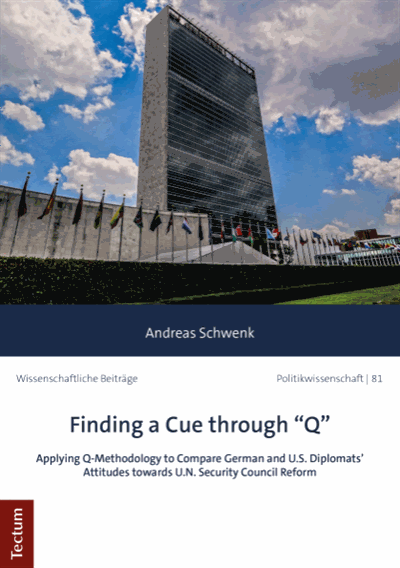
Finding a Cue through "Q"
Applying Q-Methodology to Compare German and U.S. Diplomats' Attitudes towards U.N. Security Council Reform- Autor:innen:
- Reihe:
- Wissenschaftl.Beitr.a.d.Tectum Verlag: Politikwissenschaft, Band 81
- Verlag:
- 2019
Publikation durchsuchen
Bibliographische Angaben
- Auflage
- 1/2019
- Copyrightjahr
- 2019
- ISBN-Print
- 978-3-8288-4306-6
- ISBN-Online
- 978-3-8288-7239-4
- Verlag
- Tectum, Baden-Baden
- Reihe
- Wissenschaftl.Beitr.a.d.Tectum Verlag: Politikwissenschaft
- Band
- 81
- Sprache
- Englisch
- Seiten
- 84
- Produkttyp
- Monographie
Inhaltsverzeichnis
KapitelSeiten
- Titelei/Inhaltsverzeichnis Teilzugriff Seiten I - X
- 1. Introduction Kein Zugriff Seiten 1 - 4
- 2.1.1. The Federal Republic of Germany Kein Zugriff
- 2.1.2. The United States of America Kein Zugriff
- 2.2.1. The “Razali Reform Paper” Kein Zugriff
- 2.2.2. The High-Level Panel Report Kein Zugriff
- 2.2.3. The Group of Four Kein Zugriff
- 2.2.4. The Group “Uniting for Consensus” Kein Zugriff
- 2.2.5. The African Union Kein Zugriff
- 2.2.6. The “Small Five” Kein Zugriff
- 2.3. An Academic Approach: The “Schwartzberg Reform Proposal” Kein Zugriff
- 2.4. Assessment of Main Initiatives Kein Zugriff
- 3. Methodology Kein Zugriff Seiten 33 - 38
- 4.1. Analysis of Interviews Kein Zugriff
- 4.2.1. Convinced Institutionalism (Factor A) Kein Zugriff
- 4.2.2. Cautious Institutionalism (Factor B) Kein Zugriff
- 4.2.3. Diplomats’ Alignment to the two Discourses (Factor Loadings) Kein Zugriff
- 4.3. Assessment of Typologies Kein Zugriff
- 5. Limitations Kein Zugriff Seiten 55 - 56
- 6. Conclusion Kein Zugriff Seiten 57 - 60
- References Kein Zugriff Seiten 61 - 68
- Appendix Kein Zugriff Seiten 69 - 82
- About the author Kein Zugriff Seiten 83 - 84
Literaturverzeichnis (115 Einträge)
Es wurden keine Treffer gefunden. Versuchen Sie einen anderen Begriff.
- References Google Scholar öffnen DOI: 10.5771/9783828872394
- African Union. (2005). The Common African Position On The Proposed Reform Of The United Nations – “The Ezulwini Consensus”. (March 8th, 2005). http://www.un.org/en/africa/osaa/pdf/au/cap_screform_2005.pdf. Google Scholar öffnen DOI: 10.5771/9783828872394
- African Union. (2005). Sirte Declaration On The Reform Of The United Nations. (July 5th, 2005). Assembly/AU/Decl. 2 (V). http://www.au.int/en/sites/default/files/decisions/9552-assembly_en_4_5_july_2005_auc_fifth_ordinary_session_decisions_declarations_and_resolution.pdf. Google Scholar öffnen DOI: 10.5771/9783828872394
- Alexopoulos, A. & Bourantonis, D. (2007). The Reform of the UN Security Council: A Veto-Player Analysis. Department of Political Science, University of Crete. Google Scholar öffnen DOI: 10.5771/9783828872394
- Alker, H. R., Jr. & Sylvan, D. (1986). Political Discourse Analysis. Presented at the annual meeting of the American Political Science Association, Washington. Google Scholar öffnen DOI: 10.5771/9783828872394
- Ariyoruk, A. (2005). Players and Proposals in the Security Council Debate. Global Policy Forum. https://www.globalpolicy.org/component/content/article/200/41204.html. Google Scholar öffnen DOI: 10.5771/9783828872394
- Asthana, A. & Grierson, J. (2016, May 10th). Afghanistan and Nigeria 'possibly most corrupt countries', Cameron lets slip. The Guardian. https://www.theguardian.com/uk-news/2016/may/10/david-cameron-afghanistan-nigeria-possibly-most-corrupt-countries. Google Scholar öffnen DOI: 10.5771/9783828872394
- Auswärtiges Amt. (2014). Bericht der Bundesregierung zur Zusammenarbeit zwischen der Bundesrepublik Deutschland und den Vereinten Nationen und einzelnen, globalagierenden, internationalen Organisationen und Institutionen im Rahmen des VN-Systems in den Jahren 2012 und 2013. (September 3rd, 2014). Google Scholar öffnen DOI: 10.5771/9783828872394
- Auswärtiges Amt. (2016). Deutsche Kandidatur für den Sicherheitsrat 2019/2020. http://www.auswaertiges-amt.de/nn_582140/sid_1D24DC9675AA84A941A88CC236A8F6FF/DE/Aussenpolitik/Friedenspolitik/VereinteNationen/07_Sicherheitsrat/Sicherheitsrat.html?nnm=582138. Google Scholar öffnen DOI: 10.5771/9783828872394
- Auswärtiges Amt. (2016). Reform des Sicherheitsrats der Vereinten Nationen. http://www.auswaertiges-amt.de/DE/Aussenpolitik/Friedenspolitik/VereinteNationen/5_Reformen/ReformSR_node.html. Google Scholar öffnen DOI: 10.5771/9783828872394
- Baas, L. R. (1997). The interpersonal sources of the development of political images: An intensive, longitudinal study. Operant Subjectivity, Vol. 20, pp. 117–142.eng Google Scholar öffnen DOI: 10.5771/9783828872394
- Bertrand, M. (1985). Some Reflections of Reform of the United Nations. United Nations Joint Inspection Unit. Geneva: United Nations. Google Scholar öffnen DOI: 10.5771/9783828872394
- Bosco, D. (2015). The United States Doesn't Want To Reform The UN Security Council. Foreign Policy. http://foreignpolicy.com/2015/09/29/the-united-states-doesnt-want-to-reform-the-u-n-security-council/. Google Scholar öffnen DOI: 10.5771/9783828872394
- Brown, S. R. (1980). Political subjectivity: Applications of Q methodology in political science. New Haven, CT: Yale University Press. Google Scholar öffnen DOI: 10.5771/9783828872394
- Bull, H. (1977). The Anarchical Society – A Study of Order in World Politics. Columbia University Press: New York, NY. Google Scholar öffnen DOI: 10.5771/9783828872394
- Bull, H. (1984). The Expansion of International Society. Oxford University Press. Google Scholar öffnen DOI: 10.5771/9783828872394
- Bundesregierung. (2015). Joint Press Statement at the Meeting of Leaders of the G-4 countries- Brazil, Germany, India and Japan – on United Nations Security Council Reform. https://www.bundesregierung.de/Content/EN/Pressemitteilungen/BPA/2015/2015-09-29-g4-sicherheitsrat_en.html. Google Scholar öffnen DOI: 10.5771/9783828872394
- Butler, R. (2012). Reform of the United Nations Security Council. Penn State Journal of Law & International Affairs. Vol. 1 (1), 23–39. Google Scholar öffnen DOI: 10.5771/9783828872394
- Buzan, B. (2014). An Introduction to the English School of International Relations: The Societal Approach. Cambridge, Polity. Google Scholar öffnen DOI: 10.5771/9783828872394
- Byung, S. L. & Wonhi, S. (2001). Investor response to online stock trading: A study using Q methodology. Operant Subjectivity, Vol. 24, pp. 109–131. Google Scholar öffnen DOI: 10.5771/9783828872394
- Carlson, J. M. & Trichtinger, R. (2001). Perspectives on entertainment television's portrayal of a racial incident: An intensive analysis. Communication Review, Vol. 4, pp. 253–278.eng Google Scholar öffnen DOI: 10.5771/9783828872394
- Charter of the United Nations. (1946). Chapter V, Article 24, Paragraph 1. Google Scholar öffnen DOI: 10.5771/9783828872394
- Charter of the United Nations. (1946). Chapter V, Article 24, Paragraph 2. Google Scholar öffnen DOI: 10.5771/9783828872394
- Charter of the United Nations. (1946). Chapter V, Article 25. Google Scholar öffnen DOI: 10.5771/9783828872394
- Charter of the United Nations. (1946). Chapter VI. Google Scholar öffnen DOI: 10.5771/9783828872394
- Charter of the United Nations. (1946). Chapter VII. Google Scholar öffnen DOI: 10.5771/9783828872394
- Charter of the United Nations. (1946). Chapter VIII. Google Scholar öffnen DOI: 10.5771/9783828872394
- Charter of the United Nations. (1946). Chapter VIII, Article 53. Google Scholar öffnen DOI: 10.5771/9783828872394
- Charter of the United Nations. (1946). Chapter XII. Google Scholar öffnen DOI: 10.5771/9783828872394
- Charter of the United Nations. (1946). Chapter XII, Article 77. Google Scholar öffnen DOI: 10.5771/9783828872394
- Charter of the United Nations. (1946). Chapter XVII, Article 107. Google Scholar öffnen DOI: 10.5771/9783828872394
- Chen, A. (1996). Student interest in activities in a second physical education curriculum: An analysis in student subjectivity. Research Quarterly for Exercise and Sport, Vol. 67, pp. 424–432. Google Scholar öffnen DOI: 10.5771/9783828872394
- Council on Foreign Relations. (2015). The Role of the General Assembly. http://www.cfr.org/international-organizations-and-alliances/role-un-general-assembly/p13490. Google Scholar öffnen DOI: 10.5771/9783828872394
- Das Bundesarchiv. Die Hallstein-Doktrin. (1955). https://www.bundesarchiv.de/oeffentlichkeitsarbeit/bilder_dokumente/01366/index-2.html.de. Google Scholar öffnen DOI: 10.5771/9783828872394
- Deutsche Gesellschaft für die Vereinten Nationen. (2016). 40 Years of German Membership in the United Nations. http://www.dgvn.de/germany-in-the-united-nations/40-years-of-german-membership-in-the-united-nations/.eng Google Scholar öffnen DOI: 10.5771/9783828872394
- Doyle, M. (1983). Kant, Liberal Legacies, and Foreign Affairs. Phylosophy and Public Affairs, Vol. 12 (3), pp. 205–235. Google Scholar öffnen DOI: 10.5771/9783828872394
- Doyle, M. (1986). Liberalism and World Politics. The American Political Science Review, Vol. 80 (4), pp. 1151–1169. Google Scholar öffnen DOI: 10.5771/9783828872394
- Dryzek, J. S. & Berejikian, J. (1993). Reconstructive Democratic Theory. The American Political Science Review, Vol. 87 (1), pp. 48–60. Google Scholar öffnen DOI: 10.5771/9783828872394
- Dryzek, J. S. & Braithwaite, V. (2000). On the prospects for democratic deliberation: Values analysis applied to Australian politics. Political Psychology, Vol. 21, pp. 241–266. Google Scholar öffnen DOI: 10.5771/9783828872394
- Febbraro, A. R. (1995). On the epistemology, metatheory, and ideology of Q methodology: A critical analysis. In Ian Lubek, Rene Van Hezewijk, Gail Pheterson & Charles. W. Tolman, Trends and issues in theoretical psychology (pp.144–150). New York: Springer. Google Scholar öffnen DOI: 10.5771/9783828872394
- Fischer, J. (2004). Speech before the German Bundestag http://dip.bundestag.de/btp/15/15122.pdf. (September 8th, 2004).eng Google Scholar öffnen DOI: 10.5771/9783828872394
- Gallivan, J. (1994). Subjectivity and the psychology of gender: Q as a feminist methodology. In Joanne Gallivan, Sharon D. Crozier & Vivian M. Lalande, Women, girls, and achievement (pp. 29–36). Toronto: Captus University Publications. Google Scholar öffnen DOI: 10.5771/9783828872394
- Genscher, H. D. (1990). Speech by Foreign Minister Genscher at the 45th United Nations General Assembly in New York. Bulletin 115/1990: 1201–1206. (September 26th, 1990).eng Google Scholar öffnen DOI: 10.5771/9783828872394
- Gowan, R. (2013). Germany and the Security Council: Neither too strong nor too weak. VereinteNationen: German Review on the United Nations, Vol. 61 (1), pp. 3–8.eng Google Scholar öffnen DOI: 10.5771/9783828872394
- Gilpin, R. (1981). War and Change In World Politics. Cambridge University Press: UK.eng Google Scholar öffnen DOI: 10.5771/9783828872394
- Gilpin, R. (1987). Princeton University Press: Princeton, NJ. Google Scholar öffnen DOI: 10.5771/9783828872394
- Hellmann, G. & Roos, U. (2007). Das deutsche Streben nach einem ständigen Sitz im UN-Sicherheitsrat – Analyse eines Irrwegs und Skizzen eines Auswegs. Institut für Entwicklung und Frieden. Universität Duisburg-Essen. INEF-Report 92/2007. Google Scholar öffnen DOI: 10.5771/9783828872394
- Hosli, M. O.; Moody, R.; O'Donovan, B.; Kaniovski, S. & Little, A. C. H. (2011). Squaring the Circle? Collective and distributive effects of United Nations Security Council reform. The Review of International Organizations, Vol. 6, pp. 163–187. Google Scholar öffnen DOI: 10.5771/9783828872394
- Intergovernmental Negotiations. Framework Document – As populated by states. (May 4th, 2015). http://centerforunreform.org/sites/default/files/050515_security-council-reform-framework-document.pdf#overlay-context=. Google Scholar öffnen DOI: 10.5771/9783828872394
- International Monetary Fund. World Economic Outlook Database. (July, 2016). Google Scholar öffnen DOI: 10.5771/9783828872394
- Ikenberry, J. (2001). After Victory: Institutions, Strategic Restraint, and the Rebuilding of Order after Major Wars. Princeton University Press: Princeton, NJ. Google Scholar öffnen DOI: 10.5771/9783828872394
- Kant, I. (1795). Zum ewigen Frieden – Ein philosophischer Entwurf. Google Scholar öffnen DOI: 10.5771/9783828872394
- Keohane, R. (1984). After Hegemony: Power and Discord in the World Political Economy. Princeton University Press, Princeton NJ. Google Scholar öffnen DOI: 10.5771/9783828872394
- Keohane, R. (1993). Institutional Theory and the Realist Challenge after the Cold War. In "Neorealism and Neoliberalism: The Contemporary Debate. Columbia University Press: New York. NY. Google Scholar öffnen DOI: 10.5771/9783828872394
- Kogan, S. M.; Walters, L. H. & Daniels, T. (2002). Contextual assessment of couples therapy: the clinical discourse Q-set. Journal of Marital & Family Therapy, Vol. 28 (4), pp. 409–422. Google Scholar öffnen DOI: 10.5771/9783828872394
- Lecouteur, A. & Delfabbro, P. H. (2001). Repertoires of teaching and learning: A comparison of university teachers and students using Q methodology. Higher Education, Vol. 42, pp. 205–235. Google Scholar öffnen DOI: 10.5771/9783828872394
- Lyman, P. N. (2000). Saving the UN Security Council – A Challenge for the United States. Max Planck Yearbook of the United Nations. Vol. 4, 127–146. Google Scholar öffnen DOI: 10.5771/9783828872394
- McDonald, K.C. & Patrick, S. M. (2010). Security Council Enlargement and U.S. Interests. Council on Foreign Relations. Special Report No. 59. Google Scholar öffnen DOI: 10.5771/9783828872394
- Mearsheimer, J. (1983). Conventional Deterrence. Cornell University Press: Ithaca, NY.eng Google Scholar öffnen DOI: 10.5771/9783828872394
- Mearsheimer, J. (2001). The Tragedy of Great Power Politics. W. W. Norton & Company: New York, NY.eng Google Scholar öffnen DOI: 10.5771/9783828872394
- Meisler, S. (1995). United Nations: The First Fifty Years. Atlantic Monthly Press. New York, NY. Google Scholar öffnen DOI: 10.5771/9783828872394
- Morgenthau, H. (1948). Politics Among Nations. Knopf: New York, NY. Google Scholar öffnen DOI: 10.5771/9783828872394
- Mosyagina, N. I.; Kashin, A. B. & Peck, R. L. (1997). Emerging Russian consumerism. A Q-Methodology study of consumer attitudes after Perestroika. Congress Manuscipt. Presented at the "Annual Conference on the Scientific Study of Subjectivity". Syracuse, New York. Google Scholar öffnen DOI: 10.5771/9783828872394
- Müller, F. H. & Kals, E. (2004). Die Q-Methode. Ein innovatives Verfahren zur Erhebung subjektiver Einstellungen und Meinungen. Forum: Qualitative Sozialforschung, Vol. 5 (2), Art. 34. Google Scholar öffnen DOI: 10.5771/9783828872394
- Plett, B. (2012). Small countries call for more transparency at the United Nations. BBC News. http://www.bbc.com/news/world-us-canada-18123768. Google Scholar öffnen DOI: 10.5771/9783828872394
- Pleuger, G. (2003). Die Reform des Sicherheitsrates der Vereinten Nationen. In Sabine von Schorlemer. Praxishandbuch UNO – Die Vereinten Nationen im Lichte globaler Herausforderungen, Heidelberg. Google Scholar öffnen DOI: 10.5771/9783828872394
- Richard, R. (2000). A methodological approach to national identity in Europe. Politique Européenne, Vol. 1, pp. 84–107. Google Scholar öffnen DOI: 10.5771/9783828872394
- Schwartzberg, J. E. (2005). Getting it wrong on Security Council Reform. Institute for Global Policy, World Federalist Movement. Google Scholar öffnen DOI: 10.5771/9783828872394
- Schwartzberg, J. E. (2004). Revitalizing the United Nations – Reform through weighted voting. Institute for Global Policy, World Federalist Movement. Google Scholar öffnen DOI: 10.5771/9783828872394
- Schwartzberg, J. E. (2007). Small States and UN Reform. Institute for Global Policy, World Federalist Movement. Google Scholar öffnen DOI: 10.5771/9783828872394
- Schwartzberg, J. E. (2013). Transforming the United Nations System: Designs for a Workable World. United Nations University Press. Google Scholar öffnen DOI: 10.5771/9783828872394
- Schweizerische Eidgenossenschaft. (2009). Intergovernmental Negotiations on the Reform of the Security Council, Debate on Working Methods, Informal Plenary. Permanent Mission of Switzerland to the United Nations, New York, NY. Google Scholar öffnen DOI: 10.5771/9783828872394
- Seidel, G. (1985). Political Discourse Analysis. In Handbook of Discourse Analysis ed. Teun A. van Dijk. London: Academic. Google Scholar öffnen DOI: 10.5771/9783828872394
- Shepsle, K. A. (2005). “Rational Choice Institutionalism”. Harvard University. Google Scholar öffnen DOI: 10.5771/9783828872394
- Shilin, M.; Khaimina, O.; Kluikov, Y. & Lukyanov, S. (2000). Coping strategies: The white sea case (Northern Russia). http://www.uit.no/MostCCPP/Huhmari/joe_pap/JOE_Michael-S.pdf. Google Scholar öffnen DOI: 10.5771/9783828872394
- Singer, J. B. (1997). Chances and consistencies: Newspaper journalists contemplate an online uture. Newspaper Research Journal, Vol. 18, pp. 2–18. Google Scholar öffnen DOI: 10.5771/9783828872394
- Singer, J. B.; Craig, D.; Allen, C. W.; Whitehouese, V., Dimitrova, A. & Sanders, K. P. (1996). Attitudes of professors and students about new media technology. Journalism and Mass Communication Educator, Vol. 51 (2), pp. 36–45. Google Scholar öffnen DOI: 10.5771/9783828872394
- Smith, A. (1776). An Inquiry into the Nature and Causes of the Wealth of Nations. London: W. Strahan. Google Scholar öffnen DOI: 10.5771/9783828872394
- Stephenson, W. (1935). Correlation persons instead of tests. Character and Personality, 4, 17–24. Google Scholar öffnen DOI: 10.5771/9783828872394
- Stephenson, W. (1953). The study of behavior: Q-technique and its methodology. Chicago: University of Chicago Press. Google Scholar öffnen DOI: 10.5771/9783828872394
- The Economist. (2016). Brazil's Fall. http://www.economist.com/news/leaders/21684779-disaster-looms-latin-americas-biggest-economy-brazils-fall. Google Scholar öffnen DOI: 10.5771/9783828872394
- Thomas, D. B. & Baas, L. R. (1996). The postelection campaign: Competing constructions of the Clinton victory in 1992. The Journal of Politics, Vol. 58, pp. 309–331. Google Scholar öffnen DOI: 10.5771/9783828872394
- The White House. National Security Strategy. (May, 2010). Google Scholar öffnen DOI: 10.5771/9783828872394
- Toulmin, S. (1958). The Uses of Argument. Cambridge: Cambridge University Press.eng Google Scholar öffnen DOI: 10.5771/9783828872394
- Tsebelis, G. (2002). Veto Players: How Political Institutions Work. Princeton, NJ: Princeton University Press. Google Scholar öffnen DOI: 10.5771/9783828872394
- Ullmann, J. E. (1990). Who Won Cold War? Japanese and Germans. The New York Times. http://www.nytimes.com/1990/07/03/opinion/l-who-won-cold-war-japanese-and-germans-664690.html. Google Scholar öffnen DOI: 10.5771/9783828872394
- UN Summit Agenda. (2000, September 7th). BBC News. http://news.bbc.co.uk/2/hi/904903.stm. Google Scholar öffnen DOI: 10.5771/9783828872394
- United Nations. General Assembly Decision 62/557. Question of equitable representation on and increase in the membership of the Security Council and related matters. (September 15th, 2008). Google Scholar öffnen DOI: 10.5771/9783828872394
- United Nations. General Assembly Draft Resolution A/59/L.64. Security Council Reform. (July 6th, 2005). Google Scholar öffnen DOI: 10.5771/9783828872394
- United Nations. General Assembly Draft Resolution A/59/L.67. Question of equitable representation on and increase in the membership of the Security Council and related matters. (July 18h, 2005). Google Scholar öffnen DOI: 10.5771/9783828872394
- United Nations. General Assembly Draft Resolution A/59/L.68. Reform of the Security Council. (July 21st, 2005). Google Scholar öffnen DOI: 10.5771/9783828872394
- United Nations. General Assembly Draft Resolution A/60/L.49. Improving the working methods of the Security Council. (March 17th, 2006). Google Scholar öffnen DOI: 10.5771/9783828872394
- United Nations. General Assembly Presidential Note A/59/565. Follow-up to the outcome of the Millennium Summit. (December 2nd, 2004). Google Scholar öffnen DOI: 10.5771/9783828872394
- United Nations. General Assembly Resolution A/RES/47/62. Question of equitable representation on and increase in the membership of the Security Council. (December 11th, 1992). Google Scholar öffnen DOI: 10.5771/9783828872394
- United Nations. General Assembly Resolution A/RES/48/26. Question of equitable representation on and increase in the membership of the Security Council. (December 3rd, 1993). Google Scholar öffnen DOI: 10.5771/9783828872394
- United Nations. High-level Panel on Threats, Challenges and Change. A more secure world: Our shared responsibility. (December 2nd, 2004). http://www.un.org/en/peacebuilding/pdf/historical/hlp_more_secure_world.pdf.eng Google Scholar öffnen DOI: 10.5771/9783828872394
- United Nations. Secretariat Assessment ST/ADM/SER.B/932. Assessment of Member States’ advances to the Working Capital Fund for the biennium 2016–2017 and contributions to the United Nations regular budget for 2016. (December 28th, 2015). Google Scholar öffnen DOI: 10.5771/9783828872394
- United Nations. Security Council Presidential Note S/2006/507. Note by the President of the Security Council. (July 19th, 2006). Google Scholar öffnen DOI: 10.5771/9783828872394
- United Nations. Security Council Resolution S/RES/687. (April 8th, 1991). Google Scholar öffnen DOI: 10.5771/9783828872394
- United Nations. Security Council Resolution S/RES/688. (April 5th, 1991). Google Scholar öffnen DOI: 10.5771/9783828872394
- United Nations. United Nations Millennium Declaration A/55/L.2. (December 14th, 2000).eng Google Scholar öffnen DOI: 10.5771/9783828872394
- United States Congress. 2005 United Nations Reform Act H.R.2745. (June 17th, 2005).eng Google Scholar öffnen DOI: 10.5771/9783828872394
- United States Department of State. (1999). Reform of the UN System. Google Scholar öffnen DOI: 10.5771/9783828872394
- United States Department of State. (2003). Reform of the UN System. Google Scholar öffnen DOI: 10.5771/9783828872394
- United States Department of State. (2004). Reform of the UN System. Google Scholar öffnen DOI: 10.5771/9783828872394
- United States Institute of Peace. (2006). American Interests and UN Reform – Report of the Task Force on the United Nations. Google Scholar öffnen DOI: 10.5771/9783828872394
- Uniting for Consensus Group. (2009). Security Council Reform. Global Policy Forum. https://www.globalpolicy.org/images/pdfs/UFC_2009_Proposal.pdf. Google Scholar öffnen DOI: 10.5771/9783828872394
- Walt, S. (1987). The Origins of Alliances. Cornell University Press: Ithaca, NY. Google Scholar öffnen DOI: 10.5771/9783828872394
- Waltz, K. (1959). Man, the State, and War. Columbia University Press: New York, NY. Google Scholar öffnen DOI: 10.5771/9783828872394
- Webler, T.; Danielson, S. & Tuler, S. (2009). Using Q Method to Reveal Social Perspectives in Environmental Research. Social and Environmental Research Institute. Greenfield, MA. Google Scholar öffnen DOI: 10.5771/9783828872394
- Wight, M. (1977). Systems of States. Leicester University Press, UK. Google Scholar öffnen DOI: 10.5771/9783828872394
- Wight, M. (1996). International Theory: The three Traditions. Leicester University Press, UK. Google Scholar öffnen DOI: 10.5771/9783828872394
- Wight, M. (2002). Power Politics. Bloomsbury Academic. Google Scholar öffnen DOI: 10.5771/9783828872394
- Winter, E. (1996). Voting and Vetoing. The American Political Science Review, Vol. 90 (4), pp. 813–823.eng Google Scholar öffnen DOI: 10.5771/9783828872394
- Wirkola, E. R. H. (2010). Reform of the UN Security Council and Veto Player Theory. University of Oslo. Google Scholar öffnen DOI: 10.5771/9783828872394