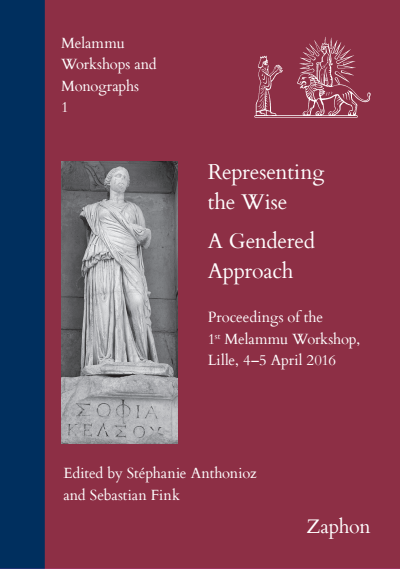
Representing the Wise. A Gendered Approach.
Proceedings of the 1st Melammu Workshop. Lille, 4-5 April 2016- Herausgeber:innen:
- |
- Reihe:
- Melammu Workshops and Monographs, Band 1
- Verlag:
- 2019
Zusammenfassung
Der erste Workshop des Melammu-Projekts stellte sich die Frage, wie Repräsentantinnen und Repräsentanten der Weisheit in der Antike konzeptualisiert wurden und ob es einen klaren Unterschied zwischen weiblicher und männlicher Weisheit gab. Der Workshop folgte der Chronologie, von mesopotamischen und ägyptischen Quellen über levantinische bis hin zu griechischen und römischen Zeugnissen. Er gestattete eine umfangreiche Erörterung von Weisen, sowohl göttlichen als menschlichen, wie sie in der Antike porträtiert wurden. Die Beiträge förderten zahlreiche Spannungen zutage. Das Wesen der Weisheit selbst, menschlich und göttlich, empirisch, theoretisch, beizeiten auch abstrakt und schwer zu charakterisieren, deutet auf die Problematik einer Definition. Daher kann die Pluralität der Repräsentationen verstanden werden als Zeichen dieser Schwierigkeit und Varietät. Mehr noch, die Gender-Frage erwies sich als eng verbunden mit den Gesellschaften und deren Organisation.
The first of the Melammu Workshops askes how female and male representatives of the wise, female and male sages, were conceptualized in antiquity and whether there was a clear difference between female and male wisdom. The workshop followed a kind of historical chronology starting from Mesopotamian and Egyptian sources, continuing West through the Levant and ending with Greek and Roman documentation. It permitted a vast exploration of sages, both divine and human, as they were portrayed in antiquity. The papers brought to light several tensions among which the question of gender was not the least. Indeed, the nature of wisdom itself, human and divine, empirical, theoretical but also at times abstract and difficult to outline, pointed to the difficulty of a definition. Hence the plurality of representations might be interpreted as a sign of this difficulty and variety. Moreover, the gender question was found to be strongly related to the societies and their organization as evidenced elsewhere in current research. Any generalization or typology of the sages at this point could not be drawn but a clear historical evolution toward masculine representation of wisdom was evidenced. Certainly, this has to do with social change, economic structures and the loci of power and authority. However, in many regards, women appear as counterparts or homologues of men in their quest for wisdom. In that sense, the workshop proved very fruitful in displaying a large gallery of portraits and in bringing to light differences according to social settings and sources but also main trends of evolution through historical times.
Reihe
E009677500 - Band 1
Publikation durchsuchen
Bibliographische Angaben
- Auflage
- 1/2019
- Copyrightjahr
- 2019
- ISBN-Print
- 978-3-96327-068-0
- ISBN-Online
- 978-3-96327-069-7
- Verlag
- Zaphon, Münster
- Reihe
- Melammu Workshops and Monographs
- Band
- 1
- Sprache
- Englisch
- Seiten
- 208
- Produkttyp
- Sammelband
Inhaltsverzeichnis
- Table of Contents Kein Zugriff
- Representing the Wise. A Gendered Approach. Introduction Kein Zugriff Seiten 7 - 16Autor:innen: |
- Female Sages in the Sumerian Tradition of Mesopotamia Kein Zugriff Seiten 17 - 42Autor:innen:
- Male Sages in Sumerian Literature Kein Zugriff Seiten 43 - 52Autor:innen:
- Female Sages in Akkadian Literature Kein Zugriff Seiten 53 - 64Autor:innen:
- Male Sages in Akkadian Literature Kein Zugriff Seiten 65 - 70Autor:innen:
- The Sages / Wisemen in Ancient Egypt Kein Zugriff Seiten 71 - 118Autor:innen:
- Memories of Female (and Male) Sages in Late Persian / Early Hellenistic Yehud. Considerations Informed by Social Memory and Current Cross- and Trans-disciplinary Trends in th e Study of Wisdom Kein Zugriff Seiten 119 - 148Autor:innen:
- Lady Wisdom in Prov 1–9; 31. Context, Definition and Function of her Personification Kein Zugriff Seiten 149 - 162Autor:innen:
- Lady Wisdom in Greek Culture. Athena as a Deity of Polymorphic Intelligence Kein Zugriff Seiten 163 - 172Autor:innen:
- Paideia makes the Man. A Gendered Approach to the Figure of the Wise Man in Imperial Rome Kein Zugriff Seiten 173 - 184Autor:innen:
- Female Sages in Roman Literature – Selected Examples Kein Zugriff Seiten 185 - 204Autor:innen:
- Index Kein Zugriff Seiten 205 - 206