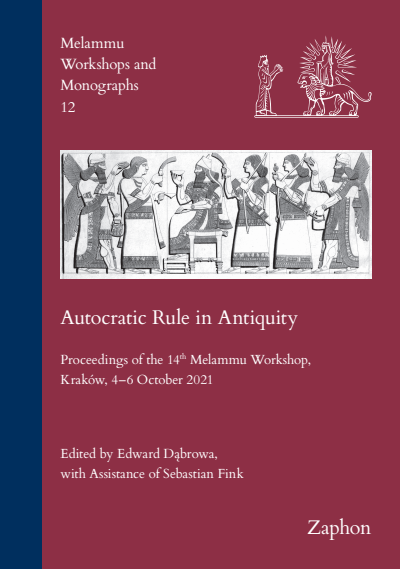
Autocratic Rule in Antiquity
Proceedings of the 14th Melammu Workshop, Kraków, 4–6 October 2021- Herausgeber:innen:
- Reihe:
- Melammu Workshops and Monographs, Band 12
- Verlag:
- 2025
Zusammenfassung
Autocratic forms of government have been around in all historical periods, from ancient times to the present day. Autocracy has taken various forms, yet undoubtedly its most characteristic feature is the manner in which an individual or group exercises power – one contrary to the principles of the legal and political order underpinning the sociopolitical life of the collective in which it appeared. As a form of government, it took various forms, determined by a variety of factors. This diversity of forms in which the autocratic style of government manifested itself has led researchers to attempt to describe and classify them. The important place occupied by autocratic forms of government in the ancient world led the academic collective of the Melammu Project to choose autocracy in antiquity as the theme of the 14th Melammu Workshop. Among others, "Oriental Despots in the Inscriptions of Assurbanipal" are in the focus of Sebastian Fink; "Mycenaean Kingship" is dealt with by Josef Fischer and "Lydian Autocracy as Seen by the Greeks" by Francesca Gazzano. Jesper Majbom Madsen analyses "The Fear of Democracy and the Need of Autocracy in Cassius Dio’s Political Thinking"; "Thoughts on Autocratic Authorship in Antiquity" are presented by Matthias Haake and "Attributes of Power of the Hasmoneans" by Edward Dąbrowa.
Autokratische Regierungsformen gab und gibt es in allen historischen Epochen, von der Antike bis zur Gegenwart. Die Autokratie hat verschiedene Formen angenommen, doch ihr charakteristischstes Merkmal ist zweifellos die Art und Weise, wie ein Individuum oder eine Gruppe Macht ausübt – eine Art und Weise, die im Widerspruch zu den Prinzipien der rechtlichen und politischen Ordnung steht, die dem gesellschaftspolitischen Leben des Kollektivs zugrunde liegen, in dem sie auftrat. Als Regierungsform nahm sie verschiedene Formen an, die durch eine Vielzahl von Faktoren bestimmt wurden. Die große Bedeutung, der autokratische Regierungsformen in der Antike zukamen, veranlasste das Melammu-Projekt, die Autokratie in der Antike als Thema des 14. Melammu-Workshops zu wählen. Im Fokus von Sebastian Fink stehen unter anderem „Orientalische Despoten in den Inschriften Assurbanipals“; „Mykenisches Königtum“ wird von Josef Fischer und „Lydische Autokratie aus Sicht der Griechen“ von Francesca Gazzano behandelt. Jesper Majbom Madsen analysiert „Die Angst vor Demokratie und die Notwendigkeit der Autokratie im politischen Denken von Cassius Dio“; „Gedanken zur autokratischen Autorschaft in der Antike“ werden von Matthias Haake und „Machtattribute der Hasmonäer“ von Edward Dąbrowa vorgestellt.
Publikation durchsuchen
Bibliographische Angaben
- Auflage
- 1/2025
- Copyrightjahr
- 2025
- ISBN-Print
- 978-3-96327-284-4
- ISBN-Online
- 978-3-96327-285-1
- Verlag
- Zaphon, Münster
- Reihe
- Melammu Workshops and Monographs
- Band
- 12
- Sprache
- Englisch
- Seiten
- 271
- Produkttyp
- Sammelband
Inhaltsverzeichnis
- Table of Contents Kein Zugriff
- Introduction Kein Zugriff Seiten 1 - 6Autor:innen:
- Oriental Despots in the Inscriptions of Assurbanipal Kein Zugriff Seiten 7 - 20Autor:innen:
- Some Remarks on Mycenaean Kingship Kein Zugriff Seiten 21 - 40Autor:innen:
- Lydian Autocracy as Seen by the Greeks Kein Zugriff Seiten 41 - 70Autor:innen:
- Warum es sich nicht lohnt, Ratgebern zu folgen. Der Fall des Polykrates und des Amasis Kein Zugriff Seiten 71 - 88Autor:innen:
- The Writing Tyrant in Ancient Greece: From the Archaic to the Hellenistic Period. Some First Thoughts on Autocratic Authorship in Antiquity Kein Zugriff Seiten 89 - 126Autor:innen:
- Attalids’ Attitude to Greek Cities after 188 BC. Selected Issues Kein Zugriff Seiten 127 - 150Autor:innen:
- A ‘contagion’ of sōtēria. Hellenistic Kingship and Collective Salvation between Political and Religious Discourse Kein Zugriff Seiten 151 - 172Autor:innen:
- Attributes of Power of the Hasmoneans (152–76 BCE) as an Expression of their Political Standing Kein Zugriff Seiten 173 - 186Autor:innen:
- C. Iulius Eurycles and His Position in Late Hellenistic Sparta Kein Zugriff Seiten 187 - 204Autor:innen:
- Cleopatra’s Languages Kein Zugriff Seiten 205 - 228Autor:innen:
- Fear of Democracy and the Need of Autocracy in Cassius Dio’s Political Thinking Kein Zugriff Seiten 229 - 256Autor:innen:
- Indices Kein Zugriff Seiten 257 - 263