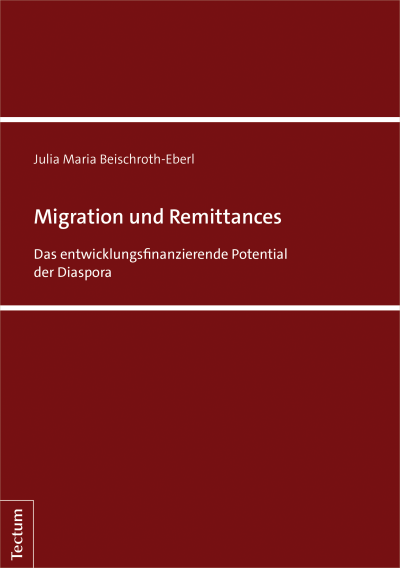
Migration und Remittances
Das entwicklungsfinanzierende Potential der Diaspora- Autor:innen:
- Verlag:
- 2021
Zusammenfassung
Remittances, die Geldtransfers von Migranten in ihre Herkunftsländer, haben in der Diskussion um nachhaltige Entwicklung in den letzten Jahren vermehrt an Bedeutung gewonnen. Diese Arbeit betont das enorme Potential von Remittances, Entwicklungsprozesse in Bewegung zu setzen und zu finanzieren. Dazu werden Fakten aufbereitet und diskutiert, die den positiven Einfluss von Rücküberweisungen auf nachhaltige wirtschaftliche und soziale Entwicklung und Armutsreduktion, sowohl auf Mikro- als auch Makroebene unterstreichen. Die theoretische Herangehensweise wird dazu durch länderspezifische Fallbeispiele illustriert. Des Weiteren werden Probleme, die im Remittance-Kontext aufkommen, wie Abhängigkeit, Verpflichtung oder auch der persönliche Verlass auf Rücküberweisungen, abgehandelt.
Publikation durchsuchen
Bibliographische Angaben
- Auflage
- 1/2021
- Copyrightjahr
- 2021
- ISBN-Print
- 978-3-8288-3973-1
- ISBN-Online
- 978-3-8288-6780-2
- Verlag
- Tectum, Baden-Baden
- Sprache
- Deutsch
- Seiten
- 134
- Produkttyp
- Monographie
Inhaltsverzeichnis
- Titelei/Inhaltsverzeichnis Kein Zugriff Seiten I - XXIV
- 1. Einleitung Kein Zugriff Seiten 1 - 10
- 2.1. Pure Uneigennützigkeit Kein Zugriff
- 2.2. Eigeninteresse, persönlicher Nutzen Kein Zugriff
- 2.3. Familienarrangement: gegenseitige Absicherung Kein Zugriff
- 2.4. Migration mit Sparziel und Rückkehrplan Kein Zugriff
- 2.5. Wertpapiere und Anlageformen Kein Zugriff
- 2.6. Stagnation der Remittances Kein Zugriff
- 2.7. Solidarische Remittances Kein Zugriff
- 3.1.1. Die Typologie der Transfermechanismen Kein Zugriff
- Western Union als Stimme der MigrantInnen? Kein Zugriff
- 3.2. Kostenunterschiede der einzelnen Transfermöglichkeiten Kein Zugriff
- 3.3. Wie viel Geld wird gesendet ? Kein Zugriff
- 4.1.1. Devisenbringer Remittances Kein Zugriff
- 4.2.1. Dutch Disease Kein Zugriff
- 4.3. Remittances und Inflation – eine Streitfrage Kein Zugriff
- 4.4.1. Auswirkungen des Zweiten Golfkrieges 1990/91 Kein Zugriff
- 4.4.2. Der Kosovo und Mazedonien Kein Zugriff
- 4.5. Remittances und Brain Drain Kein Zugriff
- 4.6.1. Remittances und Wirtschaftskrise Kein Zugriff
- 5.1.1. Beispiel Ghana: komplexe traditionelle Strukturen und Remittances Kein Zugriff
- 5.2.1. Beispiel Mocambique Kein Zugriff
- 6.1. Die EmpfängerInnen und deren Haushalte Kein Zugriff
- 6.2. Remittances und ihr Effekt auf die Einkommensverteilung Kein Zugriff
- 6.3. Remittances und Bildung Kein Zugriff
- 6.4.1. Soziale Remittances (technische Remittances) Kein Zugriff
- 7.1.1. Organisation und Organisationsgeschichte der senegalesischen Diaspora Kein Zugriff
- 7.1.2. Les tontines Kein Zugriff
- 7.2. Exkurs Rückwanderung / return migration Kein Zugriff
- 8.1. Senderinnen Kein Zugriff
- 8.2. Empfängerinnen Kein Zugriff
- 8.3. Künftige Herausforderungen der Genderforschung zu Remittances Kein Zugriff
- 9. Remittances und MigrantInnenverschuldung Kein Zugriff Seiten 85 - 86
- 10.1. Beispiele erfolgreicher Initiativen Kein Zugriff
- 10.2. Banking the Unbanked Kein Zugriff
- 11.1.1. Beispiel Remittancepolitik Marokkos Kein Zugriff
- 11.2.1. Studie der deutschen Gesellschaft für Technische Zusammenarbeit Kein Zugriff
- 12.1. EU Kein Zugriff
- 12.2. GCIM Kein Zugriff
- Remittances und die UN Millennium Development Goals Kein Zugriff
- 12.4. IOM Kein Zugriff
- 12.5. Weltbank / CPSS „Remittance – task force“ Kein Zugriff
- 12.6. OECD Kein Zugriff
- 13.1. Die Philippinen Kein Zugriff
- 13.2.1. Remittances und erzwungene Ersparnisse: Das Bracero Programm Kein Zugriff
- 13.3. Senegal Kein Zugriff
- 14. Conclusio Kein Zugriff Seiten 121 - 122
- 15. Literaturverzeichnis Kein Zugriff Seiten 123 - 130
- Liste der Interview-/GesprächspartnerInnen Kein Zugriff
- Zusammenfassung Kein Zugriff
- Abstract Kein Zugriff
Literaturverzeichnis (87 Einträge)
Es wurden keine Treffer gefunden. Versuchen Sie einen anderen Begriff.
- 15. Literaturverzeichnis Google Scholar öffnen DOI: 10.5771/9783828867802
- Acosta, Pablo; Fajnzylber, Pablo; López, Humberto J. (2007): The Impact of Remittances on Poverty and Human Capital: Evidence from Latin American Household Surveys. In: Schiff, Maurice; Özden, Çağlar (Hg.): International Migration, Economic Development & Policy. Washington: International Bank for Reconstruction and Development / The World Bank; New York: Palgrave Macmillan, 59- 98 Google Scholar öffnen DOI: 10.5771/9783828867802
- Acosta, Pablo; Fajnzylber, Pablo; López, Humberto J. (2008): How important are remittances in Latin America? In: Fajnzylber, Pablo; López, Humberto J. (Hg.): Remittances and Development. Lessons from Latin America. Washington, D.C.: The World Bank, International Bank for Reconstruction and Development, 21–49 Google Scholar öffnen DOI: 10.5771/9783828867802
- Adams, Jr. Richard H. (2006): Remittances, poverty, and investment in Guatemala. In: Özden, Çağlar; Schiff Maurice (Hg.): International Migration, Remittances & the Brain Drain. Washington: International Bank for Reconstruction and Development / The World Bank; New York: Palgrave Macmillan, 53–80 Google Scholar öffnen DOI: 10.5771/9783828867802
- Bagasao, Ildedonso (2004): Migration and development: the Philippine experience. In: Small enterprise development Vol.15 No.1, 62–67 Google Scholar öffnen DOI: 10.5771/9783828867802
- Baldassar, Loretta; Vellekoop Baldock, Cora; Wilding, Raelene (2007): Families Caring Across Borders. Migration, Ageing and Transnational Caregiving. New York: Palgrave Macmillan Google Scholar öffnen DOI: 10.5771/9783828867802
- Ballard, Roger (2003): Remittances and Economic Development. University of Manchester: Centre for Applied South Asian Studies Google Scholar öffnen DOI: 10.5771/9783828867802
- Barou, Jacques (1978): Travailleurs africains en France. Rôle des cultures d’origine. Grenoble: Presses Universitaires de Grenoble; Publications Orientalistes de France Google Scholar öffnen DOI: 10.5771/9783828867802
- Blion, Reynald (2002): South of North: European Immigrants’ Stakeholdings in Southern Development. In: Bryceson, Deborah; Vuorela Ulla (Hg.): The Transnational Family. New European Frontiers and Global Networks. New York: Berg, 231–244 Google Scholar öffnen DOI: 10.5771/9783828867802
- Brain Gain Network (2009): Brain Gain Network. http://www.bgn.org [Zugriff 26.2.2009 und 08.11.2020] Google Scholar öffnen DOI: 10.5771/9783828867802
- Brown, Lawrence A. (1991): Place, Migration and Development in the Third World. London and New York: Routledge Google Scholar öffnen DOI: 10.5771/9783828867802
- Bryceson, Deborah; Vuorela Ulla (Hg.) (2002): The Transnational Family. New European Frontiers and Global Networks. New York: Berg Google Scholar öffnen DOI: 10.5771/9783828867802
- Bürger, Susanne (1992): Umfang, Richtung und Determinanten der internationalen Arbeitsmigration unter besonderer Berücksichtigung der Dritten Welt. Dipl.-Arb. Univ. Wien, Grund- und Integrativwissenschaftliche Fakultät Google Scholar öffnen DOI: 10.5771/9783828867802
- Calderón, Cesar; Fajnzylber, Pablo; López, Humberto J. (2008): Remittances and Growth: The Role of Complementary Policies. In: Fajnzylber, Pablo; López, Humberto J. (Hg.): Remittances and Development. Lessons from Latin America. Washington, D.C.: The World Bank, International Bank for Reconstruction and Development, 335–368 Google Scholar öffnen DOI: 10.5771/9783828867802
- Charles, Delphine (2006): Ces migrants qui aident leur pays! In: Africa International n°396 / mars 2006, 12–13 Google Scholar öffnen DOI: 10.5771/9783828867802
- Crush, Jonathan (Hg.) (2006): Migration, Remittances and Development in Southern Africa. Cape Town: Idasa, Queens University Canada: African Research Centre. Southern African Migration Project (SAMP) Google Scholar öffnen DOI: 10.5771/9783828867802
- Dayton-Johnson, Jeff; Katseli, Louka T.; Maniatis, Gregory; Münz, Rainer; Papademetriou, Demetrios (2007): Gaining from Migration. Towards a new Mobility System. Paris: OECD Development Centre Google Scholar öffnen DOI: 10.5771/9783828867802
- De Haas, Hein; Plug, Roald (2006): Cherishing the Goose with the Golden Eggs: Trends in Migrant Remittances from Europe to Morocco 1970–2004. In: IMR Volume 40 Number 3. New York: Centre of Migration Studies, 603–634 Google Scholar öffnen DOI: 10.5771/9783828867802
- Denis, Olivier (2005): The Moneysend and Mastercard™ Services. In: OECD (Hg.): Migration, Remittances and Development. The Development Dimension. Paris: OECD Publishing, 135–137 Google Scholar öffnen DOI: 10.5771/9783828867802
- DeParle, Jason (2007): Western Union thrives as immigrants send cash home. Immigrant Cash gives new life to Western Union. The New York Times, Beilage in Der Standard. Printausgabe 3.12.2007 Google Scholar öffnen DOI: 10.5771/9783828867802
- DeParle, Jason (2007): Migrant money flow: a $300 Billion Current. The New York Times, Beilage in Der Standard. Printausgabe 3.12.2007 Google Scholar öffnen DOI: 10.5771/9783828867802
- Department for International Development (DFID); The World Bank (2003): International Conference on Migrant Remittances: Development impact, opportunities for the financial sector and future prospects. Report and Conclusions. London. http://www.livelihoods.org/hot_topics/docs/RemitConfFinal.doc [Zugriff 16.10.2008, Link zum Dokument leider nicht mehr aktiv] Google Scholar öffnen DOI: 10.5771/9783828867802
- Deutsche Gesellschaft für Technische Zusammenarbeit (GTZ) GmbH (2007): Remittances aus Deutschland und ihre Wege in die Herkunftsländer der Migranten. Eine Studie zu fünf ausgewählten Ländern. Eschborn: GTZ Google Scholar öffnen DOI: 10.5771/9783828867802
- Donner, Christine (1991): Mosambiks wirtschaftspolitische Entwicklung seit der Unabhängigkeit (1975) unter Berücksichtigung des Transitverkehrs. Eine politikorientierte geographische Analyse. Dipl.-Arb. Univ. Wien, Grund- und Integrativwissenschaftliche Fakultät Google Scholar öffnen DOI: 10.5771/9783828867802
- Ekra, Silvia (2005): African Female Diaspora in France. In: IOM International Organization for Migration (Hg.): World Migration. Costs and Benefits of International Migration. Volume 3 – IOM World Migration Report Series. Geneva: IOM, 275–277 Google Scholar öffnen DOI: 10.5771/9783828867802
- Eajnzylber, Pablo; López, Humberto J. (Hg.) (2008): Remittances and Development. Lessons from Latin America. Washington, D.C.: The World Bank, International Bank for Reconstruction and Development Google Scholar öffnen DOI: 10.5771/9783828867802
- Fassmann, Heinz (2007): Binnenmigration. Berlin-Institut für Bevölkerung und Entwicklung. http://www.berlin-institut.org/online_handbuchdemografie/bevoelkerungsdynamik/faktoren/migration/binnenmigration.html [Zugriff 25.7.2008, Link zum Dokument leider nicht mehr aktiv] Google Scholar öffnen DOI: 10.5771/9783828867802
- Fellahi, Khalid; de Lima Susana (2005): Western Union and the world market for remittances. In: OECD (Hg.): Migration, Remittances and Development. The Development Dimension. Paris: OECD Publishing, 123–133 Google Scholar öffnen DOI: 10.5771/9783828867802
- FUPAD (2009): Fundación Panamericana para el desarrollo. Manos Unidas por El Salvador. http://www.padf.org/ [Zugriff: 26.2.2009 und 08.11.2020] Google Scholar öffnen DOI: 10.5771/9783828867802
- Global Commission on International Migration [GCIM] (2005): Migration in einer interdependenten Welt: Neue Handlungsprinzipien. Deutsche Ausgabe, Originaltitel: Migration in an interconnected world: New directions for action. Berlin: Deutsche Gesellschaft für die Vereinten Nationen [DGVN] e.V. Google Scholar öffnen DOI: 10.5771/9783828867802
- Grace, David C. (2004): Using remittances to build financial relationships with credit unions. In: Small Enterprise Development Vol. 15 No.1, 35–43 Google Scholar öffnen DOI: 10.5771/9783828867802
- Green, Duncan (2008): From Poverty to Power. How active citizens and effective states can change the world. Oxford: Oxfam International Google Scholar öffnen DOI: 10.5771/9783828867802
- Griesser, Doris (2007): Stabilität durch Zuwanderer. Forschungsprojekte zu Arbeitsmigration in Südosteuropa. In: Der Standard. Printausgabe 24.12./ 25.12./ 26.12.2007 Google Scholar öffnen DOI: 10.5771/9783828867802
- Guzmán, Juan Carlos; Morrison, Andrew R.; Sjöblom, Mirja (2008): The Impact of Remittances and Gender on Household Expenditure Patterns: Evidence from Ghana. In: Google Scholar öffnen DOI: 10.5771/9783828867802
- Morrison, Andrew R.; Schiff, Maurice; Sjöblom, Mirja (2008): The Internationale Migration of Women. Washington: The International Bank for Reconstruction and Development / The World Bank; New York: Palgrave Macmillan, 125–153 Google Scholar öffnen DOI: 10.5771/9783828867802
- Haller, Birgitt (2007): Privatverschuldung von AusländerInnen. In: Fassmann, Heinz (Hg.): 2. Österreichischer Migrations- und Integrationsbericht 2001–2006. Rechtliche Rahmenbedingungen, demographische Entwicklungen, sozioökonomische Strukturen. Klagenfurt / Celovec: Verlag Drava, 302–304 Google Scholar öffnen DOI: 10.5771/9783828867802
- Harries, Patrick (1994): Work, Culture, and Identity. Migrant Laborers in Mozambique and South Africa, c. 1860–1910. Social History of Africa. Portsmouth: Heinemann; London: James Currey Ltd; Johannesburg: Witwatersrand University Press Google Scholar öffnen DOI: 10.5771/9783828867802
- HELP.gv.at. (2008): Allgemeines zu Steuern und Abgaben. http://www.help.gv.at/Content.Node/80/Seite.800100.html [Zugriff 23.7.2008, Link zum Dokument leider nicht mehr aktiv] Google Scholar öffnen DOI: 10.5771/9783828867802
- Ionescu, Dina (2006): Engaging Diasporas as Development Partners for Home and Destination Countries: Challenges for Policymakers. IOM Migration Research Series No. 26. Geneva: IOM International Organisation for Migration Google Scholar öffnen DOI: 10.5771/9783828867802
- Jumah, Adusei; Kunst, Robert M. (2007): Inflation in the West African Countries: The Impact of Cocoa Prices, Budget Deficits, and Migrant Remittances. Wien: Institute for Advanced Studies, 219 Economics Series Google Scholar öffnen DOI: 10.5771/9783828867802
- Kane, Abdoulaye (2002): Senegal’s Village Diaspora and the People Left Ahead. In: Bryceson, Deborah; Vuorela Ulla (Hg.): The Transnational Family. New European Frontiers and Global Networks. New York: Berg, 245–264 Google Scholar öffnen DOI: 10.5771/9783828867802
- Katseli, T. Louka; Lucas, Robert E.B.; Xenogiani, Theodora (2006): Effects of Migration on Sending Countries: What do we know ? Research programme on: Economic and Social Effects of Migration on Sending Countries. OECD Development Centre. Working Paper No. 250. Paris: OECD Development Centre Google Scholar öffnen DOI: 10.5771/9783828867802
- Kohnert, Dirk (2007): African Migration to Europe: Obscured Responsibilities and Common Misconceptions. GIGA Research Programme: Transformation in the Process of Globalisation. GIGA Working Papers N° 49. Hamburg: GIGA, German Institute of Global and Area Studies Google Scholar öffnen DOI: 10.5771/9783828867802
- Kraler, Albert (2007): Zur Einführung: Migration und Globalgeschichte. In: Kraler, Albert; Husa, Karl; Bilger, Veronika; Stacher, Irene (Hg.): Migrationen. Globale Entwicklungen seit 1850. Wien: Mandelbaum Verlag, 10–29 Google Scholar öffnen DOI: 10.5771/9783828867802
- Liebig, Klaus Dr.; Rondorf, Ulrike (2007): Dutch Disease aufgrund steigender Entwicklungshilfe. Bonn: Deutsches Institut für Entwicklungspolitik [D.I.E.] Google Scholar öffnen DOI: 10.5771/9783828867802
- Mansoor, Ali; Quillin, Bryce (2007): Migration and Remittances. Eastern Europe and the Former Soviet Union. Washington: International Bank for Reconstruction and Development / The World Bank Google Scholar öffnen DOI: 10.5771/9783828867802
- Mansuri, Ghazala (2007): Does Work Migration Spur Investment in Origin Communities? Entrepreneurship, Schooling, and Child Health in rural Pakistan. In: Schiff, Maurice; Özden, Çağlar (Hg.): International Migration, Economic Development & Policy. Washington: International Bank for Reconstruction and Development / The World Bank; New York: Palgrave Macmillan, 99–139 Google Scholar öffnen DOI: 10.5771/9783828867802
- McKenzie, David J. (2006): Beyond remittances: the effects of migration on mexican households. In: Özden, Çağlar; Schiff Maurice (Hg.): International Migration, Remittances & the Brain Drain. Copublication of the World Bank, International Bank for Reconstruction and Development, Washington DC and Palgrave Macmillan, New York, 123–147 Google Scholar öffnen DOI: 10.5771/9783828867802
- Menouna, Olivier (2006): Les tontines: une autre manière de vivre la finance. In: Africa International n° 396/mars 2006, 9–11 Google Scholar öffnen DOI: 10.5771/9783828867802
- Morrison, Andrew R.; Schiff, Maurice; Sjöblom, Mirja (Hg.) (2008): The Internationale Migration of Women. Washington: The International Bank for Reconstruction and Development / The World Bank; New York: Palgrave Macmillan, 1–11 Google Scholar öffnen DOI: 10.5771/9783828867802
- Nohlen, Dieter (Hg.) (2000): Lexikon Dritte Welt. Länder, Organisationen, Theorien, Begriffe, Personen. Reinbek bei Hamburg: Rowohlt Taschenbuchverlag Google Scholar öffnen DOI: 10.5771/9783828867802
- Nohlen, Dieter; Grotz, Florian (2007): Kleines Lexikon der Politik. Beck’sche Reihe. München: Verlag C.H.Beck Google Scholar öffnen DOI: 10.5771/9783828867802
- Nyberg-Sөrensen, Nina (2006): The gender dimension of migrant remittances. In: Kurswechsel. Zeitschrift für gesellschafts-, wirtschafts- und umweltpolitische Alternativen. Sonderzahl Verlag: Heft 2 / 2006, 6–14 Google Scholar öffnen DOI: 10.5771/9783828867802
- OECD (Hg.) (2005): Migration, Remittances and Development. The Development Dimension. Paris: OECD Publishing Google Scholar öffnen DOI: 10.5771/9783828867802
- Opportunity International (2009): Opportunity International. The Opportunity Card. http://www.opportunity.org [Zugriff 26.2.2009 und 08.11.2020] Google Scholar öffnen DOI: 10.5771/9783828867802
- Organización Internacional para las Migraciones (OIM) (2003): Encuesta Nacional sobre Remesas Familiares. Cuadernos de Trabajo sobre Migración 17. Guatemala. http://www.livelihoods.org/hot_topics/docs/SurveyRemitSpanish.pdf [Zugriff 16.10.2008, Link zum Dokument leider nicht mehr aktiv] Google Scholar öffnen DOI: 10.5771/9783828867802
- Orozco, Dr. Manuel (2005): Migrant Hometown Associations (HTAs) – The Human Face of Globalization. In: IOM International Organization for Migration (Hg.): World Migration. Costs and Benefits of International Migration. Volume 3 – IOM World Migration Report Series. Geneva: IOM, 279–285 Google Scholar öffnen DOI: 10.5771/9783828867802
- Österreichische Nationalbank (2008): Basisinformation. Wissenswertes zur Zahlungsbilanzstatistik. http://www.oenb.at/de/stat_melders/zabil_neu/basis/zahlungsbilanz/ueber_die_zahlungsbilanz.jsp [Zugriff 20.6.2008, Link zum Dokument leider nicht mehr aktiv] Google Scholar öffnen DOI: 10.5771/9783828867802
- Özden, Çağlar; Schiff Maurice (Hg.) (2006): International Migration, Remittances & the Brain Drain. Copublication of the World Bank, International Bank for Reconstruction and Development, Washington DC and Palgrave Macmillan, New York Google Scholar öffnen DOI: 10.5771/9783828867802
- Parnreiter Christof (1994): Migration und Arbeitsteilung: AusländerInnenbeschäftigung in der Weltwirtschaftskrise. Wien: Promedia Google Scholar öffnen DOI: 10.5771/9783828867802
- Parnreiter, Christof (1999): Migration: Symbol, Folge und Triebkraft von globaler Integration. Erfahrungen aus Zentralamerika. In: Fischer, Karin; Novy, Andreas; Parnreiter, Christof (Hg.): Globalisierung und Peripherie. Umstrukturierung in Lateinamerika, Afrika und Asien. Frankfurt am Main: Brandes & Apsel, Wien: Südwind, 129–149 Google Scholar öffnen DOI: 10.5771/9783828867802
- Parnreiter, Christof (2007): Migration, Entangled Histories und Politics of Scale: Der Fall Lateinamerika. In: Kraler, Albert; Husa, Karl; Bilger, Veronika; Stacher, Irene (Hg.): Migrationen. Globale Entwicklungen seit 1850. Wien: Mandelbaum Verlag, 54–70 Google Scholar öffnen DOI: 10.5771/9783828867802
- Perry, Guillermo (2008): Foreword. In: Fajnzylber, Pablo; López, Humberto J. (Hg.): Remittances and Development. Lessons from Latin America. Washington, D.C.: The World Bank, International Bank for Reconstruction and Development, XIX-XX Google Scholar öffnen DOI: 10.5771/9783828867802
- Pfeiffer, Lisa; Richter, Susan; Fletcher, Peri; Taylor, Edward J. (2008): Gender in Economic Research on International Migration and its Impacts: A critical review. In: Morrison, Andrew R.; Schiff, Maurice; Sjöblom, Mirja (Hg.): The Internationale Migration of Women. Washington: The International Bank for Reconstruction and Development / The World Bank; New York: Palgrave Macmillan, 11–51 Google Scholar öffnen DOI: 10.5771/9783828867802
- Preston, Julia (2008): Flow of Immigrant Cash Slows. The New York Times, Beilage in Der Standard. Printausgabe 19.5.2008 Google Scholar öffnen DOI: 10.5771/9783828867802
- Pries, Ludger (2008): Die Transnationalisierung der sozialen Welt. Frankfurt am Main: Edition Suhrkamp Google Scholar öffnen DOI: 10.5771/9783828867802
- Ratha, Dilip (2006 a): Trends, Determinants, and Macroeconomic Effects of Remittances. In: The World Bank: Global Economic Prospects 2006. Economic Implications of Remittances and Migration. Washington: The International Bank for Reconstruction and Development / The World Bank, 85–116 Google Scholar öffnen DOI: 10.5771/9783828867802
- Ratha, Dilip (2006 b): Remittances, Households, and Poverty. In: The World Bank: Global Economic Prospects 2006. Economic Implications of Remittances and Migration. Washington: The International Bank for Reconstruction and Development / The World Bank, 117–134 Google Scholar öffnen DOI: 10.5771/9783828867802
- Ratha, Dilip (2006 c): Reducing Remittances Fees. In: The World Bank: Global Economic Prospects 2006. Economic Implications of Remittances and Migration. Washington: The International Bank for Reconstruction and Development / The World Bank, 135–150 Google Scholar öffnen DOI: 10.5771/9783828867802
- Salzbrunn, Monika (2002): Hybridization of Religious and Political Practices amongst West African Migrants in Europe. In: Bryceson, Deborah; Vuorela Ulla (Hg.): The Transnational Family. New European Frontiers and Global Networks. New York: Berg, 217–230 Google Scholar öffnen DOI: 10.5771/9783828867802
- Sander, Cerstin (2004): Capturing a market share? Migrant remittances and money transfers as a microfinance service in Sub-Saharan Africa. In: Small Enterprise Development Vol.15 No.1, 20–34 Google Scholar öffnen DOI: 10.5771/9783828867802
- Schicho, Walter (2001): Handbuch Afrika in drei Bänden. Band 2: Westafrika und die Inseln im Atlantik. Frankfurt am Main / Wien: Brandes & Apsel / Südwind Google Scholar öffnen DOI: 10.5771/9783828867802
- Secretaría de Desarrollo Social Mexico (2009): Programa 3 x 1 para Migrantes. http://www.sedesol.gob.mx/archivos/8015/File/2007/1ertrim/05_3x1_para_Migrantes.pdf [Zugriff 26.2.2009, Link zum Dokument leider nicht mehr aktiv] Google Scholar öffnen DOI: 10.5771/9783828867802
- Siddique M.A.B.; Appleyard Reginald (2001): International Migration into the 21st Century: Selected Issues. In: Siddique M.A.B. (Hg.): International Migration into the 21st Century. Essays in Honour of Reginald Appleyard. Cheltenham; Northampton: Edward Elgar Publishing Google Scholar öffnen DOI: 10.5771/9783828867802
- Stacher, Irene (2007): Bevölkerungsmobilität im Maghreb und im westlichen Mittelmeerraum seit Mitte des 19. Jahrhunderts. In: Kraler, Albert; Husa, Karl; Bilger, Veronika; Stacher, Irene (Hg.): Migrationen. Globale Entwicklungen seit 1850. Wien: Mandelbaum Verlag, 151–170 Google Scholar öffnen DOI: 10.5771/9783828867802
- Standard, Der (2007): Migrationsdebatte mit mehr Vernunft. Printausgabe 3.10.2007 Google Scholar öffnen DOI: 10.5771/9783828867802
- Standard, Der (2009): Handys als Bank für Arme. Autorenkürzel (dpa). Printausgabe 18.2.2009 Google Scholar öffnen DOI: 10.5771/9783828867802
- Straubhaar, Thomas; Vădean, Florin (2005): International migrant remittances and their role in development. In: OECD (Hg.): Migration, Remittances and Development. The Development Dimension. Paris: OECD Publishing, 13–37 Google Scholar öffnen DOI: 10.5771/9783828867802
- Stichter, Sharon (1985): Migrant Laborers. African Society Today. Cambridge: Cambridge University Press Google Scholar öffnen DOI: 10.5771/9783828867802
- Taylor, Edward J. (1999): The New Economies of Labour Migration and the Role of Remittances in the Migration Process. IOM International Migration Vol. 37 (1). Oxford; Malden: Blackwell Publishers Ltd., 63–88 Google Scholar öffnen DOI: 10.5771/9783828867802
- United Nations (1987): International labour migration and remittances between the developing ESCAP countries and the middle east: trends, issues and policies. Bangkok: United Nations, Development papers No. 6, Economic and Social Commission for Asia and the Pacific Google Scholar öffnen DOI: 10.5771/9783828867802
- Usher, Erica (2005): The Millennium Development Goals and Migration. IOM Migration Research Series No. 20. Geneva: International Organisation for Migration Google Scholar öffnen DOI: 10.5771/9783828867802
- Van Dijk, Rijk (2002): Religion, Reciprocity and Restructuring Family Responsibility in the Ghanaian Pentecostal Diaspora. In: Bryceson, Deborah; Vuorela Ulla (Hg.): The Transnational Family. New European Frontiers and Global Networks. New York: Berg, 173–196 Google Scholar öffnen DOI: 10.5771/9783828867802
- Wimaladharma, Jan; Pearce Douglas; Stanton, David (2004): Remittances: the new development finance ? In: Small Enterprise Development Vol. 15 No.1, 12–19 Google Scholar öffnen DOI: 10.5771/9783828867802
- Wölfl, Adelheid (2007): Familiensolidarität steht über allem. Kosovo ist abhängig von Gastarbeitern. In: Der Standard. Printausgabe 17.12.2007 Google Scholar öffnen DOI: 10.5771/9783828867802
- World Bank, The (Hg.) (2006): Global Economic Prospects. Economic Implications of Remittances and Migration. Washington, D.C: The World Bank, International Bank for Reconstruction and Development. Google Scholar öffnen DOI: 10.5771/9783828867802
- Yang, Dean; Martínez, Claudia A. (2006): Remittances and poverty in migrants’ home areas: evidence from the Philippines. In: Özden, Çağlar; Schiff Maurice (Hg.): International Migration, Remittances & the Brain Drain. Copublication of the World Bank, International Bank for Reconstruction and Development, Washington DC and Palgrave Macmillan, New York, 81–121 Google Scholar öffnen DOI: 10.5771/9783828867802