, um zu prüfen, ob Sie einen Vollzugriff auf diese Publikation haben.
Monographie Kein Zugriff
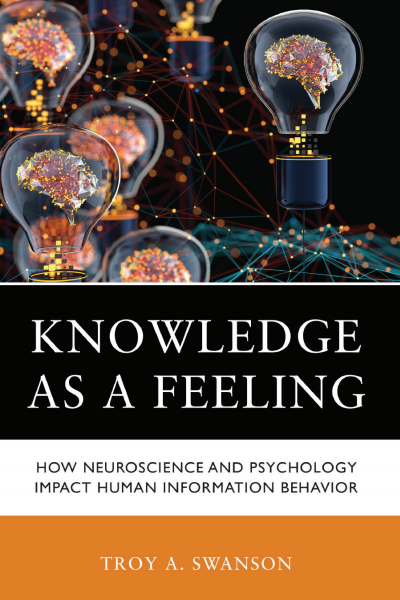
Knowledge as a Feeling
How Neuroscience and Psychology Impact Human Information Behavior
Autor:innen:
Verlag:
2023
Zusammenfassung
Much of information science theory assumes a type of rationality in how individuals process the world around them but the impact of misinformation and disinformation along with the polarization of society into competing information factions calls for new understandings around our relationships to information. Advances in neuroscience and psychology shed new light on how the brain processes information using both conscious and unconscious systems. Current theory in neuroscience emphasizes that the mind is not a unified whole but a network of networks constructing reality to anticipate needs. Knowledge is not a rational process but centers around the feeling of knowing which is the net output of competing brain processes. The feeling of knowing assumes a group context and offers a social epistemological stance that judges knowledge within this group context. With knowledge built into groups, power dynamics allow work to be accomplished but also privilege some group members over others.
The feeling of knowing has significant implications for information science challenging theoreticians and practitioners to reconsider how individuals process information. For information behavior, the feeling of knowing offers a fuller picture looking at conscious and unconscious processing in the production of knowledge. For information literacy, the feeling of knowing sheds light on how individuals evaluate information and synthesize new sources into their existing knowledge. Ultimately, the feeling of knowing leads us toward new reflective and metacognitive tools that help meet this moment in the evolution of our information ecosystem.
This book explores the idea that knowing is a feeling that results from the interactions of the brain’s unconscious and conscious processes and not through the accumulation of facts. It's intended to help librarians, educators, and information scientists better understand what neuroscience and psychology are teaching about what it means to know and how our brain learns.
Schlagworte
Publikation durchsuchen
Bibliographische Angaben
Copyrightjahr
2023
ISBN-Print
978-1-5381-7892-8
ISBN-Online
978-1-5381-7893-5
Verlag
Rowman & Littlefield, Lanham
Sprache
Englisch
Seiten
296
Produkttyp
Monographie
Inhaltsverzeichnis
KapitelSeiten
Contents Kein Zugriff
Foreword Kein Zugriff
Acknowledgments Kein Zugriff
Preface Kein Zugriff
Introduction Kein Zugriff
Disclaimers Kein Zugriff
Chapter One The Networks in Our Heads Kein Zugriff
Chapter Two The Future, Not the Past Kein Zugriff
Chapter Three Bundles of Memories Kein Zugriff
Chapter Four Constructing the World Kein Zugriff
Chapter Five Internal Representations of External Events Kein Zugriff
Chapter Six Giving Meaning to the Moment Kein Zugriff
Chapter Seven A Summary of the Moment Kein Zugriff
Chapter Eight The Orgy of Utter Chaos Kein Zugriff
Chapter Nine The Wisdom of the Body Kein Zugriff
Chapter Ten Our Deep Connections to Other Minds Kein Zugriff
Chapter Eleven The Happiness of Pursuit Kein Zugriff
Chapter Twelve The Feeling of Knowing Kein Zugriff
Chapter Thirteen Exercising Control over Our Mental Lives Kein Zugriff
Chapter Fourteen Our Shortcuts and Bypasses Kein Zugriff
Chapter Fifteen Consistent Choosers Kein Zugriff
Chapter Sixteen Nebulous, Slippery, and Poorly Understood Kein Zugriff
Chapter Seventeen Information Science and the Black Box Kein Zugriff
Chapter Eighteen Patterns of Reality Kein Zugriff
Chapter Nineteen Information Literacy and the Skills of Knowing Kein Zugriff
Chapter Twenty Kuhlthau’s Information Search Process Kein Zugriff
Chapter Twenty-One Dervin’s Sense-Making Kein Zugriff
Chapter Twenty-Two Nahl’s Affective Load Kein Zugriff
Chapter Twenty-Three Everyday Life Information Seeking and Other Theories Kein Zugriff
Chapter Twenty-Four Content Wrapped around a Feeling Kein Zugriff
Epilogue Kein Zugriff Seiten 263 - 272
Bibliography Kein Zugriff Seiten 273 - 288
Index Kein Zugriff Seiten 289 - 294
About the Author Kein Zugriff Seiten 295 - 296
Ähnliche Veröffentlichungen
aus dem Schwerpunkt "Sprachwissenschaft & Linguistik"