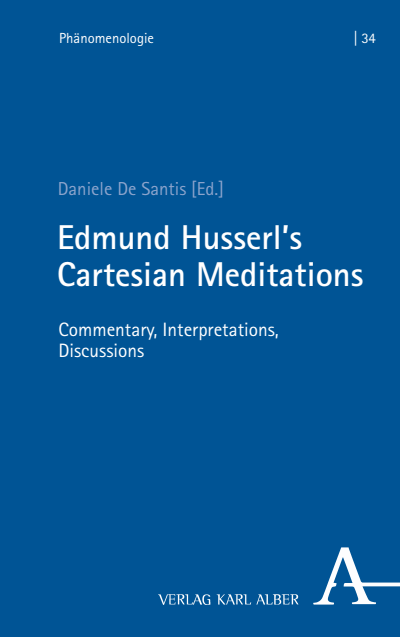
Edmund Husserl’s Cartesian Meditations
Commentary, Interpretations, Discussions- Herausgeber:innen:
- Reihe:
- Phänomenologie, Band 34
- Verlag:
- 2023
Zusammenfassung
Dieses Buch bietet die erste systematische Diskussion von Husserls Cartesianischen Meditationen. Beginnend mit einem Kommentar zum Text der fünf Meditationen werden in den hier veröffentlichten Aufsätzen einige der wichtigsten Begriffe der Husserlschen Philosophie untersucht und geklärt: Intentionalität, Synthese, Evidenz, Intersubjektivität. Darüber hinaus bietet das Buch die erste Diskussion von Husserls später Version der Transzendentalphilosophie und ihrer Relevanz für zeitgenössische Debatten in der kontinentalen und analytischen Philosophie. Mit Beiträgen vonAndreea Smaranda Aldea | Lilian Alweiss | Stefano Bancalari | Jakub Čapek | Emanuela Carta | Daniele De Santis | Aurélien Djian | Saulius Geniusas | Sara Heinämaa | Leonard Ip | Hynek Janoušek | Federico Lijoi | Claudio Majolino | Danilo Manca | Sergio Pérez-Gatica | Witold Plotka | Alice Pugliese | Ignacio Quepons | Rosemary Rizo-Patrón de Lerner | Agustín Serrano de Haro | Wojciech Starzyński
Schlagworte
Publikation durchsuchen
Bibliographische Angaben
- Copyrightjahr
- 2023
- ISBN-Print
- 978-3-495-99554-9
- ISBN-Online
- 978-3-495-99555-6
- Verlag
- Karl Alber, Baden-Baden
- Reihe
- Phänomenologie
- Band
- 34
- Sprache
- Englisch
- Seiten
- 0
- Produkttyp
- Sammelband
Inhaltsverzeichnis
- Titelei/Inhaltsverzeichnis Kein Zugriff Seiten 1 - 8
- Introduction Kein Zugriff Seiten 9 - 20Autor:innen:
- Autor:innen:
- 1. Introduction Kein Zugriff
- 2.1. The »motif« and the »content« Kein Zugriff
- 2.2. The repetition and variation of the »motif« Kein Zugriff
- 2.3. The critique of the »doctrinal content«. Kein Zugriff
- 2.4. Insightfulness and tradition Kein Zugriff
- 2.5. The »motif« and the »motive« Kein Zugriff
- 2.6. The »idea« of science and the »factual« sciences Kein Zugriff
- 3.1. On the manifold beginnings of philosophy Kein Zugriff
- 3.2. The »first beginning«: the Pre-Socratics Kein Zugriff
- 3.3. Towards the »second beginning«: the Sophists Kein Zugriff
- 3.4. The »second beginning«: Socrates and Plato Kein Zugriff
- 3.5. The »third beginning«: Descartes Kein Zugriff
- 3.6. Descartes and the Sophist Kein Zugriff
- 4.1. Splinters Kein Zugriff
- 4.2. Unity and pseudo-unity Kein Zugriff
- 4.3. The Sophist within Kein Zugriff
- 4.4. The scientist without Kein Zugriff
- 5.1. Biographical and structural dependency Kein Zugriff
- 5.2. The variation of the first layer: from »private« to »personal ego« Kein Zugriff
- 5.3. The variation of the first layer and its way to the »deeper« layer Kein Zugriff
- 5.4. The variation of the deeper layer: from »doubt« to »bracketing« Kein Zugriff
- 5.5. The variation of the deeper layer: from »pure« to »transcendental« ego Kein Zugriff
- 5.6. The variation of the deeper layer: from »sheer« to »inadequate« apodicticity Kein Zugriff
- 5.6. The variation of the second layer and its way to the doctrinal critique Kein Zugriff
- 5.7. The critique of the doctrine: »substances« and »axioms« Kein Zugriff
- 5.8. The critique of the doctrine: »solipsism« Kein Zugriff
- 6. Concluding remark. Columbus above the Tartarus—an analogy Kein Zugriff
- Autor:innen:
- Introduction Kein Zugriff
- 1. A broadening of, and deviation from, the Cartesian doctrinal content: The theoretical background of the conceptual network of the horizon Kein Zugriff
- a. Intentionality and reflection Kein Zugriff
- b. Synthesis. Kein Zugriff
- c. Horizon Kein Zugriff
- 3. Intentional analysis Kein Zugriff
- Conclusion Kein Zugriff
- Autor:innen:
- 1. Introduction Kein Zugriff
- 2. The Bracketing of the Natural Attitude Kein Zugriff
- 3. An Inquiry into Existence and Non-Existence Kein Zugriff
- 4. Kant’s response to Hume’s circle Kein Zugriff
- 5. Husserl’s response to Hume’s circle Kein Zugriff
- 6. The limit of ontology Kein Zugriff
- Autor:innen:
- 1. Introduction Kein Zugriff
- 2. Preliminary remarks on transcendental idealism Kein Zugriff
- 3. The essence of the monad Kein Zugriff
- Intermezzo on Ideas I Kein Zugriff
- 4. The structure of the monad Kein Zugriff
- 5. Systematic remarks on transcendental idealism Kein Zugriff
- Autor:innen:
- 1. Introduction Kein Zugriff
- 2. The Problem Kein Zugriff
- 3. The Sphere of Ownness Kein Zugriff
- 4. Living Bodiliness (Leiblichkeit) Kein Zugriff
- 5. Transfer of Sense Kein Zugriff
- Autor:innen:
- 1. Introduction Kein Zugriff
- 2. Unity as a nucleus of presentation (§ 55) Kein Zugriff
- 4. The unity of the monad Kein Zugriff
- 5. Conclusions: Phenomenology and metaphysics Kein Zugriff
- Autor:innen:
- 1. The sublation of the natural attitude Kein Zugriff
- 2. The sublation of the disinterested onlooker Kein Zugriff
- 3. Unconscious life and the method of phenomenology Kein Zugriff
- Autor:innen:
- 1. Introduction Kein Zugriff
- 2. On the historical context of Ingarden’s reading of CM Kein Zugriff
- 3. Ingarden on CM and the realism-idealism controversy Kein Zugriff
- 4. The problem of the beginning Kein Zugriff
- 5. Developments of Ingarden’s reading of CM Kein Zugriff
- 6. Conclusion Kein Zugriff
- Autor:innen:
- 1. Landgrebe and the reception of Husserl’s Cartesianism after World War II Kein Zugriff
- 2. Landgrebe’s argument in Husserl’s departure from Cartesianism Kein Zugriff
- 3. Behind Husserl’s back: Contexts and motivations of Landgrebe’s position Kein Zugriff
- 4. Critical assessment of Landgrebe’s interpretation of the role of horizons in his critique of Husserl’s Cartesianism Kein Zugriff
- Autor:innen:
- 1. Between objectivity and intersubjectivity: Levinas on the place of the Meditations in Husserl’s work Kein Zugriff
- 2. Deduction and dissimulation: The interpretation of the Fifth Meditation Kein Zugriff
- 3. Apodicticity and intersubjective reduction: Extending the Cartesian Meditations beyond Husserl’s phenomenology Kein Zugriff
- Autor:innen:
- 1. Criticism: Husserl made the problem of the other unsolvable Kein Zugriff
- 2. Encountering others: Sharing of the same corporeity and culture Kein Zugriff
- 3. Undifferentiated generality vs. appresentation Kein Zugriff
- 4. »We must return to the cogito« Kein Zugriff
- Conclusion: Sharing and exposure Kein Zugriff
- Autor:innen:
- 1. Introduction Kein Zugriff
- 2. How Cartesian are the Cartesian Meditations? Kein Zugriff
- 3. How descriptive is Husserl’s descriptive phenomenology? Kein Zugriff
- 4. How egological is Husserl’s egology? Kein Zugriff
- 5. Conclusion: Ricoeur and the Husserlian Heresies Kein Zugriff
- Autor:innen: |
- 1.1. Patočka’s stay in Paris and his first encounter with Husserl Kein Zugriff
- 1.2. Deepening the Cartesian theme Kein Zugriff
- 2.1. Descartes as the thinker of the total system of the scientific revolution Kein Zugriff
- 2.2. Descartes as a cunning destroyer of ancient metaphysics Kein Zugriff
- 2.3. Descartes as the founder of psychologized subjectivity Kein Zugriff
- 2.4. Descartes and the end of metaphysics through its instrumentalization Kein Zugriff
- 3.1. The Brentanian roots of Husserl’s Cartesianism Kein Zugriff
- 3.2 Epochē and reduction Kein Zugriff
- 3.3. Aspects of Husserl’s Cartesianism Kein Zugriff
- 4. Conclusion Kein Zugriff
- Autor:innen:
- 1. Where and when Kein Zugriff
- 2. »Kantian« meditations: A dispute about science Kein Zugriff
- 3. »Cartesian« (and »neo-Kantian«) meditations: Grundnorm and intersubjectivity Kein Zugriff
- 4. Kelsen versus Husserl? Kein Zugriff
- Autor:innen:
- 0. Introduction Kein Zugriff
- 1.1 The core thesis Kein Zugriff
- 1.2 The corollary thesis Kein Zugriff
- 2.1 Evidence and the truth-connection Kein Zugriff
- 2.2 The incompatibility of metaphysical realism and the phenomenological perspective Kein Zugriff
- 2.3 An alternative to The Standard View Kein Zugriff
- 3. Why evidence justifies belief Kein Zugriff
- 4. Conclusion Kein Zugriff
- Autor:innen:
- 1. An »ancient staging of an ancient theater« Kein Zugriff
- 2. Two directions: Begründung and Fundierung Kein Zugriff
- 3. Husserl’s two antithetical rational demands Kein Zugriff
- 4. The Cartesian Meditations and the so-called »Cartesian way« Kein Zugriff
- 5. Geltungsfundierung and Genesisfundierung in the Cartesian Meditations Kein Zugriff
- 5. Concluding remarks Kein Zugriff
- Autor:innen:
- 1. Husserl on self-variation and eidetic variation Kein Zugriff
- 2. Reflexion, Ichspaltung, Wiedererfahrung—self-imagining reconsidered Kein Zugriff
- 3. Self-variation anew … Radikale Selbstbesinnung revisited Kein Zugriff
- Autor:innen:
- 1. The powerful work of Jean-François Lavigne Kein Zugriff
- 2. The so-called »ontological psychologism« of the Logical Investigations Kein Zugriff
- 3. The metaphysical postulates of transcendental phenomenology Kein Zugriff
- 4. Absolute affection and transcendence Kein Zugriff
- Autor:innen:
- 1. The Cartesian path Kein Zugriff
- 2. The basic distinction Kein Zugriff
- 3. First philosophy as such Kein Zugriff
- 4. Closing remarks: first philosophy and phenomenology Kein Zugriff
- Autor:innen:
- 1. From »First Philosophy« to »Second Philosophy« Kein Zugriff
- 2. From »Second Philosophy« to »Last Philosophy« Kein Zugriff
- 3. »Last Philosophy« in the Cartesian Meditations Kein Zugriff