, um zu prüfen, ob Sie einen Vollzugriff auf diese Publikation haben.
Ausgabe Teilzugriff

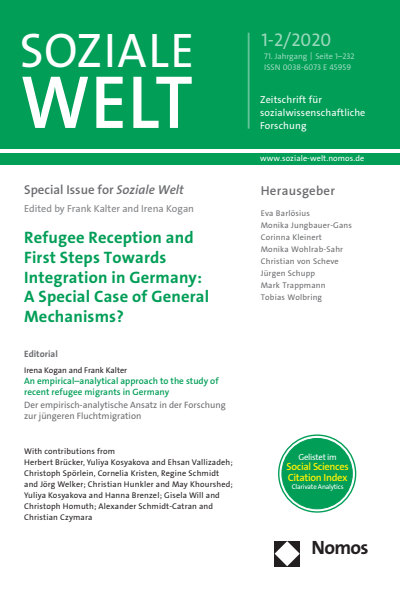
Jahrgang 71 (2020), Heft 1-2

SozW Soziale Welt
Autor:innen:
Zeitschrift:
SozW Soziale Welt
Verlag:
 2020

Über die Zeitschrift

Die Soziale Welt ist eine der großen, auch im Ausland gelesenen Fachzeitschriften innerhalb der deutschen Soziologie. Sie bringt empirische und theoretische Arbeiten aus allen Bereichen des Faches und versucht auf diese Weise, die Entwicklung der Soziologie einerseits zu spiegeln und ihr andererseits auch neue Impulse zu geben. Dies geschieht neben den viermal pro Jahr erscheinenden regulären Heften auch durch die Arbeit an Sonderbänden mit einheitlicher Thematik. Die Zeitschrift "Soziale Welt" wendet sich an Soziologen, Sozialwissenschaftler, Interessierte allgemein. Homepage: www.soziale-welt.de
Publikation durchsuchen


Bibliographische Angaben

ISSN-Print
0038-6073
ISSN-Online
2942-3414
Verlag
Nomos, Baden-Baden
Sprache
Deutsch
Produkttyp
Ausgabe

Artikel

Cover der Ausgabe: SozW Soziale Welt Jahrgang 71 (2020), Heft 1-2
Artikel
Kein Zugriff

Seite 1 - 2
Nomos Verlagsgesellschaft mbH & Co. KG, Baden-Baden 2020

Cover der Ausgabe: SozW Soziale Welt Jahrgang 71 (2020), Heft 1-2
Artikel
Open Access Vollzugriff

Seite 3 - 23
Nomos Verlagsgesellschaft mbH & Co. KG, Baden-Baden 2020
Autor:innen:

Cover der Ausgabe: SozW Soziale Welt Jahrgang 71 (2020), Heft 1-2
Artikel
Open Access Vollzugriff

Seite 24 - 53
Nomos Verlagsgesellschaft mbH & Co. KG, Baden-Baden 2020
Autor:innen:

Cover der Ausgabe: SozW Soziale Welt Jahrgang 71 (2020), Heft 1-2
Artikel
Kein Zugriff

Seite 54 - 89
Nomos Verlagsgesellschaft mbH & Co. KG, Baden-Baden 2020
Autor:innen:

Cover der Ausgabe: SozW Soziale Welt Jahrgang 71 (2020), Heft 1-2
Artikel
Kein Zugriff

Seite 90 - 122
Nomos Verlagsgesellschaft mbH & Co. KG, Baden-Baden 2020
Autor:innen:

Cover der Ausgabe: SozW Soziale Welt Jahrgang 71 (2020), Heft 1-2
Artikel
Open Access Vollzugriff

Seite 123 - 159
Nomos Verlagsgesellschaft mbH & Co. KG, Baden-Baden 2020
Autor:innen:

Cover der Ausgabe: SozW Soziale Welt Jahrgang 71 (2020), Heft 1-2
Artikel
Kein Zugriff

Seite 160 - 200
Nomos Verlagsgesellschaft mbH & Co. KG, Baden-Baden 2020
Autor:innen:

Cover der Ausgabe: SozW Soziale Welt Jahrgang 71 (2020), Heft 1-2
Artikel
Kein Zugriff

Seite 201 - 232
Nomos Verlagsgesellschaft mbH & Co. KG, Baden-Baden 2020
Autor:innen:

Literaturverzeichnis (422 Einträge)

  1. Ager, Alastair & Strang, Alison (2008): Understanding integration: a conceptual framework. Journal of Refugee Studies 21(2): 166-191. Google Scholar öffnen doi.org/10.5771/0038-6073-2020-1-2-3
  2. Alba, Richard & Foner, Nancy (2015): Strangers No More. Immigration and the Challenges of Integration in North America and Western Europe. Princeton/Oxford: Princeton University Press. Google Scholar öffnen doi.org/10.5771/0038-6073-2020-1-2-3
  3. Alba, Richard & Nee, Victor (1997): Rethinking assimilation theory for a new era of immigration. International Migration Review 31(4): 826-874. Google Scholar öffnen doi.org/10.5771/0038-6073-2020-1-2-3
  4. Allsop, Jennifer, Sigona, Nando & Phillimore, Jenny (2014): Poverty among refugees and asylum seekers in the UK. An evidence and policy review. IRIS Working Paper Series No. 1/2014. Birmingham: Institute for Research into Superdiversity. Google Scholar öffnen doi.org/10.5771/0038-6073-2020-1-2-3
  5. Aycan, Zeynep & Berry, John W. (1996): Impact of employment-related experiences on immigrants’ psychological well-being and adaptation to Canada. Canadian Journal of Behavioural Science/Revue Canadienne des Sciences du Comportement 28(3): 240-251. Google Scholar öffnen doi.org/10.5771/0038-6073-2020-1-2-3
  6. Aydemir, Abdurrahman (2011): Immigrant selection and short-term labor market outcomes by visa category. Journal of Population Economics 24(2): 451-475. Google Scholar öffnen doi.org/10.5771/0038-6073-2020-1-2-3
  7. Bakker, Linda, Engbersen, Godfried & Dagevos, Jaco (2014): In exile and in touch. Comparative Migration Studies 2(3): 261-282. Google Scholar öffnen doi.org/10.5771/0038-6073-2020-1-2-3
  8. Bansak, Kirk, Hainmueller, Jens & Hangartner, Dominik (2016): How economic, humanitarian, and religious concerns shape European attitudes toward asylum seekers. Science 354(6309): 217-222. Google Scholar öffnen doi.org/10.5771/0038-6073-2020-1-2-3
  9. Basran, Gurcharn S. & Zong, Li (1998): Devaluation of foreign credentials as perceived by visible minority professional immigrants. Canadian Ethnic Studies 30(3): 6-23. Google Scholar öffnen doi.org/10.5771/0038-6073-2020-1-2-3
  10. Beiser, Morton (2006): Longitudinal research to promote effective refugee resettlement. Transcultural Psychiatry 43(1): 56-71. Google Scholar öffnen doi.org/10.5771/0038-6073-2020-1-2-3
  11. Bevelander, Pieter (2011): The employment integration of resettled refugees, asylum claimants, and family reunion migrants in Sweden. Refugee Survey Quarterly 30(1): 22-43. Google Scholar öffnen doi.org/10.5771/0038-6073-2020-1-2-3
  12. Bevelander, Pieter (2016): Integrating refugees into labor markets. IZA World of Labor No. 269. Bonn: IZA Institute of Labor Economics. Google Scholar öffnen doi.org/10.5771/0038-6073-2020-1-2-3
  13. Bevelander, Pieter & Pendakur, Ravi (2009): The employment attachment of resettled refugees, refugees and family reunion migrants in Sweden, in: Pieter Bevelander, Mirjam Hagström & Sofia Rönnqvist (Hrsg.), Resettled and Included? The Employment Integration of Resettled Refugees in Sweden. Malmö: Malmö University. S. 227-245. Google Scholar öffnen doi.org/10.5771/0038-6073-2020-1-2-3
  14. Bevelander, Pieter & Pendakur, Ravi (2014): The labour market integration of refugee and family reunion immigrants: a comparison of outcomes in Canada and Sweden. Journal of Ethnic and Migration Studies 40(5): 689-709. Google Scholar öffnen doi.org/10.5771/0038-6073-2020-1-2-3
  15. Blossfeld, Hans-Peter, Roßbach, Hans-Günther & von Maurice, Jutta (Hrsg.) (2011): Education as a lifelong process. The German National Education Panel Study (NEPS). Zeitschrift für Erziehungswissenschaft 14(2). Google Scholar öffnen doi.org/10.5771/0038-6073-2020-1-2-3
  16. Brahmbhatt, Kavita, Atfield, Gaby, Irving, Helene, Lee, James & O’Toole, Therese (2007): Refugees’ Experiences of Integration. Policy Related Findings on Employment, ESOL and Vocational Training. Birmingham: Refugee Council and University of Birmingham. Google Scholar öffnen doi.org/10.5771/0038-6073-2020-1-2-3
  17. Brücker, Herbert, Rother, Nina & Schupp, Jürgen (Hrsg.) (2017): IAB-BAMF-SOEP Befragung von Geflüchteten 2016. Studiendesign, Feldergebnisse sowie Analysen zu schulischer wie beruflicher Qualifikation, Sprachkenntnissen sowie kognitiven Potenzialen. DIW Berlin: Politikberatung kompakt No. 123. Berlin: Deutsches Institut für Wirtschaftsforschung. Google Scholar öffnen doi.org/10.5771/0038-6073-2020-1-2-3
  18. Brücker, Herbert, Jaschke, Philipp & Kosyakova, Yuliya (2019): Refugee migration to Germany revisited: some lessons on the integration of asylum seekers. XXI European Conference of the fRDB on “How to manage the refugee crisis”. Google Scholar öffnen doi.org/10.5771/0038-6073-2020-1-2-3
  19. Cheung, Sin Y. & Phillimore, Jenny (2017): Gender and refugee integration: a quantitative analysis of integration and social policy outcomes. Journal of Social Policy 46(2): 211-230. Google Scholar öffnen doi.org/10.5771/0038-6073-2020-1-2-3
  20. Chiswick, Barry R. (2000): Are immigrants favorably self-selected? An economic analysis. IZA Discussion Paper No. 131. Bonn: IZA Institute of Labor Economics. Google Scholar öffnen doi.org/10.5771/0038-6073-2020-1-2-3
  21. Connor, Phillip (2010): Explaining the refugee gap: economic outcomes of refugees versus other immigrants. Journal of Refugee Studies 23(3): 377-397. Google Scholar öffnen doi.org/10.5771/0038-6073-2020-1-2-3
  22. Cortes, Kalena E. (2004): Are refugees different from economic immigrants? Some empirical evidence on the heterogeneity of immigrant groups in the United States. Review of Economics and Statistics 86(2): 465-480. Google Scholar öffnen doi.org/10.5771/0038-6073-2020-1-2-3
  23. Cowling, Misha M., Anderson, Joel R. & Ferguson, Rose (2019): Prejudice-relevant correlates of attitudes towards refugees: a meta-analysis. Journal of Refugee Studies 32(3): 502–524. Google Scholar öffnen doi.org/10.5771/0038-6073-2020-1-2-3
  24. Crawley, Heaven & Skleparis, Dimitris (2018): Refugees, migrants, neither, both: categorical fetishism and the politics of bounding in Europe’s ‘migration crisis’. Journal of Ethnic and Migration Studies 44(1): 48-64. Google Scholar öffnen doi.org/10.5771/0038-6073-2020-1-2-3
  25. Crisp, Jeff (1999): Policy Challenges of the New Diasporas: Migrant Networks and Their Impact on Asylum Flows and Regimes. Geneva: Policy Research Unit, UNHCR. Google Scholar öffnen doi.org/10.5771/0038-6073-2020-1-2-3
  26. Czymara, Christian S. & Schmidt-Catran, Alexander W. (2017): Refugees unwelcome? Changes in the public acceptance of immigrants and refugees in Germany in the course of Europe’s ‘immigration crisis’. European Sociological Review 33(6): 735-751. Google Scholar öffnen doi.org/10.5771/0038-6073-2020-1-2-3
  27. DeVoretz, Don J., Pivnenko, Sergiy & Beiser, Morton (2004): The economic experiences of refugees in Canada. IZA Discussion Paper No. 1088. Bonn: IZA Institute of Labor Economics. Google Scholar öffnen doi.org/10.5771/0038-6073-2020-1-2-3
  28. De Vroome, Thomas & Van Tubergen, Frank (2010): The employment experience of refugees in the Netherlands. International Migration Review 44(2): 376-403. Google Scholar öffnen doi.org/10.5771/0038-6073-2020-1-2-3
  29. Düvell, Franck (2006): Europäische und internationale Migration. Einführung in historische, soziologische und politische Analysen. Münster/Hamburg: LIT Verlag. Google Scholar öffnen doi.org/10.5771/0038-6073-2020-1-2-3
  30. Dumper, Hildegard (2002): Missed Opportunities: A Skills Audit of Refugee Women in London from the Teaching, Nursing and Medical Professions. London: Greater London Authority. Google Scholar öffnen doi.org/10.5771/0038-6073-2020-1-2-3
  31. Dustmann, Christian, Fasani, Francesco, Frattini, Tommaso, Minale, Luigi & Schönberg, Uta (2017): On the economics and politics of refugee migration. Economic Policy 32(91): 497-550. Google Scholar öffnen doi.org/10.5771/0038-6073-2020-1-2-3
  32. Esser, Hartmut (2001): Soziologie. Spezielle Grundlagen. Band 6, Sinn und Kultur. Frankfurt/New York: Campus-Verlag. Google Scholar öffnen doi.org/10.5771/0038-6073-2020-1-2-3
  33. Esses, Victoria M., Hamilton, Leah K. & Gaucher, Danielle (2017): The global refugee crisis: empirical evidence and policy implications for improving public attitudes and facilitating refugee resettlement. Social Issues and Policy Review 11(1): 78-123. Google Scholar öffnen doi.org/10.5771/0038-6073-2020-1-2-3
  34. Feller, Erika (2005): Refugees are not migrants. Refugee Survey Quarterly 24(4): 27-35. Google Scholar öffnen doi.org/10.5771/0038-6073-2020-1-2-3
  35. FitzGerald, David S. & Arar, Rawan (2018): The sociology of refugee migration. Annual Review of Sociology 44: 387-406. Google Scholar öffnen doi.org/10.5771/0038-6073-2020-1-2-3
  36. Gerhards, Jürgen, Hans, Silke & Schupp, Jürgen (2016): German public opinion on admitting refugees. DIW Economic Bulletin 6(21): 243-249. Google Scholar öffnen doi.org/10.5771/0038-6073-2020-1-2-3
  37. Ghorashi, Halleh (2005): Agents of change or passive victims: the impact of welfare states (the case of the Netherlands) on refugees. Journal of Refugee Studies 18(2): 181-198. Google Scholar öffnen doi.org/10.5771/0038-6073-2020-1-2-3
  38. Hainmueller, Jens, Hangartner, Dominik & Lawrence, Duncan (2016): When lives are put on hold: Lengthy asylum processes decrease employment among refugees. Science Advances 2(8): e1600432. Google Scholar öffnen doi.org/10.5771/0038-6073-2020-1-2-3
  39. Hangartner, Dominik, Dinas, Elias, Marbach, Moritz, Matakos, Konstantinos & Xefteris, Dimitrios (2019): Does exposure to the refugee crisis make natives more hostile?. American Political Science Review 113(2): 442-455. Google Scholar öffnen doi.org/10.5771/0038-6073-2020-1-2-3
  40. Hatton, Timothy J. (2013): Refugee and asylum migration, in: Amelie F. Constant & Klaus F. Zimmermann (Hrsg.), International Handbook on the Economics of Migration. Cheltenham/ Northampton: Edward Elgar Publishing. S. 453-469. Google Scholar öffnen doi.org/10.5771/0038-6073-2020-1-2-3
  41. Hein, Jeremy (1993): Refugees, immigrants, and the state. Annual Review of Sociology 19: 43-59. Hercowitz-Amir, Adi & Raijman, Rebeca (2019): Restrictive borders and rights: attitudes of the Google Scholar öffnen doi.org/10.5771/0038-6073-2020-1-2-3
  42. Danish public to asylum seekers. Ethnic and Racial Studies: 1-20. Google Scholar öffnen doi.org/10.5771/0038-6073-2020-1-2-3
  43. Jaschke, Philipp & Kosyakova, Yuliya (2019): Does facilitated access to the health system improve asylum-seekers’ health outcomes? Evidence from a quasi-experiment. IAB-Discussion Paper No. 7/2019. Nürnberg: Institut für Arbeitsmarkt- und Berufsforschung (IAB). Google Scholar öffnen doi.org/10.5771/0038-6073-2020-1-2-3
  44. Jorden, Skye, Matheson, Kimberly & Anisman, Hymie (2009): Supportive and unsupportive social interactions in relation to cultural adaptation and psychological distress among Somali refugees exposed to collective or personal traumas. Journal of Cross-Cultural Psychology 40(5): 853-874. Google Scholar öffnen doi.org/10.5771/0038-6073-2020-1-2-3
  45. Kalter, Frank (2008): Stand, Herausforderungen und Perspektiven der empirischen Migrationsforschung, in: Frank Kalter (Hrsg.), Migration und Integration. Kölner Zeitschrift für Soziologie und Sozialpsychologie Sonderheft 48/2008. Wiesbaden: VS Verlag. S. 11–36. Google Scholar öffnen doi.org/10.5771/0038-6073-2020-1-2-3
  46. Kleist, J. Olaf, Engler, Marcus, Etzold, Benjamin, Mielke, Katja, Oltmer, Jochen, Pott, Andreas, Schetter, Conrad & Wirkus, Lars (2019): Flucht‐ und Flüchtlingsforschung in Deutschland: Eine Bestandsaufnahme. Abschlussbericht Verbundprojekt. Flucht: Forschung und Transfer. Bonn/ Osnabrück: IMIS/BICC. Google Scholar öffnen doi.org/10.5771/0038-6073-2020-1-2-3
  47. Kogan, Irena (2007): Working through Barriers. Host Country Institutions and Immigrant Labour Market Performance in Europe. Dordrecht: Springer. Google Scholar öffnen doi.org/10.5771/0038-6073-2020-1-2-3
  48. Kogan, Irena. (2016): Arbeitsmarktintegration von Zuwanderern, in Heinz U. Brinkmann und Martina Sauer (Hrsg.), Einwanderungsgesellschaft Deutschland. Entwicklung und Stand der Integration. Wiesbaden: Springer VS. S. 177-200. Google Scholar öffnen doi.org/10.5771/0038-6073-2020-1-2-3
  49. Koser, Khalid (1997): Social networks and the asylum cycle: the case of Iranians in the Netherlands. International Migration Review 31(3): 591-611. Google Scholar öffnen doi.org/10.5771/0038-6073-2020-1-2-3
  50. Koser, Khalid (2002): From refugees to transnational communities?, in: Nadje Al-Ali & Kha lid Koser (Hrsg.), New Approaches to Migration? Transnational Communities and the Transformation of Home. London: Routledge. S. 138-152. Google Scholar öffnen doi.org/10.5771/0038-6073-2020-1-2-3
  51. Koyama, Jill (2014): Constructing gender: refugee women working in the United States. Journal of Refugee Studies 28(2): 258-275. Google Scholar öffnen doi.org/10.5771/0038-6073-2020-1-2-3
  52. Krahn, Harvey, Derwing, Tracey, Mulder, Marlene & Wilkinson, Lori (2000): Educated and underemployed: refugee integration into the Canadian labour market. International Journal of Migration and Integration 1(1): 59–84. Google Scholar öffnen doi.org/10.5771/0038-6073-2020-1-2-3
  53. Khourshed, May, Hunkler, Christian, Méango, Romuald & Börsch-Supan, Axel (2019): Qualifications, potentials and life courses of Syrian asylum seekers in Germany. MEA Discussion Papers No. 01-2019. München: Munich Center for the Economics of Aging. Google Scholar öffnen doi.org/10.5771/0038-6073-2020-1-2-3
  54. Laban, Cornelis J., Gernaat, Hajo B., Komproe, Ivan H., Schreuders, Bettine A. & De Jong, Joop Google Scholar öffnen doi.org/10.5771/0038-6073-2020-1-2-3
  55. T. (2004): Impact of a long asylum procedure on the prevalence of psychiatric disorders in Iraqi asylum seekers in The Netherlands. The Journal of Nervous and Mental Disease 192(12): 843-851. Google Scholar öffnen doi.org/10.5771/0038-6073-2020-1-2-3
  56. Lomba, Sylvie D. (2010): Legal status and refugee integration: a UK perspective. Journal of Refugee Studies 23(4): 415-436. Google Scholar öffnen doi.org/10.5771/0038-6073-2020-1-2-3
  57. Long, Katy (2013): When refugees stopped being migrants: movement, labour and humanitarian protection. Migration Studies 1(1): 4–26. Google Scholar öffnen doi.org/10.5771/0038-6073-2020-1-2-3
  58. Maggini, Nicola & Fernández G. G., Eva (2019): Politicization of solidarity toward out-groups: the case of refugees. American Behavioral Scientist 63(4): 475-491. Google Scholar öffnen doi.org/10.5771/0038-6073-2020-1-2-3
  59. Massey, Douglas S., Arango, Joaquin, Hugo, Graeme, Kouaouci, Ali, Pellegrino, Adela & Taylor, Google Scholar öffnen doi.org/10.5771/0038-6073-2020-1-2-3
  60. J. Edward (1998): Worlds in Motion. Understanding International Migration at the End of the Millennium. Oxford: Oxford University Press. Google Scholar öffnen doi.org/10.5771/0038-6073-2020-1-2-3
  61. Murray, Kate E. & Marx, David M. (2013): Attitudes toward unauthorized immigrants, authorized immigrants, and refugees. Cultural Diversity and Ethnic Minority Psychology 19(3): 332-341. Google Scholar öffnen doi.org/10.5771/0038-6073-2020-1-2-3
  62. Nickerson, Angela M. & Louis, Winnifred R. (2008): Nationality versus humanity? Personality, identity, and norms in relation to attitudes toward asylum seekers. Journal of Applied Social Psychology 38(3): 796-817. Google Scholar öffnen doi.org/10.5771/0038-6073-2020-1-2-3
  63. Pehrson, Samuel, Brown, Rupert & Zagefka, Hanna (2009): When does national identification lead to the rejection of immigrants? Cross‐sectional and longitudinal evidence for the role of essentialist in‐group definitions. British Journal of Social Psychology 48(1): 61-76. Google Scholar öffnen doi.org/10.5771/0038-6073-2020-1-2-3
  64. Pehrson, Samuel & Green, Eva G. T. (2010): Who we are and who can join us: national identity content and entry criteria for new immigrants. Journal of Social Issues 66(4): 695-716. Google Scholar öffnen doi.org/10.5771/0038-6073-2020-1-2-3
  65. Phillimore, Jenny (2011): Refugees, acculturation strategies, stress and integration. Journal of Social Policy 40(3): 575-593. Google Scholar öffnen doi.org/10.5771/0038-6073-2020-1-2-3
  66. Pittaway, Eileen & Bartolomei, Linda (2001): Refugees, race, and gender: the multiple discrimination against refugee women. Refuge: Canada's Journal on Refugees 19(6): 21-32. Google Scholar öffnen doi.org/10.5771/0038-6073-2020-1-2-3
  67. Portes, Alejandro & Bach, Robert L. (1985): Latin Journey. Cuban and Mexican Immigrants in the United States. Berkeley/Los Angeles/London: University of California Press. Google Scholar öffnen doi.org/10.5771/0038-6073-2020-1-2-3
  68. Portes, Alejandro & Zhou, Min (1993): The new second generation: segmented assimilation and its variants. The Annals of the American Academy of Political and Social Science 530(1): 74-96. Google Scholar öffnen doi.org/10.5771/0038-6073-2020-1-2-3
  69. Reitz, Jeffrey G. (1998): Warmth of the Welcome. The Social Causes of Economic Success for Immigrants in Different Nations and Cities. Boulder: Westview Press. Google Scholar öffnen doi.org/10.5771/0038-6073-2020-1-2-3
  70. Rooth, Dan-Olof (1999): Refugee Immigrants in Sweden: Educational Investments and Labour Market Integration. Lund: Lund University, Department of Economics. Google Scholar öffnen doi.org/10.5771/0038-6073-2020-1-2-3
  71. Ryan, Dermot A., Benson, Ciaran A. & Dooley, Barbara A. (2008): Psychological distress and the asylum process: a longitudinal study of forced migrants in Ireland. The Journal of Nervous and Mental Disease 196(1): 37-45. Google Scholar öffnen doi.org/10.5771/0038-6073-2020-1-2-3
  72. Scalettaris, Giulia (2007): Refugee studies and the international refugee regime: a reflection on a desirable separation. Refugee Survey Quarterly 26(3): 36-50. Google Scholar öffnen doi.org/10.5771/0038-6073-2020-1-2-3
  73. Schweitzer, Robert, Perkoulidis, Shelley, Krome, Sandra, Ludlow, Christopher & Ryan, Melanie (2005): Attitudes towards refugees: the dark side of prejudice in Australia. Australian Journal of Psychology 57(3): 170-179. Google Scholar öffnen doi.org/10.5771/0038-6073-2020-1-2-3
  74. Siegert, Manuel (2008): Schulische Bildung von Migranten in Deutschland. Working Paper der Forschungsgruppe des Bundesamtes No. 13. Nürnberg: Bundesamt für Migration und Flüchtlinge. Google Scholar öffnen doi.org/10.5771/0038-6073-2020-1-2-3
  75. Siegert, Manuel & Olszenka, Ninja (2016): Ethnische Ungleichheit in der Sekundarstufe I, in: Claudia Diehl, Christian Hunkler & Cornelia Kristen (Hrsg.), Ethnische Ungleichheiten im Bildungsverlauf. Wiesbaden: Springer VS. S. 543-596. Google Scholar öffnen doi.org/10.5771/0038-6073-2020-1-2-3
  76. Siegert, Manuel & Roth, Tobias (2013): Söhne bevorzugt? Geschlechtsspezifische Unterschiede beim Gymnasialbesuch türkischstämmiger Schülerinnen und Schüler. Kölner Zeitschrift für Soziologie und Sozialpsychologie 65(1): 49-72. Google Scholar öffnen doi.org/10.5771/0038-6073-2020-1-2-3
  77. Swan, Neil, Auer, Ludwig, Chenard, Denis, de Plaa, Angelique, de Silva, Arnold, Palmer, Douglas, Serjak, John & Milobar, Lorraine (1991): Economic and social impacts of immigration: a research report prepared for the economic council of Canada. Cat. No. EC22-176/ 1991E. Ottawa: Supply and Services Canada. Google Scholar öffnen doi.org/10.5771/0038-6073-2020-1-2-3
  78. Takeda, Joe (2000): Psychological and economic adaptation of Iraqi adult male refugees: implications for social work practice. Journal of Social Service Research 26(3): 1–21. Google Scholar öffnen doi.org/10.5771/0038-6073-2020-1-2-3
  79. Wilkinson, Lori (2008): Labor market transitions of immigrant‐born, refugee‐born, and Canadian‐born youth. Canadian Review of Sociology/Revue Canadienne de Sociologie 45(2): 151-176. Google Scholar öffnen doi.org/10.5771/0038-6073-2020-1-2-3
  80. Will, Gisela, Gentile, Raffaela, Heinritz, Florian & von Maurice, Jutta (2018): ReGES – Refugees in the German Educational System: Forschungsdesign, Stichprobenziehung und Ausschöpfung der ersten Welle. LIfBi Working Paper No. 75. Bamberg: Leibniz-Institut für Bildungsverläufe. Google Scholar öffnen doi.org/10.5771/0038-6073-2020-1-2-3
  81. Williams, Lucy (2006): Social networks of refugees in the United Kingdom: tradition, tactics and new community spaces. Journal of Ethnic and Migration Studies 32(5): 865-879. Google Scholar öffnen doi.org/10.5771/0038-6073-2020-1-2-3
  82. AFAD (2013): Syrian Refugees in Turkey, 2013, Field Survey Results. Republic of Turkey Prime Ministry, Disaster and Emergency Management Presidency (AFAD). (https:// data2.unhcr.org/en/documents/download/40157, accessed: February 2, 2018). Google Scholar öffnen doi.org/10.5771/0038-6073-2020-1-2-24
  83. Aksoy, Cevat Giray & Poutvaara, Panu (2019): Refugees’ Self-Selection into Europe: Who Migrates Where? Ifo Working Papers (289). Google Scholar öffnen doi.org/10.5771/0038-6073-2020-1-2-24
  84. Alba, Richard & Nee, Victor (1997): Rethinking Assimilation Theory for a New Era of Immigration. International Migration Review 31(4): 826–74. Google Scholar öffnen doi.org/10.5771/0038-6073-2020-1-2-24
  85. Anon.(2015): Merkel at Her Limit. Germany’s Refugee Crisis. The Economist (October, 10). Retrieved November 11, 2019 (https://www.economist.com/europe/2015/10/10/merkel-at-her Google Scholar öffnen doi.org/10.5771/0038-6073-2020-1-2-24
  86. -limit). Google Scholar öffnen doi.org/10.5771/0038-6073-2020-1-2-24
  87. BAMF (2016 a): Hochschulzugang Und Studium von Flüchtlingen. Eine Handreichung Für Hochschulen Und Studentenwerke. Nürnberg. Google Scholar öffnen doi.org/10.5771/0038-6073-2020-1-2-24
  88. BAMF (2016 b): The Stages of the Asylum Procedure. An Overview of the Individual Procedural Steps and the Legal Basis. Nuremberg. Google Scholar öffnen doi.org/10.5771/0038-6073-2020-1-2-24
  89. BAMF (2017): Das Bundesamt in Zahlen 2016. Asy, Migration Und Integration [The Federal Office in Figures 2016. Asylum, Migration and Integration]. Nuremberg. Google Scholar öffnen doi.org/10.5771/0038-6073-2020-1-2-24
  90. BAMF (2019): Learning German. Retrieved November 11, 2019 (http://www.bamf.de/EN/Will kommen/DeutschLernen/deutschlernen-node.html). Google Scholar öffnen doi.org/10.5771/0038-6073-2020-1-2-24
  91. Black, Sandra E. & Spitz-Oener, Alexandra (2010): Explaining Women’s Success: Technological Change and the Skill Content of Women’s Work. Review of Economics and Statistics 92(1): 187– 94. Google Scholar öffnen doi.org/10.5771/0038-6073-2020-1-2-24
  92. BMBF (2018): Bildung Und Forschung in Zahlen 2017 [Education and Research in Figures 2017]. Bundesministerin Für Bildung Und Forschung [Federal Ministry of Education and Research]. Retrieved August 15, 2018 (https://www.bmbf.de/pub/Education_and_Research_in Google Scholar öffnen doi.org/10.5771/0038-6073-2020-1-2-24
  93. _Figures_2017.pdf). Google Scholar öffnen doi.org/10.5771/0038-6073-2020-1-2-24
  94. BMI (2017): 280.000 Asylsuchende Im Jahr 2016 [280.000 Asylum-Seekers in the Year 2016]. Bundes Ministerium Des Innern, Für Bau Und Heimat, BMI [Federal Ministry for the Interior, Building, and Community]. Retrieved March 28, 2017 (http://www.bmi.bund.de/SharedDocs/ Pressemitteilungen/DE/2017/01/asylantraege-2016). Google Scholar öffnen doi.org/10.5771/0038-6073-2020-1-2-24
  95. Borjas, George J (1987): Self-Selection and the Earnings of Immigrants. The American Economic Review 77(4): 531–53. Google Scholar öffnen doi.org/10.5771/0038-6073-2020-1-2-24
  96. Brenzel, Hanna, Brücker, Herbert, Guichard, Lucas, Fendel, Tanja, Jaschke, Philipp, Keita, Sekou, Kosyakova, Yuliya, Trübswetter, Parvati & Vallizadeh, Ehsan (2018): Endbericht Für Das Projekt “Flüchtlingsmonitoring.” Google Scholar öffnen doi.org/10.5771/0038-6073-2020-1-2-24
  97. Brenzel, Hanna & Kosyakova, Yuliya (2019): Geflüchtete Auf Dem Deutschen Arbeitsmarkt. Längere Asylverfahren Verzögern Integration Und Spracherwerb. IAB Kurzbericht 2019(6): 1– 8. Google Scholar öffnen doi.org/10.5771/0038-6073-2020-1-2-24
  98. Brücker, Herbert, Croisier, Johannes, Kosyakova, Yuliya, Kröger, Hannes, Pietrantuono, Giuseppe, Rother, Nina & Schupp, Jürgen (2019): Second Wave of the IAB-BAMF-SOEP Survey: Language Skills and Employment Rate of Refugees Improving with Time. IAB Brief Report 2019(3): 1–19. Google Scholar öffnen doi.org/10.5771/0038-6073-2020-1-2-24
  99. Brücker, Herbert, Glitz, Albrecht, Lerche, Adrian & Romiti, Agnese (2018): Occupational Recognition and Immigrant Labor Market Outcomes. 12030. Google Scholar öffnen doi.org/10.5771/0038-6073-2020-1-2-24
  100. Brücker, Herbert, Rother Nina & Schupp, Jürgen (2017 eds.): IAB-BAMF-SOEP-Befragung von Geflüchteten 2016: Studiendesign, Feldergebnisse Sowie Analysen Zu Schulischer Wie Berufl Icher Qualifikation, Sprachkenntnissen Sowie Kognitiven Potenzialen. Vol. 13/2017. Berlin: DIW Berlin, German Institute for Economic Research. Google Scholar öffnen doi.org/10.5771/0038-6073-2020-1-2-24
  101. Brücker, Herbert, Rother, Nina, Schupp, Jürgen, Babka von Gostomski, Christian, Böhm, Axel, Fendel, Tanja, Friedrich, Martin, Giesselmann, Marco, Kosyakova, Yuliya, Kroh, Martin, Kühne, Simon, Liebau, Elisabeth, Richter, David, Romiti, Agnese, Schacht, Diana, Scheible, Jana A., Schmelzer, Paul, Siegert, Manuel, Sirries, Steffen, Trübswetter, Parvati & Vallizadeh, Ehsan (2016): Forced Migration, Arrival in Germany, and First Steps toward Integration. DIW Economic Bulletin 6(48): 541–56. Google Scholar öffnen doi.org/10.5771/0038-6073-2020-1-2-24
  102. Chiswick, Barry R (1999): Are Immigrants Favorably Self-Selected? The American Economic Review 89(2): 181–85. Google Scholar öffnen doi.org/10.5771/0038-6073-2020-1-2-24
  103. Cohen, Roger (2015): Germany, Refugee Nation. The New York Times (December, 21). Retrieved November 11, 2019 (https://www.nytimes.com/2015/12/22/opinion/germany-refugee-nation. html). Google Scholar öffnen doi.org/10.5771/0038-6073-2020-1-2-24
  104. Crisp, Jeff (1999): Who Has Counted the Refugees? UNHCR and the Politics of Numbers. Policy Research Unit UNHCR (12): 33–62. Google Scholar öffnen doi.org/10.5771/0038-6073-2020-1-2-24
  105. DESTATIS (1953): Statistisches Taschenbuch Über Die Heimatvertriebenen in Der Bundesrepublik Deutschland Und Westberlin. Wiesbaden: Statistisches Bundesamt (DESTATIS, Federal Statistical Office). Google Scholar öffnen doi.org/10.5771/0038-6073-2020-1-2-24
  106. DESTATIS (2017): Press Release Number 290/17, August 23, 2017. Wiesbaden: Statistisches Bundesamt (DESTATIS, Federal Statistical Office). Google Scholar öffnen doi.org/10.5771/0038-6073-2020-1-2-24
  107. DESTATIS (2018 a): Bildungsstand Der Bevölkerung. Ergebnisse Des Mikrozensus 2017. Wiesbaden: Statistisches Bundesamt (DESTATIS, Federal Statistical Office). Google Scholar öffnen doi.org/10.5771/0038-6073-2020-1-2-24
  108. DESTATIS (2018 b): Press Report No. 303, August 15, 2018. Wiesbaden: Statistisches Bundesamt (DESTATIS, Federal Statistical Office). Google Scholar öffnen doi.org/10.5771/0038-6073-2020-1-2-24
  109. DIHK (2019): Netzwerk Unternehmen Integrieren Flüchtlinge. Retrieved November 11, 2019 (https://www.unternehmen-integrieren-fluechtlinge.de/.). Google Scholar öffnen doi.org/10.5771/0038-6073-2020-1-2-24
  110. Dustmann, Christian, Fasani, Francesco, Frattini, Tommaso, Minale, Luigi & Schönberg, Uta (2017): On the Economics and Politics of Refugee Migration. Economic Policy 32(91): 497– 550. Google Scholar öffnen doi.org/10.5771/0038-6073-2020-1-2-24
  111. Dustmann, Christian, Fitzenberger, Bernd, Schönberg, Uta & Spitz-Oener, Alexandra (2014): From Sick Man of Europe to Economic Superstar: Germany’s Resurgent Economy. Journal of Economic Perspectives 28(1): 167–88. Google Scholar öffnen doi.org/10.5771/0038-6073-2020-1-2-24
  112. Dustmann, Christian, Ludsteck, Johannes & Schönberg, Uta (2009): Revisiting the German Wage Structure *. Quarterly Journal of Economics 124(2): 843–81. Google Scholar öffnen doi.org/10.5771/0038-6073-2020-1-2-24
  113. Elango, Sneha, García, Jorge Luis, Heckman, James & Hojman, Andrés (2015): Early Childhood Education. National Bureau of Economic Research (w21766). Cambridge, MA. Google Scholar öffnen doi.org/10.5771/0038-6073-2020-1-2-24
  114. Esser, Hartmut (2001): Integration Und Ethnische Schichtung. Arbeitspapiere-Mannheimer Zentrum für Europäische Sozialforschung (40). Google Scholar öffnen doi.org/10.5771/0038-6073-2020-1-2-24
  115. Esser, Hartmut (2006): Migration, Sprache Und Integration. AKI-Forschungsbilanz 4. Berlin: Wissenschaftszentrum Berlin für Sozialforschung gGmbH FSP Zivilgesellschaft, Konflikte und Demokratie Arbeitsstelle Interkulturelle Konflikte und gesellschaftliche Integration -AKI-. Google Scholar öffnen doi.org/10.5771/0038-6073-2020-1-2-24
  116. Faulenbach, Bernd (2012): Die Vertreibung Der Deutschen Jenseits von Oder Und Neiße. Aus Politik Und Zeitgeschichte (APuZ) 51-52/2002: 44–54. Google Scholar öffnen doi.org/10.5771/0038-6073-2020-1-2-24
  117. Fuchs, Johann, Söhnlein, Doris, Weber, Brigitte & Weber, Enzo (2018): Stochastic Forecasting of Labor Supply and Population: An Integrated Model. Population Research and Policy Review 37(1): 33–58. Google Scholar öffnen doi.org/10.5771/0038-6073-2020-1-2-24
  118. Guichard, Lucas (2020): Self-Selection of Asylum Seekers: Evidence from Germany. Demography. Google Scholar öffnen doi.org/10.5771/0038-6073-2020-1-2-24
  119. Advance online publication. https://doi.org/10.1007/s13524-020-00873-9. Google Scholar öffnen doi.org/10.5771/0038-6073-2020-1-2-24
  120. Hainmueller, Jens, Hangartner, Dominik & Lawrence, Duncan (2016): When Lives Are Put on Hold: Lengthy Asylum Processes Decrease Employment among Refugees. Science Advances 2(8): 1–7. Google Scholar öffnen doi.org/10.5771/0038-6073-2020-1-2-24
  121. Hein, Jeremy (1993): Refugees, Immigrants, and the State. Annual Review of Sociology 19(1): 43– 59. Google Scholar öffnen doi.org/10.5771/0038-6073-2020-1-2-24
  122. Horn, Heather (2015): The Staggering Scale of Germany’s Refugee Project. The Atlantic, September 12. Google Scholar öffnen doi.org/10.5771/0038-6073-2020-1-2-24
  123. Hosner, Roland, Vana, Irina & Khun Jush, Golschan (2017): Integrationsmaßnahmen Und Arbeitsmarkterfolg von Flüchtlingen Und Subsidiär Schutzberechtigten in Österreich. Abschlussbericht des FIMAS-Projekts, Vienna. (http://research.icmpd.org/fileadmin/Research-Website/Pu blications/FIMAS_Bericht_final.pdf, accessed: February 18, 2018). Google Scholar öffnen doi.org/10.5771/0038-6073-2020-1-2-24
  124. IAB-BAMF-SOEP Survey of Refugees (2019): Scientific Use Files (SUF) v.34. Google Scholar öffnen doi.org/10.5771/0038-6073-2020-1-2-24
  125. Isphording, Ingo E. & Otten, Sebastian (2011): Linguistic Distance and the Language Fluency of Immigrants. Vol. 274. 274. Google Scholar öffnen doi.org/10.5771/0038-6073-2020-1-2-24
  126. Isphording, Ingo E. & Otten, Sebastian (2014): Linguistic Barriers in the Destination Language Acquisition of Immigrants. Journal of Economic Behavior and Organization 105: 30–50. Google Scholar öffnen doi.org/10.5771/0038-6073-2020-1-2-24
  127. Jacobsen, Jannes (2019): Language Barriers during the Fieldwork of the IAB-BAMF-SOEP Survey of Refugees in Germany, in: Dorothée Behr (Hrsg.), Surveying the Migrant Population: Consideration of Linguistic and Cultural Issues. Köln: GESIS – Leibniz-Institut für Sozialwissenschaften. S. 75-84 Google Scholar öffnen doi.org/10.5771/0038-6073-2020-1-2-24
  128. Kalter, Frank & Kogan, Irena (2014): Migrant Networks and Labor Market Integration of Immigrants from the Former Soviet Union in Germany. Social Forces 92(4): 1435–56. Google Scholar öffnen doi.org/10.5771/0038-6073-2020-1-2-24
  129. Kogan, Irena (2012): Potenziale Nutzen! : Determinanten Und Konsequenzen Der Anerkennung von Bildungsabschlüssen Bei Zuwanderern Aus Der Ehemaligen Sowjetunion in Deutschland. Kolner Zeitschrift Fur Soziologie Und Sozialpsychologie 64(1): 67–89. Google Scholar öffnen doi.org/10.5771/0038-6073-2020-1-2-24
  130. Kogan, Irena (2016): Integration Policies and Immigrants’ Labor Market Outcomes in Europe. Google Scholar öffnen doi.org/10.5771/0038-6073-2020-1-2-24
  131. Sociological Science 3(August):335-358. Google Scholar öffnen doi.org/10.5771/0038-6073-2020-1-2-24
  132. Koser, Khalid (1997): Social Networks and the Asylum Cycle: The Case of Iranians in the Netherlands. The International Migration Review 31(3): 591–611. Google Scholar öffnen doi.org/10.5771/0038-6073-2020-1-2-24
  133. Koser, Khalid & Pinkerton, Charles (2002): The Social Networks of Asylum Seekers and the Dissemination of Information about Countries of Asylum. Research Development and Statistics Directorate, Home Office. Google Scholar öffnen doi.org/10.5771/0038-6073-2020-1-2-24
  134. Kosyakova, Yuliya & Brenzel, Hanna (2017): Teilnahme an Maßnahmen Zum Spracherwerb Sowie Zur Bildungsbeteiligung in Deutschland, in: Herbert Brücker, Nina Rother & Jürgen Schupp (Hrsg.), IAB-BAMF-SOEP-Befragung von Geflüchteten 2016: Studiendesign, Feldergebnisse sowie Analysen zu schulischer wie beruflicher Qualifikation, Sprachkenntnissen sowie kognitiven Potenzialen. IAB-Forschungsbericht. 13/2017. Nuremberg: IAB. S. 41-53 Google Scholar öffnen doi.org/10.5771/0038-6073-2020-1-2-24
  135. Kosyakova, Yuliya, Olbrich, Lukas, Sakshaug, Joseph W. & Schwanhäuser Silvia (2019): Identification of Interviewer Falsification in the IAB-BAMF-SOEP Survey of Refugees in Germany. FDZ-METHODENREPORT. Methodological Aspects of Labour Market Data 02/2019. Google Scholar öffnen doi.org/10.5771/0038-6073-2020-1-2-24
  136. Koyama, Jill (2015): Constructing Gender: Refugee Women Working in the United States. Journal of Refugee Studies 28(2): 258–75. Google Scholar öffnen doi.org/10.5771/0038-6073-2020-1-2-24
  137. Kroh, Martin, Kühne, Simon, Jacobsen, Jannes, Siegert, Manuel & Siegers, Rainer (2017): Sampling, Nonresponse, and Integrated Weighting of the 2016 IAB-BAMF-SOEP Survey of Refugees (M3/M4) – Revised Version. Berlin. Google Scholar öffnen doi.org/10.5771/0038-6073-2020-1-2-24
  138. Kühne, Simon, Jacobsen, Jannes & Kroh, Martin (2019): Sampling in Times of High Immigration: The Survey Process of the IAB-BAMF-SOEP Survey of Refugees. Survey Methods: Insights from the Field 1–9. Google Scholar öffnen doi.org/10.5771/0038-6073-2020-1-2-24
  139. Massey, Douglas S., Arango, Joaquı´n, Hugo, Graeme, Kouaouci, Ali, Pellegrino, Adela & Taylor, Google Scholar öffnen doi.org/10.5771/0038-6073-2020-1-2-24
  140. J. Edward (1998): Worlds in Motion: Understanding International Migration at the End of the Millennium. Oxford: Oxford University Press. Google Scholar öffnen doi.org/10.5771/0038-6073-2020-1-2-24
  141. Melitz, Jacques & Toubal Farid (2014): Native Language, Spoken Language, Translation and Trade. Journal of International Economics 93(2): 351–63. Google Scholar öffnen doi.org/10.5771/0038-6073-2020-1-2-24
  142. Oltermann, Philip, Borger, Julian & Boffey, Daniel (2018): Trump Says Germans ‘Turning against Their Leadership’ over Immigration. The Guardian (June, 18). Retrieved November 11, 2019 (https://www.theguardian.com/us-news/2018/jun/18/donald-trump-attacks-angela-merk el-saying-her-coalition-is-rocking). Google Scholar öffnen doi.org/10.5771/0038-6073-2020-1-2-24
  143. Reitz, Jeffrey G (1998): Warmth of the Welcome: The Social Causes of Economic Success for Immigrants in Different Nations and Cities. Boulder, CO: Westview Press. Google Scholar öffnen doi.org/10.5771/0038-6073-2020-1-2-24
  144. Scalettaris, Giulia (2007): Refugee Studies and the International Refugee Regime: A Reflection on a Desirable Separation. Refugee Survey Quarterly 26(3): 36–50. Google Scholar öffnen doi.org/10.5771/0038-6073-2020-1-2-24
  145. Spitz-Oener, Alexandra (2006): Technical Change, Job Tasks, and Rising Educational Demands: Looking Outside the Wage Structure. Journal of Labor Economics 24(2): 235–70. Google Scholar öffnen doi.org/10.5771/0038-6073-2020-1-2-24
  146. UNHCR (2017) Global Trends – Forced Displacement in 2016. Genf: UNHCR. Google Scholar öffnen doi.org/10.5771/0038-6073-2020-1-2-24
  147. Williams, Lucy (2006): Social Networks of Refugees in the United Kingdom: Tradition, Tactics and New Community Spaces. Journal of Ethnic and Migration Studies 32(5): 865–79. Google Scholar öffnen doi.org/10.5771/0038-6073-2020-1-2-24
  148. AlKhatib, Walid, Robbins, Michael, Shutaywi, Musa, Jamal, Amaney A., Tessler, Mark A., Shiqaqi, Khalil, Meddeb, Youssef, Haber, Rabih, Mezlini, Imen, Latif, Hamid & Abderebbi, Mhammed (2016): Arab Barometer: Public Opinion Survey Conducted in Algeria, Egypt, Jordan, Lebanon, Morocco, Palestine, and Tunisia. Ann Arbor: Inter-university Consortium for Political and Social Research. Google Scholar öffnen doi.org/10.5771/0038-6073-2020-1-2-54
  149. Arab Barometer Wave IV (2016-2017) Technical Report (n.d). Retrieved from http://www.arabb arometer.org/wp-content/uploads/ABIV_Technical_Report.pdf. Google Scholar öffnen doi.org/10.5771/0038-6073-2020-1-2-54
  150. Becker, Gary S. (1964): Human Capital. A Theoretical and Empirical Analysis, with Special Reference to Education. New York: National Bureau of Economic Research. Google Scholar öffnen doi.org/10.5771/0038-6073-2020-1-2-54
  151. Birchall, Jenny (2016): Gender, Age and Migration. An extended Briefing. Brighton: Institute for Developmental Studies. Google Scholar öffnen doi.org/10.5771/0038-6073-2020-1-2-54
  152. Bol, Thijs & van de Werfhorst, Herman G. (2011): Signals and closure by degrees: The education effect across 15 European countries. Research in Social Stratification and Mobility 29(1): 119-132. Google Scholar öffnen doi.org/10.5771/0038-6073-2020-1-2-54
  153. Bonin, Holger, Amelie, Constant, Tatsiramos, Konstantinos & Zimmermann, Klaus F. (2006): Native-migrant differences in risk attitudes. IZA Discussion Paper No. 1999. Bonn: Institute for the Study of Labor (IZA). Google Scholar öffnen doi.org/10.5771/0038-6073-2020-1-2-54
  154. Borjas, Georg J. (1987): Self-selection in the earnings of immigrants. American Economic Review Google Scholar öffnen doi.org/10.5771/0038-6073-2020-1-2-54
  155. 77(4): 531-553. Google Scholar öffnen doi.org/10.5771/0038-6073-2020-1-2-54
  156. Breen, Richard (2005): Explaining cross-national variation in youth unemployment: Market and institutional factors. European Sociological Review 30(2): 125-134. Google Scholar öffnen doi.org/10.5771/0038-6073-2020-1-2-54
  157. Brücker, Herbert, Rother, Nina & Schupp, Jürgen (2016): IAB-BAMF-SOEP-Befragung von Geflüchteten: Überblick und erste Ergebnisse. IAB-Forschungsbericht 14/2016. Nürnberg: Institut für Arbeitsmarkt- und Berufsforschung. Google Scholar öffnen doi.org/10.5771/0038-6073-2020-1-2-54
  158. Buber-Ennser, Isabella, Kohlenberger, Judith, Rengs, Bernhard, Al Zalak, Zakarya, Goujon, Anne, Striessnig, Erich, Potancokova, Michaela, Gisser, Richard, Testa, Maria Rita und Lutz, Wolfgang (2016): Human capital, values, and attitudes of persons seeking refuge in Austria in 2015. PLoS one 11(9): e0163481. Google Scholar öffnen doi.org/10.5771/0038-6073-2020-1-2-54
  159. Chiswick, Barry R. (1978): The effect of Americanization on the earnings of foreign-born men. Google Scholar öffnen doi.org/10.5771/0038-6073-2020-1-2-54
  160. Journal of Political Economy 86(5): 897-921. Google Scholar öffnen doi.org/10.5771/0038-6073-2020-1-2-54
  161. Chiswick, Barry R. (1999): Are immigrants favourably self-selected? American Economic Review Google Scholar öffnen doi.org/10.5771/0038-6073-2020-1-2-54
  162. 89(2): 181-185. Google Scholar öffnen doi.org/10.5771/0038-6073-2020-1-2-54
  163. Cobb-Clark, Deborah A. (1993): Immigrant selectivity and wages: The evidence for women. Google Scholar öffnen doi.org/10.5771/0038-6073-2020-1-2-54
  164. American Economic Review 83(4): 986-993. Google Scholar öffnen doi.org/10.5771/0038-6073-2020-1-2-54
  165. De Jong, Gordon F., Abad, Ricardo G., Arnold, Fred, Cariño, Benjamin V., Fawcett, James T. & Gardner, Robert W. (1983): International and internal migration decision making: A valueexpectancy based analytical framework of intentions to move from a rural Philippine province. International Migration Review 17(3): 470-484. Google Scholar öffnen doi.org/10.5771/0038-6073-2020-1-2-54
  166. Engzell, Per (2019): Aspiration squeeze: The struggle of children to positively selected immigrants. Sociology of Education 92(1): 83-103. Google Scholar öffnen doi.org/10.5771/0038-6073-2020-1-2-54
  167. Eurostat (2019): Asylum and first time asylum applicants by citizenship, age and sex: Annual aggregated data (rounded). Retrieved from https://ec.europa.eu/eurostat/en/web/products-datas ets/-/MIGR_ASYAPPCTZA. Google Scholar öffnen doi.org/10.5771/0038-6073-2020-1-2-54
  168. Feliciano, Cynthia (2005): Educational selectivity in U.S. immigration: How do immigrants compare to those left behind? Demography 42(1): 131-152. Google Scholar öffnen doi.org/10.5771/0038-6073-2020-1-2-54
  169. Feliciano, Cynthia & Lanuza, Yader R. (2017): An immigrant paradox? Contextual attainment and intergenerational educational mobility. American Sociological Review 82(1): 211-241. Google Scholar öffnen doi.org/10.5771/0038-6073-2020-1-2-54
  170. Gosh, Jayati (2009): Migration and gender empowerment: Recent trends and emerging issues. Google Scholar öffnen doi.org/10.5771/0038-6073-2020-1-2-54
  171. Human Development Research Paper 4, United Nations Development Programme. Google Scholar öffnen doi.org/10.5771/0038-6073-2020-1-2-54
  172. Grogger, Jeffrey & Hanson, Gordon H. (2011): Income maximization and the selection and sorting of international migrants. Journal of Development Economics 95(1): 42-57. Google Scholar öffnen doi.org/10.5771/0038-6073-2020-1-2-54
  173. Ichou, Mathieu (2014): Who they were there: Immigrants educational selectivity and their children’s educational attainment. European Sociological Review 30(6): 750-765. Google Scholar öffnen doi.org/10.5771/0038-6073-2020-1-2-54
  174. Ichou, Mathieu & Wallace, Matthew (2019): The healthy immigrant effect: The role of educational selectivity in the good health of migrants. Demographic Research 40(4): 64-94. Google Scholar öffnen doi.org/10.5771/0038-6073-2020-1-2-54
  175. Jasso, Guillermina & Rosenzweig, Mark R. (1990): The New Chosen People: Immigrants in the United States. New York: Sage Foundation. Google Scholar öffnen doi.org/10.5771/0038-6073-2020-1-2-54
  176. Kalter, Frank (2000): Theorien der Migration, in: Mueller, Ulrich, Nauck, Bernhard & Diekmann, Andreas (Hrsg.), Handbuch der Demographie 1. Modelle und Methoden. Berlin: Springer. S. 438-475. Google Scholar öffnen doi.org/10.5771/0038-6073-2020-1-2-54
  177. Kalter, Frank & Granato, Nadia (2007): Educational hurdles on the way to structural assimilation in Germany, in: Heath, Anthony & Cheung, Sin Yi (Hrsg.): Unequal Chances. Ethnic Minorities in Western Labour Markets. Oxford: Oxford University Press. S. 271-319 Google Scholar öffnen doi.org/10.5771/0038-6073-2020-1-2-54
  178. Kennedy, Steven, Kidd, Michael P., McDonald, James Ted, Biddle, Nicholas (2015): The healthy immigrant effect: Patterns and evidence from four countries. Journal of International Migration and Integration 16(2): 317-332. Google Scholar öffnen doi.org/10.5771/0038-6073-2020-1-2-54
  179. Kroh, Martin, Brücker, Herbert, Kühne, Simon, Liebau, Elisabeth, Schupp, Jürgen, Siegert, Manuel, Trübswetter, Parvati (2016): Das Studiendesign der IAB-BAMF-SOEP-Befragung von Geflüchteten. SOEP Survey Papers 365: Series C. Berlin: DIW/SOEP. Google Scholar öffnen doi.org/10.5771/0038-6073-2020-1-2-54
  180. Lancee, Bram (2016): The negative side effects of vocational education: A cross-national analysis of the relative unemployment risk of young non-western immigrants in Europe. American Behavioral Scientist 60(5-6): 659-679. Google Scholar öffnen doi.org/10.5771/0038-6073-2020-1-2-54
  181. Lee, Everett S. (1966): A theory of migration. Demography 3(1): 47-57. Google Scholar öffnen doi.org/10.5771/0038-6073-2020-1-2-54
  182. Lessard-Phillips, Laurence, Fleischmann, Fenella & van Elsas, Erika (2014): Ethnic minorities in ten Western countries: migration flows, policies and institutional differences, in: Anthony Heath & Yaël Brinbaum (Hrsg.): Unequal Attainments: Ethnic Educational Inequalities in Ten Western Countries. Oxford: Oxford University Press. S. 25-61. Google Scholar öffnen doi.org/10.5771/0038-6073-2020-1-2-54
  183. Levels, Mark, Dronkers, Jaap & Kraaykamp, Gerbert (2008): Immigrant children’s educational achievement in Western countries: Origin, destination, and community effects on mathematical performance. American Sociological Review 73(5): 835-853. Google Scholar öffnen doi.org/10.5771/0038-6073-2020-1-2-54
  184. Lieberson, Stanley (1980): A Piece of the Pie: Blacks and White Immigrants since 1880. Berkeley: University of California Press. Google Scholar öffnen doi.org/10.5771/0038-6073-2020-1-2-54
  185. Lindstrom, David P. & López Ramírez, Adriana (2010): Pioneers and followers: Migrant selectivity and the development of U.S. Migration Streams in Latin America. The Annals of the American Academy of Political and Social Sciences 630(1): 53-77. Google Scholar öffnen doi.org/10.5771/0038-6073-2020-1-2-54
  186. Lu, Yao (2008): Test of the “healthy migrant hypothesis”: A longitudinal analysis of health selectivity of internal migration in Indonesia. Social Science & Medicine 67(8): 1331-1339. Google Scholar öffnen doi.org/10.5771/0038-6073-2020-1-2-54
  187. Massey, Douglas M., Arango, Joaquin, Graeme, Hugo, Kouaouci, Ali, Pellegrino, Adela & J. Edwad Taylor (1998): Worlds in Motion: Understanding International Migration at the End of the Millennium. Oxford: Oxford University Press. Google Scholar öffnen doi.org/10.5771/0038-6073-2020-1-2-54
  188. Massey, Douglas M. (2010): New Faces in New Places: The Changing Geography of American Immigration. New York: Russell Sage Foundation. Google Scholar öffnen doi.org/10.5771/0038-6073-2020-1-2-54
  189. National Statistics Office & Fafo AIS (2013): Eritrea Population and Health Survey 2010. Asmara: National Statistics Office and Fafo Institute for Applied International Studies. Google Scholar öffnen doi.org/10.5771/0038-6073-2020-1-2-54
  190. Nauck, Bernhard (2009): Binationale Paare, in: Karl Lenz & Frank Nestmann (Hrsg.): Handbuch Persönliche Beziehungen. Weinheim: Juventa. S. 695-712. Google Scholar öffnen doi.org/10.5771/0038-6073-2020-1-2-54
  191. Picot, Garnett, Hou, Feng & Qiu, Hanquing (2016): The human capital model of selection and immigrant economic outcomes. International Migration 54(3): 73-88. Google Scholar öffnen doi.org/10.5771/0038-6073-2020-1-2-54
  192. Portes, Alejandro & Rumbaut, Rubén G. (1996): Immigrant America: A Portrait. Oakland: University of California Press. Google Scholar öffnen doi.org/10.5771/0038-6073-2020-1-2-54
  193. Polavieja, Javier G., Fernández-Reino, Mariña & Ramos, Marίa (2018): Are migrants selected on motivational orientations? Selectivity patterns amongst international migrants in Europe. European Sociological Review 34(5): 570-588. Google Scholar öffnen doi.org/10.5771/0038-6073-2020-1-2-54
  194. Ro, Annie, Fleischer, Nancy L. & Blebu, Bridgette (2016): An examination of health selection among U.S. immigrants using multi-national data. Social Science & Medicine 158: 114-121. Google Scholar öffnen doi.org/10.5771/0038-6073-2020-1-2-54
  195. Sjastaad, Larry A. (1962): The costs and returns of human migration. Journal of Political Economy Google Scholar öffnen doi.org/10.5771/0038-6073-2020-1-2-54
  196. 70(5): 80-93. Google Scholar öffnen doi.org/10.5771/0038-6073-2020-1-2-54
  197. Spörlein, Christoph (2018): How educational systems structure ethnic inequality among young labour market participants in Europe: Occupational placement and variation in the occupational status distribution. Research in Social Stratification and Mobility 55: 109-119. Google Scholar öffnen doi.org/10.5771/0038-6073-2020-1-2-54
  198. Spörlein, Christoph & Kristen, Cornelia (2018): Educational selectivity and language acquisition among recently arrived immigrants. International Migration Review, https://doi.org/10.1177/01 97918318798343. Google Scholar öffnen doi.org/10.5771/0038-6073-2020-1-2-54
  199. Spörlein, Christoph & Kristen, Cornelia (2019): Why we should care about regional origins: Educational selectivity among refugees and labor migrants in Western Europe. Frontiers in Sociology 4(39): 1-18. Google Scholar öffnen doi.org/10.5771/0038-6073-2020-1-2-54
  200. Spörlein, Christoph & van Tubergen, Frank (2014): The occupational status of immigrants in Western and non-Western societies. International Journal of Comparative Sociology 55(2): 119-143. Google Scholar öffnen doi.org/10.5771/0038-6073-2020-1-2-54
  201. Statistisches Bundesamt (2019): Anzahl der Ausländer aus Syrien in Deutschland von 2008 bis 2018. Retrieved from https://de.statista.com/statistik/daten/studie/463384/umfrage/auslaen der-aus-syrien-in-deutschland/. Google Scholar öffnen doi.org/10.5771/0038-6073-2020-1-2-54
  202. Stock, Inka (2012): Gender and the dynamics of mobility: reflections on African migrant mothers and “transit migration” in Morocco. Ethnic and Racial Studies 35(9): 1577-1595. Google Scholar öffnen doi.org/10.5771/0038-6073-2020-1-2-54
  203. UNHCR (2019): Population and Statistics Reference Database. Retrieved from http://popstats.u nhcr.org/en/persons_of_concern. Google Scholar öffnen doi.org/10.5771/0038-6073-2020-1-2-54
  204. United Nations, Department of Economic and Social Affairs, Population Division (2017): World Population Prospects: The 2017 Revision. DVD Edition. Retrieved from https://population.un Google Scholar öffnen doi.org/10.5771/0038-6073-2020-1-2-54
  205. .org/wpp/DataQuery/. Google Scholar öffnen doi.org/10.5771/0038-6073-2020-1-2-54
  206. Van de Werfhorst, Herman G. & Heath, Anthony (2018): Selectivity of migration and the educational disadvantages of second-generation immigrants in ten host societies. European Journal of Population. https://doi.org/10.1007/s10680-018-9484-2. Google Scholar öffnen doi.org/10.5771/0038-6073-2020-1-2-54
  207. Van Tubergen, Frank, Maas, Ineke & Flap, Henk (2004): The economic incorporation of immigrants in 18 Western societies: Origin, destination, and community effects. American Sociological Review 69(5): 704-727. Google Scholar öffnen doi.org/10.5771/0038-6073-2020-1-2-54
  208. Weeks, John R., Rumbaut, Rubén G. & Ojeda, Norma (1999): Reproductive outcomes among Mexico-born women in San Diego and Tijuana: Testing the migration selectivity hypothesis. Journal of Immigrant Health 1(2): 77-90. Google Scholar öffnen doi.org/10.5771/0038-6073-2020-1-2-54
  209. Alba, Richard & Foner, Nancy (2015): Strangers No More: Immigration and the Challenges of Integration in North America and Western Europe. Princeton, New Jersey: Princeton University Press. Google Scholar öffnen doi.org/10.5771/0038-6073-2020-1-2-90
  210. BAMF – German Federal Office for Migration and Refugees (2019): Das Bundesamt in Zahlen 2018. Asyl. Accessed August 2nd, 2019. http://www.bamf.de/SharedDocs/Anlagen/DE/Publikationen/Broschueren/bundesamt-in-zahlen-2018-asyl.pdf? blob=publicationFile. Google Scholar öffnen doi.org/10.5771/0038-6073-2020-1-2-90
  211. Beiser, Morton R., Turner, Jay & Ganesan, Soma (1989): Catastrophic Stress and Factors Affecting Its Consequences among Southeast Asian Refugees. Social Science & Medicine 28(3): 183– 95. Google Scholar öffnen doi.org/10.5771/0038-6073-2020-1-2-90
  212. Berry, John W. (1997): Immigration, Acculturation, and Adaptation. Applied Psychology 46(1): 5– 34. Google Scholar öffnen doi.org/10.5771/0038-6073-2020-1-2-90
  213. Böttche, Maria, Stammel, Nadine, & Knaevelsrud, Christine (2016): Psychotherapeutische Versorgung traumatisierter geflüchteter Menschen in Deutschland. Der Nervenarzt 87(11): 1136– 43. Google Scholar öffnen doi.org/10.5771/0038-6073-2020-1-2-90
  214. Bogic, Marija, Njoku, Anthony & Priebe, Stefan (2015): Long-term mental health of war-refugees: a systematic literature review. BMC International Health and Human Rights 15(29): 1–42. Google Scholar öffnen doi.org/10.5771/0038-6073-2020-1-2-90
  215. Bustamante, Lineth H.U., Cerqueira, Raphael O., Leclerc, Emilie & Brietzke, Elisa (2017): Stress, trauma, and posttraumatic stress disorder in migrants: a comprehensive review. Revista Brasileira de Psiquiatria 40(2): 220–25. Google Scholar öffnen doi.org/10.5771/0038-6073-2020-1-2-90
  216. Brenzel, Hanna, Brücker, Herbert, Fendel, Tanja, Guichard, Lucas, Jaschke, Philipp, Keita, Sekou, Kosyakova, Yuliya, Olbrich, Lukas, Trübswetter, Parvati & Vallizadeh, Ehsan (2019): Flüchtlingsmonitoring: Endbericht. Accessed August 4, 2019. https://www.bmas.de/SharedDocs/Downloads/DE/PDF-Publikationen/Forschungsberichte/fb528-fluechtlingsmonitoring-endber icht.pdf Google Scholar öffnen doi.org/10.5771/0038-6073-2020-1-2-90
  217. Breslau, Naomi & Kessler, Ronald C. (2001): The stressor criterion in DSM-IV posttraumatic stress disorder: an empirical investigation. Biological Psychiatry 50(9): 699–704. Google Scholar öffnen doi.org/10.5771/0038-6073-2020-1-2-90
  218. Cardozo, Barbara Lopes, Talley, Leisel, Burton, Ann & Crawford, Carol (2004): Karenni refugees living in Thai–Burmese border camps: traumatic experiences, mental health outcomes, and social functioning. Social Science & Medicine 58(12): 2637–2644. Google Scholar öffnen doi.org/10.5771/0038-6073-2020-1-2-90
  219. Carta, Mauro, Bernal, Mariola, Hardoy, Maria & Haro-Abad, Josep (2005): Migration and mental health in Europe (the state of the mental health in Europe working group: appendix 1). Clinical Practice and Epidemiology in Mental Health 1: 1–13. Google Scholar öffnen doi.org/10.5771/0038-6073-2020-1-2-90
  220. Cebulla, Andreas, Daniel, Megan, Zurawan, Andrew, Brown, Victoria, Tipping, Sarah & Tomaszewski, Wojtek (2010): Spotlight on Refugee Integration: Findings from the Survey of New Refugees in the United Kingdom. Accessed July 31, 2019. https://assets.publishing.service.gov.uk/government/uploads/system/uploads/attachment_data/file/116062/horr37-report.pdf. Google Scholar öffnen doi.org/10.5771/0038-6073-2020-1-2-90
  221. Cheung Chung, Man, AlQarni, Nowf, AlMazrouei, Mariam, Al Muhairi, Shamsa, Shakra, Mudar, Mitchell, Britt, Al Mazrouei, Sara & Al Hashimi, Shurooq (2018): The impact of trauma exposure characteristics on post-traumatic stress disorder and psychiatric co-morbidity among Syrian refugees. Psychiatry Research 259: 310–15. Google Scholar öffnen doi.org/10.5771/0038-6073-2020-1-2-90
  222. Chiswick, Barry R., & Miller, Paul W. (2001): A model of destination-language acquisition: application to male immigrants in Canada. Demography 38(3): 391–409. Google Scholar öffnen doi.org/10.5771/0038-6073-2020-1-2-90
  223. Crepet, Anna, Francesco, Rita, Anthony, Reid, Wilma, Van den Boogaard, Pina, Deiana, Gaia, Quaranta, Aurelia, Barbieri, Francesco, Bongiorno &Di Carlo, Stefano (2017): Mental Health and Trauma in Asylum Seekers Landing in Sicily in 2015: A Descriptive Study of Neglected Invisible Wounds. Conflict and Health 11(1): 1–11. Google Scholar öffnen doi.org/10.5771/0038-6073-2020-1-2-90
  224. Davenport, John (2017): Syria Civil War Key Points. Fordham University, Department of Philosophy. Accessed August 4, 2019. https://faculty.fordham.edu/davenport/Syria/Syria-History.h tml. Google Scholar öffnen doi.org/10.5771/0038-6073-2020-1-2-90
  225. De Vroome, Thomas & Van Tubergen, Frank (2010): The employment experience of refugees in the Netherlands. International Migration Review 44(2): 376–403. Google Scholar öffnen doi.org/10.5771/0038-6073-2020-1-2-90
  226. Destatis – German Federal Statistical Office (2019): Ausländische Bevölkerung 2005, 2010 und 2014 bis 2018 nach ausgewählten Staatsangehörigkeiten. Accessed August 2nd, 2019. https://www.destatis.de/DE/Themen/Gesellschaft-Umwelt/Bevoelkerung/Migration-Integration/Tabe llen/auslaendische-bevoelkerung-staatsangehoerigkeit-jahre.html. Google Scholar öffnen doi.org/10.5771/0038-6073-2020-1-2-90
  227. Dietrich, Hans, Al Ali, Radwan, Tagay, Sefik, Hebebrand, Johannes, & Reissner, Volker (2019): Screening for posttraumatic stress disorder in young adult refugees from Syria and Iraq. Comprehensive Psychiatry 90: 73–81. Google Scholar öffnen doi.org/10.5771/0038-6073-2020-1-2-90
  228. ECRE - European Council of Refugees and Exiles, Mouzourakis, Minos, Pollet, Kris & Fierens, Ruben (2017): The Concept of Vulnerability in European Asylum Procedures. Accessed July 31, 2019. http://www.asylumineurope.org/sites/default/files/shadow-reports/aida_vulnerability_in Google Scholar öffnen doi.org/10.5771/0038-6073-2020-1-2-90
  229. _asylum_procedures.pdf. Google Scholar öffnen doi.org/10.5771/0038-6073-2020-1-2-90
  230. EFD – European Foundation for Democracy (2018): Refugees in Europe. Review of Integration Practices & Policies. Accessed July 31, 2019. https://europeandemocracy.eu/wp-content/uploads/2018/05/2018-Refugees-In-Europe-Full-Version.pdf. Google Scholar öffnen doi.org/10.5771/0038-6073-2020-1-2-90
  231. Esser, Hartmut (2006): Sprache und Integration: die sozialen Bedingungen und Folgen des Spracherwerbs von Migranten. Frankfurt: Campus. Google Scholar öffnen doi.org/10.5771/0038-6073-2020-1-2-90
  232. Foster, RoseMarie Perez (2001): When immigration is trauma: guidelines for the individual and family clinician. American Journal of Orthopsychiatry 71(2): 153–70 Google Scholar öffnen doi.org/10.5771/0038-6073-2020-1-2-90
  233. Haasen, Christian, Demiralay, Cüneyt & Reimer, Jens (2008): Acculturation and mental distress among Russian and Iranian migrants in Germany. European Psychiatry 23: 10–13 Google Scholar öffnen doi.org/10.5771/0038-6073-2020-1-2-90
  234. Hauff, Edvard & Vaglum, Per (1993): Integration of Vietnamese refugees into the Norwegian labor market: the impact of war trauma. International Migration Review 27( 2): 388–405. Google Scholar öffnen doi.org/10.5771/0038-6073-2020-1-2-90
  235. Jakšić, Nenad, Brajković, Lovorka, Ivezić, Ena, Topić, Radmila & Jakovljević, Miro (2012): The role of personality traits in posttraumatic stress disorder (PTSD). Psychiatria Danubina 24(3): 256–266. Google Scholar öffnen doi.org/10.5771/0038-6073-2020-1-2-90
  236. Kalter, Frank & Granato, Nadia (2002): Demographic change, educational expansion, and structural assimilation of immigrants: the case of Germany. European Sociological Review 18(2): 199–216. Google Scholar öffnen doi.org/10.5771/0038-6073-2020-1-2-90
  237. Kane, Jeremy C, Ventevogel, Peter, Spiegel, Paul, Bass, Judith K., van Ommeren, Mark &A Tol, Wietse (2014): Mental, neurological, and substance use problems among refugees in primary health care: analysis of the health information system in 90 refugee camps. BMC Medicine 12:1–11. Google Scholar öffnen doi.org/10.5771/0038-6073-2020-1-2-90
  238. Khoo, Siew-Ean (2010): Health and humanitarian migrants’ economic participation. Journal of Immigrant and Minority Health 12(3): 327–39. Google Scholar öffnen doi.org/10.5771/0038-6073-2020-1-2-90
  239. Khourshed, May, Hunkler, Christian, Méango, Romuald, & Börsch-Supan, Axel (2019): Qualifications, Potentials and Life Courses of Syrian Asylum Seekers in Germany. MEA-Working Paper 2019-1. Munich: Max-Planck-Institute for Social Law and Social Policy. Google Scholar öffnen doi.org/10.5771/0038-6073-2020-1-2-90
  240. Kirmayer, Laurence J., Narasiah, Lavanya, Munoz, Marie, Rashid, Meb, Ryder, Andrew G., Guzder, Jaswant, Hassan, Ghayda, Rousseau, Cécile, Pottie, Kevin & for the Canadian Collaboration for Immigrant and Refugee Health (CCIRH) (2011): Common mental health problems in immigrants and refugees: general approach in primary care. Canadian Medical Association Journal 183 (12): E959–E967. Google Scholar öffnen doi.org/10.5771/0038-6073-2020-1-2-90
  241. Iversen, Valentina C., Sveaass, Nora & Morken, Gunnar (2014): The role of trauma and psychological distress on motivation for foreign language acquisition among refugees. International Journal of Culture and Mental Health 7(1): 59–67. Google Scholar öffnen doi.org/10.5771/0038-6073-2020-1-2-90
  242. Leopoldina – German National Academy of Sciences and Berlin-Brandenburg Academy of Sciences and Humanity (2018): Traumatisierte Flüchtlinge - schnelle Hilfe ist jetzt nötig. Accessed August 2nd, 2019. https://www.leopoldina.org/uploads/tx_leopublication/2018_Stellungnahme_traumatisierte_Fluechtlinge.pdf. Google Scholar öffnen doi.org/10.5771/0038-6073-2020-1-2-90
  243. Lindert, Jutta, von Ehrenstein, Ondine S., Priebe, Stefan, Mielck, Andreas & Brähler, Elmar (2009): Depression and anxiety in labor migrants and refugees – a systematic review and metaanalysis. Social Science & Medicine 69(2): 246–57. Google Scholar öffnen doi.org/10.5771/0038-6073-2020-1-2-90
  244. Massey, Douglas S., & International Union for the Scientific Study of Population (1998): Worlds in Motion: Understanding International Migration at the End of the Millenium. Oxford: Clarendon Press. Google Scholar öffnen doi.org/10.5771/0038-6073-2020-1-2-90
  245. McKinsey Global Institute (2018): Europe’s Refugees: Refocusing on Integration. Accessed August 2nd, 2019. https://www.mckinsey.com/featured-insights/europe/europes-refugees-refocusing-o n-integration. Google Scholar öffnen doi.org/10.5771/0038-6073-2020-1-2-90
  246. Miller, Kenneth E., & Rasmussen, Andrew (2010): War exposure, daily stressors, and mental health in conflict and post-conflict settings: bridging the divide between trauma-fcused and psychosocial frameworks. Social Science & Medicine 70 (1): 7–16. Google Scholar öffnen doi.org/10.5771/0038-6073-2020-1-2-90
  247. Nygaard, Mette, Sonne, Charlotte & Carlsson, Jessica (2017): Secondary psychotic features in refugees diagnosed with post-traumatic stress disorder: a retrospective cohort study. BMC Psychiatry 17(1): 5. Google Scholar öffnen doi.org/10.5771/0038-6073-2020-1-2-90
  248. OECD (2016): Making Integration Work: Refugees and Others in Need of Protection. Paris: OECD Publishing. Google Scholar öffnen doi.org/10.5771/0038-6073-2020-1-2-90
  249. Rasmussen, Andrew, Crager, Mia, Baser, Ray E., Chu, Tracy & Gany, Francesca (2012): Onset of posttraumatic stress disorder and major depression among refugees and voluntary migrants to the United States: onset of PTSD and depression in refugees. Journal of Traumatic Stress 25(6): 705–12. Google Scholar öffnen doi.org/10.5771/0038-6073-2020-1-2-90
  250. Rubin, Donald B. (1987): Multiple Imputation for Nonresponse in Surveys. New York: Wiley. Schick, Matthis, Zumwald, Andre, Knöpfli, Bina, Nickerson, Angela, A. Bryant, Richard, Schny- Google Scholar öffnen doi.org/10.5771/0038-6073-2020-1-2-90
  251. der, Ulrich, Müller, Julia, & Morina, Naser (2016): Challenging future, challenging past: the Google Scholar öffnen doi.org/10.5771/0038-6073-2020-1-2-90
  252. relationship of social integration and psychological impairment in traumatized refugees. European Journal of Psychotraumatology 7: 28057. Google Scholar öffnen doi.org/10.5771/0038-6073-2020-1-2-90
  253. Shmotkin, Dov & Litwin, Howard (2009): Cumulative adversity and depressive symptoms among older adults in Israel: the differential roles of self-oriented versus other-oriented events of potential trauma. Social Psychiatry and Psychiatric Epidemiology 44(11): 989–97. Google Scholar öffnen doi.org/10.5771/0038-6073-2020-1-2-90
  254. Smith, Bruce, Dalen, Jeanne, Wiggins, Kathryn, Tooley, Erin, Christopher, Paulette & Bernard, Jennifer (2008): The brief resilience scale: assessing the ability to bounce back. International Journal of Behavioral Medicine 15:194–200. Google Scholar öffnen doi.org/10.5771/0038-6073-2020-1-2-90
  255. Steel, Zachary, Chey, Tien, Silove, Derrick, Marnane, Claire, A. Bryant, Richard & van Ommeren, Mark (2009): Association of torture and other potentially traumatic events with mental health outcomes among populations exposed to mass conflict and displacement: a systematic review and meta-analysis. JAMA 302(5): 537–549. Google Scholar öffnen doi.org/10.5771/0038-6073-2020-1-2-90
  256. TNS Infratest Sozialforschung (2016): Erhebungsinstrumente der IAB-BAMF-SOEP-Befragung von Geflüchteten 2016: Integrierter Personen- und Biografiefragebogen, Stichproben M3-M4. SOEP Survey Papers 362: Series A. Berlin: DIW/SOEP. Google Scholar öffnen doi.org/10.5771/0038-6073-2020-1-2-90
  257. Turner, R. Jay & A. Lloyd, Donald (1995): Lifetime traumas and mental health: the significance of cumulative adversity. Journal of Health and Social Behavior 36(4): 360–376. Google Scholar öffnen doi.org/10.5771/0038-6073-2020-1-2-90
  258. WHO – World Health Organization (2016): International Statistical Classification of Diseases and Related Health Problems. Accessed August 1st, 2019. apps.who.int/iris/bitstream/10665/246208/1/9789241549165-V1-eng.pdf. Google Scholar öffnen doi.org/10.5771/0038-6073-2020-1-2-90
  259. AsylG (2015): Asylgesetz. https://www.gesetze-im-internet.de/asylvfg_1992/. Google Scholar öffnen doi.org/10.5771/0038-6073-2020-1-2-123
  260. Bakker, Linda, Dagevos, Jaco & Engbersen, Godfried (2014): The Importance of Resources and Security in the Socio-Economic Integration of Refugees. A Study on the Impact of Length of Stay in Asylum Accommodation and Residence Status on Socio-Economic Integration for the Four Largest Refugee Groups in the Netherlands. Journal of International Migration and Integration 15(3): 431–48. Google Scholar öffnen doi.org/10.5771/0038-6073-2020-1-2-123
  261. BAMF (2016): The Stages of the Asylum Procedure. An Overview of the Individual Procedural Steps and the Legal Basis. Nuremberg. Google Scholar öffnen doi.org/10.5771/0038-6073-2020-1-2-123
  262. BAMF (2017): Das Bundesamt in Zahlen 2016. Asy, Migration Und Integration [The Federal Office in Figures 2016. Asylum, Migration and Integration]. Nuremberg. Google Scholar öffnen doi.org/10.5771/0038-6073-2020-1-2-123
  263. Blossfeld, Hans-Peter, Golsch, Katrin & Rohwer, Götz (2007): Event History Analysis With Stata. New York: Taylor & Francis. Google Scholar öffnen doi.org/10.5771/0038-6073-2020-1-2-123
  264. Borjas, George J. (1989): Economic Theory And International Migration. The International Migration Review 23(3): 457–85. Google Scholar öffnen doi.org/10.5771/0038-6073-2020-1-2-123
  265. Brenzel, Hanna and Kosyakova, Yuliya (2019): Geflüchtete Auf Dem Deutschen Arbeitsmarkt. Längere Asylverfahren Verzögern Integration Und Spracherwerb. IAB Kurzbericht 2019(6): 1– 8. Google Scholar öffnen doi.org/10.5771/0038-6073-2020-1-2-123
  266. Brücker, Herbert, Croisier, Johannes, Kosyakova, Yuliya, Kröger, Hannes, Pietrantuono, Giuseppe, Rother, Nina & Schupp, Jürgen (2019): Second Wave of the IAB-BAMF-SOEP Survey: Language Skills and Employment Rate of Refugees Improving with Time. IAB Brief Report 2019(3): 1–19. Google Scholar öffnen doi.org/10.5771/0038-6073-2020-1-2-123
  267. Brücker, Herbert, Jaschke, Philipp & Kosyakova, Yuliya (2019 a): Integrating Refugees into the German Economy and Society: Empirical Evidence and Policy Objectives. Washington, DC: Migration Policy Institute. Google Scholar öffnen doi.org/10.5771/0038-6073-2020-1-2-123
  268. Brücker, Herbert, Jaschke, Philipp & Kosyakova, Yuliya (2019 b): Refugee Migration to Germany Revisited: Some Lessons on the Integration of Asylum Seekers. Pp. 1–80 in XXI European Conference of the fRDB on “How to manage the refugee crisis.” Calabria. Google Scholar öffnen doi.org/10.5771/0038-6073-2020-1-2-123
  269. Brücker, Herbert, Rother, Nina & Schupp, Jürgen eds. (2016): IAB-BAMF-SOEP-Befragung von Geflüchteten: Überblick Und Erste Ergebnisse. Nürnberg: Institut für Arbeitsmarkt und Berufsforschung. Google Scholar öffnen doi.org/10.5771/0038-6073-2020-1-2-123
  270. Brücker, Herbert, Rother, Nina & Schupp, Jürgen eds. (2017): IAB-BAMF-SOEP-Befragung von Geflüchteten 2016: Studiendesign, Feldergebnisse Sowie Analysen Zu Schulischer Wie Berufl Icher Qualifikation, Sprachkenntnissen Sowie Kognitiven Potenzialen. Vol. 13/2017. Berlin: DIW Berlin, German Institute for Economic Research. Google Scholar öffnen doi.org/10.5771/0038-6073-2020-1-2-123
  271. Chiswick, Barry R (1999) Are Immigrants Favorably Self-Selected? The American Economic Review 89(2): 181–85. Google Scholar öffnen doi.org/10.5771/0038-6073-2020-1-2-123
  272. Chiswick, Barry R. & Miller, Paul W. (1995): The Endogeneity Between Language and Earnings: International Analyses. Journal of Labor Economics 13(2): 246–88. Google Scholar öffnen doi.org/10.5771/0038-6073-2020-1-2-123
  273. Coffey, Guy J., Kaplan, Ida, Sampson, Robyn C. & Montagna Tucci, Maria (2010): The Meaning and Mental Health Consequences of Long-Term Immigration Detention for People Seeking Asylum. Social Science and Medicine 70(12): 2070–79. Google Scholar öffnen doi.org/10.5771/0038-6073-2020-1-2-123
  274. Cortes, Kalena E. (2004): Are Refugees Different from Economic Immigrants? Some Empirical Evidence on the Heterogeneity of Immigrant Groups in the United States. Review of Economics and Statistics 86(2): 465–80. Google Scholar öffnen doi.org/10.5771/0038-6073-2020-1-2-123
  275. Deutscher Bundestag (2016): Drucksache 18/ 7625, Antwort Der Bundesregierung, 18. Wahlperiode. 1–4. Google Scholar öffnen doi.org/10.5771/0038-6073-2020-1-2-123
  276. DIHK (2018): Deutscher Industrie- Und Handelskammertag (DIHK) Kritisiert Rechtsunsicherheit Für Ausbildungsbetriebe [The Association of German Chambers of Commerce and Industry (DIHK) Criticizes Legal Uncertainty for Training Companies]. Google Scholar öffnen doi.org/10.5771/0038-6073-2020-1-2-123
  277. Dustmann, Christian, Fasani, Francesco, Frattini, Tommaso, Minale, Luigi & Schönberg, Uta (2017): On the Economics and Politics of Refugee Migration. Economic Policy 32(91): 497– 550. Google Scholar öffnen doi.org/10.5771/0038-6073-2020-1-2-123
  278. Dustmann, Christian, Preston, Ian & Brell, Courtney (2019): The Labour Market Integration of Refugee Migrants. Google Scholar öffnen doi.org/10.5771/0038-6073-2020-1-2-123
  279. Grote, Janne (2018): The Changing Influx of Asylum Seekers in 2014-2016: Responses in Germany. Focussed Study by the German National Contact Point for the European Migration Network (EMN). 79. Nürnberg. Google Scholar öffnen doi.org/10.5771/0038-6073-2020-1-2-123
  280. Hainmueller, Jens, Hangartner, Dominik & Lawrence, Duncan (2016): When Lives Are Put on Hold: Lengthy Asylum Processes Decrease Employment among Refugees. Science Advances 2(8): 1–7. Google Scholar öffnen doi.org/10.5771/0038-6073-2020-1-2-123
  281. Hvidtfeldt, Camilla, Schultz-Nielsen, Marie Louise, Tekin, Erdal & Fosgerau, Mogens (2018): An Estimate of the Effect of Waiting Time in the Danish Asylum System on Post-Resettlement Employment among Refugees: Separating the Pure Delay Effect from the Effects of the Conditions under Which Refugees Are Waiting. PLoS ONE 13(11): 4–8. Google Scholar öffnen doi.org/10.5771/0038-6073-2020-1-2-123
  282. IAB-BAMF-SOEP Survey of Refugees (2019): Scientific Use Files (SUF) v.34. Google Scholar öffnen doi.org/10.5771/0038-6073-2020-1-2-123
  283. Jackson, Samantha & Bauder, Harald (2014): Neither Temporary, nor Permanent: The Precarious Employment Experiences of Refugee Claimants in Canada. Journal of Refugee Studies 27(3): 360–81. Google Scholar öffnen doi.org/10.5771/0038-6073-2020-1-2-123
  284. Jaschke, Philipp & Kosyakova, Yuliya (2019): Does Facilitated Access to the Health System Improve Asylum-Seekers’ Health Outcomes? Evidence from a Quasi-Experiment. IAB-Discussion Paper 2019(7): 29. Google Scholar öffnen doi.org/10.5771/0038-6073-2020-1-2-123
  285. Keith, Linda Camp & Holmes, Jennifer S. (2009): A Rare Examination of Typically Unobservable Factors in US Asylum Decisions. Journal of Refugee Studies 22(2): 224–41. Google Scholar öffnen doi.org/10.5771/0038-6073-2020-1-2-123
  286. Kogan, Irena (2016) Integration Policies and Immigrants’ Labor Market Outcomes in Europe. Google Scholar öffnen doi.org/10.5771/0038-6073-2020-1-2-123
  287. Sociological Science 3(August):335-358. Google Scholar öffnen doi.org/10.5771/0038-6073-2020-1-2-123
  288. Kosyakova, Yuliya & Brücker, Herbert (2020): Seeking Asylum in Germany: Does Human and Social Capital Determine the Outcome of Asylum Procedures? European Sociological Review. Advance online publication. https://doi.org/10.1093/esr/jcaa013. Google Scholar öffnen doi.org/10.5771/0038-6073-2020-1-2-123
  289. Laban, Cornelis J., Gernaat, Hajo B. P. E., Komproe, Ivan H., Schreuders, Bettine A. & De Jong, Joop T. V. M. (2004): Impact of a Long Asylum Procedure on the Prevalence of Psychiatric Disorders in Iraqi Asylum Seekers in The Netherlands. The Journal of Nervous and Mental Disease 192(12): 843–51. Google Scholar öffnen doi.org/10.5771/0038-6073-2020-1-2-123
  290. Lamba, Navjot K. (2003): The Employment Experiences of Canadian Refugees: Measuring the Impact of Human and Social Capital on Quality of Employment. Canadian Review of Sociology and Anthropology [Revue Canadienne de Sociologie et D’ Anthropologie]. 40: 45–64. Google Scholar öffnen doi.org/10.5771/0038-6073-2020-1-2-123
  291. da Lomba, Silvie (2010): Legal Status and Refugee Integration: A UK Perspective. Journal of Refugee Studies 23(4): 415–36. Google Scholar öffnen doi.org/10.5771/0038-6073-2020-1-2-123
  292. Marbach, Moritz, Hainmueller, Jens & Hangartner, Dominik (2018): The Long-Term Impact of Employment Bans on the Economic Integration of Refugees. Science Advances 4(9): eaap9519. Google Scholar öffnen doi.org/10.5771/0038-6073-2020-1-2-123
  293. Norredam, Marie, Mygind, Anna & Krasnik, Allan (2006): Access to Health Care for Asylum Seekers in the European Union—a Comparative Study of Country Policies. European Journal of Public Health 16(3): 285–89. Google Scholar öffnen doi.org/10.5771/0038-6073-2020-1-2-123
  294. Phelps, Edmund S. (1972): Inflation Policy and Unemployment Theory: The Cost-Benefit Approach to Monetary Planning. New York: W. W. Norton & Company. Google Scholar öffnen doi.org/10.5771/0038-6073-2020-1-2-123
  295. Phillimore, Jenny (2011): Refugees, Acculturation Strategies, Stress and Integration. Journal of Social Policy 40(3): 575–93. Google Scholar öffnen doi.org/10.5771/0038-6073-2020-1-2-123
  296. Potocky-Tripodi, Miriam (2003): Refugee Economic Adaptation. Journal of Social Service Research Google Scholar öffnen doi.org/10.5771/0038-6073-2020-1-2-123
  297. 30(1): 41–61. Google Scholar öffnen doi.org/10.5771/0038-6073-2020-1-2-123
  298. Ryan, Dermot, Dooley, Barbara & Benson, Ciarán (2008): Theoretical Perspectives on Post-Migration Adaptation and Psychological Well-Being among Refugees: Towards a Resource-Based Model. Journal of Refugee Studies 21(1): 1–18. Google Scholar öffnen doi.org/10.5771/0038-6073-2020-1-2-123
  299. Smyth, Geri & Kum, Henry (2010): When They Don’t Use It They Will Lose It’: Professionals, Deprofessionalization and Reprofessionalization: The Case of Refugee Teachers in Scotland. Journal of Refugee Studies 23(4): 503–22. Google Scholar öffnen doi.org/10.5771/0038-6073-2020-1-2-123
  300. Steiber, Nadia & Vogtenhuber, Stefan (2019): Human Capital, Asylum Process Durations and the Employment Outcomes of Refugees in Austria. Google Scholar öffnen doi.org/10.5771/0038-6073-2020-1-2-123
  301. Taylor, Savitri & Rafferty-Brown, Brynna (2010): Waiting for Life to Begin: The Plight of Asylum Seekers Caught by Australia’s Indonesian Solution. International Journal of Refugee Law 22(4):558–92. Google Scholar öffnen doi.org/10.5771/0038-6073-2020-1-2-123
  302. van Tubergen, Frank (2010): Determinants of Second Language Proficiency among Refugees in the Netherlands. Social Forces 89(2): 515–34. Google Scholar öffnen doi.org/10.5771/0038-6073-2020-1-2-123
  303. van Tubergen, Frank (2011): Job Search Methods of Refugees in the Netherlands: Determinants and Consequences. Journal of Immigrant & Refugee Studies 9(2): 179–95. Google Scholar öffnen doi.org/10.5771/0038-6073-2020-1-2-123
  304. De Vroome, Thomas & van Tubergen, Frank (2010): The Employment Experience of Refugees in the Netherlands. International Migration Review 44(2): 376–403. Google Scholar öffnen doi.org/10.5771/0038-6073-2020-1-2-123
  305. Allmendinger, Jutta (1989): Educational systems and labor market outcomes. European Sociological Review 5(3): 231-250. Google Scholar öffnen doi.org/10.5771/0038-6073-2020-1-2-160
  306. Aumüller, Jutta & Bretl, Carolin (2008): Lokale Gesellschaften und Flüchtlinge: Förderung von sozialer Integration. Die kommunale Integration von Flüchtlingen in Deutschland. Berlin: Berliner Institut für Vergleichende Sozialforschung. Google Scholar öffnen doi.org/10.5771/0038-6073-2020-1-2-160
  307. BAMF (Bundesamt für Migration und Flüchtlinge) (2018): Das Bundesamt in Zahlen 2017. Asyl, Migration und Integration. Nürnberg: Bundesamt für Migration und Flüchtlinge. Google Scholar öffnen doi.org/10.5771/0038-6073-2020-1-2-160
  308. Baier, Andreea & Siegert, Manuel (2018): Die Wohnsituation Geflüchteter. Ausgabe 02|2018 der Kurzanalysen des Forschungszentrums Migration, Integration und Asyl des Bundesamtes für Migration und Flüchtlinge, Nürnberg. Google Scholar öffnen doi.org/10.5771/0038-6073-2020-1-2-160
  309. Behörde für Schule und Berufsbildung (2012): Rahmenvorgaben zur schulischen Integration zugewanderter Kinder und Jugendlicher in Regelklassen. Google Scholar öffnen doi.org/10.5771/0038-6073-2020-1-2-160
  310. Boudon, Raymond (1974): Education, Opportunity, and Social Inequality. Changing Prospects in Western Society. New York/London/Sydney/Toronto: John Wiley & Sons. Google Scholar öffnen doi.org/10.5771/0038-6073-2020-1-2-160
  311. Boillat, Jérôme & Chamouton, Bertrand (2013): Protect – Process of Recognition and Orientation of Torture Victims in European Countries to Facilitate Care and Treatment. Paris: Parcours d’Exil. Available at http://protect-able.eu/wp-content/uploads/2013/01/protect-global-eng.pdf (retrieved: 31.5.2019). Google Scholar öffnen doi.org/10.5771/0038-6073-2020-1-2-160
  312. Breen, Richard & Goldthorpe, John H. (1997): Explaining educational differentials. Towards a formal rational action theory. Rationality and Society 9(3): 275–305. Google Scholar öffnen doi.org/10.5771/0038-6073-2020-1-2-160
  313. Brenner, Mary E. & Kia-Keating, Maryam (2017): Psychosocial and academic adjustment among resettled refugee youth. Annual Review of Comparative and International Education 2016 (30): 221–249. Google Scholar öffnen doi.org/10.5771/0038-6073-2020-1-2-160
  314. Buuren, Stef van. (2018): Flexible imputation of missing data (Second edition). Boca Raton: CRC Press, Taylor & Francis Group. Google Scholar öffnen doi.org/10.5771/0038-6073-2020-1-2-160
  315. DeCapua, Andrea, Smathers, Will & Tang, Lixing Frank (2007): Schooling, interrupted. Educational Leadership 64(6): 40-46. Google Scholar öffnen doi.org/10.5771/0038-6073-2020-1-2-160
  316. de Paiva Lareiro, Cristina (2019): Ankommen im deutschen Bildungssystem. Bildungsbeteiligung von geflüchteten Kindern und Jugendlichen. Bundesamt für Migration und Flüchtlinge. Google Scholar öffnen doi.org/10.5771/0038-6073-2020-1-2-160
  317. Diehl, Claudia, Hunkler, Christian & Kristen, Cornelia (2016): Ehtnische Ungleicheiten im Bildungsverlauf. Eine Einführung, in: Claudia Diehl, Christian Hunkler & Cornelia Kristen (Eds.), Ethnische Ungleichheiten im Bildungsverlauf: Mechanismen, Befunde, Debatten. Wiesbaden: Springer VS. pp. 3-31. Google Scholar öffnen doi.org/10.5771/0038-6073-2020-1-2-160
  318. Dollmann, Jörg (2010): Türkischstämmige Kinder am ersten Bildungsübergang. Primäre und sekundäre Herkunftseffekte. Wiesbaden: Springer VS Verlag. Google Scholar öffnen doi.org/10.5771/0038-6073-2020-1-2-160
  319. Eisenhuth, Franziska (2015): Strukturelle Diskriminierung von Kindern mit unsicherem Aufenthaltsstatus. Subjekte der Gerechtigkeit zwischen Selbst- und Fremdpositionierung. Wiesbaden: Springer VS Verlag. Google Scholar öffnen doi.org/10.5771/0038-6073-2020-1-2-160
  320. El-Mafaalani, Aladin & Kemper, Thomas (2017): Bildungsteilhabe geflüchteter Kinder und Jugendlicher im regionalen Vergleich. Zeitschrift für Flüchtlingsforschung 1(2): 173–217. Google Scholar öffnen doi.org/10.5771/0038-6073-2020-1-2-160
  321. El-Mafaalani, Aladin & Massumi, Mona (2019): Flucht und Bildung: frühkindliche, schulische, berufliche und non-formale Bildung. State-of-Research Papier 08 a, Verbundprojekt ‚Flucht: Forschung und Transfer’, Osnabrück: Institut für Migrationsforschung und Interkulturelle Studien (IMIS) der Universität Osnabrück/Bonn: Internationales Konversionszentrum Bonn (BICC), Juni 2019. Google Scholar öffnen doi.org/10.5771/0038-6073-2020-1-2-160
  322. Esser, Hartmut (2006): Sprache und Integration. Die sozialen Bedingungen und Folgen des Spracherwerbs von Migranten. Frankfurt am Main/New York: Campus. Google Scholar öffnen doi.org/10.5771/0038-6073-2020-1-2-160
  323. Eurostat (2019): Asylum and first-time asylum applicants by citizenship, age and sex: Annual aggregated data (rounded), unter: https://ec.europa.eu/eurostat/en/web/products-datasets/-/MIGR_AS YAPPCTZA (retrieved: 21.5.2019). Google Scholar öffnen doi.org/10.5771/0038-6073-2020-1-2-160
  324. Ganzeboom, Harry B.G., De Graaf, Paul M. & Treiman, Donald J. (1992): A standard international socio-economic index of occupational status. Social Science Research 21(1): 1-56. Google Scholar öffnen doi.org/10.5771/0038-6073-2020-1-2-160
  325. Hoenig, Kerstin (2019): Kapital und Bildungserfolg. Differentielle Renditen im Bildungsverlauf. Wiesbaden: Springer VS. Google Scholar öffnen doi.org/10.5771/0038-6073-2020-1-2-160
  326. Holthusen, Bernd (2015): Erfahrungen und Perspektiven minderjähriger Flüchtlinge – Start eines neuen Forschungsprojektes am Deutschen Jugendinstitut. Diskurs Kindheits- und Jugendforschung 4(10): 469–475. Google Scholar öffnen doi.org/10.5771/0038-6073-2020-1-2-160
  327. Hos, Rabia (2016): Caring Is Not Enough: Teachers' Enactment of Ethical Care for Adolescent Students with Limited or Interrupted Formal Education (SLIFE) in a Newcomer Classroom. Education and Urban Society 48(5) 479–503. Google Scholar öffnen doi.org/10.5771/0038-6073-2020-1-2-160
  328. Johansson, Susanne, Schiefer, David & Andres, Nora (2016): Was wir über Flüchtlinge (nicht) wissen: Der wissenschaftliche Erkenntnisstand zur Lebenssituation von Flüchtlingen in Deutschland. Berlin: Sachverständigenrat deutscher Stiftungen für Integration und Migration. Google Scholar öffnen doi.org/10.5771/0038-6073-2020-1-2-160
  329. Kemper, Thomas (2016): Zur schulstatistischen Erfassung der Bildungsbeteiligung von Flüchtlingen und Asylbewerbern. Sonderpädagogische Förderung Heute 61(2): 194–205. Google Scholar öffnen doi.org/10.5771/0038-6073-2020-1-2-160
  330. Kempert, Sebastian, Edele, Aileen, Rauch, Dominique, Wolf, Katrin M., Paetsch, Jennifer, Darsow, Ankathrin, Maluch, Jessica & Stanat, Petra (2016): Die Rolle der Sprache für zuwanderungsbezogene Ungleichheiten im Bildungserfolg, in: Claudia Diehl, Christian Hunkler & Cornelia Kristen (Eds.), Ethnische Ungleichheiten im Bildungsverlauf: Mechanismen, Befunde, Debatten. Wiesbaden: Springer VS. pp. 157-241. Google Scholar öffnen doi.org/10.5771/0038-6073-2020-1-2-160
  331. Korntheuer, Annette (2019): ‘Cause we come with the spirit of coming to school’ Die Bildungserfahrungen von jungen Geflüchteten in München und Toronto, in: Annette Eberle, Uwe Kaminsky, Luise Behringer & Ursula Unterkofler (Eds.), Menschenrechte und Soziale Arbeit im Schatten des Nationalsozialismus. Springer VS Pädagogik. pp. 227-244. Google Scholar öffnen doi.org/10.5771/0038-6073-2020-1-2-160
  332. Korntheuer, Annette, Korn, Ashley, Hynie, Michaela, Shimwe, Baptista, & Homa, Lina (2018): Education Pathways: Policy Implications for Refugee Youth in Germany and Canada, in: Soheil Pashang, Nazilla Khanlou & Jennifer Clarke (Eds.), Today’s Youth and Mental Health. Cham: Springer International Publishing. pp. 287–304. Google Scholar öffnen doi.org/10.5771/0038-6073-2020-1-2-160
  333. Kristen, Cornelia (2005): School choice and ethnic school segregation. Primary school selection in Germany. Münster: Waxmann. Google Scholar öffnen doi.org/10.5771/0038-6073-2020-1-2-160
  334. Kristen, Cornelia & Olczyk, Melanie (2013): Ethnische Einbettung und Bildungserfolg, in Rolf Becker & Alexander Schulze (Eds.), Bildungskontexte. Strukturelle Voraussetzungen und Ursachen ungleicher Bildungschancen. Wiesbaden: Springer VS. pp. 353–404. Google Scholar öffnen doi.org/10.5771/0038-6073-2020-1-2-160
  335. Lenhard, Alexandra, Lenhard, Wolfgang, Segerer, Robin & Suggate, Sebastian (2015): Peabody Picture Vocabulary Test – Revision 4 (PPVT-4), deutsche Version. Frankfurt am Main: Pearson Assessment. Google Scholar öffnen doi.org/10.5771/0038-6073-2020-1-2-160
  336. Leopold, Liliya & Shavit, Yossi (2013): Cultural capital does not travel well: immigrants, natives and achievement in Israeli schools. European Sociological Review (29)3: 450–463. Google Scholar öffnen doi.org/10.5771/0038-6073-2020-1-2-160
  337. Massumi, Mona, von Dewitz, Nora, Grießbach, Johanna, Terhart, Henrike, Wagner, Katarina, Hippmann, Katarina, Altinay, Lale, Becker-Mrotzek, Michael & Roth, Hans-Joachim (2015): Neu zugewanderte Kinder und Jugendliche im deutschen Schulsystem. Köln: Mercator-Institut für Sprachförderung und Deutsch als Zweitsprache und Zentrum für LehrerInnenbildung der Universität zu Köln. Google Scholar öffnen doi.org/10.5771/0038-6073-2020-1-2-160
  338. Ministerium für Bildung (2017): Neu zugewanderte Schülerinnen und Schüler an allgemeinbildenden Schulen. Handreichung Sprachförderung für Schulleitungen und Lehrkräfte in Rheinland-Pfalz. Google Scholar öffnen doi.org/10.5771/0038-6073-2020-1-2-160
  339. Ministerium für Bildung, Wissenschaft, Weiterbildung und Kultur (2015): Unterricht von Schülerinnen und Schülern mit Migrationshintergrund. Verwaltungsvorschrift des Ministeriums für Bildung, Wissenschaft, Weiterbildung und Kultur vom 20. September 2015. (9413 B –Tgb.- Nr. 2112/15). Google Scholar öffnen doi.org/10.5771/0038-6073-2020-1-2-160
  340. Ministerium für Schule und Bildung des Landes Nordrhein-Westfalen (2018): Integration und Deutschförderung neu zugewanderter Schülerinnen und Schüler. Runderlass des Ministerium für Schule und Bildung des Landes Nordrhein-Westfalen. Google Scholar öffnen doi.org/10.5771/0038-6073-2020-1-2-160
  341. Nauck, Bernhard (2011): Kulturelles und soziales Kapital als Determinante des Bildungserfolgs bei Migranten? in: Rolf Becker (Ed.), Integration durch Bildung. Wiesbaden: VS Verlag für Sozialwissenschaften. pp. 71-93. Google Scholar öffnen doi.org/10.5771/0038-6073-2020-1-2-160
  342. OEDC (2016): PISA 2015 Results (Volume I). Paris: OECD Publishing. Google Scholar öffnen doi.org/10.5771/0038-6073-2020-1-2-160
  343. Olczyk, Melanie (2018): Ethnische Einbettung und schulischer Erfolg. Zur Bedeutung ethnisch segregierter Lebenswelten für den Bildungserwerb von Kindern mit Zuwanderungshintergrund. Wiesbaden: Springer VS. Google Scholar öffnen doi.org/10.5771/0038-6073-2020-1-2-160
  344. Paetsch, Jennifer, Felbrich, Anja & Stanat, Petra (2015): Der Zusammenhang von sprachlichen und mathematischen Kompetenzen bei Kindern mit Deutsch als Zweitsprache. Zeitschrift für Pädagogische Psychologie 29(1): 19–29. Google Scholar öffnen doi.org/10.5771/0038-6073-2020-1-2-160
  345. Rauch, Dominique, Mang, Julia, Härtig, Hendrik & Haag, Nicole (2016): Naturwissenschaftliche Kompetenz von Schülerinnen und Schülern mit Zuwanderungshintergrund, in: Kristina Reiss, Christine Sälzer, Anja Schiepe-Tiska, Eckhard Klieme & Olaf Köller (Eds.), PISA 2015. Eine Studie zwischen Kontinuität und Innovation: Münster/New York: Waxmann. pp. 317-347. Google Scholar öffnen doi.org/10.5771/0038-6073-2020-1-2-160
  346. Roth, Tobias (2014): Die Rolle sozialer Netzwerke für den Erfolg von Einheimischen und Migranten im deutschen (Aus-)Bildungssystem. Aachen: Shaker Verlag. Google Scholar öffnen doi.org/10.5771/0038-6073-2020-1-2-160
  347. Rubin, Donald B. (1987): Multiple Imputation for Nonresponse in Surveys. New York/Chichester/ Brisbane/Toronto/Singapore: John Wiley & Sons. Google Scholar öffnen doi.org/10.5771/0038-6073-2020-1-2-160
  348. Sächsisches Staatsministerium für Kultus (1992): Verwaltungsvorschrift zum Unterricht für ausländische Schüler an den allgemeinbildenden und beruflichen Schulen im Freistaat Sachsen vom Google Scholar öffnen doi.org/10.5771/0038-6073-2020-1-2-160
  349. 1. März 1992 (MBl.SMK S. 25), zuletzt enthalten in der Verwaltungsvorschrift vom Google Scholar öffnen doi.org/10.5771/0038-6073-2020-1-2-160
  350. 11. Dezember 2013 (SächsABl. SDr. S. S 895). Google Scholar öffnen doi.org/10.5771/0038-6073-2020-1-2-160
  351. Sachverständigenrat deutscher Stiftungen für Integration und Migration (2016): Fakten zur Asylpolitik 2016. Google Scholar öffnen doi.org/10.5771/0038-6073-2020-1-2-160
  352. Segeritz, Michael, Walter, Oliver & Stanat, Petra (2010): Muster des schulischen Erfolgs von jugendlichen Migranten in Deutschland: Evidenz für segmentierte Assimilation? Kölner Zeitschrift für Soziologie und Sozialpsychologie 62(1): 113–138. Google Scholar öffnen doi.org/10.5771/0038-6073-2020-1-2-160
  353. Siegert, Manuel & Olszenka, Ninja (2016): Ethnische Ungleicheit in der Sekundarstufe I, in: Claudia Diehl, Christian Hunkler & Cornelia Kristen (Eds.), Ethnische Ungleichheiten im Bildungsverlauf: Mechanismen, Befunde, Debatten. Wiesbaden: Springer VS. pp. 544-595. Google Scholar öffnen doi.org/10.5771/0038-6073-2020-1-2-160
  354. Sirin, Selcuk R. & Rogers-Sirin, Lauren (2015): The educational and mental health needs of Syrian refugee children. Washington, DC: Migration Policy Institut. Google Scholar öffnen doi.org/10.5771/0038-6073-2020-1-2-160
  355. Söhn, Janina (2011): Rechtsstatus und Bildungschancen Die staatliche Ungleichbehandlung von Migrantengruppen und ihre Konsequenzen. Wiesbaden: VS Verlag für Sozialwissenschaften. doi:10.1007/978-3-531-93364-1. Google Scholar öffnen doi.org/10.5771/0038-6073-2020-1-2-160
  356. Staatsinstitut für Schulqualität und Bildungsforschung (2019): Flüchtlinge und Schule: Beschulung von zugewanderten Kindern und Jugendlichen, unter:https://www.isb.bayern.de/schulartuebergre ifendes/schule-und-gesellschaft/migration-interkulturelle-kompetenz/fluechtlinge/ (retrieved: 21.5.2019). Google Scholar öffnen doi.org/10.5771/0038-6073-2020-1-2-160
  357. Stanat, Petra, Rauch, Dominique & Segeritz, Michael (2010): Schülerinnen und Schüler mit Migrationshintergrund, in: Eckhard Klieme, Cordula Artelt, Johannes Hartig, Nina Jude, Olaf Köller, Manfred Prenzel, Wolfgang Schneider, & Petra Stanat (Eds.), PISA 2009. Bilanz nach einem Jahrzehnt. Münster: Waxmann. pp. 200-230. Google Scholar öffnen doi.org/10.5771/0038-6073-2020-1-2-160
  358. Statistisches Bundesamt (2019): Allgemeinbildende Schulen – Fachserie 11 Reihe 1, Schuljahr 2018/19. Wiesbaden: Statistisches Bundesamt. Google Scholar öffnen doi.org/10.5771/0038-6073-2020-1-2-160
  359. Steinhauer, Hans Walter, Zinn, Sabine & Will, Gisela (2019): Sampling refugees for an educational longitudinal survey. Survey Methods: Insights from the Field, unter: https://surveyinsights.org Google Scholar öffnen doi.org/10.5771/0038-6073-2020-1-2-160
  360. /?p=10741 (retrieved: 21.5.2019). Google Scholar öffnen doi.org/10.5771/0038-6073-2020-1-2-160
  361. Tangermann, Julian & Hoffmeyer-Zlotnik, Paula (2018): Unbegleitete Minderjährige in Deutschland: Herausforderungen und Maßnahmen nach der Klärung des aufenthaltsrechtlichen Status: Fokusstudie der deutschen nationalen Kontaktstelle für das Europäische Migrationsnetzwerk (EMN). Google Scholar öffnen doi.org/10.5771/0038-6073-2020-1-2-160
  362. Will, Gisela, Gentile, Raffaela, Heinritz, Florian & von Maurice, Jutta (2018): ReGES – Refugees in the German Educational System: Forschungsdesign, Stichprobenziehung und Ausschöpfung der ersten Welle (LIfBi Working Paper, 75). Bamberg: Leibniz-Institut für Bildungsverläufe. Google Scholar öffnen doi.org/10.5771/0038-6073-2020-1-2-160
  363. Bail, Christopher A., Argyle, Lisa P., Brown, Taylor W., Bumpus, John P., Chen, Haohan, Hunzaker, M. B. Fallin, Lee, Jaemin, Mann, Marcus, Merhout, Friedolin & Volfovsky, Alexander (2018): Exposure to Opposing Views on Social Media Can Increase Political Polarization. Proceedings of the National Academy of Sciences 115(37): 9216–21. Google Scholar öffnen doi.org/10.5771/0038-6073-2020-1-2-201
  364. Bansak, Kirk, Hainmueller, Jens & Hangartner, Dominik (2017): Europeans support a proportional allocation of asylum seekers. Nature Human Behaviour 1(7): 1-6. Google Scholar öffnen doi.org/10.5771/0038-6073-2020-1-2-201
  365. Benoit, Kenneth, Watanabe, Kohei, Wang, Haiyan, Nulty, Paul, Obeng, Adam, Müller, Stefan & Matsuo, Akitaka (2018): Quanteda: An R Package for the Quantitative Analysis of Textual Data. Journal of Open Source Software 3(30): 774. Google Scholar öffnen doi.org/10.5771/0038-6073-2020-1-2-201
  366. Blalock, Hubert M. (1967): Toward a Theory of Minority-Group Relations. New York: John Wiley & Sons In. Google Scholar öffnen doi.org/10.5771/0038-6073-2020-1-2-201
  367. Blei, David M., Ng, Andrew Y. & Michael I. Jordan (2003): Latent Dirichlet Allocation. Journal of Machine Learning Research 3: 993–1022. Google Scholar öffnen doi.org/10.5771/0038-6073-2020-1-2-201
  368. Blumer, Herbert (1958): Race Prejudice as a Sense of Group Position. The Pacific Sociological Review 1(1): 3–7. Google Scholar öffnen doi.org/10.5771/0038-6073-2020-1-2-201
  369. Boomgaarden, Hajo G. & Vliegenthart, Rens (2007): Explaining the Rise of Anti-Immigrant Parties: The Role of News Media Content. Electoral Studies 26(2): 404–17. Google Scholar öffnen doi.org/10.5771/0038-6073-2020-1-2-201
  370. Boomgaarden, Hajo G. & Vliegenthart, Rens (2009): How News Content Influences Anti-Immigration Attitudes: Germany, 1993-2005. European Journal of Political Research 48(4): 516–42. Google Scholar öffnen doi.org/10.5771/0038-6073-2020-1-2-201
  371. Boumans, Jelle W. & Trilling, Damian (2016): Taking Stock of the Toolkit: An Overview of Relevant Automated Content Analysis Approaches and Techniques for Digital Journalism Scholars. Digital Journalism 4(1): 8–23. Google Scholar öffnen doi.org/10.5771/0038-6073-2020-1-2-201
  372. Brouard, Sylvain, Vasilopoulos, Pavlos & Foucault, Martial (2018): How Terrorism Affects Political Attitudes: France in the Aftermath of the 2015–2016 Attacks. West European Politics 41(5): 1073–99. Google Scholar öffnen doi.org/10.5771/0038-6073-2020-1-2-201
  373. Castanho Silva, Bruno. (2018): The (Non)Impact of the 2015 Paris Terrorist Attacks on Political Attitudes. Personality and Social Psychology Bulletin 44(6): 838–50. Google Scholar öffnen doi.org/10.5771/0038-6073-2020-1-2-201
  374. Connor, Phillip (2016): Number of Refugees to Europe Surges to Record 1.3 Million in 2015, http://www.Pewglobal.Org/2016/08/02/Number-of-Refugees-to-Europe-Surges-to-Record-1-3-Million-in-2015/, Accessed: 2019-02-12. Pew Research Center. 2016. Google Scholar öffnen doi.org/10.5771/0038-6073-2020-1-2-201
  375. Czymara, Christian S. (2020): Attitudes toward refugees in contemporary Europe: A longitudinal perspective on cross-national differences. Social Forces, https://doi.org/10.1093/sf/soaa055. Google Scholar öffnen doi.org/10.5771/0038-6073-2020-1-2-201
  376. Czymara, Christian S. (2019): Propagated Preferences? Political Elite Discourses and Europeans’ Openness toward Muslim Immigrants. International Migration Review, https://doi.org/10.1177 Google Scholar öffnen doi.org/10.5771/0038-6073-2020-1-2-201
  377. /0197918319890270. Google Scholar öffnen doi.org/10.5771/0038-6073-2020-1-2-201
  378. Czymara, Christian S. (2018): Discursive Determinants of Attitudes towards Immigrants: Political Parties and Mass Media as Contextual Sources of Threat Perceptions. University of Cologne. Google Scholar öffnen doi.org/10.5771/0038-6073-2020-1-2-201
  379. Czymara, Christian S. & Dochow, Stephan (2018): Mass Media and Concerns about Immigration in Germany in the 21st Century: Individual-Level Evidence over 15 Years. European Sociological Review 34(4): 381–401. Google Scholar öffnen doi.org/10.5771/0038-6073-2020-1-2-201
  380. Czymara, Christian S. & Schmidt-Catran, Alexander W. (2017): Refugees Unwelcome? Changes in the Public Acceptance of Immigrants and Refugees in Germany in the Course of Europe’s ‘Immigration Crisis. European Sociological Review 33(6): 735–51. Google Scholar öffnen doi.org/10.5771/0038-6073-2020-1-2-201
  381. Deutsche Welle (2018): Migration ‘mother of All Political Problems,’ Says German Interior Minister Horst Seehofer, https://www.Dw.Com/En/Migration-Mother-of-All-Political-Proble ms-Says-German-Interior-Minister-Horst-Seehofer/a-45378092, Accessed: 2018-09-06. 2018. Google Scholar öffnen doi.org/10.5771/0038-6073-2020-1-2-201
  382. Entorf, Horst & Lange, Martin (2019): Refugees Welcome? Understanding the Regional Heterogeneity of Anti-Foreigner Hate Crimes in Germany. Mannheim. Google Scholar öffnen doi.org/10.5771/0038-6073-2020-1-2-201
  383. Esses, Victoria M., Medianu, Stelian & Lawson, Andrea S. (2013): Uncertainty, Threat, and the Role of the Media in Promoting the Dehumanization of Immigrants and Refugees. Journal of Social Issues 69(3): 518–36. Google Scholar öffnen doi.org/10.5771/0038-6073-2020-1-2-201
  384. Finseraas, Henning, Jakobsson, Niklas & Kotsadam, Andreas (2011): Did the Murder of Theo van Gogh Change Europeans’ Immigration Policy Preferences? Kyklos 64(3): 396–409. Google Scholar öffnen doi.org/10.5771/0038-6073-2020-1-2-201
  385. Finseraas, Henning & Listhaug, Ola (2013): It Can Happen Here: The Impact of the Mumbai Terror Attacks on Public Opinion in Western Europe. Public Choice 156(1–2): 213–28. Google Scholar öffnen doi.org/10.5771/0038-6073-2020-1-2-201
  386. Fischer-Preßler, Diana, Schwemmer, Carsten & Fischbach, Kai (2019): Collective Sense-Making in Times of Crisis: Connecting Terror Management Theory with Twitter User Reactions to the Berlin Terrorist Attack. Computers in Human Behavior 100: 138–51. Google Scholar öffnen doi.org/10.5771/0038-6073-2020-1-2-201
  387. Flores, René D. (2017): Do Anti-Immigrant Laws Shape Public Sentiment? A Study of Arizona’s SB 1070 Using Twitter Data. American Journal of Sociology 123(2): 333–84. Google Scholar öffnen doi.org/10.5771/0038-6073-2020-1-2-201
  388. Greussing, Esther & Boomgaarden, Hajo G. (2017): Shifting the Refugee Narrative? An Automated Frame Analysis of Europe’s 2015 Refugee Crisis. Journal of Ethnic and Migration Studies. Google Scholar öffnen doi.org/10.5771/0038-6073-2020-1-2-201
  389. Grimmer, Justin & Stewart, Brandon M. (2013): Text as Data: The Promise and Pitfalls of Automatic Content Analysis Methods for Political Texts. Political Analysis 21(3): 267–97. Google Scholar öffnen doi.org/10.5771/0038-6073-2020-1-2-201
  390. Gruber, Johannes (2019): LexisNexisTools. An R Package for Working with Newspaper Data from ‘LexisNexis.’ Google Scholar öffnen doi.org/10.5771/0038-6073-2020-1-2-201
  391. Hainmueller, Jens & Hopkins, Daniel J. (2014): Public Attitudes Toward Immigration. Annual Review of Political Science 17(1): 225–49. Google Scholar öffnen doi.org/10.5771/0038-6073-2020-1-2-201
  392. Heizmann, Boris & Ziller, Conrad (2020): Who is willing to share the burden? Attitudes towards the allocation of asylum seekers in comparative perspective. Social Forces 98(3): 1026-1051. Google Scholar öffnen doi.org/10.5771/0038-6073-2020-1-2-201
  393. Herda, Daniel (2010): How Many Immigrants? Foreign-Born Population Innumeracy in Europe. Google Scholar öffnen doi.org/10.5771/0038-6073-2020-1-2-201
  394. Public Opinion Quarterly 74(4): 674–95. Google Scholar öffnen doi.org/10.5771/0038-6073-2020-1-2-201
  395. Hjerm, Mikael (2007): Do Numbers Really Count? Group Threat Theory Revisited. Journal of Ethnic and Migration Studies 33(8): 1253–75. Google Scholar öffnen doi.org/10.5771/0038-6073-2020-1-2-201
  396. Hopkins, Daniel J. (2010): Politicized Places: Explaining Where and When Immigrants Provoke Local Opposition. American Political Science Review 104(1): 40–60. Google Scholar öffnen doi.org/10.5771/0038-6073-2020-1-2-201
  397. Jäckle, Sebastian & König, Pascal D. (2018): Threatening Events and Anti-Refugee Violence: An Empirical Analysis in the Wake of the Refugee Crisis during the Years 2015 and 2016 in Germany. European Sociological Review: 1–16. Google Scholar öffnen doi.org/10.5771/0038-6073-2020-1-2-201
  398. Jungkunz, Sebastian, Helbling, Marc & Schwemmer, Carsten (2018): Xenophobia before and after the Paris 2015 Attacks: Evidence from a Natural Experiment. Ethnicities. Google Scholar öffnen doi.org/10.5771/0038-6073-2020-1-2-201
  399. Kalogeropoulos, Antonis & Hopmann, David Nicolas (2018): Interpersonal Discussions and Immigration Attitudes. Communications 0(0). Google Scholar öffnen doi.org/10.5771/0038-6073-2020-1-2-201
  400. Klingeren, Marijn Van, Boomgaarden, Hajo G., Vliegenthart, Rens & De Vreese, Claes H. (2015): Real World Is Not Enough: The Media as an Additional Source of Negative Attitudes Toward Immigration, Comparing Denmark and the Netherlands. European Sociological Review 31(3): 268–283. Google Scholar öffnen doi.org/10.5771/0038-6073-2020-1-2-201
  401. Kluknavská, Alena, Bernhard, Jana & Boomgaarden, Hajo G (2019): Claiming the Crisis: Mediated Public Debates about the Refugee Crisis in Austria, the Czech Republic and Slovakia. Journal of Refugee Studies 0(0). Google Scholar öffnen doi.org/10.5771/0038-6073-2020-1-2-201
  402. Koos, Sebastian & Seibel, Verena (2019): Solidarity with refugees across Europe. A comparative analysis of public support for helping forced migrants. European Societies 21(5): 704-728. Google Scholar öffnen doi.org/10.5771/0038-6073-2020-1-2-201
  403. Larsen, Erik Gahner, Cutts, David & Goodwin, Matthew J. (2019): Do Terrorist Attacks Feed Populist Eurosceptics? Evidence from Two Comparative Quasi-Experiments. European Journal of Political Research: 1–24. Google Scholar öffnen doi.org/10.5771/0038-6073-2020-1-2-201
  404. Legewie, Joscha (2013): Terrorist Events and Attitudes toward Immigrants: A Natural Experiment. American Journal of Sociology 118(5): 1199–1245. Google Scholar öffnen doi.org/10.5771/0038-6073-2020-1-2-201
  405. McLaren, Lauren M., Boomgaarden, Hajo G. & Vliegenthart, Rens (2018): News Coverage and Public Concern about Immigration in Britain. International Journal of Public Opinion Research 30(2): 173–93. Google Scholar öffnen doi.org/10.5771/0038-6073-2020-1-2-201
  406. Meeusen, Cecil, Barlow, Fiona Kate & Sibley, Chris G. (2017): Generalized and Specific Components of Prejudice: The Decomposition of Intergroup Context Effects. European Journal of Social Psychology 47(4): 443–56. Google Scholar öffnen doi.org/10.5771/0038-6073-2020-1-2-201
  407. Meeusen, Cecil & Jacobs, Laura (2017): Television News Content of Minority Groups as an Intergroup Context Indicator of Differences Between Target-Specific Prejudices. Mass Communication and Society 20(2): 213–40. Google Scholar öffnen doi.org/10.5771/0038-6073-2020-1-2-201
  408. Meuleman, Bart, Abts, Koen, Slootmaeckers, Koen & Meeusen, Cecil (2018): Differentiated Threat and the Genesis of Prejudice: Group-Specific Antecedents of Homonegativity, Islamophobia, Anti-Semitism, and Anti-Immigrant Attitudes. Social Problems. Google Scholar öffnen doi.org/10.5771/0038-6073-2020-1-2-201
  409. Meuleman, Bart, Davidov, Eldad & Billiet, Jaak (2009): Changing Attitudes toward Immigration in Europe, 2002-2007: A Dynamic Group Conflict Theory Approach. Social Science Research 38(2): 352–65. Google Scholar öffnen doi.org/10.5771/0038-6073-2020-1-2-201
  410. Muñoz, Jordi, Falcó-Gimeno, Albert & Hernández, Enrique (2019): Unexpected Event During Surveys Design: Promise and Pitfalls. Political Analysis. https://doi.org/10.2139/ssrn.3159194. Nägel, Christof & Lutter, Mark (2020): The Christmas Market Attack in Berlin and Attitudes Google Scholar öffnen doi.org/10.5771/0038-6073-2020-1-2-201
  411. Toward Refugees : A Natural Experiment with Data from the European Social Survey. European Google Scholar öffnen doi.org/10.5771/0038-6073-2020-1-2-201
  412. Journal for Security Research. Google Scholar öffnen doi.org/10.5771/0038-6073-2020-1-2-201
  413. Quillian, Lincoln (1995): Prejudice as a Response to Perceived Group Threat: Population Composition and Anti-Immigrant and Racial Prejudice in Europe. American Sociological Review 60(4): 586. Google Scholar öffnen doi.org/10.5771/0038-6073-2020-1-2-201
  414. Rooij, Eline A. de, Goodwin, Matthew J. & Pickup, Mark (2015): Threat, Prejudice and the Impact of the Riots in England. Social Science Research 51: 369–83. Google Scholar öffnen doi.org/10.5771/0038-6073-2020-1-2-201
  415. Schemer, Christian (2012): The Influence of News Media on Stereotypic Attitudes Toward Immigrants in a Political Campaign. Journal of Communication 62(5): 739–57. Google Scholar öffnen doi.org/10.5771/0038-6073-2020-1-2-201
  416. Schlueter, Elmar & Davidov, Eldad (2013): Contextual Sources of Perceived Group Threat: Negative Immigration-Related News Reports, Immigrant Group Size and Their Interaction, Spain 1996-2007. European Sociological Review 29(2): 179–91. Google Scholar öffnen doi.org/10.5771/0038-6073-2020-1-2-201
  417. Semyonov, Moshe, Raijman, Rebeca & Gorodzeisky, Anastasia (2006): The Rise of Anti-Foreigner Sentiment in European Societies, 1988-2000. American Sociological Review 71(3): 1988– 2000. Google Scholar öffnen doi.org/10.5771/0038-6073-2020-1-2-201
  418. Semyonov, Moshe, Raijman, Rebeca, Yom Tov, Anat & Schmidt, Peter (2004): Population Size, Perceived Threat, and Exclusion: A Multiple-Indicators Analysis of Attitudes toward Foreigners in Germany. Social Science Research 33(4): 681–701. Google Scholar öffnen doi.org/10.5771/0038-6073-2020-1-2-201
  419. Sides, John & Citrin, Jack (2007): European Opinion About Immigration: The Role of Identities, Interests and Information. British Journal of Political Science 37(3): 477–502. Google Scholar öffnen doi.org/10.5771/0038-6073-2020-1-2-201
  420. Smiley, Kevin T., Emerson, Michael Oluf & Werner Markussen, Julie (2017): Immigration Attitudes Before and After Tragedy in Copenhagen: The Importance of Political Affiliation and Safety Concerns. Sociological Forum 32(2): 321–38. Google Scholar öffnen doi.org/10.5771/0038-6073-2020-1-2-201
  421. Sniderman, Paul M., Bang Petersen, Michael, Slothuus, Rune, Stubager, Rune & Petrov, Philip (2019): Reactions to Terror Attacks: A Heuristic Model. Political Psychology 40(S1): 245–58. Google Scholar öffnen doi.org/10.5771/0038-6073-2020-1-2-201
  422. Wong, Cara J. (2007): ‘Little’ and ‘Big’ Pictures in Our Heads. Race, Local Context, and Innumeracy About Racial Groups in the United States. Public Opinion Quarterly 71(3): 393–412. Google Scholar öffnen doi.org/10.5771/0038-6073-2020-1-2-201

Neuesten Ausgaben

SozW Soziale Welt
Alle Ausgaben anzeigen
Cover der Ausgabe: SozW Soziale Welt Jahrgang 76 (2025), Heft 4
Ausgabe Teilzugriff
Zeitschrift für sozialwissenschaftliche Forschung. The German Sociological Review
Jahrgang 76 (2025), Heft 4
Cover der Ausgabe: SozW Soziale Welt Jahrgang 76 (2025), Heft 3
Ausgabe Teilzugriff
Zeitschrift für sozialwissenschaftliche Forschung. The German Sociological Review
Jahrgang 76 (2025), Heft 3
Cover der Ausgabe: SozW Soziale Welt Jahrgang 76 (2025), Heft 1-2
Ausgabe Teilzugriff
Zeitschrift für sozialwissenschaftliche Forschung. The German Sociological Review
Jahrgang 76 (2025), Heft 1-2
Cover der Ausgabe: SozW Soziale Welt Jahrgang 75 (2024), Heft 4
Ausgabe Teilzugriff
Zeitschrift für sozialwissenschaftliche Forschung. The German Sociological Review
Jahrgang 75 (2024), Heft 4
Cover der Ausgabe: SozW Soziale Welt Jahrgang 75 (2024), Heft 3
Ausgabe Kein Zugriff
Zeitschrift für sozialwissenschaftliche Forschung. The German Sociological Review
Jahrgang 75 (2024), Heft 3