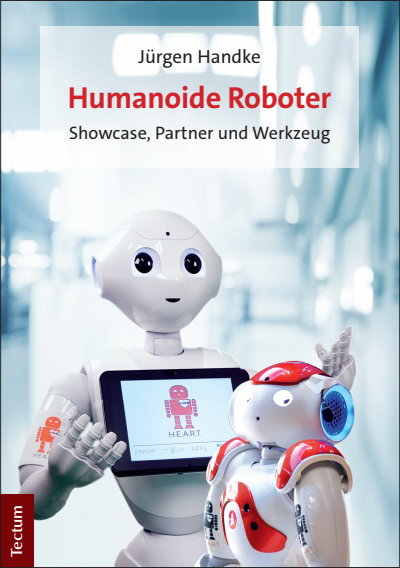
Humanoide Roboter
Showcase, Partner und Werkzeug- Autor:innen:
- Verlag:
- 2020
Zusammenfassung
Humanoide Roboter verbreiten sich in vielen Bereichen des täglichen Lebens. Doch welche Funktionen übernehmen sie dabei im Einzelnen? Was können sie für uns leisten und wie können sie speziell das Lehren und Lernen in einer digitalen Welt sinnvoll unterstützen?
Der deutsche Digital-Pionier Prof. Dr. Jürgen Handke, Leiter der Projekte H.E.A.R.T. und RoboPraX, zeigt in seinem einführenden Buch, wie humanoide Roboter gewinnbringend eingesetzt werden können, und diskutiert die verschiedenen Möglichkeiten der Nutzung durch uns Menschen: von einfachen Showcase-Anwendungen über den Einsatz als Partner in verschiedenen Lebensbereichen, speziell in der Bildung, bis hin zur Nutzung als Werkzeug zur Erlangung und Festigung digitaler Kompetenzen.
Publikation durchsuchen
Bibliographische Angaben
- Auflage
- 1/2020
- Copyrightjahr
- 2020
- ISBN-Print
- 978-3-8288-4250-2
- ISBN-Online
- 978-3-8288-7135-9
- Verlag
- Tectum, Baden-Baden
- Sprache
- Deutsch
- Seiten
- 230
- Produkttyp
- Monographie
Inhaltsverzeichnis
- Titelei/Inhaltsverzeichnis Kein Zugriff Seiten I - XXVI
- I.1 Nicht-Humanoide Roboter Kein Zugriff
- I.2.1 Humanoid, Android und Geminoid Kein Zugriff
- I.2.2.1 Die Sprechfähigkeit Kein Zugriff
- I.2.2.2 Die Dialogfähigkeit Kein Zugriff
- I.2.2.3 Mehrsprachigkeit Kein Zugriff
- I.2.2.4 Das Varietäten Problem Kein Zugriff
- I.2.2.5 Gefühle Kein Zugriff
- I.2.2.6 Bewegung Kein Zugriff
- I.2.2.7 Sensorik/Wahrnehmung Kein Zugriff
- I.2.2.8 Gefühle (Haptik) Kein Zugriff
- I.3.1.1 NAO Kein Zugriff
- I.3.1.2 Pepper Kein Zugriff
- I.4 Ausblick und Lektüreempfehlungen Kein Zugriff
- II.1 Vortragsbegleitung Kein Zugriff
- II.2 Touristik und Unterhaltung Kein Zugriff
- II.3 Werbung in eigener Sache Kein Zugriff
- II.4 Der Bereich Pflege Kein Zugriff
- II.5 Im Einzelhandel Kein Zugriff
- II.6 Auf öffentlichen Plätzen Kein Zugriff
- II.7 Klerikale Showcases Kein Zugriff
- II.8 Sinn und Nutzen von Roboter-Showcases Kein Zugriff
- II.9 Ausblick und Lektüreempfehlungen Kein Zugriff
- III.1 Roboter als Partner in der Öffentlichkeit Kein Zugriff
- III.2.1 Die Mizuho Bank (Japan) Kein Zugriff
- III.2.2 Die ATB Financial (Kanada) Kein Zugriff
- III.2.3 Die City Union Bank (Indien) Kein Zugriff
- III.2.4 Die Bank of Tokyo-Mitsubishi UFJ (Japan) Kein Zugriff
- III.2.5 Die HDFC Bank (Indien) Kein Zugriff
- III.2.6 Die Canara Bank (Indien) Kein Zugriff
- III.2.7 Der Status-Quo Kein Zugriff
- III.3.1 Der Roboter als Empfangsperson Kein Zugriff
- III.3.2 Der Roboter als Kundentrainer Kein Zugriff
- III.3.3 Der Roboter als Wegweiser Kein Zugriff
- III.3.4 Der Roboter als Interviewer Kein Zugriff
- III.3.5.1 Fotomotiv Kein Zugriff
- III.3.5.2 Darsteller in den sozialen Medien Kein Zugriff
- III.3.5.3 Gesprächspartner Kein Zugriff
- III.3.6.1 Märchenerzähler Kein Zugriff
- III.3.6.2 Quizmaster Kein Zugriff
- III.4 Fazit: Humanoide Roboter im Finanzwesen Kein Zugriff
- III.5 Roboter als Partner im privaten Bereich Kein Zugriff
- III.6.1 Das Projekt ARiA Kein Zugriff
- III.6.2 Das Projekt SMiLE Kein Zugriff
- III.7 Synergien Kein Zugriff
- III.8.1.1 L2TOR Kein Zugriff
- III.8.1.2 Roboter an finnischen Grundschulen Kein Zugriff
- III.8.2 Die Hochschullehre Kein Zugriff
- IV.1.1 Roboter in der klassische Hochschullehre Kein Zugriff
- IV.2.1.1 Humanoide Roboter als Berater Kein Zugriff
- IV.2.1.2 Humanoide Roboter als Assistenten Kein Zugriff
- IV.2.1.3 Humanoide Roboter als Prüfer Kein Zugriff
- IV.2.2 Classroom Application Packages Kein Zugriff
- IV.3 Zusammenfassung und Lektüreempfehlungen Kein Zugriff
- V.1 Algorithmisches Denken Kein Zugriff
- V.2 Einfache Maker-Spaces Kein Zugriff
- V.3 Maker-Spaces mit Robotern Kein Zugriff
- V.4.1 Choregraphe Kein Zugriff
- V.4.2 Tethys Kein Zugriff
- V.5.1 Robotik-Schulen Kein Zugriff
- V.5.2 NAO-Roboter in Bildungszentren Kein Zugriff
- V.5.3 NAO-Roboter in „Smart Schools“ Kein Zugriff
- V.5.4.1 Die Pilotphase Kein Zugriff
- V.5.4.2 Das H.E.A.R.T. – Robotikum Kein Zugriff
- V.5.4.3 Von H.E.A.R.T. zu RoboPraX Kein Zugriff
- V.6.1 Der Online-Vorkurs RoboBase Kein Zugriff
- V.6.2 Das RoboPraX – Robotikum Kein Zugriff
- V.6.3.1 Mit RoboSchool in die schulische Bildung Kein Zugriff
- V.6.3.2 Mit RoboTeach in die Lehrerbildung Kein Zugriff
- V.6.4 RoboPraX – eine Zwischenbilanz Kein Zugriff
- V.7 Ethische und juristische Fragen Kein Zugriff
- V.8 Zusammenfassung und Lektüreempfehlungen Kein Zugriff
- VI.1.1 Infrastruktur Kein Zugriff
- VI.1.2 Versicherung und Transport Kein Zugriff
- VI.1.3 Bereitstellung Kein Zugriff
- VI.2 Entwicklung Kein Zugriff
- VI.3 Programmierung Kein Zugriff
- VI.4 Robotik und Künstliche Intelligenz Kein Zugriff
- VI.5 Zusammenfassung und Ausblick Kein Zugriff
- VII Personen Kein Zugriff Seiten 203 - 206
- VIII Glossar Kein Zugriff Seiten 207 - 212
- IX.1 Print-Referenzen Kein Zugriff
- IX.2 Internet-Referenzen Kein Zugriff
- Kapitel I: Kein Zugriff
- Kapitel III: Kein Zugriff
- Kapitel IV: Kein Zugriff
- Kapitel V: Kein Zugriff
- Kapitel VI: Kein Zugriff
- Kapitel I: Kein Zugriff
- Kapitel II: Kein Zugriff
- Kapitel III: Kein Zugriff
- Kapitel IV: Kein Zugriff
- Kapitel V: Kein Zugriff
- Kapitel VI: Kein Zugriff
- Kapitel VII: Kein Zugriff
- Index Kein Zugriff Seiten 227 - 230
Literaturverzeichnis (47 Einträge)
Es wurden keine Treffer gefunden. Versuchen Sie einen anderen Begriff.
- IX Quellen Google Scholar öffnen DOI: 10.5771/9783828871359
- IX.1 Print-Referenzen Google Scholar öffnen DOI: 10.5771/9783828871359
- Alves-Oliveira, P., Sequeira, P., & Paiva, A. 2016. The role that an educational robot plays. 25th IEEE International Symposium on Robot and Human Interactive Communication, 817–822. Google Scholar öffnen DOI: 10.5771/9783828871359
- Anwar, S., Bascou, N. A., Menekse, M., & Kardgar, A. 2019. A Systematic Review of Studies on Educational Robotics. Journal of Pre-College Engineering Education Research., 9(2), Article 2. Google Scholar öffnen DOI: 10.5771/9783828871359
- Bainbridge, W. A., Hart, J. W., Kim, E. S., & Scassellati, B. 2011. The benefits of interactions with physically present robots over video-displayed agents. International Journal of Social Robotics, 3, 41–52. Google Scholar öffnen DOI: 10.5771/9783828871359
- Belpaeme, T., Kennedy, J., Ramachandran, A., Scassellati, B., & Tanaka, F. 2018. Social robots for education: A review. Science Robotics, 3(21), 1–10. Google Scholar öffnen DOI: 10.5771/9783828871359
- Ben-Ari, M., & Mondada, F. 2018. Robots and Their Applications. In Elements of Robotics (pp. 1–20). https://doi.org/10.1007/978-3-319-62533-1_1. Google Scholar öffnen DOI: 10.5771/9783828871359
- Benitti, F. B. V. 2012. Exploring the educational potential of robotics in schools: A systematic review. Computers and Education, 58(3), 978–988. Google Scholar öffnen DOI: 10.5771/9783828871359
- Breazeal, Cynthia. 2003. Toward sociable robots. Robotics and Autonomous Systems, 42(3–4), 167–175. Google Scholar öffnen DOI: 10.5771/9783828871359
- Bushweiler, Kevin. 2020. Teachers, the Robots Are Coming. But That’s Not a Bad Thing. EducationWeek, January 7,2020. https://bit.ly/2WtkJBj; Zugriff 21.3.2020. Google Scholar öffnen DOI: 10.5771/9783828871359
- Cooper, Martyn, Keating, David, Harwin, Wiliam & Dauten-hahn, Kerstin. 1999. Robots in the classroom – tools for accessible education. In Assistive Technology on the Threshold of the New Millennium (S. 448–452), Assistive Technology Research Series, 6, Düsseldorf: IOS Press. Google Scholar öffnen DOI: 10.5771/9783828871359
- Craig, John J. 2014. Introduction to Robotics: Mechanics and Control. (3. Auflage). Essex: Prentice Hall International. Google Scholar öffnen DOI: 10.5771/9783828871359
- Fernández-Llamas, C., Conde, M. A., Rodríguez-Lera, F. J., Rodríguez-Sedano, F. J., & García, F. 2018. May I teach you? Students’ behavior when lectured by robotic vs. human teachers. Computers in Human Behavior, 80, 460–469. Google Scholar öffnen DOI: 10.5771/9783828871359
- Handke, Jürgen. 2014. Patient Hochschullehre – Vorschläge für eine zeitgemäße Lehre im 21. Jahrhundert. Marburg: Tectum Verlag. Google Scholar öffnen DOI: 10.5771/9783828871359
- Handke, Jürgen. 2014b. The Inverted Classroom Mastery Model – A Diary Study. In: Eva Großkurth/Jürgen Handke (Hrsg.).The Inverted Classroom Model. Konferenzband zur 3. ICM Fachtagung in Marburg 2013. München: Oldenbourg Verlag: 15–35. Google Scholar öffnen DOI: 10.5771/9783828871359
- Handke, Jürgen. 2020. Handbuch Hochschullehre Digital. Eine Anleitung. Baden-Baden: Nomos Verlag. 3. Auflage. Google Scholar öffnen DOI: 10.5771/9783828871359
- Handke, Jürgen/Heinsch, Patrick. 2020. Humanoid Robots in Digital Teaching and Learning. In: Journal on Excellence in College Teaching. Miami University. Oxford Ohio. Google Scholar öffnen DOI: 10.5771/9783828871359
- Kajita, Shuuji/Hirukawa, Hirohisa/Harada, Kensuke/Yokoi, Kazuhito. 2016. Introduction to Humanoid Robotics. Berlin: Springer Verlag. Google Scholar öffnen DOI: 10.5771/9783828871359
- Kanda, Takayuki/Hirano,Takayuki/Eaton, Daniel/Ishiguro, Hiroshi. 2004. Interactive robots as social partners and peer tutors for children: a field trial. Human-Computer Interaction. Volume 19, Issue 1, June 2004. Google Scholar öffnen DOI: 10.5771/9783828871359
- Keller, Birte/Baleis, Janine/Starke, Christopher/Marcinkowski, Frank. 2020. Machine Learning and Artificial Intelligence in Higher Education: A State-of-the-Art Report on the German University Landscape. (erscheint, zur Zeit: Heinrich-Heine-Universität Düsseldorf). Google Scholar öffnen DOI: 10.5771/9783828871359
- Kennedy, J., Baxter, P., & Belpaeme, T. 2015a. Comparing Robot Embodiments in a Guided Discovery Learning Interaction with Children. International Journal of Social Robotics, 7(2), 293–308. Google Scholar öffnen DOI: 10.5771/9783828871359
- Khanlari, A. 2013. Effects of educational robots on learning STEM and on students’ attitude toward STEM. 2013 IEEE 5th International Conference on Engineering Education, 62–66. Google Scholar öffnen DOI: 10.5771/9783828871359
- Korn, Oliver. 2019. Soziale Roboter – Einführung und Potenziale für Pflege und Gesundheit. Wirtschaftsinformatik & Management, Vol. 11. Berlin: Springer Verlag: 126–135. Google Scholar öffnen DOI: 10.5771/9783828871359
- Korn, Oliver., Bieber, G., & Fron, C. 2018. Perspectives on social robots. From the historic background to an experts’ view on future developments. ACM International Conference Proceeding Series, (June), 186–193. Google Scholar öffnen DOI: 10.5771/9783828871359
- Kwak, S. S. 2014. The Impact of the Robot Appearance Types on Social Interaction with a Robot and Service Evaluation of a Robot. Archives of Design Research, 27(2), 81–93. Google Scholar öffnen DOI: 10.5771/9783828871359
- Lee, K. M., Peng, W., Jin, S. A., & Yan, C. 2006. Can robots manifest personality?: An empirical test of personality recognition, social responses, and social presence in hu-man-robot interaction. Journal of Communication, 56(4), 754–772. Google Scholar öffnen DOI: 10.5771/9783828871359
- Merdan, M., Lepuschitz, W., Koppensteiner, G., & Balogh, R. (Eds.). 2017. Robotics in education : Research and Practices for Robotics in STEM Education. Switzerland: Springer International Publishing. Google Scholar öffnen DOI: 10.5771/9783828871359
- Mubin, O., Stevens, C. J., Shahid, S., Mahmud, A. Al, & Dong, J.-J. 2013. A Review of the Applicability of Robots in Education. Technology for Education and Learning, 209, 1–7. Google Scholar öffnen DOI: 10.5771/9783828871359
- Pal, S., & Singh, D. 2019. Chatbots and virtual assistant in Indian banks. Industrija, 47(4), 75–101. Google Scholar öffnen DOI: 10.5771/9783828871359
- Pot, E., Monceaux, J., Gelin, R., & Maisonnier, B. 2009. Choregraphe: A graphical tool for humanoid robot programming. IEEE International Workshop on Robot and Human Interac-tive Communication, 46–51. Google Scholar öffnen DOI: 10.5771/9783828871359
- Russell, Stuart J./Peter Norvig, Peter. 2010. Artificial Intelligence: A Modern Approach. (3rd ed.). Ney York: Prentice-Hall. Google Scholar öffnen DOI: 10.5771/9783828871359
- Sullins, J. P. 2012. Robots, love, and sex: The ethics of building a love machine. IEEE Transactions on Affective Computing, 3(4), 398–409. Google Scholar öffnen DOI: 10.5771/9783828871359
- Wannemacher, Klaus und Mitarbeiterinnen. 2016. Digitale Lernszenarien im Hochschulbereich. Hochschulforum Digitalisierung, Arbeitspapier #15. Google Scholar öffnen DOI: 10.5771/9783828871359
- Wing, Jeanette, M. 2006. Computational Thinking. Communications of the ACM, März 2006/Vol. 49, No. 3: 33–35. Google Scholar öffnen DOI: 10.5771/9783828871359
- Zeaiter, S., & Heinsch, P. (2020). Robotikum – Inverted Makerspace. In G. Brandhofer, J. Buchner, C. Freisleben-Teutscher, & K. Tengler (Eds.), Tagungsband zur Tagung In-verted Classroom and beyond 2020. Norderstedt: Books on Demand GmbH: 174–184. Google Scholar öffnen DOI: 10.5771/9783828871359
- Kultusministerkonferenz. 2016. Bildung in der digitalen Welt. https://www.kmk.org. Google Scholar öffnen DOI: 10.5771/9783828871359
- IX.2 Internet-Referenzen Google Scholar öffnen DOI: 10.5771/9783828871359
- [INT1] How Robotics Will Change Our World. 2017. Technative. https://bit.ly/2FAHvNH, Zugriff 8.1.2020. Google Scholar öffnen DOI: 10.5771/9783828871359
- [INT2] Dang, Sanjit Singh. 2019. Artificial Intelligence in Humanoid Robots. 2019. Cognitive World. https://bit.ly/35yC8JN, Zugriff 8.1.2020. Google Scholar öffnen DOI: 10.5771/9783828871359
- [INT3] Robots will never replace teachers but can boost children’s education. 2018. University of Plymouth: ScienceDaily. https://bit.ly/2tAIET0, Zugriff 8.1.2020. Google Scholar öffnen DOI: 10.5771/9783828871359
- [INT4] Allen, John. R. 2019. Why we need to rethink education in the artificial intelligence age. Brookings. Washington DC. https://brook.gs/2T3ebY9; Zugriff 8.1.2020. Google Scholar öffnen DOI: 10.5771/9783828871359
- [INT5] Hetkämper, Robert. 2016. Japan: Der Roboter als Partner. https://www.daserste.de/information/politik-weltgeschehen/weltspiegel/videos/japan-der-roboter-als-partner–100.html, Zugriff 18.2.2020. Google Scholar öffnen DOI: 10.5771/9783828871359
- [INT6] Kaiser, Arvid.2017.Banker arbeiten wie Roboter? Aber doch nur in Indien! https://www.manager-magazin.de/unternehmen/banken/deutsche-bank-banker-unbeeindruckt-von-roboter-drohung-a–1166800.html, Zugriff 18.2.2020. Google Scholar öffnen DOI: 10.5771/9783828871359
- [INT7] Byford, 2015. Sam My bank is now staffed by a helpful robot. The Verge: https://www.theverge.com/2015/4/21/8460841/nao-robot-ufj-bank-japan, Zugriff 21.2.2020. Google Scholar öffnen DOI: 10.5771/9783828871359
- [INT8] Denic, Darko. 2017. Presentational Parameters of Human-Robot Interaction. MA Thesis. UMR. https://www.researchgate.net/project/Presentational-Parameters-of-Human-Robot-Interaction, Zugriff 6.1.2020. Google Scholar öffnen DOI: 10.5771/9783828871359
- [INT9] Merkur. 2017. Mit Pep(per) auf Kreuzfahrt – Costa setzt Roboter ein. https://www.merkur.de/leben/mit-pep-per-auf-kreuzfahrt-costa-setzt-roboter-ein-zr–7330767.html, Zugriff 23.2.2020. Google Scholar öffnen DOI: 10.5771/9783828871359
- [INT10] Kookhulp in de keuken, maar dan met kunstmatige intelligentie, Reformatorisch Dagblad, 04 Mar 2020. https://www.rd.nl/meer-rd/wetenschap-techniek/kookhulp-in-de-keuken-maar-dan-met-kunstmatige-intelligentie–1.1636340, Zugriff 5.3.2020. Google Scholar öffnen DOI: 10.5771/9783828871359