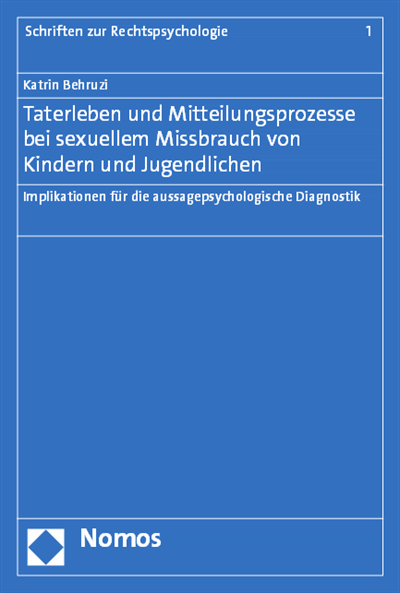
Taterleben und Mitteilungsprozesse bei sexuellem Missbrauch von Kindern und Jugendlichen
Implikationen für die aussagepsychologische Diagnostik- Autor:innen:
- Reihe:
- Schriften zur Rechtspsychologie, Band 1
- Verlag:
- 2018
Zusammenfassung
Die anwendungsorientierte Arbeit verfolgt das Ziel, mehrdimensionale Merkmalskonfigurationen in glaubhaften Zeugenaussagen empirisch zu ermitteln. Vor dem Hintergrund, dass es weder spezifische Verhaltensindikatoren für sexuellen Missbrauch gibt noch ein bestimmtes Mitteilungsverhalten Rückschlüsse auf einen etwaigen Erlebnisbezug erlaubt, wird ein Prozessmodell verfolgt, wonach Mitteilungslatenzen im Wechselspiel mit inter- und intrapsychischen Dynamiken gesehen und bewertet werden müssen und erst in dieser Interdependenz einen Hinweiswert auf den Erlebnisbezug einer Aussage entwickeln können. Im Rahmen einer explorativen empirischen Analyse von Strafverfahrensakten wurden mittels multivariater Methoden bemerkenswerte Unterschiede zwischen glaubhaften und zweifelhaften Aussagen festgestellt, die einen Indikatorwert eines spezifischen Musters von Taterlebens- und Verhaltensaspekten für den Erlebnisbezug von Aussagen über sexuellen Missbrauch an Kindern und Jugendlichen nahelegen.
Publikation durchsuchen
Bibliographische Angaben
- Auflage
- 1/2018
- Copyrightjahr
- 2018
- ISBN-Print
- 978-3-8487-4665-1
- ISBN-Online
- 978-3-8452-8892-5
- Verlag
- Nomos, Baden-Baden
- Reihe
- Schriften zur Rechtspsychologie
- Band
- 1
- Sprache
- Deutsch
- Seiten
- 242
- Produkttyp
- Monographie
Inhaltsverzeichnis
- Titelei/Inhaltsverzeichnis Kein Zugriff Seiten 1 - 12
- 1 Einleitung Kein Zugriff Seiten 13 - 18
- 2.1.1 Überblick über empirische Erkenntnisse zu Folgen sexuellen Missbrauchs Kein Zugriff
- 2.1.2.1 Tatmerkmale Kein Zugriff
- 2.1.2.2 Alter Kein Zugriff
- 2.1.2.3 Geschlechtsunterschiede Kein Zugriff
- 2.1.2.4 Behinderung Kein Zugriff
- 2.1.2.5 Familiäre Aspekte Kein Zugriff
- 2.1.2.6 Soziale Unterstützung Kein Zugriff
- 2.1.2.7 Copingstrategien Kein Zugriff
- 2.1.2.8 Missbrauchsspezifische Attributionen und das Erleben von Scham und Schuld Kein Zugriff
- 2.1.2.9 Fazit Kein Zugriff
- 2.1.3.1 Empirische Erkenntnisse zum Sexualverhalten von Kindern Kein Zugriff
- 2.1.3.2 Empirische Erkenntnisse zu Abweichungen im sexuellen Verhalten bei sexuell missbrauchten Kindern Kein Zugriff
- 2.1.4 Zusammenfassung Kein Zugriff
- 2.2.1.1 Erkenntnisse zum Dunkelfeld und zur Anzeigebereitschaft Kein Zugriff
- 2.2.1.2 Mitteilungsraten Kein Zugriff
- 2.2.1.3 Latenzzeit bis zur Erstmitteilung Kein Zugriff
- 2.2.1.4 Widerrufsraten Kein Zugriff
- 2.2.2.1 Tatmerkmale Kein Zugriff
- 2.2.2.2 Alter Kein Zugriff
- 2.2.2.3 Geschlecht Kein Zugriff
- 2.2.2.4 Behinderung Kein Zugriff
- 2.2.2.5 Familiäre Aspekte Kein Zugriff
- 2.2.2.6 Intrapsychische Aspekte Kein Zugriff
- 2.2.2.7 Dialogische Aspekte Kein Zugriff
- 2.2.2.8 Fazit Kein Zugriff
- 2.2.3.1 Das Mitteilen des sexuellen Missbrauchs als Prozess Kein Zugriff
- 2.2.3.2 Empirische Erkenntnisse zur Spezifität von Mitteilungsmustern bei sexuellem Missbrauch Kein Zugriff
- 2.2.4 Zusammenfassung Kein Zugriff
- 3.1 Herleitung der Fragestellung Kein Zugriff
- 3.2.1.1 Zur Validität der glaubhaft- und zweifelhaft-Einschätzung Kein Zugriff
- 3.2.1.2 Kriterien zur Aktenauswahl Kein Zugriff
- 3.2.2.1 Antrag auf Akteneinsicht und Akteneinsicht Kein Zugriff
- 3.2.2.2 Anfertigung von Aktenauszügen Kein Zugriff
- 3.2.2.3 Kategorienbildung und Kodierung des Aktenmaterials Kein Zugriff
- 3.2.2.4 Statistische Analysen Kein Zugriff
- 3.2.2.5 Methodenkritische Reflexion Kein Zugriff
- 3.3.1 Soziodemografische Daten Kein Zugriff
- 3.3.2 Missbrauchsart Kein Zugriff
- 4.1.1 Soziodemografische Merkmale Kein Zugriff
- 4.1.2 Opfer-Täter-Beziehung Kein Zugriff
- 4.1.3 Tatmerkmale Kein Zugriff
- 4.1.4 Taterleben Kein Zugriff
- 4.1.5 Tatfolgen Kein Zugriff
- 4.1.6 Verschweigen und Mitteilen Kein Zugriff
- 4.1.7 Zusammenfassung Kein Zugriff
- 4.2.1 Besonderheiten des Aussagekontextes der zweifelhaften Aussagen Kein Zugriff
- 4.2.2 Opfer-Täter-Beziehung Kein Zugriff
- 4.2.3 Tatmerkmale Kein Zugriff
- 4.2.4 Taterleben Kein Zugriff
- 4.2.5 Tatfolgen Kein Zugriff
- 4.2.6 Verschweigen und Mitteilen Kein Zugriff
- 4.2.7 Zusammenfassung der univariaten Analysen Kein Zugriff
- 4.2.8 Diskriminanzanalytische Auswertung Kein Zugriff
- 4.2.9 Multidimensionale Skalierung Kein Zugriff
- 5 Implikationen für die aussagepsychologische Diagnostik und zukünftige Forschungsarbeiten Kein Zugriff Seiten 203 - 208
- 6 Zusammenfassung Kein Zugriff Seiten 209 - 212
- Literaturverzeichnis Kein Zugriff Seiten 213 - 242
Literaturverzeichnis (468 Einträge)
Es wurden keine Treffer gefunden. Versuchen Sie einen anderen Begriff.
- Abney, V. D. & Priest, R. (1995). African Americans and sexual child abuse. In L. A. Fontes (Hrsg.), Sexual abuse in nine North American cultures. Treatment and prevention (S. 11-30). Thousand Oaks, CA: Sage. Google Scholar öffnen DOI: 10.5771/9783845288925
- Achenbach, T. M. & Edelbrock, C. S. (1983). Manual for the child behavior checklist and revised child behavior profile. Burlington: University of Vermont Department of Psychiatry. Google Scholar öffnen DOI: 10.5771/9783845288925
- Achenbach, T. M., McConaughy, S. M. & Howell, C. T. (1987). Child/adolescent behavioral and emotional problems: Implications of cross-informant correlations for situational specifity. Psychological Bulletin, 101, 213-232. Google Scholar öffnen DOI: 10.5771/9783845288925
- Akehurst, L., Manton, S. & Quandte, S. (2011). Careful calculation or al leap of faith? A field study of the translation of CBCA ratings to final credibility judgements. Applied Cognitive Psychology, 25(2), S. 236-243. Google Scholar öffnen DOI: 10.5771/9783845288925
- Alaggia, R. & Kirshenbaum, S. (2005). Speaking the unspeakable: Exploring the impact of family dynamics on child sexual abuse disclosures. Families in Society, 86(2), 227-234. Google Scholar öffnen DOI: 10.5771/9783845288925
- Alaggia, R. (2004). Many ways of telling: Expanding conceptualizations of child sexual abuse disclosure. Child Abuse & Neglect, 28, 1213-1227. Google Scholar öffnen DOI: 10.5771/9783845288925
- Alaggia, R. (2005). Disclosing the trauma of child sexual abuse: A gender analysis. Journal of Loss and Trauma, 10, 453-470. Google Scholar öffnen DOI: 10.5771/9783845288925
- Alaggia, R. & Millington, G. (2008). Male child sexual abuse: A phenomenology of betrayal. Clinical Social Work Journal, 36, 265-375. Google Scholar öffnen DOI: 10.5771/9783845288925
- Alexander, P. C. (1992). Application of attachment theory to the study of sexual abuse. Journal of Consulting and Clinical Psychology, 60, 185-195. Google Scholar öffnen DOI: 10.5771/9783845288925
- Alexander, P. C. & Lupfer, S. L. (1987). Family characteristics and long-term consequences associated with sexual abuse. Archives of Sexual Behavior, 16(3), 235-245. Google Scholar öffnen DOI: 10.5771/9783845288925
- Altenhain, Dietmeier & May (2013). Die Praxis der Absprachen im Strafverfahren. Baden-Baden: Nomos. Google Scholar öffnen DOI: 10.5771/9783845288925
- Andrews, B. (1995). Bodily shame as a mediator between abusive experiences and depression. Journal of Abnormal Psychology, 104, 277-285 Google Scholar öffnen DOI: 10.5771/9783845288925
- Anson, D., Golding, S. & Gully, K. (1993). Child sexual abuse allegations: Reliability of criteria-based content analysis. Law and Human Behavior, 17(3), 331-341. Google Scholar öffnen DOI: 10.5771/9783845288925
- Anthony, G. & Watkeys, J. (1991). False allegations in child sexual abuse: The pattern of referral in an area where reporting is not mandantory. Children and Society, 5(2), 111-122. Google Scholar öffnen DOI: 10.5771/9783845288925
- Arata, C. M. (1998). To tell or not to tell: Current functioning of child sexual abuse survivors who disclosed their victimization. Child Maltreatment, 3, 63-71. Google Scholar öffnen DOI: 10.5771/9783845288925
- Arata, C. M. (2002). Child sexual abuse and sexual revictimization. Clinical Psychology: Science & Practice, 9, 135-164. Google Scholar öffnen DOI: 10.5771/9783845288925
- Arntzen, F. (1970). Psychologie der Zeugenaussage. Göttingen: Hogrefe. Google Scholar öffnen DOI: 10.5771/9783845288925
- Arntzen, F. (1983). Die Grenzen experimenteller Verfahren in der Forensischen Aussagepsychologie. Zeitschrift für experimentelle und angewandte Psychologie, 30, 523-528. Google Scholar öffnen DOI: 10.5771/9783845288925
- Arntzen, F. (2007). Psychologie der Zeugenaussage. System der Glaubhaftigkeitsmerkmale (4. Aufl.). München: Beck. Google Scholar öffnen DOI: 10.5771/9783845288925
- Averill, P. M., Diefenbach, G. J., Stanley, M. A., Beckenridge, J. K. & Lusby, B. (2002). Assessment of shame and guilt in a psychiatric sample: A comparison of two measures. Personality and Individual Differences, 32, 1365-1376. Google Scholar öffnen DOI: 10.5771/9783845288925
- Backhaus, K., Erichson, B., Plinke, W. & Weiber, R. (2006). Multivariate Analysemethoden. Eine anwendungsorientierte Einführung (11. überarbeitete Aufl.). Berlin: Springer. Google Scholar öffnen DOI: 10.5771/9783845288925
- Bal, S., Van Oost, P., De Bourdeaudhuij, I. & Crombez, G. (2003). Avoidant coping as a mediator between self-reported sexual abuse and stress-related symptoms in adolescents. Child Abuse & Neglect, 27, 883-897. Google Scholar öffnen DOI: 10.5771/9783845288925
- Bancroft, J. (2009). Human sexuality and its problems. Edinburgh: Elsevier. Google Scholar öffnen DOI: 10.5771/9783845288925
- Bange, D. & Schlingmann, T. (2016). Sexuelle Erregung als Faktor der Verunsicherung sexuelle missbrauchter Jungen. Kindesmisshandlung und –vernachlässigung, 19(1), 28-43. Google Scholar öffnen DOI: 10.5771/9783845288925
- Baron, R. M. & Kenny, D. A. (1986). The moderator – mediator variable distinction in social psychological research: Conceptual, strategic, and statistical considerations. Journal of Personality and Social Psychology, 51, 1173-1182. Google Scholar öffnen DOI: 10.5771/9783845288925
- Banyard, V. L., Williams, L. M. & Siegel, J. A. (2004). Childhood sexual abuse: A gender perspective on context and consequences. Child Maltreatment, 9(3), 223-238. Google Scholar öffnen DOI: 10.5771/9783845288925
- Beauregard, E., Rossmo, D. K. & Proulx, J. (2007). A descriptive model of the hunting process of serial sex offenders: A rational choice perspective. Journal of Family Violence, 22(6), 449-463. Google Scholar öffnen DOI: 10.5771/9783845288925
- Becker, R. (2012). Bildungsbeteiligung und Bildungschancen. Bundeszentrale für Politische Bildung. Verfügbar unter: http://www.bpb.de/politik/grundfragen/deutsche-verhaeltnisse-eine-sozialkunde/138032/bildungsbeteiligung-und-bildungschancen?p=0 [27.09.2015]. Google Scholar öffnen DOI: 10.5771/9783845288925
- Behruzi, K. & Undeutsch, U. (2001). Gründe für das Verschweigen sexuellen Missbrauchs – Ergebnisse einer Analyse der Aussagen von Opferzeugen. Paper zur 9. Arbeitstagung der Fachgruppe Rechtspsychologie der Deutschen Gesellschaft für Psychologie (DGP), Münster, September 2001. Google Scholar öffnen DOI: 10.5771/9783845288925
- Behruzi, K. & Undeutsch, U. (2002). Täterstrategien in Zeugenaussagen zu sexuellem Missbrauch. In T. Fabian (Hrsg.), Praxisfelder der Rechtspsychologie (S. 166-174). Münster: Lit Verlag. Google Scholar öffnen DOI: 10.5771/9783845288925
- Benedict, M., White, R. B., Wulff, L. M. & Hall, B. J. (1990). Reported maltreatment in children with multiple disabilities. Child Abuse & Neglect, 14, 207-217. Google Scholar öffnen DOI: 10.5771/9783845288925
- Benetti-McQuoid, J. & Bursik, K. (2005). Individual differences in experiences of and responses to guilt and shame: Examining the lenses of gender and gender role. Sex Roles, 53 (1), 133-142. Google Scholar öffnen DOI: 10.5771/9783845288925
- Bentovim, A. (1996). Trauma-organized Systems in practice: Implications for work with abused and abusing children and young people. Clinical Child Psychology and Psychiatry, 1, 513-524. Google Scholar öffnen DOI: 10.5771/9783845288925
- Berliner, L. & Conte, J. R. (1990). The process of victimization: The victims’ perspective. Child Abuse & Neglect, 14, 29-40. Google Scholar öffnen DOI: 10.5771/9783845288925
- Bidrose, S. & Goodman, G. S. (2000). Testimony and evidence: A scientific case study of memory for child sexual abuse. Applied Cognitive Psychology, 14, 197-213. Google Scholar öffnen DOI: 10.5771/9783845288925
- Blandon-Gitlin, I., Pezdek, K., Rogers, M. & Brodie, L. (2005). Detecting deception in children: An experimental study of the effects of event familiarity on CBCA ratings. Law and Human Behavior, 29, 187-197. Google Scholar öffnen DOI: 10.5771/9783845288925
- Bluck, S. Levine, L. J. & Laulhere, T. M. (1999). Biographical remembering and hypermnesia: A comparison of older and younger adults. Psychology and Aging, 14(4), 671-682. Google Scholar öffnen DOI: 10.5771/9783845288925
- Boetticher, A. (2002). Anforderungen an Glaubhaftigkeitsgutachten nach der neuesten BGH-Rechtssprechung. In S. Barton (Hrsg.), Verfahrensgerechtigkeit und Zeugenbeweis. Fairness für Opfer und Beschuldigte (S. 55-65). Baden-Baden: Nomos. Google Scholar öffnen DOI: 10.5771/9783845288925
- Bolen, R. M. & Scannapieco, M. (1999). Prevalence of child sexual abuse: A corrective metaanalyis. Social Service Review, 73, 281-313. Google Scholar öffnen DOI: 10.5771/9783845288925
- Bond, C. F. & DePaulo, B. M. (2006). Accuracy of deception judgements. Personality and Social Psychology Review, 10, 214-234. Google Scholar öffnen DOI: 10.5771/9783845288925
- Borg, I. & Groenen, P. J. F. (2005). Modern multidimensional scaling. Theory and applications (2. Aufl.). New York: Springer. Google Scholar öffnen DOI: 10.5771/9783845288925
- Borg, I., Groenen, P.J.F. & Mair, P. (2010). Multidimensionale Skalierung. München: Rainer Hampp Verlag. Google Scholar öffnen DOI: 10.5771/9783845288925
- Bormstein, B. H., Liebel, L. M. & Scarberry, N. C. (1998). Repeated testing in eyewitness memory: A means to improve recall of a negative emotional event. Applied Cognitive Psychology, 12, 119-131. Google Scholar öffnen DOI: 10.5771/9783845288925
- Boudewyn, A. C. & Liem, J. H. (1995). Childhood sexual abuse as a precursor to depression and self-destructive behavior in adulthood. Journal of Traumatic Stress, 8, 445-459. Google Scholar öffnen DOI: 10.5771/9783845288925
- Bowen, K. (2000). Child abuse and domestic violence in families of children seen for suspected sexual abuse. Clinical Pediatrics, 39, 33-40. Google Scholar öffnen DOI: 10.5771/9783845288925
- Bradley, R. & Wood, J. M. (1996). How do children tell? The disclosure process in child sexual abuse. Child Abuse & Neglect, 20 (1), 881-891. Google Scholar öffnen DOI: 10.5771/9783845288925
- Brezo, J., Paris, J., Vitaro, F., Hébert, M., Tremblay, R. E. & Turecki, G. (2008). Predicting suicide attempts in young adults with histories of childhood abuse. British Journal of Psychiatry, 193, 134-139. Google Scholar öffnen DOI: 10.5771/9783845288925
- Bristol, M. M. & Schloper, E. (1984). A developmental perspective on stress and coping in families of autistic children. In J. Blacher (Hrsg.), Severely handicapped young children and their families (S. 91-142). Orlando, FL: Academic Press. Google Scholar öffnen DOI: 10.5771/9783845288925
- Bottoms, B. L., Rudnicki, A. G. & Epstein, M. A. (2007). A retrospective study of factors affecting the disclosure of childhood sexual and physical abuse. In M.-E. Pipe, M. E. Lamb, Y. Orbach & A.-C. Cederborg (Hrsg.), Child Sexual Abuse. Disclosure, Delay and Denial (S. 175-194). New York: Routledge. Google Scholar öffnen DOI: 10.5771/9783845288925
- Briere, J. (1988). Controlling for family variables in abuse effects research: A critique of the “partialling” approach. Journal of Interpersonal Violence, 3, 80-89. Google Scholar öffnen DOI: 10.5771/9783845288925
- Briere, J. N. & Elliott, D. M. (2003). Prevalence and psychological sequelae of self-reported childhood physical and sexual abuse in a general population sample of men and women. Child Abuse & Neglect, 27, 1205-1222. Google Scholar öffnen DOI: 10.5771/9783845288925
- Broman-Fulks, J. J., Ruggiero, K. J., Hanson, R. F., Smith, D. W., Resnick, H. S., Kilpatrick, D. G. & Saunders, B. E. (2007). Sexual assault disclosure in relation to adolescent mental health: Results from the National Survey of Adolescents. Journal of Clinical Child and Adolescent Psychology, 36, 260-266. Google Scholar öffnen DOI: 10.5771/9783845288925
- Brown, J., Cohen, P., Johnson, J. G. & Salzinger, S. (1998). A longitudinal analysis of risk factors for child maltreatment: Findings of a 17-year prospective study of officially recorded and self-reported child abuse and neglect. Child Abuse & Neglect, 22, 1065-1078. Google Scholar öffnen DOI: 10.5771/9783845288925
- Brown, L. S. & Wright, J. (2003). The relationship between attachment strategies and psychopathology in adolescence. Psychology and Psychotherapy, 76, 351-367. Google Scholar öffnen DOI: 10.5771/9783845288925
- Bruck, M. & Ceci, S. (2004). Forensic developmental psychology: Unveiling four common misconceptions. Current Directions in Psychological Science, 13(6), 229-232. Google Scholar öffnen DOI: 10.5771/9783845288925
- Budin, L. E. & Johnson, C. F. (1989). Sex abuse prevention programs: Offenders’ attitudes about their efficacy. Child Abuse & Neglect, 13, 77-87. Google Scholar öffnen DOI: 10.5771/9783845288925
- Bullens, R. (1995). Der Grooming-Prozeß – oder das Planen des Missbrauchs. In B. Marquardt-Mau (Hrsg.), Schulische Prävention gegen sexuelle Kindesmisshandlung. Grundlagen, Rahmenbedingungen, Bausteine und Modelle (S. 55-67). Weinheim: Juventa Verlag. Google Scholar öffnen DOI: 10.5771/9783845288925
- Burgsmüller, C. (2009). Vom Umgang der Strafjustiz mit der Aussagepsychologie bei sexuellem Missbrauch von Kindern seit der Grundsatzentscheidung des 1. Strafsenats des BGH vom 30.07.1999. Kindesmisshandlung und –vernachlässigung, Themenheft: Glaubhaftigkeitsbegutachtung, 12(2), 42-51. Google Scholar öffnen DOI: 10.5771/9783845288925
- Burk, L. R. & Burkhart, B. R. (2003). Disorganized attachment as a diathesis for sexual deviance. Developmental experience and the motivation for sexual offending. Aggression and Violent Behavior, 8, 487-511. Google Scholar öffnen DOI: 10.5771/9783845288925
- Burton, D. L. (2003). Male adolescents: Sexual victimization and subsequent sexual abuse. Child Adolescent Social Work Journal, 20, 277-296. Google Scholar öffnen DOI: 10.5771/9783845288925
- Busse, D., Steller, M. & Volbert, R. (2000). Sexueller Missbrauchsverdacht in familiengerichtlichen Verfahren. Praxis der Rechtspsychologie, 10 (Sonderheft 2), 3-98. Google Scholar öffnen DOI: 10.5771/9783845288925
- Bussey, K. & Grimbeek, E. J. (1995). Disclosure processes: Issues for child sexual abuse victims. In K. J. Rotenberg (Hrsg.), Disclosure processes in children and adolescents (S. 166-203). Cambridge: Cambridge University Press. Google Scholar öffnen DOI: 10.5771/9783845288925
- Butzel, J. S., Talbot, N. L., Duberstein, P. R., Houghtalen, R. P., Cox, C. & Giles, D. E. (2000). The relationship between traumatic events and dissociation among women with histories of childhood sexual abuse. Journal of Nervous and Mental Disease, 188, 547-549. Google Scholar öffnen DOI: 10.5771/9783845288925
- Calam, R., Horne, L, Glasgow, D. & Cox, A. (1998). Psychological disturbance and child sexual abuse: A follow-up study. Child Abuse & Neglect, 22, 901-913. Google Scholar öffnen DOI: 10.5771/9783845288925
- Campis, L. B., Hebden-Curtis, J. & DeMaso, D. R. (1993). Developmental differences in detection and disclosure of sexuel abuse. Journal of the American Academy of Child and Adolescent Psychiatry, 32, 920-924. Google Scholar öffnen DOI: 10.5771/9783845288925
- Cederborg, A.-C., Lamb, M. E. & Laurell, O. (2007). Delay of disclosure, minimization, and denial of abuse when the evidence is unambiguous. A multivictim case. In M.-E. Pipe, M. E. Lamb, Y. Orbach & A.-C. Cederborg (Hrsg.), Child sexual abuse. Disclosure, delay, and denial (S. 159 – 173). New York: Routledge. Google Scholar öffnen DOI: 10.5771/9783845288925
- Celano, M. P. (1992). A developmental model of victims’ internal attributions of responsibility for sexual abuse. Journal of Interpersonal Violence, 7, 57-69. Google Scholar öffnen DOI: 10.5771/9783845288925
- Chaffin, M., Wherry, J. N. & Dykman, R. (1997). School age children’s coping with sexual abuse: Abuse stresses and symptoms associated with four coping strategies. Child Abuse & Neglect, 21, 227-240. Google Scholar öffnen DOI: 10.5771/9783845288925
- Chaudoir, S. R. & Fisher, J. D. (2010). The disclosure process model: Understanding disclosure decision-making and post-disclosure outcomes among people living with a concealable stigmatized identity. Psychological Bulletin, 136(2), 236-256. Google Scholar öffnen DOI: 10.5771/9783845288925
- Chen, L. P., Murad, H. M., Paras, M. L., Colbenson, K. M., Sattler, A., L., Goranson, E. N., Elamin, M. B., Seime, R. J., Shinozaki, G., Prokop, L. J. & Zirakzadeh, A. (2010). Sexual abuse and lifetime diagnosis of psychiatric disorders: Systematic review and meta-analysis. Mayo Clinic Proceedings, 85, 618-629. Google Scholar öffnen DOI: 10.5771/9783845288925
- Christiansen, J. R. & Blake, R. H. (1990). The grooming process in father-daughter incest. In A. L. Horton, B. M. Johnson, L. M. Roundy & D. Williams (Hrsg.), The incest perpetrator: A family member no one wants to treat (S. 88-98). Newbury Park, CA: Sage. Google Scholar öffnen DOI: 10.5771/9783845288925
- Cinq-Mars, C., Wright, J., Cyr, M. & McDuff, P. (2003). Sexual at-risk behaviors of sexually abused adulescent girls. Journal of Child Sexual Abuse, 12, 1-18. Google Scholar öffnen DOI: 10.5771/9783845288925
- Classen, C. C., Palesh, O. G. & Aggarwal, R. (2005). Sexual revictimization: A review of the empirical literature. Trauma Violence Abuse, 6, 103-129. Google Scholar öffnen DOI: 10.5771/9783845288925
- Coffey, P., Leitenberg, H., Henning, K., Turner, T. & Bennet, R. T. (1996). Mediators of the long-term impact of child sexual abuse: Perceived stigma, betrayal, powerlessness, and self-blame. Child Abuse & Neglect, 20, 447-455. Google Scholar öffnen DOI: 10.5771/9783845288925
- Cole, P. M. & Putnam, F. W. (1992). Effect of incest on self and social functioning: A developmental psychopathology perspective. Journal of Consulting and Clinical Psychology, 60(2), 174-184. Google Scholar öffnen DOI: 10.5771/9783845288925
- Collings, S. J., Griffiths, S. & Kumalo, M. (2005). Patterns of disclosure in child sexual abuse. South African Journal of Psychology, 35, 270-285. Google Scholar öffnen DOI: 10.5771/9783845288925
- Connolly, D. A., Price, H. L. & Gordon, H. M. (2009). Judging the credibility of historic child sexual abuse complaints. How Judges describe their decisions. Psychology, Public Policy, and Law, 15(2), 102-123. Google Scholar öffnen DOI: 10.5771/9783845288925
- Conte, J. R. & Schuerman, J. R. (1987a). Factors associated with an increased impact of child sexual abuse. Child Abuse & Neglect, 11, 201-211. Google Scholar öffnen DOI: 10.5771/9783845288925
- Conte, J. R. & Schuerman, J. R. (1987b). The effects of sexual abuse on children: A multidimensional view. Journal of Interpersonal Violence, 2, 380-390. Google Scholar öffnen DOI: 10.5771/9783845288925
- Conte, J. R., Wolf, S. & Smith, T. (1989). What sexual offenders tell us about prevention strategies. Child Abuse & Neglect, 13, 293-301. Google Scholar öffnen DOI: 10.5771/9783845288925
- Cooper, M. L., Shaver, P. R. & Collins, N. L. (1998). Attachment styles, emotion regulation, and adjustment in adolescence. Journal of Personality and Social Psychology, 74, 1380-1397. Google Scholar öffnen DOI: 10.5771/9783845288925
- Cosentino, C. E., Meyer-Bahlburg, H. F. L., Alpert, J. L., Weinberg, S. L. & Gaines, R. (1995). Sexual behavior problems and psychopathology symptoms in sexually abused girls. Journal of the American Academy of Child and Adolescent Psychiatry, 34, 1033-1042. Google Scholar öffnen DOI: 10.5771/9783845288925
- Cougle, J. R., Timpano, K. R., Sachs-Ericsson, N., Keough, M. E. & Ricardi, C. J. (2010). Examining the unique relationships between anxiety disorders and childhood physical and sexual abuse in the National comorbidity survey-replication. Psychiatry Research, 177, 150-155. Google Scholar öffnen DOI: 10.5771/9783845288925
- Courtenay, H. W. (2000). Constructions of masculinity and their influence on men’s well-being: A theory of gender and health. Social Science & Medicine, 50, 1385-1401. Google Scholar öffnen DOI: 10.5771/9783845288925
- Crisma, M., Bascelli, E., Paci, D. & Romito, P. (2004). Adolescents who experienced sexual abuse: Fears, needs and impediments to disclosure. Child Abuse & Neglect, 28, 1035–1048. Google Scholar öffnen DOI: 10.5771/9783845288925
- Craig, R. A., Scheibe, R., Raskin, D. C., Kirchner, J. C. & Dodd, D. H. (1999). Interviewer questions and content analysis of children’s statements of sexual abuse. Applied Developmental Science, 3, 77-85. Google Scholar öffnen DOI: 10.5771/9783845288925
- Cyr, K., Chamberland, C., Lessard, G., Clément, M.-È., Wemmers, J.-A., Collin-Vézina, D., Gagné, M.-H. & Damant, D. (2012). Polyvictimization in a child welfare sample of children and youths. Psychology of Violence, 2(4), 385-400. Google Scholar öffnen DOI: 10.5771/9783845288925
- Daigneault, I., Hébert, M. & Tourigny, M. (2006). Attributions and coping in sexually abused adolescents referred for group treatment. Journal of Child Sexual Abuse, 15(3), 35-59. Google Scholar öffnen DOI: 10.5771/9783845288925
- Dallam, S. J., Gleaves, D. H., Cepeda-Benito, A., Silberg, J. L., Kraemer, H. C. & Spiegel, D. (2001). The effects of child sexual abuse: Comment on Rind, Tromovic, and Bauserman (1998). Psychological Bulletin, 127, 715-733. Google Scholar öffnen DOI: 10.5771/9783845288925
- Deckers, R. (2014). Prüfung der Glaubhaftigkeit einer Zeugenaussage durch das Gericht im Lichte der neuen BGH-Rechtsprechung. In R. Deckers & G. Köhnken (Hrsg.), Die Erhebung und Bewertung von Zeugenaussagen im Strafprozess (S. 119-129). Berlin: Berliner Wissenschafts-Verlag. Google Scholar öffnen DOI: 10.5771/9783845288925
- Denov, M. S. (2004). The long-term effects of child sexual abuse by female perpetrators: A qualitative study of male and female victims. Journal of Interpersonal Violence, 19(10), 1137-1156. Google Scholar öffnen DOI: 10.5771/9783845288925
- Derlega, V. J. & Grzelak, J. (1979). Appropriateness of self-disclosure. In G. J. Chelune (Hrsg.), Origins, patterns and implications of openness in interpersonal relationships (S. 151-176). San Francisco: Jossey-Bass. Google Scholar öffnen DOI: 10.5771/9783845288925
- Dettenborn, H., Fröhlich, H.-H. & Szewczyk, H. (1984). Forensische Psychologie. Berlin: VEB Deutscher Verlag der Wissenschaften. Google Scholar öffnen DOI: 10.5771/9783845288925
- DeVoe, E. R. & Faller, K. C. (1999). The characteristics of disclosure among children who may have been sexually abused. Child Maltreatment, 4, 217-227. Google Scholar öffnen DOI: 10.5771/9783845288925
- Dhaliwal, G. K., Gauzas, L., Antonowicz, D. H. & Ross, R. (1996). Adult male survivors of childhood sexual abuse: Prevalence, sexual abuse characteristics, and long-term effects. Clinical Psychology Review, 16, 619-639. Google Scholar öffnen DOI: 10.5771/9783845288925
- Diehl, U. (2001). Einstellungen der Eltern zur Sexualität ihres körper- oder mehrfachbehinderten Kindes. BZgA Forum 2/3, 16-19. Google Scholar öffnen DOI: 10.5771/9783845288925
- DiLillo, D. (2001). Interpersonal functioning among women reporting a history of childhood sexual abuse: Empirical findings and methodological issues. Clinical Psychology Review, 21, 553-576. Google Scholar öffnen DOI: 10.5771/9783845288925
- DiPietro, E. K., Runyan, D. K. & Fredrickson, D. D. (1997). Predictors of disclosure during medical evaluation for suspected sexual abuse. Journal of Child Sexual Abuse, 6, 133-141. Google Scholar öffnen DOI: 10.5771/9783845288925
- Dolezal, C. & Carballo-Diéguez, A. (2002). Childhood sexual experiences and the perception of abuse among Latino men who have sex with men. Journal of Sex Research, 39, 165-173. Google Scholar öffnen DOI: 10.5771/9783845288925
- Easton, S. D. (2012). The disclosure process for men with histories of sexual abuse. Clinical Social Work Journal, 12, 1-12. Google Scholar öffnen DOI: 10.5771/9783845288925
- Easton, S. (2014). Masculine norms, disclosure, and childhood adversities predict long-term mental distress among men with histories of child sexual abuse. Child Abuse & Neglect, 38, 243-251. Google Scholar öffnen DOI: 10.5771/9783845288925
- Easton, S. D., Saltzman, L. Y. & Willis, D. G. (2013). “Would you tell under circumstances like that?”: Barriers to disclose of child sexual abuse for men. Psychology of Men & Masculinity, 23, 1-10. Google Scholar öffnen DOI: 10.5771/9783845288925
- Edelstein, R. S., Luten, T. L., Ekman, P. & Goodman, G. S. (2006). Detecting lies in children and adults. Law and Human Behavior, 30, 1-10. Google Scholar öffnen DOI: 10.5771/9783845288925
- Elliott, M., Browne, K. & Kilcoyne, J. (1995). Child sexual abuse prevention: What offenders tell us. Child Abuse & Neglect, 19, 579-594. Google Scholar öffnen DOI: 10.5771/9783845288925
- Elliott, D. M. & Briere, J. (1994). Forensic sexual abuse evaluations of older children: Disclosures and symptomatology. Behavioral Sciences & the Law, 12, 261–277. Google Scholar öffnen DOI: 10.5771/9783845288925
- Elsner, K., Hebebrand, J. & König, A. (2008). Sexuell übergriffiges und aggressives Verhalten im Kindesalter – Einflüsse entwicklungsrelevanter Faktoren. Forensische Psychiatrie, Psychologie, Kriminologie, 2, 222-231. Google Scholar öffnen DOI: 10.5771/9783845288925
- Erdmann, K. (2001). Induktion von Pseudoerinnerungen bei Kindern. Regensburg: S. Roderer Verlag. Google Scholar öffnen DOI: 10.5771/9783845288925
- Erdmann, K., Volbert, R. & Böhm, C. (2004). Children report suggested events even when interviewed in a non-suggestive manner: What are its implications for credibility assessment? Applied Cognitive Psychology, 18, 589-611. Google Scholar öffnen DOI: 10.5771/9783845288925
- Erikson, E. (1968). Identity, youth, and crisis. New York: Norton. Google Scholar öffnen DOI: 10.5771/9783845288925
- Evans, A. L. & McKinlay, I. A. (1988). Sexual maturation in girls with severe mental handicap. Child Care, Health and Development, 14, 59-69. Google Scholar öffnen DOI: 10.5771/9783845288925
- Everill, J. & Waller, G. (1995). Disclosure of sexual abuse and psychological adjustment in female undergraduates. Child Abuse & Neglect, 19, 93-100. Google Scholar öffnen DOI: 10.5771/9783845288925
- Everson, M. D. & Boat, B. W. (1989). False allegations of sexual abuse by children and adolescents. Journal of the American Academy of Child and Adolescent Psychiatry, 28, 230-235. Google Scholar öffnen DOI: 10.5771/9783845288925
- Fabian, T., Greuel, L. & Stadler, M. (1997). Möglichkeiten und Grenzen aussagepsychologischer Glaubwürdigkeitsbegutachtung. Strafverteidiger, 16, 347-351. Google Scholar öffnen DOI: 10.5771/9783845288925
- Faller, K. C. (1988). Child sexual abuse: An interdisciplinary manual of diagnosis, case management, and treatment. New York: Columbia University Press. Google Scholar öffnen DOI: 10.5771/9783845288925
- Faller, K. C. (1989). Characteristics of a clinical sample of sexually abused children: How boy and girl victims differ. Child Abuse & Neglect, 13(2), 281-291. Google Scholar öffnen DOI: 10.5771/9783845288925
- Faller, K. C. (1991). Possible explanations for child sexual abuse allegations in divorce. American Journal of Orthopsychiatry, 61, 86-91. Google Scholar öffnen DOI: 10.5771/9783845288925
- Faller, K. C. & DeVoe, E. (1995). Allegations of sexual abuse in divorce. Journal of Child Sexual Abuse, 4, 1-25. Google Scholar öffnen DOI: 10.5771/9783845288925
- Farrell, M. K., Billmire, E., Shamroy, J. A. & Hammond, J. G. (1981). Prebubertal gonorrhoea: A multidisciplinary approach. Pediatrics, 67, 151-153. Google Scholar öffnen DOI: 10.5771/9783845288925
- Feiring, C. & Cleland, C. (2007). Childhood sexual abuse and abuse-specific attributions of blame over 6 year following discovery. Child Abuse & Neglect, 31, 1169-1186. Google Scholar öffnen DOI: 10.5771/9783845288925
- Feiring, C., Taska, L. & Chen, K. (2002). Trying to understand why horrible things happen: Attribution, shame, and symptom development following sexual abuse. Child Maltreatment, 7, 26–41. Google Scholar öffnen DOI: 10.5771/9783845288925
- Feiring, C., Taska, L. & Lewis, M. (1996). A process model for understanding adaptation to sexual abuse: The role of shame in defining stigmatization. Child Abuse & Neglect, 20, 767-782. Google Scholar öffnen DOI: 10.5771/9783845288925
- Feiring, C., Taska, L. & Lewis, M. (1998). The role of shame and attributional style in children’s and adolesvents’ adaptation to sexual abuse. Child Maltreatment, 3, 129-142. Google Scholar öffnen DOI: 10.5771/9783845288925
- Feiring, C., Taska, L. & Lewis, M. (1999). Age and gender differences in children’s and adolescents’ adaptation to sexual abuse. Child Abuse & Neglect, 23, 115-128. Google Scholar öffnen DOI: 10.5771/9783845288925
- Fergusson, D., Horwood, L. & Lynskey, M. (1996). Childhood sexual abuse and psychiatric disorder in young adulthood, II: Psychiatric outcomes of childhood sexual abuse. Journal of the American Academy of Child and Adolescent Psychiatry, 35, 1365-1374. Google Scholar öffnen DOI: 10.5771/9783845288925
- Fergusson, D. M., Lynskey, M. Z. & Horwood, L. J. (1996). Childhood sexual abuse and psychiatric disorder in young adulthood: I. Prevalence of sexual abuse and factors associated with sexual abuse. Journal of the American Academy of Child and Adolescent Psychiatry, 34, 1365-1374. Google Scholar öffnen DOI: 10.5771/9783845288925
- Fiedler, K. & Schmid, J. (1999). Gutachten über Methodik und Bewertungskriterien für Psychologische Glaubwürdigkeitsgutachten. Praxis der Rechtspsychologie, 9(2), 5-45. Google Scholar öffnen DOI: 10.5771/9783845288925
- Finkelhor, D. (1984). Child sexual abuse: New theory and research. New York: The Free Press. Google Scholar öffnen DOI: 10.5771/9783845288925
- Finkelhor, D. (1994). The international epidemiology of child sexual abuse. Child Abuse & Neglect, 18, 409-53. Google Scholar öffnen DOI: 10.5771/9783845288925
- Finkelhor, D. & Berliner, L. (1995). Research on the treatment of sexually abused children: A review and recommendations. Journal of the American Academy of Child Adolescence Psychiatry, 34, 1408-1423. Google Scholar öffnen DOI: 10.5771/9783845288925
- Finkelhor, D. & Browne, A. (1985). The traumatic impact of child sexual abuse: A conceptualization. American Journal of Orthopsychiatry, 55, 530-541. Google Scholar öffnen DOI: 10.5771/9783845288925
- Finkelhor, D. Hotaling, G., Lewis I. A. & Smith, C. (1990). Sexual abuse in a national survey of adult men and women: Prevalence, characteristics, and risk factors. Child Abuse & Neglect, 14, 19-28. Google Scholar öffnen DOI: 10.5771/9783845288925
- Finkelhor, D., Ormrod, R. K. & Turner, H. A. (2007). Poly-victimization: A neglected component in child victimization. Child Abuse & Neglect, 31, 7-26. Google Scholar öffnen DOI: 10.5771/9783845288925
- Finkelhor, D., Ormrod, R, Turner, H. & Holt, M. (2009). Pathways to Poly-Victimization. Child Maltreatment, 14, 316-329. Google Scholar öffnen DOI: 10.5771/9783845288925
- Finkelhor, D., Shattuck, A., Turner, H. A., Ormrod, R. & Hamby, S. L. (2011). Polyvictimization in developmental context. Journal of Child & Adolescent Trauma, 4, 291-300. Google Scholar öffnen DOI: 10.5771/9783845288925
- Finkelhor, D., Wolak, J. & Berliner, L. (2001). Police reporting and professional help seeking for child crime victims: A review. Child Maltreatment, 6, 17-30. Google Scholar öffnen DOI: 10.5771/9783845288925
- Fisher, R. P., Brewer, N. & Mitchell, G. (2009). The relation between consistency and accuracy of eyewitness testimony: Legal versus cognitive explanation. In T. Williamson, R. Bull & T. Valentine (Hrsg.), Handbook of Psychology of Investigative Interviewing: Current Developments and Future Directions (S. 121-136). Chichester: Wiley. Google Scholar öffnen DOI: 10.5771/9783845288925
- Fivush, R. (1994). Young children’s event recall: Are memories constructed through discourse? Consciousness and Cognition, 3, 356-373. Google Scholar öffnen DOI: 10.5771/9783845288925
- Fondacaro, K. M. Holt, J. C. & Powell, T. A. (1999). Psychological impact of childhood sexual abuse on male inmates: The importance of perception. Child Abuse & Neglect, 23, 361-369. Google Scholar öffnen DOI: 10.5771/9783845288925
- Fontes, L. A. & Plummer, C. (2010). Cultural issues in disclosures of child sexual abuse. Journal of Child Sexual Abuse, 19, 491-518. Google Scholar öffnen DOI: 10.5771/9783845288925
- Fontanella, C., Harrington, D. & Zuravin, S. J. (2000). Gender differences in the characteristics and outcomes of sexually abused preschoolers. Journal of Child Sexual Abuse, 9(2), 21-40. Google Scholar öffnen DOI: 10.5771/9783845288925
- Fortier, M. A., DiLillo, D., Messman-Moore, T. L., Peugh, J., DeNardi, K. A. & Gaffey, K. J. (2009). Severity of child sexual abuse and revictimization: The mediating role of coping and trauma symptoms. Psychology of Women Quarterly 33, 308-320. Google Scholar öffnen DOI: 10.5771/9783845288925
- Furniss, T. (1991). The multi-professional handbook of child sexual abuse: Integrated management, therapy, and legal intervention. London: Routledge. Google Scholar öffnen DOI: 10.5771/9783845288925
- Friedrich, W. N. (1997). Child sexual behavior inventory: Professional manual. Odessa, FL: Psychological Assessment Ressources. Google Scholar öffnen DOI: 10.5771/9783845288925
- Friedrich, W. N. (1998). Behavioral manifestations of child sexual abuse. Child Abuse & Neglect, 22, 523-531. Google Scholar öffnen DOI: 10.5771/9783845288925
- Friedrich, W. N., Beilke, R. L. & Urquiza, A. J. (1988). Behavior problems in young sexually abused boys. A comparison study. Journal of Interpersonal Violence, 3, 21-28. Google Scholar öffnen DOI: 10.5771/9783845288925
- Friedrich, W. N., Davies, H, Feher, E. & Wright, J. (2003): Sexual behavior problems in preteen children. Developmental, ecological, and behavioral correlates. Annals of the New York Academy of Sciences, 989, 95-104. Google Scholar öffnen DOI: 10.5771/9783845288925
- Friedrich, W. N., Fisher, J., Broughton, D., Houston, M. & Shafran, C. R. (1998). Normative sexual behavior in children: A contemporary sample. Pediatrics, 101(4), e9. Google Scholar öffnen DOI: 10.5771/9783845288925
- Friedrich, W. N., Fisher, J. L., Dittner, C. A., Acton, R., Berliner, L., Butler, J., Damon, L., Davies, W. H., Gray, A. & Wright, J. (2001). Child Sexual Behavior Inventory: Normative, psychiatric and sexual abuse comparisons. Child Maltreatment, 6, 37-39. Google Scholar öffnen DOI: 10.5771/9783845288925
- Friedrich, W. N., Grambsch, P., Damon, L., Hewitt, S. K., Koverola, C., Lang, R. A., Wolfe, V. & Broughton, D. (1992). Child Sexual Behavior Inventory: Normative and clinical comparisons. Psychological Assessment, 4, 267-290. Google Scholar öffnen DOI: 10.5771/9783845288925
- Friedrich, W. N., Grambsch, P., Broughton, D., Kuiper, J. & Beilke, R. L. (1991). Normative sexual behavior in children. Pediatrics, 88, 456-464. Google Scholar öffnen DOI: 10.5771/9783845288925
- Friedrich, W. N., Gully, K. J. & Trane, S. T. (2005). Letter to the Editor: Re: It is a mistake to conclude that sexual abuse and sexualized behavior are not related: A reply to Drach, Wientzen, and Ricci (2001). Child Abuse & Neglect, 29(4), 297-302. Google Scholar öffnen DOI: 10.5771/9783845288925
- Friedrich, W. N., Jaworski, T. M., Huxsahl, J. E. & Bengtson, B. S. (1997). Dissociative and sexual behaviors in children and adolescents with sexual abuse and psychiatric histories. Journal of Interpersonal Violence, 12, 155-171. Google Scholar öffnen DOI: 10.5771/9783845288925
- Friedrich, W. N. & Luecke, W. J. (1988). Young school-age sexually aggressive children. Professional Psychology: Research and Practice, 19, 155-164. Google Scholar öffnen DOI: 10.5771/9783845288925
- Friedrich, W. N., Sandfort, T. G. M., Oostveen, J. & Cohen-Kettenis, P. T. (2000). Cultural differences in sexual behavior: 2-6-year-old dutch and american children. Journal of Psychology and Human Sexuality, 12, 117-129. Google Scholar öffnen DOI: 10.5771/9783845288925
- Furniss, T. (1991). The multi-professional handbook of child sexual abuse: Integrated management, therapy, and legal intervention. London: Routledge. Google Scholar öffnen DOI: 10.5771/9783845288925
- Gainey, R. & Paine, B. (2006). Caregiver burden, elder abuse and Alzheimer’s disease: Testing the relationship. Journal of Health and Human Services Administration, 29, 245-259. Google Scholar öffnen DOI: 10.5771/9783845288925
- Galow, A. (2008). Die Bedeutung neuropsychologischer Erkenntnisse für die Beurteilung der Glaubhaftigkeit von Aussagen. In R. Volbert & M. Steller (Hrsg.), Handbuch der Rechtspsychologie (S. 376-386). Göttingen: Hogrefe. Google Scholar öffnen DOI: 10.5771/9783845288925
- Garnefski, N. & Diekstra, R. (1997). Child sexual abuse and emotional and behavioral problems in adolescence: Gender differences. Journal of the American Academy of Child and Adolescent Psychiatry, 36, 323-329. Google Scholar öffnen DOI: 10.5771/9783845288925
- Gil, E. (1993). Age-appropriate sex play versus problematic sexual behaviors. In E. Gil & T. Johnson (Hrsg.), Sexualized children: Assessment and treatment of sexualized children and children who molest (S. 21-40). Rockville, MD: Launch Press. Google Scholar öffnen DOI: 10.5771/9783845288925
- Gilbert, P. & Miles, J. N. V. (2000). Sensitivity to put-down: It’s relationship to perceptions of social rank, shame, social anxiety, depression, anger and self-other blame. Personality and Individual Differences, 29, 757-774. Google Scholar öffnen DOI: 10.5771/9783845288925
- Gitlin, C. (2008). Expert testimony on child sexual abuse accommodation syndrome: How proper screening should severely limit its admission. Quinnipiac Law Review, 26(2), 497-549. Google Scholar öffnen DOI: 10.5771/9783845288925
- Gold, S. N., Elhai, J. D., Lucenko, B. A., Swingle, J. M. & Hughes, D. N. (1998). Abuse characteristics among childhood sexual abuse survivors in therapy: A gender comparison. Child Abuse & Neglect, 22, 1005-1012. Google Scholar öffnen DOI: 10.5771/9783845288925
- Gold, S., Lucenko, B., Elhai, J., Swingle, J. & Sellers, A. (1999). A comparison of psychological/psychiatric symptomatology of women and men sexually abused as children. Child Abuse & Neglect, 23, 683-692. Google Scholar öffnen DOI: 10.5771/9783845288925
- Goldberg, L. R. & Feyd, J. J. (2006). Self-reports of potentially traumatic experiences in an adult community sample: Gender differences and test-retest stabilities of the items in a Brief Betrayal-Trauma Survey. Journal of Trauma & Dissociation, 7, 39-63. Google Scholar öffnen DOI: 10.5771/9783845288925
- Gomes-Schwartz, B., Horowitz, J. M. & Cardarelli, A. P. (1990). Child sexual abuse: The initial effects. Newbury Park, CA: Sage. Google Scholar öffnen DOI: 10.5771/9783845288925
- Gonzalez, L. S., Waterman, J., Kelly, R., McCord, J. & Oliveri, K. (1993). Children’s patterns of disclosures and recantations of sexual and ritualistic abuse allegations on psychotherapy. Child Abuse & Neglect, 17, 281-289. Google Scholar öffnen DOI: 10.5771/9783845288925
- Görgen, T., Rauchert, K. & Fisch, S. (2012). Langfristige Folgen sexuellen Missbrauchs Minderjähriger. Forensische Psychiatrie, Psychologie, Kriminologie, 6, 3-16. Google Scholar öffnen DOI: 10.5771/9783845288925
- Goodman-Brown, T. B., Edelstein, R. S., Goodman, G. S., Jones, D. P. H. & Gordon, D. S. (2003). Why children tell: A model of children’s disclosure of sexual abuse. Child Abuse & Neglect, 27, 525-540. Google Scholar öffnen DOI: 10.5771/9783845288925
- Goodwin, J., Sahd, D. & Rada, R. (1982). False accusations and false denials of incest: Clinical myths and clinical ralities. In J. Goodwin (Hrsg.), Sexual abuse: Incest victims and their families (S. 17-26). Boston: John Wright. Google Scholar öffnen DOI: 10.5771/9783845288925
- Granhag, P. A., Strömwall, L. A. & Johnsson, A.-C. (2003). Partners in crime: How liars in collusion betray themselves. Journal of Applied Social Psychology, 33, 848-868. Google Scholar öffnen DOI: 10.5771/9783845288925
- Gray, A., Busconi, A., Houchens, P. & Pithers, W. D. (1997). Children with sexual behavior problems and their caregivers: Demographics, functioning, and clinical patterns. Sexual Abuse, 9, 267-289. Google Scholar öffnen DOI: 10.5771/9783845288925
- Greuel, L. (1997). Glaubwürdigkeit – Zur psychologischen Differenzierung eines umgangssprachlichen Konstrukts. Praxis der Rechtspsychologie, 7, 154-169. Google Scholar öffnen DOI: 10.5771/9783845288925
- Greuel, L. (2001). Wirklichkeit – Erinnerung – Aussage. Weinheim: Beltz. Google Scholar öffnen DOI: 10.5771/9783845288925
- Greuel, L. (2009). Was ist Glaubhaftigkeitsbegutachtung (nicht)? Zum Problem der Dogmatisierung in einem wissenschaftlichen Diskurs. Interdisziplinäre Fachzeitschrift für Prävention und Intervention, 12(2), 70-89. Google Scholar öffnen DOI: 10.5771/9783845288925
- Greuel, L. (2012). Glaubhaftigkeitsbegutachtung – Methoden und Perspektiven der forensischen Aussagepsychologie. In R. Egg (Hrsg.), Psychologisch-psychiatrische Begutachtung in der Strafjustiz (S. 33-67). Wiesbaden: Kriminologische Zentralstelle. Google Scholar öffnen DOI: 10.5771/9783845288925
- Greuel, L., Offe, S., Fabian, A., Wetzels, P., Fabian, T., Offe, H. & Stadler, M. (1998). Glaubhaftigkeit der Zeugenaussage. Weinheim: Psychologie Verlags Union. Google Scholar öffnen DOI: 10.5771/9783845288925
- Greydanus, D. E. & Omas, H. A. (2008). Sexuality Issues and Gynecologic Care of Adolescnts with developmental disabilities. Pediatric Clinics of North America, 55, 1315-1335. Google Scholar öffnen DOI: 10.5771/9783845288925
- Gries, L. T., Goh, D. S. & Cavenaugh, J. (1996). Factors associated with disclosing during child sexual abuse assessment. Journal of Child Sexual Abuse, 5(3), 1-19. Google Scholar öffnen DOI: 10.5771/9783845288925
- Hall, D. K., Mathews, F. & Pearce, J. (2002). Sexual behavior problems in sexually abused children: A preliminary typology. Child Abuse & Neglect, 26, 289-312. Google Scholar öffnen DOI: 10.5771/9783845288925
- Hammen, C. (2005). Stress and depression. Annual Review of Clinical Psychology, 1, 293-319. Google Scholar öffnen DOI: 10.5771/9783845288925
- Hampel, P., Kümmel, U., Meier, M., Desman, C. & Dickow, B. (2005). Geschlechtseffekte und Entwicklungsverlauf im Stresserleben, der Stressverarbeitung, der körperlichen Beanspruchung und den psychischen Störungen bei Kindern und Jugendlichen. Praxis der Kinderpsychologie und Kinderpsychiatrie, 54, 87-103. Google Scholar öffnen DOI: 10.5771/9783845288925
- Haidt, J. (2003). The Moral Emotions. In: R. J. Davidson, K. R. Scherer, & H. H. Goldsmith (Eds.), Handbook of affective sciences (S. 852-870). Oxford: Oxford University Press. Google Scholar öffnen DOI: 10.5771/9783845288925
- Halpern, C. T., Udry, J. R., Suchindran, C. M. & Campbell, B. (2000). Adolescent male’s willingness to report masturbation. The Journal of Sex research 37(4), 327-332. Google Scholar öffnen DOI: 10.5771/9783845288925
- Hannon, R., Hall, D. S., Nash, H. Formati, J. & Hopson, T. (2000). Judgments regarding sexual aggression as a function of sex of aggressor and victim. Sex Roles, 43(5), 311-322. Google Scholar öffnen DOI: 10.5771/9783845288925
- Hanson, R. F., Resnick, H. S., Saunders, B. E., Kilpatrick, D. G. & Best, C. (1999). Factors related to the reporting of childhood rape. Child Abuse & Neglect, 23, 559-569. Google Scholar öffnen DOI: 10.5771/9783845288925
- Harder, D. W., Cutler, L. & Rockart, L. (1992). Assessment of shame and guilt and their relationships to psychopathology. Journal of Personality Assessment, 59, 584-604. Google Scholar öffnen DOI: 10.5771/9783845288925
- Hardt, J. & Rutter, M. (2004). Validity of adult retrospective reports of adverse childhood experiences: Review of the evidence. Journal of Child Psychology and Psychiatry, 45(2), 260-273. Google Scholar öffnen DOI: 10.5771/9783845288925
- Harter, S. (1983). Developmental perspectives on the self-system. In P. H. Mussen (Hrsg.), Handbook of child psychology (4th ed., Vol. 4) (S. 274-385). New York: Wiley. Google Scholar öffnen DOI: 10.5771/9783845288925
- Hausmann, A., Rutz, W. & Meise, U. (2008). Frauen suchen Hilfe – Männer sterben! Ist die Depression wirklich weiblich? Neuropsychiatrie, 22(1), 43-48. Google Scholar öffnen DOI: 10.5771/9783845288925
- Hazzard, M., Celano, M., Gould, J., Lawry, S. & Webb, C. (1995). Predicting symptomatology and self-blame among child sexual abuse victims. Child Abuse & Neglect, 19, 707-714. Google Scholar öffnen DOI: 10.5771/9783845288925
- Heath, V., Bean, R. & Feinauer, L. (1996). Severity of childhood sexual abuse: Symptom differences between men and women. American Journal of Family Therapy, 24, 305-314. Google Scholar öffnen DOI: 10.5771/9783845288925
- Hébert, M., Tourigny, M., Cyr, M., McDuff, P. & Joly, J. (2009). Pravalence of childhood sexual abuse and timing of disclosure in a representative sample of adults from Quebec. Canadian Journal of Psychiatry, 54(9), 631-639. Google Scholar öffnen DOI: 10.5771/9783845288925
- Hennicke, K. (2005). Stationäre und ambulante Versorgung mit Intelligenzminderung und psychischen Störungen in den Kliniken für Kinder- und Jugendpsychiatrie/Psychotherapie in Deutschland. Erste Ergebnisse einer Fragebogenuntersuchung. In M. Seidel (Hrsg.), Die stationär-psychiatrische Versorgung von psychisch erkrankten Menschen mit geistiger Behinderung. Dokumentation der Arbeitstagung der Deutschen Gesellschaft für seelische Gesundheit bei Menschen mit geistiger Behinderung e. V. (DGSGB) am 3.12.2004 in Kassel (S. 17-39). Berlin: DGSGB. Google Scholar öffnen DOI: 10.5771/9783845288925
- Herman-Stahl, M. A., Stemmler, M. & Petersen, A. C. (1995). Approach and avoidant coping: Implications for adolescent mental health. Journal of Youth and Adolescence, 24, 649-665. Google Scholar öffnen DOI: 10.5771/9783845288925
- Hershkowitz, I. (2006) Delayed disclosure of alleged child abuse victims in Israel. American Journal of Orthopsychiatry, 76, 444-450. Google Scholar öffnen DOI: 10.5771/9783845288925
- Hershkowitz, I., Horowitz, D. & Lamb, M. E (2005). Trends in children´s disclosure of abuse in Israel: A national study. Child Abuse & Neglect, 29, 1203-1214. Google Scholar öffnen DOI: 10.5771/9783845288925
- Hershkowitz, I., Horowitz, D. & Lamb, M. E. (2007). Individual and family variables associated with disclosure and nondisclosure of child abuse in Israel. In In M.-E. Pipe, M. E. Lamb, Y. Orbach, & A.-C. Cederborg (Hrsg.), Child Sexual Abuse. Disclosure, Delay and Denial (S. 65-75). New York: Routledge. Google Scholar öffnen DOI: 10.5771/9783845288925
- Hershkowitz, I., Lanes, O. & Lamb, M. E. (2007). Exploring the disclosure of child sexual abuse with alleged victims and their parents. Child Abuse & Neglect, 31(2), 111-123. Google Scholar öffnen DOI: 10.5771/9783845288925
- Hillberg, T.Trauma Violence Abuse, Hamilton-Giachritsis, C. & Dixon, L. (2011). Review of meta-analyses on the association between child sexual abuse and adult mental health difficulties: A systematic approach. Trauma, Violence & Abuse, 12, 38-49. Google Scholar öffnen DOI: 10.5771/9783845288925
- Hingsburger, D. (1995). Yust say know! – Understanding and reducing the risk of sexual victimisation of people with developmental disabilities. Quebec, Canada: Diverse City Press. Google Scholar öffnen DOI: 10.5771/9783845288925
- Hinz, A. (2001). Geschlechtsstereotype bei der Wahrnehmung von Situationen als „sexueller Missbrauch“. Eine experimentelle Studie. Zeitschrift für Sexualforschung, 14(3), 214-225. Google Scholar öffnen DOI: 10.5771/9783845288925
- Hollomotz, A. (2009). Beyond ‘vulnerability’: An ecological model approach to conceptualizing risk of sexual violence against people with learning difficulties. British Journal of Social Work, 39(1), 99-112. Google Scholar öffnen DOI: 10.5771/9783845288925
- Hollomotz, A. (2011). Learning difficulties and sexual vulnerability. A social approach. London: JKP. Google Scholar öffnen DOI: 10.5771/9783845288925
- Holmes, W. C. (2008). Men’s self-definitons of abusive childhood sexual experiences, and potentially related risky behavioral and psychiatric outcomes. Child Abuse & Neglect, 32, 83-97. Google Scholar öffnen DOI: 10.5771/9783845288925
- Holmes, G. & Offen, L. (1996). Clinicians‘ hypotheses regarding clients problems: Are they less likely to hypothesize sexual abuse in male compared to female clients? Child Abuse & Neglect, 20, 493-501. Google Scholar öffnen DOI: 10.5771/9783845288925
- Holmes, W. C. & Slap, G. B. (1998). Sexual abuse of boys: Definition, prevalence, correlates, sequelae, and management. Journal of the American Medical Association, 280, 1855-1862. Google Scholar öffnen DOI: 10.5771/9783845288925
- Hommers, W. (1997). Die aussagepsychologische Kriteriologie unter kovarianzstatistischer und psychometrischer Perspektive. In L. Greuel, T. Fabian & M. Stadler (Hrsg.), Psychologie der Zeugenaussage (S. 87-100). Weinheim: Psychologie Verlags Union. Google Scholar öffnen DOI: 10.5771/9783845288925
- Horselenberg, R., Merckelbach, H. & Josephs, S. (2003). Individual differences and false confessions: A conceptual replication of Kassin and Kiechel (1996). Psychology, Crime & Law, 9(1), 1-8. Google Scholar öffnen DOI: 10.5771/9783845288925
- Howard, J. A. (1984). The „normal“ victim: The effects of gender stereotypes on reactions to victims. Social Psychology Quarterly, 47(3), 270-281. Google Scholar öffnen DOI: 10.5771/9783845288925
- Hunter, J. A., Goodwin, D. W. & Wilson, R. J. (1992). Attributions of blame in child sexual abuse victims: An analysis of age and gender influences. Journal of Child Sexual Abuse, 1, 75-89. Google Scholar öffnen DOI: 10.5771/9783845288925
- Hyman, S. M., Gold, S. N. & Cott, M. A. (2003). Forms of social support that moderate PTSD in childhood sexual abuse survivors. Journal of Family Violence, 18(5), 295-300. Google Scholar öffnen DOI: 10.5771/9783845288925
- Ihle, W. & Esser, G. (2002). Epidemiologie psychischer Störungen im Kindes- und Jugendalter: Prävalenz, Verlauf, Komorbidität und Geschlechtsunterschiede. Psychologische Rundschau, 53, 159-169. Google Scholar öffnen DOI: 10.5771/9783845288925
- Ingram, D. L., White, S. T., Durfee, M. F. & Pearson, A. W. (1982). Sexual contact in children with gonorrhoea. American Journal of Diseases of Children, 136, 994-996. Google Scholar öffnen DOI: 10.5771/9783845288925
- Irish, L., Kobayashi, I. & Delhanty, D. L. (2010). Long-term physical health consequences of childhood sexual abuse: A meta-analytic review. Journal of Pediatric Psychology, 35, 450-461. Google Scholar öffnen DOI: 10.5771/9783845288925
- Izard, C. E. (1992). Basic emotions, relations among emotions, and emotion – cognition relations. Psychological Review, 99, 561-565. Google Scholar öffnen DOI: 10.5771/9783845288925
- Jensen, T. K., Gulbrandsen, W., Mossige, S., Reichelt, S. & Tjersland, A. O. (2005). Reporting possible sexual abuse: A qualitative study on children’s perspectives and the context for disclosure. Child Abuse & Neglect, 29, 1395-1413. Google Scholar öffnen DOI: 10.5771/9783845288925
- Jespersen, A. F., Lalumière, M. L. & Seto, M. C. (2009). Sexual abuse history among adult sex offenders and non-sex offenders: A meta-analysis. Child Abuse & Neglect, 33, 179-192. Google Scholar öffnen DOI: 10.5771/9783845288925
- Johnson, R. (2014). The neural basis of deception and credibility assessment: A cognitive neuroscience perspective. In D. C. Raskin, Ch. R. Honts & J. C. Kircher (Hrsg.), Credibility Assessment. Scientific Research and Applications. (S. 217-300). Oxford: Academic Press. Google Scholar öffnen DOI: 10.5771/9783845288925
- Johnson, B. K. & Kenkel, M. B. (1991). Stress, coping, and adjustment in female adolescent incest victims. Child Abuse & Neglect, 15, 293-305. Google Scholar öffnen DOI: 10.5771/9783845288925
- Johnson, D. M., Pike, J. L. & Chard, K. M. (2001). Factors predicting PTSD, depression, and dissociative severity in female treatment-seeking childhood sexual abuse survivors. Child Abuse & Neglect, 25, 179-198. Google Scholar öffnen DOI: 10.5771/9783845288925
- Johnson, J., Cohen, P. Kasen, S. & Brook, J. (2002). Childhood adversities associated with risk for eating disorders or weight problems during adolescence or early adulthood. American Journal of Psychiatry, 159, 394-400. Google Scholar öffnen DOI: 10.5771/9783845288925
- Johnson, T. C. (1989). Female child perpetrators: Children who molest other children. Child Abuse & Neglect, 13, 571-585. Google Scholar öffnen DOI: 10.5771/9783845288925
- Johnson, T. C. (1988). Child perpetrators – children who molest other children: Preliminary findings. Child Abuse & Neglect, 12, 219-229. Google Scholar öffnen DOI: 10.5771/9783845288925
- Johnson, T. C. & Feldmeth, J. R. (1993). Sexual behaviors: A continuum. In E. Gil & T. C. Johnson (Hrsg.), Sexualized children: Assessment and treatment of sexualized children and children who molest (S. 39-52). Rockville, MD: Launch Press. Google Scholar öffnen DOI: 10.5771/9783845288925
- Johnson, D. M., Sheahan, T. C. & Chard, K. M. (2003). Personality disorders, coping strategies, and posttraumatic stress disorder in women with histories of childhood sexual abuse. Journal of Child Sexual Abuse, 12 (2), 19-39. Google Scholar öffnen DOI: 10.5771/9783845288925
- Jones, L., Bellis, M. A., Wood, S., Hughes, K., McCoy, E., Eckley, L., Bates, G, Mikton, Ch., Shakespeare, T. & Officer, A. (2012). Prevalence and risk of violence against children with disabilities: A systematic review and meta-analysis of observational studies. Lancet, 380(9845), 899-907. Google Scholar öffnen DOI: 10.5771/9783845288925
- Jones, D. P. H. & McGraw, E. M. (1987). Reliable and fictitious accounts of sexual abuse to children. Journal of Interpersonal Violence, 2(1), 27-45. Google Scholar öffnen DOI: 10.5771/9783845288925
- Jonzon, E. & Lindblad, F. (2004). Disclosure, reactions, and social support: Findings from a sample of adult victims of child sexual abuse. Child Maltreatment, 9, 190-200. Google Scholar öffnen DOI: 10.5771/9783845288925
- Jonzon, E. & Lindblad, F. (2005). Adult female victims of child sexual abuse: Multitype maltreatment and disclosure characteristics related to subjective health. Journal of Interpersonal Violence. 20, 651-666. Google Scholar öffnen DOI: 10.5771/9783845288925
- Jud, A., Rassenhofer, M, Witt, A., Münzer, A. & Fegert, J. M. (2016). Häufigkeitsangaben zum sexuellen Missbrauch. Internationale Einordnung, Bewertung der Kenntnislage in Deutschland, Beschreibung des Entwicklungsbedarfs. Expertise. Unabhängiger Beauftragter für Fragen des sexuellen Kindesmissbrauchs. Verfügbar unter: https://beauftragter-missbrauch.de/fileadmin/Content/pdf/Pressemitteilungen/Expertise_Häufigkeitsangaben.pdf [29.02.2016] Google Scholar öffnen DOI: 10.5771/9783845288925
- Julius, H. (2001). Werden Jungen als potenzielle Opfer sexuellen Missbrauchs von Lehrerinnen und Lehrern eher „übersehen“ als Mädchen? Sonderpädagogik, 31(1), 3-10. Google Scholar öffnen DOI: 10.5771/9783845288925
- Jumper, S. A. (1995). A meta-analysis of the relationship of child sexual abuse to adult psychological adjustment. Child Abuse & Neglect, 19, 715-728. Google Scholar öffnen DOI: 10.5771/9783845288925
- Kassin, S. M. & Kiechel, K. L. (1996). The social psychology of false confessions: Compliance, internalization, and confabulation. Psychological Science, 7(2), 125-128. Google Scholar öffnen DOI: 10.5771/9783845288925
- Kaufman, K. L., Harbeck-Weber, C. & Rudy, L. (1994). Re-examining the efficacy of child sexual abuse prevention strategies: Victims’ and offenders’ attitudes. Child Abuse & Neglect, 18, 349-356. Google Scholar öffnen DOI: 10.5771/9783845288925
- Kaufman, K., Hilliker, D., Lathrop, P., Daleiden, E. & Rudy, L. (1996). Sexual offenders’ modus operandi: A comparison of structured interview and questionnaire approaches. Journal of Interpersonal Violence, 11, 19-34. Google Scholar öffnen DOI: 10.5771/9783845288925
- Keary, K. & Fitzpatrick, C. (1994). Children’s disclosure of sexual abuse during formal investigation. Child Abuse & Neglect, 18, 543-548. Google Scholar öffnen DOI: 10.5771/9783845288925
- Kellogg, N. D. & Hoffman, T. J. (1995). Unwanted and illegal sexual experiences in childhood and adolescence. Child Abuse & Neglect, 19, 1457-1468. Google Scholar öffnen DOI: 10.5771/9783845288925
- Kellogg, N. D. & Houston, R. L. (1995). Unwanted sexual experiences in adolescents: Patterns of disclosure. Clinical Pediatrics, 34, 306-312. Google Scholar öffnen DOI: 10.5771/9783845288925
- Kemme, S., Boetticher, A. & Kolberg, J. H. (2013). Das Spannungsverhältnis zwischen richterlicher Beweiswürdigung und der Tätigkeit des aussagepsychologischen Sachverständigen. Praxis der Rechtspsychologie, 23(1), 33-53. Google Scholar öffnen DOI: 10.5771/9783845288925
- Kendall-Tackett, K. A., Meyer Williams, L. & Finkelhor, D. (1993). Impact of sexual abuse on children: A review and synthesis of recent empirical studies. Psychological Bulletin, 113, 164-180. Google Scholar öffnen DOI: 10.5771/9783845288925
- Kendall-Tackett, K.A., Meyer Williams, L. & Finkelhor, D. (1997). Die Folgen von sexuellem Missbrauch von Kindern: Review und Synthese neuerer empirischer Studien (G. Amann, R. Wipplinger & M. Anwar, Übers.). In G. Amann & R. Wipplinger (Hrsg.), Sexueller Missbrauch. Überblick zu Forschung, Beratung und Therapie (S. 151-186). Tübingen: dgvt Verlag. (Original erschienen 1993: Impact of sexual abuse on children: A review and synthesis of recent empirical studies) Google Scholar öffnen DOI: 10.5771/9783845288925
- Kendall-Tackett, K. A. & Simon, A. F. (1992). A comparison of the abuse experiences of male and female adults molested as children. Journal of Family Violence, 7, 57-62. Google Scholar öffnen DOI: 10.5771/9783845288925
- Kendler, K. S., Bulik, C. M., Silberg, J., Hettema, J. M., Myers, J. & Prescott, C. A. (2000). Childhood sexual abuse and adult psychiatric and substance abuse disorders in women: an epidemiological and cotwin control analysis.Archives of General Psychiatry, 57, 953-959. Google Scholar öffnen DOI: 10.5771/9783845288925
- King, M. B., Coxell, A. & Mezey, G. C. (2000). The prevalence and characteristics of male sexual assault. In G. C. Mezey & M. B. King (Hrsg.), Male victims of sexual assault (S. 1-15). Oxford: Oxford University Press. Google Scholar öffnen DOI: 10.5771/9783845288925
- Klocke, U. (2012). Akzeptanz sexueller Vielfalt an Berliner Schulen: Eine Befragung zu Verhalten, Einstellungen und Wissen zu LSBT und deren Einflussvariablen. Berlin: Senatsverwaltung für Bildung, Jugend und Wissenschaft. Google Scholar öffnen DOI: 10.5771/9783845288925
- Klonsky, E. D. & Moyer, A. (2008). Childhood sexual abuse and non-suicidal self-injury: Meta-analysis. The British Journal of Psychiatry, 192, 166-170. Google Scholar öffnen DOI: 10.5771/9783845288925
- Knopp, F. & Lackey, L. (1987). Female sexual abusers: A summary of data from 44 treatment providers. Orwell, VT: Safer Society Program. Google Scholar öffnen DOI: 10.5771/9783845288925
- Köhnken, G. (2007). Fehlerquellen in aussagepsychologischen Gutachten. In R. Deckers & G. Köhnken (Hrsg.), Die Erhebung und Bewertung von Zeugenaussagen im Strafprozess (S. 1-41). Berlin: Berliner Wissenschafts-Verlag. Google Scholar öffnen DOI: 10.5771/9783845288925
- Köhnken, G., Kraus, U. & Schemm, K. vom (2008). Voreinstellungen und das Testen sozialer Hypothesen im Interview. In R. Volbert & M. Steller (Hrsg.), Handbuch der Rechtspsychologie (S. 232-243). Göttingen: Hogrefe. Google Scholar öffnen DOI: 10.5771/9783845288925
- Kogan, S. M. (2004). Disclosing unwanted sexual experiences: Results from a national sample of adolescent women. Child Abuse & Neglect, 28, 147-165. Google Scholar öffnen DOI: 10.5771/9783845288925
- Kolko, D. J., Brown, E. J. & Berliner, L. (2002). Children’s perceptions of their abusive experience: Measurement and preliminary findings. Child Maltreatment, 7, 41-53. Google Scholar öffnen DOI: 10.5771/9783845288925
- Kraemer, H. C., Stice, E., Kazdin, A., Offord, D. & Kupfer, D. (2001). How do risk factors work together? Mediators, moderators, and independent, overlapping, and proxy risk factors. American Journal of Psychiatry, 158, 848-856. Google Scholar öffnen DOI: 10.5771/9783845288925
- Krischer, M. K., Sevecke, K., Lehmkuhl, G. & Steinmeyer, E. M. (2005). Minderschwere sexuelle Kindesmisshandlung und ihre Folgen. Finden sich unterschiedliche psychische und psychosomatische Symptome in Verbindung mit verschiedenen Formen sexueller Interaktion? Praxis der Kinderpsychologie und Kinderpsychiatrie, 54(3), 210-225. Google Scholar öffnen DOI: 10.5771/9783845288925
- Krüger, P., Caviezel Schmitz, S. & Niehaus, S. (2012). Geistig behinderte Opfer sexueller Gewalt im Strafverfahren – Die Sicht der Betroffenen. Schweizerische Zeitschrift für Heilpädagogik, 18 (11/12), 8-14. Google Scholar öffnen DOI: 10.5771/9783845288925
- Krüger, P., Caviezel Schmitz, S. & Niehaus, S. (2013). Mythen geistiger Behinderung und sexueller Gewalt im Strafverfahren. Ergebnisse einer qualitativen Analyse von Strafprozessakten aus zwei Deutschschweizer Kantonen. VHN, 82, 1-13. Google Scholar öffnen DOI: 10.5771/9783845288925
- Kubiciel, M. (2014). Zwischen Effektivität und Legitimität: Zum Handlungsspielraum des Gesetzgebers nach der „Deal“-Entscheidung des BVerfG. HRRS, Onlinezeitschrift für Höchstrichterliche Rechtsprechung zum Strafrecht, 6/2014. Verfügbar unter http://www.hrr-strafrecht.de/hrr/archiv/14-06/?sz=6 [16.04.2016] Google Scholar öffnen DOI: 10.5771/9783845288925
- Kuehner, C. (2003). Gender differences in unipolar depression: An update of epidemiological findings and possible explanations. Acta Psychiatrica Scandinavica, 108(3), 163-174. Google Scholar öffnen DOI: 10.5771/9783845288925
- Kutchinsky, B. (1994). Missbrauchspanik. Häufigkeit und Befund sexuellen Kindesmissbrauchs. In K. Rutschky & R. Wolff (Hrsg.), Handbuch Sexueller Missbrauch (S. 79-99). Hamburg: Ingrid Klein Verlag. Google Scholar öffnen DOI: 10.5771/9783845288925
- Kvam, M. H. (2000). Is sexual abuse of children with disabilities disclosed? A retrospective analysis of child disability and the likelihood of sexual abuse among those attending norwegian hospitals. Child Abuse & Neglect, 24, 1073-1084. Google Scholar öffnen DOI: 10.5771/9783845288925
- Kvam, M. H. (2004). Sexual abuse of deaf children. A retrospective analysis of the prevalence and characteristics of childhood sexual abuse among deaf adults in norway. Child Abuse & Neglect, 28, 241-251. Google Scholar öffnen DOI: 10.5771/9783845288925
- Lamb, S. & Coakley, M. (1993). „Normal“ childhood sexual play and games: Differentiating play from abuse. Child Abuse & Neglect, 17, 515-526. Google Scholar öffnen DOI: 10.5771/9783845288925
- Lamb, S. & Edgar-Smith, S. (1994). Aspects of disclosure: Mediators of outcome of childhood sexual abuse. Journal of Interpersonal Violence, 9, 307-326. Google Scholar öffnen DOI: 10.5771/9783845288925
- Lamb, M. E., Sternberg, K. J., Esplin, P. W., Hershkowitz, I., Orbach, Y. & Hovav, M. (1997). Criterion-based content analysis: A field validation study. Child Abuse & Neglect, 21, 255-264. Google Scholar öffnen DOI: 10.5771/9783845288925
- Lang, R. A. & Frenzel, R. R. (1988). How sex offenders lure children. Annals of Sex Research, 1, 303-317. Google Scholar öffnen DOI: 10.5771/9783845288925
- Lange, A., de Beurs, E., Dolan, C., Lachnit, T., Sjollema, S. & Hanewald, G. (1999). Long-term effects of childhood sexual abuse: Objective and subjective characteristics of the abuse and psychopathology in later life. Journal of Nervous and Mental Disease,187(3), 150-158. Google Scholar öffnen DOI: 10.5771/9783845288925
- La Rooy, D., Pipe, M.-E. & Murray, J. E. (2005). Reminiscence and hypermnesia in children’s eyewitness memory. Journal of Experimental Child Psychology, 90, 235-254. Google Scholar öffnen DOI: 10.5771/9783845288925
- Larsson, I. & Svedin, C. G. (2002a). Sexual experiences in childhood: Young adults´recollections. Archives of Sexual Behavior, 31, 263-273. Google Scholar öffnen DOI: 10.5771/9783845288925
- Larsson, I. & Svedin, C. G. (2002b). Teachers´and parents´reports on 3- to 6-year-old children´s sexual behavior – a comparison. Child Abuse & Neglect, 26, 247-266. Google Scholar öffnen DOI: 10.5771/9783845288925
- Larsson, I., Svedin, C. G. & Friedrich, W. N. (2000). Differences and similarities in sexual behavior among preschoolers in Sweden and USA. Nordic Journal of Psychiatry, 54, 251-257. Google Scholar öffnen DOI: 10.5771/9783845288925
- Lawson, L. & Chaffin, M. (1992). False negatives in sexual abuse disclosure interviews. Journal of Interpersonal Violence, 7, 532-542. Google Scholar öffnen DOI: 10.5771/9783845288925
- Lazarus, R. S. & Folkman, S. (1984). Stress, appraisal and coping. Ney York: Springer. Google Scholar öffnen DOI: 10.5771/9783845288925
- Leander, L. (2010). Police interviews with child sexual abuse victims: Patterns of reporting, avoidance and denial. Child Abuse & Neglect, 34, 192-205. Google Scholar öffnen DOI: 10.5771/9783845288925
- Leander, L., Christianson, S. A. & Granhag, P. A. (2008). Internet-initiated sexual abuse: Adolescent victims’ reports about on- and off-line sexual activities. Applied Cognitive Psychology, 22, 1260-1274. Google Scholar öffnen DOI: 10.5771/9783845288925
- Leander, L., Granhag, P. A. & Christianson, S. A. (2005). Children exposed to obscene phone calls: What they remember ans tell. Child Abuse & Neglect, 29, 871-888. Google Scholar öffnen DOI: 10.5771/9783845288925
- Levesque, R. J. (1994). Sex Differences in the Experience of child Sexual Victimization. Journal of Family Violence, 9, 357-369. Google Scholar öffnen DOI: 10.5771/9783845288925
- Levitan, R. D., Rector, N. A., Sheldon, T. & Goering, P. (2003). Childhood adversities associated with major depression and/or anxiety disorders in a community sample of Ontario: Issues of comorbidity and specificity. Depression and Anxiety, 17, 34-43. Google Scholar öffnen DOI: 10.5771/9783845288925
- Lewis, H. B. (1971). Shame and guilt in neurosis. New York: International University Press. Google Scholar öffnen DOI: 10.5771/9783845288925
- Littleton, H., Horsley, S., John, S. & Nelson, D. V. (2007). Trauma coping strategies and psychological distress: A meta-analysis. Journal of Traumatic Stress, 20, 977-988. Google Scholar öffnen DOI: 10.5771/9783845288925
- London, K., Bruck, M., Ceci, S. J. & Shuman, D. W. (2005). Disclosure of child sexual abuse. What does the research tell us about the ways that children tell? Psychology, Public Policy, and Law, 11, 194-226. Google Scholar öffnen DOI: 10.5771/9783845288925
- London, K., Bruck, M., Wright, D. B. & Ceci, S. J. (2008). Review of the contemporary literature on how children report sexual abuse to others: Findings, methodological issues, and implications for forensic interviewers. Memory, 16, 29-47. Google Scholar öffnen DOI: 10.5771/9783845288925
- Lown, E. A., Nayak, M. B., Korcha, R. A. & Greenfield, T. K. (2011). Child physical and sexual abuse: A comprehensive look at alcohol consumption patterns, consequences and dependence from the national alcohol survey. Alcoholism: Clinical and Experimental Research, 35, 317-325. Google Scholar öffnen DOI: 10.5771/9783845288925
- Lucenko, B. A., Gold, S. N., Elhai, J. D., Russo, S. A. & Swingle, J. M. (2000). Relation between coercive strategies and MMPI-2 Scale Elevations among women survivors of childhood sexual abuse. Journal of Traumatic Stress, 13, 169-177. Google Scholar öffnen DOI: 10.5771/9783845288925
- Lüdders, L. (2012). Sexuelle Gewalterfahrungen von Mädchen und Jungen. Ein metaanalytischer Review über die Folgen und die Bewältigung sexueller Viktimisierung im Kindes- und Jugendalter. Hamburg: Verlag Dr. Kovač. Google Scholar öffnen DOI: 10.5771/9783845288925
- Lyle, P. N. (2006). Adult males with childhood sexual experiences: The role of attachment and coping in psychological adjustment. Dissertation Auburn University. Google Scholar öffnen DOI: 10.5771/9783845288925
- Lyon, T. D. (2007). False denials: Overcoming methodological biases in abuse disclosure research. In M. E. Pipe, M. E. Lamb & A. C. Cederborg (Hrsg.), Disclosing abuse: Delays, denials, recantations and incomplete accounts (S. 41-62). Mahwah, NY: Erlbaum. Google Scholar öffnen DOI: 10.5771/9783845288925
- Lyon, T. D. (2009). Abuse Disclosure: What Adults can tell. In B. Bottoms, C. Najdowski & G. Goodman (Hrsg.), Children as victims, witnesses and offenders: Psychological science and the law (S. 19-35). New York: Guilford. Google Scholar öffnen DOI: 10.5771/9783845288925
- Maikovich-Fong, A. K. & Jaffee, S. R. (2010). Sex differences in childhood sexual abuse characteristics and victim’s emotional and behavioral problems: Findings from a national sample of youth. Child Abuse & Neglect, 34, 429-437. Google Scholar öffnen DOI: 10.5771/9783845288925
- Mahalik, J. R., Locke, B. D., Ludlow, L. H., Diemer, M. A., Scott, R. P., Gottfried, M. & Freitas, G. (2003). Development of the conformity to masculine norms inventory. Psychology of Men & Masculinity, 4(1), 3-25. Google Scholar öffnen DOI: 10.5771/9783845288925
- Malloy, L., Lyon, T. & Quas, J. A. (2007). Filial dependency and recantation of child sexual abuse allegations. Journal of the American Academy of Child and Adolescent Psychiatry, 46, 162-170. Google Scholar öffnen DOI: 10.5771/9783845288925
- Maniglio, R. (2009). The impact of child sexual abuse on health: A systematic review of reviews. Clinical Psychological Review, 29, 647-657. Google Scholar öffnen DOI: 10.5771/9783845288925
- Marshall, W. L. & Marshall, L. E. (2000). The origins of sexual offending. Trauma, Violence & Abuse, 1, 250-263. Google Scholar öffnen DOI: 10.5771/9783845288925
- McElvaney, R., Green, S. & Hogan, D. (2012). Containing the secret of child sexual abuse. Journal of Interpersonal Violence, 27, 1155-1175. Google Scholar öffnen DOI: 10.5771/9783845288925
- McMillan, H. L., Fleming, J. E., Streiner, D. L., Lin, E., Boyle, M. H., Jamieson, E., Doku, E. K., Walsh, C. A., Wong, M. Y. Y. & Beardslee, W. R. (2001). Childhood abuse and lifetime psychopathology in a community sample. American Journal of Psychiatry, 158, 1878-1883. Google Scholar öffnen DOI: 10.5771/9783845288925
- McMillen, C. & Zuravin, S. (1997). Attributions of blame and responsibility for child sexual abuse and adult adjustment. Journal of Interpersonal Violence, 12, 30-48. Google Scholar öffnen DOI: 10.5771/9783845288925
- Meehan, W., O’Connor, L. E., Berry, J. W., Weiss, J., Morrison, A. & Acampora, A. (1996). Guilt, shame, and depression in clients in recovery from addiction. Journal of Psychoactive Drugs, 28, 125-134. Google Scholar öffnen DOI: 10.5771/9783845288925
- Mendelsohn, M. & Sewell, K. W. (2004). Social attitudes toward traumatized men and women: A vignette study. Journal of Traumatic Stress, 17(2), 103-111. Google Scholar öffnen DOI: 10.5771/9783845288925
- Mian, M., Wehrspann, W., Klajner-Diamond, H., Lebaron, D. & Winder, C. (1986). Review of 125 children 6 years of age and under who were sexually abused. Child Abuse & Neglect, 10(2), 223-229. Google Scholar öffnen DOI: 10.5771/9783845288925
- Mina, E. E. S. & Gallop, R. M. (1998). Childhood sexual and physical abuse and adult self-harm and suicidal behavior: A literatur review. Canadian Journal of Psychiatry, 43, 793-800. Google Scholar öffnen DOI: 10.5771/9783845288925
- Möller-Leimkühler, A.M. (2005). Geschlechtsrolle und psychische Erkrankung. Journal für Neurologie, Neurochirurgie und Psychiatrie, 6(3), 29-35. Google Scholar öffnen DOI: 10.5771/9783845288925
- Molnar, B. E., Buka, S. L. & Kessler, R. C. (2001). Child sexual abuse and subsequent psychopathology: Results from the National Comorbidity Survey. American Journal of Public Health, 91, 753-760. Google Scholar öffnen DOI: 10.5771/9783845288925
- Murphy, N. A. & Elias, E. R. (2006). Sexuality of children and adolescents with developmental disabilities. Pediatrics, 118, 398-402. Google Scholar öffnen DOI: 10.5771/9783845288925
- Murray, J. B. (2000). Psychological profile of pedophiles and child molesters. The Journal of Psychology, 134, 211-224. Google Scholar öffnen DOI: 10.5771/9783845288925
- Nagel, D. E., Putnam, F. W., Noll, J. G. & Trickett, P. K. (1997). Disclosure patterns of sexual abuse and psychological functioning at a 1-year follow-up. Child Abuse & Neglect, 21, 137-147. Google Scholar öffnen DOI: 10.5771/9783845288925
- Nelson, E. C., Heat, A. C., Madden, P. A. F., Cooper, L. Dinwiddie, S. H., Bucholz, K. K., Glowinski, A., McLaughlin, T, Dunne, M. P., Statham, D. J. & Martin, N. G. (2002). Association between self-reported childhood sexual abuse and adverse psychosocial outcomes. Results from a twin study. Archives of General Psychiatry, 59, 139-145. Google Scholar öffnen DOI: 10.5771/9783845288925
- Neumann D., Houskamp B., Pollock V. & Briere J. (1996). The long-term sequelae of childhood sexual abuse in women: A meta-analytic review. Child Maltreatment,1, 6 –16. Google Scholar öffnen DOI: 10.5771/9783845288925
- Niehaus, S. (2001). Zur Anwendbarkeit inhaltlicher Glaubhaftigkeitsmerkmale bei Zeugenaussagen unterschiedlichen Wahrheitsgehaltes. Frankfurt am Main: Peter Lang. Google Scholar öffnen DOI: 10.5771/9783845288925
- Niehaus, S. (2005). Täuschungsstrategien von Kindern und Erwachsenen. In K.-P. Dahle & R. Volbert (Hrsg.), Entwicklungspsychologische Aspekte der Rechtspsychologie (S. 279-294), Göttingen: Hogrefe. Google Scholar öffnen DOI: 10.5771/9783845288925
- Niehaus, S. (2008). Glaubwürdigkeitsattribution. In R. Volbert & M. Steller (Hrsg.), Handbuch der Rechtspsychologie (S. 497-506). Göttingen: Hogrefe. Google Scholar öffnen DOI: 10.5771/9783845288925
- Niehaus, S., Krüger, P. & Caviezel Schmitz, S. (2012). Chancen geistig behinderter Opfer sexueller Gewalt im Strafrechtssystem. Schweizerische Zeitschrift für Heilpädagogik, 18 (11/12), 15-21. Google Scholar öffnen DOI: 10.5771/9783845288925
- Nolen-Hoeksema, S. (2001). Gender differences in depression. Current Directions in Psychological Science, 5, 173-176. Google Scholar öffnen DOI: 10.5771/9783845288925
- Noll, J. G., Trickett, P. K., Susman, E. J. & Putnam, F. W. (2006). Sleep disturbances and childhood sexual abuse. Journal of Pediatric Psychology, 31, 469-480. Google Scholar öffnen DOI: 10.5771/9783845288925
- Nonhoff, K. & Orth, C. (2009). Prävention von sexuellem Missbrauch – Sexuelle Aufklärungsstrategien von Eltern, Schulen und Organisationen. Kindesmisshandlung und –vernachlässigung. Interdisziplinäre Fachzeitschrift der Deutschen Gesellschaft gegen Kindesmisshandlung und Vernachlässigung, 12(1), 23-36. Google Scholar öffnen DOI: 10.5771/9783845288925
- Oates, R. K., Jones, D. P. H., Denson, A., Sirotnak, A., Gary, N. & Krudman, R. (2000). Erroneous concerns about child sexual abuse. Child Abuse & Neglect, 24(1), 149-157. Google Scholar öffnen DOI: 10.5771/9783845288925
- O’Connor, L. E., Berry, J. W., Inaba, D., Weiss, J. & Morrison, A. (1994). Shame, guilt, and depression in men and women in recovery from addiction. Journal of Substance Abuse Treatment, 11, 503-510. Google Scholar öffnen DOI: 10.5771/9783845288925
- Odinot, G., Memon, A., La Rooy, D. & Millen, A. (2013). Are two interviews better than one? Eyewitness memory across repeated cognitive interviews. PLoS ONE, 8(10), e76305. Verfügbar unter: http://journals.plos.org/plosone/article?id=10.1371/journal.pone.0076305 [27.09.2015] Google Scholar öffnen DOI: 10.5771/9783845288925
- O’Leary, P. & Barber, J. (2008). Gender differences in silencing following childhood sexual abuse. Journal of Child Sexual Abuse, 17(2), 133-143. Google Scholar öffnen DOI: 10.5771/9783845288925
- O’Leary, P., Coohey, C. & Easton, S. D. (2010). The effect of severe child sexual abuse and disclosure on mental health during adulthood. Journal of Child Sexual Abuse, 19, 275-289. Google Scholar öffnen DOI: 10.5771/9783845288925
- Oksford, K. & Frude, N. (2003). The process of coping following child sexual abuse: A qualitative study. Journal of Child Sexual Abuse, 12(2), 41-72. Google Scholar öffnen DOI: 10.5771/9783845288925
- Omarzu, J. (2000). A disclosure decision model: Determining how and when individuals will self-disclose. Personality and Social Psychology Review, 4(2), 174-185. Google Scholar öffnen DOI: 10.5771/9783845288925
- Orbach, Y. & Lamb, M. (1999). Assessing the accuracy of a child’s account of sexual abuse: A case study. Child Abuse & Neglect, 23, 91-98. Google Scholar öffnen DOI: 10.5771/9783845288925
- Orbuch, T. L., Harvey, J. H., Davis, S. H. & Merbach, N. J. (1994). Account-making and confiding as acts of meaning in response to sexual assault. Journal of Family Violence, 9, 249-264. Google Scholar öffnen DOI: 10.5771/9783845288925
- Paine, M. L. & Hansen, D. J. (2002). Factors influencing children to self-disclose sexual abuse. Clinical Psychology Review, 22, 271-295. Google Scholar öffnen DOI: 10.5771/9783845288925
- Paolucci, E. O., Genuis, M. L. & Violato, C. (2001). A meta-analysis of the published research on the effects of child sexual abuse. The Journal of Psychology, 135, 17-36. Google Scholar öffnen DOI: 10.5771/9783845288925
- Payne, D. G. (1987). Hypermnesia and reminiscence in recall: A historical and empirical review. Psychological Bulletin, 101, 5-27. Google Scholar öffnen DOI: 10.5771/9783845288925
- Petermann, A. & Greuel, L. (2009). Dissoziative Identitätsstörung und ritueller Missbrauch – Möglichkeiten und grenzen der polizeilichen Ermittlungstätigkeit und Beweisführung. In L. Greuel & A. Petermann (Hrsg.). Macht – Familie – Gewalt. Intervention und Prävention bei (sexueller) Gewalt im sozialen Nahraum (S. 183-208). Lengerich: Pabst. Google Scholar öffnen DOI: 10.5771/9783845288925
- Peth, J., Sommer, T., Hebart, M. N., Vossel, G., Büchel, C. & Gamer, M. (2015). Memory detection using f MRI – Does the encoding context matter? NeuroImage, 113, 164-174. Google Scholar öffnen DOI: 10.5771/9783845288925
- Pfister, W. (2014). Die Prüfung der Glaubhaftigkeit einer Aussage im Spiegel höchstrichterlicher Rechtsprechung. In R. Deckers & G. Köhnken (Hrsg.), Die Erhebung und Bewertung von Zeugenaussagen im Strafprozess (S. 99-117). Berlin: Berliner Wissenschafts-Verlag. Google Scholar öffnen DOI: 10.5771/9783845288925
- Phanichrat, T. & Townshend, J. M. (2010). Coping strategies used by survivors of childhood sexual abuse on the journey to recovery. Journal of Child Sexual Abuse, 19(1), 62-78. Google Scholar öffnen DOI: 10.5771/9783845288925
- Phares, V., Compas, B. E. & Howell, D. C. (1989). Perspectives of child behavior problems: Comparisons of children’s self-reports with parent and teacher reports. Psychological Assessement, 1, 68-71. Google Scholar öffnen DOI: 10.5771/9783845288925
- Piaget, J. (1932). The moral judgement of the child. Clencoe, Illinois: The Free Press. Google Scholar öffnen DOI: 10.5771/9783845288925
- Piccinelli, M. & Wilkinson, G. (2000). Gender differences in depression. Critical review. British Journal of Psychiatry, 177, 486-492. Google Scholar öffnen DOI: 10.5771/9783845288925
- Pickrell, J. E., Bernstein, D. M. & Loftus, E. F. (2004). Misinformation effect. In R. F. Pohl (Hrsg.), Cognitive illusions (S. 345-361). Hove: Psychology Press. Google Scholar öffnen DOI: 10.5771/9783845288925
- Pipe, M.-E. & Goodman, G. (1991). Elements of secrecy: Implications for children’s testimony. Behavioral Scineces and the Law, 9, 33-41. Google Scholar öffnen DOI: 10.5771/9783845288925
- Pipe, M.-E., Lamb, M. E., Orbach, Y., Sternberg, K. J., Steward, H. L. & Esplin, P. W. (2007). Factors associated with nondisclosure of suspected abuse during forensic interviews. In M.-E. Pipe, M. E. Lamb, Y. Orbach & A.-C. Cederborg (Hrsg.), Child Sexual Abuse. Disclosure, Delay and Denial (S. 77-96). New York: Routledge. Google Scholar öffnen DOI: 10.5771/9783845288925
- Pipe, E., Orbach, Y., Lamb, M. E. & Cederborg, A.-C. (2007). Seeking resolution in the disclosure wars: An overview. In M.-E. Pipe, M. E. Lamb, Y. Orbach, & A.-C. Cederborg (Hrsg.), Child Sexual Abuse. Disclosure, Delay and Denial (S. 3-10). New York: Routledge. Google Scholar öffnen DOI: 10.5771/9783845288925
- Pithers, W. D., Gray, A., Busconi, A. & Houchens, P. (1998). Caregivers of children with sexual behavior problems: Psychological and familial functioning. Child Abuse & Neglect, 22, 129-141. Google Scholar öffnen DOI: 10.5771/9783845288925
- Priebe, G. & Svedin, C. G. (2008). Child sexual abuse is largely hidden from the adult society: An epidemiological study of adolescents’ disclosures. Child Abus & Neglect, 32, 1095-1108. Google Scholar öffnen DOI: 10.5771/9783845288925
- Quas, J. A., Goodman, G. S. & Jones, D. (2003). Predictors of attributions of self-blame and internalizing behavior problems in sexually abused children. Journal of Child Psychology and Psychiatry, and Allied Disciplines, 44, 723-736. Google Scholar öffnen DOI: 10.5771/9783845288925
- Redlich, A. D. & Goodman, G. S. (2003). Taking responsibility for an act not committed: The influence of age and suggestibility. Law and Human Behavior, 27, 141-156. Google Scholar öffnen DOI: 10.5771/9783845288925
- Reichert, S. K. (2002). Die medizinische Untersuchung des sexuell missbrauchten Kindes. In M. E. Helfer, R. S. Kempe & R. D. Krugman (Hrsg.), Das mißhandelte Kind (S. 467-488). Frankfurt am Main: Suhrkamp. Google Scholar öffnen DOI: 10.5771/9783845288925
- Rind, B., Tromovitch, P. & Bauserman, R. (1998). A meta-analytic examination of assumed properties of child sexual abuse using college samples. Psychological Bulletin, 124(1), 22-53. Google Scholar öffnen DOI: 10.5771/9783845288925
- Robins, R. W., Noftle, E. E. & Tracy, J. L. (2007). Assessing self-conscious emotions. A review of self-report and nonverbal measures. In J. L. Tracy, R. W. Robins & J. P. Tangney (Hrsg.), The self-conscious emotions (S. 443-467). New York: Guilford Press. Google Scholar öffnen DOI: 10.5771/9783845288925
- Rodriguez-Srednicki, O. (2001). Childhood sexual abuse, dissociation and adult self-destructive behavior. Journal of Child Sexual Abuse, 10, 75-90. Google Scholar öffnen DOI: 10.5771/9783845288925
- Rodriguez, N., Vande Kemp, H. & Foy, D. W. (1998). Posttraumatic stress disorder in survivors of childhood sexual and physical abuse: A critical review of the empirical research. Journal of Child Sexual Abuse, 72, 17-45. Google Scholar öffnen DOI: 10.5771/9783845288925
- Roesler, T. & McKenzie, J. (1994). Effects of childhood trauma on psychological functioning in adults sexually abused as children. Journal of Nervous and Mental Disease, 182(3), 145-150. Google Scholar öffnen DOI: 10.5771/9783845288925
- Roesler, T. A. & Wind, T. W. (1994). Telling the secret: Adult women describe their disclosures of incest. Journal of Interpersonal Violence, 9, 327-338. Google Scholar öffnen DOI: 10.5771/9783845288925
- Rohmann, J. A. (2014). Trauma und Folgen. Erkenntnisse, verbreitete Ansichten und rechtspsychologische Bedeutung. In R. Deckers & G. Köhnken (Hrsg.), Die Erhebung und Bewertung von Zeugenaussagen im Strafprozess (S. 193-241). Berlin: Berliner Wissenschafts-Verlag. Google Scholar öffnen DOI: 10.5771/9783845288925
- Roma, P., San Martini, P., Sabatello, U., Tatarelli, R. & Ferracuti, S. (2011). Validity of criteria-based content analysis (CBCA) at trial in free-narrative interviews. Child Abuse & Neglect, 35, 613-620. Google Scholar öffnen DOI: 10.5771/9783845288925
- Romans, S., Martin, J. & Mullen, P. (1997). Childhood sexual abuse and later psychological problems: Neither necessary, sufficient nor acting alone. Criminal Behavior and Mental Health, 7(4), 327-338. Google Scholar öffnen DOI: 10.5771/9783845288925
- Roos, J. (1992). Regel“verletzungen“ und „peinigende“ Gefühle, Psychmed, 4, 86-90. Google Scholar öffnen DOI: 10.5771/9783845288925
- Rosenberg, M. (1979). Conceiving the self. New York: Basic Books. Google Scholar öffnen DOI: 10.5771/9783845288925
- Rossilhol, J. B. (2002). Sexuelle Gewalt gegen Jungen. Dunkelfelder. Marburg: Tectum Verlag. Google Scholar öffnen DOI: 10.5771/9783845288925
- Rowan, A. B. & Foy, D. W. (1993). Posttraumatic stress disorder in child sexual abuse survivors: A literature review. Journal of Traumatic Stress, 6, 3-20. Google Scholar öffnen DOI: 10.5771/9783845288925
- Ruggiero, K., McLeer, S. V. & Dixon, J. F. (2000). Sexual abuse characteristics associated with survivor psychopathology. Child Abuse & Neglect, 24, 951-964. Google Scholar öffnen DOI: 10.5771/9783845288925
- Runder Tisch Sexueller Kindesmissbrauch (2011). Abschlussbericht. Berlin: Bundesministerium der Justiz, Bundesministerium für Familie, Senioren, Frauen und Jugend & Bundesministerium für Bildung und Forschung. Google Scholar öffnen DOI: 10.5771/9783845288925
- Russano, M. B., Meissner, C. A., Narchet, F. M. & Kassin, S. M. (2005). Investigating true and false confessions within a novel experimental paradigm. Psychological Science, 16(6), 481-486. Google Scholar öffnen DOI: 10.5771/9783845288925
- Saimeh, N. (2007). Können psychische Erkrankungen die Aussagetüchtigkeit bei Sexualdelikten beeinflussen? In R. Deckers & G. Köhnken (Hrsg.), Die Erhebung von Zeugenaussagen im Strafprozess (S. 61-88). Berlin: Berliner Wissenschaftsverlag. Google Scholar öffnen DOI: 10.5771/9783845288925
- Sandnabba, N. K., Santtila, P., Wannas, M. & Krook, K. (2003). Age and gender specific sexual behaviors in children. Child Abuse & Neglect, 27, 579-605. Google Scholar öffnen DOI: 10.5771/9783845288925
- Sarwer, D. B., Crawford, I. & Durlak, J. A. (1997). The relationship between childhood sexual abuse and adult male sexual dysfunction. Child Abuse & Neglect, 21, 649-655. Google Scholar öffnen DOI: 10.5771/9783845288925
- Sas, L. D. & Cunningham, A. H. (1995). Tipping the balance to tell the secret. The public discovery of child sexual abuse. London, Ontario: London Family Court Clinic. Google Scholar öffnen DOI: 10.5771/9783845288925
- Sauzier, M. (1989). Disclosure of child sexual abuse. For better or for worse. Psychiatric Clinics of North America, 12, 455-469. Google Scholar öffnen DOI: 10.5771/9783845288925
- Saywitz, K. J., Goodman, G. S., Nicholas, E. & Moan, S. F. (1991). Children’s memories of a physical examination involving genital touch: Implications for reports of child sexual abuse. Journal of Consulting and Clinical Psychology, 59, 682-691. Google Scholar öffnen DOI: 10.5771/9783845288925
- Schmuck, P. & Hager, W. (1999). Geschlechtsrollenstereotype bei ost- und westdeutschen Studierenden. Bildung und Erziehung, 52(2), 237-251. Google Scholar öffnen DOI: 10.5771/9783845288925
- Schoentjes, E., Deboutte, D. & Friedrich, W. N. (1999). Child Sexual Behavior Inventory: A dutch-speaking normative sample. Pediatrics, 104, 885-893. Google Scholar öffnen DOI: 10.5771/9783845288925
- Schönbucher, V., Maier, T., Mohler-Kuo, M., Schnyder, U. & Landolt, M. A. (2012). Disclosure of child sexual abuse by adolescents: A qualitative in-depth study. Journal of Interpersonal Violence, 27(17), 3486-3513. Google Scholar öffnen DOI: 10.5771/9783845288925
- Schreier, M. (2014). Varianten qualitativer Inhaltsanalyse: Ein Wegweiser im Dickicht der Begrifflichkeiten. Forum Qualitative Sozialforschung, 15 (1), Art. 18, Verfügbar unter: http://nbn-resolving.de/urn:nbn:de:0114-fqs1401185 [27.09.2015]. Google Scholar öffnen DOI: 10.5771/9783845288925
- Schröttle, M., Hornberg, C., Glammeier, S., Sellach, B., Kavemann, B., Puhe, H. & Zinsmeister, J. (2013). Lebenssituation und Belastungen von Frauen mit Behinderungen und Beeinträchtigungen in Deutschland – Langfassung. Ergebnisse der quantitativen Befragung. Berlin: Bundesministerium für Familie, Senioren, Frauen und Jugend. Google Scholar öffnen DOI: 10.5771/9783845288925
- Schröttle, M., Hornberg, C., Neder, N., Mecke, D., Elli, O. & Vogt, K. (2014). Gewalterfahrungen von in Einrichtungen lebenden Frauen mit Behinderungen – Ausmaß, Risikofaktoren, Prävention. Berlin: Bundesministerium für Familie, Senioren, Frauen und Jugend. Google Scholar öffnen DOI: 10.5771/9783845288925
- Schröttle, M. & Müller, U. (2004). Lebenssituation, Sicherheit und Gesundheit von Frauen in Deutschland. Eine repräsentative Untersuchung zu Gewalt gegen Frauen in Deutschland. Berlin: Bundesministerium für Familie, Senioren, Frauen und Jugend. Google Scholar öffnen DOI: 10.5771/9783845288925
- Schulz-Hardt, S. & Köhnken, G. (2000). Wie ein Verdacht sich selbst bestätigen kann: Konfirmatorisches Hypothesentesten als Ursache von Falschbeschuldigungen wegen sexuellen Kindesmissbrauchs. Praxis der Rechtspsychologie, 10, 60-88. Google Scholar öffnen DOI: 10.5771/9783845288925
- Schwind, D. (2012). Glaubhaftigkeit von Zeugen vor Gericht. Trennschärfe der Realkennzeichen anhand von aussagepsychologischen Gutachten. Sarbrücken: Akademikerverlag. Google Scholar öffnen DOI: 10.5771/9783845288925
- Seidel, M. (2009). Positionspapier „Zielgruppenspezifische psychiatrische und psychotherapeutische Versorgung von erwachsenen mit geistiger Behinderung und zusätzlichen psychischen Störungen – Situation, Bedarf und Entwicklungsperspektiven“. Bielefeld: Deutsche Gesellschaft für Psychiatrie, Psychotherapie und Nervenheilkunde. Verfügbar unter: http://www.dgppn.de/fileadmin/user_upload/_medien/dokumente/referate/psychische-stoerungen/zielgruppenspezifische-versorgung.pdf [30.09.2015] Google Scholar öffnen DOI: 10.5771/9783845288925
- Seidler, G. H. (2012). Der Blick des Anderen. Eine Analyse der Scham (3. Aufl). Stuttgart: Klett-Cotta. Google Scholar öffnen DOI: 10.5771/9783845288925
- Senn, T. E., Carey, M. P. & Vanable, P. A. (2008). Childhood and adolescent sexual abuse and subsequent sexual risk behavior: Evidence from controlled studies, methodological critique, and suggestions for research. Clinical Psychological Review, 28, 711-735. Google Scholar öffnen DOI: 10.5771/9783845288925
- Senn, T. E. & Carey, M. P. (2010). Child maltreatment and women’s adult sexual risk behavior: Childhood sexual abuse as a unique risk factor. Child Maltreatment, 15, 324-335. Google Scholar öffnen DOI: 10.5771/9783845288925
- Shapiro, R. A., Schubert, C. J. & Myers, P. A. (1993). Vaginal discharge as an indicator of gonorrhoea and chlamydia infection in girls under 12 years old. Pediatric Emergency Care, 9(6), 341-345. Google Scholar öffnen DOI: 10.5771/9783845288925
- Siddiqi, S. U., Van Dyke, D. C., Donohoue, P. & McBrien, D. M. (1999). Premature sexual development in individuals with neurodevelopmenal disabilities. Developmental Medicine & Child Neurology, 41, 392-395. Google Scholar öffnen DOI: 10.5771/9783845288925
- Silovsky, J. F. & Niec, L. (2002). Characteristics of young children with sexual behavior problems: A pilot study. Child Maltreatment, 7(3), 187-197. Google Scholar öffnen DOI: 10.5771/9783845288925
- Simon, B. (2008). Einstellungen zur Homosexualität: Ausprägungen und psychologische Korrelate bei Jugendlichen mit und ohne Migrationshintergrund (ehemalige UdSSR und Türkei). Zeitschrift für Entwicklungspsychologie und Pädagogische Psychologie, 40, S. 87-88. Google Scholar öffnen DOI: 10.5771/9783845288925
- Simpson, T. & Miller, W. (2002). Concomitance between childhood sexual and physical abuse and substance use problems: A review. Clinical Psychological Review, 22, 27-77. Google Scholar öffnen DOI: 10.5771/9783845288925
- Sjöberg, R. L. & Lindblad, F. (2002a). Delayed disclosure and disrupted communication during forensic investigation of child sexual abuse: A study of 47 corroborated cases. Acta Paediatrica, 91, 1391-1396. Google Scholar öffnen DOI: 10.5771/9783845288925
- Sjöberg, R. L. & Lindblad, F. (2002b). Limited disclosure of sexual abuse in children who’s experiences were documented by videotape. American Journal of Psychiatry, 159, 312-314. Google Scholar öffnen DOI: 10.5771/9783845288925
- Smith, D. W., Letourneau, E. J., Saunders, B. E., Kilpatrick, D. G., Resnick, H. S. & Best, C. I. (2000). Delay in disclosure of childhood rape: Results from a national survey. Child Abuse & Neglect, 24, 273-287. Google Scholar öffnen DOI: 10.5771/9783845288925
- Smith, S. G. & Cook, S. L. (2008). Disclosing sexual assault to parents: The influence of parental messages about sex. Violence Against Women, 14, 1326-1348. Google Scholar öffnen DOI: 10.5771/9783845288925
- Smolak, L. & Murnen, S. K. (2002). A meta-analytic examination of the relationship between child sexual abuse and eating disorders. International Journal of Eating Disorders, 31, 136-150. Google Scholar öffnen DOI: 10.5771/9783845288925
- Sobsey, D. & Doe, T. (1991). Patterns of sexual abuse and assault. Sexuality and Disability, 9, 243-259. Google Scholar öffnen DOI: 10.5771/9783845288925
- Sobsey, D. & Mansell, S. (1994). Sexual abuse patterns of children with disabilities. The International Journal of Children’s Rights, 2, 96-100. Google Scholar öffnen DOI: 10.5771/9783845288925
- Sorensen, T. & Snow, B. (1991). How children tell: The process of disclosure in child sexual abuse. Child Welfare League of America, 70, 3-15. Google Scholar öffnen DOI: 10.5771/9783845288925
- Spaccarelli, S. (1994). Stress, appraisal, and coping in child sexual abuse: A theoretical and empirical review. Psychological Bulletin, 116, 340-362. Google Scholar öffnen DOI: 10.5771/9783845288925
- Spaccarelli, S. & Fuchs, C. (1997). Variability in symptom expression among sexually abused girls: Developing multivariate models. Journal of Clinical Child Psychology, 26, 24-35. Google Scholar öffnen DOI: 10.5771/9783845288925
- Spaccarelli, S. & Kim, S. (1995). Resilience criteria and factors associated with resilience in sexually abused girls. Child Abuse & Neglect, 19, 1171-1182. Google Scholar öffnen DOI: 10.5771/9783845288925
- Spataro, J., Mullen, P. E., Burgess, P. M., Wells, D. L. & Moss, S. A. (2004). Impact of child sexual abuse on mental health. British Journal of Psychiatry, 184, 416-421. Google Scholar öffnen DOI: 10.5771/9783845288925
- Specht, R. (2001). Darf’s ein bisschen mehr sein? Sexualpädagogik in der Arbeit mit behinderten Menschen. BZgA Forum, 2/3, 3-7. Google Scholar öffnen DOI: 10.5771/9783845288925
- Spirito, A., Stark, L. J. & Williams, C. (1988). Development of a brief checklist to assess coping in pediatric patients. Journal of Pediatric Psychology, 13, 555-574. Google Scholar öffnen DOI: 10.5771/9783845288925
- Sporer, S. L. (1997). Realitätsüberwachungskriterien und forensische Glaubwürdigkeitskriterien im Vergleich: Validitätsüberprüfung anhand selbsterlebter und erfundener Geschichten. In L. Greuel, T. Fabian & M. Stadler (Hrsg.), Psychologie der Zeugenaussage (S. 71-85). Weinheim: Psychologie Verlags Union. Google Scholar öffnen DOI: 10.5771/9783845288925
- Sporer, S. L. & Köhnken, G. (2008). Nonverbale Indikatoren von Täuschung. In R. Volbert & M. Steller (Hrsg.), Handbuch der Rechtspsychologie (S. 353-363). Göttingen: Hogrefe. Google Scholar öffnen DOI: 10.5771/9783845288925
- Sroufe, L. A. (2005). Attachment and development: A prospective, longitudinal study from birth to adulthood. Attachment & Human Development, 7, 349-367. Google Scholar öffnen DOI: 10.5771/9783845288925
- Stadler, L., Bieneck, S. & Pfeiffer, C. (2012). Repräsentativbefragung Sexueller Missbrauch (2011) (KFN-Forschungsbericht Nr. 118). Hannover: KFN. Google Scholar öffnen DOI: 10.5771/9783845288925
- Staller, K. M. & Nelson-Gardell, D. (2005). “A burden in your heart”: Lessons of disclosure from female preadolescent and adolescent survivors of sexual abuse. Child Abuse & Neglect, 29,1415-1432. Google Scholar öffnen DOI: 10.5771/9783845288925
- Stander, V. A., Olson, C. B. & Merrill, L. L. (2002). Self-definition as a survivor of childhood sexual abuse among navy recruits. Journal of Consulting and Clinical Psychology, 70(2), 369-377. Google Scholar öffnen DOI: 10.5771/9783845288925
- Stanley, J. L. Bartholomew, K. & Oram, D. (2004). Gay and bisexual men’s age-discrepant childhood sexual experiences. Journal of Sex Research, 41, 381-389. Google Scholar öffnen DOI: 10.5771/9783845288925
- Steel, J., Sanna, L., Hammond, B., Whipple, J. & Cross, H. (2004). Psychological sequelae of childhood sexual abuse: Abuse related characteristics, coping strategies, and attributional style. Child Abuse & Neglect, 28, 785-801. Google Scholar öffnen DOI: 10.5771/9783845288925
- Steller, M. (1989). Recent development in statement analysis. In J. C. Yuille (Hrsg.), Credibility Assessment (S. 135-154). Dordrecht: Kluwer. Google Scholar öffnen DOI: 10.5771/9783845288925
- Steller, M. (2008a). Psychophysiologische Aussagebeurteilung. In R. Volbert & M. Steller (Hrsg.), Handbuch der Rechtspsychologie (S. 364-375). Göttingen: Hogrefe. Google Scholar öffnen DOI: 10.5771/9783845288925
- Steller, M. (2008b). Glaubhaftigkeitsbegutachtung. In R. Volbert & M. Steller (Hrsg.), Handbuch der Rechtspsychologie (S. 300-310). Göttingen: Hogrefe. Google Scholar öffnen DOI: 10.5771/9783845288925
- Steller, M. (2013). Vier Jahrzehnte forensische Aussagepsychologie. Eine nicht nur persönliche Geschichte. Praxis der Rechtspsychologie, 23(1), 11-32. Google Scholar öffnen DOI: 10.5771/9783845288925
- Steller, M. & Böhm, C. (2008). Glaubhaftigkeitsbegutachtung bei Persönlichkeits-störungen. Forensische Psychiatrie, Psychologie, Kriminologie, 2(1), 37-45. Google Scholar öffnen DOI: 10.5771/9783845288925
- Steller, M. & Köhnken, G. (1989). Criteria-based statement analysis. In D. Raskin (Hrsg.), Psychological methods in criminal investigation and evidence (S. 217-245). New York: Springer. Google Scholar öffnen DOI: 10.5771/9783845288925
- Steller, M. & Volbert, R. (1997). Glaubwürdigkeitsbegutachtung. In M. Steller & R. Volbert (Hrsg.), Psychologie im Strafverfahren (S. 12-39). Bern: Huber. Google Scholar öffnen DOI: 10.5771/9783845288925
- Steller, M., Volbert, R. & Wellershaus, P. (1993). Zur Beurteilung von Zeugenaussagen: Aussagepsychologische Konstrukte und methodische Strategien. In L. Montada (Hrsg.), Bericht über den 38. Kongress der Deutschen Gesellschaft für Psychologie in Trier 1992. Band 2 (S. 367-376). Göttingen: Verlag für Psychologie. Google Scholar öffnen DOI: 10.5771/9783845288925
- Sullivan, P. M. & Knutson, J. F. (2000). Maltreatment and disabilities: A population-based epidemiological study. Child Abuse & Neglect, 24, 1257-1273. Google Scholar öffnen DOI: 10.5771/9783845288925
- Sullivan, P. M., Vernon, M. & Scanlan, J. M. (1987) Sexual abuse of deaf youth. American Annals of the Deaf, 32(4), 256-262. Google Scholar öffnen DOI: 10.5771/9783845288925
- Summit, R. C. (1983). The child sexual abuse accommodation syndrome. Child Abuse & Neglect, 7, 177-193. Google Scholar öffnen DOI: 10.5771/9783845288925
- Summit, R. C. (1992). Abuse of the child sexual abuse accommodation syndrome. Journal of Child Sexual Abuse, 1, 153-164. Google Scholar öffnen DOI: 10.5771/9783845288925
- Svedin, C. G. & Back, C. (2003). Why didn’t they tell us? On sexual abuse in child pornography. Stockholm: Save the Children Sweden. Google Scholar öffnen DOI: 10.5771/9783845288925
- Tabachnick, B. G. & Fidell, L. (2007). Using multivariate statistics. Boston: Pearson/Allyn & Bacon. Google Scholar öffnen DOI: 10.5771/9783845288925
- Tang, C. S. (2002). Childhood experience of sexual abuse among Hong Kong Chinese college students. Child Abuse & Neglect, 26, 23-37. Google Scholar öffnen DOI: 10.5771/9783845288925
- Tangney, J. P. (1991). Moral affect: The good, the bad, and the ugly. Journal of Personality and Social Psychology, 61, 598-607. Google Scholar öffnen DOI: 10.5771/9783845288925
- Tangney, J. P. (1995). Shame and guilt in interpersonal relationships. In J. P. Tangney & K. W. Fischer (Hrsg.), Self-conscious emotions: The psychology of shame, guilt, embarrassment, and pride (S. 114-139). New York: Guilford Press. Google Scholar öffnen DOI: 10.5771/9783845288925
- Tangney, J. P. & Dearing, R. L. (2002). Shame and guilt. New York: Guilford Press. Google Scholar öffnen DOI: 10.5771/9783845288925
- Tangney, J. P., Stuewig, J. & Mashek, D. J. (2007). Moral emotions and moral behavior. Annual Review of Psychology, 58, 345-372. Google Scholar öffnen DOI: 10.5771/9783845288925
- Tangney, J. P., Wagner, P. E., Barlow, D., Marschall, D. E. & Gramzow, R. (1996). Relation of shame and guilt to constructive versus destructive responses to anger across the lifespan. Journal of Personality and Social Psychology, 70, 797-809. Google Scholar öffnen DOI: 10.5771/9783845288925
- Tangney, J. P., Wagner, P. E., Fletcher, C. & Gramzow, R. (1992). Shamed into anger? The relation of shame and guilt to anger and self-reported aggression. Journal of Personality and Social Psychology, 62, 669-675. Google Scholar öffnen DOI: 10.5771/9783845288925
- Tangney, J. P., Wagner, P. & Gramzow, R. (1992). Proneness to shame, proneness to guilt, and psychopathology. Journal of Abnormal Psychology, 101, 469-478. Google Scholar öffnen DOI: 10.5771/9783845288925
- Tebbutt, J., Swanston, H., Oates, R. K. & O´Toole, B. I. (1997). Five years after child sexual abuse: Persisting dysfunction and problems of prediction. Journal of the American Academy of Child and Adolescent Psychiatry, 36, 330-339. Google Scholar öffnen DOI: 10.5771/9783845288925
- Tracy, J. L. & Robins, R. W. (2004). Putting the self into self-conscious emotions: A theoretical model. Psychological Inquiry, 15, 103–125. Google Scholar öffnen DOI: 10.5771/9783845288925
- Tracy, J. L. & Robins, R. W. (2007). The self in self-conscious emotions. A cognitive appraisal approach. In J. L. Tracy, R. W. Robins & J. P. Tangney (Hrsg.), The self conscious emotions. Theory and research. New York: Guilford Press. Google Scholar öffnen DOI: 10.5771/9783845288925
- Trankell, A. (1971). Der Realitätsgehalt von Zeugenaussagen. Göttingen: Vandenhoeck & Ruprecht. Google Scholar öffnen DOI: 10.5771/9783845288925
- Treibel, A., Funke, J., Hermann, D. & Seidler, G. H. (2008). Alltagsvorstellungen über Gewaltopfer in Abhängigkeit von Delikt und Geschlecht – eine internetbasierte Studie. Monatsschrift für Kriminologie und Strafrechtsreform, 91(6), S. 458-470. Google Scholar öffnen DOI: 10.5771/9783845288925
- Trickett, P., Noll, J. G., Reiffman, A. & Putnam, F. W. (2001). Variants of intrafamilial sexual abuse experiences: Implications for short- and long-term development. Development and Psychopathology, 13, 1001-1019. Google Scholar öffnen DOI: 10.5771/9783845288925
- Trickett, P. K., Noll, J. G. & Putnam, F. W. (2011). The impact of sexual abuse on female development: Lessons from a multigenerational longitudinal research study. Development and Psychopathology, 23, 453-476. Google Scholar öffnen DOI: 10.5771/9783845288925
- Trocme, N. & Bala, N. (2005). False allegations of abuse and neglect when parents separate. Child Abuse & Neglect, 29(11), 1333-1346. Google Scholar öffnen DOI: 10.5771/9783845288925
- Ullman, S. E. (2007). Relationship to Perpetrator, disclosure, social reactions, and PTSD symptoms in child sexual abuse survivors. Journal of Child Sexual Abuse, 16, 19-36. Google Scholar öffnen DOI: 10.5771/9783845288925
- Ullman, S. E. & Filipas, H. H. (2005). Gender differences in social reactions to abuse disclosures, post-abuse coping, and PTSD of child sexual abuse survivors. Child Abuse & Neglect, 29, 767-782. Google Scholar öffnen DOI: 10.5771/9783845288925
- Undeutsch, U. (1967). Beurteilung der Glaubhaftigkeit von Aussagen. In U. Undeutsch (Hrsg.), Handbuch der Psychologie, Bd. 11: Forensische Psychologie (S. 26-181) Göttingen: Hogrefe. Google Scholar öffnen DOI: 10.5771/9783845288925
- Undeutsch, U. (1982). Die Beurteilung des Realitätsgehalts von Zeugenaussagen. In A. Trankell (Hrsg.), Reconstructing the past. The role of psychologists in criminal trials (S. 27-56). Stockholm: Norstedts. Google Scholar öffnen DOI: 10.5771/9783845288925
- Ussher, J. M. & Dewberry, C. (1995). The nature and long-term effects of childhood sexual abuse: A survey of women survivors in Britain. British Journal of Clinical Psychology, 34, 177-192. Google Scholar öffnen DOI: 10.5771/9783845288925
- Volbert, R. (1995). Glaubwürdigkeitsbegutachtung bei Verdacht auf sexuellen Missbrauch. Zeitschrift für Kinder- und Jugendpsychiatrie, 23, 20-26. Google Scholar öffnen DOI: 10.5771/9783845288925
- Volbert, R. (2005). Die Entwicklung von Aussagefähigkeiten. In K.-P. Dahle & R. Volbert (Hrsg.), Entwicklungspsychologische Aspekte der Rechtspsychologie (S. 241-257). Göttingen: Hogrefe. Google Scholar öffnen DOI: 10.5771/9783845288925
- Volbert, R. (2008). Suggestion. In R. Volbert & M. Steller (Hrsg.), Handbuch der Psychologie, Bd. 9: Handbuch der Rechtspsychologie (S. 331-341). Göttingen: Hogrefe. Google Scholar öffnen DOI: 10.5771/9783845288925
- Volbert, R. (2009). Glaubhaftigkeitsbegutachtung: Wie man die aussagepsychologische Methodik verstehen und missverstehen kann. Interdisziplinäre Fachzeitschrift für Prävention und Intervention, 12(2), 52-69. Google Scholar öffnen DOI: 10.5771/9783845288925
- Volbert, R. & Banse, R. (2014). Deception detection. How can psychological research assist legal practice. European Psychologist, 19(3), 159-161. Google Scholar öffnen DOI: 10.5771/9783845288925
- Volbert, R. & Lau, S. (2013). Unspezifität des autobiografischen Gedächtnisses bei Depressiven – Konsequenzen für die Aussagequalität. Praxis der Rechtspsychologie, 23(1), S. 54-71. Google Scholar öffnen DOI: 10.5771/9783845288925
- Vrij, A. (2005). Criteria-based content analysis. A qualitative review of the first 37 studies. Psychology, Public Policy and Law, 11, 3-41. Google Scholar öffnen DOI: 10.5771/9783845288925
- Vrij, A., Granhag, A. & Porter, S. (2010). Pitfalls and opportunities in nonverbal and verbal lie detection. Psychological Science in the Public Interest, 11(3), 89-121. Google Scholar öffnen DOI: 10.5771/9783845288925
- Walter, J. (2004). Selbstbestimmte Sexualität. Standards im Umgang mit der Sexualität von Menschen mit einer Behinderung. Psychoscope, 25(4), 13-18. Google Scholar öffnen DOI: 10.5771/9783845288925
- Ward, T., Polaschek, D. L. L. & Beech, A. R. (2006). Theories of sexual offending. Chichester: John Wiley & Sons. Google Scholar öffnen DOI: 10.5771/9783845288925
- Wegener, H., Köhnken, G. & Steller, M. (1988). Recht. In D. Frey, C. Graf Hoyos & D. Stahlberg (Hrsg.), Angewandte Psychologie (S. 342-362). München: Psychologie Verlags Union. Google Scholar öffnen DOI: 10.5771/9783845288925
- Weiner, B. (1986). An attributional theory of motivation and emotion. New York: Springer. Google Scholar öffnen DOI: 10.5771/9783845288925
- Weiner, B. (2006). Social motivation, justice, and the moral emotions. An attributional approach. Mahwah, NJ: Lawrence Earlbaum Associates. Google Scholar öffnen DOI: 10.5771/9783845288925
- Weiss, E. L., Longhurst, J. G. & Mazure, C. M. (1999). Childhood sexual abuse as a risk factor for depression in women: Psychosocial and neurobiological correlates. American Journal of Psychiatry, 156(6), 816-828. Google Scholar öffnen DOI: 10.5771/9783845288925
- Wetzels, P. (1997). Gewalterfahrungen in der Kindheit. Baden-Baden: Nomos. Google Scholar öffnen DOI: 10.5771/9783845288925
- Whetsell-Mitchell, J. (1995). The many faces of child sexual abuse. Issues in Comprehensive Pediatric Nursing, 18, 299-318. Google Scholar öffnen DOI: 10.5771/9783845288925
- Whiffen, V. E. & MacIntosh, H. B. (2005). Mediators of the link between childhood sexual abuse and emotional distress. Trauma, Violence, & Abuse, 6, 24-39. Google Scholar öffnen DOI: 10.5771/9783845288925
- Wieckowski, E., Hartsoe, P., Mayer, A. & Shortz, J. (1998). Deviant sexual behavior in children and young adolescents: Frequency and patterns. Sexual Abuse, 10, 293-303. Google Scholar öffnen DOI: 10.5771/9783845288925
- Wilsnack, S., Wonderlich, S. A., Kristjanson, A. F., Vogeltanz-Holm, N. D. & Wilsnack, R. W. (2002). Self-reports of forgetting and remembering childhood sexual abuse in a nationally representative sample of US women. Child Abuse & Neglect, 26, 139-147. Google Scholar öffnen DOI: 10.5771/9783845288925
- Wolfe, V. V., Gentile, C. & Wolfe, D. (1989). The impact of sexual abuse on children: A PTSD formulation. Behavior Therapy, 20, 215-228. Google Scholar öffnen DOI: 10.5771/9783845288925
- Wolff, R. (1994). Der Einbruch der Sexualmoral. In K. Rutschky & R. Wolff (Hrsg.), Handbuch Sexueller Missbrauch (S. 121-146). Hamburg: Ingrid Klein Verlag. Google Scholar öffnen DOI: 10.5771/9783845288925
- Wyatt, G. E. & Mickey, M. (1988). Support by parents and others as it mediates the effects of sexual abuse: An exploratory study. In. G. E. Wyatt & G. Powell (Hrsg.), The lasting effects of child sexual abuse (S. 211-225). Newbury Park, CA: Sage. Google Scholar öffnen DOI: 10.5771/9783845288925
- Wyatt, G. E., & Newcomb, M. D. (1990). Internal and external mediators of women’s sexual abuse in childhood. Journal of Consulting and Clinical Psychology, 58, 758-767. Google Scholar öffnen DOI: 10.5771/9783845288925
- Wortley, R. & Smallbone, S. (2006). Situational prevention of child sexual abuse. Crime prevention studies 19. Monsey: Criminal Justice Press. Google Scholar öffnen DOI: 10.5771/9783845288925
- Yates, T. M., Carlson, E. A. & Egeland, B. (2008). A prospective study of child maltreatment and self-injurious behavior in a community sample. Developmental Psychopathology, 20, 651-671. Google Scholar öffnen DOI: 10.5771/9783845288925
- Young, R. E., Bergandi, T. A. & Titus, T. G. (1994). Comparison of the effects of sexual abuse on male and female latency-aged children. Journal of Interpersonal Violence, 9, 291-306. Google Scholar öffnen DOI: 10.5771/9783845288925
- Young, M. S., Harford, K. L., Kinder, B. & Savell, J. K. (2007). The relationship between childhood sexual abuse and adult mental health among undergraduates: Victim gender doesn’t matter. Journal of Interpersonal Violence, 22(10), 1315-1331. Google Scholar öffnen DOI: 10.5771/9783845288925
- Zick, A., Küpper, B. & Höverman, A. (2011). Die Abwertung der Anderen. Eine europäische Zustandsbeschreibung zu Intoleranz, Vorurteilen und Diskriminierung. Berlin: Friedrich Ebert Stiftung. Google Scholar öffnen DOI: 10.5771/9783845288925
- Zimmermann, P. (2010). Sexualisierte Gewalt gegen Kinder in Familien. München: Deutsches Jugendinstitut. Google Scholar öffnen DOI: 10.5771/9783845288925
- Zirpoli, T. J., Snell, M. E. & Loyd, B. H. (1987). Characteristics on persons with mental retardation who have ben abused by caregivers. Journal of Special Education, 21, 31-41. Google Scholar öffnen DOI: 10.5771/9783845288925
- Zlotnick, C., Mattia, J. & Zimmerman, M. (2001). Clinical features of survivors of sexual abuse with major depression. Child Abuse & Neglect, 25, 357-367. Google Scholar öffnen DOI: 10.5771/9783845288925