Die Soziale Welt ist eine der großen, auch im Ausland gelesenen Fachzeitschriften innerhalb der deutschen Soziologie. Sie bringt empirische und theoretische Arbeiten aus allen Bereichen des Faches und versucht auf diese Weise, die Entwicklung der Soziologie einerseits zu spiegeln und ihr andererseits auch neue Impulse zu geben. Dies geschieht neben den viermal pro Jahr erscheinenden regulären Heften auch durch die Arbeit an Sonderbänden mit einheitlicher Thematik. Die Zeitschrift "Soziale Welt" wendet sich an Soziologen, Sozialwissenschaftler, Interessierte allgemein. Homepage: www.soziale-welt.de
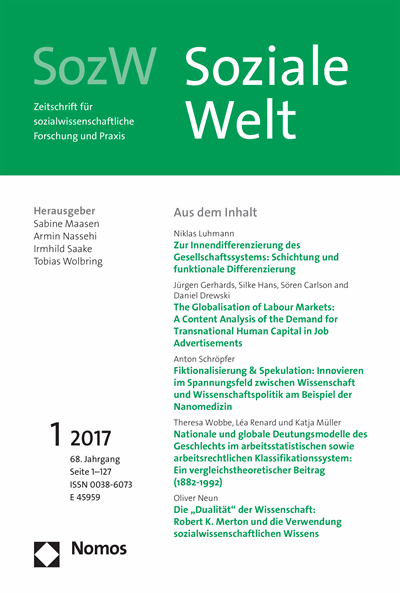
Zwei Formen der Bildung gesellschaftlicher Teilsysteme lassen sich im Rahmen einer Theorie gesellschaftlicher Systemdifferenzierung unterscheiden. Die eine Form betrifft Schichtung im Sinne einer gesellschaftseinheitlich institutionalisierten...
This article analyses how globalisation has affected the demand for transnational human capital (foreign language skills, cross-cultural competence, knowledge about other countries and international experiences) over time, across levels of...
Wissenschaftliche Akteure befinden sich in heutiger Forschung mitunter vor einem zentralen Übersetzungsproblem, nämlich der herzustellenden Konvergenz zwischen wissenschaftlichen und wissenschaftspolitischen Ansprüchen an das Innovieren. Wie das...
Dieser Beitrag beschäftigt sich mit der Frage, welche Relevanz arbeitsstatistische und -rechtliche Kategorisierungen im Zeitraum von 1880 bis 1992 für den Wandel der Deutungsmodelle des Geschlechts haben. Aus vergleichstheoretischer stellt die...
In der Wissenschaftssoziologie dominiert das Bild Robert K. Mertons als Begründer der institutionalistischen Wissenschaftssoziologie, in der er die Autonomie der akademischen Forschung betont. Damit wird sein Werk aber nur selektiv erfasst. Er...
Duncon, Otis D. (1968): Social Stratification and Mobility: Problems in the Measurement of Trends, in: Eleanor B. Sheldon / Wilbert E. Moore (Hrsg.): Indicators of Social Change: Concepts and Measurements, New York, S.675-719. Google Scholar öffnen doi.org/10.5771/0038-6073-2017-1-5
Field, Mark G. (1971): The Health Care System of Industrial Society: The Disappearance of the General Practitioner and Some Implications, in: Everett Mendelsohn / Judith P. Swazey / Irene Taviss (Hrsg.): Human Aspects of Biomedical Innovation, Cambridge Massachusetts, S.156-180. Google Scholar öffnen doi.org/10.5771/0038-6073-2017-1-5
Gessner, Volkmar (1974): Recht und Konflikt: Eine soziologische Untersuchung privatrechtlicher Konflikte in Mexiko, Habilitationsschrift, Ms., Bielefeld [Druckversion: Gessner, Volkmar (1976): Recht und Konflikt: Eine soziologische Untersuchung privatrechtlicher Konflikte in Mexiko, Tübingen]. Google Scholar öffnen doi.org/10.5771/0038-6073-2017-1-5
Parsons, Talcott (1964): Mental Illness and ‚Spiritual Malaise‘: The Role of the Psychiatrist and of the Minister of Religion, in: Ders. Social Structure and Personality, New York / London, S. 292-324. Google Scholar öffnen doi.org/10.5771/0038-6073-2017-1-5
Parsons, Talcott (1971): Comparative Studies and Evolutionary Change, in: Ivan Vallier (Hrsg.): Comparative Methods in Sociology: Essays on Trends and Applications, Berkeley / Los Angeles, S. 97-139. Google Scholar öffnen doi.org/10.5771/0038-6073-2017-1-5
Bennett, Roger (2002): Employers’ Demands for Personal Transferable Skills in Graduates: A Content Analysis of 1000 Job Advertisements and an Associated Empirical Study, in: Journal of Vocational Education & Training 54, pp. 457-476. Google Scholar öffnen doi.org/10.5771/0038-6073-2017-1-25
Bühlmann, Felix / David, Thomas / Mach, André (2013): Cosmopolitan Capital and the Internationalization of the Field of Business Elites: Evidence from the Swiss Case, in: Cultural Sociology 7, pp. 211-229. Google Scholar öffnen doi.org/10.5771/0038-6073-2017-1-25
Casner-Lotto, Jill / Barrington, Linda (2006): Are They Really Ready to Work? Employers’ Perspectives on the Basic Knowledge and Applied Skills of New Entrants to the 21st U.S. Workforce, United States. Google Scholar öffnen doi.org/10.5771/0038-6073-2017-1-25
Díez Medrano, Juan (2014): The Socio‐Economic Returns of Fluency in English as a Foreign Language, in: Jürgen Gerhards / Silke Hans / Sören Carlson (eds.), Globalisierung, Bildung und grenzüberschreitende Mobilität, Wiesbaden, pp. 239-258. Google Scholar öffnen doi.org/10.5771/0038-6073-2017-1-25
Gerhards, Jürgen (2012): From Babel to Brussels. European Integration and the Importance of Transnational Linguistic Capital. Berlin Studies on the Sociology of Europe (BSSE). No. 28. Berlin: Freie Universität Berlin (English translation of Gerhards, Jürgen (2010): Mehrsprachigkeit im vereinten Europa. Transnationales sprachliches Kapital als Ressource in einer globalisierten Welt, Wiesbaden). Google Scholar öffnen doi.org/10.5771/0038-6073-2017-1-25
Gerhards, Jürgen / Hans, Silke (2013): Transnational Human Capital, Education, and Social Inequality. Analyses of International Student Exchange, in: Zeitschrift für Soziologie 42, pp. 99-117. Google Scholar öffnen doi.org/10.5771/0038-6073-2017-1-25
Gerhards, Jürgen / Hans, Silke / Carlson, Sören (2017): Social Class and and Transnational Human Capital. How Mid-dle and Upper Class Parents Prepare Their Children for Globalization, London – New York. Google Scholar öffnen doi.org/10.5771/0038-6073-2017-1-25
Igarashi, Hiroki / Saito, Hiro (2014): Cosmopolitanism as Cultural Capital: Exploring the Intersection of Globalization, Education and Stratification, in: Cultural Sociology 8, pp. 222-239. Google Scholar öffnen doi.org/10.5771/0038-6073-2017-1-25
Klarer, Urs / Sacchi, Stefan (2007): Entwicklung des Stellenmarktes in Presse und Internet: Presse, Internet-Stellenbörsen und firmeneigene Internet-Seiten als Medien der betrieblichen Personalsuche – eine zeit- und medienver-gleichende Analyse, Zürich. Google Scholar öffnen doi.org/10.5771/0038-6073-2017-1-25
Mau, Steffen / Büttner, Sebastian (2010): Transnationality, in: Stefan Immerfall / Göran Therborn (eds.), Handbook of European Societies. Social Transformations in the 21st Century, New York, pp. 537-570. Google Scholar öffnen doi.org/10.5771/0038-6073-2017-1-25
Meyer, John W. (2007): World Models, National Curricula, and the Centrality of the Individual, in: Aaron Benavot / Cecilia Braslavsky (eds.), School Knowledge in Comparative and Historical Perspective: Changing Curricula in Primary and Secondary Education, Dordrecht, pp. 259-271. Google Scholar öffnen doi.org/10.5771/0038-6073-2017-1-25
Pöllmann, Andreas (2013): Intercultural Capital: Toward the Conceptualization, Operationalization, and Empirical Investigation of a Rising Marker of Sociocultural Distinction, in: SAGE Open 3, pp. 1-7. Google Scholar öffnen doi.org/10.5771/0038-6073-2017-1-25
Raab, Marcel / Ruland, Michael / Schönberger, Benno / Blossfeld, Hans-Peter / Hofäcker, Dirk / Buchholz, Sandra / Schmelzer, Paul (2008): GlobalIndex: A Sociological Approach to Globalization Measurement, in: International Socio-logy 23, pp. 596-631. Google Scholar öffnen doi.org/10.5771/0038-6073-2017-1-25
Ramírez, Francisco O. / Suárez, David / Meyer, John W. (2007): The Worldwide Rise of Human Rights Education, in: Aaron Benavot/Cecilia Braslavsky (eds.), School Knowledge in Comparative and Historical Perspective: Changing Curricula in Primary and Secondary Education, Dordrecht, pp. 35-51. Google Scholar öffnen doi.org/10.5771/0038-6073-2017-1-25
Wagner, Gert G. / Frick, Joachim R. / Schupp, Jürgen (2007): The German Socio-Economic Panel Study (SOEP) – Scope, Evolution and Enhancements, in: Schmollers Jahrbuch 127, pp. 139-169. Google Scholar öffnen doi.org/10.5771/0038-6073-2017-1-25
Walters, Peter G.P. (1990): The Significance of Foreign Language Skills for Initial Entry Positions in International Firms, in: Journal of Teaching in International Business 1, pp. 71-83. Google Scholar öffnen doi.org/10.5771/0038-6073-2017-1-25
BMBF (2009): nano.DE-Report 2009. Status Quo der Nanotechnologie in Deutschland, Bonn, Berlin, abrufbar unter: https://www.bmbf.de/pub/nanode_report_2009.pdf, letztes Abrufdatum: 18.1.2016. Google Scholar öffnen doi.org/10.5771/0038-6073-2017-1-45
BMBF (2011): nano.DE-Report 2011. Status Quo der Nanotechnologie in Deutschland, Bonn, Berlin, abrufbar unter: https://www.bmbf.de/pub/nanoDE-Report_2011.pdf, letztes Abrufdatum: 18.1.2016. Google Scholar öffnen doi.org/10.5771/0038-6073-2017-1-45
Callon, M. (2006): Die Sozio-Logik der Übersetzung. Auseinandersetzungen und Verhandlungen zur Bestimmung von Problematischem und Unproblematischem, in: A. Belliger, / D.J. Krieger (Hrsg.), ANThology. Ein einführendes Hand-buch zur Akteur-Netzwerk-Theorie, Bielefeld, S.51-74. Google Scholar öffnen doi.org/10.5771/0038-6073-2017-1-45
Doubleday, R. / Viseu, A. (2010): Questioning Interdisciplinarity: What Roles for Laboratory based Social Science, in: K.L. Kjolberg / F. Wickson (Hrsg.), Nano meets Macro, Social Perspectives on Nanoscale Sciences and Technologies, Singapore, S.55-84. Google Scholar öffnen doi.org/10.5771/0038-6073-2017-1-45
EGE – European Group on Ethics (2009): Ethical Aspects of Nanomedicine: A Condensed Version of the EGE Opinion 21, in: F. Allhoff / P. Lin (Hrsg.), Nanotechnology & Society. Current and Emerging Ethical Issues, Dordrecht, S.187-206. Google Scholar öffnen doi.org/10.5771/0038-6073-2017-1-45
ETPN – European Technology Platform on Nanomedicine (2009): Roadmaps in Nanomedicine towards 2020, Joint European Commission/ETP Nanomedicine Expert Report 2009, abrufbar unter: http://www.etp-nanomedicine.eu/public/press-documents/publications/etpn-publications, letztes Abrufdatum: 19.4.2012. Google Scholar öffnen doi.org/10.5771/0038-6073-2017-1-45
ETPN – European Technology Platform Nanomedicine (2013): Nanomedicine 2020. Contribution of Nanomedicine to Horizon 2020. White Paper to the Horizon 2020 Framework Programme for Research and Innovation – Recommen-dations from Nanomedicine Community, abrufbar unter: http://www.etp-nanomedicine.eu/etpn-white-paper-2013, letztes Abrufdatum: 18.1.2016. Google Scholar öffnen doi.org/10.5771/0038-6073-2017-1-45
EuroNanoMed (2011): Nanomedicine, from research to patient and industry, abrufbar unter http://www.cordis.europa.eu/documents/documentlibrary/119870481EN6.pdf, letztes Abrufdatum: 20.2.2012. Google Scholar öffnen doi.org/10.5771/0038-6073-2017-1-45
Felt, U. (2010): Leben in Nanowelten. Zur Ko-Produktion von Nano und Gesellschaft, in: P. Lucht / M. Erlemann / E. Ben Ruiz (Hrsg.), Technologisierung gesellschaftlicher Zukünfte. Nanotechnologien in wissenschaftlicher, politischer und öffentlicher Praxis, Freiburg, S.19-38. Google Scholar öffnen doi.org/10.5771/0038-6073-2017-1-45
Gibbons, M. / Limoges, C. / Nowotny, H. / Schwartzman, S. / Scott, P. / Trow, M. (1994): The New Production of Knowledge. The Dynamics of Science and Research in Contemporary Societies, London. Google Scholar öffnen doi.org/10.5771/0038-6073-2017-1-45
Gouze, N. (2013): Nanomedicine: Open Innovation, abrufbar unter: http://horizon2020projects.com/il-nanotechnology-interviews/nanomedicine-open-innovation/, letztes Abrufdatum: 23.5.2017 Google Scholar öffnen doi.org/10.5771/0038-6073-2017-1-45
Grube, A. / Schneider, C. / Rekić, Schetula, V. (2008): Nanomedizin – Chancen und Risiken. Eine Analyse der Potentia-le, der Risiken und der ethisch-sozialen Fragestellungen um den Einsatz von Nanotechnologien und Nanomaterialien in der Medizin. Im Auftrag der Friedrich-Ebert-Stiftung, Berlin, abrufbar unter: http://library.fes.de/pdf-files/stabsabteilung/05709.pdf, letztes Abrufdatum: 24.4.2012. Google Scholar öffnen doi.org/10.5771/0038-6073-2017-1-45
Hutter, M. / Knoblauch, H. / Rammert W. / Windeler, A. (2016): Innovationsgesellschaft heute. Die reflexive Herstel-lung des Neuen, in: W. Rammert / A. Windeler / H. Knoblauch / M. Hutter (Hrsg.), Innovationsgesellschaft heute. Per-spektiven, Felder und Fälle, Wiesbaden, S.15-38. Google Scholar öffnen doi.org/10.5771/0038-6073-2017-1-45
Kearnes, M. / Grove-White, R. / Macnaghten, P. / Wilsdon, J. / Wynne, B. (2006): From bio to nano? Learning lessons from the UK agricultural biotechnology controversy, in: Science as Culture 15, S.291-307. Google Scholar öffnen doi.org/10.5771/0038-6073-2017-1-45
Kenneth, D. / Thompson, P.B. (2008) (Hrsg.): What Can Nanotechnology Learn From Biotechnology? Social and Ethi-cal Lessons for Nanoscience from the Debate over Agrifood Biotechnology and GMOs, Burlington / MA. Google Scholar öffnen doi.org/10.5771/0038-6073-2017-1-45
Kurath, M. / Kaiser, M. (2010): Fragile Disziplinen: Identitäts-Diskurse und Transformationsprozesse in den Nanowis-senschaften und Nanotechnologien, in: P. Lucht / M. Erlemann / E. Ruiz Ben (Hrsg.), Technologisierung gesellschaftli-cher Zukünfte. Nanotechnologien in wissenschaftlicher, politischer und öffentlicher Praxis, Freiburg im Breisgau, S.93-108. Google Scholar öffnen doi.org/10.5771/0038-6073-2017-1-45
Latour, B. (2011): Reflections on Etienne Souriau’s Les différents modes d’existence, in: L. Bryant / N. Srnicek / G. Harman (Hrsg.): The Speculative Turn. Continental Materialism and Realism, Melbourne, S.304-333. Google Scholar öffnen doi.org/10.5771/0038-6073-2017-1-45
Lucht, P. / Erlemann, M. / Ruiz Ben, E. (2010) (Hrsg.): Technologisierung gesellschaftlicher Zukünfte. Nanotechnolo-gien in wissenschaftlicher, politischer und öffentlicher Praxis, Freiburg im Breisgau. Google Scholar öffnen doi.org/10.5771/0038-6073-2017-1-45
McGrail, S. (2010): Nano Dreams and Nightmares: Emerging Technoscience and the Framing and (re)Interpreting of the Future, Present and Past, in: Journal of Future Studies 14, S.23-48. Google Scholar öffnen doi.org/10.5771/0038-6073-2017-1-45
Nordmann, A. (2006): Personalisierte Medizin? – Zum Versprechen der Nanomedizintechnik, in: Hessisches Ärzteblatt, 5, abrufbar unter: http://www.philosophie.tu-darmstadt.de/media/institut_fuer_philosophie/diesunddas/nordmann/aerzteblatt.pdf, letztes Abrufdatum: 24.4.2012. Google Scholar öffnen doi.org/10.5771/0038-6073-2017-1-45
Nordmann, A. (2005): Was ist TechnoWissenschaft? Zum Wandel der Wissenschaftskultur am Beispiel von Nanofor-schung u. Bionik, in: T. Rossmann / C. Tropea (Hrsg.), Bionik. Neue Forschungsergebnisse in Natur-, Ingenieur- und Geisteswissenschaften, Berlin, S.209-218. Google Scholar öffnen doi.org/10.5771/0038-6073-2017-1-45
Nordmann, A. (2008): Mit der Natur über die Natur hinaus?, in: K. Köchy / M. Norwig / G. Hofmeister (Hrsg.), Nanobio-technologien. Philosophische, anthropologische und ethische Fragen, Freiburg, München, S.131-147. Google Scholar öffnen doi.org/10.5771/0038-6073-2017-1-45
NSF – National Science Foundation (2001): Societal Implications of Nanoscience and Nanotechnology, Arlington, Virginia, abrufbar unter: http://www.wtec.org/loyola/nano/NSET.Societal.Implications/nanosi.pdf, letztes Abrufdatum: 25.4.2012. Google Scholar öffnen doi.org/10.5771/0038-6073-2017-1-45
NSF – National Science Foundation (2009): NSF Workshop Report on Re-Engineering Basic and Clinical Research to Catalyze Translational Nanoscience. Los Angeles, California, abrufbar unter: http://www.nsf.gov/crssprgm/nano/reports/reengineering_basic_and_clinical_4_9_09.pdf, letztes Abrufdatum: 19.4.2012. Google Scholar öffnen doi.org/10.5771/0038-6073-2017-1-45
Passoth, J.H. / Rammert, W. (2016): Fragmentale Differenzierung und die Praxis der Innovation. Wie immer mehr In-novationsfelder entstehen, in: W. Rammert / A. Windeler / H. Knoblauch / M. Hutter (Hrsg.), Innovationsgesellschaft heute. Perspektiven, Felder und Fälle, Wiesbaden, S.39-68. Google Scholar öffnen doi.org/10.5771/0038-6073-2017-1-45
Plank, C. / Eglin, D. / Fahy, N. / Sapet, C. / Borget, P. / van Osch, G. / Gentili, C. / Miramond, T. / Zöller, K. / Anton, M. (2012): Gene activated matrices for bone and cartilage regeneration in arthrisis, European Journal of Nanomedicine 4, S.17-32. Google Scholar öffnen doi.org/10.5771/0038-6073-2017-1-45
Rammert, W. / Windeler, A. / Knoblauch, H. / Hutter, M. (2016): Die Ausweitung der Innovationszone, in: W. Rammert / A. Windeler / H. Knoblauch / M. Hutter (Hrsg.), Innovationsgesellschaft heute. Perspektiven, Felder und Fälle, Wies-baden, S.3-14. Google Scholar öffnen doi.org/10.5771/0038-6073-2017-1-45
Rusch, G. (1997): Fiktionalisierung als Element von Medienhandlungsstrukturen, in: C. Oberwagner / C. Scholz (Hrsg.), Literaturwissenschaft als Wissenschaft über Fiktionalität, Szeged, S.123-138. Google Scholar öffnen doi.org/10.5771/0038-6073-2017-1-45
Schiemann, G. (2008): Nanotechnologie und Naturverständnis, in: K. Köchy / M. Norwig / G. Hofmeister (Hrsg.), Nanobiotechnologien. Philosophische, anthropologische und ethische Fragen, Freiburg – München, S.67-83. Google Scholar öffnen doi.org/10.5771/0038-6073-2017-1-45
Schimank, U. (2009): Wie sich funktionale Differenzierung reproduziert – eine akteurtheoretische Erklärung, in: P. Hill / F. Kalter / J. Kopp / C. Kroneberg / R. Schnell (Hrsg.), Hartmut Essers Erklärende Soziologie – Kontroversen und Per-spektiven, Frankfurt / Main, S.201-226. Google Scholar öffnen doi.org/10.5771/0038-6073-2017-1-45
Schillmeier, M. (2014): Black Box ‚Gesellschaft‘. Produktive Kontraste in der Wissenschaftsforschung, in: N. Braun / J. Müller / A. Nassehi / I. Saake / T. Wolbring (Hrsg.), Begriffe – Positionen – Debatten, Baden-Baden, S.192-207. Google Scholar öffnen doi.org/10.5771/0038-6073-2017-1-45
Stengers, I. (2010): Including Nonhumans in Political Theory. Opening Pandora’s Box, in: B. Braun / S.J. Whatmore (Hrsg.), Political matter. Technoscience, democracy, and public life, Minneapolis, S.3-34. Google Scholar öffnen doi.org/10.5771/0038-6073-2017-1-45
Thorbrietz, P. / Zöller, K. (2008): Jugendforen Nanomedizin. Chancen und Risiken, ethische und soziale Fragen der Nanomedizin aus der Sicht junger Erwachsener. Nanomedizin: Anwendungsfelder, mögliche Risiken und ethische Fra-gen. Ein Überblick, abrufbar unter: http://www.nano-jugend-dialog.de/daten/MPSNanomedVorstudieEnd.pdf, letztes Abrufdatum: 6.5.2012. Google Scholar öffnen doi.org/10.5771/0038-6073-2017-1-45
Trommelmans, L. / Selling, J. / Dierickx, K. (2009): Is tissue engineering a new paradigm in medicine? Consequences for the ethical evaluation of tissue engineering research, in: Medicine, Health Care and Philosophy 12, S.459-467. Google Scholar öffnen doi.org/10.5771/0038-6073-2017-1-45
Bemmann, M. (2016): Das Chaos beseitigen. Die internationale Standardisierung forst- und holzwirtschaftlicher Statistiken in den 1920er und 1930er Jahren und der Völkerbund, in: Jahrbuch für Wirtschaftsgeschichte 57 (2),545-587. Google Scholar öffnen doi.org/10.5771/0038-6073-2017-1-63
Berkovitch, N. (1999b): The Emergence and Transformation of the International Women's Movement, in: J. Boli / G. M. Thomas (Hrsg.), Constructing World Culture. International Nongovernmental Organizations since 1875, Stanford, Stanford University Press, 100-126. Google Scholar öffnen doi.org/10.5771/0038-6073-2017-1-63
Brentano, L. von (1873): Referat. Fabrikgesetzgebung, in: Ständiger Ausschuss des Vereins für Socialpolitik (Hrsg.), Verhandlungen der Eisenacher Versammlung zur Besprechung der socialen Frage am 6. und 7. Oktober 1872, Leipzig, Duncker & Humblot. Google Scholar öffnen doi.org/10.5771/0038-6073-2017-1-63
Collier, R. B. / Collier, D. (1991): Shaping the Political Arena. Critical Junctures, the Labor Movement, and Regime Dynamics in Latin America, Princeton, Princeton University Press. Google Scholar öffnen doi.org/10.5771/0038-6073-2017-1-63
Conrad, S. / Macamo, E. / Zimmermann, B. (2000): Die Kodifizierung der Arbeit. Individuum, Gesellschaft, Nation, in: J. Kocka / C. Offe (Hrsg.), Geschichte und Zukunft der Arbeit, Frankfurt a.M. / New York, 449-475. Google Scholar öffnen doi.org/10.5771/0038-6073-2017-1-63
Cussó, R. (2012): L'activité statistique de l'Organisation économique et financière de la Société des Nations. Un nouveau lien entre pouvoir et quantification, in : Histoire & Mesure 27, 107-136. Google Scholar öffnen doi.org/10.5771/0038-6073-2017-1-63
Donnelly, M. (1998): From Political Arithmetic to Social Statistics: How Some Nineteenth-Century Roots of the Social Sciences Were Implanted, in: J. Heilbron / L. Magnusson / B. Wittrock (Hrsg.), The Rise of the Social Sciences and the Formation of Modernity, Dordrecht / Boston / London, Kluwer Academic, 225-240. Google Scholar öffnen doi.org/10.5771/0038-6073-2017-1-63
Frerich, J. / Frey, M. (1996): Handbuch der Geschichte der Sozialpolitik in Deutschland, Bd. 2: Sozialpolitik in der Deutschen Demokratischen Republik, 2. Auflage, München / Wien, R. Oldenbourg Verlag. Google Scholar öffnen doi.org/10.5771/0038-6073-2017-1-63
Giraud, O. (2017, im Erscheinen): Making Sense of the Women’s Labour in the Context of the French Family Business: From Domestic Labour to Recognized Work, in: O. Giraud / T. Wobbe / I. Berrebi-Hoffmann (Hrsg.), Arguing about categories, Oxford / New York, Berghahn. Google Scholar öffnen doi.org/10.5771/0038-6073-2017-1-63
Hacking, I. (1986): Making up People, in: T. C. Heller / M. Sosna, / D. E. Wellberry (Hrsg.), Reconstructing Individualism. Autonomy, Individuality, and the Self in Western Thought, Stanford, Stanford University Press, 222-236 Google Scholar öffnen doi.org/10.5771/0038-6073-2017-1-63
Hausen, K. (1997): Arbeiterinnenschutz, Mutterschutz und gesetzliche Krankenversicherung im Deutschen Kaiserreich und in der Weimarer Republik. Zur Funktion von Arbeits- und Sozialrecht für die Normierung und Stabilisierung der Geschlechterverhältnisse, in: U. Gerhard (Hrsg.), Frauen in der Geschichte des Rechts. Von der Frühen Neuzeit bis zur Gegenwart, München, Beck, 713-743. Google Scholar öffnen doi.org/10.5771/0038-6073-2017-1-63
Heintz, B. (2012): Welterzeugung durch Zahlen. Modelle politischer Differenzierung in Internationalen Statistiken, 1948-2010, in: C. Bohn / A. Schubbach, / L. Wansleben (Hrsg.), Welterzeugung durch Bilder. Sonderband der Zeitschrift Soziale Systeme 18, 7-39. Google Scholar öffnen doi.org/10.5771/0038-6073-2017-1-63
Heintz, B. / Werron, T. (2011): Die Unwahrscheinlichkeit der Globalisierung. Zur Entstehung globaler Vergleichshorizonte am Beispiel von Wissenschaft und Sport, in: Kölner Zeitschrift für Soziologie und Sozialpsychologie 63, 161-192. Google Scholar öffnen doi.org/10.5771/0038-6073-2017-1-63
Hericks, K. / Wobbe, T. (2017): Ein Sieg des Fortschritts? ‚Gleichbehandlung‘ und ‚Leistung‘ aus der Perspektive der World-Polity-Forschung, in: M. Funder (Hrsg.), Neo-Institutionalismus – Revisited. Bilanz und Weiterentwicklungen aus Sicht der Geschlechterforschung, Baden-Baden, Nomos,71-96. Google Scholar öffnen doi.org/10.5771/0038-6073-2017-1-63
Hussmanns, R. / Mehran, F. / Varma, V. (1992): Surveys of economically active population, employment, unemployment and underemployment. An ILO-manual on concepts and methods, Genf, International Labour Office. Google Scholar öffnen doi.org/10.5771/0038-6073-2017-1-63
International Conference of Labour Statisticians (1982): Resolution concerning statistics of the economically active population, employment, unemployment and underemployment, adopted by the Thirteenth International Conference of Labour Statisticians. Google Scholar öffnen doi.org/10.5771/0038-6073-2017-1-63
International Labour Office (1944): Declaration of Philadelphia, Declaration concerning the aims and purposes of the International Labour Organisation, Annex, in: 26th International Labour Conference Philadelphia Record of Proceedings, International Labour Office, Montreal. Google Scholar öffnen doi.org/10.5771/0038-6073-2017-1-63
International Labour Office (1948a): Employment, Unemployment and Labour Force. A Study of Methods. Report prepared for the Sixth International Conference of Labour Statitsticians (Montreal, 4-12 August 1947), Genf. Google Scholar öffnen doi.org/10.5771/0038-6073-2017-1-63
Jepperson, R. L. (1991): Institutions, Institutional Effects, and Institutionalism, in: W. Powell / P. DiMaggio (Hrsg.), The New Institutionalism in Organizational Analysis, Chicago, University of Chicago Press, 143-163. Google Scholar öffnen doi.org/10.5771/0038-6073-2017-1-63
Kaiserliches Statistisches Amt (1884): Die Statistik des Deutschen Reichs, Bd. 2. Berufsstatistik nach der allgemeinen Berufszählung vom 5. Juni 1882. Berlin: von Puttkammer & Mühlbrecht. 8* Google Scholar öffnen doi.org/10.5771/0038-6073-2017-1-63
Koch, M. (2015): From International to World Organizations, in: B. Holzer / F. Kastner / T. Werron (Hrsg.), From Globalization to World Society. Neo-Institutional and Systems-Theoretical Perspectives, Abingdon: Routledge, 279-300. Google Scholar öffnen doi.org/10.5771/0038-6073-2017-1-63
League of Nations (1938): Statistics of the Gainfully Occupied Population. Definitions and Classifications Recommended by the Committee of Statistical Experts (1938, II. A. 12). Studies and reports on statistical methods, No. 1, Genf. Google Scholar öffnen doi.org/10.5771/0038-6073-2017-1-63
Meerwarth, R. (1925): Nationalökonomie und Statistik. Eine Einführung in die empirische Nationalökonomie. Handbuch der Wirtschafts- und Sozialwissenschaften in Einzelbänden, 7. Band. Berlin, Walter de Gruyter & Co. Google Scholar öffnen doi.org/10.5771/0038-6073-2017-1-63
Mejstrik, A. (2008): Berufsstatistisches Niederösterreich. Der offizielle Berufs- und Arbeitsmarkt nach den Volkszählungen 1934, 1971 und 2001, in: P. Melichar / S. Eminger / E. Langthaler (Hrsg.), Wirtschaft. Niederösterreich im 20. Jahrhundert Bd. 2, Wien / Köln / Weimar, Böhlau, 633-730. Google Scholar öffnen doi.org/10.5771/0038-6073-2017-1-63
Natchkova, N. / Schoeni, C. (2013): The ILO, Feminists and Expert Networks. The Challenges of a Protective Policy (1919–1934), in: S. Kott / J. Droux (Hrsg.), Globalizing Social Rights. The International Labour Organization and Beyond, Genf, 49-64. Google Scholar öffnen doi.org/10.5771/0038-6073-2017-1-63
Patriarca, S. (2011): Gender Trouble. Frauen und die Herstellung der aktiven Bevölkerung Italiens 1861-1936, in: T. Wobbe / I. Berrebi-Hoffmann / M. Lallement (Hrsg.), Die gesellschaftliche Verortung des Geschlechts. Diskurse der Differenz in der deutschen und französischen Soziologie um 1900, Frankfurt a.M. / New York, Campus, 212-237. Google Scholar öffnen doi.org/10.5771/0038-6073-2017-1-63
Raphael, L. (1996): Die Verwissenschaftlichung des Sozialen als methodische und konzeptionelle Herausforderung für eine Sozialgeschichte des 20. Jahrhunderts, in: Geschichte und Gesellschaft 22, 165-193. Google Scholar öffnen doi.org/10.5771/0038-6073-2017-1-63
Reichel, K., (2014): Dimensionen der (Un-)Gleichheit. Geschlechtsspezifische Ungleichheiten in den sozial- und beschäftigungspolitischen Debatten der EWG in den 1960er Jahren, Stuttgart: Franz Steiner Google Scholar öffnen doi.org/10.5771/0038-6073-2017-1-63
Renard, L. (2017, im Erscheinen): The Grey Zones Between Work and Non-work: Statistical and Social Placing of ‘Family Workers’ in Germany (1880 – 2010), in: O. Giraud, T. Wobbe, I. Berrebi-Hoffmann (Hrsg.), Arguing about categories, Oxford / New York, Berghahn. Google Scholar öffnen doi.org/10.5771/0038-6073-2017-1-63
Strang, D./Meyer J. W. (1994): Institutional conditions for diffusion, in: R. W. Scott/J. W. Meyer (Hrsg.), Institutional Environments and Organization: Structural Complexity and Individualism. Thousand Oaks/London/New Delhi: Sage, 100-112. Google Scholar öffnen doi.org/10.5771/0038-6073-2017-1-63
Topalov, C. (1994): The Invention of Unemployment. Language, Classification, and Social Reform 1880–1910, in: B. Palier (Hrsg.), Comparing Social Welfare Systems in Europe, Oxford Conference, France–United Kingdom, 493-507. Google Scholar öffnen doi.org/10.5771/0038-6073-2017-1-63
Topalov, C. (2001): A revolution in representations of work: the emergence over the 19th century of the statistical category "occupied population" in France, Great Britain, and the United States, in: Revue française de sociologie 42, 79-106. Google Scholar öffnen doi.org/10.5771/0038-6073-2017-1-63
Ventresca M. J. (2002): Global policy fields: conflicts and settlements in the emergence of organized international attention to official statistics, 1853-1947, Institute for Policy Research Working Paper WP-02-45, Northwestern University. Google Scholar öffnen doi.org/10.5771/0038-6073-2017-1-63
Wadauer, S. (2008): The Production of Work. Welfare, Labour Market and the Disputed Boundaries of Labour (1880–1938), Universität Wien: Institut für Wirtschafts- und Sozialgeschichte, unter: http://pow.univie.ac.at/fileadmin/user_upload/proj_pow/Projekt/Production_of_work_-_k_-_e.pdf (abgerufen am 18.6.2015). Google Scholar öffnen doi.org/10.5771/0038-6073-2017-1-63
Wikander, U. / Kessler-Harris, A. / Lewis, J. (Hrsg.) (1995): Protecting Women. Labor Legislation in Europe, the United States, and Australia 1880-1920, Campaign, University of Illinois Press. Google Scholar öffnen doi.org/10.5771/0038-6073-2017-1-63
Wobbe, T. / Kestler, A. / Kauffenstein, E. (2011): Statistische Klassifizierung und geschlechtliche Kategorisierung. Die Unterscheidung von Haushalt und Betrieb in der deutschen Berufsstatistik um 1900, in: T. Wobbe / I. Berrebi-Hoffmann / M. Lallement (Hrsg.), Die gesellschaftliche Verortung des Geschlechts. Diskurse der Differenz in der deutschen und französischen Soziologie um 1900, Frankfurt a.M. / New York, Campus, 238-263. Google Scholar öffnen doi.org/10.5771/0038-6073-2017-1-63
Wobbe, T. (2012): Making up People: Berufsstatistische Klassifikation, geschlechtliche Kategorisierung und wirtschaftliche Inklusion um 1900 in Deutschland, in: Zeitschrift für Soziologie 41, 41-57. Google Scholar öffnen doi.org/10.5771/0038-6073-2017-1-63
Wobbe, T. (2015): Das Globalwerden der Menschenrechte in der ILO: Die universelle Deutung von Arbeitsrechten und ihr sozio-struktureller Kontext von den 1930er bis 1950er Jahren, in: B. Heintz / B. Leisering (Hrsg.), Menschenrechte in der Weltgesellschaft. Semantischer Wandel und rechtliche Institutionalisierung, Frankfurt a. M., Campus, 283-316. Google Scholar öffnen doi.org/10.5771/0038-6073-2017-1-63
Wobbe, T. (2017): Der überlokale Wandel statistischer Repräsentationen der Arbeitswelt. Vom nationalen Zensus um 1900 zur internationalen Vergleichbarkeit in der International Labour Organization (ILO), 1882–1938, in: S. Haas / M. C. Schneider / N. Bilo (Hrsg.), Kulturgeschichte der Statisktik, Stuttgart: Steiner. Google Scholar öffnen doi.org/10.5771/0038-6073-2017-1-63
Wobbe, T. / Malmedie, L. (2017, im Erscheinen): Diskriminierungsverbot und Anti-Diskriminierungsmaßnahmen in der EU seit 1957: Eine inklusionstheoretische und institutionalistische Perspektive, in: M. Bach / B. Hönig-Bach (Hrsg.), Handbuch der Europasoziologe, Baden-Baden, Nomos. Google Scholar öffnen doi.org/10.5771/0038-6073-2017-1-63
Wobbe, T. / Renard, L. (2017, im Erscheinen): Gendered boundaries between household and market at a global scale: the category of ‘family workers’ in the International Labour Organization (ILO) statistics (1930s -1980s), in: Journal of Global History 12 (3). Google Scholar öffnen doi.org/10.5771/0038-6073-2017-1-63
Zimmermann, S. (2015a): Klasse – Geschlecht – globale Differenz. Drei Achsen der Ungleichheit in der Gründungsstunde der Internationalen Arbeitsorganisation im Jahre 1919, in: Aus der Geschichte des Arbeitsrechts und des Sozialrechts 5, 358-366. Google Scholar öffnen doi.org/10.5771/0038-6073-2017-1-63
Zimmermann, S. (2015b): Night Work for White Women and Bonded Labour for “Native” Women? Contentious Traditions and the Globalization of Gender-Specific Labour Protection and Legal Equality Politics 1926 to 1939, in: S. Kimble / M. Röwekamp (Hrsg.), New Perspectives on European Women‘s Legal History, New York, Routledge, 558 – 590. Google Scholar öffnen doi.org/10.5771/0038-6073-2017-1-63
Aufermann, Jörg/Bohrmann, Hans/Sülzer, Rolf (1973): Sozialisation, in: Dies. (Hrsg.), Gesellschaftliche Kommunikation und Information. Forschungsrichtungen und Problemstellungen. Ein Arbeitsbuch zur Massenkommunikation II, Frankfurt a. M., 423-424. Google Scholar öffnen doi.org/10.5771/0038-6073-2017-1-87
Calhoun, Craig/Van Antwerpen, Jonathan (2007): Orthodoxy, Heterodoxy, and Hierarchy: „Mainstream“ Sociology and Its Challengers, in: Craig Calhoun (Hrsg.), Sociology in America. A History, Chicago, 367-410. Google Scholar öffnen doi.org/10.5771/0038-6073-2017-1-87
Carrier, Martin/Nordmann, Alfred (2011): Science in the Context of Application: Methodological Change, Conceptual Transformation, Cultural Reorientation, in: Dies. (Hrsg.), Science in the Context of Application, Dordrecht, 1-7. Google Scholar öffnen doi.org/10.5771/0038-6073-2017-1-87
Cole, Jonathan R./Zuckerman, Harriet (1975): The Emergence of a Scientific Speciality: The Self-Exemplifying Case of the Sociology of Science, in: Lewis A. Coser (Hrsg.), The Idea of Social Structure. Papers in Honor of Robert K. Merton, New York, 139-174. Google Scholar öffnen doi.org/10.5771/0038-6073-2017-1-87
Coser, Lewis A./Fleck, Christian (2007): Robert K. Merton, in: Dirk Kaesler (Hrsg.), Klassiker der Soziologie. Bd. 2. Von Talcott Parsons bis Pierre Bourdieu. 5. überarb. Aufl., München, 152-179. Google Scholar öffnen doi.org/10.5771/0038-6073-2017-1-87
Crothers, Charles (1998): The Relation between the Logics of Merton's Theory and Lazarsfeld's Methodology: Their Intellectual Compatibility and Research Partnership, in: Jacques Lautman/Bernard-Pierre Lécuyer (Hrsg.), Paul Lazarsfeld (1901-1976). La sociologie de Vienne à New York, Paris, 213-253. Google Scholar öffnen doi.org/10.5771/0038-6073-2017-1-87
Fleck, Christian (2015a): Lazarsfeld, Paul Felix (1901-1976), in: James D. Wright (Hrsg.), International Encyclopedia of the Social & Behavioral Sciences. 2. Aufl. Bd. 13 [K-Le], Amsterdam, 635-640. Google Scholar öffnen doi.org/10.5771/0038-6073-2017-1-87
Fleck, Christian (2015b): Merton, Robert K. (1910-2003), in: James D. Wright (Hrsg.), International Encyclopedia of the Social & Behavioral Sciences. 2. Aufl. Bd. 15 [Med-Mot], Amsterdam, 246-251. Google Scholar öffnen doi.org/10.5771/0038-6073-2017-1-87
Fleck, Christian/Stehr, Nico (2007): Einleitung. Von Wien nach New York, in: Paul F. Lazarsfeld, Empirische Analyse des Handelns. Ausgewählte Schriften. Hrsg. v. Christian Fleck und Nico Stehr, Frankfurt a. M., 7-58. Google Scholar öffnen doi.org/10.5771/0038-6073-2017-1-87
Gibbons, Michael/Limoges, Camille/Nowotny, Helga/Schwartzman, Simon/Scott, Peter, Trow, Martin (1994): The New Production of Knowledge. The Dynamics of Science and Research in Contemporary Societies, London. Google Scholar öffnen doi.org/10.5771/0038-6073-2017-1-87
Hartmann, Heinz (1973): Vorwort zur zweiten Auflage, in: Ders. (Hrsg.), Moderne amerikanische Soziologie. Neuere Beiträge zur soziologischen Theorie. 2., umgearbeitete Auflage, Stuttgart, III-V. Google Scholar öffnen doi.org/10.5771/0038-6073-2017-1-87
Hinkle, Roscoe, L./Hinkle, Gisela N. (1960): Die Entwicklung der amerikanischen Soziologie. Eine Geschichte ihrer Motive und Theorien. Eingeleitet und übersetzt von Leopold und Hilde Rosenmayr. München. Google Scholar öffnen doi.org/10.5771/0038-6073-2017-1-87
Jerabek, Hynek (2012): Six Examples of Collaboration Between Paul F. Lazarsfeld and Robert K. Merton, in: Hannes Haas/Hynek Jerabek/Thomas Peterson (Hrsg.), The Early Days of Survey Research and Their Importance Today, Wien, 2-27. Google Scholar öffnen doi.org/10.5771/0038-6073-2017-1-87
Lazarsfeld, Paul F./Merton, Robert K. (1948): Mass Communication, Popular Taste and Organized Social Action, in: Lyman Bryson (Hrsg.), The Communication of Ideas. A Series of Addresses, New York, 95-118. Google Scholar öffnen doi.org/10.5771/0038-6073-2017-1-87
Lazarsfeld, Paul F./Merton, Robert K. (1973): Massenkommunikation, Publikumsgeschmack und organisiertes Sozialverhalten, in: Aufermann, Jörg/Bohrmann, Hans/Sülzer, Rolf (Hrsg.), Gesellschaftliche Kommunikation und Information. Forschungsrichtungen und Problemstellungen. Ein Arbeitsbuch zur Massenkommunikation II, Frankfurt a. M., 445-470. Google Scholar öffnen doi.org/10.5771/0038-6073-2017-1-87
Meja, Volker/Stehr, Nico (1995): Robert K. Mertons strukturelle Analyse, in: Robert K. Merton, Soziologische Theorie und soziale Struktur. Hrsg. v. Volker Meja und Nico Stehr, Berlin, VII-XXVI. Google Scholar öffnen doi.org/10.5771/0038-6073-2017-1-87
Merton, Robert K. (1959): Notes on Problems-Finding in Sociology, in: Robert K. Merton/Leonard Broom/Leonard S. Cottrell, Jr. (Hrsg.), Sociology Today. Problems and Prospects, New York, IX-XXXIV. Google Scholar öffnen doi.org/10.5771/0038-6073-2017-1-87
Merton, Robert K. (1961): Social Problems and Sociological Theory, in: Robert K. Merton/ Robert Nisbet (Hrsg.), Contemporary Social Problems. An Introduction to the Sociology of Deviant Behavoir and Social Disorganization, New York, 697-737. Google Scholar öffnen doi.org/10.5771/0038-6073-2017-1-87
Merton, Robert K. (1964): The Bearing of Sociological Theory on Empirical Research, in: Hans Albert (Hrsg.), Theorie und Realität. Ausgewählte Aufsätze zur Wissenschaftslehre der Sozialwissenschaften, Mohr, 119-136. Google Scholar öffnen doi.org/10.5771/0038-6073-2017-1-87
Merton, Robert K. (1966). Die ambivalente Haltung des Wissenschaftlers, in: Alphons Silbermann (Hrsg.), Militanter Humanismus. Von den Aufgaben der modernen Soziologie, Frankfurt a. M., 330-355. Google Scholar öffnen doi.org/10.5771/0038-6073-2017-1-87
Merton, Robert K. (1967b): Der Rollen-Set: Probleme der soziologischen Theorie, in: Heinz Hartmann (Hrsg.), Moderne amerikanische Soziologie. Neuere Beiträge zur soziologischen Theorie, Stuttgart, 255-267. Google Scholar öffnen doi.org/10.5771/0038-6073-2017-1-87
Merton, Robert K. (1968c): Contributions to the Theory of Reference Group Behavoir (with Alice S. Rossi), in: Ders., Social Theory and Social Structure. 3. erw. Aufl., New York, 279-334. Google Scholar öffnen doi.org/10.5771/0038-6073-2017-1-87
Merton, Robert K. (1972a): Wissenschaft und demokratische Sozialstruktur, in: Peter Weingart (Hrsg.), Wissenschaftssoziologie I. Wissenschaftliche Entwicklung als sozialer Prozeß. Ein Reader mit einer kritischen Einleitung des Herausgebers, Frankfurt a. M., 45-59. Google Scholar öffnen doi.org/10.5771/0038-6073-2017-1-87
Merton, Robert K. (1972b): Die Priorität bei wissenschaftlichen Entdeckungen: Ein Kapitel der Wissenschaftssoziologie, in: Peter Weingart (Hrsg.), Wissenschaftssoziologie I. Wissenschaftliche Entwicklung als sozialer Prozeß. Ein Reader mit einer kritischen Einleitung des Herausgebers, Frankfurt a. M., 121-164. Google Scholar öffnen doi.org/10.5771/0038-6073-2017-1-87
Merton, Robert K. (1973a): The Normative Structure of Science, in: Ders., The Sociology of Science. Theoretical and Empirical Investigations. Hrsg. v. Norman W. Storer, Chicago, 267-278. Google Scholar öffnen doi.org/10.5771/0038-6073-2017-1-87
Merton, Robert K. (1973c): Technical and Moral Dimensions of Policy Research, in: Ders., The Sociology of Science. Theoretical and Empirical Investigations. Hrsg. v. Norman W. Storer, Chicago, 70-98. Google Scholar öffnen doi.org/10.5771/0038-6073-2017-1-87
Merton, Robert K. (1982a): Basic Research and Potentials of Relevance, in: Ders., Social Research and the Practising Professions. Hrsg. und mit einer Einleitung von Aaron Rosenblatt und Thomas F. Gieryn, Cambridge, Mass., 213-223. Google Scholar öffnen doi.org/10.5771/0038-6073-2017-1-87
Merton, Robert K. (1995a): Opportunity Structure: The Emergence, Diffusion, and Differentiation of a Sociological Concept. 1930s-1950s, in: Freda Adler/William S. Laufer (Hrsg.), The Legacy of Anomie Theory. Advances in Criminological Theory. Bd. 6, New Brunswick, New Jersey, 3-78. Google Scholar öffnen doi.org/10.5771/0038-6073-2017-1-87
Merton, Robert K. (1998a): Unanticipated Consequences and Kindred Sociological Ideas. A Personal Gloss, in: Carlo Mongardini/Simonetta Tabboni (Hrsg.), Robert K. Merton & Contemporary Sociology, New Brunswick, New Jersey, 295-318. Google Scholar öffnen doi.org/10.5771/0038-6073-2017-1-87
Merton, Robert K. (1998b): Working with Lazarsfeld: Notes and Contexts, in: Jacques Lautman/Bernard-Pierre Lécuyer (Hrsg.), Paul Lazarsfeld (1901-1976). La sociologie de Vienne à New York, Paris, 163-211. Google Scholar öffnen doi.org/10.5771/0038-6073-2017-1-87
Merton, Robert K. (2004): Autobiographic Reflections on The Travels and Adventures of Serendipity, in: Robert K. Merton/Elinor Barber (Hrsg.), The Travels and Adventures of Serendipity. A Study in Sociological Semantics and the Sociology of Science, Princeton, 230-298. Google Scholar öffnen doi.org/10.5771/0038-6073-2017-1-87
Merton, Robert K./Devereux, Edward Jr. (1956): The Role of Social Research in Business Administration: A Case Study Based Primarily Upon the 1930-1949 Experience of the Opinion Research Section of the Chief Statistician's Division of AT&T. 2 Bd., New York: Bureau of Applied Social Research. Unveröffentlichtes Manuscript. Google Scholar öffnen doi.org/10.5771/0038-6073-2017-1-87
Merton, Robert K./West, Patricia S./Jahoda, Marie (1951): Patterns of Social Life: Explorations in the Sociology of Housing. 2. Bd., New York: Bureau of Applied Social Research. Unveröffentlichtes Manuscript. Google Scholar öffnen doi.org/10.5771/0038-6073-2017-1-87
Panofsky, Aaron L. (2010): A Critical Reconsideration of the Ethos and Autonomy of Science, in: Craig Calhoun (Hrsg.), Robert K. Merton: Sociology of Science and Sociology as Science, New York, 140-163. Google Scholar öffnen doi.org/10.5771/0038-6073-2017-1-87
Sampson, Robert J. (2010): Eliding the Theory/Research and Basic/Applied Divides. Implications of Merton’s Middle Range, in: Craig Calhoun (Hrsg.), Robert K. Merton: Sociology of Science and Sociology as Science, New York, 63-78. Google Scholar öffnen doi.org/10.5771/0038-6073-2017-1-87
Scheuch, Erwin K. (1998): Wissenschaft – Anwendung – Publizistik: Drei Leben als Sozialwissenschaftler, in: Karl Martin Bolte/Friedhelm Neidhardt (Hrsg.), Soziologie als Beruf. Erinnerungen westdeutscher Hochschulprofessoren der Nachkriegsgeneration, Baden-Baden, 233-266. Google Scholar öffnen doi.org/10.5771/0038-6073-2017-1-87
Schiemann, Gregor (2014): Wir sind nicht Zeugen einer neuen wissenschaftlichen Revolution, in: Alfred Nordmann/Hans Radder/Gregor Schiemann (Hrsg.), Strukturwandel der Wissenschaft. Positionen zum Epochenbruch, Weilerswist, 39-53. Google Scholar öffnen doi.org/10.5771/0038-6073-2017-1-87
Simonson, Peter/Weimann, Gabriel (2003): Critical Research at Columbia: Lazarsfeld's and Merton's „Mass Communication, Popular Taste, and Organized Social Action“, in: Elihu Katz/John Durham Peters/Tamar Liebes/Avril Orloff (Hrsg.), Canonic Texts in Media Research. Are There Any? Should There Be? How About These?, Cambridge, 12-38. Google Scholar öffnen doi.org/10.5771/0038-6073-2017-1-87
Stehr, Nico (1985): Robert K. Mertons Wissenschaftssoziologie, in: Robert K. Merton, Entwicklung und Wandel von Forschungsinteressen. Aufsätze zur Wissenschaftssoziologie. Mit einer Einleitung von Nico Stehr, Frankfurt a. M., 7-30, 301-310. Google Scholar öffnen doi.org/10.5771/0038-6073-2017-1-87
Weingart, Peter (1972): Wissenschaftsforschung und wissenschaftssoziologische Analyse, in: Ders. (Hrsg.), Wissenschaftssoziologie 1. Wissenschaftliche Entwicklung als sozialer Prozeß. Ein Reader mit einer kritischen Einleitung des Herausgebers, Frankfurt a. M., 11-42. Google Scholar öffnen doi.org/10.5771/0038-6073-2017-1-87