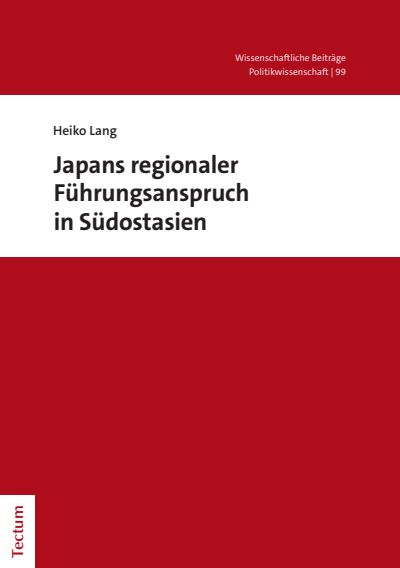
Japans regionaler Führungsanspruch in Südostasien
- Autor:innen:
- Reihe:
- Wissenschaftl.Beitr.a.d.Tectum Verlag: Politikwissenschaft, Band 99
- Verlag:
- 2022
Zusammenfassung
Mit diesem Werk bietet der Autor eine Analyse der Regionalpolitik Japans in Südostasien von den 1970er Jahren bis zur Gegenwart, mit besonderem Fokus auf den japanischen Führungsanspruch. Nach der diskursanalytischen Betrachtung des Wandels im japanischen Führungskonzept und der angestrebten regionalen Ordnung wird empirisch anhand von Fallstudien die Regionalstrategie Japans analysiert, seinen Führungsanspruch auch gegen die chinesische Herausforderung zu realisieren.
Das Buch richtet sich an Politikwissenschaftler:innen und Japanolog:innen, die im Bereich der japanischen Außenpolitik oder Regionalstudien arbeiten.
Der Autor ist promovierter Japanologe und unterrichtet Internationale Beziehungen in Tokyo.
Schlagworte
Publikation durchsuchen
Bibliographische Angaben
- Copyrightjahr
- 2022
- ISBN-Print
- 978-3-8288-4806-1
- ISBN-Online
- 978-3-8288-7918-8
- Verlag
- Tectum, Baden-Baden
- Reihe
- Wissenschaftl.Beitr.a.d.Tectum Verlag: Politikwissenschaft
- Band
- 99
- Sprache
- Deutsch
- Seiten
- 154
- Produkttyp
- Monographie
Inhaltsverzeichnis
- Titelei/Inhaltsverzeichnis Kein Zugriff Seiten I - VI
- 1.1 Fragestellung, Thesen und Ziele Kein Zugriff
- 1.2 Methode und Vorgehensweise Kein Zugriff
- 2.1 Der Machtbegriff im Bereich regionaler Führung Kein Zugriff
- 2.2 Systembegriff und Machtverteilung im regionalen System Kein Zugriff
- 2.3 Führung auf der regionalen Ebene Kein Zugriff
- 2.4 Selbstverständnis als Führungsmacht und Führungsanspruch Kein Zugriff
- 2.5 Ergebnis: der theoretische Führungsbegriff Kein Zugriff
- 2.6 Theoretische Konzeption der regionalen Ordnung Südostasiens Kein Zugriff
- 3.1 Grundlagen des japanischen Führungsanspruchs Kein Zugriff
- 3.2 Einflussfaktoren auf Japans Regionalpolitik Kein Zugriff
- 3.3 Japans Selbstbild seiner regionalen Rolle Kein Zugriff
- 3.4 Analyse des japanischen Führungsanspruchs: Stil, Machtmittel und Rollenbilder Kein Zugriff
- 3.5 Fazit Kein Zugriff
- 4.1 Rückkehr in die Region: vorsichtige Annäherung (1955–1977) Kein Zugriff
- 4.2 Die Fukuda-Doktrin als Wendepunkt Kein Zugriff
- 4.3 Politische Absichtserklärungen zum Aufbau einer ökonomischen Führungsposition (1977–1990) Kein Zugriff
- 4.4 Das Ende des Kalten Kriegs und der Golfkrieg Kein Zugriff
- 4.5 Initiativen für eine wirtschaftliche und politische Integration (1990–2006) Kein Zugriff
- 4.6 Führungskonkurrenz mit China (2006 bis 2020) Kein Zugriff
- 5.1 Phase I (1975–1978): Rhetorischer Führungsanspruch Kein Zugriff
- 5.2 Phase II (1978–1988): Passivität Kein Zugriff
- 5.3 Phase III (1989–1993): Aktive Vermittlungsbemühungen Kein Zugriff
- 5.4 Japanische Führung im Kontext des Kambodscha-Konflikts? Kein Zugriff
- 6.1 Phase I: Formulierung des Führungsanspruchs und AMF-Plan Kein Zugriff
- 6.2 Phase II (November 1997–Mitte 1998): Das Manila Framework Kein Zugriff
- 6.3 Phase III (November 1998–2000): Erneute Führungsinitiative Kein Zugriff
- 6.4 Japanische Führung in der Finanzkrise? Kein Zugriff
- 7.1 Phase I: Die Grundlegung des FOIP Kein Zugriff
- 7.2 Reaktionen der ASEAN und der USA Kein Zugriff
- 7.3 Phase II: Versuch der Integration von FOIP und AOIP Kein Zugriff
- 7.4 Japanische Führung bei der regionalen Ordnungsbildung? Kein Zugriff
- 8.1 Zusammenfassung der zentralen Ergebnisse Kein Zugriff
- 8.2 Diskrepanzen zwischen Anspruch und Wirklichkeit der japanischen Führung Kein Zugriff
- 8.3 Ist Japan Führungsmacht? Kein Zugriff
- 8.4 Ausblick Kein Zugriff
- Abkürzungsverzeichnis Kein Zugriff Seiten 143 - 144
- Literaturverzeichnis Kein Zugriff Seiten 145 - 154
Literaturverzeichnis (125 Einträge)
Es wurden keine Treffer gefunden. Versuchen Sie einen anderen Begriff.
- Abe, Shinzō (2013): Japan is Back, https://www.mofa.go.jp/announce/pm/abe/us_20130222en.html. Google Scholar öffnen DOI: 10.5771/9783828879188
- Abe, Shinzō (2014): The 13th Asia Security Summit: The Shangri-La Dialogue Keynote Address, https://www.mofa.go.jp/fp/nsp/page4e_000086.html. Google Scholar öffnen DOI: 10.5771/9783828879188
- ASEAN (o. J.), ASEAN Outlook on the Indo-Pacific, https://asean.org/asean2020/wp-content/uploads/2021/01/ASEAN-Outlook-on-the-Indo-Pacific_FINAL_22062019.pdf. Google Scholar öffnen DOI: 10.5771/9783828879188
- Ashida, Ichirō (1993): Ajia no „meishu“ heno yabō to sono haikei [Der Ehrgeiz, „Führer“ Asiens zu werden, und der Hintergrund], in: Zen’ei 11:639, S. 225–241. Google Scholar öffnen DOI: 10.5771/9783828879188
- Asō, Tarō (2005): Asian Strategy As I See It: Japan as the „Thought Leader“ of Asia, http://www.mofa.go.jp/announce/fm/aso/speech0512.html. Google Scholar öffnen DOI: 10.5771/9783828879188
- Asō, Tarō (2006): Bogen der Freiheit und Prosperität, http://www.de.emb-japan.go.jp/naj/NaJ0701/vortrag.htm. Google Scholar öffnen DOI: 10.5771/9783828879188
- Baldwin, David A. (2002): Power and International Relations, in: Carlsnaes, Walter et al. (Hrsg.): Handbook of International Relations, London: Sage, S. 177–191. Google Scholar öffnen DOI: 10.5771/9783828879188
- Beeson, Mark (2001): Japan and Southeast Asia: The Lineaments of Quasi-Hegemony, in: Rodan, Garry et al. (Hrsg.): The Political Economy of South-East Asia: An Introduction, S. 283–306. Google Scholar öffnen DOI: 10.5771/9783828879188
- Black, Lindsay (2017): Japan’s Aspirations for Regional Leadership – Is the Goose Finally Cooked?, in: Japanese Studies 37:2, S. 151–170. Google Scholar öffnen DOI: 10.5771/9783828879188
- Blechinger, Verena (1998): Zwischen Bilateralismus und Regionalismus: Die innenpolitische Debatte über eine politische Rolle Japans in Asien, in: Japanstudien 10. Jahrbuch des Deutschen Instituts für Japanstudien der Philipp Franz von Siebold Stiftung, München. Google Scholar öffnen DOI: 10.5771/9783828879188
- Blechinger, Verena / Legewie, Jochen (2000): Action and Reaction, Direct and Indirect Leadership: Re-Evaluating Japan’s Role in Asian Regional Cooperation, in: Dies. (Hrsg.): Facing Asia – Japan’s Role in the Political and Economic Dynamism of Regional Cooperation, München: Iudicum, S. 297–324. Google Scholar öffnen DOI: 10.5771/9783828879188
- Burns, James M. (1978): Leadership, New York: Harper Colophon. Google Scholar öffnen DOI: 10.5771/9783828879188
- Calder, Kent E. (2000): Will Japan Play a Leadership Role in East Asian Regional Political and Economic Integration?, in: Blechinger, Verena / Legewie, Jochen (Hrsg.): Facing Asia – Japan’s Role in the Political and Economic Dynamism of Regional Cooperation, München: Iudicum, S. 11–20. Google Scholar öffnen DOI: 10.5771/9783828879188
- Chachavalpongpun, Pavin (2014): Approaches Toward Regionalism: Japan, China, and the Implications on ASEAN, in: Shiraishi, Takashi / Kojima, Takaaki (Hrsg.): ASEAN-Japan Relations, Singapur: Institute of Southeast Asian Studies, S. 38–54. Google Scholar öffnen DOI: 10.5771/9783828879188
- Choong, William (2020): Japan’s Indo-Pacific Strategy in Southeast Asia: Floundering, not Foundering, in: ISEAS Perspective 40, 1–8. Google Scholar öffnen DOI: 10.5771/9783828879188
- Cooney, Kevin J. (2004): Japan’s Foreign Policy Maturation: A Quest for Normalcy, New York: Routledge. Google Scholar öffnen DOI: 10.5771/9783828879188
- Dieter, Heribert (2008): Lehren aus der Asien-Krise. Neue Formen der finanzpolitischen Kooperation in Südost- und Ostasien, SWP-Studie vom November 2008. Google Scholar öffnen DOI: 10.5771/9783828879188
- Diplomatic Bluebook 1978, http://www.mofa.go.jp/policy/other/bluebook/1978/1978-2.htm (Internetquelle 1). Google Scholar öffnen DOI: 10.5771/9783828879188
- Diplomatic Bluebook 1978, http://www.mofa.go.jp/policy/other/bluebook/1978/1978-3-1.htm (Internetquelle 2). Google Scholar öffnen DOI: 10.5771/9783828879188
- Diplomatic Bluebook 1981, http://www.mofa.go.jp/policy/other/bluebook/1981/1981-2.htm (Internetquelle 3). Google Scholar öffnen DOI: 10.5771/9783828879188
- Diplomatic Bluebook 1984, http://www.mofa.go.jp/policy/other/bluebook/1984/1984-2.htm (Internetquelle 4). Google Scholar öffnen DOI: 10.5771/9783828879188
- Diplomatic Bluebook 1989, http://www.mofa.go.jp/policy/other/bluebook/1989/1989-1-3.htm (Internetquelle 5). Google Scholar öffnen DOI: 10.5771/9783828879188
- Diplomatic Bluebook 1991, http://www.mofa.go.jp/policy/other/bluebook 1991/1991-1-2.htm (Internetquelle 6). Google Scholar öffnen DOI: 10.5771/9783828879188
- Diplomatic Bluebook 1998, http://www.mofa.go.jp/policy/other/bluebook/1998/I-b.html#5 (Internetquelle 7). Google Scholar öffnen DOI: 10.5771/9783828879188
- Diplomatic Bluebook 2000, http://www.mofa.go.jp/policy/other/bluebook/2000/I-c.html#4 (Internetquelle 8). Google Scholar öffnen DOI: 10.5771/9783828879188
- Diplomatic Bluebook 2001, http://www.mofa.go.jp/policy/other/bluebook/2001/chap1-a.html (Internetquelle 9). Google Scholar öffnen DOI: 10.5771/9783828879188
- Diplomatic Bluebook 2013, https://www.mofa.go.jp/policy/page22e_000013.html (Internetquelle 10). Google Scholar öffnen DOI: 10.5771/9783828879188
- Diplomatic Bluebook 2014, https://www.mofa.go.jp/fp/pp/page22e_000566.html (Internetquelle 11). Google Scholar öffnen DOI: 10.5771/9783828879188
- Diplomatic Bluebook 2020, https://www.mofa.go.jp/files/100116875.pdf (Internetquelle 12). Google Scholar öffnen DOI: 10.5771/9783828879188
- Diplomatic Bluebook 2022, https://www.mofa.go.jp/files/100400275.pdf (Internetquelle 13). Google Scholar öffnen DOI: 10.5771/9783828879188
- Funabashi, Yoichi (1991): Japan and the New World Order, in: Foreign Affairs 70:5, S. 58–74. Google Scholar öffnen DOI: 10.5771/9783828879188
- Gallie, Walter Bryce (1956): Essentially Contested Concepts, in: Proceedings of the Arestotelian Society 56, S. 167–198. Google Scholar öffnen DOI: 10.5771/9783828879188
- Heginbotham, Eric / Samuels, Richard J. (1998): Mercantile Realism and Japanese Foreign Policy, in: International Security 22:4, S. 171–203. Google Scholar öffnen DOI: 10.5771/9783828879188
- Heiduk, Felix / Wacker, Gudrum (2020): From Asia Pacific to Indopacific: Significance, Implementation and Challenges, in: SWP Research Paper 9, German Institute for International and Security Affairs. Google Scholar öffnen DOI: 10.5771/9783828879188
- Hirata, Keiko (2001a): Reaction and Action: Analyzing Japan’s relations with the Socialist Republic of Vietnam, in: Maswood, S. Javed (Hrsg.): Japan and East Asian Regionalism, London: Routledge, S. 90–117. Google Scholar öffnen DOI: 10.5771/9783828879188
- Hirata, Keiko (2001b): Cautious Proactivism and Reluctant Reactivism: Analyzing Japan’s Foreign Policy toward Indochina, in: Miyashita, Akitoshi / Sato, Yoichiro (Hrsg.): Japanese Foreign Policy in Asia and the Pacific: Domestic Interests, American Pressure, and Regional Integration, New York: Palgrave, S. 75–100. Google Scholar öffnen DOI: 10.5771/9783828879188
- Hook, Glenn D. et al. (2005): Japan’s International Relations: Politics, Economics and Security, London: Routledge. Google Scholar öffnen DOI: 10.5771/9783828879188
- Hornung, Jeffrey (2010): Japan’s Cooperative Leadership, in: APSA Annual Meeting Paper, https://ssrn.com/abstract=1642372. Google Scholar öffnen DOI: 10.5771/9783828879188
- Hosoya, Yuichi (2019): FOIP 2.0: The Evolution of Japan’s Free and Open Indo-Pacific Strategy, in: Asia-Pacific Review 26:1, S. 18–28. Google Scholar öffnen DOI: 10.5771/9783828879188
- Hughes, Christopher W. (1999): Japanese Policy and the East Asian Currency Crisis: Abject Defeat or Quiet Victory?, CSGR Working Paper 24, http://www2.warwick.ac.uk/fac/soc/csgr/research/workingpapers/1999/wp2499.pdf. Google Scholar öffnen DOI: 10.5771/9783828879188
- Ikenberry, G. John / Kupchan, Charles A. (1990): The Legitimation of Hegemonic Power, in: Rapkin, David P.: World Leadership and Hegemony, Boulder u. a.: Lynne Rienner Publishing, S. 49–69. Google Scholar öffnen DOI: 10.5771/9783828879188
- Ikenberry, John G. / Kupchan, Charles A. (1990): Socialization and Hegemonic Power, in: International Organization 44:3, S. 283–315. Google Scholar öffnen DOI: 10.5771/9783828879188
- Inada, Juichi (2007): Responding to the Asian Financial Crisis, in: Berger, Thomas U. et al. (Hrsg.): Japan in International Politics. The Foreign Policies of an Adaptive State, London: Lynne Rienner Publishers, S. 151–178. Google Scholar öffnen DOI: 10.5771/9783828879188
- Institute for International Monetary Affairs (2000): Speech by Mr. Taku Hiramatsu „Framework for Regional Monetary Stabilization“, http://www.iima.or.jp/pdf/Mr.Hiramatsu.pdf. Google Scholar öffnen DOI: 10.5771/9783828879188
- Ito, Go (2004): Leadership in Bandwagon: A Historical Sketch of Japan’s Security Policy, in: Policy and Society 23:1, S. 21–37. Google Scholar öffnen DOI: 10.5771/9783828879188
- Jain, Purnendra (2016): New Thinking Redefines Japan’s Foreign Aid Policy, in: Asian Studies Association of Australia, https://asaa.asn.au/new-thinking-redefines-japans-foreign-aid-policy. Google Scholar öffnen DOI: 10.5771/9783828879188
- Johnstone, Christopher B. (1999): Paradigms Lost: Japan’s Asia Policy in a Time of Growing Chinese Power, in: Contemporary Southeast Asia 21:3, S. 365–385. Google Scholar öffnen DOI: 10.5771/9783828879188
- Kang, David C. (2003): Getting Asia Wrong. The Need for New Analytical Frameworks, in: International Security 27:4, S. 57–85. Google Scholar öffnen DOI: 10.5771/9783828879188
- Kang, David C. (2004): Hierarchy, Balancing and Empirical Puzzles in Asian International Relations, in: International Security 28:3, S. 165–180. Google Scholar öffnen DOI: 10.5771/9783828879188
- Katada, Saori (2001): Determining Factors of Japan’s Cooperation and Non-cooperation with the United States: The Case of Asian Financial Crisis Management, 1997–1999, in: Miyashita Akitoshi / Sato Yoichiro (Hrsg.): Japanese Foreign Policy in Asia and the Pacific: Domestic Interests, American Pressure, and Regional Integration, St. Martin’s Press, S. 155–173. Google Scholar öffnen DOI: 10.5771/9783828879188
- Katzenstein, Peter (1996): Cultural Norms and National Security: Police and Military in Postwar Japan, Ithaca: Cornell University Press. Google Scholar öffnen DOI: 10.5771/9783828879188
- Katzenstein, Peter J. (2005): A World of Regions: Asia and Europe in the American Imperium, Ithaca: Cornell University Press. Google Scholar öffnen DOI: 10.5771/9783828879188
- Kawashima, Yutaka (2003): Japanese Foreign Policy at the Crossroads – Challenges and Options for the Twenty-First Century, Washington: Brookings Institution Press. Google Scholar öffnen DOI: 10.5771/9783828879188
- Keohane, Robert O. (1984): After Hegemony: Cooperation and Discord in the World Political Economy, Princeton: Princeton University Press. Google Scholar öffnen DOI: 10.5771/9783828879188
- Keohane, Robert O. / Nye, Joseph S. (1977): Power and Interdependence: World Politics in Transition, Boston: Little, Brown and Company. Google Scholar öffnen DOI: 10.5771/9783828879188
- Khong, Yuen Foong (2017): Who Will Replace the US in Southeast Asia, in: East Asia Forum, 6. September, https://www.eastasiaforum.org/2017/09/06/who-will-replace-the-us-in-southeast-asia. Google Scholar öffnen DOI: 10.5771/9783828879188
- Kikuchi, Tsutomu (2005): East Asia’s Quest for a Regional Community, in: Policy and Society 25:4, S. 23–35. Google Scholar öffnen DOI: 10.5771/9783828879188
- Kimura, Takayuki (1997): Japan-US Relations in the Asia-Pacific, in: Grant, Richard L. (Hrsg.): The Process of Japanese Foreign Policy – Focus on Asia, London: Royal Institute of International Affairs, S. 37–71. Google Scholar öffnen DOI: 10.5771/9783828879188
- Koga, Kei (2021a): Japan-Southeast Asia Relations: A Diplomatic „New Normal“ in the Indo-Pacific Region?, in: Comparative Connections 23:1, S. 151–160. Google Scholar öffnen DOI: 10.5771/9783828879188
- Koga, Kei (2021b): Japan’s Free and Open Indo-Pacific Vision under Suga: Transition and Future Challenges in Southeast Asia, in: East Asian Policy 13:3, S. 84–100. Google Scholar öffnen DOI: 10.5771/9783828879188
- Koga, Kei (2022): Southeast Asia in Japan’s FOIP Vision 2022, in: Nagy, Stephen R. (Hrsg.): Japan in the Indo-Pacific: Investing in Partnerships in South and Southeast Asia, Special Paper, Institute for Security and Development Policy, S. 23–32 (online abrufbar unter https://www.isdp.eu/publication/japan-in-the-indo-pacific-investing-in-partnerships-in-south-and-southeast-asia/). Google Scholar öffnen DOI: 10.5771/9783828879188
- Krauss, Ellis S. (2000): Japan, the US, and the emergence of multilateralism in Asia, in: Pacific Review 13:1, S. 473–494. Google Scholar öffnen DOI: 10.5771/9783828879188
- Kugler, Jacek / Organski, A. F. K. (1989): The Power Transition: A Retroperspective and Prospective Evaluation, in: Midlarski, Manus I. (Hrsg.): Handbook of War Studies, Boston: Unwin Hyman, S. 171–194. Google Scholar öffnen DOI: 10.5771/9783828879188
- Kupchan, Charles A. (1998): After Pax Americana. Benign Power, Regional Integration, and the Sources of a Stable Multipolarity, in: International Security 23:2, S. 40–79. Google Scholar öffnen DOI: 10.5771/9783828879188
- Kwan, C. H. (2001): Yen Bloc: Toward Economic Integration in Asia, Washington: Brookings Institution Press. Google Scholar öffnen DOI: 10.5771/9783828879188
- Lam, Peng Er (1996): Japan’s Search for a Political Role in Southeast Asia, in: Southeast Asian Affairs, 23:40, S. 40–55. Google Scholar öffnen DOI: 10.5771/9783828879188
- Lam, Peng Er (2000): Japanese Relations with Southeast Asia in an Era of Turbulence, in: Inoguchi, Takashi / Purnendra, Jain (Hrsg.): Japanese Foreign Policy Today, New York: Palgrave, S. 251–265. Google Scholar öffnen DOI: 10.5771/9783828879188
- Lam, Peng Er (2001): Japan’s Diplomatic Initiatives in Southeast Asia, in: Maswood, S. Javed (Hrsg.): Japan and East Asian Regionalism, London: Routledge, S. 118–131. Google Scholar öffnen DOI: 10.5771/9783828879188
- Lang, Heiko (2020): Competing Visions of Japan’s Relations with Southeast Asia, 1938–1960: Identity, Asianism and the Search for a Regional Role, Baden-Baden: Nomos. Google Scholar öffnen DOI: 10.5771/9783828879188
- Lang, Heiko (2022): The San Francisco System in Southeast Asia and Japan’s Search for a Regional Order in the 1950s, in: Sugita, Yoneyuki und Teo, Victor (Hrsg.): Rethinking the San Francisco System in Indo-Pacific Security, Singapore: Palgrave Macmillan, S. 107–131. Google Scholar öffnen DOI: 10.5771/9783828879188
- Lee, Lavina (2016): Abe’s Democratic Security Diamond and New Quadrilateral Initiative: An Australian Perspective, in: The Journal of East Asian Affairs 30:2, S. 1–41. Google Scholar öffnen DOI: 10.5771/9783828879188
- Lemke, Douglas (2002): Regions of War and Peace, New York: Cambridge University Press. Google Scholar öffnen DOI: 10.5771/9783828879188
- Lincoln, Edward J. (1993): Japan’s New Global Role, Washington: Brookings Institution. Google Scholar öffnen DOI: 10.5771/9783828879188
- Lincoln, Edward J. (2004): East Asian Economic Regionalism, Washington: Brookings Institution Press. Google Scholar öffnen DOI: 10.5771/9783828879188
- Lindberg, Leon N. / Scheingold, Stuart A. (1970): Europe’s Would-Be Polity: Patterns of Change in the European Community, Englewood Cliffs: Prentice-Hall. Google Scholar öffnen DOI: 10.5771/9783828879188
- Lipscy, Phillip (2003): Japan’s Asian Monetary Fund Proposal, in: Stanford Journal of East Asian Affairs 3:1, S. 93–104. Google Scholar öffnen DOI: 10.5771/9783828879188
- Lukes, Stephen (1976): Power: A Radical View, London: Macmillan. Google Scholar öffnen DOI: 10.5771/9783828879188
- Mahatir, Mohamad / Ishihara, Shintarō (1996): The Voice of Asia: Two Leaders Discuss the Coming Century, Tokyo: Kōdansha. Google Scholar öffnen DOI: 10.5771/9783828879188
- Mastanduno, Michael (2003): Incomplete Hegemony. The United States and Security Order in Asia, in: Alagappa, Muthiah (Hrsg.): Asian Security Order. Instrumental and Normative Features, Stanford: Stanford University Press, S. 141–170. Google Scholar öffnen DOI: 10.5771/9783828879188
- Maswood, S. Javed (2001): Japanese foreign policy and regionalism, in: Ders. (Hrsg.): Japan and East Asian Regionalism, London: Routledge, S. 8–25. Google Scholar öffnen DOI: 10.5771/9783828879188
- Maswood, S. Javed (2004): Japanese Foreign Policy: Leadership and Style, in: Policy and Society 23:1, S. 39–57. Google Scholar öffnen DOI: 10.5771/9783828879188
- Mearsheimer, John J. (2001): The Tragedy of Great Power Politics, New York: Norton. Google Scholar öffnen DOI: 10.5771/9783828879188
- Mendl, Wolf (1995): Japan’s Asia Policy: Regional Security and Global Interests, London: Routledge. Google Scholar öffnen DOI: 10.5771/9783828879188
- Michishita, Narushige (2022): Japan’s Grand Strategy for a Free and Open Indo-Pacific, in: Pekkanen, Robert J. / Pekkanen, Saskia M. (Hrsg.): The Oxford Handbook of Japanese Politics, Oxford: Oxford University Press, S. 493–513. Google Scholar öffnen DOI: 10.5771/9783828879188
- Midford, Paul (2015): Japan’s approach to Maritime Security in the South China Sea, in: Asian Survey 55:3, S. 525–547. Google Scholar öffnen DOI: 10.5771/9783828879188
- Midford, Paul (2020): Overcoming Isolationism: Japan’s Leadership in East Asian Security Multilateralism, Stanford: Stanford University Press. Google Scholar öffnen DOI: 10.5771/9783828879188
- Ministry of Foreign Affairs (1999,1): Asian Economic Crisis and Japan’s Contribution, http://www.mofa.go.jp/policy/economy/asia/crisis0010.html. Google Scholar öffnen DOI: 10.5771/9783828879188
- Ministry of Foreign Affairs (1999,2): Challenge 2001 – Japan’s Foreign Policy toward the 21st Century, www.mofa.go.jp/policy/other/challenge21.html. Google Scholar öffnen DOI: 10.5771/9783828879188
- Ministry of Foreign Affairs (2020): The 12th Mekong-Japan Summit, https://www.mofa.go.jp/page3e_001078.html. Google Scholar öffnen DOI: 10.5771/9783828879188
- Ministry of Foreign Affairs (o. J.): „Japan’s Bilateral Swap arrangements under Chiang Mai Initiative“, http://www.mof.go.jp/jouhou/kokkin/pcmie.htm. Google Scholar öffnen DOI: 10.5771/9783828879188
- Mochizuki, Mike M. (2007a): Japan’s Changing International Role, in: Berger, Thomas et al. (Hrsg.): Japan in International Politics: The Foreign Policies of an Adaptive State, Boulder: Lynne Rienner, S. 1–23. Google Scholar öffnen DOI: 10.5771/9783828879188
- Nabers, Dirk (2008): China, Japan and the Quest for Leadership in East Asia, Giga Working Paper 67. Google Scholar öffnen DOI: 10.5771/9783828879188
- Neumann, Iver B. (Hrsg.) (1992): Regional Great Powers in International Politics, Basingstroke: St. Martin’s Press. Google Scholar öffnen DOI: 10.5771/9783828879188
- Nolte, Detlef (2006): Macht und Machthierarchien in den internationalen Beziehungen: Ein Analysekonzept für die Forschung über regionale Führungsmächte, GIGA Working Paper Nr. 29, Oktober 2006. Google Scholar öffnen DOI: 10.5771/9783828879188
- Nye, Joseph S. (1990): Bound to Lead: The Changing Nature of American Power, New York: Basic Books. Google Scholar öffnen DOI: 10.5771/9783828879188
- Nye, Joseph S. (2002): The Paradox of American Power, Oxford: Oxford University Press. Google Scholar öffnen DOI: 10.5771/9783828879188
- Nye, Joseph S. (2004): Soft Power. The Means to Success in World Politics, New York: Public Affairs. Google Scholar öffnen DOI: 10.5771/9783828879188
- Obuchi, Keizō (1998): Japan and East sia: Outlook for the New Millenium, Rede vom 4. Mai 1998, https://www.mofa.go.jp/announce/announce/1998/5/980504.html. Google Scholar öffnen DOI: 10.5771/9783828879188
- Organski, A. F. K. (1958): World Politics, New York: Alfred A. Knopf. Google Scholar öffnen DOI: 10.5771/9783828879188
- Pedersen, Thomas (2002): Cooperative hegemony: power, ideas and institutions in regional integration, in: Review of International Studies 28, S. 677–696. Google Scholar öffnen DOI: 10.5771/9783828879188
- Pu, Xiaoyu (2019): To Dream an Impossible Dream: China’s Visions of Regional Order and the Implications for Japan, in: Sohn, Yul / Pempel, T. J. (Hrsg.): Japan and Asia’s Contested Order: The Interplay of Security, Economics, and Identity, Singapur: Palgrave Macmillan, S. 65–84. Google Scholar öffnen DOI: 10.5771/9783828879188
- Pyle, Kenneth B. (2007): Japan Rising. The Resurgence of Power and Purpose, New York: Public Affairs. Google Scholar öffnen DOI: 10.5771/9783828879188
- Rapkin, David P. (1990): Japan and World Leadership?, in: ders. (Hrsg.): World Leadership and Hegemony, Boulder: Lynne Rienner, S. 191–212. Google Scholar öffnen DOI: 10.5771/9783828879188
- Rapkin, David P. (1990): The Contested Concept of Hegemonic Leadership, in: ders. (Hrsg.): World Leadership and Hegemony, Boulder u. a.: Lynne Rienner Publishing, S. 1–19. Google Scholar öffnen DOI: 10.5771/9783828879188
- Rix, Alan (1993): Japan and the Region: Leading from Behind, in: Higgott, R. et al. (Hrsg): Pacific Economic Relations in the 1990s, St. Leonards: Allen & Unwin, S. 62–82. Google Scholar öffnen DOI: 10.5771/9783828879188
- Rozman, Gilbert (2007): Japanese Strategic Thinking on Regionalism, in: Ders. et al. (Hrsg.): Japanese Strategic Thought toward Asia, New York: Palgrave Macmillan, S. 243–268. Google Scholar öffnen DOI: 10.5771/9783828879188
- Soeya, Yoshihide (1997): Vietnam in Japan’s Regional Policy, in: Morley, James W. et al. (Hrsg.): Vietnam Joins the World, New York: M. E. Sharpe. Google Scholar öffnen DOI: 10.5771/9783828879188
- Soeya, Yoshihide (2003): Japan as a Regional Actor, in: Japan Center for International Exchange (Hrsg.): ASEAN-Japan Cooperation: A Foundation for East Asian Community, Tokyo: Japan Center for International Exchange, S. 47–59. Google Scholar öffnen DOI: 10.5771/9783828879188
- Stephens Alexander J. (2006): From Phoenix to Fire Hazard. Perceptions of Japanese Leadership in the Asia Pacific 1960–2000, ohne Ortsangabe. Google Scholar öffnen DOI: 10.5771/9783828879188
- Stubbs, Richard (1991): Reluctant Leader, Expectant Followers: Japan and Southeast Asia, in: International Journal 46:4, S. 649–667. Google Scholar öffnen DOI: 10.5771/9783828879188
- Sudo, Sueo (2002): The International Relations of Japan and South East Asia: Forging a New Regionalism, London: Routledge. Google Scholar öffnen DOI: 10.5771/9783828879188
- Sudo, Sueo (2005): Evolution of ASEAN-Japan relations. Southeast Asia Background Series No. 6, Singapore: ISEAS Publications. Google Scholar öffnen DOI: 10.5771/9783828879188
- Sudo, Sueo (2007): It Takes Two to Tango: The Conflict as Japan Sees It, in: Hsiung, James C. (Hrsg.): China and Japan at Odds: Deciphering the Perpetual Conflict, New York: Palgrave Macmillan, S. 43–58. Google Scholar öffnen DOI: 10.5771/9783828879188
- Suzuki, Hiroyuki (2020): Japan’s Leadership Role in a Multipolar Indo-Pacific, in: Center for Strategic and International Studies, October, S. 1–12. Google Scholar öffnen DOI: 10.5771/9783828879188
- Takeda, Yasuhiro (1998): Japan’s Role in the Cambodian Peace Progress, in: Asian Survey 28:6, S. 553–568. Google Scholar öffnen DOI: 10.5771/9783828879188
- Tan, See Seng (2020): Consigned to Hedge: South-East Asia and America’s ‚Free and Open Indo-Pacific‘ Strategy, in: International Affairs 96:1, S. 131–148. Google Scholar öffnen DOI: 10.5771/9783828879188
- Tanaka, Hitoshi (2005): Strategische Aufgaben für Japans Außenpolitik im 21. Jahrhundert, http://www.de.emb-japan.go.jp/NaJ/NaJ0510/aussenpolitik.htm. Google Scholar öffnen DOI: 10.5771/9783828879188
- Taplin, Ruth (1997): Japan’s Foreign Policy Towards Southeast Asia, in: Grant, Richard L. (Hrsg.): The Process of Japanese Foreign Policy – Focus on Asia, London: Royal Institute of International Affairs, S. 72–106. Google Scholar öffnen DOI: 10.5771/9783828879188
- Teo, Victor (2021): Southeast Asia-Japan Ties After Trump, in: ISEAS Perspective 31, S. 1–18. Google Scholar öffnen DOI: 10.5771/9783828879188
- Tonelson, Alan / Morse, Ronald (1991): Outdated Alliance Strategies, in: Pretowitz, Clyde et al. (Hrsg.): Powernomics: Economics and Strategy after the Cold War, Washington: Economic Strategy Institute, S. 241–256. Google Scholar öffnen DOI: 10.5771/9783828879188
- Triepel, Heinrich (1938): Die Hegemonie: Ein Buch von führenden Staaten, Stuttgart: Kohlhammer. Google Scholar öffnen DOI: 10.5771/9783828879188
- Waltz, Kenneth N. (2000): Structural Realism after the Cold War, in: International Security 25:1, S. 5–41. Google Scholar öffnen DOI: 10.5771/9783828879188
- Wirtschaftliche Planungsbehörde (1999): Ajia taiheiyô chiiki – Han’ei no tetsugaku: sôgô kokuryoku no kanten kara mita nihon no yakuwari [Die Asiatisch-Pazifische Region – Die Philosophie des Wohlstands: Die Rolle Japans, gesehen vom Standpunkt der gesamten nationalen Macht], Tokyo 1991. Google Scholar öffnen DOI: 10.5771/9783828879188
- Yasutomo, Dennis T. (1990): Why Aid? Japan as an „Aid Great Power“, in: Pacific Affairs 62:4, S. 490–503. Google Scholar öffnen DOI: 10.5771/9783828879188
- Young, Oran R. (1991): Political Leadership and Regime Formation: On the Development of Institutions in International Society, in: International Organization 45:3, S. 281–308. Google Scholar öffnen DOI: 10.5771/9783828879188